Chief Information Officer, Wor-Wic Community College
Caroline Chung
Co-Director of the Institute for Data Science in Oncology, The University of Texas MD Anderson Cancer Center
Devesh Maheshwari Chief Technology Officer, Lendi Group
FEATURING INSIDE
Dr. Mark van der Pas CEO, Uffective
Prof. Dr. Paul Boudreau President, Stonemeadow Consulting
Theresa Mcdonnell Chief Nurse Executive & SVP, Duke University Health System
Varun Kakaria North America CIO, Reckitt
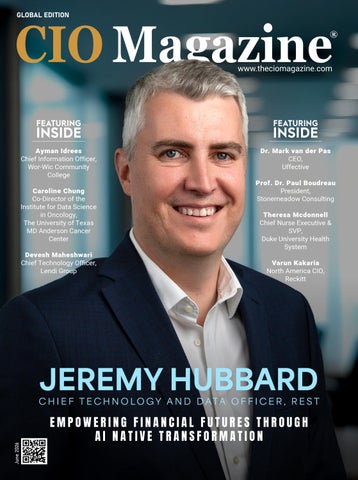
CHIEF TECHNOLOGY AND DATA OFFICER, REST JEREMY HUBBARD
EMPOWERING FINANCIAL FUTURES THROUGH AI NATIVE TRANSFORMATION
admin@thecioomagazine.com
www.thecioomagazine.com
admin@thecioomagazine.com
www.linkedin.com/company/ciomagazine
CIO Magazine www.theciomagazine.com is a global knowledge sharing digital platform published by Connecta Innovation Private Limited. All rights reserved. The opinions expressed in the content and pictures provided are those of the authors. They do not purport to reflect the opinions or views of Connecta Innovation Private Limited or any of its subsidiaries, its members or associates and we do not assume any responsibility. The publisher does not assume any responsibility for the advertisements. The content, pictures, and all warranties made in such advertisements are the sole responsibility of the advertisers. CIO Magazine www.theciomagazine.com is a Free Subscription and Free-to-read digital platform strictly not for sale and must be strictly for internal private use only. Publisher does not assume any responsibility arising out of anyone modifying content and pictures, printing a copy of this digital platform in any format and in any country and all matters related to that. “CIO Magazine www.theciomagazine.com“ and “The CIO Magazine www.theciomagazine.com“ trademarks are owned by Connecta Innovation Private Limited.
WHEN TECHNOLOGY TAKES THE NEXT STEP
Foryears, organizations have viewed technology as a tool that helps people work faster, make better decisions, and improve efficiency. Today, however, we are approaching a very different reality. The next wave of artificial intelligence is no longer focused solely on assisting humans. It is beginning to act on their behalf.
I was recently contemplating on how quickly our expectations of technology have evolved. Not long ago, having access to real-time data and automation was considered a competitive advantage. But, those capabilities are becoming table stakes now. The conversation has shifted toward systems that can independently execute tasks, make recommendations, coordinate workflows, and even anticipate needs. According to industry analysts, AI agents are expected to become a core component of enterprise operations over the next few years, fundamentally changing how organizations deliver value. Yet many businesses remain focused on productivity gains while overlooking the deeper transformation taking place beneath the surface.
This month’s cover story offers a compelling perspective on that shift. Jeremy Hubbard, Chief Technology and Data Officer at Rest, shares why he believes agentic AI represents a structural change rather than an incremental improvement. Drawing from decades of leadership experience across technology, banking, and financial services, Jeremy discusses the importance of challenging long-standing assumptions and building the data, governance, and identity foundations required for the future. His insights remind us that successful digital transformation is rarely about technology alone; it is about reimagining how organizations operate and serve their customers.
Beyond our cover feature, this issue of CIO Magazine brings together a collection of thoughtprovoking interviews, expert opinions, and industry perspectives exploring leadership, innovation, cybersecurity, data strategy, and emerging technologies. Together, they reflect the opportunities and challenges facing organizations as they navigate an increasingly intelligent and interconnected world.
The age of agentic AI is not a distant possibility. It is already beginning to reshape industries, institutions, and expectations. The leaders who thrive will be those willing to look beyond automation and prepare for a future where technology becomes an active participant in creating value. I invite you to explore this issue and discover the ideas that will help shape that future.
58 Chief Information Officer, Wor-Wic Community College From Services to Experiences: Reimagining AI Strategy in Higher Education
Varun Kakaria 22 North America CIO, Reckitt
Turning Technology into a True Business Accelerator
Theresa (Terry) Mcdonnell 16 CEO of IFS loops
DNP, ACNP-BC, Chief Nurse Executive & SVP, Duke University Health System
Caroline Chung 28 Co-Director of the Institute for Data Science in Oncology, The University of Texas MD Anderson Cancer Center
Building Culture First AI for Cancer Care
Devesh Maheshwari
48 Chief Technology Officer, Lendi Group
Empowering AINative Transformation in Financial Services
JEREMY HUBBARD
CHIEF TECHNOLOGY AND DATA OFFICER, REST
EMPOWERING FINANCIAL FUTURES THROUGH AI NATIVE TRANSFORMATION
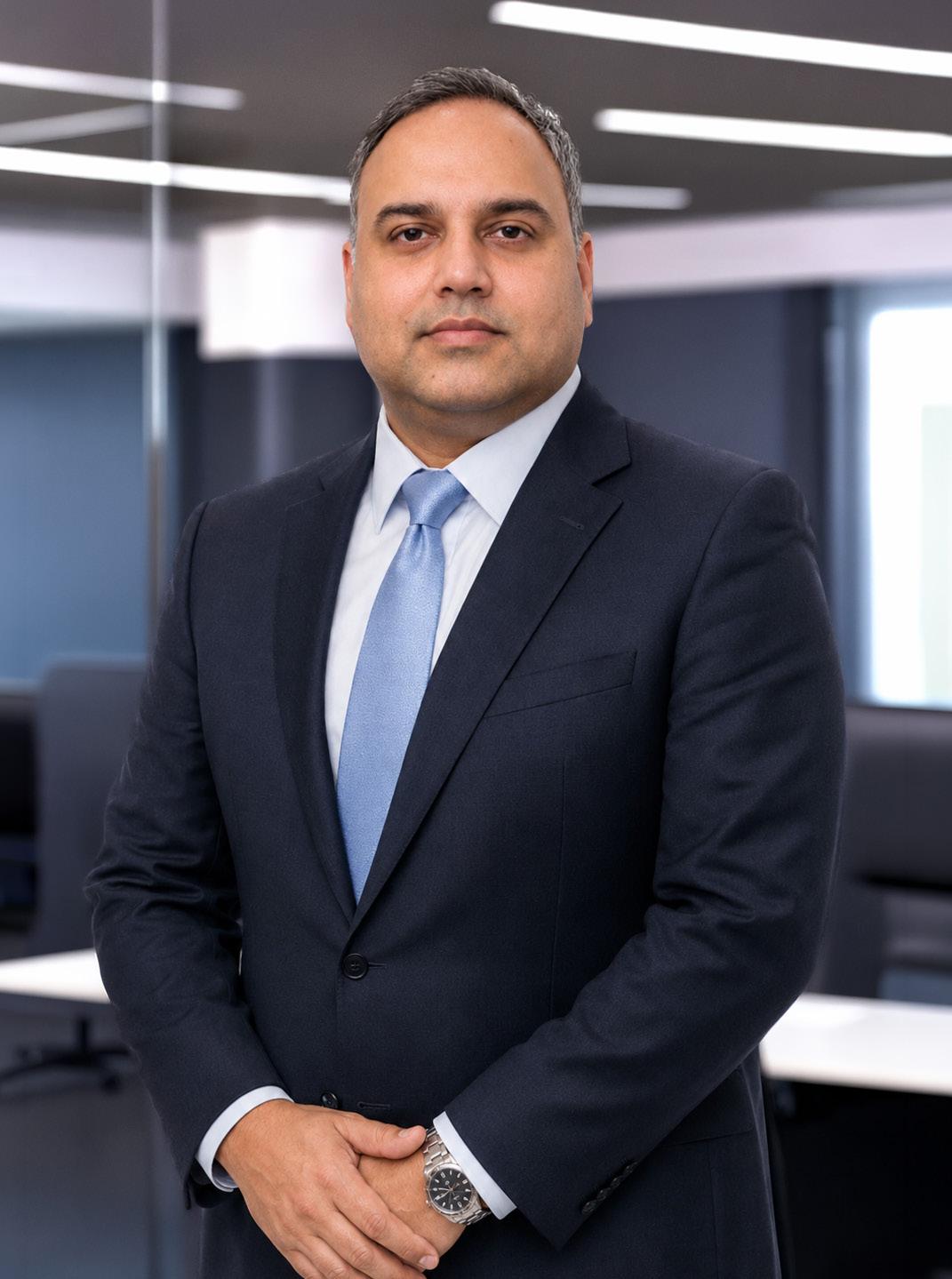
Jeremy Hubbard is Chief Technology and Data Officer at Rest, one of Australia’s largest superannuation funds. He is accountable for technology, cyber security, data analytics, and artificial intelligence. With over 30 years in technology, Jeremy previously served as CIO at UBank and held technology leadership roles at Once Australia, Capgemini, and Oracle Corporation. He is passionate about building high-performing teams and shaping organisational culture. A graduate of AICD’s Company Directors program, Jeremy holds a Bachelor of Information Technology from the University of Queensland and is completing a Master of Organisational Leadership at Melbourne Business School.
Recently, in an exclusive interview with CIO Magazine, Jeremy shared insights into how technology must disrupt rather than merely support business, a conviction formed at UBank in 2011 when launching Australia’s first digital home loan forced the team to challenge every non-negotiable banking assumption — from KYC to wet signatures — and redesign around how customers actually wanted to buy, not how banks had always processed. On industry trends, Jeremy sees GenAI for productivity as overhyped — useful but a starting point, not a destination — while agentic AI is underestimated, signaling a structural shift where AI acts on members’ behalf and funds with strong identity, governance, and data architecture will move fast while others retrofit. His advice to senior engineers aspiring to CIO: stop optimising for technical depth, start investing in business fluency, speak the language of outcomes, build relationships outside tech, and never stop learning. The following excerpts are taken from the interview.
What moment early in your career first convinced you that technology should disrupt, not just support, the business? It happened gradually, then all at once, which is probably how most shifts actually feel in hindsight.
I was in the early days of UBank, watching customers interact with financial products. The technology we were building inside the enterprise was nowhere near as easy to use, fast, or useful as what people already had in their pockets. The iPhone had arrived. Customers were setting the bar, not banks.
The moment that crystallised it was the launch of UBank’s home loan product in 2011. A mortgage had always been manual and paper-based – forms, branches, wet signatures, weeks of waiting. We made it digital. But to do that, we couldn’t just digitise the existing process. We had to challenge every assumption in it, including the things the bank considered
non-negotiable. Know-your-customer checks. Approval workflows. The whole model. We had to redesign it around how a customer actually wanted to buy a home loan, not around how the bank had always processed one.
That experience convinced me that technology’s job isn’t to automate what exists. It’s to ask whether what exists is worth automating at all, and if not, to build something better.
What do you love the most about your current role?
I keep coming back to scale and consequence. Rest has over 2 million members, 48% of them under 30. I feel genuinely privileged to play a role in shaping their experience and their retirement outcomes, people who are decades away from retirement and not thinking about super at all. That gap between where they are and where they need to be is exactly where technology can do something meaningful.
I’m passionate about building highperforming teams and helping people reach their potential, watching someone step into a role they didn’t think they were ready for is genuinely one of the best parts of the job
I also love that the role demands two completely different things at once. One part of my job is running a complex technology organisation, cyber, data, delivery, AI strategy, platforms, people. The other part is being a business leader at the executive table, shaping what Rest becomes over the next five years. The tension between those two keeps it honest. You can’t hide in either one.
I’m passionate about building highperforming teams and helping people reach their potential, watching someone step into a role they didn’t think they were ready for is genuinely one of the best parts of the job. At Rest I’ve been building a team where people have clarity of purpose, feel connected to member outcomes, and do the best work of their careers. There’s still more to do, but we’re well on our way.
Which trend in financial services technology is overhyped right now, and which is being underestimated?
AI is simultaneously the most overhyped and the most underestimated force in financial services right now, it just depends on which part of it you’re looking at.
The overhyped end is GenAI for productivity. Every fund, every bank, every fintech has announced a co-pilot or a summarisation tool. That work has value, but the industry is treating it like a destination. It’s a starting point. Many organisations are still at Stage 1, using AI to assist humans, and declaring victory.
What’s being underestimated is agentic AI and what it means for member service. We’re moving toward a world where AI doesn’t just assist people, it acts on their behalf, at scale,
The question to ask your CIO isn’t “are we compliant?” It’s “can our controls keep pace with threats that don’t wait for a human to review them?”
across the full arc of a member’s financial life. That’s a structural shift. The funds and banks that get their foundations right now (identity, governance, data architecture) will be able to move fast when the window is open. The ones that don’t will find themselves trying to retrofit governance onto systems that were never designed for non-human actors. That gap will compound quickly.
What
shift in the threat landscape should every board member understand by end of 2026?
The shift boards need to understand is that the threat environment is now operating at machine speed, and most of our defences were designed for human speed.
AI has fundamentally changed the offensive side of the equation, and most defensive postures haven’t kept pace. The window between a vulnerability being identified and exploited has collapsed from years to hours. AI-automated phishing is now achieving clickthrough rates of 54%, a 450% increase over standard phishing, and Microsoft detected 8.3 billion email phishing threats in Q1 2026 alone. This is what’s already happening.
For board members, the implication is straightforward. Cyber is a member and customer trust issue before it’s anything else. Trust, once lost, is extraordinarily hard to rebuild, and in financial services, it’s the foundation everything else rests on. Cyber is also a team sport. The threat doesn’t discriminate by organisation or sector, and the industry is stronger when we share intelligence, collaborate on standards, and treat this as a collective responsibility.
The question to ask your CIO isn’t “are we compliant?” It’s “can our controls keep pace with threats that don’t wait for a human to review them?”
What book, podcast, or idea has most influenced how you think about risk and innovation?
The Great Mental Models by Shane Parrish. It might sound abstract for a technology role, but at its core it’s about one thing: seeing the world as it actually is, not as you want it to be.
That distinction matters enormously in risk and innovation. Most bad decisions in technology come from one of two places, ego getting in the way of the facts, or being too far from the consequences of the decision to feel them clearly. Mental models are a way to pressure-test your own thinking before you commit. First principles thinking. Second-order consequences. Inversion, instead of planning for success, asking what would make this fail and working backward from there.
For me, the practical impact has been in how I approach risk conversations. The instinct in most organisations is to frame risk in a way that makes it easier to approve. I’d rather name it plainly and let the decision stand on honest ground.
What’s one piece of technology, in any industry, that you think is genuinely brilliant and why?
SpaceX and the reusable rocket.
For decades, everyone in aerospace accepted one thing as fact: rockets are single-use. SpaceX asked why, found no good answer, and built the rocket that proved it wrong. The result changed the economics of space entirely.
What’s equally compelling is how they got there. The first Starship test flight in 2023 exploded over the Gulf of Mexico before stage separation. Subsequent flights failed in different ways. In most organisations that level of public failure would have ended the programme. Instead, SpaceX treated each one as data, iterated fast, and by late 2024 were catching the booster mid-air on return. Eleven flights, six successes, five failures. It shows no sign of stopping.
That willingness to fail visibly, learn quickly, and keep going is rarer than it sounds. Most organisations manage risk on paper. SpaceX went and found out what would actually break. I find that genuinely brilliant.
What one sentence would you want your team to see every day?
Know the goal. Back each other. Find a way. What is your biggest goal? Where do you see yourself in 5 years?
My biggest goal right now is simple: get Rest to AI-native before the window closes. The super industry is at an inflection point, and the funds that build the right foundations (identity, governance, data architecture) in the next 12 to 18 months will be the ones that can move with confidence when agentic AI is ready to scale. The ones that don’t will be retrofitting. That gap compounds.
Beyond Rest, I want to keep growing as a leader. I’m completing a Master of Organisational Leadership at Melbourne Business School, and that’s deliberate. The hardest problems I face are human ones. How you build culture at scale, how you lead through uncertainty, how you develop people who then go on to lead others. That’s where I want to keep getting better.
In 5 years, I see myself in a role with broader scope, whether that’s a larger organisation, a board portfolio, or both. Impact is what I’m after: a chance to make a bigger difference for more people, contribute to decisions that matter, and keep building teams that do work they’re genuinely proud of.
What’s one piece of tactical advice you’d give a senior engineer who wants to become a CIO?
Stop optimising for technical depth and start investing in business fluency.
The technical skills got you here and they still matter. The gap between a great senior engineer and a CIO is about business fluency: the ability to influence senior leaders and drive real business outcomes. To take a complex technology decision and make a business leader care about it. To understand what the CFO is
worried about, what the CMO is trying to achieve, and frame your work in terms they’re making decisions against.
The engineers I’ve seen make that transition well didn’t wait for permission to play a bigger role. They started speaking the language of outcomes, customer outcomes, business outcomes, cost and risk, before anyone gave them a leadership title. They built relationships outside their team. They got curious about the parts of the business that had nothing to do with technology.
And they never stopped learning. Technology moves fast, faster now than at any point in my career. The leaders who stay relevant are the ones who stayed curious, adapted quickly, and were honest about what they didn’t yet know. That habit of continuous learning keeps you effective on the way up and once you’re there.
Wa n t t o S e l l o r fi n d
I nve s t o rs f o r yo u r
B u s i n e s s ?
Redefining Care Delivery for the Frontline and Future
Theresa (Terry) Mcdonnell
DNP, ACNP-BC, Chief Nurse Executive & SVP, Duke University Health System
Theresa (Terry) McDonnell, DNP, ACNP-BC, is Chief Nurse Executive and Senior Vice President at Duke University Health System and Vice Dean for Clinical Affairs at Duke University School of Nursing. With 25 years of enterprise healthcare leadership across organizations from $50M to enterprise scale, she has led transformational initiatives in workforce equity, AI-powered care delivery, and nursing innovation. A Gold Stevie Award winner for Most Resilient Female Leader and a Modern Healthcare Leading Women honoree, she is a Forbes contributor, global keynote speaker, and practicing Acute Care Nurse Practitioner in GI Oncology.
Recently, in an exclusive interview with CIO Magazine, Terry shared insights into leading at the intersection of clinical expertise and executive strategy. Addressing the national nursing crisis, she argues that workforce sustainability is an operating model problem, not an HR problem, and points to Duke’s Co-Care Model pairing bedside nurses with virtual nurses and AI-supported tools as proof that redesigning care delivery cuts burnout and turnover far more than perks ever could. On health equity, she says technology alone will not close gaps unless representation becomes an operational imperative, because systems designed by people who have navigated barriers make different, better decisions for communities. For early-career nurses, her advice is direct: raise your hand, volunteer for strategy-adjacent committees, understand the budget, read the annual report, propose solutions, and become a visible thought leader, because influence is earned long before permission is granted. The following excerpts are taken from the interview.
You stand at the intersection of clinical expertise and executive strategy. What moment at the bedside first made you realize you wanted to influence healthcare from the boardroom, not just the floor?
It was not a single moment, rather it was a series of moments, accumulated over time spent at the bedside and in the clinic, with colleagues that shared the continued frustration that the work they were doing was not reflected in the decisions being made about them. They wanted their reality to be represented in leadership. They wanted the people setting strategy to understand what it meant to care for a patient at two in the morning, or to navigate a family in crisis, or to manage a shift that was already short-staffed before it started.
That is why I have maintained my clinical practice throughout my executive career. I see patients in GI Oncology not as a formality but because it is the most important accountability mechanism I have and ultimately it is our why... It keeps the distance between the boardroom and the bedside from growing too wide. Every workforce decision I make, every technology I implement, and every transformation initiative I lead, I must be able to defend in the room where the care happens. That obligation never goes away. It just gets more consequential as the scale of the work grows.
Nurse turnover and burnout remain national crises. What structural shift — not just perks — will actually stabilize the nursing workforce by 2030?
We need to stop treating workforce sustainability as a human resources problem and start treating it as an operating model
problem. Perks, bonuses, wellness apps, and free meals, are generous gestures that do not address structural reality. Nurses are leaving the bedside because the conditions of the work have become unsustainable. It is a design failure, not a motivation failure.
The shift that will move the needle is redesigning how care is delivered so that nurses are not simultaneously managing the cognitive load of multiple competing tasks while also being asked to be fully present for the complex human beings in front of them. At Duke, we are addressing this directly through our Co-Care Model, which pairs bedside nurses with virtual nurses and AI-supported tools that redistribute the documentation burden, the administrative coordination, and the safety monitoring, so that the nurse at the bedside can focus on direct patient care. This new model reduces burnout significantly and we have seen a reduction in turnover.
By 2030, the organizations that stabilize their workforces will be the ones that redesigned care delivery — not the ones that offered the most competitive sign-on package.
Health equity is a stated priority, but gaps persist. Which operational change will do more to close disparities than any new technology?
Representation at every level of decisionmaking as an operational imperative. The gaps that persist in health equity are not primarily the result of insufficient data or inadequate technology. They are the result of systems designed by people who didn’t have to navigate the systems. When the people designing care delivery have personally experienced what it means to navigate barriers to access, or have
family members and colleagues who have, different decisions get made.
The operational change I would prioritize is ensuring that the clinical and administrative workforce at every level, from the unit to the boardroom, reflects the communities being served. The institutional knowledge that comes from lived experience changes the questions being asked. It changes how work and problem solving are prioritized and changes the patient experience.
Technology can accelerate progress once the direction is set and the strategic priorities reflect the priorities and needs of the people we serve within the community.
Leaders who carry both clinical and executive weight need grounding. What book, philosophy, or person outside healthcare has most shaped how you lead?
Robert Fulghum’s All I Really Need to Know I Learned in Kindergarten. I have come back to that book more times than I can count — not because it is simple, but because it is ruthlessly true. Share everything. Play fair. Don’t hit people. Clean up your own mess. Say sorry
when you hurt someone. Warm cookies and cold milk are good for you. Live a balanced life.
These simple truths create the perfect operating philosophy for leading large, complex organizations through hard change. The most expensive failures I have witnessed in healthcare leadership: the mergers that destroyed culture, the technology implementations that disrupted, and the workforce crises that were allowed to fester could be traced back to a violation of principles of community and simplicity.
I keep Fulghum close because executive leadership can accumulate a kind of institutional sophistication that makes simple ethical clarity harder to see. The titles, the budgets, and the complexity can make obvious things feel complicated. When that happens, I find it useful to go back to the beginning and keep things simple.
You’re a relentless advocate for workforce development. What’s the one skill you believe every nurse leader must develop to survive the next decade?
Financial fluency. The ability to translate clinical value into financial language is what determines
WE NEED TO STOP TREATING WORKFORCE SUSTAINABILITY AS A HUMAN RESOURCES PROBLEM AND START TREATING IT AS AN OPERATING MODEL PROBLEM
whether a nursing leader has influence over the decisions that shape the work. The leaders who will have the greatest impact on nursing in the next decade are the ones who can walk into a room with a CFO or a board and make the case for a workforce investment with a clear ROI.
I have watched extraordinary clinical leaders fail because they made an impactful decision that wasn’t vetted for financial risk. The turnover cost per nurse. The revenue impact of a ten-day reduction in average length of stay. The liability exposure of a preventable harm. These are the metrics that move decisions. And nurse leaders who can speak that language without abandoning clinical values will shape the future of the profession in ways that pure clinical advocacy cannot.
The leaders who will be highly successful will balance their clinical skills with financial and strategic acumen.
From frontline nurse to SVP shaping billion-dollar strategy, what core belief about healthcare has stayed constant for you, no matter the size of the budget or team?
Never before has the imperative for change been stronger and I think we can all agree that what got us here will not move us forward. That conviction has been with me from the beginning, and it only sharpens as the work becomes more challenging.
Academic healthcare has extraordinary strengths in the clinicians, and the science, balanced with genuinely compassionate care. But it also carries institutional inertia that protects models and structures long past the
point where they serve patients or the people delivering care.
The belief that has anchored everything for me is that our staff and our patients need to be reflected in our leadership and in the decisions we make. We can’t ever forget that the people best equipped to solve for the problems of today are those closest to the work. When we engage our staff to identify and solve problems, better decisions are made.
For early-career nurses with leadership ambitions, what’s the first move they should make if they want a seat at the strategy table?
Raise your hand first and volunteer to participate in solving problems. Bring your voice to quality committees, finance committees, governance structures, and workforce councils. Volunteer for the work that is adjacent to strategy, not just the work that is central to your current role. Every institution has committees that need members, and projects that need clinical perspective.
Understand the budget and how budgeting works. Understand the strategy and read the annual report. Be the person who comes with problems and propose solutions.
Be visible beyond your unit. Be a thought leader and share your insights externally at conferences and in broader forums. Every article, every conference panel, every LinkedIn post that reflects your genuine thinking expands the sphere in which you can have impact. The nurses who will lead healthcare through the next decade are already doing this work, they are not waiting for permission, neither should you.
Varun Kakaria
North America CIO, Reckitt
Turning Technology into a True Business Accelerator
Varun Kakaria is a global technology and digital transformation leader with more than two decades of experience driving growth, operational excellence, and AI-enabled execution across the CPG industry. As North America’s Chief Information & Digital Officer at Reckitt, he has led large-scale data, digital, AI, and omnichannel programs that strengthened commercial precision and simplified work for teams. Known for turning complexity into clarity, Varun builds high-trust, high-performing organizations and uses technology with purpose — to empower people, unlock value, and shape the future of consumer goods across North America and other global markets.
Recently, in an exclusive interview with CIO Magazine, Varun shared insights into how his 21 plus years in Consumer Packaged Goods have been shaped by moments where technology, people, and business outcomes intersect. Varun described his passion for working at the intersection of strategy and execution, building curious and empowered teams, and finding joy when people take ownership and deliver impact at scale. He sees the future defined by value driven consumers, AI powered decisioning, AI ready data, fragmented demand, and connected end to end execution, and stressed that treating technology as a business accelerator and investing in clean, reusable data foundations is how companies stay ahead. He also shared his personal hobbies and interests, future plans, words of wisdom, and much more. The following excerpts are taken from the interview.
Hi Varun. As you reflect on your 21+ years in the Consumer-Packaged Goods (CPG) domain, what pivotal moments shaped your career trajectory and led you to become the North America CIO at Reckitt?
Looking back, my career has been shaped less by titles and more by the inflection points where technology, people, and business outcomes intersected. My early consulting years taught me the true meaning of business value — that technology only matters when it solves a real problem, and customers will only invest their time or money when you’re delivering a tangible benefit.
Joining the CPG industry was the next defining shift. Very early on, I learned the power of frontline empathy: spending time with frontline teams, understanding their realities, and knowing the business cold. That became a differentiator — it gave me the ability to serve as the bridge between business and technology.
Leading large-scale digital transformations across markets reinforced another truth: data, automation, and disciplined execution can unlock disproportionate value when paired with clear purpose and strong cross-functional alignment.
But the most pivotal realization was this: the CIO role is no longer about systems or implementations. It’s about shaping and enabling growth — elevating technology from a support function to a true business partner and advisor that unlocks value across the enterprise.
And through all of this, the constant has been people. I’ve been fortunate to work with diverse, talented teams across cultures and markets. They’ve shaped me, challenged me, and enabled me to deliver consistently —
ultimately leading to the privilege of serving as CIO for North America.
What do you love the most about your current role?
What I enjoy most is the privilege of being at the intersection of strategy and execution. Every day brings a new challenge — from enabling commercial teams to win in the market, to strengthening and modernizing our digital backbone. But the real joy comes from building teams that are curious, empowered, and unafraid to challenge the status quo. When you see people grow, take ownership, and deliver impact at scale, that’s the most rewarding part of the job
What are the most significant challenges facing CPG leaders today, and how can they overcome them?
CPG leaders are navigating a perfect storm of shifting consumer expectations, margin pressure, supply chain volatility, explosion of data. The challenge is not just complexity — it’s speed. The companies that win will be the ones that simplify decision-making, embrace predictive and autonomous capabilities, and build cultures that move faster than the market. Overcoming these challenges requires a blend of disciplined execution, modern technology foundations, and a leadership mindset that values progress over perfection.
The CPG industry is rapidly evolving - what trends do you see shaping the future of consumer goods, and how can companies prepare?
The CPG industry is moving faster than ever, and a few forces are clearly shaping where it’s
headed: value-driven consumers, AI-powered decisioning, data that actually work across the enterprise, increasingly fragmented demand, and the need for truly connected, end-to-end execution.
What I am seeing — and feeling — is that these shifts aren’t theoretical anymore. They’re showing up in how consumers choose, how retailers negotiate, how supply chains respond, and how teams make decisions day to day.
For companies to stay ahead, they need to treat technology as a business accelerator, not just a safeguard for risk or compliance. When tech simplifies work, sharpens decisions, and frees people to focus on what matters, it becomes a real competitive advantage.
And none of this is possible without AIready data. Clean, connected, reusable data is what turns ambition into execution. Without it, even the best AI strategy stalls.
The companies that prepare early — with purposeful technology, strong data foundations, and a mindset of connected execution — won’t just keep pace with the industry. They’ll help define the future shape of this industry
What role do you see mentorship playing in career development, and how can aspiring professionals find the right mentors?
Mentorship has been one of the biggest accelerators in my career. The best mentors do not hand you answers — they stretch your thinking, challenge your assumptions, and hold up a mirror so you can see yourself more clearly. That kind of honest, thoughtful guidance is invaluable.
For aspiring professionals, the right mentors are not always the most senior people in the room. Look for people who genuinely inspire you — peers, leaders in other functions, or even individuals outside your industry. Sometimes the most transformative advice comes from someone who sees your world from a completely different angle.
FOR COMPANIES TO STAY AHEAD, THEY NEED TO TREAT TECHNOLOGY AS A BUSINESS ACCELERATOR, NOT JUST A SAFEGUARD FOR RISK OR COMPLIANCE
What matters most is intentionality. Be open to feedback, acknowledge where you want to grow, and ask for guidance with humility and clarity. And then — most importantly — act on it. Growth only happens when you are willing to do uncomfortable work.
Along the way, you will also encounter moments where you feel misunderstood or judged unfairly. One of the most powerful lessons I learned is that perception is someone’s reality. You don’t have to agree with it, but you do have to understand it. That openness — to listen, to reflect, and to adjust — can completely change how you navigate complex situations and relationships.
In the end, mentorship isn’t about finding someone to “fix” your career. It’s about surrounding yourself with people who help you become a sharper, more self-aware, more resilient version of yourself.
What skills or experiences do you believe are essential for success in the CPG industry?
Success in CPG requires a blend of commercial acumen, operational discipline, and a deep understanding of consumers. But the differentiators today are adaptability and storytelling. The industry moves quickly, and the ability to translate data into decisions — and decisions into action — is invaluable.
Experiences that expose you to the end-to-end value chain, from manufacturing to marketing,
build the kind of holistic perspective that sets leaders apart.
Can you share a book or resource that inspires you and why?
There have been many sources of inspiration in my life, but the one that has shaped my leadership the most is my mother. She taught me that good decisions aren’t made from presentations and spreadsheets alone — they’re made by understanding people, intent, and impact. Her belief is simple: if your intent is right, your morals are strong, and you surround yourself with good people, you can navigate almost any challenge.
That perspective has become foundational to how I lead as a CIO. Whether I’m spending time with teams, shaping a digital transformation, or
IF CPG LEADERS COMBINE PURPOSEFUL TECHNOLOGY, STRONG DATA FOUNDATIONS, EXCEPTIONAL TALENT, AND
A LASER FOCUS ON VALUE, THEY WON’T
JUST KEEP UP WITH THE INDUSTRY — THEY WILL SHAPE WHERE IT GOES NEXT
aligning leaders around a shared ambition, I always come back to that grounding: technology only creates value when it serves people.
What are some of your passions outside of work? What do you like to do in your time off?
Outside of work, I love to travel and spend time in nature, often with some good music in the background. I have also recently rekindled my old love for swimming — there is something about being in the water that clears my head and resets my energy.
But most importantly, I enjoy spending time with my family. Whether we’re exploring somewhere new or just relaxing together, those moments help me reset, stay grounded, and come back to work with clarity and focus.
What is your biggest goal? Where do you see yourself in 5 years from now?
My biggest goal is to continue driving technology transformations with purpose — the kind that genuinely make people’s lives simpler, help them work smarter, and unlock meaningful business outcomes. Technology is at its best when it simplifies complexity, elevates capability, and creates space for people to do their best work.
Over the next five years, I see myself leading at an even broader enterprise level — still deeply connected to technology, but with a wider remit to shape strategy, culture, and value creation. Whether that means scaling a multi - market digital agenda, driving end - to - end transformation, or stepping into a role that blends business and technology leadership, my focus will remain the same:
enabling growth, simplifying complexity, and building high - trust, high - performing teams that can deliver consistently at scale.
What advice would you give to CPG leaders looking to drive growth, improve efficiency, and stay ahead of the competition?
My advice is this: use technology to elevate people. The companies that win are not the ones with the most tools — they are the ones that solve real problems for real humans. When tech simplifies work and unlocks better decisions, growth becomes a natural outcome.
Second, treat data like a strategic asset. Clean, reusable, well-governed, AI-ready data is the fuel for everything ahead of us — automation, predictive execution, and AI at scale. Without strong data foundations, even the best technology can’t deliver its full value.
Third, invest in great talent. The right people — curious, adaptable, commercially minded — are what turn technology and data into real competitive advantage. Tools don’t transform organizations; people do.
And finally, lead with value. In today’s socio-economic environment, every program must earn its place. The organizations that stay ahead are the ones that measure impact relentlessly, double down on what works, and have the courage to stop what doesn’t. Valuedriven execution is no longer a discipline — it is a differentiator.
If CPG leaders combine purposeful technology, strong data foundations, exceptional talent, and a laser focus on value, they won’t just keep up with the industry — they will shape where it goes next.
Building Culture First AI for Cancer Care
Caroline Chung
Co-Director of the Institute for Data Science in Oncology, The University of Texas MD Anderson Cancer Center
Dr. Caroline Chung, recognized by Reuters as a Trailblazing Woman of 2026 in Enterprise AI, served as the inaugural Vice President and Chief Data & Analytics Officer at MD Anderson Cancer Center, co-directing the Institute for Data Science in Oncology and holding a tenured professorship in Radiation Oncology. A clinician specializing in CNS malignancies, she translates clinical challenges into enterprise-wide AI strategy, bridging precision medicine and patient outcomes at scale. Her global leadership spans co-president of the Quantitative Medical Imaging Coalition, co-chair of ASCO’s AI Community of Practice, advisory roles with the NIH and NCI, and co-authoring NASEM’s Digital Twins report. Dr. Chung is a defining voice in responsible, impactful AI implementation in medicine.
Recently, in an exclusive interview with CIO Magazine, Caroline shared insights into how clinical experience, quantitative rigor, and culture-first leadership are converging to redefine cancer care. On AI trends in oncology for 2026, she flagged multimodal AI as truly transformational while calling for more research on AI implementation, impact measurement, and the human-AI interface to understand how learning and critical thinking evolve. As Chair of Women in Cancer – All in Cancer, she credited “Strengthening Through Perspectives” events for moving the needle by fostering open dialogue across clinicians, researchers, STEM, industry, and patient advocates, stressing that sponsorship opens doors, because women and underrepresented leaders are often over-mentored and undersponsored. The following excerpts are taken from the interview.
Hi Caroline. Twenty years in radiation oncology and quantitative imaging is a foundation few AI leaders share. Can you take us back to the moment you first saw the link between pixels, data, and a patient’s life, and how did that shape your path?
It was not a single moment but an accumulation of lived experiences in the clinic, challenges identified in research and the promise of emerging technologies to leverage data to enable a better future for our patients.
As a radiation oncologist, defining the target for radiation treatment is a core part of delivering effective treatment. Very early in my career, I started in pursuit of extracting much more information from imaging data than just anatomy, information about the underlying biology. Information that could tell us which areas of the tumor would be most likely to respond to
treatment or be most likely to recur and may benefit from treatment intensification. However, treating a pixel as more than just an image signal but rather a measurement demands a metrology that supports quantitative medical imaging.
While we generate enormous amounts of imaging data across medicine, we currently continue to treat a lot of this data as visual aids to clinical decision making when it could be used as quantitative measurements. With the growing capabilities of AI and computational algorithms, there is great opportunity to utilize quantitative imaging measurements to support precision medicine, increasing the speed of novel therapeutic discovery and the efficiency of clinical trials to advance clinical care. Precision medicine relies on precision measurements and this applies to current clinical care, even more with the integration of AI into clinical care and critically to enable digital twins.
What do you love the most about your current role?
What an extraordinary opportunity it has been to take on the role of the inaugural Chief Data Officer and then Chief Data & Analytics Officer, which meant a unique opportunity to start with a blank slate and ask: what should this actually look like to maximize the impact to serving our mission to end cancer?
Focusing on our people first and bringing mutual conversations around the processes to ensure that technology enables and supports the end goals has been a core approach. Even when it comes to AI, I’ve written about how ‘Culture, not code, is the core of every AI strategy” (https://www.forbes.com/councils/ forbestechcouncil/2025/12/01/culture-notcode-is-the-core-of-every-ai-strategy/).
Working beyond the technical questions such as which algorithm to deploy, but rather how do
we work collectively to build an organization where people can readily find, appropriately access and trust data, where they feel capable and equipped to ask better questions of it, where they see themselves as active participants in a learning health system to iteratively improve?
That’s the work that keeps me energized. Because a truly future-ready health system isn’t built on dashboards or models alone, it’s built on a shared belief, across clinicians, researchers, administrators, and patients, that the data we generate and how we generate it can and should make care better each and every day. And recognizing that a patient journey is often not isolated in a single institution, it will take much broader collaborations across systems and stakeholders to realize the full potential.
AI in oncology moved from hype to clinical trials fast. From your seat, what is the single trend in AI for cancer care that’s truly transformational in 2026, versus still experimental?
IF I HAD TO NAME ONE TREND THAT HAS GREAT PROMISE TO BRING PRACTICECHANGING IMPACT, IT’S MULTIMODAL AI
If I had to name one trend that has great promise to bring practice-changing impact, it’s multimodal AI. Although there is further work to be done in this arena, meaningful integration of pathology, radiology, genomics, and clinical data into a single analytical layer is showing great potential and meaningful integration across these data domains has incredible powerful for informing clinical decisions and revealing new insights. There are so many areas that need further research, development and experimentation. One that I will call out is the need for more research around the implementation of AI in healthcare and the measurement of impact, which was also recently highlighted in Nature. Many publications to-date have focused on
model performance and accuracy, but this is only part of what is needed to drive to impact. An additional area that needs much more research is the human-AI interface. Better understanding how this dynamic relationship evolves our learning, critical thinking, perceptions and evolution of both knowledge and beliefs can help us mitigate risks and maximize impact.
Quantitative imaging and predictive modeling are converging. How are these tools changing the standard of care for early detection, and where are health systems still underprepared?
For most of modern medicine and oncology until today, the clinical imaging workflow has allowed for the generation of heterogeneous imaging data as long as a radiologist is able to visually read the images and provide a report on what they see, including an evaluation of whether the tumor(s) are progressing or regressing. With this approach, medicine currently remains reactive.
As we start to leverage predictive modelling to move from reactive medicine to anticipatory clinical decision making, what we’re witnessing is a fundamental repositioning of imaging in cancer care from a qualitative, adjunctive data source to a quantitative measurement platform. That distinction sounds technical, but the clinical and operational implications are enormous.
Take early detection as an example. AI-based models using digital breast tomosynthesis have shown the promise to forecast five-year breast cancer risk from routine screening images. There are AI models being utilized to anticipate the need for cardiac catheterization. A number of these models are in clinical use already today.
THE OPPORTUNITY TO USE QUANTITATIVE IMAGING TO CREATE IN VIVO BIOLOGICAL SIGNAL FROM NONINVASIVE IMAGING IS INCREDIBLE
But here’s where health systems are still deeply underprepared: the lack of standardization. Quantitative imaging practices remain inconsistent across institutions, scanners, and protocols. You can’t build a predictive model on top of data that isn’t reproducible. Until we treat image acquisition with the same rigor we apply to laboratory assays we will keep leaving signal on the table.
Beyond this fundamental and pragmatic aspect is the gap between detecting a signal and connecting it to the underlying biology. The opportunity to use quantitative imaging to create in vivo biological signal from noninvasive imaging is incredible. We have barely scratched the surface of what imaging can tell us about the tumour microenvironment, molecular phenotype, and treatment response without a single biopsy. The major challenge with radiomics or radiogenomics has been finding signal that can persist amidst all the technical noise that is generated across noncalibrated imaging studies.
Diversity in leadership is central to your mission. As Chair of Women in Cancer – All in Cancer, what practices have actually moved the needle on mentorship and inclusive pathways?
Several years ago, we started an event series under the theme “Strengthening Through Perspectives” and we have continued it past the initial year because that statement is so central to our mission of supporting the growth of leadership through mentorship, sponsorship, networking and learning resources across the entire community supporting cancer – clinicians, researchers, educators, administrators, those in STEM,
regulatory and industry as well as patient advocacy. The diversity of perspectives comes from the different educational backgrounds, work and personal lived experiences, areas of expertise that help us look at situations and the world differently. When open, constructive dialogue around a shared goal occurs across a table of individuals with these different perspectives, mutual learning, respect and deeper understanding of each other and the shared challenges occurs thereby leading to inspiration, synergy and momentum. Beyond the group benefit, when individuals at the table realize they are not alone, and they also stop interpreting structural barriers as personal failures. That cognitive shift is underestimated as a force multiplier.
In order to build this broad perspective and set the table, we have encouraged both mentorship and sponsorship to bring differing perspectives to leadership teams and strategic discussion. Mentorship gives advice. Sponsorship opens doors. Research on this has found that women and underrepresented leaders are commonly over-mentored and under-sponsored. We’ve worked hard to encourage that leaders go beyond guiding by advocating, nominating, and pulling people into rooms they wouldn’t otherwise enter.
Art, music, or nature often inform how we think about systems. What’s a personal favorite that captures your view of “precision” — in life or in medicine — and why?
Fractals are genuinely universal. You find them in the branching of a river delta and the branching of a bronchial tree, in the spiral of a nautilus and the spiral of a galaxy, in the
HEALTH DATA, AI, AND COMPUTATIONAL MEDICINE ARE CONVERGING AT A MOMENT WHEN THE DECISIONS WE MAKE IN THE NEXT FEW YEARS WILL SHAPE CARE DELIVERY FOR THE NEXT FEW DECADES
The third is the ability to ask critical questions and discern promising signal from lots of noise. The pace of technology, particularly in data and AI, is moving incredibly quickly and while there is much excitement and promise, there is also an incredible amount of hype and exaggerated success. Being able to dig a level deeper to ask critical questions from the perspective of the data, the technology and the clinical application will help you discern. To this point, ignore the idea that depth and breadth are in tension, that becoming a domain expert means you’ll lose your edge across disciplines. The most powerful positions in this space, the ones shaping how AI actually transforms cancer care or health systems, are held by people who went deep enough to be taken seriously and broad enough to be trusted to lead. You don’t have to choose. The intersection is a key position of strength.
What is your biggest goal? Where do you see yourself in 5 years from now?
It is helpful to have a Big Hairy Audacious Goal (BHAG), one that generates a sense of urgency and focus. Mine is to positively impact the lives of at least one billion people. When your north star is that scale, you stop asking ‘what’s the next logical step?’ and start asking ‘what’s the highest-leverage thing I can do to move towards that goal? How can I best utilize my skills, experience and expertise, network and time to intentionally make progress towards this goal?’ The everyday decisions such as what to build, what to publish, where to invest my energy look completely different when you hold them against that horizon.
Health data, AI, and computational medicine are converging at a moment when the decisions we make in the next few years will shape care delivery for the next few decades. I look forward to contributing at tables where these decisions are made, both advising and architecting. Whether that’s through a learning health system that reaches underserved communities, through AI frameworks that become policy, or through platforms that put precision medicine within reach far beyond academic medical centers, the common thread is scale with equity.
The billion isn’t a vanity number. It’s a compass. It keeps me honest about whether what I’m collectively growing and building with others and how I’m investing my time is truly transformative.
Looking at the arc from radiation oncology to leading enterprise AI, if you had to capture your professional journey in one sentence, what would it be, and what chapter are you writing next?
“My career has been grounded by a belief that the biggest impact isn’t made alone nor in a single step, it’s made by connecting knowledge, resources and people through shared mission and collective learning.”
I started by building cross-functional teams, programs and solutions within Radiation Oncology as I pursued the introduction of MR in radiotherapy and then helping build out one of the first multidisciplinary brain metastases clinics and programs in the world in Toronto. Then expanded beyond any disease site domain or department to institutional.
Dr. Mark van der Pas Prof. Dr. Paul Boudreau
A NEW PARADIGM FOR IT BUDGETING
Dr. Mark van der Pas CEO,
Uffective
Prof. Dr. Paul Boudreau
President, Stonemeadow Consulting
Mark van der Pas is the founder and CEO of Uffective, a decision intelligence platform that optimises bottom-line impact for infrastructure and energy asset portfolios. He holds a PhD in IT Management from Maastricht University, where he researched machine learning for investment strategies. With 25+ years in tech and telecommunications, managing multi-billion-dollar portfolios, he and his team enable organisations to turn complex data into strategic advantage.
Paul Boudreau is an academic researcher, international speaker, and author of Applying AI to Project Management. He is an adjunct professor at SKEMA Business School in France and holds a DBA from National University. With over 35 years in the technology industry and 15 years teaching project management, he works with industry and government on AI implementation, training, and ethics.
Despite massive investments, many organizations remain frustrated with the performance of their Information Technology (IT) organization. Executives describe IT as slow, costly, and difficult to adapt, even as technology becomes more central to competitive advantage. The result is a persistent gap between what leaders expect from IT and what it delivers. This gap becomes most apparent during the annual budgeting cycle. Each year, organizations carefully plan and prioritize new IT initiatives. Yet when it comes to execution, the results fall short of expectations. The typical response is to intensify planning with even more rigorous frameworks. Paradoxically, the more rigorous the planning becomes, the less effective the outcomes are, creating a recurring cycle of increasing effort with decreasing impact.
Organizations often underestimate the risks of annual planning by overlooking the unintended consequences of seeking
plan accuracy. The drive for precision consumes time, creates inefficiency, and generates unrealistic expectations. Instead of improving IT performance, this obsession with accuracy further reduces contributions and is counterproductive for cash flow management, leaving IT even less capable of delivering on business needs.
To create real impact, organizations must pivot from measuring plan accuracy and output to prioritizing outcomes. This shift transforms IT from an overworked, underperforming service into a strategic partner that drives meaningful business value.
Why Annual IT Budgeting Undermines Value
The standard approach to managing multimilliondollar IT investments is deceptively simple: determine the total budget, compile a list of proposed initiatives, assign price tags, and prioritize until a “red line” separates funded
IN MANY ORGANIZATIONS, 20 TO 40 PERCENT OF PROPOSED INITIATIVES NEVER MAKE IT PAST THE FUNDING THRESHOLD, MEANING A COMPARABLE SHARE OF PREPARATION EFFORT PRODUCES NO VALUE
projects from those that don’t make the cut. Although the process feels disciplined, it breaks down in three unexpected ways.
Misdirected effort. Determining the overall size of the IT budget is usually straightforward. The real work begins when organizations attempt to define, scope, and cost the upcoming year’s initiatives. This process often involves feasibility analyses, and internal negotiations, frequently engaging large parts of the organization. By the time proposals reach decision-makers, they resemble mini–business cases rather than highlevel strategic options. Yet, much of this work is ultimately wasted. In many organizations, 20 to 40 percent of proposed initiatives never make it past the funding threshold, meaning a comparable share of preparation effort produces no value.
Pressure to deliver. The budgeting process also creates incentives that distort behavior. The stronger the pressure on IT to deliver projects on time and on budget, the more cautiously those projects are defined. When approval depends on being predictable, project teams present plans that look safe rather than realistic. To protect themselves against delivery risk, managers build contingencies into budget and duration estimates to avoid missing targets.
This drive for predictability has a detrimental effect. While padded estimates may improve the chances that individual projects hit their targets, they reduce the number of initiatives that can be funded in the first place. The result is a portfolio that appears well-controlled on paper but delivers less overall value. This becomes a portfolio optimized for plan adherence rather than business value.
Illusion of predictability. Annual planning is often justified as a way to create financial
stability, yet it routinely delivers the opposite. Early in the year, spending lags as teams wait for approvals and finalize plans. Delays then push costs into later periods, while unspent budgets trigger a rush to exhaust funds before yearend. Instead of smooth cash flow, organizations experience a spike as projects dramatically increase spending near the end of the year, anticipating the annual budgeting process. That complicates forecasting and undermines financial control.
More importantly, locking decisions into an annual cycle limits responsiveness. New opportunities must wait for the next planning window, regardless of their potential value. The organization gains a sense of certainty, but only by sacrificing flexibility, a capability IT is expected to provide.
The Hidden Costs of the Red Line
The structural flaws in annual IT budgeting do not remain abstract for long, as the consequences of red-line management ripple through the organization, consuming much more time than expected, shaping unrealistic expectations, and moving less impactful ideas forward. These effects are rarely attributed to the budgeting process itself. Instead, they are experienced as inefficiency, disappointment, or missed opportunity. Understanding these hidden costs is critical. They explain why organizations can invest heavily in IT year after year and still feel they deliver little value.
When planning turns into lost productivity. Analysis of proposals represents weeks of effort across project teams and analysts. In one large IT organization, the annual planning process consumed the equivalent of more than a month of productive capacity across project leaders
and analysts, which is time that could otherwise have been spent delivering value. Instead of increasing clarity, the process absorbs energy that organizations can least afford to lose.
The waste does not stop there. Even initiatives that are prioritized and approved are frequently delayed or canceled later, particularly those authorized during peak planning periods. In fact, retrospective analysis shows that one organization canceled more than a fourth of its prioritized projects, those originally placed above the red line, underscoring how fragile these commitments can be. The result is a system that requires substantial upfront effort, only to reverse decisions once conditions inevitably change.
Unrealistic promises and broken trust. In addition to allocating resources, the annual planning process creates expectations. Proposals above the red line are treated as commitments, building confidence that promised capabilities will be delivered as planned. These expectations are rarely met. Delays, scope changes, and budget overruns are common. When outcomes fall short of what was promised, the narrative is predictable: IT overcommitted and underdelivered. What is less visible is how the planning process itself encourages unrealistic promises by rewarding precision in estimates long before uncertainty can be resolved. Defensible projects crowd out valuable ones. Red line prioritization creates a sense of rational choice, but it often favors the most defensible initiatives rather than the most valuable ones. Projects that are legally mandated, tied to infrastructure maintenance, or sponsored by influential stakeholders tend to crowd out more innovative or exploratory investments. Smaller initiatives with uncertain but potentially
high upside are easily displaced by more familiar programs. The prioritization dynamic favors large, defensively priced projects over smaller, faster ones. Promising ideas that could provide early learning or incremental value are pushed below the funding threshold, not because they lack merit, but because the system rewards certainty over impact.
Compounding the problem, annual planning constrains when ideas can be considered. Opportunities that emerge outside the planning
WHEN OUTCOMES FALL SHORT OF WHAT WAS PROMISED, THE NARRATIVE IS PREDICTABLE: IT OVERCOMMITTED AND UNDERDELIVERED
window are forced to wait, regardless of urgency or potential impact. Over time, the portfolio becomes a reflection of timing and politics rather than strategic intent.
From Projects to Portfolios: Managing IT Through Envelopes
An alternative is to shift from managing individual projects to managing portfolios of related investments through bounded groupings known as envelopes. An envelope is a portion of
the IT budget aligned to a strategic objective such as improving customer experience, increasing operational efficiency, strengthening resilience, or enabling growth in a specific business unit. Instead of approving dozens of individual projects each year, leadership allocates funding to a small number of envelopes and assigns clear accountability for the value they are expected to deliver. Envelopes can be compared to value streams, offering greater agility, an inherent focus on value creation, rapid feedback through incremental steps, and built-in mechanisms for evaluating the impact of changes.
This shift changes the decision question. Rather than asking whether a specific project should be funded, leaders ask whether an envelope is delivering the outcomes it was created to achieve. Prioritization moves from defending individual initiatives to continuously choosing the best use of resources within a strategic domain.
Envelopes also reduce complexity. IT portfolios are difficult to manage not only because of budget constraints, but also because projects differ widely in purpose, risk, and interdependencies. By grouping related initiatives under a common objective, envelopes localize these trade-offs. Decisions that once required escalation to senior leadership can be made closer to the work by leaders who understand the operational realities and strategic intent behind the investments.
Importantly, envelopes do not eliminate financial discipline. They simplify it. Funding is still capped, spending is still tracked, and performance is still measured. What changes is that the unit of management becomes the value delivered by a portfolio. For organizations accustomed to annual project-level approvals,
this may sound like a loss of control. In practice, it produces the opposite. By clarifying where authority sits and what success looks like, envelopes make trade-offs explicit, accelerate decisions, and allow portfolios to evolve as conditions change without reopening the entire budgeting process.
Artificial intelligence (AI) can play a meaningful supporting role by reducing the cost and effort of early-stage planning. Large language models can help teams quickly explore ideas, clarify scope, and test rough assumptions, reducing the effort required to explore proposals that may never be funded. More advanced machine learning approaches can further support portfolio-level insight by identifying patterns across initiatives, highlighting cumulative impact, and improving comparisons among smaller investments. Used this way, AI can help organizations confidently fund more initiatives by increasing project efficiency and enabling faster, more informed prioritization. In organizations that redesign how decisions are made, AI can significantly increase the number of viable options leaders are willing to consider.
Research shows that organizations achieve better results by moving away from rigid, waterfall-style project management and breaking large initiatives into smaller, modular components that support more agile ways of working, faster feedback, closer alignment with business needs, and improved outcomes. Yet these benefits are difficult to realize when budgeting and prioritization remain locked into annual planning cycles. Envelopes bridge this gap. By funding strategic domains rather than fixed project plans, they allow priorities to shift as teams learn, making it possible to start, stop, or redirect initiatives throughout the year. As a
result, organizations become more responsive to shifting customer needs, competitive pressures, and technological change without waiting for the next annual planning cycle.
How Envelopes Change Behavior
Shifting from project-based approvals to envelope-based portfolios does more than simplify budgeting. It fundamentally changes how leaders think, decide, and act around IT investments. By redesigning accountability and incentives, envelopes address many of the predictable failure responses embedded in traditional planning.
Strategy becomes explicit. Creating envelopes forces leadership to make strategic choices visible. Deciding which envelopes exist and which do not is itself a strategic act. Each envelope represents a deliberate commitment to a set of outcomes, whether to improve the customer experience, accelerate growth, or strengthen operational resilience.
Unlike project lists that blur priorities, envelopes clarify them. They signal where decision authority sits and what trade-offs matter. When envelope owners are given clear outcome-oriented mandates, prioritization shifts from negotiating project approvals to actively steering investments toward strategic goals.
Value becomes the metric. Traditional IT governance emphasizes delivering the complete scope, on time, and within the budget. Envelopes replace this narrow focus with a broader question: Is the portfolio delivering the intended impact?
When envelope performance is assessed at the portfolio level, success is no longer tied to any single project. What matters is whether the combined investments achieve their
objectives. This perspective encourages faster learning, earlier course correction, and greater willingness to stop or reshape initiatives that no longer contribute to value.
Similar to financial portfolio management, the performance of the whole matters more than the fate of any individual asset. This shift reduces defensiveness, lowers the stakes of individual project decisions, and keeps attention focused on outcomes rather than sunk costs.
Leaders are developed, not just projects. Assigning envelope ownership creates a robust mechanism for leadership development. Envelope owners must balance competing demands, make difficult trade-offs, and influence stakeholders who depend on funding but do not report to them. Success requires not only analytical skill but judgment, communication, and the ability to say no constructively.
These roles expose leaders to enterpriselevel thinking in a way that traditional dayto-day line management or project oversight rarely does. They learn to manage uncertainty within their assigned envelope, allocate scarce resources at the enterprise level, and take responsibility for outcomes rather than activities. Over time, organizations often find that envelope ownership becomes a proving ground for senior leadership, accelerating the development of future executives.
How Leaders Initiate the Change
Adopting envelope-based IT governance does not require a wholesale reorganization or a multi-year transformation. Most organizations can begin by changing a small number of decisions at the top and letting new behaviors cascade naturally.
1. Define a small number of envelopes
Identify five to ten strategic domains that collectively cover the majority of IT investment. These should reflect outcomes the organization genuinely cares about, such as customer experience, operational efficiency, resilience, or digital growth, rather than existing organizational charts.
2. Assign clear ownership and authority
Each envelope should have a single senior owner accountable for the value it delivers. This role must include fundamental decision rights, including the ability to prioritize, stop, or redirect initiatives within the envelope without constant escalation. Accountability without authority will simply recreate the bottlenecks of annual planning.
3. Allocate budgets top-down, not project by project
Instead of approving individual initiatives, allocate funding to envelopes based on
strategic priorities and past performance. Only exceptionally large investments need separate approval. This removes the incentive to overspecify projects early and preserves flexibility as conditions change.
4. Review performance on impact, not plan adherence
Envelope reviews should focus on outcomes achieved and learning generated, not on whether individual projects matched their original estimates. This encourages honest reassessment, faster course correction, and more disciplined and impactful use of resources over time.
5. Reallocate based on results
Envelopes that consistently deliver value should earn increased funding, while those that underperform should be reduced. Capital must not only precede impact but also follow it: reward success with greater investment and scale back where results fall short.
OVER TIME, ORGANIZATIONS OFTEN FIND THAT ENVELOPE OWNERSHIP BECOMES A PROVING GROUND FOR SENIOR LEADERSHIP, ACCELERATING THE DEVELOPMENT OF FUTURE EXECUTIVES
BY PROMOTING STRATEGIC INTENT, PLACING AUTHORITY CLOSER TO THE WORK, AND MEASURING SUCCESS BY VALUE DELIVERED RATHER THAN PLANS FOLLOWED, LEADERS CAN TRANSFORM IT FROM A CONSTRAINED SERVICE FUNCTION INTO A STRATEGIC PARTNER
Why This Approach is Effective
These steps work in both traditional and agile environments because they shift the unit of management from projects to outcomes. Rather than asking teams to predict the future with ever greater precision, leaders create structures that allow priorities to evolve as reality unfolds. Most importantly, this approach restores trust. IT is no longer judged by its ability to hit estimates set months in advance, but by its contribution to results that matter to the business.
Conclusion: Reclaiming IT’s Strategic Role
For many organizations, dissatisfaction with IT is treated as a delivery problem. In reality, it is often a decision problem that is rooted in how investments are planned, prioritized, and governed. Annual budgeting creates the appearance of control, but at the cost of flexibility, realism, efficiency, and impact. Moving from project-level approvals to envelope-based portfolios does not require better forecasts or more disciplined execution. It requires a shift in perspective, from managing commitments to managing outcomes. By promoting strategic intent, placing authority closer to the work, and measuring success by value delivered rather than plans followed, leaders can transform IT from a constrained service function into a strategic partner.
Organizations that continue to rely on annual planning will keep asking IT to deliver agility through rigid processes. Those who redesign how decisions are made will discover that the constraint was never technology. It was governance.
Empowering AI-Native Transformation in Financial Services
Devesh Maheshwari
Chief Technology Officer, Lendi Group
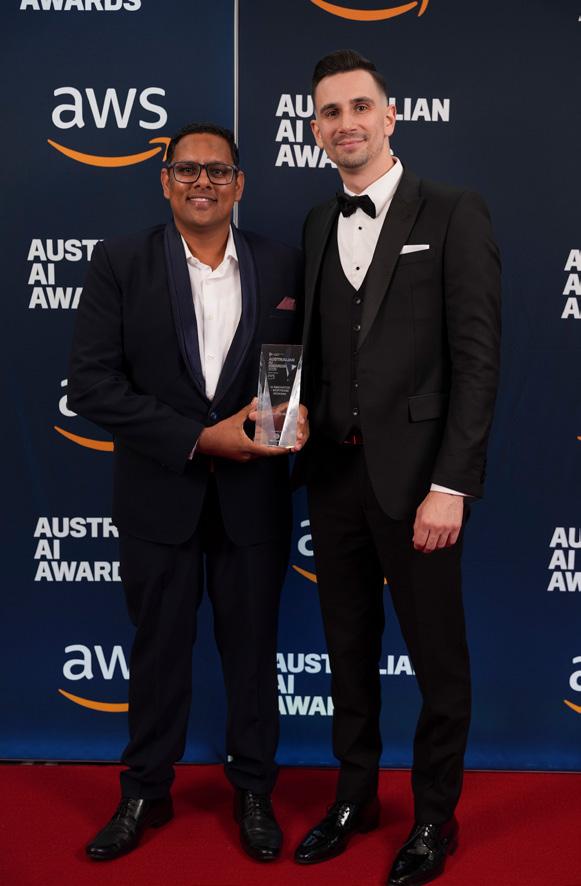
Devesh Maheshwari is the Chief Technology Officer of Lendi Group, one of Australia’s fastest-growing fintech companies and the parent of the Aussie and Lendi home loan brands. An experienced technology executive, Devesh brings a career spanning IBM, ThoughtWorks, Pitney Bowes, Tyro, DataMesh Group, and Tabcorp, with a consistent focus on technology-led transformation in highly regulated industries. He was named Cyber Thought Leader of the Year at the 2026 Australian Cyber Awards and is a recognised voice on AI adoption, cybersecurity, and technology leadership. He holds a Bachelor of Engineering in Information Science from Bangalore and is based in Sydney.
Recently, in an exclusive interview with CIO Magazine, Devesh shared insights into his journey from Quality Assurance Engineer and Technical Writer to Chief Technology Officer, explaining how that first role taught him that technology risk is never purely technical because every defect can become a compliance breach, customer failure, or reputational event. Reflecting on being named Cyber Thought Leader of the Year at the 2026 Australian Cyber Awards, he said the recognition belongs to his team and carries an obligation to share learnings, mentor practitioners, and advocate for security as a strategic enabler, not a bolt-on. And if he could put one sentence on every IT and security war room wall, it would be that AI amplifies what already exists, so data quality, clarity of purpose, and integrity of controls will determine whether it becomes your greatest asset or greatest liability, because disciplined foundations must come before intelligent systems. The following excerpts are taken from the interview.
Your career path spans strategy, technology, and transformation in extremely regulated industries. What was your very first role in tech, and what did it teach you about the link between technology and business risk?
My first role in technology was as a Quality Assurance Engineer and Technical Writer at IBM, early in my career after completing my Bachelor of Engineering in Information Science in Bangalore. It was a formative experience in ways I did not fully appreciate at the time. Quality assurance, at its core, is the discipline of asking what could go wrong, and what is the cost if it does. That framing — understanding failure modes before they materialise — turned out to be one of the most transferable lenses I have ever developed as a technologist. What that role taught me was that technology risk is never purely technical. The systems we build sit inside business processes, regulatory environments, and human workflows. A defect in code is not just a bug — it is a potential compliance breach, a customer experience failure, a reputational event. At IBM, working across enterprise environments, I saw first-hand how the quality of a technology decision reverberated through an entire organisation. That connection between technical rigour and business consequence has stayed with me through every role since — from Senior QA Consultant at ThoughtWorks, to leading engineering at Tyro in payments, through to the work we are doing today at Lendi Group transforming home lending through AI.
What do you love the most about your current role?
What I love most with Lendi Group is the rare privilege of building something genuinely new,
at a moment in history when the technology available to us can fundamentally reshape how an industry operates — not just incrementally improve it. At Lendi Group, we are not simply modernising the home loan process. We are reimagining it from the ground up — building an intelligent platform that anticipates needs, streamlines complexity, and empowers every broker, partner and customer who touches it. We have an ambition to become an AInative business. That’s not just spin, for usit’s a structural commitment backed by real architectural work, from the operational data layer we have built on MongoDB through to the AI agents we are embedding across decisionmaking workflows. What makes this particular
moment so energising is the intersection of meaningful social impact and technological ambition. Buying a home is one of the most significant financial decisions most Australians will ever make. The fact that our technology can make that journey clearer, faster, and less stressful for over a thousand brokers and their clients — that is a purpose worth showing up for every day. I am also deeply proud of the team we have built and the culture we have created: one that prizes engineering excellence, moves quickly, and takes its responsibilities seriously in a regulated environment. That combination of pace and rigour is genuinely hard to achieve, and being part of it is what I find most fulfilling.
Cyber threats are evolving from ransomware to AI-powered social engineering. Which emerging threat vector worries you most heading into 2030, and why?
The threat vector that concerns me most heading into 2030 is AI-augmented identity deception — the combination of large language models,
synthetic voice and video, and real-time data harvesting to impersonate trusted individuals at scale and with unprecedented plausibility. We are already seeing the early form of this with deepfake audio used in business email compromise attacks and synthetic video deployed in executive impersonation fraud. But what makes the 2030 version of this
THE
ARMS RACE BETWEEN AI-POWERED ATTACK AND AIPOWERED DEFENCE WILL DEFINE THE CYBERSECURITY LANDSCAPE OF THE NEXT DECADE
WE HAVE MADE DELIBERATE CHOICES AT LENDI GROUP TO INVEST IN SECURITY AS AN ENABLER OF BUSINESS CONFIDENCE, NOT JUST A COST OF DOING BUSINESS
threat categorically different is the degree of personalisation that becomes available when these capabilities are powered by models trained on — or in real time accessing — a target’s digital footprint: their communication style, their professional relationships, their calendar patterns, their known concerns. An attacker who can synthesise a convincing version of your CFO, referencing a real conversation from last Thursday and displaying knowledge of an internal project, has a very high probability of bypassing even a security-aware human. For an organisation operating in financial services, where trust and identity are the bedrock of every transaction, this is not an abstract scenario — it is a near-term operational risk. My response has been to invest in zero-trust architectures that do not rely solely on identity claims, to build security awareness cultures that treat scepticism as a professional virtue, and to ensure that our AI systems are themselves hardened against prompt injection and adversarial manipulation. The
arms race between AI-powered attack and AIpowered defence will define the cybersecurity landscape of the next decade.
Quantum computing and post-quantum cryptography are on the horizon. How should CIOs be preparing today for a post-quantum threat landscape?
The most important thing CIOs need to understand about quantum risk is that it is not a future problem — it is a present one, because of what the security community calls harvest now, decrypt later. Adversaries with sufficient motivation are already capturing and storing encrypted communications and data today, on the assumption that quantum decryption capability will become available within a decade. This means that data with long-term sensitivity — financial records, legal agreements, identity credentials, health information — is already at risk from a threat that has not yet materialised in its most powerful form. The preparation strategy
has several practical dimensions. First, CIOs need to conduct a cryptographic inventory: understand what encryption algorithms are deployed across their estate, where they are embedded in third-party products and supply chains, and which data assets have long-term sensitivity. Most organisations have very poor visibility into this. Second, they should begin transitioning to post-quantum cryptographic algorithms — NIST has now finalised its postquantum standards, and the migration roadmap should be part of every security architecture review. Third, cryptographic agility must be built into the architecture from this point forward — the ability to swap out algorithms without full system re-engineering is no longer a niceto-have. Finally, this cannot be treated as a pure IT issue. Boards and executive leadership teams need to understand the risk and be willing to fund the migration, which is non-trivial. Those organisations that treat this as urgent today will be in a materially better position than those that wait for a clear and present danger — by which point the remediation cost will be far higher.
You were named Cyber Thought Leader of the Year at the Australian Cyber Awards recently. What does this recognition mean to you, and what responsibility comes with it?
Being recognised as Cyber Thought Leader of the Year at the Australian Cyber Awards is genuinely humbling, not least because the quality of the other finalists reflects the breadth and depth of talent in this community. It is a recognition I hold on behalf of every team member who has contributed to the security posture and the culture we have built at Lendi
Group — this kind of award is never the work of one person. What it means to me personally is validation that the approach we have taken — integrating security into the architecture and culture of the organisation rather than treating it as a bolt-on compliance function — resonates with the broader practitioner community. We have made deliberate choices at Lendi Group to invest in security as an enabler of business confidence, not just a cost of doing business. When that approach earns recognition, it reinforces the conviction that it is the right way to lead. The responsibility that comes with it is significant and I take it seriously. Thought leadership in cybersecurity is not a title — it is an obligation to share what you have learned, to contribute to public discourse on threats and responses, to mentor the next generation of practitioners, and to advocate at the executive and board level for security being treated as a strategic priority. Australia’s financial services sector, and the broader technology ecosystem, is stronger when its leaders invest in raising the collective capability of the community. That is what I intend to continue doing.
Great technology leaders often have influences outside the server room. What book, biography, or philosophy outside tech has most shaped how you lead?
The work that has most profoundly shaped how I think about leadership is Viktor Frankl’s Man’s Search for Meaning. It is not a business book or a leadership manual — it is an account of finding purpose and agency under the most extreme conditions imaginable. The central insight, that we cannot always choose our circumstances but
we retain the freedom to choose our response to them, is something I return to constantly in the context of leading through transformation and uncertainty. Technology leadership at the executive level involves navigating a nearcontinuous stream of ambiguity — strategic pivots, competitive disruptions, organisational complexity, and the human dimension of leading teams through significant change. What Frankl’s philosophy gives me is a framework for maintaining clarity of purpose in those moments. If the organisation knows why it exists and what it is trying to build, then the how becomes
far more tractable, even when circumstances change. A secondary influence has been the Stoic tradition — particularly Marcus Aurelius’ Meditations. The Stoic discipline of separating what is within your control from what is not, and directing your energy accordingly, is profoundly practical for a CTO. There is an enormous amount in enterprise technology that you cannot directly control: vendor roadmaps, regulatory change, macroeconomic conditions, talent market dynamics. What you can control is the rigour of your thinking, the quality of your decisions, and the culture and standards you model for your team. That is where I choose to place my energy.
What are some of your passions outside of work? What do you like to do in your time off?
Outside of work, I am genuinely passionate about cricket — it has been a constant thread through my life, from growing up in India to living in Sydney, and there is something about the strategy, patience, and team dynamics of the game that I find deeply resonant with how I think about building organisations. I am also an avid reader — history, philosophy and biographies of people who have navigated complexity and adversity keep me grounded and curious in equal measure. There is rarely a time when I am not working through a book. Family is the true anchor. Spending time with my family — being present and genuinely off the clock — is something I have learned to protect with intention, because it is easy in an executive role to let the boundaries dissolve. That deliberate separation actually makes me a better leader: it restores perspective, it reminds me of the human stakes behind what we build, and it gives
me the kind of energy that no productivity hack can replicate. I also try to stay physically active — it is non-negotiable for sustained cognitive performance, and I have come to appreciate exercise less as a fitness practice and more as a discipline of consistency.
I AM DEEPLY COMMITTED TO THE AUSTRALIAN TECHNOLOGY ECOSYSTEM, AND I BELIEVE THERE IS A GENERATIONAL OPPORTUNITY RIGHT NOW FOR AUSTRALIAN ORGANISATIONS TO COMPETE GLOBALLY ON THE STRENGTH OF THEIR AI CAPABILITIES, NOT JUST THEIR MARKET ACCESS
What is your biggest goal? Where do you see yourself in 5 years from now?
My biggest goal, in the near term, is to complete what we have started at Lendi Group — to build a genuinely AI-native financial services platform that changes the experience of buying and owning property in Australia in ways that are felt by real people making real decisions. We are targeting June 2026 for full AI-native operation, and the ambition beyond that is to scale what we are building into something that defines the standard for intelligent financial services in this market and potentially beyond. In five years, I see myself continuing to operate at the intersection of technology strategy, business transformation, and people leadership — whether that is continuing to grow within Lendi
AI AMPLIFIES WHAT ALREADY EXISTS — SO THE QUALITY OF YOUR DATA, THE CLARITY OF YOUR PURPOSE, AND THE INTEGRITY OF YOUR CONTROLS WILL DETERMINE WHETHER IT BECOMES YOUR GREATEST ASSET OR YOUR GREATEST LIABILITY
Group as it scales, or taking those capabilities into a broader context. I am deeply committed to the Australian technology ecosystem, and I believe there is a generational opportunity right now for Australian organisations to compete globally on the strength of their AI capabilities, not just their market access. On a personal level, I want to continue investing in the next generation of technology leaders — mentoring, contributing to the dialogue on responsible AI and cybersecurity, and helping to raise the standard of technology leadership in Australia. The recognition I have received through forums like the Australian Cyber Awards reinforces my conviction that leadership in this domain carries an obligation to give back, and that is something I intend to do with increasing commitment over the next five years.
If you could put one sentence about AI on the wall of every IT and security war room, what would it say, and why is that message critical for leaders today?
The sentence I would put on every wall is this: AI amplifies what already exists — so the quality of your data, the clarity of your purpose, and the integrity of your controls will determine whether it becomes your greatest asset or your
greatest liability. The reason this message is critical is that there is an enormous amount of noise in the current conversation about AI — excitement, fear, hype, and genuine uncertainty — and very little of it is grounded in first principles. Organisations are deploying AI into contexts they do not fully understand, on data foundations they have not adequately cleaned or governed, without clear accountability structures for the decisions those systems make. The result is not neutral: it is actively dangerous, because AI operating on flawed inputs or within weak governance frameworks does not fail quietly — it scales its failures. The antidote is not caution for its own sake. It is disciplined foundational work: investing in data quality, building explainability into AI-powered decisions, embedding security and privacy into the AI architecture from the start, and ensuring that every AI deployment has a clear owner and a clear accountability framework. At Lendi Group, this is exactly the philosophy we have applied — building the operational data layer before deploying the intelligence layer, so that the speed and quality of what we build is grounded in a solid foundation. That sequence matters enormously, and it is a lesson I would share with any leader navigating this terrain.
FROM SERVICES TO EXPERIENCES: REIMAGINING AI STRATEGY IN HIGHER EDUCATION
Ayman Idrees
Chief Information Officer, Wor-Wic Community College
Ayman Idrees is a higher education technology executive and thought leader with more than 26 years of experience leading digital transformation, enterprise modernization, and innovation strategy across U.S. and international institutions. As Chief Information Officer at Wor-Wic Community College, he focuses on reimagining how technology, AI, and digital ecosystems can transform the student experience and drive institutional agility. Prior to Wor-Wic, he served as Executive Director of Digital Transformation at UAE University, helping advance the institution into a Tier-1 research university through large-scale modernization initiatives. His work centers on the intersection of technology, service innovation, AI strategy, and the future of higher education.
Most Higher education institutions are using AI to do the wrong thing better.
They are automating processes, accelerating workflows, and reducing costs. But in doing so, they are optimizing a model that is already losing relevance. The real shift is not about efficiency. It is about experiences.
Across industries, expectations have fundamentally changed. People no longer evaluate organizations based on the services they provide, but on how well those services adapt to their needs, context, and goals. The competitive advantage has shifted from delivering services to designing experiences.
AI has the potential to accelerate this shift but only if leaders use it to rethink the model, not just improve it.
Higher education is undergoing a notable shift in expectations and operating models. This shift is not driven solely by technological advancement, but by changes in how students engage with institutions and how value in education is perceived.
For many years, colleges and universities have been organized around the delivery of services, including instruction, advising, enrollment management, and student support. These services have historically been optimized for efficiency, scale, and consistency, often structured around linear academic pathways. This model aligned with institutional priorities of access expansion and standardized delivery. However, evolving student expectations are challenging the sufficiency of this approach.
Building on the conceptual foundation of the experience economy introduced by B. Joseph Pine II and James H. Gilmore, institutions are
increasingly moving toward the intentional design of experiences rather than discrete services. In this framing, value is created not only through what institutions provide, but through how students engage with, interpret, and progress through their educational journey.
This shift is closely associated with the growing recognition that student pathways are no longer linear. Students frequently navigate higher education while balancing employment, family obligations, financial constraints, and changing academic or career goals. As a result, enrollment patterns are more fluid, and engagement with institutional services occurs across multiple channels and timeframes.
In this context, the distinction between services and experiences becomes operationally significant. Services are typically transactional and episodic in nature. Experiences, by contrast, are intentionally designed and continuously shaped across multiple institutional touchpoints. They are contextual, adaptive, and influenced by how students interact with the institution over time. Each interaction, whether digital or in person, contributes to a cumulative perception of institutional value and support for student success.
Artificial intelligence and modern data platforms are increasingly central to enabling this transition. Without these capabilities, personalization at scale remains limited by structural and operational constraints. AI-driven systems allow institutions to analyze patterns of engagement, anticipate student needs, and deliver more timely and context-aware interventions. When combined with integrated data ecosystems, these capabilities support more coordinated and adaptive institutional responses.
PEOPLE NO LONGER EVALUATE ORGANIZATIONS BASED ON THE SERVICES THEY PROVIDE, BUT ON HOW WELL THOSE SERVICES ADAPT TO THEIR NEEDS, CONTEXT, AND GOALS
At the operational level, this shift can be observed in student support services. Traditionally, IT support models have been structured around ticket-based systems in which users submit requests and await resolution. While effective in managing workload and tracking service delivery, this model reflects a transactional service orientation. The introduction of real-time support channels, selfservice tools, and integrated communication platforms has begun to alter this dynamic. These changes not only improve response efficiency but also shift expectations toward continuous and interactive engagement.
This evolution has broader implications for institutional technology leadership. The CIO role is increasingly evolving from operational system stewardship to strategic experience design. The challenge is no longer simply implementing systems but designing the digital ecosystem that shapes how students experience the institution. This requires a shift from thinking in terms of systems and functions to thinking in terms of journeys and outcomes.
The challenge is no longer just implementing systems. It is designing the digital ecosystem that shapes how students experience the institution. This requires a shift from thinking in terms of systems and functions to thinking in terms of journeys and outcomes.
Three priorities emerge.
First, institutions must move from fragmented systems to connected ecosystems. Student experiences break down when data and processes are siloed across admissions, academic systems, and support services. Integration becomes a strategic requirement, not just a technical one.
Second, data must become a trusted, shared foundation. Personalization depends on a holistic understanding of the student, not isolated transactions. This requires strong governance, data quality, and clarity around how data is used.
Third, AI must be applied with intent. Not every process needs automation. The focus should be on moments that matter, where timely intervention, personalization, or anticipation can significantly improve student outcomes.
A further development in this evolution is the movement from personalization toward co-creation. In this model, students are not solely recipients of institutional services but active participants in shaping their learning pathways. This requires systems that support flexibility, modularity, and responsiveness to individual academic and professional trajectories.
However, the adoption of these approaches also introduces important considerations. Issues related to equity, access, data privacy, and algorithmic transparency must be addressed to ensure that technological advancement does not inadvertently reinforce existing disparities. The effectiveness of AI-enabled systems in higher education is therefore closely linked to the strength of institutional governance and ethical oversight.
The conversation around artificial intelligence in higher education often focuses on tools and capabilities. However, the more important question is what these tools are enabling. If the goal is efficiency, institutions will optimize existing models. If the goal is impact, they must reimagine the model entirely.
THE CHALLENGE IS NO LONGER SIMPLY IMPLEMENTING SYSTEMS BUT DESIGNING THE DIGITAL ECOSYSTEM THAT SHAPES HOW STUDENTS EXPERIENCE THE INSTITUTION
Institutions that are likely to lead in this environment are those that move beyond incremental improvement and toward intentional experience design. In this context, technology serves not as an end in itself, but as an enabler of more adaptive, responsive, and student-centered educational ecosystems. The implications extend beyond operational effectiveness to the broader question of how institutions define and deliver educational value in an evolving digital landscape.