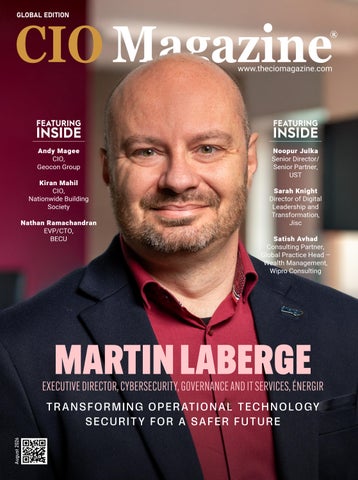
GLOBAL EDITION
FEATURING
FEATURING
INSIDE
INSIDE
Andy Magee CIO, Geocon Group
Noopur Julka Senior Director/ Senior Partner, UST
Kiran Mahil CIO, Nationwide Building Society Nathan Ramachandran EVP/CTO, BECU
Sarah Knight Director of Digital Leadership and Transformation, Jisc Satish Avhad Consulting Partner, Global Practice Head – Wealth Management, Wipro Consulting
MARTIN LABERGE
EXECUTIVE DIRECTOR, CYBERSECURITY, GOVERNANCE AND IT SERVICES, ÉNERGIR
August 2026
T R A N S F O R M I N G O P E R AT I O N A L T E C H N O L O G Y SECURITY FOR A SAFER FUTURE
CIO MAGAZINE
1
Aug. 2026
August 2026
Vol - 3 Issue - 8
Managing Editor Sarath Shyam
Consultant Editors
Dr. John Andrews Emma James Sabrina Samson Naomi Wilson Andrew Scott Kwith Alexander Editorial Enquiry: admin@thecioomagazine.com
Art & Design Charlie Jameson Louis Bernard Shirley David
Branding & Marketing Partnership Jennifer Anderson Monica Davis Rachel Roy Anna Elza Sales Enquiry: admin@thecioomagazine.com
Free Subscription www.thecioomagazine.com
International Partnerships Americas • Europe • Middle East & Africa • Asia-Pacific admin@thecioomagazine.com
Follow Us On www.linkedin.com/company/ciomagazine
CIO MAGAZINE
2
CIO Magazine www.theciomagazine.com is a global knowledge sharing digital platform published by Connecta Innovation Private Limited. All rights reserved. The opinions expressed in the content and pictures provided are those of the authors. They do not purport to reflect the opinions or views of Connecta Innovation Private Limited or any of its subsidiaries, its members or associates and we do not assume any responsibility. The publisher does not assume any responsibility for the advertisements. The content, pictures, and all warranties made in such advertisements are the sole responsibility of the advertisers. CIO Magazine www.theciomagazine.com is a Free Subscription and Free-to-read digital platform strictly not for sale and must be strictly for internal private use only. Publisher does not assume any responsibility arising out of anyone modifying content and pictures, printing a copy of this digital platform in any format and in any country and all matters related to that. “CIO Magazine www.theciomagazine.com“ and “The CIO Magazine www.theciomagazine.com“ trademarks are owned by Connecta Innovation Private Limited. Aug.2026 Jul. Jun. May 2026 2026
RESILIENCE IS THE NEW DIGITAL ADVANTAGE
T
he most dangerous threat facing an organization may not be the one it can see coming. It may be the one it has not imagined yet. For years, technology leaders have built defenses around known risks. Firewalls were strengthened, vulnerabilities patched, backups created, and incident-response plans rehearsed. But the digital landscape has changed. AI is accelerating the speed and sophistication of attacks, operational technology is becoming increasingly connected, and technologies such as quantum computing are forcing organizations to rethink assumptions about cryptography and security. The challenge is no longer simply to prevent disruption. It is to build organizations that can adapt when prevention is not enough. That shift requires a different mindset. Resilience is not created by a security team working in isolation. It is built through capable people, informed leadership, trusted partnerships, strong governance, and the ability to make decisions under pressure. In many ways, the strength of an organization’s response depends less on whether it can predict the next threat and more on whether it has developed the capacity to respond to the unexpected. This month’s cover story brings that idea to life through our conversation with Martin Laberge, Executive Director, Cybersecurity, Governance and IT Services at Énergir. His 23-year journey into cybersecurity, his work across IT and operational technology, and his focus on protecting critical infrastructure offer a valuable perspective on how security has evolved from a technical function into a strategic business responsibility. His warning about the convergence of AI-driven attacks and quantum-era risks is particularly relevant for today’s boards and technology leaders. Just as important is his belief that organizations need strong teams and trust between technology and the wider business. This issue of CIO Magazine explores that broader transformation through thought-provoking articles, interviews, and perspectives on the technologies, leadership challenges, and opportunities shaping the future of business. The future will undoubtedly bring threats we cannot predict. But uncertainty does not have to mean vulnerability. Organizations that invest in adaptability today will be better prepared for whatever tomorrow brings. The real competitive advantage may not be seeing the future first. It may be being ready for it, whatever it looks like. Enjoy Reading.
Sarath Shyam
CIO MAGAZINE
Aug. 2026
CONTENTS 08
COVER STORY
CIO MAGAZINE
Aug. 2026
AUGUST 2026
26
CIO INSIGHTS
Magee 26 Andy CIO,
Geocon Group Elevating Human Customer Experience with Agentic AI
34 Mahil 34 Kiran CIO,
Nationwide Building Society Empowering Trust in an AI-Driven Future
CIO MAGAZINE
Aug. 2026
CONTENTS 18
42
50
58
TECH TALKS Knight 18 Sarah Director of Digital Leadership and Transformation, Jisc
Building Universities Ready for a Digital Future
50 Senior Director/ Senior Partner, Noopur Julka UST
Empowering the Next Generation of Talent
CIO MAGAZINE
Aug. 2026
Ramachandran 42 Nathan EVP/CTO, BECU
Unlocking Legacy Systems to Empower Members
Avhad 58 Satish Consulting Partner,
Global Practice Head – Wealth Management, Wipro Consulting Transforming Wealth Management through AI Orchestration
CIO MAGAZINE
7
Aug. 2026
C OV E R S TO RY
MARTIN LABERGE
EXECUTIVE DIRECTOR, CYBERSECURITY, GOVERNANCE AND IT SERVICES, ÉNERGIR T R A N S F O R M I N G O P E R AT I O N A L T E C H N O L O G Y SECURITY FOR A SAFER FUTURE
Martin Laberge is Executive Director, Cybersecurity, Governance and IT Services at Énergir in Quebec, where he leads cybersecurity strategy, risk management, OT security, governance, and IT services across the organization and its Canadian and American subsidiaries. Recognized as one of the Top 100 CISOs of 2026, he is a strong advocate for protecting critical infrastructure and advancing operational technology (OT) security. A frequent speaker at industry conferences, Martin is passionate about developing the next generation of cybersecurity leaders and believes that strong teams, resilient organizations, and a people-centered approach are the foundation of longterm success. Recently, in an exclusive interview with CIO Magazine, Martin shared insights into how a 2003 computer worm shifted him from software QA to cybersecurity, leading to a 23-year career across industries and to his current role at Énergir where security underpins corporate strategy. On AI and emerging threats, he warns boards are underestimating the convergence of AI-accelerated attacks and quantum-era cryptography risk, stressing resilience over single-threat readiness. His advice is to build great people, earn the trust of the business, and lead with adaptability because no CISO succeeds alone. The following excerpts are taken from the interview.
CIO MAGAZINE
8
Aug. 2026
CIO MAGAZINE
9
Aug. 2026
Hi Martin. Your career spans 23 years across retail, finance, government, transport, energy, and utilities, and now as CISO you lead global cybersecurity programs. What was the pivotal project or challenge early in your career that first made you realize cybersecurity was your calling? Initially, I was not destined to work in cybersecurity. It was one of the first computer worms in 2003 that introduced me to this field. At the time, I was working as a Software Quality Assurance Analyst. The company I worked for had been hit by a computer worm, and most employees were affected except for our small office. Two colleagues and I had searched
CIO MAGAZINE
10
Aug. 2026
Yahoo, downloaded the Windows patch that prevented the worm from spreading, burned three CDs, and manually installed the patch on all our workstations. The CIO at the time was impressed by our resourcefulness and promptly “volunteered” us to build the company’s information security team. I did not know much about cybersecurity then, but I was curious and eager to prove myself, so I accepted the challenge. Twelve months later, I was promoted to Team Coordinator. My first truly defining project came later during my time at RONA, following its acquisition by Lowe’s. We earned the trust of senior leadership in Québec, as well as the support of the U.S.-based CISO at the time,
What continues to inspire me today is knowing that my team enables the organization to achieve its objectives by reducing operational risk
Warren Steytler, who became a mentor to me. My team and I were given the opportunity to design and implement a comprehensive threeyear cybersecurity program. That experience solidified my decision to pursue a career as a CISO. Today, I am incredibly fortunate to continue that journey with Énergir, a company that has made cybersecurity a cornerstone of its strategic plan, and where I have had the privilege of building my career for the past six years. What part of your current role energizes you most every day, and why does it keep you passionate about the work? What continues to inspire me today is knowing that my team enables the organization to achieve its objectives by reducing operational risk. Knowing that, through our work, the company is able to grow, evolve, and seize new opportunities. Cybersecurity is such a broad and fascinating field. In the same day, I might have a highly
technical discussion with my Director of Operations in the morning, then meet with the CFO to discuss the potential financial impact of a major incident. Later, I might present to the Board of Directors, and finish the day discussing emerging technologies and the integration of artificial intelligence with my colleagues and my boss. If that’s not motivating, I don’t know what is. Every day brings new challenges, new perspectives, and new opportunities to make a meaningful impact on the business. That diversity, combined with the ability to influence both technology and corporate strategy, is what makes cybersecurity such a rewarding profession for me. The threat landscape evolves daily, yet budgets and talent remain finite. Looking ahead five years, what single shift in adversary tactics do you believe boards are still underestimating today? I believe boards are still underestimating the convergence of artificial intelligence and quantum computing. Today, most discussions focus on ransomware and data breaches. Those threats remain real, but they are extensions of risks we already understand. What concerns me more is how emerging technologies will fundamentally change the economics of cyberattacks. In the near term, artificial intelligence will enable adversaries to automate reconnaissance, vulnerability discovery, social engineering, and even large portions of the attack chain. Attackers will be able to operate at a scale and speed that traditional security organizations cannot easily match.
CIO MAGAZINE
11
Aug. 2026
Looking further ahead, quantum computing has the potential to disrupt one of the foundations of modern cybersecurity: cryptography. While large-scale quantum attacks may still be years away, the risk is already present because adversaries can steal sensitive information today and decrypt it in the future once quantum capabilities mature. Many boards are still treating quantum as a research problem rather than a business risk. The real challenge is that organizations are preparing for individual threats when they should be preparing for a future where AI accelerates attacks and quantum computing weakens some of the trust mechanisms that underpin our digital economy. The question boards should be asking is not simply whether they are protected from today’s threats. It is whether their organization is becoming resilient enough to adapt to technologies that will fundamentally reshape both attack and defence. Talent in the AI era needs new fluency. Beyond technical upskilling, what human capability do you believe leaders must cultivate so their teams thrive alongside AI, not fear it? Beyond technical upskilling, the most important capability leaders need to cultivate is adaptability. Every major technology shift creates uncertainty, and uncertainty often leads to fear. AI is no different. The organizations that will thrive won’t necessarily be those with the most advanced AI tools, they will be the ones with people who are willing and able to continuously learn, unlearn, and reinvent how they work.
CIO MAGAZINE
12
Aug. 2026
Throughout history, technology has repeatedly changed jobs, but it has rarely eliminated the need for human judgment, creativity, empathy, and leadership. What changes is how we apply those uniquely human strengths. As leaders, our role is not simply to teach employees how to use AI. It’s to create an environment where experimentation is encouraged, learning is continuous, and failure is viewed as part of the adaptation process. In cybersecurity, we’ve been adapting to constant change for decades. AI is simply the next evolution. The individuals who will excel are not those who know all the answers, but those who remain curious, flexible, and willing to evolve alongside the technology. Ultimately, I don’t think the future belongs to AI. I think it belongs to people who know how to work with AI. Most recently, you were recognized as one of the Top 100 CISOs, 2026. Our readers would love to know the secret mantra behind your success. To be honest, I don’t believe there is a secret mantra for success as a CISO. If there is one lesson I’ve learned throughout my career, it’s that no CISO succeeds alone. Any recognition I receive is really a reflection of the incredible people I have the privilege to work with every day. Success in cybersecurity requires a strong, multidisciplinary team made up of people with different skills, perspectives, and experiences. You need technical experts, risk professionals, architects, communicators, and problem-solvers who share the same purpose and passion.
Equally important is the support of the organization. Cybersecurity cannot succeed in isolation. It requires executive sponsorship, engaged business leaders, and a culture that understands that security is an enabler of growth, resilience, and trust. Personally, I have always believed that passion is contagious. I am passionate about what I do, and I think leaders who genuinely care about their mission have a unique ability to inspire others and bring people along on the journey. Building a high-performing team is not just about hiring talented people, it’s about creating an environment where they can grow, innovate, and challenge one another. Another lesson I’ve learned is that a successful CISO cannot view the role as purely technological.
Technology is important, but cybersecurity is fundamentally a business discipline. It is about understanding risk, enabling strategic objectives, protecting critical operations, and helping organizations innovate with confidence. The most effective CISOs are those who can move comfortably between the technical and business worlds, discussing threats and architecture with engineers in the morning, risk exposure with the CFO at lunch, and strategic priorities with the Board of Directors in the afternoon. If I had to summarize my philosophy in one sentence, it would be this: build great people, earn the trust of the business, and never lose sight of the fact that cybersecurity exists to help the organization succeed.
In the near term, artificial intelligence will enable adversaries to automate reconnaissance, vulnerability discovery, social engineering, and even large portions of the attack chain
CIO MAGAZINE
13
Aug. 2026
Leaders are shaped as much by life outside the office as within it. What’s a book, not about security or business, that fundamentally changed how you think about risk or people? The book that had the greatest impact on me was Awaken the Giant Within by Tony Robbins. At first glance, it may seem far removed from cybersecurity, but many of the lessons I learned from it have shaped both my leadership philosophy and my approach to risk management. One of the book’s central messages is that our results are largely driven by our beliefs, decisions, and actions. As leaders, we cannot control every challenge, crisis, or threat that comes our way, but we can control how we respond to them. That mindset has been invaluable throughout my career in cybersecurity, where uncertainty and constant change are part of the job. The book also reinforced an important lesson about people: individuals are capable of far more than they often believe. As a leader, I see one of my primary responsibilities as helping people recognize their potential, develop confidence, and grow beyond what they thought possible. Building high-performing teams is not just about technical skills. It’s about inspiring people, creating a sense of purpose, and fostering an environment where they can continue to learn and evolve. Those lessons have influenced me as much as any cybersecurity framework or technical certification. Ultimately, the book taught me that success starts with mindset. Technology changes, threats evolve, and industries transform, but the ability to adapt, grow, and bring out the best in people remains a timeless leadership skill.
CIO MAGAZINE
14
Aug. 2026
If you weren’t in cybersecurity, the curiosity and discipline you have could translate to many fields. What’s one profession you secretly think you’d have loved to pursue? If I weren’t in cybersecurity, I think I would have loved to be an actor. I did a great deal of theatre in my youth and even appeared as an extra in a few television productions and web series. I was fascinated by the idea of stepping into another person’s shoes and bringing emotions to life for an audience. Ironically, I still get to do a little of that today. I spend a lot of time speaking at conferences, telling stories, and helping people see cybersecurity from a different perspective. The setting may have changed, but the goal is similar: connect with people, inspire them, and leave a lasting impression. I suppose cybersecurity became my stage. What is your biggest goal? Where do you see yourself in 5 years from now? Five years from now, I hope to continue evolving alongside a team and an organization that are as talented, innovative, and human-centered as the ones I have the privilege to work with today at Énergir. Earlier in my career, I was driven primarily by technology and the excitement of solving complex security challenges. Over time, however, I discovered that one of the most rewarding aspects of leadership is watching others grow and succeed. Seeing team members develop new skills, take on bigger responsibilities, and achieve goals they once thought were beyond their reach has become even more fulfilling than deploying the latest technology.
One of my personal goals is to help develop the next generation of cybersecurity leaders. If, in five years, some of the people I have had the opportunity to mentor are serving as CISOs, security executives, or influential voices in our industry, I would consider that one of my greatest accomplishments. Beyond my organization, I have become increasingly passionate about operational technology (OT) security and the protection of critical infrastructure. Over the past few years, I have made it one of my personal missions to raise awareness of the risks facing critical assets and the importance of investing in their protection. I hope to continue working with industry leaders, government officials, and operators of critical infrastructure to help strengthen our collective resilience. The consequences of a cyberattack against critical services extend far beyond technology. They can impact public safety, economic stability, and the daily lives of citizens. Ultimately, my goal is not just to build secure systems. It is to help build stronger people, stronger organizations, and more resilient critical infrastructure for the next generation. If an aspiring professional could only take one lesson from your journey, what truth about building a career in security would you want them to remember on their hardest day? If there is one lesson, I would want aspiring professionals to remember on their hardest day, it is that people are far more resilient than they think. At some point in your career, you will face a major incident, a crisis, or a situation that
CIO MAGAZINE
15
Aug. 2026
Building a high-performing team is not just about hiring talented people, it’s about creating an environment where they can grow, innovate, and challenge one another
seems overwhelming. In cybersecurity, it is not a question of if, it is a question of when. The organizations and professionals who succeed are not the ones who avoid every crisis. They are the ones who are prepared to respond when adversity arrives. One of the biggest lessons I have learned is that there is almost always a solution. Sometimes it requires thinking outside the box. Sometimes it requires challenging assumptions. And very often, the answer is sitting somewhere within your team, waiting to be discovered through collaboration and open dialogue. No one succeeds alone in this profession. When things go wrong, ego becomes the enemy.
CIO MAGAZINE
16
Aug. 2026
The ability to listen, ask for help, and leverage the collective intelligence of your colleagues is often what makes the difference between failure and success. Throughout my career, I have always encouraged my teams to adopt this mindset: stay calm, stay curious, and focus on solutions. Every crisis presents an opportunity to learn, improve, and emerge stronger than before. The true measure of maturity, both for a cybersecurity professional and for an organization, is not whether they can prevent every incident. It is how effectively they respond, adapt, and recover when the inevitable happens.
CIO MAGAZINE
17
Aug. 2026
T A L K S T E C H CIO MAGAZINE
18
Aug. 2026
Building Universities Ready for a Digital Future
Sarah Knight Director of Digital Leadership and Transformation, Jisc
Sarah Knight is director of digital leadership and transformation at Jisc. Sarah supports UK universities with their digital transformation using Jisc’s framework and maturity model along with research into international and transnational education and curriculum and assessment design. Sarah established Jisc’s student experience experts group, an active community which provides valuable consultation and dissemination opportunities for Jisc. Sarah continues to champion Jisc’s change agents’ network: to support staff-student partnership working on technology enhanced curriculum projects. During her time at Jisc, Sarah has led large transformation projects on curriculum and assessment design, digital capabilities and students’ experiences of technology. In an exclusive conversation with CIO Magazine, Sarah talks about the evolving role of digital transformation in higher education and why institutions must move beyond viewing technology as simply infrastructure. She shares insights on creating a culture that embraces innovation, strengthening digital leadership, and building data-driven ecosystems that support long-term resilience and growth. Sarah also discusses the transformative impact of artificial intelligence on teaching, learning, assessment, and research, highlighting the importance of developing digital and AI capabilities across the entire academic community.
CIO MAGAZINE
19
Aug. 2026
Your career has been deeply rooted in digital transformation within the education sector. What key moments or decisions have shaped your journey into this leadership role? Having worked in the sector and for Jisc for the past 22 years, my role has centred around working with colleges and universities to realise the benefits that technology can bring to the student experience, to enhance the quality of teaching, and to enable more efficient and effective ways of working. Whether this has been through the use of virtual learning environments, assessment and e-portfolio platforms, Moocs, virtual worlds, simulations, VR…and of course now genAI. Having started my career as a chemistry lecturer in South Africa, I have always centred my work on how to support students, particularly disadvantaged students, with their learning and how to enable staff to fully realise the potential of technology for their teaching. I have been fortunate in my role at Jisc to be involved in sector leading research and observe innovative practice across further and higher education which has firmly focused on improving students’ experiences. Understanding how staff and students’ expectations and experiences of using technology are continually changing, the digital (and AI) capabilities required, the focus on sound pedagogic practice and the vision and leadership to foster innovation and organisational change are the guiding principles for my work. Post pandemic, there was a shift in senior leadership teams’ awareness of the importance of digital as a key requirement for investment. Despite the pressure to return to the traditional approaches of fully on campus learning for
CIO MAGAZINE
20
Aug. 2026
ALTHOUGH CONSIDERABLE INVESTMENT HAS BEEN MADE TO PROVIDE ROBUST AND SECURE INFRASTRUCTURE, THERE IS STILL THE NEED TO ADDRESS THE TECHNICAL LEGACY OF DISTRIBUTED AND DUPLICATE SYSTEMS
students, there was a recognition that student demographics and expectations had changed. This has been further brought into focus by declining international students studying in the UK and pressures on university finances. As a result, my role has focused on supporting senior teams with advancing their strategies for digital transformation. Higher education is undergoing significant change. From your perspective, what are the most pressing challenges institutions face today in their digital transformation efforts? Four years ago, recognising and acknowledging the impact that the pandemic had on education, it became clear there was a need to move beyond pockets of innovative practice with technology and a reactive approach. Instead, the shift was towards a holistic whole organisational approach to digital. This involves a significant shift in organisational culture – led by the executive team with that digital mindset and vision, who can role model those behaviours. In the past, digital has been seen as being just about the kit. Although considerable investment has been made to provide robust and secure infrastructure, there is still the need to address the technical legacy of distributed and duplicate systems. A digital ecosystem with a single source of truth, with the core business back office systems integrating seamlessly with academic platforms and student record systems. Interoperability and common standards are the enablers of this and result in the ability to fully realise data informed decision making. Never before has this been so crucial than in an age where artificial intelligence is being quoted as an inevitable part of the future of higher
education. To realise the full potential of AI we need a sophisticated understanding, use and governance of institutional data. However, the investment in infrastructure, security and data, needs to be counterbalanced by the investment in people. Starting with the university council or board of governors to develop their digital mindset, capability and leadership. This will set the vision for digital as a fundamental part of the university, enabling financial resilience, global competitiveness and offering an inclusive and equitable experience to all students whether they are studying in the UK or at an overseas campus. The council or board, along with the university executive, play a vital role in the governance and accountability of year on year progress of a digital transformation strategy from the initial baseline to sector benchmarking. We have seen the value of universities using a higher education sector co created framework for digital transformation and associated digital and data maturity models to baseline current practice and identify priority areas for investment. In a resource constrained environment having this evidence is essential for financial sustainability. AI is rapidly influencing every industry. How do you see it reshaping the education and research landscape in the coming years? We are seeing changing student demographics in UK universities, with an increase in undergraduate commuter students and more international and transnational education students than home students. This necessitates a rethink of curriculum and assessment design so that they are better suited for a digital and
CIO MAGAZINE
21
Aug. 2026
AI workplace, whilst raising the quality of teaching and ensuring an inclusive and equitable experience for all students irrespective of place of study. All learning is blended with elements of digital with an increasing awareness of how genAI may be disrupting the norms of education. We are seeing some exemplar practice where students and staff and co designing the curriculum and rethinking approaches to assessment to counteract the risks that genAI poses to academic integrity. Curriculum frameworks are being refreshed; principles and policies for blended learning are becoming part of education strategies to maintain the global reputation for UK higher education. Developing the digital and AI capabilities of all staff, including those who are supporting transnational education, is an ongoing commitment – the associated professional
CIO MAGAZINE
22
Aug. 2026
bodies for professional services staff, academic staff and researchers all acknowledge the importance and requirements of staff to be digitally capable and confident. This is part of professional practice and needs to be recognised and rewarded as such. Human resource departments, organisational and educational development units are a key stakeholder in the delivery of a digital transformation strategy, yet many are not. Offering staff and students the ability to self-assess their digital and AI capabilities so they can receive targeted training and support is another important aspect of baselining and benchmarking institutional practice. It’s equally important to ensure staff and students can share their expectations and experiences of the digital environment, enabling these insights to shape the future developments.
At Jisc, you’ve been part of several impactful initiatives. Which achievement are you most proud of, and what made it particularly meaningful? I am most proud of the research my team and I have led on understanding students’ digital experiences. There are so many assumptions made about how students use digital, and myths about their expertise and digital confidence. It’s only by actually talking to students, gathering their views and experiences, that we can ensure we are designing our digital environments to better support their education. We must also support all students to become digitally confident and resilient, to develop the skills they need for a global digital workplace. I started this work in 2005 and 20 years later this research is continuing to lead the sector Our current research focuses on better understanding how transnational education (TNE) students experience the use of technology to support their learning. As many UK universities are growing their TNE provision, with digital playing a key role, it is essential to understand the digital civil
infrastructure within which students are learning. This includes access to digital devices, data, and digital resources, as well as their expectations of how technology – including AI - supports their learning and assessment. Such understanding is fundamental to providing an equitable experience. As a leader, how do you approach driving change while ensuring teams remain aligned, motivated, and adaptable? My approach to driving change is grounded in three interconnected principles: curiosity, communication, and collaboration. These are essential to not only delivering transformation but ensuring people remain aligned, motivated, and adaptable throughout the journey. Curiosity is the starting point. In a sector as dynamic as higher education, transformation cannot be driven by assumption, it requires a mindset of continuous learning and exploration. I encourage teams to stay curious about emerging technologies, evolving student needs, and institutional challenges. By fostering a
HUMAN RESOURCE DEPARTMENTS, ORGANISATIONAL AND EDUCATIONAL DEVELOPMENT UNITS ARE A KEY STAKEHOLDER IN THE DELIVERY OF A DIGITAL TRANSFORMATION STRATEGY, YET MANY ARE NOT
CIO MAGAZINE
23
Aug. 2026
culture where questioning is welcomed and experimentation is supported, we create an environment where innovation thrives, and teams feel empowered to contribute ideas. This also helps individuals see change not as disruption, but as an opportunity to improve outcomes for the institutions and learners we serve. Communication is what sustains alignment and momentum. Change can create uncertainty, so clarity and consistency are critical. I prioritise transparent communication about the “why” behind transformation, linking every initiative back to the broader mission of supporting higher education through digital evolution. Regular touchpoints, open forums, and clear narrativesetting help ensure everyone understands both their role and the impact of their work. Importantly, communication is not one-directional; actively listening to concerns, feedback, and ideas ensures people feel heard and remain engaged. Collaboration is what turns strategy into reality. Digital transformation is inherently cross-functional, it requires diverse expertise, perspectives, and partnerships. I focus on breaking down silos and creating opportunities for teams to co-create solutions, whether internally across Jisc or externally with our higher education partners. When people feel they are shaping change rather than simply receiving it, motivation and ownership increase significantly. Outside of your professional role, what interests or activities help you stay inspired and maintain balance? As I spend a lot of my time in front of my laptop or travelling, I enjoy being outdoors in my spare time. I am very fortunate to live in a part of the UK which has some beautiful countryside to enjoy so I spend my weekends walking the hills,
CIO MAGAZINE
24
Aug. 2026
along with kayaking local rivers and canals. I have recently taken up horse riding again and I am enjoying re-learning those skills. I love a challenge and the goals I have set myself over the next two years are to continue learning to ski and also to experience a tandem paragliding flight! For young professionals aspiring to build a career in digital transformation, what advice would you offer to help them stay relevant and grow with confidence? I would encourage young professionals to be comfortable with uncertainty. You won’t always have all the answers, and that’s okay. Focus on making progress, learning quickly, and iterating. Confidence comes not from certainty, but from knowing you can adapt and respond. Digital transformation doesn’t happen in silos. It requires people with different skills, experiences, and viewpoints working together. Seek opportunities to work across disciplines technology, education, operations, and strategy. Be open to diverse perspectives. Some of the best ideas come from unexpected places. Focus on co-creation rather than ownership. Your impact grows when you help others succeed as well. Learning how to collaborate early in your career will build both your confidence and your credibility, and it mirrors how transformation actually happens in organisations like Jisc and across the higher education sector. Finally, stay connected to purpose. In higher education especially, digital transformation is about improving experiences and outcomes for students, staff, and institutions. If you can anchor your work in that bigger impact, it will help you stay motivated, resilient, and focused as your career develops.
Want to Sell or find Investors for your Business?
25
Digital First Magazine CIO MAGAZINE Aug. 2026 August 2021
CIO MAGAZINE
26
Aug. 2026
Andy Magee CIO, Geocon Group
Elevating Human Customer Experience with Agentic AI Andy Magee is the Chief Information Officer at Geocon Group, one of Australia’s largest mixed-use property developers, where he also oversees technology across the company’s nine-property Iconic Hotels portfolio. With over 20 years of experience spanning desktop support through to executive leadership, Andy has built his career on a customer-first approach and a willingness to stay hands-on. He is equally comfortable setting enterprise AI strategy as he is building the solutions himself, and is a recognised voice on AI adoption and digital transformation in the Australian property sector. Recently, in an exclusive interview with CIO Magazine, Andy shared insights into his journey from state-level basketball and retail into IT leadership, where he now drives technology and digital transformation. He sees AI agents becoming true team members by 2030, reshaping org charts and pushing strategy cycles from three years down to 1218 months. Looking ahead, his goal is to lead transformation in the property sector and rebuild how people buy, sell and interact with property. His advice to aspiring leaders: technical skill is the foundation, but understanding people, communicating clearly, and being customer-driven is what actually defines leadership. The following excerpts are taken from the interview.
CIO MAGAZINE
27
Aug. 2026
Hi Andy. You’ve spent 20+ years in IT leadership driving strategy and digital transformation. What first sparked your passion for using technology to solve business problems? My path into technology wasn’t a traditional one. Before my IT career, I was a state and rep level basketball player. Playing at that level taught me things that no certification or degree ever could - the value of teamwork, the discipline of high performance, and the understanding that your individual role only matters in the context of the collective. I was a small forward, which is the most versatile position on the court. Your job is to do a bit of everything and make the people
CIO MAGAZINE
28
Aug. 2026
around you better. That mentality has defined my entire career. My first job was in retail, and what I quickly discovered was that I thrived when I was helping the customer. It didn’t matter what the product was, what energised me was understanding what someone needed and finding the right solution. When I moved into IT, starting in desktop support, I realised I was doing the exact same work. The customer was different, the tools were different, but the core of the work was identical - understand the problem, find the fix, make someone’s day easier. That’s what sparked it. I’m a problem solver at heart, and technology just happens to be the arena I found myself in.
IN ANY GIVEN WEEK I MIGHT BE PRESENTING AN AI STRATEGY TO THE EXECUTIVE TEAM AND THEN BUILDING THE SOLUTION MYSELF THE NEXT DAY
You’re passionate about propelling organizations to new heights through technology. What part of that mission energizes you most in your current role? What energises me most is that I get to operate across both sides of leadership , from strategy to execution. I’m not the kind of CIO who sits back and delegates everything. My background is on the tools, and I’m not afraid to still be there. In any given week I might be presenting an AI strategy to the executive team and then building the solution myself the next day. At Geocon, I lead a small team across both a major property development business and a nine-property hotel portfolio, which means there’s no room to be a single-dimension leader. You have to be a generalist and willing to do whatever the team needs to move forward. What I love about this moment in particular is that the pace of both our industry and technology more broadly is creating opportunities to affect genuine change. Whether it’s designing solutions
that improve how our customers interact with us or building internal tools that make our people’s jobs easier, I get to see the direct impact of the work every day. That’s what gets me out of bed. Digital transformation has moved from “nice to have” to “survival.” What’s the biggest shift you expect in how organizations approach transformation by 2030? The biggest shift I see by 2030 is that the organisational chart as we know it will fundamentally change. AI agents won’t just be tools that sit alongside your workforce, they’ll be embedded members of teams, with defined roles, performance metrics, and governance frameworks just like any other employee. Leaders and managers will be accountable for their AI agents’ output in the same way they’re accountable for their people. This isn’t theoretical, we’re already deploying AI agents at Geocon that operate as part of our sales function, with real accountability around how they perform.
CIO MAGAZINE
29
Aug. 2026
The flow-on effect of this shift is that the traditional three year strategic plan is becoming obsolete. When the capabilities of your workforce, (both human and AI) are evolving this rapidly, organisations need to think in 12 to 18 month cycles at most. The businesses that are building this muscle now, treating AI as a genuine part of their operating model rather than a side experiment, will see compounding productivity gains. Those still waiting for the “right time” to start may find the gap is already too wide to close Cybersecurity and risk management are now boardlevel topics. What emerging threat should every leader prioritize that most are still underestimating? The threat most leaders are underestimating isn’t just what attackers are doing with AI, it’s the attack surface we’re creating ourselves. Every organisation right now is encouraging employees to experiment with AI, and rightly so. But governance at that scale is extraordinarily difficult. Employees are connecting AI tools to company data, feeding sensitive information into platforms their IT teams don’t even know about, and building workflows with no security review. Even large enterprises with dedicated security teams are openly promoting this “experiment first” approach without fully appreciating what it means for their risk posture.
CIO MAGAZINE
30
Aug. 2026
At the same time, AI is accelerating the capability of the average threat actor dramatically. Sophisticated social engineering, convincing phishing at scale, faster exploitation of vulnerabilities. Attacks that once required nation-state resources are now within reach of far less skilled operators. When you combine that external acceleration with an expanding internal attack surface driven by well-intentioned AI adoption, you have a compounding risk that most boards haven’t fully grasped yet.
MY BIGGEST GOAL IS TO BE AT THE FOREFRONT OF DIGITAL TRANSFORMATION IN THE AUSTRALIAN PROPERTY INDUSTRY
You work across AI/ML, cloud, cybersecurity, and data. Which one technology topic do you personally find most fascinating right now and why? Agentic AI fascinates me more than any other area of technology right now, specifically its ability to fundamentally reshape customer experience. What excites me isn’t the automation itself, it’s what it does for the humans on both sides of the interaction. We’ve deployed an AI SDR agent at Geocon that handles inbound property enquiries. It does the leg work, understanding a purchaser’s preferences, timeframes, budget, all while simultaneously helping them with questions about the product, the buying process, and even Canberra as a place to live. What it’s really doing is bridging the gap that normally exists between a lead coming in and a human agent making that first call. By the time the sales team picks up the phone, they have genuine context, and the customer already feels heard. That first human conversation becomes significantly more meaningful because neither party is starting from zero.
CIO MAGAZINE
31
Aug. 2026
AI AGENTS WON’T JUST BE TOOLS THAT SIT ALONGSIDE YOUR WORKFORCE, THEY’LL BE EMBEDDED MEMBERS OF TEAMS, WITH DEFINED ROLES, PERFORMANCE METRICS, AND GOVERNANCE FRAMEWORKS JUST LIKE ANY OTHER EMPLOYEE
This is what I think many businesses will get wrong. The temptation is to automate everything and reduce headcount. I believe the real opportunity is the opposite - use AI to remove the parts of the job that humans find draining, like generic lead qualification, and elevate the moments where humility, compassion and genuine understanding matter. We’re in a position to give people the context, time and headspace to make those interactions count. The businesses that recognise this will build lasting customer relationships. The ones chasing pure efficiency will lose something they can’t easily get back.
CIO MAGAZINE
32
Aug. 2026
IT leadership demands constant learning and pressure. What’s your favorite way to reset and recharge outside of work? I have identical twin boys who are eight and incredibly sporty, so a lot of my time outside work revolves around them. I’ve taken up golf as I’ve gotten older as it still gives me that competitive outlet but is a lot kinder on the body. My boys have started playing too, which has been a great way to share something together. The real highlight though has been getting back into the basketball stadium. I’m coaching both my boys now, and it’s completely reignited
my passion for the game. There’s something about being back on the court, passing on what I learned as a player, that brings everything full circle. Between that and making sure I genuinely switch off and recover each week, I find the balance I need to keep performing at work. Books and ideas shape great leaders. What’s one book, podcast, or talk you recommend most to aspiring tech leaders? The Diary of a CEO podcast with Steven Bartlett. I find it to be the single most valuable source of leadership thinking I’ve come across. The topics are always current and the guests consistently challenge how I think about both technology and leadership. The episode with Geoffrey Hinton, the “Godfather of AI” particularly stuck with me. When someone at that level of influence is being that candid about where AI is heading and what it means for society, it forces you to think beyond your own organisation and consider the broader responsibility that comes with deploying this technology. For anyone in a leadership role right now, especially in technology, I’d say it’s essential listening. What is your biggest goal? Where do you see yourself in 5 years from now? My biggest goal is to be at the forefront of digital transformation in the Australian property industry. Property is one of the last sectors still running on fundamentally old and clunky processes, and I think the opportunity to reshape how Australians buy, sell and interact with property is enormous. The traditional real estate model is already shifting, and the acceleration of AI is opening doors that simply
didn’t exist two years ago — the ability to build solutions we could only have dreamed of, to create efficiencies that weren’t possible, and to genuinely transform how an entire industry operates. Where I want to be in five years is leading that charge. We’re at a unique moment in technology where the leaders willing to lean in now will define how their industries work for the next decade. I want to be one of those leaders, someone who didn’t just adopt the technology but used it to fundamentally change how business is done at an industry level. Aspiring IT professionals often ask how to break into leadership. What’s the first skill or mindset you’d tell them to build? The first thing I’d tell any aspiring IT leader is that your career won’t be defined by your technical ability. It will be defined by your ability to understand people, communicate clearly, and build relationships. The best technologist in the room rarely becomes the leader. The person who can listen to a business problem, translate it into a solution, and bring people along with them does. I learned this early, long before my IT career. Basketball taught me that individual talent means nothing without the ability to make the people around you better. Working in retail taught me that everything starts with the customer. Those lessons have carried me further than any technical skill I’ve ever developed. Be customer-driven, invest in how you communicate, and never underestimate the value of genuine relationships. The technical knowledge matters, but it’s the foundation, not the differentiator.
CIO MAGAZINE
33
Aug. 2026
CIO MAGAZINE
34
Aug. 2026
Kiran Mahil CIO, Nationwide Building Society
Empowering Trust in an AI-Driven Future Kiran Mahil is CIO at Nationwide Building Society and a leading figure in UK financial services transformation. She leads business critical technology across core banking, payments, savings, and lending, helping the modern mutual deliver at scale for its customers. Through major platform modernisation and enterprise migrations, she has strengthened resilience, accelerated digital capability, and enabled tangible customer outcomes, including the Fairer Share payment made to millions. Known for her calm, outcomes focused leadership, Kiran combines strategic clarity with disciplined execution, building high performing teams, and sustainable capability. Her contributions are industrywide, championing digital skills, diversity, and trusted customer-centred innovation. Recently, in an exclusive interview with CIO Magazine, Kiran shared insights into how her two-decade journey from strategy consulting to CIO in financial services shaped her customer-first leadership philosophy. She spoke about AI evolving from automation to augmenting judgement across credit, risk, and servicing, with real-time payments and platform ecosystems making continuous adaptation the new baseline by 2030. Looking ahead, Kiran’s focus is on delivering resilient, customer-centred digital platforms while treating talent as a strategic supply chain — upskilling teams at scale and mentoring more women into senior tech roles with integrity and ambition. The following excerpts are taken from the interview.
CIO MAGAZINE
35
Aug. 2026
Your two-decade career spans running divisional businesses and leading enterprise-wide transformation across major UK financial services institutions. What was your very first role in the industry, and what did it teach you about the link between technology and customer outcomes? My first role was at McKinsey & Company, where I worked in the European Financial Institutions Centre, focused on research, insight and consulting strategy for financial services clients. From the outset, this role grounded me in the fundamental link between technology, business strategy, and customer outcomes. I was not building technology directly; rather, I analysed how banks used data, platforms, and emerging digital capabilities to shape their propositions, improve efficiency, and respond to regulatory pressures. What became clear early on was that technology decisions only create value when they are tightly anchored in real customer needs. The most successful organisations were those that translated complex data and systems into simple, intuitive experiences, whether through product design, access to services, or greater pricing transparency. In my subsequent roles across Telecoms and Banking, I have consistently operated at the intersection of business, technology, and delivery, with end-to-end accountability for customer outcomes. These experiences have shaped my leadership philosophy, teaching me to start with the customer problem and design the technology, operating model, and delivery approach around it. Over the past two decades, I have consistently applied this principle across enterprise transformations, digital journey launches, and core banking portfolios, ensuring
CIO MAGAZINE
36
Aug. 2026
technology serves as a powerful enabler of better, faster, and more inclusive customer experiences. What do you love the most about your current role? My role is fabulous! I have the privilege of shaping technology strategy and leading large‑scale transformation, while ensuring it delivers tangible value for Nationwide customers. The balance between long‑term
CREATING A COLLABORATIVE, PEOPLE‑FIRST CULTURE FOCUSED ON CONTINUOUS IMPROVEMENT IS FUNDAMENTAL TO SUCCESSFUL TRANSFORMATION
strategy and immediate delivery is particularly rewarding, as it allows me to see the direct impact of decisions in improved customer journeys, market‑leading propositions, and stronger resilience. I thrive on the end‑to‑end accountability the role brings. It is not just about setting direction, but about ensuring that technology, operations, and business teams come together to deliver reliable, high‑quality outcomes at scale. I am also able to leverage the broader platform that both my role and
the Nationwide brand provide. It enables me to influence industry direction on the future of technology, shaping the workforce of the future and championing inclusion, while continuing to deliver meaningful impact within my own organisation today. A significant part of what drives me, is the opportunity to build and lead high‑performing teams. Creating a collaborative, people‑first culture focused on continuous improvement is fundamental to successful transformation. I find it especially rewarding to see teams grow, perform, and deliver together. At Nationwide, the scale and ambition of what we are delivering increasingly represents career‑defining experiences for many colleagues. That is really special.
Real‑time payments are redefining customer expectations, making instant settlement, continuous visibility of funds, and event‑driven services the norm. At the same time, our platform ecosystem is reshaping distribution, as we expose capabilities through APIs and embed financial services into broader customer journeys. This is underpinned by cloud‑native, modular technology and a product‑centric operating model that enables pace and flexibility. Ultimately, future readiness is about continuous adaptation. At Nationwide, our focus on simplifying complexity, building high‑performing teams, and aligning technology closely to customer outcomes is already laying the foundations to remain trusted, relevant, and competitive as the landscape continues to evolve.
With AI, real-time payments, and platform ecosystems converging, what will “future-ready” mean for a UK financial services firm five years from now? Firms across the banking industry will embed AI at the core of decision making across credit, servicing, risk, and operations, moving beyond task automation to the augmentation of judgement, underpinned by strong governance and rationale. At Nationwide, we have a clear view of this direction of travel and are already progressing towards an intelligent, always‑on, platform‑led model that delivers seamless, real‑time financial experiences while maintaining trust and resilience at scale. Our continued focus on modernising the technology estate, advancing cloud adoption and embedding data‑led decision making is creating a more responsive, resilient, and insight‑driven organisation.
Customer experience is the battleground, but trust is the moat. What design or technology principle will be most critical to maintaining trust in banking over the next five years? Nationwide tops trust rankings by consistently prioritising customer outcomes over shareholder returns, delivering fair value, maintaining strong financial resilience, and investing in strong foundational capability. We strive to get the basics right for our customers. It is the efficacy of the mutual model, which uses transparent communication and focuses on customer-first decision making, which reinforces long-term confidence and loyalty. Trust in banking over the next five years will come down to something simple: customers need to understand what is happening and feel in control of it. As AI is used more in areas, it is critical that human insight remains central to ensure the right decisions are made to deliver the best customer outcomes.
CIO MAGAZINE
37
Aug. 2026
At Nationwide, we are already building towards this. We are simplifying and modernising our core systems, and moving to shared platforms and common data so decisions are consistent, transparent, and well governed across the organisation. What this means in practice for customers is better visibility and faster, more reliable services. For example, we are moving towards more real time, event driven experiences such as instant updates, improved payment processing, and smarter analytics. These changes help customers see what is happening with their money, rather than feeling it is hidden behind the scenes. Digital skills gaps are a systemic risk to transformation. What model of workforce development will actually close the gap at scale by 2030? Closing the digital skills gap at scale will not come from a single intervention, but from employers thinking more strategically about the workforce of the future, building capability continuously from early careers through to senior leadership. I am really passionate about this topic and in my experience, there are a number of areas of focus, which I am trying to lean into. Primarily, large-scale reskilling and upskilling of the existing workforce, embedding programmes across the software development lifecycle, with a strong view of the capabilities that are going to take the business forward. The criticality of supporting the permanent workforce and readying them for the future is paramount. When we talk about digital skills, we need to challenge the traditional assumptions of skillsets and start thinking about rounded capabilities, core domain knowledge with a level of business understanding, and how we
CIO MAGAZINE
38
Aug. 2026
upskill our colleagues for joined up enterprise working and decision making. We also have to look at the whole pipeline, thinking about early career entrants, through to creating opportunities for experienced hires. Having structured pathways feeding into the pipeline, is imperative. Within the early-career stage, vehicles like internships, apprenticeships, and strategic partnerships with feeder institutions are necessary to bring in diverse, job-ready talent and broaden access into technology. Targeted progression and sponsorship is then critical to ensuring talent not only enters the organisation, but progresses into decision-making roles. By 2030, the firms that succeed will be those that treat talent as a
strategic supply chain, continuously developing skills at scale rather than reacting to shortages. Transformational leaders are shaped by ideas beyond their sector. What book, philosophy, or thinker outside technology has most influenced how you lead? I am a voracious reader and tend to draw on ideas from a wide range of thinkers, applying what resonates most in practice. I’m particularly influenced by Peter Drucker’s emphasis on clarity of mission, outcomes, and disciplined execution, which keeps my focus anchored on customer value and trust. His belief that culture ultimately shapes success has also been a constant reference point. That has reinforced my conviction that transformation is fundamentally a people endeavour. Whether modernising core banking or building new digital capability, sustainable success comes from empowering teams, creating accountability, and fostering
AMBITION DEFINES WHERE YOU WANT TO GO, BUT INTEGRITY DEFINES HOW YOU GET THERE AND WHETHER OTHERS WILL CHOOSE TO FOLLOW YOU
psychological safety so that people feel confident taking ownership of outcomes. More personally, one of the books that has shaped my leadership style is ’Be the Leader You Want to See’ by Susie Ramroop. It is a simple, practical read, but it offers powerful perspectives on building confidence and navigating career progression in a way that really stays with you. Every leader remembers a moment when the work felt deeply meaningful. What’s one “this is why I do it” memory from your career that you still carry with you? I have had several moments throughout my career where I have felt a deep sense of satisfaction in the work I do. Most recently, delivering the £100 Fairer Share payment to eligible Nationwide members was one of those moments. Seeing the tangible difference it can make to individuals and families is incredibly rewarding. What brings it to life are the personal stories that come back to us. Reading messages from members about how the payment has helped them, often in meaningful and sometimes emotional ways, really reinforces the impact. One example that stayed with me was a family of four who each received the payment and combined it to take their first holiday together. Moments like that make the purpose very real. What makes this possible is our mutual model. We are accountable to our members, not shareholders, which means we can make deliberate choices to return value directly to them. By continuing to innovate, operate efficiently, and manage our cost base carefully, we can maximise what we give back. I am genuinely proud to be part of an organisation that challenges the status quo on the high street
CIO MAGAZINE
39
Aug. 2026
and consistently strives to do the right thing for its customers. What are some of your passions outside of work? What do you like to do in your time off? Reading, walking, cooking, and going to the gym are important ways for me to reset, particularly given the pace and intensity of my role. With a lot going on in the day job, I value activities that allow me to slow down, create some headspace, and recharge. I am also very much a people person, so I enjoy spending time with family and friends. Whether that is travelling, trying new experiences, or simply making memories together, nurturing those relationships is really important. Alongside this, I am passionate about giving back, particularly in supporting young people and students as they transition into the workplace. I regularly contribute to initiatives that help build confidence, develop practical skills, and create pathways into careers in technology, which I find incredibly rewarding. What is your biggest goal? Where do you see yourself in 5 years from now? My ambition is to help build a modern, resilient, and genuinely customer-centred banking platform that supports sustainable growth and strengthens trust with our customers. For me, success is not just about delivering transformation, but about leaving behind an organisation with the capability, culture, and confidence to keep evolving long after specific programmes are complete. Over the next five years, I hope to continue contributing at an enterprise level, shaping both strategy and delivery. I’m particularly interested in playing a
CIO MAGAZINE
40
Aug. 2026
broader role in how the industry defines “future ready”, as technology, regulation, and customer expectations continue to converge. Just as important is the legacy built through people. I care deeply about developing diverse leadership pipelines, especially supporting more women into senior technology roles, and creating environments where individuals can grow, feel confident in their contribution, and do their best work. If you could mentor one early-career woman in tech tomorrow, what’s the first lesson you’d teach her about leading with both integrity and ambition? The first lesson I would teach is that integrity and ambition are not opposing forces, they are mutually reinforcing. Ambition defines where you want to go, but integrity defines how you get there and whether others will choose to follow you. Early in your career, it can feel like you need to compromise one to accelerate the other, but in reality, the most sustainable success comes from being super clear on your values and consistent in how you show up. I would encourage her to be explicit about what she stands for and to use that as her decision framework, especially when under pressure. Ambition should show up as a willingness to step forward, take on hard problems and own outcomes, not as a need to have all the answers or to compete with others. Importantly, I would remind her that leadership is built on trust. Every decision, every interaction, every commitment either strengthens or erodes that trust. If you can combine the courage to aim high with the discipline to act with integrity, you build credibility early and that becomes the foundation for everything that follows.
CIO MAGAZINE
41
Aug. 2026
T A L K S T E C H CIO MAGAZINE
42
Aug. 2026
Unlocking Legacy Systems to Empower Members
Nathan Ramachandran EVP/CTO, BECU
Nathan Ramachandran, BECU’s EVP and Chief Technology Officer, brings 20+ years of financial-services innovation rooted in a personal journey shaped by resilience, opportunity, and the life-changing support of a credit union. He leads the modernization of BECU’s platforms to create meaningful, digital-first, human-always experiences for 1.5 million members. Previously with Accenture and major U.S. banks, Nathan has dedicated his career to transforming technology in service of people—and expanding hope through financial empowerment. Recently, in an exclusive interview with CIO Magazine, Nathan shared insight into how personal resilience after losing his father young and navigating medical debt led him to modernize financial systems for impact, turning a 20+ year career at Accenture and major banks into his current role as BECU’s EVP/CTO where he’s modernizing legacy platforms for 1.5M members. He sees AI making credit decisions autonomous in 5 years with clean data and accountability, views cloud dependency as business risk, and advises leaders to earn a strategy seat by improving business outcomes, not just tech. The following excerpts are taken from the interview.
CIO MAGAZINE
43
Aug. 2026
Hi Nathan. You could have chosen finance, law, medicine, anything. But you picked tech. What was the first experience that made you believe building and fixing systems was how you were meant to make your mark, and what inspired you to commit to it? Early in my life, I saw firsthand how systems, especially financial systems, can either create opportunity or reinforce vulnerability. After losing my father at a young age, my family faced significant financial strain, and navigating things like medical debt and access to credit wasn’t just theoretical, it was deeply personal. From there, I became fascinated with how systems are built – how they scale, how they fail, and how they can be redesigned to be more inclusive, resilient, and impactful. Over time, that curiosity turned into a career focused on modernizing complex platforms and connecting legacy systems to new capabilities so organizations can move faster and serve people better. Ultimately, what inspired me to commit to this path wasn’t just the technology itself, it was the realization that if you get the systems right, you can unlock better outcomes at scale. That’s where I saw I could make my mark and have devoted my career to this. What do you love the most about your current role? At BECU, we are dedicated to improving the financial well-being of our members and their communities. The complex landscape of BECU’s systems and the opportunity to modernize them to better serve our members is a big part of what energizes me in this role. Institutions like ours have decades of technology investments, and with that comes
CIO MAGAZINE
44
Aug. 2026
both constraint and incredible opportunity. As CTO, my role is to turn that complexity into a strategic advantage connecting legacy systems to modern platforms, simplifying the architecture, and enabling real-time, seamless experiences across every member touchpoint. My role is also about aligning technology with purpose ensuring every investment we make improves member outcomes, strengthens resiliency, and positions us for the future. That means balancing speed with stability, innovation with governance, and always keeping the member at the center of every decision. What I find most rewarding is bringing people, process, and technology together to reimagine how we serve because when you get that right, you don’t just modernize systems, you fundamentally elevate the experience for 1.5 million members and many more to come. Cloud is no longer a destination, it’s the default. Looking ahead five years, what aspect of cloud computing will stop being a technology conversation and become a pure business risk conversation, and why? In the next five years, what stops being a ‘technology conversation’ and becomes a pure business risk conversation is dependency, specifically the combination of third-party concentration, data control, and operational resiliency in the cloud. We’re already seeing this shift. Cloud has given us speed, scalability, and access to best-in-class capabilities, but it has also concentrated risk. When a vendor has an outage, a security issue, or a change in their platform, the impact isn’t isolated to IT, it directly affects member experience, revenue, and trust. That’s no longer a technical issue and becomes a business
continuity issue. Resiliency and recovery will become business differentiators as systems become more distributed and interdependent, the ability to fail over, recover quickly, and maintain service continuity will be measured in member impact, not system uptime metrics. So, the conversation is shifting from ‘How do we use cloud?’ to ‘What is our tolerance for disruption, exposure, and dependency?’ and that becomes a fundamental business-led discussion. Data, Digital, and AI are converging fast. In Card & Payments, what is one process you believe will be completely autonomous in five years that still requires human sign-off today, and what has to change first? In Cards and Payments, I believe real-time credit decisioning and transaction approval will become fully autonomous with a high degree of AI-enabled decision automated. There will be exceptions where a human in the loop will be
prevalent but overall declining in scale. Today, there’s still a human checkpoint for edge cases, exceptions, or policy overrides, but that it will progressively reduce in a fully digital, real-time ecosystem. The combination of AI, data, and modern event-driven architecture allow us to evaluate risk, context, and member behavior in milliseconds, whether it’s approving a new card, increasing a limit, or authorizing a transaction. In that world, the speed of the decision is the experience and waiting for human approval becomes the friction you can’t afford. But for that to become a pure machine decision, three things must change. First is data, we need clean, connected, real-time data across the full member and transaction lifecycle. Second is trust, our models, controls, and governance must be audit-ready and explainable, so regulators and boards are comfortable with autonomous decisions. And third is accountability, the system must demonstrate consistent outcomes at scale, not just in the 80%
THE MOST IMPORTANT ADVICE I’D GIVE IS THIS: EARN YOUR SEAT BY IMPROVING THE BUSINESS, NOT BY REPRESENTING TECHNOLOGY
CIO MAGAZINE
45
Aug. 2026
case, but in the edge cases where risk is highest. What’s interesting is that AI isn’t introducing new risk here—it’s amplifying the speed and scale of existing risks. That’s why governance, model risk management, and human oversight frameworks need to evolve just as fast as the technology. Talent is re-skilling in real time. What are the three skills you now hire for that you didn’t screen for five years ago? The first skill is systems thinking across data, platforms, and business outcomes, not just technical depth in a single domain. As architecture becomes more composable and API- driven, we need people who understand how decisions in one system ripple across the entire member experience. Our environment is increasingly interconnected, and point solutions don’t scale. The second skill is the ability to work effectively with AI and do so with a human and AI collaborative approach. That’s not just using tools, but knowing how to frame problems, validate outputs, and apply judgment. AI is becoming a foundational capability across our organization, and the differentiator is how well individuals can extend their own thinking with it. The third skill is a product mindset and owning outcomes, not just delivering tasks. As we move toward product-as-a-service and platform-based models, we need talent that understands customer impact, speed to market, and continuous improvement. It’s no longer enough to build the system, you also have to continuously evolve it as a living product. What’s changed is that these skills sit at the intersection of technology and business. We’re not hiring for roles per say, we’re hiring for how people think, how they learn, and how
CIO MAGAZINE
46
Aug. 2026
IN THE NEXT FIVE YEARS, WHAT STOPS BEING A ‘TECHNOLOGY CONVERSATION’ AND BECOMES A PURE BUSINESS RISK CONVERSATION IS DEPENDENCY, SPECIFICALLY THE COMBINATION OF THIRD-PARTY CONCENTRATION, DATA CONTROL, AND OPERATIONAL RESILIENCY IN THE CLOUD
they connect technology decisions to real-world impact. Leaders are shaped by what they consume outside work. What is one book, not about technology, that fundamentally changed how you lead people through ambiguity, and what idea from it do you use weekly? The standard formula for creating a strategy, communicating it well, managing the change and executing well is still a foundational method. I have read several books that shaped my career journey along the way. The one book that gave me a brand-new perspective was, Code Breaker: Jennifer Doudna, Gene Editing, and the Future of the Human Race, by Walter Isaacson. The book explores the development of the CRISPR gene-editing technology and its transformative, and ethically complex, impact on humanity. This book was transformative for me because it deeply etched the word genetic pre-disposition and its impact on how people react to situations and intrigued my interest in behavioral psychology in numerous other books. This understanding has helped me blend business strategies with the human element, and working for a purpose-driven organization, I try my best to practice the blend of both as much as possible. If you could have dinner with three people from any era to debate the future of technology and society, who would you invite, what would you ask them, and what do you hope would be challenged in your own thinking? • Malcolm Gladwell – In the world of AI, would he consider writing a sequel to the book
Outliers? I’d like to understand if the perspective of needing 10,000 hours to becomenan expert still hold true? • Jamie Dimon – As a former JPMC employee, I carry the impression that Chase is a well-run bank. I would hope to learn, obviously in confidence, what about AI keeps him up at night and what is he attempting to do to manage the risk from probabilistic models? • Walter Isaacson – Would he consider writing a book about an immigrant? [joking... LOL] What is your biggest goal? Where do you see yourself in 5 years from now? Through leading large-scale mergers and acquisitions alongside enterprise technology transformations, I have developed deep expertise in bridging modern platforms with complex legacy environments. My work focuses on unlocking value by integrating emerging technologies into established systems to accelerate business outcomes. Looking ahead, I aim to extend this experience across the financial services sector, partnering with institutions in an advisory capacity to navigate modernization with clarity and confidence. Aspiring tech leaders often chase titles over judgment. What’s the most important advice you’d give to a rising CIO or CTO who wants a seat at the strategy table? The most important advice I’d give is this: earn your seat by improving the business, not by representing technology. Many aspiring leaders think the path to the strategy table is about visibility or title. In reality, it’s about judgment
CIO MAGAZINE
47
Aug. 2026
AS CTO, MY ROLE IS TO TURN THAT COMPLEXITY INTO A STRATEGIC ADVANTAGE CONNECTING LEGACY SYSTEMS TO MODERN PLATFORMS, SIMPLIFYING THE ARCHITECTURE, AND ENABLING REAL-TIME, SEAMLESS EXPERIENCES ACROSS EVERY MEMBER TOUCHPOINT
and making decisions that consistently connect technology to business outcomes, especially when the answer isn’t obvious. Strategy isn’t where you go to give updates, it’s where you go to make trade- offs. Start by shifting from ‘owning delivery’ to ‘owning outcomes.’ If you’re still measuring success by whether something shipped on time, you’re not ready yet. You have to understand what moved because it shipped (member behavior, revenue, risk, or cost) and be able to speak to that clearly. Next, develop business fluency. You need to understand your organization’s revenue and service model, how risk is measured, and where
CIO MAGAZINE
48
Aug. 2026
growth is constrained. When you can translate a technical decision into its impact on growth, efficiency, or member experience, that’s when you move from a participant to a strategic voice. Last, and probably the most important, is to learn when not to use technology. Some of the best decisions I’ve seen are when a leader simplifies a problem, removes a constraint, or challenges the need for a solution entirely. That’s where judgment shows up. At the end of the day, a seat at the table isn’t given, it’s earned through trust. And trust is built when your peers see that every decision you make moves the business forward, not just the technology agenda.
CIO MAGAZINE
49
Aug. 2026
T A L K S T E C H CIO MAGAZINE
50
Aug. 2026
Empowering the Next Generation of Talent
Noopur Julka
Senior Director/ Senior Partner, UST
Noopur Julka is a strategic business leader and trusted advisor to FTSE 250 and Fortune 500 boards and executives, with a track record in guiding complex digital transformations, cultural change, and strategic growth across the UK, US, and India. She partners with boards and C-suites to shape vision, influence high-stakes decisions, and strengthen leadership capability to deliver sustainable shareholder value. She also advises on AI governance frameworks and identifying new market segments, helping organizations navigate and capitalize on opportunities in the age of AI. A passionate advocate for diversity and inclusion, Noopur mentors emerging leaders and champions initiatives that embed agility, innovation, and resilience into organizational DNA. Recently, in an exclusive interview with CIO Magazine, Noopur shared insights into how her journey began with lessons from her mother’s grit and determination, which shaped her approach to leading complex change. From advising FTSE 250 and Fortune 500 boards across the UK, US, and India, she now partners with C-suites at UST to drive digital transformation and strategic growth. On AI, she believes leadership is shifting from planning with certainty to “exploit and explore” with courage, making continuous governance and ethical data audits non-negotiable. Her advice to leaders: use AI to empower people, not replace them, by consciously designing pathways for young talent and leaving every project, strategy, or conversation better than you found it. The following excerpts are taken from the interview.
CIO MAGAZINE
51
Aug. 2026
Hi Noopur. Every career has a starting spark. Growing up and in your early professional years, what was the first experience that made you realize you wanted to lead complex change and strategy? My mother had been a primary school teacher in India, Maharashtra but Marathi wasn’t her first language. It wasn’t even her second. She chose to learn it, master it, and then teach in in an entirely new environment, simply because that was what the system required and she was determined to make it work. She was raising two children, my sister and I while building a career at a time when a woman working at all was optional and quietly defied the norm. She taught for nearly three decades before retiring. The real complexity started post-retirement. For ten long years, she fought a battle for her pension through the system for what she was rightfully owed with grace, conviction and persistence.
OUR RESPONSIBILITY AS LEADERS IS TO ENSURE WE OPEN DOORS FOR TALENT AND CREATE GREATER VALUE FOR THE ECONOMY
CIO MAGAZINE
52
Aug. 2026
That’s where I first saw what leading through ambiguity actually looks like. Not in a boardroom. Not in a business school case study. In my mother’s grit with very limited resources, I watched her hold our home together and stay calm through a long exhausting battle. She never had a roadmap, but she created one- pivoting, taking risks and learning along the way. She has clarity of purpose and the patience to keep moving forward. Today, she is a role model across the state and honestly, everything I know about leading complex change, I learned from her first. My mother gave me the real foundation to understand the frameworks I later learnt at Harvard. What do you love the most about your current role? It’s the empowerment, the ability to make a real impact in businesses and people’s life. My role requires me to understand the complementary and
often conflicting priorities of C suite members across the board and to translate them into a single, well-rounded solution. It is the business side that excites me especially now, when technology is, reimagining business processes and challenging the very logic of how businesses operate. What I value about UST is the freedom to be the CEO of your own portfolio and to embrace new challenges. It’s a place where I feel expanded rather than restricted. I’ve heard ‘go for it and we will enable you’ a lot more than ‘let’s park it for now’ and that has made all the difference in how big I’m able to think and how far I can expand horizons for my clients, my company and my teams. You’ve seen transformation waves come and go. As we look to 2030, what’s the biggest shift in how boards approach strategy that most executives aren’t prepared for yet? I believe the knowledge gap between boards and executives will narrow significantly, giving rise to a continual, “just in time” governance framework. Insights, benchmarking and “what if” scenarios will be far more accessible, and agility will emerge as a real differentiator in the boardroom. Boardrooms will be more empowered with AI from strategy dashboards to risk scores. Right now, AI governance stands as a deficit as statistics indicate that less than 40% of F100 companies have formal board oversight of AI. As AI governance and strategy mature, we’ll see a shift from quarterly reviews to active, continuous strategic governance. Board composition will change too – driven by a younger demographic and greater tech savviness and produce more diverse board structures.
AI is reshaping every boardroom conversation. In today’s AI era, what does “strategic leadership” mean that it didn’t mean 5 years ago? I keep coming back to the idea of “exploit and explore” which Professor Tushman taught us at Harvard Business School- classic organizational dilemma. It is a delicate balance between exploration, reimagining, innovation, market expansion, new categories and exploitation, efficiency, cost optimization, changing talent mix and more. Five years ago, the balance was the goal but with the pace of change today, the weight has shifted decisively toward exploration. First, leading without a stable planning horizon has become critical. Strategic leadership now means making the decision without that comfort because the world is changing faster than ever. Second, it takes courage to kill your own model and to recognise that the real measure of success is the business outcome. I’ve met executives whose balance sheets look reasonably healthy, yet who are rightly questioning their business model as consumer habits shift beneath them. There’s also a growing trend of “less is more” and divestitures becoming a clear trend. For me, the strategic leader is a selfdisruptor: someone who can exploit what works today while aggressively preparing for whatever replaces it tomorrow. Diversity and inclusion take on new dimensions with AI. What responsibility do leaders have to ensure AI systems reflect equitable values? When it comes to building diverse and equitable AI systems, I see it as a moral responsibility not just corporate one. Who gets a job or a loan is a serious question and when those decisions
CIO MAGAZINE
53
Aug. 2026
are derived from an algorithm, they need to be audited. They impact real lives, often through invisible data sets whose gaps fall hardest on people who aren’t represented in them. Our responsibility is not the algorithm itself, but the training data around it and the sections that do not exist. There is also a question of accountability. I feel data audits need to be tagged at the board level.
CIO MAGAZINE
54
Aug. 2026
We all need inspiration outside work. Which book, film, or creator has influenced how you think about people, resilience, or innovation the most? I am a big believer of the compounding effect – the idea that a 1% improvement each day, across every aspect of life (health, learning, finances, meditation) can dramatically stretch and even exceed your goals. Atomic habits by James Clear are a book I refer to time and again. I try
AS AI GOVERNANCE AND STRATEGY MATURE, WE’LL SEE A SHIFT FROM QUARTERLY REVIEWS TO ACTIVE, CONTINUOUS STRATEGIC GOVERNANCE
especially in today’s age of AI is the courage to move forward during uncertainty and trust the direction. That willingness to believe the dots in your life will connect, even when they don’t make sense in the presence, is a conviction worth carrying forward.
to consistently do one small thing and trust the process. Over my career, I have deliberately chosen a diverse experience of working across multiple countries, in different verticals, across a large breadth of transformation to widen my perspective. The discipline of being consistent and stretching yourself is simple but remarkable. I also revisit the Stay Hungry Stay Foolish commencement address at Stanford time and again. What makes it so encouraging,
You champion agility and innovation. What’s one non-business practice you’ve adopted that helps you stay agile in your own thinking? There was a time when I decided to learn golf because I saw that was where deals got made. No one told me to, I just observed, showed up, and it helped that I picked it up quickly. I was one of the very few women on the court, but I wanted to be there because that was where influence lived. The same logic applies to AI now. The action has simply shifted to the algorithm – so once again, I show up. We need to bring an authentic point of view to the data we’re training. Every time my name appears next to words like AI,
CIO MAGAZINE
55
Aug. 2026
strategy, transformation or leadership, I’m training the machine who belongs in those conversations. That’s why amplifying diverse voices matters too – we are, in effect, shaping the thought leadership data. I also challenge my own thinking by keeping close to a group of critical thinkers I brainstorm with regularly. My network is something I truly cherish, and the beauty of a network is that the more you offer, the more you learn. For you, what does “leading with purpose” mean in practice, not just theory? It means, making an impact where it matters even if it is commercially inconvenient. I am often told that I politely push back on the brief and I do that because it is quite easy to lead with purpose when it is commercially aligned for the win (short term or long term), difficult when it isn’t. It is often okay to be the person in the room opposing the idea or challenging the transformation project. For me it is a consistent personal choice grounded in my values of integrity and sincerity. Leading with purpose is having your non negotiables even if the cost of keeping them is very high. I do feel that the aspect of humanity should be integrated more at work. If you touch anything, a project, a strategy, a human interaction, it is important to leave it better than you found it driven by sincerity and good intent. Purpose compounds with micro steps. What is your biggest goal? Where do you see yourself in 5 years from now? My biggest goal is to be a self-disruptor. Someone who opens up new markets for my clients and at the same time, creates real
CIO MAGAZINE
56
Aug. 2026
opportunities for young people entering the workforce. In five years, I want to be someone who has helped shape the conversation at the intersection of technology, strategy, human potential and the harder questions about what AI should do and for whom. For me, market creation is inseparable from building pathways for young talent. Looking ahead, what’s one message you’d share with today’s leaders about using AI to empower people rather than replace them? I recently spoke with a young person entering the workforce. When I asked him about resilience, he said the first line of his CV had probably been replaced by an AI bot in a company and that for him, resilience meant building his resume. Roles that once needed a degree now ask for two years of experience. Those with experience now ask for a portfolio. Entry-level job seekers are suffering the most. The way I see the talent problem is that AI is automating the first job and with it, the pathway into the system. This is a problem for the companies too. What happens when the workforce retires? Where does the next generation come from? Our responsibility as leaders is to ensure we open doors for talent and create greater value for the economy. We have to make conscious decisions about which roles should not get automated. And every time AI takes over role, we need to deliberately design a pathway for what that person can do next to create more value. The talent strategy for the younger generation is a real concern but also an opportunity to unlock untapped potential, if we frame it right.
CIO MAGAZINE
57
Aug. 2026
T A L K S T E C H CIO MAGAZINE
58
Aug. 2026
Transforming Wealth Management through AI Orchestration
Satish Avhad
Consulting Partner, Global Practice Head – Wealth Management, Wipro Consulting
Satish Avhad is a Management Consulting Partner at Wipro Limited, where he leads the global Wealth Management practice for Wipro Consulting. With 20 years in financial services, Satish has built a reputation for translating emerging technology — including AI, GenAI, and Agentic AI — into enterprise-scale transformation for the world’s leading wealth firms. Before Wipro, he spent nine years at EY advising top-tier institutions on platform implementations, data strategy, and digital modernization across front, middle, and back offices. Satish holds an MBA in Finance, a degree in Computer Science, and a law degree from Mumbai University. He was recognized among the Top 25 Financial Services Consultants and Leaders of 2024. Recently, in an exclusive interview with CIO Magazine, Satish shared insights into how his 20-year professional journey evolved from hands-on technologist to boardroom advisor, helping global wealth firms turn emerging tech into enterprise-scale impact. He sees Agentic AI as the next frontier, moving beyond isolated automation to orchestrate entire advisor workflows end-to-end so humans can focus on trust and relationships. His words of advice: build discipline and consistency as your foundation, use LLMs for speed, but never stop caring for body and mind — that clarity powers sustainable impact. The following excerpts are taken from the interview.
CIO MAGAZINE
59
Aug. 2026
Hi Satish. Your career has been defined by turning emerging technology into enterprise-scale impact for global financial giants. Looking at your journey from hands-on technologist to boardroom advisor, how did you first recognize that Agentic AI would be the next frontier for Wealth Management? The recognition did not arrive as a single moment of epiphany. It was more like watching a tide that had been building for years finally reach the shore. We are living in the era of automation, and I have had the privilege of witnessing its evolution firsthand across nearly two decades in financial services. In the early years, automation meant rule-based systems — rigid, deterministic, and effective only within tightly defined boundaries. If a portfolio rebalancing trigger was met, the system acted. If a compliance threshold was breached, an alert fired. It was powerful in its own way, but it was also limited. The system could only do exactly what it was told, nothing more. Then came the wave of probabilistic and machine learning-based automation. Suddenly, systems could learn from data, identify patterns that human eyes might miss, and make predictions with increasing accuracy. I remember working on AI-based solutions at EY that leveraged predictive analytics and natural language processing, and feeling a genuine sense of excitement about what was becoming possible. We were no longer just automating tasks; we were beginning to augment human judgment. But the real turning point for me came more recently, as I watched the emergence of what we now call Agentic AI. I recall a conversation with one of our client teams where we were discussing
CIO MAGAZINE
60
Aug. 2026
the sheer number of disconnected tools an advisor uses in a single day — CRM systems, portfolio management platforms, compliance engines, communication tools, research databases. Each one automated in isolation, but the advisor still sat at the center, stitching everything together manually. It struck me then that the next frontier was not about making any single tool smarter. It was about orchestrating all of them together, autonomously, end to end. Agentic AI does precisely that. It combines the strengths of machine learning-based intelligence, rule-based logic, connectors, APIs, and end-to-end integration to automate complete business processes — not just individual steps, but entire workflows. For wealth management, this is transformational. When an advisor finishes a client meeting, Agentic AI can summarize and document the handwritten meeting notes, update the CRM, trigger follow-up actions, generate personalized lead-sourcing emails, and even flag portfolio adjustments that align with the conversation — all without the advisor lifting a finger. These are not hypothetical scenarios. We are implementing them today. I have watched advisors go from spending hours on administrative follow-ups to having those tasks completed in minutes, freeing them to do what they were always meant to do: build genuine relationships and deep, trust-based connections with their clients. That, to me, is the promise of Agentic AI in wealth management. It does not replace the human touch; it gives the human the time and space to be truly human. When I saw that shift begin to happen in real engagements — when I watched an advisor look at an auto-generated meeting summary and say, “This is exactly what I would have written, but it
took me zero time” — I knew we had crossed a threshold. This is not incremental improvement. This is the next era. Agentic AI is moving from concept to operating model in Wealth Management. Looking five years ahead, how will the role of a human advisor be redefined, not replaced? I think about this question often, and the answer fills me with genuine optimism about the future of our industry.
WE WERE NO LONGER JUST AUTOMATING TASKS; WE WERE BEGINNING TO AUGMENT HUMAN JUDGMENT
Five years from now, the financial advisor will no longer be defined primarily as an asset allocator. That function — important as it is — will increasingly be supported, augmented, and in many cases executed by intelligent systems that can analyze markets, optimize portfolios, and rebalance allocations with a speed and precision that no human can match. But here is what those systems cannot do: they cannot sit across the table from a client who has just lost a spouse and help them reimagine their financial future. They cannot sense the anxiety in a young
entrepreneur’s voice when she talks about her first liquidity event. They cannot celebrate with a family when their child gets into college and seamlessly connect that joy to a conversation about education funding and estate planning. The advisor of the future will be more like a life coach than a portfolio manager. Freed from the burden of manual data gathering, compliance paperwork, and routine transactional tasks, advisors will finally have the bandwidth to look at all aspects of a client’s life holistically — financial planning, tax optimization, insurance coverage, estate planning, philanthropic goals, even the emotional and psychological dimensions of wealth. I have always believed that the best advisors are the ones who understand that money is never really about money; it is about security, freedom, legacy, and purpose. Agentic AI will give every advisor the capacity to operate at that deeper level. I remember a conversation with a senior advisor at one of our client firms a few years ago. He told me, “Satish, I know exactly what I should be doing for my clients. I just do not have the time.” That statement has stayed with me. It captured the fundamental constraint that technology is now poised to remove. When you liberate an advisor from twelve hours a week of administrative work, you do not just give them time back. You give them the ability to be the advisor they always wanted to be. Perhaps the most exciting dimension of this shift is the democratization it enables. Historically, the white-glove, deeply personalized wealth management experience was reserved for highnet-worth and ultra-high-net-worth individuals. The economics simply did not support offering that level of service to mass affluent clients. But when Agentic AI handles the operational heavy
CIO MAGAZINE
61
Aug. 2026
lifting, the cost of delivering personalized advice drops dramatically. Suddenly, a mass affluent family saving for retirement can receive the same thoughtful, comprehensive guidance that was once available only to clients with ten million dollars or more. This is not just an efficiency story. It is a story about equity and access. More individuals will receive the kind of attentive, personalized financial guidance that genuinely changes lives. The advisor becomes the bridge between sophisticated technology and deeply human needs, and in doing so, the role does not diminish. It elevates. Five years from now, I believe the best advisors will be those who embrace AI as a partner and use the time it gives them back to become indispensable — not because of what they know about markets, but because of how deeply they understand their clients.
THE ADVISOR OF THE FUTURE WILL BE MORE LIKE A LIFE COACH THAN A PORTFOLIO MANAGER
CIO MAGAZINE
62
Aug. 2026
Talent wars in AI are intense, yet Wealth Management needs domain fluency. Where will the next generation of “AIembedded product” leaders come from, and what background will they have? This is a question that sits very close to my heart because I have lived through the evolution of talent in this industry, from the early days of manual spreadsheet-driven operations to the current era of intelligent automation. And what I have learned, sometimes painfully, is that the most sophisticated technology in the world is only as good as the person who understands why it is being built. Let me share a story. Early in my career, I was leading a platform implementation for a major global wealth management firm. We had assembled a brilliant team of technologists — some of the sharpest engineers I had ever worked
with. But the project kept stalling. Requirements were being misunderstood, workflows were being automated incorrectly, and the client was growing frustrated. The problem was not talent. The problem was translation. No one on the technology side truly understood the nuances of how a financial advisor thinks, how a client onboarding workflow actually operates in practice, or why a certain compliance step exists in the first place. I ended up stepping in as the bridge between the business stakeholders and the technology team, and that experience taught me something I carry to this day: domain fluency is not optional — it is the connective tissue of every successful implementation. Now, in the age of Agentic AI, the dynamics are shifting even further. Technology and tech implementations are precisely where AI automation will absorb most of the heavy lifting. Code generation, testing, deployment pipelines, infrastructure provisioning — all of this is rapidly being automated. But when it comes to domain knowledge, to truly understanding the business needs and translating them into the right capabilities and technology implementations, that is where human talent remains irreplaceable. Someone has to communicate the requirements clearly, frame the right prompts, and ensure that the AI is solving the actual business problem, not just a technical approximation of it. Here is what I believe the future looks like. Where once you needed a team of twelve or fifteen people to run a delivery pod — business analysts, developers, testers, project managers — in the near future, one or two exceptional individuals will be able to orchestrate the entire pod’s output. But those individuals will need to be a rare breed. They will need deep domain understanding in wealth management, a strong
analytical mindset capable of thinking through multiple scenarios and edge cases, a working knowledge of how technology implementations actually function end to end, and the ability to convert complex business needs into precise, technology-specific prompts for AI systems. This is not about choosing between a technologist and a domain expert. The next generation of AI-embedded product leaders will be both. They will come from backgrounds where they have had hands-on exposure to business operations — perhaps they started as operations analysts, financial planners, or compliance specialists — and then developed a genuine curiosity for technology. Or they will be technologists who deliberately immersed themselves in the domain, spending time with advisors, sitting through client meetings, understanding the emotional and regulatory dimensions of wealth management. I have been fortunate to hold degrees in computer science, finance, and law, and I can tell you that this intersection is where the magic happens. The leaders who will thrive in this new era are those who refuse to be confined to a single discipline. They are the translators, the bridgebuilders, the ones who can sit in a room with a Chief Investment Officer and a machine learning engineer and ensure both are solving the same problem. That is the talent we need to cultivate, and frankly, that is the talent that will define whether firms succeed or fail in the AI era. If you could have dinner with any three figures from technology, economics, or philosophy, who would be at the table and what would you ask them about the future of human + AI collaboration? I have thought about this more than you might expect, usually during those quiet moments of
CIO MAGAZINE
63
Aug. 2026
meditation early in the morning when the mind is free to wander across time and ideas. If I could assemble three minds at one table, I would choose Elon Musk, Adam Smith, and Gautama Buddha. A technologist, an economist, and a philosopher. Because I believe the future of human and AI collaboration cannot be understood through any single lens — it demands a conversation that spans innovation, systems, and the very meaning of human existence. I would start with Elon Musk, and my question would be direct: What is your vision for creating a superhuman through AI and brain connectivity, and what would such a superhuman be permitted — or expected — to do? Elon’s work with Neuralink and his relentless push toward merging human cognition with artificial intelligence fascinates me because it forces us to confront a fundamental boundary. Where does the human end and the machine begin? As someone who has spent nearly two decades helping financial institutions harness technology, I am deeply invested in this question. In wealth management, we are already seeing AI augment human decision-making in extraordinary ways. But augmentation is different from merger. I would want to understand how Elon envisions the ethical guardrails, the societal implications, and whether he believes there is a line that should never be crossed. I imagine it would be an intense, provocative conversation — and knowing Elon, he would probably challenge my assumptions before I finished asking the question. My second guest would be Adam Smith, the father of modern capitalism. I have always been drawn to his work because his ideas underpin the very industry I serve. “The Wealth of Nations” did not just describe how markets work — it articulated a philosophy about human motivation,
CIO MAGAZINE
64
Aug. 2026
labor, and the invisible hand that guides economic systems. My question to him would be: How will AI reshape the concept of capitalism itself? When algorithms can allocate resources more efficiently than markets, when AI can predict demand and optimize supply chains in real time, when labor as we know it is fundamentally transformed — does the invisible hand still function? Or does it become an invisible algorithm? As someone who advises global wealth management firms on digital transformation, I see these forces at work every day. The democratization of financial services, the rise of robo-advisors, the shift toward personalized wealth management at scale — all of these are, in a sense, a reimagining of capitalist principles through the lens of technology. I would love to hear Adam Smith’s perspective on whether this evolution honors or undermines the system he envisioned. And finally, I would invite Gautama Buddha. This choice may surprise some readers, but for me it is perhaps the most important conversation of the three. Buddha founded a philosophy centered on suffering, purpose, and the nature of the mind. My question to him would be: How will the world shape up when most people may no longer have a definitive purpose for life, as most of the work they once performed gets automated by AI and robotics? This is not a theoretical concern for me. I practice meditation daily. I draw deeply from Buddhist principles of mindfulness, presence, and inner calm. And I have seen firsthand how purpose — the feeling that your work matters, that your contribution is needed — is one of the most powerful forces in human well-being. If AI takes over not just tasks but entire professions, if robotics handles manufacturing, logistics, and even creative endeavors, what do humans do with their time? More importantly, what do
they do with their sense of self? I believe Buddha would tell us that purpose does not come from labor alone — it comes from awareness, from compassion, from the quality of attention we bring to each moment. But I would want to hear him say it, in his own words, at that table. I imagine the dinner would run late into the night. Three radically different perspectives, converging on the most important question of our time: What does it mean to be human in a world increasingly shaped by machines?
THE LEADERS WHO WILL THRIVE ARE NOT THOSE WHO ADOPT AI ONCE AND DECLARE VICTORY — THEY ARE THE ONES WHO COMMIT TO EVOLVING WITH IT, CONTINUOUSLY, RELENTLESSLY, EVERY SINGLE DAY
Every builder has a tool they can’t live without. Beyond your laptop, what is one piece of technology, app, or methodology you personally rely on to think clearly and move fast? I am going to answer this question in a way that might surprise some readers, because my most essential tools are not apps or devices. They are practices. If I had to name the one methodology I cannot live without, it would be discipline and consistency. I call them the Vitamin D and C of life — not glamorous, not headline-grabbing, but absolutely essential for sustained health and performance. Over twenty years in financial services, I have watched brilliant people with extraordinary talent plateau because they lacked the discipline to show up every day with the same intensity, the same focus, the same commitment to doing the work that matters. Discipline builds momentum. Momentum builds motivation. Motivation ignites passion. And passion, when sustained by consistency, gives you purpose. These are not abstract concepts for me — they are the basic building blocks that have shaped every meaningful achievement in my career, from leading complex platform implementations to building a global wealth management practice.
CIO MAGAZINE
65
Aug. 2026
I remember a period early in my consulting career when I was juggling multiple high-stakes client engagements simultaneously. The pressure was immense, the hours were brutal, and there were moments when the sheer volume of work felt overwhelming. What got me through was not a productivity app or a project management tool — it was the discipline of starting each day with a clear set of priorities and the consistency of executing against them, day after day, without exception. That experience taught me that tools can fail, systems can break, but discipline is the one resource that never runs out if you choose to cultivate it. That said. in today’s day and age, LLMbased applications are absolutely essential go-to tools. They provide enormous efficiency and put answers, analysis, and creative possibilities at your fingertips. I use them extensively in my dayto-day activities — from synthesizing research on industry trends to drafting frameworks for
client engagements to stress-testing strategic hypotheses. The speed at which these tools can process information and surface insights has genuinely transformed how I work. For anyone leading in the wealth management space today, fluency with large language models is no longer optional — it is table stakes. But here is the part I feel most strongly about. The human body and mind remain the most sophisticated machine on this planet. No technology, no matter how advanced, can replace the clarity that comes from a healthy body and a calm mind. Exercise and meditation are nonnegotiable for me. I rely on them every single day to stay physically fit and mentally centered. My morning meditation practice, in particular, is sacred. It is the time when the noise falls away and I can think with genuine clarity — about strategy, about relationships, about the direction I want to take my team and my clients. And physical exercise, whether it is a run, a workout,
IN MANY WAYS, AI REPRESENTS THE NEW SURVIVAL OF THE FITTEST. BUT “FITTEST” IN THIS CONTEXT DOES NOT MEAN THE STRONGEST OR THE MOST TECHNICALLY SOPHISTICATED
CIO MAGAZINE
66
Aug. 2026
or yoga, gives me the energy and resilience to sustain the intensity that my role demands. So if you forced me to choose one tool, I would say this: the methodology of discipline, powered by the daily practice of caring for your body and mind. Everything else — the apps, the platforms, the AI assistants — they amplify what is already there. But they cannot create the foundation. That is your job. Visionary leaders are shaped by what they read and revisit. Is there one book, academic or otherwise, that changed how you think about systems, leadership, or intelligence, and what line from it still guides you? There is, and it is a book that many people have heard of but far fewer have truly internalized. Robert Kiyosaki’s Rich Dad Poor Dad changed the way I think about money, about systems, and ultimately about the architecture of a welllived life. I first read it relatively early in my career, at a time when I was making good money but not truly understanding how money works. Like most young professionals, I was focused on earning — on salary increments, bonuses, the next promotion. I was running on the treadmill that Kiyosaki describes so vividly: working harder and harder, earning more and more, but never actually building wealth. The book stopped me in my tracks. What Kiyosaki taught me was a fundamentally different way of looking at the world. He stripped away the emotion from financial decisionmaking and replaced it with a clear, almost engineering-like framework. The core concept that resonated most deeply with me was this: an asset is something that generates income, and a
liability is something that produces expenses. It sounds simple, almost obvious. But when you truly absorb that distinction and begin applying it to every financial decision you make — from real estate to investments to how you spend your weekends — it transforms your relationship with money entirely. I remember a specific moment, years after reading the book, when I was evaluating a real estate investment. The numbers looked attractive on the surface, but when I applied Kiyosaki’s framework rigorously, I realized the property would be a net expense generator for at least the first several years. It was not an asset — it was a liability dressed up in attractive packaging. I walked away from the deal, and it turned out to be exactly the right decision. That moment reinforced something important: the right mental model, applied with discipline, can save you from costly mistakes and guide you toward decisions that compound over time. But the book’s influence extends beyond personal finance. It reshaped how I think about systems and leadership as well. In wealth management, we are constantly helping clients distinguish between what generates value and what consumes it — whether that is a technology investment, a business process, or a strategic initiative. Kiyosaki’s framework applies beautifully at the enterprise level too. Is this platform implementation going to generate ongoing value and efficiency, or is it going to become a perpetual cost center? Is this organizational change going to produce a selfsustaining capability, or is it going to require constant intervention? These are the questions I bring into every client engagement, and they trace directly back to the clarity I gained from that book.
CIO MAGAZINE
67
Aug. 2026
THE LEADERS WHO EMBRACED MACHINE LEARNING EARLY GAINED A DECISIVE ADVANTAGE. THOSE WHO WAITED WERE FORCED TO CATCH UP AT ENORMOUS COST
The line that still guides me, paraphrased in the spirit of Kiyosaki’s teaching, is this: “An asset puts money in your pocket; a liability takes money out.” It is a lens I apply not just to finances, but to time, to relationships, to strategic choices. And in an era where AI is forcing every organization to rethink what generates value and what does not, I believe Kiyosaki’s framework is more relevant than ever. If you could leave readers with one sentence that they tape to their monitor as they lead teams through AI transformation, what would that sentence be? “Evolve with AI every day.” I chose these words carefully because they carry a conviction I have developed over
CIO MAGAZINE
68
Aug. 2026
nearly two decades of leading technology transformations in financial services. AI is not a one-time implementation. It is not a project with a start date and an end date. It is a living, breathing force that is reshaping every dimension of how we work, how we serve clients, and how we think about value creation. The leaders who will thrive are not those who adopt AI once and declare victory — they are the ones who commit to evolving with it, continuously, relentlessly, every single day. In many ways, AI represents the new survival of the fittest. But “fittest” in this context does not mean the strongest or the most technically sophisticated. It means the most adaptable. Charles Darwin’s insight was never about brute strength — it was about the ability to respond to change. And that is exactly what AI demands of us. The technology is advancing at a pace that makes yesterday’s best practices obsolete by tomorrow. The models are improving, the capabilities are expanding, the use cases are multiplying. If you are not evolving alongside it — learning, experimenting, questioning, adapting — you are falling behind, whether you realize it or not. I have seen this play out in my own career. The leaders who embraced machine learning early gained a decisive advantage. Those who waited were forced to catch up at enormous cost. The same pattern is repeating now with Agentic AI, and it will repeat again with whatever comes next. The constant is not the technology itself — it is the commitment to evolution. So tape it to your monitor. Say it to your team. Make it the opening line of your next strategy meeting. Evolve with AI every day. Because in this era, evolution is not a choice — it is a responsibility.
CIO MAGAZINE
69
Aug. 2026
CIO MAGAZINE
70
Aug. 2026