Virginia
2026 Voting Rights Scorecard
Redistricting
Access to Polling Places
Virginia continues to use the congressional map adopted after the 2020 Census. In 2026, voters approved a proposal that would have allowed the state to redraw its congressional districts before the next census. However, the Supreme Court of Virginia later ruled it unconstitutional, and the U.S. Supreme Court declined to overturn that decision. As a result, Virginia’s existing congressional map remains in place.
Virginia delegates the location and quantity of polling places to cities and counties but does mandate at least one polling place per precinct. Virginia also provides curbside voting for voters 65 and older and voters with disabilities.
Vote by Mail Virginia meets six of the seven criteria. The state has a permanent absentee voter list where any voter can automatically receive absentee ballots for every election.
In-person Early Voting Early voting in Virginia begins 45 days before an election and is open for some Saturdays, providing accessibility for those with a typical 9-5 workday. County and city electoral boards may elect to offer in-person voting on Sundays. Early voting ends the Saturday before Election Day.
Voter ID Laws Virginia requires in-person voters to provide an acceptable form of identification or sign an ID Confirmation Statement. Acceptable IDs include student IDs, employee photo IDs, non-photo documents, and expired Virginia driver’s licenses. The photo ID requirement was repealed effective July 1, 2020. Voters who do not have an acceptable ID may sign an ID Confirmation Statement and vote a regular ballot. Voters do not need to include a copy of their ID when requesting an absentee ballot or voting by mail.
CBCF’s scorecard evaluates voting rights and access to the electoral process across 15 states with large Black populations. This fact sheet highlights key laws, policies, and recent developments affecting voting access in Virginia.
Disinformation Campaigns Virginia prohibits certain forms of election disinformation, particularly knowingly false information about when, where, or how to vote, to prevent efforts to interfere with voters’ exercise of their voting rights. The law is limited to information about election dates, times and locations, polling places, precincts, voter registration status, and certain election offices. Violations are a Class 1 misdemeanor and may also result in a private civil action. Virginia does not currently have a law specifically addressing election-related deepfakes.
Felon Disenfranchisement Virginia no longer automatically disenfranchises individuals based on any felony conviction. Under a 2026 federal court ruling and subsequent state guidance, individuals with felony convictions that were not recognized as common-law felonies in 1870 can register and vote without having to have their rights restored by the Governor. Virginia’s Constitution still disenfranchises individuals convicted of murder or voluntary or involuntary manslaughter unless the governor restores their rights or grants them a pardon. Note: One of three pending constitutional amendments on the ballot this fall could allow voting rights to be restored automatically once a person has completed their prison sentence.
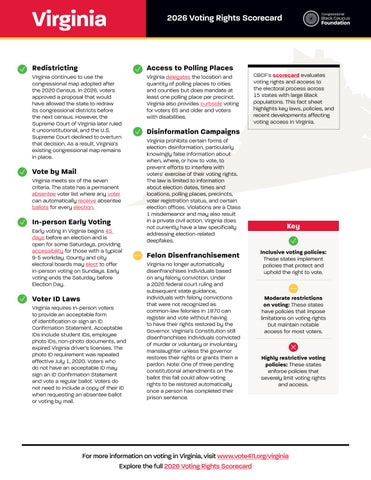
Key
Inclusive voting policies: These states implement policies that protect and uphold the right to vote.
Moderate restrictions on voting: These states have policies that impose limitations on voting rights but maintain notable access for most voters.
Highly restrictive voting policies: These states enforce policies that severely limit voting rights and access.
For more information on voting in Virginia, visit www.vote411.org/virginia Explore the full 2026 Voting Rights Scorecard