Ohio
2026 Voting Rights Scorecard
Redistricting Since the 2024 election, Ohio redistricting has been marked by two major developments. First, voters rejected a proposal to transfer redistricting authority from elected officials to an independent citizen commission, leaving the existing system in place. Second, because Ohio’s 2022 congressional map did not have bipartisan support, the state was required to redraw its congressional districts in 2025. After the Legislature failed to agree on a new map, the Ohio Redistricting Commission unanimously adopted one on October 31, 2025. The new map maintains Cleveland’s 11th Congressional District, a Black opportunity district with roughly 44% Black residents, but increases the number of Republican-leaning districts from 10 to 12. The map will be used for the 2026 elections.
CBCF’s scorecard evaluates voting rights and access to the electoral process across 15 states with large Black populations. This fact sheet highlights key laws, policies, and recent developments affecting voting access in Ohio.
Vote by Mail Ohio meets six out of seven of the criteria. S.B. 293, signed December 19, 2025, and effective March 20, 2026, eliminated the four-day mail grace period; all ballots must arrive by 7:30 p.m. on Election Day, UOCAVA excepted.
In-person Early Voting Ohio offers a four-week period of early voting, including weekends. While there is no statewide requirement for poll hours, the extended voting period gives voters ample opportunity to make arrangements to vote.
Voter ID Laws
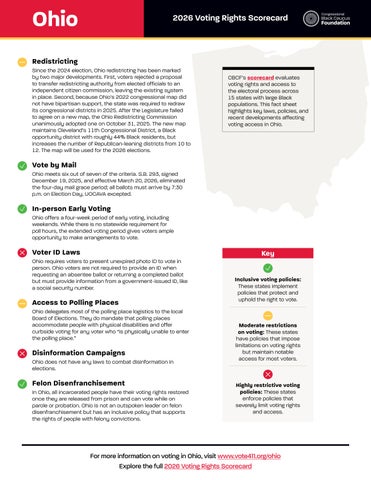
Key
Ohio requires voters to present unexpired photo ID to vote in person. Ohio voters are not required to provide an ID when requesting an absentee ballot or returning a completed ballot but must provide information from a government-issued ID, like a social security number.
Access to Polling Places Ohio delegates most of the polling place logistics to the local Board of Elections. They do mandate that polling places accommodate people with physical disabilities and offer curbside voting for any voter who “is physically unable to enter the polling place.”
Disinformation Campaigns Ohio does not have any laws to combat disinformation in elections.
Felon Disenfranchisement In Ohio, all incarcerated people have their voting rights restored once they are released from prison and can vote while on parole or probation. Ohio is not an outspoken leader on felon disenfranchisement but has an inclusive policy that supports the rights of people with felony convictions.
Inclusive voting policies: These states implement policies that protect and uphold the right to vote.
Moderate restrictions on voting: These states have policies that impose limitations on voting rights but maintain notable access for most voters.
Highly restrictive voting policies: These states enforce policies that severely limit voting rights and access.
For more information on voting in Ohio, visit www.vote411.org/ohio Explore the full 2026 Voting Rights Scorecard