New York
2026 Voting Rights Scorecard
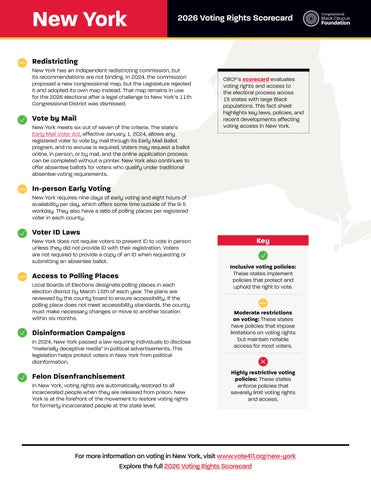
Redistricting New York has an independent redistricting commission, but its recommendations are not binding. In 2024, the commission proposed a new congressional map, but the Legislature rejected it and adopted its own map instead. That map remains in use for the 2026 elections after a legal challenge to New York’s 11th Congressional District was dismissed.
Vote by Mail New York meets six out of seven of the criteria. The state’s Early Mail Voter Act, effective January 1, 2024, allows any registered voter to vote by mail through its Early Mail Ballot program, and no excuse is required. Voters may request a ballot online, in person, or by mail, and the online application process can be completed without a printer. New York also continues to offer absentee ballots for voters who qualify under traditional absentee voting requirements.
CBCF’s scorecard evaluates voting rights and access to the electoral process across 15 states with large Black populations. This fact sheet highlights key laws, policies, and recent developments affecting voting access in New York.
In-person Early Voting New York requires nine days of early voting and eight hours of availability per day, which offers some time outside of the 9-5 workday. They also have a ratio of polling places per registered voter in each county.
Voter ID Laws New York does not require voters to present ID to vote in person unless they did not provide ID with their registration. Voters are not required to provide a copy of an ID when requesting or submitting an absentee ballot.
Access to Polling Places Local Boards of Elections designate polling places in each election district by March 15th of each year. The plans are reviewed by the county board to ensure accessibility. If the polling place does not meet accessibility standards, the county must make necessary changes or move to another location within six months.
Disinformation Campaigns In 2024, New York passed a law requiring individuals to disclose “materially deceptive media” in political advertisements. This legislation helps protect voters in New York from political disinformation.
Felon Disenfranchisement In New York, voting rights are automatically restored to all incarcerated people when they are released from prison. New York is at the forefront of the movement to restore voting rights for formerly incarcerated people at the state level.
Key
Inclusive voting policies: These states implement policies that protect and uphold the right to vote.
Moderate restrictions on voting: These states have policies that impose limitations on voting rights but maintain notable access for most voters.
Highly restrictive voting policies: These states enforce policies that severely limit voting rights and access.
For more information on voting in New York, visit www.vote411.org/new-york Explore the full 2026 Voting Rights Scorecard