Georgia
2026 Voting Rights Scorecard
Redistricting Governor Brian Kemp (R) called a special session of the state legislature in June 2026 to consider redrawing its electoral map for 2028. After facing public pressure, the legislature declined to conduct redistricting during the special session but is likely to revisit the issue before the 2028 Presidential election
Vote by Mail Georgia meets five of the seven criteria. The state has fairly lenient vote by mail policies, including no-excuse absentee voting and an application process that can be completed without a printer. However, the state recently passed a law that tightened the identification requirements and allowed less time for voters to submit absentee ballot applications.
CBCF’s scorecard evaluates voting rights and access to the electoral process across 15 states with large Black populations. This fact sheet highlights key laws, policies, and recent developments affecting voting access in Georgia.
In-person Early Voting Georgia permits an early voting period of up to 17 days, but a lot of authority is in the hands of the county registrar, who determines if early voting can occur on Sundays, and if precincts can have more flexibility with time (expanding the early voting hours from 7am to 7pm instead of 9am to 5pm).
Voter ID Laws Voters must provide a photo ID to vote in-person or by mail, but a valid student ID from a Georgia university is permitted. Voters must include their driver’s license/state ID number or a copy of an acceptable voter ID when applying for and submitting an absentee ballot.
Access to Polling Places Georgia law made it a criminal offense for individuals and groups to “offer […] or participate in the giving of any money or gifts,” including food and drink, to voters in line at polling locations. The provision, commonly referred to as the “line-warming” ban, has been the subject of ongoing litigation. In August 2023, a federal court issued a preliminary injunction blocking enforcement of portions of the ban beyond the 150-foot buffer zone surrounding polling places. However, in December 2025, the U.S. Court of Appeals for the Eleventh Circuit vacated that ruling and remanded the case for further review. As a result, the legal status of portions of the linewarming restrictions remains subject to ongoing litigation.
Disinformation Campaigns Georgia does not have any laws to combat disinformation in elections.
Felon Disenfranchisement Georgia law involving felon disenfranchisement is complex. The state constitution prohibits individuals convicted of a felony involving “moral turpitude” from voting until completion of their sentence, though the term is not clearly defined in election law. In practice, Georgia generally treats felony convictions as disqualifying until a person completes all terms of their sentence, including incarceration, parole, and felony probation. Voting rights are automatically restored upon completion of the sentence, although limited exceptions exist for certain individuals, including some first-offender cases, nolo contendere pleas, and conditional discharges.
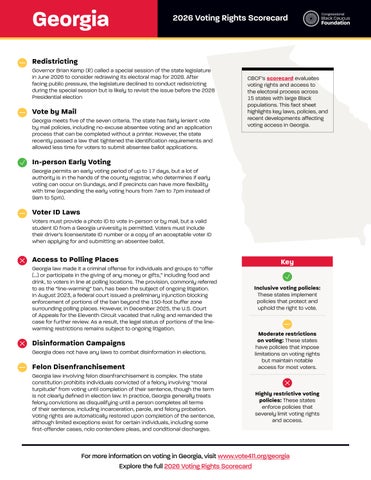
Key
Inclusive voting policies: These states implement policies that protect and uphold the right to vote.
Moderate restrictions on voting: These states have policies that impose limitations on voting rights but maintain notable access for most voters.
Highly restrictive voting policies: These states enforce policies that severely limit voting rights and access.
For more information on voting in Georgia, visit www.vote411.org/georgia Explore the full 2026 Voting Rights Scorecard