Center for Policy Analysis and Research Health Equity and Transportation Equity
July 2026
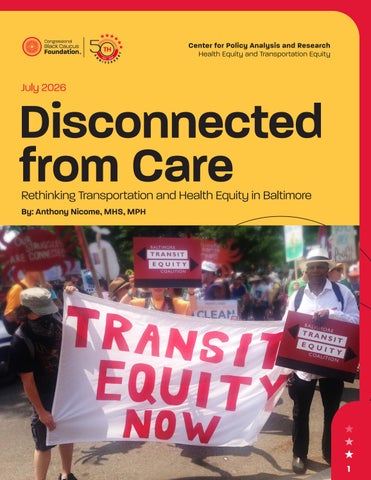
Disconnected from Care Rethinking Transportation and Health Equity in Baltimore By: Anthony Nicome, MHS, MPH
1
Transportation is a critical social determinant of health, shaping whether people can access the essential resources they need to thrive. When reliable transportation is not available, something as basic as getting to a medical appointment can become difficult, leading to missed appointments and poorer health outcomes over time.1 Beyond healthcare, transportation also affects access to healthy food, safe recreational spaces, and stable housing.2 If someone cannot easily reach a grocery store, they may have limited access to nutritious options. If commuting is unreliable or costly, maintaining steady work becomes harder. These challenges compound over time, ultimately shaping one’s overall health and well-being.
In Baltimore, Maryland, where chronic disease rates are already high, transportation barriers are closely tied to broader environmental and social inequities.3 Black residents experience disproportionately high rates of conditions like hypertension, diabetes, and asthma. At the same time, life expectancy can vary dramatically by neighborhood — sometimes by 15 to 20 years.4 For example, residents of Sandtown-Winchester, a predominantly Black Baltimore neighborhood, have a life expectancy about 15 years shorter than those in Roland Park, a more affluent, predominantly white community just a few miles away.5 These differences point to deeper structural issues, including transportation access and neighborhood conditions like concentrated poverty, aging housing, limited access to healthy food and green space, higher crime rates, and longstanding disinvestment. In many Baltimore neighborhoods with limited public transit,
2
residents are more likely to live near environmental hazards such as industrial pollution, heavy traffic corridors, or older housing stock with environmental health risks.6 The combination of transportation barriers and higher exposure to environmental stressors further contributes to the health disparities seen across the city. The connection between transportation and health equity is particularly critical for Black residents of Baltimore who rely heavily on public transit to access clinics, hospitals, and other essential services. When transportation is unreliable, indirect, or difficult to navigate, it becomes more than an inconvenience, functioning instead as a structural barrier to care. Missed buses, long transfer times, and extended travel distances can lead to missed appointments, delayed treatment, and worsening health conditions over time, deepening existing health inequities.
This brief highlights how these transportation challenges sit directly within broader issues of health equity and healthcare access across Black neighborhoods in Baltimore. It also examines how access to Federally Qualified Health Centers (FQHCs) — community-based health centers that provide comprehensive primary care regardless of a patient’s ability to pay — and mobile health clinics intersect with public transit systems in shaping whether care is truly reachable in practice. Even when healthcare providers are located within or near Black neighborhoods, transit
limitations can still determine whether those services are realistically accessible. Thus, access to care is shaped not only by where healthcare services exist, but by how effectively the transportation system connects people to them. To illustrate these dynamics, the brief provides case studies of three Baltimore neighborhoods — SandtownWinchester, East Baltimore Midway, and Cherry Hill — each offering a snapshot of how transportation conditions, healthcare access points, and service availability come together to shape access to care in Baltimore for its Black residents.
Map of neighborhoods highlighted in case studies (left to right: East Baltimore Midway, and Sandtown-Winchester, and Cherry Hill).
The brief concludes with recommendations to address these challenges, including the need to invest in East–West transit connectivity through the Red Line or Bus Rapid Transit; expanding mobile health clinics through better funding and coordination; increasing funding and capacity for Federally Qualified Health Centers; improving bus reliability on major healthcare corridors; addressing
last-mile barriers through neighborhood infrastructure improvements; and improving public data transparency on FQHC missed appointments and access gaps. Together, these strategies provide a pathway toward reducing transportation-related barriers and creating conditions that enable Black neighborhoods to access the care they need without transportation inequities serving as a barrier.
3
The “Highway to Nowhere” (I-170), which runs through the predominantly Black neighborhoods of Rosemont and Franklin Square in West Baltimore, reflects the enduring consequences of transportation decisions that divide communities and limit access to city resources like healthcare, underscoring the need for more equitable, community-centered transportation planning.
A History of Transportation Inequity in Baltimore Baltimore’s transportation system cannot be understood without examining how the city grew and changed over time. In the 20th century, Baltimore was a major industrial hub, with neighborhoods built around its port, rail lines, and manufacturing base.7 As a working port city, it was a center of shipping and industry, with jobs that supported strong Black working-class neighborhoods. As deindustrialization took hold after World War 2, many of those jobs disappeared.8 The economic collapse
4
that followed hit Black neighborhood in Baltimore especially hard. Combined with long-standing segregation in housing and employment, it led to concentrated poverty, disinvestment, and physical decline in many Black neighborhoods.9 Over time, white policymakers directed public investment and resources away from Black neighborhoods, leaving Black residents in areas with fewer job opportunities, limited access to quality healthcare, restricted housing opportunities, and fewer places to buy healthy food.10
Policies like redlining, highway construction, and suburban expansion further reshaped how the city is connected.11 Predominantly Black neighborhoods were often cut off from investment through decisions made by white policymakers, while transportation infrastructure was designed to prioritize regional economic activity and suburban commuter access over connectivity within Black neighborhoods, reflecting broader patterns of racial segregation and discriminatory planning practices. This was especially true in East and West Baltimore, where a large share of the city’s Black residents lived. In practice, this has meant transit systems often better serve a majority white commuter base.12 The racial gap in the Baltimore’s transit policy is best reflected by the city’s metro and light rail system. For example, the Metro SubwayLink,
which opened in 1983, runs a single 15mile north-south line from Owings Mills, MD to downtown’s Johns Hopkins Hospital.13 The Light RailLink, currently a 30-mile line built in 1992, connects northern Baltimore County through the city down to BWI Airport and Anne Arundel County.14 Both are important regional systems, but they were designed primarily to serve white suburban Marylanders by channeling reliable access into downtown and regional job centers, while systematically excluding many Black residents in East and West Baltimore from the same level of connectivity. This has cut off Baltimore’s Black neighborhoods from efficient access to employment, healthcare, education, and economic opportunities across the city and the state, further deepening the negative impacts of environmental racism on Baltimore’s Black residents.15
5
Transportation infrastructure decisions made by white policymakers in Baltimore, created lasting patterns of community disconnection and unequal access to transportation.16,17 These inequities were further compounded in 2015 when an already approved transit project for the city was canceled. The $900 million Red Line project would have created a longneeded east–west rail connection across the city. However, Republican Governor Larry Hogan halted the project for being costly, then redirected over $700 in state matching funds toward highway and road
projects in more suburban and rural parts of the state.18 Today, transit related inequities — like who has access to a personal vehicle, light rail, or efficient bus service — persist between white and Black residents and continue to shape how access to care functions in Baltimore, especially for Black residents living in East and West Baltimore. The broader history of segregation, disinvestment, and infrastructure planning is the foundation for the barriers that remain in place today.
Map of Metro SubwayLink. Source: Maryland Transit Administration (MTA), mta.maryland.gov.
Map of Light RailLink. Source: Maryland Transit Administration (MTA), mta.maryland.gov.
6
Safety-Net Healthcare Access in Baltimore: Federally Qualified Health Centers, Transportation Barriers, and Mobile Health Delivery Vehicle Access and Reliance on Public Transit Baltimore’s public transportation system is primarily composed of bus service operated by the Maryland Transit Administration (MTA), supported by limited rail options, including the Metro SubwayLink, Light RailLink, Charm City Circulator, and the MARC commuter rail for regional connections. Within the city, buses function as the dominant mode of transit and the primary means by which many residents access employment, grocery stores, healthcare, and other essential services. For many Black Baltimoreans, public transit is a critical part of everyday life, providing the primary way to travel to work, school, healthcare appointments, and other destinations.19 In Baltimore, approximately 26%–30% of all households do not have access to a personal vehicle. Among households without a personal vehicle, about 55% are Black, while approximately 24% are white. In
some predominantly Black neighborhoods, this number is even higher. Sixty-three percent of residents of Oldtown/Middle East lack access to a car, along with 58.5% in Sandtown-Winchester and Harlem Park, and 55.3% in Poppleton.20 By comparison, car ownership rates are much higher in predominantly white neighborhoods, with only 5.9% of residents in Canton and 7.2% in Greater Roland Park lacking access to a personal vehicle. While private vehicle ownership could help reduce some of the mobility barriers created by indirect routes, long travel times, and required transfers, it is not equally attainable. With an average income of approximately $47,656 for Black residents, the financial burdens of car ownership -including purchase costs, insurance, maintenance, and fuel — remain out of reach for many households, reinforcing on a transit system that does not always align with residents’ travel needs.21,22
Black households dominate Baltimore’s careless population Share of households without a personal vehicle, by race
% of careless households
60
55%
50 40
24%
30 20
21%
10 0
Black
White Black
Other
Share of Black households experiencing carelessness, defined as households without access to a personal vehicle.
White / Other
7
Black neighborhoods face far less vehicle access
Black
White
Share of residents lacking access to a personal vehicle
63.0%
Oldtown/Middle East
58.5%
Sandtown-Winchester & Harlem Park
55.3%
Poppleton
Greater Roland Park
7.2%
Canton
5.9% 0
20
40
60
% lacking vehicle access
Disparities in household vehicle access between predominantly Black and predominantly white neighborhoods.
Although Baltimore’s transit network provides broad geographic coverage, it often requires multiple transfers and circuitous routing, particularly for East and West Baltimore residents traveling across neighborhoods. Rail lines offer faster service along specific corridors, but their limited reach reduces their utility for many high-need neighborhoods. As a result, even short trips can become time-intensive and unpredictable, with reliability challenges compounding issues of access and making transit dependence a central constraint on mobility and opportunity.
8
Federally Qualified Health Centers as the Safety-Net Backbone Federally Qualified Health Centers (FQHCs) are community-based clinics located throughout the United States, with many serving urban neighborhoods, rural neighborhoods, and other medically underserved areas where access to healthcare is limited.23 FQHCs are supported by federal and state funding through the Health Resources and Services Administration (HRSA).24 Nationally, FQHCs serve more than 30 million patients each year, 17% of which are Black.25 In Maryland, they are also funded by the Maryland State Department of Health and are a key part of Baltimore’s healthcare safety net, providing essential healthcare services in the city’s neighborhoods that need them most. What makes FQHCs different than large and/ or academic medical systems is their focus on access. They provide care to many Maryland residents regardless of insurance status or ability to pay and adjust costs based on what patients can afford. In addition to primary care, many also offer mental health services, dental care, and other support all in one place.26
In Baltimore, several major FQHC networks anchor this system, including but not limited to organizations like Total Health Care, Healthcare for the Homeless, Baltimore Medical System, and Park West Medical Center. Like many other FQHC’s they rely on federal funding and specifically in Baltimore make up the majority share of FQHC locations operating across the city and are located in or near predominately Black neighborhoods in East and West Baltimore.27,28 FQHCs across Baltimore collectively serve thousands of residents annually, most of whom are Black and low-income.29 Even with that reach, the need for patient care still exceeds current capacity. Individual networks like Total Health Care serve tens of thousands of patients each year, but providers consistently report that demand for care continues to outpace available and/or accessible appointments and resources.30 Here, the gap between FQHC capacity and community health needs is especially visible.
9
While FQHCs are often located near bus routes and transit stops, multiple stakeholders like community health centers, transit advocates, and public health officials have noted that a lack of affordable, accessible transportation in Baltimore remains one of the most significant barriers to care.31 Even when clinics may appear geographically close to one’s residence, patients may still need to take two or three different buses to reach them, with both cost and travel time making public transportation difficult to rely on. Stakeholders have also highlighted limitations in existing transportation assistance programs. While Baltimore City operates a Medicaid-funded nonemergency medical transportation service, eligibility restrictions, advance scheduling requirements, and limited availability for uninsured residents can reduce its effectiveness. To help
address these gaps, some providers have implemented transportation supports, such as public transit subsidies, assistance with transportation benefit enrollment, and rideshare vouchers through programs like Uber Health. Mobile clinics resourced by local community health centers and hospital systems have also been used to bring services directly into neighborhoods. While this has reduced transportation burdens for some patients, providers note that these models can be challenging to sustain and scale. These transportation challenges can have direct consequences for health. Difficulties getting to appointments may lead to missed visits, delays in preventative care, interruptions in treatment, and poorer management of chronic conditions for many Baltimore residents — particularly those living in predominantly Black and lowincome neighborhoods.
Map of FQHC locations in Baltimore. Many are concentrated in predominantly Black communities in East and West Baltimore where healthcare needs are greatest. Their distribution reflects the critical role FQHCs play in expanding access to primary care in medically underserved neighborhoods. Source: Open Baltimore.
10
Mobile Health Clinics as a Community-Based Access Strategy
Mobile health clinics are an increasingly important, but still underutilized, part of Baltimore’s healthcare landscape.32 Unlike traditional health clinics, mobile clinics bring care into neighborhoods rather than require residents to travel to them.33 In Baltimore, mobile clinics are operated by hospital systems, FQHC networks, and communitybased organizations. They provide a range of services, including: • Primary care screenings (e.g. hypertension, diabetes, high cholesterol) • Vaccinations and preventive services • Behavioral health support • Maternal and child health services • Health education and care coordination Across Baltimore, there are an estimated seven to eight active FQHC-associated mobile health units in operation. Healthcare for the Homeless and Total Health Care run two such local mobile clinics, providing services to residents two to three days per week during midday hours.
Mobile clinics: • Reduce missed appointment rates by removing transportation barriers • Increase engagement among patients who are disconnected from traditional healthcare systems • Improve early detection of chronic conditions • Build trust in neighborhoods with long histories of disinvestment Mobile outreach efforts tied to major health systems in Baltimore have reported reaching thousands of uninsured or underinsured residents annually, many of whom had not seen a provider in over a year. However, the city’s mobile clinics across are not consistently deployed in a way that aligns with transit gaps. Their schedules are often limited, and they are not always integrated into broader transportation or healthcare planning. This creates missed opportunities for Black residents to access their services. In neighborhoods where transit barriers
11
are highest, mobile clinics can function as a direct workaround — but only if they are appropriately scaled, strategically deployed, and more closely aligned with the city’s highest-need corridors and service gaps. Collectively, Baltimore’s FQHCs and mobile health clinics function as interdependent components of the city’s broader safety-net healthcare system. Yet their effectiveness is shaped -and often constrained — by the same underlying issue of transportation access. FQHCs provide the foundational infrastructure for primary and preventive care in underserved neighborhoods, yet persistent demand, capacity limitations, and reliance on a transit system that requires long, multi-
leg trips all reduce the ease with which residents can consistently access services. Mobile health clinics, in turn, attempt to address these gaps by bringing care directly into neighborhoods, reducing transportation burdens and expanding outreach to populations that are least likely to be regularly engaged in the healthcare system. However, their limited scale, uneven deployment, and lack of full integration into broader transit and health planning mean they cannot fully compensate for structural access barriers on their own. As a result, both models highlight the same reality: improving health outcomes in Baltimore requires not only strengthening clinical capacity but also addressing transportation inequities that shape whether care is reachable.
Map of mobile health clinics operating throughout Baltimore. Many are located in predominantly Black neighborhoods where access to permanent healthcare facilities, including brick and mortar FQHCs, may be limited. These clinics help expand access to essential healthcare services by bringing care directly into communities with unmet healthcare needs. Source: Harvard Mobile Health Map Tool.
12
The Geography of Inequity: Where Barriers Exist in Baltimore For Baltimore residents, transportation inequities are experienced in deeply personal and tangible ways: missed medical appointments, delayed diagnoses, inconsistent treatment, and care that never happens at all. Patients who rely on public transit are significantly more likely to miss appointments, particularly when travel times exceed 45 minutes. In some neighborhoods, reaching a healthcare provider can require more than an hour of travel each way. Importantly, these burdens are not distributed evenly across the city. They are concentrated in historically Black neighborhoods that already experience disproportionate health disparities; transit related inequities; and long-standing patterns of disinvestment, including limited access to full-service grocery stores, fewer parks and green spaces, and reduced investment in neighborhood infrastructure such as sidewalks, lighting, and safe bus stops.34
In addition, these neighborhoods demonstrate the effects of challenges such as last mile connectivity — the distance and difficulty of traveling from a transit stop to a final destination — and bus bunching — where irregular bus arrivals create unreliable service and long wait times — which further compound access barriers by making even short trips unpredictable and time-consuming. 35, 36 At the same time, they reveal important opportunities for investment, repair, and more equitable transportation planning. By examining these three neighborhoods more closely, a clearer picture emerges of where transportation barriers persist in Baltimore.
While citywide transportation data helps illustrate the scale of the problem, it only tells part of the story. To fully understand how transit inequity shapes health outcomes, it is necessary to examine the lived realities of residents in specific Baltimore neighborhoods where transportation, race, health, and geography intersect most clearly. This section provides a closer look at three such neighborhoods — SandtownWinchester, East Baltimore Midway, and Cherry Hill — that share common patterns of transportation-related inequity while reflecting distinct neighborhood-level dimensions of how those inequities are experienced by Black residents. Together, these neighborhoods demonstrate how limited transit access can restrict healthcare access, reinforce economic hardship, and deepen existing racial health disparities.
13
Sandtown-Winchester Sandtown-Winchester, located northwest of downtown Baltimore in an area more formally known as West Baltimore, has become known for the 2015 uprising following the death of Freddie Gray in police custody.37 The uprising was shaped by long-standing structural inequities that continue to shape the daily life of residents, including lack of access to healthcare.38 The neighborhood is over 90% Black, with more than 58% of households lacking a car. In Sandtown-Winchester, FQHCs are not within immediate walking distance: the majority of residents live more than .5 miles from an FQHC. As a result, even within a relatively compact neighborhood, geographic proximity does not translate into consistent or convenient access to primary care services.39 Bus stop density in Sandtown-Winchester is relatively high, yet service reliability is a persistent issue. Residents frequently encounter delays, inconsistent headways,
and bus bunching.40 A trip that should take 15-20 minutes can easily take twice as long depending on timing and service conditions.41 In this community, the issue is not whether infrastructure exists, but how well it works. The neighborhood illustrates how disinvestment is reflected not just in physical conditions but in transit system performance. For residents managing conditions like hypertension or diabetes, unreliable transit can disrupt continuity of care. Over time, that contributes directly to worse health outcomes.42 These transportation challenges are compounded by broader neighborhoodlevel constraints, including high rates of vacant housing, limited access to groceries, and reduced availability of neighborhoodlevel services, which together shape everyday mobility needs. In this context, even short-distance travel becomes resource intensive, requiring residents to plan around unpredictable service, longer wait times, and limited redundancy in transit options.
For residents managing conditions like hypertension or diabetes, unreliable transit can disrupt continuity of care. Over time, that contributes directly to worse health outcomes.
14
Sandtown-Winchester therefore reflects a form of cumulative disadvantage, where healthcare access is not determined by a single barrier such as distance or service availability, but by the layering of transit unreliability, economic disinvestment, and constrained local infrastructure. This helps explain why the neighborhood’s healthcare utilization patterns often reflect delayed or episodic care rather than preventive engagement, as transportation instability effectively raises the “cost” of routine care visits, even when services are geographically close.
East Baltimore Midway East Baltimore Midway, a neighborhood that sits just north of the Johns Hopkins medical campus, has experienced significant institutional investment over the past two decades. Large-scale redevelopment efforts tied to the expansion of the university brought new facilities, infrastructure, and economic activity to the area. But not all residents have benefited equally. The neighborhood is over 85–90% Black, with lack of access to vehicle rates estimated around 35-40%.43,44 Despite its proximity to one of the largest healthcare institutions in the region, access to care remains uneven.
Geographically, East Baltimore Midway appears well-positioned to support access for primary care, as residents on average are located within half a mile of an FQHC. Moreover, the area has a high density of bus stops, as well as multiple transit routes running along major corridors like East Nort Ave, Greenmount Ave, E 25th St, and Hartford Ave.45 But similar to SandtownWinchester, proximity does not translate into reliable access. Residents often face indirect routes, because Baltimore’s bus network is largely designed around downtownoriented travel patterns rather than direct connections between neighborhoods. This requires travelers to go away from nearby destinations before looping back, while congested corridors, slow down bus travel times, and inconsistent service that makes short trips unpredictable. A trip that is under two miles can still take minutes depending on timing and transfers. There is also a deeper issue of access versus inclusion: although FQHCs may appear geographically close, the area’s transit system makes it difficult to reach locations in neighborhoods adjacent to the city’s downtown core. East Baltimore Midway highlights a different kind of inequity — one where significant Map of MTA bus stop locations in East Baltimore Midway. Although the map shows a high concentration of MTA bus stops throughout the neighborhood, the presence of numerous stops does not necessarily translate into convenient access to essential services. Residents often must rely on multiple bus routes and transfers to reach healthcare providers, grocery stores, employment centers, and other critical city resources, resulting in longer travel times and increased transportation burdens. Source: Open Baltimore.
15
investment in major health systems like Johns Hopkins exists, but existing transit systems are not designed to ensure that Black residents can fully benefit from them.47 This produces a structural paradox in which institutional density increases in the area, but functional accessibility remains constrained, reinforcing patterns where proximity to care coexists with persistent underutilization driven by mobility barriers. This produces a structural paradox in which institutional density increases in the area, but functional accessibility remains constrained, reinforcing patterns where proximity to care coexists with persistent underutilization driven by mobility barriers.
Cherry Hill Cherry Hill is one of the most geographically isolated neighborhoods in Baltimore.48 Bounded by major highways and waterways, it is physically separated from much of the city in ways that directly affect mobility. The neighborhood is more than 88% Black, with rates for those without vehicles approaching 48%.49 Unlike Sandtown-Winchester, where the main transportation issue is reliability, Cherry Hill faces more fundamental barriers: distance combined with limited connectivity.
For decades, residents had to travel less than a mile to reach an FQHC, as the Family Health Centers of Baltimore site was located directly in Cherry Hill. However, following its closure in 2023, and the relocation of services for Cherry Hill residents to Total Health Care’s South Baltimore Health Center in neighboring Brooklyn, trips to this site — and to other healthcare providers across the city — can now often take 60 to 75 minutes by Charm City Circulator and MTA bus routes.50 Routes are limited, and most require at least one transfer. Service frequency drops significantly during offpeak hours, making it even harder for residents with nontraditional schedules. Moreover, the “last mile” challenge is especially pronounced. After completing a bus trip, residents may still need to walk 0.4 to 0.75 miles to reach a clinic. For Cherry Hill residents, these walking distances can create additional challenges, particularly in areas with inconsistent sidewalks or limited pedestrian infrastructure, which could pose challenges for older adults or individuals with mobility issues. Healthcare providers and researchers note that patients from Cherry Hill often face compounded barriers to care, including long travel times, physical strain, and scheduling challenges.53
Map highlighting the only FQHC serving the area, located in the neighboring Brooklyn (brown box). Cherry Hill (shown in the area to the left, bounded by major roadways) previously had its own FQHC, but, following its closure, residents must now travel to the Brooklyn clinic to access primary care services.
16
many residents face significant barriers to consistent and timely healthcare due to the restricted availability of on-site services.
Cherry Hill is an underserved neighborhood in South Baltimore where access to primary care services is limited. It is served by a non-FQHC mobile health clinic, MedStar Mobile Health, which parks at Middle Branch Fitness and Wellness Center, but it only operates on Thursdays from 10 a.m. to 4 p.m., leaving residents with a very limited window in which to access care.54 As a result, many residents face significant barriers to consistent and timely healthcare due to the restricted availability of on-site services.
Winchester faces persistent reliability issues despite its proximity to multiple bus stops. East Baltimore Midway reflects a landscape where investment has not translated into meaningful accessibility for residents. Finally, Cherry Hill experiences the most compounded challenges, combining geographic isolation and limited last-mile connectivity.
At the same time, these case studies reveal that Baltimore’s transit system is not entirely absent but, instead, insufficiently aligned with how residents access care. Baseline transit coverage exists across all three What the Neighborhood Level neighborhoods, and most residents are Data Reveals within walking distance of a bus stop. This Collectively, these case studies indicate that suggests that Baltimore’s transit network patterns of transportation inequity — such already connects residents to many areas of as limited vehicle ownership, inadequate the city, though improvements in reliability, access to time-efficient transit, indirect frequency, and routing could meaningfully route design, unreliable service, poor east– enhance access without requiring entirely west connectivity, geographic isolation, new infrastructure. and last-mile barriers — are consistent Transit coverage alone does not guarantee across all three neighborhoods. Although access. Planning decisions often rely the underlying causes of these inequities on whether a bus stop exists near differ, their impacts on residents’ mobility residents, rather than whether trips are and access to opportunities are strikingly feasible in terms of travel time, transfers, similar. Barriers to healthcare access are and reliability.55 Across neighborhoods, shaped by a combination of transit system inconsistent service undermines the design, service reliability, geographic usability of the system: a delayed bus or isolation, and uneven investment in infrastructure. Route layout and connectivity missed transfer can turn a manageable healthcare trip into an impossible one, influence how easily residents can reach particularly for appointments tied to fixed care, while delays, infrequent service, and schedules. There is also a persistent bus bunching determine whether those mismatch between transit routes and trips are realistically manageable. At the healthcare geography, as major providers same time, public and private investment and FQHCs are not always located along has not translated evenly into accessible infrastructure for existing residents. This has efficient transit corridors, nor are routes consistently designed around healthcare left some neighborhoods with persistent gaps in transportation access that connects destinations. Structural gaps — especially poor East and West connectivity — continue residents to healthcare despite broader to reinforce inequities at the citywide redevelopment or institutional growth. level. Finally, the “last mile” remains one Moreover, while all three neighborhoods of the least addressed barriers. For many experience similar patterns of transportation residents, particularly in Cherry Hill, the inequity, the specific ways these final segment between a transit stop and barriers manifest are shaped by each a healthcare facility can often be the most neighborhood’s geographic, infrastructural, difficult part of the trip, yet it remains largely and service conditions. Sandtownoverlooked in transportation planning.56
17
Policy Recommendations 1. Invest in East -West Transit Connectivity Through the Red Line or Bus Rapid Transit Democratic Governor Wes Moore and Maryland transportation officials should prioritize restoring east–west transit connectivity across Baltimore, particularly between historically underserved Black neighborhoods in East and West Baltimore. Whether through the original Red Line proposal or rapid bus service system, the goal should be to create faster and more reliable connections between neighborhoods like Sandtown-Winchester, East Baltimore Midway, and major healthcare and employment centers.57,58 A stronger east–west corridor would also improve access to existing rail lines and regional transit systems that connect residents to opportunities outside the city. A rapid bus service alternative could potentially improve efficiency by using dedicated bus lanes, more frequent service, and better route coordination while relying on existing roadway infrastructure. Regardless of the final design, transportation investments should also be viewed as public health investments.59 Reducing long and unreliable healthcare commutes can improve appointment attendance, continuity of care, and overall health outcomes for residents who rely heavily on public transportation.
Baltimore should invest more heavily in mobile health clinics as a direct way to reduce transportation-related barriers to healthcare access. 18
2. Expand Mobile Health Clinics Through Better Funding and Coordination Baltimore should invest more heavily in mobile health clinics as a direct way to reduce transportation-related barriers to healthcare access. Mobile health units yield an estimated $14 in return for every $1 invested in primary care and up to $13 for every $1 in lowincome neighborhoods — largely driven by fewer emergency department visits, reduced hospitalizations, and stronger preventive care outcomes.60 Mobile clinics already operate successfully through organizations like Healthcare for the Homeless and Total Health Care, but services remain limited in both schedule and geographic reach. Additional funding could allow clinics to expand evening and weekend hours, hire more staff, and operate more consistently in neighborhoods where transportation barriers are highest.
The city should also better coordinate mobile clinic deployment with transit gaps and healthcare access data. Mobile units could be strategically placed near public housing developments, transit hubs, churches, and neighborhoods with high missed appointment rates. Because mobile clinics remove the transportation barrier entirely, expanding them represents one of the most immediate and practical ways to improve healthcare access for underserved residents and generate income for the city. 3. Increase Funding and Capacity for Federally Qualified Health Centers Baltimore and Maryland policymakers should increase long-term funding for FQHCs, which serve as a critical healthcare safety net for many Black and low-income residents. While organizations
such as Baltimore Medical System and Park West Medical Center already provide essential care across the city, many clinics continue to face staffing shortages, high patient demand, and limited appointment availability. Expanding clinic hours, opening additional locations, and increasing staffing could improve healthcare access in neighborhoods where transportation barriers already make care difficult to reach. Additional funding should also support transportation assistance programs connected to FQHCs. Clinics could provide subsidized transit passes, rideshare partnerships, patient navigation services, or shuttle programs that help residents reach appointments more reliably. Treating transportation support as part of healthcare delivery would help reduce missed appointments and improve continuity of care for patients managing chronic illnesses.
19
4. Improve Bus Reliability on Major Healthcare Corridors Baltimore’s transit system already reaches much of the city, but unreliable service often prevents residents from accessing healthcare efficiently. In neighborhoods like SandtownWinchester and East Baltimore Midway, residents may live close to bus stops but still face long and unpredictable trips because of delays, missed transfers, and inconsistent service. The MTA should prioritize improving reliability and frequency on routes that connect residents to hospitals, FQHCs, pharmacies, and other healthcare destinations. Investments should focus on higherfrequency bus service, better coordination between routes, dedicated bus lanes in congested areas, and real-time reliability improvements. While these changes may appear smaller than major rail projects, they could have a more immediate impact on healthcare access for residents who rely on transit every day. Reliable transportation is essential not only for mobility, but for maintaining consistent access to medical care. 5. Address Last Mile Barriers Through Neighborhood Infrastructure Improvements Baltimore should also invest in pedestrian and neighborhood infrastructure that improves the “last mile” between transit stops and healthcare facilities. In neighborhoods such as Cherry Hill, residents often face long walks, poorly maintained
20
sidewalks, unsafe crossings, and limited pedestrian infrastructure even after completing a bus trip. These barriers can be especially difficult for older adults, residents with disabilities, or individuals managing chronic health conditions. The city should prioritize sidewalk repairs, safer crosswalks, improved lighting, covered bus shelters, and Americans with Disabilities Actaccessible pathways near healthcare facilities and transit stops. Small-scale improvements like these are often overlooked in transportation planning, but they can significantly improve whether residents are realistically able to access care safely and consistently. 6. Improve Public Data Transparency on FQHC Missed Appointments and Access Gaps A major gap in Baltimore’s healthcare and transportation planning is the lack of publicly available data on missed appointments at FQHCs, even though these patterns are critical for understanding where access is breaking down. Importantly, this is not about identifying individual patients or exposing protected health information, but about having aggregated, deidentified data that shows where missed appointments are happening geographically — by neighborhood, ZIP code, or clinic service area. That level of detail would allow researchers, community organizations, and policymakers to better understand how transportation barriers translate into real access failures across the city.
While FQHCs are mandated to submit extensive annual data to the HRSA through the Uniform Data System, that reporting primarily focuses on completed visits, patient demographics, clinical outcomes, staffing, and financial performance. It does not consistently provide detailed, publicly accessible breakdowns of missed appointments or no-show rates by geography or neighborhood. As a result, a key indicator of access — where patients are unable to receive care they intended to receive — remains largely invisible at the city level. Expanding standardized reporting to include aggregated no-show data would not only strengthen accountability but also give policymakers in Baltimore and Maryland a more precise tool for identifying where transit investments, mobile clinic expansion, and targeted interventions are most urgently needed.
Conclusion: Moving from Simple Access to Equitable Mobility Policymakers have a clear opportunity to better align Baltimore’s transportation network with reliable access to FQHCs for
Black residents. That alignment should begin with improving reliability on existing bus lines before expanding geographic coverage, prioritizing higher-frequency routes that directly serve healthcare facilities, addressing last mile barriers through targeted infrastructure improvements and partnerships, and revisiting east–west connectivity as a long-term priority. Most importantly, transportation policy must be treated as part of healthcare policy rather than as a separate issue. Baltimore already possesses many of the essential components needed to build a more equitable system: a transit network with broad reach and a healthcare infrastructure designed to serve vulnerable populations. What remains missing is coordination between the two. Correcting that misalignment will not eliminate every inequity facing the city, but it would address one of the most persistent and solvable barriers to care. For thousands of residents, that could mean the difference between missing an appointment and receiving the care they need.
21
References Mary K. Wolfe, Noreen C. McDonald, and G. Mark Holmes, “Transportation Barriers to Health Care in the United States: Findings From the National Health Interview Survey, 1997–2017,” American Journal of Public Health 110, no. 6 (2020): 815–822, https://doi.org/10.2105/AJPH.2020.305579 1
Wendy Heaps, Erin Abramsohn, and Elizabeth Skillen, “Public Transportation in the U.S.: A Driver of Health and Equity,” Health Affairs Health Policy Brief, July 29, 2021, https://doi.org/10.1377/hpb20210630.810356. 2
Abell Foundation, “Alleviating Chronic Disease and Reducing Health Inequities,” Abell Foundation, March 2022, https://abell.org/alleviating-chronic-disease-andreducing-health-inequities/. 3
Nene Narh-Mensah, “Maryland Life Expectancy Data Highlights Racial Disparities,” Maryland Matters, October 26, 2022, https://marylandmatters.org/2022/10/26/ maryland-life-expectancy-data-highlights-racial-disparities/. 4
Madeleine Deason, Joey Trull, and Rose Creasman Welcome, “Map: In Poor Baltimore Neighborhoods, Life Expectancy Similar to Developing Countries,” KFF Health News, February 16, 2016, https://kffhealthnews.org/public-health/map-in-poor-baltimore-neighborhoods-life-expectancy-similar-to-developing-countries/. 5
Danielle Underferth, “New Report from Johns Hopkins Finds Stark Transit Inequity in Baltimore,” Johns Hopkins University Hub, October 7, 2021, https://hub.jhu. edu/2021/10/07/transit-inequity-baltimore/. 6
7
Ron Cassie, “Then and Now: Industry,” Baltimore Magazine, May 2014, https://www.baltimoremagazine.com/section/businessdevelopment/then-and-now-industry/.
“Baltimore’s Blight Began with Loss of Manufacturing,” AFRO American Newspapers, October 21, 2016, https://afro.com/baltimores-blight-began-with-loss-ofmanufacturing/. 8
Richard Rothstein, “From Ferguson to Baltimore: The Fruits of Government-Sponsored Segregation,” Economic Policy Institute, April 29, 2015, https://www.epi.org/ blog/from-ferguson-to-baltimore-the-fruits-of-government-sponsored-segregation/. 9
Richard Rothstein, “How Government Policies Cemented the Racism that Reigns in Baltimore,” The American Prospect, April 29, 2015, https://prospect. org/2015/04/29/government-policies-cemented-racism-reigns-baltimore/. 10
David Armenti and Alex Lothstein, “Baltimore’s Pursuit of Fair Housing: A Brief History,” Maryland Center for History and Culture, 2020, https://www.mdhistory. org/baltimores-pursuit-of-fair-housing-a-brief-history/. 11
12
Baltimore Transit Equity Coalition, “FAQ’s,” More Transit Equity, accessed July 9, 2026, https://moretransitequity.com/faqs/.
Ron Cassie, “The Multi-Modal City: Without the Red Line, Can Baltimore Still Create a Modern Transportation System?” Baltimore Magazine, September 2016, https://www.baltimoremagazine.com/section/community/the-multi-modal-city-can-baltimore-still-create-a-modern-transportation-system/. 13
WOLB Talk 1010, “The Evolution of Baltimore’s Mass Transit: From Streetcars to the MTA,” WOLB Talk 1010, accessed July 9, 2026, https://wolbbaltimore. com/3528916/the-evolution-of-baltimores-mass-transit-from-streetcars-to-the-mta/. 14
Lorena Bally, “In the Face of Empty Promises, Baltimore Residents Take On Environmental Injustice in Their Communities,” Prism, March 12, 2025, https:// prismreports.org/2025/03/12/baltimore-incinerator-pollution-composting/. 15
Christian Schaffer, “Governor Hogan Defends Decision to Cancel the Red Line,” WMAR-2 News, 2018, https://www.wmar2news.com/news/political/governorhogan-defends-decision-to-cancel-the-red-line. 16
Ron Cassie, “The Multi-Modal City: Without the Red Line, Can Baltimore Still Create a Modern Transportation System?” Baltimore Magazine, September 2016, https://www.baltimoremagazine.com/section/community/the-multi-modal-city-can-baltimore-still-create-a-modern-transportation-system/. (baltimoremagazine.com. 17
Colin Campbell, “Five Years Later, Many Across Baltimore Bitterly Lament Gov. Hogan’s Decision to Kill the Red Line Light Rail,” The Washington Post, September 12, 2020, https://www.washingtonpost.com/local/trafficandcommuting/five-years-later-many-across-baltimore-bitterly-lament-gov-hogans-decision-to-killthe-red-line-light-rail/2020/09/12/600f9b44-f529-11ea-bc45-e5d48ab44b9f_story.html. 18
Aleyna Rentz, “Unreliable Mass Transit and American Public Health,” Johns Hopkins Bloomberg School of Public Health, January 22, 2024, https://publichealth.jhu. edu/2024/unreliable-mass-transit-and-american-public-health. 19
Baltimore Neighborhoods Indicator Alliance, “Sustainability — Vital Signs 23” ArcGIS StoryMaps, June 5, 2025, https://storymaps.arcgis.com/stories/ b102dd1b62fe42e2a996780097cff5e5. 20
Neilsberg Research, “Baltimore, MD Median Household Income by Race—2025 Update,” Neilsberg, March 1, 2025, https://www.neilsberg.com/insights/baltimoremd-median-household-income-by-race/. 21
22
https://upward-mobility.urban.org/framework/neighborhoods/transportation.
HealthCare.gov, “Federally Qualified Health Center (FQHC),” HealthCare.gov Glossary, accessed July 9, 2026, https://www.healthcare.gov/glossary/federallyqualified-health-center-fqhc/. 23
Brother’s Brother Foundation, “What Is the ‘Safety Net’ in the US Public Health System?” Brother’s Brother Foundation, October 26, 2023, https://brothersbrother. org/what-is-the-safety-net-in-the-us-public-health-system/. 24
Akash Pillai, Jennifer Tolbert, and Clea Bell, “Community Health Center Patients, Financing, and Services,” KFF, February 4, 2026, https://www.kff.org/medicaid/ community-health-center-patients-financing-and-services/. 25
National Association of Community Health Centers, “What Is a Health Center?” National Association of Community Health Centers, accessed July 9, 2026, https:// www.nachc.org/community-health-centers/what-is-a-health-center/. 26
Health Resources and Services Administration, “Find a Health Center,” U.S. Department of Health and Human Services, accessed July 9, 2026, https:// findahealthcenter.hrsa.gov/. 28
Baltimore Medical System, 2024 Community Health Needs Assessment (Baltimore, MD: Baltimore Medical System, 2024), https://bmsi.org/wp-content/ uploads/2024/09/BMS-2024-Community-Health-Needs-Assessment_2024.05.17_FINAL.pdf. 29
Baltimore City Health Department. “Local Health Improvement Coalition (LHIC) Reports.” Accessed July 14, 2026. https://www.baltimorecity.gov/health/about/lhic/ reports. 30
22
Maanasa Kona, Megan Houston, Jalisa Clark, and Emma Walsh-Alker, Assessing the Effectiveness of Policies to Improve Access to Primary Care for Underserved Populations: Case Study Analysis—Baltimore City, Maryland(New York: Milbank Memorial Fund, August 2022), https://www.milbank.org/wp-content/ uploads/2023/01/Gtown-Baltimore_final.pdf. 31
University of Maryland School of Medicine, Mobile Health in Baltimore: Consensus Conference Report (Baltimore, MD: University of Maryland School of Medicine, 2024), https://www.medschool.umaryland.edu/media/som/community/Mobile-Health-in-Baltimore-Consensus-Report-FINAL.pdf. 32
Stephanie W. Y. Yu, Caterina Hill, Mariesa L. Ricks, Jennifer Bennet, and Nancy E. Oriol, “The Scope and Impact of Mobile Health Clinics in the United States: A Literature Review,” International Journal for Equity in Health 16, no. 1 (2017): 178, https://doi.org/10.1186/s12939-017-0671-2. 33
Chase Hoffberger, “In Baltimore, Money Still Follows the Segregation Map,” Baltimore Brew, February 5, 2019, https://www.baltimorebrew.com/2019/02/05/inbaltimore-money-still-follows-the-segregation-map/ 34
Christopher Marks, “How to Put an End to Bus Bunching,” CommonWealth Beacon, July 16, 2023, https://commonwealthbeacon.org/opinion/how-to-end-to-busbunching/. 35
SHARE Mobility, “What Is Last Mile Transportation? A Practical Guide for Operators,” SHARE Mobility, November 20, 2025, https://www.sharemobility.com/ resources/blog/what-is-last-mile-transportation. 36
Juana Summers, Vincent Acovino, and Sarah Handel, “10 Years after Freddie Gray’s Death, His Neighborhood Looks for Hope,” NPR, April 26, 2025, https://www. npr.org/2025/04/26/g-s1-62502/ten-years-freddie-grays-death-sandtown-winchester. 37
Jay A. Perman, The Greatest Gap: Health Inequity in Baltimore (Baltimore, MD: University of Maryland, Baltimore, June 2016), https://www.umaryland.edu/media/ media-archive/Health-Equity-June-2016.pdf. (umaryland.edu). 38
Baltimore Neighborhood Indicators Alliance–Jacob France Institute, “Census Demographics: Population,” Vital Signs, accessed July 9, 2026, https://bniajfi.org/ indicators/Census%20Demographics/paa. 39
40
PolicyMap, “PolicyMap | Mapping, Analytics, and Data Visualization,” accessed July 7, 2026, https://www.policymap.com.
41
Elijah Knaap, “Sandtown and Spatial Mismatch,” Knaaptime, accessed July 9, 2026, https://knaaptime.com/posts/spatial-mismatch/.
Danielle Underferth, “New Report Finds Stark Transit Inequity in Baltimore City,” Johns Hopkins Bloomberg School of Public Health, October 7, 2021, https:// publichealth.jhu.edu/2021/new-report-finds-stark-transit-inequity-in-baltimore-city. 42
Baltimore Neighborhood Indicators Alliance–Jacob France Institute, “Households with No Vehicles Available,” Vital Signs, accessed July 9, 2026, https://bniajfi.org/ indicators/Sustainability/novhcl. 43
Baltimore Neighborhood Indicators Alliance–Jacob France Institute, “Census Demographics: Population,” Vital Signs, accessed July 9, 2026, https://bniajfi.org/ indicators/Census%20Demographics/paa. 44
45
PolicyMap, “PolicyMap | Mapping, Analytics, and Data Visualization,” accessed July 9, 2026, https://www.policymap.com.
Maryland Transit Administration, “Local Bus Schedules,” Maryland Transit Administration, accessed July 9, 2026, https://www.mta.maryland.gov/ schedule?type=local-bus. 46
Cathy Wang, “An Investigation into the University’s Controversial Real Estate Holdings,” The Johns Hopkins News-Letter, April 19, 2024, https://www.jhunewsletter. com/article/2024/04/an-investigation-into-the-universitys-controversial-real-estate-holdings. 47
Isabella Gomes, “Many In Baltimore’s Struggling Cherry Hill Enclave Could Have Gone Hungry Amid COVID. But a Small Band of Neighborhood Activists Stepped Up,” Pulitzer Center, June 18, 2021, https://pulitzercenter.org/stories/many-baltimores-struggling-cherry-hill-enclave-could-have-gone-hungry-amid-covidsmall-band. 48
Statistical Atlas, “Race and Ethnicity in Cherry Hill, Baltimore, Maryland,” The Demographic Statistical Atlas of the United States, accessed July 9, 2026, https:// statisticalatlas.com/neighborhood/Maryland/Baltimore/Cherry-Hill/Race-and-Ethnicity. (statisticalatlas.com. 49
FHCB Health System, “FHCB Closure Information,” LinkedIn, October 27, 2023, https://www.linkedin.com/pulse/fhcb-closure-information-family-health-centers-ofbaltimore-lbuse. (linkedin.com). 50
51
PolicyMap, “PolicyMap | Mapping, Analytics, and Data Visualization,” accessed July 9, 2026, https://www.policymap.com/. (policymap.com).
Dori E. Rosenberg, Deborah L. Huang, Shannon D. Simonovich, and Basia Belza, “Outdoor Built Environment Barriers and Facilitators to Activity among Midlife and Older Adults with Mobility Disabilities,” The Gerontologist 53, no. 2 (2013): 268–279, https://doi.org/10.1093/geront/gns119. (pmc.ncbi.nlm.nih.gov). 52
Isabella Gomes, “Many in Baltimore’s Struggling Cherry Hill Enclave Could Have Gone Hungry Amid COVID. But a Small Band of Neighborhood Activists Stepped Up,” Pulitzer Center, June 18, 2021, https://pulitzercenter.org/stories/many-baltimores-struggling-cherry-hill-enclave-could-have-gone-hungry-amid-covid-small-band. 53
MedStar Health, “MedStar Health Mobile Health Center,” MedStar Health, accessed July 7, 2026, https://www.medstarhealth.org/services/medstar-health-mobilehealth-center. 54
Karla Isabel Cervantes-Sanmiguel, María Victoria Chávez-Hernández, and Omar Jorge Ibarra-Rojas, “Analyzing the Trade-Off between Minimizing Travel Times and Reducing Monetary Costs for Users in the Transit Network Design,” Transportation Research Part B: Methodological 173 (2023): 142–161, https://doi.org/10.1016/j. trb.2023.04.009. (trid.trb.org). 55
Bill Frist, “The Road Less Considered: The Overlooked Connection Between Infrastructure, Nature, and Public Health,” Forbes, March 18, 2026, https://www.forbes. com/sites/billfrist/2026/03/18/the-road-less-considered-the-overlooked-connection-between-infrastructure-nature-and-public-health/. 56
Daniel Zawodny, “MTA Considers Pivoting Red Line to Rapid Bus Service Instead of Light Rail, Sources Say,” The Baltimore Banner, March 17, 2026, https://www. thebanner.com/community/transportation/baltimore-red-line-light-rail-wes-moore-6JKZDAVNG5FMFBD7TV2VOPRZRE/. 57
Greg Ng, “MTA Plans Community Open House Meetings to Determine Future of Baltimore’s Red Line,” WBAL-TV 11, April 18, 2026, https://www.wbaltv.com/ article/baltimore-red-line-open-house-meetings-train-bus-options/71041035. 58
Aroub Yousuf, “Investing in Public Transit Is Investing in Public Health,” Union of Concerned Scientists Science Network, February 28, 2024, https://blog.ucs.org/ science-blogger/investing-in-public-transit-is-investing-in-public-health/. 59
National Association of Community Health Centers, “NACHC Announces Center for Mobile Health to Advance Mobile Health Care Delivery,” National Association of Community Health Centers, February 9, 2026, https://www.nachc.org/nachc-announces-center-for-mobile-health-to-advance-mobile-health-care-delivery/. 60
23
July 2026 Center for Policy Analysis and Research Health Equity and Transportation Equity