Alabama
2026 Voting Rights Scorecard
Redistricting A federal-court-drawn congressional map with two districts where Black voters had an opportunity to elect candidates of their choice was used in Alabama’s 2024 elections. This occurred after courts found that the Legislature’s 2023 map, which contains one majority-Black district rather than two, did not comply with the Voting Rights Act. In May 2026, a federal court again found that the 2023 map was intentionally discriminatory. The U.S. Supreme Court later blocked that ruling from taking effect, allowing the 2023 map to remain in place for the 2026 elections. Litigation remains ongoing.
CBCF’s scorecard evaluates voting rights and access to the electoral process across 15 states with large Black populations. This fact sheet highlights key laws, policies, and recent developments affecting voting access in Alabama.
Vote by Mail Alabama only meets three of the seven criteria. The state has restrictive vote-by-mail policies: voters must provide an excuse to vote by mail and completed ballots must be notarized or signed by a witness, meaning voters cannot complete and submit their ballots independently. Additionally, the state restricts third-party assistance with absentee-ballot applications and absentee ballot activities by imposing criminal penalties for certain conduct involving collection, delivery, and handling of absentee-ballot materials.
In-person Early Voting Alabama is one of only three states that does not offer in-person early voting. This policy is one of the strictest in the nation and leads to long lines on Election Day that may deter potential voters.
Voter ID Laws In order to register to vote, residents must provide “satisfactory evidence of United States Citizenship,” which is an unnecessary step as federal law prohibits non-citizens from voting. Alabama voters must provide a photo ID to vote in-person. Accepted forms of photo ID include a driver’s license, passport, military ID, and certain student and employee IDs. Free voter ID cards are available to registered voters who do not possess one of the accepted forms of ID.
Access to Polling Places There has not been recent legislation to reduce access to polling places systemically, but there have been closures of voting sites. Since the 2013 Shelby v. Holder decision, Alabama does not have to get permission from the federal government to change their voting laws, and polling place reductions have increased in the state since then.
Disinformation Campaigns In 2024, Alabama passed a law prohibiting the distribution of media that contains false information and is intentionally harmful to the subject’s reputation within 90 days of an election. This legislation helps protect Alabama voters from political disinformation.
Felon Disenfranchisement Alabama allows people with felony convictions to vote after they have completed probation/parole and received documentation stating that they owe no fees or restitution. Requiring people to pay outstanding fees and restitution before regaining the right to vote can create a financial barrier to voting that disproportionately affects people who have been involved in the criminal legal system.
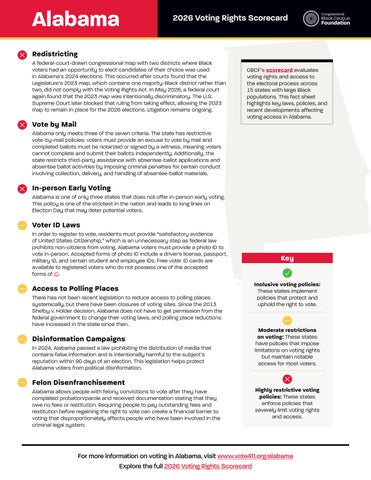
Key
Inclusive voting policies: These states implement policies that protect and uphold the right to vote.
Moderate restrictions on voting: These states have policies that impose limitations on voting rights but maintain notable access for most voters.
Highly restrictive voting policies: These states enforce policies that severely limit voting rights and access.
For more information on voting in Alabama, visit www.vote411.org/alabama Explore the full 2026 Voting Rights Scorecard