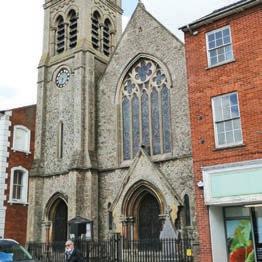
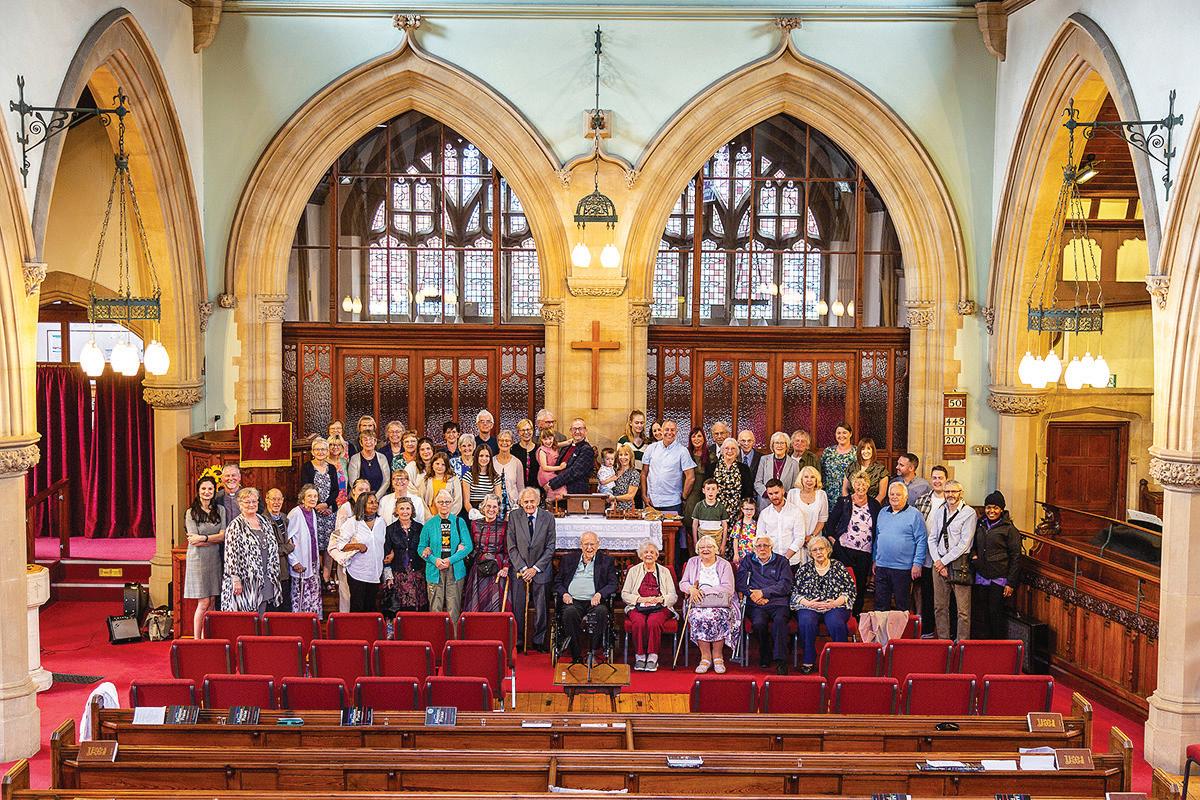
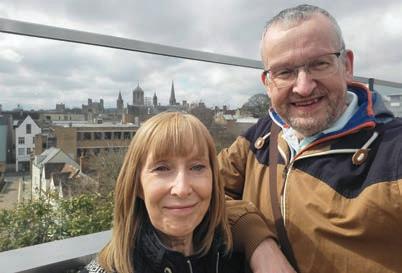
Town centre church keeps looking for new ways to reach out
PAGE 3
PRAYING FOR TODDLER GROUPS
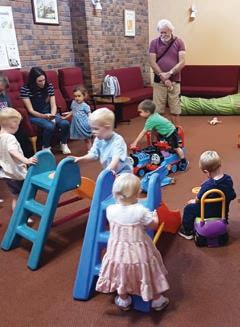
New Month of Prayer for Toddler Groups launches in CF
PAGE 14
TOP
TIPS FOR LEARNING
CHURCHES
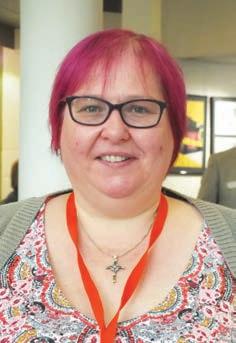
New series on practical ideas for church life –by Catherine Booton
PAGE 20
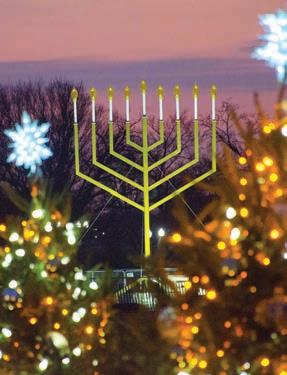
CHRISTMAS IS JEWISH!
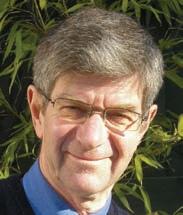
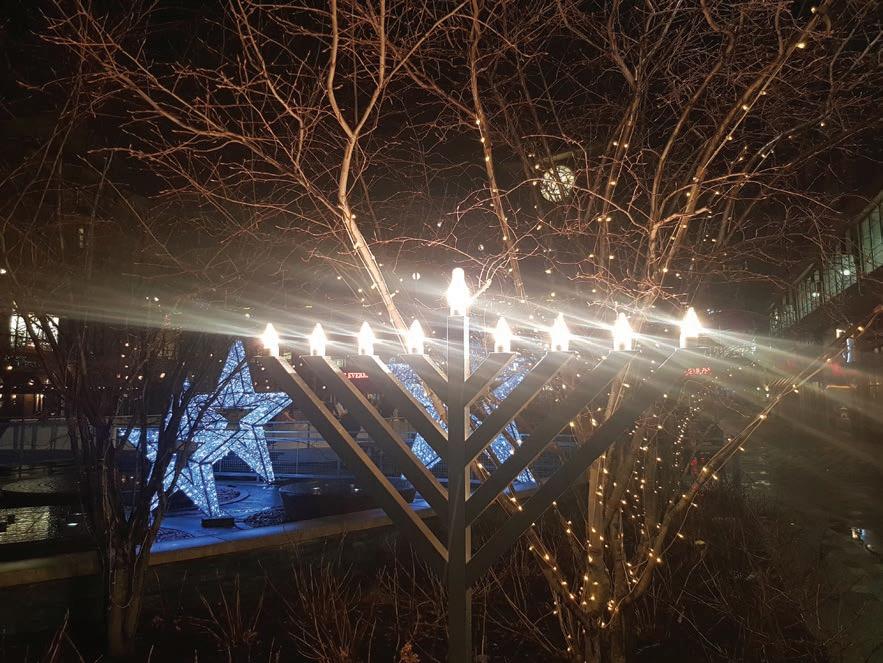
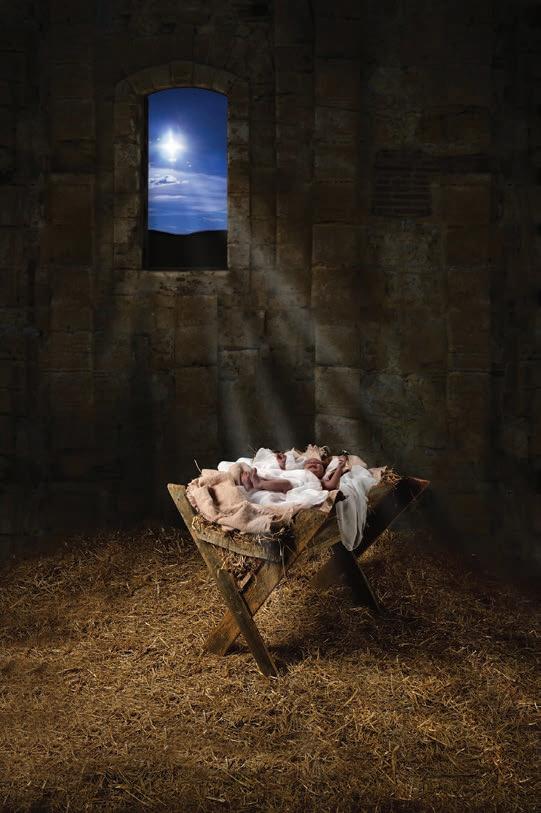
Jew’s surprising claim – and why 25th December may even be the right date
PAGE 30
“…looking forward to being refreshed by your company. God’s peace be with all of you” (Romans 15:33, The Message)
Editorial
Should we be ‘woke’?
It seems you can’t escape ‘wokeness’ these days – whether it’s the police criticised for being ‘too woke’ or banks condemned for closing the accounts of people they deem ‘not woke enough’!
So, what is wokeness and is it good or bad?
At its mildest, being woke is about awareness of social justice and supporting equality for all –something Christians agree with, in principle. But the way in which it is manifesting in our culture should give discerning Christians a very different wake-up call.
You might think wokism has been hi-jacked by extremists who pressurise everyone to agree with their views. As a result, corporate bosses, mainstream media and politicians bend over backwards to avoid offending minority opinions, while ignoring the majority. It has replaced political correctness as a buzzword.
But wokism has actually been extremist from the start. It is driven, imperceptibly to most, by a political ideology called Critical Theory.
Critical Theory emerged out of Marxism after World War One. It divides the world into the “oppressors” and the “oppressed”. Everyone is either a victim or a villain: so if you are white you are automatically racist, if you are male you are misogynist, and if a Christian you are homophobic, etc.
The aim is to destroy the “power structures” that support oppression. It is no surprise that for an atheistic Marxist theory, these structures are primarily the Church, religion, heterosexual marriage, traditional values, sexual morality, free market economics, and even the biological reality of two sexes. As most of these are fundamental to Christianity, this is why so many Christians in the West
TO ORDER REFRESH: There are three issues of Refresh each year, available on annual subscription at £30 incl. p&p and the Yearbook. Email: admin@congregational.org.uk or tel: 0115 9111460 for details.
Refresh Magazine, ISSN 2634-2987, is published by: The Congregational Federation, Congregational Centre, 8 Castle Gate, Nottingham NG1 7AS
Editor: Andrew Halloway. Design and print: Verité CM Ltd. www.veritecm.com.
In his article ‘Critical Theory and the Gospel’, Dr Bradley Green writes that Critical Theory is “a kind of alternative theology”. Wokeness is not biblical social justice but a rejection of Western civilisation and its foundation — Christianity. Sooner or later we will be asked to bow before it, like Nebuchadnezzar’s golden statue. Will we be like Shadrach, Meshach and Abednego and continue to speak God’s truth in public, or hide it away?
One evangelist who has spent most of his life sharing God’s truth with the public is evangelist Trevor Dickerson. I interviewed him for Refresh and I hope you can glean from his experience (see page 26).
I also hope you are enjoying our Local Church News. If you have news about your church that would be encouraging or helpful to others, do email me at: a.halloway@ntlworld.com.
Finally, it won’t be long before the Christmas lights are switching on again, so we have included an article on Christmas that might surprise you (page 30).
May I be the first to wish you a very happy and blessed Christmas!
Andrew Halloway, Editor
are
Magazine. Please contact the Editor if you would like permission to reproduce any content. All Bible quotes are from either the
or NIV unless otherwise stated. This magazine is
From the General Secretary
Finding our voice again
The Lord your God... is always with you. He celebrates and sings because of you, and he will refresh your life with his love.
Zephaniah 3:17 (CEV)
I hope this autumn edition of Refresh finds you well and encouraged in your faith and church at the moment. If not, take time to read this magazine and let the Holy Spirit speak to you and refresh you as you read.
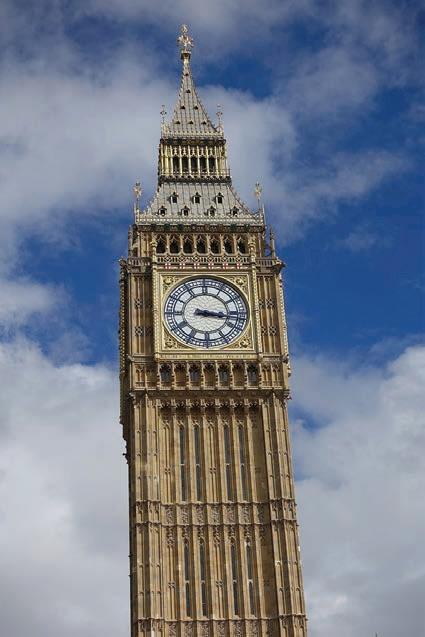
I heard a fantastic testimony today from Christian musician Chip Kendall. His new song is about time, based on a prophecy he had regarding the Church and Big Ben. The prophecy spoke of the Church regaining its voice again in our world, and his new song includes the Big Ben chimes.
Did you know the chimes were inspired by Handel’s Messiah, which was in turn inspired by Psalm 37? Inside the Elizabeth Tower that houses Big Ben there is a plaque with the words to the chimes from the Psalm:
All through this hour
Lord be my guide
That by thy power
No foot should slide!
Did you sing it rather than read it? I think it’s a wonderful little prayer for every hour. For more
information on this and to hear the song the link is: youtu.be/HFyMsO6TAcA?si=0f9vbQbGrGbBa6Sr
I do believe that the prophecy is being fulfilled too. The Government is in the process of responding to the Bloom Report that was released earlier this year. The title is ‘Does Government Do God?’ The Faith and Communities Minister, Baroness Scott, is meeting with faith groups to address and action the recommendations that were put forward. I had the privilege of representing the Free Churches Group at one of these meetings and would welcome any thoughts you have relating to the work your church is doing and the report’s findings.
You might remember in the last issue we shared Greta White’s 1953 Coronation Day memories. It is with great sadness we learned recently of Greta and her daughter Nicola’s death. We send deepest sympathies to the church at Loddiswell at this time. Both Nicola and Greta were wonderful company and supported the Congregational Federation with love and joy. They will both be missed very much.
As we look forward into 2024, the work of the church support staff team will focus on small churches. The new calendar contains photos of small churches doing mission, and we have a programme to inspire and encourage through hybrid days held in the Nottingham offices. Topics will include embracing the small church, officer roles, safeguarding, mission, children, and also finishing well. Look out for more information.
It’s been wonderful to visit churches I’ve never been to before, including Fairford, Timsbury and Lloyd Morris, so if you are needing someone to lead worship and you have never invited me before, then ring the office and let’s set a date for 2024.
I pray every day for your church, for revival and growth and that Christmas brings new opportunities to serve your communities.
Thank you for all you do.
God bless,
Yvonne Campbell
P.S. Remember applications for the Congregational Insurance Serving the Community Awards will open soon – do nominate your church!
sadly passed away along with her daughter, Nicola
Big Ben marks the time but our times are in God’s hands
Credit: Joseolgon/Wikimedia
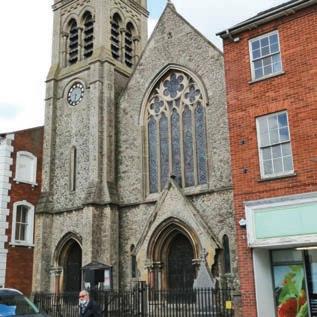
About Cowper Memorial Congregational Church
The church is 150 years old this year, although, due to the difficulties with the ceiling, the planned celebrations are delayed until 2024. The church was built on the site of the house where William Cowper, the poet and hymn-writer, lived until his death in 1800. Cowper is buried in St Nicholas Parish Church in the town.
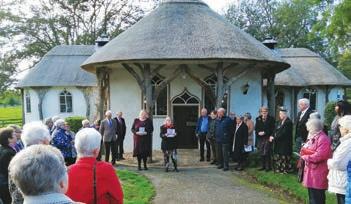
Dereham church never gives up on outreach – even if the ceiling caves in!
Cowper Memorial Congregational Church in Dereham, Norfolk, has a good position in the busy town centre and as a result had an outreach that was going really well. The church’s minister, David Farrow, explains what happened next…
Last year we were looking at ways of promoting our Friday coffee morning. Being a town centre church and Friday being market day, we wanted something to introduce the church to passers-by. A member of our congregation suggested Good News newspaper; he had used it before in a former church he attended.
“We used the paper each month for about six months, and it became very acceptable to passers-by. We distributed it outside the church in the Market Place (main street) and invited them into the coffee morning. It proved to be a very satisfying part of our outreach.”
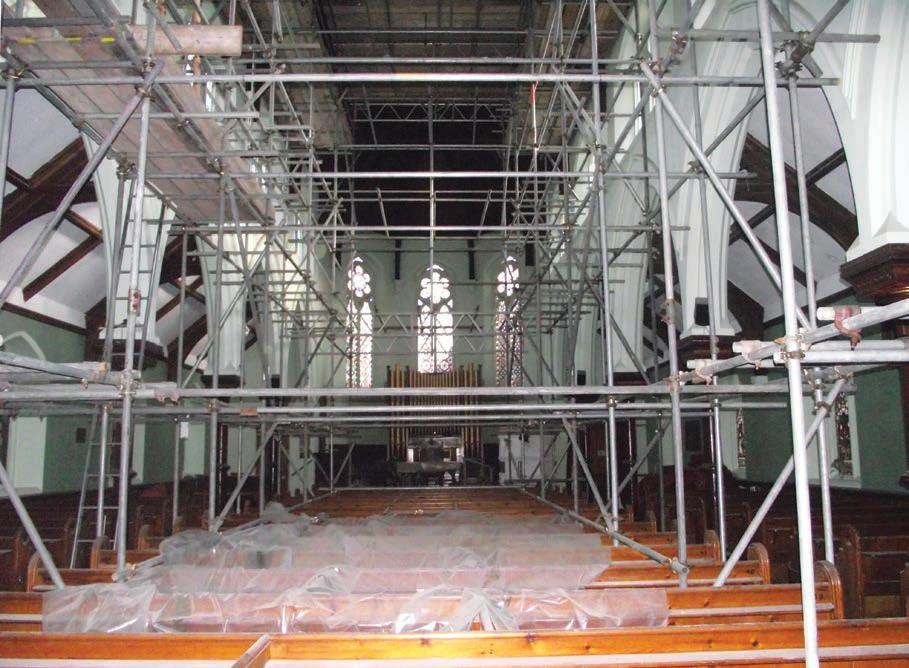
Then the ceiling collapsed in the main church! David recalls: “It had been noticed on the Sunday before that there appeared to be a small gap near to one of the joists. Our first reaction was to discuss a plan of action at the Deacons’ meeting we had planned for the coming Monday afternoon. However, on the Thursday morning, I received a phone call from a member of the fellowship who had gone to the church and found that a section of the ceiling had collapsed, spreading wood and debris all over the church.
“We arranged for a scaffold tower to be erected so that the damage could be inspected. We appointed a structural engineer to carry out a detailed inspection and report on what was needed to restore the section of ceiling. On receiving the report, we discovered that the problem was more serious than we thought: the screws that fixed the joists to the rafters were not long enough, and the whole ceiling needed to be reinforced.
“As the engineer could not guarantee that there would not be further falls, he stated that the main church needed to be closed to the general public for
health and safety reasons, and the work should be commenced as soon as possible. All this happened at the end of October 2022.”
So the main church was closed and Sunday Worship and midweek activities were moved to the church hall at the rear of the building. This had a detrimental impact on the church’s outreach. David explains: “Despite placing instructions on the railings outside the church detailing how to find the rear entrance, having the front doors of the church closed (which face onto the Market Place) created a rumour in the town that the church had closed.”
The church countered that rumour on local Facebook groups and their website, but the number of people declined, especially at the Open Door coffee morning which was held on Fridays – the town’s weekly Market Day.
David continues: “We thank God that the faithful supported us during this difficult period of time and, weather permitting, we handed out copies of Good News, but the general public were reluctant to find their way to the rear entrance of the church.
“Funding the repairs has been a concern to us. Some applications were rejected because we had started the work. However, the Congregational Federation have been very supportive of our need, providing us with an Impact Grant. The problem was that we did not receive any grant aid by the time invoices had to be paid, but we rejoice in that there were several church members who gave the church short term loans.”
After six months the work was finished and the main church was re-opened in May.
David says: “As a church we were tested over that six months, and if there is one thing we have learnt it is that God acts in his time, and not ours. We are continuing our outreach work, especially on Friday
mornings in the Market Place with the church front doors open once again.”
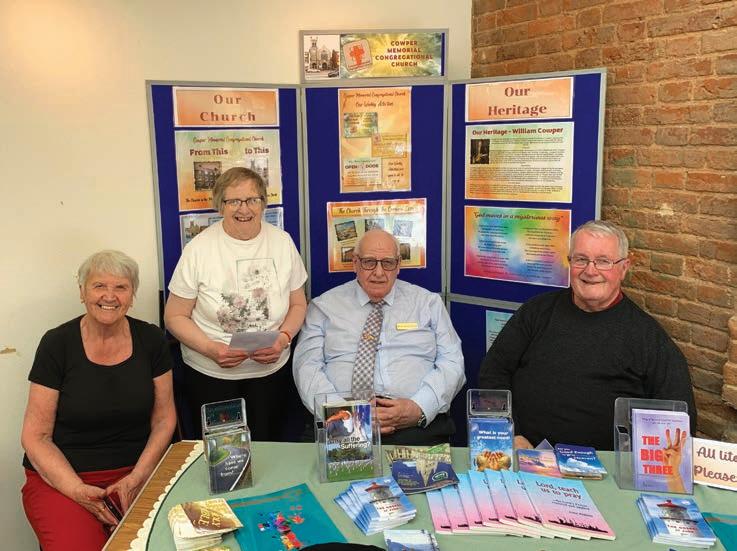
through its presence at ‘Dereham Day’. This was run for several years prior to the pandemic lockdowns as a day when the organisations, societies and churches in the town could display what they have to offer to the community. The church decided it was a good place to be: “Last year, for the first time, we decided to have a display stand, and use the occasion for outreach, focusing on our connection to William Cowper,” says David.
“It was estimated that 2,000 people attended the event (held in May). Because we felt that last year was a great success, and it gave us an opportunity to talk to so many people, we decided to participate again this year, and our theme was based on biblical truth.
“We had several leaflets dealing with questions like ‘Is the Bible true?’, ‘Was Jesus really resurrected from the dead?’, ‘What is heaven really like?’, and we also distributed copies of the ‘Jesus Unmasked’ booklet by Refresh Editor Andrew Halloway, as well as the Good News newspaper he produces, which has been received well by the general public, along with copies of the Bible.”
Since moving back into the main building, the church has had two encouragements since May. David says: “First, we have an increase in our congregation of five new people, and second, we had a man and wife come in and ask if we had anyone to play the organ. I replied: ‘No, our last organist passed away three years ago and we have been unable to replace her.’ Upon hearing this, the man offered to play for us, as he and his wife had just moved into the area and was keen to use his God-given talents. It also came to light that his wife was a music teacher, mainly on piano, and she was willing to play together with the
Left: Scaffolding in the church while the ceiling was repaired
Below: Last year’s stand at the Dereham Day, which after the event was placed in the church and used as a point of information for visitors
organ. You have no idea how much this has improved our Sunday morning worship!”
On the down side, recently the market has not been as large and busy as it used to be, and several people who used to attend on Friday mornings turned to other churches while the ceiling was being repaired. However, the church has come up with another idea for outreach: “This year, for the first time, we are taking part in the annual Heritage Open Days, when our church will be open for people to see the building, and we have the opportunity to explain the connection we have with William Cowper, the hymn writer and poet.
“The Open Days will give us a more significant opportunity to distribute the Good News in addition to our regular opportunities.”
The church’s motto seems to be: ‘Never say die!’ Amen to that.
Isle of Wight church opens new building
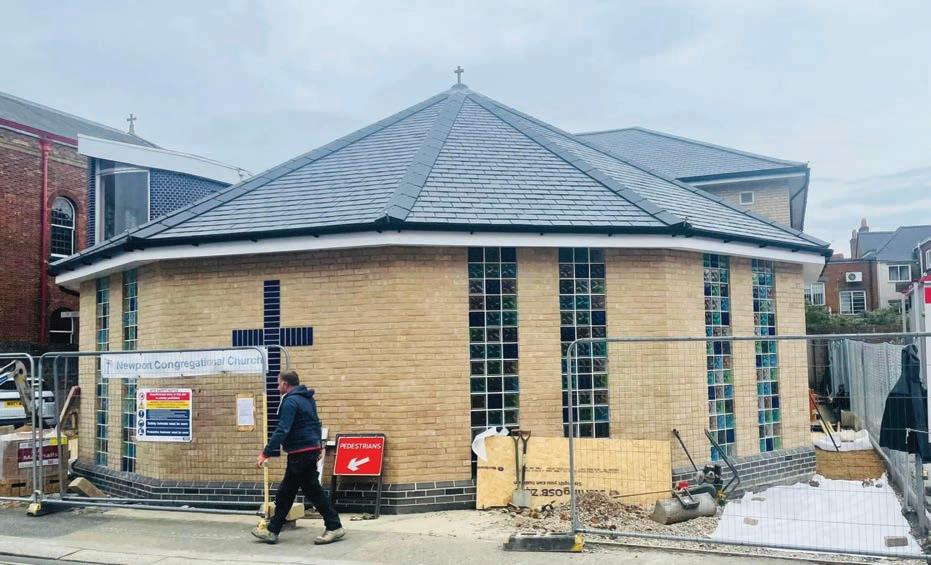
Newport
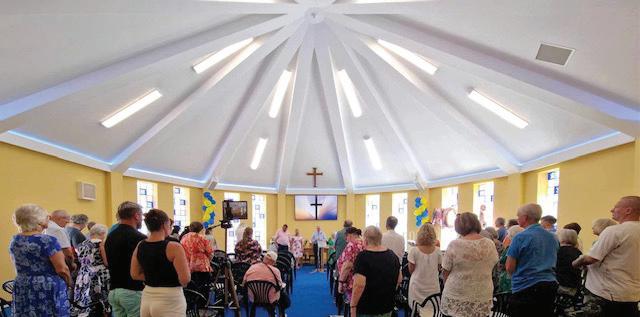
Congregational Church’s new chapel was opened in the summer with a weekend of celebrations.
There was a service on Saturday 24 June which was attended by ecumenical guests and members of the South East Area of the Congregational Federation (CF). The CF presented the church with an olive tree, in reference to Psalm 52:8: “But I am like an olive tree, thriving in the house of God. I will always trust in God’s unfailing love.”
There was also a praise party on the Saturday evening and on Sunday morning a worship service was led by Revd Jason Boyd.
The celebrations were attended by the CF’s General Secretary, Yvonne Campbell, and Church Support Worker, Luzia Watt. Yvonne said: “It was wonderful for Luzia and me to be part of the weekend to celebrate the opening of the new sanctuary. This has been the vision of Newport’s former minister Graham Akers for over 20 years and to have it finally a reality is such a joy.
“A special plaque was revealed which was a surprise for him. It was a wonderful weekend of celebration.”
Current Newport minister Mark Evans told Refresh: “As the minister at the church it’s been a long journey, but we have finally got there in seeing our chapel finished. We thank God for this and thank the building team who became part of the family.
“As a church we have no debt. God has set us free now to fully serve him. The question is: ‘How do we build with God today?’ The vision God has given us is that we are God’s wine press, where people come and
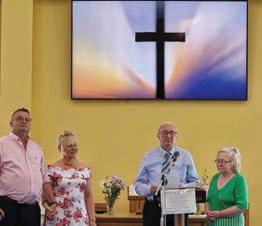
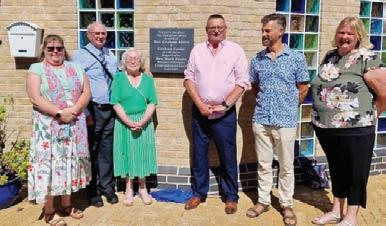
Unveiling the plaque marking the opening of the building. From l to r: Mrs Louise Randall – Newport’s Church Secretary; former Newport minister Revd Graham Akers and wife Lilian; Newport minister Revd Mark Evans; Mr Graham Cooke – the church’s architect; CF General Secretary Yvonne Campbell
are transformed into what God wants us to be: his pure produce, ready to bring glory to his name, as we leave the things of the world behind.
“We currently do this by feeding people both physical and spiritual food through our acts of worship and running a Government funded (£70k currently) community pantry called The Pyle Street Pantry. God is good and we want his blessing in full.
“We have this building due to the faithfulness of the God-fearing folk of the past. We the church now need to build for his glory. We are looking to do this in various ways, as we bring new wine into his new wine skin. After the impact of the years in the wilderness, a new congregation is being birthed as we look at new ways of empowering folk post-Covid, and how we re-shape what we do with new families and new technology, as we build on the biblical truths that Congregationalists hold tightly to.
“Psalm 127 says: ‘Unless the Lord builds the house, the builders labour in vain.’ We pray God is at the centre of all we do.”
The first service inside the new building
Current and former ministers. From l to r: Current minister Revd Mark Evans and Denise Evans; former minister and visionary for the building, Revd Graham Akers and Lilian Akers
A crafty way to bless others
In January, Linda Cooke, Finance Assistant at the Congregational Federation, started a craft group called Patchwork Praise at her church. It meets once a month on a Tuesday morning and is proving a great success as a way of blessing the local community.
Linda says: “From the start I wanted this group to have a purpose or aim, and not be like other Knit and Natter groups that I had been a part of in the past (though there is nothing wrong with those groups). My purpose is to bring together crafters from my church and community, to use the skills that God has given us, link it to our faith and the Bible, and then to bless others.
“Each month there is a short devotional time, linked to a knitting, crochet, craft stitch or pattern. We have a go at the pattern during the morning and the members take it home with them afterwards, along with the ‘Thought for the Day’, to pray and ponder on as they continue to ‘Knit-along’.
“On Easter morning, for example, each member of the congregation was given a knitted mini basket filled with a Cadbury’s Creme Egg. The delight on each person’s face was amazing. What is more
important is they had no idea who had made the baskets or who supplied the eggs – you could say this is an ‘act of kindness’. Though this may not be a new thing to do, it was certainly new to my church.
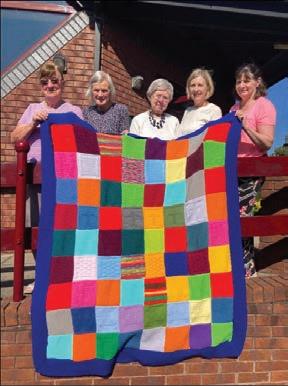
“During the summer, the ladies were busy sewing or crocheting together a series of Knitted Prayer Squares that we have been making since January (pictured). Also the whole church is now getting involved in preparing a ‘Patchwork of Poppies’ ready for Remembrance Day – a really exciting project, bringing together all ages, groups and abilities.
“Our church is a ‘Patchwork of People’ who are brought together, using whatever skill or talent they have, whether its arranging flowers, making teas, a friendly welcoming face, playing music, leading worship, and not forgetting the knitters/crafters. We are all needed to make up our church.
“We have a great time at our meetings, crafting, enjoying a drink and a biscuit. We show and tell our latest projects and enjoy great fellowship together. What more could I ask for?! For me, this is using one of the talents that God has given to me, sharing it with others and then passing the love on to the wider
Above: Linda Cooke
Below: The first completed
Patchwork Praise Prayer Square blanket, with some of the ladies who contributed
Free audio Bibles for people with sight loss
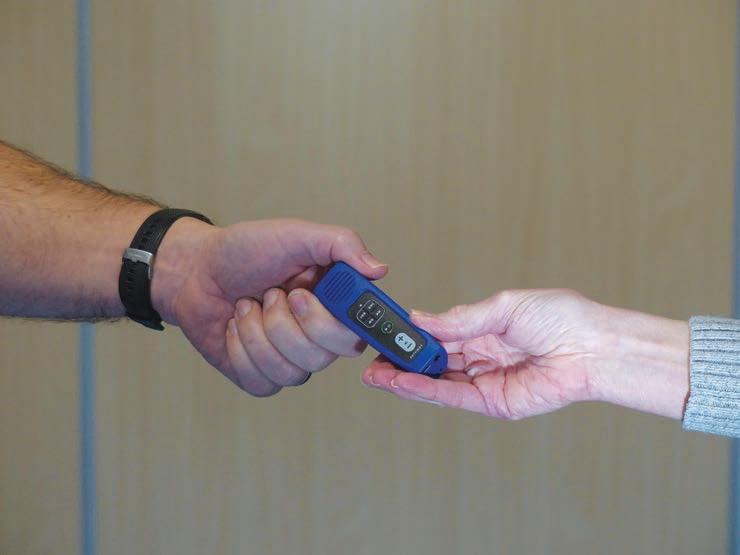
Torch Trust for the Blind is offering free audio Bibles to anyone living with sight loss, and churches can obtain them for members of their congregation.
At the end of 2021, Torch took a leap of faith and ordered 1,000 Pathway audio Bible players containing the New Testament and Psalms, read by David Suchet. Knowing the power of Scripture to change lives, they planned to give these Bibles for free to anyone in the UK losing their sight.
Two years on, all 1,000 Bible players have been sent out and the stories coming back were so amazing that Torch ordered 1,000 more.
One lady told Torch: “It is my friend… with me wherever, it is just so convenient and I have read the New Testament many times but the way this is read brings across the characters; it is just easily understood”. A man called Kenneth wouldn’t call himself a Christian and hasn’t enjoyed audio books in the past, but told Torch: “I’m really listening to the New Testament now… not just odd verses. I’m realising what it all means.”
simple to use audio Bible so they can once again connect with Scripture.
Torch is encouraging anyone who knows someone who is blind or partially sighted to contact Torch for a free audio Bible at www.torchtrust.org/pathway or by calling 01858 438260.
For many people, losing their sight is confusing and life altering with one of the biggest losses being the ability to read. For those who have regularly read
Most of the first 1,000 players were sponsored by individuals, churches or trusts. Torch is also seeking people to donate £20 to cover the cost of sending out one of the new audio Bibles.
The Congregational Federation hosted a sight loss friendly church webinar given by the Torch Trust on 12 October, which is available to watch on the website if you missed it.
People from both Southam and Clarendon Park churches attended Neil’s 30th anniversary at Clarendon Park
Celebrating 30 years of ministry
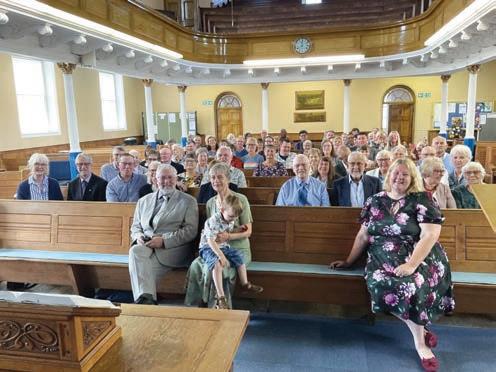
On Sunday 2 July Neil Chappell celebrated 30 years in Congregational Federation ministry by taking the church that he leads, Southam Congregational Church, to his childhood church, Clarendon Park Congregational Church in Leicester. Neil took the service and there was a celebratory lunch afterwards. Clarendon Park’s minister Gwyn Davies said: “Sunday 2 July 2023 will be a day that stays in the mind for a long time for many. It was a joy to join in fellowship with our friends from Southam and Bishops Itchington, Elisabeth Sweeney-Smith (CF President Elect) and members of Neil’s family in celebration of his 30 years in ministry. Congratulations, brother. Here’s to the next 30 years!”
All at the Congregational Federation join in those congratulations. Neil himself shares his reflections on the past 30 years…
Icanstill picture it today… the wonderful comfort, the smell of books and coffee, the desk filled with papers and magazines, the warming fire, the all-embracing welcome of the study in the Manse at Clarendon Park. It was there, in the mid-1980s, that the then minister, Eric Burton, quietly suggested to me that I might consider training for the Christian ministry.
Me? A minister? That wasn’t in the game plan! At that time I was an engineer for British Telecom, I went to as many Leicester City games as I possibly could and I played cricket all summer long. Of course, I was also a deacon at church, had been chair of Congregational Federation Youth for three years, led some of the youth work at Clarendon Park and was occasionally preaching at local Congregational churches. I had no real long-term vision for where my life was headed, but I was sure it didn’t include becoming a Reverend! Or did it?
The more I thought about the suggestion the more it grew on me. Conversations over coffee – and the
occasional beer – strengthened the growing conviction that this was actually where God was calling me. Those conversations led to a Church Meeting at Clarendon Park, and the church unanimously agreed to support me in my fledgling journey. Looking back now I am very humbled by that simple act of affirmation.
That then led to the Foundation Course at Nottingham, and then to four years at Northern College in Manchester. I had some formative experiences during my time there, including working in inner city Hulme and Moss Side, two years of wonderful village life at Uppermill Congregational Church in Saddleworth under the wise and encouraging guidance of Don and Pat Openshaw, and six weeks in a summer placement in a township outside Port Elizabeth in South Africa. In June 1993 I shared in a very moving valedictory service in the library at Luther King House as myself and nine other students brought our time at college together to an end.
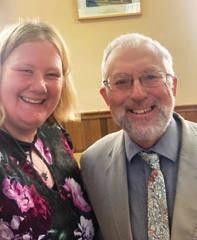
Neil and wife Debby
Then on 3 July 1993 I was surrounded by family and friends at Clarendon Park Congregational Church in Leicester as I was ordained as a Congregational Minister in a service led by Revd Raymond Clarke. In his ordination charge, Eric Burton reminded me of Paul’s words: “Run straight towards the goal in order to win the prize, which is God’s call through Christ Jesus to the life above.”
On 2 July 2023, 30 years later, I returned to lead a service at Clarendon Park – once again surrounded by family and friends. I was glad of the support of the current minister at Clarendon Park, Gwyn Davies. In fact, he tells me that when he went to the Church Meeting to ask their approval for the planned service, they broke out in spontaneous applause at the thought of the service!
And it was the most wonderfully joyous occasion. We closed our church at Southam for the day and 30 of the congregation travelled the 35 miles to Leicester, along with members of our family who had travelled from around the country to join the friends at Clarendon Park. It was also marvellous to see Elisabeth Sweeney Smith – CF President Elect – at the service.
In the 30 years between those two services the journey has taken me to Greenacres in Oldham, and now to Southam in Warwickshire. The experience of leading these two churches has been very humbling and full of great memories.
I have been very fortunate to have the full support of my family at all times. My wife Debby and I were only reflecting the other day on the places we’ve been and the people we’ve seen in all those years. I have been immensely grateful for the support and strength
that Debby has given me. I don’t know what I would have done without it.
Thirty years ago Eric Burton told me: “Neil, ‘Your light must shine before people’ (Matthew 5:16). That is the word of Jesus to you. A light exposes, reveals, shines and reflects. Shine, Jesus, Shine in your exposing the imperfections in people against Christ’s utter perfection. Shine, Jesus, Shine in your revealing to people their way and Christ’s Way. Shine, Jesus, Shine through you into the darkness of peoples’ lives, bringing them hope. Shine, Jesus, Shine – Your light must be a reflection to people of Christ, the Light of the World.”
It was with boundless delight that we sang Graham Kendrick’s great hymn of praise at Clarendon Park 30 years later. I can only say how wonderful it was to share that day of celebration with the congregation at Clarendon Park, and how refreshing and uplifting for Gwyn to pray a prayer of rededication and renewal for me as part of the service. It was only fitting that following the service we should all share in coffee and cake, as befits all celebrations!
Another memory has been added to the journey, and I now look forward to what the next ten years hold!
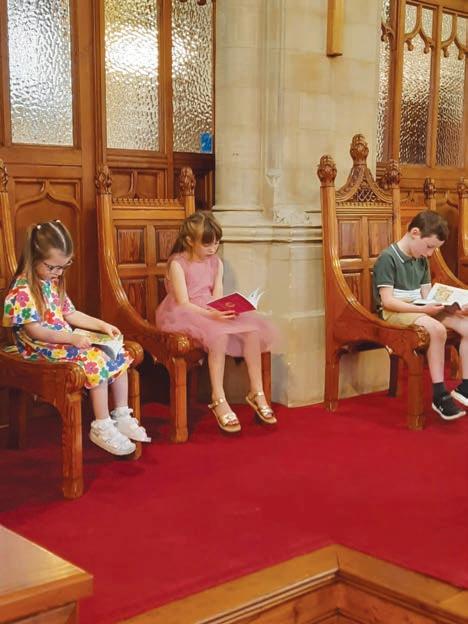
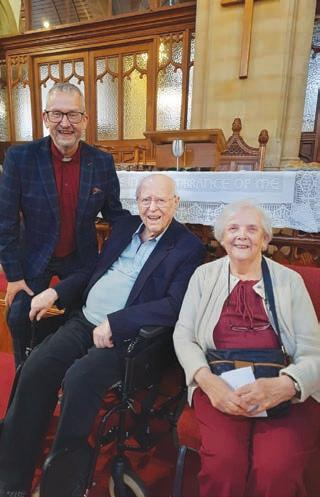
Clarendon Park deacons on the communion chairs! Neil’s grandchildren Ruby, Finnley
How you can help save lives
Revd Kathy Shaw, the minister at Padfield Congregational Church in Derbyshire, tells Refresh readers why the church decided to install a defibrillator, how they went about it and what other churches can learn from their experience
defib
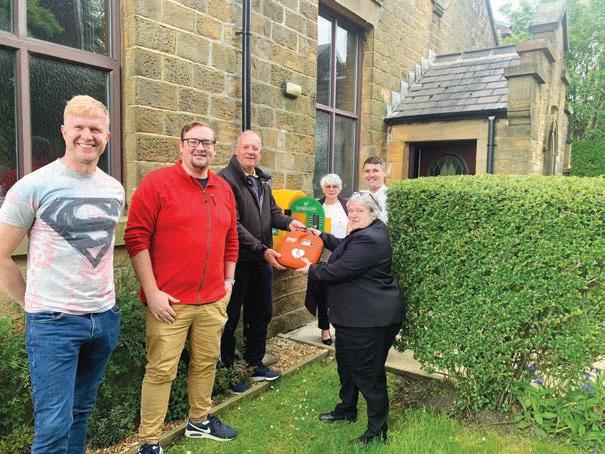
Receiving the defib (left to right): Tony Doyle (member of the Glossopdale Defib Fundraising Group); Damien Greenhalgh (member of the Glossopdale Defib Fundraising group and also a Derbyshire County Councillor); Graham Dodd (church member and local defib guardian); Kath Woodhead (Church Secretary); Kathy Shaw (holding the actual defib); District Councillor Ollie Cross (who funded the installation of the unit from his Councillor budget)
ast year we made the decision to seek the resources to install a defibrillator outside our church, to be accessible 24/7 for the residents of Padfield.
Our need for a defibrillator
Padfield is a village on a long steep hill in the Peak District, with a high number of older people. In addition, it’s an area where tourists and walkers visit, passing through the village in large numbers –especially in the summer months. The village has a defibrillator at the bottom of the village, but there was a need for another one at the top end of the village, where our church is located, recognising that time would be of the essence for anyone in need of using one.
After conversations with residents and discussions within the church, we agreed to take the lead in making it happen, with the intention to site the second defibrillator on the outside wall of the church. The siting was key, as it needed to have an electricity source and be accessible 24 hours a day.
Purchase, installation and maintenance of the defibrillator and housing unit
We then started to let people within the village know that the church was willing to take the project on, mainly by word of mouth and social media. We anticipated it taking us about 12 months, from the time we made the decision to go ahead and its installation. As it happened, it went much quicker than anticipated due to a set of fortunate circumstances.
We started fundraising, and very quickly we began to receive donations from local people. Having reviewed costs, we anticipated needing about £2,000 to buy the defibrillator and the unit to house it, and about £300 for the initial installation costs (total around £2,300). You
electrician to install the
Ongoing costs per annum we estimate at approximately £300-£500
for maintenance checks, replacement pads (which have to be replaced every time the defibrillator is used and cost approximately £50 per set), and constant electricity to the housing unit – keeping in mind rising costs each year. We also intended to provide awareness raising and training annually for CPR and using the defib.
Our local District Councillor heard of our plans and offered us a grant to install the unit when we got it. Then in conversation with him we learnt that there was a group, Glossopdale Fundraising Group, who were raising money to purchase and install defibs around Derbyshire, so we contacted them and they agreed to site one at the church!
So, by a miracle we had secured the defib, housing unit and installation costs, and we were ready to go! We then held a coffee morning and pre-loved books sale, which raised about £300 – meaning we had our first year’s running costs.
The defib and housing unit was installed in April. We had to wait about six weeks from the order being placed to delivery of the unit.
How it works and what’s involved in maintaining it
Although the defib itself is a self-contained unit with its own battery to power it, the box that it is housed in needs electricity to power a light, which automatically comes on when the daylight fades, and a heater to ensure that there is no condensation in the unit, keeping it fully working whatever the temperature outside. However, it uses very little electricity to power it.
The siting of the unit was dictated by accessibility to the power source within the church and being visible to anyone needing it.
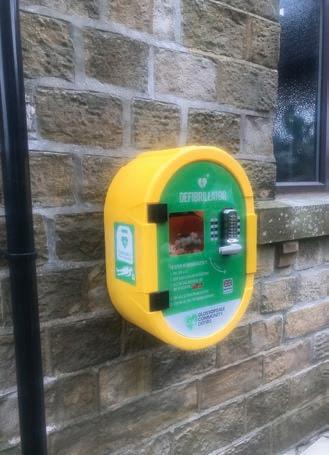
The container that houses the defib has coded access. When someone rings the emergency services, if appropriate, they are given the code to access the defib. Its battery lasts about five years and is replaceable when required. The defib is registered on a national database. We have a ‘defib guardian’ who is a local church member. The guardian receives notification via email if the defibrillator is used, either by the emergency services or any individual. When the unit is returned, we then check it to ensure that it is fully working and replace the pads as needed.
The
container attached to the church wall
If you are thinking about installing a defib at your church or in your local area…
There are a number of things you need to consider:
• Cost of purchase and ongoing maintenance
• Power source
• Maintenance and replacement of ‘pads’
• Awareness raising and training for those using it
• A registered guardian
As well as the costs incurred for installation and maintaining it on an ongoing basis, it is essential that you ensure that local people know about it and know how to access it. We recommend that you keep a spare set of pads (these can be ordered online and you are given the details when you purchase the unit). The pads have a limited life so don’t get too many in stock.
We also check the unit weekly to ensure that the housing unit is kept clean and that its internal light and heater is working, as well as the defibrillator itself.
Since its installation twelve months ago it has been accessed once, but local people feel reassured that it is there, and accessible 24/7.
The unit is easy to use, and a voice talks the user through what to do, but recently in conversation with local residents they expressed that they felt that they needed to feel confident in using it. So we have now sourced training in CPR and how to use the defib by a qualified NHS trainer, and this is happening at the church this October. We hope to make this an annual event for local people.
For any churches considering installing this life-saving machine, we would say ‘go for it’! It’s well worth the peace of mind.
New shepherd needed for small Cornish flock
By Jill Murray, Minister at Cawsand Congregational Church,
Cawsandis a little fishing village on the south coast of Cornwall.
I’m not a native but I have lived here for over 50 years now and have served our church in a non-stipendiary capacity for 13 years – such a delight and a privilege!
The church is built, literally, on the rocks at the edge of the sea and our sea-defence wall houses the store of the last fisherman for miles around. We have a beautiful manse beside the church but my husband and I live elsewhere, so the manse is leased to a charitable organisation which sends groups of young people, at the moment from Austria, to improve their English and get a taste of life in Cornwall. Our church depends on the revenue from the manse to stay open; it’s a big, old building right on the sea and costs a lot to maintain.
Like so many areas where property is at a premium, our community is mainly ‘older-aged’ but so very warm and generous. Our fundraising efforts raise many thousands of pounds for charitable causes annually and create a lively and warm atmosphere for all to share.
The lack of young people does mean that youthwork is not currently possible for the church, although we have an excellent record from the days before sport, computer games, etc. took up the time of young families.
We have outreach from a weekly coffee shop and involvement in many local activities, including Bible study, ‘Open the Book’ and other involvement with our local school, and offering a ‘warm room’ over the winter months for those seeking to save their heating costs and find friendship.
We are famous for being the ‘go-to’ church for weddings because of our location for the photographs and host, among other events, an annual ‘Guitarfest’ where we enjoy listening to some of the big names in classical guitar music, including workshops, and, of course, fine refreshments! We also have a
close relationship with the Fishermen’s Mission as my husband used to minister for them, and we celebrate annually our ‘Harvest of the Sea’, attended by our wonderful male voice choir.
So – I hope you may now have a taste of life in beautiful Cawsand – which is marvellous – but inevitably for me at 81 years of age, as Minister and Worship Leader, my thoughts are turning to the future of the church and my successor.
We currently have a service twice a month, alternating with our sister Anglican church in the village, and have open table for Communion and a huge warm welcome for all.
Could you see yourself becoming part of our church family, perhaps as Worship Leader and eventual Minister, and shepherding our small but hopefully growing membership on in a strong, Gospel-based and locally-loved Congregational church?
There would be no stipend but help with domestic bills or another financial agreement could be reached. Do also look at our website: www.cawsandcongregationalchurch.org.uk.
Come and dip your toe in our Cornish Congregational water –always warm – and see whether you could become part of our family.
With love from us all... Jill.
email: minnadhu@talktalk.net
Beautiful Cawsand – the church is the cream building jutting out into the sea
community every month
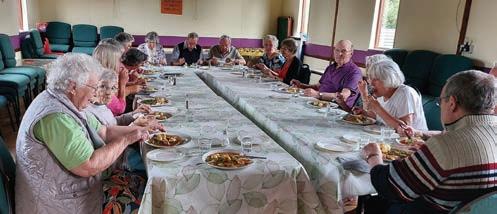
Bow Congregational Church in Crediton, Devon, holds a monthly lunch club for people on their own who want to meet others in the village.
Church Secretary Carole Thomas and Kath McCarthy (who also runs a puzzle club twice a month) provide a meal once a month, followed by cake and tea or coffee.
Carole gives an example of one of the meals: “I cooked chicken, potatoes, carrots, peas and gravy followed by homemade lemon drizzle cake made by one of our members. One 92-year-old lady comes early to wrap the cutlery in the napkins as her contribution to the lunch.
“Afterwards, everyone pitches in to clear up and wash up. We are grateful for our industrial dishwasher! Then the lovely thing is no one wants to go home! There is no charge, just a donation.
“We use the hall a lot for various outreaches and soon I will be applying for some grants to replace the flooring!”
Bedford church’s Open Day a great success
Roxton Congregational Church in Bedford held an Open Day on Saturday 1 July and welcomed many visitors.
The beautiful building is a local attraction. Richard Hooker, a deacon at the church, told Refresh: “The day was well attended and it was great to welcome everyone, including some who had never been before.
“The fine weather enabled our visitors to have their refreshments in the garden, browse our stalls and enjoy our guided tours round the church. It was good to see people taking the opportunity to catch up with friends and neighbours and making the most of the day.”
The Congregational churches in the area also met for a ‘Songs of Praise’ service on 3 September at Elstow.
Market Harborough’s Minister retires
In July this year the Revd Stephen Haward and his wife Jane stepped down at the Congregational Church in Market Harborough after Stephen had been their Minister for eight years.
The church told Refresh: “We were very sad to lose them both. Stephen had served as a Congregational Minister for 41 years overall and he and Jane were looking forward to a well-earned rest. Our church family held a special lunch for Stephen and Jane and their family and friends in recognition and thanksgiving for the blessing that they have been to us over the years. We ask for God’s blessings on them both as they begin the next chapter of their lives in Yorkshire.
“We have now begun our journey to call a new Minister and pray that God will
last service on 9 July
Buggy Club day out
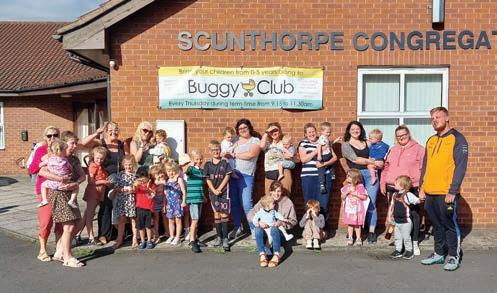
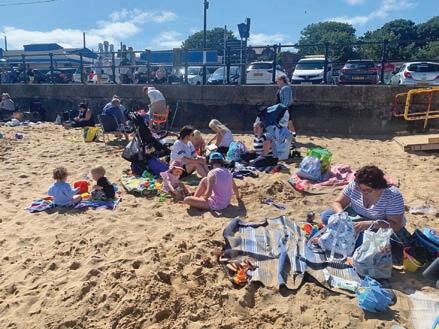
During the summer holidays the children and carers of the Buggy Club at Scunthorpe Congregational Church enjoyed a coach trip to Cleethorpes, funded in part by the church.
The church reports that it was a wonderful day full of fun and laughter enjoyed by all.
The Buggy Club is a parent and toddler group for children under school age who meet in the church hall every Thursday morning through term time. It is run by volunteers from the church and has been going for 12 years. Parents can meet other parents while the children learn to share and play together.
The children enjoy all the usual activities including drawing, jigsaws, building bricks and a story time. There are always refreshments provided. When the weather allows, the children also enjoy a secure outside play area with activities including water splash and sand trays. The parents are always there and are always willing to lend a hand, especially when we are celebrating the Christian festivals which we try to make special.
Above: Scunthorpe’s Buggy Club outside the church
Right: Buggy Club children enjoying their time on the beach at Cleethorpes
Stephen with Yvonne
Creating brave spaces
By Oliver Kinchin, CF President
At
the National Assembly in May,
I
invited all churches
to join me in creating brave spaces in our conversations, our Bible Studies, in our very way of being church. Here is the poem which inspired that challenge. and what other churches can learn from their experience
As an example of how you could create a brave space in your Bible studies, read Psalm 139. What do you identify with, but also, and more importantly, what makes you uncomfortable? Then read Psalm 13, and ask again, what do you identify with and what is uncomfortable? Finally, read Psalm 88 and reflect and share with others where you identify and where you are uncomfortable.
Being brave means that we need to respect the differences we hear in others, and allow ourselves to be challenged in hearing the perspectives of others. We may not agree, but we can walk in mutual respect and love with all those who are brave enough to walk with us.
An Invitation to Brave Space
By Micky ScottBey Jones, inspired by a poem by Beth Strano
Together we will create brave space
Because there is no such thing as a “safe space”
We exist in the real world
We all carry scars and we have all caused wounds. In this space
We seek to turn down the volume of the outside world, We amplify voices that fight to be heard elsewhere, We call each other to more truth and love
We have the right to start somewhere and continue to grow.
We have the responsibility to examine what we think we know. We will not be perfect.
This space will not be perfect.
It will not always be what we wish it to be
It will be our brave space together,
We will work on it side by side.
Please contact me at: oliver.kinchintutor@ congregational.org.uk if you would like me to walk with you as you start creating brave space.
Oliver Kinchin
‘Shaping the Future’ –a report on the Council for European Churches
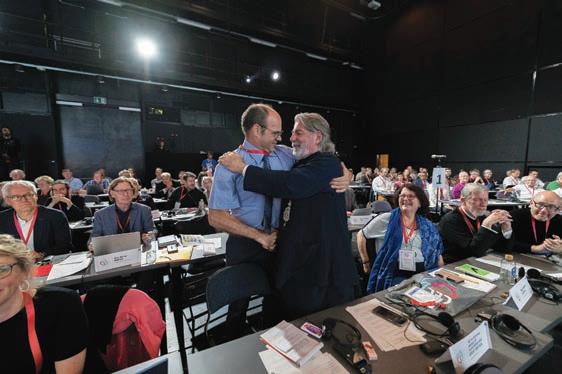
As a member of the Inter-Church Board, retired minister Chris Gillham travelled to Tallinn in Estonia to represent the Congregational Federation (CF) at the Council for European Churches (CEC) General Assembly. This took place on 14-20 June under the theme of: ‘Under God’s Blessing – Shaping the Future’. The CF is a member of the CEC. This report is made up of extracts from Chris’s daily reports.
Tallinn
is an interesting city. The centre is a beautifully preserved and important medieval trading walled city. It is fascinating to walk round and explore. The conference venue was just outside the Old City and is a converted power station.
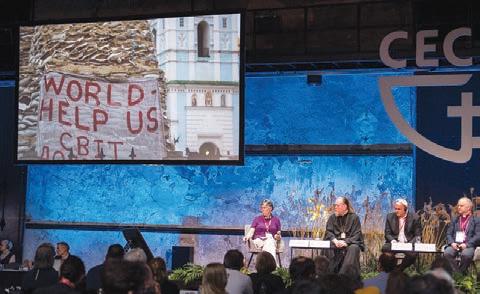
Much of the conference was concerned with the war in Ukraine. The first keynote speaker was Mrs Svetlana Tsikhanouskaya, an exiled Belorussian opposition leader. Her speech was impassioned and convincing, but with this and the two sessions on Ukraine, I could not help feeling that things were a little one-sided with no opportunity for a response. To be fair, the President did say that he had written to the Russian
Above: Outgoing CEC
President Christian Krieger (left) congratulates newly elected CEC President Archbishop Nikitas of Thyateira and Great Britain (Greek Orthodox Archbishop of Great Britain under the Ecumenical Patriarchate) on his election at the Assembly
Orthodox Church but received no response.
All the texts of the speeches are published on the CEC website.
possible to disagree. His assessment of Europe as it is put me in mind of the Book of Ecclesiastes, with which I could not disagree, but his assessment of Europe as it could be was so utopian as to be impossible before the return of Christ.
Greetings came from the Roman Catholic Bishops’ Conference and from the World Council of Churches (WCC). The latter brought by Rev Dr Susan Durber, President of the WCC European Region.
After the General Secretary’s report, there was a time of general questions and the first to be asked came from my friend from Liechtenstein. He requested that pressure should be put on the government of Liechtenstein to give recognition to the Protestant community which is around 8 per cent of the population. At the moment, only the Roman Catholic Church is recognised.
A reminder came from Norway that CEC should relate to the Council of Europe as well as to the European Union. The response was that CEC is keen for such a relationship.
Saturday saw a superb keynote address delivered by Rowan Williams. His thesis concerned the importance of liturgy and eucharist, but did seem to limit the relevance of non-liturgical and noneucharistic churches. I planned to ask him a question on these lines but was beaten to it by the General Secretary of the URC.
Credit: Albin Hillert/CEC
The second keynote speech came from a most enthusiastic German professor of sociology, Hartmut Rosa. His delivery was so energetic that he carried you along with him but, on reflection, I suspect that there was quite a lot in his thesis with which it would be
I was very pleased to meet Rev Kostas Lazaridis, the representative of the Greek Evangelical Church. He manages a refugee care centre in Thessaloniki. It is good to know that this work, to which Christian Rebuild has contributed, is continuing and to hear news of old friends in both Greece and Albania.
The last keynote address was given by the Ecumenical Patriarch of Constantinople, His All Holiness Bartholomew. I found him difficult to follow, particularly when he spoke about a “new ecumenism”.
Right: A panel discussion on the war in Ukraine
Credit: Albin Hillert/CEC
This seemed to be an accommodation between the American Southern Baptists and other fundamentalist groupings with the Russian Orthodox to support President Putin.
A short and very moving cartoon film spoke to me more than all the speeches about Ukraine. The film showed a fertile land in which people built houses and became increasingly prosperous. Then an army general pressed a button and rockets destroyed the houses. Above them, Jesus was re-nailed to the Cross as he wept with the people. His blood fell on the land, re-fertilising it and allowing it to grow anew.
Monday was mainly devoted to business sessions. At lunch time, I did an interview with Sion Brynach for the CYTUN (Churches Together in Wales) website and Facebook page.
There was considerable concern that emphasis should be placed on the lack of religious freedom in some European countries. These included Nagorno Karabakh, Belarus, Turkey and North Cyprus.
In conclusion, here are some of the benefits and drawbacks I saw of the CF being represented at the Assembly:
The benefits
A) The CF can input into discussions and voting, so not leaving everything to the bigger denominations, and we can make a distinctive contribution.
B) We can make a useful contribution in working with our National Instruments as I was able to share with the few others who are connected with CYTUN and Churches Together in Britain and Ireland (CTBI).
C) We are able to meet with and understand people from very different cultures and traditions, e.g. the Armenian Orthodox Church.
D) We can meet and gain news of old friends, e.g. the Greek evangelicals.
E) We can learn of difficulties we have not heard of before, e.g. problems of church recognition for Protestants in Liechtenstein.
F) We can be reminded of things that have long since dropped from the news, e.g. North Cyprus.
G) We hear, in the keynote speeches, first rate theological speakers and thinkers.
H) There are surprises and happy meetings with all manner of people. Where else would I have shared a meal and enjoyed a conversation with a young, newly ordained Romanian Orthodox priest?
I) There is a great choice of worship.
J) We have contact with and gain access to the newest European research and resources.
K) As the UK ecumenical instruments represent us to devolved and UK administrations, so CEC represents us in the Council of Europe and represents the churches in the EU.
The drawbacks
Just one. Financing the conference and European travel.
Credit: Albin Hillert/CEC
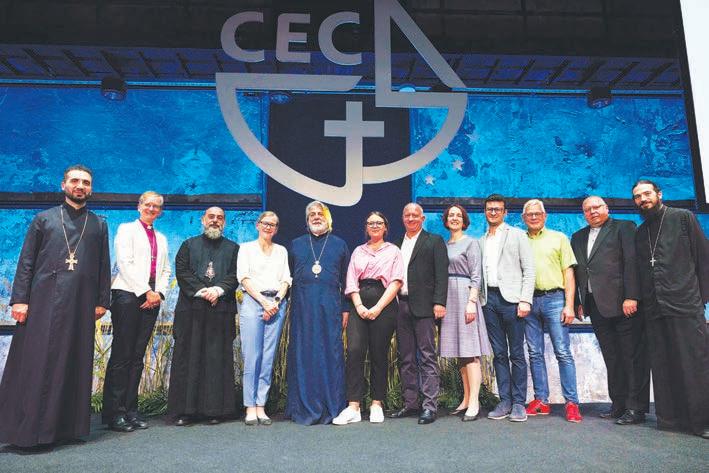
The new leadership of the CEC, pictured at the Assembly
Credit: Ulf Tjärnström/CEC
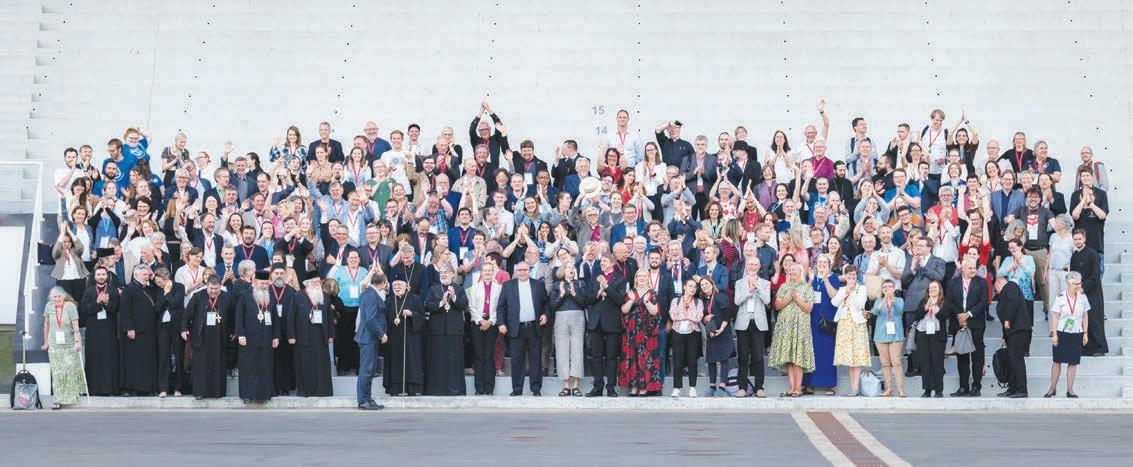
Top: Assembly participants gather for a group photo at the Laulo Våljak song festival ground
New month of prayer for toddler groups
By Joy Howell, Area Worker for the SW Midlands Area
Backin February, CF General Secretary Yvonne
Campbell asked me to represent the CF at the CMN (Children’s Ministry Network) conference. Despite snow making it difficult to get there, I came away from the conference feeling that it had definitely been worth the effort.
Amongst other people I met Joanna Gordon who heads up the 1277 Toddler Network – you can find this on Facebook or see the website https://1277.org.uk.
During April the message went out and I was so encouraged to start getting responses within a couple of days. After a few reminders more responses came in and I began to realise that we were going to have more than one group/church per day to be praying for.
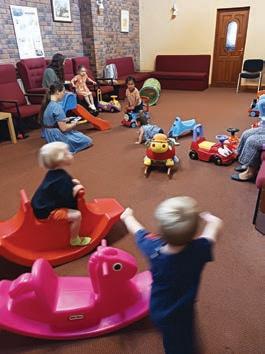
Children at Joy’s toddler group Little Fishes at Hasbury Community Church in the West Midlands
Jo has such an enthusiasm for her work with toddler groups, particularly where she lives in London, but also across the country. Her enthusiasm definitely rubbed off and inspired me to think again about the group that I run with a couple of others at my own church, but also to encourage the churches within my own SW Midlands Area (and then further afield).
The value of well-run toddler groups is immeasurable in the lives of the children and their carers. The benefits to a child’s development are physical, social, mental and, of course, spiritual; and the benefit to the carers of being able to have social interaction with others, whilst observing or playing alongside their child in a safe environment, is also invaluable.
Jo talked amongst other things about the Month of Prayer for Toddler Groups in June. She, with several others, was going to Parliament on 1 June to meet with an MP to champion the role of toddler groups. This was the launch of the Month of Prayer.
I decided to contact the churches within the SW Midlands Area, initially to ask for details of their toddler groups so that we could pray together for each other’s groups. I then spoke with Yvonne about making this a national project rather than just an area-based one, and she agreed.
By June we had 32 groups to pray for over the month and, as the month went on, three or four others got in touch to say that they had not seen the initial notice but could their group be added. I feel that there are almost certainly more groups than this, led by or meeting in our CF churches, but it was so encouraging to have these positive responses and to know that we were praying for this important aspect of our churches’ work.
So, what now? Well, for a start I know of at least one SW Midlands church that, after reading and praying throughout June, is considering starting a toddler group in their village – AMAZING! I hope there are others too.
Maybe some of you involved in running groups would like to meet (on Zoom or in person) to network two or three times a year to share ideas, challenges, opportunities and to pray together? Let me know if that’s something you’d like to do.
If you’re involved in a toddler group do check out 1277 – it’s good for inspiration and networking. Also Care For The Family provide some good resources and run an annual Playtime Conference (it’s full for this year but look out for it next year). Care For The Family also produce a booklet called ‘It’s just the Toddler Group’. The title, sadly, sums up the way that some churches think of their toddler group, but the booklet contains some really helpful ideas on how the group can be more intentional in their Christian witness and still provide a group that people of any faith or none are comfortable with.
And finally – an unexpected follow-on from our Month of Prayer for Toddler groups – Linda Cooke was inspired to have a month of prayer for churches that run various craft/art groups. In September, a whole host of groups and churches were included which was so wonderful!
P.S. 1277 is the average number of days of life that a toddler has before starting formal education – in case you were wondering.
Joy Howell –passionate about toddler groups
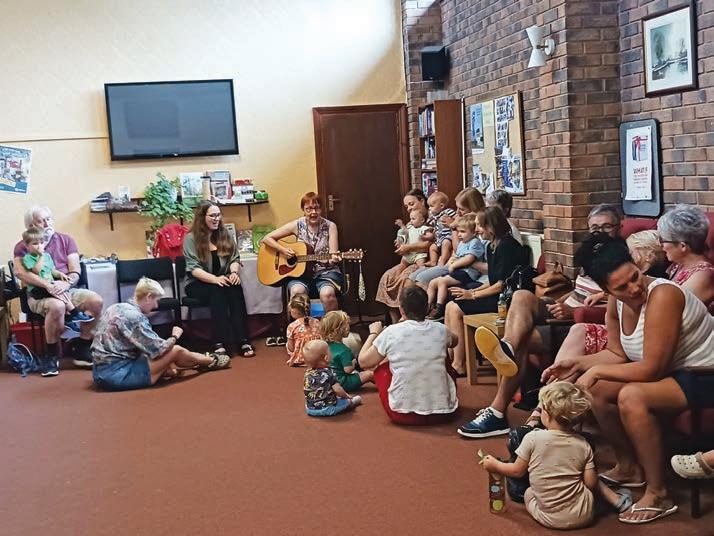
Joy plays guitar to lead the toddlers’ singing time
North East Area puts fun into Assembly again
Lastyear Refresh reported on this new initiative –when the NE Area revamped its annual Assembly into its first Fun Day, combining fellowship and the necessary ‘business’.
On Saturday 15 July the NE Area held their second Summer Fun Day in Scarborough. Robert Waddington, Vice Chair of the NE Area, reports:
“It began as an experiment. Would it work? The choice was simple: carry on as we were and fade away or re-think how we operated and dare to do something different.
“After two annual summer Area Fun Days we’ve discovered that the reworking of the NE Area begun in March 2022 is a positive step forward. A slimmeddown organisation responds to Area needs with two face-to-face and two Zoom Executive meetings a year (pop-up Zoom meetings can be added if a pressing need arises), and a summer gathering for everyone which focuses on people not paper.
“The Executive keeps in touch with all the Area churches following their meetings and asks for comments, questions and approval (or not!) of the minutes. Six weeks is allowed for this process to take place.
“This year’s summer get-together took place at a Methodist church with great facilities in Scarborough, close to many of the town’s attractions. Beginning at 10 am, people were free to come and go as they wished, with refreshments being made available all day. A selection of home-made table-top games made for easy chatting with friends from other churches. At 3 pm we got back together to compare notes on the best places to keep dry and ritual umbrella shaking!
“A 45-minute business meeting at 3.30 pm reported back on Federation matters and set an agenda to guide the Executive; we also had time also to review how the new system was working. The meeting confirmed that the decision to make changes had been justified. A time of worship with the emphasis on vision rounded things off.
“It was a great day. A strong desire was expressed to meet up again but at a new venue next year, as well as planning a Resource Sharing Day in the autumn. With increased numbers attending, the aim must be to encourage those who have yet to ‘live the dream’ to join us in York next July.
“By 5 pm we were setting off home, brushing the sand from our toes (almost), uplifted, smiling, knowing that it had been good to be together again, and looking forward.”
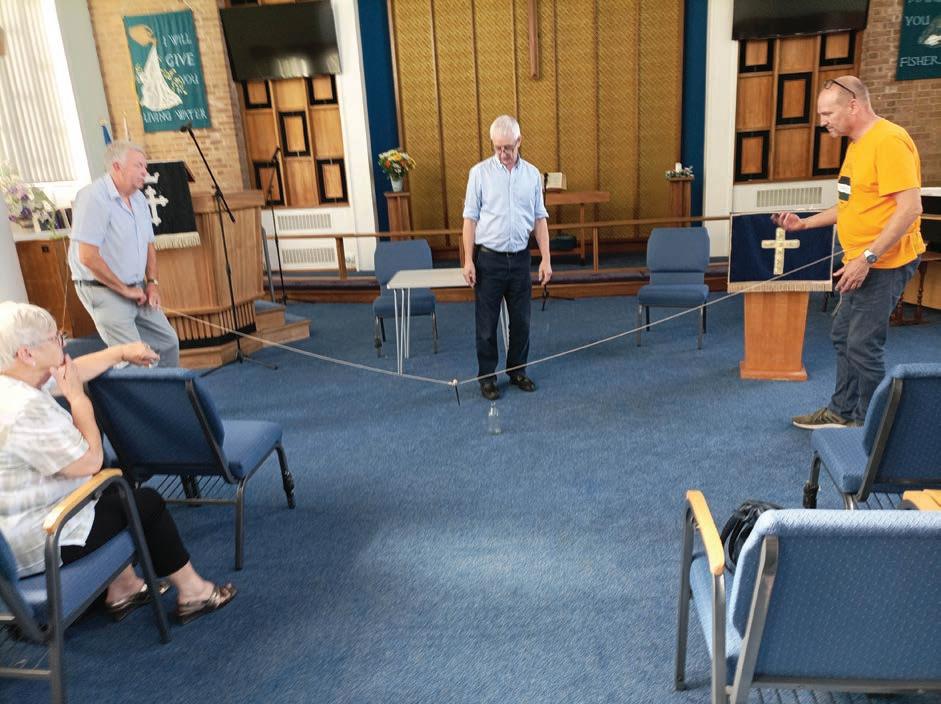
Robert Waddington leading worship in the church with an intriguing visual aid!
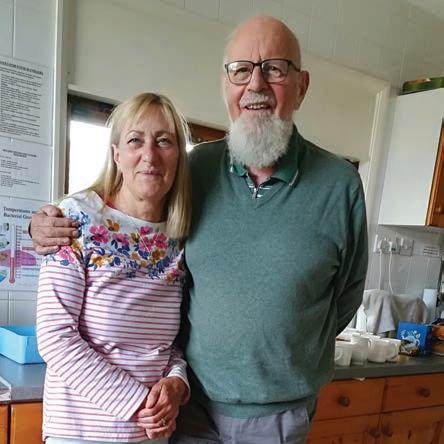
NE Area Secretary Tony Leeming and wife Ruth in the kitchen at Norstead Methodist Church, Scarborough – the base for the Fun Day
Top right: CF General Secretary Yvonne Campbell (left) and Church Support Worker Luiza Watt (second from left) with CWM’s Mission Secretary for Discipleship & Dialogue, Revd Dr Graham McGeoch (far right), and CWM General Secretary Jooseop Keum
Council for World Mission honours retired missionaries
By Yvonne Campbell, CF General Secretary
On 21 August the CF’s Church Support Worker Luzia Watt and I went to an event at Kensington URC hosted by CWM for retired missionaries (now called Partners in Mission –PIM), retired staff of CWM and current serving PIMs.
It was wonderful to hear stories of people who gave their life to share the Gospel of Jesus with others from around the world, including in Zambia, Zimbabwe, Tuvalu and the Solomon Islands. It was especially nice to see Maureen Williams – a member of Highbury Congregational Church who was the first PIM sent by the CF.
Yvonne Campbell (right) and Luiza Watt (left) with Maureen Williams
First pioneers to graduate!
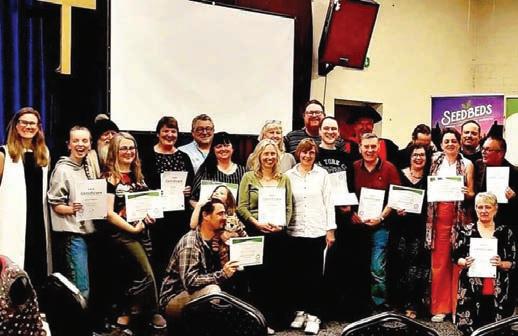
Pictured here is the graduation of the first cohort of students from the Newbigin Pioneering Hub. Congratulations to Trevor and Lorraine Pailing from Newark Congregational Church and Ruth Green, Minister at Pennymoor Congregational Church in Devon, for successfully completing the first Newbigin Pioneering Course. (Lorraine is twelfth from the left in the white shirt; Trevor is 7th from the right in the red shirt; Ruth is kneeling, far right.)
Ruth says: “The Newbigin Pioneering Hub was an inspiration! It re-lit my fire for outreach and got the ideas flowing. I would greatly recommend it.” Trevor adds: “The course not only gave insight into ideas of integration within a community but also caused a deeper examination of our own community and our own attitude towards it.”
We are also delighted that Sarah McGrory, the online pastor at Hay Mills CC (the Congregational church in Yardley, Birmingham), has just started the course. She says: “The first weekend was amazing, to be amongst a group of like-minded people. I jammed with Pete as he played the guitar and I sang. It was like coming home.”
The CWM General Secretary Jooseop Keum spoke and said when he started his role there were only nine Partners in Mission; now there are 30 and his aim is to reach 50. Currently, we have Nigel Lindsay serving in Grenada and he will visit the UK in October and November and visit lots of churches and CF Area meetings. CWM also hope to welcome five new churches at their Assembly in 2024.
If you would like regular news of CWM contact the office and we can send you their newsletter, called Insight.
This year’s Practical Theology students
The CIPT (Congregational Institute for Practical Theology) is delighted to welcome a new intake of students to the first year of the Foundation Degree in Practical Theology Course.
The students come from a wide variety of CF churches from many different areas and make up our largest intake for many years. Our studies began in September with our first residential weekend and students are settling in well as they look at a wide range of topic areas which will help them to further their walk with God, as well as developing their service within their churches. Please remember to pray for them, alongside the existing students, tutors and staff who are part of the course.
If this is something you are interested in finding out more about then take a look at our website pages https://www.congregational.org.uk/learningservice-ministry/cipt or contact the Director of Studies at: Catherine.Booton@congregational.org. uk for further information.
Bandages, fire exits and serving the community
By Revd Neil Chappell, Minister at Southam & Bishop’s Itchington Congregational Church
For the last twelve months our congregation at Southam & Bishop’s Itchington CC in Warwickshire have been completing their latest safeguarding review. They have been wonderfully led by one of the church members, Cathryn Clarke, and wisely guided by CF safeguarding checker Joy Howell.
The time spent pulling paperwork together, reviewing it, asking people to add their details, walking through the building looking at familiar and unfamiliar aspects, talking it through at meetings and submitting for assessment is not inconsiderable.
But let me be clear, it is worth it. You see, we have a responsibility to complete it. An obligation. We want to commit ourselves to best practice in all we do, and first and foremost that applies to looking after people when they come into our buildings.
The care and welfare of our church members and visitors to our premises should be a number one priority, and that starts with whether our buildings are fit for purpose and whether our leaders and helpers are trustworthy and honest. We can’t just say: “Of course they are!” We need to spend time convincing ourselves they are, and the guidance and help of the Congregational Federation and other agencies go a long way to helping with this task.
The dreadful recent events in Johannesburg when fire ripped through an apartment building claiming 74 lives is a reminder for us to take this task seriously. What are the hazards in our buildings? Where are the fire exits and the fire-fighting equipment? Do people know who to contact in an emergency or when they have a concern? Can people report problems, safe in the knowledge it will be looked at and reviewed? Whether we have a congregation of five people or 500 we need to be sincere and professional in our approach.
The folks at Southam were mightily pleased when they received word back from Nottingham that they had received their Safeguarding Certificate. The work didn’t stop there though, as risk assessments needed to be made, and the work done by the church shared with those outside groups who use the building on a regular basis.
As a result of the process, the Church Meeting decided that they wanted to equip a number of the church members with first aid knowledge, and a
bespoke course has been arranged with St John Ambulance to come and provide this. This is a considerable investment by the church – a four figure sum – but it was deemed worth it. We are responsible for people from the moment they walk through the doors of a church, and if anyone should fall ill it is reassuring to know that people have been trained to deal with the situation.
This was the feeling at the Congregational Federation too. Recently a course was provided by St John Ambulance for staff to be equipped with training to deal with emergency situations. It was empowering and encouraging to know that these techniques and principles taught in a lecture room could have real benefit, not just in the office but at many of the events that CF stage. Hopefully, we will never have to put our training to the test, but if we do, we do so in the knowledge we have prepared ourselves.
There are many churches around the country who are doing a wonderful job embracing these responsibilities. I was recently at a very well attended funeral at our church at Greenacres in Oldham. There was literally standing room only, and I was impressed that Greenacres had a number of fire stewards on duty who would have helped the congregation if there had been an emergency of any sort. Many of those present would have been unfamiliar with the building layout, so it was reassuring that everyone was being so well looked after.
I know that all this comes at a cost – both in terms of personnel and finance. But this should not deter us from doing our utmost to serve our communities with honesty and integrity. It should be a badge of honour for churches to display the certificates that the CF issues, and a sign to everyone who comes into our churches that they are being looked after from the moment they enter the building. Get in touch with the CF office if we can help you or your church in any way.
Above: How good is your safeguarding policy and practice?
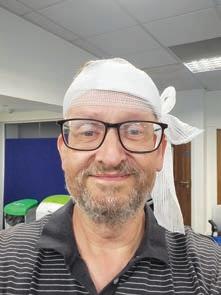
Top: Neil Chappell –enjoying a first aid course
Fire safety for churches –new requirement for Grab Bags
By Philip Stainer, Property Manager/Finance Officer at the CF
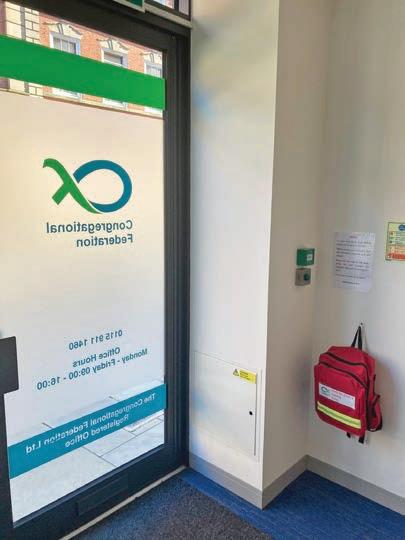
Emergency grab bag in an obvious position by the door of the Congregational Federation offices
Atthe Nottingham premises, comprising offices, conference facilities and student accommodation, we are obliged to carry out a Fire Risk Assessment for the benefit of staff, guests and residents.
A Fire Risk Assessment Report is a live document, highlighting areas requiring attention, immediately or in the long-term, e.g. failed emergency lighting, blocked fire exits, firefighting equipment not serviced, staff training, etc.
Although. we realise that the majority of the Congregational Federation church buildings are not as complex as the Nottingham site, there is still a requirement to carry out a Fire Risk Assessment (FRA).
Emanating from our FRA and subsequent staff training we were recommended to upgrade our Fire & Evacuation Plans and install Emergency Grab Bags.
Our Emergency Grab Bags are bespoke to the Nottingham premises so that in the event of an incident, copies of building plans, highlighting essential services, can be easily identified.
Frequently, when I visit premises, I have to hunt for the gas meter in the basement, the water meter in the most obscure place and the electricity meter, perhaps in the cleaning cupboard. Therefore, churches may wish to consider setting up their own Emergency Grab Bag containing essential information regarding the building and its key services.
Also, like many churches the Nottingham premises are frequently used by members of the public who may not be familiar with the layout of the buildings. Therefore, it is particularly important to consider:
1. Appropriate guidance and policies particularly for church lettings.
2. How to detect fires and how to warn people quickly if they start. For example, installing smoke alarms and fire alarms or bells.
3. The installation and servicing of the correct fire-fighting equipment.
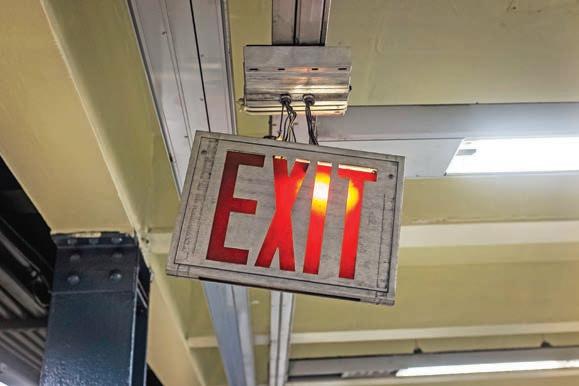
4. Keeping fire exits and escape routes clearly marked and unobstructed at all times.
5. Ensuring workers and volunteers receive appropriate training on procedures they need to follow, including fire drills.
Although we are sharing our experience, we always recommend that churches obtain professional advice on matters of Health & Safety.
CONGREGATIONAL FEDERATION OPPORTUNITIES
The following churches are seeking ministers/pastors at the present time. If you are interested in receiving more information you must firstly contact the Congregational Federation via our Nottingham office.
Full time:
Market Harborough (East Midlands); Greenacres, Oldham – part-time considered (North West); Haverhill (Eastern); Musselburgh (Scotland); Southwick Christian Community Church (South East); Springhead, Oldham – part-time considered (North West).
Part-time:
Bretherton (North West); Dereham: Cowper Memorial (Eastern); Elstow Bunyan Christian Fellowship (East Midlands); North Nibley (South West Midlands); Oakamoor (North West Midlands); Shillington (East Midlands); Stalybridge (North West).
Non-stipendiary:
Frampton (South West Midlands); Oban Congregational Church (Scotland); Penrhys, Llanfair Uniting Church, (Wales); Ebenezer Independent Congregational Chapel, Tredegar, Gwent (Wales); Cawsand Congregational Church, Cawsand (South West).
Train your brain or just take a relaxing time out with these puzzles. The solutions are on the inside of the back cover (don’t cheat!).
Crossword
Across
1. He was prophet to King Hezekiah (2 Kings 20) (6)
5. Night animal (6)
8 & 14 Down. God’s great gift to us (4,7)
9. High chests of drawers in two sections (8)
10. Tasty dessert (5-3)
12. Bible book (4)
13. Small condiment containers (6)
15. Relating to group of people having a common tradition (6)
17. At Jesus’ baptism, the Holy Spirit descended in this form (4)
19. Art of riding and training horses (8)
21. Sold his land and gave the money to the apostles (Acts 4) (8)
23. The first wife of Jacob (Genesis 29) (4)
24. Attendant on a Scottish hunting or fishing expedition (6)
25. Bible book starting: ‘Paul, a servant of Christ Jesus’ (6)
2. Captain? (7)
3. Perfect (5)
4. Spicy (3)
5. Town within London Borough of Bexley (9)
6. She was a leader of Israel (Judges 4) (7)
7. Country linking north-east Africa with the Middle East (5)
11. Fast-paced ballroom dance (4,5)
14. (See 8 Across)
16. Firmly fix or establish a habit, belief, etc. (7)
18. African browsing mammal of giraffe family (5)
20. Melchizedek’s kingdom (Genesis 14) (5)
22. Polite form of address to a man. (3)
Wordsearch Sudoku
Can you find 15 books of the New Testament? Look up, down, forwards, backwards and diagonally.
Fill the grid so that every column, every row and every 3 x 3 box contains the digits 1 to 9
Top tips for learning churches
A new series offering practical ideas on church life
by Catherine Booton, the CF’s Learning and Development Manager
Part 1: Help! We need a preacher for Sunday
Or a service leader, or a worship leader… Sound familiar? I know that such exclamations can be heard in church leadership teams of many traditions all around the country each week. But have you considered if you really do need a preacher or leader? Is there an alternative to the sermon? Is there someone, or a group of people, within your church who could lead the Sunday service? Do you just need a few ideas to give you the confidence to do so?
Well, in this article I am going to offer just a few ideas that could be helpful to you when considering how to lead your own services within your fellowship.
1. DIY service
A week or two before the service, ask people to suggest their favourite hymns, to find a reading (biblical or not), or write a prayer and then have a central person to bring it all together, place it all in an order and add any other elements to it.
You could either ask for suggestions that are completely random or give people a theme to base their suggestions around. For example, if I was asked to choose my favourite hymn the answer would probably be ‘Shine, Jesus shine’ because it reminds me of CF Youth events and learning all the ‘modern’ songs with my peers! But if the theme was water, say, I would choose ‘I will sing the wondrous story’ as I think of the day we will all be “singing with the saints in glory, gathered by the crystal sea” in the Kingdom of God.
2. Form a worship group
If you have a number of people who would be prepared to be involved in leading worship, but don’t want to do the whole service, why not lead the worship using multiple voices? Plan the service out together and
allocate roles to each person so they know what task they have been given. If people are given smaller tasks they are more likely to give it a go.
3. Time of reflection
We spend much of our time surrounded by noise and words. Instead of a sermon could you create a reflective space as part of your service? Perhaps using pictures or items? These could concentrate on a Bible reading or theme and be tied in with the hymns and prayers that are chosen? How about John 8 (Jesus being the Light of the World) as the focus and then using a world map and some nightlights to create an interactive prayer time? Or if the reading was Genesis 1, could you use pictures of creation as your focus, or even have models of parts of the creation to focus on. Don’t forget about the power of music either – a well-chosen song or instrumental can really aid that time of reflection.
LEARNING TOGETHER
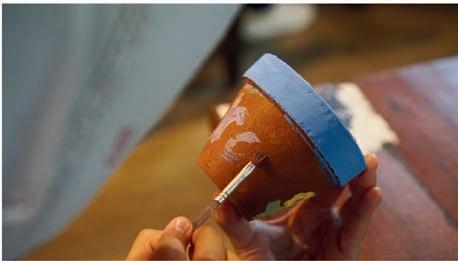
doing something creative? Crafts are not just for our young people! There are lots of crafts from art, painting, origami, collage, colouring, modelling and more that could be linked to the service theme and give people an opportunity to creatively explore the reading. Could you use a reading from Revelation 21 about what the new Jerusalem would look like and create a piece of artwork, either individually or collectively, to reflect that? Or how about using the Parable of the Sower and decorating a plant pot and then sowing a seed in it?
become a service. This can be an excellent focus for a service and also allows you to find out more about the work that particular organisations are doing, at home and around the world.
Sermon vault
If you would rather hear a spoken sermon, why not use one of the sermons in the CF sermon vault? These are freely available via the website and designed to allow you to add hymns, reading and prayers to make a full service using them. This resource is quite new and we are hoping to add to those already available as times goes on. If you do use any, your feedback would be very useful.
6. Special Sundays
In the CF Yearbook and on the Resource Hub website (www.theresourcehub.co.uk) there is a list of Sundays dedicated to a particular theme or charity. There is often a wealth of worship material that goes with those Sundays which can be used collaboratively to
A few examples over the next few months:
• 19 November – International Men’s Day
• 19 November – Safeguarding Sunday
• 21 November – Pray for Schools Day
• 19-26 January – Week of Prayer for Christian Unity
• 26 January – Holocaust Memorial Day
• 11 February – Racial Justice Sunday
• 26 Feb-11 March – Fairtrade Fortnight
• 1 March – World Day of Prayer
• 8 March – International Women’s Day
These are just a few ideas to start the thinking process and I do hope that they are of some use to you. Do remember that if you need anything printing out then contact the CF office and we will be able to help.
If you would like further practical ideas, then please get in touch with us and we will see what we can do to help. And, of course, if you would like to develop your skills in putting together worship, preaching or other ways to help your church, praise God, then look out for details of our Likewise Preaching Day, coming to a number of locations around the country soon, or contact us to book one for your church or area!
LEARNING TOGETHER
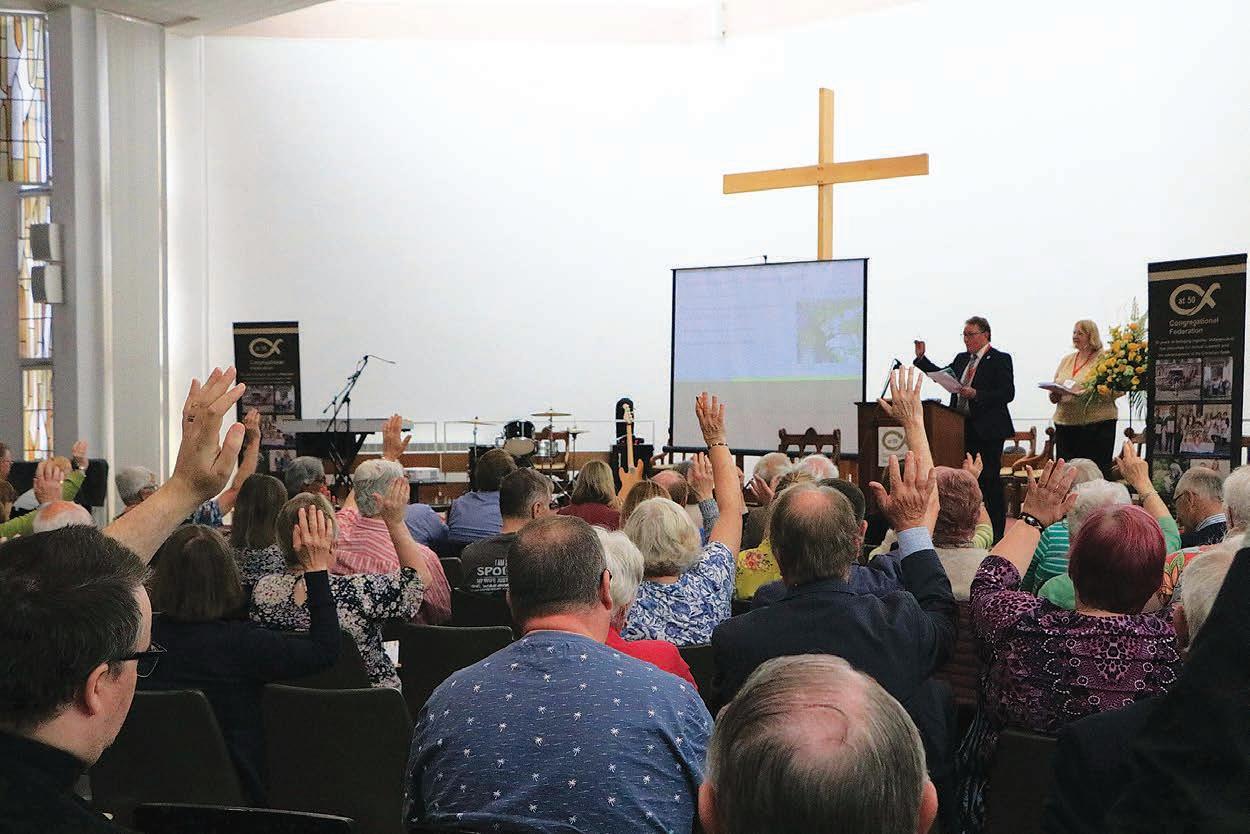
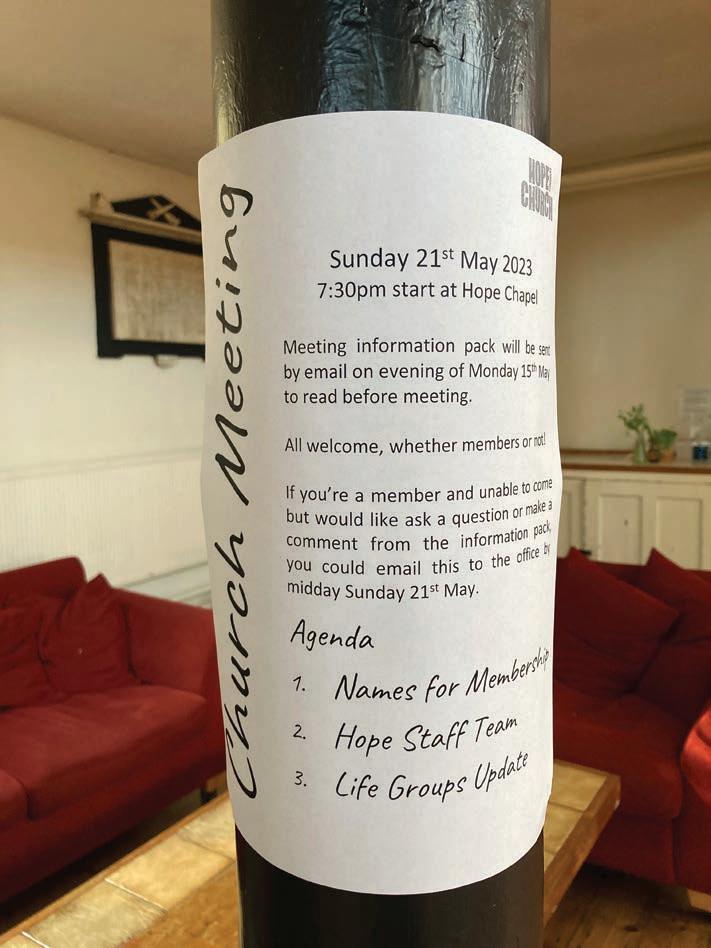
Can we improve on the way we hold Church Meetings?
By Revd Chris Bond, co-pastor of Hope Chapel in Bristol
Church Meetings’ are a distinctive feature of our churches – shared with Baptists and a few other denominations – but something that sets us apart as Congregational.
I wonder what comes to your mind and what emotions you feel when you have a Church Meeting coming up? We’ve had some really good ones and others that have been very hard and painful. There have been times that I’ve dreaded a Church Meeting, and times when I’ve come away from one full of energy and inspiration from the great time we’ve had together.
In my appraisal last month, one of the appraisers had a helpful suggestion for how we can tweak our Church Meetings to make them less confrontational. As an elder team we’ve been working on improving these meetings for the last year and my appraiser’s suggestion was another good one to add to our learning.
I thought also that we could learn from each other as Congregational churches. Some of you have been involved with church meetings for many years. I’ll share some of our recent learning in this article and would appreciate hearing from other churches. What is your experience of Church Meetings, and, more importantly, what have you learned about how to do these meetings really well? Could you write in to the Refresh magazine with your stories, learning and advice?
We have learned three things that I want to share. The first is about relational health and maturity within the church, and the second and third are practicalities.
1: Relational health and maturity
The first area of our learning has been to recognise that Church Meetings can reveal the state of relational health and maturity within the church. If people are feeling hurt or neglected, the Church Meeting can be seen as an opportunity to get some of that pain off their chest. This can become quite exposing and unpleasant.
Around 2005 we came across some teaching called the Living Free Course that has helped us as a church
to live everyday lifestyles of forgiveness and reconciliation, particularly through recognising when we have ‘lost our peace.’
That led to a significant shift in our church meetings where members would recognise that if they had ‘lost their peace’ (i.e. felt disturbed emotionally), then the first thing to do was to look to reconcile with or forgive the person that had hurt or offended them. We each began to only speak in Church Meetings from a heart posture of peace and faith and that made them much more encouraging environments where we could progress building God’s Kingdom together. I’ve personally recognised some areas where I’ve been at fault in relationships within the church, so have apologised to and reconciled with people in advance of church meetings. It’s been a good way to keep me accountable!
2: Asking the right questions
A second area of learning for us has been around asking the right questions in a Church Meeting. We have a small staff team at Hope who make many of the day-to-day decisions, and then a team of Elders who also make certain decisions. It can sometimes be difficult to know which questions we should bring to a Church Meeting and which should just be made by staff or Elders.
That learning I mentioned from my recent appraisal was around the way in which we ask questions at the Meetings. My appraiser observed that we tended to present ideas that Elders had formulated to the church members and ask for a response in a way that felt quite confrontational – i.e. someone would need a level of courage to speak up and challenge the presenter directly over the proposal.
Instead, it was suggested that Elders could present and then members could be asked a softer question like: ‘How could this proposal be improved?’ Then members could discuss it in small groups before feeding back. This would be a subtle change for us but one that would create an easier environment for members to respond with what they believe is God’s leading for us as a church.
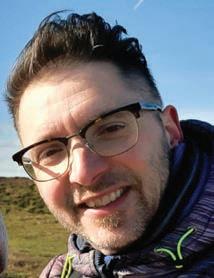
Revd Chris Bond ‘
we have sent out a week before the meeting so that members can read relevant information and prayerfully consider the meeting agenda items before we meet. These have included, for example, financial updates from our Treasurer so members understand our current church finances.
We have about six Church Meetings each year. Some people don’t come to every meeting and a challenge can be that if we have been working on a particular item for several meetings, they might not have tracked with us on the journey and decisions to this point so are new to the subject. Within these information packs that we send out before the meeting we include reminders of previous decisions we’ve made relating to the item, whether these were recent decisions or some years ago. These information packs have obviously been more work to create but have been appreciated by church members.
So to conclude: you may have read all this, and wondered how Chris and Hope Chapel could have got this all so wrong! But I’d expect that because we’re human and are still on a journey of becoming like Jesus, some of these challenges are common to us all. I hope we can learn from each other and our churches can grow into more health and maturity, so that through the way we love each other and partner together we show the world the reality of Jesus who is within us.
Hope Chapel’s Church Meeting announcement poster
The five marks of mission
Rev Dr Graham Adams is one of the tutors on the Congregational Federation’s Practical Theology course and Tutor in Mission Studies, World Christianity and Religious Diversity at Luther King Centre for Theology and Ministry in Manchester. In this series, Graham explores the Bible’s five marks or aspects of mission: proclaiming the good news, nurturing new believers, caring for those in need, transforming injustice, and treasuring all creation.
Part 2: Nurturing new believers
Inthe last issue, I began to discuss the ‘Five Marks of Mission’, starting with ‘Proclaiming the good news of God’s kingdom’.
I explained that it is not about proclaiming the church, but proclaiming the kingdom – a new reality, which is close at hand but also amongst us. It’s where God’s will is done – a realm of justice, peace and healing. In the Lord’s prayer, we pray for it to come on earth as in heaven; we seek it and we strive for it. It is about all things being renewed – individuals, relationships, communities and all creation.
So when we proclaim the kingdom, we are proclaiming something incredible. Our task, as the church, is to discern it – that is, to identify wherever this kingdom is taking root, and to declare it, by sharing our stories of this good news.
What this means is that evangelism isn’t about recruiting people for our church, but helping them to see and experience a new reality which is amongst us. But churches often focus on themselves. This is understandable, if we are declining or feeling fragile, or we need people to fulfil various roles. But the mission of the local church is not to secure the future of the church – but to proclaim the kingdom.
Having said that, the church has a crucial part to play. After all, people who are drawn to this strange new kingdom need a community to belong to and where they can grow in faith, hope and love. So the second mark of mission is to nurture believers – not only new ones, but all of us.
The church is to be a place of nurture. In particular, to nurture people in the ways of Jesus, who shows us that the kingdom is at hand. In other words, our job as a church is to help people see that it’s not
all about the church but about something bigger and better – because we are pilgrim people. We are people on the move, seeking this kingdom and its renewal of all creation. And this should help to make the task thrilling – ‘Come and join our journey!’
But I wonder if that’s how it looks to people outside the church? Do we look like people ‘on the move’? Do we show that we are actively seeking something? To seek is to demonstrate that we don’t have all the answers, but we are being guided into truth (John 16:13). We are not a settled club, but we are disciples, apprentices, people learning while on the job; learning to follow Jesus who shows us the kingdom.
I think that this need for movement and learning is one reason why Jesus asked us to become like little children (Matthew 18:3). As the Brazilian educationalist Paulo Freire recognised, childhood represents this state of possibility – a phase of life in which curiosity is particularly intense, including being curious about whether things can change. So to become like children is to recover our thirst for exploration and adventure, to seek out new horizons. It is to imagine things differently. This is what it means for us to be communities which nurture believers: it’s not about giving neat answers, but drawing people into the adventure of faith, seeking out the new horizon of God’s kingdom.
In a classic and challenging book, What Prevents Christian Adults From Learning?, the theologian John Hull says that “where adults see a danger, children see an exciting possibility”. This is revealing. Too often, when we try to nurture one another, we are inclined to close down discussion, to repeat familiar clichés, to urge people to fit their questions and their faith into our boxes.
It’s almost as though we fear childlikeness – which includes the urge to ask the perpetually penetrating ‘why?’ questions. After all, it wouldn’t be right to view children only as naïve or innocent; they are often
profoundly aware of the harshest realities. They are attentive to the cries of creation, they notice – and they question.
So if your church has children, don’t be afraid to let them disrupt your adult habits or assumptions. But even if your church doesn’t have children, still we can actively seek out our own childlikeness, our curiosity, our spirit of wondering and adventure, our imagining of new possibilities – because these are crucial for us as communities striving to nurture people in the ways of the kingdom.
As Paul Joshua Bhakiaraj puts it: “It takes a whole church to raise a Christian” – and he has in mind that children and young people are integral to that. In other words, let’s not only be concerned with whether adults are nurturing children, but let’s celebrate how children and childlikeness help to nurture us.
This makes me wonder: should we aim to be ‘safe spaces’ or ‘brave spaces’? The answer is both, but there is an interesting difference between the two. In safe spaces, people who might otherwise feel intimidated or excluded are free to be themselves, to ask their questions, to belong. This is especially important for people who have been hurt (as many have been by churches) or who are marginalised in some way. And so, to be communities of nurture, we need to help people feel safe – to share their stories of pain and longing, ask their questions, and dream together.
assumptions, challenging us to think and grow. This is important for seeking the kingdom; we cannot take our own grasp of things for granted, because we are being called onwards – and sometimes new believers help us to move, if we let them.
So the second mark of mission is to nurture believers – both new and old. We are being nurtured not merely into a set of ideas, but a way of being – in pursuit of God’s kingdom. So we need to show that we are a learning community, which is helped if we can recover the spirit of childlikeness – a readiness to adventure and imagine things differently, allowing ourselves to be disrupted by others’ questions, recognising that the church is not the destination but a stepping stone, which can help us to foster curious faith, imaginative hope and love for all creation.
Graham Adams contends that children have much to teach us
Trevor Dickerson –National Field Director of Outreach UK
‘Jesus
left heaven to reach us –we need to leave our comfort zones to reach others for him’
Refresh Editor Andrew Halloway talks to Outreach UK’s National Field Director, Trevor Dickerson. Trevor has been on a mission to share the Gospel for 30 years, particularly in a one-to-one way and by door-to-door visiting. He says: “Around 80 per cent of people who become Christians come through personal evangelism.” Here’s what he has learned in three decades of outreach…
How did you come to faith yourself?
I had the privilege to be brought up in a home with committed Christian parents and so each Sunday we would go to church and hear about Jesus. One evening at a ‘crusade’ meeting I felt God speaking to me in a very personal way about my need to know Jesus as my Saviour and Lord, so when an invitation to respond to the Gospel message was made, I went forward and asked Jesus to forgive my sins and become my Saviour.
When did you first realise that you were called to be an evangelist and how did you get started?
My wife Jean and I were leading a youth group at our church (probably because we were the youngest couple in the church!) and one of our group members came back in the summer from university. As we were gathered as a group one evening, I asked him how he had been getting on. He spoke about joining the Christian Union and how they had been going out and sharing their faith with others, including engaging in some door-to-door evangelism. His next words troubled me, but also hit home – “We ought to be doing this,” he said to us all. My inward immediate reaction was: “There is no way you’ll get me out there knocking on doors.” However, when no one else would go with him, I thought, as co-leader of the group, I ought to go with him to support him, as I knew I ought to be sharing my faith. It was whilst going out, knocking on doors, that God spoke to me about doing this full-time, and I was convicted of the need and calling to ‘go’ with the Gospel on a full-time basis.
You have worked for Outreach UK for many years. What exactly does this British mission organisation do?
I have worked with Outreach UK for over 30 years – in two slots. From 1986 to 2001 I was an evangelist and training officer, and from 2007 to the present day I have been National Field Director.
Outreach UK was established back in 1874 as the ‘Christian Colportage Association’ and in the early 1900s had over 100 evangelists spreading the Gospel by selling Christian books and Bibles from door to door. During one year’s work at that time, 70,000 copies of Bibles, New Testaments, books and booklets were sold and hundreds of thousands of gospel tracts were distributed. Our name changed to Home Evangelism back in the 1970s, then in 2007 we became Outreach UK. As a mission today, we are involved in sharing the Gospel one-to-one, rather than selling Christian literature. At present we have around 70 part-time evangelists spread around England and Wales.
What has kept you going in over 30 years as an evangelist?
It might sound a ‘trite’ answer, but it’s God’s calling as an evangelist. As yet, I don’t see this calling having changed, and so I keep doing what God has asked me to do. Until he changes that, I’ll keep going! I also believe that the greatest need for everyone is to know Jesus Christ as Saviour and Lord and most people, around 80 per cent, become Christians through one-to-one evangelism (according to statistics from the Luis Palau Organisation). If Christians aren’t sharing their faith in Jesus Christ, who else will tell folk of the Saviour?
What is the most difficult thing you have found about your work for the Lord?
That’s a good question. There are a number of things I could mention, such as the lack of interest in evangelism from some churches. Related is the seeming failure of some Christians to see and understand the ‘lostness of the lost’ – where perhaps the thinking is that everyone will be saved anyway because God is a God of love, so I don’t really need to share the Gospel which some folk don’t want to hear.
Alternatively they may feel uncomfortable about sharing as they might upset someone. It’s sometimes difficult to keep going when there is so much apathy or lack of interest in evangelism, but God says he’s at work in people’s hearts and a person’s conversion is down to the Holy Spirit, not us.
What is the most encouraging thing that has ever happened in your outreach ministry?
That’s an easier question. It’s when you see God changing people’s lives as they come to know Jesus as Saviour and Lord. I’ve had the privilege of seeing God bring people into a relationship with him and then seeing them grow in that new faith. I’ve also had the joy of seeing Christians who’ve said “I couldn’t do what you do” going out with the Gospel and being blessed by it.
Although all Christians are called to share their faith, being an evangelist is a special calling or gifting. Do you think it is undervalued in the Church today? Yes, I agree, it’s one of the five-fold ministries mentioned in Ephesians 4:11. Note where it comes in the list – it’s before pastor and teacher! It seems to me that God is saying this is one of the foundational gifts to build and grow his Church. If folk aren’t getting ‘saved’, there will be less need for pastors and teachers, but in most churches, the gift of the evangelist is often neglected. Perhaps this is one reason why our congregations are dwindling? We’re not aligning with God’s priority to reach the lost. So I do think that the gift of evangelism is undervalued. How many churches do we know that say: “We must put more money, time and effort into spreading God’s good news. Let’s not get a pastor but get an evangelist to work with us”?! Many churches are shrinking, but often our priority is maintenance rather than growth.
Here is a dangerous prayer, but one that God loves to answer: “Lord, lead me today to the person you want me to speak to about you.” If we all had this perspective and outlook, I’m sure we’d be encouraged as we see God at work giving us Gospel opportunities and through him, growth in his Church.
After three decades in evangelism, would you say the Church is better or worse now, at reaching people with the Gospel?
I think the picture is mixed. Some churches have a heart and desire to reach out with God’s good news, but others are just praying that God will send folks into their services without them having to leave their seats. At the end of Jesus’ life on earth, he clearly told his disciples to ‘Go’ with the Gospel. If we look at this in context, Jesus was saying, “As you go, spread the Gospel.” It’s to be part of who we are and what we do. In some cases, Christians have grasped this and are
EVANGELISM
excellent at ‘gossiping the Gospel’. Others, however, are not and have missed the instruction by Jesus and missed his desire to reach others for him.
You have specialised in door-to-door work, despite many churches having abandoned it. Why do you feel it is effective today?
I’ve been doing this for over 30 years. I’m always looking for the person that God wants me to speak with about him, and so not expecting to get a conversation with everyone. A question I sometimes ask churches is: “Who lives in the homes around your church building?” Many churches have no idea, yet this is our immediate mission field. If we don’t share God’s good news with these folk, who will?
I’ve met so many people who were seeking a relationship with God and along comes a Jehovah’s Witness who says: “I can tell you how.” As our churches have declined in number, the Kingdom Halls have grown.
Door-to-door is effective in many ways. First of all, it raises the profile of your church and of the Gospel and counters the cults, building bridges into the community, countering wrong perceptions of who Christians are and what they believe.
Secondly, the housebound can be helped and befriended. We live in an epidemic of loneliness where 60 per cent of over 60s won’t see anyone to speak to from Friday evening to Monday morning.
Thirdly, it’s surprising how many backslidden Christians you meet in this way, who would otherwise have avoided all contact with churches. If you befriend them, you help them on the road back.
But above all this, the seed of the Gospel is sown and people do come to know Jesus, whether through yourself or other Christians later.
You are invited to many churches to train ordinary church members in outreach. Should more churches be doing this?
It’s always a joy and privilege to be asked to give some evangelism training, as it shows the church has a desire to reach others with God’s good news. If every church and every church member was reaching out with the Gospel on a regular basis, I believe we would see God adding to our numbers, changing people’s lives. Training is very useful to help us get started or to support what we’re already doing.
We train people is so many different skills, so why not in the most important one of all – sharing your faith in Jesus?
The training that my colleagues and I give comes direct from our own experience. Our main focus is on one-to-one witnessing – but can include specifics like door-to-door visiting if required. We can run courses in person at your church or via Zoom. We’ve run a
Continued overleaf
Trevor at a conference, encouraging churches to engage in evangelism
number of courses for Good News for Everyone members (formally The Gideons) via Zoom with very positive feedback.
You are still enthusiastic about using literature in outreach. What benefits do you see over digital methods?
Digital media has its place, but remember, most people become Christians because they have a relationship with a Christian. Face-to-face interaction is vital in building real relationships which will last and help make lasting change.
Literature is a very helpful tool in sharing the Gospel in one-to-one situations. I’ve given away thousands of Gospel booklets, tracts and, over recent years, Good News newspapers. Good News is by far the most helpful in that it’s new every month so, if visiting homes, you have something fresh every month, enabling you to legitimately re-visit and continue to grow those relationships that become bridge for the gospel to cross. Good News has stories from many different people, with differing backgrounds and experiences, but all pointing to faith in the Lord who has changed their lives.
Another great tool is the Pocket Testament League Gospels. These are very helpful when encouraging someone to read a small part of the Bible or a gospel. I’ve given away thousands of these too. God’s Word has a particular power to touch lives. Many today know very little or nothing about the Bible, so I introduce one of the Gospels as a “booklet about the life of Jesus”, and many people accept a copy that way.
Another of my favourites is the ‘Bridge to Life’ booklet – where it’s easy to point to the illustration of Jesus being the bridge between us and God – and ask, “Where are you, which side of the bridge are you?”
In recent years you have developed the Casting Your Nets evangelism training seminar. What caused you to start that and why?
Casting Your Nets came out of a desire to help ‘normal’ Christians to share their faith in Jesus Christ in easy ways. It makes it simple, so that every Christian can get involved, even those who are housebound. It covers five topics: Listening, Gospel Opportunities, Literature and Tracts, Sharing Your Story, and What’s Achieved?
If you could say one thing to every UK church today, what would it be?
Take the gospel outside our church buildings. It’s not enough to give invitations to services, where we feel comfortable, and others don’t. Let us take the difficult steps and go out to where others are – and share our faith in Jesus Christ, in relevant ways. Listen to what people say and respond with compassion and love (Matthew 9:36). Jesus left heaven to reach us!
TESTIMONIES
Faith – the adventure of a lifetime!
Dr John Clements, Pastor of the Old Meeting House Congregational Church in Norwich, tells Refresh how the Lord has been faithful to him through 64 years
Little did I know 64 years ago how my life would change when I asked Jesus into my life to be my own personal Saviour. Back in July 1959 I was feeling terribly alone during my first term at boarding school; how I missed my mother and home. I can remember talking to Matron (whom we called Cuckoo!) and kneeling down beside her and praying to Jesus. Gosh, what an adventure it’s been, what trials I have overcome and what challenges I faced over the years! As the years have gone by, I have found my faith being stretched more and more, but space only allows me to mention two or three events.
Back in 2015, I received a call to become the Pastor of the Old Meeting House Congregational Church. The chapel had less than £200 in the bank and only one member who works shifts and is unable to attend on a regular basis. On top of that, some years ago the chapel entered into a repair lease agreement that that only allows the church to meet on Sundays.
At the time, I had a mortgage and two children still living with me and my wife. My friends told me that I would be a nut to accept such a challenge, but over the years the Lord has been developing my faith and there are some positive signs that God is doing a new thing in this forgotten chapel.
This past year I have had to face the biggest challenge in my life. I was diagnosed with cancer of the oesophagus. This involved major surgery and part of my stomach had to be removed.
I have a large network on Facebook, and I put up a post asking for prayer and was amazed that over 250 people responded and promised to pray for me. Their prayers were answered, as the operation has been a complete success and I am able to continue to serve the Lord for the time being.
Let me finish with another answer to prayer. Some years ago, I felt God call me to write a book. If you know anything about publishing, you will know just how impossible it is to be published without a literary agent. Many authors end up self-publishing, but I have never had the funds to do that. After several years of trying to get an agent, the Lord opened the door in a most remarkable way with an agent – but with God, nothing is impossible!
John’s book, The Tale of the Temporania, should be published next year
TESTIMONIES
From suicidal thoughts to studying theology
Kevin Phillips from Newport Congregational Church tells how finding a Bible in hospital when he was at his lowest ebb was the beginning of a new life
Likeso many people, I bore the burden of poor mental health after a difficult time as a child.
Over Christmas 2017, I suffered with severe psychosis and suicidal thoughts. The hospital admitted me to their psychiatric ward for a while to keep me safe. I wondered whether I would ever go home.
I had a seamless plan to take my life. In January 2018, I worked out how to get out of the hospital by pretending I had recovered. I suppose I was a bit like Robin Williams – who everyone thought was so happy! After some time, the hospital agreed I could go home with a care package from the home treatment team.
On my last evening in hospital before going home, I came across a book. It was peeking out from under a pile of tatty books and I felt compelled to see what it was. When I dug it out, I discovered it was a copy of the Holy Bible.
I opened the first book in the Bible and read:
“In the beginning God created the heavens and the earth. The earth was formless and empty, and darkness covered the deep waters. And the spirit of God was hovering over the surface of the waters.”
I saw myself as formless and empty and I wondered if God was hovering over me.
Then I continued to read in my tired, unsure state:
“And God said ‘let there be light’, and there was light. God saw that the light was good, and he separated the light from the darkness. God called the light day and the darkness he called night. And there was evening and there was morning – the first day.”
Despite never reading the Bible before, this inspired me to think: “Tomorrow’s a new day – could it be the first day of a new life for me?”
So, the next day, I went home with a copy of the Bible, and with the home treatment team due to support me. I still suffered with psychosis and hallucinations, and was very anxious and afraid. But something felt different.
When home, I was so afraid and fought the urge with all my inner being not to go through with my suicide plans. I started to read the Bible and the creation story inspired me. It felt warm and safe and gave me hope.
Over time, I began talking to God every day. I didn’t class myself as a Christian at this stage but talking to
God and asking him to shine his light on my path helped me. Without guidance, I began having a natter with him every day.
I found myself feeling ready to return to work again after almost two years of unemployment. I started by volunteering at the local RSPCA shop. Then I took on a part-time job in a care home, before moving on to a full-time job at a holiday park.
In March 2022, an old friend of mine reached out to me on Facebook after I shared a post relating to my faith. She invited me to come along to a service at Newport Congregational Church. I did and the minister and the rest of the congregation welcomed me with open arms. The minister, Mark, hugged me and it felt good.
I soon found myself going to church more and more, and helping out with events. After a year, I took a permanent job with the church to help run the community pantry. I’m helping put food on the tables of over 100 vulnerable families every week. I also head the church’s cleaning team.
I read and study the Bible every day. I find it so interesting and useful for my everyday life. I fill myself with Scripture, which helps me fight my daily battles. Recently, I have been delving into the Old Testament. I have enjoyed reflecting on my observations and interpretations of what I’ve read. These reflections have given me a deeper understanding and appreciation of the Bible.
I am honoured to be embarking on a new journey this year. I will be studying for the Congregational Foundation Degree in Theology. I find it incredible to think how focusing on Jesus every day has steered me from a place of terror to a place of calm. In 2017, I would never have believed it possible. As our minister said at the first service I attended:
“God is like a satnav. Sometimes you veer off your path, but, in time, he will guide you back to where you need to be.”
Finally, please know that there is always help and support available to you if you are suffering – please ring the Samaritans on 116 123. They’re available 24 hours a day. They will listen to you; they won’t judge you and they will also be able to signpost you to any additional support you may need to keep you safe.
Kevin’s life has turned around since encountering God through the Bible
Author Charles Gardner
Christmas is Jewish!
And there is nothing pagan about the festival. Surprised? Read on and consider these compelling arguments about the reason for the season.
There is no biblical command to celebrate Christmas, and over the centuries, many Christians have been reluctant to celebrate Christmas – it was even banned by Parliament in 1647. The reason usually cited has been the perceived pagan roots of the celebration, or at least the date on which it is celebrated has been linked to ancient pre-Christian winter solstice festivals.
Other Christians have wondered how on earth it could be wrong to celebrate the arrival into the world of our wonderful Saviour, and point out that the original Santa Claus was a Christian saint, Nicholas, and the generosity he is famous for is something the Bible commends.
However, few are aware of another aspect of Christmas – it’s Jewish roots! Here Charles Gardner, a Christian journalist with his own Jewish roots, tells why a Messianic Jew believes that there is nothing pagan about the festival…
Christmas is a Jewish festival. You might need to read that again if you haven’t already fallen off your chair.
It is the claim made by Jerusalem-based Revd Aaron Eime, who is well-versed in Hebraic traditions and has studied with rabbis for many years.
In a recent talk he gave, while on a UK tour on behalf of the Church’s Ministry Among Jewish People (CMJ), he demonstrated how not only Hanukkah but Christmas are Jewish feasts – an idea likely to send
Perhaps the most surprising claim is that 25 December – long thought to be a date picked out of a hat to celebrate Christ’s birthday or, worse, to chime in with pagan festivals – was deliberately chosen as quite possibly the right day.
In any case, in deciding on when to mark the incarnation of Christ (i.e. when God took on human flesh), Jewish followers of Jesus, who of course made up all the first disciples, reckoned they already had a suitable feast – Hanukkah.
Also known as Chanukah, it was all about restoring
Temple, which took place on the 25th of Kislev (or December in the Gregorian calendar). And Aaron assures us that there is plenty of evidence to suggest that Jesus was born on that day – yes, really!
It makes sense because Jesus is the perfect embodiment of the Temple restoration; he referred to himself as the temple that would be raised up on the third day.
The Hanukkah menorah that is said to have kept on burning miraculously for eight days with only enough oil for a day was surely a picture of the “light of the world” (John 8:12), who was to come into the world to rescue his people from their sin and waywardness, just as the Maccabees had rescued Israel less than two centuries earlier.
There is also a Jewish tradition that godly heroes die on the same day they were born. Moses, they say, went to be with the Lord on his 120th birthday.
In Jesus’ case, Aaron suggests, there is evidence that he was conceived at Passover – and, of course, he died at Passover. Which means that it was highly probable that he would indeed have been born ‘in the bleak midwinter’ (as the carol goes) – not at Tabernacles as many, including myself, have believed.
Some argue that the shepherds would surely have not been out in the cold with their sheep, but they are obviously not farmers!
Chanukah is a beautiful picture of how God brings light out of darkness; in fact, God often uses the very cause of the darkness to be the bearer of light, as with Bathsheba who continued the line of the Messiah in spite of the fact that everything was wrong with the relationship that produced the child.
In the case of the tyrant Antiochus Epiphanes IV, he ruthlessly imposed Greek culture on the Jewish people, which led ultimately to the shocking blasphemy of sacrificing a pig on the Temple altar. And he did it on the 25th of Kislev – the same day the Temple was re-dedicated a few years later!
Satan did his worst but, through the godly Maccabees, God turned it into triumph. The cross may seem to have been the devil’s doing, but God meant it for our good and Jesus rose victorious.
Aaron concluded his talk by saying: “There is nothing pagan about Christmas. It’s all about the redemption and birth of the Messiah. You can celebrate Christmas, and you should.”
Light is a theme of both Hanukkah and Christmas Credit: JPC24M/flickr
(Aaron quoted sources including the Didache, a collection of early Christian writings, as well as the Gospel of James and the books of the Maccabees – part of the Apocrypha which, though not regarded as inspired Scripture by Protestants, is accepted by 400 million Orthodox Christians and does provide historical information.)
Pioneering ministry
REVIEWS
Books on my desk
General Secretary Yvonne Campbell shares five new books she’s planning to read that you might be interested in Revd Nigel Lindsay, Partner in Mission at the Samaritan Presbyterian Church in Grenada, reviews a couple of books for those who want help on fresh expressions of Church/pioneer ministries
Godsend
By Michael Moynagh
‘Godsend’ is a toolkit to help form new Christian communities with people who were not previously attending church. I liked the layout of the book, with short chapters and discussion points that can be used in a small group. You can use this book with your new community or your house group to help them understand more about fresh expressions/pioneering.
Published by Fresh Expressions Ltd, 2021
Pioneer Practice
Written and edited by Jonny Baker (who heads up Newbigin training)
Find out more about the Newbigin Pioneering Hub and the CMS Certificate in Pioneering Mission here. I was excited about getting this book when my sister brought it out to me in Grenada, but I was put off by the small type and 192 pages, so have only just finished it. It has large pictures which provoke thought, and lots of headings and short chapters to make it easy to pick up and read bits. It gives lots of examples of pioneer projects and does not shy away from the challenges, and many valuable quotes from those involved. It’s not a book you will read and then leave on the shelf. If you’re a practitioner, you will pick it up and use it regularly.
Published by Get Sidetracked, 2021
Refresh: Introducing adults to faith through toddler groups
By Caroline Montgomery
It’s been wonderful to hear about and be praying for all the toddler groups in our churches, so this is a must for those needing to infuse more about Jesus and share the good news with the adults in the groups. It is full of ideas and thoughts to build your own faith too.
Published by BRF Ministries
My God can be trusted at home and abroad
By Phil Cheale
I’m really looking forward to reading this book. Phil was the Minister at Springwater Peppard Congregational Church after following God’s call to be a missionary in Africa. God’s faithfulness will shine as Phil tells story after story of his calling. Can be purchased direct from Phil. Email: mygodcanbetrusted@gmail.com. Also on Amazon
Romans: A letter that makes sense of
life
By Andrew Ollerton
This was the book I purchased when I attended the New Wine festival in the summer. I love reading books of the Bible in full rather than small random chunks, and this will bring Romans to life as it is easy to read and gives opportunities to reflect.
Published by Hodder & Stoughton
Putting the pieces back together
By Caroline Gilpin
This is a Christian’s experience of bereavement and love written by a member of Lapford Congregational Church. For those in Ministry this is a beautiful book to use or gift, and for those in the depths of grief it is a comfort and encouragement. It is straight from the heart which will help so many people.
Published independently. Available on Amazon.
Being an Inter Generational Church
By Suzi Farrant and Darren Philip
This new book is so exciting, as it gives practical examples with theological explanations about how church works best with people of all ages in our congregations. It has themes including worship, hospitality, joy and testimony. I’m really looking forward to reading this and sharing and trying some of the theories.
The light shines in the darkness, and the darkness can never extinguish it.
John 1:5
During November please pray for all who have lost their way with life.
Pray for those struggling with mental health issues, addictions, debt issues and those involved in criminal gangs. Pray for those who work to support those with these issues, pray they have the right skills, good training and enough funding.
Pray that our churches will and can support where they are able.
Pray for the Council of the Congregational Federation who meet this month. Pray for a movement of the Holy Spirit for wisdom and a clear vision.
DECEMBER
And he will be called: Wonderful Counsellor, Mighty God, Everlasting Father, Prince of Peace.
Isaiah 9:6b
Pray for this season of advent that the message of Jesus, the message of hope, is not lost.
Pray for all those who work in retail that they get a good work and home balance.
Pray for the churches of the Congregational Federation, pray their Christmas services will welcome new people from the community.
Pray for all those leading services that they will be inspired to share the Christmas story in a new way and enjoy the season.
Pray for the staff of the Congregational Federation, pray there is good communication and there are good relationships and support.
JANUARY
Anyone who belongs to Christ has become a new person. The old life is gone; a new life has begun!
2 Corinthians 5:17
Pray for those starting something new – whether new school, new job, new baby, new home or new church. Pray for those struggling to adapt to change. Give them courage and strength.
Pray for those grieving a loved one, having to live life differently and feeling alone.
Pray for our Government, pray that they work well together, that they seek the reality of life in the UK and work to make things better for the poor and vulnerable. Pray for justice. Pray for the Faith Minister and her work with churches in response to the Bloom Report.
Pray for Christian unity in the UK and around the world. The 19–26 January is the week of prayer for Christian unity; pray the resources will be used and people will attend the services and prayer groups. Pray for the local churches in your area, how you can support each other.
FEBRUARY
Three things will last forever – faith, hope and love – and the greatest of these is love.
1 Corinthians 13:13
Pray for married couples, for those in new relationships, those going through divorce, those in abusive relationships. Pray love, pray peace and protection.
Pray for those who work in counselling and guidance services. Pray wisdom over them. Pray for the accreditation and Pastoral Care Board of the Congregational Federation that meets this month. Pray for people to step into these roles so those in ministries and those in our churches can be supported, encouraged and prayed for more.
Pray for those living in war torn countries. Pray protection for them. Pray for those who grieve and those living in fear. Pray for peace.
MARCH
I will thank the Lord because he is just; I will sing praise to the name of the Lord most high Psalm 7 v 17
Praise God for his majesty, his power, his grace. Give him the glory.
Thank God for your life, for his endless blessings. Praise God for the wonders of his creation. Thank God for all you have that makes life good. Thank God for your church, the building, the people and everything that happens there.
Thank God for the Congregational Federation, the history, the offices, the staff and the volunteers.
FEEDBACK
Ruth Leeming, Minister at Home Church in Pickering, says:
“Thank you for the new Refresh (issue 7). It’s really good and very attractive and well thought out. Many congratulations on the success of this publication!”
Chris Bond, Minister at Hope Chapel in Bristol, says:
“I thought the last issue of Refresh magazine was excellent. There were lots of engaging articles that were good to read. It did feel fresh and encouraging. Thank you.”
CF Minister Sara Iles says:
“Thanks for latest edition of Refresh. What a lovely, inspiring magazine it is!”
TO ORDER REFRESH
An annual subscription for next year’s 3 issues, including the Yearbook, is £30 incl. p&p. Email: admin@congregational.org.uk or tel: 0115 9111460 for details.