Putting the pieces back together after bereavement
PAGE 9
EMERGING CHURCH
Pioneering hub explores new ways of doing church
PAGE 20
A PLACE OF MIRACLES
Partnering with a Ugandan church that cares for 3,000 kids
TO ORDER REFRESH:
There are three issues of Refresh each year, available on annual subscription at £30 incl. p&p and the Yearbook. Email: admin@congregational.org.uk or tel: 0115 9111460 for details.
“…looking forward to being refreshed
by your company. God’s peace be with all of you” (Romans 15:33, The Message)
Our privileged planet
As NASA plans to go the moon again, it reminds me that Buzz Aldrin quoted Psalm 8:3-4 on his way back from the first successful moon landing.
When I was growing up, all I heard from science lessons, TV and the media was how the Christian view of the universe and life was mythology that had been cast aside as modern science revealed the truth.
As you can imagine, this was disconcerting for a young Christian who had committed his life to Christ at the age of 14, and had been taught that the Bible had all the answers.
But something inside me questioned the prevailing ‘wisdom’. Whilst I dutifully wrote the answers I was supposed to, in order to pass my biology exams, at the same time I was reading alternatives to atheistic evolution, whether it was theistic evolution, young earth or old earth creationism, and – more recently –intelligent design theory.
Whilst it was difficult to know which experts had the best science, my gut told me life and the universe was far too beautiful, complex and interdependent to have come about by chance.
Of course, acknowledging God as Creator is far more important than understanding how he did it –but if he did create everything, wouldn’t there be some tell-tale signs that science should discover?
If you want to avoid the creation/evolution controversy and stick to cosmology, I highly recommend a DVD called The Privileged Planet. It shows the uniqueness of Earth. For example, the Earth’s position in the solar system is exactly within the habitable belt for human life. A few degrees off, and Earth would be uninhabitable, like Mars or Venus. Its atmosphere, plate tectonics and other geophysics are also uniquely suitable for complex life.
Refresh Magazine, ISSN 2634-2987, is published by: The Congregational Federation, Congregational Centre, 8 Castle Gate, Nottingham NG1 7AS Tel: 0115 911 1460 www.congregational.org.uk Registered charity 264839
Editor: Andrew Halloway. Design and print: Verité CM Ltd. www.veritecm.com.
Cover photos: Ricky Romero/ Flickr; Horia Andrei Varlan/Flickr
All Bible quotes are from either the NLT or NIV unless otherwise stated.
This magazine is printed on paper from a sustainable source.
The DVD also interviews geophysicists and astrophysicists who started out with atheistic assumptions, and have moved to believing in design by investigating the facts.
The truth is that we are not meaningless specks of dust in an uncaring universe. We are of infinite value because we are God’s creations.
When I consider your heavens, the work of your fingers, the moon and the stars, which you have set in place, what is mankind that you are mindful of them, human beings that you care for them?
You have made them a little lower than the angels and crowned them with glory and honour... how majestic is your name in all the earth!
(Psalm 8:3-9, NIV)
Andrew Halloway Editor a.halloway@ntlworld.com
CONTENTS
1 From the General Secretary LOCAL CHURCH NEWS
2 Warm spaces this winter
4 New minister ordained
5 Time capsule service
6 Growth at Newport TESTIMONY
7 Light from the darkness FEDERATION NEWS
9 New course for pioneers
11 CF students’ feedback
12 Vacancies & Tips for life online
13 Bible cake recipe! EVANGELISM
14 Sharing hope by President Taylor
16 Evidence for Easter
18 Casting Your Nets series MISSION
20 Saving children in Uganda
22 Walking round Grenada PLUS. . .
23 Retreat with a difference
25 Heroes of the Faith - Eric Liddell
27 Break time
28 Book reviews
29 Prayer Diary & Puzzle solutions
From the General Secretary
Hurray for springtime!
Winter is often a time when we go into hibernation mode, stay in more, and have cosy nights in front of the fire, reading a book. But I love it when spring arrives and life starts to grow, all over again.
If we think back to January, I wonder if you made any New Year resolutions or had a plan for what you wanted to do, or where you wanted to go? Now it’s March, how are those plans going?
I obviously want to encourage you if you are still persevering with your resolutions and plans, but if you didn’t or haven’t, then I also want to say that’s OK. Life isn’t a competition and Jesus accepts us and loves us as we are and will guide and prompt us into change when we need to. I love this verse from Psalm 143:8 (NLT):
“Let me hear of your unfailing love each morning, for I am trusting you. Show me where to walk, for I give myself to you.”
It reminds us that we must trust God. He loves us and will guide us, if we put him centre of our lives and surrender to him.
In January, I downloaded the Lectio 365 app onto my phone as a way of staying focused and persistent with my prayers. I want to recommend it to you as it has helped me draw closer to God. It was created by Pete Greig, who has written some amazing books, and has just released a new Bible study course which is worth using if you are looking for new material.
I continue to visit churches.
I started the year in Taunton, putting more of the plans for Assembly in place. Assembly is on 13 May in the Tacchi-Morris Arts Centre.
Everyone is invited to be part of the day, share fellowship and be part of the events.
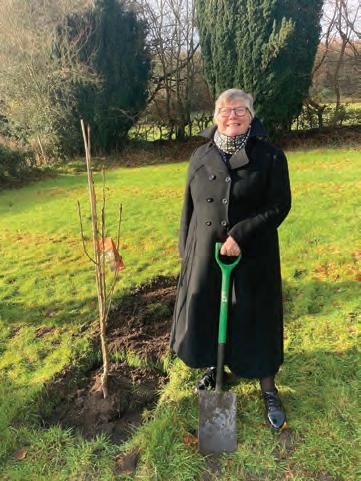
I helped Helen Cameron, Moderator of the Free Churches Group, plant a tree at Horningsham Congregational Chapel in Warminster – the oldest Free Church in England, dating back to 1556. I have visited Brierley Green
Congregational Church (CC) in Buxworth in Derbyshire, Greenacres CC in Oldham and was part of the Southwest Midlands Area Vision Day hosted by Highbury CC in Cheltenham.
In April we are also planning a day at Newark CC, focussing on gaining confidence in leading worship. If you would like to host a day like this at your church we would be delighted to support you.
Finally, I am thrilled that Catherine Booton has accepted the post of Learning and Development Manager and I look forward to working with her. It’s been a blessing attending the training weekends, though tinged with sadness at memories of our previous Manager, Walter.
It was such a joy to get to know all the students and I was very blessed by their worship and enthusiasm for learning. The course has a space for you. Why not enrol on a module and see what a positive zest and influence it will be for your faith?
May God bless you.
Yvonne Campbell
Theology students in a lecture at the Nottingham CF offices
Helen Cameron, Moderator of the Free Churches Group, planting a tree at Horningsham Congregational Chapel in Warminster
Winter warmers
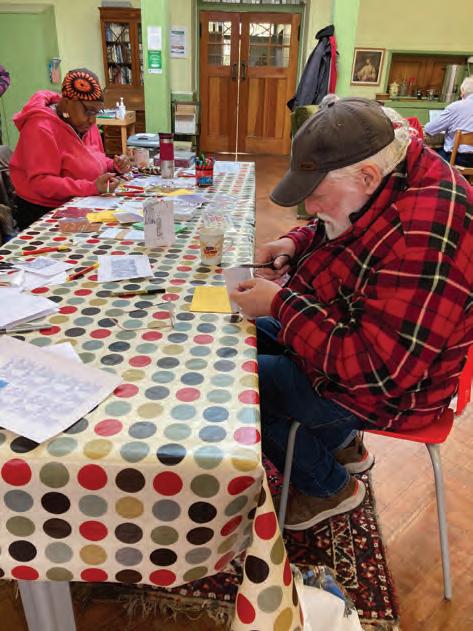
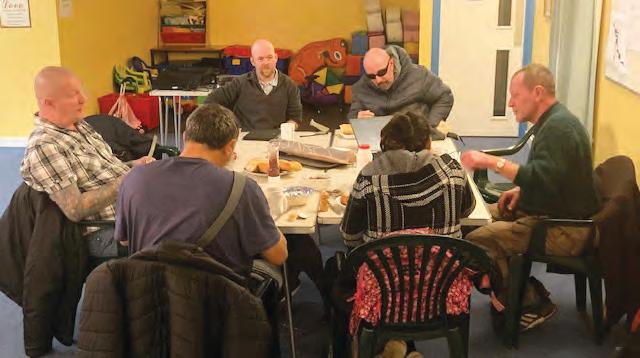
Congregational churches have been helping the vulnerable to keep warm this winter
By the Editor
As energy costs have risen across the UK in the last year, in tandem with steep rises in the cost of food and other essentials, many people have been forced into a ‘heating or eating’ dilemma.
Like many other UK churches this winter, Congregational fellowships opened ‘warm hubs’ or ‘warm spaces’ to help people in need both save money and keep warm.
Neil Chappell, Minister at Southam and Bishop’s Itchington CC in Warwickshire, tells how Southam’s warm space came about and how it has helped in Southam: “Back in the summer of 2022, when worrying reports of large rises in energy and fuel prices and the knock-on effect on transport and food prices became evident, our church began weighing up what we could do to respond to the needs of the most vulnerable in our local community.
“We had met with other community groups and organisations in our town for talks about plans being made and this strengthened our resolve to play our part. Through deacons and church meetings in August and September, plans were made and we arranged to open on the first Wednesday in November. We successfully applied for a grant from the Warwickshire Rural Communities Council, and we partnered with a local GP surgery and received a generous donation from Southam Lions, all to help with our set up and running costs.
And yet on other weeks we have had over 20 people with us.
“We plan to run the warm space to the end of March. We have had two local teenagers volunteer to help out each week as part of their college course, and at the beginning of February we hosted a Money Advice Market with Warwickshire County Council and eight different community organisations.
starter grant for warm hubs is available – contact the Congregational Federation office for details
“We planned to open eight weeks before Christmas and four people volunteered each week to help run the warm space, which was open from 10am to 4pm. We offered hot drinks and refreshments, newspapers, free wi-fi, the use of a computer, puzzles, magazines, a book swap library and much more – although most people just drop in for a chat and a bit of company.
“A local couple have brought a plateful of sandwiches each week, others have popped in with boxes of biscuits and chocolates.
“Some weeks have been quiet – with just six people joining our volunteers over the six hours.
“This project has been an enriching experience for all. It has truly been a church and community initiative with people from all walks of life responding in amazing ways to help out. We are just glad to play our part.”
From the beginning of December, Trinity Congregational Church in Brixton has also been opening its hall for a couple of hours on Friday mornings as a warm space, open to all members of the community. Alan Argent, Minister at Trinity, says: “A Christmas card-making workshop attracted wide interest and all those who participated enjoyed their time. Tea, coffee, biscuits and chat are always freely available.”
Blaby CC near Leicester has also been providing a warm space with food since November. Julie Newitt,
A
Settling into Southam and Bishop’s Itchington’s warm space –attendance varied from six people to over 20
lay pastor at Blaby, writes: “At the September church meeting it was agreed that we could start to feed those in our community who are struggling at this time. This would be once a month on a Saturday.
“This is costly and as we are providing these meals for free, I submitted applications to Blaby Parish Council and Blaby District Council to help us fund the warm space and the lunches. I am happy to say that Blaby District Council agreed to give us not the £500 I asked for but £1000! This means the cost of the lunches will be met by this grant. People from the church meeting also volunteered to help with these lunches, so I am blown away by this.”
In addition, Blaby have resumed their coffee, chat and games events which were just getting going before COVID. They serve drinks and cake and have puzzles, books etc. available on the tables, or people can just sit somewhere warm and chat. They ran this twice a month from 10am to 12 noon, and at the same time the church was open for private prayer or meditation and Julie was available to talk in the vestry if needed. Ten people turned up at each of the first two events.
Newport CC on the Isle of Wight have also been running a heat hub. Louise Randall, Church Secretary, says: “We are open on a continuous basis between 7pm and 9pm for soup and a roll. This ties in with a men’s group that is held at church, and on Thursday evenings we are open between 6pm and 8pm for a hot meal. This is a regular fellowship meal that everyone is invited to, church and non-church.”
Over Christmastime, they were also open from 10am onwards for refreshments, a hot meal at
lunchtime, and just “being with people in a very warm building”.
At least one church opened a warm space but no one came, so the idea was shelved. Not every area in the country has suffered equally from ‘energy poverty’, so this is not surprising – and some people’s pride prevents them from ‘accepting charity’, especially among the older generation.
However, for all those warm spaces that have been successful, a great need has been met, and there have also been opportunities to meet new people who would perhaps otherwise never have entered a church.
People at Trinity Congregational Church’s warm space enjoyed a Christmas card-making workshop
A table full of visitors at Newport’s heat hub
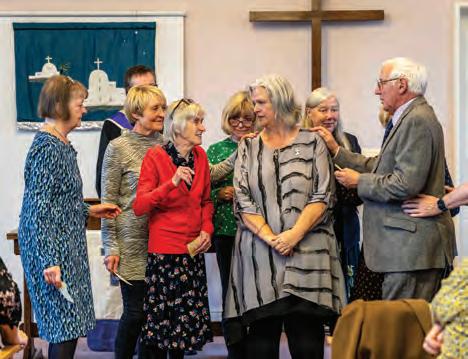
Ordination for Helen
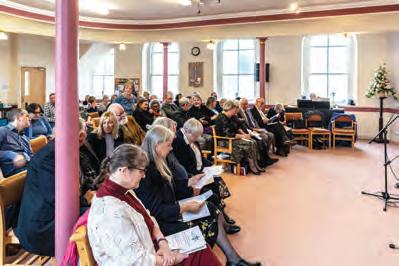
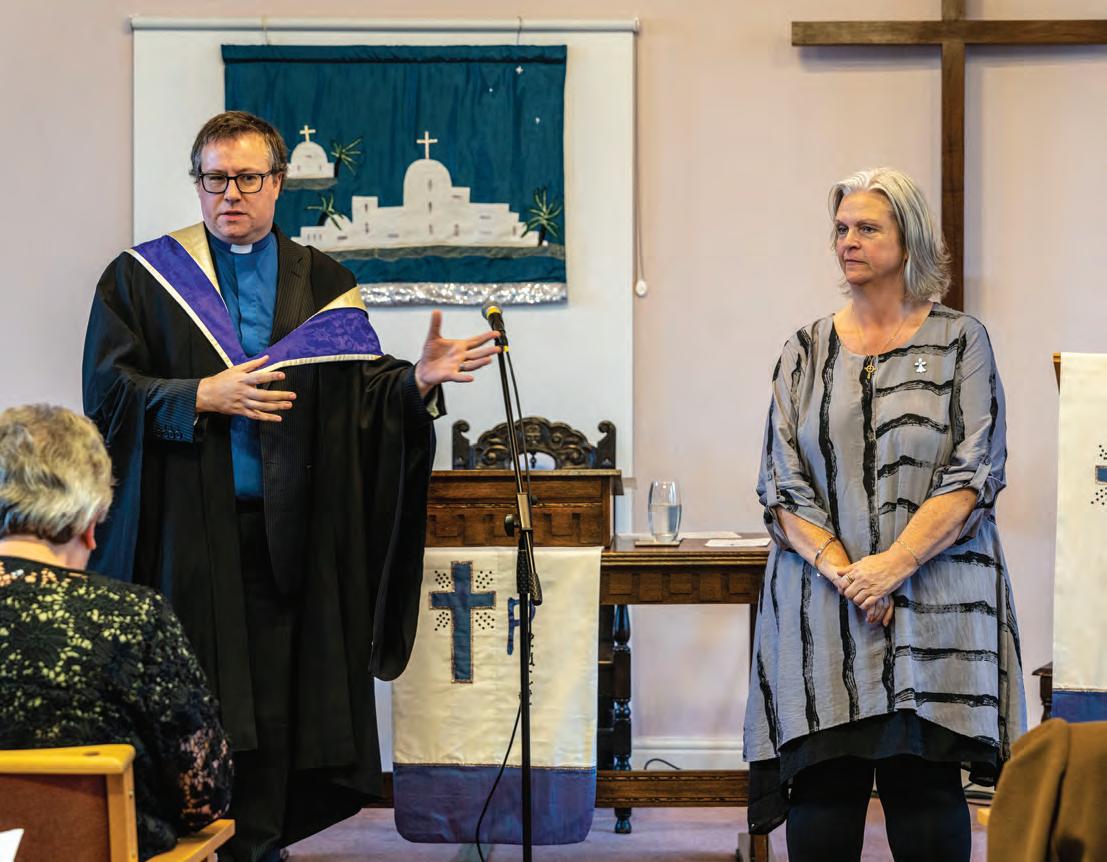
Rev. Helen Keighley, Minister at Harden Congregational Church in Bingley, West Yorkshire, was ordained on Sunday 30 September at the church. She tells Refresh readers how the Lord led her into ministry – and how the actual day went!
I still find it hard to believe that my spiritual journey brought me to ordination. I know God moves in mysterious ways but really...me?!
I didn’t set out to be ordained.
I didn’t set out to be a minster. God has always been an important part of my life, and the fellowship of worshipping with others and living a life following Jesus has sustained me for many years. But it was a bit of leap to start thinking about ministry.
It was first suggested to me by my friend, who happens to be an Anglican assistant priest.
I dismissed it at first, but a seed was sown and events seemed to conspire to nudge me. I gave up teaching after 35 years and wondered what would come next. People kept suggesting ministry. And eventually, after a lot of prayer, I found myself embracing the idea.
I had my doubts about whether I was good enough, holy enough, enough of a good example. But I’m not relying on myself. I’m being led by God. So, I was inducted as minister at Harden CC and began my four years of study with the Federation on
the Foundation Degree in Practical Theology course (which, by the way, I can highly recommend!).
I still wasn’t really thinking about ordination, but a lot changed for me over the four years and as I learned and grew and prayed, I came to realise that it was a step I was ready for. After all, I love this calling, the people at church and other churches and in our local community, and I love God. So, what makes more sense than to serve?
I have promised to carry out my ministry in a spirit of gentleness, meekness, love, affection and tenderness and have committed myself fully to the service of God. I thank him every day for showing me the way I should go.
Ordination day was a truly amazing, emotional and humbling experience. To be surrounded by friends and church families from the community was so supportive. To have my fellow students there was very special. To have my personal tutor, Oliver Kinchin, presiding was wonderful. After all, he’d witnessed my journey from the beginning, my insecurity and self-doubt, and had encouraged me all the way.
I missed Walter Riggans (the late Learning and Development Manager) that day, but am sure he was there in spirit. Being offered the right hand of fellowship from so many representatives of the Federation and local churches was joyous. I managed to hold myself in check until the deacons laid hands on me, at which point I admit I shed tears of happiness.
I am so happy and so blessed to have heard and accepted God’s calling.
Main: Rev. Oliver Kinchin leads Helen’s ordination at Harden
Above: The church was full of supporters for Helen
Church buries a time capsule
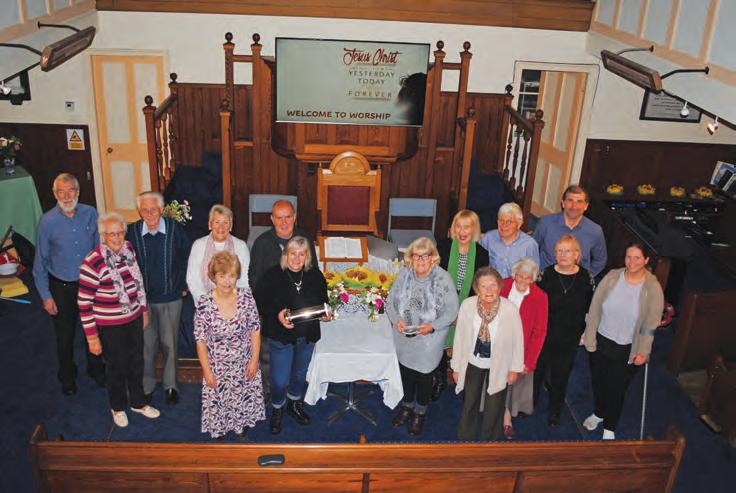
By Amanda Kitely, Guilden Morden Congregational Church Secretary
During COVID the church thought it might be a nice idea to do a time capsule. Unfortunately, COVID went on longer than expected and we were only able to do it in October.
We held the service on 23 October, the church’s anniversary, with a view to digging it up in 18 years – 200 years after the church opened.
We included information, photos and handprints from all our groups and societies that meet at the church. These include a toddler and baby group that has been held on Wednesday mornings for over ten years, an amateur dramatic club that practises at the church, a bridge club, a lunch club for the retired, and National Childbirth Trust antenatal classes! As you can imagine, we really do have a large footfall through our church!
Our minister, Tony Frost, had gone around the village taking photos of village life today, and the local school also contributed some drawings. We also included pictures from a colouring competition we held for the Queen’s Platinum Jubilee.
The day dawned and it was pouring down with rain! The forecast did say there was meant to be a break in the rain about the time we were to bury the time capsule, so we hoped all would be well!
Many attended the service, including six children which was lovely, and we all had our photo taken to mark the occasion!
Tony’s sermon was on ‘Change, change, change.’ He explained how much has changed, even over just the last 10–20 years. Reassuringly, though, Jesus Christ never changes:
Psalm 102:27: “You remain the same, and your years will never end.”
Malachi 3:6: “I, the LORD, do not change.”
Hebrews 13:8: “Jesus Christ is the same yesterday and today and forever.”
Because ‘Jesus Christ is the same yesterday and today and forever’:
You can always count on Jesus being there in your life, even when it doesn’t seem like he is. He doesn’t change.
You can always depend upon his character to never change.
You can always know that he loves you.
You can always depend on his commitment to you in all things, at all times, in all ways.
Though the world changes, circumstances change, people change, and you change, Jesus never does.
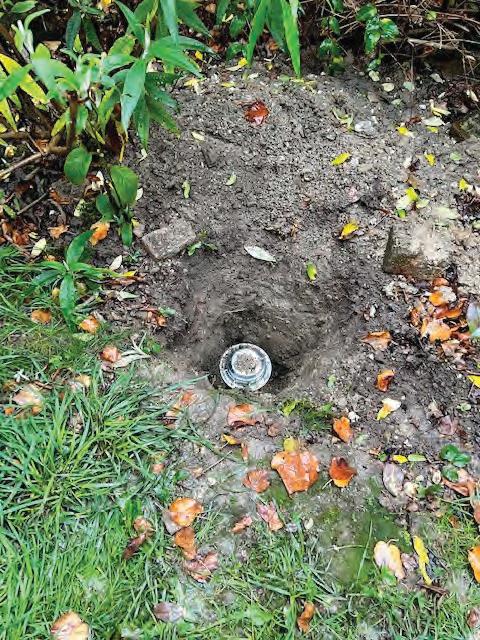
After the service we went outside to bury the capsule. Unfortunately the weather forecast was wrong and it was still raining! However, that didn’t dampen our spirits and many watched it being buried, with the children excitedly helping!
After the service we had some lovely warm refreshments and a good time was had by all!
Amanda Kitely with the time capsule, along with some of the Guilden Morden congregation and three members of the Congregational church in a neighbouring village
The buried capsule before it was covered over
Newport’s new chapel is being constructed alongside the existing building
Vision begins to take shape
Newport
Congregational Church on the Isle of Wight first had a vision for a new building back in 2003 – but it is now finally being built, as new ministries also begin to flourish
By Louise Randall, Church Secretary
Over the last year, Newport Congregational Church (NCC) has seen a big change – not only in our congregation, but in the activities we do.
In September 2021, a secretary was voted in, so for the first time in ten years NCC has a secretary, which has been a steep learning curve for both the new secretary – myself! – and the minister.
The biggest change is that the work on the new chapel building has finally started, which is really exciting – the original vision was born in 2003!
Now that the work has started the framework has gone up really quickly, and it has become quite a talking point as people walk past. We are looking forward to moving in!
Our free food project continues to go from strength to strength. Our neighbours from the local Catholic church recently gifted us a sum of money to support our food project, which has enabled us to buy a new glass-fronted door fridge to go in the foyer, enabling us to offer fresh food to those in need.
As well as what we offer in the foyer, we also have a kindness cupboard full of non-perishable items.
During lockdown we were given a large freezer on long term loan, so we also stock a variety of ready meals that come to us through the waste food project on the Island.
With some of the money we were given, we bought some individual food containers and in November a group spent the day cooking and managed to cook and freeze 68 meals, including for those with dietary needs, and it only cost us £16 due to the food we had already in.
We are conscious of the rising cost of living and
along with all the other churches in Newport have become a warm hub. We already have a meal together as a church on Thursday evenings and have extended the invitation to all who would like to come.
Our record so far is feeding 21 people in one go!
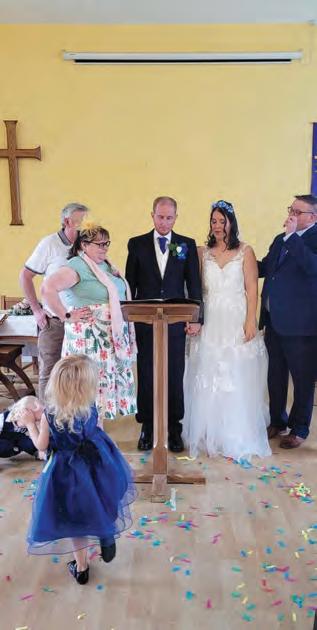
The other big change for us as a church is that we now have a weddings licence and the church secretary has become the Responsible Appointed Person, meaning we can now hold weddings in the building without couples needing to be married at the Registrar’s first. So in October 2021 we had the first wedding at church, which was actually just a celebration for a couple who were part of the church.
We then had another wedding in July for another church couple, and though we had the licence by then, the couple still needed to have the Registrar here on the day. The couple were married by the minister but the Registrar was still required for the legal part. But by the time we had a wedding in October this year, we were able not only to have the actual wedding, but as Church Secretary I was able to be the Responsible Authorised Person to take care of the legal side of things, meaning that we didn’t need a Registrar.
This third wedding was for a couple we first met through our toddler group, and who decided to get married after the husband-to-be was diagnosed with stage 3 cancer.
What is interesting in the tale of the three weddings is that it shows quite well how the church is changing and growing, which is exciting. And as we look to the future we are hoping to restart the toddler group, which hasn’t run since July due to ill health.
Three weddings have taken place at Newport in the last 18 months
Putting the pieces back together
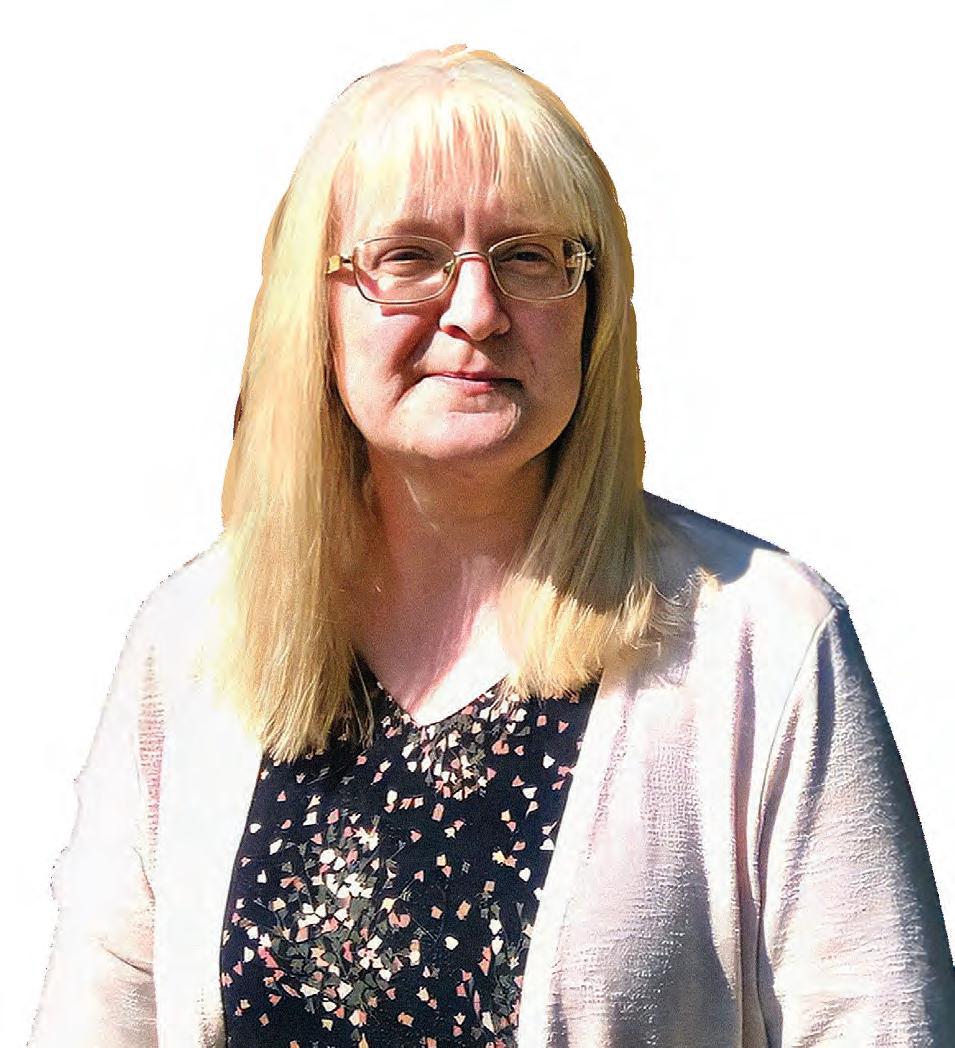
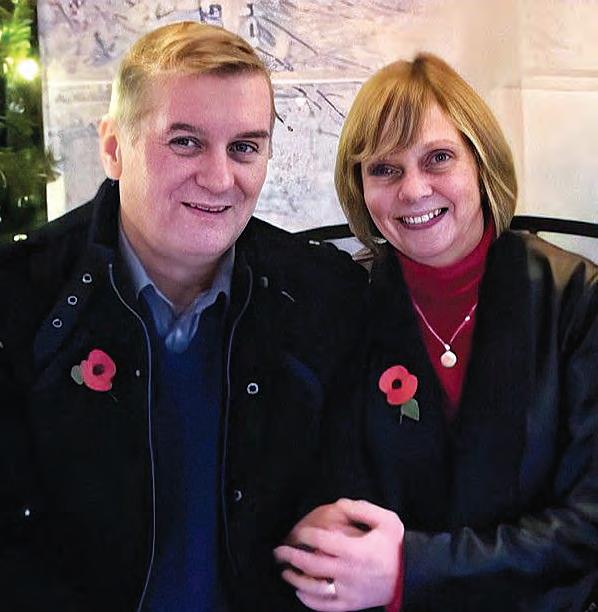
Caroline Gilpin’s husband died suddenly when he was 42 and she was 37 and her son was six months old. Caroline tells how she went through a terrible time, but also how she clung on to her faith and, 16 years on, has written a book telling her story of bereavement in the hope it will help others.
By Caroline Gilpin, Deacon at Lapford Congregational Church, Devon
In February 2007, my world as I knew it came to an abrupt end.
I think until that point I had led a pretty ‘charmed’ life. I was brought up in a caring home as part of a Christian family, had many good friends (both Christian and non-Christian) and met the love of my life in 1998 (although I didn’t realise it at our first meeting!) and married him in 2003.
We had almost four years of happy married life together, only marred slightly by illness and a diagnosis of Crohn’s Disease during our first year of marriage. That was just a blip in an otherwise happy life: Crohn’s was manageable by diet and medication. We were blessed to have a beautiful son arrive in 2006.
But then my husband, Tim, became ill around the time of our son’s christening in November 2006. He steadily grew worse and went into hospital in January 2007 to have surgery on his stomach. He was in the hospital for a month and had to have several operations, but appeared at last to be getting better.
Unfortunately, no one realised in all the years of illness and diagnosis that Tim had an ulcer and on 12 February this ruptured and he died, despite the efforts of the hospital staff to save him.
I was utterly lost. I couldn’t believe that this had happened to him. Or to me. I couldn’t understand how, with so many people praying for Tim, God hadn’t answered our prayers. I felt as if I had been ripped right down the middle; half of me had been taken away with Tim and what was left was a raw open wound. I had no idea how it would heal.
Fortunately, I had a strong bedrock of faith to cling onto (sometimes only by the fingernails), a very supportive family and network of friends and a wonderfully supportive local church. Somehow with all of that help I got through the initial experience, helped by having a son I had to get out of bed for, and eventually began to put myself back together.
Caroline Gilpin says her book “is ultimately positive and hopefully uplifting as it is a love story about falling back in love with God”
In the first UK lockdown in 2020, I felt that God was giving me an opportunity to write about my experience, something which I had been thinking about doing on and off for a few years. I didn’t want to write a self-help book, just an account of my experience and all the extra questions I had as a Christian who believed that God loved me, yet had trouble reconciling that love with unanswered prayers and losing the love of my life.
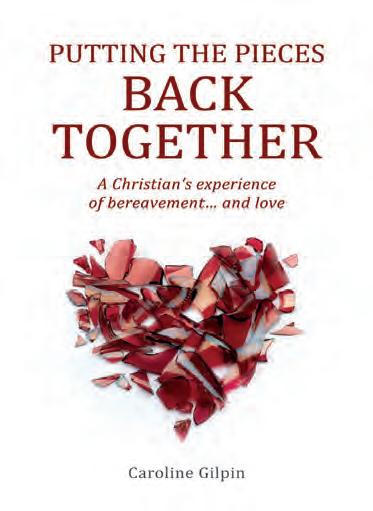
The book I have written (Putting the Pieces Back Together) is really a love story: a human love story and a divine love story. Some people walk away when they feel God has deserted them. I clung on to the cliff face and finally made my way back up on top and got back en-route with my journey with God. I wanted to share some of what I feel are common experiences of grief but also the extra questions, like: Is it all right to shout at God? Why had he abandoned me? Would I ever be able to trust him again?
When I was baptised as an adult, aged 21, I was given a verse as a gift from my church: one which they believed they had been directed to give me. It was Isaiah 43:1 (RSV): “Fear not, for I have redeemed you; I have called you by name, you are mine.” At the time, I thought it was lovely, inspiring and a verse I stuck on my wall to try to remember it, but it didn’t mean much other than that.
Years later, that verse has been a lifeline to me. It has become my bedrock from which I can’t be moved. It has been God’s promise to me on many
occasions but particularly through my bereavement. The verses speak of God’s love for me and his promise to get me through what he knew was coming. Verse one and the verses following have become really precious to me as they illustrate God’s love story in my life:
“Fear not, for I have redeemed you; I have called you by name, you are mine. When you pass through the waters I will be with you; and through the rivers, they shall not overwhelm you; when you walk through fire you shall not be burned, and the flame shall not consume you. For I am the Lord your God, the Holy One of Israel, your Saviour. I give Egypt as your ransom, Ethiopia and Seba in exchange for you. Because you are precious in my eyes, and honoured, and I love you, I give men in return for you, peoples in exchange for your life.”
I was broken into pieces by my experience but I believe I have been re-shaped into something new. It’s not necessarily better, it’s definitely not something I would have chosen to be, life’s just different from what I expected and so am I.
I hope the book I have written will explain my small attempts at navigating my way through grief, mistakes I’ve made and lessons I’ve learned, and through it all finding out how to hang on to God’s promise to me.
Putting the Pieces Back Together: A Christian’s Perspective on Loss and Love by Caroline Gilpin is available on Amazon.
New ways of doing church
A new course for those who want to pioneer a community outreach has been launched, called the Newbigin Pioneering Hub
The Newbigin Pioneering Hub is a collaboration between the United Reformed Church, the Congregational Federation, Church Mission Society and the Seedbeds organisation.
CF President Mark Taylor tells how the Federation got involved: “In the summer of 2018 I (along with Nigel Lindsay) had the opportunity to represent the CF at a Council For World Mission event in Utrecht on the subject of Fresh Expressions of church/Pioneering.
“It was a wonderful, exciting event and we both came back enthused about the possibilities for Fresh Expressions (FX) in the Federation.
“As soon as we could we made a report for Council suggesting that a Working Group be established to examine:
a) How can FX fit into the Congregational model of church governance and what can this teach other denominations?
b) What more can be done to bring the use of FX into the mainstream of Congregationalism?
c) How can the CF work with other denominations on issues relating to FX, in particular training?
“I have been delighted that Council have been so receptive and supportive on this topic. Particularly exciting has been working with the URC and the Church Mission Society (part of the Anglican church) on The Newbigin Pioneering Hub – a Pioneer training course – which was launched in September 2022 in Birmingham. I am delighted that four people associated with Congregational churches have enrolled on the programme.”
Trevor and Lorraine Pailing from Newark in Nottinghamshire were two of those four people, attending on behalf of London Road Congregational Church in Newark.
They say: “We began the Pioneering Mission Course in September 2022 by going on a residential weekend, Friday until Sunday, at The Greenhouse Retreat and Education Centre in Bromsgrove. It was a lovely setting with alpacas roaming in the adjacent fields – a good place for study and reflection.
“This was our first time doing any kind of study for many years and we were both very apprehensive.
“We needn’t have worried; the weekend was very relaxed with good food and good company. All who attended, approximately 20, had come for different reasons, and from many different parts of the country. We were a mixed bunch but with a united purpose
of finding out more about being pioneers in our communities.
“The first evening was spent at a Creative Arts Festival at Lodge Road Community Church, where we witnessed first-hand the pioneering work of Angie and Ash Barker.
“The church is being used in many ways for its community. There was street dancing, a band, drama and singing, metal work, cooking projects, crafts and so much more. There was a room full of bikes which have been donated. They repair them and give them to people who need one to get to work, school, etc. They also teach people how to repair the bikes.
“There are translators, financial advisors, help for arranging doctors and hospital appointments, etc. The list goes on. The local police even visit and signpost people to the projects!
“All profits made go back in to the project work.
“The evening was a real celebration of their achievements. Many of the volunteers are people who have had their lives transformed by the work of the project and now want to give back. It was a privilege to see this pioneering work and speak with people whose lives have been helped and changed by it.
Trevor and Lorraine Palling
Newbigin Pioneering Hub logo
“Our first two modules have been looking at: Pioneering Mission – what Mission is and isn’t; Mission Spirituality – what spirituality is and isn’t.
“Our first assignment was to ‘map our community’, i.e. look at where we live more deeply: the culture of where we live, housing, needs, politics, diversity, etc.
“The story of the woman at the well in John 4 was used to help us visualise how Jesus went to meet the woman where she was at; she was an outcast, he knew her needs. He was intentional in his actions. He did not condemn, he did not judge; he met her where she was at. After a few minutes of talking with the woman (having someone listen is the beginning of healing), she no longer hides from her community but runs towards it and shares her good news. Her life was changed, the community was changed.
“Jesus did not ask the woman, or her community, to become Jews in order to be accepted. He stayed with them for two days in their culture, before moving on and leaving them with changed hearts to do things their way.
“The heart of mission is to come alongside cultures and work with them, not try to convert people to our ways.
“Where are our wells and who is the Samaritan woman in our own communities?
“Our second assignment was to give a review on a pioneer that has inspired you personally. We chose to talk about the work some friends of ours have developed and continue to develop in Gambia, providing schools and education for many children. It began by starting a youth club for about half a dozen children one afternoon a week, and went on to build schools and provide education for 1750 children, some of whom have gone on to teacher training and now teach in the schools where they were once pupils.
“Our third assignment was to write about what it means to ‘spiritually come home’ for us individually, and to recognise ‘what your genius is and how you can bring it to the world’. (Tricky!)
“The course made us think much more deeply about ourselves, how we think, how we might be
stuck in our ways and how we need to be more open to other views and opinions. Do we spend more time trying to change people’s views to our own rather than actually coming alongside them and walking with
Trevor has some online video clips of the three modules so far which give you a flavour of the content. For the links or more information about enrolling for September 2023, email: tvrpailing@outlook.com
them and accepting their differences?
“It also asks the question, ‘Do we love where we live enough to actually bring about change?’
“It is all taxing our brains!
“Our next module (which began in January) was Church and Mission.”
Taps Mtemachani, Pastor of Temple Church, which meets in the Congregational Church building in Newcastle under Lyme, has also been on the yearlong course. The Federation part-funded his place. He is enthusiastic: “The course has been incredible! It is essentially a network of many Christian leaders pioneering fantastic, innovative and progressive Christian mission in so many different forms across the country.
“I have found that network really inspiring and the sharing of learning and experiences has also been invaluable. Over three learning modules we have looked at things like the intersection of culture and mission and how the two relate and converge into the formation and agency of Christianity in local contexts, including the role and nature of Church as that relates to mission spirituality.
“I look forward to completing the rest of the course by July and then hope to continue exploring and implementing the learning in how we work better together with our local Congregational church partners at King Street CC, and create an environment much more attractive and conducive to a younger and multicultural generation of worshippers.”
Taps Mtemachani
Studying for Congregational ministry
The Congregational Federation’s training course, a foundation degree in Practical Theology, is designed to nurture your life and faith, and is rooted in the local church.
It is designed to help you take the next step in your journey of faith, building knowledge and understanding, and helping to develop your skills and confidence.
Teaching takes place at the Federation offices in Nottingham on four weekends in a year – in September, January, April and June. The course combines face to face teaching with distance learning and electronic learning. In this way it’s accessible to those who have other commitments, at home, work or church. It is accredited by York St. John’s University.
The course is for anyone who is part of a Congregational church but we do welcome those outside the Congregational tradition too.
Two students who have taken the course share their experiences...
I am a final-year student, and Student Representative, on the practical theology course.
Never in my life did I think I would study so I could consider ministry. That I should have come this far in studying is incredible to me.
After undertaking the Growing in Faith Together (GIFT) course, I was invited to study for the Practical Theology foundation degree.
I have found the course rewarding and I have learnt a great deal. As I come to the end of the course, I feel that I am being called by God to minister to others.
The challenge for me was writing academic essays and learning theological language and words, but I managed it due to all the support that is available.
The seven hour train journey to and from Nottingham was also a bit of a challenge as it meant very long days and several intense days of teaching.
During COVID lockdowns the teaching weekends were instead held remotely and this proved difficult as we were unable to build relationships face to face with other students and tutors.
This is a course I would definitely recommend for any person of faith, as it opens doors to a deeper faith, relationship and
Lynn Robertson
Student from Gilfillan Congregational Church,
I can only speak highly of it, and encourage anyone interested to at least enquire about joining. As students we are supported fully by the Course Administrator, Maddy, who is always available to guide, help and remind us what we are meant to be doing (!), and we all are looking forward to the energy and support Catherine Booton, the new Learning and Development Manager, will no doubt provide when she assumes the role in April.
The four weekends in Nottingham are packed with high-quality teaching sessions, lectures and tutorials, and strike a good balance between academic instruction and practical guidance. The students attend the course for differing reasons; some as part of the road to ministry, some for self-development, and some selecting certain modules to enhance their own, or their church’s, education.
We come together not only as individuals, but as representatives of our home churches, and it is always interesting to see how varied we are in both thought and practice. Differing, but all bound together in Christ. This difference in approach and idea, along with the superb teaching, fellowship, and support from all involved makes the course both enriching and uplifting.
Highly recommended!
Gwyn Davies Minister
at Clarendon Park
Congregational
Church, Leicester
For a prospectus or more information email: training@congregational.org.uk. The closing date for applications is 31st May each year. For more information on our learning opportunities please visit congregational.org.uk/learningdevelopment or email: madeleine.varley@congregational.org.uk.
The Federation offices in Nottingham where the weekend teaching takes place
Full-time – Musselburgh (Scotland); Southwick Christian Community Church (South East); Springhead, Oldham – part time considered (North West); West End, Haverhill (Eastern).
Part-time – Dereham: Cowper Memorial (Eastern); Elstow Bun.yan Christian Fellowship (East Midlands); North Nibley (South West Midlands); Shillington (East Midlands); Stalybridge (North West).
Non-Stipendiary – Frampton (South West Midlands); Oban Congregational Church (Scotland); Penrhys, Llanfair Uniting Church, (Wales); Ebenezer Independent Congregational Chapel, Tredegar, Gwent (Wales).
Educational bursaries for Congregational members
Applications are welcomed for educational bursaries from families of Congregational ministers and members, for eligible categories outlined in Milton Mount Foundation website. For the forthcoming academic year 2023/24, applications are due by 10 May 2023. Further information and application details: miltonmountfoundation.org.uk.
TIPS FOR LIFE ONLINE
Sketching out a plan
By Neil Chappell, Social Media & Website Officer, Congregational Federation
What’s your next big thing? Lent Course? Mothering Sunday? Easter? Coronation Weekend?
So you’re planning an event/occasion of some kind and want the publicity to go as widespread as possible – as far beyond the four walls of your church as you can. So you’ve covered the normal avenues of posters/leaflets/word of mouth/newspaper ads. What else can you do?
Well, there’s always social media. Facebook, Tik Tok, Instagram, YouTube and Twitter are all the rage now, aren’t they? In my opinion, you would ignore these channels at your peril. They can reach you a whole new audience and give a timely boost to your plans.
But before you jump into the online world there’s a few things you should take into account. Who is your intended target audience? This matters as it affects the platform you use to share your message. The biggest social platform is Facebook with over 30million UK residents checking in every day. However, the largest group of users are aged between 25-34, and the biggest increase in users over the last 12 months was in the age group 55-75. So if you’re planning a youth event Facebook might not be the place to share it!
Have a consistent brand presence. Just think how instantly recognisable the Nike logo is. Or the marketing adverts of Tesco, Costa Coffee, John Lewis, Sky Sports or Nat West Bank. Companies spend a great deal of time finely tuning their brand and image so that it is familiar and the associated message can be trusted. Churches need to do the same – so that they too are instantly recognised
(on leaflets or online or on the building) and their message can be trusted. If you have a logo make sure it is across all your platforms – on noticeboards and newsletters, leaflets and social media. And if you have a strapline, or a Bible verse, consistently use it to identify yourself, because who could ever forget the slogan, ‘Should have gone to Specsavers’?! Create engaging content. Telling someone about your event in a video is a really good way of getting the message out, because you are animated and excited (hopefully) and you can answer any questions. A poster or a leaflet is less dynamic. If you include a phone number or an email that is the only way people can interact. Don’t fall into the trap of just creating a poster and putting it on social media. People who use social media engage more with short videos, or they like to answer a poll, or an amusing question, and they definitely like entering competitions. There’s a whole new way of connecting with people in your local community that churches should explore. And don’t forget, if someone responds, acknowledge it – keep the conversation going. Take the first step. Don’t keep putting it off. Gather a few interested people around you to learn together and share ideas and expertise – especially young people! And always remember, less is more!
You don’t have to post multiple times a day – two or three times a week can be sufficient to get your message across, using good quality graphics, photos you have taken, even video. Give it a shot.
And let us know how you get on in this adventure. Did anyone respond? Any good conversations had? Any lessons learnt?
You can contact me anytime to talk about your church’s website or social media presence. Drop me a line.
Best wishes, Neil neil.chappell@congregational.org.uk
Neil
Bible Cake Recipe
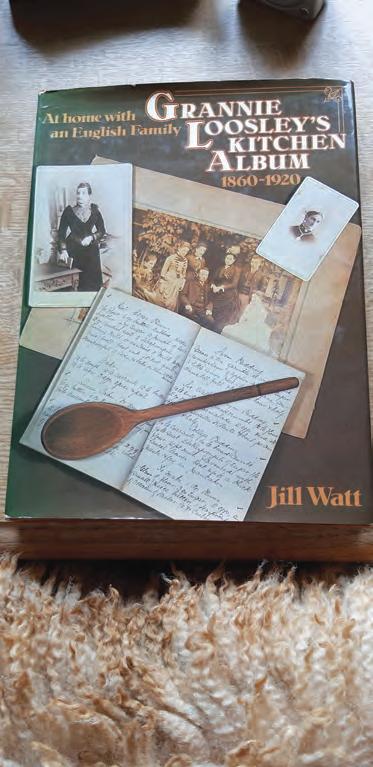
This recipe is shared with us by Hilary Stephenson from Pontesbury CC in Shrewsbury and comes from a 1980-published book, Grannie Loosley’s Kitchen Album, by Hilary’s second cousin – Jill Watt. ‘Grannie’ Mary Anne Loosley was Hilary’s great grandmother. The recipe doesn’t give the names of the ingredients, but does give you the Bible verses where you can find them! Have fun looking them up –but use the AV to find the right ingredients. It makes an 8 inch/20 cm fruit cake. If you make the cake please share your photos for the next issue!
Ingredients
1.½lb Judges V, verse 25 (last clause)
2.½lb Jeremiah VI v20
3.1 tablespoon 1 Samuel XIV v25
4.3 of Jeremiah XVII v11
5.½ lb 1 Samuel XXX v12
6.½ lb Nahum III v12 (chopped)
7.2 oz Numbers XVII v8 (blanched and chopped)
8.1 lb 1 Kings IV v22
9.Season to taste with II Chronicles IX v9
10.A pinch of Leviticus II v13
11.A teaspoon of Amos IV v5
12.3 tablespoons Judges IV v19
Method
N.B. Leaven means baking powder. Curd means butter.
Beat nos. 1, 2 and 3 to a cream; add 4, one at a time, still beating; then add 5, 6 and 7, and beat again; add 8, 9, 10 and 11, having previously mixed them; and lastly 12. Bake in a slow oven for 1½ hours.
Mary Anne Loosley’s Victorian and Edwardian recipe book by Jill Watt
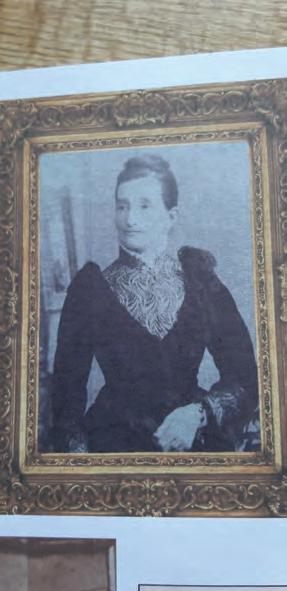
Mary Anne Loosley
SHARING HOPE
President Mark Taylor explains some outreach ideas that could work for your church
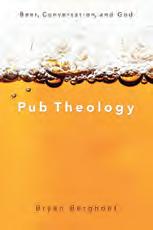
Pub theology
Just over six years ago I read a short book – Pub Theology by Bryan Berghoef. As soon as I’d finished it I knew that I wanted to try out the activity in my home town of Newark. I also knew exactly where I wanted it to happen. A little less than a year later, the first pub theology meeting in Newark took place. What is pub theology?
It’s something that’s been happening for a number of years. It started in a pub in London – but it’s become quite a big thing in the USA. It’s all about meeting up somewhere comfortable, having a drink if you’d like (mine’s a pint), and talking about some of the ‘big questions’ that if we are human we ought to be interested in and have a point of view on. It’s for people of all faiths and none – the more different points of view that are represented the better it works. In Newark, as well as people from various Christian denominations, we have had pagans, an Odinist, atheists and agnostics in attendance.
What happens at a pub theology session?
Someone provides a list of questions or statements as conversation starters. We talk to each other, say what we think, and ask each other questions. We have a drink. We have a good time. We all go home a little wiser and understanding other points of view a little better. We look forward to next time.
What shouldn’t happen at a pub theology session?
Someone talks too much – it’s not about saying what we ‘know’ and teaching everyone else who doesn’t ‘know’ it. We learn a lot more by listening to a new perspective than trotting out our own
ideas. The rule of thumb is that if we meet for 90 minutes and there are 10 of us each person should speak for about 9 minutes and listen for the other 81. This isn’t always easy – particularly for me.
Someone tries to ‘convert’ people to their way of thinking/their faith. This is not a proselytising activity; if that’s what you want to do – then you don’t want to do pub theology.
The rules of pub theology
From our very first meeting we agreed some ground rules:
1. Listen first;
2. Respect each person;
3. Everyone is entitled to their opinion;
4. What we say stays between us. This one is very important in ensuring everyone can say what they really think about an issue without fear that their ‘heretical views’ will be reported back!
What do we discuss?
Here are some of the questions we talked about at our last meeting.
1. What part should a country’s ethical approach/ record play in choosing a venue for the World Cup?
2. “The people have spoken. Trump will be reinstated. Vox Populi, Vox Dei.” Elon Musk. Really?
3. “There has to be evil so that good can prove its purity above it.” The Buddha. How far does this go towards explaining the existence of evil?
There is usually a mix between current issues and more timeless topics.
A few practicalities
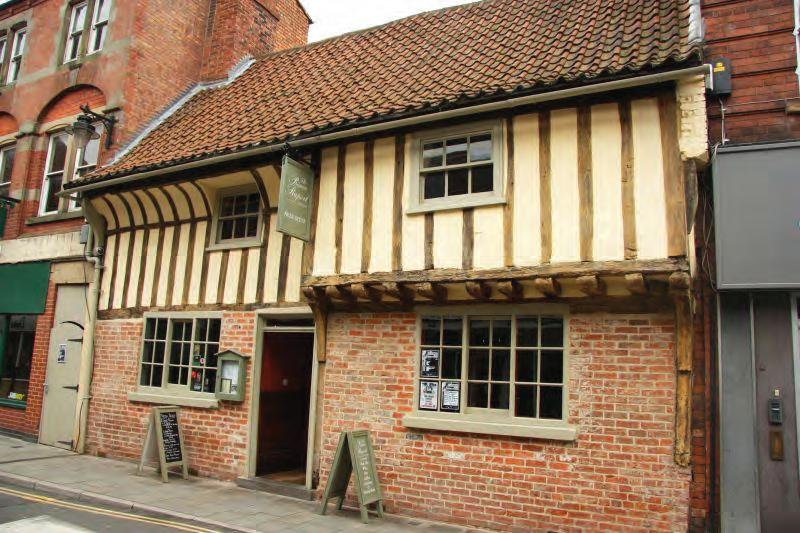
The venue is important. In Newark the choice was clear – there is a beautiful, recently restored pub in a half-timbered 15th century building right in the heart of town – The Prince Rupert. The main advantage (as well as the fact that it sells great real ales) is that there are a number of small rooms that can be used for private
The venue where Mark started Pub Theology in Newark
meetings. The pub has generously let us have a room for free.
After a venue the next thing we needed was some people to attend. Two factors came into play here. The first is that I didn’t want it to be primarily an event for church people – this meant that I chose not to promote it through our local Churches Together group. The second thing is that I realised that my initial plan, ‘I know, I’ll put flyers out in all the local pubs’, wasn’t really viable. My message was basically going to be ‘come to a different pub’ and if I were a landlord I wouldn’t like that. So instead I did my publicity in three ways:
I put out a number of posters in places in the town (library, shops, wine merchant);
I wrote an article for the local newspaper; I created a Facebook page and promoted an event. Then I went to the pub on the Thursday evening, planned for the first event with my list of discussion topics and waited to see if anyone else would come. They did.
Does this sound interesting?
If you’d like to know more there are a few options: Have a look at the website pubtheology. com where you’ll find lots more information and resources.
Read the book Pub Theology by Bryan Berghoef.
Get in touch with me. Send an email to: newarkpubtheology@virginmedia.com with your contact details and I’ll happily reply or telephone you to discuss. I’ll help in any way I can, but bear in mind I don’t claim to be an expert. It’s just that I’ve done it once.
The book that started it all: Pub Theology by Bryan Berghoef, published by Cascade Books, 2012
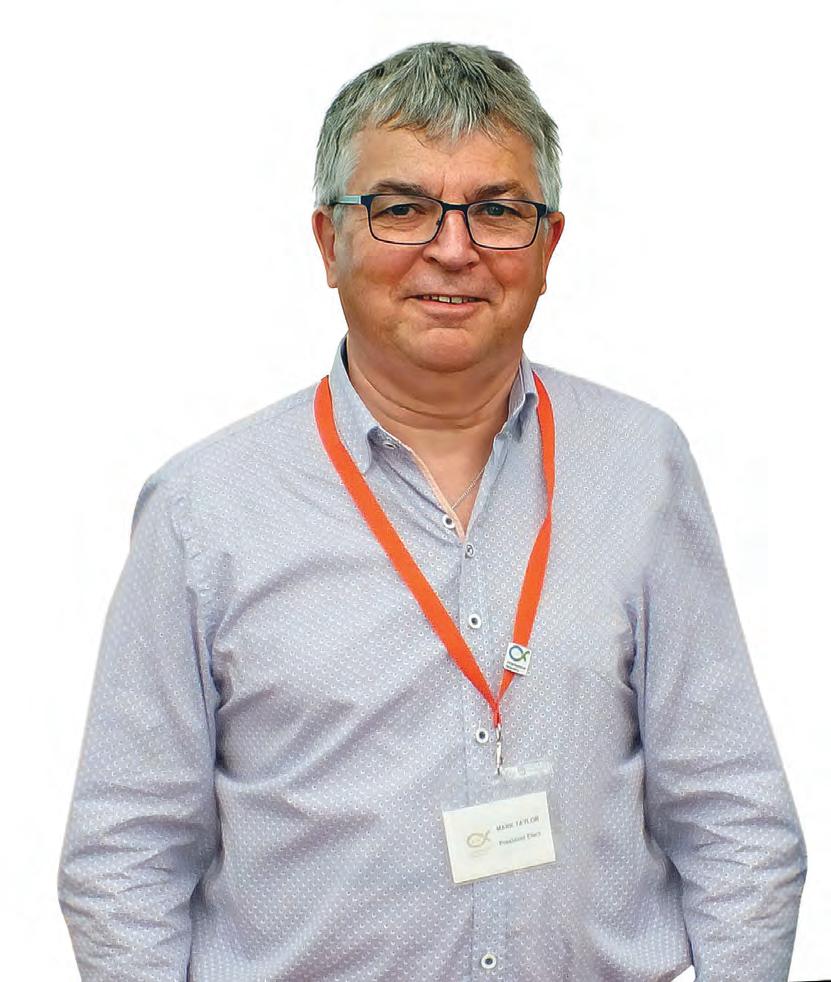
President Mark Taylor
Did Jesus really rise from the dead?
Last
issue we featured an
extract
from
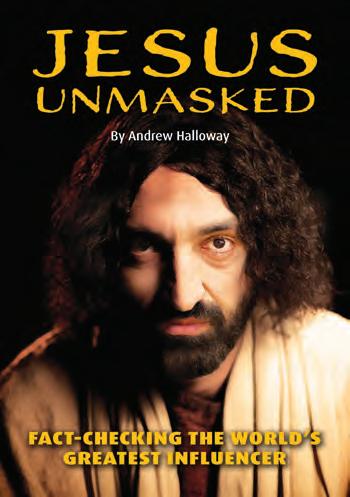
Refresh Editor Andrew Halloway’s new evangelistic booklet Jesus Unmasked: Fact-Checking the World’s Greatest Influencer. In this second extract, Andrew tackles a very relevant subject as we
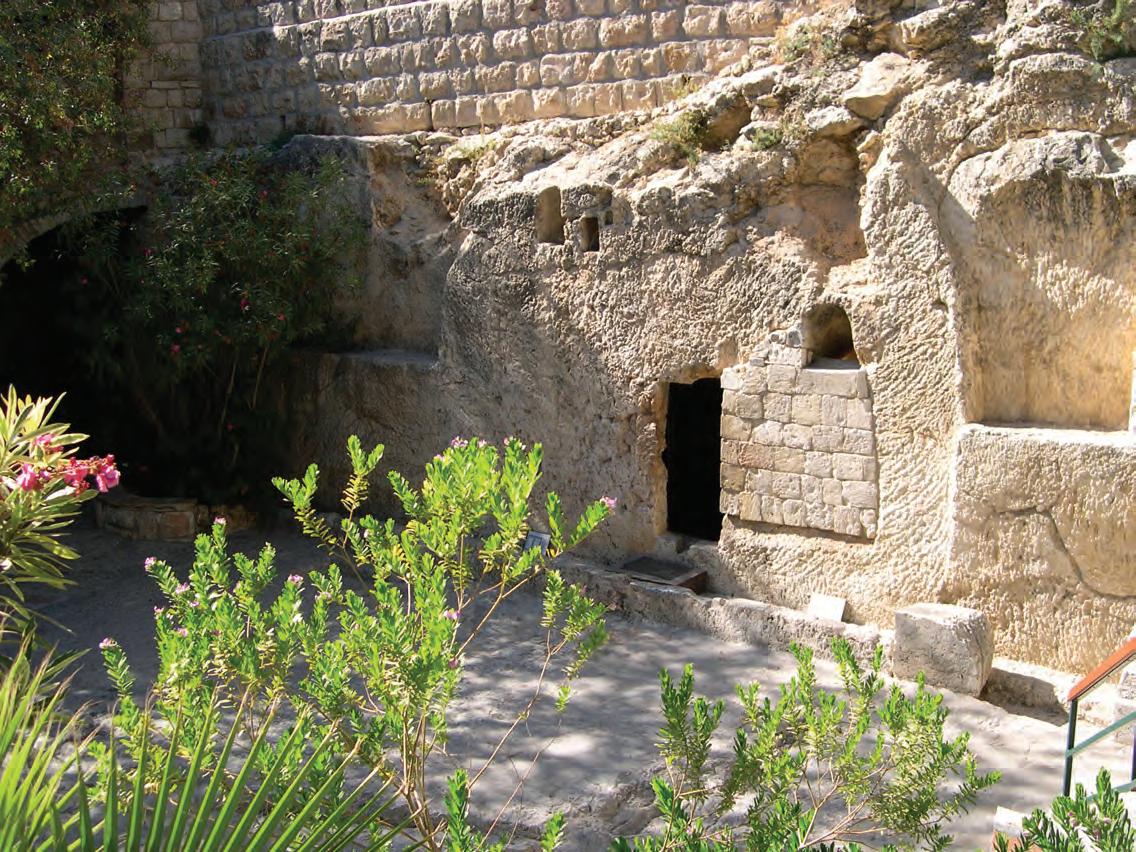
Jerusalem. Some believe that this rock-cut tomb from the time of Christ is the actual resting place of Jesus’ body, but whether that is the case or not, it certainly looks very like the description in the Bible and inspires thousands of pilgrims every year
The swoon theory
Maybe Jesus just fainted on the cross and then recovered in the tomb. Seriously? Roman soldiers were expert executioners, and the punishment if they failed was death. Besides, Jesus was whipped within an inch of his life before being crucified, causing him to collapse on the way to his crucifixion. Then, after being nailed to the cross, he was stabbed with a spear to check if he was dead. Both blood and water came out – which doctors today recognise as proof of death by asphyxiation. In any case, he would have died after being left for
dead in a stone cold tomb with no treatment, suffocated by the bandages covering his face. Even if he revived, how would a terribly wounded man escape from a tomb sealed with a two ton stone, which could only be moved by means of levers, and was guarded by soldiers who would have paid with their lives if he escaped?
Disciples’ plot?
Did Jesus’ disciples steal the body? All the accounts say they were in hiding, frightened of being arrested like Jesus – hardly the mood for fighting the soldiers guarding the tomb. But if the disciples had killed them all, so that none escaped to tell about it, how
could they have covered it up? Hiding the bodies would be no use, as their very absence would give the game away. (In fact, the guards weren’t killed because they reported to the chief priests afterwards, who then bribed them to say the disciples stole the body – see Matthew 28:11-15.)
Also, some people are prepared to die for the truth, but why would the disciples later die for something they knew was a lie? Surely at least one would have confessed to save himself. Finally, all four Gospels state that women were the first witnesses of the resurrection. This would be a stupid thing to write if you were making it up. In the Jewish law of the time, a woman’s testimony wasn’t valid!
Roman plot?
The Romans had no reason to hide the body. They wanted to stamp out rebellion, and that meant stopping any rumours of a resurrected Messiah. A missing body would only have added fuel to the fire. The best way to stop it would have been to reveal the body, if they had it. But they never did.
Jewish plot?
The last thing the Jewish leaders wanted was belief in Jesus to spread. They’d got him killed to shut him up. They were the ones who asked for the tomb to be guarded. Like the Romans, if they had stolen the body, all they had to do to disprove the resurrection was produce it, but they didn’t.
Hallucinations?
How could over 500 people hallucinate the same thing at the same time? Psychologists say it’s impossible. Yet that’s how many followers of Jesus personally witnessed the resurrection (1 Corinthians 15:6). Jesus was also seen on different occasions by different people, over a 40-day period. Anyway, hallucinations can’t explain how the body went missing.
The verdict
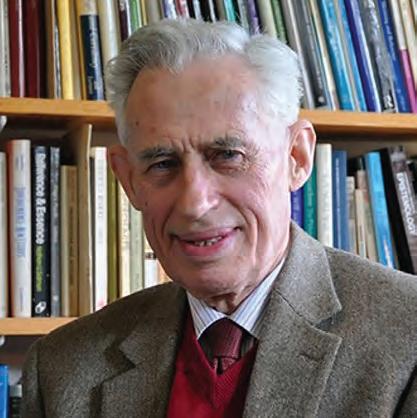
Oxford professor Richard Swinburne took a scientific approach – applying the Bayes’ Theorem probability analysis to the historical facts about Jesus’ death and his empty tomb. He concluded that it is 97 per cent probable that Jesus really did rise from the dead. His argument is in an Oxford University Press book, The Resurrection of God Incarnate (2003), and he has defended it at academic conferences around the world.
Dr Paul L Meier, former professor of ancient history at Western Michigan University, wrote: “The tomb in which Jesus was buried was actually empty on the morning of the first Easter. And no shred of evidence has yet been discovered in literary sources, epigraphy or archaeology that would disprove this statement.”
Lawyer Frank Morison set out to disprove the resurrection, but the evidence led him to write a
Jesus Unmasked, published by Good News newspaper. If you would like a FREE copy, email admin@ congregational.org.uk. This full colour booklet normally costs £1 plus £1.25 p&p, or 80p each when buying a pack of 5 at £6.50 incl. p&p. You can order copies and read the whole booklet online at goodnews-paper. org.uk/jesusbooklet.
best-selling book, Who Moved the Stone?, concluding it was true. Another lawyer and atheist, Val Grieve, also studied the evidence and decided in favour in his book Your Verdict on the Empty Tomb. Charles Colson, a top lawyer and Special Counsel to the US President, became a Christian after studying the resurrection. Lord Caldecote, former Lord Chief Justice of England, stated that the resurrection “has led me as often as I have tried to examine the evidence to believe it as a fact beyond dispute”. Another former Lord Chief Justice of England, Lord Darling, said: “No intelligent jury in the world can fail to bring in a verdict that the resurrection story is true.”
Oxford professor Richard Swinburne applied probability analysis to the historical facts about Jesus’ death and his empty tomb, and concluded that it is 97 per cent probable that Jesus really did rise from the dead
Credit: Levan
Ramishvili/Flickr
Evangelism made easy for everyone – honestly! (Part 5)
In this series, evangelist Revd Andy Godfrey explains a new training programme for churches called Casting Your Nets, which equips ordinary Christians to respond to Jesus’ call to ‘cast your net’ on the right side of the boat – where the fish are. This time, Andy asks what sharing the Gospel actually achieves.
What is the purpose of sharing of the Gospel with others? Sounds like a very simple question, doesn’t it? The answer is surely obvious: the salvation of souls. End of article, right?! No more to say.
However, Outreach UK’s evangelism training course
Casting Your Nets asks a similar but slightly different question which has many more answers to it – some of which are a little less obvious.
The question posed by Casting Your Nets is this: “What is achieved by reaching out with the Gospel?” A small difference but an important one. Yes, the answer is again that souls are saved. But there are other answers as well which form an important part of the course and provide motivation for Christians to engage in evangelism.
If we take each of the answers provided on the course in turn, I do hope that you will see how they combine to spur us on in the God-given task of reaching those who need our Saviour.
The first answer the course offers is this: ‘Awareness is raised of the Gospel’ – and how much that is needed in our day!
I wonder if you’ve ever watched a quiz show where a question about the Bible has come up. How often does the contestant get it right? How many children in our secular age know the story of Noah and the Ark, or David and Goliath, or even the stories of Jesus’
birth and death? How many people have a Bible today – let alone read it?
Isn’t it the case that we need to be not only raising awareness of the Gospel but shouting it from the roof tops! So many are sadly ignorant of what it really means to be a Christian today. By the way, as the course points out, the word Christian only appears three times in the Bible and on each occasion, it has to do with a fully-fledged commitment to Christ, not just being a good person, living in a Christian country or just believing in God.
As people who know the truth, we need to be out there proclaiming it and flying the flag for it. The more people who hear it, the more people will listen to it and be saved by it.
A second answer to the question is that ‘Christians gain credibility.’ This is not just to make us feel good! As we not only talk about Jesus but “live lives worthy of our calling”, people will see Jesus in us and see the reality of how he’s changed our lives. This leads to the third answer to our question: ‘Jesus is honoured and glorified.’ He himself said that when he is lifted up, he will draw all men to himself. A reference to the cross, yes, but as we raise Jesus higher, as we make Jesus known, so more are drawn to him and so he gets more of the praise and honour he deserves.
Do you long for that? Do you long for people to treat Jesus with the respect and honour he deserves? Do you want Christ to be glorified? The best way to do this is to go out and be an effective witness for him. Showing the world the difference he has made in your life and the difference he can make in theirs too.
A fourth answer is that ‘Cults are countered.’ This might be a side effect of our evangelism but it’s a very important answer to the question of ‘What is achieved?’ The Jehovah’s Witness movement, the Mormons and others are still incredibly active and seeking to do all they can to gain converts. The bottom line is that we have the truth about Jesus and his gospel, and they don’t. As we share
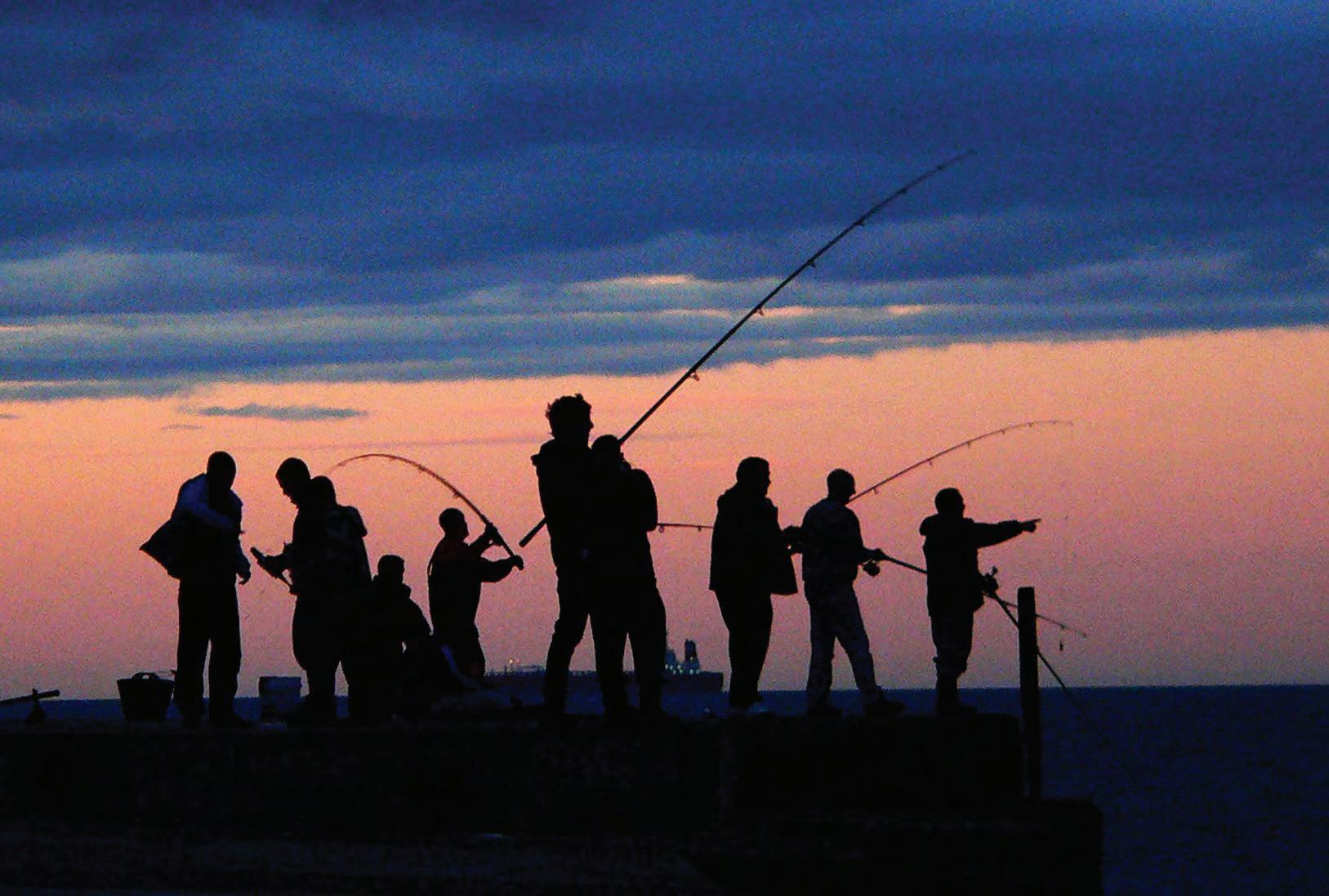
Fishing together – we all have a part to play in bringing others to Christ about Jesus with others their wrong teachings are countered, their claims are dismissed and their impact diminishes. We catch the fish and they don’t. This is actually a tremendous outcome for the truth of the gospel.
It is also amazing to note how many practical things can be achieved by those who are willing to go and be ambassadors for Christ. The course highlights such results as ‘The ‘lonely are befriended’ (this can happen, for example, through regular door-to-door visiting in an area); likewise, ‘The housebound can be helped.’ Also, ‘Backsliders can be brought back to God.’
It may well be that we will find ourselves talking to someone who has fallen away from God, from the Christian faith and from church. In talking to them we may well see their restoration.
Finally (although there are many other answers), the course points out that ‘Disciples are made.’
According to Jesus’ own words in Matthew 28, that is actually the aim. Our aim is to make disciples –people who will follow the Lord Jesus and serve him. One of the aims of Casting Your Nets is to encourage disciples to encourage other disciples to serve the Lord. That’s a great result.
In bringing this series to a close, let me say that Casting Your Nets is as an excellent and effective evangelism training course that equips every
Christian regardless of age, health or location to be an effective witness for the Lord Jesus Christ. It shows us all how each day there are opportunities to share our faith and provides us with practical resources to do just that.
It makes you think about where the ‘fish’ that need to be caught are in your area. The course will enable you to learn how to listen to others, to talk about Jesus and how to share your own testimony. Outreach UK has received so much positive feedback about the course and if you or your church would like to know more you can visit the website at: www.castingyournets.co.uk. If you would like someone from Outreach UK to run the course for you, that can be arranged. There are free PowerPoints and helpful notes available for your use.
If God is calling you to be a ‘fisher of men’ –where are you going to cast your net? It might be that you only have to throw it as far as next door. That can be a daunting challenge but with God’s help, the right resources and training, who knows what you can achieve?
Let’s all hang a notice on our homes saying: “Gone fishing.”
Credit: Francis Hannaway/Wikimedia
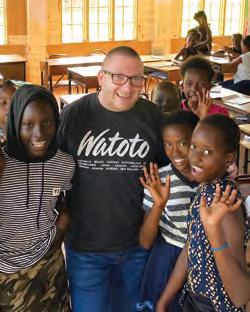
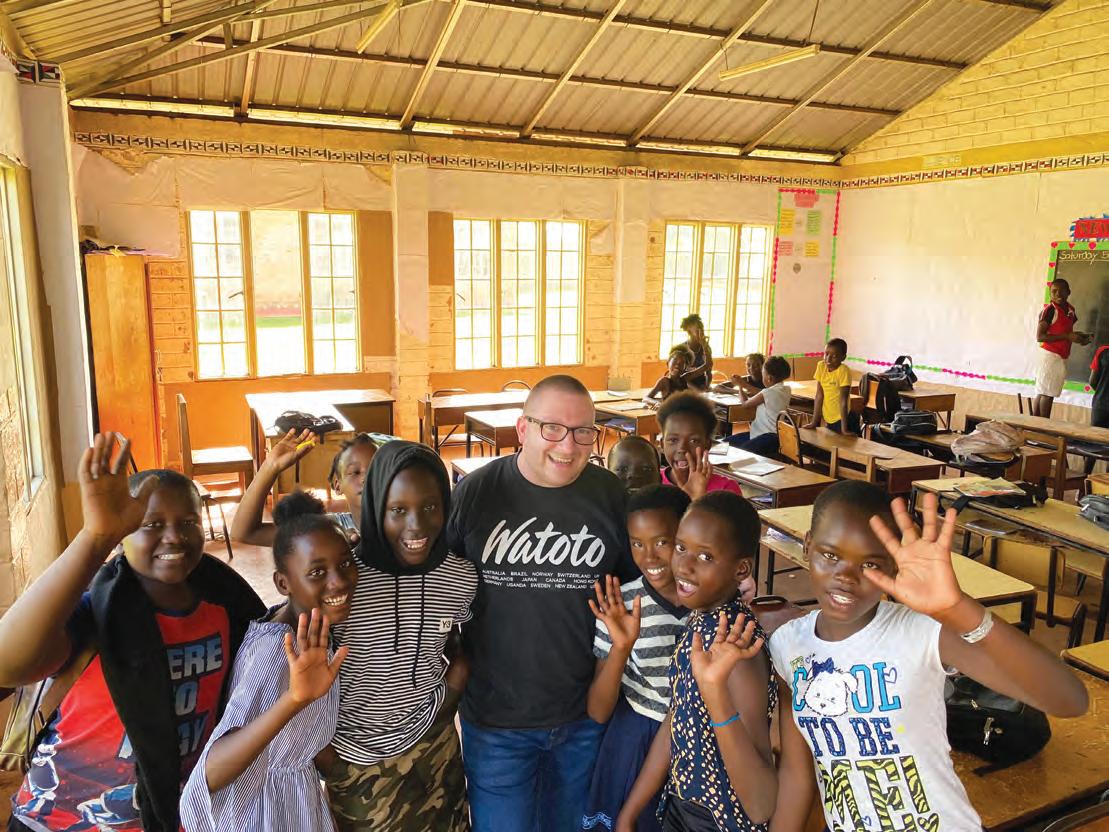
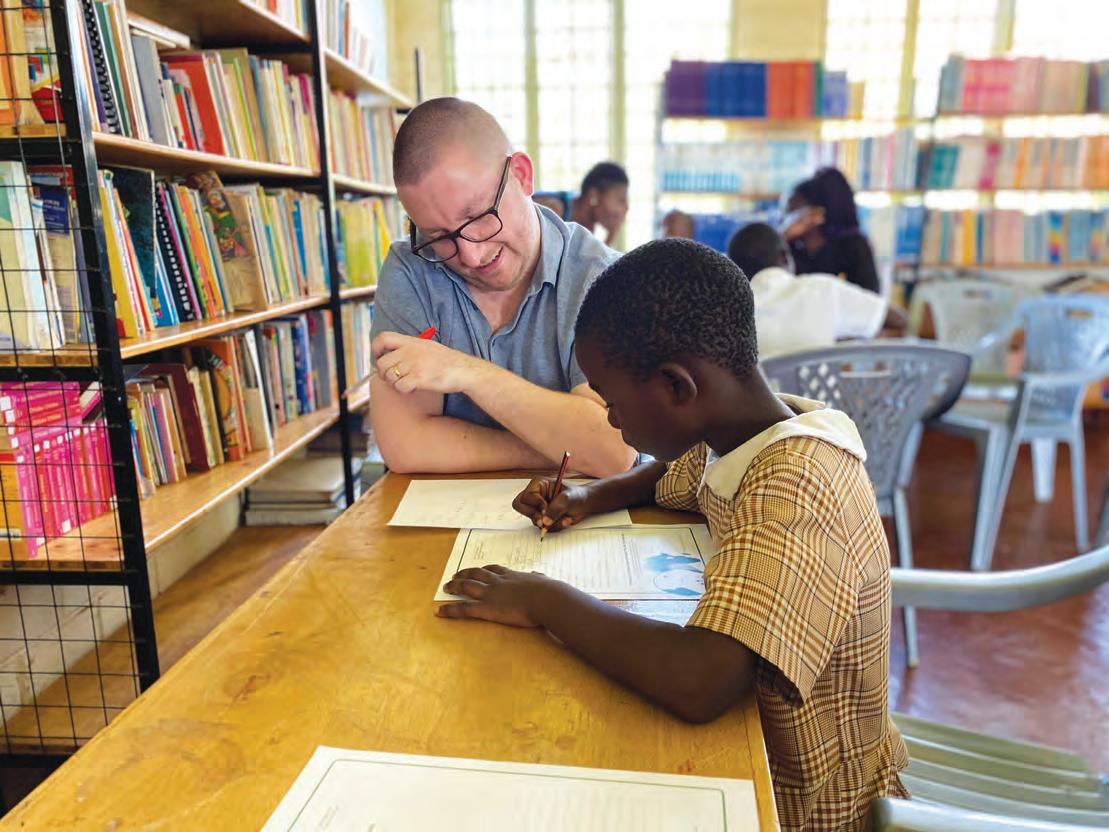
MAIN: Dave with children at Suubi village. When he met them they were helping each other with maths revision during their down time at the weekend
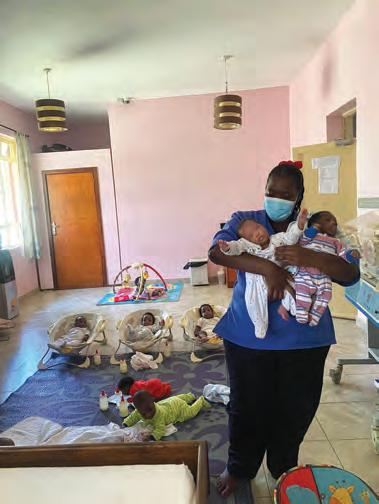
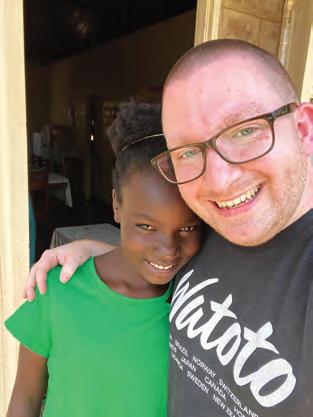
BELOW: Just a few of the babies at Baby Watoto. With 128 babies, nap time is less than straightforward!
working with a ministry called Watoto. Watoto is a church based in Kampala, Uganda, that now meets in 15 locations in Uganda and South Sudan.
The church was founded in 1984 while HIV/AIDS and civil war were decimating the nation and leaving many children orphaned. Since then Watoto has been committed to the biblical instruction to care for orphans and widows (James 1:27).
Nearly 40 years later, it remains a place where abandoned or orphaned babies are rescued, children are raised in families and vulnerable women in the community have their dignity restored. Watoto is committed to rescuing the most vulnerable and raising them into future leaders who will in time rebuild their nation.
You may have seen or heard the Watoto Children’s Choir – groups of children who travel all over the world to share their story, raise awareness of the work of Watoto and raise essential funds. But these children are just the public face of a much bigger ministry. As I write this right now, Watoto is currently caring for 128 babies and over 3,000 children and young people across three children’s villages.
villages has everything the children need – schools, medical care, sports and recreation facilities and a church; mothers, teachers, doctors, sports coaches, youth workers, social workers and pastors.
Through community outreach projects, vulnerable women in the poorest parts of the community are welcomed in, taught to read and write, and trained in a skill that they can then use to work and provide for their families. Some learn tailoring, some hairdressing, others how to make soap or peanut butter. They are then provided with a grant to start up their own small businesses which enables them to provide for their family.
At South Chingford, we are proud to partner with Watoto. A number of our members sponsor babies, children or young people, and four children are sponsored by our small groups. We also look forward to hosting the Children’s Choir each time they visit the UK. It is always one of our most effective outreach events – they draw an enormous crowd every time. I was able to spend some time in Uganda earlier this year to see for myself the incredible work of Watoto and the impact of our support and sponsorship. I spent time at each of the children’s villages, shared meals with the children that my wife and I sponsor and those supported by our church
small groups, and visited some of the women enrolled in the community project in their homes in Kampala’s slums. Truly, it is a place of hope and a place of miracles.
Some stand-out memories that will stay with me forever:
Elisha
Whilst at one of the baby homes, I was able to meet Elisha – the newest addition to Baby Watoto who had been brought in just three days before I arrived, after being abandoned. Malnourished, battered and bruised, he’d had a traumatic start to life but while I was there we caught a glimpse of his smile for the first time since he’d arrived.
With nothing known about him, staff had named him when he arrived, and another miracle began. Elisha is one of 45 babies who have been rescued by Watoto so far this year after being abandoned or orphaned.
Occasionally Watoto’s social workers are able to identify relatives and re-settle children where appropriate, but the likelihood is that Elisha will spend his childhood and teenage years in a Watoto home, with a mother and siblings that he’ll meet in a couple of years when he’s able to graduate from the baby home.
Watoto will raise him, put him through school and further education, and when he’s ready to leave and transition into employment and independent living, he’ll always have a family and support network.
Children’s village
One of the children’s villages is in Gulu, Northern Uganda. It is built on a site that was occupied by the Lord’s Resistance Army (a rebel group and violent cult) during the insurgency. When the homes were
Sylvia
On one of my community visits, I went to see one of the ladies supported by the Watoto Neighbourhood Project.
Amongst the slums of Kampala with its narrow back streets, sewage running down the middle of the walkways and people washing clothes by hand in cold dirty water, we found Sylvia’s home. We barely fit in the one-room shack with no power (she couldn’t afford the additional £2/month so it was cut off).
As she shared her heart-breaking story of loss, abandonment, grief, abuse and hopelessness, tears ran down her face and mine. At Watoto she has found love, hope, and is learning a skill that will enable her to rebuild her life and provide for her child.
Right now on a good day she can earn 3,000 Ugandan Shillings (for comparison, 5,000 UGX is £1). I’ve been in some tough places and seen some harrowing things, but I still haven’t recovered from that visit and I hope I never do.
As a pastor of a church in London, where the contrast couldn’t be greater, I’m reminded that the need for the church to bring care and hope to its local community is the same everywhere, and I’m inspired by the incredible transformation brought about by this particular local church committing to care for the most vulnerable in its community.
If you’d like to find out more about Watoto, head to Watoto.com or get in touch with me directly (find me in the yearbook or ask Yvonne Campbell to put you in touch!). If you’d be interested in hosting a concert at your church next time the children’s choir are here, let’s talk. If you (or your church) would like to sponsor a child or mother, let’s talk. If you’d like to visit for yourself or you have a particular skill and
her home in Suubi village LEFT: Dave helps one of the children writing letters to share news and updates with sponsors
Reflections on a walk around Grenada
Congregational minister Nigel Lindsay walked for five days around Grenada in December to raise money to repair the Samaritan Presbyterian Church in Grenada, where he is working as a CWM (Council for World Mission) Partner in Mission. He tells Refresh readers about his experiences…
What a great experience as I walked over five days around Grenada, spending between 3.5 hours and 5 hours a day travelling and being hosted by some lovely people from different church denominations. The plan was to raise money to repair Samaritan Presbyterian Church so we can do more community activity.
Day 1:
Samaritan Church to Grenville Methodist – Prayer
I was blessed as some people from the church prayed for me as I set off. I was aware of other prayer from all over Grenada and in the UK, as I walked up steep hills on a day of pouring rain, when my feet ached and my bag felt heavy. The prayers gave me fuel to keep going and protected me. I prayed for a few people on my journey.
Many say that God knows our needs anyway, true, but he wants us to connect and partner with him. Prayer leads to actions and more is achieved when we work together in partnership with God.
Day 2:
Grenville to St David’s Catholic Church –Church unity
As I walked and passed a church of any denomination I would pray for that church and that God would bring unity to the body of Christ in Grenada. I was hosted on my four nights by Methodists, Catholics, Presbyterians and Anglicans and supported by other tribes of Church. God wants us to be united. There is more that unites us than divides us.
Yes, we have some theological differences, different structures and some different ways of being church. However, we can do projects together, encourage each other in prayer and sometimes resources. Many of the issues we face are the same.
St David’s to St George’s Presbyterian Church –Climate crisis
As I walked down to the main road from St David’s Catholic Church, you could see the beauty of the hills, sea, houses, schools and farms laid out before me. Grenada is such an amazing and blessed country with sun, rain and good soil, just a bit hilly at times.
I am impressed by all the street cleaners I see around, clearing rubbish. How do we encourage our people not to waste so much single use disposable items? We can walk with water in a reusable bottle, rather than buying one. We can carry our own containers for food.
So many cars passed me with just one person in, and walking to the shops rather than driving would cut pollution. Some of the flatter islands are in danger of being under water soon. We have a responsibility to those who are suffering due to our mismanagement of our environment.
Genesis 1:26-28; Matthew 25:40
Day 4:
St Georges to Gouyave Anglican Church – Exercise
I walked past the Kirani James Sports Stadium. Over years many have celebrated great physical accomplishments and I wonder what the future holds. I had expected to see lots of young people out
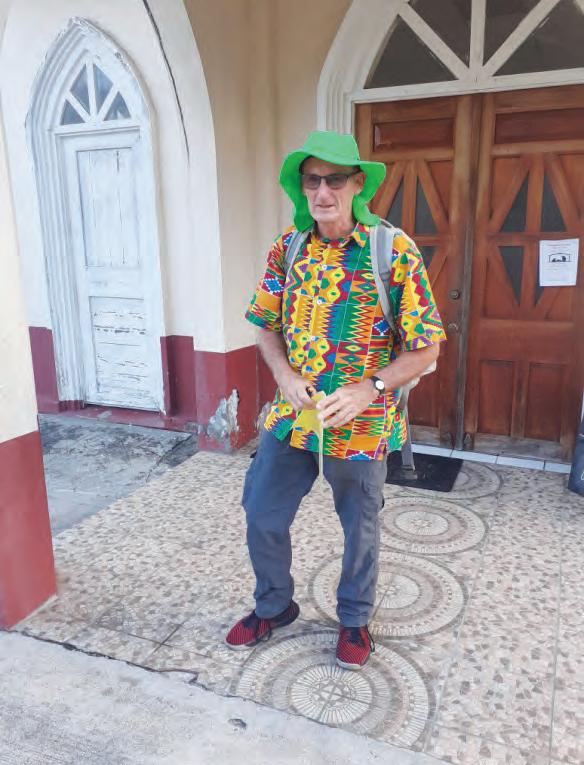
Nigel Lindsay in his brightly-coloured walking gear!
playing physical games in this holiday but saw very few. Many stay at home and watch a screen and lose the opportunity to socialise and make the most of this amazing environment.
Many of our older people have kept fit walking and tending the farm; now in older age they are still able to get out and enjoy life. If we don’t use and build up our bodies it will become more of a challenge in old age. I believe we are all on a journey, physically, emotionally, spiritually and we have to exercise and grow in a holistic way. A bit more walking will help us and our environment.
Philippians 3:12-14; James 1:12; 1 Corinthians 9:24-27
Day 5:
Gouyave to Samaritan Presbyterian Church –Journeying together
I had been told that some teachers from Samaritan Presbyterian School planned to meet me in Victoria and walk the last part of the journey with me. I looked forward to this and was pleased that more than I had
MISSION
expected, and some of their children, took part. We tried to stay together, but some had longer legs and a faster pace, but we were all in it together and celebrated as people arrived at the end.
We are all on a faith Journey and sometimes it feels like we walk alone, but God is always with us. It is good to walk with others, but we are all unique, go at a different pace, and divert to engage in different things. Walking together involves negotiation, and whilst that can be challenging it helps us to grow and understand more.
Some try to do Christianity alone, but fellowship is key to our growth. In becoming a Christian we have not reached a destination, but have started a journey. I pray we can all journey with others.
Matthew 9:37-38; Hebrews 13:1-2; Philemon 1:6; Romans 14:1-12
My thanks to all who supported me in this venture: in prayer, in accommodation, and financially. I was encouraged by your support.
Singing for the soul!
Helen Keighley, Minister at Harden Congregational Church in Bingley, West Yorkshire, explains the benefits of an unusual retreat she enjoyed last year
When life gets incredibly busy and you feel like you are juggling everyone’s demands on your time, how we would love just to make everything stop and take some time to be quiet and relax.
Our lives are so busy that we find it difficult to stop. But we need to stop to find time for our soul, time to be at peace, time for spiritual enrichment. The Sherpas of the Himalayas have a saying: “Let your soul catch up with your body.” How do you do that? Wherever you go and however you do it, it’s healthy to take time out.
You might take time to pray and come closer to God that way. How many of us take the time to encounter God in a quiet time? You might also find spiritual enrichment in the love of your family, your church or outdoors in nature.
I like to sing! So when I discovered a singing retreat in the Yorkshire Dales it seemed perfect. It took place at a very special place called Parcevall Hall (an Anglican retreat house near Appletreewick). Removed from the hustle and bustle of life, I was able to reconnect with peace, with nature and with God.
At this retreat, I perhaps expected communal meals, shared prayers and worship and singing together. Not all retreats are the same. This one had no direct religious input. There were sociable times, singing
together times and time alone.
The retreat centre is a wonderful place to be – acres of gardens, inspiring views, quiet nooks where you can think or read and chapels in the centre and out in the garden. Just being there is a great way of finding time to process your own emotions. Lesley Booker writes in the Retreat newsletter: “In the silent spaces we slowly learned to unwind, to think deeply, to listen to our bodies and our hearts and, like Elijah, to find God.”
There is something very spiritual about being out in the countryside, exposed to the elements. It gives you time to marvel at God’s creation, to use all your senses, to breathe in the essence of it all. Embroidered on a wall hanging in the house and engraved on a plaque on a rock in the courtyard were these words: “Nature in all its diversity grants us a glimmer into the heart of God the Father which is nothing but love. Trust in his love and you will never be disappointed.”
But why singing? “To sing in a group is an act of love, for yourself and for other people,” says James Sills in Do Sing. I believe it is also an act of love for God. The emphasis is on the communal not the individual.
Helen Keighley
MAIN: A view of the gardens at Parcevall Hall BOTTOM RIGHT: Beautiful Parcevall Hall where the retreat took place
Continued from page 23
Singing helps you to connect in a way other activities don’t.
Breathe deeply. Add a vowel sound like Ooooooo, Aaaaaaaaa and an arm movement. It’s amazing how calming that can be. The teacher introduced us to a box of tissues. I worried that she might be afraid my singing was going to be so bad she’d either want to cry or stick the tissues in her ears! But no. She explained that they were essential on this kind of retreat as music can unexpectedly bring up emotions. Introspection and self-evaluation is part of the process and can be challenging or uncomfortable. We were encouraged to take a moment out whenever we needed it.
She calls it a retreat rather than a course partly due to the setting being a very spiritual place. We were free to sing, not sing or just listen to each other. To lose ourselves in the music. Or to withdraw. We even went out into the garden to sing. The aim was to combine singing in harmony with rest, nurture and inspiration. For me, it is a time of spiritual growth. Our rounds and three-part harmonies were practised and recorded so that we could listen to them again and again and reconnect with the feelings we experienced.
Jean Wise writes: “A spiritual retreat is an opportunity to slow down to spend time with God. We explore, we learn new things, we experience the world differently. We see ourselves in a new light. We talk and listen deeply. We leave refreshed and ready to re-enter the world.”
The singing lifted my soul and brought me closer to God. What joy!
“May your time of slowing down to be with God deepen your faith, light your way, and draw you closer to him.” Amen.
Engage Worship will lead a retreat day over zoom for us on Thursday 18 May – email: support@ congregational.org.uk to book your place. A £300 Continued Ministerial Development grant is also now available for those on the accredited roll if you are considering attending a retreat.
HEROES OF THE FAITH
A series on inspiring Christian lives by one of the UK’s leading evangelists, Canon J John Eric Liddell
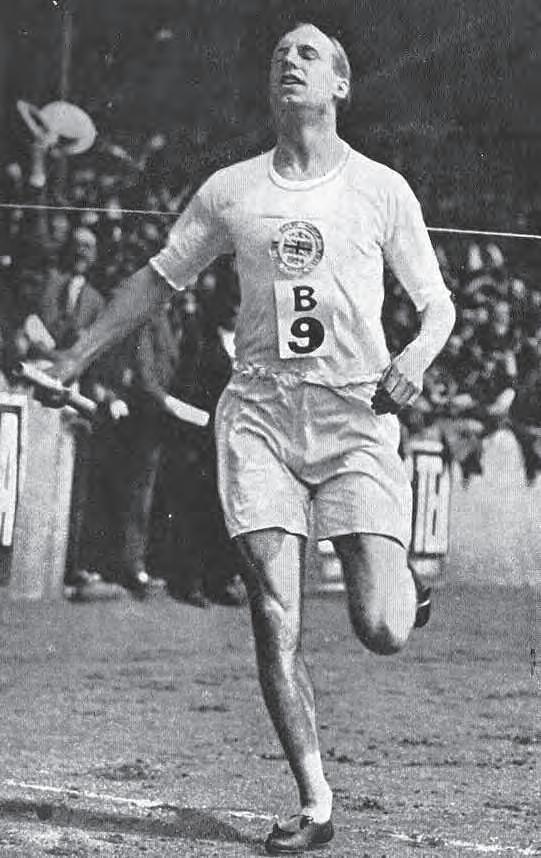
Sport fans will know the name of Eric Liddell, largely due to the 1981 film Chariots of Fire that reminded the world of him. But Refresh readers may not be aware that Eric was also an ordained Congregational minister
Liddell was born in China to Scottish missionaries in 1902. At the age of five, he was sent to a London boarding school while his parents continued in China. For 12 years they had only brief times of family reunion.
Liddell grew up surrounded by Christianity and acquired a firm faith at a young age. He studied science at Edinburgh University where, despite a reserved and shy personality, he became involved in evangelistic preaching with the Christian Union.
That Liddell had outstanding sporting ability was something that had been identified at school, and at university he played for Scotland’s national rugby team. In 1923 he shifted his focus to athletics where he was soon recognised as the fastest runner in Scotland.
Liddell was selected for the British team for the 1924 Olympics in Paris with the expectation that he would run in several races, including the 100 metres where he was tipped to be the likely winner.
However, holding beliefs on sport on the Lord’s Day, he refused to take part in the heats that would be held on a Sunday. His action brought him under enormous pressure from both the British Olympics management and the popular press to compromise his faith. He refused to yield.
In the 200m Liddell won a bronze medal. He prepared for the 400m, a distance over which he was not expected to do well. On the morning of the race, he was handed a paper which read: “In the old book it says, ‘He that honours me, I will honour.’”
Recognising the words from 1 Samuel 2:30, Liddell was encouraged. He took the race at a sprint pace and won, breaking the Olympic and world records. Already well known because of his moral battle, Liddell’s dramatic and unexpected victory now made him a global celebrity.
After the Olympics, Liddell continued to compete but, rejecting various appealing offers associated with
Eric Liddell at the British Empire versus USA (Relays) meet held at Stamford Bridge, London on Sat 19 July 1924
Chariots of Fire – the movie that highlighted Eric Liddell’s athletic achievements and faith
Continued from page 25
sport, expressed his firm belief that ‘God made him for China’. In 1925 he returned to north China as a teacher in a missionary college. In China, Liddell, busy with work and evangelism, continued to compete occasionally. He travelled to Scotland in 1930 to be trained and ordained in the Congregational Church of Scotland and, returning to China, married Florence Mackenzie whose parents were Canadian missionaries.
During the 1930s a brutal three-way war between the Nationalists, the Communists and the invading Japanese made China perilous. With the situation becoming ever more dangerous, Liddell, his wife and their two daughters made a final visit to Scotland in 1939 before returning to China. By 1941 Japanese attacks meant that British nationals were advised to leave. Liddell said goodbye to his children and his wife, now pregnant with their third child, while he himself stayed on at a rural mission station with his brother Rob who was a doctor. It was a difficult, dangerous and wearying time.
In 1943, along with other missionaries and foreigners, Liddell was interned by the Japanese and sent to a brutal prison camp where conditions were harsh and insanitary. There, Liddell became a leader, helping the elderly, encouraging the depressed,
defusing quarrels and teaching Bible classes. He studied the Bible and prayed deeply both for inmates and for the Japanese. He wrote a book on discipleship, which is still in print, and was able to maintain an interrupted correspondence with Florence in Canada.
Liddell, malnourished, suffered an alarming decline in health in 1945 and, just five months before liberation, died from a brain tumour. His grave at the camp is now marked with a memorial headstone inscribed with Isaiah 40:31: “They shall mount up with wings as eagles; they shall run and not be weary.”
At the War’s end Liddell was greatly mourned and funds were raised for the support of his daughters, a missionary scholarship and an athletics trophy. However, with the withdrawal of missionaries from China in 1949, Eric Liddell became increasingly forgotten until Chariots of Fire brought him once more to the world’s attention. Although, inevitably, the film alters details, its depiction of a man who put God before his sporting career is authentic and true.
Liddell is an outstanding Christian hero and let me suggest three things that are striking about him.
First, Liddell lived a life of surrender. His last words were about surrendering to God, an attitude that was central to his life. He took the lordship of Christ seriously and his breath-taking commitment stands as a rebuke against everything that risks taking the place of God in our lives, whether it be sport, pleasure or our careers. Whether we agree with Liddell’s attitude to sport on Sunday is irrelevant; it was a ruling that he believed God had laid upon him and, quite rightly, he refused to break it.
Second, Liddell lived a life of sacrifice. It’s easy to utter pious words about ‘surrendering to God’ until you have to pay the price. In being willing to forfeit success at the Olympics, Liddell showed he was prepared to pay what it demanded. He paid the price of surrender again when he rejected promising careers to take on a humble teaching job in China. And, most awesomely, he paid the price of surrender when, saying farewell to his family and a daughter he would never see, he chose to stay in China and serve God.
Finally, Liddell lived a life that shone
By portraying Liddell as a modern saint, Chariots of Fire invited a cynical world to explore for stains and blemishes. Yet over 40 years on, everything discovered about Eric Liddell has simply enhanced his reputation as someone who could live for others because he lived for Christ.
Few of us will have the opportunity to gain Olympic gold, but all of us have the opportunity to be those who, whatever the cost, stand firm for Christ.
“And when the Chief Shepherd appears, you will receive the crown of glory that will never fade away.”
(1 Peter 5:4 NIV)
Train your brain or just take a relaxing time out with these puzzles. The solutions are on the inside of the back cover (don’t cheat!).
Crossword
Across
7. Surname of notorious American gangster of the Prohibition era (6)
8. (See 6 Down)
9. The third plague God sent on Egypt [Exodus 8] (4)
10. Used for Christian worship (8)
11. King of Salem who fed Abram [Genesis 14] (11)
14. American state (11)
18. Indian fried disc of spiced bread (8)
19. Bible’s last word (4)
20. ‘Heart of my own heart, whatever ------ ‘ [hymn] (6)
21. Not transparent (6)
Wordsearch
Can you find 22 Oscar-winning movies? Look up, down, forwards, backwards and diagonally.
Down
1. Area of northern Israel where Jesus ministered (7)
2. Clothing item given by Jonathan to his friend David (4)
3. Small vehicle on which to cross water (3,3)
4. Issued by Caesar Augustus just prior to Jesus’ birth [Luke 2] (6)
5. Disease ascribed to a Vitamin B deficiency (8)
6. & 8. Across. ‘Then ------ stood up with the ------ ‘ [Acts 2] (5,6)
12. A Jewish high priest in Jesus’ time [Luke 3] (8)
13. St. Paul wrote a letter to the Christians in this city (7)
15. Type of rider’s seat (6)
16. Led Israel for 20 years in the days of their Philistine enemy (6)
17. ‘Jesus, ------ of my soul’ [hymn] (5)
19. Husband of wicked Queen Jezebel [1 Kings 16] (4)
Sudoku
Fill the grid so that every column, every row and every 3 x 3 box contains the digits 1 to 9
REVIEWS
The Fire Still Burns
By Stuart Scott
Reviewer: Mark Taylor, Congregational Federation President
This book by a URC minister comprises a series of linked reflections on the role of the ‘Ministry of the Word and Sacraments’ in that denomination. Whilst somewhat esoteric for a general readership and focussing on the URC perspective, the volume touches on some issues that are of general application to churches of all types in a time of church decline. From his statement early in the book, “If you keep on doing the same thing you are likely to get the same result,” Stuart Scott’s main thrust is the need to be “fleet of foot and to be creative and imaginative” and to take risks in exploring what the future of being church looks like.
One of the reflections focuses on pioneer ministry and fresh expressions of church. Each section ends with a series of helpful questions for discussion which could be used to explore the way forward in local churches and the Federation. As the title might suggest, ultimately this is an optimistic work, but it is an optimism predicated on the need to change. One final quote: “It is not the God of the Church who needs a mission, but a missionary God who calls and equips the Church.” What might be our response to that?
Reviewer: Richard Cleeves, Retired Congregational Minister
If you like reading books about faith that give you all the answers, then this is not for you. Or maybe it’s the very book you have been waiting for! It’s full of questions, discussion starters and worship material; it engages with faith in a pressurised world, which for many calls faith itself into question. It’s a book that’s all about truth: the truth of the gospel, the Bible and life itself. But that begs the age-old question posed by Pilate, what is truth?
Graham invites us to reflect on two kinds of truth. Try this. Take a piece of paper and write on it a Bible verse that expresses the truth at the heart of the faith. Take it in your hand and hold it tight. You know
The
Immerse Bible: Messiah
By Tyndale House Publishers
exactly what this truth is. You have grasped it. You would stake your life on it. It’s what Graham describes as ‘Truth-in-hand. Grasped. Contained. Sufficient.’ Take another piece of paper and write the same words on it. This time place it on the palm of your out-stretched hand. Now it’s vulnerable: a breath of wind might blow it away, it’s open to scrutiny from others. “Truth,” suggests Graham, “is what happens when the palm remains open. The potential for, and anticipation of, connection, conversation, collaboration.” This is ‘truth-in-process’.
Published by SCM Press, 2022
Reviewer: Celia Taylor, Church Secretary, Corfe Castle Congregational Church
I loved it. Brilliant! This book is an amazing read, very uplifting and very moving spiritually. It is certainly inspired too, as I found the words very much came to life as I read them. The Holy Spirit came down on me in such a mighty way throughout the read. I got more out of reading than I ever expected. It is so exciting that you want to read it quickly. I felt I was within the storyline. It was also such an amazing experience reading without chapters and verses; it seems a faster read with no distractions. I tended to find myself reading more of the Bible this way. This book has made a difference to my life as it is such an easy read and it gives me a
very good understanding of the Bible in a shorter space of time. It also makes more sense to read it like a book as that is what we are generally used to. I strongly recommend this way of reading the Bible and it has made me want to purchase more of these books. This book is also the focus of a CF national Bible study on Zoom. [If you would like to join, we meet on a Monday afternoon at 1.30pm. Contact admin@congegtional.org.uk for the link.]
Published by Tyndale House Publishers and Institute for Bible Reading, 2021
Learntoprayabouteverything.
GivethankstoGodasyouaskHimforwhatyouneed.
Philippians 4:6 (NLV)
MARCH
I will thank the Lord because he is just; I will sing praise to the name of the Lord Most High.
Psalm 7:17, NLT
Praise God for his majesty, his power, his grace. Give him the glory.
Thank God for your life, for his endless blessings.
Praise God for the wonders of his creation.
Thank God for all you have that makes life good.
Thank God for your church, the building, the people and everything that happens there.
Thank God for the Congregational Federation, the history, the offices, the, staff, the volunteers and the structures.
APRIL
Suddenly the Lord himself stood among them and said to them, “Peace be with you.”
Luke 24:36, GNB
Pray for peace and justice around the world.
Pray for peace where there is anxiety and trauma.
Pray for those whose desire is to hate and fight –pray they will have a change of heart.
Pray for those who fight addiction, that they will be set free and make a breakthrough.
Pray for resurrection hope and for more people to know Jesus.
MAY
Let me hear of your unfailing love each morning, for I am trusting you. Show me where to walk, for I give myself to you.
Psalm 143:8, NLT
Pray for the National Assembly of the Congregational Federation in Taunton this month.
Pray for those with responsibility and pray for the new President, Oliver Kinchin.
Pray for North Street and Stoke St Mary Congregational Churches.
Pray for the South West Area as they host the Assembly.
Pray for safe travelling for all attending.
Pray for all those who work in the travel industry or spend their time travelling.
Pray for all those who are refugees and are moving.
JUNE
Sing to him; yes, sing his praises. Tell everyone about his wonderful deeds.
1 Chronicles 16:9, NLT
Pray for children, young people and students.
Pray as they take exams or tests or look for employment.
Pray for the children in our churches or organisations linked to our churches.
Pray that children will give their hearts to Jesus and not be frightened to speak up about their faith.
Pray for those who work for children and especially those in children and youth ministry.
JULY
Never stop praying.
1 Thessalonians 5:17, NLT
Pray for your Minister and all members of your church.
Pray they have a good rest planned.
Pray for their protection and inspiration for them.
Pray for other Christians that they are encouraged and grow deeper in their relationship with God.
Pray for the persecuted Church around the world.
Pray for rest and a good work/life balance for those who work long hours.
Pray at all times in the day; share your day with Jesus.