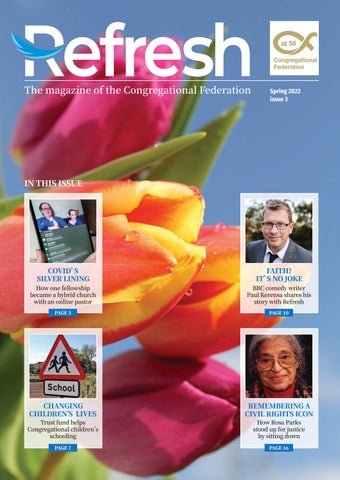
How one fellowship became a hybrid church with an online pastor page 3
Trust fund helps Congregational children’s schooling page 7
Spring 2022 issue 3
BBC comedy writer Paul Kerensa shares his story with Refresh page 10 FaITH? IT’S NO JOKe
ReMeMBeRINg a CIVIL RIgHTS ICON
How Rosa Parks stood up for justice by sitting down page 16
“…looking forward to being refreshed by your company. God’s peace be with all of you” (Romans 15:33, The Message)
Never say never again
This issue of Refresh arrives in springtime – when it’s great to see nature springing back into life after the winter, and so easy to see parallels with the resurrection life that Jesus brings to all who trust in Him.
“For if we have been united with him in a death like his, we will certainly also be united with him in a resurrection like his” (Romans 6:5).
In the two years of the Covid pandemic, many churches have seen not only a terrible increase in physical deaths, but experienced a kind of spiritual ‘death’ as churches closed during the lockdowns. As Christians, we are the Body of Christ, and being unable to meet and share in the life of the Church was a painful experience.
It was therefore literally a ‘God-send’ when new technology enabled many churches to meet virtually. You could say it was a partial resurrection, and then when the lockdowns were over, what a joy it was to meet again together properly – despite being hampered by masks, social distancing and all the other limitations.
In this issue we tell the exciting story of how one church, Hay Mills (page 3), started with a few messages on Facebook live. Soon their online presence grew, to the point where they now have a pastor dedicated to online ministry.
See also the story of Revd Fionnaigh Reid (page 5), whose calling seemed to end when she had to quit full-time ministry. However, as she says, God hadn’t finished with her, and has led her into a new work with a Christian helpline. It’s an encouraging story of how God resurrected a ministry that had seemingly ‘died’.
One James Bond film was called Never Say Never Again – and that’s an apt title for God’s work in us.
He always has something he has called us to do, though sometimes that can involve painful change, like the death of one ministry before another can arise.
However small it might be, God has an important job for us: “For we are God’s handiwork, created in Christ Jesus to do good works, which God prepared in advance for us to do” (Ephesians 2:10).
As an old Sunday School chorus goes: “There’s a work for Jesus none but you can do.” Please do check out the details of the Congregational Assembly on the back cover –and I wish you all a very happy Easter.
Andrew
Halloway
Editor a.halloway@ntlworld.com
Contents
1. From the General Secretary
3. Our story: Hay Mills CC
5. Local church news
7. Changing children’s lives
8. Making dreams come true
10. Meet Paul Kerensa
12. Biblical reflections by Walter Riggans
14. Making evangelism easy by Andy Godfrey
16. Heroes of the faith by J John
18. Break time
19. Reviews
20. Vacancies; Tips for life online
21. Prayer diary & Break time solutions
22. Assembly information and timetable
Refresh Magazine, ISSN 2634-2987, is published by: The Congregational Federation, Congregational Centre, 8 Castle Gate, Nottingham NG1 7AS Tel: 0115 911 1460 www.congregational.org.uk Registered charity 264839 Editor: Andrew Halloway. Design and print: Verité CM Ltd. www.veritecm.com. Cover photo: Pete Goddard
All Bible quotes are from either the NLT or NIV. This magazine is printed on paper from a sustainable source.
TO ORDER REFRESH
There will be three issues of Refresh in 2022, available on annual subscription at £30 incl. p&p and the Yearbook. Email: admin@congregational.org.uk or tel: 0115 9111460 for details.
From the General Secretary
What will your legacy be?
Welcome to another edition of Refresh – I hope you will be encouraged after reading all the articles, and will share the magazine with your family and friends. If you would like extra copies, please contact the office in Nottingham on 0115 9111460.
At the beginning of this year, I was able to attend the funerals of much-loved Congregational ministers who have gone to glory. It is always a privilege, and although a sad occasion, I always learn something new about the person and think about their legacy. I enjoy meeting their families and sharing with the fellowship. A funeral wishes booklet can be downloaded from the Church of England website for anyone considering planning their own funeral. I attended the funeral of the lovely Geoff Cable and learned that he had served as an SAS soldier, then as a minister for over 30 years. He enrolled on the training course at 84 years old, becoming the oldest person to be accredited. Walter Riggans, our Learning and Development Manager, would love to hear from you if you would like to start learning again. Unfortunately, I was unable to attend Man Ho Lee’s funeral. He was from Korea and overcame cultural and
language barriers to lead St Helier Congregational Church. He supported many new Korean families who arrived in the UK to settle, and taught them about Jesus.
Another funeral I had the privilege of attending was for Kenneth Chambers, who had a pastoral heart. He visited many retired ministers, encouraging and supporting them and keeping them up to date. I love this description that Betty and George Lea shared: “What a great man, he enjoyed a joke and was a great preacher.”
Continued on page 2
GONE TO GLORY: Ministers Geoff Cable and Kenneth Chambers
A prayer for our golden anniversary by
Yvonne Campbell
Dear Father God, We thank you for 50 years of the Congregational Federation. Help us to share the good news of your gospel. We praise you for your Generosity and grace. Give us more Opportunities to read your word and be obedient to its teaching. Clothe us in Love for ourselves and others as we live each day for you. Give us a new Direction, revive and refresh us in our 50th anniversary year. Amen.
You are invited to:
A time of fellowship and sharing within the Congregational Federation A time to pray
A time to feedback and discuss ideas related to the 50th anniversary calendar challenges A time to hear from others and ignite new and old friendships
Hosted by the General Secretary
Last Wednesday of the month at 11am and 7pm
The first 6-month dates are: 23rd February, 30th March, 27th April, 25th May and 29th June Online on zoom: meeting id: 937 314 7464 – passcode: cf
‘The 50th anniversary is a natural time to look back and reflect.’
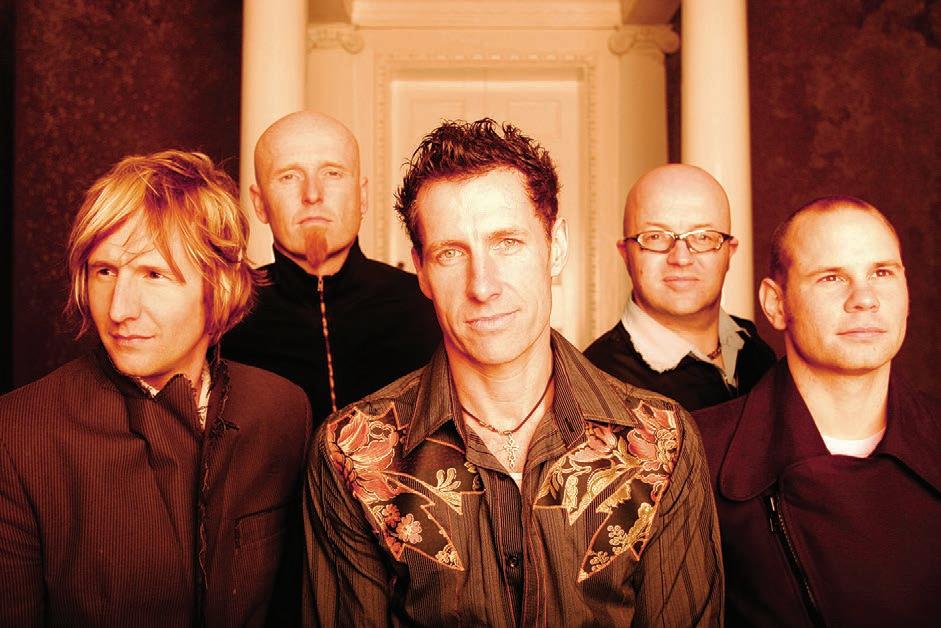
HISTORY MAKERS: The band Delirious? sang: “I’m going to be a history maker in this place.” What impact for Christ will our lives have?
Continued from page 1
Have you heard the song ‘History Maker’ by Delirious? It has a fabulous chorus to challenge us: “I’m going to be a history maker in this place, I’m going to be a speaker of truth to all mankind.” What an amazing legacy that would be! Have you ever thought what you would like your legacy to be?
When I attended the Induction of the wonderful Jane Vickers at Hay Mills C.C. in September 2021, I learned a new song called ‘Only Jesus’ by Casting Crowns. This is the chorus: “I don’t want to leave a legacy, I don’t care if they remember me, only Jesus! I’ve only got one life to live, I’ll let every second point to Him, only Jesus!”
What a beautiful lyric – “I want every second of my life to point to Jesus!”
The 50th anniversary of the Congregational Federation is a natural time to look back and reflect on the legacy so far, but also a time to look forward and be excited about what God wants us to do in the next 50 years.
I am so thankful to all those who lived through 1972 and were sparked and determined to start something new, to begin and set the foundations of the Congregational Federation. They were expectant and excited, and I want to recreate some of that passion and enthusiasm again 50 years later.
We hope you have been following the calendar challenges and enjoying the photos of our churches. On the last Wednesday of every month, I will be hosting ‘Golden Time’ on Zoom. Everyone is welcome to join, seek ideas, share fellowship and stories and pray together.
This month (March) will see the Spring School delivered, which will bring Non-Conformists together
from the four nations for a time of discussion and discernment. We are also going to be holding two hymn writing workshops to encourage some new congregational hymnists.
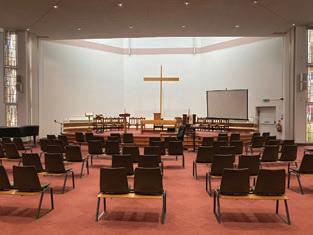
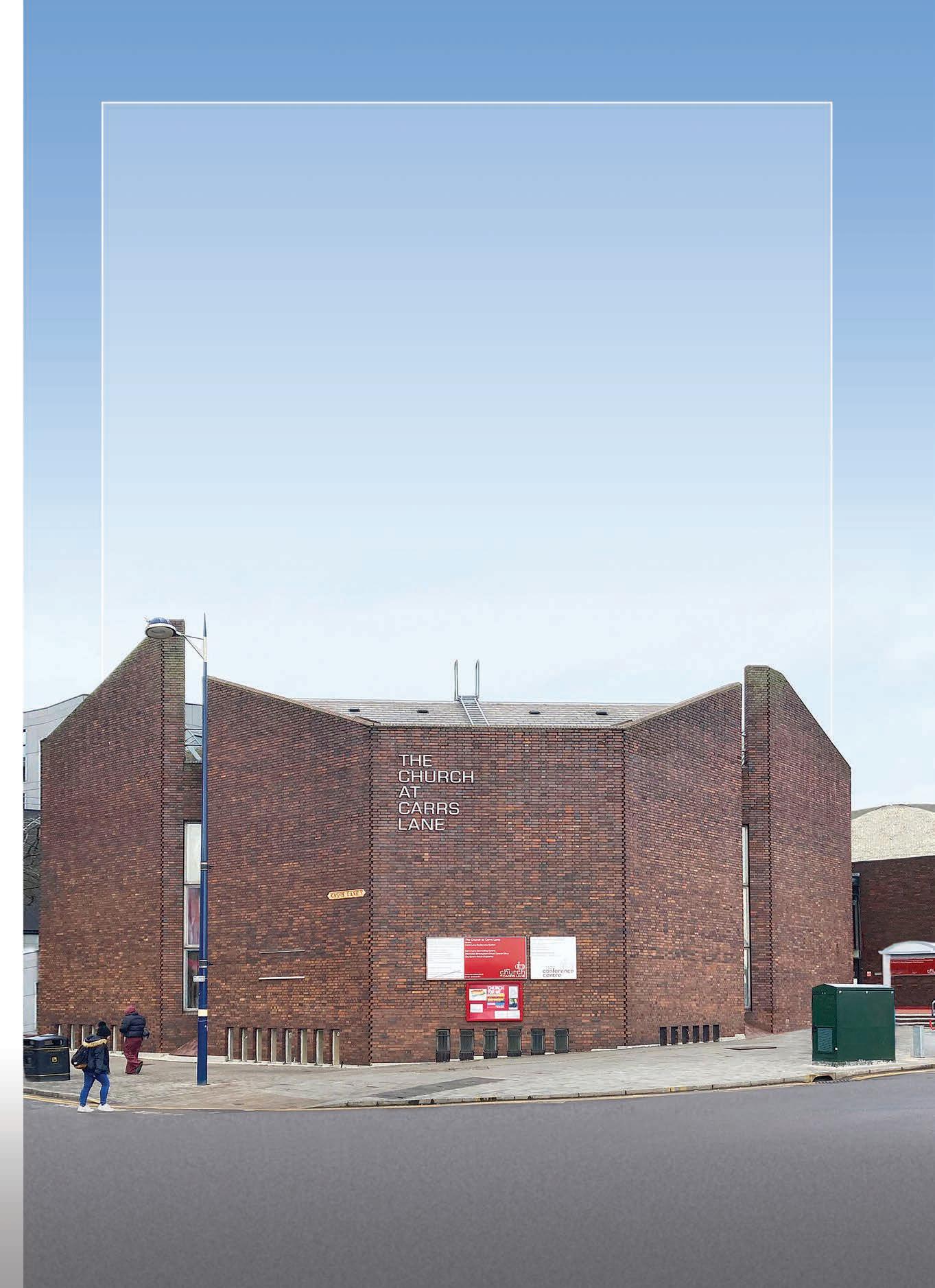
I look forward to welcoming you at Assembly on 14 May, when we can celebrate face to face (although you will be able to watch online too). We hope to have Bob Hartman with us on Friday and Paul Kerensa has been booked (to make us all giggle) on Saturday evening (see more about Paul on page 10). Our main event will be at Carrs Lane Conference Centre in Birmingham, a spacious venue to host a day of reminiscing and celebrating.
The Congregational Federation includes all of us, whether a member since October 1972 or more recently, we (you and me) make it what it is. We all make our own decisions, including whether to attend events, meetings or training, and my prayer is that we will all be involved in encouraging new ideas in the future. We will all pray for the moving of the Holy Spirit in our churches and communities and the offices of the Federation. We will all play our part in the priesthood of all believers, to fulfil our objective to advance the Christian faith and spread the knowledge and love of God throughout the land.
Please join me in a prayer for revival, a prayer for truth and a prayer for how we the Congregational Federation have faith that is genuine, because “our faith is far more precious than mere gold” (1 Peter 1:7, NLT)!
Please get involved and celebrate our 50th anniversary.
May God bless you abundantly as you serve Him. Yvonne Campbell
It’s church, Jim, but not as you know it!
Hay Mills CC – a Congregational church in Birmingham –is one of many churches where the Covid lockdowns have been a springboard into‘hybrid church’
By Stephane Vickers, Pastor at Hay Mills CC
HAY MILLS CC is not your regular church and that is what God wanted!
From the pastors to the church secretary to the members and gathered community onsite and online, we are a rag tag bunch whom God has gathered.
Our history
The journey of this church starts over a decade ago with me being aware that God had placed a calling on my life. I had no idea how or what that would turn out to be but had faith that if the God of miracles wants it, he will make it happen. So, the long and eventful journey began. Along the way I got married to my now co-pastor, Jane, and we had a child (we are a blended family).
I saw an advert on the internet for a position as Church Development Worker for the Congregational Federation (which I had never heard of) and applied. I had no Christian leadership experience or even preached. In fact, I had almost none of the things they listed as required for the job! But I had a different set of skills and a gritty determination to be faithful to what God had called us to.
Judith, the mission enabler, walked us through the first 18 months and came down every week with wise words and guidance. We would not have got this far without her dedication and support. The Federation as a whole has been super supportive, and I want to single out General Secretary Yvonne Campbell for going the extra mile in support and thoughtful encouragement. Jane has been by my side all along, and I have seen God do amazing things to her and through her over the last few years.
We started with a building which had been closed for over three years and off we went, God leading and providing for us when we most needed it. Three years later we were recognised officially as a congregational church – self-governing and self-financing.
We struggled at first with money and how to run a church, as none of the members had done it before, but sorted it out as we went along. Within the first 18 months we had two dedications and ten baptisms,
which was amazing, but despite this our church did not grow as we had thought and hoped it would, although the gathered community expanded during this time with people from Eastern Europe and as far afield as Brazil.
Covid’s silver lining
I had always resisted online ministry and when the first Covid lockdown hit we were not in a place to adapt – or so we thought. God had other plans; as always he has a better way.
So I decided to do a mini-message on Facebook live, holding my phone at the bottom of the garden. We had no idea if anybody would watch and how it would be received but felt called to do something to stay connected with people. Well, the response was slow at first, but Jane joined me to read the comments and then to make comments on the message.
Continued on page 4
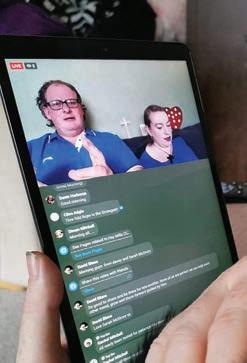
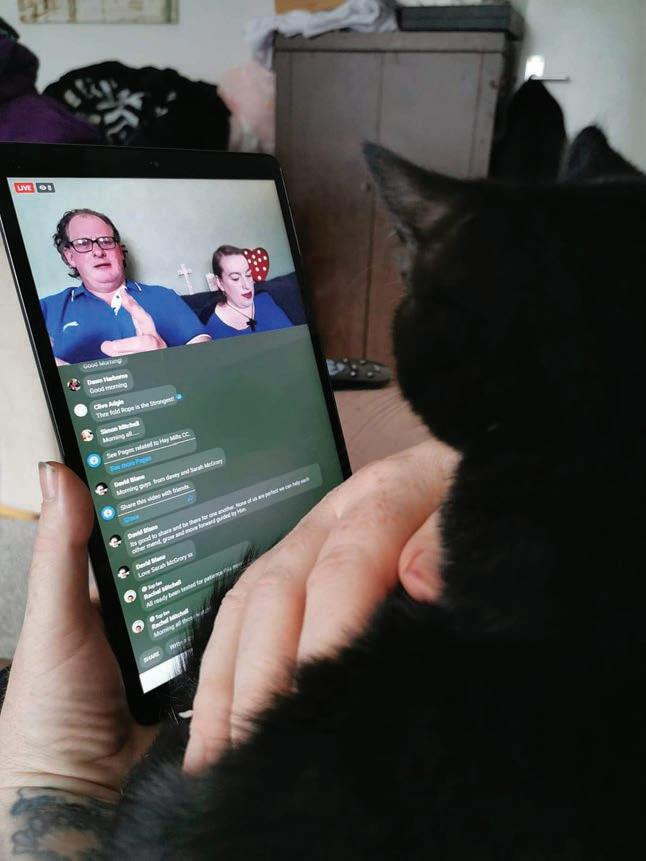
Hay Mills CC – online. The tablet shows Pastors Stephane and Jane Vickers doing Facebook live Sunday service
“Wow, how are we going to deal with this?” I thought. I asked God and he gave me the answer.
Continued from page 3
This and our usual banter as a couple seemed to be a hit.
We decided to be as honest as we could and share our faith and life with those who would listen, and boy did they listen! We had more than 13,000 views during the 18 months of lockdown, with a peak of over 900 on an Easter Sunday.
We had comments and views from all over the globe, from Texas to Taiwan, the Philippines and Scotland. Sarah McGrory and her boyfriend Davey Blane from Scotland started watching regularly, and on a comment during a service Davey told us he had given his life to Christ. A couple of months later he asked for baptism in the comments when I was doing a sermon on baptism! “Wow, how are we going to deal with this?” I thought. I asked God and he gave me the answer.
Hybrid church was suggested to me, and I was encouraged to apply for CWM (Council for World Mission) funds, so I did, and we received a blessing. We could now hire an online pastor. I heard the Spirit say to me that it should be Sarah McGrory and I asked her, and she said she would be delighted. (Sarah tells her side of the story in the box on this page.)
The future
Footnote:
For more information email Pastor Sarah at: onlinehaymillscc @gmail.com
A journey of faith is always challenging and it has been a tough but rewarding time; we continue to put our trust in Jesus and listen to the Spirit as best we can. As I write, we have been approached to host Pastor Raj Kaul from Dudley to share his intercultural fresh expression of church at a contemplative time of prayer and worship at our building, so we will see where that leads. Also, at the end of January we baptised Davey here at our church, took Sarah into membership and inducted her officially as our online pastor. Hay Mills CC is now truly hybrid, online and onsite, blended together.
God has taken us in a new direction, and we intend to keep it that way and ask him to lead us into new seasons and pastures for his glory.
Sharing life online
By Sarah McGrory, Hay Mills CC’s online pastor
I first met Steph, Pastor of the Hay Mills church, when we were attending Congregational Training in Nottingham in 2019. We hit it off straight away, sitting on the ‘naughty table’ at the back, our unconventional ways making it obvious we were called to pioneering ministry. Following the course we went our separate ways – Steph back to Birmingham and me back to Clydebank in Scotland, but we kept in touch.
In October 2021 I got a call from Steph. Covid was changing the way we do church. Steph had a vision – would I come and work for Hay Mills as their ‘Online Pastor’? The rest is history. What do I do? Well, I am designing and managing a website for the church: haymillscc. mychurchedit.co.uk – a work in progress. I’m also contributing to their Facebook and Twitter pages, as well as the occasional TikTok, and coordinating and running both a Bible study and prayer/ meditation hour twice a week on Zoom. We have attendees from Helensburgh in the North to Birmingham and Wiltshire in the South.
Steph and his wife, co-Pastor Jane Vickers, are taking a well-earned sabbatical in March, so I’m even getting to take some Sunday services.
Here’s to hybrid ministry! The walls of the church have come down; church doesn’t just happen on a Sunday. In my spare time, I also run a social enterprise called ‘Somewhere in Between’ (see somewhereinbetween.org.uk). It’s not church, it’s not school, it’s somewhere in-between, sharing ideas for education and church for people who don’t fit in the mainstream.
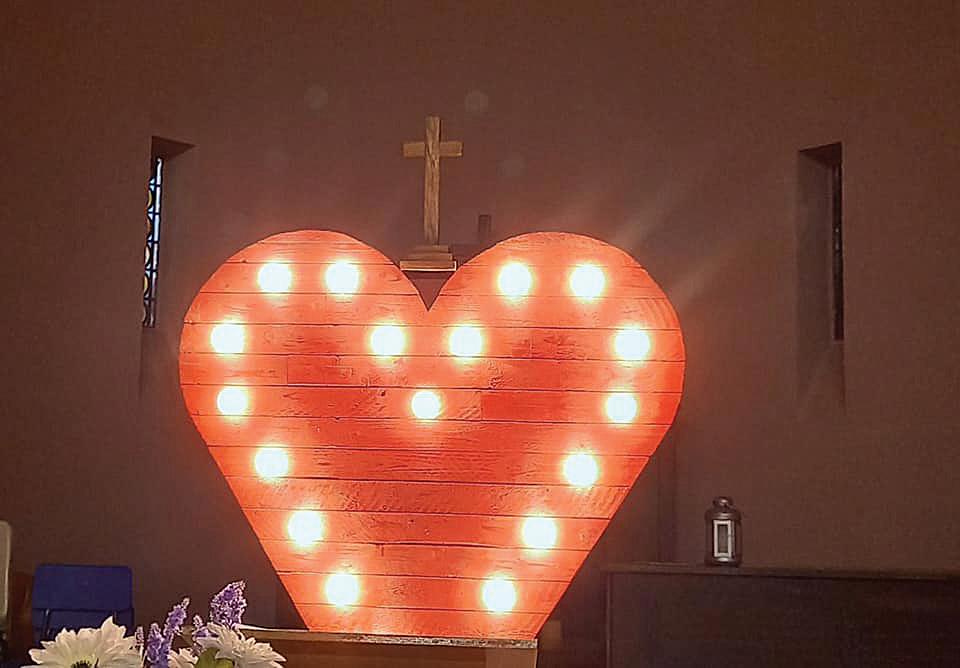
Hay Mills CC – onsite
Serving those on the margins
Hope Community Church in Bristol report in their newsletter that one of their dreams is to love and serve those on the margins of society. They are fulfilling that dream in three ways already: through a foodbank, supporting refugees and mentoring people from prison. The foodbank runs at Hope
Chapel on Wednesday mornings, and volunteers from the church help with this and supporting the children of Afghan refugees by accompanying them on the bus as they travel to school. The church also partners with the Mentor Me ministry to help men and women coming out of prison to establish their new lives.
New ministry for ‘retired’ Rev
In home
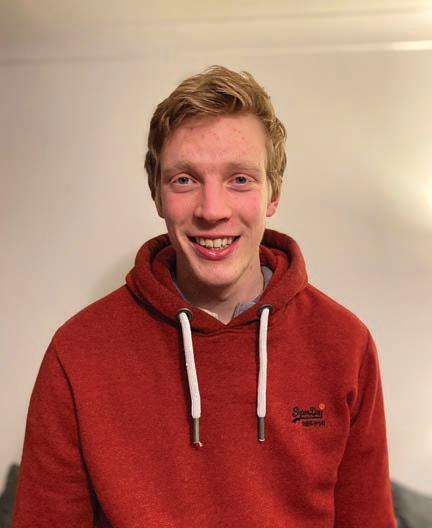
had to step back from full time ministry at Guilden Morden Congregational Church in Cambridgeshire in 2015. Having moved to a part of north-east Scotland where the nearest Congregational church is over 50 miles away, it seemed her time in any form of ministry was probably over.
But God had other ideas. Fionnaigh tells what happened next . . .
“I was scrolling through Facebook, as is my custom, when I came upon an advert for new ‘listeners’ for a Christian helpline called New Kapporet. This was undoubtedly God giving me the nudge, saying: ‘I haven’t finished with you yet!’ I took the plunge and emailed the contact.
“A few days later, I got a phonecall, and we talked about the training which was based upon Samaritan lines but with a Christian element: prayer. I filled in the form, attended the training over the next few weeks online, and became a ‘listener’ in late April.
“Each watch is three hours, and we begin with prayer with our watch leader. Then we pray with each caller if they wish, and often share Bible passages, and then pray together at the end of each watch, leaving our callers and their issues with the Lord.
“We have prayer partners who pray for a whole list of people – callers, listeners and trustees – and their
“Our callers can be anyone, from someone who is lonely or has mental health issues, to those contemplating suicide or even in the act of carrying it out, who need a friendly non-judgemental voice on the other end of the line.
“As a listener it can be joyful, and it can be harrowing! It is easy to see that God brings the right caller to the right listener so often, and both caller and listener can be blessed by the call.
“The helpline started in May 2020 with a small band covering a six-hour slot each day, but we have now expanded to covering the period between 3pm and 12pm, 7 days a week and we hope to expand this further. However, to do that, we need more listeners, prayer partners and, as with any charity, financial support. It costs around 10p per minute for each call, which is free for the caller.
“Could God be calling you to this ministry in some way? I would be happy to talk, if you are interested. The General Secretary has sent information about us to the churches. Please pray about it, for us and our callers, but also to see if you could support us in some way.
“Here is a link to an article in the Baptist Times which will tell you a little bit more: baptist.org.uk/ Articles/626836/_Lessons_from.aspx
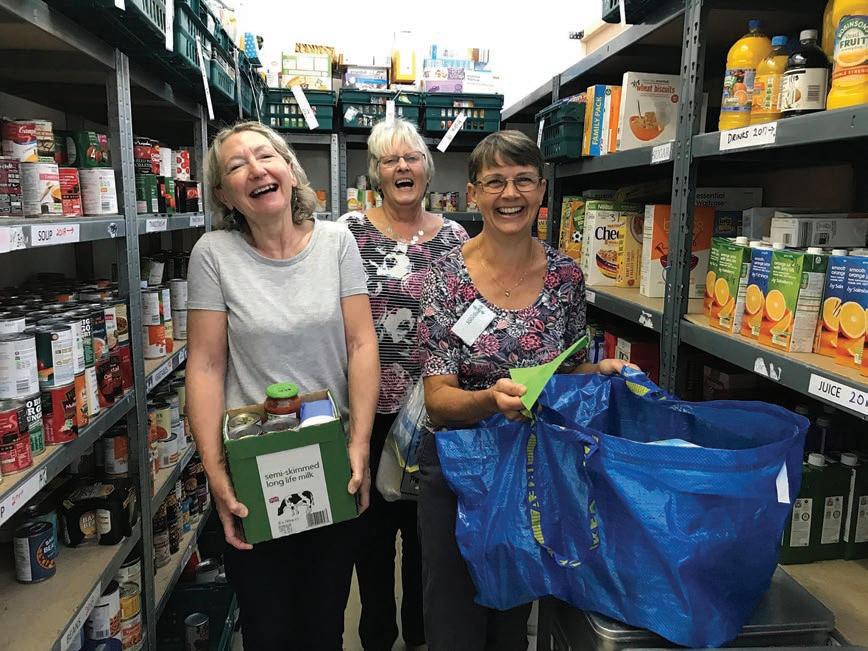
Bristol North West Foodbank. Hope Church runs one of its four outlets
This was undoubtedly God giving me the nudge, saying: ‘I haven’t finished with you yet!’
A poster promoting the helpline
Operation Christmas Child at Steeple Bumpstead
Reaching Out magazine, Steeple Bumpstead ongregational Church in Haverhill, Suffolk, told how the children at their Pilots club helped bring Christmas cheer to children around the world.
Deacon Sheila Burr says: “At the beginning of November, Pilots had a great time filling 21 shoeboxes. dren worked in pairs and rushed around collecting items from the heaped tables and filling xes. Each shoebox also included a greetings card with a photo of the Steeple Bumpstead Pilots, and decorated by them.
“These boxes joined the ‘wall’ of colourful shoeboxes which were brought to our Shoebox
Service the following Sunday, and we prayed for their safe journey and for the children who will receive them.”
“These boxes filled with small items and love can bring hope and a smile to children caught in the midst of wars, natural disasters and extreme poverty, and could be the first Christmas present they have ever received in their lives.”
In all, 60 boxes from the church and the local primary school went to Operation Christmas Child’s West Anglia processing centre, and from there to Albania, Moldova, Central Asia, Liberia, Nigeria and the Middle East.
New evangelist for Lancashire church
Alan Marsden, Minister at Martin Top Congregational Church near Clitheroe, tells us how his church has appointed a new evangelist:
“In 2020, we at Martin Top Chapel noted that our Sunday morning congregations had grown to about 45 regulars. However, many of these people had come from other churches, so the Kingdom of God itself had barely grown. We therefore resolved to appoint someone who was committed to evangelism, who would come alongside the many people in our district who had little or no relationship with God and for whom the gospel of Christ is something unknown.
“The members agreed to set aside some modest funds to remunerate a day’s work per week. We duly advertised on our website and by word of mouth, and received three expressions of interest. Each submitted a CV and application, and the members made the decision accordingly.
“One important factor was our chapel’s location, which is well outside of any recognisable settlement, be that village or town, though we are within striking distance of several. Interested persons were therefore invited to come and take a look around and join us for one of our services.
“As a church of evangelical theology and traditional worship, the appointed person would have had to be comfortable inviting people to our church.
“The Church Meeting duly appointed Matthew Fawcett, a young man of farming stock, with a strong record of outreach and passion to bring souls to Jesus Christ. He started in December 2021, delivering 499 leaflets advertising our carol service, a number of which were accepted, and locals duly came along.
“Hailing from across the border in Yorkshire, Matthew spent some time assessing the area, familiarising himself with the villages and market towns close by.
church, Matthew and his wife often join our mid-week service, reporting some of the conversations he had that week, and providing us with names of people for whom to pray. Future plans include a Lambing Service for local farmers, marking the Queen’s Jubilee, and running bookstalls at Barnoldswick and Clitheroe markets. Delivering evangelistic but sensitively written, general-interest magazines in the local villages is also something that will be taking place in the coming months.
“We only attract a few families at present, so in addition to appointing our evangelist, we put aside £6,000 to renovate and refurnish one of our rooms, to better accommodate a children’s work or creche. We felt it important to do so before such families arrived, and not in response to them coming. Evangelism, like fishing, requires the equipment and tackle to be ready before any catching is done. Sitting and waiting around for new people to drop in is not enough; to take the gospel to them is what Jesus commanded.”
Pilot kids with their shoeboxes
CHANGING CHILDREN’S LIVES
Educational fund offers help
By Revd Sara Iles & Peter Young
The Congregational school that became a trust fund which helps the children of Congregational ministers
It’s 150 years since Milton Mount College was founded; one of its alumnae was the poet, Mary Baldwin (1916-2018), who attended the school from 1927-32. You may be more familiar with this former student through her marriage to Harold Wilson, who went on to become Prime Minister.
Mary was the daughter of a Congregational Minister, Rev Daniel Baldwin, and his wife, Sarah, née Bentley. Mary was an accomplished writer and well-known for being an independently minded woman and an activist for many causes.
Milton Mount College opened in 1873 near Gravesend and later moved to Crawley. It was set up to educate the daughters of Congregational ministers.
Supporting the education of children of those serving in Congregational churches
In 1962, the proceeds from compulsory purchase of the school’s property were used to create The Milton Mount Foundation, to continue supporting the education of children of those serving in Congregational churches. Sadly, the building was demolished in 1972, but the Foundation has continued as a dynamic and active charitable trust for over 60 years. It continues to consider applications for education support, fees and school equipment. Two of the seven trustees, including myself (its newest member), are from the Congregational Federation.
The purpose of the Foundation is primarily to assist with the cost of education of children of ministers of Congregational Federation churches, as well as those from the Evangelical Fellowship of Congregational Churches, the United Reformed
It also seeks to assist with the cost of education of daughters of members of these churches.
There are two main strands of assistance: firstly, towards school fees for children of 11 or over at independent boarding and day schools approved by the trustees. Secondly, grants are available to the children of ministers (Congregational or URC) who are doing a first undergraduate or first postgraduate degree course. Grants may be awarded towards the cost of uniform of a child on entry to any secondary school and to women taking up further education for the first time. The trustees also have the power to give help in other areas of need in the field of education.
The deadline for all applications for the academic year starting in September 2022 is 10th May 2022. If you think you (or your children) might be eligible for support from this Foundation, why not find out more information on our website? See: miltonmountfoundation.org.uk/index.htm
We invite you to pray for the work of the Foundation, as the Board consider applications in the coming years. Please pray for the work of our Chair, secretary and all the trustees. We pray too for all of the people who receive grants and who benefit from the wonderful legacy of Milton Mount, as it continues to meet educational needs in the future.
Footnote:
For further reading on the founding of Congregational Schools see biblicalstudies.org.uk/pdf/jurchs/06-02.pdf
The magnificent Milton Mount College at Crawley, before its demise in 1972
Making dreams come true
How Covid Mission Grants from the Council for World Mission (a worldwide partnership of 32 Christian denominations including the Congregational Federation) are being used in Congregational churches
Eyemouth United Congregational Church in Berwickshire
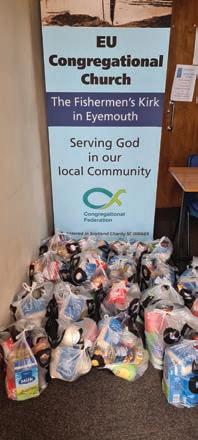
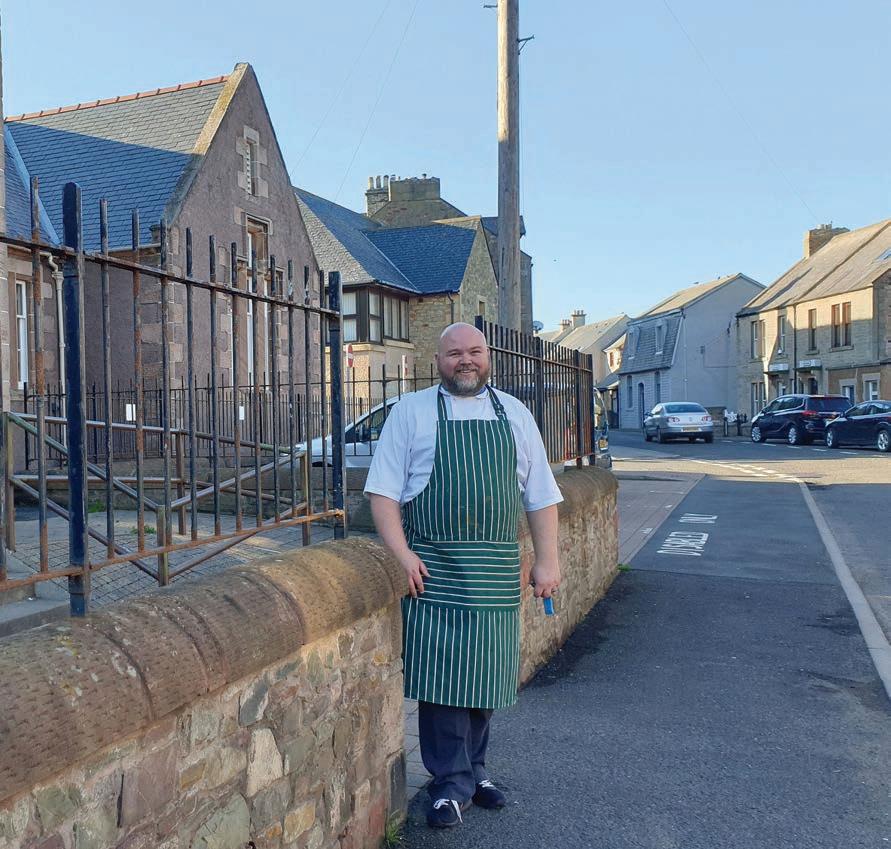
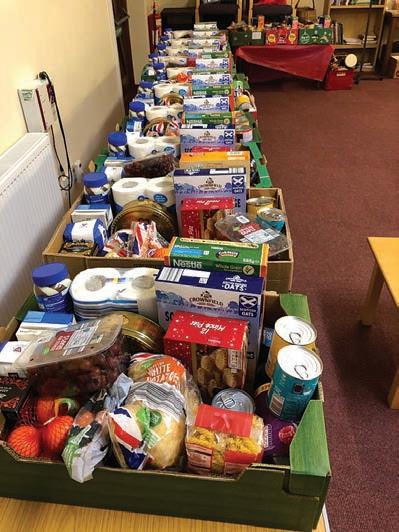
The minister at Eyemouth, what they have been doing “There was the cooking during lockdown for those who wanted freshly made and distributed across the community to anyone who wanted them – free. Now from our building, one doing Eyemouth – and the other is run by Splash making food bags to anyone who wants them – averaging 140 a week.
“In just one week, an incredible 110 grocery bags went out into the community . . . received some heart-warming feedback, which makes it all so worthwhile.”
Southwick Christian Community Church in West Sussex
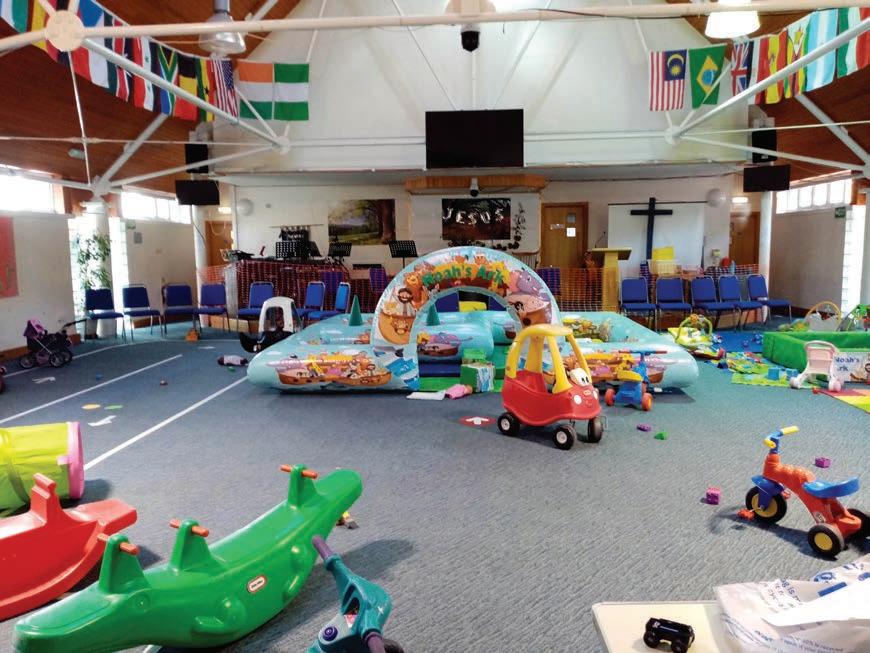
Southwick bought soft play equipment with their grant. Unusually, Southwick is affiliated to both the Baptist Union and the Congregational Federation.
The church says: “Soft play started in October on Wednesdays which, as expected, has turned out to be very popular. The equipment we bought with the grant is excellent and the children love playing in the ball pits, the bouncy castle and engage with the other activities we put alongside this.
“Currently, about 30 families have accessed this provision and we have received very warm and
positive feedback. At Christmas we did a short nativity and each child had a large sheep face given to them with their name on. They went out and placed them in our hedge, ready for the area to become the shepherds’ fields when we set up our lit up outdoor display.
“We have also started a soft play-based event monthly on Sunday afternoons to engage young families. The grant has been wonderful and enabled us to get up and running again with our work among young families. We are very grateful.”
The new soft play items at Southwick
Eyemouth minister Ruairidh (Roo) MacRae in his chef’s gear after helping with the cooking
Grocery bags in Eyemouth United church –commonly called The EU and historically known as ‘the Fishermen’s Kirk’
Chinley Independent Chapel in High Peak, Derbyshire
food and other essential items for their children. This was the beginning of the ‘Chinley Independent Chapel Community Support’ initiative.
“From working with a local restaurant to providing Christmas meals, to preparing and delivering food
Hope Community Church in Bristol
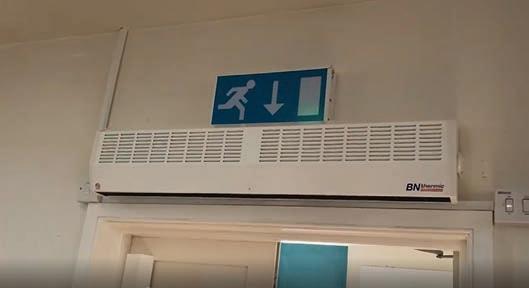
Air curtains have been installed to help with ventilation. The church say they are working really well. Everyone gets a warm greeting as they come in the door! Pastor Chris Bond says: “Please pass on
Chinley’s food parcels sorted and ready to go out
parcels, giving ‘gift vouchers’ to help families in urgent need, picking up and delivering food donations from a local supermarket to families in need, this initiative has been a crucial help for many
“A big ‘thank you’ to the Congregational Federation for the ‘Gift of Grace’ donation and Community Grant, and the North West Area for supporting us with a grant to set up and run the first Christmas meals.”
Ashby-de-la-Zouch Congregational Church
In order to reopen church for services and other events, Ashby have spent money on new technology to be able to display music and hymns from YouTube on to the wall, including an upgraded PC and digital projector.
Nordelph Congregational Church
This church used their grant to print newsletters for the community for a whole year. Nordelph say: “God has worked his way during lockdown. From about 15 attending on a Sunday we now deliver, mainly by snailmail, 51 hard copies of a Sunday service to use at home, along with newsletter and prayer list.” The people receiving these are “our ‘own’ congregation and a growing number – including many who were too frail to go to church on Sundays, etc., even before coronavirus, or sadly have had nothing from their own churches. The shape of the church will be interesting in the future.”
The church has also been supporting Ashby Foodbank throughout the pandemic by allowing them to use the building and providing them with heating, lighting, etc. as their work load increased.
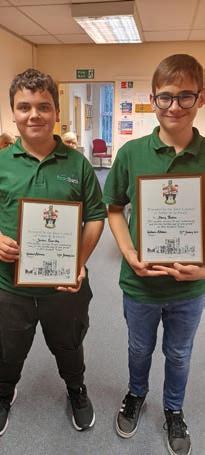
Photo opposite: Harry Booton (13) and Jordan Eccersley (14) from the Ashby church being awarded the Ashby Town Council Civic Youth Award 2020 for their work with Ashby Foodbank during the lockdowns
Hay Mills Congregational Church in Birmingham
This grant was to employ an online pastor, Sarah McGrory, as their weekly Facebook live services have attracted hundreds of new members. For more about this, see ‘It’s church, Jim, but not as you know it!’ on page 3.
Sarah has been running Bible studies, a weekly prayer/ meditation hour, posting a regular blog and other information on the church’s website, as well as taking some services, organising visiting speakers and putting out updates on other social media like Twitter and Tik Tok.
One of the new air curtains in the church
MEET PAUL KARENSA
Comedian at our annual Assembly tells Refresh how he came to faith
Paul Karensa will be doing a comedy slot in the evening at our annual Congregational Federation Assembly in Birmingham on Saturday 14 May.
Paul is a writer for TV comedies like BBC1’s Miranda and Not Going Out, among countless others, plus a stand-up performer who’s as comfortable in cathedrals as comedy clubs and is a regular on BBC Radio 2’s Breakfast Show. He’s taken his one-man show to Spring Harvest, Greenbelt and New Wine, as well as the Edinburgh Fringe and Montreal Comedy Festival. He’s also an author whose books include Hark! The Biography of Christmas and children’s book Noah’s Car Park Ark.
But how did he come to faith, and what impact does it have on his comedy career? Refresh asked him to tell you his story. . .
I’ve been a Christian only a little longer than I’ve been a comedian. In both cases, there was a moment of commitment followed by a lifetime of fine-tuning.
I grew up in what felt like the village of Dibley in the county of Midsomer: six pubs and one church, with the church the centre of it. My family weren’t ‘church people’ but they were ‘village people’ – not the singers of YMCA, but they got stuck into village life. That meant whatever the church was doing.
So there was Cubs, Scouts, choir, youth group, weekends away – maybe my parents enjoyed the childcare! We weren’t particularly churchy, so when I came home engaging with the teaching, it was perhaps a surprise to them. What did they expect!
Arguably my comedy career, then a hobby, started around then, when church leaders roped me in to appear in drama skits, then write them. By my mid-teens, I was writing Alternative Midnight Mass services each Christmas: comic sketches to illustrate the Nativity story, telling it anew. I guess I’m still doing that, only now it’s via books, radio, stand-up and occasionally for organisations like Bible Society or Spring Harvest.
But my first church-based writing was before I became a Christian, as a young teen still learning who Jesus was, and is, and what that means for us.
I went on a summer trip with CYFA, an organisation for teens in the church. It was a canal cruise – 40 of us on narrowboats on the Grand Union Canal. I went
from about aged 13 to 17, like an Alpha Course spread out over my teens. One year we’d ponder the disciples, the next might be what prayer is, the next Moses, the next how to cook 40 jacket potatoes in ovens that didn’t work properly (I think they tied that in with the Feeding of the Five Thousand).
Making my commitment
A few years in, after much questioning, pondering, reading and praying, I recall making my commitment on a riverbank in rural Birmingham. It was one of those evenings when it all just came together: a beautiful sunset, but also among friends, having pondered and puzzled through the week and years. I figured there wasn’t just a construction plan behind this, but a future plan too: a creator who’d set us in motion, but also stuck around – who’s there for us now, millennia later.
I’m still in touch with some of those teens (now 40-somethings), and even with one of the leaders (now 50-something).
I arrived home, now in my late teens (I’d clearly grown up a lot that week!), and committed to church in a different way. It must have coincided with the end of my tenure as Head Chorister – my voice would have broken at some point at the start of those CYFA canal trips, so weekly choir commitments dwindled. Instead I joined the late-teens group, with more chats, ponderings and hot chocolate.
Getting my first car added to my freedom to go to these events, as my parents remained non-churchy. I was the only one in the family still attending. So I wasn’t about going along with what we did as a family, but making a firm choice to ‘do’ church on my own.
At ‘A’ level time, I chose Religious Studies, studying John’s gospel and philosophy of religion. Our teacher was a staunch atheist. I was pursuing comedy writing and performance a little more by then, and I distinctly remember trying to sell him a 20p copy of the sixth form magazine I’d just written and edited. “Disposable culture, Paul. Disposable culture,” he said and walked on. I walked on the other way. I bumped into him recently; 25 years on, he’s head of RE at the same school
At the University of Nottingham, I studied Theology: not vocationally, but as something I could see myself still being fascinated by afterwards. I was half-right. Again we had atheist lecturers, including our New Testament lecturer, who on week one introduced us to New Testament Greek, sure that this would convert any Christians on the course away from their faith.
My faith lasted. So having spent years studying the origins of Christianity, I’m still a sturdy Christian. By the end of the Theology degree, my fascination was only half-dwindling, as I’d discovered a new rival to my academic studies: theatre.
By graduation I was acting, writing and directing more than I was studying in the library or lecture hall. A year at drama school followed, before I discovered I couldn’t act my way out of a paper bag. There was a brief spell of despondency at my future career. I felt I’d dipped a toe into the worlds of vicarhood and acting... I considered training as a lawyer or accountant. Then I spotted an advert for a stand-up comedy course.
Adding positivity to the world
I did stand-up once, just to add it to my acting CV – but I instantly loved it and never looked back. That was over 20 years ago, and since then I’ve continued writing comedy, and more recently non-comedy, and my academic interest has been renewed, with a particular focus on cultural history. Whatever I do, it’s linked by wanting to put positivity and encouragement out into the world. Sometimes that’s about simple silly jokes. Sometimes it’s retelling old stories or unappreciated pockets of history, in hopefully new accessible ways.
As a Christian and a comedian, that’s meant occasionally checking in and nudging myself in the right direction. I used to joke about this, that and the other, anything goes. Offence is in the ear of the beholder and all that. I was never ‘Frankie Boyle’ levels of shock, but I’d tell jokes I’m not proud of now. That was 20 years ago, and perhaps that’s true of many us, whether professional comedian or pub socialite.
With hindsight, some early topics of mirth I’d consider were just not adding positivity to the world. I’m sure I’m still guilty of that today sometimes. I’m sure I used to do routines that belittled or mocked, going for cheap laughs. I was a Christian then too, but more of a ‘Sunday Christian’. I wasn’t living my faith out through the week – instead I was apologising to God each Sunday morning for the previous six and a half days.
So I wouldn’t say that my journey of faith was about a Damascus moment, after which I’ve been suddenly perfect. I made a commitment as a teenager, but I’ve been recommitting regularly ever since. When I turn to Christ, it’s not a 180-degrees turn – it’s more like an oil tanker turning: you turn, but often need to nudge a degree or so this way or that, because it may seem like the right direction, but keep going down that route a few hundreds of miles, and you’ve gradually drifted off-course.
So I’ll keep turning and returning to Christ, fine-tuning my faith, and trying to be the person (comedian, writer, father, husband, son, brother, friend, amateur historian, court jester) that I think God wants me to be.
Fellow Christian comedian Milton Jones says: “If I was a joke thief, I would be shinning up Paul Kerensa’s drainpipe!”
‘In the biblical witness, drawing on our reserves of faith is also an expression of faith.’
Reserves of faith are also faith
by Dr Walter Riggans
When there are dark times in our lives, we remember deeply loved passages in Scripture that speak to us about how the Lord knows and loves us. For example: “Do not fear, for I have redeemed you; I have summoned you by name; you are mine” (Isaiah 43:1).
Knowing that we belong to the Lord is our security and hope. However, Christians are not exempt from very difficult times and experiences, anxiety and doubts. Life sometimes requires us to really trust the Lord, and we find ourselves praying for a deep-down faith.
Sometimes it comes easily, knowing that the Lord is with us, caring and protecting us. But in hard times it can sometimes seem like we are working from our reserves of faith and joy, like we are holding on to God’s love and care, almost in spite of not seeing easy evidence of it in our lives at that time.
This can add to our sense of shame, of depression. But the Bible doesn’t support this feeling of selfcondemnation. In the biblical witness, drawing on our reserves of faith is also an expression of faith. It really can still be faith when trust and joy are a struggle, if we are holding onto what we have known of the Lord and trusting him to show himself clearly again to us.
What the Bible presents as a life of faith includes times of digging deep and remembering stronger, joyful times. We see this repeatedly in the Psalms. And remember that the Psalms are songs for corporate worship, not simply the personal prayers of individuals. Think of Psalm 13:
How long, Lord? Will you forget me forever? How long will you hide your face from me? How long must I wrestle with my thoughts and day after day have sorrow in my heart? . . . But I trust in your unfailing love; my heart rejoices in your salvation. I will sing the Lord’s praise, for he has been good to me.
In Psalm 44 this memory of past interventions by God makes the Psalmist wonder about God now: We have heard it with our ears, O God; our ancestors have told us what you did in their days, in days long ago . . .
Awake, Lord! Why do you sleep? Rouse yourself! Do not reject us forever. Why do you hide your face and forget our misery and oppression?
This desperation led to accusing God of being asleep when his people needed him. But there is no indication that God is angry because of this, and in the psalm the Psalmist affirms that, nonetheless, “In God we make our boast all day long, and we will praise your name forever” (v 8).
In the same way for us, our trust in God, rooted in our lives but being tested in serious hardship, can still be a real trust in God. It is a testimony to the depth of our faith. A trust that is never seriously tested can be real and strong, but a trust that perseveres under a severe test is precious and wonderful. Don’t let others tell you otherwise; don’t tell yourself otherwise.
Photo: Pierre Guayacan
In the book of Job. God asks the Satan: “Have you seen how true Job is to me?” The Satan responds: “He has everything going for him; of course, he is true to you!” God says: “Test him.” And Job passes the test. But he rails at God as he then tries to come to terms with what has happened. And yet at the end, God commends Job for speaking the truth about him (Job 42:7). God did not condemn Job, even though he rebuked him for certain things. God is not angry with us if we are honest with him, trusting him in a way that is holding tightly to him, digging into our reserves of faith. Job teaches us that God will not turn away from us just because we are afraid or doubting. It’s what we do with our faith and doubts and anxieties that matters. Some will turn away from God, like Job’s wife, but if we hold fast to God and refuse to let him go, like Job, God will not reject us. He will want to lead us on from there, but he will be the caring Shepherd who is leading us.
youtube.com/watch?v=Li2hddmy63U
If you, or a friend for you, can access the internet, play this version of ‘How Can I Keep From Singing?’. There is no happy triumphalism in this arrangement, but there is real faith. It is a song of deep trust and commitment to the Lord, even when it is really difficult.
There is also a gift of faith that we can pray for that is aware that sometimes, as Job put it, the Lord takes as well as gives; he tests as well as provides. We can pray for this gift for ourselves and for others, that we will have an ever greater experience of it (1 Corinthians 12:9). Perhaps we need this gift to be able to sustain faith and deep trust over long periods of hardship. Remember the testing words of James:
Consider it pure joy, my brothers and sisters, whenever you face trials of many kinds, because you know that the testing of your faith produces perseverance. Let perseverance finish its work so that you may be mature and complete, not lacking anything . . . Blessed is the one who perseveres under trial because, having stood the test, that person will receive the crown of life that the Lord has promised to those who love him. (James 1:2-4,12)
youtube.com/watch?v=pN4tPkX0MG0
If you, or a friend for you, can access the internet, or if you have this song on a CD, you could close this reflection by singing with Stuart Townend’s version of Psalm 23. We trust in the Lord alone; and we really do trust in him.
When we go through dark times, we need our reserves of faith
Evangelism made easy for everyone – honestly! (Part 2)
In this series, evangelist Rev. Andy Godfrey explains a new training programme for churches called Casting Your Nets, which equips ordinary Christians to respond to Jesus’call to‘cast your net’on the right side of the boat – where the fish are. This time, Andy explores the best ways to use literature in outreach.
“There is no such thing as good news in this world!”
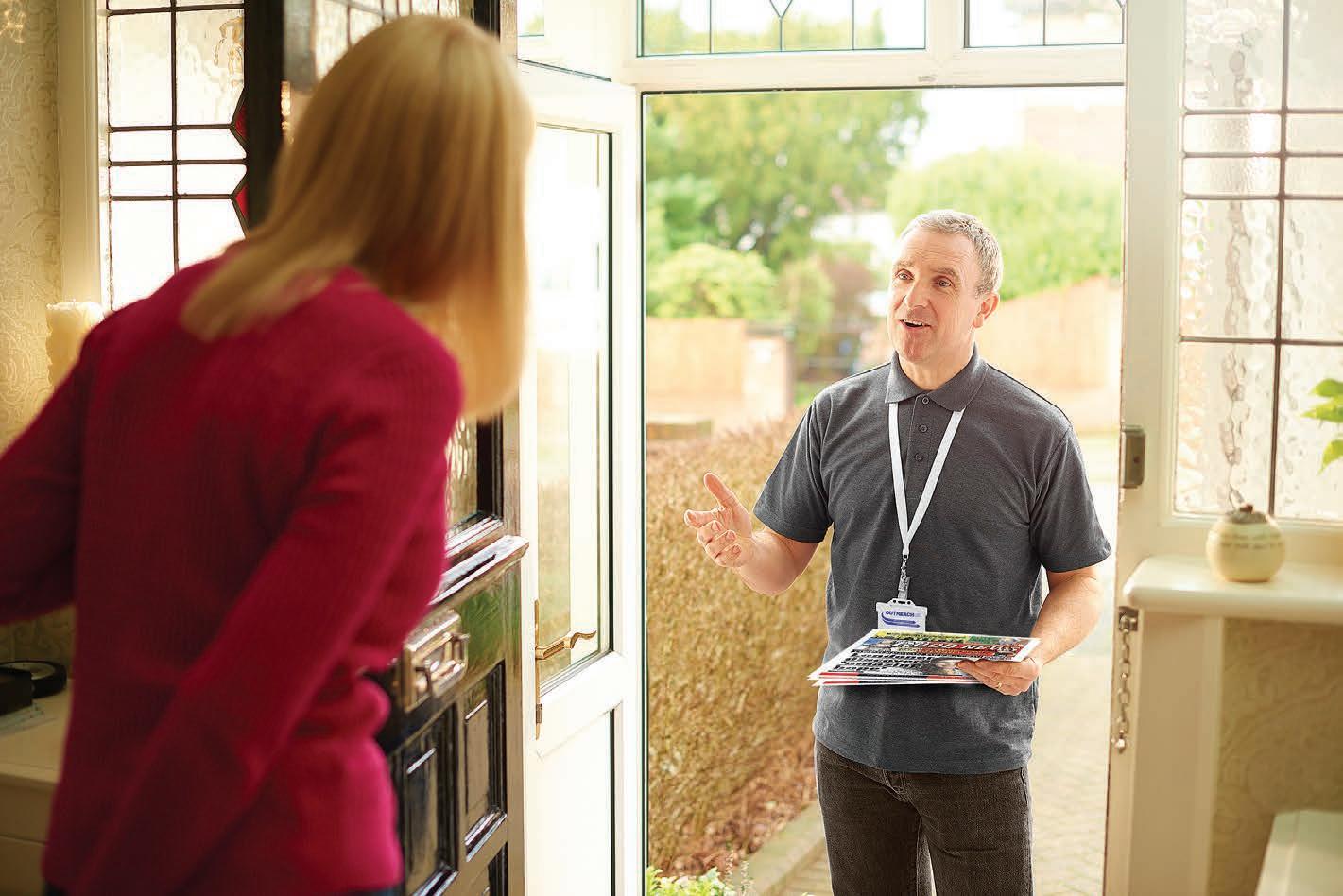
This loud response rang out across the market after I asked a lady if she would like a newspaper called Good News. I was handing out evangelistic leaflets and newspapers at Dunstable Market with some colleagues.
Her response shows how much need there is out there to share the good news of Jesus. I challenged her to “prove me wrong” but she just moved on.
As Christians we believe – we know – that not only do we have good news for the world but we have the greatest news the world has ever heard: news of a Saviour who died, rose again and is coming back. But how do we get that across to a disbelieving and cynical world? One way is to use literature. Be it tracts, booklets or newspapers, there is a lot of excellent material – something for every occasion and every person.
Casting Your Nets (www.castingyournets.co.uk), a new evangelism training programme from Outreach UK, has a whole session devoted to how to use literature in evangelism and outreach. The course, designed to show that every believer can be an effective witness for Christ, promotes the idea of simply passing on a piece of literature to those you come into contact with.
There is a very good reason for this. There was a time when non-Christians had a basic understanding of the Bible and our job as evangelists/church visitors was to build on this platform of knowledge. But this is no longer the case, so we must begin from the presupposition that the people we are now meeting know virtually nothing about Jesus, the Bible or the Gospel.
As a result of this diminishing awareness of Christian truths it is essential that we should be equipped with literature, DVDs, etc., that are appropriate to the ages and social circumstances of the people we meet. And also, very importantly, the materials must be written or presented in a language that they can understand and relate to. Too often, evangelistic materials, particularly tracts, use off-putting Christian jargon without explaining it.
Different kinds of literature appeal to different kinds of people and we should always carry an
assortment, giving the one which best suits the needs of the people we meet. For this reason, it is important that we are familiar with our literature before we distribute it.
Casting Your Nets works in partnership with two of the best literature-based evangelistic organisations around: Good News newspaper and the Pocket Testament League. Good News newspaper celebrated its 20th anniversary last year. It is descended from Challenge newspaper, which was launched in the 1960s, but has a fresh, modern look, and carries the very useful tagline on the cover, ‘Good News for a Change’. Many times I have started gospel conversations by offering a Good News with the question, “Would you like some good news for a change?!”
Published monthly, it contains stories of how God is changing lives today. In addition, there are often reports on social action by churches – to counteract the negative stories about the Church that the media often present. There are also testimonies of celebrities and sports stars, which attract readers to the paper, articles on the latest evidence for the truth of the Bible, film reviews making a spiritual point and other articles that point people towards Jesus. It makes a great conversation starter, if you meet the same person again and ask what they thought of the paper or particular articles in it.
Outreach UK provides free copies of the paper to those on the Casting Your Nets training programme. The course points out the many ways that the paper can be used. Door to door work is the tried and tested example, but the paper also works well alongside almost any form of outreach, whether given away at coffee mornings, church cafes, Messy Church and town centre outreaches, or left in places like hairdressers, doctors’ and dentists’ waiting rooms (with permission) or anywhere where people have time to sit and read. The paper is also being distributed to prisoners in over half of the prisons in the country by prison chaplains.
The Pocket Testament League has been in existence since 1893. It was started when a young girl called Helen Cadbury (yes – that Cadbury!) became a Christian and discovered the life-changing power of
God’s Word. She was so excited about this that she organised a group of girls who sewed pockets onto their dresses to carry the small New Testaments her father had provided. The girls called their group The Pocket Testament League. Using small membership cards, they pledged to read a portion of the Bible every day, pray, and to share their faith as God provided opportunity
Each year, PTL produce thousands of gospels that are easy to give away and have an explanation of the Gospel in them. Outreach UK recommends ‘Love is the Bridge’ – a version of John’s gospel, and the training programme gives hints and tips on how to use them. These gospels, designed to fit in a pocket, can be easily carried and offered to anyone willing to take them.
Many churches and evangelists, including those with Outreach UK, give away thousands of Good News and PTL gospels every month. This monthly distribution creates opportunities to meet people on a regular
basis – providing the opportunity to build up relationships, so more of your faith can be shared. People we meet have become very open to receiving a new edition of Good News each month, and then Love is the Bridge makes a great follow-up gift for those who show interest in the faith.
One evangelist told us that when out walking each day he would carry gospel literature and ask people he met: “What are you reading at the moment?” When they asked him the same question in response, he would answer: “I’m reading the world’s best seller – would you like a copy?” and give them a gospel. Other evangelists have been out ‘prayer walking’ around their community, which also presents opportunities to give away literature. So, when people tell you that there is no such thing as good news in the world, the well-equipped Christian can respond: “Yes there is – and you can read all about it in this.”
Church. Ever since it has been a venue for community groups to meet, as well as a place of Christian worship.
The church is home to a dance academy and karate classes; vulnerable adults meet for lunch and social support most weeks; toddlers bring their adult carers for fun and learning, and on Friday morning food can be obtained at knock down prices.
Sadly, plans to commemorate the 50th anniversary were prevented by the pandemic, but the church has backed church member Bill Hopkins and his vision to distribute Good News to so many in the community.
“I instantly felt God give me the strength to endure whatever would happen next. God’s peace flooded my soul, and my fear melted away.”
Heroes of the faith
A series on inspiring Christian lives by one of the UK’s leading evangelists, Canon J John
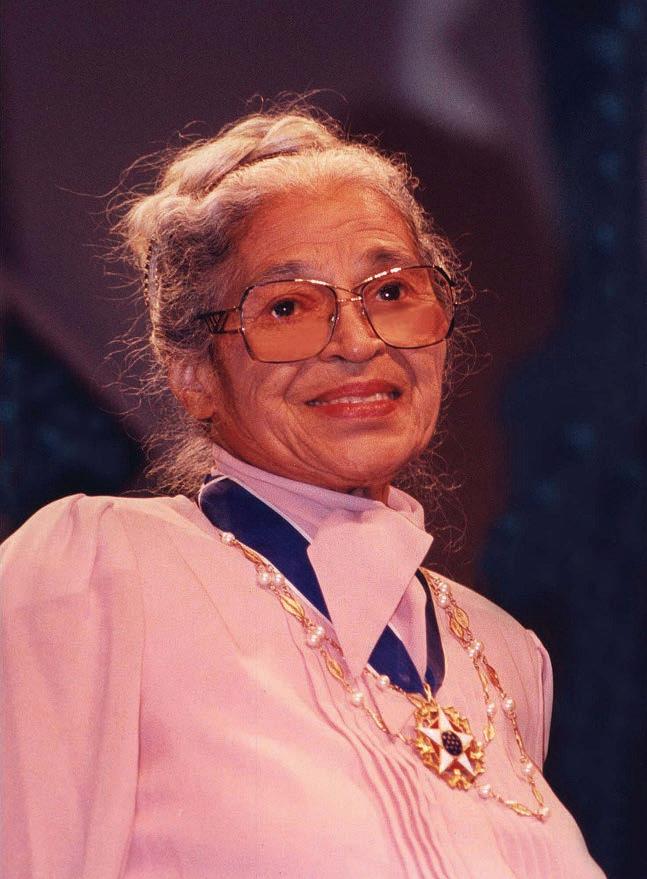
Rosa Parks
Some of my heroes are known for a lifetime of activity but some, like Rosa Parks, the woman whose quiet protest ended racial segregation in the United States, are known for what they did in a moment.
Rosa was born in Alabama in 1913 into an AfricanAmerican community. When her parents separated she moved with her mother to a farm just outside the state capital, Montgomery. Although slavery had been abolished 50 years earlier, African-Americans suffered prejudice, abuse and intimidation, and were frequently subject to segregation.
Rosa’s family were deeply involved in the church and had a profound faith. As Rosa later wrote: “Prayer and the Bible became a part of my everyday thoughts and beliefs.” She remained involved in the church all her life, eventually becoming a deaconess.
In 1932 Rosa married Raymond Parks. He was active in the National Association for the Advancement of Coloured People (NAACP), which defended the rights of African-Americans. In 1943 Rosa became active in the Civil Rights Movement where she worked as a secretary. As a priority was providing legal help to those who had been deprived of justice, every day Rosa faced the appalling social inequality and frequent violence that black men and women encountered.
Injustice
One focus of injustice centred on the buses. The city of Montgomery had a law that allowed the segregation of passengers by race, and bus drivers commonly demanded that black passengers give up their seats when the ‘whites only’ seating was full.
On the evening of 1 December 1955, Rosa took the bus home and sat in an empty seat at the front of the section reserved for blacks. As the ‘whites only’ section became full, the bus driver moved the ‘coloured’ sign behind Rosa and three other people, and ordered them to give up their seats. Three of them did but Rosa remained seated. When asked “Why don’t you stand up?” she simply responded: “I don’t think I should have to stand up.” The driver said: “Well, if you don’t stand up, I’m going to have to call the police and have you arrested.”
When writing about this moment later, Rosa said: “I instantly felt God give me the strength to endure whatever would happen next. God’s peace flooded my soul, and my fear melted away.” Her response was calm and dignified: “You may do that.”
The police were called and Rosa was arrested and charged under the segregation law, found guilty and fined. However, by now support for her was gathering. The various organisations promoting AfricanAmerican rights soon realised that this quiet, reputable 42-year-old woman was a suitable candidate to challenge the law. Courageously, she
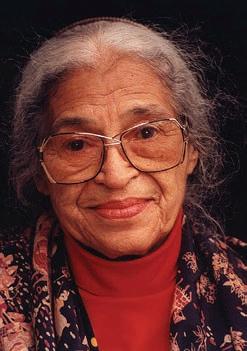
Rosa Parks, 1913 – 2005
appealed against her conviction, challenging the very legality of racial segregation. She was backed by civil rights groups, churches and a financially damaging boycott of buses. Rosa’s case went all the way to the United States Supreme Court, where segregation was ruled unconstitutional.
Rosa found, as is so often the case, that victory came with a price. Both she and her husband lost their jobs and she became the subject of harassment and death threats. Despite becoming an honoured symbol of black dignity and strength, Rosa and her husband suffered financially. Raymond died in 1977 and Rosa died in 2005 at the age of 92. In a remarkable final honour, the American government had her body lie in state in the US Capitol.
You could say that Rosa became an ‘accidental hero’ but there is more than that. Rosa’s action was not simply a random angry protest; there had been plenty of those and they achieved very little. This was where the right person did the right action in the right way at the right time.
Great significance
There were three significant things in what Rosa Parks did.
First, there was a godly preparation. How any of us react in the spur of the moment is based on who we have become during our lifetime. In a sense, Rosa had been preparing for this confrontation all her life. Her personality and identity had been shaped by decades of Christian preaching, Bible study and prayer. The motto of the Boy Scouts is ‘be prepared’ – guidance that could be applied to all of
life. After all, none of us know when we are suddenly going to find ourselves in a crisis, faced with a difficult challenge to do what is right. Let’s prepare ourselves in advance. Stay close to Christ and his Word, let the Spirit mould who you are and you will be ready for whatever life throws against you.
Second, there was a godly exasperation. Exasperation may seem an unlikely Christian virtue, but it is one. The fact is it’s easy to become desensitised to injustice, to accept evil with a weary shrug of the shoulders: ‘It’s one of those things’ or ‘I guess we just have to accept it’. Rosa, filled with a sense of biblical justice, decided on that bus that she was no longer prepared to accept injustice. Enough was enough! Similarly today, I believe that we all face evils in the world which we far too easily just take for granted. I think the church could do with a lot more godly exasperation.
Finally, there was a godly action. Rosa did something. (More precisely, she refused to do something – her action was inaction.) So many of us mutter our concerns, perhaps pray about them and maybe make a comment on social media, but we don’t actually do anything. Rosa, doubtlessly aware of the consequences for her, chose to act. But notice how she acted. The ultimate success of her protest relied on how she reacted in the right way: with gentleness, politeness and courage.
Rosa Parks spoke out for her rights by speaking quietly and stood up for what was right by sitting down. May we also have the courage to stand for truth today.
This was where the right person did the right action in the right way at the right time.
The bus on which Rosa refused to give up her seat, sparking the Montgomery Bus Boycott – a US civil rights landmark
Train your brain or just take a relaxing time out with these puzzles. The solutions are on the inside of the back cover (don’t cheat!).
BREAK TIME
Crossword
Across
7. National Park in south-west England (8)
8. ---- on-Sea, N. Wales resort (4)
9. Catch fire (6)
10. Study of plants (6)
11. Number of years of Solomon’s reign (5)
12. Make practical use of [USA spelling] (7)
15. Sister of Laban (7)
17. Shocked or surprised: taken (5)
20. Bible book beginning: ‘Paul, a servant of Jesus Christ...’ (6)
22. Isaiah says that even these grow tired and weary (6)
23. ‘ I approach the eternal throne (hymn) (4)
24. ‘What a God have I’ (hymn) (8)
Down
1. Tropical trees found on river banks (8)
2. Stern; not lax or indulgent (6)
3. Whenever this man lowered his hand, Israel was losing a battle (5)
4. ‘At his feet your bring’ (hymn) (7)
5. Savagely violent (6)
6. Bible book mentioning Nicodemus (4)
13. Climbed a tree to see Jesus (8)
14. Is profitable or advantageous (4,3)
16. Large, spiral-horned antelopes (6)
18. Tree branches (6)
19. She invited Paul to stay in her home (5)
21. Woodwind instrument (4)
Wordsearch Sudoku
Can you find 20 domestic appliances? Look up, down, forwards, backwards and diagonally.
Fill the grid so that every column, every row and every 3 x 3 box contains the digits 1 to 9
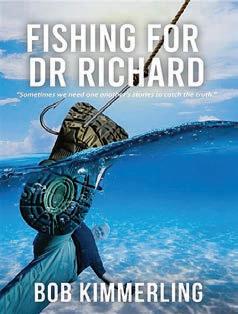
Fishing for Dr Richard
By Bob Kimmerling Reviewer: Melanie Thomas, member of Vineyard Life Church, Richmond
Bob Kimmerling is a minister and elder at the Congregational church in Richmond – Vineyard Life Church. This book follows a conversation between two men: one is a retired medic and founding father of pharmaceutical medicine; the other an architect, but latterly a church minister – Bob.
Melanie says: “I loved this book and very much enjoyed eavesdropping on the conversational journey of these two friends. It always left me wondering what was going to happen next in this gentle yet exciting narrative.
“I also found myself embarking on my own journey of discovery with God, or rather re-discovery. Some of the anecdotes are remarkable (and hard to believe if I hadn’t known the writer), but when I turn back to the Bible, actually, it’s there already – the almost outrageous depths of God’s love in indefatigable
pursuit of mankind, portrayed in Bible story after Bible story. The God of the Bible is just the sort of God who could be expected to make Himself known like that, in coincidences and unexpected events loaded with meaning, not unlike the stories of this book.
“Sometimes we need one another’s stories to catch the truth. The delight of reading this book has caused me to look afresh at biblical teaching as if I’d never really registered the words before, nor really taken in how amazing the Christian story is. It has made me realise there is a whole depth and breadth of ‘knowing God’ yet to discover.”
Published by Bob Kimmerling (2021), paperback £9.99, ebook £3.99. Available from Amazon, Waterstones, WH Smith, Eden. Proceeds will be donated to the Vineyard Community Centre
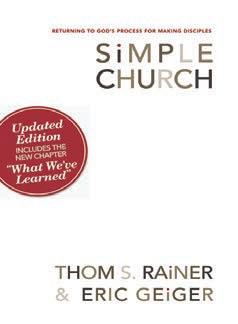
Simple Church: Returning to God’s Process for Making Disciples
By Thom S. Rainer & Eric Geiger Reviewer: James
This book was a timely gift that definitely held my interest. Based on the case studies and research of hundreds of American churches, the authors argue that the discipleship process in most churches is undefined, confusing, ineffective and complex, which dilutes the potential for impact.
The authors argue that churches that have simplified are thriving. Simplified in this case means to eliminate the complexity and congestion that hinder the church in its mission. It involves designing a strategic discipleship process that produces life change, and moves people toward greater levels of spiritual maturity and commitment.
The book argues firstly that the discipleship process must be clear (clarity); secondly, the church
Taylor, Minister at North Street Church, Taunton must be committed to the key programmes that have been placed along the process (movement); thirdly, the discipleship process should be implemented in every area of the church (alignment); and fourthly, the church abandons anything working against the discipleship process (focus).
‘Simple Church’ was an exciting read as I imagined the potential in my own context. Implementing this radical strategy will undoubtedly be challenging, but I believe it could be a very effective way to create focus in mission and intentionality about discipleship, hopefully paving the way for spiritual and numerical growth.
Published by B&H Publishing Group (2011), paperback. Available at Eden (£6.00); Amazon (£8.95)
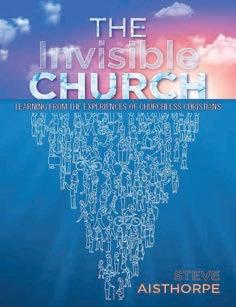
The Invisible Church: Learning from the Experiences of Churchless Christians
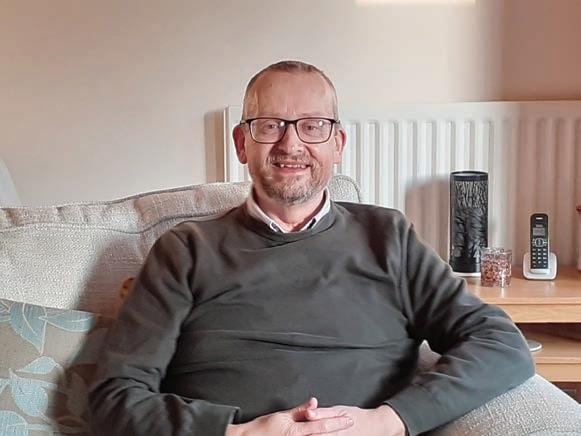
By Steve Aisthorpe Reviewer: Gerry Simonis, Minister at Clydebank Congregational Church
Steve Aisthorpe’s doctoral study into the topic of declining churches was published in this book and is a good example of how scholarly writing may be done in a way that reads well.
Steve’s study explains that ‘post-congregational’ Christians have very different reasons for why they are ‘post-congregational’. The study shows there is hope and faith in this group of Christians. They are in the main not disenchanted with Jesus, just with the Church institution’s inability to really listen and its dismissiveness of change.
As with any such specific studies there are many more questions waiting for an answer or at least a
discussion. Many of these questions have helpfully been posed at the end of each chapter. In summing up, Steve says: “In one sense, it is sad that at a time when many denominations are discovering an appetite for planting new expressions of church, many of the pioneers have left . . . there is a growing realisation that church is what occurs when people are touched by the living Christ and share the journey of faith with others. Whether that occurs in an historic building or online or wherever, is unimportant.”
Published by Saint Andrew Press (2016). Available at Amazon in paperback (£14.99) or Kindle (£14.24) or at Eden (£18.11, free delivery)
The following churches are seeking ministers/pastors at the present time. If you are interested in receiving more information you must firstly contact the Congregational Federation via our Nottingham office.
Full-time – Greenacres (North West)
Part-time – Dereham: Cowper Memorial (Eastern); Elstow Bunyan Christian Fellowship (East Midlands); Haverfordwest Pastorate (Wales); Oakamoor (North West Midlands); Shillington (East Midlands); Stalybridge (North West); Witney (South West Midlands).
Non-Stipendiary– Frampton (South West Midlands); Oban Congregational Church (Scotland); Penrhys, Llanfair Uniting Church (Wales); Ebenezer Independent Congregational Chapel, Tredegar, Gwent (Wales).
By Neil Chappell, Social Media & Website Officer, Congregational Federation
So can I suggest three social media goals for 2022? Let’s see:
1. Refresh
Make sure your social media output is showing up-to-date content. There’s nothing worse than looking at the upcoming events on a church website and discovering the most recent thing is a Harvest Supper from two years ago.
2. Small steps
lan to update your church website every fortnight. Add new dates, and report on how activities have gone. On Facebook plan three posts a week – an event post, a community post and an encouraging post.
3. Catch the eye
A question I get asked from time to time is whether you can compare a business with a church. This is because we often copy business strategies in the social media concepts of the church. For instance, consider the following statement:
“A social media goal is a statement about what you want to achieve with your marketing activity.”
Perhaps the Church suffers because it doesn’t take itself as seriously as a business and apply sound principles and strategies to its life of faith. After all, our ‘marketing activity’ is our outreach to our local community, and we need to build up the brand that is so life-changing and life-affirming.
Around 50-75 years ago the Church was fully embedded in the life of this country. Since then there has been a steady decline, so that now there is a significant disconnect which means we need new strategies to reach out. And this is where having good goals can help your church grow.
Do your best to source some great images –they always enhance a post tremendously. Pixabay, Unsplash, Freely and Pexels are great sites for copyright-free images that compliment great posts – but don’t forget to attribute images if you can. And good photos of your own church and own people are the best publicity possible. Don’t forget you can contact me anytime to talk about your church’s social media presence. Drop me a line.
This is the confidence we have in approaching God: that if we ask anything according to his will, he hears us.
During March, please remember in prayer the Congregational Federation. Pray for all within the Federation as they seek to serve God.
Pray for all who serve our churches – ministers, pastors, chaplains, preachers, mission enablers and spiritual enablers.
During Lent, remember how Jesus resisted temptation in the wilderness and pray for help to follow his example.
Please also pray for the events that are taking place in March:
4 March World Day of Prayer prepared by Christian women from England, Wales and Northern Ireland. The theme of the service is HOPE
21 Feb – Fairtrade Fortnight
6 March
8 March International Women’s Day. The theme is ‘Break the Bias’, a global call to arms to tackle discrimination, celebrate our differences and forge an equal future
16 March The meeting of the Investment Trust and Trading Board
26 March The meeting of the Church Support Committee
APRIL
1 John 5:15
And if we know that he hears us—whatever we ask— we know that we have what we asked of him.
Remember in prayer the members of Council and Council Committees.
Pray for students undertaking the CF Training Course, the tutors who provide the training and the administration staff.
Please pray too for the Congregational Federation in Scotland and all the Congregational Church fellowships within the Area.
During Easter remember how Jesus suffered and died and rose again for us.
Events to remember in prayer:
1 – 2 April CF Council Meeting
1 – 3 April CIPT Training Weekend
22 April Earth Day—Theme ‘Invest in our Planet’
25 April Finance and Support Services Committee
28 April CF Council meeting via Zoom
MAY
1 Chronicles 16:11
Look to the LORD and his strength; seek his face always.
During May, please pray for the churches of the Congregational Federation in Wales.
Remember in prayer the Congregational Federation
As sembly at Carrs Lane Conference Centre, Birmingham – those who have organised it, those who are speaking and all who attend. Pray for this year’s President, the President who will be welcomed as President for 2022/23, the Officers and for the person who will be announced as the President Elect.
Events to remember in prayer:
4 – 9 May Deaf Awareness Week
13 May CF Assembly fringe events
14 May CF Assembly
15 – 21 May Christian Aid Week. This year Christian Aid week will focus on the plight of those affected by drought, which many countries around the world face
JUNE
Jeremiah 29:12
[The Lord says]: “Then you will call on me and come and pray to me, and I will listen to you.”
As we celebrate Pentecost, pray that the Holy Spirit will move within our churches.
During June, please pray for the churches in England and the Areas that serve them. Events to remember in prayer:
1 – 6 June Volunteers Week. Give thanks for all who work as volunteers, especially those working within our churches
4 – 12 June ‘Churches Count on Nature’ Week
20 June Sanctuary Sunday – a day to celebrate the contribution of refugees and those seeking sanctuary
20 – 26 June Refugee Week. The theme for this year is ‘Healing’