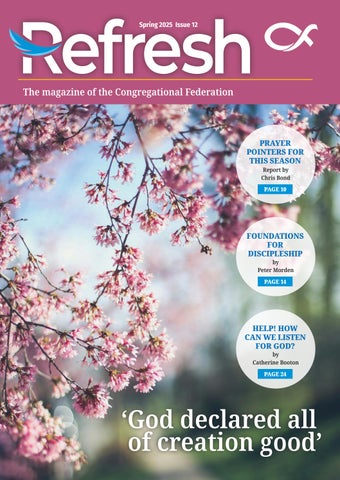
Spring 2025 Issue 12
The magazine of the Congregational Federation
PRAYER POINTERS FOR THIS SEASON Report by Chris Bond
PAGE 10
FOUNDATIONS FOR DISCIPLESHIP by Peter Morden
PAGE 14
HELP! HOW CAN WE LISTEN FOR GOD? by Catherine Booton
PAGE 24
‘God declared all of creation good’
“…looking forward to being refreshed by your company. God’s peace be with all of you” (Romans 15:33, The Message)
Contents 3 From the General Secretary 4 From the President 6 Federation News 8 Local Church News 9 Youth Ambassador: Harry Booton 10 Report on 24/7 Prayer ideas by Chris Bond 13 People’s responses to The Prayer Course 14 PRACTICAL THEOLOGY: Who do you follow? by Peter Morden 17 TESTIMONY Obedient Servant by Scott Beaton 18 MISSION Trip to Brazil by Luzia Watt 20 Six types of working genius by Chris Bond 21 CELEBRATIONS A 25 year anniversary at Stalybridge 22 TECHNOLOGY Tomorrow’s World by Neil Chappell 24 LEARNING TOGETHER Top Tips for Learning Churches, part 5 by Catherine Booton 26 Local ecumenism in Scotland by Margaret McGuinness 27 All for Jesus, Jesus for All update by Clemy Gilmore 28 CREATION CARE: five marks of mission by Graham Adams 30 PASTORAL CARE Grief in different forms by Clemy Gilmore 33 Mission on the margins by Harley Stapleton-Brister 35 Prayer Diary from March to July TO ORDER REFRESH: There are three issues of Refresh each year, available on annual subscription at £36 incl. p&p and the Yearbook. Email: admin@congregational.org.uk or tel: 0115 9111460 for details.
2
Refresh Magazine, ISSN 2634-2987, is published by: The Congregational Federation, Congregational Centre, 8 Castle Gate, Nottingham NG1 7AS Tel: 0115 911 1460 www.congregational.org.uk www.theresourcehub.co.uk Registered charity 264839
W
elcome to the spring issue of Refresh! As we marvel at the progress of spring, we are reminded of the fragility of the world as our beautiful pollinators, insects and butterflies, have declined alarmingly. There’s a call to action from Graham Adams who suggests that creation care should be the heart of mission (page 28). Hand-in-hand with life, comes death and the painful experience of grief. Clemy Gilmore talks us through using helpful biblical examples and a psychological perspective. Mission in context and learning is a strong theme elsewhere; try tracking Elisabeth SweeneySmith’s route around the UK visiting congregations! Other contributors have been on mission to Brazil, to the Philippines and Jamaica, to painful reflections in Auschwitz, and to San Francisco – where a conference on 24/7 Prayer links to the theme of prayer and how to listen to God. See the thoughtful articles by Peter Morden, Chris Bond and Catherine Booton for some inspiration for personal application and church ministry. Moving into 2025 has prompted reflections on technology from Neil Chappell and he looks backwards as well as forwards – it’s Tomorrow’s World indeed! Congregational Federation have launched a podcast with expanding learning resources online, do visit the website. Please do get in touch if you would like to tell us your news for Refresh. I hope you are blessed by this issue, and know the Lord’s deep care for you. May the Lord make His face shine upon you… and give you peace. Louisa Lockwood, Editor Refresh@congregational.org.uk
Cover © Jessica Fadel, Unsplash Design and print: Verité CM Ltd. www.veritecm.com.
All Bible quotes are from either the NLT or NIV unless otherwise stated.
All articles are copyright ©Refresh Magazine.
This magazine is printed on paper from a sustainable source.
Please contact the Editor if you would like permission to reproduce any content.
From the General Secretary Welcome to the Springtime Refresh!
T
he weather is better, the days are warmer, and the nights longer. I hope this issue finds you well and encouraged. Lots of changes have happened with staffing in the Congregational Federation: Kate Bass has joined the team as Trust and Property Manager and Blessing Afolabi-Jombo is the Assistant Financial Controller. They both bring a wealth of experience and it is great to be working with them. There are lots of exciting things happening as we head into spring. We have launched the Being Congregational five-week course which has been very well received; it will be online over Lent so if you want to find out more then come and join us. Christian Rebuild have also produced a weekly Lent reflection booklet highlighting some of the projects they support; this is available from the office. We have two further biblical studies booklets being published that are reflections from the mission trips in Grenada and Brazil that took place last year. They are colourful and vibrant with challenges from different contents and cultures. There is a worship outdoors / forest church resource too, inspired and led by Sara Iles, which I encourage you all to try as the weather gets better. It may attract new people and will let others see worship in a new way. Our new discipleship programme, All for Jesus, Jesus for All, is also progressing well and will be ready later on in the year. There are lots of changes in some of our churches as Oakamoor, Larkhall, Market Harborough, Cawsand, Springhead and Greenacres all welcome new ministers. We have also heard of faithful servants who have gone to glory including Ena Borthwell, Monica Hill, Jane Wardropper, Neil’s brother, and my old Sunday school teacher and old friend Eileen who always loved to read the Refresh. However there have also been two miracle baby granddaughters, one to Peter a member at Wavertree and one to Debbie at Wivenhoe. What does the verse
Left: Trevor Howard (on the left) from Churches in Communities International with Oakamoor’s new Minister Scott Beaton.
in Ecclesiastes say? ‘There is a time for everything’ (Ecclesiastes 3:1). In October and again in January I took part in a 40-day sugar fast. I followed a book by Wendy Speake. It’s something I’d never done before but it brought me closer to God and my understandings of the Bible deepened. It’s been about feasting on God’s word rather than anything else. My favourite verse at the moment is from Joel 2, verse 12; “Even now,” declares the Lord, “return to me with all your heart, with fasting and weeping and mourning.” Can you hear the urgency of the love for you? We weep and mourn for the times we’ve run to other things rather than to our amazing God, the times we have missed being in his presence, receiving from him. The fast helped me focus on Jesus, to seek him first in everything. As we move into spring, whatever challenges or joys we face personally or as a church, let’s aim to seek first Jesus, knowing he loves us and delights in us. May God bless you abundantly. Yvonne Campbell
The two miracle baby granddaughters, Mabel (top) Eleanor (bottom).
3
FEDERATION NEWS
Update from the President
W
e are into the final leg of my tenure as President so here’s a review of what I have been doing since my last Refresh article. Summer to autumn 2024 As summer passed into the autumn, I found myself leading a service at Ardrossan on the west coast of Scotland, attending the ordination service of Lynn Robertson at Kirkcaldy, joining a service at East Morton led by Helen Keighley, leading Harvest Festival services at Greenacres and Cheltenham and made a trip to Stanley Zion Christian Centre in the North East area and joined a service at Scunthorpe CC. There was lunch with Liz Hudson at Stroud as well as catching up with ministers on my way to visits to Lapford and Chumleigh in the South West – longer daylight hours helps in making multiple visits. October to November 2024 In October I led a service in Perth, attended the Graduation Day in Nottingham of students on the Congregational Practical Institute Training course and joined Knowle Green’s motorbike monthly café. I also visited Eastern region again twice in October, to Stambourne, Silver End and Wivenhoe and joined the first regional assembly in quite a while. As the days shortened into November, I led services at Trinity CC, Brixton and Isleworth, SW London and then back north to lead my first Remembrance Day service in Springhead, Oldham and to present Bibles to children at Brierley Green. November turned out to be very busy with a Council meeting in Edinburgh after which I led a service in Blantyre who made me feel very welcome over lunch, pointing me in the direction of the David Livingstone museum. That evening, I joined the Youth Group at Parkhead CC, Glasgow – a lively time with young people fully engaged under Jack Graham’s
4
supervision. Brunch followed the next morning with Lorna Cammock before I left Scotland for the drive home to the Peak District. The following weekend I led an anniversary service at Stalybridge (NW) attended by other visiting speakers and enjoyed fellowship over lunch. Time for some stillness was needed which I found by joining a Christian Meditation at Hope CC and then back to frenetic activity at the November sale at Chinley Independent Chapel. An evening with other leaders in Churches Together in England at Lambeth Palace completed a busy month. Advent and Christmas 2024 The festive season of December began by leading an Advent service at Timperley CC in Manchester followed by a dash to Bakewell Livestock Market joining rural chaplains for their afternoon Christmas Carol service around the sales ring. The following weekend I was in Sheffield attending a breakfast café service led by one of the members of Hillsborough CC. Lunch with Suzanne Nockels followed before I led the afternoon service at Tapton Hill CC. December also included leading a service at Newcastle-under-Lyme formally welcoming new members, again celebrations included a shared luncheon. A trip to watch the Nativity Performance by the drama team of Wintershall near Guildford was a time of refreshing as part of a large audience following the players through fields from scene-to-scene until we arrived inside a large barn complete with animals and a manger to celebrate Immanuel. More festivities followed as I joined Yelvertoft for their Christmas meal in that delightful village. December ended attending the carol service at Heaton Mersey CC and leading my first Christmas Day service at Chinley Independent Chapel.
FEDERATION NEWS
January, February and March 2025
On reflection
The New Year started with a lot of snow in the North West which meant having to cancel a trip to Wavertree CC, only my second cancellation during a busy eight months (a second Devon trip was cancelled due to flu in October). London called next for a service at Union Chapel, Islington which included the church formally welcoming a new member. It was good to meet their new Minister, Rev Cathy Bird (taking up her role the following week) and the Minister from nearby Highbury Quadrant over a lunch cooked by former asylum seekers and refugees being trained as chefs in the church’s kitchens, and who along with other asylum seekers, attend services. It is part of the church’s outreach work and mission to engage. The next Saturday meant a trip to Larkhall, near Glasgow to attend the induction service of Rev Graham Morrisson conducted by Rev Gerry Simonis, and it was good to catch up with other Scottish ministers and area secretary Margaret McGuinness. The January Week of Prayer for Christian Unity found me leading a service at Padfield CC (NW) and joining an ecumenical soup and reflection at Brierley Green CC. February means a visit to Clarendon Park, Leicester, Timperley CC, Heaton Mersey and visits to Elstow and Roxton in the East Midlands. It’s March so it means trips to the Rea Valley churches, then on to Wales for services at Blaenavon, Haverfordwest, Dowlais and an induction service at Abertillery as well as joining Wales Area Assembly at the end of the month. March also includes a trip to Fairford and South Cerney in the South West Midlands.
A big vote of thanks to all those involved in pulpit supply, church secretaries and deacons who make the life of a visiting speaker so much easier. Hospitality has been very much appreciated. I seem to have a habit of leaving a Bible or something at a church which is a good way of making sure I make a return visit! Visits have taken up the majority of my time and I have been blessed by the welcome and fellowship I have received and delighted to have formed new connections around the country. Prayer and preparation have been part of my commitment to serve as President of the Federation; with the theme to ‘Hear The Word of The Lord’ I have endeavoured to hear and deliver the specific message for different congregations – may the seeds be watered and grow. I have grown in my own ability to hear the voice of the Lord and I pray that many of you have also been developing your sense of discernment. God bless us all in whatever way the Lord has called us to serve and may we always have our ears open to Hear The Word of The Lord. Elisabeth Sweeney-Smith
From top left: Elisabeth with Rev Javid Shahnawaz at Highbury Quadrant; Rev Graham Morrisson’s induction at Larkhall CC; suitcase packed and ready for travel in January 2025; Marcia Cameron the current CIPT student at Trinity CC with Elisabeth (a former CIPT student!); some of the fellowship at Newcastle-under-Lyme; and the Wintershall Nativity. From top going clockwise: Elisabeth with Mike Royal, Chair of Churches Together in England; Elisabeth with Rev Gordon Campbell of Perth CC; and with Boys Brigade leader and deacon Bill Andrew at Blantyre; Jack Graham at Parkhead CC; at Brierley Green during week of prayer for Christian Unity.
5
FEDERATION NEWS Top: Congratulations to Kevin Dudman, new minister at Cawsand, pictured here with Jill Stephens and Jill Murray. Middle: Congratulations to the Council for World Mission graduates of the 2024 Training-in-Mission (TIM) programme who completed their course on 21 November, receiving not only a Diploma in Mission Studies but also certificates in Peer Mediation, Peace, Wellness and Resilience in Children. See www. cwmission.org for further information. Right: Welcome to The Vault, a new podcast from the Congregational Federation, containing news about its work and witness and upcoming events, and with news and interviews from people within the Congregational Federation and its churches. Listen to Episode 1 - 16.01.2025 at www.congregational.org. uk/the-vault.
6
A
ll welcome to an OPEN DAY for the Foundation Degree in Practical Theology. Date is Friday 21 March, 11am to 3pm, at Cleaves Conference Centre, Castle Gate, Nottingham, NG1 7AS. Questions to ponder: • Do you want to develop and deepen your faith? • Do you want to learn more about Congregationalism? • Do you feel called to serve? • Are you thinking about studying? For more information and to register for the open day contact us at: training@congregational.org.uk or by phone on 0115 911 1460. Visit www.congregational.org.uk/news-andevents-latest-news/latest-news/post/829-ciptopen-day
FEDERATION NEWS
2025 NATIONAL ASSEMBLY Saturday 10 May
W
e would like to invite YOU to the 2025 National Assembly! To be hosted by the East Midlands Area of the Congregational Federation in Nottingham at Nottingham Trent University, 50 Shakespeare Street, Nottingham. NG1 4FQ. The National Assembly will be on Saturday 10 May. There will also be events held on Friday 9 May in the afternoon and evening, on the Saturday evening and on Sunday 11 May, see the details below. • Friday, 2pm, Mission workshop including a talk from Rev Gabriel from the Congregational Church in Brazil.
• Friday 7pm, a short walking history tour of Nottingham brought to life by Ezekial Bones, suitable for all ages. • Saturday, 9.30am refreshments at Nottingham Trent University, 10am worship. Children and Youth Assembly will be on the same day. • Saturday, 6.30pm to 9.30pm, at St Nicholas Church, Castle Gate, a barn dance with hot food served.
Last year’s conference (clockwise): Foday Kamara, Minister at Chinley Chapel and North West Area Church Support worker, asks questions during the business session. Church Support Worker Luzia Watt reports on her year. Fruitful discussions at lunchtime. The worship leaders.
CF Council member Roo Macrae from Scotland.
CONGREGATIONAL FEDERATION OPPORTUNITIES The following churches are seeking ministers/pastors at the present time. If you are interested in receiving more information you must firstly contact the Congregational Federation via our Nottingham Office.
Full time:
Haverhill (Eastern); Inglewhite (North West); Southwick Christian Community Church (South East).
Part-time:
Burbage (East Midlands); North Nibley (South West Midlands); Shillington (East Midlands); Stalybridge (North West).
Non-stipendiary:
Frampton (South West Midlands); Oban Congregational Church (Scotland); Penrhys, Llanfair Uniting Church, (Wales).
7
LOCAL CHURCH NEWS
The new members’ meal at Crediton Congregational Church in November 2024.
Recent church growth at Crediton Congregational Church By Jake Lloyd
W
e’ve had almost 30 new people join our church in Crediton in recent months – many of whom have no church background. We wanted to celebrate this and make them all feel welcome. And so, with funding from the Congregational Federation, in November we hosted a meal for them. It was a lovely evening of local food, good conversation, and a short talk from our pastor. Afterwards one new member told us: ‘It was such a thoughtful way to welcome new people into the church family. From the warm smiles and open conversations to the delicious food and beautifully prepared setting, everything about this evening was perfect. I felt so valued and cared for.’ We’re grateful to the Congregational Federation for making it possible. Thank you! Reflecting on our recent growth, our pastor James Gregory said: ‘There’s not really one thing I can point to as a prompt for the growth we are seeing. The most exciting part is that people we’ve known through mostly un-religious activities we run in the church during the week have started to come and join us for Sunday worship – and not to just see what is going on but to find Jesus for themselves too. It’s such a joy that folk are happy to talk to us about the questions they have about life and purpose and the possibility that there is a loving presence we dare to call God behind it all. One thing I’ve learned is to be a little bit
8
more bold in inviting people. There are lots of people who have really good intentions to come and try out church for themselves but might need a gentle cajoling to get over their anxieties over trying something new.’ One new member is Will, a mixed martial arts instructor in the town. At his recent baptism he gave a very powerful talk about how his whole life he struggled with fear, until recently: ‘I noticed how some of my favourite public figures all had one thing in common: their faith in Jesus Christ. So I ordered a Bible, started to pray, and listened to podcasts about Christianity and who Jesus was. I then heard something that shocked me: there is a phrase that is repeated 365 times in the Bible. That phrase is “do not be afraid.” I felt like this was finally light in the darkness.’ We’re so pleased to have Will and these other new members join us, and we thank God for what He is doing in our church.
The five week Being Congregational Course is now launched. It is not just to encourage new members but to remind us all of the Congregational traditions. Ring the office or find all the information on the website www.congregational.org.uk.
YOUTH WORK
The horrors of the Holocaust An organised day trip to Poland and a Teams meeting with a victim keep the individual human stories at the forefront of learning about the Holocaust By Harry Booton, Youth Ambassador for Congregational Federation
I
n October last year, I was lucky enough to be invited by a charity called the Lessons from Auschwitz Project (LFA Project) to attend a one-day trip to Poland to visit the camps at AuschwitzBirkenau. This experience was indescribable – the horror, the poignancy and the evil efficiency of the whole thing really hit me in a way I did not expect. To see the site where so many people, around a million, took their final steps is an experience unlike any other. One thing the LFA is extremely passionate about is ensuring the Holocaust is humanised. When people see the number 6 million – the number of Jewish people killed during the Holocaust – it is very easy to see it as a block of a figure. It is much harder to realise that it means 6 million individuals, people like us with lives and dreams, stories, problems and triumphs. De-humanising its victims was a key tactic used by the Nazi regime to justify and streamline their evil operations. And for that reason, it is so important we give the victims of the Holocaust their identity back. One such victim was Eva Clarke BEM. While part of the LFA Project, I was lucky enough to be on a live Teams meeting with Eva and to hear her story firsthand. Eva was born in Mauthausen concentration camp on 29 April 1945. She and her mother were the only surviving members of her family – 15 of whom were killed in Auschwitz. Eva’s mother followed her husband to a concentration camp where they remained for three years. They later got sent to Auschwitz where they were split apart. Anka never saw her husband again. Because her pregnancy was not visible, Anka was sent to an armaments factory near Dresden where she remained for six months. In the spring of 1945, with the Nazis realising the war was lost, they began evacuating concentration camps. Anka was forced onto one of these trains which then spent three weeks running around Czechoslovakia as
the Nazis decided what to do with their ‘dying cargo.’ Eventually the train arrived at Mauthausen where Anka went into labour, giving birth to Eva in the back of a cart. The camp was liberated a few days later by American forces. Eva weighed only 1.5kg. The story of Eva and her family is just one of the millions that surround the Holocaust and are so often silenced by the horror and awe of the event as a whole. But to rob these people of an identity, even if accidentally, is something we must strive not to do. Holocaust Memorial Day was on Monday 27 January. Each year, people show their support by joining the Holocaust Memorial Day Trust’s annual Light the Darkness campaign by placing a candle in their windows at 8pm to commemorate those lives lost and to stand up to prejudice and hatred in our world today. This is not a joyful article but how can it be? It is not a happy topic. However, while I was at the camps, there was one thing that stuck out to me. And that was the power of faith. Despite everything the Nazis could throw at them, people in these camps never gave up their faith, even though it was the easy way out. And that, I believe, is as powerful a message as any – never give up your faith, no matter what.
Harry Booton, Youth Ambassador for Congregational Federation.
To find out more about Lessons from Auschwitz, go to www.gov.uk/ guidance/send-students-on-the-lessons-from-auschwitz-course and www.het.org.uk/lessons-from-auschwitz-online. To raise any questions with Harry Booton about other aspects of CF youth work, you can email him at youth@congregational.org.uk.
9
PRAYER Golden Gate Bridge, viewed from San Francisco where Chris Bond joined the 24/7 Prayer annual conference.
PRAYER POINTERS FOR THIS SEASON A report of the 24/7 Prayer annual conference in San Francisco, USA with take away learning for application in congregational churches in the UK By Chris Bond, Minister at Hope Chapel, Bristol
Chris went to the 24/7 Prayer USA annual conference in San Francisco; the theme for the 2024 National Conference was Praying in Colour. He went as a personal retreat, to learn for Hope Chapel, and also to learn from prayer in America to feed into prayer developments. Praying in colour
Pete Greig, founder of 24/7, author.
10
Pete Greig spoke on how 24/7 Prayer had ‘monochrome’ beginnings – mostly white, British, nondenominational charismatic, young, a bit scruffy, ‘with an expectation that revival was a switch we could reach for and flick if we just prayed long and loudly enough.’ Through these past 25 years, it has matured into ‘praying in colour’: global, multicultural, multidenominational, multi-prayer-style (including liturgies, rules of life, and monastic rhythms), multitheology (including suffering and experiencing unanswered prayer), and multigenerational. As St Francis lay on his deathbed, having had a huge impact across Europe, he said to the other
Franciscans ‘now let us begin.’ Pete said that after these first 25 years of 24/7 Prayer it seems like we are just getting started.
‘The greatest miracle is not when God supernaturally does something but when people bend the knee to incarnate God’s will on earth as it is in heaven.’ Pete Greig.
Incarnated prayer The theme for US 24/7 Prayer for 2025 is ‘Incarnated Prayer.’ This was similar to what we recognised at the 25-year celebration of the Prayer Centre at Hope Chapel about neither prayer nor action alone being the fullness of our calling, but that they bring change when combined.
PRAYER Adam and Julie Cox told their story of incarnated prayer in Kansas City. They moved into a former drug house, not realising they had moved across an invisible racial divide in the city. A big moment followed 15 years of praying along their ten-mile road when they joined across racial lines to form a human prayer chain; on a day in June, 6,000 people prayed for an hour. This had a big impact on the city as it spoke about racial divides for the first time – ‘Unite KC’ launched with coalitions formed in ten spheres of society addressing racial justice; thousands of people have done ‘one good thing’ to bring racial justice, and much more sprang from that prayer chain event in 2020. Praying in places of pain JT (Jonathan Tremaine) Thomas leads ministry at sites of racial unrest; he began at Ferguson on the day of Michael Brown’s funeral in August 2014. He spoke on physically going to and praying in the places of pain in the city, making them an altar, a place of prayer, breaking spiritual strongholds there and ‘restoring the spiritual atmosphere.’ I chatted with him and we’re planning to connect with Marvin and others so the Bristol story can be part of this, and we can also learn from him and the organisation he started, Civil Righteousness.
Building a culture of prayer
Left: Jon Tyson, evangelist minister, author.
Jon Tyson explained that a culture of prayer in a church is not something that is formed in just two years. It’s a longer work. The Flywheel concept in Good to Great (by Jim Collins) is that, rather than just flitting from trend to trend, you figure out what the most important thing is and build that steadily. It’s hard to get started but over time it gathers its own weight and momentum. Build your prayer strategy in a planned and bold way with a big vision.
Far left: JT Thomas, founder of Civil Righteousness.
Daily rhythm of prayer As part of its movement from ‘monochrome’ to ‘colour’ praying, 24/7 has established daily prayer rhythms. This modern form of monasticism uses the Lectio 365 app for people to connect with the pattern from wherever they are in the world. Morning – pray the Bible; Midday – pray for the lost; Evening – pray the Examen.
Far left below: Civil Righteousness using social media to establish a prayer room in St Louis, USA.
Helpful resources include the Lectio 365 app and books such as Praying like Monks, Living like Fools by Tyler Staton and How to Pray by Pete Greig. Continued overleaf
11
Credit: Patrick Fore, Unsplash
PRAYER
Top: Prayer hubs can take place anytime, anywhere – inside or outside like this one in the corner of a quiet car park. Far right: Design vision of the Eternal Wall of Answered Prayer, near Birmingham UK.
Bridgetown Church in Portland, Oregon, have formed Prayer Hubs where people gather at points of the city at given times of the day to pray. We could do this in Bristol, maybe even across churches. Something like it happens already with prayer in the BRI, for example. Could a midday prayer for 15 minutes on the Upper Reaches Prayer Barge be a gathering point for people working in offices nearby? Ways of Praying The conference was not just about prayer; it was prayer. The conference followed the daily prayer rhythm of morning, midday, evening. One or two people introduced the theme from the front, for example: • praying for global places of conflict: two people introduced the theme from the front, then all prayed aloud on that theme for three minutes; • praying for the lost at midday: someone at the front read a Bible verse, then people prayed in groups of three. These were snappy and engaging punctuations of prayer throughout each day. Summary Speakers at the conference recognised a momentum in prayer that is growing in America and round the world. We’ve seen this in Bristol through collaboration across the Christian community and churches. It was encouraging that Bristol is perhaps further along in this cross-city partnership than was apparent within the American churches. The ideas and resources within 24/7, particularly around rhythms of prayer, could be easily used in Hope Chapel and within Bristol. Resources and ideas • Year of Incarnated Prayer Resource Kit (24/7 USA). • Lectio 365 App Midday Prayer launched on 1 January 2025.
Chris Bond, minister at Hope Chapel, Bristol visited San Francisco for the 24/7 annual prayer conference.
12
• Praying in Colour Podcast is coming this year. Other Connections for Bristol Eternal Wall of Answered Prayer – national monument being built outside Birmingham as a
record of answered prayer. Everyone has been asked to contribute their stories of answered prayer. This could be a shared project across Bristol churches as a way to celebrate and inspire further prayer. Good Faith Partnership – they have the relational connections and consulting skills to help the church of Bristol plan and collaborate. Palau Association – offered to help churches collaborate in prayer and in reaching the city with the gospel. Ideas for Hope Chapel and other churches • Develop a daily prayer rhythm as a church body. Find out what other organisations your members might be part of (such as the Order of the Mustard Seed, or part of the Society of Saint Francis, or the Iona Community). Many might already use the Lectio 365 app; others could be encouraged to download and use it. • Read more about 24/7 prayer and organise a 24/7 prayer group and movement in your church, the website has ideas, practical guides, courses to follow, books to read and should help inspire others; see www.24-7prayer.com. • Start up a prayer group or a prayer course (see page 13 for the impact it can have). • Set up a prayer space where you already meet or in a new spot; perhaps within the church meeting space, an unused corner, a shared office/youth room, or in a café, pub or outdoors. • To encourage people new to prayer and faith, explore the Try Praying ideas and booklet at www. trypraying.org. • Try a prayer and fasting event during the Lent season.
Credit: Patrick Fore, Unsplash
PRAYER
People’s prayer experiences Prayer is the most powerful tool we have and whenever a church has a challenge, a vacancy, or something that needs extra support, it has to begin with prayer. The church in Newcastle-under-Lyme invited me to run The Prayer Course, which is written by Pete Greig, for them. It is an eight-week course, which helps us to pray. This course uses the Lord’s prayer, the prayer Jesus used to teach his disciples when they asked him how they should pray. It was such a blessing and God moved powerfully. Here are some testimonies from those who did the course. Yvonne Campbell
Tony: enjoyed the videos with the interviews as these gave a good foundation for some lively discussion. He is also enjoying the book immensely. Hilary: the three Ps (Pause, Pray, Persevere) are easy to remember and have certainly slowed me down and stopped me rushing into prayer. I now feel more prepared when I actually pray, simply by being quiet with God for a few minutes first. I also find it helpful to find a verse to just concentrate on prior to praying, usually the wonderful book of Psalms. I am trying to persevere and be patient and again have realised that this is one of my biggest weaknesses. An excellent course for old and new Christians alike, we never stop learning. Hazel: I have been praying for most of my adult life and wondered how this course could help me. Well, it helped in so many ways even going for just four of the weeks. The main thing I learnt was the three Ps. 1. Pause, take a few minutes to clear your mind. ray, your prayers do not have to be long lengthy 2. P prayers full of words, your prayer can just be one word, God knows what you want. Plus it doesn’t matter where you are or what you are doing, you can pray.
3. Persevere, keep praying for whatever you are asking God for. God knows when it is the right time to answer your prayers, but it may not always be the answer you want. Paul: recently I took part in a prayer course, How to Pray by Pete Greig. This took place each Friday morning for eight weeks, and it was led by Yvonne Campbell, General Secretary of the Federation. The course went through how to pray, when to pray and each session made you think about different aspects of prayer; for example, sometimes prayers don’t appear to be answered but we are told to wait. I found the course very beneficial and I would recommend it to everyone. Pam: this course opens your mind and heart to search the scriptures, to rediscover prayer and generally give your soul a boost. We watched a video, had discussion and prayer and covered such subjects as, Why Pray? Adoration, Petition, Listening, and unanswered prayers. Each week we were given study notes to help us reflect during the coming week. We were also given a copy of How to Pray which is written in an interesting and helpful way. The whole course has deepened our prayer life and encouraged us all as Christians to strengthen our trust in our wonderful Saviour.
I have been praying for most of my adult life and wondered how this course could help me – it helped in so many ways.
If The Prayer Course is something your church would like to do, all the resources are available online at www.prayercourse.org or if you would like extra support please ask the Congregational Federation.
13
Who are you following? Here are some Bible-based suggestions for building foundations for discipleship, becoming authentic followers of Jesus in today’s world By Peter Morden, Principal of Bristol Baptist College
S
Credit: Sylvain Brison, Unsplash
A boat on the Sea of Galilee today, from where Jesus called the four fishermen to ‘Come follow me.’
14
oon after Jesus began his public ministry, he called his first disciples. Matthew 4:18-22 describes it vividly. ‘Come follow me’ Jesus says, and four fishermen leave everything to go after him and begin a new life fishing ‘for people’ (4:19). The call is clear, the response immediate and the effect dramatic, for what had just happened in the insignificant outpost of the Roman Empire that was first-century Palestine was to prove a pivotal moment in world history. These disciples could not have known it at the time, but Jesus would take them and a few other ordinary women and men and do something quite extraordinary. He would teach and train them and then, after his death and resurrection, commission and empower them to go to the ‘nations’ to make more disciples (Matthew 28:16-20). The risen Lord is still calling, sending and multiplying disciples today. In fact, he wants all of us to respond freshly to his life-giving, revolutionary invitation to ‘follow him’. If we do so, the impact can be just as transformative now as it was 2000 years ago. We need to ask the question though, ‘What does it mean to follow Jesus faithfully today?’ The early disciples, whether it was Peter, Mary Magdalene, or any of those who first heard his call, followed him quite literally. They journeyed with him along dusty Palestinian roads; they watched him and did the things he did; they sat at his feet and drank in his
teaching. Jesus is not with us physically and we cannot respond to him in precisely the same way. So how are we to follow or, as is sometimes said, ‘apprentice’ ourselves to him now? This is a crucial question for us as we seek to live for God in our complex, messy world. Mark 8-9, chapters at the heart of Mark’s gospel, help orient us for the life of discipleship today. Discipleship begins and ends with Jesus We pick up the narrative with Peter’s confession of Jesus as the Messiah (8:29). This is a pivotal moment in the unfolding gospel story. Jesus is revealed as the one who will come and save his people. Then, in Mark 9 we see him transfigured in brilliant, blazing brightness and hear Father God saying, ‘This is my Son, whom I love’ (9:7). Verse after verse in the gospel calls us to focus on Jesus Christ, God’s Son our Saviour. We are drawn into the story but he is always at the centre. Some studies on discipleship concentrate more on the life we are to lead than the one we are to follow. But this is a mistake, for if we are to follow Jesus closely we are going to need to look to him more than we look to ourselves. How do we do this? Mark 8-9 suggest four ways of ‘fixing our eyes’ (Hebrews 12:2) on Jesus, each of which help us see different dimensions of discipleship.
Credit: Luca Bravo, Unsplash
PRACTICAL THEOLOGY
Credit: Luca Bravo, Unsplash
PRACTICAL THEOLOGY
‘Listen to Him’ The voice on the mountain challenges the disciples to ‘listen’ to Jesus (9:7). The challenge is the same for us, and we hear his voice through the Scriptures which carry ‘God breathed’ authority. (See also 2 Timothy 3:16.) There are so many resources to help us ‘listen’. The Bible Project is a brilliant way to appreciate the grand narrative of Scripture so we see how the different parts fit together. Vlogs such as the one by my colleague Helen Paynter help us apply the difficult parts of the Bible – New and Old Testament – to our lives today. The emphasis on disciplined devotion which is making a welcome comeback in western spirituality directs us to practices which create space to hear Jesus above the many other voices which clamour loudly for our attention. Through the development of holy habits we ‘listen’ to Jesus and God does his transforming work in us by Word and Spirit. We cannot be faithful disciples if we do not pay close attention to our Master. Listen to him. ‘Take up your cross’ Next there is the challenge of Jesus’ words, ‘Whoever wants to be my disciple must deny themselves and take up their cross and follow me (8:34).’ It is hard to imagine a more jarring statement for a first-century Jewish audience. The words ‘whoever’ and ‘must’ need to be carefully noted and absorbed. Jesus is not setting out an optional extra for the especially keen and committed. The road signposted ‘discipleship’ is also marked the ‘way of the cross’. This is true for all of us. There are no exceptions. What does this way of the cross involve? In its original context – namely a society only too aware of the horrors of crucifixion – to speak of cross-bearing is surely to stress that the road of discipleship is marked by suffering. It should come as no surprise that the first disciples suffered, the early church
suffered, or that persecution is a distressing reality for many brothers and sisters around the world today. We naturally shrink from suffering, but comfortable western Christians have to be ready. The words about ‘self-denial’ and following Jesus (8:34), tied so closely to the call to carry our cross, suggest a further layer of meaning. We are to deny ourselves and place our lives in the hands of another, namely Jesus himself. The call is to dethrone ‘self’ and make Jesus ‘Lord’. This aspect of cross-bearing discipleship, like that of suffering, is profoundly counter cultural. We do not warm to self-denial; self-fulfilment sounds much better. As we reflect on this, it is vital to appreciate we are placing our lives in the hands of our loving, liberating Lord who reassures us that through the counterintuitive process of giving our lives to him we will actually save them. The way of discipleship is the way to ‘life in all its fullness’, life now and life in the age to come (see John 10:10). But sacrifice comes first. I have been deeply challenged writing these words. My prayer is that as followers of Jesus we would hear the challenge as we engage once more with his radical call on our lives.
People gathering on a mountain side today, but Mark 9 speaks of ‘glory on the mountain and glory in the valley’ when it comes to mission.
Follow Him into mission As we engage with Mark 9 we’re invited to contemplate Jesus’ glory, giving ourselves in worship and wonder alongside the three disciples who saw him transfigured before their eyes. As we spend time with him, whether one-to-one or in the company of others, we get to know him more. Here is a further way of fixing our eyes on Jesus – contemplation and adoration. But we should notice something further. Mark 9 speaks of glory on the mountain and glory in the valley. The disciples worship the transfigured Jesus and then he leads them down the mountain to engage in mission to broken people in a broken, hostile world (9:14-29). Continued overleaf
15
PRACTICAL THEOLOGY
Credit: Christopher Sardegna, Unsplash
The road signposted ‘discipleship’ is also marked the ‘way of the cross’. This is true for all of us.
Some teaching on Christian discipleship either misses this emphasis on mission or does not give it the prominence it deserves. At various times in my life I have been told that God is not so much interested in my ministry but only in my own ‘personal walk’ with Jesus: ‘it’s what God wants to do in you not through you which is important.’ But this is a false dichotomy. God is indeed vitally interested in our inner lives and personal relationship with him, but he is also deeply concerned that we participate in his mission. In a self-centred world the call is clear. True discipleship is missional discipleship. Failure is not final The call to fully committed, cross-bearing discipleship which is deeply rooted in Jesus and missional to the core is needed now more than ever. But as we
continue to look to our Lord we should notice one final thing. The first disciples mess up repeatedly, but Jesus perseveres with them. We read they fail in their attempts to drive out the unclean spirit and exhibit an extraordinary prayerlessness (9:18, 29). They are unable or unwilling to grasp Jesus’ crucial teaching about his forthcoming death and resurrection (9:29-32), even arguing about which of them is the greatest (9:33-37). The God-given insight of Peter’s confession of Christ notwithstanding, the story of the disciples from 8:27 – 9:37 is a story of many failures. And this is of a piece with the rest of the gospel. Read on and see how Mark’s gospel finishes, assuming with most commentators that 16:8 is the final verse. Even the female followers of Jesus, who in Mark are consistently more faithful than their male counterparts, ‘said nothing to anyone [about the resurrection] because they were afraid.’ All this would be astonishing if we didn’t recognise each of these failings and more in ourselves. Just as they did, we often stumble and fall. Given the disciples’ long litany of failure, the grace with which Jesus deals with them is remarkable. Of course, he speaks to them strongly. The rebuke, ‘Get behind me Satan’ is for Peter especially but spoken whilst Jesus is looking at the others (8:34). The Master disciplines his disciples. Yet wonderfully, despite multiple blunders of belief and behaviour, his grace for them is renewed daily. This is the gospel we too have believed. Our faith is frail, our Saviour is strong, his grace is sufficient. Consequently, let us fix our eyes on him once again and commit to follow wherever he leads. This is the adventure of discipleship. We hear afresh those extraordinary words of Jesus, ‘Come, follow me.’
Suggested free resources include: • The Bible Project, search ‘Study the Story of the Bible With Free Tools.’ • Helen Paynter’s vlog, search on YouTube for ‘Why Hope?’ • Practicing the Way at www.practicingtheway.org for ideas on how to become like Jesus. The Message of Discipleship by Peter Morden, new edition published by IVP (2018), in the Bible Speaks Today series. Reviewer Mark Powley said, ‘Peter provides here a steady guide for this tough and glorious journey.’ See more about Peter Morden at www.bristolbaptist.ac.uk/team/revd-peter-morden/.
16
TESTIMONY
Scott Beaton on his ordination day at Oakamoor Memorial Free church, holding an engraved silver plate presented to him by the trustees.
Serving obediently or obedient servant By Scott Beaton
I
am now ten months into my first formal ministerial post at the Oakamoor Memorial Free church. This, in the quiet village of Oakamoor, is near the very famous Alton Towers in the Staffordshire Moorlands. When you read this, I should be a fully-fledged ordained minister, with Churches in the Communities (CiC). While the church is a free independent church, it is affiliated with Congregational Federation, which has been truly a blessing. Especially in the support they have offered me so far and for the church itself. Having come to faith around 15 years ago in my mid-thirties, it’s fair to say my spiritual journey has been one that started as bumbling through scripture, trying to understand the impact it would have on my life. To one where I now understand such things as serving and being obedient to the Holy Spirit. The title of this article for me – Serving Obediently, or Obedient Servant – is how I would sum up my walk with Jesus so far. ‘Serving Obediently’ is what I do. I have served on the youth team since I came to faith, and in the last six years, served across many teams, such as the car park
team, working the AV desk, and outreach teams, and to what I call the ‘ministry of chairs.’ In amongst this time, I have preached, but often in small group settings within the church and even as a volunteer chaplain in a care home and leading bi-weekly services. All this I have done to serve obediently, in where God has placed me. In trusting me in these areas of church life, God has blessed me with a huge responsibility of leading a church, in what I can only selfishly describe as the most beautiful church I’ve ever seen. But my personal journey has been one that has brought me to my second part of this title. An ‘Obedient Servant’ is who I am. I can reflect back and see the transformation of who I am in Christ. Maybe like me, you have often prayed for new challenges, ‘to be stretched’ as I call it. And when it happens, when God opens those doors, I stare and wonder if I really want to walk through the open door; this recently was of course ordination. With guidance, wisdom and discernment from CiC and my own spiritual mentor, I now find myself as a servant of God, to serve as the best as I humanly can. As an obedient servant, to serve obediently. 17
MISSION
Trip to Brazil Three reflections on the mission trip to Brazil in 2024 Report by Luzia Watt, Congregational Federation A massive thank you for those who prayed and supported the CF team group in Brazil. We worked with two local congregational churches in Brazil supporting the local community. We evangelised on local squares and food markets, preached the gospel, worked with homeless families and adults. Prepared and served over 300 bowls of soup, distributed toys, visited the sick and the elderly, visited schools, and organised events. If you want to know more about our amazing experience serving the Lord in Brazil, we could arrange to visit your church and share about our experience and how the Lord has blessed us in Brazil. For more information please email luzia.watt@congregational.org.uk.
18
Report by Jason Edwards, Bethesda Congregational Church Going to Brazil was quite simply one of the best decisions I’ve ever made, from the culture, weather, food and most importantly the wonderful people who maintain and attend the churches we visited, this was to become my spiritual journey. I only found our Lord three and a half years ago. Up until that point the only time I would visit a church was for funerals and weddings and the only two things I cared about were myself and money. But I soon found out that money couldn’t fix a broken heart, neither could it fix a broken friendship, you can buy a clock but you can’t buy time and you can buy a house but you can’t buy a home. I learnt these the hard way and it wasn’t until I lost everything, that I now realise that it was a test from our Lord, that life is not meant to be easy and has made me a stronger person for it. It wasn’t until I lost everything and sitting in an empty room, I did something which I had not done in years, I started to pray and after a while I told a good friend of mine, he suggested I go with him to a little church called Bethesda, at the time the pandemic was taking hold of the country and everything was done via Zoom. Adriana and David Beddows were taking the service and I’ll never forgot Adriana saying ‘we have a
MISSION
Jason Edwards here, it’s always exciting to have someone new.’ I knew then that I had found a home and have never been happier. They say that the business of life is the acquisition of memories and in the end, when we have our final hours on this planet, that’s all we will take with us. To have good memories, truly great memories, you have to have Jesus Christ in your heart. If anyone gets the chance to go to Brazil, or anywhere with the Congregational Federation, one word would sum it up, GO. The experience will change your life, from the soup kitchens to the church services, to the people you meet (who are the friendliest I’ve ever met), but also to the people I went with, who I can proudly say are my friends. The memories will stay with you forever.
We took part in lots of activities (church services, visiting, open air…) but the ‘Soup Kitchen’ that both churches do was a great blessing to me. To see that, whether it rains or not, every week they are there, feeding them with soup and the Word of God too was a great encouragement to me to persevere in my calling here in Wales. I was also encouraged to see that the church in Patos has an active Bible college and they are training people according to God’s Word, equipping them to go and make disciples. What is the most precious thing I brought back to Wales with me? We need to teach God’s Holy Word – The Holy Bible – to all generations.
Far left; Luzia Watt and the missionary group in Brazil; left, Jason Edwards helping with the chores; and below, Adriana Beddows, speaking for the Congregational Federation.
Report by Adriana Beddows, DNA MISSION UK I am a Christian Missionary from Brazil to Wales; I’ve been here for 24 years now, by the grace of God. So, when Luzia Watt invited me to prepare and translate for the Team, it was a privilege to say yes. We spent 16 days assisting two Congregational churches in the north-east of Brazil (Joao Pessoa and Patos), whose pastors I’ve known since I was a teenager, so it was a blessing to see how God is blessing them.
19
TRAINING
Hope Chapel and the 6 types of working genius Whatever type of Working Genius you might be, remember that ‘You are the body of Christ, and each one of you is a part of it.’ (I Corinthians 12:27) By Chris Bond, Minister at Hope Chapel in Bristol
T
he Congregational Federation gave a grant to Hope Chapel for church members to complete the 6 Types of Working Genius assessment. Delivered as part of a church weekend away on Dartmoor, the aim was to further equip the church in ‘every member ministry’ and as ‘the priesthood of all believers,’ so that each person could be more effective in knowing and using their gifts both in gathered church contexts and also as ‘salt and light’ in their workplaces, schools, homes and local communities. Developed by a Christian business consultant, Patrick Lencioni, the 6 Types of Working Genius tool identifies in each person two ‘Geniuses,’ two ‘Competencies,’ and two ‘Frustrations’ from within the six different types summarised below. The CF funding enabled adults and youth from school year 6 and above to all participate in the
If you would like to try this in your church, reach out to The Congregational Federation for more info.
20
assessment, answering 46 questions which gave each person their suggested Geniuses, Competencies and Frustrations in a rich 11-page report.
CELEBRATIONS
Celebrations
Celebrating 25 years of the ‘new’ church in Stalybridge By Jennifer Lisle
W
ithout a permanent minister for a long time, the ‘new’ church celebrated its 25th Anniversary with a commemorative service led by Mrs Elisabeth Sweeny-Smith, the current President. The congregation was joined by visiting speakers, who have supported us over the years, with Alan Kennedy playing the piano for us. The service coincided with our annual Toy Service, when toys and money are donated to the Wood Street Mission in Manchester who support children and families living in poverty. From grassroots in 1818 Congregationalists were first heard of in 1818 when Ministers of the “Manchester District” occasionally came to Stalybridge to preach in a cottage. In 1827 the need to hold meetings in private houses was recognised and continued until October 1830. As the ‘church’ grew larger premises were needed so they moved into the building recently vacated by the Baptists. Soon, larger premises were needed and at a cost of £1,500 a chapel, with a school underneath capable of accommodating 600 children, was built and opened in 1835. The site also had a large burial plot. This chapel was demolished in 1860 and a new church was built on the site opening in 1861. In December 1990, the results of a dry rot and structural survey found that the church and Sunday School building alongside were unfit for public use and must be closed. Precious documents and items of furniture were put into storage awaiting a new home. Interim solutions in the 1990s We had to find somewhere else to worship. Offers of help from other churches were received but were gratefully rejected since there would need to be alterations to service starting times.
We arranged to worship temporarily in the Community Centre but it became our home for nine years. Each Sunday morning the room had to be set up and then tidied away at the end of the service. There were many highs and lows during those nine years and a whole range of fundraising events were a regular feature in a variety of venues. North West Area and The Congregational Federation A small team dealt with the purchase of land, architects, builders and everything else needed to build a new church. The Northwest Area and Federation provided support when needed. Work commenced in March 1999 with the foundation stone being laid on 23 April by our then minister Rev Marjory Kelsall. On 21 November 1999, the church held its first service. Some chairs were donated and others were borrowed for the occasion. The floors were bare and three card tables were used for a communion table. Two years later Marjory retired but thanks go to a dedicated but changing group of speakers, without whose help over the years we would have found it difficult to worship as we should to the glory of God. In 2024, after our 25th Anniversary service, a buffet lunch was provided by the church members and finished with a birthday cake made by one of the deacons. Before we ate we remembered the hundreds of nameless people over the past 195 years who worked hard for the church and its two buildings. Thanks to a small, dedicated and determined band of worshippers in more recent times, we now have a beautiful multi-purpose building in which to continue the work of the Lord. Unfortunately some of those hard-working worshippers, like Moses, never entered the ‘Promised Land’. Here’s to another 25 years!
Above - from left to right: Alan Kennedy on the piano preparing for the Stalybridge 25th Anniversary service. A good view of the new multi-purpose church during the 25th Anniversary service. A dedicated band of worshipers at the 25th Anniversary of the ‘new’ church at Stalybridge.
21
Credit: Luke Chesser, Unsplash
TECHNOLOGY
Tomorrow’s World A look at the tech of yesterday, and the tech of tomorrow By Neil Chappell, Social Media and Website Officer at Congregational Federation
D
id you ever watch Tomorrow’s World? It was a television programme about contemporary developments in science and technology that ran from 1965 to 2003. The original presenter was Raymond Baxter, and over the years Michael Rodd, Judith Hann, Maggie Philbin and a whole host of others offered the British public its first chance to see key technologies that subsequently became commonplace. Amongst the memorable features on its programme were the breathalyser (1967), home computer (1967), artificial grass (1968), ATM and chip and pin (1969), pocket calculator (1971), mobile phone (1979), CDs (1981) and wind-up radio (1993). Predictions for 2025 In 1995 the show celebrated its thirtieth anniversary, and it looked forward 30 years to see what we could expect to be commonplace technology in 2025: from asteroid mining and doctors operating using holograms and robots, to space junk gel and people
22
being able to use an implanted microchip in their arm to pay for their shopping. Not sure how many of those we have ticked off, although my Smart Watch is almost like an implanted microchip on my arm! The Consumer Electronics Show (CES) held in Las Vegas in January every year has carried on the mantel of Tomorrow’s World with some mind-boggling tech on show. This year it featured Nike x Hyperice, tech-filled ‘shoes’ that soothe your aching feet with topical warmth and compression and the Kirin Electric Salt Spoon – ‘Soup too bland but lowering salt intake?’ – use this spoon to add flavour... through electric shocks! Not sure if the shocks are delivered to the soup or the person! Innovation in our churches It is great to see innovation at work, and that applies to the church too. Innovation can come in many shapes and forms, and it allows churches to extend their reach beyond the physical building –
Credit: Luke Chesser, Unsplash
TECHNOLOGY
Above: Neil says ‘my Smart Watch is almost like an implanted chip on my arm’. Below: Thirty years ago, Tomorrow’s World predicted that robots would be commonplace technology in 2025.
Credit: Alex Knight, Unsplash
something we’ve seen a lot of in recent years. With online streaming services, social media outreach, and engaging digital content, churches can encourage and impact more people. It is important to remember that innovation is not just about adopting the latest technology, it is about cultivating a habit that prioritises growth, connection, and relevance. By embracing innovation you place your church to better serve your community, engage your members, and fulfil your mission. The heart of innovation lies in your desire to meet the needs of your congregation and reflect Christ’s love in creative and meaningful ways. So take a step forward and see how much impact your creativity can have. And if that creativity takes a techy turn, then you can contact me anytime to talk about your church’s website or social media presence. Drop me a line. Best wishes, Neil Chappell
Contact Neil Chappell by post at Congregational Federation, 8 Castle Gate, Nottingham, NG1 7AS or by email at neil.chappell@congregational.org.uk.
23
LEARNING TOGETHER
Top tips for learning churches A series offering practical ideas on church life by Catherine Booton, Learning and Development Manager at Congregational Federation
Credit: Andrew Halloway
Part 5: Help! How can we listen to God? Prayer is a vital part of our personal and church life and as such we need to ensure that we devote an adequate amount of time to it. However, prayer is more than reciting our latest list of wants and needs, it is important to listen to God and respond to his calling. So how can we listen for God, both in our own lives and in the life of the church?
Time The most important thing we can offer is time – time to pray and time to listen. Often churches are so busy doing things that we don’t have time to pause and hear what God is saying to us. We can be too keen to rush on to the next stage without giving adequate listening time. I know that I am often guilty of that – I like to think it is youthful enthusiasm, but I may be getting a bit long in the tooth now for that excuse. However, I know that sadly my patience in the Lord is certainly not lengthening as the number of candles on my birthday cake increases and so I know that I too need to spend more time listening for God and hearing his voice before I embark on the next step of the path. Perhaps we, as individuals and churches, don’t just need to organise prayer meetings but listening meetings too… As Congregationalists we should want to seek the mind of Christ together and how can we do that if we don’t allow time to hear and spend all our time speaking instead? Church meeting should be a place of listening as we collectively look to all that God is sharing with us and so it’s a good idea that adequate time should be included within the agenda of the meeting to pray and listen. Setting When do you hear God most often and where do you find it easiest to listen for him? Is it inside or outside? Is it on your own or when you are with other people? Is it in the stillness or when you are doing something, like walking or reading the Bible or sharing fellowship with others? Is it with your eyes 24
tight shut or wide open? I am sure the answer is different for different people and even at different times for the same people!
‘We need to expect to hear from God as we pray and as we listen – so why not put aside some time each day – you never know what you might hear? Thinking about the setting is important and offering options to find what suits different people can be helpful. Perhaps you could organise a prayer meeting which includes an optional prayer walk, so some people are praying at a set location, at the same time others are actively moving around the area as part of their prayers? Or have a prayer tree/book/ list in your church so people can add their concerns to this, as and when, and then a group prays them through at a particular time. Prayer cards for use at home or on the go can also be useful. A prayer line (and listening time) can be fairly easily set up so that concerns and praises from within the church fellowship can be shared and prayed. Whatever is most useful for you and your church to listen for God’s voice can make all the difference and so it is good to offer opportunities for people to come to God and listen out for him in different ways.
Credit: Eric Nopanen, Unsplash
LEARNING TOGETHER
Listening
Respond Once we have taken that time to listen, then we need to respond. That response can take many different forms. We could be being asked to wait, perhaps even being told that the answer we are seeking is not an affirmative one, or it could be that
Taking time to listen to God can include listening to worship music, scripture or Christian radio stations; for others, they might need to switch off the audio input. Take time, find the setting, and do the listening to find out what God has to say to you.
Credit: Larry George, Unsplash
Do you expect to hear God speaking to you? Have you trained yourself to listen out for him? Often, we hear God as that still, calm voice trying to speak above all the busyness of our day-to-day lives but sometimes God shouts so that he is able to make himself clearly heard. Do you often dismiss what you hear because you are not sure it is from God at all? You wouldn’t want to run a marathon if the furthest you’ve run before is the end of the street and you may not be able to undertake a military assault course without the proper level of training. It is the same in our spiritual life. It can be hard to focus on God for periods of time and so we need to train ourselves in helpful ways of listening. There are a wide variety of spiritual listening exercises online and in books which you may find useful. We need to expect to hear from God as we pray and as we listen – so why not put aside some time each day to – you never know what you might hear?
we are being urged to move forward and to respond positively to whatever the next part of the plan is. If we have not taken the time, found the setting and done the listening, how can we confidently respond knowing that we are moving onward in God’s way? 25
ECUMENISM
Sharing church: local ecumenism in Scotland By Margaret McGuinness of the CF Inter Church Board
The Scottish Church Leaders’ Forum (SCLF) is a forum in which designated senior leaders within churches in Scotland gather for the purpose of sharing fellowship, information and insight. Member churches currently meet through Action for Churches Together in Scotland (ACTS), overseeing the transition to the Scottish Christian Forum (SCF). Here is a round-up of Congregational Federation churches in local ecumenical involvement in Scotland. From the West: Kilmarnock / Winton Place
A flyer for family fun at the free Christmas Activity Trail. Right: The information poster for Let’s Talk About Dying. Right below: Iain Wilson of Bethany Trust and Anna Easton of Gilfillan Memorial Church at a recent Wired-In Friday event.
Reachout Together: here we are trying to provide children, especially from families where there are handicapped members, with opportunities to be involved in Christian activities. Two of the more successful have been the Christmas and Easter trail. Eight town centre churches, representing six denominations, take part in providing craft sessions, so that collectively the story is told. Other activities include: Good Friday walk of witness; ‘Carols at the Cross’ near to Christmas; Prayer for Christian Unity; Pause for Hope (focusing on cancer sufferers and their relatives); Open Doors; Mission Aviation Fellowship; Tearfund World Harvests; Songs of Praise led by Youth Group; and an Eco Service with the focus on care for environment. From the Central: Airdrie / Coatdyke Churches Together ran the Airdrie Churches Together Annual Carol Service 2024 organised by the Airdrie Salvation Army with a local charity collection. The annual carol service includes participation from local clergy, the primary school, and Gaelic and other singers (search YouTube for Airdrie Churches Together Carol Service 2024). Airdrie Christian Aid Committee runs various activities such as Christian Aid Week 2024, a quiz evening and afternoon praise service. From the East: Musselburgh Two interrelated groups: Churches Together is currently composed of Congregational, three Church of Scotland, the Roman Catholic and Anglican churches. Churches Together activities: weekly Cook Club where food, mostly from FareShare, is prepared and shared together in a teatime meal; Holy Week, Stations of the Cross service and an early Easter service at the harbour; a stall at the Harbour Festival, with children’s free kite and windsock crafts.
26
Clergy: support events during the annual Musselburgh Festival; lead the cenotaph Remembrance Day service; ‘Let’s Talk About Dying’ event, with local funeral directors on hand; then workshop with Scottish Marie Curie deputy director; and finally, a service of remembrance.
From the North: Dundee / Gilfillan Hosts a special drop-in meal every Friday in partnership with Bethany Christian Trust. Known as Wired-In, the event offers a hot lunch to struggling folks in the city and also provides online access for people to update their CV, search and apply for jobs, check email, and update their job search status with the Department for Work and Pensions. In 2023 we also started a Warm Space extension where guests are invited to stay for a free film (or sometimes karaoke) and a hot drink during the colder winter months. Bethany also keeps an office at Gilfillan, and in future months there are hopes for launching a new support group at the church for those in addiction recovery.
Credit: Aaron Burden, Unsplash
MISSION COURSE
Going deeper with God Discover more about the forthcoming discipleship and mission course, All for Jesus, Jesus for All, funded by CWM By Clemy Gilmore, Discipleship and Project Lead at Congregational Federation
H
appy New Year! It’s 2025 and we can’t wait for the May Assembly when all will be unveiled! The working group have been beavering away in the background to bring you a new resource, All for Jesus, Jesus for All. This new resource is for Congregational Federation churches that would like to explore what it might mean to go deeper with God, step out in faith and respond to the Holy Spirit’s guidance. We rejoice in the diversity of Congregational Federation churches and are producing a resource that we hope you will find accessible no matter your situation. Last year was about preparation, setting the foundations for the development of the resource, which is funded by CWM, our partners in mission. Facilitated by Clemy Gilmore, project lead, the working group was formed of CF members who are volunteering their time, knowledge and energy to get All for Jesus, Jesus for All out to you by the May Assembly. We are currently in the process of designing and writing up the various sessions which will include interactive aspects as well as online resources. We want this resource to be relevant, contextual, accessible and to provide for the diversity that exists in the Congregational Federation. This is a big ask and we are up for the task!
What will the resource look like? It will be available online as well as in book form. Alongside the resource there will also be a youth version, and we will be seeking to work with our CF youth leaders and relevant organisations to develop this. Our aim is that All for Jesus, Jesus for All will enable any group size to take part and enjoy exploring their faith, together with their church friends and family. We hope the resource will be equally enjoyed by individuals who may want to use it as a devotional, or by service leaders as a preaching series. We are aiming to have a workable draft out to churches who have offered to pilot the resource, by the beginning of March, which means it can be used as a Lent study if they so wish. Their feedback will help us to finalise and get it ready for launch at May Assembly 2025. If you would like to be a pilot church for us, it’s not to late to get on board. Contact Yvonne Campbell at the CF office or Clemy Gilmore as per contact details below. Onwards and Upwards!
All for Jesus, Jesus for All takes the cross and the heart of God as its symbols.
Please contact Clemy Gilmore on email Clemy.CF@gmail.com.
27
CREATION CARE EVANGELISM
The five marks of mission Rev Dr Graham Adams is one of the tutors on the Congregational Federation’s Practical Theology course and Tutor in Mission Studies, World Christianity and Religious Diversity at Luther King Centre for Theology and Ministry in Manchester. In this series, Graham explores the Bible’s five marks or aspects of mission: proclaiming the good news, nurturing new believers, caring for those in need, transforming injustice, and treasuring all creation.
Part 5: Caring for creation
Credit: Greg Rosenke, Unsplash
S
Human life only really makes sense within a broader picture of life on Earth.
28
o far in this series on mission, we have looked at the first four ‘marks of mission’: proclaiming the good news of the kingdom, nurturing believers, caring for those in need, and transforming injustice and violence. You may notice that these are all focused especially on humanity – our sharing and receiving good news, our nurture as believers, our care for one another, and addressing the wider structures which harm and divide us. If we were looking through a camera lens at these different aspects of mission, the fifth mark involves pulling back and widening the focus – to see that human life only really makes sense within a broader picture of life on Earth. So the final mark is about caring for creation at large – because it all matters to God. It’s worth noting that, for much of the church’s history, this wasn’t an obvious thing to recognise. In fact, for many centuries the church’s main approach to nature was to regard it as temporary and not a concern for mission. But that was never the whole story: people like St Francis reminded us of our connection with nature; and although Jesus did not directly seem to ask us to care for creation, many of his stories are about nature and agriculture, reminding us of our dependency on the processes of life. In fact, there would have been a much greater sense of the balance between all aspects of life, as in all ancient cultures – but industrialisation, globalisation and the western dominance of the Earth
changed all of that. The Earth became something to exploit and control – and we lost the sense of being simply its tenants. Later on, other movements drew attention to the harm we have been doing to Earth’s ecosystems and climate – deforestation, desertification, the destruction of biodiversity, the poisoning of the air and the seas, and how these processes have a disproportionate impact on poorer communities, who were not the ones to cause them. And gradually the church has listened – though not all churches. Still some churches regard it as a non-issue or a distraction, but more and more are persuaded that caring for creation is integral to God’s mission. In 2008, in the introduction to The Green Bible, Dave Bookless wrote this: “I spent nearly 30 years reading the Bible, hearing it read, and listening to preachers expounding it. During this time, I didn’t notice that it had anything especially relevant to say about the environment or our use of natural resources. It has taken me the last 15 years to discover what I was missing. I now realise that I and those who taught me the Bible at home, school and church were reading God’s word very selectively. My mental processes were blanking out whole frequencies of biblical light, not because they were dangerous but simply that I was not open to the possibility that they existed.” Now more and more people are seeing that the Bible has so much to say about our connection with life more broadly: in Proverbs 8, for instance, God’s Wisdom rejoices in the whole inhabited earth and delights in the human race – in other words, God’s delight in us is inseparable from the Earth at large. This has been a crucial aspect of ‘green’ or ‘eco’ theologies – the rediscovery that human life is not ‘above’ nature but that we are very much a part of it, and are called to
play our part within its processes – but instead we have damaged and distorted those processes. Of course, there are different ways of responding to this challenge: arguably, many of us treat it as an important thing to do, but we still tend to focus on the other marks of mission, because something tells us that God is mostly concerned with humanity. But even if that is true, humanity needs a sustainable home – and to care for creation is to safeguard life for future generations. But God declared all of creation good, and if we are to pray for the kingdom to come on earth as in heaven, obviously Earth matters. So this ‘fifth’ mark of mission is not the least important, but should inform the other marks. For instance, when we proclaim the good news of the kingdom, this is not simply about evangelising about God’s love for people – because the kingdom is ‘more than’ personal; it is a new reality where life thrives and flourishes, in all its wonder and beauty. This is glimpsed in a mustard seed, or in yeast – in the very processes of life. And when we nurture new believers, and indeed old believers too, we are not simply focusing on humans as spiritual creatures, but are reminding each other of the need to build new communities of life, in which we join with God in cherishing creation – the diversity of life, the call to hospitality and generosity, the coming of shalom. Indeed, when we care for those in need, there is nothing which suggests this care should be limited to human welfare. In fact, as some people argue, if we are called to love our neighbour, then we should recognise that the Earth is our great neighbour, deserving our love and respect. And when we seek to transform systems and structures which do harm, or which deepen poverty and exclusion, we cannot do this properly without also being concerned for the very webs of life in which humans struggle or thrive.
Credit: Nico Miot, Unsplash
Credit: Patrick Hendry, Unsplash
CREATION EVANGELISM CARE
The fifth mark of mission – caring for creation – is therefore not an optional extra, but is intrinsic to this vision of God’s mission, in which we are called to participate. After all, God saw the goodness of Earth and invited us to be its tenants. It is in such a context and through such a commitment, that we stop trying to control mission and instead discover our part in something so much bigger than us: the reconciliation of all things, the coming of God’s new kingdom on earth as in heaven.
Left: More and more churches are persuaded that caring for creation is integral to God’s mission. Far left: Other movements have drawn attention to the harm we have been doing to Earth’s ecosystems and climate – deforestation, desertification, the destruction of biodiversity, the poisoning of the air and the seas.
To join projects or find teaching resources, see these organisations: A Rocha and their EcoChurch UK programme https://ecochurch.arocha.org.uk, Christians for Climate Action https:// christianclimateaction.org; Operation Noah; Eco-Congregation Portal https://www. operationnoah.org. The Green Bible, published by Collins (2008) highlights over 1,000 passages about creation care in green soy-based ink and includes unique contributions and a concordance. Courting Chaos: Navigating the Ecology Crisis with the Help of Jeremiah is by Kevin Durrant, published by Resource Publications (2021), reviewed as ‘a really splendid and helpful book’.
29
PASTORAL CARE
Credit: Anne Nygard, Unsplash
EMBRACING GRIEF A helpful look at the causes and the processes of grief, through the pain it brings to an understanding that it is part of an expression of love. By Clemy Gilmore, Discipleship Project Lead at Congregational Federation
S
he had been a best friend and my mother. I was devastated when she died. Words could not express the loss I felt, the hole her dying left in my heart and my life. That was over three years ago, and over this time I have learnt to embrace the pangs of grief that still flood my whole being from time to time. Letting go of grief has been almost as hard as receiving it into my life. Any remembrance of her brings back a kind of transformed grief, a joy mingled with sadness. I have learnt that painful though it is, grief is also a kind friend that reminds me to stop for a moment and to allow myself to feel the depth of the love I held for the mother I have lost. In Genesis 37:34-35, we read of Jacob’s profound grief when he is tricked by his sons to believe that Joseph has been devoured by wild animals; ‘Then Jacob tore his clothes, put on sackcloth and mourned for his son many days. All his sons and daughters came to comfort him, but he refused to be comforted. “No,” he said, “I will continue to mourn until I join my son in the grave.”’
30
‘Letting go of grief has been almost as hard as receiving it into my life.’ Part of the human experience There is no timeline for grief, for it stays as long as we need it to stay. Although I would not wish grief on anyone for the devastation it bears upon any soul, grief is an inextricable part of our human experience and cannot be denied as it will come one way or another. As sure as death is in the human experience, so is grief. It is perhaps one of the most difficult of emotions to endure. However, we can learn to navigate and even embrace grief as Jacob did; he would not be comforted lest he forgot Joseph. We cannot be comforted or comfort anyone out of grief, instead, we can learn to invite grief as a necessary companion in the journeying of this earthly life.
PASTORAL CARE Causes of grief
‘Jesus, a man of sorrows and deep love, Grief is not just confined to the loss of a loved one, although this possibly tops the charts of loss; grief grieved for John the Baptist, for his friend can come with the loss of a much-loved pet, the loss Lazarus, and he wept over Jerusalem.’ of health, vitality and youth, the loss of one’s home, of a supportive community, of a lifelong companionship or marriage, the loss of a job, a Pastoral care business, even the loss of items that have Human nature does not readily accept the pain of sentimental value as they remind us of loved ones. such heartache. Pastoral carers need to be Objects can be very powerful in helping us to hold especially attentive to this avoidance. The on to the love we have for someone, so losing these temptation of not talking about the grief can be can compound grief. strong. We feel for the person ourselves, we identify Grief is complex not least because another’s grief with their pain, and we may be reminded of our own can bring back our own. Most importantly grief cannot grief. It is natural to want to avoid the pain of grief. be judged because it is intensely personal. Everyone One of the difficulties that presented during the grieves differently just as everyone loves differently Covid-19 pandemic is that many of those who were and to deny any person their grief is to deny them caring for the grieving were also in a place of grief their ability to love, for grief is a sign of deep love. In themselves. Sometimes the overwhelm of grief can the same way to deny oneself the grief that feel more like an enemy than a friend, comes with loss is to deny ourselves love; expressed as such by David in Psalm it hardens our hearts. The poet Rumi 13. It is natural to want to avoid or (translated by Emily O’Dell in The get rid of the deep discomfort and Guardian on 1 December 2024) put wound that grief causes. it this way as he learnt to embrace However, grief needs to be heard the gift of grief; and acknowledged if we are to ‘My wondering heart went come through it into mental and around the world – it travelled far emotional healing. seeking the remedy. But in the end, Credit: Nick Fewings, that sweet and savoury water of life Five phases of grief Unsplash simmered and flowed from the granite of In psychology, grief is described as the my own heart.’ anguish that comes with the loss of someone Grief is as much part of our personal lives as life or something we love. Elizabeth Kübler-Ross wrote itself; to deny it is to shut out life; to embrace it is to in her book On Death and Dying (1969) that grief has open rivers of love. five identifiable phases. Although not all may be Biblical examples of grief Our Christian faith does not protect us from this difficult emotion. Quite the opposite, Jesus teaches us that grief is real and part of living and loving. We grieve because we love. The Bible is filled with the grief of people of faith. Jesus, a man of sorrows and deep love, grieved for John the Baptist, for his friend Lazarus, and he wept over Jerusalem for the lost as he prepared to take on the sins of the world. The psalms are filled with the distress of their writers as they felt deeply for their loss, whatever and whomever that might have been in their life. The losses were sighed and wept over in passionate ways. King David expressed his anguish so powerfully in Psalm 13 that Spurgeon referred to it as the ‘howling psalm’. It expresses David’s longing to be free of the pain of sorrow and ends by acknowledging that his hope is in the love of God. David had learnt that love and grief are inseparable companions and that embracing both would bring him through the dark valley of the shadow of death.
present in a person’s journey of grief, the following phases are generally accepted as being part of grieving: denial, anger, bargaining, depression, and acceptance. As emotions tend to come and go, as tears give way to laughter, grief can at times feel overwhelming. Our brains are expert at adopting certain coping strategies; denial is one that enables a person to process the circumstances around the grief more slowly. It is OK to be in a place of denial. There can be a wrestling with the reality of the circumstances, difficulty believing that something did or didn’t happen and can include a sense of things feeling unreal. Prolonged denial, however, can delay emotional and mental wellbeing, and sorrow will continue to bring pain until there is acceptance of what has happened. Anger on the other hand is more of a masking mechanism that protects the psyche from the bitterness and regret that may be underlying the relationships in the circumstances that brought about the grief. This anger is often expressed through blame Continued overleaf
31
Credit: Emmanuel Phaeton, Unsplash
PASTORAL CARE
Love is the light in and at the end of the dark tunnel of grief.
32
of self, others, or God. It is OK to feel angry about the situation, allow yourself or another their feelings in as much as it doesn’t bring harm to self or others. Anger is an energetic emotion with strong physical expressions and if bottled up it can lead to depression or explosive behaviour. Anger needs to be allowed to be expressed in appropriate and safe ways. Anger needs to be heard. There is no doubt that grief brings with it feelings of vulnerability and helplessness. As a result, a person may enter a phase of bargaining. Words that often accompany such bargaining include ‘if only’ and ‘what if’. This is a way of regaining a sense of control over circumstances that a person had no control over. A person may make promises to God or others to make the situation and emotions better, more manageable, a way to influence where they felt they had no influence. It is OK to feel the need to bargain, to pray and attempt to impact the circumstance differently. Although the situation cannot, in reality, change, the person is enabled to process their sense of helplessness and vulnerability through this. As a sense of reality sets in, it is not uncommon for a person to experience depression. Depression is not easily defined and presents in different ways. A person may feel foggy, irritable, confused and unable to feel joy, experience loss of appetite and isolate themselves. It is OK to be in this place. It is often a silent, quiet space replacing the previously overwhelming strong emotions of grief. Like fog quietly settles on the ground, so reality settles on the psychological landscape of a grieving person. It is important to speak with a health professional if you or a person you are caring for becomes stuck in this place. Acceptance often follows as the person allows the reality to sink in and settle into a new way of being and living life around the loss. The loss will always exist; however, the person begins to see that they can go on and enjoy life again without denying the existence of the loss. Sadness will come and go but is no longer so overwhelming. As understanding of grief has developed over the decades, feelings of guilt and emptiness were added to the original five described above to better reflect the complexities of grief. Grief can often present as fear, anxiety, obsessive dwelling on the past, repeatedly going over events surrounding the circumstance of the loss, apprehension about the future, confusion, distress and a perceived inability to
get on with normal life. It is important to allow yourself or a person you are helping to feel the emotions that need to be heard to enable a healthy grieving process. Physical experiences Grief can also be expressed in our bodies in visceral ways. When grief gets physical, we can become fearful that we have been affected by a terrible illness. It is always advisable to seek medical attention if there are any troubling physical symptoms experienced during or after a time of grief. Furthermore, any of these expressions of grief in their various forms, can significantly impact our relationships; marriages can end, family dynamics can become strained, and friends may find themselves at odds. In the vulnerability of our grief we feel exposed and our natural tendency is to become defensive. Therefore, our care for those in grief needs to be holistic. We cannot fix anyone, but we can help the grieving to find healing by caring in loving ways. Love listens to grief without judgement; the patience and kindness of love brings healing. Love does not need to remind others of the wrong they did, love offers forgiveness and hope. Love is the light in and at the end of the dark tunnel that grief can often feel like. Extending grace It takes courage to face one’s grief and we can feel very alone in it. Acknowledging a person’s experience without judgement is to be respectful and loving for grief is love expressed. Allowing yourself and others to be how they need to be in the grief is to extend grace. Take courage and lean into the discomfort of grief whether your own or another’s. Acceptance of your own process or that of a person you are caring for is essential. Grief is a journey that can bring great wisdom and at the same time a sense of incongruence that can feel troubling. Jesus said that in this world we will have trouble and hardships but that in him we can overcome (John 16:33) or in other words, come through them. Grief is a very natural and universal human experience and will itself bring about the respite and healing a grieving person needs.
If this article has affected you in any way and you need someone to talk to, please contact your pastoral team, or you can speak anonymously to a trained person at the Cruse Bereavement helpline on 0808 808 1677. You can find more information on their website www.cruse.org.uk. To find a Christian counsellor go to www.acc-uk.org.
Credit: Subhash Nusetti, Unsplash
MISSION
Mission on the margins CWM’s Training in Mission Diploma takes students to different contexts to give a wide perspective on what mission means for other communities around the globe. Last year Harley, a member at Union Chapel, was part of the programme and spent time in the Philippines and Jamaica. By Harley Stapleton-Brister
The Council for World Mission (CWM) run a Training in Mission Diploma which takes students to contexts different from their own to give a wide perspective on what mission means for different communities around the globe. The course is designed to help students understand mission from and in the margins of society, among those who are dealing with poverty and oppression. Our programme took us to the Philippines for three months, and Jamaica for two months.
W
hy is context so important in understanding how mission should work? Every human being has a culture from which they herald, and every culture carries a different understanding of the world in all spheres of life, whether it be social, political, or in any other aspect of being. Context also matters in understanding the issues which people are up against around the world, and what the causes of those issues are. For instance, in the Philippines, many communities are struggling to maintain rights over the lands in which they live. The Philippine government, Philippine police and military collaborate with big business in the country, which
gives businesses a lot of power to control people’s lives, and even ruin lives. In the Philippines we were introduced to a community of farmers, in the Province of Cavite, whose livelihoods were being affected by a corporation which wished to build a shopping mall on their farm lands, where most of the farmers also live. If the mall were to be built, the farmers would not only have to give up their right to till the land which they have been tilling for generations, but they’d have to give up their rights to live on the land also. Whilst they would be getting an offer to leave the lands, the community believes in their own dignity, and in their 33
right to stay. The police force, and even the military in their region have been threatening them continually, yet the community has continued to defy the efforts of those who want to take their lands from them. To know about the existence of this community and their struggles is to know that doing mission with them has to do more than only preach the gospel of salvation. Many people have needs which go hand in hand with gospel-based evangelism efforts, and it would be wrong to engage in a form of mission with this community which does not recognize needs which go beyond their personal redemption.
‘it would be wrong to engage in a form of mission with this community which does not recognize needs which go beyond their personal redemption’ A big part of mission is about understanding Missio Dei, meaning God’s mission. The concept comes from John 20:21: “As the Father has sent me, I am sending you”. Through a careful reading of scripture, we can begin to discern what God’s mission for us is in a world where so many people are hurting, where so many have their rights taken from them.
In Jamaica, our programme focussed on resiliency and wellness training, and peer mediation training, useful skills to prepare students for dynamics in the mission field. Importantly, we also learned about CWM’s Onesimus project, which studies the history of the trans-Atlantic slave trade, and the terrible history of the English church’s historical involvement in the slave trade in Jamaica and across the Caribbean. We learned about those who resisted slavery, including Baptist minister turned revolutionary Sam Sharpe, one of Jamaica’s national heroes. The project also looks into the legacies of slavery, understanding how the dark history of the trans-Atlantic slave trade continues to inform corporate malpractice and criminality in our world today. Slavery is unfortunately still a reality for many people. Take the Uyghurs in Northwest China, for instance, whom rights groups have said are being used for forced labour by brands like Shein, and even Apple to help manufacture their products. The Onesimus project is worth looking into for anyone who wants to know more about the history of the church and the slave trade, understand what actions can be taken in the present towards repairing the damage that has been done, and who want to know what the church can do to tackle modern day slavery.
‘CWM … gives a person the chance to experience what mission means in a plural world, to learn the most cutting -edge theology coming out of the Global South … and learn the importance of knowing context in mission’ CWM’s Training in Mission programme gives one the kind of experiences they’ll only have a few times in their life. It gives a person the chance to experience what mission means in a plural world, to learn the most cutting-edge theology coming out of the Global South, go on community visits they’d never be able to otherwise, and learn the importance of knowing context in mission by being immersed in cultures different from their own. If you can apply for this year’s programme, do so. You’ll end the programme with new experiences, new understandings, and new friendships which you’ll carry with you for the rest of your life.
A river taxi experience; Harley and his fellow students; a road block demonstration in the Philippines; a church service in Jamaica.
34
Please contact Yvonne Campbell if you would like to be part of the TIM programme or broader programmes with CWM, email yvonne.campbell@congregational.org.uk.
Credit: Daiga Ellaby, Unsplash
MISSION
Credit: Daiga Ellaby, Unsplash
PRAYER DIARY 2025
Rejoice always, pray without ceasing, give thanks in all circumstances; for this is the will of God in Christ Jesus for you. 1 Thessalonians 5:16-18 (ESV)
MARCH
MAY
This is the confidence we have in approaching God: that if we ask anything according to his will, he hears us. 1 John 5:14 (NIV)
Look to the LORD and his strength; seek his face always. 1 Chronicles 16:11
During March, please remember in prayer the Congregational Federation. Pray for all within the Federation as they seek to support the churches. Pray for all who serve our churches – ministers, pastors, preachers, youth and children’s workers, deacons and those who do their roles quietly in the background. Pray for growth over the Easter season in our churches and that more people come and stay. Please also pray for the events that are taking place in March: Friday 7 March: World Day of Prayer Wednesday 12 March: The meeting of the Investment Trust and Trading Board Saturday 29 March: The meeting of the Church Support Committee
APRIL And if we know that he hears us – whatever we ask – we know that we have what we asked of him. 1 John 5:15
Remember in Prayer the members of Council and CF Committees. Pray for students undertaking the CF Training Course, the tutors who provide the training and the administration staff. Pray for care homes and those who are housebound. Pray for those who visit and care for them. Pray especially for those with dementia and their families. Events to remember in prayer: Friday 4 – Sunday 6 April: CIPT Training Weekend Saturday 12 April: Finance and Support Services Committee Monday 14 – Monday 21 April: For events that are happening during Holy Week Friday 25 – Saturday 26 April : CF Council meeting
During May, please pray for the churches of the Congregational Federation in the East Midlands Area as they host the Assembly. Remember in prayer the Congregational Federation Assembly in the Nottingham Trent University, Nottingham, those who have organised it, those who are speaking and all who attend. Pray for this year’s incoming President Caroline Stott. Events to remember in prayer: Friday 9 – Sunday 11 May: CF Assembly Sunday 11 – Saturday 17 May: Christian Aid Week Thursday 22 – Tuesday 27 May: International Congregational Federation Conference in Greece
JUNE The Lord says … ‘Then you will call on me and come and pray to me, and I will listen to you’. Jeremiah 29:12 During June please pray for the Congregational churches in Scotland and Wales. Pray for those who are unemployed or financially struggling, those feeling they have no hope. May they find help and the Christian message. Pray for Christians around the world and all the member churches of CWM. Events to remember in prayer: Wednesday 25 – Friday 27 June: CIPT Training Weekend
JULY Is anyone among you in trouble? Let them pray. Is anyone happy? Let them sing songs of praise. James 5:13 Pray for all churches in the English Areas of the CF that they see growth. Pray for retail and hospitality industries and those who work in travel and airports, that they have kind words and enjoy what they do. Events to remember in prayer: Friday 18 July: Council for World Mission Sunday Thursday 24 July: The meeting of the Investment Trust and Trading Board 35
SECTION HEADER
Main article title to go in this space Article written by a person to go in this space
This is an example of text for a caption to a photograph ranged right
TO ORDER REFRESH An annual subscription for next year’s 3 issues, including the Yearbook, is £36 incl. p&p. Email: admin@congregational.org.uk or tel: 0115 9111460 for details.