
CTUIR considers lowering enrollment blood quantum
YASSER MARTE
The CUJ
MISSION — The Confederated Tribes of the Umatilla Indian Reservation (CTUIR) is considering whether to lower its tribal enrollment blood quantum requirement from one-quarter to one-eighth.
The CTUIR, made up of the Cayuse, Walla Walla and Umatilla tribes, has seen a decline in membership in the past four years.
In 2022, the CTUIR had 3,232 enrolled members. Enrollment dipped by one member in 2023 to 3,231. However, the decline became more noticeable in 2024 when enrollment fell to 3,206, before slipping again in 2025 to 3,193 members.
Under the current code, applicants must show at least one-fourth combined Native American blood
“This will be a long, detailed process if the General Council wants to determine what options, if any, they would like to put to a vote. It will take a lot of conversations.”
— ELFRINA LUBRIN, CTUIR Enrollment
quantum to qualify for enrollment in CTUIR.
Now, tribal leaders are weighing whether that threshold should change.
The CTUIR Board of Trustees (BOT) plans to hold a work session with the Enrollment Office to review whether to amend the enrollment code. Tribal leaders have not introduced a formal proposal or set a timeline for a vote, but discussions are expected to begin in the coming months.
The CTUIR has hired consultants
from Taylor Policy Group Inc. (TPG), based in Hyannis, Massachusetts, to conduct a population study and provide data research as CTUIR leaders evaluate a possible change.
According to the company’s website, Native nations use TPG’s research for internal decisionmaking, negotiations, tribal policy development and contested proceedings. The firm also specializes in natural resource economics, gaming policy, impact analysis, economic development strategy, taxation and governance
issues involving tribal corporations. Elfrina Lubrin, CTUIR Enrollment administrative office manager, said the BOT is scheduling a presentation with the TPG to brief members on its findings.
Lubrin said the group also plans to present the study to the General Council. Tribal leaders are not seeking motions or votes at that meeting, she added, describing it instead as the first step in sharing information with tribal members as discussions move forward in the coming months.
“We hope to create an education campaign after meeting with the BOT to help summarize the research for tribal members,” Lubrin said. “We hope to include graphics and implication examples so they can come to the June (17)
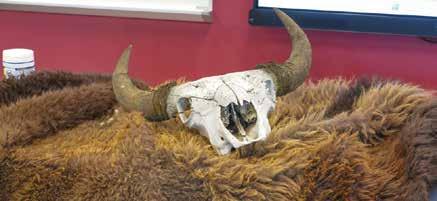
The concept of blood quantum dates back centuries and was later used by the federal government to define and limit Native rights and land ownership. Tribal enrollment standards vary across the U.S., with some tribes lowering the blood quantum requirements and other ancestral lineage. The Confederated Tribes of the Umatilla Indian Reservation are expected to discuss potential changes to their blood quantum requirement in the coming months. (Yasser Marte/The CUJ)
BLOOD QUANTUM: CTUIR has seen decline in enrollment over past four years
Continued from Page A3
General Council meeting with some understanding and any questions they may have.”
After the work session, the BOT will forward all information to the General Council, which will present the consulting firm’s analysis, data, statistics and graphs to the community. Any proposed amendment to the enrollment code would likely require community input and approval through the tribe’s established governance process.
Lowering the blood quantum
The concept of blood quantum dates back centuries and was later used by the federal government to define and limit Native rights and land ownership, according to the Native Governance Center. Over time, it became embedded in federal policy and, in many cases, tribal constitutions.
Across the U.S., tribal enrollment standards vary, with some tribes lowering blood quantum requirements and others relying on ancestral lineage. The issue has been widely discussed and debated in Native American communities.
The CTUIR last revised its enrollment criteria in 1993. The enrollment requirement in the CTUIR Constitution Article IV, “Members,” states tribal membership includes:
1. All persons of Indian blood whose names appeared on the official census roll of the CTUIR as of July 1, 1949;
2. Have a parent or grandparent who is an enrolled member of
the CTUIR; and 3. Possess at least one-fourth degree of Indian blood from a federally recognized tribe within the United States.
However, Section 2.05 of the CTUIR Enrollment Code, titled “Dual Enrollment,” states “no person may be enrolled in the CTUIR if that person is enrolled in another federally recognized Indian Tribe within the U.S.”
The CTUIR Enrollment Office processes enrollment applications and relinquishments, issues Certificates Degree of Indian Blood (CDIB), tribal identification cards and traces family genealogy.
In addition, the office maintains records of tribal members and their addresses for mailings and announcements, as well as demographic information on tribal members and reservation residents for use by other departments and outside agencies.
The Enrollment Office also administers several tribal member benefits, including quarterly gaming distributions, minors’ gaming trust accounts, elders’ pension and Supplemental Security Income (SSI) plans and the tribe’s burial assistance program.
Lubrin said there are multiple scenarios that TPG was asked to research regarding changes to enrollment criteria, so impacts on services and tribal programs will vary.
“This will be a long, detailed process if the General Council wants to determine what options, if any, they would like to put to a
UNOFFICIAL Umatilla County Election Results
Preliminary results from the May 19 municipal election are in across Umatilla County. With voters weighing in on city council races, judicial positions and local ballot measures. While the totals remain unofficial and may change as additional ballots are counted, early returns show several candidates holding strong leads and multiple local measures either passing or failing by notable margins. Included here is a breakdown of the latest unofficial election results from Pendleton, Hermiston, Milton-Freewater and surrounding districts.
City of Milton-Freewater
Milton-Freewater City Council, Ward 1 John Lyon
(123) Write-in 3.15% (4) Total votes 127
Milton-Freewater City Council,
At-Large Position 2
Steve Irving 96.36% (583)
Write-in 3.64% (22)
Milton-Freewater City Council, At-Large Position 3
Wes Koklich 95.89% (536)
Write-in 4.11% (23)
Total votes 559
vote,” Lubrin said. “It will take a lot of conversations. If they decide on what options to vote on, it could possibly be placed on the November 2027 election ballot. Again, it will be the General Council determining what and when.”
Other Tribal Nations’ enrollment requirements
Across Indian Country, tribes are working to prevent population decline while working on preserving language and cultural traditions. Each nation takes its own approach, but enrollment policy remains the heart of tribal sovereignty.
The Confederated Tribes of the Warm Springs Reservation in north-central Oregon, which includes Wasco, Warm Springs and Paiute tribes, uses a one-quarter blood quantum requirement and a one-eighth adoption standard for certain cases.
The Nez Perce Tribe in Idaho requires a minimum of one-quarter Nez Perce blood quantum for enrollment.
Other nations have moved away from blood quantum entirely.
The Confederated Tribes of Grand Ronde, based in western Oregon and representing more than 30 tribes and bands historically removed to the Grand Ronde Reservation, has more than 6,000 enrolled members.
As of January 2025, it updated its enrollment criteria. Applicants must now demonstrate Grand Ronde Indian blood and descend from a biological parent or grandparent who was an enrolled member.
City of Hermiston
Hermiston Municipal Judge
Cameron R. Bendixsen 98.58% (1,739)
Write-in 1.42% (25)
Total Votes 1,764
Hermiston City Council, Ward I
Krista Van Veen 62.44% (1,323)
Jackie Linton 37.19% (788)
Write-in 0.38% (8)
Total votes 2,119
Hermiston City Council, Ward II
Roy N. Barron 73.03% (1,476)
Caleb Jacobs 26.52% (536)
Write-in 0.45% (9)
Total votes 2,021
Hermiston City Council, Ward III
Barbara J. Martin 64.14% (1,100)
Leeann Wornell 34.99% (600)
Write-in 0.87% (15) Total votes 1,715
Hermiston City Council, Ward IV
David Patrick McCarthy 70.12% (1,260)
City of Pendleton
In 2013, citizens of the White Earth Band of Ojibwe in Minnesota voted to replace a one-quarter blood quantum requirement with a lineal descent system, a change aimed at addressing long-term population decline.
Among the largest tribal nations in the country, the Cherokee people include more than 450,000 enrolled citizens across three federally recognized governments: the Cherokee Nation, the United Keetoowah Band of Cherokee Indians and the Eastern Band of Cherokee Indians. Each maintains its own enrollment system.
The Cherokee Nation in Oklahoma relies on direct lineal descent from individuals listed on the Dawes Rolls. The United Keetoowah Band, also in Oklahoma, requires documented descent from the Dawes Rolls and a minimum onequarter Cherokee blood quantum.
The Eastern Band of Cherokee Indians in North Carolina requires applicants to trace lineage to a direct ancestor on the 1924 Baker Roll and maintain at least onesixteenth Cherokee blood.
The push to reshape enrollment policy is expected to take months to years, as CTUIR leaders and citizens discuss how potential changes would affect their dividends, scholarships, hunting rights, elder services and other benefits.
For now, the question remains open: whether adjusting the enrollment threshold could strengthen the community or redefine it in ways that reach far into the future.
Total votes 605 City Measures
CUJ
ABOUT THE CUJ
The Confederated Umatilla Journal (CUJ) was created in 1975 as the official publication of the Confederated Tribes of the Umatilla Indian Reservation (CTUIR), which includes the Cayuse, Umatilla and Walla Walla people. The CUJ is produced monthly by the CTUIR Communications Department.
PUBLISHER: Kaeleen McGuire kaeleenmcguire@ctuir.org
EDITOR: Yasser Marte yassermarte@ctuir.org
REPORTER: Beau Glynn beauglynn@ctuir.org
ADVERTISING: M. Moses-Conner cuj@ctuir.org
CONTRIBUTORS: Kathy Aney Dallas Dick Annie Fowler Lee Gavin Wil Phinney Travis Snell Aaron Wooden Sammantha McCloud
Pendleton City Council, Ward 1
Russell Nicolai 55.26% (410)
Ive Rixe 33.83% (251)
Jose Angel Perez
Write-in
(75)
(6)
Total votes 742
Pendleton City Council, Ward 2
Cody Jones 56.22% (583)
Ellie McBride 43.39% (450)
Write-in 0.39% (4)
Total votes 1,037
Pendleton City Council, Ward 2 (2-Year Unexpired Term)
Joseph Hull 49.80% (493)
Sean Butler 43.74% (433)
Caleb Montgomery 6.16% (61)
Write-in 0.30% (3)
Total votes 990
Pendleton City Council, Ward 3
Kristi Jenness 76.86% (1,199)
Marie Pratuch 13.27% (207)
Alicia Reynen 9.23% (144)
Write-in 0.64% (10)
Total votes 1,560
Pendleton City Council, At-Large
Debbie L. Kishpaugh 55.61% (1,889)
Addison Schulberg 43.89% (1,491)
Write-in 0.50% (17)
Total votes 3,397
CONTACT US Confederated Umatilla Journal 46411 Timíne Way Pendleton, OR 97801 email: cuj@ctuir.org phone : 541-429-7005
EMAIL ADVERTISING, LETTERS TO THE EDITOR, AND OTHER SUBMISSIONS TO: cuj@ctuir.org
ADVERTISING DEADLINE: 20th of the month prior to publication. The CUJ prints on the first Thursday of each month.
City of Milton-Freewater Measure 30-173
to the city charter
(565)
(198)
votes 763 City of Pendleton Measure 30-170
option levy for Fire and Ambulance operations
(2,057)
(1,752)
votes 3,809
City of Athena Measure 30-172
Athena-Weston School District, 29RJ: Bonds for Career, Trades, Technical Education Center; expand student opportunities
(532)
(486)
votes 1,018 City of Echo Measure 30-171 Echo Fire District, 7-403: Five-year general operations local option tax.
(195)
36.69% (113) Total votes 308
SUBSCRIBE: The CUJ is free to pick up at tribal entities and area businesses. However, a mailed subscription can be purchased for the price of shipping and handling by contacting the CTUIR Finance Department. Call 541-429-7150 or visit the Finance Department in person at Nixyáawii Governance Center, 46411 Timine Way, Pendleton. One Year: $15 Two Years: $28
For more information or daily news, visit the CUJ online at: cuj.ctuir.org
Wanaket burrowing owl project holds steady
YASSER MARTE
The CUJ HERMISTON — It is dark when the Wildlife Habitat team arrives at Wanaket Wildlife Area, well before sunrise, to begin setting traps for burrowing owls.
The crew started at about 4:30 a.m. at the Wanaket Wildlife Area on May 22, moving quietly across the terrain as they set equipment and checked for signs of activity. The early hours are deliberate and chosen to match the owls’ hunting patterns.
Lindsay Chiono, a wildlife habitat ecologist with the Department of Natural Resources (DNR) of the Confederated Tribes of the Umatilla Indian Reservation (CTUIR), said that when the team arrives at a burrow site, they typically work with two artificial burrows. They open both to determine which one contains the nest. Once they locate the nest, they often find a female owl inside.
They carefully open the burrow, remove the female and record her band number if she already has one. If she is unbanded, they place a band on her and take standard measurements, including her weight, before returning her to the burrow.
The team then sets a trap outside the burrow for the male or both adults, depending on which birds have already been captured. The trap for the male includes an MP3 player and speaker that plays the call of a young male owl. The recording is intended to provoke a territorial response, leading the adult male to investigate and enter the trap.
After setting the traps, the researchers leave the area for about 60 to 90 minutes to allow the owls time to inspect the setup and
become captured. Once they catch the adult male, they repeat the same process — checking his band number or applying a new band if needed, taking measurements and then releasing him.
“We check for the nest, we count how many eggs have been laid and if any chicks have hatched, then we will figure out how old they are,” Chinono said. “And the reason we do that is we want to come back when the chicks are about 21 days of age to band the chicks.”
She noted that researchers wait until that stage because chick mortality is fairly high, around 50%. Banding too early risks placing bands on chicks that may not survive.
At about 21 days, the chicks are much closer to fledging, when they leave the nest. At that point, the team is more confident that the
bands will remain on birds that survive to adulthood.
Chiono worked alongside Rich Scheele, a DNR wildlife biologist, and was joined this summer by Gabriel Watson, a student of Walla Walla Community College, who participated in a seasonal fellowship with the team.
Watson said conserving local burrowing owl populations is important for expanding habitat opportunities for the species. He noted that his favorite part of the project has been handling the owls and observing them up close. He said he has especially enjoyed seeing the birds in the field, including several chicks this season.
The trio worked through sunrise, setting traps and once all traps were set and mapped, the team hiked across the area to check each one. As the sun rose, temperatures
increased across the Columbia Plateau habitat.
The CTUIR manages the Wanaket Wildlife Area to protect and enhance wildlife habitat. The area includes over 2,700 acres of upland, wetland and aquatic habitats that support many important natural and cultural resources.
With support from David Johnson, director of the Global Owl Project, who previously built the burrow network at the former Umatilla Chemical Depot, the DNR Wildlife Program established a network of 20 artificial burrow sites at Wanaket Wildlife Area.
Each site contains two burrows, designed to meet the burrowing owls’ nesting and storage needs. In a typical setup, the owls nest in one burrow while the male uses the second to cache food.
The first site was constructed in 2009, with additional burrows installed incrementally between 2010 and 2023.
Chiono said it took years for the owls to locate and begin using the system and Wanaket did not record its first nesting activity until 2018. That initial success included one breeding pair and one successful nest.
What followed was five years with no recorded nest, but in recent years, occupancy has begun to slowly climb.
According to DNR, by 2024, a single breeding pair returned and successfully nested. In 2025, activity increased to three breeding pairs, all of which produced successful nests.
Now, with 2026 marking the third consecutive year of active nesting, biologists are seeing continued
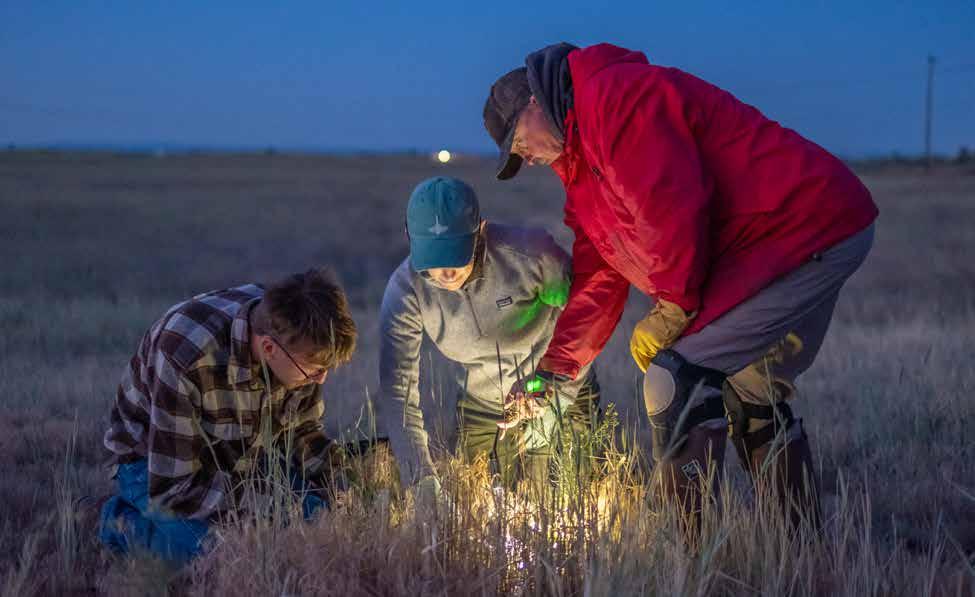
Employees with the Confederated Tribes of the Umatilla Indian Reservation (CTUIR) Department of Natural Resources (DNR) Wildlife Habitat team prepare to set traps for burrowing owls before sunrise on May 22 at the Wanaket Wildlife Area in Hermiston. From left to right, Gabriel Watson, a student of Walla Walla Community College, Lindsay Chiono, a DNR wildlife habitat ecologist, and Rich Scheele, a DNR wildlife biologist. (Yasser Marte/The CUJ)
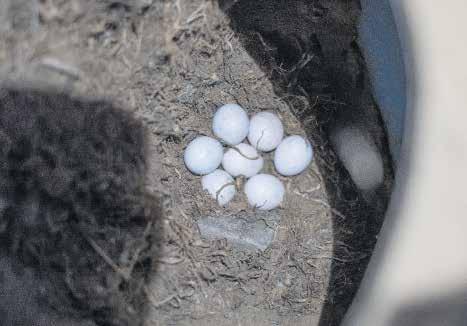
Seven eggs laid by a female burrowing owl rest inside the bird’s nesting burrow on May 22 at the Wanaket Wildlife Area in Hermiston. The eggs indicate an active nesting site and successful use of the habitat structures installed to support burrowing owl breeding and habitat establishment in the area. (Yasser Marte/The CUJ)
Rees Training Center wins Army environmental award
THE CUJ
HERMISTON — Rees Training Center (RTC) has received a 2026 Secretary of the Army Environmental Award, according to the Army’s press release.
The Army training center announced April 17 that it won in the Natural Resources Conservation, Small Installation category, the Assistant Secretary of the Army for Installations, Energy and Environment said.
The award recognizes mission-focused environmental management and is among the Army’s highest honors for environmental stewardship, according to the press release. As a category winner, RTC advances to the 2026 Secretary of Defense Environmental Awards competition, with final results expected in June.
“The award reflects the hard work of an entire team committed to proving that environmental stewardship and military readiness go hand in hand and directly supports our soldiers’ ability to train,” the press release stated. “Through the connections with our partners, like the Confederated Tribes of the Umatilla Indian Reservation (CTUIR), we have invested in making Rees Training Center a model for what competent and responsible land stewardship looks like on a military installation.”
Located on 7,500 acres at the former Umatilla Chemical Depot near Hermiston, RTC supports the Oregon Army National Guard and regional forces with weapons ranges, maneuver areas, tracked vehicle driver training and a Regional Training Institute.
The installation is also home to
one of the Department of Defense’s (DOD) most significant Western Burrowing Owl conservation programs, protecting a species listed by the U.S. Fish and Wildlife Service as a Bird of Conservation Concern and designated a DOD Military Sensitive Species.
When the depot was under Army management in 2008, the owl population had fallen to just four nesting pairs. Through sustained conservation work in partnership with the CTUIR, RTC and adjacent tribal lands now support more than 80 nesting pairs across 11,500 acres, making RTC a model for burrowing owl recovery across the DOD.
Central to the program’s recent success is a low-cost artificial burrow system built from 55-gallon barrels donated by the local Tree Top plant. Each burrow is relocatable to avoid conflict with active training operations, a design
approach that reflects the program’s core philosophy.
Rhande Shaw, Natural Resources specialist for the Oregon Military Department, said the agency’s work with the Western Burrowing Owl at RTC shows environmental stewardship and military readiness can complement each other.
“By strategically placing artificial burrows, we are able to carefully deconflict wildlife habitat from active training,” Shaw said. “Our priority is always the mission and ensuring soldier training remains unimpeded while conserving natural resources and that is what makes working for this program so rewarding.”
Last year’s donation of 100 barrels from Tree Top will yield 200 burrows. The design has been adopted by the CTUIR and drawn interest from University of Boise scientists and Idaho Army National
Guard environmental staff, who visited RTC to observe construction and installation. RTC also hosted a DOD Avian Knowledge Network owl training event open to Army, Guard, tribal and state agency participants. Beyond burrowing owl habitat work, the RTC has also focused on reducing cheatgrass and wildfire risk along Coyote Coulee through prescribed fire followed by targeted herbicide treatment.
The installation has since signed an intergovernmental agreement with Oregon State University and the U.S. Geological Survey Fire, Invasives and Rehabilitation of Shrub-Steppe Rangelands Team to reseed more than 350 acres with native grasses and forbs. Data from the partnership will be used to develop customized fire models and update the center’s Integrated Wildland Fire Management Plan.
OWLS: Continued growth in occupancy renews optimism among wildlife staff
Continued from Page A3
growth in occupancy since 2024. The trend has renewed cautious optimism among wildlife staff that the habitat improvements are beginning to take hold more consistently across the site.
The team checked 14 nest sites and set traps at two locations. At both of those sites, they found eggs—seven to eight in each nest— confirming two active nests.
“Means things are more or less holding steady,” she said. “We had hoped that things were increasing from last year, so we hoped for more like four nests,” she said.
She said the goal is for steady or gradual growth in nesting activity over time, rather than decline.
Active nests in previously used sites are a positive sign, she added, suggesting site fidelity among adult owls or their offspring.
Chiono said the projects, including work at the Umatilla Chemical Depot, began because the burrowing owl is not listed as threatened or endangered but is still considered a species of concern due to declining populations. The artificial burrow structures serve as a short-term measure while longerterm habitat issues are addressed.
“Structures are kind of a stopgap measure until we can make larger-scale progress on the
real problems facing burrowing owls, which are habitat loss and loss of prey population. These artificial burrows, they work, they demonstrate effective solutions, but they are high maintenance,” she said.
The approach is not a permanent solution to broader population declines but still provides meaningful support, she added.
“It’s not gonna be a practical solution to the larger-scale problem. But it helps us for now,”
Chiono said.
She noted that conservation work on burrowing owls is more feasible than efforts for some other grassland species that depend on shrinking habitats such as sagebrush ecosystems.
“There are several grassland and sagebrush-dependent bird species that are sometimes found at Wanaket that are much harder to help because they depend on sagebrush cover, and we have so many fires these days that it’s hard to stop the tide of sagebrush loss,” she said.
She said those broader ecological pressures are difficult to manage directly, while the burrowing owl project remains a more practical intervention. “So the things that are facing those species are a little harder to put our hands around. This is something we know we can do,” she said.
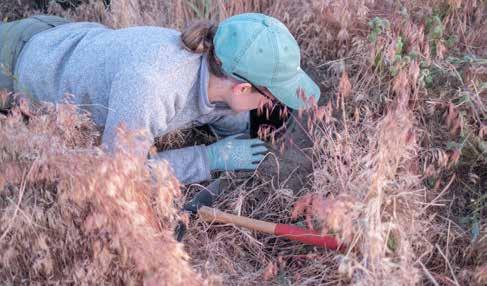
Lindsay Chiono, a wildlife habitat ecologist with the Confederated Tribes of the Umatilla Indian Reservation Department of Natural Resources, inspects a burrowing owl nest site on May 22 at the Wanaket Wildlife Area in Hermiston to survey owl activity and habitat use. (Yasser Marte/The CUJ)
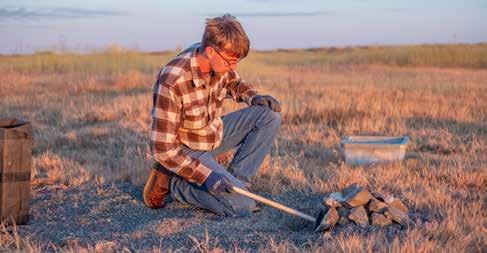
Gabriel Watson, a student at Walla Walla Community College, clears cobwebs and spiders from a burrowing owl trap on May 22 at the Wanaket Wildlife Area in Hermiston. (Yasser Marte/The CUJ)
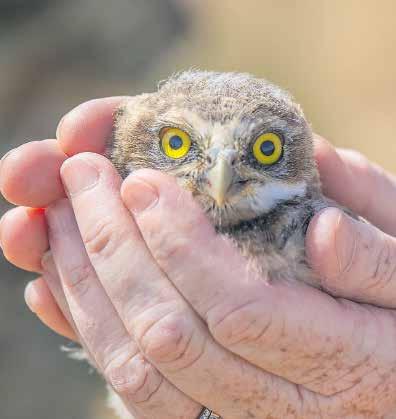
A visitor holds a burrowing owl chick in June 2025, during monitoring and banding operations at Rees Training Center in Hermiston. (U.S. Army National Guard Maj. W. Chris Clyne/Contributed photo)
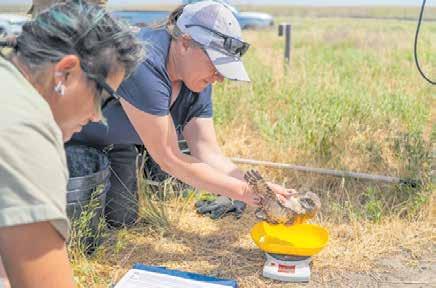
Rhande Shaw, left, Natural Resources specialist for the Oregon Military Department (OMD), records data while Janet Johnson, program manager of OMD, places a burrowing owl on a digital field scale on June 11 during monitoring operations at Rees Training Center in Hermiston. (U.S. Army National Guard Maj. W. Chris Clyne/Contributed photo)
MESSAGE FROM CTUIR LEADERSHIP
Working to protect treaty rights and sovereignty
In late April, the Northwest Native Economic Summit, co-hosted by the Affiliated Tribes of Northwest Indians (ATNI) and our own Nixyáawii Community Financial Services (NCFS), brought tribal leaders together at Ilani Casino in Ridgefield, Washington.
The summit provided an opportunity to learn from other ATNI tribes working to diversify their economies and assist tribal members in their ventures.
I was pleased to share that the Confederated Tribes of the Umatilla Indian Reservation (CTUIR) now has a Workforce Development Department to help tribal members prepare for their futures.
Breakout sessions focused on various topics, including tourism, energy sovereignty, housing, land buy-back funding strategies, natural resources, philanthropy in Indian Country and holistic food systems.
During the energy breakout session, participants discussed how energy development is repeating history by moving forward with little regard for tribal and environmental impacts. Tribes continue working
to restore and protect the environment for salmon, big game and future generations. Too often energy projects focus only on the economy and jobs while overlooking the environment we all depend on.

KATHRYN BRIGHAM Chair, CTUIR Board of Trustees
At an Indigenous journalism panel, participants suggested developing a strategy to help people better understand that everyone benefits when tribes work to protect treaty rights. The environment does not recognize boundaries, so protecting natural resources benefits all communities, not just tribes.
Also in April, the CTUIR Board of Trustees (BOT) approved a strategic trip to Washington, D.C., to seek congressional support and assistance in protecting our 1855 Treaty. We are all concerned about “prediction markets” because they may unlawfully affect tribal sovereignty, tribal services and our communities.
Prediction markets are platforms
where people place bets on the outcome of future events such as elections, sports, economic trends or world events. People buy and sell predictions based on what they believe will happen. The going price reflects how likely participants think an outcome is.
Supporters say prediction markets can help forecast events, but concerns remain about gambling, lack of regulation, insider information and impacts on tribal sovereignty and gaming rights. As these markets continue to expand into many areas, tribes, states and federal agencies are closely watching ongoing court cases and regulatory decisions that may affect tribal governments, communities and existing gaming laws.
CTUIR and other tribes have reminded federal agencies of their trust responsibilities to uphold tribal sovereignty, protect federal Indian law and respect federal, state and tribal gaming laws.
We were also honored to see the original 1855 Treaty again. It was meaningful for our team to view the treaty together and take pictures.
The United States was once entirely Indian Country. Today, 14 states no longer have tribal reservations, but 575 federally recognized tribes remain through ratified treaties, executive orders or legislation recognizing and restoring tribes as sovereign nations with governmental responsibilities similar to the federal government.
The CTUIR government continues working alongside its staff to protect the 1855 Treaty for future generations. Our ancestors thought and fought for us. Now it is our time to plan and fight for future generations.
Finally, congratulations to all our graduates. I know the journey was tough at times, but now you are opening the next door to your future.
If you have questions or want to connect, please reach out to me at katbrigham@ctuir.org or 541-9754877. Thank you for staying engaged and supporting our shared future.
Tribal delegation visits Washington, D.C.
The Confederated Tribes of the Umatilla Indian Reservation (CTUIR) sent a leadership delegation to Washington, D.C., May 1116 to speak with elected officials regarding the CTUIR’s priorities, including Rep. Dan Newhouse (WA-R) who serves in the CTUIR’s Washington ceded territory.
A lead priority was prediction markets, where people can trade on the outcome of events, including sports games and they stand to threaten tribal gaming by bypassing hardfought and thorough gaming regulations and agreements. The CTUIR Board of Trustees (BOT) delegation including BOT Chair N.
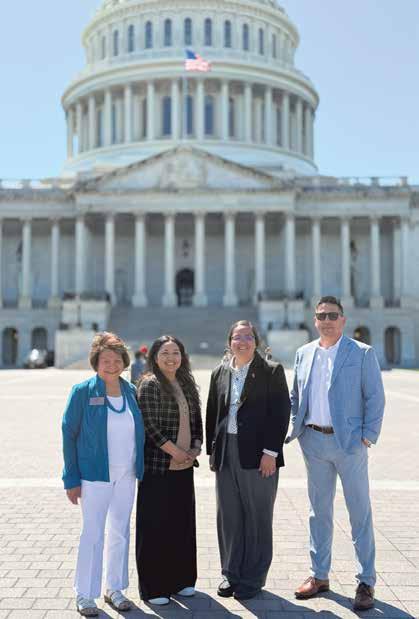
Kathryn Brigham, Vice Chairman Aaron Ashley, Secretary Monica Paradise and Trustee Sierra Quaempts.
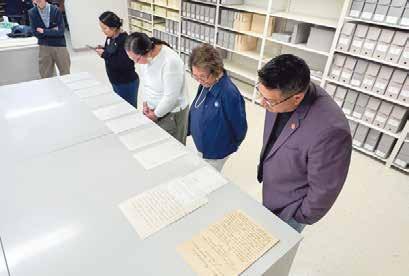
On the final day, the delegation visited the National Archives to view the Treaty of 1855, which was a powerful reminder of what was being fought for on the trip.
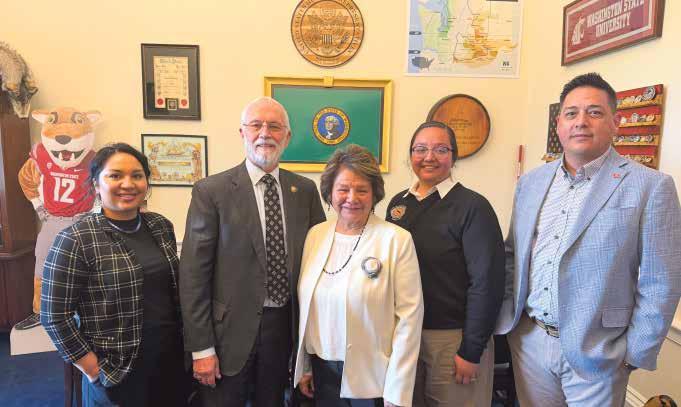
A delegation of elected leaders of the Confederated Tribes of the Umatilla Indian Reservation (CTUIR) ventured to Washington, D.C., May 11-16 to discuss the priorities of the CTUIR with elected leaders. From left, Board of Trustees Secretary Monica Paradise, Rep. Dan Newhouse (WA-R), Chair N. Kathryn Brigham, Trustee Sierra Quaempts and Vice Chair Aaron Ashley. (Kaeleen McGuire / The CUJ)
From left, Board of Trustees Secretary Monica Paradise, Trustee Sierra Quaempts, Chair N. Kathryn Brigham and Vice Chair Aaron Ashley visit the National Archives to view the Treaty of 1855.
(Contributed Photo)
CTUIR Board of Trustees Chair N. Kathryn Brigham, Secretary Monica Paradise, Trustee Sierra Quaempts and Vice Chair Aaron Ashley stand in front of the Capitol Building in Washington, D.C. (Kaeleen McGuire / The CUJ)











We belong here
Twenty years ago, this spring, I graduated from college.
Like many graduates, I was excited, uncertain and hopeful about what came next. I now know much of my experience and opportunities have been shaped by people who believed in me, encouraged me and, most importantly, kept the door open for me.

KAELEEN MCGUIRE CTUIR Director of Communications
That thought was on my mind recently as I traveled to Washington, D.C., with Confederated Tribes of the Umatilla Indian Reservation (CTUIR) leadership.
One of the most meaningful moments of the trip was viewing the Treaty of 1855 at the National Archives. Seeing the treaty, preserved with such care and still carrying the signatures and promises that continue to shape our lives today filled me with pride, gratitude and a renewed sense of responsibility.
The treaty is not simply a historical document. It is a living reminder of who we are, what our ancestors fought for, and tribal leadership continues to fight for.
Viewing our original treaty was a powerful reminder that our ancestors expected us to have a voice and to use it. They expected us to advocate and protect what was promised for future generations. Protecting our people and defending our treaty rights is our ongoing obligation.
A few years ago, I attended a meeting with tribal leadership and an elected official. Others were there and someone turned to me and asked a question I have never forgotten:
“And what would your role be here?”
The question was not asked out of curiosity. It was asked in a way that suggested I must justify my presence.
At the time, I answered politely and moved on. Looking back, I wish I had responded differently.
My role was the same as it is today: support tribal leadership, advocate for our people and do the job I was hired to do.
I did not need their permission to be there.
Moreso, the question reflected something many women experience. Our presence is questioned, our experience is disregarded, and our seat at the table is treated as
something that must be earned over and over again.
That experience taught me something important. The issue was never whether I belonged in that room. The issue was that someone felt entitled to question it.
Over time, I have learned that belonging is not something given by others it comes from knowing oneself, understanding the purpose that brought you there and refusing to let egos or doubt diminish your voice.
I often think about that moment, especially when I watch women lead and advocate on our behalf on Capitol Hill. Their leadership reminds me that representation is not symbolic; it is essential. When decisions are being made that affect tribes, elected officials need to hear directly from tribal leadership and from the tribal people whose communities are impacted. Tribal voices matter.
Walking through the halls of Congress, meeting with elected officials and participating in conversations that directly impact us reminded me once again why representation matters. It also brought that earlier experience back to mind. This time, however, there was no question about why I was there. I was there to support our leadership, share our perspectives, and help advance the priorities of our people.
I know I still have a great deal to learn in my role and in life, and I am committed to improving every day. I will continue to listen, learn and work hard, and make my loved ones who are no longer with us proud.
Tribal women should not have to justify why they belong in rooms where decisions are made that affect our people.
We earned our place in those rooms through our work, our knowledge and our commitment to our sovereignty secured by our treaty. We belong there because our voices matter.
And we belong there because generations of women before us worked hard to ensure that we would have the same opportunities.
KAELEEN MCGUIRE is the director of Communications for the Confederated Tribes of the Umatilla Indian Reservation and the publisher of the Confederated Umatilla Journal. Her first job was with the CUJ.
Art, dialogue and summer days
Summer is almost here.
That means dipping in the river, concerts in the park, community parades and sunsets that seem to linger a little longer than they should. School is wrapping up, graduation caps are flying and a new generation is preparing for whatever comes next.
To the graduates: congratulations. You made it through one chapter and now another begins. Enjoy this moment. Celebrate with your friends and family. The future will be waiting for you tomorrow.
Normally, this space is where I talk about the stories in this edition or weigh in on an issue making headlines. This time, I’d rather keep it simple: enjoy your summer.
That doesn’t mean there isn’t plenty to discuss in these pages.
This edition includes an illustration and concept art to help tell a story. Decisions like that don’t happen lightly. They require discussion, review and careful consideration. In this case, there were no photographs to capture because the issue exists largely in conversation, debate and possibility. Yet the discussion itself is newsworthy and deserving of thoughtful presentation.
Art has always reflected life. Whether it’s a painting, a song, a film or a novel, its purpose is to communicate something meaningful. The illustration in this edition is no different. It reflects the subject at hand and offers another way to engage with an important
community conversation.
At the CUJ, we encourage thoughtful risk-taking from our reporters, photographers and contributors. We do it in service to the community and in pursuit of stronger storytelling. We hope readers find value in that effort.
The major topics in this edition — blood quantum and the recent nuclear virtual town hall — have already sparked passionate responses throughout the community. They will likely continue to do so for months ahead.
And that’s OK.
One thing I’ve always appreciated about this community is its willingness to speak plainly. People care enough to show up, ask questions, challenge ideas and voice concerns. They don’t always agree, but they participate. That engagement is a sign of a community that remains invested in its future.
That’s healthy.
If you have thoughts on the issues affecting our community, send us a letter to the editor. We welcome respectful perspectives and would be glad to consider them for publication. Keep speaking up. Keep sharing your views. Conversations about the future should involve everyone.
But while those discussions continue, don’t forget to enjoy the season in front of you.
Take the long walk. Go to barbecues. Attend the local events. Visit family. Travel if you can. Read
a few novels. Go to the movies. Cool off by the river. And please take the time to enjoy the sunset. Summer doesn’t last forever. As always, thank you, gracias and qayciyáwyaw.


YASSER MARTE Editor, The CUJ
CTUIR to host nuclear energy town hall
BY BEAU GLYNN
The
CUJ
MISSION — A virtual town hall will take place on June 17 to give members of the Confederated Tribes of the Umatilla Indian Reservation (CTUIR) the opportunity to voice
their opinions to their elected officials about nuclear development — a longstanding issue since the Hanford Nuclear Reservation became the first full-scale plutonium reactor in 1943.
“CTUIR leadership have felt that




it’s important to have a community discussion about what U.S. Energy Secretary Chris Wright has called the ‘nuclear energy renaissance,’ and how to potentially update its policies to respond to that,” CTUIR Legislative Affairs Manager Sterling Cosper said.
In February 2025, Wright signed a secretarial order aimed to “Unleash the Golden Era of American Energy Dominance,” in accordance with President Trump’s executive orders.
“As global energy demand continues to grow, America must lead the commercialization of affordable and abundant nuclear energy,” Wright said in the secretarial order. “As such, the Department will work diligently and creatively to enable the rapid deployment and export of nextgeneration nuclear technology.”
Cosper said, with the Hanford site being within CTUIR ceded territory, nuclear energy has been a longstanding issue impacting treaty rights and the natural environment of First Foods.
In 1980, Ballot Measure 7 was passed by Oregon voters halting the creation or storage of new nuclear waste until there was a permanent waste repository. As recently as 2025, there have been efforts to restore a focus on nuclear energy intended to repeal Ballot Measure 7; no bills have been passed in the state of Oregon.
Cosper said the motivation to set the revival of nuclear energy relates to the increasing numbers of hyperscale data centers in the region and across the country intended to support artificial intelligence (AI) development.
“As from what we’ve gathered, they are placing a substantial new strain on a power system that has already faced longstanding challenges, which is why nuclear is back in the public conversation,” Cosper said.
The CTUIR is keeping the topic of
nuclear energy at the forefront of tribal members’ minds by inviting them to participate in the town hall.
Cosper said CTUIR elected officials are doing the town hall, and it’s related survey, to get a better sense from tribal members about how they feel about nuclear energy and the first comprehensive CTUIR policy to address it.
“A big point of the town halls, I think, is to inform members specifically what the CTUIR government is trying to accomplish with this new policy effort, including what it actually states,” Cosper said.
The Draft Nuclear Policy Survey is intended to complement the town hall. Cosper noted that some tribal members would be more comfortable voicing their thoughts and opinions in an anonymous format or feel they can better communicate that way.
“This is not only to share their general take on the policy, but they may also think of something that the CTUIR team hasn’t,” he said.
Within the survey is supplemental information about the history the CTUIR shares with nuclear energy development, as well as a summary of the draft Policy. In the draft are the overarching goals of the policy, what the tribe opposes pertaining to nuclear energy development, plans for oversight, mitigation of negative impacts, monitoring and more.
Survey participants will have the opportunity to give their opinions on the CTUIR’s Nuclear Policy, the need for preparedness of strategic representation, their support or lack thereof pertaining to nuclear energy, the most concerning aspects of it and the most beneficial. Among other questions, survey participants can ask additional questions or comments they would like to see discussed at the June 17 virtual town hall.
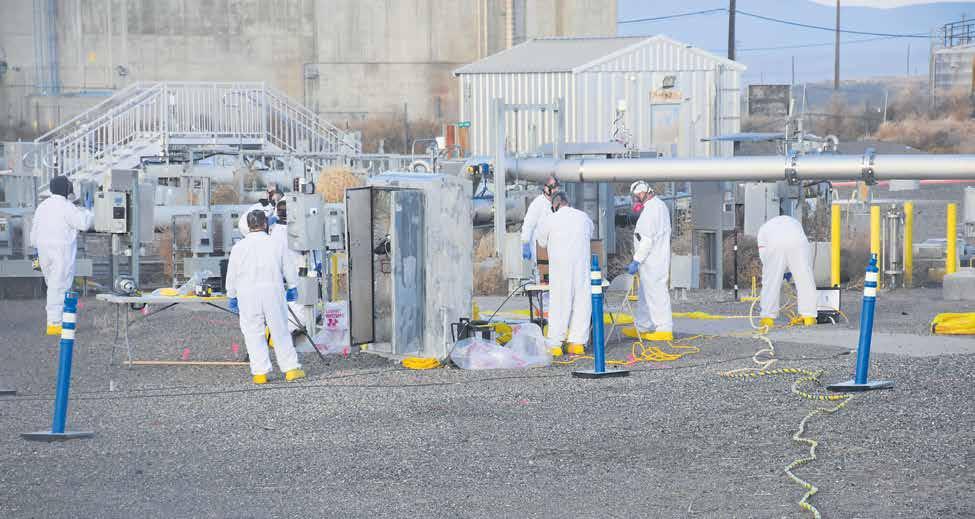
Crews with Hanford Tank Waste Operations & Closure - H2C pump water out of an access pit for Tank SY-103 in the 200 West Area in December 2025 as part of ongoing preventive maintenance at the Hanford Nuclear Site in Washington. Removing water from these pits helps keep tank foundations safe, which helps the site meet safety and operational standards. (Hanford Site/Contributed photo)
1940–1985
● 1943 – The Hanford Nuclear Reservation (Hanford) became the site of the first full-scale plutonium reactor. Waste accumulated there and was poorly managed, leading to ongoing issues that continued to be mitigated.
● 1972 – Construction began on the Columbia Generating Station (CGS), the only commercial nuclear reactor completed at Hanford.
● 1980 – Oregon voters approved Ballot Measure 7, restricting new nuclear waste generation or storage without a permanent national repository and requiring voter involvement in nuclear facility siting.
● 1983 – The 1982 Nuclear Waste Policy Act recognized the CTUIR as an affected tribe whose reservation contained a radioactive waste repository or whose treatydefined rights on land outside its reservation were adversely affected by a nuclear facility.
● 1984 – The CGS began providing more than 1,200 megawatts (MW) of electricity to the regional grid. As of 2026, it remained Hanford’s only operational nuclear plant.
2000–2010
● 2001 – The Western energy crisis affected the Bonneville Power Administration (BPA), which contributed to major financial losses and reduced funding for fish and wildlife programs.
● 2003 – The Columbia River InterTribal Fish Commission (CRITFC) published an Energy Vision emphasizing protection of salmon and opposition to harmful energy development.
● 2007 – CTUIR adopted its Hanford Policy, opposing new nuclear development at Hanford without tribal consent and requiring safe disposal of high-level waste in a national repository.
● 2009 – The CTUIR Board of Trustees (BOT) adopted an energy policy guiding energy development and responses to regional energy issues. The policy incorporated language from CRITFC and the Affiliated Tribes of Northwest Indians (ATNI), and referenced the CTUIR Hanford Policy in its nuclear provisions.
CTUIR NUCLEAR TIMELINE
2019–2023
● 2019 – Washington Gov. Jay Inslee signed the Clean Energy Transformation Act (CETA), which required Washington’s electricity supply to be carbon-free by 2045.
● 2021 – The Washington Climate Commitment Act (CCA) was enacted to support emissions reductions under CETA.
The CTUIR opposed SMNR development at Hanford due to unresolved nuclear waste and environmental concerns and circulated its Hanford Policy to federal and state agencies, conditioning any deployment on a permanent waste repository.
● 2022 – The CTUIR continued monitoring SMNR development and engaged federal officials, including the U.S. Department of Energy, on Hanford-related issues. The Tribe reiterated its opposition to new nuclear development absent a national waste storage solution and emphasized concerns about ecological impacts and site safety. The CTUIR also adopted the CRITFC Energy Vision, which advised against new nuclear missions at Hanford without tribal consultation and consent.
● 2023 – Oregon legislation seeking to ease restrictions on nuclear energy development failed to advance. X-energy proposed an SMNR project at Hanford in partnership with Energy Northwest and Amazon, but later withdrew the proposal following opposition from the CTUIR and Columbia Riverkeeper.



2024
● FEB. 7 – The CTUIR sent a letter to the Washington Legislature opposing development of small modular reactors (SMNRs) at the Hanford site.
● MARCH 6 – Energy Northwest sought CCA funding for an SMNR project at Hanford. Washington lawmakers approved a $25 million capital budget allocation for SMNR development.
● MARCH 27–29 – The CTUIR and Columbia Riverkeeper requested a veto of the $25 million allocation.
Washington Gov. Jay Inslee signed the state budget, including the funding.
● SEPT. 26 –The Washington Department of Commerce notified the CTUIR regarding consultation requirements tied to releasing the $25 million in SMNR funding, stating that consultation must be initiated before funds can be released.
● OCTOBER –Amazon announced plans tied to SMNR development at Hanford to support data centers in Oregon’s Umatilla and Morrow counties, while Oregon’s nuclear moratorium remained in place.
2025
● JAN. 3 – CTUIR leaders met with Washington legislators to discuss SMNRs, beginning development of a tribal nuclear policy.
● FEB. 12–24 – Washington Commerce requested formal tribal consultation on funding tied to Energy Northwest’s proposed SMNR project. CTUIR directed staff to initiate consultation.
● FEB.– MARCH – Oregon lawmakers considered multiple nuclear-related bills, including proposals for an SMNR demonstration project in Umatilla County and state-level nuclear energy studies. The CTUIR provided testimony expressing concerns and requesting formal consultation.
● APRIL – Key nuclear-related bills stalled in committee before the legislative session ended.
● MAY 5 – Energy Northwest, Amazon, X-energy, and Washington Commerce presented the SMNR proposal to the BOT. The CTUIR stated the meeting did not constitute formal consultation, citing unresolved questions about state funding and tribal consultation requirements.
● MAY 23 – The Trump administration issued executive orders promoting nuclear energy expansion, including faster reactor licensing and increased domestic nuclear fuel production.
● JULY – The CTUIR began drafting a formal nuclear energy policy informed by prior tribal positions and regional energy developments.
● OCT. 14–16 – Washington Commerce and Energy Northwest advanced consultation discussions and announced the Hanford SMNR project.
● NOV. 5 – Washington voters rejected Initiative 2117, preserving the state’s Climate Commitment Act, which supported clean energy funding, including nuclear-related proposals.
2026
● JANUARY – The CTUIR began planning town halls to present its draft nuclear policy to tribal members, targeting June 18 for presentation to the General Council, with opportunities for public input. Washington and Oregon lawmakers introduced multiple bills related to nuclear energy and state energy strategy, including proposals to expand nuclear power and allow municipal contracting for nuclear energy. The CTUIR also worked with Oregon Rep. Bobby Levy on legislation to include protections for tribal interests.
● JAN. 13 & 15 – CTUIR General Council Chairman Lindsey X. Watchman and Trustee Lisa Ganuelas testified against Washington nuclear energy legislation (HB 2090/SB 5821), urging formal tribal consultation prior to project approvals and raising concerns about past energy development impacts and project timelines.
● MID–LATE JANUARY – Energy Northwest requested an additional $50 million in CCA funding through Washington’s capital budget process to support SMNR development, administered by Washington Commerce.
● JAN. 25 – The Washington Democratic Central Committee passed a resolution opposing HB 2090/SB 5821, citing tribal testimony from the CTUIR and Yakama Nation, concerns over nuclear project cost overruns, potential impacts on utility rates, and prioritization of energy for data centers and artificial intelligence.
● FEB. 6 – The BOT sent a letter to Washington lawmakers requesting the denial of Energy Northwest’s proposed $50 million in CCA funding.
● FEB. 12 – CTUIR staff filed a complaint with the Washington Governor’s Office of Indian Affairs regarding Washington Commerce’s handling of CCA funding related to the SMNR proposal.
● FEB. 23 – Washington’s capital budget entered House committee review, with the CTUIR monitoring whether Energy Northwest’s requested funding was included.





Thornhollow Bridge back in service
BEAU GLYNN
The
CUJ
MISSION — The Thornhollow Bridge is restored and open once again.
The Confederated Tribes of the Umatilla Indian Reservation (CTUIR), Oregon Department of Transportation (ODOT) and Umatilla County representatives held a ribbon-cutting ceremony on May 8 to celebrate the opening of the new bridge, restoring a key crossing on the Umatilla Indian Reservation (UIR) six years after a devastating flood damaged the structure.
The bridge, located about 13 miles east of Mission along Thornhollow Road, was severely damaged after devastating flooding in February 2020 and removed in 2022.
Permitting for the bridge construction was initially slated to start in 2025, but in March 2021 Umatilla County commissioners announced in a press conference that the process would be beginning four years earlier.
“It’s great to have this open again, because a number of tribal people have had to go to Cayuse, then go to Mission to go to Walla Walla,” CTUIR Board of Trustees (BOT) Chair N. Kathryn Brigham said. “This is much closer and safer.”
Before its destruction, the bridge served as the closest river crossing for residents north of the Umatilla River and in the Thornhollow area. Detours to the north or south of the crossing added about 16 miles
of travel, according to an estimate from ODOT Region 5 Manager Ken Patterson.
“To do that for a number of years, that’s a real pain,” Patterson said.
Construction on the bridge was completed on April 20, and traffic was allowed to cross the following day after liability was transferred from ODOT to Umatilla County.
HP Civil Inc. of Salem installed the bridge and built the approaching roadways on both sides.
The project cost was budgeted at $3.5 million courtesy of the Local Bridge Program through ODOT. The program includes bridge design, engineering, construction, right-ofway and construction engineering. Umatilla County provided a 10.27% match to the state funding.
“It’s been a project of frustration, of just pure non-patience,” Umatilla County Commissioner Dan Dorran said. “But it’s one of the greatest little projects that I’ve been around
as a politician, and this is the fourth bridge I’ve been able to be a part of in my almost six years (as commissioner).”
Dorran said there had not been a day in which he did not get a phone call regarding the bridge. He also said he was amazed how the funding cycle included everybody.
“I made this promise that we’d have this bridge back within two and a half years. Well, I’m two and a half years into my second term, so I’m going to go ahead and call that a win,” Dorran joked. “Let’s celebrate the Thornhollow Bridge, what it means to the tribes and what it means to everybody in Umatilla County, it wasn’t just tribal members bugging every day, I’ll guarantee you that.”
Patterson said that if this was the third bridge for the Thornhollow crossing location, he wants it to be the last one.
“This project for me is an
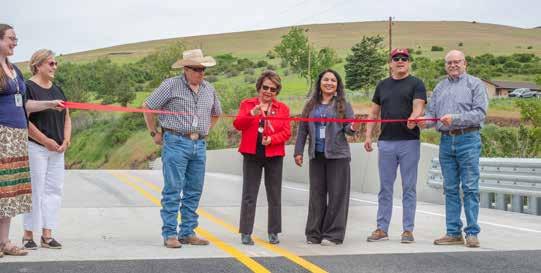
Confederated Tribes of the Umatilla Indian Reservation (CTUIR) Board of Trustees (BOT) Chair N. Kathryn Brigham cuts the ribbon on May 8 to open the new Thornhollow Bridge. Joining Brigham are, from left, CTUIR Planning Department Senior Planner Dani Schulte, Oregon Department of Transportation Region 5 Liaison Michelle Owen, BOT Treasurer Raymond Huesties, BOT Secretary Monica Paradise, BOT Vice Chair Aaron Ashley and Umatilla County Commissioner Dan Dorran.
example of persistence, resilience and creativity,” he said. “This road means something to everybody who uses it, for school, getting to work and emergency services, it’s an important road.”
Brigham said the UIR suffered several disasters during the 2020 flood, but the bridge loss was a major one. She said it was truly a partnership to get the bridge reconstructed because it could not have been done single-handedly.
“I just want to thank everyone in the community who wanted to see this open again. I want to thank you for your impatience. I think that persistence was really what got this done,” Brigham said. “It was a long project. It probably would have been even longer if we hadn’t had the people in the community demanding it, so thank you, everyone.”
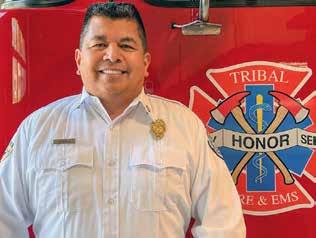
UTFD fire chief named to Governor’s Fire Service Policy Council
TRAVIS SNELL
The CUJ
MISSION – Giving a voice to Oregon-based tribal fire agencies, Umatilla Tribal Fire Department (UTFD) Chief James Hall was recently appointed to the Governor’s Fire Service Policy Council.
“I was honored to receive an official appointment by the Governor’s Office to serve as the Tribal Fire Response Agency representative,” said Hall, who is the council’s first Confederated Tribes of the Umatilla Indian Reservation (CTUIR) representative and first representative for the nine tribes in Oregon. “I believe it is extremely important that tribal communities have a voice in statewide fire service discussions, especially as Oregon continues to face increasingly complex emergency response challenges involving wildfire, hazardous materials transportation, EMS system demands and interagency coordination.”
Established in 2001, the council provides guidance to the governor and state fire marshal on issues affecting fire protection and life safety. It also serves as a statewide forum in which fire service leaders and public safety stakeholders can discuss issues impacting communities and develop policy recommendations and implementation strategies. The tribal representative position was added during Oregon’s 2025 legislative session to ensure tribal fire agencies have a voice in fire service policy discussions and emergency response planning.
Along with the tribal representative, the council includes representatives from the Oregon Volunteer Firefighters Association, Oregon Fire Chiefs Association, Oregon Fire District Directors Association, Oregon Fire Marshals Association, Oregon State Fire Marshal’s Office, Oregon State
Fire Fighters Council and other state agencies.
“The importance of the council has grown significantly as Oregon faces larger wildfire seasons, recruitment and retention challenges and greater needs for interagency preparedness planning,” Hall said. “Having this diverse representation is important because it brings together perspectives from emergency response, fire prevention, firefighter training, EMS, local government, tribal governments and statewide public safety leadership.”
Hall said the council meets quarterly and that his first meeting was in April. The next meeting is scheduled for July. In addition to formal meetings, members participate in discussions, workgroups, outreach efforts, policy development and coordination activities related to fire service preparedness, emergency response planning, firefighter training and interagency collaboration.
“I hope to strengthen communication and
collaboration between tribal, local, state and federal fire agencies throughout Oregon. I also want to ensure that the unique needs and challenges facing tribal fire departments are recognized in statewide policy discussions,” he said.
Hall added that his goals of representing tribal fire response agencies directly align with the council’s because many issues affecting tribal departments are also statewide concerns. The representation is also for tribes that do not have official structural/EMS departments but instead just wildland capabilities or are working on establishing or expanding capabilities.
“Tribal fire departments often operate in rural or geographically complex areas while coordinating with multiple jurisdictions and agencies. Challenges involving wildfire response, EMS staffing shortages, access to training, communications interoperability, hazardous materials preparedness and firefighter safety affect nearly every fire agency in Oregon,” he said. “By bringing tribal perspectives and operational experience into these discussions, I believe we can improve statewide coordination, preparedness and public safety outcomes for all communities.”
Hall said as someone who began in the fire service approximately 35 years ago as a volunteer firefighter with the UTFD, he considers it an honor to serve on the council.
“I take great pride in representing both the CTUIR and the nine tribes in the state of Oregon. I believe this appointment reflects the growing recognition of the important role tribal emergency services play in protecting communities, supporting mutual aid systems and participating in statewide emergency response efforts,” he said.
Changes to SNAP requirements put benefits at risk for some households
BEAU GLYNN
The CUJ
SALEM — Changes with the Supplemental Nutrition Assistance Program (SNAP) may put thousands of Oregonians at risk of losing their benefits.
On May 14, the Oregon Department of Human Services (ODHS) announced a requirement for all households to be interviewed when applying for or renewing their monthly food benefits; the requirement went into effect on June 1.
In a press release, ODHS said the change returns SNAP to standard federal rules, ensuring that benefits are accurate and reflect the current financial state of each household.
“These updates help make sure people receive the correct SNAP benefits for their current situation,” ODHS SNAP Director Jessica Amaya Hoffman said in the release. “Completing the interview and providing documents when requested helps us process benefits correctly and connect people to the full amount they qualify for.”
The release said some households were previously permitted to skip renewal interviews due to a temporary flexibility that started during the COVID-19 pandemic. Those included households were composed of all adults 60 or older, or met SNAP definition of disability and households where no one had income from work.
The now-required interviews help to confirm information, prevent errors, ensure households receive the correct benefit amount and connect them with the benefits and services they qualify for.
An additional release from ODHS on May 29 shared an update on the SNAP work rule and its impacts as Oregonians remain at risk of losing their food benefits.
In April, the ODHS warned that 6,948 Oregonians were at risk of having their benefits closed at the end of April due to federally directed changes to the SNAP work rules. An additional 6,309 people were at risk of losing or having their benefits reduced at the end of May.
The SNAP work rules expanded age requirements to span from 18 to 64 years old with no children under 14 after President Trump signed House Resolution One. People who don’t meet the work rules may lose SNAP benefits after three months. Previously, the age range spanned from 18 to 54 with no children under the age of 18 within the household.
The SNAP work rules require 80 hours each month of work or approved activities through paid work or self-employment, volunteering, trading work for housing or other needs by way of bartering, joining a SNAP Employment and Training program or any combination of those tasks. In addition to fulfilling the 80 work hours, applicants must also supply proof of work activities by way of paystubs or a signed letter from an employer, volunteer coordinator or the person the applicant trades work for through bartering.
People who do not meet work rules and don’t qualify for an exemption can only receive SNAP benefits for three months in a threeyear period; the ODHS refers to these as “countable months”.
On the ODHS website, exemptions
include pregnancy, being in school at least half-time, if the applicant is in drug or alcohol treatment (excluding Alcoholics Anonymous or Narcotics Anonymous support groups), receiving unemployment benefits, being an American Indian or Alaska Native and meet tribal eligibility or lived on waived tribal land due to high unemployment (Burns Paiute Tribe, Coquille Indian Tribe, Confederated Tribes of Siletz Indians, Cow Creek Band of Umpqua Tribe of Indians and the Klamath Tribes). Crook, Gilliam, Jefferson, Lake, Morrow, Sherman and Wheeler counties are also exempt because they do not have a WorkSource Center.
Oregon SNAP helps approximately 27% of household afford groceries. According to the ODHS, every dollar in SNAP benefits generates
$1.50 to $1.80 in local economic activity, driving an estimated $1.6 billion into the Oregon economy each year. These account closures or reductions represent nearly $2 million in SNAP benefits not being spent in Oregon communities, according to the ODHS in its May 29 release. The average monthly SNAP benefit for one adult statewide is around $183, meaning a single adult would receive roughly $2.29 per hour by fulfilling their required 80 hours of qualifying activities for the SNAP work rules.
Any households needing to apply or renew their benefits should ensure ODHS has current contact information, keep watch for messages or calls regarding interviews and respond to ODHS to avoid delays in benefits.
James Hall was appointed to the Governor’s Fire Service Policy Council as the first representative for Oregon’s tribal fire agencies. (Umatilla Tribal Fire Department/Contributed photo)
OBITUARIES
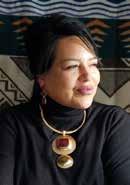
Leila Donavon Spencer-Wagenaar
APRIL 25, 1967 – MAY 17, 2026
Leila Donavon Spencer-Wagenaar will be remembered for her fierce love, strength, and unwavering devotion to her family and community. Her sudden passing has left a deep and profound loss for all who knew her.
Leila was also a gifted singer whose beautiful voice could move people to tears. Through her singing, she brought comfort, emotion, and spirit to those around her, leaving lasting memories for everyone fortunate enough to hear her.
She dedicated her life to her family, her people, and the values she believed in. Leila impacted generations, inspiring those around her to stand strong, advocate for themselves and for Indigenous rights, and to meet life with courage and determination. She was known for always being there when needed, offering support, guidance, and love without hesitation.
Her greatest joy was her family. Time spent with her loved ones was central to her life and brought her deep happiness and fulfillment. Through everyday moments and family gatherings alike, she created memories that will be cherished always.
Leila’s warmth, spirituality, and fierce love leave an irreplaceable space in the hearts of her family and community. Though her passing was sudden, her legacy of strength, love, and advocacy will continue through those she leaves behind.
She is survived by her husband, Edward Wagenaar; her daughters, Brittainey, Briana and Brosnan Spencer; her siblings, Leslie LeCornu and Joshua Spencer Sr.; her mother, Marcella Spencer; her grandchildren Lucious, Meadow, Roman and Trinity Spencer and Donnie, Micah, Deacon, and Marcellus Stewart. She was preceded in death by her father, Lester Spencer.
She will be deeply missed and forever remembered.
Delbert Edwin (Halfmoon) Ferraris
28, 1987 – MAY 3, 2026
Delbert Edwin (Halfmoon) Ferraris was born on May 28, 1987, in Pendleton, Oregon, and passed away on May 3, 2026, in his hometown. He was a proud member of the Confederated Tribes of the Umatilla Indian Reservation.
Delbert attended Rite of Passage school in Nevada and later Chemawa Indian Boarding School in Salem, Oregon, where he met his longtime partner, Janet Gibson. Together they shared and welcomed a son, Joseph Halfmoon, who was the joy of Delbert’s life.
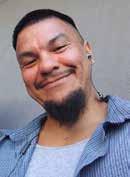
Delbert later attended trade school at Salish Kootenai College in Montana, where he studied to be a heavy equipment operator with a focus on Commercial Driving. He also briefly attended school in Chicago where he studied steel welding. He went on to work various jobs as a laborer.
An active person from an early age, Delbert valued fitness and staying strong, both physically and mentally. He played football. He trained in Jui Jitsu and wrestling at St. Andrews. He was known as a happygolucky soul with a generous spirit. Delbert helped whenever he could and never hesitated to stand up for those who could not stand up for themselves. At his best, he was warm, kindhearted, thoughtful, and fiercely loyal to the people he loved.
Delbert was the grandson of Louis “Tony” and Rosaline (Shillal) Van Pelt (maternal) and Carolyn Halfmoon (paternal). He is preceded in death by his mother, Jacqueline Phyllis Van Pelt; his father, Michael Joseph Halfmoon (Ferraris); and his sisters, Marsha Lynne Halfmoon and Karla Marilee Halfmoon.
He is survived by his son, Joseph Halfmoon; his brothers, Jake Ferraris (Halfmoon) and Robert Van Pelt; his nieces Leah Van Pelt and Sophie Van Pelt; his nephew Quention Van Pelt; and his significant other, Brycee Bear. Delbert will be deeply missed by his family, friends, and all who were fortunate enough to know him.
Leila Spencer-Wagenaar
Delbert Edwin (Halfmoon) Ferraris
CTUIR again contracts with LASO for legal aid to tribal members
THE CUJ

MISSION – The Confederated Tribes of the Umatilla Indian Reservation (CTUIR) is again teaming with Legal Aid Services of Oregon (LASO) to provide legal aid in civil cases to low-income tribal members.
The CTUIR Board of Trustees (BOT) recently approved a contract with the Native American Program of Legal Aid Services of Oregon (NAPOLS), which is a specialized LASO program serving Native tribes, organizations and individuals in Oregon. LASO is a legal services program serving the state’s lowincome communities.
“The Board of Trustees recognizes that civil legal representation can be quite costly to tribal members, even those earning above federal poverty levels, and has made the decision to again provide funding to assist tribal members with obtaining no-cost representation for certain civil matters,” Joe Pitt, CTUIR Office of Legal Counsel
(OLC) lead attorney, said.
The types of civil cases considered include issues such as family law, housing, government benefits, senior law, consumer issues, debtors’ rights/bankruptcy, employment, probate issues, criminal expungement and civil rights.
Pitt said LASO generally provides no-cost representation to individuals whose income is 125% or less of the federal poverty guidelines. However, the 2026 contract funds no-cost services to individuals whose income is above that threshold.
“It covers the range between 126% and 250% of federal poverty guidelines,” he said. “Normally, individuals in this income range would need to seek other options for representation at their own cost.”
While LASO representation is generally free, there are limited costs associated with initiating representation: $25 for individuals between 126% and 200% of the federal poverty guidelines and $50 for individuals above 200% of the guidelines.
“There may also be litigation expenses such as court fees, deposition costs, expert witness fees, etc.,” Pitt said. “However, while NAPOLS does not cover these costs, the contract includes mechanisms for these costs to be reimbursed by the CTUIR in certain circumstances.”
In the past, NAPOLS shared its specialist expertise, as requested on a case-by-case basis, with the attorneys at Pendleton LASO. Under the 2026 contract, NAPOLS will directly intake and review tribal member requests for services and determine which cases are accepted.
To increase service to CTUIR members, NAPOLS may also provide a referral to one of the regional LASO offices or one of the other two statewide offices – the Farmworker Program or the LowIncome Tax Clinic – depending on the specific legal question at issue. Also, regardless of whether a case is accepted for full representation, tribal members will either receive additional self-help legal resources or advice and counsel related to
their issues.
NAPOLS handles legal matters in Oregon’s federal courts, tribal courts within Oregon and various federal administrative forums. However, NAPOLS does not take cases for legal matters in out-ofstate courts. CTUIR members who have legal matters in other states could receive a referral to a legal aid service provider in that state.
The CTUIR first contracted with the LASO Pendleton Regional Office to provide similar services from 1998 to 2022. Following a twoyear absence, the BOT approved a similar contract with LASO in 2024. However, that contract expanded services to CTUIR members living throughout Oregon, unlike the previous contract, which was limited to five counties surrounding the Umatilla Indian Reservation.
Tribal members can call the LASO Pendleton Regional Office at 503224-4086 or the NAPOLS Portland Office at 503-223-9483 for help. For more information, visit https:// lasoregon.org/locations/nativeamerican-program/
Nixyáawii Community School hires new language arts educator
BEAU GLYNN
The CUJ MISSION — Nixyáawii Community School (NCS) has hired a new language arts educator to start teaching in the 2026-27 school year.

Cammila White grew up in Yamhill, Oregon, and earned degrees from Chemeketa Community College and continued to go to school at Oregon State University, Western Oregon University and Eastern Oregon University as she raised her four daughters.
“Along the way, I discovered how much I value learning not only about different people and cultures, but also from them,” she said.
White said she also spent time teaching second-language English in South Korea for four years.
“That experience changed the way I view education and reinforced the importance of connecting learning to students’ cultures, communities and real-life experiences.”
White has spent the past several years living and working in Wallowa County.
“What first stood out about NCS was the strong sense of connection between students, staff and the wider community,” White said.
“During the interview process, students shared experiences about teachers who helped them build confidence and feel connected to their culture. Those conversations will stay with me forever.”
NCS Principal Ryan Heinrich said four students sat in on the interview panel for both candidates considered for the position.
“They were very impressed with her, they brought a lot of good energy to the interview and had a lot of good ideas,” he said.
The panel also included two staff members, the NCS Board of Education chair and Heinrich.
The language arts position has been empty since spring break,
when the previous teacher, Nicci Harrison, resigned in solidarity with the release of math teacher Amanda Meyer as part of a reduction in force at the school. Heinrich said he and other NCS staff members have been picking up the slack in their absence.
“The more I learned about NCS, the more it felt like a community grounded in relationships, respect and learning that has meaning. I value place-based education and hope to continue growing by learning from students, families, coworkers and the community around me,” White said.
Heinrich said both candidates interviewed had experience teaching overseas and taught in the region, sharing similar backgrounds.
White said the uniqueness of NCS comes from its interconnectivity with the community. She said the way language, culture and community are woven into the students’ learning make a more belonging environment for them.
“That strong sense of identity and support is a big part of what makes NCS unique,” she said.
White said she wants the classroom to be a place for students to grow in confidence regarding their reading, writing, speaking and critical thinking.
“Representation always matters and the students will be reading books by authors whose stories are shaped by their own cultures and real-life experiences,” White said. “We’ll participate in writing opportunities both locally and nationally so students can see that their voices have value beyond the classroom.”
White said she was also excited about the cross-curricular projects, place-based learning and other opportunities the students might have to connect their writing to their communities and experiences.
“At the same time, we’ll continue strengthening core literacy skills like reading comprehension, vocabulary, discussion and clear communication while making food adventures a legitimate part of our curriculum,” she said. “Food and culture are so tightly interwoven that I feel it’s important to bring food into our deep dives on characters and their environments.”
White shared a message to the NCS students she met in the interview process and the ones she will meet
in her classroom after the summer.
“You already have stories that need to be told and ideas that should be shared. I want each of you to see yourselves reflected in the work we do in class,” she said. “Your stories absolutely deserve to be heard and I want our classroom to be a place where you feel safe sharing them. Language arts will help give you the tools you need to express your feelings, your hopes and maybe even some of your fears clearly and confidently.”
Joe Pitt
Cammila White
CTUIR community gathers for MMIP month
BEAU GLYNN
The
CUJ
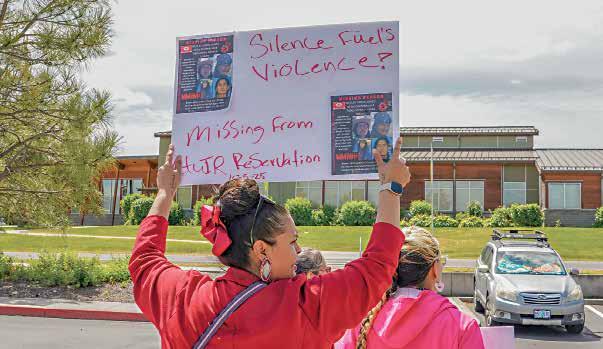
MISSION — Members of the Confederated Tribes of the Umatilla Indian Reservation (CTUIR) gathered to recognize the month of May as Missing, Murdered Indigenous People’s Month (MMIP).
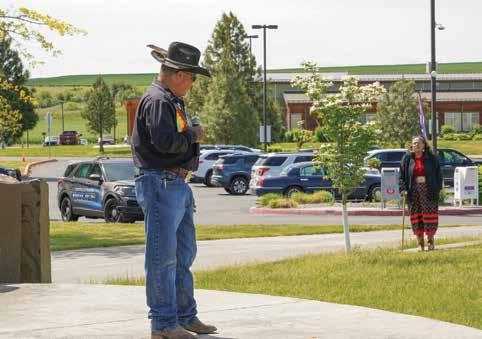
On May 14, CTUIR Family Violence Services (FVS) hosted a walk and lunch at the Nixyáawii Governance Center to recognize, support and honor the families of missing and murdered Indigenous relations.
Invited guest speaker Chico Holliday, of the Confederated Tribes of Warm Springs, shared remarks focusing on raising awareness and supporting families and communities affected by violence and loss.
According to the Bureau of Indian Affairs (BIA), about 1,500 American Indian and Alaska Native missing person cases have been entered into the National Crime Information Center throughout the U.S. The agency also reported about 2,700 murder and non-negligent homicide cases to the federal government’s Uniform Crime Reporting Program.
Combined, the figures represent approximately 4,200 missing or murdered cases that remain unsolved.
The BIA attributes the unsolved status of these cases due to a lack of investigative resources available to identify new information from witness testimony, re-examine new or retained material evidence and rewiring fresh activities of suspects.
Holliday spoke to the crowd about when his daughter went missing and the efforts it took to find her.
“It doesn’t only affect the families, but also the community as a whole because every community that we live in is really small,” he said. “Everybody knows everybody, and it’s really difficult to watch those families go through it.”
Holliday described the challenges he faced locating his child, including local law enforcement initially classifying her as a runaway and the jurisdictional boundaries that hindered investigation.
“I went to our tribal police and filled out a runaway report because that was the first step I was told to take,” Holliday said. “And then from the moment she crossed that line, that imaginary jurisdictional line, it became the county’s problem, and when she went further than that and went into the city, that became a city problem.”
There were roughly four county boundaries that were navigated, he said.
“There was nothing they could do until it escalated to the point where there was potential trafficking,” Holliday said. “At the time, I wasn’t sure, but then we started getting these weird phone calls and that’s when it escalated.”
In a 2017 Government Accountability Office report titled “Human Trafficking: Investigations in Indian Country or Involving Native Americans and Actions Need to Better Report on Victims Served,” tribal and major city law enforcement agencies were surveyed on human trafficking investigations, victim services and
barriers to identifying and serving Native victims.
In the survey, 27 of 132 tribal law enforcement agencies and six of 61 major city law enforcement agencies reported initiating human trafficking investigations that involved at least one Native American victim, accounting for 17% of the agencies surveyed.
The report noted 16 respondents identified several barriers to investigating cases and supporting victims, including a lack of training on identifying and responding appropriately to victims, victim shame and reluctance to come forward and the limited resources.
Holliday said once he shared the strange phone calls with a deputy assistant, the case escalated to the point where a national alert went out. He said he was able to retrieve his daughter within seven hours of the alert.
“That trauma did not just affect our daughter at that time, it affected the whole household,” Holliday said.
FVS Lead Advocate Enola Dick said a big challenge is how long it takes for law enforcement to determine whether a victim is missing or has simply run away, especially in the cases of younger people.
“That’s part of their excuse to do nothing,” she said. “That’s kind
of the thing everywhere, it’s, ‘Oh, everybody’s either out partying, drinking or they ran away and they’ll be home,’ so they put it off way too long before they start looking. Sometimes, by then, they’re never going to find them.”
Dick said another barrier, similar to Holliday’s experience, is jurisdictional boundaries.
“Our tribe used to go through that too. If a crime happened close to our borders, they would say, ‘Oh, well we need to measure and make sure it’s on the reservation or not,” Well, now that we work with the sheriff’s office more, there’s not such a problem,” she said.
In cases of human trafficking, barriers become more complex because trafficking often crosses jurisdictional boundaries or state lines.
“That’s part of what helped (Holliday) get more help, was that there were rumors of trafficking,” Dick said. “So at least they could get national attention, and they got more help than he was getting because of all of the boundaries that they were going through.”
Dick said social media could simultaneously serve as a hindrance and an asset in cases such as these. In Holliday’s case, he was able to access his daughter’s Instagram account and learn where she was.
But there is also the negative aspect of anonymous predators.
“Young people, there are so many different social media accounts to be on, and a lot of these sites are not good, they’re not healthy,” Dick said. “They’re sites where there are perpetrators preying on young people, girls and boys. Sending fake pictures that aren’t them, sending explicit photos of themselves – or so they say – and then wanting them to send something in return.”
Holliday said the best one can do is to pray alongside those who are going through the challenge of having a missing or murdered relation.
“Pray for them with the understanding that somehow, some way, we’re going to be able to assist them,” Holliday said. “My message today is don’t give up. Don’t stop. I had to literally go out there and knock on doors trying to find information, trying to locate her while my wife was on the other end going through media accounts.”
A list of open missing or murdered Indigenous Persons cases can be found at https://www.bia.gove/ service/mmu/missing-murderedcases. To submit information or a tip, text BIAMMU and Your Tip to 847411, call in to 1-833-560-2065 or email OJS_MMU@bia.gov.
Confederated Tribes of the Umatilla Indian Reservation member DeArcie Abraham holds up a sign regarding tribal elder Wesley Jones, who has been missing since early October, during a walk acknowledging Missing/Murdered Indigenous Peoples Month on May 14 near the Nixyáawii Governance Center. (Beau Glynn/The CUJ)
Confederated Tribes of Warm Springs member Chico Holliday speaks to a crowd on the Nixyáawii Governance Center lawn on May 14 as CTUIR members gathered to acknowledge Missing/Murdered Indigenous Peoples Month. (Beau Glynn/The CUJ)
Red dresses hung up along the route of a walk to acknowledge Missing/Murdered Indigenous Peoples Month May 14 at the Nixyáawii Governance Center. (Beau Glynn/ The CUJ)
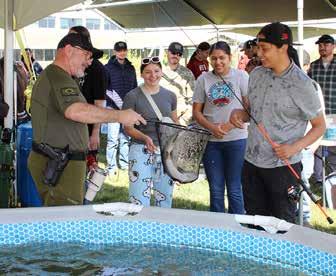
Umatilla Tribal Police Department (UTPD) Officer Boon Setser helps net a fish for Confederated Tribes of the Umatilla Indian Reservation (CTUIR) member Daniel Dick during an open house event hosted in April 2025 by the CTUIR Department of Natural Resources. The UTPD will host a similar fishing event called Cops and Bobbers on June 12 at the Nixyáawii Governance Center. CTUIR
UTPD to host Cops and Bobbers event
while encouraging cultural teachings with younger generations, Bingham said.

MISSION – The Umatilla Tribal Police Department (UTPD) will host an all-ages fishing event called Cops and Bobbers on June 12 at the Confederated Tribes of the Umatilla Indian Reservation’s (CTUIR) Nixyáawii Governance Center (NGC).
From 9 a.m. to 5 p.m., participants can catch rainbow trout supplied by Island Springs Hatcheries of Portland on the NGC’s front lawn from two large swimming pool-style fish tanks in a safe and controlled environment, UTPD Sgt. Derrick Bingham said.
“Our goal is for each participant to have the opportunity to catch and take home a fish,” he said. “Fishing gear will be available at the event to use. Once a participant catches a fish, they will have the option to either keep their fish or release it back into the tank.”
For those who want to keep their fish, UTPD officers and CTUIR Fish & Wildlife Commission members will help clean fish at an on-site cleaning station to make the experience easier and more convenient.
The event is centered around fishing to help create positive experiences with UTPD officers
“For many tribal communities, fishing is not just recreation, it is tied to treaty rights, family traditions, First Foods and cultural identity,” he said. “This event is designed to encourage community connection, mentorship and engagement with the youth, parents, elders and community members.”
While the primary focus is on youth, the event is intended for the entire family and community.
“There are no specific age limits for attendance. We want this to be an opportunity for families to come together, build positive relationships, enjoy time outdoors and learn from one another,” Bingham said.
He added that the UTPD plans to make Cops and Bobbers an annual community event.
“The idea came from wanting to create a positive opportunity for law enforcement to strengthen community relationships,” Bingham said. “Fishing was chosen because it reflects important cultural and community values, including spending time together, learning from one another and connecting with the outdoors.”
For more information, call 541215-2008.







TRAVIS SNELL
The CUJ










APRIL 27, 2026
BOT Present: Vice Chair Aaron Ashley; Treasurer Raymond Huesties; Secretary Monica Paradise; Toby Patrick and Corinne Sams. Chair Kat Brigham, Lindsey X. Watchman, General Council Chair and Sierra Quaempts on travel status. Lisa Ganuelas on birthday leave. Quorum present.
Old business: None
New business: Proposed Resolutions: Next resolution number is 2026-027: Resolution 2026-027: Topic: Tutuilla Solar Project. RESOLVED, that the Board of Trustees (BOT) hereby approves the Amended and Restated Lease Agreement and the Landlord Release, Consent and Estoppel Certificate attached as Exhibits 1C and 2C, respectively, for the Tutuilla Solar Project; AND BE IT FINALLY RESOLVED, that the BOT hereby authorizes its Chair, or her designee, to execute the attached Amended and Restated Lease Agreement and the Landlord Release, Consent and Estoppel Certificate, or documents containing substantially similar terms, and to take such further actions, including the execution of documents, as may be necessary to carry out the purposes of this Resolution. AND, that said Resolution has not been modified, amended or repealed and is still in full force and effect. DATED: April 27, 2026.
MOTION: Raymond Huesties moves to adopt Resolution 2026-027. Corinne Sams seconds. Discussion. Question. Motion carries 4-0-0.
Resolution 2026-028: Topic: Funding and Participation in Oregon Public Utility Commission Dockets. RESOLVED, the Board of Trustees (BOT) directs the Department of Economic and Community Development (DECD), with the supervision of the Office of Legal Counsel (OLC), to continue to engage outside legal counsel Jim Deason (Deason) to provide representation in the Oregon Public Utility Commission (OPUC) dockets of interest to the Confederated Tribes of the Umatilla Indian Reservation (CTUIR); AND BE IT FURTHER RESOLVED, the BOT authorizes the Executive Director (ED) and DECD to file as interested parties in OPUC dockets of interest to the CTUIR, upon which the CTUIR will receive notice of filings in those dockets; AND BE IT FURTHER RESOLVED, the BOT authorizes the ED to sign, and DECD to file, public comment letters in OPUC dockets of interest to the CTUIR, so long as they are consistent with current BOT-approved policies, with the understanding that DECD will provide a monthly status report on these activities; and with the understanding that any initial or dispositive filings, such as a Petition to Intervene in a contested case matter, must be approved through BOT action; AND BE IT FURTHER RESOLVED, the BOT authorizes DECD, through Deason, to pursue a multi-year intervener funding agreement (agreement) with PacifiCorp and Cascade Natural Gas Corporation (CNGC), subject to OPUC’s approval; AND BE IT FURTHER RESOLVED, the BOT authorizes and appropriates funding from Cost Center 001-009 to engage Deason’s services; AND BE IT FINALLY RESOLVED, the BOT authorizes the ED to sign the agreement and to work with DECD to file the necessary documents with OPUC, and any necessary subsequent documents necessary, to receive the funding; AND, that said Resolution has not been modified, amended, or repealed and is still in full force and effect.
DATED: April 27, 2026.
MOTION: Raymond Huesties moves to adopt Resolution 2026-028. Corinne Sams seconds. Discussion. Question. Motion carries 4-0-0.
Resolution No. 2026-028: Topic: CTUIR Probate Code.
RESOLVED, that, to further strengthen the Confederated Tribes of the Umatilla Indian Reservation’s (CTUIR’s) powers of self-governance, the Board of Trustees (BOT) hereby adopts the draft Probate Code to govern administration of decedent estates and to resolve contested probate-related matters that are within the Tribal Court’s exclusive jurisdiction and the Tribal Court’s concurrent jurisdiction; AND BE IT FURTHER RESOLVED, that the BOT enacts the Probate Code, attached as Exhibit 1, in furtherance of PL-280 retrocession, and which Code shall include provisions including but not limited to: Explicit consideration of custom and tradition as to ownership and possession of culturally significant property of importance to the CTUIR and Tribal members. Perfecting transfer of rights and ownership of property over which the Umatilla Tribal Court has exclusive or concurrent jurisdiction: whether real, personal, or mixed in nature; whether corporeal or incorporeal, tangible or
intangible; and wheresoever situated, whether within or without the exterior boundaries of the Umatilla Indian Reservation. Winding up and settlement of a decedent’s estate, including payment of claims and distribution to heirs and devisees. Resolve disputes related to the probate of decedent property, including but not limited to determination of heirs or will contests. Close decedent estates with finality such that expectations as to claims and distribution of a decedent’s assets are settled with ultimate repose; AND BE IT FURTHER RESOLVED, that the Probate Code will take effect 120 days from the date of adoption, on Aug. 25, 2026, and shall apply to all decedent estates within the Tribal Court’s jurisdiction where the decedent’s death occurred on or after the effective date; AND BE IT FURTHER RESOLVED, that the BOT directs the Tribal Court, pursuant to its rule-making authority at Court Code Section 3.02, to promulgate and adopt procedural rules for efficient and effective probate administration with an ideal level of judicial economy that nevertheless provides a robust forum for the due process required for contested matters, including but not limited to the draft Rule for Appointment of Probate Administrator; Powers of Probate Administrator; AND BE IT FURTHER RESOLVED, that the BOT directs the Office of Legal Counsel (OLC) to work with the Tribal Court to create forms for use in non-probate transfers within the Tribal Court’s jurisdiction, and for use in uncontested probate matters by self-represented individuals; AND BE IT FURTHER RESOLVED, that the BOT directs OLC to work with the Tribal Tax Administrator to examine questions as to any implications of Oregon’s Estate Tax to non-trust estate property within the jurisdiction of the Tribal Court, and to hold a work session on this issue within 120 days of adoption; AND BE IT FINALLY RESOLVED, that, three years from the effective date, the BOT directs OLC and other relevant Tribal government staff to work with the Tribal Court to review any issues that have occurred to determine what amendments, if any, could assist with judicial efficiency, procedural effectiveness, or make the Code or related forms more user-friendly without compromising due process consideration; and to present a report to the BOT within 90 days of that date with any proposed recommendations for amendment, including possible incorporation of the Inheritance Code; AND, that said Resolution has not been modified, amended, or repealed and is still in full force and effect. DATED: April 27, 2026.
MOTION: Corinne Sams moves to adopt Resolution 2026-029. Raymond Huesties seconds. Discussion. Question. Motion carries 4-0-0.
Other Board Action Items: Commission/ Committee Update by Monica Paradise, BOT Secretary.
Enrollment Commission, two-year staggered term. Two positions advertised with one application from Michelle Moses.
MOTION: Corinne Sams moves to appoint Michelle Moses by acclamation to the Enrollment Commission to fill term expiring September 05, 2029. Raymond Huesties seconds. Discussion. Question. Motion carries 4-0-0.
Farm Enterprise, three-year term. One position advertised, one application from DeArcie Abraham.
MOTION: Toby Patrick moves to appoint DeArcie Abraham by acclamation to fill a three-year term, expiring May 18, 2029. Corinne Sams seconds. Discussion. Question. Motion carries 4-0-0.
Housing Commission, two-year term. Two positions advertised with three applications from Alan Crawford, Roberta Wilson and Michelle Moses.
ACTION: By secret ballot Alan Crawford was appointed to one position, and tie broken by Vice Chair Ashley voting for Michelle Moses to be appointed to the second position to the Housing Commission.
Tiichám Conservation District, two-year term. Two positions advertised with one application from Cara Greene.
MOTION: Corinne Sams moves to appoint Cara Greene by acclamation to fill term expiring Oct. 3, 2026. Toby Patrick seconds. Discussion. Question. Motion carries 4-0-0. No removals, resignations or terms expiring. Completed applications due by 4 p.m. on Friday, May 22 with work session scheduled for Friday, May 29 and appointments will be made on Monday, June 1.
Wildhorse Foundation Annual Report. The Board of Trustees acknowledges that the 2025 Annual Report of the Wildhorse Foundation was presented and reviewed during the work session held on April 22,
2026. The report reflects a total annual giving of $1,848,827. The 2025 Annual Report of the Wildhorse Foundation is due to the State of Oregon no later than May 31, 2026.
MOTION: Raymond Huesties moves to approve the 2025 Annual Report of the Wildhorse Foundation as presented and authorize Board Chair Kat Brigham to sign the accompanying letter on behalf of the BOT. Corinne Sams seconds. Discussion. Question. Motion carries 4-0-0.
BOT Travel or External Meeting Reports:
Corinne Sams, Washington, D.C. with CRITFC.
Lindsey X. Watchman, two reportsdeferred:
1. April 17 to Warm Springs for a tour of their Assisted Living Facility.
2. April 18 to Portland to attend the American Cancer Society mid-year convention.
MOTION: Toby Patrick moves to approve Corinne Sams travel report. Raymond Huesties seconds. Discussion. Question. Motion carries 4-0-0.
BOT Leave and Travel or Outside Meeting Requests:
Corinne Sams, three requests:
1. Polled personal leave on 4/22 from 1:30 to 4 p.m.,
2. Travel, 5/4 to 5/6 to Portland as participate as speaker for the American Fishers Society Conference,
3. Travel, 5/7 to 5/8 to Portland to attend Oregon Tribal Consultation Task Force meetings.
Lindsey X. Watchman, polled personal leave on 4/24 from 8:30 to 10:20 a.m.
Lisa Ganuelas, three requests:
1. Personal leave on 4/30 all day.
2. Virtual meeting on 4/28 from 10 a.m. to noon with WA Clean Energy Citing Council.
3. Travel from 6/10 to 6/12 to Canyonville to attend Healing the Water Gathering.
Toby Patrick, personal leave for six hours on 4/21 all day on 4/22 and 4/23.
MOTION: Raymond Huesties moves to approve leave requests. Toby Patrick seconds. Discussion. Question. Motion carries 4-0-0.
MAY 4, 2026
BOT Present: Chair Kat Brigham; Vice Chair Aaron Ashley; Treasurer Raymond Huesties; Secretary Monica Paradise; Lisa Ganuelas; Corinne Sams; and Lindsey X. Watchman, General Council Chair. Toby Patrick on personal leave. Sierra Quaempts on travel. Quorum present.
Old Business: None
New Business: Proposed Resolutions: Next resolution number is 2026-027:
Resolution 2026-030: Topic: Joint Management Agreement – Coonskin Creek County Road 900 Passage Project. RESOLVED, that the Board of Trustees (BOT) hereby approves the attached Joint Management Agreement between Umatilla County and the Confederated Tribes of the Umatilla Indian Reservation (CTUIR), and authorizes its Chair to execute it or a substantially similar agreement on behalf of the CTUIR; AND BE IT FINALLY RESOLVED, that the BOT authorizes its Executive Director to take such further action and execute other documents, if any, that are necessary to carry out the purposes of the Joint Management Agreement and this Resolution; AND, that said Resolution has not been modified, amended or repealed and is still in full force and effect. DATED: May 4, 2026.
MOTION: Raymond Huesties moves to adopt Resolution 2026-030. Corinne Sams seconds. Discussion. Question. Motion carries 6-0-0.
Other Board Action Items: External CTUIR Appointments by Monica Paradise.
Central Washington University — Sierra Quaempts;
Columbia River Policy Advisory Group — Lisa Ganuelas.
MOTION: Raymond Huesties moves to appoint Lisa Ganuelas, to the Columbia River Policy Advisory Group and to appoint Sierra Quaempts to Central Washington University. Corinne Sams seconds. Discussion. Question. Motion carries 6-0-0.
BOT Travel or External Meeting Reports: Deferred
BOT Leave and Travel or Outside Meeting Requests:
Lisa Ganeulas, four leave requests:
1. Polled personal leave from 2 p.m. to 4 p.m. on April 28;
2. Polled birthday leave all day on April 27;
3. Polled personal leave from 2 to 4 p.m. on April 29;
4. Personal leave from 10:30 to 11:30 a.m. on May 19.
Monica Paradise, personal leave from May 26-29 for 30 hours.
Sierra Quaempts, three leave requests:
1. Polled personal leave from 3 p.m. to 4 p.m. on May 1;
2. Travel Request to Portland on May 7 to Portland to attend the Behavioral Health signing ceremony;
3. Personal leave all day on May 8.
Toby Patrick, polled personal leave from noon to 4 p.m. on April 30.
MOTION: Raymond Huesties moves to approve leave requests. Corinne Sams seconds. Discussion. Question. Motion carries 6-0-0.















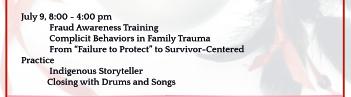







CONFEDERATED UMATILLA JOURNAL
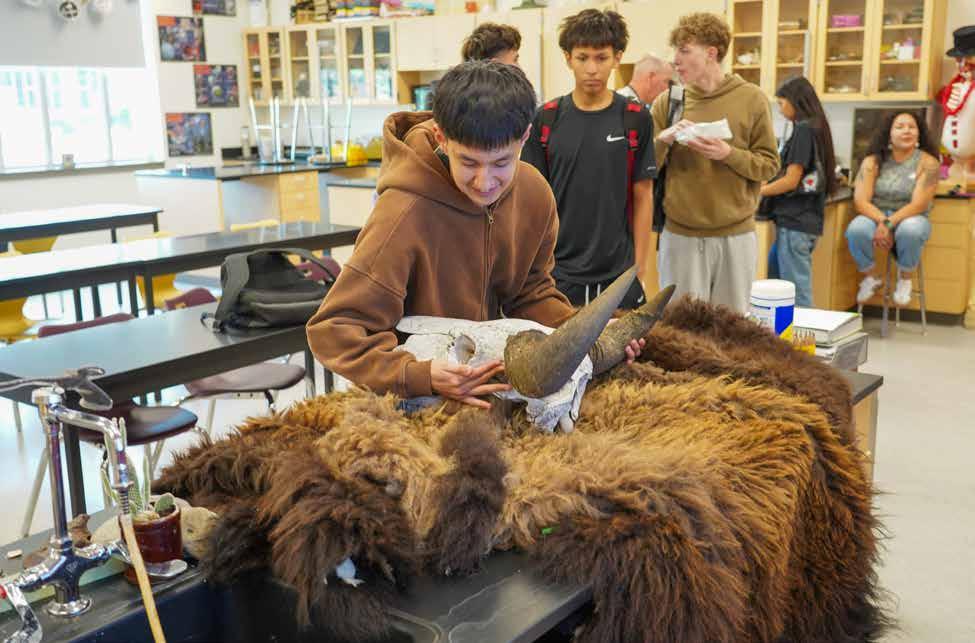
NCS students to participate in bison treaty hunt
BEAU GLYNN
The CUJ
MISSION — Six Nixyáawii Community School (NCS) students will have the opportunity to travel to Yellowstone National Park to practice their treaty rights by hunting bison in July.
This opportunity comes after donations from Change X, a nonprofit supported by Microsoft and Amazon, and Yellowhawk Tribal Health Center (Yellowhawk) paid a portion of the $16,000 in travel costs, said Aaron Noisey, NCS physical education/health teacher/ athletic director.
“Some of the kids have never been able to do anything like this,” Noisey said. “We want to thank our community, the Change X group, Yellowhawk and the community support that the kids have gotten by supporting their fundraising efforts to be able to do this.”
On May 21, multiple speakers gathered at NCS to inform the students of their treaty rights and how to safely exercise them, as well as expand on what is required to
hunt at Yellowstone.
Speakers included Confederated Tribes of the Umatilla Indian Reservation (CTUIR) member Kola Shippentower, who has gone on hunting trips to the Yellowstone area; Umatilla Tribal Police Officer Dick Bobbit, from the Fish and Game Division; and CTUIR Department of Natural Resources (DNR) Wildlife Program Manager Andrew Wildbill.
The CTUIR is one of eight tribes permitted to exercise treaty rights by hunting bison at Yellowstone. Other tribes are the Yakama Nation, Nez Perce Tribe, Shoshone, Salish Kootenai, Crow, Blackfoot and Northern Arapaho.
“It’s particularly difficult because we are in such an exclusive area where there are a lot of eyes on us,” Shippentower said. “There are a lot of people within the town that are kind of aware of what our season looks like, so they’re keeping an eye on the different areas where we can go and hunt because there are maps that we have to abide by and borders that we have to keep a really close eye on where the herds are at,
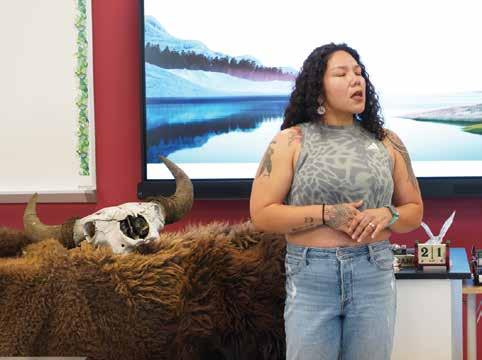
where their movement is and then where we are in relation to them.”
She spoke of her firsthand experience in Yellowstone, telling the students what would be required of them if they were to partake in the treaty hunting.
“You want to make sure that you have pretty good knowledge and experience, being physically fit, being sound with your firearm and having an understanding of the type of work that’s going to be called for you to be able to pack out and take care of the animal,” she said.
Bobbit informed the students of his duties while attending the treaty hunting, ensuring that everything
is done legally and the animal is claimed by the hunter who downed it.
“The difference in hunting over in Montana than around here is that you have a lot of eyes watching you, everybody’s watching you. You have people with cameras on their house that are down in the field to watch what’s going on, so it’s really important to do everything right,” Bobbit said. “There are a lot of hunters and a bunch of bison coming in, so we try to limit our group to just five shooters. That way
Dresden Farrow, a student at Nixyáawii Community School, lifts up a buffalo skull on, May 21. The skull and skin were part of a presentation about the treaty hunting of buffalo at Yellowstone National Park. (Beau Glynn/The CUJ)
Confederated Tribes of the Umatilla Indian Reservation member Kola Shippentower speaks to students about her hunting experience in Yellowstone National Park on May 21 at Nixyáawii Community School. (Beau Glynn/The CUJ)
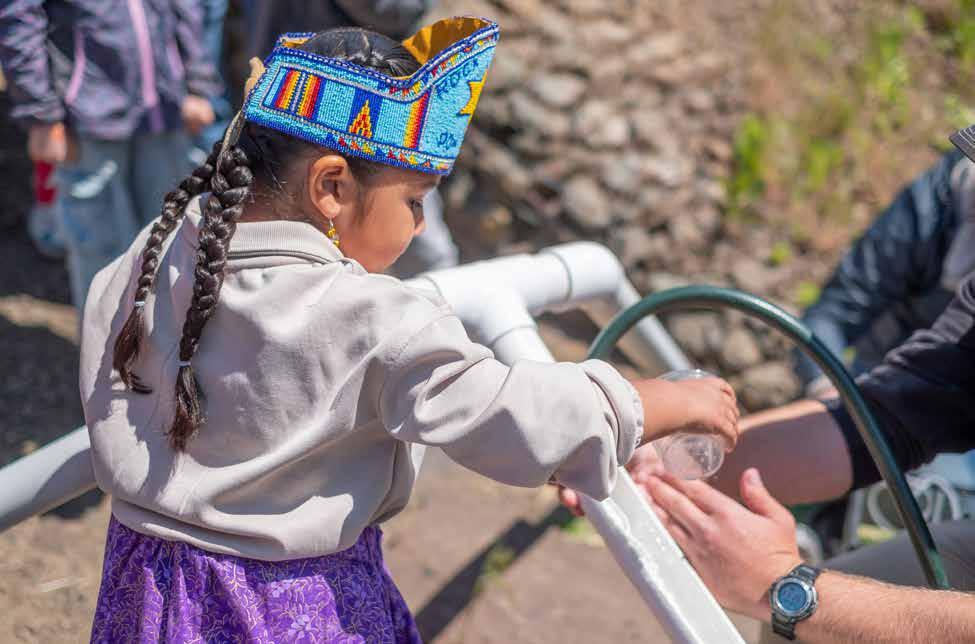
Return to the River
YASSER MARTE
The CUJ
WALLA WALLA — Dozens of children crowded the riverbank, holding cups of tiny salmon as they waited for their turns to release the fish into the water during the annual Return to the River Festival at Walla Walla Community College (WWCC).
The Confederated Tribes of the Umatilla Indian Reservation (CTUIR) and WWCC’s Water and Environmental Center co-hosted the annual festival on May 16 to celebrate salmon restoration and provide a glimpse into the region’s cultural and natural resources history.
Children lined up during two sessions to name and release hundreds of smolts into the river. At noon, they released roughly 160 fish, and at 1 p.m., they released nearly 103 more.
Drew Trogstad-Isaacson, interim director of the Water and Environmental Center, said about 270 juvenile salmon were released into Mill Creek on May 14 as part of the event. He said additional releases earlier in the week through the Salmon in the Classroom program and the Tri-State Steelheaders program included roughly 400 to 500 fish, with fourth grade students
taking part in those releases.
Salmon remain culturally and ecologically significant throughout the Walla Walla River Basin, Trogstad-Isaacson added, where agencies, tribes and community partners are working to restore stable populations that could support future recreational and subsistence fisheries.
Before the first group of smolts was released, Merle Kirk, education and outreach assistant for the CTUIR’s Natural Resources Department (DNR), offered a ceremonial prayer.
Lil’ Miss Rock Creek Powwow Mavis Mata, 4, was the first to release a salmon she named Coco, marking the start of the event’s first session. Mata slowly poured the water from the cup, guiding young Coco down a chute into Mill Creek, returning the young salmon to the river. Afterward, the rest of the children followed.
Wenix Red Elk, DNR public outreach and education specialist, said the tribe launched the festival in 2008 in the Walla Walla Basin to educate the community about salmon restoration and treaty rights.
As the CTUIR advanced water rights and irrigation projects, Red Elk said the tribe also worked with regional partners on water and salmon restoration efforts to bring
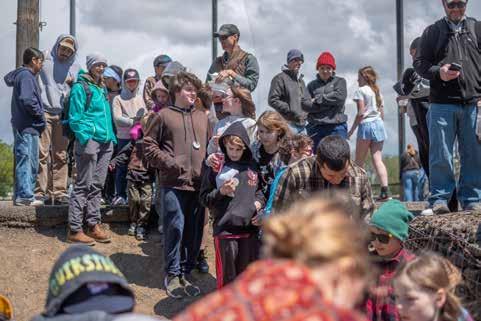
a broader understanding to the community.
The tribe now operates a fish hatchery near Milton-Freewater and releases more than 500,000 smolt throughout the basin, including in the Walla Walla and Tucannon watersheds, she noted. In addition, the tribe operates a wet lab focused on mussels and lamprey restoration.
During the annual event, DNR staff members manned booths where community members learned about restoration projects and basin-wide partnerships.
More than 30 organizations, institutions and agencies participated, including CTUIR’s Cultural Resources Protection, First Food Policy and Fisheries and Water Resources, as well as the Columbia River Inter-Tribal Fish Commission (CRITFC), the Snake River Salmon Recovery Board and the Tri-State Steelheaders.
“We partner with stakeholders involved in water and natural
resource restoration to show the ecological work happening throughout the basin,” Red Elk said.
The outreach also highlights the return of salmon to the river after an absence of more than 80 years, she added.
“When we eventually start harvesting and fishing there again, people will better understand why,” she said. “They’ll know Native Americans are from here, this is where they signed their treaty and this is their home.”
Red Elk said the CTUIR’s work reflects a long-standing relationship with the land and water in the area, emphasizing that tribal presence and stewardship extend “from time immemorial.”
The tribe’s homeland includes not only present-day Pendleton but also its 6.4 million acres of ceded territory, including the Walla Walla River Basin, she said. Restoration efforts are intended to repair those lands and waters for future generations and the broader community that lives there.
Children release salmon at annual festival
Lil’ Miss Rock Creek Powwow Mavis Mata, 4, gently pours water from a cup to guide her smolt, Coco, down a chute into Mill Creek during the annual Return to the River Festival on May 16 at Walla Walla Community College, returning the young salmon to the river. (Yasser Marte/The CUJ)
Dozens of children crowd the riverbank awaiting their turns to release fish into the water during the annual Return to the River Festival on May 16 at Walla Walla Community College. (Yasser Marte/The CUJ)
Passing on the knowledge
Tribal youth learn the fine art of salmon processing
Students
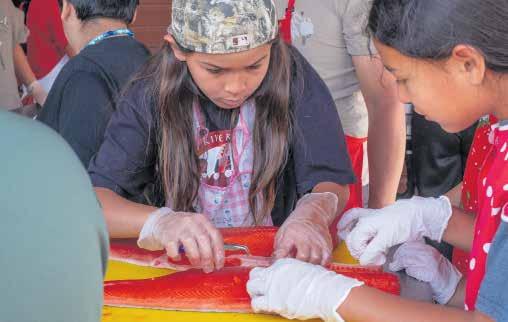
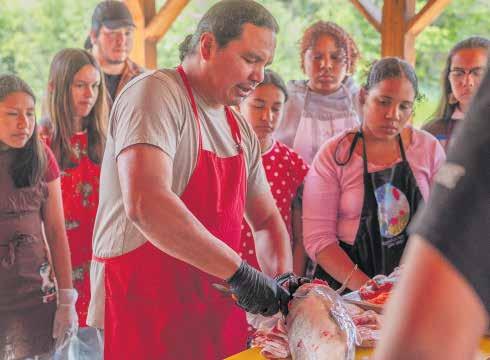
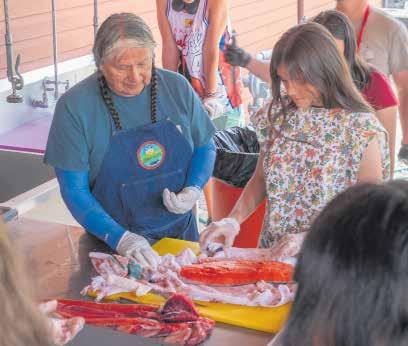
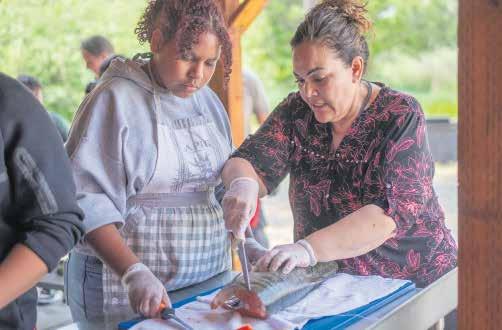


PHOTOS BY YASSER MARTE
The CUJ
Angel Calvillo, left, and Kiya Orna, right, remove scales from a salmon June 1 at the Mission Longhouse.
Andrew Wildbill, Wildlife Program manager for the Department of Natural Resources of the Confederated Tribes of the Umatilla Indian Reservation, demonstrates how to fillet a salmon for a group of students June 1 at the Mission Longhouse.
examine salmon fillets after a fish-processing demonstration on June 1.
ABOVE : Building Our Life Skills Training and Employment Readiness Lead David Wolf, left, teaches Braire Azure, right, how to properly remove bones from a salmon.
LEFT: Lisa McIntosh, left, learns how to fillet a salmon from Wenix RedElk, Public Outreach Education Specialist.
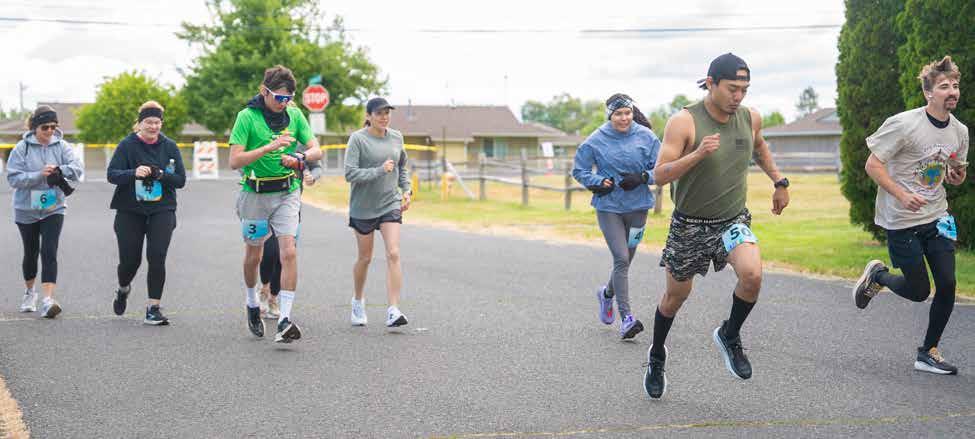
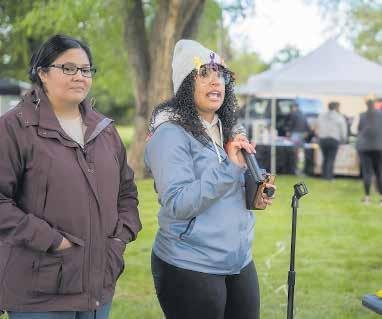
YELLOWHAWK
FUN RUN
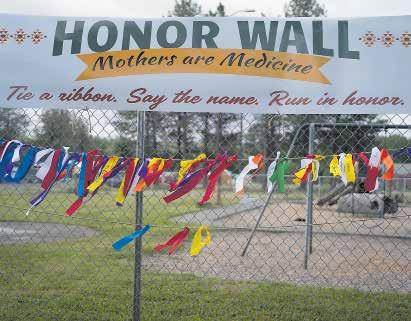
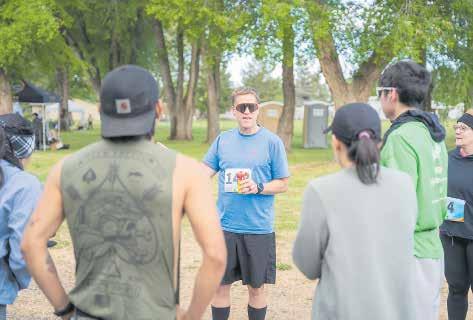
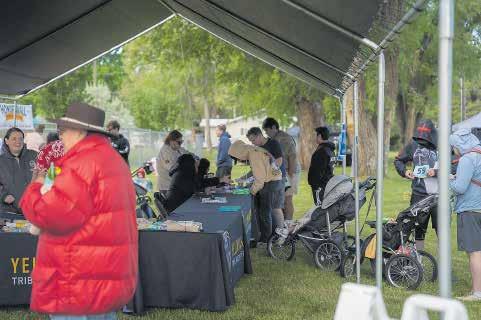


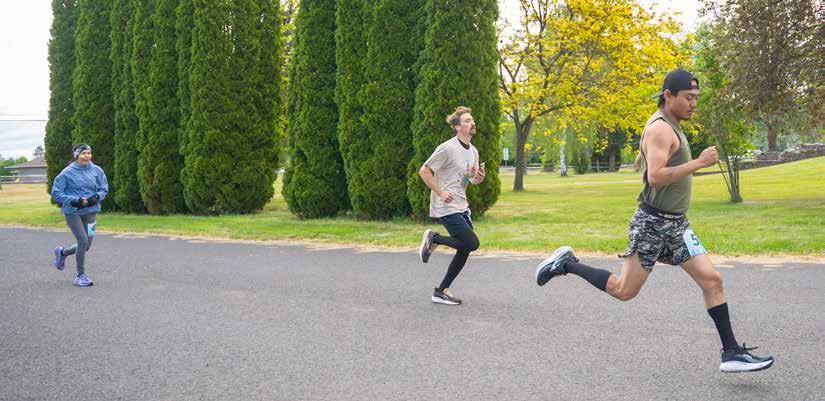
Fun Run organizers Leah Arnold and Darshae King deliver opening remarks and share event information before the start of the 44th Annual Fun Run on May 16 at the July Grounds in Mission.
Fun Run participants tied ribbons to the Honor Wall in tribute to the mothers in their lives who inspired and shaped them.
Participants in the 10K race begin their run on May 16 at the annual Yellowhawk Fun Run at the July Grounds in Mission.
RIGHT: Tiffany Yago, Zacchaeus Speakman, and Trayton EnickMahoney take an early lead at the start of the 10K run.
ABOVE: Zachary Rock, running coordinator of the Fun Run, helps organize runners ahead of the 10K race.
PHOTOS BY LEE GAVIN The CUJ
Pendleton Street Fair
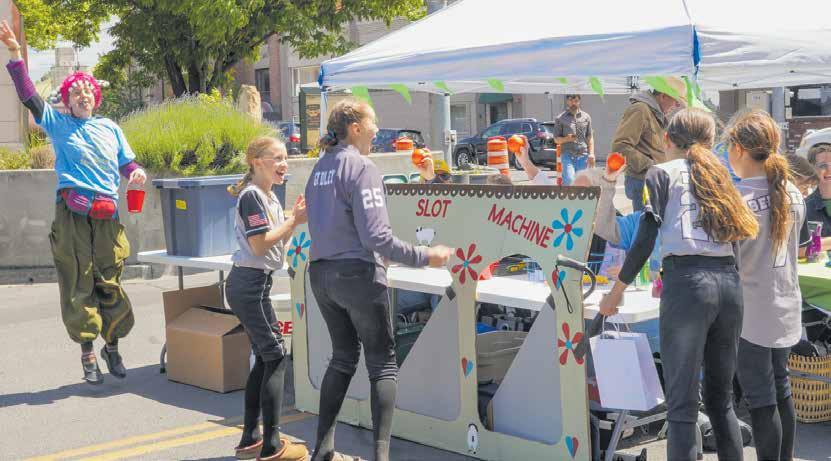
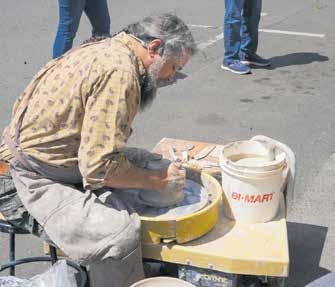
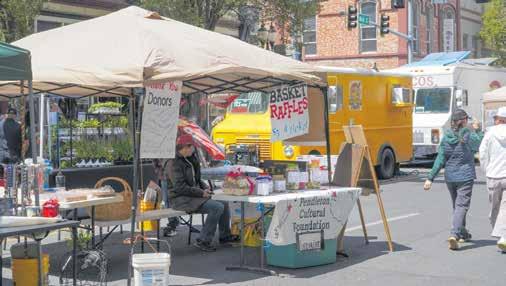
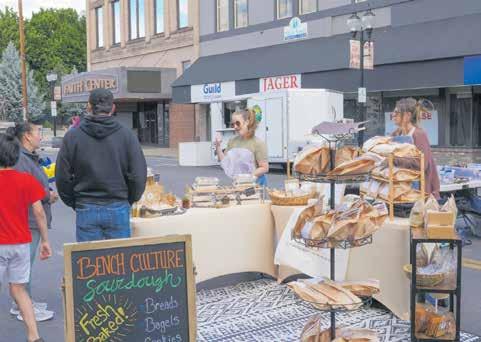
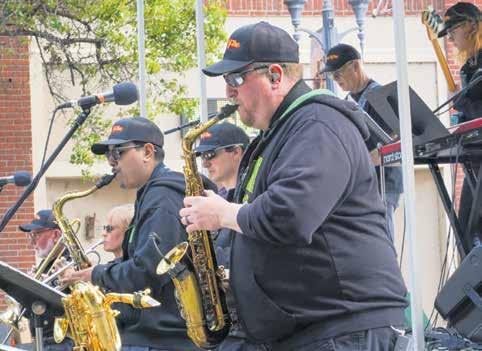
HUNT: Donations from Change X and Yellowhawk help fund trip to Yellowstone
Continued from Page B1
we can watch them and make sure they’re safe and we can identify what they shot. You could imagine when there are 50 shooters in that little area shooting at 40 bison, everybody shoots something in their opinion.”
“The most important thing to understand as a treaty hunter is our treaty rights. Our treaty rights are held by the tribe, and they’re the tribe’s responsibility,” he said.
Wildbill told the history of how the CTUIR was able to exercise its treaty rights to hunt for bison, one of the First Foods.
“We wanted to reestablish our bison hunting, so our Board of Trustees assigned some money
Wildbill said his program’s purpose was to provide opportunities for the sustainable harvest of wildlife of the First Food order by protecting, conserving and restoring wildlife populations and their habitats.
to our lawyers and our cultural resources program to develop the Cayuse, Umatilla, Walla Walla traditional relationship to buffalo and buffalo hunting report. So we told the state of Montana that we still had treaty rights in our aboriginal territory, and they had to acknowledge those,” Wildbill said.
The first buffalo hunt took place in 2011 and estimates show that roughly 4,900 bison live in Yellowstone.
“It’s not just something that we’re
getting for us,” Shippentower said.
“We want to make sure that we’re providing for other people that can’t make the trip, or especially for elders who no longer hunt or really need that throughout the year.”
The six students are fundraising to close the gap in the expense of the trip, after previously selling Krispy Kreme donuts, a raffle and a Support My Map fundraiser. The treaty hunting trip takes place July 5-13.
PHOTOS BY BEAU GLYNN
The CUJ
The Brass Fire Band was one of three performances to grace the stage.
The Pendleton Downtown Association (PDA) puts on a Human Slot Machine at its booth May 16 on Main Street at the Pendleton Street Fair. PDA volunteer Stephanie Huffman cheers as a group of teenagers win big. The PDA hosted the second annual Street Fair after its revival in 2025.
Bethany Edwards, owner of Bench Culture Sourdough, was one of 55 vendors at the Street Fair.
LEFT: Tom Henderson, owner of Pendleton Ceramics LLC, displays his expertise with the pottery wheel.
RIGHT: A total of 55 vendors set up shop on Main Street as part of the Pendleton Street Fair.
Txtáyma hosts first Market at the Park
BEAU GLYNN
The CUJ
MISSION — Vendors displayed their wares at the first Market at the Park on May 14 at the Txtáyma Food Truck Park.
Food, jewelry and self-care products were on display at the event’s first installment, which will continue every second and fourth Thursday through October.
Nixyáawii Community Financial Services (NCFS) Business Services Manager Jacob Wallis said the food truck park is supposed to be a small business ecosystem, where entrepreneurs and small business owners can find a place to create commerce or opportunities for retail.
“The hope is more exposure in general,” Wallis said. “The more opportunities we have for (the vendors), the better chance of them getting not only more money, but scaling their business so they feel comfortable with it and that it’s sustainable for them. We’re also giving them a safe space that they feel like they could plan around this.”
Txtáyma Food Truck Park Manager Adrienne Sampson said Txtáyma means “to barter” in the Umatilla language.
“We started this to help bring vendors to a place to sell their products, as well as bring fresh food to the community,” Sampson said. “We’ve been working really hard with the Parks and Recreation
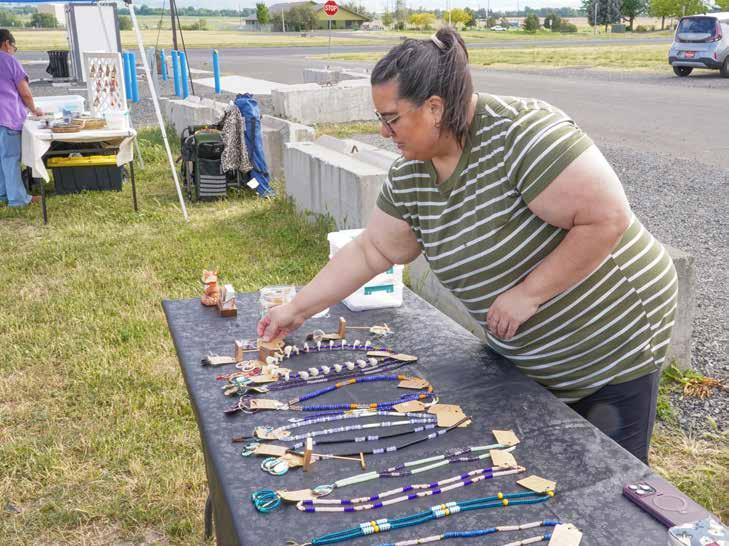

Department to try and put together a park that works together, where people can come and sell their products in a commerce area where everyone can get together and share their products.”
Wallis said the hope is to have
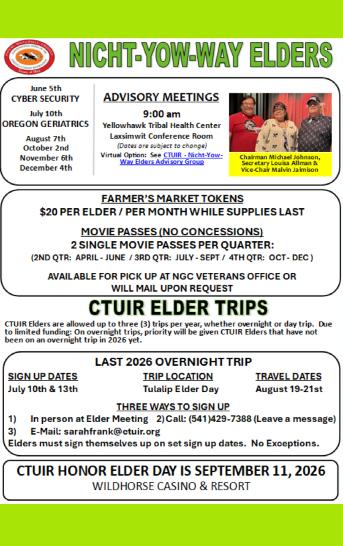
anywhere from 10 to 12 vendors as the season progresses, though 15 would be ideal.
“We figured May would be a bit of a slow running just to get it going and get it established, and hoping through the summer that we’ll have a pretty good retail mix out here,” he said. “We want there to be artisans, creatives, handmade items — or mostly handmade.”
Wallis said vendor spaces are not exclusive to tribal members and that other community members can take part.
“We’re looking at ag producers, harvesters and makers in general, and ways we can incorporate not only our First Foods, but also to just have local ag producers in this and how we can start networking between them and our food trucks,” he said.
Cassandra Franklin, a vendor at the first Market at the Park, owns Old Meacham Creek Designs and sells Indigenous neo-traditional jewelry.
“It’s all been based off of designs,
colors and patterns I saw growing up, with my grandmother in her regalia and in her sister’s regalia and just watching them create things,” Franklin said of her jewelry. “I can’t sew to save my life. I can’t do beadwork, but I’ve been able to match colors, textures and patterns in making jewelry and make each piece one of a kind.”
Franklin said she had never sold her jewelry, only given it out as gifts. When her brother Jacob encouraged her to set up as a vendor, she said it was the most stressful thing in her life, but also the most rewarding.
“I’ll try to be here as often as I can. I like to sell,” Franklin said. “I have people that come back to me, and it’s nice to have a place where you can set up locally.”
Wallis said any potential vendors who are curious about signing up should reach out.
“We do have a sign up sheet here, but if you’re not sure just go to the events, subscribe to our events page. We always have a lot of different events going on,” he said.



Cassandra Franklin, owner of Old Meacham Creek Designs, displays her Indigenous neo-traditional jewelry at the first Market at the Park on May 14 at Txtáyma Food Truck Park in Mission. (Beau Glynn/The CUJ)
Scan the QR code for more information or to sign up for Market at the Park.





First two Šináata Scholars set to graduate from Whitman College
ERICK BENGEL
Northwest Public Broadcasting
WALLA WALLA — When Aiden Wolf learned he had the chance to attend Whitman College on a new scholarship for regional Native American students, his mother wasn’t completely on board.
The history of the college’s namesake — the missionary and doctor Marcus Whitman — doesn’t sit well with Wolf’s family. They’re enrolled members of the Confederated Tribes of the Umatilla Indian Reservation, or CTUIR, which comprises the Cayuse, Umatilla and Walla Walla peoples.
In 1847, a band of tribal members killed the doctor, his wife and others. Tensions increased between tribes and settlers and more violence followed. In 1850, five Cayuse men were convicted and hanged for the “Whitman Massacre”; Wolf descends from two of them.
So, when it came time for Wolf to pick a college, his mother thought twice about Whitman “because of that history,” he said.
But, he said, his parents also wanted what was best for him. In the end, Wolf — who had doubts, as well — went to Whitman.
“It turned out to be a great decision for me,” Wolf said.
A new scholarship
This month, Wolf and Lindsey Pasena-Littlesky will be the first


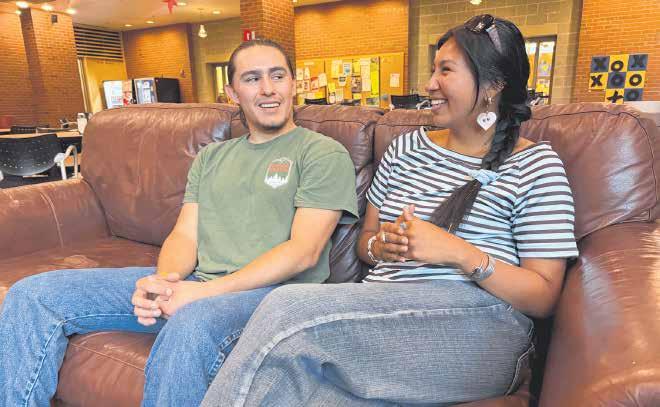
Šináata Scholars to graduate from the college. Wolf majored in theater, while Pasena-Littlesky majored in environmental studies and politics.
Named after a Cayuse word meaning “to seek,” the scholarship is part of the college’s effort to both acknowledge its history with local tribes and to forge a better relationship with them “while providing an opportunity for education at Whitman College for tribal students,” said Jeanine Gordon, Whitman’s special assistant to the president for Native American outreach.
The full-ride scholarship supports students connected to the CTUIR. Students who are members of the tribes present at the 1855 Walla Walla Treaty Council — an event held on the future site of Whitman College — are also eligible.
For Wolf and Pasena-Littlesky, the Šináata meant they didn’t have to worry about debt and could focus on their studies. It also meant they would help build bridges between the college and their culture.
The scholarship, Wolf said, “really plays this role in representation of Native communities, Native peoples, so it feels great to be a part of something bigger than myself.”
A college’s legacy
Whitman College has had to reckon with Marcus Whitman’s legacy, echoing experiences of other institutions across the U.S. that are named after divisive figures.
Around the time of Whitman’s mission, increasing numbers of non-Indian immigrants claimed land the U.S. government didn’t own but offered anyway. The Cayuse, Umatilla and Walla Walla tribes attended negotiations and signed the 1855 treaty, agreeing to live on the Umatilla Indian Reservation.
The old story that cast Whitman as a martyr who sought Native Americans’ spiritual salvation — in fact, he converted very few Natives — and the U.S.’s expansion into the Pacific Northwest helped save the college from going under in the late 19th century, according to Blaine Harden, the author of the 2021 book “Murder at the Mission.”
The city-owned Marcus Whitman statue on campus has been repeatedly tagged. On Indigenous Peoples Day in 2024, vandals spray-
painted the words “Whitman is on stolen land” and “We are still here.”
Over the past decade, Whitman College has adopted a land acknowledgement and signed a memorandum of agreement with the CTUIR.
The college has also taken steps to attract Native American students and teach the Walla Walla community about Native culture. It now holds an annual First Foods Festival and Pášx̣apa Powwow. At the Cleveland Commons on first Fridays, diners can enjoy fish, game meat, root vegetables and berry preserves at a First Foods Station. And there’s the Šináata. First offered in 2022, the scholarship continues to grow: The 2025-2026 academic year saw six new scholars.
Culture and connection
Pasena-Littlesky is a community member of the CTUIR and an enrolled member of the Hopi Tribe of Arizona. She said her scholarship was “not about just me, it’s about the impact it had on this campus.”
In her sophomore year, PasenaLittlesky co-organized a two-day, campus-wide Salmon Film Festival. Along with film screenings, an art exhibit depicted people’s relationship to salmon through clay, paint and sculpture. Leaders from different Indigenous tribes came and spoke, as well as tribal scientists, professors and policy analysts. A salmon dance performance featured drumming and dancing.
At Ankeny Field, elders dug a fire pit and roasted salmon on stakes. The traditional salmon bake took place from morning until evening when the salmon was served for dinner.
As Pasena-Littlesky walked across campus, she could see her culture being practiced.
Her non-Native peers spoke with her family and friends who were doing the baking — the former passionate about salmon conservation because they’d grown up enjoying and caring for watersheds, the latter because of their culture; salmon is considered a “first food.” Two groups, through different backgrounds, connecting over a shared love.
“That kind of exchange is what this Šináata Scholarship is about,” she said.
In the basement of Whitman College’s Reid Campus Center, Aiden Wolf, a graduating theater major, talks with Lindsey Pasena-Littlesky, who double-majored in environmental studies and politics. (Erick Bengel/Northwest Public Broadcasting)



Haskell Indian Nations University
Bachelor’s of Arts, Indigenous & American Indian Studies
Eastern Oregon University Bachelor of Science, Interdisciplinary Studies Native American Studies, Anthropology, and Sociology Graduation Date: June 13, 2026 ADILIA HART
UPCOMING COMMENCEMENT CEREMONIES

Thursday, June 4, 2026 6-7 pm Stadium Field

Embry-Riddle Aeronautical University
Bachelors of Science in Unmanned (Uncrewed) Systems Applications






NIXYAAWII COMMUNITY SCHOOL
Friday, June 5, 2026 6-7 PM Wildhorse Resort & Casino
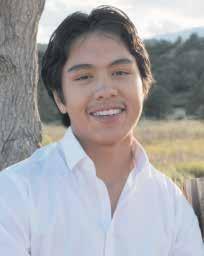
PILOT ROCK HIGH SCHOOL
Saturday, June 6, 2026 11 AM Pilot Rock High School Gym

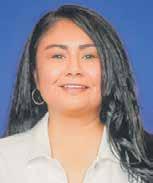
Northwest Indian College AAS General Direct Transfer Degree OLIVIA
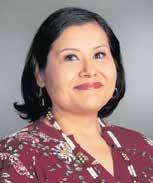
DAISY SUE MINTHORN
“Tis-See-Sah”
University of Oklahoma Master of Arts (MA) in Museum Studies Dodge Family of Arts & Sciences MAURICE V. BRONSON
CORRECTION:
In the May graduation section on Page B12, the information for two Blue Mountain Community College graduates was switched. DeArcie Abraham is graduating with an Associate of Applied Science in Agriculture Production and Richard Orna is graduating with an Associate Student Transfer Business degree.


















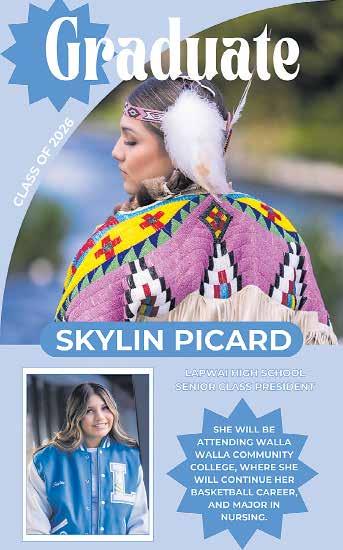
STATE TRACK AND FIELD CHAMPIONSHIPS

Thatcher captures 4A title in 400 meters
else has a little bit of Hayward magic in them.”
EUGENE — John Thatcher didn’t have to look over his shoulder to see who was breathing down his neck. There was no one there.
The Pendleton senior ran a personal best 48.54 seconds to win the 400 meters on May 30 on the final day of the 4A state championships at Hayward Field, almost a second in front of Cameron Dierdorff of Scappoose, who ran a 49.41. It was the first time Thatcher ran under 49 seconds.
“It hasn’t really hit me yet,” Thatcher said. “It was interesting, the guy in lane five (Drew Granade) got really good, then his form broke down. My last 100 meters was like sub 12 (seconds).”
Pendleton coach Andrew Sneed watched the race unfold.
“John found a new gear with about 40 meters to go and that sealed the deal,” Sneed said. “And, he broke the school record. What a great way to end his Buckaroo career.”
The previous Pendleton school record of 48.70 was set by Steve Hickey in 1982.
Thatcher, Quinn Kennedy, Gabe DeGrofft and Adam Urbina ran the 4x100 relay, finishing just off the podium in ninth place with a time of 43.90. The team was missing Ben Hopkins, who was out with an injury.
“Ben is one of our staples in our relays and sprints,” Sneed said. “Just missing him was a key factor for our overall team performance.”
The Bucks 4x400 relay team of Urbina, Kellen Villers, DeGrofft and Thatcher finished 10th with a time of 3:31.19, 3 seconds off their season best.
“I really want to get those guys a medal,” Thatcher said.
“They put their best foot forward,” Sneed added. “Sometimes, someone
Also on the track, Easton Dressler placed 12th in the 800 with a time of 2:11.69.
In the javelin, Pendleton’s Jaren Yoshioka earned his way on the medals podium, placing fourth with a throw of 166-3, which he hit on his third attempt.
Also for the Bucks, Jubal Hoisington finished 12th with a toss of 149-8.
On May 29, senior William Michael opened the day with a thirdplace finish in the pole vault with a height of 13-5, which he cleared on his first attempt. He then missed all three attempts at 13-8 3/4.
“It was great to see Will go from seventh last year to third,” Sneed said. “Being at Hayward before, and having competed in that environment, helps a lot.”
The Pendleton boys finished 12th in the team standings with 21 points. Henley won the team title with 97.5 points, while Scappoose was second (94) and Marist third (64).
In the girls’ meet, Hazel Case had an outstanding weekend for the Bucks, placing second in the long with a PR of 17-5 1/4, which she hit on her fifth jump. It’s just the second time she’s jumped more than 17 feet.
Case also was fourth in the 100 with a time of 12.71, and fourth in the 200 with a PR of 26.02.
Case also ran on the 4x100 relay team with Citlalli Garcia, Landrie Davis and Genevieve Christiansen, which placed eighth in 50.82.
“Qualifying in four events and going out and competing in four events shows her athleticism and character,” Sneed said. “Our two pole vaulters placed and earned points today.”
In the pole vault, Ava Jackson cleared a PR of 8-11 3/4 to finish
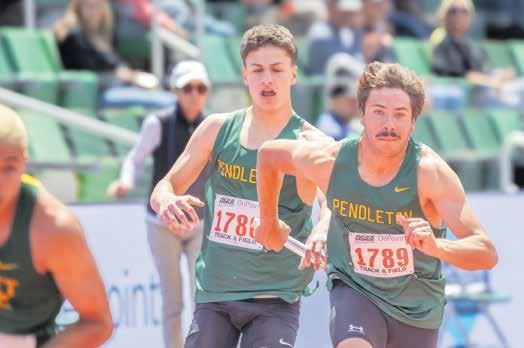

tied for sixth, while Kayle Smith also cleared 8-11 3/4 and tied for eighth.
On May 29, Braelyn Gunter placed eighth in the javelin with a toss of 103-1.
The Pendleton girls compiled 23 points and finished 11th in the team’s standings. Klamath Falls
won the team title with 68 points, while Baker was second with 67 and Henley third with 54.
“It’s one of our better finishes for the girls in recent times,” Sneed said.
ANNIE FOWLER
The CUJ
Pendleton’s Hazel Case lands in the sand while long jumping at the 4A State Track & Field Championships on May 30 at Hayward Field in Eugene.
Pendleton’s Adam Urbina receives the baton from Gabe DeGrofft during the 4x100-meter relay May 30 at the 4A State Track & Field Championships at Hayward Field in Eugene.
Pendleton’s John Thatcher wins his preliminary heat of the 400 during the 4A State Track & Field Championships on May 29 at Hayward Field in Eugene. Thatcher qualified for the final with a time of 49.65 seconds.
STATE TRACK AND FIELD CHAMPIONSHIPS
Parsons powers TigerScots to 2A team victory
ANNIE FOWLER
The
CUJ
EUGENE — Weston-McEwen senior Wyatt Parsons is not a man who likes to lose. That much was evident May 29 on the final day of the OSAA/OnPoint Community Credit Union 2A championships at Hayward Field.
After a long wait to get on the track, Parsons and the rest of the Weston-McEwen 4x100 relay team — Tristan Weseman, Logan Ray and Colby Perkins, turned in a time of 43.15 seconds to win the event and better their school record.
Parsons, who ran the anchor leg, was a full step ahead of Columbia Christian’s Jasper Zapp when he crossed the finish line.
That was just the beginning of a golden night for Parsons, who went on to win the 100 and the 200.
Parsons did not lose a 100-meter race all season.
“I’m usually not the fastest guy out of the blocks, but when I get ahead of them, it’s over,” Parsons said. “I love racing with people who are fast.”
Parsons had a hand in 35 of the TigerScots’ 74 points, leading Weston-McEwen to the team title for the first time since 2017. Enterprise was second with 54, while East Linn Christian was third with 47.
“It’s pretty exciting,” WestonMcEwen coach Loran Monaco said. “I could not have asked for a better team effort. Everyone contributed. Wyatt had a great day and broke two state records, and I don’t know how many school records.”
In the 100, Parsons ran a state record 10.83 seconds, surpassing his record of 10.89 that he ran in the prelims. Zapp was second in 11.12 as Parsons was the only runner under 11 seconds.
In the 200, Parsons had a blistering time of 21.98 seconds, breaking the state record along the way. The previous record of 21.99 belonged to Nevin Lewis of Culver, set in 2009. It’s the first time Parsons had run under 22 seconds.
“It’s a nice feeling,” said Parsons, who will run at Mt. Hood Community College next year. “I

“I could not have asked for a better team effort. Everyone contributed. Wyatt had a great day and broke two state records, and I don’t know how many school records.”
— LORAN MONACO, Weston-McEwen track and field coach
knew it would be fast with Kaydon (Haro) and Jasper (Zapp) on my hips. I knew if I got out fast it would be good.”
The team title was the icing on the cake for Parsons.
“It shows the work, not just by me, but the whole team puts in,” he said. “It’s a good place to be around. We knew Enterprise would be tough. Everyone stepped up. In my four years, I haven’t gotten second two times in football and two times in track. It’s nice to finally win one.”
Not long after the TigerScots won the 4x100, Arden Shaul placed fifth in the 1,500 for W-M with a PR of 4:09.03.
Weseman also was fifth in the 200 with a time of 23.18, while Ray was fourth in the 300 hurdles with a PR of 42.55.

2A Girls
Weston-McEwen’s Brooklyn Parker, Charlotte Hansell, Bree Perkins and Addy Hall turned in a time of 51.77 to place third in the 4x100 relay.
Enterprise won the relay with a state record time of 50.39.
Hall also placed third in the 300 hurdles with a PR of 46.23, fifth in the 100 hurdles (16.26) and was seventh in the 100 with a time of 13.19.
Hansell began the day with a fifthplaced finish in the triple jump with a leap of 32-5, which came on her last jump. She also placed eighth in the 300 hurdles (49.23).
Bandon won the 2A title with 103 points, with Enterprise a distant second with 63, and Delphian third with 54.5. Weston-McEwen was
BY KATHY ANEY
eighth in the team standings with 29 points, while Heppner was 20th with 11, and Stanfield was 23rd with 2.
1A Boys
Pilot Rock’s Sun Schimmel ran a personal best 11.26 to finish fourth in the 100. The top four runners were within .15 seconds of each other, with Josiah Gaither of St. Stephens Academy winning with a time of 11.19.
Schimmel added to his medal haul with a sixth-place finish in the 800 with a PR of 2:01.34, then turned right around and placed third in the 200 with a PR of 22.94.
“It went according to plan,” Pilot Rock coach Tyler Zyph said. “After the 800, he couldn’t even go get his medal because he had to switch his spikes and join the 200 guys in the tunnel. They were laughing at him a little. They were ‘like dude, you just ran the 800, and you’re going to run the 200? No way.’ I think that lit a fire.”
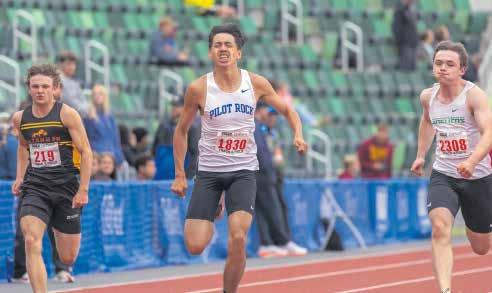
Weston-McEwen’s Wyatt Parsons wins the 100 at the 2A State Track & Field Championships on May 29 at Hayward Field in Eugene.
Weston-McEwen’s Sydney Carey shot puts at the 2A State Track & Field Championships on May 29 at Hayward Field in Eugene.
Pilot Rock’s Sun Schimmel runs the 100 at the 1A State Track & Field Championships on May 29 at Hayward Field in Eugene.
PHOTOS
The CUJ










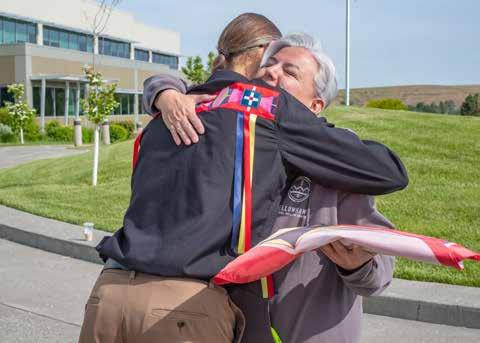
Flag Day ceremony honors Airman Serena Satterwhite
YASSER MARTE
The CUJ
MISSION — It was a quiet, ceremonial changing of the flags.
Outside the Nixyáawii Governance Center on the morning of May 20, Flag Day, the ceremony took place with no fanfare. There were no songs or speeches. The changing of the flags was brief and swift.
Five people gathered for the moment, including Confederated Tribes of the Umatilla Indian Reservation (CTUIR) General Council Chairman Lindsey X. Watchman, Board of Trustees Trustee Lisa Ganuelas, General Council Vice Chairman Boots Pond and Building Our Life Skills Training & Employment Readiness lead David Wolf.
Together, they lowered and replaced the flags in a simple act of recognition and respect.
Martina Gordon, Yellowhawk Tribal Health Center human resources information systems clerk, accepted the flag on behalf of her niece, Airman Serena Satterwhite, the daughter of tribal member Jeanine Gordon.
Satterwhite serves in the U.S. Air Force as a special missions aviator. She was honored during a Longhouse Ceremony on Jan. 4 and graduated from basic military training on March 5.
On April 29, Satterwhite received the Air Education and Training Command Distinguished Graduate Award in Aircrew Fundamentals after finishing at the top of her class in academic achievement.
Jeanine and her family traveled to attend Satterwhite’s Special Mission Aviator Fundamentals graduation on May 27 at Lackland Air Force Base in San Antonio.
During the ceremony, Jeanine said she was able to pin her daughter’s first pair of wings, describing it as “pretty special.”
“My daughter is a descendant of our ancestral warriors and leaders,” Jeanine said. “She’s the sixth great-granddaughter of Chief Piokimoxmox and the seventh greatgranddaughter of old Chief Joseph. I guess I just really believe that those
“My daughter is a descendant of our ancestral warriors and leaders ... I guess I just really believe that those grandfathers are very proud of her too.”
—JEANINE GORDON, mother of Airman Serena Satterwhite
grandfathers are very proud of her too, so it’s just really cool.”
While reflecting on the meaning of the flag, Watchman said several years ago, community members and local veterans formally adopted a local Air National Guard unit stationed at the Eastern Oregon Regional Airport before its deployment to Iraq. During the ceremony, they presented the unit with a tribal flag.
“That flag became their beacon of home,” Watchman said. “When they returned from deployment and came back to Tent City, they would see that flag and know they made it home. All the troops made it back.”
Watchman credited the blessings placed on the flag for helping protect the service members during their deployment.
As a veteran, Watchman said he often connects his military service with the history and symbolism of the tribal flag when speaking about his people.
“It represents this small community and our commitment to protecting our people,” he said.
Jeanine said the flag is now at home and will be placed in a keepsake display box with a glass front to preserve it for Satterwhite. She also expressed her gratitude and was honored CTUIR leadership gave this year’s retired flag to her daughter.
Confederated Tribes of the Umatilla Indian Reservation (CTUIR) General Council
Chairman Lindsey X. Watchman presents the tribal flag to Martina Gordon, human resources information systems clerk at Yellowhawk Tribal Health Center, on behalf of Airman Serena Satterwhite on May 20 outside of the CTUIR Nixyáawii Governance Center in Mission. (Yasser Marte/The CUJ)
BMCC Spring Powwow celebrates culture, tradition, community
THE CUJ
PENDLETON — More than 400 dancers, singers, families, students and community members gathered throughout the day on May 3 for the Blue Mountain Community College (BMCC) Spring Powwow.
The Native American Student Alliance (NASA) Club hosted the powwow, drawing visitors from across the Pacific Northwest and as far as Kansas and Utah.
Before the first dancer stepped into the arena and the first grand entry song carried through the speakers, anticipation filled the McCrae Activity Center at BMCC.
Laughter rose from the vendor tables. Children ran between chairs in tiny moccasins, their regalia jingling as they moved through the crowd. Families embraced after long drives across state lines, and the steady heartbeat of drums echoed throughout the gym.
Then, almost instantly, the circle came alive.
“When you looked around the arena, you saw generations together, you saw community together, and you saw people feeling proud of who they are and where they come from,” said Shaundeen Smith, Confederated Tribes of the Umatilla Indian Reservation (CTUIR) tribal navigator at BMCC. “That’s what makes gatherings like this so important. It creates a space where people feel welcomed, seen, connected and celebrated. Seeing our students, families and community members come together in that way was incredibly meaningful.”
Inside the arena, 123 registered dancers moved in rhythm to songs from 12 visiting drum groups, while vendors lined the outer edges of the gathering offering food, artwork, beadwork and handmade items that carried stories and traditions of their own.
Elders watched from the stands as young dancers stepped into the circle beside seasoned
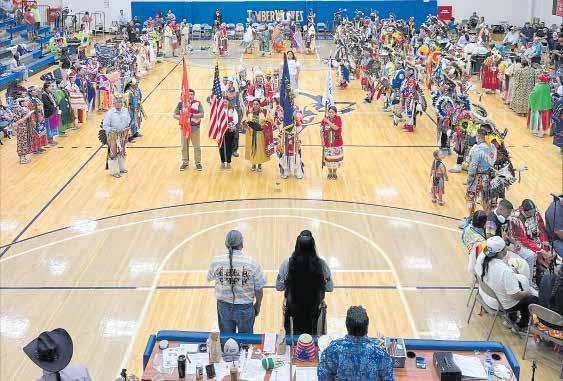
veterans. Between songs, hugs were exchanged as often as words.
For some, powwows are where traditions are passed down, where identity is strengthened, friendships are renewed and community is reinforced in real time.
This year’s event was supported by several partners and organizations, including the Wildhorse Foundation, CTUIR Higher Education, CTUIR Board of Trustees, Associated Student Government and more. Their support helped continue a gathering that celebrates culture, strengthens community and creates meaningful spaces of belonging at BMCC.






Throughout the day, the energy inside the arena shifted between celebration and reflection. Drums echoed through the bleachers as young dancers practiced their steps near the sidelines. First-time attendees sat beside families whose ties to powwow traditions span generations.
For a few hours in Pendleton, Native Americans throughout the region, generations and backgrounds, moved together to the same beat.
As the final songs echoed through the arena and chairs slowly emptied, the feeling left behind proved difficult to describe but easy to recognize: belonging.





More than 400 dancers, singers and community members gathered on May 3 at Blue Mountain Community College in Pendleton for the Native American Student Alliance Spring Powwow. (Blue Mountain Community College/Contributed photo)
Happy Canyon announces 2026 Appreciation Awards
By BEAU GLYNN
The CUJ
PENDLETON — The Happy Canyon Board of Directors recognized Aarone Hines, Wendy Sorey and Whitney Porter on May 26 at the annual Appreciation Awards in the Happy Canyon room at the Pendleton Convention Center.
The first two recipients, Sorey and Porter, are sisters who have been participating in the Happy Canyon Indian Pageant and Wild West Show since 1981. Their families have a legacy in the pageant, with their parents contributing and performing in the show themselves.
Sorey portrayed an array of characters during her time in the pageant, starting as a showgirl, and then proceeding to play other roles including an emigrant woman, pioneer, trunk mother, surprise second Blondie and last year playing a surprise Trunk Grandma.
Porter, also having participated in the pageant as a variety of characters, started her career at Happy Canyon at 9 years old when she took part in the trunk act. From there, she played an emigrant, Goldie, a saxophone player and Annie Oakley.
“When she had all these parts, her night consisted of running to the dressing room, changing, going back to set, play the part, run back to the dressing room and run to the next scene,” Alan Waggoner, former Happy Canyon president, said during the awards ceremony.
With the history of their parents participating in the Happy Canyon, so do Sorey and Porter’s children and grandchildren. Waggoner said their grandchildren now star in the trunk act together as a part of the family legacy.
“Happy Canyon is so much more than a pageant, it is a tradition, history, hard work and community,” Sorey said. “It brings generations together and keeps the spirit of Round Up and Happy Canyon alive for those of us who love this place and call it home.”
The sisters compared the Happy Canyon season to a holiday, their favorite time of year as they watch family members pass down parts.
“Both Wendy and Whitney appreciate the opportunity for their children and now grandchildren to grow up in Happy Canyon and for
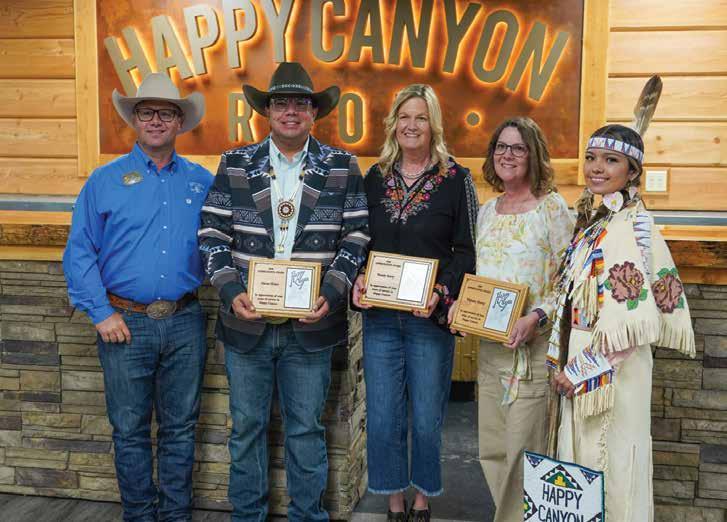
them to share that same experience where they get to spend every year having fun, sharing with friends and family and carrying on a tradition,” Waggoner said.
The final recognition for the 2026 Appreciation Awards went to Hines, the CEO of Yellowhawk Tribal Health Center and longtime participant in the Happy Canyon Pageant. Hines has also served on the Pendleton Round Up and Happy Canyon Hall of Fame Board as President.
“Aaron Hines has been a part of Happy Canyon his entire life, for 39 years,” Waggoner said before awarding Hines. “He was born in August and was carried into the show one month later in a baby board and he has been in the show ever since.”
Since starting as a baby, Hines has portrayed many different roles in the pageant. Dancing out of the teepee with other children, a warrior in the mountain scene, the Falling Indian one year, and a raider for several. He now portrays the camp-crier, a role he plays atop the horse Dancer.
“Aaron’s family has been participating in Happy Canyon from the very beginning,” Waggoner said. “Mary Hines, Aaron’s grandma, participated and was a key person for helping many of the young ladies by loaning them regalia.”
Waggoner also said Hines’ grandmother also served as a chaperone for the Happy Canyon court and was recently inducted to the Pendleton Round Up and Happy Canyon Hall of Fame for service to the organizations.
“On a personal note, I have been involved with the show for many years, I have watched Aaron work with Dancer, bringing him to set beginning in late July and August to get him ready for the show,” Waggoner said. “Riding the horse across the set is not an easy task. Some nights Dancer can be challenging, but Aaron has met the challenge and has done a great job, giving the audience a beautiful display of horsemanship.”
Hines said volunteers don’t participate for recognition, but because it was what their families have been doing for generations;
following in the footsteps of his father, grandfather and grandmother.
Hines joked that he thought he wasn’t quite old enough to be awarded with the recognition, but he had been in the show since he was a baby, making 2026 his fortieth year in the show.
“I don’t know if that qualifies, but I do have the gray hairs to prove it,” Hines said. “It is definitely an honor to receive this, I don’t step up to help because I need the recognition or the awards, but it’s just something that our family has done forever.”
Happy Canyon Show Director Becky Waggoner said for those that love the show, it is a holiday and a family reunion at the same time.
“I think one of the most beautiful things that keeps Round Up and Happy Canyon going strong is longevity and I call it the golden thread. That these families that come back year after year, it takes these amazing adults that are raising children and grandchildren to make this show strong.”

From left,Happy Canyon President Casey Hunt stands with Appreciation Award recipients Aaron Hines, Wendy Sorey and Whitney Porter, as well As Happy Canyon Princess MyaLyn Mills on May 26 in the Happy Canyon Room at the Pendleton Convention Center.
(Beau Glynn / The CUJ)
COONSKIN CREEK UPCOMING FISH PASSAGE PROJECT
The CTUIR Department of Natural Resources has an upcoming fisheries barrier removal project in Coonskin Creek near Cayuse Road (County Road 900), about 8 miles east of Mission, Oregon. Coonskin Creek provides critical habitat for midColumbia Steelhead and year-round habitat in the upper reaches for more native fishes. The project is funded by the Bonneville Power Administration to support fisheries mitigation.
Four fish passage barriers in the creek are planned for removal - three associated with the old City of Pendleton water pipeline that has crossed the Reservation for over 100 years. The fourth fish barrier will replace the existing, under-sized culvert with a 3-sided box culvert that will allow high flows to move through the channel without pooling on the upstream side of the road. The channel will be re-aligned to eliminate right angle turns at the culvert. The new creek alignment will meander with pool and wood habitat for fish rearing, reduce gradient and stream velocity in the reach. The creek naturally dries during the summer and fall months, and construction will occur after the stream is dry.
Staff from the Fisheries Program have worked with the Umatilla County, Bureau of Indian Affairs, CTUIR Water Resources, CTUIR Planning, and CTUIR Public Works to advance this project to implementation this summer with effort to minimize disruption to the community. The larger stream crossing will update and upgrade critical infrastructure identified in the CTUIR Climate Adaptation Plan – ensuring greater capacity for large hydrologic events predicted for the next several decades.
The project will be under construction during June and July between Cayuse Bridge and Kanine Road. We ask that travelers use caution when passing this site and watch for construction traffic and flaggers. The road is planned to close for about 14 days during the installation of the stream crossing. The traffic will re-route over Thornhollow Bridge.
PUBLIC NOTICES
Please plan extra time for driving during the construction. For more information about the project please contact Dana Sheedy, Fish Passage Specialist at (541) 429-7559.
PUBLIC NOTICE
June 01, 2026
TRIBAL MEMBERS: This notification formally announces that applications are now being accepted from tribal members who wish to serve on the Commission(s)/ Committee(s) listed below. Members will receive a $125.00 stipend per meeting once the minutes have been approved and processed on CTUIR paydays.
CTUIR is advertising the following positions:
1 Position - Health Commission: meets 2nd & 4th Tuesdays at Yellowhawk
1 Position – Land Protection Planning Commission: meets 2nd and 4th Tuesday at 2pm
4 Positions - Science and Technology: meets 2nd and 4th Tuesdays at 1:30pm
1 Position- Tiicham Conservation District: meets 2nd and 4th Tuesdays at 1-2:30pm
All completed applications are due by 4:00 PM on Thursday, June 18, 2026. A BOT work session is scheduled for Friday, June 26, 2026, at 8:30 AM to review applications. Appointments will be made on Monday, June 29, 2026. Applicants must have access to meet in person, via Teams, or via a teleconference with a landline or smartphone.
Applications are available online, or you may pick up a paper application at the front desk in the Nixyáawii Governance Center rotunda. Please return your paper applications to the front desk or the BOT Secretary’s Office. URL Link to fill out and submit your completed online application(s): https://ctuir.org/ourgovernment/committees-commissions/ committee-and-commission-application/ Feel free to reach out if you need assistance with accessing a computer or filling out the application.
For questions, please call BOT Secretary Monica Paradise - 541-429-7372 or email monicaparadise@ctuir.org






PUBLIC HEARING NOTICE
NOTICE IS HEREBY GIVEN that the Land Protection Planning Commission (LPPC) of the Confederated Tribes of the Umatilla Indian Reservation (CTUIR) will hold the following public hearings:
Conditional Use File #CU-26-001 – The Applicant, CTUIR Department of Natural Resources, seeks approval from the Land Protection Planning Commission to conduct a timber harvest on the site referred to as Tátwin (formerly Rainwater). The subject property is held in trust for the CTUIR and is identified as trust parcel T5600. It is located outside the external boundary of the Umatilla Indian Reservation in Columbia County, Washington. The proposed timber harvest would remove timber through mechanical and hand thinning methods to reduce fire danger and improve forest health. Under the CTUIR Land Development Code Chapter 3, timber harvests removing more than 5,000 gross board feet are identified as a Conditional Use. Conditional Use approvals are subject to Chapters 6 and 13 of the CTUIR Land Development Code.
The hearing will be held on Tuesday, June 23, 2026 beginning at 9:00 a.m. Individuals may attend the meeting in the Walúula and Wanaqit conference rooms at the Nixyáawii Governance Center, virtually, or by phone. Information on joining the meeting online is available at https://www.ctuir. org. Participation in the hearing will also be available by phone at 872-242-7793 starting at 9:00 a.m. on the day of the hearing. The meeting ID will be 447 606 598#.
Staff reports and other materials related to the hearing will be available at least ten days in advance. They will be posted online at the link above or may be requested from the Tribal Planning Office by calling 541-2763099.
The public is entitled and encouraged to participate in the hearing and submit testimony regarding the request. Written comments may be sent to tpo@ctuir.org or to the Tribal Planning Office at 46411 Timíne Way Pendleton, OR 97801 for receipt by 4:00 p.m. June 22, 2026.











Umatilla language teacher receives Crystal Apple Award
BEAU GLYNN
The
CUJ
MISSION — A Umatilla language teacher was among 34 educators honored at the Crystal Apple Award recognizing excellence in education across Eastern Oregon.
The InterMountain Education Service District (IMESD) hosted the 26th annual Crystal Apple “Excellence in Education” Awards on May 11 at the River Event Center in the Wildhorse Resort and Casino, honoring educators for their contributions to student success.
Hundreds of education professionals gathered in support of colleagues across school districts in Umatilla and Morrow counties. The Crystal Apple Award honored 34 recipients, five legacy awards and one leadership award.
“These school district employees inspire, motivate and support students in our communities,” IMESD Crystal Apple Coordinator Michele Madril said. “Despite challenges in education, our local school staff have continued to remember what’s most important — our students.”
Madril said the award recipients provide learning environments where students are inspired to explore, grow and broaden their perspectives.
Amongst the winners from Pendleton School District, the award






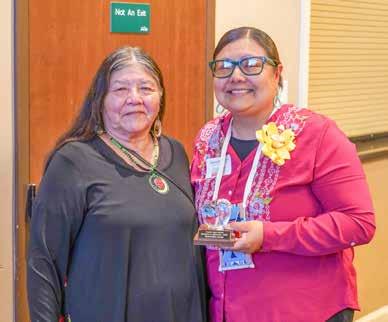
ceremony honored Shawndine Jones, a Umatilla language teacher at Pendleton Early Learning Center (PELC) and Washington Elementary School, with a Crystal Apple.
Jones, of the Walker River Paiute Tribe, was recognized for her “Walk to Language” project, developed in collaboration with Umatilla Master Speaker Mildred Quaempts.
Jones also participates in the Sapsik’ʷałá Alumni Network at the University of Oregon, a teacher education program that collaborates with federally recognized Oregon tribes to create pathways for Indigenous people to become teachers in their communities.
Madril read Jones’s biography to the crowd as she was presented the award by Pendleton Superintendent Michelle Jensen.
“Shawndine has been an unwavering supporter of bringing tribal culture and language to her students. She is the bridge connecting elementary students to tribal knowledge,” she read to the crowd.
Jones said the project started when PELC opened in 2015 and she worked together with Quaempts to bring Umatilla language to classrooms. She said she started with the kindergarten classes and has since expanded the project to Washington Elementary School.
The lessons prepared by Jones are recordings of Quaempts speaking timely or on-theme word lists or phrases in the Umatilla language. Then those recorded lessons are
brought to the students.
“Learning from Mildred, she’s taught me a lot. She’s a really great teacher,” Jones said. “I really appreciate just collaborating with her and the language program. Working in the schools is very fulfilling, and they’re very supportive.”
Quaempts said collaborating with Jones has been awesome and described her as having a “beautiful heart.”
Jones said she hopes the project will urge students to continue learning about another culture, even if they’re not a part of it.
“I think this collaboration really helps with understanding the people that are from here,” she said. “I’m not a tribal member here. I try to do things respectfully, but I think it’s important that all children learn about the tribes here, and their language is a part of that. Just helping them grow, it’s amazing to see.”
In addition, at Nixyáawii Community School, the Crystal Apple Award went to Julian “Wus” Gone, the school’s custodian.
In the Pendleton School District, winners were Jolene Hudson, an intervention teacher at Sherwood Heights Elementary School; Abbey Prevot, an art teacher at Pendleton High School; and Bridget Schultz, a fifth grade teacher at Washington Elementary School.
Shawndine Jones, right, holds her Crystal Apple “Excellence in Education” Award with Umatilla Master Speaker Mildred Quaempts on April 12 at Wildhorse Resort and Casino.
(Beau Glynn/ The CUJ)