August 2026
VOLUME 34 | ISSUE 8 The monthly newspaper of the Confederated Tribes of the Umatilla Indian Reservation Pendleton, Oregon
CUJ
CONFEDERATED UMATILLA JOURNAL
cuj.ctuir.org
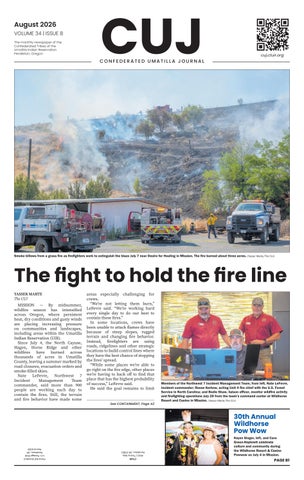
Smoke billows from a grass fire as firefighters work to extinguish the blaze July 7 near Desire for Healing in Mission. The fire burned about three acres. (Yasser Marte/The CUJ)
The fight to hold the fire line YASSER MARTE The CUJ
MISSION — By midsummer, wildfire season has intensified across Oregon, where persistent heat, dry conditions and gusty winds are placing increasing pressure on communities and landscapes, including areas within the Umatilla Indian Reservation (UIR). Since July 4, the North Cayuse, Hagen, Horse Ridge and other wildfires have burned across thousands of acres in Umatilla County, leaving a summer marked by road closures, evacuation orders and smoke-filled skies. Nate LeFevre, Northwest 7 Incident Management Team commander, said more than 900 people are working each day to contain the fires. Still, the terrain and fire behavior have made some
areas especially challenging for crews. “We’re not letting them burn,” LeFevre said. “We’re working hard every single day to do our best to contain these fires.” In some locations, crews have been unable to attack flames directly because of steep slopes, rugged terrain and changing fire behavior. Instead, firefighters are using roads, ridgelines and other strategic locations to build control lines where they have the best chance of stopping the fires’ spread. “While some places we’re able to go right on the fire edge, other places we’re having to back off to find that place that has the highest probability of success,” LeFevre said. He said the goal remains to limit
See CONTAINMENT, Page A2
Members of the Northwest 7 Incident Management Team, from left, Nate LeFevre, incident commander; Reese Kerbow, acting Unit 4 fire chief with the U.S. Forest Service in North Carolina; and Bodie Shaw, liaison officer, monitor wildfire activity and firefighting operations July 29 from the team’s command center at Wildhorse Resort and Casino in Mission. (Yasser Marte/The CUJ)
30th Annual Wildhorse Pow Wow
Keyen Singer, left, and Cara Green-Hoptowit celebrate culture and community during the Wildhorse Resort & Casino Powwow on July 4 in Mission.
PAGE B1
CTUIR 46411 Timine Way Pendleton, OR 97801
Presorted Standard U.S. Postage PAID Pendleton, OR Permit #100
CONFEDERATED UMATILLA JOURNAL | AUGUST 2026
A2
CONTAINMENT: Hagen Fire remains significant threat Continued from Page A1
the size, duration and impact of the fires while protecting nearby communities.
Fires large and small challenge
The North Cayuse Fire was the first of several major wildfires to ignite. It began on the afternoon of July 4 near Adams, quickly drawing hundreds of firefighters and aircraft into a continuous fight as flames moved through dry grasslands and timber. For nearly two weeks, crews battled intense heat, unpredictable winds and rugged terrain as they worked to stop the fire’s advance. When officials declared the fire fully contained on July 18, it had burned about 4,887 acres. In its wake, the landscape fell silent, reduced to blackened ash and scorched timber. The smoky scent of burnt wood and charred earth lingered throughout the landscape. But the summer’s fire danger was not limited to the largest blazes. Smaller grassfires also brought disruptions close to home. Late in the afternoon on July 7, a grass fire near Goad Road and Southeast Court Avenue in Pendleton caused traffic delays and prompted a precautionary power outage that left thousands of customers without electricity. Pendleton Fire Chief Tony Pierotti said fire crews responded to the grass fire, where a power pole also caught fire. PacifiCorp Communications Specialist Omar Granados said the company intentionally deenergized power lines serving a large portion of Pendleton, including downtown, because of the nearby fire. The precautionary outage reduced wildfire risk and helped protect residents and first responders, he said. The outage affected Mission, the Nixyáawii Governance Center, homes, businesses and traffic signals throughout parts of Pendleton. Granados said the outage affected nearly 6,000 customers. Power was later restored to all affected customers, and PacifiCorp advised customers who remained without service to reset their main breakers. During the incident, a semi-truck damaged overhead power lines near the area and Wtechlink Pendleton Fiber crews responded to repair the damage. Pierotti said the grass fire burned approximately 28 acres. A few days later, the Umatilla Tribal Fire Department (UTFD) and Bureau of Indian Affairs (BIA)
CUJ ABOUT THE CUJ
The Confederated Umatilla Journal (CUJ) was created in 1975 as the official publication of the Confederated Tribes of the Umatilla Indian Reservation (CTUIR), which includes the Cayuse, Umatilla and Walla Walla people. The CUJ is produced monthly by the CTUIR Communications Department.
Residents of the Desire for Healing senior care facility are evacuated and wait outside as firefighters respond to a nearby grass fire July 7 in Mission. (Yasser Marte/The CUJ)
responded to another grass fire on July 15 near Desire for Healing, a senior resident care facility at 44882 Mission Road. The Umatilla Tribal Police Department (UTPD) closed Mission Road from Memory Lane to Highway 30 for several hours and temporarily evacuated residents from the senior care facility. Fire crews later determined the immediate threat had passed, allowing residents to return. UTFD Chief James Hall said the fire burned approximately 3 acres. Later, the facility faced another disruption when a blown electrical fuse cut power throughout the building. Desire for Healing officials evacuated residents for a second time, transporting them to Willowbrook Post Acute in Pendleton after the outage made it unsafe to remain inside the building. Kayak Transit and Clearview Transportation assisted with transporting residents. Marci Buschke, operations supervisor for Kayak Transit, said Kayak provided buses and drivers at no cost to assist with the evacuation. Transit staff helped residents board buses and transported them to Willowbrook Post Acute. Some clients were transported by ambulance, though officials had not immediately confirmed whether they were taken to Willowbrook or another facility.
Major wildfires stretch across the region
While smaller fires disrupted neighborhoods and local roads, larger wildfires continued to spread
PUBLISHER: Kaeleen McGuire kaeleenmcguire@ctuir.org EDITOR: Yasser Marte yassermarte@ctuir.org REPORTER: Beau Glynn beauglynn@ctuir.org ADVERTISING: M. Moses-Conner cuj@ctuir.org CONTRIBUTORS: Kathy Aney Dallas Dick Annie Fowler Lee Gavin Wil Phinney Travis Snell Aaron Wooden Sammantha McCloud
Pendleton Fiber crews repair a damaged utility line after a commercial vehicle struck the overhead equipment on July 7 in Pendleton. (Yasser Marte/The CUJ)
across northeast Oregon, creating a season of overlapping emergencies for firefighters and communities. The Lower Dry Creek Fire, which started July 15 near MiltonFreewater and Weston, quickly became one of the largest wildfire threats in Umatilla County. According to the Oregon Department of Forestry, the fire burned approximately 8,096 acres, destroyed six homes and 40 outbuildings. The fire was fully contained on July 19. For rural communities near the fire, the impact was measured in more than acres burned. As crews worked to contain one blaze, new incidents continued to emerge across the region, adding to the challenges faced by residents and
emergency responders. Among the largest fires of the season, the Hagen Fire, sparked by lightning, has become one of the region’s most significant threats, growing to over 40,000 acres and stretching firefighting resources across multiple counties as crews work to protect nearby communities. As it grew, officials issued evacuation levels across portions of Umatilla County, Union County and the UIR, urging residents to prepare as crews worked to slow the fire’s advance. The fire has reached 11% containment, but suppression efforts continue and the battle is far from over. “We’ve made some good progress
20th of the month prior to publication.
SUBSCRIBE: The CUJ is free to pick up at tribal entities and area businesses. However, a mailed subscription can be purchased for the price of shipping and handling by contacting the CTUIR Finance Department. Call 541-429-7150 or visit the Finance Department in person at Nixyáawii Governance Center, 46411 Timine Way, Pendleton.
The CUJ prints on the first Thursday of each month.
One Year: $15 Two Years: $28
CONTACT US
Confederated Umatilla Journal 46411 Timíne Way Pendleton, OR 97801 email: cuj@ctuir.org phone: 541-429-7005 EMAIL ADVERTISING, LETTERS TO THE EDITOR, AND OTHER SUBMISSIONS TO:
cuj@ctuir.org
ADVERTISING DEADLINE:
For more information or daily news, visit the CUJ online at:
cuj.ctuir.org
CONFEDERATED UMATILLA JOURNAL | AUGUST 2026
A3
Blackened ground and scorched timber mark the burned landscape July 7 at the North Cayuse Fire, which burned approximately 4,887 acres near Adams. (Yasser Marte/The CUJ)
EDITOR’S NOTE
The Hagen, Paradise and Horse Ridge Fires are actively burning and this is a developing story. For more updates, please refer to The CUJ, KCUW or the the Confederated Tribes of the Umatilla Indian Reservation Facebook pages.
toward containment and protecting structures,” LeFevre said. “No structures lost at this point, so that’s certainly a good achievement and a win.” LeFevre said while crews have had success protecting structures on tribal lands and along Bingham Road, significant work remains. The fire continues to burn actively and spread to the east and south, requiring continued efforts from firefighters. Other fires also tested resources across the region. The Bradley Flats Fire, about 25 miles south of Pendleton, burned approximately 227 acres and reached 90% containment. The Horse Ridge Fire, located about 25 miles east of Pendleton, burned approximately 860 acres and reached 95% containment, with crews continuing to reinforce fire lines and monitor the perimeter.
Behind the fire response
The wildfire response extends far beyond northeastern Oregon. According to the National Interagency Fire Center, firefighters are battling 85 large fires nationwide, including nine new large incidents reported over the previous day. More than 27,000 firefighters and support personnel are assigned across the country, supported by 587 crews, 1,615 engines and 200 helicopters. So far this year, 43,264 wildfires
“We’ve made some good progress toward containment and protecting structures. No structures lost at this point, so that’s
certainly a good achievement and a win.” — Nate LeFevre, Northwest 7 Incident Management Team commander, speaking about the Hagen Fire
have burned more than 4.66 million acres across the United States, surpassing the 10-year average for both the number of fires and total acres burned. Fire activity remains especially intense in the Pacific Northwest. The Northwest Geographic Area is at Preparedness Level 5, the highest national readiness level, with 43 large fires still uncontained and 20 Complex Incident Management Teams assigned across Oregon and Washington. The Northwest Incident Management Team 7 is working with the Umatilla and Walla Walla County sheriff’s offices, the city of Walla Walla, state agencies and the CTUIR to contain the fires. As firefighters work together to contain the fires, they face growing challenges. One of the biggest is securing aircraft as wildfires continue to burn across Oregon and Washington. LeFevre said about 20 incident management teams are deployed throughout the region, each competing for a limited number of helicopters and air tankers to support suppression efforts. However, he said crews working the fire have secured the aircraft they need in recent days, helped by clear weather that has allowed pilots to fly safely. The firefighting effort gained additional support with the arrival
of four Oregon Air National Guard helicopters, including Blackhawks and Chinooks stationed in Pendleton. LeFevre said the aircraft, capable of carrying more than 2,000 gallons of water per drop, will serve as a shared resource for fire crews across the region. “People from all over the nation come into Oregon to help us out,” LeFevre said. Locally, he said, the team has worked closely with the tribe, county fire chiefs, the Oregon Department of Forestry and the Oregon State Fire Marshal’s Office. Those partnerships have included sending engines to protect structures along Bingham Road. “That coordination has been fantastic,” he said, adding that the Forest Service, Washington Department of Natural Resources and the federal wildland fire agency serving the tribe have all been part of daily coordination efforts. Bodie Smith, liaison officer of the Northwest 7 Incident Management Team, said spending time alongside firefighters at the Athena base camp has given him a firsthand look at the physical and emotional demands of a long wildfire campaign. “As fires drag on, you get a little tired,” Smith said. Even so, he said firefighters remain focused on safety while carrying out their mission and adapting to changing fire conditions.
LeFevre said the fire response has included a handful of minor injuries, from small burns to bumps and scrapes, but no serious incidents. He said firefighter and public safety remain the team’s top priorities. Many of the crews, Smith said, take pride in helping protect the lands of the Umatilla Indian Reservation, even as some work in unfamiliar terrain. He said their commitment has been inspiring despite the risks they face each day. Smith said the firefighting effort has expanded into a national and international response. Five Australian firefighters joined the incident the previous day as part of a larger deployment from Australia to support wildfire operations in the Pacific Northwest. He said the roughly 50-member Australian incident management team was assigned to shadow another fire in Oregon, while remaining personnel were divided into five-person modules and distributed among major incidents across the region. Incident management teams typically rotate every 14 days, Smith said, making a smooth transition between teams critical as new leaders take over the response. He said his responsibility is to ensure the incoming team understands the fire situation, operational priorities and the relationship with the CTUIR. LeFevre said the team has received strong support from the CTUIR and its Wildland Fire Service. “We appreciate that continued support,” LeFevre said, adding that community support has also been significant. He said donations, including baked goods and other supplies delivered to Athena, have helped support firefighters throughout the response.
CONFEDERATED UMATILLA JOURNAL | AUGUST 2026
A4
A heavy layer of wildfire smoke hangs over Pendleton on July 20 as smoke from regional wildfires affects air quality. (Yasser Marte/The CUJ)
Community rallies as wildfires spread YASSER MARTE The CUJ
MISSION — For residents across the Umatilla Indian Reservation (UIR), wildfire season has arrived not only with flames stretching across the landscape, but with smoke-filled skies, evacuation alerts and road closures. Smoke from the Hagen, Horse Ridge and Paradise wildfires moved across the region, contributing to worsening air quality as the Air Quality Index (AQI) reached the “Unhealthy” range of 150 to 200. Amid the growing fire threat across Umatilla County, the Confederated Tribes of the Umatilla Indian Reservation (CTUIR) Board of Trustees (BOT) declared a state of emergency July 22, citing “imminent fire danger” from the Hagen Fire near the eastern boundary of the UIR along Bingham Road, as well as a public health emergency caused by persistent poor air quality. The declaration stated that local resources had reached capacity and could not manage additional fire threats, prompting the CTUIR to seek state and federal assistance. The declaration activated the tribe’s Emergency Management Plan, which included daily coordination with the Oregon Department of Human Services, Umatilla County Public Health, the American Red Cross and Umatilla County Emergency Management. CTUIR Emergency Management officials said firefighting operations remained under the direction of local, state and federal agencies, while tribal officials focused on supporting residents and coordinating resources.
Health impact
According to the Centers for Disease Control and Prevention, wildfire smoke is a mixture of gases and fine particles released when trees, plants, buildings and other materials burn. The particles can travel deep into the lungs and affect people’s health, sometimes within hours of exposure. Smoke exposure can cause coughing, trouble breathing, wheezing, asthma attacks, stinging eyes, scratchy throats, runny noses, irritated
Megan George, Environmental Health and Safety technician for the Confederated Tribes of the Umatilla Indian Reservation (CTUIR), left, and Brian Fullen, Environmental Health and Safety specialist with CTUIR, prepare Smoke Matters Kits on July 27 at the Nixyáawii Governance Center in Mission. (Contributed Photo)
sinuses, headaches, fatigue, chest pain and a rapid heartbeat. Health officials advised residents to reduce time outdoors during periods of unhealthy air quality, especially older adults, children and people with respiratory or heart conditions, who face greater risks from smoke exposure.
It takes a community
As smoke from regional wildfires worsened air quality, the Nixyáawii Governance Center (NGC) closed its building after officials monitored local smoke levels and determined additional precautions were needed. Amid the challenging conditions, the community came together to support one another. In response to the worsening air quality, the CTUIR Environmental Health & Safety Program
distributed 70 home smoke filter kits July 24 in the NGC lobby, providing residents with tools to improve indoor air quality. Each kit included a digital indoor air quality monitor, a Smoke Matters home sealing kit with materials to help limit smoke infiltration, an N95 mask, a microfiber cleaning cloth, AQI information and QR codes linking to instructional videos on creating a cleaner indoor environment and using the kit effectively. Households were limited to one kit each, and supplies were available on a first-come, firstserved basis while quantities lasted. Yellowhawk Tribal Health Center (Yellowhawk) also maintained a distribution list and contacted individuals already enrolled in its programs to help coordinate kit deliveries. For residents unable to reach the NGC because of health concerns, transportation barriers or the risk of being unable to return home from the
CONFEDERATED UMATILLA JOURNAL | AUGUST 2026 Bingham area, tribal staff helped arrange delivery of smoke filter kits when possible. The effort extended beyond smoke protection, as community members and local businesses also supported firefighters working across the region. In addition, Mission Market hosted a firefighter donation dropoff in support of crews responding to the Paradise, Horse Ridge, Hagen and Ninemile fires. Community members were able to bring donations to the market at 46493 Mission Road. Requested donations included bottled water, electrolyte drinks, individually wrapped snacks and other supplies to help firefighters stay hydrated and supported during extended wildfire response efforts. Each donation helped provide firefighters with essential supplies to stay fueled and hydrated while responding to wildfire incidents.
Emergency evacuations
As wildfire conditions intensified, emergency response efforts expanded with evacuation assistance and shelter available for residents at Sunridge Middle School, Blue Mountain Community College and the Pendleton RoundUp Grounds. The Oregon Red Cross opened a shelter for fire evacuees and their pets at Sunridge Middle School, located at 700 SW Runnion Ave. in Pendleton. Rebecca Davenport, shelter supervisor of the Oregon Red Cross, said the shelter accommodated cats, dogs, turtles, guinea pigs, hamsters and other small pets, but it could not house larger animals such as horses or cattle. Among those sheltering at Sunridge Middle School was Kyrie Phillips, who evacuated with family from their home on Hagen Road near Bingham Creek at mile post 22. The group included five adults, two children, eight dogs and two cats. Phillips said they heard sirens
A5 help protect the health and safety of the community throughout the wildfire smoke emergency.”
CTUIR Incident Command System
Kyrie Phillips, a fire evacuee staying with his family at Sunridge Middle School, checks on one of his dogs, Lassie, inside her kennel on July 28 at the shelter in Pendleton. The Phillips family has eight dogs and two cats staying with them at the evacuation center. (Yasser Marte/The CUJ)
before deputies stopped and handed over a yellow Level 2 evacuation notice. “It was chaotic,” Phillips said. “But I kept my cool.” Phillips said it took several trips back and forth to bring every member of the household to safety at Sunridge Middle School, including the family’s eight dogs — Seven, Kilo, Oliver, Blue, Lady, Bob, Twinkie and Bossy — and two cats, Falcon and Split. To support evacuees with pets, the CTUIR and the Pendleton Animal Welfare Shelter provided supplies including food, bowls, leashes, tarps, pee pads, cleanup materials, dog waste bags and disinfectant wipes. Red Cross officials reminded residents that pets could not be dropped off at the shelter on their own. Those staying at the shelter were required to register and remain responsible for their pets’ daily care, including feeding, watering, walking and cleanup. Mystie Haynie, Public Health Operations supervisor for Yellowhawk, reported that the Evacuation Services Task Force
EVACUATION INFORMATION
For more information, contact Rebecca Davenport, shelter supervisor for the Oregon Red Cross, at 503-9535396. The shelter is at Sunridge Middle School, 700 SW Runnion Ave., in Pendleton. An emergency shelter was opened at Blue Mountain Community College’s McCrae Activity Center (Mac Center) basement gym, located at 2411 N.W. Carden Ave. in Pendleton. The shelter was established in coordination with the CTUIR, the Oregon Department of Human Services, Umatilla County Public Health and Umatilla County Emergency Management. Additional support was also made available for residents evacuating with livestock. The Pendleton Round-Up Grounds opened its facilities for people needing a safe location to relocate horses because of evacuation orders. Residents needing assistance with horse relocation were encouraged to call 541276-2553 for access information.
contacted 23 of 30 households located within the Level 3 evacuation area along the Bingham Road/Highway 204 corridor during the Hagen Fire response. Of those contacted, 11 households had evacuated to hotels or stayed with family or friends, while 12 reported sheltering in place with evacuation plans. Seven households could not be reached, and 14 were determined ineligible for Disaster Case Family Services assistance, Haynie added. Kila Solomon, Public Health Emergency Preparedness (PHEP) coordinator for Yellowhawk, reported that the PHEP Task Force has distributed 14 air purifiers, 42 replacement filters and 23 box fans to help improve indoor air quality since the wildfire smoke response began. “Public Health staff have focused on supporting homebound patients through wellness calls, medication deliveries, home visits, indoor air quality checks and coordination with Tribal, local, and state partners,” Solomon said. “The PHEP Task Force will continue providing resources and support to
The CTUIR also activated its Incident Command System to coordinate the tribal response to the Hagen Fire and help ensure essential services continued during the emergency. The system is based on the National Incident Management System and aligned with Federal Emergency Management Agency (FEMA) Community Lifelines, providing a framework for responding to emergencies such as wildfires, severe weather, hazardous materials incidents and public health emergencies. While Northwest Incident Management Team 7 and the Oregon State Fire Marshal’s Office managed wildfire suppression efforts, CTUIR’s emergency management structure focused on coordinating resources and supporting community needs. The tribe identified three primary priorities during the emergency: protecting life safety, stabilizing community lifelines and conserving property and the environment. The response structure was organized into seven functional divisions responsible for areas including safety and security, food and shelter, health and medical services, transportation and infrastructure, emergency response, finance and administrative support. According to CTUIR, the Incident Command System allowed tribal departments and partner agencies to work within one coordinated structure, helping direct resources where they were needed most while supporting residents affected by the fire. As wildfire season continues, the response across the region has highlighted the importance of preparation, communication and community support during rapidly changing emergencies.
CONFEDERATED UMATILLA JOURNAL | AUGUST 2026
A6
MESSAGE FROM TRIBAL LEADERSHIP
Reflections on 50 years of service to CTUIR
Fifty years of service to the Confederated Tribes of the Umatilla Indian Reservation (CTUIR) has been one of the greatest honors of my life. Looking back, I am grateful for my family, many tribal leaders who guided me and taught me the importance of protecting our treaty rights and natural resources for future generations. Robert and I were married in January 1965. Together we raised three wonderful daughters: Charlie, Terrie and Kim. Today we are blessed with six grandchildren and five great-grandchildren, who continue to make us proud. During the 30 years we lived in Cascade Locks, we also helped raise many young people who became part of our family. They all lived by the same rules: go to school, earn good grades, do your chores and always be honest. When we moved to Cascade Locks during our first year of marriage, I expected we would stay only one year before returning to Mission. Instead, we stayed for 30 years. Eventually I was elected to the CTUIR Board of Trustees (BOT) and we returned home. My journey into tribal leadership began in 1976 when I was appointed to the CTUIR Fish and Wildlife Committee. I never imagined a career in tribal government. Before that, I was happy being a wife and mom. The opportunity came because my grandfather, Sam Kash Kash, encouraged me to apply when a committee position became available. My family supported his
N. KATHRYN BRIGHAM Chair, CTUIR Board of Trustees
recommendation and that single decision changed my life. For two years before my appointment, I drove my grandfather and my stepfather-inlaw, Percy Brigham, to fisheries meetings. Those trips became my classroom. My grandfather taught me about the treaty rights reserved by our ancestors in the 1855 Treaty, while Percy taught me the importance of fishing as a way of life. At every meeting I listened carefully and asked questions until I understood the issues being discussed. The tribal leaders I worked with also became my teachers. They taught me that success comes from working together, listening respectfully, being honest and insisting that the federal government fulfills its trust responsibility. They also taught me that when challenges arise, we should first look at yourselves for solutions before blaming others. One of the most important moments in my career came in 1977 when Bonneville Power Administration invited the four Columbia River Treaty Tribes a meeting that led to the creation of the Columbia River Inter-Tribal Fish Commission (CRITFC), giving
the Tribes a stronger, united voice in protecting Columbia River fisheries. I was honored to serve on the original CTUIR drafting team alongside Sam Kash Kash, Antone Minthorn, Kenneth Bill and Doug Nash. That same year, the first five-year agreement under U.S. v. Oregon was approved by the Federal Court to implement the goal of a 50/50 share of harvestable salmon. While challenges remain because many salmon runs are protected under the Endangered Species Act, the U.S. v. Oregon federal court decision changed the relationship between the Tribes and the states forever. Throughout my career, I served in many leadership roles, including a member, secretary and chair of the Fish and Wildlife Committee, a member of the CTUIR Water Commission, chair of the CTUIR Water Rights Settlement effort, BOT member, and, beginning in 1985, a tribal representative to the Pacific Salmon Commission. The Fish Wars of the late 1960s and 1970s were a turning point for Columbia River Treaty Tribes. Before the federal court decisions, tribal fishers harvested only about 13 percent of the harvestable salmon despite treaty guarantees. Those legal victories recognized the Tribes as co-managers and made a harvest/production connection to help protect salmon for future generations. Without those decisions, it is unlikely salmon would have returned to the Umatilla River after 75 years or to the Walla
Walla River after nearly 100 years. One of the greatest privileges of my career was witnessing those salmon releases. At the Walla Walla River, an elderly non-Indian gentleman told me how happy he was because, although his own children had never known salmon there, his grandchildren would one day be able to fish. That moment reminded me that restoring our natural resources benefits everyone. Our natural resources are inseparable from our 1855 Treaty. The treaty guaranteed our right to harvest our traditional First Foods — water, salmon, big game, roots and berries. These resources support our health, culture, traditions, education, economy and identity. Protecting them means protecting the future of our people. As I reflect on 50 years of service, I know none of these accomplishments were achieved alone. They were made possible by the wisdom of our elders, the leadership of those who came before me, the dedication of tribal staff and elected leaders and the unwavering support of my family. I hope the next generation continues this work with integrity, respect and unity. Our responsibility is not only to honor the promises our ancestors secured in 1855, but also to ensure that our children, grandchildren and those yet to come inherit healthy rivers, healthy salmon and the opportunity to exercise the treaty rights that have sustained our people for generations.
LETTER FROM THE EDITOR
Crisis brings out the best in our community Wildfire season doesn’t ask permission before it arrives. It comes with little warning, turning clear summer days into a smoky haze. This season, wildfires have swept across the Pacific Northwest, blackening the landscape and scorching forests. The damage is impossible to ignore. Burned land stretches for miles and the smell of smoke lingers long after the flames have passed. Every disaster leaves its mark, but it also uncovers something enduring: the courage of
firefighters and the resilience of a community determined to help one another. Neighbors check on neighbors. Volunteers deliver meals and supplies. Donation drives spring into action. Schools and local arenas open their doors to evacuees, offering shelter and a place to regroup. In the face of loss, people come together with compassion
and the shared belief that no one should face hardship YASSER alone. People show up. They MARTE lend a hand, support their Editor, neighbors and keep moving Confederated forward together. Umatilla In these pages, we Journal recognize more than the fires that shaped this season. We acknowledge the people who answered them with generosity and compassion. Their altruistic work deserves as much attention as the headlines because it reminds us that while flames can change a landscape overnight, they cannot consume the spirit of a community. And behind every wildfire response are the men and women who step toward the fire line. Firefighters leave behind their families to protect the places and people they serve. They work through heat-exhausting conditions, long shifts and unpredictable conditions. Their courage reminds me that service is built on sacrifice, teamwork and dedication to helping others. During wildfire season, they are a source of strength and hope for the communities they protect. For those who have evacuated, we at the CUJ extend our deepest support. We hope you remain safe and that you can soon return to your homes and communities. To the firefighters, first responders and volunteers throughout the Pacific Northwest, thank you for your courage and dedication to protecting our communities. Thank you, gracias , and qayciyáwyaw.
CONFEDERATED UMATILLA JOURNAL | AUGUST 2026
A7
CTUIR FVS hosts Tribal State and Federal Summit BEAU GLYNN The CUJ
MISSION — The Confederated Tribes of the Umatilla Indian Reservation (CTUIR) Family Violence Services (FVS) program hosted its biannual Tribal State and Federal Summit July 7-9 at Wildhorse Resort and Casino (WRC), shaping the behavior and culture surrounding domestic violence. The summit invited speakers on an international scale to discuss topics surrounding complicit behaviors in family trauma, coercive control within families, the intersection of brain injury and domestic violence and others. FVS Manager Desireé Coyote said this summit came about due to the work systems like FVS have been doing for the past four, five years, after having always addressed domestic violence, sexual assault, elder abuse and stalking. “The last five years were cases that really impacted our families, our children and our survivors of domestic violence,” Coyote said. “This year’s summit had a focus on moving beyond policy and assisting our community members in a meaningful way that benefits our community members – not a systems-based lens. Coyote said there needs to be more meaningful ways to help the community, not to punish it. “The victim didn’t commit a crime, the offender committed crimes. The system, and sometimes community members, will always blame the mom, who they believe is not doing anything to protect the kids, but she really is,” Coyote said. She added that systems don’t take the time to sit and figure the piece out, hence the summit looking at how systems can help the families they’re trying to serve. The summit emphasized a focus on reflecting on current procedures within systems and determining if they still fit the mold of the community being served. “In my 20-plus years of addressing violence within the home, the existing templates have not worked, especially when data still shows the overrepresentation of populations within jail, detentions, prison and additionally diabetes, suicide, alcohol or drug use,” Coyote said. Coyote added that when systems don’t factor in coercion, brain injuries or negative systemexperience and their lasting harm, victims will continue to state that instances aren’t worth reporting as the systems don’t believe the experience. “Our tribal professionals often created, based on Oregon or USA, existing templates such as types of professionals and policy and procedures. Unfortunately, that may include ‘how we do the work,’ Check the box for intake, check the box for solutions. This practice, as experience shows, has not worked,” she said. Coyote said this practice, as her experience shows, has not worked. This year’s theme, Moving Beyond Policy: Shaping Behavior and Culture, focused not only on the need to move, but also solutions to work from the heart and not from
Duane Bowers addresses attendees during his presentation “Complicit Behaviors in Family Trauma” on July 9 at Wildhorse Resort & Casino during the Tribal State and Federal Summit, Beyond Policy: Shaping Behavior and Culture. (Beau Glynn / The CUJ)
checking a box. The summit’s keynote speaker, Marisa Miakoda Cummings, reminded attendees that they used to socialize with strong protocols and etiquette for day-to-day life to exist with limited contact. “(Cummings) presented a reminder for the Indigenous and provided a tribally-specific lens for the non-Indigenous. This keynote was crucial for setting the foundation for this year’s summit as the work we do to address domestic and sexual violence is handled by both tribal and non-tribal staff,” Coyote said. Other speakers included Jordyn Battle and Arianna Sessoms, speaking about supporting survivors of domestic violence, sexual assault and stalking in the workplace; Shannon Sivell, Alexxis Robinson-Woods and Libby Villa, who focused on what the Crime Victim and Survivor Services Division’s (CVSSD) commitment to collaboration, equity and meaningful engagement; and Dr. Rebecca Campbell, who spoke about the neurobiology of trauma. Coyote said she’s been a part of the CVSSD for 15 years. “It’s looking at how their grantees — usually law enforcement, prosecution and community-based advocacy — we learned back in 2010 to 2012 that services to communities of color, specifically tribal nations, were not being provided in that equal way,” she said. “Awareness was really lacking in regard to nonprofits providing services to survivors at tribal nations, so (Sivell, Robinson-Woods and Villa) talked about the overall work that we’ve done for the last 15 years to get to where we’re at now.” The second day of the conference began with Dr. Emma Katz, who presented virtually from her home in the United Kingdom while she spoke about responding to coercive control within families. Molly Washington and Shanna Knight presented on behalf of the Native American Program of Legal Aid Services of Oregon (NAPOLS), and Russha Montag Knauer analyzed the intersection of brain injury and domestic violence. “(Knauer) gave a basic outline of what brain trauma is and how it impacts people, and then she
brought in domestic violence and sexual assault, how we respond under the trauma that occurs to us and how the body truly protects itself, including our mind, body and soul,” Coyote said. Speaking about coercive control at the start of the day, Katz delved into the defining components: motivation, context and impact. “A coercive controller’s motivation is to maintain control and dominance over a partner, an ex-partner or a family member’s life to punish for non-compliance — this is what drives the perpetrator’s actions,” Katz said. “ The perpetrator is motivated by their deeply held and harmful drive to obtain control over other people in their family and maintain that control indefinitely for as long as they want it.” Katz said the context of a perpetrator’s behavior lies in a power imbalance between them and their current or ex-partner and their family, creating a need for dominating the relationship and the family and accumulating more power. Regarding impact, Katz told summit attendees that it results in the victim-survivors having to make harmful changes to their lives and behaviors in order to avoid punishment from the perpetrator. At the start of the third and final day of the conference, Robert Ransom provided fraud-awareness training to attendees, and Duane Bowers followed with a session about complicit behaviors in family trauma. Finally, Gheisha-Ly Rosario Díaz, Sharwline Nicholson and Melissa Hope Johnson spoke about creating a survivor-centered practice that promotes child safety and encourages accountability while strengthening family preservation efforts. The sessions were followed with a performance by dancer Kellen Trenel in the Rivers Event Center as he performed “According to Coyote.” “We learned about Kellen and his performance from our allies at Whitman College. We also looked at his prior work at various venues and believe this would be a great opportunity for Summit attendees, an excellent remembrance for Indigenous and an excellent learning experience for the nonIndigenous,” Coyote said.
Kellen Trenal performs “According to Coyote” on July 9, the last day of the Tribal State and Federal Summit. (Beau Glynn / The CUJ)
Confederated Tribes of the Umatilla Indian Reservation Family Violence Services Program Manager Desirée Coyote addresses summit attendees. (Beau Glynn / The CUJ)
She added that Trenel’s storytelling was engaging and lighthearted, giving insight to nuances of old ways and told the Creation story. “It was a sigh of relief and a bit of humor compared to the heavy topics from the summit, his ending was quite fitting with Marisa Cummings’ beginning,” Coyote said. Coyote said the array of topics was important for the health and well-being of community members, containing topics system professionals should know, practice and be held accountable to as someone who touches the life of someone in their community through their work. “For Family Violence Services, when we walk the community members through the paths they are on, the professionals and the community members usually involved include community-based advocates, system-based advocates, law enforcement, prosecution, courts, mental health, child welfare and judges,” Coyote said. “This entire summit was built to enhance systems knowledge and practice for the benefit of those we serve.”
CONFEDERATED UMATILLA JOURNAL | AUGUST 2026
A8
CTUIR joins historic tribal early learning effort BEAU GLYNN The CUJ
MISSION — For the first time, Oregon’s nine federally recognized tribes have a formal role in shaping a statewide early learning system designed specifically for Native children and families. The Oregon Tribal Early Learning Alliance (OTELA) held its first meeting on March 24, launching a collaborative effort to guide early childhood education and care programs across the state. OTELA and the Tribal Early Learning Plan and Fund (TELP/F) were created through House Bill 2815, which went into effect Jan. 1.
The bill requires the Department of Early Learning and Care (DELC), in consultation with the state’s nine federally recognized tribes, to develop and implement a statewide early learning and care plan for Native American or Alaska Native children ages 8 or younger. The DELC works to support coordinated, culturally appropriate and family-centered early learning services that recognize and respect the strengths and needs of all children, families and early childhood professionals. The TELP is a statewide strategic framework developed in consultation with Oregon’s nine federally recognized tribes and in
partnership with the DELC Office of Tribal Affairs. The plan outlines strategies to support tribal children from birth through age 8 while guiding the state’s early learning efforts in a way that respects tribal sovereignty and responds to community needs. Oregon’s nine federally recognized tribes are the Burns Paiute Tribe; Confederated Tribes of Coos, Lower Umpqua and Siuslaw Indians; Confederated Tribes of Grand Ronde; Confederated Tribes of Siletz Indians; Confederated Tribes of Warm Springs; Coquille Indian Tribe; Cow Creek Band of Umpqua Tribe of Indians; the Klamath Tribes and the Confederated Tribes of the Umatilla Indian Reservation (CTUIR). CTUIR Education Director Jaimie Crane and Early Childhood Services Program Manager Jory Spencer were appointed to OTELA retroactively, effective Jan. 1. In November 2025, the CTUIR Board of Trustees (BOT) approved a motion to appoint the two to OTELA after receiving a letter requesting the appointments of two representatives. “I think the appointment combinations of the department director and program manager is a smart approach,” Crane said. “ As Education director, I bring a broad strategic understanding of tribal education priorities, workforce needs and long-term planning, and can ensure that early learning decisions align with the tribe’s overall education goals.” Crane said Spencer has a hands-
on knowledge of effective early learning programs and understands the realities of students, staff, families and direct-service delivery. “This hybrid representation will better ensure OTELA’s final recommendations are grounded, practical and workable,” she said. The two members attend and participate in the 90-minute meetings every other month. Meetings are held virtually with in-person meetings in Salem when needed, Crane added. They provide recommendations on funds distribution for tribal technical assistance, professional development, infrastructure support and the support of tribal children families and caregivers, while also providing input on the delivery of cultural and linguistically-responsive early learning services. Crane said the goals for being on the OTELA align with ensuring programs and funding reflect the tribal values, languages and community-identified needs. She said it was important for the tribes to be represented at this level, referencing the OTELA’s guiding principles for Tribal Early Learning and Care, including the protection and sovereignty and self-determination, community resilience, improved outcomes for children and families, correcting historical inequities, building community trust, partnership and participation and accountability.
Up to $7,500 : 8.50% APR/OAC* (48mo) $7,501—$10k : 8.75% APR/OAC* (60mo) $10,001—$15k : 9.75% APR/OAC* (60mo) $15,001—$20k : 10% APR/OAC* (60mo)
Rates & terms are subject to change without notice
CONFEDERATED UMATILLA JOURNAL | AUGUST 2026
A9
UTPD still following up on tips in Wesley Jones case TRAVIS SNELL The CUJ
Lindsey X. Watchman, General Council chair for the Confederated Tribes of the Umatilla Indian Reservation, discusses the importance of listening to people’s concerns during General Council meetings on July 7 in his office in the Nixyáawii Governance Center in Mission. (Yasser Marte/The CUJ)
Listening, learning and guiding JORDAN STEWART The CUJ
MISSION — For Lindsey X. Watchman, strong leadership begins with hearing the community’s voice. Watchman, General Council chairman of the Confederated Tribes of the Umatilla Indian Reservation (CTUIR), works in his office on July 7, where he discusses why he believes effective leadership starts with listening to the voices of the people. “I enjoy the opportunity to build a community based on our cultural practices and way of knowing and treating each other. We have an opportunity to live the types and levels of sovereignty that we desire,” Watchman said, “It’s the opportunity to be able to impact the area I live in and the people I care about.” But Watchman also identifies communication between tribal leadership and the community as one of the greatest challenges facing the General Council. Because the council normally meets only once a month, members have limited opportunities to share concerns, ask questions and participate in discussions that shape the tribe’s future. To strengthen communication, Watchman supports creating additional community gatherings where members can share their perspectives more regularly. He said the primary responsibility of General Council officers is “to get the opinion of the people and then share with the Board of Trustees.” For Watchman, maintaining a connection between leadership and the community ensures tribal government reflects the needs and priorities of its citizens. “This government is for the community,” he said. “Our government, our community, our society should be managed in a way that everybody benefits. Everybody has an opportunity to be healthy. They have an opportunity to be employed.” Watchman said strong communities begin with meeting the basic needs of their members.
“I enjoy the opportunity to build a community based on our cultural practices and way of knowing and treating each other. We have an opportunity to live the types and levels of sovereignty that we desire.” — Lindsey X. Watchman, General Council chairman
Before people can fully participate in cultural traditions, civic responsibilities and community activities, they must first have stability and security. “They have an opportunity to have a home that isn’t crowded and be able to take care of themselves,” he said. “After those basic needs are met, you can start participating in culture and helping others and growing in your own way.” His approach to leadership reflects a belief that community wellness depends on creating opportunities for every individual to thrive and on building relationships of mutual care between individuals and the community. “We’re all very privileged to at least start off in a community that cares about us as an infant,” he said. “And as we get older, we get a turnaround and show that we care about that community as well.” He said leadership is not only about making decisions but also about giving back. By listening to community members and supporting their needs, he said tribal leaders can help strengthen a cycle of care that benefits future generations. Watchman said being elected to a third term as General Council chairman stands out as his greatest personal accomplishment. With elections every two years, he said each victory reaffirms the people’s confidence in his leadership and their belief that he has served as an effective chairman.
MISSION – Umatilla Tribal Police Department (UTPD) officials say they continue Wesley Jones to follow up on tips they have received in the case of Confederated Tribes of the Umatilla Indian Reservation (CTUIR) member Wesley Dixon Jones, who was last seen about 10 months ago. UTPD Det. William Morris said he has received three reports recently but none that led to any new information in the case. “In recent months, the UTPD has responded to three reports. The reports included the discovery of remains near Thornhollow and again near the Maze, which is a location along the railroad right of way close to the area Wesley Jones was last seen in a vehicle with a family member,” Morris said. “All the remains were determined to be non-human. The case remains open and the UTPD remains committed to following up on any leads. We also are still encouraging the community to contact the UTPD with any new information on Wesley Jones’ whereabouts.” The Maze is an informal name used by Umatilla Indian Reservation (UIR) residents for a place east of Sampson Lane along a railroad right of way. Morris said as long as tips regarding the disappearance of the 72-year-old keep coming in, the UTPD would follow up on them and not label the case cold. A cold case is an unsolved investigation
that remains open but is not active pending the discovery of new information. Anyone with information can call the UTPD at 541-278-0550. Jones was last seen on Oct. 5, 2025, along east Short Mile Road on the UIR in a gray 2003 Ford Escape with Oregon license plate SM15454. When the vehicle returned west on the same road, Jones was no longer visible in it. He is described as a 5-feet, 8-inchtall Native American weighing approximately 140 pounds with long black hair and brown eyes. Jones was last seen wearing a black and red TigerScot jacket, black shirt, black sweatpants and boots. Since Oct. 6, the UTPD, CTUIR Geographic Information Systems, Umatilla County Sheriff’s Office Search & Rescue, FBI, MMIW Search & Hope Alliance, Jones’ family and volunteers have conducted searches along the Umatilla River as well as areas encompassing Cayuse Road, Bingham Road, Short Mile Road, River Road, Sampson Lane and Johnley Pond. In another missing person involving the UIR, UTPD officials said they are still tracking the whereabouts of missing 72-yearold Donald Partin, who was last seen around 2:30 a.m. near Highway 331 and Mission Road driving a silver 2023 Dodge Ram 2500 with the Washington license plate A940674. UTPD officials said Partin is a white bald male around 5-feet9 inches tall weighing about 200 pounds with green eyes. If you have any information, call the UTPD at 541-278-0550.
CONFEDERATED UMATILLA JOURNAL | AUGUST 2026
A10
Columbia Riverkeeper files suit against Trump administration’s threats to endangered species Government axes long-standing “harm” definition THE CUJ
HOOD RIVER — Columbia Riverkeeper filed a federal lawsuit July 14 challenging U.S. President Donald Trump’s administration over changes to the Endangered Species Act (ESA), citing that the new rule would make it easier to destroy habitat critical to threatened and endangered species. According to a Columbia Riverkeeper’s court filing, the Trump administration eliminated a long-standing definition of “harm” under the ESA. The U.S. Supreme Court upheld the definition in 1995. The definition prohibited people, companies and government agencies from harming endangered species by destroying or degrading their habitat. As a result, fossil fuel companies, developers and federal agencies will be emboldened to increase activities that destroy the habitat of threatened and endangered species, including many stocks of Columbia River salmon and steelhead. “Fish and wildlife need habitat to survive. This rule change defies common sense, public opinion, science and the law,” said Miles Johnson, legal director for Columbia Riverkeeper. Many runs of Columbia River basin salmon are critically low or in danger of extinction, in large part because federal dams and other developments have degraded the habitat where these fish breed, grow and migrate. A federal court recently noted that federal salmon policy is moving in the “wrong direction” and scolded federal agencies for their “disappointing history of government avoidance and manipulation instead of sincere efforts at solving the problem and genuinely remediating the harm.” When Congress enacted the ESA in 1973, it recognized that protecting the habitats of rare fish, wildlife and plants is essential to preventing extinction and helping those species recover.
The National Marine Fisheries Service and the U.S. Fish and Wildlife Service wrote rules that prohibit anyone from causing “harm” to an ESA-listed species by destroying its habitat. These rules recognized the common-sense concept that destroying a forest, beach, river or wetland that a species relies on for survival constitutes harm to that species. In 1995, the U.S. Supreme Court upheld these rules, explaining that they were supported by the ordinary meaning of “harm,” the purpose of the ESA and multiple indications of congressional intent. The Trump administration proposed deleting these longstanding, common-sense protections. Hundreds of thousands of Americans submitted public comments opposing the Trump administration’s move to eliminate habitat protections for wildlife. U.S. senators, tribes, scientists, legal experts and environmental groups also opposed the move. The Trump administration ignored the science and the law and pushed ahead with its plan to gut bedrock environmental laws. (Last line needs cited. Sounds like an opinion.) “Claiming that the Endangered Species Act does not protect the habitat of endangered species is beyond stupid, even for the Trump administration,” Johnson said. Columbia Riverkeeper filed this legal challenge in the U.S. District Court for the Western District of Washington. This case could be moved or consolidated with other cases challenging this rule that have been or will be filed in other courts across the country. Several states and tribes are also expected to file cases challenging this rule change. It may take roughly a year for the district court to decide the legality of this rule change. Columbia Riverkeeper is represented in this case by lawyers at Earthjustice. Co-plaintiffs include Center for Biological Diversity, Conservation Law Foundation, Conservation Northwest, Friends of the Wild Swan, Oregon Wild, Sierra Club, Swan View Coalition and WildEarth Guardians.
CONFEDERATED UMATILLA JOURNAL | AUGUST 2026
A11
Pendleton City Council rejects homelessness settlement Lawyers representing five unhoused residents say they now plan to proceed with the lawsuit
A sturdy metal fence and locked gate keeps people out of a picnic shelter on May 3 at Stillman Park in Pendleton.
ANTONIO SIERRA Oregon Public Broadcasting
PENDLETON — It took months for Pendleton city staff to negotiate a tentative settlement to resolve a lawsuit over the city’s homelessness policies. Ultimately, it took only three hours of public pressure before it unraveled. The Pendleton City Council voted 5-3 on June 29 to reject the settlement, and plaintiffs said the next day that they will move forward with the lawsuit after the city’s own attorney said Pendleton was likely to lose in court. The city had a tight turnaround time to pivot to a defense, with the city required to respond to the lawsuit by July 1. Hundreds of residents packed the main hall of the Pendleton Convention Center to watch the city council meeting, and hours of debate showed that the issue of homelessness in Pendleton is far from a settled matter.
Defending the settlement
On behalf of five unhoused residents, the Oregon Law Center and Legal Aid Services of Oregon filed a lawsuit in state court last October. They alleged that the rules around public sleeping were unfair, hard to follow and left them few places to sleep at night. Rather than defend the lawsuit in court, city staff opted to open settlement negotiations with the plaintiffs’ attorneys last year. City Manager Robb Corbett and Chad Jacobs, the city’s hired legal counsel, defended the approach in front of a skeptical audience. Jacobs said state law was not on the city’s side and negotiating the settlement would allow the city to avoid costly litigation and allow city officials to focus on addressing homelessness directly. The proposed settlement would have expanded the resting period in designated areas from eight hours in the evening to 24 hours. The city’s current ordinance outlines where people can sleep outside between the hours of 10 p.m. and 6 a.m. while banning them from sleeping on streets, sidewalks, alleys and other public rights-of-way. The council amended it in 2025 to ban sleeping in public facilities or buildings, which included benches at bus stops. Additionally, the city would have waived fines for violations of the city’s existing resting ordinance and set aside $120,000 for expanded sheltering and day center services. While data is scant, there has been an uptick in visible homelessness in recent years. There is a seasonal warming station and temporary housing for unhoused residents, but permanent, affordable housing is in short supply. Corbett referenced Grants Pass, the southern Oregon town that defended its homelessness enforcement policies all the way to the U.S. Supreme Court. While the city won that case,
(Kathy Aney/ OPB)
Corbett said Grants Pass was subsequently sued under state law and entered into a settlement. Jacobs said if a state court rules against Pendleton in the lawsuit, it could cost the city more than $250,000, money that would come out of the city’s general fund rather than the city’s liability insurance. “I’m telling you, based on how this has played out in other jurisdictions, the city is likely going to lose,” he said. “How I define a win is something that improves the community and something that makes this a better situation.” Jacobs delivered his arguments to an unreceptive audience, with some members occasionally heckling him as he spoke.
‘Who’s protecting us?’
When the city council opened up the floor to public comment, Patrick Gregg was the first person at the microphone. A local attorney, Gregg is a leader for Neighbors for a Better Pendleton, a community group that advocates for stricter homelessness enforcement. The group rallied residents to a city council meeting last year to urge the council to adopt its proposed policies, which include banning new social services from the downtown area and increasing the city’s capacity to incarcerate unhoused people convicted of crimes. Standing before the council nearly a year later, Gregg said the settlement was the opposite of what Neighbors for a Better Pendleton wanted. He added that the money set aside for homelessness services would just be the tip of the iceberg. “Let me be as clear as I can,” he said. “This is going to be a multimillion dollar settlement over the course of its time. Take it to the bank.” The people who spoke after Gregg mostly agreed with him. They urged the council to delay a decision until the public had more time to digest the settlement or go back to the table to renegotiate the agreement. But more often than not, they wanted the council to scrap the settlement entirely so the city could fight the lawsuit in court. “All of this seems designed to protect the city,” resident John Norman said. “So who’s protecting us? In an echo of last year’s meeting, the complaints about homelessness were met with a smaller opposition that defended unhoused residents. Karin Power told the council that she taught in public schools for more than 30 years. When she heard unhoused residents referred to as “those people,” she remembered
them as her former students. “To keep saying, ‘Just fight it, fight it;’ it’s not a solution,” she said. Before they voted on the settlement, every councilor made a statement. Councilor John Thomas said he would not only vote against the settlement but he would be in favor of the city joining a class action lawsuit against Gov. Tina Kotek for the state’s homelessness laws. The city’s recent election – where a slate backed by Neighbors for a Better Pendleton won four seats – also had an effect on the council’s vote. Councilor Sean Butler noted that he had lost his race to a challenger endorsed by Neighbors for a Better Pendleton, and since the group was against the settlement, he would vote against it too. The newly elected candidates won’t take office until January. Councilor Carole Innes, who volunteers to feed unhoused and hungry residents, was one of three councilors who voted for the
settlement. She said many of the complaints weren’t relevant to legal questions surrounding the city’s resting ordinance. “I believe in the rule of law,” she said. The crowd had thinned significantly by the time the council voted three hours into the meeting, but its members still received hearty applause when they voted to reject the settlement. The Oregon Law Center was less enthusiastic in its response. “It is dismaying that Pendleton City Council chose to reject a settlement that would have improved conditions for people experiencing homelessness,” Oregon Law Center legal fellow Allison Nasson said in a statement. “The real issue here is that Pendleton’s policies punish homeless people with fines, jail time, or banishment for activities that other citizens can safely do. The five women in this case have suffered because of those policies, and will be moving forward with their claims in court.” Even with the settlement scuttled, the city’s homelessness policies could still be forced to get more lenient. The plaintiffs filed an injunction to suspend the city’s public sleeping policies until the issue could be litigated, but a hearing was postponed while both sides negotiated the settlement. A hearing for a judge to consider the injunction has not yet been scheduled.
CONFEDERATED UMATILLA JOURNAL | AUGUST 2026
A12
AUGUST GROCERY SPECIALS Prego® Italian Sauce 24 oz
$5.10 Great Value™ Variety Shredded Cheese 8 oz
$3.50 Barilla® Spaghetti Noodles 1 lb
$3.10 Jolly Rancher
S’mores Latte • 20 oz
Lotus • 32 oz
Chocolate and Toasted Marshmallow with Choice of Milk
Green Apple and Blue Raspberry Lotus with Choice of Soda Water or 7UP
$4.00
$4.00
Use your Rewards on the Rez card & SAVE ON FUEL!
ONLINE ORDERING AVAILABLE mymissionmarket.com or
SHOP AND GET POINTS!
Grocery | Deli | Espresso Gas Station | Drive Thru
ORDER ONLINE
Earn points on your Rewards on the Rez card when you shop, then spend points like cash!
GAS NOW AVAILABLE 24/7! Monday–Saturday, 6am–8pm | Sunday, 9am–5pm 46493 Mission Rd. Pendleton, OR 97801 • 541-276-9082
CAT16853-3
Owned and Operated by the Confederated Tribes of the Umatilla Indian Reservation.
Public responds to CTUIR nuclear draft policy town hall BEAU GLYNN The CUJ
MISSION — After the Confederated Tribes of the Umatilla Indian Reservation’s (CTUIR) virtual nuclear draft policy town hall on June 17, some key takeaways were gathered from public responses. Ranging from concerns over the environmental impact on tribal land, transparency with tribal members throughout the development of the draft policy, and economic development, the CTUIR’s Energy Strategy Team (EST) is clarifying some concerns addressed in a June meeting. CTUIR attorney Martha Izenson pointed out five key issues to clarify to the public after fielding comments: concerns about the environmental impacts of nuclear development, support for renewable energy, mitigation strategies, transparency and the involvement of tribal members in the policy’s development and economic development. Regarding the environmental impacts of nuclear development, tribal members expressed caution in reference to any potential increase in nuclear energy development, noting the need to protect and preserve land with cultural, spiritual and physical value. “It is clear that staff on the EST need to work to clarify that the policy does not change the existing Hanford Policy or opposition to nuclear development, and the policy only seeks to identify and strengthen CTUIR capacity to respond quickly to nuclear developments which may be proposed nearby when the need arises,” Izenson said. The CTUIR adopted the Hanford Policy in 2007, which lays out five core objectives: to identify and inform the CTUIR community about the conditions at Hanford (Washington) as they pertain to natural and cultural resources and how they are affected by pollution from weapons development; to protect the health of tribal members while at Hanford; to evaluate cleanup efforts; to inform other governments regarding Hanford and the CTUIR’s efforts and interests there; and to encourage partnerships to further the rest of
those goals. In reference to town hall attendees commenting on support for renewable energy, Izenson said the draft policy does not dismiss nor discourage tribal support for renewable energy. When addressing mitigation, Izenson said the nuclear policy provides guidance in navigating mitigation strategies, if and when clear opposition does not preserve and protect CTUIR’s interests and treaty-reserved rights, but does not outline any specific mitigation agreement. “Several questions and comments pertained to transparency and accountability, and the role of tribal members in developing the draft nuclear policy,” Izenson said. “The draft policy has gone through, and will continue to go through, a particularly robust engagement process, including committees, commissions and tribal staff input.” She added there will be a second survey to gauge tribal member feedback, as well as a potential for more town halls or a special General Council meeting — though dates for those have not been set. Izenson said there is an economic development portion of the draft policy that has caused a lot of confusion. “The draft policy supports economic development and support of training for tribal members to enter the renewables industry as technicians or to work with the tribal government to support tribal enterprises that provide alternatives to nuclear energy,” she said. Izenson added that other possible implementations of the draft policy would set up a tribal certification program to gauge and address if specific proponents meet and exceed the CTUIR’s standards for protection and preservation of tribal interest. The five key takeaways noted by Izenson and the EST point out the comments and concerns tribal members had during the town hall meeting, and further questions or statements can be addressed in additional surveys and meetings if and when they take place to gauge tribal feedback on the status of the draft policy.
CONFEDERATED UMATILLA JOURNAL | AUGUST 2026
A13
Removing a century-old barrier for steelhead Water line elimination will restore Coonskin Creek, reopen steelhead habitat YASSER MARTE The CUJ
MISSION — The pipeline carried water, just not for the people whose land it crossed. Now crews have removed the abandoned line from beneath the Umatilla Indian Reservation (UIR), more than two decades after it stopped supplying Pendleton’s municipal water system and became a barrier to fish passage. Workers unearthed the pipeline on July 7 as part of the Confederated Tribes of the Umatilla Indian Reservation’s (CTUIR) Coonskin Creek Fish Passage Project, an effort to restore the stream and reopen habitat for steelhead and other native fish. “We’re removing the sections that impact the creek,” Dana Sheedy, a fish passage specialist with the CTUIR Department of Natural Resources, said. “The hope is that we restore those sections as best we can and start to let the rivers heal and the fish come back into these systems in a healthier manner.” The pipeline crosses several creeks between Thornhollow and Mission, where it and related infrastructure have blocked fish passage to critical steelhead habitat. About 50 yards upstream, crews have replaced the old pipeline beneath Cayuse Road. The project is funded through the Bonneville Power Administration’s fish and wildlife mitigation program. Installed in 1914, the pipeline carried spring water from the upper Umatilla River to Pendleton for nearly 90 years. The system drew water from high-quality springs on tribally owned allotments near Thornhollow and crossed about 19 miles of the UIR before reaching the city. Although the line crossed UIR land for miles, it did not supply water to UIR residents. Pendleton retired the pipeline in 2003 after developing a new municipal water source. The line remained buried across tribal lands, where it has become an obstacle for fish passage. Sheedy said the system originated near the springs at Thornhollow, where groundwater naturally rises through gravel deposits along the upper Umatilla River. The abandoned pipeline and a concrete apron built to protect it from erosion altered the creek’s channel, increased water velocity and contributed to bank erosion and fine sediment entering the stream, she said. The crossing, along with nearby grade-control structures, blocked threatened Mid-Columbia summer steelhead and other native fish from reaching upstream spawning and rearing habitat. Sheedy said the restoration project will remove four barriers that have long hindered fish migration. “All four barriers are located within a relatively short stretch of stream,” Sheedy said. “Two of them were grade-control log weirs below a water pipeline that was covered by a concrete apron for erosion control. Together, those structures created stream conditions with
Crew workers dig out an old pipeline while removing a section of the city of Pendleton water pipeline crossing Coonskin Creek July 6 on tribal land along Cayuse Road in Mission. (Yasser Marte/The CUJ)
Dana Sheedy, a fish passage specialist with the CTUIR Department of Natural Resources, inspects the old water pipeline crossing Coonskin Creek on tribal land July 6 along Cayuse Road in Mission. (Yasser Marte/The CUJ)
“The hope is that we restore those sections as best we can and start to let the rivers heal and the fish come back into these systems in a healthier manner.” — Dana Sheedy, CTUIR Department of Natural Resources
water that was too shallow and moving too fast for migrating fish to pass.”
More than a fish passage project
For the CTUIR, however, restoring fish passage is about more than engineering. “Salmon and steelhead are First Foods to the CTUIR community,” Sheedy said. “This project is going to reconnect Coonskin Creek to its headwaters, where high-quality habitat remains just upstream of Cayuse Road.” Although portions of the creek flow underground through the project area and surface water is typically present for only about six months each year, Sheedy said fish still need access to the perennial reaches upstream. “We want fish to migrate upstream through the site and reach those higher-quality areas,” she said. “We also want the young fish they produce to be able to grow and stay healthy. The larger and healthier they become before migrating downstream, the better their chances of surviving.” Restoring connectivity is especially important as climate change affects water temperatures and stream conditions throughout the region, Sheedy noted. As summer temperatures rise, portions of the lower Umatilla River can become increasingly difficult for salmonids to survive and rear. By reconnecting Coonskin Creek to upstream habitat fed by springs from the Blue Mountains, fish will have access to cooler waters and a wider range of conditions. “Connectivity becomes really important in order to continue having fish move through these systems and access areas that are going to boost their health better,” Sheedy said. As climate conditions change, access to cooler water is becoming increasingly important for salmon and steelhead survival, Sheedy said. Salmonids begin experiencing physiological stress when temperatures rise, producing heat shock proteins that help their bodies cope with the effects of
excessive heat. Sheedy said that energy could otherwise be used for growth, migration and survival. “We really want them to be able to shelter themselves from that,” she said. “As climate may increase or is predicted to increase these temperatures even more, these areas that have colder and more hospitable water temperatures become very important.” The abandoned pipeline will not remain in place once the restoration project is complete. Crews will remove the section crossing Coonskin Creek and cap the remaining infrastructure under an agreement between the CTUIR and Pendleton, Sheedy said. Crews will also reshape the creek channel to create conditions that better support fish movement and habitat. “We’re going to create a better aligned channel there,” she said. “There’s kind of what I call a dogleg, another turn that hit toward a bank to the south and then made a hard left.” The restored channel will follow a more natural pattern, with gentle bends designed to slow water and create habitat features fish can use during migration. “We’re going to create a more natural stream channel on the downstream side where the stream will have some meanders,” Sheedy said. “This will create some scour pools that the fish can utilize for resting, adult migration passage and other times when they’re needing it.” Crews will also add woody structures to help stabilize the channel and create additional habitat. At the connection point between the restored channel and the existing stream, the project will create a backwater area, a slowermoving section of water that can provide important habitat for young fish. “That will kind of create a little side pond that’s really good for rearing fish and habitat in general,” Sheedy said. As part of the restoration, crews will fill the former channel and reestablish native vegetation along the creek. Replacing the artificial
crossing with a natural stream bed will allow steelhead and other native fish to move upstream without encountering the barriers created by the old infrastructure. “We pretty much have a natural stream bottom,” Sheedy said. “The fish will be able to move upstream and downstream freely in a naturalized habitat.” Undersized culverts can create conditions that are nearly impossible for migrating fish to overcome, she noted. When water is forced through narrow crossings, it can increase velocities beyond what fish can sustain. “With these undersized culverts and the distances of 40, sometimes 50 feet and high velocities, the fish can’t burst speed fast enough to get through and past that obstruction,” she said. The restored channel will also include features designed to help fish conserve energy as they move through the stream. “We’ll have a low-flow channel, so we’ll have a deep enough section to be able to swim through,” Sheedy said. “There’ll be roughness and rocks and then potentially within that roughness and rocks, behind a big rock, like a boulder, you have an eddy, and they can kind of duck in and rest there.” Those small features can make a significant difference for migrating fish. Instead of facing a uniform rush of water, fish will have areas where they can pause, rest and continue moving through the watershed. “We’re just excited to be doing these projects on the reservation and excited to be connecting this habitat,” Sheedy said. “The streams produce fish for us.” The CTUIR is continuing similar work throughout the Mission tributaries, replacing aging culverts and removing sections of abandoned pipelines that limit fish passage. “We’re just excited to be doing these projects on the reservation and excited to be connecting this habitat,” Sheedy said. “The streams produce fish for us and we are moving across the pipeline with sequential projects to replace corroding culverts and remove sections of pipeline so we can continue to improve access in this reach from Mission Creek to the Coonskin area.”
CONFEDERATED UMATILLA JOURNAL | AUGUST 2026
A14
CTUIR BOARD OF TRUSTEES MINUTES JUNE 22, 2026
BOT Present: Chair Kat Brigham; Treasurer Raymond Huesties; Secretary Monica Paradise; Members Lisa Ganuelas; Corinne Sams and Sierra Quaempts. Vice Chair Aaron Ashley and General Council Chair Lindsey X. Watchman on personal leave and Member Toby Patrick. Quorum present. Old Business: None. New Business: Proposed Resolutions: Next resolution number is 2026-036. Resolution 2026-036: Topic: Spirit Mountain Community Fund. RESOLVED, that Board Chair N. Kathryn Brigham is hereby authorized, empowered and directed, on behalf of the Confederated Tribes of the Umatilla Indian Reservation (CTUIR), to execute and deliver a letter of inquiry to the Spirit Mountain Community Fund regarding funding for the Longhouse and Community Assessment; NOW, THEREFORE, BE IT RESOLVED, that the Board of Trustees (BOT) hereby approves the Letter of Inquiry attached to this Resolution as Exhibit 1C for submission to the Spirit Mountain Community Fund’s Tribal Grant Program; AND BE IT FINALLY RESOLVED, that this Resolution shall become effective as of the date and time of its passage by the BOT. AND, that said Resolution has not been modified, amended or repealed and is still in full force and effect. DATED June 22, 2026. Motion: Raymond Huesties moves to adopt Resolution 2026-036. Discussion. Question. Motion carries 4 for (Raymond Huesties, Corinne Sams, Sierra Quaempts, and Monica Paradise) – 0 against – 1 abstaining (Lisa Ganuelas). Other BOT Action Items: None. BOT Travel or External Meeting Reports: Deferred. BOT Leave and Travel Requests: Chair Kat Brigham, four Zoom meetings: June 22 from 11 a.m. to noon regarding Climate Comment Act for Lower Snake River Dams; June 30 from 1-4 p.m. regarding 9 Oregon Tribes; June 30 from 8-9 a.m. regarding ATNI Executive Board; Travel Request October 11-16 to Snoqualmie, WA to attend Centennial Accord meeting. Vice Chair Aaron Ashley, one leave request: Personal leave request from July 16-21 for 30 hours.
Member Lisa Ganuelas, one leave request: Personal Leave Request for June 15-17. Motion: Corinne Sams moves to approve leave requests. Sierra Quaempts seconds. Discussion. Question. Motion Carries 5-0-0.
JUNE 29, 2026
BOT Present: Vice Chair Aaron Ashley; Treasurer Raymond Huesties; Secretary Monica Paradise; Members Corinne Sams; and Sierra Quaempts. Personal leave: Chair Kat Brigham; General Council Chair Lindsey X. Watchman. Members Lisa Ganuelas and Toby Patrick on Administrative Leave. Quorum present. Old Business: None. New Business: Proposed Resolutions: Next resolution number is 2026-037. Resolution 2026-037: Topic: Nicht-Yow-Way Elders Advisory Group Bylaws. RESOLVED, that the Board of Trustees (BOT) supports the Nicht-Yow-Way Elders Advisory Group’s Bylaws, attached as Exhibit 1; AND BE IT FINALLY RESOLVED, that the BOT appropriates additional funding per year to support the Nicht-Yow-Way Elders’ Advisory Group, detailed in the attached confidential Exhibit 2C; AND, that said Resolution has not been modified, amended or repealed and is still in full force and effect. DATED June 29, 2026. Motion: Corinne Sams moves to adopt Resolution 2026-037. Monica Paradise seconds. Discussion. Question. Motion carries 4-0-0. Other BOT Action Items: Committee/ Commission update by Secretary Monica Paradise. Education and Training Committee, twoyear term. Advertisement for one position. Motion: Raymond Huesties moves to advertise Boot Pond’s position, which is expiring July 7, 2026. Corinne Sams seconds. Discussion. Question. Motion carries 4-0-0. Farm Enterprise, three-year term. Advertisement for one position. Motion: Raymond Huesties moves to advertise for Antone Minthorn’s position that expired March 24, 2026. Corinne Sams seconds. Discussion. Question. Motion carries 4-0-0. Health Commission, three-year staggered terms, one position advertised and one application received from Carrie Sampson. Motion: Raymond Huesties moves to defer
until next month. Corinne Sams seconds. Discussion. Question. Motion carries 4-0-0. Land Protection Planning Commission, three-year term. Motion: Raymond Huesties moves to continue advertising one position. Sierra Quaempts seconds. Discussion. Question. Motion carries 4-0-0. Science and Technology Committee, twoyear term, four positions advertised, two applications received. Motion: Corinne Sams moves to reappoint Jeanine Gordon, and to appoint Celeste Wolf and Cathy Sampson Kruse by acclamation and to keep one position advertised. Raymond Huesties seconds. Discussion. Question. Motion carries 4-0-0. Tiichám Conservation District, two-year term, one position advertised, one application received from Rosenda Shippentower. Motion: Raymond Huesties moves to appoint Rosenda Shippentower by acclamation to the Tiichám Conservation District for the remaining term expiring October 3, 2026. Corinne Sams seconds. Discussion. Question. Motion carries 4-0-0. Applications are due by 4:00 p.m. Friday, July 17. A Board of Trustees work session is scheduled for July 22 at 8:30 a.m. to review applications. Appointments will be made on July 27. BOT Travel or External Meeting Reports: Chair Kat Brigham two reports: Trip to Salem to attend unveiling and presentation of the Official Portrait of Governor Kate Brown on June 15-16; June 22, Zoom meeting regarding WA Department of Commerce Lower Snake River Dams Study. General Council Chair Lindsey X. Watchman one report: Travel to Spokane, Washington June 8 to attend Governor Bob Ferguson’s fundraiser event. Motion: Corinne Sams moves to approve travel reports. Raymond Huesties seconds. Discussion. Question. Motion carries 4-0-0. BOT Leave and Travel Requests: Chair Kat Brigham, two leave requests: Personal Leave on June 2 and 9 from 7:30 a.m. to noon; Travel Request on July 6-7 to attend the Tribal Attorney Summit in Portland, Oregon.
Vice Chair Aaron Ashley, one leave request: Travel Request October 11-16 to Snoqualmie, Washington to attend the Centennial Accord meeting. Member Sierra Quaempts, one leave request: Personal Leave July 10, 7.5 hours. Motion: Raymond Huesties moves to approve leave requests. Sierra Quaempts seconds. Discussion. Question. Motion Carries 4-0-0.
JULY 6, 2026
BOT Present: Vice Chair Aaron Ashley; Treasurer Raymond Huesties; Secretary Monica Paradise; Members Lisa Ganuelas; Corinne Sams; Sierra Quaempts; and General Council Chair Lindsey X. Watchman. Chair Kat Brigham on travel, Member Toby Patrick on birthday leave. Quorum present. Old Business: None. New Business: Proposed Resolutions: Next resolution number is 2026-038. Resolution 2026-038: Topic: Hack Real Estate Contract of Sale. RESOLVED, that the Board of Trustees (BOT) hereby approves the Real Estate Contract of Sale for the Hack Property attached as Exhibit 1C, authorizes its Chair to execute the Real Estate Contract of Sale, or a document containing substantially similar terms and appropriates from the Land Acquisition account (130-000) the amount of the Purchase Price for the Hack Property as set forth in the Real Estate Contract of Sale; AND BE IT FURTHER RESOLVED, that the BOT has reviewed the Preliminary Title Report on the Hack Property, which is attached as Exhibit 2, which identifies the encumbrances to the Hack Property, and the BOT wants to proceed with the purchase of the Hack Property; AND BE IT FURTHER RESOLVED, that the BOT directs that the Department of Economic and Community Development shall manage the Hack Property, and that property taxes on and other expenses for the Hack Property will be paid out of Land Acquisition account; AND BE IT FURTHER RESOLVED, that upon receipt of title to the Hack Property, the Land Manager shall expeditiously pursue the conversion of the Hack Property from fee to trust status; AND BE IT FINALLY RESOLVED, that the BOT authorizes its Chair and Executive Director to take such further action and to execute documents that may be necessary to carry out the purposes of this
CONFEDERATED UMATILLA JOURNAL | AUGUST 2026
A15
CTUIR BOT MINUTES, CONTINUED
JULY 13, 2026
BOT Present: Chair Kat Brigham; Vice Chair Aaron Ashley; Secretary Monica Paradise; Members Toby Patrick; Lisa Ganuelas (Departed to attend a virtual meeting at 9:58 AM); Corinne Sams; Sierra Quaempts; and General Council Chair Lindsey X. Watchman. Treasurer Raymond Huesties on personal leave. Quorum present. Old Business: None. New Business: Proposed Resolutions: Next resolution number is 2026-039. Resolution 2026-039: Topic: 20262027 Board Priority Implementation Plan. RESOLVED, that the Board of Trustees (BOT) hereby adopts the 2026-2027 Board Priorities Implementation Plan attached as
Exhibit 1; AND BE IT FURTHER RESOLVED, that the BOT directs the Executive Director to distribute the Implementation Plan through press releases, to the various Committees and Commissions of the Confederated Tribes of the Umatilla Indian Reservation (CTUIR), and to present this Implementation Plan at the next available General Council Meeting; AND BE IT FURTHER RESOLVED, that the BOT directs the Executive Director to report on the progress of the Priorities through regular reporting of the staff to the BOT, in addition to an overall status report from the Executive Director that shall happen not less than every 3 months; AND BE IT FINALLY RESOLVED, that the BOT approves the allocation identified in Exhibit 2C from the Contingency Fund to expedite those identified core priorities. AND, that said Resolution has not been modified, amended, or repealed and is still in full force and effect. DATED July 13, 2026. Motion: Corinne Sams moves to adopt Resolution 2026-039. Aaron Ashley seconds. Discussion. Question. Motion carries 6 for (Corinne Sams, Aaron Ashley, Lisa Ganuelas, Sierra Quaempts, and Monica Paradise) - 1 against (Lindsey X. Watchman) – 0 abstaining. Other BOT Action Items: None. BOT Travel or External Meeting Reports: Deferred. BOT Leave and Travel Requests: Member Corinne Sams, two requests: Personal leave request for July 17, 7.5 hours; Travel request from July 22-24 to attend CRITFC meeting in Warm Springs. Chair Kat Brigham, one request: Travel request for July 15 to Portland to attend the ATNI Executive Board meeting. General Council Chair Lindsey X. Watchman, one request: Polled personal leave for July 10, 7.5 hours. Member Lisa Ganuelas, three requests: Travel request for July 15 to Walla Walla to attend the FFPP-organized tour of the Perca Verm filtration; Personal leave on July 17 from 1:30-2:30 p.m.; Personal leave on July 10, 7.5 hours. Member Sierra Quaempts, one leave request: Polled personal leave for July 9, 7.5 hours. Motion: Corinne Sams moves to approve leave requests. Aaron Ashley seconds. Discussion. Question. Motion carries 5-0-0. [Toby Patrick not present for the vote]
C U LTU R A L I N S T I TUT E
Museum Store
3-DAY SALE!
Thursday, Friday, Saturday August 13, 14, 15 For three days only get 40% off eveything in the store including blankets, home décor, art, books, CDs, and DVDs. Colorful bags, apparel, water bottles, hats and accessories are all marked down for three days only. The 3-Day Sale happens just once a year so don’t miss out!
40% off storewide!
Offer may not be combined with other discounts or offers.
Kinship Café
Open for lunch 11am-2pm Tuesday through Saturday! Great lunch options, weekly specials, and tasty huckleberry treats!
TÍKAAŠ – THE PRECIOUS ART OF CRADLEBOARDS Closes August 29
View our current exhibit featuring cradleboards from the Fred L. Mitchell Collection before it is too late. Learn about these colorfully beaded and finely crafted baby carriers used to transport infants leaving the mother’s hands free and keeping the child safe and entertained. Cradleboards are often considered works of art. They are traditionally decorated with intricate beadwork, porcupine quills, or paintings. Amulets, toys, and charms are often hung from the protective canopy. Young girls made small cradleboards for their dolls. Don’t miss this exquisite exhibit!
FREE FIRST FRIDAY!
August 7 10am-5pm
FREE admission all day. Dine inside at Kinship Cafe or order take-out. Enjoy Indian Tacos ($13) and Frybread ($6) from 11am- 2pm. Shop the Museum Store!
www.tamastslikt.org • 541.429.7700 • 47106 Wildhorse Blvd. Pendleton, OR 97801 Exhibits, Museum Store Open Tues-Sat, 10am-5pm • Kinship Cafe Open Tues-Sat 11am-2pm First Fridays are FREE!
EAT. SHOP. EXPLORE. AUGUST 2026
Resolution; AND, that said Resolution has not been modified, amended or repealed and is still in full force and effect. DATED July 6, 2026. Motion: Corinne Sams moves to adopt Resolution 2026-038. Sierra Quaempts seconds. Discussion. Question. Motion carries 6-0-0. Other BOT Action Items: None BOT Travel or External Meeting Reports: Sierra Quaempts has three reports: June 7-9 to Aurora to attend Senate President Rob Wagner’s fundraiser at Langdon Farms Golf Club; June 2 to Hermiston to attend the 211 roundtable discussion and information sharing; June 24 to Walla Walla to attend the commencement ceremony for Whitman College. Motion: Lindsey X. Watchman moves to approve travel reports. Raymond Huesties seconds. Discussion. Question. Motion carries 6-0-0. BOT Leave and Travel Requests: Kat Brigham, Chair one leave request: Personal Leave for July 28, 7.5 hours. Monica Paradise, Secretary, one leave request: Personal leave for July 8, 2-4 p.m. 2 hours. Sierra Quaempts, member one leave request: Personal leave for July 17, 7.5 hours. Motion: Lindsey X. Watchman moves to approve leave requests. Raymond Huesties seconds. Discussion. Question. Motion Carries 6-0-0.
CONFEDERATED UMATILLA JOURNAL | AUGUST 2026
A16
Winners get 20 seconds to grab up to $1,000 CASH! Fridays & Saturdays Drawings every 30 minutes • 7–10pm
Promotional currency will be used within the Cash Cube. Cash awarded is based on the total value of the promotional currency collected. 75 points per entry including Tables Games, Keno, Bingo and Poker.
GRAB CASH, SPIN THE WHEEL & MULTIPLY YOUR WINNINGS
UP TO 5X!
FRIDAYS • 10:15pm
Earn multiple entries each Friday 9am–9pm. Entries do not carry over week-to-week.
Three winners will have a chance to grab up to
ENTRY MULTIPLIER EVERY MONDAY See Club Wild for details.
$10,000 CASH! SATURDAY, AUGUST 29 10:30pm
Pick an animal plush to keep & win up to
$300 FreePlay! Every Sunday • 2–5pm Drawings every 15 minutes
DOWNLOAD,
Play daily on the Wildhorse App to win instant prizes! Plus, earn bonus entries into $170,000 Summer of Fun & Games when you play! APP GAME For more details, visit wildhorseresort.com or the Wildhorse App!
CASINO • HOTEL • GOLF • RV • DINING • FUNPLEX 800.654.9453 • PENDLETON, OR • I-84, EXIT 216 • wildhorseresort.com • Owned and operated by CTUIR Management reserves all rights to alter, suspend or withdraw promotions/offers at any time.
CAT16853-1
PLAY AND
WIN!
August 2026 cuj.ctuir.org
VOLUME 34 | ISSUE 8
CUJ CONFEDERATED UMATILLA JOURNAL
SECTION
B
Abraham Shippentower, left, and Lillian Watchman dance during an intertribal song at the 30th annual Wildhorse Resort & Casino Pow Wow on July 4 in Mission, where all attendees are invited to join regardless of whether they wear regalia.
30th Annual
Wildhorse Pow Wow
Confederated Tribes of the Umatilla Indian Reservation member Sunhawk Thomas applies warpaint before dancing the Mens Traditonal category. Ernest Morning Owl dances during the War Bonnet Special.
Photos by LEE GAVIN -The CUJ
| More photos and Powwow results on Page B2-B3
B2
CONFEDERATED UMATILLA JOURNAL | August 2026
Contestants in the Teen Girls Fancy Shawl category line up for judging July 4 during the 30th annual Wildhorse Resort & Casino Pow Wow in Mission.
Photos by
LEE GAVIN The CUJ
LEFT: Men’s Traditional dancers Santana Hutchinson, left, and Steven Paul prepare to line up for judging following competition in their category.
Tribal members from across the Pacific Northwest gather July 3-4 to participate in the 30th annual Wildhorse Resort & Casino Powwow in Mission.
Michelle Thompson prepares an order at her stand, “MTs Frybread.”
CONFEDERATED UMATILLA JOURNAL | August 2026
B3
30th Annual Wildhorse Pow Wow Results GOLDEN AGE WOMEN (60+)
JUNIOR MEN GRASS (18-39)
1st Pat Heemsah 2nd Wilma Buck 3rd Wilma Wahsise 4th Edith Walsey
1st Chad Star 2nd Sunhawk Barney 3rd Dezlin Walsey 4th Trenton Calica
GOLDEN AGE MEN (60+)
JUNIOR WOMEN FANCY (18-39)
1st Phillip Allen 2nd Terry Heemsah Sr 3rd Wallace Shorty 4th George Meninick Sr.
1st Tavian Star Lasley 2nd Dee Dee Pacheco 3rd Teata Ellenwood 4th Tennille Wahtomy
JUNIOR GIRLS JINGLE (7-12)
JUNIOR MEN FANCY (18-39)
1st Nani Tulee 2nd Nichalle Soto 3rd Amaya Queahpama 4th Haley Whitefoot
1st Gary Olney 2nd Stanley Whiteman 3rd Apollo Johnson 4th Carlos Benally
JUNIOR BOYS GRASS (7-12)
JUNIOR WOMEN TRADITIONAL (18-39)
1st Senata Meninick 2nd Jason John 3rd Niigaanii Star 4th Austen Miller
1st Katrina Blackwolf 2nd Gerra Shock 3rd Jade Louis 4th Tyera Alice Hendrickson
JUNIOR GIRLS FANCY (7-12)
JUNIOR MEN TRADITIONAL (18-39)
1st Emma Eaglespeaker 2nd Raine Williams 3rd Chanah Blackhorn 4th Sabrina James
1st Saul Jurado 2nd Bryon Adams 3rd Raymond Scott Jr. 4th Hahots Shebala
JUNIOR BOYS FANCY (7-12)
SENIOR WOMEN JINGLE (40-59)
1st Rodger Begay 2nd Timinah Ellenwood 3rd Steven Paul Jr. 4th Samuel Shippentower
1st Bridget Eaglespeaker 2nd Acosia Red Elk 3rd Julie Johnson 4th Leanna Longee
JUNIOR GIRLS TRADITIONAL (7-12)
SENIOR MEN GRASS (40-59)
1st Emma Jenkins 2nd Eveanna Morning Owl 3rd Aria Olney 4th Hazel Quarmpts
1st Gary Villa Warm 2nd Ted Darryl Bolton 3rd Ronald J. Kicking Woman Sr. 4th Tameem Sarwary
JUNIOR BOYS TRADITIONAL (7-12)
SENIOR WOMEN FANCY (40-59)
1st Tarryn M. Williams 2nd Mathanyol Briseno 3rd John Adams 4th Kyren Deere Runner
1st Susie Walsey 2nd Mary Diavolikis 3rd Raenell Scott 4th Fern Slimjohn
TEEN GIRLS JINGLE (13-17)
SENIOR MEN FANCY (40-59)
1st Imani Benson 2nd Leona Slimjohn Smith 3rd Alexix Payer 4th Abi Kordatzky
1st Kenny Pratt Jr. 2nd Gary Smith 3rd Anthony Smith
TEEN BOYS GRASS (13-17) 1st Elijiah Denny 2nd Ian Blackwolf 3rd Jayden Walsey 4th Leyson Kentle
TEEN GIRLS FANCY (13-17) 1st Nikiya Longee 2nd Valerie Scabbyrobe 3rd Dazha Joseph 4th Stephanie Brown
TEEN BOYS FANCY (13-17) 1st Kenneth Brown Jr. 2nd Jeremiah Wahchumwah 3rd Keanu Fasthorse-Begay 4th Hoody Walsey
TEEN GIRLS TRADITIONAL (13-17) 1st Dymond Say 2nd Jeyden Holliday 3rd Brees Van Pelt 4th Katerra Jackson
TEEN BOYS TRADITIONAL (13-17) 1st Blake Lloyd 2nd Myles Minthorn 3rd Abraham Shippentower 4th Tristan Brown
MEN’S CHICKEN DANCE (ALL AGES) 1st Jordan Yazzie 2nd Kenneth Brown Sr. 3rd River Buck Mattawa 4th Eric Broncheau
SENIOR WOMEN TRADITIONAL (40-59)
SENIOR MEN TRADITIONAL (40-59) 1st Russell McCloud 2nd Sydney John 3rd Andrew Tewawina 4th Nakia Williamson
GRASS V. JINGLE MEN VS WOMEN 1st Nizhoni Tallman 2nd Chad Star Marshall
VETERANS SPECIAL A. Mary Diavolikis B. Elvis Sampson C. Richard Yallup D. Phillip Allen
WAR BONNET SPECIAL 1st Nakia Williamson 2nd Carlos Calica 3rd George Meninick Sr.
OWL DANCE SPECIAL 1st Samuel Thompson 2nd Dee Dee Pacheco 3rd Chad Star Marshall
HAND DRUM CONTEST 1st Bad Eagle 2nd Mad Dawg 3rd NDN Boyz
WOMEN’S BASKET HAT (ALL AGES)
DRUM CONTEST 1st Indian Nation 2nd Mad Dawg 3rd The Horses 4th Battle Stone 5th Southern Valley
JUNIOR WOMEN JINGLE (18-39)
Host Drum Bad Eagle of Chilliwack, British Columbia, prepares for its next song.
1st Tilda Walsey 2nd Katrina Miller 3rd Violet Olney 4th Jacqueline Cantsee
1st Natasha Slimjohn 2nd Jordan T. Heemsah 3rd Frieda Delores Buck 4th Sheena McCloud 1st Arianne Sheka 2nd Shaundeen Smith 3rd Analynn Olney 4th Hokian McCloud
Curtis Bearchum dances during grand entry.
2026 Happy Canyon Princess Manaia Wolf, left, and Jolene Wolf show off matching shirts purchased from vendors at the powwow.
CONFEDERATED UMATILLA JOURNAL | August 2026
B4
The long road home for Columbia Basin salmon YASSER MARTE The CUJ
MISSION — Along the Columbia River Basin, salmon have shaped tribal cultures for generations. But as fish runs decline, tribes are working to restore habitat, strengthen hatcheries and protect treaty rights that depend on healthy rivers. The Columbia River Basin, which spans seven U.S. states and one Canadian province, was once the world’s largest salmon-producing river system. Salmon remain central to the traditions, cultural practices and treaty rights of Native American tribes, including those around the Columbia Plateau. According to Columbia Riverkeeper’s “Fish Facts: Columbia Basin Salmon, Steelhead and Other Native Fish in Crisis” fact sheet, the Columbia River Basin historically supported an estimated 10 million to 16 million salmon and steelhead. The fact sheet states that more than one-third of historic salmon and steelhead populations are extinct, while many remaining populations are considered quasiextinct, with 50 or fewer wild fish returning to spawn each year. It also reports that of the 16 salmon and steelhead stocks originating above Bonneville Dam, four are gone and 11 are either protected under the Endangered Species Act or have been eliminated. Jerimiah Bonifer, Fisheries Program manager for the Department of Natural Resources at the Confederated Tribes of the Umatilla Indian Reservation (CTUIR), said the Fisheries Program’s primary mission is to protect tribal harvest opportunities and uphold treaty rights. To do that, he said, fish and other natural resources must remain healthy and abundant. “When you see these declines over time, there are certain plans and visions that we have that help support these natural resources,” Bonifer said. One of the tribe’s key tools is habitat restoration and conservation easement acquisition. Those efforts follow what the tribe calls its “river vision,” a framework that defines a healthy river as one that supports the resources tribal members need to exercise treaty rights for future generations. The vision includes several benchmarks that guide restoration projects, including hydrology, river connectivity, geomorphology and riparian vegetation. “We’re making sure those touchstones are achieved when we go out and do these restoration efforts to restore the processes that support these populations,” Bonifer said. According to the EarthJustice report “Columbia Basin Salmon in Peril,” Columbia Basin salmon are in serious trouble, especially those that return to the Snake River to spawn. The report noted that basinwide, most wild salmon and steelhead populations are less than 5% of their pre-1850s levels, while some
Young Chinook attempt to leap into a pipeline to replicate swimming upstream on April 7 at the Pendleton Acclimation Facility in Mission. (Yasser Marte/The CUJ)
stocks, including several from the Snake River, are less than 1% of historic levels. These numbers fall well below healthy abundance goals, according to the report. The Northwest Power and Conservation Council has set an interim goal of 5 million salmon returning annually to the basin by 2025, but current returns, including hatchery fish, are less than half that goal. The report also said current returns for specific stocks remain below mid-level healthy abundance goals set by the Columbia Basin Partnership Task Force. Some species with the steepest declines, including Snake River spring and summer Chinook, are approaching functional extinction thresholds.
Hatcheries fill a critical role Habitat restoration remains one of the most important strategies for rebuilding fish populations and sustaining tribal treaty rights. Artificial production through hatchery programs is another tool used to support fish populations across the Columbia Basin. According to the Oregon Department of Fish and Wildlife, Oregon’s 33 hatcheries — 14 stateowned, 18 federally owned and one Portland General Electric facility — produce about 40 million fish annually. Those hatcheries produce about 35 million salmon and steelhead and about 5 million trout annually for release into Oregon rivers and lakes. Some releases rely on additional facilities operated by tribes, the Salmon and Trout Enhancement Program and other local entities. Hatcheries also provide opportunities for the public to learn about fish production, from eggs to broodstock, while supporting tribal
cultural traditions and providing access to wildlife viewing, interpretive displays, boating and angling in some locations. However, Bonifer said deferred maintenance at hatcheries across the Columbia Basin has persisted for decades, creating a significant backlog of repairs and operational needs. Managers have identified a roughly $1 billion infrastructure maintenance backlog, he said, with many facilities deteriorating because of constant exposure to water and aging concrete and steel structures. Those conditions limit production capacity and prevent hatcheries from fully meeting fish mitigation goals. Bonifer said the basin needs continued and increased funding to modernize and maintain the facilities. The basin contains numerous hatcheries, each operating under mitigation goals designed to offset the impacts of the federal hydropower system on the Columbia River, Bonifer said. One example is the tribally owned Nch’wána Hatchery on the South Fork Walla Walla River, which produces spring Chinook salmon to help restore populations that disappeared from the watershed. “A lot of these populations, including here in the Umatilla River, were extirpated in the early 1920s,” Bonifer said. Those original runs no longer exist, he said. Instead, managers rely on hatchery-produced fish to supplement existing populations or reintroduce salmon to areas where they were lost. In the Umatilla Basin, the CTUIR supplements a naturally occurring summer steelhead population while maintaining a reintroduced spring Chinook run.
Bonifer said the spring Chinook program began with fish from the Carson National Fish Hatchery in Washington. Over time, managers developed a locally adapted broodstock by collecting returning adult fish from the Umatilla River and using them to produce juveniles released back into the system. “We’re locally adapting the broodstock,” Bonifer said. “The adults that we collect to produce the juveniles that we’ll release into the system come from Umatilla River stock.” As the region plans for future energy needs, Bonifer said fish, wildlife and cultural resources must remain part of those decisions. According to the Columbia River Inter-Tribal Fish Commission’s energy vision, a regional power system is called for that protects treaty-protected resources, supports the recovery of Columbia Basin fish and wildlife populations and reduces impacts to water quality and tribal cultural resources. The vision also emphasizes the need for reliable energy while addressing challenges such as drought, wildfire and climate change. “We’re more than supportive of these energy needs and understanding the needs of the basin,” he said. “We just want to make sure that the resources are brought forward with those changes and not left behind.” For Bonifer, protecting those resources is about more than fish recovery. It is tied to the continuation of tribal cultures and the exercise of treaty rights. “They need to exist for the continuation of our culture and the exercise of our treaty rights,” he said.
CONFEDERATED UMATILLA JOURNAL | August 2026
B5
NCS students will return to new staff, classes, resources BEAU GLYNN The CUJ
MISSION — Students will be returning to school at Nixyáawii Community School (NCS) on August 24 as the new school year starts off with some big changes. Two new additions have been made to the staff directory at the school, including language arts educator Camilla White and social studies educator Katie Kelm. White will be replacing former English language arts educator Nicci Harrison, who resigned in solidarity with then-math educator Amanda Meyer, who was a part of a Reduction in Force in March. Kelm is the most recent addition to the staffing. While the previous reduction in force involved the school’s corestudies educator, there is still an array of math classes available to incoming students, taught by existing staff. NCS Principal Ryan Heinrich said, this year, students will have expanded opportunities in math classes, including financial algebra, consumer math and math 111 offered through online courses. “Through the collaborative efforts of NCS administration, the NCS School Board, the Confederated Tribes of the Umatilla Indian Reservation Education Department and the Office of the Executive Director, we are also excited to restore two popular programs — Foods and Drumming — to our course offerings this
NIXYÁAWII COMMUNITY SCHOOL UPCOMING EVENTS Aug. 10
Open Enrollment and Registration
Aug. 19 • 4-6 pm Open House,
Aug. 20 • 8am - 12pm
Soft Start for incoming freshmen
Aug. 24
First day of school for all students
school year,” Heinrich said. White previously expressed interest in resurrecting the foods program during her interview process, sparking the incentive to bring back the program. Heinrich said, with a dedicated team of six full-time teachers and nine total members on staff, as well as guest instructors and language educators, NCS will continue to provide small, relationshipfocused learning environments for classes that average 10-12 students. Important upcoming dates for students and families planning to attend include Aug. 10 for open enrollment and registration, an open house with light refreshments on Aug. 19 from 4-6 p.m., a soft start for incoming freshmen on Aug. 20 from 8 a.m. to 12 p.m. and the first day of school for all students kicks off on Aug. 24. “We look forward to another outstanding year of learning, growth and success as we continue to support every Golden Eagle,” Heinrich said.
Nixyáawii Community School awaits the return of staff and students Aug. 4 in Mission. (Beau Glynn/The CUJ)
CONFEDERATED UMATILLA JOURNAL | August 2026
B6
NCFS hosts tour for HomeBuilds Project BEAU GLYNN The CUJ
MISSION — Nixyáawii Community Financial Services (NCFS) hosted tours for two of its first home build projects in the Nixáawii Neighborhood on July 30. The project is courtesy of a grant secured by NCFS provided by Oregon Housing and Community Service for housing development. “ When I heard that we had the ability to go after additional funding, that’s when I said, ‘This could be the opportunity to really help make that connection between the tribe developing and building the Nixyáawii neighborhood,’” NCFS Homeownership Services Manager Pamela Ranslam said. “Actually providing the opportunity for tribal members to just buy a home rather than having to go through the construction of a home.” The significance of the grant was in taking away the requirement for tribal members to secure a construction loan while NCFS would work with a contractor to reduce the stress of tribal members having to build their own homes. It also provides housing opportunities regardless of income level to community members, that was the significance of the grant — being able to take away the requirement that tribal members would have to get a construction loan, and NCFS could work through a contractor to reduce the stress on the buyer. “That’s really where we came up with being able to use this money to hire a contractor, start building homes and then turn around and be able to sell them to the tribal community,” Ranslam said. She added that construction costs tend to be challenging as they’re higher risk, when considering building on trust land in addition, only two loan options remain. One is based on veteran-status and the other being a Section 184 loan. The Section 184 loan is a government-guaranteed loan by the Office of Native American Programs. The main requirement for this loan is for the borrower to be enrolled in a federally recognized tribe. It can be used for fee simple land, which have no restrictions of ownership, and trust land, whether it’s allotted or tribal trust-land with a 99-year lease. “With the Section 184 loan, it was specifically designed for the tribal community and specifically trust land. You can use it in the city of Pendleton or anywhere in the state of Oregon or Washington. So people can use that anywhere as long as they’re enrolled, but it’s really one of the only options for tribal members who are looking to get a mortgage on trust property or with a 99-year lease,” Ranslam said. She said with most construction loans, buyers are only paying a fraction or portion of the money used based on interest until the home is completed, and then mortgage payments begin. “With the Section 184 loan, you’re going to start making your mortgage payments the day you get the money to build your home, so you could be
Lot 14, one of the houses open for touring on July 30, is one of the stick-built homes being sold by Nixyáawii Community Financial Services in an effort to encourage community members to become buyers. Both lots 14 and 32 were open for touring by community members and potential buyers. (Beau Glynn/The CUJ)
“(Buyers) want their grandchildren, their great-grandchildren, their future generations, even if they’re not living on the reservation, maybe if they go off and they get a job somewhere else, they always have a place to come home to.” — Pamela Ranslam, NCFS Homeownership Services Manager
paying a mortgage and rent for nine months, and now you’re having to come up with some more money to pay for both,” Ranslam said. Ranslam said construction loans require a 10% contingency loan on stick-built homes as well. If one were to get a $300,000 loan to build a home, the loan would need to be an additional $30,000 to be amortized, or written off, over 30 years. “If we finance it internally or use that grant money to pay for the construction loan, that eliminates all those additional fees and charges that the homeowner would have to pay for, so they can actually just come in and purchase the home straight versus having to get a construction loan, pay for their mortgage, pay that 10% contingency,” she said. Ranslam said the benefit is twofold: it is NCFS building the homes so the buyer will not have to undergo the process attached to the construction loan, but also them not having to finance or pay the upfront costs they would normally have to do. “ There’s some definite cost savings that have nothing to do with the construction of the home, it has to do with the financing or the fees that you’re going to have to pay a lender to be able to get that house, so we’re helping to reduce that,” she said. The way the neighborhood is
Nixyáawii Community Financial Services hosted a tour of two houses that are a part of the HomeBuilds project, meant to help community members buy their own homes. Pictured July 30, the Nixyáawii Neighborhood has a park and 70 lots, 15 of which are reserved for veteran-status buyers. (Beau Glynn/The CUJ)
developed, Ranslam said flooring options were limited for the houses being constructed, considering having to have the garage open off the alleys running through the area, though they are customizable to fit what the buyer needs. Ranslam said the main thing she’s learned from teaching and providing financial and home buyer education is that buyers want a home for their families, not just their immediate families, but multigenerational homes. “(Buyers) want their grandchildren, their great-grandchildren, their future generations, even if they’re not living on the reservation, maybe if they go off and they get a job somewhere else, they always have a place to come home to. That’s really the main focus for most families, they want that connection for future generations and that level of security,” she said. Ranslam said by putting someone in the position of homeownership versus renting, they’re investing in themselves and their families, and that it can have a long-term effect on the mindsets of the buyer’s children and grandchildren. “It’s amazing when tribal members are able to become
Nixyáawii Community Financial Services (NCFS) Homeownership Services Manager Pamela Ranslam (right) guides Cree Enright through lot 14 on July 30. (Beau Glynn/The CUJ)
homeowners, we have so many out there who do want to become homeowners,” she said. “I think they’re still concerned, they’re still looking at the affordability option, and we’re looking at that too, to make sure that we’re providing some other opportunities for them.”
CONFEDERATED UMATILLA JOURNAL | August 2026
Memorial Horse Parade
B7
Photos by
LEE GAVIN The CUJ
Veterans Derek Gavin, carrying the American flag, and Derek Quaempts, carrying the Eagle Staff, conclude the Memorial Horse Parade and begin lunch July 3 in rhw Nixyáawii Mission Longhouse.
Veterans Committee Chair Ashleigh Wolf carries the CTUIR Tribal Veterans flag during the Memorial Horse Parade on July 3 in Mission.
Tribal members on horseback finish the Memorial Horse Parade. From left to right, Hazel Quaempts, Logan Quaempts, Jack Mills III, Happy Canyon Princess MyaLyn Mills and Nakai Gavin.
Rachel and Abel Matamoros greet the crowd from their float July 3, 2026 during the Memorial Horse Parade.
Board of Trustees Chair N. Kathryn Brigham addresses attendees at the Veterans Memorial before the Memorial Horse Parade.
Veterans and community members gather for a circle dance before the Memorial Horse Parade begins.
CONFEDERATED UMATILLA JOURNAL | August 2026
B8
Leland Wilson smiles at a cake in his honor during his retirement party on June 30. (Travis Snell/ CUJ)
Enjoy Life with Confidence Discover a vibrant lifestyle focused on connection, convenience, and everyday peace of mind. At McKay Creek Assisted Living, residents embrace each day with confidence while enjoying a welcoming community atmosphere. Experience a lifestyle where every day feels fulfilling, connected, and carefree. Connect with our team today to learn more. 541-612-8213 | McKayCreekAL.com
1601 Southgate Place Pendleton, OR 97801
Leland Wilson retires from CTUIR BEAU GLYNN The CUJ
MISSION — Leland Wilson retired from the Confederated Tribes of the Umatilla Indian Reservation (CTUIR) Public Works on June 30 after 25 years of working for the tribe. Wilson, 70, and a member of the Confederated Tribes and Bands of the Yakama Nation, started working at CTUIR in June 2001, though he said he worked at the Tribal Environmental Recovery Facility (TERF) in the 1980s when it was referred to as Solid Waste. From there, he worked at the Arrowhead Travel Plaza, then at Wildhorse Resort & Casino (WRC) as a Blackjack dealer. Wilson said he started working at WRC in 1995, he and his daughter were in the first Blackjack class. “If I feel like going back to work, I’ll probably look at doing Blackjack
again,” Wilson said. Wilson was working in Community Service for a couple years before the then-supervisor asked if he wanted to part-time shampooing rugs in Public Works. Zachary Patrick, Public Works custodial supervisor and Wilson’s supervisor up to the point of his retirement, said he meant a lot to the rest of the crew in Public Works. “He was a hard worker, reliable, always showed up and was dependable,” Patrick said. “It’ll be a little unorganized at first, hard to fill his position for the time being, but we’re glad to see him move on and retire.” Wilson said two of the things he’ll miss the most about his job are the paycheck and stability, though he also added that he’ll miss his fellow employees. He said his plans for retirement include fixing up his car and going fishing.
DIAPER DIAPER DISTRIBUTION DI RI I
AUGUST 11, 12 - 4 PM AUGUST 12, 8 AM - 12 PM PUBLIC HEALTH FRONT DESK
SIZES 0-7 DIAPERS & 2T-5T PULL UPS This distribution This distribution isis open open to to any any person who person who needs needs supplies supplies or or to restock to restock. .
ITEMS ARE ITEMS ARE LIMITED LIMITED AND AND DISTRIBUTED DISTRIBUTED PER CHILD PER CHILD Public Health Public Health,, 541.240.8697
CONFEDERATED UMATILLA JOURNAL | August 2026
B9
Kishpaugh ends run with Pendleton’s Rhythmic Mode ANNIE FOWLER The CUJ
PENDLETON — From costumes to choreography, Debbie Kishpaugh guided Pendleton High School’s Rhythmic Mode dance team to nine state titles and a reputation for excellence at the state level that spanned four decades. In March, she made the difficult decision to retire. “I poured my heart and soul into it,” Kishpaugh said. “I poured so much of myself into it. I will miss it. It was just time. It was time for me to do other things. When you have that conversation with yourself, ‘when is the time?’ It’s just time to slow down a little.” Kishpaugh, 64, who owns Jr. Jam Dance Studio in Pendleton and Jr. Jam Annex in Hermiston, will continue to run her dance studios. In January 2027, she will begin her responsibility as a Pendleton City council member. In May, she defeated incumbent Addison Schulberg in the race for the at-large seat. Taking over Rhythmic Mode will be Elissa Franks, who danced for Kishpaugh at Pendleton, and learned to dance at her studio. “She started at the age of 3 doing Itsy Bitsy Spider,” Kishpaugh said. “She was at the studio until her senior year. Her mom, Lora (Franks), was on the first team I coached, then became my assistant coach for 30 years. Her mom is going to stay on as the assistant coach.”
Young and ready for a challenge Kishpaugh arrived in Pendleton when she was 22, fresh out of college and looking to establish herself. She worked as a fitness instructor at Roundup Athletic Club, but she wanted more. She had danced most of her life and in college at University of Oregon and then Western Oregon State College. She wanted to teach and decided to contact Pendleton High School. “I called the school, said I was new to Pendleton,” she said. “I told them I can coach cheerleading, gymnastics or dance team. I was told they had a cheer coach, didn’t have a dance team and it was the last year of gymnastics.” That did not deter Kishpaugh, who teamed up with Liz Leonard to bring the dance team back to life. “Liz had talked to them prior to me,” Kishpaugh said. “She and I coached together as volunteers. A couple of years later, she started her family and I took over.” Kishpaugh volunteered as a dance team coach for four years before she ever received a paycheck. “Debbie Hill, who was on the school board, said it was time to pay me,” Kishpaugh said. “It took me four years to get a paycheck.” The early years at Pendleton were a bit rough. The dance team was called the Buckerettes, but a naming contest in 1987 saw the name changed to Rhythmic Mode and a new generation of dance was born. Kishpaugh took over the program
Dance instructor and Pendleton City Councilor-elect Debbie Kishpaugh leads a dance rehearsal on May 5 at her Jr. Jam Dance Studio in Pendleton. (Kathy Aney/The CUJ)
“I poured my heart and soul into it. I poured so much of myself into it. I will miss it. It was just time. It was time for me to do other things.” — Debbie Kishpaugh in 1986, and the team qualified for state for the first time in 1987, placing third. “Every year I have coached, we have placed in the top five all but two years (1988 and 2005),” Kishpaugh said. Rhythmic Mode won its first state title in 2001, and followed with titles in 2008-13, and 2018-19. Pendleton looked to win its 10th state title in 2020, but the COVID pandemic shut down the state championships six days before the competition. “We would have gone into state with the highest score,” Kishpaugh said. “The year after, judges came in and gave us rankings. We were the only school our size to receive a superior rating. COVID killed dance. We weren’t the only team that struggled to come back. The richer teams, Lake Oswego and Canby, survived better than the rest of us.” At times, the program had upwards of 50 dancers, but most years there were between 25-40. “Our highest number was 53,” Kishpaugh said. “That was before we were well-funded by the school district.”
Kishpaugh was named the Oregon 5A Dance/Drill Coach of the Year in 2008, 2017 and 2025. She was named the National Federation of High School Associations Coach of the Year for 2021-22. Kishpaugh also was inducted into the Buckaroo Hall of Fame in 2021. In addition to her work at the high school, Kishpaugh is the founder of the Oregon Junior Dance Team Championships (OJDTC). The program has raised more than $135,000 for dance and academic scholarships for the Oregon Dance Drill Coaches Association. Kishpaugh said she has so many good memories with the high school program and her studio, but the best ones include her daughters Morgan and Piper. “Both of my girls grew up in the studio, danced on the (Rhythmic Mode) team and worked in the studio,” she said. “Those were some of the most memorable times.”
Dancing from Day 1 Kishpaugh has been in love with dance since she was a little girl. When she was 9, she put together a production of Winnie the Pooh with her twin sisters Sherry and Shelly,
and her little sister Kristie. “I’ve always been ambitious,” Kishpaugh said. “I guess it started with my first step. When I was on the junior high team, I choreographed for our team, and on the high school team at South Salem. When I was in high school, I volunteered to be the junior high coach. It has been in my blood.” She also started making costumes at a young age. “I would take grocery bags and make holes in them,” she said. “My mom wouldn’t let me use the sewing machine. I got out old clothes and trinkets and made my own costumes. When I learned to sew, I was making costumes.” Kishpaugh opened her dance studio in Pendleton 40 years ago and has had scores of dancers come through the doors. She has had dancers go on to perform professionally with the Disney Cruise line, on Broadway, Boise State University, Oregon State University, Gonzaga University, Eastern Oregon University, Chapman University and the University of Montana. As the field of dance has evolved, so has Kishpaugh. “Any coaching takes a lot of mental effort,” she said. “It is an art form and it evolves. I’m just as hard on myself as everybody else.” Acro, a style of dance that combines classical dance steps with gymnastic skills, has become popular and Kishpaugh is keeping up with the times. She added a 40foot running trampoline in her Hermiston studio. “The numbers for acro are up,” she said. “We also have the big tumbling mats. The 40-foot tumbling track, once it’s down, it’s not going anywhere. I just need a place to put it.” If history has taught us anything, Kishpaugh will make it happen.
CONFEDERATED UMATILLA JOURNAL | August 2026
B10
MORE FUN. MORE OFTEN!
FREE LIVE MUSIC LUKE BASILE - AUGUST 7 A celebrated singer/songwriter known for his mix of laid-back island rhythms and soulful acoustic style.
JESSEY ADAMS - AUGUST 28 Award-winning singer/songwriter known for her combination of outlaw and traditional style county music.
Plus, a special outdoor menu starting at 4pm Visit hamley.com for full schedule
Lawn opens at 4pm. Food and beverages purchase required for outside dining. Management reserves all rights to alter, suspend or withdraw promotions/offers at any time.
DOWNLOAD OUR NEW APP!
LEW-7UP-8-2026
LEW-7UP-8-2026
®
OFFER EXPIRES 8-31-2026
OFFER EXPIRES 8-31-2026
MOST OF OUR ENERGY IS SPENT HELPING YOU GET THE MOST OUT OF YOURS. We offer resources and cash incentives to reduce your energy costs and generate clean power. Learn more at energytrust.org.
CONFEDERATED UMATILLA JOURNAL | August 2026
B11
Mt. Hood is next stop for W-M sprinter Wyatt Parsons ANNIE FOWLER The CUJ
ATHENA — Wyatt Parsons got offers to run track from numerous colleges, even some from out of state, but the Weston-McEwen speedster chose Mt. Hood Community College — one of the few Oregon schools that did not extend an offer. “Mt. Hood was one of the only schools that didn’t reach out to me,” Parsons said. “My coach (W-M assistant Matt Wiseman) recommended them, so I reached out to their coach (Fernando Fantroy). The second I reached out, coach Fantroy got back to me and said he’d like to have me. I really like him as a person. He is a nice guy and is funny. I went for a visit and I liked everything there.” Mt. Hood, located in Gresham, has a newly resurfaced track. The Saints will host the 2027 NWAC men’s and women’s track and field championships. Parsons said he received offers from bigger schools, but he didn’t want the price tag. “Going to a bigger school would have cost me a lot more money,” he said. “If I would have gone to EOU (Eastern Oregon University) or Portland State, it would have cost me more. I’d be getting calls every day from schools that wanted me, some were out of state. I didn’t want to go D3. Community college seemed like a perfect fit, budget friendly, and there are great athletes.” When it comes down to it, Parsons is worth every penny of his scholarship. Parsons won three gold medals at the 2A state championships in May, and helped the TigerScots to the boys team title — their first since 2017. Parsons opened championship day on the track as he and the rest of the Weston-McEwen 4x100 relay team — Tristan Weseman, Logan Ray and Colby Perkins — turned in a time of 43.15 seconds to win the event and better their own school record. Parsons, who ran the anchor leg, was a couple of steps behind two runners when he received the baton, but was a full step ahead of Columbia Christian’s Jasper Zapp when he crossed the finish line. After finishing second in the event at the Special District 4 Championships the week before to Culver, Parsons said that wasn’t going to happen again. “I enjoy the pressure that the team puts on me,” he said. “They rely on me. I told them ‘if you guys give me a little bit more at state, I can do it.’ I’m too competitive to lose something like that.” Parsons followed with a title in the 100 meters, running a state record 10.83 seconds, surpassing his own record of 10.89 that he ran in the prelims. Zapp was second in 11.12 as Parsons was the only runner under 11 seconds. In the 200, he claimed the title with a state record time of 21.98 seconds. The previous record of 21.99 belonged to Nevin Lewis of
Weston-McEwen’s Wyatt Parsons wins the 100 at the 2A State Track & Field Championships on May 29 at Hayward Field in Eugene. (Kathy Aney/ The CUJ)
“This year, I really kicked it up, especially since the loss at state last year in the 100... It flipped a switch for me. I ran all winter. I was running around the middle school and going to the weight room with my coach. Putting in that extra effort in the off season paid off.” — Wyatt Parsons Culver, set in 2009. It’s the first time Parsons had run under 22 seconds. “That was exciting especially since I ran a 22.00 twice and it was a relief when I looked up at saw 21.99 (in the prelims),” Parsons said. Parsons also added a fourth-place finish in the long jump at state (208), but that is not one of the events Mt. Hood would like him to compete in. “He (Fantroy) wants me to do the 100, 200, 4x100 and 4x400,” Parsons said. “The 4x400 team was competitive last year and they only lost one guy. We should be one of the best in the NWAC.” Parson never lost a race in the 100 meters all season. In 13 races, he ran under 11 seconds 11 times. Early in the season, he ran a 10.87 at the Buck Track Classic, besting Pendleton’s Ben Hopkins (11.03), and ran a 22.29 to win the 200, just a whisker in front of Pendleton’s John Thatcher (22.30) and Hopkins (22.39). “It was so much fun running against Ben and John,” Parsons said. Parson’s made big strides from last year to this spring. He was second at state last year in the 100, and ran under 11 seconds just twice. He was eighth in the 200 (23.40), he won the long jump (21-2 1/2) and the 4x100 relay was disqualified in the finals. “Up until this year, I didn’t put in as much work as I should have,” Parsons said. “This year, I really kicked it up, especially since the loss at state last year in the 100 (to Oli Beauregard of Delphian). “He was younger than me and he ran my PR. I came in No. 1 and lost in the finals. It flipped a switch for me. I ran all winter. I was running around the middle school and going to the weight room with my coach. Putting in that extra effort in the
offseason paid off.” Parsons is confident he can shave even more time off when he gets to college. “I hope working with Fernando, I
can get some crazy times,” he said. “There is plenty left in me. I believe coach Fernando can get everything out of me with his expertise in sprinting.”
CONFEDERATED UMATILLA JOURNAL | August 2026
B12
CTUIR is Wampum Sponsor for Indigenous Media Conference Staff from the Confederated Tribes of the Umatilla Indian Reservation (CTUIR) Communications Department celebrate being the first Wampum Sponsor, a top-tier level sponsorship, of the Indigenous Media Conference on July 22 in Portland. Recognition of the sponsorship included a video dedication to the history of the CUJ and KCUW, introduced by CTUIR Communications Director Kaeleen McGuire, a performance by Acosia Red Elk, an introduction by former CTUIR Communications Director Chuck Sams and an introductory speech delivered by Public Relations Specialist Travis Snell preceding the awards banquet on the conference’s final day. Pictured, from left, are McGuire; Snell; Lee Gavin, photographer and videographer; Sammantha McCloud, KCUW operations associate; Monece Moses, administrative assistant; Beau Glynn, Confederated Umatilla Journal (CUJ) reporter; and Yasser Marte, CUJ editor. (CTUIR/Contributed photo)
THE FUTURE OF AUGUST 17–23 FREE YOUTH GOLF CLINICS August 18 | Morning & Afternoon Sessions Session Covers: Golf Swing Fundamentals (drives to wedges), chipping, putting, etiquette, and rules. Space limited to the first 50 registered youth golfers. Bring your own clubs if available.
Scan to register or visit wildhorseresort.com
CLUB WILD MEMBERS RECEIVE A
FREE THREE-DAY PASS! Join us on the greens at the Wildhorse Golf Course and see over 140 professional golfers compete for a spot in the LPGA.
GET TICKETS: Wildhorse App or at wildhorseresort.com
CASINO • HOTEL • GOLF • RV • DINING • FUNPLEX 800.654.9453 • PENDLETON, OR • I-84, EXIT 216 • wildhorseresort.com • Owned and operated by CTUIR
Management reserves all rights to alter, suspend or withdraw promotions/offers at any time.
CAT16853-5
®
CONFEDERATED UMATILLA JOURNAL | August 2026
B13
B14
CONFEDERATED UMATILLA JOURNAL | August 2026
PUBLIC NOTICE
July 27, 2026 TRIBAL MEMBERS: This notification formally announces that applications are now being accepted from tribal members who wish to serve on the Commission(s)/Committee(s) listed below. Members will receive a $125.00 stipend per meeting once the minutes have been approved and processed on Confederated Tribes of the Umatilla Indian Reservation (CTUIR) paydays. CTUIR is advertising the following positions: 1 Position- Gaming Commission: meets every Tuesday at 1:00 p.m. and every Wednesday at 10:30 a.m. 1 Position - Land Protection Planning Commission: meets second and fourth Tuesday at 2:00 p.m. All completed applications are due by 4:00 p.m. on Friday, August 21, 2026. A BOT work session is scheduled for August 28, 2026, at 8:30 a.m. to review applications. Appointments will be made on August 31, 2026. Applicants must have access to meet in person, via Teams, or via a teleconference with a landline or smartphone. Applications are available online, or you may pick up a paper application at the front desk in the Nixyáawii Governance Center rotunda. Please return your paper applications to the front desk or the BOT Secretary’s Office. URL Link to fill out and submit your completed online application(s): https://ctuir.org/our-government/ committees-commissions/committeeand-commission-application/ Feel free to reach out if you need assistance with accessing a computer or filling out the application. For questions, please call BOT Secretary Monica Paradise - 541-429-7372 or email monicaparadise@ctuir.org
CONFEDERATED UMATILLA JOURNAL | August 2026
B15
CUSTOMER
APPRECIATION
Days
OVER $5,000 in Prizes & Giveaways!
August 25–27 Registered Rez Rewards members receive 2X points plus promotional fuel pricing on purchases!
Niixx- Yow-Way lders Eld
ADVISORY MEETINGS 9:00 AM Yellowhawk Tribal Health Center Laxsimwit Conference Room (Dates subject to change) Virtual Option: CTUIR - Nicht-Yow-Way y Elders Advisory y Group p
CTUIR HONOR ELDER DAY A AY FRIDAY A 9/11/26 AY WILDHORSE CASINO
NECKLACE MAKING FOR ELDER DAY A AY WEDNESDAY WEDNESDAYS A S AT AY A 9:00 AM (SAME TIME AS WEAV A ING WEDNESDAY AV A ) AY WEAVING WEDNESDAY) A SENIOR CENTER AT SOME SUPPLIES PROVIDED DONAT A ED SUPPLIES ARE WELCOME AT DONATED OR BRING YOUR OWN! MOVIE PASSES P SSES PA 3RD QTR: JULY L - SEPT LY 4TTHH QTR: OCT - DEC AVAILABLE A AV VAILABLE FOR PICK-UP AT VA A NGC VETERANS OFFICE OR WILL MAIL UPON REQUEST
Chairman Michael Johnson, Secretary Louisa Allman Vice-Chair Malvin Jaimison
FOR MORE INFO: CALL SARAH FRANK AT A (541)429-7388 OR EMAIL: SARAHFRANK@CTUIR.ORG OR DCDFS AT A (541)429-7315
LAWN Party
Wednesday, August 26 • 11am–3pm
Free BBQ, In-Store Specials, Live Music by Nuketown, Outdoor Concessions, Prizes & So Much More!
SAVE 5¢ WITH ARROWHEAD’S REWARDS ON THE REZ PROGRAM! Sign up inside Arrowhead Travel Plaza! Check our daily gas prices at arrowheadtravelplaza.com
541.276.8080 • PENDLETON, OR • I - 84, Exit 216
NEXT TO WILDHORSE RESORT & CASINO Must be 18 or older to enter drawing. Management reserves the right to alter, suspend or withdraw offer/promotion at any time. Owned and operated by the Confederated Tribes of the Umatilla Indian Reservation.
CAT16853-2
CONFEDERATED UMATILLA JOURNAL | August 2026
B16
HOURS MONDAY-THURSDAY 10AM - 7PM FRIDAY & SATURDAY 10AM - 5PM SUNDAY CLOSED
LIBRARY OF THINGS A COLLECTION OF NONTRADITIONAL LIBRARY ITEMS THAT YOU CAN BORROW WITH YOUR PENDLETON PUBLIC LIBRARY CARD
CONTACT INFORMATION ADDRESS: 502 SW DORION AVE PHONE: 541-966-0380 WWW.PENDLETONLIBRARY.COM
FEATURING
LIBRARY ofth ings
HOW TO GET A “THING” MUST HAVE PENDLETON PUBLIC LIBRARY CARD MUST BE 18+ COMPLETE FORM MAY REQUIRE DEPOSIT
American Girl Dolls “Kaya”
We g ot t he t hing s!
Tarn 40 Backpacks
Snowshoe set
Inflatable Kayak Badminton set
Kindle Pa
perwhites
Sphero Indi
Cars