Issue 415
FR
EE
!
October 2026 @concreteuea
www.concreteuea.co.uk
ADHD isn't my superpower Page 28
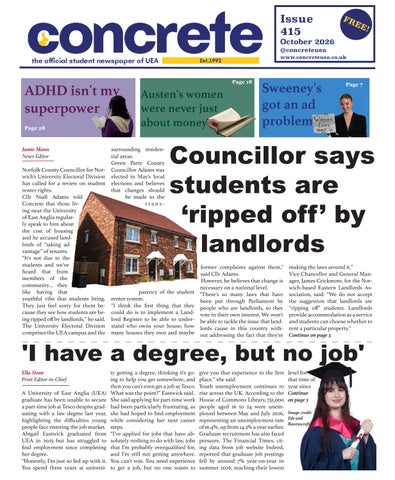
Jamie Mann News Editor Norfolk County Councillor for Norwich’s University Electoral Division has called for a review on student renter rights. Cllr Niall Adams told Concrete that those living near the University of East Anglia regularly speak to him about the cost of housing and he accused landlords of “taking advantage” of tenants. “It’s not due to the students and we’ve heard that from members of the community… they like having that youthful vibe that students bring. They just feel sorry for them because they see how students are being ripped off by landlords,” he said. The University Electoral Division comprises the UEA campus and the
Austen's women were never just about money
surrounding residential areas. Green Party County Councillor Adams was elected in May’s local elections and believes that changes should be made to the trans-
Page 18
Sweeney's got an ad problem
Page 7
Councillor says students are ‘ripped off’ by landlords
parency of the student renter system. “I think the first thing that they could do is to implement a Landlord Register to be able to understand who owns your house; how many houses they own and maybe
former complaints against them," said Cllr Adams. However, he believes that change is necessary on a national level. "There's so many laws that have been put through Parliament by people who are landlords, so they vote in their own interest. We won't be able to tackle the issue that landlords cause in this country without addressing the fact that they're
making the laws around it.” Vice Chancellor and General Manager, James Crickmore, for the Norwich-based Eastern Landlords Association, said: “We do not accept the suggestion that landlords are “ripping off” students. Landlords provide accommodation as a service and students can choose whether to rent a particular property.” Continue on page 3
ty getting a degree, thinking it’s going to help you get somewhere, and then you can’t even get a job at Tesco. What was the point?” Eastwick said. She said applying for part-time work had been particularly frustrating, as she had hoped to find employment while considering her next career steps. “I’ve applied for jobs that have absolutely nothing to do with law, jobs that I’m probably overqualified for, and I’m still not getting anywhere. You can’t win. You need experience to get a job, but no one wants to
give you that experience in the first place.” she said. Youth unemployment continues to rise across the UK. According to the House of Commons Library, 751,000 people aged 16 to 24 were unemployed between May and July 2026, representing an unemployment rate of 16.4%, up from 14.3% a year earlier. Graduate recruitment has also faced pressure. The Financial Times, citing data from job website Indeed, reported that graduate job postings fell by around 7% year-on-year in summer 2026, reaching their lowest
level for that time of year since Continue on page 5
'I have a degree, but no job' Ella Stone Print Editor-in-Chief A University of East Anglia (UEA) graduate has been unable to secure a part-time job at Tesco despite graduating with a law degree last year, highlighting the difficulties young people face entering the job market. Abigail Eastwick graduated from UEA in 2025 but has struggled to find employment since completing her degree. “Honestly, I’m just so fed up with it. You spend three years at universi-
Image credit: Ede and Ravenscroft
02
October 2026
EDITORIAL Meet the team Editors-In-Chief Ella Stone Alyssa Gava Charlotte Ward Deputy Editors-In-Chief Izzy Hollyhead Sam Fuller Pia Subong Venue Team Venue Editor Violette Douglas Deputy Venue Editors Grace Barnett Ben Heiss Copy Editors Senior Copy-editor - Polly Dye Abigail Armitage Katy King Petra Bradburne Online Editors Senior Online Editor - Hannah Burns Sam Fuller Felix Sears Alex Adepoju Social Media Team Head of socials- Maria Siddika Freja Lovell Bonnie Wakefield Mai Stacey Photography Team Abdulqudus Azeez Erin Heffernan Leif Findlay Moe Jennings Rose Griffin
The Official Newspaper of the University of East Anglia since 1992 Union House Norwich NR4 7TJ
Scan here to find us online
To join as an editor or write a story email: concrete.editor@uea.ac.uk For more content go to concreteuea.co.uk No part of this newspaper may be reproduced by any means without the permission of the Editors-In-Chief. Concrete is a UEASU society, but retains editorial independence as regards to any content. Opinions expressed herein are those of individual writers, not of Concrete or its editorial team.
Editor's Note Ella Stone Print Editor-In-Chief This time last year, I started to hate journalism. This time last year, I joined Concrete. Now, this year, I’ve fallen back in love with journalism. It feels strange to admit that something I had once been so passionate about could become something I dreaded. The constant pressure to find stories, meet deadlines and question whether my words were making any difference had begun to overshadow the reason I wanted to become a journalist in the first place. Joining Concrete changed that. It reminded me that journalism is not simply about chasing headlines or filling pages. It is about people, their experiences and the stories that might otherwise go unheard. It
is about asking difficult questions, holding those in power accountable and giving a voice to the communities around us. Most importantly, it taught me that falling out of love with something does not mean you have to give it up. Sometimes, you just need to find your way back to it. A year on, I am reminded of how much can change when you find the right people, the right purpose and the courage to keep going. Concrete has given me more than opportunities to write; it has given me a reason to believe in journalism again. Perhaps that is what this year has taught me: pas- sion is not always something you find once. Sometimes, it is something you have to rediscover.
News...........................................P2 Women face two-year wait for diagnosis 'Surprise by Norwich's warmth' UK student visa applications at a five-year low UEA secures funding to train future medical researchers
Comment..................................P6 A master's degree, but at what cost? Sweeney's got an ad problem
SciTech......................................P8 Plastic to petrol The nose knows what home smells like
Food + Drink...........................P10 Comfort of cooking Pints, pres and price tags
Environment...........................P12 The environemental cost of ai: are data centres worth it? Why climate change needs better journalism
Lifestyle....................................P28 ADHD isn't my superpower A ghost in the party
Sport..........................................P30 The benefits of being active Antonelli's champtionship to lose
Women face two-year wait for diagnosis Lilia Colledge News Editor Women living with autoimmune diseases are waiting up to two years for a diagnosis, compared with less than three months for men, new research has found. The study, led by the University of East Anglia and the University of Cambridge, examined 6,600 patients and found women were 75% more likely to report being misdiagnosed. For many, symptoms such as exhaustion, pain and low mood were attributed to psychological causes rather than an underlying physical illness. Autoimmune diseases occur when the immune system mistakenly attacks the body's own cells and tissues. Symptoms can vary over time and affect different parts of the body,
making conditions difficult to identi- Dr Sloan said: "Ultimately, we fy. need to understand Dr Melanie Sloan, from UEA's why these differencNorwich Medical School, said
"psychological explanations were sometimes given too quickly when symptoms were difficult to explain medically." Researchers are calling for doctors to consider autoimmune diseases alongside mental health conditions, particularly when symptoms persist or move between different areas of the body.
es occur before we can design effective solutions.” The research team plans to work with patients and medical professionals to improve care and reduce delays in diagnosis. I m a g e credit: Felix Sears
03
October 2026
NEWS
Lilia Colledge, News Editor Jamie Mann, News Editor
'Surprised by Norwich’s warmth' Llyod Chin and Lilia Colledge
International students from the University of East Anglia have been speaking to Concrete about their experiences of belonging and homesickness. According to the UEA website, there are approximately 2,221 international students at UEA; around 12.5% of the student population. The national percentage is around 24%, according to a House of Commons Library study. Oscar Zueck, from Mexico, said he wasn’t expecting the welcome he felt.
“I was surprised by Norwich’s warmth. I found a place where I feel at home, even though I didn't grow up here,” he said. Vaishnavi Dukkidi from Hyderabad, India, explained how the distance has challenged her sense of connection and belonging.
“I miss the little things… like having someone around without having to plan a call or explain how my day went.” But others still talked about the challenges they have faced since coming to study in the UK.
Samhita Vashist, from Bangalore, India. Many feel a strong sense of community at UEA and are keen to stay in the UK after graduation. “If things work out, I’d love to stick around in the UK,” said Alec Rousseau from Milwaukee, Wisconsin. However, this was over clouded by a sense of uncertainty.
me stories about their days as they are unfolding versus receiving updates or chronologies with weeks in between.” Despite these challenges, they expressed the opportunities studying abroad has opened for them. “While India has great colleges, I wanted a fresh perspective and bigger leaping board for professional pursuits,” said
Madyson talked about a similar unknown. “I think a large part of that decision will depend on what op-
“Distance makes experiencing life with others difficult because you miss out on the day to “Financials are always day,” said Madyson Lauder- a concern, though, so man, from Columbus, Ohio. I’ll prioritise stable emShe added: “There’s such a felt difference between hear- ployment over anything ing my friends process or tell right now,” he added.
Continued.... “Private rented accommodation is also generally significantly cheaper than purpose-built student accommodation, although costs vary depending on the property and what is included,” he said. The Renter’s Rights Act 2025 came into force nationally this May and introduced several measures, including a ban on no-fault evictions and the end of fixed term tenancy contracts. "A national landlord database is already being introduced under The Renters’ Rights Act, with implementation in December. It will hold landlord and property information, so a separate register is unnecessary,” Mr Crickmore added. Norwich City Council’s website says the ob-
New scholarship for writers Lilia Colledge News Editor
A new scholarship will help aspiring writers study prose fiction at the University of East Anglia next academic year. The Eve Smith Scholarship is open to students offered a place on UEA’s postgraduate Prose Fiction course, covering tuition fees, contributions towards living costs and necessary visa support. The award honours the late Eve Smith, former Company Secretary of the Booker Prize Foundation. UEA graduate and Nobel Prize-winning author Kazuo Ishiguro told the Booker Prize team that Smith would have been thrilled to help a new generation discover their calling. Ben Okri, Booker Prize winner 1991, when speaking to Booker Prize team, said: “It is fitting that a Booker scholarship should be in her honour. The art of writing would have delighted her to no end.”
UEA subjects ranked in UK top ten Joey Newport General Writer
portunities become available to me after graduation.” Image credit: Unsplash
jective of the Act is: “to rebalance the relationship between tenants and landlords, offering greater security, fairness, and quality of housing for the 11 million private renters and 2.3 million landlords across the country.” Mr Crickmore concluded: “We would also challenge the suggestion that landlords are making the laws that govern the private rented sector. It has just undergone its biggest overhaul in more than 30 years, introduced by a Labour government. The first measures came into force in May, with further changes still to come. We should allow time to see how they work in practice, including any unintended consequences, before proposing further burdens on landlords.”
Four subjects at University of East Anglia were placed in the ‘Good University Guide 2027’ UK top ten. The guide, from The Times and the Sunday Times, saw Social Work, Anthropology, Physiotherapy and Nursing courses score high. The UEA courses featured alongside other top programmes from the University of St Andrews and Imperial College London.
Orionid meteor shower to light up UK skies Kyla Oakley General Writer The Orionid Meteor Shower can be seen across the UK this month. The phenomenon is created when Earth passes through debris left behind by Halley’s Comet. The peak will be the night of 21 October, with showers continuing until 7 November. A full moon on 26 October may make it harder to see the fainter meteors, but the brightest will still be visible. To have the best chance of viewing look southeast, preferably away from artificial light.
04
October 2026
NEWS
Experts warn of New bacteria found in cancer health risks linked to DNA study 3am wake-up trend
Felix Sears Online Editor
Researchers at the UEA have identified 18 new types of bacteria in prostate cancer patients, most originating from the mouth. The study, in collaboration with the Pan Prostate Cancer Group, analysed data from almost 200 patients. Oral bacteria such as Porphyromonas, linked to aggressive prostate cancer, appeared throughout the data. Dr Abraham Gihawi, of UEA's Norwich Medical School,
said the discovery could help researchers develop tests and investigate links between bacteria and cancer in greater detail. The UEA said men with gum disease have a higher risk of prostate cancer. Porphyromonas gingivalis, associated with gum disease, has been found in dental plaque and prostate fluid. Dr Hayley Luxton, Head of Research Impact at Prostate Cancer UK, said the findings could lead to “more targeted and effective treatments for men”.
Sam Fuller Deputy Editor-in-Chief Experts have warned that waking up at 3am, a routine associated with actor Mark Wahlberg, could leave people tired and less productive if they do not get enough sleep. Feel30, a telehealth clinic, has cautioned that adopting an early-morning routine without adjusting bedtime
UK student visa applications fall to five-year low “I always thought getscholars“There are
huge issues for in-
ting up early to go to the gym would be a great way to prepare for the day, but I began to just lose steam
Student visa applications to the UK fell to their lowest September level ternational studein five years in 2026, raising con- nts other than facerns about the potential economic mily,” said international student impact on universities and the wider Sonia. economy. “Family is not my issue. Lower-inAccording to Home Office figures, come backgrounds, most of them
applications dropped by 10.3%, from 79,800 in September 2025 to 71,600 in September 2026.
The decline follows tighter immigration rules introduced in January 2024, which prevented most international students from bringing family members to the UK, with exceptions for postgraduate research students and government-sponsored
McCarthy said. Anneliese Cadena, a nurse practitioner and clinical consultant at men's health provider Feel30, said sleep should be prioritised when changing morning routines.
light before bed may also help improve sleep. Concerns have also been raised about the potential effects of restricted sleep on testosterone levels. A small
2011 study found that
“Choose a wake-up one week of sleep retime that fits your striction was associatresponsibilities and ed with lower daytime still gives you enough testosterone levels in healthy young men. Howcould lead to fatigue sleep,” Cadena said. ever, subsequent research Adults generally need seven and difficulties conhas produced mixed findto nine hours of sleep each ings, with results varying centrating. night, according to NHS Harry McCarthy, who tried getting up early to exercise, said the routine left him struggling to maintain his energy levels throughout the day.
Sam Fuller Deputy Editor-in-Chief
by the end of the day,” reducing exposure to bright
guidance. Anyone waking at 3am would need to be asleep by 7pm to achieve eight hours of rest. The Cleveland Clinic recommends gradually adjusting bedtime by 15 to 20 minutes over several days rather than making sudden changes. Maintaining a consistent sleep schedule, limiting caffeine in the evening and
Research by the Higher Education Policy Institute (HEPI) and Kaplan International Pathways, produced by London Economics, estimates are struggling with the in- that each international student enrolling in 2024/25 generates an avcrease of tuition fees. erage economic benefit of around “That’s the hardest part being from £100,000. a developing country. For me, there's A sustained decline in international a huge currency gap being from Instudent numbers could therefore donesia.” The fall could have significant finan- affect university finances, locial implications for universities, cal economies and businessmany of which rely on international es that benefit from student tuition fees to support their budgets. spending.
according to the conditions studied. Persistent tiredness should not automatically be attributed to an early-morning routine. The NHS advises people experiencing ongoing sleep problems to seek medical advice. Symptoms such as loud snoring or gasping during sleep may also warrant assessment for an underlying condition, including sleep apnoea.
As institutions face growing financial pressures, the figures raise questions about how the UK can balance immigration controls with its efforts to attract international students. Image credit: Sam Fuller
05
October 2026 Lilia Colledge, News Editor Jamie Mann, News Editor
UEA secures funding UEA pilots AI to train future medi- revision tool to cal researchers support students students the skills to search workforce. address global health Professor Samuel issues. Fountain, Associate Future medical re- He said: “We are de- Pro-Vice-Chancellor of searchers at the Unilighted to receive UEA's Doctoral Colversity of East Anglia lege, said the award will receive specialist this funding and recognised the training training to tackle glob- believe our plan to opportunities available al health challenges train these cohorts across the university through a new funding of students will lead and Norwich Research award. Park. The university will train to exciting improve- He said bringing togeth14 PhD students each ments in health.” er expertise in biomedyear after securing a Professor Rushworth ical, clinical and health share of £90 million in added that students sciences would help funding from the Med- would benefit from Nor- prepare future research ical Research Council wich's research commu- leaders to develop solu(MRC), which aims to nity and the opportuni- tions to complex health support the next gen- ty to develop specialist challenges. eration of medical re- expertise. The investment is also searchers across the UK. The MRC is investing expected to strengthThe funding will £90 million across UK en Norwich Research universities over three provide students years, with the fund- Park's position as one with specialist ing expected to support of Europe's largest training in nutrition more than 200 doctoral centres for life sciresearchers annually. science, microbiology Dr Joanna Robinson, ence research, bringand clinical research, Director of Research ing together researchers helping prepare them Talent, Skills and Ca- working across different for careers investigating reers at the MRC, said areas of medicine and some of the biggest chal- investing in researchers health. lenges facing human early in their careers Image credit: Jamie Mann health. was important The award will be deliv- for the future ered in partnership with of medical sciNorfolk and Norwich ence. University Hospital, the said Quadram Institute, John She Innes Centre and Earl- the awards ham Institute. would help Three cohorts of researchers will be recruit- researchers ed, with the first intake develop scibeginning in October entific ex2027. Professor Stuart Rush- pertise and worth, Programme Di- strengthen rector at UEA's Norwich the UK's Medical School, said the funding would give medical reElla Stone Print Editor-In-Chief
Alyssa Gava Online Editor-in-Chief The University of East Anglia has launched a trial of an artificial intelligence platform that turns course materials into revision resources for students. StudyStash will be available through Blackboard to students on selected courses across the School of Economics, Norwich Business School and the School of Media, Language and Com-
munication. The platform can generate flashcards, practice quizzes, revision schedules and audio learning materials using existing course content. Professor Claire Pike, UEA’s Pro-Vice-Chancellor for Student Education and Experience, said the tool would complement the university’s existing learning resources and help students create personalised study materials.
Continued... The government has announced plans to tackle youth unemployment through a retail employment initiative involving major employers, including Tesco, John Lewis, Waitrose, Currys and Costa Coffee. The scheme aims to create up to 100,000
The trial comes as universities explore how artificial intelligence can be incorporated into higher education, while ensuring students remain responsible for their own learning and assessments. Participation in the pilot is optional, with UEA set to use the findings to assess how AI-powered tools could support students’ learning.
jobs for young people by the end of the current Parliament. A separate government programme, Opening Shift, will offer more than 11,000 work experience placements to eligible 18 to 24-year-olds seeking employment. However, the government has clarified that the retail initiative's target does not mean all 100,000 opportunities will be new permanent positions. For graduates like Eastwick, the difficulty of securing work raises questions about the transition from university into employment. “It’s embarrassing, if I’m being honest. People ask what I’m doing now I’ve graduated, and I don’t really have an answer. I thought I’d be doing something with my degree by now, not sitting around applying for jobs and hearing nothing back,” she said.
06
October 2026
COMMENT
A master's degree, but at what cost? Mar Devonport Comment Editor
Postgrads are quietly struggling to pay their way through a master's, and I am one of them. Though, no one really warned me just how hard doing a master’s would be. Trying to live on my student loan was no longer possible. I have seen my mental health tumble as I realised I had to leave a job I loved because I wasn’t given enough hours to pay my bills. I tried to stay away from home to prove to everyone that I was capable of taking care of myself but after another job loss, I had to go home. I am now somewhere that is arguably the best place in hospitality I
have worked, yet it is not enough. I am desperate to buy my own shoes. To have the autonomy to spend the money I make on something other than to survive. A branded shoe that won’t fall apart immediately, one that has colour, and that doesn’t replicate my work shoes in black. Annoyingly though, I know I need this year. I am doing a part-time journalism course and I have one more year to go. I feel unprepared and there feels like there is a constant question over whether the stories I produce
are good enough for the BBC, the Guardian, or even the Daily Mail. But it is just one more year. I’d rather not romanticise the 9 to 5, but it is so close. Because a 9 to 5 is a life where I’m not asking my family for yet more money. A l though, there is nothing to reassure me that the grass is greener on the other side. I know those who have graduated who are struggling to find a job in this grim
job market, and let’s not get into paying back student loans when you finally do get a job. It is hard to defend the amount of interest based on the Retail Prices Index (a measurement that is no longer a National Statistic) + 3%. But I am just as glued to LinkedIn as those who have graduated, anxious to find what my future could look like. For any prospective postgraduate students, I really hope this doesn’t put you off. Our postgrad course are brilliant, but the university needs to make the financial impact clearer or at least acknowledge the hardship. Or maybe our government should do more for their future voter base. Image credit: Leif Findlay
Norwich voted Green, so why Reform? Dylan Roques General Writer As a Green Party Councillor, I’m often faced with interesting situations, representing one of few urban divisions (what a county councillor seat is referred to) in Suffolk. This gives me a nuanced view into the actions of councils that represent us at UEA. Since 1974, before the most recent election, Norfolk had only been led by a non-Conservative leader twice, while Norwich had elected Labour leaders throughout, except for a short spell when the Lib Dems took control between 2002 and 2006. Yet, we’re now faced with a minority Reform County Council and a majority Green City Council. Two leaders who politically couldn’t be further apart. But for the good of our 'fine city', they must collaborate and work constructively together to push the change both campaigned for. The change their voters desire. Norfolk County Council handles big, strategic services such as adult social care, children’s services and schools, roads and libraries. Norwich City Council, as a district
council, handles bin collections, planning applications, parks, housing and homelessness. This raises a question about democracy, and how important localism can be. With Reform winning only two councillors within the city bounda r i e s at both City and County level, albeit both by small margins of less than 300 votes each, the clearest divide between the two authorities is their stances on Local Government Reorganisation (LGR). When Labour won in 2024, they said they wanted to fix the broken system of local government. Their solution was LGR. This process would replace our current two-tier system,
where you are represented by both a District and County Council, with singular councils fulfilling all your services. T h e y asked local councils to draft business cases, outlining how these councils would run, for the Secretary of State to decide which model would be best for each county. These c a s e s featured proposed council boundaries and how many councils each county would have. In Norfolk, a three-council model was accepted by the government, proposing a ‘Greater Norwich Authority’, heavily favoured by the Green-led Norwich. Alex Catt, then leader of the Green Party in Norwich, said, “if LGR was to happen, Norwich must have its own council.” Reform, across Norfolk, Suffolk and
even Essex, opposed LGR for slightly different reasons. In Suffolk, we were told it was because they did not want their county split up. In each, a legal challenge was launched against the government to change the LGR result, one that we now know was successful. This has plunged East Anglia into chaos, with Reform, a party unpopular in the city, now able to control social care, highways, education, libraries, health and more, in an area where fewer people voted for them than Labour. And what they’ve failed to grasp is that this is wildly unpopular. People in Norwich simply do not want to be ruled by a Reform administration, and people in rural Norfolk don’t want to be ruled by Norwich. So, while the Green City Council continues its day-to-day work, an administration democratically mandated by the people of Norwich, the County Council will ban pride flags in libraries such as the Forum and make political grandstanding statements like “cancelling net-zero”. And we will just have to hope they don’t go further. Image credit: Unsplash
07
October 2026 Mar Devonport, Comment Editor Benjamin Seeds, Deputy Editor
Sweeney’s got an ad problem Rosie Newman
Comment Correspondent
As far as marketing goes, Sydney Sweeney hit a home run. Novig, a peer-to-peer exchange sports betting p l at f o r m , l au n c h e d their campaign advert 'Just Sports', starring Sweeney scantily clad in hockey pads and Novig-branded boxers whilst seductively repeating the word “sports”. What do men love more than gambling, sports, and women saying very little at all? Oh, and boobs, there’s lots of boobs in the advert. Thanks to this campaign, the actress, known for her love of great denim, selling her used bath water, and her cameo in the Pretty Little Liars finale, has managed to find herself at the centre of yet another controversy. Many critics and prominent female athletes have commented on the campaign, criticising its objectifying nature and reduction of sportswomen to hyper-sexualised props. I agree wholeheartedly that this advert degrades women in sports and, p e r -
haps a hard-nosed stance to some, has no place on television. However, to call Novig’s advert a ‘step backwards for feminism’, as many are, relies on a collective amnesia. Objectification in sports is already our default setting. During the World Cup, fast fashion websites are flooded with graphic baby tees bearing slogans like “any hole is a goal” or “tits out when England score.” Look at the state of things, how much further can we actually step? Women in athletic spaces have forever been reduced to decorative objects; to pretend that Sydney Sweeney has introduced sexual objectification into sports ignores just how deeply normalised it already is. Although, Sweeney’s involvement specifically bears witness to another spiralling phenomenon: the re a c t i o n economy. Sydney isn’t just N o v i g ’s
poster girl; she is an active investor, creative director, and part-owner who reportedly pitched the campaign herself. Outrage and controversy are modern marketing’s most lucrative currencies, and Sweeney has built a solid brand around these tenets. To drive downloads, all she has to do is poke at the culture war and wait for the ‘look at these triggered feminists’ posts to roll in. Of course, Sweeney didn’t invent ragebait, but outrage and controversy have become so ingrained into news media, algorithms, and American politics (from Trump’s profanity-filled Truth Social posts to calling Supreme Court justices “Low IQ”) that it’s becoming harder every day to distinguish the antagonistic from the genuine. It’s not so hard to envisage a world where all the media we consume is engineered to pit us against each other in an attempt to drive us further to opposing sides of the politics, cultural, and social spectrums. In fact, it might be much closer than we think. Image credit: Unsplash
Burnham’s gimmicks are excellent political strategy Benjamin Seeds
policies like city-owned shops or free buses has taken moderate politics by storm and, clearly, inspired £2 bus fare caps, pints in football Burnham’s strategy. stadiums, pubs’ business rate Take No.10 North as an example. cuts and No. 10 North™ are all Here, Burnham is doing three gimmick policies. things at once: first, he is satisfying From a policy standpoint, they the public’s desire for immediate are nowhere near enough to fix change. the problems that the country Second, he is signalling his allefaces, nor to define Burngiance to what people see as ham’s premiership. ‘common sense politics’: takNevertheless, they are a ing the most straightforward sign that the new Labour and simplistic path to solving leader understands a problem. In this case, he is the political environaddressing the concern ment he is in, and that too much power that he knows how rests in London by litto navigate it. erally moving some In an era where of the government moderates are easto a different city. This ily crowded out by is easy to understand, populists on the even if you don’t enleft and right, the gage with politics very centre ground has much. needed to change Third, he is keeping its political strategy pressure off the public dramatically. coffers. No.10 North is, Even if the responin the grand scheme sible thing to do is of things, incredibly to slowly move the cheap to implement. country in the right Burnham understands direction, adjustsomething that Starming here and there er did not: You cannot to bring about slow assume that just bebut positive change cause you are governcannot be the foing well, technically, cus of communipeople will support cation. you. You have to keep Politicians talking feeding the public about growing the with what they want to economy or bringing hear and get the borunemployment down by some per- i n g government stuff done in centage is just not going to do it an- the background. ymore. Bonus points if, like the £2 bus fare The reason for this is simple: it’s cap, your gimmick policies might mind-numbingly boring. actually help people, even if they Enter New York City’s Zohran Mam- won’t fix any of the big stuff. dani, whose style of direct communication and similar gimmick Image credit: Unplash Comment Deputy Editor
08
October 2026
SCI-TECH
Plastic to petrol The power of Joshua Panaligan General Writer From the bags we bring to our regular shopping trips to the protective film shielding our food, Polyethylene (PE) has been a widely produced plastic, a reliable material for manufacturing everyday consumer goods. However, human society is no stranger to generating waste as we consume. According to a recent report by the World Bank Group (2026), global plastic waste generation tops 320 million tonnes annually. Despite these daunting statistics, plaguing reports on plastic pollution for decades, people have been finding new, creative ways to fight these numbers. With the slogan of the 3 R’s (“Reduce, Reuse, and Recycle”) coming to mind, what’s fresh on the agenda this time round? Most recently, a collective of scientists affiliated with the Oak Ridge National Laboratory in the US have developed a new way to recycle PEbased plastic waste into fuel. More accurately, they have devel-
oped an alternative method that may replace the old with more gold. This concerns the use of molten salts to chemically break down these pesky PE polymers into hydrocarbons (fuels) ready for the road. Perhaps another R for ‘Refuel’ could work? For those curious about the science but who dislike overly technical chemistry lingo, a fantastical retelling of the process could suffice! Firstly, we have the ‘villain’, a single-use ‘polyethylene (PE)’ polymer, consisting of long, carbon-based chains too stubborn to break down easily. Now, enter our molten salt ‘hero’ to foil PE’s plan. Our hero’s identity as an ‘aluminium chloride bath’ allows its powerful manifestations (charged aluminium ions) to bind with atoms within the PE chains, creating
fiercely acidic catalytic sites (danger zones) that ‘melt’ these chains into puny hydrocarbons on contact. A hero also comes with its strengths and weaknesses. Overall, it dominates other techniques in relation to: Resource feasibility: Expensive noble metals are unnecessary; Energy requirements: Only lower temperatures of 200°C are needed, compared with hotter pyrolysis processes requiring 400–500°C; Reaction yields: Producing 60% gasoline under relatively mild conditions. Unfortunately, this process is currently considered ‘unstable’ because the salts are hygroscopic (water-absorbing), meaning less consistent reactions. That is not to say development is stunted, though. As scientists navigate these pitfalls, we can continue our best efforts to, say it with me, Reduce, Reuse and Recycle! Image credit: Richard Stone
digital belonging Lola Sears Sci-Tech and Environement Editor
Similarly, students who struggle to fit in may feel they don’t share the same interests as their peers. Whilst common, this can be isolating. Fan groups can reduce loneliness by connecting people with similar interests. Anonymity can also pro-
everyday peer interaction, and social media helped maintain connections. For example, my school Social media and online was over 30 minutes from spaces are often criticised where I lived, and many for being dangerous and friends lived further away. harming mental health. Without texting, I would However, many people have struggled to connect use social networking with my peers and mainsites to find belonging tain that sense of belongwhere they othering. wise can’t. Of course, online spaces Many people, can be dangerous placparticularly es to meet new people. from marginI’ve heard horror stories alised groups, from friends using online struggle to find dating! belonging in their Beyond stranger danger, communities and relying exclusively on turn to online spaconline support can crees instead. ate a disconnect from For people on the the outside world. LGBTQ+ spectrum, Without social cues digital spaces can be and tone of voice, a lifeline. Those who learning to interact cannot safely express with people in themselves can find person can be community online. Sodifficult. cial media also provides This can lead to education on LGBTQ+ greater anxiety topics, allowing people to when socialislearn more about theming face to face. selves without harmful People who find information. belonging online These spaces can also may also be vulnerable help people explore their tect people to bad advice from those identity before coming when sharing personal who don’t have their best out in the real world. This artwork, poetry or writing. interests at heart. is especially important This isn’t just about chat- To conclude, when used amid rising hate and ting with strangers and the safely, digital spaces can discrimination against risks involved (we’ll come help people discover marginalised groups. onto that), but digital spac- themselves and find beThose who are neurodies also help people stay longing. However, people’s vergent or struggle with connected with existing welfare must be considtheir mental health can friends. ered if they become too face a lack of understand- This was particularly reliant on them. ing. Online communities important during COVID, can provide reassurance when people couldn’t visit Image credit: Ella Stone and show people they are friends. Young people esnot alone. pecially struggled without
09
October 2026
Lola Sears, Sci-Tech Editor Sam Phillips, Deputy Editor
Why we fear change
Ella Stone Print Editor-in-Chief
Change is one of the few constants in human life. Technology evolves, social norms shift and scientific discoveries regularly overturn what was once considered fact. Yet humans can struggle to adapt even when change is unavoidable. The difficulty is not necessarily a refusal to accept change. At a psychological level, change disrupts the systems people use to make sense of the world. Part of the answer lies in how the brain predicts what will happen next. Rather than simply reacting to information, the brain is constantly making predictions about its surroundings. This idea, known as predictive processing, suggests that the brain builds an internal model of the world and compares its predictions with what actually happens. When the two do not match, the brain produces what neuroscientists call a prediction error. This is not a mistake in the usual sense. It is information that tells the brain its model needs updating.
In 1978, Finnish neuroscientist Risto Näätänen and colleagues published research using EEG to investigate how the brain responds to unexpected sounds. Participants heard a repeated series of tones, with occasional changes in pitch. Even when they were not paying attention to the sounds, their brains produced a distinct electrical response w h e n a tone changed. This became known as mismatch negativity, suggesting that the brain had formed an expectation about what it would hear and detected when reality did not match it. Change in everyday life can work in a similar way, although on a much larger scale. In a 2018 meta-analysis, scientists combined results from 87 neuroimaging studies looking at uncertainty in situations involving threats, rewards and decision-making. They
found that uncertainty repeatedly involved areas including the anterior insula, a region involved in detecting significant changes in internal and external states, and the amygdala, which helps process emotional information. These systems help the brain work out whether something important has happened and whether a response is required. However, there is another problem: dealing with uncertainty requires cognitive control. The prefrontal cortex, at the front of the brain, is involved in functions including attention, decision-making and cognitive flexibility: the ability to adjust our thinking when circumstances change. Research by neuroscientist Amy Arnsten has shown what happens when stress interferes with this system. In their studies, researchers found that high levels of stress-related chemicals can weaken the neural connections supporting prefrontal
cortex activity, while strengthening more primitive, rapid-response circuits. This could explain why major changes can feel mentally exhausting. The brain may need greater flexibility when stress makes flexible thinking harder. But the brain is not permanently stuck with its original predictions. It can adapt through neuroplasticity, which is the ability of the nervous system to change its connections and activity in response to experience. Every time someone encounters a new environment and discovers that it is predictable and manageable, the brain gains more information with which to update its model. Eventually, what was unfamiliar can become familiar. This may be the crucial distinction. Humans are not necessarily bad at change. We are good at adapting to change, but adaptation requires the brain to gather enough information to make the unfamiliar predictable. The discomfort comes from the period in between. Image credit: Rose Griffin and Unsplash
The nose knows what home smells like James Thomas General Writer The nose knows. In fact, the nose loves to sniff and tell. The scent of a home-cooked meal tells your stomach to rumble and your mouth to salivate; the stench of sewage drives you away from toxins. Both instances happen without your control – only guided by smell-induced reflexes, of which we have many. In fact, research indicates that we can remember around 10,000 distinct scents. It’s no wonder, then, that smells are so deeply intertwined with our emotions and memories. Cushioned in your brain is the amygdala. It’s your emotional processing
centre – it tells you how to react to someone bumping into you at the LCR, to your situationship refusing to label things, and to getting a First on the summative you thought you failed. It’s also wound up in your olfactory system, as exemplified by the “Proust effect”. Upon smelling a slice of madeleine cake, the narrator of Marcel Proust’s 'In Search of Lost Time' exclaims “And suddenly the memory returns”. Named after the French novelist, the Prousteffect is the involuntary recollection of memories associated with a smell, often intense and stemming from childhood. In an instant, the character changes from a grown man getting a whiff of a baked good,
into his younger self eating madeleine cake with his aunt before church. All thanks to the amygdala activating with the reception of that specific scent. When you first moved into your accommodation, you probably noticed a certain scent – not necessarily bad, just… different. Just another new thing. You cover the walls with posters and photographs so it looks like home, you layer blankets over your bed so it feels like home, and you blare your favourite tunes so it sounds like home, too. But smell, as demonstrated by Proust, is the cherry-scented spray on top. Maybe at home there’s a lavender reed diffuser in your bathroom, or an old ted-
dy bear that lives on your bed. If the homesickness is wearing you down, you could sniff something out and bring it with you, fill those new four walls with the smell of your childhood, and feel yourself finally settle in. And one day, you’ll leave your accommodation, bags packed once more, and find that the lingering scent of boiling noodles, alcohol, and dish soap smells like home, too. Image credit: Ella Stone
10
October 2026
FOOD + DRINK Chicken cauldron pie
Comfort in cooking Claudia Allison General Writer
to bring everyone together. I especially miss cooking and eating lasagne, my Homesickness: a term that mum’s homemade soup and most (if not all) students my favourite dessert: plum know all too well at uni. It and apple crumble (which is is longing for a return to slightly more crumble than your family, friends and the fruit). Coincidentally, these comfort of your childhood are all autumnal dishes bedroom. which can be batch cooked However, one thing that is and reheated when needed, easily taken for granted is making them incredibly your family’s home-cooked convenient. meals. The Autumn Semes- Cooking these dishes are ter for me is a stark remind- a ritualistic process and er of having to part with one that requires patience, familiar food in exchange which as a student, I no for my own. I don’t usuallonger have. I was bored of ly get homesick after all, making pesto pasta for the I enjoy the independence tenth time, so I attempted and spontaneity of student to recreate the lasagne and life, but meals being made the crumble last year at uni. for me is something I deep- Although it did not go terrily miss. They are that one bly, I was disappointed that constant in my life which re- I couldn’t recapture the taste assure me whenever things that I had been romanticisbecome chaotic, and they ing for weeks. have the remarkable ability Cooking for myself has certainly been a journey, with some of my improvised dishes turning out better than expected and others which I’ve tried to forget, such as accidentally burning a fishcake because I underestimated how pow-
erful the convection setting on the microwave oven was. Learning these recipes off by heart has helped provide the foundation of my meals which I can easily adapt through using creativity and initiative which have made me more confident as a cook. For instance, I can season these meals to my taste and add some extra vegetables to get my five-a-day. Instead of making lasagne, I can simplify the recipe and just make bolognese for myself. As the only mouth to feed, there is much less pressure as I don’t need to impress others, which has made me less critical of my efforts. Although the homesickness of missing your family’s meals never goes away completely, your family are a phone call away and you can ask how to tailor any favourite recipes to fit your time and budget. The best thing about recipes is that they can be flexible and by adapting them, you can create new, innovative meals for yourself. Image credit: Claudia Allison
Saffron Pennycooke Music Editor Ingredients: 750g chicken breast Button mushrooms Puff pastry 4 Garlic cloves 2 Onions Butter Chicken stock Milk Flour Mixed herbs Salt and pepper. For a spooky month of grey skies and cold weather, this chicken pie in a ‘cauldron’ is perfect for warming any undead hearts! Put on your cosiest jumper, switch on a comforting show, whether it’s Gilmore Girls or a Tim Burton film, and start chopping. Step One: Sau-
There's no place like your local pub Will Witham General Writer
According to my research, there are around 40 pubs scattered across the UK with the name ‘Six Bells’, yet to a small cohort of rural and village folk, there is one that stands out. If asked to name the greatest pub in the world, I would say ‘Six Bells in Walsham le Willow’ with pride and absolute certainty – it's home after all, and you can’t beat that kind of comfort. The pub is as old as I can remember, with a fascinating history allegedly dating back to the plague years. It’s been an ever-present factor
in the lives of myself and my friends growing up, and I wouldn’t have it any other way. It’s difficult not to get sentimental, especially when talking about your first. Right when you walk into this establishment, you’ll notice the confined seating, cosy booths, and the ageing doorways lined with weathered wood. The letterbox is stuffed with tissue: a charming idiosyncrasy that you just accept. The narrow entryway has seen hordes of people from Christmases and celebrations past trickle into the building like suitcases on a conveyor belt. Once you pass the quaintly lit fireplace during the
té diced onions with salt until transparent, then add the chopped garlic. Step Two: Add butter, mixed herbs, salt and pepper. Step Three: Add the diced chicken and mushrooms. Step Four: Crumble in a chicken stock cube with a splash of milk. Gradually alternate between adding flour and milk, stirring continuously to create a roux. Keep mixing to remove the floury taste. Add mustard if desired. Step
puff pastry. Ensure the chicken is fully cooked before baking. Brush with egg wash for a golden finish, if desired. Step Six: Bake at 200°C in a fan oven for 15–20 minutes, until the pastry is golden brown. Serve alone, with mash or greens, and enjoy! Image credit: Saffron Pennycooke
Five: Fill your ‘cauldron’ with the filling and cover with ready-made
colder seasons, you’ll find the bar where esoteric bottles and concoctions sit staring at you asking, “Are you brave enough to try?” And every time the answer has remained a firm ‘no’. Truly, I won’t even dare venture to the toilet situation. Now, you might think I’ve been contradicting myself, and maybe you’ll question if I really do love this pub, and indeed I do. I just want you to reflect on the local that you grew up with; does it also have odd customs (or customers)? Do you criticise it, but never let an outsider do the same? Do you love it despite, and maybe even because of its flaws? For
all its eccentricities, Six Bells is still OUR local pub. Not for its innovative ales and IPAs (although you can get a four quid Guinness), nor it’s comfortable seating. No, none of these things reel in the masses, nor frankly the locals, on any given day. But the community, the spirit, and most of all the camaraderie I feel, as we make the voyage to Six Bells pub every Christmas for the umpteenth time, is what romanticises the establishment for me. It is a great pub, just not for the reasons you might usually think. Image credit:Will Witham
11
October 2026
Thomas Byrne, Food + Drink Editor Alistair James, Deputy Editor
A seat at every table: how food brings us together Alistair James Deputy Food + Drink Editor A family in Gyeongju set the table, dried persimmons, kimchi, songpyeon all meticulously arranged. Beside them, offerings of apples and pears sweeten the air; tops and bottoms cut so that the ancestor spirits may drink in their aroma and bless the family’s feast. Friends watch the parade as it rounds a street corner in Dusseldorf. They hold thick spiced slices of bauernbrot. As the procession of colourful horse-drawn carriages and decorated tractors comes into view, they cheer, and each takes a hearty bite. Schoolchildren in Norwich sing as a
basket full of tinned beans and teabags passes between the pews. The last donations are collected as the final chorus of ‘cabbages and greens’ echoes around the church hall. Whether it’s Chuseok in South Korea, Erntedank in rural Germany or the Harvest Festival here in the UK, autumn is undoubtedly a time to celebrate good food. Look out this season for the classics; squash, apples, stews, and pumpkin spice lattes – and spare a thought for these traditions. Thousands of years old, rituals like these have seen empires fall, recipes revised, whole generations come and go, but remaining, always, is the union of people over food. So, maybe you’re a fresher, this might be your first time in Norwich, maybe
A cosy pot of Ratatouille Thomas Byrne Food + Drink Editor Ingredients: 2 Red onions 4 Garlic cloves 2 Aubergines 3 Red or yellow peppers 3 Courgettes 4 Large tomatoes Fresh basil Fresh thyme Balsamic or red wine vinegar 400g Tinned tomatoes Olive oil Food is the perfect antidote for homesickness; a single comforting bite can trigger vivid childhood memories you’d otherwise forgotten. No,
I haven’t been reading Proust, instead I’ve pulled inspiration from the magical Pixar film that takes its name from the dish above. For me, there is not better Autumnal comforting meal than this ratatouille, I hope you feel similarly! Step One: Chop all the vegetables. Fry the aubergines, peppers and courgettes in olive oil until golden, then set aside. Step Two: Fry the onions, garlic, basil stalk and thyme for
10–15 minutes until soft. Step Three: Return the vegetables to the pan. Add the fresh and tinned tomatoes, a splash of vinegar, salt and pepper. Step Four: Cover and simmer for 30–35 minutes, stirring occasionally. Finish with fresh basil and season to taste. Serve alone, with bread, with rice, or as a side. Image credit: Unsplash
even in the UK. Maybe you’re in second or third year trying to block out the growing rumour that ‘this year actually counts you know’. Maybe you’re postgrad, here on exchange, maybe you work here at UEA or are just visiting and happened to pick this up. Wherever you’ve come from, it’s easy to feel that disconnect, and that strange loneliness that comes with living in such a busy world. But we’re all here now, with our backs to a scorching summer facing a stormy winter, enjoying a seasonal reprieve. So, while I’ve got your attention, keep reading – I promise I’m not going to give you an eighteen-step recipe for German farmers bread or Korean half-moon rice cakes, as delicious as they both are!
I’m going to ask you to think about that flat mate with that generous inability to measure one serving of pasta, so that there is always a little spare, or the oven pizza you shared on that one Thursday morning after the particularly hazy Sports Night, or that family recipe that you’ve almost got down if only you could read the handwriting. The culinary snobs may take issue with this, but these can all become traditions too, so what if they haven’t been around for quite as long? So what if the jar of curry sauce isn’t exactly authentic? I’ve been eating food for gosh, what, 20 years now? So I’ll let you in on a secret: share your food, it tastes better that way. Image credit: Ana Binks
Pints, pres and price tags Thomas Byrne Food + Drink Editor We, as a generation, are constantly told that we drink less, go out less, and have less fun. This kind of thinking has led people to make claims that Gen Z’s lack of drinking is responsible for pub closures and for why the alcohol industry is in decline. As most of you who’ve set foot in a bar other than Wetherspoons would know, it’s the prices that make the pub or club an unforgiving place for Gen Z. So how do we survive in this daunting world of alcohol, where the risk of drinking too much or spending too much can ruin a night? The best answer is to stop drinking entirely, but as a Food and Drink Editor, I’d be out of half a job. If you’re not keen on that option, there are other things you can keep in mind, like pre-drinks (pres). Pres are a rite of passage in Uni; they can come before the best LCR nights or the worst
ones where you reluctantly end up in Loft. If you intend to drink, pres will save you money –plan for a later night to combat filling empty time with alcohol. However, if overconsumption is a risk for you, pres can be your worst enemy. It’s all too easy to have multiple shots when that bottle is right in front of you. You won’t believe how many people don’t make it to the club after being paralytic before midnight. The type of alcohol you drink can play into whether “pick your poison” remains the idiom to live by. Spirits are easier to drink a lot of. Imagine how m a n y shots you could drink in the time it takes your friend to finish a pint – please do not try this, getting your stomach pumped is not a rite of passage.
Pints of beer or cider tend to be cheaper, with cask conditioned beverages usually costing less than their macro counterparts. Pints also take more time to drink and therefore make it easier to recognise your limit while on a night out. Impulsiveness with alcohol is very difficult to overcome, just take your time, drink water and eat before drinking, and a hangover won’t prevent you from joining that morning run club, seeing a friend for coffee, or attending your 9AM!
Image credit: Thomas Byrne
12
October 2026
ENVIRONMENT The environmental cost of AI: are data centres worth it? Lola Sears Sci-Tech and Environement Editor
Additionally, people aren’t keen on living near them, as they’re rather unsightly. These plain concrete buildings block Many people will have heard of data light and views, while noise can discentres and the ongoing controver- rupt local residents and wildlife, posy around building more of them. tentially changing the character of But what actually are they? Why do surrounding communities. we need them, and why do so many They also require huge amounts people not want them? Let's break it of water and electricity. Water is down. scarce, particularly following recent Data centres are large buildings droughts and heatwaves, and there housing hundreds of computers, hasn’t been a single reservoir built servers and storage drives, typically since 1989. used to run artificial intelligence (AI) So, while we are being banned from systems. They also contain power using hoses and watching adverts supplies, security devices and indus- telling us to take shorter showers, trial cooling systems. These help run these data centres are given free rein AI, but are also used for online bank- to use water. It is needed to cool the ing, email and social media, making machines, which can be built in arethem essential to much of our every- as where supplies are already limitday digital lives. ed. Sounds useful, right? Then why are Although data centres could run on people so mad? renewables to avoid putting pressure These data centres often run AI tools, on the energy grid and forcing us to which require a lot of energy. AI has use more oil and coal, they don’t have proved controversial, particularly to, and many don’t. This means their lately, with platforms being used to consumption of water, electricity and make indecent images of people. land can have a huge environmental With AI developing so quickly, some impact, especially as demand for AI experts have warned it could pose continues to grow. serious threats to humanity, Despite these concerns, the raising questions about government wants to make how far this technology the UK a world leader in should be allowed to go. AI and has outlined plans But that’s not the only reato build several more data son people aren’t happy. centres. It claims halting Data centres are massive, construction would force us with a new one proposed in to rely on overseas data proScotland covering 150 acres. cessing and prevent hunThat’s the size of 84 football dreds of jobs being created. pitches! So even if they damage the These centres take up vast environment, at least there amounts of land that could will be more jobs up for be used for other purgrabs! Image credit: Benjamin Seeds poses, such as building council houses for the 1.34 million people on the UK’s social housing waiting list.
Lola Sears, Environment Editor
Why climate change needs better journalism Sam Fuller Deputy Editor-in-Chief Everyone must have noticed that we are in an era of increasingly extreme weather, so understanding climate change is as important as ever. And that exactly where journalism comes in. Jour-
nalists play a vital role in tackling climate change by turning complex scientific research into easily accessible information for the public; creating reliable reporting so the public understand both the causes and what action is needed to prevent it. But this is where the problem lies. Misinformation is also ever growing and spreading through social media with unverified facts. Journalists must counter this, by ensuring their reports are grounded in reliable evidence. A Reuters Institute report from 2025 found that 80% of
respondents across eight countries believe climate change news should educate them about climate change. But there is room for improvement from the media. Around 4 in 10 (45%) respondents to the Reuters report rated jour-
journalists to consult credible researchers and help them make sense of climate issues. Reporting should go beyond updates on the extreme weather and explain the science behind climate change, the consequences and the steps that the public can take to help combat the crisis. Ultimately, journalists cannot dismantle climate change alone, b u t they c a n provide people with knowledge they need to make the best decisions for our planet. By prioritising accuracy and making news accessible, journalists can counter misinformation, bolster the public's understanding and ensure the climate change crisis remains at the forefront of everyone's mind.
nalists' explanation of climate change positively, in reference to the causes or consequences of climate change. While only 40% thinks the media does a good job when delivering solutions for climate change. The report also found that 71% of people trust climate change scientists as a source of accurate Image credit: Sam Fuller information. A journalist’s role, based on these findings, is clear: Audiences want
Issue 415
October 2026
VENUE
UEA’s favourite books - Films that make you feel at home Memory and music - Forgotten fashion and more…
14
October 2026
EDITORIAL Letter from the editor Boxes unpacked, dishes stacked high and that faint scent of autumn blowing homesickness across campus –a season of change begins to set in. Leaves falling slowly into the lake and rain starts spitting in ways that make sitting in the smokers a frost-bitten feat. Perhaps here in this paper some solace can be found. A shelter from the cold unbelonging, a mitten for your o u t stretched hand as it reaches for home. Perhaps you’re crouched in your room corner, the ceiling feeling low, missing home and wondering how to fill the quiet nothingness that the browning of the leaves keeps insisting. Here at Venue, our team have compiled a variety of perspectives and outlooks on these feelings of nostalgia and displacement. Across a wide collection of cultural analysis and creativity, this issue aims to fill the feelings that are evoked by the empty box in your room, now unpacked and quiet, alone. Yours,
Ben Heiss
Creative.................................................................................p14-15 Nightmare Crib by Ruby Robbins Books.....................................................................................p18-19 A book for every home by Neo Xin Yuan Film + TV..............................................................................p20-21 A film that makes you feel at home by Aparna Shiva Does casting matter more than myth by Seren Hull Music.....................................................................................p22 Memory and music by Parker Job Is music a political vehicle by Izzy Hollyhead Fashion.................................................................................p24-25 Forgotten fashion we need to bring home by Faith Worthington Advice...................................................................................p26 A place to call your own by Eleni Lucas Events....................................................................................p27 The girls I met in the LCR queue by Sylvia Draper Photo spread by Emily Pearce……..……..............….….p16-17 Cover photo by Leif Findlay………………………………p13
CREATIVE Monthly Theme : Unboxing We are all born from the Devil’s nest by Shannon Wells The moon danced in its ritual of fire, Satan’s eyeball lathering wiles onto his foggy pyre; Trees crippled over their betrayed limbs, Now haggard soldiers, whimpering over the graves of their kin. Haunting reveries of morn’s tender birth, Beguiled by the spilt kiss of mortal breath on untamed hearth. They mourn as the naked spectre departs, Soul-torn to bathe his highness’ robes with the stench of spoilt heart. Briars chain-bind my feet to Chapel wall, Crying with Cavalry, whilst dust is murdered as flung spear mauls. Each life I let expunge gouges my skin. Bestializing; enough to push the shackles from Goodwill’s grip.
Depiction of a fantasy forest represents the breaking free from the rigid realism of the natural world, uncovering the ethereal elements hidden beneath the surface. Visual art by Shannon Wells
Reaper gifts a scythe as wreathing florets wilt around my grave. Warped into thistle-rods, tree-men yield to their master, knighting me. And as the hellfire ladens my coffin, I smile at Death’s call, trip-trapping to our lair’s door, and brandish. Blade plucks hood, spilling jittering black bones. Until, now bed-lazed in ward, Jack O Lantern’s flame haunts no more.
Illustration credits :Ben Heiss
15
October 2026
CREATIVE Nightmare Crib By Ruby Robbins Her voice is so grizzly, and you can hear the saliva down her throat, gurgling. The room makes me too close to her, its zoo animal walls clasping me like her little fingers round my index so tightly. The purple under my eyes makes me feel shapes of grey in the giraffe, the monkey. I wish she’d stop. She gets louder, her face is flushed, pink and angry. It stinks of acid milk and talcum powder, an unchanged pull-up princess nappy, £1 extra. Can you shut the fuck up I hear my voice screeching and so I hear my mothers. So now I’m biting my nails, they taste of pureed apple. I gag at the grizzly shriek of a human without words. The bear laughs at me and so now I’m covering my ears, white noise on my palms. A waft of vomit makes me gag again. The wooden bars cross over and under her tiny body, a little lump of flesh. I pull my knees to my chest and hear myself crying too. Mines a whimper. This corner is too much space. I want to feel only silence and no hard places so I can’t lean against the wall. Please baby please. I hear myself whisper. I’m heaving my skeleton off the number rug, off the fuzzy, crumby seven and I’m over her wooden cage like a murderer. My anaemic cheeks and swollen neck loom. The music box chimes with a xylophone, give a dog a bone. My breathing is like I’m running, like I’m being chased, like I’d never breathed until now. I walk my fingers along the wood and stoop over to scoop her up. She’s shrieking and bobbing on my hip. Please baby please. I’m smiling with peeled grape lips and squinted nothing eyes. I bring her onto the bed. Her shriek rattling in my pulse, it’s like we’re in a burning building and I’m watching all the wall animals melt, the rug numbers turning to soot. Everything is black dust. I pick up and squeeze the white pillow in fistfuls. I put it over her small face and hold down. I wake up gasping slumped on my sweat flooded sofa to the baby monitor crackling with tears from upstairs. I fall over the steps, cartoonishly slipping up my beige carpet, my wet hands leaving a snail trail along the banister. It’s bright outside and my money plant is happy. My Babbbyyyy thank god thank god. I mutter again and again, sweeping her into my arms, glancing guiltily at number seven and catching my breath. I’m sorry I’m sorry, you’re okay mummy loves you. I kiss her all over her face, my dry mouth and peanut butter sleep breath doesn’t matter. She coos and gurgles, the juddering makes her stop crying and a smile moulds into her playdough chub. She farts. We are both relieved.
Exquiste Corpse by Ruby Robbins and Izzy Copley
Sophie Cullen, Creative Editor Ruby Robbins, Creative Editor Una Ewings, Creative Editor Image credit : Melina Goncalves Christoforou
Untitled by Melina Goncalves Christoforou Within my knees, ankles and shoulders, I hold the weight from yesterday not from the boxes that I had carried but from the place I now (have to) retain Inside me lies a building and a city that I am not coming back to — though I know how to orchestrate a room but not a mind, and nor a body I walk and walk and so it creaks the jumbling happening within my hips, but I cannot open my structure to rearrange what lacks in order, I like to turn to simpler belongings ; these ones are loud in their abundance yet somewhat plain in their existence. Heavier than the brown cartons that have held them through the moving, which seem sturdy, though slightly thin & the body should be more than just a blanketed housing with a cramped up skeleton jammed in its own burrow Still I plunge head first into their innards, and I make a carpet out of books pictures posters lamps pens ceramic plates drawings clothes notes evenings dancing handholding cooking with India catchups with Summer tongue races lunch in Victoria park piano-playing in the train station hangers blu tack pillows sheets - I want to walk onto something that feels mine but all I do is emulate the place I left behind. I find, within my torso, a bunch of fabric and loose stitching, though it has been here for a while- there are no silverfish that need feeding. So I hold my arms out, and break my spine open, for I want to be written on, palimpseted scalpeled out of this shell.
I say her phrases to myself
in my head
or under the shallows of my breath, restful shapes moving. The day and ever. The day and ever.
The train this slow evening
goes down England
browsing for the right sky,
What like is it. Nothing is silent. Nothing is not silent.
too blue swapped for a cool grey. For miles I have been saying The way I say things when I think. What like is it. Only tonight I am happy and sad like a child
who stood at the end of summer
in a green, erotic pond. The day
and dipped a net
and ever. The day and ever. I am homesick, free, in love with the way my mother speaks.
Carol Ann Duffy The Way The Mother Speaks
18
October 2026
BOOKS
UEA academics reveal their favourite books Parker Job General Writer Have you ever looked at your lecturer and wondered what they read in their free time? I asked several LDC academics and writers for their favourite books, with one caveat: it had to be outside their area of specialism. Stephen Benson The idea of having a favourite anything reminds me of childhood, when it felt vitally important to have a favourite colour or animal. A favouri t e book has t o give me a hit of pure pleasure, like pop music, or the best writing about it. A classic is Chris Heath’s Pet Shop Boys versus America, a stylish and funny book about the supremely stylish pop group as they travel around a foreign country. Heath also wrote another brilliant book about the band, with an even better title: Pet Shop Boys, Literally. Double the pleasure. Jacob Huntley David Peace’s novel GB84, about the 1984–85 miners’ strike, recounts Thatcher’s government programme to eradicate union power, using the police and
other state forces against coalfield communities. Told in Peace’s terse, often elliptical style, the novel explores political intrigue and working-class lives alongside a sense of horror. This is a country riven by class war, seething with tyranny, corruption and betrayal, with violence imminent at any moment. Jo Poppleton My favourite texts are ones I return to repeatedly. One is George Her-
bert’s poem The Collar. I love it because it explores taking stock: what remains in your life, what is lost and what rewards life might yield. It moves from unbridled fury to calm and loving peace when the speaker hears God call to them. Will Rossiter I should probably recommend a more highfalutin book, but one of my favourites is Through the Looking-Glass and What Alice Found There. Charles Dodgson, aka Lewis Carroll, was a lecturer in mathematics and logic, and the book explores
dream logic, how words and thoughts translate into images, how language works and how meaning and communication often fail. Claire Hynes Wide Sargasso Sea by Jean Rhys is a clever, wonderful novel written in beautiful, haunting prose. I’ve lost count of how many times I’ve read it. A prequel to Charlotte Brontë’s Jane Eyre, it focuses on the ‘madwoman in the attic’, reimagined as Creo l e heire s s Antoinette C o s w a y . P u b lished posthumously in 1966, the novel presents three perspectives: Antoinette’s, her husband Mr Rochester’s and her keeper’s after she is imprisoned. It’s a fabulous read, and I thoroughly recommend it. From books in my own collection to titles I’d never heard of, this has given me insight and, more importantly, book recommendations! Image credit: Rose Griffin
Austen’s women were never just after money Megan Kempster Books Correspondent Discourse about the value placed on money in Jane Austen’s novels always surges when a new adaptation is released, as with the new Sense and Sensibility film. Based on the 1811 novel of the same name, it is strongly grounded in womanhood and in the many forms of love, whether that be familial, platonic or romantic. However, for some people all they take away from Austen’s books is the way the female characters centre their lives around financial happiness. In doing so, they miss the point of her writing altogether. The Sense and Sensibility film was released in the UK on the 25th of September, and surprisingly, the interviews with the cast members are what have gone viral. Well, one specific cast member, the actor who plays Mr Willoughby – Frank Dillane. In an interview with Ambar Lee (The Fangirl Nation), she said his character portrayal was the “slimiest” she’d ever seen to which Dillane was visibly taken aback. He then went on to combat this claim by saying, “I didn’t see him as slimy, or I didn’t personally see much of the red flags”, and “the women, after all, spend the whole film talking about whether he has money or he has status […] so then to burn Willoughby in the same flames that they are burning in themselves seems
to be unfair”. How disappointing indeed. Not only could I hear Austen turning in her grave, but I could also hear the collective sighs of women everywhere as he spoke those words. He has misunderstood the novel and Austen’s reasons for writing books such as Sense and Sensibility, Pride and Prejudice and Emma in the first place. Her novels are first and foremost about women navigating life in a time when the scales were not tipped in their favour and, ultimately, about surviving society. The deeper themes can be overlooked by some who simply see her novels as romances. Some may even say her characters are, for lack of a better term, gold diggers. But the truth is, women had to care about money; many were not allowed to get jobs of their own, and they were entirely dependent on men, whether
that be their father or partner. Choosing a husband was not simply about who to love but a decision that would determine their future independence. Image credit: Rose Griffin
19
October 2026
Samuel Haines Books Editor Neo Xin Yuan Deputy Editor
A book for every home Neo Xin Yuan Deputy Books Editor
On her first day in the UK, Prarthana Aggarwal stumbled upon My Wild City in London’s Daunt Books. The beautiful cover and the author’s Indian name — Neha Sinha — caught her attention. In the memoir, Sinha writes about her experience in New Delhi, the same city Prarthana hails from. ‘It felt like fate,’ Prarthana recounts, smiling fondly, ‘finding a book about my city in London, right before I’m about to start my creative writing master’s.’ As My Wild City explains, nature is scarce in Delhi. The only green spaces are parks and zoos, which are only accessible by car. In contrast, No r w i c h
offers parks, marshes and forest trails right at her doorstep. Prarthana also appreciates the public transport here; it is ‘much better’ than Delhi’s. Aya Kawamura, a Japanese student, makes it a habit to consume Japanese media even in the UK, resorting to VPNs to bypass geo-blocking. 'I don’t feel homesick because I watch Japanese media once a day and spend my time the same way as I would in Japan.’ She enjoys Miyuki Miyabe’s mystery novel Solomon’s Perjury, where high school students take it into their own hands to investigate a classmate’s death. The book has been adapted for both TV and film. ‘I like mystery novels,’ Aya enthuses. ‘I watched the film after reading the book, but the film cuts something from the novel. Reading the novel is better.’ Although she was
born in another country, Jessica Karthar Singh still considers India her home. Because she has been living alone for years, homesickness does not come easily to her. ‘When I do feel homesick, I go back to reading the books I brought from home.’ She carries Kurt Vonnegut’s Cat’s Cradle with her everywhere she goes — and Norwich is no exception. ‘It’s a book that talks about literally everything in life: politics, love, misogyny, inequality, war, power, parents’ negligence, [the care between] siblings, and even more.’ Looking ahead, Jessica is excited for her time in Norwich. ‘Home didn’t really have [as] many parks as Norwich does and I'm glad to be strolling in parks here.’ Looking for your next read? Ask an international student for a book recommendation — you might end up pleasantly surprised. Image credit: Neo Xin Yuan
New Eggbox anothology
Samuel Haines Books Editor
An imprint of the UEA Publishing Project, Egg Box, has released five new anthologies written by UEA master’s students from the School of Literature, Drama and Creative Writing. The anthologies cover Crime Fiction, Scriptwriting, Literary Translation and Poetry, as well as Non-Fiction and Prose. The MA Crime Fiction anthology features a foreword from crime fiction author and The Traitors star Harriet Tyce, along with an introduction by Henry Sutton, UEA’s Professor of Creative Writing and Crime Fiction. The anthology contains stories
about a jilted bride on her wedding day, a female werewolf and much more. The Creative Writing anthology from UEA’s 2026 MA Creative Writing graduates is introduced by UEA Creative Writing Lecturer and novelist Dr Jasmin Kirkbride, along with a foreword by poet, playwright and UEA alumnus James McDermott. Alongside this, there is also an MA Scriptwriting anthology featuring works by 25 writers from the MA Scriptwriting cohort, accompanied by a foreword from BAFTA-winning writer Janice Okoh. These scripts present unique spaces and perspectives like the dream-
scape of Antarctica, a liminal laundrette, a hospital ward and even the world through a cat’s eyes. In the MA Literary Translation and Poetry anthology, MA Poetry students explore the vitality of language with poems ranging from conventional sonnets and sestinas to wild new forms. The MA Non-Fiction and Prose anthology from MA Prose Fiction students rounds off the new texts. The anthology features writing exploring contemporary life and beyond, dealing with subjects like sex workers, slaughterhouses, an epic flood, a sweat mark shaped like a gun, and a boy who walks on water. Image credit: Eggbox
Water Moon by Samantha Sotto Yambao Review by Megan Kempster
This whimsical fantasy novel set in Tokyo follows a young woman, Hana, who takes over her father’s magical pawnshop. A place where the lost can pawn off regrets or specific life choices in exchange for something else. Hana has lived above the pawnshop for as long as she can remember, but she starts to question whether it’s where she truly belongs. After the shop is broken into and one of her father’s prized possessions is stolen, she finally has the chance to leave the only place she has ever known. Sotto Yambao’s magical-realist style portrays an ever-shifting world where she reinforces that familiarity and belonging are not the same; confronting an uncertain future is frightening but necessary, and we all must embark on journeys to find our places in the world. This book helps you accept that perhaps leaving home (even if just for a short while) is the best thing you can do.
Show me the bodies by Peter Apps Written by Pia Subong
Summer 2017 saw the fall of London’s Grenfell Tower, leaving dozens displaced and without a permanent address for years. Spring of 2022 saw the release of Peter Apps’ book Show Me the Bodies, an earnest and detailed account of Britain’s worst fire in modern history. Following the INQUEST investigation, Apps details the numerous ways our government failed to confront a preventable problem and everything that lay in its wake. He speaks about the victims and their families; the people whose stories were hushed by the sounds of roaring fire. He speaks of an Italian couple who moved to the tower and stayed for decades; of a girl studying for her GCSEs who sat an exam the day after the incident – of people who made Grenfell Tower their home and watched as its ashes blew away into the wind. Show Me the Bodies highlights the importance of having a home to lay down roots in and how living somewhere can transform into belonging.
Circe by Madeline Miller Written by Faith Worthington
Madeline Miller’s Circe is an immersive modern classic that perfectly captures what it means to feel out of place. Raised in the shadow of the Titan sun god Helios, Circe is ignored and undervalued by her family; a feeling many university students can relate to. When Zeus banishes Circe to Aeaea for practising witchcraft, social isolation becomes her greatest gift. Alone, she struggles, but ultimately discovers true power, learning to ‘bend the world to [her] will.’ This gripping feminist retelling offers a vital lesson for students: to truly flourish, you need physical distance from restrictive structures. Isolation is challenging; however, it forces you to unlock your inner ‘power.’ Once you know your strengths, you can find your true people. With Circe’s rich language and gripping plot, Miller eloquently delivers a pertinent reimagining of Greek mythology. It quickly became a favourite of mine and is undoubtedly a must-read!
20
October 2026
FILM + TV Now You See Me
Written by Avery Hewitt
The first of a successful trilogy – with a fourth movie in the works – Now You See Me is a 2013 heist movie about five magicians who use their tricks to get rich by deceiving the audience, and sometimes each other. After being recruited by a mystery figure who tasks them with one final job that will set them up for life, they band together to discover who he is, learning about each other along the way. This film will keep you on the edge of your seat as you desperately try to figure out how they pull off such bewildering heists, searching for every small clue they drop along the way. This film is great for those of you who love a quiz, murder mystery, or logic puzzle, or alternatively for those of you with no interest in figuring it out and patiently waiting for the big reveal at the end!
Slumdog Millionaire
Written by Olivia Brooks Merino
Train spotting’s Danny Boyle takes on the refurbishment of yet another Dickens tale in this modern-day Mumbai imagining of Oliver Twist. The Oliver in question: 18-year-old Jamal, who gets arrested on suspicion of cheating on India’s Who Wants to Be a Millionaire. Their claim: a poor orphan – or “slumdog,” which the officers repeatedly spit at him whilst torturing him for the truth – could never have the knowledge to win such a competition. The film unravels every life event that has led him to each correct answer, unveiling sparkling characters along the way. From his ruthless older brother Salim to his beautiful love interest Latika, to Mumbai herself, unforgiving but inescapably vibrant in the background of every venture they race through. A poignant social commentary, inspiring love story, and exhilarating action tale, Boyle paints an eclectic picture of Mumbai where harsh circumstances coexist with colour, beauty and fun, all whilst weaving a compelling question of fate and destiny throughout.
Extra Geography
Written by Sylvia Draper
Based on the short story by former UEA Chancellor Rose Tremain, Extra Geography is a coming-of-age comedy about friends Flic and Minna, who decide to fall in love with their geography teacher as their summer project. It’s a visually stunning film, with rich, bold colours and beautiful shots of the British countryside. I enjoyed the portrayal of the sustaining, devotional friendship one experiences at age 15, something which I've never seen before represented on screen so well. The film is not tied to a specific time, with a range of music and books from different eras, so anyone is able to locate their own nostalgia. With witty and relatable characters, Extra Geography is the perfect film for reflecting upon secondary school memories and the loss of innocence that comes with growing up. If you want to laugh and simultaneously be filled with sadness, this is for you!
Does casting matter more than the myth? Seren Hull General Writer What do Matt Damon, Zendaya and Ancient Greek mythology have in common? Apparently, quite a lot, if Christopher Nolan’s 'The Odyssey' (2026) is anything to go by. Nolan’s adaptation of Homer’s epic has sparked debate over its casting, with questions surrounding whether a story so deeply rooted in Greek culture should feature such a diverse ensemble. But beneath the controversy lies a rather fitting irony: this is, after all, a story about belonging. Damon leads as Odysseus, alongside Anne Hathaway as Penelope, T o m Holland as Te l e m a chus, Lupita Nyong’o as Helen of Troy and Zendaya as Athena. While some audiences question whether actors without Greek heritage are appropriate, others argue that mythology should not be confined by modern ideas of cultural ownership. Nyong’o’s portrayal of Helen, whose beauty is central to the Trojan War, emphasises this tension. For some, casting decisions should acknowledge the cultural origins of the characters. For others, Homer’s work has travelled beyond Ancient Greece, be-
coming a story reinterpreted by countless cultures. Perhaps that is where the film's casting becomes particularly interesting. Odysseus spends much of his journey desperately trying to return to Ithaca, while the story itself has spent centuries travelling far beyond its birthplace. Both are searching for somewhere to belong, just in
but in the people in waiting. Odysseus’ encounters with mythical creatures and temptations, for example, Calypso, repeatedly delay his return. The alluring nymph detains Odysseus on her island for several years, offering him an alternative life away from Ithaca. Meanwhile, Telemachus grows up without his father, highlighting the emotional cost of a journey that is about more than one man's adventures. rath- For university students, the e r idea of longing for familiar surroundings may feel particularly recognisable. L e av i n g
different ways.
home can make even the most mundane things seem appealing – including your own bed, family cooking and, perhaps, a washing machine. Ultimately, The Odyssey raises important questions about cultural authenticity, while reminding audiences that belonging is not exclusive to identity. Perhaps its greatest achievement is making an Ancient Greek king's journey home feel surprisingly familiar. After all, whether you're crossing the Mediterranean or catching the train back from university, sometimes all you really want is to get home.
Nol a n’s interpretat i o n a l s o reimagines familiar characters. Zendaya’s Athena offers a different perspective on the goddess traditionally portrayed as Odysseus’ divine protector, demonstrating how adaptations can reshape ancient identities for mod- Image credit: Unsplash ern audiences. Yet the film’s emotional heart lies not in who plays the gods,
21
October 2026 Elliott Lecointe, Film + TV Editor Avery Hewitt, Deputy Editor
Finding home 5,155 miles away Aparna Shiva Lifestyle Editor Do you know what I like most about media? The fact that you can pack up a suitcase, move to the other side of the world, and still carry slices of the life you left behind. In the case of films, they can recreate the exact sights, sounds, and atmosphere that tie you to a place. And when those familiar surroundings appear on screen, a wave of nostalgia hits you in the sweetest spot. 'Kumbalangi Nights' is a Malayalam film that held me through my toughest times here while I was wallowing in homesickness. There are very few opportunities for me to speak my native language here, and although conversing in English has become second nature, it still takes a lot of energy. So, watching a Malayalam film has become synonymous with a linguistic rest. When you are in a place where you don’t really understand the humour in every conversation, it’s nice to immerse yourself in a world where the humour, mannerisms, and accents come natural-
ly to you rather than having to be learned. The characters are not polished individuals, and the acting is so natural that it feels like it’s your life. But more than that, the film feels like a slow song that heals. The film’s track, C h e r athukal, uses metaphors for the wa r m t h of a lamp and a c o o l morning breeze to convey enduring love and c o m f o r t. The film is set in a fishing village and showcases the backwaters, one of the things that I miss most about home. There is so much warmth and realism in the way the shots are taken that you can’t help but relive those days in a location that looks completely different. But then, while films can convey essences of home, they also emphasise emotional distance and dysfunction. The four brothers go through
different stages in their lives, carrying both love and conflict, but the resolution of it all lies in their own home. They reach it together, reminding us that being uncomfortable is not always a sign that you don’t belong there. Any place that becomes home must go through phases of conflict. That is a comforting reminder to have when you are struggling to adapt to a new place. There is a sequence in the film where Bobby calls out to Bonny, "Kavaru adichu kidakkanu, kondoyi kanikkan padille?" Which translates to: "The water is glowing; shouldn’t you take her out to see it?" This is followed by Bonny taking his girlfriend, Nylah, out on a traditional wooden boat called a vanji into the dark waters. The song Ezhutha Kadha blesses our ears as they move their hands and oars through the water, and it is a delight to watch. The screen takes on a magical quality at that moment, and that is the point in the film where hope fills my chest. This film, for me, has the capacity to make 5,155 miles feel like no distance at all. Image credit: Pixabay
The curse of nostalgia Will Witham General Writer Nostalgia for me always feels a bit ironic; the films that make me feel nostalgic for the past were made and released during times when I was not even sentient. The films that I associate nostalgia with - granted, there are a lot of them are nostalgic to me due to the overarching themes of friendship, love, camaraderie and even the soundtracks that are being shown. I think of Grown Ups, I think of Stand by Me, The Goonies, Back to The Future and the oddball of this group, the original Jungle Book on VHS. This is not to claim that a disservice has been done to films that should have supposedly been nostalgic for my generation, as there are
Fresh Meat: A retrospective some that potentially do. I arguably something that just know my main derivative, the main ingredient for whatever they were using for those films back in the day to create ‘nostalgia’, comes from times when I wasn’t even alive. The reason why is because my family and friends introduced me to these films; I have fallen in love with their cinematic DNA. A problem with the modern-day landscape of film releases is when a film attempts to ‘nostalgia-bait’ audiences. Sometimes it works, yet most of the time it just feels repetitive, mundane and, quite frankly, pointless. These kinds of films can also be seen as ‘money grabs.’ I will let you decide what films I might be referring to here... Nevertheless, nostalgia is
keeps bringing us, the audience, back to the cinema. I know it does for me. Regardless of your age and where you are in life, once you go to the movies, take a seat, and the lights go out, time itself stops and places you wherever your mind will let you adventure. To when you first went, or when you watched your favourite film for the first time. It’s a figurative means of time travel, one in which I plan on continuing to venture for the rest of my life. I m a g e credit: U n splash
Hayden Myall General Writer
15 years ago, Fresh Meat premiered on Channel Four and was watched by about 1.5 million people. Today, the show remains a cult classic and a must-watch for anyone starting university. The first season follows six freshers in Manchester who end up sharing an off-campus house. Despite being quintessentially 2010s, the show remains relatable and hilarious. It brilliantly satirises typical fresher experiences: first impressions, romance, money worries. Watching the show, it’s impossible not to see aspects of yourself in the characters. Whether it's Jack Whitehall’s immaculately played toff, JP, the awkward
struggles of Kingsley to reinvent himself, or the fractious friendship between the posh but ashamed Oregon and the working-class Vod. The relationship between these characters is where the show's real magic lies. Just like in real life, they’re a collection of vastly different people from varied backgrounds brought together randomly by university. They form friendships, break up and fall out, but ultimately, their bond remains unbreakable, and they always come together in the end. That is the heartwarming core of the show, and watching it is sure to be an antidote to any fresher worrying about how their time at university will turn out.
22
MUSIC Dummy by Portishead Written by Ed Pardoe Portishead’s 1994 debut album, Dummy, is one I return to often, especially during the autumn. Its slower, darker hip-hop beats with heavy percussion and bass create a ‘trip-hop’ feel, while some tracks also resemble jazz and soul. Complemented by melancholic female vocals, this makes for an atmospheric listen best enjoyed in Norwich’s fancy bars, or in the peace of your own room on a rainy day. There’s an eeriness throughout the album, helped by distorted male vocal samples and vinyl crackles. This album was even eerie enough to inspire the soundtrack of the horror game franchise, Silent Hill. ‘Why I Like the Birds’ by Hum Written by Connor Petts This song takes me back to Scotland with an indescribable nostalgia and comfort. Hum strike the perfect balance between poetic lyrics and guitar fuzz, bringing birdwatching metaphors to life through song. My visits to Scotland return me to nature too, and to childhood summers in Skye. Looping through terms made life feel cyclical, like it would take that shape forever. When I return to that temporal pocket, I realise how much time I have allowed to slip away, like the girl in the song. I often find myself looping this track. It’s something that weaves through my life permanently. ‘Love Yourz’ by J Cole Written by Sangeeth Uthayarjah Have you ever looked up to someone and wished to live their life? I have. Growing up, I longed to live a celebrity's lifestyle with designer clothes, fame and status. 'Love Yourz' by J Cole thoughtfully explores this feeling with a relaxed and melodic sound. The song compares struggle to beauty while comparing success to ugliness. He reminds you that appearances can be deceiving and your struggle might be someone’s idea of success. The chorus delivers a strong message which has stuck with me to this day: 'There is no such thing as a life that's better than yours.’
October 2026
Link between music and memory Parker Job General Writer When you listen to music, what happens in your brain? Are you reminded of something? Someone? A story? An anecdote? I know for certain this isn’t an individual experience. I’ve seen countless people speaking on songs that remind them of their ex, a loved one, or an old friend. That leads me to ask, what is it about music that connects to our memories? In a 2007 study conducted by Petr Janata et al., discovered that 30-second musical excerpts reminded participants personally experienced events. They used popular songs from several years and found that approximately 30% elicited a memory in participants, often aided by a positive association with the song. This revealed that emotion is a major reason why we experience these involuntary memories. Music is commonly present in moments of high emotion, especially positive emotions. With weddings, for instance, music is such an integral part of the ceremony and will most often be associated
with these high levels of positive emotion. Thus, this strengthens the association between music and happy emotions. Simple and mundane situations are also littered in music. When experiencing music, we are often less focused, with a lesser need to be completely present. This allows for the likelihood of involuntary memories being present. It was suggested by Dr Kelly Jakubowski that music invokes more positive memories than any other form of stimulus. Especially when considering sad and angry music compared to other media of the same nature. When you consider this, it makes sense. You don’t only listen to sad songs when you’re sad; you don’t only listen to angry songs when you’re angry. If you are feeling these emotions, you often use this music therapeutically. Listening to Conan Gray when going through a breakup, or Green Day when you’re mad at the world, can make you feel less alone. Dr Jakubowski also considered the familiarity of music, how we are much more likely to re-listen to a song than to re-consume any
other piece of media. How many times have you watched your favourite film? 10 maybe 20 times, if you’re really dedicated. What about your favourite song? Probably hundreds, if you haven’t lost count. You are much more likely to have an experience worth remembering with a song, as they are frequently repeated and present in our lives. So, memories are connected to music through emotional stimulation. Does that mean anything beyond being interesting to know? Yes! Multiple studies have shown that patients with Alzheimer’s disease benefit from music, helping them connect to the present moment. A recent study conducted by Harvard University even suggested that people who listened to music every day decreased their risk of dementia by around 40%. Frankly, it’s incredible what music can do! Image credit: Ella Stone
Coming up in Norwich Erin Heffernan Deputy Music Editor
vals like Truck and Latitude. They manage to mix folk and shoegaze so beautifully. Theatre are ones to look out for this month in Norwich. For musicians looking to get on stage and perform with emerging local talent, Norwich band Lunavaria are hosting their monthly blues jam night at Space Studios, where musicians can join them on stage and showcase their own talent. After a long wait, the new jazz piano bar at St Michael-at-Plea Church has finally opened! Although Norwich already has a plethora of venues to choose from, another bar, especially a jazz piano bar, won’t hurt. And if you're into jazz, Last Pub Standing is hosting their very own weekly jazz jam night.
This month, Norwich is bursting at the seams with incredible upcoming events! Some amazing up-and-coming indie artists will be gracing us with their presence this month, including the Dublin-based post-punk band Gurriers. They will be performing at the iconic waterfront on October 20, touring their long-awaited second album, Nobody’s Coming to Save You. Norwich is spoilt for choice with Irish bands coming to make a noise. Limerick-based shoegaze band, Theatre, take the stage at Voodoos on October 13. After they opened for Bleech 9:3 on their 2026 tour, they’ve blown up, playing at iconic festi- Image credit : Leif Findlay
23
October 2026
Saffron Pennycooke, Music Editor Erin Heffernan, Deputy Editor
Should musicians be expected to speak out on politics? Izzy Hollyhead Deputy Print Editor-in-Chief
‘Problematic,’ ‘cancelled’ and ‘privileged’ are buzzwords highlighting the lack of political awareness in artists and musicians. Ed Sheeran is the latest singer attached to these labels. Many fans are calling Sheeran out for his lack of advocacy and support for the ‘Free Palestine’ movement. This controversy occurred after Sheeran axed Macklemore, an artist outspoken about worldly issues, from his tour’s supporting lineup. Sheeran isn’t the first artist to refrain from using their platform to convey political messages, and he won’t be the last. Is there anything inherently wrong with this, or should musicians be required to be political spokespeople? Historically, many alternative genres have
thrived off politics and wouldn’t exist without it. Punk, goth, pop-punk and rock were movements created in response to society’s political state. Music acts as a universal language for people worldwide. Many artists create to unite people and communicate feelings. Songs can also bring attention to social movements and act as a form of protest. Popular Irish hip-hop trio Kneecap exemplify political music today. When writing lyrics, the band favour politically charged storytelling, using hiphop to revive Irish culture and identity. Last year, Kneecap sparked debates regarding free speech and censorship. They scrutinised law enforcement and UK political figures through the pro-Palestine messages they regularly share at shows. By contrast, the band have been celebrated across Ireland for highlighting the divide in political expression between the UK and Ireland, promoting the idea that musicians should only be political if they benefit their own country. Many musicians avoid politics to keep the focus
on their art rather than personal beliefs, so they don’t damage their careers or fuel controversy. Tom Morello, guitarist of Rage Against the Machine, told NME that politics in music is disregarded by people who disagree with the viewpoint artists present. He also recognised that ‘the second that you write a song that agrees with [the listener’s] politics, all of a sudden they’re all for it.’ ‘Censoring who you are is a disservice to yourself, and never should you leave behind who you are for your career,’ Morello added. By suggesting people who avoid speaking out fear disagreement, Morello implies their opinion may be incorrect. Whilst artists have no obligation to be political when creating their first track, their large audiences can be influential during political crises. Ultimately, musicians are real people with opinions and should be able to share or withhold them without scrutiny. Image credit: Unsplash
How to feel at home in Norwich Thomas Byrne Food + Drink Editor Belonging is such an important feeling; it can make or break an experience and decide whether a place feels like home to you. I’m sad to admit that I didn’t feel like I belonged in Norwich until my second year. I’d squandered my first year, staying close to the Uni, only venturing out in order to go to the pub or head home; then I changed something – a few simple decisions transformed the way I felt about this city brimming with culture. Firstly, I joined the Drama and Musical Theatre Society (DMTS), a community of like-minded people who adore performing; whether you’re a singer, musician, actor, or just interested in experimenting, you will fit in! It is incredible how much a play rehearsal, society social or musical number can boost your morale if you’ve been missing out on it since school.
They might seem like a scary lot, and the possibility of cliquey behaviour can lead you away from signing up for that musical. But I can promise you, if you’re a fresher, or even an unfulfilled second or third year, if you want to be there, you will be welcomed with open arms. But perhaps you’ve exhausted all the societal options (there are many), and find yourself eager for more, more music and the social life or experience that comes with it. Then look no further than this ‘Fine City’ – a place famed for its creativity. After scratching the performance i t c h with
DMTS, I found myself missing choral and church music of all things. Since childhood, I’ve sung in various churches, most notably as a chorister at Westminster Abbey, so UEA Chamber Choir didn’t turn out to be the right environment for me; although it still might be for you! Thankfully, as the saying goes, there is a church for every Sunday of the year in Norwich, so I was met with no shortage of opportunities. St Peter Mancroft, the beautiful Perpendicular Gothic church towering over the marketplace, offers a choral scholarship paying £1000 a year for the opportunity to sing services every Sunday. This might appeal to the polyphony lover who enjoys regular singing but doesn’t have the time for multiple ser-
vices a week. If you wish to sing at a higher standard, Norwich Anglican Cathedral offers a more full-on choral scholarship for two tenors, two basses, and two altos. This also comes with accommodation, making it a very desirable position. I can vouch for the friendly atmosphere of the Cathedral, as I regularly sing with them. There are countless other opportunities that Norwich can offer. You’re not simply confined to church music and musical theatre, as open mic nights are commonplace in the city, with my favourite being held in the dark, atmospheric basement of Voodoo Daddy’s. But if a pub is more your speed, then you might find your local holds similar events. For my Golden Triangle dwellers, the Pear Tree hosts theirs every Tuesday from 8 pm to 11 pm. Whatever your jam, scene, or taste is, you’ll be able to find it in this ‘Fine City’ that I call home. Image credit: Rose Griffin
24
October 2026
FASHION McQueen's dark fashion revival Alexandra Birch Deputy Fashion Editor
Designers, stylists, assistants, clicking heels, the crinkling of dress bags. The fashion pinnacle of the year has arrived! The Spring/Summer collections were displayed at Fashion Week, hosted in the fashion capitals of the world: New York, Milan, London, etc. Throughout September, fashion shows dominated the calendar, with one of the most stunning venues being the glass-domed Galleria Vittorio Emanuele II in Milan. Usually displayed on mannequins in luxury apparel shops, the designer looks came to life and walked the runway in designs that will define the fashion trends of the coming year. London Fashion Week has a deep history with the city and the designers it adores. This au-
hidden, which may symbolise a lack of power and control. The collection also featured a dark tulle dress layered with a gossamer-like fabric reflecting a glittering blood red, and a male model in a suit paired with a high-neck collar and icy blue hair reminiscent of devil horns. The collection clearly symbolises power, seen within the fabric choices; tulle and organza are used for ethereal heavenly imagery, whilst the leather and latex show the duality of power and biblical imagery of ‘angels.’ Despite being known for controversial and occasionally disturbing designs, M c Q u e e n’s S p r i n g / Su m mer collection s i g - nalled a clear shift. This shift was also exacerbated by their choice to return to London this year after showing their collections in Paris in previous y e a r s .
This m o ve , paired with their new CEO, Gi- anfranco D'Attis (formerly Chief Executive of Prada), brings a new confidence back to British fashion design. As Halloween is approaching quickly, I am sure some of you are still looking for the perfect outfit. Why not take inspiration from this collection? I recommend a tight leather jacket or trousers, layered with mesh or crochet – or add another layer of leather! Why not try to style your hair into horns with hairspray and gel? Remember the best outfits are creative and inspired by the runway.
tumn, many designers aimed to challenge new p e rs p e c t ive s within their collections, most notably Alexander McQueen with their new collection ‘Angels in the Dark.’ Staged in the undercroft of Lincoln’s Inn Chapel, the collection featured pastel floral patterns paired with striking dark colour palettes and sharp-angled leather motifs adorned with buckles. One model wore a wide-fit collar wrapped sharply around her neck, con- Image credit: Violette Douglas nected by thin straps to a lacy corset and black latex skirt. The model's hands were
Graduating from fashion week Violette Douglas Venue Editor
In it to win it. Norwich University of the Arts (NUA) entered the ‘Graduate Fashion Foundation’ awards for the first time this summer and came away with multiple wins. Sonia Abul won the ‘Surface Textile Award’ for her futuristic exploration of waste materials. Inspired by her experience of growing up across Bangladesh, Britain and Italy, which provided her with a varied perspective on sustainability, she creates biomaterial out of waste and refashions it into colourful, oceanic artwork. The success did not stop there, with over ten NUA students shortlisted for a range of awards, including the ‘Inclusive Fashion’ award, for which Stella Shykoleno was shortlisted. Lola Powell won the ‘Constructed Textiles’ award for her nature-focused look. The piece was constructed from rough textures that were expertly arranged to look stiff yet flowing, which is evocative of the changing seasons she is inspired by. A fabulous start for NUA; perhaps they will win even bigger next!
Jarrolds calls for preloved fashion Grace Mahon Fashion Editor
Jarrolds has installed collection boxes across its Norfolk stores, asking for donations of people’s unwanted clothes. The charitable donations will then be reinvented by fashion design students at Norwich University of the Arts. The final designs are due to be showcased at a fashion show next spring and sold in a silent auction that same night. With plans to be hosted at St Andrew’s Hall next year, all fashion show proceeds will help to fund Ankosé and its work with the supermarket network in Norfolk, which sells food and household items at heavily discounted prices. Ankosé has provided relief to countless families and individuals experiencing financial hardship since it was established in 2023. Tickets are now available for purchase until they sell out. Image credit: Isabella Larocque
Runway to reality Nithya Vinaitheerthan General Writer
Luxury designers are known for overpriced basics, and it’s no surprise that in recent times people are starting to notice it; consumers are boycotting fast fashion and companies with underpaid labourers. As London Fashion Week came to an end last month, many have noticed a radical change in the way brands are rehumanising themselves, embracing whimsical imperfections and authenticity to appeal better to the public. On 21 September 2026, Burberry, a brand known for its iconic trench coats and plaid patterns, flipped the script completely by collaborating with Celia Birtwell to produce a collection of vibrant colours and doodles mimicking childlike imagination. This isn’t an anomaly; it’s a trend. Many others followed suit, including Marks and Spencer, Miu Miu and other fashion houses. Whether it be emphasising the functionality of weatherproof clothing or intentionally crumpling layers of clothing, we can see luxury brands are increasingly trying to understand the daily priorities of their consumers.
25
October 2026
Grace Mahon, Fashion Editor Alexandra Birch, Deputy Editor
Give skinny jeans another chance Faith Worthington
General Writer
The skinny jean is a controversial topic. We have seen it go wrong in so many ways, but we’ve also seen it go so right. Once a staple of the 2000s wardrobe, the skinny jean and boot combination was the uniform of the cool girl. Whether paired with a kneehigh or ankle boot, or trainers, it was both a casual and going-out fit. So, how and when did something so iconic become so unfashionable? As fashion moved towards oversized cuts and wide-leg mom jeans, the skinny jean was pushed aside. Its association with an era of heavy eyeliner, statement belts and Tumblr-Girl fashion made it feel like a relic of the past, but perhaps we were too quick to dismiss it. Growing up in the shadow of the King Kylie era, I remember the ripped skinny jeans, side part and boots combination as the epitome of what made my
Halloween the student way Isabella Larocque General Writer
teenage cousin cool. She was the bridge between my childhood and the tantalising promise of the Tumblr-Girl grunge aesthetic. Perhaps it’s time to bring back not just the skinny jean and boot, but the feeling of being the effortlessly cool older cousin. We have already welcomed back ballet flats, knee-high boots and Y2K fashion, so why should the skinny jean be left behind? Paired with a knee-high boot, a chunky belt and a cute going-out top? I love it! The key is not to recreate the 2010s outfit piece for piece, but to take what worked and make it our own. I’m not asking for the entire Tumblr-Girl era to return (although I wouldn’t complain). I’m asking us to reconsider a combination that was once a wardrobe essential. Fashion is cyclical, and the skinny jean deserves another chance. After all, perhaps the pieces we’re most desperate to leave behind are the ones we end up missing the most.
With 31 October creeping up on students, so does the quest for finding the perfect Halloween costume. I challenged myself to find an outfit purely from charity shops in Norwich, and not only was I greeted with an abundance of options, but I was shocked by the spookily low prices! Every shop had something unique, quirky and ready to be styled to its best. Finding a drawer of a hundred ties, a wall of multi-coloured wigs and a Dobby mask for a couple of pounds, I would claim that my trip was thoroughly successful. With options galore on our doorstep, it’s surprising that we turn towards Amazon next-day delivery throughout the whole of October. This year we need to scour the charity shops, helping our community with our donations, while also re-using and re-purposing clothes. You heard it here first: second-hand shopping is the perfect way to find our show-stopping costumes this year. Image credit: Violette Douglas
The myth of effortless style Megan Kempster Books Correspondent
Is there such a thing as effortlessly stylish? Before I even started my first year at university, my social media was flooded with posts about what to wear to fresher’s week and basic clothing essentials that I would need. As if I wasn’t already overwhelmed by everything I needed to do before that September move-in date rolled around, now I needed a whole new wardrobe too. It feels like every few years I go through a phase of suddenly hating all my clothes. I do a big clear-out, and before I know it there’s bin bags full of clothes destined for charity. But replenishing an entire wardrobe is expensive, and if there’s anything university students are conscious of – it’s money. The summer before starting university, I dove into the world of second-hand shopping apps. There is a balancing act between wanting to fit in and not wanting to be boring. Everyone should have their own personal flair; apps like Vinted and Depop make it easier to find unique, preloved pieces without breaking the bank. The hardest part, however, is
knowing what to search for. I often found myself recreating outfits worn by my favourite influencers or film characters, using them as inspiration while trying to establish my own aesthetic. It can be tempting to imitate what you admire rather than experiment with what feels like you; perhaps finding your own style is less about knowing what to wear but more about the willingness to try something new. Even after starting university, it didn’t immediately fall into place. Every day, I'd spend what felt like hours trying to pick an outfit that was semi-formal yet comfortable, while also appearing ‘effortless’. I started to question whether I was dressing for myself or for everyone else, and perhaps that was why I felt uncomfortable, like an imposter. I began to mix my older pieces with my new ones, and I finally settled on a style that made me feel most confident. Clothes have always been important to me – I've always thought that if I feel good and look good, I’ll do good work too. So, try new things and experiment. Make sure you’re dressing for yourself, and as much as it may seem like it, nobody is effortless; everyone spends time figuring out what to wear and how they want to be perceived. Just don’t let it consume you; after all, fashion is fun! Image credit: Leif Findlay
26
October 2026
ADVICE A place to call your own
Eleni Lucas, Advice Editor
Eleni Lucas Advice Editor
much as you may enjoy your course (and by that I obviously mean going out), you need other ways to fill your time that benefit your well-beAt university, we find ourselves dealing with a ing and keep you connected to the life you led lot of newness, from which we try to extrapolate at home. Play an instrument? There are music what we are familiar with. However, as you be- practice rooms on campus, with only a £20 joincome ever more absorbed into student life and ing fee for the whole year. Need your sport? Join all its possibilities, there will come a time when a club, even if you don’t get onto the BUCS team; the excitement and novelty wear off. And, yes, play socially and meet people who want to play even if you believe you are not the ‘type’ your sport outside of university too.
of person to experience homesickness, Many students come to university feelI fear you are quite wrong – it sneaks up ing apprehensive about the integrity of on us all. Luckily for you, most people are in the their home friendships and want to find same boat, and there’s plenty you can do to com- a group that they can rely on. Universibat it. Your space is your temple, and your uni room not properly representing ‘you’ can make you feel out of place. If you’ve never used FreePrints or filled your wall with photos of your friends and family, now is always better than never. Photos, notes, birthday cards – get them up there. I even pinned up my leaving card from work, with little ‘good luck at uni’ messages greeting me every morning. You’ll find that seeing
your family and friends smiling at you every day makes you feel better about missing home. Your people are still there for
ty’s a funny place – you’ll meet people in Week 1 that you’ll click with instantly; you’ll have friends that you only make halfway through the year, whose friendship only blooms just before you return home. It’s sometimes difficult to know which friendships to nurture and which to let fall by the wayside. Gener- a l l y , most people deserve more than a meetup or two to be able to show who they are;
you; they miss you and love you and want you it’s natural to not be so good at getting to have a good time- it’s your duty to make them proud! Design your room in a way that’ll make your most authentic self across first you look forward to being there – no one said it time around. But if you do not give someone the benefit of the doubt, or they do not give it to has to look like a prison cell. It’s also important to keep up the hobbies and you, chances are you both know it’s not going anactivities you filled your time with at home. As ywhere (or perhaps you just don’t want it to). It’s
nothing to get down about; if you haven’t found them yet, your people are only right around the corner. And, to meet them, it is very impor-
tant that you do not stop being your most genuine self and keep pursuing what makes you you. The friendship snowball effect is waiting to happen to you – one good friend can introduce you to a whole batch of people you’ll love. If your first year is anything like mine was, it’s going to be hectic but fun. Year one is never short of nights out, and you’re probably going to want to go to everything. This is only amplified when all your friends are going out, and they want you there too. It’s flattering, for sure, but it really doesn’t mean you have to go. In fact, it’s a great test of friendship to see who only cares for your company on a night out, and who will respect your desire to skip. It seems to be one of our greatest fears t h a t our new friends won’t see us as a ‘fun
time’, but true friends won’t think less
of you for not wanting to go out, not wanting to drink, wanting to go home early, or all three. A great piece of advice, which is proving true for me this year, is ‘there
will always be another function.’ Why do we treat every club night as the be-all and end-all? Don’t we know that Sports Night runs every week? I promise you, your friends will get over it, and if you’re leaning more towards leaving the night to dance itself away, you’ll probably be happy you chose to stay home. Readers, I know you will find your place; UEA
cares about you and wants you here! When things feel tough or unfamiliar, reflect on my list of ways to withstand homesickness. And give yourself some slack –
it’s not a simple thing to up and move your whole life. You’re doing great, and this year will only get easier. Be good; you’ve got this. Until your next crisis! Image credit : Eleni Lucas
27
October 2026
EVENTS
Edie Davies, Events Editor
The girls I met in the LCR Sylvia Draper General Writer
It was my second day ever at UEA and I'd spent almost the whole day crying. Nothing could've prepared me for how much I'd miss home here; I was sure I was going drop out. After a long FaceTime with my mum on the floor of the empty music and media building, she managed to convince me to put myself out there and go to the welcome party at the LCR. So, I got myself back to my flat, changed into a more party-ish top, and wore sunglasses to cover my red, puffy eyes (and because they
looked cool). I pre-drank a little in my room, then headed to the LCR. Alone. As I made the miserable, rainy walk from the Village to the LCR, I very much considered turning back. Did I really feel like dancing by myself in a room of strangers? Should I just get on the first train back home instead? But then someone smiled at me and said ‘hello’. When she realised I was by myself, she introduced me to her friend and invited me to hang out with them for the night. We spoke in the queue about where we were from, our courses, and how we were both inexperienced clubbers. It didn't feel like forced small talk; I felt like she actually wanted to speak to me. I felt myself starting to relax a bit as we stood out in the drizzle waiting for our turn to enter. Once inside, we danced as a group and went in the photo booth together. And for the first time
since entering Norwich, I found myself having a genuinely good time. I stopped thinking about how much I missed home; I was able to just embrace the moment and dance to nostalgic 2000s pop music. That night showed me how clubbing was more than just loud music and alcohol - it can be a real opportunity for human connection. You might think this story ends with us becoming best friends, but that's not what happened. And that's okay! The fleeting friendships I made that night gave me hope that maybe I would be alright at UEA. I hope those girls are doing well - maybe one day we’ll find time to hang out again. But if we don't, I'll always be grateful for how kind they were and how, because of them, I was able to have the best time at the LCR Welcome Party. Image credit: Erin Heffernan
Space is the place to be Violette Douglas Venue Editor
Sometimes you need something new, and sometimes you need somewhere familiar. Space Studios will offer you both. There is no need to go underground to find an underrated venue; instead, at Space you will go straight to the roof. Even as the winter months draw in, the rooftop remains an inviting space fitted with heat lamps and a convenient wooden roof. You can still watch the world pass by without ending up drinking the skies. Space is split between three floors, creating an intimate vibe within each space. The roof offers the best spot to sit and hear the echoes of the main room floating up through the open downstairs windows. Alternatively, you can get some fresh air before heading back to the dance floor. Their main room is their real attraction. Space is such a versatile spot, providing everything from red lit, sweaty, DnB events to
Acclaimed authors come to campus Grace Barnett Deputy Venue Editor
ous genres. Wednesday 4th November: Zadie Smith Award-winning writer of novels such as White As Autumn continues and Winter begins to Teeth and The Autograph Man, Zadie Smith’s roll in, an indoor event is the perfect way to is here to discuss her newest essay collection, spend your evening. This semester, UEA Live, Dead and Alive. This promises to be an excita literary festival that hosts a plethora of ex- ing event, with Smith discussing essays that citing new thinkers and writers, has some big touch on writers such as Joan Didion and names coming to campus. Hillary Mantel. Saturday October 24th: Louise Doughty and Tuesday 1st December: John Lanchester Jill Dawson This event is perfect for those interested in Acclaimed contemporary writers, Louise crime and thrillers. With his book Capital Doughty, writer of Platform Seven and Apple adapted for TV, award-winning writer John Tree Yard, and Jill Dawson, whose novels in- Lanchester is here to discuss his new thriller clude Fred and Edie and The Great Lover, will novel, Look What You Made Me Do. be talking about their writing process as well Image credit : Evon Wong as discussing their experience in writing vari-
funky open mic jazz nights with local band Lunavaria. If you, like me, like a bit of everything - this is the place to be. They even host their own radio show from the decks located right by the bar. This is a place that operates as far more than a drinking venue. Although their spicy margaritas are great, Space is fundamentally a culture hub. They champion local talent and have hosted UEA’s own talent from DJs to saxophonists. Space does not stop at music, though; they also host pop vintage shop events with local brand ‘Dophe’. As well as jewellery making sessions, poetry readings and art popups. It is an environment that thrives upon community and simple enjoyment. Its warm lighting and cosy layout make for an inviting presence that tricks you into thinking you are in your own living room. This is what makes a standout venue: its ability to make you feel part of it.
On Campus
In the City
23rd October Y2k vs 2010s @ LCR
22nd October King No-One @ Voodoo Daddys
24th October The Wonder Stuff & Inspiral Carpets @ LCR 28th October Norwich Books Festival: Rock Goes to College: Paul Sexton @ LCR
31st October The Haunted House Party @ Space Studios 5th November The Usual @ Dead Wax Social
31st October Halloween @ LCR
7th November Chloe Slater @ Waterfront
13th November Dizzee Rascal @ LCR
7th November La La @ Gonzo's Tea Room
28
October 2026
LIFESTYLE
The art of slowing down Kyla Oakley General Writer
Sometimes, I take nothing at all. You get to see and hear things you may otherwise ignore. Like the wind rustling the leaves in a nearby tree, strangers pausing to take pictures and pulling funny poses, squirrels collecting food, or just the slow movement of the water. These things are all incredibly grounding once you actually take a moment to notice them. And that is exactly what I love about it. There are so many options for activities you could use as rituals of comfort, and discovering what works for you is a beautiful journey in itself. You could try and focus on the sensory elements of these things too - what can you hear? What do you see? Do you feel anything? Once you start practicing this habit regularly, everything else gets a little easier to deal with. A few other options for relaxing include exercise, reading, writing, watching a favourite film, or having a go-to comfort drink. It can even be something as simple as taking a little nap! The vital part is slowing down and doing something for you instead of for everyone else.
As students, there will be many times when there is just so much for us to do that it can get pretty overwhelming. Especially if we don’t have things in place to help us. There are a few things that I like to do when everything gets a bit too noisy. Sure, taking a break is a good first step, but the kind of break you take actually matters a lot. Everyone is different, and for me, being in nature is one of the most grounding experiences. In fact, as I am writing this, I am sat under a tree on campus. Another thing that helps me is rewatching certain television shows (sitcoms can be a lifesaver during hard times)! There’s so much wonderful nature in Norwich. We are very lucky, too, to have the lake on campus (which is a particular favourite spot of mine). I have found over the course of my degree that t h e r e ’s nothing that quite hits the spot more than going to the lake, or finding a nice area on campus and just sitting there and taking a breath. I tend to take a book, a sudoku puzzle or a notebook Image credit: Ella Stone to jot down some thoughts.
ADHD isn’t my superpower Aparna Manoj Lifestyle Editor I was always told that I was a drama queen. "There’s no way that you were so offended by that..." "Why are you acting like a pick me?" "Why are you so loud with your emotions?" The question that I always asked myself was: Why isn't everyone like this? Do they not feel love and anxiety? And so, I started to hide myself, blending into my surroundings. I would pretend to care about things that I wasn't really interested in and hid all my imaginative worlds away. The problem with this is the more you do it, the more it eats at you. The more I hid away my authenticity, the more silent I became. The fog grew intense. At one point, I remember feeling completely paralysed. People see how hyper focused I get when I am passionate about something, and they say that I have a superpower. I have thought about this often. ‘Yes,’ I would think, ‘But have you seen the state of my room and my fridge?’ I would go multiple days in a row without showering, without eating. I couldn’t sleep with a hundred thousand thoughts
zooming through my mind. But yeah, a superpower. A parallel that I've noticed with my ADHD is in Spider-Man: Brand New Day. Everybody celebrates Spider-Man. They are outside his hospital window when he gets shot and Jean Grey s u s tains his
I've never felt more seen in my entire life. Nothing could be a better representation of over stimulation. After an intense day, which includes talking to people, among other things, I come back to my room and sit in the dark. Otherwise, I feel like my brain will never function again. That's why I struggle with the idea of ADHD being a superpower. Superheroes can control their abilities. Peter Parker chooses when to swing through New York. Jean Grey can decide when to reach someone's mind. I cannot. Some days I am excited that I have this thoughtful and creative brain. Some days I'm sad that I can't keep in details or logic that isn’t exciting but is still essential. Some days I am fascinated by the depth of my love, and on other days I feel so alone. And sometimes, I just stand there watching all the different versions of myself running around frantically but reaching nowhere in particular. So, is ADHD my superpower? No, it's just me, for better and for worse.
life. But nobody knows Peter Parker, who is lonely and has lost everybody he has ever loved. I find this very similar to how people feel around me when I am my energetic self, lighting up the whole room. But nobody sees the other me, the one who cannot get up from bed. There is another scene where Spider-Man feels overwhelmed, to the point that he senses the dripping tap water. "Alert! Senses are overImage credit: Rose Griffin loaded!" He feels it all.
29
October 2026 Aparna Manoj, Lifestyle Editor Taysir Correia, Deputy Editor
A ghost in the party Charlotte Ward Online Editor-in-Chief Halloween has always been my favourite season. The autumnal dusting of leaves, the sudden appearance of cute but ghoulish home décor, the sense of whimsy it brings with it. There is something about it that feels like the ordinary world has loosened its grip. It carries an air of unguarded fun, perhaps the one holistic cultural moment left. Unless, of course, we count the return of The Traitors as a national holiday. Halloween is supposed to be about becoming unrecognisable. Yet for someone who prefers introverted settings, it can also bring the rather spooky expectation to socialise. It is strange that a holiday so rooted in disguise has become so concerned with being seen. Social media has given us an increasingly fixed image of what a good Halloween looks like: the inescapable mo-
notony of “group costume inspo”, followed by the obligatory digi cam photos to prove you were there. You are supposed to be somewhere, with someone, dressed as something, having fun. Historically, however, the costume was much more up my street. As the veil between the living and dead was thought to thin in Halloween’s Celtic origins, disguises were worn to confuse or deter the supernatural. Costumes were not a declaration of identity, but a way of obscuring it. As folklorist Florence Marian McNeill described it, there was “the whole unhallowed clanjamfrey of the netherworld” — and I have decided clanjamfrey is perhaps the best word in the English language. Costumes were donned to scare. Now, many dress to attract. For university students, Halloween exists somewhere in the liminal space between the carefree traipsing of the streets trick-or-treating as a child and the bustling world of clubbing
and “going out” as an adult. Part innocence, part in its shedding. Perhaps this is why I feel slightly ghostly myself. I have spent nights drifting around strangers’ conversations while visiting friends at different universities, present but somehow not quite there. Many a time, I have reached for the cool, crisp draw of the outside. Perhaps this is why I enjoy fright nights more. At Norwich’s own PrimEvil, for example, there is comfort in being immersed in the spirit of the season without having to perform a particular version of yourself. You can scream, disappear into the
darkness, become anonymous amongst strangers. There is no pressure to look a certain way or document every moment, only the freedom to experience it as it comes. For once, the night can belong to you, rather than the audience watching from behind their screens. Perhaps this is closer to Halloween’s origins than we realise. The old costume was a way of becoming unknowable to the dead and living alike.
Image credit: Unsplash
Where's my student loan? Taysir Correia Deputy Lifestyle Editor
es early on is tough; maybe pay almost £6 just to wash KNOW THIS IS HARD) loans might not cover all our that's what university is real- and dry one load is ridicu- Set a Hard Food Budget: Ask bills, but why not turn this ly about: tossing us into the lous. I separate my clothes by yourself honestly: How much into a positive? When you’re As a student, the thrill of see- deep end with a loan and colour, but now you're telling do I actually spend on gro- at the bottom, the only way is ing money land in your bank watching us figure out how to me I have to throw blacks and ceries? Set a strict limit and up. Let's teach ourselves to be account quickly dies out. survive. whites together, because if I stick to it by batch-cooking more responsible with monMoving to university is when It's hard to romanticise uni- don't, I end up paying closer and shopping smart. ey and budget better. After you start to see the real cost versity when you have so to £12 a week just for clean "Me Time" Money: Set aside all, we're here to become reof living. For most of us, the much on your mind. I con- clothes! It’s these hidden ex- a small, specific part of cash sponsible adults, and money majority of our student loans stantly catch myself making penses that end up taking all exclusively for extra activi- is one of life's biggest chalgo directly on rent, leaving us the exact same calculations the money we already don’t ties even if it's just £5 or £10 a lenges. broke all over again. over and over again, just to have. week so you can enjoy your- Learning how to navigate it Yet we're still left with the re- see if there's anything left to So, how do we make this bet- self guilt-free. early on just means our fusponsibility of feeding our- spend on myself. At the end ter? Here are a few practical Cap Your Transport Costs: ture selves will be grateful for selves, paying for transport, of the day, you still need to tips to help you survive: Look into student railcards, the smart, resilient decisions buying clothes, and trying to find activities that make you Find a Flexible Part-Time weekly bus passes, or walk- we're making right now. have a social life with friends. feel alive without draining Job: Look for roles on cam- ing whenever possible to stop Image credit: Leif Findlay Where is that money sup- your bank account. pus or flexible shift work travel costs from eating into posed to come from? And let's not even speak about that fit around your lectures your spending money. Having to make hard choic- the cost of laundry. Having to without causing burnout. (I At the end of the day, student
30
October 2026
SPORT
From first-timers to fighters Dhara Ranavaya Sports Editor
week, Ridha has high hopes. “Competitions have always been something I love and with the training given at this club it seems really achievable and accessible.” For third-year student Violet Cramphorn, the journey began with nerves rather than competitive aspirations. “Taekwondo was completely out of my comfort zone and I kept telling myself, ‘it's good to do things completely new, to be a complete beginner.’” H av i n g n eve r considered herself
Think joining a sports club is just about making friends? University sport could be the start of your sporting career. The first taster session is daunting: you don’t know anyone and have no idea what you’re doing. But taking that first step could lead to something bigger. For first-year Ridha Alsaadi, joining UEA Taekwondo has opened the door to new ambitions. Having practised the sport previously, Ridha was hesitant to join. “I thought it would be hard to relearn the martial art and may be difficult to keep up, but I’ve found all the coaches are so friendly even if you struggle with the basic kicks. The reassurance comes from within and I can tell they really want to help.” Ridha has found the club welcoming and inclusive. With three sessions a p a r -
ticularly sporty, she almost didn’t attend her first taster session. It was hardly easy. “I barely said a word, almost fell over several times, kicked several people’s hands. Not the best first impression.” Despite the rocky start, Violet is glad she stuck with the sport, made friends and learnt a new skill. She is now on the committee and plans to compete in 2027. UEA Boxing said its team spirit encourages embers to pursue their goals and compete. “As we see people joining t h e
club we find out about their ambitions and what they wish to get out of the club, and we push them in the direction they want to go.” Competition extends beyond BUCS. Two UEA MMA committee members have competed in the All Stars BJJ Norwich Open, NAGA London and the EJO Hertfordshire Open. More than ten Muay Thai fighters have also competed at the Hodray Muay Thai Interclubs. “These opportunities allow us all to grow enormously as fighters and it’s been great to see more and more members interested in competing as a means to improve.” So, could UEA sport kick-start your Olympic dreams? Whether you're returning to a sport or trying one for the first time, there’s only one way to find out. Image credit: Dhara Ranavaya
The benefits of getting active
Lottie Downes General Writer
The new university year brings a fresh start. You may get a job, start a relationship or knuckle down to get a first. But it’s also a chance to take up a sport. Nearly 2,500 people visited the Sports Fair during Welcome Week to explore the 56 sports offered by the university. It’s a way to meet people while improving wellbeing and creating memories. First-year student Molly joined women’s rugby to meet likeminded people “that value teamwork and dedication and enjoy a game I’ve played for years”. There are also plenty of activities you may not have tried before, whether that’s rugby, running, futsal or fencing. UEA Pole Fitness Vice President Hannah started aerial classes after
getting tired of gymnastics. She in- dents cope with leaving home, fi- reasons for joining were friendship, itially hated pole because it was dif- nancial challenges and the stresses community, inclusivity, happiness ficult and painful. That changed of studying. and competition. when she saw a picture of herBritish Universities and Col- Athletes valued trying something self trying a new move. leges Sport (BUCS) re- new, saying: “You can step out of “I had never seen my body look ported that “Students your comfort zone and still feel supso strong and pretty. I was hooked at English institutions ported by the people around you.” from that point. It became someexperience lower UEA Climbing members cited the thing to conquer and there was wellbeing than young “cheapest sports membership with always a new move I wanted to adults as a whole.” the most sessions”. They also highlearn.” In a 2024-25 survey, lighted leadership opportunities, Hannah encourages othBUCS found 82% “connections like no other” and a ers to try it. “Try one beof students con- regular adrenaline rush. ginner session as a laugh, sidered them- UEA Student Sport said: “Starting and I can almost guaranselves active, university is the perfect chance to tee you will be hooked. while 72% of active try something new, meet new peo“Everyone was a beginstudents participat- ple, and get involved in things you ner once and rememed in university sport. might not have tried before. Most reported never “There’s something for everyone, feeling isolated from others. so make the most of the opportuniUEA Golf Club Captain LP said ties while you’re at UEA – you never bers what it was “sports societies are one of the best know what you might end up lovlike to start quite an intimidating ways to connect people from differ- ing!” Image credit: Chloe Kirkland sport.” ent backgrounds”. Beyond the fun, sport can help stu- In an athletics society poll, the top
31
October 2026 Dhara Ranavaya, Sports Editor Melissa Battley, Deputy Editor
Premier League drama Finding your
place at uni Abigail Armitage Copy Editor Finding your community at university can be daunting, especially when you're moving away from home. However, there is a reason everybody tells you to join societies and clubs. Often, going back to the basics of university social life can be where a lot of amazing experiences lie. For Freya, a UEA student studying BA Education Learning and Teaching, joining netball in second year helped her to fall back in love with a previous hobby. "I was scared to join in first year, because I was still settling into the uni life. "Me and my friend Flo wanted to join a sport, so we joined netball," also mentioning she "liked netball once upon a time" so felt drawn to it more than other sports. Aside from training weekly, Freya also highlights how joining netball has led to other experiences. "I've been to the netgala, which is in summer. And then a Christmas meal, which was fun."
Sports clubs will hold yearly meals, awards ceremonies, and socials in places like the SU bar on campus. In this way, joining a sport can feel like a second family, especially in a time where you may be missing home and craving community. "When I had free time, I then had people to spend it with, so I wasn't alone in my room. I settled in easier because I had my girls to support me." Whether you're look-
ing to meet new people or inte-
grate parts of your life at home into your university experience, joining a sport is always worth it. It's never too late to find your community, even if you're a third year and haven't tried any clubs before! "Even if it's not netball, just join a sport. Because I didn't in my first year and I wish I did." Image credit: Abigail Armitage
Hayden Myall General Writer
Five games into a new Premier League season is the perfect time to take stock. The table begins to matter (although Tottenham fans won’t say that), players find form and new trends reveal themselves. One of the biggest changes this season is the crack-down on time wasting. At goal kicks and throwins, the referee can count down five seconds for the ball to be played. It is already having an impact. The Premier League has recorded its highest average ball-in-play time in five years, at 57.7%. This change is working alongside the trend of more goals per game (one hundred and forty have been
scored this season), and the renewed focus on set pieces to make Premier League matches more entertaining. For instance, Chelsea, under new manager Xabi Alonso and thanks in part to a very leaky defence, have already scored ten and conceded twelve goals. Elsewhere in the league, up-and-coming Brighton and Brentford, free-scoring and exciting, look set to challenge for the Champions League again. With last year’s champions Arsenal having already fallen to a three- nil defeat at the hands of Brighton, the season’s shaping up to be incredibly competitive. However, this has been completely overshadowed by the Premier league’s landmark ruling. Manchester City has been found
guilty of one hundred and fifteen breaches of financial fair play rules. Although no punishment has been announced, and Manchester City have appealed the decision, this is still a seismic moment. Whatever the punishment is: a fine, points deduction, relegation, it will forever tarnish the club’s reputation and leave an asterisk next to the eight titles they’ve won since Sheik Mansour bought the club in 2008. Image credit: Leif Findlay
Antonelli's championship to lose Felix Sears Online Editor Issues plague rivals as the youngster storms clear Kimi Antonelli’s first Formula One world championship is looking increasingly inevitable to many fans of the sport, but some say this is a case of skill rather than circumstance. The Italian extended his lead to 84 points after the Malaysian Grand Prix – an advantage so big that no driver in Formula One history has ever lost the title from that position with seven rounds left.
T h i s dominance does howe v e r come at the cost of his teammate, with George retiring from multiple Grand Prix’s with engine issues. George is Kimi’s only true rival this year, with Mercedes outdoing the other teams in terms of development and having the quickest cars on most races.
It would be unfair, however, not to give the twenty-year-old credit as he strives to be the sport’s youngest champion. Antonelli has put together a string of impressive performances, with his recovery to 5th from the back of the pack in Azerbaijan symbolic of his coming of age after a tough rookie year in 2025. Antonelli may benefit from his rivals not being able to put up a fight, but his consistent ability to be in the right place at the right time, leading to his eight race wins this year, is a true mark of a champion. Image credit: Unsplash
Discover UEA's sports clubs Charlie Towle General Writer Boasting 56 different clubs, there’s something for everybody at UEA Sport. Starting with a schooltime staple, we have rounders. Club president, Filip Rosak, said that the club is “inclusive of all abilities and easy to pick up.” Korfball takes the fight to Netball and Basketball, swapping a net for a bucket amongst other key tweaks. Plus, with no designated men’s or women’s teams, everybody can play together! Live out your jedi fantasies with fencing at UEA. With an introduction course for beginners and
being one of UEA’s highest performing BUCS teams, there’s space for all abilities. Padel – we are cheating a bit here, as it isn’t recognised by UEA Sport. However, it is a UEA SU society! Both indoor and outdoor courts are popping up all over Norwich, so you can up your game whatever the weather. At the depths of our list, we have UEA Scuba. They’ve planned an international dive trip as well as adventures across the UK. It looks like everything’s better under the sea. For a full list of the University’s offerings, search ‘clubs’ on the UEA SU website, where you can also purchase memberships and tickets to events. Image credit: Rose Griffin
32
PUZZLES
Pia Subong, Deputy Editor-In-Chief
Across
Down
1 International holiday on Oc- 1 Popular boxing anime, familtober 31st iarly 9 Volcano in Italy 2 Brick store coming to Nor10 Rheumatoid arthritis, abbrv. wich 11 Indebted 3 Highest mountain in Greece 12 Criminal 4 Work ___ 15 Nightmare on ___ Street" 5 Emperor of Rome 54-68 AD (1984 horror movie) 6 American actor Dano 17 Float 7 "How Will I ___" (1985 Whit18 Listen (anag.) ney Houston hit) 23 2026 Tom Cruise movie 8 Conjures up, say 26 Draw, perhaps 13 One, to the French 27 Slimy mollusc 14 Keeps away from 29 "A Street___ Named Desire" 16 Teeny tiny 30 Having a PH level of 2 19 Total earnings, in economics 32 New, to Germans 20 Spooky 33 British Film Institute, abbrv. 21 Norwich City Football Club, 34 Atlantic, say familiarly 37 "What, you ___!" (Macbeth 22 Tennis player Rybakina quote) 24 Simon and ___ 39 Jean shorts, perhaps 25 Children's author Dahl 40 British author Beatrix, as a 28 Hobbyist craft 31 Unsalted road 42 "HEY!" 35 Snoopy's alter ego, with JOE 43 "Preach!" 36 Scoop holder 44 Clutter, slangily 38 Greatest of all time, abbrv. 41 A toy, when repeated
The monthly brain teasers are here again! Newspaper Edition
I tell you the truth but never speak, I bring you the news you want to seek. I have a headline but no head, And stories that must all be read. What am I?
Want to see the answers? Scan the QR code, and let us know how well you did!
I chase every writer, day and night, I make editors work until it's right. Miss me once and you might be in trouble, But meet me on time and your work will be published. What am I? I'm the first thing readers see, With bold black words that speak for me. I showcase stories big and small, And try to make you read them all. What am I?
To join as an editor or write a story email: concrete.editor@uea.ac.uk For more content go to concreteuea.co.uk