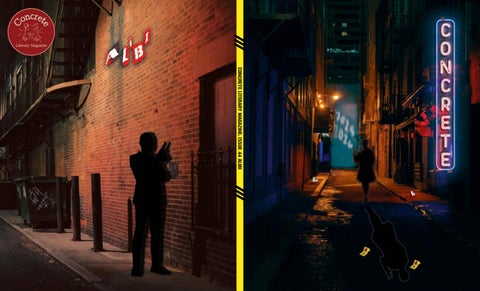
CONCRETE LITERARY MAGAZINE: ISSUE 44 ALIBI
3 2 1
Concrete Literary Magazine is an annual print journal produced in downtown Boston, amid blue-tinted high rises and blackened train tracks, at the tables of crowded cafes and at the mercy of flickering wireless internet. Established in 1982, Concrete, like Boston, or New York, or London, or Shanghai, is continuously evolving to match its urban population. Within the journal’s pages can be found a collection of prose and poetry that represents the dynamic nature of city life. All of the work found within the pages of Concrete is original work published by undergraduates of Emerson College under the Student Government Association and the Writing, Literature, and Publishing department. All rights revert to the authors and artists upon publication, and permission to republish must be gained directly through the contributors. Submissions: Concrete accepts unsolicited submissions from registered students of Emerson College, including fiction, nonfiction, poetry and screenplays. Submissions should be delivered electronically via Submittable at concreteliterarymagazine.com/submit. Please also include a cover sheet that includes your name, Emerson ID, email address, phone number, and title and genre of the work submitted. Do not include your name within the document of the piece. Cover includes art by Adam Hale & Haileyfoxart. Emerson College 120 Boylston Street Boston, MA 02116 Copyright © 2023 Concrete All rights reserved.
4
5
Poetry Readers Catherine Arndt Caroline Benoit Danika Benziger Drew Delouchry Gabrielle Finucan Juliette Hagobian Maria Mancur Paige Tokay Rowan Wasserman Editor in Chief Quinn Gardiner Managing Editor Heather Thorn Poetry Editors
Maggie Kaprielian
Olivia Trzaski
Assistant Poetry Editors Reid Rademacher Prose Editors
Lucia LaVorgna
Tessa Donohue
Mars Early
Assistant Prose Editors Lillian Flood Abigail Lincks Nadia Haeryfar Head Designer Reid Perry Assistant Head Designer Rowan Wasserman
Prose Readers Alyssa Buford Brooke Buckmir Declan Ireland Inika Mukherjee Kynadee Coffman Lily Shafir Mimi Newman Nicole Guth Seal Kirtley
Head Copyeditor Grace Grauwiler Assistant Head Copyeditor
Mia Solimine
Copyeditors Elliot Berkley Sawyer Klipstein Madison Gagner Emie McAthie Mia Rodriguez Evan Martin
Designers Anabelle Rosenberger Paige Tokay Lauren Mallett Caroline Benoit Treasurer
Cayetana Espinosa 6
7
table of Contents ON
NATI Y M F O G N O S dp page 10
THE DAY THE CLOCKS RAN BACKWARDS
RED R
Meg
AIN
Rady
page
Beloved reader,
Elliot Berkley
page 70
46
Song of My Nation Alex Pham Busking Max Ardrey Anthem-Mum: Do Not Give Me Flowers Jade Wein BUS return flight Olivia Trzaski TART S KINNight Off Addison Brenizer E R TO G Max e A The Dilemma Jagger van Vliet rd pag olin r a e 10 reyMy Shin Used to Guards the Rats C Jake Clark oit FORD GETAWAY n e B FORD GETAWAY Heather Thorn 54 Red Rain Meg RadyH.R. Thorn page To Restart (Red) Caroline Benoit CRO page 44 : Elegy to Youth Louise Berke M U L M M u E WS H T cia AN Never in the Valley of Evergreen Kaya Westbrook L ME aV org DO NOT GIVE Crows Lucia LaVorgna p na The Day the Clocks Ran Backwards Elliot Berkley a ge FLOWERS 68
Jade Wein page 20
ht
ig fl n r
u ret
za
Tr ivia
Ol
ski
e pag
28
NIGHT OFF
Addison Breniz page 30
er
SOMETIMES MY SHIN GUARDS THE RATS Jake Clark page 42
TH
GY e Berke 6 E L E ge 5 uis Lo
pa
THE DILEMM page 38
page 58
8
A
et
Quinn and Heather Managing Editor Editor-in-Chief and
OU TO Y
NEVER IN THE VALLEY OF EVERGREEN
Jagger van Vli
te for members at Concre aff st e th k an th to e is is lik of a product like th n Foremost, we would tio ea cr e Th n. tio e organiza the busy their dedication to th not only to getting ed itt m m co p ou at gr e a larg into the project so th es lv impossible without se em th se fu in tastes. The to personally llection of creative work done, but also co e rs ve di a of e tiv also presenta hours of work. We’d ss tle this issue may be re un co ur yo to appreciate is a testament which we bare! We ts quality of this issue ui fr e th g in id ov ers for pr Finally, like to thank the writ esent it adequately. pr to d an k or w ur the ad yo e issue and joining th up your trust in us to re g in ck pi r fo , u, the reader we’d like to thank yo investigation. Magazine , Concrete Literary ge lle Co n so er m E history at Gangsters of In our long, 44-year our name (formerly om fr s— ge an ch crises, s erou They’re our identity s. ul has undergone num ha er ov gn si de sue, changes and pression. Our last is Concrete) to brand ex e tiv ea cr r te ea gr of a terest of a maze, on the inside in d if you will, in the in pe ap tr g in be ol used to the feeling of theme is Alibi, a to ’s Labyrinth, explored ar ye is Th . m do ee ? self and fr I? What have I done as w re barrier between the he W k: as t isis that in which one mus d to, this identity cr te avoid confinement, la re e w d an , by fascinated Who am I? We were keeps us free. mples. fingerprints, DNA sa s: ue cl up ck Pi . ce e eviden t the walls, We present to you th one records. Inspec ph ll ce st ue eq R s. wound u need one. Look for defensive n Alibi, if you feel yo ow ur yo d in F s. or windows, and mirr Sincerely,
ok
Kaya Westbro
9
Song of My Nation bp
In a middle school hallway, a boy leans against a wall, bored. It is around midday on a Sunday. At the peak of the dry season, heat rises from the old school clay like television static. Through the small opening in front of him, the opposing cloister balcony is an impressionistic painting. The school is completely barren, the hallways and rooms empty. Though downtown, right up against a porous, overbearing market intersection, the inward-facing cloisters are as silent as the bottom of the sea. The boy looks down his shirt, trying to catch the front of his collar with his lips. He clamps around it, trying and failing like a fish struggling for water. He is waiting by a large metal classroom door. He catches his shirt, then lets it go—only to start up again, catching, letting go, catching. Try as I might, it is undeniable: behind the mask of his face, behind a door with no handle, are thoughts of an unknown color. Though it is a Sunday, he has been dressed perfectly. His uniform is freshly ironed, creased only at the wrists, the white cotton of his shirt scrubbed so diligently as to almost be seethrough. His pitch-black shorts terminate right at the knees, cut carefully in a straight line with a pair of scissors. A set of purplish marks just barely peeks through from underneath. His sneakers toe the line dividing the sunlight from the shadow of the hallway. As the minutes pass, he watches this line shift and wane in microscopic increments. In this way, he estimates precisely how much of his Sunday he has wasted. When noon had passed, and the last chance for an enjoyable Sunday had disappeared, the boy backs away quietly. Right as he is about to turn the corner, however, the classroom door creaks open, and a voice emerges from within. “Con.” Chin to his chest, the boy kicks away an invisible overgrowth blocking his path towards the door.
The classroom is boiling hot. Facing due west, the sun cuts directly into the room through barred windows, searing into the floor in long, solid protrusions. With the lights off, the division between shade and light is tangibly clear. The window by the front podium has no bars, and the blackboard is obscured entirely in the afternoon light. The boy doesn’t move, waiting by the door. The room has been cleared out, all its tables and chairs stacked neatly in a dark corner. The wooden floor, freshly mopped, opens and rolls out into a glowering sea of brown. And, at the front of the room, a young man sits on the edge of a carpeted platform with an electric piano and a chalkboard. Were it not for his being a teacher, he looks young and handsome enough that the boy could call him “Anh” rather than “Chú.” He has a modern but clean haircut, layered and carefully combed with gel, which stays flat across his head and far out of his face. Below a bay of undisturbed forehead, sharp, razor brows emerge, naturally furrowed downwards into the slope of a large bell nose. Gnarly, big features, and a clean-shaven face. Large eyes that seem always set on something just out of sight, at the point of squinting. Like every other teacher, he wears a white undershirt and pitch-black dress slacks, fastened at the middle by a gold-plated clasp, and this didactic tightness frames his thin, branch-like arms and legs like a flower in a stuffy bouquet. A silver pen sits neatly clipped to the tab in his breast pocket. Sensing the boy, he looks up, quickly putting something in his pocket. Standing up, he turns away from the boy and sits at the piano bench. When the heavy classroom door shuts behind the boy, the man turns back around and smiles curtly. “Please, so I can see you better.” He motions to the center of the room. A small X, made with two pieces of masking tape, sits unoccupied. It is pinned to the floor by a blade of light from the window. The boy obeys. He sniffles, then stands straight, hands clasped at his front, looking at the man. From this spot, he is equidistant from all points of escape. “Do you know why you’re here?”
—
10
11
The boy is about to speak, but the man continues. “As you know, you’ll be singing the national anthem alone. You’ve been selected, despite your interest in more prosaic subjects. I’ve selected you myself.” A cough. The man lifts the lid of the piano. “Ideally, we’ll go through the song once or twice, make sure your intonation is correct, and on Independence Day next month, we’ll be ready to perform for the school. Yes?” “Dạ.” “Good.” As he tugs his fingers out, the man throws a look at the boy. “And straighten your collar.” “Dạ.” Quickly tugging at his collar, darkened in places with spit, he straightens it out. The man rests his fingers on the keys and presses out the first chord. He adjusts the volume on his electric piano. “Okay. You’re old enough, so you should know the words.” After repeating the first line, the man hums the melody quickly, rocking his head lightly to the rhythm. “It’s imperative you get this part right in particular. Singing, as you know, is pronunciation. Do you understand?” “Dạ.” “Alright!” The man, pleased, claps his hands and counts himself in. His playing is practiced and stately, so unassuming, that it is as if it were a natural sound produced by the room itself. The opening flourishes state the motif for eight bars, and, at the end of it, the man looks to the boy on a sustained dominant chord and counts him in, clearly. “One, two, three…” The boy begins to sing. He stumbles through the verses, half-mumbling, half-whispering, the words indistinguishable. His voice is completely dominated by the sound of the piano. At the last syllable, the boy shuts his mouth, and the song disappears in an instant. The man’s hands disappear from the keys. “Let’s try again.” Winding up through the first eight bars, he slows at the seventh. “Are you ready, con?” “Dạ.”
The man smiles again. But as he slows in the approach of the first word, he hears no breath— and when he enters the first verse, he hears nothing. Out of the corner of his eye, the man looks at the boy. He is mouthing the words. After ten minutes of this, the man stops. “You’re thirsty. Stay there and stand still.” Pushing the piano bench back, the man leaves the room and returns with an empty paper cup. Reentering the room, he locks the door behind him. The boy hasn’t moved an inch from the center of the room, his eyes still glued to the tips of his feet. The crown of his head glimmers in the sunlight. “Come here.” The boy approaches. Reaching into his bag, the man withdraws a thermos and pours out some water. Handing it to the boy, the man watches the boy force the water down his throat. Taking it back, he motions the boy to return to his place in the center of the room. They begin again to the same empty result. All the while, the boy’s eyes, with no trace of subtlety, drift towards the windows and the rectangular slices of open sky beyond them. Again, no words escape the boy’s lips. After another ten minutes, the man stops once again. He rubs his eyes. “You aren’t singing.” Silence. The man tilts his head. “You wanted this, yes? I asked you when I caught you at that karaoke bar, didn’t I? ‘Which do you prefer: a beating or a performance?’” “Dạ.” “Don’t you remember the words?” The man begins to sing the first bar of the verse, but is cut off by a cough. “Dạ.” “Con, look at me. Where’d all that confidence go?” The boy looks up, barely meeting the man’s eyes. … The man clears his throat. Standing up, he turns towards the chalkboard, lacing his fingers behind his back. “Perhaps I’ve explained myself poorly. There’s 12
no reason to be embarrassed. As understood in the work of Confucius, the principal reasons for embarrassment are, in essence, based on the fundamental belief that one’s actions are, against the risk of oversimplifying, purposeless. I understand this feeling all too well.” The man takes a deep breath. “Once, I was shy like you. Growing up, I didn’t want to speak. Hated it. I never knew what they wanted me to say. All I saw around me were contradictions between the way I felt and the way the world was. It’s confusing, isn’t it? Uncertainty was my enemy, and fear was its natural, dangerous manifestation. As a result of this, I said nothing at all. I refused to engage because I was afraid. And so, just like you: struggling grades, an infatuation with the west, prolific daydreaming … when I caught you that day, it was like looking in a mirror.” The man turns around. “In our hearts, we are all fighting a war against senselessness. We must face this aspect of ourselves. We must not retreat into ourselves. It was in a classroom not unlike this that I was reformed—I listened and learned, and realized, correctly, that there is no reason to be afraid. Because everything that needed to be known was out here, where all can see. Because anything in service of this nation can’t be anything but moral and right. Of this you can be 100 percent sure. Do you understand?” “Dạ.” The man gently crouches down and meets the boy at eye level. “This isn’t a punishment. It’s a promotion. Despite yourself, I can hear how beautiful your voice is.” The boy doesn’t move. “Dạ,” he mumbles. “It’s Dạ Chú to you.” “Dạ, Chú.” “See? I can hear it already …” Their eyes meet momentarily. The boy shows no signs of exhaustion. His gaze is clear and focused. The man nods, turning away and yawning. He rolls his wrists out and taps his foot. A small round clock set just above the front door reads 3:14. The sky outside falls through the bars in a charred, orange hue. Taking a sip of water, the man sits down
again. His shirt has come out a little from under his belt, revealing a thin ring of ghostly white flesh. “Alright then. We’ll do this as long as it takes.” The boy shifts from foot to foot in his place. After a few more empty repetitions, the man lets the last chord of the song dissipate into the air. Reaching down to close the piano lid quietly, he rests his hands in his lap. He looks straight ahead at the door. “You understand that everybody will be there, yes?” “Dạ Chú.” “Your teachers, your parents, your peers. All of them. Watching you squirm.” He pauses to let each of these uncomfortable avenues of thought penetrate. And then, after an administered pause: “Because you are good enough. You are a winner. No one else can do it.” The boy rubs his elbow. “Dạ.” “Dạ, Chú.” “Dạ, Chú.” The sun has fallen into view, and the shadows of the window bars cast black lines across the empty floor like thick, impenetrable pillars. Annoyed, the man pushes back on the bench and stands up. His forehead is now dotted with sweat. The man, rubbing his palms, steps down from the platform and approaches the boy. His steps are measured and silent, as if he is gliding. He stops inches from him. His shadow makes the boy’s face inscrutable. Quietly, he gets down on one knee and speaks, reaching down to wipe a speck of dust off his shoe. “Do you think because this isn’t graded it isn’t important?” He looks up to meet the boy’s eyes, but they are set in a straight line parallel to the floor. Silence. “Are you still nervous? Still shy? Do you still need help?” Silence. The man looks away. “So you refuse to sing.” In an instant, a slap bursts across the boy’s face. The man’s arm is outstretched in the air. 13
The crack cuts through the ambient sounds of rustling trees and distant traffic. For a while, the man and boy stand frozen in place. In the silence that rushes to fill the empty wake of the strike, the boy looks up at the man. The man swallows a wad of spit. “You know the words.” “Dạ.” Another slap ricochets off the boy’s right cheek with a firm backhand. A thick, meaty sound echoes through the room. Now, the man presses his forehead into the boy’s and, with each sentence, forcefully thrusts a finger into his chest. Pressed together, their combined sweat melds together into a sticky paste. “Dạ Chú.” “Dạ Chú.” “So why don’t you sing? Or is it that you just want to waste my afternoon, the way I am wasting yours?” Silence. “Answer me! Or is it that you resent me because I am young?” Another slap—the boy’s left cheek, now glowing a soft red, hangs distended in the air. The boy begins to tremble. His eyes, wide and unblinking, surrender the small beginnings of tears. He looks down quickly, not making a sound. “Don’t move!” “Dạ Chú.” The man looks up into the boy’s face. Their eyes meet, and the boy cannot restrain himself. Quietly, as the tears fall, the man puts a hand on the boy’s shoulder and squeezes. Silence. They wait for the boy to finish. Eventually, the tears stop. Unable to continue staring, the man looks away and rubs his eyes. “So now you don’t speak either.” Silence. He sighs. His grip hardens on the boy’s shoulder. “Do you hear me?” “Dạ, Chú.” The man smiles at this. Apologetically, he laughs, affecting a lighter tone of voice: “Could it be? You of all people, training to be a bodhisattva?” Nothing.
Clicking his tongue, the man’s smile drops away. He raises his hand again, but stops. The 5 o’clock bells from a nearby church begin to ring in the distance. The afternoon sun, having fallen into view of the windows, burns the floorboards a deep orange. The ringing seems to go on and on and on. The man stands up. He walks towards the piano, hands in his pockets, and, halfway there, in a sudden twist of the hips, marches back to the boy and grabs him by the neck of his shirt. And then, in a continuous series, each phrase punctuated by hard, firm strikes: “Your parents. Your teachers. The tenth general himself, our great retired general, granted us his precious time to stand at our flag. Do you understand how far beyond you this is? How much this matters? I’ll beat the words out of you if I have to.” The man is breathing heavily. His shirt has slipped out from under his belt and has begun to stain in places with sweat, but not an inch of fatigue appears in his eyes. “Silence is not an option.” Suddenly, in the interval between strikes, the man’s hands drop to his sides. He blinks. “What was that?” Nothing. “Are you smirking?” “Không.” “Dạ Không, Chú.” The man corrected. “Dạ Không, Chú.” “Do you think this is a joke?” “Dạ Không, Chú.” The boy wipes sweat from his face and begins to shake his head. “Do you think I don’t understand you? Con, I was exactly like you. Don’t think you’re fooling me—I know exactly what you think of me. You think I’ll give up on you, or feel bad for you, is that it? Quivering like a dog. You think you can outlast me. You think you’ve locked all of your thoughts up safe in your chest, where you and only you can see. But I can see. That’s why I won’t let you leave.” Letting go, the man stands up in place, frowning. “All your kind are invested in are your lousy little friends. Think about this: they’ll be half bored to death just watching you stand there like a retarded little mute.” A shift—in the corner of the man’s eye, the 14
boy has begun to ball up his right hand into a fist. “Do you resent me calling them lousy?” Reaching back down, he firmly pushes his pointer finger into the boy’s chest. Though his skin is light and untanned, his fingers are worn to an astonishing degree—whorled and ragged, each crease echoing a life of exertion. Looking up, he keeps his eyes set directly on the boy’s, watching him closely. “I had lousy friends growing up too. It is difficult not to be a lousy child. It is difficult to care about things you’ve never seen. But you’ve felt it, haven’t you? When you played soccer in some cratered hole in the street. When your dad beat you, half to death, coming home late. In the music you heard and the way your parents and teachers whispered around the table late at night, far from earshot. In the heavy silence of contemptible adults who take your history to their deathbeds. You think, ‘Why is it that something so important has nothing to do with me at all?’ How does a weak little child not resent it, that invisible weight placed on the shoulders of the next generation? That is what you’re thinking, isn’t it? You think: ‘What’s so wrong with being lousy, then? With living in a single moment, now? Why deal with anything more than the banal?’ Right?”
far below. He clicks his tongue and, from his pocket, he withdraws a cigarette. Lighting it with a BIC, he leans against the side of the window. His shoulders fall into a slouch. “A real fucking boiler, isn’t it? Not even the dogs are out.” … “There was a girl I knew growing up. She was one of those types. Obedient. She knew who she wanted to be since she was a baby. Always raised her hand, spoke loudly with a northern dialect, and snitched at every chance she got. Couldn’t be coerced by anything, never tried soda, once. And she always looked so chuffed, for no reason at all. The Iron Blouse was what we’d called her. Get it? Nobody liked her. Now she works with the Ministry of Commerce.” He takes a drag and breathes it out, the smoke lifting up towards the blistering, lowhanging sun. The man reaches up to adjust something on his face, but there’s nothing there. “Do you have a girlfriend, Chú?” “Shut up.” Snuffing his cigarette on the hem of his pants, the man returns to the piano. He lifts the piano lid, he cracks his knuckles, and tugs his chair in. He skips the introductory bars of the song, counting in immediately, “One, two, three—” Nothing. Another repetition, and another— the silence congeals into a hard and viscous substance, so hard that even speaking becomes difficult. The church bells have long ceased to ring. The afternoon breeze has slowed to a crawl, and the air in the room has settled into a stagnant pool. He plays it again and again. The music’s harmonic logic has been repeated so often now that it has begun to lose its sense of cohesion, the glue and plaster coming apart at the seams of the measure, the strict, stately rhythm slowly devolving as the man hastens his pace. The boy yawns. He is standing there, doing nothing, for some reason. But always, stockstill with a wandering eye, ringing out with that flat, anharmonic monotone: “Dạ.” The man is now sweating profusely, and rapping his fingers on the side of the piano, giving out directions
… “Say something!” The man looks at the boy, expectantly. But nothing comes. A moment later, the boy’s hand unclenches. A shift. He is suddenly still. A pause. Slowly looking up, his eyes stare out the window. Slowly, his trembling comes to a stop. The man turns away. “Let’s take a break.” Shaking out his right hand, the man gets to his feet, sucking in his breath. He tugs out the fingers of the offending hand one by one. “If you keep making me hit you, I won’t be able to play the piano well, you know. So sing the damn song.” He pauses, turning towards a nearby windowsill. The boy’s eyes follow him as he walks over to it and looks down into the street, 15
to himself. When he runs out of Confucius, he starts on Lenin, Mao, and Ho Chi Minh. He checks his watch and, at regular intervals, goes to smoke. He rubs his eyes, squinting harder around the room. And time passes. The rays of light that had so violently penetrated the room before have slowly faded, giving in to the uniform darkness of the bars. The light switch for the lectern is broken. Returning to his seat, the man flicks on his lighter, and producing a rubber band from his bag, ties down the igniter. His white skin glows under the light of the flame. “It’s 6:15.” …
Nothing. The man groans. The boy could not be coerced, beaten, chided, or manipulated—that blank look of his, vaguely of sadness and shame, was impenetrable. It was the kind of look that ended at the eyelids: ideas of right and wrong, empathy and apathy, responsibility or laziness, disappeared at its surface. No matter what he asked, the man could no longer make any headway. All he knew was that familiar sight in his eyes: of that color of the iris, so inherent to young boys and girls, into that wide and endless pool of black and white. Head in his hands, they stand and sit in silence together. Neither man nor boy moves, at a complete impasse. Time has shifted, irrevocably, into night. A cold evening breeze cuts holes through the stagnant air of the room, lifting up small particles of accumulated dust. Not a single motorcycle seems to pass on the street, and the boy, bisected in half by a shadow, disappears from the waist down. Not a thing moved except for the flicker of the lighter. Finally, the man speaks up. “Just sing it once for me, won’t you? Just to show me that we can get somewhere. To reassure me.” Nothing. “Let’s be friends. Let’s sing together, anything at all. You aren’t impudent, and you aren’t stupid. I know that now. I know you don’t want to do it. But it must be you.” Nothing. The man doesn’t move. He closes his eyes. He clutches the edge of the piano cover with his fingers. After a long moment, he speaks in a whisper. “Please. I don’t want to lose my job.”
“How about we just pretend? I pretend sometimes too when I don’t really want to do something. It isn’t so important, the meaning of the words. That’s why you’re silent, right? They’re just words to you.” Silence. “I’m not supposed to tell you this, but on stage out there, your friends, classmates and teachers will be singing along too—and in truth, nobody will really care what you do. They’ll be too worried about how they themselves sound. Is that less scary? Nobody will hear you.” … “Imagine that they’re the words to your favorite song. What was it you were singing before? How did it go?” Silence. Exasperated, the man clicks his tongue. “Don’t you see that I’m trying to relate to you, you little creature? I’m telling you I understand why you’re so reticent. To be frank with you— ” The man drops into a conspiratorial tone, leaning towards the boy, far enough as to seem about to topple off the platform entirely. “I’m reticent too. I feel the same way you do. But you mustn’t ruin your future anymore than you already have.” The man sits back. “I can’t let you go until you do it for me once, okay? So let’s be friends now. I know you can do it.”
… The man does not look at the boy. Fully obscured in the shadow of evening, the moon far above the view of the classroom bars, the boy is almost indistinguishable from the floor and walls. Only the low sound of breathing moves through the air. “We’ll take as long as it takes.” The man coughs. “One, two, three …” The man makes to press down the keys, but just at the point of releasing the first chord, he comes to a stop. He listens. Pure, empty silence has filled the room. A heavy, natural kind of silence. Not a single breath or sound seemed to exist in the outer world. Abandoned there, this room, the buildings, and streetlights, the market stalls and cloisters, the land and the sea, all seemed to vanish under this immense quiet, as if they were never there. The boy, on his little X, stands with his eyes open, looking somewhere else. And there, in a single moment, comes an eerie, cold feeling which pierces the man’s heart: that this unbearable silence was theirs to share. Once again, they are at a standstill. The man sighs. Pushing a strand of hair out of his face, he lifts his fingers. Alone, the man begins to sing the first verse. Crackling at the edges, his warbly, hoarse voice can barely carry it. Nothing has changed—but he struggles on, alone. The sound echoes through the dark and empty recesses of the school. At the end of the song, he repeats the verse again. Then again. When his lighter goes out, he takes out another, and for a moment before the light is back, he disappears entirely into the evening. He brushes his hair out of his face and clears his throat. He sings again. The sounds of the piano ring out as clear and fragile as glass. He waits for as long as it will take.
… … … “I’m going to start singing, and you can join in whenever you feel like it. I’ve been unfair to you. I’m not a good singer, so bear with me, okay con?” 16
17
BUSKING Max Ardrey
my well-worn shoes scrape stranger streets the traveled timbre sounding grayed cousin sky kisses new earth ‘round redbrick cobbled corners no glasses for my mind’s eye mirage glances swing at me summoning words without chords to speak doesn’t matter I stumble toward the bitter steps and then out come the strings though harshly plucked notes won’t go far through bleak december air couple quarters line my bag my phony compensation but they make friends, plopped one by one the copper coins colliding like living, breathing tablature I am constructed, made of matches and cards from different decks some shining, others weathered scornful stares and eyes that rue they must not like worn cards just light me, the matchbook man and find where I’ve been lost
18
19
Anthem - Mum: Do Not Give Me Flowers Jade Wein
(Content Warning - Allusions to domestic violence) 20
than three gift cards and five scratchoffs. Useless anywhere besides your least favorite niece’s birthday party. She slides over five singles, four too many, and tells me to keep the change. Like she owes more; like we both don’t know it. I take it regardless, and watch her limp away silently, something from the frozen section dampening her coat, fused to her side as if she presses it tight enough it’ll replace the bruised skin. Silent still. Thief then, like a ghost, but one with a surprising amount of spine. More than I’ve got, anyhow.
The bell chimes as she enters, a warning and a welcome wrapped in worn gold paint. With it brings the appearance of a woman who looks like she might view punk as a lifestyle instead of just an aesthetic choice. Gregory, a semi-regular that I decided is too crusty for “Greg,” turns back to his milk selection after a glance too long, staying blissfully quiet. From behind the counter, it’s difficult to survey the aisles she wanders past, but the top of her hair, ratty as all get-out, is an easy to follow shadow. Greg’s eyes follow as well, and an intrusive part of me wonders if he’s pegged her as “thief” or “easy prey.” “Yo, Gre-gor-y,” I call. His eyes take a moment to jump from her to me. “Make a decision yet, dude?” “Greg, if you please, Miss,” he says, and with a final glance to the back of the store, he approaches the counter. “Then it’s Yaz for you, I ain’t no ‘Miss.’” I scan the milk and cinnamon over his grumbling. “One fifty-five, if you please.” He pulls out six quarters and a nickel. Exact, one of the only things I like about this man. I shoot a sharp grin. “Have a nice day. Say hi to the wife, yeah?” He stares, face unshifting, but ultimately gathers his items, silver ring glinting under the fluorescent lights as he grumbles his way out the door and all the way back to suburbia. I busy myself wiping down the counter with a dry rag, the one I keep on the rack in case I need to look busy and not overly surveillant. She’s gone quiet. She’s either holding her breath or exerting an extreme amount of stealth she did not exhibit upon entrance. The latter proves true when she reappears from the aisle on my side, closest to the counter, exuding the stench of malnutrition and the Irish shower she walked in with. I smile, and I feel something a little more genuine in it now. “All set?” I wonder aloud. She shrugs, dropping a small pack of gum in front of me. That brand is only found directly in front of me, on the counter shelves. I have no idea when she grabbed it. I feel my smile widening against my will. Sneaky. Cute. I give her a total, and she pulls out a scrap of leather. A ratty old thing, containing no less
–<-^->–
The ghost is back in my shop, stealing candy cigs and my cat’s attention. The corner shop’s lost stray. No one knows I adopted him two weeks back. I let customers assume whatever they want until they start trying to shoo him out the door. The woman and cat are mirrors, coats too heavy for the summer and too worn and scruffed to protect any ounce of them. People are in and out more often now that the hottest day of the year is starting to look more like a consistent thing. Two or three at a time, they grab a popsicle or juice or beer, and they stare in disgust or amazement at the little puff of smoke scurrying through the aisles. Ugly little dude. I named him Tulip. 21
Tulip circles the woman suspiciously, ultimately brushing against her leg in acceptance. They say that cats possess good senses of a person’s character, but in this case I think Tulip just likes dead things. Metaphorically … for the most part. She doesn’t seem all that put off, luckily. I guess stray recognizes stray. The most recent patrons bounce and tap their way out the glass door, high on life and a freshly opened wine cooler poured into the plastic refill cups I let them take. I don’t get it, drinking in public is always more fun when everyone knows you’re doing it, at least that’s what my ma always said. At the knell of the closing door, the woman appears by the counter. “Chrysa,” she offers, along with a bottle of Bacardí and a mini sewing kit, barcodes up. Nice. “Looks like you got a fun night in store, Chrysa,” I gift back. It’s just as much a present as a lure. She shrugs. I ask for an ID, and she hands it over in a way that contradicts the rejection I feel. “Chris Morgen.” Huh. Regardless, she’s just past the cusp of twenty-six. “And a happy birthday to you.” She pities me with a smile, a small thing on her long face. I wonder if I should tell her the caramels and Ace bandages in her coat’s inside pocket are on me, but a part of me wants to avoid scaring her off. Well, the best presents are ones you don’t draw attention to, especially when they were stocked partially because of her. Another smile, something a little more tangible, at my lack of further ado. She collects her purchase and tucks away her ID next to a newly dated library membership. She pauses at the exit, looking back. “See you later,” she says, and it feels like a confession. With the chime of fool’s gold above the door, she fades away into the high sun. I linger there, my eyes insistent, but a rowwwr demands more. I break out the emergency stock of squeeze treats. I still refuse to bring the nice ceramic food bowls into this shithole. He smells the chicken, but refuses to approach it when I crouch to his level. Typical. He always refuses food from my hand.
–<-^-> It’s three minutes to closing, and a ghost that I’ve been trying to win over for weeks manifests through the door with a speed that would make me concerned for the stock on the top shelves if I cared about their integrity. The door’s ricochet and the bell’s ring linger as she hops the counter with ease, tinnituslike even after she’s out of eyeline. There’s a blur of black straight past me, and lowering my gaze, there she is. Solid and silent Chrysa, contorted in a ball at my feet under the lip of the cash register. Not cowering, because that is even farther below her than she is now, rather … skeptical. Not pleading, but perhaps demanding with a significant amount of hesitation. A thought is spared to be concerned, another is used in wondering how beautiful her face looks now as it’s taken by something close to trust, unfortunately covered by shadow as it is. I don’t hate the thought as much as I probably should. The chime crescendos again, calm and slow. Sauntering in is a man in a tie of all things, an annoying lack of perspiration on his button-down and a worried amount on his temple. He scans the room, and moves to the aisle when he sees me already watching. He peruses the lotions with the utmost amount of casualty, looking left and right and finding nothing, perhaps no one, he wants. A squeeze to my ankle. It transfers through me seismically, banging my wrist against the counter. “Oi, dude.” I call. “We close at 5.” There’s never been a “we.” Employees are for chumps and chains. He hesitates at the mouth of the aisle. “Oh, my mistake.” He swipes his way through a purchase of fancy hotel lotion with a silver card. “Pretty early, eh? You got somewhere to be, darlin’?” He tries to smooth over, unstoppable. “It’s Yaz.” Immovable. “… Right.” He drools. He scouts the exit as his heels clack away and away, still searching. He pauses just outside the door, removing a mask as if the glass wall is a one-way mirror. Not much, a gruff sigh and a storm cloud over him, but enough. He tosses the lotion into the street waste bin, and finally, he walks. I can almost feel the shop decompressing. I look down. Nothing. I turn, and she’s to
I place the packet on the ground, and he comes to lick at it, cutting his tongue on the plastic opening. He sniffs, and rises to circle my knee, letting me pet him for the first time, bleeding and all. Selfishly, I think it’s another win for me. 22
my left, sitting with her legs folded on my counter. Tulip is there too, both disrespecting the sanctity of my laminate barrier. I guess I don’t mind. A whisper of thanks, heard and unspoken. Her face, now in full view, has that look I hoped for, almost trust. It’s an earned thing, through selfless action, but I feel pretty selfish gaining this. I was right, it is beautiful. Tulip rests a patchy cheek against her calf, and her hand cradles the other on instinct. And my hand cradles hers on instinct. For a second, one second, there’s a subtle warmth under my palm. The next, empty air. She’s maneuvered herself off the counter, a foot away, but still on my side of it. Staring between me and the spot she just occupied, as if she separated from her body and was watching, the potential conclusion to the scene she just escaped from. The scene that could still exist, if it wasn’t for the tender bruise throbbing under the frizzy hair brushing her jaw. And suddenly, she’s reaching forward, grabbing my still-raised wrist, and pressing it back in place. Hard. I try to gentle my grip, but she barely lets up. Pressing, scorching. But then, ever so slowly, she relaxes. Her hand drops and she sags like a settling rice bag. Surprised, how warm she is. She walks around as if she holds no blood at all. My mind contains a million questions. I don’t ask any of them. Instead, I let go, however reluctantly, and travel to the back for a bag of ice. When I return to the counter, a part of me is a little surprised that Chrysa is still there. “Free of charge,” is passed with the bag. She scoffs, as I learned to expect by now. There’s maybe three ounces of sincerity between the two of us, and it seems it’s been used up for the day. “Guess I owe you one.” She says. “Oh, you owe me way more than one,” and here she actually flusters. But then she’s huffing into her hand, and if I’m not mistaken, it sounds like she’s actually laughing. And then she’s chuckling her way through the glass door with a wave, just barely audible over the bell, and then she’s gone. Tulip circles the spot where Chrysa once sat, uncaring of his loving mother’s lingering. And yet, he still nudges my hand demandingly. I let him scratch his chin against the heel of my palm, and I worry.
–<-^->–
Under the sound of a wailing child and my shattering patience, the bell announcing Chrysa’s presence is inaudible. I don’t realize she’s back until she’s gazing down the aisle at me, shoes and socks soaked through with the slushy this brat threw at me. His mom said no to a second, and he decided that clearly it is the fault of the lady running the cashier. The wooden shelf is splintering from his fists, fallen snack bags are popping and crunching, and I might start throwing a fit myself. The mother is relatively apologetic, though, so I let her drag her kid out unscathed to count the money she threw on the counter in a fluster. A ghost of my own mother, one that’s a little more literal, sighs inside me. Darn kids, it whispers, a bit too fond for my liking. Chrysa watches them go. “Darn kids,” she sighs. Looking back over, she softens. “Need help?” “I can’t pay ya,” I respond. She smirks and I can’t quite tell if it means don’t care or good. Either way, I lead her to the back room, stepping over a split in the tile that trips her up. Ha. In the room, one that’s part storage, part break room, and part kitty-ruled, I busy myself digging for stain remover as Chrysa pokes around behind me. I wonder what takes her focus. All the junk that I like to look at enough made its way over here, like my master’s diploma in literature or zines made by an old friend back in Boston. Beautiful photos of my mother and even more beautiful wanted posters of my uncle. And of course, Tulip on his throne of cardboard and memory foam. I’m not sure if she’s realized how much access she currently has to me, but I am secretly begging her to take advantage. “Paulette Kelly?” I turn, and of all the things covering the wall, she’s pointing at a framed calligraphy of some poem quote: “Do not stand at my grave and weep / I am not 23
there; I do not sleep. – Paulette Kelly.” A gift from an ex, something they found in a thrift shop. Broke up with me two weeks later for “lacking passion.” Farewell, Lauren. It’s a nice quote, though. “Yeah,” I call back, “you into poetry?” “I guess, at least enough to know that it’s misattributed,” she responds.
Chrysa in the back to handle the purchase and apologize for the sticky red stain that coats the woman’s heel. She’s annoyed, but willing to hold her tongue after her initial complaint. “New hire?” the woman asks. I turn, and Chrysa is leaning against the open doorway of the back room. Chrysa, charmingly smug, tilts her head. “No,” she says. “Just stopping by.” Her fingers ghost over my forearm resting on the counter as she passes, the woman startling a bit as she cuts her off on the way out the door. A chime, a smile. Smug, charming. She whisks out with a final whisper. “See you later.”
Huh. “Huh?” She looks back. “‘Do not stand at my grave and weep.’ It’s by Mary-something. Fry I think? Kelly was the one who wrote—never mind, nerd shit.” I finally reach for a small bottle of hair bleach. Good enough. I turn and sit on the ground, bottle left on the chipped lid of the recently dubbed cleaning bin. “I love nerd shit,” I say with false graveness. It earns another smile, one that grows less and less rare the more she visits. Chrysa slides over to the shelf above me, hopping up onto it and sitting with barely a creak, dangling her legs over the edge without a care. Leaning back on her hands, that smile turns to a smirk shooting down at me. Usually we stand at about the same height, but her legs are much longer, and from here, she looks impossibly tall. I almost want to keep looking up, but it’s hard to read her lips from the floor, so I stand, leaning against the same shelf. She seems suddenly hesitant with the equal ground, but, painfully shy, she’s asking what I know of Emily Dickinson, quoting something about hope and feathers and pulling out lines from memory that had to have been written down somewhere. I’m not really a poetry person, but among the novels I’ve read, there’s been a fair share of things a bit too flowery to be prose, so it’s not a struggle to follow and even contribute. It’s nice. I don’t really go beyond small talk with the regulars these days. Certainly not this far, with faces leaning closer together in an unneeded hush. A hush that becomes very necessary when I’m falling even closer to see how she tastes when she’s content. There’s a moment of pause just before our lips meet, a valiant attempt at communication. It’s her who loses patience, gently, but with a firmness that tastes like melted sugar and ash. Each subtle press is a little more addictive. A hand, near unwilling, reaches toward her jaw, to comfort or control or— “—Scuse me? You are open, right?” Right outside the door. The moment fizzles, pops. I leave
–<-^->–
A chime by the door. A figure leaping across the counter. A ghost against my jaw, and a whisper against her lips. I don’t care what you’re trying to escape from. I just need you to make it permanent. Because something must give. That’s what happens when you apply too much pressure on something— that something tends to break. I just really don’t want it to be her spine, even if it means it’s my heart instead. In fact, I’d welcome it, because I really do need to stop letting it take credit for her “healing,” if it can be called that. I place a hand on her waist, aiming for a patch of skin that isn’t bruised. She winces anyways. For the past month, it’s been this. Closing time for me is her opening. Between kisses and lessons on countertop maintenance, I learn that she does, in fact, have access to a hairbrush—she just also maintains an aesthetic that she is very committed to, as well as the fact that she possesses 24
an affluent love of your average grandmother’s favorite hard caramels and Pink Whitney, which was discovered on the same day I learned that they make a strangely satisfying combination. I also learn that it was her brother that skulks his way in and out of my shop. Since his first appearance, the two have not been in at the same time. He seems to be more mindful of my hours, but he still searches. I reserve my best attempts at small talk for him, even letting him call me darling on occasion, just to make sure he’s sent home in a good mood. Y’know, just in case. A part of me is scared that I’ll want to save her. It feels like just another choice taken away from her, not letting her figure out her shit herself. And I don’t know it all, but I do know it’s shit, real shit. The kind that won’t heal with the offer of a job or new home or physical retribution. All things that I have offered. Never more than once, though. She is firm in both acceptance and denial, and she will make it clear when she changes her mind. At least, I hope it’s a when. The sun sets a little earlier tonight, the slightest tease at the fading season. The younger bar hoppers are early too, searching for pregame suppliers and things to fulfill the late-night cravings. I applaud their proactivity, but we’re closed. “Tell me what you want,” I nearly beg. Her grip eases in my hair, and she’s looking, really looking, for maybe the first time. To my eyes, to the half-wall glass panes, to the shiny panel display on the register. Everything that makes the shop mine. All a window. All a mirror. She peruses it all, and then it’s back to me, staring straight at me, just another reflective surface. She deliberates, taking her sweet ass time with it too, but she does answer. “Not this.” It’s said with a smile, so rare and wistful that I almost miss the resolve, the stark determination that is about to be thrown at the nearest target. It’s for this reason I don’t stop her casual exit. Her boots fall silently all the way out the door and down the street. It’s a wonder, they always look so heavy. I need to feed Tulip. He didn’t wander out after me today, so I need to go home and give him actual food. I need to feed myself too, probably. I grab the rag on the rack. I wet it for the first time in a while. I wipe down the counter. I don’t cry.
I lock up, and I stay behind the counter. It’s about time for inventory anyways. –<-^->–
A week later, Gregory is back, and he’s rushing straight to the counter like he’s being tailed. “Do you guys have bouquets? Roses, lavender, the like.” Again, there are no “guys.” He’s been in here enough to know that I can barely afford to keep this place open, let alone hire help. And “we” have never sold anything living, and I certainly have no problem telling him as much. He kisses his teeth. Storming through the candy aisle, his ranting is as distinct as ever. “Damn woman never appreciates a thing. No, apologies ain’t worth nothin’ in this economy.” Jesus. “Trouble in paradise?” I ask, trying to keep my tone light. He reappears after his rummaging with a red heart-shaped Valentine’s box of chocolates. “Sweetheart, there is not an ounce of paradise in marriage. Somethin’ to actually learn from that Madonna chick.” I choose to let the pet name slide when he lets out a frustrated sigh, running his fingers through his thinning hair and reaching for his wallet. “Nah, just tryn’a apologise for once,” he grumbles. Huh. That’s new. “For what?” I really shouldn’t care, but I’ve never heard of this man apologizing for anything. “Nothing worth pickin’ a fuss over,” he starts. “… got a lil’ aggressive the other night, think I scared her.” He almost looks remorseful, but gives an annoyed sigh when he hands the change over. “I don’t get all the cryin’, but I owe her, I guess.” 25
He saunters out the door, a man on a questionable mission, and I wonder if his wife likes flowers, or chocolates, or apologies paid for with a tenner. I wonder about the kind of man who goes to a run-down bodega to buy gifts for his wife. And of course, I think about Chrysa, and I wonder if whoever might still be hurting her is bothering to apologize anymore.
door before using them. She raises an eyebrow, amused in a way she only ever seems to be at my expense. I sigh and turn to dig through the stationary as she squeaks her way through the aisle. She returns after a minute with her treasure: a popsicle box dripping its way down one bare arm, a shaving kit and caramel pouch clutched in the other. She places everything onto the counter, and she waits for me to ring everything up. I feel a little ridiculous, but I’m a professional, kind of. I crack a little. Because, well, she’s glowing. Backed by total night, she’s radiating something. I joke to myself that it might be toxic, mainly to excuse the distance. Tulip has no such qualms. In fact, he wanders out of the back of the aisle to prance up to her. He disappears from my eyeline, but I see her shift her weight, knowing that she’s leaning into him, too. Sucker. It’s a mockery of a transaction, but I still read her total, and she still pulls out her wallet. It’s not cash within though, this time it’s a red visa debit. She swipes. Puts it back smoothly as if she’s gotten some practice. Part proud, part fond, part livid, I chuckle and sway my head clear. She doesn’t reach for her bagged items, mission apparently incomplete. “Maybe next time, you come to me.” She pulls out another set of keys, unclipping one that looks like a duplicate of another and letting it clink on the counter. “Free of charge,” she says, smugly. Shiny and new. “New digs, huh?” I scope, trying for something less annoyed than I feel. She sees it. “New to me, at least.” Her amusement turns more sly, and I tense for it. “Jealous?” I scoff. “Nah. Just wish I could have seen …” this growth. “… the place. I’m great at interior decoration. Could’ve brought flowers, housewarming and all.” I wouldn’t have, she hates taking care of them. “It wasn’t furnished yet.” She’s looking again, and for some reason I feel caught. “At least now you’ll have somewhere to sit while you judge the new paint job.” “I’ll only judge if it’s bad.” She finally lets out a genuine chuckle. “Don’t worry, it’s all me. I know my shit.” I believe her. Fuckin’ art chicks.
–<-^->–
Ding. Shit. I spring up from where I’ve been dozing against the tobacco stock. The Anatomy: A Love Story hardcover is not exactly my weapon of choice, but you can swing anything hard enough, probably. Peaking around the lollipop spinner, I follow the squeak of new Vans, spying for an intruder. I find Chrysa. Forgetting the panic is easy, accepting the anger is a struggle. It’s been three months, and she hasn’t darkened my door once. And yet, the elation. The thought that she returned at all, after however many hours or days of doubt, she came back. “Y’all have stamps?” She asks, knowing full well there is no “y’all.” “… We’re closed,” I reply after finding my voice. Because of course we are, it’s nearly one in the morning. It’s not the point, though. The key I gave her all those months ago dangling from her knuckles is proof, I know she didn’t even try the
26
considerably thrown off. I asked though, and it’s only fair. Chrysa takes her boots off next to the mat by the door, and I follow suit. She wanders further into a room that’s larger than life. Open-concept living area with a blinding marble kitchen behind the three-seater couch, white cabinets looming over the plush cushions and rug. To the right of it, there’s a short hallway that leads to a single door, likely the bedroom. It’s so reminiscent of my mother’s old house that I expect her to pop out from under the kitchen’s bar and start mixing mocktails. She pads lightly over the hardwood, as if she wants to prevent it from settling as long as possible. She moves behind the bar, beckoning me over with a ghost of a smirk. I sit. She mixes Bacardí (borrowed, not stolen) and cranberry juice and we drink. She stays standing behind the countertop, and yet it feels far too normal, as if we have been having weekly dates and she isn’t only a few months out from her first paycheck. She admires her work on the wall in front of the couch, behind where a TV is clearly planned to be placed. It’s green and teal in wavy circles, something called a malachite wall. I ask if it’s made with a stencil, and she just laughs. Alright then, keep your secrets, art chick. Eventually, we migrate to that very couch, and it really is soft as hell. Chrysa asks who’s running the store (Tulip) and how long I can stay (forever, if she’ll let me). We sit in on-and-off silence. She takes in her new place, and I take in her. For the first time, I can hear her heart beat heavy, as real as can be.
She grabs the bag at last, dragging it casually across the counter to her and letting it fall by her side. The jostle at her shoulder doesn’t look like it hurt. “See you later,” she says, with the utmost casualty. And she turns. And she walks. The bell chimes, and out the door she is. I can still see her down the street, even in the starless night. My eyes manifest her outline. The key on the counter lingers with warmth, like she’s been clutching it for a while. I grab it, and it immediately cools. Goldprinted key and dog tag chiming where they dangle in my hand, I lock the door behind her. Tomorrow, I decide, I’ll call the number on the charm and ask for the damn address. Now, I finish my book. She’ll feel more real in the morning. –<-^->–
There’s a bell over the door of her apartment, even looks to be real silver. It chimes sweetly as Chrysa holds the door open for me, a symbol of chivalry. Away from home turf, I feel a bit exposed. Unprotected by the counter and the aisles and the recluse of my back room, my groove is 27
return flight Olivia Trzaski
home, a place I cannot name except in relation to other homes except in relationships cast out on a star-spangled horizon, you wait for me like a star god, a constellation wayfinder and degradation of dust in human hands, my hands, this is where I land, I am my land I was born to and from and of the land I am arriving at every time I open my eyes and lie awake, lie asleep, lie to you through a window I paint only a silhouette of homecoming decentered, I hit that edge that lisp on my lips that sounds like home is a vowel, open and ended, chasing its own comet tail across a future confined to the bottom of a well, well-wishing, well I’m wishing, wishing you well hear me well here yes, I haven’t forgotten even falling from a plane, I haven’t forgotten to return to hold whole wings in my hands instead of just bones thrown to predict you made of sky, you seen in the half-silvered light of snow and dawn through box-cut window I am awake to hold my half-grown hand out to you so take me
28
29
NIGHT OFF Addison Brenizer Falcon: Sorry team, I have to take tomorrow night off. I have a “day job” obligation. Owl: no problem! Swan: Bad news, I also have a day job obligation tomorrow night Falcon: I can cancel. I don’t want us on the field with half as many operatives. Heron: Hum and I will be fine, enjoy your evening Hummingbird: ^ have fun guys!
Johanna was usually not one for the Altair Tech charity galas. They were an excuse for shareholders to rub shoulders and pretend they were concerned about the city; she skipped them more often than not. Her one exception was the yearly art auction. It took place in the Mason family mansion—her domain. With a tap on her watch or a swipe on her tablet, she could remotely control the entire building. It gave her a certain sense of stability the other events did not.
Johanna closed her tablet, tuning back in to listen to whatever Joey was talking about. “Listen, the Crickets are going to go all the way this year, I’m telling you,” Joey said. “We’ve got some real good hitters, and Ramos is the best pitcher in the league.” “You’re just saying that because Altair’s got shares in the stadium,” Ward said. William Ward, 79. CEO of Ward Pharmaceuticals. His local team of choice is the Masterminds, not the Crickets. The major indoor stadium is named after him. Johanna knew everything about these people, since Joey never remembered.
Being the personal assistant to millionaire Joey Mason gave her some perks, after all. She shadowed the man of the hour as he exchanged meaningless pleasantries with all the other important families in the city. She had to admit, Joey had a certain charisma to him. His perpetually messy brown hair and boyish grin gave him a sense of youth that the other patriarchs yearned for. She thought he took it too far sometimes—the “fist bump” incident—but there were people she’d hate working for, even in this room.
“Joey, you’re the only guy here who cares even a little bit about baseball,” Meija said. Daniel Meija, 52. CFO of Ward Pharmaceuticals. Expected to be promoted to CEO after Ward dies. Johanna kept herself from crinkling her nose. Why is Joey talking to these guys? “I know, I know,” Joey said, holding his hands by his head. “You guys are more of a basketball company.” He looked up at the ceiling curiously, like a new thought just came to mind. “They’ve been doing a lot better recently, now that I think about it.”
They were in the reception hall on the second floor. There were small tables around the hall, each with a small centerpiece of appetizers. The large windows showed a view of the gardens, making the whole party seem fancier than it actually was. In between windows hung replicas of the art up for auction. All of the genuine pieces were in a vault in the manor and would be sent out at a later date. Joey was standing at a table talking to two men. Johanna stood behind him, listening silently and tapping away at her tablet. Checking vault— secure. Bedrooms—locked. Kitchens—operating on schedule.
“It’s because Connor Turner’s finally pulling his weight,” Meija said, playfully elbowing Ward. “Turner’s gained a lot of muscle mass in a short amount of time. I wonder what his workout regime is,” Joey speculated innocently. Johanna’s eyes flicked over to him. Her “side job” had involved breaking into a Ward Pharma office and finding their financial records. There had been a large purchase of synthetic hormones, an ingredient in performance-enhancing drugs, from a month ago. They couldn’t figure out who needed the steroids. A basketball team associated with the company would be a likely culprit. But that couldn’t be what Joey was referring to. He did spend meetings watching games on his phone. He must just keep a close eye on this kind of stuff, Johanna thought.
Her fingers itched to open another tab. She wanted to check on The Nest—a vigilante network operating in the city, and the only real friends she had outside of work. They worked only with what tech they could find or make themselves, meaning that the risk of injury or exposure was always incredibly high. Johanna bit the inside of her mouth in frustration. She wasn’t active tonight, and neither was Falcon. The Nest was working with half as many operatives on a night with the same amount of crime as any other. Part of her wished the city worked like the manor—where she could just hit a button and everything would be fine. 30
“I met with the coach just this past week,” Meija said. “He said Turner’s taking the team more seriously. Changed his diet and everything.” “Just his diet?” Joey asked. “That’s surprising. Are you guys expecting a big payout from the stadium soon?” “What do you mean?” Meija asked. 31
“You know, with all the ticket sales.” Ward and Meija exchanged a glance. Joey seemed undeterred. “Come on, don’t play dumb. The better the team does, the more people want to go, the more expensive the tickets. You must get royalties, since your name’s plastered on the outside.” “What are you trying to say?” Ward asked, almost playfully. Johanna could hear an undercurrent of danger though; Ward’s hand was clenched at his side. “I’m saying that you’ve got an investment in a sports team, and your pockets would get pretty full if they started doing well. Nothing more,” Joey said, flashing a smile. “I’m trying to congratulate you.” But Johanna recognized a glint in his eyes. He thought something was up—but he would have no real reason to be suspicious. She hadn’t told anyone but her team about the synthetic hormones. He had another reason to be suspicious of Ward Pharma. Whatever he knew, Johanna would have to figure out. It could be relevant for The Nest and their investigation. Johanna cleared her throat. “Sir,” she said, stepping forward to stand next to him. She was taller than him, especially in heels. She tended to look more professional than he did; her blazer was buttoned, his wasn’t. It added to his image of a happy-go-lucky millionaire, and made her look more shrewd than she actually was. “It’s almost time for the opening remarks.” They weren’t supposed to start for another half an hour—but she needed to know what he knew. Joey rolled his eyes playfully. “Sorry, men, duty calls!” “You’re lucky to have such a beautiful young girl as your personal assistant,” Ward said. “Mine’s an old hag.” Johanna’s grip on her tablet tightened. She could take Ward down four different ways right now, even in heels. But this was her day job. She had to play her part. “Thank you for the compliment, Mr. Ward,” she said, her voice calm. “Call me Will,” he said. “If you ever get sick of Crickets over here, we’d be happy to take you on at Ward Pharma.” “Thank you for the offer, Mr. Ward, but I’m happy with my job now.” Johanna pivoted on her
heel, walking in the direction of the small platform where Joey was expected to make his opening remarks.
tastes. And I don’t like birds.”
Joey jogged over to keep up with her. He fell in step right beside her. Their close relationship sparked all sorts of rumors. Johanna herself didn’t really know what to call it—they were partners, certainly, but she had no idea if that partnership would end the moment she moved on to another job. Her entire relationship with Joey hinged on her position—if he found out anything about her that he didn’t like, then she could get fired, and they would never see each other again.
“They’re loud. They’re overdone. I feel like they’re always watching me,” Joey said, as bluntly as he could possibly muster. Evelyn was always looking for an angle to push, something to prove she was more deserving of CEO. He tried not to give her anything, to do everything in his power to push her away—even giving her total control over the marketing department. It still was not enough. Johanna didn’t like her, but could sympathize.
Which was why Johanna had to tread very, very carefully. “Eugh, they’re so gross,” Joey said. Johanna hummed in acknowledgement, waiting until they were out of earshot of the guests before speaking again. “Why were you so interested in their relationship with the Masterminds?” Joey shrugged. “I was just curious. You know how it is with guys like that. There’s always another motive.” “Then why didn’t you ask Zaara Church about her hockey rink? The Rhino Beetles have been doing just as well. Why the interest in Ward?” Joey opened his mouth to respond, interrupted by a shrill voice calling his name from across the room. He winced. “Hide me,” he whispered.
“How come?” Evelyn asked, turning to him. “I think they’re quite beautiful.”
“I know,” Johanna said. She wished she could put a hand on his shoulder to comfort him. She couldn’t now, not when there were so many reporters. “You didn’t tell her anything she didn’t already know.” “Yeah. I guess. I’m just so afraid I’m going to say the wrong thing and get my entire life taken away from me, you know?” Johanna nodded. She knew all too well. The moment Joey knew she was in The Nest, she would lose her job—and everything that came with it. Get back on the mission. “I do,” she said. “But you handled that well.” She checked her watch. “We still have fifteen minutes before the opening remarks.” Fifteen minutes to figure out what he knew about Ward.
“But you’re not a fan of The Nest? That’s an unpopular opinion.” “Not among actual lawmakers,” Joey said. “People who actually care about the well-being of the city hate them.”
“Yeah, cool. What were we talking about?” Joey asked, rubbing his palms on the side of his legs. “Your interest in Ward,” Johanna said. Joey nervously looked around the room, then at her. What did you get yourself into? “You don’t have to tell me,” she amended. Giving him a way out usually got him to talk.
“Do you hate them, Joseph?” Evelyn asked.
Evelyn Mason, Joey’s older cousin and next best pick for CEO, walked up to both of them. She didn’t even acknowledge Johanna. “Isn’t this art just beautiful?” Evelyn Mason, 29. Head of Marketing for Altair Technologies. Despite technically being the oldest heir, ownership of the company itself was handed down to Joseph after the untimely death of his father.
Joey sneered. “Yeah! I do! I hate how a small group of good-for-nothings decided they could just take the law into their own hands without ever considering that we have laws in place for a reason. They did one good thing. Fine. But that doesn’t mean they should get to run around and do whatever they want. What happens when some kid thinks they look cool, goes out and tries to save someone, and gets himself killed? What happens when people who don’t care about protecting people do the same thing?” Joey paused. “Not to mention the privacy risk they all pose. I should be able to keep my private information safe in my own house.”
32
They walked a couple of paces away from Evelyn. “God, I just—she just—” Joey started, before covering his mouth with his hands and groaning into them.
Joey rolled his eyes. “Ev, for the last time, I had nothing to do with the Burden case. He got invited to a couple of parties, that’s it. I never saw him buy, sell, or get someone else to sell drugs.”
Johanna steeled herself. She knew what was coming next.
“Eh. It’s alright,” Joey said. “A little soft for my
“Of course, sir,” Johanna said. “Right this way.”
“Well, that’s more a problem with your disposition than it is with actual birds, isn’t it?” She raised her voice just loud enough that the people around them could also hear. “Can I assume you’re not a fan of our hometown vigilante group?” She clicked her tongue. “They’ve busted all sorts of criminals you’ve brushed shoulders with.”
“Too late,” Johanna said, disappointed. She would have to get her answers later.
They stood underneath a painting of a swan—a painting Johanna had avoided making eye contact with the whole night. The edges of the bird seemed to blend in with the pond around it, like you were looking at it without glasses on. Johanna loved that painting. If she had the money—
“I’m not worried about myself. I’m worried about everyone else in this city,” Joey said, clenching his fists. “Johanna. We have to get ready for the opening remarks.”
“No, no, it’s fine. It’s not that bad.” He lowered his voice. “I have a… contact. They found evidence that Ward was buying the materials for performance-enhancing drugs.” Johanna’s breath quickened. To her knowledge, only The Nest and Ward Pharma knew about the synthetic hormones. Either Ward Pharma had a whistleblower, or someone from The Nest had squealed—but why would they talk to Joey Mason? His loose ties to the Burden case would be enough to drive The Nest away from him, even without his openly anti-vigilante stance. A whistleblower would see him as just another seedy millionaire willing to side with his own class.
“You wouldn’t worry about them breaking in if you had nothing to hide,” Evelyn said, her eyes narrowing.
So how did he know? 33
“I think they’re drugging the players so they perform better,” Joey explained. “I’m trying to see if Ward actually has any idea. My working theory is that Meija’s the one who’s in on it, since he met with the coach and all.” “Who is this contact?” Johanna asked. “Can you trust them?” “I can’t tell you that,” Joey answered immediately. “But I’d trust them with my life. I have, before, technically.” Before Johanna could ask for more details, they walked within earshot of a group of shareholders mingling. “Anyway, Ramos is going to sweep the floor with the Windbreakers this weekend. I’d stake my trust fund on it.” Johanna couldn’t help herself. She wouldn’t be able to talk about other business anyway. “I can’t believe you think Ramos is the best pitcher when Ingram’s struck out more players this season than Ramos has in his entire run with the Crickets,” she said. “Statistics aren’t everything.” “Objectively, in baseball they are.” “Saying ‘objectively’ in front of your opinion doesn’t make it automatically right.” Johanna smirked. “Objectively, I think it does.” Joey opened his mouth to retort when a glass window shattered. Chaos broke out. A woman screamed, people started running, and the security stormed into the room. Johanna began tapping away, following Joey as he ran to the platform. Vault door—locked. Entrance to vault—locked. Police notified, meaning The Nest will be here at any moment. Unlocking the bedrooms on the first and second floors in case people need somewhere to hide. Joey stood on the platform and grabbed the microphone. “Everyone, try to remain calm!” He yelled. His words fell on deaf ears. “Try to exit in a timely manner! Do not—” He was cut off by another round of screaming as a masked man entered the room through the broken window. Johanna saw his eyes land on the swan painting, then on the two of them. The paranoid part of Johanna’s brain told her he had figured her identity out. Then she remembered she was standing next to one of the youngest and most influential men in the city. “Joey,” Johanna warned.
“Meet me on the third floor,” he said. He ran off to one of the back entrances. Johanna put her tablet in a pocket on the inside of her blazer before running in the opposite direction. They had a protocol for attacks like this. More masked men were entering the room, pointing guns at the people who couldn’t move fast enough. Johanna ran in front of one of the replicas, some kind of explosion of color, sprinting for the secret exit in the wall. A gunshot was fired, tearing into the canvas. She pressed the door, popping it out of the wall, and slipped inside.
“I don’t want you both working on your night off,” Owl protested.
She closed the door behind her as a bullet thudded into the plaster. She heard someone bang on the wall—the passages in the mansion were locked with a fingerprint scanner. She began to walk through the passage toward the staircase that would bring her upstairs, placing an earpiece into her ear and finally opening that secondary tab. “Come in, Owl,” she said, pressing a hand into the earpiece to speak on their private line.
“Falc, Swan, how was your night off ?” Hummingbird jokingly asked.
“Is this about the Altair gala? I’ve already sent Heron and Hummingbird,” Owl said, her voice coming in through the comm channel. “It’s your night off, Swan, you don’t need to—” “I’m close by,” Johanna interrupted. “I can get into the security system of the manor. Which doors do you need me to open?” Johanna could hear Owl thinking, her microphone picking up the soft clacking of a keyboard. “Heron and Hummingbird are going to enter through the second-floor dining hall. Can you make a path for them?”
Johanna would have to test this. She took out her earpiece and walked up the stairs, thinking about what she was going to say. Joey was standing there, pacing in the small passageway. She tried to see the wrinkle of an earpiece in his suit pocket, but couldn’t find one. When he noticed her, his shoulders relaxed. “How bad is it?”
“My team needs me,” Falcon said. “It would be remiss if I didn’t show up to help.” Hummingbird’s voice rang over the comm channel. “This is the gaudiest dining room I’ve ever broken into,” she said. “And William Ward is here? Ew.”
She tapped on her tablet, mostly for show. “The police are on their way. The Nest is in the building.” She looked up at him, looking for any kind of reaction. Anger at them breaking into his house. Fear of them finding whatever he had to hide. She searched his face for a twitch of a muscle, a raised eyebrow, anything. There was no reaction. He already knew—and he couldn’t hide that from her.
“We’re heading toward the reception hall now,” Heron said, slightly out of breath. “These parties must be the worst.”
“It hasn’t been much of a night off,” Falcon said. “I’ve been doing some research. I got some information from Ward and his CFO, Meija, about the synthetic hormones. They’ve been meeting with the coach—” Johanna stopped in her tracks. How had Falcon already been informed about her information on Meija? Had he been listening in somehow? No. Johanna knew the manor better than herself; She would know if someone had broken in or placed a listening device inside. The only people who would know about their conversation were Ward, Meija, herself, and…
“Shit, the insurance bill is going to be massive. You’ve locked the offices, right?” Johanna nodded. “Good. Good.” But Joey was still antsy. He was waiting for his moment to slip away and change, but this was his gala. He would need to make a statement afterward, and he couldn’t do that if he was bruised. They would ask questions, like, Why didn’t anyone see you fight them? Why did people see you run away if you’re so injured? He couldn’t jump into combat, but he couldn’t let his friends endanger themselves. Johanna felt the same—pulled between her want to help and the security of her identity. But then, she didn’t know if she had to be as afraid of revealing that to him anymore.
“—I’ll tell you when we’re able to regroup,” Falcon said, his voice breaking through Johanna’s thoughts. A voice she had heard not even ten minutes ago, just with a formal tone and through a speaker.
“If you want to go hide, I can handle the press,” Johanna said slowly. “I’ll tell them you went into the vault for both the safety of the art and your own well-being.” Take the out. Take the out. Take the out.
Oh. It was so obvious.
“Done,” she said, taking out her tablet. She unlocked and locked the necessary doors, and turned off the security cameras in that hallway for good measure. Johanna grimaced. The insurance would only cover so many broken windows. She switched over to the open line between all of her teammates, trying to get a sense for how they were doing. She was met by the sounds of breaking glass and a crackle as someone else came on the line.
Falcon and Joey were the same person. Joey’s “contact” was Swan. That’s how he knew about Ward’s synthetic hormones. That’s why he had a reason to be suspicious. Falcon found the information, Joey had the means to get close enough to ask about it. She leaned against the wall of the passageway. It was so obvious. How had she not seen it before? Anxiety ripped through her. How had anyone not put it together?
“I’m nearby as well,” Falcon said. Johanna felt a weight lift off her shoulders. If Falcon was nearby, everything was going to be okay. He was technically their leader, if only because he had the most free time and tended to be the most responsible. “Give me fifteen minutes and I’ll be there.”
Joey Mason’s notorious hatred for The Nest, for one. His aloof personality. Even now, Johanna was having a hard time putting the two figures together. Falcon was formal, almost overly so. He relished in responsibility, something Joey actively tried to avoid. The two were polar opposites—but the truth
34
couldn’t stop staring her in the face.
Joey sighed. “Okay, thanks, Hanna. I’ll see you later, I promise,” he said, jogging off deeper in the passageway. Johanna waited until he was out of earshot before taking out her tablet. He would most likely come out into the supply closet, so she turned off all the cameras in that hallway. She put the earpiece back in. “I’m changing now. I’ll be right with you,” Falcon said. “Okay. They’re outnumbered two to one, so we could really use the help,” Owl said. “Swan? Can you suit up?” Johanna swallowed. “I’m sorry, but no. 35
Something just came up with my day job,” she said. “But I can still remotely access the security system. Buzz in if you need any help with that.” She leaned against the wall of the passageway, waiting for further instruction. She didn’t let herself relax until Heron gave the alert to leave the building. “Ms. Gill! Ms. Gill!” “You, in the navy suit.” “Eyewitnesses say that some of the paintings were damaged in the invasion by both the invaders and The Nest. Is this true?” “Technically not. The paintings we had on display in the reception hall were replicas. The genuine copies were held in a vault on the property.” “Ms. Gill!” “You, front row.” “What are you going to do about the auction? Is it even safe to hold an event like that?” “We’ve decided to move the auction to a later date, and to a different, more secure location. We’re in conversation with the major museums in the city. They have the means and the experience of protecting art from situations exactly like this one. Altair Tech is committed to our mission of giving back to the community, no matter who tries to prevent us from doing so.” “Ms. Gill! Ms. Gill!” “You, the woman with the scarf.” “Reports say Joey Mason disappeared during the invasion tonight, and he hasn’t been seen since. Where is he? Is he alright? Why isn’t he out here today?” “Mr. Mason wanted to monitor the art we’re storing for auction. Our people decided he would be safer remaining in our vault than in the halls of the mansion. He’s currently meeting with museum staff regarding our request for a new venue.” “Ms. Gill! Ms. Gill! Ms. Gill!” “I’m sorry, but that’s all the time I have for now.”
Johanna found Falcon the night after the press conference, sitting on the edge of a cathedral. She had to tell him she knew. But if Johanna Gill asked Joey Mason if he was Falcon, she would get fired on the spot. If Swan asked Falcon if he was Joey Mason, he could tell her she was wrong, and they would laugh about it later. There were other problems. She couldn’t find a way to tell him she knew without revealing herself. Swan revealing herself to Falcon was fine. Heron and Owl knew each other’s civilian identities. If she was wrong, then at least she hadn’t exposed herself to her boss, who would fire her on the spot. “Clear night,” she said. It was. The light pollution from the city made it hard to see any stars, but you could see the entire city from on top of a cathedral like this one. It glowed with a warm yellow light, the honking of cars melting away into background noise. This was where Falcon usually went when he had a moment to himself on patrol. There were no cameras up here—meaning no one would be listening in. He jumped, then laughed to himself. “Swan, any more of that and we’ll have to put a bell on you.” Johanna could see the resemblance so clearly now. She was sure if he took off his hood, she would see his mop of brown hair. “You can certainly try.” She sat down next to him, their legs dangling over the side of the building. She didn’t know how to approach the subject, other than just stating it outright. She wasn’t one to dance around a conversation, not in the way Joey was. “I know your civilian identity,” she said. She heard Falcon breathe in sharply. “No, you don’t,” he said. “I would recognize Joey Mason anywhere.” Falcon barked out a laugh. Johanna recognized it—Joey’s fake laugh, reserved for the men at parties he was trying to get intel from. She knew why he even bothered showing up to those now. “You think I’m Joey Mason? He hates The Nest. He would never join us, even if we begged him to.”
Falcon could then share it on the comms channel the moment he got a moment to himself?”
collaborate at galas, you know, who’s going to get what information from who—”
“You don’t have any genuine evidence,” Falcon insisted, swallowing.
“—I meant for us specifically.” “Oh.” Johanna looked out across the city, trying to find an answer written in the bright lights. It seemed like a question bigger than the skyscrapers, something that couldn’t be answered even if Johanna found the perfect word to describe it. “Maybe we can really… talk now that we don’t have to hide this from each other.”
“I do. Because only one other person knows both of you and was present for your conversation with Ward.” She pulled down her mask, revealing her face. Falcon stared at her, dumbfounded. For a moment, Johanna thought she had guessed wrong. That she had just made a terrible mistake, that Falcon was going to continue to laugh in her face, then tell her boss, and then Johanna would be truly alone again.
“Well then,” Joey said, shifting to sit more casually. “What do you, Hanna, want to talk about?” “Baseball.” Joey laughed. “I should’ve figured your identity out earlier. You and Swan are the only two people I’ve ever met who prefer the Windbreakers over the Crickets. It’s no wonder you’re actually the same person.”
Falcon flipped down his hood, revealing familiar brown hair. “Hanna?” She nodded. “Me.” There was a slight pause, where the two of them just examined each other. Understood for the first time what the two of them had really experienced. Realized that they were more alike—and closer—than they had thought.
Johanna smiled. “The statistics don’t lie.” A small beep came in through the comms. “There’s a car chase near the Cain skyscraper. Falcon, Swan, can you handle it?” Owl asked.
Joey groaned into his hands, breaking the silence. “I thought I was being so careful.”
Joey flipped his mask back on, pressing a hand into the earpiece. “We’re on it,” he said, using a voice that was just as much a mask as the mask he actually wore was.
“I’m the only person who could’ve figured it out.” Johanna reached out and put a hand on his shoulder. “Don’t worry, I won’t tell.” “Not even the team?” Joey looked up at her. His real voice, not the one he used at parties, and not the one he used over comms, fell somewhere between the two. He wasn’t as formal, but he talked much slower, like he was really thinking about everything he was going to say next.
“Race you,” Johanna said, pulling her mask back up with one hand and taking out a grappling hook with the other. Joey smiled. “You’re on.” They swung off into the night, their laughter echoing on the wind.
“Really. It’s not my secret.” She leaned back. “You’re not going to fire me, right?” “No. The Nest-hating is an act.” He leaned back, tension melting from his shoulders. “What does this mean now? For us?” “Well,” Johanna started. “It’s going to make it easier to cover for each other, now that we don’t have to lie about where we’ve been. We can
“That’s what I thought too,” Johanna said. “But only one of us would’ve known about the synthetic hormones Ward was buying. Only Joey Mason would have heard him and Meija talk about meeting with the coach for lunch. How can two people have shared information between them fast enough that 36
37
Dilemma The dilemma appeared, with no prior warning, on a Monday morning. It swam into the city on a morning wind, slipping noiselessly between silver skyscrapers and high-rise office buildings. It wove its way through the cloudless sky, dwarfing the cold morning sun with indifference. Upon its arrival, the dilemma was perfectly silent, stoic, and utterly unassuming. Considering it had arrived in the early hours of the day, few people actually noticed the dilemma until the work rush had begun. Amidst the steady march of workers all hunched against the chill of the morning, it took only a few upturned faces for the crowd to realize that something strange was occurring. Beneath scarves and hats and wind-flushed faces, there was a shared widening of eyes—a collective openmouthed expression. With each minute that passed, more and more commuters stopped in their tracks and angled their windburned faces upward. From below, the dilemma was nebulous, unshapen, and unsightly, like a bloated shadow. In its entirety, it stretched a full city block long and hung suspended nearly five hundred feet high. It was not unlike a grotesque phantom or maybe a ghost. But it could not be either of the two. In fact, its density was the only palpable thing about it. There was no doubt in anyone’s mind that the dilemma did possess a real weight—one that seemed to defy the fact that it was swimming quite so high above the ground. Some onlookers supposed it might be a balloon or even a blimp. An airship of some kind seemed the only logical explanation for such a large thing to simply appear, without any sort of warning, in the sky. But even the blimp theory seemed foolish considering how abnormally large and alive the dilemma was. Children on their way to school stood stupefied in the cold morning air. They shivered together and speculated among themselves that the dilemma had
Jagger van Vliet to be of extraterrestrial origin. One or two young boys eagerly indulged this theory, darting off to get a better vantage point of the self-proclaimed “invaders from outer space.” All the speculation on the ground would be for naught as the occupants of the surrounding skyscrapers were afforded a much different view. With each floor, a new and shocking picture was painted of the dilemma in its entirety. Those on the twelfth floor of a nearby building observed a sizable fanlike form affixed to a scaly underbelly. The scales were noticeably thick, like armor, and possessed a hypnotic sheen to them. They were uniform and gray, settled atop the row before it, like a rank of iridescent soldiers. Further up still, on the twentieth floor, a group of accountants was quite startled by the sight that drifted past their respective window. They were not treated to ventral fins, nor scaly underbellies, but indeed what could only be described as a cavernous mouth. It gaped silently, intermittently allowing a view of the abyssal cavity within. The dilemma looked at all times ready to belt some harrowing note or monstrous roar, and yet, it remained silent, noiseless as it moved through the buildings. Though if the accountants of floor twenty believed they had the most terrifying view of the morning, they would have been quite incorrect, as just a floor above, a meager few petrified interns gazed out the window, and the dilemma gazed back. Its eye eclipsed the window easily. The lens protruded slightly and carried within it a blank, unfeeling calm. Little finicky movements here and there disproved the frail hope that perhaps the eye did not even know what it was looking at. Every shift and quiver of the twenty-first floor’s interns was noted by a brief, perceptible twitch of the great eyeball. Every action, and every movement, was seen by the malformed iris, which was warped at points
38
creating an uneven black mirror. The trembling observers of the eye watched in a state of horror as their own reflection was cast back upon them. By and large, any myths or rumors about the dilemma were cleared up by lunchtime. Enough interns had called enough friends, and enough friends had called enough news stations. The truth of the matter was made clear by numerous publications and networks, who, in under a few hours of the dilemma’s arrival, made sure to make the situation crystal clear. And it was a wonderful talking point to be fair— much more exciting than politics or the economy. A monstrous, scaly beast swimming hundreds of feet above the city posed a totally novel, once-in-alifetime reporting opportunity. Despite the citywide commotion, one man, Mr. Norman Bauer, had not given much thought to the dilemma at all. On the topmost floor of the city’s premier investment firm, Norman was singularly focused on navigating his coffee cart to the correct boardroom. He had, of course, given the creature an obligatory look from the bus stop, but beyond this, there had been no real reason to give the thing any further thought. There were more pressing matters in Norman’s life—in particular, keeping his measly coffee running job, which had already come under threat twice before. He could not afford to be late a third time, and dilemma or not, Norman’s rent was still due. As it would happen, Norman would have made it to the proper boardroom with five minutes to spare. He would have likely collected a few underwhelming tips from people who could easily have given more, and this would have been the most eventful occurrence of his day. However, a strange snippet of conversation arrested Norman in his hurry—stopped him dead in his tracks before an unmarked door which had been left slightly ajar. “Missiles are totally out of the question,” a voice was saying. Unable to pull himself away from a statement so absurd, Norman abandoned his cart entirely, peering through the small crack between the door. Inside, there was another identical boardroom— Norman could not be faulted for his struggles with punctuality. Seated at the far end of a long conference table there were a half dozen suited men and though just barely visible, a seventh man was standing at the window, looking down. 39
The man at the window had clearly been the one to mention missiles, as the remaining heads were all turned toward him. “Well then what can possibly be done about it, Ortden?” a gruff voice demanded. Norman watched as the man at the window—Ortden—took a long breath. Turning back to the men at the table, Ortden did not speak. Instead he set about methodically lighting a long black cigar. Working slowly, he seemed at ease within the anxious silence, as if an hour of this quiet could pass and he would hardly have noticed. He was old, nearing eighty, and seemed in no hurry to speak about missiles just yet. For now, he set about blowing ugly ringlets of smoke into the air before him. Finally … “There are a number of things that could be done, gentlemen. The matter at hand is whether or not we can come to any civil agreement on what that might entail.” The room rumbled in collective agreement. “I believe Horace had a decent proposal,” Ortden said, indicating a balding man closest to him. From his vantage, all Norman could see was the back of a staunchly hairless head. “Rather than shooting the thing down,” Horace began, pausing pointedly, “I felt we might make use out of the thing while it’s still intact. It’s a big beast, no doubt about that. Monstrous to say the least. What I’m trying to say is, just imagine the meat on those bones. Just imagine how much we could get out of a thing that size. We could sell the stuff as a novelty steak. We could sell it at double the price of wagyu. Maybe even triple!” “You’re proposing that we make bouillabaisse out of the beast,” a larger fellow chuckled— presumably the one who had callously suggested missiles in the first place. “What I am proposing, Roberts,” Horace shot icily, “is that as the head of this hemisphere’s largest food and drink processing operation, it would be a foolish choice not to hand over the reins to me.” This did not seem to please the congregation, as a murmur of disapproval rose and fell like a tide over the group. Norman, still unseen in the doorway, realized with a start that these men were talking about the dilemma itself. Obviously, it was none of his business, but he couldn’t help the shiver of nausea that surged through him. There was something disturbing about Ortden’s glinting eyes as they
continually flitted back to the window, where moments ago, he had been staring down at the creature’s scaly back. “Come on, you’re talking as though a couple filets are the only use for a creature of that size,” Roberts grunted. “Did you see its scales? You must have seen its scales. At least five feet thick I’d wager. Can you imagine armor made from the stuff ? Any military would pay a fortune for the material alone. I’ve got at least twenty private contractors who would pay top dollar for the opportunity to manufacture tactical gear out of the stuff. We could sell it to guerilla militias first and then when the demand is up, governments would pay just about anything to make sure they’re not caught with their pants down. The payout would be …” Apparently, the thought of selling to the weapons contractors was an equally disagreeable concept, and the hum of dissent sounded once more, quieting the larger instantly. “Armor?” questioned a snide man with a leering tone. “You really think making bulletproof vests out of fish pelt is the best use of it?” “Well, when you phrase it like that!” Roberts boomed and his face was somehow more red than before. “Five feet thick, those scales are. Maybe even six or seven feet actually. Think about the contracts!” With this, the group devolved into squabbling once more. “You have all neglected to consider the clearly reasonable choice,” cried a man who evidently felt something else had not been proposed. “Think of the oil gentlemen. Think of the biodiesel! Imagine how much we could get from the beast. I daresay we could harvest the stuff in gallon drums. Barrels even!” The man seemed particularly insistent, and his assurance may have been enough to sway the group, had an indignant Roberts not interrupted. “Fish oil? How do you intend to sell that one? Fish oil, when there’s coal and gasoline. It’s a joke.” “I suppose plucking scales is a more practical idea?” “Damn your oil!” “Damn your scales!” And with this, the same quarrelling began again. This time, a number of fists were slammed upon the table and fingers were wagged in various faces. As Norman considered the room at large, he 40
thought to himself that this was an awfully strange way for businessmen to be behaving. Horace, his jowls trembling terribly, had turned a shade of red that was encroaching on cardiac arrest crimson. Roberts, in turn, had become equally dishevelled, a thin sheen of sweat slicking his face. Though he was doing quite well at holding his composure, the man who had proposed harvesting the creature’s oil man’s had lost his glasses, their wiry frames having slid to the end of his nose and then fallen clean off. Within the disarray and disorder, Norman noted only one face that remained placid—perfectly serene. It was a testament to Ortden’s influence that it took only a single word to silence the room. A single, coolly spoken word, that slid between curses and exclamations. “Sirs.” All heads turned mutely to face him as he spoke. “Look at us,” Ortden smiled, “What have we stooped to? What are we really?” He paused ever briefly, as if daring someone to answer. “I’ll tell you what we are. At our very roots we are opportunists, gentlemen. Opportunists. Obviously, with any opportunity there will be some … setbacks. Obstacles are, of course, a certainty in our line of work. But the way I see it, there is a way we might all come out of this venture more … welloff, shall we say.” Norman watched as Ortden smiled through this last line. He seemed to relish in the innocence of the phrase, as did the group. As if given permission, a sly smirk crept over their faces. There was a new air pressure in the room, spilling out into the hallways—a certain frenzied hunger. “We can all get what we want, if we think about it rationally. Take for instance, you, Horace. You want the beast’s meat. Of course, we can’t go about killing the thing for no reason. The public would be outraged. People tend to draw a line at animal cruelty.” “Oh please,” Horace cut in, “What cruelty? You think it can actually feel? Something that big? It might not even have a brain for all we—” Ortden had simply given Horace a cool, unfeeling look and he stopped without finishing the thought. “As Horace said, his distribution centers would be uniquely equipped to sell the creature’s meat. Surely, it would not take much undue effort to convince people—I’m talking about country club
imagined telling the room full of snarling men exactly what they deserved to hear. And then Norman thought unavoidably about his looming rent. He thought about the price of groceries, which really had skyrocketed in recent weeks. Finally, he imagined a newly furnished apartment with a proper view. … It took only a few months for life to return to its usual routines. Soon the sky was once again devoid of scaly, swimming beasts, and when a recently hired coffee runner looked longingly out the window, they were no longer greeted with a glistening fin. Instead, they saw the same view as always, and turned back to their deliveries, wearily checking to make certain they were at the correct office of a newly promoted Norman Bauer. After a barrage of forms, agreements, and whispered threats, Norman had been generously given a corner office with panoramic views of the vacant sky. Most days he tried to ignore the view altogether. He tried not to think about the many nondisclosure contracts, and the ongoing presence of a single black SUV at the end of his street. This was for the best. Hardly anyone remembered the incident of months prior. Even the newscasters grew bored of the beast eventually, their latest coverage favoring a trending diet hack, and a burgeoning oil shortage in the Middle East. There was no concrete moment when the dilemma was fully destroyed. It wasn’t killed, or at least, not obviously. Little by little, conversations simply dissolved back into the regular mundane topics, and children went back to ignoring the sky. A movie or two were eventually released about the dilemma, and there were inevitably factions of conspiracists who made a point of protesting. Just what they were protesting, no one could truly remember. Of course, Norman remembered, but every paycheck seemed to confirm that he had made the right decision in keeping his mouth shut. Still, there was that same nausea every now and again—especially when Ortden would pass his office. But it was a manageable nausea by now. Norman knew that it would always soften into a dull ache by the time he arrived home. All said, life went back to being rightfully secure and dutifully unchanging. The skies were empty, free of dilemmas, and Norman was certain that he preferred it that way.
types—that the creature’s meat is the next big thing in clean eating. Naturally, we could sell a halfrate reproduction to the others, an ersatz filet— something cheaper and processed. Once the thing is dead, the scales would then be free for all your contractors to use, Roberts. Even the oil idea has its merits. Yes, coal and gasoline will remain preferred products, but I am sure that if we were to pull some strings with our friends abroad we might see an energy crisis by this time next year. You see, it all falls into place, gentlemen. Can’t you see? Have you no vision? Perhaps you have lost your hunger. Perhaps you no longer possess the fire within you. Though I doubt it. I think I know you all too well. I think you’re all hungrier than ever. Tell me gentlemen … are you hungry?” Another sweeping and total wave of nausea flooded Norman’s senses. The stifled smirks had broadened now and the men were all smiling widely, imagining the profits. They were suddenly ravenous, black-eyed, and savage-looking. Any disorder that had reigned only minutes ago was now replaced by a distinct sense of oneness. They were a pack. Norman watched, fists clenched, as Ortden strolled back to the window, looking down again. “The only trouble is getting the public to forget the damn thing,” Ortden murmured. “I suppose it will be the usual routine,” Roberts chuckled. “Give them something shinier to look at instead.” “Maybe we can convince congress to drum up that business at the border again. That will do nicely,” Horace agreed. “Gentlemen, there remains one more issue,” Ortden spoke again, his tone different—sharper, serrated. “It would seem that our little conversation has not been as private as we might have hoped.” Norman’s heart promptly sunk, and foolishly he straightened and returned to his cart. The coffees were, by now, totally cold. “Although I am certain that if someone mistook any of our jokes for truth …” The door swung open with a fatal sound and Ortden stood for a moment, eyeing Norman with a faint leer. “I am certain there might be a promotion in order for keeping these kinds of jokes to themselves.” Norman opened his mouth and then promptly closed it. He imagined himself saying no. He 41
Sometimes My Shin Guards the Rats Jake Clark
Once I sat by the rats, fed them bits of bread. Listened to them squeak, filling pages with their ravings.
Sometimes my shin guards the rats, when my frame sits plainly. Where bruised furs take shelter, and I believe they need me.
Lead to an end, and saw to their piles. of withered leaf shavings. They were happy I was there.
Sometimes I don’t sit by the rats, and in the morning, I see how their spiny tails turn blue, and see little hands turned to the sky.
But then I didn’t come back for a long, long time. My head filled with excuses, to make it make sense. “Every day a trial,” I’d say, boggled from all lucid ends.
The glow is running inside. Collided furry souls, still burning through to that undying green light.
Most days I spent inside, small snoots softly waning. Another heart of man gently lying, from the way love goes.
I’ve often imagined them without me, crippled by some starving bird of prey. Another causality in the cycle of nature, another mark of these violent days. But as they go,
Looming hubris remembers every day, of some bitter truth unwound. Waiting in mossy shadows, by winds that led me to drown.
bleeding on the sidewalk, they dream of nests, some collective burrow.
A million eyes lost, in some cold December. Where love isn’t found, to move on is all you can do.
Where family lay warm together, in scraps of rubble, grass, and dirt. Surviving nature’s unflinching wrath, love to see them through the night.
Why would I ever trust myself, when the rats no longer can?
The warmth of their bodies, leaven out the coolant sting of the sky. Bound by the tail, hidden in the whiskers, and beaming black starry eyes. Is a strength often denied, to the small things of God’s mind.
42
43
FORD GETAWAY h.r. THorn You’re next to me and I’m pretending not to notice the engine’s shaking because neither of us knows how to fix a thing that trembles. I want to write about nothing, a car with one loose screw, the thought of you a pistol—powder blowing, forgetting birthdays, blood in my eyes, all you. We could’ve saved a lot if we’d learned about cars: time, a little money, some trouble. I’m driving and you’re a barrel to my head. The car rocks, a crooked cradle. I want to write about love and have it not hurt or whiten my knuckles gunning down an unlit road. I want a lot. Who doesn’t? You’re miles away and I’m the captive held ransom by no one.
44
45
At 467 E. Mulberry Lane, Adam is often alone but not lonely. Never lonely. His time is spent in a world long past, when trees grew in number, clumped together, reaching toward the sky with their thick trunks and green canopies. In school, they learned these places were called forests. Adam stared outside their window of the living room, imagining that, instead of rocks, there was a miniature field of short green leaves that tickled your skin and buried the dirt. That it would die with the seasons and revive when the rain fell. Not anymore, though. What he knew flew by like a rumor, words and explanations he could not grasp. All he knew was that water was not enough. The ecosystem was irreparably damaged after the war, too busy to kill others while their own land starved. Before, water had been the life force of everything. Then the Earth grew teeth, starved for another kind of source that did not fall from the sky. But Adam only knew what he read and watched and dreamed. But daydreams alone were not enough.
had imitation lawns with turf, but those were few and far between. He’d rather have everything be real, decorating their house, like the rock lawns most people settled for. He remembered asking his mother once why they never had imitation lawns. She scowled, “Blame your father. Thanks to him, I’ll be paying off the reparations tax until I die.” Every mention of his father was met with that same sneer and accusatory tone, but that was the first time he learned about the “reparations tax.” His mother described it as a mandatory payment to the B.C.D. for families of those who had broken the law. Because his father had spilled his own blood, “We are billed for his crimes against the government in an attempt to recuperate the costs,” as she put it. Adam didn’t think that was fair at all. He wondered if he would have to pay the tax eventually, too. The office was plain as it always was. The only thing that changed were the people in the waiting room in the hard plastic green upholstered seats in neat rows. Some might have mistaken his giddiness as an eagerness to serve, to donate what would nourish their crops, but he was simply hoping to get this over as quickly as possible. The security guard by the front desk was the only other variable that changed. Sometimes it was the same man with brown skin and a buzz cut—occasionally it would be a woman—but today it was a burly balding man with a funky mustache. He was alert but bored, Adam could tell. If he had that job, he’d be bored too. The people waiting their turn paid him no mind. Most of them were around his mother’s age, on their phone or tablet. He could barely reach the kiosk, but she quickly typed in the information before it spat out a ticket with “13” written in big, bold lettering. Thirteenth in line. That’s a lot of waiting, he thought. “We won’t be late, right?” “Course not,” she said as she ruffled his hair. She was always right. They sat down in two chairs close to the front. The only book in the room was splayed open on a coffee table. He looked around, making sure no one else was watching before grabbing it and settling in his seat. It was an encyclopedia of trees with every page showcasing different species. One photo was of thick red trunks so tall you couldn’t see the tops. Giant Sequoias are located in Sequoia National Park, it read. Also known as Sequoiadendron giganteum.
Despite it being Donation Day, he couldn’t contain his excitement on his twelfth birthday. Adam would finally see a tree. Not just imagined in his head or documented in pages or on a screen. His mother announced days prior that she had finally secured tickets to the Greenhouse. After years of begging and waiting, she finally saved enough money to purchase two tickets. He knew it was expensive, but it would be worth it. He didn’t even feel the usual dread pooling in his stomach approaching donation days. He’d only had a couple since his last birthday—children didn’t donate as often as adults did—but it was enough to know he dreaded it, just as any child would if they were going to the dentist or a doctor’s appointment. And of course, it had to fall on his birthday this time around. But now, none of that mattered. He hopped in the back seat—the sooner they left, the faster they could make it to the Greenhouse. Adam remembered to buckle up as his mom turned the keys to the ignition. As she drove out of the neighborhood, he spotted the plastic props that passed as trees some houses had decided to display. Only the rich would spend money on illusions, but he never understood why they—anyone, for that matter—were content with the imitation of what should be real. Some houses 46
47
He tried to sound it out, “Se-quo-ia-den—” but promptly gave up. He flipped the page, reading about others, willow, baobab, sycamore, and palm; all of them now extinct. None had survived the Blood Drought. He was reading about Dracaena cinnabari—any plant with “dragon” in the name sounded so cool— when the front desk lady called their number. “Thirteen!” He quickly closed the book and set it back down on the table before scurrying to catch up to his mother. The receptionist bent down, looking right into his eyes, “Adam, correct?” She no doubt already knew his name, so the question was pointless. And her smile was too big and her gaze too intense. He just nodded. She led them back to one of the rooms. Inside, it was sterile and bare. Just a small counter with a sink and matching cabinets up top. There was one waiting room chair with a portrait of assorted purple-toned flowers in a pot, and in the corner, a dentist-like chair in the middle. The doctor lady was clad in a long white coat and curly red hair. His mom had called them “phlebotomists.” “Take a seat, Adam. We’ll get started right away so you can get out of here.” He couldn’t argue with that. The faster she finished, the sooner they’d get to the Greenhouse. He sat down in the big chair with his legs dangling. His mom settled in the corner one. “Right or left?” “Right, please.” She quickly tied a latex tourniquet around his arm while feeling for a good vein. “Want me to count down?” “Um, sure.” The last doctor hadn’t asked that. “Okay, three, two, one, and quick pinch.” He felt it then, so quick, as it pierced his skin, merging skin with metal. But the sensation passed, and he was content to watch the red liquid trail up the thin line into the plastic tube. The doctor and his mom were talking, but he was too busy watching the blood to listen in. Before the tube was full, she pulled out the needle, only feeling a small pinch. When he accompanied his mother to her appointments, he noticed they drew more. But regulations were different for those under sixteen. That’s what he heard, anyway. And they had to donate more often.
“All done! Most kids your age struggle a lot more, but you did great!” He preened at the compliment. The doctor pulled out a small bag of pretzels. “Here, it’s important to eat after a donation.” He gladly took the pretzels. “What do you say, Adam?” his mom said as she started standing to leave. “Thank you!” He waved to the lady before exiting the room, retracing their steps back to the waiting room. As they passed the front desk, he noticed the tall middle-aged guy talking to the receptionist. The ticket sat crumpled in his fist. “Please, you don’t understand. I fully intended to make my donation summons last month, but my wife totaled our car just before, and I was only able to bring it into the shop last week because I just finished paying off our recent hospital bill.” The tension in his muscles was making the veins in his neck pop, but the receptionist didn’t seem phased. “Sir, I understand your frustrations, but a totaled car does not fall under accepted excuses for not appearing for your appointed donation according to the B.C.D.” The man let out a frustrated grunt. “Did you not hear me? My car was totaled, so I couldn’t get to the office! I live two hours out. You think buses drive out that far?” “Sir,” she said, “I’m going to need you to calm down. You are legally obligated to inform the B.C.D. if you are unable to make your required appointment, which you failed to do. Not to mention you’ve already missed one.” Yikes, Adam thought. Missing two is illegal, he knew that much. “No. No, doesn’t this count? I’m here now!” She frowned, but her eyes told Adam she didn’t really mean it. “I’m sorry,” she said as she glanced over at the guard. “My hands are tied. I really don’t know how the authorities didn’t notice this earlier. You’ve failed to appear twice, which I’m sure you know is a federal offense.” “God, this is fucking insane!” The security guard closed in. “Sir, I’m going to need you to step away from the front desk.” Adam noticed the hand that was hovering over his holstered weapon on his belt was now reaching for the handcuffs. A sharp tug made Adam turn. His mother’s brows were furrowed and her 48
grey eyes were stern. “Come on, Adam.” He dug in his heels, ready to protest, but she was taller and stronger. “But—” She quickly turned on him, “No buts! There’s nothing to see.” They didn’t stop walking until they were back in the car. It didn’t seem fair to him that the man was punished for not being able to make it. The Blood Collection Department really could open more locations in less busy areas. Then he could’ve taken a bus or train since his car wasn’t working. But Adam didn’t voice any of this to his mother, who’s busy backing out of the parking spot. “Adam, listen to me, okay?” He chewed on another pretzel. “Yes?” “We abide by the law. We will never be like that man. We will never be like your father. You hear me?” He could see her searching for his eyes in the rearview mirror. He nodded. “Of course, mother.” She rarely ever mentioned his father, but those who got taken away for spilling blood rarely came back. He couldn’t help but imagine that the security guard was closing in on him, ready to take him away instead of the angry man. The incident was almost enough to make him forget that they were headed to the Greenhouse. Almost. On their way, he noticed a big gray concrete building with barred windows, and encased in a tall wire fence. Adam pointed out the window, curious by the sight. “Mom, what is that?” She gazed to their left where it lay off in the distance. “A prison,” she said simply. Adam thought of his father then, of where he could’ve gone after he was taken away. It felt like no time had passed since they drove past the person that they were approaching the large imposing building, unmistakably the Greenhouse. Adam was giddy, unable to sit still as he pressed his nose against the car window. If he really focused, he could see the imposing glass dome that was in the center of the enormous property. The front door stood tall and wide, made of a deep, rusted oak with black metal swirling around the double doors in an elaborate pattern. The front of the building was built like an old Gothic cathedral with intricately carved stone and skinny turrets that
tapered at the top. A concentric mosaic of stained glass covered most of the facade above the arched door. The bright sun hit the colored glass at the perfect angle, letting the colors gleam. But what really stole his breath was how green everything was. The path up to the entrance was paved with stepping stones inlaid with teal swirls. On either side of the path were trimmed bushes with tiny blue and purple flowers. He spotted a couple that had yet to bud. Every couple of feet, large green bushes trimmed in the shape of spiraling cones—they reminded him of unicorn horns—stood on either side. And trees, real trees, were planted everywhere. It looked more amazing than he even imagined, and they hadn’t even made it inside. When they stepped inside, cold air blasted him in the face. He welcomed the goose bumps rising on his arms. It was hot, and he had already started sweating. A short woman with black hair and bangs greeted them. The light from the glass mosaic reflected the colored glass against the white marble tiles. The tour started promptly at three o’clock as the group of waiting visitors were ushered past a set of glass doors off to the left by the tour guide. Adam couldn’t help but stare at the others touring alongside him. A young man next to him was holding a brochure display at the ticket booth. Donate it, Don’t spill it. Do your part. The Blood Collection Department of Ecology and Agriculture Thanks You! it read. He was one of the youngest, aside from a toddler in a stroller who was being pushed by a graying woman. Another woman was wearing a pencil skirt and matching blouse next to her husband—he’d assumed—who was wearing nice slacks and a polo shirt. Adam looked down at his own attire, just shorts and a t-shirt, and felt very underdressed. He knew most visitors here were rich, that a tour at the Greenhouse felt like another Tuesday, not months and months of saving like his mother had done. He resolved to savor this opportunity. They started in an elongated greenhouse with a glass roof. Everywhere he turned, there were blooming flowers with layered petals. It was a cascade of colors: reds, purples, yellows, and everything in between. All of them had thorned stems, and he recognized the flowers as roses from an old nature documentary. The tour guide called this room the Rosarium. A cluster of paper 49
birch trees sat in the center, fenced in by a yellow rose bush. There was a hole in the ceiling for the trees to grow through the roof. Another smaller room displayed all sorts of bizarre-looking plants. American pitcher plants, corpse lilies, bleeding hearts, hemlocks, most of which he’d never heard of. Vines crawled up the glass, and there were little stone ponds. A little alcove displayed just bamboo. Every room brought a new wonder, and Adam absorbed everything. He read all the little tablets of information, trailing behind the rest of the group. The guide had a microphone clipped to her shirt so he could always hear her. As they passed every plant, he kept wondering how much upkeep it required. How much blood it would take. His mom often had to nudge him forward if he stared at something too long. One of the rooms led to their outdoor pavilion with wooden verandas and a collection of cacti and succulents. “Amid the Blood Drought,” the tour guide said, “the cacti and succulents were one of the few plants to survive. Since they could go days, some even weeks, without water, that meant they could go without blood. See this Graptopetalum paraguayense?” She pointed to a small succulent, low to the ground, that had thick green petals similar to a flower. “Plants like these just barely survived until the B.C.D. figured out that only human blood could be used to water any plant. Five gallons of blood could get us through several weeks at least. Since blood only stays good for up to forty-two days, a huge job for our gardeners is to monitor the watering schedule and ensure shipments line up.” A man at the front raised his hand. “Have you ever used your own blood to water these plants?” A couple of people gave him strange looks, but the man paid them no mind. “No. Employees at the Greenhouse are subject to the same federal laws as everyone else. We aren’t allowed to intentionally spill our own blood to maintain any of the plants. We donate every two months like everyone else.” “Do you know of anyone who has in the past?” Adam was too short to see her talking at the front, but he pictured her furrowing her brows at the question. No one wanted to look like they were breaking rules. To question was to mistrust the B.C.D., which was a slippery slope. Even if you didn’t trust them, you could at least
trust the consequences. But he had to admit, he was curious about her response, too. “Uh, not that I know of. If anyone working here did that, I wouldn’t hesitate to report them,” she said. “As I’m sure we’d all do. Besides, if we bleed the plants, we might as well be donating from the Prison Centre down the road.” Adam paused at that, thinking back to when they had passed the prison just before arriving here. Was that why the two buildings were so close to each other? It was a morbid kind of logic, that the crime of bleeding led to a sentence of bleeding against your will while you rotted away. She continued forward to the end of the veranda on the other side, into the mushroom garden. It was pretty humid in the small room; the ideal climate for any kind of fungus. Moss covered the ground around the path, and all sorts of mushrooms sprouted from the rocks and even climbed up the walls. As he scrutinized a mushroom cap, he saw little dried brown flakes and realized it was old blood. Someone asked if they were poisonous, and Adam found himself leaning away from them now, even though she said they weren’t. Apparently, they’d gone in a circle because the room adjacent to the mushrooms was the Rosarium. “We’ve actually finished just in time,” the tour guide said, “because the five o’clock watering should be happening any minute.” Everyone gathered under a clear tarp tent with three sides, and she unfurled the fourth side of the tarp once everyone was inside. Almost, as if on cue, a hissing sound like sprinklers reverberated around the dome, and then it was all red. The ceiling pipes let out a deluge of blood covering the flowers, staining the white birch trunks, and pooling around the tent. Instead of it trailing up, like his blood collecting in the tube, the red liquid trickled down like rain. He wondered if this was how it looked at the farms since all plant growth relied on blood now. Did battlefields used to look like this when nations killed as easily as water once nurtured life? The downpour only lasted a couple of minutes, and as people shuffled out, he looked at the roses that were now drenched in red. The dirt looked darker, too. He turned to his mom, who was also occupied, staring at the bloody aftereffects. “Doesn’t it look like rain?” she asked. More like a crime scene. Or battlefield. But he’d 50
only seen those in movies. “Yeah, it kind of does.” The tour guide said something about accepting donations as everyone shuffled back into the lobby, since it was one of the few government-sanctioned Greenhouses. A last preserve for nature. But that also meant the government gave them plenty of money. She smiled down at him, “I’m glad you enjoyed it, Adam. It was beautiful.” As they made their way back to the car, through the front path, and back onto the dreary, gray cement, he was surprised to feel a sort of sorrow he couldn’t place. It was beautiful. No one would disagree, and the likelihood that he would ever see that much plant life again was very slim. But that meant that the trees and plants that grew here grew unobstructed, free to flourish while everywhere else lay barren. They only survived because they had permission. Only relegated behind glass walls was nature free to sprout, only seen by those that could pay. “Mom,” he said once he was in the backseat. “Do you think wars are done now that we have to save all the blood for the fruits and veggies?” Agriculture permitted farming for sustenance and animal feed; human blood was scarce. That’s why the B.C.D. was so harsh. “Oh, that’s tough,” she said. She paused at a turn before continuing. “Imagine a big candle. It begs to be used, to release its scent and bring us light, so we burn them. Humans have that instinct, too. They beg to win and to conquer and pluck reason from sacrifice. And even though we must cherish our blood so we can all survive, we all give in to instinct.” Adam didn’t really know what to make of that. She looked lost in thought, as if the words were more for herself than for him, so he let it be. When they returned home, his mother’s words echoed in his head during their dinner of spaghetti and meatballs, while he was brushing his teeth, and as he tossed and turned under the covers. How easy it would be, he thought, to grow something. How easy it would be to make himself bleed. Surely people have done it, do it and don’t get caught. Not like his father. It could be his blood that nourished those plants at the Greenhouse. We all give in to instinct, Adam’s mom had said. Just like dad, Adam’s brain supplied. People shouldn’t need to pay to see plants, to see life. All he needed was a seed.
At school the next day, classmates flocked around Adam, eager to hear about his time at the Greenhouse. He’d always been too preoccupied with himself—more content in daydreams—to make any real friends. But the class was small, where everyone knew everyone, and Adam made the Greenhouses— which were otherwise an urban legend—real. He couldn’t help but feel a little smug about it, that he got to really see it, touch it even, making him the closest connections his classmates had to what could be. But he knew he could do more. Must do more for his classmates who’ve never had the privilege of seeing budding flowers and towering trees. At lunch, he ate everything his mother packed for him. A peanut butter and jelly sandwich, crackers, and an apple. He imagined his blood nourishing the apple he was eating, and grinned. Touching, seeing plants was thrilling. But growing them, well, he couldn’t imagine anything more exhilarating. He swiped a seed from the apple core, then quickly chucked the core into the trash bin before returning to class. The whole bus ride home, the seed sat heavy in his pocket. Every now and then, he would curl it in his fist for reassurance, as if it was intangible, ready to slip away at a moment’s notice. But it doesn’t slip away. He feels it throughout dinner like a tether connecting him to the old pill bottle he stashed it in. His mother comments on his silence and he has to pretend his mind isn’t preoccupied. The next morning is much of the same silence. When the bus takes him home again, he executes his plan. He grabs handfuls of dirt from underneath the rock garden to place inside a small paper Dixie cup. He grabs a fine-tipped needle from his mother’s sewing kit along with the secret apple seed and makes his way toward the basement. As he descends, he can feel the pitter-patter of his heart, like a drum in his ears. He thinks about turning around, putting everything back and throwing away the seed. This isn’t safe. What you’re doing is wrong. But his legs don’t obey. He crouches down in the undone basment—just concrete and dust—and places his Dixie cup full of dirt where the sunlight hits through the basement window. He uses his pointer finger and digs a hole down the center where he places the seed. With the dirtied finger, he brings the needle tip to his index finger and pushes until he quick, sharp sting. A 51
small dewdrop of blood drops right onto the seed. Almost too easy, he thinks. He squeezes his finger to let out more blood and darken the dirt patch. All that is left to do is wait. Adam expected the lie to weigh him down. There’s something thrilling about his ritual, of heading to the basement every other day to “water” the tiny seed. Instead of the expected weight, he feels lighter every time his blood drips onto the dirt. And when a sprout first appears, he has to muffle his excitement. School is the hardest part. Adam isn’t tempted to tell his mother. She wouldn’t understand. But he longs to tell his classmates. He daydreams about showing off his growing plant with them, sharing the fruits of his labor as the little seed grows into hearty red apples. Maybe he could try with other fruit, too. Before dinner one night, his mother catches the dirt underneath his fingernail and mutters an excuse. Something about playing in the dirt at recess. While the progress is slow, it’s amazing to witness. He can’t spend more than a couple of minutes every day with the apple—lest his mother get suspicious of his trips to the basement—but he finds camaraderie with a plant. It too is an accomplice to his acts. The poor apple sprout is a fugitive, and he, its protector. There are whispers circling when Minnie is absent one day. The teachers speak in hushed tones, and the gossip is hard to discern. “I heard her dad got taken by the B.C.D,” Theo says. Adam tries not to freeze when he hears, “‘B.C.D.’” “W-what, why?” He tries to sound curious but he sounds nervous instead. “He hurt himself. That’s what I heard, anyway. Bled everywhere.” Oh God. His heart is racing like a jackrabbit, like when he first went into the basement. A boy he doesn’t like—Jackson maybe—chimes in. “They say when the B.C.D arrests you, you never return.” By midday, the gossip mostly settles down, but Adam can’t shake it. He keeps expecting the police to greet him when he steps off the bus at the end of the day. He’s heard the stories. So when he greets his apple seed that evening, he’s pleased to see it’s taller than before. When the first leaf appears, he forgets to put the
needle back. It’s a silly mistake, one he’s never made before. But it’s enough. Enough to shatter the fantasy Adam created. His mother pulls out the needle during dinner. He doesn’t even notice the movement. But like a magician’s sleight of hand, it appears in her palm, and his heart stops as he sees the stained metal tip. “Adam. Please tell me this isn’t what I think it is.” “I dunno.” He feigns ignorance, but his mother has always been smarter. He stares down at his mashed potatoes, suddenly finding them very interesting. “Adam. Tell me the truth.” He feels her eyes piercing into him, scrutinizing him. She already knows. “I—I just—” She stands abruptly, her chair scraping against the wooden floorboards, and he cringes at the sound. “Stop! Don’t bother lying.” She doesn’t wait for a response as she rushes out of the kitchen. Adam scrambles after her, dread pooling in his stomach. She’s headed toward the basement. He rushes to intercept her, but she’s faster than he expected and his strides are no match for his. He takes the stairs two at a time, but she’s already by the window. “Damn it, Adam! You know better than this!” She picks up the cup, not caring that dirt spills everywhere. She grabs the seedling and pulls. Adam screams. “No. Mother, please!” His eyes sting with pressure, and hot tears spill down his face. He wipes at his cheeks, but they don’t stop. Everything is blurry, and he inhales in short hiccups. “St—stop!” Every syllable is staccato as Adam struggles to keep his voice from quivering. “I’m just do—doing what you, what you told me.” At that, his mother pauses. For the first time she doesn’t look angry, more confused, Adam thinks. But then her eyebrows furrow again, the same deep brown as his, and her gaze hardens. She scoffs. “How dare you. I would never suggest you break the law. ” Her voice is low, not the shouting Adam has come to expect. Her low, even tone is almost scarier. “You said, ‘we all give in to instinct.’” He gathers the courage to point at the mess in front of her. The dirt is sprawled out on the concrete, and he sees 52
but nurturing it, watching it grow from your hands, only for it to be ripped away, is so much worse. As his eyes clear, he expects to see his mother. But she’s gone. Instead, there’s a sparse trail of dirt creeping up the stairway. He’s midstep when he hears a shrill ringing. The doorbell! Adam thinks of the man at the donation center and Minnie’s father. It’s not a sudden realization, but an affirmation of his guilt. He was silly to think he was an exception. Maybe his mother was right. Soon, he’ll be side-by-side with his father, the man who had condemned the two of them to never being able to afford the luxury that would allow them to afford what Adam so desired. But he had finally seen a tree with his own eyes and witnessed nature growing, had held it in his palm. The seedling was borne of his blood, not from something donated, but blood that flowed freely. And he didn’t need to ask for permission. He does not regret anything. Whoever is behind the door is here for him.
the sapling turned over on its side. It reminds him of those pictures of gravestones he saw one time in class. “You said we couldn’t escape the urge to hurt others, but we can’t escape the urge to grow new life, right? Plants have the same instinct.” Adam remembers the moments when his mother talked about growing in her belly. He didn’t know yet, but that instinct from his mother to keep nourishing, and him to keep growing was there. Just like his apple sapling. She laughs, but there is no warmth to it. It’s cold and toneless, nothing like he’s heard from her. “You foolish boy. You mistake instinct for insolence. We always have a choice. And I hoped you’d learn from your father’s mistakes, but it seems you’ve inherited his…predilections.” The mention of his father stuns him, almost as if it’s a physical blow, and while he doesn’t know what that word means— predilections—he understands the root of her disappointment all the same. She rises to her feet, stepping on the bud several times, and Adam imagines the rhythm of the stomps against his own body, an echo of the plant’s pain. He thought never having seen a tree was horrible,
53
To Restart Caroline Benoit
Rushed and reckless Reckless and messy Messy like a pile of dirty laundry lying Lying on the ground, covering all but my face My face is stained red Red, a cutting deep scarlet Scarlet letter, this is mine My symbol of lies Lies cannot turn the clock Clocks control time Time ruled by hands Hands at my sides My side, I beg you to take Take me with my faults My faults you could never forgive Forgiveness unearned Earning takes work Work I have not done Done with promises Promises I’ve failed to follow on On my face, a tear falls Falling bloody, a slow drip Dripping down Down onto broken ground Grounded, this has become implanted Implanted like the weed The weed awaits a hand to pull Pull the plug and start anew
54
55
Elegy To Youth Louise Berke
I miss the sweet smell of self that would spill like the sticky rolls of fat that now drape over my stomach or the sickly sunken string of time that clings to the outer corners of my mouth— I miss throwing up my insides just to swallow them again slicking my tongue in an acidic vulgarity that comes for singularity with a sizzle against the baby teeth burrowed in the soft solace of my gum cavity and twisting my stomach in a permanence only the root canal of compulsion can provide— I miss the eccentricity in mangled self-done pixie cuts being tousled by the turbulence of my scooter hitting the sidewalk crack that I was later told would break my mother’s back free-falling in ferocity, only the porous blood that stained my knees could stop me and not the illusion of self that seeps into the wet wrinkles creasing my hot pink sheets.
56
57
Never in the Valley of Evergreen Kaya Westbrook
58
“She’ll be gone two weeks,” Mrs. Murphy told me as she leaned over the counter. It had only been a few days since Grace was last seen leaving for her morning run just as usual. Her absence still felt novel, and only a bit more salacious than the Parkers’ outdoing of the Cohen family’s Halloween decorations. “That’s long enough to visit the next city, see those people, learn how bad it can get, and run out of funds!” She laughed at that, turning to beam at my mother standing in the mouth of the kitchen. I hummed, nodding along as I refilled her coffee. I left Mrs. Murphy’s certainty untested. There was no reason to doubt her claim. Then the date passed, and nothing descended from the cradlelike hillside. The mothers gathered, settling into the farcorner booth late in the morning. They would order black coffee on cold days and unsweetened iced tea on hot days. If I enticed them well enough, they’d split a slice of pie three or four ways, joking about how bad they were as they peeled back the flaky crust and picked at the jammy fruit filling. They spoke in breathy whispers, covering their beverages with balanced hands as they bent close over the laminate table. I could only hear what they were saying when I swept past to warm their mugs or remove plates and empty pie crusts. Mrs. Haynes said she’d return after a full month. Mrs. Parker thought Grace could be gone twice as long, only arriving in time for Thanksgiving. My mother, knowing the outside world best, said she would be back at the start of November; that Halloween reveals how truly ugly the outside is, and Grace would miss our beautiful, safe little town. Mrs Murphy would split into a smile each time, bemoaning the fact that she wasted her bet so early. If only she had waited, she would have seen it that much more clearly!
I enjoyed the peace of their meetings. With how little they ordered, I could simply sit and rest my legs, only tidying up the tables once they left. I still found myself waiting for the glass door to swing open with just a little too much force, for Grace to stomp sand from her morning run into the welcome mat, and order an omelet made only with egg whites from the counter closest to the kitchen. She seems to seek me out in my most exhausted moments, when I can’t afford the enthusiasm I should while serving her. So I’ve learned to stay on guard, watching even when my posture melts, and my mind winds listlessly over the diner’s quiet spatterings of conversation. Better that than having my mother’s attention drawn to my lackluster work ethic. As the novelty faded, my focus sank into my usual throbbing haze. I stopped tracing the figures of people in the sharp sunlight outside. Now my nerves earn a sudden jolt when someone yanks the door open. My numb feet hit the floor before the bell tied above the door stops clattering, and I need to steady myself on the counter. Sherif Gardiner kicks the sand from his cracked leather boots, pausing to find the diner’s corners before striding further inside. His skin looks blanched from the wind, flushed only across his rounded cheeks and nose, with a blueish-gray sagging beneath his eyes. He’s late today. Of course, he has to miss his breakfast, the only time he’s called into action. I doubt he minds it either way; no one could find themselves in that job without an impermeable sense of duty. Not that I could understand. “It’s a double berry dutch apple today,” I start, pressing my steadying palm into the counter. “I can heat it back up if you like.” His gaze flickers from me to the mothers clucking in their usual booth. They remain undisturbed from his entrance. It looks like they’re due for a refill. “Would you like your coffee too?” 59
“No, that’s—” He stops, swallowing as his gaze drops away. There’s something heavier about him, like his sunspots have settled into stone, or the wind left his hair patchier than usual. His posture is tight and jerky as he turns from me, shuffling toward the women instead. “That’s fine. I’m fine, without it today.” His words tumble, oddly spaced as he crosses the rest of the room, twisting his hands as if to warm them. He looks much too cold for our temperate November weather. It must have been a long morning. Sherif Gardiner hovers over the short side of the table as I return to my perch. The stool rotates beneath me, worsening the swimming feeling as I watch him bob nervously in place. He leans close to Mrs. Murphy, murmuring something too low and gravely to hear. The mothers’ chatter rolls out. Something strains beneath Mrs. Murphy’s smile, the one she’s performed perfectly since September. She responds with five or so short, quiet words, and our sheriff pulls back to glance around. The rest of the diner’s thrum remains unchanged. He says something else, and the woman’s eyes widen in surprise. Mrs. Murphy’s smile splinters wider, and she doubles over, laughter rattling the dishes scattered across the table. “Oh, that’s rich!” she barks out. “Ridiculous, truly! How did you come up with such a thing?” Sherif Gardiner draws back, saying something new. His brow is furrowed. He’s lacking his usual boasting glow. “Oh, you,” Mrs. Murphy waves her hand dismissively, resting her chin on her palm as it settles. She says something softly, eyes twinkling as she reverts her attention to the other bemused mothers sitting with her. Sheriff Gardiner straightens dazedly, nodding with a soft smile as he pulls himself away from the group. The door clatters, and I watch through the glass as he slips into the pine green patrol car. The engine doesn’t start.
“What was so funny?” I ask. The pot of fresh coffee is broiling my knuckles where they near the heated glass. Mrs. Haynes nods, wrapping her spindly fingers appreciatively around her mug once I’ve warmed it. “It’s not every day that someone gets a laugh like that out of you, Mrs. Murphy,” she chuckles softly, shaking her head so her fat curls spring around her cheeks. “And here I thought Teddy grew out of such pranks!” “What did he say?” I lead again, sweeping up their shared empty plate. She huffs, taking a lengthy sip from her cup before turning to answer. “He said someone found Gracie’s foot on the beach, can you imagine?” She laughs again, softer than before, as the heavy mug thuds on the table. “Sure, there might be a foot, but it has to be some other poor soul. The next town over does have waterfront properties, you know. And, nothing like that could happen in Evergreen. Nothing bad ever happens, definitely not to my Gracie!” She beams, rocking forward in the booth as Mrs. Haynes rattles something about Bratford having strange clowns with an affinity for large knives on Halloween. They all laugh, small and chittery as an engine starts outside. I laugh and take their dirty dish away. The fresh coffee blisters my fingers from inside the foam travel cup. I stop by the supply boxes, grabbing a fistful of creamer cups before pushing the door open with my hip. The patrol car is still sitting there, grumbling aimlessly without its driver’s directions. He looks clammy through the driver’s side window, pressing his pallid forehead to the outer rim of the 60
worn steering wheel. I tap on the glass, and he flinches, narrowly missing the screeching horn. “Julia!” He trills, rolling the pane down. “Is there something—” he pauses suddenly, as though he had misspoken. Sweeping a sleeve across his brow, he starts again, drawing the sounds out slow and level beneath the bristling wind. “What can I do for you?” “I just wanted to thank you,” I smile, offering the coffee and creamer cups through the open windows. “You’ve been so busy this morning, keeping things good and orderly.” My fingertips ache from the sudden change in temperature as he takes the cup and settles it in a cupholder beside him. “We all appreciate what you do,” I murmur, clutching my reddened palm so the heat radiates to the other. Sheriff Gardiner grins, shaking his head as he pops the lid from the foam cup. He empties three creamers in before swirling the liquid and taking a healthy sip despite the heat. “You know I’m glad to help.” He chuckles to himself, putting the lid back on. “And, you know where to find me if ever you need anything.” He sighs, straightening in the driver’s seat as if to leave. “I overheard some of what you said inside,” I add, hitching myself to the window. His brow creases quickly before shifting to face me again. “Why did you say it was Grace?” “Oh, that.” He huffs, slouching back in his seat. Taking another sip of overly hot coffee, he nods toward the beach across the road. “You know that little exercise outfit Gracie likes to wear, the one with the leggings?” I nod dully, shifting back as he gestures, animating how her favorite set fits around her by grasping at the air. He’s normally here early enough to watch her
loop past. Plenty of people do watch her, after all. “The shoe was that same bright pink color. I thought maybe,” he stares out the windshield, cradling the foam cup in his callused hands as he thinks. His face flushes slightly, then he shakes his head. “I got confused, that’s all!” He plunks the cup back in its holder hard enough that the coffee splashes through the small sipping hole, and rests his hands on the steering wheel again. “And, let’s keep this between the two of us,” he adds softly. “We don’t want Brandon or Mrs. Murphy worrying about what I notice when keeping an eye out, do we?” I shake my head, slinking away from the car as the wheels creak. Though nothing I could say would matter to either of them, regardless. Sheriff Gardiner would never do anything reproachable. The wind pummels my side abrasively as it comes off the sea. It only needs to push a little harder to send me stumbling across the weathered trail. My ankles roll in abandoned mole holes, and my thin canvas sneakers fail to gain traction on the slick stones peaking from beneath the compressed earth. I fight my way up the hill, tightening my fists in my shallow coat pockets as though the strain could better grip any warmth. Finally, I break away from the path, trampling low shrubs and ashy dry grass until I can catch myself on the old bench. The seat is always more narrow than I remember, as though the span of a month or two is enough for the salt and wildlife to nibble along the edge, reducing the planks to damp, curving, and creaking bars, rounded beneath my jeans. I press myself into it anyway, clinging to the old thing as my pulse settles and the familiar dizzy ache subsides. The level breaths I pull in sting like nettles of ice sweeping past my lips. Still, I pull them in, hold them to a count of four, and slowly press them out. It’s not unusual for the beach to be empty by this time of year; the sand and water always adapt to winter before anything else does. Their 61
strict closure has likely gone unnoticed. Perhaps that’s why it feels strange to catch the whipping motion of torn yellow tape as I look over the cliff ’s ledge. I came here for the peace, the rush of air that makes everything beyond it seem insignificant. But the wind can only blur my vision, and the icy sting does nothing to dull the color of the scenery. It thrashes down below, the same enthusiastic yellow as a canary or a caution sign, and I can’t pull my eyes away. I can’t separate the ribbon and the blocky black lettering from its meaning, the rotten presence it warns of. I don’t see Sheriff Gardiner in the mornings anymore. His schedule has been completely displaced. Now he only comes in the evening, windswept and weary from days staking the shore. I imagine I only saw him then because the sun had set, and there’s no use watching the water once it’s reduced to a murky void. Anyone else would tell him there’s no use watching at all. I summed up the energy the night before last, and finally asked what he hopes to get out of his latest mission, why bother when it couldn’t be one of ours? Why try if no one would believe it if it were? His fingers were white, shaking as he clutched the remainder of his third cup of coffee. Then he told me, slowly as though he were tasting the sentence for the first time, that whoever the foot belonged to is likely still down there. We can’t truly know what lies beneath the stony and spiraling water. He said more things were bound to wash up. He couldn’t explain what he hoped to do upon his believed eventuality. I poured him another cup of coffee and wiped the table down once he left. Late last summer, as the season began to crystallize, Grace plucked me from behind the counter just as my shift ended and herded me
up the hill. It was worse than it is now, with the sun bearing down well into the afternoon and an extra set of feet kicking up the loamy dirt. I huffed and gagged with each fumbling step, feeling as though the dust I inhaled was congealing into hot clay in my lungs. Grace wouldn’t stop pulling. She dragged me to the cliff top on her strength alone, leaving a ring as red and pulsing as the rest of me felt visible around my wrist. I sat on the bench, leaning back so the breeze could wick the sweat from my collar as I unbuttoned my cardigan. Grace stayed standing, pacing upwind toward the ledge. Her lighter clicked, and she blew a bitter puff of smoke into the sky. It circled back, combing past her, soaring beside me. “Does your mother know you have those?” I coughed quietly, batting my tingling hand in front of my face, urging the blood back to my fingertips as I tried to sweep the stench away. Grace smirked. She turned and strutted back to the bench, settling so softly the wood failed to protest her presence. She dragged again, and the smoke was more subdued as she sat closer. “I’ll tell her,” I said, glowering as the sea breeze turned my sweaty face clammy and pink. “You won’t.” She shrugged, curling to face me. “And she wouldn’t believe you even if you did.” “I’ll do it in front of the other mothers. Some of them would believe me.” Grace sighed, rolling her eyes. “Julia, here,” she said, pressing the cigarette to my lips. I sputtered, spitting it out, then fumbled to catch it before it landed on my skirt. “You’re welcome!” She laughed, leaning in as I blew on the hand that brushed the burning end. “That’s probably the closest thing to the outside world you’ll ever taste, since you’re so afraid of leaving.” I glared at her then, snuffing it out on the damp bench beneath us. “You’re welcome,” she said again, sounding flat, dry like the dust I choked on moments before. “I’m not scared.” I dropped the butt, grinding it under my shoe for good measure. “Just tired is all.” 62
“You’re always tired!” She turned forward when she said it, brow furrowed as her gaze flickered around the sun. I couldn’t understand why she said it so angrily. For my mother, it was because of my laziness, my habit of slacking. For teachers, my distractability. Naturally, the exhaustion and pain I complained of, and that they had to compensate for, could only be my fault, a failure of my discipline. But for Grace, it made no difference in her games whether I was alert or glazed, if I was argumentative or complacent. There was no real difference in outcome when I was active as opposed to passive, whether I walked myself or if she dragged me along behind her. Yet it was somehow worse when she said it. I could feel something breaking. “I think something’s wrong.” I hummed in agreement, if only to placate her a little. She went silent then, shifting to watch me. There wasn’t anything she could say for that, and she didn’t try to invent anything. We let the moment pass. Then another. The wind battered harder, carrying the first smells of evening from the sand and water down below, and I shifted to straighten my cardigan on my shoulders. Grace fished around in her purse and lit another cigarette. “Do you think staying will make you any better?” she asked, puffing smoke out ahead of us so it flattens against the wind and rushes over a second time. “Has it ever helped before?” I wrinkled my nose and did nothing to move. “I couldn’t leave if I tried.” She looked at me again, holding the cigarette loosely between two fingers as if it were familiar to her. The filter was stained, glossy, and rosewood pink from her favorite lip plumper. I pressed my mouth shut, tasting the waxy vanilla flavor that transferred to my lips from the first cigarette. They tingled slightly, heating more when she finally laughed again. “Oh my god!” She grinned, resting an arm on the back of the bench, sinking slightly to fit
the curve of the rotted wood. “You really are pathetic, aren’t you?” The dust and smoke dissipated months ago. It’s strange for the air to be so clear now, smelling only of rain, salt, and cyprus. I stroke the bench beneath me, running my fingers along the soft, rolling grain pressing up from beneath the surface. Despite the time, the burn still looks new. My nails catch and scrape at the remaining char as I brush over it. It seems like such a waste now, distasteful to mark the reliable old wood in such a way, careless to throw away our only chance to share such a thing. Of course, of all the things she could offer me, a cigarette is one of the last I would have wanted. The feeling on my lips still hangs in my mind. Its absence accentuates the cold. “What are you doing here?” I bolt upright, twisting around to face the stern voice. Brandon frowns, hunched in his coat as he crushes the remaining sprigs of grass underfoot. He has always been a handsome boy, strong and upright since the first day we met. He’s earned a statuesque face, a sharp chin, a full brow, honeyed eyes, and straight teeth as bright and stunning as headlights on a dark winding road. His appearance alone would be enough to earn him regard beyond our sleepy valley, to turn whatever trials he could face into reasonable adventures with hopeful and contained outcomes. I’d like to use it to my advantage, take Brandon as a companion, and use his fortune to dodge the natural tragedies we’ve been warned of. I thought Grace bore the same line of thought, that she held him close so she might steal him away when she chose to leave. But she’s gone, and he’s fighting the wind to reach the bench beside me. “I didn’t think anyone else knew about this place.” He slouches into the bench. The seat creaks and shifts, rocking back on the two wooden posts. “Grace showed me,” I say, grounding myself against the motion. I fold my coat tighter around 63
myself. It’s grown without me again, leaving odd gaps for cold air to steal into my core. He sighs, tilting his head back. “Gracie really does like this spot.” He shifts, looking at me over his square shoulder. “You know her pretty well, do you think it’s a good choice?” I hum, turning to face him properly. The bench trembles beneath us with my motion. Slowly, he pulls a fisted hand from his pocket to reveal a small velvet box. Tilting it toward us, he eases it open to reveal tiny diamonds, clustered together like sweet alyssum florets bounded atop a thin golden ring. The design isn’t in style, and its case couldn’t possibly have been made within the last ten years. Still, the metal gleams in the late autumn half-light. It’s been polished diligently; I didn’t think he knew how to do such a thing. “It was my grandmother’s. I’m gonna use it to propose once Gracie gets back. Everyone’s guessed it by now, so I doubt it’ll be much of a surprise, but,” he pauses, resting the box on his thigh as he looks out to the horizon. “They wouldn’t expect me to do it in a place like this, would they?” He glances back at me, sinking his head expectantly to the side. I snatch the ring from its case, the stiff velvet clinging to the metallic contours until I can pull it loose. Brandon reaches out as if to protect the piece by tearing it away from me, only to hesitate and relent as I slip it over my left ring finger. The band sits so loose that I have to hold my hand upright, fingers splayed for the wind to comb through so it doesn’t slip off and disappear into the loose earth and brush beneath us. My fingers, numbed by the cold, feel stiffly braced where they meet the weight. I straighten the head, pinching it upright with my pinky and middle finger. It presses into my scar, a minor thing cut into the soft skin between my fingers from my own carelessness, nothing so severe as to demand stitches. Still, I hold it up, watching the light shift over the messily clustered stones. It’s much too big for me. Grace’s fingers are even more slender than mine. “You should bring this back to your grandmother,” I say, pressing the ring securely
back into its case. He frowns, cradling the open-faced box in both of his hands. “Is something wrong with it? I got it repaired and everything,” “Because Grace is dead,” I say flatly, pressing my spine into the bench. I turn to face the graying horizon, dense clouds pulling in from the sea. Brandon’s eyes flicker, searching for a reasonable rebuttal, only to catch more icy wind. They water from the sting. “Also,” I sigh, tensing as the bench trembles beneath us. “She never wears gold, said it makes her look green.” He breaks out laughing, a hearty guffaw set deep in his stomach that rattles the wood and the earth beneath it. “Is that right?” He beams, “I’d never noticed! Well, I’m sure we’ll figure something out. Maybe she’ll take a liking to it after this!” He snaps the box shut, slipping it back into his pocket. As his smile settles, he creaks back into the bench. “I hadn’t taken you one for dark humor. Why’d you make a joke like that?” “Well, you know,” I mumble, nodding toward the cliff ledge, the beach, water, and jagged stones curling below. “It’s been in the air, I guess.” “Because of the foot?” He smirks, one brow quirking above the other. “I’d heard it was just one of the Parkers’ decorations, their truck wasn’t big enough to properly pack in all the new ones, and they lost a few on the way back to storage.” “I hadn’t heard that one yet.” Of all the explanations, it’s the easiest to chew. It means the water is empty, that Grace may still get a proposal for Christmas. The sink is cool and milky, unmoving like a full moon as I fold over it. The walls, wooden floors, and arches cradling the doors were not as forgiving as I leapt from bed. They careened into me, sweeping me against the floral wallpaper and pressing bruises that will turn from blue to green to yellow into the soft flesh of my arms. The bathroom floor was cold and hard beneath my knees. I did my best to stay safely suspended 64
above the toilet bowl, not to look too closely, not to see the filth already there, and encourage my retching to tear from my sternum harsher than it already was. But the sink is stable, and the soap smells like lilac and wind. I rinse my mouth out, gargling the icy water to pull the burning bile from the back of my throat. I brush my teeth, wash my face, and wipe the sweat from my neck. Like every other time, I turn off the bathroom light and leave the door slightly ajar as I exit. The hall is brighter than I left it, smaller with the corners brushed beneath a thin veil of rosy lamplight. It doesn’t stop the floor from rolling underfoot. It only proves the space is finite, cramped as my mother slinks out of her office. “It’s late,” she says blandly, tugging on the wrinkled collar of her work blouse. “I’m tired, it’s been a long day. Could you try to keep it down?” “Yes.” I nod softly, stopping to hold the wall in place. “Sorry. I just – I got sick again.” “That’s too bad,” she hums, pressing past me and into the small bathroom. “Did you eat too much again?” I frown, following after her. She takes a makeup wipe in each hand, dragging them from her forehead down to her chin, then circling them back up until her powdery complexion melts into a rash of gray and berry red lipstick. “It’s an important lesson, even if it takes a few times to really get it,” she pumps milky cleanser into her fingertips and distributes it over her cheeks, rubbing and rinsing with water hot enough to steam and fog the faucet. She pats herself dry with one hand, squeezing toothpaste out with the other. “Have you cleaned up after yourself?” she asks, quickly brushing her teeth. “I don’t have it in me to baby you tonight, and I don’t want this floor to stink in the morning. You know how to do it, don’t you?” I nod, stepping back as she presses into the hall again. She smiles, breath harsh and minty as
she catches me in a tight hug. “Goodnight then, Julie,” she sighs, then she sweeps seamlessly over the waves in the floorboards, turns the lamp off, and disappears into her bedroom. I scrub out the toilet bowl, disinfect the crevices between the seat and the lid, shake out the rug and drop it in the laundry, sweep the floors and the base of the toilet. The rest of the household never sees it so closely; they have no reason to be on the floor, to hang their face above the water long enough to see the stains, long enough to smell them. The bleach burns at the back of my sinuses, making me gag even though there’s nothing left to tear up. Running my hands under the icy faucet does little to soothe the chemical itch, and they tingle and throb against the quilt’s weave when I throw myself across my bed. The trees wave just beyond my bedroom window, curling and swaying their shadows before the starless night sky. On good nights, the motion lulls me to sleep, rocking back and forth as the windowpane whistles softly from the pressure. Now it feels as though the branches have crept their twigs through the cracks, as if the silhouettes rolling over my throat and chest are leveraging their weight onto me. My heartbeat rolls and sways with the motion, rocking in my core and blooming hot and dry on my lips. I can feel the cauldron as I lie still, waiting for some semblance of sleep to sweep me away. I know I’m empty, the gnawing ache in my stomach and the scattered shaking in my hands are proof enough that I have nothing left to give the night. Still, it feels as if something is coming to a boil, frothing over and burning wasted on the sides. It pulls and pulses like the waves at the foot of Grace’s cliff. It’s as if there is more that I should have done today, something more worthwhile I should have spent my hands on before they turned slow and heavy under worthless labor. The movement outside my window suggests there might still be promises I can keep. 65
I crawl to the edge of the mattress, easing over the footboard and onto the chilly wooden floor. The room spins with the transition, and I stumble forward while searching the corners for a sound pair of shoes to wear. I slip back into yesterday’s pants, pull a fresh shirt over my head, wrap myself in my cardigan and coat, and adjust my bag over my shoulders. The layers press the pulse deeper into my core, holding the heat tight and blistering against my skin. It feels better than my bedclothes, but it still demands that I let it out. It wants me outside, open on the street so the wind can weather the frantic feeling away. The hall feels even tighter while I’m wrapped with soft things, like I might crash into the walls and wake the household, agitating them for a second time tonight. It’s a relief to sit at the foot of the stairs, even if it only lasts long enough to slip into my shoes, and to fish the house keys out from the bottom of my satchel. The door sucks itself shut once I step outside. The wind and the cold press the heavy wood back into place the moment my fingers slip from the handle. My key’s teeth grind as I pull it free from the socket, jangling before I swing and drop the ring into the depths of my bag. I turn to face the street, air pooling over my unbuttoned collar. The white gate moans, protesting as I swing it open and step onto the sidewalk, dampened gray from the late afternoon rain. The feeling still pulses, trembling like the marrow of my bones has turned to dust. Still, I think it’s better, like it’s settling, satisfied to be wasted better than it ever was before. Better than I thought possible. The street glistens, rolling down the hillside like a meandering mountain stream. It wasn’t built in any rush; it winds scenically from the valleys’ elevated mouth, through the cypress grove, and rides alongside the old river’s gully, all until it empties on the powdery shore. It’s been rerouted a few times before, making way for new buildings, growing neighborhoods, and silently swelling property lines. Now the smooth tarmac winds around the basin like an intestine, and it eases its passengers down just as seamlessly.
I pull my hood up to cover my ears, balling my fists in my pockets to cower away from the damp cold. It seems violent, unnatural even, to fight against this town’s gravity. By the time I reach the end of the block, where the walkway dissolves into displaced gravel and grass, my exposed skin has turned slick from the mist. My breath breaks off in little pieces, short and hurried, icy down my throat and burning as it settles heavy in my lungs, resistant to leave and make space for more. My limbs have returned to their numbing ache, unwieldy as I stabilize on the loose stones underfoot. The pressure still writhes inside me, steaming in the night air. It hurts. It burns the underside of my skin. It’s sharp stones beneath my aching feet. It’s something great and terrible bound inside much too small a container. I’m too small for it, winded as the dim streetlights disappear into the corner’s foliage. It rocks forward, threatening that if I don’t let it out, if I don’t find space, it will cut itself loose. Will staying make it any better? Wind buffets the outside of my hood when I reach a break in the trees. The sea stretches out endlessly, inky and motionless, without the forgiving light of the moon. I already knew the answer, long before Grace ever thought to raise the question. It went without saying. She knew it long before I did; she dug into the difference each chance she got. She only voiced it to get under my skin, to remind me of the impossibility. Of another thing I wanted, another that she could get if only she opened her palm to chance. And then she did. So, if I could meet her out there, she would know exactly what I had achieved: the impossibilities she had believed in just as much as I do. And if I stand before her, out there as I am, she would have to acknowledge the ways she was wrong. That there was nothing pathetic, that all it took was to try. The road ahead snaps upright, the final semblance of a walkway fraying out at the sides. I cross the road, panting open-mouthed 66
as I stumble and sit at the base of an oak. The moss leaks moisture up through the seat of my pants, so I shift and tuck the short tail of my coat beneath me. It feels alien to sit so high up; I can’t even hear the waves anymore. My pulse, normally rhythmically synced with the constant roar, feels arrantly confused in its absence. As much as it wants to run, to cut through the final stretch in one final dash, I worry that letting it pull me much further will earn me another collapse. That all the things I have bound inside will grow impatient and burst loose during my unconsciousness. Sheriff Gardiner would find me before he settles at the shore for another day, hollowed out like a jack-o’-lantern, left to rot on the side of the road. I’ll never see Grace again, even if I make it over the lip of this cage. Things only get worse outside of Evergreen. This rot could creep out, stringing all my loose, fumbling pieces in bushes and trees before I even find the next town over. I’ll be another foot, tumbling to the shore at high tide. Still, the urge pulls like a ribbon snapping taut beneath my ribcage. A blistering sharpness like too much sun on my back pressing me forward. This terrible feeling wants to be let free, and it won’t rest until it carves out a space to be witnessed amongst all the other horrible things. I stand up, steadying myself against the trunk’s abrasive bark. It’s impossible for any place to rival Evergreen’s comfort and safety, but I’ve witnessed so many impossible things as it is. I’m sure to find more, to live in the impossibility. It will be more awful and complete than anything I’ve known before.
67
Crows Lucia LaVorgna The caw is the bringer of death. Omens are not meant to be taken lightly. When the wind begins its terrible howl, it is telling you a secret it has held for all its life. And now it is up to you to decide what to do with what has been gifted. Do not throw it away, for it is a privilege to be granted omniscience. A card spread is only that, and nothing more. But if you believe it is, then respect your intuition and give yourself the chance to find what is right. There may not be an answer you wish to seek, so let it float, waiting for the right time. Give your fate to the birds, for they have known for centuries. Let them choose. Count in ones, twos, and threes. The first is a hint in which we cannot explain. The second is a kind of harmony only found in a feathered pair. And the third is the harbinger of chaos. If you dare continue, fours, fives, and sixes hold mystical fortunes. Four gifts prosperity, a source of discovery. Five inflicts a grieved sickness. And six, a multiple of three, brings a transformation of good and evil. Flock and flutter, all things must mutter. Remembrance of a face, kind or kindred. Life has no bounds here, in this place of great
68
69
murder.
The Day the Clocks Ran Backward Elliot Berkley
70
he day the clocks run backward, March 7th, 1922, in the gray brick house on the corner of Rue du Repos on the edge of the PereLachaise Cemetery, Letitia Fontaine rises from her bed in the darkness, lights a lamp, redresses in her evening gown, and sits down at her mirror to unremove her jewelry. On the other side of their bed, Damien Fontaine plucks his novel from where he had carefully placed it on the table before he went to sleep to conceal the terrible letter he had—or will— receive that morning, and turns back through the chapter he had read before. Their daughter, Angèle Fontaine, in the bedroom beneath them, removes her diary from under her pillow and erases the last entry she has written. The housekeeper rises from her quarters, lights a lamp, and begins returning the clean dinner dishes to the sink. She places the copper kettle back upon the tray with just enough warm milk to fill a cup for Letitia. She retraces her steps upstairs, backward but not stumbling once, calls out “Goodnight!” and enters the room without knocking. It is, as Letitia realizes she will not have to drink her milk backward, too, that dread and confusion run through her like a freight train. What is she doing? Have the clocks been set forward an hour? She tries to ask her husband what is the matter, but all she finds herself saying is, “I certainly hope so.” On the bed, Damien begins to understand what is happening, as he responds, “It will be alright, Letty.” The two of them sit in a rather fearful and expectant silence after that point. After taking a few breaths, Letitia ventures, “Do you think we might ever…” and then swallows before she finishes her sentence, for she gets the itch in the back of her throat, and knows if she speaks any more, she will begin to weep. Damien’s heart twists sharply. He had hoped she would not broach the subject, and fears she might say more. He stands from the bed and places his slippers on his feet. He follows the moonlight backward over the floorboards to the bathroom, where the housekeeper has filled the bath once more, and slips into the warm water. The housekeeper exits the bedroom, knocks on the door, and returns downstairs, backward. Damien leans his head against the rim of the bathtub as the soap slides against his skin like the slippery scales of a
fish. He thinks. There are twelve hours, if the clock keeps winding back like this, until the scene in the drawing room preceding his reading aloud of the terrible letter that he had received that morning. The grandfather clock in the hallway chimes. 10 p.m. It is a ruthless sound. The clock continues to swing and click and tick and steal back the time in the gray brick house on the corner of Rue de Repos. In her bedroom, Angèle wipes her eyes before beginning to sob. She opens the drawer of her desk and reads, backward, the terrible letter that her father had received that morning. A teardrop wrinkles the paper, just above where her thumb rests. She abruptly stops crying and places it on top of her desk, her hand trembling. Outside, a bird takes flight over the city of the dead, winging backward. A finch, perhaps. The shadow its wings cast flickers over her window. She opens it, nearly knocking over the potted lily on the sill with her typical carelessness. The air smells of sweet soil and trodden leaves, and something dark and deep that does not frighten her. She knows what is happening, but she is not afraid. All through herself, a dreadful, exciting anticipation runs, like slicing electric currents deep beneath concrete roads, of all the things that she has lost at once returning to her. The ghosts beneath her, they would understand the feeling, wouldn’t they? The final few threads of the sunlight reappear through the leaves, turning the cemetery into a loom of crimson-pink-golden threads, tendrils of light intertwining with rays of greenery. This place, to her, is a garden of dead things. Not for the bodies buried beneath the soil. She does not think of those. It is her own life. Memories of plunging into the swaths of forest, laughing, dappled sunlight playing along her face, climbing trees, and skinned knees. She and her brother, before they understood the weight of what this place was. The wind blows backward, pressing Angèle’s hair to her cheeks. Upstairs, Damien has risen out of the bathtub and is in his trousers and shirt. He fastens his shoes and returns to study to erase what he has written on his paperwork, all the signatures and names and dates. In their bedroom mirror, Letitia observes her wrinkled, veiny hands in the light of the unsetting sun. Once, she longed to be rid of the smudges 71
and smears that time made, the skin that it took and tore and shattered, but now she observes the blue veins between the bones of her knuckles and somehow fears losing them, fears the wrinkles in the corners of her eyes fading to smooth, porcelain skin, fears losing any and all proof that she has lived. Will her brain shrink in her head, too? She fears that. It would hurt for her limbs to shrink, most especially her spine. As the day that the clocks run backward keeps unspooling, or perhaps—spooling—and the sun dances its merry, selfish way back into the middle of the sky, the housekeeper re-prepares dinner. After a life of riding the Metro, crossing the bridges, praying in each Cathedral in the city, after a life of exposure to every face of Paris, she is the type of woman who listens to the heartbeat of the city and considers things about the world that others cast aside. And while the Fontaines are caught up in their enclosed little world between the walls of PereLachaise Cemetery, the housekeeper is wondering what the evening is like in the houses across the city, as the people walk backward down the stairs and out of bed and along the streets. She has not spoken backward, or eaten backward, or thought backward. It is almost a ritual, almost, almost … something like that, as if cooperating with the sky and the clocks. Less like a film reel being turned back and more like a dance. Were the cars driving backward, too? She will not know until she leaves to do the shopping after—or, before, now—the scene in the drawing room after the terrible letter that Damien receives. Dessert is set: Saint-Germain almond cake. Letitia and Damien and Angèle eat in silence, taking sips of water before bites of cake. The housekeeper brings out steaming pork chops. Angèle only has the stomach for half of hers, the rest of her intestines digesting her anger: hot and bright and expectant. All that was lost would return. Damien eats two servings to fill the cavern of gaping, gnawing emptiness that will eat him whole the more and more he tries to convince himself it is not there. Letitia wipes her mouth and finishes hers, a single tear rolling down her cheek. The starting course is stuffed mushrooms. The gardener, having had a rather confusing evening, returns backward to the cemetery through the back gate, passing from a cobble lane of houses into a gravel lane of headstones. The forest curls
in pristine, golden evening light, all around him, drawing him in like it always does, appearing as if a song could paint. But it is never for his pleasure. It is never for anyone’s enjoyment, though he tames it to deceive visitors into thinking it might be. As he creeps through the crosshatched light, he says his farewells to the thrushes and tawny owls, the flycatchers and robins, and particularly to the crows, whom he has a fond affection for. He says his farewells to the foxes, although he can not see them, and knows he will not. Damien meets him out back to have their typical evening chat about the grounds, things that needed keeping, and things that needed trimming, the headstone to be cleaned, or the mausoleum that might be purged of rats—the latter was the gardener’s least favorite part of his job. Letitia stands outside her son’s bedroom. She pushes open the door and steps inside. She runs her fingers over the dustless windowsills and removes the fresh flowers from their vase. She does not want to do these things, but she does them, as if strings were attached to her joints. She steps back down the hall, stands outside Angèle’s door for a while in silence, then knocks and leaves. Inside, Angèle turns toward the door, then returns to staring at the cerulean wallpaper once the knock has echoed through her room. She stands, leaves her room, and runs backward down the stairs to stand next to her mother inside the front door. “You make me hate this place,” she whispers. “You made him hate this place. You know it is your fault.” The halls are empty. The house is quiet, light, and shadowed like lace trim along the wall. Particles of dust float back to where they were before. The clock ticks away. “Angèle,” her mother whispers, voice breaking. She is quiet. “You know that, right?” Her mother asks. She is quiet. “It’s not our fault.” They open the front door and walk back along the tree-lined lane, a parasol tucked into Letitia’s elbow. “Alright,” Damien says, dusting off his hands. “Looks to be about right, yes.” The gardener and Damien kneel by a gravestone. Damien observes the cracks and crumbles in the facade; he cannot read 72
the words anymore. Long have they faded. The two of them are deciding whether to give the forgotten, overgrown crypt of death to a new customer on the waiting list for this grand and wild city of ghosts. But they have already made their minds up. The answer is yes. So why, Damien wonders, are they kneeling here, deliberating? Wandering away from an answer? He hates this part of the job. He has never been able to get over it; the deep and perpetual terror takes hold of him. He is used to the dead. He is used to their pain, the grief of their loved ones. He is a keeper of souls, and he is not afraid of ghosts. He holds a somber fascination, a deep-rooted respect for the world beyond life, whatever that may be. He is afraid of forgetting. That is another kind of death. Adrift in the wastes of time. Did anyone ever kneel at this moss-covered grave, turned over for another body? He thinks of his son. All the things his son wished to forget. This place, mostly, that he had not set foot in since age twelve. At his side, the gardener is in a world of shade and ferns, green silence. He observes a butterfly crawling back into a cocoon. It is lit by a spotlight of sun fighting its way through the canopy. He does not tell Damien. It is his moment alone, clutched to his heart like a locket. He is not afraid of being forgotten. The butterfly wraps itself in the warmth of the silk. It is becoming a caterpillar. It is returning to the ground, to the soil, to the seeds and sprouts in the womb of the earth. It is dying, in a way. No one will remember its name, and one day he will forget the amber seaglass of its wings. Things grow, and die, and regrow. The gardener has seen it all in the tiny, spinning circles of insects. The cycles. Like air entering and leaving lungs. Spiraling. Decomposing. Shared with the trees, with the algae and fungi. He is part of the algae and fungi, and the trees. They are part of him. He wonders if time will keep unspooling, if the graves will be unburied, if the bodies will rise from the earth. He is not afraid. “Is it time?” He asks Damien. “Good dimensions. This seems like the right spot.” The two of them walk away. Down the lane at a cafe with the green and white awning, Letitia pays for their lunch. Angèle tells her mother, “You can’t play pretend any longer.” Letitia is silent.
“You and father ignoring his pain is why he’s gone today. Why are you ignoring it?” Letitia is silent. “Stop talking nonsense. None of this matters.” Abruptly, Angèle picks up her sandwich, and Letitia launches into one of her lectures about Versailles. “I don’t know why we can’t just forget it all,” she sighs. She tells Angèle that a criminal had been beheaded there. “Absolutely barbaric,” she says. She keeps talking until she finds the thread of her previous topic. “These new political ideas,” she shakes her head. She is making no sense to Angèle, who takes her coffee from the waiter. He smiles at her beneath his mustache. The flowers in the window box across the way are remarkably yellow. There is quiet chatter all around them, hushed, polite voices. All complicit in this strange, new world. Are they as afraid as Letitia, or as excited as Angèle? They must be. Ice being stirred. Women with shopping bags. It is an ice bath Letitia has plunged willingly into all her life, leaned back into, a familiar and consuming embrace. Angèle is afraid and out of place. She feels like a butter knife among polished, silver forks. She walks to the bathroom. She cries into the sink. She wants to scream, but cannot. She wonders if the same madness she saw in her brother’s eyes would seep into her head. If the seeds of it were already there. Not that it mattered anymore. They leave the cafe. They walk down the sun-lined street. The sun, which has reached its crest in the sky, is simmering down, making everything glow with morning satisfaction. Everything passes in waves of quiet. Angèle is suspended. Her chest is filled with light. She is floating down the street, she thinks, detached from the ground. Her hand is clutched at her side, condensing all of her pain into one spot. Letitia cannot bring herself to talk. There is a weight on her tongue that if lifted, would fall down her throat and suffocate her. She feels her age lifting from her shoulders. The gardener slips a gloved hand into the warm, decomposing soil. Life twists around his knuckles. Death is beneath his fingertips. But they are the same. He would like to be a child again, he thinks, and crawl back into his own cocoon. Wrapped in walls of verdigris damasque, Damien weeps silently. He removes the terrible letter he had received that morning from his desk 73
and abruptly turns up the envelope, and then shuts it in a terrible jerk. He sits and stares at it for a long while, running his fingers along the edges, the sharp corners, the red-white-blue stamp. Slowly, he places it back in the drawer. There is a red apple in his hand. He eats it. His watch winds back and back forever, and each bite of the apple is a step backward in time, a step away from death, and a step toward bittersweet unknowing. He does not want to be a child again. He does not want to cease existing. He does not want to live as he had once lived, years ago, beneath a cold moon and a sunken roof. He is afraid to see his son again. He is afraid to see his son hate him again. He wants to exist forever between these walls of dark paper. The housekeeper is doing her shopping. She is returning the things she has bought, the bread and the cheese, the flowers she wanted for her windowsill, the brown paper bags, and putting her money back in her old fuchsia handbag. Everyone is walking backward. All complicit in this strange, new world. A city in suspension, caught between an unwanted past and an unknown future. She wonders if it is only Paris, now, or the world. As to her other question, the cars are driving in reverse, smoothly arcing around each corner, just like ants know how to move with a calm serenity. She always admired their synchronized marching, the lines of tiny little armies going back and forth and around and around. She remembers them, a child of five, between her toes on the dusty ground of the park; her mother had called to her, and she had looked up, through the sunlight, and to her. Would she see her mother again? Angèle walks downstairs, slowly, listening to her mother sob. She is standing in the dark hallway, her back to her father’s study. In her hand is the terrible letter he received that morning. Her mother is crying like a little girl, in another room, miles away from Angèle, it seems. The walls muffle her voice, but it is the most piercing, horrifying sound Angèle has ever heard. It is coming from the empty room above her, with the empty bed, and the empty hearth, and the vase on the windowsill that is never empty, for her mother adds fresh, white flowers every week. Angèle is filled with utter disgust, and all at once, a deep, gnawing sadness, and her feet pause, telling her to run to Letitia and comfort her. She wonders who will comfort her when her mother is gone. She realizes she does not need to worry
about that anymore. She places her hand on the door handle, opens the study door as quiet as a mouse, and slips inside. She finds the envelope, removes the piece of paper she had put there, and replaces it with the terrible letter. It is like sending it back to its original address; no, she is telling him. I reject this. You will return. The housekeeper returns in a hurry. The gardener looks at Damien across the grass as they speak about the next headstone to be overturned, and sees the deep and untold pain within his eyes that he cannot speak. It is alright, the gardener tells him silently. I see it, and know it, and perhaps that will make it easier to bear for you. The gardener was once a son, too. He wishes he could cup his father’s wrinkled face. Tell him he forgives him. But all things are forgiven. Damien walks back into the drawing room and sits for a while in silence. Letitia returns to the drawing room, slamming the door upon entering. “I don’t even know who you are anymore,” she snaps. They stare at each other. “You know it’s all in his head. It will make no difference. We will not send for him, Letitia.” They stare at each other. Angèle enters the room without a word. “He will not come back, no matter how hard we plead and snivel.” Damien barks. “If he comes back, it will certainly be of his own accord and not because we begged him. It is no use.” “I hate you both,” Angèle screams, venom seeping through her teeth. She does not mean it this time. “We can’t help him anymore.” Damien’s voice wavers, and he squeezes his fist to stop from crying. “He’s going to die!” Letitia wails. “You remember what he did in August.” “Both of you are horrible,” Angèle whispers. “I’m sure it is easy for you to do, you who are so well-versed in deathly, sickly, horrible things,” Letitia cries, ignoring what Angèle is about to say. “Your son runs away to America on the verge of going mad, and all you can do is sit there and look somber. I should have known you would be fine with all of this. You have made our lives horrible.” “You have a hand to hold a pen with and money for stamps yourself, don’t you?” Angèle says. “Just write to him yourself, mother.” “But we must write to him!” Letitia exclaims in horror. 74
“It will do no good,” Damien says. “Write to him, or send your brother to fetch him, or something? Why in the world wouldn’t we send for him?” “No. We won’t.” Damien says. “We need to send for him immediately,” Letitia says, abruptly sitting down. The three of them sit in silence. Angèle’s fingers, held behind her back, find the door handle quietly. She considers running, running down the hall, down the ivory-colored carpet and through the grand front door, and along the lane, and into oblivion. From where she presses her ear to the door, the housekeeper’s heart squeezes in pain. In the cemetery, the gardener stands next to his ladder, which leans like a tired old man, underneath the drawing room window, and looks at an old, abandoned nest, empty and lonely in the morning light. He will not sweep it away. Ever. “Regards, Louis.” Damien begins to read. “I wish you good health and to never see you again.” He finishes reading the letter from his son, backward, to Letitia and Angèle. He puts the letter back into the envelope and closes it. The two of them leave, quietly, their heads hung low, with flickers of hope feebly buried. Damien sits alone for a while, then stands and walks to the drawing room door. “There is a letter from America,” he calls, his voice wavering, down the hall. “Letitia. Angèle.” Each syllable from his mouth is a cut, deep, deep through his skin. The gardener enters the house. He makes friendly, tired conversation with Damien. The housekeeper is preparing breakfast. The kettle whistles, faraway, like a lonely bird. After a pause in the conversation, where Damien removes the letter from his jacket and stares at it for a bit, turning it over, once, twice, biting his tongue at the familiar handwriting, the gardener takes the envelope from Damien. “This is for you. New from the post,” the gardener says, and gives Damien a small smile, for he believes it will do some good, although it is a small and sad offering. The gardener leaves the house, the letter tucked away in his pocket. He picks up his things in the shed out back and makes his way through the cemetery, shedding sunlight like dead leaves, the foliage crackling beneath his well-worn, muddy boots. The air has taken on a brittle, spring chill;
he shivers, burying himself further in his coat. He observes his breath clouding the air as he greets the birds and bugs and creatures. In the gray brick house, Letitia looks in the mirror and wonders what will happen when they rise from their beds tomorrow, or yesterday. Which way the clocks will be turning. If it will be a somber, quiet night or the harsh light of a new morning. She does not know. In the gray brick house, Damien observes the family portrait in the hallway, the way he would look after a burial site. He does not know what to hope for, which direction the clocks will keep turning. But he does know to hope he can remember these images forever, no matter what. Preserve them in his mind so that they will never become moss-eaten, desecrated ruins with no name. In the gray brick house, Angèle puts her nightdress on as the sky turns to rose. She does not know what will happen when she opens her eyes, where she will be in the waste of time. She closes her eyes and imagines her brother’s face, the one she once knew, clear as a faded picture, the one where he is only ten and she six, the one in the hallway with the edges grown soft and the paper creased and thin, his sparkling eyes two dots that she will recall for the rest of her life. At the edge of the cemetery, where the green wreckage abruptly ends at the postbox, the gardener places the letter back where he found it, and waits, and watches the mailman’s truck wind backward down the street. It stops at the gray brick house on Rue de Repos on the edge of the Pere-Lachaise cemetery, and the mailman gets out, opens the postbox, and returns the letter to his bag in the early light of morning. The gardener is unafraid. Louis and Angèle and Letitia and Damien and the housekeeper and the housekeeper’s mother and the waiter with the mustache and the skeletons deep beneath the earth, they have been, so now they always will be, stuck in the web of time, each movement and breath and memory a ripple that continues to echo forever. They are all lost, and they are all cocooned, and isn’t it wonderful, the shapes that time makes as it stretches out like a sunbathing cat? He looks down. An ant crawls, forward, across his foot.
75
Olivia Trzsaki is an avid writer
author bios Elliot Berkley is a junior
at Emerson pursuing a BA in Writing, Literature and Publishing. She grew up in Tacoma, Washington. Her short story “Beetles” was published in Concrete’s Spring 2025 issue, and her novella Sungleam was published by Wilde Press in Fall 2024. In her free time, she loves being among the trees and close to the ocean, spending time with her loved ones—including two dogs and five cats—playing Minecraft, and going to museums.
Louise Berke is a sophomore
creative writing student with a minor in publishing. At Emerson, she works as the Assistant Living Editor for Your Magazine and an editor for Generic Magazine.Born and raised in New York City, she loves the hustle and bustle that urban life brings. She finds herself writing about her own experiences as a woman, writing short prose pieces and poetry that explore feminism through the grotesque and gothic. When she’s not writing, she’s reading classic literature, going on long walks with friends, or doing arts and crafts. Excited for the opportunities to come, she can’t wait to further her publishing journey!
of fiction and poetry who grew up in Connecticut. She is working toward a BFA in Creative Writing at Emerson College in Boston, where she is set to graduate this spring. You can find her work in the 2024 issue of The Roanoke Review. Her love of books has also led her to a career in copy editing. In her free time, she loves to scrapbook, try to keep her plants alive, and obsess over fictional people.
bp is a 21 year old Vietnamese American
who grew up in Saigon. Outside of fiction, he writes articles and travelogues for the Alan Cheuse International Writers Center.
Addison Brenizer is a freshman
Caroline Benoit is a sophomore at Emerson College studying Writing, Literature, and Publishing. In this issue, is her first published piece “To Restart”. Focusing mainly in poetry, she enjoys writing about the human experience and the way people leave an impact on each other. Whether about love or the decay of it, she aims for her writing to be something that is deeply personal to her, but also leaves interpreted meanings for readers to project onto their own lives and emotions.
76
creative writing major who lives in the Boston area. Her work has previously appeared in Front Porch Magazine. She likes to write speculative fiction about people who have a hard time expressing themselves within their contemporary society. When not writing, she’s usually walking on the Common or playing video games.
Jake Clark is a Massachusetts
born and raised writer and musician currently pursuing a bachelors degree in Film Production. His interest in poetry was born entirely from his love of the artists David Berman and Arthur Rimbaud and a mutual respect and fear of nature. Outside of poetry he enjoys painting, script writing, film composition, and sculpture making. He has two dachshunds, Olive and Brody. He loves them very much.
77
Kaya Westbrook is a lifelong
Max Ardrey is a third-year visual
reader from the Bay Area of California. Between video games and ghost stories, she aspired to contribute to the world of fiction herself. While her studies in Media Psychology have taken her a step away from writing, she continues to value stories for how they change the way we see the world around us and how they can help us know ourselves.
and media arts student. Other work of his has appeared in Stork Magazine and Five Cent Sound. He is also the deputy living arts editor for the Berkeley Beacon.
H.R. Thorn is a poet who seeks to
unravel the human experience in her writing. She is the author of one poetry collection, What Happened Was. hrthorncontinued.com
Lucia LaVorgna is a fiction and
Meg Rady is a senior at Emerson
College graduating in May with a BFA in creative writing. She was a previous copresident of Pub Club, co-editorial manager of Lunchbox, and literary agent intern at Creative Media Agency. You can find her short memoir essay “Happy Birthday” in the Taster Issue Vol. 2 Issue 2 of Lunchbox. When she’s not studying, writing, or reading, she’s probably playing video games or watching anime.
Jade Wein is in the class of 2027 at Emerson College, studying writing and costume design. They own two cats: Sunny and Luna, and one day, they hope to publish a novel. This story is their first publication!
78
poetry writer originally from Baltimore, Maryland. She is an undergraduate junior Creative Writing major with a Publishing minor at Emerson. This is her first published poetry piece in Concrete Literary Magazine! Her poetry often focuses on the facets of grief, love, exploration of the world, and becoming akin to new versions of yourself. Outside of her writing, she enjoys spending time with her friends and family, animals, and being in the vast green world around her!
Jagger van Vliet is, above all
else, a Dadaist. Jagger was born in Maine and currently resides in Boston, Massachusetts. They are pursuing an MA in Writing and Publishing at Emerson College, where they also write novels, short fiction, poetry, and various editorials. Jagger is the author of a published novella, “TABU.” Additional work can be found in Stork Magazine, Five Cent Sound, and Concrete Literary Magazine, among other publications. Presently, they are the Editorial Director of Index Fashion Magazine. Jagger’s writing concerns the grotesque, the strange, or the ineluctably necessary (which are all the same thing).
79