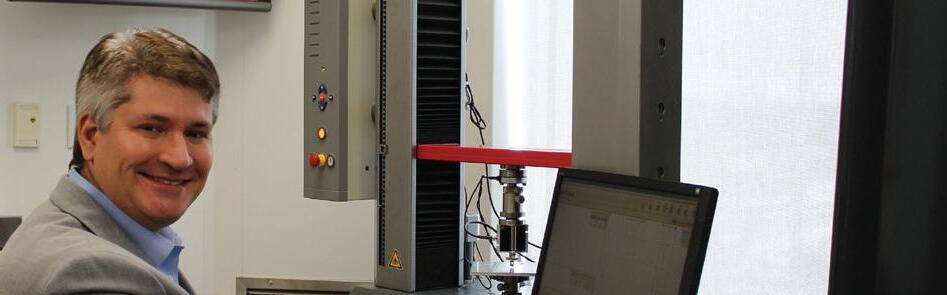
Purpose Through People
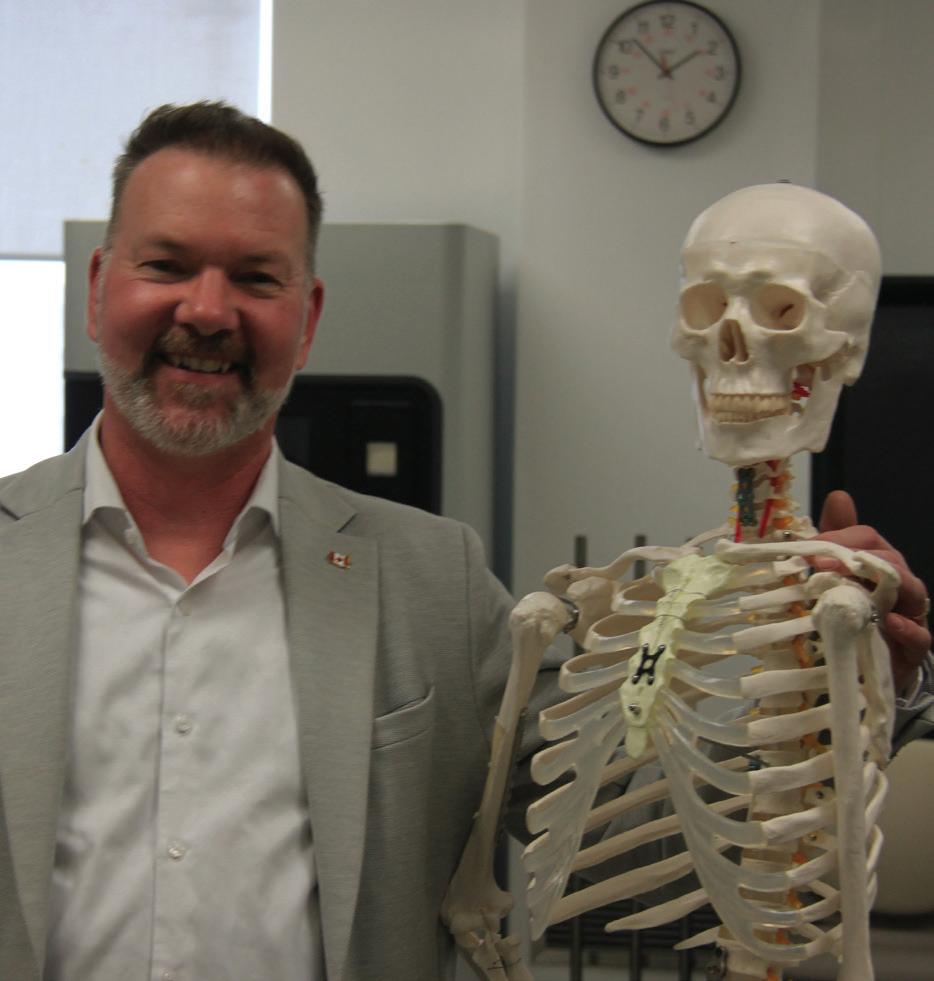
Ian Polyzois didn’t take a straight path into his career; he followed curiosity, innovation, and, above all, people.
Purpose Through People
Ian Polyzois didn’t take a straight path into his career; he followed curiosity, innovation, and, above all, people.
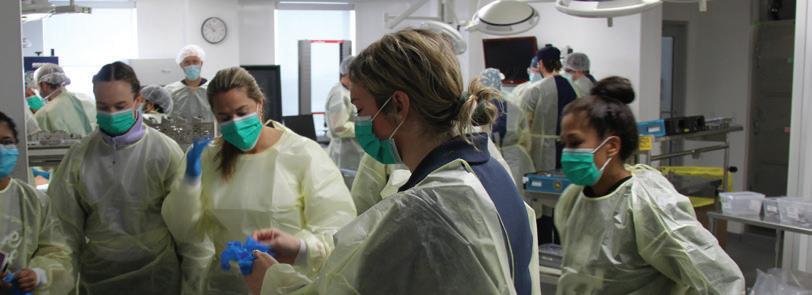
Why It Matters
Fueling research that turns bold ideas into better recoveries for hip and knee patients
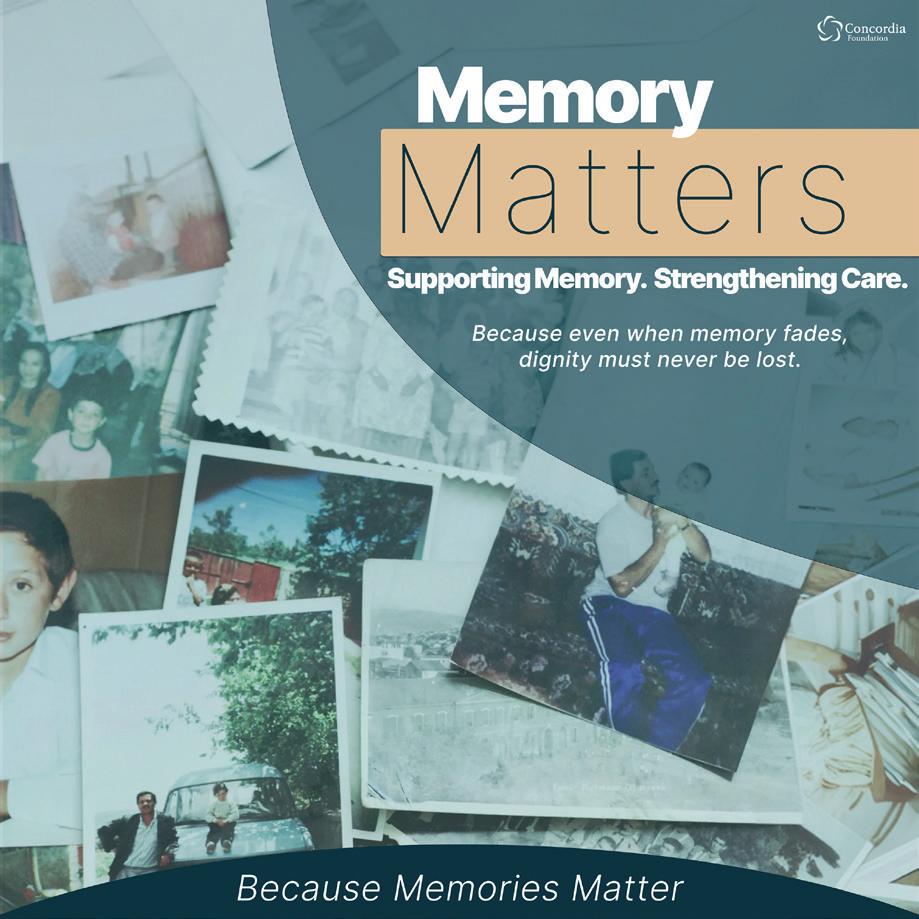
Because even when memory fades, dignity must never be lost. A Campaign for Dementia
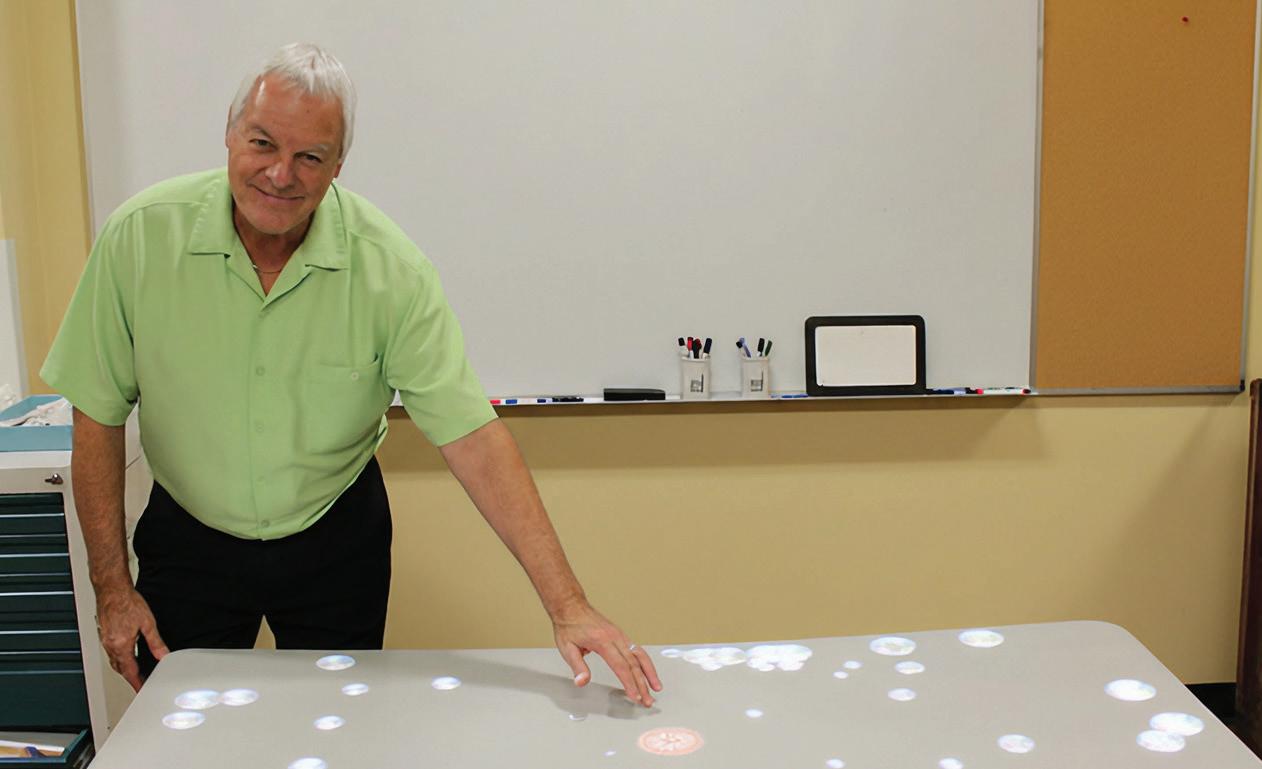
At Concordia, we see it every day. A patient who no longer recognizes their surroundings. A spouse trying to comfort someone who no longer remembers their name. A family overwhelmed—navigating fear, confusion, and loss.
Dementia does not just affect memory—it affects dignity, connection, and the ability to feel safe in the world.
A Growing Crisis in Manitoba
Dementia is no longer a future issue—it is here, now, in our community.
• Over 20,000 Manitobans are currently living with dementia
• That number is expected to double within a generation
Nine Manitobans are diagnosed every day
• Nearly half of Manitobans have been personally impacted by dementia
• The cost to our healthcare system is approaching $1 billion annually
(Source:AlzheimerSocietyofManitoba)
The need for specialized, compassionate care has never been greater.
The Challenge
Hospital environments can be overwhelming for patients living with dementia:
Bright lights, noise, and unfamiliar settings increase anxiety
• Communication barriers lead to frustration and distress
• Families often feel unsupported and unsure how to help
Without targeted tools and training, even the most dedicated care teams face real limitations. We can—and will—do better.
We are bringing world-class training from Teepa Snow to our community.
Who is Teepa Snow?
Teepa Snow is a globally recognized leader in dementia care education, with more than 40 years of clinical and teaching experience. As an American occupational therapist, she has trained thousands of healthcare providers and family caregivers around the world, transforming how dementia is understood and supported.
Educated at Duke University and the University of North Carolina, Teepa has worked across neuro-rehabilitation, geriatrics, long-term care, and academic medicine. Today, she is widely regarded as one of the most influential educators in dementia care internationally.
Her Approach
Positive Approach to Care® (PAC). Teepa founded Positive Approach to Care® in 2007— an internationally adopted training model that helps caregivers respond to dementia with skill and compassion.
Her approach focuses on: Recognizing remaining abilities rather than losses
• Adapting communication and environment
• Reducing distress and responsive behaviours
At its core is a powerful idea: what may appear as “challenging behaviour” is often a person communicating an unmet need.
The GEMS® Model
One of Teepa’s most widely used tools, the GEMS® Model, compares stages of dementia to gemstones—such as Sapphire, Diamond, Emerald, Amber, Ruby, and Pearl. This strengths-based framework helps caregivers: Understand changing brain function
• Adjust expectations
Provide appropriate, supportive care
Teepa Snow is known for her highly engaging and experiential training methods. She often demonstrates dementia-related behaviours herself, helping caregivers better understand what individuals are experiencing. Her teaching emphasizes:
Entering the person’s reality rather than correcting it
• Using effective non-verbal communication
• Reducing confrontation while building trust and connection







WEDNESDAY, AUGUST 12, 2026
Elmhurst Golf and Country Club
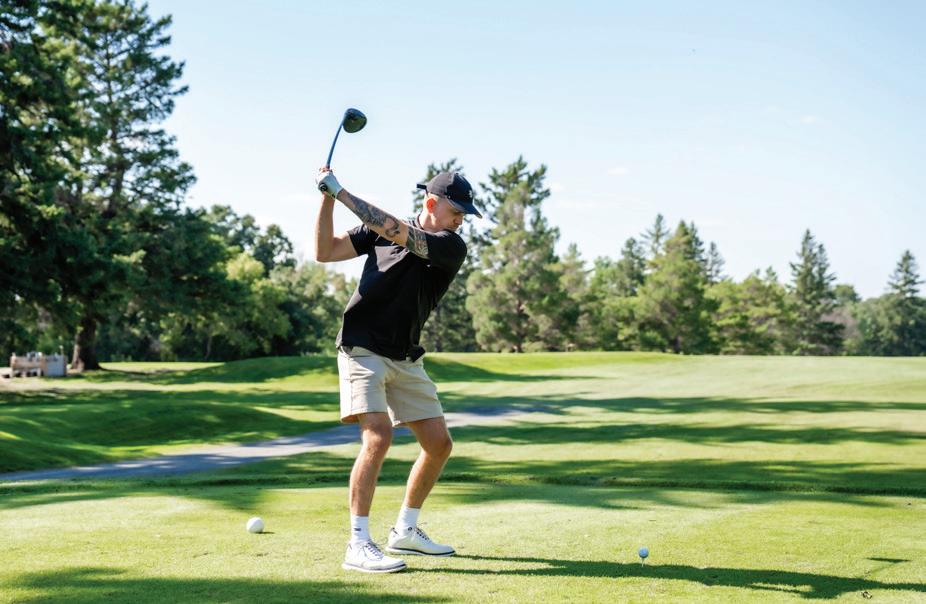
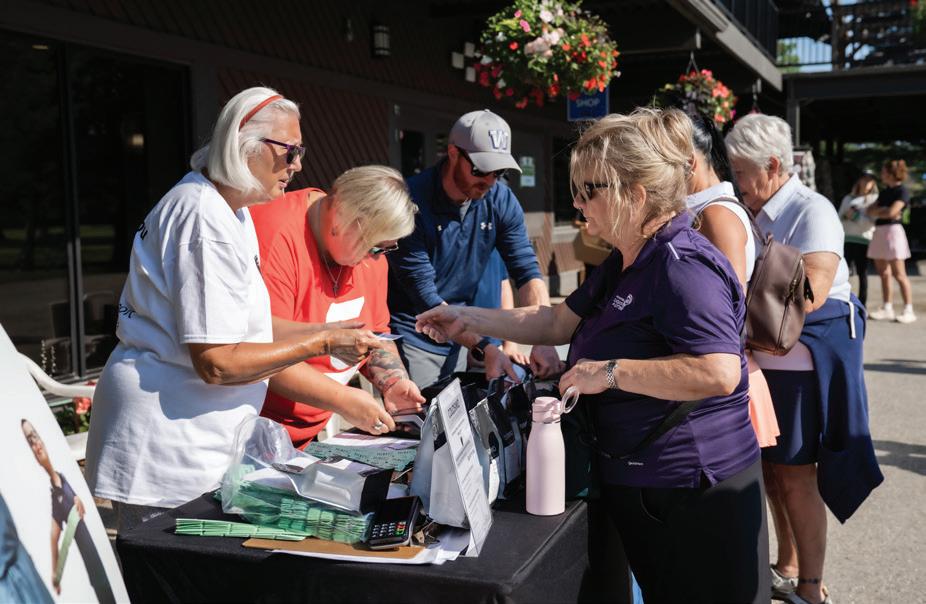
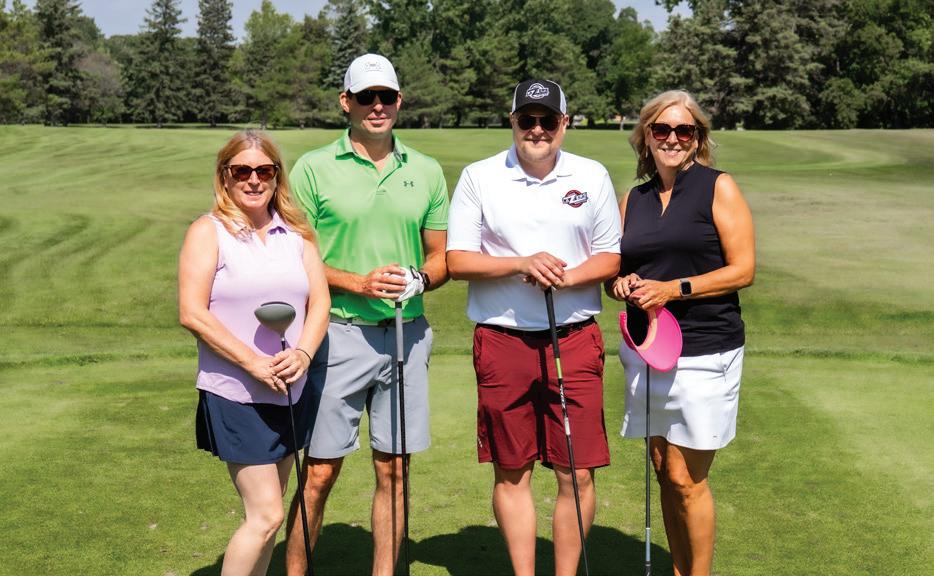
The Concordia Classic celebrates our 26th year of tournaments. Located at Elmhurst Golf and Country Club, we are thrilled to welcome another sold-out tournament of golfers and an incredible team of volunteers who make the day such a success.
Our tournament committee is made up of talented, highly motivated people who could deliver a masterclass in teamwork—the true key to our success. Thank you to everyone, as we look forward to seeing everyone on August 12!
The Concordia Classic Committee voted unanimously to adopt this worthy project for the tournament sponsorship this year. We all know someone who is affected by dementia, and we want to show our support for patients, caregivers, families and friends.
Because even when memory fades, dignity must never be lost. Dementia does not just affect memory—it affects dignity, connection, and the ability to feel safe in the world.
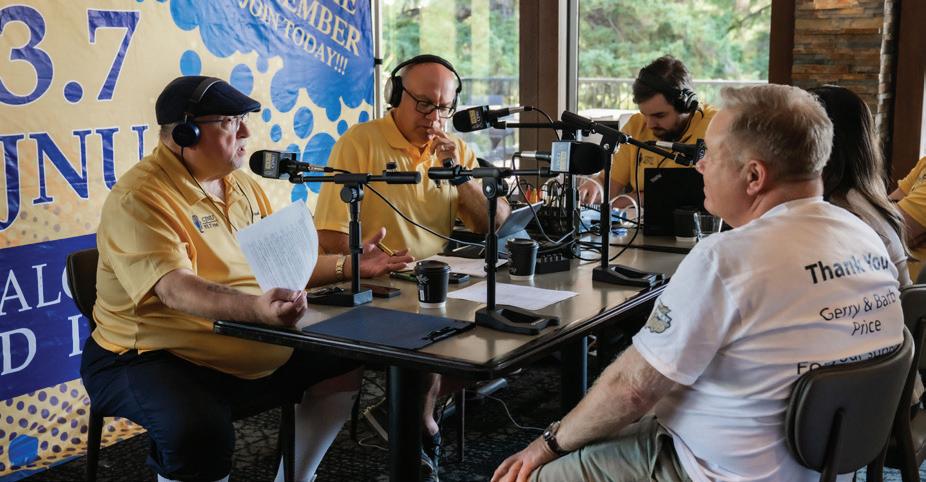
Join us on August 12, 2026, when CJNU will broadcast live from the Concordia Classic and we launch our podcast – “Memory Matters” with CJNU.

Summer 2026 | Vol. 4. No. 4
The Concordia Connection is a publication of The Concordia Foundation Inc.
Registered Charity # 13036-3336-RR0001
Who We Are
The Concordia Foundation Inc. is a registered charitable public foundation incorporated under the Corporations Act of Manitoba. Rooted in faithbased values and a vibrant Mennonite heritage, we serve as the philanthropic partner for the broader Concordia Campus community, which includes Concordia Hospital, Concordia Place personal care home, Concordia Village housing, Concordia Wellness Projects Inc., the Concordia Arthroplasty Research Chair, and the Concordia Child Care Centre. As part of our humanitarian efforts, we also support Operation Walk Manitoba.
1095 Concordia Avenue
Winnipeg, MB R2K 3S8
Phone: 204.813.4354
Website: www.Concordiafoundation.ca
E-mail: info@concordiafoundation.ca
Publisher: The Concordia Foundation
Editor-in-Chief: Sue Barkman
Design and Layout: Blue Ink Media
Ad Coordinator: Judy Mercer, Alex Peters
Digital Edition: concordiafoundation.ca
Advertising and Sponsorships
Contact the Concordia Foundation to inquire about sponsorships of our events and advertising in this publication.
E-mail: info@concordiafoundation.ca
Contributors
Sue Barkman, Kaleigh Ewonchuk, Alex Peters
Distribution
This publication is distributed throughout the Concordia Campus, including waiting areas, lobbies, the Concordia Café and our clinics. Thank you to our supporting businesses for having this available in their public areas. Special thanks to Laurie Finley and CanStar, The Winnipeg Free Press and Derksen Printers for the distribution to 18,000 households and to Print Pro for the donor mail drop. This publication is also available for download digitally at www. concordiafoundation.ca
Return undeliverable Canadian addresses to: The Concordia Foundation Inc.
1095 Concordia Avenue
Winnipeg, MB R2K 3S8
Reproduction in whole or in part is available with written permission from the publisher.
Copyright © The Concordia Foundation 2026
We are pleased to share the Spring / Summer 2026 edition of Concordia Connection — a collection of stories and highlights that reflect the compassion, innovation, and community spirit that continue to shape Concordia.
At Concordia, our story is rooted in community, compassion, and commitment. Every day, healthcare professionals, staff, volunteers, donors, and community partners work together to ensure that patients, residents, and families receive not only exceptional care, but also kindness, dignity, and hope. This publication is one way we share those stories with you — stories of lives touched, challenges overcome, and the meaningful impact of generosity.
Inside this edition, you will learn more about our special 2026 initiative, the Memory Matters campaign and podcast series, featuring our own Cecilia Nguyen, Clinical Performance Specialist, in collaboration with CJNU. Through heartfelt conversations and shared experiences, the series explores the realities of dementia care while celebrating the importance of memory, connection, and compassionate support.
At Concordia Hospital and Concordia Place, we see every day how dementia affects not only memory, but also dignity, relationships, and a person’s sense of safety and belonging.
We see families navigating uncertainty and loss. We see spouses offering comfort through difficult moments. And we see the extraordinary difference compassionate care can make.
Through the Memory Matters campaign, the Concordia Foundation is committed to enhancing dementia care and supporting the patients, residents, and families who live this journey every day.
This edition also features the inspiring stories of several residents from Concordia Village who generously shared memories and reflections from their remarkable lives. In our “Memories Matter” feature, you will meet residents whose experiences, wisdom, and stories remind us of the value of preserving and honouring every life story.
We have also been pleased to welcome community leaders and government partners for tours of our research and innovation facilities. MP Colin Reynolds and MLA Mike Moroz recently visited to learn more about the innovative work taking place within Concordia’s research community.
We extend special thanks to MP Colin Reynolds (Elmwood-Transcona) for his advocacy and support in securing nine positions through the Canada Summer Jobs program. We are thrilled to welcome a talented group of students this summer who are contributing their skills and enthusiasm across data analysis, laboratory research, childcare, and administration.
Each story in these pages reflects a simple but powerful truth: together, we are stronger.
As you will discover throughout this edition, the spirit of Concordia is present in both groundbreaking innovation and quiet moments of everyday kindness. From advances in healthcare and research to stories of compassion and resilience, our mission remains clear: to serve with caring, commitment, and community at the heart of all we do.
None of this would be possible without you — our donors, volunteers, partners, and friends. Your generosity supports progress, uplifts patients and families, and ensures care extends far beyond the walls of our hospital and care centres. Together, we are building brighter tomorrows and creating a lasting legacy of hope.
On behalf of all of us at the Concordia Foundation, thank you for taking the time to connect with us through this publication. As you turn these pages, we hope you will celebrate what has been achieved, feel inspired by the stories shared, and consider the role each of us can play in shaping what comes next.
Ifyouwouldliketostayconnectedbetween editions,weinviteyoutosubscribetoourmonthly digitalnewsletter.InkeepingwithCanadian digitalcommunicationregulations,subscriptionis required,andyoumayunsubscribeatanytime.
–
The Concordia Foundation Board of Directors
By Kaleigh Ewonchuck, Staff Writer
On May 5, 2026, a small group of us from Concordia walked into a workshop, not quite realizing how much it would shift the way we saw the people we cared for.
The session was led by Teepa Snow, whose more than 40 years of experience in occupational therapy and dementia care were evident not only in what she said, but in how she said it. Throughout the day, there was a quiet but powerful reminder of something simple, yet often forgotten: the person is still there.
“I am who I was before, just different.”
Dementia is often described in clinical terms — symptoms, stages, decline. But what we were reminded of that day is that behind all of those words is a person navigating a world that no longer feels familiar. Memories may slip away, familiar faces may begin to blur, and even one’s sense of self
can feel uncertain. That reality can be frightening, not only for those experiencing it, but also for the people who love and care for them.
And yet, even in that uncertainty, there is still presence. Still emotion. Still need.
We learned that care is not simply about completing tasks or managing routines. It is about offering dignity in moments when someone feels most vulnerable. It is about connection — meeting people where they are, rather than trying to bring them back to where we think they should be. It is patience in the face of resistance, and understanding that behaviours often express what words no longer can.
As we listened, learned, and practiced together, there was a quiet shift in perspective. Instead of
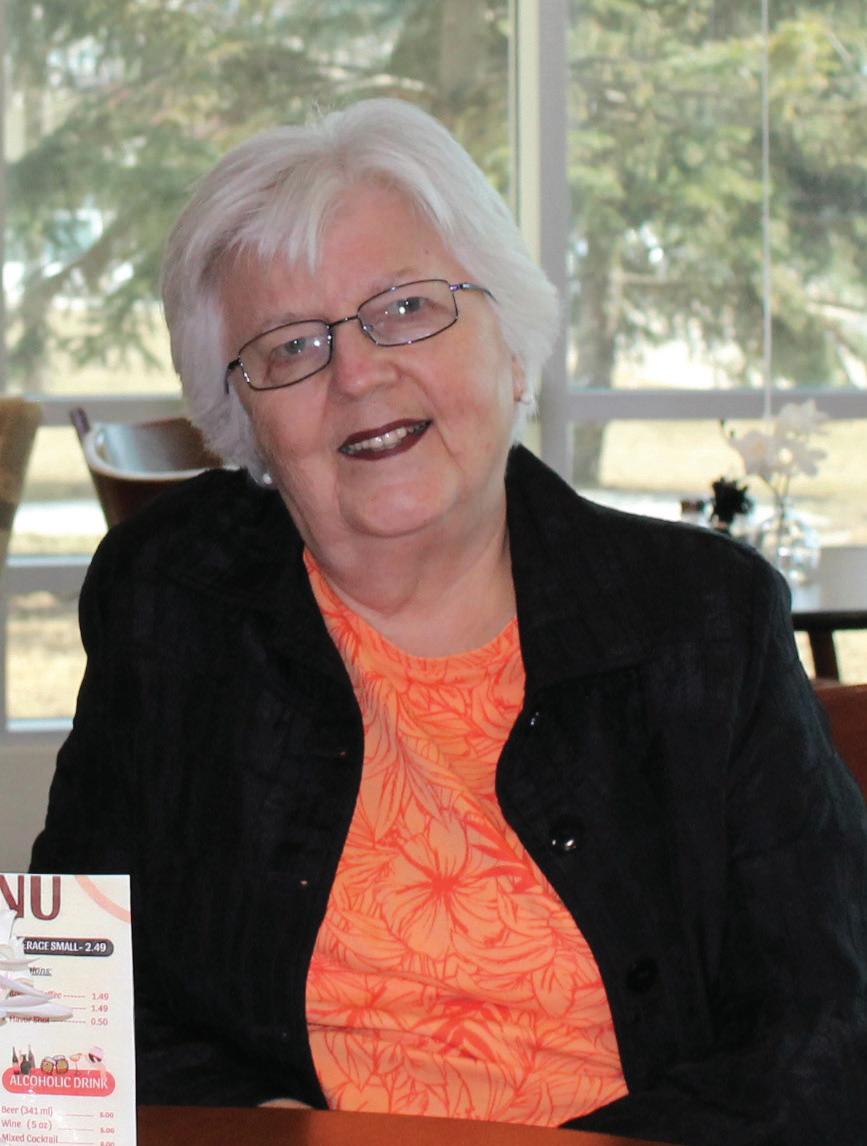
Pat arrived at Concordia Village in July, carrying with her not just a suitcase, but a lifetime of memories. The transition felt natural, almost as though it was meant to be. Both her aunt and uncle had once lived in the very same suite, and the moment she stepped inside, she felt an immediate sense of belonging. It was as if the walls already knew her story.
“The walls already knew her story.”
Long before Concordia Village, Pat’s life began on a farm just outside Winnipeg, where she grew up alongside her two brothers. Her childhood was filled with open skies, endless fields, and long prairie winters. She smiled as she recalled climbing to the top of the barn shed with her brothers and sledding down with fearless joy.
One memory still stands out vividly: the great winter storm of March 4, 1966. Snow piled nearly six feet high, almost swallowing the barn. There were no snowblowers or modern conveniences — just shovels, determination, and a strong sense of togetherness.
“It was very different back then,” she said.
When asked what has changed most over the years, Pat didn’t hesitate.
“Everything. It’s completely different.”
The wide-open fields she once knew have since been replaced by shopping malls and apartment buildings. The quiet countryside has become
busier and louder, but in her heart, those peaceful landscapes remain untouched.
One of Pat’s greatest passions began at the age of 18, when she started working at a local bakery. It was there that the owner shared a treasured fruitcake recipe with her — a small gesture that sparked something much bigger. Baking quickly became more than just a skill; it became her calling.
Before long, Pat opened a bakery of her own, pouring love into every loaf, wedding cake, and pastry she created. Today, she continues to share that passion with her children and grandchildren, passing down recipes filled with both flavour and cherished memories.
“Warm kitchens, snowy memories, and a lifetime of kindness.”
Now, Pat is a treasured member of the Concordia Village community. She fills her days with simple joys: gardening, crafting, and creating thoughtful handmade touches like doorknob fobs that brighten the lives of those around her. Her hands are always busy, making something meaningful and full of care.
She often reflects on how quickly Concordia Village felt like home, thanks to the kindness of the staff and the warmth of neighbours who soon became like family.
Her secret to happiness is beautifully simple:
“Day by day. That’s how you do it.”
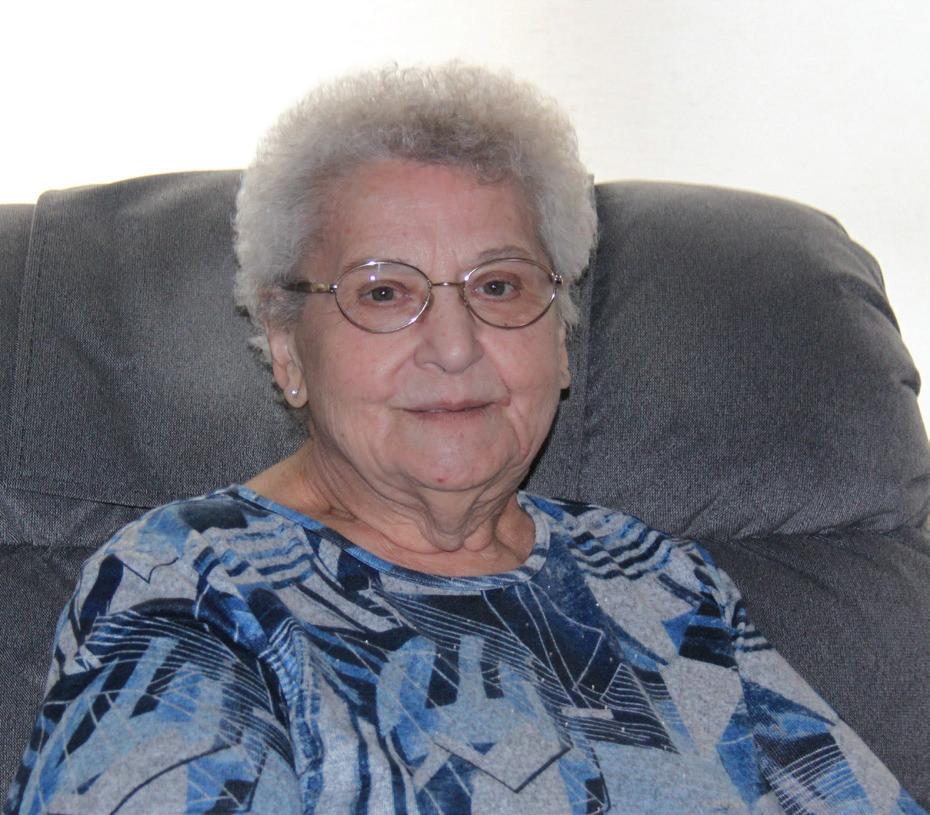
Sally, 79, was born in Gilbert Plains and raised on a farm near Ethelbert, a small, closeknit community where life was simple and neighbours felt like family. Her early years were shaped by hard work, open fields, and a strong sense of connection — values that have stayed with her throughout her life.
In 1960, Sally moved to Winnipeg, stepping into a new chapter filled with both uncertainty and opportunity. Years later, in 1973, while working in an office, she happened to run into a friend who mentioned an opening in nursing. That chance encounter changed everything.
Sally decided to take the leap.
She began her nursing career at St. John’s Hospital and later worked at St. Boniface Hospital, where she dedicated more than 25 years to caring for others. Working in gynecological surgery, Sally became known for her compassion and unwavering commitment to her patients. Nursing wasn’t simply a career — it was a calling. She gave her time, energy, and heart to every person she cared for.
Sally has always been someone who believes in showing up, staying busy, and doing her best, no matter the circumstances.
When asked what advice she would give others, she didn’t hesitate.
“There’s no guarantee in life.”
It is a simple truth, but one Sally has embraced fully — choosing to face uncertainty with openness
rather than fear.
“Sometimes, the unexpected turns lead exactly where you’re meant to be.”
In 2021, Sally faced another unexpected change when renovations to her apartment prompted a move to Concordia Village. While transitions can feel daunting, she approached this chapter with courage and optimism.
“The unknown is always scary. Don’t be scared of new challenges.”
From the moment she toured her suite, something felt right.
“The first time I toured my suite, I knew it was the one.”
Today, Sally is an active and valued member of the Concordia Village community. As a member of resident council, she helps shape the community around her, and she also spends time volunteering in the Village store — always ready with a smile and a kind word.
For Sally, connection is one of life’s greatest gifts.
“The secret is to keep moving and stay connected with people.”
It is a philosophy that continues to keep her vibrant and engaged. Whether lending a hand, sharing a conversation, or simply showing up for others, Sally continues to build meaningful relationships and foster a sense of belonging.
She speaks about life with gratitude — grateful for her health, her experiences, and the many people
And when life becomes difficult?
“Deal with it the day it happens if something upsets you. Don’t carry it.”
There is a quiet wisdom in the way Pat lives— a reminder that happiness is rarely found in grand moments, but rather in the small, steady ones: in kindness, resilience, warm kitchens, and snowy memories.
Spending time with Pat, it’s impossible not to feel inspired. Her life is a beautiful testament to finding joy in every season and making wherever you are feel like home.
she has met along the way. She embraces each day fully, finding joy in both life’s big milestones and its quieter moments.
Looking back, Sally has no hesitation in recommending Concordia Village to others.
“The sooner, the better,” she said with a smile, reflecting on how quickly it felt like home.
Sally’s story is one of resilience, compassion, and openness to life’s unexpected turns.
It is a gentle reminder that while life rarely follows a straight path, sometimes the unexpected leads us exactly where we are meant to be.
By Kaleigh Ewonchuk, Staff writer
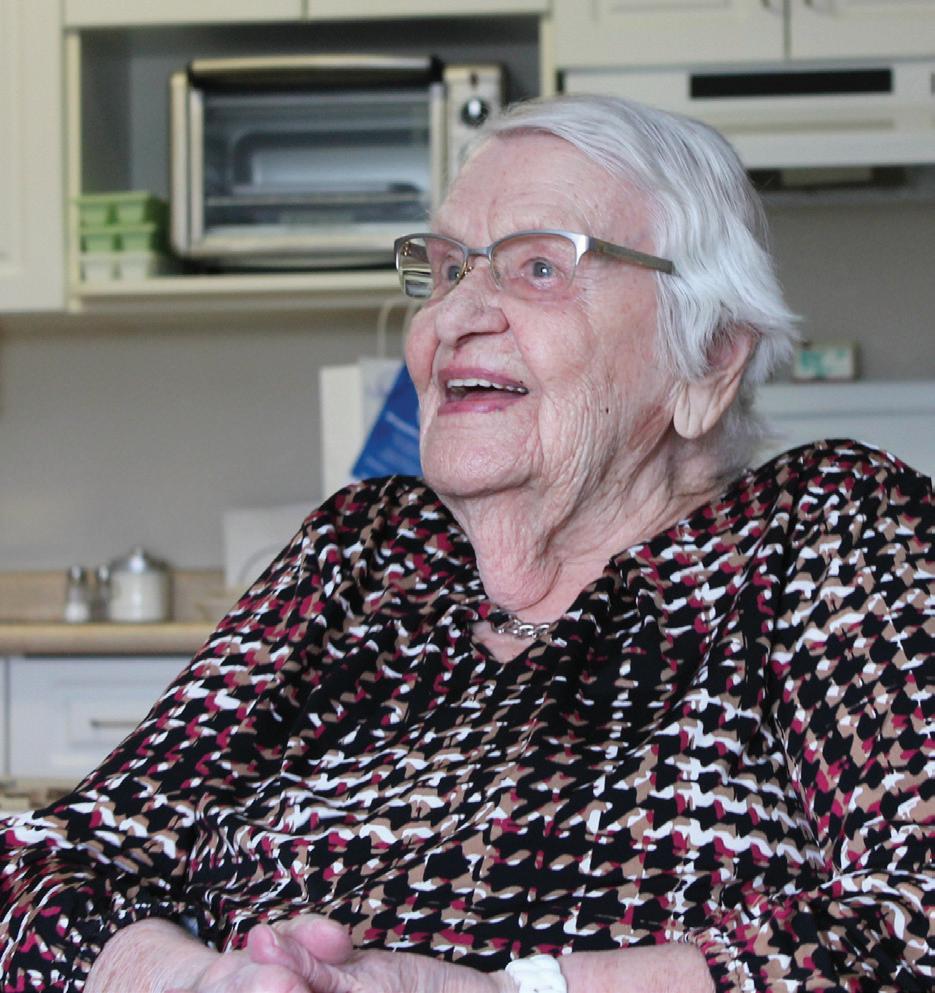
Irecently had the pleasure of sitting down with Blanche, one of the oldest residents at Concordia Village — and certainly one of the most remarkable. At 106 years old, Blanche carries with her more than a century of memories, experiences, heartbreaks, and joys. Yet the first thing you notice about her is not her age. It’s her spirit.
These days, you’ll often find Blanche gathered with friends, working on puzzles, sharing stories, or cheering enthusiastically for the Winnipeg Jets. She especially enjoys watching Kyle Connor play and rarely misses a game. Staying connected, engaged, and interested in life is simply part of who she is.
Blanche’s story began on a small farm in Holland, Manitoba, where she grew up skating, playing hockey, and tobogganing through long prairie winters. Life was modest, but full of family, hard work, and resilience — values that would carry her through every chapter of her life.
Her journey has not been without sorrow. Blanche was married only two years when tragedy struck. Her husband had taken a job working in the gold mines during a booming period in Manitoba, but a devastating accident claimed his life, leaving Blanche widowed with a newborn daughter to care for. It was the kind of heartbreak that could easily have changed the course of a person’s life.
But Blanche chose strength.
With quiet determination, she carried on, raising her children and refusing to let hardship take away her hope. She faced each challenge head-on, always moving forward, one day at a time.
That same determination shaped her working life. Blanche began her career at Western Glove as a presser before advancing to the sewing machines and later cuffing pants. Through hard work, perseverance, and leadership, she earned the respect of those around her. She became active in the union, was elected to leadership, and eventually served as Union President — a role that took her
across Canada and opened doors to experiences she never imagined possible.
And through it all, her greatest focus remained her family.
Blanche spoke honestly about the sacrifices she made as a mother. There were times she went without food so her children would have enough to eat. She never dwelled on those hardships, sharing them simply as part of life — another example of the quiet strength that has defined her journey.
Later in life, after remarrying, another unexpected opportunity came along. Blanche was asked to help at the Sutherland Hotel restaurant, and before long, she was managing it. She poured herself into the work, but always stayed true to herself.
“I told them, the day I turn 65, I’m retiring,” she said with a smile.
And true to her word, the day before her 65th birthday, she reminded them she was leaving and stepped away after years of dedicated work.
Retirement opened the door to new adventures. Blanche and her husband, William, travelled across Canada together — from Vancouver to Prince Edward Island — embracing every opportunity to explore. At one point, they even moved to Vancouver, hoping to start a new chapter there.
But Manitoba was home.
“It was 10 o’clock at night,” Blanche recalled with a laugh. “We looked at each other and said, ‘Let’s go home.’”
Within days, they had packed up and returned.
When William later passed away, Blanche once again faced profound loss. But as she had done throughout her life, she chose not to let grief define her. Instead, she continued living fully — travelling, taking road trips to Gimli, and embracing every season of life with independence and optimism. Well into her 90s, Blanche was still driving, cooking for herself, and staying active socially. Eventually, she made the move to Concordia Village, where she continues to brighten the lives of those around her.
Today, Blanche still treasures her independence. She enjoys cooking when she feels like it, spending time with friends, and hosting regular “girls’ nights.” She is always ready for a conversation, always quick with a smile, and always has a story to share. More than anything, Blanche is a reminder of the strength of the human spirit. Her life has been marked by both deep loss and deep joy, yet she continues to choose positivity, gratitude, and connection.
At106yearsold,Blanchecontinuestoshow everyonearoundherwhatittrulymeanstolivelife fully—withcourage,resilience,humour,andheart.
“Herstoryisareminderthatresilienceisn’tabout avoidinghardship—it’sabouthowyouriseafterit.”
“At106yearsold,Blanchestillchoosesjoy, connection,andhope.”









By Kaleigh Ewonchuk, Concordia Foundation Staff
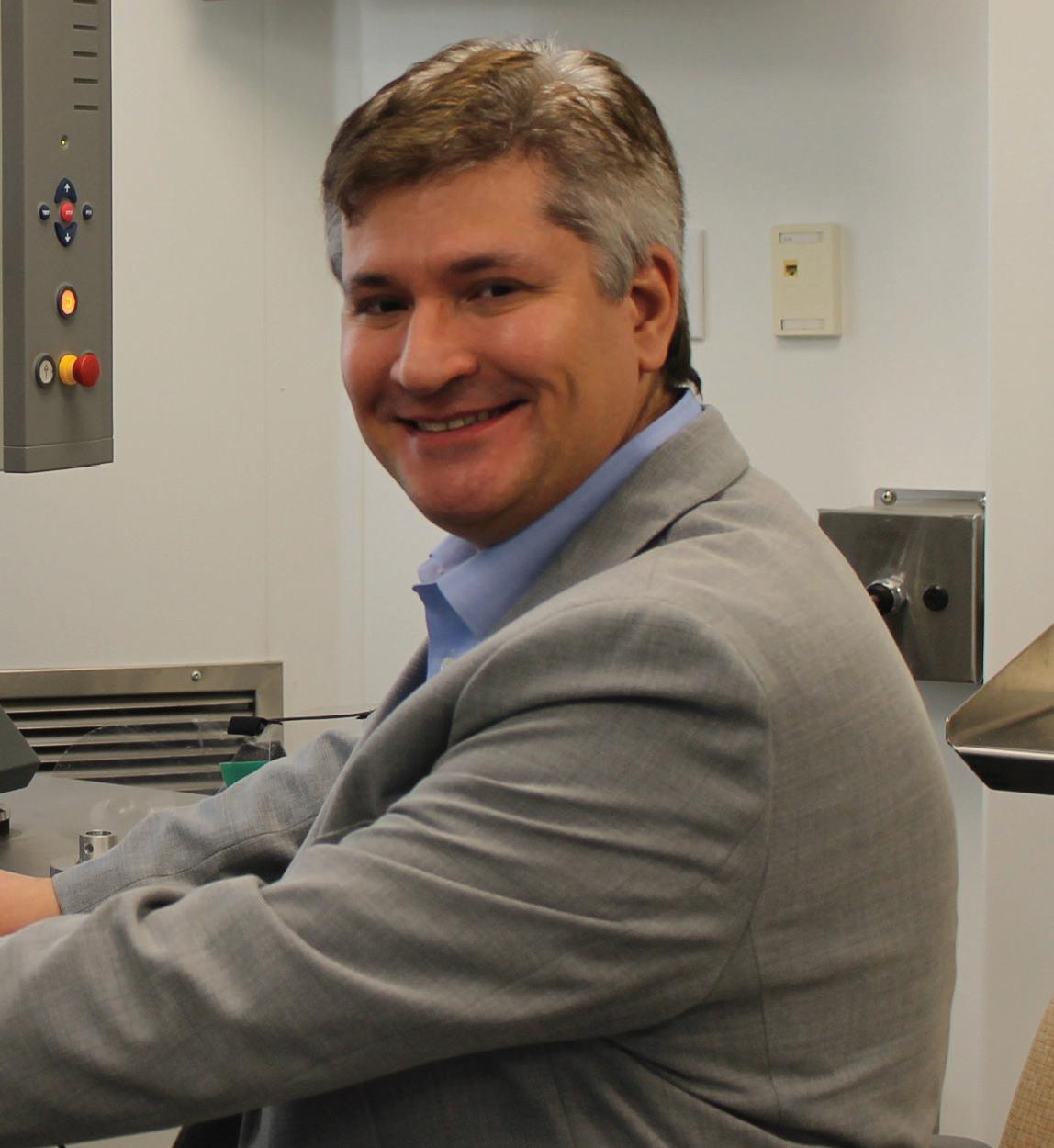
Ian Polyzois didn’t take a straight path into his career—he followed curiosity, innovation, and, above all, people.
As a child, Ian dreamed of becoming a fighter jet pilot. The idea took hold at a career fair, where posters and recruiters opened his eyes to a world of cutting-edge technology and possibility. It was a dream rooted in excitement, but also in a fascination with how things work.
Over time, that path evolved. Ian adjusted course, choosing to pursue mechanical engineering as a way to stay connected to innovation while building something more tangible.
At the University of Manitoba, he developed a strong academic foundation, guided not only by his studies but by his family. His father, a civil engineer, and his mother, a child psychologist, instilled in him a deep respect for both hard work and understanding people—values that would quietly shape his career.
After graduating, Ian’s work took him far from home, from Quebec City to Texas. He contributed to advanced engineering projects, including aircraft systems and national defense. The work was fastpaced and technically challenging—but over time, something felt missing.
Despite the complexity and scale of the projects, Ian began to feel disconnected from the people his work was meant to serve.
That realization became a turning point.
As he reconsidered his goals, Ian knew he wanted to make a more direct impact. He shifted into biomedical engineering—a decision that would ultimately define his future.
“I guess I followed where the science was, where the innovation was,” Ian reflects. “And I knew material science could branch beyond mechanical. And it did.”
With that shift came a return to Manitoba, bringing his journey full circle. What began as a fascination with flight had evolved into a deeper purpose: improving lives through engineering.
“I thought to myself, the best way to learn is to move laterally—take what you know and find an adjacent area of study that can build on it.”
By Eleoussa Polyzoi
August 15, 2009
My father began to sing last night.
A frail voice, at first, with poise and humor
Light and lyrical
Notes savored in silence and dignity
Reminiscent of his youth
A celebration at 93
A smile, a mischievous glint
I haven’t seen in a very long while Broke through for a moment.
The anger and frustration
Unapologetic suitors
Overstaying their welcome
In these hallowed grounds of my childhood home
The many weeks before.
It was glorious!
The day belonged to him.
Youthful sensibilities filled the room
Lifted souls and
Lightened hearts and minds
Like the ebb and flow of life
Transporting him and his listeners to a simpler time and place.
A gift for me—an island of grace
For which I am grateful
In December 2019, Ian joined the Orthopaedic Innovation Centre (OIC) as an engineer specializing in computer simulation. Supported by federal NGen funding, his role quickly expanded beyond technical work. He became involved in financial planning, project management, and client relationships—but what mattered most was finding a team that felt like family.
“I remember Trevor interviewing me,” Ian says. “It felt personal. I really appreciated that.”
At OIC, Ian’s work took on new meaning. He specializes in simulating medical implants—knees, hips, spines, and custom pediatric plates—testing designs virtually before they are ever built.
Using computational modelling, Ian can simulate how bones, joints, and implants behave under real-world conditions. It’s a powerful tool that is transforming how implants are developed— making them more precise, more personalized, and ultimately more successful.
But for Ian, the work goes beyond technology. Through detailed analysis and simulation, he identifies potential issues before they happen, helping to save time, reduce costs, and improve outcomes. It’s a process grounded in both science and responsibility.
He often describes his role as “creating peace of mind.”
Surgeons, clients, and ultimately patients rely on his work to ensure that what is designed will perform safely and effectively. Whether studying meniscus repair or evaluating implant performance, Ian’s simulations help guide real-world decisions— decisions that directly affect people’s lives.
And sometimes, those lives come into clearer focus.
Ian recalls hearing about a young patient who received a custom implant designed with the help of advanced simulation. The child had been living with significant pain, struggling with simple movements that most people take for granted. Running, playing, even walking comfortably had become daily challenges.
After surgery, everything changed.
With a properly fitted implant tailored to their anatomy, the child was able to move freely again—

Also the soup that I contributed to the competition was an Indonesian beef soup called “Soto Betawi” with some ingredient substitutions based on availability. My wife is Indonesian and she recommended it to me. It was a fun experience to try something different.
Ingredients (serves 4):
Beef (brisket, chuck, or sirloin), thinly sliced: 700g
• Water: 1.5L
• Coconut milk, full-fat: 400ml
• Garlic cloves, minced: 5
• Medium onion, finely chopped: 1
• Shallots, finely sliced: 6
• Fresh ginger, peeled and sliced: 25g
• Fresh galangal, peeled and bruised: 20g
• Lemongrass stalks, bruised: 2
Kaffir lime leaves: 4
• Bay leaves: 3
returning to school, to play, and to being a kid. For the clinical team, it was a success. For the family, it was life-changing.
For Ian, it was a powerful reminder of why his work matters.
While he may never meet every patient, he knows that behind every model is a person—a story, a family, a future.
Over time, Ian came to understand something even more important.
Beyond the data, beyond the models, people are looking for reassurance.
“It’s not just about engineering—it’s about trust. It’s about helping people feel safe, informed, and supported during some of their most vulnerable moments.”
For Ian, that purpose is clear: to help people feel confident in the care they receive.
And that’s what continues to drive him.
Because beyond the technology, beyond the innovation, it’s the human impact that matters most. Whether it means helping someone walk without pain or return to a sport they love, the goal remains grounded in everyday life.
At the end of the day, it’s not about the model. It’s about the person it helps.
The OIC is a partner of the Concordia Arthroplasty Research Chair, that is sponsored by the Concordia Foundation. We are proud of the exceptional work of the OIC team.
Cloves: 3
• Cinnamon stick: 1
Nutmeg, grated: 1/4 tsp
• Salt: 1.5 tsp
Sugar: 1 tsp
• Cooking oil: 3 tbsp
Medium tomatoes, diced: 2
• Spring onions, thinly sliced: 3
Fried shallots: 3 tbsp
• Limes, cut into wedges: 2
Sambal (chili paste): to serve
Steps:
1. Heat oil in a large pot over medium heat. Add thin sliced beef with some shredded garlic, ginger, galangal, and onion. Saute together until the beef is browned on all sides.
2. Pour coconut milk into the same pot and bring to a boil. Add an aromatics spice bag containing lemongrass, kaffir lime leaves, bay leaves, cloves, cinnamon, nutmeg, and shallots. Add salt and sugar. Reduce to a low simmer for 20 minutes. Do not boil vigorously or the coconut milk may split.
3. Remove and discard the spice bag. Taste and adjust seasoning.
4. Serve over rice or enjoy as a soup, garnished with tomato, spring onion, and fried hallots. Offer lime wedges and sambal on the side.
Ianisascientistaswellasaculinaryexpertwho hasbroughtaspecialsouprecipetotheOIClab. Thiswinter,theresearchteamtookturnsbringing inhotandnourishingsouptowork. ThiswasIan’s specialcontribution.
The Concordia Foundation is proud to partner with CJNU 93.7 FM on Memory Matters, a podcast and radio series dedicated to raising awareness, sharing knowledge, and fostering meaningful conversations about dementia, memory loss, and compassionate care.
Through this unique collaboration, Memory Matters brings together healthcare professionals, researchers, caregivers, community leaders, and individuals with lived experience to explore the many dimensions of dementia care. Each episode provides practical information, personal stories, and expert insights designed to help families navigate the challenges of cognitive decline while promoting dignity, understanding, and hope.
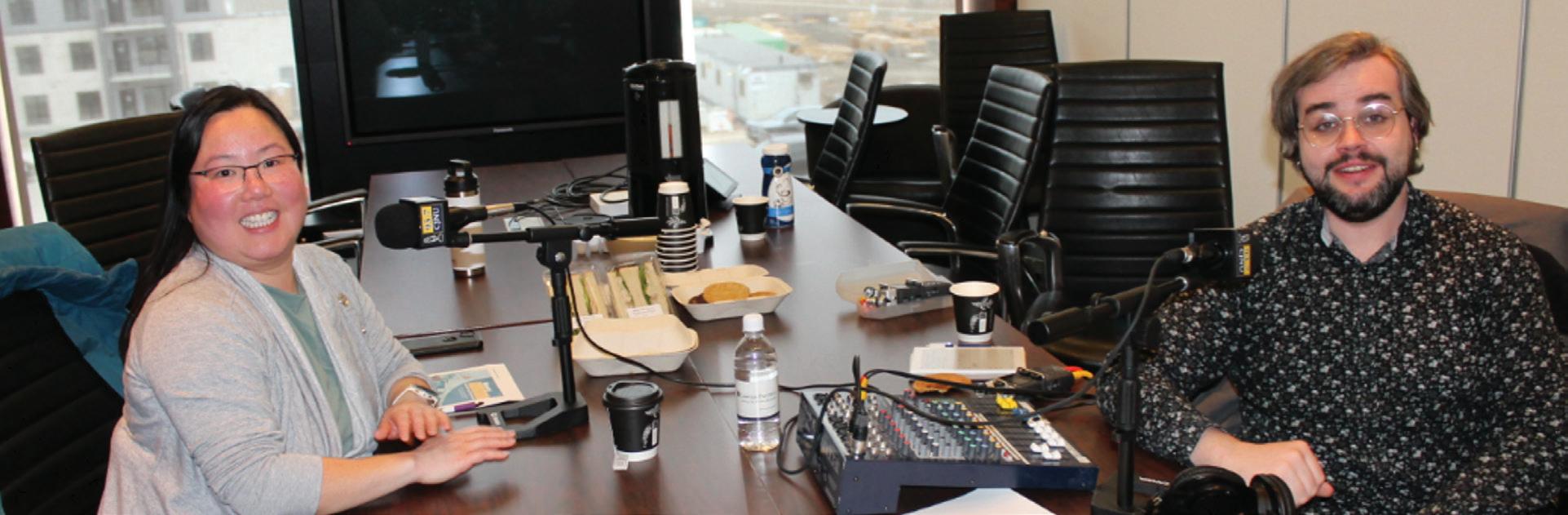
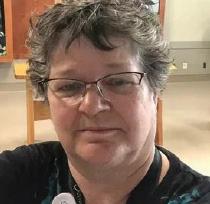
Pictured here are your hosts, Cecilia and Adam during a recording session of Memory Matters. Together, they help create thoughtful and engaging conversations that shine a light on the realities of dementia and the importance of supporting patients, caregivers, and families throughout their journey. The podcast reflects a shared commitment between CJNU and the Concordia Foundation to ensure that reliable information, compassionate resources, and inspiring stories are accessible to everyone in our community.
As the need for dementia care continues to grow, partnerships like this play an important role in connecting people with knowledge and support. Through Memory Matters, we are helping to reduce stigma, encourage early conversations about brain health, and highlight the innovative research, clinical care, and community programs that are improving quality of life for those affected by dementia.
We are grateful to CJNU for helping amplify these important discussions and for their ongoing commitment to community engagement. Together, we are building awareness, fostering understanding, and
“The instinct to care for others doesn’t end with a career…”
Jackie Chudley never imagined that a volleyball injury in her early twenties would one day lead to both a knee replacement and a hip replacement.
She began her medical career in Thunder Bay, Ontario, building a meaningful path in nursing. Over the years, she worked across orthopaedic care, emergency medicine, cardiac care, and more. Her career took her far from home—from Arizona to South Carolina and back to Canada again. But no matter where she went, Jackie stayed grounded in who she was and the kind of care she believed in.
From Nursing Informatics to hands-on registered nursing, Jackie devoted her life to caring for others with steady compassion. But her journey brings forward an important question: who cares for those who spend their lives caring for everyone else?
Eventually, Jackie reached a turning point. After years of living with chronic hip and knee pain, she spoke with her family physician and decided enough was enough.
Her surgery was scheduled for May 2025 after a 17-month wait. But the road leading up to it was not easy. Complications, including an infection and atrial fibrillation, caused delays, leaving her to
wrestle with uncertainty and countless “what ifs.”
When the day finally came, Jackie entered the operating room with a lifetime of medical knowledge behind her. As a nurse, she thought she understood what to expect. But experiencing care as a patient revealed something much deeper.
She came to truly appreciate the importance of support, understanding, and human connection—not just from family and friends, but from surgeons, physicians, nurses, and even fellow patients.
“You want to feel heard,” Jackie reflected. “You want to know someone else understands what you’re going through.”
Before surgery, her fears were filled with unknowns. Afterward, the questions became immediate and deeply personal: How do I get up? How do I use the washroom? These simple yet essential concerns are the realities of recovery. And sometimes, the hardest part is not even knowing what to ask—or who to ask.
Jackie’s experience highlights something vital: medical care is not only about procedures and outcomes. It’s about support. It’s about reassurance. It’s about answering questions—for others and for
ensuring that individuals living with dementia—and those who care for them—know they are not alone. The podcast series will launch on August 12, 2026. Listen, learn, and join the conversation as we work together to advance dementia awareness, support caregivers, and promote compassionate care for all. CJNU 93.7, where Music and Memories Matter.
CeciliaNguyen,BNRN MSN(C)MSc,Clinical PerformanceSpecialist,ConcordiaHospital; AdamGlynn,StationManagerandon-airhostat CJNU 93.7 FM
ourselves. Above all, it’s about empathy, presence, and standing beside someone through uncertainty. Where do you go when you feel scared after surgery? Who can you talk to? These are questions many patients face. While there may not be a single answer, one truth remains: you are not alone.
Whether it’s sharing advice with someone preparing for surgery or simply holding the door open for another person, small acts of care matter. Even in retirement, Jackie continues to support those around her—proving that the instinct to care for others doesn’t end with a career.
The Concordia Foundation, Orthopaedic Innovation Centre, and the Arthroplasty Research Chair have brought together a group of orthopaedic patients who have undergone hip and knee procedures to share their stories and support others on a similar journey.
Their lived experiences are helping to shape how we communicate, connect, and care—ensuring that patients feel informed, supported, and never alone. Through their insight and generosity, this group is strengthening our work and deepening our partnership with the community we serve. Jackie is an integral part of this group.

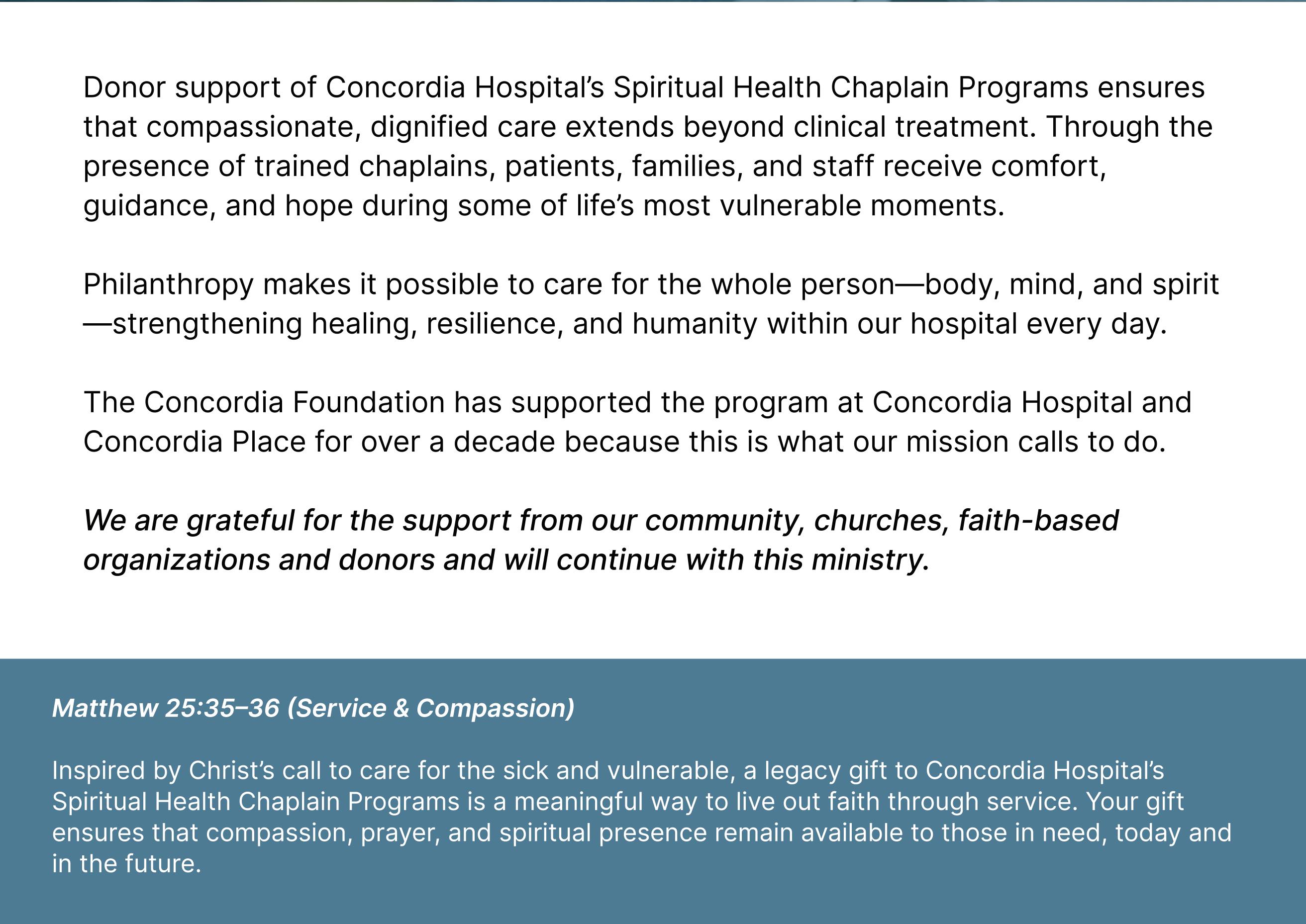
Ihave come to learn that supporting the human spirit has lasting effects. In a recent encounter with a long-time church couple, Henry and Carol – I rediscovered just how important supporting the human spirit is, and that our role as Spiritual Health Practitioners (SHP) makes a meaningful impact with those we serve – sometimes even without us knowing.
During my conversation with this couple, I shared my profession and place of work (Concordia PlaceCP). Hearing this, Carol brightened up and shared that her mother had lived at CP many years ago before her passing. She remembered that it had been a good home for her during her later years. As she reminisced, tears welled up as she told me of when her mother had to be admitted to hospital due to health complications.
She recounted that the medical team had suggested her mother undergo surgery, a recommendation she struggled with, knowing that it was not something her mother would want at this stage of her life. She spoke of how grateful she was for the occasions when the SHP, provided a compassionate presence and listened empathetically during that time of crisis. Carol’s expressions of gratitude and tears, multiplied as she continued to think of her mother and as she recalled how the SHP advocated on behalf of her mother and family. In the end her mom’s wish was honored. This SHP had provided to her family, support that stood the test of time.
They continued to share their admiration for my profession and how much they value the work of all spiritual health practitioners. As the passion of how much the support had meant to her and her family was uttered with every word that she spoke, she closed our conversation by describing our role as ‘godsend’.’
For Henry and Carol, this experience took place 10-15 years ago. Yet, in that moment, the SHP whose heart had held their story, was all that mattered. They shared a blessing with me and encouraged me to continue the important and valuable work of providing spiritual support— something that they will never forget.
Sometimes we don’t get to be there. Births, deaths, graduations and championship games are all life events that I’ve missed. We can’t get to everything. And life sometimes has a way of preventing us being with loved ones when they need us the most. Life moves on.
And trauma and tragedy, events families experience in hospital can prevent us from moving on.
During the COVID-19 period, I met an elderly Asian woman in the hospital. Her neck and several parts of her spine were broken, and her body was held together with wires and machines. She couldn’t move her head or feed herself—someone had to place food in her mouth.
She told me she had applied for MAID (Medical Assistance in Dying). She had never married, had no family in Canada, and her only relative—an older sister—was overseas. With her body broken and no one to care for her except one church friend, she said she didn’t want to be a burden anymore and just wanted to go peacefully. She asked me to call her faith leader to share her decision.
When I made the call through the iPad, she tearfully told him about her MAID application. I could hear the faith leader’s reply and he strongly disapproved. She cried harder and asked me to end the call. Then she held my hand and said softly, “When I go through MAID, will you be there with me?”
Her question stunned me. I asked myself, Can I be there for something I don’t agree with? What would Jesus do for someone whose body and soul are this broken? Within seconds, I answered, “Yes, Grandma. I’ll be there with you. I’ll hold your hand and sing so you won’t be alone.” She smiled through her tears.
Through this experience, I came to a deeper reflection on the meaning and importance of spiritual health. Later, her MAID request was not approved, and her condition improved to the point that she was discharged. Watching her leave the hospital, I was profoundly grateful. I realized how deeply the work that we do in spiritual health can touch and comfort the souls of those who stand in the darkest and most painful moments of life—even at the edge of death.

Not knowing what to expect, I greeted Gloria and Connie at the front door. After a short visit, I walked them through the likely path Raymond would have experienced after arriving at the hospital. We visited the Urgent Care waiting room where he would have begun receiving treatment – the place where Gloria last held his hand.
Korey Dyck Spritual Health Practitioner
We can get stuck, fixating on a time and place we couldn’t attend. We can be left wondering, “what was it like, who was there, what are the sounds and smells like of a place I can’t imagine”? One patient family at Concordia decided to fill in the gaps to their family story in order to move on.
The family was not allowed to visit during the hospitalization and death of their husband and father during the first few months of the Covid-19 pandemic. The Nelson family (not their real name) wanted to see for themselves where their loved one spent the last days of his life, away from the family and community he knew best.
One day in February, the Nelson family contacted the Spiritual Health office wondering if they could have a tour of the hospital. They explained their story and their need for the visit in order to heal from a loss they were still grieving. We planned the visit for April when ‘Raymond’s’ wife and daughter would be in the city from their home in Northern Manitoba.
We then walked the back hallway to N1North, where Raymond was moved to once he was stable. We walked past his room, and then sat in the back lounge and talked. As we sat not too far from the room that Raymond breathed his last breath, I listened with empathy and kindness, as Gloria recounted the husband and father that he was to the family.
After a while, we made our way to the Chapel, a place the family wanted to see. They sat, cried, talked, and joked – all forms of healthy release. They could now imagine what their husband and father saw, and smelled and heard before he died. The story was now complete. They were grateful for the experience, to see real people caring for real patients and to imagine Raymond, their husband and father receiving the same compassionate care.
Spiritual Health is Health. In 2003, the Province of Manitoba changed the definition of health to include ‘mind, body, and spirit’.
During Spiritual Health Awareness Week (Oct 19 – 25), we recognize and celebrate the work of Spiritual Health Practitioners and all hospital staff as they support the human spirit in making sense of their patients’ healing journeys.

Why This Matters Now
Manitoba has a rare and strategic advantage in orthopaedic innovation—one that directly supports provincial priorities in innovation, technology, education, health care, and economic growth. In today’s global economy, jurisdictions that invest early in research and innovation infrastructure become the leaders that others follow. Strategic public investment will ensure Manitoba remains a creator of solutions rather than a consumer of them.
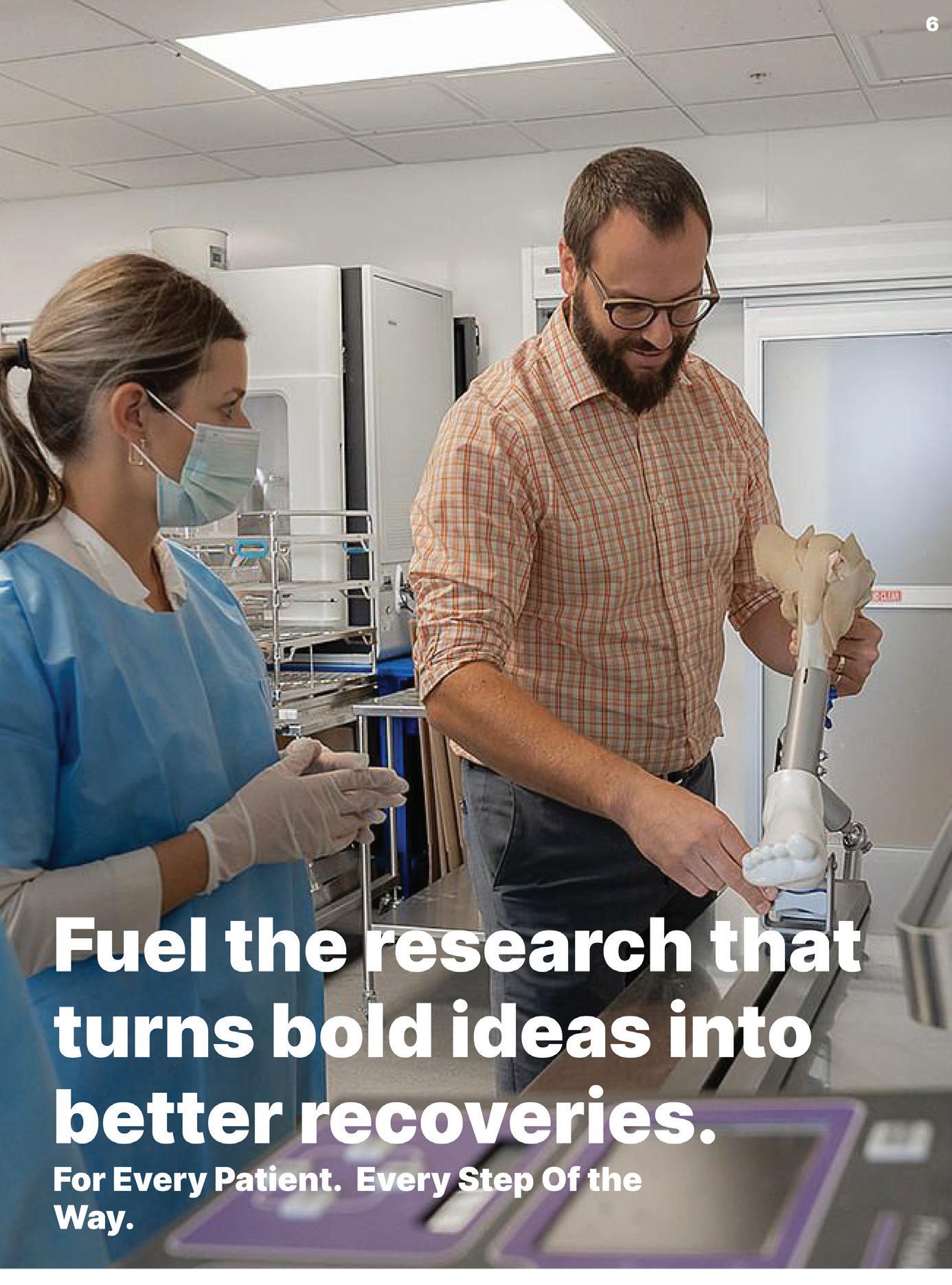
Our non-profit organization operates a fully functioning research and testing lab at the Concordia Hip and Knee Institute in Winnipeg. With more than 20 full-time and part-time staff, along with students and research collaborators, we support some of the most advanced orthopaedic research and medical device projects in Canada.
The Orthopaedic Innovation Centre (OIC) is Canada’s only comprehensive orthopaedic research centre that combines applied bioengineering, medical device testing, clinical collaboration, and hands-on training within an active clinical environment. Investment in modern equipment and infrastructure is essential to maintain credibility with global innovators, attract top talent, and translate research into real-world patient outcomes.
Manitoba’s Innovation Advantage
Manitoba’s leadership in joint replacement innovation spans more than 50 years, beginning with Dr. Frank Gunston of Flin Flon, inventor of the modern knee replacement. That legacy continues today through OIC, where research excellence is translated into safer surgeries, faster recoveries, and better patient experiences.
Our work advances multiple provincial priorities simultaneously:
• Innovation & Technology: Independent testing, validation, and research support for Canadian and international medical device companies
• Education & Workforce Development: Hands-on
training for engineers, surgeons, researchers, and students, including student science fairs and outreach programs that inspire young people to pursue careers in bioengineering and health sciences
Economic Development: More than $1 million annually brought into Manitoba through international research and testing contracts
Health System Impact: Improved patient outcomes, fewer complications, faster recovery times, and enhanced patient satisfaction
Canadian Health-Care Resilience: Fifteen years of home-grown innovation that strengthens
Canada’s ability to develop, test, and improve health-care technologies domestically
The Opportunity
Global competition for innovation leadership is accelerating. Leading jurisdictions are investing aggressively in advanced research infrastructure to attract talent, secure intellectual property, and accelerate commercialization.
Together with the Arthroplasty Research Chair, led by the Concordia Foundation, we aim to: Enable next-generation orthopaedic research and testing
Support Manitoba and Canadian innovators in scaling technologies and exporting expertise globally
• Expand training opportunities for highly skilled STEM and health-care professionals
• Strengthen Manitoba’s reputation as a national hub for applied health innovation and medical device development
• Build stronger partnerships between researchers, clinicians, industry, and education
With strategic investment, Manitoba will: Be recognized nationally and internationally as a leader in applied health innovation and medical device testing
Train, attract, and retain top-tier engineers, clinicians, researchers, and students in Manitoba
• Anchor additional research funding, intellectual property development, and commercialization activity within the province
• Help Canadian companies innovate faster and compete globally
• Deliver measurable improvements in patient outcomes, health system efficiency, and economic growth
Dr. Eric Bohm, Orthopaedicsurgeon,ConcordiaArthroplastyResearch;Professor ofSurgery,MaxRadyCollegeofMedicine,UniversityofManitoba;Chairofthe AdvisoryCommitteefortheCanadianJointReplacementRegistry
On the importance of data-driven health care: “I believe in a properly functioning, publicly funded health-care system. We’re really struggling with that in Canada right now. You can’t manage a system unless you know what’s happening.”
On expanding surgical capacity: “With our current government, we were able to open the program up in Selkirk, doing another 800 joints a year, and that was largely because of the quality of the data that we had.”
On patient impact: “Our patients are an average age of 67 and they come to you miserable. They can’t walk. They can’t play with their grandkids. They can’t travel. You do an operation—it takes 40 minutes—and they’re forever grateful.”
Trevor Gascoyne, CEO,OrthopaedicInnovationCentre
“We’re a team of 17 people in total—a small nonprofit group with a very modest marketing budget. Yet somehow, we’ve built a worldwide reach, which is really exciting to be part of.”
On the connection between engineering and medicine: “Hip and knee replacement is one of the best examples of engineering and medicine working together. Everything—from the materials to the implant design and durability—has been highly engineered. I love being part of improving and optimizing that innovation.”
Dr. Christiaan Righolt, DirectorofClinicalResearch,OrthopaedicInnovationCentre; AssistantProfessor,DepartmentofSurgery,UniversityofManitoba
“I like the direct impact you can have here—being co-located in the clinic, working directly with surgeons, and helping improve patient care.”
Colton Poitras, DataAnalyst,OrthopaedicInnovationCentre
“I’ve worked in places where there’s a ‘good enough’ mentality. I appreciate that we hold ourselves to a higher standard here. It’s a place where people genuinely care about doing excellent work.”
Jessie Robertson, BiomedicalEngineer,OrthopaedicInnovationCentre
“What brought me here was the unique combination of engineering and clinical exposure. It feels like you’re making a direct impact.”
“Helping other people is important. It makes you work harder when you know your work has purpose and meaning.”
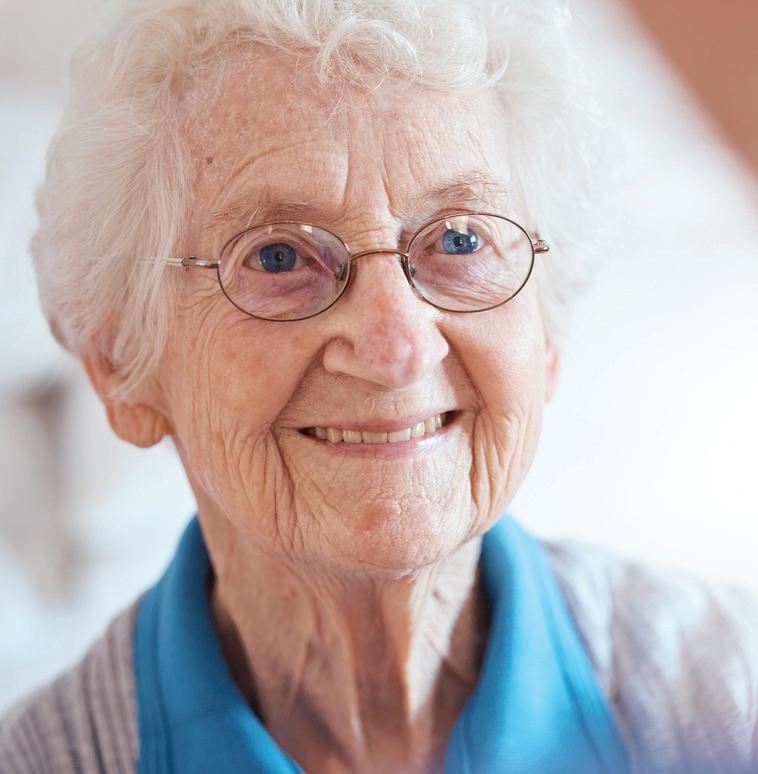
Dementiamaytakememories—butitshould nevertakeawaycompassion.
Together,wecanensurethateverypersonismet withunderstanding,dignity,andmomentsofjoy.
Barbara was a nurse later in life, devoted to her patients. She worked as a ward nurse and in psychiatric care, always advocating fiercely for those who needed it most. Something shifted in her when she turned 40 and pursued her lifelong dream of becoming an RN.
On one of her first assignments, she once cared for a young girl struggling with delusions and difficult behaviours. Barbara quickly recognized that the girl hadn’t eaten properly in days and was severely
She left behind more than belongings. She left a legacy—and a promise. She asked her daughter to do something meaningful with what remained.
To do something.
To care for others.
To care for yourself.
To remember what it truly means to be a nurse— to nurture, to comfort, to show compassion.
And to honour and respect the caregivers who ‘put up with me,’ she would laugh. Because memory matters

From page 1
Caregivers are struggling to support loved ones with dementia
Through her work, Teepa Snow has:
• Delivered more than 8,000 in-person training sessions
• Developed books, workshops, certification programs, and online learning tools
Supported caregivers and organizations across multiple countries
Her programs continue to shape dementia care practices worldwide and she will be in Winnipeg in the fall of 2026 where a number of healthcare professionals from Concordia will attend.
Formoreinformationvisithttps://teepasnow.com
dehydrated. Without hesitation, she found a bowl of oatmeal, added brown sugar, cream, and cinnamon, and gently coaxed her to eat—calling it “pudding” to make it more inviting. She always claimed that Oatmeal was the cure for everything.
The girl devoured it.
Within hours, her behaviour shifted. She slept through the night, and over the following days, with more “pudding” and care, her condition stabilized. Her diagnosis changed—and so did her life. That young girl would later become a nurse herself, inspired by the compassion she received from “Nurse Barbara.”
Barbara worked long shifts, often on her feet, and rarely said no to overtime. She went the extra mile in quiet, personal ways. Once, she spent her own money to buy daily ice cream sandwiches for
From page 3
a patient named Gladys, who had dementia. This went on for months as a daily ritual.
As Gladys enjoyed the treat, memories surfaced— warm summer evenings on the veranda, sharing ice cream with the boy who became her husband. He had passed years earlier, but in that moment, he was close again. And she smiled and hummed a song from days long ago.
Gladys may not have remembered who brought her the ice cream, who held her hand, or who kept her safe—but she felt love. And in that moment, that was everything.
Because memory matters.
When Barbara herself began to show signs of dementia, her family stepped carefully, unsure at first how to help. Her daughter, who would care for her until the end, immersed herself in learning— especially the work of Teepa Snow. She shared that knowledge with family and with the caregivers who would support Barbara in her final years in memory care. Barbara passed peacefully in April 2025 at the age of 94.
Her legacy lives on in ways we may never fully know. She often reminded her children and colleagues: what you do matters. The more you give, the more you care, the better the world becomes. Even as dementia progressed, Barbara held tightly to her dignity. She insisted on respect, even as moments became confusing or unpredictable. She knew she shouldn’t drive or take transit—but she tried anyway, to the gentle frustration of those caring for her. She knew the young doctor wasn’t really her “boyfriend,” but with a spark of humour, she would say, “I’m not dead yet.”
Dementia steals many things—not just memory, but it often takes away your dignity and peace. Barbara fought to hold onto both.
More Than Memory: A New Perspective on Dementia Care
seeing only loss, we were encouraged to recognize change. Instead of focusing on what is gone, we learned to see what remains.
Because so much does remain.
A person living with dementia still has instincts, emotional responses, habits, and abilities — they may simply be expressed differently now. They still seek comfort, safety, and familiarity. They still respond to kindness, tone, touch, and reassurance. They still have something meaningful to offer, even if it looks different than before.
The workshop was not about fixing dementia, nor was it about control. It was about learning to walk
alongside someone with compassion.
To change how we think.
To listen differently.
To care in a way that honours who someone has been — and who they still are.
We left that day with more than techniques or strategies. We left with a deeper understanding: dementia care is not just about helping someone live. It is about helping them feel seen, respected, and safe in a world that is changing around them.
And perhaps, in learning to care this way, we become a little more human too.
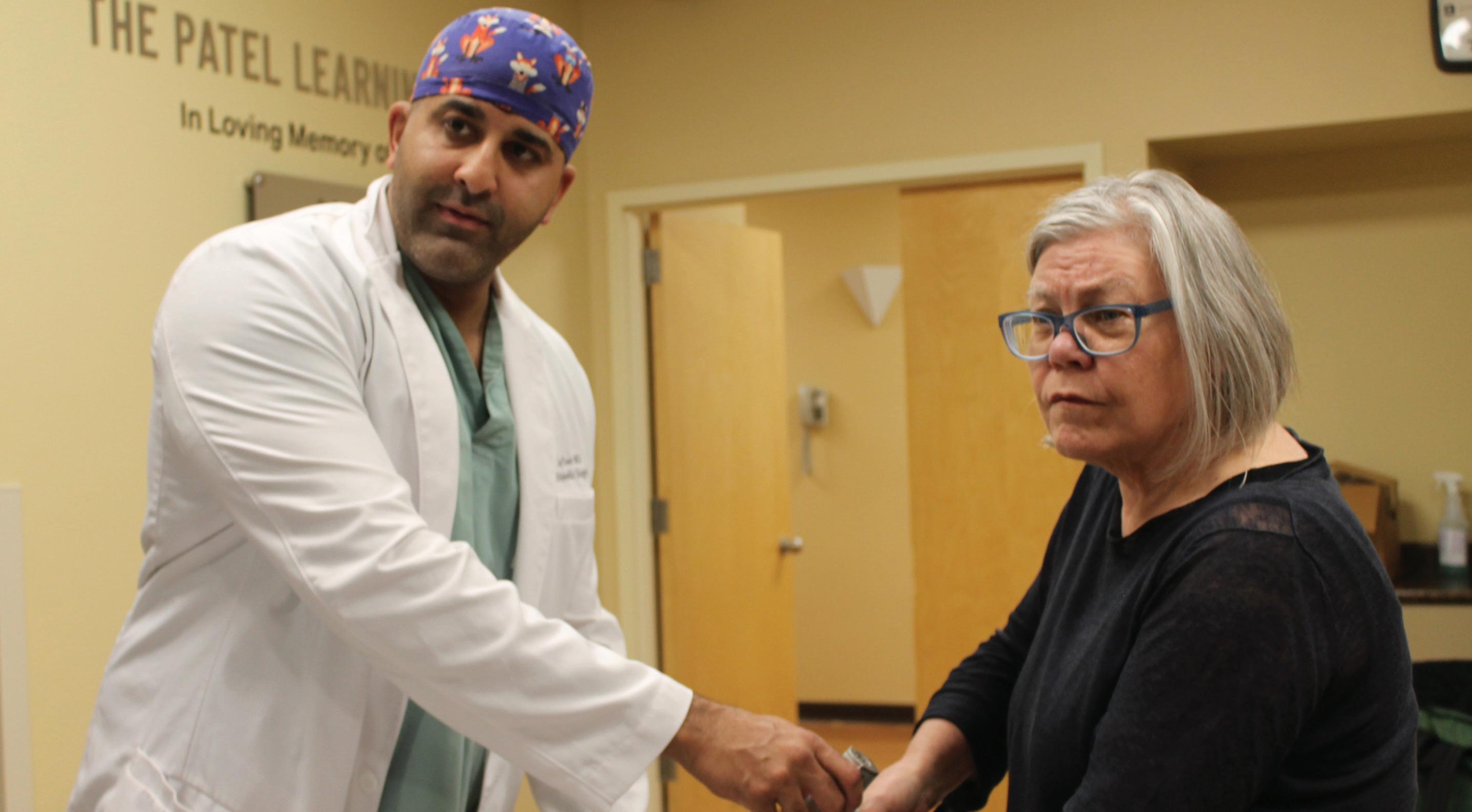
Not long ago, many people in Manitoba who needed spine surgery had to wait a long time and stay in the hospital for days or even weeks. Their backs hurt so much that simple things— like walking to the kitchen or going outside— felt impossible.
Today, something hopeful is happening at Concordia Hospital. Doctors are using new high-tech tools to see the spine in detailed 3-D images during surgery. This means they can work with amazing accuracy and make smaller cuts. As a result, many patients feel less pain and heal much faster. Some are even able to go home the very same day.
One patient, Carol, remembers how hard life used to be. She loved being active, but severe back pain made her feel stuck at home. After her surgery, everything
changed. Within months, she was walking easily again — and even hiking in the hills on a trip overseas. She said it felt like getting her life back.
This new approach is also helping more people get care sooner. By doing these advanced surgeries at Concordia, hospitals can treat more patients and shorten long wait lists. At the same time, surgeons from around the world are coming to Winnipeg to learn these life-changing techniques, making the city a place of learning and hope.
For many patients, the biggest gift is simple: the freedom to move without pain. Whether it is gardening, travelling, or just walking to the store on a winter day, these new spine surgeries are helping people stand tall again — and step forward into healthier, happier lives.
By Alanna Mitchell, Science and Medical Journalist

Jay Toor did not always plan to become a spine surgeon. While training in orthopaedic surgery in Toronto, his life changed after a terrible accident in his family. His grandfather, who was strong and active even in his 80s, fell down the stairs and suffered a severe spinal cord injury. Despite emergency surgery, he passed away.
That heartbreaking moment shaped Dr. Toor’s future. He decided to focus his career on spine surgery, believing that the ability to move your hands and legs is one of life’s most precious gifts.
After finishing most of his specialty training — and even earning a business degree to better understand how hospitals work — he was called to help improve spine care in Manitoba. In 2023, he moved to Winnipeg, where many patients were waiting years for surgery. Dr. Toor believed new minimally invasive technology could change that. He worked tirelessly, sharing his ideas with health leaders and demonstrating how better tools could help patients recover faster while also saving the health-care system money.
Today, he performs advanced spine surgeries at Concordia Hospital and Health Sciences Centre, and helps train surgeons from around the world. He says the teamwork and patient-focused spirit he found in Winnipeg inspire him every day. For Dr. Toor, the goal is simple but powerful: help people return to the activities they love and give them the freedom to live life without pain.
Donor-advisedfunds(DAFs)havebecomeoneofthefastest-growingcharitablegivingvehiclesinCanada,offeringdonorsaflexible,strategic,andtax-efficientwayto supportthecausestheycareabout.
For individuals and families making larger or recurring charitable gifts, structure becomes an integral part of philanthropy. A donor-advised fund, for example, allows a donor to make a charitable donation to a public foundation, receive a tax receipt in the year of the gift, and then recommend grants to Canadian charities over time. This creates a flexible charitable giving program without the administrative burden of a standalone private foundation!
Thanks to Abundance Canada for being a helpful resource
Since 1974, Abundance Canada has helped Canadians achieve their philanthropic goals with a customized Generosity Plan™. Discover tax saving ways to increase your support to the causes you care about during your life, through your estate and beyond. As a registered public foundation with the Canada Revenue Agency (CRA), we offer a professional and personalized gift planning service. We make charitable giving easy and effective. Consultations are free, confidential, and without obligation.
Donor-advised funds (DAFs) have become one of the fastest-growing charitable giving vehicles in Canada, offering donors a flexible, strategic, and taxefficient way to support the causes they care about.
A DAF is essentially a charitable account administered by a public foundation—such as a community foundation, financial institution–affiliated foundation, or national charitable organization—into which a donor makes a contribution. Once the contribution is made, the donor receives an immediate charitable tax receipt, while the funds continue to grow tax-free within the account.
One of the main advantages of a donor-advised fund is flexibility. Donors can recommend grants to their preferred charities over time, allowing them to spread out their giving or respond to emerging needs as they occur.
This makes DAFs particularly attractive for individuals and families who want to create a longterm giving strategy without the administrative responsibilities of establishing a private foundation.
DAFs also allow donors to involve their children or other family members in philanthropy, helping build a tradition of giving across generations. Many
sponsoring foundations offer guidance, research support, and streamlined administration, making it easier for donors to focus on their charitable goals.
In essence, donor-advised funds combine the simplicity of a charitable donation with the ongoing flexibility of a personalized philanthropic plan. They have become an essential tool for Canadians who want to make a meaningful and lasting impact in their communities.
The Concordia Foundation is pleased to welcome several gifts from Family Foundations and DAFs throughout the year.
For more information, please discover Abundance Canada’s resource centre.
Discover tax-saving ways to increase your support to the causes you care about during your life, through your estate and beyond. As a registered public foundation with the Canada Revenue Agency (CRA), we offer a professional, personalized giftplanning service. We make charitable giving easy and effective. Consultations are free, confidential, and without obligation.
Contact the Concordia Foundation to discuss your generosity plan. info@concordiafoundation.ca

Getting sick or injured doesn’t follow a 9-to-5 schedule. Extended Hours
Primary Care Clinics (EHPCC) offer quick, convenient, and high-quality care for minor health concerns when your regular care provider isn’t available – or if you don’t have one. These clinics are open evenings, weekends, and holidays.
Not sure if it’s the right place? There’s no wrong door. If we can’t help, we’ll connect you to the right care.
The clinics work a lot like your family doctor’s or health care provider’s office. You’ll see doctors, nurses, nurse practitioners or other health care providers who can treat things like:
When are the clinics open?
The clinics are open 365 days a year, including holidays, with the following hours: Weekdays (Mon-Fri): 5:30 p.m. – 11:30 p.m.
• Weekends (Sat-Sun): 1:00 p.m. – 11:30 p.m.
Your family doctor knows you best and should be your first point of contact. When they’re unavailable, Extended Hours Primary Care Clinics offer a convenient alternative. Any care provided is shared with your doctor for seamless follow-up, ideal for managing chronic conditions like diabetes or asthma.
• Headaches, earaches, back pain
Rashes or skin ailments
• Sore throat, cough, fever
• Nose bleeds
Sore eyes with redness or infection
Diarrhea and vomiting or indigestion
• Urinary tract infections
• Joint swelling
Breast feeding issues
• Sexually transmitted infections and testing
• Ongoing management of chronic conditions such as asthma or diabetes
Extended Hours Primary Care ClinicConcordia Hospital M-127-A, 1095 Concordia Avenue near the front lobby
Open 365 days a year, including holidays Weekdays (Mon-Fri): 5:30 p.m. - 11:30 p.m. Weekends (Sat-Sun): 1:00 p.m. - 11:30 p.m.
Phone: 204-632-3251
Walk-in appointments available - call ahead for availability


Discover comfortable, modern living at Canterbury Residences in Winnipeg’s new Canterbury community.
Choose from spacious one-, two-, and three-bedroom townhomes designed to suit your lifestyle.
• Spacious one-, two-, and three-bedroom townhomes
• Located in the newly developed Canterbury community
• Contemporary design with comfort and functionality

Experience the perfect blend of comfort and convenience at Canterbury Residences, where charming townhouses meet a vibrant community vibe.


APPOINTMENT DETAILS:
11 Merkel Manza Boulevard, Winnipeg, MB
Showroom Hours: By appointment only
Inquiries: Monday–Friday, 8:30 a.m. – 4:30 p.m.
Website: https://www.kotharirentals.com/ residential/canterbury-family-homes-inc
Select suites feature walk-in closets, high-speed internet readiness, and central air conditioning, ensuring you enjoy modern comforts every day.