


A dverti $ er Component manufaCturing Serving the Structural Building componentS induStry S The “Setting the Goal of One Thousand Pieces per Hour” See cover story by LimTek Solutions on page 48
www.todd

The number one expert for process improvement in all departments of wood truss and wall panel manufacturing using proven and practical lean manufacturing methods combined with industrial engineering.

√ Labor Time Standards for Accurate Wood Truss Labor & Pricing Estimations
120+ Different time elements to input into any wood truss programs.
Based on the equivalent measurements called work minutes, work hours, realistic expectancy (RE), or scheduled units (SU).

√ 100+ Different Companies Using Them Every Day
Productivity scheduling, efficiencies measurement, productivity incentive programs, labor cost estimations, and Pricing based on Labor Units.
√ Three Offerings With or Without Onsite Consultation Services
1) Wood Truss Time Standard


2) Lean Manufacturing TDC Training Material — All the TDC lean manufacturing training material best practices, without an onsite consultation. Most clients are shocked by the depth and scope of the TDC best practice training materials, which are very clear, concise, and without bias to enhance their operations.

3) Consultation & Training — Full onsite consultation with all the lean manufacturing best practices training material and time standards included. A Minimum Gain of 3 Net Profit Points is a Very Low bar for TDC
“... It was an investment well spent because I not only learned a completely different way to view labor metrics, but I came out of it with a completely different mindset on pricing, scheduling, and staffing...”
Shane Soule, President Bremen, IN
“….Your time standards are perfect. They are far more accurate than BF. We are much more comfortable with the work minute for estimation of labor for both the pricing and shop scheduling. BF is just too unreliable for our needs.”
Keith Myers, Truss and Panel GM – Lakewood, NJ Written testimonials provided by dozens of clients on the TDC website.


drummond.com todd@todd drummond.com
(603) 748 1051
Anna Stamm – Advertiser Forum: Expecting an Instantaneous Answer
Joe Kannapell: The Development of the Truss Plate, Part VII: Contentious Competition
Wendy Boyd – Spida Machinery: Creating Solutions with Labor-Saving Equipment
Todd Drummond Consulting, LLC: Money Hides Many Sins (Waste)
Glenn Traylor: Has Your Guideline Shifted?
Tracy Roe – Eagle Metal: Dependability in an Uncertain Environment
Edmond Lim, P.Eng. –LimTek Solutions: Setting the Goal of One Thousand Pieces per Hour
Rob Bellian – Vekta: Increase Truss Production Quality and Efficiency with Precision Printing
Steve Shrader – Hundegger USA: Increasing CLT Options and Supply
Carl Villella – Acceptance Leasing: Forecasting Inflation and Interest Rates
Frank Woeste – All Things Wood: Design of Wood Structures—an Introductory Course
Thomas McAnally – The JobLine: Is 2022 Like 2006?
Geordie Secord – Design Connections: Building Information Modeling for the Component Business?
Lesko Financial Services Team: First Quarter Brings Hints of Later-Year Move Toward Recovery
MiTek Staff:
Effects of Ripping Structural Truss Lumber
Randy Daudet – Simpson Strong-Tie: Top Structural and Wood-Related Changes in the 2021 IRC, Part 2
Joe Kannapell – The Last Word The
$ er Component manufaCturing Serving the Structural Building componentS induStry S The Inside Articles 6 10 17 24 35 42 48 55
A dverti
Last Pioneers 62 69 74 78 84 90 112 114 136
Design and build faster than ever. Learn

From plans, to walls, to panels, and everything above. Introducing a new level of design tools, built from the ground up.

more a t EagleMetal.com
Publisher Thomas McAnally twm@componentadvertiser.org
Editor Anna L. Stamm 800-289-5627 x 3 anna@componentadvertiser.org
Distributed FREE Via e-mail subscription Download PDF or Read on line at www.componentadvertiser.com
News of Interest and Advertising inquiries can be submitted to: anna@componentadvertiser.org An Open Forum for many sources. Deadline 20th of each month. Articles, Trade Names, and Logos are the property of their respective owner or creator unless otherwise noted
Disclaimer: We reserve the right to refuse any advertisement or material that we deem not in the interest of the industry or the Advertiser. Permission to use content is the responsibility of the contributor including permissions to use any likeness of persons.
The Advertiser is provided “As Is” including typographical errors, omissions, and mistakes both intentional and unintentional.
30,55,64,72 Copyright 2008-2023 Component Manufacturing Advertiser The Advertiser 411 Walnut Street #12250 Green Cove Springs, FL. 32043
&
Wolf X Machina
Tech Systems .............................................................. 14,101,126 .................................................. 13,51,69 .............................................................................................. 58,98 ................................................................................. 31 ............................................................................................ 22,80 ............................................................................. 8,64 ................................................................... 4,42,72 .................................... 32,66 ............................................................. 38,108,120 .................................................................................. 19,61 ................................................................................... 21,87 .............................................................. 9,33,41,62,94,121 ......................................................................... 1,30,48,50 ........................................................................................ 12,112,135 .......................................................................................... 83,138 ........................................................................ 46,47 ............................................................. 13,93 ....................................................... 20,60,114,119,120 ............................................................................ 16,17,52,82,88 ................................................................. 9,26,39,94,97 ...................................................................... 33,59,61,78,84,109 ............................................................... 34,102 ...................................................... 2,24 ................................................. 40,70,106 ........................................................................... 27,54,55 ............................. 7,15,19,31,61,65,67,68,71,83, 89,92,93,99,105,107 ................................................................................ 59,104 ....................................... 15,19,23,28,29,39,41,44,45, 51,53,59,65,67,71,73,76,77,79,81,83,86,89,96,107 Published Monthly
Wasserman
Associates
Wood
Believe it at your own risk!
reproduction in whole or in part
Archive Copies Available On Line www.componentadvertiser.com Inside ................................................................................................ 7 .............................................................................61 .............................................................................72 ............................................................................93 ............................................................................95 ...............................................................105 ................................................105 .................................................................................100 ............................................................................................103 ...............................................................................104 .........................................................................................119 .................................................................................................132 ............................................................................................134
no
without permission from the component manufacturing advertiser
Anna L. Stamm Director of Communications and Marketing Component Manufacturing Advertiser.

Advertiser F Forum

Expecting an Instantaneous Answer
I’m always amazed, and irritated, when people expect an instantaneous answer. In these days of instant electronic communication, the fact that replies could be immediate is often conflated with the thought that they will be immediate. This leads to unnecessary aggravation for everyone involved.

How many times have you been asked a question, only to have the person asking it move on before giving you an opportunity to answer? Whether they’ve escalated the situation by looping in more people or simply made a decision without all of the facts you could have provided, now you’re both on the defensive.
I realize this list will not live on past this article, but it sure would be nice if it could avert some of these avoidable conflicts for me or someone else in the future.
When communicating electronically, please remember:
1. Just because you are sitting at your computer, the other person may not be sitting at theirs.
2. Just because you are working on that specific topic, the other person may be working on a different critical issue at that same moment in time.
3. When you haven’t received an answer within 5 minutes, 2 hours, etc., that doesn’t mean you will never receive an answer.
4. If it was important enough for you to ask the question, isn’t it also important enough to wait for an answer?
With a good dose of patience and understanding, everyone can accomplish what needs to be done. Replies can be made in a timely manner, even when they’re not instantaneous.
PHONE: 800-289-5627 FAX: 800-524-4982 Read/Subscribe online at www.componentadvertiser.com Don’t Forget! You Saw it in the Adverti$$er February 2023 #15283 Page #6 A dverti $ er Component manufaCturing m The
Monet DeSauw FWA 500 Floor Web Cutter
• Push Button Powered Blade Angulations
• Single Push Button Setting for 2 Blades per Side
• Electronic Digital Readouts
• Backup Mechanical Indicators
• Cuts 4 Angle Webs, Cantilever Webs (2 piece webs) & Square Blocks
• Magazine Lumber Feed for 3x2, 4x2 and 6x2 Lumber 12 1/2” to 48 1/2” Length Capacity (7” Minimum on Square Blocks)
• 60 Pieces per Minute
• (4) Internal 16” Blades & (1) External 16” Cut-Off Blade
• Pneumatic Blade Brake on External Blade
• Dust Hoods
• Belt Waste Conveyor (under saw)
• Add $4,200 for 12’ Incline Waste Conveyor (adjacent to saw)


• Add $1,900 for Extra Set of Blades
• 480 Volt / 3 Phase FOBMO
Call For Pricing
Monet DeSauw DeRobo
Linear Saw
• Automated (Truss Design Software Download) or SemiAutomated (Touch Screen Entry) Operation
• All Movements are Computer & PLC Controlled
• Comprehensive Setup Screens Display Each Piece with Setup
Data
• 22” x 40 Tooth Blade on PAE Cut 1 or 2 Boards up to 20’ (2 Second Plunge Cut)
• Cut Chords, Webs, Rafters, Wedges & Stair Stringers
• Cut Long Scarfs by MultiPlunging
• Servo Positioning on Infeed, Angle & Outfeed Pusher
• Over Travel Protection
• Ink Jet Printer
• Lumber Optimization Program
• Belt Waste Conveyor
• 480 Volt / 3 Phase / 60 Amp
• Includes 5 Day Onsite Installation & Training
• Optional Monet DeSauw Live Deck, Bunk Feeder & Incline Belt Waste Conveyor FOB MO Call For Pricing

Monet DeSauw DeSawyer
2000 Automated Saw
• Touch Screen User Interface with Backup Mechanical Controls
• 3 Operating Modes: Auto, SemiAuto & Manual
• All 20 Axes of Movements are Computer & PLC Controlled
• Comprehensive Setup Screens Display Each Piece with Setup Data
• Anti-Collision & Optimizing Programming

• Auto Calibration Productivity & Time Tracking
• Maintenance Diagnostics
• Variable Speed Conveyor (0-50 Flights per Minute)with Powered Hold Downs
• (1) 30” x 80 Tooth Blade (27 3/4”
Scarf on PAE)
• (4) 16” x 40 Tooth Blades (13 1/2”
Scarf on Centerline)
• Pneumatic Blade Brakes on all 5 Blades
• 16 1/2” to 20’ Length Capacity (11” Minimum on Square End Blocks)
• Vibrating Waste Conveyor Under Saw
• 480 Volt / 3 Phase
• Includes 4 Day Onsite Installation & Training
• Add $2,900 for Extra Set of Blades
• Optional Live Deck, Label Printer, Ink Jet Printer, Catcher Display & Incline Belt Waste Conveyor.
Call For Pricing FOB MO
Buy Factory Direct From Wasserman & Associates at the same price as the Manufacturer, and get the added support and care you need to be up and running FAST! WE’LL EVEN HELP SELL YOUR USED EQUIPMENT TOO!
PHONE: 800-289-5627 FAX: 800-524-4982 Read/Subscribe online at www.componentadvertiser.com Don’t Forget! You Saw it in the Adverti$$er February 2023 #15283 Page #7 A dverti $ er Component manufaCturing m The 800-382-0329 | www.wasserman-associates.com
NEW! NEW! NEW! NEW SAWS!
CONSIDERING EQUIPMENT? CONSIDER CLARK.
EZ-SET AUTO JIGGING EXCLUSIVE & PATENTED DESIGN
Automatic Truss Jigging System to drastically reduce setup times. Allows for 100% embedment on the table, with top & bottom chord pucks in the same slot. TopSider or standard configurations available for conventional kick-leg, walk-thru, or our new trackless 8' and 10' continuous table systems. Systems for other roller & hydraulic gantries are coming soon. Available in new machine installations or for retro-fitting your existing table. The TopSider is exclusively applicable for “kick or flip leg” style truss presses such as the Tri-Axis & Lumbermater®


FEATURES / APPLICATIONS
• Capable of 100% On-Table Nail Plate Embedment
• Two Pucks Per Slot
• 24", 26", and/or 30" Spacing
• Compatible with all current major design software
• Multiple Simultaneous Layouts
Lumbermater® is a registered trademark of Illinois Tool Works, Inc., or ITW.
EQUIPMENT FOR TRUSS & COMPONENT MANUFACTURERS WWW.CLARK-IND.COM / GENERAL@CLARK-IND.COM LOCAL 417-235-7182 • US TOLL FREE 800-743-9737
2Seconds
That'sallthetimeittakes
todrillstudsforrunningRomexorotherelectricalwireinthewallpanels
Motor: HeavyDuty5HP-3phase-220vor440v(Pleasespecifywhenordering)
MotorcarriagebearingandspindleassemblymountedonBlanchardgroundsteelplate
LinealmotionishardenedandgroundVbearingsandrails

BlockSizes: 2x4through2x12infiniteheightsettingtocenter
AirSupply: 100psi10CFM

Drills: 2wing3/4'”CarbideTippedcanaccommodatesmallerorlarger
Spindles: AlloySteelpolishedandgroundprecisionshafting
Frame: 2"SteelWithPowderCoatFinish
Covers: 10Gauge(1/8"Thick)Aluminumremovable

Dimensions: Height-60inches,Width-33inches,Depth-33inches
Shippingweight: 750lbs.-(Includingcrate)
MADEINAMERICABYAMERICANS
PHONE: 800-289-5627 FAX: 800-524-4982 Read/Subscribe online at www.componentadvertiser.com Don’t Forget! You Saw it in the Adverti$$er February 2023 #15283 Page #9 A dverti $ er Component manufaCturing m The 916-508-3558• ww w.thehaincompany.com SeetheStudDrillerinaction! Goto https://youtu.be/AnODX5vPesE forademonstration
Work Smar ter
The Development of the Truss Plate, Part VII: Contentious Competition
 By Joe Kannapell
The plated truss industry went bonkers around 1961. Truss fabricators were besieging suppliers for product and were willing to try nearly any plate or machine. Plate suppliers had to conform to the new testing and QC required by TPI-60, but machinery vendors had no guidelines beyond satisfying customers. Many of these early suppliers followed the lead of Sanford and Jureit in obtaining patents to protect their inventions and their eventual sales – or so they thought. Among those were Interlock Steel in Pennsylvania, Clary Corporation in Texas, and Bill Black, Sr. in Florida, each entering the business with a unique perspective and each making their mark.
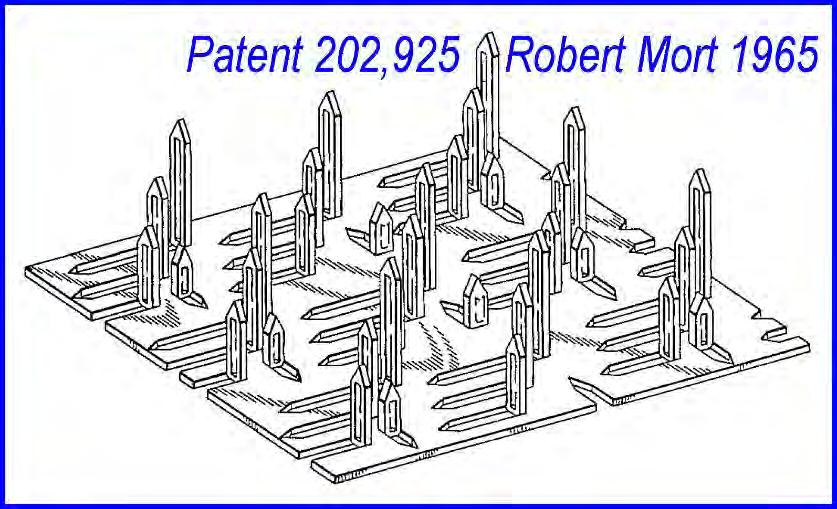
Interlock Steel : Edgar Mort knew right away that a truss plate with integral nails would sell much better than those he was stamping with only holes for nails. He encouraged his CPA brother, Bob Mort, to join him in developing a truss plate business. Edgar then devoted the resources of his Standard Aluminum Co. to developing a plate, while Bob engaged Dr. Jack Ritter at nearby Youngstown State University’s Civil Engineering Lab to assist. After testing several configurations, they settled on a unique design, for which Mort received a patent in 1965. With a viable product in hand, the Morts incorporated Interlock Steel Company, and went on to become a full-service supplier of plates, engineering, and machinery.
Clary: The Clary Corporation had been a manufacturer of mechanical office machines, but somehow got into the saw business through the work of a prolific inventor, George Mayo. Mayo’s first remarkable rendition of a component cutter incorporated mechanisms that survive to this day, including a rack and pinion drive for the moveable head, and a square drive shaft for the lumber conveyor. Mayo kept innovating for the next twenty years, finally conceiving the Timbermill for Speed Cut, Inc., the first component saw with more than four heads.
Clary was also the first to provide tabular books of cutting angles and lengths, authored by future SBCA President Gary Sweatt, PE. Later, Clary persuaded Dan and Camilla Hurwitz to move to Texas to provide cutting software. Though that venture was short-lived, the Hurwitzs went on their own to create On-Line Data, the most successful independent software provider.
PHONE: 800-289-5627 FAX: 800-524-4982 Read/Subscribe online at www.componentadvertiser.com Don’t Forget! You Saw it in the Adverti$$er February 2023 #15283 Page #10 A dverti $ er Component manufaCturing m The Continued next page
Bill Black Sr., father of TeeLok founder Bill Black, Jr., devised a machine to build trusses, “of unusually uniform structural characteristics.” As this was the earliest truss machinery patent granted, it was necessary to establish the advantages of offsite construction over conventional framing which, “…requires much climbing about the upper portion of the house being erected, limiting this phase of the work to the stronger and more agile carpenters.”


Unfortunately, this very detailed multi-head machine design, perhaps never built, didn’t anticipate the tens of thousands of pounds of force required to embed most truss plates. But as this concept evolved through the next 20 years, it finally resulted in Hydro-Air’s Glide-Away, which set the world production record that stands to this day (see The Last Word: Vertical Presses—The World Record, in the February 2020 issue).
The three patents described here and in my previous articles set the stage for a contentious competition to either work around or to one-up these patents. By their nature, patents required the inventor to reveal the details of his invention to the public in exchange for gaining a monopoly position for the next 17 years in 1960. For example, Mayo’s 12,800-word patent description was sufficiently detailed to enable imitators to evade it with the help of skilled patent attorneys and skeptical courts-of-law. And, over the next decades, it was the courtroom that would largely shape the future of the industry. But, in the near term, a pivotal decision was forthcoming that would become the most far-reaching.
Next Month: Patent Skirmishes
Since 1970, Joe Kannapell has worked as programmer, Chief Engineer, Marketing Manager, and Sales VP for MiTek, plus 7 years at truss plants, retiring at the end of 2020.
PHONE: 800-289-5627 FAX: 800-524-4982 Read/Subscribe online at www.componentadvertiser.com Don’t Forget! You Saw it in the Adverti$$er February 2023 #15283 Page #11 A dverti $ er Component manufaCturing m The

TIME COPYRIGHT © 2020 MITEK INDUSTRIES, INC. ALL RIGHTS RESERVED IDEAL FOR LARGE RESIDENTIAL OR MULTI-STORY PROJECTS
Prefabricated to meet builder’s specifications
Ability to be sheathed with most flooring surfaces
Utilizes top chord support for ease of installation
Allowances for deflections, reactions, plumbing locations, waste and duct chases at the design stages Contact your Sales Representative or Contact MiTek at 800-325-8075. FLOOR CASSETTES SAVE TIME ONSITE AND SHORTEN THE INSTALLATION CYCLE Open web design for easy installation of HVAC, Electrical & Plumbing Crane onsite and install in minutes Open web trusses eliminate the need for soffits and dropped ceilings, providing new design possibilities Safe to walk on immediately, improving safety at heights Reduced onsite storage
INSTALL MORE SQUARE FEET IN A FRACTION OF THE
→
→
→
→
Used Razer S5 Linear Saw
S5 Razer saw modules configured for either left-to-right cutting and/or “Z” shaped layout. AIT auto infeed tables. Vekta user interface software complete with the full version of the optimization algorithms. Stack cutting and side by side cutting
Contact for Pricing
Eide Integrated Systems, LLC 612-521-9193
www.eidemachinery.com



Safety Speed Manufacturing Model
7400 XL Panel Saw
Safety Speed Manufacturing, model 7400 XL*, vertical panel saw, 3 HP induction motor, 64 inch crosscut, 2 1/8" maximum thickness, accuracy within 0.005 inches, 13 foot long welded steel frame with integrated stand and linear V-guides, enclosed counterweight system, adjustable vertical and horizontal rules. Quick changes from vertical to horizontal cutting. Includes machined aluminum material rollers, hold down bar, wheels, quick stop gauges and material hold downs. Dust collection ready. Options available include digital readouts for vertical cuts, automated length measuring, laser guide, stop bar, vacuum and midway fence. 208-230/460 volt, 3 phase electrical (208-230 single phase, 2 HP power optional +$100.00).

$13,149 Base, FOB MN. Wood Tech Systems 765-751-9990
www.woodtechsystems.com


2019 MiTek Blade Linear Saw (# 1)


MiTek Blade model: 89060-501, with 20′ infeed, face printing via Matthews printer model DOD 8000+ Maxi. Features 17″ saw blade powered by 5HP motor to cut 2×3 through 2×12 boards. Left to Right in-feed in “Z” configuration with 18′ out-feed conveyor. Includes any available spare parts, 230v/3Ph electrical power required, 110 PSI at 4-50 CFM air pressure as specified by the OEM.
$364,990 FOB CA
•
765-751-9990
•
PHONE: 800-289-5627 FAX: 800-524-4982 Read/Subscribe online at www.componentadvertiser.com Don’t Forget! You Saw it in the Adverti$$er February 2023 #15283 Page #13 A dverti $ er Component manufaCturing m The SAWS National Crane 680-HTM Tractor Mount, Multiple Units Available Call Dan at 800-824-6704 www.runnionequipment.com
20 ton capacity
80’ boom – 90’ tip height
Out and down outriggers
•
•
•
Single front outrigger for 360 degree stability
Continuous rotation
Adjustable swing speed control
5th Wheel
Freightliner and Peterbilt
OSHA and DOT Certified
•
•
•
•
A dverti$er Component manufaCturing S erving the S tructural B uilding c omponent S i ndu S try The
NEW!
www.woodtechsystems.com
Start smarter... Grow faster... Achieve more... cvillella@acceptlease.com | www.acceptlease.com 894 Beaver Grade Road, Suite #304 - Moon Township, PA. 15108 Phone: 412-262-3225 Fax: 412-262-1154 Keep More of Your CASH Eliminate Yearly Financial Reporting Low Fees Fixed Payment Programs No Additional Collateral Now offering short term Working Capital Loans
the Component Industry Since 1996” Start smarter... Grow faster... Achieve more...
“Serving
We have recently experienced unprecedented lead times, materials costs and home prices which seem to be receding as quickly as they arose. These cycles are not unique to our industry and will continue to ebb and flow. The one constant is the need to know how these factors affect your business. At 4Ward Solutions Group we help you figure out your costs per component group, minimum working inventory, plant capacity, and labor levels.
In-House Experts! Never
What do you need? How can we help?
Our values are integrity, safety, teamwork, and continuous improvement and we are here to serve. If you have questions about your business and would like our help in achieving operational excellence, please contact our team.


Our solutions are tailored to your business.


PROUDLY SERVING: LUMBER DEALERS, BUILDING MATERIAL DISTRIBUTORS, COMPONENT & PANELIZERS, MODULAR & VOLUMETRIC, MILLWORK & BUILDING INDUSTRY
250+ YEARS OF COMBINED EXPERIENCE IN-HOUSE EXPERTS TECHNOLOGY LEADERS





300+ HAPPY CUSTOMERS
 Roger Wagner, Design Manager
Owen Eldridge, Consulting Manager
Ben Hershey, CEO
Jordie Puchinger, CTO, Founder of Moducore
Dylan Thomas, Labor Manager Tomasz Cwik, Robotics / New Products Expert
Mike Ruede Jr., Automation & Robotics Expert
Darren Hamar, Offsite Expert
Christ Weintraut, Offsite Expert
Roger Wagner, Design Manager
Owen Eldridge, Consulting Manager
Ben Hershey, CEO
Jordie Puchinger, CTO, Founder of Moducore
Dylan Thomas, Labor Manager Tomasz Cwik, Robotics / New Products Expert
Mike Ruede Jr., Automation & Robotics Expert
Darren Hamar, Offsite Expert
Christ Weintraut, Offsite Expert
outsourced.
CONNECT WITH OUR EXPERTS INFO@4WARDSOLUTIONSGROUP.COM - 4WARDSOLUTIONSGROUP.COM
Equipment Wanted!
Saws
• Automated Component & Linear Saws (2010 & Newer)

• Monet DeSauw or TimberMill
Manual Component Saws
• Floor Web Saws
• Spida (Apollo) Saws with Truss Automation
• Bunk Cutters
Truss Equipment
• Roller Gantry & Hydraulic Press Systems
• Finish Rollers
• Truss Stackers
• Floor Truss Machines
• Lumber Splicers
• Jack Tables
• C-Clamp Presses
Trucks & Trailers
• Stretch Roll-Off Trailers
• Go oseneck Roll-Off Trailers

Modular Equipment
• Pacific Automation or MiTek Mobile Home Press
Contact Wasserman & Associates for a Fair Market Value Assessment of your Used Equipment Operational, Needs Work, and Parts Only equipment will be considered!
800-382-0329 | www.wasserman-associates.com
Terminailer XP
Price: $224,000
FOB: MN
Don’t just do it, nail it. It’s a brand new day in wall-panel production, with a whole new way of doing things better.
Terminailer®, a revolutionary, event-driven, nailing machine that completely defies any preconceived notions about sub-component assembly.
1994 Clary Master Component Saw
1988 Clary Master 5-Blade Component Saw
1988 Clary Master, 5-blade component saw, rebuilt by seller in 2013. Cuts dimensional lumber from 1′-6″ at 90/90, to 20 ft lengths, 2×2″ through 2×12″. Includes analog displays for angles and length, powered angulation and length, shaker pan undersaw waste conveyor, (1) 32″ blade, (1) 22″ blade & (2) 18″ blades & (1) 16″ blade. Cuts 4-angle floor webs at 3′-0″ minimum. In working order when decommissioned in October of 2022. Includes belt incline, schematic drawing and all available spare blades. 480 volt, 3 phase electrical required.
$8,497 FOB ID
Wood Tech Systems
765-751-9990
www.woodtechsystems.com

5 Blade Component Saw (Model 340). Powered Angulation & Carriage. Pneumatic Blade Brakes. Waste Conveyor (under saw). Excludes Incline Waste Conveyor (adjacent to saw). In working condition but has several issues that need to be addressed (reference photo #6).

$7,500 NOW $5,000 - FOB AL
Wasserman & Associates
800-382-0329
www.wasserman-associates.com
Terminailer all but shatters the stereotypical myth that subcomponent equipment is essentially peripheral – unimportant. And it does so by quickly and accurately driving far more framing nails in your wall panel jobs than ever before. Whether in your shop or in the field, one operator sets the pace for production and quality. And that reduces labor costs and other aspects of overhead.
Terminailer is an event-driven, sub-component assembler that will quickly and accurately drive 30% to 70% of the framing nails in any wall panel job. In your shop or in the field, one operator sets the pace for production and quality. The Terminailer functions independent of design software, requires zero set-up time when switching between any configuration, and requires no special operator training.
The Terminailer is easy to move around the shop so it’s location can evolve as your shop evolves. With all of the nailing occurring in the closed main chamber, nail injuries and nail location miss-fires are eliminated, making your plant that much safer.
With nearly ten years of development from people that know machinery it is assembled to exacting standards, well supported, and it is easily maintained with shelf-item parts. Terminailer: vetted, tested, and ready to drive maximum productivity for you. Be sure to check out our videos below for a quick review of this revolutionary machine!

PHONE: 800-289-5627 FAX: 800-524-4982 Read/Subscribe online at www.componentadvertiser.com Don’t Forget! You Saw it in the Adverti$$er February 2023 #15283 Page #15 A dverti $ er Component manufaCturing m The A dverti$er Component manufaCturing S erving the S tructural B uilding c omponent S i ndu S try The 765-751-9990 www.woodtechsystems.com NEW!
SAWS


Creating Solutions with Labor-Saving Equipment
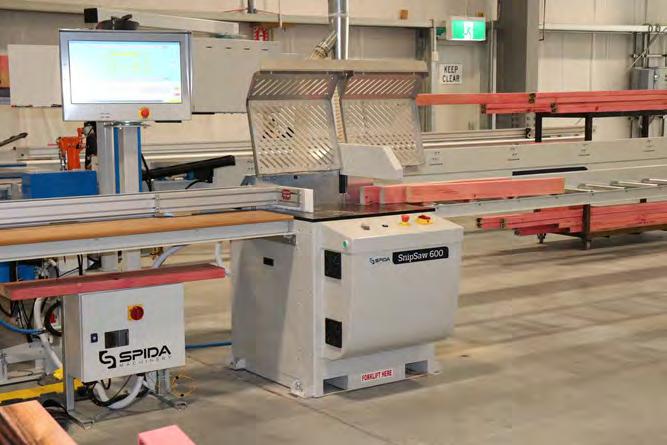 By Wendy Boyd Chief Customer Officer –Sales, Service & Marketing

hen arriving back to work after Christmas holidays, I had a few hundred emails to work through and a multitude of other tasks to conquer so I’d be up to speed again for 2023. One of the most compelling emails I had was from a Truss and Wall Fabricator who was appealing to me to help solve an age-old problem. The email went something like this:
WWendy, I want to talk to you about some machinery for my factory. I can’t get my workers to come to work, they are either away on holidays, they are sick, or their family is sick – hence I only have half my staff come to work daily – what can Spida do to help?
My first thought was: wow, where do I start? Better cutting, better automation – Spida has so many options that could help!
Immediately I looked at my stock on hand to see if I had a quick solution to his cutting problems. With quite a few Spida saws in stock, we had a conversation on cutting requirements for his factory and how we could increase his cutting capacity with just one new saw. Could one saw make a huge difference? (Hint: the answer is YES.)
He also had a completely manual wall framing line with 10 men who would work on it – but on average only 5 would show up to work on any given day. Could we redeploy the dependable workers so that they were productive and efficient every day? (Hint: the answer is YES.)
PHONE: 800-289-5627 FAX: 800-524-4982 Read/Subscribe online at www.componentadvertiser.com Don’t Forget! You Saw it in the Adverti$$er February 2023 #15283 Page #17 A dverti $ er Component manufaCturing m The
Continued next page
Chatting about output, he understood that the Spida Wall Line’s capability eclipsed that of his current planned lineal feet per day of wall frames. He looked at where this wall line could fit in his plant and who he needed to make it work. He had 4 men that he knew were the workers who showed up every day – and that’s all he needed to operate the wall line we were discussing and to keep the production promises made to keep his factory running. I could see his mind ticking over about the possibilities going forward. Could he increase his production numbers and start getting more market share in his city? (Hint: the answer is YES.)
We were well on the way to helping him solve the issues he was having, but there was one more thing to add to his list that would be an easy way to increase his truss production. We discussed the capabilities of a Mini 8 or Mini 10 table press to help his already overburdened truss line. With a couple of dedicated workers –that were repurposed from around the factory (he didn’t need 5 of those men on the wall line anymore), he planned on pushing quite a few trusses to one of these tables. Easy to install and just as easy to learn with a little training, the Mini 8 or 10 can do anything from small to large trusses with just a few men. Would this help him increase his production even more? (Hint: the answer is YES.)


So with just a few conversations, I was able to provide a multitude of options to help the sender of that 1 email. Only 199 more emails to go….
If we can help you with your 2023 requirements, please let us know. We have Tony in South Central, Dan in the Southeast, Bill in the Northeast, and Mike in the West – all can be contacted via our Spida office or via the contact page on our website. Happy 2023!

PHONE: 800-289-5627 FAX: 800-524-4982 Read/Subscribe online at www.componentadvertiser.com Don’t Forget! You Saw it in the Adverti$$er February 2023 #15283 Page #18 A dverti $ er Component manufaCturing m The
priority, Call Me. If the salesman will do - we'll talk later...
Also, don't let Financing Deals influence your best solution. FitzGroup can arrange – Zero down & No payments for 90 Days!


Please be assured that your investment with any of our selected partners will not cost one penny more with the Fitzgerald Group as your purchasing contact. In addition, you will receive the full advantage of our Partner Relationships and Services NOT offered elsewhere.

PHONE: 800-289-5627 FAX: 800-524-4982 Read/Subscribe online at www.componentadvertiser.com Don’t Forget! You Saw it in the Adverti$$er February 2023 #15283 Page #19 A dverti $ er Component manufaCturing m The REPRESENTATIVES 765-751-9990 www.woodtechsystems.com Monet FWA 500 Floor Web Saw New, Monet five-head, floor truss web saw, cuts 4-angle, 4x2 floor truss webs from 16 inches and 90-90 blocks from 12 inches to four foot long maximum length. Features 10-board magazine feed, powered, fixed-quadrant angulation, manual carriage standard, shaker-pan scrap conveyor with short incline conveyor and cut-off blade. Option for longer carriage length, single-sided setup (shown in pictures, but not standard), dust hood and horizontal scrap conveyor. 480 volt, 3 phase. Call for pricing, FOB MO. NEW! 800-382-0329 | www.wasserman-associates.com
LLC a blending of excellent services and products, with answers that work...!© Not producing the results you need or want – getting conflicting info about what to do and the equipment and the systems you may need? Before you Buy - Ask yourself –do I need a salesman or a guide? If you want an Independent Guide that has your bottom-line results as the #1
Fitzgerald Group,
RFitzgerald@FitzGroup.com
www.FitzGroup.com A dverti$er Component manufaCturing S erving the S tructural B uilding c omponent S i ndu S try The Hiring Zone Building Component Industry's Job Board Employer to Candidate Direct Hiring No Recruiting Fees! Post your Opportunity... Candidates respond directly to you! For Additional Information Contact: twm@componentadvertiser.org or Call: 800-289-5627 x1 Visit our website: www.componentadvertiser.com/Hiring-Zone 2021 Hain 20' Powered Measuring System & 2 Dewalt Saws • 20' Hain Powered Measuring System • Feet & Inches System (Stops at 12" Centers) • Motor: 1/4 HP Linear Actuator (110 Volt) • Infeed/Outfeed Roller Conveyor with Stands • (2) DeWalt Sliding Compound Miter Saws Details
719.528.5445
Leverage the power of a strong network.
As a truss component manufacturer, you already know Simpson Strong-Tie as a reliable partner in the construction industry. But our connections go beyond the products we make. Our people can help reinforce your network of builders, engineers, contractors, equipment manufacturers and suppliers, strengthening your existing relationships. Also, our open-platform software is integrated with the most widely-used systems, and can be customized to work with the machinery you choose. Backed by our expert service and support, you’ve got all the resources to succeed.
Grow your business ecosystem with a well-connected partner. To learn more, visit our website at go.strongtie.com/componentsolutions or call (800) 999-5099.

© 2022 Simpson Strong-Tie Company Inc. TRUSS23PART
Simpson Strong-Tie® Building Technology | Software and Service for Smarter Business

IntelliVIEW Suite Manage. Design. Build.
The industry’s most powerful integrated component design, engineering, and management software for steel and wood-framed structures.
iCommand
Manage projects, customers, materials, pricing & inventory
iModel
Design truss layout & profiles


iDesign
Optimize material usage & engineer trusses

iPanel
Design wall layouts, panelize, bundle, break & stack
eShop
Maximize crew productivity & improve manufacturing efficiency
The IntelliVIEW Suite is a fully integrated software solution for the layout and design of a building’s rough framing elements—including roof and floor trusses, wall panels, solid sawn, EWP, sheathing and various ancillaries.


The IntelliVIEW Suite provides the industry’s most complete analysis of the design, cost information and bill of materials—promoting increased profits by reducing plate and lumber use.


Ask those who know. They’ll tell you about the people at Alpine who make a difference.

BUILD MORE. alpineITW.com | 800.521.9790
USED ALS 276 LINEAR SAW

PARTS & COMPUTER
• Used Servo Star CR10251 (2 Available) -$1,100 Each
• Used Servo Star CR06251 (2 Available) - $1,100 Each
• Used ALS Windows XP Computer - $1,500

• Used parts were removed in "working condition" from the ALS 276 during a saw upgrade FOB AL Wasserman & Associates 800-382-0329 www.wasserman-associates.com
2002 Koskovich Auto Omni component saw, 5-blade automated saw includes [3] 20 inch blades, [1] 30 inch blade, [1] 12 inch blade and shaker waste conveyor with factory side pans. Fully automated setup with full power length and all axis angulation, single-sided setup from operator console, 2×3 through 2×12 and 4×2, 20’ to 9” @ 90°/90°, Exair cabinet coolers, remote monitor, no spares. In operation until Aug. ’21. 208/240/480 volt, 3 phase, 100 Amp saw electrical required. 120 volt, 1 phase PC electrical required.
$13,970 NOW $9,997 FOB OH Wood Tech Systems

765-751-9990
www.woodtechsystems.com

Safety Speed Cut Model 7000 Panel Saw
Safety Speed Manufacturing model 7000, vertical panel saw, 3 HP induction motor, 64 inch crosscut, 2 inch maximum thickness, accuracy within 1/64th of an inch, 10 foot welded steel frame with integrated stand and linear V-guides, enclosed counterweight system, adjustable vertical and horizontal rules. Quick changes from vertical to horizontal cutting. Includes machined aluminum material rollers, hold down bar, wheels, quick stop gauges and material hold downs. Dust collection ready. Options available include lower frame extensions, digital readouts, laser guide, stop bar, vacuum and midway fence. 208-230/460 volt, 3 phase electrical (208-230 single phase, 2 HP power optional +$100.00). $9,332 Base, FOB MN.

New L-M Equipment
Verticut 2000 PET / Bunk Saw Station
The L-M Verticut 2000 is a true Precision End Trim (PET) saw that is capable of holding a 1/16th accuracy all day long. Made in the USA, the V2k comes equipped with a 15 HP 460/230 volt High-E three phase TEFC motor driving a Double ended Premium “Stellite” inlaid saw bar with a spring loaded chain tensioner and an automatic oiler to lubricate the .404 pitch custom profile semi chisel saw chain.
Rather than a single pivot-point, the saw assembly is mounted on a mandrel box that is guided by cam followers on a steel frame that is raised and lowered by a hydraulic cylinder. A console with the saw controls moves with the saw assembly along a track positioned using a manual “V” wheel geared drive or optional Hydraulic drive
The V2k is unlike other imported systems that are basically a Portable Yard Saw on a cutting rack with a best cutting accuracy of +/- 1/8″ (meaning up to ¼” accuracy variance between units of lumber). The V2k from L-M provides +/- 40 thousands, assuring consistent PET precision from unit to unit.
Another advantage L-M has over the competition is their commitment to personal service with unlimited phone assistance and technical help. Their team has traveled the country working on crosscut saws for many years and they know their equipment inside and out. L-M is a familyowned business that prides themselves in doing the job right and building long term relationship that is vital to their business: “Built to last as long as our customers since 1946”.
Price based on configuration
FOB OR
765-751-9990
PHONE: 800-289-5627 FAX: 800-524-4982 Read/Subscribe online at www.componentadvertiser.com Don’t Forget! You Saw it in the Adverti$$er February 2023 #15283 Page #23 A dverti $ er Component manufaCturing m The SAWS 765-751-9990 www.woodtechsystems.com
NEW!
2002 Koskovich Auto Omni 5-Blade Component Saw
www.woodtechsystems.com
NEW!
SERVO
Money Hides Many Sins (Waste)
Atrending DIY post shows a long sequence of nail holes alongside a wall-mounted TV with a caption that says, “I knew that stud was in there somewhere.” Meant to be a humorous poke at the times when we’ve attempted new projects, it reveals how sometimes we might not have been as skilled as we believed. We are all guilty of trying to do projects that go horribly wrong. Often these projects cost us far more than if we had just listened to a professional.

The past few years have been a tremendous boon for the building industry. This type of success can easily cause a perception of ourselves that can be unrealistic when we are on top of the proverbial success hill. We tell ourselves that when the money flows like a river, we must be the unqualified expert. TDC is witnessing hidden mistakes that will cost so many component manufacturers (CM-wood truss and wall panel manufacturers) hundreds of thousands, if not millions, of dollars with the decisions being made today. As I explain in my January article, Don’t be Blind to Simple Truths for the 2023 Build Season, maintaining sales and margins will become more challenging in the coming months and years.

The tight labor market is causing many to make expensive bad decisions. In a rush to provide equipment to lower labor costs, some vendors are losing sight, or are blind, to the basic tenets of lean and time and motion principles. By far, the Just-In-Time tool in the lean manufacturing toolbox is the most misunderstood one. In an effort to lower labor costs, expensive equipment is being sold to CMs that, in the end, will cost the CMs millions of lost sales. The latest example is a floor truss assembly table made by a reputable truss equipment vendor which is the most ergonomically poor design TDC has witnessed in twenty years of professional consulting. My recommendation to my client, where I saw this brand new table, was to sell it and purchase a used or new floor truss table for better results. The cost of lost sales from the poorly designed table will be substantially higher than the cost of the table itself. Numbers do not lie, and the end results will clearly show that the overall output will be dramatically lower.

PHONE: 800-289-5627 FAX: 800-524-4982 Read/Subscribe online at www.componentadvertiser.com Don’t Forget! You Saw it in the Adverti$$er February 2023 #15283 Page #24 A dverti $ er Component manufaCturing m The
Continued next page
Todd Drummond
New equipment installs and new manufacturing facilities are being built with preventable constraint costs that can never be removed. In other words, they would have been able to produce far greater output with the same equipment had it not been designed with seriously flawed bottlenecks in their overall systems. I cannot emphasize enough how poorly some new manufacturing buildings are being designed with no future expansion capabilities. Also, very expensive new truss tables are being positioned and combined with equipment that will forever constrain the total capabilities that would be possible. Even when a vendor is very successful with their sales, and is honorable in their advisement, they may be mistaken as to their recommendations of what is best for your needs. TDC cannot emphasize the importance of properly understood lean principles and industrial engineering practices in all areas of your operation, not just manufacturing.
When a company truly understands and follows lean manufacturing principles, one can find areas that need improvement, and the barriers that block improvement cannot be an excuse for a needed change.

Another example is that so many LBMs and CMs are struggling with their company’s existing communication and tracking enterprise resource planning (ERP) systems provided by plate and accounting vendors. The most common statement by most is that it is “good enough” or “just takes a little bit more training and investment” to get their system to where all their sales teams will use it. Too often, their systems do not connect all the information from every division within the company. The apps are too complicated for many sales team members, and not all the information is updated or available. Suppose your salespeople cannot find all of an order’s needit-right-now information, such as all relevant emails, documents, schedules, automated reminders, all various departments information beyond the CM operations, and detailed status of every stage via a web browser on the cellphone without calling someone. What kind of time-wasting events do you think are happening within your company in every department every day? When a salesperson has to interrupt someone else’s work to get an answer to 95% of the repeated typical questions being asked, why in the world does your company feel this is acceptable? If your current vendors are not resolving this never-ending time-wasting problem, perhaps it is time to look for another solution.
PHONE: 800-289-5627 FAX: 800-524-4982 Read/Subscribe online at www.componentadvertiser.com Don’t Forget! You Saw it in the Adverti$$er February 2023 #15283 Page #25 A dverti $ er Component manufaCturing m The
Continued next page
Current success is not a guarantee of future success. Properly understood lean principles combined with industrial engineering practices can prevent many current and future potentially costly errors within your company’s system. It applies in every area, not just manufacturing.

The team of TDC is your best source for learning about proven and practical lean manufacturing best practices combined with industrial engineering principles to keep your company at the leading edge of competitiveness. No one is better at providing your team with proven results for good employee practices, pricing, truss labor estimation, and so many other best-in-class practices. TDC’s tailored solutions are for the client’s specific needs. Go beyond the typical software and equipment vendor recommendations for your operations and do what many have dared to do. Embrace the Drummond Method, and your company can experience cost savings, and net profit gains that usually take months or years can be accomplished in weeks or months, resulting in an average of 3 to 6-point net profit gains for CMs. All areas are addressed, not just the manufacturing. Please do not take my word for TDC’s services, though. Read the public testimonials many current and past clients with decades of expertise and experience have been willing to give: https://todd-drummond.com/testimonials/
Website: www.todd-drummond.com
Phone (USA): 603-748-1051
E-mail: todd@todd-drummond.com
Copyrights © 2023
Work Smar ter
2Seconds
That'sallthetimeittakes
todrillstudsforrunningRomexorotherelectricalwireinthewallpanels
Motor: HeavyDuty5HP-3phase-220vor440v(Pleasespecifywhenordering)
MotorcarriagebearingandspindleassemblymountedonBlanchardgroundsteelplate
LinealmotionishardenedandgroundVbearingsandrails
BlockSizes: 2x4through2x12infiniteheightsettingtocenter
AirSupply: 100psi10CFM
Drills: 2wing3/4'”CarbideTippedcanaccommodatesmallerorlarger
Spindles: AlloySteelpolishedandgroundprecisionshafting
Frame: 2"SteelWithPowderCoatFinish
Covers: 10Gauge(1/8"Thick)Aluminumremovable
Dimensions: Height-60inches,Width-33inches,Depth-33inches
Shippingweight: 750lbs.-(Includingcrate)
MADEINAMERICABYAMERICANS
PHONE: 800-289-5627 FAX: 800-524-4982 Read/Subscribe online at www.componentadvertiser.com Don’t Forget! You Saw it in the Adverti$$er February 2023 #15283 Page #26 A dverti $ er Component manufaCturing m The
916-508-3558• ww w.thehaincompany.com SeetheStudDrillerinaction! Goto https://youtu.be/AnODX5vPesE forademonstration


4,001,398


That’s the total trigger count from all six nail guns combined on an installed Terminailer.® For a machine that was a little over two years old, that is a big number; a real tribute to the durability of the machine’s components and engineering.

Yes, that number represents a pretty darn impressive mechanical milestone to be sure, but what is really impressive is that human hands were saved from millions of repetitive motions and potentially costly nailing accidents.
With just a sole operator, Terminailer drives a whole lot of improvement in efficiency and output. This amazing sub-component assembler quickly and precisely drives 30% to 70% of the framing nails in any wall panel job—be it batch, or just–in–time production. All with no complicated training, software or set-up time required when switching configurations. Add increased safety and easy maintenance with off-the-shelf parts, and you can see why Terminailer should be driving greater productivity in your plant.
Put things together like never before.

www.TERMINAILER.com 765-751-9990 Terminailer ® is a registered trademark of Construction Industry Innovations, LLC Copyright 2023 All Rights Reserved
Terminailer® and
Terminailer XP
Call

Condition: New Location: MO
New, Monet DeSawyer 2000, computerized, five-bladed component saw, sets up in 15 to 17 seconds, can run in manual mode, downloads projects from a network or manually using display screen controls. Features all powered movements, cuts from 15" 90/90 cuts to 20 foot length, 2 x 3" to 2 x 12" lumber depths and internal brakes are standard. Options include enhanced servo controls featuring autocalibration, catcher's display and either shaker or belt scrap conveyor and incline. 440 volt, 3 phase electrical.


PHONE: 800-289-5627 FAX: 800-524-4982 Read/Subscribe online at www.componentadvertiser.com Don’t Forget! You Saw it in the Adverti$$er February 2023 #15283 Page #29 A dverti $ er Component manufaCturing m The 765-751-9990 www.woodtechsystems.com
NEW!
New Monet DeSawyer 2000 Component Saw
for
Pricing
One month after installing a Double Lumber PickLine to feed two TCT Linear Saws:

"We are getting 3,000 to 5,000 bdft more each saw, than we were getting before the install.


We have shut down one Cybersaw and one TCT chord saw.
This equals about 3 less people 10 hours, and 2 less forklifts 10 hours.
Overall, it is a major improvement to our operation. We hope to have the chance to run it two shifts to further accelerate the payback.”
Tom Hollinshed, Owner
LimTek Solu�ons Inc.


6021 Yonge St., Unit 1019
Toronto, ON M2M 3W2
Tel: (416) 888-4457
Edmond.Lim@LimTekSolutions.com
Edmond.Lim@LimTekSolu�ons.com
LimTekSolu�ons.com






PHONE: 800-289-5627 FAX: 800-524-4982 Read/Subscribe online at www.componentadvertiser.com Don’t Forget! You Saw it in the Adverti$$er February 2023 #15283 Page #31 A dverti $ er Component manufaCturing m The Your Solution for Lack of Technical Staff ● PlanSwift Lumber and Building Material Takeoffs ● Truss and Wall Panel Design Experienced Staff ● EWP Layouts and much more! All Points was launched by Industry Veteran Dave Walstad with over 20 years of Offshore Experience to create the Gold Standard in Technical Support Teams. 1-941-713-4395 www.AllPoints.Tech Dave.AllPoints@gmail.com Offices in: Panama City Beach, FL USA HCMC (Saigon), Vietnam Bengaluru, India Eliminate your lack of technical resources to grow sales and increase the clock speed of your company. We have the network and experience you can count on Deploy Technical Teams from All Points! 800-382-0329 | www.wasserman-associates.com 2000 Alpine AutoMill Automated Component Saw • Automated Setup via Download or SemiAutomated Setup via Touch Screen Input • 19 Axes of Automation • Five Blades cut 2x3 thru 2x12 from 18" to 20' • Waste & Incline Conveyor • Out of Service in 2018 • 480 Volt / 3 Phase • Price is in US Dollars $29,500 FOB ON Details
PERFECT Heels,Angles, & Lengths
Safe, accurate cutting of any component with the ProCut™ UC Linear Saw Series
Roof, Floor, and Wall components: Webs, Chords, Sliders and Wedges – up to 4-boards high! The ProCut™ Linear Saw Series is configurable to any assembly line – providing a safe, accurate way to cut your lumber, while keeping your materials moving on your line.
Maximize your output with ProCut™ Material Handling Systems
Feed the ProCut™ with bulk lumber staged around the Linear Infeed Conveyors. Materials are picked and placed in the order which it is to be processed. Lumber is fed to the ProDeck™ Lumber Infeed - where it accumulates and is dispensed to the sawyer.

From the ProCut™, the cut material is conveyed to an accumulator where it is grouped and placed together with all components for the job. The material is conveyed to the staging area at each truss assembly workstation. The staging areas at the table provide an uninterrupted supply of perfectly cut and organized material.


Eliminate the carts and congested staging areas in your plant. The ProCut™ saw, when used in combination with the ProDeck™ and our Custom Material Handling Systems, can be configured to improve the flow of perfectly cut parts and materials directly to your assembly stations.
The ProCut™ UC Linear Saw Series offers many variations to suit your plant and assembly line. Let us design a system for you.
UC LINEAR SAW SERIES ™ UC LINEAR SAW SERIES ™ ProCut LLC (612) 521-9193 www.eidemachinery.com/emsi-procut/
ProCut™ UC-4 shown.
ProDeck™ Options Available.
•
Used
•
2018 Hornet MC-19 Cutting Stations (Qty of 2)
•
Motors: Two 1 HP / 220 Volt or 440 Volt / 3 Phase
Saw Blades: 7 1/4"
Carbide Tipped (set
Angle Adjustment: Manual Rotation with Air Brake
Carriage: Steel Rails with Steel Dual V Rollers
Pedestal: 3/16" Formed Steel
• Covers: 10 Gauge (1/8" thick) Steel
Fully Enclosed for Safety
2018 Hornet model MC-19 chop saw version cutting stations, include 25 ft long infeed and 10 ft long outfeed. Two available at this location. Price is per each. Each station includes infeed pusher, chop saw, marking device, automated controls, outfeed, control panel and CutBuild Automation software. Sold for $59,500 new. 220 volt, 1 phase electrical required for station. 110 volt, 1 phase electrical required for computer.


$47,993 FOB NV
Wood Tech Systems 765-751-9990

PHONE: 800-289-5627 FAX: 800-524-4982 Read/Subscribe online at www.componentadvertiser.com Don’t Forget! You Saw it in the Adverti$$er February 2023 #15283 Page #33 A dverti $ er Component manufaCturing m The SAWS
Hain Quick Rafter Cutter
www.woodtechsystems.com Reconditioned in December 2020
Board Sizes: 2x4 and 2x6
•
•
at 45 degrees)
•
•
• Air Supply: 90 PSI
•
• Saw Housing: 1/2" Billet Aluminum
$12,500 FOB MN Wasserman & Associates 800-382-0329
800-289-JOBSJobLine.com, inc. Time To Hire? We’re here when you need help! visit: www.thejobline.com email: twm@thejobline.com STRICTLY CONFIDENTIAL! The
www.wasserman-associates.com
The truss industry relies on 3rd party quality assurance services to provide random visits to review the plants Quality Assurance program along with their operations. If your plant needs to comply with the IRC, IBC and to those who depend on solid, experienced QA expertise, we ask you to consider selecting Timber Products Inspection, Inc. (TP) as your choice for 3rd party inspections.

Proudly serving the forest products industry for over 50 years, TP brings the expertise you need to ensure your business is successful. As a responsible partner, TP delivers to clients, employees, and the industries we serve the confidence to drive value through the effective use of our diverse professional team.


TP would like to welcome the following authorized agents to our inspection team, each of whom have many years of experience in the truss industry!
• Al Coffman
• Jean Hart
• Curt Holler
• Chuck Ray
• Glenn Traylor
• Elliot Wilson
If you have questions about how you can make this selection, please contact your authorized agent above or Glenn Traylor at 919-280-5905 or trusguy@gmail.com.
https://www.tpinspection.com/ https://www.tpinspection.com/auditing-services/truss
Read/Subscribe online at www.componentadvertiser.com
Has Your Guideline Shifted?
By Glenn Traylor

Recently after receiving a phone call from a client, I reflected on our conversation. I was a little caught off guard with the direction the conversation took and felt like I needed to make a few issues clear. And, it has led me to reflect on boundaries and guidelines – why they exist and how they can shift over time.
The call started out as a basic call: “I need some assistance on a project.” My response was OK, what is it that we need to address? The caller explained that, during in-house inspections, it was determined that some lumber was substituted incorrectly, resulting in non-conforming lumber grades in some trusses. I asked: “How many trusses are we talking about?” The response: “Why does that matter?” I responded: “Well, depending on the quality of trusses, it would impact the potential solution.” My client responded: “Well, I have no idea how many trusses… I’m not sure how many jobs are involved. All I know is that my guys have been substituting #2 Southern Yellow Pine for drawings that called for #1.”
My first priority was to get a handle on the scope of the problem. Is it a problem with trusses in the yard? Trusses just built? Were the trusses delivered? Installed? Each of these scenarios could require a different solution.
The photograph of the errant white line on the pavement is a good metaphor for this situation. The manufacturing plant has correct protocols in place, but over time they were not followed successfully. Initially this road accurately followed the gradual curve of the highway. Eventually though, because of a soft area under the roadbed, the road pushed out toward the shoulder, creating a bulge in the white line. Although the line has remained intact, it is no longer a good indicator to a driver as to where to aim his vehicle. Within the context of the road, the line provides a guide to the driver to keep his vehicle out of the ditch, but anyone looking at the line will know it no longer defines that driving lane.

PHONE: 800-289-5627 FAX: 800-524-4982 Read/Subscribe online at www.componentadvertiser.com Don’t Forget! You Saw it in the Adverti$$er February 2023 #15283 Page #35 A dverti $ er Component manufaCturing m The
Continued next page
In this plant, there are four production individuals who had the opportunity to verify and catch an improper substitution of lumber.
1. The lumber picker
2. The sawyer
3. The catcher
4. The truss builder
Then, if all that failed, the in-house inspector should have caught the problem on their weekly inspections. Statistically speaking, three inspections are supposed to be adequate to catch this sort of error. But is that enough? My answer might surprise you.
Even though five individuals failed to catch this situation promptly, that does not mean the frequency of inspections should be increased unilaterally. Consider this:
• Manufacturing that is solely dependent on an inspection to catch problems would require a 100% inspection.
• The ANSI/TPI 1 Chapter 3 procedure does not require 100% inspection. It does not need to require this type of inspection.
The reason is because the Quality Assurance Program is more than just inspections. It’s a review of procedures and processes that take place in the truss plant. It’s a review of the lumber selection process, the process of the catcher and sawyer. It involves walking through the entire plant identifying problems and areas that can create problems. This is specifically why in-house inspectors must do their job. It’s to check the process, not a specific truss inspection. The same is true with the thirdparty inspector. Without boots on the ground, scanning the shop floor, viewing lumber inventory, walking the aisles, the QA process is critically flawed. There has got to be a perspective view from different angles to get an accurate grasp of the situation.
An ANSI/TPI 1 3rd Party Quality Assurance Authorized Agent covering the Southeastern United States, Glenn Traylor is an independent consultant with almost four decades of experience in the structural building components industry. Glenn serves as a trainer-evaluator-auditor covering sales, design, PM, QA, customer service, and production elements of the truss industry. He also provides project management specifically pertaining to structural building components, including on-site inspections and ANSI/TPI 1 compliance assessments. Glenn provides new plant and retrofit designs, equipment evaluations, ROI, capacity analysis, and CPM analysis.
Glenn Traylor Structural Building Components Industry Consultant http://www.linkedin.com/in/glenntraylor
PHONE: 800-289-5627 FAX: 800-524-4982 Read/Subscribe online at www.componentadvertiser.com Don’t Forget! You Saw it in the Adverti$$er February 2023 #15283 Page #36 A dverti $ er Component manufaCturing m The
“I would encourage other component manufacturers to attend the workshop because it is an opportunity to gain a better understanding of MSR and how it can be used. That makes you a more responsible customer because you know how to maximize its use in the design of your product.”
—Porter Clark, Hiwassee Builders Supply Inc., Athens, TN

“Unless they can say they have their business running perfectly, I believe there’s something any CM can take back from the workshop to improve their business. I know our business will be better because we attended.”
 —Adam Beck, Drexel Building Supply, Campbellsport, WI
Hotel Valencia Riverwalk
East Houston St. San Antonio, TX 78205 Hotel
April 5 Register Today!
4/26 Golf Outing Social Hour Independent Dinner
4/27 Educational Sessions Tour Hosted Dinner Friday, 4/28 Educational Sessions A PRIL 26-28 San Antonio, TEXAS Learn more at msrlumber.org/workshop
WORKSHOP
150
Deadline:
Wednesday,
Thursday,
2023

Electrical Supply: 110 VAC
Motor: 1/4 HP, 110 VAC, Linear Actuator
Highly Accurate: +/- .010 Inches

Stop Rail: 2 x 4 x 1/4 Aluminum Extrusion


Stops: Jig Bored Steel
Stop Blocks: Machine Billet Aluminum
Internal Components: Hardened, Ground and Polished Steel and Billet Aluminum
Dimensions:
Length: 5 feet (60”) to 60 feet (720”)

Height: 12 inches
Depth: 12 inches
If you are looking for the fastest, most consistent way to measure and cut your product, then the Hain Measuring System (MEA) is your answer. The MEA changes from one length t any length instantly, up to 60’, without changing the operator’s position on the line. It is also highly accurate (+/- .010) and quickly moves from one length to the next in seconds. The MEA is designed for quick and easy setup and is simple to use. Even a first time user will be productive with little or no training required. It can adapt to any saw and can be mounted to any surface so that you can integrate the MEA with your existing setup. The MEA is versatile allowing “left” or “right” handed operation and measurement in “feet and inches” or “inches” depending on your preference. The MEA is also available in a “Skid Mounted” version.

theHAINCOMPANY 6125 Enterprise Drive, Unit 9 | Diamond Springs, CA 95619 530.295.8068 | sales@thehaincompany.com

Spida Automated Apollo Saw
The Spida Apollo saw with Automation is a computerized, pull-arm type saw used for cutting either wood truss components or wall panel cutting and represents the lowest-cost way to add an automated single-blade saw to your operation. Features include angle cutting from 10 to 170 degrees, 36 inch scarf cuts, patented variable stroke limiter for safety, solid frame and arm design, 17 inch industrial touch screen with enclosure, 7.5 HP motor, plug and play wiring making installations easier and includes cowls for adding a dust extraction system.

Available options include software is available for both trusses and wall panel cutting, laser guide showing exactly the path of the blade before the blade moves, Safe Grip™ Clamp for cutting smaller pieces, clamping table, Plate Marker template providing automated set up for marking joint locations (studs, sub-component locations, etc.) on top/bottom plates, Chop Saw Table for adding another saw for miter/compound or end cuts, prior to feeding the Spida Apollo saw, Portable Dust Extractor and spare blades.
Saw is available in 240 volt, 20A or 460 volt, 15A 3 phase electrical. Computer requires 110 volt, 1 phase, 20A.
$64,500
PHONE: 800-289-5627 FAX: 800-524-4982 Read/Subscribe online at www.componentadvertiser.com Don’t Forget! You Saw it in the Adverti$$er February 2023 #15283 Page #39 A dverti $ er Component manufaCturing m The 765-751-9990 www.woodtechsystems.com
FOB NZ/IN NEW!
Prestage Tabl
Capabilities*
Wall Heights: 7' 11 ½" to 10' 3" - 12 ' 3" - 14' 3" or 16' 3"
Wall Lengths: 16', 20' or 24'
Pre-Stage Area: 16', 20' or 24' (matches wall length)

*Subject to change without notice
Why a Prestage Framing Table?
The new field-tested Triad PreStage Framing Table, designed and built with customer input, can bring increased productivity to your panel shop.
Triad's exclusive and unique design merges a pre-layout material-staging area with a fast and efficient framing station -- into a single unit that can assist with rapid throughput in your plant.

A powerful, built-in continuous track system lifts and conveys components and material to framers and then the finished panels to your next station.

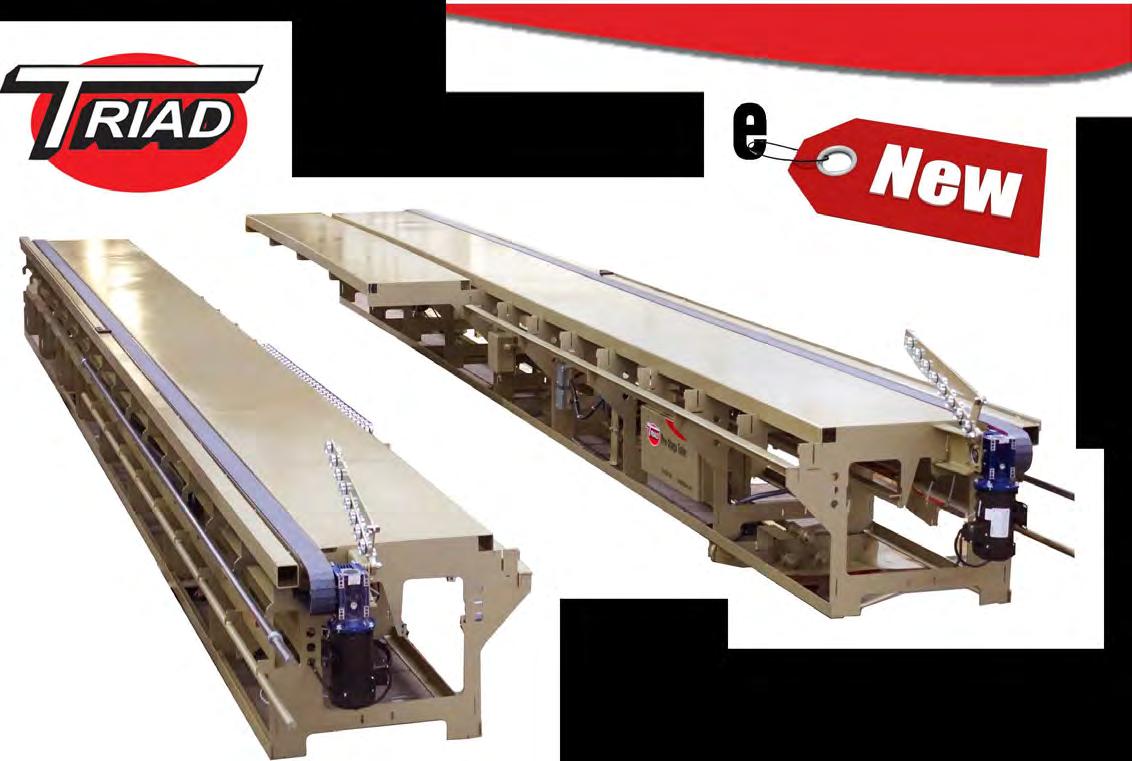
Initial customer field production, from a Texas plant, has shown an average of 3600 linear feet per day (8 hr shift) of framed walls in their facility!

Cal I to learn more about this approach! Experience you can trust. www.TriadMachines.com I P.O. Box 130 Alda, NE 68810 I 800-568-7423 Ext. 133
New Monet DeRobo Linear Saw
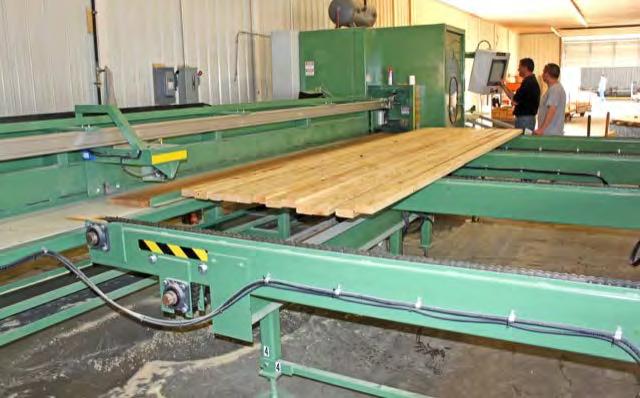
New, DeRobo linear saw by Monet organizes "fill" boards to increase optimization of each board, can produce unlimited scarf cuts, cuts 1 or 2 boards at a time and cuts webs, chords, wedges, rafters and open-stair stringers. Works with all major connector plate manufacturer's software. Features include 22 inch blade, left-to-right feed direction standard, lumber push and pull grippers for more accuracy, ink marking on the 1 1/2" face of the incoming boards and small piece capture and delivery to the front of the saw for easy access. Infeed deck and bunk feed are shown as options only. 480 volt, 3phase. Call for pricing, FOB MO.
765-751-9990
REPRESENTATIVES
New Spida Rolsplicer
New Square 1 Rolsplicer, splices 2"x3", 2"x4" and 2"x6" lumber with a 3 to 4 second cycle time. Presses the lumber together prior to imbedding plates. Embeds plate lengths up to 19 inches. Features two, recessed, simultaneous-activation buttons, guarded motor and sprockets, external lubrication points, 3 HP motor and a footprint of 59" long x 42" wide. Optional 20' infeed and 10' outfeed conveyor available. 480 volt, 3 phase electrical. Other voltages available.
765-751-9990
$29,800 FOB IN
www.woodtechsystems.com


PHONE: 800-289-5627 FAX: 800-524-4982 Read/Subscribe online at www.componentadvertiser.com Don’t Forget! You Saw it in the Adverti$$er February 2023 #15283 Page #41 A dverti $ er Component manufaCturing m The REPRESENTATIVES
www.woodtechsystems.com
NEW!
NEW!
By Traacy Roe
Dependability in an Uncertain Environment

The most popular outlook for 2023 that I have heard is uncertainty. Nobody has a clear picture of what the new year will bring for our industry. Large investments have been made in talent, equipment, and infrastructure to capitalize on the increased demand over the past two years. What about your software? Have you had to adapt your process to fit the capabilities of your current offering? Could you use some additional enhancements to really get every ounce of productivity from your process?
The TrueBuild® Job Management application by Eagle Metal offers a level of adaptability and customization far beyond what the industry is used to. Imagine a scheduling platform that gives you everything you need and nothing that you don’t. Do you want to track deliveries only? Do you want a calendar and tracking for EVERY step in your operational process? This calendar was designed from the ground up to give you exactly what you need.

Now that you have things being scheduled and tracked the way you need them to be, how can you determine if you are doing any good? Job Management from TrueBuild® offers an instant, sortable, customizable snapshot of all of YOUR key metrics. You decide what you see and who sees it inside your operation. Break down your sell price and volume the way you want to see it. You are in control and the information is presented in the format you want for the date range you need.

PHONE: 800-289-5627 FAX: 800-524-4982 Read/Subscribe online at www.componentadvertiser.com Don’t Forget! You Saw it in the Adverti$$er February 2023 #15283 Page #42 A dverti $ er Component manufaCturing m The
How do you know if your labor costing scheme is accurate? Data, of course. TrueBuild® Job Management gives you complete insight into your estimated labor costs from your labor pricing schemes and compares that to your input actual labor costs. All of this information on an easy-toread screen in real time. Gone are the days of having to adjust pricing for difficulty by feel and experience. Let this software do it for you.


Straight forward software for people who get things done developed by people who have done it. Everything you need and nothing that you don’t. Don’t compromise your process or limit your productivity because your software won’t support it or it isn’t dependable. You have invested too much to settle for anything less than exactly what you need. Visit eaglemetal.com to learn more or contact us at 800-521-3245. It’s time for an upgrade.
PHONE: 800-289-5627 FAX: 800-524-4982 Read/Subscribe online at www.componentadvertiser.com Don’t Forget! You Saw it in the Adverti$$er February 2023 #15283 Page #43 A dverti $ er Component manufaCturing m The

NEW!
Component Saw
2002 Auto Omni 5 blade automated component saw includes shaker waste conveyor with factory side pans, [3] 20 inch blades, [1] 30 inch blade and [1] 12 inch blade. Fully automated setup with full power length and all axis angulation, single sided setup from operator console, 2×3 through 2×12, 22’ to 3′ @ 90°/90°, and spare blades. 208/240/480 volt, 3 phase, 100 Amp and 120 vac, 90 Amp electrical required.

Price: $19,990 FOB PA
Wood Tech Systems 765-751-9990
www.woodtechsystems.com
2008 Alpine PF90 Wall Panel Saw
2008 Alpine PF 90 wall panel cutting and marking system. 3.5″ x 12″ maximum cutting profile, Inkjet option, cuts to 16 ft long. From the OEM’s literature, “Effortlessly handles two of the most critical and difficult processes in any wall panel operation – plate cutting and panel layout. At the rate of 1,000 linear feet per hour or more, uses data from the design software and accurately marks stud, cripple and jack locations, job and panel number, subcomponent and window/door locations, and even sheathing locations on both top and bottom plates simultaneously with ink-jet printing.
MORE INFORMATION HERE
$8,499 FOB NY
Wood Tech Systems

765-751-9990
www.woodtechsystems.com
REPRESENTATIVES
Safety Speed Manufacturing Model 6400 Panel Saw
Safety Speed Manufacturing model 6400 vertical panel saw, 3 HP worm drive motor, 64 inch crosscut, 1 3/4" inch maximum thickness, accuracy within 1/64th of an inch, 10 foot welded steel frame with integrated stand and linear V-guides, enclosed counterweight system, adjustable vertical and horizontal rules. Quick changes from vertical to horizontal cutting. Includes machined aluminum material rollers, hold down bar, wheels, quick stop gauges and material hold downs. Dust collection ready. Options available include lower frame extensions, digital readouts, laser guide, stop bar, vacuum and midway fence. 120 volt. Starting at $5,169 FOB MN.

2019 MiTek Blade Linear Saw (# 2)

MiTek Blade model number 89060-501, with 20′ infeed, face printing via Matthews printer model DOD 8000+ Maxi. Features 17″ saw blade powered by 5HP motor to cut 2×3 through 2×12 boards. Left to Right in-feed in “Reverse U” configuration with 18′ out-feed conveyor. Includes any available spare parts, 230v/3Ph electrical power required, and 110 PSI at 40-50 CFM air pressure as specified by the OEM.
$364,990 FOB CA
765-751-9990
www.woodtechsystems.com

PHONE: 800-289-5627 FAX: 800-524-4982 Read/Subscribe online at www.componentadvertiser.com Don’t Forget! You Saw it in the Adverti$$er February 2023 #15283 Page #45 A dverti $ er Component manufaCturing m The SAWS REPRESENTATIVES 765-751-9990 www.woodtechsystems.com New Monet FWA-500 AC Automated Floor Web Saw Call For Pricing FOB MO Additional Information Here NEW! 765-751-9990 www.woodtechsystems.com
2002 Koskovich Auto Omni 5 Blade


Setting the Goal of One Thousand Pieces per Hour

A“Thousand Pieces an Hour” is a golden truss production metric and a lofty goal for many component plants. If one thousand is the magic number, even at 75% efficiency, in a 7-hour shift (7 hours x 1,000 pieces/ hour, at 75%) that would be 5,250 pieces with potential to achieve 7,000 pieces. So, let’s use 750 pieces per hour as a production rate goal.
For a truss plant, pieces per hour is easily measured and/or extracted for every labor process and every machine utilized in truss production. For example, how many pieces of lumber can be picked in an hour? How many pieces are cut on a saw in an hour? How many pieces of lumber can be stacked behind a saw in an hour? How many trusses can be built on a jig in an hour?

Material handling, process organization, machinery, and the labor required can all be measured. I’m asked all the time how much production should be expected, or in other words what does it take to “Feed the Beast.” Fortunately, through videos/pictures and better yet by attending a plant tour, one can see how Enventek’s Process Organization Technology can achieve “A Thousand Pieces an Hour.”
How We Feed the Beast
Although I could go into great detail on all aspects of our process improvement, it’s always best to highlight these three. Individually or in combination, they will get you well on your way to the thousand pieces per hour goal.
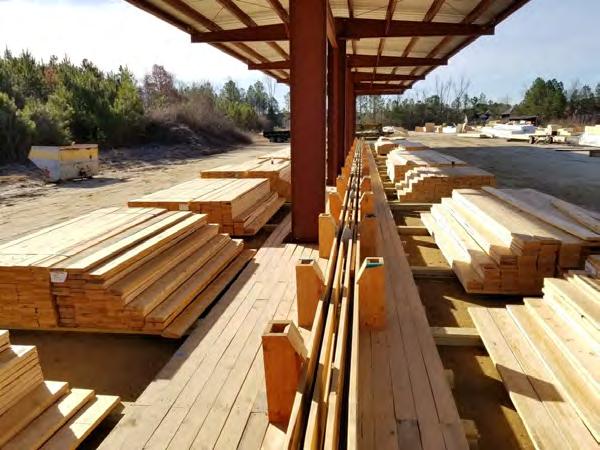
Lumber intake: With a Lumber PickLine, if a board is dropped every 5 seconds into the chaindriven lumber trough, that would be a picking rate of 12 boards a minute (720 pieces an hour) for a total of 5,040 pieces in 7 hours. Organizing your lumber with a Lumber PickLine eliminates excessive forklift lumber picking and reduces operating costs significantly. And, picking lumber using our ingenious symmetrical batch mode makes the process essentially cut-by-truss when the autofill carts are positioned in sequence in front of the truss build tables.
PHONE: 800-289-5627 FAX: 800-524-4982 Read/Subscribe online at www.componentadvertiser.com Don’t Forget! You Saw it in the Adverti$$er February 2023 #15283 Page #48 A dverti $ er Component manufaCturing m The
Continued next page
Edmond Lim, P.Eng. LimTek Solutions Inc.
Cutting: The amazing RetroC is a marvel to watch as the truss industry’s only auto-feeding component saw capable of cutting lumber at a rate of over 90 pieces per minute. Even with a 50 ft live deck, you will never be able to keep Feeding the Beast at this rate for long. Using the industry standard feed rate of 18 pieces per minute already yields more than one thousand pieces an hour. Having this much wiggle room is why the RetroC can be fed lumber collated for cut-by-truss to speed up truss production at the tables and also organize the cut lumber for left and right of table.
Material handling: The SpeedCatch sorting and optimizing algorithm is quite sophisticated, so that ultimately SpeedCatch improves truss build productivity by organizing the lumber in front of the tables with autofill lumber cart slots pre-sorted for left and right side of truss. What we call “symmetrical batch mode” is effectively cut-by-truss when the collated carts of lumber hit the tables. Because there are no human lumber catchers behind the RetroC, this is a two-person saw shop – all you need is one fulltime lumber picker on the Lumber PickLine and one fulltime sawyer.

Most factories intentionally aim to be below 100% utilization in order to perform routine maintenance. We like to see 75% utilization, which is relatively stress free for our installations as we utilize simple low-tech processes designed with robust high-tech automation. Low maintenance and dependability means proper cleaning and maintenance 25% of the time for any of the processes we provide, while still having confidence in being able to push to 100% when necessary.
When you’re ready to see our efficient and effective systems for yourself, let us know! Inside and out, LimTek Process Organization Technology will help you squeeze out more truss production and deliver quality trusses with shorter lead times to better service your customers by organizing your truss fabrication processes to maximize your investment in automation. https://limteksolutions.com/#solutions


PHONE: 800-289-5627 FAX: 800-524-4982 Read/Subscribe online at www.componentadvertiser.com Don’t Forget! You Saw it in the Adverti$$er February 2023 #15283 Page #49 A dverti $ er Component manufaCturing m The


· Simplified Re-Design · Robust low maintenance · No upper hold downs · Electronic braking · Auto feeding lumber · Holds calibration · Out cuts any linear saw · Cut-by-Truss or Batch cut 6021 Yonge St., Unit 1019 Toronto, ON M2M 3W2 Tel: (416) 888 -4457 Edmond.Lim@LimTekSolu�ons.com LimTekSolu�ons.com
EKSTROM-CARLSON MODEL E STRAIGHT LINE RIP SAW
• 10 HP Arbor Motor
• 3 HP Variable Speed Feed
• 4" Maximum Thickness (when using 18" Blade)
• 48" Throat
• Adjustable Rip Fence
• Overhead Holddown
• Automatic Chain Oiler
• Dust Outlets
$10,500 FOB MI
Wasserman & Associates 800-382-0329
www.wasserman-associates.com
•
•
•
•
•
•
•
Wasserman & Associates 800-382-0329
www.wasserman-associates.com
2005 PCS / MiTek
Twin Axis Sheathing Saw
2005 PCS/MiTek Twin Axis sheathing saw: Cuts X and Y axis simultaneously in one pass through the saw. Cuts up to 1″ thick, wood sheathing material, minimum width 3″. Fully enclosed to reduce noise, dust, and improve operator safety; automated via downloaded sheathing cutting files from wall design software. Includes 8 foot long idler infeed conveyor and outfeed conveyor with pop-up skate wheels, (1) spare blade and all available spare parts. 220v/440v, 3phase electrical saw, 120v, 1 phase electrical PC. 100 PSI at 14 CFM air required.
$17,991 FOB VA
Wood Tech Systems 765-751-9990
www.woodtechsystems.com
Component manufaCturing
Used Spida Automated Truss Saw


• Automated Stop & Automated Saw Rotation as directed by Truss Software

• Generation 1 - Windows 98 (highly recommend Spida $32,000 Upgrade)
• 5.5 HP Motor (3 Phase) with 17.7" Blade
• Computer with Enclosure
• Outfeed Table with Automated Stop
• Infeed Roller Conveyor

$15,900 FOB KY
Wasserman & Associates
800-382-0329
www.wasserman-associates.com
2000 SpeedCut MetraCut Saw

2000 SpeedCut MetraCut model SSA17 centerline radial arm saw, provides center-in cutting with turntable analog angle measurement. Includes (1) 16 inch diameter blade with 1 inch diameter arbor bore. Angular capacity 164 degrees with a maximum scarf cut of 31 inches. No conveyors included. 220/440 volt 3 phase electrical required.
$10,793 FOB TN
Wood Tech Systems

765-751-9990
www.woodtechsystems.com
2018 MiTek Blade Linear Saw
Model: 89060-501, with 20′ infeed, face printing via Matthews printer model DOD 8000+ Maxi. Features 17″ saw blade powered by 5HP motor to cut 2×3 through 2×12 boards. Left to Right in-feed in “U” configuration with 40′ skate wheel out-feed conveyor. Includes 14′ scrap incline and any available spare parts, 230v/3Ph power, 110 PSI at 40-50 CFM as specified by the OEM.
$374,990 FOB CA
765-751-9990 www.woodtechsystems.com
PHONE: 800-289-5627 FAX: 800-524-4982 Read/Subscribe online at www.componentadvertiser.com Don’t Forget! You Saw it in the Adverti$$er February 2023 #15283 Page #51 A dverti $ er Component manufaCturing m The A dverti$er
S erving the S tructural B uilding c omponent S i ndu S try The SAWS
DANCO GANG-RIP SAW
3 3/8" Maximum
Thickness
13 1/2" Maximum
Fence to
Distance from Rip
Outer Saw
HP
100
Arbor Motor
Feed
2 HP
Motor
7 1/2 HP Dust Collector
480 Volt / 3 Phase
Waste Conveyor with Short Incline $35,000 NOW $29,900 FOB MN
Start smarter... Grow faster... Achieve more... cvillella@acceptlease.com | www.acceptlease.com 894 Beaver Grade Road, Suite #304 - Moon Township, PA. 15108 Phone: 412-262-3225 Fax: 412-262-1154 Keep More of Your CASH Eliminate Yearly Financial Reporting Low Fees Fixed Payment Programs No Additional Collateral Now offering short term Working Capital Loans “Serving the Component Industry Since 1996” Start smarter... Grow faster... Achieve more...
REPRESENTATIVES


$124,990.00 NOW $69,990 FOB SD Available March 2022

2006 Koskovich Omni Miser WFA with WoodRunner Lumber Retrieval


Servo controlled angulation axis of movement for cutting and making wall frame (square & angle cut) components. , “D” Print option (both faces, one edge). Includes 5 HP, 3450 RPM, arbor motor, computer monitor, console, 220/440v 3 Ph, spare blade. The WoodRunner Air Pick automated lumber retrieval system includes a single picking head with 10 bunks and 2 magazines. Includes manuals, all available spare parts and spare servo cards, and WoodRunner software source code. Available March 2022.

PHONE: 800-289-5627 FAX: 800-524-4982 Read/Subscribe online at www.componentadvertiser.com Don’t Forget! You Saw it in the Adverti$$er February 2023 #15283 Page #53 A dverti $ er Component manufaCturing m The 765-751-9990 www.woodtechsystems.com


Continued next page
By Rob Bellian Sales and Marketing Manager

Increase Truss Production Quality and Efficiency with Precision Printing

If you lack precision printing capabilities in your truss plant, then you need to see what you’re missing! The Vekta P3 is a custom-built print system that can take your business to the next level.
The Vekta P3 Printer works seamlessly with the Vekta V5 and S5 Razer Linear Saws. The Vekta Razer is a high accuracy linear saw with an incredibly small footprint, making it ideal for increasing cutting capacity without sacrificing valuable floor space. The V5 is our full-featured version of the Razer, capable of performing virtually any cut as well as routing and drilling operations. The S5 was specifically designed with the truss fabricator in mind – we eliminated some of the “extra” features of the V5 to offer a more budget-friendly option. These saws, combined with a vast array of Vekta Automation’s material handling options, can make a profound impact in any truss plant. Now, combined with the Vekta P3 printer, the Razer is seriously turning heads!
Vekta Automation’s P3 Printer was custom designed from the ground up for our industry. It has the capability of printing ANY image onto the lumber in a sharp, clear manner with ultra-high positional accuracy. While originally designed for the fabrication of wall panels (stud locations/ lengths, opening sizes, panel junction marks, etc.), we’ve recently adapted the technology to print an ever-increasing array of information onto truss components also. Our aim is to print enough information directly onto the lumber to eliminate the need for additional paperwork, laser projectors, or large screen TVs.
Vekta is now a licensed OEM partner with Hewlett-Packard. This has allowed us to design and manufacture the P3 with the ability to keep up with top-of-the-line linear saws. The P3 Printer opens up a whole new world of possibilities for Vekta customers. It was designed in such a way as to let the range of printable information easily expand over time as our customers ask for more details. Every year, Vekta adds more options as to what can be printed in real time and with millimeter accuracy on the lumber – which is one of the main reasons why our competitors haven’t been able to catch up.
PHONE: 800-289-5627 FAX: 800-524-4982 Read/Subscribe online at www.componentadvertiser.com Don’t Forget! You Saw it in the Adverti$$er February 2023 #15283 Page #55 A dverti $ er Component manufaCturing m The
Continued next page
The printer incorporates 16 individual, disposable print heads and prints on two faces of the lumber. It automatically adjusts for different thickness material and self-checks to ensure the printer is in the correct position to avoid a crash. As with all of the options for Vekta saws, existing Razer systems can be easily upgraded to include a P3 Printer.
P3 Printing Capability Overview
Five key areas where our P3 excels include the following:
1. Truss Plate Placement Guide: The outline of the plates can be printed directly onto the components, so you need less reliance on the abilities and experience of the builders. We are also developing several other schemes to cater to the needs of different plants. For example, you can print the full outline of the plate, a scaled down version of the plate, key apex locations only, or some other scheme. In the image shown, you will notice that for some plates (such as the middle plate on the bottom chord) some of the lines are omitted. This is to allow the plate location to be shifted slightly to suit the inevitable variability of trusses.
2. Member Designation: The member designations are the unique identifying marks printed on each component. Traditionally this information is generally fixed – all components are printed with the same information. Our print system allows these marks to be fully customized to your needs. What is more, they can be customized for that particular member type also. For example, you may want job-truss-member printed on certain members but only the length printed on other members – such as studs and other similar components. Similarly, it may be desired to print company information on certain components. Anything is possible! These member designation marks can be printed on the top face, side face, or both the top and side faces of the components.

PHONE: 800-289-5627 FAX: 800-524-4982 Read/Subscribe online at www.componentadvertiser.com Don’t Forget! You Saw it in the Adverti$$er February 2023 #15283 Page #56 A dverti $ er Component manufaCturing m The
Continued next page
3. Orientation Mark: One of the cleverest aspects of the printer is its ability to print an orientation mark onto each component. This orientation mark is a picture of the finished truss and has the appropriate member highlighted within the truss diagram. What is more, the truss diagram is always orientated on the member to be perfectly upright in the finished truss. This orientation mark therefore allows the truss assemblers to very easily and intuitively identify where within the truss a particular component should be positioned and also the correct orientation of that component.
4. Junction Mark: Junction marks allow the truss assembler to easily identify what truss member intersects with the given member –again, allowing for faster, easier layout of the truss without paperwork.

5. Print Information: You decide what you want printed: stud location and type, wall junctions, wall openings, even your company name and logo! With speeds up to 1400 mm/s, the printer will not slow down your saw in the slightest! Print across the full width of 140 mm wide top and bottom chords. Print on the side of either single or stacked components. With a resolution of up to 600 dpi, even the ink we use is far less expensive than any other print system on the market.
Staying on the Cutting Edge
At Vekta, our objective is to build cutting-edge equipment specifically for the truss and frame industry. We assess your processes and challenges from your point of view, so that we can develop systems that will deliver unparalleled accuracy and efficiency. The Vekta P3 printer is just one more example of how we are raising the bar and continuing to bring new ideas to the table.


PHONE: 800-289-5627 FAX: 800-524-4982 Read/Subscribe online at www.componentadvertiser.com Don’t Forget! You Saw it in the Adverti$$er February 2023 #15283 Page #57 A dverti $ er Component manufaCturing m The


301 Industrial Drive Rushford , MN 55971 507-864-2220 www.acerinc .com
’
aboutproduction… Think Ranger RS .
When it
s all
Speed Cut Saw with 2006 Alpine Speed Cut Express

• Speed Cut Metra-Cut Saw
• 5 HP Motor with 16" Blade
• 2006 Speed Cut Express Automation with Touch Screen Computer

• Automated Stop and Automated Saw Angulation as directed by Truss Design Software
• Infeed/Outfeed Roller Conveyor with Stands

• Saw Barrier Guard
• In working condition when taken out of service in August 2020
$13,900 FOB IA
Wasserman & Associates 800-382-0329 www.wasserman-associates.com

Time To Hire?
$13,149 Base FOB MN
We create transformative website and app experiences
Since 2006, we've been helping businesses of all kinds build their online presence. We make websites and software for the construction industry to empower companies to reach a wider customer base and engage their audiences. Companies all around the world work with us to make websites and apps that people actually want to use. Reach out to Wolf X Machina if you're a business and you want a website that actually drives results.
WOLF X MACHINA
www.wolfxmachina.com

info@wolfxmachina.com
Safety Speed Manufacturing Model 7400 XL Panel Saw Safety Speed Manufacturing, model 7400 XL*, vertical panel saw, 3 HP induction motor, 64 inch crosscut, 2 1/8" maximum thickness, accuracy within 0.005 inches, 13 foot long welded steel frame with integrated stand and linear V-guides, enclosed counterweight system, adjustable vertical and horizontal rules. Quick changes from vertical to horizontal cutting. Includes machined aluminum material rollers, hold down bar, wheels, quick stop gauges and material hold downs. Dust collection ready. Options available include digital readouts for vertical cuts, automated length measuring, laser guide, stop bar, vacuum and midway fence. 208-230/460 volt, 3 phase electrical (208-230 single phase, 2 HP power optional +$100.00).
NEW!
New Monet DeWall Saw
Monet DeWall 90/90 wall panel marking saw is a computer numeric controlled wall panel saw with touch screen user interface. Cuts and marks up to 2 boards at a time using 2x4 through 2x8 or cuts and marks one board at a time. Call for pricing, FOB MO
765-751-9990
www.woodtechsystems.com


PHONE: 800-289-5627 FAX: 800-524-4982 Read/Subscribe online at www.componentadvertiser.com Don’t Forget! You Saw it in the Adverti$$er February 2023 #15283 Page #59 A dverti $ er Component manufaCturing m The 800-289-JOBSJobLine.com, inc.
We’re here when you need help! visit: www.thejobline.com email: twm@thejobline.com STRICTLY CONFIDENTIAL! The
NEW!
765-751-9990 www.woodtechsystems.com
SAWS
Your software. Your data. Your decisions.
Modern business relies on actionable data to drive decisions. That’s why truss component manufacturers rely on Simpson Strong-Tie. As a partner to the construction industry, we’re continuing to invest more resources in solutions built just for you. Our open-platform software can be integrated with your existing systems and equipment for smoother collaboration inside and outside the company. At the same time, it provides secure access to proprietary data, so customized reports can be created with greater ease and control. Use your data, your way, and drive business results.
Get the software you need to manufacture business success. To learn more, visit our website at go.strongtie.com/componentsolutions or call (800) 999-5099.

© 2023 Simpson Strong-Tie Company Inc. TRUSS23SOFT
Simpson Strong-Tie® Building Technology | Software and Service for Smarter Business


PHONE: 800-289-5627 FAX: 800-524-4982 Read/Subscribe online at www.componentadvertiser.com Don’t Forget! You Saw it in the Adverti$$er February 2023 #15283 Page #61 A dverti $ er Component manufaCturing m The 800-382-0329 | www.wasserman-associates.com 2020 Spida 45' Floor Cassette Table • 12'-8" X 45' with Slotted Steel Top • (11) End Eject Pop-Up Rollers • Floor Cassette Jigging • (2) Outside 14' x 20' Non-Powered Conveyor Sections $81,900 FOB FL Fitzgerald Group, LLC a blending of excellent services and products, with answers that work...!© Not producing the results you need or want – getting conflicting info about what to do and the equipment and the systems you may need? Before you Buy - Ask yourself –do I need a salesman or a guide? If you want an Independent Guide that has your bottom-line results as the #1 priority, Call Me. If the salesman will do - we'll talk later... Also, don't let Financing Deals influence your best solution. FitzGroup can arrange – Zero down & No payments for 90 Days! Please be assured that your investment with any of our selected partners will not cost one penny more with the Fitzgerald Group as your purchasing contact. In addition, you will receive the full advantage of our Partner Relationships and Services NOT offered elsewhere. RFitzgerald@FitzGroup.com 719.528.5445 www.FitzGroup.com A dverti$er Component manufaCturing S erving the S tructural B uilding c omponent S i ndu S try The Hiring Zone Building Component Industry's Job Board Employer to Candidate Direct Hiring No Recruiting Fees! Post your Opportunity... Candidates respond directly to you! For Additional Information Contact: twm@componentadvertiser.org or Call: 800-289-5627 x1 Visit our website: www.componentadvertiser.com/Hiring-Zone 800-289-JOBSJobLine.com, inc. Time To Hire? We’re here when you need help! visit: www.thejobline.com email: twm@thejobline.com STRICTLY CONFIDENTIAL! The
Increasing CLT Options and Supply
By Steve Shrader Business Development / Operations, Hundegger USA


Everyone is hearing a lot about CLT, a.k.a. cross laminated timber, these days, so customers are starting to ask their suppliers if more options are available for their use too. Well, wanting to use CLT means that you will need a reliable supply of CLT – and Hundegger has taken great strides to help make that a reality!

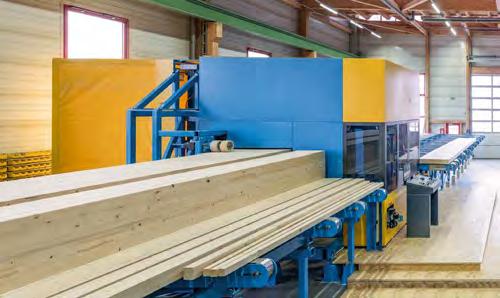
We’re pleased to partner with SmartLam North America on its new $50M glulam manufacturing facility in Dothan, AL. Intending to manufacture 84,000,000 board feet of large glulam beams and columns annually, Dothan is strategically located in Alabama to serve the Southeast, the fastest growing mass timber market in the United States. In addition, SmartLam North America is investing $24M to fully automate the existing Dothan, AL and Columbia Falls, MT CLT facilities. This additional investment will allow each facility to produce 2,000,000 cubic feet annually.
The manufacturing equipment we’re supplying includes these state-of-the-art machines. For glulam beams, SmartLam is adding two Hundegger ROBOT-Max machines to its Dothan, AL facility, while it’s also adding the Hundegger UFA in both Alabama and Montana to upgrade its CLT production. In fact, the Hundegger ROBOT-Max has been developed for the North American market, because mass timber here will use larger cross sections than required in Europe. The ROBOT-Max can process beams and columns as large as 24” x 48” and up to 40’ long. In the mass timber market, it is the only such saw.
PHONE: 800-289-5627 FAX: 800-524-4982 Read/Subscribe online at www.componentadvertiser.com Don’t Forget! You Saw it in the Adverti$$er February 2023 #15283 Page #62 A dverti $ er Component manufaCturing m The
As SmartLam North America CEO Derek Ratchford said when announcing the new construction last fall, “Most mass timber glulam beams and columns are manually produced. The new glulam plant will be automated allowing SmartLam to significantly increase production and simultaneously deliver multiple mass timber projects. We are currently the largest CLT manufacturer in North America and with the CLT automation upgrades and the new glulam addition, SmartLam will become the largest mass timber producer in North America.”

The high precision and quality of our fully automatic machines increase the economy and competitiveness of every timber construction factory –from small to large-scale enterprises. Our extremely flexible CNC machines can be quickly and perfectly adapted to specific customer requirements because of their modular construction, and that’s one of the reasons why Hundegger has been the world market leader in the field of CNC-controlled joinery machines with a market share of more than 90%.

If you’d like to learn more about what Hundegger can do for you, please contact me directly or visit the Hundegger website
PHONE: 800-289-5627 FAX: 800-524-4982 Read/Subscribe online at www.componentadvertiser.com Don’t Forget! You Saw it in the Adverti$$er February 2023 #15283 Page #63 A dverti $ er Component manufaCturing m The

New Spida Floor Truss Finish Press
New Spida floor truss finish roller press, four-foot wide (other widths available) x 3 1/2” tall throat. Use of this process speeds assembly and transports finished truss away from the production area, adds quality and peace of mind for your finished floor trusses. The unique “uni-body” construction creates a ridged machine that does a final press of the connector plates for complete embedment into lumber, saving wear on your floor assembly machine. 12” diameter rolls, 7 1/2 HP motor, 80# chain, 114 FPM speed, emergency photoelectric shut-off, chain and sprocket guards, integrated brake. Available options include: other roller widths, Heavy-Duty upgrade, gear motor drive, and soft start controls. 480 volt, 3 phase electrical. Other voltages available.
Price based on configuration, FOB FOB IN
TRUSS EQUIPMENT
NEW!
NEW IDLE & POWERED 14' TRUSS CONVEYOR (AZ)
• 14' Long x 4" or 5" (Inside Diameter) Schedule 40 Pipe
• Tube Steel Stands (7" Height Adjustment - Height to be Specified)

• 4 Bolt Flange Bearings
• Idle and Motorized Rollers
• 1/4 HP Motors (240/480 Volt-3 Phase) with Controls
• 1" and 1 1/4" Cold Rolled 24" Shafts Baffled
• 6 to 8 Week Delivery
2021 Eagle TP600 Production Press
• TP600 Production Press (Extra Throat
Depth for 2x8 and 2x10 Lumber)
• 25 Ton Cylinder with 5 1/4" x 6 1/4"
Platen
• 1 Phase Hydraulic Pump with Integrated Oil Cooler
• Steel Suspension Boom with Trolley
• Magnet (for Proper Plate Placement)
• Excludes: Overhead Steel Beam & Pedestals
$8,950 FOB CA
Wasserman & Associates
800-382-0329
www.wasserman-associates.com
2019 40′ End Eject Floor Truss Gantry System
2019 MiTek Canada 40′ working length, end eject floor truss gantry system with floor truss finish roller and 40′ of outfeed rollers. Gantry is powered by pendant controls at a travel speed of 120 ft. per minute. 2 bay floor truss gantry with no flip mechanism that was built for robotics so the table tops will need to be reconfigured for manual building.
460V, 3 Phase power required.
$284,990 FOB CA
Wood Tech Systems

765-751-9990
www.woodtechsystems.com
Wescana Vertical Truss Stacker
• 4 Lifting Arms Stack Trusses from 20' to 60' Spans (2 HP / 3 Phase)

• Stacking Capacity of 30 Trusses with Indexing for Each Truss Stacked
• 28 Second Cycle Time
• Automatic Truss Sensors to Activate Lifting Arms

• PLC Controlled
• 7" Touch Screen User Interface
• Dual, Manual & Automated Electric Controls
• 70' Powered Outside Conveyor (1 HP / 3 Phase)

Call for Price - FOB Alberta
800-382-0329 | www.wasserman-associates.com
PHONE: 800-289-5627 FAX: 800-524-4982 Read/Subscribe online at www.componentadvertiser.com Don’t Forget! You Saw it in the Adverti$$er February 2023 #15283 Page #65 A dverti $ er Component manufaCturing m The REPRESENTATIVES
www.woodtechsystems.com
765-751-9990
NEW!
www.wasserman-associates.com
800-382-0329 |
Average 20 Second Setups. Any table. Any Truss.
Spending more than a few seconds setting up ANY type of jigging is a waste of your time and productivity; and a direct hit to your bottom line. Nothing comes close to the speed and accuracy of WizardPDS® 100% automated jigging. With WizardPDS®, effectively remove ALL jigging setup time from your schedule and see where it takes you - Increased productivity, and increased profitability.
» NO manual jigging required
» Channels spaced avg. 24” OC.
» Reduces your jig setup time 99%

» (2) Automated pins per channel

» Fit any new or existing truss tables


» Any truss setup in 20 seconds or less
WizardPDS®. Your table, automated.
We bring the best together!
Eide Integrated Systems, LLC 612-521-9193 www.eideintegratedsystems.com
Completed truss setup in 20 seconds or less.
This truss could be, too!
2018 Clark Mini Barn Press, builds rigid frames for sheds from 8 foot to 14 foot spans, to 3′-6″ height. Builds mansard and rafter shapes. Includes (5) track mounted heads with 8″ x 10″ platens, material clamps, 10 HP hydraulic power unit with manifold for air and fluid, ball valve controls, mounting track and all available jigging. 460 volt, 3 phase electrical required.
$19,997 FOB TX
Wood Tech Systems
765-751-9990
www.woodtechsystems.com
Horizontal Truss Stacker
Model HVS, Two Unit, 2-Zone, 14’ Horzontal Stacking System. Two lifting units (one master and one slave) with integral electrics. A truss sensing system consisting of adjustable laser sensors mounted on slide rails. One indoor electric control enclosure & panel w/PLC and manual controls. A stacker-conveyor interface package comprised of (1) mounted 3-push button enclosure and (1) remotely mounted 2-push button enclosure (pause/ emergncy stop). Hand-held Wampfler
WESCANA FLOOR TRUSS MACHINE


• 7' x 40' Table with 3/4" Steel Table Top
• Two 5' Park Sections
• 1 Contr ol Valve for FlipOver Arms
• 1 Control Vlave for Ejectors
• Truss Depths from 12" to 26"
• Truss Flip-Over Arms
• Side or End Ejectors
• Bui lt-In Camber for Clamping on Both Sides
• 24" Diameter x 1" Wall Thickness Roller
• 10 HP / 3 Phase Gear Motor
• Front & Rear Emergency Shut-Off Bars
• Joystick Control
A dverti$er
Remote Control System. 8 stacking rails and 4 stripping posts. Stack 1 5/8” thick x 14’ tall trusses up to 30 high. Stack a truss in approximately 40 seconds (cycle time). Stack up to 55’ or longer trusses on each side of the conveyor with minor assistance for truss sag, shorter lengths can be stacked unassisted. Excludes 77’ Walk Through Conveyor System. Two systems available at $25,000 NOW $19,900 Each. FOB NE.
• Air Cylinders Under Table
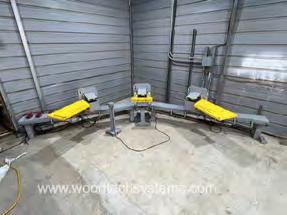
• 2' per Second Travel Speed
Component manufaCturing
Wasserman & Associates 800-382-0329
www.wasserman-associates.com
The 2018 75′ Roof Truss Gantry System with Wizard Automation
MiTek Canada 75′ continuous top, end eject roof truss gantry system with Wizard automated jigging. Features (18) table sections with ejector rollers, (34) rails of Wizard automation at 24″ OC spacing for approximately 68′ of automation, (1) 8′ park stations, (1) 8′ park station with integrated conveyors leading to final roller, (1) table guided, pendant controlled gantry head, (1) 24″ diameter finish roller press, (8) 14′ interior idler rollers, (8) 14′ interior powered rollers, (13) short (approx. 7′) idler conveyors, and (4) 14′ 3-roller idler beds with an additional (2) powered rollers and (2) idler rollers outside.

208V, 3 phase power required. $674,990 FOB CA
765-751-9990
• 2 Contr ol Valves for Clamping
Table Guided Gantry System by Spida Machinery

New table-guided (NO rail) gantry system by Spida, side-eject or end-eject options, with continuous production tables built to length. Available in steel, plastic or combination table top options. Can be fabricated to receive automated jigging such as “Wizard” brand. 24″ diameter gantry heads feature raised operator platform, heavy-duty steel roll with 4″ shaft, baffles and heavy-duty spherical bearings, dual 7.5 HP braking gear motors for a total of 15 HP, easy adjusting bogie wheel assemblies, safety bars, Wampfler “finger safe”, under-table-mounted electrical supply and optional soft start drive. Spida can provide the combination of powered transfer rolls, sloping ejectors, receivers, idler conveyors and powered conveyors required to meet your configuration needs. 440 volt, 3 phase electrical. Other voltages available. FOB IN.
765-751-9990
PHONE: 800-289-5627 FAX: 800-524-4982 Read/Subscribe online at www.componentadvertiser.com Don’t Forget! You Saw it in the Adverti$$er February 2023 #15283 Page #67 A dverti $ er Component manufaCturing m The TRUSS EQUIPMENT
2007 Clark Industries
NEW!
www.woodtechsystems.com Price based on configuration FOB IN 800-382-0329 | www.wasserman-associates.com
NEW!
www.woodtechsystems.com
2018 Clark Mini Barn Press
erving the S tructural B uilding c omponent S i ndu S try
S


One Table System $87,900 Wasserman & Associates Framing Table With Panel Bridge -Laser Pointer -Bridge Auto Return -Bridge Tilt at Sheathing Seams -Programmable Fastener Patterns -Pop-Up Skatewheel Conveyors -6’-11” to 12’-5” Wall Heights -Fixed Squaring Stops -No Floor Rails *Includes Installation Support in the United States & Canada Wasserman & Associates 2341 Shepard Rd Milford NE 68405 Phone: 800-382-0329 Web: www.wasserman-associates.com $93,500 Additional Information Here
Carl Villella, CLFP President, Acceptance Leasing & Financing Service

Forecasting Inflation and Interest Rates
The economic focus these days continues to be on inflation and interest rates. As business owners, we all grapple with the difficulties of trying to plan when you don’t know where prices will be, or how expensive it will be to borrow money.
The Fed has already raised interest rates a number of times, and it will probably make one more hike upwards. But according to economists, the hikes will not go beyond 5%. Fortunately, inflation is beginning to cool, so the need for further hikes is diminished.
Jared Franz, U.S. Economist for Capital Group, believes interest rates will remain high for a longer period time, and as such they may trigger a “shallow” recession. But, even if that’s the case, he expects growth to bounce back quickly. In his report for 2023, he believes that the U.S. could be at the start of a strong capital spending cycle as manufacturing is reshaped and supply chains realign.
Regardless of the ups and downs though, we also know that your business won’t stop moving forward as we all wait to see what the outcomes will be. So, we hope that as you consider your equipment needs this year, you’ll consider financing through Acceptance Leasing and Financing Service.
As we begin our 31st year in the financing business, we hope that you’ll join the hundreds of clients who have benefited from our experience and expertise in the component manufacturing business. We know the vendors, the equipment. Nothing can replace that kind of experience. We hope that you will contact us at 412-262-3225 to learn about the many financing programs available to every type of borrower.
We are Acceptance Leasing and Financing Service, Inc. Established in 1992, we pride ourselves on our Certified Leasing and Financing Professional designation. We are a member of SBCA and a frequent attendee of the BCMC tradeshow. We can provide financing for any new and, regardless of age, used equipment. We look forward to working with you.

PHONE: 800-289-5627 FAX: 800-524-4982 Read/Subscribe online at www.componentadvertiser.com Don’t Forget! You Saw it in the Adverti$$er February 2023 #15283 Page #69 A dverti $ er Component manufaCturing m The


Our engineering & manufacturing methods mean faster production and delivery times for our customers (and yours)! Put our 60+ years of experience to work for you! •w' Triad Machines 800-568-7423 ext. 133 www.TriadMachines.com


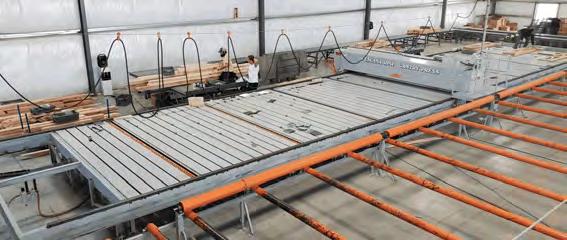

PHONE: 800-289-5627 FAX: 800-524-4982 Read/Subscribe online at www.componentadvertiser.com Don’t Forget! You Saw it in the Adverti$$er February 2023 #15283 Page #71 A dverti $ er Component manufaCturing m The New Spida Trackless Floor Gantry Price based on configuration FOB IN NEW! 765-751-9990 www.woodtechsystems.com NEW! 765-751-9990 www.woodtechsystems.com New Spida Roof Truss Finish Press Price based on configuration FOB IN 800-382-0329 | www.wasserman-associates.com WESCANA TRACKLESS ROLLER GANTRY SYSTEM • Trackless Roller Gantry System • 24" Diameter x 1" Wall x 14' Long Gantry Roller • 7.5 HP / 3 Phase Gear Motor with Safety Brake • Contr olled Motor Drive System for Start & Stop • Safety Barrier & Electric Eyes • Front & Rear Emergency Shut Off Bar • Joystick Operation Control • Ride-On Platform at Table Height • 2' per Second Travel Speed • Continuous 3/4" Steel Slotted Top Table • Manual Roof Jig Hardware • Ejectors for Side or End Eject • 2 Park Sections • Optional W izard Ready Tables, Transfer Rollers, Exiting Conveyor, Finish Roller & Outside Conveyor NEW! 800-382-0329 | www.wasserman-associates.com • (2) 24" Diameter x 14' Long Rollers • 3 1/2" Diameter Shafts with Baffles • Dual 5 HP / 3 Phase Gear Motors • Front & Rear Emergency Shut Off Bar • Safety Barriers & Electric Eyes • Controlled Motor Drive System for Start & Stop • Running Amber Beacon • Reversing Red Beacon & Buzzer • Emergency Stop Control Module • Taper-Lock Sprockets • S ealed Flanged Roller Bearings • Revesing Magnetic Starter • 2' per Second Travel Speed NEW!
THE NEWEST PANEL DESIGN PLATFORM AVAILABLE


TRUEBUILD ® LAYOUT WITH PANEL DESIGN FUNCTIONALITY WAS WRITTEN FROM THE GROUND UP TO DELIVER COMPLETE MODEL CONTROL TO PANEL DESIGNERS.

Continued next page Learn More About Our W all Pan e l F u nctionalit y at Ea gle #TIMETOBUILD
EMPOWERING GREAT COMPONENT MANUFACTURERS
2016 Triad exterior and interior wall panel lines with conveyors and terminal stations. Builds 2×4 and 2×6 walls up to 16’ in length with wall heights from 6’-9” to 10’-2” and includes Component Nailer model FTN and panel lift
Exterior line includes (2) sets of Rough Opening Assembly tables model RO-CAT, framing table model Gen II with manual nail-gun tool dollies each side & stud locators at 16” and 24” o.c., squaring and sheathing table model Gen II with staple & routing combo bridge & side shift for seams @ 3” & 6” o.c. fasteners, top & bottom plate gun mounts for 6” o.c. fasteners, auto stop & tilt features, (3) 10 ft skatewheel conveyors, (4) 20 ft x 36″ roller conveyors and (4) powered infeed conveyors with chain track.
Interior line includes Rough Opening Assembly table model RO-CAT, framing table model Diamond Quad with manual nail-gun tool dollies each side, pop-up rollers & stud locators at 16” and 24” o.c., (2) 10 ft skatewheel conveyors, (4) 20 ft x 36″ roller conveyors.
System sold for over $223,000 new. Sold as one system only. 110 volt, 1 phase electrical required. 100 PSI air required.
Used Triad G2 Wall Assembly Equipment
Used Triad wall assembly equipment includes 16 ft x 12′-3″ max height framing station, model G2, with (2) two-tool dollies, squaring/ sheathing combo table, model G2 SH-SQ, with multi-tool mount nailing bridge and separate manual-drive router bridge, quantity of (6) 10 ft long x 2 ft wide idler roller conveyors with (4) legs, and Triad model FTCN component nailing station with four Hitachi NR83A nail tools.


Framer includes 16″ and 24″ color-coded stud locators, pop-up skate wheel conveyors, tool dollies have two tool mounts each (no tools) and powered height adjustment. Sheathing bridge includes joy-stick controls, tool offset, tool tilt, laser guide, power return and mounts for up to (23) Hitachi nail tools. Router and all available spare parts included. 120 volt, 1 phase, 30 Amp electrical required. 100 PSI air required.
$40,997
765-751-9990
www.woodtechsystems.com
PANEL EQUIPMENT
Wall Panel Work-Station (Green)
Custom fabricated, heavy-duty table ideal for producing rough openings, rake-walls, even interior walls. Table features a squaring lip, double-row pneumatic liftouts, duplex 110v outlet for hand tools. Table dimensions: 16’ 4 1/2” long, 9’ 5” wide, 30 1/2” high.
$9,490 FOB KY Wood Tech Systems
765-751-9990
www.woodtechsystems.com
outlet for hand tools.
Table dimensions: 17’ 8 3/4” long, 9’ 5” wide, 25 1/2” high.
$9,490 FOB KY
Wood Tech Systems 765-751-9990
www.woodtechsystems.com

PHONE: 800-289-5627 FAX: 800-524-4982 Read/Subscribe online at www.componentadvertiser.com Don’t Forget! You Saw it in the Adverti$$er February 2023 #15283 Page #73 765-751-9990 www.woodtechsystems.com
2016 Triad Wall Assembly Equipment
NOW $185,970
Wall Panel Work-Station (Blue) Custom fabricated, heavy-duty table ideal for producing rough openings, rake-walls, even interior walls. Table features a squaring lip, double-row pneumatic liftouts, duplex 110v
FOB CA
ALLTHINGSWOOD Design of Wood Structures— an Introductory Course
By Frank Woeste
Once again, Virginia Tech will be offering its popular two-day course on topics related to wood construction. This year’s course, to be held on April 26–27, will focus on practical code-conforming design of wood structures based on provisions of the 2018 National Design Specification® (NDS®) for Wood Construction, NDS Supplement, IRC, and IBC

Overview of Course Content
“Design of Wood Structures—an Introductory Course” will begin with a review of lumber grading methods and stamps, moisture content, sizes, and allowable stresses of species of dimension lumber and timber involved in the structural design process. As an introduction to the design process, building code loads and the rationale for “load combinations” in the code will be discussed and several design examples using load combinations will be presented.
Course participants will learn the “design process” by working through the structural design of simple framing elements showing what adjustment factors apply to the tabulated allowable design properties of lumber that apply to a design case. The NDS adjustments for connection design will be reviewed including the impact of moisture content at the time of fabrication and in-service. Common nail connection designs will be demonstrated, and course participants will be given interesting bolt connection details to design with other participants.
Participants will be introduced to the 2018 Wood Frame Construction Manual (WFCM) that contains “look-up tables” for design of residential walls, floors, and roofs using ASCE 7–16 Minimum Design Loads and Associated Criteria for Buildings and Other Structures load requirements. After a cursory review of both “Engineered Design” and “Prescriptive Design” provisions in the WFCM, a wall stud design will be demonstrated using the look-up tables in the WFCM. (Note, this column discussed the 2015 edition of WFCM in the January 2018 issue: WFCM—a Valuable Structural Design Guide.)
The second day will include a presentation and discussion of the AWC/ICC Code Conforming Wood Design which addresses design of wood structures for fire resistance and height and area allowances for different types of wood construction. This unit has been well received by building design practitioners in previous courses as the instructor will walk the participants through IBC fire resistance requirements based on height, area allowances, and types of construction. Finally, a summary of advances in Tall Mass Timber Structures that are now permitted up to 18-stories by the IBC will be provided.
PHONE: 800-289-5627 FAX: 800-524-4982 Read/Subscribe online at www.componentadvertiser.com Don’t Forget! You Saw it in the Adverti$$er February 2023 #15283 Page #74 A dverti $ er Component manufaCturing m The Continued next page
Learning and Networking
While not listed in the Course Syllabus and Schedule, the most valuable benefit of participating in this course might stem from what you learn from the person sitting next to you or from a comment made by a participant during the open discussions (that are encouraged during each unit of the course). The value of a simple comment related to your work, followed up by group discussion, can be priceless.
For me, my best ideas for authoring practical articles and identifying research needs come from participants. Most course participants are typically from the East and Southeast parts of the U.S., related professions, and organizations. For example, 88 participants attended our May 2022 course. The following is a partial list of professions or industry segments represented:
• Building Officials/Inspectors/ Permit Technicians
• Design Build Engineers
• EWP Suppliers
• Fastener Suppliers
• Homebuilder and Designers
• Lumber Suppliers
Continuing Education Credit

• Post-Frame Building Supplier/ Engineers
• Residential Designers
• Restoration Engineers
• Structural Engineers
• Truss Designers
• Truss Manufacturers
• Truss Plate Suppliers/Engineers
Participants will receive a certificate from Virginia Tech for 1.5 Continuing Education Units (CEUs) equivalent to 15 hours of instruction. The registration fee includes the course notebook, lunch on both days, refreshment breaks, and the following publications: 2018 National Design Specification® (NDS®) for Wood Construction with Commentary and the NDS Supplement—Design Values for Wood Construction.

Due to classroom space, “early registration” (before March 1st) is recommended since other programs have been oversubscribed. Participant registration during the “early registration” period has always been available.
For more information and to register, visit the Design of Wood Structures—an Introductory Course page online.
Frank Woeste, P.E., is Professor Emeritus, Virginia Tech and a wood construction consultant. Frank, along with his colleagues, has developed and presented continuing education programs for more than 30 years. He is a member of the ANSI/TPI 1 Project Committee for revision of the truss design standard and the AWC Wood Standards Design Committee, and serves as the ALSC Consumer Representative (Alternate). Comments are welcome and can be sent to fwoeste@vt.edu
PHONE: 800-289-5627 FAX: 800-524-4982 Read/Subscribe online at www.componentadvertiser.com Don’t Forget! You Saw it in the Adverti$$er February 2023 #15283 Page #75 A dverti $ er Component manufaCturing m The
New PROSTACK
WALL PANEL STACKER
$185,970 FOB NV
Developed in a commercial wall panel production facility this is the remarkable ProStack, fully automated wall panel stacker. The ProStack relieves your build team from creating a stack of wall panels and keeps them building walls instead. Stacks 2×4 through 2×8 walls up to 20′ in length and up to 12 feet in height. The ProStack automatically centers each layer including multiple wall segments on the same layer, and the ability to “create” fork lift pockets for ease of loading in your yard or on the build site. (Please see video for more.) 208 volt, 3 phase, 45.3 full Amp load electrical required. No air required. Footprint is 26′-5″L x 19′-3″W.
Here are some of the features of the ProStack Wall Panel Stacker:
• Wall Length Max – 20’
• Wall Height Range – 8’ to 12’
• Material 2×4″ through 2×8″
• Total Weight capacity – 6,000 lbs.
• Total stack Height Max – 6’
• This unit stacks on-center
• System is able to stack on center layers that have multiple wall segments
• Siemens controls
• Full manual override controls via HMI
• Speed – 45-60 seconds per wall layer
$124,900
FOB MN
2016 Triad Wall Assembly Equipment
2016 Triad exterior and interior wall panel lines with conveyors and terminal stations. Builds 2×4 and 2×6 walls up to 16’ in length with wall heights from 6’-9” to 10’-2” and includes Component Nailer model FTN and panel lift model XPL1000:
Exterior line includes (2) sets of Rough Opening Assembly tables model RO-CAT, framing table model Gen II with manual nail-gun tool dollies each side & stud locators at 16” and 24” o.c., squaring and sheathing table model Gen II with staple & routing combo bridge & side shift for seams @ 3” & 6” o.c. fasteners, top & bottom plate gun mounts for 6” o.c. fasteners, auto stop & tilt features, (3) 10 ft skatewheel conveyors, (4) 20 ft x 36″ roller conveyors and (4) powered infeed conveyors with chain track.
Interior line includes Rough Opening Assembly table model RO-CAT, framing table model Diamond Quad with manual nail-gun tool dollies each side, pop-up rollers & stud locators at 16” and 24” o.c., (2) 10 ft skatewheel conveyors, (4) 20 ft x 36″ roller conveyors.
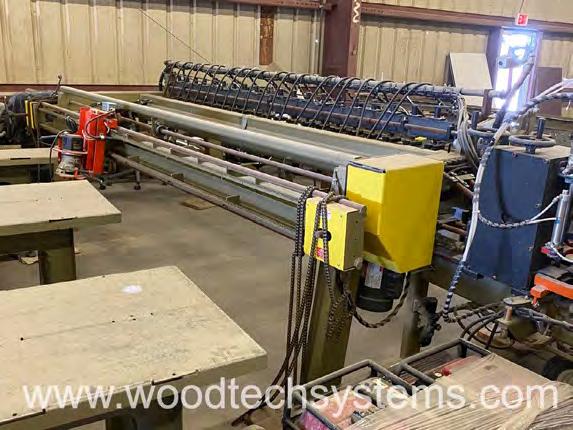
System sold for over $223,000 new. Sold as one system only. 110 volt, 1 phase electrical required. 100 PSI air required.
765-751-9990
www.woodtechsystems.com


PHONE: 800-289-5627 FAX: 800-524-4982 Read/Subscribe online at www.componentadvertiser.com Don’t Forget! You Saw it in the Adverti$$er February 2023 #15283 Page #76 A dverti $ er Component manufaCturing m The 765-751-9990 www.woodtechsystems.com
PANEL EQUIPMENT
New Component Table with Skatewheel Conveyors

Lift & Extend Skatewheel Conveyors. 10' x 10' Work Area with Squaring Lip. Gun Holster & Nail Tray.

$11,900 FOB NE
Wasserman & Associates
800-382-0329
www.wasserman-associates.com
New Panels Plus Wall Panel Framing Equipment
Consider Panels Plus wall panel assembly equipment for manufacturers of wood or steel wall panels, floor-panels, and related framing components. Panels Plus is an employee owned, ISO certified, manufacturing company that builds state-of-the-art equipment featuring durable construction, with fit and finish second to none in the structural building component industry. The referenced base framing table allows you to assemble from 7-12 foot wall heights, at industry standard 16 foot lengths, at a working height of 29 to 32 inches. This framer design includes controls at each end of table, squaring stops and pneumatic clamping for consistent wall panel quality. Frames 2x4 or 2 x 6 walls, with color-coded, steel stud locators at 16 and 24 inches O.C. spacing. Includes pop-up skate wheels for easy transfer of completed wall frame. Framing table can be configured to receive wall framing light bars, other options include custom buildable wall heights, lengths and auto-indexing of optional 2 or 3 tool carriages.
2021 Panels Plus Tilt Table provides the ability to easily access all sides of the wall panel, including the backside. The table includes horizontal rollers, pneumatic lift cylinders, and a moveable control pedestal. The table pneumatically lifts the wall panel from lying flat to a 75-degree angle. Once the panel is rolled into the tilt table, it is clamped tightly in place and will stay secure when tilted, allowing for easy access to work on the backside of the wall to inspect the wall panel for “shiners” or install horizontal blocking, windows, etc. OEM
Specifications: here
$37,993- FOB VA
Wood Tech Systems 765-751-9990
www.woodtechsystems.com
IBS/Comsoft Wall Panel Light Bars
Reconditioned dual 16’ foot long light bars, includes spare light board. Light bars are compatible with all light-bar equipped or ready IBS/Comsoft, Panels Plus, etc. wall panel equipment driven by ITW (IBS) or other compatible design software. 110 volt, single phase electrical. $18,890 NOW $16,550 FOB MN.
Wood Tech Systems
765-751-9990
www.woodtechsystems.com
Additionally from Panels Plus are sheathing tables with features that include foot pedal control at squaring end of table, with squaring stops, roller conveyors at both sides, single pendant controls for bridge, tool spacing at 6 inch centers with 3 inch bridge shift for offset nailing. Tool bridges can accommodate from 2 x 4 to 2 x 8 walls, with seam tilt being standard equipment Panels Plus Tool Bridges are available with single beam or dual beam design for two different tool mounts on one bridge. Squaring stations, sub-component tables, conveyors and panel lifts are also available to complete the configuration of the wall panel assembly line. Price includes factory installation and training. 50 CFM at 120 psi air. 120 or 230 volt, 1 phase electrical.


$274,900
FOB NZE/IN
New Spida fully-automated CNC controlled sheathing station, fastens sheathing to wood frame wall panels from 2×3″ to 2×8″ nominal, in wall heights from 7′ to 12′. Straightens studs from the underside of the panel prior to firing fasteners. Fixed bridge fires fasteners into sheathing as wall panel passes under bridge. Works with tools firing up to 3 1/2″ nails. Features touch-screen controls, (4) high-speed nail tools, automated tilting of tools at seams and powered transfer of panels. Approximate size is 18 ft wide x 27 ft long. 230 / 460 volt, 3 phase electrical required. 100 PSI at 28 CFM.

PHONE: 800-289-5627 FAX: 800-524-4982 Read/Subscribe online at www.componentadvertiser.com Don’t Forget! You Saw it in the Adverti$$er February 2023 #15283 Page #77 A dverti $ er Component manufaCturing m The 765-751-9990 www.woodtechsystems.com
CLICK HERE for more information NEW!
765-751-9990 www.woodtechsystems.com NEW! Spida
Automated Wall Sheathing Station
2021 Panels Plus Tilt Table
By Thomas McAnally TheJobLine.com
Is 2022 Like 2006?
It wasn’t very long ago, so many of us remember the Great Recession and fear we are going to see a repeat. Hopefully not. It seems regional right now, like it did early in 2007, after the job market had raged in 2006 and the good times rolled!
Like in 2006, the 2022 hiring season started off frantic. I had more than a hundred truss designer openings but few candidates. Candidates were in control and could demand exceptionally high wages, which employers paid. I saw average designer wages go up 30%–40% between 2018 and 2022. Just like they did between 2000 and 2006.
By 2007, I started to see a trend. Candidates were coming in at higher numbers, but not because they wanted a better job. Instead, they were seeking a job because they had been laid off, something that was almost unheard of over the preceding years. More and more came as 2007 progressed, while fewer and fewer jobs were available. By 2008, single family design job orders were dead. There were no jobs, but candidates were still pouring in. Fortunately, that’s not quite what I’m seeing now, which is more regional, much slower, and almost all related to single family construction. Just like last time, good multifamily designers are still in demand. (We have jobs!)

What I am concerned about this time is how deep the recession will go. With high interest rates and dysfunctional government, will we skate by with a few areas of the country taking a step back and resetting their market, or will there be nation-wide deep recession pain? My crystal ball is not clear on that answer.
Also different this time is that the industry now offers remote as an option for designers. Removing the obstacle that relocation causes for families makes a job move much easier. Still, I am getting more job opportunities where the employer wants to replace remote people with in-office designers. There are still remote design jobs out there in some areas of the country for a well-qualified designer, but designers can no longer make remote an obvious demand.
Now, we’re at a point where the landscape has switched from a candidate’s market to an employer’s market. Even so, jobs are still available, especially if you know how and where to look.
If you’re thinking of making a move, be sure to take your time and explore your options. At The JobLine, we have the tools to help get you what you are worth. After 30 years, we’ve got the experience and connections to help you find your next position. Our clients worked with us through the last recession and will again for this one, however long it takes.

Your “recruiter down the hall,” I’ve been recruiting off-site manufacturing industry professionals for 30 years through TheJobLine.com. Contact me for assistance with recruiting or your job search: twm@thejobline.com

PHONE: 800-289-5627 FAX: 800-524-4982 Read/Subscribe online at www.componentadvertiser.com Don’t Forget! You Saw it in the Adverti$$er February 2023 #15283 Page #78 A dverti $ er Component manufaCturing m The
PANEL EQUIPMENT
2007 VIKING 16' X 12' SQUARING TABLE
WITH SHEATHING BRIDGE
• 16' x 12' Squaring Table with Powered Width Adjustment & Powered Chain Conveyor


• Wall Panel Lengths up to 16', Wall Panel Heights from 4'-0" to 12'-2"
• Swing Gates at Both Ends of Squaring Table
• Automated Field & Edge Nailing
Driving by Panel Pro Event Software & Your Programmed Nailing Patterns
• Simple Touchscreen Controls
• 2 Tool Carriages for Sheathing Nailing with Tilt Function for Seams
• 2 Paslode Nail Guns with High Load Coil Tray
• Auto Sheathing Bridge Return

• Includes 4 Pallets of Magnum Coil Nails (2 3/8 x .113)
• 480 Volt / 3 Phase
$29,900 FOB KS.
Wasserman & Associates
800-382-0329
www.wasserman-associates.com
2021 Triad Router Bridge & Portion of V-Track
2021 Triad Routing Bridge with approximately (20) feet of v-track. Fits over tables that build up to 12′ nominal height wall panels. Includes powered automatic bridge return, powered vertical router movement, manual fine adjustment wheel, manual vertical router travel with chain drive and (1) Milwaukee router, catalog #5625-20 120 volt, 1 phase, 15 Amp electrical required. No table included.
$28,970 NOW $5,000 FOB BC
Wood Tech Systems
765-751-9990
www.woodtechsystems.com
New Panels Plus Floor Cassette Framing Station
Price: $Call for pricing
FOB: MN
2015 Framing Table (12' x 19')
• Wall Lengths to 19'
• Powered Height Adjustment to 12'
• Pop-Up Skatewheel Conveyor (New Skatewheel Conveyor)
• Fixed Squaring Stops
• Very Top Plate Storage on Adjustable Side
$24,500 FOB NE
Wasserman & Associates
800-382-0329
www.wasserman-associates.com
IBS Tool Bridge & Router Bridge
IBS multi-tool bridge with (24) tool stations. Bridge features auto-return, button controls and laser guide mount. Fits up to 12′ nominal rail centers. IBS router bridge features (1) router, laser guide mount and lever-switch button controls. Fits up to 12′ nominal rail centers. Sold as a pair. Includes all available floor mounted, v-rail. Both bridges missing laser sub-assembly. 120vac, 120psi air.
$15,975 FOB UT
Wood Tech Systems

765-751-9990
www.woodtechsystems.com
New Panels Plus floor framing machine, supports the structural members creating floor sections from 2" x 6" LVL through 2" x 10" to 2" x 12" dimensional lumber, 20" deep wood floor trusses or engineered wood / I-joists. Standard footprint of floor panels (cassettes) up to 12' wide x 45' long. Table consists of a fixed section and a track-guided, moveable section controlled by either a foot switch or push-buttons.
New Wall Panel Lift
• 8' to 12' Wall Heights
• 1,000 Lb Capacity
• Weight: 120 Lbs
• Excludes: Electric Hoist & Freestanding Bridge Crane

$1,850 FOB NE
Wasserman & Associates
800-382-0329
www.wasserman-associates.com
Includes a series of color-coded locator pins at 16", 19.2 and 24" on-center spacing and clamping with squaring feature including foot pedal control. The locators individually flip down if a joist comes out on top of them. After the floor is complete and unclamped, the floor section can be raised up on skate-wheel conveyors and rolled out or lifted off the table using an overhead crane. Table height is 24.5", OAL 45.5 ft, OAW 14.5 ft. 120 volt, 1 phase, 15 Amp electrical required. 90 to 120 PSIG at 15 CFM air required.
PHONE: 800-289-5627 FAX: 800-524-4982 Read/Subscribe online at www.componentadvertiser.com Don’t Forget! You Saw it in the Adverti$$er February 2023 #15283 Page #79 A dverti $ er Component manufaCturing m The A dverti$er Component manufaCturing S erving the S tructural B uilding c omponent S i ndu S try The 765-751-9990 www.woodtechsystems.com NEW!
Alpine has it all—the right equipment, user-friendly software and dependable hardware to improve your teams efficiency. Alpine delivers the complete package for success—including comprehensive support and service that sets us apart within our industry.


Ask those who know. They’ll tell you about the people at Alpine who make a difference.


“We’ve worked with Alpine in creating top quality products surpassing customer expectations since 1984. Over the years Alpine team members have become more like family and we couldn’t do this without them!”
— Tolga Adak Florida Quality Truss Inc.
BUILD MORE. alpineitw.com | 800.521.9790
Triad 12 ft Gen II Sheathing
Bridge & Track
Triad Generation II nail tool bridge with 60 ft of v-track, refurbished by Triad in 2021. Maximum panel height clearance 12′-3″. Includes locations for (3) tool mounts along the middle beam, top & bottom plate tool mounts, tilt-tool option, joy-stick controls, power bridge return, e-stop button, all available Paslode tool mounts, manual and all available spare parts. 120 volt, 1 phase electrical required. 100 PSI air required.


$75,971 NOW $69,997 FOB CO
PHONE: 800-289-5627 FAX: 800-524-4982 Read/Subscribe online at www.componentadvertiser.com Don’t Forget! You Saw it in the Adverti$$er February 2023 #15283 Page #81 A dverti $ er Component manufaCturing m The NEW! New Panels Plus Combination Table Price: $Call for pricing FOB: MN 765-751-9990 www.woodtechsystems.com 765-751-9990 www.woodtechsystems.com 2007 Panels Plus Steel Wall Panel Sheathing Station $74,970 NOW $68,997 FOB MN 765-751-9990 www.woodtechsystems.com


SINGLE BEAM SHEATHING STATION
The Single Beam Sheathing Station offers flexibility in fastener spacing both in the field, on seams, and while stitching the top and bottom plates. This Sheathing Station fastens sheathing to wood wall panels to ensure quality panels every time.


BENEFITS
• Ergonomic working height
• Flexibility with fastener spacing


• Fastens consistently and accurately




• Reduces the risk of “shiners”
$26,977 FOB MD
Triad / Viking Wall Equipment
Triad squaring table with two bridges and one Viking power conveyor. Either bridge fits on the squaring table. Builds from 6′-9″ to 12′-3″ tall wall panels to 16′-0″ long. Triad squaring table, model G2SHSQ, has powered clamp / unclamp controls on either end of the fixed side of table.
Triad nailing bridge, model PSTT, has (24) tool mount locations with Paslode tool mounts, auto return and bottom plate laser sight mount. Changed by owner from staple tools to nail tools. Router bridge is manual travel. Viking powered conveyor 23 ft long with support platforms alongside both chains. Forward powered drive only. Foot pedal controls for drive motors. 120 volt, 1 phase electrical required. 100 PSI air required.
PHONE: 800-289-5627 FAX: 800-524-4982 Read/Subscribe online at www.componentadvertiser.com Don’t Forget! You Saw it in the Adverti$$er February 2023 #15283 Page #83 A dverti $ er Component manufaCturing m The NEW 12' X 16' FRAMING TABLE 800-382-0329 | www.wasserman-associates.com • Add $11,900 for Sub-Component Layup Tables with Pop-up Skatewheel Conveyors • EQUIPMENT FINANCING available from SLS Financial Services $38.000 FOB NE • Pop-up Skatewheel Conveyor • Powered Height Adjustment (6'-11" to 12'-5" wall heights) • Fixed Squaring Stops • Excludes Tool Dollies • 110 Volt / 20 Amps • Add $6,000 for Stud Locators at 16" & 24" O.C. • Add $2,750 for 1 Pair of 15' Skatewheel Conveyor with Stands NEW! 765-751-9990 www.woodtechsystems.com
WWW.PANPLUS.COM 1-866-726-7587
Design Connections
Building Information Modeling for the Component Business?


If I compare the truss layout and design software used in the early 1980s to what is available today, it’s mind boggling. Actually, comparing layout software wouldn’t be possible since the first layout software at our company didn’t show up until around 1989! Up to that point, layouts were done with a pencil and paper, usually on ¼” grid graph paper to make life a little easier. Of course, every truss dimension – heel height, pitch, span, bearing location – was calculated by hand. In my case, I had my trusty Hewlett Packard HP15 scientific calculator always at the ready. I touched on this same subject in my September column, Design: Software Power or Brain Power?, but now rather than continuing to look back, I’d like to look forward.

The promise of BIM (building information modeling) for the truss and wall panel world would suggest that the plans we receive – or more accurately the 3D models – would include not only complete information with which to do our work but also fully accurate information.
Imagine these dreams as realities. No more interior walls dimensioned as 4” thick when they’re actually built from 2x4 with ½” sheetrock each side totaling 4½” in the real world. No more guessing about cladding dimensions when trying to determine the offset from bearing wall to finished cladding. And, perhaps best of all, no more looking at a cross section on a plan and wishing that the architect had taken the section just a couple of feet over so that it actually gave some idea of what the ceiling profile is supposed to be. (As a side note, I have jokingly told many architects that I secretly believe they take a course in how to provide cross sections with as little useful information as possible. I know that in many cases it is because the tools they are using aren’t necessarily up to the task either.)
PHONE: 800-289-5627 FAX: 800-524-4982 Read/Subscribe online at www.componentadvertiser.com Don’t Forget! You Saw it in the Adverti$$er February 2023 #15283 Page #84 A dverti $ er Component manufaCturing m The Continued next page
Geordie Secord, Senior Recruiter TheJobLine.com – Canada
Hewlett Packard HP15
But, when will these fully accurate BIM models begin to become common? Like flying cars, they always seem to be 5–10 years away – at least in the single family home construction sphere. Will builders and developers ever be willing to invest in the additional up-front costs to have full BIM models prepared, even if they do accept that there are cost savings available to them through construction efficiencies and catching problems early in the process? In the case of one-off custom homes, there is no opportunity to amortize any additional architectural costs over multiple builds, so savings have to be real and substantive on the first build. And, yes I do understand that in the BIM “world” collections of parts, assemblies, and tools promise to make plan preparation faster, but anecdotally I have been told that this is not yet the case.

Until such time as we can have a high degree of confidence in the BIM model we’re receiving, we’ll need truss, wall panel, and EWP designers that can read and interpret architectural drawings to understand intent. Add to that the need for designers to be able to comfortably communicate with builders, architects, and engineers so they can fill in the holes of missing information by asking productive questions. There is a real danger during the in-between period when BIM models are common but not yet fully reliable.

Yes, I do believe that there will come a time when BIM will ultimately fulfill its promise of streamlining the component design process, and more broadly construction as a whole. When that happens, there will be another wholesale shift in the component world, much like the shift from pencil and paper to 3D layout software. I just think that, when it happens, I’ll be out for a cruise in my fancy new flying car.
Do you agree? When do you think we’ll have fully deployed BIM? Whether you’re optimistic or pessimistic, please reach out, I’d love to hear from you.
If you want help finding that next perfect component designer or design job in Canada, please contact me. If your work is in the mass timber world anywhere in North America, I’d love to talk to you about connecting you to that next great job or candidate. You can reach me at secord@thejobline.com, or 800-289-5627 ext. 2. I’m also happy to engage at: LinkedIn.com/in/geordiesecord. www.thejobline.com
PHONE: 800-289-5627 FAX: 800-524-4982 Read/Subscribe online at www.componentadvertiser.com Don’t Forget! You Saw it in the Adverti$$er February 2023 #15283 Page #85 A dverti $ er Component manufaCturing m The
IT’S ONE THING IN LIFE TO MAKE THE CUT. IT’S ANOTHER TO MAKE IT BETTER.
Designed for high-volume floor truss web output with even greater safety, the Monet DeSauw FWA-500 AC (for “automated controls”) offers the very latest in operator-friendly saw technology. Perfect for manufacturers running floor trusses in large volumes with variable web design, the 500 AC features automation for all blades, including the fixed cut-off blade for minimal waste. And without any need to open the saw motor cabinets, except for periodic service, you’ll benefit from enhanced safety as well. You might say that with the fully automated FWA-500 AC, Monet DeSauw has set a new standard. Again. Contact us today to discuss how this exceptional machine can positively impact your production goals.

765-751-9990 www.woodtechsystems.com
Wood Tech Systems is a registered trade name of Wood Truss Systems, Inc.


$37,900
2014 TRIAD RAKE WALL TABLE
• Wall Lengths to 12'
• Wall Heights to 40'
• Powered Height Adjustment
• Manually Adjustable Rake Side (0 to 12/12 pitch)
• Adjustable Squaring Stop
• Pop-Up Skatewheel Conveyors
• Stud Locators at 16" and 24" Centers
• Center Support Bar with Stud Locators
• Excludes Tool Doilies
• Price is in US Dollars
New Spida Wall Extruder Panel Assembly System
The concept of the Spida Extruder is to bring materials to a central location as the product is extended or “extruded” to create the framed wall panel. A single operator in one central location, feeds the studs and sub-components in-between the plates, while the Extruder does the nailing. The Extruder features (4) servo-controlled, indexing, bracket-mounted tools that can be coil or stick fed, hands-free clamping of plates and is adjustable for wall heights starting from 5’-11”, with options to build walls to 12‘3”, from 2×4″ to 2×8″ lumber.
An option is available to add an intermediate tool mount, for fastening blocking between studs, a notoriously slow process in wall panelization that usually reduces production. The Extruder design makes this connection much easier for the operator, keeping your wall production high.
The support stations are adjacent to the Extruder and operators at those stations build the sub-component openings, sub-assemblies (like ladders) which are conveyed to the central operator’s station, where they are dropped and nailed into the panel in sequence. Conveyors and transfer tables of various configurations are used to bring the parts to the Extruder. Each design takes advantage of curved or raised conveyors to efficiently bring materials to the Extruder and fit within your plant’s material flow in the most efficient way possible.
$32,500 FOB NE
IBS Framing Table & Squaring Table
• Fra ming Table with Pop-Up Skatewheel Conveyor & Squaring Stops
• No Tool Dollies or Stud Locators on Framing Table
• Squaring Table with Roller Conveyor & Squaring Stops


• Wall Panel Lengths to 18'
• Powered Height Adjustment from 3'-11"to 12'-3"
• New Motors & Skatewheel Conveyor
• 110 Volt / 1 Phase
Once the wall panel is framed, it proceeds by conveyor to a squaring station and a sheathing station for completion. Here too, the sheathing is fastened as the panel passes by the sheathing bridge with its’ (4) four, high-speed tools. There are options for router bridges and automated ply loading. The Spida Sheather is a fully automated, CNC machine that features touch screen controls and tilt nailing at seams.
Over ten years in development and use in Australia and Asia, there are now several locations using the Extruder here in North America. A typical system can be installed in about (5) hours thanks to the modular, “plug-and-play” design of the Spida wall equipment. 120 volt, 1 phase, 15 Amp electrical required and 110 PSI air @ 6 CFM required for each Extruder and Sheather station.
Price: 178,300
Location: NZE/IN
PHONE: 800-289-5627 FAX: 800-524-4982 Read/Subscribe online at www.componentadvertiser.com Don’t Forget! You Saw it in the Adverti$$er February 2023 #15283 Page #89 A dverti $ er Component manufaCturing m The
765-751-9990 www.woodtechsystems.com New!
| www.wasserman-associates.com
800-382-0329
800-382-0329 | www.wasserman-associates.com
NOW $29,900 FOB Ontario
By The Lesko Financial Services Team

First Quarter Brings Hints of Later-Year Move Toward Recovery
The start of a new quarter and a new year bring with them a cautious glimmer of optimism that the economy is finally poised to begin a slow turn-around toward a gradual recovery.

To be sure, many challenges remain for households that have been weathering inflation for more than 18 months. But prices have been trending downward since hitting a high in June, with November’s inflation figures coming in at a better-than-expected 7.1% and December’s at 6.5%, in line with estimates. This trend gives rise to hopes that inflation may have peaked.
Supply chain problems are being slowly worked out and while retailers are still facing sporadic shortages, the word “normal” has been finding its way back into forecasts for 2023 as industries find and deploy strategic solutions.
The U.S. has begun to tackle semiconductor shortfalls with new legislation and new chip plants. And lingering problems have been helped by what appears to be a more tempered approach on the part of Chinese authorities dealing with outbreaks of COVID in certain provinces.
Despite higher retail prices, reports show that holiday spending was robust as consumers endeavored to make up for the lockdown years with more spending on gifts, entertainment, and travel. Consumers still seem eager to spend, but with fewer excess cash reserves than in the immediate post-pandemic months.
Additional positive news for consumers and household budgets is that prices at the gas pump have been edging downward as demand decreases during cold-weather months.
Probable headwinds
Investors remain jittery as uncertainty persists on Wall Street. The S&P 500 closed out 2022, its worst calendar year performance since 2008, down almost 20%.
Many stock market forecasts for 2023 foresee moderate improvement with investors advised to be patient, review risk, and think long-term. And perhaps to take advantage of any opportunities that may arise along the way while still maintaining a solid investing approach based on their short, medium, and long-range goals.
PHONE: 800-289-5627 FAX: 800-524-4982 Read/Subscribe online at www.componentadvertiser.com Don’t Forget! You Saw it in the Adverti$$er February 2023 #15283 Page #90 A dverti $ er Component manufaCturing m The
Some market analysts have voiced the belief that recent downturns may have injected a dose of reality to valuations that were hovering too high and brought welcome sobriety into areas where it was needed such as NFT’s and cryptocurrencies. The FTX bankruptcy and resulting shockwaves may or may not be an anomaly but revealed weaknesses in embracing investing fads, no matter how much buzz surrounds them.
The Federal Reserve has committed to additional interest rate hikes this year but hinted at the possibility of slower and less aggressive increases. Notes from the FOMC, however, voiced concern about the continuing strength of the labor market.
There are still close to 10.5 million job openings and the number of available jobs has topped 10 million for 13 consecutive months; before the pandemic began in February 2020, the highest on record was 7.7 million. There are roughly 1.7 jobs per unemployed American.
This indicates that demand still far outpaces the supply of available workers. With so many jobs unfilled, will it be possible for companies to avoid raising wages to attract candidates, thus increasing inflationary pressures?
Even if the Fed does move to slow future interest rate increases, persistent inflation, the cooling economy, and interest rates that are the highest in decades lead many forecasters to predict at least a mild recession for the coming year.
Tempered expectations
For the first quarter of 2023, economists are forecasting a continued slowing of the economy and recessionary pressures lingering. Although recession fears remain, many businesses and investors have been preparing for some time and now see the possibility of a market correction as a somewhat positive sign that the numbers are headed in the right direction.
Wall Street is likely to remain volatile and global markets will continue to have an impact domestically.

With altered expectations, we at Lesko Financial are looking forward to steady growth as we continue to weather ongoing uncertainty, slower overall recovery, and a wish for a return to more normal markets late this year.
It’s a good time to review and, if necessary, adjust, your own investing strategy. It’s also important to reset your financial goals for the new year and make plans to achieve them. Our financial advisors are ready to meet virtually or in-person to help you stay confident and strong heading into 2023. www.leskofinancial.com
PHONE: 800-289-5627 FAX: 800-524-4982 Read/Subscribe online at www.componentadvertiser.com Don’t Forget! You Saw it in the Adverti$$er February 2023 #15283 Page #91 A dverti $ er Component manufaCturing m The
Wasserman & Associates
Wall Panel Line Accessories
Wall Panel Lift

* 8’- 12’ Wall Height
* 1,000 LB Capacity
* Easy Adjustment
* Hoist and Crane Sold Separate


Handle Bar Router
* 8’ - 12’ Wall Height
* 2 Person Operation
* 3 ¼ hp Production Router
* 120 Volt /1 Phase/15 Amp
Lay-Up Tables


* 10’ x 10’ Working Area
* Lift & Extend Rollers
* Squaring Lip
* Gun Holster And Nail Tray
Skate Rollers
* 15’ Standard Length




* Adjustable Height
* Sturdy Stands
* Custom Lengths Available
$1,850.00
$3,000.00
$11,900.00
$2,750.00
EST. 1991
New
New
Equipment
Equipment
TRUCKS & TRAILERS
2003 JDH TRUSSMASTER SIDEOFFLOADING TRUSS TRAILER

10,000 Lb Tandem Axles (Dual Wheels). 26,000 GVWR. Deliver Trusses Vertically. Stretch from 18' to 38'. Raise Loads
Hydraulically. Air Brakes.
$6,900 FOB CA
Wasserman & Associates
800-382-0329
www.wasserman-associates.com
• Modified by LMI TENN
• 8" Floor Cross Members
• Reinforced Roof
• 22.5 Tubeless Tires
• Sl iding Tandem Axle (for weight distribution) (FOB PA) $9,900
Wasserman & Associates 800-382-0329
www.wasserman-associates.com
Step Deck Roller Trailer

40'-0" Lower Deck, 12'-6" Upper Deck
Hydraulic Tilt on Lower Deck
Lower Deck has 3 Split Load Lifts
Roller Locks (upper & lower decks)
GVWR: 37,000 KG (81,400 LB)
Air Ride Suspension
Tires & Brakes are Good
Winches & Straps
Price in US Dollars
$30,000 NOW $24,900 FOB ON
Wasserman & Associates
800-382-0329
www.wasserman-associates.com
1987 Barnes Pole Trailer 1987 Barnes pole trailer, model RTY. Carries trusses peak down, with spans from 28’6″ to 46′-0″. Includes bolster arms for shorter trusses, center chains and split support tubes. Has current Pennsylvania DOT inspection valid through March of 2023.


$8,129 NOW $6,909 FOB PA Wood Tech Systems 765-751-9990
www.woodtechsystems.com
2007
Boom Crane
• 2007 Freightliner M2 Flatbed Truck (168,000 Miles)

• New Tires in 2022 ($12,000 Value)
• Hiab 322E-7 Hipro Crane (FOB WA) $89,000

• Hydraulic Front End
• Sliding Tandems
• Spring Suspension
• Tires: 75% Remain / Brakes 50%
• Locking Rollers (2 locks need repair)
• Headache Rack
• Partial New Wiring/Lights in Summer
2022
• Sandbalested & Painted in 2015
• DOT is current
• Available in February 2023
$24,900 FOB IN
Wasserman & Associates
800-382-0329
www.wasserman-associates.com
• Hydraulic Front End
• Single Sliding Axle
• Locking & Controllable Rollers
• Expanded Metal between Rollers
• DOT is current $18,000 FOB TN
Wasserman & Associates 800-382-0329
www.wasserman-associates.com
•
•
•
•
•
•
PHONE: 800-289-5627 FAX: 800-524-4982 Read/Subscribe online at www.componentadvertiser.com Don’t Forget! You Saw it in the Adverti$$er February 2023 #15283 Page #93 A dverti $ er Component manufaCturing m The
2006 A-NU-PROSPECT
1995 Pines 45' Chip Trailer
Freightliner Truck with Hiab Knuckle
800-382-0329 | www.wasserman-associates.com National Crane 680-HTM Tractor Mount, Multiple Units Available Call Dan at 800-824-6704 www.runnionequipment.com
20 ton capacity
•
80’ boom – 90’ tip height
Out and down outriggers
•
Single front outrigger for 360 degree stability
Continuous rotation
Adjustable swing speed control
•
5th Wheel
Freightliner and Peterbilt
OSHA and DOT Certified
1996 Lakeside 48'-70' Stretch Roll-Off Trailer
2003 Lakeside 40' Roll-Off Trailer
HSF Hain Systems Framer
Electrical Supply: 110 VAC
Motor: 1/4 HP, 110 VAC, Linear Actuator
Highly Accurate: +/- .010 Inches
Stop Rail: 2 x 4 x 1/4 Aluminum Extrusion

The Hain Systems Framer (HSF) will help you build square and accurate wall panels for residential or commercial construction applications. It will help you cut building costs by saving time and improving your quality. It’s a reliable, efficient and proven system that features a ruggedly simple design. The HSF is based on a proven design with over 20 years of actual production use and maintenance experience. It comes fully assembled and is designed for portable job site framing or in-plant permanent installation. The table has many optional attachments and will support Mylar Tape wall layout or any other type of layout. The optional gun rails can also be retro-fit to any table.
Stops: Jig Bored Steel
Stop Blocks: Machine Billet Aluminum
Details:
Internal Components: Hardened, Ground and Polished Steel and Billet Aluminum
Dimensions:
Length: 5 feet (60”) to 60 feet (720”)
Table Construction: Thick-wall Structural Steel Tubing, Jig Welded for Accuracy
Height: 12 inches
Depth: 12 inches
Air Supply: 90 psi (10 CFM Air Flow Recommended)
Electrical Supply: 120 VAC
Powder Coat: Industrial Gray
Dimensions: Height: 43”
Length: 16’ or 20’
Width: Adjustable 8’ to 10’ or 8’ to 12’
Shipping Weight: 3000 lbs
If you are looking for the fastest, most consistent way to measure and cut your product, then the Hain Measuring System (MEA) is your answer. The MEA changes from one length t any length instantly, up to 60’, without changing the operator’s position on the line. It is also highly accurate (+/- .010) and quickly moves from one length to the next in seconds. The MEA is designed for quick and easy setup and is simple to use. Even a first time user will be productive with little or no training required. It can adapt to any saw and can be mounted to any surface so that you can integrate the MEA with your existing setup. The MEA is versatile allowing “left” or “right” handed operation and measurement in “feet and inches” or “inches” depending on your preference. The MEA is also available in a “Skid Mounted” version.
theHAINCOMPANY 6125 Enterprise Drive, Unit 9 | Diamond Springs, CA 95619 530.295.8068 | sales@thehaincompany.com
way to measure and cut your product, then the Hain Measuring System (MEA) is your answer. The MEA changes from one length t any length instantly, up to 60’, without changing the operator’s position on the line. It is also highly accurate (+/- .010) and quickly moves from one length to the next in seconds. The MEA is designed for quick and easy setup and is simple to use. Even a first time user will be productive with little or no training required. It can adapt to any saw and can be mounted to any surface so that you can integrate the MEA with your existing setup. The MEA is versatile allowing “left” or “right” handed operation and measurement in “feet and inches” or “inches” depending on your preference. The MEA is also available in a “Skid Mounted” version.

PHONE: 800-289-5627 FAX: 800-524-4982 Read/Subscribe online at www.componentadvertiser.com Don’t Forget! You Saw it in the Adverti$$er February 2023 #15283 Page #94 A dverti $ er Component manufaCturing m The
theHAINCOMPANY 6125 Enterprise Drive, Unit 9 | Diamond Springs, CA 95619 530.295.8068 | sales@thehaincompany.com Electrical Supply: 110 VAC Motor: 1/4 HP, 110 VAC, Linear Actuator Highly Accurate: +/- .010 Inches Stop Rail: 2 x 4 x 1/4 Aluminum Extrusion Stops: Jig Bored Steel Stop Blocks: Machine Billet Aluminum Internal Components: Hardened, Ground and Polished Steel and Billet Aluminum Dimensions: Length: 5 feet (60”) to 60 feet (720”) Height: 12 inches Depth: 12 inches If you are looking for the fastest, most consistent
TRUCKS & TRAILERS
2017 CMF-Stealth Live Deck
2017 CMF-Stealth Live Deck, (6) rail/ pedestal design, 16′ wide x 20′ long, powered infeed for component saws. Handles lumber lengths from 3′ to 20′. Features guarded sprockets, heavy-duty construction, dual push-button controls at both ends of deck and adjustable base feet. Split-design, easily shipped and installed. Multi-voltage 3 phase motor. Steel panels between rails not included.
$28,497 FOB PA
MISC.
New Hain Company Micro Mini Measuring System
Video Here
$3,499 FOB CA
Wood Tech Systems
765-751-9990
www.woodtechsystems.com
Hain 20' Powered Measuring System Adapts to Any Saw. Left or Right Hand Operation. Feet & Inches System (Stops at 12” Centers) or Inches System (Stops at 10” Centers). Motor: 1/4 HP Linear Actuator (110 Volt). Stop Rail: 2 x 4 x 1/4” Aluminum Extrusion. Stops: Jig Bored Steel. Stop Blocks: Machine Billet Aluminum. Optional Lengths from 5’ to 60’. Optional Gang Stop. Add $890 per 10’ Section of Heavy Duty Roller Conveyor with Stands
2005 A-Nu-Prospect, Rayfab 42′-60′ Stretch Trailer

2005 A-Nu-Prospect stretch rolloff trailer, Rayfab model RT60, stretches from 42′ to 60′. Sliding axle, fifth wheel tractor connection, locking split rollers, electric over hydraulic lift, ABS brakes, 80% brakes and 80% tire tread. Decommissioned in December of 2021. Needs DOT, mudflap hanger and replacement air canister for (1) roller. 81,400 GVWR.
$27,997FOB UT
Wood Tech Systems
765-751-9990
www.woodtechsystems.com
2003 Thermwood C53DT CNC Router


• 18 HP Spindle with 5 Position
Typewriter Tool Changer
• X, Y and Z Servo Axis
• Q-CORE Controller (THM Version
8.73 - Windows7)
• Reads NC Files via Network or USB
Flash Drive
• 5' x 20' Fixed Table
• Roller Hold Down
• Program Side Fence
• Auto Tool Length
• Auto Lubrication
• Excludes Dust Collector
• The seller was cutting OSB Sheathing and 1 1/4" TimberStand Stair Stringers
• Video available upon request
$29,500 FOB MN
Wasserman & Associates
800-382-0329
www.wasserman-associates.com
Wood Tech Systems
765-751-9990
www.woodtechsystems.com
2022 Medium-Duty Flat Conveyor with Incline Conveyor
2022 Medium-Duty Horizontal Roller Bed Conveyor

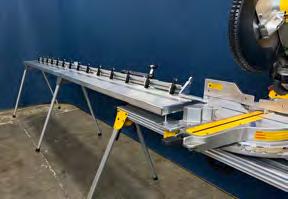
2022 Medium-Duty Incline Slider Bed Belt Conveyor Price shown is for both items. See the PDF drawing links shown below for additional information.

More Details Here
$19,947 FOB ID
Wood Tech Systems 765-751-9990
www.woodtechsystems.com
AMI Industrial Floor Carts

AMI's industrial floor trucks (material carts) are designed of hardwood construction, fitted with space-age phenolic, roller-bearing wheels, and ball bearing swivel casters for strength and durability. AMI's phenolic wheels resist shock without chipping. They are non-sparking, non-marking, and can be operated continuously between -50℉ and 260℉. They are unaffected by grease, oil or debris on your shop floor.

Series "B" AMI Industrial Floor Truck
Our swivel casters are precision built with perfectly aligned raceways. All cold-form parts are made to exacting tolerances from heavy-gauge steel, and are hardened for severe service and long wear. Series B-4 carts include four casters, one at each corner, to prevent "tri-cycling" of long lumber loads.
Standard Models Available Max Load Weight
2748
2022 Powermatic Dual-Bag Dust Collector
2022 Powermatic Dual Bag Dust Collector. Industrial dust collector, dual-bag, 1800 CFM with 6″ port. Includes supply of 6″ flex hose. System has 10 Cu. Ft. capacity. 3HP, 3Ph, 5 amp, 460/V with onboard starter.
$5,497 FOB VA
Wood Tech Systems
765-751-9990
www.woodtechsystems.com
48" Series "B" & "C" 2500
3260 32" x 60" Series "B" & "C" 2800
3660 36" x 60" Series "B" & "C" 2800
3672 36" x 72" Series "B" 4000
4072 40" x 72" Series "B" 4000
3696 36" x 96" Series "B" 4000
4896 48" x 96" Series "B" 4000
*Other models and sizes are available on request. FOB NC.
Wood Tech Systems
765-751-9990
www.woodtechsystems.com
$7,890
Wasserman & Associates
800-382-0329 www.wasserman-associates.com
2005 Koorsen Connector Detector (For Repair or Parts)
6 detection zones to locate missing plates. Horn & zone lights indicate missing plates. 12" to 60" adjustable height from floor. 110 Volt / 1 Phase. New control panel switches & lights in 2014. Needs circuit board repair or replacement and new tower light. Includes 4 extra detection zone boxes. $2,500 NOW $1,500 FOB NE

Wasserman & Associates
800-382-0329
www.wasserman-associates.com
INGERSOLL RAND ROTARY SCREW AIR COMPRESSOR

Model UP6-15c-210. 15 HP. 38 CFM at 210
PSIG. 120 Gallon Tank
$7,900 NOW $5,900 FOB NE
Wasserman & Associates
800-382-0329
www.wasserman-associates.com
PHONE: 800-289-5627 FAX: 800-524-4982 Read/Subscribe online at www.componentadvertiser.com Don’t Forget! You Saw it in the Adverti$$er February 2023 #15283 Page #95 A dverti $ er Component manufaCturing m The
(lbs.)
27" x 48" Series "B"
32" x
& "C" 2500 3248
MISC.
IF ONLY YOU COULD NAIL EVERYTHING IN LIFE THIS EASILY.
With a Terminailer XP, it takes only one person to drive between 30% and 70% of the framing nails in any given job . And all this nailing is done within a secure enclosure, so your people are protected from costly nailing injuries while eliminating literally millions of repetitive motions ( 4,001,398 repetitive motions to be exact , judging from the total nail count tallied recently on a two year-old Terminailer XP).
That’s a lot of nails successfully installed to be sure, and a lot of debilitating repetition your workers’ hands are spared, without any complicated training, software or lengthy setup time required.

Developed by people who know wall panel production, Terminailer XP boasts multiple repeat buyers, 20-plus machines performing exceptionally in the field and tens of millions of nails installed. Thoroughly field-proven, Terminailer is ready to drive greater productivity for you. Contact us today for more information.


765-751-9990 www.woodtechsystems.com
Wood Tech Systems is a registered trade name of Wood Truss Systems, Inc.
MISC.
The WoodRunner WR-2 lumber retrieval system seeks and retrieves the exact boards needed to cut. The core of the system is a trolley with an automated picking head. The trolley moves back and forth on a runway truss positioned over lumber carts while the picking head’s laser scans below. After locating the specific piece of lumber needed, the picking head uses a powerful vacuum to hold the board while moving it to the infeed deck.

Call for Price
Eide Integrated Systems, LLC 612-521-9193
www.eidemachinery.com
New SL Laser Projection System
Scrap
30 amp power.
$22,490 - FOB CA
Wood Tech Systems
765-751-9990
www.woodtechsystems.com
• Challenger Model CH200-4045-S
Horizontal Wood Grinder (60 HP/45

KW - 480 Volt/3 Phase)
• 3 CY Dump Hopper with 15' Long x 4' Wide Vibrating Primary Feed Conveyor
• 15' Long x 2' Wide Vibrating Infeed Conveyor (with 5' Fiberglass Section)


• MDI Model CR-85 Metal Detection System (under Fiberglass Section)
• 3/4" Screen
• Cornell Blower
• Pipe from Blower to Cyclone

• HMI Model MH48 Cyclone
$39,500 FOB DE
Wasserman & Associates
800-382-0329
www.wasserman-associates.com
New, laser projection system from SL Laser. Projects roof truss, floor truss and wall panel design images accurately onto building surface, for faster setup and fabrication times. Each laser head provides 21' projection length (@15 foot ceiling heights). Includes system computer, cables, mounting hardware for attachment to customer's structure, factory installation, training and choice of green or red laser. Works with each connector plate manufacturer's design software. Modular nature of the laser heads allows for easy, future expansion of system length. 120 volt, 1 phase. FOB NC Wood Tech Systems 765-751-9990
www.woodtechsystems.com
Electrical Supply: 110 VAC
Motor: 1/4 HP, 110 VAC, Linear Actuator
Highly Accurate: +/- .010 Inches
Stop Rail: 2 x 4 x 1/4 Aluminum Extrusion
Stops: Jig Bored Steel
Stop Blocks: Machine Billet Aluminum
Internal Components: Hardened, Ground and Polished Steel and Billet Aluminum
Dimensions:
Length: 5 feet (60”) to 60 feet (720”)
Height: 12 inches
Depth: 12 inches
Hydro-Air Chord Splicer
• 7 1/2 HP - 3 Phase Hydraulic Power Unit
• 9" x 16" Platen
• Dual Push Button for Operator Safety
$10,900 FOB PA
Wasserman & Associates
800-382-0329
www.wasserman-associates.com
If you are looking for the fastest, most consistent way to measure and cut your product, then the Hain Measuring System (MEA) is your answer. The MEA changes from one length t any length instantly, up to 60’, without changing the operator’s position on the line. It is also highly accurate (+/- .010) and quickly moves from one length to the next in seconds. The MEA is designed for quick and easy setup and is simple to use. Even a first time user will be productive with little or no training required. It can adapt to any saw and can be mounted to any surface so that you can integrate the MEA with your existing setup. The MEA is versatile allowing “left” or “right” handed operation and measurement in “feet and inches” or “inches” depending on your preference. The MEA is also available in a “Skid Mounted” version.
theHAINCOMPANY 6125 Enterprise Drive, Unit 9 | Diamond Springs, CA 95619 530.295.8068 | sales@thehaincompany.com
PHONE: 800-289-5627 FAX: 800-524-4982 Read/Subscribe online at www.componentadvertiser.com Don’t Forget! You Saw it in the Adverti$$er February 2023 #15283 Page #97 A dverti $ er Component manufaCturing m The
Used 2015 Woodrunner Lumber Retrieval System
Incline
20′ belt scrap conveyor with 8′ incline, 2′ wide. 240v,
2001 Challenger Wood Grinder
system is protected under U.S. Patent #8,960 ,244 and other patents. Every Ranger Retrieval System is built to order -- up to 130'/ 40m long . Fill the carts and feed the saw for an entire shift . The Ranger never misses a beat . Acer Inc. 301 Industrial Drive Rushford , MN 55971 507-864-2220 www.acerinc .com Think big … Think Ranger RS.
NEW GALVANIZED STEEL STRAPPING

1 1/4" wide x .035 thick. $69 $59 per coil.
$1,449 $1,155 per skid (21 coils). FOB PA.
Wasserman & Associates
800-382-0329
Generation
Used 2018 Triad Framing Table
The Generation 3 Framing Table has adjustable 20’ long walls, with wall heights from 6’9” to 14’3”. Studs are placed between color-coded stud locators. With just a push of a button, the width adjustment clamp is activated to clamp and square all components. The Generation 3 Framer features a wider table top, designed with the framer in mind. Our new Anti-Slip Surface that allows the operator to work on a comfortable and safe surface.
Call for Price
Eide Integrated Systems, LLC
612-521-9193
www.eidemachinery.com
Jenkins Model 195 Double End Machining
•
New Handle Bar Router
Porter Cable Model 7519 Production Router
Motor with Soft Start. Steel Handle Bar
Frame with Makita Switches. 120 Volt / 1
Phase / 15 Amp / 21,000 RPM. Includes 2 Router Bits. $3,000 FOB NE.

Wasserman & Associates
800-382-0329
www.wasserman-associates.com
•
www.wasserman-associates.com MISC.
$115,000 FOB
Sweed Scrap (Band) Chopper with Stand 1/2 HP Motor (115/208-230 Volt)


$1,900 NOW $1,750 FOB NE.
Wasserman & Associates
800-382-0329
www.wasserman-associates.com
Purchased but never installed. Manual (x, y) movements, powered vertical movement. 15-ft wide bridge x 23 ft long x 14 ft height. Hoist moves at 16 feet per minute, includes pendant control, chain container and centering strap to minimize the need to reach for the control pendant. Last 3 photos show current condition & status. Other photos are of matching crane frame with hoist in place. 115 volt, 1 phase electrical required.
$16,690 FOB NV
Wood Tech Systems
765-751-9990
www.woodtechsystems.com
BLACK BROTHERS LAMINATING PRESS


(3) 98" x 74" Side Loading Air Pod
Laminating Presses
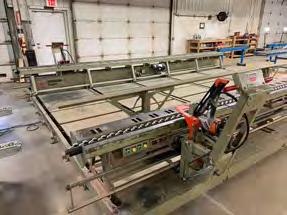
98" x 222" Press Area with Used Together
6" to 74" Adjustable Press Load Opening (threaded rods for manual adjustment)
4 Air Hose Actuated Roller Tracks in Lower Platen
All Necessary Air Contols for the Press
$18500 FOB IA
Wasserman & Associates
800-382-0329
www.wasserman-associates.com
Scrap
Adjustable legs, side-rails, rough-top belt, 3-phase power As-Is, Where-Is.
$1,990 FOB KY
Wood Tech Systems
765-751-9990
www.woodtechsystems.com
EMSI Teeter Cart

Width - 46" / Length - 72" / Load Capacity
- 3000 pounds / Pneumatic tires - 14.5 inch / Maximum utility in truss plants, panel plants and lumber yards / Quick assembly by bolting parts together / All hardware is supplied / Upright 2 x 4's not supplied. Medium duty tires rated at 1500 lbs each are included.

Call for Price Eide Integrated Systems, LLC
612-521-9193
www.eideintegratedsystems.com
PHONE: 800-289-5627 FAX: 800-524-4982 Read/Subscribe online at www.componentadvertiser.com Don’t Forget! You Saw it in the Adverti$$er February 2023 #15283 Page #99 A dverti $ er Component manufaCturing m The MISC.
800-382-0329 | www.wasserman-associates.com
Center
Refurbished in 2019
Please reference attached proposal for specifications
Details
Additional
IA
2021 Gorbel crane frame with 1,000 lb electric chain hoist
Incline Conveyor
3,
A dverti$er Component manufaCturing S erving the S tructural B uilding c omponent S i ndu S try The
February 3 – 4
February 6 – 7
February 9
Calendar of Events
FEBRUARY 2023
International Housing Assoc. (IHA) Annual Meeting
Northwestern Lumber Assoc. (NLA) LBM Expo—North
Truss Manufacturers Assoc. of Texas (TMAT) Chapter Meeting
February 21–23 Timber Products Inspection Lumber Grading Course
February 22 – 24 55th Annual NFBA 2023 Frame Building Expo
February 27 –
March 1
February 27 –
March 3
February 28 –
March 1
March 1
March 1 – 2
March 2 – 3
March 3 – 4
March 6 – 8
March 8 – 9
March 8 – 10
March 8 – 10
March 11 – 12
March 12 – 16
March 13 – 16
March 14 – 18
March 21 – 22
March 24 – 25
March 27 – 29
March 28 – 30
March 28 – 30
March 29 – 31
March 29 –
April 1
April 4 – 5
LBM Advantage Annual Buying Show
EduCode 2023 Conference & Exhibition
Northwestern Lumber Assoc. (NLA) LBM Expo—Nebraska
MARCH 2023
Independent Dealers Education Association Services (IDEAS) Show
Pennsylvania Housing Research Center (PHRC) Housing Conference
Northwestern Lumber Assoc. (NLA) LBM Expo—Iowa
American Institute of Building Design (AIBD) Design & Build Conference
University of Texas Building Professional Institute (BPI) of Texas—Houston
Lean Summit 2023
Lumbermens Merchandising Corporation (LMC) Annual
Las Vegas, NV
St. Cloud, MN
Austin, TX
Peachtree City, GA
Louisville, KY
Orlando, FL
Las Vegas, NV
La Vista, NE
King of Prussia, PA
State College, PA
Des Moines, IA
North Myrtle Beach, SC
Houston, TX
Tucson, AZ
Charlotte, NC
Southeastern Lumber Manufacturers Assoc. (SLMA) Spring Meeting & ExpoSavannah, GA
Do it Best Spring Market
Build23: AWCI’s Convention + INTEX Expo
AGC–The Construction Assoc. 2023 Annual Convention
CONEXPO-CON/AGG 2023 Tradeshow
Southern Pine Inspection Bureau (SPIB) Lumber Grading Course
JLC Live New England
International Mass Timber Conference
Atlantic Builders Convention (ABC) Conference & Expo
National Lumber and Building Material Dealers Assoc. (NLBMDA) 2023 Spring
Meeting and Legislative Conference
Orlando, FL
Las Vegas, NV
Las Vegas, NV
Las Vegas, NV
Pensacola Beach, FL
Providence, RI
Portland, OR
Atlantic, NJ
Washington, D.C.
International Wood Products Assoc. (IWPA) 67th World of Wood ConventionSavannah, GA
Modular Building Institute (MBI) 2023 World of Modular
APRIL 2023
Southern Pine Inspection Bureau (SPIB) Quality Control Course
April 12 – 14 2023 NASCC: The Steel Conference
April 20 – 23
April 26 – 27
April 26 – 28
April 30 – May 3
Associated Building Material Distributors of America (ABMDA)
40th Annual Convention
Virginia Tech Short Course on Structural Design Topics in Wood Construction
MSR Lumber Producers Council (MSRLPC) Annual Workshop
LBM Advantage 2023 NextGen Leadership Conference
Las Vegas, NV
Pensacola Beach, FL
Charlotte, NC
Orlando, FL
Blacksburg, VA
San Antonio, TX
Charlotte, NC
PHONE: 800-289-5627 FAX: 800-524-4982 Read/Subscribe online at www.componentadvertiser.com Don’t Forget! You Saw it in the Adverti$$er February 2023 #15283 Page #100 A dverti $ er Component manufaCturing m The
May 1 – 3
May 2 – 4
May 3 – 6
May 9 – 11
June 21 – 22
July 23 – 26
July 24 – 27
July 25 – 27
August 3 – 5
September 18 – 22
Calendar of Events
MAY 2023
Builder 100 Leadership Summit
Structural Building Components Assoc. (SBCA) Open Quarterly Meeting
Structural Engineering Institute (SEI) Structures Congress 2023
DesignBUILD 2023
JUNE 2023
National Framers Council (NFC) Regional Meeting & Golf Tournament
JULY 2023
Southeastern Lumber Manufacturers Assoc. (SLMA) Annual Conference

University of Texas Building Professional Institute (BPI) of Texas—North Texas
Structural Building Components Assoc. (SBCA) Open Quarterly Meeting
AUGUST 2023
American Institute of Building Design (AIBD) Design & Build Conference
SEPTEMBER 2023
Building Component Manufacturers Conference (BCMC)
Dana Point, CA
Nashville, TN
New Orleans, LA
Sydney, NSW, Australia
Ellicott City, MD
Sea Island, GA
Irving, TX
Buffalo, NY
Nashville, TN
Indianapolis, IN
Don’t see your event? Increase attendance and participation by listing your industry focused events here! E-mail details and event web-link to Anna@componentadvertiser.org. We can’t guarantee space for all events, but all industry related events will be added on a space available and interest to our reader priority.
CONNECTED SOFTWARE SOLUTIONS FOR YOUR BUSINESS
- Full stack web applications



- Analysis, storage, visualizations, and integration of data
- E-commerce applications and integrations


- AI / ML solutions

- Blockchain development
- IoT and smart factory applications

- ERP integrations





PHONE: 800-289-5627 FAX: 800-524-4982 Read/Subscribe online at www.componentadvertiser.com Don’t Forget! You Saw it in the Adverti$$er February 2023 #15283 Page #101 A dverti $ er Component manufaCturing m The
us today to see how we can connect your factory info@4wardsolutionsgroup.com 4wardsolutionsgroup.com 4Ward is the exclusive Q4US representative in North America
Contact
The truss industry relies on 3rd party quality assurance services to provide random visits to review the plants Quality Assurance program along with their operations. If your plant needs to comply with the IRC, IBC and to those who depend on solid, experienced QA expertise, we ask you to consider selecting Timber Products Inspection, Inc. (TP) as your choice for 3rd party inspections.
Proudly serving the forest products industry for over 50 years, TP brings the expertise you need to ensure your business is successful. As a responsible partner, TP delivers to clients, employees, and the industries we serve the confidence to drive value through the effective use of our diverse professional team.
TP would like to welcome the following authorized agents to our inspection team, each of whom have many years of experience in the truss industry!
• Al Coffman
• Jean Hart
• Curt Holler
• Chuck Ray
• Glenn Traylor
• Elliot Wilson
If you have questions about how you can make this selection, please contact your authorized agent above or Glenn Traylor at 919-280-5905 or trusguy@gmail.com.
https://www.tpinspection.com/ https://www.tpinspection.com/auditing-services/truss
Safety First!
Safety Meeting Topics


From State Fund CA.

Safety and Substance Abuse Dont Mix

Drug use and alcohol consumption are normally considered personal issues. They only become an employers concern when they affect safety and worker performance. Drug and alcohol abuse cost employers through high absenteeism and sick pay. Abusers hurt themselves and their families if they lose their job as a result of their actions. If they are fired or cannot function on the job, the company loses the services of an experienced worker. Those under the influence of drugs or alcohol cause friction in the work group, lower morale and work efficiency, use poor judgment that results in bad decisions, and give the company a poor public image.
Certain times of the year individuals should be especially aware of their alcohol and drug consumption. In the winter months when the days are dark and dreary, some people experience a sense of depression or seasonal affected disorder (SAD). They may turn to drugs or alcohol in the mistaken belief it will relieve the symptoms of the disorder.

The holiday season, with increased social gatherings or added financial stress, leads some people to misuse drugs or alcohol, especially during this year of millennium celebration. Those who over-consumed alcohol or drugs yesterday and are hung over today may feel out of sorts, still trying to recover, and may not give all their attention to the safety aspects of their job. Their judgment and safety performance becomes impaired and the likelihood of an accident or injury to themselves or coworkers increases.
Sometimes a personal or health problem persists. In most cases, the problem gets resolved. But if it is not resolved some people turn to alcohol or drugs. Even some prescription drugs can interfere with job performance. The individual cannot think clearly or becomes distracted. This can lead to accidents. Irresponsible consumption of drugs or alcohol not only jeopardizes the safety and health of the worker and coworkers but it can impact the employers business and affect the future of all families involved.
La seguridad y la drogadicción o el alcoholismo no se mezclan
El uso de drogas y el consumo de alcohol se consideran generalmente asuntos de índole personal. Éstos solamente incumben al empleador cuando afectan la seguridad y el desempeño del trabajador. La drogadicción y el alcoholismo tienen un costo elevado para los empleadores por ser causas del ausentismo laboral elevado y de las ausencias por enfermedad con goce de salario. Los drogadictos y los alcohólicos se lastiman a sí mismos y a sus familias si pierden sus trabajos como resultado de sus acciones. Si se les despide o si no pueden desarrollar las funciones del trabajo, la empresa pierde los servicios de un trabajador con experiencia. Aquéllos que se conducen bajo la influencia del alcohol o las drogas causan fricción en el grupo de trabajo, bajan la moral y la eficiencia en el trabajo, utilizan el mal juicio que resulta en malas decisiones, y dan una mala imagen pública a la empresa.
Durante algunas épocas del año, las personas deben estar especialmente conscientes de su consumo alcohólico y de drogas. Durante los meses de invierno, cuando los días son opacos y lúgubres, algunas personas padecen de algún tipo de depresión o de síndromes estacionales (SAD, por sus siglas en inglés). Ellos pueden optar por consumir drogas o alcohol con la falsa esperanza de que eso les aliviará los síntomas del trastorno.
La época de las fiestas de fin de año, con un mayor número de reuniones sociales o de mayor tensión nerviosa por problemas económicos, conduce a muchas personas a excederse en el uso de drogas o en el consumo de alcohol, especialmente este año de celebración del nuevo milenio. Todos aquellos que consumieron alcohol o drogas en exceso ayer, y tienen resaca hoy, pueden sentirse faltos de coordinación, aún tratando de recuperarse y quizá no le presten completa atención a los aspectos de seguridad que su trabajo requiere. Su juicio y desempeño seguro se verán seriamente disminuidos y aumentará la posibilidad de que ellos o sus compañeros de trabajo sufran accidentes o lesiones.
Algunas veces los problemas personales o de salud persisten. En la mayorìa de los casos, el problema se resuelve. Pero si no se resuelve, algunas personas recurren al alcohol o a las drogas. Incluso algunos medicamentos recetados pueden interferir en el desempeño del trabajo. La persona no puede pensar claramente o se distrae. Esto puede llevar a accidentes. El consumo irresponsable de las drogas o del alcohol no solamente pone en peligro la seguridad y la salud del trabajador y sus compañeros, sino además, puede repercutir en las actividades empresariales del empleador y afectar el futuro de todas las familias involucradas.
The above evaluations and/or recommendations are for general guidance only and should not be relied upon for legal compliance purposes. They are based solely on the information provided to us and relate only to those conditions specifically discussed. We do not make any warranty, expressed or implied, that your workplace is safe or healthful or that it complies with all laws, regulations or standards.


PHONE: 800-289-5627 FAX: 800-524-4982 Read/Subscribe online at www.componentadvertiser.com Don’t Forget! You Saw it in the Adverti$$er February 2023 #15283 Page #103 A dverti $ er manufaCturing m The PHONE: 800-289-5627 FAX: 800-524-4982 READ/SUBSCRIBEONLINE AT WWW.COMPONENTADVERTISER.COM Don’t Forget! YOU SAW ITINTHE Adverti$er March 16th, 2012 #05135 PAGE #37 A dverti$er COMPONENT MANUFACTURING
We create transformative website and app experiences

Since 2006, we've been helping businesses of all kinds build their online presence. We make websites and software for the construction industry to empower companies to reach a wider customer base and engage their audiences. Companies all around the world work with us to make websites and apps that people actually want to use. Reach out to Wolf X Machina if you're a business and you want a website that actually drives results.
WOLF X MACHINA
www.wolfxmachina.com
info@wolfxmachina.com
PHONE: 800-289-5627 FAX: 800-524-4982 Read/Subscribe online at www.componentadvertiser.com Don’t Forget! You Saw it in the Adverti$$er February 2023 #15283 Page #104 A dverti $ er Component manufaCturing m The
giggles
A dverti$er Component manufaCturing S erving the S tructural B uilding c omponent S i ndu S try The Hiring Zone Building Component Industry's Job Board Employer to Candidate Direct Hiring No Recruiting Fees! Post your Opportunity... Candidates respond directly to you! For Additional Information Contact: twm@componentadvertiser.org or Call: 800-289-5627 x1 Visit our website: www.componentadvertiser.com/Hiring-Zone
BAM “Ovation”
Door Machining Center (DMC)

New Builders Automation Machinery


“Ovation” series, door machining center (DMC). Fully programmable, two-stage door machine featuring (27) axes of operation. Can be specified with either two or four front machining heads. Machine is side-eject, direct-drive with helical gear racks and gear protection from dust. The door loader is driven by an absolute encoder; no stepping motors, belts or exposed ball screws are used.

More information Click Here
Price based on configuration
Wood Tech Systems
765-751-9990
www.woodtechsystems.com
PHONE: 800-289-5627 FAX: 800-524-4982 Read/Subscribe online at www.componentadvertiser.com Don’t Forget! You Saw it in the Adverti$$er February 2023 #15283 Page #105 A dverti $ er Component manufaCturing m The 800-382-0329 | www.wasserman-associates.com New Sub-Component Nailer • Assembles Trimmers, Jacks, L’s, Channels & Headers • 2x4 and 2x6 Capacity • Remote Fire & 3-Way Clamping • Staggered or Straight Line Nail Pattern • Squaring Stop • Foot Pedal Control • Reserve Air Tank • 5’ Infeed & Outfeed Roller Conveyor $24,000 FOB NE NEW!
EQUIPMENT
Model BSP-6P Rollers
6
Polyurethane
MODULAR
Hilman
•
Ton Capacity. •
Wheels.
• Swivel Padded Top.
Wasserman
800-382-0329
800-382-0329 | www.wasserman-associates.com Wescana Jack Press & Table 35 Ton Hydraulic Press with 14" Wide Platen Press Roof or Floor Truss (4" Maximum Opening) Steel Frame Table with 1/4" Steel & 1" Plastic Top Slotted Jigging at 12" Centers | Joystick Control 7.5 HP / 3 Phase (208/230/460/575 Volt) 6' x 25' Table & 8' x 25' Table Available NEW! Door } Stair } Window Machines
• 54 48 Available $290 NOW $220 each FOB NE
& Associates
www.wasserman-associates.com
Dotul Door Stop Stitcher Click Here for details $4,900 NOW $3,600 FOB GA Wasserman & Associates 800-382-0329 www.wasserman-associates.com RUVO MODEL 1300 DOUBLE END DOOR TRIM SAW $4,250 FOB PA Wasserman & Associates 800-382-0329 www.wasserman-associates.com

BAM Stair Wedge Saw
Builders Automation Machinery (BAM) model 2220, stair wedge saw station automatically produces wood wedges used to lock stair treads and risers into slots cut into the stair stringers…


Price based on configuration
FOB FL
765-751-9990
BAM Pre-Hung Door Machine Titan Series


Builders Automation
Machinery (BAM) Titan series pre-hung door machine. Designed to produce between 150 and 250 doors per day. Multi-function door machine capable of doors 1′-6″ to 4′-0″ in width, and both 6′-8″ or 8′-0″ door heights. Processes both 1 3/8″ and 1 3/4″ thick door slabs. Machines the door, hinge jamb and strike jamb all at the same time. Capable hinge sizes include 3 1/2″ x 3 1/2″, 4″ x 4″, 4 1/2″ x 4 1/2″ with 5/8″ radius. Cycle time with flush hinge routing is 45 seconds. 10′ long x 7′-6″ wide footprint. Shipping weight 4,000 lbs.
More information Click Here

Price based on configuration
765-751-9990
PHONE: 800-289-5627 FAX: 800-524-4982 Read/Subscribe online at www.componentadvertiser.com Don’t Forget! You Saw it in the Adverti$$er February 2023 #15283 Page #107 A dverti $ er Component manufaCturing m The 765-751-9990 www.woodtechsystems.com 800-382-0329 | www.wasserman-associates.com Builders Automation Stair Stringer Router More information here: http://goo.gl/mSsxyY NEW! BAM Staircase
Clamp
Automation Machinery (BAM) staircase assembly clamp, model 2210, accommodates up to 20 foot long stringers with a maximum width of 54″… Price based on configuration FOB FL NEW!
Assembly
Builders
www.woodtechsystems.com NEW!
www.woodtechsystems.com NEW!

TheJobLine.com Careers in the Truss, Wall Panel and Engineered Wood Components Industry Job Opportunities Available Candidates Services & Products 800-289-5627 www.thejobline.com Since 1992
Big Sky Living in Montana!
Truss Designer. MiTek software. Experience required: 2+ years. Components include: floor trusses, roof trusses and wall panel experience is a plus. Markets include lumber yards, single family, single family custom, and light commercial. Work Schedule: average 40-45 hours a week or more if interested.
Compensation hourly, plus overtime, and base pay from $22 to $28hr+-. ($45k-70's) Yr.+-) depending upon experience, monthly bonus based on production output/errors. Benefits include: Medical, Dental, Vision, retirement programs, and ESOP (Employee Stock Ownership Plan). Relocation is open to negotiation. Low cost of living. EOE (Equal Opportunity Employer). J15235
Not a remote job but who wants to work remote when the office is in Montana?
visit: www.thejobline.com
email: mail@thejobline.com
STRICTLY
HIRING NOW!
Remote Truss Designer
MiTek - J15228
Our client in Florida is looking for Remote Truss Designer NOW, before the end of the year! Work remote, or in an office location in Florida. They need ONE Basic or Intermediate level Remote Truss Designer. Fantastic benefits, compensation is very competitive, and they use MiTek software. Remote is an option if you have a home office and remote experience, or you can work in office. They may consider someone without remote experience, just depends on the skill level. Fantastic benefits, compensation is very competitive, and they use MiTek software. I can't say more about this opportunity here.

Compensation can be estimated based on your experience and skill 45 hours per week average.
Overtime hours are usually available. Call/email for details
See what we can do for YOU!
visit: www.thejobline.com
email: mail@thejobline.com
STRICTLY CONFIDENTIAL!
Truss & Wall Panel Designer J15226
Northeast
Design Director -
Central Ontario J15265
Truss Sales & Design - Truss/Framing
Packages J15279
TN
Truss Sales & Design - Truss/Framing Packages J15245
Texas, Louisiana, Oklahoma
Truss Designer - Remote (Alpine) J15278
Remote or in GA
Regional Manager - Truss & Wall Panel J15261
Pacific/Southwest
CFS Truss Designer J15269 Remote or in the Midewst
Truss Designer - Alpine J15265 Florida
Commercial/Mega-Multifamily Truss Designer J15277
Nashville, TN
Senior Project Manager - Mass Timber J15276
B.C.
Project Superintendent U.S. - Mass Timber J15273
U.S.
Project Superintendent Roaming - Mass Timber J15274
North America
Chief Estimator/Precon Manager - Mass Timber J15271
BC
Project Coordinator J15272 TN
Truss Designer - MiTek/Multifamily J14173 Texas
Remote Senior Truss Designer - Truss J15266
South
Senior Truss Designer - Truss J15218
South
General Manager | Operations ManagerTruss J15620
Southwest
Remote Mega-Multifamily Truss Designer
J14177
Nation Wide
Outside Sales - Truss J14207 KY, TN, IN
Plant Manager - Truss/Panel J15258
Midwest
Truss & Wall Panel Designer J15259
Midwest
Truss Design/Estimating Manager J14171
Texas
Operations Manager - Truss ID: J15230
Southwest
Yard/Field Delivery Manager J15240
South
Remote Truss Designer - Alpine J15246
Midwest Candidate preferred
Outside Sales - Truss/Panel/EWP J10600
Southern IA
Truss Designer J14164
Florida
Advancement Opportunity to Production Manager Ji5219
South
Remote Multifamily Truss Estimator J15227
USA
Remote Mega-Multifamily Truss Design Manager J15234
Nationwide
Mega-Multifamily Project Manager J15229
South/Southeast
Senior Design/Design Manager | Alpine J15224
Knoxville, TN
General Manager - Truss J15221
South
Production Manager - Truss/Wall Panel/ Shipping/Maintenance J15217
KY
Remote Mega-Multifamily Design Checker J14187
Remote or in Texas
PHONE: 800-289-5627 FAX: 800-524-4982 Read/Subscribe online at www.componentadvertiser.com February 2023 #15283 Page #110 TheJobLine.com, inc. 800-289-JOBS www.thejobline.com job opportunities available
TheJobLine.com
See what we can do for YOU!
CONFIDENTIAL! TheJobLine.com
Get Current Job Opportunities Here
ID: C11370
General | Plant Manager/OperationsTruss/Panel/Framing Package Relocation: Texas, Arizona
20 years' experience. Started in production, advanced to Saw Supervisor, Production Manager, Plant Manager, now General Manager. As General Manager operated a $125M truss plant. Tripled output and reduced errors and labor cost. Developed and implemented standards and procedures to manage quality and costs. As Plant Manager (4 years), manage all the operation of the manufacturing plant, such as Productivity, logistics, efficiencies, costs. As Production Manager (12 years), manage all the areas of the manufacturing across the plant. Safety, quality control, efficiencies, HR, etc... Software: MiTek, Word, Excel, OptiFrame. Products: R & F Truss, Panel, Framing package. Markets: Single Family, Multifamily, Custom Homes. Bilingual English/Spanish spoken and written. Degree in Industrial Engineering.
Compensation: $90's+ bonus ($100k min)
ID: C13437
Remote Truss Designer | In Office Truss Designer | Design Manager Relocation: Ohio

If it is big, bad, ugly, or worse, I can handle it. I've done layout and profile work in autocad w/ some home brewed scripting, and ArchiCAD. Custom residential, a few track builders that had 3 base models and many options to track, some multi-family, and large commercial projects. Software: MiTek, AutoCAD, ArchiCAD, Truswal, Simpson, Eagle and others. Quick to pick up new software.
ID: C10853
Remote Design Manager | Remote Offshore Design Project Manager Relocation: Texas, Georgia, USA - South
Top level Engineering/Design Management candidate, 14+- years experience Truss, 4+- Panel experience. Has experience building and integrating offshore design resources with internal design departments and training design managers to better utilize offshore capabilities. Large volume manufacturer experience. MiTek Sapphire design/layout proficient. Too confidential to go into more detail.
Compensation: $120k+
ID: C18565
Designer: Truss/Panel, Wood/Steel, BIM
Relocation: North Carolina
Material take-offs, proposals, job-site meetings, Submittal Tracking, Excellent Problem-solving Skills, Material Ordering, Field Measuring, 3-D Modeling Program (3-D and 4-D BIM in-house), Generated
Available Candidates
material take-offs from the BIM model, Coordinated RFI's thru the BIM model, Clash detection between wood trusses, structural steel and LVL's. 3-D Scan's of job-sites. Scheduled / Distributed work to 6 designers Cross-trained all designers in roof floor and wall panels for whole-house design.
ID: C18370
Plant | Location | General Manager - Truss/ Panel
Relocation: California, Nevada
Highly experienced (20+ years) roof and floor truss, and wall panel manufacturing manager. Started in the plant as builder, then sawyer, supervisor, truck driver, maintenance manager, designer, outside sales, plant manager, operations manager, and general manager. OSHA trained, developed and implemented safety programs. Successful turn around experience, hands on ability to work with departments to combine individual strengths into one team effort, lower costs, and meet quality and volume expectations. Past experience negotiating better vendor programs to lower costs and improve inventory turns.
ID: C10507
Senior Management - Truss/Panel/Lumber/ Installed Services
Relocation: USA - Western
I am a Diverse driven individual seeking a position in the fast paced construction component industry where my professionalism in sales, business and leadership skills along with a strong proven background in, General Management, Operations, Sales Management, strategic alliances, business development, team building, P&L experience and Customer Satisfaction will play an integral part in growing new business, nurturing existing business or developing company operations to meet the highest level of efficiencies, standards and safety while having fun doing it!
ID: C11929
Location/General Manager - Truss/I-Joist/ Beams/EWP
Relocation: USA - ALL States
Schedule all production. Schedule all deliveries. Purchasing. Set company pricing. Invoicing. Receiving. Developed a system for outside sales staff to turn in truss orders. Designer. Primary duties: design, layout, and cutting/production documents. Secondary duties: checking others work, scheduling, customer service, inside sales, and training. Software used: Non-MiTek, AutoCAD, and CAD - Other. Component experience includes floor trusses, roof trusses, I-Joists, EWP, and hardware. Market experience includes tract, single family, single family custom, multi-family, light commercial, and agriculture. My
volume is $150k+- a month. Designed 1.25 million in 2012 for production. This total doesn't include quotes and is considerably less than my capability considering all other job duties.
ID: C18454
Remote Designer | Mega-Multifamily | Single Family Custom
Relocation: Minnesota
12 Years' experience. Create Estimating models for bids. Study blueprints for inconsistencies, collaborate with Design Manager and Sales to determine if more information is needed, design and engineer trusses, create a detailed truss layout to set trusses in the field, and provide support until project is successfully completed.
Mega-Multifamily, Multifamily, Single Family Custom. MiTek Sapphire and CAD. Tested low end of Senior Designer range.
ID: C11834
General/Regional Manager - Truss/Panel
Relocation: Maine, Massachusetts, New Hampshire, Ontario, Vermont
As District Manager: Responsible for the financial performance of three wood truss and wall panel plants, two Millwork and door assembly facilities and one installed labor location in multiple states. Group revenues increased from $50 million/year in to $70 million per year. Devised a “buy versus make” purchasing protocol in to ensure that internal truss and Millwork plants were operating at capacity before using outside vendors that supplied similar products. Spearheaded a “hub and spoke” organizational structure for three truss plants. This plan optimized scarce design talent, reduced clerical expenses, and synchronized output at each plant. Restructured the installed labor division to include material estimators, lumber salespeople and cost accounting methods in 2005. The changes resulted in a 400k gain in profits. Drafted corporate training material for fall protection and new hire safety orientation.
As General Manager: Won “Gold Store” award for exceeding company goals in profits, sales growth, and ROA. Served on a corporate manufacturing audit and operating performance team that made recommendations to under performing truss plants. Two of the facilities audited became “Gold Stores” the following year. When the sales of three district stores were allocated to the truss plant, the lost business ($1.5 million/year) was made up and organic sales grew by over 10%. Sales volume grew from $11 million per year to over $15 million per year.
ID: C18459
Remote Wall Panel Designer | Wall Panel Designer
Time To Hire?
Available Candidates
Relocation: Alberta, British Columbia, Ontario
8 Years' experience as a wall panel designer. Uses HSB CAD, AutoCAD, Autodesk Revit. Everything from Single family custom to multifamily and modular.
ID: C18468
Truss Designer | Wall Panel Designer
Relocation: Arizona, California, Nevada, Utah
Designer, truss and wall panel, MiTek, AutoCAD, iLevel, almost considered a senior designer. In addition to design, was responsible for training new designers. Also has iLevel, Open Joist 2000 experience. Wall panel design experience is in AutoCAD and later in Sapphire. Started in the industry in sales, then wall panel design, added truss, and I-Joist. 7 years' experience in truss design, 3 in wall panel, 10 in I-Joist design. Will consider relocation to indicated areas only. Will consider remote.
$26-28 hr.
PHONE: 800-289-5627 FAX: 800-524-4982 Read/Subscribe online at www.componentadvertiser.com February 2023 #15283 Page #111
inc. 800-289-JOBS www.thejobline.com
TheJobLine.com,
Current Candidates www.thejobline.com TheJobLine.com, inc. 800-289-JOBS
We’re here when you need help! visit: www.thejobline.com email: mail@thejobline.com or call Thomas McAnally for Personalized Service STRICTLY CONFIDENTIAL!
Effects of Ripping
Structural Truss Lumber
By MiTek Staff
How does ripping lumber, cutting a board along its length, affect its grade or strength values? Structural lumber is graded or inspected which provides designers, through the National Design Specification® (NDS®) for Wood Construction, the strength/design values for the lumber members. This process is accomplished by visually inspecting the entire board or passing the board through a testing machine.
The lumber industry is overseen by the American Lumber Standard Committee (ALSC). This group is made up of lumber producers, distributors, and users. They review and approve the grading rules and design values that are submitted to them by the grading agencies and then published in NDS.
Each grade of visual graded lumber has specific requirements for grain direction and slope, lumber defect size(s) and distribution. See Figure 1 for examples of lumber defects from the Metal Plate Connected Wood Truss Handbook. The same issues exist for Machine Graded Lumber. As reflected by the visual grading rules, there is a known relationship between lumber defect size(s) and distribution and strength values.

PHONE: 800-289-5627 FAX: 800-524-4982 Read/Subscribe online at www.componentadvertiser.com Don’t Forget! You Saw it in the Adverti$$er February 2023 #15283 Page #112 A dverti $ er Component manufaCturing m The Continued next page
Figure 1 – Images of Lumber Defects
An example of these grading requirements from the Southern Pine Inspection Bureau (SPIB) is shown in Figure 2. Note the chart that gives the knot size limits, as an example, per width of board for this one grade of lumber.


When you rip a member and change the member width, the defect size(s) and distribution requirements change. For example, from the knot chart above, a 2-1/4” diameter knot is permitted along the center line of the wide face in a 2x6 while a 1” diameter knot is allowed in a 2x4 along the edge of the wide face. If you rip 2” from a 2x6 that leaves a 1-7/8” knot along the edge of the wide face, see Figure 3. What is the new grade of this member? A 2x4 No. 2 SP permits a 1-1/4” knot along the wide face so in this example this ripped board does not meet a No. 2 grade.
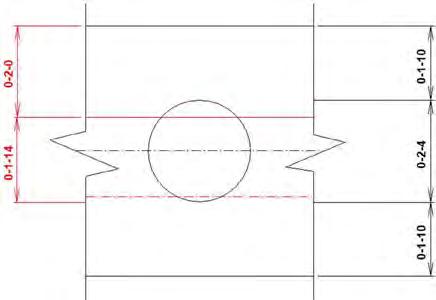
So caution should be used when ripping lumber used as structural members. No matter the amount being ripped the grade of the material likely will drop. Options are to send the truss design to your MiTek engineer for a repair or have a qualified lumber grader come out and inspect the new members. Note the grader should be able to inspect Machine Evaluated Lumber and provide a new visual grade to the material.
For additional information, or if you have questions, please contact the
Engineering department.
PHONE: 800-289-5627 FAX: 800-524-4982 Read/Subscribe online at www.componentadvertiser.com Don’t Forget! You Saw it in the Adverti$$er February 2023 #15283 Page #113 A dverti $ er Component manufaCturing m The
Figure 2 – No. 1 SP Grade Specifications
MiTek
Figure 3 – 2x6 ripped to a 2x4
By Randy Daudet
Top Structural and Wood-Related Changes in the 2021 IRC, Part 2
In the last article, we described the primary structural and wood-related changes in the 2021 International Residential Code, Chapters 3 and 4. This article will continue with the primary changes to Chapters 5 through 8 of the IRC.

Decks
For the 2018 and the 2021 IRC, an informal group known as the Deck Code Coalition had been working to develop detailed prescriptive requirements for the safe construction of decks. For the 2021 IRC, seven of their proposals were ultimately approved, making significant improvements to the deck section.
One change made general improvements and expanded the use of the tables throughout the section. It clarified that decks are designed for either the live load or the ground snow load, whichever is greater. It revised the footing sizes in Table R507.3.1, allowing some smaller footing sizes for members with lower demand loads. The deck post height table was revised to make the post height based on tributary area of the post. Revised deck joist span tables, deck beam span tables, and deck ledger connection tables were added that cover 50, 60, and 70 psf snow loads in addition to 40 psf live loads. A new method of analyzing joist cantilevers resulted in a new deck joist span table with the maximum cantilever based on the adjacent joist span rather than the joist spacing.
Another change provides generic instruction for construction of guards so they can resist adequate lateral load. While not providing exact details, the new Section R507.10, Exterior Guards, will reinforce that guard loads have to “be transferred to the deck framing with a continuous load path to the deck joists.” The new section states that where the guard post is connected to the side of a joist or beam, that joist or beam must be connected to adjacent joists to prevent rotation of the beam, and when the guard post is mounted on top of the decking, it must be “connected to the

PHONE: 800-289-5627 FAX: 800-524-4982 Read/Subscribe online at www.componentadvertiser.com Don’t Forget! You Saw it in the Adverti$$er February 2023 #15283 Page #114 A dverti $ er Component manufaCturing m The
Continued next page
Deck Guard Connections
deck framing or blocking and installed in accordance with approved manufacturer’s instructions to transfer guard loads to the adjacent joists.” Previously, the Deck Code Coalition had attempted to put in actual prescriptive details for mounting of guard posts, but those had been disapproved, so they probably thought that this was the best they could do for now.
A couple of the changes dealt with installation of deck beams. One specifies that deck beams made of two pieces of lumber must be fastened together. The intent is to prohibit the practice of notching both sides of the support post and installing one beam member on each side. The beam spans are based on both beams being fastened together. A related change clarified application of deck beams, limiting the cantilever to one-fourth of the actual beam span, rather than one-fourth of the allowable beam span.
Another major change revised the table for spans of deck beams. As was also done for other tables, higher snow loads were covered. Furthermore, the deck beam span lengths in the table are now based on the Effective Deck Joist Span Length, not the actual joist span. The Effective Deck Joist Span Length is the actual joist span multiplied by a joist span factor that is determined by the ratio of the joist cantilever length divided by the supported joist span. This is meant to address the fact that the deck beam table is derived based on an assumed cantilever length of one-fourth of the joist span. When cantilevers shorter than that are used, the old table would be overly conservative, and the new factor accounts for that.
Finally, the treatment of deck board spans was revised. New columns were added to the joist spacing table for single spans of deck boards, and it was clarified that the entries for the existing columns were for multi-span boards.
For information on the use of Simpson Strong-Tie products with decks, take a look at our Deck Connection Fastening Guide, Connection Solutions to Meet the DCA6 Prescriptive Residential Wood Deck Construction Guide, Installation Options for Deck Lateral Load Connections, CodeCompliant Guardrail Post Connections, or Guard Post, Guard Rail and Baluster Installations Using Strong-Drive® Structural Fasteners
Fasteners

There were several changes to IRC Tables R602.3(1) and R602.3(2) that affect wood-frame fastening. In Table R602.3(1), two new lines were added for fastening of blocking between rafters or trusses not at the top plate, one for toe nails and one for end nails. The fastening of sheathing to framing was split into two rows, one for subfloor and wall sheathing, and another row for roof sheathing. Roof sheathing fastening spacing was changed from 12″ to 6″ on center at intermediate supports for 8d common and RSRS-01 nails. The 12″ nail spacing for 10d common or 8d deformed shank nails was maintained. This is due to the new higher roof components and cladding loads in ASCE 7-16. New language was added in footnote A that specifies “nails used for
PHONE: 800-289-5627 FAX: 800-524-4982 Read/Subscribe online at www.componentadvertiser.com Don’t Forget! You Saw it in the Adverti$$er February 2023 #15283 Page #115 A dverti $ er Component manufaCturing m The
Continued next page
framing and sheathing connections are carbon steel,” and that “Connections using nails and staples of other materials, such as stainless steel, shall be designed by accepted engineering practice or approved under Section R104.11.” This is to address the recently documented fact that stainless steel fasteners withdraw from wood easier than carbon steel fasteners, so the assumed values used to derive this table would not apply to stainless steel fasteners. Lastly, a new Note g was added to Table R602.3(2), the Alternate Attachments table that prescribes the use of staples and alternate sizes of nails. It states that “Alternate fastening is only permitted for roof sheathing where the ultimate design wind speed is less than or equal to 110 mph, and where fasteners are installed 3″ on center at all supports.”
Wall Bracing
Although there were fewer than usual, there were still several changes made to the IRC Wall Bracing section. One significant change was to Section R602.10.1.2. It was retitled from “Offsets along a braced wall line” to “Location of braced wall lines and permitted offsets.” The 2018 IRC allowed the braced wall line to be offset not more than 4′ from the exterior walls without limitation. A building designer would be able to offset all their braced wall lines 4′ toward the interior of the structure, therefore reducing the required length of bracing, while still meeting the letter of the IRC. The 2021 wording will prohibit such an extent of offsetting, requiring that “Each braced wall line shall be located such that no more than two-thirds of the required braced wall panel length is located to one side of the braced wall line.”
Another change dealt with placement of braced wall panels at the ends of braced wall lines. In Seismic Design Categories D0, D1, and D2, braced wall panels have to be located at the end of braced wall lines, except that Methods WSP, BV-WSP, and continuous sheathing methods can begin up to 10′ from the end of the braced wall line provided a 24″-wide panel is installed at the building corner, and the panel closest to the end of the braced wall line has an 1,800 lb. hold-down device installed. A new exception was added to also allow a Method PFH or ABW to be installed up to 10′ from the end of the braced wall line, since these methods will also have holdowns with at least 1,800 lb.

In Table R602.10.3(3), which lists bracing lengths based on Seismic Design Category, bracing methods PFH, PFG, and ABW were added to the column heading with method WSP, in the same place they are listed when used to resist wind loads.
As mentioned in the previous IRC article, there were several changes meant to reinforce the limitations on use of wall bracing in high seismic areas. Tables R602.10.3(3), R602.10.3(4), and R602.10.6.5 were modified to remove illustrations for three-story houses in SDC D2, and add
PHONE: 800-289-5627 FAX: 800-524-4982 Read/Subscribe online at www.componentadvertiser.com Don’t Forget! You Saw it in the Adverti$$er February 2023 #15283 Page #116 A dverti $ er Component manufaCturing m The Continued next page
a footnote that “One- and two-family dwellings in Seismic Design Category D2 exceeding two stories shall be designed in accordance with accepted engineering practice.” Similarly, in Section R602.10.6.5, the statement that “Townhouses in Seismic Design Categories D0, D1, and D2 with stone or masonry veneer exceeding the first-story height shall be designed in accordance with accepted engineering practice” was moved to the beginning of the section, and the statement that “One- and twofamily dwellings in Seismic Design Category D exceeding two stories and having stone or masonry veneer shall be designed in accordance with accepted engineering practice” was added.
Also in Section R602.10.6.5 related to houses with brick veneer, the section was rewritten to clarify the three conditions that might be encountered—veneer on first floor only, veneer exceeding first-story height, and limited veneer exceeding first-story height. The changes appear to be editorial only.
In Figure R602.10.6.2, which describes construction of bracing method PFH, a note that the strap-type hold-down in PFH must be installed with manufacturer’s edge distance was added. This is necessary to ensure that the allowable load of the strap-type hold-down can be achieved. Both Simpson Strong-Tie and MiTek recommend that their strap-type hold-downs be installed with a minimum of 1/2″ end distance.
Another change was the removal of a limitation that no more than four CS-PF portal frames could be used on a single wall line. The last wall bracing change was to Section R602.10.10.1, which deals with bracing of cripple walls in Seismic Design Categories D0 and D1, and townhouses in SDC C. It adds requirements to clarify that only bracing methods WSP and CS-WSP are permitted in these higher seismic areas.
For help with wall bracing and the use of Simpson Strong-Tie products in wall bracing, refer to Connector Solutions to Meet the Wall Bracing Requirements of the International Residential Code or the Wall Bracing Length Calculator web app.
Walls/Soffits
There are a couple of structural changes to note in Chapter 7. One was to Tables R703.15.1 (Cladding Fastening) and R703.15.2 (Furring Fastening). It states that the thickness of wood structural panel sheathing can count toward the minimum fastener penetration depth when the panels have the same minimum specific gravity as that required for the studs. A second change added a new section, R704, on soffits. The new section adds requirements for construction of soffits where design wind pressure exceeds 30 psf. This addresses an area that has been identified in recent storms as a weak link in the building envelope. While soffits might not seem structural, their failure in wind events allows wind and water into the attic, at best ruining the ceiling and insulation.
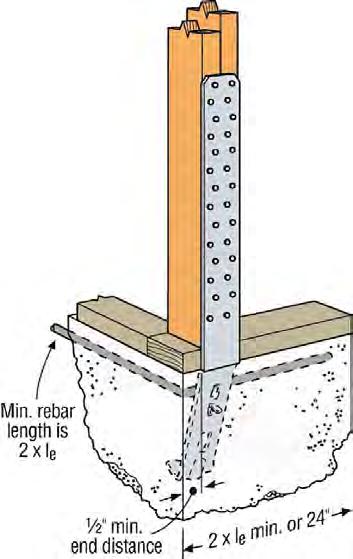
PHONE: 800-289-5627 FAX: 800-524-4982 Read/Subscribe online at www.componentadvertiser.com Don’t Forget! You Saw it in the Adverti$$er February 2023 #15283 Page #117 A dverti $ er Component manufaCturing m The
Continued next page
STHD14 Installed Strap Tie Holddown Corner
Roof Framing
For the second year in a row, the roof framing section was significantly rewritten. One change dealt with construction of the rafter peak and ridge straps when they are used to replace collar ties. Part of the change clarified that when the rafters are connected directly opposite one another with a gusset plate, collar ties or ridge straps are not required. The second part clarified the installation of the ridge strap to state that they must be “nailed to the top edge of each rafter with a minimum of three 10d common (3″ × 0.148″) nails with the closest nail no closer than 2 3/8″ from the end of the rafter.” This matches up with Simpson Strong-Tie’s recommendations for placement of nails at ends of wood members.
A couple of changes were made to the requirements for resisting rafter thrust, where weight on the rafter system causes them to push out on the tops of the exterior walls. One change to Section R802.5.2 clarifies the three cases for resisting rafter thrust: ceiling joists in the lower third of the rafter height and used to directly resist thrust; ceiling joists installed above the lower third of the rafter height that are not permitted to be used to resist rafter thrust; and ceiling joists that are not parallel to rafters. In each case, either the ends of the rafters are tied together with a continuous tie, or a ridge beam must be provided. In addition, the construction of laps or joints in ceiling joists used to provide the continuous tie was clarified. Table R802.5.2 gives the fastening of ceiling joists to rafters in order to transfer the rafter thrust into the joist. This table was revised to slightly reduce the number of nails required for the ceiling joist to rafter connection.
A final roof framing-related change was to the section requiring rafter bearing, R802.6. The change clarifies when bearing is required for the top ends of rafters by adding the sentence “Where the roof pitch is greater than or equal to 3:12 (25% slope), and ceiling joists or rafter ties are connected to rafters to provide a continuous tension tie in accordance with Section R802.5.2, vertical bearing of the top of the rafter against the ridge board shall satisfy this bearing requirement.” This means that, in a normal rafter/ceiling joist/ridge board configuration, 1 1/2″ bearing for vertical forces is not required, as the rafter is just pushing horizontally against the ridge board. However, if there were rafters with no ceiling joists or other horizontal tie at the bottom, there would be a requirement for vertical bearing at the ridge beam, because the ridge beam is providing vertical support for the rafter.

For more information on stick-frame roofing, check out our online course “Code Requirements for Conventionally Framed Roofs.”
The article, Top Structural and Wood-Related Changes in the 2021 IRC, Part 2, appeared first on Simpson Strong-Tie Structural Engineering Blog. To sign-up to receive the Engineering Blog in your inbox, go to seblog.strongtie.com/subscribe.
Copyright © 2023 Simpson Strong-Tie Company Inc. All Rights Reserved
PHONE: 800-289-5627 FAX: 800-524-4982 Read/Subscribe online at www.componentadvertiser.com Don’t Forget! You Saw it in the Adverti$$er February 2023 #15283 Page #118 A dverti $ er Component manufaCturing m The
LSTA Ridge Strap
Simpson Strong-Tie to Preview Deck Planner App with Augmented Reality and New Pipeline Management Functionality for Builders and Pro Dealers at IBS
January 25, 2023, Pleasanton, Calif. — Simpson Strong-Tie, the leader in engineered structural connectors and building solutions, will preview new augmented reality (AR) functionality for its popular Deck Planner Software™ design app at the 2023 International Builder Show (IBS) January 31 –February 2 at the Las Vegas Convention Center.
Located in Central Hall C2130, the Simpson StrongTie booth will offer a preview of the forthcoming addition of AR technology to its Deck Planner Software application — a completely free, web-based design solution to help contractors, lumberyards, and homeowners quickly and easily design dream backyards. Featuring 3D software, design guides, and an in-app user tutorial, Deck Planner Software provides a suite of intuitive tools and resources for designing and building sturdy, attractive decks, pergolas, and other outdoor living spaces.
With AR functionality, Deck Planner users can easily design a safe, strong and beautiful deck in minutes by selecting materials, dimensions, colors, and hardware, and then engage in a real-world interactive AR experience within the deck design. When ready to build, Deck Planner Software generates a permit submittal page and materials lists to get projects started right away. (AR functionality is expected to become available by early spring of this year).
Simpson Strong-Tie will also feature new additions to its Pipeline web-based material management and estimation logic technology solution, including the ability to create actual measurements and provide the true costs for construction of a house. Users can now adjust costs based on options at any level with immediate visibility into how specific options will affect both the selling price and the profit margin.

New Simpson Strong-Tie advances and innovations in builder technology come on the heels of a $1.3M investment in the Higharc homebuilding automation platform. Founded by CEO Marc Minor in 2018, Higharc is changing how new homes are designed, sold, and built. As of October 2022, Higharc helped support visualization, design, and creation of 38 communities nationwide. The first direct venture investment made by Simpson Strong-Tie in a startup, the commitment is part of a core strategy to allocate resources to open innovation, new technologies, and industry leadership in all areas of the construction process.

PHONE: 800-289-5627 FAX: 800-524-4982 Read/Subscribe online at www.componentadvertiser.com February 2023 #15283 Page #119 A dverti $ er Component manufaCturing m The Industry News
Simpson Strong-Tie Adds to Digital Framing and Building Component Solutions Suite with Acquisition of EstiFrame Technologies
January 17, 2023, Pleasanton, Calif. — Simpson Strong-Tie, the leader in engineered structural connectors and building solutions, today announced that the company has acquired Elk Grove, CA-based EstiFrame Technologies, Inc. Founded in 2017 by Coby Gifford and Aaron Love, EstiFrame provides component manufacturing and framing technologies to the construction industry, including the EasyFrame automated marking system that matches saws with digital printers to label 2x frame members for fast and accurate assembly.
Designed to reduce construction timelines and address skilled labor shortages in framing and construction, the EasyFrame system prints framing blueprints for a structure directly onto the framing members themselves. Paired with either a manual or automated saw, the system provides wall panels that are pre-marked for easy assembly, driving construction efficiency and accuracy.
“EstiFrame has established a strong reputation for providing easy-to-adopt, scalable solutions to LBM dealers and framing shops looking to gain critical efficiencies in component manufacturing,” says Simpson Strong-Tie Vice President of Customer Facing Technology April Burt. “The EasyFrame system is a logical and complementary addition to the Building Technology solutions already provided by Simpson Strong-Tie, and expands our offerings for customers who continue to seek more efficient ways to convert the digital frame into strong, safe physical structures.”
Driven by one of the most powerful linear optimization algorithms available, EasyFrame software is designed to save the greatest amount of wood possible by managing cut completion activity and constantly re-optimizing on the fly.

As part of the acquisition, Gifford and Love will remain with the EstiFrame team to ensure a seamless transition as Simpson Strong-Tie assumes customer sales and service, continuing to provide saw setup and installation as well as onboarding and design services, including training operators how to best use and leverage the EasyFrame system.
For more information on Simpson Strong-Tie building technology solutions dedicated to improving productivity, efficiency, and accuracy with integrated component systems, visit strongtie.com/products/ connectors/ics
PHONE: 800-289-5627 FAX: 800-524-4982 Read/Subscribe online at www.componentadvertiser.com February 2023 #15283 Page #120 A dverti $ er Component manufaCturing m The Industry News
Hundegger USA Announces Equipment Delivery Schedule for SmartLam North America Facilities

Fulfilling its commitment to make cross laminated timber (CLT) available to the U.S. market, Hundegger is pleased to report it is on pace to deliver cutting-edge equipment to the new SmartLam manufacturing plant.
As announced in September 2022, SmartLam North America, the first US manufacturer and largest manufacturer in North America of cross laminated timber (CLT), is building a $50M glulam manufacturing facility in Dothan, AL. Intending to manufacture 84,000,000 board feet of large glulam beams and columns annually, Dothan is strategically located in Alabama to serve the Southeast, the fastest growing mass timber market in the United States. In addition, SmartLam North America is investing $24M to fully automate the existing Dothan, AL and Columbia Falls, MT CLT facilities. This additional investment will allow each facility to produce 2,000,000 cubic feet annually.

CLT is the next generation of engineered wood products. Extensively tested and already widely used in Europe, CLT has vast applications for construction, industrial matting, and bridging. Architects and builders choose wood because it looks great, has numerous environmental characteristics – including renewability – and it’s easy to work with. In addition, trees absorb carbon dioxide from the atmosphere as they grow, sequestering and storing the carbon while producing oxygen which reduces greenhouse gases and improves air quality.
As stated by SmartLam North America CEO Derek Ratchford, “Most mass timber glulam beams and columns are manually produced. The new glulam plant will be automated allowing SmartLam to significantly increase production and simultaneously deliver multiple mass timber projects. We are currently the largest CLT manufacturer in North America and with the CLT automation upgrades and the new glulam addition, SmartLam will become the largest mass timber producer in North America.”
This growth is being made possible with manufacturing equipment supplied by Hundegger USA. SmartLam is adding a fully equipped Hundegger UFA machine to the Columbia Falls, MT facility and a TWO state of the art ROBOT-MAX machines to the Dothan, AL facility (for glulam beams) along with a Hundegger UFA at the Dothan, AL facility (for CLT production).
As Steve Shrader, Business Development / Operations, Hundegger USA, will attest, the Hundegger ROBOT-Max has been developed for the North American market where Mass Timber will use larger cross sections than required in EU. “The ROBOT-Max can process beams and columns as large as 24” x 48” and up to 40’ long. In the Mass Timber market, it is the only such saw.”
Hundegger has been the world market leader in the field of CNC-controlled joinery machines with a market share of more than 90%. The universal, flexible machines are used in all timber construction sectors from carpentry, contract joinery, timber frame construction, log house construction, prefabricated house construction, and glulam joinery. Many of the largest companies in the world are using Hundegger equipment, and Hundegger is the #1 selling brand in America.
SmartLam is the first U.S. CLT manufacturer to be certified to the SFI 2015-2019 Chain-of-Custody Standard. As the first stand-alone glulam plant built in the U.S. since 1995, this turnkey state-of-the-art facility is expected to be 100% operational in October of 2024.
Contact: Steve Shrader, Hundegger USA 435-654-3028 • info@hundeggerusa.com
PHONE: 800-289-5627 FAX: 800-524-4982 Read/Subscribe online at www.componentadvertiser.com February 2023 #15283 Page #121 A dverti $ er Component manufaCturing m The Industry News
Building Materials Price Growth Slowed 60% in 2022


Posted January 24, 2023 on NAHB Now | The News Blog of the National Association of Home Builders Reprinted with permission.

The producer price index (PPI) for inputs to residential construction less energy (i.e., building materials) rose 8.3% in 2022 (not seasonally adjusted) according to the latest PPI report — less than one-half the increase seen in 2021.
On a monthly basis, building materials prices declined 0.3% in December — the fourth consecutive monthly decrease. After increasing an average of 1.8% per month the first five months of 2022, the index averaged a monthly 0.1% decline from June through December.
Price growth of goods inputs to residential construction, including energy, declined even more sharply over the year because of a historic increase in fuel prices in 2021. Prices increased 8.2% in 2022 after surging 20.8% the prior year.
Softwood Lumber : The PPI for softwood lumber (seasonally adjusted) fell 6.9% in December and 26.1% over the course of 2022. Since increasing the first three months of the year, the softwood lumber index has fallen 45.8%.
Steel Mill Products : Prices for steel mill products decreased 2.7% in December, the sixth consecutive decline. After soaring 128% in 2021, prices dropped 28.7% in 2022 — 25% since May.
Gypsum Building Materials: The PPI for gypsum building materials declined 0.2% in December but increased 17.6% over the course of 2022. Although the 2022 price increase was more than three times the 25-year average, it was substantially lower than the 23% increase seen in 2021.
Ready-Mix Concrete: The trend of ready-mix concrete (RMC) prices continued its historic pace as the index increased 1.6% in December. The PPI for RMC increased 13.6% in 2022, twice the 2021 increase and nearly seven times the historical average.
David Logan, NAHB’s director of tax and trade policy analysis, shares more details and graphics in this Eye on Housing post.
PHONE: 800-289-5627 FAX: 800-524-4982 Read/Subscribe online at www.componentadvertiser.com February 2023 #15283 Page #122 A dverti $ er Component manufaCturing m The Industry News
How and When Will Housing Rebound?
Posted January 13, 2023 on NAHB Now | The News Blog of the National Association of Home Builders. Reprinted with permission.
NAHB Chief Economist Robert Dietz recently provided this housing industry overview in the bi-weekly e-newsletter Eye on the Economy.
Housing data for the end of 2022 illustrate a market continuing to weaken because of low housing affordability, largely as a result of elevated mortgage interest rates. At the start of 2023, the average 30-year fixed mortgage rate is near 6.5%, down from a near 20-year high of 7.1% in early November.
However, forecasters expect the Federal Reserve will end its path of rate increases at the end of the first quarter. This should lead to sustainable declines for mortgage rates in the second half of 2023 and into 2024, enough to spur a rebound for single-family construction.
And more construction is needed over the long term: A new NAHB study estimates the housing market is underbuilt by 1.5 million homes. However, rising mortgage rates combined with 35% to 45% growth in home prices since 2020 have priced many prospective buyers out of the market. Indeed, according to new NAHB estimates, 18 million households were priced out of the market as rates increased from 3% to 7% throughout 2022.
The decline in affordability is clearly reflected in current housing sales statistics: The volume of existing home sales in November 2022 was 35% lower than a year prior, while inventory was at just a 3.3-month supply. New home sales, per Census data, were down 15% in November on a year-to-date basis when compared against the same time period of 2021. Inventory is elevated at an 8.6-month supply, as builders report growing cancellation rates (30% on average) and declining buyer traffic.

As a result of these market developments, single-family builder sentiment — as measured by the NAHB/Wells Fargo Housing Market Index (HMI) — declined every single month of 2022, falling from 83 in December 2021 to 31 in December 2022. This is the lowest reading since 2012, with the exception of the spring of 2020. In fact, nearly two-thirds (62%) of builders are using some form of sales incentive to sell homes, with 35% reporting they cut prices.
The steep decline in the HMI points to additional reductions in the pace of housing starts. In November, single-family starts decreased 4.1% and had dropped 9.4% year to date. Meanwhile, multifamily permits decreased 16.4% to an annualized 561,000 pace, the lowest reading for apartment permits since September 2021. NAHB is forecasting declines for apartment construction in 2023 due to the large amount of supply in the construction pipeline, as well as tightening commercial real estate finance conditions.
Subscribe for free to Eye on the Economy.
PHONE: 800-289-5627 FAX: 800-524-4982 Read/Subscribe online at www.componentadvertiser.com February 2023 #15283 Page #123 A dverti $ er Component manufaCturing m The Industry News
Single-Family Starts Edge Higher as Multifamily Production Weakens
Posted January 19, 2023 on NAHB Now | The News Blog of the National Association of Home Builders
Reprinted with permission.
Single-family housing starts posted a double-digit percentage gain in December, but production is running well below a rate of 1 million units annually, indicating ongoing weakness in the housing market as high construction costs and elevated interest rates continue to present affordability challenges.

Led by a decline in multifamily production, overall housing starts decreased 1.4% to a seasonally adjusted annual rate of 1.38 million units in December, according to a report from the U.S. Department of Housing and Urban Development and the U.S. Census Bureau.
The December reading of 1.38 million starts is the number of housing units builders would begin if development kept this pace for the next 12 months. Within this overall number, single-family starts increased 11.3% to a 909,000 seasonally adjusted annual rate, but are down 25% compared to December 2021. The multifamily sector, which includes apartment buildings and condos, decreased 19% to a 473,000 pace.
Total housing starts for 2022 were 1.55 million, a 3% decline from the 1.60 million total from 2021. Single-family starts in 2022 totaled 1.01 million, down 10.6% from the previous year. Multifamily starts (5+) in 2022 were up 14.5% compared to the previous year and exceeded a 500,000 annual pace for the first time since the Great Recession.
“Even though single-family starts are up on a monthly basis, permits indicate that the housing market will slow down further in 2023,” said Jerry Konter, chairman of the National Association of Home Builders (NAHB) and a home builder and developer from Savannah, Ga. “We expect a sustainable decline for mortgage rates in the second half of this year, which should lead to a housing recovery in 2024.”
“The decline in single-family permits indicates that builders are slowing construction activity as interest rates have spiked in recent months,” said Danushka Nanayakkara-Skillington, NAHB’s assistant vice president for forecasting and analysis. “Starts began on a strong footing in early 2022 but fell back in the latter part of the year as higher costs led to a pause in home building activity and affordability conditions worsened for home buyers.”
On a regional and year-to-year basis, combined single-family and multifamily starts are 5% higher in the Northeast, 5.7% lower in the Midwest, 1.6% lower in the South and 7.2% lower in the West.
Overall permits decreased 1.6% to a 1.33 million unit annualized rate in December and are down 29.9% compared to December 2021. Single-family permits decreased 6.5% to a 730,000 unit rate and are down 34.7% compared to December 2021. Multifamily permits increased 5.3% to a 600,000 pace.
Looking at regional permit data on a year-to-year basis, permits are 13.6% lower in the Northeast, 3.4% lower in the Midwest, 2.4% lower in the South and 8.3% lower in the West.
PHONE: 800-289-5627 FAX: 800-524-4982 Read/Subscribe online at www.componentadvertiser.com February 2023 #15283 Page #124 A dverti $ er Component manufaCturing m The Industry News
Builder Confidence Uptick Signals Turning Point for Housing Lies Ahead
Posted January 18, 2023 on NAHB Now | The News Blog of the National Association of Home Builders
Reprinted with permission.
A modest drop in interest rates helped to end a string of 12 straight monthly declines in builder confidence levels, although sentiment remains in bearish territory as builders continue to grapple with elevated construction costs, building material supply chain disruptions and challenging affordability conditions.
Builder confidence in the market for newly built single-family homes in January rose four points to 35, according to the National Association of Home Builders (NAHB)/Wells Fargo Housing Market Index (HMI) released today.
“It appears the low point for builder sentiment in this cycle was registered in December, even as many builders continue to use a variety of incentives, including price reductions, to bolster sales,” said NAHB Chairman Jerry Konter, a home builder and developer from Savannah, Ga. “The rise in builder sentiment also means that cycle lows for permits and starts are likely near, and a rebound for home building could be underway later in 2023.”
“While NAHB is forecasting a decline for single-family starts this year compared to 2022, it appears a turning point for housing lies ahead,” said NAHB Chief Economist Robert Dietz. “In the coming quarters, single-family home building will rise off of cycle lows as mortgage rates are expected to trend lower and boost housing affordability. Improved housing affordability will increase housing demand, as the nation grapples with a structural housing deficit of 1.5 million units.”
Derived from a monthly survey that NAHB has been conducting for more than 35 years, the NAHB/Wells Fargo HMI gauges builder perceptions of current single-family home sales and sales expectations for the next six months as “good,” “fair” or “poor.” The survey also asks builders to rate traffic of prospective buyers as “high to very high,” “average” or “low to very low.” Scores for each component are then used to calculate a seasonally adjusted index where any number over 50 indicates that more builders view conditions as good than poor.
All three HMI indices posted gains for the first time since December 2021. The HMI index gauging current sales conditions in January rose four points to 40, the component charting sales expectations in the next six months increased two points to 37 and the gauge measuring traffic of prospective buyers increased three points to 23.
Looking at the three-month moving averages for regional HMI scores, the West registered a one-point gain to 27, the South held steady at 36, the Northeast fell four points to 33 and the Midwest dropped two points to 32. HMI tables can be found at nahb.org/hmi. More information on housing statistics is also available at Housing Economics PLUS (formerly housingeconomics.com).

PHONE: 800-289-5627 FAX: 800-524-4982 Read/Subscribe online at www.componentadvertiser.com February 2023 #15283 Page #125 A dverti $ er Component manufaCturing m The Industry News
4Ward Solutions Group Appoints Owen Eldridge as Vice President


January 27, 2023—4Ward Solutions Group of Stanwood, WA is pleased to announce we appointed Owen Eldridge as Vice President of 4Ward Solutions Group. Owen Eldridge is a team-oriented leader with almost 20 years of experience in the building industry. Owen’s work focuses on driving out inefficiencies in residential and commercial construction. He and his team are passionate about finding and developing innovative solutions for their clients in the offsite manufacturing industry. This includes working with national and international companies to continuously improve our building processes.
Before being named Vice President, Owen spent four years as a solution provider and manager with 4Ward Solutions Group, responsible for the company’s consulting, service and support in all markets and sectors.
4Ward CEO, Ben Hershey, said “Owen is a key part of our leadership and success the past four years. Owen’s expertise and operational experience in manufacturing has helped elevate the success of numerous customers. He has a passion for the industry and the fundamental changes companies are pivoting to in providing an increased level of offsite manufacturing.” 4Ward Solutions Group along with the industry has experienced incredible growth in the services they provide. Ben continued “I look forward to having Owen lead the Consulting, Design and Labor teams as we continue to expand the solution offerings we provide to meet the needs of our customers.”
“I am excited to be a part of this incredible team and have the opportunity to provide leadership to the many services we provide,” said Owen Eldridge.
To find out how 4Ward can help with solutions for your facility, contact our team at info@4WardSolutionsGroup.com
PHONE: 800-289-5627 FAX: 800-524-4982 Read/Subscribe online at www.componentadvertiser.com February 2023 #15283 Page #126 A dverti $ er Component manufaCturing m The Industry News
Patent Granted – Build Homes Without Framing
January 2023—A patent has been granted to James Walker, PE for a method of constructing homes without the need for framing. Using patented high strength panels, a home can be quickly and economically built without the need for studs, joists, rafters or trusses. This saves significantly on construction costs and reduces construction time by 2/3 compared to conventional construction. Frameless-Construction™ homes are not only strong, but are energy efficient, renewable and utilize significantly less wood saving trees while being stronger than conventional construction.
The Future Has Been Patented!
This method to construct residential and light commercial properties without framing (no studs, joists, rafters or trusses!) using conventional wood products has just been published by the US Patent Office (US20190210317A1) as developed by engineer James Walker. (https://patents.google.com/patent/US20190210317A1)
This method uses engineered panels of OSB or plywood to form the roof, walls and flooring of homes. The engineered panels are of such significant strength that no framing is required – no studs, joists, rafters or trusses – are needed to build a home, apartment building or light commercial structure.
Without the need for a frame, the costs of a home are significantly reduced saving thousands of dollars in construction costs. Additionally, the method takes weeks, if not months, off the building schedule allowing quick construction and move-in.
The patented “frameless construction” method provides integrated ventilation for the roof and walls ensuring the removal of moisture while providing a cooler roof and attic and longer lasting roof. This ventilation also prevents ice dams in the winter. Wall panels are ventilated with an integrated rain screen which is increasingly required by building codes.
Floors and ceilings have integral plenums that are used to distribute heated and cooled air to the interior of the building, eliminating the need for ductwork – another significant cost saving. Buildings constructed with this frameless method are very energy efficient since the thermal layer is continuous without any thermal breaks. Additionally, this is renewable construction using all wood materials.
Dr. Mark Gagnon, Penn State Professor says: Jim Walker and the ISBP Team continue to advance building envelope technologies resulting in increased structural performance and reduced material use. Their latest patent on frameless construction brings all their innovative elements together to provide effective solutions for the current demands of light frame construction.
Frameless construction could revolutionize the construction of homes, multi-family dwellings, light construction and manufactured homes. Developed by James Walker, a registered engineer, it is part of the product line of Innovative Structural Building Products (isbp.com) and is an extension of previously patented products for ventilated roof and wall sheathing and multi-plenum floor sheathing.
Contact:
James Walker, PE
Innovative Structural Building Products, LLC.

Web: www.ISBP.com
Email: James@isbp.com
Phone: 603.724.4500
P.O. Box 277, 760 Main Street, Franconia, NH 03580
PHONE: 800-289-5627 FAX: 800-524-4982 Read/Subscribe online at www.componentadvertiser.com February 2023 #15283 Page #127 A dverti $ er Component manufaCturing m The Industry News
International Code Council and American Society of Home Inspectors Collaborate to Diversify Workforce and Equip Building Professionals for the Future
New agreement will advance joint initiatives to expand professional development, including training and certification opportunities, for home inspectors and building safety professionals
January 18, 2023, Washington, D.C. – The International Code Council and the American Society of Home Inspectors (ASHI) recently signed a memorandum of understanding to expand available resources and improve membership opportunities to home inspection and building safety professionals. This new agreement will also further advance joint initiatives between the two organizations to help diversify the workforce.
The Code Council and ASHI will work together to create opportunities for increased collaboration between members of both organizations. This will include access for ASHI members to Code Council certifications and Code Council exam resources. Additionally, ASHI will recognize Code Council training courses as qualifying for ASHI certification renewal certified education units.
“The Code Council knows the importance of, and is committed to, supporting building safety and home inspection professionals. By collaborating with ASHI, we can efficiently and effectively share knowledge, resources and expertise to help meet the goals of our organizations,” said Code Council Board of Directors President Michael Wich. “By signing this agreement, we will further our commitment to provide industry professionals with the support they need to succeed, both personally and professionally.”
Both organizations will deepen their commitments to creating more opportunities for women to enter the home inspection and building safety fields. Through a collaborative effort, the Code Council and ASHI will participate in events dedicated to advancing women in the profession and support Code Council and ASHI chapters that are focused on these shared goals.
“Recognizing the critical role Code Officials and Home Inspectors play in ensuring our homes and communities remain safe, ASHI is proud to partner with the Code Council to help support the building safety industry,” said ASHI Executive Director James Thomas. “We look forward to working with the Code Council to help grow and diversify the workforce and better equip industry professionals with the tools they need to keep our buildings safe.” ###
About the International Code Council
The International Code Council is the leading global source of model codes and standards and building safety solutions. Code Council codes, standards and solutions are used to ensure safe, affordable and sustainable communities and buildings worldwide.

About the American Society of Home Inspectors
The American Society of Home Inspectors strives to keep the home inspection industry at a high standard and creates advancement opportunities for its members. This is accomplished through efforts such as providing educational resources and events, presenting technical information, connecting members with prospective clients, and lobbying on Capitol Hill.
PHONE: 800-289-5627 FAX: 800-524-4982 Read/Subscribe online at www.componentadvertiser.com February 2023 #15283 Page #128 A dverti $ er Component manufaCturing m The Industry News
ANSI/APA PRS 610.1-2023: Standard for Performance-Rated Structural Insulated Panels in Wall Applications
This Standard covers the manufacturing, qualification, quality assurance, design and installation requirements for performance-rated structural insulated panels (SIPs) used in wall applications.
This Standard, ANSI/APA PRS 610.1-2023, Standard for Performance-Rated Structural Insulated Panels in Wall Applications, provides requirements and test methods for qualification and quality assurance for performance-rated structural insulated panels (SIPs), which are manufactured with a foam plastic insulation core bonded between two wood structural panel facings intended for use in wall applications. Product performance requirements are specified.
Available for free download, the publication contents include:
• Scope
• Referenced documents
• Terminology
• SIP walls
• Performance criteria and requirements
• Test methods for SIPs
• Reporting of test results
• Trademarking and certification
• Appendix: Test requirements for facing materials
• Appendix: Testing requirements for SIP assemblies
• Appendix: History of the standard
This Standard, which was initiated by APA – The Engineered Wood Association, has been developed under the provisions of the American National Standards Institute (ANSI) as a revision of American National Standard ANSI/APA PRS 610.1-2018, Standard for Performance-Rated Structural Insulated Panels in Wall Applications

Approved January 3, 2023. FREE DOWNLOAD ►

PHONE: 800-289-5627 FAX: 800-524-4982 Read/Subscribe online at www.componentadvertiser.com February 2023 #15283 Page #129 A dverti $ er Component manufaCturing m The Industry News New Publication
84 Lumber Set to Accelerate Expansion Plans

The nation’s largest privately held building materials supplier plans to add to its existing 310 facilities in 2023
Eighty Four, PA (January 24, 2023) – 84 Lumber, the largest privately owned building materials supplier in the U.S., currently operates 310 facilities which includes 234 stores, 14 component manufacturing plants, 28 engineered wood product centers (EWP) and 34 door shops. The company plans to open new facilities and make improvements to 54 existing locations to increase its market share by the end of 2023.
The new store openings include Stockton, California; Denver, Colorado; and Greeley, Colorado. The company also is relocating existing stores to larger facilities in Morgantown, West Virginia and Sarasota, Florida.
In addition to new stores, 84 Lumber is opening component plants in Winter Haven, Florida; Columbia, South Carolina; Boise, Idaho; and a second plant in Atlanta, Georgia. Regarding new EWP facilities, the current Atlanta facility is being relocated to a larger location in Cartersville, Georgia and new centers will be opened in the New Jersey and Boston markets. To round out the company’s extensive expansion plans, a new door shop is coming to Denver, Colorado.
“With the opening of these new stores and manufacturing facilities, we remain strong in our continued prospect for growth,” said 84 Lumber President Maggie Hardy. “We value our customers and listen to what is important to them to grow their businesses. As a result, we are growing and expanding in two ways – opening new locations and investing in existing markets.”
“I’m immensely proud of the performance of our company over the last several years,” said Hardy. “We have the right people, and we are supporting our associates and customers with the necessary resources to take our company to the next level. I’m committed to growing this company the 84 way and continuing to provide more opportunities for our associates.”
To keep up with growth, 84 Lumber is looking to hire new associates in stores and manufacturing facilities across the country. To apply, visit 84lumber.com/careers, and to learn more about the company, visit them on Facebook, Instagram or LinkedIn.

About 84 Lumber
Founded in 1956 and headquartered in Eighty Four, Pennsylvania, 84 Lumber Company is the nation’s largest privately held supplier of building materials, manufactured components and industry-leading services for single- and multi-family residences and commercial buildings. The company operates 310 facilities which includes stores, component manufacturing plants, custom door shops and engineered wood product centers in more than 35 states. 84 Lumber also offers turnkey installation services for a variety of products, including framing, insulation, siding, windows, roofing, decking and drywall. A certified national women’s business enterprise owned by Maggie Hardy, 84 Lumber was named one of America’s Largest Private Companies by Forbes and also made the Inc. 5000 list of America’s Fastest Growing Companies in 2022. For more information, visit 84lumber.com or join us at Facebook, Instagram or LinkedIn.
PHONE: 800-289-5627 FAX: 800-524-4982 Read/Subscribe online at www.componentadvertiser.com February 2023 #15283 Page #130 A dverti $ er Component manufaCturing m The Industry News
US LBM to Divest Feldman Lumber, Rosen Materials and Wallboard Supply

Definitive agreement reached with L&W Supply, an operating unit of ABC Supply
ATLANTA, January23, 2023—US LBM, a leading distributor of specialty building materials in the United States, announced today that it has reached a definitive agreement to sell three of the company’s operating divisions, Feldman Lumber, Rosen Materials and Wallboard Supply Company, and their subsidiaries Coastal Roofing Supply, Eastern Wallboard Supply and Richardson Gypsum, to L&W Supply. L&W Supply is an operating unit of ABC Supply.
US LBM acquired Feldman Lumber and Wallboard Supply in 2014 and Rosen Materials in 2015. In total, these divisions and their subsidiaries currently operate 42 locations in 12 states and primarily sell and distribute interior building materials, including wallboard, acoustical ceilings and steel framing.
“The alignment of L&W Supply’s product focus with that of Feldman Lumber, Rosen Materials and Wallboard Supply will be a great benefit for the customers and associates of these divisions,” said US LBM President and CEO L.T. Gibson. “Upon completion of this transaction, US LBM will remain well positioned to continue our growth through product category expansion, strategic acquisitions and greenfield development, while continuing to provide our customers a full line of specialty building products.”
The transaction is subject to customary closing conditions, including regulatory review, and is expected to close in the second quarter of 2023.
About US LBM
US LBM is the largest privately owned, full-line distributor of specialty building materials in the United States. Offering a comprehensive portfolio of specialty products, including windows, doors, millwork, wallboard, roofing, siding, engineered components and cabinetry, US LBM combines the scale and operational advantages of a national platform with a local go-to-market strategy through its national network of locations across the country. For more information, please visit uslbm.com or follow US LBM on LinkedIn.
PHONE: 800-289-5627 FAX: 800-524-4982 Read/Subscribe online at www.componentadvertiser.com February 2023 #15283 Page #131 A dverti $ er Component manufaCturing m The Industry News


PHONE: 800-289-5627 FAX: 800-524-4982 Read/Subscribe online at www.componentadvertiser.com Don’t Forget! You Saw it in the Adverti$$er February 2023 #15283 Page #132 A dverti $ er Component manufaCturing m The Advertiser Directory 4Ward Solutions Group www.4wardconsult.com 623-512-6770 ben@4wardconsult.com Acceptance Leasing & Financing Service, Inc. www.acceptlease.com 412-262-3225 cvillella@acceptlease.com Acer Inc. www.acerinc.com 507-864-2220 sales@acerinc.com Your Solution for Lack of Technical Staff ● PlanSwift Lumber and Building Material Takeoffs ● Truss and Wall Panel Design Experienced Staff ● EWP Layouts and much more! All Points was launched by Industry Veteran Dave Walstad with over 20 years of Offshore Experience to create the Gold Standard in Technical Support Teams. 1-941-713-4395 www.AllPoints.Tech Dave.AllPoints@gmail.com Offices in: Panama City Beach, FL USA HCMC (Saigon), Vietnam Bengaluru, India Eliminate your lack of technical resources to grow sales and increase the clock speed of your company. We have the network and experience you can count on Deploy Technical Teams from All Points! All Points Technical www.AllPoints.Tech 941-713-4395 Dave.AllPoints@gmail.com AN ITW COMPANY Alpine www.alpineitw.com 800-521-9790 mschwitter@alpineitw.com Clark Industries, Inc. www.clark-ind.com 800-743-9727 general@clark-ind.com Eagle Metal www.eaglemetal.com 800-521-3245 connect@eaglemetal.com Eide Integrated Systems eideintegratedsystems.com 612-521-9193 ext 204 tom@eidemachinery.com EstiFrame Technologies, Inc. www.estiframe.com 209-576-5000 cgifford@estiframe.com Fitzgerald Group, LLC www.fitzgroup.com 719-528-5445 rfitzgerald@fitzgroup.com HOLTEC USA Corporation www.holtecusa.com 813-754-1665 info@holtecusa.com Hundegger USA www.hundeggerusa.com 435-654-3028 steve@hundeggerusa.com LimTek Solutions limteksolutions.com 416-888-4457 edmond.lim@limteksolutions.com MiTek USA www.mitek-us.com 800-325-8075 customerservice@mii.com Panels Plus www.panplus.com 866-726-7587 tkaasa@panplus.com ROGworx Automation www.ROGworx.com 707-333-4507 sales@ROGworx.com
Simpson Strong-Tie www.strongtie.com 800-999-5099




Spida Machinery USA www.spida.com


Welcome to The Hain Company's website! Here you will find information about the Hain Company and its line of innovative products that can help streamline your company. Our products are diversely used throughout the manufacturing industry to speed production and reduce labor costs.


PHONE: 800-289-5627 FAX: 800-524-4982 Read/Subscribe online at www.componentadvertiser.com Don’t Forget! You Saw it in the Adverti$$er February 2023 #15283 Page #133 A dverti $ er Component manufaCturing m The Vekta USA www.vektausa.com 907-230-8276 info@vektausa.com Wasserman & Associates www.wasserman-associates.com 800-382-0329 sales@wasserman-associates.com Wolf X Machina www.wolfxmachina.com info@wolfxmachina.com Wood Tech Systems, Inc. www.woodtechsystems.com 765-751-9990 info@woodtechsystems.com Advertiser Directory
Runnion Equipment Company www.runnionequipment.com 708-541-1063 barunnion@runnionequipment.com
web@strongtie.com
The Hain Company
866-647-7771 sales@spida.com
Welcome
News The New (JSMEA) or Job Site Measuring System has been released for Home Hain Engineering Services Company Overview Products Companies We Represent Hain Racing Products Request Form Contact Us Mailing List Used Products Leasing & Financing Services About Hain Racing Products All Measuring Systems Hain Systems Framer Sub Component Nailer Quick Rafter Cutter Vent Block Drills Hain Racing Offset Drive Aluminum Valve Cover Used Products Refurbished QRC Refurbished VBD Refurbished MEA Refurbished SCN Refurbished MMEA Monet Desauw Component Saws Floor Web Saw Material Handling Used Equipment Companies We Represent Festool Klaisler Mfg. Corp. The Koskovich Company Monet Desauw Inc. Mango Tech All Measuring Systems Folding Measuring System The Hain Company www.thehaincompany.com 530-295-8068 sales@thehaincompany.com TheJobLine.com www.thejobline.com 800-289-5627 mail@thejobline.com Timber Products Inspection www.tpinspection.com 770-922-8000 Todd Drummond Consulting, LLC. www.todd-drummond.com 603-748-1051 todd@todd-drummond.com Triad | Merrick Machine www.triadmachines.com 800-568-7423 ext 133 mmcsales@merrickmachine.com Contact our Advertisers for manufacturing and handling equipment, saws, plates and connectors, software, business management, financing, third-party inspections, employment services, transportation equipment, and much more! Your Company can be Listed in TheAdverti$er Contact Anna Stamm Anna@componentadvertiser.org 800-289-5627 x3
For Information on Any of these Job Opportunities
Visit: The Hiring Zone
Truss Operations Manager 23-0125
Posted on Wednesday, January 25, 2023
Employer: Client Confidential
We are searching for a roof/floor truss designer with 5-10 years experience who is motivated to manage and grow an operation. We are a family owned and operated building supply business with concrete block and pallet manufacturing that has been in business for 60 years. We added roof and floor trusses to our business in the 90s and are poised with the equipment, facility and market to grow sales into the foreseeable future.
Wall Panel Designer 23-0120
Posted on Friday, January 20, 2023
Employer: Mandere Construction
Mandere Construction was founded in 1992 and serves the Inland Northwest as the premier framing company in the area. We are sought after by the best of the best in the building industry and are trusted to complete framing, siding and wall panel projects of all sizes. While we are locally managed and operated and we have the privilege of being part of the Kodiak Building Partners portfolio of companies. We are looking to add to our Wall Panel Production Team. This position is responsible for the coordination, prioritization and drawing of Wall Panel Designs that will keep our wall panel shop working at capacity. The successful candidate will demonstrate a good working knowledge of construction principles, have good attention to detail and take initiative while working effectively as part of a team.
Truss Designer 23-0901-1
Posted on Monday, January 09, 2023
Employer: Simple Homes
Simple Homes is looking for a detail oriented designer to develop truss and floor designs from architectural and structural drawings. The ideal candidate for this position enjoys hyper-focused work, sweats the small stuff, is a clear communicator and strong team player, and is excited about working for a rapidly growing company.
Remote Mega-Multifamily Estimator J15227
Posted on Monday, January 02, 2023
Employer: Client Confidential
Remote Mega-Multifamily Truss Estimator opportunity. Qualified
candidates will already know the general duties and skills needed for this position and additional details can be obtained prior to approving presentation. Employer will consider 3+ years single family design experience. Training and position is remote. Expert level Remote MMF Estimators are afforded top consideration but the employer is very willing to train experienced single family designers wishing to become MMF Designers. This position is a stepping stone to a MMF Design job if you are interested.
Truss Designer - MiTek/Multifamily J14173
Posted on Monday, November 28, 2022
Employer: Client Confidential
JobLine Senior Designer ranking and MiTek software experience (Sapphire preferred) is highly desirable for this position. Prefer someone with commercial and multifamily experience but strong Single Family Custom will be considered. Bring your friends! In-office position. Remote is not an option.
Lead Designer 22-0811-2
Posted on Thursday, August 11, 2022
Employer: ProTec Panel & Truss
ProTec Panel & Truss is looking to add a Lead Designer to our team. The designer will be responsible for the production of detailed shop drawings for component manufacturing using Mitek Software. They will contribute to the Design Team's success by working with team members to check accuracy and assist entry level designers.
Remote Designer - Truss/Panel J14179
Posted on Friday, January 21, 2022
Employer: Client Confidential
This opportunity is for senior remote designers with truss and/or wall panel experience. Only highly capable designers with solid remote experience will be considered.
MiTek software experience preferred. The ideal candidate will have multifamily and single family experience. This advanced level designers only. Please inquire for additional information.
PHONE: 800-289-5627 FAX: 800-524-4982 Read/Subscribe online at www.componentadvertiser.com February 2023 #15283 Page #134 A dverti $ er Component manufaCturing m The theHiring Zone The Hiring Zone is operated by The Component Manufacturing Advertiser Magazine. All applications will be sent exclusively to the advertising company. job opportunities available A dverti$er Component manufaCturing S erving the S tructural B uilding c omponent S i ndu S try The Hiring Zone Building Component Industry Job Board Employer to Candidate Direct Hiring No Recruiting Fees! Post your Opportunity... Candidates respond directly to you! For Additional Information Contact: twm@componentadvertiser.org or Call: 800-289-5627 x1 For Rates and Posting, visit our website: www.componentadvertiser.com/Hiring-Zone
MITEK ® POSI-STRUT ®
REDUCE LABOR AND OVERALL WEIGHT OF THE SYSTEM WITH POSI-STRUT METAL WEBS. MORE SPACE BETWEEN CHORDS FOR MECHANICALS.
YOU SIMPLY CAN’T AFFORD TO IGNORE THE ADVANTAGES OF THE POSI-STRUT FLOOR TRUSS SYSTEM.

Longer Spans allow design freedom Wide Surface makes attaching the floor deck and ceilings simple
Open Web design creates a service void for ease of access
Top Chord Bearing for reduced hanger cost
Lightweight Construction means joists are easy to handle Increased space to run HVAC and mechanicals due to the metal web design
Factory Manufactured ensures a made to measure quality product
Improved energy efficiency by allowing for insulation over windows and doors
If you’re interested in using Posi-Strut in your next build, talk to your MiTek representative at (314) 851-7306.
To learn more about Posi-Strut, visit Mitek-US.com/Posi-Strut
COPYRIGHT © 2020 MITEK. ALL RIGHTS RESERVED
Joe Kannapell, P.E.
TheLastWord on
The Last Pioneers
Joe Hardy of 84 Lumber was the last of the World War II veterans to whom we owe our industry. Ed Ryan of Ryan Homes (now NVR) and Cal Jureit of Gang-Nail (now MiTek) were also major contributors. All three returned from winning that war with a drive to transform home building, and they helped each other do it. They each began in the mid-1950s and put their companies on a path that would take them to a collective $20 Billion in sales in 2022. While Ed and Cal retired in the early 1970s, Joe persevered for another half-century, until his recent passing on the day he turned 100.

Ed came home to Pittsburgh, a survivor of a German POW camp, and joined Joe, his childhood friend, in setting up a lumberyard. Joe eschewed his father’s jewelry business to run the lumberyard, while Ed followed his father’s lead and built houses. After a few years, Joe took over Ed’s share in the business and moved the lumberyard 20 miles south to Eighty Four, PA, where it resides today. Ed set up a wall panel and roof truss plant across the road from Joe with a Mark 8 truss machine and Panel-Rite wall equipment supplied by the company that would become MiTek. Both grew their businesses with a consistent, near formulaic approach. Ed expanded rapidly into neighboring states with his easily constructed, fully componentized homes. When his homebuilding volume in new markets supported manufacturing, he cloned his Eighty Four plant, and spread the gospel of component building, and especially panelization. Today, among NVR’s eight facilities, is the world’s largest panel plant that can crank out 40 houses a day. Joe’s component plants are smaller, but he’s built double the number.
Entrepreneur Joe followed a unique “McDonald’s-like” approach to expanding his lumber business but did it without going deep into debt or diluting his ownership. While Ray Kroc brought in two of his major suppliers to fund his expansion, Joe leased new properties with an option to purchase them later at a fixed price. Joe selected new locations by charting the likely expansion paths for a community, securing a property on its periphery, and erecting a standardized metal building. He initially ran a cash-only business, and he paid his lessor from profits generated. As volume and profitability increased, he generated sufficient cash to exercise his buy option, and add to 84’s equity. At a later date, NVR rode a similar strategy to stunning success, optioning land and deferring the purchase until the time they closed with homebuyers.
PHONE: 800-289-5627 FAX: 800-524-4982 Read/Subscribe online at www.componentadvertiser.com Don’t Forget! You Saw it in the Adverti$$er February 2023 #15283 Page #136 A dverti $ er Component manufaCturing m The
Continued next page
Joe didn’t get serious about the component business until the late 1980s. He started small, building trusses near his headquarters for his 25 lumberyards that were within a reasonable shipping distance. Then, when his like number of yards around Baltimore/Washington were ready, he built a large, perfectly located truss plant and installed Gang-Nail presses at the recommendation of Abner Yoder of Stark Truss. Within a year he hired a seasoned Ryan Homes manufacturing executive from the Pittsburgh area and embarked on a rapid expansion. Often 84 plants would be located close to NVR’s, and that would necessitate that 84 build wall panels. The bulk of all truss equipment came from MiTek.
Viewing 2022’s array of plants belies the traumas experienced by each of the entities created by these founders. By the mid-1980s, Jureit’s patents had been usurped by the courts, Gang-Nail margins were eroded by price-cutters, and their reserves were sapped by a huge EWP investment. Yet somehow Jureit’s work ended up in the hands of Warren Buffett, and he was feted by MiTek on the 50th anniversary of his founding. In 1991, Ed Ryan’s company went through an even more agonizing ownership change, yet the prolific Ryan Homes name survives, and its meteoric rise rivals Silicon Valley companies. In 2008, Joe Hardy’s fortunes nearly collapsed in the Great Recession, many dozens of stores and plants shuttered, yet, as of today, the business has never been stronger.

Ryan, Hardy, and Jureit helped win the War and the countless battles to secure the dominance of components in much of America. Evidentially, their spirit lives on at NVR, 84 Lumber, and MiTek, and it seems likely to do so long into the future.

PHONE: 800-289-5627 FAX: 800-524-4982 Read/Subscribe online at www.componentadvertiser.com Don’t Forget! You Saw it in the Adverti$$er February 2023 #15283 Page #137 A dverti $ er Component manufaCturing m The
IMPROVE CONSISTENCY INCREASE EFFICIENCY
The Industry-Leading Manufacturer of Panelized Wall Panel & Floor Cassette Equipment.


FLOOR CASSETTE STATION
The Panels Plus Floor Cassette Framing Station is designed to hold joists in a square position for fastening decking. This model can be stand-alone or integrated into a full production line. Dimensional lumber, I-joists, and open web floor truss configurations are all compatible with this floor cassette table.

The Panels Plus floor cassette system is developed at a lower working height, so fall protection is not required when fastening decking. The floor cassettes also pop up upon completion and can be rolled out or picked up with a crane for easier product transfer.


OUR POPULAR PANELIZING PRODUCTS


WOOD WALL FRAMING STATIONS WOOD WALL SQUARING STATIONS WOOD WALL SHEATHING STATIONS LIGHT GAUGE STEEL FRAMING & SHEATHING WWW.PANPLUS.COM 1-866-726-7587
