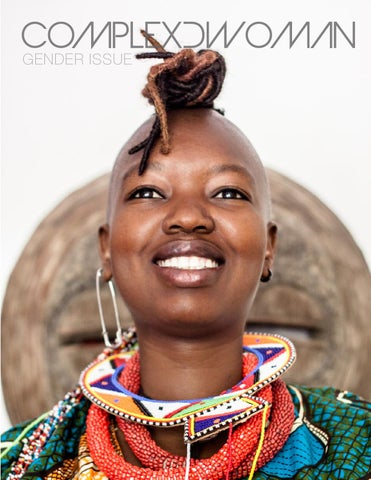
COMPLEXDWOMAn Gender issue
Education. HEaltH. JusticE. For EvEry girl. EvEry woman. EvErywHErE. support a proJEct. Join in at chimeforchange.org
/chimeforchange
EDITOR’S
LETTER I am pleased to present the Gender issue, marking the re-launch of the magazine, formerly Complexd magazine, to ComplexdWoman. I wish to start by thanking you, our readers, for being patient during this publishing break. At the ComplexdWoman HQ, we have taken some time to review the last three years and make sure that we continue to publish strong content, coupled with visually provoking imagery. The first change you will notice is our name, which was a natural transition. We referred to you as Complexd women and responsively it is what you started to call yourselves, giving birth to the phrase ‘I am a Complexd woman’… and our new title. Over the last couple of years, I have noticed that readers, fans and followers take a keen interest in the making of an issue. So I have decided to personalise our web/blog and report directly from my Editor’s Diary so you can read about the buildup to each issue and follow my thought process from concept to creation.
The Gender issue has left my eyes and my mind wide open. What started off originally as the Empowerment issue led me down a completely different path when I met a Womanist. This woman - who currently graces the cover - not only appreciates women and their contribution to this world, but has intimate relationships with them. Her unique perspective steered the issue in the direction of gender and sexuality. I learned a lot from the women interviewees who fall in love with women and, on a personal level, I learned to set aside the prejudices I had grown up with to be able to listen to the stories of these women and share them with you. Take your time with this issue; read every word and read it with an open mind. Rid these women of labels and appreciate the challenges they have faced not only being women, but also living a life society deems as unconventional. Kered Clement Editor-in-Chief
Make-up/Body Art by Krystal and Stephanie @ Iindigo World www.iindigoworld.com
4 | COMPLEXDWOMAn
COMPLEXDWOMAn | 5
CONTEN
C o m p l e x DW o m A n G E N D
8 Complexd Beauty Garden of Equality
COMPLEXD FEATURES Violence Against Women Is Everyone’s Business Andrea St Bernard
20
64
Complexd Style Neutrois
28 Complexd Woman Aleah Chapin Rocío Russo Pearce Julie Fogarty Claudia Moroni
44
6 | COMPLEXDWOMAn
Complexd Profiles Empowered Women Rebecca Thompson Jenny Garrett Dorothy Kufeji
78 Complexd COVER A Girl Named Skye Culture & Sexuality
NTS
DER Issue
98 Complexd Fashion HIm & Her
Editor Kered Clement Sub Editor Darcel de Vlugt Contributing Writers Nina Kelly Tameka Coley Artistic Director Rachel Irwin House Photographer Frederique Rapier
118 Complexd Men Fabian Weiss Pretty Bwoy
Video Editor Henry Robinson Intern Ashleigh Johnson-Palmer Cover Skye Photographed by Frederique Rapier Make-up/Body Art by Krystal and Stephanie @ Iindigo World www.iindigoworld.com
158 Complexd Travel + Lifestyle Jeju Divers The Nu Project
COMPLEXDWOMAn | 7
COMPLEXDBeauty
Photographs by Rio Romaine http://www.rio-romaine.com/
8 | COMPLEXDWOMAn
COMPLEXDWOMAn | 9
10 | COMPLEXDWOMAn
‘I yearned to do a project that showed why colour shouldn’t divide beauty
’
COMPLEXDWOMAn | 11
A pathway through graphic design led London-based photographer Rio Romaine into fashion photography. His work stands out in such a competitive field because of his choice of subject, often opting for quirkier models with unique features and characteristics. We asked Rio about his inspiration behind the beauty editorial Garden of Equality.
‘Constructing a team that creates something from nothing excites me! That excitement led to taking fashion photography more seriously. It’s a competitive industry, but you can stay afloat if you develop your style and think of strong concepts. Garden of Equality happened because of my deep thoughts about the lack of diversity in the industry. I yearned to do a project that showed why colour shouldn’t divide beauty. I purposely stripped and simplified this shoot because I am tired of seeing women caked in make up and surgically distorting their bodies. As a man, it shouts insecurity! I believe being natural shows a woman’s true beauty, leaving them transparent.’
12 | COMPLEXDWOMAn
Models | Julia, Paula, Rachel, Sycha, Symara and Yolanda
COMPLEXDWOMAn | 13
14 | COMPLEXDWOMAn
COMPLEXDWOMAn | 15
16 | COMPLEXDWOMAn
COMPLEXDWOMAn | 17
COMPLEXDstyle
Neutrois Photography | Anthony Winters | www.awintersfoto.com
18 | COMPLEXDWOMAn
COMPLEXDWOMAn | 19
| COMPLEXDWOMAn 20 20 | COMPLEXD
What is feminine? The plumpness of your breast or width of your hips? The flowers on your dress? Or heels on your tips?
COMPLEXDWOMAn | 21
22 | COMPLEXDWOMAn
COMPLEXDWOMAn | 23
Hair & Make-up | Nicole Jay Wardrobe | Ayasa Afi Model | Echo Nittolitto
24 | COMPLEXDWOMAn
COMPLEXDWOMAn | 25
| COMPLEXDWOMAn 26 26 | COMPLEXD
COMPLEXDWOMAn | 27| 27 COMPLEXD
| COMPLEXDWOMAn 28 28 | COMPLEXD
COMPLEXDWOMAN
Aleah Chapin
In 2012, artist Aleah Chapin’s painting, entitled ‘Auntie, won the 2012 BP Portrait award – an annual competition spearheaded by the National Portrait Gallery in London. Her first solo exhibition at the Flowers Gallery in New York featured a continuation of the award-winning piece. Here, she discusses with ComplexdWoman (CW) her inspiration behind the series - ‘The Aunties Project’ - and the importance of exposing the bodies of the women who have shaped her. CW: You grew up on an island north of Seattle - what was that like? AC: When I was younger, we used to call ourselves ‘island kids’. I’m just beginning to realise how lucky I was to grow up among such wonderful, weird and creative people. When I look back on my childhood we were surrounded by incredibly influential people. We were taught to do something that contributed to the world’s community while still being true to ourselves. CW: You’re paintings are astonishingly detailed and must take a very long time. Describe the emotions you feel when your painting? AC: I’ve been stupidly and passionately in love with ‘making things’ since I was a kid. If I am being honest, painting is a wild journey and not always fun. There are times when a painting is kicking my butt and making me miserable, but there is no other place I would rather be than in my studio. Then there are moments when it feels like the painting is giving birth to itself and somehow I’ve stumbled upon it - it’s not me who is making it, but the painting which is creating itself.
Portrait by Maria Teicher
CW: Winners of the BP Portrait Award get a £30,000 cash prize. That must have changed a lot for you as a young up-and-coming artist. AC: In some ways I feel like nothing has changed. I still struggle and I still get excited in the studio. I feel like the same person, but I did notice when things shifted. My work reached people on the other side of the world. The Auntie portrait took a month to complete and the subject had a huge influence on the outcome of the painting. The woman in Auntie was in the room when I was born and 26 years later I was painting her naked. I see that piece - and the others in the series - as collaborations between these women and me. It’s an expression of our relationships to each other. Overall, winning the BP Portrait Award has been overwhelming, humbling and thrilling. The best part of it is being able to wake up every day in disbelief at how lucky I am that I get to go into the studio and play with paint. –
COMPLEXDWOMAn | 29
| COMPLEXDWOMAn 30 30 | COMPLEXD
‘There are moments when it feels like the painting is giving birth to itself and somehow I’ve stumbled upon it - it’s not me who is making it, but the painting which is creating itself’
CW: When we looked at ‘The Aunties Project’ the first thing we thought was, ‘wow, these women must be very comfortable with their bodies’ was it that simple? AC: I didn’t have to convince any of the women painted in this series to be painted naked. I think it says a lot about the kind of people they are. We were outside in a field at the edge of the woods. They have never been naked together, but they are all very strong women. We all have selfdoubts and so do they, but these women are secure with themselves. Their willingness to do something so exposing for me is a reflection of the relationship I have with them and that’s exactly what I wanted to capture in the paintings. CW: Are you secure with your body? AC: Even though I was brought up among such confident women, I still have plenty of body issues. I wish I didn’t, and sometimes I pretend that I don’t, but they are still there. It would be wonderful if I could say that painting these women erased all my anxieties. In saying that, it did help me become closer to these women who confided that we all go through phases of loving or hating our bodies, and that’s okay. CW: The naked female body features heavily in your work. Why do you choose mainly curvaceous older women as your subjects? AC: The female nude is probably the most painted subject in art history. This may be for many reasons, but from an artist’s perspective, luscious, curvy bodies are more fun to paint. I think that an artist can only really make work about what they know and I’ve been surrounded by these women my whole life. CW: So what do you love about being a woman? AC: I love being a person - woman or not. I love this complicated relationship with my body and I love this life that I have. My advice is to create the life that you want to live knowing that the only boundaries you have are the ones you create. And most importantly, say ‘yes’ to things that scare you. To see more of Aleah’s work visit http://aleahchapin.com/
COMPLEXDWOMAn | 31
32 | COMPLEXDWOMAn
COMPLEXDWOMAn | 33
‘We were outside in a field at the edge of the woods. They have never been naked together, but they are all very strong women’
34 | COMPLEXDWOMAn
COMPLEXDWOMAn | 35| 35 COMPLEXD
| COMPLEXDWOMAn 36 36 | COMPLEXD
COMPLEXDWOMAN Rocío Russo Pearce ‘Gender equality has come a long way in some parts of the world. Women are occupying positions in the work force that used to be male dominated’
Born in New York City and bred in the Dominican Republic, 29-yearold photographer and advertising graduate Rocío Russo Pearce fell in love with photography the moment she clutched a pink 110mm (Barbie branded) camera. Her series of portraits titled, ‘Women: A Portrayal of Strength’ was exhibited at the International Museum of Women. ComplexdWoman (CW) was eager to find out why she chose these particular women as her subjects.
CW: As a native Dominican, how would you describe your people? Did the vibrant culture have anything to do with your love for photography? RRP: Dominicans live a very relaxed lifestyle - schedules are more of a guideline and even in hard times, they find laughter on a stunning beach or mountaintop. Plus, we have great food to help distract us from the worries of life. For me, photography truly is a love affair. It started at a very young age with a pink 110mm (Barbie branded) camera that I never put down. The Barbie camera evolved into professional cameras and other formats. With a growth in technique and a discovery of my personal style, my passion for photography grew so
much stronger. Like all love affairs, you do go through some cold periods; they last a few days, a few weeks and sometimes even months. But true love always finds a way of rekindling that fire. CW: What inspired you to do the series ‘Women: A Portrayal of Strength’? RRP: I have grown up around people with an amazing amount of strength, men and women alike, yet I realised as I grew older that women embody every aspect of the meaning of strength. They show physical strength as well as firmness, courage and mental and moral power. When I moved to San Francisco in 2005 to pursue my masters in photography, –
COMPLEXDWOMAn | 37
38 | COMPLEXDWOMAn
I left my entire family behind and moved to a place and studied at a school I had never visited before. It was so scary, but I got through it and became so much stronger because of the experience. I overcame financial hardship and emotional obstacles in the process and at the end my head was still held high. Part of that success is thanks to the women in my life that served as role models every time they lead by example. I wanted to show a glimpse of the difference a woman can make in the world when she puts her mind to it. I wanted to show the spirit of women warriors who don’t back down without a fight. CW: Do you think women have come closer to achieving gender equality because of their strength? RRP: Gender equality has come a very long way in some parts of the world. There are women occupying positions in the work force that used to be male dominated. There are woman in construction jobs, female CEOs of huge corporations and owners of small businesses, myself one of the latter. Countries like Brazil, Argentina, Costa Rica, Kosovo and most recently South Korea all have female Presidents in office. We have female Prime Ministers, Chancellors and Secretary of States. Even my little island, the Dominican Republic, has a female vice-president. I don’t think we can say that we have completely achieved equality. Sadly, there is still a lot of work to be done and I know that education is a huge determining factor. I do hope that with proper education, equality will be achieved in our lifetime. CW: Is the fight for gender equality still harder in the Dominican Republic? RRP: Yes! The fight for gender equality is harder in the Dominican Republic and other developing countries because of a prevalent male chauvinistic mentality. There is no separation of church and government. Education is a huge part of achieving equality and the public education system there does not have the resources to help get the country where it should be. Towards the end of 2012 the government had proposed changes to the penal code that violate basic human rights. The changes would eliminate punishment for violence against women and domestic violence would not be considered a grave offense unless the victim dies or is disabled for at least 90 days. The changes to the code will also reduce the punishment of incest-based crimes and sexual harassment. It conceals the rape of a minor and criminalises abortion under all circumstances, even if the mother’s life is at risk. An article written by the Guardian in the UK stated that gender-based violence is the fourth highest cause of death among women in the DR. There have been multiple protests and petitions to try and stop changes to the penal code. The fight for gender equality is definitely harder there, but there will always be women holding their ground and fighting back. Those are the women that I admire. CW: What else do you admire about women? RRP: I am so proud to be a woman and I love everything about it, as cliché as that may sound. The best advice I give my little sisters and can pass along to other women is ‘never say never’. Do not let traditional societal gender roles define who you are, what you can and can’t do. We are stronger than we realise, but knowing when to ask for help is part of that strength. This portrait represents the young woman I was when I left home. A young woman struggling with the initial obstacles of being independent and achieving my career goals while being away from the people and place where I had emotional security.
COMPLEXDWOMAn | 39
This is my mother and sister. It is a portrayal of motherhood in a more subtle way than just photographing a pregnant woman. My sister is all grown up. She is healthy and independent but the way in which she lies in our mother’s lap signifies our connection to our mothers and the reassuring comfort we seek from them. I am not a mother yet (other than to my canine daughter Zoe Dumplin) but I can appreciate the strength it takes to consistently provide healthy food for a child’s growth and development, a proper education and access to the best medical healthcare. Some people may see a ‘stay at home mom’ as weak, but unless you have experienced the level of involvement and hard work it takes you will never really know how strong you need to be to raise children.
40 | COMPLEXDWOMAn
My portrait of Mia has been a popular one and was featured in a show hosted by the International Museum of Women (IMOW). Mia’s expression speaks for itself; to me it says, ‘go get them tiger’! Mia is an actress and playwright and her strongest performances are when she takes the stage alone; she has won best female solo performance awards on multiple occasions as well as top pick in performance festivals. Her presence is so strong she doesn’t need additional cast members! Her portrait represents the power you can already see.
COMPLEXDWOMAn | 41
Lynne photographed with her cat Fillmore portrays the strength of knowing when to ask for help or when to seek comfort in others to enable you to continue moving forward. Some people see asking for help as a weakness. I agree with the phrase there is strength in numbers. Help from others can come in many forms and be as simple as someone lending you a hand or sharing words of encouragement.
42 | COMPLEXDWOMAn
This is a portrait of my grandmother on my father’s side. Her image represents all grandmothers in the world. In my life my grandmothers are the best examples of courage and strength. My maternal grandmother unfortunately passed away due to Alzheimer’s before this series was started. When this image was taken, my Abuela was in her early 90s; she is now 97. Living this long shows a tremendous amount of physical strength. Her husband - my grandfather - opposed the Trujillo dictatorship in the Dominican Republic and for this he was murdered during the regime when my dad - the youngest of three - was only 4 years old. My grandmother raised all three of her boys by herself; they all became well-educated family men.
Portraits by Rocio Russo Pearce www.rociorusso.com
COMPLEXDWOMAn | 43
C O M P L E X D
V i ole n c e Against Women
44 | COMPLEXDWOMAn
F E A T U R E S
n Is E ve r yo ne’s Business Words by Nina Kelly | Images by Frederique Rapier
COMPLEXDWOMAn | 45
46 | COMPLEXDWOMAn
‘
We are all born from women after all, and there’s no one that should not care about women’s treatment worldwide
’
My job requires me to be abreast of the news agenda in the UK and internationally. As a result, I have the dubious pleasure of scanning everything from the salacious redtops to the righteous broadsheets every morning. Daily, I read of unspeakable details of rape and murder, such as the three young sisters in India, the oldest of whom was just seven; this came just weeks after the country’s uproar at the gang rape and brutally drawn out murder of a young female student in Delhi. In the Maldives, a 15-year-old rape victim is taken to court for adultery. Meanwhile, in South Africa, a woman is killed by her boyfriend, who walks free from the court on bail despite the severity of his crime. And of course, there’s barely a day without a tale of violence against women in the Democratic Republic of the Congo. We’ve become almost desensitized to the horrific stories; such is their prevalence. If you read the papers as religiously as I do, then you won’t be surprised to learn that a UN commander recently declared that it’s more dangerous to be a woman than a soldier in modern conflict. Read in isolation, these incidents - and the countless others like them - are disturbing and vomit-inducing enough. Together, they read like a coordinated war on women, a ‘gendercide’ if you will, as some feminists have taken to calling it. But who is responsible for the cancer that is violence against women? The truth is that it’s absolutely everybody’s problem and everybody’s business. It’s not enough for survivors of violence to be the only ones speaking out against it. I can see no end to violence against women without men backing change as well and I applaud groups that seek to engage this activity, such as Men in Feminism and the
White Ribbon Alliance. We are all born from women after all, and there’s no one that should not care about women’s treatment worldwide, whether we’re among those who will end up as victims or not. In the same way that conscious Caucasian’s joined the Civil Rights Movement in America, and straight people go on Pride marches to show their support for the gay community, sometimes the only thing that matters is what’s right. Of course, if violence against women only affected women in war zones or poorer countries then it would be no less disgraceful. But you’d be mistaken to believe this is the case. This is not a problem of ‘elsewhere’… it is your problem, wherever and whoever you are. In the UK today, two women are killed by the hands of their partner or expartner every week; one woman in four will experience sexual assault as an adult; and yet just 5 per cent of rapes reported to the police (already a tiny percentage of rapes overall) result in a successful prosecution of the attacker. These statistics, taken from NGO and government research, are collated among others by Million Women Rise (MWR), an unfunded coalition of ordinary women who are sick of the prevalence of violence against their gender. My experience of working with MWR and spreading their message further afield is that people struggle to believe the reality of those statistics, and are especially shocked to discover that we’re talking about the UK. Sadly, anyone working in the shrinking women’s sector (i.e. charities that support victims of violence and abuse) knows the truth only too well. And yet this same women’s sector, which provides vital services to some of the most vulnerable people in our society, is being slowly decimated by a political will that doesn’t respect its value. –
COMPLEXDWOMAn | 47
48 | COMPLEXDWOMAn
COMPLEXDWOMAn | 49
I paint a bleak picture, I know, but I am not the only one aware of it. New movements sprouting up in recent years show that British women – and young women in particular – are beginning to fight back. UK Feminista, for example, puts on a summer school for young women to train in feminist activism. Meanwhile, every year at the Million Women Rise march, more and more young women join the veterans and add their voices to call for an end to violence against women. Younger generations are realising that all is not as equal as they may have been encouraged to believe. And those who remember the second wave of feminism in the 60s and 70s are astounded to see many of the advancements they fought for being rolled back with ease. For example my mother, who is a card-carrying member of the old guard of feminism, tells me that the sort of pornographic imagery we’re surrounded by wouldn’t have been acceptable in the immediate aftermath feminist protests 50 years ago. We have let things slip, it seems, and insidious sexist imagery has thrived, feeding on our complacency.
50 | COMPLEXDWOMAn
But what have sexist images of women got to do with violence against them? My answer is: everything. There’s a whole spectrum of objectification, starting with words and images and leading ultimately to the rawest form of ‘dehumanisation’ apparent in culture: violence. A society that encourages us to judge women on how they look and what they wear cannot be surprised when these are questions asked of rape victims in court in attempts to excuse crimes committed against them.
Follow Nina on Twitter: @ninapavlova Learn more about Million Women Rise: www.millionwomenrise.com
There is still some way to go in the UK, and in any case, we cannot see ourselves as separated from the global struggle to end violence against women. The truth is that it doesn’t exist in a vacuum; we must work hard to stop creating the perfect environment for violence against women: a sexist one.
COMPLEXDWOMAn | 51
‘Young women in particular are beginning to fight back’
52 | COMPLEXDWOMAn
image courtesy of www.v-day.org
COMPLEXDWOMAn | 53
Andrea St.
54 | COMPLEXDWOMAn
Bernard
COMPLEXDWOMAn | 55
Interview by Kered Clement Images by Frederique Rapier
56 | COMPLEXDWOMAn
I was born in St. Georges, Grenada, the birthplace of both my parents. Our family migrated to Canada a year later to escape the violence that had resulted from the civil revolution in our country. We moved into a humble apartment in Toronto, but our hearts belonged to Grenada. Fortunately, Grenada began to regain political and social stability within a few years and it was a great pleasure to travel back regularly to enjoy vacations on our beautiful island. My fondest memories are of the countless hours
spent with my sister and brothers playing on Grand Anse beach. My mother would always say that no matter how much fighting we did, there was always happiness and harmony on Grand Anse Beach. At the 2012 London Olympics, I choose to represent Grenada in Taekwondo. I am a citizen of both Canada and Grenada, but I always knew that the Olympic experience as a member of Team Grenada would be very different –
COMPLEXDWOMAn | 57
‘I was on a quest to become the strongest, smartest and most powerful woman I could be and Taekwondo played a very big role in shaping me into the woman I wanted to be’ from that of a Canadian Olympian. Team Grenada walked into the stadium proudly to a roaring crowd with a small delegation who had not yet claimed an Olympic medal and we waved goodbye having celebrated our first Olympic medal with the whole world watching. It was historical! I spent a lifetime thinking about what it would be like to compete at the Olympics and I was not disappointed. While I was slightly disappointed that I did not win, I have no regrets because I gave it my all. Such a pursuit is a major commitment and I am proud of myself for following this dream, despite the many sacrifices that had to be made. Witnessing Kirani James win was like icing on the cake. Outside of my own moment of competition, this was the highlight of my experience. I’ve been following Kirani’s development and it was a moment of true accomplishment. We all drew inspiration and a sense of national pride from his achievement. My journey to becoming a sportswoman was inevitable, as I have been involved in competitive sports for most of my life. The first sport I took to a higher level was volleyball, which won me a full athletic scholarship to Duquesne University, in Pittsburgh, Pennsylvania. Upon completing my undergraduate degree, I was satisfied that I had reached my full potential in volleyball, but my desire to remain active and to continue competing remained strong. Taekwondo fascinated me; it’s a full contact sport, which teaches mainly striking techniques (kicks and punches), which are applicable to the sport, but are also real life self-defense tactics. I was aiming to attend law school and dreamed of becoming a successful lawyer. It occurred to me that I was on a quest to become the strongest, smartest and most powerful woman I could be, and Taekwondo played a very big role in shaping me into the woman I wanted to be. I began my journey in Taekwondo around the same time I started interviewing for positions at a few of Toronto’s top law firms. I had every intention of continuing to pursue Taekwondo so I was determined to represent myself, and my dreams, honestly to any potential employers. My desire to fight in taekwondo competitions was strong and it was not well received by many firms. Most saw it as a fad and asked when I planned to give it all up. For some employers, having another ambition was not their idea of budding
58 | COMPLEXDWOMAn
young lawyer committed to a successful career. Equally there were firms that were impressed with my drive, and understood that a competitive sport will always be a part of my winning formula. Eventually McMillan LLP gave me the opportunity to continue being myself, in my pursuit of athletic and professional excellence. Doing this has been an extreme challenge. I never asked for and was not given any special considerations for having chosen to pursue a sporting career while struggling to build a respectable reputation as a transactional lawyer. I took everything I had to make it happen, and it left me with little or no time for anything else. I worked as many, or more, hours than my colleagues, and trained as hard or harder than my opponents. The greatest challenges I faced were meeting the demands of any particular transaction at the law firm, which can often take over all aspects of your life until it is finished. The personal sacrifices that are required to get the job done are huge and to be a good lawyer in my business, you often have to make countless sacrifices without many breaks in between. Somehow, I have managed to maintain a high standard of professionalism, while pursuing my chosen activities and life outside of the firm. Outside of the firm, I am a fighter, engaged in full-contact combat. The feeling I get when I am fighting is unlike any other feeling. I can’t think of a better way to describe it but an extreme adrenaline rush. Knowing that I am facing an opponent whose goal is to kick hard and to aim for my head is daunting. The chance that I could suffer an injury is very high. I have to channel my fear into focus. My mind must be clear enough to execute my strategy; my head, calm enough to maintain respect for my opponent and the officials; my will, strong enough to stay in the fight no matter what the situation. When facing the intense moments of a fight, my mind can betray my goal, often coming up with logical and rational reasons why I should not get in the ring, or continue the fight. I must depend on my fighting spirit to overcome these rational thoughts and to give me the courage to fight. Regardless of the result of the fight, I am always proud when I face my fears and do my best to succeed. –
COMPLEXDWOMAn | 59
60 | COMPLEXDWOMAn
When I first started this sport, my coach would make me spar with much more experienced fighters. His advice to me was ‘learn to survive’. That is the first step and a lesson worth learning inside or outside of the ring. In many ways, the legal profession can also be as aggressive as the ring. Most of my colleagues and clients think of my fighting experiences as an asset in my profession. Not all lawyers have the same style, but in my experience, all clients want a lawyer they know can fight for their cause. Whether or not they understand what happens in the ring, most associate my fighting career with strength of character and fearless demeanor. Life in competitive sport has made me a believer that the prize goes to the one who earns it. If you want something, you have to be willing to fight for it, and to make sacrifices if necessary. Whether what you want is of a professional or a personal nature, you must know how to make a realistic plan and then pursue your dreams with 100% commitment. Balancing competing interests and maintaining a standard of excellence is a norm that I have strived for and often achieved throughout my life which has allowed me to face such challenges in the office with maturity and poise. I am a much better person and professional for having balanced the competing demands of sporting with a normal academic and professional lifestyle. In all honesty, being a successful sportswoman certainly takes a toll on my personal life. Although I am happy with my ‘alternative lifestyle’, I have watched many of my friends get married and start families, which I think is admirable. My ability and my willingness to maintain such a sacrificial attitude towards my passion and profession could change if I were to have children. It may be more difficult to maintain an unpredictable schedule. But I do not view my choice to focus on my career and remain in competitive sport as a sacrifice because this is what I have chosen to do with my life. Of course, I do look to the future knowing that I will not continue in competitive sport forever. I think the option of getting married and having children is still available; I just haven’t been in a rush to get there. I have always felt confident enough to pursue my dreams in spite of family and societal expectations. I recognise that having grown up in Toronto I had many more opportunities than some women in other parts of the world, but I believe that life is what you make it, and that every woman should relentlessly pursue the life they desire. My advice to all women is not to give in to anyone’s standards or expectations but to set your own, and set them higher than anyone else can imagine; then go for it! I am a ComplexdWoman because I choose my own destiny, and have the courage to follow my passion, even if it leads me towards a road less traveled, or requires me to forge a new path all together!
COMPLEXDWOMAn | 61
62 | COMPLEXDWOMAn
Wardrobe | H&M Sport Make-up | Joanne Sysum - http://www.joannasysum.com/ Location | Espero Studios - http://esperostudio.co.uk/
COMPLEXDWOMAn | 63
COMPLEXDPROFILES
EMPOWERED
WOMEN
64 | COMPLEXDWOMAn
COMPLEXDWOMAn | 65
‘There are not many places in the world where you’re accepted by a bunch of manly builders who have a shot of strong rum before they work’
The Hospitality Expert Picture yourself in lush tropical gardens with a vibrant view of blue Carribean Sea, white sand beach and verdant rain forest mountains… Are you there yet? Great! You have just envisioned the reality that is Maca Bana - a beautiful sustainable villa in Grenada. Its charming interior and hillside location offering far reaching views wasn’t the execution of a highly acclaimed architect. It was the mastermind of restaurant owner and mother of two, Rebecca Thompson. ComplexdWoman talks to Rebecca to find out what it takes to own several hospitality businesses. I opened my first restaurant in Grenada at the age of 21. I was born in Yorkshire between Sheffield and Rotheram, which is a world away from the Caribbean. My father was in the Navy so I went to visit him when he got stationed in Grenada. I fell in love with the island and being the independent young woman I was, I decided to stay long after my father left. The irony was that when the business was up and running and people would ask to see the owner, they would say ‘go fetch your dad’. People didn’t take me seriously because of my age and when locals would arrange to meet me to sell their produce, I would turn up and they would ask to see the man. At that age I was quite feisty, so I would argue with them, but as I matured I realised being a one-woman tirade against macho men wasn’t going to do me any favours on the island. I had to learn to accept the culture, but retain my core values, eventually finding the right balance. –
66 | COMPLEXDWOMAn
Photography by Emily Thompson-Kuhn
COMPLEXDWOMAn | 67| 67 COMPLEXD
In addition to Maca Bana, I co-own Aquarium restaurant, nestled on the beach below Maca Bana’s villas; Glovers restaurant in St Georges University medical school; and we also rent a bar and restaurant space at Port Lois in the capital of Grenada. Maca Bana derived from wanting to give visitors a sense of the Robinson Crusoe experience by re-creating the feeling of being in remote tropical surroundings. It was deliberately designed in a way that would make the view unhindered and private. The exterior emulates a lush, jungle like setting, but the interior is more luxurious than a mud hut. We provide guests with a 5 star accommodation with all the amenities on the inside, but when outside, you feel like you’re in an eco-resort –it’s the best of both worlds. I drafted the design for Maca Bana and worked very closely with our contractor. I was very passionate about the project and spent tireless nights planning it. I knew exactly what I wanted in my head, so instead of hiring an architect, I used my common sense, practicality, aesthetics
68 | COMPLEXDWOMAn
and, in my opinion, one of the best contractors in Grenada, Jester Alexander. I took on the role of project manager and when I turned up on the site on my first day, I knew how important it was to build up a rapport with the workmen and gain their respect. I was very hands-on; as soon as a wall was built I would jump in with paint and a brush. I watched as the builders swung around in digging machines on the edge of the cliff to create the villa balconies. It was very traumatic, but it makes me appreciate our stunning cliff side views even more. I was entrenched in the development of Maca Bana from a simple sketch to the construction. Even to this day, guests can expect to be led by me to their villas. It’s a family run hotel, so if something happens in the middle of the night, I get a call straight away. Managing my children and balancing family life with running a business is challenging. I took the role of a single parent while their father built up the beachside restaurant, Aquarium. I started planning Maca Bana when
our children got a little older and it was like emancipation for me. I am a ComplexdWoman because I did a job that most women wouldn’t do for two years. I went to the building site everyday and got stuck in. I’m used to working physically with my hands as an artist, so I was helping with sanding and painting. There are not many places in the world where you’re accepted by a bunch of manly builders who have a shot of strong rum before they work. But they never made any snide comments because they were quite impressed that I didn’t mind getting my hands dirty. When the heat got too intense I put a bag of ice in my baseball cap and carried on working. Being successful and running more than one business is about hard grafting and knowing all aspects of your business from the ground up. http://www.macabana.com
COMPLEXDWOMAn | 69
‘Our society is focused on women being the nurturers. Society shouldn’t enforce certain roles based on gender’
The Breadwinner British/St Lucian Jenny Garrett is the author of Rocking Your Role, a book that goes beneath the surface of what it means to be a female breadwinner. She is a Leadership and Coaching Consultant and her company Reflections Associate Limited motivates women to live their best life. ComplexdWoman speaks to Jenny about her role as a female breadwinner. I had a strong sense of responsibility as a child because a single mother brought me up. My younger brother arrived when I was eight years old and instinctively I knew I couldn’t be a baby anymore. It taught me to be very independent, a trait that has carried on throughout my life. I’ve always had this internal drive to push myself further. I’m not driven by money; I’ve just always had a hunger for pushing my boundaries. My mum had me at 17 and when my brother and I were older she qualified to become a teacher. She showed us that no matter where you come from or if people think less of you, it’s down to you to shape the person you want to be. She’s my role model and throughout my career I haven’t allowed anybody to write me off. My clients are businesswomen and executives who want to manage their lives more effectively while reaching their full potential. Through the network of clients I have and further research I learnt that a fifth of the women in the UK are breadwinners - roughly 2.7 million women in the UK. I am also a breadwinner and for a long time I didn’t vocalise it. When I delved deeper into the topic, some very sensitive issues were highlighted like resentment, ego and guilt. That’s how my first book, Rocking Your Role – the how to’ guide to success for female breadwinners came about. –
| COMPLEXDWOMAn 70 70 | COMPLEXD
Photography by Frederique Rapier
COMPLEXDWOMAn | 71| 71 COMPLEXD
I started by forming a group on Linkedin and set up forum chats that received a lot of interest. When I gathered all the interviews, I realised it was much bigger than an article. I knew I needed to compile it in a book. The idea of writing and publishing a book was very daunting, so I found a book coach who helped me structure how I was going to write. I wrote the book in 90 days by putting in 2 hours every single day. Within the book I also talk about my personal journey and some of the mistakes I’ve made. There are many different reasons why a woman becomes the breadwinner. It could be that their partner is retiring early or was made redundant. Or they have always been ambitious and being a breadwinner was inevitable. Unfortunately, most women are still not comfortable with it or are concerned what other people around might think. Before my interview on BBC Radio 4, a segment from an interview with Tony Parsons was played. He said, ‘If my wife earned more than me, my penis would actually drop off’. But yet still, he said his daughters were really intelligent young women and probably on their way to being high earners. In saying that, he still admitted that he would be disappointed if their partners earned less. He expressed some very strong feelings and sadly there are a lot of people who think the same. One of the things couples don’t talk about is sex and money; my husband and I didn’t talk about it for quite a long time and I think that caused unnecessary resentment. There
72 | COMPLEXDWOMAn
is also a lot of pressure from the norms of society, which automatically places men at the head of the household. At restaurants, the waiter would give my husband the bill so, to avoid any awkwardness, I would give him my card beforehand. When we bought our house, I invested a lot in redecorating but when family came around they would automatically give my husband a pat on the back. There were things I would get annoyed about and things he would get annoyed about. When we started talking about it, things were much better. One of the most common traits of a female breadwinner is the satisfaction they get from work. It’s something that the house and the home can’t give them and generally they find it hard to rely on others. When you start a family there is a lot of guilt about being a stay at home mother. As women we constantly question ourselves. Now that we have kids, should I be at home? Should I be in the playground? Should I have a roast dinner on the table every night? I have met stay at home dads who are extremely happy with their role and I think it’s important for men to be supported in that role too. Our society is focused on women being the nurturers, but there are some women who just don’t have it in them and society shouldn’t enforce certain roles based on gender. It’s a good feeling to know that you can support your family and look after them financially and a woman can also fulfill that role.
When I finished writing Rocking your Role, I felt like I had overcome so many hurdles. I had a serious talk with my husband first and asked him to read every chapter thoroughly, because it would reveal to everyone that I was the breadwinner. Immediately he said he was cool with it and that was the supportive response I needed from my husband to stop the trend of shying away from what people tend to refer as a ‘role reversal relationship’. Every time I think of the amount of people that will read the book I still have to take a deep breath, but the more I share, the more I hope other women will feel comfortable about their role. At the book launch, women were throwing their hands up saying ‘I’m a main earner’! I found that this act of selfdisclosure really helps other women to do it too.
that most women in the workplace feel embarrassed to say they’ve done something good. I would advise other women not to rely on the validation of others. People have always told me they don’t think I’m taking the right route. But I trust in myself and trust that my decisions are going to lead me in the right direction. I am a ComplexdWoman because of a combination of things that make me unique. My heritage, my upbringing and the path I have chosen in life. I like being the odd person out! I embrace being different. If people are drawn to me, that’s great! www.rockingyourrole.com/
Women have a lot of self-doubt because were brought up with this ‘good girl’ label, which orders us not to be too outspoken, or have an opinion; just fit in and look cute. That’s why I think it’s important to give young girls selfpraise from an early age. Men are always encouraged to praise themselves and show it and this transfers into the workplace. Women in the workplace expect people to know they are doing a good job and if it doesn’t get noticed then it’s not good enough, whereas a man would say ‘I’ve written a report and I’m fantastic! I deserve a pay raise and a promotion!’ And they get it! I’ve learnt from career coaching
COMPLEXDWOMAn | 73
The Paediatric Surgeon Dorothy Kufeji FRCS (Eng), FRCS (Paed), specialises in neonatal surgery and paediatric colorectal surgery at Guys and St Thomas’ hospital in London. She performed the first laparoscopic ACE stoma at the Evelina Children’s Hospital 8 years ago and is currently the chairman of the Pan London consortium for Paediatric Surgery Training and a member of the board of the London Postgraduate School of Surgery. ComplexdWoman chats with Dorothy about her medical career. The stability I was brought up with in Nigeria made me feel like I could go out into the world and do and achieve whatever I set my mind to. I have two sisters and six bothers and I was given as much freedom as my brothers when it came to career choices. My dad just wanted all of us to excel in whatever we did. From a young age I knew I wanted to look after people; after all, I was the one cleaning up the scraps and cuts caused by the daring adventures of my brothers. I qualified with honours at the University of Ibadan, Nigeria’s premier tertiary educational institute. After my post-graduate training at Lagos University Teaching Hospital, where I was the first female chief resident in surgery, I came to the UK, where I have lived for the last 15 years. Medical training in Nigeria is based very much around the British system and I had a well-rounded experience when I came to the UK, working in Nottingham, Leeds and Sheffield. I’ve worked at St Georges Hospital, Lewisham Hospital and Great Ormond Street Hospital for Children. My working days can be up to 24 hours depending on what commitments and patients I have. The alarm goes off at 6am and I’m at my desk at 8am, but if there is an emergency then I have to be available whenever I am called. A typical day on call involves visiting children in the intensive care unit. Training staff as I make my rounds and monitoring premature babies who have had surgical complications or congenital conditions. At the same time emergencies are coming in, creating situations where I also have to compose myself for operating in theater or talk to the parents and families of children who are critical. At times, I can be in theater all day and night, eventually heading home at 2am in the morning. I am up again at 6am and it starts all over again. I knew what I was getting myself into. It’s the nature of the profession and I had enough warning in my training. You persevere, even though the hours are crazy. The European regulation for working times are trying to control the hours doctors work, but if you choose this path, especially at my level, the work finishes when your
74 | COMPLEXDWOMAn
patient’s condition is no longer life-threatening. Seeing a child who was critical smiling at you when they recover gives me the strength to work robotically. That’s all I need to keep me going. In medical school, I knew I wanted to be a surgeon. At the end of my general surgical training, I was chief resident in the hospital and had an opportunity to work with Professor Debo Adeyemi and Professor Omodari, who had a great way of dealing with children with terrible birth defects. I won’t pretend it was easy to be a woman when I was moving up in my medical career. There are very subtle incidents, comments and actions that go against you because of your gender. When I was training, all the meetings were scheduled after work. While I had to return home because I had a young family to look after, the male trainees would join the consultants and surgeons at the pub, go to the gym or play tennis together and make decisions during these male bonding activities that were vital to what was happening at work. It was a silent form of exclusion that led to the relationship with male trainees and their seniors being much stronger and resulting in very offensive and condescending situations at work. Instead of keeping quiet, I spoke out about it and made my point known. I was met with cold shoulders by my seniors, but I made no apologies for the fact that I am a woman, willing to work hard for my career, but that I also wanted to spend time looking after my own children. I am a woman and I wouldn’t change anything! Whatever role or career I am in, I am there because I am capable of being in that role. I grew up in a home full of men and men have always surrounded me at work and in surgery. At work, I bring to the table a quality only a woman can bring in a difficult situation, not only when I’m looking after a sick child, but also picking up signals from my mentees. I am the chairperson of the training committee for paediatric surgery in the region and once, when a trainee came in for their –
‘An equal amount of men and women in higher positions in the medical profession is a good thing, because there is no denying that women contribute an emotional balance in the work place’
COMPLEXDWOMAn | 75| 75 COMPLEXD
assessment, I could see that they were falling to pieces. I gave them some words of encouragement and pointed them in the right direction because I could sense what this person was going through. One of the male panelists asked me why I was being over emotional about the situation. It proves that there must always be a balance between rational and emotional. An equal amount of men and women in higher positions in the medical profession is a good thing, because there is no denying that women contribute an emotional balance in the work place. Our roles as the nurturing mother and wife are just as important and I will not drop them because of what I want to achieve at work. What I try to do is let these factors meet in the middle. I will admit, balancing family life and a career is very difficult. I admire women who have been able to do both with some degree of success because both are full-time jobs. At work, I lead firmly but I maintain my nurturing qualities because it reaches out to people. At home I have learnt to sacrifice being a perfectionist and delegate a bit more. When I finish work I try my best to detach, but I can’t just put my foot up because my own children also need and want my attention. To disconnect I read, but when I close my eyes sometimes, there are patients I still see. It’s not a bad thing - like an artist, ideas come to me in the middle of the night and I am able to construct surgical procedures that could cure a child. There are also children that grow on you. Because of the nature of what I do, I can be faced with a child who is critically ill from the moment they are born and has to have major surgery for the next 16 years of their life under my care. You get to know that child, their family and watch their personality grow. It is very difficult to stop thinking about my patients. I am often touched on a personal level. I find solace in talking to some very wise people in my life, while maintaining patient confidentiality. I have strong friendships with people who work in the same field, so we share our experiences. I have learned to never do anything by halves. Whatever I do I give it 110%. As the saying goes, anything worth doing is worth doing well. I believe women truly rule the roost. I don’t think we need to be feminist! We are feminine and that’s good enough. I have lived and worked in environments where I am the only woman, but it doesn’t really matter to me. I can wear a dress and I can wear trousers… I am versatile. I am a ComplexdWoman because of my love for my fellow human beings. It doesn’t matter if I was the chief executive of Guys and St Thomas Hospital; the respect I have for another chief executive would be the same respect I have for the cleaner.
| COMPLEXDWOMAn 76 76 | COMPLEXD
Photography by Frederique Rapier
COMPLEXDWOMAn | 77| 77 COMPLEXD
| COMPLEXDWOMAn 78 78 | COMPLEXD
Coverstory
A GIRL NAMED
SKYE Interview by Kered Clement Photographs by Frederique Rapier Make-up/Body Art by Krystal and Stephanie @ Iindigo World www.iindigoworld.com
COMPLEXDWOMAn | 79
I clearly remember the day they caught us. We were just children, we didn’t see anything wrong with what we were doing. The look on their faces was that of shame and disgust, but to us it just felt natural. I was beaten so badly that day, the repercussion of our actions became a blur. The following day was like doomsday - everyone was huddled together: my aunties, uncles, cousins, all repeatedly praying and crying like someone had died. It was in that moment I saw my first sexual experience as satanic, because it was with a girl. I didn’t know what sexuality was, or what the words lesbian or gay meant; I didn’t understand these labels, but I knew being referred to as the ‘demon child’ wasn’t a good thing. I grew up in a village called Shurugwi in Zimbabwe. They would always shout from the kitchen: ‘Come here you rebellious difficult child!’ so I took my newest label with a pinch of salt, the same salt that came to be my secret weapon. I resented the way women were treated and expected to behave in Zimbabwe and loathed being groomed for my future husband. I wanted to be free to run around in the garden and roll in the dirt like my brothers, but I was confined to the kitchen. ‘You’re grounded’ are the words etched in my brain from childhood. It was all they could do in my stance against gender roles. I showed no mercy when I would pour a whole jar of salt into the food I was forced to cook. Being labeled the child with the demons wasn’t an easy pill for my family to swallow. They were very proud because of
80 | COMPLEXDWOMAn
their wealth and the tall wall built around our house was a symbol of that pride. The life my siblings and I lived was very controlled - we were driven to and from school. One day I stole my brother’s trousers and wore them to class, not to bring shame on my family but as a statement, but it resulted in my sister growing a strong animosity towards me. She never understood me and I still don’t understand her life now. Sadly we do not speak because she has allowed the misunderstanding to create a wedge between us. Most of the women in my family responded quite badly to my protest, but my sister’s disapproval hurt the most because I could see her starting to live a life I was completely against. Quite often, there were domestic violence issues in her marriage. There was a lot of cheating, mistreatment and inequality. I wanted to reach out to her and ask her why she would put up with such things, but she would never question her husband or put him in his place. The bonds were not all broken with the women in my family. I am still very close to my grandmother. I think she understands me because I am almost an exact replica of a younger her. I look like her, share the same shoe size and I even walk like her. She lives in a much more rural part of Zimbabwe, a place I used to beg and plead to live permanently. That’s why my flat is adorned with memorabilia from rural villages in Africa. I found the lifestyle so simple, humbling and accepting. I’m not sure if my grandmother fully understands my sexuality, as
she is a very traditional woman, but she never stopped me from being myself and never punished me for wanting something different. In a way, my grandmother empowered me to try and be myself in a country that outlawed my feelings. In my teenage years I started to experiment more with women, but it was very taboo and no one really spoke out about it; we would just pretend it didn’t happen. For a long time I wasn’t comfortable being with women because of the response I was getting. It became hard to live my life, so I started to the live the life my family wanted me to. One day, I tried to be status quo normal and bring a boyfriend home; even he was wrong. I couldn’t win, but that’s when I realised that something wasn’t right with them. There was nothing else left to do but make the hardest decision of my life and leave my beloved homeland. I left in 2000 for London, with no clue what I was going to do or where I was going to go. How I was going to eat and survive? When I started to settle and establish a life for myself in London, questions like ‘don’t you miss your family?’ always led to an awkward silence. Being the black sheep among my siblings, I’ve never been close to my mother; we’ve always had a love/hate relationship because she was concerned with how I embarrassed her or disgraced the family. Leaving finally allowed her to pretend I didn’t exist and completely disown me. –
COMPLEXDWOMAn | 81
| COMPLEXDWOMAn 82 82 | COMPLEXD
‘My hair wasn’t a campaign! It signifies my African-ness and my connection to my roots. It was not a jab at femininity and not a statement to masculinity’
COMPLEXDWOMAn | 83| 83 COMPLEXD
84 | COMPLEXDWOMAn
The UK was a big eye-opener for me. I was exposed to a massive gay and lesbian community and that’s when I started to come out of my sexuality shell. For a long time, I couldn’t be in a relationship because religion played a big part in my non-acceptance. After sex, I would pray and apologise to God for my wrong doings. I would ask for forgiveness and feel like what I did was dirty. I grew up going to church every Sunday and reading the Bible every night, so it took me a long time to accept that what I was and what I was doing wasn’t wrong. It wasn’t easy; you go through so many stages of trying to find acceptance. There was a point when I tried to research and learn about all the religions in the world to see if there was one that suited me and could answer all my questions about life. I did grow to like Buddhism because there was something in it that made sense to me; it’s not one sided and quite accepting of homosexuality because it is not judgmental. Moving to London wasn’t instantly liberating. I went through a period of dating men to try to fool myself into being straight. When I got into my first serious relationship, I still didn’t call myself a lesbian. I would actually introduce myself as straight. I’ve been accepting of myself for eight years now, but my family they are still hoping that one day a man will come along and change me. Being a lesbian is a relief! It was tough for me being in a heterosexual relationship. I am strong-minded! I need equality! When I was in a relationship with a guy, sex was very complicated. Everybody is different in bed, some more submissive than others. I was equally confident in bed as him. I wanted to wear a sex toy sometimes and that really freaked him out. I wanted to do things that some guys couldn’t actually handle if it compromised their masculinity. There are not many guys who understand how to live without gender roles. Masculinity was forced onto me when I was growing up and I hated the part of my culture that saw men as more important than women, but I wouldn’t call myself a feminist. Other people will call me a feminist because I attend feminist campaigns and events but I find labels very restricting. Being a lesbian is enough for me, being a Black African lesbian feminist is way too much pressure. Among the gay community some people perceive themselves to be butch, look for partners who are more femme and vice versa; to me that mirrors the gender defined roles found in heterosexual relationships. I’m not into that ,which is why I have had issues in relationships with the butch/femme power struggle. In a lesbian relationship, the woman who might wear the sex toy in the bedroom may also open the doors or not step into the kitchen. When it comes to choosing a partner, if a woman is going to act and dress like a man, I might as well date a man. I want equality! I don’t want roles. If I wanted a husband, I’d go and get one. A lot of people have said ‘well why did you shave your hair’. My hair wasn’t a butch statement, shaving it wasn’t a campaign! It signifies my African-ness and my connection to my roots. It was not a jab at femininity and not a statement to masculinity; I am just against gender-defined roles that have oppressed a particular group. –
COMPLEXDWOMAn | 85
86 | COMPLEXDWOMAn
I feel very fortunate to be able to have my opinions and voice them now. I feel more empowered because I survived by supporting myself. I had so many unstable jobs and many times I could have been homeless, but I gained my independence and got an education. Furthermore, I paid for my education myself so I will not tolerate any of my family telling what I should and should not do. That’s not to say I don’t miss my home. I needed to leave Zimbabwe because I probably would have ended up arrested for being myself. Ironically, I work within the prison service as a Psychological Assistant and Offender Supervisor. One of the first things I realised when I started working in prisons was how accepting the prison community was of same sex relationships. Women would walk around holding hands and they were very comfortable with it. I provide therapy groups across three prisons for sex offenders, mainly with men. My work involves spending most of my day doing physiological assessments or group work with up to 10 prisoners. When I think about the corrective rape happening to lesbian women in South Africa and sitting doing group work with sex offenders in the UK, I’d be lying if I said that it doesn’t affect me a little. What I campaign about on the outside is considered a conflict of interest, but I think the two worlds are very much connected. I’m never going to not do what I do on the outside. One of the challenges of training to be a Psychologist is removing yourself from personal and societal prejudices. A lot of people assume I am just a fashion designer, but I was led down this career path through an experience volunteering at a children’s home back in Zimbabwe. These children had been raped, abused, abandoned or were HIV positive, but they were unbelievably strong. I really wanted to understand how they kept their hope. I wanted to understand human behavior and people. I strongly believe if you want to help victims you have to understand the perpetrator. This belief put me in a very dangerous situation when I went to South Africa. I wanted to provide some form of therapy to perpetrators, even the ones involved in corrective rape, but being too vocal nearly caused me to be raped and killed. Looking back, I know I put myself in too much of a risky situation. I remember that moment soldiers thrust their guns in my face because I was trying to speak out about
corrective rape. This is one of the reasons why I still have not found peace as a queer African woman. What is going on in the continent of Africa itself is bad. In South Africa the rate of corrective rape is staggering: 10 lesbians get raped a week and some of the assaults are so horrific that people die. Yet South Africa is one of the few countries that have the best human rights Geneva Law for homosexuality. There are places that I can and cannot go in South Africa being a lesbian, but the saddest reports of corrective rape are when the women in the family agree that corrective rape or forced marriage is the right thing to do to rid of this so called disease. Men are carrying out the actual act, but there are a lot of women who are involved in organising it or not reporting it. In some parts of Africa gay and lesbian people are constantly living in fear. They cannot be in a normal relationship in the way that a gay couple may be in London. You cannot walk around proudly hand in hand with your partner. We have a long way to go because for a lot of countries in Africa it’s still a crime. It’s painful to hear about these things. I get so angry sometimes I want to go home and fight from within, but I chose to stay and build my knowledge in Psychology so that eventually I can work with people that have been abused or abandoned because of their sexuality. The only way we can fight homophobia in Africa is by being visible. One of the longest standing arguments in most African countries is that being gay is un-African, it does not exist, it’s a ‘white man’s disease’. Anyone who got it went overseas and caught it there and they don’t want it contaminating others. If we stay in the closet then people are going to continue thinking it’s non-existent. It is easier said than done, because in Africa, you can get arrested or beaten to death, but I believe we can be powerful if we do it in numbers. While I am in the UK, I have freedom of speech and choice; I do a lot of interviews and TV appearances. I have written a lot of articles for African magazines to get people talking about the topic in a public space. My friend was nominated to take a portrait that represented someone from one of the 204 countries competing in the London 2012 Olympics. She is a Lesbian Activist from South Africa so we saw it as a great opportunity to make a statement by making me the representative of Zimbabwe a lesbian woman. –
COMPLEXDWOMAn | 87
Because of this it is risky for me to go home, so not too long ago I went back to South Africa to meet up with my family. I had high hopes they might have missed me enough to accept my differences, but it didn’t go down well. I went with my partner at the time. I hadn’t seen my family for 6 -7 years so I was in a very tender and emotional state. We met up in a place, which was very close to the border and introducing my mother to my partner was too real for her. We parted ways when she asked me to see a doctor because she thinks what I have is a sickness or disease. I remember as a young girl my grandmother used to tell me stories of matriarchal African tribes in the depths of Kenya where women get married to other women. If the married women want to have children they would invite a donor in for a night, they have children and the man moves on. A lot of this part of African history is oral. One day I would like to film my grandmother talking about these tribes on camera. Coming to terms with my sexuality has been challenging because of my culture. It generally is for people of African and Caribbean heritage and I know a few friends who still live double lives. I still have the scars from when my choice in sexuality was being beaten out of me. I suffered a lot of homophobia, before I even knew what the word meant. Even though I am in the UK and I have the freedom to be queer, there are still challenges. I am estranged from my family, so sometimes I feel fragmented and disconnected. If I have a partner, I cannot introduce them to my family. If I have any relationship problems, I cannot share them with my siblings because they refuse to understand me. I worry about the future. I would like to have a baby, but I worry that my family won’t accept my child. It’s so bad that if I died tomorrow and my body got flown back home, they would probably burn it. One of the toughest things for me is that I don’t have close family around me. I have been disowned for quite a long time. My family is massive but I am not in contact with any of them, which is quite sad. I love being a woman who falls in love with women. Women are the most beautiful creatures ever made. Maybe I’m just biased, but I have studied naked me and naked women, and women are just more appealing to me in the way we are crafted. We are so passionate about everything. Only a woman can be in a relationship where there is domestic violence and still hold it together for her children and family. Only a woman strong like my grandmother wakes up at 5am to go and work in the fields. Women… we are the glue that hold things together. I am a Complexd woman because I hate to conform. I am happy being a revolutionary woman. I do not hate men because it was my father that made me the woman I am today. He was a great man! He taught me to love people regardless of their colour, class or creed. My father taught me to never accept the gender roles that made girls soft and boys tough because he was a man that wasn’t afraid to cry in front of us. If it weren’t for my knowledge in psychology, my voice in activism, my love for art, my vibrancy in dress and my African-ness, there would be no Skye. http://facebook.com/Skye.Tinevimbo
88 | COMPLEXDWOMAn
COMPLEXDWOMAn | 89
CULTURE & SEXUALITY Photographs by Frederique Rapier
90 | COMPLEXDWOMAn
Skye’s experiences show how culture can sometimes affect freedom of choice when it comes to sexuality. ComplexdWoman speaks to three women from Caribbean, British and Australian backgrounds about coming out within their communities.
COMPLEXDWOMAn | 91
92 | COMPLEXDWOMAn
‘I’m looking for a woman who is genuine, down to earth and respectable; someone I can bring home to my mum’ Name | Danielle Age | 26 Occupation | Non-Conformist Culture | British Caribbean I never verbally came out to my family, my schoolteacher did. I was having a hard time at school and while we were talking in her office, she asked me about my sexuality and I broke down in tears. That night she phoned my mum and told her. She discussed it with me first and I thought it was the easiest way for me at the time. I have higher levels of testosterone, so I was always a bit more laddish, which really stuck out in an all girls’ school. Being feminine wasn’t really natural for me and I think my mum, dad and grandmother knew for quite some time. My mum is English and Irish and my dad is from Barbados and Grenada. I feel blessed to say that I’ve never had a bad response about my sexuality among my friends and family. My mother is really loving and supportive and although my dad and my gran are from a West Indian background, they are both quite liberal. My gran came over to the UK when she was 20 and her love for me is so pure it doesn’t matter what I am. My family is very open-minded and I feel very fortunate that I can do traditional things like introduce my girlfriends to my family. Even though I had the support at home, I really struggled with my image and identity because of my sexuality. I thought because I was gay that I had to act and dress a certain way. I used to wear New Era caps and my jeans really low to match the ‘rude boy’ persona I had. It got me quite a lot of bad attention and I was put in a box straight away and stereotyped as an angry butch lesbian. I was against wearing make-up because I associated it with femininity and I never had any self-confidence so I would scrap my hair back in a ponytail. I never quite liked who I was and it took me a few years to find my self-confidence. When I found it I literally let my hair out, I wear make-up when I feel like it and I found peace with myself. Even though I still wear men’s clothes, my vibe is different because I wear them for comfort and not to get a reaction or approval. I am a lot happier with my life and people respond really well to the vibe I give off. People love my Afro, they are always curious
about my tattoos and I’m enjoying the positive attention I get from strangers. I’ve never been a victim of discrimination. I’ve only had negative remarks once or twice in my life. I have experienced hostility when I have travelled out of the UK so I am more aware of my surroundings in different countries. When my previous partner and me went to Turkey we had to be quite cautious about being affectionate in public as it’s quite a male dominated country, but when we went to Italy it was fine. I’m not on a mission to prove a point as a gay woman. I am who I am, I’m not trying to change anyone’s opinion and I am not doing this to spite anyone, I’m just being me. My sexuality is not a choice; it’s built into me. From as early as I can remember, I was attracted to women. I like opening doors for my girlfriend and carrying the heavier bag, but at the same time, I’m sensitive and emotional. I’ve always been in quite long term relationships, my longest being 4 years. I met my ex in a club; we had mutual friends and four years later we had a flat, dog, car and matching tattoos and then we broke up. We go through the same challenges as every relationship. Every relationship has its insecurities; trust issues, trials and tribulations. Like everyone else, I’m looking for a woman who is genuine, down to earth and respectable; someone I can bring home to my mum. Sadly, a lot of lesbian women have been through dramatic situations and carry their bad experiences from the past, which can be quite troublesome in relationships. I’m not into the drama, hype and craziness - that side of gay life doesn’t appeal to me. In my opinion Love is Love. The biggest stereotype for lesbians is that we can’t have kids. But I always tell people to not be so naive; we are living in the 21st century. I’m a non-conformist, so when it comes to kids and marriage I don’t feel like I need to be married at 27 and have a mortgage and kids by 30. If I fall in love and find that level of commitment with someone, then yes, I will want kids; if I don’t, then I can adapt. I am happy being a woman that’s attracted to other women. In life you have to be who you want to be. Always come from a place of love and then you can’t go wrong.
COMPLEXDWOMAn | 93| 93 COMPLEXD
94 | COMPLEXDWOMAn
‘I sent a message to my mum, dad and closets friends. It wasn’t the Hollywood ending they had hoped for’
Name | Eleah Age | 28 Occupation | Pilates Instructor Culture | Australian I had a comfortable upbringing in Melbourne; my dad was a property developer and my mum stayed home and looked after us. We had a lovely house and we were fortunate enough to spend our evenings and weekends playing in our swimming pool and tennis court. I left home to travel around Asia and Europe like any voyeuristic young Australian and when I settled into life in London and fell in love. I sent a message to my mum, dad and closest friends letting them know that I was really well and that I had a girlfriend. It wasn’t the Hollywood ending they had hoped for. My dad didn’t think I was being serious, which surprised me because one of his best friends was gay and he always said to me and my siblings that if any of us were gay then he would be totally fine with it. My mum has had a bit of a harder time because of her conventional view of family. It’s drawn my dad and me closer together, but my mum has become slightly distant. She’s very weary of her footing and is slowly coming to terms with it. I’ve said to her that I’d love to have kids one day and I will. She was really taken aback as she doesn’t think it’s possible, so I still have a bit of a way to go with my mum. I prefer the word ‘queer’ because it encapsulates everybody. I feel like the word ‘lesbian’ is really loaded and old school and ‘queer’ is more current. I came out
in London, so I’ve yet to experienced the queer scene in Melbourne, but I know that it’s a lot smaller. Being in London gives me the opportunity to immerse myself in a community of so many different types of people, be it trannies, transsexuals or whatever you want to be. I live in East London where you can’t walk two steps without bumping into another queer person. I love reading queer magazines and going to queer party nights. I now have a new identity, one that is very different to the one I had back home and it feels so right for me. My longest relationship was with a guy, which lasted three years. I realised I was queer the first time I slept with a girl. It was like a smack in the face. I noticed a stark difference in my relationship with a woman and the one thing I was missing when I was with a man was passion. I was very blasé about losing him, but it all matters with her and me. It’s always hard to find the right partner whether you’re straight or queer. 3 out 5 queer couples meet online and luckily for me, I went on-line and met someone really amazing. Hormones are the main challenge when you’re in a relationship with a woman. One of my personal challenges coming out so late was separating the relationship I have with my girl friends and my actual girlfriend. I expected my partner to have the exact same interests as me and like the same bands and the same clothing, the way you would with your female best friends. It took me a long time to get around the fact that my woman might have a different opinion and tastes. Relationships are a work in progress and at the end of the day, when you love each other, you vibe off each other.
COMPLEXDWOMAn | 95
‘If you are gay in London,
anything goes’
Title/Name | Victoria Age | 24 Occupation | Motion Graphics Designer Culture | British (Liverpudlian) I didn’t have to come out; I was what you call an obvious gay. I didn’t even tell my parents; they asked me. I was around 13, my mum came into my room and said hastily, ‘Do you want some breakfast? Are you gay?’ It was short and painless. I was very open about it with my friends at school so I can’t say I’ve had any horrible experiences or catastrophes. I went to an all girls’ school and although I was the only one in my year who was out and proud, we were all quite close, so no one was homophobic. If the people closest to you are supportive then it’s easier to be more open. When I was little my mum used to put me in these prissy little dresses and I hated it. Now she has an explanation for my dress rebellion. It’s not as obvious as people might think; I didn’t grow up wanting to play with Action Men, but I preferred wearing boys’ clothes. I don’t go out of my way to dress more masculine, but I feel more comfortable in certain things. Personally, I don’t view men and women as different; maybe that’s due to the fact that I get on with everybody equally. There are recognisable traits of men and women but, in my opinion, we all balance out
| COMPLEXDWOMAn 96 96 | COMPLEXD
to be equally as interesting. I wouldn’t say that women are better than men or I love one particular thing about being a woman. That’s why one of the most stereotypical things I hate to hear about lesbians is that we are all man-haters and feminist. Being a man-hater has nothing to do with sexuality and I wish people wouldn’t confuse the two. I’m attracted to a woman’s personality. A woman who carries herself with confidence is very appealing. Being in a relationship with another woman is great, until you end up having your periods at the same time. You begin to sync up more often and have to deal with a solid week of hormonal turmoil were you absolutely hate each other, but at least we can understand what each other is going through. If you are gay in London, anything goes. I could walk down the street in a massive bird suit and people wouldn’t look twice because I have the freedom to express myself. It takes the strain off coming out as gay when you grow up in a culture that doesn’t control the way we live our lives. I never believed I had to act a certain way and the only thing that controls stereotypes is the media. I pay attention to what I see around me; London can open your eyes to anything you want it to.
COMPLEXDWOMAn | 97| 97 COMPLEXD
COMPLEXDFASHION
Him Legging WARMI Her Necklace H&M Necklace H&M Bra Augustin Teboul Dress Harry Hallim Ring KMO
| COMPLEXDWOMAn 98 98 | COMPLEXD
&
Photography | Sarah Ford www.sarahford.fr Fashion | Gregory Ambroisine
COMPLEXDWOMAn | 99| 99 COMPLEXD
Him Shirt Laitinen Shorts H&M Harness aux pieds Zana Bayne Her Dress Juan Hernandez Daels Harness Zana Bayne Shoes Alain Quilici
100 | COMPLEXDWOMAn
Her Dress Eva Minge Harness Zana Bayne Him Shirt Qasimi Harness worn as a tie Zana Bayne Pants Laitinen
COMPLEXDWOMAn | 101
Her Jacket Vertigo Harness Zana Bayne Pants A.F Vandervost Him T-Shirt Sansovino Pants Laitinen Skirt A.F Vandervost
102 | COMPLEXDWOMAn
Her Top Harry Halim Underwear Chantal Thomas Gloves Sonia Rykiel Him Shirt Qasimi Pants H&M Harness Zana bayne
COMPLEXDWOMAn | 103
Her Skirt worn as a dress Harry hallym Bracelet KMO
104 | COMPLEXDWOMAn
Her Necklace KMO Skirt worn as a dress Harry Hallim Belt Laitinen
COMPLEXDWOMAn | 105
Him Jacket Laitinen Shirt Qasimi Harness Zana Bayne
Make up & Hair | Lamia www.lamiamakeup.com Models - Laura@wm and Julien@Eye
106 | COMPLEXDWOMAn
Her Jacket Vertigo Shirt H&M Harness Zana Bayne
COMPLEXDWOMAn | 107
COMPLEXD
Julie Fo
| COMPLEXDWOMAn 108108 | COMPLEXD
WOMAN
garty
COMPLEXDWOMAn | 109
‘Berlin is such a gender free city and when I’m there, I feel at ease with myself’
Soon after graduating from studying Documentary Photography at University of Wales in 2006, Irish Photographer and Artist Julie Fogarty was awarded The National Photographic Portrait Commission. ComplexdWoman (CW) chats with Julie about her most recent work documenting queer life in Berlin.
CW: What are some of your earliest memories, growing up in Ireland? JF: During my childhood Ireland was great, but once I hit my teens and realised I was a dyke it somehow got a bit tricky. No one talked about gay people and when they did, it was always in a negative context, and so instead of dealing with it, I took a lot of drugs. I was only identifying myself as bisexual as I felt that was easier for my family to except, I didn’t become a fully-fledged dyke until I was 23. CW: So how did your family react when you came out about being gay? JF: It was documentary photography that opened me up to the world again and gave me a new way of seeing things. It allowed me to get close to people and friends again and reconnect with my family. That’s what the series What’s Wrong With Ma is all about. When I capture an image and know I’ve taken something special it makes me feel good. CW: Why did you choose the queer community in Berlin, why not Ireland or England? JF: Berlin is such a gender free city and when I’m there, I feel at ease with myself. I feel free to be who I am and I wanted to take portraits that documented the time and place to remind me of that feeling. I never really investigated Ireland enough and was always a bit resentful –
110 | COMPLEXDWOMAn
COMPLEXDWOMAn | 111| 111 COMPLEXD
112 | COMPLEXDWOMAn
towards it, but now I am involved more with the growing queer community there and actually feel I could capture something similar in Dublin. I don’t photograph for anyone else - I photograph for me! My photographs freeze moments in time that I like to look back on. CW: What was the inspiration behind the Bomb the Butch series? JF: When I eventually came out after years of struggle, I promised myself I would never look butch and I would never cut my hair. Butch women were always seen as a negative thing when I was growing up in Ireland. So I was terrified of looking too masculine. I am more secure with myself now and I feel more relaxed about expressing my masculine side within the queer community. I feel comfortable wearing men’s clothes and I like cutting my hair short. I wanted to explore my newfound freedom by photographing really beautiful and handsome women. CW: Describe what you mean by your masculine side? JF: One doesn’t have to be a man to have naturally masculine aspects to their identity. I don’t believe in absolutes, life is far too complex. Trying to form your own opinions and expressions as an individual is a process of exploration. Some of us sit outside the norms that we have been indoctrinated into following (as we grew up and were schooled by our families, education, advertising and generally the hetero-normal environment). Often, we rest at the edges of the spectrum because that is where we feel comfortable and truthful. Not everyone can understand the complexities of every individual. CW: Tell us about your feminine side? JF: In today’s society being a woman is being the underdog; we have to fight for everything, but I love a good fight, and everyone roots for the underdog in the end. The best piece of advice I can give any woman is know who you are, know what you want and don’t let anyone tell you who and what you are supposed to be and don’t let anyone get in your way. Photographs by Julie Fogarty - http://juliefogarty.com/
COMPLEXDWOMAn | 113
114 | COMPLEXDWOMAn
COMPLEXDWOMAn | 115
‘I wanted to photograph really beautiful and handsome women’
116 | COMPLEXDWOMAn
COMPLEXDWOMAn | 117
COMPLEXDMAN
Fabian Weiss At just 26, freelance photographer Fabian Weiss already has many notable accolades to his name, the most recent being a nomination for the 2013 PDN 30 New and Emerging Photographers to Watch and 2012 Winner Getty Emerging Talent Award. His work is captivating because it explores less covered issues relating to cultural and personal changes in society. ComplexdWoman speaks to Fabian about his most controversial series ‘Lala Life’, capturing lesbian and bisexual women in modern China.
118 | COMPLEXDWOMAn
Photograph by JosĂŠ Manuel Alorda COMPLEXDWOMAn | 119
I asked her which one of the characters on her blanket she identifies with - Xiao points on the rather male version of the symbolized couple.
120 | COMPLEXDWOMAn
COMPLEXDWOMAn | 121
Xi is partying at the anniversary party of the Beijing Lala Shalong with her girlfriend. On most of the other nights, the secluded club called LANE is a strip club.
122 | COMPLEXDWOMAn
COMPLEXDWOMAn | 123
CW: What developed your thirst for capturing the lives of people from other places and cultures? FW: I was brought up in Southern Germany in a small town near the countryside. I wanted to see more than just cows and mountains and grew a substantial interest in getting to know about different places. When I finished college, my eagerness to learn about diverse cultures led me further and further away from home. I lived in Munich, Vienna, London and Denmark. I dived head on into the lifestyles of these cities to fully explore their true nature. CW: Why Photojournalism? FW: I was drawn to photojournalism and documentary photography, because it enables me to explore the profound cultural and personal changes that occur in our contemporary world. I prefer to document intimate stories that sway between daily life and hardship, focusing on people living on the margins of society. On a personal level, this kind of photography is my secret key into the lives of people from a variety of cultures around the globe. CW: You’ve travelled extensively in Europe, what led you to documenting lesbian women in China to create the series Lala Life? FW: The project Lala Life was part of a bigger project about finding love in modern China. It was born from a conversation with a Chinese friend and my flatmate at the time, Bai Xi. From our conversations I became curious about how the Chinese deal with the discrepancy between old values of arranged marriages and new influences of free love and dating culture in the West. I simply wanted
124 | COMPLEXDWOMAn
to explore all facets of the culture, including homosexuality, which was an important part of the story. I observed that living with old family doctrines had a big impact on young gays and lesbians, who are the only descendants for their parents. CW: Homosexual life in some parts of China still remains hidden; how did you seek out your subjects? FW: Before I arrived in China, I made an overall plan of what I wanted to see and document within the month I had there. I made a lot of arrangements with fixers, students and other photographers beforehand and was lucky to get some help on the ground from friends. Whilst chatting, somebody mentioned a place where lesbians can meet and I just called and asked to meet a couple. It was a matter of timing and being in the right place at the right time. They wanted somebody to document their 7th anniversary festivities so they were more open to being photographed. CW: You photographed some very intimate moments between women. How did they respond to the presence of a man? FW: The response was a broad mix of being cautious and incredibly inviting. Initially I had to spend a great deal of time showing each woman that my intentions were good. This involved spending a lot of time with them and even becoming close friends with some of the women. There were so many moments when I was taken back by how much they appreciated having somebody with a true and unbiased interest. Being a man and a foreigner went in my favour many times.
CW: What about the photograph of Hua’s fake Chinese marriage (pae 128129), was there any concern about her identity being discovered? FW: Gaining the trust of my subjects is about being honest with my intentions, showing true compassion and – first and foremost – being a decent human being. In my understanding, it’s me who takes the pictures, not the camera. And my approach towards my subject is reflected in the nature of my images. Hua was fine with me taking a picture of her fake wedding. She even chose her favourite image. Most of the women wanted to share their circumstances; they know how important it is to get the word out. It wasn’t all easy, I wanted to capture some members of the older more traditional generation, but it was impossible. CW: What did you learn about Chinese ‘Tomboys’? FW: The most common reason for women dressing like a men and being labelled as ‘Tomboys’ is because they feel like boys. Generally the differences between men and women are not as stark as they are in the West, so for most of the ‘tomboys’ it wasn’t much of a drastic change for them. CW: How has your opinion of lesbian women changed since completing the Lala Life series? FW: I admired the hard decisions some of the women I met and talked to face. They cope with being married to a man out of conformity and attempt to pretend for the rest of their lives. I witnessed a different kind of strength and courage that I’ve never witnessed before. http://www.fabianweiss.com/
COMPLEXDWOMAn | 125
Hua is flipping through her wedding pictures on the phone. A few months ago the 29-year-old lesbian celebrated her fake wedding. Her parents and most of her friends believe that she is now living together with her husband. But her husband is actually gay and they only meet each other when they have to fulfill their role pretending to be a happy couple.
126 | COMPLEXDWOMAn
COMPLEXDWOMAn | 127
128 | COMPLEXDWOMAn
Betty, 51, and Spring, 32, met on the Internet. Their age difference is not a problem for them. They’ve known each other for nearly a year and a half now. But until they can finally get together, Spring has to get divorced from her husband. That also means she leaves her family, she leaves her hometown and she leaves her workplace.
COMPLEXDWOMAn | 129
Sometimes it’s very hard to distinguish between men and tomboys, as they dress just like men.
130 | COMPLEXDWOMAn
COMPLEXDWOMAn | 131
COMPLEXDWOMAN
Claudia Moroni
Born in Rome and based in London, Claudia’s background in Fine Arts ignited her interest in the craft of analogue photography. Her portraiture is captivating and emotive and noticeably diverse. ComplexdWoman (CW) was curious to hear more about her most current personal project featuring Transgender men and women.
132 | COMPLEXDWOMAn
Portrait by Santi Oliveri
COMPLEXDWOMAn | 133
‘I decided to photograph gender variant people and focus on their eyes to express the idea that what really matters is their identity’
Age | 26 Place of birth | Rome, Italy Current residence | London, UK CW: How has your upbringing in Rome, Italy shaped you into the woman you are today? CM: I grew up in the suburbs of Rome, in and area that lacked social and cultural spaces. I’ve always associated a feeling of staleness and conformity with that area. Thankfully my parents are both avid readers so from a young age they instilled in me a strong passion for the written word that fueled my imagination and allowed me to escape from my surroundings. I became more interested in reading than socialising, so I was a bit of a loner. I preferred to have one really good friend instead of being part of a group because I couldn’t quite understand herd mentality. I’ve always been a bit of an eccentric and, since my parents are very liberal, they never tried to stop me from being who I am. I got bullied in school because I wouldn’t conform. Being bullied definitely shaped me into the person I am today. I feel a strong affinity with minorities and people who don’t conform to societal standards. CW: Portraiture features heavily in your portfolio of work, why is that? CM: Despite the fact that socialising has never been my top priority, I’m totally fascinated by humanity and I’ve always loved people-watching. Portrait photography feels –
134 | COMPLEXDWOMAn
COMPLEXDWOMAn | 135
136 | COMPLEXDWOMAn
like the right medium for my instinctive need to observe and to get to know people from all walks of life. Without a camera, I wouldn’t feel comfortable approaching a stranger and striking up a conversation with them. There’s no better way for me to explain this than to reference one of my favourite photographers, Diane Arbus, who said: ‘If I were just curious, it would be very hard to say to someone: “I want to come to your house and have you talk to me and tell me the story of your life”’. I mean, people are going to say, ‘you’re crazy’, plus they’re going to keep mighty guarded, but the camera is a kind of license. CW: Why did you focus on photographing transgender men and women for this project? CM: The media tends to sensationalise trans people’s stories, mostly focusing on the medical aspects of transitioning like surgery and hormone therapy. I feel this is a form of objectification. I decided to photograph gender variant people in front of a blank background, focusing selectively on their eyes to express the idea that what really matters is their identity. Some of the portraits are topless or full frontal nudes, but I want viewers to focus mostly on the individual, not just on their physicality. I think it’s important to recognise that there is nothing wrong or shocking about trans people’s bodies and there is no need for the media to expose them as some sort of object. There is hardly any recognition of non-binary identities in the media and most trans and gender queer people are portrayed as ‘freaks’ who are at war with themselves and generally miserable all the time. Transphobia is still a big problem, I think that it is important to show that many trans and gender queer people in the UK can and do lead happy, normal and extraordinary lives. For this reason I would like to continue this project long term, collaborating with the models to photograph them outside the studio to incorporate more of their daily life. –
COMPLEXDWOMAn | 137
‘Transphobia is still a big problem, I think that it is im people in the UK can and do lead ha
138 | COMPLEXDWOMAn
mportant to show that many trans and gender queer appy, normal and extraordinary lives’
COMPLEXDWOMAn | 139
CW: You speak very passionately about this topic, are you personally connected to someone who is transgender? CM: When I started this project, I was really ignorant and I never really though much about gender. I guess not having to worry about it or question my gender or sexuality was part of my cissexual privilege. It was when I met a trans guy for the first time that I started to question a lot things I took for granted, like gender and sex and their social implications. All of a sudden a new world opened up to me and I started researching to understand concepts that I never fully questioned or explored before. It was also very refreshing to meet a trans person who was very open and similar in age who shared many of my interests. I felt like I could really relate to him, he is a great guy, but he’s also a very private person so I will just say that meeting him was an incredible experience. CW: What are your opinions of masculinity and femininity now that you have made close bonds with trans and gender queer people? CM: I have learned that gender is a spectrum and masculinity and femininity can be closer than we think. I also realised that while today most people would say that men and women are closer to being more equal, there is still a lot of stigma towards femininity. Femininity is seen as artificial and inferior to masculinity and masculinity is seen as a natural superior condition. I don’t really love many things about being a woman as I feel that we still have many battles to fight to gain total equality. Saying that, in my line of work being a woman has its advantages. Strangers, especially women, tend to trust me more than they would trust a man and I get access to more intimate places and potentially vulnerable people because I’m perceived as less threatening. Portraits by Claudia Moroni http://www.claudiamoroni.co.uk/
140 | COMPLEXDWOMAn
COMPLEXDWOMAn | 141
142 | COMPLEXDWOMAn
‘I’m going to do hormone replacement therapy soon. I will be going full time and that’s what I want in order to be me. I’m over 6ft without heels, and I wear heels a fair amount. People in the streets stare at me a lot, but I’m doing hormone replacement therapy because that’s what I want for me, not what I want for anyone else. I want to be able to look in the mirror and see the person I want to see; I don’t care what everybody else sees. The only way I’m going to help fight for the rights of trans is by being me in public. I’m not going to hide or be ashamed of who I am. I walk around and I smile! I smile because I’m happy and I will continue to be happy indefinitely, because it makes me happy to be Sophie!’
COMPLEXDWOMAn | 143
Pretty Bwoy
Ta m e k a ‘ T s a n s a i ’ C o l e y ( T C ) t a k e s a L o o k a t t h e J a m a i c a n M e t r o s e x u a l .
Jamaica is globally renowned for several reasons – Bob Marley, Rastafari, reggae music, the colourful personalities of our people, and in recent years, Usain Bolt and our athletic prowess. Our sense of style, too, has long been an element of our culture that intrigues and inspires many, with dancehall fashion influencing nations far and wide. Yet for most people, the word ‘style’ does not immediately come to mind when Jamaica is mentioned, let alone ‘metrosexual’. This fascinates and concurrently surprises many a visitor, who finds that not only are we stylish – (I once heard a visitor exclaim, ‘Jesus! You Jamaicans dress up for everything!’) – But also that metrosexuality and flamboyant gay fashion are very present. What is even more interesting is that this is often visible among the proverbial ‘bad men’ who once wanted no part of such developments. So much so that Ebony G Patterson – a prolific, ultra-modern Jamaican artist and educator – explored this theme with her installation for the National Gallery of Jamaica’s 2010 biennial exhibition entitled Di Real Big Man. It featured a bedazzled, feminised ‘gangsta’ as a demi-god of sorts, flaunting bleached skin and rope twists – clearly illustrating how things once deemed taboo are now heralded as symbols of masculinity, even in the
144 | COMPLEXDWOMAn
ghetto. While this has not quite extended to all Jamaican males, it is certainly viewed differently, and is not nearly as offensive now as it was circa 1990. Jamaican men are now playing around with colour and texture. They’re wearing ultra-skinny jeans and cardigans, and gone are the days of matching everything and throwing pieces together. Today he has no qualms experimenting with style. He is carefully selecting his clothes and accent pieces too... metrosexuality is in! This has also opened a window for homosexual men to step out in their ‘fabulosity’, and contrary to popular belief, no one is running away, ostracising or abusing them. While they are likely to garner a few glares, receive compliments, and, in some cases, are even asked to pose for pictures... it’s a far cry from the perspectives and reactions of old. Naturally with Kingston being the island’s metropolis, most trends take root there first, and this paradigm shift is incorporated into the closets of gents across the capital. Here are three prominent ‘pretty bwoys’ who constantly turn heads – fashion stylist, make-up artist, and video director, Dexter Pottinger, singer Machu Ezra, and Garfene Grandison, lifestyle coordinator at The Gleaner. –
COMPLEXDWOMAn | 145
146 | COMPLEXDWOMAn
‘I am a trendsetter, setting trends so metros follow’
TC: How do you define metrosexual, or what is your view on ‘pretty bwoys’? DP: A guy who is always well polished, clean and tries to observe the latest trends. It is not an unfair stereotype. GG: A gentleman who takes pride in how he carries himself. In Jamaica it is seen as being a ‘pretty boy’, but with that stereotype comes the notion that metrosexual/pretty boys aren’t real men, and that’s unfair. Being a ‘real man’ doesn’t mean one should have a sloppy appearance. It’s not an excuse for having dirty nails, unkempt hair, or worst of all, ill-fitting clothing. The days of such backward expectations are to be left for the dark ages, the same place where they left that awful belief that women are meant to do household work. I think that stereotype is just as unfair as women being inferior to men. ME: I really don’t like the word metrosexual, I think it sounds negative and boxes people in. TC: Do you consider yourself metrosexual/‘pretty bwoy’? DP: Somewhat, but of a higher standard. I am a trendsetter, setting trends that metros follow. GG: I really don’t. I just have a deep appreciation for fashion. Looking tailored and well-dressed is of great importance to me, especially in my line of work. Having a brand is important, and one’s brand not only constitutes their level of work, but also the image of the person representing the brand. ME: I’ve never been called a metrosexual, and I’m happy for that. I don’t like to be defined. I’m an individual, and my style comes out through my music or whatever is on my mind, but I have been called a pretty boy by females.
TC: Have you always been interested in fashion? DP: I’ve always had an eye for fashion, from a very young age. GG: I recently discovered that I loved fashion as a child. My siblings say that when my mother left them in charge of me, I would totally disregard the outfits they picked out and choose my own. ME: I don’t consider myself a fashion guru or obsessed with fashion. I don’t follow fashion designers and know their every move, but I’ve always been creative, and it speaks through my everyday style. TC: What responses do you get from strangers when you go out? DP: I get good feedback because of my history in fashion, and Jamaicans gravitate to edge. GG: Generally it’s always positive. A few times when I genuinely don’t put any effort into an outfit people walk up and compliment me, I guess that’s all about confidence. People also come up to me and say: ‘Only Garfene could pull that off, I would never try that.’ I don’t know if that’s good or bad, but I take it in my stride. I dress for me, and to suit the occasion, so once I am comfortable, nothing else matters. ME: There have been many occasions where people ask where I shop, or compliment me on my style. I was in Miami and a guy asked how I got my jeans that length and cut, so I gave him a quick Ezra style tutorial (laughs). When I perform, people point out that my style is different from Jamaican artistes. –
COMPLEXDWOMAn | 147
TC: How long does it take for you to choose an outfit and get dressed? DP: Luckily, I prep my closet weeks in advance due to my busy schedule. So I just shower, get dressed and GO! GG: This is probably one of my most feared questions (laughs). It ranges from one to two hours. It’s not something that I am proud of, but it’s something I can’t help. I will stand in front of the mirror for hours changing an outfit until it feels just right and I hear the ‘feel good’ dance tune in my head. ME: I would say 45 minutes. It depends on where I’m going. If I’m performing, I know exactly what my look will be, but I’m usually rushing so I have to think fast. I always look at the final product to see how I can make it mine. TC: Describe your style? DP: Street chic – urban, but still rich and sophisticated. GG: Classic, fun, experimental, edgy and sophisticated. I wear Carlton Brown and Spokes Apparel by Dexter Huxtable usually. They’re both amazing Jamaican designers. ME: Urban street mixed with a little ‘gentleman’... Machu is very urban Afro-centric, while Matthew is more the gentleman, though I still keep a little urban in it. TC: Who is your style icon or celebrity style twin? DP: I haven’t seen anyone as yet that will take risks in male fashion. Maybe a male GaGa. (Laugh). GG: Most definitely Pharrell. I actually joke sometimes and separate my personalities - the well dressed, suave, articulate socialite is Pharrell, and the miserable homebody is Garfene. I respect Pharrell for his easy-going demeanor and his take on sartorial elegance... even when he’s edgy and totally out of this world, he rocks it with confidence and ease. I also really admire Justin Timberlake and Jay-Z, simply because they rock amazing suits. I wish that I could don a suit every day.
148 | COMPLEXDWOMAn
ME: I realise I am drawn to old dancehall style, so one icon I look to is Shabba, and I also like timeless gentlemen like Frank Sinatra. How do women feel about your style as opposed to men? DP: Girls want to be with me, guys want to be me. GG: Women absolutely love it and many wish their husbands could dress like I do. Some have even asked me to style their husbands! On the other hand, some men appreciate it, but others look on and would never do what I do. Women love when I break the rules; they think it’s sexy, but the men secretly whisper. I don’t mind (laughs). ME: Women want to be with me and men want to be me (laughs)! Just joking. I get the same response from both sexes; they appreciate it. TC: What inspires your style? DP: I’m inspired by nature and everything around me, even the smallest things. GG: My mood mainly, but I also incorporate or fuse the latest fashion trends to create a unique look. ME: My music is the biggest influence on my style. Whatever I write about, however I’m feeling, or what I see all comes through. It depicts who I am as an artist and how I want to look. TC: What is the ultimate style blunder for men? DP: Tight tops and a BELLY! GG: Two things irk my soul. One is men who think fashion is about T-shirts or button-down shirts and jeans. There is way more to male fashion than that! Two is the shoe and belt combo. Maybe I’m old school, but I think a man’s belt should ALWAYS match his shoes. ME: Ill-fitting pants. Baggy pants make men look sloppy, and extra tight pants are just ridiculous; wear a pair of leggings instead (laughs)! –
COMPLEXDWOMAn | 149
‘My style is urban street mixed with a little ‘gentleman’... Machu is very urban Afro-centric, while Matthew is more the gentleman’ – Machu
TC: Is there a trend you wouldn’t be caught dead wearing? DP: Baggy jeans and broad ties. GG: Crocs. I don’t care how comfortable they are, I just can’t get myself to love them or even wear them. ME: Extra-short cargo shorts. That’s a little too risky for me. Also, T-shirts worn on Jersey Shore are not allowed. I have some in my closet if anyone wants to buy or burn. TC: What advice do you have for conservative men who want to step outside their style comfort zone? DP: Keep it simple and clean, but play with colours. GG: As the great Anna Wintour said: ‘The thing about the fashion world is that it makes them nervous; they fear the peculiarity so they will always resent it just because.’ That statement proves true in Jamaica. Some people are just used to seeing men in frumpy clothing or suits that don’t fit. Men should feel free to step up their game and become pacemakers. We’ve always been behind in fashion, so we should find the confidence to wear bold colours and bright
150 | COMPLEXDWOMAn
prints, balancing it with subtlety, while still maintaining whatsociety deems masculine. The fashion industry was not meant only for ladies to look glamorous, but for men to also match up, creating a well-needed style balance. ME: Proceed with caution... don’t try too hard. As my friend would say, ‘You try hard, you die hard’. Start with simple changes in your wardrobe. If you usually wear dull colours, try a brighter one for a change. The first things people notice are a good colour and fit. Follow Tameka at - tsansai.wordpress.com Photographs by Lance P Brown Painting of Di Real Big Man by Ebony G Patterson (http://nationalgalleryofjamaica.wordpress.com/) Dexter is wearing 3D by Dexter Pottinger, Zara and H&M Garfene is wearing Spokes Apparel Machu is wearing a Kenneth Cole blazer, Topman shirt and accessories, Levi’s jeans and Sperry shoes
COMPLEXDWOMAn | 151
REAL
152 | COMPLEXDWOMAn
L MEN Photography by Sarah Ford - www.sarahford.fr
COMPLEXDWOMAn | 153
154 | COMPLEXDWOMAn
‘Being a ‘real man’ doesn’t mean one should have a sloppy appearance. It’s not an excuse for having dirty nails, unkempt hair. The days of such backward expectations are to be left for the dark ages, the same place where they left that awful belief that women are meant to do household work’ – Garfene Grandison
Models in order of appearance Berthold Rothas Axel Dos Santos Alex Poots Anthony Yung Hair by Yazoue Alex and Axel Make-up by Lamia Bernad Berthold and Anthony Make-up by Yann Boussand Larcher
COMPLEXDWOMAn | 155
156 | COMPLEXDWOMAn
COMPLEXDWOMAn | 157
C O M P L E X
158 | COMPLEXDWOMAn
D T R A VEL
Photography by Grete Howard www.grete-david.co.uk COMPLEXDWOMAn | 159
Words and Photographs by Brian Miller – www.baraka.zenfolio.com The Haenyo, which means ‘sea women’, is the name given to skilled female divers in the Korean province of Jeju. These women have been known to be able to hold their breath for more than two minutes and dive to depths of 20 meters swarming with sharks and jellyfish. Up till the 19th century, diving was the job of a man, but crippling taxes and low pay made it unprofitable work for men. Women weren’t taxed as highly so the laborious task was passed onto them. Inhabitants of Jeju Island depend heavily on sea products so with this newly assigned job role, women earned more money and became the head of the household. The Haenyo represented the matriarchal family structure of Jeju Island. Their streamline bodies are much more adaptable to diving so the men would look after the children and go shopping while the women were the breadwinners. From the late 1970s, exports of sea products to Japan such as abalone and conch aided financial development, allowing these ‘sea women’ to build homes and educate their daughters. But this financial, social and educational development threatened the traditional practices of Haenyo with their daughters choosing to work in the island’s tourism industry or in bigger cities. In 1950 there were 30,000 Haenyo on the island. In 2003 those numbers decreased to 5,650 sea women registered as divers, of whom 85% were over 50 years old. The numbers of ‘sea women’ are declining and with tourism industry providing more opportunities for Jeju men, this matriarchal family structure is quickly dying out. Travel photographer Brian Miller, who has inhabited Jeju Island for seven years and capture The Haenyo at work, shares his experience of being among the fading Matriarchal community. –
160 | COMPLEXDWOMAn
COMPLEXDWOMAn | 161
162 | COMPLEXDWOMAn
COMPLEXDWOMAn | 163
164 | COMPLEXDWOMAn
Travel photography can be very nerve-wracking and frustrating work. It’s not like studio photography, where you can alter the lighting, change the setting and direct the model. When you embark on a travel expedition you invest not only money to get where you need to be, but also lots of time doing research and planning routes. No matter how much you plan, there is never a moment of clarity; in the back of your mind there is always that stomach-wrenching thought that the entire trip can be ruined by any number of elements completely beyond your control. But these mishaps are what make the whole effort and experience so rewarding. When I come away from it all with a really great shot I feel like I’ve captured something truly unique. I travelled to Jeju Island out of a desire to travel around Asia, without really knowing much about the island or its culture. I figured I’d stay for a little while then move on, but I ended up living there for nearly seven years. The Haenyo can be very guarded and private and if they don’t want you photographing them they have no problem telling you. I was introduced to several Haenyo through a Korean friend, making it possible for me to get closer than most foreigners. The Haenyo can at times be a combination of the old uncle that teases you at family reunions and the doting grannies who bake you cookies. They would slug me in the arm and tease me about my hair while scooping out the insides of sea urchins and forcing them into my mouth. As tough as they are, I never felt intimidated by them. My mother comes from a large family in the suburbs of Chicago. My grandfather died when her and her siblings were quite young, leaving my grandmother to raise them all on her own. In many ways the character of the Haenyo reminds me of my grandmother and her ability to tackle very difficult situations without any fanfare or complaint. –
COMPLEXDWOMAn | 165
‘I arrived on Jeju Island during a period of intense social change. The is province of Korea to an island transforming to fulfill the mainland’s dream difference when travelling from the garish resort area of Jungmun to you witness is in many ways the struggle between Jeju’s competing i honeymoon destination’
166 | COMPLEXDWOMAn
sland was shifting from a poor, historically neglected, at times brutalized m of turning it into an International Tourism destination. There is a stark the rural areas of the island. When you travel between the two what identities: the tough, largely agricultural Korean outpost and the exotic
COMPLEXDWOMAn | 167
Although Jeju retains much of its independent spirit, the younger generations of Jeju women are highly educated, modern, sophisticated individuals for whom the Haenyo lifestyle holds little appeal. Many of those women are leaving Jeju and the countryside to pursue life in the bustling urban landscapes of mainland Korea. Every day I was with the Haenyo I was struck by the fact that I was witnessing a way of life that may very soon vanish. I’m extremely protective of my grandma. It’s hard for me to imagine her trekking across a shore of volcanic rocks to plunge into rough waters, without the use of breathing equipment, to spear fish and capture octopi barehanded. I always had this vision of old age as a time when you retreat into an easy chair and watch TV as the clock ticks away the remaining hours of your life. My experience with the Haenyo taught me that growing old doesn’t mean you have to give up on living or withdraw into a passive existence. It’s given me confidence in the fact that I can still lead a strong, active lifestyle well into my golden years.
168 | COMPLEXDWOMAn
COMPLEXDWOMAn | 169
170 | COMPLEXDWOMAn
COMPLEXDWOMAn | 171
WARN YOU ARE ABO
STUNNINGLY
ART NU
REAL W
172 | COMPLEXDWOMAn
NING! OUT TO VIEW
Y BEAUTIFUL
DES OF
WOMEN
COMPLEXDWOMAn | 173
The Nu Project Photographed by Matt Blum Since 2005, Matt Blum and Katy Kessler based in Minneapolis, USA have photographed over 150 women across North and South America nude. Their aim is to expel the image of uniformity and perfection of women’s bodies portrayed through visual media and to show a true reflection of all women.
174 | COMPLEXDWOMAn
COMPLEXDWOMAn | 175
‘
I was a bit awestruck by the photos because that’s just not the way I see myself. I think most people are so used to seeing the “final product”; the airbrushed, photoshopped versions of photography that their view of what they should look like standing in front of a mirror is completely distorted. Maybe if everyone had the chance to get some fine art shots taken, maybe we’d all be a little happier with ourselves
’
176 | COMPLEXDWOMAn
‘The Nu Project is one that evolves how we view and love bodies, women, and the spaces they create. The photographs reveal the empowering possibilities held in re-understanding the nature of beauty. We are reminded that our everyday lives and bodies, the seemingly mundane and uninteresting parts of ourselves–are meaningful’ Seven years ago I had an urge to capture beautiful fine art nudes of women of all shapes and sizes. When my partner Katy came onboard, she suggested that light-hearted images would be easier to digest, so we figured the one place a naked woman would feel most at ease is within the comfort of her own home. Instantly I saw the difference in expression and emotion from the women who volunteered to be photographed at home in comparison to a studio setting. The response to The Nu Project has been overwhelming. We get responses from mostly women who say they have been moved to tears. We are so very grateful for our participants and their willingness to show their bodies without shame and that’s the only way we can show that every body is beautiful. We want to be representative of the women in the world and feature a more diverse range of women. At present we are focusing on trying to make the Nu Project more diverse. We want to include more women of colour, women of Asian and Middle Eastern heritage and transgender women. Only then will we truly feel that this project is complete. http://thenuproject.com Please note: The quotes used are not the opinions of the women depicted in this feature, but of other participants who provided testimonials, which can be viewed on the website.
COMPLEXDWOMAn | 177
178 | COMPLEXDWOMAn
COMPLEXDWOMAn | 179
‘The Nu Project is one that evolves how we view and love bodies, women, and the spaces they create. The photographs reveal the empowering possibilities held in re-understanding the nature of beauty. We are reminded that our everyday lives and bodies, the seemingly mundane and uninteresting parts of ourselves –are meaningful’
180 | COMPLEXDWOMAn
COMPLEXDWOMAn | 181
182 | COMPLEXDWOMAn
COMPLEXDWOMAn | 183
184 | COMPLEXDWOMAn
COMPLEXDWOMAn | 185
186 | COMPLEXDWOMAn
COMPLEXDWOMAn | 187
188 | COMPLEXDWOMAn
COMPLEXDWOMAn | 189
‘The Nu Project is about souls. What matters, is the beauty beyond the flab, stretch marks, tattoos or skinniness. It’s not about the size of your breasts, waist or hips; the only thing that matters is the amount of love that you have to offer to transform the world. And we have a lot’
190 | COMPLEXDWOMAn
COMPLEXDWOMAn | 191
COMPLEXDClassified
YOUR
AD HERE ‘From our page to your business or product’
e: advertise@complexd.co.uk
192 | COMPLEXDWOMAn
COMPLEXDWOMAn
For daily updates visit www.complexd.co.uk/blog/
COMPLEXDWOMAn