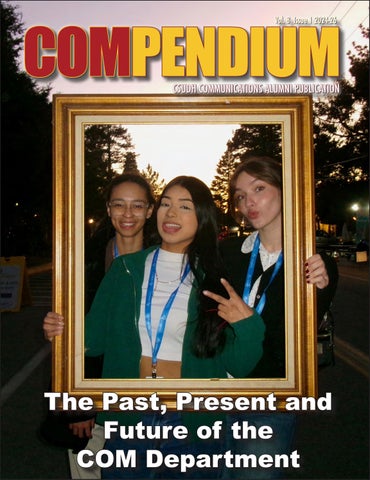
COMPENDIUM COM PENDIUM Vol. 8 Issue 1 2024-26
CSUDH COMMUNICATIONS ALUMNI PUBLICATION
The Past, Present and Future of the COM Department
Contents The Evolution of the COM Dept. Page 3
COM Department Gets New Chair Page 5
COMPENDIUM CONTRIBUTORS
Lead Designer Jessica Valencia
Writers & Designers
Editor Dr. Brant Burkey, Associate Professor, Dept. of Communications
Edward Inclan Kenneth Lee Karla Moran Sapphire Perez Deshawn Pouper Alizah Salazar Nour Smidi Jessus Torres Jessica Valencia
Andrea Ambriz Taya Bohenko Nyomi Capetillo Jennifer Cardona-Leon Camila Chavarria Allie Colcol Kevin Demetrio Orozco Luis Diaz Emmalise Fischer
Journalism Program Updates Its Curriculum Page 8
Dr. Hernandez Leads FDC & AI Initiative Page 10
Grant for New Digital Hub
Page 3
Page 13
Benefits of Student Involvement Page 15
Valentin Contreras Profile Page 18
Grabbing Hollywood by the Horns Page 21
Danushka Kumarasinghe Profile Page 25
LA Times Day Page 29
Jade Zuniga Profile Page 31
Importance of Joining Clubs Page 34
Importance of Internships COMPENDIUM
Page 38
1
Jennifer Peters Retires Page 51
Latinx Journalism Concentration Page 53
Jessica Pedraja Profile Page 55
Gabby Medina Profile Page 43
Golden Globe Foundation Support Page 58
Interim Bulletin Advisor
Community News Awards Winners
Page 47
Page 60
Page 63
Back in the Studio Page 66
Gabriel Gomez Profile Page 68
Challenges of Accreditation Page 72
Jade Stevens Promotes Nature Page 75
Future of COM Page 78
COMFest Roundup Page 80
Graduation Roundup Page 81
COMPENDIUM
Benefits of Internships
2
COM DEPT Evolution
COMPENDIUM
By Deshawn Pouper
3
During the course of his tenure, Dr. Paul Fornelli has seen many changes in Communications, including the classes he teaches. From the days where he taught COM 101: Introduction to Video Practices, and fast forwarding to where that has now turned into COM 110/111: Intro to Digital Media Production is just one of the significant changes that has happened over the past two decades as the world is going more digital. One of Cal State Dominguez Hills longest standing professors in the Communications Department, Dr. Fornelli has been a faculty member since 2001. Fornelli said, “I was actually a program director at a couple different campuses. That was an era of we were teaching classes like Emerging Technology." Now, Digital Journalism is a class option students can take advantage of to learn how to do podcasting and use social media in journalistic ways. With the digital world becoming prevalent during the 2000s, the field of Communications started to shift as well. The shift to digital didn’t just change what Communications students were being taught, but it also changed the intentions of how students wanted to use the skills they’re acquiring. While most students will take the normal route of getting experience as writers for print or digital publications, or work their way up as broadcast journalists on TV using the skills and knowledge they acquired in college, some will use these skills in other enterprising ways. For example, some students can go on to create their own YouTube channels, produce their own podcasts, or even make our own blogs. That is why the Communications Department has had to transform its curricula to adapt to these evolving conditions and provide the students the skills they need in a rapidly changing industry. This evolution also goes beyond just teaching new skills in the classroom. The Communications Department must also prepare students for specialized careers in a variety of media industries.
COMPENDIUM
This is why students can now take advantage of having standalone majors such as Journalism, Advertising/Public Relations, and Film, Television, and Media. According to Dr. Brant Burkey, who has been in the department since 2014, students could only previously get a bachelor's degree in Communications with an option of Journalism, Advertising/ Public Relations, or Media Studies. But after the department went through a growth phase, spanning from 2015 until the start of 2020, the department revamped its entire curriculum into standalone majors, providing more specialized pathways for students to pursue their respective career fields. For example, instead of having the singular option to write for The Bulletin newspaper, Journalism majors can also now get experience producing magazines or broadcast television news segments, preparing them for entering different fields of journalism. The program also introduced a Latinx Journalism Concentration for students interested in pursuing careers in Spanish-language news media. The Journalism program also earned national accreditation. But it's not just the Journalism program that was growing. The Communications Department as a whole expanded its roster of full-time faculty, from four full-time faculty members in 2014 up to 10 full-time faculty in 2026. The Film, Television and Media Program also expanded its Hollywood by the Horns programming and developed new partnerships with the Golden Globe Foundation, which now supports several fellowship programs within the department. However, some of that momentum was slowed because of the COVID-19 pandemic, as the department adjusted to remote instruction for a few years and then had to deal with lower enrollment and budget cuts to the university in the years following. These circumstances meant that the department has had to be flexible in how it plans for the future. "Some of that's just flexibility, just recognizing that we're going through an extreme period of time in history, and you just have to do what you have to do to get through,” said Dr. Fornelli. As the department takes the major steps necessary to make its comeback, it is going through another revamping of the curriculum that will take place this Fall. Each program is being asked to rethink the classes it offers, the number of units required to graduate, and what sort of prerequisites will be required. "We want to offer classes that will give students more experience in their prospective media fields but we also have to work around the challenges facing the university as a whole," said Dr. Burkey. "But I am confident that we will continue to evolve as a department in ways that will meet our students' needs in this transformative media landscape."
4
At the Head of the TTable: able: Dr Dr.. RRyan yan Bowles Eagle Leads With Care
COMPENDIUM
Known for her thoughtful leadership and student-centered approach, Dr. Eagle steps into the chair’s role at a pivotal moment for the department.
5
Every morning as department chair, Dr. Ryan Bowles Eagle walks into a job she knows will surprise her. At a CSU chair training, she recalled, one university president described the role this way: "She said, 'Every day being a department chair is knowing that you’re going to come in and you’re going to eat a chili pepper and you don’t know how spicy it will be,'" said Dr. Eagle. “And she was right. Some days it won’t be so spicy. And I’ll be like, oh, that wasn’t too spicy. And other days it will be a really spicy pepper. But it helps if you can wrap your mind around knowing that every day will have a chili pepper and that you’re going to eat it.” This Fall, longtime CSUDH educator Dr. Eagle stepped into the role of Communications Department chair, bringing a background in documentary production, feminist media studies, and media activism to a position that shapes what students learn and how they’re supported. On paper, becoming department chair sounds like a title change—one more line under a name. In reality, it’s a daily balancing act: supporting students, coordinating faculty needs, navigating university priorities, and making decisions that ripple through an entire program. Dr. Eagle, who has been at the university since Fall 2013, now serves as both department chair and associate professor in the Film, Television and Media B.A. program. Before becoming chair, she was already known across the department as a faculty member deeply committed to students, a scholar shaped by feminist studies and media analysis, and a teacher whose classroom centered on critical thinking and representation. Her path to the classroom was not a straight line. As a student, she studied film and creative writing at the University of Southern California, later earned a master’s degree in modern literature and culture in England, and worked in independent
By Andrea Ambriz
documentary production before pursuing a Ph.D. at UC Santa Barbara. What pulled her toward teaching, she said, was not only a love of film and media, but a love of discussing them and connecting with people through those conversations. “What I loved most was talking to people about the things that I loved,” Dr. Eagle said. “And I started to think that being a professor might be a way that I could do that for the rest of my life.” That instinct became a career grounded not just in media studies but in values. Dr. Eagle described feminism as central to the way she teaches and moves Photo Courtesy of Nancy Perry
X
lenges as a new chair, and I’m grateful for her steady leadership that is informed by her student-centered approach, critical thinking, clear communication, and empathy.” For Dr. Eagle, becoming chair was not the result of a sudden personal pivot, but part of the department’s rotating leadership structure. “To be honest, the timing for when I took on the role is because it was my turn,” she said. Still, if the position came through process, her approach to it is unmistakably personal. When asked what she wants to protect in the department, Dr. Eagle returned not to prestige or policy, but to purpose. “I am always reminding myself of the mission, which is to serve the students,” she said. “And I’m looking at everything through the lens of what’s best for the students.” “I think one of the most important roles of a department chair is listening and really understanding what other people are going through,” Dr. Eagle said. “And knowing that sometimes you can’t fix things, and you certainly don’t control everything, but you can support and you can listen. And you can make people feel heard and seen.” That quality has also stood out to Nancy Perry, the department’s operations support coordinator, who works closely with Dr. Eagle and whose office sits right next door.
COMPENDIUM
through the world, saying it informs how she thinks about dignity, representation and whose voices are heard. “When I think of myself as a feminist and when I think of how feminism applies to my work, I think of it in terms of my moral compass and the way that it points me to care about the rights and dignity of everyone,” Dr. Eagle said. That commitment is something colleagues have noticed for years. A former Communications Department chair, Dr. Sharon Sharp, who has worked with Dr. Eagle since she joined the department in Fall 2013, described her as “a tremendous asset to our campus, department, and FTVM program.” “She is an exceptional teacher, leader, and scholar. I have been continually impressed and inspired by the way her work is guided by empathy and equity,” said Dr. Sharp. Dr. Sharp also worked closely with Dr. Eagle on the design of the Film, Television and Media B.A. degree that launched in 2018 and now continues to work alongside her in the FTVM program. In her view, Dr. Eagle’s leadership style reflects the same qualities long visible in her teaching and service. “Dr. Eagle’s term as chair began this Fall during an extraordinarily challenging time for the university, the department, and the world more generally,” said Dr. Sharp. “She’s been adroitly handling those chal-
6 X
COMPENDIUM
7
patterns they may have noticed in said, and where she once could retreat for alone time after class media but never heard openly examined in an academic space. Other or office hours, chairing means moments come when students who being with people much more entered the class indifferent leave with often. To stay balanced, she relies a deeper understanding of people on self-care, time with her 10unlike themselves. year-old daughter, novels, “It’s really meaningful when I movement and deliberate see those students have a realization boundaries. that they don’t have to agree with That intentionality seems every single thing I say, but at some to shape not only how she works, point, developing a deeper sense of but how she imagines success. empathy for the way that people who Looking ahead, Dr. Eagle are different than them have been said she hopes that years from subjected to harmful patterns, harmful now the department will be able tropes, harmful stereotypes,” Dr. Eagle to say it endured difficult times without losing sight of what matters. “I would hope that we could look back and say that we’ve weathered the challenging times at the university and higher education in the world,” Dr. Eagle said, “and that in that time, the students and faculty felt supported and seen and heard.” In many ways, that vision echoes what Dr. Sharp said about the position itself: “The chair position is both rewarding and challenging,” said Dr. Sharp. “[It] has the opportunity to support students, staff, and faculty in tangible and meaningful ways. Many systemic factors that impact the department are outside a chair’s control, which limits what a chair said. "Witnessing a student become can do.” open to understanding the Asked what she hopes experiences and perspectives of students remember about her, someone that they hadn’t previously both as a professor and now as through studying media with me is department chair, Dr. Eagle's an honor.” answer was simple and The move from professor to unmistakably consistent with chair has brought major adjustments. everything those around her Dr. Eagle said one challenge is how describe much of the day cannot be planned. “I would hope that they Another is the interpersonal energy remember that they matter to the role demands. me,” said Dr. Eagle. “I am an introvert,” Dr. Eagle X
CHANGES IN JOURNALISM
COMPENDIUM
BY TAYA BOHENKO
8
COMPENDIUM
However, implementing these changes does not come without
9
Dr. Hernandez
Braves the New World of AI
as FDC Director
In 370 BCE, the famous philosopher Plato wrote about a dialogue between Socrates and Phaedrus, which took place just outside Athens. One of the core arguments within the dialogue was against the teaching of writing. Plato echoed Socrates’ belief that writing would implant forgetfulness into the souls of those who learned it, their ability to memorize would fade, and anyone who believed writing might provide something reliable or permanent must be exceedingly simple-minded. One shudders to think what he might have said about generative AI. Some 24 centuries later, faculty and students at CSUDH are facing technology changes the world has never seen before, and it often feels as though we are in uncharted territory. I was fortunate enough to speak with someone with the means of navigating it. I just had to find her.
COMPENDIUM
By Kenneth Lee
10
COMPENDIUM
It was one of Los Angeles’ seldom-seen rainy days last Thursday when I ventured to the fifth floor of the Leo F. Cain Library. Through trial and error, as well as some very helpful directions from students along the way, who I am confident noticed I was somewhat uncertain of my surroundings, I eventually found the office of newly appointed Interim FDC Director Dr. Miriam Hernandez. After a quick knock on the door, I was greeted by the warm smile of Associate Professor Hernandez. Dr. Hernandez is a native of Monterey, Mexico, and given my background in collegiate soccer, we naturally discussed the region’s two soccer teams, C.F. Monterey and Tigres. Dr. Hernandez is an associate professor in the COM Department, specifically in the Advertising and Public Relations program, and is currently serving as the interim director of the Faculty Development Center. The Center focuses on providing CSUDH faculty with equity-minded and meaningful professional development, organizing pedagogy courses, and dealing with the many responsibilities of being at CSUDH, including how to promote the Center’s research. Pedagogy is the theory and practice of learning. In other words, the teaching of teaching. Dr. Hernandez’ academic journey has truly spanned the globe. She began in Monterey, where she received her bachelor’s degree in International Relations and her master’s in Political Analysis from the Technological Institute of Monterey. She obtained her PhD in Communication from City University in Hong Kong before becoming a postdoctoral research fellow at Nanyang Technological University in Singapore. I wanted to know how that wealth of experience from all over the world would assist Dr. Hernandez in this new interim role. “That has really helped me see a lot of pedagogy approaches in these schools, and each school is very different," she said. "I came from a very, you know, interdisciplinary is the way to go, where you've got to really put a lot of focus on how to bring different disciplines together.” Dr. Hernandez said her contrasting experiences from CSUDH students also informs her many roles on campus. “I came from a very privileged background. I was able to be a full-time student. When I got here, it was like, no, here students are commuter students. They have responsibilities, they have families, they are working full time. They have athletic responsibilities, and you know, those were the minority in the other schools that I went to.” In truth, I had presumed that with all of her 11
experiences, Dr. Hernandez’s greatest strength would be a strong idea of how she wanted to see things done, no stone she had left unturned, no subject she wasn’t well-versed in. But as good leaders often do, she offered a somewhat different perspective. “I think maybe the great benefit is not that I was very versed on the things we are doing here, but that when I came, I was able to say, ‘oh, I can adapt.’” When faced with technology that impacts our ability to teach and learn, it is normal to perhaps be uneasy or even fearful, just as Socrates once was. However, when equipped with the ability to adapt and the presence of mind to anticipate change, it makes tackling those challenges far more manageable and even exciting. I believe Dr. Hernandez possesses both of those qualities. AI is undoubtedly the largest technological challenge facing education today. Another part of the FDC’s vision is to expand the use of technology and the science of learning in order to improve student-centered pedagogy. It is entirely possible that we are only seeing the tip of the iceberg when it comes to AI and the changes it will inevitably bring to CSUDH. When asked about these changes and challenges, Dr. Hernandez mused, “I think that’s a very interesting question. In fact, that is the nature of education, to change, right? However, I think also as faculty, the more that we are doing this, we may say, well, this is the way that I have done things, and I have always done these things, and they haven’t really changed that much in, I don’t know, many, many years. Even though I have adapted to the different students that I teach, the things that are very important, such as connecting with the community, being understanding to my students’ needs, I’ve had them all the time that I have taught. These are the core beliefs that I have, and I just kind of adapt them to what I’m doing.” How education changes because of technology is a conversation that is currently being waged within the FDC. When a new wave of technology splashes onto the shores of learning, it is vital that faculty and students go back and evaluate what the core of education is. Generative AI is rocking every step of the education and learning process, and it is doing so in different ways for everyone. The learning process is by no means an easy one; it can often be riddled with frustration and relentless practice, not to mention balancing the many responsibilities students are facing outside of school. This makes the prospect of using generative AI extremely attractive. In an ideal world, some professors might hope that this is
the last new wave of technology we will see for quite some time, but Dr. Hernandez told me that if the world has taught her anything, there are going to be more changes. In February 2025, the CSU announced an an agreement with OpenAI to create
by AI and what alternative activities can be used to avoid students relying on OpenAI. Dr. Hernandez made it known that while AI has gotten more open, some activities simply cannot be replaced. “The particular training that we have about generative AI, that’s the part we discussed. What are the parts that cannot remove you, the student has to be there. You have to be there,” she said. It was truly such
an eye-opening conversation with Dr. Hernandez; her energy and enthusiasm toward the subject were inspiring but if there was one piece of it I could leave you with, it would be this: "I really don't know what the next thing is going to be in terms of technology or anything," Dr. Hernandez concluded. "I just know it’s going to happen. If you have strong pillars of belief, these are the things that are important. It comes and it checks you a little bit, and you say, okay, this is how you move forward.” So this is what we must continue to do in the face of sweeping technological changes in education and in our society: face them with strong pillars of belief and keep moving forward.
COMPENDIUM
ChatGPT EDU. ChatGPT EDU is a specialized version of ChatGPT tailored specifically for academic environments, making it particularly useful for educational purposes. In the wake of that agreement, the FDC applied for and received funding to provide training to faculty who wished for it. The course was called Revamp Your Course with AI, and it was a workshop that equipped faculty members with the tools and guidance they need to properly examine the impact of AI on teaching and learning. The workshop also examines what assignments or assessments can be easily disrupted
12
A New Stage For Student Media At CSUDH
COMPENDIUM
BY Kenneth Lee
13
At Cal State Dominguez Hills, students in the Communications Department are creating incredible works of digital media every day. Whether it be a podcast, documentary, or article, students are showcasing their creativity in a variety of digital formats, so having a digital hub to showcase these incredible projects is precisely what the COM Department needs. Dr. Brant Burkey is an associate professor in the Communications Department and current interim journalism program coordinator. He envisioned a media center more than a decade ago when he was first hired in 2014. “I had always envisioned creating some kind of media center,” Dr. Burkey said. “During the department's period of growth that we had between 2014 and 2020, it kept being something that I really wanted to make happen, but we just never really had the capacity for it. Then, of course, from 2020 to almost 2023, we were out for the pandemic, so nothing got done there. But a few years back, once we came back from the remote pandemic years, I started thinking about, instead of trying to create a physical media center, maybe we could do something that was more digital.” This shift from a physical space to a digital one reflects the reality of modern media. Today, most content is created, shared, and consumed in some digital modality. That is why Dr. Burkey’s spent this academic year developing the DH Digital Hub, which is essentially a website that will act as both an archive and showcase for student work in the Communications Department. The goal is to bring together different forms of media produced within the department and make them accessible in one place. “My vision was to create a web portal that could be both an archive and an exhibit of all of our student media,” Dr. Burkey explained . The DH Digital Hub will include work from several student publications, such as Compendium Magazine, Medium Magazine, and even The Bulletin. Instead of these projects being scattered across different platforms, the DH Digital Hub would centralize them, allowing students, faculty, and even the public to easily view what students are creating. This not only highlights student work but also gives it a wider audience beyond the classroom. One of the biggest benefits of this project is how it supports student creativity and development. In the Communications Department, students are constantly learning
and the public could soon have access to the first version of the hub. In addition, a second round of funding has already been approved, which will help expand the project even further. Looking ahead, Dr. Burkey also hopes to involve students directly in maintaining the hub. One of his long-term goals is to turn the site into an internship opportunity where students act as curators. These students would be responsible for selecting and organizing content from different programs within the department. Not only would this help keep the site updated, but it would also give students hands-on experience managing a real digital platform. Beyond showcasing student work, the Digital Hub could also play a role in addressing one of the university’s current challenges—enrollment. Like many universities, CSUDH has been working to attract more students, particularly from local high schools and community colleges. The Digital Hub could become a valuable recruitment tool by giving prospective students a clear idea of what they can achieve in the Communications Department. As Dr. Burkey explained, the site would allow people to “see what our students are creating rather than just keeping it in the classroom.” This kind of visibility could make a strong impression on potential students who are deciding where to apply or transfer to college. Ultimately, the creation of the DH Digital Hub represents an important step forward for the Communications Department at CSUDH. By providing a centralized platform for student work, the hub not only highlights creativity but also prepares students for the realities of modern media careers. As technology continues to evolve, projects like this will become even more important. The DH Digital Hub is not just about showcasing work—it is about giving students the tools, exposure, and experience they need to succeed in the rapidly changing media industries.
COMPENDIUM
new skills across multiple forms of media. From writing articles to producing podcasts and videos, students are gaining experience that prepares them for the workforce. Dr. Burkey emphasized the importance of this kind of learning, stating that students are able to “create all of this stuff in all these different formats instead of just one type of journalism or one type of media.” This versatility is extremely valuable in today’s media landscape. As Dr. Burkey pointed out, we are living in a “media-saturated environment” where people are constantly consuming content across different platforms. Because of this, it is no longer enough for students to specialize in just one media format. Being able to write, record, edit, and produce content across multiple mediums gives students a significant advantage when entering the workforce. The Digital Hub will serve as a place where students can display all of these skills in one location, almost acting like a portfolio that is accessible to anyone. Another important aspect of the Digital Hub is its potential to expand beyond just written and magazine-based content. While the initial version of the site will focus on department publications like Compendium and Medium, Dr. Burkey has a much larger vision for the future. He hopes to eventually include broadcast journalism segments, advertising campaigns, and even film and television projects. This would allow the hub to represent all areas of the Communications Department, not just Journalism. By doing this, the site becomes more than just a showcase—it becomes a comprehensive reflection of what COM students at CSUDH are capable of creating. The timeline for the project shows that it is already well underway. The first round of funding, which came from an initial Instructionally Related Activity (IRA) grant, has gone toward building the site and organizing its content. According to Dr. Burkey, “by the end of this spring, we’re hoping that’s going to be up and visible.” This means that students
14
Student
Involvement
By Jesus Torres
W
hat students experience in college is what dictates which useful skills they take with them past their college career. These experiences should extend far beyond lectures, essays and exams. For Communications students, some of the most meaningful parts of their college education happen in the spaces where academics meet the community, clubs, cultural centers, student media, and campus organizations.
experience “ isThethatoutside it is not all about
making social media posts, or doing press releases, or even writing social media strategies.
COMPENDIUM
“
15
COMPENDIUM
For Advertising and Public Relations major Jenna Isadora Hernandez, getting involved with the campus became a way to turn theory into practice. Outside her coursework, she immersed herself in KDHR Radio, Theatre and Dance, Associated Students Inc., and other creative outlets that helped her grow professionally and personally. “The outside experience is that it is not all about making social media posts, or doing press releases, or even writing social media strategies,” Hernandez said. “While I love doing all that, the clubs and organizations were a gateway to showcase what I could do with the knowledge I had, and it felt nice to be appreciated.” Hernandez also ventured into sports social media management having been a part of the women’s softball team management for the 2023 season where they would go on to win the 2023 CCAA Division II Tournament. Her involvement there even included such tasks as setting up the field for game days or managing equipment. Film, Television and Media major Kolby Hill, who found a receptive community through the Black Resource Center and the Organization of Africana Studies, also found that weekly events like the Poetry Slam helped him connect with students from different backgrounds while exploring identity, culture and activism. He added that involvement has shown him there are “many different ways to be a part of something or get involved on campus.”
16
We learned more “about brotherhood,
being vulnerable and healthy masculinity as diverse men of color in higher education.
“
COMPENDIUM
Journalism major Carlos Merlo found his place in the Male Success Alliance (MSA), where mentorship, brotherhood and leadership development shaped his college experience. Through MSA, he represented CSUDH at the Young Men of Color Consortium and the Men of Color Action Network. “We learned more about brotherhood, being vulnerable and healthy masculinity as diverse men of color in higher education,” Merlo said. “Those experiences brought reassurance that we belonged. We learned how to represent ourselves and bring back resources to our college campuses.” Advertising and Public Relations major Jaime Luis Roca Martinez, who works at the Immigrant Justice Center, said the organization strengthened his communication and teamwork skills, abilities he sees as being essential for his 17 future career.
“The field I intend to one day have my career in involves group work and strategizing, but without the department, I never would have experienced a group setting,” said Luis Roca Martinez. According to Merlo, who also has had internships with the Immigrant Justice Center, getting involved can also highlight the importance of community. “The IJC taught me to advocate for our community,” he said. “It connected me with how diverse and expansive advocacy work is and the many elements to it.” What all of these Communications majors show is that the college experience doesn’t begin and end in the classroom. Seeking to join campus organizations, clubs or events outside of one’s major department can lead to students developing a wide-ranging set of skills that can be applied back to their original major and beyond. Since CSUDH provides so many engaging ways for students to get involved, the professional and social takeaways students receive only goes to show that if students are willing to make the investment, they will receive experiences worth tenfold in return. “Being in clubs and organizations showed me that there is so much more than just my major,” concluded Hernandez.
From Classroom to Broadcast Studio Valentin
milla C Chhava varrria By C Caami
Contreras
California State University Dominguez Hills Alumni Valentin “Val” Contreras, a citizen of the IIPAY Nation of Santa Ysabel and descendant of the Pala Band of Mission Indians, was just like any other Journalism major at CSUDH, taking Communications classes like The Bulletin, Senior Project, and the required Internship, but his love for speaking about the topic of the American Indian/ Alaska Native (AI/ AN) community with whom he identified with made him stand out. Contreras was a Journalism major in 2020 and, although COVID-19 didn’t give him the full college experience, he still became the Arts & Entertainment editor for The
COMPENDIUM
“Chase after your dreams, live passionately, and enjoy life!,”
Alumni Valentin Contreras was at California State University Dominguez Hill in 2020 and became the president for the Native American Indian Association Club, The Arts & Entertainment Editor for The Bulletin, and now is a DJ, radio host for Soundwaves on 90.7FM and an American Indian / Alaska Native community 18 advocate in the nonprofit industry
COMPENDIUM
19
Bulletin, was a member of the Indigenous Journalist Association, and became the president of the Native American Indian Association Club at Dominguez Hills, where he raised awareness for the Indigenous community. But he still credits his Journalism classes as providing him with the skills and experiences as having shaped who he is today, a radio host and entrepreneur, which has allowed him to expand his experience and grow a platform so he can do what he loves - speaking for and representing the Indigenous community. In fact, Contreras speaks passionately about the topic he worked on for his Senior Project, which was a multimedia package that consisted of an article, podcast, and video exploring a topic that focused on Indigenous communities, in addition to his digital portfolio that showcased his multimedia news project, published work, and a professional resume. “During my capstone year at CSUDH, I chose to focus my project on Native American Representation in Media because I’m a strong motivator for the American Indian/Alaska Native (AI/AN) community,” said Contreras. “I wanted to investigate the topic to share insight on the rising increase of Native creatives. This project allowed me to combine my love of the AI/AN community with my educational passion and I had a blast completing it! I created a video, podcast, and article while connecting with Native journalists.” In addition to the Senior Project, Journalism majors are also required to take an Internship class where they must complete 120 hours of a professional internship in their field so once they graduate, they can get opportunities from employers with the internship experience they have. “My internship was executed through a partnership between CSUDH and UndergroundHipHopBlog.com - during this time, I was able to create digital media content for the company,” he said. “I networked with a lot of artists, music industry insiders and tastemaker DJs. I was a staff photographer at events, created podcasts, and recorded live performances.” He then fondly reminisced about his time completing his senior project and internships. “This was a really fun time. It was somewhat a blur though because it happened so quickly; after a couple of months, I was done with the required hours,” he said.
COMPENDIUM
Valentin also expressed his favorite memories while being a Journalism major at Dominguez Hills from being in the newsroom to the classroom. “Some of my favorite memories of being a Journalism student at CSUDH were the nights in the editing rooms, going over stories with the staff writers, and the lectures in Professor Burkey’s class,” Valentin said. And although COVID-19 took some of his experiences away, he still made the best of what he could do. “I think my experience at CSUDH was unique due to being in the COVID era,” Contreras said. “I wish I could’ve made more memories. My on-campus time was limited and that would be my only negative aspect of my time at CSUDH. However, given the circumstances, I think it prepared me for the hybrid format of the world we all live in now.” So what has Contreras been up to after he graduated? He’s now working as an advocate for the American Indian/Alaskan Native community for a non-profit organization, while also working as a radio DJ/Host. “I’m currently a DJ and radio host of Soundwaves, which airs Friday nights on 90.7FM,” he said. “I tend to create partnerships with community-based organizations to help people reach their goals. I’m an avid film lover, sports enthusiast, and try to stay as involved in the media industry as possible.” After achieving their goals, alumni like Contreras and many others get to achieve their dreams and do what they love. His advice for current Communications majors? “Chase after your dreams, live passionately, and enjoy life,” he concluded.
20
HELPING STUDENTS TAKE
HOLLYWw OOD BY THE HORNS BY JENNn IFER CARDONA-LEON
Dr. Ryan Bowles Eagle, a Film, TV and Media associate professor and Communications Department chair, launched Hollywood by the Horns (HBTH) in 2014 with the starting goal of connecting Film, TV and Media (FTVM) students with professionals in the entertainment industries and help encourage the diverse creative voices of the students. “When I joined the Communications Department and the university one of the things that I noticed and discussed among the faculty was that I wish there were more opportunities for our students to connect with professionals working in the entertainment industries,” Dr. Eagle said. “It was something that I was very lucky to have an opportunity to do when I was an undergraduate studying film and I wanted that for our students.” Dr. Eagle believed students not only deserved opportunities but had so much to offer to the entertainment industries in terms of students' experiences and creative voices. The Communications Department offers opportunities to empower their students and to have the ability to stand out in entertainment industries where their students have their dreams set. The faculty have worked hard to give stu-
COMPENDIUM COM PENDIUM
“I wanted that for our students.” - Dr. Eagle
21
“Hollywood by the Horns demystifies the industry and replaces intimidation with preparation.”
COMPENDIUM COM PENDIUM
dents opportunities of internships, networking, building a portfolio and advice. The FTVM faculty also wanted to teach their students to “take Hollywood by the horns.” They started HBTH with two missions in mind: 1) create a meaningful connection between students and professionals in the entertainment industries; and 2) foster students’ creative voices and help them see how they can best make positive impact in the entertainment industries and their stories. To make sure they achieve these missions, HBTH hosts professional masterclasses with screenwriters, producers and cinematographers, as well as offers industry panels, film screenings with producers and crew members, Production Assistant Bootcamp training workshops, mentorship pairing with working professionals, field trips and its annual “Getting a Job” panel in COMFest. Toddy Eames, the current director of HBTH and FTVM associate professor, shared that HBTH was created to bridge gaps between classrooms and the entertainment industry by bringing professionals to campus and providing students with firsthand exposure, mentorship and work-force preparation. This ensured that FTVM students have access to networking, training and the confidence needed to enter competitive creative industries. “We hope students leave with three things: confidence, clarity and connection,” said Prof. Eames. “Confidence in their creative voice and professional presence; clarity about how the industry actually functions, its pathways, expectations and realities; and connection, including real relationships with mentors and professionals that can help open doors. Hollywood by the Horns demystifies the industry and replaces intimidation with preparation.” Prof. Eames shared that from all of the events, panels and workshops there had been positive response. Students report how in-person conversations with professionals make the industry feel more accessible and clearer. Also, how it led to internships, mentorship relationships and follow-up conversations. “Beyond professional benefits, these gatherings build community and remind students that they belong in these spaces,” said Prof. Eames. Prof. Eames continued to talk about the mentorship program where graduating seniors pair with established film and television professionals for one-on-one guidance, portfolio development and career navigation support. “Mentored students meet regularly with industry professionals who provide project oversight, portfolio review, career advice and honest industry insight,” shared Prof. Eames. “Mentors help refine resume and reels, prepare pitch materials and navigate entry-level pathways. The relationship is structured but personalized, offering sustained support during critical transition period.” Another way HBTH support their students is with their
22
COMPENDIUM COM PENDIUM
23
fellowship program. It offers financial assistance and structures professional development opportunities so that fellows can focus on their creative work without the need for outside employment. “Fellows are selected through an application process based on creative promise, financial need and commitment to storytelling,” said Prof. Eames. “Once selected, students use the funding to support tuition, creative projects and professional development opportunities. Fellows continue developing scripts, pilots or short films while receiving structured guidance.” According to Prof. Eames, it is important for students to get involved in HBTH because the entertainment industry runs on relationships as much as talent. It gives students access to networks they may not have and builds professional confidence, both essential in a field that can feel exclusive and intimidating. That is why she encourages students to take advantage of the face-to-face access because being in a room with professionals, asking questions, introducing themselves and following up is invaluable. She also indicates that taking advantage of mentorships and workshops can strengthen soft skills like communication, organization and professional etiquette, which are often what differentiate potential job candidates. Another important tip she offers to HBTH students is the recommendation they start small: attending events, introducing yourself and following up with a thank-you email. Prof. Eames also wants students to know that creation doesn’t begin with perfection; it begins with participation, which is why HBTH was designed to be a supportive entry point for students. “It’s completely normal to feel intimidated, most professionals once felt the same way. The key is to show up and ask questions. Professionals respond to preparation, curiosity and sincerity,” said Prof. Eames. “You don’t have to feel ready; you just have to be willing.” Maire Jones, an FTVM major, encouraged students to take advantage of HBTH even if they do not know what part of the entertainment industries they may want to get into. But meeting professionals that have succeeded in the industry is inspiring and teaches students a lot of the reality verses the dream of Hollywood.
@HOLLY W OODBYTHEHO RNS As the program continue to expand with workshops and mentorship opportunities follow @hollywoodbythehorns on Instagram to keep up and get involved.
COMPENDIUM COM PENDIUM
“I got my mentor Josh Locy, production designer and director with Chelsea Pictures, completely sure that I wanted to be a production designer or art director, which is basically bringing the writers' and directors’ visions to life by building, buying items and designing the sets,” she said. “Luckily my mentor was a director and working with him I learned that I wanted to go more of that route.” With her mentorship with Locy, Jones had the opportunity to get on different sets of films, get connected with a lot of people and a job at a social media agency. HBTH also opened an opportunity to a screenwriting internship with Cinestory in Idyllwild. Jones talked about how she spent five days meeting screenwriters and participating in workshops with them as well as helping set up meetings. “I’m really excited to go back. It is just applying [your skills] to everything,” she said. “The professors encouraged you to be part of it, even if it takes extra time out of your personal life it’s really worth it.” She also took part in the Creative Promise Fellowship and got a grant of $2,000 toward her tuition to work on a screenplay she pitched to the program. She described her project as a mockumentary about the place she works.
“It’s just really nice to have the support of the Film, TV and Media and Hollywood by the Horns programs,” she said. “The best part is the professors encourage you to take every opportunity you can because you can only go so far with just your classes.” If Jones had not taken the opportunities she gained from actively participating in HBTH she wouldn’t have been as nearly as prepared to graduate. “But because of the experiences and exposures I’ve gotten from the industry professionals within the program I feel like I can flourish. I can use the connections I made and what I learned to apply to real professional jobs,” she shared. For anyone interested in joining HBTH, Jones advised that students don’t have to pretend to know everything and it’s better if you admit it. Students can use their vulnerabilities to their advantage to get the information and support they need. Another piece of advice is to check every email from school and revolving around HBTH. “Even if you are the busiest person alive take the time because you care about it and everything you put in you will receive back,” Jones said. “It doesn’t take long as you think. One day you’ll be really happy you were active within the program." Dr. Eagle hopes students take advantage of the opportunities during their time here and to connect with professionals who share their knowledge. “I hope that our students can really tell that the program is here because we believe in them,” she said. “We built this program because we believe their voices have value and we believe they can contribute to these industries in meaningful ways. We know our students deserve these opportunities and that they have so much of value to contribute in terms of stories they have to tell and the perspectives they have to share.” She doesn’t want students' fear or self-doubt to hold them back from getting involved with Hollywood by the Horns. Hollywood by the Horns is here to help FTVM students take advantage of their college experience and step into their dream career on the right foot, full of connections, internships, relationships and work projects. As the program continue to expand with workshops and mentorship opportunities, students interested in participating with HBTH are encouraged to follow @hollywoodbythehorns on Instagram to keep up and get involved.
24
COMPENDIUM COM PENDIUM
25
For Dhanushka Kumarasinghe, playing Pokemon Go was a hobby and a fascinating pastime when he was younger. What Kumarasinghe did not know is how the game he viewed as entertaining would shape his future. Fresh out of high school Kumarasinghe attended California State University, Northridge to study Film. While he enjoyed his major and college he had to take a break from school for personal reasons. Kumarasinghe spent the next couple of years of his life working to help support his family. In 2014 he decided it was time to slow down at work and return back to school. When applying to colleges the second time around, Kumarasinghe was looking at schools who would accept his past credits from CSUN. Although this time he didn’t know if film was truly his path. Through the years his interest and passions had shifted. He attended California State University, Dominguez Hills as part of the communications department. After attending he chose to have a meeting with Dr.Burkey, through this meeting they were contemplating which major Kumarasinghe should choose. “I didn’t know what option to pick so I just saw a little flyer on his wall that talked about advertising and I was like, ‘I guess I’ll just do that,’”recounted Kumarasinghe. He didn’t start his studies in Advertisement and Public Relations out of passion or hobbies, it was out of pure circumstance and a poster sitting on a wall. Once he started the classes it was evident that he liked it. He found that Professor Russo was a huge part of what made him fall in love with AD & PR. “I promise you, if you speak to anybody from like… 2014– 2019 they’ll say Russo was a huge part of their interest in advertising.”expressed Kumarasinghe. “ He just had that kind of enthusiasm and he made you interested in it because he was interested in it.” One of his biggest accomplishments at CSUDH was during his senior year, when he wrote a research paper about the marketing applications of Pokémon Go. This paper led him to winning first place at the 2017 California State University systemwide Student Research Competition. ww Through his time at CSUDH Kumarasinghe realized he did enjoy what he had chosen. He became president of Public Relations Student Society of America, hosted a podcast, and DJ’ed for KDHR, the student-run radio station at CSUDH. Building connections with others around him well after he graduated CSUDH. “The collaboration with the different people from PR and advertising, just kind of like that
How
GO Pokemon
(Behind) Dhanushka Kumarasinghe presenting a plan created for Toyota and how to use influencers to help promote the outdoor activity use of the vehicle.
BY Sapphire Perez
Courtesy of Dhanushka Kumarasinghe Kumarasinghe testing one of the AR filters he helped pitch and create with Toyota.
COMPENDIUM COM PENDIUM
Changed His Life
networking was really great, I’m still in touch with some of those people to this day,” said Kumarasinghe. After graduating he did not go straight into working. It was hard for Kumarasinghe to find a job in the AD&PR field for about the first year. At the seven month mark he received good news, an acceptance for a three month internship. During this internship he was working, building relationships with employees, and was confident he may receive a long term position with the company. Unfortunately, that was not in the cards for Kumarasinghe. Due to issues with a high-profile client the company lost lots of money and cut employees, including all the interns like Kumarasinghe. “You have people, millionaires, on the top who lost millions of dollars, you have people at the company who lost their jobs, you have people, like property owners who lost their property, and then at the very bottom of the pyramid was this intern at a PR company who lost his job,” said Kumarasinghe. Then as months passed he decided it was time to get another job while continuing job searching. He started working for a temporary employment agency, being contracted for short periods of time for companies to do jobs As time went on Kumarasinghe continued playing Pokémon Go, it was his favorite game and he played it quite often. While playing he would often meet many new people, who he would have conversations with and in some occasions start friendships with. One day he went out to play and met a new friend. While playing together he mentioned he studied AD & PR. This new friend mentioned that they knew someone, Vicky, from the company Saatchi and Saatchi. “I was playing Pokémon Go a lot, I had nothing to do, I was just working, or looking for a job, and I just played Pokémon,” reflected Kumarasinghe. “You meet a lot of people when you play Pokémon Go, and I met someone who was in advertising.” After the interview he received news that he did not get the job. On the positive side what he did create was a new connection. He continued at the temporary employment agency and soon after another opportunity arose. The agency was contracted for a few weeks by Saatchi and Saatchi. He was working in their Idea Management department helping with paperwork. As the weeks went on there was a request for less temps. Kumarasinghe continued week after week being brought in to do more work. One day he came
26
COMPENDIUM COM PENDIUM
27
in late to work, the director of the department had to head downstairs to let him in the building. On the way up she asked him about what he hopes to do in the future when he told her that he studied advertising. “She connected me with HR people and then HR connected me with finance who also needed a temp,” remembered Kumarasinghe. “Through HR and the finance people they were bringing me into Saatchi and Saatchi for like two and a half months.” He continued working as a temp but was exclusively working for Saatchi and Saatchi. He built connections and was familiar with multiple departments in the company. After around two months, there was a job opening in the Ad Operations team, the set that helps build and set up digital advertisement campaigns on social media. Vicky knew the director of the team and served as the connection for Kumarasinghe to get an interview. This time, about eight months later, he did receive the role and officially became an employee at Saatchi and Saatchi in 2018. “The role that Vicky tried to get the first time, that I didn’t get, was Ad Ops, but it was a different team,” said Kumarasinghe. “ I knew now what the right answers were and the second time I interviewed, I was able to answer it correctly.” In his first three years he switched roles from an assistant, to media planner in Advertising Operations. After he switched to the Paid Social Team. The director of Paid Social was Vicky, he was looking for someone who had experience in the digital advertising realm. He has been part of Vicky’s team since 2021 and is currently the Media Supervisor on the team. His team is responsible for buying advertising space on different social media platforms. Then they find which type of advertising works best on those platforms, whether it’s video, pictures, or interactive advertisement. They have also helped the clients build boosting content for that advertising space. He is the most proud of the work he has done for Toyota. They did the a car giveaway on TikTok with a dance challenge, worked on augmented reality lens on Snapchat, have done brand collaboration advertisements with Marvel and Toyota. “ We did this dance competition called Corolla Cross Step, where we hired an influencer creator who’s known to be a really good dancer, named Audrey Fisher, who created the Corolla Cross step dance,” said Kumarasinghe. “We challenged other
Phot o Kum Credit: S arasi a nghe pphire P Saatc er h h Adve i compan as been w ez rtisem y sin ith th been c trans ent Oper e 2018, st e Saatchi Supe a f r a rviso ered and tions tea arting w nd ith th m an r of t prom he Pa d e id So oted to th has sinc e cial t e Me eam. dia
COMPENDIUM COM PENDIUM
people on TikTok to do the dance and the three people who did the best dance would win a Corolla Cross.” While Kumarasinghe loves his current job and has had lots of success with his projects, he wants to take a break for about a year from space. “This is not a nine to five job, you take your work home with you, I’m always thinking about this job and I’m stressing about this deliverable and that deliverable,” stressed Kumarasinghe. “There’s no time, almost, for my personal life in some ways.” Kumarasinghe has decided to take his creative juices away from work and focus on goals and personal projects he has thought about in the last few years. He does not believe that this is the end of his advertising career, just a way to reignite his passion. “ Not really focusing on my personal goals, kind of wore me down,” expressed Kumarasinghe. “Maybe taking some time away from what I’m doing now may reinvigorate some passion for it.” He advises any students who may still be on the fence about their schooling to think about the current job market, the effects of artificial intelligence on their career, and the lifestyle they want to live. To consider the work-life balance and the sacrifices they are willing to take to make it in their career. “There are so many people who pick a job that is so antithetical to their lifestyle preference that they end up in a situation in their late 20s, mid 30s, like, ‘man, I am not happy with my life,’” said Kumarasinghe. Dhanushka Kamarasinghe career was not linear. It was filled with uncertainties and lots of hope. It took him years to return to school, he chose his career from a random poster on the wall, and took more than a year to finally secure a job. Since then his career has been successful and playing Pokémon Go since college ended up being what tied everything together. “It felt like everything just fell into place when it happened,” reflected Kumarasinghe.
28
LA Times Day Dr. Brant Burkey and the SISJ Panel during the 2025 LA Times Day event
COMPENDIUM COM PENDIUM
Interim Journalism Program Coordinator and Associate Professor Dr. Brant Burkey believes the CSUDH collaboration with the LA Times last Spring should be an annual or at least bi-annual event on campus. Last Spring term, March 29, 2025, California State University Dominguez Hills hosted an "LA Times Day" event throughout classrooms on campus. However, it was not intended or targeted for current college students at the university but rather local high schoolers. “It gives high school students an opportunity to visit a university campus and allows them the chance to envision themselves going to college someday,” said Dr. Burkey. Being a huge contributor to the communication between the LA Times and CSUDH, Dr. Burkey assisted with coordinating classroom use for various workshops and even presented a few of them himself. His workshops educated the young adults on news literacy and identifying fake news in the media. “They [students] said they really enjoyed the workshops,” said Dr. Burkey. Other CSUDH faculty, such as Adam Elrashidi, professional journalists and even photojournalists from the LA Times also presented an 29 assortment of workshops throughout the campus
By Emmalise Fischer
classrooms. There were reportedly over 100 students in attendance from a variety of grade levels ranging anywhere from high school freshmen to seniors. Beyond future college students gaining experience for a future in journalism, graduating CSUDH seniors got the opportunity to pass down knowledge as well. “It was a really refreshing experience getting to hear other younger student journalists give out their perspective of what they think,” said aspiring news reporter and alumni, Jimmy Dominguez. Dominguez was a Journalism major who attended CSUDH for all four years of his college experience and graduated in Fall 2025. During his time at the University, he served as the president to the club Society of Independent Student Journalists (SISJ). SISJ presented a panel discussion during
Unfortunately, it is not confirmed that the collaboration between LA Times and CSUDH will turn into a regular partnership. "We haven't really had any ongoing conversations for it to happen this Spring,”said Dr. Burkey, "but we'd like to continue this partnership in the future." This leaves the Journalism Program with the question... should they take the first steps and reach out to LA Times to make this an annual event? Or should they offer these workshops on campus even without the collaboration? Only time will tell but Dr. Burkey hopes that this collaborative event will become a regular occurrence that may one day even incorporate more of our own Journalism majors. Jimmy Dominguez looks at his notes before presenting at last year's LA Times Day.
the event where the attending high school students were given the opportunity to ask the graduating seniors questions about their experiences in the field. The curious high school students asked a range of questions toward the panel of SISJ members. There is one question that lingers in the former SISJ president's mind nearly a year later. The student asked, "What does it take to be a ‘good’ student journalist?" Dominguez answered, “It takes a lot of bravery. It takes a lot of guts.” Bestowing his knowledge and experience upon the young minds only broadened his perspective on the world of journalism. Dominguez would even consider the event to "perfectly" catch the "community" aspect of journalism many people disregard or forget about in route to their careers as reporters.
“We haven’t really had any ongoing conversations for it to happen this Spring,” Dr. Burkey said, “but we’d like to continue this partnership in the future.“
COMPENDIUM COM PENDIUM
“It was a really refreshing experience getting to hear other younger student journalists give out their perspective of what they think.”
30
From
Dreams to Reality
COM PENDIUM
By Jessica A. Valencia
31
Anxiety filled her body asshe entered a new entirely different world filled with lights, artists and all sorts of new people. Somehow, she was still excited and inspired to walk into similar experiences in the future, her anxiety turning into motivation simply from observing seeing others do what she had only dreamed of doing. Like many other students, they were encouraged to start their own passion projects throughout the start of their journey at Dominguez Hills. But, many students find themselves overwhelmed and often struggle to find the courage and motivation to do so. That was certainly the case for senior AD & PR major Jade Zuniga before starting her own video podcasting social media account - “2mundo. media.” 2mundio.media is a media channel, where Zuniga interviews Latin music artists. Zuniga’s choice to only focus on regional Mexican music was due to her personal enjoyment of the genres and her understanding and deep connection of the Spanish language.
PENDIUM COMPENDIUM COM
“The hardest part about starting for me was doubting myself, being afraid of what others were going to think or judge,” said Zuniga. The Communications Department had a variety of different classes that helped. Zuniga feels comfortable withpublic speaking, but what really helped change the game for her were classes taught in Spanish by Dr. Ana de la Serna. Zuniga states not only did Dr. de la Serna’s Spanish speaking classes go over formats, professional wording and the inverted pyramid but having to write press releases in her native Spanish language also helped her tremendously. Dr. de la Serna was not Zuniga’s only mentor, Zuniga’s mother also played a huge role in the creation of her video media channel, 2mundo.media. The idea first began from attending album releases, listening parties, and press conferences as her mother’s plus one. From there, Zuniga was able to gain insight and understand how everything works behind the scenes just from watching her mother interview artists. Zuniga now uses her video media channel as a way to show what she is able to do and how proficient she is able to research and interview a variety of different Spanish artists. Zuniga claims her channel is “basically like a resume,”but with the goal of gaining experience as she continuously builds her skills, in hopes of working with a news channel or within the music industry.
32
COM PENDIUM
Although, researching, coming up with questions and interviewing artists does not always go according to plan. Some interviewing artists does not
33
always go according to plan. Sometimes Zuniga is invited to last minute events, which in turn seems like an amazing opportunity, but can be challenging for Zuniga. “I will rely on past questions I have asked [other artists] because at the end of the day every person has different life experiences and answers to those questions.” Zuniga recalled. Zuniga claims she didn’t even need a lot of expensive technology and equipment to get started, she is able to produce content with nothing more than her cellphone, a tripod and the Cómica wireless microphone. She says that she uses her phone because “the quality is good and it makes it easier to upload content instantly.” While interviewing does not need expensive recording equipment, producing solo content requires a relaxed and composed demeanor, even if the interviewing and recording process does not go smoothly. “I think the most challenging part when creating content is not wanting to stutter or mess up when recording an interview.” stated Zuniga “ There have been a couple of times where I do an interview and go back to listen to it if the audio wasn’t on.” Having her own media channel has opened up a lot of opportunities, like being invited to special events and album releases, where Zuniga usually gets to interview up and coming musical artists, like Legado 7, Pepe Garza, ElPincheRika, Rancho Humildes, and Clave Especial. She was also able to make connections with someone who helped her to secure an internship with Evoke Agency. On her first day as an intern, she had the opportunity to attend Junior H’s album release, where she met some
important people but also was able to listen to Junior H’s new album before anyone else could. Album releases feature red carpet and media covering before an artist performs a little bit of their music from the new album set to release after the party. Zuniga encourages anyone who wants to start their own media channel to start as soon as possible. She says the best that can happen is you gain a lot of experience and the worst being having nothing to lose. But she wants others to know that there is a strong possibility that those who try might gain more recognition, connections in the industry and possible future jobs, so it’s definitely worth trying. “ I really enjoy assisting these events, from doing interviews, to networking, and hearing them perform live, sometimes being the first listeners of some songs in their new Albums!” Zuniga recalled joyfully. In the end, Zuniga thinks it is important to never be afraid of what others may think and be confident. Ever since she has started, Zuniga has only received pos-itive comments and messages from supporters. It has brought her comfort to know that she is doing a good job and others believe in her as well.
Zuniga’s logo for her video podcasting social media account “2mundo.media.”
Small Clubs, Big Impacts
O
n a commuter campus, belonging doesn’t always happen by accident. At California State University, Dominguez Hills, students often arrive for class and leave just as quickly — back to work shifts, family responsibilities, long drives, and whatever else is waiting off campus. That reality can make the college experience feel transactional: show up, submit the assignment, go home. For students in the Communications Department, clubs like PRSSA and SISJ are pushing back against that pattern. Clubs can shape a student’s college experience. Whether they
pertain to a major or are part of a fraternity or sorority, these campus organizations offer connections and professional development, even a sense of belonging that’s often harder to find on a commuter campus. At CSUDH, where many students balance school with jobs and family responsibilities, the growth of these student organizations has become an important way to build community. In the Communications Department, two clubs are especially encouraged: the Public Relations Student Society of America chapter, known as PRSSA, and the Society of Independent Stu-
dent Journalists, or SISJ. PRSSA is a national, pre-professional organization with chapters at universities across the country. At CSUDH, it serves students in Advertising and Public Relations by creating pathways into the industry, from networking and mentorship to hands-on event planning and portfolio building. Leaders of the CSUDH chapter say the weekly rhythm is part of what keeps the club functioning. PRSSA’s board meets every Monday, and the meetings typically begin with casual check-ins before moving into planning and logistics for upcom-
COMPENDIUM COM PENDIUM
CSUDH’s Communications clubs PRSSA and SISJ are still growing and helping students by: Andrea Ambriz land opportunities and feel connected
34 X
COMPENDIUM COM PENDIUM
ing events, social media posts with scheduling, and follow-ups from previous events. For PRSSA co-president and senior AD/PR major Mateen Richey, currently in his second year with the club, the appeal is the level of participation and the way members are encouraged to speak up. “The vibe is really just everyone getting involved,” said Richey. “Everyone's really willing to pitch ideas for events or even just speak their minds on what they think we should do.” Even with the casual energy, the chapter runs with structure. Co-president and senior AD/PR major Calvin Bui described the board meetings as a place where responsibilities are assigned and timelines are set, especially as the club works to expand its event programming and partnerships.
35
“Most of the time board meetings [are] me delegating assignments to certain people. Or me asking when the next event would be okay,” said Bui. “Talking to people about how they want to
handle each other in general.” Still, club leaders say PRSSA’s atmosphere is what convinces students to return, especially students who may feel disconnected on a campus where many leave after class. “It's really welcoming, I would say. This is one thing I tell people. As much as we talk about the business side of it and getting ready with the career development I was just talking about, we still have that fun time for ourselves,” said Richey. “We don't just lim-it the organization to just business, business, business, [we're] really trying to develop and curate a friend-tofriend relationship.” As the Spring 2026 semester moved forward, PRSSA leaders said the chapter has focused on events that connect students X
organizations on campus, because I feel like there's a certain stigma when it comes to being a transfer student and you feel left out and as soon as someone transfers in, they're like, oh, I didn't come here my freshman year,” said Calvin. “There's already friend groups that are already made and it's clear, and they feel left out. But it's hard to shift a notion or image that people create in their head.” Bui said he has spent the past four years on the board, previously serving as vice president, and part of his leadership has been learning how to create an entry point for students who feel unsure about getting involved, in an attempt to make a safe space for students so they feel like they're part of a community. “We do agency tours, try to put out as much work or interest for students, I would say,” said Bui. “But yeah, that's like how we try to do
outreach to students, I would say, is just like trying to catch their eye. But it's just hard because we're a small campus and we're also a very heavily commuted school.” Richey, currently working on his internship, alongside Bui and many other AD/PR students, was able to get this opportunity through PRSSA. The club’s biggest impact is allowing students not only to interact with their peers but also to connect with professionals doing the work in the field. “We've gone to different mixers, different conferences because of PRSSA,” said Richey. “Being able to meet people through there and, you know, try to bring them on to our campus as well. So we've actually been able to bring a couple of people that we met from conferences, to our campus.” Social media has become a 36 COMPENDIUM COM PENDIUM
with working professionals. They pointed to panels with guest speakers and agency tours as ways to make careers feel more concrete for students still figuring out their next steps. “We have all of our events on our Instagram page, CSU PRSSA, but we've done a bunch of events. Last semester, we were able to bring John Lee,” said Richey. “He works in the public sector for Los Angeles County. And other different panelists came in talking to the fellow students and us as well.” While PRSSA provides a strong base for students who join, sustaining membership remains one of the chapter’s biggest challenges. Both co-presidents pointed to the realities of a commuter campus and the experience of transfer students arriving after social circles have already formed. “[They] aren't aware of the
X
Although PRSSA is still rebuilding itself after the Covid years, new opportunities have begun to spike for members, including working collaboratively with other campus organizations and clubs like SISJ, the Society of Independent Student Journalists, a club for Journalism students interested in reporting and news media. “There's a lot of overlap, especially with Journalism and Film and Television, but also other things like Marketing as well,” said Richey. “There's a lot of overlap, especially, you know, we work with journalists a lot. They're probably going to be the people that are pitching stories to or that are being pitched stories to.” Looking ahead, Richey said he hopes future leaders keep the momentum and continue building a consistent presence on campus. “Let's hope people just keep staying engaged,” said Richey. “People continue to keep putting effort like I did into the organization or fellow board members this year as well.” For Bui, the goal is not only to graduate with skills and connections, but to have AD/PR students eventually return and invest in the next generation of CSUDH students. “I want to see a legacy, where I can come back to the organization, be a speaker,” said Bui. “I want to come back to a classroom full of students that I've never met before. I just want to be able to talk to people and give back to the community that brought me up. That's the one thing I want to be able to do in the future.” On a campus where students come and go, that desire to build something that keeps people connected is what turns a club like PRSSA into a foundation.
COMPENDIUM COM PENDIUM
major part of the club’s outreach and internal training. Board members produce multiple posts each week to promote events and build visibility, while also practicing skills they will use professionally, including creating flyers, curating events and maintaining consistent posting schedules. “The main thing to think about is it's not busy work to be busy, but it's work that you need to do so you can build up your own portfolio and your own representation as an individual,” Bui said. “At the end of the day, they want to see concrete physical evidence. So the main thing about being a board member is building your portfolio and being able to make better connections and get better opportunities.” With only five to 10 students on the PRSSA board, the CSUDH chapter is smaller than many university chapters. However, beyond the student chapter, PRSSA is strengthening their connection to a broader and larger professional network that students can access after graduation. “I think we're just trying to build PR and the people that we connect with as well,” said Richey. “PRSSA is for students but you also have the Public Relations Society of America (PRSA), and that's like the like an umbrella alumni organization over the student organization.” Opportunity is a central word to PRSSA’s mission. The club is meant to be a space where students gain experience and mentorships. They grow and learn from other people’s experiences, including in forms of speakers and panelists, and practice skills that translate beyond the classroom.
37 X
Katelyn Rodriguez, a senior Advertising and Public Relations major, is currently doing an internship at Digital for Good, an organization that informs and educates students, parents and schools’ faculty on anti-cyberbullying and how to maintain digital wellness, where she does social media and marketing. But like many students starting an internship, she didn’t know where to start and felt underqualified in using programs like Microsoft Word, Microsoft Excel and Adobe Photoshop. Fortunately, she was able to get more experience in her COM classes and the support she needed to eventually get an internship that helped her build her confidence. The turning point was when she got the Dominguez Hills Wom-
Dr. Hygh hosting PRSSA Careers in PR and Storytelling with Commander Matthew Kroll, Tanuja Singeetham and Kristal Shipp for the Communications Department
Resources and Importance of Internships “Just make sure you’re pursuing things you want to be doing and you’re interested in doing. When it doesn’t work out, start over somewhere else.” Courtesy of Nancy Perry
COMPENDIUM COM PENDIUM
by Jennifer Cardona-Leon
38
COM COMPENDIUM PENDIUM
en’s Resource Center Glow internship. It helped her build confidence in applying for more internships and jobs, as well as build her portfolio with preparing campus events and social media marketing. It is a requirement for Journalism and Advertising and Public Relations majors to do an internship their senior year. However, for many students they may not know where to start or feel unsure about applying their skills in their work field. To support this requirement and help students get started, the Communications Department offers workshops, resources and helpful advice for how to secure an internship. The internship requirement Journalism and AD/PR majors must be fulfilled in their field of study and should provide the opportunity to practice the skills and concepts learned through their academic coursework in a professional setting. Ideally, the internship should help bridge the campus experience to a career in the student’s chosen field. Lisa Mastramico, lecturer and academic internship coordinator, is the instructor for COM 496, the required internship course for Journalism and AD/ PR majors. She must first approve a student’s internships before providing an access a code to enroll but she also hosts workshops to help them learn how to apply for internships. The workshops are two hours long and offered at times and days to meet students’ schedules. It is where all of their questions can be answered about how to get started, where to look, and how to go about the process of applying. They are intended for students who plan to take an internship the following semester so the idea is to get started well before they start applying. For example, if students are planning to intern in the Fall, then Spring is the time to go to one of her workshops and ask questions. “I really don’t want students to worry about internships. I know internships stress students out and I want to help as much as I can,” Mastramico said. “And the best I can do is say, ‘Come meet with me.’ But I can’t help you if you don’t see me, if I don’t know you exist.” She has found that the workshops have proven helpful for students to navigate the internship process and witnessed firsthand students’ stress melting away when they came to talk to her. Her advice is to make the internships work for you and to think of it as a positive experience. However, Mastramico explained that the
39
When providing academic advising, Interim Journalism Program Coordinator Dr. Burkey encourages students to pursue internship opportunities that offer hands-on professional experience in their prospective fields. "They can be great stepping stones for future careers."
COMPENDIUM COM PENDIUM
process is different for each student because it depends on where they’re at and what they want to do. Internships are opportunities to build portfolios, resumes and network in their prospective fields. That is why the Communications Department makes it a requirement for Journalism and AD/PR majors because they know if students graduate with an internship, they are more likely get hired. “What [an] internship does is it takes all the stuff you’ve learned in class, projects, the things you’ve been writing and creating, takes those skills and puts them in a professional environment,” Mastramico explained. “So, you can see how those skills actually work outside of the classroom and what people are doing in your industry.” The hope is that internships can create bridges from the campus to career as supervised, guided opportunities to get professional experience where students can figure out what they want to learn and find out what might interest them in the industry. “I would say resumes are a good place to start, but don’t get stuck there,” she said. “Click around, look for what opportunities are out there. Focus on the process of elimination because it is a big field.” Mastramico understands internships may feel intimidating but want students to understand they deserve a spot in professional work environments like everyone else. “Our students are amazing, talented and have great skills, and we believe in you. We know you can go out there and do this,” Mastramico said. “You totally got this and I can help you, and I will guide you through the process, but you got this. At some point you’re going to have to do it, why not start now?” The Career Center also has an team that can provide resources for job searching and internships. For example, they can help by providing resume samples or reviewing students’ resumes, as well as assist students with exploring the Handshake system for both jobs and internships. The faculty of the Communications Department also want students to know they were once in the same shoes, getting through 40
COMPENDIUM COM PENDIUM
their educations and trying to find work in their fields, but they all agree that internships can be an important stepping stone in getting a foot in the door in most media professions. Dr. Larry Hygh, assistant professor in the Communications Department and advisor for the Public Relations Student Society of America (PRSSA) club, teaches in the Advertising and Public Relations degree program. He once interned during the 1996 Summer Olympics in Atlanta doing press operations for the sport of badminton, and the following summer doing an internship at the White House in the Office of Public Liaison and later with his congressman, Max Sandlin, interning with his press secretary. His internships helped him to learn how to do communications in a multiethnic cultural setting, including organizing press conferences and disseminating press information to the media for the Summer Olympics. “I gained some real-life experience that gave me a competitive advantage, a competitive edge over other candidates for jobs,” Dr. Hygh said. “There’s no way you’ll get a job without doing an internship. And you need to learn what you like and what you don’t like.” According to Dr. Hygh, internships shouldn’t be looked at as simply checking off a box to graduate when it is a great place to connect with people who work in the industry you are interested in. Networking with people may lead you to better opportunities, future jobs and create ways to stay connected. He thinks it is important for people to know who you are in internships, to volunteer, stay late, get to know people, turn their heads and put yourself out there. Dr. Hygh shared that it is equally important for both Journalism and Advertising and Public Relations majors to know how to write and pay attention to the news. “Write, write, write, write, I don’t care what type of communication person you are. You must be able to write,” he said. “I always begin every course, no matter what it is, with what’s going on in the news because you have to know what’s going on in the world around you.” He also points out that public speaking is an important skill in Communications. Dr. Hygh found that internships and opportunities helped him memorize and consume information when hosting an event that involved him in public speaking. Dr. Brant Burkey, the interim Journalism Program coordinator and associate professor, was able to get his first internship from connections he made working at a local weekly newspaper where he had previously worked selling classified ads. The internship he did there later gave him the opportunity to write small articles and columns, where he got to see his name in print and practice journalism in a professional, real-world setting. More journalism jobs started to come up for him after his internship. He already had experience and published articles, 41 which gave him an advantage over some of his colleagues with
COMPENDIUM COM PENDIUM
the same degree because he had something to show. “Internships are valuable because they give you professional experience in a professional setting. Also, you end up with content that will help your portfolio to be able to get other jobs because it shows that you’ve already been out there doing work,” Dr. Burkey said. Dr. Burkey is also quick to admit that he was no stranger to being scared and not feeling qualified in the newsroom. He wasn’t sure he was quite ready to be a professional journalist but, as an intern, he had the leeway to learn how to do the job when the expectations weren’t so high. “They didn’t hold me to the highest standards, and they let me go out and figure it out,” he said. “When you’re doing an internship, that’s the place to make mistakes rather than on the job, where you’re expected to maintain different level of professionalism.” That is why the Communications Department not only requires an internship for Journalism and AD/PR majors but it also provides opportunities like the Senior Project and Bulletin classes that give students as much experience as possible before sending them out into the field as aspiring media professionals. “These different opportunities towards the end of your academic pathway are to be able to get as much real-world experience. The newsroom, an internship and creating your portfolio is to prepare you for the industry after you graduate,” Dr. Burkey said. Everything is to prepare every student and encourage them to try to get out there and do things on their own. However, there is only so much the Communications faculty can do. It is the students who need to take it seriously because they genuinely want to see their students succeed in their prospective careers. “None of us felt confident or prepared but with each experience you get, it builds your confidence. You’re going to feel the imposter syndrome, but we all must go through the process of being beginners. Then with a little more experience, you end up actually becoming good at something,” Dr. Burkey said. With the experience Rodriguez gained from her internships, she feels even more confident now that she has been able to tailor every single one into skills on her professional resume. “I’ve got my first assignment officially completed. I started doing weekly meetings with my team lead and [I’m] getting introduced to new platforms that are important for any job in the market postgraduation,” she said. However, Rodriguez recommended that students start looking for internships as early as possible and take advantage of all the guidance at their disposal from the Career Center, their faculty, and the COM Internship Coordinator Lisa Mastramico. “Thankfully, Lisa helped me so much in the internship workshop that she did,” Rodriguez said. “She instilled confidence and made it very clear that she was open and more than willing to help.” The Communications Department requiring internships for Journalism and AD/PR students isn’t about adding more requirements but instead giving their students a higher success rate of getting a job and creating a career after graduation. 42
By Sapphire Perez
COMPENDIUM COM PENDIUM
UNEXPECTED LIFE PATHS
43
There it goes, the first alarm is blaring through the air at 5:45 a.m., it’s too early to wake up, so the only option is to turn it off and wait for the next one. There it goes again at 6 a.m. and this time there are no options, get up now to get ready for work or stay in bed and be late. Once up, it’s a race against the clock. Brush teeth, get ready, and be in the car by 7 a.m. because the drive to the station is about an hour and work starts at 8 a.m. in Glendale. Being a video journalist, the first thing that needs to be done is checking in with the assignment desk manager to see what stories there are for the day. Once aware of the stories and what the report time is, it’s finally time to grab a coffee before reviewing the background information and prepping
the interview questions. After, it’s time to call and check in with the point of contact to confirm the event and the location. Once it’s time to head out, all the equipment needs to be grabbed and checked to make sure nothing is missing and everything is working. At the event, it’s time to set up and film. After all the shots are captured, it is time to go back to the van to upload, edit, and send all the footage with extra information back to the station. Once everything is all set and done, it’s time to repeat that process again for the other assigned stories. When finished, return to the station, leave all the equipment, and plug everything in to charge. At that point, it’s been a long day of running around and it’s time to go home.
(Top left corner) Gabriella Medina at Dodger Stadium reporting for KABC7.
That’s when she became undeclared and went to meet with an COM Advisor, Penny Roebuck-White. Roebuck-White asked Medina what she liked to do and her only response was writing. Medina thought the only option for her would be to major in English but Roebuck-White suggested Journalism. Medina then switched her major to Journalism and had a minor in Advertising and Public Relations. “Then she told me, ‘why don’t you just do journalism?’ and I said, ‘why would I do that, I don’t even know what that is?’ Eventually, I ended up learning what it was and I took the classes and it was really cool for me,” said Medina. She noticed that she loved journalism because she was able to write and tell people’s stories. Her favorite part was joining The Bulletin, which she credited as giving her a lot of support and helped her to be a better writer. She enjoyed the stories she covered, liked the feedback, and felt like she had sharpened her skills. During her time at CSUDH, she also completed two internships despite the fact Courtesy of Gabriella Medina
That is what a day at work can look like for Gabriella Medina working at KCAL as a news assistant. While there are many sides to her job like writing for teleprompters, pulling video files, adding to the website, and assisting the assignment desk, her favorite and most exciting days are when she’s out in the field reporting. “It’s definitely interesting, it’s always different, and every day is a different story,” Medina said, as she reflected on the high-profile court cases and Dodger parades that she has covered. Although Medina may enjoy this job now, it’s not at all where she expected her life to be. Initially, California State University, Dominguez Hills was not what Medina considered to be a dream school but it was the school that was affordable, had a major she wanted to pursue, and she could stay at home and help her family. When she first started at CSUDH, Medina thought she was destined to be a veterinarian. Though, her studies had other plans. She signed up for a math course that was required for her major during the summer session but Medina’s work schedule was not compatible with the time of the class. So she decided to drop the course but then found out, without it, she would no longer be able to complete her major.
COMPENDIUM COM PENDIUM
(Bottom right corner) Gabriella Media behind the wheel of s KABC7 news van.
44
COMPENDIUM COM PENDIUM
that the world was in the middle of the COVID-19 pandemic. Even though she had to complete both internships remotely, Medina was grateful that through her internships she got the experience of writing for a real news outlet and having her work published. Although, it also meant she didn’t know the feeling of stepping into a real newsroom and was unsure of what to expect after graduation. “My experience, as I mentioned, came from print and that came from…when I was in my bedroom alone, working from home because of the pandemic,” Medina reflected. But then she realized, “Like, wow, I am going to be in an actual physical environment with actual people.” Throughout her college years, there was a brief time that Medina was employed at Disneyland, where she enjoyed her job and had a love for the Disney company. When it came time to figure out what her plans were after graduation, she was on the
45
Disney Careers website and found a listing online that aligned with journalism. This listing was for an assignment desk internship with KABC for a six month-long period. Medina figured she would apply and see what happens. While interning there, she began to understand the world of broadcast journalism and enjoyed doing it. After her internship ended, they offered her the opportunity to shift positions to a year-round employee as a news assistant. In her role as news assistant, Medina is currently taking on many responsibilities. Some shifts she is working through their video journalist program, out all day filming interviews that will be shown at a later broadcast. Her shifts may also include working with the teleprompters and clipping segments from the broadcast to transform them from broadcast to a written form for the website. Starting off her career in the realm of broadcast made Medina feel uneasy. She was unsure if she was able to do the work required because it was not something she was well versed in. Medina was only used to written work. Over time, though, she gained a love for her job. “Being able to go out and shoot video for this, just to be able to tell what’s going on and to show these people’s passion and their stories, that’s something very important to me,” said Medina. Including her internship, Medina has now been with KABC for four years. During this time, she also decided to return to school to get her master’s degree. She graduated
Gabriella Medina setting a tripod with her cellular device before reporting at the scene of a news story
from University of Southern California Annenberg School with a master’s degree in Digital Media Management. Right now, everything is focused on social media, and Medina would like to try different avenues, merging the use of her degrees and experience with something new. To get into this field would bring Medina’s passion for photojournalism closer to her everyday life. While she is not sure if she is done with working in broadcasting, Medina believes it is never too late to start something new and there is more than one option with what a person can do with their life. “I always wanted to be a veterinarian, I always wanted to help animals in some shape, way, or form, whether it was as a veterinarian, zoologist, marine biologist,” Medina said. “Clearly, that wasn’t the route for me but journalism ended up being an eye opener for me and it changed my whole perspective on things and my career.”
(Above) Gabriella Medina behind the scenes at the KABC7 tent.
COMPENDIUM COM PENDIUM
(Behind) Gabriella Medina sitting behind the ABC7 news anchor desk
46
Interim Adviser Brings a New Perspective to The Bulletin By Alizah Salazar
COMPENDIUM COM PENDIUM
Students experience a temporary shift in newsroom leadership during the spring semester as Tony Dodero guides The Bulletin while longtime adviser Adam Elrashidi is on leave due to a family matter.
47
Photo Credit/ Nancy Perry Tony Dodero, a longtime journalist and editor.
Inside the newsroom of For Dodero, stepping into The Bulletin, student journalists the newsroom reconnects him gather around computers, pitch with the profession where his story ideas, and edit drafts as they career first began. work toward publishing the latest “What led me into jouredition of the campus newspaper. nalism was the same thing that This semester, however, leads a lot of people into it,” the newsroom is navigating a Dodero said. “I have altemporary shift in leadership. ways wanted to be a writer. I was ` Longtime faculty advilooking for a career where I could sor Adam Elrashidi is on leave write and get paid.” after welcoming twins earlier this Dodero discovered jourspring semester. In his absence, nalism while attending California Tony Dodero, an adjunct instruc- State University, Long Beach, tor with decades of journalism where he worked in the student and communications experience, newspaper. Originally interesthas stepped in to guide the stued in magazine writing, he later dent newsroom until Elrashidi’s shifted toward newspapers after expected return later in March. realizing they offered more opAs a current staff member portunities for staff writers. of The Bulletin this semester, the “I worked for the newstemporary transition has offered paper at Cal State Long Beach a new perspective on newsroom and learned to be a news writer,” leadership. Dodero said. “It was something I
had never done before, I just fell in love with it.” After graduating, Dodero began his professional career as a reporter for the Daily Pilot, a community newspaper covering Costa Mesa and Newport Beach. His career expanded when the publication was later acquired by the Los Angeles Times. Over the next two decades, Dodero held several roles in the newsroom, including reporter, city editor, and news editor. He later became editorial director of the Los Angeles Times Community News Division, overseeing multiple community newspapers. Though he eventually transitioned into public relations, Dodero said his journalism experience continues to shape how he mentors students.
“I love helping reporters become better writers,” he said. “And I love helping students become better writers, too.” Dodero currently works as the public information officer for the city of Costa Mesa, where he manages media relations, social media channels, city video operations, and the city’s website. He also serves as an adjunct instructor at Dominguez Hills since 2011. His approach to editing focuses on collaboration rather than authority. “When I first started editing, I didn’t really know how to be an editor,” Dodero said. “But what I learned is that being a good editor is like being a coach.” Rather than rewriting a reporter’s work himself, Dodero prefers to work through edits alongside the writer.
“I like to sit down with reporters and edit their stories together,” he said. “That way they don’t lose their voice.” Dodero said his leadership style has always emphasized openness and accessibility. I was not the kind of editor who shut the door and said, ‘Don’t come talk to me,’” he said. “My door was always open.” Students currently working on The Bulletin say that approach has helped create a supportive atmosphere during the transition. Jesus Torres, a senior journalism major and copy editor for The Bulletin and a first-time member of the newspaper staff this semester, said the change gave him an opportunity to learn from someone with extensive professional experience.
COMPENDIUM COM PENDIUM
Photo Credit/ Alizah Salazar The Wall of The Bulletin newsroom where student stories begin.
48
shift from print to digital.” first,” Light said. “We didn’t For people who have “I wouldn’t say I Torres added that know who was going to step not experienced how Adam was anxious,” Torres said. Dodero’s mentorship has in and handle the schedule runs papers, it is going to “I was excited that there helped him feel more because the newspaper can be an eye-opener when he was an opportunity to meet confident about pursuing a be hectic.” returns, Light said. Light said Dodero’s someone who specializes in career in journalism. Even with the tempothe art of journalism.” Other students on presence helped ease that rary transition, Light said she Torres said Dodero’s the staff have experienced uncertainty. “Having Dodero hopes students continue to come in and help us was career background has pro- both advisors and have learn from Dodero’s experireally good,” she said. vided valuable insight into noticed differences in ence while he is guiding up She described both the newsroom. how journalism has evolved. leadership styles. leadership approaches as “Having someone Kira Light, a “Honestly, I just who has worked in the senior journalism major different but equally focused want to enjoy his presence industry for over 20 years – and staff reporter for The on producing the newspaper. while he’s here,” Light said. “With Adam, every- “He’s a really nice guy, and almost three decades – you Bulletin, worked on the he has a lot of history with learn a lot about profesnewspaper last semester thing was very structured sionalism and adaptability,” under Elrashidi, said the and fast-paced,” Light said. newspapers.” “Tony is more laid back and Carlos Merlo, a Torres said. “He’s seen the announcement of the senior journalism major temporary change initially easier to talk to, but they both get the job done.” and editor for The Bulletin, came as a surprise. She said the differsaid he initially felt uncer “It was a shock at ence in leadership styles tain about the change in maybe noticeable for stuleadership. dents who have not previously worked under Elrashidi.
COMPENDIUM COM PENDIUM
Photo Credit/ Alizah Salazar Student journalists work on story drafts during a newsroom meeting as the staff pre-pares the next edition of The Bulletin.
49
Although his role in advising The Bulletin is temporary, Dodero said he hopes students gain an important lesson from the experience. “Wherever you go, you’re going to have different editors and different bosses,” he said. “You have to learn how to adapt.” For the students producing The Bulletin, the semester’s temporary transition offers not only a change in leadership, but also an opportunity to learn from different newsroom styles while continuing to report.
COMPENDIUM COM PENDIUM
“Honestly, I ing under Tony Dodero “I just want to make would say I was kind of has created a different sure we produce a paper that skeptical at the moment atmosphere than previ- Adam would be proud of,” he when I heard that these ous semesters. said. changes would be hapDodero also hopes to “So, between pening,” Merlo said strengthen the newspaper’s Tony and Adam, I would digital presence while he is Balancing multiple responsibilities, say Tony’s very laid back,” advising the staff. Merlo said returning to Merlo said. “He knows “I think a stronger the newspaper was not an what he’s doing, but he social media presence would takes the time to explain help amplify the paper,” he easy decision. things.” “As a senior, I said. “Most people consume Merlo explained their news online now.” must focus on my senior project and internship,” how Dodero often revisits He said understandjournalism fundamentals ing digital journalism will be he said. “And as much during class, which he as I enjoyed being in essential for students entering believes helps reinforce the field. the newspaper, it is a lot of work and commit important skills students “The future of journallearned in earlier courses. ism is digital,” Dodero said. commitment.” “I really enjoy Despite the “There are a lot of niche publiwhen Tony gives us demanding schedule, cations online where journalMerlo decided to return lessons on aspects of ists do meaningful work.” journalism that we may to The Bulletin after realizing the newsroom have forgotten,” Merlo said. “Things like writing still offered valuable a proper lead or underexperience. standing how a newsMerlo previroom works.” ously worked as a staff At the same reporter on the paper and returned this semes- time, Merlo said the newsroom experience ter in an editorial role, which includes additional under Adam Elrashidi responsibilities helping provided a different type manage the newsroom of preparation. “Adam was more and support other reportfast paced, ” Merlo said. ers during this change. With several new “There was definitely a students joining the staff sense of urgency.” While the pace this semester, Merlo said returning members have could feel intense at also taken on a leadership times, Merlo said that experience helped him role in helping maintain the workflow of the grow as a journalist. During his time paper. “I learned that the newsroom is a collective advising the newspaper, effort,” Merlosaid. “Sure, Dodero said his primary there is a leader, but the goal is to support the students and maintain leader’s job is to make sure everyone works to- the publication standards. gether.” Merlo said work-
50
Making An Impact From CSUDH to retirement, Jennifer Peters’ dedication to her students continues to shape lives and careers
COMPENDIUM COM PENDIUM
By Nour Smidi
51
Jennifer Peters, a longtime lecturer for the Communications Department who is retiring from CSUDH, says the most important part of her teaching has been her impact on students. During her time at CSUDH, she prioritized her students and encouraged them to pursue paths that felt true to them. She hopes to be remembered as a committed, caring, and consistent professor: “I hope my legacy is one of care, commitment, and consistency. I stepped up when needed, and I always put my students first, creating an environment where they felt supported, challenged, and valued.” Peters describes CSUDH as especially meaningful because of its diverse student body. Compared to more homogeneous environments, she felt she could make a greater impact and better support her students. With this mindset, she worked to ensure that all her students had a strong foundation and a real chance at a future in advertising and public relations. Although she is no longer at CSUDH, it is clear how much the school meant to her. When asked what she misses most about teaching, she emphasized that she misses teaching, specifically at CSUDH. This reflects the welcoming environment of the school, where both professors and students can grow and benefit from the experience. Teaching in such a diverse and dynamic
environment was especially rewarding. Peters notes that CSUDH students brought a wide range of perspectives and life experiences, which created an engaging classroom. With a background in public relations and crisis management, Peters remained committed to teaching PR courses (COM 365, COM 366, COM 100, and COM 106/107), even when they were no longer available at CSUDH. This reflects her dedication to preparing students for careers in PR and advertising. She is currently teaching at Orange Coast College and plans to retire in about a year. “Up until I retired, I taught seven to nine classes a semester at four schools. The change has been downsizing my course load. I am now only teaching at Orange Coast College, where I teach public relations.” For Peters, one of the most challenging moments in her career was leaving CSUDH after those courses were no longer offered. Her connection to the diverse student body made that transition especially difficult. Still, this does not diminish the impact she has had. As she says, “I am proud of all the students who entered my life while teaching at CSUDH. I am proud to know that I will forever be part of their academic journey.”
communications field. Her journey highlights the importance of taking initiative and pursuing new directions. Even in her final words for this interview, she offers some impactful lessons for CSUDH students. “Gain experience early through internships or projects, build a strong portfolio, and master writing,” she concludes. “Think strategically, not just tactically. Stay digitally fluent but also learn how to adapt and not become reliant. Network consistently and protect your reputation through ethical practice. Most importantly, show initiative, build relationships, and demonstrate real-world readiness.” This message reflects both her experience and her approach to growth. Her emphasis on adaptability aligns with her own path, as she prepares to explore script writing after retirement, confident in her ability to keep learning and evolving.
COMPENDIUM COM PENDIUM
She hopes her students remember her as someone who supported them, encouraged them to take on new challenges, and believed in their abilities even when they doubted themselves. This level of care and commitment continues to inspire others in education. During the interview, her genuineness was clear. It was more than a career for her; it was a lifestyle. At Orange Coast College, Peters continues to look ahead in the media industry, showing that her passion extends beyond teaching. She says, “I have one more year left at Orange Coast College. After that, I will be fully retired. The first thing I’ve done is start taking classes in Script Writing. Why not? I am a storyteller. From there, we shall see.” Her decision to explore script writing, despite having no prior experience in it, reflects her willingness to take risks and step beyond traditional career paths. It shows that one is not limited to a single role and can expand within the
52
Latinx Concentration By Karla Moran
COMPENDIUM COM PENDIUM
Latinx Journalism senior Jessica Valencia poses for her graduation photos.
53
Spanish or Latinx Culture and the News Media. Adding to what Dr. de la Serna said, the intent in creating a Latinx Concentration is to build on the journalism skills that students are already learning. “The concentration… is a pathway through the existing Journalism curriculum,” said Dr. de la Serna. “So even if only one student is currently pursuing it, they’re still taking courses that are already part of the program, just with a more focused direction.”
The Latinx Concentration is relatively very new to the program; therefore, it is currently only being pursued by one student at CSUDH. “That flexibility allows us to support students where they are, without the program depending on a specific enrollment number in the way a single course might,” Dr. de la Serna continued. “The Latinx Journalism courses are also open to other Journalism majors and majors from other programs, so it is a really collaborative,
The Journalism Program at CSUDH has created a Latinx Concentration for students interested in pursuing a career in Latinx media. CSUDH has a large population of Hispanic/Latinx students that can represent their communities by learning how to tell stories about them. The Latinx Journalism Concentration gives that opportunity to students. “At CSUDH, many of our students have deep ties to Latinx communities, and we saw a need for a space where they could develop their journalism skills in a way that reflects those experiences,” Associate Professor Dr. de la Serna said of the initial concept of the concentration. “It wasn’t about creating something separate, but about being more intentional about centering language, culture, and community within the training we already provide.” Students who are interested in the Latinx Concentration would still be taking the core classes needed for Journalism majors in terms of the curriculum. The only difference is that there would be Spanish language and Latinx focused courses included, such as Newswriting in
interdisciplinary environment.” By allowing other majors as well as other Journalism majors to take the courses intended for the Latinx Concentration, it not only benefits the students in the concentration by not relying on enrollment numbers, but it serves as a way to get more students interested in it too. It also sets a prime example of community which, in essence, is the point of the concentration. “Students take courses that center Latinx
communities, along with Spanish and Chicana/o Studies coursework,” Dr. de la Serna added. “It’s less about adding requirements and more about shaping a pathway that aligns with the kind of reporting they want to do.” That is exactly what drew graduating senior Jessica Valencia to the program. “When I first came to CSUDH, I was an FTVM major to guarantee my spot, but I really wanted to pursue journalism and write magazine articles,”
English, increasing their skill set and knowledge of both worlds. While there has only been one student to go through the pathway, the Latinx Journalism Concentration is working to promote itself for students to know of its existence. “Most of the promotion has happened in a very direct way,” said Dr. de la Serna about the methods that have been
ble opportunity. Students who decide to do the concentration would not only have more opportunities in the field of journalism, but they would gain and demonstrate an understanding of the issues in Latin American countries. They would be able to tell stories of their communities as well as represent the Hispanic, Chicana/o, and Latinx cultures across
used to get the word out. “Through advising, classroom conversations, and getting to know students’ interests. Because it’s a concentration within the major, it often comes up in those one-on-one moments when students are thinking about what kind of journalist they want to be.” Since its start, the efforts being made to promote the Latinx Concentration have been mostly directed towards Journalism majors; however, there should be more noise around this incredi-
multiple media platforms by applying their training from the concentration. “Right now, a lot of the work is about building visibility,” Dr. de la Serna said. “That includes continuing to connect with students in our own classrooms, but also reaching beyond campus, especially to community colleges and high schools where students may already be doing bilingual or community-centered storytelling. We also want to highlight student work more intentionally so others can see
what’s possible within the concentration.” Dr. de la Serna mentioned that as a program they take responsibility for making students aware of the things going on. They are also responsible for sharing what they have to offer to students within the program and potential students. Whether it be about new scholarship opportunities, events, or courses for the following semester, they keep students informed. However, a little help from a “broader institution” like the university would make a huge difference in reaching a wider range of students. “When there’s alignment between program-level efforts and university-level visibility,” said Dr. de la Serna, “it creates more access, and ultimately more opportunities for students.” The program can do as much as they can to get the word out; however, it seems the best way is through word of mouth. As more students join, the Latinx Concentration will provide them with a unique experience in learning how to tell stories about the Hispanic/Latinx communities around them. It also offers a great way to get into the Hispanic/Latinx media industry, where students will have enough experience to explore other related careers.
COMPENDIUM COM PENDIUM
Valencia said. “Then I discovered the Latinx Journalism Concentration, where I was essentially the only student, but it helped me get closer to my roots, especially taking Chicana/o Studies classes, which helped me understand who I was in my culture and gave me different perspectives to better understand how to tackle the stereotypical roles in the Latinx media. Working one-onone with Dr. de la Serna also furthered my Spanish writing and language skills, and fulfilled my personal discovery and path because I had always wanted to work in Spanish media.” The experience helped Valencia complete her professional internship at Dominguez Rancho Adobe Museum, where she created their newsletters and ‘Zine publication, which also propelled her to get a job as a layout journalist for The Signal in Santa Clarita after graduation. “There’s no journalism concentration like the one here but Dr. de la Serna pushed me and now I might eventually write for a magazine, edit, or do layout, but I also want to get experience in broadcast journalism, maybe as an achor.” Students part of the concentration would be getting hands-on experience in both Spanish and
54
One Plan One Goal
COMPENDIUM COM PENDIUM
From First-Generation Student to Associate Media Director
55
An image of Times Square, highlighting one of Jessica Pedraja's interactive promotional campaigns for the Liquid I.V. brand.
By Nour Smidi
I
n Jessica Pedraja’s view, her family’s immigrant status meant navigating the college world largely on her own, not because she lacked support at home, but because her parents simply did not know how to guide her through it. Having graduated in 2016, Pedraja’s academic journey, which later contributed to her professional success, was not all roses and rainbows. It required careful planning and determination as she worked to carve out her career path. At the time, there was no Plan B only Plan A. With that mindset, she believed Plan A had to work. It was the only way forward. One day, overwhelmed with doubt, she broke down to her mentor at CSUDH, Professor Russo, because she felt she was not living out her true professional identity. That moment became a turning point. Professor Russo suggested she explore Media Strategy, a field she had never seriously considered before.
COMPENDIUM COM PENDIUM
Looking back, Pedraja says the struggles eventually paid off because sticking to Plan A worked out better than she had imagined. Here is how she describes that turning point in her own words. “My senior year, I interned at IDPR and landed a job there after graduating. But I quickly realized it was not for me. I called Professor Russo crying because I felt lost. For so long, this was what I thought I wanted, and suddenly I had no idea what other careers were possible. He told me to investigate Media Strategy. I did some research, started interviewing, and everything changed from there.” Pedraja says her time at CSUDH shaped who she is as a professional. If she had lost focus early on, she might have started looking for a Plan B. But because she knew what she wanted from the beginning, she stayed committed to her path. She said it is the support from professors that can play a crucial role, guiding students not only academically but professionally, by answering questions, offering direction, and helping them navigate uncertainty. Entering the job market was intimidating, especially when working alongside graduates from well-known universities such as UCLA, USC, and Pepperdine. Instead of discouraging her, however, it motivated Pedraja to work even harder. She made sure to study everything she was given during her internships and consistently pushed herself to outperform expectations. That dedication eventually led to major opportunities, including work on the Liquid I.V. campaign. Launched on June 4, 2025, at what the brand called “the most dehydrating hour of the day,” the campaign turned Times Square into an interactive reminder for people to stay hydrated. Rather than simply promoting a product, the campaign created a direct connection with the public through a creative and engaging experience. Projects like this highlight how far Pedraja has come in her career. Her journey shows that when someone commits fully to their goals with focus, resilience, and strategy, Plan A can be enough.
56
COMPENDIUM COM PENDIUM
57
As a senior media strategist, her roles involve managing a team, coordinating ads alongside reality TV producers like in Love Island, onboarding new team members, launching ads, spearheading campaigns, and managing a portfolio of clients. In media strategy, it is all about knowing what the client wants and not everything is about sales, it is more about awareness, just like in the Liquid I.V. campaign, with skills like communication, leadership, and strategic thinking. Leadership is perhaps one of the most important skills she needs for managing her team, as well as applying strategic thinking to execute ads in the industry. In the future, she hopes to revolutionize the industry by taking on more leadership roles to hopefully get to being a media director while also advancing her studies by getting a master’s degree. Through this, she would be able to stand out in her industry, given that she already has a bachelor’s and practical experience. Lastly, Pedraja knows very well that getting a degree and making it work for you is not easy, but with the right kind of support from mentors and grit, surely, there is no task too big for an ambitious person. One of the biggest takeaways from how her career has turned out is just how valuable the professors are and their availability to help. Getting assistance from professors is something Pedraja seems to be sure of because it is a strategy that works. At best, a professor has had different career experiences and carries a vast knowledge pool that students can take advantage of. So, they can give a helping hand in whatever steps that a student decides to take next in their academic and/or professional careers. Jessica Pedraja has built a career not defined by chance, but by clarity and calculated moves
FTVM and Journalism Students Receive Golden Opportunity
The Golden Globe Foundation has been a partner of CSUDH for quite a few years now and is a collaboration that allows for students to participate in Golden Globe Fellowships. They offer CSUDH Journalism and Film, Television and Media (FTVM) majors an opportunity to produce professional work, make additions to their resume and become associated with prestigious organizations. Journalism students receive one fellowship program, which is called the Golden Globe Foundation Equity in Journalism Fellowship. This is overseen by the interim Journalism program coordinator and associate professor in the Journalism program, Dr. Burkey. The Golden Globe Equity in Journalism Fellowship process begins in the Fall semester with a submission of journalistic ideas by students which are then revised for their clarity and feasibility by full-time CSUDH Journalism faculty. These faculty include the likes of Dr. Nancy Cheever, Professor Adam Elrashidi and Dr. Brant Burkey. After evaluations of applicants, the Journalism seniors that are selected then have the entirety of the Spring semester to complete their projects. These Golden Globe Equity in Journalism Fellowships allow recipients to focus on topics of their choosing within the broader umbrella topic of the representation of underrepresented communities in the news media. “It gives students the chance to say, ‘I was a Golden Globe Foundation Fellow,’” Dr. Burkey
COMPENDIUM COM PENDIUM
by Jesus Torres
GGF Equity in Journalism Fellows Sapphire Perez (above) and Andrea Ambriz (below) present their 58 projects at this year's World Press Freedom Day event.
explained. “That’s a feather in their cap and proof they can produce professional-caliber work.” The Equity in Journalism Fellowship offers the opportunity for students to expand their resumes as they have to complete a media package consisting of a feature news article, an audio podcast and a video related to their chosen topics. One GGF Equity in Journalism fellow this year is Andea Ambriz, who chose to cover the misrepresentation of disabled persons in the media. “A lot of times in the media, disability is seen as ‘inspiration porn’ where they’ll show someone with a disability and celebrate them to be an inspiration, which is wrong because they are just as human as everyone else,” said Ambriz. “The additions to my resume help me stand out to employers. They can see just how passionate we are about the Journalism industry."
This year's Golden Globe Foundation Fellows with Meher Tatna (front, center), former president of the Hollywood Foreign Press Association, precursor to the Golden Globe Foundation.
COMPENDIUM COM PENDIUM
Besides experience, the GGF Equity in Journalism Fellowship also provides financial assistance to ensure students can focus on their projects. This has been a great help to another GGF Equity in Journalism Fellow, Sapphire Perez, who chose to cover the misrepresentation of Native American communities in the media. Having to balance between being a full-time student and being a caregiver to her grandmother while also working part time, Perez has found the fellowship grant has been what she calls, "a blessing.” While Journalism Fellows focus on equity and representation in the news, FTVM students explore creative storytelling through two additional programs: the Creative Promise Fellowship and the Screenwriting 59 Fellowship.
The fellowships are overseen by FTVM Associate Professor Toddy Eames. The Creative Promise Fellowship supports completed projects like screenplays or short films and, like the Equity in Journalism Fellowship, opens to applicants in the fall semester. Afterwards, students’ submissions are reviewed, selected and then students begin their projects in the Spring semester. Marie Jones, who is involved in the Golden Globe Creative Promise Fellowship, is finding the whole experience to be “life changing” and is grateful for the Golden Globe Foundation for making it all possible. “I'm working on a pilot for a script about how TikTok is the only work filmmakers can get right now,” Jones explained. “It's inspired by personal experience, and it will be portraying the damage and severity of what's at stake for digital arts in our modern world.” Jones is mentored by Production Designer and Director Josh Locy, who, she says, has opened so many new perspectives about what is expected in the media producing industry and “realistic ways to achieve” her goals. The GGF Screenwriting Fellowship, on the other hand, sends students to professional conferences for mentorship and networking. “Students attend this 4-day event where they get mentored by professional writers,” Professor Eames explained. “They also build longterm relationships by building networks as well as learning how to work on their own writing.” The ultimate goal of the Golden Globe fellowship is to provide experiences that are valuable to Communications seniors. At the end of the Spring semester, the GGF Equity in Journalism Fellows get to present their work during COMFest to professionals, fellow peers and CSUDH faculty. Ambriz and Perez both presented their work at the World Press Freedom Day portion of COMFest this spring, as well as received the Outstanding Journalism Student awards, while Jones went on to win the Outstanding FTVM Student and Outstanding Senior awards at this year’s COMFest. “The Golden Globe Fellowship has given me a sense of belonging and reminded me that my voice matters,” said Jones.
The C in CSUDH stands for community CSUDH Journalism Program receives, Center for Community News recognition The Journalism Program at CSUDH has been attempting to add community news reporting into the program’s curriculum. The efforts are now starting to pay off as the Center for Community News from the University of Vermont recognized two faculty members this year for their efforts to start or expand university-led programs in the region. The Center for Community News is a program that helps build local news through student reporting. This program launched in 2019 as a student-powered partnership between universities and community newspapers. Professors Dr. Ana de la Serna and Adam Elrashidi were named 2026 Faculty Champions, with both of
them receiving a monetary award to help grow student community reporting. Associate Professor Dr. Ana de la Serna has been trying to fill in the gaps in the Latinx Journalism Concentration at CSUDH to help improve the Spanish journalism community on campus and across the United States, while Professor Elrashidi wants to focus on expanding The Bulletin beyond the campus. CCN gave the CSUDH Journalism Program a small monetary award of up to $1000 but, according to Dr. de la Serna, the real reward is being able to partner with different Journalism programs from across the country to develop better community reporting.
Dr. de la Serna appreciates how the CCN is helping Journalism programs communicate with other CSU campuses. “Something that wasn’t happening was communication between different campuses. The CCN saw the lack of communication and decided to help us out, having one person to coordinate and have meetings, and then can all come and share and support each other,” said Dr. de la Serna. Recommended to apply by Professor Dr. Nancy Cheever, Professor Elrashidi was awarded the CCN because he wants to focus on formalizing and expanding The Bulletin’s community reporting efforts. He hopes that The Bulletin can be more than
just a campus newspaper and go beyond the borders of the campus into places like South Bay, Long Beach, Compton and Torrance. Prof. Elrashidi wants to have reporters that know the community and can be present in places that aren’t being covered. “The project would focus on identifying manageable local beats, such as the Carson government, education, housing and community events,” said Prof. Elrashidi. “The goal would be to integrate community reporting into the curriculum while keeping expectations realistic for students.” Both professors feel that being mentored and finding a sense of direction from the CCN to make this happen is the ultimate reward that
COM COMPENDIUM PENDIUM
by Luis Diaz
60
COM COMPENDIUM PENDIUM
Dr. de la Serna (left) hopes to expand the Latinx Journalism Concentration as a CCN Champion.
61
can help the program grow. Apart from the communication aspect, other programs provide feedback on what’s going right or wrong and being able to share and allow programs to put them in practice with students. “We can see what others are doing, what goes right or wrong both for us and then can we share. Having different courses or new courses, sharing resources like the grant we got from here, allows us all to apply for our programs or even get scholarships for students,” said Dr. de la Serna. Increasing student enrollment is Dr. de la Serna’s goal on campus as well as being able to fill in the gaps by having more Latinx news around the United States. Latinos make up approximately 11% to 12.6% of journalists in the United States, according to the National Association of Hispanic Journalists. Dr. de la Serna explains that most of the courses for Spanish Journalism haven’t been offered here on campus because there aren’t many students. Having some sense of guidance from the CCN will allow her to accomplish the objective. “They are helping
me with different strategies, and that’s what I’m hoping to do,” said Dr. de la Serna. CCN recognized Dr. de la Serna for her support of Spanish reporting because there are few places that offer reporting in Spanish. She attended a conference in Miami, Florida where she had the opportunity to network with other programs that teach Spanish Journalism. “We got the opportunity to meet each other and once again network,
trying to figure out what’s everyone doing,” Dr. de la Serna explained. Having the support from the CCN goes beyond the university and Journalism Program, Dr. de la Serna hopes to reach students that might not have a clue about the Latinx Journalism Concentration on campus, while Elrashidi hopes to learn how to teach better and be more prepared when the time comes to have student reporters
go out into the field. “For me this is really important, giving me the support and ideas of how I will reach community colleges who don’t know that the Latinx program exists and maybe being able to reach high school students that don’t have an idea of what they want to do,” said Dr. de la Serna. This award comes at a very crucial point, especially with everything happening within the His-
Prof. Elrashidi reviews the Bulletin newspaper while trying to expand its coverage to include more community news.
Having personal experience in Spanish journalism, Dr. de la Serna hopes to use her background and culture to reach students and inspire somebody to enroll into the program. Professor Elrashidi wants to maintain realistic expectations for students and wants them to see this as an opportunity that doesn’t come around that often. “This is money that we don’t get very often, I’m treating it as a job,” he said. “It’s about
laying down a really good foundation for something that someone else can maybe build on later.” Being in this fellowship means a lot to Elrashidi by trying to make The Bulletin a powerhouse on campus and in the community but by also helping him gain credibility. “I want to be incredibly accomplished and score more points for my tenured portfolio. But anything that will help me gain more credibility will help me open
more doors,” Elrashidi said. “That will give me access to other spaces and will help me with my intention of being a better journalist and professor, so I will take it.” Overall, Dr. de la Serna and Prof. Elrashidi feel the CCN fellowship is a good opportunity to add community reporting to the curriculum, can help the department grow, and will allow students to have the proper resources they need to develop their community reporting skills. 62 COM COMPENDIUM PENDIUM
panic community across the country. “Having somebody from outside look at the work and say you are doing a good job, like this curriculum is great and offering the help made me feel really good, but this is beyond the university," Dr. de la Serna explained. "This is not just for the students here but across the country, especially with the way things are right now,. validating our culture, validating the way we report for and about our communities."
Alondra Valdez- Working to beat the deadline, Alondra Valdez drafts her latest story for Beachcomber from home.
COMPENDIUM COM PENDIUM
, ching, PublishingPit 63
How Internships are O p ening s r a o n d o B uilding D ConfidenceBy Alizah Salazar
Valdez said Internship Coordinator Lisa Mastramico helped guide her toward the opportunity. Her previous experience as a staff writer for the student-run newspaper The Bulletin also helped her stand out during the application process. Juggling coursework and reporting can feel overwhelming, but Valdez views the challenge as preparation for her career. “Having this internship is molding me into the kind of journalist I’d like to be and making it feel achievable,” she said. Jessica A. Valencia, a graduating Latinx Journalism major, is completing an in-person internship at the Dominguez Rancho Adobe Museum. As a journalism intern, she assists with producing two newsletters – one for the public and another for donors who support the museum. Valencia said the field experience has strengthened her communication skills, particularly in understanding tone and body language while interviewing. “That is something you can’t learn in the classroom,” Valencia said. “You have to be out in the field in order to fully understand and gain the experience.” After applying for multiple internships, Valencia secured the museum position with the help of a revised resume and cover letter. The opportunity has had a lasting impact. “Before this internship, I felt like I did not belong in the field,” Valencia said. “Having been chosen to take on such a huge project has not only been inspiring, but it has helped me believe in myself.”
Press Releases
COMPENDIUM COM PENDIUM
&
Alondra Valdez, a senior Journalism major, is interning with Beachcomber, an online news publication covering the greater Long Beach area. In her role, she develops story ideas, determines angles, conducts interviews, and creates articles for publication. “I’m responsible for coming up with multiple stories that interest the people of Long Beach,” Valdez said. “I come up with the angles, who to interview, and how to further develop my story.” For Journalism and AD/PR students, internships are often a leap into the field – a resume booster before graduation. But for many seniors preparing to enter the workforce, internships have developed a deeper meaning. They are opportunities to test their skills in real-world settings, connect with industry professionals, and, most importantly, build confidence. From news publications, museums, public relations firms, and more, students are gaining experience that are beyond classroom assignments. Internships help students transition from academic learning to professional practice, allowing them to prove they can handle the responsibilities in this competitive indus-try. The fully remote internship allows Valdez to balance her responsibilities as a full-time student while maintaining independence. Rather than completing assignments just for grades, she is now writing for a public audience.
64
COMPENDIUM COMPENDIUM COMPENDIUM COM PENDIUM
65 65
Jesus Cortez, a senior Journalism major, found an internship that aligned closely with personal interests. Cortez is a writing intern at The Daily Fandom, a fan-driven media platform focused on thoughtful, inclusive coverage of fandom, pop culture, and media. Cortez works remotely and communicates with editors through Slack while pitching and completing articles on deadlines. He learned about the opportunity through a list of internships shared by Mastramico and reached out directly to the company’s CEO. As a writing intern, Cortez is responsible for meeting deadlines and working closely with editors to move his articles through the publication process. The experience has strengthened his writing ability and helped rediscover his passion for writing. “Having experienced a rebirth in my appreciation for writing, I’ve grown more confident in my abilities,” Cortez said. Originally focused on covering traditional news writing, Cortez now envisions a future covering art, sports, and media – topics that resonate with his personality. This internship has clariColeman- The Daily fied his future direction and Shareca Fandom logo represents a given him the confidence to fan-driven media platform focused on pop culture and pursue a career that aligns fandom communities. with his interests. Internships in Advertising and Public Relations provide similar professional experience and exposure to the industry. Mateen Richey, a senior majoring in Advertising and Public Relations, is interning with Society House PR. The firm is owned by Tony Ferguson, who also serves as president of the Public Relations Society of America Los Angeles. Richey secured the internship through involvement with the Public Relations Student Society of America (PRSSA) and the Public Relations Society of America (PRSA). He said being active and building relationships played a significant role in earning the opportunity.
“You’re not just coming to an event and leaving,” Richey said. “You connect and network with everybody.” The internship is primarily remote, though in-person attendance is required for certain events. Richey has worked on launching a press release for LA Bike Academy, helping build the story from ground up and reaching out to media outlets for coverage. The hands-on experience has reinforced his interest in pursuing a career in sports entertainment – a field he has long been passionate about. “It has definitely made me more confident,” Richey said. “I get confidence that it is possible.” Working alongside experienced professionals has given Richey a clearer understanding of industry expectations while helping him see himself in similar leadership roles in the future. Not every student has secured an internship yet, but the search itself requires determination. Camila Chavarria, a fourth-year Journalism student, has been actively applying for internships while balancing a full-time job and coursework. She hopes to secure a remote internship, ideally in sports journalism. “An ideal internship for me would be working for a sports company,” Chavarria said. “All I want is to write about sports like I always wanted to.” Although applying for internships can be challenging and intimidating, Chavarria still applies and seeks guidance. She believes that internships are essential for long-term success in journalism. “If you don’t have an internship, it’ll be highly unlikely you’ll get the job you want in journalism,” Chavarria said. While she continues her search, Chavarria remains focused on growth. Students understand that getting into the field, internships are key steppingstones to the professional world. Several students noted that their internships were unpaid, but they emphasized the professional growth and exposure gained from the experience. Through internships they are building portfolios, producing published work, launching campaigns, and collaborating with professionals.
Getting Back into the Studio By Deshawn Pouper
cial for Communications students. “If that’s the direction they want to go as a journalism career, whether in television broadcasting or other forms of broadcasting, this will give them an opportunity to get practice before they actually go out into the field,” Dr. Burkey explained. In the past, there was "Bulletin TV," which was student-led and served as an extension of the campus newspaper, The Bulletin. Reporting stories from the newspaper, they 66 would broadcast news segments throughout COMPENDIUM COM PENDIUM
According to Dr. Brant Burkey, the interim journalism program coordinator this Spring, the broadcast lab will be fully up and running as early as Fall 2026, a luxury that has largely been absent for COM students since it had to go on a bit of hiatus after the pandemic. With much of the communications field adapting to the digital world, the broadcast lab will serve as another tool for students to practice. Acquiring experience in front of a camera, behind the camera, and production work are just some of the elements that could be benefi-
COMPENDIUM COM PENDIUM
various classrooms and spaces around campus. This time around, with a room secured on the third floor of the library, there is now a dedicated space where students can practice. “We are trying to turn it into a practice space that would involve having a green screen, lighting, cameras, a desk, and a switcher so that our students that are interested in broadcast journalism would have a space to go and kind of practice,” Dr. Burkey pointed out. Bringing the broadcast lab to fruition will have some of its own challenges because the space itself isn’t necessarily made for a broadcasting. According to Dr. Burkey, one of the biggest issues with the space as it is, is the sound issues that could potentially come up because of the high ceilings in the room, the cement walls, and nearby servers for the library. So navigating the sound issues while the department waits for additional soundproofing will be an interesting obstacle to navigate. “Obviously this is not a space that was designed to be a studio from the outset,” Professor Fornelli said. “The open ceilings, the hard surfaces are all bouncing sound, which makes it inadequate for what we really wanted to do, which is to have a studio where you can do interviews, and bring people in. Then there would still be the need to have a functional multicamera environment, which we don’t have.”
67
Although there may be challenges, and obstacles that faculty and students will need to work through, the opportunity to learn how to report news via broadcasting, as well as getting the experience with production behind the camera, are what Communications students can benefit from. “Though it might not be ABC, CNN, or FOX, you might not have hundreds of people on staff, the fact that you will know how to operate basic equipment and understand those basics, you don’t necessarily need four cameras and a huge production switcher in there, whether you go into ‘professional broadcasting journalism’ or whether you become a newsmaker yourself with those skillsets, all factor into the mix.” Senior Journalism major Damonya Jones, who has an interest in broadcast news, thinks it’s a great idea because she acquired some experience under her belt working on various broadcasting productions outside of campus. “I had to pitch for that type of experience to my professors because the two institutions that I went to, they really didn’t offer Broadcast courses,” Jones said. “Any skills that I got when it comes to being broadcast related has actually been out of school.” Now that the broadcast lab is slated to become available by Fall 2026, it’s exciting to not only see how students take advantage of the space, but also how they navigate the challenges that will come with a brand new broadcast lab that will still see improvements as time goes on.
Beyond the Frame:
Gabrield Gomez showing off his photography at a recent gallery show.
The Creative Vison of Gabriel Gomez Not every student begins college knowing exactly what they want to do or who they want to become — and for Gabriel Gomez, that uncertainty became part of the journey. What started as a business major eventually transformed into a deeper passion for journalism, photography, communication, and meaningful human connection. His path is not defined by a single direction, but by curiosity, reflection, the willingness to grow through experience and how the right mentor can change everything. Before transferring to CSUDH, Gomez began his academic journey at El Camino College, where he initially declared a business major. It didn’t take long for him to realize that path didn’t align with his interests or passion. “I didn’t know what I wanted to do originally,” he explained. His enjoyment for reading gradually drew him towards English, and eventually—after more reflection—to journalism when transferring to Dominguez. “I just naturally went with it,” he said. “I was really into books, really into writing.” Even as he explored English, Gomez knew he didn’t want to follow the traditional route of teaching. Journalism offered something different — something more active and engaging. It gave him the opportunity to ask questions, meet new people, and tell stories beyond the classroom.
At one point, sports journalism seemed like a natural fit. Gomez had been deeply involved with tennis since the age of ten, playing competitively through high school and at El Camino College. It was a major part of his life, and something he still enjoys today. “You get older, you want to get out a little bit more… I start feeling it a little bit,” he said with a laugh. Transferring to CSUDH gave him the opportunity to bring these interests together. Arriving with a journalism major and a communication minor, Gomez began to recognize that journalism was not just a career path — it was a way of thinking and leaning more towards his curiosity. Even now, he sees how journalism remains woven into everything he does. “I still use journalism whether I realize it or not,” Gomez said. “Even at my job now… I’m talking to people from all kinds of backgrounds, asking questions, building a picture of who they are. That’s journalism.”
COMPENDIUM COM PENDIUM
By:Nyomi H. Capetillo
68
COMPENDIUM COM PENDIUM
69
His path, however, wasn’t really straightforward. Gomez stepped away from school for two years to work as a tennis instructor and support his family. That time gave him clarity and motivation to return. “I found my calling,” he said. “So it wasn’t hard for me to go back.” One of the most impactful and influential parts of his time at CSUDH came through mentorship. Gomez credits Dr. Burkey, whose teaching style left a lasting impact on Gomez’s outlook toward education. Gomez spoke with gratitude and sincerity when mentioning Dr. Burkey, describing him as someone who changed the way he approached his education. “I wasn’t always the best student,” Gomez admitted. “I could absorb the knowledge, but my attitude wasn’t great.” That perspective shifted under Burkey’s guidance. “He made me take it way more seriously… He changed my life. He put me on the right track.” Alongside mentorship, hands-on experience played a major role in his growth. Writing for the campus newspaper taught him lessons that extended beyond the classroom. Rather than focusing on specific moments, Gomez emphasized what he took away from the experience. “It taught me to think before I do something,” he said. “Sometimes you have to sit back, reflect, and learn from the situation.” While journalism helped him understand people, photography allowed him to interpret the
world vviisually. G Goomez hhad ad aallwa ways ys hhad ad a nniche annd intter eres estt in pphhotog ogra rapphy — a cr creeative oouutlet tthhat in allo low wed him ttoo exp exprres esss him himsself in a dif difffer eren entt wa way— y— whic hichh ffir irsst ssttar ted aass aann in intter eres estt ggrad raduually bbeecame a ppaassio sionn ooff hi hiss oow wn. Thr Throoug ughh aannalog ffiilm, G Goomez de devvelo lopped a style tthhat ffoocuses oonn in intten enttio ion, n, ppaatien ience ce,, aannd pper er-sp e c t ive. H Hiis w woork oofften ttra rannsf sfoorms nnaatura urall llaandscapes in intto ssoomet ethin hingg m moore ssur urrreal, uusin singg exp exper eriimen enttal tteechniq hniques ues ttoo sshif hiftt co colo lorr aannd aattmos osppher eree. “It feels more tactile… more intentional,” he explained. “It’s almost meditative.” Today, Gomez works as an assistant store manager at Pedal Mafia, a cycling apparel store located in Santa Monica’s. While the job may seem far removed from traditional journalism, he sees clear connections between his education and his current work. “You never know who’s going to walk through that door,” he said. “Thats the fun part.” The store has become a space for interaction and connection, where conversations happen naturally with people from all walks of life. Gomez approaches these moments with the same curiosity he developed through journalism. Stating that the job constantly introduces him to new people and perspectives. At its core, he believes the same curiosity that defines journalism plays a role in how he approaches these interactions. “Its about building connections,” he explained. “The products sell themselves. What really matters is the relationship you build with people.” That same curiosity led him to the job in
COMPENDIUM COM PENDIUM
the first place. After stopping by the store during a bike ride to purchase cycling gear, he struck up a conversation with the manager – a simple interaction that eventually turned into an opportunity. “If I had just said thanks and walked out, I probably never would’ve gotten that opportunity,” he said. “Sometimes all it takes is being curious and starting a conversation.” Outside of work, Gomez continues to develop his photography, particularly through experimental landscape work. One of his main projects focuses on what he calls “alien landscapes,” where desert environments — specifically like Joshua Tree National Park— are transformed through film into vivid, unexpected scenes using experimental film. His process varies depending on the moment. “I have two ways of shooting,” he explained. “Sometimes I go with pure instinct — almost like guerrilla photography where I’m just reacting to what I see. Other times I slow everything down and analyze every detail of the scene.” Both approaches allow him to explore his creativity while refining his artistic voice.
Another meaningful part of his work includes astrophotography, where long exposure shots require patience and stillness. During these moments, Gomez often finds himself reflecting. “I’d just sit there thinking about life… where I’ve been and where I’m going,” he said. Looking ahead, Gomez hopes to turn his photography into a published book — a goal that represents both his creative growth and long-term vision. “I’ve always wanted to be a published arthur, “ he said. “Having your own book — that’s such a cool accomplishment.” His vision extended beyond just the book itself. Gomez hopes to pair the publication of his book with a gallery exhibition, creating an immersive experience where viewers can connect with his work on a deeper level. He even imagines including an audio element where viewers can listen to music while enjoying each image that compliments it. With the goal of publishing it in the upcoming years around 2028. For Gomez, success is not defined by a single achievement, but by impact. “Success to me means inspiring someone else,” he said.
70
COMPENDIUM COM PENDIUM
For current CSUDH students, especially those studying journalism and communications, his advice is simple but meaningful. “If you think you know the answer to something, think again,” he said. “Stay curious and stay open to other perspectives.” Reflecting on his time at CSUDH, Gomez emphasized the importance of community and connection. “It’s such a tight-knit community,” he said. “Enjoy it while you can, because it really does go by fast.”
71
Gomez' photography focuses his lens on what he calls "alien landscapes" and "astrophotography."
Gomez’s story is a testament to the idea that growth isn’t about perfection — it’s about direction. Through every stage of his journey — from uncertainty to discovery, from journalism to photography — Gomez continues to move forward with curiosity. His willingness to pivot, reflect, and embrace unexpected interests helped him discover not only his major, but also his identity as a creator, communicator, photographer and much more. Learning that sometimes the most meaningful paths are the ones that extend beyond the frame.
By Karla Moran
Facing Challenges for
Future Accreditation for CSUDH Journalism Progr Program am hope things start to improve, the program and its faculty will have to work extremely hard to meet the ACEJMC standards as well as its students’ standards. “It’s a big deal to get accredited,” said Dr. Burkey, interim journalism coordinator and associate professor. “It is both for reputation but also to show that our program meets all these very strict standards.”
Although the Journalism program has met the standards of the ACEJMC, it is hard to tell whether they will be able to meet them again with limited resources and funding. “We try to do as much as we can given the resources that we have,” said Dr. Burkey. “Some of the resources that we need to maintain accreditation we can’t necessarily
COMPENDIUM COM PENDIUM
After the 2020 pandemic, Cal State Dominguez Hills took a toll in their enrollment and funding. For the university’s Journalism program, this has created new challenges as they work toward extending their accreditation awarded by the Accrediting Council on Education in Journalism and Mass Communication (ACEJMC). With only one year to prepare and two years to
72
“That’s something we would like to do for the foreseeable future, but we’re also constrained at the moment because of larger issues.”
COMPENDIUM COM PENDIUM
get right now.” Due to the decline in budgeting and funding for Dominguez Hills, the program has struggled to meet their goals such as setting up a studio space for broadcast journalism. During the pandemic, classes and meetings were done remotely; therefore, any changes wanting to be made to the campus and Journalism specific spaces had to be paused. “We were out for two and a half years,” Dr. Burkey said. “We were doing everything remotely and when we came back, we had to start all over.” Before the pandemic, the Communications Department was in a “growth phase,” Dr. Burkey 73 recalled.
This included an increase in faculty from four to ten full-time members since his start at the university in 2014. It also involved the development of the three majors under the Communications Department. What was before a B.A. in Communications turned into a B.A. in either Journalism; Advertising and Public Relations; and Film, Television, and Media. With all these improvements to the program, Dr. Burkey and Dr. Cheever, the journalism program coordinator, decided to pursue accreditation. “Dr. Cheever and I thought it would be a really important thing to elevate our profile. We had to work really hard and invite the ACEJMC site team to come out
here and review everything about our program,” said Dr. Burkey. After a lengthy process and days on campus, the ACEJMC reviewed everything from faculty and students to syllabi and equipment. With the help of the entire Journalism faculty, they were able to receive accreditation on the first try. “Dr. Cheever is usually the lead,” said Dr. Burkey describing the team effort. “She’s like the captain. We all participate, we’re all part of the process, but she’s the one who leads the effort.” Seeking a second round of accreditation is important not only for Dr. Burkey and the school, but also for potential students since Dominguez Hills does not always
itation has not faded in the slightest. “We would like to continue our accreditation,” said Dr. Burkey. “That’s something we would like to do for the foreseeable future, but we’re also constrained at the moment because of larger issues.” As a result of the decline in enrollment and budgeting, there have been tough decisions made in the program. For example, there are fewer classes being offered not only in the Journalism Program, but in the entire Communications Department. Even now, some courses have had to close because there are not enough students signing up and enrolling in them. Still, the program continues to offer what it can to its students to prepare them for their careers after graduation. The Bulletin, Compendium, and Medium Magazine are all publications available for Journalism students to enroll in and get the chance to have their work published and added to their portfolios for their future. “I’m also proud of the students because being accredited also shows the caliber of what our students are doing despite the fact that we don't have the most advanced
newsroom, despite the fact we don’t have all the studio space, despite the fact we can't always offer all the classes we'd like to. I think it speaks to the character of Dominguez Hills’ Journalism program. We’re small but mighty.” Being accredited not only uplifts those who work hard to get the title, but also the university. Students should feel proud to attend an accredited program and learn from accomplished faculty. “I have a sense of pride in that being a small program, from a small university, that is often marginalized in terms of the resources that it’s given compared to other universities,” said Dr. Burkey. “I’m proud as a faculty that we’ve been able to provide something more than what people would think we would.” It is easy to overlook CSUDH because it is such a small campus; however, any future Journalism students would benefit by enrolling in an accredited Journalism program, in addition to it being one of the most affordable colleges, which makes it a great option for prospective students.
COMPENDIUM COM PENDIUM
the name recognition of other Cal States. So having the Journalism program be accredited could attract more students if that fact was more widely known. “I wish the university would advertise it more,” said Dr. Burkey. “I think its good for students to recognize for such a small program, the fact that we’re in this elite category shows that we offer a lot more than it would seem.” The ACEJMC has high standards for the programs it reviews. In the state of California, there are less than 10 accredited Journalism programs making CSUDH stand out amongst other high-ranking universities. It elevates the status of the university and catches the attention of potential students looking to pursue a career in journalism. “It’s mostly about reputation but it is [being able] to highlight that we offer some things that some schools can’t,” said Dr. Burkey. “And it puts us in company with schools that we’re not often associated with.” Despite the struggles the Journalism program is currently facing, the desire to keep the accred-
Journalism majors celebrating their graduation as part of the Class of 2026.
74
Beyond the Environment
COMPENDIUM COM PENDIUM
by Luis Diaz
75
From a very young age, CSUDH alumni and now Adjunct Professor Jade Stevens has always been mesmerized by the environment. Her love for nature started when she was a Girl Scout, where she went on camping trips and other outdoor activities. Through the Girl Scouts, Professor Stevens learned a lot about wilderness training and appreciation for nature. Stevens was no stranger to the outdoors. From hikes to camping in San Diego on the beach, exploring the outdoors has always been something close to Stevens’ heart. Her family owns land in Hainesville, Louisiana. It was meant to be an opportunity for her and her family. “We own about 10 acres, and I remember as a kid going to visit that space for Mother’s Day,” said Stevens. “It’s a farm, it has a couple of livestock pigs and I’d say that it’s probably the earliest memory of enjoying the outdoors.” As she grew up, Stevens was trying to see what to pursue in life. She drifted away from the outdoors as she moved to Los Angeles but her passion for the outdoors remained close to her heart. It wasn’t until 2020, when she says her passion “refreshened” for the outdoors.
The pandemic shut down the entire world, which gave Stevens free time to be outdoors. From that moment on, she was able to get on her regular routine of bike riding, hiking, hanging out and having fun with outdoor activities. While being out in the forest and doing other activities in the wild, she found herself not seeing many people of color out enjoying nature. “I’ve always been aware of this situation and it was be-
cause of my parents, they would tell me to be safe and think about how you’re going to be in the middle of nowhere, so you have to be aware of that,” said Stevens. She explained how Black
Newsom announced the 30x30 initiative in October 2020, she found it to be the perfect opportunity to bring the Black community together, especially during difficult times. The result ended up being the 40-acre Conservation League, California’s first Black-owned conservancy. Stevens and her partners guided the conservancy by purchasing 650 acres of undeveloped land between Sacramen-
to and Lake Tahoe, with the goal of creating the first Black-focused nature retreat. The 40-acres mission is to have economic, environmental and recreational justice, and to be able to have an inclusive space that will provide open arms to the Black community and other communities of color. Not only did the Governor of California do this initiative but also it
became a federal initiative through the Biden Administration. “Governor Newsom wanted to make sure that we were considering how to get more people to go outside and appreciate the work that was being done,” said Stevens. That is why creating a space where people feel welcomed and like they belong there was something that Stevens wants to make 76 a top priority. COMPENDIUM COM PENDIUM
people have been seen more as “outsiders” and questions arise from that. The media has also portrayed how other people do outdoor activities, not Black communities. “I noticed that in movies and videos, they kind of toyed with and made jokes about surfing and hiking, snowboarding, those are things that other people do, not Black people,” said Stevens. When Governor
COMPENDIUM COM PENDIUM
77
“When you are able to create a type of experience that makes people feel more comfortable, they’re likely to enjoy going outside and doing some of the activities,” Stevens said. She thinks back to the times when she would zip line in the Caribbean or ride horses in Mexico, realizing that she was paying money for these activities when she could get it for free here in California. “Why is it that I can go somewhere like a park for free in my backyard and I don’t feel comfortable enough to do that but I am willing to hop on a plane, pay money and go somewhere else to do the same,” said Stevens. In order to change that perspective, Stevens pitched an idea where they can test a hypothesis if they can create a type of model programming that people need to see, then people would feel more comfortable to appreciate the outdoors. “I want more people to really understand how freeing it is to be outside,” said Stevens. Living in a city like Los Angeles, there aren’t many opportunities to slow down and enjoy nature. According to UC Davis Health, “Regular access to green spaces has been linked to lower risks of depression and improved concentration and attention.” Professor Stevens hopes through her initiative that she can inspire and encourage students to pursue their own ideas. “Whatever aspirations that students have, I hope to inspire them to think about whatever it is that they want to achieve. It takes years, multiple, but it can happen,” said Stevens. The conservancy plans to build about 50 treehouses that can be available for the public to rent, with the goal of opening Gateway Park by 2028. Throughout this whole process, Professor Stevens feels that these experiences are all connected in some way and she believes they can help her when teaching in the classroom. “Being comfortable with failure, what I’ve experienced outside of my role of being professor is to come up to challenges and failures,” said Stevens. “I wasn’t perfect, sometimes I had to figure it out because I didn’t get a degree in Environmental Science.” Stevens encourages students and others to get involved in some type of outdoor activity that can benefit a person to clear their mind and enjoy what nature has to offer. “I encourage people to come visit our site or be more intentional about visiting more open spaces to get the benefit of being disconnected and being outside,” said Stevens.
Students learning how to use and navigate cameras and lighting techniques on the third floor of the library
The Future Of COm Before podcasts were popular and before apps decided what news we see, the Communications Department at Cal State Dominguez Hills was already helping students discover their voice and using it in multiple forms. Now, as media evolves at a rapid pace, the department is entering a new chapter. It continues its strong tradition of giving students opportunities, while also adapting to the new tools and technologies that are shaping the future. Faculty across the Journalism, Film, Television, and Media, and Advertising and Public Relations programs agree that while technology is reshaping the field, preparing students remains a top priority. The university was on an upswing right before COVID-19 hit. Once it did, enrollment began to drop, with programs such as Advertising and Public Relations feeling the biggest decline. “Ever since the pandemic, we’ve just been sort of adjusting,” said Dr. Brant Burkey, interim Journalism program coordinator. “And now we’re at this phase because we’re dealing with the university having lower enrollment.” In Fall 2020, the university had approximately 17,763 students enrolled. After the pandemic, numbers dropped to around 14,299 in Fall 2023. Despite the significant drop, the challenge extends beyond numbers. The media industry itself is transforming. Artificial intelligence, social media platforms and new forms of distribution have altered not only how content is created, but how it is consumed. “It’s not just AI,” Dr. Burkey said. “In the last decade, we’ve had to incorporate new media skills in what we teach, which requires thinking very differently than we used to.”
Writing remains foundational across all three majors, he said, but students must now create content across multiple platforms while understanding how social media and emerging technologies are changing society. “The fundamentals are still the same. That always remains,” he said. “But now we have to be able to change.” AI is a major part of that shift, but it’s not the whole story. While AI is becoming more integrated into education and professional workspaces, there are concerns about students using AI unethically. “The data that is used to train these models comes from the internet, and the internet is not the nicest place,” said Dr. Miriam Hernández, an associate professor in the AD/PR program and interim director of the Faculty Development Center (FDC). However, AI can also be utilized as a tool for growth. “I think there’s a lot of opportunity if you use it as a tool in a responsible way,” Dr. Burkey said. “But if we’re letting something else do those things for us, then you stop being able to do it on your own.” The stakes extend beyond the classroom. AI is already reshaping the job market. Research from MIT Sloan shows that after tracking AI adoption between 2010 and 2023, rather than eliminating entire professions, AI tends to alter specific tasks within them. Sometimes that means removing any human involvement. According to National University, 35 percent of all companies worldwide report using AI in their business, and 77 percent of companies are either using or exploring the
COMPENDIUM COM PENDIUM
By Taya Bohenko
78
Unlike larger universities with crowded lecture halls, CSUDH maintains a smaller student-faculty ratio, allowing professors and students to build closer relationships. “Our students here get to know their professors, and we get to know our students,” Dr. Eagle said. “It does make a difference.” Still, the department faces financial pressures and enrollment challenges. “Every department on campus is in a moment of reflection and hopefully transformation,” Dr. Eagle said. “We are having to figure out how to be really creative and collaborative to help students get what they need, and help them graduate.” Changes are coming within the departments, particularly within Journalism. “There are going to be some curriculum changes,” Burkey said. “Students will have more flexibility to choose a particular pathway.” What this means for Journalism majors is that they will be able to focus more on specific types of journalism that they might pursue in their careers, such as broadcast journalism, multimedia journalism, or print journalism working for either newspapers or magazines. Though specifics are still unfolding, Dr. Eagle said students remain the focus. “I can tell you that the faculty I have spoken to, and certainly in the department, are making those decisions centering what they know is best for the students. That’s always at the forefront of every conversation that I’m in.”
COMPENDIUM COM PENDIUM
use of it. “It means we now have more competition for jobs,” Dr. Burkey said. “Because why would we need people if they can just do it for us?” Communications Department Chair Dr. Ryan Bowles Eagle described the current moment as one of uncertainty but not inevitability. “There’s so much fear around whether AI is going to take all the jobs in these fields,” Dr. Eagle said. “But even if AI can write a press release, there has to be a human there who understands what goes into that message and what makes it work.” Dr. Hernández said the shift is already visible, and that students can no longer rely on simply producing content. Instead, they must learn how to evaluate, revise and elevate AI-generated work. “You don’t only have to write it. You have to become the expert that knows how to review this work,” she said. Dr. Hernández said the evolution of public relations has been especially dramatic. “Public relations and advertising is a field that changes so much,” she said. “It has changed so much from what it was. Now it’s writing press releases, writing social media, updating websites. It’s everything.” Effective communication relies not just on transmitting information but also on empathy, understanding and shared experiences. Although AI can be a powerful tool, it cannot replicate this type of human interaction. Dr. Eagle, who has been at the university for 13 years, described this moment as one of flux and said what distinguishes the department is not just curriculum, but culture. “One is how deeply the faculty value our students’ voices, and the experiences and perspectives that they bring into the program,” she said. “It’s about celebrating what our students arrive here with, and helping them translate those experiences into journalism, media, storytelling or screenplays.”
79
Dr. Eagle sees advocacy as her primary responsibility. “You can’t fix everything, and you can’t help everyone with everything,” Dr. Eagle explained. “But as the chair, you have the responsibility to advocate for the students, faculty, and staff as best as you can. And I do like that about my role.” In a time defined by technological, economic and cultural uncertainty, the department’s mission remains the same. “Our biggest job,” Dr. Eagle concluded, “is to remember that you all [students] are the priority.”
COMFest
COMPENDIUM COM PENDIUM
The COM Department held its second annual COMFest this Spring, which included industry panel discussions, fellowship presentations, the student awards and scholarships, special department recognitions, and much more.
80
20 20 26
Graduation Graduation Celebration Celebration
COMPENDIUM COM PENDIUM CSUDH COMMUNICATIONS ALUMNI PUBLICATION
DEPARTMENT OF COMMUNICATIONS COLLEGE OF ARTS AND HUMANITIES 1000 East Victoria Street • Carson, CA 90747 (310) 243-3313 / (310) 243-3683 • Fax (310) 516-3779 ©2017 All Rights Reserved