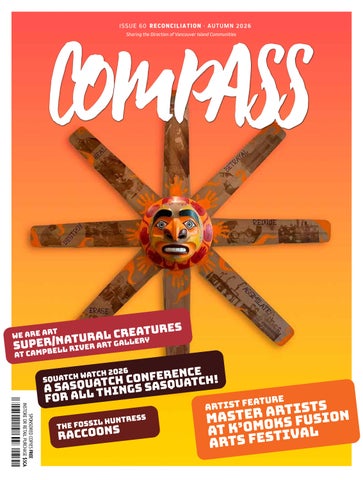
ISSUE 60 RECONCILIATION ∙ AUTUMN 2026 Sharing the Direction of Vancouver Island Communities
SPONSORED COPIES FREE INSTORE OR RETAIL PURCHASE $5CAD
AU T U M N 2 026 ·
1
Winter, Rerouted.
Non-stop to Puerto Vallarta returns to YQQ, starting October 25.
SEE MORE AT:
comoxairport.com/PVR 2 · C O M PA SS M AG A Z I N E I SS U E 6 0
M AGAZ INE
6
6
We Are Art Two Super/Natural Exhibits
8
A Place to Stay in Campbell River Just Like Home Lodge Opens
10 8
14
Campbell River Art Gallery
Strathcona Regional District
The Fossil Huntress Raccoons: Adorable Tiny Hands and Questionable Intentions The Fossil Huntress
12
Island Chronicles Proposing a New UNESCO Global Geopark David Durrant
14
Artist Feature Master Artists Come Together for K'omoks Arts Fusion Festival Kealy Donaldson
30
30
Stay Well The Most Important Relationship Dana Mahon
TRUTH & RECONCILIATION DAY is September 30th Kiki's Communications and Compass Divisions recognizes and honours Residential School survivors and the children that did not make it home. Every Child Matters is a critical point for Indigenous relations in Canada and beyond. Every Child Matters symbolizes the loss of culture, freedom, and self-esteem that many Indigenous children experienced and we, as Canadians, take accountability for the historic impacts and tolls that Residential Schools took on Indigenous communities, families and individuals. Hiy Hiy ~ we honour you ~ hands up!
AU T U M N 2 026 ·
3
ISSUE 60 AUTUMN 2026
Reconciliation: The restoration of friendly relations Restoring friendly relations with family, friends, community members is not always an easy task. Reconciliation in Canada has elevated into an important National Day of Honouring the Past Truths of Residential School Survivors. In any situation where someone has to apologize and take ownership, the first step is always the hardest. Saying 'sorry' doesn't always hit the mark and more dialogue and understanding needs to be bridged between the parties to reach a new beginning, to start again with better intentions between both. Inter-generational trauma sits at the stem of Reconciliation but it doesn't mean that everyone is dysfunctional. It also needs understanding that those who have been affected carry a heavy burden and their family around them likely feel and carry some of the outlook on that burden. I recently was talking with local Elders and not to dissipate 'reconciliation' they noted an appreciation for Canadians recognizing the past but were ready to move through it, move forward, and not continually revisit or live in the past. They are healing. It is not a perfect world out there; we can only strive to make it better within our own reaches! Some are better at this than others; I say this without judgment. Some reflection is still required and September 30th is a dedication to that reflection. You can honour the day by wearing an orange t-shirt, participate in a local event or simply sit and take a moment to be more self-aware of our Canadian heritage and the roots of this great country of ours. Gilakas’la, Emote, Marsii, Hiy Hiy ~ KEALY DONALDSON Publisher Compass Magazine
PUBLISHER Kealy Donaldson DESIGN + LAYOUT Jessie Stones COVER Reconciling Light Winadzi James To Advertise or Subscribe Kealy: 250.203.1880 In-store purchase: $5 Back Issues: $10 Annual Subscription: $50/4 issues
CONTRIBUTORS Campbell River Art Gallery Kealy Donaldson David Durrant Cameron Ezzy Fossil Huntress Blog © Dana Mahon Museum at Cambell River Erin Neely Jen Olsen Strathcona Regional District Linda Trevor
4 · C O M PA SS M AG A Z I N E I SS U E 6 0
THE COMPASS MAGAZINE
is produced on Vancouver Island, printed on the West Coast of British Columbia, and published on Vancouver Island paper by: Kiki’s Communications Inc. ISSN# 2369-8063 107 1250 Knight Road Comox, BC V9M 4H2 250.203.1880 www.compassmagazine.ca compassmagazine@ourmail.com
Entire Magazine contents are copyright. All Rights Reserved.
We acknowledge the financial support of the Government of Canada.
We’re building an economy as vibrant as our landscape. Your business deserves a seat at the table. Join the voice of business & shape the future of our region. Visit comoxvalleychamber.com
AU T U M N 2 026 ·
5
Artists and Curators at the Exhibit Opening © Campbell River Art Gallery
We Are Art T WO N E W E X H I B I T I O N S AT C A M P B E L L R I V E R A RT G A L L E RY Artists: James Kwaksistala (Kwakwaka'wakw), Charles Jules (Nuu-chah-nulth), Alexander J. Mark (Nuu-chah-nulth), Thomas Whiteley (Inuit, Kuujjuaq). Curated by Nadine Bariteau
Super/Natural Creatures features
first time, with the addition of new
the work of James Kwaksistala,
works and artists, expanding on the
Charles Jules, and Alexander J.
original presentation.
Mark who are based in Campbell
Running concurrently in the Satel-
River, alongside special guest artist
lite Gallery, Becoming Super/Natural
Thomas Whiteley. This exhibition
showcases artworks made by the
brings together rich storytelling
participants of the 2026 carving
traditions, ancestral designs, and
and printmaking workshops led
contemporary printmaking and
by James Kwaksistala, carver, and
is the culmination of a three-year journey rooted in relationship building, mentorship, and deep
James Kwaksistala © Campbell River Art Gallery
mutual respect.
Nadine Bariteau, printmaker. For some participants, this was their first opportunity to carve, for others an occasion to reconnect with their tra-
Celebrating the collaborative spirit of the Hamdzatsi Collec-
ditions. These prints honour transformation, resilience, and the
tive, Super/Natural Creatures marks a major milestone. After
importance of nurturing spaces where creativity can flourish.
touring to Trois-Rivières and Toronto, the CRAG is thrilled to present the Collective in their home gallery for the very
6 · C O M PA SS M AG A Z I N E I SS U E 6 0
Super/Natural Creatures and Becoming Super/Natural at the CRAG on Tuesday - Saturday, 10am - 4pm until October 31, 2026.
AU T U M N 2 026 ·
7
A Place to Stay, Steps from Care J U S T L I K E H O M E LO D G E A N D H E A LT H P R O F E S S I O N A L S H O U S I N G O P E N S Strathcona Regional District
When people from small coastal communities need medical treat-
arranged, and the Strathcona Regional District, which owns
ment in Campbell River, the trip often means a long ferry
and operates both programs, built the facility with that link in
ride, hours on the highway, and the cost of a hotel on top of
mind.
everything else. Some travel from remote villages where the journey takes most of a day. A new building on the Campbell River Hospital campus is designed to ease that burden, and it opened with a ribbon cutting ceremony on August 25.
"If we want people to access care, and if we want health professionals to choose this region, we have to remove the barriers that stand in their way," said SRD Vice-Chair Susan Sinnott at the ceremony. She described the lodge as a source
The facility at 541 2nd Avenue holds two programs under one
of comfort and dignity for people away from home, and the
roof. On the first floor, the ten-unit Just Like Home Lodge
housing as a place for care providers to land, build connec-
will host patients and caregivers travelling to Campbell River
tions, and consider staying for good.
for care, including guests from First Nations, Métis and Inuit communities across Mid and North Vancouver Island and the surrounding coast. On the second floor, Health Professionals Housing offers twenty self-contained suites for healthcare workers who are working in the region, training there, relocating, or exploring a possible move. The suites are available for both short and longer stays, which gives new arrivals somewhere to live while they find their footing and decide whether the region suits them. The two programs answer connected problems. Patients need a place to stay when care takes them away from home, and hospitals need staff to provide that care. Recruiting healthcare workers to a smaller centre is easier when housing is already 8 · C O M PA SS M AG A Z I N E I SS U E 6 0
The project drew wide support. The Campbell River Hospital Foundation and its donors raised more than $2 million toward construction of the lodge. Seymour Pacific Homes built the facility and worked with the district to keep costs down, and Island Health made the hospital campus available as the site. That location shapes how both programs work. Patients and caregivers can walk to appointments, and healthcare workers live beside their workplace. The reach of the project extends well past the city limits. Campbell River Hospital serves 32 communities across Mid and North Vancouver Island and the surrounding coastal areas, so every guest room and staff suite supports a network of towns and villages that depend on the hospital for care.
“The SRD is committed to building stronger, more sustainable
Health Professionals Housing began welcoming residents on
healthcare across our region,” said Sinnott. “This facility shows
September 1, 2026, and Just Like Home Lodge opens their
what is possible when regional government, healthcare part-
doors on September 15, 2026.
ners, donors, community organizations and the private sector come together with a shared purpose and a clear commitment to the people and communities we serve.”
Details on eligibility and how to request a stay are available at justlikehomecr.ca for the lodge and srd.ca/hph for the housing program.
SRD Board Director Attendees (L to R): Robyn Mawhinney – Electoral Area C, Mark Vonesch – Electoral Area B, Martin Davis – Tahsis, Mark Baker – Sayward (Chair), Susan Sinnott – City of Campbell River (Vice-Chair), Ben Lanyon – City of Campbell River, Kermit Dahl – City of Campbell River and Doug Chapman – City of Campbell River.
AU T U M N 2 026 ·
9
Procyon lotor © Riverwalker
The Fossil Huntress RACCOONS: ADORABLE TINY HANDS AND QUESTIONABLE INTENTIONS The Fossil Huntress There are few creatures quite as charming—or as suspiciously
perish in large numbers somewhere convenient for future
competent—as the raccoon.
palaeontologists.
With its black mask, ringed tail and remarkably nimble front
The wider raccoon family appears in the North American fossil
paws, the northern raccoon, Procyon lotor, looks rather like a
record during the Early Miocene, more than 16 million years ago.
small bear dressed for a burglary. This is misleading.
By the Late Miocene, recognizably raccoon-like procyonids
Raccoons are not bears, although they belong to the same
were padding through North American forests. Fossils assigned
broad branch of the carnivore family tree. Their closest living
to the genus Procyon—the group containing living raccoons—
relations are other members of the family Procyonidae, includ-
are known from the Late Miocene and Pliocene.
ing coatis, ringtails, cacomistles, olingos and kinkajous. Together, they form an impressive clan of climbers, fruit thieves, insect hunters and nocturnal specialists, most of which live in the Americas. The fossil story of raccoons is surprisingly patchy. Small, forest-dwelling omnivores do not always leave us a generous fossil record.
A newly described species, Procyon garberi, lived in Florida during the Late Miocene, showing that true raccoons were already experimenting with their familiar body plan millions of years before anyone invented the locking garbage bin. By the Pleistocene, raccoons were widespread across North America. Several fossil raccoons once given separate species names, including Procyon priscus, Procyon simus and the
Their bodies are easily scattered, their habitats are not always
delightfully compact Procyon nanus, were later interpreted as
ideal for fossilization, and they rarely have the decency to
variations of the living northern raccoon, Procyon lotor.
10 · C O M PA SS M AG A Z I N E I SS U E 6 0
If that interpretation is correct, modern raccoons were sharing
believed had already been solved by purchasing a more
the continent with mammoths, mastodons, giant ground
expensive garbage bin.
sloths, sabre-toothed cats and dire wolves. Those giants disappeared. The raccoon remained. This probably had much to do with flexibility. Raccoons are
I had a midnight explorer who used to come for a visit and search about the place when I lived near a park. I would see signs of mischief but never the burgular.
spectacularly unfussy omnivores. Depending upon where
Now, I have a family living in the tree next door. Mamma
they live and what is in season, they may eat berries, grapes,
takes her kits out early in the morning to forage.
apples, nuts, acorns, corn, insects, worms, crayfish, frogs, fish, eggs, small animals and carrion.
Their hind feet can rotate substantially, allowing them to climb down trees headfirst. This is an excellent adaptation
They generally consume more invertebrates than verte-
for life in the forest and a deeply unsettling skill to witness at
brates, but the governing principle appears to be: “Is this
two o’clock in the morning.
edible, and can I get my little hands on it?”
Baby raccoons are called kits. They are born with faint masks
In towns and cities, the menu may expand to include garden
and tail rings already visible, although their eyes remain
produce, pet food, compost and whatever treasures have
closed for the first few weeks. A mother usually raises her
been placed inside a container clearly labelled “raccoon
kits alone, teaching them where to den, what to eat and, pre-
enrichment puzzle.” In my garden, they leave the tomato
sumably, how to stand perfectly still on a fence while making
plants alone but eat most everything else.
prolonged eye contact with the homeowner.
Their native range stretches from southern Canada through
Raccoons are primarily nocturnal, but I have been seeing
most of the United States and Mexico into Central America.
them more and more in the day. A nursing mother, a hungry
They inhabit deciduous and mixed forests, wetlands, river
youngster or an animal disturbed from its den may forage
valleys, coastal areas, farmland, suburbs and cities.
in daylight. As with all wildlife, however, raccoons should be
Woodlands near water are particularly good raccoon country because they provide food, climbing trees and hollows for dens. Raccoons have also been introduced to parts of Europe and Asia, including Germany and Japan, where some populations
admired from a respectful distance. They can defend themselves vigorously and may carry rabies in some regions. There is something deeply impressive about an animal that survived the climatic upheavals of the Ice Age and then adapted to highways, suburbs, streetlights and wheelie bins.
have become invasive. Their great adaptability, while admi-
The mammoths vanished. The sabre-toothed cats vanished.
rable from a raccoon’s point of view, can create serious prob-
The giant ground sloths vanished.
lems for native wildlife. Raccoons raid bird and turtle nests, compete for den sites and may carry diseases and parasites. Cute does not mean ecologically harmless. Nature is under no obligation to keep those two categories separate.
The raccoon looked at the changing world, flexed its tiny fingers and said, “Interesting. Does this lid come off?” fossilhuntress.blogspot.com
The raccoon’s scientific name, Procyon lotor, roughly means “washing procyon.” This refers to the famous habit of dipping and manipulating food in water. Raccoons are not necessarily washing dinner because they have suddenly become concerned about hygiene. Their front paws contain an extraordinary concentration of sensory receptors, allowing them to examine objects through touch. Moisture may enhance the sensitivity of the skin, helping them feel and manipulate their food.
DON'T WANT TO MISS EVEN ONE ISSUE?
3
KEEP SUPPORTING OUR EFFORTS TO CREATE & SHARE DIALOGUE ON VANCOUVER ISLAND & POWELL RIVER!
In other words, they are not politely washing supper. They
DON'T WANT TO MISS Each front paw has five long digits. Raccoons do not have EVEN ONE ISSUE? opposable thumbs, but they can grasp, pry, turn and open are inspecting it with wet fingers.
objectsKEEP withSUPPORTING astonishing skill. They can manipulate latches, OUR EFFORTS TO CREATE & SHARE ON VANCOUVER ISLAND & POWELL RIVER! lift lidsDIALOGUE and occasionally solve problems that humans
NOW YOU CAN SUBSCRIBE TO THE NEXT 4 ISSUES plus gst || $52.50 $36.75 Annually $50$35 plus GST annually 3 MAGAZINES MAILED DIRECTLY TO YOU QUARTERLY One for the house, the business and for sharing! COMPASSMAGAZINE.CA | COMPASSMAGAZINE@OURMAIL.COM WE TAKE: VISA | MASTERCARD | MONEY ORDER | E-TRANSFER
AU T U M N 2 0 26 ·
11
C
© BooFace Photography
Island Chronicles
Vancouver Island and its coastal communities are uniquely positioned for such a vision. Its mountains, forests, rivers, caves, coastlines and oceans tell an extraordinary geological story. But that story cannot be separated from the Indigenous knowledge, cultures, languages and stewardship that have shaped these territories for generations.
VA N C O U V E R I S L A N D A N D C OA S TA L COMMUNITIES: A UNESCO GLOBAL G EO PA R K W H E R E E A R T H , P EO P L E A N D R EC O N C I L I AT I O N M E E T
This is where the idea becomes much larger than geology. An
David Durrant
working in isolation, cannot move the dial at the scale reconcil-
Imagine standing on a Vancouver Island shoreline, looking across the Pacific, with mountains rising behind you. Beneath your feet is a geological story millions of years in the making, shaped by
Indigenous-led Vancouver Island and Coastal Communities Global Geopark could make reconciliation tangible. One geopark here, another there, with individual communities iation requires. What is needed is a collective vision - one that connects communities, knowledge, stewardship and opportunity across the Island and coastal regions.
tectonic forces, volcanism, glaciers, erosion and earthquakes.
Supported by the Association of Vancouver Island and Coastal
But there is another story here - older than Canada itself: the
ments, regional districts, First Nations and trust areas - such an
story of the Indigenous People who have lived with, travelled across, named, understood and cared for these lands and waters for thousands of years. What if Vancouver Island could bring these stories together and share them with the world? That is the promise of a UNESCO Global Geopark. UNESCO - the United Nations Educational, Scientific and Cultural Organization - recognizes landscapes where geological, natural and cultural heritage converge with education, conservation and sustainable development. A geopark is not simply a designation. It is a commitment to understanding and protecting a place while supporting the communities connected to it.
12 · C O M PA SS M AG A Z I N E I SS U E 6 0
Communities (AVICC) - representing more than 50 local governinitiative could create a powerful regional platform for collaboration. This would not be about one community claiming the vision. It would be about communities working together, with Indigenous Nations at the centre, and with UNESCO as a global partner, to create something greater than any one jurisdiction could achieve alone. Reconciliation requires more than isolated efforts. It requires scale, partnership and a shared commitment to move forward together. Imagine Indigenous knowledge holders and scientists teaching together. Indigenous place names alongside geological stories.
Indigenous youth becoming guides, researchers, conservationists and entrepreneurs in their own territories. Visitors coming not simply to see Vancouver Island, but to understand it.
Get Ready for the Ultimate Adventure.
The process, however, must begin with Indigenous Nations. They should not be invited into a finished concept. They should help create it. They should help determine what knowledge is shared, what remains protected, how their languages and histories are represented, and what governance and economic opportunities serve their communities. Canada already has a powerful example from which much can be learned. The Tumbler Ridge UNESCO Global Geopark in northeastern British Columbia demonstrates how geological heritage can become a catalyst for education, conservation, tourism, community identity and economic diversification. More importantly, Tumbler Ridge demonstrates that a geopark can be a living platform for bringing people together. Throughout the year, it hosts Indigenous-led initiatives and workshops that connect Indigenous knowledge, education, community engagement and stewardship, with support from the community and partners such as Meikle Wind.
2026 Grizzly EPS XT-R
Tumbler Ridge is not simply a model to follow - it is proof of what becomes possible when a community comes together around the land, its stories and its future. The lesson for Vancouver Island is clear: a geopark can be far more than a geological designation. It can become a platform for Indigenous knowledge, education, stewardship, community development and reconciliation. Other UNESCO Global Geoparks around the world reinforce the same lesson: when geological heritage is connected with the people and cultures of a place, it can become a powerful catalyst for cultural recognition, sustainable development and a deeper relationship with the land. Vancouver Island and coastal communities could take this idea further. This should not be about mass tourism. It should be
Campbell River Boatland is your one-stop shop for top-notch marine, powersports and lawn and garden products and services in Campbell River. Our friendly, knowledgeable staff are dedicated to helping you find the perfect watercraft, powersports vehicle, or power equipment tailored to your lifestyle.
about meaningful tourism, education, research, conservation, Indigenous economic opportunity and a deeper relationship between people and place. Protect the land. Respect the knowledge. Share the opportunity. Build reconciliation. Vancouver Island is not simply a collection of mountains, forests, rivers and coastline. It is a living story - written in stone, carried by salmon, spoken in Indigenous languages and held in generations of knowledge. Let Vancouver Island and its coastal communities show the world what reconciliation looks like when we build it together. AU T U M N 2 0 26 ·
13
Feature Artists
14 · C O M PA SS M AG A Z I N E I SS U E 6 0
it's festival time:
Master Artists Come Together for k'omoks fusion arts festival. September 25-27, 2026 Kealy Donaldson Four incredible local Master Artists join Queneesh Indigenous Community Society to come together for K’omoks Fusion Indigenous Arts Festival, September 25-26-27 at Filberg Park, Comox! Each of these Artists have graced the cover the Artist Feature of Compass Magazine over the past years and the Festival will be hosting Master Artist Workshops with each of these acclaimed specialists! Here are excerpts from the original articles along with the Master Artists’ workshop details! More festival information and workshop registration can be found at www.queneeshsociety.ca Join Queneesh Society and these very talented Artists for the
Issue 26 | Winadzi James Winadzi is from the Kwakwaka’wakw nation, from the Kwicksuteniuk clan from Gilford Island on his mother’s side and from the Gwa'sala 'Nakwaxda'xw from Blunden Harbour on his father’s side. He spent his childhood growing up in Campbell River. At the age of 15 he decided to start carving and trained under his father, Simon James Sr. —a renowned artist in his own style. After leaving Campbell River, Winadzi attended The Vancouver Film School, where he finished both 2D classical and 3D computer animation and created a short student film called “Dawn of Creation,” which was the inspiration for Raven Tales “How Raven Stole the Sun.” Now living on Bowen Island with his wife Naomi James and family, Winadzi has completed 26 episode of ‘Raven Tales’ and since 2004 he has become the proud owner of Raven Tales Production Corp. He has collaborated on public art projects with artists on Bowen Island including a sculpture called “Embracing the Spirit of the Flame.” This project started on the day that the Olympic Flame came to Bowen Island on its way to the Opening Ceremonies for the 2010 Vancouver Winter Olympics.
Corrine Hunt
Join Corrine Hunt, Kwakkwaka'wakw / Tlingt Artist, in an introduction to First Nation Form Line and Design Artist Talk + Workshop. Hunt is know for her incredible design work, including the 2010 Winter Games Medals and the redesign of the BC Lions logo. Please bring your Eventbrite Receipt to gain access to the workshop. Workshop times: Saturday September 26th at 1pm and Sunday September 27 at 1 pm. Cost: $25 + fees /taxes Issue 32 | Corrine Hunt
K’omoks Fusion Indigenous Arts Festival! Gate admission is
It’s no secret; the Hunt name is synonymous with the Indig-
by donation and there is a full lineup of activities for all ages,
enous Art World. I remember growing up in the 1970s and
live music, salmon bbq and traditional foods, vendor market,
‘80s knowing that the Hunts from northern Vancouver Island
wellness circle, cultural and youth zones, ALL in an inclusive
were some of the best First Nation Artists in the world. Here is
environment. For more festival information, head to www.qu-
another great artist from the long line of Hunts: Corrine Hunt,
eneeshsociety.ca and to read the entire articles from Compass
Contemporary First Nations Artist. While growing up in Alert
Magazine and the Artist Features, www.compassmagazine.ca
Bay, she was taught that culture stems from family; everything
See you at K’omoks Festival!
Winadzi James Come explore the Art of Traditional Storytelling with Winadzi
she knows she learned from her childhood. “Being in Alert Bay and surrounded by family, as children, we absorbed so much about our culture without really knowing what we were being taught," she says. "Potlatch played such an important role in our lives and still does. It’s in my blood.”
James, the legendary Master Artist behind the famous Raven
Hunt’s Great Great paternal Grandmother A’neesla’ga’ was a no-
Tales books and videos. James is known for his multi-medium
ble woman from the Tlingit Clan in Alaska. She married Robert
disciplinaries but comes prepared to lend his knowledge to
Hunt and they settled in Fort Rupert. While A’neesla’ga’ passed
storytelling and reaching different demographics. Come just to
away in 1919, this Hunt still wears A’neesla’ga’s Tlingit robes in
listen or prepare yourself to learn some of the tricks in storytell-
ceremony today. Because her Great Great Grandma was such a
ing engagement. Workshop times: Friday September 25, 4pm
powerful woman, her songs and dances have been passed down
and Saturday September 26, 4pm. Cost: $25 + taxes/fees
and they are still danced today.
AU T U M N 2 0 26 ·
15
luke marston
16 · C O M PA SS M AG A Z I N E I SS U E 6 0
AU T U M N 2 0 26 ·
17
Hunt designed the 2010 Winter Games Medals for VANOC. At the time, her first Noguchi table was exhibited at a gallery in Yaletown. The exhibit and the table caught the attention of a VANOC staff and they loved it. She was sought after to submit an RFP for the Olympic medals and she was awarded the honour. “The entire experience at VANOC was amazing” shares Hunt. She is still producing cultural museum exhibits; last year she was in New York and has been asked worldwide to share her talents including her hometown Alert Bay for the U’mista Cultural Centre. Hunt feels very blessed to able to do what she does!
Leonard TIGER Williams Join Master Artisan Leonard Tiger Williams in a beautiful offering of traditional Cedar Weaving! Expect to spend a full hour + getting your bracelet underway and help to finish it over the weekend on the festival site. Workshops will take place next to the Master Artists Circle. Workshop Times: Friday Sept 25 at 2pm, Saturday Sept 26 at 11am, Sunday Sept 27 at 11am. Cost: $30 + fees/taxes Issue 51 | Leonard Williams Leonard ‘TIGER’ Williams, a member of the Quatsino First Nation, is an accomplished, self-taught Cedar Bark artist of 25 years. He
Bruce Alfred
was born in Alert Bay in 1960 and is of the Quatsino and Tlowitsi
The incredibly talented Master Traditional Artist Bruce Alfred
studying the natural world. His parents were survivors from St.
heads the lineup of talent and will be demonstrating building Bentwood Boxes and discussing the history behind Bentwood Boxes and the cultural meaning. Demonstration times: Friday September 25 at 3pm, Sunday September 27 at 12pm. Cost: $25 + fees/taxes Issue 50 | Bruce Alfred Bruce Alfred does not see himself as an artist with a reputation, yet he has been chosen to participate in some very unique ventures and to contribute to fascinating projects. Perhaps, he has mused, his reputation as an imminent carver in wood is not in his home village of Alert Bay, BC but is outside of it. Bruce is a member of the ‘Namgis First Nations whose work today is known both in Canada and internationally. He received an award from the BC Achievement Foundation in 2008 for artistic excellence. Certainly, his meticulous workmanship is recognizable and that, combined with outstanding designs and vibrant colour makes his work highly sought after. His specialty
ancestry. Williams was raised by both his grandmother and great grandmother, who encouraged him to pursue his interests for Michael’s Residential School in Alert Bay; in separate incidents both of Williams’ parents drowned. Williams hasn’t had the chance to visit Turnour Island but he notes there are some residential houses still standing on the island. “My family lived close to the centre of the village in the 9th house; I hope I can return one day while the buildings still stand,” he says. Throughout the years, he has watched addiction take over his family members. He is now the oldest member of his family. Williams battled his own issues with alcohol and was able to overcome it, with his health as his priority. He will be ten years sober as of this August and it has brought many things to light including his dedication to the art of weaving. With a background in Culturally Modified Trees and Traditional Use Studies, Williams' opportunity to learn about the ecological growing conditions of various cedar species would eventually evolve into a harmonious relationship from start to finish of every piece of work he does.
is bentwood boxes, rattles, totem poles and traditional masks.
Williams shares how his rich cultural knowledge started. “An
Bruce said that from the time he was very young, he always
wanted to work. I thought ‘why not’ and asked when would we
wanted to be a carver. He was raised by his grandmother Axu from the age of three. His grandmother did not speak English, and Bruce heard the Kwak’wala language being spoken from a young age. Bruce’s own growing reputation garnered opportunities to visit other countries and participate in international projects, and
Archeologist knocked on my door in 1994 and asked me if I be starting. The Archeologist responded ‘in an hour’. Williams laughs a bit, and notes it must have been meant to be. Williams has visited and documented thousands of First Nations historic sites through this work and attributes his cultural knowledge to this opportunity. His artistry with cedar bark weaving is a result of the many different perspectives from which he studies his
he has been to England, New York, Australia and Mexico. In
subject.
2010, he travelled to Manchester, England with Doug Cranmer’s
His work is informed by his study of Quatsino ethnographic ob-
two nephews Kevin and Edgar to assess the repair of a totem pole originally created by Doug in 1967 in honour of Canada’s Centennial year, then visited again a few years later with Bill Cranmer, a ‘Namgis chief. This project lead to a new commission in Blackpool this year, where Bruce created a stunning light screen showcasing First Nations’ designs. 18 · C O M PA SS M AG A Z I N E I SS U E 6 0
jects held in museums around the world. In learning their forms, styles and weaving patterns, he repatriates lost knowledge for return to his people. From gathering and harvesting his cedar, visualization and implementing skill and technique, every piece clearly has a song deep in traditional values and process.
FESTIVAL TIMETABLE
HANDS-ON LOCAL CREATIVE FUN.
Three days of music, makers, wellness + wild salmon at Filberg Park Filberg Park · 61 Filberg Road, Comox BC · K'omoks Traditional Territory · Gate admission by donation Masters Circle workshops: pre-register on Eventbrite or pay on site (limited availability). Master Artists host art displays in their own tents plus workshops in the Workshop Area.
SEPTEMBER 25-26-27 2026 K'OMOKS FUSION ARTS FESTIVAL WWW.QUENEESHSOCIETY.CA
01. FRIDAY SEPT 25 Gates 12–6 · Market 12–6 · BBQ 12–(,30 TIME
MUS IC S TAGE First Credit Union
MAS TERS CIRCLE Compass Magazine V.I.
12 NOON
12.30 Welcoming + Opening Prayer
Master Artists' displays open
1 PM
Cultural Performance
Local Edibles w Dianne MacLean
2 PM
Greg Wells — acoustic set
Cedar Bracelets w Leonard Williams, $30
3 PM Cultural Performance
5 PM
Tara Williamson + guest
6 PM
GATE CLOS ES · S ECURITY ON S ITE
YOUTH ZONE
Art + Play Zone & Face Painting ALL DAY Brushing / Smudging session
Bentwood Boxes + History w Bruce Alfred, $"$
4 PM
WELLNES S CIRCLE
Raven Tales Storytelling w Winad#i Drum Circle — bring your drum or shaker!
Art of Storytelling w Winad#i James, $"$
Make N Take Art w Lyndsay Dumont Storytelling w Métis Elder Flora Smigel
02. SATURDAY SEPT 26 Gates 10–6 · Market 10–6 · BBQ 11–(,30 TIME
10 AM 11 AM
MUS IC S TAGE First Credit Union
MAS TERS CIRCLE Compass Magazine V.I.
WELLNES S CIRCLE
YOUTH ZONE
10.15 Welcoming + Opening Prayer
Master Artists' displays open
10.45 Rise + Shine Stretch w Alisha
Art + Play Zone & Face Painting ALL DAY
Cultural Performance
Cedar Bracelets w Leonard Williams, $30
Local Edibles w Dianne MacLean
Raven Tales Storytelling w Winad#i
12.30 Sacred Circle w Bruce Dumont in tipi
Make N Take Art w Lyndsay Dumont
12 NOON 1 PM
DJ Hanson — acoustic
2 PM
Cultural Performance
3 PM
Traditional Formline + Design w Corrine Hunt, $"$ 2.15 Tea Party in Workshop Tent w June Johnson 3.15 Art of Storytelling w Winad#i James, $"$
4 PM
James Vickers Band (Blues/RnB)
6 PM
GATE CLOS ES · S ECURITY ON S ITE
Storytelling w Frank Assu — Wewaikai
3.30 Sound + Ground w Cam
Make N Take Art w Lyndsay Dumont Storytelling w Flora Smigel — Métis Elder
03. SUNDAY SEPT 27 Gates 10–3 · Market 10–3 · BBQ 11–2,30 TIME
MUS IC S TAGE First Credit Union
MAS TERS CIRCLE Compass Magazine V.I.
WELLNES S CIRCLE
YOUTH ZONE
10 AM
10.15 Welcoming + Opening Prayer
Master Artists' displays open
10.45 Rise + Shine Stretch w Alisha
Art + Play Zone & Face Painting ALL DAY
11 AM
Cultural Performance
Cedar Bracelets w Leonard Williams, $30
12 NOON
Bentwood Boxes + History w Bruce Alfred, $"$
1 PM
Greg Wells — acoustic
2 PM
Cultural Performance
3 PM
2.45 CLOS ING CEREMONY · GATE CLOS ES — END OF FES TIV AL
12.30 Sacred Circle w Bruce Dumont in tipi
Traditional Formline + Design w Corrine Hunt, $"$
VENDOR MARKET Orange sign = Indigenous Vendor · Red sign = Friend of Queneesh (QICS) Vendor
MADE INDIGENOUS MADE BY TRADITION
Raven Tales Storytelling w Winad#i
GATE ADMISSION BY DONATION · WWW.QUENEESHSOCIETY.CA
Make N Take Art w Lyndsay Dumont Raven Tales Storytelling w Winad#i
Tea Party in Workshop Tent w June Johnson
Make N Take Art w Lyndsay Dumont
SALMON BBQ+ $16 Wild Plate: sockeye + salad · $20 incl bannock $64bannock4only · $4 beverages · Fin + Feather Hot Dog Cart daily
FRI SEPT 25 12–6 SAT SEPT 26 10–6 SUN SEPT 27 10–3
SCHEDULING AND TIMES MAY BE MODIFIED SLIGHTLY; AU T U M N 2 0UPDATES! 26 · 19 CHECK WWW.QUENEESHSOCIETY.CA FOR
Bruce Dumont
June Johnson
K'omoks Fusion Arts Fest J O H N S O N, M AC L E A N, D U M O N T + E Z Z Y FAC I L I TAT I N G W E L L N E SS T E AC H I N G S AT U P C O M I N G K'O M O K S F U S I O N A RT S F E S T I VA L! Kealy Donaldson With Fall harvesting and gathering beginning on the West Coast, Queneesh Indigenous Community Society is offering Indigenous Food Security Workshops at the K'omoks Fusion Arts Festival, September 25-26-27 at Filberg Park. Queneesh is honoured to host June 'Umagalis Johnson and Dianne 'La Bouche' Maclean, both incredible knowledge holders and well-known facilitators in this regard. Also being offered at K'omoks Festival is the 'Wellness Circle'; special guest facilitators include Bruce Dumont, past President of MNBC, Metis Elder and Knowledge Keeper and Compass Magazine's wellness contributor Cameron Ezzy. A drumming circle and smudging / brushing offering will also be on site. Bringing your own drum and join in the fun. These workshops and offerings are complimentary at the festival and pre-registration is recommended for the Food Security Workshops. QICS raises their hands to ISPARC for their generous funding support of the workshops. The 'Wellness Circle' schedule will be posted at www.queneeshsociety. ca and Food Security Workshop registration link can be 20 · C O M PA SS M AG A Z I N E I SS U E 6 0
found there with link to Eventbrite.ca. General admission to the festival is BY DONATION and the upper Filberg Park is an inclusive zone, where ALL are welcomed to attend; unfortunately dogs are not permitted in the park.
JUNE JOHNSON | Workshop: Elders Tea Party Saturday + Sunday 2.15pm, Masters' Circle Workshop Tent June’s traditional name ‘Umagalis', she is the daughter of Charles Peters and Elizabeth ‘Dick' Peters from the Wewaikai Nation. She has learned the Culture and Medicinal plants from her parents. She is an Elder in the Community,the mother of two and grandmother of six. June completed her Development Standard Term Certificate in language revitalization at UVic12009. She has taught at School District 72, today she is Elder in Residence in North Island College plus teaches the Kwakwala/Likwala language. She believes that teaching and learning fosters sense of pride and belonging. She is Coordinator for the Elders and Youth Culture Group whereas she teaches cultural protocol of the Bighouse and
traditional dances plus regalia making. Her heart has been teaching about our traditional plants and medicines. Her mother used a lot of the medicines on my older sister and I because where we lived didnt have a car ferry to take us to the doctor if you had a bad cut or sore throat. Recently she took a group of Doctors in our community on a plant walk to introduce them to our medicinal plants. She believes if pharmaceuticals don’t work try the traditional. Today she does group plant walks for schools and workshops to introduce the participants to the different teas and salves.
Cam Ezzy
DIANNE 'LA BOUCHE' MACLEAN Workshop: Local Edibles + Medicinals Friday 1pm + Saturday 12pm, Masters' Circle Workshop Tent Dianne Maclean is a Metis Elder and Cross- Cultural Educator. Maclean's Native Ancestry is from the Red River region in Manitoba. She had a diverse background including being Storyteller, a Former RN in Private Practise, Wildcrafter, Community Activist and Cross-Cultural Environmental Educator. Maclean highly honours all her Ancestors, both Native and European. Her Metis name is La Bouche and she was given the responsibility to Talk for those who aren’t being Heard. She offers a very unique understanding of the deep connection to Comox Valley and Vancouver Island edible and medicinal flora and fauna. Spending her youth in Prince Rupert and Haida Gwaii, where her father was a Halibut Fisherman, a trapper and a diver. Mclean spent much of her early life in the wilderness where she learned hunting, trapping and fishing skills as well as a basic knowledge of Traditional Foods and Medicines. Traditional Foods and Medicines have become an incredibly important focus in her journey.
BRUCE DUMONT | Workshop: The Sacred Circle Saturday + Sunday 12pm, Wellness Circle, Upper Meadow
supporting First Nations, Inuit, and Métis in recovery. Bruce is a proud Mosom (grandfather) and “Papa Bruce” to twelve grandchildren and is passionate about sharing his family’s stories and history. He believes Métis youth are the future of their communities and strives to support youth to carry on Métis traditions and culture.
CAMERON EZZY | Workshop: Sound + Ground: Holistic Healing through Vibrational therapy and Barefoot Grounding Saturday 3pm, Wellness Circle in the Upper Meadow “What you think and feel about yourself creates a belief system about yourself. This belief system governs the choices you make and leads to the perspective of reality you create". Open to those curious to experience a holistic approach to grounding and for those who already know. Ezzy's practice focuses on forest bathing, yoga, vibrational therapy, art therapy, breathe connection and connection back to self. Ezzy is originally from Australia and is currently residing on Hornby Island. He is facilitating/assisting at Halo Ridge Recovery at Forbidden Plateau.
Bruce Dumont is the former President of the Métis Nation British Columbia (MNBC) and former Board of Governor at the Métis National Council. He received his education at the Northern Alberta Institute of Technology and Southern Alberta Institute of Technology, completing a Red Seal designation as an Electronic Technician. He also has experience working in the British Columbia forestry industry and is a Certified Safety Professional, with experience working with the British Columbia Workers’ Compensation Board as an Occupational Safety Officer. His grassroots start was in Campbell River, where he and others formed North Island Metis Association, which has sprouted many other regional organizations throughout the Island region.
Queneesh Indigenous Community Society looks forward to hosting the 4th Annual K’omoks Festival, now known as K’omoks Fusion Arts Fest. QICS invites you to the historic Filberg Lodge and Park property on September 25-26-27 this fall! The event will run rain or shine and is outdoors.
Bruce is now semi-retired but continues to support community as an Elder with the Cowichan Valley Métis Nation and the Indigenous Lead for Cedars Recovery at Cobble Hill,
K’omoks Fusion Arts Fest | admission by donation FB @QueneeshSociety | queneeshsociety@gmail.com www.queneeshsociety.ca
FOR THE FULL FUSION ARTS FEST LINE UP, HEAD TO www.queneeshsociety.ca
AU T U M N 2 0 26 ·
21
Squatch Watch 2026 A S A S Q UAT C H C O N F E R E N C E FO R A L L T H I N G S S A S Q UAT C H! Kealy Donaldson
Come and listen to some of the most credited specialists talk about all things Sasquatch!
Tom Sewid Sasquatch Island
Why are we putting this event on? There are so many stories and
"North American Indians and
limited information on this Elusive creature! I have had an
Canadian First Nations referred
experience that left me truly wondering if I had been followed
to North American as Turtle
by a Sasquatch. It was very localized, close to Strathcona Park
Island because it looks like a
and a special gift was left for me, followed by an eerie silence. I
turtle from space. I call North
know I'm not alone; many stories and legends bring forward the
America ‘Sasquatch Island’
Dzunakwa, Big Foot, Sasquatch and even the Yeti! It truly left me
because many Indigenous
wondering. So I am excited to be presenting this special event
Tribes have a name, stories and
and listen to experts and locals alike!
in some cases art or dances
This 3-Day Conference, at the Florence Filberg Centre in the Comox Valley, will host multiple Presenters, Sasquatch-themed Vendors Market and a Halloween Monster Bash Dance (All Ages Dry Event). If you’re curious about the elusive Sasquatch or are already a ‘BELIEVER’, mark your calendar and get your tickets to attend! Here’s some highlighted special Speakers that will be hosting presentations and community dialogues: 22 · C O M PA SS M AG A Z I N E I SS U E 6 0
about Sasquatch. Even to this day, all people from every corner of North America have sighting accounts, stories and names for the large hair covered creatures known as Sasquatch". Sewid will share his personal Sasquatch accounts along with First Nation legends and stories. He has recently opened a Sasquatch Museum in the Pacific Northwest.
Terrance N. James PhD + Biographer “Sasquatch Discovered”
Alley provides verbatim accounts of the creatures from natives,
Sasquatch Discovered is the bi-
cross-cultural traits that allows you to quickly compare what the
ography of Dr. John Bindernagel – Canada’s foremost Sasquatch/ Bigfoot investigator. His intense childhood curiosity about the natural world, with a particular interest in ornithology, led to his involvement as a Junior Naturalist and his teacher dubbing him “the scientist” for his in-class contributions. By high-school, he was practicing good curatorial habits as he collected specimens for the museum he created in the family home. While in university, Bindernagel was intrigued by the story of an “ape-man” in British Columbia. During his time in Africa, he became familiar with the great apes and hypothesized the Sasquatch as North America’s great ape. On return to Canada, he chose to live in the Comox Valley, on Vancouver Island, B.C., and closer to the west coast rain forests– prime Sasquatch habitat. Here he aimed to study and pursue research on this elusive animal. Terry James will share his story of friendship and biographical overview of Dr. John Bindernagle’s encounters.
follows with a section on the beliefs of each of the tribes found within the covered region and concludes the section with his summation of the information. He includes an excellent table of natives believe about the creature. For instance, of the 14 tribes, five believe the creature steals souls and 10 believe it whistles. Roughly two-thirds of the book consists of fast-paced, action-filled eyewitness accounts. The thing that is most striking about these accounts is that in several, bigfoot seems to be acting as a protector of the wildlife in the forest. I have not encountered this in other books and found it intriguing. Alley has an energetic, enthusiastic storyteller style of writing that keeps you immersed in his story to the very end. This brings variety and regional/tribal dialects into his manuscript. Squatch Watch Vancouver Island looks forward to hosting him!
Squatch Watch Vancouver Island 2026 Conference The conference opens Friday night, with a Sasquatch Market, Opening Ceremony, 1st Presenter, Concession w Aunty's Deadly Seafood Chowder and Bannock, Sasquatch Pizza and Bigfoot Donuts. Presenter Meet n Greet @ Match, Chances Casino Courtenay 8-10 pm (No Host / Complimentary Ticket required). Saturday, continues with a morning Presenter, Community Dialogue session and an afternoon Presentation, Squatch Market, Con-
Dr. J. Robert Alley Dr. J. Robert Alley is a preeminent figure in the exploration of cryptozoology, renowned particularly for his comprehensive works on Bigfoot. As an
cession, and Keynote Panel for Q&A from Attendees! Saturday night will host the Monster Bash Dance where community comes together to dress up for prizes and have a ton of fun together! Sunday, the final day continues to host the Squatch Market and final Presenters, Concession and Closing Ceremony! THANK YOU TO OUR HOTEL SPONSOR Bayview Hotel V.I.
esteemed author and research-
Not only are they the OFFICIAL accommodation for the Confer-
er, Alley has delved into the
ence Presenters, Conference Attendees get a SPECIAL RATE for
enigmatic world of Sasquatch
their booking (CAD$): Classic Two Queen: $166.32 per night plus
with unparalleled depth and
taxes King Suite: $183.92 per night plus taxe. Guests can access
rigor. His groundbreaking
the preferred rates using the booking code: 2610SQUA
books, such as “Bigfoot: The
www.bayviewvi.com
True Story of Apes in America” and “Raincoast Sasquatch: The Bigfoot / Sasquatch Records
OFFICIAL TRANSPORTATION SPONSOR: BC FERRIES
of Southeast Alaska, Coastal British Columbia & Northwest Washington,” stand as pivotal contributions to the field, offering meticulous analysis and compelling evidence that challenge conventional perspectives on this elusive creature. Raincoast Sasquatch is the bigfoot equivalent of In Search of Ogopogo. Alley, has devoted roughly three decades to collecting evidence, interviewing eyewitnesses and following up leads
TICKETS ON SALE NOW! Conference 3-Day Tickets, Single Daily Tickets, Gala Dinner Tickets and Vending Space are available at eventbrite.ca Squatch Watch Vancouver Island 2026. Presented by Kiki’s Communications Inc. in partnership with
and has become a leading authority on the creature. His book
Queneesh Indigenous Community Society (partial proceeds to
adds another dimension to the coverage -- it gets deep into the
QICS). A Special Thank you to Experience Comox Valley for their
native folklore surrounding the creature. It is the most in-depth
ongoing support and sponsorship, along with Chances Casino.
coverage of indigenous folklore about the creature that I found in one volume to date.
www.squatchwatch.ca AU T U M N 2 0 26 ·
23
Imagine being a child removed from your family, your home, everything familiar. Imagine being taught your language, culture and spirituality were wrong. For thousands of Indigenous children in Canada's residential-school system, there was physical and sexual abuse. Now imagine those children becoming parents. Not because they were broken — humans learn relationship through relationship. How do you learn tenderness when it wasn't shown to you? How do you create safety when your nervous system learned the world wasn't safe? The science is still developing, but we know trauma's consequences can ripple through generations. Perhaps we stop asking why people can't just move on, and start asking what happens when something from generations ago is still being lived today. There was a deep spiritual wound, too Indigenous Peoples are diverse; there is no one "Indigenous spirituality." But colonization attempted to disrupt culture, language, ceremony and spirituality — not just where people lived. Disconnect people from the practices that helped them make
Shift Happens W H AT I F R EC O N C I L I AT I O N I S A L S O ABOUT HOW WE HEAL? Jen Olsen
meaning, grieve, pray and belong, and you're not just taking a practice — you're disrupting relationship. Trauma isn't the only thing that travels through generations If we speak about Indigenous Peoples only through trauma, we reduce cultures to what was done to them. Resilience travels through generations too — love, language, story, ceremony, humour. Elders remembering. People reclaiming what others tried to erase. Maybe healing isn't only about looking at what was wounded. Maybe it's also about remembering what was always there. Reconciliation as relationship
Intergenerational trauma, the body, and the sacred work of
Over the years, I've supported Indigenous communities —
tending to one another
community gardens, beauty care for Elders, Reiki. None of it
When I was young, I spent time within the K'ómoks First Nation community on Vancouver Island. My cousin Kristi's grandfather
makes me an authority. Those experiences taught me something simple: Listen first. Ask. Be present. Let relationship lead.
was the Nation's Chief; I knew him as Bumpa. I wasn't thinking
I keep thinking about our hands. Hands can take. Hands can
about reconciliation then. I didn't understand residential schools,
harm. But hands can also tend — plant gardens, prepare food,
colonialism or intergenerational trauma. I was just a kid.
paint an Elder's nails. Maybe reconciliation asks: What are we
It wasn't until much later — through my work in wellness and Reiki, and supporting Indigenous communities — that I began to understand how deep the conversation around healing goes, and how much deeper our conversations around reconciliation need to go. What happens to trauma when the event is over? Our experiences don't exist only in our minds. Our nervous systems adapt to what we live through. What happens to us as children shapes our sense of safety, love and belonging long after childhood ends. 24 · C O M PA SS M AG A Z I N E I SS U E 6 0
choosing to do with our hands now? More than good intentions Love and tenderness aren't enough. Reconciliation requires truth: listening to Indigenous voices, supporting Indigenous-led initiatives, respecting sovereignty and becoming curious about the land we live on, and the people who cared for it for generations before us. Maybe reconciliation begins with truth, but it can't end there. It isn't only something we talk about, it's something we practice through relationship. And maybe some of our deepest healing begins there.
Charlie Peters and Sam Henderson © Museum of Campbell River
Walking in their Footsteps MORE THAN A LANDMARK: THE NEXT CHAPTER FOR AWAK'WIS Erin Neely For more than 50 years, the Big House Pavilion has been a defining
Local Initiatives Program grant, while forestry companies donated
feature of Campbell River's waterfront. Known over the years
the massive cedar timbers and materials used in the structure.
as the Longhouse, Heritage Pavilion, Foreshore Pavilion, and
First Nations artists and community members contributed cultur-
Awak'wis, it has welcomed residents and visitors alike as a place
al knowledge, design, carving, and traditional leadership, helping
of gathering, celebration, learning, and cultural connection.
create a landmark that reflected both Indigenous culture and
Commissioned in 1972 and dedicated in 1973, the Pavilion was
community partnership.
the result of a remarkable community effort. Led by the Salmon
Historic photographs from the dedication ceremony capture
Festival Committee, the project brought together community
Charlie Peters of We Wai Kai and Sam Henderson of Nakwaxda'xw
organizations, local government, local industry, and Indigenous
Nation and married into Wei Wai Kum Nation standing before
communities. Construction was supported through a federal
the newly completed structure. During the event, Henderson
AU T U M N 2 0 26 ·
25
explained the meaning of the carvings in his language, sharing stories and traditions with those gathered on the waterfront. At a time when formal collaboration between local governments and First Nations was less common than it is today, the Pavilion represented a unique partnership. It served not only as a community gathering place but also as a visible acknowledgement of the rich Indigenous history and culture that have always been integral to this region. For decades, the Pavilion hosted cultural events, weddings, festivals, ceremonies, and community celebrations. Generations of residents created lasting memories beneath its cedar beams, while visitors from around the world encountered a landmark that reflected the unique character of Campbell River and the territories of the Ligwiɫdaxw people. By 2023, age and deterioration had created significant structural concerns. Engineering assessments identified extensive rot in key components of the building, resulting in the difficult decision to close the structure to ensure public safety. Today, the City of Campbell River, Wei Wai Kum Nation, and We Wai Kai Nation are working together to consider the future of the site and how the legacy of Awak'wis can continue on the waterfront. Following a blessing ceremony attended by representatives of the City and First Nations leadership, discussions have focused not only on the physical space, but also on the history, relationships, and shared values the Pavilion has come to represent. These conversations are taking place during a period of strengthening relationships between local governments and First Nations. Viewed through this lens, the future of Awak'wis is about more than replacing a structure. It is an opportunity to honour a legacy that began more than five decades ago while creating a renewed space for gathering, learning, and connection. The original Awak'wis came to life because people chose to work together to create something meaningful for their community. As plans for the future take shape, that same spirit continues to guide the conversation. More than a landmark,
Off the Beaten Path T H E T R E E S T H AT H O L D FILBERG’S STORY Linda Trevor Executive Director, Filberg Heritage Lodge and Park Association
Awak'wis has long been a symbol of connection, respect, and shared purpose. Its next chapter offers an opportunity to honour the past, celebrate the present, and create a gathering place that will serve and inspire future generations.
A heritage property is often measured by what has survived: a
building, a collection, a landscape shaped by generations of care. At Filberg Park, some of the most important parts of that
Photo: Dedication of the Foreshore Park Longhouse
legacy are still growing.
Charlie Peters of We Wai Kai (left) and Sam Henderson of Nak-
The trees that line its pathways, frame its gardens, and con-
waxda'xw Nation and married into Wei Wai Kum Nation (right)
tribute to its distinctive character are not simply ornamental
at the dedication ceremony for the Longhouse at Foreshore Park (now Robert V. Ostler Park). Sam Henderson is explaining the meaning of the carvings on the Longhouse in his language, 1972.
26 · C O M PA SS M AG A Z I N E I SS U E 6 0
features. They are part of the Park’s living heritage. Protecting them requires more than appreciating their beauty. It requires understanding what we have, caring for it responsibly, and planning for its future.
That is the purpose of the Filberg Heritage Lodge and Park
maintenance. Spring pruning and replanting, summer water-
Association’s (FHLPA) growing arboretum, which is recognized
ing and mulching, fall preparation, and winter monitoring all
as a Level I Arboretum by ArbNet, the international arboretum
contribute to the health of the collection.
accreditation program.
It also emphasizes sustainable horticultural practices,
Located on nine acres of waterfront property in Comox, Fil-
including the use of native plants, composting, and reducing
berg Park is a place where cultural and environmental heritage
reliance on chemical fertilizers and pesticides. These measures
coexist. The Town of Comox and FHLPA have formed a collab-
reflect a broader understanding of conservation: the goal is
orative partnership to develop a vibrant arboretum that will
not simply to maintain a landscape in its current form, but to
serve as an educational and ecological resource, while helping
support its long-term health.
preserve the Park’s beauty for generations to come. A Living Heritage The word arboretum can suggest a formal collection of trees, but at Filberg it represents something more expansive: a com-
Trees grow, change, and eventually reach the end of their natural lives. A responsible arboretum plan must therefore consider succession and climate resilience, ensuring that plant species are managed with preservation and the future in mind.
mitment to the long-term care of a living landscape.
Stewardship Is a Shared Responsibility
The Park’s collection includes both native and ornamental
The care of Filberg’s arboretum is a collaborative undertak-
species. Each contributes to the character of the grounds,
ing. The plan identifies a staffing structure that includes a
and together they form an important community asset with
dedicated Town of Comox Chargehand, arborists as needed,
ecological and educational value. The significance of these
and a volunteer task force with a range of horticultural and
trees extends beyond their appearance. They help define the
arboricultural interests.
experience of moving through the Park, provide structure and shade, and connect visitors to a landscape that has developed over many years.
That collaboration is important because the knowledge required to care for a living collection must be sustained over time. The plan calls for mentorship, knowledge transfer, and
For a heritage organization, that connection matters. Pres-
clear documentation so that future staff and volunteers can
ervation is not only about maintaining what is old. It is also
continue the work.
about ensuring that the living elements of a property continue to have a future. Preservation Begins with Knowing What We Have One of the most important provisions of the Arboretum Plan is the development of a comprehensive, up-to-date plant inventory. The plan calls for records that include each plant’s genus, species, common name, plant family, and origin. A digital GIS system from the Town of Comox is being used to help track and update this information.
For FHLPA, this is an important part of our role as stewards of Filberg Park. We are not simply caring for a landscape on behalf of the present community. We are helping ensure that its natural and cultural heritage remains meaningful and accessible to those who come after us. A Future Rooted in Place The arboretum also offers an opportunity to deepen the public’s understanding of the Park through education. By sharing knowledge about the collection, the significance of different
This work may be less visible than a garden in bloom, but it is
species, and the importance of conservation, FHLPA can help
fundamental to responsible stewardship. A collection cannot
visitors appreciate the living landscape and the responsibility
be effectively protected if its history, composition, and condi-
involved in caring for it.
tion are not understood.
That educational role is central to the plan. An arboretum is
The plan also calls for regular assessments of plant health,
not only a place to see trees; it is a place to learn why they
including an annual review by the Town of Comox Arborist
matter.
and the Filberg Chargehand. These assessments are intended to identify disease, pest infestations, nutrient deficiencies, and safety concerns, particularly following extreme weather events. In other words, protecting the arboretum means paying attention—not only when a tree becomes a problem, but throughout its life. Care That Looks Beyond the Present
As Filberg Park continues to evolve, protecting its trees will remain an important part of preserving the property's character. The arboretum provides a framework for that work—one that integrates documentation, maintenance, sustainable practices, and long-term planning. The trees of Filberg Park are part of its story. Our responsibility is to ensure that story continues to grow.
The Arboretum Plan outlines a practical, seasonal approach to
AU T U M N 2 0 26 ·
27
© Cam Ezzy
Sound Advice SOBERFEST Cam Ezzy An event took place this summer that was of particular importance
to enter our draw throughout the day, and because the prize
to me, as I am approaching six years of sobriety. I was an
was transferable, many entered who did not live with addic-
alcoholic for over 30 years and also fell into addictions with
tions themselves.
gambling and cigarettes. I beat both of these before committing to slaying my own dragon and being free of alcohol.
The founder and I were to draw the winner on stage that evening before announcing the main act: Bif Naked! Unfortu-
Soberfest 2026: a day to celebrate the choice of leaving addic-
nately, that didn't happen, and we left feeling a little confused
tions behind, and a day of encouragement for those about to
and disappointed, wondering why we never saw the man
begin their journey towards a happier, healthier life. Soberfest
who had organised everything. We drew the winner the next
was held at Starlight Stadium in Langford on August 15th. This
morning — and found out within minutes that the organiser's
year saw over 100 vendors offering everything from stickers
wife had gone into labour that afternoon. A beautiful, healthy
and crystals to private recovery centres and agencies that
daughter was born later that evening, and our confusion was
support people through their decision to get sober. I'll note
replaced with celebration.
here that "sober" refers to all substances, not just alcohol, as it is usually understood.
There was another major prize to be won that day: over 70 items valued at around $50,000. To enter, you needed to participate at
I was in attendance as part of the support team representing
certain sponsors' tents, and ours was one of them. Halo Ridge's
Halo Ridge Recovery Center, and to demonstrate how power-
founder asked me to come up with something involving Hima-
ful vibrational therapy is when combined with thoughts and
layan singing bowls for participants to engage in.
feelings of self-love. I'll come back to this.
With two stages, a kids' zone, a food court, over 100 vendors
Halo Ridge Recovery is a newly opened recovery centre locat-
and a crowd of approximately 3,500, this was a perfect op-
ed on Forbidden Plateau here in the Comox Valley and was
portunity to demonstrate how vibrational therapy is different
a title sponsor of the event. We were there to promote our
from sound healing. There is no way anything to do with
holistic approach to recovery and to give away a seven-week
sound would stand up against the goings-on of the festival —
recovery program valued at $45,000. Everyone was welcome
you simply would not be able to hear!
28 · C O M PA SS M AG A Z I N E I SS U E 6 0
Buying? I'll find your Dream Home So, to demonstrate the difference between a perspective
Selling? No-obligation Free Market Evaluation
of sound and one of vibration, I asked each person I met their name, introduced myself, and asked them to think of
SUSAN MALLINSON
something they love about themselves. I placed a ten-inch Himalayan singing bowl in their hands while holding my hand
REALTOR® at Royal Lepage Advance Realty
underneath theirs, struck the bowl, and moved it so it vibrated
cell: 250.203.3545 office: 250.286.3293 toll-free: 1.888.286.1932 email: susanmallinson@royallepage.ca
over their heart while they held that thought. Then I removed my hand, leaving them with the bowl resonating throughout their entire body along with their own thoughts and feelings
Serving the communities of
of self-love.
Sayward · Campbell River
Participant after participant realised how those feelings were
www.susanmallinson.com
amplified through the vibrations resonating over their heart. They understood how the perspective of feeling is internal and the perspective of hearing is external. Two people had tears in their eyes. Some also realised that being asked to think about self-love made them feel uneasy. I know those thoughts through my own journey, and I encourage everyone who has a questioning, negative thought about self-love to ask themselves: Why? What is the belief behind this? Do you truly believe what you just thought, or are these thoughts based on something outside yourself that you have agreed upon? For me, recovery starts when you start believing you are worthy. It is self-worth and self-love that push you through the horrible physical and mental stages of recovery. When we use loving intentions and rhythmic vibrations, we alter our nervous systems and create a new belief system about ourselves. This is what I have done daily for the past three years. In closing, I share one of my own affirmations, whether you live with addictions or not: *"What I think and feel about myself creates a belief system about myself. This belief system governs the choices I make and leads to the perspective of reality I create."* To learn more about Halo Ridge Recovery and their holistic approach — forest bathing, yoga, vibrational therapy, art therapy, breath connection, clinical counselling and, most importantly, connection back to self:
CAMPBELL RIVER, BC • 250-286-3344 • THUNDERBIRDRVPARK.COM
@haloridge.recovery | www.haloridgerecovery.com | 1-800-915-4797
It’s St orm Match Energy, Frequency and Vibrations, with Positivity, Intention and Mindfulness. Vibrational Therapy/Sound Baths. Heal yourself! Meridian Vibrational Therapy meridianvibrationaltherapy@ gmail.com Cameron Ezzy · 250 792 5605
ay. Getaw Watching Sea son! Book Your Fall
OPEN ALL YEAR ROUND WATERSIDE COTTAGES • 1 & 2 BEDROOM OCEANVIEW RV SITES 30 & 50 AMP SERVICE TBIRDATTYEESPIT
VANCOUVER ISLAND, BC
AU T U M N 2 0 26 ·
29
© laughingmangovideo
Stay Well R E PA I R I N G T H E M O S T I M P O R TA N T R E L AT I O N S H I P O F A L L Dana Mahon It isn’t uncommon to associate the word reconciliation with exter-
default and go-to thinking was reprogrammed to ‘I am at peace
nal relationships. In Canada for example, its inherent meaning
with my life, who I am, where I’ve been and where I am heading’,
refers to healing the relationship between Indigenous peoples
we might find that life feels less like something we have to sur-
and non-Indigenous citizens.
vive and more like something we get to experience. When we are
In other formal affairs such as legal situations, to reconcile is about fixing a broken relationship, or, in the case of finances, making sure records match. What if, we also consider the word reconcile to represent a fixing of the relationship between us and us.
content with who we are, we make choices that reflect this and therefore life begins to take on a new shape and direction. It may not be automatic or easy at first; hence the term reprogramming. We can however, commit to repairing our relationship with ourselves, the light, the shadow, the mistakes, the lessons, and even our worst of the worst moments and
So much of our well-being, physical, mental or emotional, is tied
choices, step by baby step. This happens by being honest with
to external circumstances such as but certainly not limited to,
ourselves, accepting our humanness, removing some of the pres-
whether we workout, our job, our living situation, how “well” we
sure and judgment we place on ourselves, and most of all, from
age, how calm our environment is, what our family or partner
growing as a result of this awareness and thus starting to move
does or doesn’t do, if we have enough money in the bank etc…
differently, in a way that honours and celebrates who we are. We
These all contribute, sure. But, if we are able to truly understand
are each incredible creations. We are walking, talking, vibrating
that our overall well-being rides mainly on our ability to “fix” the
vessels. We are living miracles.
relationship between us and us, we would discover that wellness is something we can have every day, all day.
When we move from this place, we shift not only into true acceptance, but deep appreciation for our own story. THEN, we
Sure, like everything in life, even this would fluctuate because
can foster and sustain reconciliation with our Selves. THEN, we
let’s face it, none of us are fully enlightened yet. But if our
can begin to live the life we were truly meant to live.
30 · C O M PA SS M AG A Z I N E I SS U E 6 0
AU T U M N 2 0 26 ·
31
32 · C O M PA SS M AG A Z I N E I SS U E 6 0