COMPASS MAGAZINE VANCOUVER ISLAND | Issue 59 | Summer 2026 | Patriotism
the Beaten Path Coastal Fire Updates
Sayward Fire Department
Food for Thought
Teriyaki Salmon
Josie Boulding & Ryan Stuart
The Fossil Huntress
Humpback Whales
The Fossil Huntress
Artist Feature
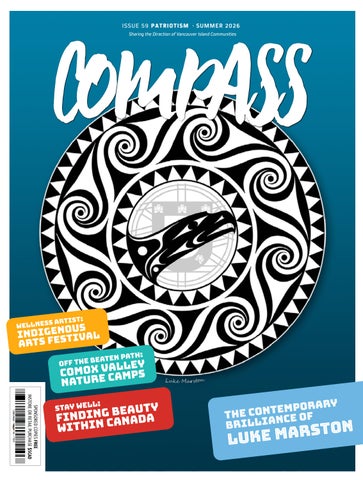
The Contemporary Brilliance of Luke Marston
George Froehlich
Island Chronicles
First Nations Climate Action Network
Coastal First Nations
Stay Well
Finding Beauty Within (Canada) Dana Mahon
ISSUE 59
SUMMER 2026
Patriotism
Patriotism - Noun
1.the quality of being patriotic; devotion to and vigorous support for one's country:"a highly decorated officer of unquestionable integrity and patriotism"
When I started publishing this magazine,back in 2014, it was originally called "Campbellton Now" and was a social justice and community engagement piece for Campbell River's historic footprint. My second issue featured Curtis Wilson's Indigenous version of the Canadian Flag. It was the first time it had ever been published and Curt was pretty excited, as was I. It was and is a new wave thought process on who we are as Canadians. Not saying that everyone has to agree; points of view are HOT right now and I'm not trying to light any fires.
I would like to honour our country in this issue – the Big Pink (on the old maps), the Great White North (Coo-oucooucoou), predominantly known as Canada. Can we rise up from the noise we are all hearing and share stories and a love that relates to a special event, place, moment or memory that you have that lands on love, devotion and vigorous support, paralleled to the definition of patriotism.
I think so!
Tie in your love for Canada, and why you think it is such a great country, by celebrating it this summer. No politics - just love & appreciation. Sitting with all generations, all peoples inclusively, building the TRUE NORTH, Strong + Free... making beautiful memories of this gorgeous west coast shoreline and lush forests! Hats off Canada and elbows up!
Gilakas’la, Emote, Marsii ~
KEALY DONALDSON
Publisher
Compass Magazine
PUBLISHER
Kealy Donaldson
DESIGN + LAYOUT
Jessie Stones
COVER Shore to Shore
Luke Marston THE COMPASS MAGAZINE is produced on Vancouver Island, printed on the West Coast of British Columbia, and published on Vancouver Island paper by:
To Advertise or Subscribe
Kealy: 250.203.1880
In-store purchase: $5
Back Issues: $10 Annual Subscription: $50/4 issues
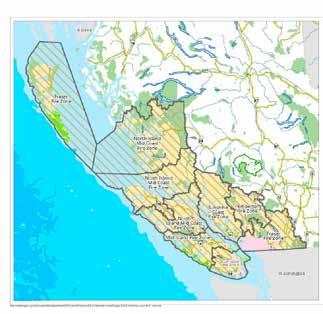
Good news for campers and outdoor enthusiasts: as of noon on Friday, May 15, 2026, the Category 1 campfire prohibition has been lifted throughout British Columbia's Coastal Fire Centre. The ban had been in place since earlier this spring, when a combination of prolonged drought, rising fire weather indices, and an uptick in human-caused wildfires pushed officials to restrict open flame.
The turnaround came as forecast conditions shifted. Cooler temperatures and improved humidity values have collectively reduced wildfire hazard across the region, giving the BC Wildfire Service enough confidence to rescind the small-fire prohibition.
Anyone lighting a campfire must still do so responsibly. Don't burn in windy conditions, establish a fuel break around your fire, never leave it unattended, and ensure it is fully extinguished before leaving the area. If fire spreads beyond your fuel break, suppress it immediately and report it.
Category 2 and Category 3 open fires remain strictly prohibited, along with fireworks, burn barrels, air curtain burners, and binary exploding targets. The lifted ban applies to land outside municipal boundaries, but also extends to parks, ecological reserves, and recreation sites within city limits. If you're in a municipality, check for additional local restrictions.
To report a wildfire or burning violation, call 1-800-663-5555 or use the free BC Wildfire Service mobile app. BCWildfire.ca
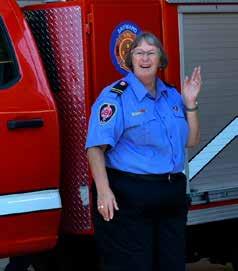
Celebrating 20 Years of Service: Patricia Rusch
After two decades of dedication, Patricia (Pat) Rusch is being recognized by the Strathcona Regional District and the Sayward Volunteer Fire & Rescue Department for her extraordinary contributions to emergency services in the Sayward community.
Pat currently serves as Administrative Assistant and leads the department's First Responder program — but her impact stretches far beyond any single title. Over the years she has served as Ambulance Unit Chief, Emergency Support Services Volunteer, and board member of the Sayward Health Society. She is also a certified Red Cross Professional Responder Instructor, bringing lifesaving training directly to her community.
Fire Chief Frank Morgan offered warm words at the milestone. "Two decades of serving this community with courage, compassion, and a genuine love for what you do. You've given so much of yourself to this department, and we are honored to celebrate this milestone with you." He added with a smile: "While I may be the Fire Chief, we all know Pat is the boss."
SRD Manager of Emergency Services Shaun Koopman echoed the sentiment. "Whether day or night, rain or shine, you'll find Pat at one of the firehalls with her nose to the grindstone. I truly believe Pat is the example that we should all try to emulate."
The Sayward Volunteer Fire & Rescue Department delivers fire protection, first responder, and rescue services to the Village of Sayward and Sayward Valley residents.
To learn more, visit saywardfire.ca
Food for Thought
ALL THE TERIYAKI
Josie Boulding
Teriyaki is more than a sweet and savoury sauce. In Japan it is a cooking technique to create a shiny coating on meat; teri means shine and yaki means grilled. In North America, it tends to be a carmelesque sauce. Either way it is popular because of its irresistible combination of sweet, salty and umami, that hard to define flavour that’s oh so satisfying, especially on warm summer nights. Many store bought teriyaki sauces are full of sugar, so instead try this quick DIY teriyaki sauce—and the two delicious recipes to use it!
TERIYAKI SAUCE
MAKES: 1 1/4 CUP PREP: 10 MINUTES COOKING: 10 MINUTES
Ingredients
½ cup tamari or soy sauce
½ cup water
¼ cup honey
2 tablespoons rice vinegar
2 garlic cloves, pressed (about 1 tablespoon)
1 tablespoon ginger, peeled and grated (about 1 small finger)
2 tablespoon lime juice (about 1 lime)
¼ teaspoon agar agar powder or cornstarch
Directions
Heat a frying pan on medium heat.
Add all the ingredients, except the agar agar, to the saucepan. Stir to mix well.
Now add the agar agar and whisk into the liquid, breaking up any chunks. Bring the Teriyaki Base to a boil.
Remove from heat. You can use it right away, but if you want to use it as a marinade, set it aside to cool and thicken first. After about five minutes, give it a whisk or vigorous stirring to prevent clumps. Store in the fridge for up to a week.
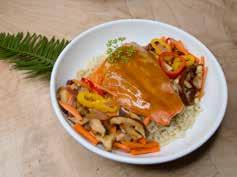
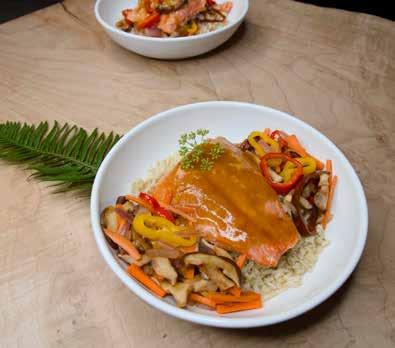
TERIYAKI-GLAZED SALMON
SERVES: 4 PREP TIME: 10 MINUTES
COOK TIME: 10 MINUTES
Salmon might be even more popular in Japan than it is in coastal British Columbia, so it’s no surprise that it's a natural compliment to teriyaki. You could cover a filet with the Teriyaki Sauce as is, but we find it easier to work with when it’s less of a sauce and more of a thick glaze.
Ingredients
¼ cup Teriyaki Base
⅛ teaspoon agar agar powder or cornstarch
1 1-pound (500-gram) salmon fillet
Directions
Pour the Teriyaki Base into a microwave-safe bowl. Whisk in the agar agar or corn starch until no chunks remain. Heat the mixture in a microwave in 30-second pulses, whisking in between, until it boils. (Alternatively, heat in a frying pan until it boils.) Set it aside to cool, either on the counter or in the fridge, to allow it to thicken. It should only take 5 to 10 minutes.
While you wait, heat a barbecue or oven to 400F.
Wash and dry the salmon fillet.
Spoon or paste the teriyaki glaze over the salmon, covering all the pink parts. Transfer to the oven or barbecue.
Cook salmon until the thinnest part of the meat just starts to flake apart when poked with a fork. Cooking time will vary depending on the thickness of the fillet. Start checking after five minutes.
Tip: The best way to defrost salmon is slowly. Transfer frozen fillets to the fridge at least 24 hours before you plan on cooking the fish. The slow defrost helps maintain firmer flesh.
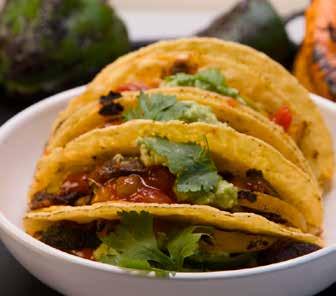
This taco recipe makes the most of mushrooms’ versatility. The fungi absorb a ton of the Mexican-Japanese fusion flavour and then bakes into a perfect chewiness. This is a meaty feeling, veggie taco that’s filling and incredibly satisfying!
Ingredients
2 cups mushrooms, sliced thick
1 red onion, sliced thin
⅓ cup Teriyaki Base
¼ cup avocado oil
2 tablespoons tomato sauce or paste
1 tablespoon cumin
1 tablespoon chili powder
1 tablespoon oregano
1 teaspoon cinnamon
½ teaspoon pepper
¼ teaspoon salt
Directions
to helping you nd the perfect watercraft, powersports vehicle, or power equipment tailored to your lifestyle.
Mix everything except mushroom and onion in a big bowl.
Add the sliced mushrooms and onion. Toss to coat. Refrigerate for 30 minutes to 24 hours–the longer the better.
Preheat the oven to 400F. Line a baking sheet with parchment.
Spread the mushroom mixture across the baking sheet as evenly as possible.
Cook in the oven for 15 minutes. Flip the mushrooms. Return to the oven for another 15 minutes.
The mushrooms are done when they are soft and just starting to brown.
Add to tacos or toss on a salad. Either way, smother in salsa and guacamole.
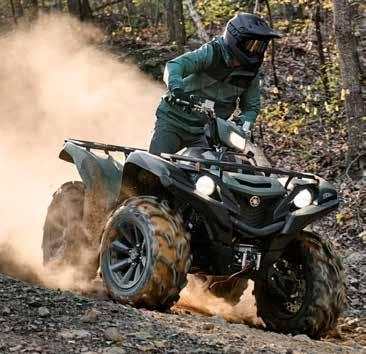
2026 Grizzly EPS XT-R
The Fossil Huntress
HUMPBACK WHALE G W A 'Y A M
The Fossil Huntress
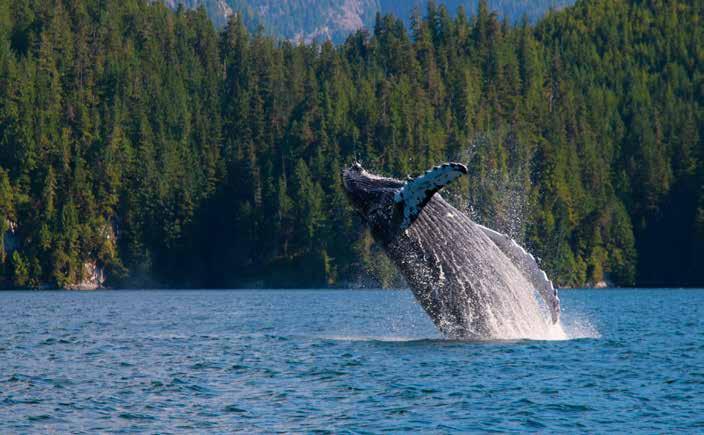
Look deep into the knowing eye of this magnificent one. He is a Humpback whale, Megaptera novaeangliae, a species of baleen whale for whom I hold a special place in my heart. Baleens are toothless whales who feed on plankton and other wee oceanic tasties that they consume through their baleens, a specialised filter of flexible keratin plates that frame their mouth and fit within their robust jaws.
Baleen whales, the mysticetes, split from toothed whales, the Odontoceti, around 34 million years ago. The split allowed our toothless friends to enjoy a new feeding niche and make their way in a sea with limited food resources.
There are fifteen species of baleen whales who inhabit all major oceans. Their number include our humbacks, grays, right whales, bowhead and the massive blue whale. Their territory runs as a wide band running from the Antarctic ice edge to 81°N latitude.
In the Kwak'wala language of the Kwakiutl or Kwakwaka'wakw, speakers of Kwak'wala, of the Pacific Northwest, and my cousins on my father's side, whales are known as
g'wa'ya'm. It is a term used for many species of whale including the California grey and Humpback that live on our coast.
Whaling was a global practice and is still done today. Most Inuit communities have voluntarily limited or ceased traditional whale hunting activities since the late 1970s, and have not hunted a bowhead whale, a baleen cousin to the humpback, in over 100 years.
There was some whaling by my First Nation cousins around Vancouver Island but only a small number of individuals in First Nation society had the right to harpoon a whale. It was generally only the Chief who was bestowed that great honour.
Our Nuu-chah-nulth cousins along the west coast of Vancouver Island held this practice but they also benefited from whales washing ashore—their bones made into ceremonial objects and tools and the flesh harvested if still edible.
Humpback whales like to feed close to shore and enter the local inlets. Around Vancouver Island and along the coast of British Columbia, this made them a welcome food source as the long days of winter passed into Spring.
Humpback whales are rorquals, members of the Balaenopteridae family that includes the blue, fin, Bryde's, sei and minke whales. The rorquals are believed to have diverged from the other families of the suborder Mysticeti during the middle Miocene—some eleven to fifteen million years ago.
While cetaceans were historically thought to have descended from mesonychids—which would place them outside the order Artiodactyla— molecular evidence supports them as a clade of even-toed ungulates — our dear Artiodactyla.
It is one of the larger rorqual species, with adults ranging in length from 12–16 m (39–52 ft) and weighing around 25–30 metric tons (28–33 short tons).
The humpback has a distinctive body shape, with long pectoral fins and a knobbly head. It is known for breaching and other distinctive surface behaviours, making it popular with whale watchers and a lucky few who catch their antics from the decks of our local ferries.
Both male and female humpback whales vocalize, but only males produce the long, loud, complex "song" for which the species is famous. Males produce a complex soulful song lasting 10 to 20 minutes, which they repeat for hours at a time. I imagine Gregorian Monks vocalizing their chant with each individual melody strengthening and complimenting that of their peers. All the males in a group produce the same song, which differed in each season. We tell of these whale songs in our Indigenous stories. From a Western science perspective, its purpose is not clear, though it may help induce estrus in females and bonding amongst the males.
Found in oceans and seas around the world, humpback whales typically migrate up to 25,000 km each year.
They feed in polar waters and migrate to tropical or subtropical waters to breed and give birth, fasting and living off their fat reserves. Their diet consists mostly of krill and small fish.
Humpbacks have a diverse repertoire of feeding methods, including the bubble net technique.
Humpbacks are a friendly species that interact with other cetaceans such as bottlenose dolphins. They are also friendly and oddly protective of humans.
You may recall hearing about an incident off the Cook Islands a few years back. Nan Hauser was snorkeling and ran into a tiger shark. Two adult humpback whales rushed to her aid, blocking the shark from reaching her and pushing her back towards the shore. We could learn a thing or two from their kindness. We have not been as good to them as they have been to us.
Like other large whales, the humpback was a tasty and profitable target for the whaling industry. My grandfather and uncle participated in that industry out of Coal Harbour
on northern Vancouver Island back in the 1950s. So did many of my First Nation cousins. My cousin John Lyon has told me tales of those days and the slippery stench of that work.
Six whaling stations operated on the coast of British Columbia between 1905 and 1976. Two of these stations were located at Haida Gwaii, one at Rose Harbour and the other at Naden Harbour. Over 9,400 large whales were taken from the waters around Haida Gwaii. The catch included blue whales, fin whales, sei whales, humpback whales, sperm whales and right whales. In the early years of the century, primarily humpback whales were taken. In later years, fin whales and sperm whales dominated the catch.
Whales were hunted off South Moresby in Haida Gwaii, on the north side of Holberg Inlet in the Quatsino Sound region. It was the norm at the time and a way to make a living, especially for those who had hoped to work in the local coal mine but lost their employment when it shut down.
While my First Nations relatives hunted whales in small numbers many years ago, my Norwegian relatives participated in the hunt on a scale that nearly led to the extinction of our lovely Humpbacks before the process was banned.
The Coal Harbour Whaling Station closed in 1967. Once it had closed, my grandfather Einar Eikanger, my mother's father, took to fishing and my uncle Harry lost his life just the year before when he slipped and fell over the side of the boat. He was crushed between the hull and a Humpback in rough seas.
Our Humpback populations have partially recovered from those days to build their population up to 80,000 animals worldwide—but continued whaling by many countries along with entanglement in fishing gear, collisions with ships, and noise pollution continue to negatively impact the species. So be kind if you see them. Turn your engine off and see if you can hear their soulful cries echoing in the water.
fossilhuntress.blogspot.com
Ocean Chronicles
FIRST NATIONS CLIMATE ACTION NETWORK MAP
Coastal First Nations
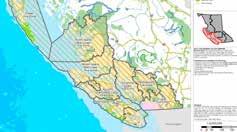
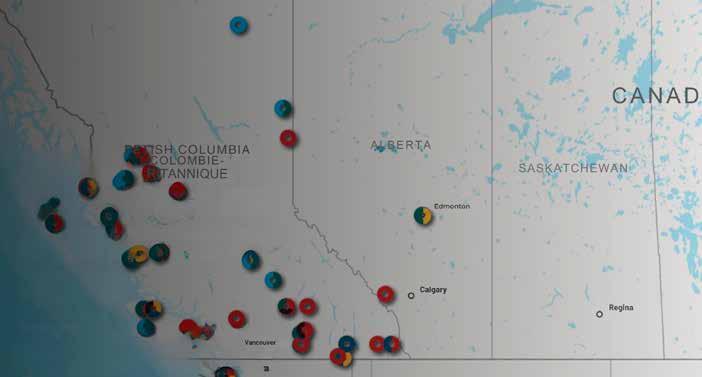
The First Nations Climate Action Network Map seeks to bring together and map the network of people, organizations, initiatives, resources and trainings that support, lead and uplift First Nations climate action in BC. It assists community leaders and climate coordinators in identifying and connecting with potential partners, organizations and communities working on similar climate resilience priorities.
As a participatory map, users are invited to add new listings or edit existing listings, co-maintaining a living, ever-growing knowledge sharing resource focused on First Nations climate action.
Launching with over 200 listings, each with a description of work, relevant resources, website links and contact information, users can filter listings by theme, type, scale and region to find listings most relevant to their work and climate action priorities.
The Network Map was developed collaboratively through interviews with First Nations leaders, network facilitators, and staff from key organizations, and input from a steering committee comprised of Indigenous Climate Adaptation Working Group and First Nations Leadership Council members. Initially created as a map of regional and provincial organizations, the Network Map evolved to include resources, trainings, and community examples to inspire and empower First Nations climate leadership.
After piloting a preliminary version with the steering committee, Indigenous Climate Action Network Climate Action Coordinators, and the 200+ listed organizations, the Network Map was officially launched at a webinar on April 29, 2026.
The First Nations Climate Action Network acknowledges the many diverse First Nations across BC each with deep and profound relationships with their territories. Relationship building and respect for Indigenous leadership is foundational to our success.
The Network Map is a tool for First Nations communities and coordinators to identify and connect with potential partners, organizations, and communities working on similar climate resilience priorities. The Network Map helps create and strengthen connections between First Nations working on climate action and supports us in building off one another's work.
From Prince Rupert to Victoria, Kyuquot to Edmonton, the map is populated with a great deal of information and is an excellent resource tool!
See the map here: experience.arcgis.com/experience/8b9860de835046b3a92611f166a52eef
I am inspired by the legacy of my ancestors… we have to find a balance between traditional and contemporary art, and at the same time evolve and grow as Coast Salish people.
Luke marston northwest coast art
George Froehlich, Froehlich Media
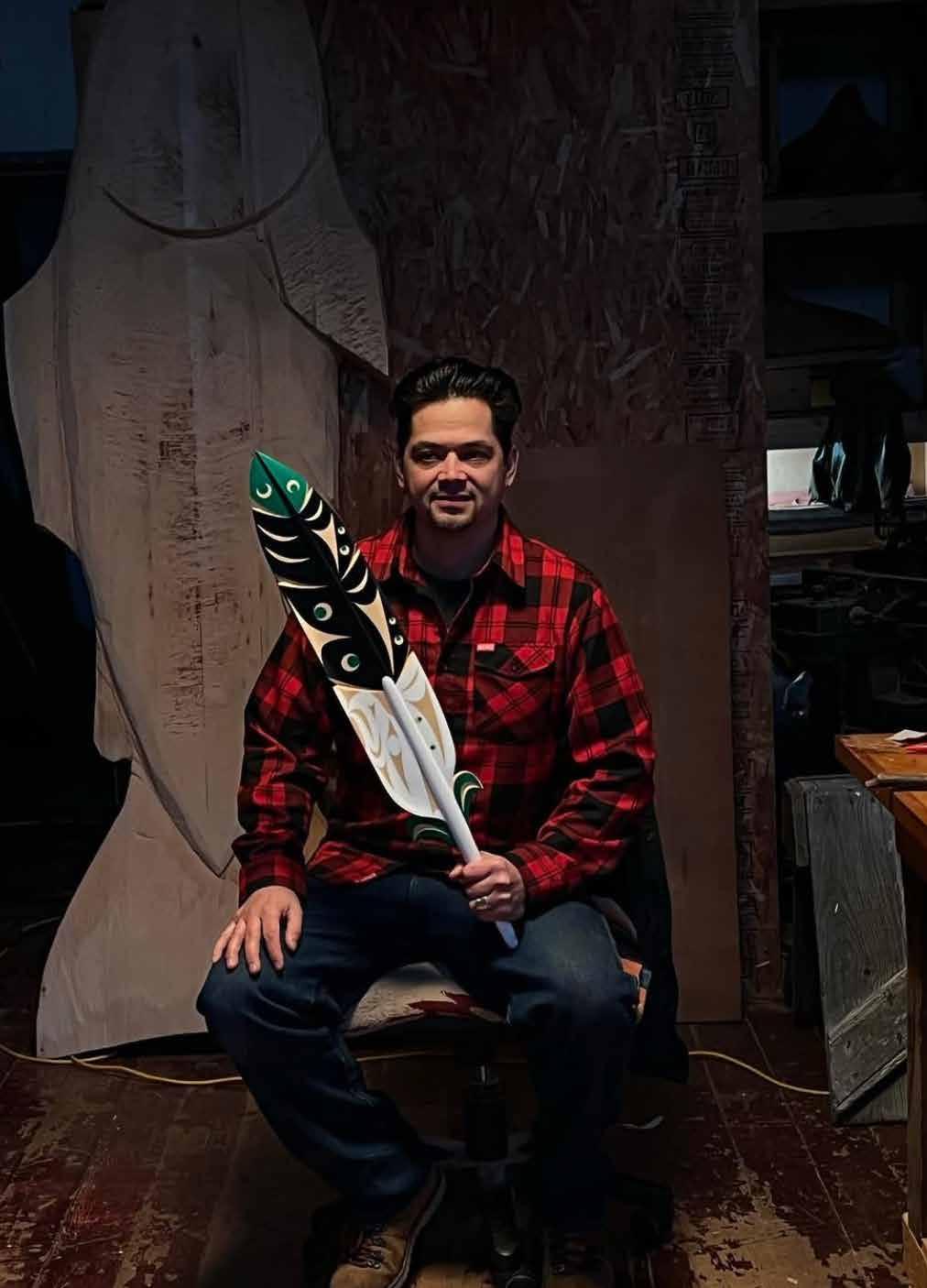
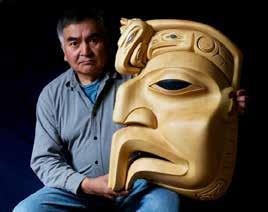
Luke Marston, a member of the Stz’uminus (Chemainus) First Nation, was born in 1976 on Vancouver Island to carvers Jane and David Marston.
Luke Marston is one of the most important young contemporary artists working on the Northwest Coast today. His work is not only remarkable, it is transformative. He creates pieces that are bold, superior, and unforgettable, pushing Coast Salish art into new territory while remaining deeply rooted in its traditions.
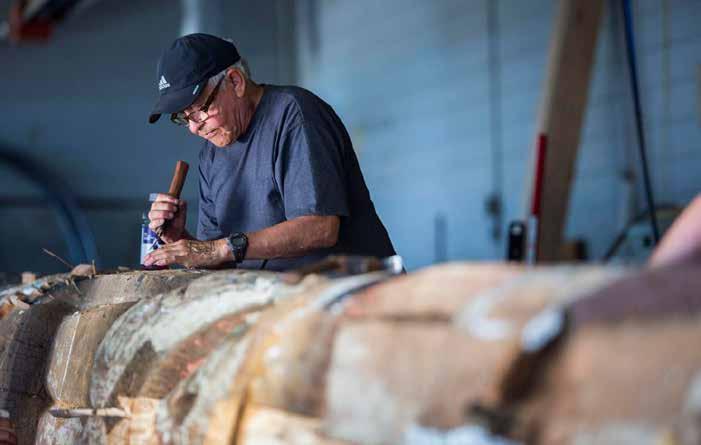
Marston stands at the forefront of a new generation of Indigenous artists who are reshaping what contemporary Northwest Coast art can be. His carvings are visually commanding, emotionally resonant, and technically superb. They honour the minimalist clarity of Coast Salish design, yet they expand its expressive range in ways that feel both daring and inevitable.
He is not simply producing art, he is advancing a tradition.
A Childhood Shaped by Art, Story, and Lineage
Marston grew up surrounded by art. Both of his parents were carvers, and the home was alive with the scent of cedar, the rhythm of tools, and the stories embedded in every piece. For him, carving was not an activity; it was a way of understanding the world.
In Coast Salish culture, art is inseparable from identity. It is woven into ceremony, memory, and community. Marston absorbed that worldview early. He learned that carving is not simply shaping wood — it is shaping continuity.
The Apprenticeship: Learning From the Masters
Following the time-honoured path of Northwest Coast artists, Marston apprenticed with some of the most respected carvers of the era: Simon Charlie, Wayne Young, Sean Whonnock, Sean Karpes, and others. These were not casual lessons. They were years of disciplined study learning form, proportion, cultural responsibility, and the ethics of representation.
Each mentor shaped his understanding. Each reinforced the idea that Coast Salish art is not merely aesthetic, it is relational. It connects artist to ancestors, community to land, and tradition to future generations.
Forging a Distinctive Contemporary Voice
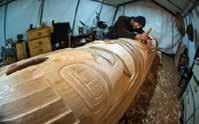
What makes Marston’s work so compelling is the way he blends the minimalist clarity of Salish tradition with a contemporary boldness that is entirely his own. His carvings feel sculptural, architectural, almost cinematic. They command space.
He respects the traditional vocabulary — clean lines, open forms, balanced compositions — but he pushes it. He stretches it. He asks: What else can this language say?
The result is a visual signature that is instantly recognizable. His pieces carry the weight of history while speaking fluently to the present moment.
This is why his work stands out, and is memorable; it's why he is a major contemporary voice.
Beyond Wood: A Multidisciplinary Creator
Although carving remains his first love, Marston’s creative reach extends far beyond it. He has produced jewellery, prints, paintings, and cast works in bronze and other mediums. Each form allows him to explore different facets of Salish identity and contemporary expression.
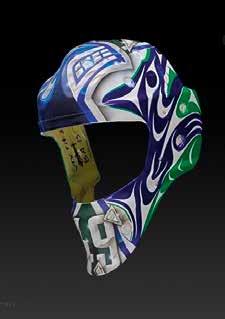
One of his most unexpected commissions was a helmet for the Vancouver Canucks, a moment where Indigenous art entered the arena of professional sports. It was a reminder that Coast Salish design is not confined to galleries.
Marston’s work has been exhibited widely: the Victoria Art Gallery, the New York Museum of Arts, and numerous shows across Canada, the United States, Japan, and Portugal. His pieces are held in private collections around the world.
Each exhibition expands the global understanding of Coast Salish art, not as a static tradition, but as a dynamic, evolving cultural force.
luke marston
The Artist’s Philosophy
Marston’s creative philosophy is rooted in reverence and evolution. He speaks often about the responsibility artists carry, not only to their craft but to their ancestors.
“I am inspired by the legacy of my ancestors… I feel for the master carvers of long ago. I believe, as an artist, that we have to find a balance between traditional and contemporary art, and at the same time evolve and grow as Coast Salish people.”
This is the tension that animates his work: the pull of tradition and the push of innovation.
Carving Forward
Luke Marston stands at a rare intersection where ancestral knowledge meets contemporary imagination. His work is not only visually powerful; it is culturally resonant. It reminds us that tradition is not a boundary. It is a foundation.
And from that foundation, Marston continues to carve forward.
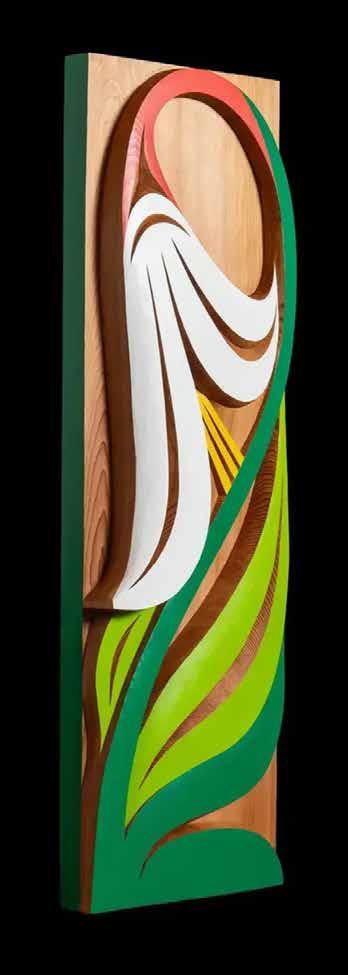
Luke Marston's current available works include limited edition Feather prints and Fawn Lily Wood Carving.
Here is the legend that inspired the Fawn & Lily piece:
A long time ago there lived a beautiful girl who always had to be first in everything she did. She was always first to eat, first in line, first to dance, first on the canoe. One day Xeels the transformer came to see her, he transformed her into the most beautiful forest flower. He said she was going to be the first flower to bloom in the spring to let the people know that it was time to end the winter ceremonies.
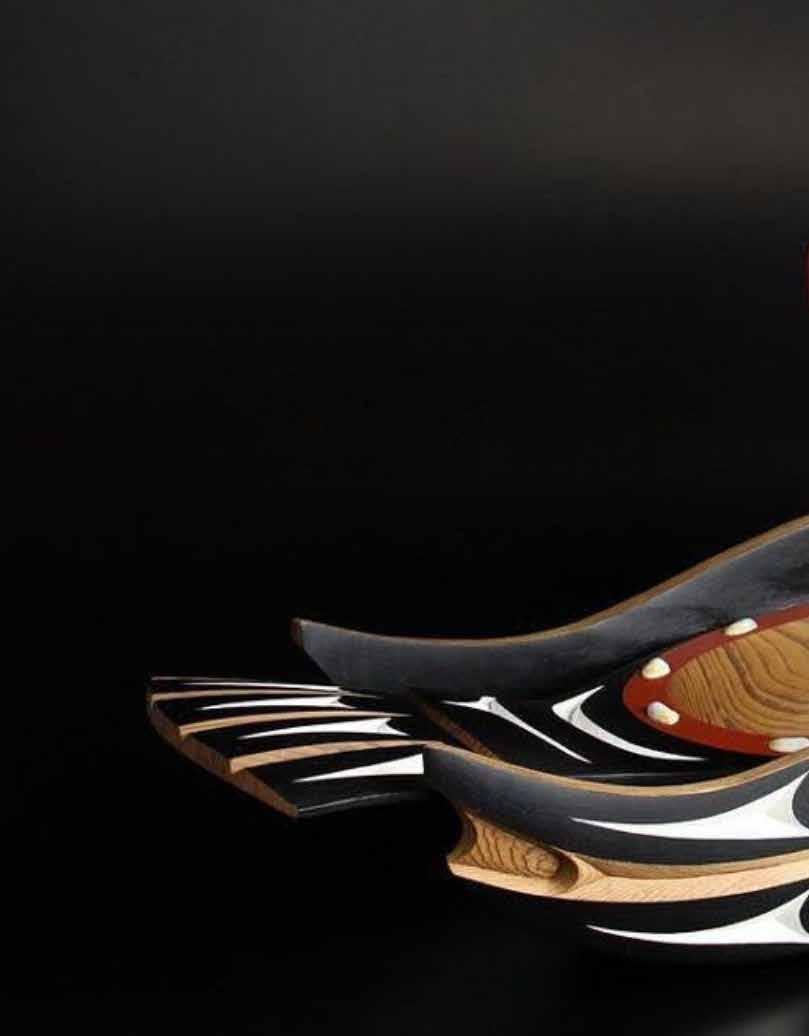
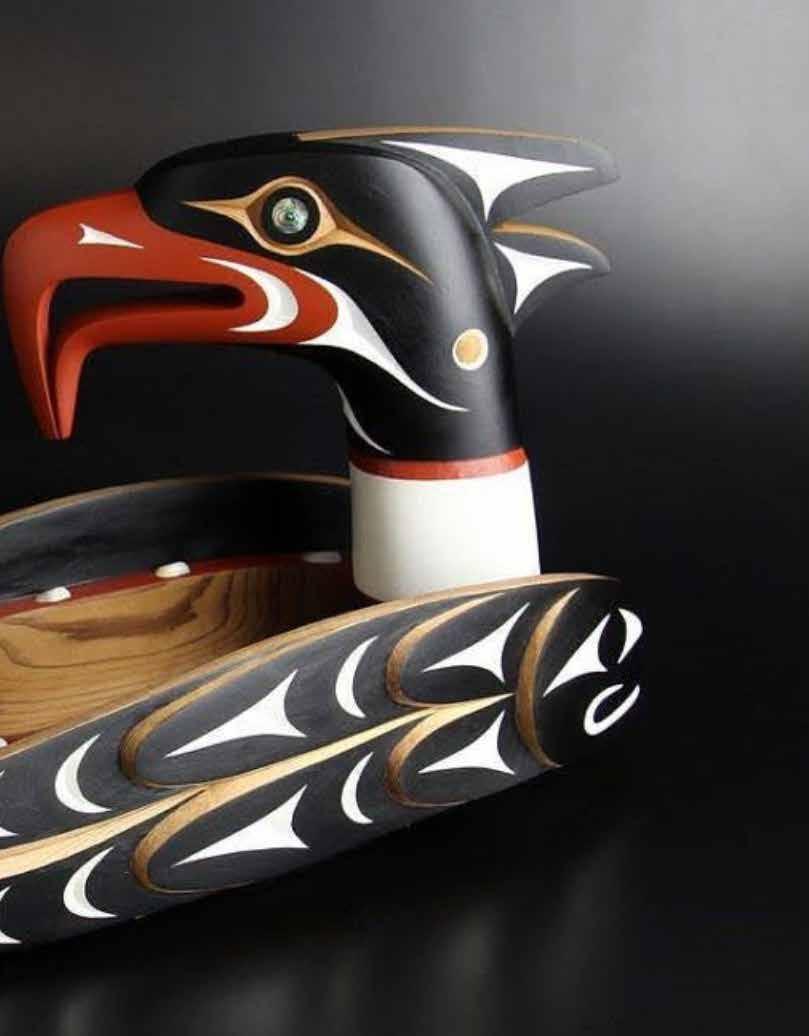
Shore to Shore Limited Edition Print (on the cover)
Designed and signed by Luke Marston, a special Shore to Shore limited-edition silkscreen print is available, a rendition of the Portuguese and Coast Salish stone mosaic that is installed around his sculpture in Stanley Park, Vancouver BC. The print is 22' by 22', and limited to 400 copies.
At the centre of the artwork is an eagle’s head, representing both the Coast Salish and the Azores Bird. Behind the head is a faint image of the Portuguese crest. The surrounding wave design depicts the ocean as it connects from the shores of Pico Island to the North Shore of Vancouver.
shoretoshore.ca/support
Luke Marston www.lukemarston.com and through social channels Facebook and Instagram.
Froehlich Media Follow weekly Northwest Coast art stories at gfroehlich.substack.com
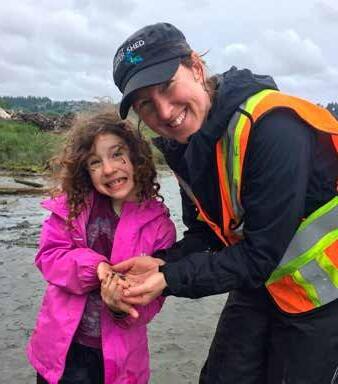
This summer, local children will have the opportunity to trade screens for shorelines as Comox Valley Project Watershed launches its new Super Stewards Summer Camps for youth ages 7 to 12. The week-long day camps are designed to help children explore the natural world through hands-on environmental learning, stewardship activities, and outdoor play.
Based on the K’ómoks Estuary around the Riverway Walk Area, the camps will run Monday to Thursday from 9 a.m. to 3 p.m. Campers will spend their days exploring estuary habitats from coastal forest to mudflat, including a special excursion to the Kus-kus-sum site.
Activities will include building bug hotels, bird watching, scavenger hunts, nature art, species identification, watershed educational activities, and stewardship projects. Campers will also learn about salmon habitat, local biodiversity, and Indigenous fish traps.
The program is not only to teach children about ecology, but also to help them build confidence, curiosity, and a stronger connection to nature and community.
“This program is all about learning through experience,” says Caila Holbrook, Manager of Education and Outreach at Project
Watershed. “We want kids to have fun outdoors while also gaining a deeper understanding of the ecosystems around them and how they can care for them.”
This is a new program, and community feedback will help shape future camps. To help ensure the camps are accessible to all interested youth, subsidies are available for low-income families. Families are encouraged to register participants early and share information with others who may be interested.
The camps build on Project Watershed’s growing environmental education programming, which engages approximately 500 students a year in classroom presentations and field trips focused on stewardship and restoration around the Estuary. projectwatershed.ca/2026/04/15/2026summercamps
FROEHLICH MEDIA
NORTHWEST COAST ART
Walking in their Footsteps
QUEENS VENTURER SCOUT
David Durrant
My father was a Scout Master, and as a very young boy I remember the day three Queen’s Venturer Scouts visited our home. To me, they seemed larger than life. Their uniforms were neat, their badges proudly earned, and they carried themselves with quiet confidence, kindness, and purpose. I was completely captivated. From that moment on, I could not wait to become a Cub Scout.
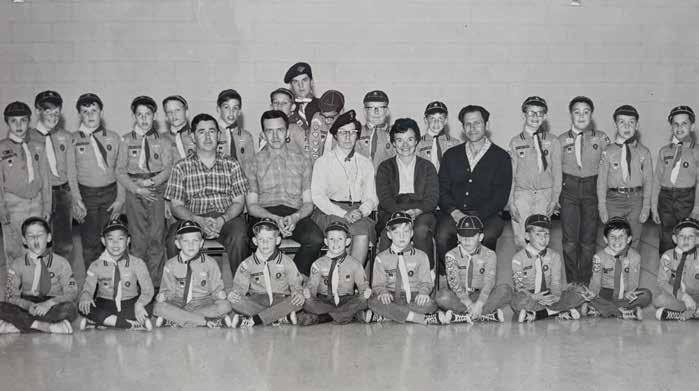
There was only one problem: I was far too young. The entrance age for Cubs in Scouts Canada was eight, and I was only six. Still, rules and age could not diminish my fascination. On meeting nights, I would stack wooden boxes outside the recreation hall, climb carefully to the top, and peer through the windows just to watch the Cub pack in action. Inside, the boys laughed, learned, marched, and listened to their leaders. To me, it looked like a world of belonging, adventure, and respect.
Eventually, the Cub leader, Akela, as they are called, noticed my face pressed against the glass. Instead of sending me away, he invited me inside. Alongside the other leaders, Baloo and Bagheera, he welcomed me warmly into the pack. I still remember the mixture of excitement and nervous pride I felt walking through those doors for the first time.
I was placed into a small group called a Six, where an older Cub known as a Sixer guided and encouraged me. He wore two stripes on his sleeve, symbols of responsibility and leadership. I admired those stripes deeply because my father also wore two stripes on his work uniform. To my young mind, they represented something simple but important: trust, service, and the respect of others.
Looking back now, I realize Scouting offered far more than skills or uniforms. It gave young people a sense of purpose, belonging, discipline, and community. The older Cubs quietly guided the younger ones, teaching us not only how to tie knots or light campfires, but how to carry ourselves with integrity and care for others. Those early evenings watching through a hall window shaped something lasting in me, a respect for leadership, service, and the quiet example of others.
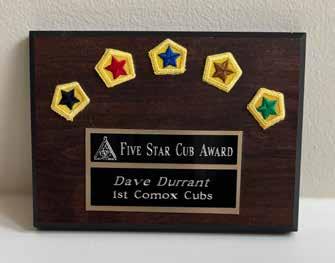
In the Cub Scout program of Scouts Canada, the Five Star badges represented the highest level of achievement a Cub could earn before moving on to Scouts. Each star required effort, learning, teamwork, and perseverance. The badges reflected growth in areas such as outdoor skills, citizenship, physical fitness, service, and personal responsibility. To young Cubs, even one star felt meaningful; earning all five was rare and deeply respected.
In 1967, I became the first Cub Scout in the 3rd Comox Pack to earn all Five Stars. For me, it was never just about badges. It was the result of many evenings at meetings, camping trips, community activities, and the guidance of leaders who believed in young people. As a child who once stood outside the recreation hall window too young to join, receiving all Five Stars felt almost unbelievable. It taught me that patience, encouragement, and community can help a person reach further than they once imagined.
Another memorable moment in 1967 was placing third in the annual Cub Car Derby. I was happy, but my father was over the moon. He stopped at several places on the way home, the base exchange, a gas station, and a friend’s home. “I’ll only be a minute, are you coming in?” he’d say. “Better not leave that trophy in the car.” He made a very big deal of it, his pride and excitement overflowing at every stop. He felt such joy.
I couldn’t wait to get home to show my mother. She smiled warmly, deeply supportive and genuinely pleased, and in that simple moment she made the day feel complete.
At 11, our group transitioned from Cubs into Scouts. It was a time of growing independence and responsibility. We earned proficiency badges in camping, first aid, mapping, citizenship, leadership, and outdoor skills. Older Scouts, 12 and 13 years old, helped guide the younger ones, passing on knowledge and encouragement as others had once done for us. We were no longer divided into Sixes, but into Patrols, each with a Patrol Leader, an Assistant Patrol Leader, and members who shared responsibility. Adult Scouters supported us as advisors. Scouts was about learning to lead, but also learning to trust one another.
The late 1960s and early 1970s were a time of great change and uncertainty in the wider world. The Vietnam War, civil rights movements, Indigenous rights, and second-wave feminism were reshaping public life. Alongside this, there was a cultural movement often associated with the “hippie” era, music, protest, new ideas about peace, and different ways of living. It was a time when many people questioned long-standing systems and searched for something new.
For many Scouts, this wider world of change made Scouting feel like something steady and familiar. While society around us shifted quickly, Scouting remained grounded in values of service, kindness, responsibility, and teamwork. It gave young people a sense of direction and stability, an anchor of sorts, while still encouraging growth, independence, and care for others.
For those of us growing up in that time, especially in military families, there was often a quiet inner tension. There was deep respect for a parent’s service and sacrifice, and at the same time, a growing awareness that the world was more complex than it first appeared. Many of us learned, slowly and sometimes uneasily, to hold both loyalty and questioning in the same heart.
During those years, many adult leaders in community
organizations were also reassessing their roles. Society was changing, and with it, the willingness and availability of volunteers. Some stepped back, others moved in new directions, and in many places, Scouting felt the effects of fewer adult leaders. Over time, this also encouraged Scouting to adapt, placing more trust in youth leadership and making participation more flexible.
Many Scouts eventually drifted toward school sports or other activities, and some moved on quickly. But I stayed for a few more years. Scouting challenged me, but in a good way. It gave me confidence and surrounded me with people who encouraged growth, responsibility, and service.
In Scouts Canada, youth traditionally moved into Venturers between the ages of 14 and 17. I was 14 when I became a Comox Venturer. There were few Venturers in Comox at the time. The Venturer section focused more on leadership, personal responsibility, outdoor adventure, and service to the community.
Venturers planned their own expeditions, organized projects, and took on more responsibility for their activities. It was during this time that I began working toward the Queen’s Venturer Award. In many ways, it felt connected to those early memories of the Venturer Scouts who had once visited our home.
To earn the Queen’s Venturer Award, participants were required to complete major projects that demonstrated leadership, service, and personal growth. One part involved meaningful community service, such as helping others, supporting youth, or contributing to local initiatives. Another involved a challenging outdoor expedition that tested planning, endurance, and teamwork.
A third area focused on leadership and personal development, learning to organize, guide others, and take responsibility within the group and the wider community. The award represented not only achievement, but also maturity and steady growth over time.
For my Community Service Project, I worked with younger Cub Scouts, helped clean Brooklyn Creek with Hamilton Mack Laing, supported community fundraising efforts, and volunteered at local events. Each activity was small on its own, but together they reflected a desire to contribute in practical, hands-on ways.
For my Outdoor Adventure and Expedition Project, I chose to create a West Coast experience. Using my father’s boat, I organized a salmon fishing expedition out of Comox. Before we left, I carried out a full inspection of the boat, engine, and trailer while others observed and asked questions. I explained our gear and why it was chosen, and how it matched the natural behaviour of salmon.
The first day, we did not catch anything. When someone remarked on our luck, I remembered something my grandfather had said about where the fish might be. We decided to try again early the next morning.
That second day was different. The fishing was memorable, not just for the catch, but for the shared experience. At one point, after landing a large fish, someone laughed and said, “Give this man
SUSAN MALLINSON
his badge.” It was said in good humour, but it stayed with me, not because of the fish, but because of the teamwork, patience, and persistence behind it.
For me, Scouting had always been about more than outcomes. It was about learning to prepare, to try again, and to keep going when things did not go as planned.
The leadership component of the Venturer program encouraged us to guide younger members, support our community, and develop responsibility. I worked with Cub and Scout packs in Comox, helping with activities such as teaching younger Cubs how to sew on their badges. It was simple work, but meaningful in its own way, small moments of guidance and connection.
Not long after, my family was transferred to Edmonton for two and a half years before we returned to Comox for Grade 12. During that time of transition, my father asked whether I intended to apply for my Queen’s Venturer designation. I remember telling him there was still one thing I felt I needed to do.
He asked, “What else is there?”
And I replied, “Get accepted into the University of Alberta and have the Canadian Coast Guard help me get through.”
In truth, it was less a plan than a sense of direction, something still unfolding rather than finished. I would sometimes tell my father, “It’s on my to-do list,” knowing it meant I was still becoming rather than arriving.
In the end, I never needed to apply.
And yet, even now, looking back on the paths taken, the lifelong service given, and the quiet contributions made to community, I sometimes find myself returning to that younger version of myself, standing at the threshold of something larger than I could then fully understand.
It is in the coldest part of the night that birds start to sing.
The sun's rays twinkle on the distant horizon while darkness lays heavy over sleeping hearts.
It is in these final moments of darkness the pure essence of a soul can be felt, seen and heard.
It is in the same moments that God speaks to us in our slumber.
Warm within our beds we dream the dreams of the life we wish to live.
The life we wish to share with love.
As the seconds go by the choir outside fills their lungs and lifts their voices to the advancing light.
Every bird joins in the celebration of another day.
Every leaf opens its pores to the vibration of this sonic bloom.
Every flower feels the love of warmth before the day's beginning.
Every soul is graced with the dawn of a new day.
Every heart has another day to love.
It is the SONIC BLOOM that tells life another moment has come to shine brighter than the approaching sun.
To rise and to greet another day.
Sound Advice
SONIC BLOOM
Cam Ezzy
Are you someone who rises early and sees the dawn of a new day? I am!
Rumi said that if you wake between the hours of 3am to 5am don't go back to sleep, the morning breeze has secrets to share.
I have often wondered about this and if the phenomenon of Sonic Bloom had any part in him saying so.
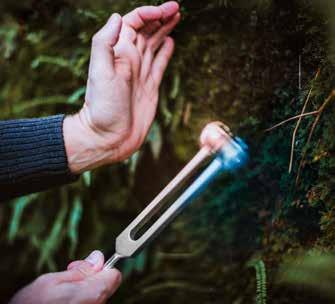
Sonic Bloom is a technical term given to the birds singing in the pre-dawn hours. This acoustic vibration opens the cells "stomata" on the underside of leaves and prepares the leaf for the rising sun, and to start the process of photosynthesis.
The earth starts breathing in carbon dioxide because of the acoustic vibrations.
I believe the trees have to be feeling this and it leads me to think about the universal law.
Cause and effect!
The cause is a vibration. The effects vary across nature.
We measure the effects in ways of sound, light, heat and distance/speed. We can also measure this in how we feel too.
Why do we resonate so powerfully with a particular vibration and not at another?
A sonic bloom led me to write this poem and still to this day I wonder about what secrets are waiting to be shared in the early hours.
Match Energy, Frequency and Vibrations, with Positivity, Intention and Mindfulness. Vibrational Therapy/Sound Baths. Heal yourself!
Meridian Vibrational Therapy meridianvibrationaltherapy@ gmail.com
Cameron Ezzy · 250 792 5605
Sonic Bloom
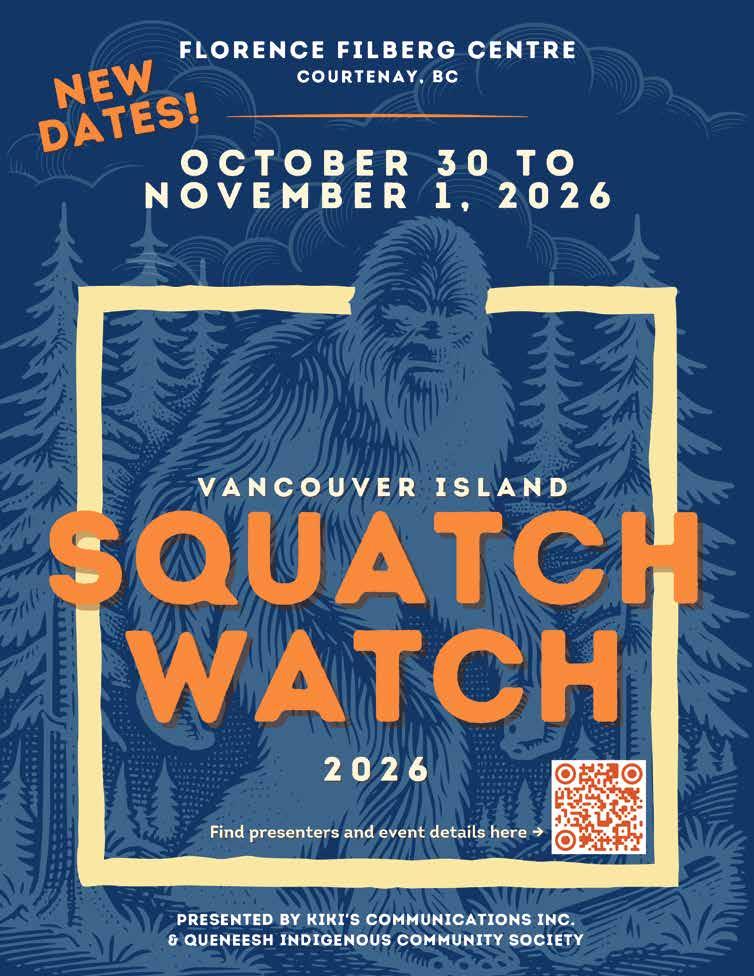
SQUATCH WATCH VANCOUVER ISLAND 2026: A SASQUATCH CONFERENCE FOR ALL THINGS SASQUATCH!
Kealy Donaldson
Come and listen to some of the most credited specialists talk about all things Sasquatch!
The Vancouver Island Squatch Watch 3-Day Conference, at the Florence Filberg Centre in the Comox Valley, will host multiple presenters, a Sasquatch-themed Vendors Market & a Gala Dinner with Keynote Speaker. If you’re curious about the elusive Sasquatch or are already a ‘BELIEVER’, mark your calendar and get your tickets to attend! Here are some of the highlighted special speakers who will be hosting presentations and community dialogues.
Tom Sewid, Sasquatch Island
"North American Indians and Canadian First Nations referred to North American as Turtle Island because it looks like a turtle. I call North America ‘Sasquatch Island’ because many Indigenous Tribes have a name, stories, and art or dances about Sasquatch. Even to this day, people from every corner of North America have sighting accounts, stories and names for the large hair-covered creatures known as Sasquatch." Sewid will share his personal Sasquatch accounts along with First Nation legends.
Francis Horne Sr. Indigenous Artist and Environmentalist
An astute environmentalist, Horne Sr. has experienced and developed his own image of Sasquatch. From a sandy creekside bed, Horne discovered a massive footprint and documented his findings in collaboration with his traditional teachings in Tsonoqua. Through Horne’s licensing agreement with Native Northwest, his iconic Sasquatch image has become renown for its iconic look and style. Recently, along side Native Northwest, Horne Sr. fought a long, three year court battle regarding copyright infringement and theft of intellectual property. He won this lawsuit and will be sharing some of the hurdles he experienced with Indigenous art theft. Horne will be presenting on his own findings and traditional beliefs at the Conference with a second presentation of a Fireside Dialogue for Artists.
Terrance N. James, PhD, Biographer, “Sasquatch Discovered”
Sasquatch Discovered is the biography of Dr. John Bindernagel, Canada’s foremost Sasquatch/Bigfoot investigator. His intense childhood curiosity about the natural world, with a particular interest in ornithology, led to his involvement as a Junior Naturalist and his teacher dubbing him “the scientist” for his in-class contributions. By high-school, he was practicing good curatorial habits as he collected specimens for the museum he created in the family home.
While in university, Bindernagel was intrigued by the story of
an “ape-man” in British Columbia. During his time in Africa, he became familiar with the great apes and hypothesized the Sasquatch as North America’s great ape. On return to Canada, he chose to live in the Comox Valley, on Vancouver Island, B.C., and closer to the west coast rain forests– prime Sasquatch habitat. Here he aimed to study and pursue research on this elusive animal. Terry James will share his story of friendship and biographical overview of Dr. John Bindernagle’s encounters.
New presenters will be announced at www.squatchwatch.ca
Squatch Watch Vancouver Island 2026 Conference opens Friday night, May 22, with a Sasquatch Market, Opening Ceremony, 1st Presenter, Concession w Aunty's Deadly Seafood Chowder and Bannock. Saturday, May 23, continues with a morning Presenter, Community Dialogue session and an afternoon Presentation, Squatch Market, Concession with a Gala Dinner & Keynote Speaker! Sunday, May 24, the final day continues to host the Squatch Market and final Presenters, Concession and Closing Ceremony!
THANK YOU TO OUR HOTEL SPONSOR Bayview Hotel V.I. Not only are they the OFFICIAL accommodation for the Conference Presenters, Conference Attendees get a SPECIAL RATE for their booking (CAD$):
Classic Two Queen: $166.32 per night plus taxes King Suite: $183.92 per night plus taxes
Guests can access the preferred rates using the booking code at kikiscommunications.com/squatch-watch-v-i-2026 www.bayviewvi.com
TICKETS ON SALE NOW!
Come join in the sharing of all things Sasquatch!
Conference 3-Day Tickets, Single Daily Tickets, Gala Dinner Tickets and Vending Space are available at eventbrite.ca Squatch Watch Vancouver Island 2026.
Presented by Kiki’s Communications Inc. in partnership with Queneesh Indigenous Community Society (partial proceeds to QICS).
kikiscommunications.com/squatch-watch-v-i-2026
compassmagazine@ourmail.com
WELLNESS ARTIST
K'omoks Fusion Arts Fest
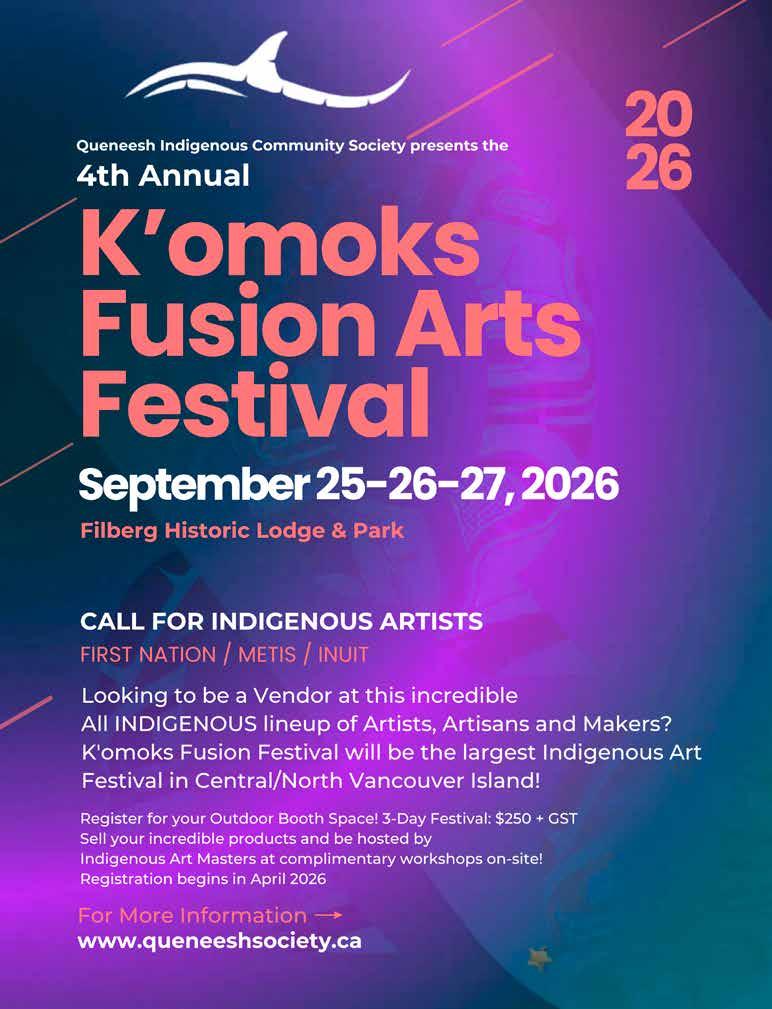
K'omoks Fusion Arts Fest 2026 is set to be hosted at the beautiful heritage grounds of Filberg Park & Lodge in K'omoks, BC. This 3-Day event will set precedence on Vancouver Island, hosting 100+ Indigenous Masters, Artists, Artisans and Makers on the weekend of September 25-26-27!
This will be the 4th Annual K'omoks Festival, which has now solidified as an anchor event for Queneesh Indigenous Community Society (QICS). It is a pivot for the umbrella organization whose focus is inclusive of the Indigenous citizens in the Comox Valley region and Vancouver Island as a whole.
The society's mandate for this festival is to raise the profile of Indigenous and First Nations-Metis-Inuit (FN/M/I) Artists, Artisans and Makers on Vancouver Island and support Indigenous Economic Development in the Arts Sector, as well as providing an open platform for knowledge-sharing for generational learning.
Through these three days, First Nation and Canadian Indigenous Artists, Artisans and Makers will be showcasing their works of traditional art, pop-fusion art and incredible musical performances! Traditional Indigenous Art workshops will be presented in the Masters’ Circle - cedar weaving, traditional medicines, traditional edibles, wool weaving, carving stylings, painting and more. Traditional foods, Hulq'umi'num', will be sampled and sold: salmon, bannock, berry jams, ooligan oil, bison meat, local seafood and other Indigenous food offerings.
Queneesh continues to accept applications for ALL First Nation/Metis/Inuit Artists, Artisans and Makers to apply to be a VENDOR in the largest Indigenous Artisan Festival on Central Vancouver Island! Outdoor booths will host up to 100 Indigenous Artists and Artisans – all featuring traditional First Nation and Pop-Fusion Art, Artisan pieces and Handmade items. Applications are available www.queneeshsociety.ca.
Kealy Donaldson
Bruce Alfred
Compass Magazine Vancouver Island’s Masters’ Circle
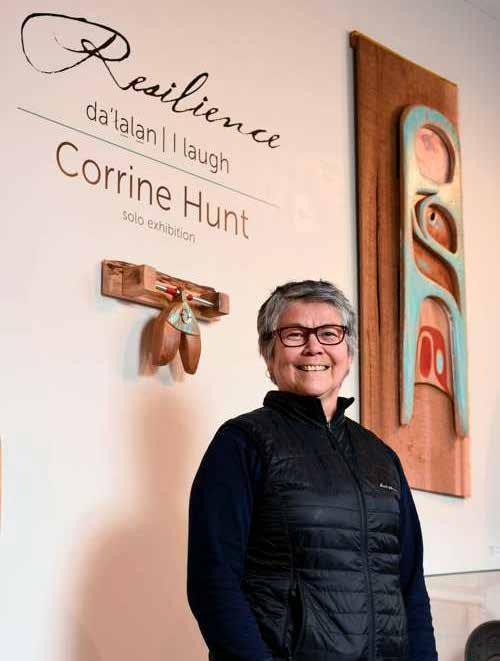
6+ Indigenous Masters for the 3 day event; the attending Masters will be working on current works (demonstrations) as well as vending their collectible pieces. Masters will also be facilitating workshops throughout the festival; there will be complimentary dedicated workshops for attending Vendors and added workshops available for public registration. The Compass Magazines' Masters includes Corrine Hunt – Issue 32 Spring 2021, Bruce Alfred – Issue 50 Spring 2024, along with (unconfirmed) Roy Henry Vickers – Issue 28 Fall 2020. These Master Artists represent some of the deepest cultural roots on Vancouver Island and the truly are at the top of their game in the Art Industry. They bring forward a level of authenticity that is unparalleled by outside talent. Read all about these incredible Master Artists at www.compassmagazine.ca in the back issue collective.
The Workshop Circle
These daily workshops will be presented to highlight traditional learning and share skilled knowledge of our West Coast First Nation's and Indigenous peoples. Multiple workshops are proposed through the 3-day festival timeline. Each Master Artist will be sharing their artistic niche and deliver skills-based lessons and the Hulq'umi'num Traditional Foods will also deliver local food security workshops.
The Festival Stage
An All Indigenous line-up of musical talent will adorn the Filberg Park throughout the weekend! Rumoured so far to be in the mix of musicians are The James Vickers Blues Band, Greg Wells and more. Six key musical performances will take place along with local First Nation's youth performing traditional dance, singing & drumming.
Hulq'umi'num', Coast Salish for Traditional Foods will also be highlighted on site, along with offerings of traditional Medicines and local edibles - A mix of samples and purchased items will be available, locally made and delicious! Traditional offerings are a key highlight that attendees will literally "eat up" with gaining knowledge and recipes.
FOR THE FULL FUSION ARTS FEST LINE UP, HEAD TO www.queneeshsociety.ca
Queneesh Indigenous Community Society looks forward to hosting the 4th Annual K’omoks Festival, now known as K’omoks Fusion Arts Fest. QICS invites you to the historic Filberg Lodge and Park property on September 25-26-27 this fall! The event will run rain or shine and is outdoors.
K’omoks Fusion Arts Fest | admission by donation For more info: Queneeshsociety.ca | FB @QueneeshSociety
queneeshsociety@gmail.com
James Vickers
Corrine Hunt
Shift Happens
AVOIDING BURNOUT THE AYURVEDA WAY: THRIVING IN PITTA SEASON
Jen Olsen
As we move into the warmth of summer, Ayurveda teaches us that we are entering Pitta season, the season of fire and oil.
The sun shines brighter, our schedules become fuller, social invitations increase.. many of us feel an undeniable surge of energy, motivation, ambition, and drive. This can feel incredible!!
But if we're not mindful, that same fire that fuels our vitality quickly becomes the fire that burns us out.
Pitta energy is hot, sharp, intense, focused, and transformative.
It's the energy that helps us achieve our goals, launch projects, travel, create, and take action.
But when this fire becomes excessive, it can manifest as irritability, frustration, inflammation, skin issues, digestive disturbances, impatience, exhaustion, and emotional overwhelm.
The key isn't to suppress the fire; the key is to tend it wisely.
Honour the Power of the Sun.. But Don't Forget the Moon
Summer naturally invites us into the masculine qualities of doing, achieving, producing, and moving.
The days are longer. The energy feels expansive. We want to say yes to everything... But nature always seeks balance.
While the sun is at its strongest, we must consciously cultivate the cooling, receptive, feminine qualities of the moon.
Can you still create space for rest? Can you still sit quietly with yourself? Can you still move slowly, even when life is asking you to move quickly?
Burnout often happens not because we're doing too much, but because we're never pausing long enough to receive.
Protect Your Sleep Like It's Sacred
One of the biggest mistakes people make during summer is sacrificing sleep.
Late sunsets, patios, social gatherings, travel, and busy schedules can easily tempt us into staying up later than usual.
But Ayurveda reminds us that true healing, hormone regulation, nervous system restoration, and emotional processing happen during deep rest.
Simple Ways to Cool Pitta This Summer
Aim for a consistent bedtime and begin winding down before 10 p.m. Limit screens and create evening rituals that feel nourishing — candlelight, herbal tea, a few pages of a book instead of scrolling.
When Pitta accumulates, we often crave the very things that aggravate it: more coffee, alcohol, spicy food, and stimulation. These habits may feel energizing but leave us depleted. Reduce caffeine, alcohol, fried foods, screen time, and over-scheduling. Ask yourself: What would help me cool down right now?
Summer is the perfect season for cooling foods like cucumbers, watermelon, berries, coconut, mint, fennel, and leafy greens. Herbs like chamomile, lemon balm, rose, and hibiscus are beautiful allies. Rose soothes emotional intensity and brings softness. A simple rose and mint tea on a warm afternoon can feel like medicine.
During Pitta season, water becomes deeply healing. Swim, sit beside a lake, or listen to rainfall. Even visualizing water in meditation softens an overheated nervous system. Water teaches us to flow rather than force.
Enjoy your Summer!
Jenny Olsen Mother. Daughter. Yogi. Priestess.
Stay Well
FINDING THE BEAUTY WITHIN (CANADA)
Dana Mahon
Celebrating Canada Day is typically associated with July 1st fireworks, celebrations, parades, festivals, waving flags from balconies, cars or wherever is highly visible, as a way to show patronage.
In other words, a one day event. While this can bring people and communities together, it can also be a bit anti-climactic, and leave behind a heavy carbon footprint at the same time.
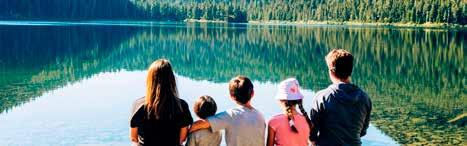
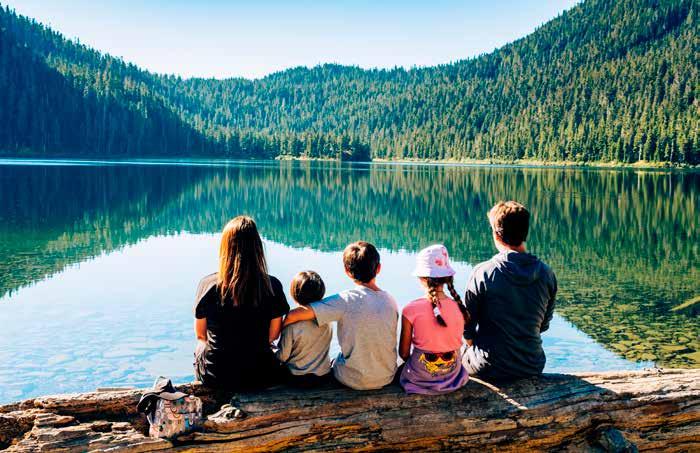
There are so many incredible spots where we can honour the beauty of our land, and contribute to our well being at the same time. Incredible trails, waterfalls, beaches, lakes and rivers, campsites, sea walks, botanical gardens, parks, and walk-on ferries to explore nearby islands are all wonderful opportunities to discover the beauty of our Island, all while breathing in fresh air, getting some vitamin D (and Sea), and moving our bodies.
Showing love for Canada can be expressed in various ways, including keeping her clean and healthy. How about beach
combing/cleaning, cleansing in her rivers or oceans while kids build sand castles, and, admiring her incredible land and sea life. We can use nature as a playground and an outdoor gym: logs make great pitstops for a few pushups; beaches are perfect for long or short walks; sea walks are accessible and safe for those who require walking aids or wheelchairs; cycling lanes and paths are abundant; rocks make great weights in a backpack for those wanting an extra challenge; the list goes on!
So when considering ways in which to love up on this country this summer, perhaps you’ll choose one of the many ways we can respect her sacred land and waters, and also pay respect to our physical, mental, spiritual and even financial well-being. Nature after all is FREE and the dividends are invaluable.
Pack some healthy snacks, head out with friends or family, or enjoy solo time, and send our country some love, appreciation and gratitude for being one that is as healthy as it is beautiful.