I count on the Social Security I earned. And I vote.
As prices for groceries, housing and health care soar, the Social Security millions of older Americans count on is more important than ever. It's money they earned after a lifetime of hard work, and AARP will never stop fighting to protect it.
Social Security is one of the most successful initiatives in America's history. But it faces a funding gap that Congress must fix in the next few years to keep Social Security strong. Join us to stand up for Social Security in the upcoming election.
Be a Social Security voter. aarp.org/SocialSecurityVoter
Celebrating 91 years of Social Security: a promise worth protecting
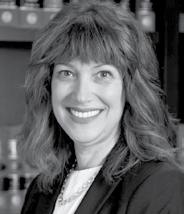
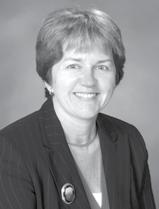
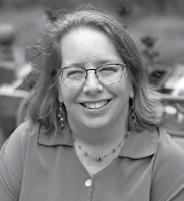
By Jennifer Benson, AArP MAssAchusetts stAte Director
As Social Security approaches its 91st birthday this August, it remains one of the most trusted and valued initiatives in American life. Since its creation in 1935, Social Security has provided a steady foundation of financial security for generations of older adults, helping millions live with dignity and independence.
Here in Massachusetts and across the country, Social Security is more than just a monthly check. It is peace of mind. It is the ability to pay the bills, stay in your home, and plan for the future with confidence.
Today, more than 70 million Americans rely on Social Security, and for many older adults, it represents a primary source of income. Over time, Social Security has grown and adapted to meet changing needs, but its core promise has remained the same: workers pay into the system throughout their careers, and in return, they earn reliable support they can count on in retirement.
In June, The Social Security Trustees Report offered a snapshot of where things stand and where Social Security is headed. The good news is that Social Security continues to fully pay recipients and is expected to do so for years to come.
However, the report also points to challenges ahead. The trust fund that helps pay retirement benefits is projected to have enough money to pay full benefits until 2032. If Congress does not act before then, Social Security would still collect payroll taxes and continue paying benefits, but those payments could be reduced. Looking at Social Security as a whole, including retirement and disability benefits, the program is projected to pay full benefits until 2034. After that, ongoing income would cover about 83 percent of scheduled benefits.
These projections are driven by long-term trends: people are living longer, fewer workers are contributing relative to retirees, and the program’s costs are rising as America ages.
Still, it is important to remember what these numbers do and do not mean. Social Security is not going away. Even in the future scenarios outlined in the report, the program would continue to provide benefits funded by ongoing payroll contributions.
For AARP and millions of older Americans, the message is clear. The latest report is a call to action, not a cause for alarm. AARP has been firm in its position that Social Security should be strengthened, not cut. Americans have earned their benefits over a lifetime of work, and no family should see those earned benefits reduced.
AARP continues to advocate for bipartisan solutions that protect the program’s future without reducing payments or putting retirement security at risk. The goal is simple: ensure that Social Security remains strong for today’s retirees and for future generations.
As we celebrate 91 years of Social Security, it’s a moment to reflect on its impact and its promise. From Boston to the Berkshires, it has helped generations of residents stay financially secure and connected to their communities.
The path forward will require thoughtful leadership and action. But one thing remains constant: Social Security is a promise that matters, and it is worth protecting.
Jennifer Benson
‘It’s a magical place’: Two men worked for over 20 years to create Shrewsbury’s favorite garden
B y e vA n W A lsh
c ontri B uting W riter
SHREWSBURY — Twenty-three years ago, Shrewsbury’s Garden of Sweet Remembrance was a memory itself. Maybe less than a memory – a wreck. Once part of a sprawling estate, the garden was an afterthought, a remnant from a bygone era.
Wisteria vines made the historic garden impassable.
“This entire area, all of it – it looked as though God had spilled a gigantic bowl of brown spaghetti on it. The trees were draped with vines. It enveloped everything. Trees died. You couldn’t move. It was chaos,” said Christopher Kirk.
But starting in 2003, Kirk and longtime friend Bill Davis began working to turn the piece of forgotten earth into something. After decades of effort from Kirk and Davis, the Garden of Sweet Remembrance has re-emerged from its unsightly past, becoming one of the most beautiful outdoor spots in Shrewsbury.
The history of the garden goes back a century. In 1912, Matthew Whittall purchased over 100 acres of land on Meetinghouse Hill and constructed Juniper Hall, an elaborate mansion. In 1922, vice-president Calvin Coolidge visited the landmark property.
Gardening was one of the Whittall family’s favorite pastimes, and the public was invited to the estate for “Lilac Weekend.” The property’s gardens were elegant, with a reflecting pool and pergola, and a selection of flowers said to be among the best in Worcester County. Upon Whittall’s death in 1922, the area was dedicated as the “The Garden of Sweet Remembrance.”
Over the next 75 years, the property changed hands. In 1927, Juniper Hall was deeded to the Grand Lodge of the Masons of Massachusetts, becoming a retirement home. The town ultimately purchased the property in 1976, and the structure was razed.
Left without maintenance for years, manicured gardens turned into a jungle of weeds. When Kirk and Davis arrived – alongside other members of the Friends of Prospect Park – the unmitigated vegetal growth seemed almost too much to overcome.
A botanist was quoted as saying it “was like walking through the bowels of the Titanic.”
“If you’ve ever seen National Geographic’s pictures of the Mayan temple in the Yucatan Peninsula jun-
gle – that’s what it looked like,” said Kirk. “Giant vines all over the place. The reflecting pool was so covered in vines that you could actually walk across it.”
The vines reached up to 5 inches in diameter, said Davis. The patchwork of wisteria grew like spiderwebs – dozens of vines needed to be uprooted before any progress could be made. Weeds sometimes grew 6 feet into the air.
“It was junk. Just junk,” said Davis.
And yet, there seemed to be progress. In the four years following 2004, when the group’s efforts started, Davis and Kirk poured 30 hours per week into rehabilitating the garden. Davis estimates he chopped over 150 cords of wood.
But progress wasn’t linear. In 2008, “everything went south,” said Davis. A blizzard uprooted trees, erasing years of work. Trails that were blazed were lost. The Town Manager at the time said he’d “never seen such destruction in Shrewsbury.”
After yet another setback, Davis and Kirk were the only ones left willing to continue to work on the park. “People became so discouraged. We’d do so much work, and the vandals would tear it up or the town would plow it under. That was sad,” said Davis.
Led by gardener Brenda Goodwill, a renewed effort to restore the park started, bringing over 1,000 fresh plants to the space. This time, the renovations had sticking power, and in 2024, “Art in Prospect Park” marked the first public event held at the reclaimed space.
In 2026, the event is returning for
The old remains of the Pergola at Prospect Park in Shrewsbury still stands where gardens once sprawled out before the old Juniper Hall estate in Shrewsbury.
(Photos/Evan Walsh)
its third year. Thanks to over 20 years of hard work, the space is colorful, lively, and serene – a spot where people actually want to be. And, much to Davis and Kirk’s credit, there are no vines causing a disturbance.
“Gradually, enough people saw this as a beautiful place. It’s a magical place. It’s a serene place. I mean, here we are between I-290 and Route 140, and you can hardly hear a car. You hear the birds and you see all sorts of wildlife,” said Davis.
Added Kirk: “I could see what would happen if we stopped – all the brush would come back, all the weeds would come back. I didn’t know what would happen, but as long as I’m alive – as long as I can do it – I want to keep it open.”
The old remains of the Pergola at Prospect Park in Shrewsbury still stands where gardens once sprawled out before the old Juniper Hall estate in Shrewsbury. New plans to revamp this space for use as a cemetery, look long term, towards a future where
This year’s Art In Prospect Park will be held in Shrewsbury on September 13 from 11 a.m. to 3 p.m. The event will feature local art, crafts, young artists, kindness rock painting, and park history. There is plenty of on-site parking.
these old columns will be even more historic.
Kirk recently made another stop at the Garden of Sweet Remembrance. While there, he noticed a young family with blankets sprawled across the grass. They were having a picnic in the area, commenting on the flowers and wildlife.
“That’s what we’ve been doing it for. It’s finally turning it into what we anticipated,” he said.
Added Davis: “That’s the paycheck we got.”
The Legends and Lore of the IVY LEAGUE.
In Lions, Tigers, and Bulldogs, writer and educator Matt Robinson explores the myths and meaning of the Ivy League’s storied schools and looks at how they shaped American education and society.
Available now at bookstores and online at www.lionstigersbulldogs.com
It’s a
Before rankings and headlines, there were raucous rivalries, secret societies, and time-honored traditions.
From the first American corporation and university and the inspirations for everything from MGM to the A-Bomb, this lively collection brings the Ivy League’s unforgettable stories to life.
great gift for the applicant or alumnus and everyone in between!
Bill Davis and Christopher Kirk have worked on the Garden of Sweet Remembrance for over 20 years, turning it into one of the most beautiful outdoor spots in Shrewsbury.
Persistence pays off Writer Lorraine Smith overcame multiple obstacles
By MAtt roBinson contriButing Writer
CAMBRIDGE — Many people spend their entire lives gathering stories but never take the time to share them. Others want to, but due to medical problems or other issues, do not get the chance. Still others claim they are “too old” or that “nobody will care” about the stories they have to tell.
Fortunately, Lorraine Smith was not one of those types of people. Despite a life-threatening health issue that arose at the same time, Smith published her debut novel in 2019 and has seen its popularity rise ever since.
South Carolina native Born and raised in South Carolina, the 65-year-old Smith came to Cambridge after college.
“My father’s side of the family is from Cambridge,” she explained. “In 1985 my grandmother suggested that I move to Boston and if I didn’t like it, I could always move back home to SC.”
Though her mother was frankly not thrilled with the idea of Smith
moving so far away, Smith took her grandmother’s wise advice to heart and figured that she had nothing to lose.
Her mother saw it differently, however.
“She said that I would return home in a week,” Smith recalled, laughing.
Though she admits that her first New England winter was challenging (as was the exorbitant cost of living),
Smith also reasoned that, “if my mother did not say anything, I probably would have been on the first plane back to South Carolina!” Perhaps encouraged by her mother’s discouragement, Smith stuck it out and has been a proud Cantabridgian ever since.
Career in communications
Once she decided to stay, Smith found work as a creative administrator with WHDH-TV in Boston and later a com-
munications specialist with an engineering consulting firm in Boston. While writing is a part of Smith’s daily life, it was a passion long before it be-
came her profession.
“I first fell in love with writing and words around the age of nine or ten,” she recalled, noting that it
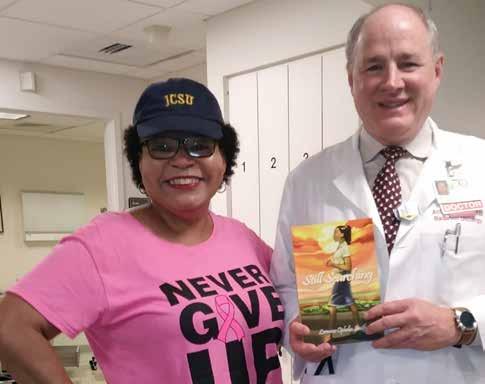
Lorraine Smith’s journey to the publication of her first novel also included a battle with breast cancer.
Author Lorraine Smith is now at work on her second novel, which is set in Boston and Cambridge.
was a middle school teacher who first “recognized my creative writing talent and encouraged me to continue writing.”
When asked who else inspired her writing habit, Smith cites such literary legends as Nikki Giovanni, Eric Jerome Dickey, Omar Tyree, Terry McMillan, Maya Angelou, Lorraine Hansberry, Ann Leary and Alice Hoffman.
While most of her writing was in the business world, Smith always had stories percolating in her head and wrote many of them down. The earliest version of her award-winning debut novel, “Still Searching,” was drafted in the 1990s.
Inspired by life experiences “I came up with the idea of my novel ‘Still Searching’ after I ended a relationship and found myself as a new single mother,” she explained. “Instead of eating pints of ice cream and being depressed, I took pen to paper…and began writing this story, which just poured out of me nonstop.”
When asked for a synopsis, Smith replied, “’Still Searching’… [involves] the emotional journey of Brenda Peekson – a young woman growing up in the segregated South, struggling to find her place in a world filled with limitations, expectations, and painful betrayals. From navigating a strict household and societal norms to experiencing first love, heartbreak, and a shocking revelation that shatters her trust, Brenda’s story is one of self-discovery, strength, and the fight to reclaim her worth.”
When she had the first version of the manuscript completed, Smith sent a draft to 60 different publishers.
“At the time you could not push a button on a laptop to send your manuscript to several publishers,” she noted. “Instead, I printed 60 copies and mailed them…just knowing that at least 50 publishers would respond with mega-book and possibly movie deals.”
Unfortunately, Smith learned the lesson that many first-time (and even more established)_ authors do – rejection is part of the process.
“The joke was on me,” she laughed, “because I was rejected by all 60 publishers!”
Persisting after many rejections Figuring that it was not her time and eager to focus on other matters (including her son), Smith did what many authors do and put her manuscript away in a drawer. Years later, that drawer would reopen and, in so doing, it would open a new opportunity for her.
“Years later,” Smith recalled, “I was at work and needed something in a cabinet at my desk. As I opened
it, there was a copy of the manuscript…with an inch of dust on it.”
Though she did not take the manuscript out at the time, Smith began to hear an inner voice pushing her back to the drawer.
“That voice said, ‘Lorraine –pull the manuscript out, dust it off, and try again!’”
And while she was able to ignore the voice for months, it eventually persuaded her.
“In 2017, I took it out and did some more editing,” she explained. “This time, I sent the manuscript to 30 publishers by way of the computer. A month or so later I received interest from several publishers who wanted to publish my book.”
Health challenges
Unfortunately, personal matters again threatened to get in the way when, just weeks after inking her book deal in 2019, Smith was diagnosed with breast cancer.
“My publishing company was wonderful,” she beamed. “[They] worked with me as we edited the book while I went through surgeries, chemo, radiation, and many appointments.”
Eventually, Smith became not only a first-time published author but a breast cancer survivor too.
Again, however, the path to fame was not to be smooth for Smith.
“The book was doing well,” she recalled, “and then Covid-19 happened and the world stopped.”
Once the pandemic had passed, Smith’s publisher recommended republishing the book.
“That was a great idea,” she maintained, “because the book took off and began reaching larger audiences!”
Looking ahead
Inspired by her long-awaited and hardwon success, Smith has already begun working on a second book, which is actually set in Boston and Cambridge.
“This book is about two best friends who met at work from two different worlds,” she explained. “One is married, and the other is divorced, and they both have one son.”
Though she will not say where she gets ideas for her characters, Smith admits that her writing involves “more than fiction.”
“It is a mirror. It is a voice. It is the story of every woman who has dared to question where she truly belongs,” she suggested.
As for what lessons she has learned from her writing process and what lessons she hopes to impart to her readers, Smith emphasized that, “a pause in life is not a period” and urges readers (and everyone) to “follow your passion and never give up!”
“She Works Hard for the Money” was an anthem for working-class women
By shAron oliver contriButing Writer
BOSTON — Disco legend and Boston native Donna Summer’s1983 hit single “She Works Hard for the Money” served as a pressing reminder to all working-class women (and men) who punched in at a time clock. It was a chance meeting with a Los Angeles restroom attendant that inspired the song.
West Hollywood restaurant
During an appearance on the television show “You Write the Songs,” the singer described a scene wherein she and her manager Susan Muneo entered the ladies room at West Hollywood’s posh Chasen’s restaurant and encountered a woman named Onetta Johnson who unwittingly stirred up an idea for a song.
According to Summer, “We peeked around the corner, and there was a little lady sitting there with her head tilted to the side, and she was just gone – she was asleep […] I looked at her, and my heart just filled up with compassion for this lady, and I thought to myself, ‘God, she works hard for the money, cooped up in this stinky little room all night.’”
In terms of societal issues such as workers feeling underappreciated and underpaid, the song still resonates as it did back then, maybe even more so. The line “just tips for pay” draws attention to the challenges that come with low-wage earnings, where some often rely on tips to help make ends meet. The song quickly became a huge hit, reaching No. 3 on the Billboard Hot 100 and solidified Summer’s reputation as a strong voice for female empowerment.
The single is a tribute to Johnson, a restroom attendant who was taking a nursing exam, worked two jobs and was pulling a double shift to make ends meet. Not only does the opening line of the song, “Onetta there in
the corner stand,” pays homage to Johnson but she also appears on the back of the album cover alongside Summer. Nothing glamourous. No designer clothing. Just two women dressed in a waitress uniform, side by side, saying her work matters.
Remembering ‘ordinary people’ In her autobiography “Ordinary Girl,” the singer and accomplished painter spoke about being depressed as a child and seeing a therapist when she was a teenager, something that was uncommon at the time, particularly for African Americans. Nevertheless, once she reached stardom, she never forgot the so-called ordinary people. Summer’s life experience allowed her to see Johnson
for who she was, at least in part, a hard-working woman who was dedicated to advancing her education in hopes of getting a better job.
Summer told a reporter, “I had such a feeling of love and compassion for this woman. I really appreciated her role in society and began to think of other people with similar roles who do odds and ends, like waitresses, hat-check girls and mothers without husbands who keep society where it should be but don’t get credit.”
“She Works Hard for The Money” was nominated for Best Female Pop Vocal Performance at the 1984 Grammys, where Summer opened the show with a live performance of the song. The Brian Grant-directed music
video which showed women working jobs from cleaners to waitresses and taking on domestic labor at home was also a hit and was the first by a Black female artist to be placed into heavy rotation on MTV.
Fast forward to 2026. Hourly wages have not skyrocketed for many, and tips still do not cover the cost of healthcare, car loans, insurance, electricity, rent, mortgage, etc., in most cities. As a reminder and lesson from the song’s humbling lyrics, perhaps those on the receiving end of those working hard in customer service type jobs for low pay can learn a little something or take time to be a little more gracious. As the late disco queen commanded long ago, we’d better treat them right.
PAID RESEARCH STUDY AT HARVARD
The Cognitive Neuroscience Lab at Harvard University is seeking participants for a brain health study involving MRI scans, behavioral tasks on paper and on a mobile device, activity monitoring on a watch, and a short blood draw. The study will include 1-2 visits every 3-6 months, spread out over the course of 2 years and scheduled at your convenience.
In order to take part, you must:
• Be between the ages of 55 and 85
• Be able to comfortably lie flat on your back for 30-45 minutes
• Have no serious health conditions
You will receive $100 for each scan session, $50 for each hour of behavioral testing, $15 a week for wearing a watch, $50 for a blood draw, and have the opportunity for bonus payments for completing the brain games. Altogether, you can receive up to $1955 if you complete the entire study. Travel costs can be reimbursed.
If interested, please contact Abbey Russell by calling (617) 496-7039 or emailing cnlsubject@wjh.harvard.edu
Disco legend and Boston native Donna Summer’s1983 hit single “She Works Hard for the Money” was inspired by meeting a ladies room attendant in a Los Angeles restaurant. (Photo/Wikimedia Commons)
Massachusetts had its own television game shows
By shAron oliver contriButing Writer
REGION — In 1971, the Massachusetts legislature passed a bill introducing the state’s first lottery, beginning its sales with a game called “The Game” and its first drawing held in 1972 at Faneuil Hall where seven people won $50,000.
Lottery game shows
In the spring of 1975, “The Game” was changed to “The Big Money Game” and by the fall, a weekly half hour show of the same name made its debut. It was hosted by former WEEI personality Tom Russell. “The Big Money Game” show offered a top prize of $500,000 and lasted for 10 years. In 1995, the Lottery introduced another show called “Bonus Bonanza,” which aired until March 1998.
Despite its name, some took issue with “The Big Money Game” being called a game show. The program’s producer Adam Villone explained, “A game has three elements, but our program has only one of those – chance. The players need no special skills or intelligence to win.” Locals who won large cash prizes may have begged to differ.
Several people shared memories of the show on Facebook.
Diane Rae Donato wrote:
“My grandmother won $10k on a lottery tv show in 77 or 78... it must have been this one? It was some type of match game if I remember correctly?! Me and my brother and mother were on TV with her after she won! I’d also love to find the episode!!!”
Andy Leclerc added:
“I KNEW this show existed! I remember models wearing gowns with the letters in the word “MONEY” embroidered in the bodices and would descend a staircase a
certain number of steps at random, with the first one reaching the bottom won cash for her backing rooting section. And, yes, the original theme did have lyrics. Now onto my quest to prove the existence of WNAC Channel 7’s RACE TO RICHES...”
Robyn Hatch recalled:
“My uncle Tommy McDonough was on the show and my mother, and my aunt Barbara were in the audience, and you could hear their loud voices screaming in excitement great memory.”
“Bonus Bonanza’s” format was similar to “The Price is Right.” Contestants wore name tags and whoever’s face was spotlighted when the spinning wheel stopped got to play a mini game with the chance to play the bonus game for a possible $200,000.
Other game show connections
Aside from locally produced and televised “game shows,” the Bay State is or was home to some prominent hosts and announcers for quite a few nationally televised game shows. Quincy native Eugene “Gene” Wood not only hosted “Anything You Can Do” (1971-1972) and “Beat the Clock” (1972-1974), but he was also the announcer for popular game shows like “Card Sharks,” “Password,” “The Price is Right,” and the original version of
“Family Feud.” Gene Wood died of lung cancer in Boston in 2004.
Widely known for hosting MTV’s “Remote Control” (19871990), actor and comedian Ken Ober was born in Brookline and worked as a substitute teacher in Boston while studying at the University of Massachusetts Amherst. He caught his big break after appearing on “Star Search” in 1984. “Remote Control” involved three contestants sitting in lounge chairs, selecting one of nine channels on a big-screen television. Each channel represented a subject having to do with pop culture.
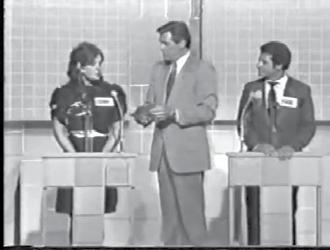
[LEFT] “Bonus Bonanza” was another Massachusetts State Lottery television game show in the 1990s.
[RIGHT] “The Big Money Game” was a popular Massachusetts State Lottery television game show in the 1970s and 1980s.
The show also helped launch the career of Worcester native Denis Leary who appeared in sketches playing various characters. In his pursuit of an acting career, Ober appeared in sitcoms like “Parenthood,” “Who’s the Boss,” and “The Fresh Prince of Bel-Air.” Ken Ober died in 2009 of natural causes at age 52.
Hailing from Pittsfield is actress Elizabeth Banks who is known for starring in the “Pitch Perfect” film series as well as “The Hunger Games” film series. She has been the host of the “Press Your Luck” game show since 2019.
Centuries-old Boston vs. New York City rivalry was not just about sports
By shAron oliver contriButing Writer
BOSTON — What is basically a tale of two cities, began long before the Boston Red Sox played against the New York Yankees, the Bruins skated past the Rangers or the Giants dared to intercept a Patriot’s pass. For some, the rivalry has been so longstanding that they don’t even know why they must display loyalty to such animosity. The so-called bad blood actually stretches back to the days of colonial New England when the two forming empires fought over regions, with the Bay State losing a large portion of land to the Empire State. However, Boston became the leading city for resistance to British rule during the American Revolution.
Centuries-old rift
While New England militiamen saw “Yorkers” of New Amsterdam (now New York City) as blasphemous drunks, their rivals viewed them as Puritans who were too intolerant and prudish to even celebrate Christmas in the 1600s. Since then, the two metropolises have battled over food, industry, literature, politics, sports and even accents. In fact, the first ever photograph of someone giving the middle
finger is seen in a 1886 team picture of the Boston Beaneaters, wherein pitcher Charles “Old Hoss” Radbourn was captured flipping the New York Giants the bird.
The differences between the two new neighboring cities were vast. Puritans held their heads high in moral superiority, allergic to mirth. Citizens of New Amsterdam were more secular and fostered a policy of religious freedoms. By 1644, Massachusetts had created a powerful alliance with other colonies. Eventually Boston and New York City became competing port cities. But only one city had access to a river inland with the opening of the Erie Canal in 1825 and suddenly New York was the gateway into an expanding American west. The canal siphoned much of Boston’s jobs and
income, one ship at a time.
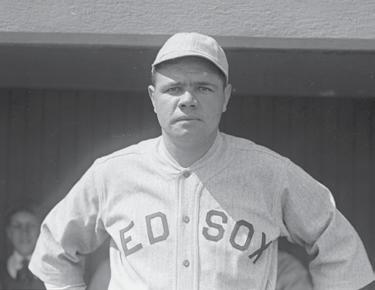
While many believe the Boston vs. New York City rivalry was instigated by the 1919 trade of Red Sox superstar Babe Ruth to the Yankees, the rift between the two cities goes back to colonial America. (Photo/Wikimedia Commons/Library of Congress)
Bostonians were not happy. The founder of Boston’s first daily newspaper saw a diversion of goods to New York as “evil” and suggested his hometown jump on a new transportation idea – the steam-powered railroad. A few years later, train tracks were laid along the old Boston Post Road in an effort to connect Boston to the waters of the Hudson River. Author Eric Jaffe wrote: “… the goal of everyone involved in Boston’s railroad system at the time was clear: to move Manhattan toward the [Massachusetts] Bay along the highways of the future.”
Curse of the Bambino
By 1860, New York City was the largest city in America, thanks in large part
to the immigration boom. The city of Boston favored colonial-era architecture while New York City focused on skyscrapers. Nevertheless, hardy Bostonians stood firm in regional pride on their own greatness in achievements as the bitter rivalries continued. In fact, one actually escalated into one of the most iconic rivalries in U.S. history. The Yankees vs. the Red Sox.
The 1919 trade of Red Sox superstar Babe Ruth to the Yankees launched one of the greatest dynasties in sports history. It also prompted and popularized the phrase “The Rivalry” and a superstition known as the “Curse of the Bambino,” which is attributed to Boston’s 86-year World Series drought that began after Ruth switched uniforms. The Yankees have often been portrayed as the dominant team who ruled the diamond, whereas the Red Sox had to face a long-standing reputation for being an underdog. Since the days of Babe Ruth’s trade to the Yankees and that decades-old losing drought, the Red Sox have gone on to win several World Series championships. Boston arguably remains an educational, cultural, artistic, and economic power in the United States with its elite schools, museums and businesses.
May the road rise up to meet you.
May the wind be always at your back.
May the sun shine warm upon your face.
May the rains fall soft upon your fields, and until we meet again, may God hold you in the palm of his hand.
Now Accepting Applications
Sponsored by Chief Joseph Robert J. Terkanian, P.O. Box 808
‘The glue holding the community together’ This Hudson heroine helps those dealing with food insecurity
By lAney hAlsey contriButing Writer
HUDSON — Dr. Patricia Kelly Luoto is at the heart of many of Hudson’s volunteer initiatives.
For over 20 years, Luoto has served with the Hudson Community Food Pantry, providing expertise from over three decades working in nutrition.
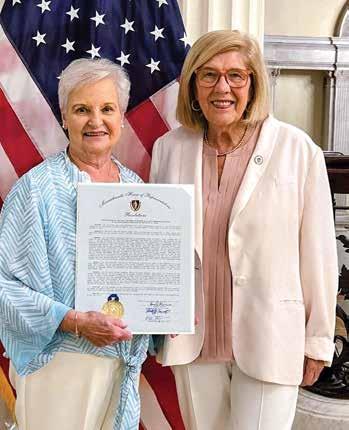
To commend Luoto for her years of dedicated service to the community, State Representative Kate Hogan nominated her for the Commonwealth Heroine Award. The recognition, presented by the Massachusetts Commission on the Status of Women, seeks to honor women for their contributions across Massachusetts, even if they don’t often get the limelight.
“Dr. Pat Luoto is treasured by the Hudson community for her efforts to make Hudson a better place and to make a difference in the lives of her Hudson neighbors,” Hogan wrote to the Community Advocate.
Hogan specifically highlighted Luoto’s work in making the Hudson
Community Food Pantry, which also serves the towns of Berlin and Bolton, as “efficient and effective as possible.”
Luoto was “humbled” by the recognition, and made a point to recognize the other volunteers who have worked alongside her. For her, volunteerism is a natural part of her life. The impulse to help others goes back to her upbringing, she said, when she made herself available to help others at church, school, and within her local community.
“I was taught to follow the Golden Rule: ‘Do unto others as others do unto you.’ It’s just kind of what I learned to do growing up,” Luoto said.
After moving to Hudson in the 1970s, Luoto and her husband, George, fell in love with the town and decided that it was where they wanted to stay.
“We raised our family here, we got to know people,” Luoto said. “We enjoyed the fact that it was diverse and especially enjoyed seeing its transformation over the years.”
Part of Hudson’s transformation has included evolving from a traditional “mill town” into a revitalized and growing community. That shift
includes a greater need for food assistance.
Luoto is a professor emeritus at Framingham State University, focusing on food and nutrition. The former director of the John Stalker Institute, Luoto also worked as a dietitian and has a background in food safety.
“I love food. It’s who I am. It’s my career,” Luoto said. “I have a real special place in my heart for anybody who has food insecurity.”
Since 2019, food insecurity levels in Massachusetts have jumped from 19 to 40 percent – a sta-
Affordable Living at its Best
accepting
62 years of age and are
State Representative Kate Hogan, right, nominated Dr. Patricia Kelly Luoto for the Commonwealth Heroine Award for her work with the Hudson Community Food Pantry.
tistic that only adds to the importance of Luoto’s work. As a director with the Hudson Community Food Pantry, she helps coordinate with the Greater Boston Food Bank.
“I hope that I have been able to provide the pantry with an understanding of food insecurity at the state level and how it impacts us at the individual community level,” Luoto said.
She attributes much of the pantry’s success to the volunteers who unload 5,000-pound food shipments, label and place all of the items, ensure food and safety standards, and much more.
“I think there’s so many benefits that art and culture can provide to a community,” Luoto said. “It gives us the opportunity to gather together as a community in the same place and to experience the music or theater that’s being provided.”
After decades of volunteering, Luoto believes the Commonwealth Heroine Award recognizes something much greater than an individual achievement.
I was taught to follow the Golden Rule: ‘Do unto others as others do unto you.’
~ Dr. Patricia Kelly Luoto
“Their volunteerism is extraordinary,” Luoto said. “These are people who are there every single Tuesday and Saturday morning. I mean, they really consider this to be their mission, to provide for the clients that come into the food pantry.”
Luoto previously served as chair of the Hudson Cultural Council. She now serves as secretary of the Hudson Cultural Alliance.
“The Commission on the Status of Women says that … it’s women who are the glue holding the community together,” Luoto said. “There were 147 recipients of the Commonwealth Heroine Award, but there could have been double or triple that amount.”
For others looking to give back in their own communities, Luoto encourages people to simply take a look around.
“I think you can volunteer with the people that you know,” Luoto said. “Everybody knows somebody who is in need of a meal, telephone call, or a visit.”
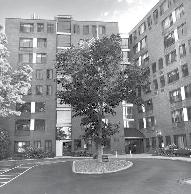
Newly Remodeled Apartments with a contemporary flair
Within the building amenities include:
• A Theater-like media center
• Handicap-accessible lounges on every floor
• Library equipped with two computers and free internet access
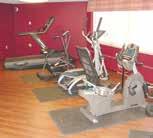
• Physical fitness center
• Game room with billiard table
• Community room with bingo board and large screen TV
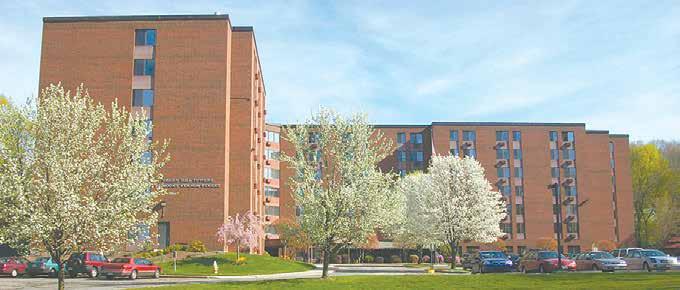
Green Hill Towers
27 Mount Vernon Street, Worcester, MA • O ffice O pen D aily 8:00 am - 4:30 pm
To receive an application please call 508-755-6062 TDD# 508-755-0228
Now accepting applications for 62 years of age and older and those who are under 62 years of age and are permanently disabled.
Applicants must meet HUD annual low income guidelines. Preference is given to individuals 62 and older.
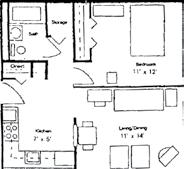
• Contemporary styled 1 & 2 bedroom apartments
• New kitchens with built-in microwaves and granite-like countertops
• Small pets welcome
• Heat and Hot water included
• Bus route / ample parking
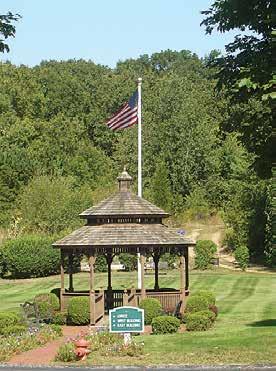
• Beautiful landscaped grounds with gazebo
WESTBOROUGH — Jon Cohen found a word to meet the moment: “verklempt.” The Yiddish word means to be so overcome with emotion that you are speechless. Cohen spent much of the afternoon on the verge of tears, he admitted.
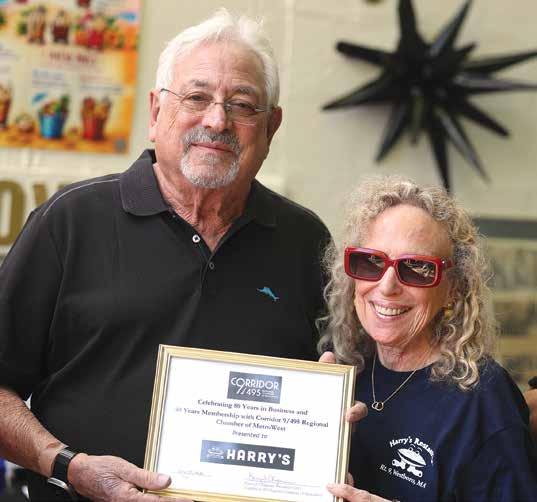
But who could blame him? On June 27, Cohen celebrated a momentous occasion in the company of friends, employees, and patrons – though everyone felt like family. His business, Harry’s Restaurant, celebrated its 80th anniversary.
“It’s a family place. It’s a garden-variety, family, mom-andpop business with the warmth of a mom-and-pop business. We know people by name, we know what they eat. That’s what it is,” Cohen told the Fifty Plus Advocate. “I’m overwhelmed. Tears in my eyes. If my father could only see it.”
Harry Cohen, the man who opened Harry’s in 1946, was surely watching from above. After years of brushing walls with paint for a living, he switched careers and opted to brush bread with mustard, opening Harry’s Famous Hot Pastrami
near White City in Shrewsbury. In 1969, the restaurant moved to its current digs along Route 9 in Westborough, shifting to “Harry’s Restaurant and Dairy Bar.”
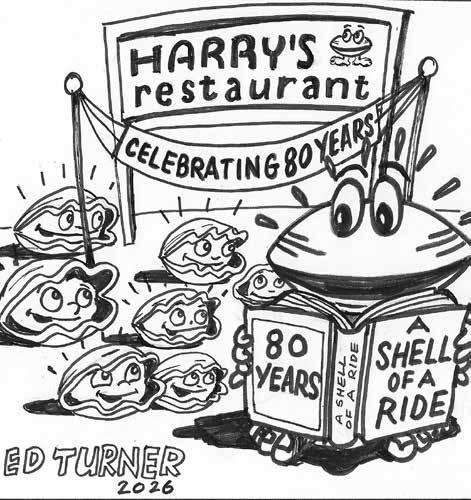
Jon Cohen took the reins in 1985, though it’s managed independently by Jeanine Sander and Suzanne Ryan. The spot maintains its broad appeal – offering seafood, burgers, milkshakes, soups, and salads – and its kitschy decor, with cartoon mollusks and drawings of anthropomorphic menu items hung around the restaurant.
Over decades, locals have come for the onion rings and stayed for the community feel.
“It’s a gathering place for all ages, it’s a community with wonderful employees and wonderful patrons who love the food and want to be here. We want to see you be successful for many, many, many years to come. It’s so popu -
“Home Cooked Meals,”
Jon Cohen, owner of Harry’s Restaurant in Westborough, celebrates its 80th anniversary with his staff.
A new cartoon at Harry’s Restaurant in Westborough commemorates its 80th anniversary.
lar that celebrities stop here,” said Karen Chapman, the CEO of the Corridor 9/495 Regional Chamber of MetroWest. “We love Harry’s. The community loves Harry’s.”
For Select Board member Mark Silverberg – and many like-minded Central Massachusetts residents –Harry’s is more than a restaurant. It’s home.
“If you stayed with pastrami, you would’ve had me. … “If they just stuck to fried clams, I would’ve been here too,” Silverberg joked. “When my kids were younger and my wife used to work late, I used to always come down here and I would order the shepherd’s pie. I’d order it because it reminded me of my grandmother’s shepherd’s pie.”
“For so many of us, coming to Harry’s is like coming home,”
he said.
State Representative Kate Donaghue, State Representative Hannah Kane, and a number of other well-wishers attended the 80th celebration, which featured a ribbon-cutting and a sample of Harry’s menu afterward.
Sander and Ryan thanked everyone for their support.
“We want to thank our customers, friends, neighbors, and community members. Your support over the years has meant everything to us. Many of you have been coming here for generations, celebrating birthdays, anniversaries, graduations, family gatherings, and plenty of other moments. Your loyalty and friendship have made Harry’s more than a restaurant,” they said in a statement.
A rose by any other name
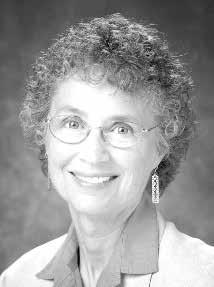
By MAriAnne lyons Delorey, Ph.D.
“The
truth is, job titles are temporary. But purpose is infinite.”
— Elaine Welteroth
I have always been intrigued by a famous story about President Kennedy when he went to visit NASA. He started talking to the people who worked there and at one point, he stopped someone with a broom and he asked him, “And tell me sir, what do you do here?” The janitor replied with pride in his voice, “Why Mr. President, I’m helping to put a man on the moon!”
I may never know how accurate this story is, but it has left me with very conflicting feelings. On the one hand, I feel a great sense of joy and justice that the worker identified with the mission of the agency. On the other hand, why is this such a surprise to people? Of course he finds meaning in his work. How classist to think otherwise! But, then again, I was raised by a firefighter – the hero of the blue collar workers. Someone whose job gives ultimate meaning but who (like a lot of hands on-workers) dedicates their body to the profession until it cannot give anymore.
Eldercare is much like many other undervalued, hands-on work – the work is physically demanding and the toll on the body is intense. Depending on the clientele, there can also be a strong emotional connection or an emotional hardship every day as well.
Our eldercare workers are the backbone of our industry and yet when we think of people who are mission-driven, that is not what comes to our minds. While I am not a direct care worker I do work in eldercare. That is how I define myself at my core. When I meet someone new and they ask me what I do for work, depending on the situation, I may say any number of different things:
• Property Manager
• Elder Housing Specialist
• CEO
• Nonprofit Administration
• I take care of older people
Recently, I was at a party, and I spent some time with someone talking more in depth about what I do. Later that day, she overheard me giving the simplified version to someone else: “I take care of older people.” She ran over (thinking I was being modest) and said, “That’s not all, she is the executive director of a nonprofit affordable housing organization!”
I corrected myself and although I got away with looking humble, I thought a lot about why I said what I did. I decided it was:
• Simpler, depending on the situation
• Humbler
• But also connected me to the mission of WHY I do what I do. And I think this is the core of what I meant. I think humans inherently want to find value in their work. This is as true for janitors as it is for CEOs. I also think the language we use helps identify our values. Consider these job titles and their corresponding value statements:
I am a carpenter: I create homes
I am a computer technician: I keep people safe from cyber attacks
I am a mechanic: I diagnose car trouble and keep people safe
I am a receptionist: I make people feel welcome
I am a server: I make sure our customers get the nutrition they need to stay healthy
Perhaps we as a society need to shift away from one- and two-word job titles to the impact we are making. Perhaps then our eldercare workers will get the praise they deserve.
Marianne Delorey, Ph.D., is the executive director of Colony Retirement Homes. She can be reached at 508-755-0444 or mdelorey@colonyretirement.com and www.colonyretirementhomes.com. Archives of articles from previous issues can be read at www.fiftyplusadvocate.com.
On getting older
By JAnice linDsAy contriButing Writer
Ihesitateto tell you this, but we are all getting old, though each of us started in a different place. Some of us started at a rather more impressive distance from the onset of the new millennium.
When I was a child, I had several relatives in their 80s and 90s, and they seemed to be having a pretty good time. I remember my great-grandfather George playing lively tunes on his fiddle. His wife, tiny great-grandmother Grace, gave large family parties at their house on Halloween and Christmas night. For gifts, she made aprons for all the women and flannel nightgowns for us little girls.
I can still hear my other great-grandmother, Marcie, laugh gaily when one of her sisters said or did something silly. Her husband, my other great-grandfather, was an old grump. Marcie turned her laughter on him. I can still hear her chuckle, “Why, Walter!” as if he had just intentionally said something very funny.
I remember being scared on a visit with Grace’s two sisters when one of them (was it Evie
or Emmy?) walked into the living room in a black mackintosh, giggling, dripping wet, but not with water. She had been milking the cow who somehow managed to kick the milk bucket and soaked her.
George died at 77 in 1949, when the average age at death of American men was about 65; Walter died at 82; Marcie just short of her 100th birthday; Grace at 101.
As a child, I didn’t think of the old age realm as something to be afraid of. It never occurred to me that someday I might live there myself.
A couple of years ago, my hairdresser observed, “You have a lot of gray hair for such a young person.” When I told her my age, she said, “You don’t have much gray hair for such an old person.”
I had already outlived the life expectancy of a baby girl when I was born.
There are a few advantages to being old. For one thing, it’s too late to die young. For another, we don’t have to worry too much about the longterm effects of anything. If something might affect us in thirty years – who cares? And for women, there are some physical elements we had to think about for about 40 years that no longer concern us.
Of course there are serious disadvantages, in that our body parts start to wear out and make us subject to various maladies, some more serious than others. I am convinced that body parts do not all age at the same rate. Mine don’t. My one remaining youthful attribute is my speaking voice. If you talk with me on the phone, you might think I’m a young person. (On the other hand, if you’re a telemarketer, I can sound very old, very tired, and a bit confused.)
While it can be difficult to get old, we might recall that it wasn’t easy being young, either, it was just a different set of challenges. When I’m tempted to grumble about getting old, I say, “Look back over your life. At what age do you wish you had died?” Most of us wouldn’t know how to answer that. And though we might dislike getting old, if we get sick, we try very hard to get well so that we can keep getting old.
I do know someone who decided when enough was enough. A healthy woman, my great-aunt Evelyn, Grace’s daughter, decided she had become old enough, and she stopped eating. She was 102.
Contact jlindsay@tidewater.net.
SUPER CROSSWORD PUZZLE
Rent a yurt for your next outdoors excursion
By shAron oliver contriButing Writer
REGION — Planning getaways to commune with nature can be stressful particularly when a large group of family members or friends are involved. Long gone are the days of pitching a simple tent. While RVs may remain popular among some, not everyone has space to store one. Cabin renting is an option, but nothing beats the ruggedness of a heavy, durable yurt (a cross between a tent and a cabin) which is an acronym for Year-round Universal Recreation Tent.
Features can include bunk beds, table and chairs, screened windows and skylights with some having woodstoves and electricity. Now that glamping is a thing for outdoor enthusiasts, yurts are no longer just a source of housing for nomadic people, and Massachusetts is right on track with meeting camper needs.
The state has several parks and campsites with yurts to choose from, including Myles Standish State Forest, Nickerson State Park and Willard Brook State Forest. However, there are several things to look into before stuffing a backpack and traveling to that ideal spot. Are reservations required? Are there nearby restrooms? Below are just a few campgrounds to check into when planning your next trip.
October Mountain State Forest –Washington
Located in the picturesque region of the Berkshires is the October Mountain State Forest, complete with a charming yurt mini-village. Here, you will find a cluster of yurts featuring wood floors, beds with real mattresses plus a table and chairs. Camping season is open from mid-May through mid-October, allowing campers plenty of time to enjoy a little fishing, hunting, and kayaking.
Otter River State Forest –Baldwinville
This spot is popular for summertime camping with four yurts on the premise. At Otter River, visitors can indulge in a little swimming, hiking
There are a variety of places to rent a yurt in Massachusetts for a more comfortable outdoors experience.
and mountain biking. Although walkin campsite reservations are accepted, calling ahead to check availability is advised.
Pinewood Lodge Campground –Plymouth
Pinewood Lodge Campground rests upon 200 acres with a 50-acre lake and a six-acre island. After spending the day boating, swimming or fishing, campers have to option of staying in a cabin, cottage, tent site and of course, a yurt.
Wells State Forest – Sturbridge
This 1,400-acre public recreation area with stunning landscape offers all activities as the others plus horseback riding. Besides having tent sites and four yurts, Wells State Forest also offers RV sites.
Shawme-Crowell State Forest –Sandwich
The town of Sandwich on Cape Cod is a great place for yurt camping where renters can relax on a patio. Shawme-Crowell’s 15 miles of trails are perfect for hiking and horseback riding and has six yurts available for rent.
Normandy Farms Campground –Foxboro
Rentals are available for most of the year, but primarily from Sunday to Sunday during the summer. Yurts come fully equipped with heat/AC, two TVs, a fireplace, bathroom with a shower, sink and toilet, kitchenette that includes a refrigerator, microwave, Keurig coffee/tea maker, two burner induction stove top, and toaster oven. There is a private bedroom with a queen bed and a queen-size pullout couch in the living room along with two single pullout couches.
Year-round sites
It is possible to find a yurt with features like two queen-size beds, a sofa bed, a fully equipped kitchen and a bathroom with a shower like the one located on an organic farm in Hawley. Such structures with the comforts of home are probably more scarce than plentiful but they do exist. Not wanting to wait until the warm days of summer or cold winters to spend cozy evenings in yurt? Not all sites are seasonal.
There are a few campground sites throughout the state which offer yearround camping. However, it is best to contact individual parks to learn more about availability and activities.
Medicare Fraud Prevention Week was June 1-5, 2026
By luciliA PrAtes, MA sMP ProgrAM Director
The Massachusetts Senior Medicare Patrol (SMP) Program joined other SMP Programs across the country, and federal agencies, namely the Administration for Community Living and the Centers for Medicare and Medicaid Services, to recognize this year’s Medicare Fraud Prevention Week, June 1–5, 2026. This annual effort, commemorating its 6th anniversary, helped raise awareness among Medicare beneficiaries, family members, caregivers, and professionals about the importance of protecting consumers from healthcare fraud, errors, and abuse, which can contribute to substantial financial losses and significantly impact one’s healthcare.
Medicare fraud costs American taxpayers over $60 billion dollars annually and puts beneficiaries at risk for medical identity theft, inaccurate medical records, and unnecessary services.
During Medicare Fraud Prevention Week, the MA SMP Program attended or hosted five outreach activities, two educational presentations, and a very robust public awareness media campaign across the Commonwealth.
As a result of the MA SMP Program’s efforts, the office has received a record number of complaints from Medicare beneficiaries and family members across the state. Consumers have called and emailed to report erroneous claims on their Medicare Summary Notices, such as Intermittent Urinary Catheters being billed to their Medicare numbers, incorrect bills from ambulatory healthcare services, and other questionable charges for Durable Medical Equipment such as braces, diabetic supplies, ointments, and genetic tests. One beneficiary even called to report over $100,000 worth of charges from three different and unknown providers in states he has never been to.
“Medicare fraud affects more than finances,” said Lucilia Prates, MA SMP Program Statewide Director. “It can compromise a person’s medical identity and records, create barriers to receiving appropriate care or equipment, and leaves beneficiaries vulnerable to additional scams.”
Residents are strongly encouraged to:
• Review Medicare Summary Notices, Explanation of Benefits, and other billing statements
• Protect their Medicare number and personal health information
• Detect common fraud schemes and deceptive marketing tactics, and
• Report suspected fraud, errors, or abuse to the MA SMP Program
The MA SMP Program also encourages beneficiaries to keep a detailed record of each of their healthcare appointments, prescriptions, and medical services by using a personal healthcare journal, My Health Care Tracker. FREE COPIES are available from the MA SMP Program. Beneficiaries may also download the SMP Medicare Tracker app through the App Store.
“Prevention begins with awareness,” added Prates. “When beneficiaries review their statements, ask questions, and report suspicious activity, they help protect the integrity of Medicare and themselves.”
The MA SMP Program works year-round to educate and empower older adults, family members, and caregivers across Massachusetts to recognize and report suspicious activity. Anyone who suspects Medicare fraud or would like assistance addressing healthcare billing concerns is encouraged to contact the MA SMP Program at (800) 892-0890 or visit MASMP.org.
The MA SMP Program is a federally funded initiative dedicated to helping Medicare beneficiaries, family members, and caregivers prevent, detect, and report healthcare fraud, errors, and abuse. The MA SMP Program operates under the leadership of AgeSpan, Inc. and works in partnership with community-based organizations and agencies statewide. Contact us if you would like a presentation delivered in your community or to your constituents. Also, please feel free to contact us if you are looking for a meaningful volunteer opportunity.
Disclaimer: This publication is supported by the Administration for Community Living (ACL), U.S. Department of Health and Human Services (HHS) as part of a financial assistance award totaling $606,780 with 100% funding by ACL/HHS. The contents are those of the author(s) and do not necessarily represent the official views of, nor an endorsement, by ACL/HHS, or the U.S. Government.
SHREWSBURY — The history of crew racing on Lake Quinsigamond originally dates back to the years before the Civil War, when different colleges competed there. The “Lake” was an ideal spot for this particular sport, being a long, narrow venue. At that time it was also bisected by what was known as “The Causeway,” all of which made it an ideal place for spectators to cheer on their particular crew teams. Although the Civil War paused racing, things picked back up in the years following.
A number of boat clubs formed around the Lake, such as the Quinsigamond Boat Club, the Lakeside Boat Club, and the Wachusett Boat Club. The Wachusett Boat Club in particular won a number of awards, including several at the National Regatta in 1895. In 1897, 18-year-old “Ned” Ten Eyck, of the Wachusett Club, won the Diamond Sculls at the Royal Henley Regatta in England.
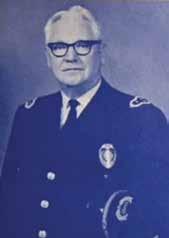
Shrewsbury police officer
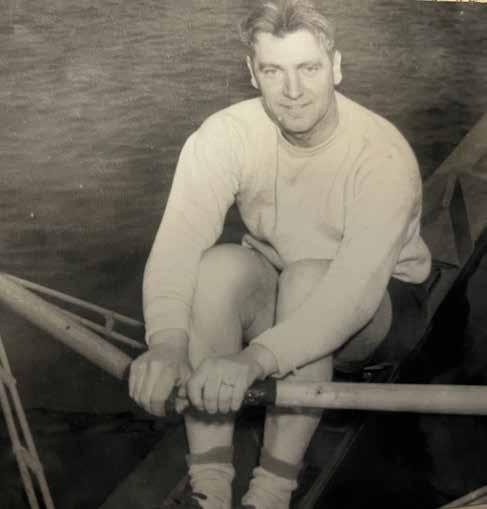
Although crew racing dwindled for a few years, it was reborn in 1937, mostly due to the efforts of Kenneth Burns, who was a Shrewsbury police officer at that time (he later became the chief of the department). Burns was an accomplished sculler in his own right, one of the fastest in New England. He won every race he entered from 1922 to 1925 and in 1925, he and Fred Haas won the Senior Double Sculls event and set a new lake record with a time of 9 minutes, 13 seconds.
In 1937, he formed a crew racing team at Shrewsbury High School, this in spite of a lack of funding and having no crew racing shells. The boys learned the sport using planks as makeshift boats. Burns succeed -
ed in raising funds for the team, getting assistance from local businessmen and sports enthusiasts. Before long, the team had two old eight-oared shells and a set of oars, donated by Ivy League colleges that no longer used them. One of the shells, contributed by Yale University, was known as the “Dipsy Doo -
54th annual regatta of the New England Amateur Rowing Association held at the Charles River basin, in which they won a stunning upset victory against several well-established crew racing clubs.
dle” because it was so warped, according to the late Barbara (Burns) Caron, Coach Burns’ daughter.
Numerous awards
Under Coach Burns’ supervision, the SHS crew team went on to win numerous awards, starting with winning the first race they ever entered. They then went on race in the
Preserving Memories with Dignity
They then went on to the National Regatta in Buffalo, New York, where they faced the Lafayas underdogs. Coach Burns was instrumental in bringing many rowing activities to Lake Quinsigamond over the ensuing years, including the Middle States Regatta in 1950, the National Regatta in 1951, the Olympic Trials in 1952, and the Eastern Sprints in following years, with many rowing activities continuing to the present day.
Kenneth Burns worked as a Shrewsbury police officer, eventually becoming chief of the department, and spent sixty years involved in crew racing on Lake Quinsigamond.
Family tradition
In the mid-1970s, Coach Burns encouraged his daughter, Barbara (Burns) Caron, who was a physical education teacher at Shrewsbury High School, to start a girl’s crew team, which she did. A few years later, Burns started training his granddaughter, Pamela (Caron) Krause in the sport. When Barbara Caron retired in 1994, Pam took over as the coach.
ette High School crew from Buffalo. In an extremely close finish, Shrewsbury was first declared the winner, then had the ruling overturned with Lafayette said to have won by one-fifth of a second.
In 1939, despite having only three years’ experience, they won the Junior Schoolboy Championship in Boston, despite being rated
Coach Burns himself, after sixty years of involvement in crew racing on Lake Quinsigamond, passed away in 1982. His many outstanding accomplishments in this field resulted in the newly constructed Route 9 bridge over Lake Quinsigamond being named after him in 2015. Memorial panels detailing his dedication to the sport are in place at either end of the bridge.
The monkey wrench was invented in Worcester
WORCESTER — Loring Coes is a man that is all but forgotten to all but a handful of people in these modern times. What the majority of people do not realize is that, if not for Mr. Coes, life in modern times would be much harder. Why would that be? Imagine a world in which mechanics, plumbers, and everyday residents did not have one invaluable tool – the monkey wrench. How would you tighten a faucet, or a pipe, or a million other things without that tool?
Coes, who was born in Worcester on April 22, 1812, became a wellknown figure in the city. He entered politics, becoming a member of the Board of Aldermen, then the Worcester Common Council, and eventually a member of the Massachusetts House of Representatives, serving from 1864 to 1865.
He and his brother, Aury Gates Coes, had been working for the firm of Kimball and Fuller, which made machinery for the woolen business. They eventually purchased the business and renamed it the L. & A. G Coes Company. Unfortunately, a fire destroyed their business in 1839, at which time they moved to Springfield, working as pattern makers in a foundry.
Originally called a screw wrench It was during this time that Loring came up with the idea of what was at the time called a screw wrench and would eventually become known as the monkey wrench. His invention was a significant improvement over the two most commonly used wrench types prior to that time, which needed two hands to operate. His could be operated with only one hand if necessary.
In order to pay for the patent on the monkey wrench, the brothers sold the pattern for spinning machines that they salvaged from the fire in Worcester. The patent for the new wrench was granted on April 16, 1841.
The Coes brothers went on to produce these wrenches for many
years at their facility in Worcester, located at what became known as Coes Square, near what is still known as Coes Pond.
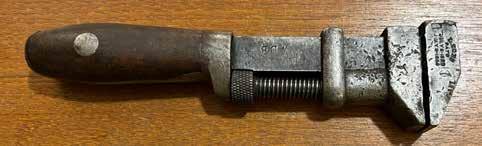
They eventually held a number of patents for several types of wrenches and improvements to the original monkey wrench design. One of these was named the “knife handle wrench,” which had a wooden handle, a throwback to number of wooden handled knives the company also had produced.
Built to last
An example of the lasting longevity of these sturdy wrenches: This writer’s grandfather, Rocco LaComfora, an Italian immigrant who lived in West Boylston and became a boiler fireman, passed a Coes wooden handled wrench down to me. At the time, back in the early 1970s, he told me, “This is a good wrench – it will last a long time for you!” It was good advice – the wrench has been used ever since on any number of projects.
Of course, we must not forget what became a commonly used saying, based on the solid construction of the Coes monkey wrenches – to “throw a monkey wrench into (something)” became widely used.
Loring Coes himself lived until the age of ninety-four, passing away on July 13, 1906, in his hometown of Worcester. His mansion in Worcester, located at 1049 Main Street, was part of a larger family estate situated around what is now the Webster Square area of the city. Much of the former estate is now occupied by the Webster Square Towers complex of apartments.
Many people ask where the name “monkey wrench” originated. There are a number of theories as to why it became known as that, with no one being able to definitively ascertain where the name came from. One of the most interesting theories, however, is that the jaws of the wrench resemble a monkey’s face.
Loring Coes and his Worcester invention, the monkey wrench, is a unique hand tool that has made life a lot easier for generations around the world ever since.
Regaining your quality of life begins when you CHOOSE
Regaining your quality of life begins when you CHOOSE exceptional results in rehabilitation.
Regaining your quality of life begins when you CHOOSE exceptional results in rehabilitation.
Regaining your quality of life begins when you CHOOSE exceptional results in rehabilitation.
For those recovering from a stroke, injury or illness, regaining your best quality of life begins with your ability to choose. Choose us for exceptional results.
For those recovering from a stroke, injury or illness, regaining your best quality of life begins with your ability to choose. Choose us for exceptional results.
For those recovering from a stroke, injury or illness, regaining your best quality of life begins with your ability to choose. Choose us for exceptional results.
For those recovering from a stroke, injury or illness, regaining your best quality of life begins with your ability to choose. Choose us for exceptional results.
Talk
Talk to your medical professionals about choosing us for rehabilitation.
Talk to your medical professionals about choosing us for rehabilitation.
America’s playground movement started in Massachusetts
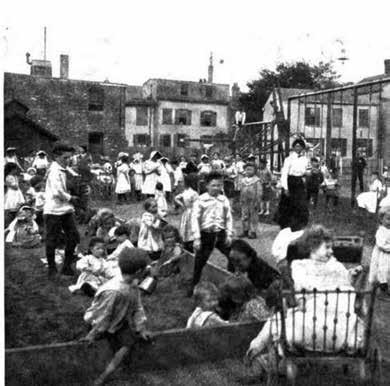
REGION — Playgrounds originated as “sand gardens” in Germany in 1885. Although the first children’s playground to offer swings, slides and a carousel opened in San Francisco’s Golden Gate Park in 1887, the concept of building public playgrounds was birthed before then with the first basic playground getting built in Boston in 1886, thanks to a local group of female philanthropists. At the time, children living in the countryside had open fields to burn off energy and kids from wealthy homes had private yards to let their imagina -
tions run wild. But city kids, particularly those from immigrant and working-class families, had no safe communal space to romp and play.
Concern for public welfare
As industrialization and urbanization grew, so did concern for public welfare. So, members of the Massachusetts Emergency and Hygiene Association (MEHA) envisioned playgrounds as the solution to the cramped quarters and social isolation children faced. It would also help youngsters develop physical health, socialization skills and cherished memories of a joyful childhood.
After hearing about how chil -
SENIORS
CONTRIBUTE TO THE UNDERSTANDING OF AGING AND COGNITION Are you healthy and vaccinated, mentally active, and over the age of 65? Schacter Memory Lab is looking for participants!
The experiment explores effects of aging on cognition. Noninvasive and no medication involved
• 2-hour time commitment
• First session pays $45 + travel expenses
ANSWERS
dren in Berlin flourished when given access to public spaces to play in, the organization arranged to have a pile of sand dumped in a North End churchyard in the summer of 1884. MEHA chair Kate Gannett Wells wrote in the organization’s annual report, “playing in the dirt is the royalty of childhood, but poverty infringes upon the right.”
In 1889, Boston’s “outdoor gymnasium” opened with swings and seesaws. However, playgrounds became a controversial topic by the early 1900s. Residents of Newburyport feared playgrounds would also attract large gatherings of young people and crime. The Newburyport Public Playground Committee report of May 1912 addressed the new Massachusetts act requiring playgrounds in cities with populations over 10,000 which resulted in trained supervision for each playground. Playgrounds had limited hours of 10 a.m. to 12 p.m. and 2 p.m. to 5 p.m. for the months of July and August with an age limit of 12 years.
In 1906, the Playground Association of America was formed to promote the ideas of playgrounds to communities and playground designs have transformed over the centuries. From the 1880s to 1890s, they began as sand gardens and morphed into model playgrounds with merry-go-rounds and other twirling contraptions.
Hazardous but fun
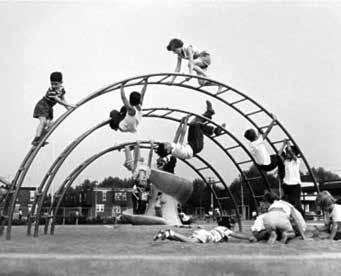
Many will remember what the playgrounds of the 60s and 70s represented: unbolted swings that could turn children into human projectiles, wood-splintering seesaws, death-defying jungle gyms, merry-go-rounds that often meant Mary-goes-down and metal slides that would burn your legs and thighs on the way down, leaving a searing and lasting impression. Of course, there were also those high
I was fortunate to have great people around me, good kids to play with, and places where we could be active all day long.
~ Rob Gronkowski
reaching yet slippery monkey bars that might have built upper arm strength, but landfall was usually on a slab of concrete. Bruises and broken bones were sometimes just part of the childhood experience. Although those playgrounds lacked protective barriers, none of that mattered to kids since it all meant hot fun in the summertime.
As Danielle Norville MacLennan put it on Facebook, “I’ll never forget that playground at the Old Wood School. It was unlike anything I’ve ever seen and so much fun. I was so sad to see it was torn down.”
In keeping with what the women of MEHA started, former New England Patriot Rob Gronkowski has brought the state of play back to the forefront, minus all that metal or sand. The onetime tight end’s new state-of-the-art Gronk Playground promotes imagination and physical fitness and has been a long-held dream for the beloved athlete since his days of recovering from arm surgery across the street at Massachusetts General Hospital. According to Gronkowski, “I had every opportunity to compete growing up as a kid, and I was fortunate to have great people around me, good kids to play with, and places where we could be active all day long.”
The playgrounds of the 1960s and 1970s were more elaborate, but not without hazards.
The concept of building public playgrounds began in Boston in 1886.