Communicare l Improving the health of our community in all we do
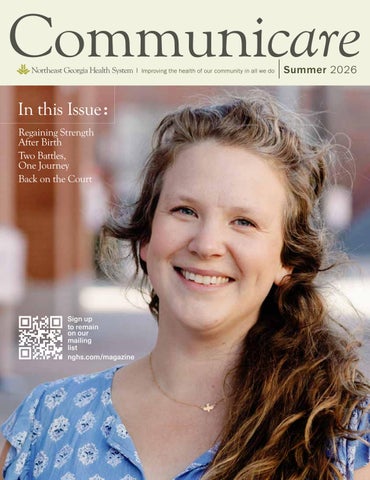
In this Issue Regaining Strength After Birth Two Battles, One Journey Back on the Court
Sign up to remain on our mailing list nghs.com/magazine
Summer 2026
contents From Our President
2
Two Battles, One Journey
3–5
A Hail Mary Pass
7–9
Back on the Court
11–12
A Second Chance at Living
13–14
Regaining Strength After Birth
15–18
Healing Through Art
19–20
743 Spring Street NE Gainesville, GA 30501 770-219-9000 nghs.com
OUR MISSION
“Improving the health of our community in all we do“ OUR THANKS TO BOARD CHAIRS Glennis Barnes
Hospital Authority of Hall County & City of Gainesville
Spence Price
Northeast Georgia Health System
ON THE COVER: Chloe Hunt, mother of four boys, regained her strength after birth thanks to postpartum physical therapy. Read her story on pages 15–18.
EDITORIAL STAFF: Abigail Davis, editor Gregg Carson, designer Sean Couch, executive director Russ Davis, director Erin Gibson, writer Emily Kerns, writer Mark Richens, writer Paige Yingst, writer
Semuel Maysonet
Northeast Georgia Medical Center
Pepper Brown, MD
Northeast Georgia Health System Foundation
Natalie Challen
Northeast Georgia Health System Auxiliary
Antonio Rios, MD
Northeast Georgia Physicians Group
Antonio Rios, MD
Northeast Georgia Health Partners Network This organization does not discriminate against any patient because of race, creed, color, national origin, religion, age, sex, disability or because a patient is covered by a program such as Medicare or Medicaid.
Communicare is a health education magazine published by the Public Relations department for the community to support the organization’s mission.
Would you like to remain on our mailing list? Scan the QR code or visit nghs.com/magazine
from our president I’ve now had the privilege of leading Northeast Georgia Health System (NGHS) for just over one year – and I continue to be energized by the momentum I see across our organization and throughout this region. What felt new just months ago now feels purposeful and aligned, thanks to the incredible people who bring our mission to life every day. One thing has become increasingly clear in my time at NGHS: this is a health system – and a community – on the rise. Growth brings tremendous opportunity, but it also demands thoughtful planning and unwavering focus. That’s why we refer to our efforts to expand services as “Growing the Greater Good.” Those words remind our teams that their work creates a ripple effect far beyond our walls – supporting economic development, creating jobs, increasing access to care and making a meaningful difference in the lives of our neighbors. A significant milestone in that journey is Longstreet Clinic joining NGHS. Together, we are strengthening physician collaboration and enhancing coordination across the continuum of care. This integration allows us to better serve patients by expanding access, improving communication and delivering a more seamless care experience – now and well into the future. Throughout this issue, you’ll see many examples of how we continue to grow with purpose and innovation to improve lives. You’ll read about expanded women’s health services designed to support patients at every stage of life (pages 3–5), followed by advancements in heart care that are saving lives every day (pages 7–9). You’ll also learn how our teams are leading the way with innovative approaches to spine surgery (pages 11–12) and discovering new advances in lung cancer care that are improving early detection and outcomes (pages 13–14). You’ll also find stories of care that go beyond traditional treatment – from physical therapy that helps new mothers heal and regain strength after childbirth (pages 15–18) to the powerful role art therapy plays in helping patients heal emotionally as well as physically (pages 19–20). None of this would be possible without our dedicated employees and clinicians who continue to bring compassion, expertise and excellence to their work every day. And, to our patients and community partners, thank you for trusting us with your care.
Matt Hanley, MD President & CEO
nghs.com 02
Two Battles, One Journey Colleen’s Experience with Truly Being Heard
When Colleen first learned she had uterine tumors, she faced a daunting decision: how to treat a condition causing escalating pain while balancing her demanding role in education and caring for her father with Alzheimer’s disease and dementia. That decision became even more urgent when a routine mammogram revealed abnormalities, leading to a breast cancer diagnosis just days before her scheduled gynecologic surgery.
Colleen credits Renee Moss, MD, gynecologic surgeon at Northeast Georgia Physicians Group (NGPG), for making a complex decision feel manageable and instilling trust in her journey, which, as it turned out, was just beginning.
nghs.com 03
“Dr. Moss walked me through every detail and gave me confidence that moving forward with the hysterectomy was the right choice – even with a cancer diagnosis looming,” said Colleen. “She showed me that I could relieve my pain while building a treatment plan for breast cancer at the same time.“
Colleen had her benign uterine tumors removed through a minimally invasive robotic procedure, which brought immediate relief from the chronic pain that had affected her daily life. The surgery improved her strength and focus to begin her next challenge: breast cancer treatment.
“Robotic surgery allows us to offer patients quicker recovery and less discomfort, which is especially important when they’re facing multiple health challenges,” said Dr. Moss. “For Colleen, it meant she didn’t have to choose between addressing her pain and planning cancer treatment.” With one surgery completed at Northeast Georgia Medical Center (NGMC) Braselton, Colleen faced another life-changing procedure: a double mastectomy. She turned to Travelyan Walker, MD, general surgeon at NGPG Surgical Associates, whose skill and compassion left a lasting impression.
nghs.com 04
“Dr. Walker didn’t just perform my mastectomy; he became my coach,” said Colleen. “His team’s compassion and guidance helped me feel truly supported during the physical and emotional stress of a double mastectomy.” “When patients are navigating multiple surgeries, our role goes beyond the operating room,” said Dr. Walker. “It’s about listening, guiding and making sure they feel supported every step of the way.” Colleen’s journey wasn’t without complications. When Dr. Moss learned Colleen had an autoimmune condition, she coordinated with her allergist to determine the best anesthesia approach. She then shared her knowledge with Dr. Walker, who relayed it to the surgery team at NGMC.
“The level of seamless communication and personalized care was unmatched,“ said Colleen. “I felt understood and had complete faith in my care team.” Colleen’s family cancer history – her mother’s breast cancer and her father’s prostate cancer – prompted genetic testing, which revealed no mutated genes for future cancer risk. However, her mother’s experience profoundly shaped Colleen’s approach. “My mom lost her battle with breast cancer after going through heavy medication treatments,” said Colleen. “I knew I didn’t want to follow that same path.”
nghs.com 05
That conviction guided her decisions throughout her care. She sought providers who respected her low-medication approach and worked collaboratively to find alternatives. She applied the same strategy when looking for a new primary care physician, ultimately selecting NGPG Family Medicine’s Christian Baumgartner, MD, whose approach aligned with her philosophy and supported her long-term health goals. “The unwavering support that I receive from my husband and daughter have been crucial during my recovery,” said Colleen. Colleen has returned to work and is embracing life with renewed energy. She is a proud survivor. “After such a difficult year, I celebrate every small moment and every win,” said Colleen. “But my biggest advice is this: never take your health for granted. Do your research, advocate for yourself and don’t delay screenings – they truly saved my life.”
Women's Care for All Ages We offer a wide range of services to support women at every stage of life–from adolescence to motherhood and beyond. Our Services Include: • Obstetrics & Gynecology (OB/GYN):
Complete care for pregnancy, childbirth, routine gynecologic needs and adolescent gynecology
• Certified Nurse Midwives (CNM):
Personalized, holistic care for pregnancy, birth and women’s health needs
• Gynecologic Surgery: Advanced
procedures, including minimally invasive and robotic-assisted surgery for faster recovery and better outcomes
• Gynecologic Oncology: Specialized
care for cancers of the female reproductive system
• Hormone Replacement Therapy (HRT)
Specialists: Individualized solutions for hormonal balance and symptom relief
• Urogynecology: Combined elements of
gynecology and urology, expert treatment for pelvic floor dysfunction and urinary incontinence
To learn more about women's health services at NGPG, visit ngpg.org/womenshealth To learn more about obstetrics and gynecology services at Longstreet Clinic, visit longstreetclinic.com/OBGYN
Look for the Leaf Northeast Georgia Health System (NGHS) is a regional health system on a mission of improving the health of our community in all we do. Our team of more than 1,500 medical staff members, representing over 60 specialties, cares for more than 1.5 million people across the region through seven hospitals and dozens of other locations and practices. NGHS is led by volunteer boards made up of community leaders. As a not-for-profit health system, all revenue beyond operating costs is returned to the community through improved services and innovative programs. NGHS is home to the state’s Best Community Hospital according to U.S. News & World Report. Northeast Georgia Medical Centers Five acute care hospitals located in Gainesville, Braselton, Winder, Dahlonega and Demorest • More than 1,000 combined beds • Surgical capabilities with 46 combined operating rooms • Level 1 Trauma Center in Gainesville 770-219-9000 | nghs.com
Northeast Georgia Physicians Group 700+ physicians, advanced practice professionals and clinical staff • 50+ locations • 11 Urgent Care locations • 40+ specialties 770-219-8400 | ngpg.org
•
•
Longstreet Clinic at NGHS
Georgia Heart Institute
200+ physicians and advanced practice professionals • 9 locations • 20+ specialties 770-718-1122 | longstreetclinic.com
•
•
120+ physicians and advanced practice professionals • 14+ locations 770-534-2020 | georgiaheartinstitute.org
nghs.com 07
a hail mary pass Collaboration, innovation bring relief to heart patient
nghs.com 08
With its sweeping vistas and lush forests, the Blue Ridge Mountains reminded Jose Juan “Pepe” Buraschi of growing up on his father's ranch in eastern Peru, where the foothills of the Andes descend into the Amazon River basin. That's why Pepe and his wife, Margarita, settled in Young Harris after he retired from his career as an international banker in Miami. Pepe and Margarita, who both moved to the United States from Peru in the 1970s, have been married for 32 years. They enjoy walking the trails near their home, especially a secluded path that winds from their back porch into the rugged woods. When Pepe noticed he was becoming more fatigued on their walks, it was a sign of heart trouble that would bring him to Georgia Heart Institute. Pepe’s journey seemed hopeless at times, but thanks to the determination and support of Margarita and the compassionate expertise of his doctors, Pepe is feeling like his best self again at age 84. “I began my treatment with one of the heart doctors in Blairsville, which is the closest cardiologist to where we live,” said Pepe. “Even though I was being treated for my condition, it continued to worsen over time. I was retaining a lot of fluid, and I still felt so tired and fatigued.” Pepe was taken by ambulance to Northeast Georgia Medical Center (NGMC) Gainesville, where he was diagnosed with atrial fibrillation, a heart rhythm disorder that is projected to affect more than 12 million Americans by 2030. Commonly known as “AFib,” the condition increases a patient’s risk of stroke and heart failure. Specialized cardiologists called electrophysiologists implanted a pacemaker to control Pepe’s heartbeat. But, over the summer, Pepe became dizzy while swimming and was hospitalized again. His doctors recommended that he get an upgraded pacemaker that included a defibrillator, which can shock the heart back into its normal rhythm. “As the days went by while I was in the hospital, there wasn’t much improvement,” said Pepe. “I was still accumulating a lot of fluid. I had nowhere to go.” Cardiologists who specialize in heart failure began to care for Pepe. He was in a condition called cardiogenic shock, in which the heart can’t pump enough blood to meet the body’s needs. They gave him IV medications to help his heart pump harder, but he wasn’t getting better. Because of his age and frail condition, he couldn’t have surgery or a transplant. Doctors suggested he consider palliative care and hospice.
nghs.com 09
“On one occasion, I was told that I probably would have five or six months to live,” said Pepe. “But my wife is a very detailoriented person. This whole time, she had been on the internet, researching different heart treatments.” Margarita’s research, with the help of an AI agent, led her to ask doctors about a new therapy: a device called TriClip that can repair the heart’s tricuspid valve and keep blood from flowing backward, or regurgitating, into the chambers. Heart failure doctors consulted with Ronnie Ramadan, MD, medical director of Georgia Heart Institute’s Structural Heart Center. Dr. Ramadan and his team were the first in the United States to treat a patient with TriClip when it first came on the market in 2024. “When I was first asked to consult on Pepe, his condition was so dire,” said Dr. Ramadan. “He was dependent on IV medication to support his heart function, and he was advised to go to hospice for comfort care unless we felt that we had anything else to offer as a last-ditch effort, a Hail Mary pass. Fortunately, we had the skills and the technology at Georgia Heart Institute to give him a chance. We performed a complex transcatheter repair of his tricuspid valve around the previous pacemaker/ defibrillator leads, which led to a remarkable reduction in his valve leakage, and it translated into a dramatic improvement in his outcome.” Pepe and Margarita praised Dr. Ramadan for what they call his “masterwork.” “We were very impressed with his clarity and simple way of approaching the issue,” said Pepe. “It was just amazing,” said Margarita. “My husband just keeps improving.” The heart failure doctors were also impressed by Pepe’s outcome. He has been able to stop taking medications to relieve his swelling. He has completed his first phase of cardiac rehab and is ready to start the second phase. “Dr. Ramadan did a great intervention and 24 hours later, my heart was pumping almost back to normal, and I was feeling great,” said Pepe. “It was just like a miracle!” To learn more about the specialized heart care available at Georgia Heart Institute, visit georgiaheartinstitute.org
GEORGIA’S HEARTS ARE ALWAYS ON OUR MINDS While you’re busy being you, we’re working all day, every day to make Georgia Heart Institute the state’s # 1 heart and vascular program. With the highest rankings in heart attack care, heart failure treatment and heart surgery, Georgia Heart Institute is also one of only two programs in the state to offer robotic heart surgery. Whether you live in Atlanta or on Lake Lanier, in the country or in town, the future of heart care is here for you today.
LEARN MORE AT 770-534-2020 OR GEORGIAHEARTINSTITUTE.ORG/ALWAYS
nghs.com 11
Diane Stevens, a wife, mom and friend, enjoys staying active and keeping herself busy. One day in January 2025, while doing what she loves most – playing pickleball – she suffered an injury on the court.
“This technique allows us to access the spine with minimal disruption,” said Dr. Boghani. “Patients often experience less pain after surgery, shorter hospital stays and a quicker return to normal activities.”
“I fell and hurt my back pretty badly,” said Diane. “I basically had to crawl around because the pain was so severe. I had never experienced anything like that before.”
The procedure is performed through a tubular system, and specialized instruments are inserted alongside the endoscope to remove the damaged pieces of disc. Because the incision is so small, patients typically have little to no visible scar.
For six months, Diane tried conservative treatments to avoid surgery, including injections, physical therapy and chiropractic massages. She saw some improvement, but the pain remained a constant part of her life and kept her from doing the things she loved.
A FASTER RECOVERY THAN EXPECTED “I couldn’t believe he was able to do the surgery endoscopically,” said Diane. “I’m all for cutting-edge treatments, so I was sold immediately. When people think of back surgery, they think of a long recovery and a huge scar, but that’s not what I experienced. When I got home, friends of mine brought dinner to my house and were shocked to see me answering the door.”
“I saw a physician who told me that back surgery would not help me,” said Diane. “I was desperate for relief, so my daughter began researching back pain treatment options. She came across Dr. Zain Boghani, a neurosurgeon with Northeast Georgia Physicians Group (NGPG). I researched him online and saw that he had a great reputation and great outcomes, so I decided to make an appointment. Afterwards, I had full confidence in the team at NGPG and was relieved to have a plan of action.” On August 3, 2025, Diane underwent surgery at Northeast Georgia Medical Center Braselton. She became the hospital’s seventh patient to receive a cutting-edge treatment option for back surgery – an ultra-minimally invasive approach using endoscopic technology. “Diane had a herniated disc with a protrusion,” said Dr. Boghani. “Essentially, this means that she had a disc weakened from her fall that was causing extreme pain. Diane was an ideal candidate for an endoscopic discectomy. Her condition and overall health made her a perfect fit for this innovative approach.” WHAT MAKES THIS APPROACH DIFFERENT? Instead of traditional back surgery, which often requires large cuts, moving muscles out of the way and a long recovery, ultra-minimally invasive spine surgery uses a tiny incision – usually less than a centimeter – and a small camera called an endoscope. Because the surgeon works through natural spaces rather than cutting muscle, there is far less damage to surrounding tissue.
“It’s important for patients to regain their function after surgery, which is why we encourage them to get up and move,” said Dr. Boghani. “Most patients can resume light activities within days and return to sports or exercise within weeks.” BACK TO DOING WHAT SHE LOVES Today, Diane is back on the pickleball court with her friends – without pain. “I’m so relieved to be back playing pickleball and living pain-free,” said Diane. “It feels incredible to have my life back. I cannot thank Dr. Boghani and his team enough for what they’ve given me.” To learn more about back pain treatment options at NGPG, visit ngpg.org/spine To learn more about back pain treatment options at Longstreet Clinic, visit longstreetclinic.com/back-pain
nghs.com 12
A Second Chance at Living HOW ROBOTIC TECHNOLOGY HELPED SAVE A LUNG CANCER PATIENT From left, Caroline Thomas, MP, and Cheryl Le stand outside NGPG Family Medicine in Toccoa.
What began as a routine screening turned into a life-saving journey for Cheryl Le. “I smoked cigarettes for more than four decades,” said Cheryl. “I always knew there was a chance of developing lung cancer – I just never thought it would happen to me.” During a routine visit with her primary care provider, Caroline Thomas, nurse practitioner, with Northeast Georgia Physicians Group (NGPG), Caroline encouraged Cheryl to get a low-dose CT scan because of her smoking history. That scan revealed a mass on Cheryl’s lung. Caroline quickly referred Cheryl to NGPG Pulmonology, where she met Dr. April McDonald. “Dr. McDonald explained everything in great detail,” said Cheryl. “She told me they needed to biopsy the tumor and would use an innovative technology called Ion Robotic-Assisted Bronchoscopy. She reassured me that she was highly experienced with this procedure and introduced me to Dr. Karen Gersch, who would perform the surgery alongside her.” On July 16, 2025, Cheryl underwent a minimally invasive biopsy using Ion technology. “Ion Robotic-Assisted Bronchoscopy is an extraordinary advancement in lung cancer care,” said Dr. McDonald, interventional pulmonologist for NGPG. “In the past, patients like Cheryl would have faced a much more invasive procedure to obtain a biopsy and subsequently remove the tumor. Now, we can navigate deep into the lung with precision, using a robotic bronchoscope and advanced imaging, to reach small or hard-to-access nodules – which are tumors on the lung.”
Working together in the operating room, Dr. McDonald used the Ion system to precisely locate and mark the tumor. Then, Dr. Gersch utilized the da Vinci robotic surgical system to biopsy and remove the tumor. “Dr. McDonald and I talked about the possibility that the abnormal lung tissue on Cheryl’s scans could hide multiple tumors, possibly even more than two,” said Dr. Gersch. “However, the only way to know for sure was by examining the tissue under a microscope after surgery. We felt that surgically removing the entire suspicious area was the best and most complete way to treat Cheryl – and it was a success.” Cheryl was discharged the next day with very little downtime.
From left, Karen Gersch, MD, and April McDonald, MD, stand in the endoscopy suite with an Ion robotic bronchoscopy system.
“I was amazed at how quickly I was able to go home,” said Cheryl. “The procedure was faster and less painful than I had originally expected.” Cheryl is deeply grateful for her care team. “At my follow-up appointment, I gave Dr. Gersch a big hug,“ said Cheryl. “Dr. Gersch and Dr. McDonald are both extraordinary women in their fields. They were caring, reassuring and made me feel safe. I trust them more than anyone.” Today, Cheryl is back to enjoying life – working, walking and playing with her dog. Her advice to others: “Get a low-dose CT scan, even if you don’t think you need it. It gave me a second chance at living.” To learn more about lung cancer treatment options at NGHS, visit nghs.com/lung-cancer
nghs.com 14
“I DIDN’T KNOW HOW MUCH I NEEDED HELP UNTIL I COULDN’T MOVE“
nghs.com 15
REGAINING STRENGTH AFTER BIRTH: POSTPARTUM PHYSICAL THERAPY JOURNEY When Chloe Hunt of Dacula, Georgia, became pregnant with her fourth son, Jesse, she expected the familiar rhythm of late‑night wakeups and third‑trimester discomfort. What she didn’t expect was an injury that would follow her into childbirth and beyond. One night, after getting out of bed for yet another bathroom trip, Chloe felt a sharp pull in her lower abdomen. “I didn’t know exactly what I had done,” said Chloe. “I just knew immediately that something was wrong.” Still, she tried to convince herself it was just another uncomfortable part of pregnancy – something she could push through like she had with her previous babies. The pain didn’t fade – it worsened. As she approached her due date, she struggled to move comfortably and never fully recovered before going into labor.
A Fast Delivery, Followed by a Moment of Panic When the time came, everything happened quickly. Chloe arrived at Northeast Georgia Medical Center (NGMC) Gainesville already nine centimeters dilated. With the support of her husband and care team, Jesse was born swiftly and safely. It wasn’t until after the birth when Chloe tried to get up to use the bathroom that the reality of her injury hit her. Jesse’s delivery had amplified the strain from her earlier injury, leaving her suddenly unable to move without intense pain. “I couldn’t move – I couldn’t get out of the bed without help,” said Chloe. “In those few seconds, panic washed over me. I remember thinking, ‘Who do I even tell?’ ‘Do I just push through?’ ‘Is this normal?’” Unsure of what to do, she shared her concerns with the staff – and that’s when she learned that inpatient postpartum physical therapy was available to help.
nghs.com 16
nghs.com 17
Bringing Physical Therapy to the Bedside Luckily for Chloe, physical therapists could come right to her room, bringing support to her bedside when she couldn’t move on her own. The program was created to support women who are experiencing severe pain, mobility challenges or birth‑related injuries immediately after childbirth. “Our moms are so overwhelmed, they have so much on their plate with a new baby. The last thing we want to do is send them home not prepared and in pain,” said Gentry Hunt, director of Mother Baby, Lactation, Pediatrics and Women’s Health for NGMC. “So, with inpatient postpartum physical therapy, it allows us an opportunity to teach them how to move better, to decrease pain and really sets them up for an easier transition to home.” The program ensures that mothers receive hands‑on guidance before they ever leave the hospital – something that was rarely available in traditional postpartum care and not even included in most hospitals’ postpartum care today. Northeast Georgia Health System is the first health system in Georgia to offer inpatient postpartum physical therapy to mothers who need it after delivery at each of the hospitals where they deliver babies – NGMC Gainesville, Braselton and Habersham. “We have developed a process where we get consults on all of our C-section birth deliveries as well as any vaginal birth deliveries that may have resulted in tearing,” said Catherine Casper, program manager for Rehabilitation Services at NGMC. “Before this program, moms were expected to go home and figure out how to get in and out of bed, how to get up and down – all while managing a new baby. The benefit here is learning how to do those techniques with less pain, less restriction and being able to return to those daily activities quicker.”
For Chloe, the visit from physical therapy was transformative. “They gave me the confidence that the simple tasks could be done,” said Chloe. “Having that physical therapy plan truly helped me recover the way I needed to so I could take care of my family.” With three older boys waiting for her at home, Chloe needed to regain her strength – not just physically, but mentally. The guidance she received helped her understand her injury, move without fear and begin healing in a way she hadn’t been able to before.
A Broader Commitment to Maternal Health Chloe’s journey would continue with pelvic floor physical therapy, which gives mothers like her continued support long after they leave the hospital. Over the course of three visits, she returned to NGMC’s Rehabilitation Services in Braselton for pelvic floor physical therapy. “It was nice to know that I was supported far beyond delivery,” said Chloe. “Pelvic floor physical therapy helped me keep progressing and feel like myself again.” “We’re really trying to advance maternal care,” said Gentry. “NGHS allows us to look at the evidence, implement what works and provide the care our community deserves.” For Chloe, that commitment made all the difference. What began as a frightening moment became an opportunity for healing – and a reminder that mothers deserve support, expertise and compassion during one of the most vulnerable times in their lives. To learn more about postpartum physical therapy at NGHS, visit nghs.com/postpartum
The physical therapy team didn’t just focus on Chloe’s mobility – they took the time to listen, validate her concerns and explain what her body was experiencing. “They really listened to me,” said Chloe. “I felt heard and believed – like what I was feeling made sense and wasn’t just in my head.”
nghs.com 18
HEALING THROUGH ART
From left, Max Eve, Robin Pretcher and Lori Thompson play instruments during a rehearsal.
nghs.com 19
In a quiet patient room at Northeast Georgia Medical Center (NGMC) Gainesville, the gentle notes of an acoustic guitar filled the space. A therapeutic musician adjusted her position and began playing a familiar song, watching as the patient's breathing slowed and tension melted from her shoulders. This wasn't entertainment – it was medicine.
“Each approach is highly individualized,” said Lori. “We're not performing for patients – we’re responding to them. Sometimes that means playing familiar songs. Sometimes it means sitting in silence, holding space for whatever they're experiencing. The music itself becomes communication when traditional language fails.”
For patients facing illness, pain and anxiety often create barriers that medication alone cannot address. Northeast Georgia Health System’s (NGHS’) Arts in Medicine program offers complementary therapies that treat the whole person, not just the diagnosis.
Clinical benefits are measurable. Studies show live therapeutic music can decrease anxiety and pain levels, promote relaxation and improve sleep quality. For hospice patients, these therapies address the profound isolation that often accompanies serious illness, restoring human connection through creative expression.
“Music has this unique ability to reach people when words can't,” said Lori Hamrick, coordinator for Arts and Medicine. “We see patients who haven't spoken in days suddenly humming along, or family members who've been holding everything together finally allowing themselves to feel.” In 2018, donors to the NGHS Foundation recognized that healing encompasses more than what happens in an operating room or exam room. The initial funding of $417,000 for just three years of support, launched the therapeutic music program, and included community donors as well as NGHS employees through WATCH, the employee giving club of NGHS, investing in a different kind of medicine. “Our donors understood something profound – that excellent health care must address the whole person,” said Chris Bray, president of the NGHS Foundation. “Their ongoing generosity, from the initial funding to year-after-year support through WATCH, makes it possible to offer this comprehensive, compassionate care that truly heals.” The therapeutic approaches vary based on patient needs. Live music can ease anxiety before surgery, help manage pain during recovery or provide comfort during end-of-life care. Visual art therapy offers patients who find verbal communication difficult an alternative way to process grief and trauma. Legacy authors capture stories that might otherwise be lost.
“Every patient teaches us something,” said Lori. “About resilience. About what matters most when time becomes precious. About the power of beauty and connection even in the hardest moments. That's what Arts in Medicine offers – not escape from reality but a deeper engagement with what it means to be fully human.” As NGHS continues expanding these innovative programs across northeast Georgia, the message is clear. Healing happens in many ways. Sometimes through a surgeon's skilled hands. Sometimes through a gentle melody or meaningful conversation. All of it reflects NGHS’ mission of improving the health of our community in all we do. To learn more about Arts in Medicine and complementary services like touch therapy and pet therapy, visit nghs.com/complementary-services To support this program and others like it, visit nghs.com/give
nghs.com 20
DISCRIMINATION IS AGAINST THE LAW Northeast Georgia Health System, Inc. (NGHS) complies with applicable State and Federal civil rights laws and does not discriminate on the basis of any legally protected class or characteristic, including race, color, national origin, religion, age, disability, or sex. NGHS: • Provides free auxiliary aids and services to people with disabilities to communicate effectively with us, such as: • Qualified sign language interpreters • Written information in other formats (large print, audio, accessible electronic formats, other formats) • Provides free language services to people whose primary language is not English, such as: • Qualified interpreters • Information written in other languages If you need these services, contact: NGHS Medical Interpreter Department Telephone Number: 770-219-1689 If you believe that NGHS has failed to provide these services or discriminated in another way on the basis of race, color, national origin, religion, age, disability, or sex, you can file a grievance with: NGHS Patient Nondiscrimination Coordinator 743 Spring Street NE Gainesville, GA 30501 Telephone Number: 770-219-1557, (TTY: 1-800-255-0135) (VRS: 1-888-888-1116) Fax: 770-219-1895, or Email: civilrightscoordinator@nghs.com. You can also file a civil rights complaint with the U.S. Department of Health and Human Services, Office for Civil Rights electronically through the Office for Civil Rights Complaint Portal, available at https://ocrportal.hhs.gov/ocr/portal/lobby.jsf, or by mail or phone at: U.S. Department of Health and Human Services 200 Independence Avenue, SW Washington, D.C. 20201 Phone: 1-800-368-1019 TDD: 1-800-537-7697 Complaint forms are available at: http://www.hhs.gov/ocr/office/file/index.html
INTERPRETERS AVAILABLE You have access to interpretation services 24/7 at no personal cost to you. This chart includes languages commonly spoken in your community, additional languages are available. English: Do you speak [language]? We will provide an interpreter at no personal cost to you.
Revised November 2024
Northeast Georgia Health System 743 Spring Street NE Gainesville, GA 30501-3899
Non-Profit Organization US POSTAGE PAID Gainesville, Ga. Permit 6
Sign up to remain on our mailing list nghs.com/magazine
BECAUSE
THAT WASN’T THERE BEFORE 12 convenient locations l Open every day, 8 am –7:45 pm Accepting patients 6 months and older
NGHS.COM/URGENT-CARE
08/26 l SIP l 235,000