CM Commonwealth School Magazine Summer 2026
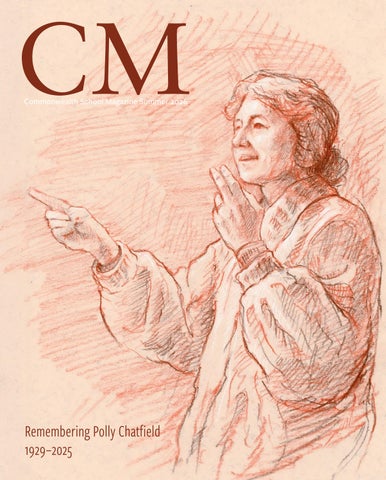
Remembering Polly Chatfield 1929–2025
WHY I MADE IT:
TITANIUM BY DANNY MCDONNELL ’26
T
itanium is three things: experimental data from a research project given life, an exploration of abstraction, and my attempt at making real color. Each rectangle in the piece is a sample of titanium, used to collect data for a class called The Science and Art of Materials. This project started back in March, as I began thinking of what I wanted to research for the end of the year. Previously, I had done a different project for this class that had gone horribly wrong, and I needed to try something new. In that project, I had been trying to figure out how to make a real red pigment called cochineal (a historical source of red dye from a bug), but in the end I had only been able to make a dullish purple-pink. I was looking to make something very saturated, and I wanted to try again. The project I chose involved exploring a process called titanium anodization, which involves putting each titanium sample into a saltwater bath and running electricity through it. This forms a thin transparent layer of titanium dioxide. Light plays with the transparent surface in different ways, allowing it to appear in certain colors. As the voltage through the circuit is increased, the thickness of the oxide layer increases, which actually changes the color of the titanium. Long story short: I was able to change the color of the titanium with electricity. My project explored how different surface finishes of the titanium (like polishing or chemically reacting the titanium) affected its color—but secretly, it had the same goal as my previously failed project. I wanted to make the most saturated color I could. As well as being a research project, Titanium is one of my first abstract pieces of art that felt intentional. Abstract art is weird; it doesn’t have the same need for a careful study of proportions or shading—or any actual depiction—as realistic drawing or painting. I had only worked with realism before this year, and unfortunately the one main rule in the Materials class was “no representation.” Over the course of the year, I thought more and more about abstraction, eventually
coming to realize how different compositions of patterns, shapes, and colors could all come together to play with the feeling of a piece. Titanium didn’t need to depict anything in particular; it just needed some emotion behind it, something to think about. The theme holding it together was color: that was my inspiration and the idea I wanted to highlight in its composition. Which brings me back to the actual form: a circle—or rather, a color wheel. The wheel is made up of all of the sample titanium pieces, no longer used for research but instead overlapping and flowing together to make a gradient. Since the start of the project, I knew I wanted to make some sort of three-dimensional, wave-like effect with the tiles to highlight the reflectivity of the titanium. My initial plan was to make a diamond instead of a circle, with the pieces all aligned together, the texture reminiscent of a mermaid’s tail. By the end, the circle actually made more sense to me: it would be a literal color wheel that showed how different hues combine to form a harmonious whole. A circle brought all of the pieces together in a way that separated them from the science and formed something new, scattering the color in all directions. In the final circle, the pieces aren’t orderly anymore, so you can see completely different colors from different angles. In a way, this is almost like my scientific exploration of surface textures: just like how changing the texture of each individual sample can make the color brighter, changing the texture of the entire circle can make it feel more vivid and whole. Art, at least my current definition of it, is a translation of an idea from the artist to the viewer. I’m still thinking about art and about how to put realism and abstraction together—is one of them more real? I have much more to discover about the vast world of art, but I’m glad Titanium was my first step into abstraction and a wider exploration of color. t
1
CM
I
write to you from the cusp. One school year is just behind us—grades submitted, cubbies cleaned, and thirty-eight seniors launched. The coming school year beckons, but at the moment, it’s hushed and incipient at 151 Commonwealth Ave. The articles that await you in this issue are similarly pitched at the cusp of now, the sliding edge of a volatile world. We share glimpses from the classes where students engage with current events and the deeper currents that give rise to the day’s news. Whether delving into national identity, race, or AI, our students are reading with acuity, asking questions, trying to take in other perspectives, and shaping their own evolving views. As you will read, our faculty do a masterful job of framing charged topics and promoting open, humane discussion (page 24). They also know that there is no “neutral” education but nor should it be propaganda; they share their own views while taking care not to put too heavy a thumb on the scale. Other articles remind us that we are all on the cusp of an AI-shaped world. The models change faster than we can absorb, AI research is narrow and quickly out of date, and economic impacts are unclear on a good day. Within the Commonwealth community, there are many who share the concerns that David Gleason raises in our profile of his work (page 28). We worry about AI ethics and the environmental impact of AI’s gluttonous use of electricity. We wonder about AI’s economic impact, as you will read in our Q&A with some of our alumni/ae in finance (page 18). We also wrestle with AI’s impact on education. Among our students are AI refuseniks, AI experimenters and skeptics, and likely a few AI cheaters. While I count myself among the AI curious, I am also increasingly worried that our collective skills will erode. I do not think AI has much to offer to high-school students. It seems a very different thing to hand an experienced driver the keys to a souped-up race car versus handing them to a child who can barely see over the steering wheel. By contrast, the intellectual capacities we nurture at Commonwealth, the habits of mind and generative skills, will allow our students to flexibly adapt to whatever comes their way. And indeed, life is not a self-driving car. AI also begs questions about what it means to be human. That question, always at the heart of a Commonwealth education, looks a little different these days when large language models offer such a convincing simulacrum of human speech. Still, our remembrances of Polly Chatfield in these pages remind us what real human connection means in our lives. Polly herself exemplified our human ideals: empathy, wisdom, generosity, patience, and love. Reading her students’ and colleagues’ stories reminded me that so much of what we do with each other now ripples into the future. At Commonwealth, we stand on the cusp of possibility, and that is where schools do their best work. Jennifer Borman ’81 Head of School
Commonwealth School Alumni/ae Magazine Issue 30 Summer 2026 Editor-in-Chief Jessica Tomer Editor Catherine Brewster Contributing Writers Jennifer Borman ’81 Catherine Brewster Becca Gillis Danny McDonnell ’26 Claire Jeantheau Lillien Waller Contributing Art and Design Becca Gillis Danny McDonnell ’26 Tony Rinaldo Photography Ryan Wang ’28 Printing Cummings Printing Co., Inc.
CM is published twice a year by Commonwealth School, 151 Commonwealth Avenue, Boston, MA 02116, and distributed without charge to alumni/ae, current and former parents, and other members of the Commonwealth community. Opinions expressed in CM are those of the authors and subjects, and do not necessarily represent the views of the School or its faculty and students. We welcome feedback: communications@ commschool.org. Letters and notes may be edited for style, length, clarity, and grammar. Printed on recycled paper. Please recycle. @commonwealthalumniae commonwealthschool commonwealthschool commonwealthschool
2 CM Summer 2026
CM
CONTENTS
Commonwealth School Magazine Summer 2026
Why I Made It: Titanium
1
Danny McDonnell ’26 captures the light.
News of Commonwealth
4
Memories of Mrs. Chatfield, Graduation 2026, United Nations accolades, Museum Day returns, and more.
Conversations with the Head
14
4
Director of Advancement Alisha Elliott ’01 and Jennifer Borman ’81 discuss our philosophy of philanthropy.
How to Predict the Unpredictable
18
Alumni/ae in economics and finance field questions from 151 Comm. Ave.
Teaching the News
14
18
24
Commonwealth teachers explain their approach to helping students unpack current events.
Ethics and the Business of AI
28
David Gleason ’79 had been exploring the ethical implications of artificial intelligence long before ChatGPT launched—but he’s working overtime now.
Meet Our Students
30
24
From fake news with Jake ’26 to comics with Caro ’27 to community activism with Vedant ’29, these students’ interests animate them inside school and out.
20 Questions with Rod Hsiao ’82 As an entrepreneur, Rod might’ve taken a winding road, but his wanting to help people never wavered.
36
36 On the Cover: Using an archival yearbook photo (right) Drawing and Painting teacher Caleb Colpitts captures Mrs. Chatfield in her element, teaching. Remember that era and more on page 8.
3
N E W S of Co m m o nwe a l t h
Museum Day Returns
S
tudying climate modeling at the MIT Museum. Delving into the experiences of Black Bostonians during the Revolutionary War at the Museum of African American History. Taking in transformative pieces of art (and intrigue!) at the Isabella Stewart Gardner Museum. Students enjoyed these experiences and more during Museum Day, a revival of a well-loved Commonwealth tradition that provides the chance to bask in Boston’s bounty of institutions dedicated to art, science, and history. With ten different museums to choose from, plus the option to attend the Massachusetts Youth Climate Coalition Advocacy Day, the day offered opportunities for everyone to expand their horizons.
Winter Play 2026: Big Love
I 4 CM Summer 2026
f a stranger showed up at your door in distress, what would you do? What about fifty strangers…who happen to be runaway brides…engaged against their will? In March, Commonwealth’s winter play, Big Love, by Charles Mee, dropped its audience into this multifaceted dilemma and gripped them until the curtain fell. At times absurd, profound, or horrifying, the show, inspired by Aeschylus’s tragedy The Suppliant Maidens, even inspired a lunchtime discussion at school, so students and teachers could unpack what they’d seen together. Bravo to our fearless cast, crew, and director, Susan Thompson, who took on the addition of a matinee performance to meet the clamoring demand of Commonwealth Theater fans!
Mermaids Across the Globe
F
rom touring La Alhambra to soaking in breathtaking paintings at the Musée d’Orsay, strolling picturesque Parisian neighborhoods to mastering new forms of communication with host families, Spanish and French students spent their spring vacations immersed in culture, art, language, and once-in-a-lifetime memories. Equally delightful, we reunited with our Spanish hosts in May as we welcomed them to Boston for a week of sightseeing and reconnection. A huge thank you to all of our chaperones and everyone who helped coordinate our international trips!
All the World’s a Stage for Chloe ’27
F
or the second year in a row, Commonwealth was proud to have one of our students represent the state of Massachusetts at the English-Speaking Union’s National Shakespeare Competition in New York City. Chloe Li ’27 gave a heartfelt yet comedic performance as Julia from The Two Gentlemen of Verona at our school-wide competition in January, going on to win the Massachusetts state round and eventually score in the top ten nationally at Lincoln Center in April. Brava, Chloe!
Exploring the Craft Traditions of India Through Pottery
A
dedicated student of ceramics since their earliest days at Commonwealth, Koki Cameron ’26 melded their love of the art form with their heritage to create a year-long Senior Capstone project exploring Indian ceramics. “I didn’t have a clear picture in my mind of what it was I was reaching for,” Koki explained in their school-wide presentation in May. “What I wanted was to make ceramics the center of my senior year and to dedicate more long-term, concentrated energy to it than I ever had before.” First steps included locating and reading through several sources to provide historical context and inspiration for the pieces Koki would create. Then, under the guidance of ceramics teacher Kyla Toomey, Koki undertook new technical challenges as they strove to create larger and more structurally complex pottery than they had previously tackled in the classroom, and also designed and experimented with new forms of decoration. The result: several beautifully and intentionally sculpted and decorated kumbas, as well as a number of smaller pieces like mugs and diyas. Kudos to Koki for undertaking and completing this feat of a capstone project, and many thanks to Ms. Toomey for her support and guidance!
Committee in Session
C
ommonwealth had an impressive showing at Model United Nations conferences this spring, with eleven students receiving recognition in their committees across two major conferences at Concord Academy and MIT. Additionally, four students earned distinction for their performance at Harvard Model Congress (HMC). Best Delegate Altea Catanzaro ’28 (HMC) Elle Espanola Mase ’27 (MITMUNC) Caro Taylor ’27 (CAMUN) Bobby Wood ’29 (HMC) n
n
n
n
Outstanding Delegate Akul Kumar ’27 (CAMUN) Vedant Ramesh ’29 (CAMUN) Natan Shapiro ’27 (MITMUNC) n
n
n
Honorable Mention Julian Bernhoft ’29 (HMC) Altea Catanzaro ’28 (MITMUNC) Kavya Ramanathan ’29 (CAMUN) Vedant Ramesh ’29 (HMC) n
n
n
n
Verbal Commendation Millie Amster ’28 (CAMUN) Luca Choly ’27 (CAMUN) Weslie Moniz ’29 (CAMUN) Jayden Xu ’29 (CAMUN) n
n
n
n
5
Class of 2026 Matriculations Boston University Bowdoin College Brown University Bryn Mawr College Carleton College Carnegie Mellon University Case Western Reserve University Claremont McKenna College Colgate University College of William & Mary Emory University (Oxford) Harvard University Harvey Mudd College Haverford College Northeastern University Northwestern University Stanford University Tufts University Tulane University University of Chicago University of Massachusetts Amherst University of Michigan University of Southern California Washington University in St. Louis Wellesley College Wentworth Institute of Technology Wesleyan University Williams College Yale University
THIS PAGE, LEFT TO RIGHT, TOP TO BOTTOM: Olivia Zhou ’26, Bin Zhou P’17, ’19, ’26; Danny McDonnell ’26; Sofía Dinamarca-Singleton ’26; Sumaya Abdirahman ’26; Emi Weinberg ’26, Maia McKneally ’26, Elsie Shoemaker ’26, Jake Hurwitz ’26 RIGHT PAGE, LEFT TO RIGHT, TOP TO BOTTOM: Head of School Jennifer Borman ’81, Amanda Trogolo ’26; Juliana Li ’26; Kevin Wang ’26; Kate Bruel ’26; Aadi Krishnan ’26; Aditya Anand ’26; Iris Yang ’26, Anna Lu ’26, Auren Amster ’26, Brandon Zhou ’26, Thomas Zhou ’26, Brian Li ’26
6 CM Summer 2026
Graduation 2026
O
n June 5, 2026, students, parents, faculty, staff, and friends flocked to the Cathedral Church of St. Paul to celebrate the Class of 2026: their achievements, their growth, their contributions to our community, and their dreams for the future. As Head of School Jennifer Borman ’81 noted in her remarks, this class ventures out into a rapidly evolving world; they will face serious questions about how to engage with artificial intelligence, its yet-to-be-seen consequences, and other defining challenges of our times. Yet, having had the privilege of watching these graduates grow throughout their years at Commonwealth, we are confident that they leave here with the skills and fortitude to navigate those challenges thoughtfully. Congratulations, Class of 2026!
7
A
lmost every decade of Commonwealth’s history was represented as we remembered Polly Chatfield on April 25. And every speaker, in some way, echoed Klare Shaw ’72, who affirmed Mrs. Chatfield’s impact using Maya Angelou’s words: “People will never forget how you made them feel.” Bill Wharton put it this way: “Charles Merrill founded the school and set its mission, but Polly was its heart.” Beginning with Jennifer Borman—“I could feel her rooting for me” as a ninth grader with uneven skills—Polly’s former students and colleagues evoked the moments in which, in Judith Siporin’s words, Polly “discerned powers within us that we didn’t know we possessed.” Along with Mr. Wharton and Ms. Siporin, Don Conolly sketched young teachers’ experience of Commonwealth as no less daunting than students’; he remembered Polly finding ways to show him that “there might be a place for me in this palace of learning.” Elizabeth Ferry ’85 recalled her “warm, encouraging smile as she tore apart and helped me reconstruct paragraphs,” her unique blend of “sheer, true niceness and diamondlike precision.” Kate Bluestein read from a letter Polly sent her in her nineties: “I made it to graduation! I wanted to sing ‘The Spacious Firmament’ one more time.” Then we did so ourselves, voices rising with the descant and all. After the ceremony, we walked two blocks to school for refreshments and more time together, recounting stories like the ones you’ll read in the pages that follow.
8 CM Summer 2026
9
10 CM Summer 2026
I had the privilege of taking Latin with Polly Chatfield in a two-student class (with Elizabeth Ferry ’85) from 1983–1985. We got to traverse the entire Aeneid, which meant that each class, Mrs. Chatfield would translate maybe 150 or 200 lines at sight, and then we would have twelve or fifteen lines as our nightly homework. The following year featured the greatest poetry of Horace and Catullus. I always felt that somehow Polly contained, or was the human avatar for, the entire school—I was dimly aware that her presence there predated me for many years and would outlast me for many more, and that that school’s best attitudes were personified by her. No other teacher persists in my memory the way she does: her commitment to the educational journey, her personal love and care for each student, her standing invitation to join her in among the elevated intellectual peaks that she inhabited. —Misha Amory ’85 vvv It is possible that Polly Chatfield was (is) secretly an angel. It might be a simple explanation for her extraordinary kindness, generosity, patience, and wisdom, from which we lesser mortals (I was her faculty colleague for a decade in the 1980s) benefited daily, year after year after year. But it’s also possible, and even simpler, to imagine that Polly, year after year after year, devoted every day to living by the only rule that really matters—not the roller skating one, but the golden one. This was her great gift to all of us. Oh, lucky, lucky us, to have known you, Polly! —Richard Robinson vvv I entered Commonwealth as an avid bookworm with non-existent basic skills…. She quickly saw that I was struggling and made time to meet with me to wind back the clock and teach me what I should have known: What makes a grammatical sentence? What makes a coherent paragraph? How do you make an effective point using accurate evidence and precise words? In each of these meetings, she radiated kindness and confidence that I could learn. As she peered over her half-moon glasses, I could feel her rooting for me. With her patient guidance, my skills improved. The D’s became C’s. More importantly, I wasn’t just getting better, I was understanding how to get better. But what also helped grow me was that I deeply admired Mrs. Chatfield. My fourteen-year-old self was entranced by her prodigious intellect, her command of the details of Mesopotamia, the joy she expressed when she was sharing something she found beautiful or important. I was awed by what she knew—as I was by so many of my Commonwealth teachers—and I truly wanted to earn her respect. That admiration motivated me to get down to work. Polly’s efforts and presence changed my trajectory at Commonwealth and hence changed my life…. Polly’s example continues to shape my present work as Head of School. Commonwealth can be a steep hill to climb. Adolescence can be rocky for all kinds of reasons. Polly was particularly attentive to those students, like me, who might need extra care and support. As a leader, I work to ensure that all of our students thrive, knowing that we need what Polly brought to school every day: knowledge and love, skill and generosity. —Jennifer Borman ’81, Head of School
encourage others. I have very clear memories of her teaching us how to use quotes from original sources in our writing during Renaissance History. It was something I struggled with a bit at first, but she was patient with me— while also not lowering her expectations one iota—but my clearest memory is of how incredibly excited she was for me when I started to get the hang of it. I can practically still see her comments at the end of my papers in my mind. I’m not sure I can think of anyone else I’ve known who took such pure joy in other people’s success. —David Wiseman ’79 vvv Polly had firm beliefs, which gave her strength and resilience and the most generous, loving heart in the world. She cared deeply about other people, even their foibles. She liked nothing better than to be of help, or as she put it, to be useful in tough situations and times of suffering. Polly was constantly productive. She always knit during faculty meetings. She instinctively anticipated others’ needs and tidied up messes. She was a nurturer, even in the literal sense. She cooked elegant meals and hosted warm and gracious celebrations…. Polly loved Commonwealth deeply. On her sixtieth birthday, she wrote that she was grateful to her colleagues for making her feel so wanted and loved at the school. It’s no difficulty at all to be sixty in such a place as that, she said. When she retired from teaching, her admirers honored her by establishing a scholarship program in her name. Polly wrote that “to make it possible for students in need to come to Commonwealth in my name is the nicest thing anyone could have done.” When she went off the school’s Board of Trustees, she wrote, “I plan to sneak into school to work on development matters whenever I can. Commonwealth is an addiction for me.” —Kate Bluestein, Former Faculty vvv She loved to introduce adolescents to things she thought were beautiful…. She was a really gifted teacher, but she really loved teenagers. Adolescents are very unbeautiful people in my memory: They don’t look good, or if they do it’s not in a good way. They don’t smell good, or if they do, it’s not in a good way. And they certainly don’t behave very well to the people who love them. But she seemed to think that we were beautiful. And in our narcissism and insecurity, that was a very meaningful thing. —Jeremy Mumford ’87 vvv Polly Chatfield was one of my favorite teachers and advisors. She opened my eyes to the wonders of the Renaissance period, taught me how to look at art and its place in history, revealed the beauty and humor in the Latin texts we read, and especially (through many days of tears and angst trying to understand Dante) how to write a good five-sentence paragraph! She offered the mix of kindness, understanding, and high expectations that I needed in my time at Commonwealth…. I cherish having been her life-long student. —Gabriella Newes-Adeyi ’83
vvv
vvv
Mrs. Chatfield (after all these years, I still can’t quite bring myself to think of her as anything other than “Mrs. Chatfield”) was an amazing teacher and someone that I always felt was “in my corner” the whole time I was at Commonwealth. She seemed like one of those people who was just born to
Her compassion seemed boundless, and most importantly, she recognized the potential in every student. She showered us with kindness and understanding, nurturing us through the turbulence of adolescence and the emotional turmoil of the Vietnam years—times when the Commonwealth 11
Avenue building could barely contain our anguish and emotions. A loving mother to a large family, she truly understood the challenges faced by young people. Being a great mom also made her an excellent teacher. Yet, Mrs. C was no pushover. She instilled high academic standards and encouraged us to reach them…. For her teaching was not merely a job; it was a calling. She committed to inspiring and guiding everyone who entered her classroom. This was especially meaningful in a school environment that, despite its pride in diversity, was not entirely free of bias. I usually only had her for English class, having chosen modern languages over the classics, but her influence on me, and others, was profound. And as unique as our bond was, she forged similar relationships with thousands of students. —Klare Shaw ’72 vvv Polly sang in Commonwealth’s Chorus, which included both students and teachers. What always impressed me about her singing was the way her face showed such joy in that act, as if she were loving every second of lifting her voice with others. I also sang in that choir and have continued as a volunteer-choir singer ever since, wherever I’ve lived. I often recall her singing face when I’m singing with others, and I always hope that I can convey that same joy to my fellow choristers and to our audience. —Lynn Nyhart ’75
I also remember, of course, the attention and reverence to language. A reverence that took the form of irreverent and passionate delight in digging in, in getting messy, in creating a space where the human sense…can hold its ground and be expressed in the sounds and shapes and meanings and histories of words. I remember her sparkling eyes, her delightful intensity.… We were having so much fun. —Elizabeth Ferry ’85 vvv Polly understood with unerring instinct the needs of other people, and, as if it were easy and the most natural thing in the world, would come to the rescue, in countless ways, small and large. On the last day of school before winter break, when all the rest of us were thinking only of collapsing on a couch to do nothing, Polly dashed home to cook huge pots of delicious food for a party to which she invited all the faculty, staff, and senior class.... For many years, just when we needed it most, Polly fed our weary souls, raised our spirits, and magically brought our highly idiosyncratic, antithetical personalities into a harmonious whole…. She discerned powers within us that we didn’t know we possessed and believed that our efforts would lead us where we wished to go. —Judith Siporin, Former Faculty vvv
vvv Commonwealth and I were not a great fit, and my connections there were few after I graduated in 1990, but Polly maintained a genuine, loving connection with me until the end of her life…. We corresponded regularly for fifteen years after I graduated. As I launched dramatically into adulthood, she shared snippets from her younger life and moments of honest emotion that took our chatty letters to a much deeper level. After I shared that I was about to become a single mother by choice less than ten years after high-school graduation, she shared real worry for me, based on her experience of how hard it had been to be a young mother on her own. And then, in her loving Polly way, she never mentioned those worries again, but always asked after my daughter and responded with delight to any news I shared about her. When I moved in 2005, Polly and I somehow lost our thread of correspondence, but after my next move in 2020 I sent her a Christmas card with my new address, she responded, and we resumed writing to each other for almost five more years. Her last card is still sitting on my desk, waiting for me to respond, and I will feel the emptiness of not receiving another. —Kate Gardner Goetz ’90 vvv I took a class with Polly Chatfield almost every semester of my four years at Commonwealth. She was an intellectual phenomenon—whether teaching ancient history, Latin, or Greek, her depth of understanding, precision, and speed of analysis were extraordinary. She was also an inspiration as a person and mentor—infinitely patient and supportive. I didn’t appreciate till later how exceptionally generous she was with her time—willing to prepare an entire semester on reading Homer or Lucretius for a two-student class, and to spend hours exploring any student’s ideas or problems. I had several teachers at Commonwealth who changed the course of my life in positive ways, but I don’t think anyone brought me to the joy of hard work and intellectual discovery more than she did. —James Glazier ’80 12 CM Summer 2026
Long before I met her, I could conjure up an image of Polly Chatfield, the formidable scholar and teacher…. In my interactions with Polly, she always made me feel like a scholar. In just a few unpretentious words, she could evoke some subtle detail that made Vergil, or Beowulf even, so stirring, not just intellectually, but spiritually, and in the same breath hint that you also knew just what she meant. She probably never knew it, but as much as anything else, those fleeting moments gave me the courage to trust my intellectual passions and fuse them with the glorious chaos of teaching kids. —Don Conolly, Faculty vvv Commonwealth in [the early 1980s] was a daunting place to be a young teacher. Colleagues were always looking to see if you measured up, but Polly always stood beside or behind me. She smiled with warm delight when I ventured to speak up in a faculty meeting. When parents lined up at my first parents evening to complain about the demands I was making of their children in ancient history, Polly stood by and helped fend them off. A few days later, however, she firmly instructed me to ease up on the kids, but with such warm concern that it felt like a compliment. Once when I remarked on the challenge of grading each weekend two full sets of tests or papers, she replied firmly, “Well, that’s the price of the ticket to teach.”… Our final chapter was friendship. Tea at her Memorial Drive condo a few times a year. We talked about the school, books we were reading, our families’ successes and tribulations, and our respective physical ailments. Her mind was as sharp, her heart as warm, her smile as bright and understanding as ever. When I visited days before she died, her faith, love, and courage convinced me that this parting was another turn of the page to a new unknown chapter. Charles Merrill founded the school and set its mission, but Polly was the school’s heart. She embodied its love of learning and scholarship, its love of young people and their promise, and the love that could bind a community around its shared purpose. As long as those loves abide, Polly hasn’t left. —Bill Wharton, Former Headmaster
“ Do what you can well and with love. That is the way to live a life.” —Polly Chatfield
13
M
ost independent schools have offices of “advancement,” but what are they advancing, exactly? Broadly speaking, these teams help their institutions grow at steady, strategic, sustainable clips through fundraising and community engagement. But you can’t engage a community (at least, not well) without knowing it deeply. So who better to lead this team at Commonwealth than one of our own? Alisha Elliott ’01 was advancing Commonwealth’s mission well before it became her official job in 2017. (Keep reading for her surprisingly early fundraising work for the school.) As alums, Alisha and Head of School Jennifer Borman ’81 share an understanding of “the unique intensity and magic” of this place, Jennifer says, that other alums instantly recognize, too. Here, they discuss the critical gaps philanthropy fills at Commonwealth and how our approach to fundraising differs from most schools, what folks can look forward to during the school’s inaugural Alumni/ ae Reunion Weekend, and how Mrs. Chatfield shaped giving over her tenure—and shapes it to this day.
Alisha, what attracted you to advancement work and brought you back to Commonwealth in particular? Alisha Elliott: It all started freshman year! My very first Project Week was interning on a gubernatorial campaign, and I just immediately fell in love with the energy and the passion of nonprofit work. The people I was working with were driven and creative, and that first experience really led me down a path to a career in fundraising. In fact, the first fundraising appeal I ever wrote was my senior year at Commonwealth to raise money for the yearbook. Before coming back to Commonwealth, I worked in fundraising for a handful of social-service and advocacy organizations [including Facing History and Ourselves, Horizons for Homeless Children, and the Anti-Defamation League]. I remember early on in my career, some of my friends would say things like, “So, you’re just asking people for money? I could never do that!” The reality is, the amount of time spent literally asking for money is quite small in fundraising; it’s about building relationships and trust and—most importantly, I think—listening. You connect people’s individual interests with opportunities to support the organization. As I was growing as a professional, my relationship with Commonwealth was also evolving. After graduating, I remained active as an alumna: I was part of the fiftieth-anniversary committee, and, later, I became president of the Alumni/ae Association. One of my favorite memories from that time was an event we did in 2013 called The Mermaid, which was modeled after [public radio’s] The Moth. It was a storytelling 14 CM Winter 2026 14 CM Summer 2026
event, and I and another alum got to emcee. One of the stories that stuck with me was told by Polly Chatfield, who I know we’re honoring in this issue, where she talked about her experience attending a Von Trapp family wedding—which, as a musical theater nerd, was particularly exciting for me. When the opportunity came up to work in advancement at Commonwealth, it felt like such a natural pairing of something that meant so much to me personally and my professional experience. It seemed like it was meant to be. Being an alum myself, I could connect quite deeply with folks from the outset. I love that I get to interact with people at all different stages of their Commonwealth journey: I meet alums from the very early years, parents of alums, grandparents, current families. One of the things I’m really proud of about the way we do fundraising here is that we invite every family to have a face-to-face conversation with us in advancement—that’s something you won’t find in most independent schools. The conversations we have with new families are always enjoyable and a nice way to get to know folks. It’s also an opportunity for me and my team to talk about all the things the advancement office does besides fundraising, like family engagement. We talk about what it means to be part of the Commonwealth community and what makes it possible.
How does your shared background as Commonwealth alumnae impact your work? Jennifer Borman: Oh, it is incredibly meaningful and organic. Between our time as students and working here, Alisha and I cover a lot of years in the school’s history. And when I talk to other alums, we have such an instant and resonant shared frame of reference: We sat in the same classrooms. We read the same poems. We admired the same teachers. We struggled in the same subjects. Nobody who hasn’t gone to Commonwealth truly understands the unique intensity and magic of this particular experience. I hear so much appreciation from alums for what this education allowed them to do with their lives, and I feel the same: a profound sense of gratitude for what I learned here and the doors I was able to open with what I learned here. It immediately creates shared common ground. AE: I absolutely agree. We have the opportunity to meet formally and informally with alums throughout the course of the year, and I think we all recognize what is core to Commonwealth. Of course, over the past sixty-five years, the school has grown and changed, and that’s a positive. But, as alums, we also have a sense of what people don’t ever want to change. For example, when the last major capital campaign funded an elevator for the building, one of the first things we heard from alums was, “Oh, does
CONVERSATIONS WITH THE HEAD
Alisha Elliott ’01
Director of Advancement 15
FINANCIAL HIGHLIGHTS (2025) Why does fundraising matter at Commonwealth? The short answer: revenue from tuition supports a portion of the cost of a Commonwealth education. The Commonwealth Fund and earnings from the school’s endowment make up the difference.
Expenses
that mean you don’t pass the clay anymore?” (Twice a year, the entire student body lines up around the staircase and passes 1,500 pounds of clay, in twenty-five-pound blocks, up to the fifth-floor ceramic studio.) Passing the Clay is a physical effort but it’s really a community effort, and the addition of the elevator did not change that.
You’re planning to tap into that shared frame of reference at Commonwealth’s first-ever Alumni/ae Reunion Weekend this fall. Why the new format, and what can alums and their families expect from the event? JB: We have had lots of ways of connecting with alums: traveling to cities where there’s a critical mass, having alums come to Commonwealth for various reunions. Some classes are motivated to organize their own events; other classes, less so. But I do think it’s been a bit episodic. Our goal for the Alumni/ae Reunion Weekend is to establish a regular cadence where any alum, no matter when they graduated, knows this will be an opportunity to come back to school, gather, and reconnect with former teachers and classmates. Another thing that will be particularly fantastic about this weekend—and I know this from having 16 CM Summer 2026
Revenue
met so many alums from so many eras—is talking to not just your classmates but others from every decade of the school. Commonwealth alums are some of the most interesting and engaged humans around. They have had fascinating careers and really diverse experiences. It’ll be an added excitement to come back and meet new people. I think it’s going to be incredibly engaging. AE: Absolutely. We want to make this a uniquely Commonwealth experience, and alums always want to learn and connect in very deep, authentic ways. We’ve had a few events over the years with masterclasses, and those have been popular, and so that is a big part of what this weekend is going to be—an opportunity to not just come back to Commonwealth but to be a Commonwealth student again for a day. We are going to have an impressive slate of classes taught by current and former teachers, as well as an alumni/ ae version of City of Boston, which is a class that has existed for ninth graders since the early ’90s. There will be a number of other events, too, but our goal, really, is for it not to feel like just a weekend of receptions but a weekend with the Commonwealth community. (Turn to page 34 for more.)
Charles Merrill founded Commonwealth to make a premier
private-school education accessible to the inner-city communities that had been denied it. Perhaps lesser known: he also was the school’s biggest benefactor for most of his life. What role does philanthropy play at Commonwealth today? JB: I teach seniors, and we read sections of The Walled Garden, so I feel like I get a weekly dose of Charles Merrill’s vision through those conversations and that material. It was clear from the get-go that he wanted this school to be intellectually elite but not elitist. He intended, worked for, and funded students to attend who came from low-income and working-class backgrounds, and he was particularly concerned with access and opportunity for Black students, reflecting his long-standing civil-rights commitments. Those remain bedrock for Commonwealth. Mr. Merrill was also able to fund those commitments out of his personal fortune for the first twenty or so years of the school. Although he remained generous after he retired, we’ve had to become fiscally sustainable and fund those commitments through our community, not just through our inspiring founder. Each year, I work through a very complex budget that honors those commitments, and we could not do that without generous
support from our community. Typically, about twenty percent of our operating budget comes from varying sources of philanthropy. Without it, our financial aid, our Dive In program, and many of the wonderful, distinctive features of a Commonwealth education, like Hancock, would be really compromised. Philanthropy is critical to what we do every day. And I am so grateful to have Alisha and her colleagues continue to find ways to inspire our community—and our community has really stepped up. AE: I did not know Charles Merrill as a student, but when I talk to alums who did, so many talk about what they learned from him, particularly the responsibility to give back and to invest in the future of our students. Now, it is on us and our community to take on that mantle. Even in the last ten years, so much has been created out of whole cloth thanks to philanthropy. Dive In—which has grown to such a significant, incredible program— started in the summer of 2019 when a small group of people said, essentially, “We want to make this happen now.” And they gave to fund the entire first year of Dive In, because the school-year budget had already been finalized. Similarly, through the last campaign, the community came together and gave to create our very first physics lab. Again, it was not in the budget, but our alums and parents and parents of alums made that happen. More recently, we received generous donations to renovate the ceramics studio and to support professional development for teachers. These things are uniquely Commonwealth and, again, only happened because of philanthropy. Talking to people about those opportunities was such a joy and a perfect example of the importance of listening and connecting in fundraising. When alums say, “This particular teacher changed my life,” or “The trip to Italy really opened my eyes, and Commonwealth took me there,” we can show them giving opportunities that directly support our students having similar experiences today.
If someone is considering giving to Commonwealth, what do they need to know? AE: If someone is considering giving to Commonwealth, that alone speaks to their commitment to the school, which is a gift in and of itself. So, thank you!
JB: There are so many different ways to give, and we are so grateful for gifts at any scale. Some people think, “Well, $25 won’t matter.” It actually does. And we have donors who are getting to that phase of life where they’re thinking about their estate plans and what they might do to remember Commonwealth, again, at whatever scale is meaningful to them. As Alisha alluded to, that might look like a series of conversations to first find out what is in their heart: What do they care most about? And how do our priorities and their priorities map onto each other? They might give to fund students, say, going to Spain or having all of their textbooks and technology funded if they have a financial aid grant. We’re also really mindful of the need to fund our school into an indefinite number of tomorrows, and that means endowment giving is a priority for us. We were able to start our endowment thanks to Charles Merrill and have continued to nurture and grow it. Again, we engage donors in conversations to find out what matters most to them and share different ways they can make an impact, now or in the future. AE: You mentioned long-term planning, Jennifer, talking both about the endowment and what’s called “planned giving,” or people giving from their estate. We use the word “legacy” in both of those conversations. When we’re talking about planned giving, it’s the individual’s legacy; when we’re talking about the endowment, it’s the legacy of the school. Connecting community members with those opportunities can be really powerful. (Turn to the inside back cover for more.) There are multiple efforts over the course of the year and opportunities for people to give in ways that feel good to them. That’s always important to us. Like you said, Jennifer, that varies greatly: it could be a gift of $25, or it could be five or six figures. But I appreciate that a significant portion of what we raise over the course of the year comes from gifts that are closer to $25.
This issue of CM is dedicated to Polly Chatfield, legendary for her generosity with her time and expertise in the classroom, as well as for her philanthropic work at Commonwealth and at many other organizations. Can you tell us
about her impact on advancement at Commonwealth—as a member of the team and to this day? JB: When I think of Polly, I think of somebody who was generous to the core. And there were all kinds of ways that generosity showed up: the time and attention she would spend with individual students, the quality of her passion for teaching and advising, for scholarship, for embracing the life of the school. I feel like her generosity as a philanthropist was just part of a truly giving heart. She, I think, was particularly moved by students who might have had a harder time here, however that harder time could have been expressed. And she, like Charles Merrill, was particularly moved to ensure Commonwealth remained accessible to students from many different economic walks of life. Her generosity continued long after she left Commonwealth, and that was beautiful to see. One of our most beloved giving opportunities is the Mary P. Chatfield Cultural Scholarship. This fund was established in the early 2000s by an alum who, as a student at Commonwealth, had traveled to Italy, and it was such a transformative experience for him, he wanted to ensure those experiences would be possible for our students for years to come. He was particularly close with and inspired by Mrs. Chatfield. And so this fund makes it possible for students to participate in our international trips regardless of their family’s financial capacity. The trips are a critical part of our language learning experience, and certainly, travel and particularly airfare have become exponentially more expensive. So this [Mary P. Chatfield Cultural] scholarship is particularly important and impactful. AE: I completely agree, and I know she was still very involved after she had retired as a teacher but served as Chair of the Board in the ’90s. She was instrumental in launching more professional fundraising efforts at the school, and she was a generous and committed philanthropist throughout her life. She made connections, spoke with people, thanked people. That’s another wonderful and critical part of fundraising: saying thank you. And donors were always happy to get a phone call—or, more likely, a long-form, beautifully genuine, handwritten letter from Polly, signed “with love.” That’s how she did everything: with love. t 17
How to Predict the Unpredictable
18 CM Summer 2026
Alumni/ae in Economics and Finance Field Questions from 151 Comm. Ave. BY CLAIRE JEANTHEAU
F
or those who aren’t seasoned in economics—and even for many who are—trying to predict financial news or policy moves can feel like starting a seven-season prestige drama at its midpoint and trying to guess the end. Who will react to a new tariff measure and how? Will that much-hyped startup keep rocketing upward or crash and burn?
What role will artificial intelligence play: savior or villain? As you might expect, the Commonwealth community has met the moment
with a drive to learn more, leading to student groups like the Investment Club and Project Weeks spent at organizations like Fidelity Investments and government finance departments in Greater Boston. So when we invited students and faculty to share their questions for alumni/ae experts who work, broadly, in economics, finance, and investing, they leapt at the chance. Below you’ll find that Q&A, and—spoiler alert—the insights alumni/ae had to share, about career-building, risk, and human behavior, applied beyond the market. 19
MEET THE EXPERTS
discussed those problem-solving experiences at Commonwealth’s annual Diversity Day (one of the many visits he’s made back to the school since graduating). One such example: working with the Central Bank of Malaysia to help design monetary and investment policies for clients from the Middle East in line with the Quran, which forbids followers of Islam from charging interest on loans. “There’s a whole world of diversity issues that come into play in investments,” Dr. Flood reflects, “that go well beyond [the ones] that many people in the U.S. think about on a daily basis.”
Ching-Ping Lin ’91, COO & Partner at Orbit Ventures
“T
his is my fifth career,” Ching-Ping Lin quips of her current role. (Others include time at a startup in the dot-com boom, a global health fellowship in China, and reaching partner status at the venture capital firm SOSV.) She helps startup founders—many from rural Middle East areas who don’t have a traditional educational background—break into the Saudi Arabian market. Her founders frequently brush up against others’ expectations: “There’s a class of investor that looks at founders, and they tend to still want to see people in their own image—so founders from Mexico or Colombia or Pakistan who all went to Stanford Business School,” she says. It’s an experience that’s made her introspective about her own education and the hidden curriculum that operates in high-powered spaces. “It just did not occur to me at all” as a young adult “that one is supposed to network and build one’s career,” Ching-Ping reflects. She developed those skills later on and works to foster them in others now.
Dr. Eugene Flood ’73, Managing Partner, Next Sector Capital
Jeffrey L. Schwartz ’96, Partner, Bain Capital; Commonwealth School Trustee
O
n one of his commutes from the North Shore to Commonwealth in the 1990s, you just might’ve caught a high-school-aged Jeffrey Schwartz reading a “foundational” book: A Random Walk Down Wall Street by the economist Burton Malkiel, which argues that, rather than trying to time the “right” point to make a purchase in an unpredictable stock market, investors should focus on building broad portfolios. Combined with a burgeoning math interest, it helped push Jeffrey past his initial career plans in medicine into an undergraduate economics major. After a start on Wall Street at Lehman Brothers, he moved to Bain Capital, where, at one point, he specialized in investing in biotech and life-sciences companies. Since 2012, Jeffrey has also applied his expertise to Commonwealth’s endowment as a member of the Board of Trustees’ Investment Committee. It’s been a full-circle experience: “I’ve realized that…as a student, I was a huge beneficiary. Back then I could appreciate the education and the pedagogy, but I lacked a full appreciation for the investment that the teachers have to make in order to do that,” he says. “It’s nice to have a balance of people [on the Board] who see the whole arc over long periods and then fresh faces coming in and getting that diversity in that mix.”
D
r. Eugene Flood first heard the word “economics” as a Harvard freshman, when an upperclassman quizzed him on his academic track during orientation. “I want to do engineering because I like quant[itative] stuff,” he remembers reasoning. “But I really want to do quant stuff that has people in it.” So followed a multi-decade career with a variety of companies, from Morgan Stanley to the investment firm Janus Henderson Group PLC, analyzing potential risks from variables like cyberattacks and foreign policy shifts—“quant stuff” and human action united. “Pushing math to its limits didn’t seem like something that was going to be as interesting to me as trying to get my arms around all these issues with human behavior and the differences in beliefs,” he says. Those sorts of differences in beliefs have made an expanded understanding of diversity in the sector a critical priority for him. He recently 20 CM Summer 2026
Rory MacFarquhar ’88, Chief Economist, Gemsstock
R
ory MacFarquhar spent a junior-year semester in college in a transitional Russia, where haunting sights surpassed the language of academic texts: “People were in empty stores. These
huge phenomena like hyperinflation…they transformed people’s lives.” He switched his course of study from history and politics to economics. “To encounter a country that was undergoing a total economic meltdown and not really have the tools to understand what was going on—that was what made me realize that this was a whole area that I didn’t know and really wanted to understand better,” he says. From there, he became “a living example of the ability to pivot repeatedly in your career,” he remarks, moving from Goldman Sachs to a seat on the National Security Council under the Obama administration to Google (where, he remembers, there were so many Commonwealth alumni/ae that they had their own social group) to a return to the financial sector in his current work. His word for explaining how what you do on a day-to-day basis in government is relevant for private-sector jobs? “Trying. People talk about the revolving door” between public- and private-facing roles “as if it’s a very simple thing, but it’s not simple at all…[But] everything’s gone fine.”
chipmaking company—“the people who are making the chips, making the computers, and generating the electricity.” Developers, then, are courting not only individuals, but organizations. Businesses have caught on to the fact that people increasingly go to large language models (LLM) first to ask where to vacation, what the best banana bread recipe is, or (of particular interest) what their next big-ticket purchase should be. The content marketing company Semrush recently projected that more people would use LLMs over organic search engines like Google by 2028. So, Dr. Flood explains, “There’s lots of companies that end up with consumers at their doorstep or on their webpage because of companies like these search engines, so those companies…are making money from [AI].” But it’s not just for-profit businesses: institutions of all kinds are wagering that paying into AI will benefit their internal processes. Dr. Flood falls into the optimist camp regarding AI’s potential for the organizations he leads, particularly Boston Children’s Hospital (he sits on its board), where he thinks its use will “make our research more efficient and improve our healthcare outcomes.” That’s a reflection, Jeffrey Schwartz says, of the idea that “when there are things that are deemed as potentially truly transformational technologies,” firms are “putting money into places to help drive adoption and growth.” But does growth always pay out? Speaking of that…
ASKED & ANSWERED $“What’s the business model that justifies the enor- $“Why do financial bubbles form?” —Albert ’29 mous spending on ads for ChatGPT and Claude?
Who’s eventually going to make money, and how?” —Catherine Brewster, English teacher The short answer: Individuals, institutions, and investors are all paying in. The long answer: While the Seahawks and Patriots battled in this year’s Super Bowl, another duel was playing out between rival artificial intelligence companies Anthropic (maker of Claude) and OpenAI (maker of ChatGPT). The developers produced competing commercials to the tune of $8–$10 million an ad (based on estimates of a thirty-second spot). Sharp observers, like Ms. Brewster, want to know: is a strategy based around selling to individual consumers enough to sustain the level of AI advertising the average person now encounters in daily life? Yes and no. On the one hand, according to Reuters, about thirty-five million individuals were using ChatGPT on a paid tier, costing up to $200 a month, as of July 2025. But that isn’t enough to turn a profit on its own—and those people represent only 5% of ChatGPT’s current users. As Rory MacFarquhar notes, “ChatGPT actually has a subscription model for individuals and it’s good, but that’s certainly not going to cover their costs. They’re going to need to do something pretty amazing, because a bunch of people paying a few dollars a month is not going to pay for all of that.” The question behind Ms. Brewster’s, in Rory’s view, is how the developers’ business model will enable them to afford expansion of the physical infrastructure behind AI—what Dr. Eugene Flood calls the “picks and shovels.” “The ad spending they’re doing is tiny compared to what they’re spending on building out massive data centers across the country that cost hundreds of millions or billions of dollars,” Rory says. Somebody stands to make a profit from that situation, though: “It’s the NVIDIAs,” Dr. Flood says, namechecking the largest
The short answer: Trends change, but humans don’t. The long answer: “That is an excellent question,” Jeffrey comments, “one that anyone who wants to be an investor, or in finance, should dedicate a good portion of their time to studying, because history has a way of repeating itself.” Indeed, a history of the bubbles resulting from speculative investing could easily fill out a Commonwealth elective class (any takers?), from the Netherlands’ infamous “tulip mania” in the seventeenth century to the dot-com bubble of the early 2000s to the rise in home prices that precipitated the Great Recession in 2008. The events in that catalog that our alumni/ae experts lived through left an indelible mark on how they approach their work. Ching-Ping Lin moved out to Seattle in 1997 after the startup she was working at was acquired by Amazon, but she was laid off just a few years later: “I honestly felt like, somehow, I was being told by Jeff Bezos that I wasn’t good enough.” Now, when she guides entrepreneurs, she cautions them: “Your job is just whatever your job is; you cannot let it define you.” Rory, meanwhile, recalls the “searing experience” of working in the Obama administration as the housing bubble popped. “A lot of people lost their houses [and] a lot of terrible things happened…I think that there really needed to be accountability for what was really a devastating hit to the economy.” If you know you might get thrown into the churn, why ride the wave in the first place? Jeffrey points to peer pressure. “It’s just a little bit of FOMO [fear of missing out] euphoria—it’s the emotional dynamic of humans,” he says. “When things are good, people extrapolate that they’ll continue to be good…they look at the last X period, and they assume that that will be the Y period, and so you get momentum and speculation. You get people who feel late to the party coming in.” Ching-Ping seconds that: “Investors are human, too. People think that investors [are] somehow all making rational decisions. They, too, are falling prey to trends.” 21
Naturally, the current question hanging over everyone is whether the trend of artificial intelligence is, to borrow Jeffrey’s phrasing, financial-bubble history repeating itself. Ching-Ping sees the same kind of buzz that preceded other big movements clouding people’s thinking around AI: “We have a phrase that we always say: ‘No one ever got fired for buying Microsoft’—which is to say that investors invest on trend.” But “on trend” isn’t the right fit for every organization, she asserts: “I’ve had mentors come in and talk to my startups and say, ‘If you’re not putting AI into your pitch…you’re not going to be able to raise money.’ I really hate that, because to me, [startups are] all about solving problems using the right approach and the right technique. And if AI is not that, then it’s not.” Rory is more skeptical about making any calls just yet. “It’s a little early to say. The valuations [of AI-based companies] are high, but they’re not outlandishly high…certainly not as high as they were during, for example, the late 1990s when people got very, very excited about tech stocks,” he says. “The definitive feature of bubbles is leverage—borrowing—and that is just getting going because the main companies that are investing in AI are extremely wealthy companies that don’t need to borrow, companies like Google and Microsoft and so forth. So it’s not really a debt-fueled investment cycle as of yet.” Regardless of what happens this round, “we will experience bubbles again in the future,” Jeffrey says. “It is always hard to know when you’re in them when they’re going on, [but] you can know, more likely or not, why they happen.”
$“At this tumultuous time, geopolitically speaking,
“ Investors are human, too. People think that investors [are] somehow all making rational decisions. They, too, are falling prey to trends.” —Ching-Ping Lin ’91
should I keep money in the S&P 500? What is a safe stock to put my money in?” —Tomer ’26
The short answer: Still in high school? Don’t sweat it too much. The long answer: The S&P 500—the index of stocks from the 500 highest-performing companies within the stock exchange—is considered one of the safest investment bets, since risk is distributed between a variety of assets rather than in one uncertain stock. But could world tumult destabilize even Tomer’s most stable option? The number one thing our experts wanted him (and other young investors) to know is that, while he might be graduating from Commonwealth this year, he still has plenty of time when it comes to stock-market outcomes. “The answer to that question depends on who you are and what your goals are as an investor,” Dr. Flood advises. “If you’re at a very early stage in your career or maybe haven’t really even started, you’re going to be invested for a long period of time and you want to be able to enjoy growth in your portfolio. Because you’re not retiring and needing the money right away, you have the ability to take a fair amount of risk.” Jeffrey agrees: “There are times that the market feels one way or the other, but unless you’re really astute, history has said time and time and time again that those that focus on long-term compounding do a lot better than people trying to time going in and out.” In other words, Tomer should feel good about staying in the S&P 500 for the long haul. Meanwhile, though, he could experiment, and our alumni/ae experts had ideas about that, too. Dr. Flood points out that many S&P 500 companies are based in the United States, and that one should consider researching outside of their ingrained perspective when building a portfolio (advice that hits at two senses of the word “diversifying”). “Look at, for example, exchange-traded funds— ETFs—that focus on other parts of the world. Add some of that to your 22 CM Summer 2026
portfolio and then also add some smaller stocks,” he suggests. And Ching-Ping offers broader guidance about how to grow from the risks you take: “I think that the cornerstone of entrepreneurialism is to try stuff in a smart way,” she says. “If you just try anything, that becomes random—but you try stuff and you see if it works, and you have to figure out what that means. You learn from that.” As for the idea of a “safe” stock? There isn’t one, truly. As with most things in life, there will always be some level of chance, Dr. Flood says. “Volatility is not going to go away, so we all need to get used to it.”
does a four-year college course in econom$“What ics and finance entail? Specifically, what kind of math does it require?” —Anonymous ’29 The short answer: Specialization is key (and Commonwealth’s math curriculum helps). The long answer: Are you, like this student, keen to learn more? If you love the kinds of problems and challenges raised in economics, Dr. Flood says, you can likely connect the discipline to whatever you’re already interested in. “You might want to specialize in tax policy or trade or some area of the capital markets—investment management, for example,” he suggests. “You might apply [economics]
in health and go and do hospital management. You might become a lawyer and write the laws for trade policy or taxation. You might become a politician and go into the House of Representatives. [There’s] so many different ways you could go.” If you were starting as an economics undergraduate, you’d begin with general courses in the discipline, but at some point, Dr. Flood says, you’d want to determine which of its twin branches—micro- and macroeconomics—to specialize in. The former deals with interactions writ small, like those involving individuals and companies; the latter, with economies themselves and topics like taxation and government fiscal policies. Then, in any graduate study, Jeffrey says, “you’ll choose a more advanced topic to focus on.… [Finance] is a very broad field with a lot of manifestations of different things you can do. There are highly quantitative, introverted things, and there are things that are massively extroverted and social-oriented.” For the math: Dr. Flood recommends, at minimum, a year of calculus and a year of statistics. That, Jeffrey notes, might be something students can finish before they even leave high school. “I think I took one math class in all of college. I passed out of the requirements with the work I had done at Commonwealth.” And, while not an “absolute prerequisite,” Rory believes that economists-in-training should learn the basics of data science to keep pace with how the field is changing. “You can become really high tech in terms of your econometrics,” he says.
You’ll want to learn as much as you can from people beyond the classroom, too. After all, as these alumni/ae highlight, economics is a study of human behavior and its peculiarities just as much as of hard numbers. Dr. Flood encourages students to seek out real-world work, whether that’s with companies, in the public sector, or with a professor (the experience that was most valuable to him). The last is easiest to do during college, but it’s also a possible avenue of outreach for a Commonwealth Project Week. “There’s no better way to learn this science,” Dr. Flood says. “A career is a long time,” Rory adds, “so you don’t necessarily want to plunge into something only to discover a few years in that it’s really not what you want to be doing.” Unenthused? Jeffrey still thinks you have nothing to lose by dipping into a trade publication or dropping into a seminar. “I’m a big believer in the liberal-arts education system of learning a lot about a variety of different things. I would tell anybody that taking a basic economics course is good at some point,” he says. “I fundamentally believe that finance and economics, whether we like it or not, are underpinnings of our society and everyone’s individual life—so everyone should have some of them.” t Claire Jeantheau served as Commonwealth’s Communications Coordinator before becoming the Marketing Manager for the American Exchange Project. 23
Teaching the News BY BECCA GILLIS
24 CM Summer 2026
Melissa Glenn Haber ’87 teaching one of Commonwealth’s newest electives, U.S. Politics and Policy in the Twenty-First Century, a course designed to help current juniors and seniors unpack what they’re hearing, seeing, and sensing from the media
I
t’s a Monday afternoon in early March. The winter play is days away, French and Spanish students are preparing to jet off to their studies abroad, seniors will embark on their projects soon, and the third quarter of the school year is about to end. Despite their novella-length to-do lists, about twenty students are seated in 2C, listening intently while quietly eating their lunches. For these students, lunchtime has turned into “an emergency meeting of Current Events Club,” as announced as recess that morning, given the war with Iran, now on day three. Some students offer thoughts on the motivations for war or pose questions about what they’ve heard online or at home; others provide live updates as they receive news alerts from an ongoing press briefing. The rest simply take in the discussion, digesting their food and the specter of war before resetting for sixth period. Whether frequenters of Current Events Club or not, Commonwealth students are grappling with the national and world events that will define, at the very least, their high-school years. How do we, as teachers, mentors, and an educational institution, guide them through the realities of our times? It’s a responsibility that stretches across academic disciplines and areas of school life, and one that our faculty and staff approach with varying perspectives but shared intentionality.
Current Events & Curriculum
M
elissa Glenn Haber ’87, creator and teacher of our U.S. Politics and Policy in the Twenty-First Century class, is keenly aware of the political context in which today’s high-school students have grown up; the seniors she teaches have no real memory of the Obama administration and generally started to become aware of politics during the 2016 election. “The things that have been norm-busting ever since [2016] are the busted norms of their lives,” she explains. With U.S. Politics and Policy, Melissa “wanted a chance to really talk about what’s happening now in the context of how we got here.” New as of the 2025–2026 school year, the class invites students to interrogate large-scale ideas about our nation, its government and policies, and the political culture that has emerged in the last decade. Melissa is particularly interested in providing students with context for sentiment and media consumption across the political spectrum, helping students form more nuanced ideas around polarization. “I wanted a space to have a more intelligent conversation,” she says, juxtaposing her goals for the class with “boringly polarized and screaming headlines.” In addition to foundational questions about the size and role of government, the class also explores some of the most pressing social and political issues of the moment, such as the rise in white nationalism—“Why does nationalism have to be white nationalism? Why couldn’t it just be nationalism?”— and the ways in which ideas around gender are shaping our politics. “These ideas are really complicated, and I didn’t understand them when I was in high school,” Melissa says. “I would have liked to.” In the language department, Mónica Schilder challenges students in her Spanish 4 class, Dictatorships in Latin America, to “think about the dangers of regimes that suppress freedom and how, through literature, art, movies, and music, generations—especially young people—still try to stand against what suppresses their own sense of identity.” Drawing on fictional and nonfictional sources alike, the class exposes students to the historical realities of living under dictatorships in countries such as Argentina, Chile, the Dominican Republic, and Cuba. At the same time, students are encouraged to draw parallels between Latin American countries and the United States, the past and the present. Mónica says that some of her favorite moments in class involve seeing students make
those connections: “It’s very interesting to see them go, ‘Oh, so Peru was suppressing the press in order to make sure that certain candidates reach power—like fake news!’” Through immersion in literature, film, music, and the other sources that frame the class, Mónica aims for students to understand the Spanish language as something more than grammatical structures and vocabulary words and culture as more than major holidays and popular foods. “One day, hopefully, they can travel to these countries and have a conversation with someone from a different generation. Or they can come across someone [from these countries] at college, and they can open a conversation and be a citizen of the world, rather than thinking all these things just happened in the past and belong in the past,” she says. Paramount, in her view, is that students understand the importance of remembering and how the figures studied in class demonstrate that taking action against abuse lies within their power. “It’s not always easy to talk about politics openly, because you don’t know where everyone stands,” she acknowledges. “But art, literature, gives you a way into those discussions that is just as powerful, but with the nuances of the art itself.” English teacher Michael Samblas is no stranger to the nuances of the written word, having created a class focused on “literature that is itself difficult to categorize.” Seeking to fill a cultural gap in Commonwealth’s English curriculum (and share his own passion for the subject, inspired partly by his Cuban heritage), he designed a Caribbean Literature class after experiencing the popularity of the lunchtime Caribbean Reading Group he led during the 2024–2025 school year. “It’s a class that is structured around various people’s understandings of who they are and what defines them, what defines a nation, what defines a culture, what defines an ethnic group,” Michael explains. Does history create stories, or do stories create history? This question lies at the core of the class, which highlights texts like Omeros, a Caribbean-based reimagining of the Odyssey and the Iliad, and Prospero’s Daughter, which places The Tempest in a Caribbean setting. “It really is a class about literary nationalism in a way,” Michael says. He notes that history, myth, and literature all play a part in a culture’s self-definition. “What stories does one group of nationalists try to emphasize, and what stories does another group of nationalists try to emphasize? In the U.S., we’re constantly having arguments over which statues we should erect, which statues we should tear down, which stories are worth telling, which stories are not worth telling, and what form those stories should be told in. That’s what I want students thinking about.” Michael conscientiously ties current events into class discussions, encouraging students to think critically about how everything from politicians’ attacks on Haitian immigrants to Bad Bunny’s Superbowl Halftime Show performance connect to writings from Caribbean authors of the past hundred years. He hopes these discussions demonstrate the importance of continuing to grapple with questions about Caribbean history and identity. “What the Caribbean represents to the Caribbean people, especially when compared to what it represents to the North American imagination, is, I think, something that is still actively being negotiated and contested,” he says. Regardless of which electives one chooses to take throughout their years at Commonwealth, every student eventually finds themself in Head of School Jennifer Borman’s Purposes of Education class, a senior seminar that raises fundamental questions about why and how we educate students. During the second semester, seniors read several chapters of Charles Merrill’s The Walled Garden, which details the founding and early days of Commonwealth. The memoir also includes ample political 25
Above: Natan Shapiro ’27 walks his classmates through local legislation surrounding sustainable energy and carbon emissions; following page, left: political activist Evan Milligan meets with students during Diversity Day 2025; following page, right: former CIA officer Joseph Wippl speaks during the spring 2026 Anthony Hill ’70 Memorial Assembly
commentary, touching on how Merrill saw national and global events reflected in the life of the school and its students. Jennifer spends time unpacking the effects of historical events like the Civil Rights Movement with seniors but says “the more salient question is, ‘How does what’s happening in 2026, in our moment, show up here in your experience?’ Whether it’s our current president and anti-DEI efforts as they’re playing out in colleges and in our country, whether it’s AI and how that’s impacting their experiences, whether it’s economic trends or trends in college admissions—how does the arc of where we are at this moment in our economy, in our politics, in our institutions actually show up?” Through class discussions, readings, and an independent research project, seniors have the opportunity to investigate that question for themselves, analyzing current events not only as subjects of academic study, but as real, impactful forces in their lives.
When Class Gets Controversial
I
s civil discourse really dead? Commonwealth teachers don’t seem to think so—at least not within their classrooms. “They have such complicated conversations,” Michael says of his students. “In Caribbean Lit, we talk about race a lot, and we’re able to talk about it with compassion and an understanding that these are controversial things, that occasionally someone will say something that you might not agree with, but that that person is not speaking from a place of malice.” A key part of the ability to have those good-faith conversations is Commonwealth’s emphasis on critically assessing the credibility of sources, which Jennifer calls a “part of the Commonwealth education from day one” and which lends students a heightened capacity to see through inflammatory rhetoric.
26 CM Summer 2026
Still, Commonwealth students are no monolith, and differences of opinion inevitably lead to some level of tension when discussing sensitive topics. Melissa says conversations about race can feel especially heavy, as some students grow quiet out of fear of saying the wrong thing. At Current Events Club meetings on immigration issues, for example, she’s sensed that students who hold opinions out of line with the majority can seem uncomfortable raising issues. “There’s sort of a chilling effect on the students who don't share a lot of the majoritarian views,” she says. “I think [some students] can feel really isolated, and sometimes those are also students who may feel isolated in other dimensions, like because they’re firstgen kids or because they come from less well-represented ethnic groups…I think that we are really trying to think about that side of diversity—the diversity of opinion— which is really complicated, because often we diverge on issues that are really heartfelt.” At the same time, however, Melissa has also enjoyed vibrant and respectful debate in classes and club meetings, watching students dissect major schisms separating liberals and conservatives while they exchange ideas and philosophies. “I actually think students are much better at engaging with ideas than we might think they are,” she says, noting that much of their discussion and debate takes place online and in other spaces unseen and unmediated by teachers. “I think our first duty as teachers—and we do this beautifully—is to help students learn how to speak and think and process and frame questions, and explore in a deep and broad way any issue from multiple points of view,” says Jennifer. “I think if students lead with, ‘Here are my views,’ that can really limit their ability to want to keep thinking something through.” But just as teachers hope to help students set aside their biases in order to explore a broad range of perspectives, they, too, are individuals with their own biases and beliefs. “Teaching is indoctrination; let’s just be honest,”
Melissa quips, emphasizing the imbalance created by gaps in age and experience. “Teachers need to be aware that when they say things, some number of students are going to accept them non-critically, and so that teacher’s opinion can be an endorsement of something as true. I’m very aware of that,” she says. Is the solution to refrain from ever sharing an opinion? Not exactly, Melissa argues; it can be harmful in its own right to fail to acknowledge one’s bias, which is why she clarifies to her students when she is “speaking from the ‘I’ perspective” or when she may have gaps in knowledge around certain issues. Mónica feels similarly, especially when her class tackles documented human-rights abuses. “It’s not that I want to brainwash anyone…but I would never be able to remain neutral if I see injustices being done,” she says. “I don’t think we are doing our students a service, even if they believe the opposite of what we believe, by not talking about these things. We are creating an open space, and I think that most of my students, if not all, feel safe in the classroom for a dialogue and a conversation about our values and ideas without too much judgment.”
Institutional Efforts
B
eyond the classroom, Commonwealth is perpetually contending with how to respond to current events on an institutional level: which events to address and how, what programming to offer students, how to adapt in changing times. As Head of School, Jennifer faces a complex and nuanced balancing act. “If an issue has a direct bearing on our mission, that is certainly a prompt to think about what we might say,” she explains. At the same time, she says, “there are good reasons to be mindful of when we hold forth,” bearing in mind the importance of the free exchange of ideas in our building. If she suspects that students may feel unsafe due to global or national events, or if one or many members of our community are likely to be personally impacted by something, Jennifer’s top priority is ensuring they receive the support they need. Sometimes that’s personal outreach; other times, it’s creating a public space to talk through anxieties and ask questions. Current events frequently take center stage during weekly assemblies, where speakers from a broad range of backgrounds share their stories and experiences with our entire community. During the 2025–2026 school year, students heard from voices such as City Councilor Henry Santana; Dr. Sherry Turkle, MIT professor and researcher focusing on
the impact of AI and social media; Hanni Myers, Holocaust refugee and social-justice advocate; and Andrew Crespo, Harvard Law professor and Executive Faculty Director of the Institute to End Mass Incarceration. Many students take it upon themselves to stay informed and get involved, too. Michael Samblas is quick to shout out Natan Shapiro ’27 and Ari Ioffe ’28 for a recent “mind-blowing” Humanities Club presentation on surprising patterns in Neil Gorsuch’s voting record, and Luca Choly ’27 for spending a weekend canvassing for New York City Mayor Zohran Mamdani—just two examples in a host of ways Commonwealth students have thrown themselves into today’s political happenings. Of course, not every student has a natural inclination toward politics, which is why Michael hopes that more humanities-oriented electives become available to ninth graders in the coming years. “We want to dispel the idea that you’re either a STEM kid or a humanities kid,” he says. “We want kids to say, ‘I’m going to be a software engineer, but I also want to be deeply knowledgeable about the political situation in the world right now.’” In Melissa’s view, creating a quarter-credit class focused on current events could give students the space to develop that deep knowledge. That dedicated space could be useful, because “current events are easier to understand when you stay on top of them, and Commonwealth has a lot of demands on kids’ time,” she points out. She also suggests that ninth graders might benefit from a weekly digest written at a suitable level, recalling her own struggles to understand complex news as a high schooler. But perhaps the most vital part of teaching our students about current events is helping them to care on a deeper and more personal level. “I think the revamping of community service is the place to start,” Mónica says. “When you are seeing other people’s realities, when you actually put your hands out there, that’s when you’re really going to get it.” Jennifer agrees. “I mean, a very simplistic definition of current events is, ‘What’s happening in your community?’ And I feel like the more that we experience and meet people and see things, the deeper our understanding and our ability to think, ‘All right, I’ve had a certain set of experiences in fifteen years, and I am now meeting other people who’ve had very different experiences, and my sense of the world has expanded, and I should look up from my own frame of reference and start to understand a bigger world.’ That’s a seed of developing a sense of concern for and commitment to others.” t Becca Gillis is the Senior Communications Associate at Commonwealth.
27
DAVID GLEASON ’79
ETHICS & THE BUSINESS OF AI
28 CM Summer 2026
N
BY LILLIEN WALLER
ot so many years ago, the average person thought of artificial intelligence as the stuff of movies, even though explorations into machine learning date back more than seventy years. Lest you think ChatGPT marked the advent of a new era, AI has been an integral part of everyday life for most of this century in the form of smartphones, streaming platforms, smart home devices, and more. When we say artificial intelligence today, however, we are most often referring to ChatGPT, Claude, and their generative AI ilk—the programs that can reason, predict, create, and iterate, producing human-like text, images, audio, and more within seconds. Technology with such awesome capabilities benefits our lives and work in a number of ways, and the majority of Americans and more than one billion people globally already rely on these tools. But what challenges does the proliferation of AI present? And what is the role of ethics for AI companies? “AI is a tool like any other and can be used for good or for ill,” says David Gleason, an expert in ethics, business, and technology, and founder and managing editor of MyEthics.net. “We can make technology mimic human behavior. But Big AI has invested hundreds of billions of dollars into building these systems, thinking that they’re going to get subscribers to pay for the benefits of the tool. And it makes sense, right? But the hype and the push are largely financially driven because these companies need to get people and businesses hooked so they’ll be willing to pay more money for it. The entire ethics enterprise is about intention.” David has been pondering the benefits and challenges of AI for a long time, especially as he has built a career in information technology helping businesses and nonprofit organizations establish and articulate their values and align those values with stakeholders. He became interested in the intersection of philosophy and science at Commonwealth, as a member of one of the last graduating classes under the leadership of founder Charles Merrill. He went on to double major in physics and philosophy at Connecticut College, and his master’s thesis at Boston University focused on the ethics and social implications of information technology at the height of the dot-com boom. “I got into ethics in technology in the ’90s because I saw that technology was being used for nefarious purposes and also that deployments of technologies were just going terribly wrong,” David explains. “I worked mostly with nonprofits, implementing hundreds of networks and software systems. And what I kept finding was that the technology worked but that there was a gap between what the technology could do and how people were trying to deploy it. In other words, the technology did not align with the needs of the organizations very well, which got me into the question of, well, what are the needs of the organization? What are they trying to accomplish? What are their motives and what are their objectives? Then let’s design a technology system to meet those needs. But let’s start with what the organization is all about and build a technology to amplify their work. “What I realized was that there was a big gap that could be filled with a better understanding of the ethics of everything from project management to systems delivery to training and everything else. And so I started working on implementations through the ethics lens. Not that ethics never generated much revenue, but people saw that I had
integrity and they could trust me. These days, I can quickly establish both my ethics chops and that I seek to help others ‘do well by doing right,’” he adds, quoting Ben Franklin. AI companies could take a page from this playbook—because alignment, trust, and good intentions don’t seem to be driving these businesses, David says. He isn’t discounting AI’s usefulness; the technology has enormous benefits, and he even uses it (judiciously) for his own research. But this doesn’t diminish AI’s ethical problems, many of which are related to sprawling physical and virtual infrastructure under scant public regulation. Large language models are capable of advanced problem solving around questions of sustainability, but what are the long-term repercussions of the technology itself on the environment? AI data centers use astronomical amounts of water, raw materials, and electricity. Global AI-related infrastructure is on pace to consume six times more electricity than the country of Denmark. This year (2026) could see data centers collectively become the fifth-largest global consumer of electricity—behind Japan but ahead of Russia—at nearly 1,050 terawatt-hours. These are just a few of the urgent environmental concerns that accompany AI (including generative AI) and the businesses that create and deploy the technology. “I don’t think that ethics are even a consideration at this point. I just think they’re doing whatever they want. AI companies are capturing return on investment. They’re going to push whatever will sell, and they’re going to tell people whatever they want to hear. This sounds really cynical. And I don’t mean to be. But at the end of the day, it’s about intention. It’s about what you’re using the tool to do and the effect that it has on people. I would also say that the stakeholder question is paramount. Who are your stakeholders? How do you identify and properly describe them? And how do you treat them with respect?” More and more these days, David is building community, in part, around questions of ethics and technology through MyEthics. net, which he started a few years ago. He wanted a place where he could think about the role of ethics in tough issues but also where other people could participate and find resources. He notes that it’s still early in the site’s development, but there’s a twice-monthly newsletter, and David hosts two in-person roundtables per month, all taking a deep dive on the same topic. The first roundtable in fall 2025 explored ethics and the cost of healthcare. Spring 2026 roundtables addressed “The Social Impact of AI” and “The Power of Attention.” “The site is not yet mature, but it’s coming along. I thought, ‘If we get three or four people at the first roundtable session, that would be great—a nice little discussion.’ Then ten people showed up. Now the roundtables are close to thirty people who come and go, fourteen, fifteen at each meeting. I think there’s a real hunger for this. People feel out of control these days, and I think it provides them with a chance to sink their teeth into something meaningful.” t Lillien Waller is a poet, essayist, and editor. Her essays focus primarily on the intersection of art and personal history. In 2023, she was awarded an Arts Writers Grant from The Andy Warhol Foundation for the Visual Arts to profile interdisciplinary artists of color in her hometown, Detroit. 29
MEET Our Students
Jake Alexander ’26 Fake News and Real News
J
ake has always been a fan of satirical news magazine The Onion, so when he discovered The Leek, Commonwealth’s homage to that publication, as a ninth grader, he was charmed. But in this era of dwindling support for journalism, even student-run comedy newspapers are struggling, and The Leek disappeared for a couple years before Jake stepped in to revive it. But underneath the jokes is Jake’s genuine concern for current events, media polarization, and the imperative to inform (and aid) others.
atives. I find the ability to work through something diligently to be much more enjoyable than questions that try to trick you.
Getting to Know You
What was your first impression of Commonwealth and how has it mapped to your experience?
What was/is your favorite class (at Commonwealth or elsewhere)?
It’s hard to pick a favorite, honestly. If I had to choose, it would probably be either Computer Science Essentials with Mr. Gold—because that was a very fun class, and it was just good to learn a little bit of Python and Scratch—or U.S. History with Ms. Haber. She is a great teacher, and she really stoked my passion for history and politics.
What never fails to make you laugh?
A good pun. I’m also the one laughing hardest at my own puns.
When do you feel the most enjoyably challenged?
I like solving long problems where I know what to do, like double deriv30 CM Summer 2026
Coffee or tea?
I’m more of a chocolate milk kind of guy.
Life as a Commonwealth Student (and Beyond)
Well, first coming into the building, I thought it was like a mini version of Oxford. The brownstone really sells that, and the student body here is really devoted. Commonwealth definitely lived up to the academic-rigor expectations, but the students weren’t as uptight as I thought they would be. Everyone’s really welcoming and fun, and they’re not always wrapped up in their studies in some corner. They’re very interesting people who have a lot of different social hobbies.
Using metrics besides grades, how do you define “success” in class?
Being able to help other people who are struggling in class is the most important thing; like, for example, in Calculus, I really take pride in being able to help my friends when they have a homework question
or when I can take the lead when we’re all studying together. I think being a good community member involves looking at the coursework and saying, “Okay, who is good at this and who needs a little bit of help?” And it’s always a mix, right? No one’s good at everything. I’m good at math, but physics—not so much. So it’s nice to get help from my friends who have already taken physics, and I’m happy to help other people when they’re struggling with calculus. I think that exchange is what really makes a great community.
You revived The Leek, Commonwealth’s satirical newspaper, this year after a brief hiatus. What is running such a publication like these days? Yeah, with The Leek we’re trying to write absurdist comedy, and the world is constantly one-upping us. I got into The Leek freshman year; I always thought the articles were super funny. Then The Leek shut down after those seniors graduated. Last year, I heard a couple people were interested in getting it back up and running, and I was like, “This is perfect for me to jump in and show the new generation of Commonwealth students this amazing tradition.” We’ve tried our hardest to bring that tradition back. It’s definitely a challenge when everyone’s so busy, but our finished product is very nice, and I think the student body really enjoys it, which is why I like to do it. I’ve always liked The Onion growing up, so The Leek was a way to continue that passion. Especially in this age of misinformation, it’s nice to know that the news is fake, instead of having to question it.
You also co-founded and run Commonwealth’s Current Events Club. Why is such a group important, and what are you getting out of it? I initially envisioned it as a place where Commonwealth students could really speak their minds about what’s going on. We have a lot of clubs related to politics and current events, like Model UN and debate, but those are more about developing argumentative skills and not necessarily your policy positions. In those clubs, people have to come up with and argue for positions that aren’t their own all the time, you know? I’ve been reading a lot about polarization and the need for open debates. I follow a lot of college organizations that work in that space—BridgeUSA is my favorite—and I wanted to start something like that here at Commonwealth to see what we could learn from each other. Commonwealth students really want to talk about these things, but it’s hard to find a place to do it sometimes. It feels weird to bring up politics. Current Events Club has definitely turned into somewhere we can share what we’ve all heard on the news and inform each other. There isn’t much debate, but it’s still very valuable to understand what media other people consume and what everyone else is thinking.
What’s your advice for prospective students considering Commonwealth?
I would really stress your curiosity in your application. Commonwealth is looking for students who are hungry to learn and take on more than what they have already. And so if you show [the admissions team] that—and that you’re very kind and willing to work with other people—they’ll love you, I think. You need to understand that education isn’t just for you: it’s so you can also help other people with what you learn. t
Caro Taylor ’27 Connecting the Thought Bubbles
C
aro loves comics. She’s tracked the evolution of legacy franchises from their humble, pulpy beginnings to worldwide juggernauts. She gets lost poring over new titles in bookstores and libraries where, she argues, the physical medium makes it easier to connect with an artist and their work. As leader of Commonwealth’s Comic Art Club, Caro encourages her fellow students to create and support each other in developing new works. And, of course, she draws comics herself, exploring themes like the hollow echo of AI-generated “art” (and winning Scholastic Art awards along the way). 31
Getting to Know You What is bringing you joy right now?
Drawing comics, reading comics. I just love looking at art and making art. Right now, I’m pretty invested in Transformers, but I like lots of superhero stuff—legacy franchises, like Batman and Teenage Mutant Ninja Turtles. I just really appreciate comics for how creative and varied they are as an art form, spanning comedy, action, politics, horror, and so on. I love going to bookshops, libraries, and comic stores and finding whatever catches my interest. Sometimes I’ll just sit there for hours and read a bunch of things to see what has potential to me. My favorite thing to do is share art with people in my life who will respond and have a connection to it. That’s hard to do digitally.
What do you think is the most intriguing paradox?
I’ve been thinking about luxury goods: why are things that are so useless considered so valuable? This actually came up because of Labubus; they’re these little collectible creatures that people are obsessed with, and everyone seems to want the rarest Labubu. It’s kind of like gambling, be-
“ I will meet other high schoolers, and I’m shocked at how much AI they use or they’re encouraged to use, and I’m grateful that doesn’t happen here, because I want to learn how to critically think.” cause it’s random which Labubu you’ll get, so people are wasting a lot of money. It reminds me of the Lipstick Effect; essentially, when people feel economically vulnerable or they have less money, then they’re more likely to seek out affordable luxury goods. So people buy useless trinkets when they feel like there’s not much economic hope.
What never fails to make you laugh?
My friends doing stupid stuff—but not, like, stupid stuff with consequences! I just love it when anyone takes a risk and does something silly. I think we should all get to be more stupid, instead of being nervous about who might be judging.
Life as a Commonwealth Student (and Beyond) What was your first impression of Commonwealth and how has it mapped to your experience? I was really impressed by recess [announcements]. On my visit day, I was sitting on the floor with all these other people, and no one was talking 32 CM Summer 2026
over the speaker. Of course, there will always be some people talking, but coming from my old school, it was like, “Oh my gosh, there’s so much respect in this room. I need to be here.”
As a comic artist, what do you think about juggernauts like Marvel Studios and their impact on the medium? I think Marvel is fascinating. It’s so cool to see these comics, which started in such a cheap fashion, evolve into something that feels grand. Like, Avengers: Endgame is one of highest grossing movies of all time (it’s #2, after Avatar). You can see the people who grew up with the first generation of a cartoon then become the artists of the next generation. Everything is a response to something that came before it, but people are putting their own personal spin on it. But it’s hard to find new indie comics or cartoons that are gaining traction, especially because the audience focus on the Internet is so diluted. There’s been a rise in fan art recently, and I think it’s because people make these pieces to build community with others. You can’t monetize fan art, so you’re just doing it for the love of the game, so to speak, and to find people who resonate with you creatively—but then the best way to do that is to rely on the preexisting IPs that everyone has already bought into.
Tell us about Comic Art Club and your art practice. What inspires you as a club leader and a creator? I started Comic Art Club because I wanted a more formal space for people to be able to make comics and be excited about comics, instead of just hoping you trip across someone who likes the same comic as you. Mostly I’m just encouraging everyone to draw what they want, but I’ve been giving some presentations on different technical skills and tenets of comic art, like lettering and speech bubbles, how to arrange panels, and character design. I’m trying to provide a space for people to hype each other up and show each other what they made, but I don’t expect it to be a place where substantial work gets done, because the lunch period is pretty short. I also wanted more dedicated, focused time to spend on my own comic ideas. I’ve been working on a watercolor comic about this fisherwoman who catches a magical fish who sings all these songs to her, and she’s entranced by it, but then it sings her own song back to her, and she realizes it’s just echoing the songs it’s heard before. It’s meant to connect to generative artificial intelligence, because it’s how I feel about these machines that take things people have made on the Internet but then just essentially play them back to you. It comes back to the digital-physical thing I feel so strongly about.
How has your Commonwealth experience colored the way you look at the world? How you plan for your future? I always think about privilege, because I feel so lucky to get to go to Commonwealth, and I am amazed at the quality of what happens here. I am surrounded by such intelligent people. I always want to be considering what my life would be like if I didn’t go here. Of course, I’m sure I would be fine, because I trust myself, but I never want to forget that this is not the normal experience for most people. One example is generative AI: I will meet other high schoolers, and I’m shocked at how much AI they use or they’re encouraged to use, and I’m grateful that doesn’t happen here, because I want to learn how to critically think. I’m just happy to be here, and I want to make good use of the privilege I have. t
Vedant Ramesh ’29: Community Minded
B
orn and raised in New Orleans, Vedant has only lived in East Boston since July 2025. (He actually moved to attend Commonwealth.) But you’d be forgiven for thinking he grew up in the area, given the depth of his community involvement. Vedant has become a vocal advocate for his new neighborhood, as well as the Massachusetts Youth Climate Coalition and related organizations, recruiting his fellow Commonwealth students along the way.
Getting to Know You What is bringing you joy right now?
Doing the play [Big Love by Charles Mee]. Even though it is stressful, rushing to finish memorizing lines and blocking scenes, it’s a really fun environment, because there are so many people around you who are in the same boat. You’re all making progress until the show comes along.
What was/is your favorite class (at Commonwealth or elsewhere)?
I love this question! Here my favorite class is Geometry Advanced. It’s a different style of mathematics than I was used to; it really forces you to think about the foundations of not just geometry but the whole discipline of mathematics. Additionally, I feel like the classroom environment is just so friendly. I love [Mira] Bernstein ’89 as a teacher. I hope she reads this, because she’s genuinely one of the best teachers I’ve ever had. But it’s also the other students in the class that make it one of my favorites. It was quite challenging at the beginning of the year for everyone taking the course. I like to say that we formed a little Geo Advanced family as we solved problems together and also suffered together—but it was a fun kind of suffering, because we had each other for company.
Fall, winter, spring, or summer?
Summer. Being from New Orleans, you gotta love the heat. Here in Boston, people are like, “Oh, I love winter. I love spring.” That’s way too cold for me.
Life as a Commonwealth Student (and Beyond) Using metrics besides grades, how do you define “success” in class?
One really big part of it is class participation. I feel like it’s one thing to know the material; it’s another thing to be able to articulate your ideas to your teacher and to your classmates.
You’ve been a vocal advocate for climate change activism. How did you get involved in this work? It all started back in New Orleans. Growing up, I’d always heard about climate change and its ravaging effects on communities, with New Orleans being a big city that’s also incredibly close to the water. Not only did I learn this in school, I also experienced it firsthand, having to deal with multiple hurricanes. So the main gateway to my activism was my interest in the climate crisis that’s currently affecting New Orleans, our country, and, frankly, the entire world. Moving to East Boston only grew that interest, because it’s an environmental justice community that’s disproportionately affected by climate change. This led me to learn a lot more about the community-engagement side of solving the climate crisis. Over the summer, I did an internship with a community food organization called Eastie Farm. There I learned not only about how the climate crisis is affecting East Boston but also about how it’s especially impacting a lot of moderate-to-low-income families and leading to other issues in the community, such as food insecurity. It was through that summer internship that I found out about another statewide coalition called the Massachusetts Youth Climate Coalition, which I joined midway through the summer.
How else do you spend your time outside of Commonwealth?
I have a talk show on YouTube called Slay It. I started it the summer before eighth grade. I realized that there’s a lot of teens out there, like me, who need a role model who can provide them with advice and an example of how to achieve excellence in a certain field—making themselves, their environment, and their community better. With that in mind, I created Slay It, in which I invite people who have exemplified that excellence, and I interview them on how they got to that level, what challenges they encountered along the way, and what advice they have for people who want to follow in their footsteps. Since then, I’ve branched out a little bit. (My most recent post was a solo video in which I broke down the MBTA.) But I’m planning a lot more videos; I want to invite some members from the state legislature and even some Commonwealth teachers, so keep an eye out.
What’s your advice for prospective students considering Commonwealth?
Do not let the immense workload deter you at all! I’m here to tell you that it actually will help so much with your time management. At my old school, when I was doing homework, I guarantee you that, every four or five minutes, I’d be looking at my phone or getting off topic in a similar fashion. Whereas at Commonwealth, the workload has allowed me to really lock in on the task I’m doing while still enjoying what I’m learning. The teachers here are not giving you busy work that’s completely meaningless. Going back to Geometry Advanced as an example: even though the work for that class is quite rigorous, it really allows you to learn so much more. It helps you understand what you’re learning and why you’re learning it. t 33
Remember When School Was Rad?
S
tep back into the classroom with Commonwealth teachers, take a field trip through the City of Boston, connect with old friends at milestone reunions, network with new colleagues, and much, much more at our inaugural Alumni/ae Reunion Weekend. Save your spot now—and stay tuned for details: commschool.org/reunion. 34 CM Summer 2026
COMMONWEALTH
Alumni/ae Reunion Weekend November 6–8, 2026
Boston, Massachusetts
Schedule
Watch commschool.org/reunion for details...
FRIDAY, NOVEMBER 6 EVENING Kickoff Cocktail Reception: *Reunion Craft cocktails, light bites, and choruses of “Hey! How have you been?”
SATURDAY, NOVEMBER 7 MORNING of Boston Alumni/ae Redux: *City Reengage with the city through the lens of this beloved ninth-grade seminar. Frisbee: Join fellow alums *Ultimate for a casual game celebrating one of Commonwealth’s newer traditions. All skill levels welcome. AFTERNOON Experience the electricity *Masterclasses: of the Commonwealth classroom again! These hourlong courses will be taught by current and former faculty. Topics announced so far include: - Caribbean Literature - Comics and Politics in the 1980s - Dictatorships in Latin America
- Le French Ennui - Nations and Nationalism - Redefining Alleles: Dominant, Recessive, and Ghost - The Science of Art and Materials - More to come... EVENING Reunions for Classes Ending *Milestone in 1 and 6: Whether it’s been five or sixtyfive years, milestone classes will get a chance to reunite at restaurants and alumni/ae homes around Boston. for the Classes of 1961–1976: *Dinner A delectable multi-course meal for alums marking fifty or more years since graduation.
SUNDAY, NOVEMBER 8 MORNING with Current Commonwealth *Brunch Student Panel and Networking: Get a sneak peek into life at Commonwealth today from current students, then enjoy networking and community-building with fellow alums across industries.
35
Q
20 Questions with Rod Hsiao ’82
A
ny parent of school-aged children will tell you: filling kids’ summers is hard. But Rod Hsiao ’82 knows the problem goes deeper than the scramble to find summer camps. Those months away from school can torpedo students’ momentum in the classroom and deepen achievement gaps along socioeconomic lines. He’s spent his career trying to improve access and outcomes for students, moving from academia to government to the private sector and back again. Commonwealth (and Polly Chatfield in particular) helped propel him down the winding path that eventually led him to co-found InPlay, a nonprofit that helps under-resourced families find summer and afterschool programs that can change the trajectory of students’ lives. Visit commschool.org/news for the unabridged version of this chat, with a deep dive into Rod’s entrepreneurial adventures.
1. What was your favorite Commonwealth class? Man, I loved Geometry with Leland Giovannelli. My other favorites might be U.S. History with Paul Jefferson or Renaissance History with Polly Chatfield.
2. What is your favorite memory of Mrs. Chatfield? She pulled me aside when I was struggling in Renaissance History. I remember putting the textbook in front of her, and she said, “All right, Rod, let’s look at the question. What do you think the key point is?” She helped me to sharpen my thinking and answer in a more lucid, articulate way. It took a few tries, but I eventually did get an A on one of her Monday quizzes. I’ve always cherished that memory of having somebody who saw I needed help and said, “Let’s go sit down and get this done.”
5. What myth(s) would you like to dispel around your work? Thinking of summer and after-school programs as babysitting, when they could be something much more rich. If kids have more opportunities to get handson learning outside of school, where they demonstrate their agency, creativity, and critical thinking, then that can help them discover their interests and what they’re good at, which can undergird their sense of identity and intrinsic motivation, and ultimately carry them forward.
6. What is your favorite aspect of your career? Definitely starting InPlay, because it wove together everything I’d done so far— public policy, operational efficiency, and social justice—with the ability to be an entrepreneur.
7. What do you hope for InPlay in the next ten years? The vision is to expand beyond working with school districts to include cities and other organizations to create a true onestop shop. A working parent doesn’t have time to look at what their kid’s school offers, what the city’s parks-and-rec department offers, what other community organizations offer. It should be all brought together, particularly if the programs are free or low cost, so parents can find them easily.
8. How do you define success? Feeling like I was able to bring my very best to help people. We’re not solving world hunger, but we now serve about 45,000 kids a year, and we offer something that strips out all the friction that stops families from accessing these opportunities.
3. What is your favorite memory of Commonwealth? I really enjoyed lunch announcements, where anybody could stand up and say, “Hey, I’m going to go to this demonstration, or I’m going to go to this theater play. Does anybody want to join me?” I just thought, “Wow, it’s okay to really care about something so early on.” There was so much debate and deep engagement, and I thought that was part of the unseen connective tissue that made Commonwealth a community.
36 CM Summer 2026
economics, which offers quantitative models, but underneath that, it’s human behavior. So I would have studied user experience or behavior design.
10. What does your ideal afternoon entail? Having a good workout, and then being left alone to read.
11. Whom do you most admire? I was surprisingly sad when Jim Henson died.
12. What book do you wish you had read sooner? Getting to Yes [by Roger Fisher and William Ury]. It definitely opened my eyes to seeing things from another person’s point of view.
13. What is your favorite museum? It’s not a particular museum, but I love those spaces that feel accessible and convenient—it could be a small local museum or even a gallery—where I can pop in and get a quick hit to immerse myself in someone else’s vision.
14. What is your favorite mode of transportation? Bicycle. 15. What do you bring to a potluck? Usually, some Chinese side dish, like a leafy green stir fry.
16. What was your go-to Boston eatery? There was a place on Church Street in Harvard Square where you could just get a plate of hamburgers and French fries. That was nirvana.
17. If you could live as a local for 48 hours anywhere in the world, where would you go? Probably somewhere in Southeast Asia. I’m actually trying to find a place there where I can take the whole family and volunteer for a month. My kids live in the Silicon Valley bubble. I’d like them to be around more people who have their priorities straight: be healthy and grateful to have a roof over your head with food to eat.
18. If you could join any past or current music group, which would you want to join? I once dreamt that I played the banjo with REM…
19. What is the best gift you have ever given? I organized a Jeopardy game for my now-wife’s birthday, turning various aspects of her life into trivia questions. I invited all her closest friends, coworkers, and our church friends, and I made a big Hawaiian dinner.
4. What’s your #1 piece of advice for Commonwealth students? Create your own opportunity. Don’t wait for somebody to post the job you want; ask for informational interviews or just go in and show your interest and curiosity. Then do a bang-up job.
9. If you could study any field aside from your own, what would it be? I started off in
20. What is your motto? Just because you Rod Hsiao ’82
can doesn’t mean you should. t
Your Legacy. Their Commonwealth. You know the lifelong power of a Commonwealth education. When you make a planned gift today, you help create that experience for generations of Commonwealth students to come.
Start Here Find step-by-step resources and sample bequest language at commschool.org/legacy.
Did You Know?
I
f you are 70½ or older, you can support Commonwealth directly through an IRA charitable rollover (also known as a Qualified Charitable Distribution, or QCD). It is a simple, highly effective way to invest in our students while reducing your taxable income. For those age 73 and older, a QCD gift can also count toward your Required Minimum Distribution (RMD) for the year, allowing you to maximize your impact while meeting your financial goals. This is just one example of how a planned gift can be simple for you and deeply impactful for Commonwealth. When you include Commonwealth in your plans, you create possibilities for future students while minimizing your (and your heirs’) tax burdens and simplifying your estate. 37
151 Commonwealth Avenue Boston, Massachusetts 02116 commschool.org
Do Y o This u Kno Man w ???
Help us identify this and other photo subjects dating back to Commonwealth’s earliest days during our first-ever Alumni/ae Reunion Weekend, happening November 6–8, 2026, in Boston! “Photo detective” stations will be set up all weekend. Turn to page 34 for more...