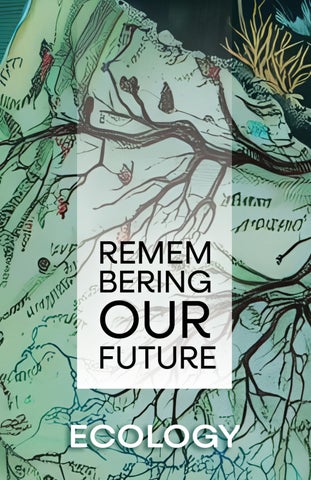
ECOLOGY
Research insights from the ORA global community A publication of Omega Resilience Awards (ORA) A program of Commonweal | 2026
“When a complex system is far from equilibrium, small islands of coherence in a sea of chaos have the capacity to shift the entire system to a higher order.”
—Ilya Prigogine
SERIES INTRODUCTION Four years ago, Commonweal founder Michael Lerner had a sense that the world was entering unprecedented times. Shocks already being felt across much of the Global South were now going to impact everyone with similar intensity. Out of this recognition came a question: How do we practically navigate the polycrisis—the cascade of interconnected crises reshaping our world? ORA (Omega Resilience Awards) was born as an attempt to learn from those already doing this work. Rather than inventing solutions from the outside, we gathered a global community of changemakers—63 fellows and 30 research teams across India, Africa, Latin America, North America, and Europe—to form a learning community. The goal: support each other, accelerate understanding, and share what emerges. Thanks to the Oak Foundation, we were able to fund a four-year prototype to discover what was possible. And we are finding out that a lot is possible. Small islands of coherence exist around the world. When connected, they strengthen the larger field of work interested in creating generative, life-giving human culture. This is one of a series of three zines created by ORA research teams. These zines look inward at our community to understand what works, what’s emerging, and what insights might inspire others navigating similar terrain. We offer these reflections as contributions to the urgent work of collectively imagining what comes next.
1
One with Nature:
Natural Narratives that Inspire Action Every forest starts as a tree. This booklet is the result of a journey with a group of very special people, one where we had the opportunity to learn about the Omega Resilience Awards (ORA) Fellows, their lives and worldviews, as they walked us through their history and projects. ORA is a community focused on helping society respond to the global polycrisis and chart a path towards a more resilient future, and each fellow’s story is a myriad of possibilities. We are Alejo, Belén, and Mauro—researchers, activists, communicators based in Argentina, who wonder about the relationship between societies and their perception of nature. In 2025, we spent over 20 hours talking to ORA Fellows from Africa, India, and Latin America to understand how their connections to nature, territorial land, and ecological practices create resilience.
We sought to vividly experience the powerful narratives emerging from the ORA Community to understand how these can inspire and inform others. We have condensed the insights, learnings, and transformations we gathered through our engagement with the fellows into a tale of three wanderers that walk through a forest. You are warmly invited to travel with them. While this story is intended to be imaginative and playful, a forthcoming text will offer a more traditional approach to the findings. We hope this journey inspires more audacious projects and ideas that turn into forms and practices that re-imagine and re-produce the world as we know it.
2
3
The Beginning There are three of us. We set out on a quest, each carrying an empty backpack, our very own carrier bag. Ursula K. Le Guin, the speculative fiction writer, suggested in The Carrier Bag Theory of Fiction that our ancestors used to carry a bag to bring back food, but also to gather the stories that shaped their community identity.
We are searching for ways to heal, learn, and help others find their way. Coming from urban territories, our path opens to the mysteries of nature ahead. We feel a wound: We’ve been taught nature is separate from us. We are searching for ways to heal, learn, and help others find their way. The world has gone awry. Bombs of power and misinformation threaten to paralyze us. We know there are practices to create resilience and that stories can empower people to take action, to drive change, to move. And so we move.
4
Our questions guide the way: How have the ORA Fellows’ journeys shaped their perception and connection to nature? Are our first experiences of “the natural world” fundamental to how we relate to it? Can these framings inspire others to mobilize as well? Speaking with the fellows is a meaningful journey. Our bags are filled with pebbles of inspiration, twigs of joy, flowers of wisdom—all of these gifts nourishing our minds and souls. This story dwells on five themes we understand help the fellows convey powerful and compelling messages: The notion of “we” as a broad and powerful expression of kinship with other human and non-human beings; the centrality of care in creating mobilizing narratives; language as a vehicle for change; the way over and back that manifests the sense of belonging; and an unnamable element that reveals a sense of absolute interconnectedness. We hope to pass on some of the narratives and insights that might nourish the ORA Community’s work, bringing new ideas and action into play. These reflections are the contents of our carrier bags. They are food for thought. We can’t stop thinking about all the issues discussed and how these communities have learned to protect their people and preserve their ecosystems. We hope they will change you as they continue to change us.
5
Who is We? The forest lies ahead of us. We find a soft trail and set out on that path, with the initial chatter and excitement of a new journey. Before long, the chatter subsides and we begin to tune into the voice of the forest. We come across a wisdom tree—quiet and observant of centuries as they go by. She speaks of her rings and of time. Her gift to us is a rugged strip of bark, its surface marked by long lines, like memories of running water. The story that nature whispers is woven from infinite threads. Literature written by all that’s alive, echoing our own life stories and the paths we tread. Our identities are shaped by endless bonds and relations— constellations of cultural elements and worldviews, overlapping and in a constant dynamic movement with public discourse. They inscribe the way we are in the world. Within that labyrinth, tracing our relationships with the natural world is quite an endeavor. Perspectives on the land, the flora and fauna, are manifold and intertwined. They form a complex ecosystem that transcends humanity. These notions, kinship with ourselves and others, is central to our connection and interaction with the natural world.
6
As we move on, we cross a river. Water flows and we stop to witness its sparkling beauty. We close our eyes and let the sound of water permeate our imagination. Water could be a fellow traveler on this journey, one of us. Its presence transcends its symbolic nature. We squat and drink and, in that very moment, the river becomes a part of us. We are one.
Imagine a threatening crisis is coming to your hometown. A flood, an earthquake, a storm. Who do you care for? When all of the material is left behind, who do you seek to save? Yourself? Your family and loved ones? Your friends and community? Your society? Some people have kinship with the animal world (a beloved pet or friend, or both) and fauna are among their “loved ones.” Some people have kinship with flora and feel trees need to be cared for, saved. For some cosmovisions, the river is as much alive as any other animal, and kinship with the river enables the need for care. Some of us were raised to live as one with the mountain, where the boundaries between self, family, community, and surroundings are fluent, less rigid or fixed. From this understanding, empathy extends beyond what we ordinarily consider to be ourselves. With the words of the tree, the memories of the river sounds, and these ideas in mind, we fill our bags and keep moving.
7
Care of Place As we continue on through the forest the path grows narrow and then opens up to a large clearing. A group of elephants gathers around us. With their trunks, they lift us up onto their backs. They seek to show us the place they call home—the soft ground, the warm air, layers of earth, air, and green surround us. Moved by the elephants and their love for home, and our own memories of the places we feel a part of, we wonder what makes the forest a forest: the sky, the river? The elephants, the birds, the lizards?
We seek answers within the wisdom of the wind, the baobab, the shea tree, and the tigers striding by. Nature dwellers may be perceived as mere objects, or as neighbors, totems, even ancestors. Some worship cows and rats. Others, mountains. Some fear the anger of nature when it is disturbed by the extraction of its material constituency—whether oil, gold, or water. The more we expand our sense of “we,” the more we expand our notions of care. 8
The three of us exchange glances. Not long ago, wandering among the trees, we had a simple yet meaningful conversation. It was about our urban gardens, and how we neglect them when our workload takes over our time and energy; how we let our houseplants wither when we’re too tired to water them. The elephants’ love for their home and their instinct for care reminds us that life transcends our bodies, our species, and territories. Life is more than human. The elephants guide us to a tent where a mahout, friend and guardian of the elephants, invites us to a ceremony of gratitude to their cherished land. We can understand his unknown language. Before going in, he picks a mushroom from the cool, moist soil under the tree that guards the entrance of the tent, protecting it from the sun. He invites us to sit on pillows forming a circle and offers us a cup of freshly brewed tea. We breathe in silence, listening to the elephants wandering away, the wind caressing the foliage of the guardian tree, the river murmuring in our minds. We have become one mind. As the mahout whispers, the river flows with unknown words; still, we can understand them. We let the words of the river carry us away to gently continue our journey.
9
Words that Speak of Nature Language shapes the way we see the world. The ORA Community has shared these words with us and we believe they can inspire you—as they inspired us—to look at the natural world with a different lens. Anga Baobab
(Guruni, Northern Ghana)
Of or belonging to the baobab. Refers to relational belonging with the baobab tree, a symbol of ecological memory, intergenerational continuity, and rootedness in place. Asase Ya
(Akan language, Ghana)
Nature. Literally “the earth” or “earth mother.” Refers to the living ground as a sacred, generative presence that sustains life and holds ancestral continuity. Baobab
(West Africa) Ancestral tree.
Symbol of longevity, ecological continuity, and reciprocal care between land and community. Bicherío
(Spanish, used in Uruguay) A group of animals,
of diverse origin, that surrounds you.
10
Isong Chi No Parakuya (Shona, Zimbabwe) Committing a crime, especially a moral or sacred wrongdoing. Refers to actions that violate ecological or ancestral law, particularly harming protected species. Implies that certain plants and living beings are under cultural protection, where destruction is understood as an ethical offense rather than merely a material act. Durga
(Sanskrit, Pan-Indian)
Hindu goddess of protection, power, and cosmic balance. Embodies the paradox of creation and destruction, reverence and violence. Represents nature as both nurturing and fiercely protective, especially against forces that threaten life. Farafara
(local language, Bogatoga region, Northern Ghana) Regeneration.
Refers to processes of renewal, re-growth, and the restoration of life through reciprocal relationships between land, community, and living systems. Guruni / Gurunsi
(Gur language family and cultural grouping, West Africa) Refers
to a group of related languages and peoples. Implies a shared cosmology grounded in reciprocity with land, ancestors, and living systems.
(Ibibio language, Nigeria)
Earth, land, and nature. Refers to the living ground as a sacred, sustaining presence that supports life, holds ancestral memory, and connects community to territory. Kasem
(Gur language, spoken by the Kasena people in Ghana and Burkina Faso) Name of a language.
Also implies belonging to a specific land, culture, and ecological worldview embedded in territory. Koya
(Guruni / Gur languages, Northern Ghana) Nature. Refers to the
living world as an active, relational presence rather than a passive environment. Nanda Devi
(Bengali and Sanskrit, South Asia) Name and form of
the same divine feminine force as Durga. Refers to the generative, joyful, and sustaining aspect of nature, while still holding its latent power and capacity for transformation. Nisarg
("निसर्ग” used in India) Nature, surroundings, but does not include green spaces.
Njuzu
(Shona) Mermaids or water spirits that guard sacred wells and rivers. 11
Psocodea
(Scientific term, biological taxonomy)
Parisara
(Sanskrit, Pan-Indian) Ecology, surroundings, or ecosystem. Refers to the relational field of living and non-living elements that sustain life.
Paryavaran (“पर्यावरण”) Environment, what surrounds you, can contain green spaces.
12
Booklice and barklice. Refers to small insects that live in close association with organic matter, symbolizing the microscopic life that participates in decomposition and ecological cycles. Prakriti
(Sanskrit, Pan-Indian) Nature.
Refers to the fundamental material reality and generative force from which all living and non-living forms emerge.
Pull of Nature (English) An abstract force that acts as a spiritual pull and a universal homecoming. Sankofa
(Akan, spoken in Ghana) To return
and retrieve what was forgotten. Refers to the act of reclaiming knowledge, memory, and wisdom from the past in order to move forward. Emphasizes continuity between past, present, and future. Sango
(Shona) Translates to
“wilderness,” “forest,” or “desert”; the closest term to nature in certain African native languages. Sasia
(Guruni / Gur languages, Northern Ghana) Nature, land, or the
living surroundings. Refers to the ecological field of relationships that sustains and connects human and non-human life. Tekoha
(Guaraní, used in Paraguay, Brasil, Argentina) Home, residency,
whereabouts. But also habit, behaviour, way and way of being. Teguala (The’wala)
(Nasa Yuwe, Nasa people, Colombia)
Traditional guide, healer, and knowledge keeper. Refers to those who mediate between community, territory, and spiritual forces, maintaining balance and continuity of life.
Tutulegbte
(Guruni, Northern Ghana)
Nurturing from the soil. Refers to the act of caring for and sustaining life through the soil, emphasizing reciprocal nourishment between land and community. Ubuntu
(Nguni Bantu languages, Southern Africa) I am because we
are. Refers to a relational understanding of personhood, where one’s humanity emerges through relationships with others, the community, and the living world. Ykua Ñe’e (Guaraní) Meaning “the word of the water” or “to tell the springs”; a project to give voice to nature through community memory. Zumbani
(Lippia javanica, Shona language, Zimbabwe and Southern Africa) Medicinal
plant used for generations to treat respiratory illness, fever, and infections. Refers to traditional ecological knowledge transmitted through rural and Indigenous communities. Its cultural protection— where cutting it is considered a wrongdoing— has helped ensure its survival and ecological continuity. 13
The Unnamed The world has become silent. We open our eyes. We are all alone, and there are no cushions, no tent, or animals around us. There are no words to describe what we see. If things have a name, why do we feel afloat, at a loss for words about what is unfolding within? We have grown silent and withdrawn into our own thoughts. Time has stood still or simply drifted away. The sun set and rose before we could speak again.
14
Beyond the distance between words and the world, we feel the presence of the spirits. One of us speaks with a new language, one we’ve learned along the way. “The boundaries between us seem to have faded away,” he says. We are one with each other and with those who have gone before us. The rest of us nod in unison as a hummingbird begins to sip from the air. As it sips, a flower blooms. Action kindles existence. The flower leans towards the sun while its roots interlace beneath the soil giving rise to new stems. In our renewed understanding of reality, a new life flourishes—still familiar, but never conceived before.
When we look inside our carrier bags we see a compound of lessons learned. We have seen something beyond things. Invisible threads that reveal a sense of absolute interconnectedness. It is as if we can see the air flow. When we look inside our carrier bags we see a compound of lessons learned. One of us searches within and takes out an apple to share. We laugh and remember the Sistine Chapel’s ceiling, where Adam refuses to extend his finger to touch God’s. Since remote times, different forms of art and faiths from our given mindsets have had means to manifest the whole, the unnamed that thrives between the fictional things we see and handle. We embrace each other softly. From that hug, memories of those who shared their time and wisdom with us rise up with gratitude. We feel our wound tingle as it begins to scar.
15
Healing the Wound Our minds feel exhausted. We have returned to our hearts and our bodies, which have visited a magical territory where we are all one. Through our travels in the forest we’ve learned that there is much we can do to heal our wound of detachment and rejoin with nature to be in a peaceful co-existence. Trees have taught us to sing in the wind, and hummingbirds have taught us that what makes some actions truly transformative is doing them with love and joy, regardless of their purpose. The elephants have taught us to see the world through their eyes, from the eyes of other beings. What should we do now? How can we develop the containers and find the adequate time and place to share the contents of our backpacks with our kin? How can we nurture a relationship between human and non-human entities that enables a livable world for all life? Our acquired language also honours the memory of a culture that struggled for their land and water rights. It also expresses how water itself runs through the hearts and minds of its stewards’ actions. Through all our encounters, we have come to understand that the diversity of challenges is met with an equally abundant range of responses: situated action, ecological art, tools, stories, myths, narratives, or spirituality—all are different vehicles, and different catalyzers. To heal our collective wounds, we should develop a cultural landscape that integrates nature. We should slow down and soften our senses, embracing the melody of the river within ourselves. How can we tend these symbolic gardens? How do we steward culture by incorporating what is beyond humanity? Treating the wounds involves nurturing a culture that transcends the human world and kindling the spark of imagination to create more desirable futures. Some core ideas arising from our conversations with fellows are: developing an emotional connection with nature; building environmental identities—unveiling the natural world within ourselves and the Earth; situated action, envisioning a world we find desirable and possible. 16
What should we do now?
Develop an emotional connection with nature
Build environmental identities: Uncovering the natural which is hidden within ourselves and the world
Envision the world we know is possible
Root in Action
17
Way Over and Back With these questions in mind, we see the sun is setting again. Along with words, sounds, flowers, and learnings, we also carry memories, images, and poems we have collected on our walk through this healing journey. We are thriving but exhausted. Our spine feels the weight of our learnings and our legs and feet the materiality of the soil that has held us the whole way. The weight we now carry is a reminder that we left light but are carrying an abundance of experiences home. We think it is time to return.
Beyond the interconnectedness, there are roots that we want to honour. Where should we return to now that we feel we are a part of everything? Beyond the interconnectedness, there are roots that we want to honour. We are not going back to our cities as heroes—we didn’t confront any monsters. We are coming back as part of a community, willing to share and put into practice our personal experiences and our learnings. We feel grateful for what we have gathered from the natural world—the flora and fauna we met along the way. We want to grow coffee and flowers, to weave and sing songs in Guarani and Nasa Yuwe, to tell stories of lions and turtles, to share the learnings of permaculture, to build sculptures of resistance with what our territory provides. Inspired and full of will, we take the path that leads us home at the next crossroad.
18
19
A Farewell Campfire We spot our city on the horizon. We know we have reached the end of this unique journey of exchange, learning, and expansion with all the beings of the forest. We decide to gather a few branches and start a campfire. As we sit around the fire, we feel the presence of the fish, the mushrooms, the people, the sounds, the smells, and the words—of everything that made our journey meaningful. We are right back where it all started. Our bags are filled with an assortment of treasures and fresh perspectives. Our eyes seem different, there is a twinkle of hope shining bright. It is clear to all three of us that something has changed within, this journey has transformed us in many ways. Can you feel it as well? Have you ever experienced a transformation like this in your life?
20
We are all invited to the campfire. You are invited too. As we wrap up this journey, we would love to read how this story—or your own personal experiences—has touched you deeply. Who and what defines your “we”? Could it be bigger, broader, or stronger? Do you feel you are caring, or being cared for? How do you feel we can heal our collective wound? What do you hope and imagine for the future? What does it take to make it happen? What stories do we need to amplify our view of ecology and nature? What narratives transform the way we see the natural world? What experiences and wisdom can guide us in truly caring for nature?
Submit your Responses 21
Safe Travels This booklet is a journey—one in which we explore how a singular group of people perceives nature, understands ecology, and views the world. The ORA Fellows are one of a kind: they have crafted truly unique responses to the global polycrisis. Theirs is more than just a worldview, it is a way of shaping the world around them from a place of situated action. Powerful creation that empowers local communities and intertwines science, art, and education. We have the privilege of sharing and rethinking our beliefs with them. Along the way, as we explore their views, our own perspectives are transformed.
Storytelling is a powerful This transformation requires something different from our role tool for change. as researchers. We find ourselves extremely moved and at a loss for words: what we experience is difficult to explain in our usual terms. One thing we learn is that storytelling is a powerful tool for change, which is why we share our impressions through this fable of sorts. A poetic approach is the only way to convey what we lived and learned. This booklet is an invitation to a shared journey. It is a faint trail, a path inviting us to become one with the world beyond ourselves. The path is also a log, a diary of sorts, of the journey to discover the ORA Fellows’ views on nature—and to integrate them with our own. We hope that, by sharing our journey, you can set out on your own. We hope your journey is as fulfilling and expansive as it was for us.
Safe travels.
22
Gifts From the Fellows Jeferson: The territoriality and vitality of his song Lorena: “El bicherío as a symbol of company” María Clara: The hummingbird that creates life with its action Gerald: The sound of the river of his childhood. A different sensoriality to value common good Ruhani: Attention to the way light changes and transforms what we see Sumana: Trees and mountains as teachers who teach us not to take ourselves too seriously Arun Kumar: Art as a place of spirituality, community and belonging Ángel: The ritual of the campfire and his joyful rebellious spirit Gloria: The predisposition to play and make science accessible to people Magdalene: Sitting in circles to imagine the future collectively Sandra: The story of the mermaids of the Mucheke River, guardians of nature Nandini: Fishermen and dolphins, in inter-species collaboration, to find and share fish 23
Ecology Meet the Research Team ALEJO DI RISIO
Alejo di Risio is a political ecologist, cultural strategist, and filmmaker working across rivers, energy systems and narrative in Latin America. MOTH Fellow, founder of elSur.Global and member of environmental networks. He develops communication, research, and artistic projects that advance ecological justice, political imagination and watershed-based futures, expanding relational imaginaries between human communities and the more-than-human world.
BELÉN FELIX
Belén Felix is a communicator with a taste for translating complex ideas into narratives that support collective action and social change. Her work has focused on projects and organizations addressing some of the most pressing issues related to education, social protection, and the ecological crisis. She currently leads the Communications team at Fundación Ambiente y Recursos Naturales (FARN), an Argentine NGO working to advance environmental human rights. She holds a BA in Education from Universidad de San Andrés and is an MA candidate in Narrative Journalism at Universidad Nacional de General San Martín.
MAURO FERNÁNDEZ
Mauro Fernández is a researcher and communicator navigating the fragile terrain where ecological collapse meets social inequality. He led climate and energy campaigns in Argentina and internationally for Greenpeace. He is a Senior Fellow on Social and Economic Equity at LSE’s International Inequalities Institute and founder of Sociedad y Naturaleza. He’s currently undergoing studies in Psychology and exploring the philosophical and cognitive roots of human behavior to reimagine our shared future. Photo credit: Luiza Cavalcante 24
A Note of Gratitude The process of creating this zine was transformational: we have come out very different from how we started. It has been a process of unlearning and relearning, of empathy, sensibility, and understanding. We owe this profound change to each of the ORA Fellows who, through their stories, actions, and ideas, have shown us their understandings of nature, how they are put into action, and how this creates and nurtures hopeful and caring ways of living. We are grateful for every conversation, story, song, and poem shared, and for your patience and eagerness to help us understand your work and visions. Each exchange has sparked new questions and ideas in us, and we have done our best here to be true to the stories, insights, and projects of each and every one of you.
Gerald Barekye Magdalene Idiang Gloria Adeyiga María Clara Botero Zapata Jeferson Panche Chocue Ángel Ramos Armoa Sumana Roy Nandini Velho Lorena Sylvia Rodríguez Lezica Sandra Nyika Arun Kumar Gurupadappa Ruhani Kaur You can use this QR Code to view additional resources for stories featured in this zine.
orawards.org/research/ecology
25
ABOUT ORA ORA (Omega Resilience Awards) is a global learning community exploring community-based responses to the polycrisis and the narratives that promote resilience. Operating across India, Africa, and Latin America in partnership with regional anchor organizations, ORA has supported 63 fellows and 30 research teams over four years. Unlike traditional fellowship programs focused on individual leadership, ORA takes a collective, collaborative approach centered on community-driven change. We believe that shifting cultural narratives requires the collective insights and shared wisdom that emerge when community-based innovators connect across regions and learn from each other’s work. Our logo—an archipelago—reflects our commitment to identifying “small islands of coherence” in an otherwise chaotic world and connecting them into a resilient network. This zine is one product of that work: research exploring how our fellows use art, culture, ecology, and technology to advance community resilience. ORA is a program of Commonweal. Learn more at ORAwards.org Follow our work on LinkedIn and Instagram. OmegaResilienceAwards
omegaresilienceawards
ABOUT COMMONWEAL Commonweal is a nonprofit supporting transformative programs at the intersection of healing ourselves and healing the Earth. For 50 years, we have been a home for work that shifts fields and builds movements. As a fiscal sponsor for over 30 programs, we support work creating tools for living better now and envisioning better futures. Rooted at the edge of Point Reyes National Seashore in Northern California, we hold space for innovation, depth, and the kind of patient, grounded work that creates lasting transformation. Learn more at commonweal.org
26
REMEMBERING OUR FUTURE: Ecology Research Team: Alejo di Risio, Belén Felix, Mauro Fernández ORA Co-Directors: Mark Valentine, Andrea Frey Creative Direction: Susan Grelock Yusem Art Direction: Erin O’Reilly Cover Illustration: Jon Marro Illustration & Graphic Design: Sienna Dawn Editorial Assistance and Proofreading: Erin McAuley With contributions from ORA Fellows: Gerald Barekye, Magdalene Idiang, Gloria Adeyiga, María Clara Botero Zapata, Jeferson Panche Chocue, Ángel Ramos Armoa, Sumana Roy, Nandini Velho, Lorena Sylvia Rodríguez Lezica, Sandra Nyika, Arun Kumar Gurupadappa, Ruhani Kaur. Copyright © 2026 by Commonweal Artwork © Jon Marro Published by: Commonweal | Bolinas, California | 2026 ORAwards.org
Sharing This Zine This zine was made to roam. Please share it. Print it for your community. Pass the PDF to your networks. Translate it into your language. Use it in workshops and gatherings. All we ask: • Credit ORA and Commonweal • Share the link to ORAwards.org • Don’t sell it or modify the content • Contact us if you want to translate: ora-outreach@omegaprograms.org This work is licensed under Creative Commons AttributionNonCommercial-NoDerivatives 4.0 International (CC BY-NC-ND 4.0). This work was made possible with funding from the Oak Foundation.
27 27