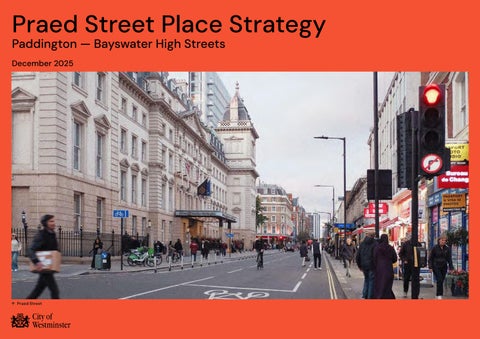
Praed Street Place Strategy Paddington — Bayswater High Streets December 2025
↑ Praed Street
Project team The Praed Street Place Strategy has been developed by Westminster City Council. It was led by the Council’s Place Shaping, Highways- Public Realm, Culture, and Economic Growth teams with support of the following consultants →
Turner Works Architecture and urban design
→
NRP Transport
→
Studio gb Landscape design
→
Lacuna Public art
→
Augarde & Partners Economy
Photographs by Turner Works, Lewis Ronald and other credits.
Content
1
2
3
Introduction
5
1.1 Executive summary 1.2 Purpose of the report 1.3 Process and timeline 1.4 Project scope 1.5 Local history 1.6 Local context 1.7 Current high street uses
6 8 9 10 11 12 13
Approach
14
2.1 High Streets Framework 2.2 Strategy components 2.3 Project types
15 16 17
Engagement
18
3.1 Engagement process 3.2 Engagement findings
19 20
4
Strategic framework
22
4.1 Vision and objectives 4.2 Strategy 4.3 Movement 4.4 Streetscape Place activation 4.5 Street fronts 4.6 Public art 4.7 Cultural activation 4.8 Curate On 4.9 Business support
23 24 25 27 29 29 31 33 34 36
Focus Locations
37
5.1 London Street 5.2 Paddington Basin approach
38 39
6
Next steps
40
7
Appendix A: Area appraisal
42
8
Appendix B: Engagement report
60
9
Appendix C: Public art location
80
10
Appendix D: Praed Street retail strategy
85
5
Westminster High Streets — Praed Street Place Strategy
3
Foreword
The high streets in Paddington and Bayswater are at the heart of community life. They are vital spaces where people come together to live, work, shop, and connect. Yet, like many places across London and beyond, our high streets are undergoing a period of significant change. Evolving shopping trends, shifts in working patterns, and the effects of major developments present both challenges and opportunities. To remain resilient and vibrant, our high streets must continue to adapt and evolve, balancing their historic character with the needs and expectations of a modern, dynamic community. Over the past two years, we have developed ideas and engaged closely with residents, community groups, businesses and partner organisations to better understand their aspirations for the area. Their contributions have been invaluable in shaping this vision and ensuring that it reflects the community’s shared priorities.
Achieving this vision will require continued collaboration and shared commitment. Building strong partnerships between the Council, local businesses, community groups, and residents will be essential. Equally, we must continue to nurture the Council’s role as a custodian of the high street — leading by example, supporting innovation, and championing the distinct identity of each local centre.
Acknowledgements
→
Paddington Now BID
This report sets out the collective ambition to support, enhance, and future-proof Praed Street, one of the key high streets in the area. Through collaboration, investment, and careful planning, we aim to ensure Praed Street continues to thrive — not only as a centre of commerce, but as inclusive, welcoming, and sustainable places at the heart of our community life.
→
TfL
→
Network Rail
→
Hyde Park Estate Resident Association
→
South-East Bayswater Residents Association
→
St Mary’s Hospital and Imperial Trust
→
Paddington Square
→
Westminster Living Streets
→
Paddington Partnership
Councillor Geoff Barraclough, Cabinet Member for Planning and Economic Development.
The Praed Street Place Strategy has been developed in collaboration with key stakeholders, community groups and residents in the area. We would like to thank everyone for their time and input, including:
Westminster High Streets — Praed Street Place Strategy
4
1
Introduction
↑ Paddington underground station
Westminster High Streets — Praed Street Place Strategy
5
1
Introduction
1.1 Executive Summary
Project background
Vision
Next Steps
The Praed Street Place Strategy forms part of the Paddington–Bayswater High Streets Programme and sets out a shared vision and coordinated plan for the street’s short, medium, and long-term improvements.
Praed Street sits at the heart of Paddington and serves as a major gateway to London. It is a lively connection to the area’s diverse mix of shops, cafés, hotels and homes. Its character blends historic architecture with the energy of a busy transport hub It aims to: and a future centre for life sciences, technology and health. However, the → Identify opportunities to improve street faces several traffic and public the streetscape and public spaces. realm challenges and a retail mix → Establish design principles reflecting dominated by low-market occupiers, Praed Street’s local character and which contribute to a fragmented heritage. identity. →
Bring together and clearly communicate community and stakeholder ambitions.
The Place Strategy is underpinned by the Westminster High Streets Framework and aligns to its three themes and strategic objectives: Safe, sustainable and welcoming places Vibrant and resilient economy Connected Communities
The Place Strategy has been shaped using the priorities identified during the public engagement in Summer 2023, analysis of the local sites, conversations with stakeholders and further public engagement in Summer 2025 to understand the level of support for the proposals.
The next steps will focus on developing design proposals and phased delivery of selected projects which will help create a thriving and resilient future for Praed Street. Delivery will rely on close collaboration between the Council, key stakeholders and the local communities. Early pilot projects will build momentum and test ideas ahead of larger-scale public realm improvements.
The vision for Praed Street is to affirm its position as a welcoming gateway to London and a vibrant, bustling place that meets diverse movement needs while feeling open, green, and safe at all hours, day and night. A high street that forms a village heart to its surrounding neighbourhoods, while growing as dynamic hub for life sciences, health, technology and transport. To achieve this vision, the Place Strategy presents the strategic design approach and proposes targeted interventions supported by a delivery plan.
Westminster High Streets — Praed Street Place Strategy
6
1
Introduction
Praed Street Strategy
1.1 Executive Summary Movement and streetscape Praed Street streetscape →
Prioritising improvements for pedestrians: footway widening, safer crossings, seating and wayfinding.
→
Protecting the street’s functionality and movement routes.
→
Enhancing cycling infrastructure.
→
Increasing greenery through flexible kerbside use.
→
Strengthening north-south walking and cycling connections.
→
Introducing places to rest and socialise.
London Street
Paddington Basin Approach
A new civic space and greener north-south link with planting, spaces to dwell and active frontages.
A lively gateway with better wayfinding, greening and public art.
3
5
3
4
5 2
Place activation Street fronts Enhancing and activating ground-level frontages through shopfront improvements, alfresco dining and other ground-level animation initiatives.
2
4
1
1
→ 1
An improved pedestrian experience.
→1
An improved pedestrian experience.
Public art Integrating public artworks that are functional and developed through meaningful engagement to tell local stories and showcase the local destinations.
2 →
A new public space between Praed Street and London Mews.
2 →
A legible access to Paddington Basin.
→ 3
A distinctive gateway with public art.
→ 3
A distinctive gateway with public art.
Curate On and business support Developing and delivering council-led programmes to diversify and improve the quality of offer to attract new, innovative businesses and support existing ones.
→ 4
More greening along London Street.
→ 4
More greening through flexible kerbside use.
→ 5
Shopfront improvements and alfresco dining.
→ 5
Shopfront improvements, alfresco dining and ground level animation.
Westminster High Streets — Praed Street Place Strategy
7
1
Introduction
1.2 Purpose of the report The Praed Street Place Strategy sets out a shared vision, key objectives, and a coordinated approach to guide short, medium and long-term improvements to Praed Street.
Place Strategy objectives
Identify multidisciplinary opportunities to improve the streetscape and public spaces.
Establish a set of design principles informed by Praed Street’s local identity and heritage.
Bring together and communicate the ambitions of local communities and stakeholders.
Create a clear plan to coordinate potential projects that can drive positive change.
Who is it for? The strategy is a practical reference for anyone shaping the street’s future: Residents, businesses, landowners, community groups, and delivery partners. It provides a common framework to guide investment, support design collaboration and coordinate project delivery. How to use it? While not a formal planning document, the Place Strategy is a strong coordination tool and comprehensive basis for action. Proposals included in the strategy are at the concept stage. They are subject to change as projects progress with design development and further public engagement.
Westminster High Streets — Praed Street Place Strategy
8
1
Introduction
1.3 Process and timeline In 2023, the Council launched the Westminster High Streets Programme to improve local high streets outside of the West End. The first area to roll-out the Programme is Paddington-Bayswater. After a rigorous context analysis, the Council conducted a public engagement exercise in Summer 2023 to identify the local communities’ aspirations and priorities to improve their high streets.
Inputs and Activities
The Place Strategy for Praed Street is among the priority projects to be taken forward as part of Paddington-Bayswater High Streets Delivery Plan (November 2024), demonstrating the commitment to high street investment in the area. It sets out a coordinated vision and identifies key spatial, environmental, cultural, community and economic project opportunities on Praed Street and its surroundings.
In Summer 2025, the Council invited local communities and stakeholders to share their feedback on these proposals, ensuring that the final strategy reflects local needs and ambitions. The Place Strategy is now complete, incorporating the feedback received and presenting a plan and design guidance to coordinate future projects.
2022
Summer 2023
Autumn 2024
Summer-Autumn 2025
Winter 2025 Onwards
High Streets Framework Scope and Analysis
Public Engagement Paddington-Bayswater High Streets Framework
Praed Street Place Strategy starts
Public engagement and completion of Place Strategy
Design development and delivery
Next Steps
Start
Fairer Westminster Delivery Plan Publications and Outputs
The next steps will focus on specific design development and phased delivery of selected projects to ensure the vision for a thriving and resilient future for Praed Street is achieved.
Statement of Community Involvement (SCI)
Engagement Report March 2024
Delivery Plan November 2024
Final Place Strategy Publication
Development of priority projects and interventions such as public realm schemes, public art commissions, etc.
Westminster High Streets Westminster High Streets — Praed Street PlacePlace Strategy 9 Praed Street Strategy
1
Introduction
1.4 Project scope Area extent The Place Strategy covers the stretch of Praed Street between Edgware Road (to the East) and Eastbourne Terrace (to the West), London Street and the rest of side streets connecting Praed Street to its North and South surroundings. Key stakeholders Praed Street’s urban landscape is influenced by a wide range of stakeholders, each playing a vital role through investment, development aspirations and proactive stewardship. By collaborating and sharing the vision, they contribute to shaping the future of Praed Street.
Key
Stakeholders Key landmarks (listed)
SEBRA
Key landmarks
St Mary’s / Imperial Trust
Green spaces
Paddington Now Bid
Water features
Grand Union Bid
Place strategy focus area
TfL, London Underground and Network Rail, key stakeholders for Paddington Stations
↑ Project scope
Westminster High Streets — Praed Street Place Strategy
10
1
Introduction
1.5 Local history The history of Praed Street goes back to the 19th century. It was named after William Praed, chairman of the company that constructed the canal basin just north of the street. This basin was part of the Paddington Arm of the Grand Junction Canal, which played a key role in the area's early industrial development. Since then, it has developed into a dynamic district centre for transport, life-sciences, health and technology. Today, Praed Street is bustling thoroughfare, high street and transport hub, serving as one of London's key gateways.
1750s
Paddington remains a rural village
Praed Street’s future site lies within farmland on the Bishop of London’s estate, far from the dense city spreading eastward.
1868
Paddington goes underground The original Praed Street Station (now part of Paddington Underground) launches, increasing the street’s transport significance within the growing capital.
2021+
High Streets Framework and local engagement shape future of Praed Street
Westminster City Council launches the High Streets Framework, using local feedback to shape priority projects and reimagine Praed Street’s role.
1808
1845
Commissioned by the Bishop of London, the street is planned to link Edgware Road with the new canal and future rail site.
The hospital grew onto Praed Street in the 1860s, shaping its identity around health and science—where Alexander Fleming later discovered penicillin in 1928!
Praed Street is imagined
1958
Paddington Bear stories are published
Michael Bond’s character is first imagined at Paddington Station, cementing the street and its station in British cultural memory.
2022
Elizabeth Line opens at Paddington Station
The new underground line expands travel options for Praed Street, introducing a new even wider urban scale to the area with faster east-west connectivity.
St Mary’s Hospital is founded
1854
Paddington Station officially opens Praed Street becomes a critical route for accessing the newly opened station, bringing with it heavy foot traffic and commercial activity.
1980s
2003
A wave of refurbishments and hotel conversions alter the architectural rhythm of Praed Street, reflecting its role as a transient space.
Mixed-use development begins just north of Praed Street, with canalside offices and flats bringing new workers and residents.
Streetscape modernisation
2023
Paddington Square development
A new landmark building and public space open next to Paddington station, transforming Praed Street’s threshold and connecting it with the wider city.
Paddington Basin regen starts
2025+
Place Strategy
The Place Strategy for Praed Street is developed to set out a coordinated vision and proposed improvements.
Westminster High Streets — Praed Street Place Strategy
11
1
Introduction
1.6 Local context The context analysis of Praed Street and its surroundings is evidence-based and comprehensive. The review of past engagement insights, together with thematic urban analysis highlight the high street’s strengths, challenges and opportunities. It forms the basis of the approach to the strategy, objectives and proposed improvements on Praed Street.
Movement and streetscape Praed Street is well connected, with Paddington Station operating 24 hours, drawing in some of the highest footfall in London. Recent public realm upgrades, including footway widening outside the Hilton Hotel, the new cycle lane and the new Paddington Square have improved comfort and accessibility. However, narrow footways, poor wayfinding and limited greenery make the rest of the street uncomfortable and hard to navigate. Traffic and vehicle congestion pose risks to air quality and pedestrian safety. There is an opportunity to extend public realm upgrades, improve signage and wayfinding and strengthen the connections to surrounding green spaces and landmarks.
Heritage and character
Activation
Praed Street’s architectural character reflects its historical evolution. It is marked by significant heritage buildings most notably Paddington Station, a Grade I listed structure designed by Brunel, as well as contemporary additions such as Paddington Square by Renzo Piano. Recent public art installations have introduced a new cultural dimension to Praed Street, particularly around Paddington Square and Paddington Basin.
Retail along Praed Street reflects its location, serving as a central transport hub close to Paddington Station and as a gateway to London for many visitors.
However, inactive frontages, low-quality shopfronts, and the scarcity of greenery and social spaces contribute to unpleasant perceptions of the high street.
The opportunity to diversify the ground floor mix and strengthen Praed Street’s local function and sense of neighbourhood could be achieved through better links to Paddington Basin, a stronger evening offer, attracting quality retailers and future redevelopments.
Enhancing ground-level activity and strengthening connections to the area’s cultural assets present key opportunities to reinvigorate the high street.
The offer is short-term and convenience-led, leaving a gap in community-oriented facilities and everyday services. However, the recent Paddington Square development has started to bring more destination activity to the high street.
Westminster High Streets — Praed Street Place Strategy
12
1
Introduction
1.7 Current high street uses The map illustrates ground-floor high street activity along Praed Street and its connecting streets. The ground floor on the southern side is predominantly small retail, food and beverage and tourism-oriented businesses, such as hotels and souvenir shops. The northern frontage is made up of hotels, the mainland station, a small amount of retail and health-related uses on account of St Mary’s Hospital.
↑ Current high street uses
Key Health / wellbeing
Souvenir shop
Retail / services
Office
Hotel
Residential
Food & drink
Cultural / leisure
Transport
→
12,900 residents
→
257 retail units
→
Short-term and convenience-led offer
→
26% Services and amenities
→
Predominance of food and beverage independents with a range of cuisines available
→
Limited services for residents
→
Freehold land ownership along the South side of Praed Street
→
Large institutions hold ownership on the North
→
2.6% of vacant floorspace
→
Highest footfall among high streets in the area (except Edgware Road)
→
Low spend
→
Night-time economy shaped by the constant movement of people between Paddington Station and St Mary’s Hospital
Westminster High Streets — Praed Street Place Strategy
13
2
Approach
↑ Praed Street — Paddington Square Approach
Westminster High Streets — Praed Street Place Strategy
14
2
Approach
Westminster High Streets Framework
2.1 High Streets Framework The Westminster High Streets Framework aims to revitalise local high streets outside the West End, supporting thriving and inclusive places that better meet the needs of residents, workers, and visitors. It is organised around three main themes and 14 strategic objectives to realise the vision. In Paddington-Bayswater, the framework has been refined through engagement with residents and stakeholders to ensure that its objectives are reflective of community priorities, focusing on what people value most about their high street. This framework and community’s feedback forms the basis of the Praed Street Place Strategy.
Praed Street Priorities Diversifying the high street's uses and improving its retail offer
Creating a welcoming and safe street environment →
Provide spaces to dwell and socialise
→
Incorporate more greening
→
Consider outdoor spaces for local events and services such as markets and festivals
→
Improve safety during the day and night
→
Improve the walking experience
→
Improve street aesthetics and maintain shopfronts
→
→
Diversify uses and retail offer to include health and well-being facilities Support a mix of chain and independent shops
→
Enhance the range of essential products and services to cater to varying income
→
Provide flexible workspace for start-ups and/or local creative businesses
→
Provide opportunities for upskilling and training
Creating opportunities for social interactions and cultural activity →
Introduce and sustain cultural and artistic spaces
→
Create family-friendly spaces and spaces for the youth
→
Support social cohesion through social initiatives and services
Westminster High Streets — Praed Street Place Strategy
15
2
Approach
2.2 Strategy components Based on Westminster High Streets Framework, the Place Strategy sets out a comprehensive vision addressing Praed Street’s priorities and bring together the aspirations of its local communities and stakeholders.
Stories in place
Common Rooms Street fronts
Animated furnishing
Common Rooms Greening
Footway Widening
Together, they enable a holistic approach to the future transformation of Praed Street and allow for an incremental implementation of projects by various stakeholders.
The 3D view is for illustration only. Proposals will be subject to feasibility studies and further community engagement.
Market Places Street furniture
The strategy comprises a variety of project types guided by strategic design principles.
The illustration on this page is a generic diagram to show how these components come together, from diversifying the business and community offer to improving the vibrancy and diversity of ground-floor retail, while enhancing the public spaces between buildings.
Stories in place
Stories in place
Cycle infrastructure
Crossings
Place activation
Movement and streetscape
Projects that enhance the area’s character through cultural activity, animation and diversity of uses on the high street
Projects that improve movement, usability, and accessibility through public realm design and traffic management measures
Business support & Curate On
Footway widening
Support for independent businesses, fostering diverse, high-quality ground floor uses
Expand and declutter footways to improve pedestrian comfort and enable flexible kerbside uses
Common rooms
Animated furnishing
Cycle infrastructure
Revitalising vacant spaces to become cultural hubs for community events, and social connection
Creative street furniture that animates the streetscape and encourages interaction
Market places
Street fronts
Vibrant markets that support local vendors and celebrate cultural diversity on the high street
Improve shops and nonretail facades to enhance visual appeal, accessibility and activate frontages
Stories in place Public art and interactive wayfinding that celebrates local heritage and identity
Enhancing cycling infrastructure to improve cyclist safety and encourage active travel
Crossings New and upgraded crossings to improve pedestrian safety
Greening Trees and planting to strengthen connection to nature and support biodiversity targets
Street furniture Street furniture in targeted locations (seating, lighting, etc.) to support safety and accessibility
Traffic management Measures to improve safety and efficiency of movement for all modes of transport
Westminster High Streets — Praed Street Place Strategy
16
2
Approach
Gateways
Focal civic spaces
Side streets
2.3 Project types The Place Strategy highlights opportunities to combine multiple place activation and streetscape improvements. This could create clusters of activity and memorable focal points along the high streets.
↑ Tooley Street, London Credit: Charles Holland Architects
Market places
↑ Identified Flying Object, King’s Cross Credit: Jacques Rival
Street fronts
↑ Marylebone Lane, London Credit: Westminster City Council (WCC)
Business support and curate on
Stories in place
These are identified as: →
Gateways: An arrival experience at key entry points, transforming transitional spaces into welcoming, memorable places.
→
Focal civic spaces: A civic heart on the high street with public realm improvements that encourage social interaction and support biodiversity.
→
Side streets: Vital side streets with greenery, seating, play features, and cycle infrastructure to create inviting community spaces at key junctions.
↑ New Kensington Farmers’ Market Credit: London Farmers’ Market
↑ St. John’s Wood High Street, London Credit: Context Office and WCC
↑ Every One Every Day Credit: Every One Every Day
↑ NHS Swimmers, London by Catherine Yass Credit: Nick Turpin
Common rooms
Animated furnishing
Crossings
Footway widening
↑ The Nourish Hub, London Credit: RCKa
Street furniture
↑ Tooley Street, London Credit: WMB Studio
↑ Real Time Clock, London by Maarten Baas Credit: Maarten Baas
Greening
↑ Marylebone High Street, London Credit: Westminster City Council (WCC)
↑ Clapham Old Town, London Credit: Urban Movement
Cycle infrastructure
↑ Early release lights, London Credit: Westminster City Council (WCC)
↑ St. John’s Wood High Street, London Credit: Context Office and WCC
Traffic management
↑ Eltham High Street, London Credit: East Architecture
Westminster High Streets — Praed Street Place Strategy
17
3
Engagement
↑ Paddington Square
Westminster High Streets — Praed Street Place Strategy
18
3
Engagement
3.1 Engagement process
Summer 2023
Public engagement Paddington-Bayswater High Streets Framework to establish area-wide priorities
February 2025
The Place Strategy has been developed collaboratively through a multi-stage engagement process. Initial insights were gathered in Summer 2023, which informed the emerging Westminster High Streets Framework and captured the early ambitions of local communities.
Early engagement with stakeholders Workshop with representatives with from TfL, Imperial, Network Rail, Sellar, Paddington Square, St-Mary’s hospital, Paddington Now
Summer 2025
Public engagement
Building on this, continuous engagement with local groups, residents’ associations and stakeholders helped shape the draft vision for Praed Street. A six-week public engagement was conducted in August-September 2025 to understand the level of support for the objectives and proposed improvements and understand people’s concerns and suggestions.
Draft place strategy: Vision, objectives and proposed improvements
Survey on Commonplace 212 responses
Outdoor exhibition
Drop-in session
Proposals exhibited outdoors at Paddington Square
Inputs from this engagement helped refine the Place Strategy and finalise the proposals presented in this report. Refer to Appendix B for more detail on the engagement feedback.
Review and analysis of feedback
Final Place Strategies Westminster High Streets — Praed Street Place Strategy
19
3
Engagement
3.2 Engagement findings
Level of support of objectives Feedback showed support for a safer, greener, and more pedestrian-friendly streets, while emphasising careful traffic management, improved crossings, and maintaining access for vehicles, residents, and businesses to ensure practical, inclusive improvements.
91%
agree or strongly agree on objectives for the street
Feedback was captured from a total of 212 responses to the online surveys. Comments received were from a wide range of age groups (19–70+). The two largest age groups of respondents were 25–34 (17%) and 60–64 (13.1%), together making up 30% of all respondents. 74.5% of respondents indicated that they live nearby. Results also highlight that respondents had multiple connections to the area, such as visiting the high street frequently, working nearby and commuting through the high street.
Level of support of proposed improvements
212 Responses Source: Commonplace
89%
agree or strongly agree with proposed improvements
212 Responses Source: Commonplace
Feedback highlighted enthusiasm for a greener and more welcoming Praed Street. Furthermore, the importance of balancing pedestrian upgrades with smooth traffic flow, clear signage and thoughtful planning around taxis and deliveries was emphasised. This is to ensure that changes enhance both safety and convenience for everyone.
Preferred option for London Street No option supported
Option B Option A
Refer to Appendix B for more detail on the engagement demographics and feedback.
212 Responses Source: Commonplace
67% of respondents show a strong preference for the creation of a new public space between Praed Street and London Mews in addition to overall public realm improvements (Option B) for a pedestrian-friendly, greener, and socially vibrant vision. Supporters highlighted safety, improved public spaces and benefits for local businesses.
↑ Option B: preferred by 67% of the respondents. The 3D view is for illustration only. Proposals will be subject to feasibility studies and further community engagement.
Those favouring Option A (overall public realm improvements only) focus on maintaining traffic flow, emergency access and practical usability.
Westminster High Streets — Praed Street Place Strategy
20
3
Key priorities mentioned
Engagement
3.2 Engagement findings The analysis of open-ended responses (384 comments) from the survey captures the communities' specific priorities, concerns and suggestions for Praed Street. This includes people’s aspirations for a street where movement, safety, and everyday usability are prioritised. Suggestions for community amenities and activation of the public space were supported and seen as positive improvements. Additionally, this analysis reveals a number of specific locations where people spoke of both opportunities and challenges associated to these spaces (see diagram on right). Refer to Appendix B for more detail on the engagement feedback.
Key Priority Priority No. No. 1 1
Priority No. 2
Priority No. 3
Traffic management
Pedestrian experience
Quality of the public realm
Key locations mentioned
St. Mary’s 21 mentions
Paddington Station / Square 35 mentions
3
1
11
Conduit Pl 5 mentions Spring St 5 mentions
9 6
8 2
Norfolk Square 9 mentions 10
Norfolk Pl 5 mentions
Sussex Gardens 11 mentions
Craven Hill Gardens 5 mentions
Pedestrian experience (38%) Strong calls for wider pavement, safer crossings, and reducing car dominance to make walking more comfortable
Paddington Basin 15 mentions
Cycling (20%) Interest in safe, continuous cycling routes, balanced with clear enforcement to protect pedestrians Accessibility (13%) Strong emphasis on retaining safe, convenient access for elderly people, disabled users, and families with buggies.
London Mews 5 mentions
London Street 30 mentions
Traffic management (45%) Desire to limit rat-running and congestion while ensuring access for ambulances, taxis, and essential vehicles
Quality of public realm (31%) Support for cleaner pavements and upgraded shopfronts to create a more welcoming, higher-quality environment 4
7
From 384 processed comments Source: Commonplace
Findings per theme
5
Greening (12%) Enthusiasm for trees, planting, and other green features to reduce noise, pollution, and visual monotony Seating, art, and markets (15%) Appetite for seating, integrated artworks and occasional markets, with caution to avoid clutter or obstructing movement.
↑ Key locations from comments
Westminster High Streets — Praed Street Place Strategy
21
4
Strategic framework
↑ Paddington Station — Elizabeth Line entrance
Westminster High Streets — Praed Street Place Strategy
22
4
Strategic framework
4.1 Vision and objectives
A vision for Praed Street The vision for Praed Street is to affirm its position as a welcoming gateway to London and a vibrant, bustling place that meets diverse movement needs while feeling open, green, and safe at all hours, day and night. A high street that forms a village heart to its surrounding neighbourhoods, while growing as dynamic hub for life sciences, health, technology and transport.
Praed Street streetscape → Prioritise improvements for pedestrians → Protect the street’s functionality and movement routes → Better link Praed Street to the wider cycling network → Support shopfront improvements → Activate northern frontage and coordinate with future development sites → Introduce public art to reflect local stories, character and heritage
Gateways and focal civic spaces Paddington Station → Enhance the arrival experience from Paddington Station → Create a welcoming space for people to navigate onward journeys → Signpost key local destinations Paddington Basin
Side streets
London Street
→ Enhance strategic connections to nearby destinations (Paddington Basin and Hyde Park)
→ Strengthen London Street as a green route connecting the high street to Hyde Park
→ Improve walking and cycling
→ Create a new public space on the North Section between Praed Street and London Mews
→ Enhance greening → Provide places to rest and socialise
→ Create legible access to Paddington Basin → Improve the connection to Edgware Road
Westminster High Streets — Praed Street Place Strategy
23
4
Strategic framework
4.2 Strategy
Key Movement and streetscape Movement
Streetscape
Enhanced crossing and junctions
Decluttered footway
Cycle infrastructure
Footway widening Flexible kerbside (loading, parking, greening and seating) Existing tree locations
Place activation Street Fronts
Public Art
Opportunity for shopfront improvements
Showcasing local destinations through memorable landmarks
Opportunity for upper levels improvements
Connecting the high street to the Basin and Hyde Park
New active frontages (facilitated via future new development)
Storytelling mural trail Existing public art
Westminster High Streets — Praed Street Place Strategy
24
4
Strategic framework
4.3 Movement
The ambition
Approach
Praed Street has the potential to be a welcoming, connected, and people-friendly gateway to London.
→ Comfortable walking routes: Declutter and widen footways to enhance the accessibility, safety and pedestrian comfort levels
This can be achieved through traffic calming, wider and better footways and crossings, and investigating the option of a new public space on London Street.
→ Enhanced pedestrian crossings: Improve east-west and north-south connectivity to surrounding neighbourhoods with new zebra crossings and continuous raised junctions → Inviting side streets: Identify opportunities to create calmer and thriving spaces on side streets
↑ Decluttered comfortable walking routes — new section of public realm at Praed Street, London
↑ Improved pedestrian crossings — Lea Bridge Road, Waltham Forest
↑ Road closures to create new public space — Strand Aldwych, London
→ A new public space on London Street → Connected cycling routes: Support cycling across the area with new dedicated cycle lanes and infrastructure → Traffic movement: Ensure traffic movement requirements, servicing needs and parking provisions are rationalised and consolidated. → Traffic management: Support enforcement to manage noncompliant parking
↑ Cycle infrastructure
Westminster High Streets Westminster High Streets — Praed Street PlacePlace Strategy 25 Praed Street Strategy
4
Strategic framework
4.3 Movement Location opportunities This plan shows the proposed measures to improve movement flow for all transport modes across Praed Street and its surroundings. → Enhanced junctions and safer and continuous crossings to side street – To clearly indicate pedestrian priority, delivered through approaches such as zebra and Copenhagen crossings. → Traffic restriction on London Street to facilitate the creation of a new public space: Closure between Praed Street and London Mews. The rest of London Street becomes two-way access only. → Introduction of new cycling infrastructure –Including safer cycling along Praed Street, cycle parking and two-way cycling on Sale Place. → Reallocation of tourist bus stops Key Vehicle traffic restriction Enhanced crossing and junctions Cycle infrastructure
↑ Proposed movement strategy for Praed Street
Westminster High Streets — Praed Street Place Strategy
26
4
Strategic framework
4.4 Streetscape
The ambition
Approach
Transforming Praed Street into a welcoming, accessible and inclusive high street for all. A high-quality, decluttered streetscape encourages pedestrians to comfortably move through, pause and enjoy a memorable public space while rearranged kerbside uses facilitate a diversity of requirements including business servicing, greening, seating, lighting, waste management and parking.
→ Inclusive and accessible footway: Provision of accessible and decluttered footways and crossings to improve the experience for all, including people with mobility needs. → Wider pavements: Widen footways and upgrade surfaces with high-quality, durable materials that are in keeping with the area’s character and WCC Public Realm SPD. → Flexible kerbside use: Reallocate kerbside space to accommodate a range of servicing infrastructure, greening, seating, parking, loading and expanded footway. → Integrated seating: Provide rest points where footway width permits with careful placement of street furniture.
↑ Balanced streetscape - Marylebone High Street
↑ Widened footway accommodating new trees, seating, bins and cycle parking — St Johns Wood High Street, London
↑ Flexible kerbside with greening, vehicle and cycle parking — Marylebone High Street, London
→ Improved wayfinding: Increase the provision of place-specific wayfinding features that improve sightlines and help people orientate themselves. → Improved lighting: Feature seasonal lighting that address functional requirements, contributing to a safe experience after dark while respecting the street’s heritage. Overall street lighting to be considered in conjunction with public realm proposals. → Increased greening: Identify a range of greening solutions that take into consideration Praed’s Street’s heavy footfalls and complex underground conditions (Underground lines and utilities).
↑ Flexible footway and loading bays — Queensway, London
Westminster High Streets Westminster High Streets — Praed Street PlacePlace Strategy 27 Praed Street Strategy
4
Strategic framework
4.4 Streetscape Location opportunities The plan shows the proposed measures to enhance the streetscape environment across Praed Street and its surroundings. This includes: Footway widening → Along Praed Street: Focused on the south side. → Station entrance: To accommodate high pedestrian volumes outside the Underground Station. → St. Mary’s Hospital and surrounds: Future redevelopment to consider footway widening opportunities to support retail activity. Footway widening for flexible kerbside use → London Street: To maximise greening and create a green route connecting Praed Street to Norfolk Square and Hyde Park. → Praed Street: To consolidate loading and parking and integrate greening and seating.
Key Decluttered footway Footway widening Flexible kerbside (loading, parking, greening and seating) Opportunities for footway widening in future St Mary’s developments Existing tree locations
↑ Proposed streetscape strategy for Praed Street
Westminster High Streets — Praed Street Place Strategy
28
4
Strategic framework Place activation
4.5 Street fronts
The ambition
Approach
A coherent and characterful mix of high-quality shops, with lively facades and welcoming fronts that draw people in and celebrate the street’s identity.
→ Shopfront improvements: Enhance the visual appeal and character of shops. ensure new shopfronts curate well-lit and transparent ground floors that contribute to soft lighting spill out and generate a safer and more engaging street atmosphere by night. → Accessible forecourts: Remove clutter to improve accessibility to shops while maintaining safe pedestrian flows.
→ Ground level animation: Transform inactive ground-floor frontages into inviting spaces that contribute to a lively, safe, and continuous street experience. → Improved upper levels: Enhance the visual and aesthetic appeal of key buildings to contribute to a coherent and well-maintained builtenvironment along the street.
→ Alfresco dining: Identify locations to support alfresco dining that contribute to the creation of a pleasant and lively street atmosphere.
↑ Shopfront improvements — Powis Street, Woolwich Town Centre
↑ Alfresco dining — Market Place, Fitzrovia
↑ Ground level animation - Dashi Ramen, Stockholm. Credit: Behance.net
↑ Lighting after dark— Sutton. Credit: Jan Kattein Architects
Westminster High Streets Westminster High Streets — Praed Street PlacePlace Strategy 29 Praed Street Strategy
4
Strategic framework Place activation
4.5 Street fronts Location opportunities This plan outlines recommended locations for enhanced and activated high street frontage across Praed Street and its surroundings. This Includes: Shopfront improvement opportunities Along southside of Praed Street New active frontages Opportunities facilitated via future new development. Alfresco dining to be supported along Praed Street building frontages where appropriate and in alignment with the WCC Streets and Spaces SPD (2025).
Key Opportunity for shopfront improvements New active frontages (facilitated via future new development)
↑ Proposed street front strategy for Praed Street
Westminster High Streets — Praed Street Place Strategy
30
4
Strategic framework Place activation
4.6 Public art
↑ Showcasing destinations - Infinite Accumulation by Yayoi Kusama— Liverpool Street Station. Credit: Nick Turpin
The ambition
Approach
Strategy
A vibrant, engaging high street where public art strengthens a sense of local identity and pride, creates a more welcoming environment, and celebrates Praed Street’s global legacy in transport and medical innovation.
→ Embedded functionality: Ensure the location and type of artwork have minimal impact on pedestrian flows and desire lines, while enhancing the street’s character and responding to its practical needs.
→ Showcasing local destinations through memorable landmarks. Artwork to highlight and anchor key neighbourhood landmarks, including create a clear sense of arrival at Paddington Station.
A curated framework for ongoing and permanent cultural landmarks will support cultural activity and social cohesion.
→ Meaningful engagement: Engage with local community groups and stakeholders throughout the process.
→ Telling local stories A curated walking route along the high street featuring 2D wall art that celebrates local history and stories of health, wellbeing, transport, local icons and communities.
↑ Telling local stories - NHS Swimmers by Catherine Yass — Tanner Lane London. Credit: Nick Turpin
→ Collaborations and partnerships: Build upon existing public art initiatives in the area and collaborate with local stakeholders to identify new opportunities.
↑ Connecting to the surroundings – Yara + Davina – Somerset House, London. Credit: Yara + Davina
→ Connecting to the surroundings Artwork to connect Praed Street to surrounding destinations, including Paddington Basin, Little Venice and Hyde Park.
↑ Functional and playful – seating by Jeppe Hein Lemvig Havn, Denmark Credit: Jimmi Sorensen
Westminster High Streets Westminster High Streets — Praed Street PlacePlace Strategy 31 Praed Street Strategy
4
Strategic framework Place activation
4.6 Public art Location opportunities This plan sets out the existing and potential sites available. Not all locations are intended to be delivered. The locations selected will be curated to ensure the output facilitates a holistic streetscape environment, sensitive to the conservation area setting.
Storytelling Mural Trail A curated walking route along the high street featuring murals that narrate local stories and celebrate community identity Showcasing Local Destinations through memorable landmarks: Artwork to highlight and anchor key neighbourhood landmarks, including create a clear sense of arrival at Paddington Station. Connecting the high street to the Basin and Hyde Park artwork to connect Praed Street to surrounding destinations, including Paddington Basin, Little Venice and Hyde Park.
Key
Proposed — Temporary Showcasing local destinations through memorable landmarks Connecting the high street to the Basin and Hyde Park Storytelling mural trail
Proposed — Long term
Existing
↑ Proposed public art strategy for Praed Street
Westminster High Streets — Praed Street Place Strategy
32
4
Strategic framework Place activation
4.7 Cultural activation
The ambition
Approach
Strategy
Paddington and Praed Street become a new cultural destination in London that encourages workers and visitors to stay in the area and stimulate a vibrant daytime and evening economy.
→ Increased arts and cultural programming on the high street: Provide activities for families and young people and support pop-up and seasonal activity.
→ Outdoor events Performance, events, workshops and walking tours in public spaces.
The vibrant and culturally diverse character and communities of the area will be reflected through arts and cultural activities that brings people together.
→ Enhanced night-time offer: Assess opportunities to enhance the night-time offer and economy in and around Praed Street, especially for hotel guests and local workers. → Continuous engagement and collaborations: Support opportunities for local cultural organisations and seek partnerships with local stakeholders for delivery.
↑ Outdoor events - Designing the Magic Carpet, Nutford Place — Edgware Road, London. Credit John Orton
↑ Indoor Programming - Punchdrunk Lost Lending Library pop-up — Brent, London. Credit: Punchdrunk.
→ Indoor programming Cultural programming and workshops to activate vacant or underused spaces and retail units in the evening. → Markets Explore seasonal market in Norfolk Square Gardens.
↑ Markets— London Farmers Market, London
Westminster High Streets Westminster High Streets — Praed Street PlacePlace Strategy 33 Praed Street Strategy
4
Strategic framework Place activation
4.8 Curate On
The ambition
Approach
Praed Street as a vibrant, sustainable, and welcoming high street, with engaging retail offer, that serves as the centre of the local neighbourhood.
Develop and deliver the Council-led Curate On programme, which establishes a series of tactics to improve the quality of offer on Paddington-Bayswater high streets.
Future development should encourage new high street frontages on the northern side of Praed Street.
→ Praed Street Retail Strategy: A vision for the future of ground floor high street offer on Praed Street, based off the local character, market analysis and future high street trends. → Meanwhile On: A pop-up programme to address retail vacancy, first launched in 2021 in the West End. It aims to transform vacant or underused shops with emerging brands through shorter-term tenancies.
↑ Angel Yard workspaces – Edmonton, London. Credit: Jan Kattein Architects
↑ Big Sister Café, delivered through Meanwhile On in Paddington — Edgware Road, London
↑ Love Cocoa, delivered through Meanwhile On — Oxford Street, London.
→ High street matchmaking platform: A platform, designed to facilitate direct introductions between landlords and businesses, and support new businesses in the early stages of opening a physical store. → High Street Rental Auctions: A national tool allowing the Council to require landlords to rent out persistently vacant commercial properties to new businesses or community groups. More information on the programme is available here: Have Your Say Today Curate On - Paddington-Bayswater High Streets.
↑ Vacant shop on Praed Street, London
Westminster High Streets Westminster High Streets — Praed Street PlacePlace Strategy 34 Praed Street Strategy
4
Strategic framework Place activation
4.8 Curate On
The retail strategy
The ambition
Approach
Turning a transit street into a gateway
→ Sequence change by cluster: Start with the stretch facing the station to test changes to the retail mix. Once change happens, extend southward in coordination with future new retail delivered through St Mary’s hospital masterplan.
The cluster-led, retail-first strategy focuses on everyday anchors, distinctive independents, and station-front activations, creating a coherent, investible street identity that captures footfall and rewards exploration.
→ Continued collaboration with landlords. → A balanced mix of trusted everyday operators and distinctive independents.
↑ Everyday needs — All Greens, London. Credit All Greens
↑ Grab-and-go small format bakeries — Pavilion, London. Credit: Pavilion Bakery
→ Layer distinctive independents: Small-format bakeries, coffee, healthy grab-and-go, niche services to give personality. → Hospitality and tourism capture: Leverage nearby hotels and tourist flows with grab-and-go, luggage-friendly retail, and dining formats that work for short stays.
→ Anchor everyday needs: Secure a high-quality convenience/grocery and pharmacy offer for residents, NHS staff and commuters.
→ Increased evening offer: Evening cafes and restaurants, cultural programming, late-night supermarkets and conveniences that facilitate needs of residents, visitors and St Mary’s hospital staff, patients and families after dark.
↑ Capture station footfall — Praed Street
↑ Evening cafes. Credits: Clem Onojegtuo on Unsplash
→ A high-visibility cluster at the station entrance showcasing change.
Westminster High Streets Westminster High Streets — Praed Street PlacePlace Strategy 35 Praed Street Strategy
4
Strategic framework Place activation
4.9 Business support
The ambition
Approach
A resilient, sustainable, and successful high street, where businesses are empowered to grow and contribute to the local economy.
Roll-out the council-led business support programmes specifically targeting high street businesses: → Business Resilience Programme: Providing free expert assistance to help ensure businesses are ready and able to deal with a range of risks and disruptions. → Visual Merchandising: Supporting local shop owners refresh their window displays to attract more customers and boost business success.
↑ Shopfront Improvements — Harrow Road
↑ By Rotation delivered through Meanwhile On — Regents Street, London
↑ Every One Every Day - Barking and Dagenham, London
→ Shopfront Improvement scheme: Providing business owners with free architectural services and physical works to enhance their external shopfronts. → Business safety and contingency planning: Business continuity management plan to help businesses in emergency preparedness and accounting for the impacts of major incidents. More information is available here: Have Your Say Today - Business Resilience Programme - Paddington-Bayswater High Streets
↑ Praed Street, London
Westminster High Streets Westminster High Streets — Praed Street PlacePlace Strategy 36 Praed Street Strategy
5
Focus locations
London Street
Paddington Basin approach
↑ London Street looking south
↑ Praed Street Street looking east
Westminster High Streets — Praed Street Place Strategy
37
5
Focus locations
5.1 London Street
5 5 6
7
1
6 5
3
2
The proposal London Street is one of the main arrival point to London as visitors exit Paddington Station. Currently, this encounter is overwhelming and unwelcoming where traffic movement predominates. Yet, the street has a strong potential to become a memorable place offering a welcoming sense of arrival and a more comfortable pedestrian route to the surroundings. A new public space between Praed Street and London Mews with seating, greening and animated wayfinding to create a welcoming gateway. A safer and more accessible street with an uplifted public realm through planting, active frontages and public art where people can walk, pause, and embark on their journey in the area.
4
↑ Illustrative view showing what the improvements could look like at the intersection of Praed Street and London Street.
→1 A pedestrian-friendly route: Enhancing the pedestrian experience and improving accessibility to the surroundings.
→ 5 A distinctive gateway: Establishing a memorable entry point with a strong sense of place with artwork that showcases local destinations and tell the local stories.
2 Enhanced pedestrian crossing on Praed Street. →
6 More greening and strengthening the connection to → Norfolk Square Gardens.
→ 3 A new public space with animated seating and wayfinding between Praed Street and London Mews. → 4 Improved cycling infrastructure.
→ 7 Active frontages: Support shopfront improvements and opportunities for alfresco dining.
Note: This 3D view is for illustration only. Proposals will be subject to feasibility studies and further community engagement.
Westminster High Streets — Praed Street Place Strategy
38
5
Focus locations
5.2 Paddington Basin approach
6
7
8
3
4
2
The proposal Connecting Praed Street to both St Mary's Hospital and Paddington Basin, this section of the street is currently a busy corridor, often feeling unwelcoming, inaccessible and confusing for pedestrians. It lacks clear wayfinding, and moments of calm needed for the location to be appreciated for its users. Enhancing legibility, improving pedestrian comfort, and strengthening the connection between the northern and southern surroundings will create a more accessible, welcoming, and cohesive setting along Praed Street.
5
1
↑ Illustrative view showing what the improvements could look like on Praed Street.
→1 A pedestrian-friendly route: Enhancing the pedestrian experience through widened footway.
→ 5 Mural trail: Public artwork to narrate local stories and celebrate community identity.
2 Continuous pedestrian crossing. →
6 Wayfinding and public artwork to guide towards the → Basin.
→ 3 Improved connection and accessibility to Paddington Basin. 4 Increased greening through flexible kerbside use. →
7 Active frontages: Support shopfront improvements and → opportunities for alfresco dining.
→ 8 Ground-level animation with public art opportunities to enliven northern frontage until hospital redevelopment comes forward.
Note: This 3D view is for illustration only. Proposals will be subject to feasibility studies and further community engagement.
Westminster High Streets — Praed Street Place Strategy
39
6
Next steps
↑ London Street looking north
Westminster High Streets — Praed Street Place Strategy
40
6
Next steps
Project
Streetscape and movement
Public realm scheme* Praed Street and London Street
Place activation
Shopfront improvements
Place activation
Public art commissions (murals)
Place activation
Public art commissions (installations, animated furnishings)
Place activation
Public art commissions (temporary)
Place activation
Markets
The next steps will be:
Place activation
Activation grants
→ Project briefs in coordination with key stakeholders and partners.
Place activation
Curate on Meanwhile On
Place activation
Curate on High Street matchmaking platform
Place activation
Curate on High Street Rental Auctions
The Place Strategy offers a comprehensive roadmap for practical and incremental improvements on the high streets. Acknowledging future developments, it is a shared tool for all stakeholders to achieve the vision, develop, fund and deliver the range of proposals. While some of the projects included in this strategy have been progressing as part of the Delivery Plan 2024, other ambitious proposals are identified at the concept stage. Specific future projects will be subject to detailed design development and further public engagement.
→ Project development including feasibility studies, cost estimates, technical considerations. → Continuous engagement with stakeholders, local communities and partners. → Scoping funding contributions and securing approvals for project delivery. → Detailed design phases, tender, mobilisation and implementation.
↑ Proposals are evaluated against four criteria. This approach ensures that strategic planning and decision-making are evidence-based, deliverable and aligned with the overall vision to improve Praed Street. * Public realm scheme (Praed Street and London Street): Decluttering, footway widening, crossings, cycling infrastructure, parking and servicing rearrangements, traffic management measures, street furniture, and greening
Key
Project type
Estimated timeframe
Estimated complexity
Estimated impact
Estimated budget
Long term (3+ years)
High level of complexity
High impact
High cost
Medium term (1-3 years)
Moderate level of complexity
Moderate impact
Moderate cost
Short term (< 1 years)
Low level of complexity
Low impact
Low cost
Westminster High Streets — Praed Street Place Strategy
41