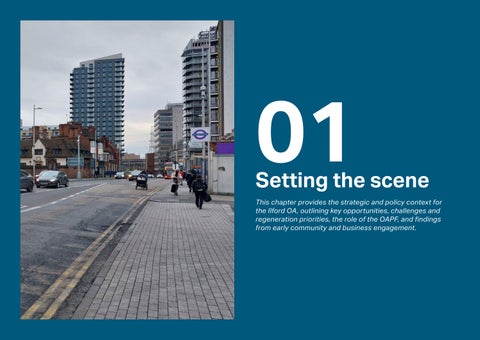
01
Setting the scene
This chapter provides the strategic and policy context for the Ilford OA, outlining key opportunities, challenges and regeneration priorities, the role of the OAPF, and findings from early community and business engagement.
01. Setting the scene
CONTENTS
Planning for sustainable growth London context London’s population has grown by 1.5 million over the past 20 years, reaching a record high of almost nine million in 2023. Even though growth has slowed in recent years, the city is still projected to gain another one million residents by 2050.
Without decisive action now, London will not have the homes or jobs infrastructure needed to support this growth - and the city’s long standing housing crisis will only deepen. This means that an increase in housing delivery, supported by spaces for new jobs, is needed both to ensure London remains a liveable, inclusive and economically competitive city. Situated on the Elizabeth Line, Ilford is an OA with the scale to drive growth, the connectivity to attract investment and the diversity to create something genuinely distinctive.
Making the best use of land
London’s housing need requires a brownfield-first approach, focusing growth in accessible locations such as Ilford OA to deliver new homes and jobs efficiently, sustainably and inclusively. A unique opportunity
While meeting housing needs brings significant change, it also creates an opportunity to deliver long‑needed community benefits, including improved youth facilities, high‑quality public spaces and other essential amenities that are only achievable with investment at this scale. A city for all Londoners
Growth should deliver the London Plan’s Good Growth objectives by creating healthier, more inclusive and betterconnected communities, ensuring all Londoners can benefit from high-quality homes, jobs, services, infrastructure and a thriving urban environment.
Illustrative view showing greening along Clements Road and development alongside the retained Salvation Army building Ilford OAPF 8
01. Setting the scene
CONTENTS
Planning for sustainable growth Ilford OA Ilford was designated as an OA in 2004, with the potential of delivering 6,000 homes and 700 jobs by 2041. Unlike many other OAs awaiting major infrastructure investment, Ilford already has strong transport links and contains several stalled or shovel-ready sites. The OA is strategically located to and from the City and Canary Wharf, with the Elizabeth line providing fast connections; just under 10 minutes to Stratford and around 30 minutes to Paddington. The area benefits from significant green and blue assets, including Valentines Park and South Park, and sits alongside the River Roding as part of the wider Roding Valley landscape. As a Metropolitan Town Centre within London’s network of over 240 centres, Ilford offers a diverse and vibrant commercial core, with Ilford Lane contributing a distinctive food destination known for its South Asian cuisine and independent retailers.
N KEY Central Activity Zone and Northern Isle of Dogs Existing regional parks Local Nature Recovery Strategy - Potential Measure Locations (See here for further information) Borough boundary Water bodies Ilford Town Centre Elizabeth line
What is an Opportunity Area? Opportunity Areas are identified in the London Plan as significant locations with development capacity to accommodate new housing, commercial development and infrastructure (of all types), linked to existing or potential improvements in public transport connectivity and capacity. They are areas that face long-standing barriers to development where co-ordinated interventions are required to unlock delivery at scale. Ilford OAPF 9
01. Setting the scene
CONTENTS
Spatial context North East London
Ilford sits within a wider cluster of regeneration areas stretching from Stratford through the Lee Valley to the Thames, each contributing complementary strengths to North East London’s long-term transformation. 1
2
1
Stratford and Olympic Legacy A major growth hub with world-class cultural institutions, universities and employment clusters. While Stratford is a key competitor to Ilford town centre, it also offers lessons in place-making and opportunities for Ilford to support the wider innovation ecosystem through housing, skills provision, affordable workspace and business growth Royal Docks, Beckton Riverside and London Riverside A rapidly expanding growth corridor, combining enterprise, industrial and mixed‑use development. With clusters in green tech, logistics, creative industries and circular‑economy activity, alongside housing growth and the potential relocation of the City’s Markets, they are strengthening East London’s role in making and production, and the wider ecosystem Ilford can connect to.
2
2
N KEY Opportunity Area Designated Open Space High Street Town Centre Borough boundary
Road Station Media Industry Experience economy Logistics
Creative industries Business Culture and nightlife Tech/ Innovation Education
Ilford OAPF 10
01. Setting the scene
CONTENTS
Spatial context Redbridge
more than a third
of Redbridge's housing pipeline is within the Ilford OA
Ilford is the Borough’s key focus for regeneration which will unlock its growth potential and reinvigorate its status as a gem of east London. Ilford is also central to delivering against LB Redbridge overall housing target, with the housing pipeline for this area making up almost 37 per cent of the overall borough-wide pipeline (as defined in the 2018 Local Plan). The pressure on housing delivery is even more urgent when considering the proportion of households in temporary accommodation (TA). Redbridge is the third highest London borough for proportion of households in TA. Almost 26.7 households are in TA for every 1,000 households (Trust for London, 2024).
LB Redbridge
LB Havering
LB Newham
Ilford LB Barking & Dagenham
N KEY Green Belt Metropolitan Open Land Other Open Space
High Street Town Centre Water
Rail Underground Superloop
Ilford OAPF 11
01. Setting the scene
CONTENTS
Spatial context Ilford at a glance
42,243
people live in Ilford
25 per cent
of the population is under 15 years old
35 per cent
of workers living in Redbridge work at night, which is among the highest shares in outer London. The majority live in and around Ilford
More deprived than
92 per cent
of neighbourhoods in England
6,000
new homes could be delivered in Ilford by 2050
64 per cent 55 per cent
of people living in Ilford are economically active. This is below the London average
Ilford is the
only
town centre in Redbridge with a catchment area which reaches beyond the borough boundary
1,200
identify as Asian/South Asian
new jobs could be delivered in Ilford by 2050
2.9
is the average household size, higher than the London average
20 per cent
of people do not have English as their first language
Ilford OAPF 12
01. Setting the scene
CONTENTS
Rd
ok
bro
r th
lf Ba
d
Le
yS
t
ook nbr
Ley Street
High Road East
Rd
Central High Road H
Ilford
A mixed-use area currently defined by inconsistent building heights and a poorquality public realm. An opportunity to intensify employment, improving open space access, and upgrading active travel routes.
rR
igh
Rd
Oa k fiel d
men
dR
Cle ts R d
Ilford Hill Ilf
d or
Hi
ll
Ilford Approach W
to ins
Clements Road ay nW
N Ci u rc
ord
Rd
d
mf
rR
Ro
la
ng
Ln
Ro d i
N
The town’s civic and retail core, anchored by the Town Hall and Exchange. Opportunities focus on enhancing the high street character, improving northsouth connectivity and creating new space for civic life.
An opportunity to strengthen a cultural cluster and provide connective public realm, overcoming severance caused by Winston Way.
Ilford
River
A major opportunity to integrate the station with the wider town centre through high density development Improvements to the gyratory can significantly improve important connections links to the south and west.
ou
Cranbrook Road
Refer to Part 5: Ilford’s Places for further information on the proposed strategies for each sub-area.
A potential high-rise cluster overcoming railway severance and poor station/ river access. Mixed use development incorporating employment space can create a livelier public realm.
A transitional area between the suburban north and the rail corridor. Priorities include improving the public realm and pedestrian/ cycle connectivity and unlocking constrained development sites.
Plays an important complementary role to the High Road, with food and beverage driving local spend and linking the station to the historic Valentine’s Park. Opportunities include sensitive development supported by enhanced active travel links. C ra
While Ilford functions as a single town centre within a wider London and borough context, its character and development opportunities vary from place to place. Ilford is made up of seven character areas (‘Ilford Places’): Ilford Hill, Ilford Approach, Cranbrook Road, Central High Road, Clements Road, Ley Street, High Road East.
Valentines Park
No
Spatial context Ilford’s Places
Ilford OAPF 13
01. Setting the scene
CONTENTS
Opportunities and challenges The case for change Despite Ilford’s designation as an OA and excellent Elizabeth line connectivity, growth has been slower than anticipated. Since allocation in the 2018 Local Plan, only 784 homes have been delivered, around 15 per cent of allocated sites have seen no planning activity, and 31 per cent of developments that have entered planning or construction are now stalled.
KEY BARRIERS TO GOOD GROW TH Viability and deliverability challenges constrain growth
Ilford lacks a sufficient supply of large, development-ready sites in single ownership, with fragmented landownership making comprehensive redevelopment difficult to deliver. Viability is further challenged by low residential values relative to construction costs, Building Safety Act requirements and infrastructure contributions. While much of the current pipeline relies on high-density and tall buildings, demand for newbuild homes at these price points remains limited. Alternative tenures such as Build to Rent (BTR) and Purpose-Built Student Accommodation (PBSA) may help unlock growth but present their own delivery challenges.
Inadequate infrastructure for a diverse and dense population Existing community provision is heavily reliant on faith-based venues that often serve specific sections of the community, limiting opportunities for wider social interaction and integration. Ilford also lacks dedicated spaces for young people despite its youthful population. Combined with high levels of deprivation and household overcrowding, this highlights the need for more inclusive community hubs, youth facilities, green spaces and other accessible gathering places that can support wellbeing, social cohesion and local pride.
Lack of an indepth cohesive planning framework
The absence of a clear vision for the town centre and of a structured approach to development has led to uncertainty, reducing market confidence and investment appetite.
Lack of consistent place quality
The character and quality of Ilford varies significantly, and recent developments have failed to enhance the public realm and townscape. Engagement with developers indicates that poor quality of place is a major deterrent to investment. The arrival experience at Ilford Station is a particular weakness, creating a poor first impression of the town centre and its potential. Engagement with local people has also revealed that the quality of the environment is a key reason why they choose to spend time and money elsewhere. These issues also limit Ilford’s appeal as a place where people aspire to live and stay. Ilford OAPF 14
01. Setting the scene
CONTENTS
Opportunities and challenges Development audit
Valentines Park
ok bro r th No
ou
d
rR
C ra
Le
yS
t
ook nbr Rd Hig
Ilford
h Rd
Oa k fiel d
men
dR
Cle ts R d
I
rd l fo
Hi
ll
W
to ins
ay nW
Ci u rc
ord
Rd
d
mf
rR
Ro
la
ng
Ln
Ro d i
N
Ilford
River
KEY Stalled site Permissions: Full, Outline & Ready to Go Failed: Lapsed Failed: Withdrawn Failed: Refused Pre-Apps Under determination Commenced: Under Construction Completed Site Allocations (as per LBR Local Plan) OA boundary
lf Ba
N
While the scale of site allocations creates a strong foundation for growth, delivery may be more complex where sites lack detailed capacity testing and design briefs or face specific constraints, highlighting the need for further coordination under this OAPF and guidance.
Rd
Development proposals have come forward on only a proportion of allocated sites, but those proposals alone would accommodate around 5,000 new residents in the town centre. Many pipeline units are either within sites that didn’t show any planning activity since being allocated (15.2 per cent), or part of a “stalled” development (31.2 per cent). 37.9 per cent are at pre-app stage, and only 7.5 per cent have been commenced on site.
Refer to the Evidence Base report for more information on challenges and barriers to good growth in Ilford. Ilford OAPF 15
01. Setting the scene
CONTENTS
Opportunities and challenges SWOT Strengths
Youthful, diverse population: Strong demographic engine for long‑term growth and strong community ties.
Pedestrianised high street: Existing car‑free spine supports footfall and placemaking. Local heritage assets: Town Hall and historic fabric provide identity and distinctiveness. Cultural Quarter and SME economy: Active creative and small‑business base. Connectivity and infrastructure: Strong transport links and digital baseline. Ilford Lane and the local food and beverage offer.
Weaknesses
Opportunities
Threats
Fragmented land ownership: Complex boundaries slow coordinated development
Public realm investment: Can catalyse growth and reposition the town centre.
Physical barriers: Over engineered highways and rail lines limit permeability.
Reliance on complex sites: Delivery constrained by viability and ownership
Walking and cycling improvements: Strengthen access to services and green/blue assets.
Safety challenges: Limited night‑time activation and safety issues affect attractiveness of OA.
Public land activation: Unlocks momentum and reduces reliance on difficult sites.
Flood risk: Ongoing exposure affects viability and resilience.
Poor public realm and local connections. Poor arrival experience: Gateways fail to create a strong first impression Limited green space: Lack of central green areas and restricted access. Insufficient social infrastructure: Youthful population underserved beyond library and theatre East end: Low activation and footfall weaken the wider centre.
Retrofit and conversion: Supports viability and climate‑resilient growth. Riverside activation: Major opportunity to create identity, amenity, and value. Cultural and SME ecosystem: Strong base for a dynamic, innovation‑led economy.
Competition from nearby centre: Stronger retail/ leisure offers draw spend. Funding uncertainty: Public realm and retrofit ambitions depend on sustained investment. Climate and infrastructure pressures: Rising costs and capacity constraints. Ilford OAPF 16
01. Setting the scene
CONTENTS
Challenges Spatial overview
Physical obstacles created by overengineered highways and railway lines
Poor arrival experience with accessibility and safety challenges
Two disconnected high streets, weak eastern High Road activation, and poor quality local streets
Limited riverside access and activation
ROMFORD
HAYES
Ilford
£600
SOUTHALL
£700
CROYDON
£800
WOOD GREEN
£900
ealing
GDV £pfs
£500
Lack of green infrastructure, Lack of social infrastructure for linear public realm and restricted a youthful population, beyond access to green space the library and theatre and Space studios
Fragmented land ownership. Public land is shown in yellow and development sites in red outline
Private sale values across comparator locations Ilford OAPF 17
01. Setting the scene
CONTENTS
Opportunities Spatial overview
Opportunities for greening across the town centre
Opportunities for meanwhile or permanent infrastructure for young people
Opportunity sites that can deliver homes, jobs and supporting infrastructure
River Roding activation; riverside living, play, improved access
Public realm investment, including a new town square
Integrate the Cultural Quarter with the town centre, leveraging the opportunity to consolidate civic assets and enhance cultural provision, including a reimagined theatre and Town Hall retrofit.
Encourage employmentled uses (light industrial) under the flyover and in the eastern end of town
Ilford OAPF 18
01. Setting the scene
Policy context What is an OAPF?
Opportunity Area Planning Frameworks (OAPFs) are strategic planning documents that set out planning, regeneration and design guidance for Opportunity Areas (OAs) and guide development in an area. OAPFs are informed by policy and guidance from the national to local level. Through the OAPF process, the GLA and TfL offer strategic planning and design expertise to London boroughs to define, support and deliver Good Growth in London’s OAs. Working in partnership with strategic stakeholders and local communities. OAPFs complement local and strategic planning policies in addressing the challenges and opportunities in OAs, and identify the necessary physical and social infrastructure to support growth.
CONTENTS
National Planning Policy Framework (NPPF)
OAPFs are London Plan Guidance (LPG), and are adopted by the Mayor of London as such. While an OAPF does not establish new policies, the framework does provide a direction of travel for forthcoming Local Plan and policy reviews at both regional and local level. It will be a material consideration in planning decisions, the plan making process and Section 106 negotiations. The OAPF sits alongside the London Plan’s strategic policies and the more detailed policies of London Borough of Redbridge’s Local Plan. It must be read in the context of the relevant statutory planning policy which applies to development proposals in the OAPF area.
London Plan produced by Mayor of London
London Plan guidance
Local Plans produced by local authorities
Neighbourhood Plans produced by local communities
What are material considerations? A material consideration is a matter that should be taken into account in deciding a planning application or on an appeal against a planning decision. For Ilford, this means that when a design proposal comes forward through the planning application process, it must demonstrate how it responds to and aligns with the guidance set out in the OAPF.
Ilford OAPF 2024 - 2050
Informs and influences
Other material planning considerations Statutory Development Plans
What are the aims of the Ilford OAPF? • Promote Ilford as a vibrant place to live, work and invest. • Respond to Ilford’s young, diverse population. • Assess development potential of strategic sites using a design-led approach. • Expand access to community infrastructure and green space. • Use land assembly and public-sector intervention to catalyse private investment. Ilford OAPF 19
01. Setting the scene
Policy context OAPF scope
An OAPF turns a long‑term vision for growth into a coordinated, place‑specific plan for how change can happen well. It is not a catch‑all solution: more detailed studies, masterplans, and technical work will often be needed to take ideas further and support implementation. This page summarises what an OAPF ’can’ and ‘cannot do’. Who will pay for these improvements? Some of the proposals identified in the OAPF can be delivered through public investment where available, but a significant amount is dependent on private developers and their respective contributions. The OAPF can be used to identify, secure, and justify infrastructure funding to unlock Ilford’s potential.
CONTENTS
What an OAPF can do: Identify where new housing, jobs, and infrastructure should be built. Thematic strategies are used to guide growth, whilst area-based guidance illustrates how strategies could be applied in specific parts of the OA. Plan for adequate and relevant transport, social, and community infrastructure to support growth. It can also plan for energy, waste, digital and water infrastructure. Promote opportunities for new and improved public realm, green infrastructure and connections, including cycling, walking and wheeling. Shape how places look and feel through design guidance, including public realm, energy, and tall building guidance. Support vibrant communities. It does so by establishing principles, land uses, and spatial moves that enable wellconnected, inclusive communities - where families, young people, and older residents can thrive. Influence planning applications and future local plans. Provide a delivery roadmap. This sets out how growth could be achieved, prioritising interventions and identifying mechanisms needed to support good growth.
What an OAPF can’t do: Create new policies BUT it can influence new policy direction. Decrease rent or lower house prices BUT it can promote affordable homes and workspaces, and plan for them. Control the economy BUT it can set a direction for high streets and town centres. Control where people park and drive BUT it can promote new or improved safe active travel routes and public transport interventions that promote mode shift. Change the frequency of waste and recycling collection BUT it assesses the capacity and plans for infrastructure required to support growth.
Ilford OAPF 20
01. Setting the scene
CONTENTS
Regeneration context Overview Beyond the planning policy outlined on earlier pages, the Ilford OAPF is shaped by a range of strategic, economic and regeneration plan, programmes and initiatives that support sustainable growth, town centre renewal and improved quality of life. These include •
the London Growth Plan’s focus on jobs, inclusive growth and thriving local centres;
•
the Mayor’s Transport Strategy’s ambition for sustainable travel and healthy streets;
•
Redbridge Sustainable Transport Strategy, which promote sustainable travel, healthy streets and reduced car dependency;
•
the Ilford Manifesto’s vision for a vibrant, inclusive and successful town centre
•
the Ilford Arrival programme’s investment in public realm and connections to the River Roding;
•
and Redbridge’s wider ambitions for healthier, greener and more inclusive communities set out in Growing Redbridge Together.
LB Redbridge has recently become England’s first UNICEF UK Child Friendly Community, reflecting the borough’s commitment to embedding children’s rights and young people’s voices in local decision-making. The OAPF reflects and supports these child-friendly ambitions, helping to ensure that Ilford’s future growth and regeneration create a town centre that better meets the needs of children, young people and their caregivers. Ilford OAPF 21
01. Setting the scene
CONTENTS
Regeneration context Ilford Western Gyratory
and rebalancing the area away from car dominance. The existing layout of the gyratory has four lanes of traffic travelling in one direction, encouraging high vehicle speeds in a poor urban environment that provides inadequate facilities for pedestrian and cyclists. Scheme features:
Illustrative impression of Ilford Western Gateway provided by LBR
A key catalyst for Ilford’s regeneration is the transformation of the Ilford Western Gyratory The Ilford Western Gateway plans aim to redefine the arrival into Ilford, establish a garden quarter, and create a public realm that rebalances the currently car-dominated environment. The Western Gateway plans will see the construction of
up to 900 new homes with amenities and services. The Ilford Western Gateway will herald the much-needed redevelopment of the existing Ilford gyratory system to reduce pollution and provide a safer, greener, more accessible route into Ilford Town Centre. The OAPF supports the proposed removal of the Ilford Western Gyratory, transforming the area into a two-way road network reducing severance
• •
• • • •
Ilford Hill will be bus and cycle only in both directions New signalised junction with at grade crossings for pedestrians and cyclists at Winston Way replacing roundabout and underpass New bus stops on Winston Way and Chapel Road Clements Lane operation reversed to be eastbound Segregated twoway cycle routes Wider footways
•
New signalised junction to access Roden Street
The removal of the Western Gyratory will: • • •
Improve safety for all road users, embracing TfL Vision Zero approach. Encourage active travel in line with TfL Healthy Streets approach.
Provide segregated cycle tracks along all key cycle routes, connecting the existing cycle connections. Why is it relevant? The full removal of the gyratory scheme is a longterm ambition. This will be supported by interim measures proposed to improve walking and cycling connectivity in the OA over short and medium term (See Part 3.3 A safe and welcoming place). Ilford OAPF 22
01. Setting the scene
CONTENTS
Evidence base How have we produced this document? The Ilford OAPF builds upon knowledge and evidence gathered through early stages of community and business engagement. We have also made use of parallel workstreams and insights gained through Ilford Arrival community engagement and design development. This process has been supported by the range of evidence which has been commissioned to support production of the plan. Strategic input from Ilford’s Town Architect Jas Bhalla, helped to refine the framework for the evidence base. Throughout the process, he has also acted as a critical friend, offering constructive challenge and scrutiny as the public realm proposals and wider vision have evolved. Phase 1
Phase 2
*Embedded in each entirety in the draft OAPF
Autumn - Winter 2024 A GLA review of London’s OAs to inform the New London Plan identified the need for an Ilford OAPF, prompting further commissioned studies.
January - April 2025
September 2025 - April 2026
Capacity study Rather than applying broad assumptions, the study adopts a bottom-up, design-led approach to determine the capacity for homes and jobs, site by site.
Land assembly and delivery strategy The land assembly workstrand is reviewing sites across the OA and identifying mechanisms to accelerate delivery.
Transport study* (TfL) An assessment of provision, future travel patterns and the key challenges and opportunities across all modes, supported by area‑based priorities.
Community and business engagement Targeted engagement sessions on issues including housing, employment and skills and public realm.
Supporting studies
A series of studies that have informed the current document: Local Connections and public realm study* (TfL) Analyses movement across the OA and a wider area. It proposes interventions to improve active travel, sustainable modes of transport and the quality of the public realm.
Evidence base The report examines the barriers to Good Growth in Ilford, using high‑level guidance on building heights and development viability to shape site‑level typologies and massing. It also refines sub‑areas through boundary analysis, detailed site testing, and the identification of additional opportunities.
Ilford OAPF 23
01. Setting the scene
Engagement summary Our approach What we did
Early targeted community and business engagement conducted between January and February 2026. This engagement has generated a clear and differentiated set of asks, from young people, older and disabled residents, and businesses.
CONTENTS
The stakeholder engagement programme combined targeted discussions with community organisations, public bodies, developers, landowners, utilities providers and internal Redbridge Council and GLA teams to inform the Ilford OAPF, ensuring the framework reflected local priorities, development opportunities and infrastructure requirements. How these session shape the draft OAPF Targeted engagement helped identify key challenges, opportunities and sitespecific considerations, while testing case studies and best practice approaches. The feedback shaped the emerging vision and development principles, and informed the public realm, walking, cycling and wheeling proposals for Ilford. Headlines
Refer to the Early Engagement Report for further details on the community and business engagement process and findings.
Community feedback was broadly supportive of change where it delivers a safer, greener and more attractive town centre. The following points summarise some of the key takeways from early engagement:
Safety is a baseline requirement, shaping whether people choose to use the town centre at all. Older and disabled residents identified systematic failures across transport and public realm. Accessibility should be addressed by how the town centre develops. Safety, programming and anchor uses are needed. A coordinated evening economy strategy is the intervention with the greatest cross-community impact. Young people offered the most ambitious vision for Ilford’s future. Their voices must be embedded in ongoing decisionmaking and co-created realities with emerging schemes. Young women described a town centre that doesn’t feel safe or designed for them. Building on good practice, Ilford has the opportunity to take a bespoke approach. Ilford OAPF 24