Hertsmere Borough Council
Hertsmere Local Plan Draft Regulation 18 Consultation Document
Chapter 7 Economy & Culture
Policy EC1 Meeting Hertsmere’s Economic Needs
7.1.1. A strategic policy that links to the spatial strategy and speaks to how Hertsmere’s employment needs will be delivered over the plan period. The policy will set Floorspace targets that will meet future needs. These identify the scale of need under the employment uses delivered through Use Classes B2, B8 and Class E (g) (i)27 . The scale of future need is identified and confirmed through Document E4 – Economic Study.
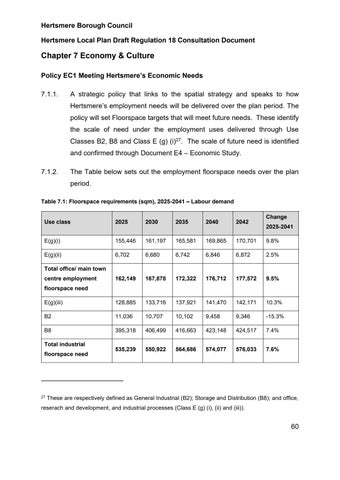
7.1.2. The Table below sets out the employment floorspace needs over the plan period.
Table 7.1: Floorspace requirements (sqm), 2025-2041 – Labour demand
27 These are respectively defined as General Industrial (B2); Storage and Distribution (B8); and office, reserach and development, and industrial processes (Class E (g) (i), (ii) and (iii)).
Hertsmere Borough Council
Hertsmere Local Plan Draft Regulation 18 Consultation Document
Source: Hertsmere Economic Study 2026
7.1.3. Technical evidence demonstrates that based on employment forecasts, by 2041 there would be a gross requirement for 56,200 sqm, including:
• +15,300 sqm of E(g)(i) floorspace;
• +200 sqm of E(g)(ii) floorspace;
• -13,300 sqm of E(g)(iii) floorspace;
• -1,700 sqm of B2 floorspace; and
• +29,200 sqm of B8 floorspace
7.1.4. In addition to this, the evidence identifies a need for 954 sqm of additional film-industry floorspace in Hertsmere, and between 52,024 sqm and 118,912 sqm of additional floorspace for data centres.
7.1.5. Employment priorities are:
• Maintaining Hertsmere’s key role in the international film and television industry;
• Meeting the need for future B8 logistic uses and ensuring that complement wider demands generated by businesses in the Greater London area;
• Secure an improved understanding of the role and future need for data centres within London and East of England Regions;
• Meeting settlement-specific, place-focused needs, which may be ancillary/ complementary to the film industry.
Hertsmere Borough Council
Hertsmere Local Plan Draft Regulation 18 Consultation Document
Policy EC2 Hertsmere’s Employment Land Hierarchy
7.2.1. A strategic policy that sets out an employment land hierarchy for the Borough. It will:
• identify and map the key sites within the hierarchy, including their relationship with the strategic highway network
• set out the forecast need for employment land across the borough, broken down by Class E(g) office and light industrial, Class B2 industrial, Class B8 storage and distribution, and related Sui Generis uses.
• be used as a basis for decision-taking in terms of how the identified need will be met.
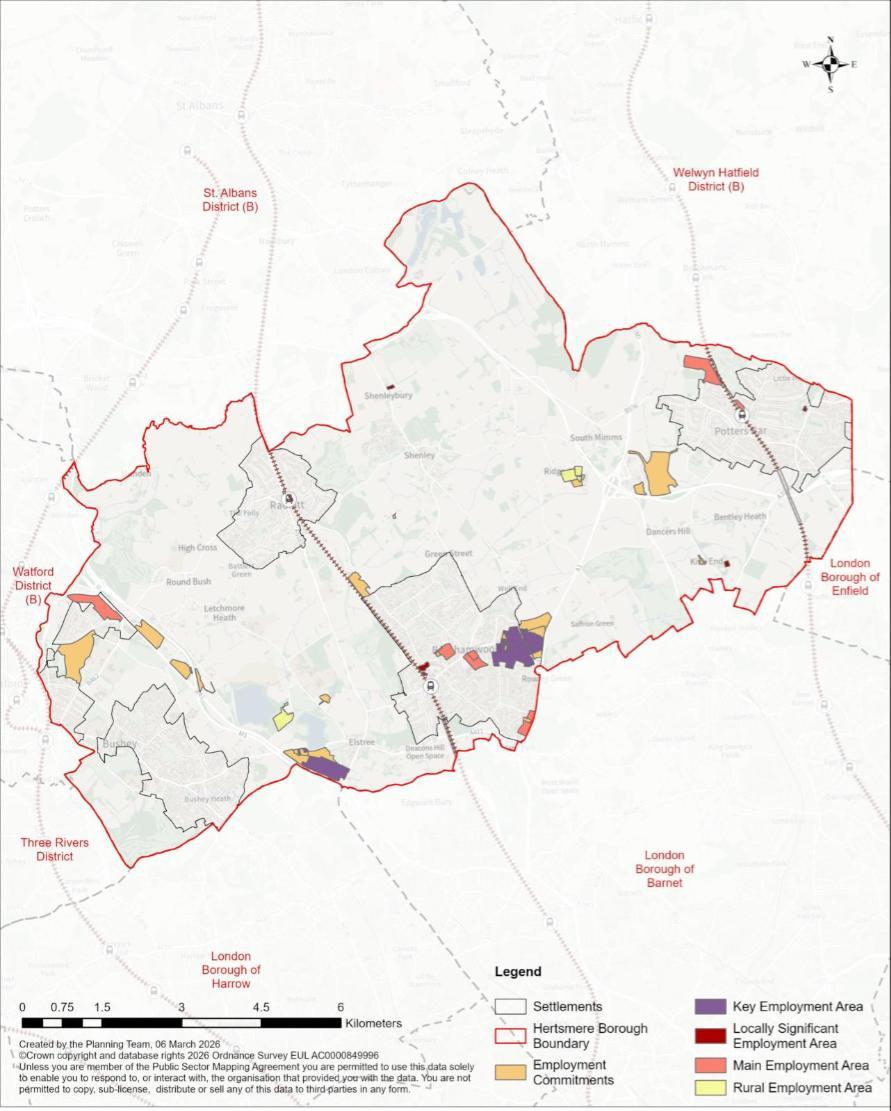
Table 7.2: Hertsmere's proposed designated Employment Areas
Classification Location
Key Employment Areas
• Centennial Park, The Waterfront and Lismirrane Industrial Estates, Elstree
• Elstree Way, Borehamwood
• Sky Elstree
• South Mimms Motorway Services
Main Employment Areas
Locally Significant Employment Areas
• Stirling Way, Borehamwood
• Tylers Way, Bushey
• Cranbourne Road, Potters Bar
• Station Close, Potters Bar
• Otterspool Way, Bushey
• Imperial Place, Borehamwood
• BBC Elstree
• Elstree Studios
• Borehamwood Enterprise Centre, Borehamwood
• Theobald Court, Borehamwood
• Hollies Way Business Park, Potters Bar
• Farm Close, Shenley
• Beaumont Gate, Radlett
Hertsmere Borough Council
Hertsmere Local Plan Draft Regulation 18 Consultation Document
Rural Employment Areas
• Wrotham Business Park, between High Barnet and Potters Bar
• Bio Products Laboratory, Elstree
• The National Institute for Biological Standards and Control, Ridge
• Clare Hall Laboratories, Ridge
Hertsmere Borough Council
Hertsmere Local Plan Draft Regulation 18 Consultation Document
Borough Council
Hertsmere Local Plan Draft Regulation 18 Consultation Document
Policy EC3 Delivering High Quality Employment Sites and Workspaces
7.3.1. This non-strategic policy seeks to secure high quality workspaces that respond to and meet the Borough’s identified employment needs and the floorspace requirements set out in Policy EC1. The policy will set out criteria that development proposals will be required to meet. These will be based on the available evidence in Document E4 Economy Study [LINK] and viability tested to ensure policy requirements do not compromise delivery of new workspaces. The policy will seek to secure design-led interventions that are appropriate and proportionate to the scale and nature of employment workspace being proposed. For clarification, the policy will seek to introduce reasonable requirements that can be delivered by new development without harming viability.
7.3.2. The policy will require the following:
• basic specification, including fitting out buildings ready for use including digital connectivity, toilets, kitchens etc.;
• meeting environmental impact, energy use and carbon emissions reduction requirements;
• ensuring that factors such as biodiversity net gain, urban greening, SuDS and public realm are considered at the earliest stage of the development process; and
• provision of flexible spaces for SMEs and startups within larger developments
Hertsmere Borough Council
Hertsmere Local Plan Draft Regulation 18 Consultation Document
Policy EC4 Affordable Workspace
7.4.1. This strategic policy seeks to secure an appropriate portion of affordable workspace from larger employment schemes, in line with the Council’s evidence base, as set out under Document E4 Economy Study [LINK] which demonstrates a clear need for this permission It will include a formula for calculating payments in-lieu for off-site provision where provision cannot be delivered on site. The policy will be viability tested to ensure that it does not endanger the delivery of employment land.
Policy EC5 Strategic Level Employment Sites/ Designations
7.5.1. This non-strategic policy will address strategic employment sites that serve a need wider than Hertsmere alone. Sites will be identified on a policies map and will include:
• Employment uses associated with the film and television industry (e.g. Sky Elstree) alongside existing large employment areas like Centennial Park, Elstree and Elstree Way, Borehamwood.
• Other large scale B8 storage and logistics, data centres; and other strategic employment uses accessed or associated directly with the strategic highway network.
7.5.2. New employment uses and additional floorspace that meet identified need within the borough as well as wider regional and national need, evidenced through Document E4 Economy Study [LINK], will be directed towards these sites in line with Strategic Policy EC1
7.5.3. The policy requires that development proposals in these areas must not compromise the overall function or effectiveness of the site. Any release of vacant land within these areas for uses other than employment will be exceptional and must be supported by robust evidence.
Hertsmere Borough Council
Hertsmere Local Plan Draft Regulation 18 Consultation Document
7.5.4. The policy will consider an approach that seeks to optimise industrial employment capacity of the sites. This could be viable and justifiable based on minimising the wider impact on the strategic extent/ permanence of the Green Belt. This approach will seek to secure industrial employment intensification of use on designated sites.
Policy EC6 Local Level Employment Sites/ Designations
7.6.1. A non-strategic policy that addresses the Main Employment Areas and Locally Significant Employment Sites identified in Policy EC2. Sites will be identified on a policies map.
7.6.2. Development in these areas will:
• Meet local need for Class E(g) office and light industrial, Class B2 industrial, Class B8 storage and distribution, and related Sui Generis uses, as identified through Strategic Policy EC1;
• Maintain the ability of the designated area to accommodate industrial and commercial land uses by resisting the introduction of main town centre and residential uses;
• Maintain the strategic position of the employment site within the Hierarchy by resisting very large warehousing and similar uses which would be better placed within Strategic Level Employment Sites; and
• Potentially encourage uses that are ancillary to strategic employment uses, where these are complimentary to and do not undermine the integrity and function of the employment area, including but not limited to businesses that support the film industry. This could include the construction of props; stage sets; and costumes.
7.6.3. Any release of vacant land within these areas for uses other than employment will be exceptional and must be supported by robust evidence.
Hertsmere Borough Council
Hertsmere Local Plan Draft Regulation 18 Consultation Document
7.6.4. This policy will consider an approach that seeks to optimise/ maximise industrial employment capacity of designated sites. The approach is justified on the grounds of minimising the wider impact on the strategic extent/ permanence of the Green Belt. If such an approach is taken, it will seek to secure intensification of industrial employment use on designated sites.
Policy EC7 Rural Employment Areas
7.7.1. This non-strategic policy would seek to ensure that proposals within designated Rural Employment Areas identified in Policy EC2 and identified on a policies map will be:
• In accordance with Green Belt policy
• Ancillary to an existing or approved employment use; and
• Compatible with the local highway network
7.7.2. Any release of vacant land for uses other than employment will be exceptional and must be supported by robust evidence.
7.7.3. This policy will consider an approach that seeks to optimise industrial employment capacity of designated sites. The approach is justified on the grounds of minimising the wider impact on the strategic extent/ permanence of the Green Belt. If such an approach is taken, it will seek to secure intensification of industrial employment use on designated sites.
Policy EC8 Co-Located/ Mixed-use Employment Sites/ Designations
7.8.1. A non-strategic policy that speaks to mixed-use sites and proposals that incorporate commercial Class E (g) uses at the ground and lower floors. The policy is related to Policy EC6 in that the new mixed-use employment sites could include Class E (g) components that contribute towards meeting local needs and supporting wider strategic needs – this could be particularly the case in respect of ancillary employment uses that support the film industry
Hertsmere Borough Council
Hertsmere Local Plan Draft Regulation 18 Consultation Document
and possibly datacentres. The policy will be informed by the Visions for the four settlements, which may identify locations for such mixed-use redevelopments.
7.8.2. The policy will also reference larger site allocations where new mixed-use development could, where it is robustly demonstrated, secure new local centres; providing a wider mix of Class E uses that is inclusive of main town centre uses.
7.8.3. The policy will seek to secure high quality provision on ground and lower floors that meets identified needs and is complimentary and compatible with the residential uses above.
7.8.4. The policy could consider whether an approach that seeks to optimise/ maximise industrial employment capacity of the sites is taken. It is suggested that this could be a viable and justifiable approach – on the basis that as per the approach to housing sites, the Council is seeking to minimise the wider impact on the strategic extent/ permanence of the Green Belt. This approach will seek to secure industrial employment intensification on appropriate sites.
7.8.5. The policy will identify where these sites are, possibly cross-referencing to the spatial strategy and site allocations.
Policy EC9 Hertsmere’s Non-Designated Employment Sites
7.9.1. This non-strategic policy relates to all of Hertsmere’s non-designated employment sites These small sites make a valued contribution towards the Borough’s economy. They meet employment floorspace needs that will not normally be met by provision available on larger designated sites. Consequently, the policy seeks to protect against the loss of any nondesignated employment sites that remain demonstrably viable propositions.
Hertsmere Borough Council
Hertsmere Local Plan Draft Regulation 18 Consultation Document
7.9.2. This policy will consider an approach that seeks to optimises industrial employment capacity of the sites. The approach is justified on the grounds of minimising the wider impact on the strategic extent/ permanence of the Green Belt. This approach will seek to secure industrial employment intensification of use on designated sites.
Policy EC10 Workplace Training and Job Opportunities
7.10.1. A non-strategic policy option that supports strategic objectives seeking to make the Borough more attractive, accessible and inclusive to business Specifically, the policy seeks to support businesses of all sizes and to help promote local skills, focusing on areas of deprivation, education and training. The policy sets out how developer contributions will be utilised to improve opportunities and contribute towards improvements to the wider economy. It will include a formula for calculating financial contributions for workplace training.
Chapter 7 Economy and Employment Questions:
33. Question: Do you agree with the content set out within policies EC1-EC10 regarding the Council's proposed approach towards securing economic and employment needs across the Borough? Yes/No.
34. Question: If you disagree with any of the content, with reference to specific policies, please provide detailed comments or suitable alternatives, and justify your answer with appropriate and proportionate evidence.
Hertsmere Borough Council
Hertsmere Local Plan Draft Regulation 18 Consultation Document
Policy EC11 Town Centres at the Heart of Hertsmere’s Communities
7.11.1. Hertsmere’s retailmarket remains healthy and competitive, supported by low vacancy, stable rents, and strong investor interest. The Borough’s centres are well positioned for modest growth and for improvements in the retail offer the town centre environments across all the settlements.
7.11.2. This is a strategic policy that links the approach to town centres/ main town centre uses with the spatial strategy.
7.11.3. This policy will:
• Make clear that the Borough’s town centres are the most sustainable locations for growth of compatible town centre uses, and that optimised levels of growth will be directed to these locations, in line with their position in the Town Centre Hierarchy;
• Cross-reference the settlement and place (policy) principles that will be set out under Part 3;
• Seek to secure high quality growth that reflects and compliments the distinctive character of each town centre, considering the relevant evidence, including the Retail and Town Centre Study and Visions for the four settlements.
Policy EC12 Hertsmere’s Town Centre Network and Hierarchy
7.12.1. This strategic policy translates Policy EC10 into a town centre hierarchy for the Borough, linking with the Spatial Strategy and the Settlement and Place Principles.
7.12.2. The policy will:
• identify Hertsmere’s key retail centres on the Policies Map;
Hertsmere Borough Council
Hertsmere Local Plan Draft Regulation 18 Consultation Document
• support town centres by actively resisting out-of-centre retail proposals, including rural diversification, by applying the sequential test approach;
• ensure that new town or district centres avoid detrimental impacts on the role and function of existing town and district centres;
• seek to maintain a core of local shopping facilities outside of the town and district centres, primarily within local and neighbourhood centres as defined in the Hierarchy above. Any redevelopment that affects a local centre should include reprovision and preferably enhancement of the shopping offer.
Key Retail Centres
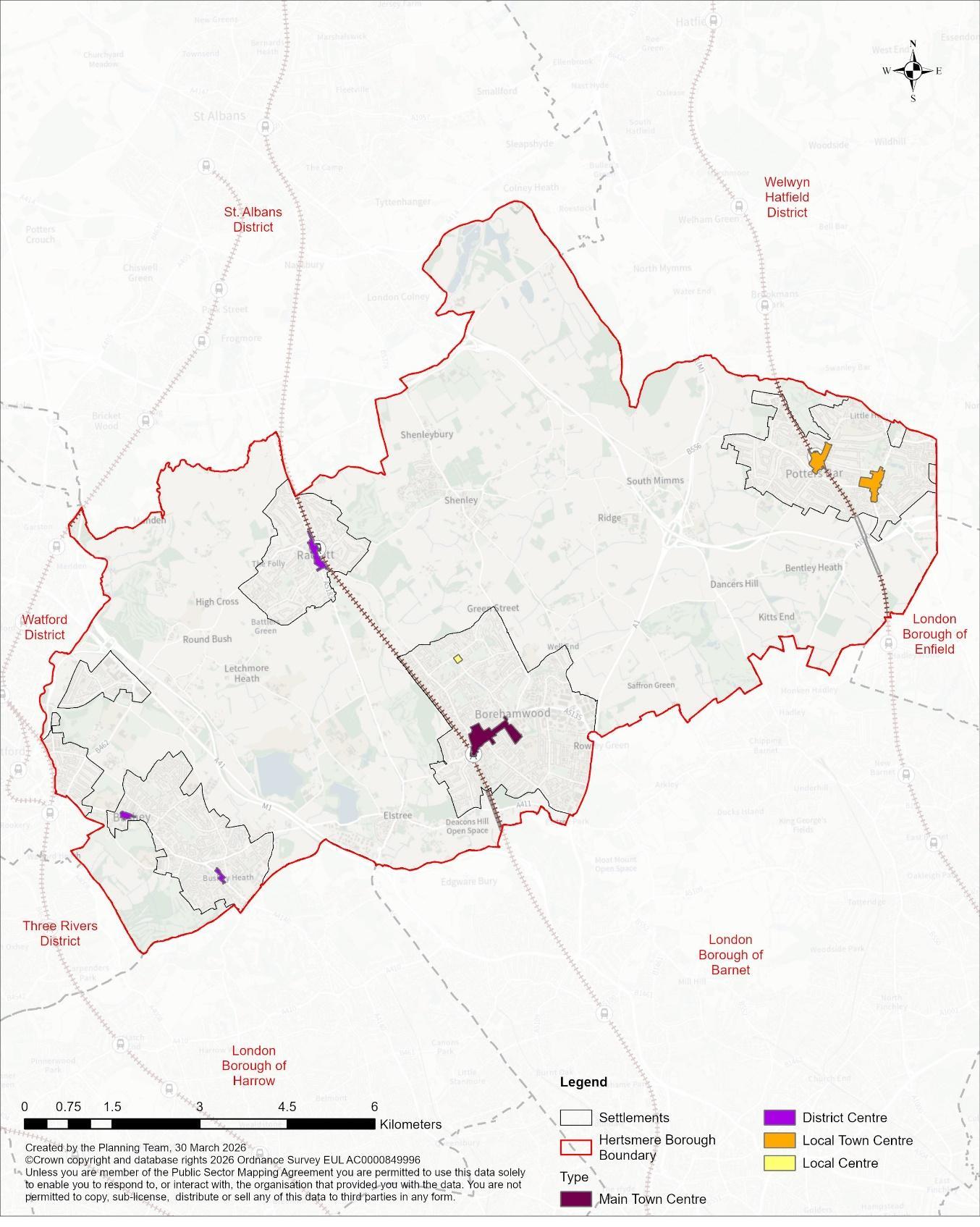
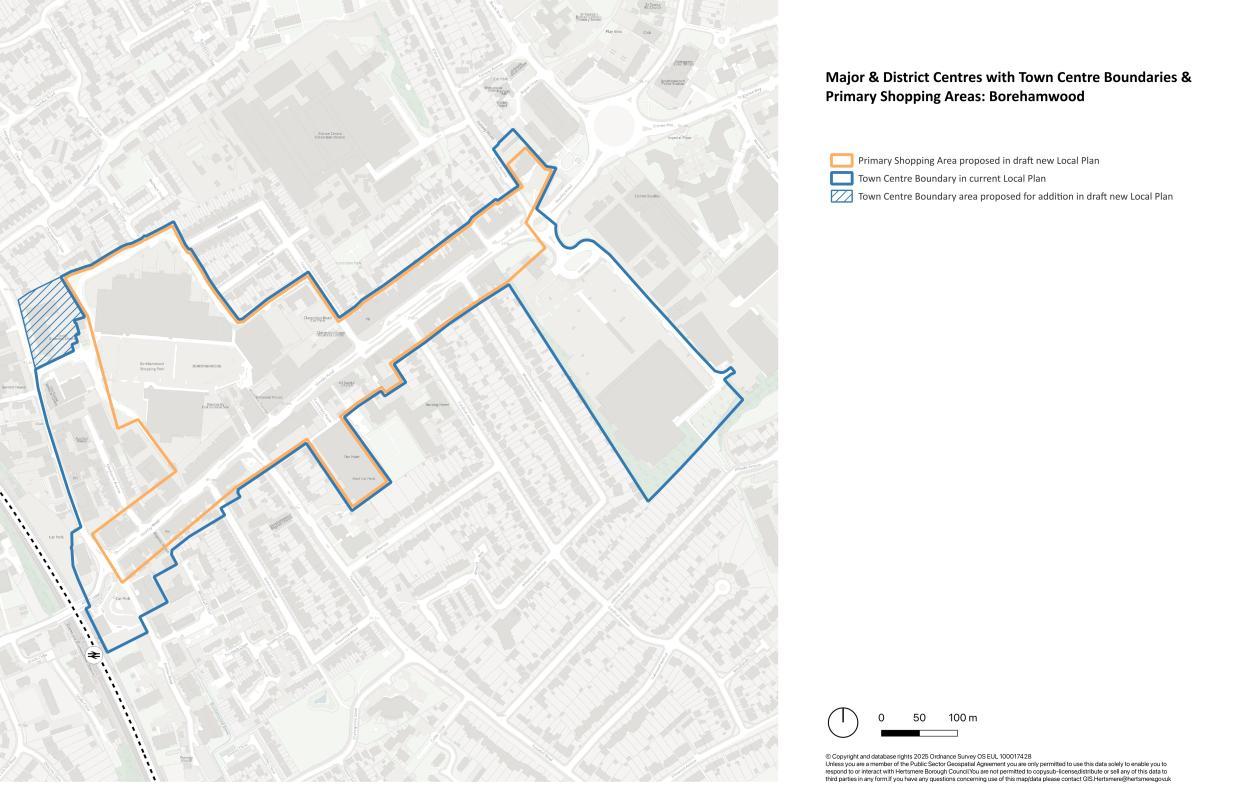
• Main Town Centre – Borehamwood
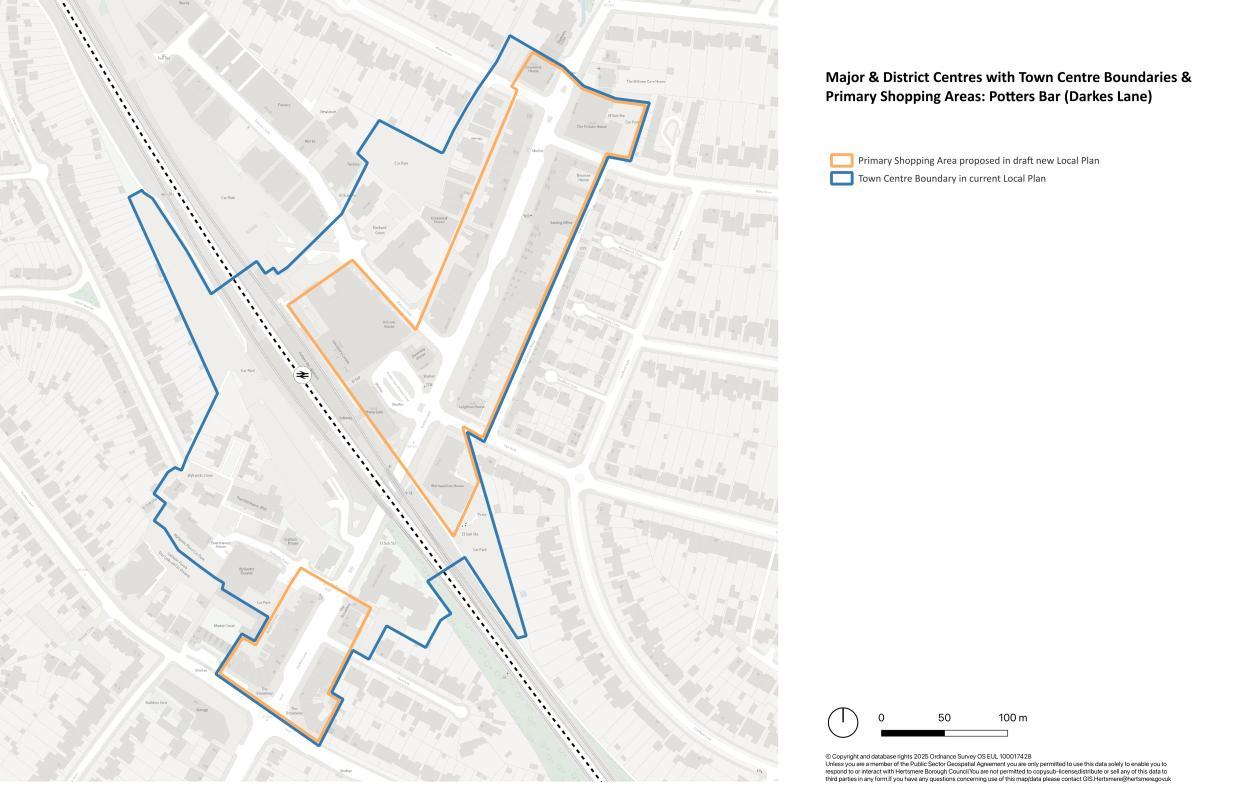
• Local Town Centres – Darkes Lane, Potters Bar
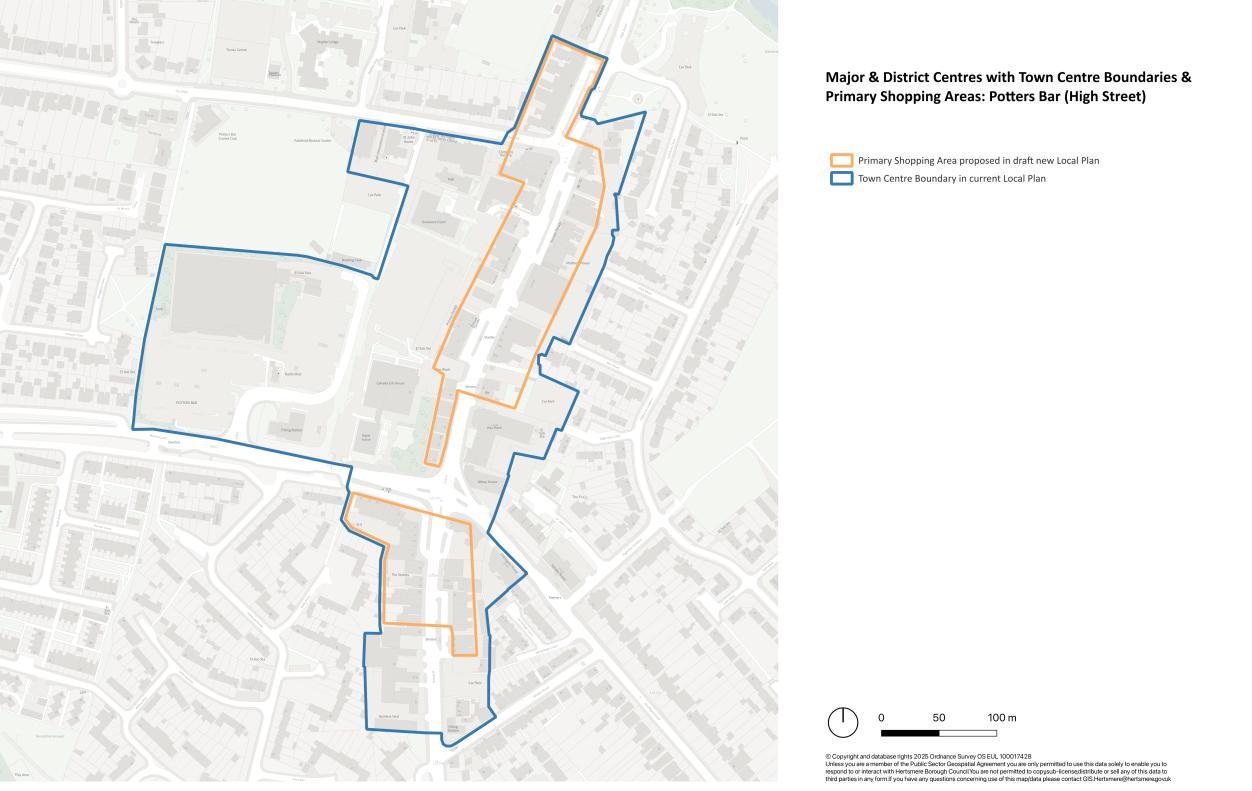
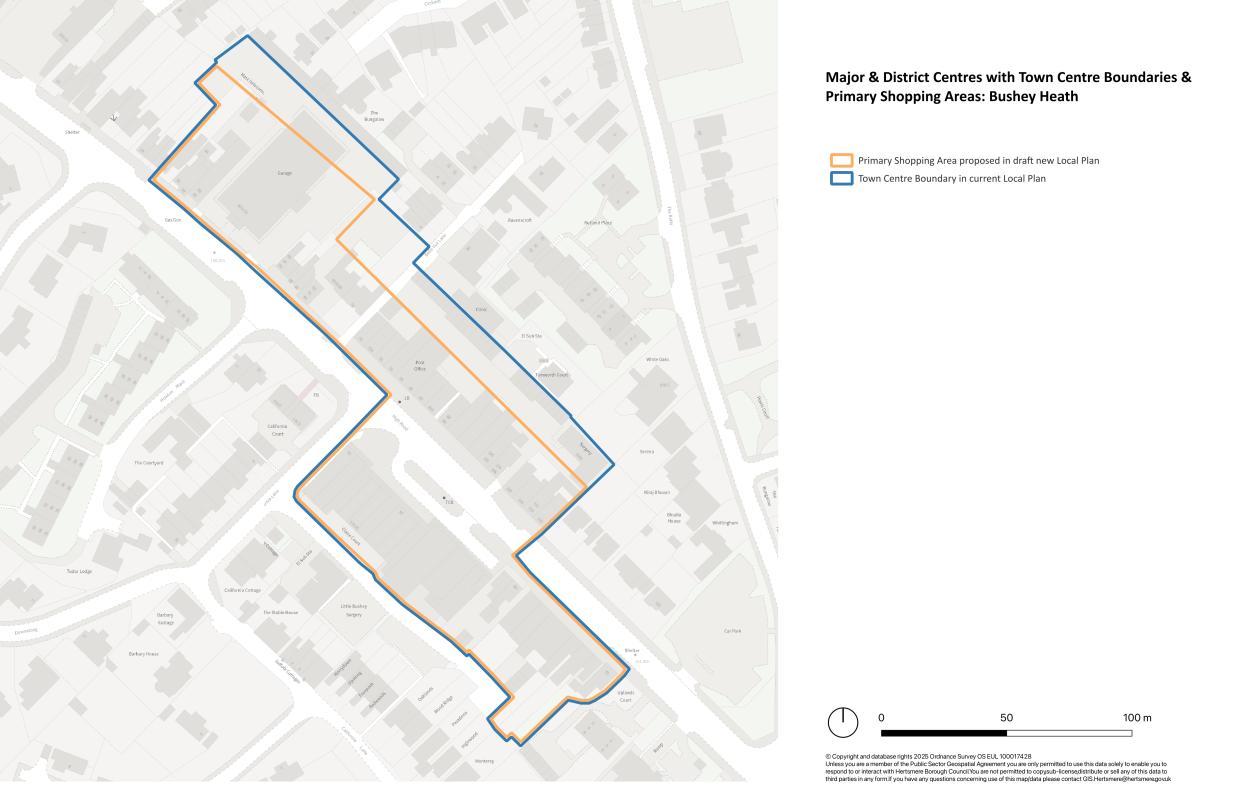
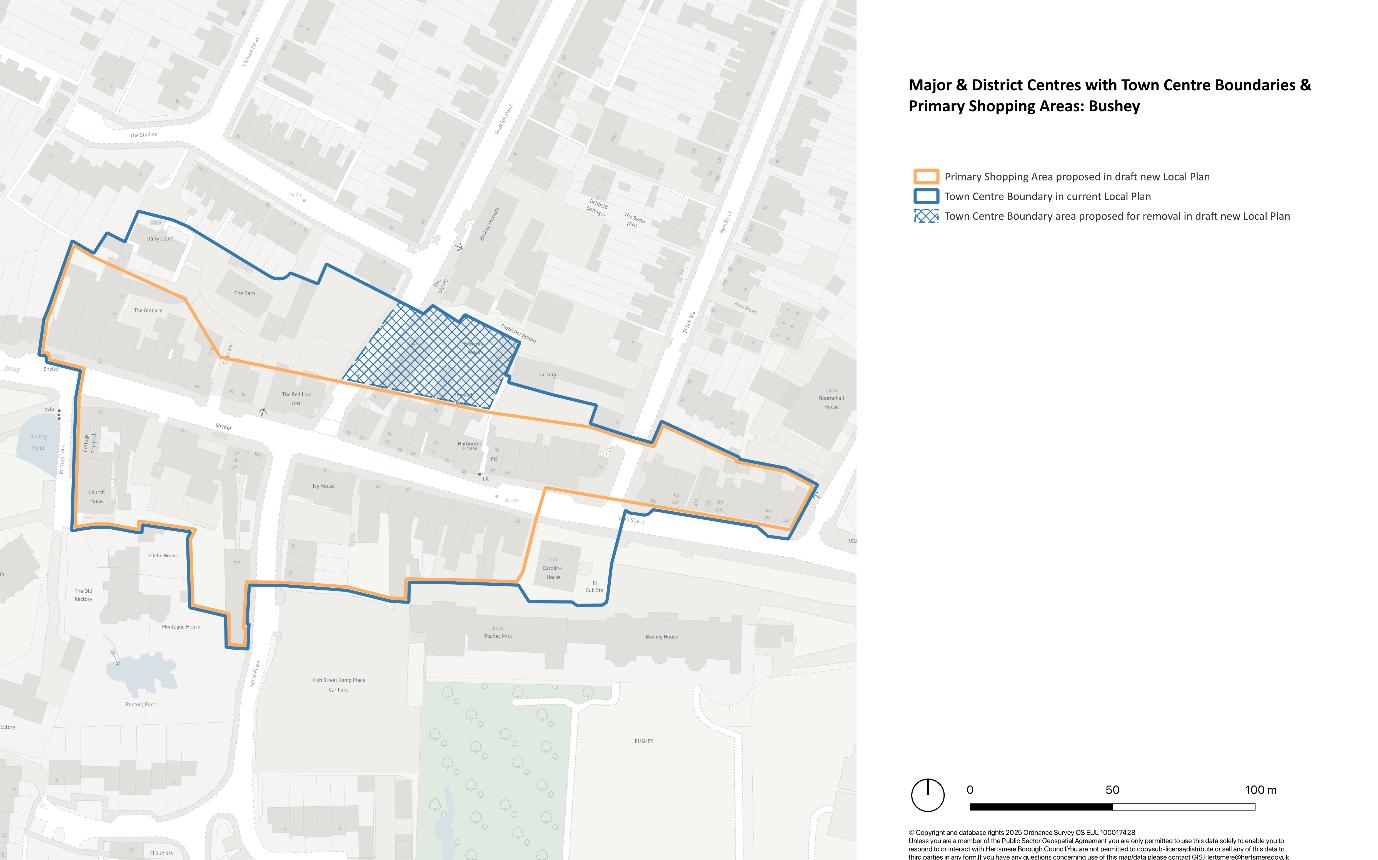
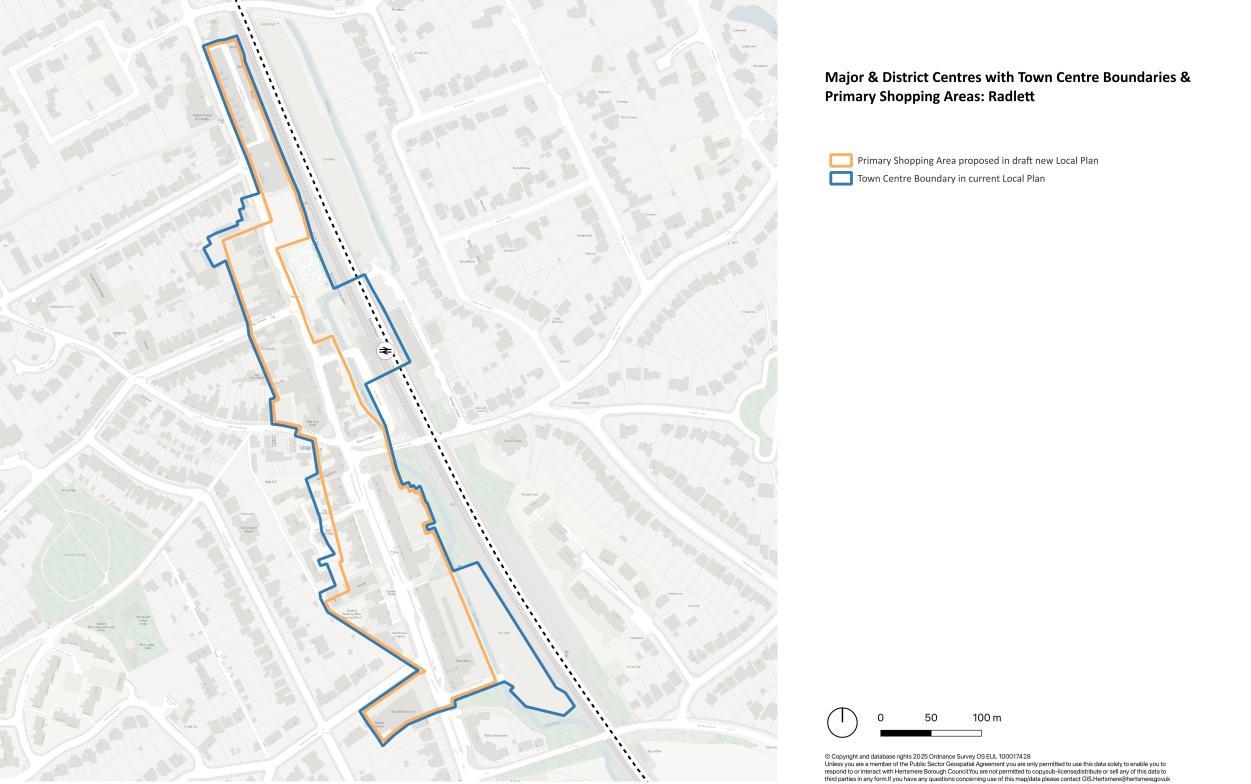
• District Centres – High Street, Potters Bar; Bushey; Bushey Heath; and Radlett
• Local Centres, Neighbourhood Centres, Shopping Parades, Corner Shops and other Service Points – to be identified as part of the relevant non-strategic policies.
7.12.3. A possible complimentary approach would be to encourage the comprehensive redevelopment of existing out-of-centre sites that are reaching the end of their lifespan for a mix of uses (inclusive of optimised residential uses). If demonstrably justified. This may include the provision of new main town centres, to serve the new communities being created through urban extensions and/or new settlements.
7.12.4. The policy will also consider the introduction of Article 4 Directions within those centres with designated Core Frontages. This will seek to manage permitted development rights, ensuring that they do not undermine the
Hertsmere Borough Council
Hertsmere Local Plan Draft Regulation 18 Consultation Document
proper planning of an area and secure the economic performance and recovery, local health and wellbeing objectives of the emerging Local plan.
Hertsmere Borough Council
Hertsmere Local Plan Draft Regulation 18 Consultation Document
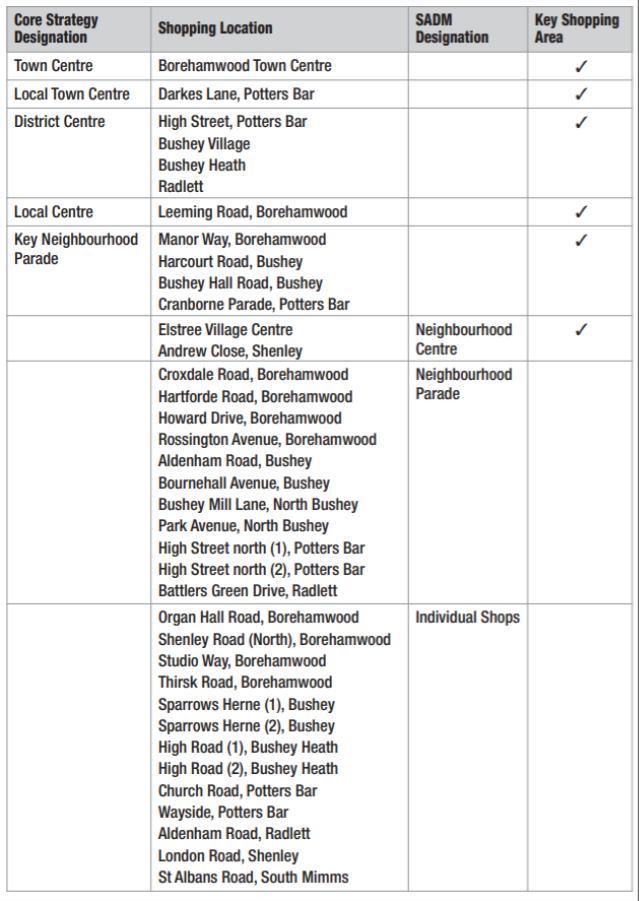
Table 7.1: Hertsmere’s Centres
Hertsmere Borough Council
Hertsmere Local Plan Draft Regulation 18 Consultation Document
Hertsmere Borough Council
Hertsmere Local Plan Draft Regulation 18 Consultation Document
Hertsmere Borough Council
Hertsmere Local Plan Draft Regulation 18 Consultation Document
Hertsmere Borough Council
Hertsmere Local Plan Draft Regulation 18 Consultation Document
Policy EC13 Optimising the Use of Town Centre Land and Floorspace
7.13.1. This strategic policy seeks to optimise the use of main town centre land and floorspace focusing on Class E, Commercial, Business and Service (a)(g)28
7.13.2. This includes retail, food and drink, financial, professional and other business services, indoor sport and recreation, medical or health services, nurseries, and offices
7.13.3. The policy will:
• Favourably consider mixed use development where it supports the role and function of the centre, is compatible with neighbouring uses, and does not impact negatively on the viability and vitality of the centre; and
• Favourably consider residential uses that have separate secured access and do not impact on the retail function of the town centre
7.13.4. The policy will consider where appropriate the need for additional controls over new floorspace to be applied to Class E developments in both town centre and out of centre locations to support the vitality and viability of centres.
Policy EC14 Hertsmere’s Main Town Centre
7.14.1. This non-strategic policy sets out how the Borough’s highest tier of Town Centre serves the Borough and responds to the wider Hertfordshire context, including neighbouring higher-tier centres, specifically St Albans and Watford.
28 The Town and Country Planning (Use Classes) Order 1987
Hertsmere Borough Council
Hertsmere Local Plan Draft Regulation 18 Consultation Document
• Main Town Centre – Borehamwood
7.14.2. Hertsmere’s higher tier centre is not seeking to compete with larger neighbouring centres but will continue to have its own role as the Borough grows during the plan period. The Main Town Centre will be identified on the Spatial Strategy Key Diagram and will be shown on the proposals map.
7.14.3. The policy will set out how the Main Town Centre will be stratified. This may include designating primary shopping areas (the retail core) and setting out complementary main town centre uses outside of the core (within the centre). The policy will be linked to Policies EC11 and EC12, and to the settlement and place principles set out under Part 3, and based on the emerging Local Plan’s technical evidence base – Document E5 Retail and Town Centre Uses Study
7.14.4. The policy will also speak to the Sequential and Impact Tests (including possibly setting a Local Floorspace Impact Threshold). These tests are relevant to assessing applications for main town centre development and retail and leisure development larger than 2,500 sqm gross outside of town centres respectively. This is to help ensure the continuing health and viability of town centres. Local authorities can set their own proportionate floorspace threshold for the Impact Test, and the emerging Local Plan’s technical evidence base Document E5 Retail and Town Centre Uses Study recommends setting this threshold at 350 sqm (gross).
7.14.5. Subject to evidence the policy will also speak to how potentially harmful uses (fast food and gambling venues) will be managed and located at peripheral locations. There may also be some merit in the policy considering main town centre (defined under Class E) that generate high levels of vehicle movements – specifically gyms, play spaces and nurseries for young children. These are uses, under Class E, that could legitimately be in the heart of town centres but consequently create a conflict in terms of their accessibility.
Hertsmere Borough Council
Hertsmere Local Plan Draft Regulation 18 Consultation Document
Policy EC15
Hertsmere’s Local Town Centres and District Centres
7.15.1. The non-strategic policy seeks to protect and enhance the vitality and viability of these key local centres by securing long-term main town centre usage The emerging Local Plan’s technical evidence base, Document E5: Retail and Town Centre Uses Study recommends the following hierarchy
• Local Town Centres – Darkes Lane, Potters Bar
• District Centres – High Street, Potters Bar; Bushey; Bushey Heath; and Radlett
7.15.2. These centres are identified on the Spatial Strategy Key Diagram and will be shown on the proposals map.
7.15.3. The policy will seek to resist the loss to non-main town centre uses at ground floor level; specifically, to uses that could harm the centres vitality and viability. The policy could form the basis of future Article 4 Direction interventions – subject to that being justified by evidence. The policy’s supporting text will set out how existing local centres will continue to support existing residential and employment communities particularly where future intensification (within those areas) is appropriate and being pursued.
Policy EC16
Hertsmere’s Local Centres, Neighbourhood Centres, Shopping Parades, Corner Shops and other Service Points
7.16.1. This non-strategic policy speaks to the next tiers of centres, which will be identified and mapped.
7.16.2. The Borough’s smaller centres are -
• Leeming Road, Borehamwood
• Manor Way, Borehamwood
Hertsmere Borough Council
Hertsmere Local Plan Draft Regulation 18 Consultation Document
• Harcourt Road, Borehamwood
• Bushey Hall Road, Bushey
• Cranborne Parade, Potters Bar
• High Street, Elstree
• Andrew Close, Shenley
• Croxdale Road, Borehamwood
• Hartford Road, Borehamwood
• Howard Drive, Borehamwood
• Rossington Avenue, Borehamwood
• Aldenham Road, Bushey
• Bournehall Avenue, Bushey
• Bushey Mill Lane, Bushey
• Park Avenue, Bushey
• High Street North, Potters Bar
• Battlers Green Drive, Radlett
• Organ Hall Road, Borehamwood
• Shenley Road North, Borehamwood
• Thirsk Road, Borehamwood
• High Road, Bushey (73)
Hertsmere Borough Council
Hertsmere Local Plan Draft Regulation 18 Consultation Document
• High Road, Bushey (14)
• Sparrows Herne, Bushey (125)
• Sparrows Herne, Bushey (3)
• Church Road, Potters Bar
• Wayside Parade, Potters Bar
• Aldenham Road, Radlett
• London Road, Shenley
• St Albans Road, South Mimms
7.16.3. These centres will be identified on the Local Plan proposals map.
7.16.4. The policy seeks to protect and enhance the convenience retail offer provided by these places to their surrounding residential and employment communities. A key objective may be to ensure their integrity and resist change of use to residential and thereby prevent their fragmentation. The policy could form the basis of future Article 4 Direction interventions – subject to that being justified by evidence.
Policy EC17 Concentration of Harmful Uses
7.17.1. A non-strategic policy that seeks to manage concentrations of potentially harmful main town centre uses, such as fast-food takeaways, vape shops and betting shops/ gambling venues.
7.17.2. Proposals for such uses will be permitted within designated town centres unless they are within 800m of a secondary school In determining applications, the policy will consider whether a harmful concentration of uses already exists in town centres. Suggested guidelines:
Hertsmere Borough Council
Hertsmere Local Plan Draft Regulation 18 Consultation Document
• No more than 10% or two consecutive fast-food units within a centre.
• No more than 5% or two consecutive betting shops, pay day loan shops or amusement arcades within a centre.
7.17.3. Proposals for fast-food outlets visible from an access point to a secondary school must demonstrate that the proposed use would not undermine any existing or proposed healthy eating policy at that school. This policy will be based on local evidence.
Policy EC18 Culture, Creative Industries and the Evening Economy
7.18.1. A possible strategic policy option that focuses upon cultural uses within the context of the evening economy. Technical evidence is clear that strengthening the evening economy and diversifying hospitality provision will be critical to future-proofing our town centres against evolving consumer trends.
7.18.2. The policy will provide a link to higher-order strategic policies that seek to secure Hertsmere’s town centres as viable and sustainable evening economy destinations that provide a meaningful alternative to St Albans and Watford. This will contribute towards sustainable place-making – by providing choice to residents and businesses so that they do not need to travel or order-out to meet their needs for food and drink. An alternative policy approach is to address this matter through specific settlement and place principles policies IE those for Borehamwood Town Centre.
7.18.3. Additionally, the policy provides a link between the film and television industry and the evening/ cultural economies – this could for example include extending dwell times of TV audiences visiting Borehamwood or encourage uses complimentary to the entertainment venues in Potters Bar and Radlett Within this context, the policy could consider proposals for flexible uses that allow for both daytime and evening activities in a single space.
Hertsmere Borough Council
Hertsmere Local Plan Draft Regulation 18 Consultation Document
Policy EC19 Public Houses
7.19.1. A non-strategic policy option that has been prepared and adopted by other local planning authorities elsewhere. The policy specifically seeks to protect the provision provided by public houses; in terms of use for food and drink, and as hub-uses within wider residential and employment communities. The need for a policy of this type of policy is entirely dependent upon relevant technical evidence – in terms of loss of provision.
Policy
EC20 Markets
7.20.1. This non-strategic policy will seek to protect and enhance markets and market spaces across the Borough. It will encourage new market spaces that complement Hertsmere’s town centre network and hierarchy and contribute to the culture and vibrancy of the Borough. Proposals for town centre redevelopment will be expected to protect and enhance existing market spaces and consider the provision of new spaces. Market proposals outside of main town centres will be subject to the sequential approach to ensure it would not have a detrimental impact on existing town centres
7.20.2. Any proposal affecting an existing market will normally be expected to include reprovision, with consideration of factors including the impact on the vitality and viability of the town centre and its distinctive local character, the provision for small business, and the public realm and townscape. The policy could also speak to management measures, infrastructure and development control.
Policy EC21 Visitor Accommodation/ Hotels
7.21.1. This non-strategic policy will help ensure that any new visitor accommodation will:
• Be appropriately located in town centre/edge of centre or otherwise wellconnected locations;
Hertsmere Borough Council
Hertsmere Local Plan Draft Regulation 18 Consultation Document
• Be proportionate to their location in terms of size, scale and function;
• Not result in a harmful overconcentration in an area;
• Not result in a net loss of residential dwelling units;
• Comply with the relevant policies in relation to high quality design, parking standards and servicing;
• Be sufficiently adaptable to allow for future changes in accommodation standards or changes of use; and
• Include ancillary public uses at ground floor level where appropriate (depending on location)
7.21.2. The policy will ensure that any conversion of visitor accommodation into residential use will comply with the relevant policies on residential design quality, amenity space standards and affordable housing.
Chapter 7 Town Centres Questions:
35. Question: Do you agree with the content set out within policies EC11EC21 regarding the Council's proposed approach towards retaining the distinctive character of the Borough's town centres? Yes/No.
36. Question: If you disagree with any of the content, with reference to specific policies, please provide detailed comments or suitable alternatives, and justify your answer with appropriate and proportionate evidence.