Hertsmere Borough Council
Hertsmere Local Plan Draft Regulation 18 Consultation Document
Chapter 10 Sustainable Design & Infrastructure
Policy SD1 Responding to the Climate Emergency
10.1.1. A strategic policy that sets the emerging Local Plan’s approach in response to the climate emergency. The policy will set out how growth across the Borough will move towards net zero as required by the Environment Act and the Council’s Climate Change and Sustainability Strategy
10.1.2. The policy provides an overview of the approaches set out in detail in the Chapter’s subsequent non-strategic policies that relate to securing improved air quality, delivering energy infrastructure, dealing with waste and contamination, managing water and flood risk, and moving towards net zero.
10.1.3. The policy’s requirements will be tested and justified in respect of their possible impact on development viability and delivery.
Policy SD2 Sustainable Design and Retrofitting
10.2.1. A strategic policy that seeks to ensure that all development proposals reach high standards of sustainable design. The policy will require that proportionate Sustainable Design Statements be submitted in support of all proposals. For major applications these will need to address landscape design and urban greening; nature conservation; energy use and heat risk management; carbon emissions, including embodied carbon and unregulated emissions; air quality; flood risk and water management; ground conditions; waste reduction and the circular economy; and operational energy and on-site renewable generation. Proposals for minor development will be required to submit an appropriate and proportionately small-scale Sustainable Design Statement.
10.2.2. The policy will assume and expect that development proposals consider the re-use of existing buildings before demolition. Proposals that include
Hertsmere Borough Council
Hertsmere Local Plan Draft Regulation 18 Consultation Document
demolition of buildings will be expected to demonstrate why re-use and retrofitting was not possible.
10.2.3. The policy will also speak to external sustainable design standards that the Council expects development to meet. This standard is likely to either be BREEAM (Building Research Establishment Environmental Assessment Method) or LETI (Low Energy Transformation Initiative). These standards are nationally established and are regularly applied to new developments across England. Other standards could be considered subject to them demonstrably sound. They will be applied to all new development over 500sqm gross, as well as major residential and non-residential refurbishment of buildings.
Policy SD3 Managing Heat Risk
10.3.1. A strategic policy that seeks to minimise the adverse impacts of heat risk through the design of buildings and spaces, and through material choices and urban greening measures. This is a key component of successful and sustainable place-making. The policy will work alongside other complementary policies in the emerging Local Plan – including those that seek to secure high quality design, public realm and tree planting and urban greening. The policy will require that all new development must be designed to reduce the potential for internal overheating and reliance on air conditioning systems.
10.3.2. Major developments that incorporate public realm improvements will be required to demonstrate that they have been positively designed to create a comfortable environment. This might be through the provision of shade and other passive cooling measures, with urban greening measures being particularly encouraged, in line with other sections of the Plan.
10.3.3. This policy will be viability tested through the whole plan viability assessment. This technical evidence will be presented published under
Hertsmere Borough Council
Hertsmere Local Plan Draft Regulation 18 Consultation Document
Document K4a Whole Plan Viability Assessment. The policy is linked to other complementary approaches that seek to secure high quality design and gains for nature and the environment, including those on open space provision, Biodiversity Net Gain and urban greening.
Policy SD4 Minimising Green House Gas Emissions
10.4.1. This is a strategic policy that contributes and supports meeting net zero objectives associated with growth. It requires that development proposals must be designed to reduce greenhouse gas emissions in operation and minimise energy demand; both annual and peak. The policy will require that proposals meet the minimum on-site reduction of carbon emissions of at least 35% beyond the baseline of Part L of the Building Regulations 2021 and calculate and minimise emissions from any part of the development that are not covered by Building Regulations: for example, unregulated emissions. For clarity, these requirements will be inclusive of the Future Homes and Buildings Standards34 Development proposals will be required to evidence these in the Sustainable Design Statement, as required by Policy SD2.
10.4.2. The policy will provide a framework for off-site contributions and payments in lieu. These will be sought in exceptional circumstances only - where is not demonstrably possible for proposals to meet net zero requirements onsite Off-site contributions and payments in lieu will be used to contribute towards the delivery of off-site measures that contribute towards meeting net zero objectives. The inclusion of this part of the policy is dependent upon technical evidence that demonstrates that its requirement will not harm the
34 These were introduced on 24 March 2026. The Future Homes and Buildings Standards: Building Circular 01/2026 - letter - GOV.UK
Hertsmere Borough Council
Hertsmere Local Plan Draft Regulation 18 Consultation Document
viability of development proposals. That technical evidence will be published under Document K4a Whole Plan Viability Assessment.
10.4.3. The policy could also seek to encourage major development proposals to assess embodied carbon emissions and maximise opportunities to reduce these emissions. It could require that developers prepare and submit the details of their approach for meeting the net zero-carbon target as a component of an Energy Strategy, which will form part of their submitted Sustainable Design Statement.
10.4.4. Finally, the policy could require that proposals demonstrate how they minimise energy demand of the building(s) in-use. This may be particularly relevant to certain forms of industrial employment use that have a high demand for energy, such as film studios and data centres.
Policy SD5 Improving Air Quality
10.5.1. This is a possible strategic policy that seeks to address air quality matters raised through place-making, as part of the wider climate change agenda. The policy requires that all new development must apply the design-led approach and integrate on-site measures to improve air quality and prevent or minimise the population’s exposure to poor air quality, having regard to the World Health Organisation’s Air Quality Guidelines. This approach integrates with other polices to secure quality growth/ place-making. As a component of securing high quality designed new places, the policy must be considered from the outset of the development process.
10.5.2. The policy requires proposals to seek to improve air quality and be at least air quality neutral. That means that proposals not result in a further deterioration of existing poor air quality; not create any new areas that exceed air quality limits, or delay the date at which compliance will be achieved in areas that are currently in exceedance of legal limits; and not create unacceptable risk of high levels of exposure to poor air quality. For
Hertsmere Borough Council
Hertsmere Local Plan Draft Regulation 18 Consultation Document
clarity, the policy will seek to secure air quality across the whole development process, inclusive of construction into final delivery and occupation.
10.5.3. The policy will set out the requirements for major and minor developments, and community infrastructure proposals. These will be proportionate, reasonable and not onerous.
10.5.4. Development proposals will be considered having regard to their individual and cumulative impacts on air quality, and any documents submitted alongside proposals should ensure due consideration of such issues Proposals that do not meet the requirements set out above will be refused unless it can be suitably demonstrated that adverse impacts can be mitigated to an acceptable level. Mitigation should be provided onsite.
Policy SD6 Energy Infrastructure35
10.6.1. A strategic policy that requires that development proposals be designed in response to a site-specific assessment of the most effective and efficient energy supply options. The policy will encourage proposals for new development to integrate renewable energy sources as part of the designled approach to delivering successful and sustainable places.
10.6.2. The policy will require that development proposals should prioritise connection to decentralised heat networks. Major development proposals must provide a Feasibility Assessment for connecting to, and if possible, extending or interconnecting, existing or planned future heat networks located on or in proximity to the site. This may apply to housing, town centre and industrial employment growth. The policy will encourage all proposals for new data centres and anaerobic digesters to be heat network ready in
35 Energy Infrastructure requirements that relate to specific sites and places will be found under the emerging Local Plan’s Part 3.
Hertsmere Borough Council
Hertsmere Local Plan Draft Regulation 18 Consultation Document
anticipation of connection. This is considered a reasonable requirement. The site allocations may provide further guidance on this matter. The policy could require that minor new-build development, conversions and building alterations must demonstrate that they have investigated and maximised opportunities to connect to existing heat networks.
10.6.3. Where a decentralised heat network is planned or likely to be delivered in the future, development proposals should be designed to enable a costeffective connection to it, having regard to energy masterplans where these are relevant.
10.6.4. Dependent on technical evidence, the policy could speak to proposals that use Combined Heat and Power (CHP) and NOx gas boilers. This could state that development proposals for CHP and ultra-low NOx gas boiler communal or district heating systems will only be acceptable where it is demonstrated that other options in the heating hierarchy have been fully investigated and are not feasible, and there will be no adverse impact on air quality. Air Quality Assessments must include full dispersion modelling to assess impacts on nearby receptors. Equally, the policy could also consider where CHP and ultra-low NOx gas boiler systems are acceptable in line with above, proposals should be designed in a way that enables, and does not preclude, the decarbonisation of the site wide communal network in the future.
10.6.5. Major housing development proposals must, and all minor housing proposals should, submit an estimated heat unit supply price (£/kWh), annual standing charges and projected annual maintenance costs for their proposed Energy Strategy.
10.6.6. Technical evidence that supports the policy approach will be published under Document E11 Local Area Energy Plan (LAEP).
Hertsmere Borough Council
Hertsmere Local Plan Draft Regulation 18 Consultation Document
Policy SD7 Minimising and Managing Flood Risk
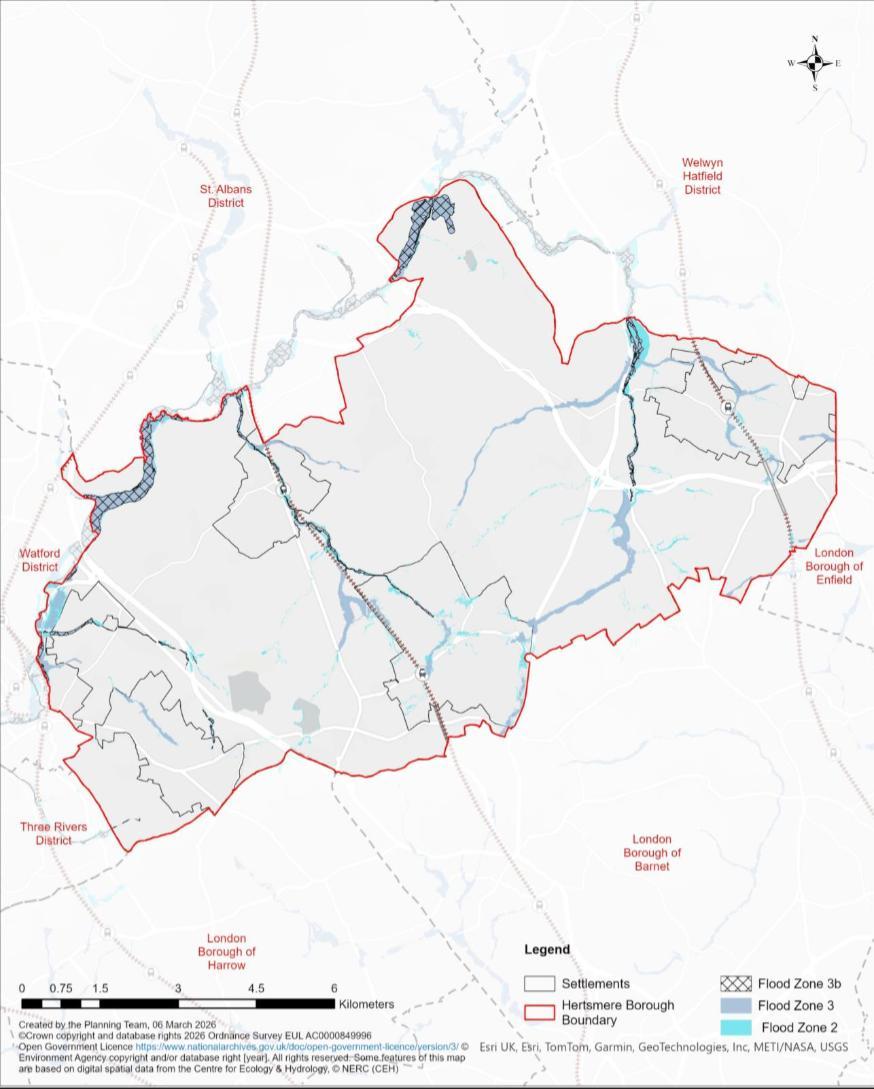
10.7.1. A strategic policy that sets out how proposals will minimise flood risk –specifically in applying the sequential test and the requirements for sitespecific Flood Risk Assessment (FRA). The policy will include mapping that identifies Flood zones, including fluvial, reservoir groundwater and surface water flood risk. The policy will refer to relevant technical evidence. This will be published under Document E7 Strategic Flood Risk Assessment.
Hertsmere Borough Council
Hertsmere Local Plan Draft Regulation 18 Consultation Document
Hertsmere Borough Council
Hertsmere Local Plan Draft Regulation 18 Consultation Document
Policy SD8 Water Supply and Wastewater
10.8.1. A strategic policy that sets out how development proposals for new water supply and wastewater facilities or the expansion of existing facilities will be supported subject to meeting criteria.
10.8.2. The policy could require that development proposals should have regard to Drainage and Wastewater Management Plans (DWMPs) and must demonstrate that the local water supply and public sewerage networks have adequate capacity both on and off-site to serve demand arising from the development; or where such capacity does not exist and there are no programmed works, arrangements are made to ensure adequate provision prior to occupation.
10.8.3. Development proposals should ensure the separation of surface and foul water systems, including by rectifying misconnections. Proposals should prioritise mains foul drainage and avoid the use of non-mains drainage for foul water disposal, particularly in Source Protection Zones (SPZ).
10.8.4. Development proposals should be designed to be water efficient, reduce water consumption and minimise pressure on the combined sewer network by integrating SuDS. Planning conditions will be applied to ensure that water efficiency standards are met as development proposals are delivered The policy will consider a water efficiency standard that may go beyond the Building Regulations, for example 110 litres per person per day. This approach is proposed in the context of recent advice from Natural England in relation to water neutrality.
10.8.5. Development proposals within a SPZ will only be supported where there is no risk of contamination to groundwater sources. SPZs will be shown on the Policies Map. The policy will require that development proposals on or in proximity to sites with contaminated land must not introduce new pathways for contamination materials to reach groundwater.
Hertsmere Borough Council
Hertsmere Local Plan Draft Regulation 18 Consultation Document
10.8.6. The above requirements are consistent with Thames Water requirements.
10.8.7. Technical evidence in support of the policy will be provided under Document E8 Water Cycle Study.
Policy SD9 Ground Conditions
10.9.1. A strategic policy for the consideration of proposals on sites that may be contaminated. This policy links in with the wider approach of optimising/ intensifying development on previously developed urban land and securing sustainable and successful place-making. The policy sets out the requirements for development proposals to demonstrate that any risks associated with land contamination, including to human health, public safety and the environment, will be adequately addressed to make the development safe.
10.9.2. The policy will require that development proposals on land that is suspected of being contaminated or potentially contaminated, or if a sensitive use is proposed, must submit a Preliminary Risk Assessment (Phase 1 Study) to identify the level and risk of contamination on the site and adjacent land, and where necessary meet requirements/ submit relevant supporting evidence.
10.9.3. Proposals involving the storage or use of hazardous substances, or development of a site in the vicinity of a hazardous installation, will only be permitted where it is demonstrated that appropriate safeguards are in place to ensure there is no unacceptable risk to human health, public safety and the environment
Policy SD10 Reducing and Sustainably Managing Waste
10.10.1. The emerging Local Plan will include a strategic policy that sets out how waste management will be considered within the context of a circular economy A circular economy approach will be promoted, with the objective of conserving and making more efficient use of resources. The policy sets
Hertsmere Borough Council
Hertsmere Local Plan Draft Regulation 18 Consultation Document
out how proposals for new waste management and transfer facilities will be considered
10.10.2. Development proposals will be required to apply the waste hierarchy and follow circular economy principles, in line with Policy SD 11.
Policy SD11 Securing a Circular Economy
10.11.1. A new strategic policy that sets out how the circular economy approach will be applied to new development across the Borough. The policy requires that major development proposals should aim to be net zero-waste. This aligns with other related policies. The policy sets out how proposals for new development will manage both the type and volume of recyclable materials and waste arising from the development during the construction and operational phases.
10.11.2. The policy will be tested to ensure that its requirements do not adversely impact on development viability The technical evidence that will be published under Document K4a Whole Plan Viability Assessment.
Policy SD12 Groundwater Source Protection Zones
10.12.1. This non-strategic policy will ensure that development proposals within Source Protection Zones (SPZ) are assessed in relation to their impact on groundwater, in accordance with the Environment Agency guidance. The SPZs will be identified and mapped in the emerging Local Plan.
10.12.2. An assessment of potential impacts and mitigation measures will be required with proposals for some uses that could adversely impact on groundwater. This may include uses such as data centres, waste processing and recycling uses, cemeteries, foul sewage discharge facilities, and storage of hazardous substances – for example, petrol stations and farm waste handling facilities.
10.12.3. Technical evidence in support of the policy will be provided under Document E8 Water Cycle Study.
Hertsmere Borough Council
Hertsmere Local Plan Draft Regulation 18 Consultation Document
Policy SD13 Minerals Consultation Area
10.13.1. Hertfordshire County Council are responsible for preparing the Minerals and Waste Local Plan. The County Council commenced a review of the Minerals and Waste Local Plan in 2022.
10.13.2. This non-strategic policy will ensure that development within the Mineral Consultation Area shown on the Policies Map will not sterilise or prevent the future extraction of the mineral resource. Where there may be a significant impact on the resource, advice will be sought from Hertfordshire County Council as Mineral Planning Authority. Those proposing developments that could generate impacts will be encouraged to positively engage with them at an appropriate point in the development process.
Chapter 10 Questions:
41. Question: Do you agree with the content set out within policies SD1SD13 regarding the Council's proposed approach towards Sustainable Design and Infrastructure across Hertsmere? Yes/No.
42. Question: If you disagree with any of the content, with reference to specific policies, please provide detailed comments or suitable alternatives, and justify your answer with appropriate and proportionate evidence.