1. Introduction and Background
1.1. The planning system plays a key role in keeping our national parks special and ensuring they remain living, working landscapes. It is for this reason that the Government, through primary legislation, has made national park authorities the sole planning authorities for their respective areas. As part of its statutory planning role, the New Forest National Park Authority is required to prepare, monitor and review a Local Plan for the National Park. Once adopted, the Local Plan forms part of the statutory ‘development plan’ (alongside any ‘made’ Neighbourhood Plans and the separate Minerals and Waste Local Plan) for the New Forest and is the principal guide for planning decisions within the National Park. The Local Plan focuses on the area within the National Park boundary, and it is the responsibilities of our neighbouring planning authorities to prepare the development plans for their respective areas outside the National Park.
1.2. Key aspects of national policy and statute pertinent to National Parks are set out in the National Parks & Access to the Countryside Act 1949, the Environment Act 1995, the Levelling Up & Regeneration Act 2023, as well as the National Planning Policy Framework and associated guidance. This includes the statutory National Park purposes; the relationship between the two purposes; the Authority’s socioeconomic duty; and the legal requirement placed on relevant bodies – including national park authorities - to seek to further the National Park purposes in undertaking their functions. It is this framework that the New Forest National Park Local Plan is prepared under and operates within.
Links to other plans and strategies
1.3. The Local Plan aims to deliver the long-term planning vision for the New Forest National Park and forms a key part of the statutory ‘development plan’for the area. National policy contained within the National Planning Policy Framework (NPPF) and guidance within the National Planning Practice Guidance (NPPG) also form material considerations when preparing the Local Plan.
1.4. The Environment Act 1995 also requires each National Park Authority to prepare a National Park Management Plan. The Management Plan – or Partnership Plan – is the overarching strategic document for the National Park and is intended to guide the work of all organisations within the National Park (not just the Authority). Although Management Plans do not form part of the statutory development plan, they should be taken into account in preparing Local Plans and may also be material considerations in assessing planning applications. In 2027 the New Forest National Park Partnership Plan will be updated and will set out a series of actions to be taken forward over the following five years, many of which have land use implications to be reflected in the Local Plan.
1.5. In addition to the development plan documents, Supplementary Planning Documents can provide more detail on planning policies, as well as specific strategies to guide the delivery of the two statutory Park purposes. These latter documents are not formal planning documents but provide detailed guidance on important issues within the National Park.



Supplementary Planning Documents
Strategies and Plans, including the Bird Aware Solent Mitigation Strategy and the Landscape Action Plan
1.6. Since the adoption of the first set of New Forest National Park-wide planning policies in 2010 there have been significant changes in national policy, which continues to confirm that national parks have the highest level of protection in relation to landscape and scenic beauty. In addition, the statutory National Park purposes originally established through the National Parks & Access to the CountrysideAct 1949 remain and are supplemented by the EnvironmentAct 1995. Changes introduced through Section 245 of the Levelling Up & Regeneration Act 2023 require ‘relevant bodies’ to seek to further these statutory National Park purposes in undertaking their functions. This strengthened duty applies to a wide range of bodies, including national park authorities, constituent local authorities and statutory undertakers.
1.7. The Environment Act 2021 introduced a new system of plans for nature recovery across England, known as Local Nature Recovery Strategies (LNRS). These aim to map out areas of wildlife, identify opportunities for improvement, and prioritize local actions to restore and enhance nature, in partnership with local stakeholders and landowners. Regulations introduced in 2023 set out how these strategies will be prepared by responsible bodies. The production of each LNRS is evidencebased, locally led and collaborative, to create a network of shared plans that public, private and voluntary sectors can all help to deliver. Natural England lead the Government’s involvement and they work alongside each of the responsible bodies to help shape the strategy and ensure overall consistency. The preparation of each LNRS is also supported by the Environment Agency and the Forestry Commission.
1.8. As the New Forest National Park is currently covered by two county council areas, two LNRSs apply to the National Park area. The strategies will be used to:
• guide investment into local priorities for protection and enhancement;
• help shape how future funding for farming and land management such as the Environment Land Management schemes will be used;
• map areas of opportunity for the use of 'nature-based solutions' to wider environmental problems like flooding, climate change mitigation and adaptation or poor water quality;
• guide mandatory Biodiversity Net Gain (BNG) investments; and
• provide a source of evidence for local planning authorities, helping to understand locations important for conserving and restoring biodiversity
1.9. The Local Nature Recovery Strategy for Hampshire was approved and published on 8 December 2025, following consultation during May and June 2025. The Wiltshire and Swindon LNRS covers the northern part of the national park and was subject to consultation between March and April 2025 and was approved in October 2025.
1.10. In addition, the New Forest National Park Local Plan is informed by a wide range of evidence base studies, including a Strategic Flood Risk Assessment; WholePlan Viability Assessment; Employment & Business Needs Survey; and an objective assessment of housing needs arising within the National Park. The policies in the Local Plan have also been assessed against a number of environmental, economic and social indicators as part of a SustainabilityAppraisal (SA) / Strategic Environmental Assessment (SEA) and Habitats Regulations Assessment (HRA).
Overview of the New Forest National Park
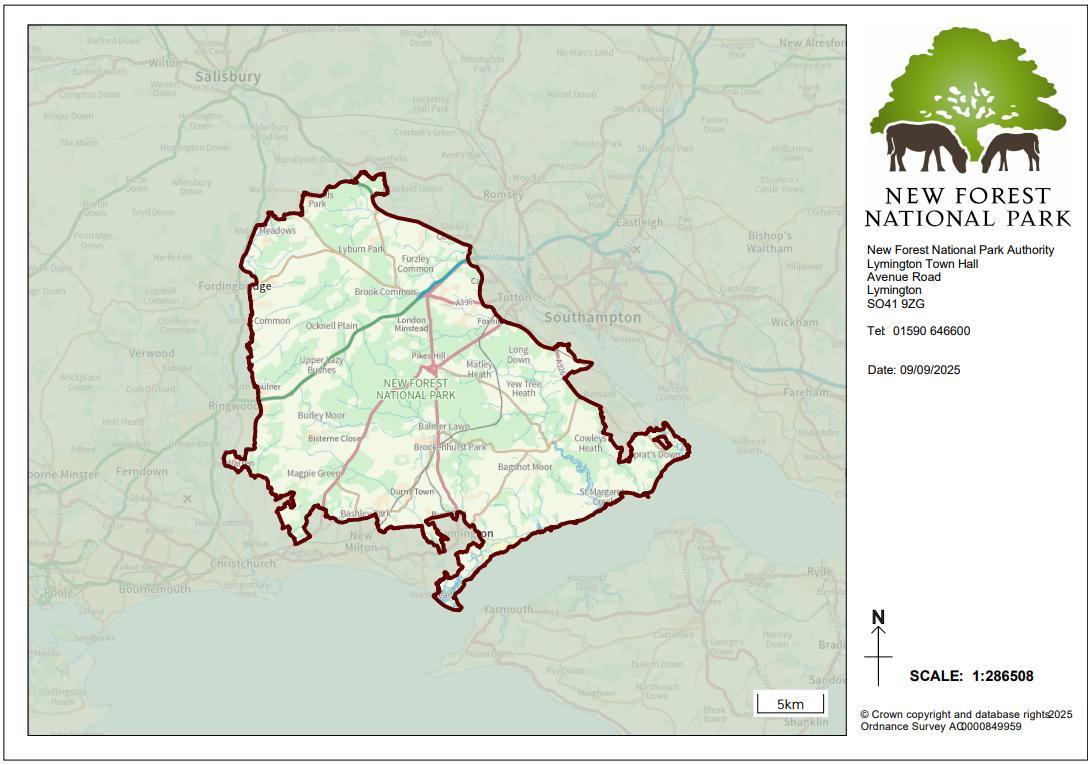
1.11. The New Forest National Park was designated in 2005 and covers an area of 220 square miles within the counties of Hampshire and Wiltshire. The National Park operates within a detailed planning policy and legislative framework which is set out below. National parks have two statutory purposes that set out the main reasons for their designation and describe the overall focus for their management.
The two purposes as set out in primary legislation are the ‘golden threads’ running through the Local Plan:
• to conserve and enhance the natural beauty, wildlife and cultural heritage of the New Forest; and
• to promote opportunities for the understanding and enjoyment of the special qualities of the New Forest by the public.
1.12. In taking forward the two National Park purposes, National Park Authorities also have a duty under Section 62(1) of the Environment Act 1995 to seek to foster the economic and social well-being of local communities within the National Park. The New Forest is a living-working area, home to 2,500 local businesses and nearly 35,000 residents. More detail is set out in Chapter 2 Profile of the New Forest National Park. All relevant authorities are required to seek to further the two purposes in any work that may affect the area and make every effort to reconcile any conflict between the two. If such efforts fail, then only as a measure of last resort should the first purpose take precedence. This is known as the Sandford Principle and is a well-established principle, dating back decades.
1.13. These statutory purposes, the related socio-economic duty and the strengthened legal requirement to seek to further the purposes in the delivery of the Authority’s planning functions form the underlying themes running through this Local Plan. The vision for the National Park, and strategic objectives (Chapter 3) are drawn from these purposes, duty and the special qualities of the National Park. In addition, the review of the Local Plan has provided an opportunity to reflect its synergies with the Partnership Plan.
The New Forest National Park Partnership Plan 2022 – 2027
1.14. The central role of the Partnership Plan (published July 2022) is to guide and coordinate the work of all those with an interest in, and influence on, the National Park in delivering its purposes and duty. This includes organisations with statutory responsibilities, land management interests, businesses, local communities and user groups.
1.15. The Plan outlines the key drivers and challenges facing the National Park and sets out how these will be addressed collectively. It sets out an overall approach to managing the National Park for the next five years, which will frame more detailed policies and actions over this period. The Plan will guide and align the priorities and resources of the National Park Authority with those of partner organisations, businesses and communities.
1.16. The vision for the Partnership Plan to 2050 is “The Vision for the New Forest is to be a national beacon for a sustainable future, where nature and people flourish”. To support the vision a number of objectives are expressed which have strong links with the Local Plan:
• people live and work sustainably, having successfully adapted to the impacts of the climate emergency and supporting nature’s recovery and resilience;
• all communities and visitors are better informed and gain inspiration, health and well-being and enjoy the extensive areas accessible across the National Park whilst respecting the fragile nature, unique environment and rich culture of the New Forest;
• tranquillity and a feeling of naturalness pervade large parts of the New Forest;
• facilities such as car parks, campsites, walking and cycling routes and community green spaces are in the right places to both protect rare wildlife and to provide a better, more informed experience for people;
• everyone contributes to caring for the National Park as a special place for present and future generations;
• the mosaic of distinctive landscapes and habitats have been conserved and greatly enhanced, supporting wildlife to recover and flourish;
• there is a strong sense, understanding of and support for the heritage and living culture of the New Forest, especially the local tradition of commoning;
• local, regional and national organisations recognise and work to enhance the value of the National Park; there is an appreciation of its importance and role within the wider area.
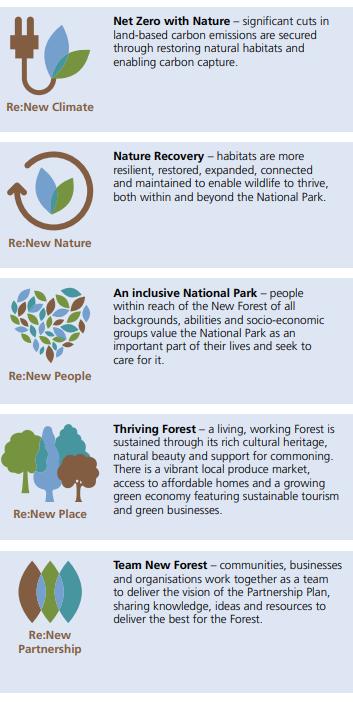
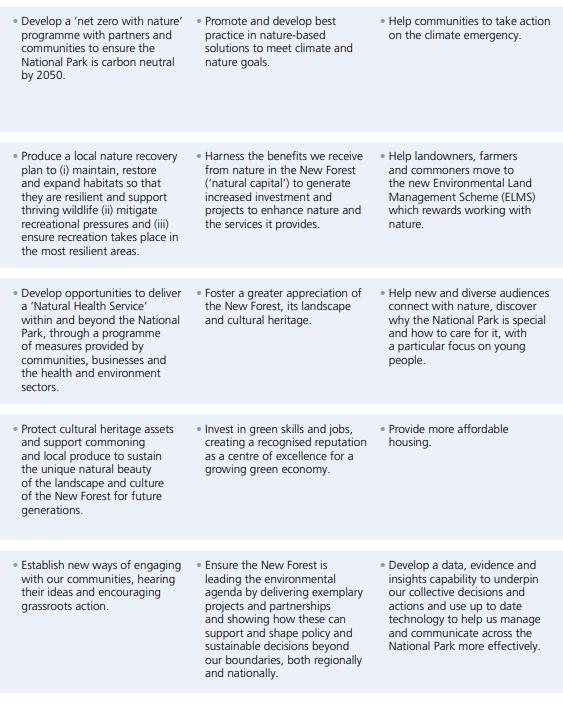
1.17. The Partnership Plan goes on to identify five themes based ‘agendas for action’, set below. To ensure that the Local Plan reflects where possible, not only the special qualities of the National Park, but also the themes of the Partnership Plan, each chapter precedes with a commentary of how these all relate.
Cross-boundary planning issues
1.18. The Localism Act 2011 introduced a legal requirement for planning authorities –including national park authorities – to co-operate on strategic cross-boundary planning matters. The ‘duty to co-operate’ aims to ensure that neighbouring authorities continue to engage with each other constructively. Although this duty has been reformed, there remains a requirement for relevant authorities to work constructively on cross-boundary matters in plan-making.
1.19. The National Park Authority is well placed to fulfil this requirement due to:
• Its coordinating role in the preparation and adoption of the National Park Management Plan. The Partnership Plan (see above) is overseen by a group of statutory bodies working alongside the National Park Authority and this has helped establish good working arrangements between the respective authorities. This includes a ‘Partnership Plan Leaders’ Panel’ which brings together senior representatives of the main bodies in the New Forest.
• The National Park Authority is the statutory planning authority for the National Park, but the constituent authorities retain their responsibilities for housing, economic development, flooding, environmental health, highways and education in the New Forest. The National ParkAuthority has therefore always worked closely with its constituent authorities on these matters
• The membership of the National Park Authority is drawn from constituent local authorities and town and parish councils across the National Park, thereby ensuring good links across the tiers of local government.
1.20. The main areas of strategic cross-boundary planning interest are:
• Habitat protection – over half of the National Park is designated as being of international importance for nature conservation. This includes all 26 miles of the National Park’s coastline and the designated habitats in the heart of the New Forest. Consequently, there is a shared need to ensure that the planned level of development within the National Park and surrounding areas does not adversely impact on the integrity of the New Forest’s protected habitats
• Housing provision – there is a significant housing need within the New Forest and surrounding areas. The Government recognises that national parks are not appropriate locations for major development and unrestricted housing and is clear that unmet needs should be considered through cooperation with surrounding authorities.
• Transport – the National Park Authority is not the statutory highway authority for the National Park area, and it is therefore important the Authority liaises closely with the bodies with that responsibility. This includes active travel and the Local Cycling & Walking Infrastructure Plans, as well as the traffic implications of major schemes close to the National Park boundary.
National policy and guidance
1.21. The National Planning Policy Framework (NPPF) and Planning Practice Guidance (NPPG, first issued in 2014) set out the Government’s planning policies and guidance relevant to the work of all planning authorities. They constitute guidance for planning authorities and decision-takers in drawing up plans and are a material consideration in determining applications. The development plan remains the starting point for determining applications, and planning law requires that applications for planning permission must be determined in accordance with the development plan unless material considerations indicate otherwise.
1.22. The NPPF states that local plans should set out the strategic priorities for the area. This should include policies to deliver the homes and jobs needed in the area and conservation and enhancement of the environment, including landscape. National parks are identified as areas where development should be restricted and the NPPF confirms that national parks have the highest status of protection in relation to landscape and scenic beauty.
1.23. The UK Government National Parks Vision and Circular provides policy guidance specifically for the English National Parks and for all those whose decisions or actions might affect them. The Circular calls for a renewed focus on achieving the two National Park purposes and for the fostering of vibrant, healthy and productive living and working communities.
1.24. In 2024 the Government published their ‘Protected Landscapes Targets & Outcomes Framework’. To support Protected Landscapes in meeting their potential for nature, climate, people and place, the Government has established ambitious targets for National Parks and National Landscapes. These targets will promote the actions that are most needed to achieve positive changes, and the New Forest National Park Local Plan has a role in the delivery of the Government’s apportioned targets for the New Forest National Park.
1.25. The NPPF, National Parks Circular, NPPG and Protected Landscapes Targets & Outcomes Framework for the New Forest have been taken into account in the preparation of this Local Plan.
Neighbourhood Plans
1.26. A number of the towns and parishes within the National Park have prepared Neighbourhood Plans and these have been ‘made’ following consultation and examination. The examination process requires draft neighbourhood plans to meet the ‘basic conditions’ as set out in legislation. One of these is compliance with the strategic policies in the Local Plan. Hence this Local Plan includes both strategic policies (prefixed with ‘SP’) and more detailed development management policies (prefixed with ‘DP’). This form of numbering enables local communities to understand which are the strategic planning policies that they should be in general conformity with in preparing Neighbourhood Plans.
1.27. As Neighbourhood Plans are typically town or parish-based, several cross over into the current administrative areas of New Forest District Council or Test Valley Borough Council
Minerals and waste planning framework
1.28. The New Forest National Park Authority is the minerals and waste planning authority for the whole of the National Park. This statutory role includes the preparation and adoption of the planning policy framework for minerals and waste development within the Park. The Authority works in partnership with the other minerals and waste planning authorities in Hampshire and has adopted the following planning policy documents.
1.29. The Hampshire Minerals & Waste Plan (adopted 2026) forms part of the statutory development plan for the National Park. The Plan covers the whole of the New Forest National Park, including the area within south Wiltshire. The plan is supported by the following Supplementary Planning Documents (SPDs):
• Oil & Gas Development in Hampshire SPD (adopted 2016); and
• Minerals & Waste Safeguarding in Hampshire (adopted 2016).
1.30. With this separate policy framework in place for minerals and waste development in the Park, the New Forest National Park Local Plan does not cover minerals and waste planning matters.
Planning enforcement
1.31. To support the protection afforded to the New Forest as a nationally designated landscape, the Authority has a dedicated planning enforcement team to ensure that unauthorised development is not harmful to the National Park, its special qualities and to protect the amenities of residents. In accordance with the NPPF the Authority has adopted a Local Enforcement Plan that sets out the policy and procedures for enforcing planning control in the Park.