5.3 Land Use
The regeneration of Basildon Town Centre presents a key opportunity to reimagine land use in support of an inclusive and economically resilient urban core. The strategy promotes a shift from a retaildominated centre to a balanced mix of uses that generate activity throughout the day and evening, while meeting community needs.
Retail and Commercial
Retail will be consolidated into a focused core, with flexible formats and shared spaces that respond to changing consumer habits. Future development will reinforce the east-west commercial spine, activating it with a mix of retail, outdoor markets, and food and beverage uses. This will encourage longer visits and support the evening economy. Improved servicing will ensure logistics support, rather than detract from, the quality of the public realm.
Civic and Community Facilities
A wider range of civic and community infrastructure will support a growing population, including early years provision, youth facilities, libraries, and health services. The proposed health facility at the former Debenhams site is a key opportunity to deliver inclusive, centrally located services that encourage footfall, linked trips, and community support. Its shopping centre location offers potential for colocated cafés, health-focused shops, gyms, and workshop space.
The masterplan also supports faster delivery of public service infrastructure in line with the NPPF. The Council will work with partners to resolve planning issues early and prioritise proposals that deliver new or improved public services.
Cultural and Creative Uses
Basildon’s cultural identity is central to creating a distinctive and welcoming Town Centre. The Culture and Creative Industries Strategy highlights the need for spaces that support both cultural production and presentation, including studios, rehearsal venues, and flexible spaces for exhibitions and events. These uses will be embedded into the public realm and development proposals, contributing to placemaking, supporting the evening economy, and improving perceptions of safety. A new cultural venue is being explored for the western edge of the Town Centre. This mid-scale space would support live events, community use, and food and drink activity, helping to diversify the cultural offer and strengthen the night-time economy.
Employment
The Town Centre will become a hub for employment, offering flexible, affordable workspace for startups, creative industries, and professional services. Mixed-use developments will include workspace that supports new businesses and job creation in the heart of the Town Centre. The Basildon Employment Land Review (2024) evidences strong growth in office-based employment and highlights the need for adaptable, high-quality workspace that can respond to evolving employment trends, including light production and creative uses.
Residential
A mix of new homes will be delivered in sustainable, walkable locations, supported by local services, green infrastructure, and active travel connections. Residential development will be further detailed in Section 5.8 Homes, with a focus on supporting long-term residency and community stability in the Town Centre.
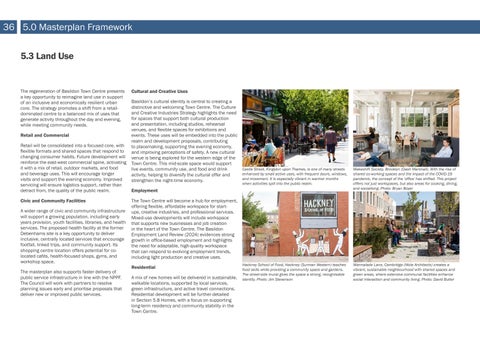
frequent doors, windows, and movement.
especially vibrant in warmer months when activities spill into the
Castle Street, Kingston upon Thames, is one of many streets enhanced by small active uses, with
It is
public realm.
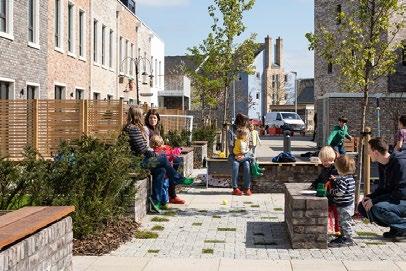
Marmalade Lane, Cambridge (Mole Architects) creates a vibrant, sustainable neighbourhood with shared spaces and green areas, where extensive communal facilities enhance social interaction and community living. Photo: David Butler
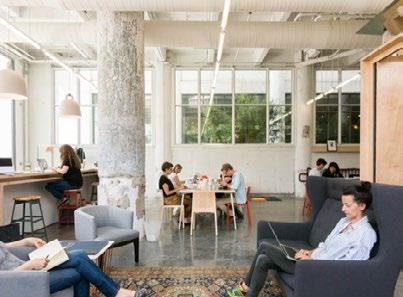
Hackney School of Food, Hackney (Surman Western) teaches food skills while providing a community space and gardens. The street-side mural gives the space a strong, recognisable identity. Photo: Jim Stevenson
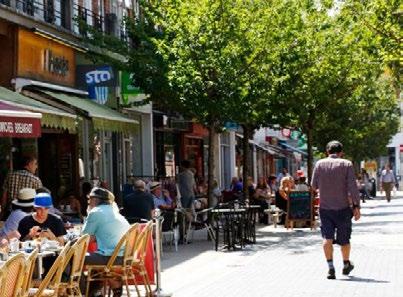
Makeshift Society, Brooklyn (Dash Marshall). With the rise of shared co-working spaces and the impact of the COVID-19 pandemic, the concept of the 'office' has shifted. This project offers not just workspaces, but also areas for cooking, dining, and socialising. Photo: Bryan Boyer
Policy TC3: Land Use
To support the creation of a dynamic, sustainable, healthy and people-centric urban environment, new development within Basildon Town Centre should meet the following criteria:
a. Deliver a balanced mix of uses, including mixed-tenure residential (in line with policies HOU1–HOU3), retail, commercial, cultural, community, civic, health, and employment spaces. Residential uses should be integrated within mixed-use developments to support a walkable town centre, extend activity beyond business hours, and improve access to local services and amenities.
b. Provide new and enhance existing infrastructure to meet the needs of a growing population, with emphasis on wellbeing, access to open spaces and play areas, and a diverse mix of community uses including fitness, youth, health, educational services, and spaces for social support.
c. Phasing must encourage the timely delivery of non-residential land uses, ensuring that supporting infrastructure is delivered early enough to support the needs of incoming residents and businesses in the initial phases in line with Local Plan Policies INF1 to INF3.
d. Development should include flexible, accessible and inclusive community spaces that support a range of activities and events,
fostering social interaction and cultural experiences throughout the day and evening in accordance with Policy INF3: Social and Community Infrastructure.
e. Development should support both cultural production (e.g. studios, maker spaces, rehearsal rooms) and cultural presentation (e.g. galleries, performance venues, pop-ups, events). Proposals should consider existing provision and contribute to a balanced cultural offer across the Town Centre.
f. Accommodate temporary cultural uses in vacant retail units or public spaces to maintain vibrancy during phased regeneration, where appropriate.
g. New commercial development should support a variety of employment opportunities including flexible and adaptable spaces, with a mix of office, retail, and leisure spaces to attract a diverse mix of businesses and stimulate economic growth.
h. Prioritise efficient land use by repurposing vacant units and intensifying development in sustainable locations. Redundant car parking, identified using the methodology set out in the Basildon Borough Parking Strategy (2023–2043), should be optimised for mixeduse residential and community facilities.
i. Development must be designed for longterm flexibility and adaptability, supporting resilience to climate change, evolving community needs, and economic shifts. Proposals should incorporate sustainable construction methods, enable future retrofitting, and provide spaces that can accommodate a range of uses over time.