JUNE 2026
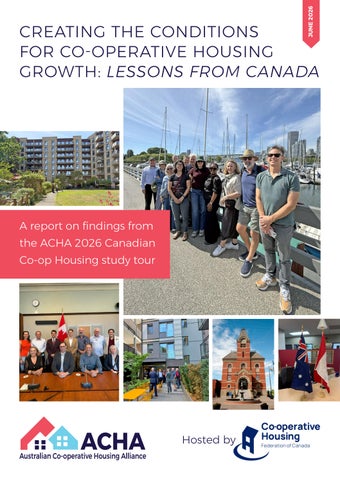
CREATING THE CONDITIONS FOR CO-OPERATIVE HOUSING GROWTH: LESSONS FROM CANADA
A report on findings from the ACHA 2026 Canadian Co-op Housing study tour
Hosted by
ACHA 2026 CANADIAN STUDY TOUR REPORT
CREATING THE CONDITIONS FOR CO-OPERATIVE HOUSING GROWTH: LESSONS FROM CANADA A report on findings from the ACHA 2026 Canadian Co-op Housing study tour
Tour hosts
Supported by
Author: Linda Seaborn. Publisher: Australian Co-operative Housing Alliance (ACHA), September 2026 Disclaimer: The report features a vibrant collection of photographs taken by the tour participants. While ACHA endeavours to ensure the quality of this publication, ACHA does not accept any responsibility for the accuracy, completeness or currency of the material included in this publication and will not be liable for any loss or damage arising out of any use of, or reliance on, this publication. © Australian Co-operative Housing Alliance (ACHA) When quoting from this document, please acknowledge: ACHA - www.acha.coop. Production of this report has been proudly sponsored by Common Equity Housing Ltd (CEHL), Australia’s largest provider of co-operative housing. CEHL’s Managing Director, Liz Thomas, was a delegate on the tour. This document was drafted with the assistance of AI writing tools. All source material, analysis and direction are the author’s own, and the content has been reviewed and verified by the author. Responsibility for any errors or omissions rests with the author. PAGE
2
ACHA 2026 CANADIAN STUDY TOUR REPORT
OBJECTIVES OF THE STUDY TOUR
1. 2. 3. Explore how Australian co-operative banks could help finance and grow the co-operative housing sector.
Identify practical pathways to scale Australian co-operative housing beyond pilot or investment concepts.
PAGE
3
Strengthen the case for Australian co-operative housing by clarifying its distinct value and mainstream potential.
ACHA 2026 CANADIAN STUDY TOUR REPORT
STUDY TOUR PARTICIPANTS
Left to right: Heinz Feldman (Wohn Project Wien), Dr. Sidsel Grimstad, Melina Morrison, Donald Proctor, Emily Taylor, Craig Brooke, Neil Wilmett, Liz Thomas and Mark Smyth, (Beverly Wood - not pictured).organised a study In June 2026 the Australian Co-operative Housing Alliance Left to right: Heinz Feldman (Wohn Project Wien), Dr. Sidsel Grimstad, Melina Morrison, Donald Proctor, Emily Taylor,
Study tour participants tour of the Canadian Housing Co-operative sector, hosted by the Co-operative Craig Brooke, Neil Wilmett, Liz Thomas and Mark Smyth, (Beverly Wood - not pictured).
Housing Federation of Canada.
Study tour participants photographed in Vancouver (from left to right):
• • • •
Nick Sabel, CEO, Common Equity NSW (CENSW) and ACHA member
• • • •
Damon Thomas (AM), Consultant
Chandrika Leslie, Treasurer, Bank First
Linda Seaborn, Senior Policy Adviser, Business Council of Co-operatives and Mutuals (BCCM)
Liz Thomas, Managing Director, Common Equity Housing Ltd (CEHL), Chair of Australian Co-operative Housing Alliance (ACHA) and Board member (BCCM) Tim Von Ess, Head of Impact Lending, Bank Australia
Steven Morrisey, CEO, South East Housing Co-operative (SEHC) and ACHA member Donald Proctor, Consultant
PAGE
4
ACHA 2026 CANADIAN STUDY TOUR REPORT
CONTENTS Objectives of the study tour.....................................................................................................................................................................................................................................3 Study tour participants.................................................................................................................................................................................................................................................4 Contents....................................................................................................................................................................................................................................................................................5 Executive Summary........................................................................................................................................................................................................................................................6 Ten Key Learnings.............................................................................................................................................................................................................................................................8 Canada.....................................................................................................................................................................................................................................................................................13 The Canadian housing co-operative sector: an overview..............................................................................................................................................................14 A brief history.....................................................................................................................................................................................................................................................15 The current environment.........................................................................................................................................................................................................................15 Financing and policy context...............................................................................................................................................................................................................16 Canadian government roles in housing.......................................................................................................................................................................................................17 Co-operative Housing Federation (CHF) of Canada...........................................................................................................................................................................18 National structure...........................................................................................................................................................................................................................................19 Federal advocacy priorities................................................................................................................................................................................................................... 20 Takeaways............................................................................................................................................................................................................................................................22 Co-operative Housing Federation of British Columbia and the Community Land Trust..................................................................................24 Vancity.....................................................................................................................................................................................................................................................................................28 Co-operative housing visits.....................................................................................................................................................................................................................................32 Fuller-Findlay Housing Co-op, Vancouver — construction site tour.....................................................................................................................34 North Arm Housing Co-operative, Vancouver — lunch and tour...........................................................................................................................36 McHardy Housing Co-operative, Burnaby — tour................................................................................................................................................................38 False Creek South: a legacy co-operative neighbourhood........................................................................................................................................ 40 Greater Vancouver Floating Housing Co-operative — marina visit.......................................................................................................................42 Cartier Square Housing Co-operative...........................................................................................................................................................................................44 Abiwin Co-op.....................................................................................................................................................................................................................................................45 Projet Sainte-Josephine...........................................................................................................................................................................................................................46 Village Chelsea.................................................................................................................................................................................................................................................48 Co-operatives and Mutuals Canada (CMC) Congress, Toronto.................................................................................................................................................49 International Co-operatives Congress..........................................................................................................................................................................................................50 Meetings on Parliament Hill.................................................................................................................................................................................................................................52 CHF Canada Annual Meeting and Conference, Fredericton.....................................................................................................................................................55 Organisations and people the tour met with..........................................................................................................................................................................................61 Study tour itinerary.......................................................................................................................................................................................................................................................62 PAGE
5
ACHA 2026 CANADIAN STUDY TOUR REPORT
EXECUTIVE SUMMARY Over two weeks in June 2026, eight representatives of Australia’s co-operative housing and co-operative banking sectors undertook an intensive study tour of Canada’s co-operative housing system. The delegation held 12 formal site visits and meetings across Vancouver, Gatineau, Ottawa and Fredericton, met with two sitting federal parliamentarians, attended the national peak body’s annual conference, and engaged directly with the chief executives, policy directors and front-line members of almost every major institution underpinning the Canadian co-operative housing sector. The tour represents a significant and well-targeted investment of board and executive time. It returned a depth of access — to government ministers, peak body leadership, financial institution executives and individual co-op members — that would be very difficult to replicate through desk research or remote engagement. Critically, the tour was not a one-way fact-finding exercise: delegation members also represented Australia’s sector on the international stage, presenting at the CHF Canada Conference, Co-operatives and Mutuals Canada Congress and the International Symposium on Cooperative Financial Institutions, and contributing directly to the CHF Canada conference program. The central finding of the tour is straightforward and significant: Canada demonstrates that co-operative housing can scale well beyond pilot or boutique status when government investment, financial institutions and sector infrastructure are deliberately aligned. Canada’s co-operative housing sector, per head of population, is around 15 times the size of Australia’s. This did not happen by accident. It is the product of sustained federal investment, a layered network of national and regional peak bodies, and active, well-resourced political advocacy. None of the Canadian success factors are unique to the Canadian context, and none are foreign to Australia’s own co-operative and mutual sector. This gives ACHA members and BCCM a clear, well-evidenced reference point for an Australian growth strategy and strengthens the case the sector can make to government, mutual finance partners, and the public.
Ultimately, the Study Tour showed that the future of co-operative housing in Australia does not need to be imagined from scratch. Around the world, successful co-operative housing systems are already demonstrating what is possible. The task ahead is to learn from these examples, adapt them to the Australian context and work collectively to realise the full potential of co-operative housing.
PAGE
6
ACHA 2026 CANADIAN STUDY TOUR REPORT
Value delivered by the tour Beyond the learnings captured in this report, the tour delivered concrete value to the Australian sector in several respects:
•
Direct relationships were established or strengthened with the CEOs and senior leadership of CHF Canada, CHF BC, the Community Land Trust (BC), Vancity Credit Union, Co-operatives and Mutuals Canada, and FIHAB in Quebec — relationships the sector can continue to draw on.
•
The delegation secured meetings with two sitting federal Members of Parliament, including a minister, providing
•
Australia’s co-operative and mutual sector was represented on two international platforms during the tour —
first-hand insight into how a mature co-operative housing sector sustains political support over time. the Co-operatives and Mutuals Canada Congress in Toronto and the CHF Canada Annual Conference in Fredericton — raising the profile of the Australian sector internationally.
•
The tour deepened the working relationship between Australian co-operative housing providers (CEHL, CENSW, SEHC) and Australian mutual banks (Bank Australia, Bank First), with shared exposure to Vancity’s integrated approach to co-operative housing finance providing a live case study for further collaboration.
•
Detailed financial and delivery data was gathered from recently completed or in-development co-operative housing projects, providing concrete benchmarks against which Australian project economics can be compared.
Key takeaways Shared Values and Principles There is strong alignment between the Canadian and Australian co-operative housing sectors, particularly in values, governance principles, and commitment to affordability and community.
Common Challenges Both jurisdictions face similar challenges, including ageing assets, funding constraints, and the need to scale supply to meet demand.
Strong Co-operative Culture Building and sustaining a positive co-operative culture is critical to long-term system performance and resilience.
Learning Through International Engagement International engagement provides valuable opportunities for knowledge exchange, innovation, and strengthening advocacy efforts.
The Importance of National Advocacy Maintaining national advocacy capability in Australia is vital to achieving growth of the order that other jurisdictions like Canada have achieved.
PAGE
7
ACHA 2026 CANADIAN STUDY TOUR REPORT
TEN KEY LEARNINGS
1.
2.
Policy and investment, not the co-operative model itself, are the binding constraint on scale.
Private/public funding models secures affordable housing co-operative supply in perpetuity
Canada’s experience shows clearly that the limiting
We have seen the successes of three different collaborative
factor on co-operative housing growth has never been
private/public funding models that ensure continuous
the co-operative model. It has been access to capital,
investment in affordable rental housing supply. Context
development finance and supportive policy settings.
specific funding mixes included Housing Future Funds,
Where government has provided sustained investment
government guarantees, commercial loans from banks
— as with the current $1.5 billion Co-operative Housing
and mutuals, soft loans from government entities, tenant
Development Program, which has generated a pipeline
equity contributions, co-operative solidarity funds, and
of more than 15,000 homes including 5,000 shovel-
grant funding.
ready units — the sector has scaled rapidly. Where federal investment was withdrawn in 1992, growth collapsed, with co-ops falling from 8% of new housing construction in 1982 to less than 1% by 2020. This is the single most important lesson for Australian advocacy: the case to government is not about proving the model works but about securing the investment that allows a proven model to scale. Relates to tour objective 1:
Foundational to ensuring affordability, quality, maintenance and social and environmental innovation in design was rigorous regulation and monitoring of non-profit and at-cost construction.
How this lesson can be adopted in Australia: This learning validates ACHA’s current shape (CEHL,
practical pathways to scale.
CENSW, CEHSA, Victorian Independent Co-op Housing
How this lesson can be adopted in Australia:
of the same layered architecture Canada has built out
This learning supports the call from ACHA to grow the co-op sector to 10% of housing stock (up from under 1%). Canada illustrates clearly the difference that funding makes and makes it clear that the model works, as also demonstrated in The Value of Housing Co-operatives in Australia1 and The Economic Impacts of Limited-Profit
Providers, secretariat support from BCCM) as the embryo more fully. The Canada example gives BCCM and ACHA a concrete blueprint for what “more formalised and resourced shared services” could look like — commercial purchasing, governance accreditation, and an assetholding / development subsidiary — rather than an abstract aspiration.
Housing Associations in Austria.2 An equivalent solution in Australia would be policy that specifically addresses housing co-operatives in federal housing programs (e.g. HAFF).
1. https://researchers.westernsydney.edu.au/en/publications/the-value-of-housing-co-operatives-in-australia/ 2. https://cms.gbv.at/repos/files/GBV/Intranet_downloads/PDF/Verbandsstatistik/Studien_Publikationen_GBV/Summary%20WIFO%20study_The%20economic%20impacts%20of%20limited%20profit%20housing%20 associations.pdf
PAGE
8
ACHA 2026 CANADIAN STUDY TOUR REPORT
3.
4.
The community land trust model separates asset risk from community governance and is bankable at scale.
Mission-aligned financial institutions are decisive, early-stage partners.
British Columbia’s Community Land Trust model
investor — financing projects before they were sufficiently
— under which a CLT holds long-term leasehold or freehold title, manages major assets, and secures institutional finance, while individual co-ops manage day-to-day community life — directly addresses the most common point of failure in volunteer-led housing: the risk that decades-long maintenance and refinancing obligations exceed board capacity. In its first ten years the BC Community Land Trust built a portfolio worth over $1.25 billion, protecting more than 2,600 existing co-op homes and adding 1,300 more in development. Key to this was the government mortgage guarantees making the CLT bankable. Notably, the CLT itself was partly inspired by the Common Equity model already
Vancity Credit Union’s willingness to act as an angel de-risked to attract mainstream lenders — was repeatedly identified as indispensable to the sector’s growth in British Columbia. The same role is played by Alterna Savings and Desjardins elsewhere in Canada. This is a close parallel to the role Australian co-operative and mutual banks, including Bank Australia and Bank First, are positioned to play in Australia. The tour validated, through direct discussion with Vancity’s strategy, treasury and policy teams, that a mutual bank can combine commercial discipline with a genuine mission orientation toward community housing outcomes. Relates to tour objective 2: the role of co-operative banks in financing growth.
operating in Australia, suggesting genuine potential for
How this lesson can be adopted in Australia:
a two-way exchange of expertise rather than one-way
Channeling mutual bank member capital into co-ops
borrowing. Relates to tour objectives 1 and 3.
rather than external investors mirrors Vancity’s role. Vancity’s willingness to invest before projects were
How this lesson can be adopted in Australia:
“de-risked enough” for mainstream lenders is the precise
This learning demonstrates what can be achieved with a
finance-mutual consultation finding on the need for
development finance guarantee plus a credible operator ie de-risking a novel asset class for conservative lenders. BC’s $1.25 billion CLT portfolio (built in ten years from three pilots) proves this.
PAGE
9
gap co-op banks can fill. This also supports BCCM’s innovative funding mechanisms and collaborative funding pools.
ACHA 2026 CANADIAN STUDY TOUR REPORT
5.
6.
Sustained government investment is the foundation of scale, not a one-off catalyst.
Co-operative housing is a proven, scalable solution to essential worker housing stress.
The federal government’s $1.5 billion Co-operative
Across every project visited, co-operative housing provided
Housing Development Program — the first dedicated
secure, affordable homes for people being priced out of
federal co-op construction funding in over 30 years
the private market in the communities where they work.
— and the BC government’s $500 million fund to
This is a live and worsening problem in Australia for nurses,
acquire existing private rental stock for the community
teachers, aged care workers and other essential workers.
housing sector both demonstrate that co-operative
Canada’s experience offers both a tested delivery model
housing scales in direct proportion to the scale and
and a powerful public narrative: co-operative housing
certainty of government commitment. The sector
is not welfare housing, but a mainstream solution to a
is now campaigning for renewed and extended
problem affecting the broader labour market and local
funding, recognising that programs delivered as one-
economies. Relates to tour objective 3: clarifying distinct
off announcements create boom-bust cycles rather
value and mainstream potential.
than durable growth. This reinforces the importance of Australia pursuing recurrent, multi-year funding commitments rather than one-off grants. Relates to tour objectives 1 and 3.
How this lesson can be adopted in Australia:
How this lesson can be adopted in Australia: This is a strong public/political point to address workforce shortages related to housing availability, which affects coop and mutual (and other) employers.
This learning reinforces the case for a dedicated funding stream for co-op housing reinstated in federal housing programs. The CHDP’s two-year expenditure window and the sector’s resulting campaign for extension is a cautionary parallel: Australia should advocate for a recurring facility (akin to a standing allocation or a revolving fund) rather than a single round, learning from Canada’s now-recurring need to re-campaign.
PAGE
10
ACHA 2026 CANADIAN STUDY TOUR REPORT
7.
Preserving and transferring existing stock is as important a growth lever as new construction. The False Creek South neighbourhood, and BC’s $500 million fund to move existing private rental housing into the community housing sector, both reflect a simple but under-utilised insight: the most affordable homes are often the ones already standing. Acquisition and transfer of existing market housing into co-operative ownership is a faster and often cheaper growth pathway than new development and deserves equal billing in Australian growth strategy alongside new supply. Relates to tour objectives 1 and 3.
8.
Sustained, well-resourced political advocacy is what protects and grows the sector over time.. CHF Canada’s “You Hold the Key” campaign — built to renew expiring federal rental assistance agreements — and the sector-wide campaign that secured the $1.5 billion Co-operative Housing Development Program in 2022 both demonstrate the value of a single, well-resourced national advocacy voice. CHF Canada’s membership structure, which captures 84% of co-ops nationally through shared regional and national membership arrangements, gives it a mandate that is difficult for government to ignore. This underscores the importance of ACHA and BCCM continuing to build a sustained, adequately resourced
How this lesson can be adopted in Australia:
national advocacy capability in Australia, rather than
This learning opens a second pathway alongside
to government.
construction. Most current Australian effort focuses on new build. BC’s $500M fund to transfer existing private rental into community ownership suggests ACHA and BCCM could advocate for an acquisition facility — potentially cheaper and faster than ground-up development — as a complementary ask to HAFF-style construction subsidy, especially relevant for vacant or distressed stock.
relying on episodic or fragmented representations Witnessing the “You Hold the Key” campaign also reinforced the benefit of Australia’s Commonwealth Rent Assistance (CRA) scheme, which is ongoing and vital to the sustainability of the community housing sector. Relates to tour objectives 1 and 3.
How this lesson can be adopted in Australia: This learning validates and extends ACHA/BCCM’s documented advocacy timeline (the 2022 ACHA revitalisation, the National Housing Roundtable, semi-regular minister meetings, the European study tour, this Canada tour). CHF Canada’s “You Hold the Key” single-issue campaign format, and its 84% membership capture giving it negotiating weight, is a template ACHA could adopt for a comparable campaign — for instance around a named ask (e.g. “Guarantee the Pilot”) rather than general advocacy.
PAGE
11
ACHA 2026 CANADIAN STUDY TOUR REPORT
9.
10.
Diverse and mixed-tenure models broaden both affordability and political support.
Co-operative culture and governance capability are long-term investments, not one-off training events.
Canadian co-operative housing spans deeply subsidised
CHF Canada’s Co-op Housing Online Learning Centre,3
rent-geared-to-income housing, near-market affordable
Co-operative Management Conference and Member
housing, seniors-specific and LGBTQI+ specific
Education Forum, its formal Co-op Housing Management
developments, shared-equity models such as Village
Accreditation (introduced in 2024), and CHF BC’s
Chelsea in Quebec, and mixed-tenure neighbourhoods
Centre for Co-operative Learning collectively represent
such as False Creek South, which blends co-operatives,
a substantial, sustained investment in governance and
not-for-profit rental and strata housing on the same
management capability across the sector. Discussions
City-owned land. This diversity strengthens the political
throughout the tour — including the Board Bootcamp
and public case for co-operative housing as mainstream
workshop in Fredericton and the plenary address on
infrastructure rather than a niche tenure for a single
co-operative culture — reinforced that the long-term
demographic, and provides a practical template for
performance of a co-operative housing system depends
CEHL and other Australian providers to diversify their
as much on the quality of its governance and culture as
own development pipelines. Relates to tour objective 3:
on its financing. This points to a clear opportunity for the
clarifying distinct value and mainstream potential.
Australian sector to invest further in shared, accredited
How this lesson can be adopted in Australia: This learning supports broadening ACHA’s current rental-only base to include limited equity. ACHA
governance and management training, rather than leaving this to individual providers. Relates to tour objectives 1 and 3.
recognises rental and limited equity co-operative
How this lesson can be adopted in Australia:
housing as proven, scalable models — this is new ground
This learning suggests a sector capability gap Australia
for ACHA (historically a rental-co-op alliance) and
hasn’t yet addressed. BCCM already runs governance
Canada’s mixed-tenure neighbourhoods (False Creek
training (Governance for Co-ops, the Accidental Secretary
South blending co-ops, non-profit rental and strata on
course) but nothing at the scale or specificity of CHF
one site) demonstrate the political and practical value of
Canada’s accredited Co-op Housing Management
pursuing both forms simultaneously rather than treating
qualification. CHF Canada’s Co-op Housing Online
LEHC as a competing model to existing rental co-ops.
Learning Centre and CHF BC’s Centre for Co-operative Learning is a concrete model for what that resource organisation’s education function could look like.
3. https://chfcanada.talentlms.com/index
PAGE
12
ACHA 2026 CANADIAN STUDY TOUR REPORT
CANADA
Canada covers an area 1.3 times larger than Australia, with around 1.5 times the population. The population is spread across ten provinces and three territories but, like Australia, significant portions of the landmass is sparsely inhabited. In Canada it is the northern tundra and in Australia the arid outback. As a result, both populations are highly concentrated, with the vast majority of Canadians living within 100 miles of the US border and most Australians living along the eastern and southeastern coastal regions.4 Canada’s system of government shares many features with Australia’s, and its housing co-operative sector developed along a broadly comparable policy trajectory until 2022, when Canada’s federal government made a major renewed investment in the sector that Australia has not yet matched. These historical similarities make Canada a particularly useful reference point for Australian practitioners and policymakers. The study tour began on Canada’s west coast in Vancouver, before moving to Ottawa — the national capital and centre of federal housing policy — and finally to Fredericton, New Brunswick, where the Co-operative Housing Federation of Canada held its annual conference. 4. https://georank.org/facts/australia/canada
PAGE
13
ACHA 2026 CANADIAN STUDY TOUR REPORT
The Canadian housing co-operative sector: an overview There are approximately 92,000 units of co-op housing in Canada, compared to around 4,200 in Australia. Per head of population Canada has roughly 15 times more co-operative housing than Australia.5 Almost all of this housing was developed under government housing programs. Indicator
Detail
Co-op housing units (Canada)
~92,000 units
Population (Canada)
~43 million
Co-op housing units (Australia)
~4,200 units
Population (Australia)
~28 million
Co-op housing per capita
Canada has ~15 times more co-op housing per head of population than Australia
The majority of Canadian housing co-ops are non-profit, non-equity co-operatives: members own the co-op collectively but hold no individual equity in it. Rather than rent, members pay a monthly housing charge, and their occupancy rights are defined by a housing occupancy agreement. Members contribute a share or deposit — typically a modest amount, up to $5,000 in some cases — which is returned when they leave. No interest or dividend is paid on this contribution. There are also a significant number of equity and limited equity co-ops in Canada, which pre-date the condominium / strata legislation. Housing co-ops in Canada are governed under provincial Co-operatives Acts and their own internal rules. Members are legally regarded as owners or shareholders rather than tenants, although the treatment of matters such as disputes and evictions varies by jurisdiction.
5. These calculations exclude equity co-ops which are small in number in both countries, and specifically Indigenous housing which even though it is often organised in a similar manner to co-ops, is often not constituted as a co-op, so not counted.
PAGE
14
ACHA 2026 CANADIAN STUDY TOUR REPORT
A brief history Canada’s housing co-operative movement has roots in three distinct traditions. Student co-operatives
Builder co-operatives
Co-op, began in 1913 as a retail co-op before expanding
in Quebec and Atlantic Canada through the Antigonish
into student housing. Further student co-ops followed
Movement, a community development movement
from the 1930s onwards, with a concentrated wave
originating in Nova Scotia. In these co-ops, members built
of formation between 1964 and 1973 under a federal
homes together for one another; once all members were
government program.
housed, the co-op disbanded.
The oldest surviving housing co-op, Guelph Campus
In the 1930s and 1940s, housing builder co-ops emerged
Continuing family housing co-operatives
The first continuing family housing co-op, Willow Park Co-op, opened in Winnipeg in 1966. In 1968 the Co-operative Housing Federation of Canada was established as a joint initiative of the Canadian Labour Congress, the Co-operative Union of Canada, and the Canadian Union of Students. CHF Canada successfully lobbied the federal government to make $30 million available in 1970 for demonstration co-op housing projects, laying the groundwork for a national sector. The most significant periods of co-op growth happened from 1973-1992 with the federally sponsored Section 61, Section 95 and Index-Linked Mortgage Co-operative Housing Program. The federal government cancelled its last co-op housing program in 1992. Some provinces continued dedicated co-op and community housing development programs, but they too were eventually cut and eliminated as austerity measures in the 1990s. By 2020, co-ops accounted for less than 1% of all units constructed nationally, down from 8% in 1982 — a stark illustration of what happens to growth when government investment is withdrawn.
The current environment The most recent federal program dedicated to building new housing co-ops is the Co-operative Housing Development Program (CHDP). Developed in 2022 and launched in June 2024, the program represents a $1.5 billion investment — $1 billion in loans and $500 million in grant funding — and is the first dedicated federal funding for co-op housing construction in over 30 years. It is part of a suite of initiatives under the Canadian Government’s National Housing Strategy. Other initiatives include:6 The Affordable
The Affordable
The Apartment
The Federal
The Rapid
$16 billion over
Fund
Loan Program
$319 million to
$4 billion to
11 years to create
$208 million for
$55 billion for
create 5,500
create over
60,000 new
4,000 below
construction of
housing units by
12,000 affordable
housing units
market housing
more than
transferring surplus
housing units
and repair or
units created using
131,000 new rental
federal lands
renew 170,000
innovative business
housing units
and buildings to
housing units
approaches and
Housing Fund
Housing Innovation
Construction
Lands initiative
Housing Initiative
housing providers
building techniques The modest 1.5 billion Co-operative Housing Development Program was secured through sustained lobbying and campaigning by the sector, notably CHF Canada. Funding is being expended over two years. The sector is now campaigning for continued growth funding beyond the current allocation.
6. Government of Canada, Progress on the National Housing Strategy - March 2026
PAGE
15
ACHA 2026 CANADIAN STUDY TOUR REPORT
GOVERNMENT ROLES IN HOUSING Federal Government •
Taxation
•
Mortgage insurance
•
Access to financing
•
Tax incentives
•
Direct subsidies
•
Provincial transfers
(Image: Parliament Hill / Centre Block and the Peace Tower — Ottawa, Ontario)
Provincial Government •
Municipal regulation
•
Building codes
•
Rental regulation
•
Direct subsidies
•
Housing authorities
(Image: Ontario Legislative Building at Queen’s Park — Toronto, Ontario)
Municipal Government •
Land use / zoning
•
Tax incentives
•
Property taxes
(Image: Toronto City Hall at Nathan Phillips Square — Toronto, Ontario)
PAGE
16
ACHA 2026 CANADIAN STUDY TOUR REPORT
Financing and policy context The vast majority of Canada’s non-profit housing co-operatives were developed with significant government support, typically including development assistance, Canada Mortgage and Housing Corporation (CMHC)-backed mortgage financing, and, in many cases, ongoing operating subsidies and rent-geared-to-income assistance for lower-income households. Financing, mortgages and federal risk mitigation
•
Federal lending comfort:
•
•
Tax incentives: Canadian housing policy has historically relied
the federal government, primarily through CMHC,
more heavily on direct subsidies, mortgage
provides mortgage insurance and loan guarantee
insurance, public financing and capital programs
mechanisms that significantly reduce lender risk
than on large-scale tax deductions for affordable
and underpin confidence in Canada’s housing
housing investment.
finance system.
•
Taxation and macroeconomic drivers
•
Insurance thresholds:
The capital gains exemption: the single largest financial benefit in Canadian
For multi-unit and affordable housing
housing is the capital gains tax exemption and
developments, separate CMHC-insured financing
deferral on principal residences, which heavily
products are available which insure lender risk.
subsidises traditional home ownership.
The share-mortgage barrier: unlike some other international systems, it is
•
HST relief for supply: to stimulate new construction, the federal
generally difficult, and often impossible, to obtain
government recently removed the Harmonised
conventional mortgage finance secured against
Sales Tax from the development of new homes.
an individual housing co-operative occupancy share, which has constrained the growth of equitybased co-operative housing models. Taxation and macroeconomic drivers.
•
The offshore investment fallout: the federal government has sharply curtailed offshore investment. In some cases this has left a legacy issue of high vacancy rates in small apartments built explicitly for investors but deeply unattractive to local renters, although the impact of these measures remains debated, as Canada’s housing challenges continue to be driven primarily by supply shortages in many markets.
PAGE
17
ACHA 2026 CANADIAN STUDY TOUR REPORT
CO-OPERATIVE HOUSING FEDERATION (CHF) OF CANADA The delegation met with: •
Tim Ross, CEO, CHF Canada
•
Dallas Alderson, Director, Public Affairs & Policy, CHF Canada
•
Karen Brodeur, Director, Co-operative Housing Development, CHF Canada
•
Patricia Tesier, Director, Member Services, CHF Canada
•
Courtney Lockhart, Associate Director, Public Affairs and Policy, CHF Canada
•
Nadine Lunt, Manager, Communications, CHF Canada
•
Daniel Brunette, Senior Director, Cooperation and Engagement, Co-operatives and Mutuals Canada.
PAGE
18
ACHA 2026 CANADIAN STUDY TOUR REPORT
National structure Housing co-operatives in Canada are organised through a network of regional federations and associations, under the umbrella of the Co-operative Housing Federation of Canada. Nearly half of all co-ops are located in Ontario, with around a quarter in British Columbia and the remaining quarter spread across the rest of the country. CHF Canada has joint membership arrangements with most regional federations, meaning co-ops are members of both the regional federation (where there is one) and the national federation. 7 The local federation handles immediate, hands-on needs such as local dispute resolution and staff training, while CHF Canada manages national-scale functions including commercial insurance programs, asset management tracking, and federal political advocacy. In the few areas lacking a local federation, CHF Canada provides direct membership, delivering both localised services and national representation. CHF Canada membership incorporates 84% of housing co-ops nationally, and over 90% of housing co-ops in Ontario.
This structure supports: •
Stronger Political Influence: It unites Canada’s housing co-ops into a single, cohesive voice when lobbying for federal funding and legislative protections.
•
Shared Infrastructure: It allows local federations to develop resources—such as educational curriculum—that CHF Canada can scale and distribute nationally through a national co-op housing online learning centre.
•
Financial Efficiency: Centralized administration lowers cost burdens on volunteer-led co-op boards.
The wider Canadian housing co-op ecosystem also includes a network of management service providers delivering property management, building maintenance, and financial and administrative services to individual co-ops.
7. https://chfcanada.coop/become-a-member/
PAGE
19
ACHA 2026 CANADIAN STUDY TOUR REPORT
Federal advocacy priorities
1. 2. 3. 4. CHF Canada’s current federal advocacy priorities are:
Renew federal rental assistance for co-op and non-profit housing, for at least ten years.
Invest in urban, rural and northern indigenous housing, taking a for-indigenous, by-indigenous approach.
Prioritse co-op and non-profit housing in Build Canada Homes.
Enable the repair and renewal of co-op and non-profit housing.
To advance the first of these priorities, CHF Canada is leading the “You Hold the Key” campaign, focused on protecting affordable homes and renewing rental assistance programs. The campaign’s central message is that housing co-ops are one of Canada’s most successful affordable housing models: federal rental assistance allows co-ops to provide deeply affordable homes to those who need them, while keeping buildings in good repair and the co-op financially sustainable. Renewing rental assistance, the campaign argues, will safeguard thousands of homes and strengthen mixedincome communities across the country. UPDATE: In August the Canadian federal government committed to extend rental assistance for five years beyond the current end date in 2028. Further information on the campaign is available at www.chfcanada.coop/you-hold-the-key This campaign closely mirrors the advocacy process that secured the $1.5 billion co-op housing investment in 2022, and illustrates the sustained, well-resourced campaigning capability that underpins CHF Canada’s influence. By way of background, in Canada, rental assistance is paid directly to the housing provider under a formal agreement, with the current agreement with the co-ops expiring in 2028. Each housing provider nominates the number of units to be subject to rental assistance; if actual need exceeds this number, the additional households are not funded. The assistance bridges the gap between the cost of providing housing and 30% of the member’s household income — often resulting in a more generous payment than the equivalent support available in Australia, but with more limited access. PAGE
20
ACHA 2026 CANADIAN STUDY TOUR REPORT
CHF Canada’s current priority for ongoing growth is to: Kickstart a pre-development fund
Pursue sustainable access to financing
Early-stage development finance
Access to financing tailored to
Consolidate co-operative growth capacity and assets
remains one of the greatest barriers
co-operative realities is essential
to sector growth. CHF Canada
for long-term growth. CHF Canada
CHF Canada is supporting the
is establishing a sustainable $5
is working with governments and
million pre-development finance
financial partners to establish
fund to support feasibility work,
financing models that protect
due diligence and project readiness
affordability, respect co-operative
with the loan repayable
identity, and recognise the sector’s
post-development. By reducing
long-term stability. In parallel, CHF
early capital constraints and using
Canada is supporting co-operatives
loan repayments to sustain the
to strengthen their financial literacy
fund over time, this approach
and readiness to responsibly
allows the sector to move
pursue expansion.
proactively on new development, rather than waiting on uncertain external funding streams.
strategic consolidation of co-operative assets and growth capacity to strengthen sector resilience and unlock expansion opportunities. Co-ordinated approaches — including partnerships, accredited co-operative trust models, amalgamations and acquisitions — can reduce risk and increase impact. This growth through scale is being pursued thoughtfully, to ensure that consolidation strengthens capacity while preserving co-operative autonomy and community identity.
Strategic plan in numbers:
2,787
new homes for members, families and neighbours currently in development Growth is also occurring outside formal government programs, through mergers and acquisitions.
4,856 homes are shovel-ready
26,947
homes are in the 36-month national development pipeline — a number not seen in decades CHF Canada’s stated vision is that anyone who wishes to take on the responsibilities and benefits of co-op membership should be able to do so. A recurring theme in discussion was that rental assistance is paid to the housing provider rather than the individual member, and that letting these agreements lapse would undermine decades of public investment in housing co-ops. PAGE
21
ACHA 2026 CANADIAN STUDY TOUR REPORT
Takeaways CHF Canada’s message to the delegation was clear: co-operative housing is no longer being treated as a niche housing product. Co-operative housing provides stable, at-cost housing owned and governed by members. As not-for-profit organisations, co-operatives focus on maintaining affordable, liveable communities rather than generating returns for investors, and members have a direct say in decision-making — creating a level of housing security rarely found in the private rental market. A key theme of the discussion was housing insecurity. Co-operative housing offers both security of tenure and more predictable housing costs, helping people remain connected to their communities while reducing their exposure
to market rent increases. The discussion also highlighted a challenge familiar to Australia: despite decades of success, many people still do not understand what co-operative housing is or how it works. Another theme that emerged across the visits was the balance between active membership and supporting co-ops with shared services. This balance lands at different points in different co-ops, underlining the importance of a flexible model that devolves decision-making in line with members’ desire for autonomy. It also demonstrated the opportunities that open up for members through the federated model, with new roles available at the regional and national level for co-op members who wish to take them on.
Scaling the model One of the most compelling discussions centred on growth. The federal government’s $1.5 billion Co-
operative Housing Development Program has delivered over 3,000 homes and generated a pipeline of 34,000 homes, including around 5,000 shovel-ready units — a pace of delivery that challenges the perception that co-operative housing cannot scale Sector leaders framed this as governments underwriting the conditions for success, with federal, provincial and municipal governments each contributing through capital funding, financing arrangements, land contributions, rental assistance and development programs. The lesson was straightforward: the barrier to growth has never been the co-operative model itself, but access to capital, development finance and supportive policy settings. The sector is now pursuing growth through new construction, acquisitions, amalgamations, unified co-operative structures, land trusts and land co-operatives — all designed to increase scale while maintaining local member control.
PAGE
22
ACHA 2026 CANADIAN STUDY TOUR REPORT
A funding challenge ahead Alongside optimism about growth, there was a strong focus on financial sustainability. Many co-operatives continue to house people experiencing housing insecurity through government-supported rent assistance programs, and some of these arrangements begin expiring from 2028 onwards, creating uncertainty for both residents and providers. This emerging funding cliff is now one of the sector’s major advocacy priorities, and reinforces the ongoing role governments play in maintaining affordability. The strongest lesson from the day was that co-operative housing can scale when governments, lenders and the sector work together. Canada’s recent experience demonstrates that co-operatives are not a niche housing product: with the right investment framework, they can deliver affordable housing at significant scale while maintaining the democratic governance, community ownership and housing security that distinguish them from both private rental and traditional social housing. The challenge ahead is ensuring growth is matched by long-term funding certainty, so affordability is preserved for future generations and housing remains a source of stability rather than insecurity.
PAGE
23
ACHA 2026 CANADIAN STUDY TOUR REPORT
CO-OPERATIVE HOUSING FEDERATION OF BRITISH COLUMBIA & THE COMMUNITY LAND TRUST The City of Vancouver is located on the unceded territories of the Musqueam, Squamish, and Tsleil-Waututh Nations in British Columbia, where more than 200 landowner groups hold interests and 85% of the province’s land area is not currently covered by treaties. British Columbia has a population of 5.6 million, with approximately 1.2 million in the broader Vancouver region and 700,000 in the city proper. There are 270 housing co-operatives in BC, comprising around 15,000 co-op homes. The broader community housing sector includes 75,000 non-profit homes and a significant Aboriginal housing sector. Two-thirds of co-op properties in BC are owned directly by the co-ops themselves; the remaining third are held by municipalities or by CHF BC. In Vancouver specifically, this split is an even 50-50. The typical co-op development in BC has 56 homes. Delegation met with: •
Michelle Cooper-Iverson, Chief Operating Officer, CHF BC
•
Monica Morgan, Executive Director, Community Land Trust
•
Thom Armstrong, Chief Executive Officer, Co-op Management Services
PAGE
24
ACHA 2026 CANADIAN STUDY TOUR REPORT
The Co-operative Housing Federation of British Columbia CHF BC is the peak body for housing co-operatives in the province, representing over 95% of non-profit housing co-ops. It delivers support across six service areas, which together illustrate how a peak body can institutionalise operational support to keep community-led housing viable, professional, and financially sustainable. 1. Commercial services
4. Community
of thousands of co-op households to negotiate
help co-ops remove physical or cultural barriers for
sector-wide discounts on flooring, appliances, internet,
equity-denied groups and runs charitable trusts
waste management, and hardware supplies. It also
including a Disability Trust and a Domestic Violence
offers co-ops specialised banking services and
Relief Fund. Sector scholarships support young leaders
long-term asset investment programs to protect
living in co-ops.
CHF BC leverages the collective purchasing power
building replacement reserves.
2. Education
CHF BC administers social inclusion frameworks to
5. Advocacy
CHF BC acts as the unified political voice for the sector
Because co-op boards are made up of residents rather
across all three levels of government. Current priorities
than professional landlords, CHF BC runs an extensive
include securing lease renewals on urban municipal
educational program to build governance literacy. Its
lands (including False Creek South, discussed below),
Centre for Co-operative Learning offers self-paced digital
campaigning for permanent rental supplements for
modules covering legal and leadership duties. Targeted
low-income members whose original federal subsidies
workshops address specific challenges — sessions on
have expired, and supporting new co-op development
treasurer responsibilities, membership terminations,
through its development arm, the Community
and directors’ legal duties have proven particularly in
Land Trust.
demand. Annual regional conferences allow board members to network and learn from legal and financial experts.
6. Co-op services
CHF BC’s member services team provides direct
3. Planning and renewal
consulting to help boards resolve operational issues, clarify bylaws, and navigate human rights obligations.
This service manages the technical and financial
It supplies legal templates, policy drafts, election toolkits,
lifecycle needs of ageing housing assets. CHF BC helps
and support for running AGMs in hybrid, digital, or in-
co-ops conduct building condition assessments, plan
person formats.
structural maintenance over 20-to-30-year horizons, recruit professional project managers for complex remediations, and connect with lenders for refinancing.
PAGE
25
ACHA 2026 CANADIAN STUDY TOUR REPORT
The Community Land Trust model To address the sector’s twin challenges of scale and capacity, CHF BC developed a Community Land Trust (CLT) model. The CLT and Coho Management Services — which manages 96 co-ops representing 50% of BC’s co-op homes — are both subsidiaries of CHF BC. Community Land Trust is a social purpose real estate developer that creates permanently affordable housing solutions, with a focus on co-operative housing. Established by CHF BC in 2015, CLT is owend by BC’s co-operative housing sector and is a member of the CHF BC group of social enterprises. Over its first ten years, the CLT has built a portfolio worth over $1.25 billion, protecting a building over 2,600 homes with a further 1,300 in development. The CLT model has functional similarities to Common Equity Housing in Australia and CHF BC has drawn directly from the Australian model in developing the CLT. As well as holding property on behalf of the co-ops, the CLT has capacity as a real estate developer to develop projects. Land and buildings for multiple co-operatives are held by the CHF BC-owned CLT, either as freehold or under a long-term government lease. The leasehold operating structure has three layers:
•
The municipality acts as the underlying landowner
•
The CLT holds a 99-year ground lease, manages long-term assets, and secures institutional mortgages against the
•
The co-op manages day-to-day operations and member relations
leasehold interest
Community Land Trust (CLT) Operating Model – LEASEHOLD Landowner Municipal, or Provincial, or Federal OPERATING AGREEMENT
LEASE
Community Land Trust Responsible for: • land and buildings, • long-term financial stability, • property and asset management
Co-op
LEASE
Responsible for: • community building, • membership • governance
PAGE
26
ACHA 2026 CANADIAN STUDY TOUR REPORT
Where land is held freehold, the structure is simplified to two layers: the CLT as freehold owner and asset manager, and the co-op managing day-to-day operations and member relations.
Community Land Trust (CLT) Operating Model – FREEHOLD Community Land Trust Responsible for: • land and buildings, • long-term financial stability, • property and asset management
Co-op
LEASE
Responsible for: • community building, • membership • governance
This structure addresses a known weakness of purely volunteer-led governance: the risk that complex, decades-long asset management obligations exceed the capacity of community boards over time. By separating long-term stewardship from day-to-day co-op governance, the CLT model makes the sector more resilient and more attractive to institutional lenders. The viability of this model was proven sequentially: three initial pilot developments, followed by the lease of an existing building, culminating in a major portfolio acquisition across seven sites. The provincial government has also deployed a $500 million fund to move existing rental homes out of the private market and into the community housing sector — reflecting the policy insight that the most affordable homes are often the ones already standing. Three ingredients were identified as critical to BC’s success: a political champion (the Mayor of Vancouver), a mission-aligned early-stage financier (Vancity Credit Union, which provided angel investment to help projects get off the ground and attract mainstream lenders), and an element of timing and opportunity.
PAGE
27
ACHA 2026 CANADIAN STUDY TOUR REPORT
VANCITY This visit highlighted several strategic priorities shaping Vancity’s future and offered valuable insights for Australia’s mutual banking sector. Discussions focused on Vancity’s turnaround and growth strategy under CEO Wellington Holbrook, with a strong emphasis on balancing commercial performance with community impact, Indigenous banking, policy influence and co-operative values. Co-operative housing emerged as a major strategic priority. Vancity’s approach to financing and supporting housing co-operatives provided an important opportunity to test the relevance of similar models for Australia and explore the role mutual banks could play in addressing housing affordability. Meetings with public policy and government relations teams demonstrated Vancity’s commitment to proactively shaping policy outcomes through trusted networks and evidence-based advocacy. The delegation also met with Chief Economist Judith Bosire to discuss the economic outlook and key issues including housing, productivity and trade. The visit concluded with Vancity’s Treasury team, highlighting opportunities for deeper collaboration between Australian and Canadian mutuals on funding, regulation and housing finance innovation. Overall, the visit reinforced the potential for mutual banks to be powerful drivers of economic and social impact. PAGE
28
ACHA 2026 CANADIAN STUDY TOUR REPORT
Vancity’s role in co-operative housing Vancity plays a significant role in Canada’s co-operative housing sector, particularly in British Columbia, through financing, advocacy, sector development, and housing innovation. As Canada’s largest community credit union and itself a co-operative, Vancity has long been one of the most important financial partners to housing co-ops.8
1. Financing housing co-operatives One of Vancity’s primary contributions is providing financing to housing co-ops for:
• • • • •
Mortgage refinancing Capital repairs and renewals Energy-efficiency upgrades Expansion and redevelopment projects New co-op housing developments
2. Supporting co-op housing organisations Vancity has been a long-standing supporter of the Co-operative Housing Federation of BC (CHF BC), providing:
• • • •
Grants and donations Sector development support Partnership initiatives Technical assistance for co-op renewal and redevelopment
3. Managing pooled co-op capital Vancity established and administers the Co-op Housing Interest Pool (CHIP), which aggregates deposits from multiple housing co-ops into a shared investment pool. This allows housing co-ops to earn better returns on reserve funds and operating surpluses while keeping capital within the co-operative sector. The pool has grown to tens of millions of dollars in assets.9
4. Developing new affordable and community-owned housing Through the Vancity Affordable Community Housing Program Vancity provides:
• • • •
Early-stage development grants Pre-development loans Acquisition financing Capacity-building support
The fund was originally seeded by Vancity and has grown through additional investment and partnerships. 10
5. Supporting individual co-op members Unlike many mainstream lenders, Vancity also offers financing products tailored to those purchasing interests in certain co-operative housing communities. This reflects its specialised expertise in the co-op housing sector. 11
8 https://vancitycommunityinvestmentbank.ca/co-operative-housing-financing/ 9 https://www.chf.bc.ca/wp-content/uploads/2023/07/220524-Banking-and-Investment-Info-Sheet.pdf 10 https://vancitycommunityfoundation.ca/affordable-housing/ 11 https://www.vancity.com/borrow/loans-lines-of-credit/co-op-home
PAGE
29
ACHA 2026 CANADIAN STUDY TOUR REPORT
High-level comparison between Canada (Vancity) and Australia Function
Canada (Vancity)
Australia No dedicated national co-operative
Dedicated co-op housing lender
Yes. Vancity and Vancity Community Invest-
housing lender. Housing co-ops generally
ment Bank provide specialised finance for
rely on mutual banks, mainstream banks,
housing co-operatives.
state housing programs, government grants, or community housing finance.
Sector development fund
Co-op reserve fund pooling
Strategic housing partner
Yes. Provides grants, pre-development
Limited. No large co-operative-owned
finance and capacity-building support to
financial institution currently provides
co-operatives and community housing
a comparable development program
providers.
focused on housing co-ops.
Yes. CHIP pools deposits from housing co-ops to increase returns and keep funds
No equivalent national mechanism.
circulating within the movement. Yes. Works directly with CHF BC and co-
Housing co-operative bodies usually
op housing organisations on refinancing,
engage separately with government
redevelopment and new projects.
agencies and lenders.
New co-op
Active participant through finance and
housing creation
technical support.
Limited institutional support specifically targeted at creating new co-operative housing.
Canada has a much larger and more mature housing co-operative sector, with strong peak bodies and a long history of federal housing support. When federal operating agreements began expiring, Vancity saw both a risk and an opportunity and stepped in to help co-ops refinance, renew assets and develop new projects. Australia’s housing co-operative sector is much smaller. Most housing policy and finance flows through:
• • • •
State and territory housing agencies Housing Australia Mainstream and mutual banks Government grant programs
None of these organisations are specifically focused on expanding the co-operative housing model.
PAGE
30
ACHA 2026 CANADIAN STUDY TOUR REPORT
An Australian equivalent A future Australian “Vancity-like” model could combine:
1. A co-operative housing development fund Providing:
• • • •
In late 2025 the BCCM initiated the
Seed grants
Housing Activation Network to bring
Feasibility funding
together financial mutuals and
Business planning support
co-operative housing federations in
Development finance
Australia to develop pilot Limited Equity Housing Co-operative (LEHC) projects. This model of housing co-op
2. A co-operative housing finance facility Potentially capitalised by:
• • • •
Customer-owned banks Industry superannuation funds Government guarantees
for working people who are seeking to exit the insecure private rental market but are not eligible for social housing near where they work. By working on pilot projects, the group is laying the groundwork for a scalable
Construction finance
model that is underpinned by the
Refinancing
co-operative and mutual ecosystem (e.g. co-op property acquisition and
Acquisition lending
development, bespoke financial
Shared-equity finance
3. A dedicated intermediary One of Vancity’s most important contributions is that it acts as an intermediary between finance, government and housing co-operatives. Australia lacks a well-funded intermediary focused solely on growing the co-operative housing sector, a new sector-owned vehicle could potentially play this role.
PAGE
housing system because it works well
or able to afford private ownership
Impact investors
It could offer:
• • • •
addresses a real need in the Australian
31
products for co-op developments, property management support) and the policy environment (e.g. financial guarantees). The lessons from Canada will serve the group well as it moves to this practical phase.
ACHA 2026 CANADIAN STUDY TOUR REPORT
CO-OPERATIVE HOUSING VISITS
PAGE
32
ACHA 2026 CANADIAN STUDY TOUR REPORT
PAGE
33
ACHA 2026 CANADIAN STUDY TOUR REPORT
Fuller-Findlay Housing Co-op, Vancouver — construction site tour
Fuller-Findlay is an LGBTQI+-focused community in Davie Village, developed in partnership with QMUNITY and due to open in 2027. The 17-storey building will provide 123 co-op homes alongside 31 units operated by McLaren Housing Society for individuals and families living with HIV/AIDS. It includes a community and social centre on the first two levels that will serve as QMUNITY’s expanded permanent home, alongside a gym, communal laundry, outdoor space, community garden, and shared work-from-home space.. The building uses hybrid mass timber construction to Passive House standards, with prefabricated window and envelope systems, and street-level retail activating the Davie Street frontage.operative values.
PAGE
34
ACHA 2026 CANADIAN STUDY TOUR REPORT
Image of the future completed project: https://cltrust.ca/property/ davie-and-burrard/
Homes
Total project cost
154 total: studio (87, 370 sq ft), 1-bedroom (11, 472 sq ft), 1-bedroom accessible (8, 533 sq ft), 2-bedroom (44, 729 sq ft), 3-bedroom (4, 1,034 sq ft) $149.5 million City of Vancouver land contribution via 99-year token lease ($33.7M); municipal DCC
Funding
waivers ($3.6M); BC Housing forgivable loan ($27.8M); BC Housing repayable loan ($58.3M); CMHC Co-Investment Fund ($15.4M); City of Vancouver capital contribution ($10.7M)
Government programs
Affordability
BC Housing Community Housing Fund Program; CMHC Co-Investment Fund
Shelter/income assistance: 20%; rent geared to income: 50% (max income for studios/
targets
1-bed: $58,000); low end of market: 30%
Community
McLaren Housing Society (operating 31 homes); QMUNITY (operating the resource and
partners
PAGE
community centre)
35
ACHA 2026 CANADIAN STUDY TOUR REPORT
North Arm Housing Co-operative, Vancouver — lunch and tour
North Arm is a seniors-focused development designed to support affordable ageing in place, delivered in partnership with the 411 Seniors Centre Society. The delegation lunched with co-op member Carol, who reflected on the contrast between the ‘legacy’ co-op model — where members carry substantial governance and maintenance responsibilities — and the CLT model, where long-term asset management sits with the CLT, freeing the co-op to focus on community life. PAGE
36
ACHA 2026 CANADIAN STUDY TOUR REPORT
Homes
Total project cost
58 total: studio (26, 325–387 sq ft), 1-bedroom (27, 480–633 sq ft), 1-bedroom accessible (5, 635 sq ft) $27.85 million Land contribution ($54M); City of Vancouver capital contribution ($1.8M); CMHC seed
Funding
funding ($50,000); BC Housing grant ($9.2M); 411 Seniors Centre construction contribution for community space ($3.6M); BC Housing mortgage ($7.8M)
Government program
Target rents
Community partner
PAGE
BC Housing Investment in Housing Innovation Program
Set at Shelter Aid for Elderly Renters ceilings — average housing charge $1,196 per month, equivalent to 30% of a gross household income of $47,840
411 Seniors Centre Society
37
ACHA 2026 CANADIAN STUDY TOUR REPORT
McHardy Housing Co-operative, Burnaby — tour
McHardy opened less than a year prior to the delegation’s visit and was built to Passive House standards, with net zero energy performance achievable through future renewable energy integration. As a new build, the CLT directed construction and managed the building initially; the co-op board evolved from a Resident Advisory Committee formed during this period. Shared amenities — laundry, a common room and a communal garden — are located on the ground floor to maximise accessibility and encourage resident interaction. PAGE
38
ACHA 2026 CANADIAN STUDY TOUR REPORT
Homes
Total project cost
Funding
Government program
102 total: studio (52), studio accessible (5), 1-bedroom (13), 1-bedroom accessible (8), 2-bedroom (26), 3-bedroom (11), 3-bedroom accessible (8) $56.3 million Land contribution ($5.2M); municipal DCC waivers ($2.3M); NZER Program grant ($121,658); BC Housing forgivable loan ($11.5M); BC Housing repayable loan ($37.2M)
BC Housing Community Housing Fund Program
Sustainability
Passive House Certified; net zero energy capable with future renewable integration
Affordability
Shelter/income assistance: 20%; rent geared to income: 50% (max income for studios/
targets
PAGE
1-bed: $58,000); low end of market: 30% (max income for 2–3-bed: $138,880)
39
ACHA 2026 CANADIAN STUDY TOUR REPORT
False Creek South: a legacy co-operative neighbourhood
The False Creek co-operatives are among Canada’s most significant examples of mixed-tenure, community-led urban housing. The neighbourhood’s first co-op was established in 1976, making 2026 its 50th anniversary. Following colonisation, the False Creek foreshore became predominantly industrial. In the 1970s the City of Vancouver made a deliberate decision to re-residentialise the area, producing a planned neighbourhood built on clear principles: roughly equal proportions of strata title development, not-for-profit rental housing, and housing co-operatives, with all land retained in City ownership and leased to each housing type. Community governance has been central to the neighbourhood from the outset. The False Creek South Neighbourhood Association represents approximately 6,000 residents and has met monthly since 1976. PAGE
40
ACHA 2026 CANADIAN STUDY TOUR REPORT
Creek View Co-operative Creek View Co-operative was built in 1982 and has 103 units spanning a range of affordability levels — from below shelter rate (under $500 per month) to approximately half of market rate. Creek View’s 40-year ground lease expired on 31 December 2023 and has been extended to 2027 while negotiations with the City continue. The City has indicated a preference to shift the neighbourhood’s tenure mix from one-third market rate housing to two-thirds, and has proposed demolishing half of Creek View and rebuilding at higher density. The co-op has commissioned a study finding that $10 million in maintenance works could extend the life of the existing buildings by 60 years and achieve net zero carbon performance — a compelling case for retention over redevelopment.
Lease expiry and the neighbourhood’s future Most ground leases in False Creek South have now expired or will expire within the next decade. As leases approach their end, co-operatives cannot secure mortgages for maintenance, and residents become more likely to move out than to move in. The City
Twin Rainbows Co-operative Adjacent to Creek View, Twin Rainbows comprises two buildings that opened in 1980. Its 60-year ground lease has approximately 14 years remaining.
of Vancouver has restarted a comprehensive development planning process for the neighbourhood, assessing densification options and infrastructure requirements.
Alder Bay Co-operative
The False Creek South
Alder Bay Co-operative is 47 years old, comprises eight well-maintained
continues to advocate for
buildings with 95 units, and is expected to have a further 50-year lifespan.
community land trusts as the
The co-operative has already begun community conversations about
most viable mechanism for
eventual redevelopment.
maintaining affordability and
Alder Bay operates a strict downsizing policy: when household size decreases, members are placed on a waiting list for a smaller unit and are required to accept the transfer when one becomes available. As with the other False Creek co-ops, cars are accommodated on surrounding streets, leaving the internal precinct fully pedestrian.
Other neighbourhood housing The neighbourhood also includes Connaught Housing Co-operative, Heritage Housing Co-op, Noble House Co-op, a not-for-profit long-term care home, strata title housing, and not-for-profit rental housing.
PAGE
41
Neighbourhood Association
renewing existing leases. To this end, the False Creek South Community Housing Trust was incorporated in 2021 — a community-led organisation dedicated to sustaining and developing permanently affordable homes and protecting the area’s mixedincome housing legacy.
ACHA 2026 CANADIAN STUDY TOUR REPORT
Greater Vancouver Floating Housing Co-operative — marina visit
The delegation visited the marina home of the Greater Vancouver Floating Housing Co-operative, where members share access to facilities and common assets. The visit demonstrated that the principles of collective ownership and shared stewardship are not confined to land-based development, and that the co-operative model can be adapted to a wide range of housing contexts. PAGE
42
ACHA 2026 CANADIAN STUDY TOUR REPORT
PAGE
43
ACHA 2026 CANADIAN STUDY TOUR REPORT
Cartier Square Housing Co-operative
The final Ottawa co-op visit was to Cartier Square Housing Co-operative, one of the city’s largest housing co-operatives. The scale of the community was immediately evident, with apartment buildings, landscaped courtyards and shared community spaces creating a vibrant, well-maintained environment. Discussions focused on governance, asset management and long-term financial sustainability. One issue highlighted was a City of Ottawa mortgage maturing in approximately five years. While the co-op is financially stable today, the upcoming refinancing requirement introduces uncertainty around future financing conditions and borrowing costs — a reminder that even mature and successful co-operatives remain dependent on access to stable, long-term capital if affordability is to be preserved over time. PAGE
44
ACHA 2026 CANADIAN STUDY TOUR REPORT
Abiwin Co-op
The delegation’s first Ottawa site visit was to Abiwin Co-op, founded in 1986 by Gays of Ottawa and allies during the HIV/AIDS crisis to provide safe and affordable housing for LGBTQ2S+ people and their supporters. The co-op demonstrated how housing can respond to specific community needs while creating long-term social value. Through the preservation of heritage buildings and a strong commitment to inclusion and human rights, Abiwin remains a powerful example of housing as community infrastructure rather than simply a real estate asset.
PAGE
45
ACHA 2026 CANADIAN STUDY TOUR REPORT
Projet Sainte-Josephine
The day began in Gatineau, Quebec, with a program hosted by FIHAB (La Fédération intercoopérative en habitation de l’Ouest du Québec) and LOGE-IC (a real estate co-operative). The delegation’s first stop was Projet Sainte-Josephine at 341 Boulevard Saint-Joseph, where it toured completed residential units and learned about Quebec’s approach to co-operative and community housing development. The relationship between FIHAB, Loge-IC, La Cité des Outaouais Solidarity Co-operative,12 and Projet Sainte-Josephine is essentially a development pipeline for creating new co-operative housing in the Outaouais region of Québec. FIHAB is a federation representing and supporting more than 30 housing co-operatives across Outaouais, Abitibi-Témiscamingue, and the Antoine-Labelle region. Its mission is to support, represent, and expand the co-operative housing movement.13 FIHAB’s vision extends beyond supporting existing co-ops. It has actively pursued the development of new co-operative housing at a larger scale. Loge-IC is FIHAB’s technical development and real estate arm, operating as a Groupe de Ressources Techniques (GRT). GRTs in Québec are specialist organisations that develop new co-operative and non-profit housing projects. 14 Loge-IC is responsible for:
• • • •
Planning and developing new housing projects. Managing construction and major renovations. Structuring financing and partnerships. Expanding the co-operative housing stock for the movement.
12. https://cooperativehabitation.coop/cooperatives/la-cite-des-outaouais-ctdo/ 13. https://cooperativehabitation.coop/outaouais/ 14 https://cooperativehabitation.coop/outaouais/#onglet-groupe-de-ressources-technique-grt-loge-ic-coopyrative-immobiliyre
PAGE
46
ACHA 2026 CANADIAN STUDY TOUR REPORT
The Coopérative de solidarité La Cité des Outaouais (CTDO) was created as a vehicle to significantly expand co-operative housing supply in the region. It is explicitly described as a project “carried and directed by FIHAB and its affiliated housing co-operatives” with the goal of scaling up co-operative housing. Projet Sainte-Josephine is the first major construction project delivered by Loge-IC for La Cité des Outaouais. The project is located at 341-347 Boulevard Saint-Joseph in Gatineau and was developed by Loge-IC in partnership with Montréal-based GRT Bâtir son Quartier. The project forms part of the broader La Cité des Outaouais initiative and is one of the developments through which CTDO is building a substantial portfolio of co-operative housing. The Sainte Josephine development contributes to the co-operative’s growing inventory, which totals approximately 148 housing units across its buildings. 15, 16 The visit highlighted a focus on sustainability, practical design and cost-conscious construction approaches aimed at reducing development and operating costs while maintaining quality housing outcomes. All housing was accessible — a practical example of how affordable housing can be delivered through strong partnerships and long-term community stewardship. The delegation met with:
• • • • •
Raphaël Déry, Executive Director, FIHAB Estelle Vandier, Associate Director, FIHAB Joelle Ritchie, President, Cite des Outaouais Co-op François Couillard, Chair, FIHAB Josée Parent, Treasurer, FIHAB
FIHAB outlined its role as a regional federation supporting housing co-operatives through governance, education, advocacy, member services and sector development. The organisation provides leadership across the sector and helps co-operatives remain sustainable and responsive to member needs. The delegation also learned about LOGE-IC, a technical resource group providing development expertise, project management, financial administration, governance support, property management assistance, and major renovation services. Together, these organisations form part of a mature support system enabling co-operatives to develop, operate and expand over the long term. A key lesson from the morning was that successful co-operative housing requires more than individual developments: it depends on strong institutions providing expertise, shared services and ongoing sector support.
15 https://citedesoutaouais.coop/projets-immobiliers/projet-sainte-josephine/ 16 https://citedesoutaouais.coop/cite-des-outaouais/une-cooperative-immobiliere/
PAGE
47
ACHA 2026 CANADIAN STUDY TOUR REPORT
Village Chelsea
Another focus of the visit was a presentation and discussion about the Village Chelsea development, an innovative shared-equity co-operative housing model designed to improve affordability while preserving long-term community benefit.17 Village Chelsea is a co-operative ownership (equity) housing project aimed at first-time home buyers. It was developed through a partnership between:
• • • •
FIHAB Cargo (real estate developer) The Foundation for the Development of Co-operative Housing in Québec PRIMAccès, a housing investment fund.
It comprises 40 units in Chelsea, Québec and uses a shared-equity structure designed to keep homes permanently affordable and protected from speculation. Entry costs are at least 25% below market.18 Unlike traditional home ownership, residents purchase a right to occupy their home through a co-operative structure. The model incorporates shared equity arrangements, resident participation, and resale controls designed to preserve affordability for future households. At the time of the resale of their units, the members will then recover their capital and 40% of the capital gain. Approximately 25% of the development’s funding was provided through government grants, helping reduce entry costs and improve affordability. The project also demonstrated the important role of partnerships between governments, co-operatives, technical support organisations, and financial institutions, including mutual and co-operative banking organisations such as Desjardins. Together, these projects show FIHAB experimenting with multiple co-operative housing tenures:
1.
Rental co-operative housing at scale through La Cité des Outaouais and projects like Sainte Joséphine.
2.
Shared-equity/co-operative home ownership through Village Chelsea, aimed at helping moderate-income households buy homes while preserving long-term affordability.
17. https://www.fondactiongestiondactifs.ca/en/news/affordable-housing-for-chelsea 18. https://villagechelsea.coop/
PAGE
48
ACHA 2026 CANADIAN STUDY TOUR REPORT
CO-OPERATIVES & MUTUALS CANADA (CMC) CONGRESS, TORONTO
PAGE
49
ACHA 2026 CANADIAN STUDY TOUR REPORT
Representing Australia at the International Co-operatives Congress “A More Co-operative Economy” Housing co-operatives are part of a much larger co-operative movement. Canada’s housing sector is strengthened by its connection to a mature co-operative economy supported by strong national advocacy, public recognition, and collaboration across multiple industries. On 8 June, Liz Thomas took a brief detour from the study tour itinerary to represent ACHA partner, the Business Council of Co-operatives and Mutuals (BCCM), at the Co-operatives and Mutuals Canada (CMC) Congress in Toronto. Canada is home to more than 6,500 co-operatives operating across sectors including banking, insurance,
agriculture, retail, healthcare and housing. The Congress provided an opportunity to broaden the conversation
beyond housing and gain a deeper understanding of the scale, diversity and economic significance of Canada’s wider co-operative and mutual sector.
Liz participated in an international panel alongside leaders from Canada, Europe and the United States, exploring the role of co-operatives and mutuals in creating a more inclusive, democratic and resilient economy. Drawing on the Australian experience, she highlighted the scale and diversity of Australia’s co-operative and mutual sector and its contribution to long-term social, economic and community outcomes. PAGE
50
ACHA 2026 CANADIAN STUDY TOUR REPORT
The discussion examined how co-operatives can strengthen communities, build economic resilience and enable
more equitable wealth creation and distribution. Panellists also reflected on common challenges facing the sector internationally, including policy settings, visibility, access to capital and the need for supportive regulatory frameworks. A consistent theme was the importance of national advocacy, cross-sector collaboration and international
partnerships in advancing a more co-operative economy. The session reinforced the view that co-operatives are not a niche alternative, but a proven and scalable economic model capable of addressing some of today’s most significant social and economic challenges. Liz also highlighted co-operative housing as a powerful example of this model in practice, showing how member-owned housing can deliver affordable, secure, and well-managed homes while fostering participation, belonging, and stronger communities. For ACHA, the Congress provided valuable insight
into how housing co-operatives sit within a broader ecosystem of co-operative enterprises working
collectively to create social and economic value. PAGE
51
ACHA 2026 CANADIAN STUDY TOUR REPORT
Meetings on Parliament Hill in Ottawa
Following the Gatineau program, the delegation travelled to Parliament Hill and met with Adam van Koeverden, Secretary of State for Sport and Member of Parliament for Burlington North—Milton West. Mr van Koeverden shared his lived experience of being raised in co-operative housing, reflecting on the important role it played in supporting his family and creating opportunities during his formative years. He spoke about the stability, affordability and sense of community that co-operative housing provided, and how that environment enabled his family to focus on education, sport and community participation. His reflections highlighted the broader role that stable and affordable housing can play in supporting opportunity and participation. His journey from growing up in co-operative housing to becoming an Olympic gold medallist and Member of Parliament provided a powerful example of the long-term social value that community housing can deliver. Having also lived, studied and worked in Australia, Mr van Koeverden reflected on the strong relationship between Canada and Australia, and expressed interest in strengthening engagement and knowledge sharing between the two countries, including on housing and
Meeting The Honourable Adam van Koeverden, Secretary of State for Sport.
community development.
PAGE
52
ACHA 2026 CANADIAN STUDY TOUR REPORT
Meeting Jenny Kwan, Member of Parliament for Vancouver East
The delegation then met with Jenny Kwan, Member of Parliament for Vancouver East and one of Canada’s strongest advocates for affordable, social, community and co-operative housing. Ms Kwan spoke candidly about Canada’s housing challenges, arguing that governments have become overly reliant on private developers to address housing affordability. She noted that developers are primarily incentivised by commercial returns, and therefore tend to deliver the types of housing that maximise profitability rather than necessarily meeting broader community needs. While recognising the important role of the private sector, Ms Kwan emphasised that market-based delivery alone is unlikely to provide sufficient affordable housing outcomes, and advocated for a stronger role for governments, community housing organisations, co-operatives and mission-driven financial institutions in delivering housing that balances affordability, sustainability and long-term community benefit. Ms Kwan also discussed the opportunities that can arise under minority governments, where housing advocates can have greater influence on policy outcomes and secure support for community housing initiatives. Her passion for housing was evident throughout the discussion, with a strong focus on ensuring future generations have access to affordable and secure housing options.
PAGE
53
ACHA 2026 CANADIAN STUDY TOUR REPORT
Question Period and a tour of Parliament
The afternoon concluded with attendance at Question Period in the House of Commons and a tour of Parliament. Observing Parliament in session provided valuable insight into Canada’s legislative processes, and the role elected representatives play in shaping housing policy, funding priorities and community development initiatives. PAGE
54
ACHA 2026 CANADIAN STUDY TOUR REPORT
CHF CANADA ANNUAL MEETING & CONFERENCE, FREDERICTON
PAGE
55
ACHA 2026 CANADIAN STUDY TOUR REPORT
Co-op members and staff from across Canada came together for workshops, keynote sessions, social events and the National Business Meeting, where members shape the national co-op housing movement by voting on resolutions and electing board directors. The Co-operative Housing Federation of Canada’s 2026 Annual Meeting and Conference took place from 9–13 June 2026 in Fredericton, New Brunswick.
•
Focus: “Deep roots. Renewed growth”, with an emphasis on co-op housing for all
•
Activities: expert-led sessions, workshops, the National Business Meeting, and social events
•
Key sessions: the Member Education Forum (for members) and the Co-operative Management Conference (for staff) PAGE
56
ACHA 2026 CANADIAN STUDY TOUR REPORT
Member Education Forum The Member Education Forum offered a wide range of workshops across four streams:
• • •
Co-op futures
•
Co-op operations
Inclusive communities Governance and leadership
Co-operative Management Conference The Co-operative Management Conference (CMC) brought together housing co-op managers and staff to strengthen management practice, leadership capacity, and operational resilience. Grounded in CHF Canada’s Strategic Plan, the CMC focused on learning that promotes community empowerment, supports the maintenance and growth of housing co-ops through long-term financial and asset planning, and fosters strong sector partnerships. Key to the sector’s Co-op Housing for All vision is a strong, supported and growing pool of staff and managers to work with housing co-ops. To this end, the Co-op Housing Management Accreditation (CHMA), launched in 2024, forms the foundation ofthe CMC program.
Plenary address: building and sustaining positive co-operative culture Liz Thomas delivered a plenary address focused on the critical role of organisational and community culture in sustaining successful co-operative housing systems. The address explored the elements of a strong co-operative culture, including active member participation, inclusive governance, leadership capability and a shared commitment to cooperative principles. Drawing on CEHL’s experience, the address highlighted both strengths and areas for continued development, particularly in engaging the next generation of co-operators and strengthening capability across co-operatives. It also reinforced the importance of sector gatherings such as the CHF Canada conference and the ACHA Summit in fostering connection, shared learning and cultural renewal.
PAGE
57
ACHA 2026 CANADIAN STUDY TOUR REPORT
Racial justice and reconciliation Indigenous Advisory Council The Co-operative Housing Federation of Canada (CHF Canada) is actively supporting and advocating for “For Indigenous, By Indigenous” (FIBI) housing initiatives to address the, as of 2026, severe lack of, and urgent need for, affordable, safe, and culturally appropriate housing for Indigenous communities.19 Key aspects of CHF Canada’s involvement include:
•
Advocacy for Strategy: CHF Canada is calling for a fully funded, permanent National Urban, Rural, and Northern Indigenous Housing Strategy to advance reconciliation, emphasizing that it must be designed and delivered by Indigenous organisations.
•
Supporting Indigenous Leadership: CHF Canada helped establish an Indigenous Housing Leadership Group and works with partners like the National Indigenous Collaborative Housing Inc. (NICHI) to advance community-led solutions.
•
Development and Partnerships: The organisation focuses on creating intergenerational housing and community spaces that reflect Indigenous priorities, with active projects and advocacy efforts in Southwestern Ontario.
•
Reconciliation Efforts: Since 2018, and continuing through 2026, CHF Canada has formalized its commitment to reconciliation through initiatives like the “Building Better Relationships: A Reconciliation Toolkit” to guide member co-ops.
As of 2026, the sector continues to push for long-term investments that prioritize Indigenous-led, community-driven solutions rather than top-down federal approaches. The conference delegation heard from April Ager-White, Indigenous Communities Director, who described CHF Canada’s commitment to making reconciliation real and ongoing. Following engagement with Indigenous leaders and co-ops, CHF Canada’s board accepted recommendations to establish an Indigenous Advisory Council and embed Indigenous leadership within CHF Canada’s own leadership structure, with the explicit purpose of driving systemic change. The Council will be drawn entirely from Indigenous people representing a diversity of views, with an expression-of-interest process to be released.
Nova Scotia’s historically Black communities The delegation heard from CEO of the Upper Hammonds Plains CLT, Curtis Wiley, who outlined the history of Nova Scotia’s historically Black communities, including Upper Hammonds Plains. Around 2,000 refugees from the War of 1812 — from Virginia, Maryland, Georgia and Louisiana — were evacuated to Nova Scotia and New Brunswick in 1815. Curtis has tracked land titles back to the lands originally promised to these Black refugees and has argued for land to be used for the benefit of their descendants. This work has informed the Upper Hammonds Community Land Trust, which has toured both the United States and Canada to share its model. Liberation Way, currently under construction, is the largest Black-led co-operative housing development in Canada. Upland Heights has been identified as a development site for hand-over to the community land trust. Curtis offered a memorable reflection on this work: “The hardest partner you will ever manage is yourself.”
19 https://chfcanada.coop/build-co-op-housing-build-a-better-future/
PAGE
58
ACHA 2026 CANADIAN STUDY TOUR REPORT
Board Bootcamp As part of the Australian delegation attending the CHF Canada Annual Meeting, Linda, Nick and Chandrika participated in the Board Bootcamp workshop led by CHF Canada Atlantic on the first day of the conference. The workshop focused on the fundamentals of effective housing co-op governance, including fiduciary duties, financial stewardship, conflict of interest, board conduct, strategic planning and member engagement. Through a series of practical case studies, presenters explored common challenges involving director conduct, conflicts of interest, confidentiality, board dynamics, reserve fund planning and decision-making. A key takeaway was the importance of boards focusing on governance rather than operations. The case studies proved particularly valuable, facilitating robust discussion at each table before being brought back to the wider group, an approach that allowed participants to explore different perspectives and highlighted that governance issues are not always black and white. While policies and principles provide guidance, boards are often required to balance competing interests, exercise judgement, and make decisions in complex circumstances. The discussions reinforced the importance of process, transparency, and keeping the long-term interests of the co-op at the centre of decision-making. The delegation was also interested in the emphasis placed on long-term financial sustainability, reserve fund planning and director education; the Canadian sector has invested significantly in governance training and provides directors with practical tools to support effective leadership. Overall, the workshop offered useful insight into how Canadian housing co-ops approach governance and board development. Many of the issues discussed are familiar in Australia, and there are clear opportunities to apply some of these governance and leadership practices at home.
Documentary screenings Two films about housing co-operatives were shown as part of the conference.
Tenants Take Over: The Story of Caroline Co-op20 When their landlord put their Hamilton apartment building up for sale in 2022, the tenants of 272–280 Caroline Street South didn’t wait to be priced out or renovicted — they organised, fundraised for a down payment, and bought the building themselves. This is the story of how a tight-knit group of seniors, single parents, new immigrants, students and working people turned a private rental into Caroline Co-op, a non-profit housing co-operative they now run democratically and for their own benefit. With support from the Golden Horseshoe Co-operative Housing Federation and financing from credit unions, a mortgage and housing corporation, and the City of Hamilton, their rents no longer line a landlord’s pocket — instead, the money goes toward repairs, accessibility, and keeping their community intact for current residents and the generations after them.
In It Together21 In August 2025, Paloma housing co-op in East Vancouver celebrated its 40th birthday. In It Together explores the co-op through a series of interviews with past and current members of Paloma, developers who were involved in the co-op movement in the 80s, and people who are active in the co-op movement today.
20 https://carolinecooperative.com/about-us/ 21 https://palomamovie.ca/
PAGE
59
ACHA 2026 CANADIAN STUDY TOUR REPORT
National Business Meeting and the 58th Annual Meeting of CHF Canada The conference concluded with the 58th Annual Meeting of CHF Canada. Speakers included Dr Maggie Paul, who delivered the Welcome to Country, and Susan Holt, Premier of New Brunswick. A key item at the National Business Meeting was a resolution to kickstart a co-operative pre-development loan fund. This was presented as the missing link in co-operative housing development: the country has a strong project pipeline and a proven track record of delivery, but has lacked dedicated funding for the pre-development stage that, once secured, helps unlock further financing. The resolution proposed a $5 million pre-development loan fund, seeded by CHF Canada endowments, with investment returns helping to grow the fund over time and provide dedicated investment in future co-op growth through repayable loans. Key resolutions at the meeting more broadly focused on strengthening the long-term sustainability of the co-operative housing sector, including measures to secure future development funding, support growth pipelines for new projects, and ensure communities can continue to deliver affordable housing for generations to come. The final evening was spent with Tim Ross, CEO of CHF Canada, a fitting close to a busy and productive week, with views along the Fredericton riverfront providing a memorable setting for reflection on an outstanding tour.
PAGE
60
ACHA 2026 CANADIAN STUDY TOUR REPORT
Organisations and people the tour met with Organisation
Representatives
Abiwin co-op
Staff and members
Cartier Square Housing Co-op
Staff and members
Community Land Trust
Monica Morgan, Executive Director
(British Columbia)
info@cltrust.ca
Co-operative Housing
Michelle Cooper-Iverson, Chief Operating Officer;
Federation of
Thom Armstrong, Chief Executive Officer, Co-op Management Services
British Columbia
info@chf.bc.ca Tim Ross, CEO; Dallas Alderson, Director, Public Affairs and Policy; Karen Brodeur, Director, Co-operative Housing Development;
Co-operative Housing
Patricia Tesier, Director, Member Services;
Federation of Canada
Courtney Lockhart, Associate Director, Public Affairs and Policy; Nadine Lunt, Manager, Communications info@chfcanada.coop
CHF Canada Annual
Hundreds of individual co-op members, representatives and federation staff
Conference
from across Canada
Co-operatives and
Daniel Brunette, Senior Director, Co-operation and Engagement
Mutuals Canada
info@canada.coop
False Creek Housing Co-op
Nancy Hannum, Robyn Chan Raphaël Déry, Executive Director FIHAB; Estelle Vandier, Associate Director;
FIHAB / LOGE-IC (Quebec)
Joelle Ritchie, President, Cite des Outaouais Co-op François Couillard, Chair of FIHAB Josée Parent, Treasurer of FIHAB CTDO@fihab.coop
McHardy Housing Co-op
Staff and members
North Arm Housing Co-op
Staff and members including Carol – long term co-op member Adam van Koeverden MP, Secretary of State for Sport;
Parliament of Canada
Jenny Kwan MP, Vancouver East Strategy, Business Banking and Commercial teams;
Vancity
Public Relations and Public Policy Engagement team; Judith Bosire, Chief Economist; Treasury team
PAGE
61
ACHA 2026 CANADIAN STUDY TOUR REPORT
Study tour itinerary Monday 1 June — Vancouver • • • • •
Site visit 1: CHF BC office Site visit 2: Fuller-Findlay Housing Co-op construction site Site visit 3: Lunch at North Arm Housing Co-op Site visit 4: McHardy Housing Co-op Site visit 5: False Creek South neighbourhood
Wednesday 3 June — Ottawa • • •
Site visit 6: CHF Canada office Site visit 7: Abiwin Co-op Site visit 8: Cartier Square Housing Co-operative
Thursday 4 June — Gatineau and Ottawa • • • •
Site visit 9: Projet Sainte-Josephine, Gatineau Site visit 10: Parliament Hill — meeting with the Honourable Adam van Koeverden Site visit 11: Parliament Hill — meeting with Jenny Kwan MP Site visit 12: Parliament Question Period
Monday 8 June •
Co-operatives and Mutuals Canada Congress, Toronto (Liz Thomas)
Tuesday 9 June • •
Co-operatives and Mutuals Canada Congress — panel presentation (Liz Thomas) CHF Canada pre-conference workshops
Wednesday 10 June •
CHF Canada Annual Meeting and Conference
Thursday 11 June •
CHF Canada Annual Meeting and Conference — Liz Thomas delivered plenary address on behalf of the Australian delegation
Friday 12 June •
CHF Canada Annual Meeting and Conference
Saturday 13 June •
CHF Canada National Business Meeting
Monday 15 June •
Site visit 13: Vancity (Chandrika Leslie and Tim von Ess)
PAGE
62
ACHA 2026 CANADIAN STUDY TOUR REPORT
PAGE
63