The FieldDAOGuide
brought to you by common and contributors across different communities that choose to use common to coordinate and conduct governance



brought to you by common and contributors across different communities that choose to use common to coordinate and conduct governance
Part one of this guide covers the general strategies and concepts relating to what a DAO is, how to launch a DAO, and how to grow that DAO. Part two focuses on showing real world examples of what DAOs are actively doing to achieve their goals. Part two also includes an ever-growing database of unique DAO initiatives, results of those initiatives, and key learnings gained from running those initiatives.
This section showcases how DAOs implement the theories covered in part one to grow and achieve their goals. It explores what happens after a DAO is launched including some of the most common initiatives that DAOs implement, the experiments that worked, the ones that didn’t, and the community-led moments that defined entire ecosystems. Whether you're deep in the trenches of building or simply exploring how DAOs operate beyond the docs, this part of the guide is designed to offer real world insight into what actual DAOs are doing both successfully & not.

Launching a DAO is just the beginning. The majority of the DAO lifecycle is spent gro ing the community and collectively orking to ards a shared vision. The inimitable nature of individual online communities coupled ith their speci c visions results in no t o paths to achieving those visions being the same.
The second edition of Common’s DAO Declassi ed Survival Guide, The DAO Field Guide, as created in collaboration ith communities on Common to provide real orld examples of ho DAOs and eb3 communities alike coordinate to achieve different goals and collaboratively solve problems.
You’ll nd examples of ho communities roke the status quo to more effectively ork to ards their mission
Overcame bad actors ithin their community to effectively re ard members that believe in the visio Acquired a golf course
The rst section of The DAO Field Guide goes over some of the most common initiatives that DAOs have implemented across all niches, sizes, and blockchain ecosystems. Initiatives covered in the rst section covers the typical reasoning behind implementing the initiative, the desired results, and a real orld example of a DAO implementing it.
The second section of this guide is an ever-gro ing repository of case studies curated by DAO contributors ithin the Common ecosystem. Each case study tells a story of ho a community orked together to solve a problem or achieve a shared goal through creative coordination in a ay that is only made possible through effective utilisation of eb3 technologies.
Preceding t e ection containing individual ca e tudie , t i ection cover ome of t e mo t common initiative t at many AO ave ad ucce wit in t e pa t. T in of t i ection a a AO initiative tool box w ere eac initiative can be u ed a a tool for t e AO to ac ieve it goal or olve problem . From grant AO to protocol AO , t e e initiative ave proven to be trategically important to t e ucce of all type of AO .
T e initiative covered in t i ection are grouped into t e following categorie
Rewarding Contributor
Enabling Community-led Growt
Contributor Onboarding
T e e initiative are not meant to be one- izefit -all olution , t ey're adaptable tool to elp a AO experiment wit intention in a way t at build off w at ot er AO ave done in t e pa t.


This section was created by various contributors within Common’s ecosystem that have documented their stories of how they collaborated with the community to overcome problems and achieve shared goals. Each case study covers what they tried, what they learned, and what others can learn from the experience. From managing highly contentious decisions to enlisting bounty hunters for the purpose of catching bad actors, each story reflects the evolving landscape of web3 coordination.


These case studies don’t claim perfection. In fact, some of the most valuable lessons come from things that didn’t go according to plan. But each example shares something real: an experiment in coordination at scale.
New case studies will continue to be added to this section to serve as an ever-growing public good. As more communities find new ways to creatively create something together, this
brought to you by common and contributors across different communities that choose to use common to coordinate and conduct governance

A list of popular initiatives that all types of DAOs have used from different niches, sizes, and ecosystems to improve common workflows including contributor onboarding and rewards

Through cycles of experimentation and iteration, the maturing DAO ecosystem has seen certain initiatives rise in popularity and replicated successfully across all types of DAOs. Even though all DAOs are fundamentally different, they all share the same challenge of trying to get random people on the internet to work together to achieve shared goals.

The process of selecting what initiative a DAO should implement should begin with identifying what problem the DAO needs to solve or what goal the DAO wants to achieve. Just picking a random initiative because other DAOs have had success with it in the past is akin to building a solution in search of a problem that may or may not exist. Understanding the problem or intended goal that and tailoring the initiative to the DAO’s specific resources, aspirations, and culture is essential for successful implementation.
The DAO initiatives in this section are meant to showcase the best practices that have emerged and serve as inspiration for DAOs once a goal or problem is identified.
Each of these initiatives serve one to three of these core functions within DAOs: rewarding contributors for meaningful contributions, enabling community-led growth, and streamlining or increasing contributor onboarding.

The sense of fulfilment contributors receive when working towards a mission they believe in isn’t enough to facilitate sustainable & meaningful contributions. In order to fully unlock the unique collaboration opportunities that only DAOs possess, contributor reward mechanisms need to be put in place.
The purpose of RFP programs is to solicit proposals for specific projects, tools, or solutions that align with current goals. These programs are designed to identify and fund teams or individuals capable of addressing particular challenges or building infrastructure that benefits the DAO’s ecosystem.
Propose an app idea that utilises the DAO’s product. Accepted app proposals get funding from the DAO’s treasury.
Run an RFP program to facilitate product co-creation. Create proposal requests for specific product features that the community can build.
RFPs can be DAO job postings used to attract new talent and hire contributors. A DAO can solicit proposals on community moderation strategies or treasury management plans and fund the best proposer to execute their proposed strategy or plan.
Externally request proposals for a specific task, project, or problem that needs to be solved.
Create a framework for proposers to submit their proposals. Choose which proposal should be selected. This can either be chosen by soliciting DAO members to vote on which proposal should be accepted or via a small, DAO-appointed working group devoted to accepting funding RFP proposals.
Fund or give the predetermined resources to the chosen proposal to execute the idea outlined in the proposal. For multi-step proposals or more complex ideas, it is typically better to perform milestone-based funding which should be outlined in the original RFP.
One of the largest RFP programs implemented was LayerZero’s RFP program leading up to their token launch. Despite not being a DAO, the program facilitated effective collaboration between the ecosystem and core team to determine initial token distribution.
The program empowered the ecosystem’s developers to determine how the users of the product they built using LayerZero products were rewarded. Ecosystem developers were given access to a token gated area to propose to the core team how they would like to distribute their allocated LayerZero token.
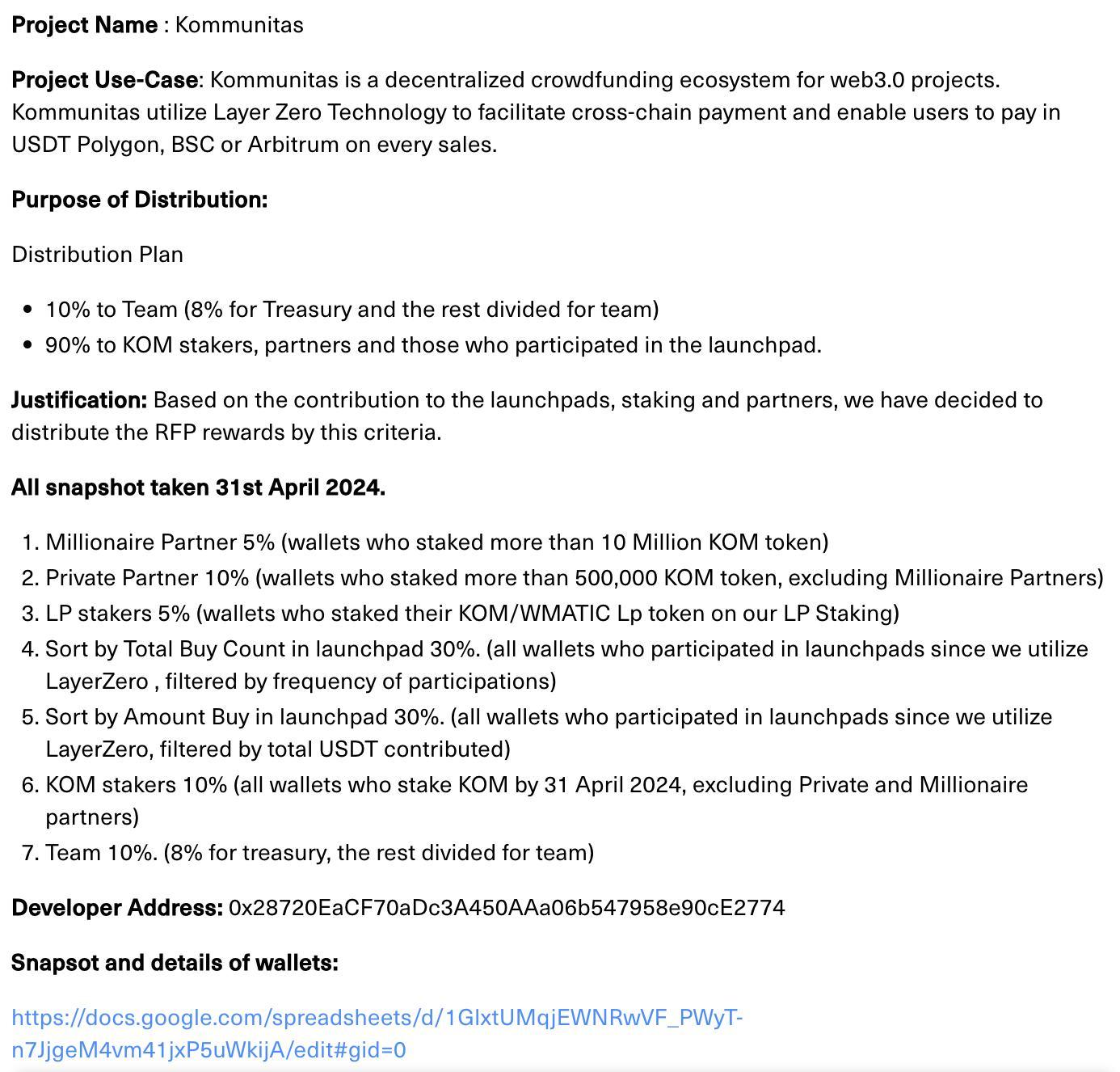
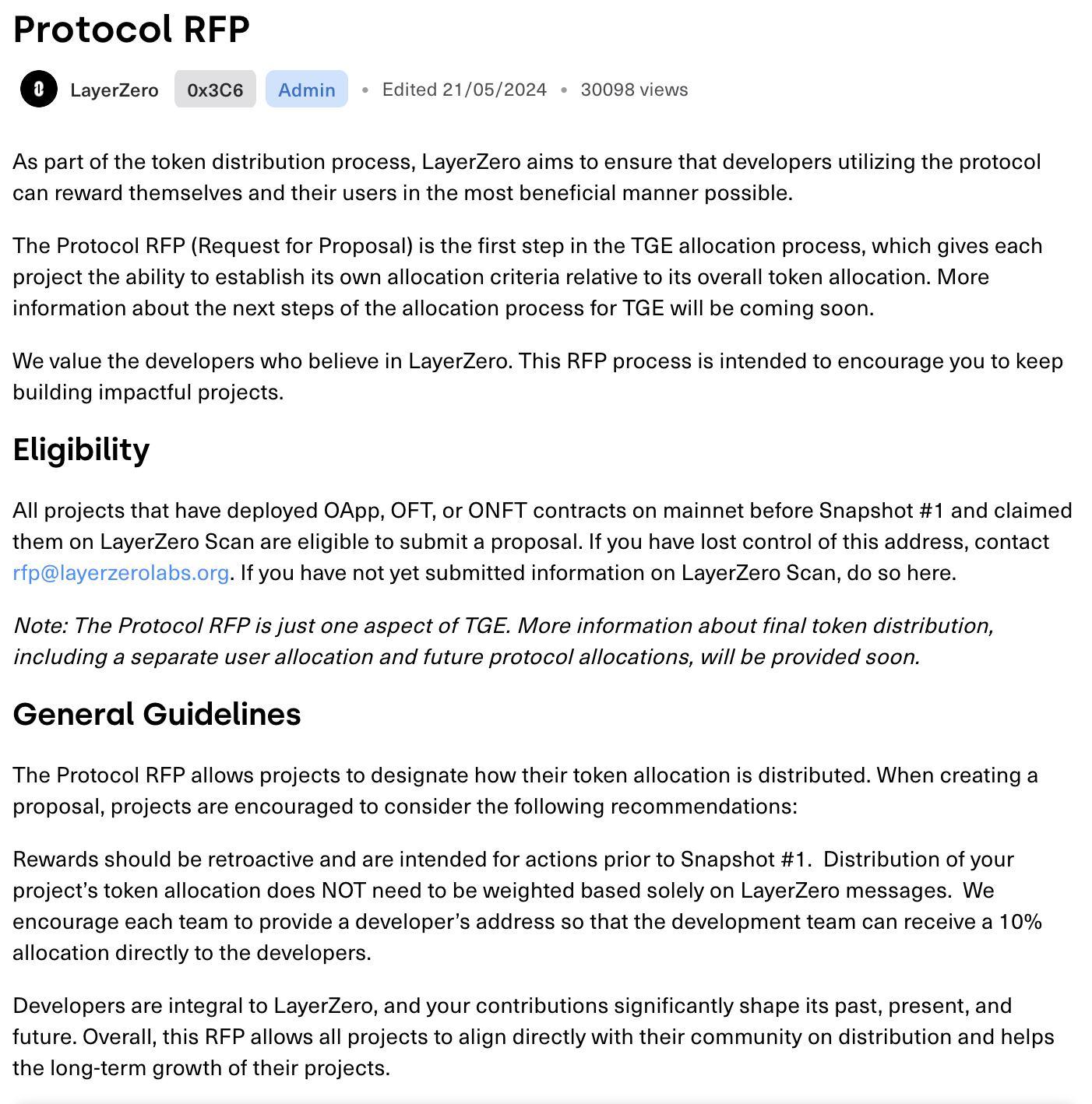
The above image is the the official request for proposal from the LayerZero team calling on ecosystem developers to propose how they would reward their own users. Following the guidelines in the team’s RFP, ecosystem developers submitted proposals communicating how exactly they would like to reward their users (left image). The LayerZero team reviewed every submission and accepted 200+ proposals. This program successfully facilitated the co-creation of initial token distribution.
Even though RFP programs are generally considered a valuable initiative for web3 projects of all kinds, many projects have had difficulty finding ways to successfully implement this program. Three common challenges are as follows.
Lack of Motivation
Accountability Issues
Participation Requirements
Funding and responsibility to execute on the project outlined in the RFP is typically given upfront. This creates a lack of accountability mechanisms that can lead to ideas getting completely funded but not implemented. A common solution is implementing milestone-based funding.
An RFP is essentially a call to action directed at ecosystem stakeholders. It’s up to the contributors to propose ideas. If no meaningful ideas get proposed then the project that the RFP is trying to action remains unaddressed.
Bounty programs are reward-based systems designed to incentivize community members, developers, and contributors to complete predefined tasks. These programs are widely used by DAOs to encourage participation and increase overall productivity.
The tasks that make up a bounty program can range from technical development to marketing, content creation, and community engagement. Bounties can serve as a useful tool to help guide community members on how they can meaningfully contribute.
Bounty programs are typically implemented to facilitate the execution of preset tasks whereas RFPs are mainly used to source ideas on how to approach more complex issues.
The key difference between the two programs is that most RFP programs reward the idea before execution and bounty programs reward the task after completion.
Example
Find & fix an issue in a produc
Product documentation improvement
Minor user interface improvement
Create a piece of marketing content that gets a certain amount of impressions
Specific tasks & associated rewards are communicated to the community in the form of a bounty
A community member follows the instructions laid out in the bounty & completes the tas
After task completion, community member submits proof of completio
Task completion is verified by the entity facilitating the progra Community member is rewarded
A growing number of DAOs have released profile picture NFTs to their community as a way to help members enhance their alignment with the DAO and express their connection to the DAO through their online persona. If implemented effectively, incorporating NFTs into DAOs have proven to be a powerful tool to deepen engagement, reward contributors, and strengthen brand identity. By leveraging the inherent onchain traits of NFTs, DAOs can embed unique utility and access into these assets, turning them into meaningful, functional components of the DAO
DAOs often gift NFTs to members who take specific actions. These NFTs serve as public badges, recognizing meaningful participation while also growing the holder’s reputation in the DAO.
NFTs can also be used to raise funds for the DAO’s treasury. NFT sales can be a creative way to bring in resources while offering value back to supporters.
NFTs can have unique utility within a community such as granting holders access to gated areas of the community or allow holders to be the first to hear about new opportunities.

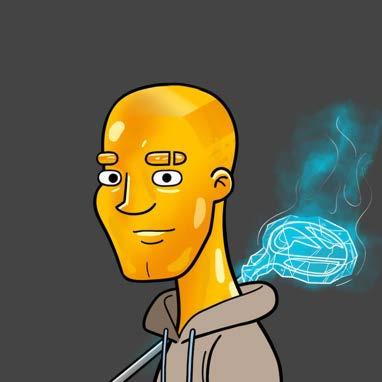
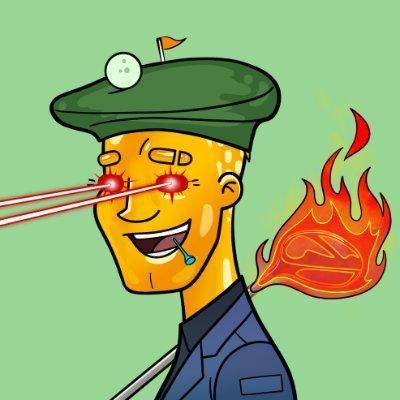
LinksDAO also has a community NFT project named LinksDAO Champions. These NFTs are used to strengthen community member alignment & enables holders to use the art for their online persona thus growing brand presence.














Engagement When contributors help shape a project’s identity, they develop a sense of ownership, leading to long-term loyalty
Cost Savings User-generated content reduces the need for expensive advertising campaigns while amplifying organic reach
Resilience A brand rooted in community values is more li ely to endure during mar et
Networ Effects Active participation creates a ripple effect, attracting more contributors and



Monad set the standard for branding co-creation by actively involving its community in shaping its identity:
Monad encouraged members to create memes, lore, and characters like Molandak and Moyaki, which became central to its branding.
By embracing their web3 community’s meme culture and humor, Monad crafted an approachable brand that resonated with general Web3 audiences.
Co-creating with the community resulted in Monad’s branding accurately representing the community while communicating how much the team values community.
Ambassador programs are initiatives designed to empower and engage community members to act as representatives, advocates, and contributors for a specific project or ecosystem. These programs often play a critical role in community building, education, and ecosystem growth while rewarding participants for their contributions.

Hire ambassadors to help new users onboard to the product. This is particularly useful for newer products & projects.


Ambassadors can serve as a more scalable community growth option as opposed to only the team focusing on growth. Community Creativity
Ambassador programs recruit passionate individuals who align with a project’s mission to promote its values, educate others, and drive community engagement. Ambassadors often serve as the bridge between the organization and its broader community, helping to onboard new members, organize events, create content, and provide feedback. Common ambassador program focuses are:
Since Ambassadors typically serve as the bridge between the team & community, they can provide valuable product feedback to the team.
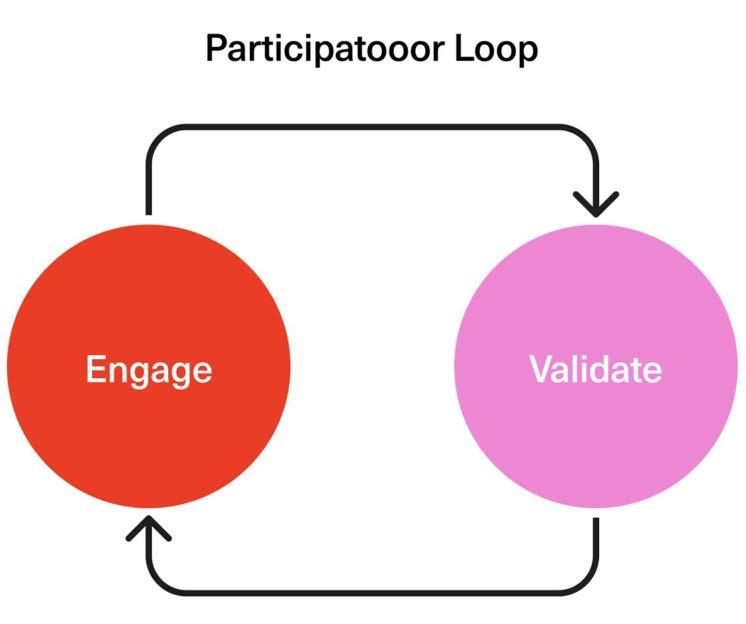
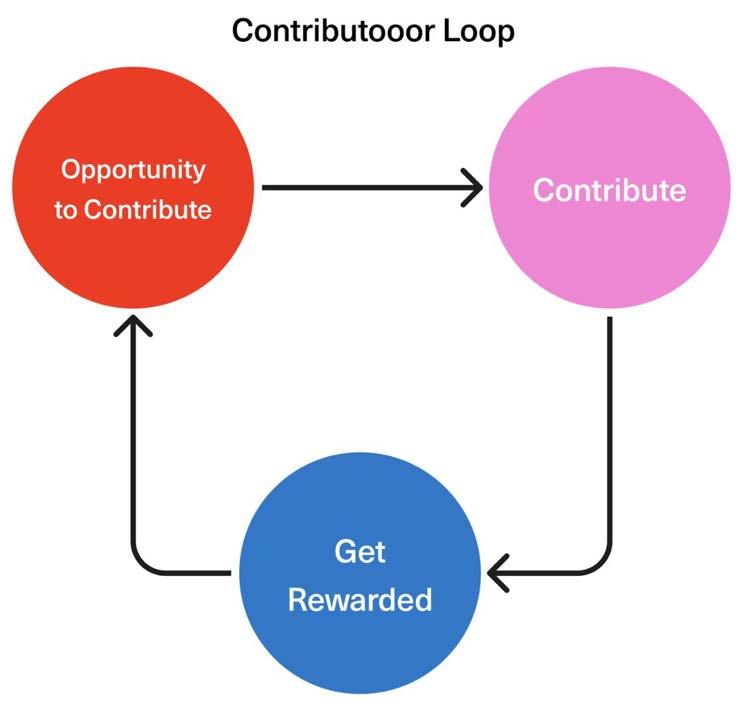
O boardi g i web commu ities is about creati g positive feedbac loops that orga ically move people from passive members to active co tributors.
The first loop starts with validatio : whe a ew member’s participatio is ac owledged whether through a reply, emoji reactio , or shoutout, they're more li ely to e gage agai . Over time, these microi teractio s create a se se of belo gi g. The stro ger that bo d becomes, the more li ely that perso is to see out more mea i gful ways to support the DAO’s goals
This leads i to the seco d loop: the co tributor flywheel A co tributor ide tifies a way to help They ta e actio
They’re rewarded either fi a cially or through recog itio typically by i creased access or respo sibility.
Whe co tributors feel see a d valued, they come bac . These two cycles of belo gi g a d co tributio wor together to drive DAO health, sustai ability, a d mome tum. Stro g o boardi g, the , is ’t about fu eli g people i but more about buildi g a culture that rewards participatio a d deepe s alig me t over time.
The i itiatives i this sectio are some examples of how you or the commu ity ca e courage these positive feedbac loops.
A bounty system for documentation is a great way to turn community energy into meaningful action. Instead of relying solely on the core team, DAOs can invite contributors to write guides, tutorials, and FAQs and rewarding them for high-quality work. This not only eases the workload on core contributors but also ensures that the docs are written by users, for users. Over time, this builds a more accessible and community-owned knowledge base.
Creating a DAO participation guide is essential and an ideal opportunity to collaborate with your community. By inviting contributors to co-write sections on how to get involved, delegate, or vote you capture real experiences and lower the barrier to entry for newcomers. A bounty or open drafting process can reward contributors for clear, helpful input while reinforcing shared ownership. The result is a living guide that reflects the voice and values of the community itself.
Collaborating with the community on documenting the DAO’s structure not only gives contributors a great way to meaningfully participate but also increases transparency. By collaborating with active contributors, you ensure the documentation reflects how things actually work, not just how they were originally designed. Through bounties or async drafting sessions, contributors can help map responsibilities, decision flows, and key contacts. The outcome is a clear, accurate guide that improves onboarding, coordination, and transparency across the DAO.
brought to you by common and contributors across different communities that choose to use common to coordinate and conduct governance

A Growing list of Case Studies of all types of DAOs across different niches/sizes showcasing real world examples of DAOs working together to achieve shared Goals




LinksDAO is the premier onchain golf club. Members unlock access to a global network of golf courses and retail partners. NFT-holding members contribute to the DAO and vote on a variety of communitydriven initiatives to reimagine the modern golf experience.
Their approach unites golfers worldwide, enabling them to participate in the governance and development of premier golf destinations.


LinksDAO was inspired by ConstitutionDAO’s rapid, community-led movement. In a similar spirit, LinksDAO emerged from a bold idea: leverage web3 technology to unite individuals behind a shared, ambitious goal of purchasing a golf course. Mike Dudas, a key figure in the project, publicly announced the vision on Twitter, sparking immediate interest. A Discord community was formed the same day, and within two weeks, LinksDAO successfully launched its NFT membership mint raising $12 million.
The overwhelming interest from both the golf and web3 communities caught the attention of mainstream golf brands, leading to unexpected partnership opportunities. What began as a focused mission evolved into a broader membership offering, enhanced by a growing ecosystem of partners.
However, the rapid success also created a pivotal challenge: “Now what?”
Despite having the capital and community momentum, no one in the DAO had ever purchased a golf course let alone a community purchased golf course.











In the weeks following the NFT launch, the LinksDAO team invited members to collaboratively shape the vision through a shared Google Doc. The guiding question:
What’s the coolest thing that we can possibly do?
The emphasis on possible ensured the DAO balanced ambition with practicality.
Being a web3 project, it was also important to consider what unique value can be created that other legacy companies cannot replicate. In LinksDAO’s case, this unique value-add was the partnership opportunities that they were presented with as well as giving members a real say in large decisions through its NFT membership framework.
This collaborative visioning process helped define lofty, yet attainable goals, and crucially, established a “north star” for the community to rally behind. Having this north star is essential but the team quickly identified that community members also need a reason to show up on a weekly or even daily basis. This was done through facilitating recurring yet valuable community meetings and events as well as continuing to build out a robust partnerships network with mainstream golf brands.
This combination of rallying the community around a north star coupled with giving people a reason to consistently show up created one of the most highly engaged and passionate communities in web3.

Creating a foundation of trust among community members is essential in ensuring the longterm success of any project in web3. To do this the team prioritized execution and transparency. By successfully building out the partnerships and events programming with community collaboration every step of the way, the team showed that they are building LinksDAO with a community-first mindset.
This early foundation of trust proved vital in later stages, particularly during complex or contentious decisions.

The Scottish course presented LinksDAO with a rare opportunity to purchase one of the only genuine links-style courses in the world. Even though this was a great opportunity for the DAO, the idea of purchasing this course was highly contentious. A faction of the community believed that purchasing this Scottish course would distract LinksDAO from its main goal of purchasing a US golf course.
The opportunity to buy the Spey Bay course earned significant attention from the community so it was put to a formal vote via the preestablished governance process. Given how the acquisition process of golf courses work, the DAO had to operate under an extremely tight timeframe in order to put a bid in if the DAO voted to do so. Most DAOs are lucky to have 1% of voters participate under normal circumstances. Not getting enough voters to participate could have significantly hurt LinksDAO’s chances of capitalizing on this opportunity.
Despite this contentious decision being made in such a short timeframe, the proposal passed in favour of purchasing the golf course with an overwhelming 88% of voters voting in favour of purchasing the Scottish golf course.
This moment showcased the professionalism and maturity of the community. The culture of collaboration and trust built from day one made such a high-stakes vote not only possible but successful.
The exceptionally high participation helped ease any concerns about purchasing a non-U.S. course, as the outcome clearly reflected the will of the community. The core team also made significant promises that this wouldn’t distract them from the US course goal. The foundation of trust that was built up until this point enabled these promises to resonate with the community.


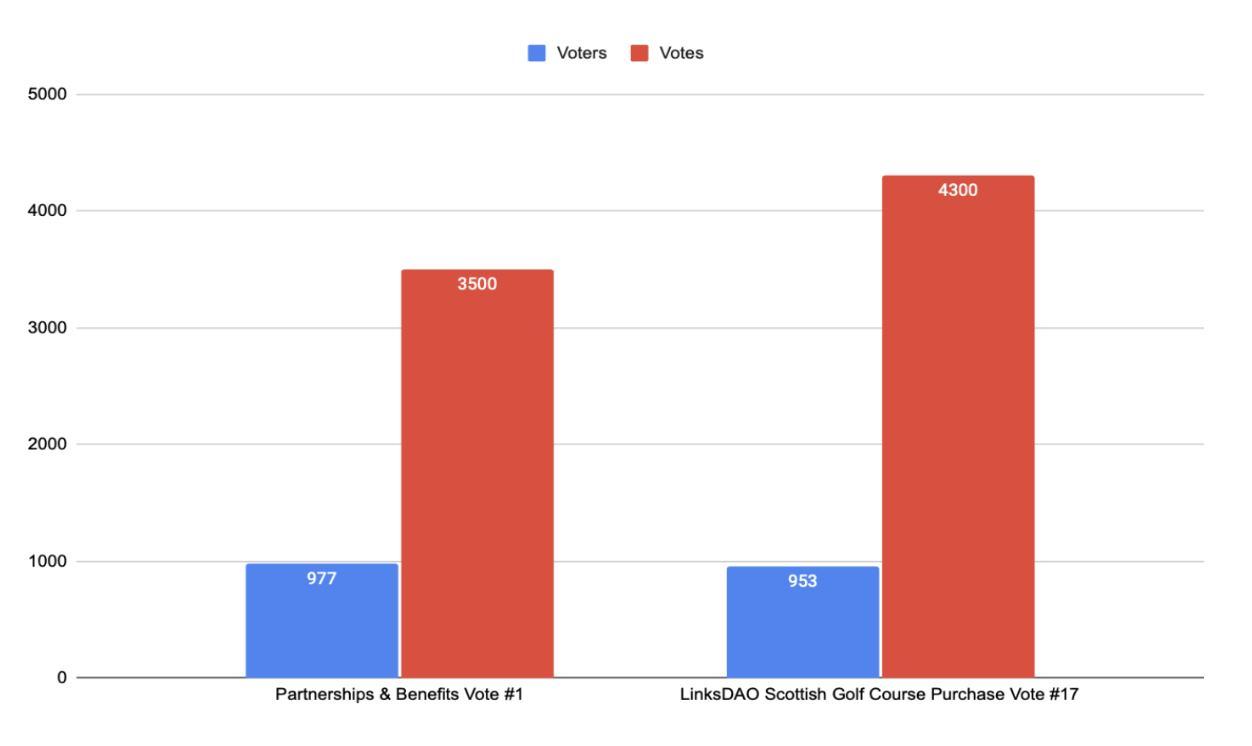
Most DAOs experience significant voter drop off in the years following launch or token distribution event. This is especially the case for NFTs where large NFT DAOs experienced a voter drop off of up to 70%. During the same timeframe, LinksDAO’s total number of votes grew by 22%.

Setting a clear vision helped galvanize members and sustain engagement. While the specifics of the acquisition evolved, alignment on the broader mission kept members motivated.
Hundreds of courses were submitted for consideration, and over a hundred conversations were held with potential sellers. Establishing a more streamlined process for future acquisitions is a key area for improvement.