It’s a revolutionary time in commercial real estate.
A
Headquarters Opportunity
in the Heart of Midtown
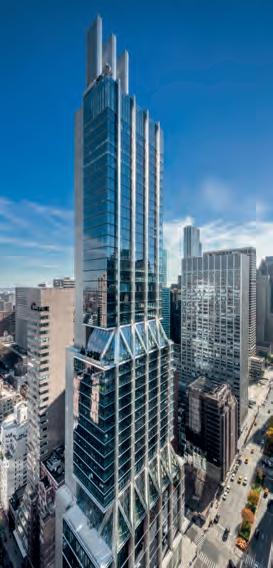
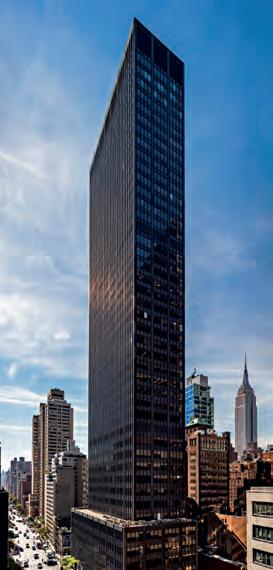
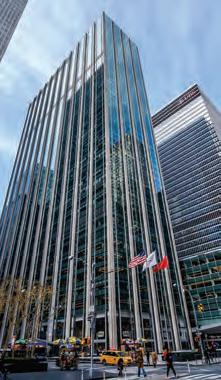
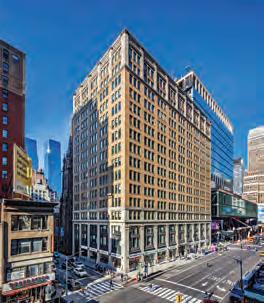
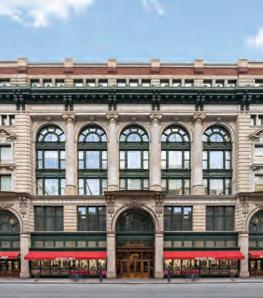
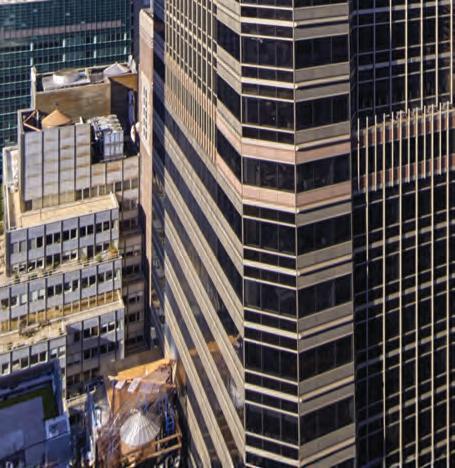
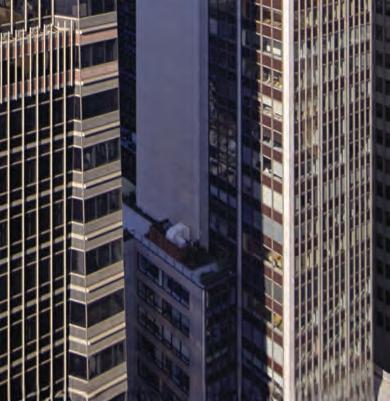
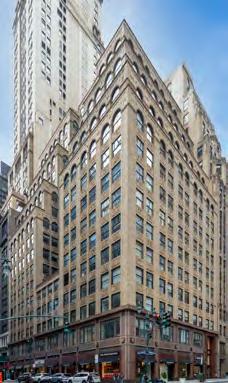
114 West 47 presents a rare full-building headquarters opportunity of 26 stories and 600,000 SF. The building brings together identity, workplace, prestige, outdoor space, light, and views at a single Midtown address.
Base Floors: 32,000 – 27,700 SF
Tower Floors: 24,700 – 18,400 SF
Hospitality-Focused Amenity Conferencing Center
The Lobby, Reinvented.
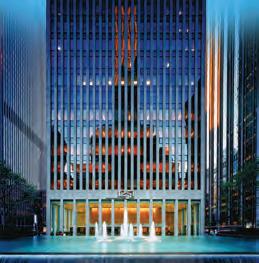
A sculpted lobby welcomes with fluid, luminous forms.
Rare Scale.
26 stories, 600,000 SF of space.
Work in a Better Light.
High ceilings, abundant light, and views elevate the everyday.
A New Legacy by Studio Sofield on the Upper East Side 5+ Bedroom Condominium Residences One Block from Central Park Priced from $21.175M
The Power in Waiting
While its stock has been low, a surprising number of Power 100 players like the asset.
Data Breakout
No surprise, but data centers were very important in 2025. M&A
Predictions
So
The
The
Max Gross
Editor in Chief
Cathy Cunningham
Executive Editor
Tom Acitelli
Deputy Editor
Isabelle Durso
New York Digital Editor
Greg Cornfield
Associate Editor
Skip Card
Copy Editor
Andrew Coen, Emily Davis
Julia Echikson, Mark Hallum, Brian Pascus, Amanda Schiavo
Staff Writers
Larry Getlen
Contributing Editor
SALES
Brigitte Baron
Senior Partnerships Director
Sona Hacherian
Strategic Account Director
Olivia Cottrell
Director of Client Marketing
Edward Cohen, Mark Rossman
Partnerships Director
Alina McInerney
Client Solutions Coordinator
MARKETING & EVENTS
Samantha Stahlman
Director of Audience
Josh Rozbruch
Social Media Manager
DESIGN, PHOTO & PRODUCTION
Jeffrey Cuyubamba
Art Director
Rohini Chatterjee
Senior Visual Designer
Jim Sewastynowicz
Photo Editor
Eliot Pierce
SVP, Product & Operations
Ashley Roseman
Director, Revenue Operations
Ramon Encarnacion
IT Manager
OBSERVER MEDIA
Joseph Meyer
Chairman
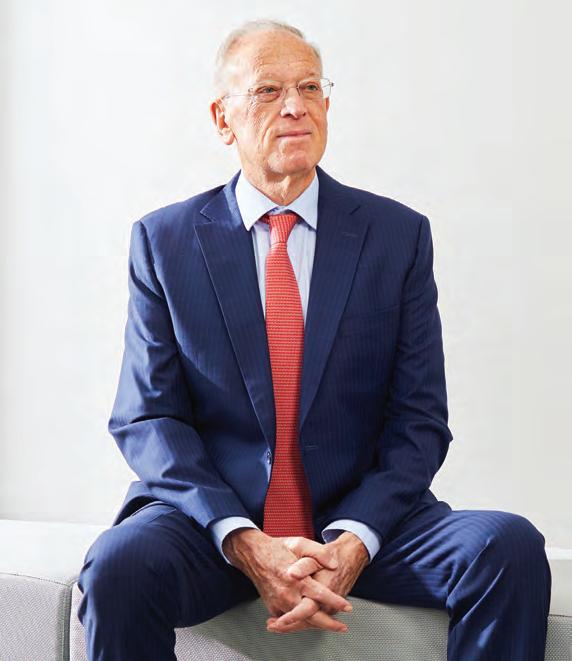
Marc Holliday Chairman & Chief Executive Officer
CONGRATULATIONS TO on being recognized by Commercial Observer for the 19th consecutive year among the Top 100 Most Powerful People in Real Estate. We salute all honorees.
Manhattan’s Tech Sector Posts Record Leasing in 2025 News
Manhattan’s technology sector in 2025 increased its office footprint by 6.54 million square feet, according to a report last week from brokerage services firm Colliers The year was second only to 2019 in terms of new square footage, but its count of 235 lease deals shattered a 2019 record by 80 transactions.
“There were more transactions in almost every size category, except for the very largest,” Frank Wallach, executive managing director with Colliers, told Commercial Observer.
It’s onward and upward in 2026. Tech’s office leasing activity totaled 1.89 million square feet during the first quarter, surpassing last year’s quarterly average, largely thanks to the artificial intelligence sector’s voracious appetite for office space.
AI tenants accounted for one-third of the office market’s tech demand in the first quarter of 2026 with 670,000 square feet of
leasing, up from a 12.1 percent share of tech demand in 2025. This year’s total AI-related office demand so far — when health tech platform Tennr’s 125,733-square-foot sublease at 345 Hudson Street in April is added to the mix — has already eclipsed 2025’s, according to Colliers.
For such massive deals, space is getting tight. Manhattan tech companies in need of footprints in excess of 250,000 square feet currently have just 24 options available within the next 12 months, Wallach said.
The city’s tech tenants benefited from a windfall of concessions in 2025, the Colliers report also noted. Last year, the sector raked in an average rental abatement of 13.3 months and tenant improvement allowances reaching $131.70 per square foot. The tech sector’s taking rents, which averaged $90.35 per square foot in 2025, were, however, just 0.1 percent below record highs in 2019.
Midtown South’s supply of prewar
New York-based real estate investment and development group Westbridge Realty Group plans to build a 99-unit residential property at 4388 Broadway in northern Manhattan’s Washington Heights, according to a recent filing with the New York City Department of Buildings
If approved, the plans, which were filed toward the end of April, show the 67,048-square-foot project resulting in a 16-story residential building that will feature ground-floor retail, as well as 25 parking spaces.
Spokespeople for Westbridge Realty Group and the registered architect, Leandro Nils Dickson, did not respond to requests for comment.
The plans list a lobby, a mail room, a package room, bike storage and over 1,600 square feet of recreation space for the building on Broadway near West 187th Street. Details on what the recreation space will look like were not available. Although no information has been made available either as to whether affordable housing will be part of the new Washington Heights project, the 99-unit figure is a good clue that the developers plan to utilize the 485x tax incentive program.
Passed by New York State lawmakers in early 2024, 485x offers tax exemptions for residential projects to incentivize the production of more affordable housing. However, the 485x program has come under significant criticism, especially the part of the legislation that requires higher wages for construction workers if the project has 100 or more units. —Amanda Schiavo
buildings remained enormously popular among the tech crowd, capturing twothirds of the sector’s office demand in 2025 and into 2026, according to Colliers. Midtown, too, notably secured a record 1.18 million square feet of office leases in 2025 from the likes of Amazon and SalesForce.
But Lower Manhattan had a more subdued office leasing market in the first quarter, according to a new report from the Alliance For Downtown New York. Still,
Westbridge Plans Building in Washington Heights
new leasing there, too, was led by the tech sector.
AI security platform Adaptive Security relocated to 51,220 square feet at Silverstein Properties’ 120 Broadway in Lower Manhattan’s largest new lease last month, while SHoP Architects claimed the largest deal for the quarter for the area, with a 56,196-square-foot renewal and expansion at the Cammeby’s International-owned Woolworth Building —Emily Davis
C-PACE Pioneer Petros PACE Winding Down
Petros PACE Finance, which originated New York City’s first Commercial Property Assessed Clean Energy (C-PACE) loan in 2021, has halted its roughly $2 billion debt portfolio, with term sheets for new deals suspended since early April, sources said.
The Austin, Texas-based lender, which was acquired in early 2022 by Apollo Global Management subsidiary Athene Holdings, has shed most of its staff with only a “skeleton crew” of around 10 people remaining, sources said.
Commercial Mortgage Alert first reported the downsizing, reporting it was part of a plan to merge Petros into Apollo’s broader commercial lending business.
But Apollo put the brakes on Petros’ C-PACE activities following a disappointing past year in which it underwrote less than $400 million in volume, according to sources.
The remaining Petros staff has been tasked with managing the portfolio for loans already in repayment, with other C-PACE lenders now bidding on their unfunded term sheets and buying loans that were funded but with future draw requests, according to sources. —Andrew Coen
BIG BYTES: Salesforce and Amazon were among the largest tenants active last year in Gotham.
HIGH-LY LIKELY: The project appears to be using the 485x tax incentive.
Global Net Lease Acquires
Modiv Industrial for $535M
Two industrial real estate investment trusts (REITs) came to a $535 million merger agreement.
Global Net Lease (GNL), which acquires and manages properties across the U.S., Canada and Europe, closed on a deal to acquire Modiv Industrial, which has a total of 42 properties and 4.3 million square feet in assets under management, the firms announced May 4.
GNL has 820 properties totaling 41 million square feet and has been on a path away from less reliable asset classes such as office.
“We believe this transaction is a compelling opportunity for GNL to expedite our transition to earnings growth in 2026 following the completion of our de-leveraging initiative while continuing to reduce our office exposure,” Michael Weil, CEO of GNL, said in a statement.
Denver-based Modiv has properties in California, Florida, Minnesota and Washington state, which GNL expects to be immediately accretive to earnings, according to Weil.
News of the acquisition comes during a busy period for industrial mergers, as Brookfield Asset Management reached an agreement in February to acquire the California-based industrial REIT Peakstone Realty Trust for approximately $1.2 billion.
—Mark Hallum
CBRE Property Management Names New Global President
CBRE Property Management, one of brokerage firm CBRE’s service lines, hired Michael Robson as its new global president.
Robson joins CBRE from KKR, where he was most recently managing director and co-head of KKR Capstone, the company’s global operations team, in charge of its Asia division. He also worked as managing director for KKR’s Australia and New Zealand division. A spokesperson for KKR did not respond to a request for comment.
In his new role at CBRE, Robson will be responsible for the “continued elevation of property management” for CBRE’s portfolio and will focus on using technology and artificial intelligence to automate building engineering components, according to Jamie Hodari, CEO of CBRE’s Buildings Operations & Experience (BOE) business segment and chief commercial officer at CBRE.
“[Michael] really understands not just hard-core operations, but front of house and how you deliver a great experience, which I think the property management world is kind of starving for right now,” Hodari told Commercial Observer.
Robson will work under Hodari in his new position and replace Emma Buckland, who was moved in the fall into a position as executive group president and chief operating officer for CBRE’s BOE segment.
3.7 billion square feet of property globally and has nearly 21,000 buildings under management, making it the “biggest property management business in the world,” according to Hodari. In addition, the division has 18,504 employees across the globe and serves 4,300 clients in 42 countries.
“This is a tremendous business, and we have a really great responsibility to safeguard and optimize the performance of 4,300 really important clients around the world,” Robson said. “It’s a heavy responsibility, and one that I’m really excited to tackle.”
As part of his new role — which he started last month — Robson said he will focus on giving CBRE’s clients the best partners, experience and technology to drive financial results. He will also help handle management operations for Industrious, a coworking firm founded by Hodari that now acts as an anchor for CBRE’s BOE segment following CBRE’s $400 million acquisition of Industrious in January 2025. Hodari is also CEO of Industrious.
Robson is already familiar with Industrious, as he was chief operating officer at the coworking firm for roughly five years before heading over to KKR in 2020, according to his LinkedIn page
Speaking of Industrious, Hodari mentioned the firm is looking for a new CEO as he transitions away from the company to focus more on his new senior leadership role at CBRE. —Isabelle Durso
Alchemy Properties Buys Tribeca Parking Garage for $57M
Alchemy Properties, a New York Citybased real estate development and investment firm, acquired an unused parking garage in Manhattan’s Tribeca neighborhood for $57 million.
Alchemy bought the 8,850-squarefoot site currently hosting the five-story parking garage at 60 North Moore Street from the Calicchio family, which has owned the property since the 1980s, according to an announcement from seller broker Avison Young. The building, which sits less than two blocks inland from popular Pier 25 on the Hudson River, has an alternate address of 56 North Moore Street
Along with partners Daishin America and Takamatsu Construction Group USA, Alchemy plans to redevelop the property between Hudson and Greenwich streets into an “ultra-luxury” condominium building with private parking for each residence, the announcement said.
Plans for the project also include a New York City Landmarks Preservation Commission-approved addition of two floors above the existing parking garage. The new floors would add more than 63,000 square feet of buildable interior space.
The project, which is estimated to cost $15.4 million, would see up to 11 new condo units created at the property, according to a filing in late April with the New York City Department of Buildings About 2,000 square feet of commercial space is also planned.
SEE YA: Plans call for an 11-unit condo project in place of the
Avison Young’s Charles Kingsley, James Nelson, Erik Edeen, Eric Karmitz and Noah Kossoff brokered the deal for the seller, while Kenneth Horn, president and founder of Alchemy, worked in-house on behalf of the buyer.
The sale comes at a bit of a discount from the $75 million asking price,
according to a listing from Serhant
It’s unclear when construction on the building would be finished, but it isn’t Alchemy’s first conversion project in Manhattan, as the firm converted the upper floors of the historic Woolworth Building into luxury condos in 2018. —I.D.
Brooklyn Heights Walgreens to Become High-Rise After Sale
New York City-based investment firm ABS Partners Real Estate filed a rezoning application to build almost 400 units of housing in Midtown, where a television studio currently stands.
ABS is looking for land-use approval from the New York City Council to build a 30-story, 394-unit Rogers Equities purchased 120 Court Street in Brooklyn Heights from the Sorkin family for $30 million to use as a mixed-use development site.
Currently home to a Walgreens, the site will allow for 64,500 square feet of residential square feet once Walgreens’ lease expires at the end of August 2026. Rogers Equities plans to construct a high-end rental building under the state’s 485x property tax incentive program.
The pharmacy, which currently occupies 11,360 square feet across two floors and brings in $55,000 per month in rent revenue, has already announced it will close June 4.
Plans were filed in March 2026 for a new 75-unit, 14-story, 86,913-square-foot residential building at 120 Court Street. The plans call for recreational space, a 38-bike storage room in the cellar and retail space on the ground floor, as well as amenity spaces on the first and second floors and outdoor recreation space on the roof. Daniel O’Brien from Newmark represented both parties in the new sale.
The 6,000-square-foot lot on the corner of Atlantic Avenue and Court Street abuts the upscale neighborhoods of Brooklyn Heights and Cobble Hill, and offers 75 feet of frontage on Atlantic Avenue and 80 feet on frontage on Court Street. Rogers Equities and the Sorkin family could not be reached for comment. —Larry Getlen
North Moore Street parking garage.
EarningsQ1
Steven Roth Criticizes Mamdani Over Ken Griffin Spat in Investors Call
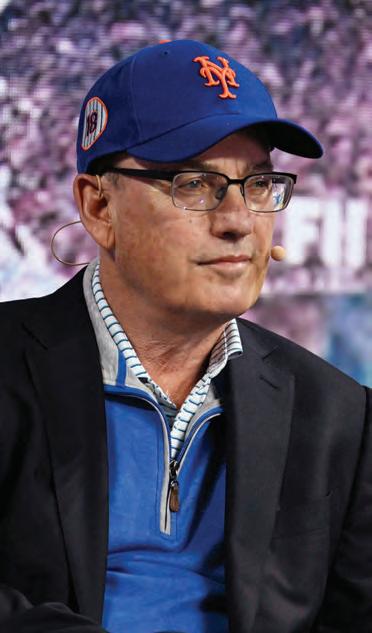
Vornado Realty Trust Chairman Steven Roth began his company’s May 12 first-quarter earnings call with harsh words for New York Mayor Zohran Mamdani and his feud with Citadel CEO Ken Griffin Roth denounced Mamdani’s social media video in early April, in which the mayor vowed to work with the state to tax pricier pieds-à-terre, using Griffin’s ownership of a luxury penthouse apartment as an example. On the earnings call, Roth said the mayor has an obligation to work with — not against — the city’s wealthiest earners and job creators.
“Let me begin by saying that I cannot and do not speak for Ken, but I do unambiguously stand with him,” Roth said. “The ugly and unnecessary video stunt is personal to Ken and personal to me too. … We are all shocked that our young mayor would
Cushman & Wakefield Posts Record Revenue
Cushman & Wakefield notched record first-quarter revenue in 2026, beating analysts’ estimates, despite recording a small loss.
Global revenue grew to $2.5 billion, up by 11 percent compared to the same time last year — C&W’s highest ever for a first quarter. Earnings per share stood at 15 cents, more than the 12 to 13 cents per share analysts had predicted.
Leasing revenue saw the biggest surge — rising 19 percent to $497.7 million, thanks to demand from office and industrial markets in the Americas, particularly from data centers.
“Industrial construction is down 60 percent from peak levels in 2022 which is going to help vacancy shift lower, but also importantly, the industrial leasing market is now 80 percent larger by dollar volume than it was pre-pandemic,” CEO Michelle MacKay said during a May 7 earnings call.
Capital markets revenue wasn’t far behind, rising 15 percent year-over-year to $181.6 million, marking the sixth consecutive quarter of double-digit growth. Services revenue increased to $1.74 billion, up by 9 percent compared to last year’s first quarter. Despite the gains, the Chicago-based brokerage recorded a net loss of $12.6 million, up from the $1.9 million net loss posted in last year’s first quarter. —Julia Echikson
pull this stunt in front of Ken’s home and single him out for ridicule. It was both irresponsible and dangerous.”
The Vornado founder reminded those tuning in to the call that his partnership with Griffin and with Rudin to develop a 62-story, 1.9 million-square-foot office tower at 350 Park Avenue has been in the works since the de Blasio administration and received unanimous New York City Council approval.
Roth rebuked the current political climate that has turned on the wealthy, and attempted to adjust the narrative toward the contributions that New York’s top earners
make toward general economic welfare.
Vornado reported a lower net loss in the first quarter of 2026 compared to the same period last year and only slightly declining revenue as funds from operations (FFO) grew.
The real estate investment trust (REIT) attributed much of that to a number of acquisitions that were in the works over the course of the last few months, such as a 49 percent acquisition in Park Avenue Plaza at a gross asset valuation of $1.1 billion, according to the company’s first-quarter earnings report.
The deal to acquire a minority stake in the 45-story, 1.2 million-square-foot property owned by Fisher Brothers at 55 East 52nd Street was announced on April 28, and Vornado’s balance sheet was also impacted by the $141 million purchase of a development site at 3 East 54th Street FFO was $96.2 million, or 49 cents per diluted share, compared to $135 million, or 67 cents per diluted share, for the first quarter of 2026. Meanwhile, revenue reached $459.1 million, compared to $461.5 million on a year-over-year basis.
A net loss of $22.8 million was recorded in the first quarter of 2026, compared to $86.8 million in the first quarter of 2025.
—Mark Hallum
Mall Giant Macerich Pares Losses
Macerich, a publicly traded real estate investment trust that owns around 41 million square feet of real estate across 39 retail centers, is in the midst of its Path Forward Plan, a reorganization put in place by CEO Jackson Hsieh shortly after his March 2024 hiring. The plan’s goal is to simplify operations and optimize performance after five straight years of posted losses.
On the company’s first-quarter earnings call May 6, Macerich showed funds from operations (FFO) of $92.4 million, or 34 cents per share including stocks and other securities, which is almost identical to the numbers for the first quarter of 2025, which showed FFO of $89.8 million, also at 34 cents per share. The FFO for this quarter included a “gain on undepreciated asset sales of approximately $10.1 million,” according to an earnings release.
Macerich reported a net loss for the quarter of $36.4 million, or 14 cents per share, compared to a net loss in the first quarter of 2025 of $50.1 million, or 20 cents per share. The company credits the difference to Macerich’s “recognizing gain on sale or write-down of assets, net in the first quarter of 2026.”
The leased portfolio occupancy at the company’s properties was 93.4 percent as of March 31, a 0.8 percent increase from the year prior but a 0.6 percent decrease from year-end 2025. —Larry Getlen
KKR Reports $28B in New Fundraising to Start 2026
Even amid constant market volatility, private equity giant KKR continues to raise boatloads of cash and deliver positive returns to its investors.
KKR reported earnings after taxes and expenses of $1.3 billion, or $1.47 per share, in the first quarter of 2026, up 19 percent year-over-year and a slight increase from the $1.1 billion in earnings it posted in the fourth quarter of 2025. Quarterly fee-related earnings rose 23 percent year-overyear to $1 billion, and adjusted net income came out 20 percent higher.
“All of these figures are among the highest we’ve reported in our firm’s history,” Craig Larson, head of investor relations at KKR, said on a May 12 earnings call.
KKR’s assets under management now stand at $758 billion, an increase of 14 percent year-over-year. The firm has become a capital fundraising machine in recent months, with $28 billion in new capital raised in the first quarter and $127 billion raised over the last 12 months.
The firm holds a total of $85 billion of commercial real estate assets under management, or 11 percent of total AUM, while infrastructure and energy real assets stand at $114 billion, good for 15 percent of total assets.
KKR’s realized performance income exceeded $750 million and realized investment income hit $120 million, bringing total monetization activity to $880 million, up over 50 percent from the first quarter of 2021.
Larson also pointed out that private credit, despite the recent spate of bad headlines, is not a sizable aspect of KKR’s portfolio and should not be considered as such.
“Direct lending is $39 billion, or 5 percent, of our AUM,” he said. “It’s an important business for us, but in the framework of KKR, it’s of modest size.” —Brian Pascus
Steven Roth talked Vornado’s numbers too.
We are proud to congratulate our Newmark honorees for their outstanding achievement in making this year’s Commercial Observer’s Power 100 List. In a dynamic real estate market, this recognition is a testament to their visionary leadership, embodying innovation, creativity and commitment.
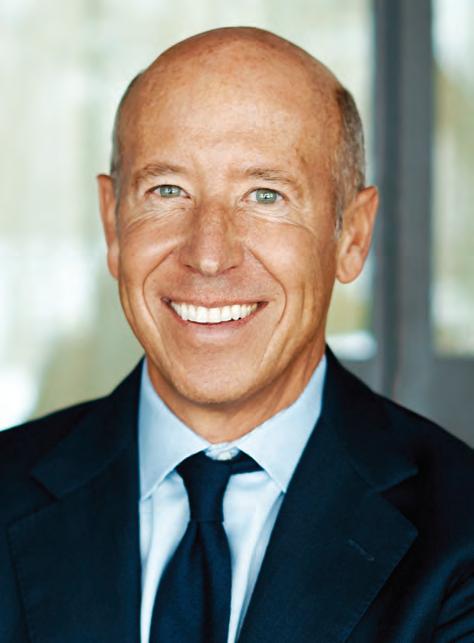
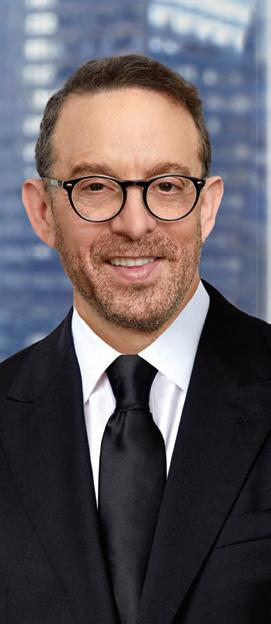
Barry Gosin Chief Executive Officer, Chairman of Newmark & Company Real Estate, Inc.
Doug Harmon Co-Head of US Capital Markets
Adam Spies Co-Head of US Capital Markets
David Falk President of New York Tri-State Region
Neil Goldmacher Chairman of National Tenant Representation
MORE LIKE FIRST CLASS, AMIRITE?
Fashion House Coach Inks Deal for New Three-Level Fifth Avenue Spot Retail
For its 85th anniversary, global fashion house Coach is signing a deal to move its Fifth Avenue store from 685 Fifth Avenue to 645 Fifth Avenue, on the northwest corner of East 51st Street, where it will have 13,200 square feet.
The space is set to open in 2027 as “Coach House.”
The leather accessories company owned by Tapestry will take over the base of the 51-story 645 Fifth Avenue, also known as Olympic Tower. The space was previously occupied by Armani Exchange, and most recently by contemporary art seller Eden Gallery, which opened in 2024. According to Fitch Ratings, its second-story lease was to expire in January 2026 with the rest in 2034.
Coach’s new lease is a direct, long-term deal with the owners, a joint venture between OMERS Administration Corporation and Crown Acquisitions Oxford Properties Group is the global real estate investment, development and management arm of OMERS. The lease covers around 3,200 square feet on the ground floor, approximately 4,000 square feet on the second floor and approximately 6,000 square feet on a lower level.
Building ownership was represented in the new deal by Brittany Bragg of Crown Retail Services, while Mike O’Neill, Taylor Reynolds and Jason Greenstone of Cushman & Wakefield represented Coach.
C&W declined to comment, while spokespeople for Tapestry, Coach and the landlords did not respond to requests for comment.
Both the lease term and the asking rent were unclear. According to Fitch, the overall average in-place base rent,
Continental Realty Acquires U.S. Shopping Center Portfolio
Betting big on retail in secondary markets, Continental Realty acquired 14 shopping centers across the Southeast and the Midwest.
Continental Realty’s acquisition from U.S. Properties Group spans seven states and encompasses more than 2 million square feet of retail. CBRE’s Chris Decouflé and Kevin Hurley represented U.S. Properties in the deal. The off-market transaction was announced this week, and came with a purchase price of about $200 million, Green Street reported
The acquisition ranks among the largest U.S. retail portfolio transactions this year so far, according to CoStar Group data.
The collection of shopping centers is more than 93 percent leased and hosts more than 230 tenants across Georgia, Illinois, Tennessee, Ohio, North Carolina, South Carolina and Virginia, according to Continental Realty. Retail occupancy in these secondary markets averages 97 percent.
The deal expands Continental’s national shopping center portfolio to over 10.5 million square feet and ups its assets under management to just under $5 billion. Anchor tenants include Kroger and Hobby Lobby —E.D.
including the lease executed with Eden Gallery Global, increased to $455 per square foot but remains below the $532 per square foot set around the time of issuance.
Coach’s current three-story digs at 685 Fifth Avenue on the corner of East 54th Street opened in the fall of 2016 and features a unique, 12-foot sculpture of Coach’s dinosaur, Rexy, designed by artist Billie Achilleos, that is entirely constructed from Coach bags and hardware. Another sculpture, “Scribing the Void,” created by Brooklyn artist Kurt Steger, traces the surface of iconic rock formations in Central Park, and is “a nod to Coach’s New York City roots,” according to a release.
The Coach brand was established in New York City in 1941, and pairs exceptional materials with innovative design. The fashion house has several other stores in Manhattan, including locations at 143 Prince Street in SoHo, 20 Hudson Yards in Hudson Yards, and 151 West 34th Street near Herald Square —Lois Weiss
Clothing Brand Edikted to Open Fifth Avenue Store
West Coast-based Gen-Z fashion brand Edikted leased the landmarked Scribner Building’s 12,865-square-foot retail space at 597 Fifth Avenue, where it will open its second New York City store.
Bobby Cayre’s Aurora Capital purchased the Scribner Building in March for $54 million through a foreclosure sale. Aurora Capital, along with Edmond M. Safra’s AVRS Partners, signed a deal for the property when it already had the Edikted lease in hand, sources said.
The length of Edikted’s new lease and the asking rent were unclear, but a report from CBRE found retail rents along Fifth Avenue from East 42nd to East 49th streets averaged $575 per square foot during the first quarter of 2026.
Edikted was represented in its new deal by Dan Harroch of DH Real Estate Advisors, while building ownership represented itself in-house and declined comment. Edikted did not return a request for comment. —L.W.
West Village Eatery L’Artusi Seals Rockefeller Center Space
Italian restaurant L’Artusi is headed to Midtown.
The popular small plates purveyor signed a 6,000-square-foot lease at Rockefeller Group’s 1271 Avenue of the Americas between West 50th and 51st streets, the New York Post reported. L’Artusi, named for the 19th century cookbook author Pellegrino Artuso, opened in 2008. It currently serves 110 seats at its 228 West 10th Street location in the West Village.
Its new Midtown site will replace a former location of Ted’s Montana Grill. The American chain, founded in 2002 by CNN founder Ted Turner, shut down operations at the 48-story skyscraper in April after 20 years.
The location’s asking rent is unclear, but retail rents along the nearby Fifth Avenue retail corridor between 42nd and 49th streets averaged $575 per square foot in the first quarter of 2026, according to CBRE data
CBRE’s Jordan Kaplan negotiated on behalf of L’Artusi in the transaction. The landlord was represented in-house by Marisa Gadlin, alongside CBRE’s Eric Gelber
“We are excited to bring such a legendary restaurant to the building,” Gelber said in a statement. “L’Artusi perfectly complements the dining program we have built at 1271 Avenue of the Americas.”
L’Artus and Rockefeller Group did not respond to requests for comment. —Emily Davis
SEALED: Bobby Cayre owns 597 Fifth Avenue.
MANGIA: L’Artusi’s lease at 1271 Avenue of the Americas is for 6,000 square feet.
the Power 100
Herbert Smith Freehills Kramer real estate partners join clients, colleagues and friends in congratulating our real estate practice chair, Jay Neveloff, and all Power 100 honorees included in this year’s list.
For decades, we have built a real estate practice unparalleled in the US. As the global powerhouse HSF Kramer, we are now so much more. As the only law firm ranked Band 1 in real estate in the US, the UK and Australia, we continue to transform skylines and reshape landscapes.
We thank our clients, business partners and friends for their support.
CRUNCH TIME
The Data Center Industry Keeps Measuring the Wrong Thing
The data center industry has a messaging problem. Not because it lacks strong fundamentals, but because it keeps answering the wrong question.
When a project is proposed, the industry responds with national statistics: trillions in GDP contribution, millions of jobs supported, and billions in tax revenue generated. These numbers are not wrong, but they are not persuasive.
Communities are not asking about national impact. They are asking about local outcomes. What do we get, here, from this project?
That question has become the center of the data center debate, and it is where the industry is losing ground. Critics point to generous tax incentives, hidden infrastructure costs and limited permanent job creation. In many cases, those concerns are justified. The issue is not the criticism itself. It is the lack of a consistent way to evaluate it. The industry speaks in aggregate, while opposition speaks in specifics, and specifics win.
A resident does not experience GDP. A resident experiences a utility bill. A school district does not budget based on projections. It runs on tax receipts and budget gaps. And local governments have to fund and manage the roads, substations, water systems and emergency services that support these projects, regardless of how the economic projections are framed.
Without a clear way to connect a specific project to these local realities, the debate becomes abstract on one side and tangible on the other. That imbalance is driving opposition. The path forward is not more messaging. It is better measurement. Because, right now, the industry is measuring the wrong thing. Every data center project should be evaluated through a local balance sheet. Not a national model or a marketing deck, but a simple, project-level accounting of what flows into and out of a community over time.
RENT CHECK
On one side of the ledger are the benefits, including property taxes, equipment taxes, construction employment, permanent jobs, indirect economic activity and infrastructure improvements. On the other side are the costs, including tax incentives, public infrastructure investments, strain on power systems, potential ratepayer impact, water usage constraints and municipal service demands.
Timing matters as much as magnitude. Construction jobs arrive early and disappear quickly, while infrastructure costs are often front-loaded. Tax revenues may ramp slowly or be offset by incentives for years, and permanent employment is smaller but longer-lived. Without aligning these timelines, it is easy to overstate benefits and understate costs. This is where much of the current tension originates.
A project can look positive in aggregate while creating nearterm strain at the local level. Or it can generate long-term value but fail to communicate that fact clearly enough to survive the approval process.
Right now, there is no standardized way to present this information. Each project is framed differently, assumptions are inconsistent, and key variables are often opaque. That creates skepticism. And skepticism turns into opposition.
A project that cannot clearly articulate its local balance sheet is more likely to face delays or cancellation. In a market where timing is critical, that uncertainty carries real financial consequences.
The industry has solved far more complex problems. It has engineered hyperscale infrastructure, optimized power
usage, and built global networks of compute capacity. It can solve this.
What is missing is not capability. It is alignment on what should be measured and how it should be communicated. The next phase of data center development will require a shift from selling economic potential to underwriting community value. That means moving beyond national narratives and building project-level transparency into the development process.
It also means accepting that not every project will look attractive under this lens. Some will show clear positive impact, while others will reveal imbalances that need to be addressed.
That is not a weakness. That is discipline.
Other asset classes have already gone through similar transitions. Infrastructure, energy and public-private partnerships have long relied on detailed, project-level analysis. Data centers are now reaching that same point.
At the Center for the Sustainable Built Environment at New York University, we are beginning to explore what a standardized local balance sheet for data centers could look like. The goal is to establish a common framework that allows developers, communities and policymakers to evaluate projects using the same assumptions. This is not about proving that data centers are good or bad. It is about making their impact legible.
Until communities can clearly see what they are gaining, they will focus on what they might lose. And, until the industry can demonstrate local value, it will struggle to deliver projects at the pace demand requires.
Suhail Y Tayeb is clinical assistant professor at New York University’s Schack Institute of Real Estate and director of the Center for the Sustainable Built Environment
Manhattan’s Leading Multifamily’s Recovery Again — But It’s Different This Time
Manhattan multifamily is back. But if you think this is just a return to the old playbook — big institutions chasing trophy assets — you’re missing what’s really happening beneath the surface.
The numbers from the first quarter of 2026 are undeniable. Manhattan recorded 102 multifamily transactions, surging 89 percent year-over-year, with total dollar volume climbing to over $1.03 billion compared with $730.4 million in the first quarter of 2025. On paper, it looks like a classic rebound — the kind we’ve seen before after periods of dislocation. But, this time, the composition of that activity tells a very different story.
This isn’t just a comeback. It’s a reset.
For years, Manhattan’s multifamily market was defined by institutional dominance. Large assets, megadeals and core buyers set the tone. When capital was cheap and regulations more predictable, that model worked. But that structure broke down over the past few years. Transaction volume slowed, price discovery stalled, and many institutional players stepped back.
What we’re seeing now is not simply their return. It’s a reconfiguration of the buyer pool and the types of deals getting done.
Yes, larger assets are driving a significant portion of the volume. In the first quarter alone, Manhattan’s 20-unit-plus multifamily buildings saw transaction activity nearly triple year-over-year, with dollar volume surging accordingly. That tells us institutional and well-capitalized buyers are back in the market, competing for scale in a supply-constrained environment.
But that’s only half the story. At the same time, smaller properties — those under 10 units — are gaining traction.
Transaction volume in this segment jumped 140 percent yearover-year, with dollar volume increasing more than 150 percent. These aren’t headline-grabbing deals, but they are incredibly telling. They reflect a different kind of buyer: local individual investors who are stepping in with a more flexible, hands-on approach to ownership. This is where the shift becomes clear.
Manhattan is no longer a one-dimensional market dominated solely by institutional and foreign capital. It’s evolving into a more layered ecosystem where multiple buyer profiles are operating simultaneously and often uniquely.
And that has real implications for how the market behaves.
First, it creates more liquidity. When you have diverse capital chasing both larger and smaller buildings, you’re not relying on a single buyer pool to drive deals. That diversification stabilizes deal flow and reduces the likelihood of the kind of standstill we saw in 2023.
Second, it changes pricing dynamics. Institutions are still disciplined — they’re underwriting to today’s debt environment and focusing on cash flow. Smaller buyers often have more flexibility. They can move quickly, use less leverage, and pursue value-add or long-term hold strategies that don’t rely on immediate yield. That competition at the market’s lower end is helping support pricing in a way many didn’t expect.
Third — and this is the most important — it reinforces Manhattan’s role as the most liquid and resilient multifamily market in New York City. Investors understand the product, the tenant base and the long-term fundamentals. In uncertain environments, that kind of predictability becomes incredibly
valuable. But the nature of that leadership is changing.
In past cycles, Manhattan’s recovery was driven almost entirely by large institutional trades. Today, it’s being supported by a broader base of capital — from global investors targeting core assets to local buyers picking off smaller deals with operational upside. That diversification makes the recovery more durable. It also signals something bigger about the market’s direction.
We are entering a phase where execution matters more than ever. The days of relying purely on market appreciation or aggressive leverage are behind us. Buyers today are focused on basis, cash flow and operational strategy. They’re underwriting deals with a level of discipline that reflects the lessons of the past few years.
And sellers are starting to adjust.
Those who recognize this shift — and price their assets accordingly — are finding strong demand. Those still anchored to 2021 pricing expectations are struggling to gain traction. The gap between expectation and reality is narrowing, but it hasn’t disappeared.
That’s where opportunity lies. For owners in Manhattan, this is a moment to take a hard look at your position. If you have a well-located, cash-flowing asset — especially one with market- rate units — you’re operating in a window where demand is deepening and competition is increasing.
For investors, the message is just as clear. Manhattan is no longer just a market for institutional capital chasing scale. There are opportunities across the spectrum — from smaller, overlooked assets to larger buildings where pricing has reset to more realistic levels. But the edge will come from execution: understanding the asset, the regulations and the path to value.
Lev Mavashev is the founder and principal of Alpha Realty, a New York brokerage focusing on multifamily.
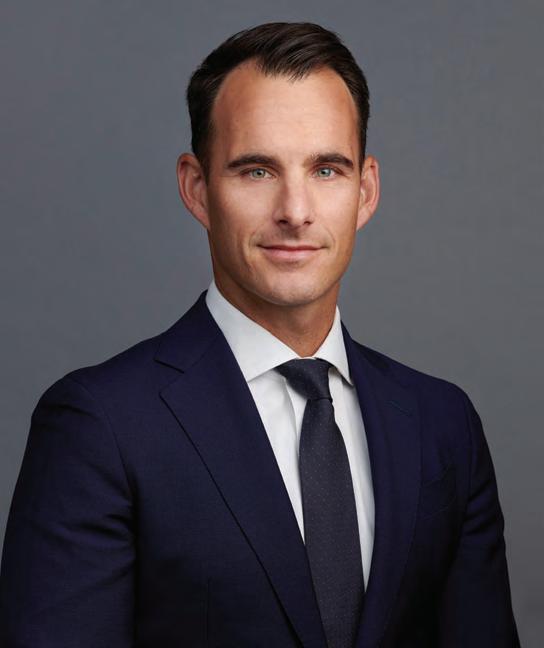
Lev Mavashev.
Suhail Y. Tayeb.
The Ground Lease Capital Advantage
Reduce upfront equity requirement and unlock embedded value with low-cost, long-term capital for acquisitions, recapitalizations and development
Mitigate risk Enhance returns $7B+ portfolio
Top lenders and brokers at a recent Commercial Observer forum broke down the still volatile real estate financing landscape
BY ANDREW COEN AND BRIAN PASCUS PHOTOGRAPHS BY GREG MORRIS
ockefeller Center, a historic landmark that for decades symbolized New York City’s financial and entertainment might, provided a fitting setting April 30 for Commercial Observer’s annual spring National Finance Forum, where some of commercial real estate’s biggest players gave their temperature checks on the state of an industry besieged by new challenges.
The semiannual event was held for the first time at Convene Quorum at 1221 Avenue of the Americas steps from 30 Rock. It also came a day after the CRE industry was confronted with another reminder of the sustained elevated borrowing costs the past four years when the Federal Reserve paused interest rates for a third straight meeting.
The symposium opened with an opening keynote featuring Rob Verrone, principal at Iron Hound, who spoke about the state of distressed loans in the commercial mortgage-backed securities (CMBS) market. Verrone, whose advisory firm negotiates CMBS loan restructurings on behalf of borrowers, said losses are mounting far more now than during the height of the COVID-19 pandemic.
“In COVID you didn’t see a lot of people taking losses because you weren’t going to sell your property when the world was shut down,” said Verrone in the kickoff keynote moderated by Joseph Barbiere of law firm Cole Schotz. “But now five years later the proof is in the pudding, and there are people actually transacting and doing A and B notes or discounted payoffs or consensual loan sales. … We’re actually taking the losses if the people who own the bonds can afford it and if the price is right.”
Verrone noted that the office sector is the largest part of its pipeline of restructurings, but Iron Hound is also heavily involved with navigating troubled loans in other asset classes. He stressed that beyond the property type, other factors weigh heavily on whether a loan can secure a workout. That includes who is in control of the debt and how many bonds are left in the sector.
The duration of workouts has gone up, often taking more than two years. Verrone attributes that partly to delay tactics often instilled by borrowers trying to wait for a better bond market. He added that the CMBS business has also gotten more complex, with a greater number of forms and legal documents that need to be filled out as parties conduct sufficient due diligence to avoid legal troubles.
The forum’s second session, “Market Outlook: Defining the Finance Landscape in 2026,” explored a large mismatch taking shape in the CRE market between equity and debt-deployment in deals. Tightening cap rates are driving the mismatch.
Yorick Starr, managing director and investment officer at Invesco Real Estate, said compressed cape rates coupled with a recent rise in the 10-Year Treasury yield makes it far
more challenging to get investors on board with CRE deals.
“Fom an equity standpoint, unless you’re investing in a sector that has high cap rates to begin with, the room for error is really minimal,” Starr said.
Demand remains strong on the debt side, according to Eric Ramirez, managing director and head of Eastern region originations at ACORE Capital. He noted that there are now often about 25 lenders bidding on some deals compared with around four or five in 2015 when he began at ACORE. Ramirez said there have been more requests for construction deals to be priced at an 80 to 85 percent loanto-value ratio since developers are confronting increasing challenges in raising equity.
The market outlook panel — moderated by Jay Neveloff, partner and chair of U.S. real estate at HSF Kramer — also featured Rebecca Bayard, managing director of the real estate financing group at Goldman Sachs, and Nick Scribani, vice chairman of global debt and structured finance at Newmark
Bayard said the current market environment has resulted in Goldman Sachs tackling more “straightforward” deals that are largely “asset-class agnostic” rather than taking on “overly complex projects” that were focused on alternative property sectors.
Scribani said lenders are eyeing opportunities in the office sector outside of just New York, including markets like San Francisco and South Florida.
“There’s a ton of lenders who now really focus on the office activity, and I think in part because there’s still
incremental yield to earn relative to some other food groups,” Scribani said. “For a while, office might have been one of the red line asset classes for most of the lenders we work with, and now it’s almost at the top of the totem pole.”
The evolving fluctuations in the CRE debt markets over the last few years were addressed in the event’s third session,
“Pivoting in a Changing Market: Staying the Course From Stability Through Volatility.”
Dylan Kane, managing director in the capital markets group at Colliers, said the last six years have presented “relentless volatility” starting with the onset of COVID-19 to the Russia-Ukraine war, rising interest rates and tariffs. Kane said structuring deals is very fluid as borrowers seek more flexibility to improve their leverage levels.
“We really approach it all, especially when trying to figure out the equity part of the stack, whether that’s pref, mezz or some sort of structured capital,” Kane said. “We just try to be as fluid and flexible and creative as we can.”
The panel — moderated by Aron Zuckerman, partner at Simpson Thacher & Bartlett — also featured Robert Rothschild, managing director at InterVest Capital Partners; Carina Kalaw, managing director and head of real estate syndications at City National Bank; and Michael Trachtenberg, president of ground lease specialist Safehold
The volatility has spurred more equity players to pivot to private credit space, where they’re now encountering increased competition from banks stepping back into CRE lending as interest rates stabilize, Rothschild said.
“Private credits are getting kind of squeezed out a little bit on the real estate side because the banks and CMBS market are pushing up leverage,” Rothschild said. “I think that just leads to a rethinking of how one wants to deploy capital depending on what yield expectations are.”
Kalaw said a number of banks are back in the CRE lending game, with competition particularly fierce in the syndication arena. She does not foresee anything hindering the banks from CRE deals in the near future outside of “a major catastrophe.”
After a short break, Kara McShane, Wells Fargo’s managing director, executive vice president, and head of commercial real estate, sat down with Bonnie Neuman of law firm Sidley Austin to discuss how her bank is navigating a more competitive lending landscape.
McShane noted that her bank completed $83 billion in originations across balance sheet and capital markets in 2025, and that Wells Fargo has focused on execution and leveraging a diverse product slate to create a competitive advantage against peer banks and even the growing private credit space.
But McShane added that, contrary to what some might assume, her bank views private credit firms as both clients and partners, rather than solely as competitors in a deep market.
“We have more of a symbiotic relationship and provide a lot of back leverage and financing to the private credit space,” she said, adding that Wells Fargo’s CRE capital solutions are often provided in conjunction with private credit. “They need us to exist, and we need them to exist.”
McShane also emphasized that, despite what the headlines might say, commercial real estate is largely insulated from the current turmoil in the private credit space, which she argued is more connected to troubled corporate credit.
“I don’t think it’s having a spillover impact — we’ve seen this before, particularly around redemptions for non-traded REITs,” she said. “It’s more likely this volatility pushes capital toward hard assets, so commercial real estate is a net beneficiary.”
The next panel featured William F. Davis, vice chair of real estate at Cozen O’Connor, holding a discussion with three market leaders on where capital is converging across asset classes in the early months of 2026.
Rob Verrone (l) and Joseph Barbiere kicked off the forum.
FEATURE
‘Borrowers do have a little bit of an upper hand today.’
Paul Vanderslice, head of CMBS at BMO Capital Markets, led with numbers, noting that the data center space secured $600 billion of capital expenditures in 2025, mainly through projects sponsored by the Big Five hyperscalers (Meta, Microsoft, Amazon, Google and Oracle).
But he also pointed out the sizable risks involved in any investment into the data center space.
“What is your collateral? It’s the building, it’s the racks, it’s the cooling towers. It’s not the chips, it’s not the servers,” said Vanderslice. “As for the risk, the power grid connections — in some markets already, like Virginia, it’s impossible to get new power, so you see data centers built in other areas.
“It’s a risk that hasn’t grown up with the CMBS business,” he added.
Justin Horowitz, senior managing director at CooperHorowitz, a firm that specializes in industry outdoor storage (IOS), noted that the data center space is impacting IOS by creating a new subsector — electrical IOS — and that his clients are trying to examine their portfolios through the lens of how much electrical power they can bring to their sites, even amid the shadow of growing data center construction
“There’s a clear advantage to having power, if it’s available,” Horowitz said. “It’s definitely a new part of the asset class and is certainly being viewed by our clients today”
Morris Betesh, founder and managing partner of Arrow Real Estate Advisors, a debt brokerage, noted that a new industry of “wildcatters” has quickly developed, where entrepreneurial investors buy up huge tracts of land, secure power to the sites, get zoning approvals, and use that leverage to work through a multiyear data center development process before an asset is even fully built.
“It’s an extremely risky business, but the returns are massive,” said Betesh. “Given how much demand there is, now everyone is a wildcatter. Everybody is out there tying up these sites, trying to get power.”
Moving away from data centers, Chris Lawton, managing director and head of originations at Nuveen Green Capital, spoke on how his firm has used Commercial Property-Assessed Clean Energy (C-PACE) loans to rightsize numerous capital stacks — the firm did $2.1 billion in C-PACE loans in 2025 — and that his firm has become more a senior position lender than mezzanine or preferred equity in recent transactions
“We’ve closed with over 300 co-lenders at this point,” said Lawton, noting that on a recent $465 million office deal his firm’s C-PACE loan took the senior position. “It’s either a syndication partner for a bank around the country or an A note.”
The sixth panel, moderated by Joe Lanzkron, a partner at Cleary Gottlieb Steen & Hamilton, examined the state of CRE lending in the early months of 2026.
Catherine Chen, managing director at Apollo Global Management, discussed how despite the market experiencing “ebbs and flows,” and pockets of distress, the sheer number of insurance companies, debt funds and banks in the lending space has created multiple options for borrowers.
But she emphasized that Apollo does not let the day-today or month-to-month swings affect its strategy because the firm is a balance sheet lender and relatively conservative by nature.
“I do think across the board there’s marginal shifts — because there’s competition — so maybe a tweak here or there to be competitive … but it feels like the market, or real estate lenders, has not skipped a beat over the last month,” she said. “All the noise hasn’t changed the overall lender demand.”
Tim Richards, managing director and real estate financing at Goldman Sachs, said that the office financing resurgence — particularly in the CMBS space — has been powered by increased leasing in major U.S. cities.
“It goes back to the return to office,” he said. “You look at markets like Boston, Miami and San Francisco, and there’s a
lot of demand for office.”
The resilience of the lending market and demand for assets like office and multifamily have compressed spreads and given the advantage to borrowers across the board, according to Marko Kazanjian, senior managing director at Institutional Property Advisors
He gave an example of how bids on a large construction loan, with 60 percent loan-to-cost, went from 365 basis points over the secured overnight financing rate nine months ago to the most recent bids for the same deal a mere 230 basis points over, a phenomena fueled by competition.
“Borrowers do have a little bit of an upper hand today,” Kazanjian said. “For more down-the-middle, more traditional financing, there’s lots of options out there.”
The final panel was a discussion between Sean Reimer, managing director of capital markets at Walker & Dunlop, and Tony Fineman, senior managing director and head of originations at ACORE Capital, which was moderated by Noam Haberman, partner at Gibson Dunn
Fineman began by speaking to the sheer amount of capital in the debt space and why the number of options and increased competition have made it “a really good time to be a borrower.” Reimer said that, while the credit side is thriving, the equity is a bit more challenging, before he broke
down what’s most liquid.
“From a deal profile perspective, cash-flowing assets are super liquid, so a business plan like a new acquisition with value-add business plan [are liquid],” he said. “On the asset class side, it’s anything housing, data centers or digital.”
Fineman gave a contrarian take on data centers, which he argued is a part of the market that is poorly understood and has secured capital due to hyperscaler tenancy from tech firms that are among the highest credited tenants in the country.
“I would venture that a high percentage of the debt capital is being deployed in the space not because they understand the product but because they understand who will sign the lease,” said Fineman. “But it’s very hard to understand what a data center really is — people go to work in an office, or live in an apartment, but when you go to a data center, you see metal boxes and lights.”
Fineman closed the forum on a note of optimism, arguing that the market has adjusted to the volatility.
“With some of the recent events in the world and in our country, the impact they had on our space is very little. I think we’ve gotten used to the fact that there’s chaos around us,” said Fineman. “You have to lean into the risk, and lend to the right sponsors and the right basis.”
DYLAN KANE.
KARA M c SHANE.
REBECCA BAYARD. PAUL VANDERSLICE.
TONY FINEMAN.
CATHERINE CHEN.
Accelerate your strategy.
Move at the speed of opportunity.
Markets move quickly. Capital is selective. The right execution at the right moment can shape returns for years.
That’s where Colliers comes in. Our investment sales, debt, and equity experts pair deep local insight with a global investor network — helping you price assets accurately, structure deals creatively, and move with conviction.
Let’s accelerate what’s next.
colliers.com/capitalmarkets
Accelerating success.
Office Leases of the Week
HDR
74,500 Relocation
Engineering firm HDR signed a 74,500-square-foot lease at the Feil Organization’s 7 Penn Plaza in Midtown, the landlord announced.
HDR, which calls itself the largest employee-
owned architecture and engineering firm in the U.S., will relocate one of its flagship offices to 7 Penn Plaza — also known as 370 Seventh Avenue — from 500 Seventh Avenue six blocks away. It is unclear when the move will take place, but once HDR
Michael J. Fox Foundation
68,958 Relocation
The Michael J. Fox Foundation for Parkinson’s Research (MJFF) selected 530 Fifth Avenue in Midtown for its new headquarters.
The nonprofit, which was founded in 2000, will relocate its offices to 68,958 square feet at the 26-story office building owned by RXR and Sagehall, according to tenant
Norm Ai
64,313 Relocation
Artificial intelligence-powered legal and compliance firm Norm Ai is moving its headquarters to the Durst Organization’s One World Trade Center
The new headquarters lease spans 64,313 square feet inside the 104-story office tower, according to a source close to the deal, with the option to expand to 70,000 square feet.
The lease marks a relocation for Norm Ai, which currently houses its team of researchers, engineers and lawyers at the nearby 7
Synthesia
50,000 New
Synthesia, an artificial intelligencepowered video generation platform, signed a major office deal at GFP Real Estate’s 675 Avenue of the Americas.
The AI firm, which allows customers to use text-to-video technology for content production, signed a deal for 50,000 square feet at the six-story Flatiron District office building, according to a recent April office report from CBRE
It’s unclear whether the deal represents a new location or a relocation for Synthesia,
moves into the 18-story office building, it will occupy space on the 15th, 16th and 17th floors.
“The move of one of our flagship offices to 7 Penn Plaza marks an exciting step forward for our firm, reinforcing our commitment to an exceptional employee experience in a premier New York building,” Jane Charalambous, the New York and New Jersey area manager for HDR, said in a statement.
Asking rent was $70 per square foot. Feil did not disclose the length of the lease.
Feil was represented in-house by Andrew Wiener and Kyle Young, while JLL represented the tenant. JLL did not respond to a
broker Savills. MJFF will move from its current digs at 111 West 33rd Street
Savills’ Kirill Azovtsev, Shay Bolton and Meghan Marchini represented MJFF in the transaction. Bolton called the new tenant a strong addition for the building. Vanessa Arnedo, MJFF’s chief people officer, said the new office space aligns with the nonprofit’s need for dedicated collaborating, meeting and focused work areas, “all in service of advancing our mission toward a cure.”
The length of the lease and the asking rent were not disclosed, but asking rent at 530 Fifth Avenue was $80 per square foot as
World Trade Center
The company will occupy the entire 60th floor and part of the 61st floor at One World Trade Center. The space will also serve as the headquarters of Norm Law, an AI-native full-service law firm started by Norm Ai’s founder, John Nay
“There’s no building in the world that carries more institutional weight than One World Trade Center,” Nay said in a statement. “Norm Ai and Norm Law are building the legal infrastructure for AI at the scale of the institutions that define the global economy.”
The tower, owned and operated by Durst alongside the Port Authority of New York
which signed a five-year lease for 13,600 square feet at the Moinian Group’s 245 Fifth Avenue in NoMad in August 2025.
The length of Synthesia’s new lease and the asking rent were also unclear, but CBRE’s report found office asking rents in Midtown South averaged $85.72 per square foot in April.
It’s unclear who brokered the deal. Spokespeople for GFP, Synthesia and CBRE did not respond to requests for comment.
Synthesia was founded in 2017 by a team of AI researchers from various Ivy League colleges. The company is backed by “Shark Tank” investor Mark Cuban
The AI firm will join several other tenants
request for comment.
“We’re excited to welcome HDR to 7 Penn Plaza,” Wiener, head of commercial leasing at Feil, said in a statement. “Across the portfolio, we’ve generated strong momentum as we continue to attract national organizations seeking full-floor opportunities in well-located, transit-oriented buildings.”
7 Penn Plaza’s other tenants include accounting firm Gruber Palumberi Raffaele Fried and security guard services provider Mulligan Security —Amanda Schiavo
recently as January 2025.
Landlords Sagehall and RXR were represented by CBRE’s Paul Amrich, Neil King, Meghan Allen and Brooke Dewing Sagehall joined RXR at the building in early 2025 and initiated a $180 million recapitalization of the property that will go toward repositioning.
“MJFF’s occupancy goals aligned perfectly with the repositioning of 530 Fifth Avenue, with both Sagehall and RXR demonstrating a strong commitment to supporting the foundation’s mission,” Amrich said in a statement. —Emily Davis
and New Jersey, was 97 percent leased as of late April.
Norm Ai was represented in its deal by Savills’ Jim Wenk, Kirill Azovtsev and Scott Bogetti. Durst’s Eric Engelhardt, Karen Rose and Sayo Kamara represented the landlord in-house alongside Newmark’s David Falk, Peter Shimkin, Hal Stein, Nathan Kropp and Paige Raisides
The asking rent and lease terms were not disclosed, but Class A office properties around the World Trade Center went for an average asking rent of $77.18 in the first quarter of 2026, according to Colliers data —E.D.
at 675 Avenue of the Americas, including billing platform Candid Health and commercial real estate data firm CompStak, as well as Trader Joe’s in the retail space. — Isabelle Durso
Office Leases of the Week
Premium Merchant Funding
46,913
Lender Premium Merchant Funding secured Lower Manhattan’s second-largest office lease in April, according to a recent CBRE office report.
Premium Merchant Funding, a New Yorkbased financial services company founded in 2014, subleased 46,913 square feet at One New York Plaza, according to the report. The sublandlord is unknown.
The Brookfield Properties-owned office
LGT Capital Partners
LGT Capital Partners, a specialist in alternative investing, signed a 10-year lease for 41,600 square feet on the 30th floor of 1251 Avenue of the Americas, a 54-story tower owned by Mitsui Fudosan America, according to a recent report from CBRE and the brokers.
The deal represents a relocation for LGT, which will move from its current New York City office at 1133 Avenue of the Americas
Rain
38,034 Relocation
Rain, a cryptocurrency and stablecoin startup, is leasing 38,034 square feet at Empire State Realty Trust’s newly acquired 555-557 Broadway
The property is known as the Scholastic Building, and the textbook publisher sold it in December as a sale-leaseback to ESRT, which made a $386 million bet on the building. 555-557 Broadway sits between Prince and Spring streets in SoHo, and has a separate entrance at 120-130 Mercer Street
tower at 1 Water Street also hosts New York State’s Office of General Services, Morgan Stanley, sustainable architecture and interior design firm Spacesmith and the law firm Fried Frank. An $835 million commercial mortgage-backed securities loan on the 50-story tower entered into special servicing in December.
It is unclear whether the tenant or the landlord worked with outside brokers. The length of the sublease and the asking rent were also unknown, but Lower Manhattan office leases averaged $59.62 per square foot in April, according to CBRE.
The Premium Merchant Funding lease was second only to law firm Cleary Gottlieb
The asking rent was unclear, but CBRE’s report found office asking rents in Midtown averaged $84.77 per square foot in April.
Cushman & Wakefield’s Mike Movshovich brokered the deal for the tenant, while Newmark’s David Falk and Peter Shimkin represented the landlord. Spokespeople for Newmark, C&W, LGT and Mitsui Fudosan America did not respond to requests for comment.
LGT will join several other tenants at its new building between West 49th and West 50th streets, including Trust Company of the West, Royal Bank of Canada, and law
Along with the 222,000-square-foot lease by Scholastic to consolidate into six floors and maintain its headquarters in the 355,942-square-foot building, Anthony Malkin’s real estate investment trust obtained three available floors, one of which Rain has now agreed to lease.
“We are pleased to welcome Scholastic to our roster of great companies who are our tenants and look forward to our new relationship with them,” Malkin said in a statement in December. “We are excited to bring this combination of contractual revenue, embedded growth and significant value-creation
Steen & Hamilton in Lower Manhattan’s April leasing lineup. The law office took 475,000 square feet at Brookfield’s One Liberty Plaza
Leasing activity in Lower Manhattan totaled 571,000 square feet in April, according to the CBRE report, exceeding the area’s five-year monthly average by 106 percent.
firms McGuireWoods and Davis Wright Tremaine
The investment firm’s new lease at 1251 Avenue of the Americas was also one of the largest office leases signed in Midtown in April, following shoe and accessories retailer Steve Madden’s 60,003-squarefoot lease at 501 Seventh Avenue, Apollo Enterprise Strategies’ 49,678-square-foot deal at 590 Madison Avenue and law firm Robinson+Cole’s 48,451-square-foot lease at 100 Park Avenue —I.D.
potential from our ability to market the three uniquely large floors in a more than 110,000-square-foot block.”
The length of Rain’s new lease was unclear, but the asking rent was $99 per square foot. Rain was represented by Sam Einhorn and Eric Ferriello of Colliers, while ESRT was represented in-house by Kerry Lavelle and a Newmark team of Peter Shimkin, Dylan Weisman, Danny Levine and David Falk. The parties declined to comment. —Lois Weiss
Wohio Holding’s 22-story office building at 16 East 34th Street leased two full floors to workspace provider Corporate Suites
The office and retail building, located between Madison and Fifth avenues a block east of the Empire State Building, will host Corporate Suites across its entire 18th and 19th floors. The 13-year lease agreement spans 34,857 square feet.
The 16 East 34th Street space will be transformed into Corporate Suites’ fourth Manhattan office location. The company
currently offers flexible workspaces in NoMad at 2 Park Avenue and in Midtown East at 641 Lexington Avenue and 880 Third Avenue, according to its website. Cushman & Wakefield’s David Rosenbloom and Matthew Etlinger negotiated the deal for Corporate Suites, while Wohio Holding was represented by George Comfort & Sons’ Peter S. Duncan and Alexander Bermingham. George Comfort & Sons is the building manager and leasing agent.
“As New York City’s office market continues to rebound, flexible space and amenity access remain in high demand,” Duncan said in a statement.
The firm’s new coworking location will offer a combination of large furnished team spaces alongside a mix of smaller private offices, equipped with conference and trining rooms, open coworking areas, phone booths, a café and an on-site services team. The asking rent for the lease was not disclosed, but office asking rents in Midtown South averaged $84.77 per square foot in April, according to CBRE —E.D.
Debt Deals of the Week
THE GRAND CANYON!
RXR Secures $269M From Blackstone, Canyon Partners for White Plains
Multifamily Refi
RXR and Korman Communities have secured $269 million to refinance Hamilton Green, a recently completed 477-unit luxury multifamily housing complex in the heart of White Plains, N.Y.
A group led by Blackstone Real Estate Debt Strategies and Canyon Partners Real Estate provided the debt, which comes after the building’s completion in 2025 and nine months after lease-up of the two-building development. JLL’s Michael Gigliotti and Kelly Gaines and Hudson Realty Capital’s Paul Patafio arranged the financing.
The property is now nearly fully leased, less than a year after opening.
Scott Rechler, chairman and CEO of RXR, spoke to the property’s early positive leasing performance metrics in the Westchester market, which has ongoing demand for housing in what is a high-demand, transit-oriented suburban market.
“The successful refinancing of Hamilton Green reflects the strength of the RXR platform and our ability to execute across the full lifecycle of a complex development — from entitlement and construction through lease-up and stabilization,” added Rechler.
Located at 5 Cottage Place and 25 Cottage Place at the spot of the former White Plains Mall in the city center, Hamilton Green features units ranging from studios to three-bedrooms. The building includes amenities such as a fitness center, an indoor pool, a golf simulator, a dog wash, and on-site resident service coordinators. The building is a 10-minute walk to the White Plains MetroNorth train station that provides direct access into Manhattan’s Grand Central Terminal
Jacob Feingold of Canyon Partners Real Estate also spoke to Hamilton Green’s strong leasing performance and central location near transportation, as well as RXR’s institutional sponsorship and the “long-term demand drivers” from being so close to the New York metropolitan area.
“This investment reflects our continued focus on high-quality residential assets in supply-constrained, high-income, transit-oriented markets,” said Feingold.—Brian Pascus
Trinity and Sculptor Land $690M CMBS Loan for Acquisition of Florida Oceanfront Resort
Trinity Investments and Sculptor Real Estate have closed their $835 million acquisition of an oceanfront resort along Florida’s Gulf Coast, financed with $690 million in commercial mortgage-backed securities (CMBS).
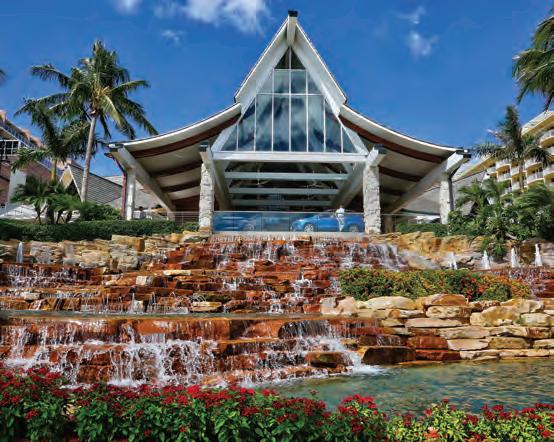
Called JW Marriott Marco Island Beach Resort, the property includes 809 hotel rooms across three buildings on a 27-acre oceanfront site at 400 South Collier Boulevard as well as two 18-course golf courses, Hammock Bay and Rookery, about 10 miles inland in Naples.
The resort also houses 140,000 square feet of event space, 12 restaurants, a 24,000-square-foot spa, five outdoor swimming pools, four tennis courts and a fitness center. The resort’s private club includes about 700 members.
Wells Fargo and J.P. Morgan Chase originated the five-year, floating-rate loan, which will be securitized in a stand-alone CMBS offering, according to JLL, which represented the joint venture and brokered the debt.
“Luxury beachfront resorts of this caliber remain among the most sought-after assets in the hospitality sector, particularly properties like the JW Marriott Marco Island that combine scale, irreplaceable coastal positioning, championship golf amenities and recurring membership income,” Kevin Davis, CEO of JLL’s hotels and hospitality, Americas division, said in a statement.
These are “attributes that generate stable cash flows and provide insulation against
The 809-room JW Marriott Marco Island Beach Resort on Florida’s Gulf Coast has new owners.
market volatility while offering meaningful upside potential,” the statement added.
The seller — Barings, MassMutual’s asset manager — has owned the resort for more than four decades. In 2018, it completed a $320 million renovation, adding an adults-only tower and rebranding the resort as a JW Marriott.
The transaction marks Trinity Investment’s second major Florida hospitality acquisition in recent years. In 2023,
it purchased the 1,000-room Diplomat Beach Resort in Hollywood for $835 million. At the time, the transaction was the largest hotel deal since the pandemic hit.
Sculptor’s parent company, previously called Och-Ziff Capital Management, has over $27 billion real estate assets under management. Daniel Och founded the firm in 1994, and Rithm Capital acquired it for just under $720 million in 2019.
Julia Echikson
Catalfumo Lands $401M Bridge Loan to Finish Ritz-Carlton
Residences in Palm Beach Gardens
Catalfumo Companies has secured $401 million in bridge debt to complete its Ritz-Carlton-branded waterfront condominium project in Palm Beach Gardens, Fla.
Northwind provided the first-mortgage completion-to-inventory loan for the The Ritz-Carlton Residences, Palm Beach Gardens development that will consist of 106 condos on 14 acres along 1,040 feet of frontage on the Intracoastal Waterway. It is slated for completion later this year, with 35 percent of the units presold. A representative for the lender declined to provide the project’s total sales figures.
“The combination of a 14-acre Intracoastal site, a private marina, and large-format floor-through residences, fully amenitized and serviced by the RitzCarlton, positions the property well within the market,” Ran Eliasaf, founder and managing partner of Northwind, said in
a statement. “We are entering the project at the tail end of construction to carry its momentum through sellout, supported by meaningful presales achieved to date.”
Eliasaf added that the project will also benefit from South Florida’s “sustained migration from the Northeast and an expanding institutional presence.”
The floating-rate loan will refinance the project’s $340 million construction loan that Madison Realty Capital issued
three years ago, with the remaining portion of the debt held back until the development’s completion. Scott Wadler and Michael Basinski of Berkadia brokered the transaction.
Basinski, director in Berkadia’s Miami office, said in a statement that the deal reflects how the commercial real estate debt markets “are seeking superior quality assets in growth markets”
Located at 2200 PGA Boulevard, The Ritz-Carlton Residences development will feature three- and four-bedroom condos across three seven-story buildings along with a 29-boat slip marina. Community amenities, spanning 20,000 square feet, will include a waterfront restaurant, a swimming pool, a spa, wellness facilities, a fitness center, a pickleball court and a clubhouse. Prices range from $4 million to more than $10 million.—J.E.
The waterfront condominium development.
Madison Realty Capital Provides $110M Refi for Silicon Valley Hotel
Ensemble Investments has secured $110 million to refinance Hotel NIA, a 250-key Marriott hotel in Menlo Park, Calif., Commercial Observer can first report.
Madison Realty Capital worked with Newbond Holdings to provide the debt.
David Sonnenblick of SonnenblickEichner Company arranged the deal.
Josh Zegen, co-founder and managing principal at Madison Realty Capital, described Hotel NIA as “a high-quality, cash-flowing asset with institutional sponsorship and proven brand affiliation,” while noting in a statement that the asset is supported by the positive demand fundamentals across Menlo Park.
Zegen noted that Menlo Park commercial real estate has benefited from the return-to-office policies instituted across Silicon Valley by tech firms, as well as from the lack of supply for hospitality assets in the area. Hotel NIA is currently the only full-service hotel within the 15.9acre Menlo Gateway campus.
“The proximity of major corporate and institutional demand generators like Meta, Snowflake and Stanford University creates a structural tailwind that gives us strong conviction in this asset’s trajectory,” said Zegen. “We believe [the property] is well positioned to outperform.”
Located at 200 Independence Drive in Menlo Park, Hotel NIA operates under Marriott’s Autograph Collection brand. The hotel features 241 regular rooms, nine suites and more than 15,000 square feet of meeting and event space — notably a nearly 5,000-square-foot ballroom — along with 301 valet parking spaces.
Neil Luthra, founding partner of Newbond Holdings, said in a statement that Hotel NIA has displayed “strong fundamentals” while being under sponsorship of Ensemble’s institutional ownership.
“The location, coupled with the modern, high-end design, and Ensemble’s deep operational experience, positions the asset for continued strong performance,” he added.—B.P,
FirstPathway, Clearwater PACE
Lend $95M on Wellness Resort in Park City, Utah
Developer Charles Heath has landed a $95 million debt package to develop a wellness resort near Park City, Utah, Commercial Observer has learned.
FirstPathway Partners provided $62 million of senior construction financing backed by funding from the EB-5 visa program for Heath’s Ameyalli well-being resort project in Midway, Utah. Clearwater PACE also supplied a $33 million Commercial Property Assessed Clean Energy (C-PACE) loan for the $130 million project featuring an 80-room hotel and a wellness center.
Ameyalli is part of a larger development that also includes includes 23 cottages and 24 townhome residences along with a private clubhouse.
Jonathan Seabolt, CEO of Clearwater PACE, said the C-PACE loan was structured as long-term, fixed-rate debt secured by a senior special assessment on the property, senior to all mortgage debt and on equal footing with the real estate taxes. The C-PACE proceeds will fund energy efficiency and water conservation measures associated with the development..
“Ameyalli represents the institutional evolution of the C-PACE market,” Seabolt said in a statement. “Sophisticated sponsors are choosing C-PACE not because they must, but because it is the most effective capital at this point in the cycle.”
Located at 832 Wellness Drive 17 miles south of Park City, the hotel will have a spa, mineral pools, wellness programming and a restaurant run by celebrity chef Charlie Palmer, who partnered with Heath on the project. The development also includes
24 townhome residences not included in the $95 million debt package.
As part of the larger development, FirstPathway Partners closed on a seperate $1.6 million EB-5 loan to the residential components of the project.
“EB-5 investors are becoming increasingly sophisticated in their underwriting criteria,” Daniel Wycklendt, president of FirstPathway Partners, said in a statement. “As an EB-5 lender, we recognize that investors are seeking not only to secure a permanent green card but to participate in institutional-grade credit facilities, with a priority position in a quality asset.”
Clearwater executed the Ameyalli resort loan on the heels of closing an up to $300 million C-PACE platform from capital supported by Ares Alternative Credit funds. Seabolt said the Utah deal paired with EB-5-backed debt underscores the expansion of C-PACE as a financing vehicle in recent years that can reduce the basis of the senior lender. It underscores the types of deals Seabolt said he plans to pursue more of with the Ares Alternative Credit backing.
“Construction capital remains constrained across most asset classes and sponsors are looking to alternative sources to bridge proceeds gaps and improve blended cost of capital,” Seabolt said. “C-PACE has emerged as a meaningful solution in that context, particularly for transactions that can demonstrate institutional sponsorship, credible cost basis and a clear path to stabilization.”
Andrew Coen
S3 Capital Lends $116M on Texas State Student Housing
Elevate Development Partners has secured $116 million of acquisition and construction financing to build a student housing complex serving Texas State University, Commercial Observer has learned
S3 Capital supplied the loan for Elevate Development’s 260-unit McLain project in San Marcos, Texas, steps from the Texas State campus. The deal marks an expansion of S3’s lending platform beyond its niche of traditional multifamily.
“Capitalizing on supply-demand imbalances has always been our focus, and we see student housing as a natural expansion of that same approach,” Steven Jemal, managing director of origination at S3 Capital, said in a statement. “Demand is structurally captive, and many universities are growing enrollment faster than they can add beds.”
Jemal said Texas State has large-scale demand for off-campus housing with enrollment up 9.6 percent in fall 2025 to a school record 44,596 students. He noted that the university is poised for further growth with a new $137 million STEM facility scheduled for completion in December and a $42 million renovation of the football stadium’s south end zone.
Located at 410 North Street, the 759bed development will be directly adjacent to campus, near the Ingram School of Engineering and McCoy College of Business. Community amenities will include study lounges, a social lounge, a bicycle room, a mail room, a swimming pool, a yoga room, a fitness center and conference rooms.
Joshua Crane, co-founder and principal
of S3 Capital, said in a statement that the deal was attractive due to San Marcos having “strong demographic tailwinds,” Elevate Development Partner’s previous experience in the market, and a lack of supply of student housing. San Marcos is in a rural area midway between Austin and San Antonio, about 30 miles from each city.
The seller and purchase price information were not immediately available.
“We are incredibly excited about the long-term growth story surrounding Texas State University and the opportunity to develop a truly best-in-class project at the footsteps of campus,” Chris Skyles, founder
of Elevate Development Partners, said in a statement. “Texas State is one of the most exciting growth stories among large universities in the country right now.”
Walker & Dunlop negotiated the financing with a capital markets institutional advisory team led by Sean Reimer, Aaron Appel, Keith Kurland, Jonathan Schwartz, Adam Schwartz and Dustin Stolly
“We continue to see significant investor and lender interest in student housing, particularly in markets where enrollment growth is outpacing new supply,”Reimer, senior managing director at W&D, said in a statement.—A.C.
Josh Zegen and David Sonnenblick.
The 759-bed project will sit directly adjacent to the Texas State University campus (pictured).
ChartFinance Bank Construction and Development Loans Contract to $456B
By Mike Haas
Construction and development (C&D) loan balances at U.S. banks fell to $456.3 billion in 2025’s fourth quarter, a 5.7 percent year-over-year decline that marks the sixth consecutive quarter of contraction in bank construction lending, according to CRED iQ’s proprietary loan analytics.
CREDIQ
The C&D pullback represents the most sustained retreat from construction credit since the post-Global Financial Crisis (GFC) de-leveraging cycle and underscores a broader recalibration in how banks are sizing exposure to the construction segment of commercial real estate.
C&D loan balances are down 9 percent from their postpandemic peak of $501.5 billion in the 2023 fourth quarter, erasing roughly $45 billion in outstanding bank construction credit over eight quarters. While the absolute decline is significant, the contraction remains far less severe than the GFC drawdown, when balances fell from $631.8 billion in the first quarter of 2008 to $201.6 billion in the first quarter of 2013 — a 68 percent peak-to-trough collapse CRED iQ’s analysis points to a combination of elevated borrowing costs, tightened underwriting standards, and softening commercial real estate fundamentals — particularly in office and select multifamily submarkets — driving the pullback. Construction starts have decelerated across most major property types, and new originations have fallen well short of payoffs and amortization, producing the net portfolio decline visible across the bank universe. Regulatory scrutiny on CRE concentration ratios has further reinforced the pullback at many regional and community institutions.
The current downturn is materially shallower than the post-GFC reset. Year-over-year C&D loan growth bottomed at minus-29.3 percent in the first quarter of 2011, compared with the minus-5.7 percent reading in last year’s fourth quarter. Following that trough, bank construction lending expanded by 149 percent over the subsequent decade, peaking in late 2023 before reversing course. The current cycle resembles a measured cooling rather than a forced unwind.
Community banks hold approximately $153 billion of outstanding C&D loans — roughly one-third of total bank construction exposure — despite representing a much
smaller share of total banking assets. This makes regional and community bank balance sheets the critical lens for monitoring credit quality in the construction segment, and helps explain why C&D performance is closely watched by regulators and investors alike.
Construction loan performance has remained reasonably resilient. The past-due and nonaccrual rate on C&D loans stood at 1.34 percent in the fourth quarter of 2025, with noncurrent loans at 0.92 percent — elevated relative to recent cycle lows but well below GFC-era stress levels. Community banks reported a slightly higher past-due non-accrual rate
(30 days delinquent or worse) of 1.42 percent, consistent with their concentrated exposure profile.
For lenders, the contraction reflects deliberate balance sheet management rather than systemic distress. For developers and investors, capital availability for new construction projects remains constrained, and the durability of any near-term rebound will hinge on interest rate trajectory, property fundamentals and bank capital allocation decisions through 2026.
Mike Haas is the founder and CEO of CRED iQ.
From billion-dollar redevelopments to the largest office-toresidential conversion in US history, Fried Frank advises on the deals that define cities and transform markets.
ShapingSkylines.
oriented approach to every engagement — advising clients through the
o borrow (and alter) a phrase from her greatest poet, America contains multitudes — and so does real estate.
Given that this is the 250th anniversary of the signing of the Declaration of Independence, the folks at Commercial Observer have been in a patriotic frame of mine. And one of the things we appreciate about our country is its disparate, crazy quilt nature. We would never say America is any one thing. The Great Plains states are different from New York City, which is different from West Palm Beach, Fla. But all three share a distinct membership: American.
And, as we were compiling this year’s Power 100, one of the things we noted was that commercial real estate wasn’t exactly one thing, either. The story of real estate over the last year has been its own crazy quilt.
One big strand of the story has been the surge
in artificial intelligence, and the incumbent data centers, power sources and office space necessary to cater to it.
No. 1 on this year’s list, Nadeem Meghji of Blackstone, placed a pretty sizable bet on data centers when he purchased QTS Realty Trust — the world’s fastest-growing data center platform — for $10 billion. That would be a bold enough move to earn a top place on any real estate list, but when you consider how vast a platform Blackstone has built, and how much largesse they’ve spread ($24 billion of equity capital last year), it explains a little why we regarded them so highly.
Another strand of the story has been the resurgence of New York City’s once moribund office stock.
When J.P. Morgan Chase (see No. 3, Jamie Dimon) opened its spanking new, Genslerdesigned office (see No. 98) that had been developed by Tishman Speyer (No. 2), one can see the hunger for the asset class.
Indeed, earlier this year Silverstein Properties
announced a long-eluded deal: American Express would be the 2 million-square-foot anchor tenant of the developer’s yet-to-be-realized 2 World Trade Center. (We ranked Silverstein No. 6.)
“How sweet that the name ‘American’ appears on the last building at the World Trade Center,” remarked CBRE’s Mary Ann Tighe (No. 15). “It seems so right on so many levels.”
Then there are the big new projects that essentially forge a city or a neighborhood from scratch, like West Palm Beach (Stephen Ross and Kenneth Himmel, No. 30) and Metropolitan Park (Steve Cohen, No. 28).
There’s the affordable housing market (Rick Gropper, No. 77) and the luxury housing market (Victor Sigoura, No. 57) and the people selling and leasing it (Robert Reffkin, No. 24).
And there’s so much more. We advise you to carefully consider each of this quilt’s patches. Taken together, they add up to our assessment of commercial real estate on this significant birthday.
The Power 100 package was written by Tom Acitelli, Andrew Coen, Gregory Cornfield, Cathy Cunningham, Emily Davis, Isabelle Durso, Julia Echikson, Larry Getlen, Max Gross, Mark Hallum, Orion Jones, Brian Pascus, Amanda Schiavo, Aaron Short and Patrick Sisson. Acitelli, Cunningham, Gross and Skip Card edited the package. Jeff Cuyubamba and Rohini Chatterjee designed it. Jim Sewastynowicz and Emily Assiran arranged the photography.
Silverstein Properties is a privately-held, full-service real estate development, investment and management firm that has developed, owned and managed more than 45 million square feet of office, residential, hotel, retail and mixed-use properties.
Investment Types
•All major property types in growing urban markets
•Flexible and efficient debt structures
•Senior loans of $75 million or more
•Subordinate loans of $50 million or more
•Shovel-ready groundup construction
•Heavy value-add repositioning
•Inventory loans on completed condo projects
•Rescue capital to borrowers
1
Nadeem Meghji
Global head of real estate at Blackstone
Last year’s rank: 2
“When I think about 2025, what we saw was the continuation of what we believe is a sustained real estate recovery,” Nadeem Meghji said. On the heels of that recovery, Blackstone invested $24 billion of equity capital, and also realized $26 billion on behalf of its investors.
When it comes to the hottest of hot asset classes — data centers — Blackstone continues to maintain its crown as the world’s biggest investor.
“We have extraordinary conviction in that theme because of what’s happening with digitalization and artificial intelligence. The momentum there is only accelerating,” Meghji said. “2025 was a record year for us, and we believe 2026 will be even stronger from the standpoint of data center leasing globally.”
Blackstone came roaring onto the data center scene in 2021 with its $10 billion purchase of QTS Realty Trust — now the world’s fastest-growing data center platform. It also owns the largest data center platform in Asia, Air Trunk, and the largest powered land bank in Europe. Not long before this list went to press, Blackstone announced its joint venture with Related Digital had secured $16 billion for a data center in Saline Township, Mich., to be purpose-built for Oracle.
“I’m seeing that the incumbents with scale have a very significant advantage, because the scale of these AI deployments and what our customers need continues to increase,” Meghji said of the increasing competition in the space. “These are massive investments, and they require an exceptionally well-capitalized platform to execute. It comes down to owning powered land, having a track record of executing, having relationships with
the hyperscalers, having scalable capital — both debt and equity — and understanding the business, because this is critical infrastructure for our borrowers.”
Logistics continues to be the place where Blackstone has its largest single exposure at 40 percent. “In a lot of the markets where we own warehouses, where there’s infrastructure investment or data center investment happening, we’re seeing a big uptick in demand, and last quarter was our best quarter in terms of our leasing pipeline,” Meghji said.
Blackstone is also leaning into the recovery in office. Case in point: San Francisco, driven by the AI revolution, with 60 percent of AI investment happening in the city. Blackstone acquired the 25-story office tower at 300 Howard (and leased it to AI company Anthropic) as well as the 277-key Four Seasons hotel on Market Street and Stanly Ranch resort an hour from the city.
In Las Vegas, Blackstone secured an $800 million investment from Realty Income Corporation for its 18 million-square-foot mixed-use CityCenter campus .
Despite all of the highlights, 2025 was an especially challenging year for the Blackstone team, which experienced a devastating loss in the death of senior executive Wesley LePatner. “Wesley was our dear friend and partner and was so impactful in our business, and such an exemplary leader,” Meghji said. “That was a very challenging period for our business on a human level, but it brought us closer together. We’ll never forget her, and we’ll continue to honor her memory.” —C.C.
2
Rob Speyer CEO at Tishman Speyer
Last year’s rank: 5
One could make the case that the success of commercial real estate in 2025 was a triumph of financing. So much of the banking world had been frozen in a postCOVID inflationary dead zone that, when banks and financial institutions decided that the water was more or less fine, years of pent-up demand was suddenly unleashed.
Furthermore, one could argue it was Tishman Speyer that helped reignite the commercial mortgage-backed securities market almost single-handedly when it refinanced Rockefeller Center to the tune of $3.5 billion in late 2024, and proceeded to do the same thing at Hudson Yards’ Spiral office tower for $2.8 billion in January 2025. Since then, the hits have kept coming: a $385 million refinance at 300 Park Avenue; the $105 million purchase of 148 Lafayette Street in SoHo; and countless units of residential, life sciences and office under construction in the many farflung corners of the globe where Tishman Speyer has planted its flag. (By its current count, the firm has approximately $65 billion in assets under management in 40 different markets.)
But, in a New York City where there hasn’t been a ton of new office construction in the past few years, Rob Speyer dazzled everybody in the business last year with the opening of 270 Park Avenue, the multibillion-dollar J.P. Morgan Chase tower on the site of the old Union Carbide Building.
“Jamie [Dimon’s] decision to go forward with that building in the depths of COVID — when everyone else thought office was dead — was like the ultimate validation of both office and New York City,” Speyer told Commercial Observer back in January 2026, referring to the J.P. Morgan chairman. “And most people should have listened to him more closely, because one of the key lessons as an executive is separating signal from noise. That was a signal.
“And, so, now the building’s completed. It’s the best office building in the world — and I say that as a real subject matter expert.”
There are a lot of great offices out there. This list is a testament to that. But let’s just say we’re not about to second-guess Rob Speyer’s professional judgment. —M.G.
Nadeem Meghji.
Rob Speyer.
Jamie Dimon
Chairman and CEO at J.P. Morgan Chase
Last year’s rank: 3
In October 2025, J.P. Morgan Chase officially opened its new 2.5 million-square-foot, 60-story global headquarters at 270 Park Avenue. The move by the nation’s largest bank underscored the U.S. office market’s recovery from the depths of the pandemic and the recovery of workaday New York City. The all-electric tower — the city’s largest — has room for more than 10,000 employees and a host of amenities to service them.
Two months later, J.P. Morgan would close out a year wherein it originated $87 billion in commercial real estate loans. That sum spread across asset classes, including a $38 billion construction financing package it led for a pair of hyperscale data centers. (The J.P. Morgan executives running the bank’s CRE lending, Michelle Herrick and Brian Baker, topped Commercial Observer’s 2026 Power Finance rankings.)
Meanwhile, the bank expanded its existing office and retail footprints over the past 12 months. In New York — despite that gargantuan new HQ — the company leased a further 139,332 square feet at Five Manhattan West. In San
Francisco, the bank announced it would expand to nearly 280,000 square feet at 560 Mission Street. J.P. Morgan also announced that in 2026 it would open more than 160 new bank branches in more than 30 states and renovate a further 600.
At the center of it all is Jamie Dimon. The aforementioned moves and figures are impactful enough. (As is the bank’s recent performance — net income and revenue were both up by double digits annually in the first quarter, to $16.5 billion and $50.5 billion, respectively.) But, when Dimon pronounces or prognosticates on the economy or geopolitics, the impact compounds like interest on a loan. He is probably the most listened-to financial figure in the country outside of government. He would say it’s all in a day’s work.
“We’ve always been focused on doing what’s right for clients — putting capital to work, and finding smart, innovative ways to help them succeed,” Dimon said in a statement to Commercial Observer. “We proudly support the entire commercial real estate sector, bringing the full strength and breadth of J.P. Morgan Chase to help them in any market environment.” —T.A.
4Jeff Blau and Bruce Beal CEO; president at Related Companies
Last year’s rank: 4
Related Companies remains a juggernaut, with Jeff Blau and Bruce Beal leading the charge.
The New York-based developer has been at the forefront of office tenants’ flight to quality since the pandemic, thanks to Hudson Yards, which Related co-developed with Oxford Properties. After a brutal start during the depths of the pandemic, the firm adapted, reducing the retail footprint in Hudson Yards and doubling down on leasing up its office.
Related’s existing office stock at the megaproject on Manhattan’s far West Side is now fully leased to blue-chip tenants such as BlackRock, Meta and L’Oreal. Even critics, including public officials like former New York City Comptroller Brad Lander, have come around on Hudson Yards.
“We opened about two minutes before COVID, so it wasn’t the best timing,” said Blau. “But, after COVID, Hudson Yards really came into its own.”
More is in store. In January 2026, the developer scored a $1.6 billion construction loan for 70 Hudson Yards, a 1.4 million-square-foot, 72-story office tower where Deloitte has already committed to lease about two-thirds of the space. The loan was not only the biggest of its kind in New York since 2020, but it also seeded one of the city’s largest ground-up construction projects since the pandemic.
Related looks to be weathering
further challenges. When its bid to secure a coveted gambling license to add a casino atop the remaining far West Side railyards fell apart, it shifted gears — and got the city on board to help finance the expensive platform.
“We listened,” said Beal. “When the city pushed back and said ‘We want more housing on the yards, and we want more affordable housing,’ we made those changes.”
Although New York Mayor Zohran Mamdani faces some pressure from local groups to halt the $2 billion payment-in-lieu-of-taxes structure, which would allow Related to redirect tax revenues from the site toward financing the platform, Blau and Beal are getting ready to build.
Then there’s also Related Companies’ venture into AI data centers, which launched last year. Related had been building solar power plants when tech companies entered the picture.
“Originally, we were selling power to state governments or utilities, and, then, ultimately the big tech companies came calling to buy that power from us.” Blau said. “And, at first, we didn’t really understand what they were doing with all that power. It was before all the craziness around data centers.”
Now it’s getting a piece of the action. In April, it landed financing to build a $16 billion data center campus in Michigan for Larry Ellison’s Oracle, with Blackstone as an equity partner. —J.E.
Jamie Dimon.
Jeff Blau.
Bruce Beal.
Marc Holliday Chairman and CEO at SL Green
Last year’s rank: 1
Where does one begin when talking about SL Green?
One could start with 346 Madison Avenue. This is the old Brooks Brothers building (catty corner to SL Green’s other behemoth, One Vanderbilt) purchased last year for $160 million.
“This will be an 800,000-square-foot tower, close to 1,000 feet of height,” said Marc Holliday. “It’ll be a $2 billion project.”
Exact plans have been quietly shown around to a select audience (completion date is roughly 2031), but the amenity package that Holliday et al. are planning is on the level of One Vanderbilt — only more so.
“We tried to go the extra mile, to make it not just functional but something that for a little extra spending around the margin becomes a real landmark and community asset,” Holliday told Commercial Observer.
And, in this market, one can be ambitious with new development. “There is no new [construction] in Midtown East for the balance of this year, ’27 or ’28. Not one.”
One can see the value of a Class A office play in the other buildings in SL Green’s portfolio. “We finished [2025] at 93 percent leased. We’re going to finish this year at 95 percent across 30 million square feet,” Holliday said. “Obviously, that’s far ahead of the market and far ahead of my peers.”
Crown jewels like One Vanderbilt have no space left to rent. Neither does last year’s favorite child, One Madison, which scored leases like Harvey AI, Sigma
6
Computing and IBM — which all took big chunks only to come back months later asking for more. Just this last quarter, SL Green did about 930,000 square feet of leasing, which is the strongest first quarter in the real estate investment trust’s history.
While office might be SL Green’s bread and butter, the REIT can also recognize the opportunities in converting older offices with iffy occupancy. They’ve started internal demolition on 750 Third Avenue, an $800 million, 700-unit project (25 percent of which will be affordable) that’s one of Manhattan’s largest conversion projects.
SL Green also closed a debt fund platform in the middle of the last year at $1.3 billion. (It was oversubscribed and about two-thirds international investors. So, take that, New York skeptics!) The REIT, too, is now one of the country’s top special servicers. (“We’re the No. 1 large-loan, single-asset/single-buyer special servicer,” Holliday said.)
And we would be remiss if we didn’t mention the $730 million purchase of Park Avenue Tower from Blackstone last fall — which gives SL Green “an unparalleled presence on Park.” (Don’t believe him? 500 Park, 450 Park, 280 Park, 245 Park, 125 Park and 100 Park Avenue would like a word.)
One wonders what Holliday does when he’s off the clock. Well, it’s not SL Green work, but he’s overseeing the reconstruction of Long Island’s Belmont Park. It’s no surprise this guy knows something about racing hard. —M.G.
Larry Silverstein, Lisa Silverstein and Tal Kerret
Founder and chairman; CEO; president at Silverstein Properties
Last year’s rank: 36
Well, he did it.
Larry Silverstein began negotiating with American Express about five years ago to anchor his one unrealized dream for Lower Manhattan: 2 World Trade Center.
In February, Silverstein and AmEx crossed the finish line, and the details were one for the books: 55 stories. 2 million square feet. A completion date of 2031. A design by Lord Norman Foster. It was a thunderous cry of confidence in the city, the office sector and maybe the future itself.
But to say that Silverstein had been working on this for five years would be a laughable understatement. Ever since the 2001 attack on the World Trade Center, Silverstein has been ensconced in the rebuilding of the WTC site, and Tower 2 was the last unfinished piece of the puzzle. Plenty of the world’s starchitects had proffered designs (“I think it’s the 18th iteration of the design,” Silverstein said) and blue-chip tenants flirted with a lease. Back in 2016, media mogul Rupert Murdoch came tantalizingly close to signing on the dotted line.
“They spent a huge amount of time and money — on lawyers, on architectural fees — until on the 15th day of January of 2016, which was the last date on which Rupert Murdoch could have done it, he called me to cancel,” Silverstein told Commercial Observer. According to Silverstein, Murdoch said to him: “I don’t like what’s going on in the world. I look at the stock market and the
American economy and I think we’re going back into the financial abyss. I think we’d be much smarter holding our cash and staying where we are.”
Silverstein took the call in stride.
“OK,” Silverstein said. “Are you sure?”
Yes, Murdoch was sure. But a decade later, all’s well that ends well, and Silverstein et al. are focused on the construction that is already underway below ground.
Even without this masterstroke, 2025 would have been a banner year. The firm owns approximately 7,000 apartments nationwide and some 15 million square feet of office. It’s also been doing healthy leasing at the World Trade Center (Uber expanded by 86,071 square feet at 3 WTC this March) and at 120 Broadway (just last month Adaptive Security took 51,220 square feet).
With Lisa Silverstein as CEO (or “Madame CEO” as Larry greets her daily) and her husband Tal Kerret as president, they’re finishing up the redevelopment and sale of 55 Broad Street, the 344,000-square-foot office they turned into multifamily with Metro Loft that is being shopped for a buyer (the price tag last we looked was above $500 million), and their rental/condo/retail project Brooklyn Tower should have its amenities finished by September or October.
“It’s so tall,” Silverstein said of Brooklyn Tower’s top floors, “you can almost see the curvature of the Earth.”
That’s not the first Silverstein property that could make a similar claim. —M.G.
Marc Holliday.
Larry Silverstein.
Lisa Silverstein. Tal Kerret.
From cluttered data to clear direction.
LeasingOS.
Gary
Barnett and Andrew Chung Chairman and co-CEO; president and co-CEO at Extell Development
Last year’s rank: 12
Building Manhattan megaprojects seems to be in Gary Barnett’s blood.
The founder of Extell Development has planted so many new projects in the borough — see his $1 billion, 600-foot-tall office building at 570 Fifth Avenue or his 1,200-foot residential tower at the former ABC campus at 77 West 66th Street, for example — that he even needed to recruit a co-CEO for the firm.
Extell announced in March 2026 that Innovo Property Group founder Andrew Chung had left his real estate investment firm to help lead Extell. Chung specializes in large-scale development, institutional investment and complex capital structures, making him the perfect partner in crime for the constantly deal-making Barnett.
In addition to Extell’s 570 Fifth Avenue office development — which will have an 80,000-square-foot Ikea store at its base — and 77 West 66th Street resi tower — which would dwarf the tallest buildings on the Upper West Side — the developer is also working on a 70-story condominium project at 50 West 66th Street, a 71-story mixeduse tower at the former Wellington Hotel at 871 Seventh Avenue, and a 1,162-foot-tall residential skyscraper at 655 Madison Avenue (where Chanel is eyeing a $450 million acquisition of the retail portion).
Barnett also recently paid $40 million to private social club Metropolitan Club to transfer 135,146 square feet of air rights from 1 East 60th Street to the 655 Madison Avenue project, which secured a $1.13 billion loan from Tyko Capital in 2025’s biggest New York City construction loan. It didn’t stop there for air rights acquisitions. Barnett is in contract to acquire 405-415 Park Avenue and the adjacent office building at 110 East 55th Street, along with a chunk of air rights from Central Synagogue at 652 Lexington Avenue. Extell also took over 123,000 square feet of air rights above Saint Thomas Church at 678 Fifth Avenue for $36 million.
As for more recent development plans, Barnett filed an application in late April 2026 to build a 1.2 million-squarefoot, 430-unit residential development with roughly 25,000 square feet of retail at 80 West 67th Street.
Across the river in Brooklyn, Extell’s 720-foot-tall, 458unit Brooklyn Point condo tower is more than 95 percent sold and is nearing sellout. Beyond New York City, Barnett is experimenting in Utah, where he’s building Deer Valley East Village in Park City, a luxury alpine village that will double as a premier skiing destination.
Oh, and did we mention Extell bought the Friars Club last month for $19 million? That should be good for a laugh. —I.D.
Owen Thomas, Douglas Linde and Hilary Spann
Chairman and CEO; president and director; executive vice president for the New York region at BXP
Last year’s rank: 8
The nation’s largest office-focused real estate investment trust bolstered its portfolio throughout the past year.
BXP as of late April boasted a portfolio of 50.4 million square feet across 164 properties. The firm completed 68 leases during the first quarter of 2026 totaling more than 1.1 million square feet, including approximately 140,000 square feet of leases signed at 360 Park Avenue South in New York City and roughly 104,000 square feet of deals signed at 680 Folsom Street in San Francisco.
Plus, as of the start of April, BXP was in negotiations for another 1.7 million square feet of leases.
“The market for premier workspace in, call it the top 10 percent of buildings in the market, is quite competitive right now as there is not a lot of availability,” Hilary Spann said. “It is very challenging to get hold of great space in all of our markets right now, particularly in New York and Boston, and San Francisco is showing real strength again in that space, so I think that really does drive the performance over the last few quarters.” New York has been a particular source
of strength for BXP, with an operating portfolio that is more than 95 percent leased.
BXP is poised to further scale its Big Apple office portfolio with a 1.8 millionsquare-foot project at 3 Hudson Boulevard and a 950,000-squarefoot development in the works at 343 Madison Avenue. Spann said both buildings are generating strong leasing interest, with 343 Madison signing investment firm CV Starr to a 275,000-square-foot anchor lease in October. Meanwhile, 3 Hudson Boulevard in Hudson Yards is conducive for businesses seeking large headquarters space, she said.
Looking ahead, Spann is bullish on BXP’s future given the desirable locations of its Manhattan office assets — a position that the debuts of 343 Madison and 3 Hudson Yards will only strengthen.
“It is incredibly important to own the best real estate that you can own in the best location that you can own it, and to manage both the hardware and the software to an absolute premier standard,” Spann said. “Premier clients want to be in premier buildings.” —A.C.
Owen Thomas.
Hilary Spann.
Andrew Chung.
Gary Barnett.
Douglas Linde.
Congratulations to the 2026 Commercial Observer Power 100 and Nadeem Meghji, Blackstone’s Global Head of Real Estate.
Blackstone is the largest owner of commercial real estate globally, owning and investing in assets across every major geography and sector, including data centers, logistics, and rental housing.
Scott Rechler Chairman and CEO at RXR
Last year’s rank: 21
When it comes to New York City’s office recovery, Scott Rechler’s RXR has put its stake firmly in the ground — then shored it up with concrete, steel and glass for good measure.
RXR’s successful 2025 was bookended by progress at 1211 Avenue of Americas, in which RXR acquired a 49 percent stake from Ivanhoé Cambridge in January 2025. In October, it secured a $1.45 billion recapitalization for the tower, sending millions of dollars into capital improvements and renovations.
RXR famously executed the city’s first billion-dollar deal since 2018 when it acquired the 590 Madison Avenue office tower in August of last year for $1.08 billion. Rechler called it “the pinnacle of our office recovery.”
“When institutions look at something and say it’s uninvestable, it usually turns out to be a good time to be an investor in that asset class,” Rechler said. He estimated that he bid on 590 Madison four times throughout his career, but the stars finally aligned in 2025.
One month later, the firm launched its $3.5 billion investment vehicle, Gemini Office Venture, seeded with stakes in 590 Madison, 1211 Avenue of the Americas and Manhattan’s Starrett-Lehigh Building.
To top it all off, RXR, with partners Apollo Global Management and SL Green, got the official go-ahead in May 2025 to convert the 5 Times Square office tower into 1,250 housing units. The mixed-use Midtown project builds upon RXR’s conversions in Lower Manhattan — the general surge of which Rechler attributes to good public policy.
“We’ve actually done, either ourselves or financing, 4,000 units of multifamily,” Rechler said. The firm is also undertaking more multifamily projects in North Carolina and Arizona.
But even a powerhouse like RXR was not immune to continued market resets. In March 2025, RXR lost its office asset at 340 Madison Avenue to a foreclosure auction to Barings, after defaulting on a $315 million mortgage from Barings’ parent company in 2024.
It’s full steam ahead in 2026, however. RXR filed permits this April for a 95-story, nearly 3 million-square-foot office and hotel tower at 175 Park Avenue next to Grand Central five years after the City Council approved the plan. —E.D.
Ben Brown
Co-president and head of the Americas, real estate, at Brookfield
Last year’s rank: 11
In July 2025, Brookfield’s Brookfield Asset Management (BAM) reached a deal to sell its net-lease real estate operating platform called Fundamental Income Properties, with 467 properties across 44 states, to Starwood Property Trust for $2.2 billion.
The deal is indicative of the deep waters in which the New York-based alternative asset manager and its real estate chief, Ben Brown, frolic.
Last year’s aggregate numbers also underscore the water’s depth. The company ended 2025 with more than $1 trillion in assets under management, and it netted nearly $2.4 billion in income.
Also, BAM sold $17 billion in assets and acquired $18 billion. It financed a further $40 billion in deals, and funded $5.5 billion in loans, according to the company. Those sales ran the globe, too. There was a $2.5 billion senior living assets deal in Australia, a $1.4 billion housing trade in Spain, and a $410 million hospitality deal in India.
The acquisitions span asset classes, too. That includes the $1.2 billion take-private in February 2026 of Peakstone, a real estate investment trust
focused on industrial outdoor storage. And it includes the $4.5 billion December pact with a Singapore partner to acquire Australia’s largest self-storage firm.
“Believe it or not, it was our most active year across our real estate business ever,” Brown said, noting that BAM overcame general economic volatility at the start of the year to finish strong. “All in all a very busy year — productive, I’d say, on both a global scale but also on a local scale. I think it sets us up to be pretty active and opportunistic this year.”
BAM was indeed busy in its New York home base. The company signed 4 million square feet of office leases in New York, including 2.1 million in its Brookfield Place — representing about 40 percent of all of Lower Manhattan’s office leasing for 2025. Farther uptown, the company finished leasing up 660 Fifth Avenue and Lever House at 390 Park Avenue.
These latter deals included taking rents of $300 a square foot, among the highest office rents ever achieved in the U.S. Brown wasn’t surprised.
“I just think we’ve had to relearn the elasticity of rents that tenants are willing to pay,” he said. —T.A.
Scott Rechler.
Ben Brown.
THE COMPLETE OFFERING TERMS ARE IN AN OFFERING PLAN AVAILABLE FROM THE SPONSOR. FILE NO. C24-0002. THE ARTIST REPRESENTATIONS AND INTERIOR DECORATIONS, FINISHES, APPLIANCES AND FURNISHINGS ARE PROVIDED FOR ILLUSTRATIVE PURPOSES ONLY. SPONSOR MAKES NO REPRESENTATIONS OR WARRANTIES EXCEPT AS MAY BE SET FORTH IN THE OFFERING PLAN. SPONSOR RESERVES THE RIGHT TO SUBSTITUTE MATERIALS, APPLIANCES, EQUIPMENT, FIXTURES AND OTHER CONSTRUCTION AND DESIGN DETAILS SPECIFIED HEREIN AS PROVIDED IN THE OFFERING PLAN. ALL DIMENSIONS ARE APPROXIMATE AND SUBJECT TO NORMAL CONSTRUCTION VARIANCES AND TOLERANCES. SQUARE FOOTAGE EXCEEDS THE USABLE FLOOR AREA. SPONSOR RESERVES THE RIGHT TO MAKE CHANGES IN ACCORDANCE WITH THE TERMS OF THE OFFERING PLAN. PLANS AND DIMENSIONS MAY CONTAIN MINOR VARIATIONS FROM FLOOR TO FLOOR. SPONSOR: 201 EAST 23RD TENANT LLC C/O THE NAFTALI GROUP, 152 WEST 57TH STREET, 45TH FLOOR, NEW YORK, NEW YORK 10019. EQUAL HOUSING OPPORTUNITY.
Seizing Power
Data centers, distressed real estate and affordable housing — these asset classes seeded the debuts on this year’s list
merica is a land of immigrants. (We’ll try to avoid drawing too much political inference from that last statement.) That means welcoming the stranger. That means advertising itself as a land of opportunity and promise.
Commercial Observer welcomes new arrivals, too!
Every year Power 100 seeks out the newcomers — the people who work hard to get ahead, in the best national tradition. That means people who are doing things we hadn’t seen before, and who embody the future’s possibilities.
Like, say, data centers. When a company has formed a partnership with Microsoft, Nvidia, MGX and xAI to buy billions of dollars worth of data centers around the country, that’s a company sought out for the Power 100 list. (We’re looking
at you, BlackRock.)
One newcomer took a bankrupt, half-finished project on the far West Side of Manhattan and turned it into a plush condo and one of the hottest hotel brands in the world: Faena. (We’re talking about Jonah Sonnenborn.)
For a very long time industrial outdoor storage was seen as nothing more than a boutique asset class that no one could ever make any real money on. But one honoree saw that with enough patience (and the right conditions), IOS could be wildly profitable. (Justin Horowitz might as well change his name to Mr. IOS.)
One honoree combined pretty much every residential real estate advisory company in the country not named Douglas Elliman into one, big behemoth the likes of which has never been seen before. (Hello, Robert Reffkin!)
A lot of honorees have returned after a stint
away. One of these names built one of the greatest real estate advisory firms in the world and sold it for $1.1 billion. (If you don’t know the name Roy March, you should really go back a few lists and learn more about the names of commercial real estate. March is evergreen for any Power 100, but especially this year.)
A number of newbies looked at older, vacant office buildings and said, “Hey, let’s turn that into apartments!” Same with affordable housing. Those are probably too numerous to mention here.
One honoree won a casino license and is using it to revamp Flushing Meadows into a multibillion-dollar community of housing and entertainment. (We’re as pissed off about the Mets as you are, Mr. Steve Cohen.)
There are many more. To paraphrase a great sentiment: Give us your energetic, your inventive, your wily real estate operators yearning to break out.
—Max Gross
A WORLD OF VISIONARY DESIGN, WHERE EVERY HOME HAS CINEMATIC OCEAN VISTAS
Steven Roth
Chairman and CEO at Vornado Realty Trust
Last year’s rank: 16
A recent report from Cushman & Wakefield showed that, from 2023 through 2025, almost a quarter of all Manhattan office relocations landed in the neighborhood around Pennsylvania Station, with most of those tenants expanding their space.
In a display of just how dominant Vornado Realty Trust is becoming in the Penn Station area, its Penn 1 and Penn 2 office towers led this local success, and Vornado has also announced plans to redevelop the entire retail corridor on Seventh Avenue between 33rd and 34th streets.
The company had its best leasing year in over a decade in 2025 with 4.6 million square feet of office space leased, including 3.7 million square feet in Manhattan. This included New York University’s 70-year master lease for 1,076,000 square feet at 770 Broadway, as well as Universal Music Group’s 22-year deal for 336,000 square feet and Verizon’s 10-year deal for 203,000 square feet at Penn 2, where the average starting rent was $109 per square foot.
On the development side, the company, under Steven Roth’s guidance, completed the 232,000-square-foot Sunset Pier 94 Studios on Manhattan’s West Side
in January 2026, in a joint venture with Hudson Pacific Properties and Blackstone Real Estate. Its space is fully leased to Paramount and Netflix.
Upcoming development projects for Vornado include the 1.85 million-squarefoot 350 Park Avenue, with Citadel likely serving as the anchor tenant and construction starting this spring. (Citadel’s Ken Griffin is for now a 60 percent partner in the project and Rudin also has a share.)
Vornado will also be breaking ground on a 475-unit rental building at 34th Street and Eighth Avenue later this year.
The company also had no shortage of landscape-shifting transactions in the past year, including acquiring 623 Fifth Avenue for $218 million and completing the sale of Uniqlo’s flagship location at 666 Fifth Avenue to the retailer for $350 million.
Vornado’s success in the Penn District has led to an undeniably optimistic outlook from Roth regarding the market, according to his Chairman’s Letter in the company’s 2025 Annual Report
“We are the largest owner in the Penn District with 9 million square feet,” writes Roth. “The Penn District’s time has come.” —L.G.
Dan Letter CEO at Prologis
Last year’s rank: 24
At the start of 2026, Dan Letter took the reins of a platform that’s already unmatched in scale.
Succeeding longtime leader Hamid Moghadam, Letter stepped into the CEO role at Prologis, a $230 billion real estate investment trust and the world’s largest industrial landlord. And, already, Letter has overseen more record-setting activity while Prologis reinforces its dominance in both traditional logistics and the burgeoning data center sector.
Prologis opened 2026 by signing 66.7 million square feet of leases in the first quarter alone — one of the strongest quarters in the company’s history. And it maintained occupancy above 95 percent across its global portfolio.
That followed a landmark 2025, when the firm closed a record 228 million square feet of tenant deals, including one of the largest new leases of last year in the nation’s largest industrial market: a 615,000-square-foot commitment from Amazon in Southern California.
Letter is also driving Prologis’ aggressive pivot into energy and infrastructure. The REIT started $1.3 billion in data center projects in the first quarter of 2026, and it is expanding its power capacity to 5.7 gigawatts, with another 14,000
acres of land now banked for data center and energy-related development.
“Advantage today is defined by location, power and scale,” Letter told investors this April. “We are well equipped to develop critical infrastructure few can match.”
Prologis’ deal-making has also remained relentless. In March 2026, Prologis formed a $1.6 billion joint venture with Singapore’s sovereign wealth fund to target build-to-suit logistics projects across the U.S. Weeks later, Letter announced a $1.17 billion partnership with pension fund La Caisse to target acquisitions across France, Germany and the U.K.
On the disposition front, in April the firm capitalized on high valuations by selling a $196 million warehouse portfolio in South Florida to Blackstone’s Link Logistics. That represents a roughly 337 percent increase in value since acquiring those properties in 2010.
With first-quarter 2026 revenue hitting $2.3 billion and development starts projected to reach up to $4.5 billion for the year, Letter is steering a 1.3 billion-square-foot ship that has become essential to the modern economy. —G.C.
Steven Roth.
Dan Letter.
13
Marc Rowan
CEO and chairman at Apollo Global Management
Last year’s rank: 7
Under Marc Rowan’s guidance, Apollo Global Management dove headfirst into some of the largest commercial real estate financings of 2025. Led by his top commercial real estate general, Scott Weiner, the firm’s global head of real estate credit, Apollo deployed more capital in 2025 — $24 billion in credit — than any other year in firm history, and upped its deployment metrics by 50 percent from 2024.
As for the deals, Apollo provided $838 million in debt — structured as a $748 million senior loan and a $90 million junior loan — to recapitalize 25 Water Street in Manhattan and deliver 1,320 residential units to the Financial District in what was formerly a 1 millionsquare-foot office building.
The firm also provided Elliott Investment Management and RXR with $785 million in acquisition financing for the joint venture’s purchase of 590 Madison Avenue, a 1 millionsquare-foot, 42-story, Class A office tower in the heart of Midtown Manhattan off 57th Street.
Rowan also directed the firm into a couple of signature acquisitions over the last 12 months.
In March 2026, Apollo paid $1 billion to
14
take a 49 percent stake in Realty Income, a publicly traded real estate investment trust that owns more than 500 single-tenant retail properties, including dollar stores, restaurants, drugstores, grocery stores and fitness centers.
Rowan also signed off on Weiner’s unconventional play to sell Apollo Commercial Real Estate Finance Inc., the firm’s $9 billion publicly traded REIT, to Athene Holdings, Apollo’s $440 billion insurance subsidiary.
But no deal for Apollo was bigger than its acquisition of Bridge Investment Group, a $1.5 billion all-stock transaction that closed in September. By acquiring Bridge — a real estate investment firm with $50 billion in assets — Apollo bought a business that specializes in residential and industrial commercial real estate investments, and one carrying a client base that encompasses global institutional investors.
“Their business will complement and further augment our existing real estate capabilities, and we believe we can help scale Bridge’s products by leveraging the breadth of our integrated platform,” said David Sambur, an Apollo partner and its head of equity. —B.P.
Chris Lee, Justin Pattner and Matt Salem
President of KKR Real Estate; head of real estate equity, Americas; head of real estate credit at KKR
Last year’s rank: 9
KKR celebrated its 50th anniversary this year, and there’s plenty that’s golden about the firm.
It had another stellar run of savvy market plays and major headlines this past year, including the $10 billion it reportedly secured this past April to launch an AI infrastructure development company. More generally, the firm has remained active across equity and credit, actively deploying capital across its high-conviction sectors.
“We feel like our brand, our team, and where we’re spending our time is really resonating,” Chris Lee said. “The work that we’ve done around which themes to pursue and which areas to focus on has put us in a good spot in our equity business. Then, the credit side of the business is where our brand shines the most, because we’ve got real breadth of capital and we can do everything from senior loans to more opportunistic loans and everything in between.”
In 2025, KKR’s U.S. real estate equity platform invested roughly $1.5 billion of equity, representing approximately $3.1 billion of gross asset value.
Describing the past year, Lee said KKR was busy “deploying through dislocation,” including $400 million of equity to the senior housing space alone, equating to $1 billion of total equity invested in the sector since 2024. It also sold roughly $2.5 billion of senior housing.
“Being able to return capital on $2.5 billion worth of senior housing sales was a highlight for the equity side of our business,” Lee said. “We owned this portfolio through the downturn, really took care of our tenants and really were stewards of these assets, and then we’re able to drive a successful outcome for our investors.”
Industrial and multifamily were also busy spots, with the firm snapping up a 2.5 million-squarefoot Class A infill industrial portfolio in southwest Atlanta for $340 million and three Dallas apartment buildings for $250 million. Speaking of Dallas, on the credit side of the business, “We love all of our clients, but I’m a Dallas native, and we made a loan on Highland Park Village, which was a highlight for me,” Lee said, referring to a high-end shopping complex in the city.
KKR Real Estate Credit was also busy growing its capital base in 2025— to $44.9 billion in assets under management, an increase of $2 billion versus 2024. The firm remains one of the largest investors in junior tranches of commercial mortgage-backed securities and has invested more than $3.5 billion in real estate securities as of year-end 2025.
“We’ve been very active as a lender,” Lee said. “We really leaned in after Liberation Day, and were able to capture some of the excess spread in the market. We run into environments when there’s fear.” —C.C.
Matt Salem.
Chris Lee.
Justin Pattner.
Marc Rowan.
16
Barry Gosin
CEO at Newmark
Last year’s rank: 15
As the great game between brokerages and real estate services firms becomes more high stakes and more complicated, victory is not about volume, said Barry Gosin. For him, to become the first call when a client seeks to navigate increasingly complex real estate decisions means providing integrated, insightful advice before, during and after a big transaction.
“Newmark wins by solving the hardest problems, not by chasing volume,” Gosin said.
Gosin has overseen Newmark evolving its expertise and expanding its reach, with agency leasing for projects like the next phase of the Penn District retail transformation in New York or supporting major market transactions across different sectors and regions.
While it’s not all a volume game, as Gosin pointed out, the numbers show Newmark’s approach is paying off. The firm saw the volume of its investment sales work rise 56 percent in 2025, along with a substantial expansion in its debt business, with overall origination volume increasing by approximately 67 percent. Newmark showcased the ability to close complicated transactions, arranging financing for
15
Mary Ann Tighe
CEO
of the New York tri-state region at CBRE
Last year’s rank: 19
Mary Ann Tighe’s landmark deals over the past year were the culmination of decades of relationship building that made her indispensable to clients.
After 22 years of representing Silverstein Properties at the World Trade Center site, Tighe and her team secured American Express for 2 million square feet at 2 World Trade Center — enabling Silverstein to start developing the tower. That decision represents the full redevelopment of the site, just as Tighe’s client promised in the wake of the Sept. 11, 2001, terrorist attacks.
“How sweet that the name ‘American’ appears on the last building at the World Trade Center,” Tighe said. “It seems so right on so many levels.”
From March 2025 to March 2026, Tighe and team (including Doug Middleton and Lauren Crowley) completed 7.4 million square feet of leasing and investment sales across New York and globally.
She continued a years-long partnership with Sotheby’s with the $513 million sale in October of the auction house’s North American headquarters at 1134 York Avenue to Weill Cornell Medical Center. She also secured the $103 million sale of the Roman Catholic Archdiocese of New York’s former headquarters at 1011 First Avenue in July, building upon previous deal-making that moved the archdiocese HQ to 488 Madison Avenue, across from St. Patrick’s Cathedral.
Tighe expects the dual forces of office-toresidential conversions and an absence of new construction to continue compressing the city’s red hot Class A office supply, despite financing obstacles and public-sector challenges.
“I’ve been calling it the J.P. Morgan Chase contagion,” she said, referring to the bank’s new 270 Park Avenue headquarters. “People look at that building and say, ‘When I hire somebody, I want them to know that my space can hold its own against what’s being offered.’ ”
Tighe and her team kept up leasing momentum for landlord clients throughout the last year, fetching premium rents for increasingly large blocks of space. A swath of the top floors at 550 Madison Avenue recently went for $225 per square foot, Tighe said, and steady leasing activity at 200 Park Avenue included law firm Gibson Dunn’s 361,569-square-foot renewal in January 2026.
“New York has come back with force, and it’s come back despite all manner of obstacles,” she said. —E.D.
the $4.3 billion One Beverly Hills mixed-use project in March 2026 and serving as adviser for the $1.8 billion merger of Sonida Senior Living and CNL Healthcare Properties the same month.
Gosin also has shepherded strategic expansions into new markets, including capturing a large part of the advisory services business for AI and technology companies as they grow globally, and becoming a player in the meteoric data center financing market. The firm has also expanded further into the United Kingdom, France, Germany and Italy as well as Asian markets such as India, South Korea and Dubai. Whereas the firm generated only 1 percent of its revenues outside the United States in 2017, that figure is now 13 percent and rising.
That diversity paid off in an uncertain market environment. During a time of slower, more selective transactions, Newmark could capture growth wherever it was occurring. This more multifaceted approach includes generating it yourself: Newmark plans to grow its recurring revenue businesses to hit a $2 billion revenue target by 2029. —P.S.
Barry Gosin.
Mary Ann Tighe.
Work brilliant
Innovative office spaces where your potential comes to light.
Live brilliant
A life of personal and professional fulfillment within a vibrant, connected community
Brilliantly designed. Thoughtfully located. Built for what’s next.
We’ve created a collection of spaces and experiences that attract bright minds, support new ways of working, and inspire what comes next—within a connected environment where business and life come together.
18 17
Douglas Harmon and Adam Spies
Co-heads of U.S. capital markets at Newmark
Last year’s rank: 17
In a market where it can often be all about star power, the Newmark capital markets team sees themselves not as boastful brokers, but as trusted advisers. It’s a team that relies on depth, and that paid off in big ways during this past year of uncertainty: Newmark’s investment sales market share tripled last year.
“I like these kinds of years where it’s a little bit fragile, where not all boats rise with the sea,” said Douglas Harmon. “We’re in it to make long-term relationships, to be trusted advisers. How can we be successful in all of these different things? Listen, longevity and credibility are super-competitive advantages.”
Newmark, however, caught a few big waves. They served as strategic advisers for the $4 billion Blue Owl, Chirisa Technology Parks and Machine Investment Group joint venture in Lancaster, Pa., a deal in the outsize data center space. They facilitated the $541 million sale of Hudson Yards’ Equinox Hotel in November. The team also completed a $1 billion-plus senior housing recapitalization for a publicly traded asset manager, and was the lead adviser for the Gemini Office Venture, bringing in the capital for RXR’s acquisition and recapitalization of 590 Madison Avenue, 1211 Avenue of the Americas and the StarrettLehigh Building. And they set a modern New York residential building price record with the summer sale of 800 Fifth Avenue to Naftali, which came out to a staggering $2,275 per square foot.
Harmon spoke of retail, residential and workspace deals all hitting their stride this past year. As he sees it, the team skillfully captured an upswing, and did an excellent job of pulling in capital from around the world and focusing it on an ascendent Manhattan market.
“Go down the list: Sept. 11, Superstorm Sandy, Global Financial Crisis, COVID — New York is always hit the hardest,” he said. “We’re coming out of a number of situations today. And, right now, New York City is coming out stronger, and with less competition, than any other time I’ve been in business.” —P.S.
Will Silverman and Gary Phillips
Managing directors at Eastdil Secured
Last year’s rank: 18
If there’s a nine- or even 10-figure investment sale in New York City, chances are Will Silverman and Gary Phillips have their names attached to it somewhere.
The duo brokered some of the biggest deals of the past 12 months, including the highest-grossing sale of 2025: RXR and Elliott Investment Management’s August purchase of the office tower at 590 Madison Avenue for $1.08 billion.
The 590 Madison deal was no fluke — Phillips and Silverman have been working large deals like it for some time now. The team also negotiated the sale of 1177 Avenue of the Americas in September to Norges Bank Investment Management and Beacon Capital Partners for $542.6 million, and the sale of 2 Grand Central to Sovereign Partners for $273 million.
Eastdil Secured has dominated the investment sales market in New York City thanks to these transactions, having a hand in 100 percent of deals exceeding $1 billion from 2023 to 2026, 78 percent of anything north of $750 million, 71 percent of all deals exceeding $500 million, and 43 percent of transactions above $100 million, according to an Eastdil source.
Of course, their resonance goes back much further; they helped Jeff Sutton’s Wharton Properties sell 724 Fifth Avenue to Prada for $835 million and sell 715-717 Fifth Avenue for $963 million to Kering, parent company of Gucci, Balenciaga and Alexander McQueen in late 2023 and early 2024. Those trades buoyed New York’s real estate investment recovery post-COVID.
The momentum seems as though it will continue throughout the rest of 2026. This despite Savills at the end of this March buying Guggenheim Investments, Temasek Holdings and Wells Fargo out of its shares in Eastdil for $1.1 billion.
Little in Eastdil’s workaday structure is changing because of the deal, and it looks as though Phillips and Silverman will remain champions of the New York investment sales market. —M.H.
Douglas Harmon.
Adam Spies.
Will Silverman (l) and Gary Phillips.
Reach higher with Ridgewood’s commercial lending solutions. Ridgewood serves the five boroughs, Westchester, Rockland, Long Island, the lower Hudson Valley, Northern New Jersey and Fairfield County, Connecticut. Our real estate experts have extensive experience with multi-family, mixed-use, retail, office and industrial properties. We offer financing up to 75% of the property’s appraised value. Plus, you’ll get personalized service from our all-local team every step of the way.
$22,000,000$15,500,000
$12,500,000$6,500,000
Michael Nierenberg Chairman, CEO and president at Rithm Capital
NEW
When it comes to evaluating Michael Nierenberg’s asset-management conglomerate Rithm Capital — which also doubles as a publicly traded real estate investment trust and one of the larger office owners in New York — it makes sense to go by the numbers.
As recently as 12 years ago, the firm had a mere $2.7 billion in assets under management. Today, through mergers and acquisitions and several crafty decisions, Rithm Capital now holds $63 billion in investable assets and a $53 billion balance sheet, one which grows to $110 billion when third-party assets are included. Its real estate and credit strategies are executed across several operating companies that include Genesis Capital, NewRez and Sculptor.
In 2025, Sculptor — Rithm’s alternatives subsidiary — closed on its $4.6 billion Series Fund IV, its largest fund to date. NewRez, a non-bank mortgage originator and servicer, originated more than $60 billion in business, making it the third-largest mortgage servicer in the U.S. And last year Genesis Capital established itself as one of largest non-bank construction lenders with $6.5 billion in credit investments.
“We’re really an asset management business that operates under a REIT structure,” Nierenberg told Commercial Observer. “We want to get to the real scale in our asset management business and separate that business from other parts of the firm — that will create more value for shareholders.”
Then there was the big play in the office space in September. Rithm acquired Paramount Group’s entire 16-building New York and San Francisco office profile for $1.7 billion, rebranding the firm as Elecor Properties in April, and infusing it with $250 million of capital improvements.
“We’re creating what we think is one of the premier office portfolios in the world,” Nierenberg said.
Rithm Capital also acquired Crestline, a $17 billion private credit and insurance firm, in an ambitious push late last year into the world of non-bank lending.
So, with alternatives investing, private credit loans, mortgage services, construction loans and office development and investment sales, it seems Nierenberg touches almost every corner of CRE capital markets. “We have all the pieces,” he said. —B.P.
Larry Fink, Paul Tebbit and Thomas Mueller-Borja
Chairman and CEO of BlackRock; co-head of BlackRock Real Estate, global chief investment officer of Core Real Estate; global co-head for real estate, global CIO for valueadd real estate at BlackRock
NEW
Led by Paul Tebbit and Thomas Mueller-Borja, BlackRock Real Estate manages $28 billion of real estate, with investments across asset classes and various real estate investment trusts. Its partners include Simon Property Group, the retail giant; Welltower, the senior housing conglomerate; and Prologis, the logistics powerhouse.
But, in mid-2025, the firm made several big moves. In June, it acquired ElmTree Funds, a $7.3 billion real estate private equity firm with a specialty in net-lease and build-to-suit singletenant properties across industrial, office and health care. One month before this deal, BlackRock closed a $12 billion acquisition of Acra Lending, an alternative mortgage lender that is now integrated into several BlackRock-managed funds.
Then the firm continued its push into the data center investment space as well, as BlackRock formed what it calls the AI Infrastructure Partnership with Microsoft, Nvidia, MGX (an Abu Dhabi-based fund) and Elon Musk’s xAI, and led the joint venture’s $40 billion purchase late last year of Aligned Data Center, a national data center provider with more than 50 assets and 50 gigawatts of power capacity.
“With this investment in Aligned Data Centers, we further our goal of delivering the infrastructure necessary to power the future of AI,” said Larry Fink, BlackRock’s CEO and chairman of the company’s AI Infrastructure Partnership.
Fink is not merely content with entering the data center space — he’s also looking to merge commercial real estate with cryptocurrency, as he argued publicly last year that in the future “every asset,” including stocks, bonds and real estate, will be placed on the blockchain.
Even so, BlackRock remains a believer in brick and mortar. Last year, the firm expanded its existing footprint at 50 Hudson Yards in New York City to 1.24 million square feet and now leases almost half the space in the 3 million-square-foot, 77-story skyscraper.
Fink suggested in his April 2025 shareholder letter that his firm will continue an aggressive push into commercial real estate and other types of illiquid assets
“The future standard portfolio may look more like 50/30/20 — stocks, bonds and private assets like real estate, infrastructure and private credit,” Fink wrote. —B.P.
Michael Nierenberg.
Thomas Mueller-Borja.
Larry Fink.
Paul Tebbit.
The foundation of every deal.
At Loeb & Loeb, clients rely on us to structure and negotiate sophisticated real estate transactions that define New York’s skyline. From first vision to final close, we bring clarity, efficiency and results to every stage of the process.
Our team advises on complex commercial leases, mortgage and mezzanine financing, joint ventures and high-value conveyances—guiding some of the market’s most significant transactions each year. We partner with developers, owners and institutions on projects that redefine neighborhoods, anchor global brands and set new benchmarks for success in the market.
When the stakes are high and the details matter, experience makes the difference.
Taking You Further
LOS
SCAN TO LEARN HOW
21
Bob Faith Founder, chairman and CEO at Greystar
Last year’s rank: 6
From higher interest rates to geopolitical upheaval to general economic uncertainty, the market certainly threw out a plethora of challenges last year. But Greystar CEO Bob Faith says his firm weathered the storm with resilience.
“We kept moving forward across all parts of our business,” Faith said. “We took advantage of investment opportunities where they made sense, continued to advance new development starts, and saw strong momentum in our third-party property management platform, which remains a key driver of our performance globally.”
The firm racked up some significant wins across its global platform, including closing its most recent U.S. credit fund at $1.27 billion, well above the original $750 million target. In the United Kingdom, the firm delivered the first set of residences in the 1,600-home rental neighborhood of Pearl Yard Bermondsey, built on the site of a former cookie factory in London. And the company was very active elsewhere in the Commonwealth.
“In Australia, we made a nearly $1 billion student housing acquisition that reflects our conviction of student housing in that
market,” Faith said. “At the same time, we continued to move forward with new development starts in key markets and expanded our third-party management footprint.”
Still, 2025 wasn’t exactly a cakewalk, with Greystar seeing an oversupply in some markets, softer transaction volumes, and headwinds when raising capital. The firm persevered.
“We weren’t immune to any of that,” Faith said. “But, as we always do, we stayed focused on what we could control: running our properties well, delivering for our partners, being disciplined in development, and staying ready to move when opportunities appeared.”
Looking ahead to the rest of 2026, Faith says the sky is clear and the wind is at the firm’s back.
“We’re stepping on the gas,” he said. “We just acquired our first two international third-party property management businesses — a major milestone for the global expansion of our service business. At the same time, we’re ramping up actively deploying capital from our flagship fund series in the U.S., Europe and Asia-Pacific at a time we think is really compelling.”
—A.Schiavo
Bruce Mosler, Ethan Silverstein, Toby Dodd and Todd Schwartz
Chairman of global brokerage; executive vice chair; chief revenue officer for the Americas; Northeast regional president at Cushman & Wakefield
Last year’s rank: 23
Cushman & Wakefield started 2026 on a high note, securing American Express its nearly 2 million-square-foot headquarters at 2 World Trade Center, thereby enabling construction to start on the tower. The deal did little to dim the brokerage’s 2025 successes in comparison, however.
“We’re having the opportunity to be a part of some of the most transformed, exciting leases in New York,” Northeast Regional President Todd Schwartz said.
Cushman & Wakefield recruited more people in 2025 than in the previous two years combined, according to Toby Dodd, who began as chief revenue officer last year. Schwartz took Dodd’s place as Northeast regional president.
“We had a fantastic year in 2025,” Dodd said. “We grew globally across each of our regions and each of our service lines.”
Ethan Silverstein had an excellent 19th year at the brokerage, with his team racking up landlordside leases at RXR’s 75 Rockefeller Plaza and Resnick’s One Seaport Plaza. But he won’t brag about some of his biggest successes — his commercial deal-making now encompasses data centers, and confidentiality is
a must in that field.
That being said, Silverstein and his institutional leasing team were able to proclaim plenty of wins.
On the landlord side, Silverstein and Bruce Mosler continued their fruitful relationship with WeWork, leading the company’s deal to secure Amazon in a 112,265-square-foot sublease at Five Manhattan West and expanding Amazon’s footprint at WeWork’s 1440 Broadway to 560,000 square feet.
“It signifies the trust that they have in us to take on some of their larger, more complex deals, and I never take that for granted,” Mosler said.
Mosler praised the growing Penn Station submarket, heralded by high-profile leases achieved at Vornado Realty’s Penn 1 and Penn 2. Mosler joined Silverstein and other colleagues in enticing law firm Goodwin Procter into a 250,000-square-foot lease at BXP’s 200 Fifth Avenue, despite it lacking the traditional location or layout for such a firm.
Outside of deal-making, Cushman & Wakefield in 2025 ranked among the top 10 large, militaryfriendly employers in the country for the fourth year in a row — a major point of pride for Mosler and his colleagues. —E.D.
Bob Faith.
Toby Dodd.
Bruce Mosler.
Todd Schwartz.
Ethan Silverstein.
Chad Tredway
Global head of real estate at J.P. Morgan Asset Management
Last year’s rank: 22
In a competitive environment, J.P. Morgan Asset Management (JPMAM) has plenty of arrows in its quiver, but one stands out as a top flyer through the crowded woods.
“It’s our network and information advantage,” Chad Tredway said. “We have the ability to get to any real estate owner at any time, and the ability to overlay J.P. Morgan data for half of U.S. households on top of our decisions to buy or sell.”
It’s been a busy year for Tredway’s platform, and the volatility hasn’t deterred his teams from innovating and investing.
“We have the most active core strategy in the U.S. in the ODCE index,” Tredway said, referring to an index for private institutional real estate investment. “We sold $5.5 billion of assets in the last two years, and we’re No. 1 for performance in the last 24 months.
“We also provided more liquidity than anyone in our index,” Tredway added. “We provided 20 percent of the liquidity in the ODCE index, even though we’re only roughly 10 percent of the overall index. We also had the largest drop in a redemption queue in the history of our index. So we went from over $7 billion down to less than $2 billion. We also raised over $2 billion of new capital to go into core last year. So I think what you could say is we saw a turning point for core, and we’re leading the pack because we are No. 1 in performance, No. 1 in
Robert Reffkin
fundraising, No. 1 in the redemption queue drop, and No. 1 in both buying and selling.”
In terms of transaction action, JPMAM sold North Park Mall in Dallas at a 5.3 percent cap rate, and also sold a stake in New York’s 1345 Avenue the Americas to Blackstone.
JPMAM also continues to lead the pack when it comes to real estate alternatives. “So, industrial outdoor storage (IOS), single-family for rent, truck terminals and logistics real estate, and then we’ve got a specialized buildto-suit partner as well,” Tredway explained. “We signed the largest industrial lease in history last year, which is also insane and that will pay us $1.4 billion in rent over a 20-year period.”
On the IOS front, JPMAM just announced a strategic investment to grow Zenith IOS’s platform. Its advanced manufacturing activities, too, continue to be a huge focus.
In 2026, a key change is that transactions are smaller than the year before for JPMAM.
“We like an aggregation strategy for this environment,” Tredway said. “We’re tending to sell our larger assets, and then dollar cost averaging the smaller ones. In terms of fundraising, we have a very focused strategy, and our non-traded REIT went from 10 to 63 assets over the last few years — we’re the fastest-growing non-traded REIT in our index [Stanger].” —C.C.
Co-founder, chairman and CEO at Compass International Holdings NEW
Robert Reffkin had quite a happy new year. Barely a week into 2026, the Compass brokerage that he co-founded in 2012 closed its $1.6 billion acquisition of Anywhere Real Estate.
The deal made Compass in the words of The New York Times “far and away the world’s largest real estate brokerage” with brand-name companies Corcoran, Coldwell Banker, Sotheby’s International Real Estate and Century 21 coming under its corporate umbrella — where Christie’s International Real Estate, ERA Real Estate and Better Homes and Gardens Real Estate were already huddling.
It’s no exaggeration to say that most home sales in the United States involve a broker from Compass or one of its subsidiaries. Heck, that might even apply to home sales around the globe. The post-Anywhere Compass now commands around 340,000 professionals in 120 countries and territories, according to a January statement. That includes brokers working in the key niche of new-development marketing and sales, which can make or break fresh condo and rental projects.
“Our collective vision is to become the
best in the world at empowering real estate professionals with everything they need to realize their entrepreneurial potential,” Reffkin said in that statement.
Also, given the scope of his company, Reffkin’s pronouncements on the real estate business have carried increasing weight.
Throughout 2025 and into 2026, he waded into an often heated debate about multiple listing services. He initially accused MLSs of hindering brokers’ interests by curtailing where and how they could list homes.
By March 2026, Reffkin was calling himself “pro-MLS” in a public letter, but advocating for the spread of MLSs that are more open with listings versus those that might curb them.
Finally, Compass has become known for its technology focus. And, given its size, where Compass goes technology-wise, much of the real estate industry is apt to follow. That includes moving into artificial intelligence. For instance, in June 2025, Compass rolled out what it described as “the next phase of Compass AI.” The platform includes a voice-activated AI assistant to provide brokers real-time support and to automate certain tasks. —T.A.
Robert Reffkin.
Chad Tredway.
Kings and Queens
The powerful pols and lobbyists affecting commercial real estate in New York City
or all the power in the hands of those on the Power 100, not much would get done without the aid of politicians and lobbyists. Run afoul of this or that public figure, and you can forget your gleaming new skyscraper or your coveted development incentive.
Nowhere might that be more true than in the nation’s premier commercial real estate bullring of New York City.
The city’s millennial mayor, Zohran Mamdani, made the Power 100 as an honorable mention alongside San Francisco Mayor Daniel Lurie. No other political figures made the list.
One of the reasons Mamdani made the cut was for his CRE-focused appointments during his first months in office. They include Leila Bozorg, whom he named deputy mayor for housing and planning, and Sideya Sherman, the new chair of the City Planning Commission (CPC) and director of the Department of City Planning — both of whom could be Power 100 honorees in their own right.
As a close aide to Mamdani, Bozorg has influence over shaping not only what the mayor executes but also how it is executed. She has managed to develop an approach to real estate that only pulls punches when it’s necessary to boost the housing supply.
Bozorg is handling Mamdani’s pursuit of a rent freeze for rent-stabilized tenants as well as launching a program to partner with private sector firms to create an insurance program serving affordable housing and rent-stabilized landlords, likely the most distressed sectors in commercial real estate.
Sherman also wields an immense amount of power as head of the city agencies approving affordable housing developments through new processes adopted by voters in the November election, one of which, called Expedited Land Use Review Procedure (exactly what it sounds like), is already spurring the approval of new projects.
Sherman may be exercising more authority than her predecessor, Dan Garodnick, as ELURP gives DCP and CPC the final say in approvals for new, non-as-of-right developments, something that previously was the remit of only the New York City Council and the mayor.
New York City Council Speaker Julie Menin may have had her wings clipped prior to ascending to the position in 2026 by the ballot initiatives that created ELURP and additional tools for greenlighting development. However, the speaker retains immense bargaining power when it comes to the municipal budget, making her an indisputably powerful person.
The budget allocates money to the New York City Housing Authority, essentially the city’s largest apartment owner, and controls how much money goes toward city services that often impact CRE, such as the Sanitation Department
and the Police Department.
At the state level, New York Gov. Kathy Hochul and legislative leaders such as Assembly Speaker Carl Heastie of the Bronx also wield power over tax and development policy. Everyone in CRE, it seems, is waiting for them to either scrap or seriously tweak the 485x property tax exemption program for housing development. (Good luck, given it’s an election year.)
There are also people who have not sworn any oaths of office yet still have pull on projects.
Suri Kasirer, CEO of lobbying firm Kasirer, represented at least one property owner and a coalition of backers for a rezoning in Long Island City, Queens, that the City Council passed in late 2025. The rezoning could create up to 15,000 new homes.
As a power-behind-the-power, Kasirer was also vital in the effort to get City Council approval for Vornado Realty Trust’s 350 Park Avenue, an office property expected to create 6,000 jobs while funding preservation of St. Patrick’s Cathedral and St. Bartholomew’s Church via air rights deals.
Jordan Barowitz of Barowitz Advisory has also been key for the industry, advising Summit
Properties on its takeover of the Pinnacle Group’s distressed rent-stabilized portfolio — a deal that closed this year involving 5,000-plus apartments, but which faced unexpected opposition from the mayor — and working with Milford Street Association Captive Insurance Company in its efforts to tame a skyrocketing expense line for affordable housing.
Barowitz’s clients include the Durst Organization, Silverstein Properties, Rush Street Gaming and J.P. Morgan Chase, to name a few.
Then there are the trade groups such as the Real Estate Board of New York (already on Power 100) and the New York Apartment Association (NYAA). The latter dates from just September 2024, when two other landlord groups merged. Under CEO Kenny Burgos, the NYAA in June 2025 flexed its muscle in the Democratic primary for mayor. NYAA spent $2.5 million in outreach for former Gov. Andrew Cuomo.
That didn’t work out, of course. But Burgos, a former state assemblyman, seems to be building a name for the organization through the media after speaking out against a rent freeze. He has met with Mamdani, whom he called a “frenemy.”
—Mark Hallum
Suri Kasirer.
Leila Bozorg.
Kenny Burgos.
Julie Menin.
Sideya Sherman.
The Power Imperative Reshaping Real Estate
Why energy availability is becoming a defining filter for capital allocation in the U.S.
nergy has become a defining force in U.S. real estate investment.
After more than a decade of flat electricity demand, consumption is rising again. The U.S. Energy Information Administration projects growth of roughly 2 to 3 percent annually through the end of the decade, driven by artificial intelligence, cloud computing, and the electrification of industry. Data centers alone are projected to account for as much as 8 to 10 percent of total U.S. electricity consumption by the early 2030s, up from roughly 3 to 4 percent today.
The infrastructure required to deliver that power is not keeping pace.
More than two terawatts of generation and storage capacity are currently waiting in interconnection queues across the United States, according to Lawrence Berkeley National Laboratory, with timelines that extend for years.
Transmission expansion is lagging, constrained by permitting complexity and cost. The gap between demand and delivery is real, and it is widening.
In practical terms, it changes how location is understood. Access to power is now part of the asset, not an external input. Energy availability has moved from an operating consideration to a capital allocation filter. It now determines which assets are viable, which markets can support growth, and how value is realized.
By John Carrafiell, Co-Founder and CEO, BGO
that access exists, assets generate durable cash flow with clear long-term visibility. Where it does not, supply is constrained and timelines extend.
Industrial real estate is evolving in the same direction, with modern, future-proofed facilities requiring significantly more power than legacy warehouses. Facilities tied to advanced manufacturing, robotics, automation, and battery production require reliable, scalable energy, and are now competing with data centers for the same power capacity. U.S. manufacturing construction spending has more than doubled since 2021, supported by federal policy, increasing demand for sites that can support high-load usage. Performance is concentrating in markets where that capacity exists. This extends to land.
Without access to power, many sites are simply not investable. Sites that do have access to power and water are materially more valuable, particularly for data infrastructure and advanced manufacturing.
“We don’t evaluate location without evaluating power.”
At BGO, this is already reflected in how we allocate capital. Access to power is a core input in underwriting and market selection, alongside more traditional considerations such as demand drivers, supply, and capital costs. In many cases, it determines whether we pursue an opportunity at all.
The impact is already visible in the market.
In Northern Virginia, the largest data center market globally, utilities have begun to limit new large-load connections, with projects facing multiyear delays tied to grid capacity. Similar constraints are emerging across other high-growth markets.
These dynamics are most evident in sectors where demand is directly tied to energy.
Data centers continue to see strong demand. The constraint is access to power at scale. Where
In some cases, that value is not yet fully reflected in pricing, particularly where infrastructure capacity is not immediately visible. Over time, this will create a clear separation between locations that can support growth and those that cannot.
Power availability is now influencing value directly, and for now, we believe the market is underpricing it.
As constraints tighten, we believe assets without access to power will underperform.
Time is also a factor. Delays tied to grid access and interconnection extend timelines and affect returns. These delays introduce a level of uncertainty that is increasingly difficult to underwrite around.
In this environment, certainty of access is as important as cost. Assets that combine strong cash flow with structural demand drivers will continue to outperform. In sectors where power availability supports tenant demand and limits new supply, that income is more durable.
As demand continues to grow and constraints become more visible, access to power will play a central role in how real estate is valued and how capital is deployed.
And for investors, that shift is already underway.
John Carrafiell, CEO, BGO.
25
William, Eric, Samantha and Michael Rudin
Co-executive chairmen; co-CEOs at Rudin
Last year’s rank: 13
On a Monday night last July, just one month after Rudin celebrated its 100th anniversary as a company, a gunman walked into the family-run firm’s 345 Park Avenue and murdered four people. In the wake of this horrific tragedy, Rudin needed to find a way to mourn the losses while keeping the business moving forward.
“We are forever changed by the unthinkable tragedy of that day and will never stop mourning the lives lost. In the aftermath, the enduring culture that has always defined Rudin became the foundation we relied upon,” Samantha Rudin said in a statement to Commercial Observer. “We also received an outpouring of support from our community and beyond. We remain committed to ensuring that there is a bright, safe and healthy future for New York.”
Beyond the tragedy, Rudin had a very successful year on the business front.
The new generation of co-CEOs has split duties on the family’s 32-building, 13.1 million-square-foot portfolio, with Samantha leading multifamily and brother Michael heading up commercial office and alternative investment strategies. Both are children of William Rudin, who shares executive chairman duties with his cousin Eric Rudin.
Key endeavors for the Rudins currently include the construction of the 1.9 millionsquare-foot office tower at 350 Park Avenue. The Rudins are developing the building in conjunction with Vornado and anchor tenant Citadel, which is taking slightly less than half of the building’s leasable space. Construction on the 62-floor, Norman Fosterdesigned supertall, located between East 51st and 52nd streets, recently commenced.
In addition, 345 Park Avenue will receive 22,000 square feet of new food and beverage offerings, with television chef Cyril Lignac and D.ream International opening three outlets in the building. Among them is Franco-East Asian restaurant Bar des Prés, a contemporary French brasserie and an artisanal French bakery and café.
Rudin is also in the process of converting the 22-story 355 Lexington Avenue, which the family built in 1959, from office to residential.
“Every generation of leadership has faced its own unique set of challenges, and ours is no different,” Michael Rudin said in a statement to CO. “But our mandate remains the same one that has guided our company from the beginning: To be responsible stewards of the business our family has built, while creating a vision for the future and honoring a longstanding legacy with civic mindedness at our core.” —L.G.
Peter Riguardi
Chairman and president of the New York region at JLL
Last year’s rank: 20
It can be difficult getting Peter Riguardi to talk about himself and his accomplishments: Everything is about the team.
“We’re on a mission — we want to grow our market share,” Riguardi said from his Madison Avenue office. “We want to be the first to really apply AI and tech to the everyday work. We think the real estate business is too random. We’re trying to develop a better style of soliciting, covering business. We formed an amazing transaction management business. We have an unbelievable consulting group. We added a lot of talent from Cushman and some of our other competitors. We’re really excited about where our business is going.”
Indeed, the JLL New York office is performing about 10 percent better than they were before the pandemic. They won Wells Fargo as a client. (Not that Riguardi will confirm that.) They upped their transaction management business to 26 accounts. They got industry veteran Pat Murphy to head up New York brokerage and Kevin Kelly to lead their data efforts as a vice chair, having come
over from Cushman & Wakefield. They integrated the Raise AI platform into their day-to-day operations.
As for the bread-and-butter deals in the past 12-plus months, Commercial Observer reported JLL’s name on the 342,484-square-foot renewal for the Office of the New York State Attorney General at 28 Liberty Street; it’s also on Stripe, the fintech firm that took 285,997 square feet at the same address; it’s on longtime JLL client BlackRock’s 193,573-square-foot grab at 50 Hudson Yards (which brought the firm’s footprint up to a whopping 1.2 million square feet); and it’s on a 60,000-squarefoot WeWork grab at 250 Broadway.
But the biggest deal JLL was involved in would have to be Deloitte’s spring 2025 one to take 780,000 square feet in Hudson Yards.
And last month CO broke the news that one of the biggest players in AI, Anthropic, was taking 465,630 square feet at 330 Hudson Street — another JLL deal.
“It was our best year that we’ve ever kept score, exceeding the couple of years before COVID,” Riguardi said. —M.G.
Peter Riguardi.
Samantha Rudin.
William Rudin.
Michael Rudin.
Eric Rudin.
Steve Cohen
Chairman and CEO at Point72
It must be hard knowing exactly how to feel about a year with the kind of extreme highs and lows that the past 12 months have held for Point72 head Steve Cohen.
On one hand, after years of planning and politicking, Cohen’s gaming license for his Metropolitan Park casino and development in Queens scored final approval in December 2025.
It was the plum that seemingly every serious real estate developer in New York City reached for.
Metropolitan Park, a joint venture between Cohen and Hard Rock International, will be an $8.1 billion complex built on 78 acres surrounding Cohen’s Citi Field stadium, where his New York Mets play baseball. The complex is scheduled to include a Hard Rock hotel, a 5,650-person live entertainment venue, a transformation of the 7 train’s Mets-Willets Point station, a 100 percent affordable housing project with 450 units, and 25 acres of new public park space — in addition to over $1.75 billion in community benefits and infrastructure improvements.
The project is slated to make billionaire Cohen an even more prominent power player in New York City than he already is, as one of the few figures who can ignite a significant transformation of a portion of the five boroughs.
In other big news for Cohen, in November 2025, according to Bloomberg, Point72 — which the media
27
Barry Sternlicht
Chairman and CEO at Starwood Capital Group
Last year’s rank: 14
When Barry Sternlicht speaks, the market listens. Underlying that power is a multicylinder approach to investing that pre-empts market opportunity and trends. This past year, Sternlicht’s firm shone via Starwood Property Trust, which performed solidly, deploying $12.7 billion in capital — its second-highest annual investment total in 16 years — and taking advantage of asset prices resetting following the pandemic-induced frenzy.
The real estate investment trust generated $412 million in net income, $52 million more than the previous year. Its assets under management grew to a record $30.7 billion, with commercial real estate loans accounting for just over half of its portfolio.
Despite the growth, redemption issues remain. Since 2024, the non-traded REIT has been limiting the number of investors who can yank their money out of the vehicle. In April 2026, it announced that it would be halting redemptions, again, to avoid selling at bottom prices.
“We recognize this decision may be frustrating for some shareholders,” Barry Sternlicht wrote in the letter announcing the move. “However, taking this step now allows us to preserve the opportunity to realize better outcomes as market conditions improve.”
Asset Management
outlet described as Cohen’s “$41.5 billion investment empire” — expanded to begin raising money for a private credit fund in 2026. Bloomberg said the firm would take in “at least $1 billion from external investors,” including an investment from Cohen himself, and that the fund would be run by Todd Hirsch, who Point72 had hired away from Blackstone in January 2025 to become its head of private capital.
Cohen’s Point72 also expanded its office space in Hudson Yards in March 2026 by taking 59,746 square feet at 66 Hudson Boulevard, adding to its 175,000-square-foot presence at 55 Hudson Yards.
In the midst of all this good news, the Wall Street Journal reported in March 2026 that Point72 had lost $1.5 billion in one week due to the war in Iran. Even so, the firm remained in positive territory for the year to that point, according to the Journal. And, one month later, Bloomberg was reporting that funds including Point72 had made strong recoveries due to a ceasefire.
Point72 also announced in late April 2026 that Cohen would hand off the title of president to company co-CIO Harry Schwefel. According to Bloomberg, Cohen would be forming an executive committee to “help him lead the firm’s strategy and direction.”
So, on one hand, you have all this (mostly) good news flowing in for Cohen and Point72 for the past year-plus.
But on the other hand — the New York Mets. —L.G.
Still, the company made big moves to beef up and diversify its balance sheet with steady cash flow, buying triple-net lease owner and operator Fundamental Income Properties for $2.2 billion in July. The 12 million-square-foot portfolio includes 467 properties in various sectors, with an average remaining lease term of 17 years.
Meanwhile, Sternlicht and Starwood Capital Group are returning to their former glory — literally. After a decade under the ownership of Marriott International, Starwood Capital Group brought back the entity that had harbored the Starwood Hotels name. Today, the portfolio includes 14 hotels in major cities such as London, Nashville, Seattle and Tokyo, and marquee hospitality brands such as 1 Hotels, Baccarat Hotels and Treehouse Hotels. “I’m kind of like a singer having one song,” Sternlicht told The New York Times in January 2025. “I want to have two songs.”
Starwood is looking toward the future as well, financing data centers that power AI infrastructure. Alongside J.P Morgan Chase, Starwood Property Trust provided a $2 billion construction loan for a 100-acre data center facility in West Jordan, Utah, making it one of the largest construction loans issued nationwide in 2025. —J.E.
Steve Cohen.
Barry Sternlicht.
30
Stephen Ross and Kenneth Himmel
Chairman and CEO; president at Related Ross
Last year’s rank: 34
For an industry that’s notoriously slow, Stephen Ross is moving at lightning speed in West Palm Beach, Fla.
Ross started Related Ross in 2024 after stepping down from Related Companies, the real estate behemoth he founded and trained on markets stretching from L.A. to New York. Since then, the developer has gone on a crusade to transform West Palm Beach into a top business hub.
Over the past year, the billionaire has secured more than $1.5 billion in construction debt. These loans involve some of Florida’s largest transactions, including $600 million for a waterfront condo development designed by RAMSA, and $772 million for two office buildings.
The development and shopping spree seems to never stop. Since January 2026, Ross has bought units at a waterfront condo building, acquired a waterfront hotel for more than $170 million, obtained a $157 million construction loan for a 28-story condo tower, launched sales for another two-tower condo development, and joined another upcoming condo development.
Companies are taking note. High-profile
29
Douglas Durst and Jonathan ‘Jody’ Durst Chairman;
president at the Durst Organization
Last year’s rank: 31
Continuing the family legacy, cousins Douglas and Jonathan “Jody” Durst have been leading the Durst Organization through a strong year, driven by renewed demand in Manhattan’s office market as well as lease-ups within its residential portfolio.
In 2025, the firm saw more than 1 million square feet of office space leased, the second-highest year of leasing for the firm in the last 10 years, Jody Durst said. That makes it, of course, the firm’s best showing since the start of the pandemic.
“We reached a landmark agreement with Bank of America for their 2.4 million-square-foot lease at One Bryant Park,” he continued, referring to the Midtown skyscraper. “While the deal didn’t close until after the new year, we spent most of 2025 negotiating that.”
The Durst Organization hardly has any room left in its Bryant Park-area portfolio, in fact. One Bryant Park is 100 percent leased, One Five One West 42nd Street is 94 percent leased, 1155 Avenue of the Americas is 97 percent leased, and 1133 Avenue of the Americas is 90 percent leased.
Plus, One World Trade Center, a 3 million-square-foot office tower in Lower Manhattan that Durst manages, leases and operates alongside the Port Authority of New York and New Jersey, is 97 percent leased.
“We’re thrilled with the Bank of America lease at One Bryant Park, and One Five One West 42nd Street is another we’re very proud of because that building became 100 percent vacant in 2018 and it’s now 94 percent leased,” Douglas Durst said of the firm’s office performance over the past year-plus.
On the residential side of things, Durst’s 27-story 20 Halletts Point and 32-story 30 Halletts Point — which added a combined 647 units plus a public waterfront esplanade to Astoria, Queens — were completed and started leasing in 2025, the second phase of the Halletts Point development. Durst’s goal is to get the two buildings — which include income-restricted apartments — fully leased by the end of this year.
Looking ahead to the rest of 2026, the firm is focused on marketing a full-building office property at 114 West 47th Street, which the Dursts say would be a great opportunity for a company to turn into its headquarters.
“We’re extremely active in the commercial market,” Douglas Durst said. —A.Schiavo
finance firms J.P. Morgan Chase, Goldman Sachs, Elliott Management, Point72 Asset Management and Millennium Management have signed office leases at Ross-owned properties. Earlier this year, Wells Fargo inked a 50,000-square-foot lease to relocate its wealth division from San Francisco to West Palm Beach.
To make sure these offices stay full and that qualified candidates abound, Ross successfully lobbied Vanderbilt University to open a $520 million satellite campus in West Palm Beach, though no construction has started. To entice more CEOs to move to the Sunshine State, he also seeded $10 million for a pro-Florida marketing campaign in February with fellow billionaire and Power 100 honoree Ken Griffin.
“In previous generations, there were a limited number of American cities where companies could access opportunity and build at scale,” Ross said while announcing the campaign. “That’s why I began my career building my businesses in those cities. But, to me, it’s clear that the next generation of companies belongs along Florida’s Gold Coast from West Palm Beach to Miami.” —J.E.
Stephen Ross.
Kenneth Himmel.
Douglas Durst.
Jonthan ‘Jody’ Durst.
CONGRATULATIONS
TO KEN FISHER, WINSTON FISHER, AND ALL THE POWER 100 HONOREES
Fisher Brothers has transformed real estate into one-of-a-kind spaces where people live, work, and play — from cutting-edge building design to neighborhood-defining art installations.
FISHERBROTHERS.COM
Joule
Matt Garman CEO at Amazon Web Services
Last year’s rank: 43
Matt Garman since June 2024 has led the most profitable division of the world’s largest e-commerce company, and one increasingly dominant in entertainment too.
That scale takes a lot of juice. Which, in turn, has made Garman’s Amazon Web Services (AWS) the nation’s largest owner of data centers, perhaps the fastest-growing commercial real estate asset class.
The scale — or, shall we say, hyperscale — is immense. At the end of 2025, AWS owned 105 data centers in the U.S., according to ABI Research. The nearest competitor was Facebook and Instagram parent Meta with 85. AWS also led the pack in capacity at these centers with 2.3 gigawatts (the only owner to clear 2 GWs).
What’s more, Garman’s team in April 2026 unveiled what it calls “Project Houdini” to speed the construction of more data centers. The project organizes production of the immense campuses around prefabricated modular parts that can be assembled as needed — kind of a Model T assembly line approach to a 21st
century phenomenon, with a server room at the center of the end product instead of an internal combustion engine.
All the growth has translated into financial returns for AWS and its parent.
AWS’s total income was up 24 percent annually in 2025 to $35.6 billion, and the division recorded its fastest growth in 13 quarters in the last three months of last year.
The web services division in Amazon’s quarterly report also touted new services agreements with a range of companies and other entities in 2025: OpenAI, Visa, the National Basketball Association, Adobe, BlackRock, United Airlines, the U.S. Air Force, AT&T, the London Stock Exchange, DoorDash … you get the picture.
At the nexus of it all is an understandably optimistic Garman, who started at Amazon as an intern 21 years ago, and came aboard AWS shortly after.
“We are incredibly bullish on the company’s growth over the next few years,” Garman told CNBC this past February.
—T.A.
Kenneth Bacon and Shankh Mitra Chairman; CEO at Welltower
Last year’s rank: 29
Toledo, Ohio-based, senior living-focused real estate investment trust Welltower has long been referred to as the largest owner of senior living sites in the United States.
In 2025, the REIT crossed the border in a big way, announcing a $3.3 billion deal to acquire 38 luxury senior housing communities in Canada from Amica Senior Lifestyles, as well as a roughly $7 billion deal in the United Kingdom to take over a 111-property portfolio from Barchester, becoming an even bigger international player in the fast-expanding sector.
Those deals underscore how the ripples of the Silver Tsunami still provide ample room for expansion in senior living. Where there was a glut of such units before the pandemic, aging baby boomers, now moving into their 80s, will rapidly increase that segment of the older adult population, so much so that a shortage of units is expected.
Welltower is well positioned for that demographic play. In March last
year, it moved to secure a $6.25 billion revolving credit facility, a move that allowed it to pay off substantial debt while lowering its cost of capital amid an expansion push. Welltower engaged in $23 billion in transactions in the fourth quarter of 2025 alone, including $14 billion in acquisitions across the U.S., the U.K. and Canada. Over the last year, its stock price has rocketed more than 60 percent.
Part of Welltower’s growth strategy has been a renewed, singular focus, a company strategy dubbed Welltower 3.0 during its third-quarter earnings. The REIT sold $6 billion of medical office space to Remedy Medical Partners last year, and parted with its skilled nursing portfolio for $1.3 billion.
The REIT also made additional commitments to improving technology and operations, even as net operating income for its senior housing portfolio grew 15 percent last year. The vision is to hasten a shift toward what it calls a pure-play senior housing operating platform. —P.S.
Kenneth Bacon.
Shankh Mitra.
Matt Garman.
David Levinson and Robert Lapidus
Chairman and CEO; president and chief investment officer at L&L Holding Company
Last year’s rank: 27
This has been a very strong year-plus run for L&L Holding, which found itself setting records and kicking off some of the most desired projects of 2025.
In New York, the company leased the final available space at its 47-story 425 Park Avenue, which was already getting $300 a square foot from Citadel for the building’s penthouse. The April 2025 lease to auto dealer Ferrari for its remaining 7,629-square-foot, two-level retail space put the retail and office spaces at 100 percent occupancy.
“No one had ever seen a building like this before,” CEO David Levinson told Commercial Observer in February for an article on the trend-setting buildings commanding the nation’s highest office rents. “If you build something really great, people will pay for it.”
This past year also saw the opening of the full-block Terminal Warehouse complex in Manhattan’s West Chelsea (a project that earned CO’s Adaptive Reuse Project of the Year award). Developed by L&L along with Columbia Property Trust and Cannon Hill, Terminal Warehouse blends modern office design with the building’s historical use as a warehouse and cargo transportation hub. In October 2025, it signed its first tenant in Convene Hospitality
Group, which took 50,000 square feet for a three-floor customizable event space to be known as the Mallory, named after the building’s original designer from the 1890s, George Mallory. The lease-up of Terminal Warehouse is one of the company’s top priorities for the year ahead.
Indeed, L&L hasn’t been neglecting the grinding out of leases. They also renewed New Zealand’s mission to the U.N. for 11,865 square feet for 11 years at 600 Third Avenue; signed Spanish fitness company Bam Labs to a 11,321-square-foot retail lease for 15 years at 150 Fifth Avenue, bringing that building to 100 percent leased; and moved 195 Broadway tenant Nagarro from a sublease to a direct lease for 41,854 square feet over eight years.
In Miami, October saw the official opening of L&L and Oak Row Equities’ 1 millionsquare-foot, mixed-use Wynwood Plaza campus, where office tenants include law firm Weitz & Luxenberg, investment firm Claure Group and Amazon, which took 75,000 square feet there.
Levinson also this January launched L&L Infinite, a real estate venture in partnership with former Silverstein Properties CEO Marty Burger that will focus on development, acquisitions and debt strategies across the U.S. —L.G.
Mark Parrell
CEO and president at Equity Residential
Last year’s rank: 33
Mark Parrell runs one of the largest multifamily ownership companies in the United States. And it’s doing rather well, given tailwinds such as a housing shortage and higher homebuying costs. The company’s portfolio as of this April included 312 properties and more than 85,000 apartments.
Unlike most of its top competitors in the heady realm of institutional multifamily ownership, Equity Residential is not agnostic when it comes to the asset class. Instead, it prefers to locate in major urban markets such as New York and San Francisco. Those two markets, in fact, accounted for roughly 30 percent of the real estate investment trust’s net operating income (NOI) in the first quarter of 2026.
Such markets provide a ready pool of tenants who are (a) usually priced out of the local for-sale market and (b) can nevertheless afford the high rents often found in major metros. It’s a not-so-secret sauce that Parrell acknowledged on the REIT’s earnings call in late April.
“Our substantial exposure to the
well-performing San Francisco and New York markets drove operating performance in the first quarter that exceeded our expectations,” Parrell said. “These two markets are characterized by strong demand from our target higher-earning renter demographic for our well-located apartment homes and modest levels of new supply.”
The REIT’s first-quarter performance reflected these demographic and geographic advantages. Equity Residential’s NOI clocked in at around $513.2 million, up from $505.1 million in the first quarter of 2025. Funds from operations and same-store revenue — returns from Equity Residential’s existing properties — were up 2.2 percent annually to $746.5 million.
As for the company’s appetite for expansion, it did not sell or buy any apartment assets in the first three months of 2026. It was a net seller in 2025, however, pocketing around $1.1 billion from the sale of 11 properties. Equity Residential purchased a further nine properties last year for $636.8 million. —T.A.
Mark Parrell.
David Levinson.
Robert Lapidus.
36
Hessam Nadji President and CEO at Marcus & Millichap
Last year’s rank: 28
It was another strong year for Marcus & Millichap, one of the largest commercial real estate services firms in North America.
In 2025, the firm’s total revenue climbed to $755.2 million, an increase of 8.5 percent compared to 2024’s $696.1 million, while brokerage commissions rose 7.3 percent from 2024. These numbers arrived even as Marcus & Millichap’s middle-market and largertransaction market brokerage recorded revenue of $200.3 million, a decrease of 1.3 percent compared to 2024.
“The comparison to `24 was a tough one, because `24 was such a strong increase,” said Hessam Nadji. “Our Institutional Property Advisors (IPA) division grew something like 38 percent in 2024, and so we saw a little bit of a flattening of the curve, but our IPA division keeps growing, and we have expanded our brand and market penetration.”
Marcus & Millichap brokered a number of deals north of $50 million in 2025. These included a $75 million loan for Farpoint Development and Saxony Properties to recapitalize a Chicago retail asset; a $76 million loan for Adept Urban Development to refinance a multifamily
Anthony Malkin and Christina Chiu
Chairman and CEO; president at Empire State Realty Trust
Last year’s rank: 37
Empire State Realty Trust (ESRT) officially became “New York or nowhere” in late 2025, when the real estate investment trust sold its final suburban asset — in Stamford, Conn. — for $64 million.
It had good reason to put its faith in New York City. ESRT successfully acquired 555-557 Broadway in early December in a $386 million deal with publishing house Scholastic, which remained in the SoHo building as a tenant. The REIT also secured a fourth-quarter lease expansion from Burlington Stores that brought the company’s footprint at 1400 Broadway to 206,392 square feet.
ESRT counted 1 million square feet of new or renewed commercial leases in 2025, down slightly from 1.3 million in 2024. The portfolio was 93.2 percent leased as of late March, according to Anthony Malkin, and rents are below the $100-per-square-foot mark.
Malkin and Christina Chiu say they entered 2026 proud of their balance sheet, defined by $417 million worth of all-cash purchases in 2025, full ownership of its assets and, as of the end of quarter one, no debt maturities until the end of 2028.
asset in Southern California; and the $148.4 million sale of a 328-unit apartment complex in Southern California to Sentinel Real Estate. Plus, in May 2025, the firm arranged the largest secured loan for a New York City office-to-residential project after Madison Realty Capital originated $720 million in debt to convert the former Pfizer headquarters in Midtown.
As for 2026, Nadji said the firm is showing a lot of success in integrating its capital markets and financing with its sales division, especially regarding multifamily deals through its IPA division, where it has added “a lot of origination capacity” for larger transactions.
But getting those multifamily transactions lined up could take some time, as “2026 has brought its own set of uncertainties, with the conflict in the Middle East and renewed inflation concerns because of oil prices,” the CEO added. “Consumers are under a lot of pressure, and a lot of landlords are seeing expenses increase. So we’re not really seeing the pricing power in the marketplace yet, but I do anticipate that to come back in the back half of `26 and especially into 2027.” —I.D.
The company continued to acquire a sizable slice of North Sixth Street in Williamsburg, Brooklyn, in a deployment of capital that gave them control of more than 120,000 square feet along the popular retail corridor. Malkin compared the ecosystem of Manhattan’s West Village and SoHo to what he expects is the high-growth future of Williamsburg.
“If you had said to us 36 months ago, ‘What’s your appetite for retail in Brooklyn?’ our answer would have been ‘Zero,’ ” Malkin said. “The opportunity presented itself. We own a big piece of — and have our own ecosystem out there — on North Sixth Street. That’s totally rare.”
All of ESRT’s recent moves — from exiting the suburbs to purchasing the Scholastic Building — were dictated by its desire to generate more cash flow and higher rents. Malkin frames this approach as the company’s “shift to growth,” focusing on assets where rents reliably outweigh capital expenditure.
“I think it’s really powerful that we’ve been able to utilize our strong balance sheet to really shape-shift the portfolio,” Chiu said. —E.D.
Anthony Malkin.
Christina Chiu.
Hessam Nadji.
Related Companies congratulates our CEO, Jeff Blau, and President, Bruce A. Beal, Jr., who have been dedicated to investing and building in New York City for decades.
www.related.com
The Jumps
Who rocketed up — way up, in some cases —
e might be 94 years old, but, man, Larry Silverstein can jump.
Last year, Silverstein Properties stood at an extremely respectable No. 36 in the Power 100 rankings. It’s the kind of position shared with billion-dollar companies whose footprint in real estate can never be questioned. But when Silverstein earlier this year scored a 2 million-square-foot lease with American Express to anchor his company’s 2 World Trade Center … Whoa.
Of course, this was not just a normal anchor tenant and not just a normal skyscraper that was being developed. The rebuilding of the World Trade Center has been going on for decades. For those of us of a certain age who wept as we watched our city smolder after the terrorist attacks of Sept. 11, 2001, rebuilding that site meant something. When Larry Silverstein vowed to the world that he would be the one to do it, people in real estate, New Yorkers and Americans all swelled with pride.
on Power 100 this year
And, while Silverstein largely lived up to his promise (as did the Durst Organization and the Port Authority), WTC 2 was elusive. For almost a quarter of a century the necessary anchor (and, with it, the incumbent financing) for yet another multimillion-square-foot tower in Lower Manhattan could not be secured. Ambitious renderings appeared in the press, along with rumored tenants. But a signed contract always exceeded Silverstein’s grasp.
Not anymore.
With American Express in hand, the final tower is set for completion, and a hole in New York’s heart is filled in. That was the kind of showstopper that vaults a developer into the top 10.
Toward the top of Power 100, jumps become more difficult. Extell has been buying properties like Imelda Marcos once bought shoes. The firm also secured the largest construction loan in the city last year. Gary Barnett and Andrew Chung clocked in this year at No. 7, but given that they were No. 12 last year the jump doesn’t feel quite as dramatic.
That being said, there were other notable jumps this year. RXR was a respectable No. 21 on last year’s list. But, just days after Power 100 2025 was published, Scott Rechler plunked down more than $1 billion for 590 Madison Avenue — making it one of the biggest single office buys the city had seen in years. (Scott, you have to tell us about these things before we publish.) RXR has definitely earned a top 10 slot in 2026.
Prologis, the industrial behemoth, might have been lowballed with its ranking last year (No. 24). While it’s difficult to claim that 24 is low, when the industrial sector has been as ablaze as it has been, the largest landlord in the space deserves to level up. We placed Prologis at No. 12. (It still might be a little low. But what are we going to do, shove Blackstone down into the 50s?)
But, for the most part, rising in Power 100 can sometimes feel like battling bridge traffic on a holiday weekend. Moving up, even a bit, is hard. Often it’s a battle of inches. Here’s to those who keep their heads and move on up. —Max Gross
Stephen Siegel and Scott Gottlieb
Chairman of global brokerage; vice chairman at CBRE
Last year’s rank: 39
Given how good the office market was in 2025, it’s no surprise that Stephen Siegel and Scott Gottlieb — CBRE’s two masters of the medium — had such a sparkling 2025.
“We’re well beyond the recovery phase,” Gottlieb said. He and his team executed leases for 2 million square feet across more than 50 transactions, including leading the 336,000-square-foot lease for Universal Music Group at Vornado Realty Trust’s Penn 2.
“You look at the deals being done in Penn Plaza today, compared to the concessions we received, we did very well for Universal there,” Gottlieb said. Gottlieb also arranged Invesco’s more than 200,000-square-foot headquarters renewal at 225 Liberty Street.
Siegel finished 2025 most proud of his work on the 100,000-square-foot deal for Apollo Global Management at 590 Madison Avenue, in which he enticed Apollo to establish an urban campus nearer its other Midtown offices. The firm has since signed on for another 50,000 square feet there.
“There was so little activity for so long that people really were approaching two issues: the need for space and expiring leases,” Siegel said. “They really had to get into the marketplace in a very aggressive
way, and they have.”
On the landlord side, Gottlieb negotiated a $500 million revamp deal at One and Two United Nations Plaza, not to mention the United Nations’ 425,190-square-foot renewal at the address. The team also secured Bank of New York Mellon Corporation in a 192,000-square-foot sublease with Condé Nast at One World Trade Center.
Perhaps it was the fact that they did so well last year that they decided to go out on a high note: Gottlieb and Siegel ended their 23-year working partnership late last year. But it’s not the end of the friendship. The pair remain “like family,” according to Siegel.
Both remain dedicated to charity work, too. Gottlieb is a board member at the 1,000-student charter school School in the Square in Washington Heights and Inwood, handling its real estate negotiations. Siegel and his wife raised $5 million for charities last year while serving on the boards of National Jewish Health and marrow registry Gift of Life. Oh, and Siegel published his autobiography “From the Bronx to the Boardroom” with Laura Rowley last year. —E.D.
Jackson Hsieh CEO, president and director at Macerich
When Jackson Hsieh assumed leadership of mall operator Macerich in March 2024, he quickly realized that the company, which had posted losses for five straight years, lacked a comprehensive strategy, mission statement or clear set of values.
He assembled what he would call the Path Forward Plan, an establishment of company priorities and a strategy for turning Macerich in the right direction.
Now, the strategy is beginning to bear fruit.
“We leased 7 million square feet of space last year. That was a company record,” said Hsieh of 2025 leasing figures that were an 85 percent increase over the year prior. “Our Path Forward Plan involves 1,000 new leases being signed and stores being opened. That’s about 25 percent of the entire number of units we have in our portfolio.”
Macerich showed signs of progress anywhere you looked in 2025. The company opened 1.3 million square feet of new stores, including 416,000 square feet in the fourth quarter alone. Macerich also has early commitments on 80 percent of 2026 tenant lease expirations, with another 16 percent in letters of intent — “an unprecedented level of visibility this far in advance and an important element of derisking our renewal pipeline,” according to the company’s 2025 annual report.
Hsieh noted the company’s acquisition of the Crabtree mall in Raleigh, N.C., calling the purchase “critical.” He also called attention to the nine anchor deals Macerich has signed with Dick’s House of Sport, the experiential offshoot of Dick’s Sporting Goods. But perhaps the most fulfilling aspect of the company’s new direction, and a large part of the reason for the company’s current success, is the buy-in from Macerich employees.
“I think people realized pretty early on that no idea is a bad idea,” said Hsieh. “There’s been this real openness to change, and it’s infectious throughout the company. So I would say that I started it, but it’s now down throughout the organization, with people making changes to improve our productivity.”
Hsieh notes that the company’s average sales per square foot is already “north of $900 a foot,” which Hsieh credits to new stores from retailers such as Apple and Alo. All of this has Hsieh looking forward to a growth-positive 2026 for the real estate investment trust .
“We’re at a tipping point that’s going to really build momentum in our institutional ownership,” he said “There are a lot of shareholders waiting for that inflection point, and I think that’s happening this year.” —L.G.
Jackson Hsieh.
Stephen Siegel.
Scott Gottlieb.
Nathan Berman
Founder and managing principal at Metro Loft
Last year’s rank: 35
He’s the king of conversions, taking lifeless office properties around Manhattan’s Financial District and turning them into Class A residential buildings. And, in 2025, Nathan Berman’s Metro Loft expanded that conversion kingdom into Midtown, recording one of the busiest years in the company’s 29-year history.
“We are doing a very large number of conversions and producing thousands of rental units,” Berman said. “We’ve never been this busy in the past.”
2025 saw the completion of two conversion projects: SoMA at 25 Water Street, the former home of the New York Daily News, a building that was once designed to look like an IBM punch card, and 55 Broad Street, once home to Goldman Sachs, a building Metro Loft recently recapitalized for $500 million.
Metro Loft has five conversion projects in the pipeline spanning 4,000 residences across 3 million square feet. “That’s a lot of conversions at any given time,” Berman said.
Those conversions include 675 Third Avenue, which will deliver 464 residences in early 2027; 111 Wall Street, which is expected to bring 1,580 apartments in 2027; 767 Third Avenue, which will deliver 337 new units early next year; 101
Greenwich Street, which will have 614 new residences; and 219–235 East 42nd Street — the former Pfizer headquarters — which will deliver 1,600 luxury apartments in early 2027.
The bulk of Metro Loft’s residences have been delivered in Lower Manhattan, an area where the price per square foot was much less expensive than other areas of the borough. But the changes in appetite happening in the office market has allowed Metro Loft to scoop up some opportunities in Midtown as well.
“We always wanted to do Midtown, but we could never afford it,” Berman said. “With the recent distress in the office market, that changed and allowed us to take a pretty good bite out of Midtown.”
But Metro Loft isn’t ditching FiDi. The firm, along with Quantum Pacific Group, is in contract to acquire 1 Whitehall Street — which just happens to be the home of your favorite real estate publication, Commercial Observer — with an eye toward conversion.
“These aging office buildings are already struggling against the Class A office,” Berman said, “and it is just a matter of time before they reach the limit of their usefulness and not be able to compete against newer offices.” —A. Schiavo
Donald Bren
Chairman at Irvine Company
Last year’s rank: 32
The multifamily sector in Southern California has become so arduous and contrived that construction is stuck at historic lows, and any proposal with more than 300 units is “big,” and anything above that is landmark.
Irvine Company, however, works in the thousands. Donald Bren’s market-leading firm is the biggest multifamily owner in California, and its pipeline appears to be as robust as it has ever been — reshaping cities one master plan at a time.
Irvine Company’s 129 million-squarefoot portfolio features 65,000 rental units across 125 communities, as well as more than 590 office buildings and 40 retail centers, a coastal resort, three golf courses and five marinas.
That makes Bren perhaps the most formidable force in commercial real estate in the nation’s most populous state.
But the past year for Irvine Company has been defined by leaning even further into more residential density. The development company is repositioning underutilized assets into residential villages, including the transformation of a golf course into a 3,100-home community, and the addition of nearly 2,000 units to the Discovery
Park development in Irvine, Calif. (which was a master-planned city built by Irvine Company).
Other big new projects include one calling for up to 2,500 units near the University of California at Irvine; 1,336 apartments at the Tustin Legacy community in Tustin; and 700 units through an office-to-residential plan at Newport Beach’s MacArthur Court.
Irvine Company has also been busy shedding underperforming office assets that no longer fit the long-term vision. The firm made waves last year by officially exiting the Downtown San Diego office market, and early this year it ditched an office property in Pasadena in a $98 million deal as it focuses on residential-heavy, master-planned developments.
Irvine Company leased 8.7 million square feet in 2025 across Orange County, Los Angeles, San Diego, Silicon Valley, Chicago and New York, finishing the year with a near 90 percent occupancy rate across its office properties. In January 2026, law firm Gibson Dunn renewed for 361,569 square feet at Irvine Company’s MetLife Building at 200 Park Avenue in Manhattan, joining major tenants such as MetLife and CBRE. —G.C.
Donald Bren.
Nathan Berman.
Laurent Morali and Nicole Kushner
Meyer
CEO; president at Kushner
Last year’s rank: 41
Last year was a busy one for Kushner, with $3.6 billion in total transactions on an often bumpy road for the multifamily industry in which Kushner is a big player.
But as CEO Laurent Morali explained, quality will always be appreciated. The firm’s $515 million refinancing of Phase 1 of its 2 million-square-foot Journal development in Jersey City, N.J., was a tricky deal. But the newly built, 966-unit luxury tower designed by Woods Bagot architects proved to be a draw. In the 10 months since the deal closed, 1,000 units across the larger $1 billion development have been leased.
“Multifamily is the DNA of the organization,” said company President Nicole Kushner Meyer. “We’ve seen what has been a more challenging time to acquire assets, but we’ve remained disciplined. It’s made this a great time for the company to be building.”
Kushner’s activities went well beyond financing. The company started a multifamily fund to acquire five properties nationwide, and also broke ground on a pair of projects, including the Surfside in Florida, a 68-unit, high-end project a block from the Atlantic Ocean, and the Liviana Livingston in New Jersey, a 280-unit multifamily rental development on the former site of a Westminster Hotel and an adjacent bank.
“While we have experience with other asset classes, we have a very clear focus on multifamily,” said Morali. “We manage all our own assets, and I think the lending community recognizes that. This discipline, focus and experience allows us to identify opportunities, especially the right deals, much faster.”
Kushner believes it has a great pipeline set up. Forthcoming completions in 2026, such as multifamily and mixed-use projects in Long Branch and Eatontown, N.J., will continue the momentum.
“All the seeds we planted in `25 will lead to other opportunities in `26,” said Morali. “We invested a lot of time and effort looking at deals in various markets. I think, in 2026, we’re going to be able to harvest everything that we planted last year. Real estate, as you know, is a long game.”
(Editor’s note: Meyer is married to Commercial Observer Chairman Joseph Meyer.) —P.S.
Miki Naftali
Founder, chairman and CEO at Naftali Group
Last year’s rank: 46
Things certainly didn’t slow down for Naftali Group in 2025.
The global real estate development and investment firm made headway on several major Manhattan developments, including its 36-story luxury condo tower at 255 East 77th Street on the Upper East Side, where the 62 units are “almost sold out,” according to Miki Naftali.
There’s also the 22-story, 45-unit luxury condo building the Henry on the Upper West Side, where Naftali said units are 85 percent sold, and the 19-story, 69-unit, boutique-scale residential building the Willow in Gramercy Park, where work on the interior is almost complete and the remaining units are set to be sold this year, the CEO said.
Over in Brooklyn, there’s Naftali’s Williamsburg Wharf project, where the first phase of delivering three towers with 89 condos and 518 rentals was completed in late 2025. Following the second phase of the project, which is well underway, Williamsburg Wharf will consist of five 22-story towers totaling roughly 850 apartments and condos along the East River. Naftali, along with investment partner Access Industries,
secured a $525 million financing package in December for the project’s second phase.
And, in one of the largest U.S. sales of 2025, Naftali in August closed on an $810 million purchase of 800 Fifth Avenue, a 33-story rental on the Upper East Side that will be demolished by the developer to make way for a new luxury condo building facing Central Park.
“800 Fifth Avenue is a once-in-a-lifetime opportunity, and it’s going to be, by far, the best residential building in the U.S., and perhaps in the world,” Naftali said. “I feel very humble and very lucky to be able to do it in my career.”
But it wasn’t all work in New York City for Naftali in 2025, as the firm was also very active in South Florida. Naftali secured $465 million in financing for its 67-story JEM Private Residences at Miami Worldcenter and also partnered with the H.wood Group on its Viceroy Residences Fort Lauderdale, a 45-story luxury condo where Naftali will work with H.wood to introduce Fort Lauderdale’s first private club.
The work is far from over in 2026, as Naftali said the company has a strong pipeline of deals. —I.D.
Miki Naftali.
Nicole Kushner Meyer and Laurent Morali.
Clay Duvall and David Binswanger
Co-CEOs at Lincoln Property Company
NEW
In December, Lincoln Property Company entered into a joint venture with PGIM, the globe’s third-largest real estate investment manager, to pursue medical properties. The JV quickly snapped up two such properties in Texas and California.
Three months later, Lincoln bought with a partner a 13.51-acre site across from Nashville’s airport. The team simultaneously announced plans to fill in the site with an industrial development.
And, just this April, Lincoln teamed with data center infrastructure developer Metroblocks to build a 30-acre data center campus in the Kansas City, Mo., area.
Such is the asset-class and geographic remits of the privately held, Dallas-based property juggernaut helmed by Clay Duvall and David Binswanger. The company’s leasing and management portfolio stood at 720 million square feet as of late April. Nearly 300 million of that came in the wake of a 2023 leadership change that saw Duvall and Binswanger installed in the co-CEO spots. The company has done 67
capitalizations totaling $5.1 billion since just the last week of February 2026.
Lincoln has 38 offices globally and plays in every asset class, including niche ones with high barriers to entry. Think stadiums and the surrounding complexes — like the ones the company has done with the NFL’s Dallas Cowboys and Cleveland Browns, or the NBA’s San Antonio Spurs and Charlotte Hornets.
The varied approach is no accident. Lincoln has been, and is, bullish — though careful — whatever the general macro or micro tumult.
“Irrespective of the headlines, though, every market has value,” Binswanger said in a January 2026 interview with Commercial Observer. “Every asset class has value. And we’re agnostic investing as omnivores across these markets and asset classes. We’re looking for relative value. So, a market that’s out of favor or a product type that’s out of favor in one area might be the exact thing we want to invest in in other markets.” —T.A.
Ken Griffin
Founder and CEO at Citadel, founder and non-executive chairman at Citadel Securities
Last year’s rank: 42
When it comes to real estate, Ken Griffin spares no expense.
Four years after purchasing Miami waterfront land for a record $363 million and relocating his firms — hedge fund Citadel and market maker Citadel Securities — the billionaire mogul has begun site work on a new headquarters tower. Related Companies will serve as the developer of the 54-story, $2.5 billion highrise, designed by Pritzker-winning architect Norman Foster.
Griffin’s relocation helped to bolster the city’s real estate sector as his employees bought homes and filled apartments. Griffin also made his own purchases: an $180 million office building in Wynwood and a long, long, long list of trophy residential properties, including a $107 million waterfront estate in Coconut Grove.
The move could yield even greater returns. Griffin partnered with Stephen Ross, another billionaire and Power 100 inductee, to help launch a $10 million campaign to convince CEOs to move their businesses to Florida.
“Where you choose to build a business determines how much time is spent driving
growth versus navigating bureaucracy,” Griffin said in a statement while announcing the endeavor. “Miami and the broader South Florida Gold Coast offer deep talent, regulatory clarity and an extraordinary quality of life.”
The billionaire is flexing his muscles, too, in New York via real estate. After Mayor Zohran Mamdani posted a video this April of himself in front Griffin’s penthouse, which cost a record $238 million, touting a 5 percent tax on pieds-à-terre, Griffin, through a representative, threatened to cancel the 62-story Manhattan skyscraper meant to house his companies.
Griffin had been moving aggressively to break ground on a 1.9 million-square-foot glass and steel structure at 350 Park Avenue, moving up the timeline to buy a 60 percent stake from partners Rudin and Vornado Realty Trust.
“It is shameful that he used Ken’s name as the example of those who supposedly aren’t carrying their fair share of the burdens associated with New York City’s often costly and wasteful spending,” Gerald Beeson, Citadel’s COO, wrote to employees. “The project — if we move forward — will entail more than $6 billion of spending.” —J.E.
Ken Griffin.
David Binswanger (l) and Clay Duvall.
Eric Plesman, Chad Remis, Dean Shapiro and Varuth ‘Nu’ Suwankosai
CEO and president; chief investment officer; global head of development; global head of credit at Oxford Properties Group
Last year’s rank: 60
“Now is a great time to be a landlord if you have very good assets. It’s a lousy time to be a landlord if you have fungible assets.”
That was Dean Shapiro’s writ-large take on 2025.
Lucky for Oxford Properties Group, the company is definitely in the former category. The real estate arm of Canadian pensions giant OMERS cleared $5 billion in transactions in 2025 and more than 18 million square feet in leases. Oxford and its platform companies had as of April 2026 $86.2 billion in assets under management totaling 146.7 million square feet through more than 650 assets on four continents. So, a lot.
Zeroing in on specific deals can make the aggregate numbers digestible.
In January 2026, Oxford and fellow Hudson Yards developer Related Companies closed a $2.45 billion capitalization for its under-construction 70 Hudson Yards tower. That included a $1.6 billion construction loan — the largest in New York City since 2020. Speaking of 70 Hudson, accounting giant Deloitte signed in April 2025 for 800,000 square feet at the 1.1 million-square-foot project. The developers and the tenant agreed to terms before construction even started (though that construction is far along).
Also, Oxford and Related this past January bought a 10th Avenue apartment building for $52 million to use its development rights for 70 Hudson. “Because of the state of the market and our degree of confidence in the market, it’s always better to build more than less,” Shapiro said, noting the supply-demand imbalance within marquee trophy office space.
Meanwhile, outside of office and way outside of New York, Oxford bought its first open-air shopping centers in the U.S. in December in a partnership with retail investor Pine Tree. The pair paid about $250 million for a 1 million-square-foot portfolio in the Austin, Texas, area.
Oxford also ventured more into credit in 2025, emboldened by the returns, its own heft in the marketplace, and by strategy set forth under CEO and President Eric Plesman, who returned to Oxford late last year after a four-year hiatus.
“We believe credit is delivering equity-like returns with materially better downside protection,” said Nu Suwankosai. “Our credit exposure went from approximately 5 percent to 15 percent of the book.” —T.A.
Laura Hines-Pierce and Sarah Hawkins
Co-CEO; senior managing director and head of East region at Hines
Last year’s rank: 40
Laura Hines-Pierce and Sarah Hawkins recognized 2025 as a market reset for Houston-based owner and developer Hines, noting improved leasing in best-in-class assets and a widening gap between scaled platforms and niche players.
“Across sectors, we stayed concentrated in our highest-conviction themes — especially living — where fundamentals remained strongest,” the pair said in a joint statement.
Hines continued to pivot from its office-first identity toward rental housing. Amid contractions in assets under management and employee counts, Hines’ core-plus fund achieved a total market value of $3.5 billion in 2025. As of December, it held $18.6 billion in assets under management in its East region.
In September, in one of Southern California’s largest trades of 2025, the firm’s Hines Global Income Trust paid $428.1 million for Runway, a 630,000-square-foot mixed-use asset in Los Angeles’ Playa Vista neighborhood. One month later, Hines U.S. Property Partners, another part of the firm, picked up Quarry Place, its second Westchester County, N.Y.,
multifamily property. Hines later broke ground on the first phase of Riverwalk, a 200-acre, 721-unit community in San Diego.
The firm took a notable exit from the for-sale residential land business with the approximately $800 million portfolio sale of 11 master-planned Dallas communities to a Starwood Capital joint venture.
Yet Hines has not departed from its roots in the trophy office market, at least not in New York City. It was selected as property and facility manager for J.P. Morgan Chase’s 2.5 million-square-foot headquarters at 270 Park Avenue, which debuted in the fall, and in December Hines signed Paypal to a 261,000-square-foot, 10-year lease at 345 Hudson Street. (Hines is a partner in that property.)
The year ahead promises yet another inflection point for global real assets, Hines-Pierce and Hawkins said.
“As pricing discovery improves and transaction activity normalizes, we expect disciplined capital to re-enter the market, which can create meaningful opportunities,” they said. “Especially for investors with scale and selectivity.” —E.D.
Laura Hines-Pierce.
Sarah Hawkins.
Dean Shapiro.
Eric Plesman.
Chad Remis.
Varuth ‘Nu’ Suwankosai.
Congratulations to Justin Horowitz on being named to Commercial Observer’s Power 100 List!
Congratulations to Justin Horowitz on being named to Commercial Observer’s Power 100 List! This milestone is a reflection of Justin’s pioneering in the IOS space. He thanks his valued clients and lending partners whose collaboration, trust, and shared vision continue to drive the sector forward.
Power in Waiting
Eli Simon took over over just this year as head of the nation’s largest mall owner
ess than two months ago, the unhappy news was announced:
David Simon, the supreme tsar of everything mall related, had passed away at the extremely premature age of 64 of pancreatic cancer.
When the news broke, Commercial Observer was deep into the preparation of Power 100, and Simon’s name seemed like a gimme for the `26 list.
Simon Property Group (SPG) had an inarguably successful 2025. In the second quarter of last year, the real estate investment trust boasted an annual rise in net income from $493.5 million to $556.1 million. By the third quarter, funds from operations had gone from $1.15 billion to $1.21 billion and the REIT signed a dizzying 1,000 leases accounting for 4 million square feet of space. They signed another 1,300 leases the next
quarter, ending the year with 12 million square feet of space leased and at 96.4 percent occupancy.
If that’s not enough, SPG owns 26 out of the 46 best-performing malls in the country.
This kind of success was never preordained. Back in 2020, the REIT lost about $1 billion in revenue in the throes of COVID closures. But as that annus horribilis ended, SPG took the counterintuitive decision of doubling its bets — it plunked down $3.4 billion to buy 26 malls from Taubman Realty Group. (Last November, it bought up the remaining 12 percent of the company.)
Ever since, SPG has been slowly and methodically readying the kingdom for the current atmosphere, spending money to improve food courts, bringing in new entertainment, trying out the latest pop-ups — all in all, preparing smartly for retail’s rebirth.
David Simon had known for a while that he had cancer and began preparing his oldest son, Eli, to step into his shoes. Now that the inevitable day has come, it is time to look at the successor.
We don’t know a lot about Eli Simon yet. “Eli reminds people of his father,” the Wall Street Journal wrote last summer as the preparation for the handover began to be discussed publicly. “They are both self-driven, obsessed with the mall business and hyper-detail oriented, say people who have worked with them.” (Eli, a Wharton grad who was only 37 when last year’s story came out, is more easygoing than his dad, according to the Journal.)
While it would be a little premature to say that this new figure will carry on in exactly the same manner as his father, Eli Simon might be a prime candidate for Power 100 `27.—Max Gross
47
Roy March
Executive chairman at Eastdil Secured
NEW
Roy March continues putting one foot before the other in finding new investors in Eastdil Secured.
In March, a deal was finalized for Savills to acquire Eastdil from Guggenheim Investments, Temasek Holdings and Wells Fargo for $1.1 billion and provide those investors with equity in Savills.
The deal shifted March’s standing in the company from CEO to executive chairman, and moved D. Michael Van Konynenburg — Mike VK, as he is known — from president to CEO.
The acquisition seems to be symbiotic in nature, giving Savills exposure to New York City capital markets, which it hadn’t dabbled in up until that point, while Eastdil gained a channel to expand into the AsiaPacific markets that the U.K.-based Savills seems to revel in.
And Savills purchased a name — one of the most storied in the business. Eastdil has long been one of the go-to firms for top players looking to buy, sell or refinance properties in New York, South Florida or Los Angeles. March’s name is legendary as one of the greatest salesmen modern real estate has
ever known, and his firm retains other top names. Eastdil’s New York City team led by Gary Phillips and Will Silverman is handling the potential sale of the Waldorf Astoria, for instance, which last sold for $1.95 billion in 2014 and was closed for eight years amid a $2 billion redevelopment. Time will tell if the owner, Dajia Insurance Group, gets a return on that nearly $4 billion investment.
In March, Eastdil’s brokers were involved in what could be one of the largest retail property sales ever in Southern California, too. Redwood West, Panattoni, Prime Finance and Prism Places paid about $530 million for the Victoria Gardens shopping center in Rancho Cucamonga.
Back on the East Coast, Eastdil helped Eyal Ofer’s Global Holdings secure $450 million of commercial mortgage-backed securities debt from Wells Fargo to refinance 1250 Broadway.
And, at the end of 2025, Eastdil’s Grant Frankel negotiated a $1.3 billion refinance of 660 Fifth Avenue in Midtown Manhattan for Brookfield. That deal brought the office and retail landlord’s total financing activity so far this year to $35 billion. —M.H.
John Carrafiell, Sonny Kalsi and Amy Price
Co-CEOs; co-president at BGO
Last year’s rank: 48
“We don’t stand on the street corner and pound our chest, but we’re a top five player in U.S. industrial and a top 10 player globally,” John Carrafiell said.
BGO may be humble, but the firm had a cracking year across sectors and strategies. Let’s start with industrial, where Carrafiell said it saw “phenomenal” leasing activity toward the end of 2025.
“The tariff announcements weren’t good news for industrial, but from September we saw tenants coming back quite seriously and intensely leasing space — and that was in Europe as well as the U.S.,” Carrafiell said.
Fast forward to 2026, and BGO also launched its U.S. value-add industrial strategy with the purchase of two assets in Atlanta, the goal being to implement capital improvements and leasing programs at those buildings to bring them to stabilization within three years.
Generally speaking, “We’re really excited about this vintage because there are a huge range of opportunities which we’re finding very attractive and, at the same time, we’re able to buy well below replacement costs, which we were not able to do for the last five years,” Carrafiell said.
Industrial is only one reason for BGO to celebrate the past year-plus. It just announced that its parent company, Sun Life Financial, had
entered into an agreement with multifamily investment firm Bell Partners to combine its and BGO’s businesses under the BGO name.
“We’re a very active player in multifamily, but we didn’t have a vertical capability, and Bell Partners has an outstanding track record,” Carrafiell said. “We were really excited to progress that transaction during the course of 2025, and closing it was a big highlight.”
BGO also closed its value-add BentallGreenOak Asia Fund IV at $4.6 billion, marking its largest fundraise to date. Then, there’s its AI and data science strategy, which is firing on all cylinders and becoming an even more formidable competitive edge for the firm with each iteration.
“We’re now on Version 5.0 of our model, and it’s become even more predictive in its ability to forecast, with a five-year forward-looking view, what are going to be the top-performing markets in the U.S. in various sectors like industrial and multifamily,” Carrafiell said. “We believe we’re ahead of everyone else in the sector in the sophistication and predictive capability of our model.”
While Nvidia chips don’t replace boots on the ground — “We still make investments the old-fashioned way and pound the pavement,” Carrafiell said — it gives BGO an edge. “And, in this business, that edge can create outperformance.” —C.C.
Amy Price.
John Carrafiell.
Sonny Kalsi.
Roy March.
50
Jeff Sutton Founder and president of Wharton Properties
Last year’s rank: 30
Jeff Sutton kept the good times rolling after his $1.8 billion in sales of three retail properties on Fifth Avenue in 2023 and 2024.
Sutton’s Wharton Properties closed $374.3 million in sales in 2025 and year-to-date in 2026, and made $92.7 million in new acquisitions over the same period while landing major financing deals for its existing portfolio in New York City and South Florida.
Wharton’s biggest deal was the $72.5 million acquisition of 112 Northeast 41st Street in Miami, which was purchased in a joint venture with Todd Rosenberg’s Pebb Capital and Ethan Leavitt’s Lane Capital Partners, while his highest-grossing disposition was the $222 million sale of Manhattan’s 529 Broadway to Ikea.
Sutton also nabbed a $176 million loan for 1551 Broadway, which is leased to Mega Evolution, the developers behind Pokemon Go. And he scored a $100 million refinancing from Jeff Krasnoff of Rialto Capital for
100 West 125th Street in Harlem, home to Manhattan’s northernmost Whole Foods location and leased to a swath of other tenants such as TD Bank.
Those two financing deals may have bumped Wharton’s total debt added since the beginning of 2025 — $334.6 million — to just about equal to what he sold, but the majority of the loans taken out by Sutton’s firm were relatively small and few by comparison
Sutton remains closely tied to SL Green Realty’s Marc Holliday as well, offloading together 690 Madison Avenue for $54.5 million in March to Swiss luxury fashion retailer Richemont. Wharton and SL Green owned the building in a joint venture.
On the office leasing front, Sutton found a partnership in a company many thought they had heard the last of not too long ago. WeWork in March 2026 signed a lease for 37,000 square feet across four floors of 511 Fifth Avenue, which Wharton owns alongside Robert Cayre’s Aurora Capital Associates. —M.H.
Jordan Slone and Richard Litton
Chairman and CEO; president at Harbor Group International
Last year’s rank: 53
Harbor Group International thrived over the past year by making big moves with its equity and credit businesses.
The Norfolk, Va.-based investment firm led by Jordan Slone and Richard Litton was the nation’s No. 1 buyer of multifamily properties in 2025 with $2.5 billion in deals. On the credit side, HGI carefully monitored market conditions and sold more than $1 billion of legacy positions.
“Spreads really tightened and, while that made it a little harder for us to deploy credit investments at returns and metrics we liked, a lot of our legacy positions really increased in value,” Litton said. “It was a great year to buy on the direct equity side, and a great year to sell on the credit side.”
On the acquisition front, HGI purchased a portfolio of 11 multifamily assets in the Southeast and mid-Atlantic regions from AH Realty for $562 million in a deal that closed in early 2026. In June 2025, HGI acquired another 11-asset multifamily portfolio in the Southeast for $625 million with 95 percent of the apartment units
occupied.
HGI’s past year-plus was also highlighted by a $740 million acquisition in August of five multifamily communities in Massachusetts, New Hampshire and Rhode Island. Those had a 95.7 percent occupancy rate.
Slone, who founded HGI in 1985, said having a seasoned senior leadership team together for so long — including Litton’s 22 years — has been a key catalyst for the company seizing on market opportunities long before the competition. HGI sold off a number of properties with floating-rate debt in early 2022, just before interest rates began to spike, and the company was ahead of the curve on Manhattan’s office market rebound when it teamed with AmTrust Realty as an equity partner for a late 2024 acquisition of 360 Lexington Avenue for $65.5 million.
“We’ve been in business for 41 years, and we’ve been through many, many market cycles,” Slone said. “We have that experience, and I think that really is something that is irreplaceable.” —A.C.
Jordan Slone.
Richard Litton.
Jeff Sutton.
Benjamin Schall CEO and president at AvalonBay Communities NEW
Publicly traded real estate investment trust AvalonBay is one of the nation’s largest owners of apartments, with almost 100,000 units in its portfolio nationwide.
The company, run by Benjamin Schall since 2022, has spent the past year looking to greatly expand on those numbers.
“We had 13 new construction starts in 2025 — one of our most active development years in company history,” AvalonBay said in a statement. “Our balance sheet strength allowed us to start $1.65 billion in new development at attractive projected returns north of 6 percent. We ended the year with 24 projects under construction, representing approximately $3.5 billion of development underway.”
AvalonBay described the ongoing projects as occurring in “100 percent suburban and predominantly coastal gateway markets.”
The company is also investing heavily in AI, seeking to streamline the resident experience by way of technology.
“We’re strengthening our digital-first customer interactions by testing AI-driven renewals and collections capabilities, scaling self-guided touring to over 200 communities, and centralizing more of the touring, leasing and move-in processes,” said the company about what it describes as
Mike Sales and Chad Phillips
CEO; global head of real estate at Nuveen Real Estate
Last year’s rank: 38
The first year of Chad Phillips’s new leadership post at Nuveen Real Estate saw plenty of green shoots for the investment manager. Phillips, who assumed the global head of real estate position on April 1, 2025, oversaw a successful fundraising year for Nuveen Real Estate while also strategically deploying plenty of capital. The fourth quarter of 2025 marked Nuveen Real Estate’s seventh consecutive quarterly performance with positive returns, and Phillips sees the platform well positioned to extend that momentum into 2026.
“We’ve hit the ground running in a really, really seamless situation from a leadership perspective, and we have been gaining market share,” Phillips said. “Momentum is building for real estate as investors are starting to come back, and we’ve been very active both in fundraising and deployment, and will continue to be.”
Nuveen Real Estate closed its U.S. Strategic Debt Fund in December with $650 million in total equity commitments, exceeding its initial target of $500 million. It marked Nuveen’s first closed-end fund in the commercial real estate credit space focused on the U.S.
“fundamentally changing how we compete over the next decade.”
“The goal is a seamless experience for residents at every touchpoint, backed by smarter, faster operations behind the scenes,” the company said.
AvalonBay’s funds from operations (FFO) per share, a key metric for REITs, saw a 3.8 percent bump in 2025, up to $11.40 from $10.98 in 2024.
According to a company release, 2025 saw AvalonBay complete the development of “four wholly owned communities containing an aggregate of 1,320 apartment homes and 32,000 square feet of commercial space,” as well as begin the construction of 11 apartment communities and expand the development of two others. In total, these communities are “expected to contain an aggregate of 3,888 apartment homes and 42,000 square feet of commercial space.”
The company also sold nine communities in 2025 for a total of $811.7 million, and acquired 12 communities for a total of $841.9 million. It sold a further $341 million in apartment complexes in the first quarter of 2026. In the first quarter, too, AvalonBay recorded $398.7 million, or $2.83 per share in FFO, slightly above analysts’ expectations of $2.80 per share. —L.G.
In July 2025, the global real estate investment manager also announced $785 million of new capital commitments raised for its Nuveen C-PACE Lending Fund III. The fundraise underscores the success of its Nuveen Green Capital arm, which originated $2.1 billion of Commercial Property Assessed Clean Energy loans in 2025, nearly double its 2024 total.
On the equity front, Nuveen Real Estate generated $320 million of new capital for its U.S. Cities Retail Fund, an open-ended vehicle that will target grocery-anchored properties.
Nuveen Real Estate is poised for further growth in 2026 after Nuveen announced an agreement in February to acquire British investment manager Schroders. The deal, which is slated to close in the fourth quarter pending regulatory approvals, would boost Nuveen Real Estate’s assets under management to $28.1 billion.
“That will increase the size of Nuveen, full stop, and over time increase the size of the real estate business,” CEO Mike Sales said. “That will be pretty significant in terms of the footprint.” —A.C.
Mike Sales.
Chad Phillips.
Benjamin Schall.
Lauren Hochfelder
Co-CEO at Morgan Stanley Real Estate Investing
Amid numerous events that have redefined the term “market volatility” in the past year — Liberation Day tariffs and a war with Iran chief among them — Morgan Stanley’s Lauren Hochfelder has never wavered in her belief that now is the time to buy into commercial real estate. To this end, Hochfelder and Morgan Stanley invested $6 billion into global CRE in 2025.
“As a general matter, we feel like this is a very attractive entry point into real estate,” Hochfelder said. “Values are down 20 to 25 percent. We think the world is setting up very well for a real estate recovery, particularly in new construction.”
A 25-year veteran at Morgan Stanley, Hochfelder is hardly intimidated by today’s dysfunctional news cycle: She oversees a commercial real estate portfolio of $55 billion.
Then there is Hochfelder’s laser-focused commitment to senior housing. She aims to use the enormous Morgan Stanley platform to ride the longevity and demographic wave presently cresting as tens of millions of baby boomers begin to retire, a phenomenon expected to create lucrative
opportunities across CRE and wealth management in the years to come.
She noted that “people don’t tend to move into senior housing at 70 — they move at 80,” and that it took the pandemic to bring about “a significant dislocation” in the senior housing sector.
“Aging demographics are a critical theme for us,” she said. “You have significant growth in the 80-year-old-plus population. That age cohort controls the majority of the wealth in this country, so there’s a lot of demand for health care-oriented real estate, in particular senior housing.”
Another high-conviction space for Hochfelder is industrial. She believes the world is in the early innings of a global supply chain realignment, one impacted by the increased frequency of event-driven supply shocks.
“People talk about Liberation Day as when the supply chain started to shift, but we focused on this long before — we think it dates back to COVID,” she said. “It’s created incremental demand for industry, and created winners and losers.” —B.P.
54
David Goldstein, Mitti Liebersohn and Janet Woods
President of the New York tri-state; CEO and chairman of New York brokerage; president at Savills North America
Last year’s rank: 56
Savills has come a long way in just the last few months, beefing up its capabilities by absorbing one of the hardest-hitting brokerages in the U.S.
In March, Savills clinched a $1.1 billion deal with Guggenheim Investments, Temasek Holdings and Wells Fargo to buy Eastdil Secured, providing the Roy Marchled firm with its extensive exposure to the Asia-Pacific markets and in turn making Savills a major player in the New York City capital markets.
In November, it upped its game in the booming retail market by creating a U.S. retail advisory services platform led by Todd Siegel and creating an operations performance arm to help industrial site owners plan, design and operate properties, working alongside its supply chain solutions group.
“This past year, Savills has grown deliberately across North America by expanding our capabilities, investing in key markets, and strengthening the platform in ways that better serve our clients,” Janet Woods, Savills’ North America president since 2024, said in a statement.
“From launching our U.S. retail advisory platform and operations performance capability to growing our integrated services through Savills’ relocation management and continuing to invest in offices across the region, every step has been intentional,” Woods added
In August, Savills also acquired Hoffman, a management consultancy for relocating commercial tenants, and Compustall Services, a technology provider for companies shifting locations. Savills plans to incorporate the two firms into its tenant services.
In March 2025, it expanded its capabilities into the Caribbean with a partnership with Puerto Rico-based tenant advisory firm CRES.
In the past year, Savills has brokered major real estate deals in Los Angeles, San Diego, Washington, D.C., Chicago, Dallas and New York, including a 51,220-square-foot lease for AI-powered cybersecurity company Adaptive Security at 120 Broadway in April 2026. It also brokered a 48,451-square-foot lease with law firm Robinson+Cole at 100 Park Avenue around the same time. —M.H.
Lauren Hochfelder.
David Goldstein.
Janet Woods.
Mitti Liebersohn.
Jeffrey Gural, Eric Gural and Brian Steinwurtzel
Chairman and CEO; principal at GFP Real Estate; CEO of GFP Development
Last year’s rank: 44
GFP Real Estate and GFP Development may be breaking off into separate entities — something they announced last month — but it seems to be merely another iteration of the Gural family’s growing influence through the generations.
Family continues to be the emphasis at the business founded in the early 1950s by Jeffrey Gural’s father, Aaron Gural. The development aspect of GFP is expected to grow while its “legacy portfolio” continues along the path it has followed for decades.
Gural’s nephew Brian Steinwurtzel, who is now serving as CEO of GFP Development (while Jeff Gural continues to run the other side), will be looking for new opportunities to build in and around New York City and Jersey City, N.J., all while overseeing some of the area’s most attention-grabbing office-to-residential conversions.
Those projects include Lower Manhattan’s 100 Gold Street, where Steinwurtzel has been converting the office building into 3,700 units of housing; and a joint venture between GFP and Metro Loft to redevelop 25 Water Street in the same area into a 1,320-unit apartment building. The company is also converting 222 Broadway into nearly 800 apartments.
Meredith Marshall and Geoff Flournoy Co-founders and managing partners at BRP Companies
Last year’s rank: 57
Meredith Marshall and Geoff Flournoy kept a pair of giant gold scissors on standby in 2025.
BRP Companies’ co-founders spent the past year celebrating a series of large affordable housing deliveries and groundbreakings in New York City and beyond, solidifying BRP’s status as a workhorse in workforce housing.
Big red ribbons helped broadcast the message, but the results spoke for themselves: 2,785 newly constructed units totaling 3.5 million square feet in New York City and neighboring Westchester County over the past 12 months. Another 5,759 units totaling 6.8 million square feet are in the pipeline in New York, New Jersey, Washington, D.C., and Georgia.
“The need for housing is universally accepted now,” Meredith Marshall said. “It’s not debated. I think there’s some tailwinds now, in terms of accepting that more needs to be done.”
Workforce housing remains Marshall and Geoff Flournoy’s bread and butter, despite their $190 million success offloading a luxury multifamily development in Long Island in early 2025. BRP last year launched leasing at the Leaf in Westchester County and Ruby Square in Jamaica, Queens — its third
completed project in the neighborhood. A 1,458-unit mixed-use project in Hudson Yards and La Central Phase II in the Bronx are also underway.
Several BRP projects are expected to break ground in Westchester County in 2026, Marshall said, and the company is moving ahead with developing 100 acres of Jersey City’s waterfront in the Cove Point phase of the Bayfront Redevelopment Project, a public-private partnership.
BRP’s mission to become the country’s largest source of workforce housing persists despite unique challenges, including New York’s bumpy rollout of the 485x development tax incentive.
“I’m bullish on the city,” Marshall said. “I think it’s not working efficiently now, but I think people know what the problem is, and I think we have to make some difficult but rational decisions to fix this.”
Far from BRP’s home base in the Northeast, Marshall and Flournoy’s development pipeline is taking them to Atlanta this year, where the transformation of a 12-acre mall site into a mixed-use complex is underway.
“We have to turn the corner in this country, and I think I see some green shoots,” Marshall said. —E.D.
“We’ve been operating as two separate companies within one for some time, and it’s because there’s been so much opportunity in the development world, from life science development to student housing, office-to-residential conversions, which we’ve really leaned into very heavily during the pandemic,” Steinwurtzel said. “I think it just made sense to have two companies, even though we will continue to work extremely close.”
Steinwurtzel said the city-owned 100 Gold Street, with about 1,000 units set aside as affordable housing, will serve as a template for New York City government regarding the office-to-residential conversions it awards to developers.
Meanwhile, Jeff Gural will continune doing what he does best: managing the office portfolio he’s built in Manhattan over the decades, many formerly industrial office buildings centered mainly in the Garment District and SoHo.
“That was the fun part of the business, making deals, buying buildings, hiring architects, seeing the project through,” Jeff Gural said. “So I told Brian when he was younger, ‘You should focus on development.’ He has, and he’s succeeded even more than I thought.” —M.H.
Meredith Marshall.
Geoff Flournoy.
Jeffrey Gural.
Brian Steinwurtzel.
Eric Gural.
Strange Brew
Capital returns as the life sciences real estate market searches for bottom
he lab boom went quiet, but the science is healing.
Life sciences real estate is still under major pressure. Behind rows of unused microscopes, falling rents and anxious landlords, the biotech engine is recovering before the lab market. Not so much a rebound, investors are seeing signs of a healthy reset.
Significant capital is returning, albeit selectively, from significant sources, showing institutional capital still has long-term conviction in the life sciences sector. Blackstone — the No. 1 firm on Commercial Observer’s Power 100 list in 2026, and the world’s largest alternative asset manager — closed a record $6.3 billion life sciences fund in March this year. Blackstone said it’s 40 percent larger than its previous life sciences fund.
Also, Congress in February 2026 reversed the White House’s proposed 40 percent cut to the $48.7 billion budget for the National Institutes of Health. The proposed reductions would have reduced facilities and administration funding by $4 billion.
Brokers and researchers also say the market is moving toward normalization, not collapse. CBRE reported biotech R&D employment hit a record after five straight months of growth. Venture capital funding, too, in the first quarter of 2026 reached $7.5 billion, which is 12 percent higher year-over-year.
Meanwhile, Colliers reported public life sciences valuations improved from 60 percent below peak in April 2025 to 26 percent below peak 12 months later, while new construction dropped sharply after the record 50 million-square-foot flood in supply the previous few years.
Lab vacancy nationwide is high at 23 percent while rents fell again in the first quarter, and concessions are still sky high as landlords compete for tenants. But leasing declines finally show signs of bottoming. For one example, organ transplant tech company TransMedics signed for 498,000 square feet in Greater Boston, propelling that market to 1.1 million square feet of leasing in the first quarter of 2026, which is more than all of its leasing activity from the second half of 2025. Also,
biopharmaceutical giant Pfizer is moving into another 230,000 square feet across two buildings in San Diego owned by Tishman Speyer-backed Breakthrough Properties.
The leasing helps the debt side come out from hiding, in some cases. For example, J.P. Morgan Chase, Deutsche Bank and Goldman Sachs provided $465 million to refinance a Breakthrough Properties campus in San Diego that is nearly 90 percent leased.
Key developments are also underway, demonstrating the level of investment going into life sciences. For example, Eli Lilly is building a $6.5 billion manufacturing facility in Greater Houston; Merck is building a $1 billion facility spanning just 225,000 square feet in Wilmington, Del.; and Texas Medical Center is developing a 37-acre research campus with 5 million square feet of collaborative space.
Life sciences real estate is not suddenly cured. After too much space was built, too many landlords are still cutting deals, and too many labs remain dark. But the science underneath the real estate is moving again. —Gregory Cornfield
Victor Sigoura Founder and CEO at Legion Investment Group
Legion Investment Group had a complex and exciting year as the firm worked to get several residential projects off the ground — literally, in some respects — while navigating New York’s City of Yes rezoning initiative and trying to make history in Manhattan’s Gramercy Park.
The firm is working on a significant luxury condominium development at 38 Gramercy Park East, the first ground-up condominium development in the area in about a century.
“Gramercy was very challenging to put together, so that deal is really gratifying,” Victor Sigoura said. “Because not only was it very challenging to put together, by way of having to buy out a 34-unit co-op, but also buy out rent-stabilized tenants and put together six properties. It was challenging, but the fact that we’re able to deliver a new ground-up development that hasn’t been done in over 100 years is extremely exciting.”
Sigoura expects to be done with the foundation work on 38 Gramercy Park East in June and then go vertical.
“I’m really excited about that project for sure,” he said. “I would also say our 1122 Madison Avenue project is very exciting. There’s been great success. We sold 22 out of 26 units in about a three-and-a-half-week period — that’s a little bit more than $400 million of sales. It is really a tremendous success for the project.”
The penthouse at 1122 Madison Avenue sold for an Upper East Side record $89.5 million earlier this year. The firm is also working on a 30-story residential tower at 11 West 13th Street in partnership with ESJ Group, and in early 2026 secured a $190 million construction loan for the project.
“Getting about 800,000 square feet, total, of projects moving all at the same time was a challenge,” Sigoura said of the previous year. “But I think 2026 will be defined as the year in which we really make a big impact in the market in terms of the types of developments that we put out on the market, the level of quality that the market will see. It’s going to be a defining year for us.”
—A. Schiavo
Last year’s rank: 50 58
MaryAnne Gilmartin
Founder and CEO at MAG Partners
Going toward the second decade of its formation, MAG Partners has three goals driving its performance: diversification, scale and capitalization.
“We have been demonstrating over the last five years that we can build beauty and create value for partners, investors and communities,” MaryAnne Gilmartin said.
“I just feel so proud that as we go between 2025 and 2026 that we are bona fide, we are legit, and we have an incredibly exciting pipeline going into 2026.”
The hits kept on coming for MAG Partners through 2025 as the firm saw strong leasing momentum at the Ruby, its luxury rental property in Chelsea. MAG Partners worked on refinancing the Ruby in 2025, securing a $210.8 million loan through Oaktree and Sumitomo Mitsui Banking Corporation (SMBC) in 2026.
“You can build a building, it can be wildly successful from a leasing point of view, it can be an object of beauty,” Gilmartin said, “but if it’s not capitalized properly, it can really change the economics.”
MAG has also secured a $148.7 million refinancing from Goldman Sachs Alternative for its recently completed mixed-income rental the Mabel at 335 Eighth Avenue. The 188-unit property is now fully leased just one year after completion.
“This is an example of diversifying
our lender relationship,” Gilmartin said. “Goldman Sachs Alternatives are the guys that gave us that loan, and with Ruby, similarly, we’re doing our first-ever deal with Oaktree and SMBC under the MAG Partners name. It’s super exciting. So capital, capital, capital, and that’s a big piece of what we’ve been focused on.”
MAG has also teamed with Eyal Ofer’s Global Holdings to develop a 149-unit residential tower at 122 Varick Street, which will be developed under a long-term ground lease with Trinity Church and utilize New York state’s 485x property tax incentive program.
New York City isn’t the firm’s only geography of focus. MAG Partners is also working on a supertall in Miami, which will be a mix of hospitality and condo. It’s part of the firm’s diversification efforts, not just with its capital lenders, but with the regions in which it operates. MAG is looking to grow its talent pool, too.
“We’re scaling the team to round out the skill sets, while at the same time keeping our special sauce, which is that we are highly entrepreneurial, but we’re institutional in our sophistication, our process management and our partner reporting,” Gilmartin said. “We want to grow so carefully. So we will stay nimble, we’ll stay fast, we’ll stay creative, and we’ll stay human.” —A. Schiavo
Sigoura.
MaryAnne Gilmartin.
Jonathan Goldstein
Co-founder and CEO at Cain
Last year’s rank: 59
If there was any doubt in Jonathan Goldstein’s ambition, this year provided 4.3 billion reasons to clear things up — and then some.
Goldstein’s Cain, along with partner Eldridge Industries, secured a $4.3 billion construction loan this March for One Beverly Hills — the 17.5acre landmark development set to redefine the ritzy Southern California enclave that’s already synonymous with luxury.
It’s one of the most significant privately funded projects in the nation and will be the tallest development in Beverly Hills, with two luxury towers and an Aman-branded hotel facing Beverly Hills’ “Golden Triangle.” And that’s only the crown jewel of Cain’s rapidly expanding portfolio.
“It’s been the biggest year we’ve ever had,” Goldstein said. “To move forward with the construction of One Beverly Hills is beyond exciting, and we’re very proud of it.”
Goldstein’s influence in South Florida remains equally dominant. In December, Cain and OKO Group closed a $630 million refinancing for 830 Brickell, the trophy office tower that’s become a magnet for tenants such as Citadel and Microsoft.
“We’re about to close a lease at $250 a foot,”
Edward Broderick, Adam R. Jelen and James Patchett
CEO of Gilbane Inc.; president and CEO of Gilbane Building Company; president and CEO at Gilbane Development Company
Last year’s rank: 58
In August 2025, Boise-based manufacturing giant Micron awarded the preconstruction contract for the first phase of the largest semiconductor facility in U.S. history to Gilbane Inc. The project in the Syracuse area will unfold over 680 acres.
A few months later and a short drive away, Gilbane topped out construction on the Albany NanoTech Complex. The 50,000-square-foot, four-story space is part of New York state’s efforts to become a hub for computer chip manufacturing.
These are the sort of grand and intricate projects that the privately held Gilbane has become known for either constructing or developing, or both, over its 156 years. The Providence-headquartered company as of late April had $11.8 billion in projects underway touching just about every commercial real estate asset class.
It’s long been able to do so via an integrated setup that clients can lean on from soup to nuts, according to Edward Broderick, Gilbane Inc.’s CEO since June 2024. Broderick previously helmed Gilbane’s development arm, which James Patchett now leads. Adam R. Jelen leads its building division.
“We put together last year a full strategy across the entire Gilbane spectrum, starting
with our clients, looking at how we could provide end-to-end solutions in very specific markets,” Broderick said. “So we picked where we could go, and where we could go very deep.”
That can mean the advanced manufacturing exemplified by the upstate New York projects. It can also mean a much bigger asset class such as health care — the company is leading the planning, design and construction on a new $300 million medical school for the University of South Carolina — or affordable housing. Gilbane as of late April was developing, building or rehabilitating over 12,000 affordable and mixed-income housing units nationwide.
“Affordable housing being such an important need of the country, we go deep and provide services across the whole spectrum — from acquiring the land to long-term operations and maintenance,” Broderick said.
Gilbane’s chops should position it well for weathering the construction industry’s challenges. Take advanced manufacturing and data centers out of the mix, and the overall construction industry is flat to declining, Broderick noted. It pays, then, to be in a position to move fast and comprehensively when a client is ready.
“That plays to our history, that plays to the size of our organization,” Broderick said. —T.A.
Goldstein said. “If I told you we started in the $70 range, and we’re now printing leases at $250 a square foot, it’s quite an incredible building.”
The same partnership also secured $55 million this January for the first new condo project in Palm Beach in two decades, and Cain will soon announce another major South Florida multifamily play.
“On top of all of that — which sounds like quite a lot, doesn’t it? — we’re reopening the Delano, and started to take customers on April 27.”
Cain acquired a stake in the Miami Beachborn Delano hotel brand three years ago, and Goldstein has been busy expanding it. In October 2025, the firm closed on the $175 million acquisition of Manhattan’s Dominick Hotel, with plans for a Delano rebranding. And Cain is pushing expansion efforts into Abu Dhabi, London and Paris.
With $17 billion in assets, Goldstein has formed Cain into a global player with a portfolio that punches above its weight.
“It’s been a big year,” he said. “I really pay tribute to my colleagues. … Because it’s not just about me or co-founder Todd Boehly, because people don’t lend $4 billion to a couple of guys running a chip shop.” —G.C.
Edward Broderick.
James Patchett.
Jonathan Goldstein.
Adam R. Jelen.
Lisa
Gomez and David Dishy CEO at L+M Development Partners; CEO and co-founder at LMXD
Last year’s rank: 63
LMXD, a brand under the L+M umbrella, spent 2025 like it has every year: developing, redeveloping and preserving affordable housing.
The firm completed more than 5,000 units of housing last year. In New York alone, LMXD completed over 1,400 units in 2025, focusing on projects that not only provide affordable housing in a city desperate for it, but that also have strong cultural and community significance.
“Part of what we love to do is projects that take affordable housing or workforce housing and combine them with interesting cultural and civic anchors,” said LMXD CEO David Dishy. “These are unbelievably compelling destinations.”
One such project — a collaboration between L+M, MSquared and Taconic Partners — was the Miramar at 405-407 West 206th Street, a 698-unit housing development with a 50-50 market-rate and affordable ratio. It’s also providing a home for the People’s Theater, a cultural and performance arts organization led by immigrants and women of color. The development was completed in the second quarter of 2025, while the theater is expected to open this fall.
“We make great residential projects that have a soul in them as well,” Dishy said.
Jonah Sonnenborn Head of real estate and senior managing director at Access Industries
In a sea of investors chasing yield across similar strategies, Access Industries is a Casper octopus: a rarely seen yet fascinating being that stays out of the limelight for the most part — yet whose work is a constant source of fascination.
“We run a little bit under the radar,” Jonah Sonnenborn said. “We’re not the group that puts our name on everything. We like people saying ‘Who is that group?’ because we’re a little bit of a mystery. At the end of the day, we’re trying to operate in a really challenging environment and focusing on the principles of business as opposed to necessarily always being the headline.”
The headlines still come, and for good reason.
From the Faena New York hotel and One High Line residences in Chelsea, to Dutchman’s Pipe golf course in West Palm Beach, Fla., to the Aman Residences in Miami, to the Four Seasonsbranded Grand Hotel du Cap Ferrat in the French Riviera, to the Ford Factory in L.A., Access’ real estate portfolio is one to envy.
“I think people have really been pleased and surprised with the quality that we deliver,” Sonnenborn said. “At One High Line, we’re down to only 30 residential units left.”
Access isn’t a thematic investor, and it isn’t just throwing capital around because it can.
“We’re focusing on the best people in the best locations, the best businesses and the best properties, and utilizing our size, our speed and our ability to have flexible capital, to maximize the best investments,” Sonnenborn said.
This year has already been a busy one.
“We’ve already closed over $1 billion of financings, and we’re about to close another billion next month,” Sonnenborn said in April. “We’re really active in terms of taking advantage of the tightening of spreads in the financing market, and positioning our portfolio for the long term in taking advantage of both the operational performance of our properties, and then ultimately capitalizing on this moment in time where the market is awash in available financing.”
The Access name is synonymous with ultra luxury, yet “We’re very much still focused on our affordable housing program,” Sonnenborn said. “There’s clearly a crisis in this country, and it’s one of affordability and supply. We invest in Southern California and Los Angeles, which is three-quarters of a million units short of equilibrium in terms of needed houses. And, so, if we can contribute to a fraction of that, we’re not only providing a solution, which is challenging, we’re also able to find ways to make money for our investors.” —C.C.
2025 was a transformative year for affordable housing, particularly in New York City, where local and state governments passed legislation to incentivize the creation of more affordable units.
“Affordable housing, workforce housing and mixed-income housing were finally the cool kids in the real estate ecosystem,” L+M CEO Lisa Gomez said. “It’s been really exciting to see the work that we do really come into the public discourse in a really big way. People are more fluent in the work that we do. It’s always nice to feel seen, heard and understood.”
The work that they do isn’t limited to New York City. The firm is in 14 states through various parts of the business and is focused on growing its footprint nationally. Looking at 2026, the firm has almost 4,000 starts or anticipated starts, as well as over 3,000 preservation projects in the works.
“We’ve really begun to be thoughtful about taking our affordable, mixed-income, workforce strategy and figuring out if there are opportunities to do it in three or four strategic regions around the country,” Dishy said. “So that’s been exciting, and that’s definitely a lot of the story of what 2026 and 2027 will end up being about.” —A. Schiavo
Jonah Sonnenborn.
Lisa Gomez. David Dishy.
Jed Walentas
CEO at Two Trees Management and chairman of the Real Estate Board of New York
Last year’s rank: 65
Two Trees, which owns and operates more than 4,000 apartments and 3 million square feet of office and retail space in New York City, in 2025 was responsible for over 40 percent of new commercial lease deals in Brooklyn office buildings over 100,000 square feet.
“We have tremendous assets, and I think we have the right philosophy to engage with the Brooklyn office market,” said Jed Walentas, who led Two Trees to a strong year while doing double duty as the chairman of the Real Estate Board of New York.
One of Two Trees’ major successes this past year has been the Refinery at Domino at 300 Kent Avenue in Williamsburg, a 19th century landmark with a full-service office building constructed within it. The converted sugar refinery now features 460,000 square feet of Class A office space, a triple-height atrium lobby, and amenities such as an Equinox fitness club. Attracting mostly tech companies, the building is now more than 90 percent occupied, and Walentas calls such success “absolutely staggering.”
“We probably signed 50 or 60 leases there over the last 15 or 16 months,” said Walentas. “We’re developing a real symbiosis there, where tenants work on stuff together and feel a positive feedback loop from each other’s presence.”
Tom Elghanayan, Fred Elghanayan and Jake Elghanayan
Co-founder and chairman; co-founder and president; principal and senior vice president at TF Cornerstone
Last year’s rank: 45
While TF Cornerstone has a dominant presence in New York City’s outer-borough multifamily market, the developer has been working on a lot of projects in Manhattan in the past year.
One of those projects is at 175 Park Avenue in Midtown East, where TF Cornerstone, in partnership with RXR, plans to replace the existing Grand Hyatt Hotel with a new 2.2 million-squarefoot building featuring hotel, office and retail space. The project is also set to dramatically improve the Grand Central 42nd Street subway station with a new public transit hall, subway entrance and public terrace space.
Senior Vice President Jake Elghanayan said the firm plans to begin demolition on 175 Park this year and is already “in discussions with a tenant or two.”
The firm — which is led by brothers Tom Elghanyan (Jake’s father) and Fred Elghanyan, and owns and operates nearly 12,000 residential units in New York City — is also at work on a new office-to-residential conversion project at Midtown’s 135 East 57th Street, or Tower 57, where the existing 32-story office tower is set to become 350 residential units. TF Cornerstone has
already signed a 47,000-square-foot lease with Chelsea Piers Fitness to anchor the retail space at the property.
“East 57th Street is what we think is a prime residential location in New York,” Jake Elghanayan said. “We’re already in demo, and our goal is to be done in 2028.”
TF Cornerstone is also still going strong in Brooklyn, where it filed plans to build a 38-story, 792-unit residential building at 45 West Street, across the street from its 13-story, 268-unit development at 15 Oak Street. All told, the Greenpoint buildings are set to feature a total of 1,060 apartment units, including some low-income housing.
The developer, too, is working on a project with Brooklyn Hospital Center to help the institution rezone nearly 6 acres and “maximize the value of their campus,” Elghanayan said.
“From a performance standpoint, 2025 was sort of the first year where almost everything in the portfolio was back above the pre-COVID levels,” Elghanyan said. “We focus as much on developing our people as our buildings, and it’s still exciting to come to work.” —I.D.
The luxury condos at One Domino Square, meanwhile, are over 70 percent sold, with over $300 million in sales to date, including two penthouses that each sold for at least $7 million — among the priciest sales in North Brooklyn history.
The company is having equal success with its properties in Brooklyn’s Dumbo neighborhood.
Architecture firm Snøhetta took 25,000 square feet at 55 Washington Street, and the Bjarke Ingels Group, another architecture firm, renewed its 50,000-square-foot headquarters at 45 Main Street, the largest lease in Dumbo last year, according to Two Trees.
For 2026, Two Trees is continuing development at the Domino site with twin 50-story buildings at 280 Kent Avenue that will include another 1,200 residential units, 315 of them affordable.
Walentas sees growth in the two neighborhoods as part of two expanding ecosystems — one oriented toward design, the other tech — that Two Trees will continue to nurture.
“We’re very much in the ‘rising tides lift all boats’ school of thought,” said Walentas. “I’m very much hoping that our success in Dumbo and at Domino will encourage other office investment and activity over the coming years.” —L.G.
Jed Walentas.
Jake Elghanayan.
Tom Elghanayan.
Fred Elghanayan.
Alicia Glen
Founder and managing principal at MSquared
Last year’s rank: 54
Despite economic and political headwinds, financing mixed-income housing proved fruitful for Alicia Glen’s MSquared last year. The investment and development platform broke ground on over 1,500 units of housing and finished three construction projects in 2025 — a significant number of transactions for the 6-year-old venture.
“We had such a good 2024 I was a little nervous that we couldn’t have as good a year in 2025,” Glen said. “But we actually were able to, in some ways, have an even better year.”
In October, MSquared celebrated the completion of Miramar, a 700-unit housing complex at Manhattan’s 405-407 West 206th Street, a project begun in the midst of COVID-19. “I think we’re still so new, that actually seeing our projects get finished and have people moving into them has also been an incredible feeling,” Glen said.
MSquared’s deal-making in 2025 included a mixed-income, 370-unit development in Dallas, called Loma, which broke ground in December. The project reunites MSquared with woman-led firm Mintwood Real Estate, and far exceeds the partnership’s previous Dallas build in size and affordability.
The platform has another mixed-income development coming to New York, Glen said, this
Jorge Pérez, J.P. Pérez and Nick Pérez
Founding executive chairman; CEO and president; president of condominium division at Related Group
Last year’s rank: 49
Jorge Pérez has earned the reputation as the godfather of Miami real estate. Back in 1979, he co-founded Related Group with Stephen Ross. Over the decades, the firm built shiny, tall condos, which transformed Miami into a high-density, luxury-driven city known on the global stage.
Today, Related Group remains dominant — and prolific, under the stewardship of the patriarch’s sons, J.P. and Nick Pérez. This spring, Related Group landed $560 million in construction debt: $200 million for a Ritz-Carlton-branded tower in West Palm Beach, and $360 million for a waterfront luxury condo tower in Hollywood.
Over the past year, Related Group’s construction debt for luxury condo developments in South Florida swelled to roughly $1 billion.
That’s not to mention the pipeline already under construction, which includes some of the region’s most high-profile projects: the St. Regisbranded project on the waterfront in Brickell; the Baccarat-branded project, also in Brickell; the development on the last remaining site on Fisher Island, an enclave
that boasts one of the country’s wealthiest ZIP codes; as well as oceanfront projects in Bal Harbour and Hillsborough Beach.
Nationally, its condo portfolio spans 10,000 units, with international accounting for an additional 1,300 units. That scope affords the developer great economies of scale and good negotiating power in matters ranging from construction materials to contracts.
But its perch extends beyond just luxury condo development. Related Group is one of the region’s largest developers of multifamily assets, thanks to a 12,600-unit portfolio.
Miami’s market cooled after the pandemic-induced buying frenzy, yet the firm still managed to land some of South Florida’s largest multifamily sales from last year. These included a $165 million sale in July to Zara’s billionaire founder of a newly completed luxury tower in Downtown Fort Lauderdale, and a $161 million sale in November of a new multifamily property in Miramar.
There’s also the affordable housing division, which spans another 12,000 units. —J.E.
time in Brooklyn’s Lefferts Gardens. The adaptive reuse project, located at the site of a burneddown housing complex, will start construction later this spring.
Despite facing what Glenn called the toughest fundraising environment for real estate in decades, MSquared completed a $139 million first close for its national mixed-income housing fund last year with a $300 million hard cap. The fund has already closed on four deals across four states, and ultimately seeks to finance $1 billion in housing across red and blue states.
“That so far exceeded expectations that I just I can’t say enough about how amazing the team was and how much people are responding positively to our strategy,” Glen said.
Glen, who served as New York’s deputy mayor for housing and economic development from 2014 to 2019, feels she entered the mixed-income housing space at the right time. Her experience has equipped her to problem-solve across localities nationally, and forge ahead with the Gateway Development Commission, the bi-state agency behind a new Hudson River rail tunnel that Glen co-chairs, despite federal funding roadblocks.
“If you take on these challenging projects and you stick with it, people respond,” Glen said. —E.D.
(l-r) Nick, Jorge and J.P. Pérez.
Alicia Glen.
Richard Coles and Gary Tischler
Co-founders and managing partners at Vanbarton Group
While Vanbarton Group operates in many different sectors of the commercial real estate landscape, its attention has been largely focused on conversions for over a decade now — and it increasingly seems like the firm couldn’t have picked better projects at a better time.
In July 2025, Vanbarton Group purchased the nearly 400,000-squarefoot 1011 First Avenue, the former headquarters of the Roman Catholic Archdiocese of New York, from the archdiocese for $103 million in order to invest $400 million in converting it into a 550,000-square-foot, 600-unit residential rental building.
In September, the company acquired the office building at 6 East 43rd Street from Emigrant Savings Bank for $135 million for another conversion, this to a 400,000-square-foot residential tower to be designed by Gensler and featuring 441 units. The company secured a $300 million loan from Brookfield to finance the purchase and redevelopment.
The company also owns what it refers to as the largest development site in the Midtown South rezoning district, at 29th Street and Fifth
Avenue, on which it plans to create a two-building residential development with around 1,100 luxury rental units. Vanbarton expects work on the project to begin early next year. (The city last summer rezoned a swath of Midtown South to encourage residential conversions.)
But not all of the company’s office-based activity is with an eye toward residential. Vanbarton Group had acquired the 750,000-squarefoot office building at 425 Lexington Avenue in 2018. It is now repositioning it with a new lobby, elevators and exterior, among other additions.
These New York projects fit neatly into Vanbarton’s longtime conversion strategy. The company previously converted 180 Water Street with Metro Loft — before Vanbarton sold its share to Metro Loft in 2017 for $450 million — followed by 160 Water Street. Vanbarton also acquired 77 Water Street in September 2024 for $95 million. Company partner Joey Chilelli told Commercial Observer in February 2026 that the plan is to convert the building into 647 apartments, and that Vanbarton hopes to have its first temporary certificate of occupancy there later this year. —L.G.
David Lichtenstein and Mitchell Hochberg
Chairman and CEO; president at Lightstone
Last year’s rank: 62
“Our ability to pivot between the different asset classes we invest in, and our different sources of capital, has really allowed us to thrive both in turbulent [and good] markets and take advantage of opportunities.”
This is how Mitchell Hochberg described Lightstone’s advantages going into 2026, and it would be difficult to argue.
In terms of asset classes, Lightstone is all over the map. Literally. And in a good way.
Take industrial and data centers. The firm acquired 4 million square feet of industrial assets last year (bringing its total up to 15 million square feet) in the far reaches of the country. It’s in the midst of a recapitalization of its industrial portfolio. And Lightstone is developing its first data center in Spartanburg, S.C. “We’re negotiating with a tenant,” Hochberg said. (Actually, there were negotiations with six different tenants when Commercial Observer spoke to him this past April.)
Or take multifamily. While the firm didn’t do a ton of multifamily buys last year, Lightstone owns about 25,000 units nationally (about 10 percent of them in New York City) and refinanced about $400 million of debt on the portfolio.
And then there are the asset classes that
Group
some view as too fraught with difficulty to truly master — like, say, life sciences.
Lightstone did about 250,000 square feet in life sciences acquisitions last year (bringing its total up to 1 million square feet on the East Coast). It’s currently in negotiations for a 573,000-square-foot mall in Cleveland. And, while others have winced their way through hospitality, Lightstone seems to be thriving — at least in certain key markets.
“From a developer’s point of view it’s been fantastic, and also operationally,” Hochberg said of Lightstone’s hospitality business. “We have five Moxy hotels in the city; it’s a combined 1,800 keys. All of their [revenue per available room] indexes are over 100 RPI, meaning they’re all outperforming their competitive market share. And, combined, they do over $300 million in annual revenue. It’s a huge portfolio, and it’s doing incredibly well.”
Lightstone is projecting to break $400 million in revenue this year.
And, as for financing, it continues to flourish. “From a capital perspective, we continue to access the Israel bond market,” Hochberg said. “We’ve issued over, I think, $1.5 billion in bonds in Israel since inception, and about half a billion alone last year.” —M.G.
Richard Coles.
Gary Tischler.
David Lichtenstein.
Mitchell Hochberg.
Joseph Moinian Founder and CEO at the Moinian Group
Last year’s rank: 55
Over the last year, the Moinian Group has made significant progress across its leasing, capital markets and development businesses.
“We signed more than 155,000 square feet of leases across our Midtown South portfolio,” Joseph Moinian said in a statement. “At the same time, we strengthened the financial position of our portfolio through a series of strategic financings, refinancing more than $1 billion in asset value across multiple properties.”
In January 2026, the firm closed a $310 million refinancing of 535–545 Fifth Avenue, an office property in Midtown Manhattan.
“This was a significant milestone that reflects both the strength of the asset and continued confidence from lenders in prime Midtown office properties,” Moinian said.
The firm’s residential business has been going strong over the last year as well, including Moinian’s two most notable residential projects the Aria at 7 Platt Street — one of the firm’s last residential projects delivered under New York state’s old 421a property tax abatement program — and 17 Battery Place, an office-to-residential conversion. Both are in Lower Manhattan.
“At Aria 7 Platt, we launched leasing for a 38-story, 250-unit luxury residential development in the
Winston Fisher and Kenneth Fisher
Partner at Fisher Brothers and CEO at Area15; partner at Fisher Brothers
Last year’s rank: 47
Fisher Brothers’ office portfolio — including 1345 Avenue of the Americas, 299 Park Avenue, 605 Third Avenue and Park Avenue Plaza at 55 East 52nd Street — had a strong 2025 and a good start to 2026, with occupancy currently at 94 percent.
Case in point: The law firm Paul, Weiss, which had taken 765,000 square feet at 1345 Avenue of the Americas in 2023 — the largest lease of that year in New York City — expanded that footprint to 849,672 square feet in July 2025. Fisher Brothers had repositioned the building with a $120 million investment in equipment upgrades and a new amenities floor.
“From the New York perspective, we’re really proud of our leasing,” said Winston Fisher. “We just did a $114-per-square-foot lease at 605 Third Avenue. Our leasing, in many ways, keeps defining the market in New York. I’m really proud that we keep helping the market in New York establish value.”
Fisher Brothers also completed a $500 million refinancing of 299 Park Avenue. And, last May, Blackstone secured $850 million in commercial mortgage-backed securities financing to purchase a 49 percent stake in 1345 Avenue of the Americas.
On the residential side, Fisher Brothers
Financial District, bringing a new collection of residences and amenities to one of Manhattan’s most transit-connected neighborhoods,” Moinian said. “At 17 Battery Place, we are advancing the adaptive reuse of approximately 150,000 square feet of underutilized office space into 220 new residential units, including 55 permanently affordable homes.”
A central part of Moinian’s long-term development strategy is its work on Manhattan’s far West Side, where the firm is collaborating with BXP on an office tower at 3 Hudson Boulevard, which will be a massive 1.9 million square feet when finished.
Moinian is also working alongside BXP and BRP Companies on another Hudson Yards project, known as Site K — a state-owned vacant lot at 418 11th Avenue. Together the firms will develop a mixed-use project, adjacent to the Javits Center, that is expected to deliver new housing as well as hospitality and community space.
“One of the most rewarding aspects of our work over the past year has been seeing the continued diversity of companies and residents choosing to make our buildings their home,” Moinian said. “Whether welcoming new tenants across our office portfolio or launching leasing at new residential developments, these moments reinforce the longterm vision that guides our work.” —A. Schiavo
began leasing Joule House in Miami, which includes 308 rental units, 26,000 square feet of ground-floor retail, and almost 25,000 square feet of amenities.
Fisher Brothers also plans to expand its experiential Area15 complex in Las Vegas to include possible hospitality, residential, entertainment and sports-related components, all designed to create a full-on experiential neighborhood.
The company also continued its philanthropic efforts through Fisher House Foundation, which provides accommodations for families of service members and veterans being treated for illness or injuries far from home, among other forms of assistance. The company likewise supports the Intrepid Fallen Heroes Foundation, which also provides assistance to military families. The Fisher family founded the Intrepid Museum Foundation, which supports the museum housed in an aircraft carrier docked on Manhattan’s West Side.
“This is the 250th birthday of this nation. The Intrepid is going to play a big role in that celebration in July,” said Kenneth Fisher. “There’s a lot to be excited about. From Winston and my perspective, we couldn’t be prouder about this.” —L.G.
Joseph Moinian.
Winston Fisher.
Kenneth Fisher.
Alex Witkoff CEO at Witkoff
Last year’s rank: 66
Alex Witkoff has served as a steady steward of Witkoff, the real estate firm founded by his father, Steve Witkoff.
The son became co-CEO in 2022 and the stand-alone chief two years later, after the patriarch joined President Trump’s administration as a special envoy, globetrotting in an effort to broker world peace with notorious figures such as Russian President Vladimir Putin. Some of Witkoff’s own properties have reportedly even served as the backdrop for negotiations.
On the development front, Witkoff, the firm and the son, remain fast at work. Its Shore Club has emerged as one of South Florida’s most coveted luxury condo developments. In 2024, a $120 million penthouse condo went under contract at the oceanfront development in Miami Beach. While the transaction will only close once the RAMSAdesigned development is complete, it remains Miami-Dade County’s most expensive condo sale.
Further along the coast in North Beach, Witkoff launched sales for the
Ocean Terrace condo and hotel development in October, reviving the longplanned and long-stalled project. It has now nabbed more than $200 million in pre-sales.
In New York’s West Chelsea, the developer completed One High Line in 2023. Witkoff, alongside partners Access Industries and Monroe Capital, had bought the condo and hotel project with two twisting towers out of foreclosure for $900 million in 2021 mid-construction. The price tag was about the same as what the original development team had paid in 2015.
The project had been plagued with sluggish sales and conflicts of interests, and a former executive now faces a criminal trial over an alleged $86 million fraud.
But under Witkoff’s leadership, the BIG-designed development still surpassed $1.1 billion in condo sales, and a new Faena hotel opened there last year. This January, Ares Management and J.P. Morgan Chase led a $525 million debt package to refinance the 236-unit condo component. —J.E.
David Falk and Neil Goldmacher
President of the New York tri-state region; chairman of national tenant representation at Newmark
Last year’s rank: 68
When interviewed for last year’s Power 100 list, David Falk said he thought office activity in New York City in 2025 would be stronger than 2024. His prediction proved prescient — all the way into 2026.
Last year, office leasing volume hit 43 million square feet in Manhattan, the third-highest total in the last decade, according to Newmark research. Law firms reinvested heavily to reinvigorate their offices. And demand from new and existing AI firms surged, hitting about 964,000 square feet leased in Manhattan in the first quarter of 2026 versus 908,000 for all of 2025.
In the midst of this explosion in demand and leasing, Newmark surged, too. The firm happily found itself on both sides of a stellar year. Newmark played a role in 16.5 million square feet worth of leasing transactions in New York City as a whole.
“As tenants get bigger and more sophisticated, they really want to be advised by bigger, more sophisticated platforms, and that means Newmark,” Neil Goldmacher said. “That’s one of the reasons Newmark had its best year ever last year.”
The firm closed many big deals, like
re-signing Horizon Media to 360,000 square feet at 75 Varick Street. Falk attributes the stellar year to a long-term trend in how the firm thinks about its work. Sure, it’s got talent, great tools, and aggressive recruitment. But it’s more about being consultative, being strategists, solving problems during a sea change in what the office means to corporate America.
Falk points to the way the firm has elevated properties — putting sites on the radar, differentiating properties so everyone wants to show their client — including recent work at 1251 Avenue of the Americas, a Midtown Manhattan skyscraper owned by Mitsui Fudosan America.where Newmark acts as leasing broker.
“We don’t just get hired to lease office space,” said Falk. “We get hired to take the building from A-minus to an A so that we are bringing it up to a different caliber, creating an environment that has a vibrant nature.”
So far in 2026, leasing has hit its stride, with 13 million square feet leased in the first quarter, a potential record pace. It’s a safe bet Falk, Goldmacher and their teams will help keep that momentum going. —P.S.
Alex Witkoff.
David Falk. Neil Goldmacher.
Revolutionary Asset Class
Data centers sparked more investment than ever in 2025
f 2024 was the year data centers gained everyone’s attention, then 2025 was when real estate’s biggest power players dove head-first into the asset class.
For a piece of real estate that bridges the gap between industrial and outright science fiction, data centers have become among the most capital-intensive assets in American history, with deals for the smallest individual projects hitting $1 billion and the biggest campuses reaching tens of billions of dollars. Telecommunications towers they are not.
BlackRock, the world’s largest asset manager with $14 trillion under its belt, formed AI Infrastructure Partnership with Microsoft, Nvidia, MGX (an Abu Dhabi-based fund) and Elon Musk’s xAI, and led the joint venture’s $40 billion purchase of Aligned Data Centers, a national data center provider with more than 50 assets and 50 gigawatts of power capacity.
Amazon Web Services (AWS) became the nation’s largest owner of data centers last year with 105 campuses to its name. (Meta is a distant second with 85 data centers.) These data centers powered AWS’s total income to grow 24 percent in 2025 to $35.6 billion.
As for the loans across the data center space, well, they made the collective eyes of credit analysts pop.
Jamie Dimon’s J.P. Morgan Chase led a $38 billion construction financing package for a pair of hyperscale data centers, while private credit got in on the action in a big way, as well. Barry Sternlicht’s Starwood Property Trust in March 2025 worked with J.P Morgan to provide a $2 billion construction loan for a 100-acre data center facility in West Jordan, Utah, making it one of the largest construction loans issued in the last 12-plus months.
Then there was Len O’Donnell’s Affinius Capital, which saw its data center pipeline reach $15 billion, as it utilized its subsidiary Corscale
Data Centers, a vertically integrated data center development firm that specialises in execution, site acquisition and asset management.
Previously unfamiliar faces also entered the space. Related Companies had been building solar power plants, but then big tech hyperscalers called and asked to buy that same power to aid their data center needs. Jeff Blau’s firm subsequently secured a deal to build a $16 billion data center campus in Michigan for Larry Ellison’s Oracle, with Blackstone as an equity partner.
And Dallas-based Lincoln Property Company, one of the nation’s largest commercial real estate owners, partnered just this April with data center infrastructure developer Metroblocks to build a 30-acre data center campus in the Kansas City, Mo., area.
It seems everyone is invested in data centers, repercussions on the power grid and the water supply be damned. —Brian Pascus
73
Idan Ofer Founder and principal at Quantum Pacific Group NEW
With a net worth north of $35 billion, one wouldn’t blame Idan Ofer for spending the rest of the decade watching his soccer team, Atlético Madrid, push around its La Liga competition from luxury boxes throughout Europe.
But the Quantum Pacific Group founder has big plans for Manhattan that involve buying underutilized office properties and converting two of them into appealing apartment towers in the Financial District, one of the most desirable neighborhoods in the city.
Thanks to Mayor Eric Adams’s City of Yes zoning, the most significant overhaul of the city’s zoning rules in decades which passed in 2024, developers can more easily convert commercial office buildings that existed before 1990 into residential properties and claim property tax exemptions to do so.
Since then, Ofer’s U.K.-based real estate company has had three highprofile office acquisitions in the works.
In 2024, Quantum Pacific picked up 767 Third Avenue from Sage Realty
David Amsterdam, Peter Nicoletti, Dylan Kane and Zach Redding
President of U.S. capital markets; head of New York capital markets; managing directors at Colliers
Last year’s rank: 71
The David Amsterdam-led Colliers capital markets team made big waves in 2025 by leading a variety of transactions through a versatile platform. The brokerage ranked as the fastest-growing capital markets platform in the commercial real estate industry last year, according to MSCI data, by placing No. 1 for growth in market share, transaction volume and institutional investment sale transactions.
The Colliers team, which features Peter Nicoletti, Dylan Kane and Zach Redding, drove much of its sharp rise by executing several signature office-to-residential conversion deals in Manhattan.
“It was a very busy year with a lot of recapitalization and reinventions of properties, specifically office,” Redding said.
Colliers brokered a $25 million sale of 29 West 35th Street to former Silverstein Properties CEO Marty Burger in October 2025 as part of a $70 million capitalization in what also marked the first building trade under a new Midtown South rezoning framework for office-to-resi conversions. The team also arranged a $45.2 million sale to CSC Real Estate of a 178,000-square-foot assemblage at 75 Maiden Lane and 13 Gold Street for another residential conversion, while also negotiating
a $28.85 million acquisition loan from Genesis Credit.
The integration of investment sales, note advisory, debt and equity placements in a single platform provides Colliers a competitive advantage to advise beyond just a single deal.
“It allows us to pivot on a deal-by-deal basis and allows us to transact across the capital stack,” Amsterdam said. “That’s important in today’s environment and is something that’s been successful for us.”
Versatility has proven to be especially important for new buyers that Colliers has engaged with in the New York City market for complex transactions, according to Amsterdam. That includes Japanese, South Korean and European investors, along with family offices entering commercial real estate for the first time.
Colliers has continued its momentum into 2026 with a large pipeline of investment sales and recapitalization assignments for office, retail, ground-up development and rent-regulated multifamily assets.
For instance, the team is marketing the former Core Club site at 66 East 55th Street on behalf of RFR Holding and a portfolio of retail assets in West Chelsea for Related Companies. —A.C.
for $88 million. Last year, Quantum and Nathan Berman’s Metro Loft purchased 101 Greenwich Street from BentallGreenOak for a bit over $100 million. Then, in December, the firm filed plans with the city to convert the historic 26-story Beaux Arts tower into 614 units of housing.
By April, Ofer and Berman teamed once again to close on 1 Whitehall Street from LoneCore Capital, a debt fund that foreclosed on the property in December, for roughly $100 million. Their plan is to transform the 21-story building into a rental high-rise. (Commercial Observer is currently a tenant in the building, by the way.)
Creating new apartments in Manhattan looks like a wise investment strategy. With New York’s rental vacancy rate below 2 percent and Manhattan’s median rents surpassing $5,000 per month earlier this year, Quantum Pacific could be well positioned to capitalize on the conversions even if the economy goes south. —A. Short
Idan Ofer.
David Amsterdam.
Peter Nicoletti.
Dylan Kane.
Zach Redding.
For Affinius Capital and its $61 billion of assets, the story in 2025 was pretty straightforward: Continue securing a steady stream of fundraising and lean into construction investment across industrial, multifamily and data centers.
Last year, Affinius expanded its credit business through a new tactical lending program for construction lending called Affinius Tactical Partners IV. Led by debt specialists Michael Lavipour and Jeff Fastov, the fund secured in excess of $720 million as of February 2026, with intentions to secure more than $1.5 billion in new opportunistic investment capital.
Then there’s the firm’s enormous (and prescient) data center financing pipeline, which reached $15 billion in 2025. Most of Affinius’ data center projects are leased or pre-leased to the largest U.S. hyperscalers such as Microsoft, while the firm’s latest data center fund, launched in late 2025, has already closed $630 million in capital and holds a $1 billion fundraising target.
“It was our best fundraising year since 2019 — but it was more concentrated than past years, 75 percent was
concentrated in various credit strategies or data centers,” said Len O’Donnell.
Affinius has long been invested in the data center space, going back more than a decade to when its deals were mainly for co-location campuses driven by cloud computing rather than generative AI. Back then, the deals were smaller with shorter leases, but Affinius had the foresight to partner with Patrinely Group to create Corscale Data Centers, a vertically integrated data center development firm that specialises in execution, site acquisition, asset management and capital markets.
Through Corscale, Affinius has been perfectly positioned to take advantage of the favorable absorption and demand metrics.
“Come 2022, 2023, we started talking about the emergence of AI, the demand started to accelerate, to the levels we see today and beyond,” said O’Donnell. “I think we did have a really good vision of how to execute in the data center space, and we have really good visibility between now and 2030, where we think demand will continue to grow during that period.” —B.P.
Bob Knakal
Founder, chairman and CEO at BK Real Estate Advisors
Last year’s rank: 85
Bob Knakal’s BKREA marked its second anniversary in early April, and it has much to celebrate.
Knakal’s investment sales firm, launched on the heels of his exodus from JLL, has closed 43 transactions totaling $1.78 billion in Manhattan real estate. As it makes its way through 2026, the firm has at least 75 listings that have the potential to bring in about $4 billion for his clients, according to Knakal.
Knakal’s signature marketing device has been a very visual representation — 24 feet long and 10 feet wide — showing most of Manhattan. The map takes up a huge section of his Midtown office.
“The reason we had such a good year last year is the efficacy of the Knakal map room,” Knakal said. “That development site map I have is by far and away the best marketing tool that I’ve ever created. We have every site that is under construction, every site that’s been demolished, every potential development site and potential assemblage site. … When someone comes into the office and they see that …”
The markets master also touts the Knakal Land Index, a database of every
land sale in Manhattan south of 96th Street since 1984, giving the firm an immense array of data across 2,400 transactions separated by residential rental, residential condominium, hotel, office and a miscellaneous category.
Knakal, who says he isn’t much of a tech bro, made an artificial intelligence expert one of his first hires upon launching the firm. BKREA now uses proprietary machine-learning technology to best leverage all this data.
“It’s giving us all kinds of crazy insight into the market, like the fact that a corner development site will sell for a 24.4 percent premium above what a mid-block development site sells for,” Knakal said. “We have 200 nuggets of insight that have come out of the AI models that we’ve applied to these datasets that is giving us, really, the combination of the historical trends and then looking at the supply pipeline to figure out what the competitive set is going to look like for any particular site.”
This approach has given Knakal confidence that his firm provides something the competition does not. —M.H.
Bob Knakal.
Len O’Donnell.
Jeffrey Levine Chairman and founder at Douglaston Development NEW
Jeffrey Levine has been at the real estate game for a long time — long enough to know how to pivot when the market, or political forces, deal him a difficult hand.
Since New York State has yet to renew the 421a residential development tax abatement, and since New York City has increased the regulatory climate under the Mamdani administration, Levine found his ability to build mixed-income and market-rate housing in New York has gotten decidedly harder.
But, like any wily veteran, he used Douglaston Development’s unique business model — which integrates construction, development and property management across three companies but under one roof — to pivot into its dependable lane of creating affordable housing.
“We’ve been focusing on joint ventures with community-based nonprofits in the affordable sector until such time as market-rate, mixedincome comes back to the table,” he said. “You always have to be flexible, and we try to maintain a presence in the affordable world at all times.”
Levine’s recent deals speak to his ability to align himself with other top-tier industry players to achieve his real estate
77
Rick Gropper
Founding principal at Camber Property Group
Last year’s rank: 75
Over the last year, Rick Gropper and his team at Camber Property Group have been working to provide New Yorkers with more affordable housing, growing the development company’s presence within the city and even expanding beyond its borders.
“The past year has been really exciting for Camber — we’re in growth mode in New York City and nationally. We’ve started on projects both in pre-development and in construction, totaling over 2,000 units and over $1 billion in total cost,” Gropper said. “That includes some really impactful and exciting projects, including the renovation and recapitalization of Linden Plaza in East New York, Brooklyn.”
Early last year Camber closed on its $845 million public-private partnership to acquire Linden Plaza, an 11-building, 1,527-unit affordable housing apartment complex. Since the closing, Camber has been renovating the complex, making improvements throughout each unit, and fixing the infrastructure within the buildings, including the heating systems.
“Linden Plaza is a very important MitchellLama property that is highly distressed and has been a really challenging project,” Gropper said, referring to the state housing program. “It
required working very closely with many different city agencies to get to a closing. And now to turn it around — I think that, in and of itself, was a big win and represents a lot of the work that we’re known for.”
Camber also completed the first two phases of its Stevenson Square project, a $1 billion, 1,000-unit, 100 percent affordable Bronx-based housing community. Camber is just about to start the next phase of pre-development on another of the complex’s 250 units.
Over the last year Camber has expanded its reach outside of New York City, working to bring more affordable housing to Pittsburgh with a 500-unit project, as well as to Erie, Pa., and Manchester, Conn. The firm also has a 200-unit project in Cleveland currently under development.
The team at Camber views providing people with high-quality, affordable homes as a critical mission, one they all take very seriously and do with great pride.
“Camber is a team of dedicated professionals,” Gropper said, “that are energetic, aggressive, creative, and are known for doing what’s right, whatever it takes.” —A. Schiavo
development goals.
In 2025, Douglaston teamed with BEB Capital and Totem to complete and start leasing Atlantic BK, a 17-story, mixed-use building that delivered 456 units of housing to Downtown Brooklyn. It formed a joint venture with nonprofit Breaking Ground to begin construction of the first phase of Sparrow Square, a $1 billion affordable housing development in Flatbush, Brooklyn. It partnered with the Entertainment Community Fund to construct Rialto West, a 158-unit affordable housing project in Hell’s Kitchen. And the firm aligned with Wells Fargo and New York City and New York State to finalize a two-phase affordable housing project near the Bronx’s New York Botanical Garden.
As he nears 50 years in the business, Levine has his eye toward succession. Last year, he established a board of directors, currently including his son Benjamin, vice chair of the firm, and daughter Jessica Sherman, also vice chair and co-chair.
“It’s an exciting development to help us go on into the future,” he said. “I’d love to see my children step into my seat as co-chairs.” —B.P.
Rick Gropper.
Jeffrey Levine.
79
John Santora
and
Anant Yardi CEO of WeWork; chairman and founder at Yardi Systems
Last year’s rank: 84
WeWork’s resurrection defied the expectations of commercial real estate industry leaders who were writing the coworking firm’s obituary once it declared bankruptcy in 2023, and it continues to reclaim territory under CEO John Santora and investment from Anant Yardi.
Yardi and Santora have managed to take a firm that had been steadily circling the drain since a failed initial public offering in 2019 and create a sustainable business model that has seen steady growth with new leases and subleases signed to the likes of Amazon. The e-commerce giant took 259,000 square feet at a WeWork site at 1440 Broadway in August, expanding its footprint there to 560,000 feet. Other such five- and six-figure deals occurred throughout last year.
Santora, who became CEO of WeWork in 2024 after its extensive Chapter 11 restructuring in which it shed much of its office space, seems to be making good on bullish promises he made in a February 2025 Commercial Observer interview.
“Companies today are no longer anchored to a single headquarters or a one-size-fits-all model,” Santora said in a separate statement. “Instead, they’re looking to diversify their real
Josh Zegen, Brian Shatz and Adam Tantleff
Managing principals and co-founders; managing principal of investor relations at Madison Realty Capital
Last year’s rank: 67
Josh Zegen and his fellow generals, Brian Shatz and Adam Tantleff, have turned Madison Realty Capital into that rare private credit firm that now goes head to head with institutional banks on the largest loans in commercial real estate.
“Last year we really added bank-like products, and what we found was this opportunity provided lower-leverage construction lending and lower-leverage transition lending that literally competed with banks,” said Zegen.
The deals speak for themselves. Madison provided Dezer Development $630 million to build a 61-story, Bentley-branded condo on Sunny Isles Beach, an oceanside hamlet 11 miles north of Miami Beach, in what was South Florida’s largest construction deal in 2025.
Madison zeroed in on hospitality construction financing in 2025, providing Related Group and BH Land with $200 million to build a Ritz-Carlton-branded condo in West Palm Beach, Fla.; and working with KSL Capital to deliver Tidal Real Estate Partners with $372 million to build a new 261-room Edition hotel with 64 luxury residences in Nashville, Tenn.
“We understand construction lending, we
understand it from a real estate standpoint, and we’re able to provide a customized product,” said Zegen.
There was also the $720 million construction loan to Nathan Berman’s Metro Loft and David Werner for their office-to-residential conversion of the former Pfizer headquarters in Midtown Manhattan, a development that will deliver 1,602 apartments across two buildings and serve as New York City’s largest office-to-resi project to date.
“On the Pfizer deal, there were quotes for just the senior loan, or just the mezzanine — we were able to say to Nathan Berman and David Werner, ‘We’ll do it for the full $720 million, and we’ll close that in 60 to 90 days,’ ” said Zegen. “Very few can do that on balance sheet and get that done.”
Not for nothing, the firm’s subsidiary Churchill provides warehouse lines to private credit funds and residential transitional loans to investors. It did $6 billion in business last year.
“The fact is that we have a lot of different products that address separate parts of the market and make us very relevant today,” said Zegen. —B.P.
estate portfolio, and build in the flexibility to reduce or increase the footprint as their needs and the market change. At WeWork, we’re delivering an integrated platform designed for a smarter way to work.”
But WeWork probably wouldn’t be seeing the revival it’s seeing today without the help of Yardi, who took a majority stake in the company in April 2024, pouring $450 million into its coffers for the next chapter. Yardi explained to investors at the time that WeWork is an ideal vehicle for meeting the needs of changing workplace patterns, and that Yardi Systems’ technology could be a major factor in its revival.
Now, WeWork isn’t merely leasing office space in Manhattan again, but is building out software that can go anywhere. One example is an October 2024 deal with Vast Coworking Group to make its booking software available in Vast’s franchises across the U.S. and Canada.
“With a composable stack of real estate, services and technology, we help companies move beyond reacting to change,” Santora said. “Our platform creates the employee experience and different ways to work, while also enabling the company to build flexibility and adaptability into its real estate strategies.” —M.H.
John Santora.
Anant Yardi.
(l-r) Adam Tantleff, Brian Shatz and Josh Zegen.
Will Blodgett Founder and CEO at Tredway NEW
Will Blodgett has a story to tell about public housing in America. Part biography, part pitch, it is also the story of how Tredway, founded in 2021 with a mission to preserve quality subsidized housing, has acquired 9,000 multifamily apartments.
Recent closings include 1,200 units in Texas and 1,800 in New Orleans. Blodgett said Tredway will buy 3,000 more, and be up and running in 30 states by the end of 2026.
Blodgett shares his typical approach to financing: “You pair Section 8 [a federal housing subsidy] with bonds and [tax] credits. Section 8 helps pay the rent, and the bonds and the credits help for the rehabilitation of the building.”
In New York, Tredway’s first ground-up project, a stately 266-unit building created with the support of city agencies using Low-Income Housing Tax Credits (LIHTC), is underway at 860 Concourse Village East in the Bronx. A year ago, the company bought the Ocean Park Apartments in Far Rockaway, Queens, in a deal that made all 602 apartments rent-stabilized, and it partnered to buy four affordable housing buildings in Coney Island, Brooklyn,
with more than 1,000 apartments.
The alphabet soup of agencies and regulations that comes with doing business in subsidized housing requires a mission-driven mindset, which Blodgett credits to personal experience.
As a teen in Chicago, Blodgett said he witnessed friends uprooted from their homes in high-rises owned and ultimately demolished by the Chicago Housing Authority. Later as a young adviser to the New York City Housing Authority (NYCHA), Blodgett became determined to notch a win, no matter how small, and bend the agency to his good will. It did not quite work.
Today he gives a world-weary laugh reflecting on his effort to get plasterers at NYCHA to also paint walls, but the experience provided a fast lesson in perseverance. After stints at two companies with large Section 8 portfolios, he has found that small mercies can matter most to tenants — and investors — from installing dimmer switches to hosting a daily meal service.
“To the vast majority of investors, the mission is very important to them,” Blodgett said. “They begin to feel very good about what they’re doing.” —O.J.
Joe Sitt and Melissa Gliatta CEO and
chairman; chief operating officer at Thor Equities
Last year’s rank: 72
Thor Equities seemed to be doing it all in 2025 — retail, industrial, data centers, you name it — and with ambition.
In New York City, Thor was part of the partnership led by Jeff Sutton’s Wharton Properties that sold the full-building Nike flagship retail store at 529 Broadway to home furnishings giant Ikea. Down in Georgia, the firm secured a $71.7 million refinancing loan for Gordon Logistics Center, a Class A manufacturing facility in Adairsville. Plus, Thor acquired a 221-acre development site in Van Wert County, Ohio, for a $1 billion data center project. And, in Florida, the investor bought three prime land sites in Miami’s coveted Wynwood district for a combined $30.3 million.
“The type of assets that we’re looking at are assets that we have a proven track record of success in,” said Melissa Gliatta, chief operating officer at Thor. “We’re not passive investors. We’re very hands-on operators.”
That kind of hands-on work translates even into the projects that don’t work out — like a proposal to build a $3 billion casino in Brooklyn’s Coney Island.
One can muse on what might have been. The Coney — a proposal Thor worked on alongside Saratoga Casino
Holdings, the Chickasaw Nation and Legends — would have included a 500-room hotel, a 2,500-seat concert venue, 70,000 square feet of retail and 90,000 square feet of meeting and event space. The partnership aimed to win one of three downstate casino permits from the New York State Gaming Commission, which were ultimately awarded elsewhere.
“We felt very confident that we had not only the best partners, but the best proposal,” said Gliatta, who leads Thor alongside Joe Sitt. “But you win some, you lose some, and we move forward at Thor. But it was a big part of what we worked on in 2025.”
Despite the gambling loss, Thor continued striking deals. The development and management firm recently purchased 1165 Broadway, a 58,000-squarefoot office and retail building in Manhattan’s NoMad neighborhood, from Michael Haddad for $56 million.
“We really believe in New York City, and we’re looking at opportunities to acquire more in the city,” Gliatta said. “For the first time in a long time, we are looking back again at retail, mixed-use properties and at some office. We find these asset classes appealing to us in New York City.” —I.D.
Will Blodgett.
Joe Sitt.
Melissa Gliatta.
David Schwartz and Martin Nussbaum
Co-founders and principals at Slate Property Group
Last year’s rank: 69
Slate Property Group has dug in as a reliable deliverer of large affordable housing projects, winning the nod to build a 600-unit development in Manhattan’s Inwood neighborhood and buying the former Stewart Hotel, across from Madison Square Garden, to convert into 579 units of low-income and transitional housing. Previously, Slate similarly converted the former JFK Hilton hotel and pushed Steve Cohen’s Queens casino bid over the finish line with a commitment to build 450 affordable apartments within the future complex.
Given the active pipeline and Slate’s vertically integrated business model (that isn’t pitching business outside the firm), David Schwartz offered a concise summary of the year: “Marketing!”
Separate from its high-volume business in affordable housing, Slate has kept a toe in the boutique luxury market where far fewer occupants offer far higher margins. The company recently sold out its eight-unit Greenwich Village condo building, dubbed the Katharine, for $91 million after buying the former dormitory for $23 million five years ago. It also has partnered to buy two multifamily buildings in Tribeca, at 45 White
Ben Weprin
Street and 81 Franklin Street, which Martin Nussbaum expects will come to market — one rental and one for sale — in the next six months.
Bridging the gap in size and affordability, Slate will bring 95 new apartments to a vacant corner at Fifth Avenue and East 33rd Street, across from the Empire State Building, availing itself of the state’s latest tax abatement program to keep a quarter of units permanently affordable.
According to Nussbaum, this was also the year that Scale Lending, the company’s private credit arm, reached an inflection point. “We’ve had a successful nine-year run on the credit side,” he said, “and that success has led to institutional investors coming to us.”
The creditor has doubled its book of business to get $2 billion out the door in the last 12 months across a dozen loans up and down the East Coast, Nussbaum said, with another $1 billion expected to close before summer ends.
“Even though rents are coming down in some markets,” Schwartz explained, “rents are not coming down for low-income. We’re looking at where you have big migration in and big rent growth, and that’s where we have a lack of affordable housing.” —O.J.
Founder and CEO at AJ Capital Partners
NEW
Ben Weprin’s AJ Capital Partners graduated to new heights over the past year with one of its chief brands.
AJ Capital — the AJ stands for “Adventurous Journeys” — expanded the Graduate Hotels collection last summer with the opening of its first Texas property across from Southern Methodist University in Dallas. The hotel collection also laid the groundwork for further expansion with an acquisition in April 2025 of Hotel Boulderado in Boulder, Colo.
The strength of the Graduate name was also evident when Weprin secured a $305 million loan in September from Aareal Capital and Barings to refinance seven properties in the portfolio. Weprin sold the Graduate brand to Hilton in 2024, which operates the hotels under franchise agreements while AJ Capital continues to own the properties.
“Regardless of the overall volatility or displacement in the market, the Graduate markets have been very steady ever since COVID,” Weprin said. “The partnership with Hilton has been fantastic in terms of building awareness and filling up the rooms and maximizing revenue, and they’ve continued to grow and expand the brand in other markets.”
Nashville-based AJ Capital also expanded its Marine & Lawn resorts brand on a global scale with the opening of its second Northern Ireland hotel, Portrush Adelphi, in April 2025.
AJ Capital, too, acquired the Greywalls Hotel in Scotland along with Mid Pines Inn and Pine Needles Lodge in North Carolina’s Pinehurst region under the brand, which focuses on properties near iconic golf courses.
The real estate and hospitality firm also made strides on the mixed-use front in early 2026 by landing a $475 million construction loan from Barings to build its Belle Meade Village project near Downtown Nashville. Vertical construction of the retail and condominium development in Belle Meade, Tenn., commenced in April with the project slated for completion in 2028.
Weprin, who founded AJ Capital in 2008, said the Belle Meade development that will include more than 40 retailers underscores the firm’s hospitality-driven approach to real estate over the last two decades.
“We saw a demand where we could really apply our brand-building and placemaking skills to more of a district-type approach as opposed to a single asset with a collection of buildings,” Weprin said. “Our superpower was that we could have very direct and forthright conversations with brand builders and owners because we are one ourselves, and they would put their trust in us that we were going to build places that would reflect their culture and be meaningful.” —A.C.
David Schwartz. Martin Nussbaum.
Ben Weprin.
James Nelson, Scott Singer and Brandon Polakoff
Principal and head of U.S. investment sales; principal and co-lead of the tri-state debt and equity finance team; principal and head of New York City investment sales at Avison Young
Last year’s rank: 87
Avison Young’s New York team showed strength across investment sales capital markets over the past year aided by synergy from its three leaders: James Nelson, Scott Singer and Brandon Polakoff.
The brokerage facilitated more than $1.56 billion of deal activity across 68 transactions in investment sales, debt and equity placements from April 1, 2025, to April 1, 2026, reflecting an increased collaboration from the leadership trio.
“We’ve had better and more productive collaboration between our teams, so we’re very much a combined team,” Singer said. “There has been great overlap between us.”
Singer noted that Avison Young was well positioned to benefit from a boost in investment sales last year spurred by a flight to quality given the firm’s history of working with a wide spectrum of borrowers, from large institutional owners to family offices.
One of the signature deals Singer arranged in late 2025 involved a $147 million commercial mortgage-backed securities loan from Morgan Stanley and Société Générale to refinance the 14-story 255 Greenwich Street property developed in 1982 by Jack Resnick & Sons.
On the investment sales side,
Avison Young brokered a $63 million acquisition of 68 King Street by developer Avdoo from 185 Varick Realty in Manhattan’s Hudson Square for an office-to-residential conversion
Avison Young also arranged a $49 million sale of the residential portion of the 12-story, mixed-use building at 809-811 Madison Avenue from Churchill Real Estate to Macklowe Properties along with SK Development. The pair plan to transform the site into luxury condominiums. Nelson said the complex deal that involved multiple parties and working with the New York City Landmarks Preservation Commission underscores the team’s versatility.
“What we’re really good at is helping tee up the opportunity and bring it all together,” Nelson said. “Creativity is a big part of what we’re doing.”
Looking ahead, Avison Young said it’s poised for another big year, with a large pipeline of investment sales and loans putting the brokerage on pace to far exceed 2025’s volume.
“We were very focused last year on making sure we had high-quality inventory,” Polakoff said. “There was a flight to quality that really matched up with what we were offering and gave us the demand we needed to get sales over the finish line.” —A.C.
Shimon Shkury, Victor Sozio, Michael Tortorici and Sean Kelly
President and founder; founding partner; founding partner; partner at Ariel Property Advisors
Last year’s rank: 81
Ariel Property Advisors is entering its 15th year in existence and continues to grow its platform to new heights.
Across investments sales, capital services and research advisory, the team that includes Shimon Shkury, Victor Sozio, Michael Tortorici and Sean Kelly has executed $1.17 billion in deals across 100 individual transactions over the past year.
The firm has managed to do that while growing its influence nationally in partnership with Global Real Estate Advisors.
“In New York City, we see tremendous opportunity, but it’s very sector specific,” Shkury said. “We’re doing a lot of work in [affordable housing] and the interesting part is that you’re trying to solve our clients’ problems by finding solutions, and the solutions are out there. The rent-stabilized market is challenging because of the growth that we’ve seen in interest rates, collections and other items, but there is a bench of buyers even for that product type.”
Ariel also helps its clients solve capital
constraints through leveraging resources from city, state and federal governments or connecting them with buyers. Its investment sales volume in 2025 was about $786 million in deals across 58 transactions, and capital services accounted for $390 million in volume across 48 deals.
While rent-stabilized and affordable housing are still challenging markets due largely to policy constraints, the demand for market-rate apartments and for office-to-residential conversions is strong, partly thanks to what has happened on the political front. That includes the conversion incentive 467m.
“New York City today is not just one market, so, even if you look at a sector like multifamily, you’re looking at three different asset classes,” Shkury said. “When we financed in Manhattan, we saw that the office-to-residential conversions are taking off because of the 467m tax abatement that came from the housing policy in 2024, so development is doing well.” —M.H.
James Nelson. Brandon Polakoff. Scott Singer.
Shimon Shkury.
Victor Sozio.
Michael Tortorici.
Sean Kelly.
A More Perfect Union
Commercial real estate mergers and acquisitions spiked in 2025
ommercial real estate experts predicted that mergers and acquisitions activity would spike in 2025, largely as a new, more businessfriendly federal administration and stability in the Treasury yields set the stage for public-to-private and public-to-public deals to dominate.
And dominate they did.
It began with Bill Ackman, founder and CEO of Pershing Square Capital Management, who announced 13 days into 2025 that he intended to take past Power 100 honoree Howard Hughes Holdings (HHH) private. That deal was finalized last May when Pershing Square struck an agreement to invest $900 million in HHH. As a result, Pershing Square owns a 46.9 percent stake in HHH, which remains active in commercial real estate after transitioning into a diversified holding company.
Another major M&A deal in early 2025 was for coworking firm Industrious, which has expanded its global footprint by 58 percent to more than 250 locations across over 100 cities globally since its takeover by CBRE in January. CBRE fully acquired Industrious in a deal that valued the latter firm at $800 million. As part of the deal, Industrious CEO and co-founder Jamie Hodari was appointed to lead CBRE’s new Building Operations &
Experience business line.
In January 2026, Compass completed its $1.6 billion all-stock acquisition of Anywhere Real Estate, and in doing so created the world’s largest residential real estate brokerage by volume. Brands such as Century 21, Coldwell Banker, Sotheby’s and Corcoran are all now under the Compass umbrella as part of that deal.
Speaking of a company that’s the biggest in its respective space, data and search giant CoStar Group in August acquired Domain Holdings Australia Limited, one of Australia’s leading property marketplaces, for $1.9 billion.
Plus, hospitality coworking firm Convene reorganized the following month nearly two years after it acquired another event space provider, Etc. venues. The firm’s executives established Convene Hospitality Group (CHG) to manage its main operations, its hospitality brand and any potential acquisitions. The most recent acquisition for CHG was its February 2026 deal to buy members-only coworking brand NeueHouse for an undisclosed sum.
And, toward the end of last year, Rithm Capital finalized its $1.7 billion acquisition of Paramount Group’s 13.8 million-square-foot office footprint in New York and San Francisco. (Rithm also recently rebranded the portfolio as Elecor Properties.) Rithm, too, around the same time acquired $17
billion private credit firm Crestline.
That deal seemed to presage more M&A activity in 2026, which is moving swiftly forward.
In March, Sun Life Financial finished acquiring the equity stakes in both real estate investment manager BGO and alternative credit investor Crescent Capital — a deal worth nearly $1.8 billion. In a separate deal announced the same time, Sun Life agreed to acquire multifamily investor Bell Partners and combine its and BGO’s businesses under the BGO name.
In April, private equity giant Ares Management acquired Houston-based real estate investment trust Whitestone REIT, which is no longer a public company, for $1.7 billion in all cash.
The biggest deal of the year in terms of prominence (and industry gossip) has been Savills’ move to buy Roy March’s Eastdil Secured for $1.1 billion.
Guggenheim Investments and Singaporean sovereign wealth fund Temasek Holdings sold its shares in Eastdil to the real estate brokerage. The deal established U.K.-based Savills as a force in the U.S. market, where Eastdil had long been a dominant player.
“In Eastdil, we are buying the No. 1 player in the U.S. market,” Savills CEO Simon Shaw said in April.
“What this does is significantly enhance our position in the eyes of investors globally to whom the enlarged firm will provide a serious choice of a full-service advisory firm.” —Isabelle Durso
Cedric
Bobo CEO and co-founder at Project Destined
Last year’s rank: 93
Just after Cedric Bobo launched Project Destined in 2016 as a social platform for students to receive training in real estate, he ran into former New York Yankees player Alex Rodriguez at a Jennifer Lopez concert. What happened next changed his life, as Rodriguez and Lopez partnered with him to seriously financially boost his program, as well as act as mentors to bring his teachings to inner-city youth, especially in the Bronx.
Over the past year, Project Destined, which offers internships and training in real estate, private equity and financial literacy, reached an alumni network of 30,000 students — a vast increase from the dozen or so Bobo started with a decade ago. The nonprofit also trained 10,000 new students in 2025.
Bobo attributed the program’s increase in membership to its new courses launched last year. Project Destined hired 10 new professors in 2025 to teach 10 classes focused on artificial intelligence and data science, with a goal to “remove some of the fear among our students around the impact of AI on their jobs,” Bobo said. BGO is providing the funding for those AI courses, which will teach 200 students across the U.S., Canada and Europe.
With Clark Construction, the nonprofit also launched four new programs solely based on skilled trades and construction management for both high school and college students focused on the office, residential and airport sectors.
Project Destined is also looking to build programs to help data center operators find talent, as younger people should be “exposed to the real estate and skills and training that are in demand,” Bobo said.
Plus, the nonprofit is working with CBRE on a new set of programs focused on practical applications of AI in real estate, as well as with Walker & Dunlop on real estate fundamental classes and law firm Hunton on a new course covering legal negotiation.
“My hope is that we’re giving students tools like sales skills, so they can actually have the ability to take some of the time and do things like business development, which is how you add tremendous value to whichever company you’re working for,” Bobo said.
In the year ahead, Bobo said the nonprofit is looking to launch a new set of classes for adults, starting with military veterans, as “there’s a lot of us out there who are trying to pick up new skills.” —I.D.
Justin Horowitz Senior managing director at Cooper-Horowitz NEW
It’s rare that a debt adviser is featured on the Power 100 list, but, when it comes to industrial outdoor storage (IOS), Justin Horowitz’s role goes far beyond debt advisory. Horowitz has been, and continues to be, a pivotal person in furthering the burgeoning space and a trusted consigliere to several IOS investment firms.
What started with cold calling, pounding the pavement and convincing lenders of the IOS space’s virtues culminated in $1.7 billion in IOS transactions in 2025 alone. This year, he’s already closed $690 million, is in the process of closing a further $829 million, and is marketing a further $630 million in deals to boot.
“ ‘Rewarding’ is probably the right word to describe it,” Horowitz said of the evolution of his career as the go-to adviser for IOS.
“There was a lot of blood, sweat and tears, going into lenders’ offices and getting them comfortable and, first and foremost, getting the clients to trust me and understand that I knew what I was talking about with IOS. It’s been really fulfilling to see people understand that IOS isn’t just a flash in the pan.”
Recently closed transactions include $103 million in financing for Alterra IOS’s acquisition of 23-asset IOS portfolio; a $130 million credit facility for Zenith IOS and J.P. Morgan
Asset Management, with 14 properties as the initial borrowing base; and a $100 million loan to refinance a portfolio of 19 IOS assets owned by Triten Real Estate Partners and TPG Angelo Gordon.
To be off to the races you have to have great jockeys, and Horowitz has placed debt on behalf of all of the key IOS players. On the lending side, he’s closed several transactions with KeyBank, Truist, BMO and is now having conversations with Wells Fargo and Bank of America, among others. “What was originally regional and local bank financing is now money market bank and life insurance company financing,” Horowitz said. “The coolest part for me to see is how big of an appetite there actually is for this space.
“The past four or five years have been about the aggregators and value-add funds and value-add strategies,” Horowitz added. “Now, the [private institutional] funds, sovereign wealth funds and core-plus vehicles are starting to be creative to buy IOS.”
While seeing the fruits of his labor today is fulfilling, “there’s still more to do,” Horowitz said. “I thank my clients daily for all the work we’re doing, and they’ve become friends at this point. It makes my job really fun.” —C.C.
Cedric Bobo.
Justin Horowitz.
Brendan Wallace CEO and chief investment officer at Fifth Wall
Last year’s rank: 80
For Fifth Wall, long one of the largest and most active investors in the proptech space, 2025 was a year of renewed growth.
The prior two years had been periods of retraction in both the real estate capital and venture capital markets, which created hurdles for the proptech sector. But, in 2025, the firm saw significant change.
“Those were very challenging years,” Wallace said of 2023 and 2024. “The outflows of capital from [limited partners] and the re-rating of many of the public company businesses created a lot of headwinds for proptech. And what we saw in 2025 was kind of a rebirth of growth in the category. We formed new capital, and brought in new strategic LPs. It was probably our most active investment year. We made a huge number of investments in 2025.”
Fifth Wall made over 40 investments in 2025, an almost 20 percent year-over-year increase when compared to 2024. All told, Fifth Wall as of late April managed $3.2 billion across 10 different funds that are all thematically focused on technologies the real estate industry is adopting. The firm
raises a significant portion of its capital from owners, operators and developers of real estate.
Some of the firm’s newest investments include Duranta, NavigateAI, Sekra and PropMatic. Fifth Wall also had five exits in the last 18 months: Document Crunch, WiredScore, Industrious, Urbint and ServiceTitan.
“2025 was a year of renewed growth for Fifth Wall and the proptech ecosystem,” Wallace said. “It was a year of profound change in the technology landscape, largely on account of generative and agentic artificial intelligence.”
Wallace said he saw the real estate industry really lean into AI use, especially when it came to developing programs in-house to help boost the business.
“It’s now become possible for real estate companies themselves to build their own internal AI infrastructure and workflows,” he said. “It used to be impossible or irresponsible for real estate companies to write their own software. This is no longer true. The DIY model of technology innovation is back in a very big way for the real estate industry.” —A. Schiavo
Andy Florance
Founder
and CEO at CoStar Group
Last year’s rank: 97
Try to search for a home without using CoStar. Or a plot of land. Or maybe even an office. Or some choice data on a city’s hospitality market.
The Arlington, Va.-based, publicly traded real estate data hegemon that Andy Florance founded from his Princeton dorm room in 1986 includes a roster of portals and platforms that make it virtually inescapable to the property-minded.
That includes the CoStar data hub itself. And it also includes commercial real estate marketplace LoopNet and digital twinning giant Matterport for those three-dimensional tours. There’s Land.com, too, the largest online exchange for rural plots. And STR, a major source of hotel data, as well as real estate auction site Ten-X.
And then there’s those home-search go-tos Apartments.com and Homes.com. This roster does not include overseas sites like those in France, Germany or Australia (Florance’s company has 86 offices in 15 countries).
Not surprisingly, these sites translate into quite a bit of traffic and profit.
CoStar clocked revenue of $897 million in the first quarter of 2026, a 23 percent annual increase. It netted $94 million in adjusted income, a 53 percent year-over-year rise. And Homes.com by itself in 2025 — despite activist investors who wanted CoStar to shutter it due to costs — drew nearly 2.1 billion views and averaged 108 million unique visitors per month, the company said during an April earnings call.
“CoStar Group produced $67 million in net new bookings in the first quarter of 2026, an increase of 20 percent year-overyear,” Florance said on the call (CoStar defines bookings as new sales contracts). “We have delivered 60 consecutive quarters of consistent, doubledigit revenue growth in a wide range of economic conditions.”
Given that performance at 2026’s start, the company now predicts revenue for the year of $3.78 billion to $3.82 billion — ahead of 2025’s $3.2 billion — and revenue in the second quarter alone of up to $932 million. —T.A.
Brendan Wallace.
Andy Florance.
Anooj Oodit
Managing director for the Americas at Turner & Townsend
NEW
Anooj Oodit very likely wins the Furthest Traveled award on his way to the Power 100. Born on the island nation of Mauritius — which Mark Twain once described as “made first, and then heaven; and heaven was copied after Mauritius” — Oodit now steers Turner & Townsend’s project management team from the island of Manhattan.
Oodit joined Turner & Townsend straight out of college 25 years ago. He rose through the ranks by leading major operations in Europe, Asia and Australia before arriving in New York in 2023 to head the company’s North America division.
In the last year, he has orchestrated Turner & Townsend’s full integration with CBRE’s project management business. The merger is a final chapter of the blockbuster deal that netted CBRE 70 percent ownership of Turner & Townsend, and its contribution of 3,000 people more than doubled Oodit’s remit and the size of the U.S. operation.
The business is now working on some 12,000 projects nationwide, and gross revenue of its U.S. division is expected to be $3.6 billion for 2025.
“New York represents one of the biggest growth opportunities at Turner & Townsend — and that’s exactly where I wanted to lead from,” Oodit said. Data centers, infrastructure and financial services are hives of activity for the firm.
In New York, it operates behind the scenes on some of the city’s most significant projects. It has partnered with the Metropolitan Transportation Authority for over a decade, advising on infrastructure development alongside a $68.4 billion capital plan. On the private side, it has been active on 30 Hudson Yards and 70 Hudson Yards, and is advising on the $1 billion renovation of Barclays’ headquarters in Times Square.
The firm is behind the camera at Netflix’s $1 billion effort to build “Hollywood East” in New Jersey with a production campus of 12 soundstages on the former Fort Monmouth Army base.
The worldly Oodit finds New York a distinctive place. “Every move brings a learning curve, and the U.S. is no exception,” he said, “but what stands out most is the intensity and clarity of ambition.” —O.J.
Kevin Chisholm
Founder and CEO at 60 Guilders
Last year’s rank: 74
A consummate deal-maker in the secondary debt market, Kevin Chisholm jokes about his “sharp elbows” and the “carrot-and-stick” approach to buying other people’s debt at a discount.
Since buying 1 million square feet of Class B office space, it has been springtime for the construction management team at 60 Guilders, a vertically integrated company.
The subsidiary business earned fees in the last year on $75 million of tenant buildouts and building renovations, Chisholm said. The construction part of its business was formed in 2024, the year 60 Guilders partnered to buy 292 Madison Avenue, and the business line has benefited from lease-ups and glow-ups at 1370 and 1375 Broadway, too, which he partnered to buy in 2025.
Occupancy at each of the three towers has climbed to above 80 percent since Chisholm acquired the combined 1 million square feet of office space when each tower was about half-empty.
“I buy debt, and I try to take your building,” he cheerfully summarized. “That’s how I feed my family. That’s not for everyone.” Chisholm’s preferred outcome is a “cash
and carry” deal where he cuts a check in exchange for the fee-simple interest of an indebted building.
“The stick approach is: I go spend less money than I am willing to pay you to walk away, and I spend a lot of time going through a legal process exercising my right as lender.” The method may not win him friends, but it has bolstered business for the firm.
Last year, when vacancy spiked to more than 10 percent at 180 Water Street, Chisholm’s leasing subsidiary decided to push rents at the office-to-residential conversion. “I’m doing it in-house,” he said, encapsulating his own vertically integrated fee-for-service model.
Across subsidiaries handling property management, construction, graphic design and marketing, Chisholm counts 26 people at 60 Guilders since its creation 13 years ago. Since refinancing 1375 Broadway earlier this year, Chisholm is hungry for more.
“I want to step up to the buffet and eat all I can eat,” he said. With a portfolio of 27 buildings that span more than 5 million square feet, 60 Guilders is already very much at the table. —O.J.
Anooj Oodit.
Kevin Chisholm.
93
Nicholas Silvers, Dov Barnett, Colin Rankowitz and Sam Sparks
Founding partner; founding partner; partner; partner at Tavros Capita
NEW
Many projects in Tavros Capital’s current pipeline happen to be near New York’s iconic waterways, but that appears to be a coincidence.
“We think that people are naturally drawn to water, and many of the views that make your experience in New York distinct are the views surrounding different bodies of water,” founding partner Nicholas Silvers told Commercial Observer. “I don’t know if we decided to find only water views.”
The leaders of the privately owned real estate investment firm have left little else to chance.
Over the past year, Tavros Capital has been developing 3,400 apartments and condo units across three different sites on the banks of the East River.
Those include the Gowanus Wharf project, a 2,200-unit cluster of five luxury apartment buildings Tavros has been creating with Charney Companies since the canaladjacent neighborhood’s rezoning passed in 2021. A year ago, the two firms closed on two loans totaling $145 million for their site at 175
Third Street, the largest building in its campus. Last summer, Tavros, Charney and Incoco Capital secured $525 million in construction financing to move ahead with a 55-story, 600unit condo skyscraper on Jackson Street in Long Island City, Queens. By February 2026, Tavros had acquired a 1-acre site at Manhattan’s 250 Water Street for $143 million on which it plans to build another 600 units.
Its strategy has been to identify what it calls “dynamic” neighborhoods conveniently close to transit and to utilize affordable housing tax incentives to build larger projects.
Perhaps most importantly, Tavros wants to add wellness amenities and tenants that make its projects a welcome addition to the area. Chelsea Piers, the renowned recreation center, is a tenant at the Queens and Manhattan sites, while Life Time Fitness will be coming to 175 Third Street.
“People are thirsty for community,” partner Colin Rankowitz said. “In a world where it’s easy to find yourself isolated in social media, it’s certainly a motivating thought when thinking of what types of amenities to include.” —A. Short
James Whelan and Jeff DeBoer
President at the Real Estate Board of New York; president and CEO at the Real Estate Roundtable
Last year’s rank: 90
These days, property owners in the nation’s premier real estate market feel caught between the unpredictability of Washington’s economic policies and City Hall’s pro-tenant agenda.
Developers have disagreed with much of New York Mayor Zohran Mamdani’s tax agenda, including a proposed pied-á-terre measure, as well as his call to freeze rents for rentregulated apartments. Meanwhile, tariffs and the Iran war have driven up the price of building materials and oil.
But real estate industry advocates James Whelan and Jeff DeBoer have repeatedly sought to find common ground with the new administrations by emphasizing the need to meet the country’s insatiable demand for more housing.
After playing a central role last year in Midtown South’s rezoning, removing a density cap for new projects, and the passage of the 467m residential conversion tax incentive, Whelan has been urging the Mamdani administration to fully staff the Department of Housing and Preservation Development and pursue policies to ensure new multifamily housing projects can pencil out.
“New York real estate is operating in a difficult political and economic environment, and that has required steady engagement,” Whelan said. “A key focus continues to be housing, given the city
continues to face a severe shortage of supply.”
This year, Whelan has advocated for state lawmakers to modernize the J-51 tax incentive allowing property owners to invest in expensive building repairs, and also to pass reforms of the state’s environmental review rules to speed up the production of new housing.
“The current review framework adds years to development timelines and significantly increases costs, limiting the city’s ability to deliver new housing at the scale required,” Whelan said.
In D.C., DeBoer spent much of last year working to prevent Congress’ signature legislative package from harming real estate investment. But he also helped extend the Opportunity Zone program to 2032. And he helped increase the amount of tax credits states could issue for low-income housing.
DeBoer is currently urging Congress to resolve differences over a bill that could spur additional housing supply by allowing more companies and institutional investors to build single-family homes for rent. The delays have led financing in some projects to dry up.
“The demand is constantly increasing for housing, so you have to have a dynamic supply chain that meets the demand, and part of that requires capital,” he said. “Where does capital come from if you want to meet that challenge?” —A. Short
Jeff DeBoer.
James Whelan. Nicholas Silvers.
Dov Barnett.
Colin Rankowitz.
Sam Sparks.
Congratulations
John Santora
CEO of WeWork
For being named to Commercial Observer’s Power 100, recognizing his vision, leadership, and success in securing WeWork’s position as the global flexible platform of choice for businesses of all sizes.
We are proud to serve over half a million members worldwide—providing smarter solutions for a smarter way to work.
We salute all honorees.
Joel
Marcus and Peter Moglia
Founder and executive chairman; CEO and chief investment officer at Alexandria Real Estate Equities
Last year’s rank: 52
When you’re the biggest presence in your asset class, that doesn’t go away in the tougher times.
Which means that Alexandria Real Estate Equities (ARE) — which Joel Marcus founded in 1994 as the first firm dedicated solely to life sciences real estate, and which Peter Moglia leads day to day — remains a major force in commercial real estate nationally despite an industry downturn.
Pasadena, Calif.-based ARE’s portfolio stood at 39.4 million square feet at the end of 2025. Another 4 million or so was under construction. Most of this portfolio is consciously clustered in the nation’s leading life sciences markets, including the top three: Greater Boston, the San Francisco Bay Area and San Diego County.
ARE’s operating portfolio was 87.7 percent occupied as of April, according to the real estate investment trust’s first-quarter earnings report. That’s no small feat, given the rising vacancy in life sciences real estate in general. Developers rushed into the space before and during the pandemic, leading to overbuilding.
Federal funding cuts for scientific research and a general pullback by life sciences companies has left a lot of that new space straining for tenants.
That hasn’t deterred ARE.
It notched 647,356 square feet of fresh leases in the first quarter of 2026. Most of that came from existing tenants, but a sizable chunk came from deals in new or redeveloped space — 117,935 square feet in total, which ARE said represents a 135 percent increase from the average during the prior five quarters.
In other words, the demand is still there — and life sciences real estate’s 800pound gorilla is prepared to capture it.
“We are motivated each and every day by our solemn mission to enable this precious life science industry, one of the most treasured innovative industries on the face of the planet, to discover and bring to patients life-saving and life-changing therapies,” Marcus said during a first-quarter earnings call last month. “How many of our friends, loved ones, still suffer from the likes of Parkinson’s, ALS, pancreatic, colon and breast cancer?” —T.A.
Jonathan Mechanic Chairman of the real estate department at Fried Frank
Last year’s rank: 92
Jonathan Mechanic once declared 2024 “the best year [he’s] ever had,” but 2025 quickly took that prize following another extremely successful annum of deals for his legal team.
Think of any of the biggest office deals in New York City in the past year — Mechanic and his group of 116 real estate attorneys in New York were probably part of it. In fact, his team advised on a total of 131 transactions in 2025 alone, with a total transaction value of $31 billion.
“As good as last year was, this year was extraordinary,” Mechanic said of 2025 versus 2024.
Some of his 2025 deals included J.P. Morgan Chase’s redevelopment of its new 2.5 million-square-foot headquarters at 270 Park Avenue (ever heard of it?); SL Green Realty’s $1.65 billion refinancing for One Madison Avenue and $1.4 billion refinancing for 11 Madison Avenue; Blackstone Real Estate’s acquisition of a 49 percent stake in 1345 Avenue of the Americas; Brookfield’s 460,000-squarefoot lease to Moody’s at Brookfield Place; and BXP’s lease agreement with Starr Insurance to anchor its new 343 Madison
Avenue development in approximately 275,000 square feet. The list goes on (and on).
And don’t forget Mechanic’s work on Metropolitan Park, the new casino going up in Queens near Citi Field in a joint venture between Hard Rock International and New York Mets owner Steve Cohen. Mechanic helped to complete the ground lease modification, land use entitlements and other project agreements with New York City and New York State to facilitate the $8.1 billion casino development.
Most recently, Mechanic helped complete the largest lease signed so far in 2026: that of American Express, which finalized a deal with Silverstein Properties and the Port Authority of New York and New Jersey in February to develop a nearly 2 millionsquare-foot headquarters at 2 World Trade Center.
When it comes to 2026, Mechanic said he’s not only making more deals, but he’s also watching to see how New York City’s housing shortage plays out, as the city “needs to get [its] act together on affordable housing” and “incentivize people to actually want to build here,” he said. —I.D.
Jonathan Mechanic.
Joel Marcus.
Peter Moglia.
97
Jay Neveloff
Chair of the U.S. real estate practice at law firm HSF Kramer
Last year’s rank: 94
Attorney Jay Neveloff helped scale his longtime law firm globally last year.
After 37 years at Kramer Levin, Neveloff began a new era on June 1, 2025, when his New Yorkbased firm merged with London- and Sydneybased Herbert Smith Freehills (HSF). The merger instantly transformed the newly christened HSF Kramer into one of the top 25 law firms in the world by revenue while positioning the commercial real estate practice led by Neveloff to expand well beyond the U.S.
“It gives us a whole additional pipeline of inbound investment,” Neveloff said. “The synergies are limitless, and it is very exciting.”
Neveloff has remained active advising on a number of top-shelf CRE transactions, including serving as New York counsel to an overseas group looking to buy the Pierre Hotel in Midtown Manhattan. The complex deal involves multiple parties since the property is part of a co-op with permanent residents in addition to hotel guests.
Throughout 2025 Neveloff represented Vornado with a long-term lease the real estate investment trust secured with New York University at 770 Broadway. The deal, which marked Manhattan’s largest post-pandemic lease, contained an upfront lease payment of
98
$935 million.
Neveloff also served as lead partner on multiple condominium formations and public offerings in Manhattan and Brooklyn, including Waldorf Towers at 301 Park Avenue, 125 Greenwich Street, 9 DeKalb Avenue and 234 East 46th Street.
Bringing multilayered transactions to the finish line is a speciality of Neveloff’s. He has played an advisory role in a variety of deals involving debt originations, investment sales, recapitalizations, joint venture partnerships, and office or residential conversions — including harnessing his expertise of New York City’s condominium laws. The ability to navigate clients through a variety of transactions with multiple capital stacks has armed HSK Kramer with a competitive edge in a challenging market environment with elevated interest rates.
“Our practice is a series of one-off unique transactions and, yes, we still do the typical purchases and sales and financings and sale-leasebacks, but a lot of what we do is unique and cutting edge,” Neveloff said. “We do a lot of these unique deals, and we are going to see a lot more of them because the world is getting more complex.” —A.C.
Andy Cohen, Diane Hoskins, Elizabeth Brink and Jordan Goldstein
Global co-chairs; co-CEOs at Gensler
Last year’s rank: 95
Over the last year, the 33 practices across Gensler, a global powerhouse in architecture and design, has completed 3,049 projects around the world, with 2,000 of those projects in the U.S. alone.
“Last year was an incredible year of growth for the firm, and growth in some really exciting practices that we have pivoted into over the past few years,” said Elizabeth Brink, who shares CEO duties with Jordan Goldstein. “We’re seeing a lot of growth in our health care practice, a lot of growth in our sports and entertainment practices, and a lot of growth in our critical facilities practices.”
The firm also saw a lot of momentum within its workplace practice, with two projects in particular standing out: J.P. Morgan Chase’s new global headquarters at 270 Park Avenue in Midtown Manhattan, and Walmart’s home office campus in Bentonville, Ark.
“The new Walmart headquarters, it’s almost hard to even imagine,” said Diane Hoskins, who serves as global co-chair alongside Andy Cohen. Built from mass timber, the offices and amenity spaces span 2.4 million square feet on a campus of more than 300 acres, “and 20,000 people are working there,” Hoskins said.
Today’s office environment is vastly different than it was in the days before the COVID-19 pandemic, as the workplace of today needs to be more of a destination where people want to be than merely a place to do your job. That shift in workplace mentality is exactly the idea Gensler took into the J.P. Morgan project.
“That’s a project we’re so proud of,” Goldstein said. “We’ve been working on it for a long time.”
It took six years and $4 billion to finish 270 Park Avenue. Gensler designed 1.7 million square feet of the building’s interior spaces, including 20 floors of office space, six conference floors and a fitness center, as well as a health and wellness suite.
Gensler’s success over the last year wasn’t limited to office design, New York City or even the U.S. — but we don’t have the print space to list them all.
“We’ve had the best year in the history of our firm because of the leadership in this room,” said Cohen. “It was the most prolific year in the history of our firm, which is amazing, and it’s really based on all the design innovation we’re providing to our clients.” —A. Schiavo
Elizabeth Brink and Jordan Goldstein.
Diane Hoskins and Andy Cohen.
Jay Neveloff.
In Memoriam
Several big names in commercial real estate died since our last Power 100
hile every year finds the commercial real estate community marking the deaths of longtime leaders and trailblazers, the time since Commercial Observer’s last Power 100 in May 2025 saw an uncharacteristic tragedy befall CRE, with our country’s abundance of gun crimes landing at the industry’s literal doorstep.
On July 28, 2025, a gunman killed four people at Rudin’s 345 Park Avenue, including security guard and off-duty police officer Didarul Islam, 36; security guard Aland Etienne, 46; Rudin associate Julia Hyman, 27; and 43-year-old Wesley LePatner, CEO of Blackstone Real Estate Investment Trust.
The shooting, which ended with the gunman taking his own life, was the deadliest in New York City in 25 years.
Caroline Tell, founder of brand content studio Tell&Co. and a longtime friend of LePatner who first met her on a high school trip, described her in a tribute just after the shooting as “a tiny force of nature, all intensity and energy.”
“She carried herself with a laser-focused conviction I had yet to see in anyone our age,” Tell wrote of their first meeting.
On reconnecting with LePatner in adulthood, Tell wrote, “I felt smarter in Wesley’s presence. I felt important in her light — capable, seen, like I was someone of consequence — because that’s how she made others feel.”
A couple of months after the 345 Park tragedy, Joshua Pack, the co-CEO and managing partner of Fortress Investment Group, died suddenly at 51. “Josh was a gifted investor, a thoughtful strategist, a compassionate leader — and a deeply cherished friend to many,” Fortress said in a statement.
The past year also saw deep losses for the architecture community.
Robert A.M. Stern, the mind behind New York luxury properties like 15 Central Park West, passed in November 2025 at age 86. And the legendary and distinctive Frank Gehry, who gave us Bilbao’s Guggenheim Museum, Los Angeles’ Walt Disney Concert Hall and so many more, died about a week later, in early December 2025, at age 96.
Beyond that, in October, Saul Zabar, owner of the legendary Zabar’s, died at the age of 97. Zabar led the popular deli — which his parents, Louis and Lillian, founded — for over 70 years, acquiring a number of Upper West Side properties (including his store) along the way. His family had no plans to alter its real estate holdings following the patriarch’s death.
February 2026 saw the passing of retail broker Brad Mendelson at age 76. Over four decades, Mendelson helped shape Fifth Avenue and Times Square into premiere shopping destinations, bringing iconic establishments like Toys R Us and the Times Square Theater to Times Square, and the likes of Harry Winston, Hollister and Blancpain to Fifth Avenue.
In March, Simon Property Group CEO David Simon died at 64 after a long battle with cancer. Simon, who led his company to become the nation’s largest owners of malls and shopping centers, was succeeded as CEO and president by his oldest son, Eli Simon.
And, toward the end of April, Charles Garner, the former CEO and principal of investments at CIM Group, died in Santa Rosa Beach, Fla. at 63. He had retired in 2019. —Larry Getlen
Saul Zabar.
Brad Mendelson.
Wesley LePatner.
Robert A.M. Stern.
Frank Gehry.
David Simon.
Matt Schwartz and Chris Papamichael
Co-founders and co-CEOs at Domain Companies
NEW
After a common-law marriage that spanned 16 years of professional collaboration, Matt Schwartz and Chris Papamichael’s Domain Companies officially tied the knot with Vorea Group last October.
Domain acquired Vorea and its subsidiaries, including a general contracting business and its commercial brokerage Igloo, for an undisclosed sum, while Papamichael’s cousin Peter, who founded Vorea, joined Domain to lead new acquisitions and business development.
“Domain’s business plan always included adding in-house building and leasing at some point,” said Schwartz, “which is something that Vorea had been building for a decade-plus.” Assets belonging to Vorea prior to the acquisition remain with Papamichael’s family office.
Domain has 5,000 multifamily apartments in its portfolio and over 2,000 in the pipeline, including at 41st Street in Astoria, Queens, where, picking up the pieces of the defunct Innovation QNS development, it will build 430 new apartments. Schwartz and Papamichael are planning another
Manny Pastreich
1,000 new apartments across three residential buildings at Greenpoint Landing in Brooklyn, and 580 new units between a hotel and a residential building in Salt Lake City.
“We have prior hospitality experience,” said Papamichael. “We’ve done a few hotels in New Orleans, and when we looked at markets like Salt Lake City we saw the need for softly branded, highend hospitality.”
Before the merger, Domain and Vorea collaborated on 420 Carroll Street in Gowanus, Brooklyn, a 360-unit multifamily building that secured a $205 million refinance loan after completing construction last summer. Today the project is more than 75 percent occupied. Domain is expanding its footprint in Gowanus at 545 Sackett Street, where 258 new apartments will hit the market in about a year.
In Long Island City, Queens, another pre-merger collaboration took place on the Hunter’s Point waterfront with 500 new apartments. Dubbed the Jasper, the project secured an upsized refinance loan of $290 million following a $220 million construction loan. —O.J.
President at SEIU Local 32BJ
Last year’s rank: 100
Manny Pastreich is not afraid to make adjustments on the fly to benefit his members.
In April 2025, the residential building workers union leader endorsed Andrew Cuomo in New York’s Democratic mayoral primary — despite once calling for his resignation as governor in 2021.
But, when Zohran Mamdani unexpectedly toppled Cuomo in June, Pastreich switched his endorsement the next day, citing the Queens assemblyman’s presence at the union’s residential rally four years ago and his priorities to reduce the cost of housing, child care and transportation while also backing higher wages.
“We appreciate the support he has shown on both sides of the affordability equation,” Pastreich said. “He’s always been a great supporter. We were torn with a choice between someone who helped pass legislation with us and someone we really know.”
Making tough choices for thousands of people tends to work out for Pastreich, who managed SEIU Local 32BJ’s collective bargaining for two decades before becoming its president in 2022.
He has helped get critical state legislation passed, including the Healthy Terminals Act, which helped 14,000 airport workers get a higher minimum wage with health insurance and paid time off. And he advocated for the Aland Etienne Safety and Security Act that the New York City Council enacted in January, which raised wage standards and benefits for 60,000 private security officers in the city.
But Pastreich’s most pressing challenge has recently been securing a new contract for the union’s 34,000 doormen, porters and maintenance workers.
When the union and real estate owners were far apart over health insurance provisions, his members agreed in March to authorize a strike the following month if negotiations continued to stall. But, on April 17, Pastreich announced a tentative agreement with a $4.50-per-hour increase over the length of the fouryear deal, a 25 percent retirement improvement, and expanded health care coverage that included Northwell Health as a preferred provider.
“We set out to win cost-of-living improvements and we got by far the largest wage increase we’ve ever won,” Pastreich said. “On all the major issues we set out on residential bargaining, we achieved them.” —A. Short
Manny Pastreich.
Matt Schwartz. Chris Papamichael.
HONORABLE MENTION
Zohran Mamdani
Mayor of New York
Daniel
Lurie Mayor of San Fransisco
Zohran Mamdani and Daniel Lurie each took the helms of their respective U.S. gateway cities in January and wasted no time in throwing their civic weight around.
In the case of Mamdani, that meant stacking New York’s Rent Guidelines Board to make good on a campaign promise to freeze rents for the city’s 1 million stabilized units. It also meant pursuing a number of zonings and rezonings to preserve and create fresh housing in a Gotham starved for the stuff.
On the housing front, too, the famously left-wing Mamdani got at least an initial endorsement from notable right-winger Donald Trump to help fund the creation of thousands of apartments over the Sunnyside railyards in Queens, the borough where Trump was born and where Mamdani served as a state Assembly rep.
Mamdani has also tried to hike both income and property taxes (including on pricier second homes) to pay for other promises such as free buses and to pay down a multimillion-dollar budget deficit he inherited from his predecessor. For the taxes, Mamdani will need the support of state lawmakers, and so far he hasn’t gotten that definitively. But the stakes involved in the taxes and rent kerfuffles underscore the millenial mayor’s potential to affect commercial real estate for good or bad.
Lurie has exerted similar influence in San Francisco. Though, given that he’s an heir to the Levi’s apparel empire and that San Francisco was in such worse shape than New York coming out of COVID-19, the positive effects of Lurie’s leadership are being felt more acutely.
In short, he’s turned around San Fran’s general business fortunes both literally and vibe-wise. Crime is down, and so is office vacancy. A boomlet in AI firms in particular is driving renewed demand not only for workspaces but also for the city’s notoriously expensive housing — which, in turn, means more property taxes to continue to clean up what had become a kind of national punching bag for post-pandemic dereliction.
Lurie, too, in the first couple of months of his administration personally raised $40 million to launch a philanthropic arm of the city’s government, the Wall Street Journal reported. And, like Mamdani, the mayor has sought taxation changes — though, in Lurie’s case, that involves cutting transfer taxes on transactions involving housing development. —T.A.
Zohran Mamdani.
Daniel Lurie.
Laura Clark at Rexford’s 11620 Wilshire Boulevard offices in Los Angeles.
Laura Clark, the new CEO of Southern California-focused Rexford Industrial Realty, talks strategy shifts in a tougher market
BY GREGORY CORNFIELD
PHOTOGRAPHS BY PATRICK STRATTNER
exford Industrial Realty’s new CEO is inheriting a company in transition, juggling activist investor pressure, co-founder departures and a major shift in strategy all at once.
In August 2025, Elliott Investment Management, a New York-based hedge fund under Paul Singer known for its activist investment approach, built a stake in Rexford — Southern California’s busiest industrial development and investment firm. A few months later, Rexford co-founders Michael Frankel and Howard Schwimmer announced plans to leave their roles as co-CEOs and on the board of directors, with Chief Operating Officer Laura Clark queued to take the reins of the multibillion-dollar real estate investment trust in one of the biggest warehousing markets in the world.
At the same time, Rexford announced it had a new playbook that looked nothing like the old one — which had over the past half-decade steered Rexford to spend north of $2 billion per year scooping up industrial developments around Southern California. Clark has instead directed the REIT to maximize returns by acquiring shares and selling properties.
But Clark also took over one of Southern California’s most closely watched landlords at what appears to be a precarious time for the market it dominates. CBRE reported Greater L.A.’s industrial asking rents fell 8.3 percent year-over-year, and by more than 30 percent since 2023, while vacancy rose to 5.4 percent and availability climbed to 8.1 percent.
Clark officially stepped into the CEO role on April 1 while Rexford was already well into its new disciplined focus. On April 24, the firm announced record leasing and 96 percent occupancy. But most of the leasing was renewals, while the firm’s net operating income fell 4 percent, and net effective rents declined 10 percent — demonstrating the occupancy-focused strategy’s effects on the bottom line.
One renewal from tire distributor Tireco stood out, as it made up about 25 percent of Rexford’s reported leasing in the first quarter, but it came with a 30 percent negative rent spread.
Commercial Observer spoke with Clark about the company’s about-face from buying sprees to capital recycling, and why she believes infill Southern California industrial, and Rexford’s portfolio, still has significant long-term upside.
The following has been edited for length and clarity.
Commercial Observer: Can you talk about your career path and how it led you to where you are, and the significance for you personally in taking on this major role?
Laura Clark: My career has been really focused across all real estate sectors and property types. I’ve had the opportunity to work on the principal side of the business, on the public and private sides.
My career has also included time as a research analyst at Green Street Advisors, in various leadership roles at Regency
Centers, and then, most recently, I joined Rexford in 2020 as our CFO, and then in 2024, I transitioned to the role of COO. So, certainly, this collective experience has positioned me for the new role today.
I’m incredibly proud to step into the role of CEO at Rexford, and honored to be able to lead the team that we have here. I am very passionate about our unique opportunity at Rexford and our unique business model that’s focused on value creation.
We are in one of the largest industrial markets in the world, and we serve the 12th-largest economy of the world, and I believe that the opportunity ahead for us is significant.
You’ve mentioned a refreshed lens, and you’re taking over for the two co-founders. What’s the most important thing you want investors, tenants, and the broader industry and market to understand for this next chapter for Rexford?
At the end of last year, when we announced the transition, we also announced a reformed approach to our strategy and to capital allocation. And I would say that, as we move forward, that is the foundation that will position Rexford for the future.
That foundation is centered around prudent capital allocation, where we can drive the highest risk-adjusted return, of course while taking into account current market dynamics, our cost of capital, and, most importantly, what allows us and enables us to produce outsized total shareholder return.
We’re also focused on continuing to improve our operational efficiencies that contribute and drive straight to the bottom line. As we move forward, our actions are going to align under this foundation, and we’ve demonstrated that over the recent months.
I have a strong conviction in our infill Southern California market focus, the ability that we have to drive value creation in this market, and the depth and expertise of our team. So, as we step into this next phase of Rexford, I believe that our opportunity to build an even better Rexford from here is significant.
What are some of the other potential avenues that you might be tapping into that are outside of honing the portfolio right now? Or is that the core of the strategy?
I believe our most significant opportunity for growth actually exists within our own portfolio today.
We have a significant amount of developments and repositionings that are in process or we’ve delivered to the market, and so the lease-up and the occupancy of those opportunities equates to about $50 million of net operating income growth.
So, our focus today is on driving occupancy across the portfolio, specifically within those developments and repositionings.
What would make this a successful first year for you as CEO? What metrics would you look at?
We have three core strategic areas of focus this year, and I’d say success this year is executing and driving those initiatives.
First, it’s around opportunistic decisions that allow us to reduce risk, build a more resilient, higher-growth portfolio, while also taking advantage of premium valuations within the market, and then taking that capital and recycling it on an accretive basis — either within our internal value creation opportunities through development or repositioning, or through share repurchases, which we’ve been executing.
And then I’d say the third area is around operational rigor: How we’re driving occupancy across the portfolio that’s going to drive higher cash flows, and how we’re driving operational efficiencies within the business.
Are these permanent changes in direction, or is this just how you’re tackling this calendar year?
I think the reformed approach to how we will allocate capital and how we make decisions is the foundation. That approach is the foundation of how we’ll drive forward.
Our value creation business model is going to continue to be focused on how we can drive higher cash flow per share that will drive higher total shareholder return over time. So that is going to be focused on allocating capital to those investments that drive the highest risk-adjusted returns — which could also include, over time, acquisitions.
Really, it’s all centered around: How do you drive outsized cash flow and total shareholder return, while mitigating risk at the same time?
You said it could include acquisitions, but Rexford was once one of the most aggressive buyers in Southern California, with years-long buying sprees. This year is very different, with almost $500 million in expected dispositions, and no acquisitions under contract for this calendar year. Can you talk more about what specifically drove that change? Is it just the market, or something in the portfolio?
Yes, it is aligned around how we’re thinking about allocating capital.
Allocating capital to the highest risk-adjusted returns takes into account market conditions and our current cost of capital — both very important as you think about investing where you can drive shareholder value, funds from operations per share and net asset value per share growth.
Today, we have competing uses of capital that allow us to do that, and those include share repurchases, the value-add repositioning and select development. That’s our focus today.
That being said, the market opportunity over time for us to continue to grow within this market continues to be very compelling. And, so, there will come a time that where the yields meet our stringent requirements, and we’re going to approach the underwriting with rigor and a risk mindset and ensure that, when we are acquiring assets into the future, we’re going to be solving to the right risk-adjusted spreads, which allows us to capture enhanced performance through the ups and the downs of cycles.
So, while acquisitions are not a compelling use of capital today, we’re laser-focused on executing the strategic priorities that we have in place today.
You mentioned value-add, and Rexford was also known for flipping properties around Southern California into Class A facilities. Rexford decided not to continue with some redevelopments in the first quarter. Do you see value-add as a pillar to Rexford?
Absolutely. Our business is built on value creation. No. 1, that’s how we’re going to produce outsized cash flow per share growth, and it’s through the repositioning and development of higher-functional and higher-quality industrial real estate. That’s the core of what we do, and we
will continue to do that — and we’re doing it today.
There were about six projects where, when we re-underwrote and re-evaluated those properties, they didn’t meet our yield requirements, and so that’s why we’re not moving forward with them.
We are moving forward with others — many others — that we have under construction today, and we also have a pipeline of opportunities that we’re excited to continue to move forward with. So that is paramount: Our business is built on value creation and will be into the future.
Are you worried about critics raising concerns that Rexford’s new strategy is sacrificing the rent growth that was achieved during the postpandemic years, and possibly focusing too much on occupancy preservation?
No. I think today, in the market that we’re operating — while we’re seeing some good early signs in terms of incremental demand across the market and across our portfolio — vacancy levels and availability across the market continue to be elevated.
While we are in this market where we’re still seeing softer demand and higher vacancy levels, it is very important that we continue to prioritize occupancy to drive revenue and income within the portfolio. So I do not believe that we’re sacrificing growth. I believe that there is a real cost of downtime.
Given the overall market fundamentals that are still not moving in the right direction across the market — as I mentioned, good early signs, but still some softness in those overall market fundamentals — I believe that the right strategy today is to focus on driving occupancy and preserving occupancy and income within the portfolio.
With the conflict in the Middle East, how much of that is a concern, or affecting overall market growth in Southern California?
There is a lot of volatility within the market, and we’ve seen that actually over the past couple of years, starting with tariffs last year and now moving into the global unrest and the war that we’re experiencing today.
We have not seen an impact to this point from the current conflict in terms of an impact to overall activity. It’s still relatively early in that conflict to hit the market, but, to date, we have not seen an impact.
We’ve been really encouraged by the early signs that we’ve seen in tenant decision-making and the level of lease execution. I would say that, if you think back to the end of last year, it was a bit slower at the end of the fourth quarter and as we kicked off the year, but, as we progressed through the quarter, we saw tenant requirements grow.
That was driven by a lot of different things — from pent-up demand to the reconciliation or consolidation of space. We have seen incremental growth as well. We’re encouraged by the fact that this activity has continued and has turned into these executions.
Describe the state of Southern California’s industrial real estate today. Is it a tenant’s market, a landlord’s market — who’s competing for who?
We are seeing a pickup in activity and a pickup in lease executions, and those are positive. But market fundamentals are still under pressure. Net absorption in the market is negative, and vacancy has picked up across the market.
So, if you take all these dynamics into account, we do see that the bottom of the cycle does appear to be forming. It’s certainly too early to call an inflection at this point, but we are seeing good early signs.
I think it’s important to remember, though, this is a nearly 2 billion-square-foot industrial market, and not all submarkets, nor all size ranges, nor all quality types perform the same. There are varying levels of demand and performance that we see depending on the quality of the real estate, the submarket in which it’s located, and the size. Just generally speaking across the market, the smaller
‘I do not believe that we’re sacrificing growth. I believe that there is a real cost of downtime.’
spaces — 50,000 square feet and lower — are performing the best across the market and have been the most stable through this cycle. That bodes well for Rexford’s portfolio. Our average tenant size is 28,000 square feet.
That product has been very challenging to deliver in the market from a supply perspective for decades, and those tenants serve the regional consumption base. That’s why, at Rexford, we focus on that product — because we’re focusing on the businesses that serve this vast consumption base.
As we look ahead, we need to see incremental demand continue to pick up so that we can see net absorption turn positive and reduce vacancy further from here.
Which tenant types and submarkets where smaller spaces — 50,000 square feet and lower — are doing particularly well in your portfolio or in the market?
Yeah, let’s drill into some of the details there. Those assets continue to see very stable and good demand across all submarkets.
We’re seeing increased demand in the South Bay, particularly around Torrance, as well the San Fernando Valley where you’re seeing an increase in advanced manufacturing, food and beverage, medical, construction-related businesses, and automobile.
We’re seeing healthy demand in parts of the San Gabriel Valley, and we’ve seen some stabilization in the Inland Empire West. We don’t focus in the Inland Empire East, but our product in the Inland Empire West, particularly from third-party logistics tenants, has continued to exhibit good demand.
Is there any opportunity for Rexford to lean more into the aerospace and defense contractor usage in Southern California, or with digital infrastructure like data centers?
Certainly, we’re seeing a pretty significant increase in incremental demand from those tenants that are in the advanced manufacturing, defense-type industry, and we’re seeing that across the market.
In terms of digital infrastructure, that’s challenging within Southern California in particular, given that those types of real estate require a significant amount of power. It’s very challenging to deliver power to data centers in this market because there is just a lack of power in our market.
I do not think that you’re going to see significant development or investment in data centers within the infill Southern California market.
What else is important for people to know?
I often get the question about what’s underappreciated about the market and about the opportunities. I think there’s something that is being missed today, probably because we’re sitting on elevated levels of vacancy and availability.
We will see demand continue to pick up and come back into this market, and that space will be absorbed over time. But I’m very optimistic, and I think what’s underappreciated is the supply dynamics of this market.
If you look over the next 10-plus years and compare that to the last 10, 20, 30 years, the supply dynamic in this market has changed significantly. Construction levels are near all-time historic lows, and they have been for the past year or two.
You add to that the recent changes and regulations around industrial development — particularly around AB 98 [which set stricter standards for larger industrial properties in California] — that have dramatically impacted the ability to add supply in our market. I think the ability to add supply into the future has changed dramatically.
We all know with real estate we work in a demand-andsupply environment. If, as we move into the future, the ability to add new supply to this market has changed drastically, I think that makes our real estate that much more valuable as we move forward.
So, we’re going to work through the current elevated levels of availability over the near term, but the inability to add supply in the market over the medium to long term, especially relative to prior cycles, creates a really unparalleled market opportunity in infill Southern California.
Our current focus is to control what we can control in this market. We’re going to drive occupancy. We’re going to drive accretion through capital recycling.
That positions Rexford for not only better growth today, but, I believe, builds a better Rexford for the future. We’re going to build a stronger and more durable portfolio. Cashflow growth is more sustainable, and we’re going to continue to have embedded opportunities within the portfolio that allow us to strategically execute the value creation platform that we have in place.
The Plan
WHO’S WHAT AT 511 FIFTH AVENUE
OWNERS: WHARTON PROPERTIES AND AURORA CAPITAL PARTNERS
TENANT AND DESIGNER: WEWORK ARCHITECT: DESIGN REPUBLIC
IT WORKS: The four WeWork-run floors under construction at Wharton Properties and Aurora Capita Partners’ 511 Fifth Avenue emphasize both communal and heads-down work. That includes a 9,000-square-foot dedicated amenities floor with a bookable boardroom (bottom left) as well as a coffee bar (bottom right). There will also be plenty of lounges and private workspaces.
By Amanda Schiavo
The upcoming WeWork floors at 511 Fifth Avenue are designed to look less like a tech startup loft and more like a boutique hotel lobby.
The coworking giant earlier this year leased four floors encompassing roughly 37,000 square feet of the Beaux Arts building between East 42nd and East 43rd streets. Bold plans for the ninth, 10th, 11th and 15th floors signal a substantial shift in WeWork’s design philosophy, away from the open-concept, industrial office layout and toward a more intimate, club-like feel.
“It’s not so new to us, because these projects take a while to design, but certainly is a shift in creative direction for the company,” Ebbie Wisecarver, WeWork’s chief design officer, told Commercial Observer.
The 18-story tower is two blocks west of Grand Central Terminal and steps from Bryant Park and the New York Public Library. A private entrance on East 43rd Street will ferry WeWork members up to intimate workspaces lined with burgundy carpeted corridors, warm color palettes, custom light fixtures and tile work. Patterned wallpaper will
match custom pillows — a nod to the building’s highly ornamental, Beaux Arts origins, Wisecarver said.
The stylistic refresh comes on the heels of WeWork’s 2024 reorganization and New York City resurgence. Its growing New York City footprint is currently at 90 percent occupancy, according to the company.
Wisecarver and her design team crafted the space as a nod to NYC’s members-only clubs, like Casa Cipriani and Zero Bond, yet the concept is far from exclusionary. This WeWork location is among the first to offer an all-access amenity space on the 15th floor. The idea for the 9,000-square-foot space featuring a barista bar, private work areas and a bookable boardroom was developed in tandem with the building’s landlords, Jeff Sutton’s Wharton Properties and Robert Cayre’s Aurora Capital Partners.
“One thing landlords have consistently said is that when they go from floor to floor, and they hit a WeWork floor, it’s always vibrant and energized,” Wisecarver said.
The boardroom will be a particular perk, Wisecarver said, allowing building tenants to avoid sacrificing their own floor space for an underutilized room. It doesn’t hurt that its line of windows is going to overlook a picturesque
stretch of Fifth Avenue, with a sight line down to the lush green canopy of Central Park.
The interior design plan for 511 Fifth Avenue offers a more mature aesthetic for WeWork’s Midtown clientele, Wisecarver added, a group largely made up of boutique hedge funds, financial services houses and accounting firms. The layout, she said, presents “the new mission statement for how we see the future of work.”
The future of work, it turns out, puts a premium on peace. Wisecarver calls the layout “a gradient of privacy,” with a mix of shared tables, semi-private corridor space and single-occupancy offices. Stuffy phone booths will be replaced by high-end pods with adjustable air flow and lighting. Solid walls will supplant vinyl office partitions to promote privacy for high-stakes meetings.
“That’s something that we’ve been playing a lot with,” Wisecarver said. “How do you take a floor plate and break it up in a relatively seamless, thoughtful way that allows people in different zones to work differently?”
The 511 Fifth location will begin interior construction this month, with an expected delivery date in October or November.
14, 2026 | The Assembly, NYC | 8:00 AM - 12:30 PM
TONY MALKIN Chairman and CEO Empire State Realty Trust
DAVID GIANCOLA Senior Managing Director JLL
HILARY SPANN Executive Vice President, New York Region BXP
PETER BRINDLEY Executive Vice President and Head of Real Estate Elecor Properties
PETER GREENSPAN Global Head of Real Estate WeWork AJ CAMHI Executive Vice President, Director of Leasing RFR Realty LLC
JEFFREY GURAL Chairman, CEO GFP Real Estate
RYAN SIMONETTI President and CEO Convene Hospitality Group
WERNER Senior Associate Principal KPF DAVID FALK President, New York Tri-State Region Newmark MODERATOR
JONATHAN KAUFMAN IGER CEO & President Sage Realty
MICHAEL GERAZOUNIS, P.E. Managing Principal & CEO MG Engineering D.P.C MODERATOR
ZACK DAVIS Senior Principal, Head of Sales Americas Unispace
KEITH DECOSTER Vice President of Market Data and Policy REBNY
DEITELZWEIG President & CEO Marx Realty
DAVID NEIL Principal The Durst Organization JOHN MEKO VP of North America and Global Operations WiredScore
JONATHAN WEISS Partner and Co-Chair of the Corporate Real Estate Practice Group Greenspoon Marder MODERATOR
MICHAEL J. WERNER Co-Chair, Real Estate Fried Frank MODERATOR
FATEMA Global Workplace Services: Strategy, Innovation & Transformation ServiceNow