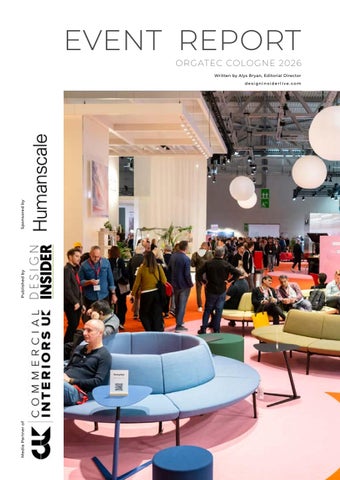
EVENT REPORT
ORGATEC COLOGNE 2026 Written by Alys Bryan, Editorial Director
Media Partner of
Published by
Sponsored by
designinsiderlive.com
ORGATEC 2026
ORGATEC F I R M LY
2026 AT
WORKPLACE THE
PLACED
THE
CENTRE
DESIGN.
EXHIBITION
PEOPLE OF
ACROSS
HALLS
IN
COLOGNE, BRANDS WERE KEEN TO COMMUNICATE THEIR COMMITMENT TO
UNDERSTANDING
VOICE,
BRAIN,
THE
HUMAN
BODY
AND
EXPERIENCE,
WITH
ON
REINFORCING
STANDS
STATEMENTS THE
DESIRE TO CREATE PRODUCTS AND ENVIRONMENTS THAT RESPOND TO THE PEOPLE USING THEM. This human-centred approach was evident throughout the event, from ergonomic wellbeing and sensory experiences to adaptable spaces, material innovation and the relationship between people and technology. But beyond the messaging, how successfully are these ambitions being translated into meaningful design? After three days exploring ORGATEC, speaking with exhibitors, designers and industry leaders, we’ve gathered our own perspectives on the products, ideas and conversations that stood out. This Event Report brings together our highlights, new product discoveries, exclusive interviews and insights into the conversations shaping the future of workplace design. Let’s dive into the details!
2
Clockwise from top left: Koelnmesse Koln. Alys Bryan, Design Insider Editorial Director. Molo. Humanscale. Bla Station, Frankfurter
EVENT REPORT CONTENTS
INTRODUCTION PAGE 2 O B S E R VAT I O N S
GOOD DESIGN IS KNOWING WHAT NOT TO DO PAGE 8
PAGE 6
B E YO N D T H E M E E T I N G R O O M :
S TA N D C O N C E P T S : D E S I G N I N G
D E S I G N I N G F O R T H E WAY W E
BEYOND THE PRODUCT
CONNECT
PAGE 22
PAGE 20
4
O R G AT E C T R E N D S
10 QUESTIONS ON
PAG E 1 0 : Colour at ORGATEC 2026
WORKPLACE DESIGN:
PAG E 1 2 : The New Executive Office
A C O N V E R S AT I O N W I T H
PAG E 1 5 : The Return of the Cantilever
CRAIG JONES PAG E 1 6
NEW PRODUCT LAUNCHES
A C O N V E R S AT I O N W I T H M A R K
PAGE 26: One Chair, Multiple Possibilities
CONSOLLA
PAGE 30: Upholstered Seating
PAGE 50
PAGE 36: Task Chairs PAGE 40: Fabrics & Flooring
JONAS PETTERSSON ON THE
PAGE 44: Small Details, Big Ideas
CHANGING ROLE OF DESIGN
PAGE 48: Desks & Tables
FAIRS PAGE 54
5
OBSERVATIONS
O R G AT E C 2 0 2 6 W E L C O M E D O V E R 4 0 , 0 0 0 V I S I T O R S A N D 5 5 0 E X H I B I T O R S T O C O L O G N E , A N O TA B L E R E D U C T I O N F R O M T H E A P P R O X I M AT E LY 5 0 , 0 0 0 V I S I T O R S A N D 7 2 9 E X H I B I T O R S R E C O R D E D I N 2 0 2 4 . L O O K I N G F U R T H E R B A C K , T H E 2 0 2 2 E V E N T AT T R A C T E D A R O U N D 4 5 , 0 0 0 VISITORS AND 686 EXHIBITORS .
The figures reveal a challenging period for one of the workplace
where showrooms, installations and fringe events create a
design industry’s most established international gatherings.
more relaxed, exploratory experience. These events encourage
Exhibitor participation fell by almost 25% compared with
visitors to move between spaces, discover brands and engage
2024, prompting questions about the investment required to
in conversations without the same traditional exhibition
participate in major trade shows and the value manufacturers
structure. Perhaps the future isn’t about choosing one format
expect in return.
over another, but understanding what each offers and how the industry wants to connect.
Across our three days at ORGATEC, there were certainly conversations about the scale of the event. Both exhibitors and
Another observation, and one that was difficult to ignore, was the
visitors commented anecdotally that the show felt smaller than
number of familiar product designs appearing across the halls.
in previous years, an impression supported by the attendance
There were many examples of furniture that closely resembled
figures. But does smaller necessarily mean less successful?
well-known originals, although the similarities weren’t always
That depends on who you ask, and what you hope to achieve
accompanied by the same attention to detail. Uncharacteristic
by attending.
colour palettes, differences in finishes and variations in tooling and manufacturing quality were sometimes telltale signs that
This question came up during my conversation with Craig
we weren’t looking at the original design.
Jones of Jones + Partners. For designers, bringing so many manufacturers together under one roof presents an excellent
It raises questions about originality, investment in design and
opportunity to make connections. For exhibitors, however, the
the commercial pressures that encourage manufacturers to
considerable expense of building and staffing a stand raises
introduce their own versions of established products.
questions about return on investment. The organisation of the exhibition halls was another talking It’s an interesting comparison with alternative formats such as
point. During my conversation with Mark, we discussed the
Clerkenwell Design Week and Copenhagen’s 3daysofdesign,
curation of the show and the sometimes surprising positioning
6
1. Ege and Artemide 2. Sedus 3. COR
1 of manufacturers presenting complete furniture solutions alongside suppliers specialising in individual components.
2
Both have an important place within the workplace furniture industry, but I wondered whether a more considered approach to their positioning could create a clearer visitor experience and help exhibitors connect with their intended audiences. And finally, something I particularly enjoyed about ORGATEC was the hospitality. There was a very noticeable desire among exhibitors to welcome people onto their stands, not simply to demonstrate products, but to encourage them to stay. Some of the larger brands, including Brunner and Sedus, created dedicated café and restaurant spaces, while stands of all sizes offered coffee, sweet treats and lunches. It was lovely to see how much effort went into making visitors feel comfortable, creating opportunities to sit down, spend time with products and get to know the people behind the brands. Perhaps this was one of the most revealing aspects of the
3
event. At a show where so many exhibitors spoke about placing people at the centre of their designs, the same thinking was being expressed through the experience of visiting their stands.
7
HUMANSCALE: GOOD DESIGN IS KNOWING WHAT NOT TO DO
AT B E Y O N D T H E D E S K : D E S I G N I N G F O R R E A L H U M A N B E H AV I O U R , H O S T E D B Y H U M A N S C A L E AT O R G AT E C 2 0 2 6 , S E R G I O S I LVA , V I C E P R E S I D E N T O F D E S I G N A N D I N N O VAT I O N AT H U M A N S C A L E , J O I N E D S I M O N K E A N E - C O W E L L , E D I T O R - I N - C H I E F O F A R C H I T O N I C , W H O E X P E R T LY G U I D E D T H E C O N V E R S AT I O N T H R O U G H D E S I G N , E R G O N O M I C S , S U S TA I N A B I L I T Y A N D T H E T H I N K I N G B E H I N D P R O D U C T S M A D E T O L A S T. TA K I N G P L A C E O N T H E H U M A N S C A L E S TA N D I N H A L L 7. 1 , A G A I N S T T H E B A C K D R O P O F I T S B O D Y. P L A N E T. M AT E R I A L S . E X H I B I T I O N , T H E D I S C U S S I O N O F F E R E D A N I N S I G H T I N T O H O W R E S E A R C H , O B S E R VAT I O N A N D T H O U G H T F U L D E S I G N C A N C R E AT E H E A LT H I E R , M O R E I N T U I T I V E W O R K P L A C E E X P E R I E N C E S .
“Most companies here are going to tell you what they’ve
meeting rooms, a café, privacy booth or lounge. As Sergio
added this year. We are defined by what we refuse to
observed, “The body doesn’t stop having requirements
add,” Sergio explained. “We don’t add products for the
when it leaves the desk, right? So the same thinking has
sake of it. Our focus has always been on a selection
to travel further.”
of key products that solve a problem really well.” This principle is evident in Humanscale’s meeting That commitment extends to avoiding harmful chemicals
chairs, designed to deliver the intuitive comfort of task
and unnecessary features that make products more
seating with self-adjusting seating that responds to the
complicated to use. “Good design is knowing what not to
individual, and the Diffrient Lounge, which supports
do. Good leadership is knowing what not to do.”
focused work, reclining and rest. Sergio explained why genuine ergonomic support matters beyond furniture that
For Sergio, who has spent 20 years at Humanscale,
simply looks comfortable. “Discomfort leads to fidgeting.
leadership is essential to maintaining these principles.
Fidgeting leads to distraction.”
A design team’s ambitions alone are not enough when responsible material choices require more demanding
The new eFloat Quattro Studio table demonstrates
sourcing strategies and higher development costs.
another important dimension: designing spaces that can transition between activities. Its adjustable height and
The conversation then turned to ergonomics and
repositionable monitor support allow the same setting to
the changing ways people work. “The body comes
accommodate collaborative meetings and individual desk
first, and the product is built to support and adapt
work. Rather than assigning rooms a single purpose, the
to the way we work, and not the other way around.”
aim is to give people greater freedom over how they work.
Traditionally, ergonomic thinking centred on the individual workstation, but today’s working day might involve several
8
Simon also questioned how products can remain relevant
The conversation closed with the importance of
over time. Sergio explained that expectations are
collaboration, particularly the healthy tension between
influenced more by changing behaviour and culture than
designers and engineers. Sergio described how different
by changes to the human body itself. People increasingly
perspectives
want authentic materials, sustainable solutions and
outcomes, with no single individual responsible for every
reassurance about the companies behind the products.
decision.
Longevity remains an important measure of success.
For Sergio, recognition is welcome, but the real
Sergio referenced the Freedom chair, in production for 27
achievement lies in continuing to fight over those
years with its original design intent virtually unchanged.
millimetres between design and engineering to create
“Ultimately, time is the true test,” he reflected. With
products without compromise. It was a fitting conclusion
technology, replaceable and upgradeable components
to a conversation that demonstrated why meaningful
become equally important. “Simplicity is also one of the
design requires conviction, curiosity and knowing when
best ways that you can make things timeless.”
less really is more.
challenge
assumptions
and
improve
9
MINI TREND: COLOUR AT ORGATEC 2026A TALE OF TWO SHADES
I F T H E R E WA S O N E T H I N G O R G AT E C 2 0 2 6 WA S N ’ T S H O R T O F , I T WA S C O L O U R ! A N D WHILE THERE WERE PLENTY OF SHADES COMPETING FOR OUR AT T E N T I O N , T WO PA R T I C U L A R FAVO U R I T E S K E PT P O P P I N G U P W H E R E V E R W E L O O K E D. From upholstery and component finishes to wallcoverings, screens, curtains and even entire exhibition stands, these two colours were clearly enjoying their moment in the spotlight. First up, a deliciously rich red-brown. Burgundy? Perhaps, but this was its brighter, bolder and altogether more spirited cousin. Warm, confident and just a little bit indulgent, this irresistible shade brought depth and personality to everything it touched. We spotted it across furniture, textiles and stand architecture, and we couldn’t get enough! Then came a breath of fresh air in the form of cool, crisp blue. Molo went all in, introducing Glacier Blue, a beautiful new colour for its products that flooded the brand’s stand with icy freshness. Elsewhere across ORGATEC, similar blue tones were making their presence felt, bringing clarity, calm and a refreshing contrast to all that red-brown warmth. Two very different personalities, both making quite the impression. One brings the warmth, the other keeps its cool, and together they reminded us just how much fun colour can bring to workplace design. Which one would you choose?
10
1
2
3
C O L O U R T R E N D S : A N E XP E R T P E R S P E C T I V E Insights from Victoria Redshaw, Futurist To explore the significance of the colour directions we observed at ORGATEC, we spoke with futurist Victoria Redshaw, who shared her insights into the emotional and cultural influences behind two particularly prominent colour families: Glacier Blue and rich burgundy and port shades Victoria highlights how colour is increasingly responding to our emotional needs. Glacier Blue offers a sense of clarity and calm, while its shifting tonal intensities introduce a more transformative, future-facing quality. Meanwhile, brown-infused burgundies reflect a growing emphasis on sensory experiences and emotion-led design, bringing warmth, reassurance and sophistication to interior spaces.
1
GLACIER BLUE: Rooted in the familiar tones of a clear sky, it connects to the growing instinct to seek clarity, tranquillity, openness, and truth in our dark, unstable, and confusing times. With rising stress levels and over-stimulation, people want workspaces that feel restorative, hopeful, and calming.
B U R G U N DY / P O R T S H A D E S : These lusciously rich shades have a captivating emotional presence at a time when people need inner strength and assuredness to combat uncertainty and a lack of control in a chaotic world. They communicate conviction through their depth, but also humanity, because brown-infused burgundies carry a compelling, sensual warmth that is reassuringly grounding and inviting.
4
5
1. Molo, Glacier Blue 2. Humanscale, Diffrient Lounge 3. Bla Station, Agile Coat Stand 4. Johanson
4
5
5. Lapalma
11
THE NEW EXECUTIVE OFFICE: LESS HIERARCHY, MORE HOSPITALITY
T H E E XE C UT I VE O F F I C E I S U N D E R G O I N G A
T R A N S F O R M AT I O N .
AC R O S S
THE
E XH I B I T I O N H A L L S , WE N O T I C E D A S H I F T AWAY
FROM
TOWA R D S
TRADITIONAL
LEADERSHIP
F O R M A L I TY
S PAC E S
T H AT
F E E L S O F T E R , M O R E WE LCO M I N G A N D MORE
CO N N E C T E D
TO
THE
WI D E R
WO R K PL A C E . The executive office is undergoing a transformation. Across the exhibition halls, we noticed a shift away from traditional formality towards leadership spaces that feel softer, more welcoming and more connected to the wider workplace. While the executive desk remains an important feature, the surrounding environment is changing. Furniture, colour
palettes
and
materials
increasingly
reflect
those found throughout the wider workplace, creating a
more
consistent
design
language.
High-quality
materials, including solid timber and leather, continue to distinguish these spaces, but softer forms and more relaxed arrangements bring a sense of approachability. Perhaps the most significant development is the inclusion of dedicated meeting and collaborative areas. Heightadjustable desks now sit alongside upholstered lounge seating and smaller meeting tables, allowing senior leaders to welcome colleagues into their offices. Privacy remains important, but these spaces are being designed to support interaction as well as individual working. Five brands offered interesting interpretations of this emerging approach.
12
Muuto | Informal Yet Refined Muuto presented a meeting environment that balanced informality with a refined aesthetic. Soft forms, considered materials and a restrained colour palette created a sophisticated setting without relying on traditional executive styling. The space featured the new Brink chair, designed by Thomas Bentzen. Available with three base options, three shell options and three colours, the collection also offers stacking and linking capabilities. The overall composition demonstrated how contemporary meeting furniture can introduce warmth and approachability into leadership environments while retaining a sense of quality.
Sedus | The Leadership Suite
Brunner | Wave
Sedus presented the concept of a leadership suite,
Brunner’s Wave executive desk, designed by Jehs+Laub,
exploring how executive environments can reflect the
combines height-adjustable functionality with distinctive
working experiences offered to the wider organisation.
detailing. Its waterfall edge, complemented by an inlaid leather element following the same profile, creates a strong
The installation combined a height-adjustable workstation
visual identity.
with informal seating and a dedicated meeting area, providing
spaces
for
individual
work,
confidential
discussions and collaboration.
The coordinating Wave sideboard and Wave wall extend the collection, with configurable panels, shelving, screens and material options allowing the environment to be
An interesting point raised during our conversation with
personalised.
Sedus was the importance of consistency between
Although the displayed colour palette remained relatively
leadership and team environments. If employees are
formal, the asymmetric forms, flexible shelving arrangements
encouraged to work flexibly and collaboratively, providing
and carefully selected accessories introduced a more
senior leaders with similar settings can help reinforce a
playful and informal character.
shared workplace culture. The display also included a new meeting configuration of the se table, demonstrating how executive spaces can accommodate a broader range of activities.
13
Sunon | ARC Sunon’s ARC executive desk offered a more sculptural interpretation of executive furniture. The Chinese manufacturer showcased a distinctive form inspired by thier vision of the future, incorporating an acrylic modesty panel that creates the appearance of a floating desktop. While retaining the presence traditionally associated with executive desks, ARC introduces a more expressive silhouette, offering an alternative to conventional formal designs. A New Approach to Leadership Spaces .MDD | TOMO
Across these examples, executive interiors are becoming
With the launch of TOMO, .MDD introduced a new brand
more closely aligned with the design language and working
centred around a high-specification wooden furniture
practices of the wider organisation.
collection with a distinctly residential aesthetic. Quality materials, privacy and individual identity remain Tactile finishes, considered detailing and warm materials
important, but they are increasingly complemented by
make the collection particularly relevant to the emerging
comfortable seating, opportunities for collaboration and a
executive lounge, where comfort and a welcoming
more welcoming aesthetic.
atmosphere are becoming increasingly important. The result is an executive office that places less emphasis TOMO demonstrates how the quality associated with
on hierarchy and greater importance on connection,
traditional executive furniture can be expressed through a
reflecting a broader change in how leadership spaces are
softer, more domestic design language.
designed and experienced.
14
MINI TREND: THE RETURN OF THE CANTILEVER CHAIR
THE
CANTILEVER
AWAY,
BUT
IT
CHAIR
C E R TA I N LY
NEVER
R E A L LY
E N J OY E D
A
WENT
RENEWED
P R E S E N C E A C R O S S T H E E XH I B I T I O N H A L L S . S E V E R A L B R A N D S I N T R O D U C E D C A N T I L E V E R B A S E S A S PA R T OF
COLLECTIONS
OFFERING
M U LT I P L E
S E AT I N G
C O N F I G U R AT I O N S , B R I N G I N G T H I S FA M I L I A R D E S I G N BACK INTO FOCUS. Particularly striking were the chunky tubular frames, which gave the classic cantilever silhouette a bolder, more contemporary character. Combining a sense of nostalgia with fresh proportions and finishes, these designs demonstrated the continued appeal of a workplace furniture favourite. Brunner | ray work Cantilever Chair Designed by jehs+laub, the new ray work cantilever chair features a slender plastic frame that flows continuously from armrest to base. Available with innovative mesh or upholstered finishes, its lightweight, stackable design combines flexibility, comfort and practicality for meeting and conference spaces. Bene | ONE Designed by Pearson Lloyd, ONE is a coordinated furniture collection supporting different forms of workplace interaction. From focused conversations to informal collaboration, its consistent design language connects different settings. The lounge chair brings a softer, welcoming character to the collection’s versatile approach to workplace furniture. Muuto | Brink Chair Designed by Thomas Bentzen, Brink combines a slender, form-pressed wooden shell with a distinctive folded edge. Available with cantilever and stacking base options, alongside different upholstery treatments, the chair balances comfort, structural strength and practicality, offering versatility across meeting and collaborative environments.
15
16
10 QUESTIONS ON WORKPLACE DESIGN: A CONVERSATION WITH CRAIG JONES
WH E R E WI L L T H E N EXT B R E A KT H R O U G H I N WO R K PL AC E D E S I G N CO M E F R O M ? H OW CAN MANUFACTURERS CREATE PRODUCTS THAT RESPOND TO CHANGING NEEDS? AND COULD DESIGNING FEWER, BETTER PRODUCTS OFFER A MORE SUSTAINABLE FUTURE? A CONVERSATION WITH CRAIG JONES AT ORGATEC REVEALED EXCITING OPPORTUNITIES FOR INNOVATION, PRODUCT DEVELOPMENT AND THE FUTURE OF WORKPLACE DESIGN.
Craig Jones is the founder of Jones + Partners, a Brighton-based industrial design studio with over 25 years of experience working across furniture, lighting, acoustics, electronics and beyond. Combining creative thinking with engineering and commercial understanding, the studio has extensive experience navigating the challenges of bringing new products to market. When Design Insider caught up with Craig at ORGATEC, our conversation explored the opportunities ahead for designers and manufacturers. From groundbreaking innovation and the future of trade shows to research-led design, product longevity and changing working behaviours, his observations inspired ten questions for the wider workplace design industry. 1. Where will the next breakthrough in workplace design
2. How can trade shows create even greater value?
come from? For Craig, ORGATEC offers an exceptional opportunity to Craig recalls the excitement of products that transformed
connect with manufacturers and industry professionals.
workplace behaviour, from pioneering task chairs to the
But as participation represents a significant investment,
introduction of office pods. While today’s exhibitions
he sees opportunities to explore complementary formats.
feature many interpretations of established product
Could the more informal, knowledge-led approach of
categories, he believes the opportunity lies in identifying
showroom events and design festivals help create even
the next unmet need. What new behaviours, technologies
greater value for exhibitors and visitors?
or working patterns might inspire the next breakthrough?
17
3. How can understanding unmet needs inspire better
specification. The opportunity for designers is to find the
products?
balance between creative ambition, customer expectations and commercial success.
A recurring theme in Craig’s work is the importance of looking beyond gaps in a manufacturer’s product portfolio
6. How can continuous improvement extend a product’s
to understand what customers actually need. Rather than
potential?
responding to competitors’ collections, he advocates identifying requirements that existing products don’t
For Craig, a product launch shouldn’t signal the end of
address. Could a greater focus on unmet needs lead to
development. Advances in technology, materials and
more purposeful and successful innovation?
manufacturing offer opportunities to continually improve functionality and performance. He points to established
4. Could research unlock the next generation of
products that have developed significantly while appearing
workplace products?
relatively unchanged. How can manufacturers make ongoing refinement a more integral part of their product
Some product briefs are so complex that Craig believes
development strategies?
meaningful research should come before any design work begins. With demographics, technology and
7. Could designing fewer, better products be the future
working behaviours continually changing, investing time
of sustainability?
in understanding the challenge can reveal unexpected opportunities. What might manufacturers discover by
Craig jokes that perhaps the most sustainable thing a
questioning the brief before developing the solution?
product designer could do is retire. But behind the humour is an interesting opportunity: to focus on designing fewer,
5. How can designers balance originality with commercial
better products that have a clear purpose and lasting
success?
value. Could greater consideration of what we bring to market encourage more responsible innovation and
Creating something distinctive is exciting, but successful
longer-lasting products?
product design must also respond to commercial realities. Craig recognises that experimental products may attract
8. What can changing working behaviours teach us
attention without necessarily achieving widespread
about future workplaces?
18
Craig highlights the complex relationship between
What should come next?
individual and collaborative working, time, space and demographic differences. Add technological developments
Our conversation with Craig highlighted the opportunities
and unexpected changes in behaviour, and designing for
that lie ahead for workplace design. From identifying
the future becomes an exciting challenge. How can a
unmet needs and investing in research to extending
better understanding of these relationships inspire more
product lifespans and reconsidering how we support
adaptable products and working environments?
changing working behaviours, there is plenty of potential for designers and manufacturers to explore.
9. Can informal workplaces and ergonomic wellbeing work together?
What connects these ideas is a belief that meaningful innovation comes from understanding people, questioning
As workplaces become more informal and residential
assumptions and continually seeking opportunities to
in character, Craig sees an interesting challenge for
improve the products and environments we create.
ergonomic design. Younger generations may prefer greater freedom in how and where they work, creating
Perhaps the most exciting question isn’t simply what we’ll
opportunities to reconsider conventional workplace
design next, but what new possibilities we have yet to
furniture. Could new solutions combine flexibility, comfort
discover.
and long-term physical wellbeing while supporting different working preferences? 10. What opportunities exist for ergonomics beyond the traditional office? Craig sees potential for ergonomic products that respond to domestic environments and other settings where people work. Traditional office furniture doesn’t always belong aesthetically or functionally in these spaces. Could designers create solutions that integrate more naturally into different environments while meeting their specific functional and ergonomic requirements?
19
ADVERTORIAL
BEYOND THE MEETING ROOM: DESIGNING FOR THE WAY WE CONNECT
A S T H E W O R K P L A C E E V O LV E S , S O T O O D O E S T H E WAY W E C O N D U C T M E E T I N G S . H U M A N S C A L E EXPLORES
HOW
HUMAN-CENTRED
DESIGN
CAN
TRANSFORM
C O L L A B O R AT I V E
S PA C E S ,
B R I N G I N G T O G E T H E R C O M F O R T, M O V E M E N T A N D M AT E R I A L I N N O VAT I O N .
Meetings have changed. No longer confined to traditional
This underpins Humanscale’s long-standing design
meeting rooms, they take place across a growing
philosophy: good design should adapt to people, rather
variety of spaces, from informal collaboration areas and
than requiring people to adapt to it.
project rooms to executive meeting suites and hybrid environments. Each demands a different balance of
Pioneering
designer
Niels
Diffrient
challenged
comfort, focus and connection.
conventional thinking around seating, creating chairs that respond intuitively to the human body, reducing
As organisations rethink how and where people come
complicated adjustments while encouraging natural
together, today’s meeting spaces need to be flexible,
movement.
welcoming and designed around the people using them. Increasingly, they must also reflect the warmth, character
This philosophy is particularly relevant in shared meeting
and material richness associated with residential and
environments, where different people use the same
hospitality interiors.
chair throughout the day. Seating must accommodate different users effortlessly, allowing them to focus on the
Designing for People, Not Postures
conversation rather than adjusting their chair.
Consider this: on average, a person sits in six different chairs over the course of a day. From individual
A Collection Designed for Connection
workstations to shared meeting spaces, each presents a
Humanscale’s Meeting Collection brings this philosophy
different experience of comfort and support.
to life, combining ergonomic performance with a refined, considered aesthetic.
Yet while environments change, the need for intuitive ergonomic support remains constant.
20
From
formal
boardrooms
to
relaxed
collaborative
environments, the collection supports different ways
As
workplace
interiors
become
more
design-led,
of interacting, reflecting Humanscale’s commitment to
TexMesh offers greater freedom to create collaborative
simplicity, comfort and intuitive functionality.
environments that feel inviting and sophisticated, without compromising comfort or functionality.
The World Conference Chair embodies this approach. Its minimalist architecture and weight-sensitive recline allow
Better Meetings by Design
the chair to respond naturally as the sitter moves, providing
The most successful meeting spaces make participation
effortless support without unnecessary complexity.
feel effortless. Intuitive support and freedom of movement allow people to engage naturally and concentrate on what
A New Material Expression
matters.
At Orgatec 2026, Humanscale introduced TexMesh, an innovative textile back option for World Conference, Smart
As the boundaries between focused work, collaboration
and Liberty chairs.
and hospitality continue to blur, seating has an increasingly important role to play.
Developed from Kvadrat’s Autumn textile, TexMesh reengineers a traditional textile into a performance backrest,
For Humanscale, better meetings start with better seating:
combining breathability and responsiveness with a softer,
designed to respond to the individual, complement the
more tactile material expression.
space and work without demanding attention.
The result brings together two increasingly important considerations for architects and designers: ergonomic
Because when seating works effortlessly, people are free
performance and visual warmth.
to focus on collaborating, sharing ideas and achieving more together
Images left to right: eFloat Quattro Studio World Conference. Texmesh World Conference Meeting Room. Texmesh
21
STAND CONCEPTS: DESIGNING BEYOND THE PRODUCT
Sedus | Spaces That Care: Bringing Workplace Habitats to Life OF ALL THE EXHIBITION STANDS WE EXPLORED, SEDUS PRESENTED DESIGN
PERHAPS
CONCEPT,
THE
STRONGEST
USING
OVERARCHING
ARCHITECTURE
TO
COMMUNICATE ITS SPACES THAT CARE PHILOSOPHY.
Designed by Mojdeh Barkhordar, Head of Workspace Design Team and Senior Interior Designer Showrooms & Events, the stand took inspiration from an urban plaza. A central atrium provided an open, welcoming space, surrounded by a series of architectural environments that created the impression of a multi-storey building. Raised floor levels introduced changes in elevation, while overhead structural grids and beams created varying ceiling heights. These differences were carefully considered to reflect the activities taking place below, from the more intimate proportions of spaces for concentration and retreat to the generous ceiling heights of social and collaborative areas.
22
Adding another dimension was a motorised lighting installation simulating the changing light and colours of sunrise and sunset, bringing an awareness of natural daily rhythms into the experience. Within this architectural framework, Sedus introduced five Habitats: Welcome & Arrival, Focus & Retreat, Workshop & Meeting, DeskBased Working, and Socialising & Sharing. Inspired by the biological meaning of habitat, each environment was designed to provide the conditions and resources people need to thrive. Four complementary colour atmospheres — Calm & Craft, Glow & Grain, Flow & Feel and Colour & Character — further demonstrated how materials, colour and spatial character can respond to different human needs.
1
The result was a thoughtfully layered stand where architecture, furniture, colour and light worked together to communicate a clear vision for the workplace, rather than simply presenting individual products. 1. Se: Meet Armchair
23
Muuto | Sense of Belonging Muuto created one of the most welcoming stands at the event, bringing its Sense of Belonging concept to life through a series of thoughtfully designed workplace settings. Divided into spaces reflecting different activities throughout the working day, the stand demonstrated how furniture, colour, materials and lighting can support concentration, collaboration and informal interaction. Each setting had its own character, yet the overall aesthetic remained beautifully cohesive, with warm materials, soft forms and a distinctly residential feel. The result was an inviting environment that encouraged visitors to explore, settle in and experience how thoughtful design can create a sense of belonging.
4
Above - Coltre Modular Sofa. Below - Includes Folded Trolley.
24
Accredited commercial suppliers 200 accredited supplier profiles Filter with ease At a glance brand + business information Full supplier contact details
DESIGNINSIDERLIVE.COM/SUPPLIER-FINDER
23
NEW PRODUCT LAUNCH
One Chair, Multiple Possibilities
.MDD | NUD
BRUNNER
Designer: Alejandro Valdés
Designers: jeh
Contoured plywood seating with four base
Generously
options, combining playful colours with a cohesive
flexible backr
collection-wide palette.
upholstery an
BRUNNER | PERGA
MUUTO |
Designer: Jonathan Olivares
Designer: Tho
Sculptural seating with a distinctive full-radius top
Flowing
edge detail, multiple material choices and armrest
configurations
options.
practical stack
S I D E C H A I R S W I T H M U LT I P L E B A S E O PT I O N S A R E A N E S TA B L I S H E D WO R K P L A C E F U R N I T U R E C AT E G O R Y, S O I T WA S N O S U R P R I S E T O S E E S E V E R A L N E W C O L L E C T I O N S L A U N C H E D.
For manufacturers, these versatile designs offer an opportunity to fill portfolio gaps, make efficient use of standardised components and continually expand collections with new configurations, materials and finishes. What particularly caught our attention were the designs bringing personality to this familiar product type. From the playful shapes and distinctive detailing of Noti’s Kap to the generous proportions and material choices of Brunner’s scoop soft, there was plenty of individuality on display. Muuto’s Brink brought its signature softness and flowing curves, while .MDD’s Nud embraced a cheerful colour palette. Flokk’s HÅG Minu also stood out for its compact
proportions
and
confident
colour-blocking.
Together, these launches demonstrated how thoughtful design, materiality and colour can bring fresh character to one of the workplace’s most familiar furniture categories.
26
ply
R | SCOOP SOFT
THONET | S 760
ARTIFORT | BESO
hs+laub
Designer: Uwe Sommerlade
Designer: Khodi Feiz
proportioned meeting chair with
Versatile, stackable seating with clever stacking
Elegantly
rest, five base options and varied
guides, optional linking and an innovative digital
proportions, optional armrests and versatile timber,
nd shell finishes.
seat-numbering system.
metal and swivel bases.
BRINK CHAIR
N O T I | KA P
FLOKK / HÅG | MINU
omas Bentzen
Designers: Studio Kabo & Pydo
Designers: Andreas Engesvik & Jannicke Grung
base
Playful, modular seating with distinctive circular
Compact,
s, varied upholstery options and
fixings, extensive configuration options and easy
expressive colour-blocking, playful proportions
king and linking functionality.
disassembly for refurbishment.
and a fresh approach to task seating.
ywood
shell
with
three
upholstered
characterful
seating
with
workplace
flowing
chair
with
27
M O N T I S | FA B I E N N E Designer: Oliver Schick Comfortable, enveloping dining chair with three distinctive base options, expressive colours and replaceable upholstered cushioning.
28
N A R B U TA S | B O TA N Y Product design consultant: Gensler Nature-inspired chair with sculptural bent-veneer shell, sweeping armrests, upholstered seat and alternative base configurations.
29
NEW PRODUCT LAUNCH
M U U T O | C O LT R E M O D U L A R S O F A
Upholstered Seating: Two Sides of Comfort
Designer: Studiopepe Seven modular elements, generous quilted upholstery, removable
M O D U L A R S O FA S W E R E A FA M I L I A R S I G H T
covers, loose armrest cushions and optional castors.
A C R O S S T H E E XH I B I T I O N H A L L S , A N D W I T H GOOD REASON.
In workplace interiors, versatility is essential, and modular systems offer designers the flexibility to create seating arrangements that respond to different spaces, activities and briefs. What caught our attention was the contrast between two distinct approaches to upholstery. At one extreme, generously proportioned sofas with bold, full forms created a strong visual presence, exemplified by Muuto’s Coltre modular sofa, with its seven modules and fully removable upholstery. At the other, Lapalma’s HUB sofa system demonstrated a lighter, more pared-back approach, with slim proportions and upholstery extending down the legs to create an easygoing, relaxed aesthetic.
SOFTLINE | CHOCO Designer: Javier Moreno
Both approaches offer comfort and flexibility, but with very
Five modular upholstered elements and complementary tables
different personalities.
create playful, reconfigurable landscapes for informal meetings.
30
B L Å S TAT I O N | R U TA N
NOTI | TOPO
Designers: Thomas Bernstrand and Stefan Borselius
Topography-inspired
Slender interchangeable steel legs, optional castors and magnetic
layers, memory-foam comfort, contrast piping and adaptable
connections allow flexible arrangements.
configurations.
SOKOA | MAKILA
N U N C | D I KA L O U N G E
Designer: Piergil Fourquié
The collection expands with a two-seater arrangement featuring
Slim metal legs in multiple colours, integrated power, side tables
an integrated central table for informal interaction.
modular
seating
combines
geometric
and optional high-back acoustic configurations.
31
BRUNNER | SESSION Designers: Doshi Levien Modular lounge seating with straight and curved configurations, sofas, armchairs, daybeds and tables. Distinctive folded arms introduce a subtle mid-century character, while L-shaped end panels offer contrasting upholstery, material finishes, storage surfaces and optional pivoting writing tablets. Timber and aluminium base options complete the collection.
32
L A PA L M A | H U B Designer: Francesco Rota HUB takes a lighter, more pared-back approach to modular seating, with slim proportions and softly curved upholstered forms. A distinctive detail sees the upholstery extend down the leg frame, creating a continuous visual line and a relaxed, easygoing character. The collection includes modular configurations alongside individual sofas and chairs, offering flexibility for different workplace settings. Its understated design brings a sense of informality without compromising on elegance.
33
J U S T A S H O R T WA L K F R O M KO E L N M E S S E ’ S M A I N E XH I B I T I O N H A L L S , D E S I G N P O S T KÖ L N O F F E R E D A N I M P R E S S I V E E XT E N S I O N T O O U R O R G AT E C E XP E R I E N C E .
Celebrating its 20th anniversary, the venue occupies a beautifully restored former postal building, bringing together international furniture and interiors brands in a setting quite different from a conventional trade fair. With more than 40 international brands involved in the 2026 programme, Design Post was a substantial destination in its own right, with an impressive quality of exhibitors and plenty to discover. Its combination of permanent showrooms, curated displays and relaxed spaces for conversation provided an appealing alternative to the exhibition halls. This year, Design Post was officially part of both ORGATEC and the parallel idd cologne event, bringing workplace and
residential
We
selected
interiors three
into
particularly
closer
conversation.
interesting
product
developments from Ocee & Four Design, Flokk’s Profim and Arper, each offering a distinctive approach to modularity, adaptability and material innovation.
34
ARPER | AOM Designer: Jean-Marie Massaud Polyurethane-free upholstery combines recyclable polyester padding, lightweight expanded-polypropylene construction and removable covers in a mechanically assembled, glue-free system.
OCEE & FOUR DESIGN | BLOOM Designer: Hee Welling Bloom is a modular seating collection comprising 19 elements, designed to guide the flow through space while creating opportunities for informal interaction. Its distinctive end profile takes inspiration from a flower in bloom, bringing a soft, sculptural quality to the collection. The design reflects the brand’s FDA philosophy — Function, Design and Aha — where thoughtful functionality and playful details come together to create moments that make people smile.
FLOKK / PROFIM | LUNEA Designer: Stylex Studio Lunea offers a particularly clever approach to modular seating, allowing individual units to be adjusted in width in 10cm increments to fit specific spaces. Its compact seat depth makes it suitable for environments where space is limited, while an online configurator simplifies planning. Distinctive die-cast aluminium legs are available as end supports or connecting elements, creating a consistent aesthetic across different arrangements. The system combines dimensional flexibility with refined detailing and practical functionality.
35
NEW PRODUCT LAUNCH
ACTIU | ALZIA Designer: Alegre Design
Task Chairs: Comfort in Motion
An approachable task chair with rounded forms, breathable W I T H S O M A N Y TA S K C H A I R S O N D I S P L AY, O U R
backrest, integrated lumbar support and discreet adjustments.
S E L E C T I O N I S B Y N O M E A N S A N E XH A U S T I V E LIST
OF
I N S T E A D,
THE
LAUNCHES
WE’ VE
AT
THE
HIGHLIGHTED
E V E N T. DESIGNS
T H AT C A U G H T O U R AT T E N T I O N F O R T H E I R INDIVIDUAL
APPROACHES
TO
C O M F O R T,
M OV E M E N T, M AT E R I A L I T Y A N D E R G O N O M I C I N N OVAT I O N .
From Humanscale’s TexMesh™, which introduces the tactile qualities of upholstery to performance mesh, to KOKUYO’s ingCloud, designed to encourage movement in every direction, manufacturers continue to explore how task chairs can better support the body throughout the working day. Sedus revisited its established black dot chair, introducing updated ergonomics and a softer aesthetic, while Actiu’s Alzia and Elyr demonstrated different approaches to combining functionality with contemporary design. Nowy Styl’s Omiko brought further personality through its
A C T I U | E LY R
distinctive backrest and two-tone knitted upholstery.
Designer: Alegre Design A new ergonomic task chair combining comfort, adaptability and Actiu’s experience in developing contemporary workplace seating.
36
SEDUS | BLACK DOT
KLÖBER | LOOC
A redesign of the established black dot chair introduces softer
Inspired by 1930s design, LOOC combines timeless simplicity,
forms, updated finishes and additional ergonomic functionality,
clean lines and an understated aesthetic with contemporary
including optional automatic weight-responsive adjustment.
workplace functionality.
NOWY STYL | OMIKO
INTERSTUHL | VEOH
A distinctive swivel chair featuring two-tone knitted upholstery and
Designer: Phoenix Design
a teardrop-shaped backrest, combining ergonomic comfort with
Award-winning ergonomic seating combines an enveloping,
characterful detailing.
residential-inspired silhouette with concealed mechanisms, adjustable support and replaceable components.
37
HUMANSCALE | TEXMESH™ Humanscale introduced TexMesh™, an innovative new backrest material for its Liberty, World and Smart task chairs. Reengineered from Kvadrat’s Autumn textile, TexMesh combines the breathability and responsive support of mesh with the rich texture, colour and tactile qualities of upholstery. The development offers designers greater creative freedom without compromising ergonomic performance, bringing warmth and a more tailored aesthetic to Humanscale’s established seating collections.
38
KOKUYO | INGCLOUD Designer: Yojiro Kinoshita Eight years in development, KOKUYO’s ingCloud was awarded the Red Dot: Best of the Best Award 2026. Its innovative triple-gliding mechanism allows the seat, backrest and armrests to move together in 360 degrees, encouraging natural movement throughout the working day. A distinctive 3D Hammock Mesh backrest wraps around the body, distributing pressure while providing responsive support. The chair reflects the Japanese manufacturer’s commitment to movement-led ergonomics, combining technical innovation with a distinctive sitting experience.
39
NEW PRODUCT LAUNCH
Fabrics & Flooring: Material Matters THE
M AT E R I A L
LAUNCHES
BROUGHT
T O G E T H E R S O M E PA R T I C U L A R LY I N T E R E S T I N G DEVELOPMENTS
IN
T E XT U R E ,
COLOUR,
P E R F O R M A N C E A N D S U S TA I N A B I L I T Y. F R O M FLOORING
T H AT
C E L E B R AT E S
W E AV I N G
TECHNIQUES
TO
TRADITIONAL
I N T E R F A C E | P I V O TA L M O M E N T S
F E LT O U C H
Designs: In Motion and Shift Point
Modular acou
Two
complementary
carpet
tile
designs,
PET productio
combining fine textures and subtle geometry
supporting cir
across 16 coordinated colourways.
UPHOLSTERY
FA B R I C S W I T H T H E S O F T N E S S O F R E S I D E N T I A L T E XT I L E S , M A N U FA C T U R E R S A R E F I N D I N G N E W WAY S T O C O M B I N E TA C T I L E A P P E A L W I T H T H E PRACTICAL REQUIREMENTS OF COMMERCIAL INTERIORS.
Craftsmanship was a recurring influence. Ege Carpets’ Matter
collection
explored
the
relationship
between
digital design and traditional weaving, while Interface’s Crafted Connections drew inspiration from hand-worked textiles. Vescom introduced upholstery that combined rich textures with recycled materials, and JAB demonstrated how decorative curtains can also offer acoustic benefits. We
were
considered
equally
interested
the
life
wider
of
in
developments
a
material,
that
including
Feltouch’s approach to repurposing PET production waste. Across these collections, material innovation wasn’t simply about appearance. It offered designers new opportunities to shape atmosphere, improve performance and make more considered specification choices.
40
INTERFACE | CRAF TED
VESCOM |
CONNECTIONS
Coral-inspired
Thread Lightly, Bound to Last and Dual Effect
Germany fro
Three carpet designs inspired by traditional textile
polyester, ava
craftsmanship, combining woven textures, bouclé and geometric patterns.
H | ZERO BRICK
ustic bricks made from recompressed
on waste, without chemical binders,
rcular design.
| CORAL
E G E C A R P E T S | M AT T E R
d textured upholstery, woven in
Design: Snøhetta
om 100% recycled flame-retardant
Developed using generative algorithms and advanced flatweaving technology, Matter creates naturally
ailable in 34 colourways.
irregular patterns through the construction of the carpet itself. Recycled PET weft yarns introduce two distinct colour directions: saturated blue and green, or muted beige and grey. The collection offers 18 colours and is available in tiles, planks, broadloom and rugs.
41
JAB | ACOUSTIC GUARD LITE An extension of JAB’s acoustic curtain offering, Acoustic Guard Lite combines decorative flexibility with sound reduction. Its four-layer construction includes two internal acoustic layers between decorative fabrics, allowing different finishes to be specified on either side. JAB demonstrated its performance through an immersive installation combining sound and light
42
V E S C O M | O N YX A luxurious two-tone mohair velvet combining 70% mohair with 30% cotton. Different dye absorption properties create contrasting colours within a single fabric, producing unusual depth and richness. Cradle to Cradle Bronze certified, Onyx offers 120,000 Martindale rubs and 100,000 Wyzenbeek double rubs.
43
NEW PRODUCT LAUNCH
Small Details, Big Ideas N O T E V E R Y N E W P R O D U C T F I T S N E AT LY I N T O
FELLOWES
A N E S TA B L I S H E D F U R N I T U R E C AT E G O R Y, A N D
C O N C E PT
S O M E O F O U R FAVO U R I T E D I S C OV E R I E S W E R E
On-desk controls allow connected equipment to be switched off
THE SMALLER, MORE UNUSUAL SOLUTIONS
together, reducing unnecessary standby energy consumption.
|
S TA N D B Y
POWER
CONTROL
A D D R E S S I N G S P E C I F I C WO R K P L A C E N E E D S .
From Fellowes’ clever approach to reducing standby power consumption to a bag designed to keep personal belongings off the floor, these products demonstrate how thoughtful design can make everyday working experiences simpler and more enjoyable. We also discovered interesting developments in materiality, including molo’s collaboration with specialist papermaker Gmund, alongside products that make maintenance, adaptation and repair more straightforward. Lighting provided another highlight, particularly Artemide’s exploration of bringing the changing colours of natural daylight indoors. What connects these varied launches is their attention to detail. Some offer technical innovation, others introduce playful functionality or beautiful material qualities, but each demonstrates how a considered design response can make a meaningful difference to the spaces we use.
44
FELLOWES
|
RECYCLED
PET
CABLE
MANAGEMENT Prototype cable trays use recycled, recyclable PET felt in 25 colours, retrofittable up to 2.7 metres.
G U S TAV | P O R TA B L E W O R K S PA C E S Y S T E M
ARTEMIDE | DUSK
Three new colourways coordinate timber surfaces with metalwork,
Design: BIG – Bjarke Ingels Group
bringing a cohesive aesthetic to portable hot-desking solutions.
Two complementary light emissions recreate changing sky colours, bringing a programmable, horizon-inspired lighting experience.
G U S TAV | P O R T B A G
JOHANSON DESIGN | SPLIT
An integrated aluminium hook with silicone overmould allows the
Designers: Färg & Blanche
bag to hang from furniture, keeping belongings accessible and off
Sculptural stools and benches integrate upholstery into their metal
the floor.
frames, creating a distinctive structural textile detail.
45
M O L O | S L O P E D S O F T WA L L A N D N E W C O L O U R S Designers: Stephanie Forsythe and Todd MacAllen Molo introduced glacier blue and deep blue to its soft collection, developed through a new partnership with German papermaker Gmund. The bespoke papers bring contrasting atmospheric qualities, from the airy freshness of glacier blue to the richer intensity of deep blue. The collection also includes sloped softwall, a sculptural development of its flexible partition system. With vertical pleats on one side and an angled profile on the other, the design reveals the honeycomb structure of the paper, creating new interactions with light while defining spaces.
46
B L Å S TAT I O N | A B L E S TA N D Designers: Johan Lindau, Stefan Borselius and Thomas Bernstrand ABLE Stand extends Blå Station’s modular ABLE collection, introduced in 2024, with a coat stand celebrating honest, uncomplicated design. Its construction leaves components and connections visible, making the product straightforward to assemble, maintain, repair and upgrade over time. According to Blå Station, it can accommodate up to 50–60 jackets and personal belongings. Available in standard colours, with bespoke finishes also possible, ABLE Stand combines practicality with a considered approach to longevity and resource efficiency.
47
NEW PRODUCT LAUNCH
Desks & Tables: Spaces to Work and Connect DESKS
AND
IN
IMPRESSIVE
AN
TA B L E S
WERE
REPRESENTED
VA R I E T Y
OF
FORMS,
S I Z E S A N D C O N F I G U R AT I O N S A C R O S S T H E
MOBEL LINEA | MESTRAL Executive desks and meeting tables feature substantial melamine tops, metal frames and coordinating modesty panels.
E XH I B I T I O N H A L L S . W H I L E T H I S WA S N ’ T A P R O D U C T C AT E G O R Y W E E XP L O R E D I N Q U I T E THE
SAME
D E PT H
AS
S E AT I N G ,
SEVERAL
D E S I G N S C A U G H T O U R AT T E N T I O N F O R T H E I R A P P R O A C H T O F U N C T I O N A L I T Y, M AT E R I A L S A N D T H E C H A N G I N G WAY S P E O P L E WO R K TOGETHER.
Meeting and collaboration were particularly interesting themes. Humanscale’s eFloat Quattro Studio demonstrated how height adjustment, power and connectivity can be brought together in a single solution, while .MDD’s Echo offered generous table depths for larger meetings and collaborative activities. Elsewhere, we discovered the refined executive aesthetic of Mobel Linea’s Mestral, the natural timber finishes of Guialmi’s Kone and the sculptural woodworking of Riva 1920’s Medialuna. Our selection brings together a handful of these discoveries, highlighting the versatility of tables across contemporary workplace, meeting and hospitality environments.
48
R I VA 1 9 2 0 | M E D I A L U N A M A N A G E M E N T Sculptural solid timber table with elongated oval top and mirrored, CNC-shaped legs separated by a gap.
H U M A N S C A L E | E F L O AT Q U AT T R O S T U D I O Designed for the changing needs of collaborative workplaces, eFloat Quattro Studio brings height adjustment, integrated power, connectivity and display support together within a single meeting table. Accommodating groups of two to seven people, it supports both seated and standing interaction, allowing teams to move naturally between different working positions. Its integrated technology reduces the need for separate equipment and complex audiovisual installations, creating a more straightforward approach to hybrid meetings. The table can support digital presentations, shared discussions and collaborative activities without requiring a permanently fitted meeting room. Particularly interesting is the way the design combines ergonomic thinking with the practical requirements of group working. Rather than treating height adjustment as a feature exclusively for individual desks, Humanscale extends its benefits to shared environments, encouraging movement, flexibility and greater choice throughout the working day.
49
THE CHANGING VALUE OF TRADE SHOWS: A CONVERSATION WITH MARK CONSOLLA
AT ORGATEC 2026, DESIGN INSIDER SPOKE WITH MARK CONSOLLA , VICE PRESIDENT OF PRODUCT MANAGEMENT AT HUMANSCALE, ABOUT THE CHANGING ROLE OF TRADE SHOWS WITHIN THE INTERNATIONAL DESIGN INDUSTRY. WITH ALMOST 35 YEARS OF EXPERIENCE, MARK BROUGHT AN INFORMED AND CANDID PERSPECTIVE TO A CONVERSATION EXPLORING PRODUCT LAUNCHES , VISITOR EXPECTATIONS , BRAND STORYTELLING AND THE FUTURE OF EXHIBITIONS.
For much of Mark’s career, trade shows were the
with exhibitions providing opportunities for visitors to
industry’s primary launch platforms. NeoCon in Chicago
experience products firsthand rather than discover them
and ORGATEC in Cologne provided manufacturers with a
for the first time.
captive audience, bringing customers, designers and the press together to discover new products, often through
This approach also reflects the importance of involving
theatrical unveilings. Today, the international exhibition
customers much earlier in product development. Feedback
landscape looks considerably different.
from architects, designers and major clients informs the process long before an official introduction. Mark places
The growth of regional events, including ORGATEC Tokyo
particular emphasis on managing expectations, with a
and India, alongside Clerkenwell Design Week and Fulton
personal ambition to ensure products presented publicly
Market Design Days, has transformed how manufacturers
become commercially available within six months wherever
connect with their audiences. For Humanscale, product
possible.
introductions increasingly happen throughout the year,
50
But as exhibitions move away from being the primary
The increasingly mixed presentation of finished furniture
destination for new product launches, what continues to
manufacturers and component suppliers also raises
attract visitors?
questions about the visitor experience. While both have important roles within the industry, their audiences and
Mark believes that brand experience and meaningful
commercial objectives can be quite different. Mark believes
engagement are increasingly important. He expressed
clearer exhibition curation would help visitors navigate the
concern that some ORGATEC exhibitors have become
event and engage with the businesses most relevant to
more focused on displaying extensive product collections,
them.
sometimes at the expense of communicating what makes individual manufacturers distinctive.
By comparison, Clerkenwell Design Week offers an interesting model. Its combination of permanent showrooms,
“Over the past ten to fifteen years, I’ve seen a significant
temporary installations and a broader selection of furniture,
shift in how manufacturers present themselves at
flooring, fabrics and materials creates an environment that
exhibitions. The emphasis on communicating a
reflects the multidisciplinary nature of commercial interiors.
brand’s identity, values and relevance to the market
The variety encourages exploration while allowing
has increasingly given way to displaying extensive
manufacturers to communicate their identities within
product collections. I think we need to consider what
carefully considered settings.
that means for the experience we’re creating for our customers.”
This
preference
for
brand-controlled
environments
51
is also evident among some of the industry’s largest
bringing our brand closer to customers. When you
manufacturers. Steelcase, Herman Miller and Vitra have
consider the investment required to participate in a
established significant showroom and brand-experience
major international exhibition, you have to ask whether
destinations, reflecting a broader shift towards spaces
you could deliver the same quality of experience, or
where manufacturers can shape their own narratives,
potentially something better, within their local market.”
present products in context and develop relationships with customers beyond the constraints of a four-day exhibition.
These permanent spaces offer greater control over how
Rather than relying exclusively on traditional trade shows,
products and company values are presented, while providing
these businesses are demonstrating the value of investing
opportunities for ongoing engagement throughout the year.
in spaces they own or manage, where the experience can
Nevertheless, Mark recognises that major international
continue throughout the year. For Mark, this investment
events deliver benefits beyond commercial introductions.
reflects a wider reconsideration of how manufacturers
ORGATEC
allocate their marketing resources, balancing the immediate
together, creating opportunities to share knowledge,
visibility of trade shows with the lasting benefits of dedicated
strengthen relationships and hear directly from founder
brand environments.
Bob King about the principles guiding the business.
Regional
exhibitions
present
another
opportunity.
Looking
brings
ahead,
Humanscale’s
the
international
conversation
teams
highlighted
the
Humanscale has experienced considerable success at
responsibility exhibition organisers have in curating events
ORGATEC Tokyo, where customers can engage directly
that balance commercial objectives with meaningful visitor
with international manufacturers without travelling to
experiences. Mark sees considerable value in exhibiting
Europe. These events also allow businesses to tailor their
alongside competing manufacturers who share similar
presentations to local market requirements, creating more
audiences, recognising that a strong collective presence
relevant experiences for regional audiences.
can encourage attendance and benefit everyone involved.
Alongside exhibitions, Humanscale continues to invest in its
As manufacturers reassess how they invest in exhibitions,
international showroom network.
the ability to attract relevant audiences, communicate distinctive brand stories and facilitate valuable connections
“We’ve made a deliberate investment in our showrooms because we recognise the value of
52
will remain central to their success.
53
JONAS PETTERSSON ON THE CHANGING ROLE OF DESIGN FAIRS
FOR JONAS PETTERSSON, CO-FOUNDER OF SWEDISH DESIGN STUDIO FORM US W I T H L OV E , T R A D E S H OW S H AV E P L AY E D A N I M P O R TA N T R O L E T H R O U G H O U T H I S C A R E E R . W H E N D E S I G N I N S I D E R C A U G H T U P W I T H H I M AT O R G AT E C 2 0 2 6 , O U R C O N V E R S AT I O N E XP L O R E D H OW E XH I B I T I O N S H AV E S H A P E D T H E S T U D I O ’ S I N T E R N AT I O N A L R E L AT I O N S H I P S , T H E D I F F E R E N T E XP E R I E N C E S O F F E R E D B Y T O D AY ’ S D E S I G N E V E N T S A N D T H E C O N T I N U I N G I M P O R TA N C E O F C O N N E C T I N G D E S I G N E R S W I T H M A N U FA C T U R E R S . For Jonas Pettersson, Co-Founder of Swedish design
to reach. Collaborations with Italian and Swedish brands
studio Form Us With Love, trade shows have played an
followed, laying the foundations for the internationally
important role throughout his career. When Design Insider
recognised practice that Form Us With Love has become.
caught up with him at ORGATEC 2026, our conversation
Jonas reflected on how fortunate they were to begin
explored how exhibitions have shaped the studio’s
their careers when Stockholm Furniture Fair was
international relationships, the different experiences
becoming increasingly international. With Copenhagen
offered by today’s design events and the continuing
experiencing a quieter period in its exhibition history,
importance of connecting designers with manufacturers.
Stockholm offered an important meeting point for the Nordic design industry, attracting visitors and businesses
Founded in 2005 by Jonas Pettersson, John Löfgren
from further afield.
and Petrus Palmér, Form Us With Love began with an ambitious decision to exhibit at two influential furniture
Two decades later, the exhibition landscape offers a
fairs immediately after graduating. The young designers
broader range of experiences, and Jonas recognises
applied to Greenhouse at Stockholm Furniture Fair and
distinct differences between events.
SaloneSatellite in Milan, securing places at both events. “ORGATEC has a very clear commercial purpose. These opportunities introduced the studio to an
Everyone is here because they’re involved in selling
international
to
furniture, and that makes it relatively straightforward
manufacturers who might otherwise have been difficult
to understand the opportunities. Copenhagen
54
audience
and
provided
access
offers something different, where people come to
Us With Love’s own Testing Grounds initiative, the studio
experience design culture, discover new ideas and
is exploring how products can be experienced in real
learn from one another. Both have their value, but the
settings, with conversations informing their continued
reasons for attending are quite different.”
development.
At ORGATEC, the studio’s work could be found across
“There’s a great deal of programming around
several manufacturers’ stands, including String Furniture
exhibitions now, and talks can be valuable when
and long-standing collaborator .mdd. This presence
there’s something genuinely interesting to share. But
reflects Form Us With Love’s established relationships
I also believe in bringing a smaller group of people
across the international furniture industry and the
together for a really good conversation. You can learn
continuing importance of exhibitions in bringing designers,
a tremendous amount by creating the opportunity
manufacturers and customers together.
for people to exchange experiences and discuss the challenges they’re facing.”
Our conversation also touched on the increasing emphasis on cultural programming, presentations and
From the international exposure provided by Stockholm
discussions surrounding contemporary design events.
Furniture Fair in 2005 to the commercial focus of ORGATEC today, Jonas’s experiences demonstrate how exhibitions
Jonas is particularly interested in formats that encourage
continue to contribute to the relationships, knowledge and
meaningful exchanges between people. Through Form
opportunities that sustain a design practice.
55