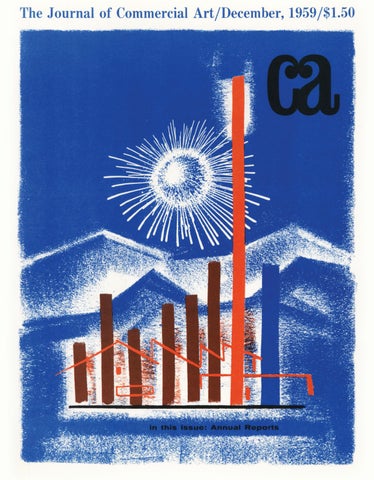
The Journal of Commercial Art . Volume
The Journal of Commercial Art is published monthly by Coyne & Blanchard , Inc. at 809 San Antonio Road, Palo Alto , California . Subscription rates : U. S. A., possessions, and Canada, single copy , $1.50, one year, $12; two years, $22 ; three years, $30; five years, $45. P. U. A. S. countries, one year, $14; all other countries, one year, $18. Copyright 1959 by Coyne & Blanchard , Inc. *Trademark registered. Second class postage paid at Palo Alto , California. Postmaster: Please send 3579 to 809 San Antonio Road, Palo Alto, California. Change of Address : Notification should be sent to The Journal of Commercial Art, 809 San Anton io Road, Palo Alto , California, at least 45 days prior to effect date. Send both new and old address . If possible, use imprint from CA mailing envelope for old address . Editorial Correspondence : No responsibility is assumed by the editors or publisher for unsolicited contributions. Manu scripts or other material should be accompanied by selfaddressed, stamped envelope . Advertising Correspondence: Requests for information or other correspondence concerning advertising may be ad dressed to David Hartman, Advertising Manager, The Journal of Commercial Art, 15 W. 44th Street, New York 36, N. Y., or to Advertising Department, The Journal of Commercial Art, 809 San Antonio Road, Palo Alto, California.
Number 5 • December 1959
2
Editorial
3
Letters to the editor
4
Humor: ''Famous A?!l-erican Holidays''
6
Creativity: Annual Reports
18
Finish: charts
22
Typography: display faces in use
25
Color: demonstration using chart of blue-ochre-black
33
Morgue: earth-moving equipment
37
Photography: planning a photo session
41
Exhibit: reproductions of current and choice
56
CA 's annual editorial in4ex
57
Production: Collotype
60
Management: taxes
62
Materials: artists' materials "work-tested" by CA
64
On the board: shop talk, advertisers' index
Editorial The Concept Robert Blanchard, publisher Richard Coyne, art director Jack Herrick, editor
The Graphics Ralph Hudgins, associate art director Jay McKendry, typographer Bert Bryce, associate typographer Clarence Philbrook, lithographer Glen Burroughs, litho cameraman Henri Luyckx, associate lithographer
Contributing Editors William Condit, Denver Wendell Davenport, Honolulu
While we were writing it we could almost hear the criest(yeah, but ... " And we have since heard them- ((yeah, but artists don't have the status they need to convince (them.' If we were only considered professionals and commercial art a profession, then ... " Wishing isn't going to make this a ((profession" and everybody in it professionals. We even doubt that legal interpretations and favorable court decisions in pending tax cases will automatically make it so, either. Just what makes an occupation a profession and those who follow it professionals? Why are industrial designers and architects and doctors professional men, and not artists and salesmen and TV announcers? We're not too sure whether establishing a prescribed educational curriculum, a code of ethics, or examinations before entering the field is the answer.
Harold Quiram, Dallas
And what would happen if overnight a bill was passed by Congress making commercial art a real, bona fide ((profession"? Would we wake up the next morning and find a carpet on the office floor-or more specifically, would all the layouts that were rejected the previous day now be accepted since we were a profession and had ((status"?
Ted Poyser, Los Angeles
We don't think so.
Susan Karstrom, Chicago Tobias Moss, New York 2
Last month we strongly advocated that, as commercial artists, we have an obligation to fulfill beyond the point of merely creating good work. That obligation is to get it accepted and used.
James Peck, Seattle
Irwin Caplan, humor editor Graphis 3, photography editors Almonte Bailey, Jack Fields and Bill Hewitt
Advertising David Hartman, advertising manager
We tend to follow the theory found in the very definition of the word ((Profession" in Webster- ((Following a line of conduct as though it were a profession; hence, assumed." We believe that to have professional status, we have to earn it. That to do this, we first have to know we are professionals, that ours is a profession that deserves recognition and equal rank among other professions. Second, we have to conduct ourselves as if we were a profession. Attaining professional status is very similar to leadership. If we assume it, and don't abuse it, we'll have it.
The Office Joan Buechner, circulation
Ill
Van Whitman, assistant to the publisher Jan Williams, circulation/advertising
The Cover Richard Coyne
CA. December '59
Stimulus
L E TTERS T O THE EDITOR Septe mber s o n g Please check with your mailing department to see if we're in the same time zone. Expecting the November issue, I opened the envelope and received the September issue. Jim Davenport NewYork City
Saw the extraordinary in November issue of CA, titled "Football," woodcut by Leonard Baskin. Please stimulate our office toward awareness of televised sports and if possible reprpduce the work by Misch Kohn and Jacob Landau.
EDITOR'S NOTE: Time zone OK, explanation a bit delayed. In our attempt to have CA exposed to as many people as possible, we sent an extra copy for you to give to a friend . If the follow-up memo hasn't arrived yet-now you know.
EDITOR'S NOTE: We are also eagerly waiting to see how Misch K ohn, Antonio Frasconi and Jacob L andau interpret other sports. Sorry that we can't supply reprint~ at this time, but we do have a few November copies left at $1.50.
After reading the Copperplate article in the November issue, may I offer a word of caution. Although the various sizes of foundry and Linotype Copperplate are usually numbered as you indicated, Monotype is numbered in reverse order. A 6 pt. No.1 in Lino is 6 pt. No. 4 in Mono, ad nauseum. May I suggest that anyone wishing to delve into the intricacies of the Copperplate family find out how his type house plays the numbers· game.
'----v-"
•
----------------------------------..
•
Sold out
ln t ermixable with all ot he r shades of Rich Art Poster Colo rs.
(In reply to CA 's request to pass along an extra copy to a friend).
Makers of Fine A r tists' Materials
Will be glad to do so. Anything to further the cause of your superlative magazine is a pleasure and a privilege. Only trouble is that nearly everyone I've talked to in Dayton about CA
lL!H RRT COLOR CO
-- -- ---------- .. -- -------------31 WEST 21ST STREET , NEW YORK 10, N . Y.
3 -
Ray Anderson Director of Graphics Stanford Research Institute Menlo Park, California
'--v-"
EDI TOR'S NOTE: Also gratefully! If anyone else would care to have us send a complimentary copy to a friend, we have reserved a few each month for this purpose.
Is it possible to mail us a reprint ... bill me? Dudty Fletcher Mutual Boiler and Machinery Insurance Co. Waltham, Mass. '----v-"
Num bers game
George W. Houk L. E. O'Neil and Associates Dayton, Ohio
Cheers to you for your kindness to fine art and another first for NBC-TV. Many thanks for superb Exhibit article.
'----v-"
•
already subscribes ... Bert Daily and Ken McCallister must be doing a fine job for you: Keep up the good work! Gratefully,
w-
:_ -r-.........> •..,..
<~
~
~
::--::.~:.,.
'l.
•
~.....~
_
.. . _ _
•
,....
•
spoil yourself a little! ........
:- .. -
--- ... - · :
~ .
EDITOR'S NOTE: . . . and the name game. A specimen sheet from them showing names, numbers and faces is a must.
• T he long , long trail Got your "extra'' copy of CA the other day and sent it to the Commercial Division of the University of Utah in hopes it would stimulate some interest among the students ... it should! Love your publication. One of the gals who worked for our agency during the summer is studying commercial art at Stanford and my copy of CA is on a lendread-return basis with her and her associates. Good luck with a great magazine. My happier days are those when CAarrives and I mean it! Fran Peek Harris & Montague Advt. Agency Salt Lake City, Utah '--v--"
EDITOR'S NOTE: As the crow CAws, Stanford is just five minutes from the House of CA .
• CA , December '59
-
.::_ •. -
\--
-
.
.... ... .,........_..~~
.
Because it's "during the holidays"-and because Art Direction Studio happened to send us their series -we deviated from our regular cartoon spread and present herewith AD's witty direct mail pieces ...
4
CA, December '59
Artists are funnier than anybody. And, when given a free rein -like creating mailing pieces of their own-there is hardly any containing their jocularity. The other thing about artists is that their best audience is other artists. Therefore to perpetuate this mutual admiration movement -CA solicits your contributions of "Ads-wecould-never-do-for-clients." Of this series of direct mail pieces, Robert Runyon of Art Direction Studio states: " ... .the unceasing harnessing of power in the service of Man has overtly relieved his physical burden while it has added immeasurably to the strain of his life and work. Idealogical arguments confront him with profound decisions at every turn. But throughout the chaos and utter confusion of this constant and harried striving there is woven a seam of hope. The battleground of civilization is interlaced with the invisible threads of an intangible strength. "It is of this strength that Art Direction's direct mail campaign is a part. Designed to substitute for the frustrated executive's lack of holiday, it infiltrates his life with an elixer of youth ... in short, it is inanity and meaninglessness supreme." The extra touch of realism was added with artificial flowers in the Indian bit, a flag for Fourth of July, pseudo decoration for Doug, and a miniature shovel for the canal piece. The four in the series are allll %" x 15", mailed flat.
5
..
* *
*
*
• * •
*
*
"'
*
*•
**
*
...... ........
.
.. ..
•* •* •*
*
* .. ••
OPBNING OF TIDil PANAMA CANAL. AUGUST 1&. 1914. DIG?
CA, December '59
CREATIVITY Dreaded by some artists because it is traditionally a frantic, last-minute rush with everybody from the Chairman of the Board on down in the actsought after by others because of lush budgets and prestige value-the Annual R eport is fast becoming the VIP of printed literature. CA pr.esents, in time to be helpful for the January-March "season", some history, ideas and examples.
The Annual
CREDITS Benguet Consolidated, Inc., Manila, Philippines Artist-Cesar Legaspi
6
Bank of America, San Francisco, Calif. Artist- A. Gonzalez Art Director- Henry Wachs Agency-Johnson & Lewis Occidental Petroleum Corp., Los Angeles, Calif. Litton Industries, Beverly Hills, Calif. Designer- Robert Miles Runyan Photography- Ovid Neale The Anaconda Co., New York, N.Y. Art Director, Designer-Jim Hobbins Crucible Steel Co. of America, Pittsburgh, Pa. Designer- George Plataz Standard Oil Co. of Calif., San Francisco, Calif. Artist- Dick Sherman Design- Logan & Carey The Fluor Corp., Ltd., Los Angeles, Calif. Photographer- Alex De Paola Monterey Oil Co., Los Angeles, Calif. Artist- Ken Parkhurst of Advertising Designers Art Director- Robert L. Steinle Photographer- Todd Walker American Machine & Foundry Co., New York, N.Y St. Lawrence Corp., Ltd., Montreal, Canada Art & Design- Rous & Mann Press Ltd., Toronto Ideal Cement Co., Denver, Colorado Campbell Soup Co., Camden, New Jersey Artist- Robert Edward Hamilton Designer- Louis J. Ansbacher P. Lorillard Co., Inc., New York City continued on Page 8
CA. December '59
7
CA. December '59
Creativity (cont'd.)
An annual report theme can be many things. IBM's theme was a simple powerful format. Each page of copy or charts was held to black and white to compliment a full bleed color photograph on the facing page of the spread. Shown are the wiring for IBM airborne computers and the IBM electric typewriter. Paul Rand designed the report for IBM.
lnf111f Din cbl n
Btutt8romlqo Wo!ktt•GJ:Iud<,...
EJwardM.O....aW Sto..-nn..,M. foirch.IJ
•::.~·~o;!,~o~
~:;·:~:~ JnnncctrK. Waoon Thcllfl.ot.}Wa~J<Jn,jr
c;,.y.,..K~tlt
CitlbrnHSnibMf Tho::lmu}W.-,Jr Albl"l'tL. Woii.AnU Olllnrt1
TlwlmuJW.,,..,., Jr W<111 H. LaMon~
p,,~.;-
A ...... tL.WiJiiarnl
IJxHaflltYH'II'fii.Jt-'
H WitiM!fM!IItt, Jr
V~e•PttlHI ... t•JGtar-<~lf.t•••~••· Eil«l,r't)Pt••II,.Dwl•iott
J-ws..w...-to:
!num·tVotal'rtuJt•t
y.,.,,.,,,,J,,.,,.JG•••,&Halnt
~::~:::~:: uJ Gta,..J "'"""'''· o.,, l'r«tm•t O.ri<ooa
J, l'lrocka
v.u,. ........
}ohnJKcn...,. Wllhamj Malf
Vrui'•••Ntltl VH'thmJ,,.,
J<:>h~
W.WIIl«.,Md)owdl
£:~:~ ~, :.~:~lr, Jr
~~~!::,~d l'oefn.udFW~td
aoo..-..
a...-
Voul'•••"•"' y;..,,..,,J,, SnrH•1 AmutaiTtHI MH
AuUI•.,Tru•••" A!IIJ/tMC. .troJ/,. A um~•ISrtrlltlrJ
ArthtarK. WI-.,I'rmi-
Orr.n.IMScon,P•••IJ•ffl
The Annual 8
Armco Steel Corp., Middletown, Ohio Art Director· Bruce L. Peters Servo Corp. of America, New Hyde Park, L.l., N.Y. Westinghouse Electric Corp., Pittsburgh, Pa. Art Director & Designer- Edward X. Redings Standard Oil Co. (Indiana), Chicago, Ill. Interlake Iron Corp., Cleveland, Ohio The United Electric Coal Co., Chicago, Ill. Artist- W. Brodeur Art Director- C. Franklin Brown Fibreboard Paper Products Corp., New York City Art Director- Henry Wachs Agency· Johnson & Lewis The Chemstrand Corp., New York City Artist- David Van Vliet Kaiser Steel Corp., Oakland, Calif. Art Director- Jack Galliano, Kaiser Graphic Arts Photographer- Will Connell
The evolution of the Annual Report is truly a chronicle of the growth of U.S. industry. From a st~rk profit and loss statement on the treasurer's letterhead to the elaborate, multi-page, multi-color, multi-purpose reports of today, the Annual Report has reflected the growth of business sophistication, a growing awareness of design and graphic art. Eighty years ago most companies were small, closely held firms operating in a relatively small, geographical area. With most of the stockholders involved in ((running" the business, an annual meeting was almost unnecessary -everybody knew how the company was doing day by day. As the company grew, and with it its need for outside capital and stockholders, so did the need for more formal meetings and communications. The annual stockholders' meeting evolved and with it the Annual Report-a simple statement showing profit or loss. In 1887, the passage of the Interstate Commerce Act required companies to issue an annual financial report. In 1902 the New York Stock Exchange decreed that its members would be required to issue an Annual Report containing specific information within a specific period after the closing of the fiscal year. The first ((graphic breakthrough" occurred in 1903 when E. H. Gray shook the financial world with an elaborate, 58-page, profusely illustrated Annual Report for U.S. Steel Corporation. Up to this time the Annual Report was as exciting as a railroad timetable and looked very similar. During the past 50 years the Annual Report has grown not only in elaborateness but in content and purpose. Today the Annual Report is considered by many CA, December '59
C.f*lrJand Jotolabll"J . lccua be \lied lw~or .:~mctltcappllac~~X~S. • a....c:a«ou~Uanc-MKblnft.dwi•NSttiC'I)O.'Oulprod~anllf'llf.nc:ludnaw!dt ,_,.olcawpwtdwdcardMXOIInun.a....duna.,.,_.IOnwetdw.-.Hol..-lln crunpr~~n.
Our~r~~dwreu•-•..,.banlwl,qtttm.,..de'"'~Thu"J"IIP"""'procntn
ord&natJ .-pnchecboloru.ou.llXI by- ~tnd&nJ~ nutnbm pr1nttd on chc chKUJn ~ ~MpiftiC wt.lr:. That nwnbert., wtuch men dw 'f)«Jbac- ollhc Amcnan lr.J'Ibn "-ocauoa, aa a!.D be ~ ·-II}' ,..,.., dl«k hand.IUII eqwpmmc • ~-.rb~cla~JIIIlftM&fti~IOmaU~~.pacomplnd}'•UtO
m.ll'di}'HCmforpteformqdtm~!tdlkp<JMacwvncll\l.
Tbc}'ft.l'rrwbdlhc2)cbanniWUJilt)'ollhc i •Ncl«tnt'fPC""nm,anddlll~t~jdUI
atWwn..tf}'C'Uihcd•w..onr.hippcd .. onr-auiiiORChmaduncfromdwnorw'J'pe...,..,.plaM,•ct.cx.na-.KmNc:lry,a!.Domclhc6raprod..cuonMOdcboflhc 6)JEicctroruc'J)'pa'IICakv..la.or,acompaa.ftJI}'-~ofllia-NrwtNccom
blftarJPilllandcabb.clfllmonc\llllc. laadd.Juon,rhci.Laii\IIO'Ip.l•m!CIOWfwdw.ntrod~aniOftolaMWI}'~
anddn.mautall}'rac}'lcd lllfrojdrc:cr.:rypt"Wmcrlwdupmcmcarlylni9)9-Adn.nc:cd wchnol fc-cuta Oft chc new machii'IC «llidt • 1-..cr, q\1~ ahdmJ carr-.r, and • buopnc kqboard for pr,_1111Cd touCh rypcwr•c~ Then: • 1 Standard Model, and lfi~Modcl-h~I.,.CY~C.,Nchproducalattnhaw'f\lthc
~ol,ntpr.otJftl.
Suppll••Dh1sion Punchedcucb.maJnftiCrapnandocbcriUpplnu.cd•fiii/Oiclaraprocct61AJI}'RCmt ~~and prod\l~Cfti bJ rhw d1wiSIOI'I, Thrtc mater•b Itt bu.c doc:umcn.n If\ INifiY 11CU ol bu-, Klmn', ~n.men.c and cd\ICIIIOft. Tbc pwKhcd 'ard lw b«omeaputolalrnolc~'sclad}'ICUWiry, forcumplc,lllilwybdb,cm!-rcucb. moeor'fdudctt&~~U~CIIOftt,chccUand-.u-..blcrlfiOO'Inoucn.
Under dw lftru ol dw contmc dcctft mmcd 11'110 wMh the Drpumwnc ol }ut~.ce onJ•n111Jfl),19'6,chtCorpowoOn1SrtqW«diOrnahaftlltblt.,comptueondw card maflufKTWit\l En~Chinn .,tuda • ptC~nN:red Man}' comprmon Itt now IWfll
.... ..-.....
To.nproyefun:hcrllllftTlt1:10~1htdlw1$10r1hu~add.ciOMI
_,.,.,Kt\lft.IIII.Cil.cueLOunnac9)8,ancwcardplanc.lft'WtAJdw5outhWCM,.,..
dedoccd at Shctm.an, TCII.. The dm11011 opened anodlcr pltat ar 0.,--. N J., br-cJR poundforanochuacConcord.loba.;and.cqwrcdL.ndatCampbdi,C.bf forttloauon ola pramc OObry 1t1 s.a J<-, C.hf
Report 9
firms to be its most important communications and public relations medium not only to its stockholders and the financial community but to employees, the press, the general public, and its customers. It is the major piece of corporate literature created, and in many multi-division corporations, the only all-in-one look at the corporation. The evolution of the Annual Report was described recently in the New Yorker magazine as embracing the following stages: 1) The ((No -Trespassing-Sign" era, 2) The ((Bathing-Suit-Under-Mink" era, 3) The "Ivy LeagueLook" era. But there are corporations who have resisted the inovations of photographs, theme illustrations, and design refinements, still holding to a tenet that all the stockholders are members of the Jack Webb Dragnet group and are interested only in ''the facts, Ma'am." O n the other hand, the more adventuresome (progressive) companies are issuing reports that are complete with samples of the product, die-cuts, fold-outs, and are more of a hard-sell brochure than a statement of earnings. There is an honest enigma that exists between the dignified and " all-out" school of thought on Annual Reports. On one hand there is a fear that a ''jazzed-up" report looks like it is hiding something, or that stockholders will decry the excessive expenditure. On the other hand, companies have found the report to be an effective selling point to stockholders, present and future, and to the customers with the big orders, specifically in selling at the management level. It can function as the ''facilities brochure," even answer a few pertinent questions that aren't covered in the straight facilities brochure. In no other piece can the corporate image be presented so well
without the obvious awkwardness or "horn tooting" or the devious development of a reason for including certain information. Some corporations have solved the problem neatly by preparing two annual reports. The importance of the Annual Report is attested to by some impressive facts and figures of its own. 1,000 corporations will produce over 40 million copies of Annual Reports this year. There is an "Annual Report Council" replete with filmstrips, research material and helpful hints. A new, hard-bound book, "The Preparation of the Annual Report" (Research Bureaus, Inc.) is off the press this month with ideas, reference material and examples. Art Director's shows and exhibits include the Annual Report, often as a separate division. Paper mills have latched on to the need for background, have prepared case histories and traveling exhibits. Extensive research has been used to find out what the stockholder wants and expects to see, whether he understands a pie chart easier than a bar graph, etc. - and the ultimate is found in the many companies that employ not only outside counsel and graphic help but maintain a permanent staff to prepare Annual and Interim Reports. With all the attention and glamour now attached to the Annual Report and its acceptance as a "selling" tool, the Annual Report presents the designer, artist and photographer with a ballooned version of the same basic headache as its one-page predecessor. To wit : an inborn time problem due to inviola.te deadlines imposed by the SEC; the fact that it takes time to add up the figures, and you can't start 'til the year is over; the importance of the report
CA, December '59
Creativity (cont'd. )
o::,:;;:=~.:!:~:
rht~hmlvk:iaufftrk yWiindle&dd
f"'Lhc:lcheed'• PJ V-~p«tooa~ra.ft;
.K.:.-.ft.cim~r..tcntdm•.,~"SAGE."'
A~Jif'lif!IO'IIfltdevt\opmentlhil y•rindw.
I)'Wt'n't - Miiaowbeutckb"~codi&N.II)'o
::'.:!~~·:::=.::
work is ptot rc~inJrowttdoichnrillftliru
~~yofA.lrborMllct:it.IOr.a
f)( ftlili..ty cquipntM....:I.,.._. By yttMnd 1hoecompeny ts.d beconlccme oi
Juidutn')'*ntfOtinftlllation lnrhe UJdCI!w:l
thlnatioll'lt:MII'~tupplicn:oflncniel
f - tO+Ciif~J"lf'Cb*d by theW..
~iacbcG,_~wtr
pctanc.tyllttlN.wilhLktmi'lwnild..,._..
GcrmanAirFDn:e.The61'8t iii'IIO - Iukiuse.. fi'J""
tH'CJ"th; tnd • A:IUJM T~cx.l DMa sy.- il WI
-• wdl•tirtrttT - 'PIIIbt~~lnthil"
~lopnwntfMappliadonbidleM.mw:Corp:
e.aanllhlftdmol¥"f«htr'J"'Od11Cef'. Tlle
«<IWW!ry ; wubMq-"lriawil!btt~WlllftttiiAdk!
tiTckf-~. Shonly -.{fv(hcdcMUftbe
Ntv;t't--Urbonw.tyWVIW!taitcnk.t:M
CC'f1fllnY. Tlwdccblon by dle Gtrm~~~A•rF'~
yar• CON.nct. w.m:t~.-od fmln rMAnay
~ rortiNpt,_,.,_ofrnilit.,y•ppti·
OrumcMn Wf-1. a WI ~ roct•y - ,
rnN.Iy F~lOotGtypt.t lnmoftl:l'jUlpptdwithl.irtOfl
~or 1 NUEymkK'cdsi:ut&WI.veiptf«
w'"lm-.~ot.MtllldayMeot ( FSG- 1)
i.Juanckv~tftdpn:tdoecd i:nmilol rcl...-
irlcrthll~~inorder tn f~llrilcrir
~·liftml.,._.,.
fllnowbeittpto-
6d-~RJMJ~Uirc:onlicleredbyma.ny tll
TudM:t..ulourluwwHodfc.-&Rd.«only
dllc..tinqu.IWW:y. NvCilM~ufbcillf
,.-fhly scnins•pammfortubfcquenttin"lw
-t-Y MJIIfCdittrlledtn~tndptoduc-
==:~r;.~=n:btm.dehy
liorlof.Urb<)metaCtl(:llld.l.lpr'OC..... ~
afiddoftMrilcdpoar.w...dimpo«anee.r...b-
FortPmc ynnwc-1\lvtpillnuJedhdu::•l MbnoiOfiocalckvclopcMnnlnlhfticklolicwnW
dftllll6e..::titttybes'-'*-lot!IIIOR . . t-
~inc:ludMI(th&"tw.,.._roc...of·f.......,
• compomlve~W~Il'dbuodddw
.......
WIUttkw"W.,.._..nertc~pafonnsacaa. flliyifttim'tft~~'-'cbinpand
~pr ........ aboatd•c:vrierllt-.
.:::s::::~==7*~ piclulet i,__()(_ll*'f:lidnllced.s.ip
f~A.mtyfteldUM.
IWHMNciOiill"~lntftil,-a.tl-of
tvro" t~. Sy~mJtcmployinfm.~
reqyi;ttt~eq~h ... lnclucW•~IIlty
fotlfw.Wlf, limrti!OCkl Ntvy tice'ahfewften
IW:Ihc4Cflmpl«e1\itht~wkh~ly w·
IG COM:flf~ IOhMioN 10
.,.,...Our~~.,......f*"ol
it!aaoryr-ksdorill(thil;yrar.
~tfw--~to...._ Jwir
'
the rd.ted JlftiWtm o/
tt.Unonb!Ph . .,.ttdacuct-Mfipioni)'S-
~~~hM-b«~tnu.deil'lche
mmaintodl•wqllwiiQQbc~
tem.alaodbeinltalleclmthlN.vy'fne.V wadler.md:Mrcnft, th&AlF.
litldQftirbometK'I ic-ll.t.u~!Jftdclb
imwwdltttlyand~~~aa
pl.y $)'~ ch""a Mt.l year l9S9. TM firN
bcm;sde..V.~ci-c:anbt~
wheadlefint~'f'Pl*'· Afldtl.-inatill
A~T~b.IO.USymm-tflyU!c~~
lodeyttiN:rtdibkfpNdi.DeciliohffllldnfhM
f'I"'OI.
~m.iMdfar-rcofaproblcni. TM~id
c:arna-.t.ed ...
,..vlpricwl.,.......it ...
noadirdfot~
fW" W L<lekt.d WV 2-£ nrly
w.,.
12
as the leading representative of the corporate image seems to require more than normal approval, suggestions and editing.
The Litton Industries, Inc. report shown on the preceding pages and in the spread above utilized the theme of technology, old and new. The report is difficult to describe except to say that it is one of the happiest blendings of copy, design, photography and printing to ever cross our desk. The props for the theme were painstakingly collected by Art Directori Designer Robert Miles Runyan from m'useums, antique stores and private collections. The modern equipment, product photos and facility photos were mounted prints handled as any other of the props in the set arrangements. Photographer Ovid Neale shot each double spread as a single photo. These spreads were reproduced either in four-colors or in two-colors, brown and black duotones. Runyan worked very closely with the lithographers, Jefferies Banknote Company of Los Angeles, and the final result was one of the truly outstanding "graphic packages."
The designer is usually faced with the same basic problems regardless of whether the company makes $40 or $40,000,000 after taxes, whether they make electronic computers or soap. These are the problems of: a central theme; how to handle the president's message; photographs of the plant/ products; financial statements; ((at-aglance" summaries; accountant's letter; and the alwayspresent charts and graphs showing distribution of the money spent and earned. In compiling a list of suggestions, we came up with a few basics: 1. Start early. Don't wait for the auditors; be set to drop their figures in at the end. 2. Develop a theme that will give the impression desired and try to stick to it. Many a report has gone down with a last-minute pick of record photos from the manufacturing department's file. Not that it isn't sometimes a good source for certain authentic matetial. 3. Keep the charts and graphs simple. Research proves that the readers are more interested in the ((visual summary" approach than wading through all of the complicated and detailed information, though you still must show all of the required facts.
CA. December '59
National Distillers and Chemical Corporation and Subsidiary Companies CONSOL I DAT E D BALANCE SB E BT
DBCBIIBBR 31 , 19118 AND 19117
CUllltENT AssETS :
CURRENT LIAB ILITIES:
Cash
$ 27,213,000
Accounts and notea receivable (leas allowance for doubtful accounta-$500,000)
115,294,000
I 06,853,000
Inventories
121,500,000
133,569,000
3,323,000
3,852,000
267.830,000
276,757,000
( N ote 1)
Prepaid expenses
Total current aueta
Short-term bank Joana Notes payable Accounts payable and accrued liabilities Federal taxes on income Long-term debt payable within one year
' 32,433,000
16,102,000 17,242,000
(Note 4 )
INVESTMENTS AND LoNG-TEaM RECEIVABLES (Note 2)
' 12,000,000
'
7,000,000 2,720,000 15,380,000 22,127,000
550,000
4,550,000
Total current liabilities
45,894,000
51,777,000
LoNG-TEaM DEBT payable after one year (Note 4J
144,810,000
ll9,810,000
DEFERRED FEDERAL TAXES on income (Note Iii) MINORITY INTEREST in subsidiary companiea
10,708,000
8.483.000
474,000
417,000
48,671,000 98,774,000 154,772,000
48,671,000 98,774,000 146,786,000
297,217,000
289,231.000
47,290,000
32,828,000
8,086,000
2,671,000
236,101,000 61,033,000
208,315,000 50,299,000
175,018.000
15S.Dl6,000
4%. % Cumulative convertible preferred$100 par Common-$5 par EARNED SURPLUS
4,628,000
2,782,000
Less-Common stock in trea.aury, at coat
8 TOCKHO L D . R 8' J:l Q U ITY
DEP'ERRED CHARGES. leu amortization
CAPITAL STOCK: PROPERTY. PLANT AND EQUIPMENT-at coat
Leas-Depreciation (Note I)
GOODWILL, PATENTS AND LEASEHOLDS--at
leas amortiu.tion
cost, (Note 6)
1,801,000
2,164,000
295,416,000
~
~
$467,554,000
Total atoekholdera' equity (Note 7) $497.802,000
~
..~..
.~..
13
4. Battle for legibility. This often means asking for more space. Study the production methods; there usually is a good economic justification story there. The amount of typography won't change, nor your time (it may lessen your problem), nor many of the other fixed costs. In a study of the total overall budget, it will usually turn out that the commonly accepted view of the cost of additional pages is badly distorted.
Above : N ational Distillers and Chemical Corporation, N ew Y ork, presented their balance sheet with clean, open typographical layout on a light blue tint. S everal other companies were also thoughtful enough to consider their stockholder's eyesight. Doremus & Co. prepared this report. B elow : L ucky Stores Inc., San L eandro, California, took a humorous poke at the pressure of the situation with their review of the year in brief Jack Galliano was the designer.
5. Plan your production in advance. It can affect your layout, your approval arguments, and the degree of your headaches. Pick the paper stock and make sure it is ordered and sitting by the press when you're ready to run. Chances are it's a premium stock and you've meticulously weighed the texture, brand, whiteness, brightness and possibly even color. Paper merchants all too frequently carry light inventories or perhaps no inventory on some finishes of paper brands. Also, protect your schedule with the printer. There are a lot of people around with the same timing problem, and overtime is expensive. 6. T ry to channel the responsibility for material and approvals through one person or your budget estimates and earning power may go up in smoke as you shuttle from pillar to post. CA is indebted to the following for their assistance in preparing this article: Arthur Brackman, Free-Lance Photographer's Guild, NYC; The Annual Report Council; D. A. T alucci, Editor of ((The Preparation of the Annual Report," Research Bureau, Detroit. CA, December '59
,o:~·w"'~rr
28
ll~~jJ2S2627
DEC. 1958
I 2 3 4 S 6 1 a 910111213 141SI617111920
?~~~~i?v~ '~f.(., '~f.L ~l-1f.>~.1+1 f/2(,,1~ 517 {~_, 5,35!.f6f
4,>o'l,72f
1/e{;£~ 2.47/.f'"f
'1,14].-p:f
~~-~
f."/3
/.30
Creativity (cont' d.) The opening spread from Matson Navigation Company's 1956 report set the theme, travel stickers. The entire report is handled in black and white with only the labels in color. Jack Allen designed and art directed it, Warren Talcott did the label illustrations.
55th ANNUAL REPORT
MATSO N NAVI GATI O N COMPA N Y 1956 covering the 74th year of Matson operations
14
One of the major graphic challenges of any annual report is the handling of graphs. On this spread, we have selected a few of the many good variations on a typical annual report theme, distribution of the sales dollar or ((cutting up the pie chart."
DISTRIBUTION OF THE BELDEN SALES DOL LAR DEPRECIATION 4.3¢
Belden Manufacturing Company, Chicago, left the dollar intact and cut up the background. Bell & Howell Company, Chicago, stacked up pennies. National Biscuit Company, New York, cut up a cracker. American Airlines, Inc., New York, created a travel feeling.
PAYROLL 32.15t
AND SERVICES PURCHASED 153.1t
CA, December '59
DIVIDENDS 3.1t RETAINED ·IN BUSINESS .St
Each Nabisco Sales Dollar Produced Income: To our employees JJ.Oj (
To governments in the, form of taxes 7.0¢
~
/ T o provide for the wear and aging of the
""""''"'"'""'""''"
~To management of the business 0.2¢
- - - - To shareholders for providing the tools J.8¢
\ -
\
' - - - To provide for growth and modernization 1.4¢
To farmers and suppliers of materials ond services and their employees 51 .8¢
w ....
Deii"'Hiatlon
15
h.
'''\''''
''/' 1-'1//
;-,~
.2C
~
S-
--:::
~/
........_,::
¥,,;;I( ,;,," I,,,\\,,,'0,,'' uoa
S1',113
$7,123
PREFERRED STOCK DIVIDENDS
REINVESTED IN BUSINESS
COMMON STOCK OIVlDENDS
.
.24
,,''\''" \''''! /'t
,'\
::'<.
'\''"\"''!'
)-:;_
~
\--
' )'~
_-
vv
'',~,, I
s--
. . . . _,:
'?:-
~
........_,
<<,~f:,
I \ ,_\,,''
I
I \ \ ,,"
~1 1111, 1\1 \,;
' ' L11t1111\ ' S1S.400
$22,t12
S22,101
ftOERAl INCOME TAX '
MATERIALS & OUTSIDE REPAIRS
PHYSICAL WEAR & OBSOLESCENCE
1'.011
,,fr\' "'i'i'J',/'t,
/~~ _..:::._
r---DISTRIBUTION OF THE REVENUE DOLLAR
(OOO'oomtrtedl
.• 11:11,240
1::
0:.
1;:...---
-=::--
~~
-:.,/
~{;/illl\11 j
~~,I J ,,, u,,,l 111'
1
........ 2
$181,712
$11,113
GASOLINE. OIL 81 TAXES
WAGES, SALARIES & RELATED EXPENSES
OTHER EXPENSES
43.711
CA, December '59
Creativity (cant' d. ) A ((must" is the accountants' report. The usual practice has been to reproduce the accounting firm's letterhead. Here again, the designer's fine hand is being felt. Shown are three of the many good approaches that we saw. Opelika Manufacturing Corporation, Chicago, added an adding machine motif. National City Lines, Inc., Chicago, placed the letter on a columnar sheet. Continental Copper & Steel Industries, Inc., New York, used the ((desk set" approach. The other side of the spread shows an interesting way to handle plant locations. Ashe & Engelmore Advertising Inc. prepared the report. Edward Rostoch, art director.
LYBRAND, Ross BRos. &. MoNTOOMERY CEfltTI,.II:D PUBLIC ACCOUNTANTS C~CVC\. ••O
~oo.t.•t•o•o
REPORT of INDEPENDENT CERTIFIED PUBLIC ACCOUNTANTS
The Board o!' Directors and Stockho1dcra. Continental Copper & Steel Industries , Inc.: We have examined the consolidated balance sheet of CONTINENTAL COPPER & STEEL INDUSTRIES, INC. and SUBSIDIARIES as of June 30, 1958 and the consolidated statements of income and earned surplus and of capital surplus for the year then ended. Our examination was made in accordance with generally accepted auditing standards, and accordingly included such tests of the accounting records and such other auditing procedures as we considered necessary in the circumstances. We previously made a similar examination for the year ended June 30, 1957. Other than for such adjustment, if any, as may be required upon final determination of the purchase price of the Wooldridge Division assets , referred to in Note 5, in our opinion, the accompanying statements present fairly the consolidated financ.ial posi t~on of Continental Copper & Steel Industries, Inc. and Subsidiaries at J une 30, 1958 and 1957 and the conso11da ted resul ts of their operaUons for the years then ended, in conformity with generally accepted ccounting principles applied on a consistent basis .
•••
Y~k, ··~" 19fr~tZ ~I ATry
CA, December •59
29.
XN"DElE"'EN"DEN""X" PUBLIC .A.CCOUN""X".A.N""X"S
ACCOUNTANT ' S C E RTIFICAT
S C HWARTZ . Kl..tt'l
SEPTEMBER 30, 1958
tt 50'\'DCftl. I ... G
lC NTI,.III)Ptll l.tr \ c ro'"'""'· .111"1 .... .. . ""or~•
.. o .. .. r
To the Board of Directors and Shareholders of Opelika Manufacturing Corporation: BOARD OP DIRECTORS, MATIOMAL CITY LINES, INC ., Ch1ea&o,Ill1noh.
We have examined the balance sheet of Opelika Manufacturing Corporation as of September 30, 1958, and the related statements of profit and loss and surplus for the year then ended. Our examination was made in accordance with generally accepted auditing standards, and accord ingiy included such tests of the accounting records and such other auditing procedures as we considered necessary in the circumstances. We had previously made a similar examina tion for the year ended September 30, 1957.
Vehc.veexu1nedthe ccnaol1datedbalan ceaheetor Jriat.1onalC1tyL1nu,lnc:.andwholly-ownedaubaldlaryc:OIIP&nlea u or Pec:e~aber ll , 1958, and the related nateunt or lnc:oae andac:c:un~latedlnc:OIIieretalnecS1nthebua l neaa · r cr>
theyear
u.en ended. ()Jr examination waa ~aade 1n accordance with &&nllr& llyaec:eptedaudltln&etandarda,andacccrd ln&lylncluded au chteataortheaccountln&r•cordaandauch othe raudltln& procedureaaaweconalderednec:eaaarylntheclrcu.. tancea . Inouroplnlon,theaccOIIIJ)anylngbalanceaheetand atatement o r lnc:o.e and •ccuJNlated 1nco111e retained ln the buatneu preaent ralrly the conaolidated flnan e tal poaltlon ot Nat1onalC1t.yLlnu,Inc.andwholly-ovnedaubaldlarycoe.panlea atDece•ber31,1958,andtheconaol1datedr-eaultaorthetr
In our opinion, the accompanying balance sheet and statements of profit and loss and surplus present fairly th e financial JX)Sit1on of Opelika Manufacturing Corporation at September 30, 1958, and the results of its operations for the year then ended , in conformity with generally accepted accounting principles applied on a basis consisten t with that of the preceding year.
=~~::~!~":c ~~~n~~~~y:~~n~~=~e:":::i 1!~ ~~n~o:!i! :~~: 1:~~~~ally
wl t hthatortheprecedlnsyear.
~~. N,..;ro.., [)~'
s,_.,_r-
cert.tr1edPubl1cAccountanta .
Chicago, Illinois November 20, 1958
17
CA, December '59
m
FINISH Graphs can offer a real challenge. More than just the problem of developing a functional .unit, it can be the vehicle for dramatic, almost abstract, design.
Sources of G.N.P.
GRAPHS
... G.N.P. per Man-Hour
... Distribution of Man-Hours by Industry Misc. --- Utilities --- Mining
Manufacturing
Transportation
Trade
Construction 18
Agriculture
Services - 0-
~o-
1947
1957
1947
1957
1947
1957
GAS PURCHASES, 1939 AND 1958 In Millions of Cubic Feet 1939
1958 483,493
A• i•tretUmg 11111otmt of lllllurtll gtU is purchtUetl fro• sources outsUk the stllle of Clllifomw. Prior to 1947, till of PMific Ugbtittg's gtU c11111e from witbi11 the slllle.
CA, December '59
REPRODUCED BY COURTESY OF :
Left: Fortune Magazine, March, 1959. Elmer Smith, designer. Pacific Lighting Corporation. Right: The American Tobacco Company . Fortune Magazine, November, 1958. Alexander Semenoick, designer.
Net rncor, Order sard I
-------------+----.-----------~--~ =-=-r=-~
I
I
,
I
Income Reinvested
-- . ...:r- -iif----r
~~
M illions of Dollars
- - - - - 60
1 - - - - - - - 55 1 - - - - - - - 50 ! - - - - - - - 45 ! - - - - - - - 40 1 - - - - - - 35 1 - - - - - - 30
PREFERRED AND
COMMON OIVIOENOS
+
25
§
t
~: 10
5
1------ 0 I
1950 I
1953
1954
I
•includes all wholly-owned subsidiaries
CA, December '59
1955
1956•
19
Finish (cont'd.)
It isn't all champagne, caviar and four colors. More often it's two. And kudos to the artist who didn't stop thinking when they only gave him one. Credits for these charts go to: Morris Plan Company of California for the very legible bar chart. Dresser Industries, Inc., Dallas, for the chart and photo pattern.
Millions 80
COMPANY GROWTH, 1947- 1956 70
•
THRIFT CERTIFICATES
•
LOANS AND CONTRACTS
•
ASSETS
so 40
30
20
10
COMMON SHAREHOLDERS' EQUITY
20
1950
1951
1952
1953
1954
1955
1956
1957
1958
In one unit, Lane-Wells' PTWC trucks combine all the services, including cementing and perforating, which are needed for making and servicing permanent type oilwell completions.
CA, December '59
Kerr-McGee Oil Industries, Inc., Oklahoma City, for the dollar distribution chart (upper). Abbott Laboratories, North Chicago (lower). In all fairness to Art Director Charles Walz and Designer Carl Regehr, this is an excerpt from a very handsome spread of charts.
Speaking ofthe artist who didn't stop thinking, credits for the graphs at the far right go to the Caples Company and Art Director William A. Aldrin who produced these and a number of other outstanding black and white charts for the fllinois Central Railroad.
PAYROLL total in millions of dollars
INCOME DOLLAR DISTRIBUTION
150
100
50
0
'49
'50
'51
'52
'53
'54
'55
'56
'57
'58
40 21 2.4c Cost of borrowed funds
30
2.2c Toxes .4c Income applicable to minority interests 2.0c Dividends
20
~Ea rnings retained for use in the business
lOO.Oc
10
0
'49
'50
'51
'52
'53
'54
'55
'56
'57
'58
COMPENSATION average straight time hourly rate $2.50
2.00
1.50
1.00
50
0
'49
CA. December •59
'50
'51
'52
'53
'54
'55
'56
'57
'58
m
TYPOGRAPHY Typography means more than good choice of a headline and the placement of body copy. In the T-depar.t ment this month, CA takes a look at somegoodexamplesof .. .
TYPOGRAPHIC DESIGN
Clarendon Bold and a subtle color combination portray digital computing, specifically a study of salaries in the field. James Cross was the designer, System Development Corporation the client.
22
CA. December '59
23
~
u T c::> N
E T
I c
s
A DIVISION OF NORTH AMERICAN AVIATION, INC .. DOWNEY, CALIFORNIA
Autonetics, a division of North American Aviation, prepared this brochure to tell the story of their product, A UTOCHECK, particularly for countdowns on a Go, No-Go basis. Art Director, D. J. Vincent. Designer, Dale Peacy. Illustrator, Ken Hodges. CA, December '59
Typography (cont'd.)
At left-The story title for Argosy was designed by Morton Mace; Bernard White, art director. The title is shown three-fourth size and ran on the right hand side of the spread. Below-Don Kapp designed this brochure, Blh x 11, for Douglas Aircraft Company, Inc. Don stacked both his shipping crates and his type well. Type faces used were: Woodblock, Title Gothic Condensed, Caslon Italic.
IR ARGO A IRPLANES
SM REPORT NUMBER 21588/ JUNE 1959
I
,,~ DOUGLAS AIRCRAFT COMPANY, INC., SANTA MONICA, CALIFORNIA
CA, December '59
ca.
COLOR This month CA again demonstrates the use of the color chart for mechanical screen color combinations. We are also showing the color variation on a coated stock and announcing the availability of additional charts on heavier vellum and on coated stock.
BLACK LINE AND COLOR KEY
BLACK PROGRESSIVE
YELLOW- OCHRE PROGRESSIVE
BLUE PROGRESSIVE
CA, D ecember •59
10%
20%
10%
30%
10%
30%
30%
40%
50%
70%
100%
70%
100%
DUOTONES
10
30
50
DUOTONES 50%
10
""" ";;.,., \. i!
~
.. ,"' . ~
"':,
•
~ --
I!
.. •
'"'"
.
30
50
70
100
CA , D ecember '59
.,
~'. I.
.
~1
. ~
.
-
I
:
.. ..
~
~
•
t·
"'
~
I
\::_.
~
'
>
• .,.
'
l
~
'
'
~.
~ ...
,.. I
..
.
"
'
} ;...
Y-3-1:5
r'
~
DUOTONES 10%
30%
50%
70%
100%
;:,':'-·'\'
~~l~~' .f''~
.f!·""',·
~':"\i;' ..
10
30
50
TRIPLE TONES 10%
10%
BLACK
30% BLACK
10%
BLACK
10
30
50
70
100
CA COLOR CHART COPYRIGHT 1959 BY THE JOURNAL OF COMMERCIAL ART
•
PRINTED
CA, December '59
BY LITHOGRAPHY USING 1SO-LINE LEVY SCREEN .
TRIPLE TONES 50%,
30%
10%
10%
10%
BLACK
BLACK
30% BLACK
10% BLACK
10
30
50
70
100
Normal duotone photographs. Russell I llig, Photographer.
CA . December '59
m
COLOR This month CA again demonstrates the use of the color chart for mechanical screen color combinations. We are also showing the color variation on a coated stock and announcing the availability of additional charts on heavier vellum and on coated stock.
10
100
20 BLACK LINE AND COLOR KEY
BLACK PROGRESSIVE
YELLOW-OCHRE PROGRESSIVE
BLUE PROGRESSIVE
CA. December •59
10%
20%
10%
30%
10%
30%
30%
40%
50%
70%
100%
70%
100%
DUOTONES 50%
10
30
50
DUOTONES 50%
10
30
50
70
100
CA, D ecember '59
Y-3-1:
DUOTONES 10%
30%
100%
50%
::~(
'
'.
.
~~kt
10
'.
'
30
50
TRIPLE TONES 10%
10%
BLACK
30%
BL.ACK
30%
10%
BLACK
30%
BLACK
10
30
50
70
100
CA COLOR CHART COPYRIGHT 1959 BY THE JOURNAL OF COMMERCIAL ART
o
PRINTED
CA, December '59
BY LITHOGRAPHY USING 150-LINE LEVY SCREEN .
TRIPLE TONES 10%
10%
BLACK
50%,
30%
10%
BLACK
30% BLACK
10%
BLACK
30% BLACK
10
30
50
70
100
Normal duotone photographs. Russell Illig, Photographer.
CA. December '59
PLEASE TYPE OR PRINT
ZONE
S ·TATE
D Enclose gift card.
STATE
Gentlemen: Please enter a 12-month subscription for sets of the CA Color Guide Charts. Enclosed is a check for $ Mail to: -NAME
-ciTY
-ADDRESS
-NAME
ZONE
Send bill to : D check here if same as above -ADDRESS -CITY
<G
z
1--1
~
en 0 <G
~ ~
1--1
z
0::: Pot
1--1
z~ ~
~
~
. $ 9 12 18 30 50
Subscriptions start with the first set. They are available only on the following annual rates and can be mailed to only one address.
D 1 set D 2 sets D 5 sets D 10 sets D 20 sets Prices for more than 20 on request.
f±E§d
PLEASE TYPE OR PRINT
Gentlemen: Please enter my subscription to CA for__ years starting
D
ZONE _ _ _ STATE
With the -cURRENT MONTH- iSSUe Or- FUTURE MONTH- iSSUe and Mail to: Checkfor $ enclosed. --NAME
--ADDRESS --CITY
--NAME
ZONE--STATE
- - - -----
(If this is a bulk or gift subscription, fill in company, school, or donor name below.) D Enclose gift card. Send bill to : D check here if same as above
--ADDRESS --CITY
D 1 copy . $1.50 D 1 year .. $12 02 years .. 22 03years .. 30 D 5years .. 45 D Add'l mos. 1 OBulk .... 9
( 5 or more from a company or school)
ffim
MONTH
YEAR
Please send the following issues at $1.50 each.
QUANT.
----------------
SIGNATURE
~
z
E-t
01--1
~
1--1
z z
01--1
t
1--1
0:::
~
<G
u u
0
~
~
<G
1--1
0 z z~
-< u
~ Q 0:::
~
~
~
~
~ ~ ~
~
~
-<
·~
~
~
0 ....0
c
~ -..;:,
~ ~
~
~ ~
c
~
::c
~
en
u
z
0
E-t
~
~
~
Q
en
;;:s c
~
~
~ -+-.:>
u
~
~
c
~
~ Q
;::J
z
z
0
~
0 ~
0
z~ ~ ~
Pot
~ ~ ~ ~
~ ~
0
~
~ 0::: ~ ~
~
~
~
~ ~
1--1
~
~
~
~
~
~ en
Q 0:::
~
u
~
0:::
en
<G ~
~
0:::
<G
0
u u 0
::c
0:::
1--1
~
0::: ~
0
~
Q 0:::
1--1
~
0 ~
~
1--1
z-<
z
01--1 E-t <G
~
0
0
~ ~
z en
~ 0:::
u
z
1--1
~
<G
1--1
PALO ALTO, CALIFORNIA
0:::
1--1
~
::c
0
0
~
> 1--1
0
0 z z~
::c
~
0
~
~ ~
E-t
u
Q
E-t
~
~ ~
~
~ ~ ~ ~
1--1
z
u
~
0
en
<G
0:::
~
0
<G
Q
z
z
809 SAN ANTONIO ROAD
I
~
0::: ~ ~
0:::
~
>
::c ~
en
<G
-< u
~
~
1--1
u
0 ~ 0
en
~
E-t E-t
0 z
u
<G
1--1
en
~
C\1
z
~
Q
Q
0
::c
<G
~
E-t
en
~
u
E-t
~
~
z z~
~
<G 0 Pot
Q 1--1
::cu
0
en en
~
0
~
~
~
0 z 0:::
1--1
SIGNATUR:E
I understand that each set of the CA Color Guide charts includes the screen combinations of two colors and black printed by lithography on 4 pages of heavy vellum and repeated on 4 pages of heavy coated stock. Colors are coded and sets are 3-hole punched.
~
z
0 E-t
0
0:::
<G E-t 1--1
en en en
-< en
-< ~
0
~
E-t
~
z
::c
01--1
t 0:::
0'>
(.0
1--1
u
<G
~
~
~
1--1
~ ~
~ ~
<G
>
<G
1--1
~
0 0:::
u
-< u ~
::c E-t
~
0
~ ~
0 ~ 0
-< ~
~
1--1
Q
THE JOURNAL OF COMMERCIAL ART
~
~ en
E-t
~
~
·~
en
~
~
-< ~
~
::c
1--1
en
~
0 0
p.... ~
~
~
~
~
0'>
(.0
::c
-<
~
z
1--1
0:::
p....
z
Q
0
0
en
u
~
;::J
E-t ~
Q
z
E-t
Q
~
~
0p....
0:::
~
~
E-t
~
~
E-t
z
en
E-t
~
-<
;::J
1--1 ~
<G
z~
1--1
::c 0
~
::c-< u
z
0:::
~
p.... ~
~
en
0 0
~
~
~
~
~
~ ~
....0 ~
~
~ ;;:s
~
TITLE OR OCCUPATION
0 ILLUSTRATOR 0 TECH. ARTIST 0 CARTOONIST OANIMATOR
0 LAYOUT
- - o T H E R _ __
0 ADMINISTRATOR 0 ART DIRECTOR 0 DESIGNER 0 PRODUCTION 0 ADVT. MANAGER 0 STUDENT
TYPE OF' BUSINESS
0 AD. AGENCY DART STUDIO
0 MFR. -CONSUME R 0 MFR.·INDUST. 0 PRINTING 0 RETAILING 0 PUBLISHING
0 FREE LANCE 0 SCHOOL
- - o T H E R _ __
0 DISPLAY
.,. _
Cil~....--tt:hSO£'*' -:--.....
r-~-~
w .
--------~·
""............,.
--lllll::lllfti!IJU_ _ _ _ -
POSTAGE WILL BE PAID BY-
POSTAGE WILL BE PAID BY-
The Journal of Commercial Art 809 San Antonio Road Palo Alto, California
NO POSTAGE STAMP NECESSARY IF MAILED IN UNITED STATES
NO POSTAGE STAMP NECESSARY IF MAILED IN UNITED STATES
The Journal of Commercial Art 809 San Antonio Road Palo Alto, California
BUSINESS REPLY MAIL
BUSINESS REPLY MAIL
L
t3\IZ::::::_ ~- ~
--
.v
~
~----
4!418 . ..,.
~~~ "----
PALO ALTO CALIFORNIA
PALO ALTO CALIFORNIA
FIRST CLASS PERMIT NO. 12
FIRST CLASS PERMIT NO. 12
ca.
MORGUE
Earth Moving Equipment Photo credits: Allis-Chalmers Mfg. Co., Milwaukee, Wisconsin; Caterpillar Tractor Co., Peoria, Rlinois; Euclid Division of G. M. C., Cleveland, Ohio; John Deere & Co., Moline, Illinois; R. G. LeTourneau, Inc., Longview, Texas. Although billed as "Construction Equipment," this month's morgue is refined to include only earth moving equipment.
33
CA, December '59
34
"'""".. · ~..
. _::_.·.:_
............ . ..
CA, December '59
..
35
CA, December '59
36
CA, December '59
C(), PHOTOGRAPHV Buying photography for reproduction with a "box-camera" approach can often be more expensive than hiring a top-drawer photographer or studio. Graphis 3 gives a short course in economics and discusses the role of . ..
Good photography, like good art, costs money. Poor photography can be even more expensive. Add up the dollars and cents of retouching, reshooting, special reductions or enlargements, loss of time, and aspirin. Add to these such intangibles as lack of detail, loss of prestige, even the possible loss of a sale. All these against one good shot ready for the printer. When selecting a photographer, the emphasis should not be ((How much do you charge?" but rather ((How knowledgeable are you?" Can he supply photos ready for printing with a minimum of retouching. Does he have a complete understanding of tonal ranges so necessary to good reproduction. Can he make glass look like glass, wood like wood ... handle highlights and reflections ... pull the details out of the shadows. Will he remember to get rid of that ladder in the background (it could cost $15 to airbrush it out). Can he talk your language. Find a man who can do these things and you've got a bargain. Not only does his value increase as he becomes more acquainted with your products and problems, he can save many hours of your time in the early planning stages and the photo sessions to follow. Good as a photographer might be, he still needs a photo buyer who plans a photo session as he would a good layout. This is where the real economies begin.
CA. December '59
37
Each one of the items in these three photos is a problem subject. It took years of experience to produce the results shown here. Russell fllig shot the one above and Herrington-Olson Photograpy of Oakland, California, provided the two photos below.
Photography (cont'd. )
38
Russell Illig (a "knowledgeable" photographer) provided this group of photos. The upper one is a typical product shot for one of his clients, Hewlett Packard, top manufacturer of electric precision testing equipment. Russ was asked to take the same subject and reshoot it, violating all the rules of good photography. The photo below shows a good example of what could be the result of price shopping. The gear boxes at the left were enlarged to show detail (and lack of it). It would be interesting to see a retoucher's estimate for the lower photo. Our own retoucher said he would refuse it and recommend that the client have it reshot. CA, December '59
The photo at the left is typical of an "inexpensive" product shot. It includes hot spots, high contrast, an unacceptable background. Compare this photo with the upper one shot in diffused north light, no dark or disconcerting shadows, complete recognition of detail, a good gray scale, an acceptable background, true horizontals and verticals, and that ''feel" of the product ... unretouched.
Glass is an extremely difficult subject to photograph. These two examples show how the Herrington- Olson studio solves the problem. CA. December '59
39
Photography (cont' d.)
These suggestions may seem obvious. They're meant to be. Many of the most obvious can be the most expensive ... like wasting an afternoon because someone forgot to put the new style knobs on a machine.
40
Any photo session, at the photographer's studio or on location, should have the following decisions made well in advance: 1. Approximately how many items are going to be shot. How many shots of each item. 2. Where will the photography be done. 3. What will the items consist of (wood, glass, plastic, metal, etc.) 4. How large are they. 5. Will there be models and who will supply them. Have they signed releases, been given instructions as to clothing and accessories. Have they been notified as to time and place, transportation, approximately how long they will be needed. Are stand-bys available. 6. Will there be a layout to follow. If so, are the drawings accurate enough to act as a guide to the photographer. Have square, rectangle, outline, duotone shots been indicated properly. Are the angles used the best ones to show off the subject. Have important details or features been called out so they may have special attention. 7. Are shots to be black and white, color or both. 8. Do you want proofs first; what size, quantity. 9. Should the final prints be glossy or semi-matte; size, quantity, single weight, double weight, mounted. 10. Has someone been given the responsibility of choosing the right model number, selecting the proper accessories, cleaning the items, checking for scratches or blemishes. 11. If there are too many shots for one session, can separate sessions be planned to handle similar categories: black and white, color, indoor, outdoor, sizes, angles, lighting effects, etc. 12. Have all client and agency decisions been made so that one person can be responsible and work directly with the photographer.
13. Has a check list been made so that no items will be overlooked. 14. Are any special effects · required, either in the shooting or the darkroom. Will there be table-top or light table shots. 15. How soon will a set of proofs be needed and what is the target date for the final prints.
If a session is to take place on location, the photographer will need this information: 1. What time will everything be ready for him to set up and start shooting. 2. Will the room or area be available without interruption until he is finished. 3. What color are the walls. Are they adequate as backgrounds, or will backdrops be needed. Are they available or should the photographer supply them. 4. Will any props be needed the photographer might be able to supply. 5. How many electrical outlets are there. What amperage is available. 6. What are the available light sources (north windows, skylight, etc.). 7. Will there also be outdoor shots. If a special spot has been chosen, what are light conditions during the day. 8. Will he need an assistant to help move things. If the session is to take place at the photographer's studio, the following information is needed: 1. How will the items arrive and when. 2. Will someone be present to assist in directing, assembling, and checking off the items. 3. Should extra time be allowed for any particufar reason. 4. What time is the appointment ... and please be on time.
•
-y-o,;a. ca:n.'t B,"lJS~ pex-fectio:n. ! That's why perfection is built into every Bainbridge Board through the greatest of care in every deliberate step of its making. Every board is air-dried, nature's way. Each board is hung separately and straight to stay straight and lie flat for life. No wonder Bainbridge is the line most in demand by top professionals and amateurs alike.
I~!.Uti~'tU'M' Si::H~~)m -
•
;
• ILLUSTRATION BOARDS
At all art supply ~ • DRAWING BOARDS • MOUNTING BOARDS stores in most popular sizes ~ • SHOW CARD BOARDS • MAT BOARDS CHARLES T. BAINBRIDGE'S SONS, 12 Cumberland St., Brooklyn 5, N. Y.
CA, December '59
:In CA's Exhibit ... ((you're just as likely to see a Buddhist temple as you are a Neiman-Marcus newspaper ad ... a page out of a children's book as an award-winning label" (jJ This is a quote from our own pre-publication brochure describing CA's Exhibit section. It wasn't meant to be a literal promise (although we did locate an outstanding Buddhist temple with authentic Japanese landscaping almost in our back yard ). It was our concept of how to present a report on what is being done in art, design and graphics (jJ We also promised to give some idea of why the piece was created, its problems and restrictions, and how the solution was accomplished (lJ A third promise could not be made in words; it had to be demonstrated. That promise was ((fidelity" ... to the artist who created the piece and to the reader who would view it. If the character of the piece is based on its use of color, it should be reproduced in color. If it is black line on a flat color, our reproduction methods should simulate the same progression. A white background should be white, and the line quality, tone value and typography should be as the artist created it (lJ We need your help in presenting CA's Exhibit. Send us samples of your favorites: ads, brochures, reply cards, et al. If your piece is selected for CA, we'll devise a means of reproducing it faithfully. Sometimes we're stymied and we may have to contact you for the original art, engraver's proofs, electros, litho negs; something that can help to do the job right (jJ A form is printed on the reverse side of this page to simplify submitting material.
Description of Piece Submitted General ________________________________________________________________________________ Media Used Printer
Paper Stock ----------------------------------~ddress _______________________________________
D lithography D letterpress D other I would like C~ to return the following material ----------------------------------------Purpose/~bjective
of Piece Submitted ______________________________________________~
Interesting Side-Lights, Background or Solution to the Problem In creating it ___________________________________________________________________________ 42
In producing it _____________________________________________________________________
Credits ~rtDirector
____________________________ Designer ______________________________________
Illustrator
Photographer ----------------------------Studio _______________________________________ Client __________________________________________________________________________________
~gency
D c~ has client approval to reproduce this piece. For Reproduction Purposes We would be able to send C~ the following: Photographs Positives
D Separated Art or Proofs
D Original ~rt D Original D Lithographer's Negatives or
D ~dditional Story Information
yourname ______________________________ address ____________________________________ city___________________________________ state -------------- phone ----------------~
• 809 San Antonio Road/ Palo Alto, California/DAvenport 6-6040 CA, December '59
EXHIBIT
43
The American Institute of Graphic Arts announced "Paperbacks U.S.A." as a new show in its 1959~1960 schedule of exhibitions. Only covers were judged. The distinguished jury of Ismar David, Louis Dorfsman, Albert Dome, Raymond B. Dowden, Robert Gage and Theodore Wilentz also were asked to evaluate the paperbound ind1kstry in the round. Entries closed last month, exhibition will be early next year. Kudos to AlGA for their outstanding efforts for the field of graphics and to Henry Wolf for this outstanding announcement design. Typography by The Composing Room, Inc. Printing by Western Printing and Lithographing Co.
CA, December '59
Exhibit
Robbins, Caver, Page and Associates, Dallas, developed this coordinated department store merchandising package for United Wallpaper, Inc. Package includes labels, color cards and shelf talkers and production was via letterpress, litho and silkscreen. Art director, Martha F. Robbins. Designer, Jerald 0. Page. Artist, Betty McCarley.
A__ long, long time ago, a tiny Greek
#fiiC 44
merchantman raised a single sail in the harbor of Rhodes and pointed its
low-swept prow due West. With its cargo of pottery, and st::tues of bronze and marble the clumsy roundboat lay deep in the sea-vulnerable to the sudden winds which then, as now, can sweep in from the Mediterranean and the Balkans. But the ship had a peculiar advantage. Along his winding course through the Cyclades Islands, across the so-mile strait between Crete and Peloponnesos, and into the green Ionian Sea toward Italy, the skipper would be aided by a small machine: history's first computt;r. Using its intricate gears and indices, he would accurately predict the rising and setting
This soft-sell brochure kicked off an Ampex Magnetic Tape direct mail campaign. The content is a digest of a Scientific American article describing history's first known computer, Greek, vintage 80 B. C. Ampex's name appeared only in a paragraph of 8 pt. italic type telling the recipient to look for another brochure in a few days. The cover, a Greek-type version of the numerical patterns often used to symbolize computer data, is printed in black ink on charcoal grey stock with three of the letters (numerals) die cut. Size, 511 x 511 • Text, Centaur. McCann-Ericson is the agency, Dean Smith the AD and designer. CA. December '59
Carson/ Roberts of L.A. produced this half-page newspaper ad announcing the new model MG for local distributor, Gough Industries, Inc . Tony H aller, AD, figured how to make still pictures say stop and go. E mil Cuhel took the pictures .
THE NEW MG 1600
The long right arm of the designer The message and the illustration are joined; they communicate with utmost efficiencythis is the creation of the graphic arts designer.
GOES FASTER
He adds new visual focus to verbal persuasion so effectively that those buying graphic material find his services approaching the indispensable.
STOPS QUICKER! Makes MG-Driving More Sport Than Ever l A roaring new 1600 engine for the MG! Touch the accelerator and feel the lunging power of added horses, as the new MG 1600 takes off with a rush! Faster on the draw- quicker on the stop with big racing-type front wheel disc brakes! And in between, there's more than 100 mph for competition use. New MG 1600-fastest, safest MG yet! And that speaks for 36 years of precision sports car breeding. It's at your nearby MG dealer's today. Come take a t rial run in the car that's as beautiful as ever, with functional design that defies the passage of time. $2485, po1·t of Los Angeles.
Tri-Arts gives added length to the designer's arm through typography; viz. wide selections in type faces and sizes, skills in handling, and expert, often unusual, methods of proofing in colors, on special papers, in specified positions. In fact, everything that expedites the message.
Tri-Arts Press, Inc. Murray Hill 6-4242
12-MONTH BMC WARRANTY!
ALL STANDARD EQUIPMENT ON THE NEW MGI Twin S-U Racing Carburetto rs • Leather Interiors Full Racing In strumen ts • Road Speed Racing Tyres Electric Windshi eld Wipe rs • E lec tric Fue l Pu mp Turn Signals • Sliding Windows • Adju stable Steerin g
Column. ALL NEW COLORS-ALSO AVAILABLE IN COUPES
BRITISH MOTOR CORPORATION, LTC. World 's 4th Largest Manufacturer of Automobiles
Tri-Arts, too, communicates with utmost efficiency. CA. December '59
45
Exhibit
the co~per
un1on art school exhibition
46 .
Two intriguing announcements of student exhibitions. Both graphic themes, the triptych and the canvas, get their message across quickly, with impact. Ann Schulheiss designed the Cooper Union announcement. Hannes Beckmann, Photographer. Robert Hagel, class of' 59, was the designer for the School of Visual Arts. CA, December '59
We cordially in1;ite you and your frienfls to a Previe ~w of the 11Jork -of the students in the Foundation Department Friday June 5, Bpm
47
School of Visual Arts 245 East 23 St. N. Y. 10
CA, December '59
Exhibit
Wendell Davenport sent these from Hawaii. We were impressed, decided to present them as a spread and call it "Look what's going on in our fiftieth state. '' Fisherman drawing and three-color candy box design by George Logue. Drawing of Iolani Palace by Keichi Kimura. Portrait drawing by Donn Allison. 48
.,. C~own and small boy, Herbert R. Bauer. Telephone ad, Tom Lee, art director. N .' W. Ayer, agency.
CA, December '59
49
Installed in baby's room an extension phone will save the new mother countless steps
over the months - and she won't have to leave him un-
attended when a call interrupts a bath or bout with diaper pins and powder. The bell can be d i sconnected so that the phone won't ring in baby's room . Costsless'than SV,¢ a day . Choice of 10 colors.
CA. December '59
Exhibit
"The wonderful thing about working for Meredith," writes designer Jim Lienhart, ''is the opportunity for artist and writer to work it out together and the chance to follow your job through. You're three steps away from paper purchasing and four from the pressroom." Meredith's entire production is under one roof Below, Jim and writer Lorraine Myers decided to do something a little more extreme than Successful Farming was used to. The bird came first and then the copy. Shown are the envelope, front cover and back cover. Art director, R . R . Ramsell. Designer, Jim L ienhart. fl lustrator, R. L indborg. Client, Meredith Pu blishing Co . Stock, B eckett Hi-White Cover.
PAID PERM IT N O . 10
DES MO IN ES. IOWA
50
CA , December '59
TO REAP AN ABUNDANT HARVEST OF SALES.
a
b
Another all-Meredith production, R. R. Ramsell, art director; Jim Lienhart, designer; Jo MurraY,, writer; Meredith photo dept., and the Meredith litho plant. This was to promote ad space in B H&G's Garden Ideas Annual. Executed with four parallel folds to the inside, each fold opens into a new spread that functions as a design unit. Shown are the two-page spread, the second and third pages of the three-page spread and the third and fourth pages of the four-page spread. Production limitation, the size ofthe press . CA, December '59
c
ANYWHERE IN THE WORLD ...,,A TRUE NORTH FIELD REFERENCE
Exhibit
I
ABLE, in simple terminology, is Autonetics' name for their portable field device for locating true North. The sales brochure was art directed 'by D. J. Vincent, designed by Dale Peacy and illustrated by Ken Hodges. Printing was two-color by Anderson Litho.
.A. U""rC> N
T
l
~· ~·
52
The llllltillc lid banquet IIICIIIIS of tile fllhionable VIlla !Iolii, ..,_. 2.0 miles IOIItll 'of San FIIIICilco in the hlltt of till West's llectrollic center will be tile site of the Fiftll Allull M11tina of tile Pnlflllionll Gnlup OR Nuclllr Scltnce.
The two-day confennc:e will comprise four sessions: sessioft 1 Electronics for Particle Ac:celtrltors session 2Electronics fDr Controlled f USIOII "-rth
CA. December '59
~
s . .. ., ..... '"""'" .... ..., -·" ,.......
~
abi.e . ABLE is an extreme!~ accurate device for automatically determining TRUE NORTH With great accu~acy. Oes1gned for field use, the highly portable ABLE saves time, man~ power, and equ1pment over the surveying methods presently in u.se. In addition, ABLE operates in all weather, day or night, to the same accuracy as most celestial methods in clear ~eath~r. TRUE NO~TH lines have been determined accurately in the specified oper~tmg lime of IS mmutes. (Aiinemcnt time is latitude-dependent; refer to specdicatJon.) . An Autone~ics high-precision ayro is the heart of the system. This JYTO seeks NORTH qutckly, and w1th great accuracy. ABLE components have a proven mean time to failure in excess of 3,000 houn. All circuits are transistorized; plug-in cards provide for eaJy replacement of individual units. Provisions for rapid circuit checks are included so that marginal operation or malfunction can be detected without disassembly. The gyro or any of the plug-in cards can be repla~ in the field in a matter of minutes. High reliability is achieved by using standard des1gns based on actual testing and operating experience. Both purchased paru and components developed at Autonetics have been subjected to extensive test and inspection programs. Simplicity of operation is emphasjzed. Adjustments to aline the gyro are made using a multiposition switch; the numbered switch positions indicate . controls used to null an indicator. Readout is available through a standard transit or theodolite, which can then be rot~ted throug~ an angle to ali~e _rock.~t launchers, ground-based radars, or o ther angle~ahbrated equ1pment. R~adout 1s 1dent1cal to the procedure used after determining basehoes by standard surveymg or compass techniques. OTHER APPLICATIONS With minor modification, ABLE can be adapted for automatic angle reference in an integrated system. For instance, an electromechanical connection (between the azimuth axis of a radar antenna and ABLE) would permit fully automatic alinement - with a drastic reduction in time required to put the equipment ..on the air." Easily operable .. simple design permits operation and maintenance with lillie traini ng Reliable . .. shortest life component rated at 3000 hours Highly portable ... approximately 100 pounds total weight; two o r three packages (or easy carrying Applicable . . . basic system permits field Hexibility
dependable . . . day or night in all weather, for mobile radar, artillery, and missile launchers
53
be
....= .-I
FIRST CLASS PERMIT NO . 355 PALO ALTO CALIFORNIA
G) G)
E NO POSTAGE NECESSARY IF MAILED IN THE UNITED STATES
00
i p;
" POSTAGE WILL BE PAID BY
c:
,..,
;::
=
Homer E. Shaw 2029 Channing Ave . Palo Alto, California
~
..t:
.... eo..
~
..a •.. ::1
~
a Cll
;
-...... 0
Jim Johnson was given the problem of designing an announcement, return card and program booklet for the annual conference of the Professional Group on Nuclear Science, a sub-group ofthe I.R.E. Also, a limited budget. His solution: photo patterns of a cloud chamber and a printed circuit to depict both nuclear science and electronics. The combined announcement and return card shown here was lithographed in two colors, ochre and black, by the National Press, Palo Alto, Calif. The same camera copy was also used for the program cover. CA, December '59
Exhibit L6 terkeads are sometimes the toughest design problems to solve. Here are two good ·solutions by Jerry Braude. One, for the "Shotgun Crowd" at the Golden Valley Gun Club, includes Jerry's logo design. &low, KNTX needed a design for each 'I.H6k' s film li&tings during their ''Fall Film Festival'' promotion. Brown and red, a. rake, CBS eyes, it's logical. At right i8 the label on the package they
came in.
12651 Osborne St. • Pacoima, California • EMpire 9-02 04
t-:=:..=~--,,---·
.::
•
GOLDEN VALLEY GUN CLUB
KNXT channel 2
"a Janfa ~for fountains"
.. •
•
••
.'
•
• Wild, man. But effective as an invitation to a fund-raising party, the proceeds go to a special fund for the City of Seattle to build scenic fountains. Dick Nelms, AD and designer, did this by "th?·owing" glue mixed with ink, with a palette knife.
• •
• CA. Deoemlwr •19
ca/59 Editorial
J::n.dex Vol. 1 ,, Nos. 1-5
Color Aug.-Separated art interpreted from Color Guide charts. Red, blue, black .. 51-54
Sept.- Use of Color Guide to select screen combinations. Red, yellow, black . . 29-32 Oct.-Choice of a second color. Sienna, green black .. 27-30
. 20-23
Production
Nov.-Red, yellow, blue, black .. 14-16 Dec.- Demonstration, using Color Guide, of blue, ochre,
Aug.-Various production techniques .. 56-59
black . . 25-32
Sept.- The use of windows in lithopraphy .. 26-28 Oct.-Duotones .. 31-33
Creativity Aug.-Aspen Conference, 1959 .. 9-13
Dec.-Collotype .. 57-59
Hank .Ketcham and Dennis .. 14-18
Special :features Aug.-CA logo and its designer, Freeman Craw .. 22
Sept.- Aspen opinions . . 69-71 Oct.-Chris-Cuts as an art medium .. 12-26 Nov.-Earl Thollander sketches in Russia .. 5-9
Time, Inc.'s "Fish story" .. 60-61 The Awkward Age, Part 1 .. 64-65
Dec.-Annual Reports .. 6-17
Sept.-Seattle's Ted Rand and Mits Katayama .. 17-19 The story behind N.Y.'s new subway map .. 24-25 The Awkward Age, Part II .. 33-36 Motivational research rears its head . . 56
Finish Aug.-Preparation of art for slide series .. 23-25
Sept.-Spot drawings .. 59-62 Nov.-A visit withAl Parker, Part I .. 19-23
Oct.- Exhibit, 1882 version . . 60-61
Typography Aug.-Numbers .. 62-63
A visit with Al Parker, Part II . . 24-27
Dec.- Charts . . 18-21
Sept.-Nomenclature .. 37-39
Hu:n1or Aug.-Irwin Caplan, advertising cliches .. 20-21
Nov.-Copperplate Gothic .. 17-18 Dec.-Display faces in use .. -22-24
Sept.-Stan Fine, how not to get an assignment .. 40-41
56
Photography Aug.- The pitfalls of over-specialization .. 66-68 Sept.- The words and pictures of Ruth Bernhard Oct.- The big picture, a trend towards ... ? . . 5-8 Dec.- Planning a photography session .. 37-40
Oct.- John Norment, motivational research .. 64-65 Nov.- Jerry Marcus, Christmas cards for clients .. 64-65 Dec.-Famous American holidays .. 4-5
Time ....
Manage:n1ent Aug.-Evaluating art costs to the total budget .. 55 Nov.-A morgue filing system .. 57-60
and your
Dec.-Taxes .. 60-61
Markets Sept.- Seattle as a place to live, Part I . . 5-8
HANDS
Commercial art in Seattle, Part II .. 9-16
Oct.- Job of an AD in a medium-sized manufacturing firm .. 43-45 Nov.-Magazine illustration, "breaking in" .. 28-32
Materials Aug.-Foto Fix, Valvespout, Scotch Brand tape dispenser, A. W. Faber Pencil pointer, Lytinol, Artblades, Graphos Pens, See-Ez Magnifier .. 46-48
Sept.-Luxo combination lamp, Dr. Ph. Martin's liquid water colors, Dexter Mat Cutter, Grumbacher Cel-Tested mixing white . . 57-58 Oct.- Retouching blacks, whites and grays (chart), Neva-Blot angles, curves and straight edges . . 62-63 Nov.-Boston Lead Pointer, Steig Pen Sparkle, Picture Sources, Check Scale, Marshall's Pre-color spray, Scaleograph .. 61-63 Dec.- Texturama, Speedball steel brushes, Planotype, Snopake, Copy-Fax and Ink-Stik pens .. 62-63
Morgue Aug.-Men's hands .. 41-45 Sept.- Buses . . 63-68 Oct.-Scientific laboratory equipment .. 37-42
HI-ART Illustration Board saves you creative time that might otherwise be wasted in extra work due to indifferent materials. HI-ART is consistently right ... a fine surface for each medium. Start with the finest ... start with Hi-Art. NATIONAL CARD, MAT and BOARD CO. 4318 Carroll Avenue, Chicago 24, Illinois 11.42.2 South Broadway, Lo$ Angeles 6,1, Collfornf.a Fn CanodtJ; Card & Poper Works 1 ltd., Peterborough, Ont.
Nov.-Children at play .. 51-56 Dec.-Earth-moving equipment - - 33-36
CA, December '59
ca.
PRODUCTION An age-old process, photogelatin emerges today as a modern answer to short-run, full-color reproduction.
Look Mom, No Dots ...
It's Collotype! A smart way to promote at the point of purchase is with lar ge, back-lighted translites-printed by the screenless collotype processdisplayed in a good looking shadow box on legs. 57
And whether it's a full-color reproduction on acetate or an 18-color run of an oil painting, you can look and there are no dots. For collotype (also called photogelatin) is one of the few reproduction processes that does not use a dot pattern, makes continuous tone reproduction possible at a practical price. Historians differ in their dating of the first appearance of collotype, but agree that it is one of the earliest forms of reproduction on record. Since its inception in Germany, a century ago, when sensitized gelatin was applied to smooth stones used on flat-bed presses for the reproduction of fine oil paintings, collotype has been developed to a commercially practical process through the use of aluminum plates and modern, sheet-fed, rotary presses. Today collotype is still the favorite method of reproducing full-color paintings and limited-run collectors items for art museums with runs varying from 25 to 400. But collotype has come of age as a competitive commercial printing process, too, with applications of every field of advertising. It is used for everything from high fidelity transparencies, limited-run annual reports and brochures to full-size, full-color point-of-purchase displays. The process was used extensively during World War II to reproduce limited-run maps (Black Box Collotype Studios in Chicago had top secret classification to run European and Pacific invasion maps). Its two main advantages are the no-dot structure which eliminates breaking up the finest details in the artwork or photograph and the fact that a 5" x 7" negative can be enlarged to a continuous tone 40" x 60" negative in one step and still retain complete fidelity.
Shown below are a few of the highlights of the process, how it works, where it can be used, its limitations, etc.
The Basic Process of Collotype: The collotype process is closely related to lithography- both rely on mutual repulsion of grease and water, and both print from a practically smooth surface; but in collotype the surface is gelatin instead of metal or stone, and the printing is direct on the paper. Optak (formerly called aquatone) is similar to collotype but is printed on an offset press and does have a screen pattern (400-line). In its original form, still practised by highly skilled, old-world artisans, the coating of gelatin which provides the actual printing surface is spread evenly about %" thick on plates of glass and must, of course, be printed flat. Modern techniques have been developed which permit the use of metal plates and rotary presses. Collotype starts with the photographing of artwork, which is either in color or black and white, on continuous tone negatives. They are the actual size that is to be reproduced-up to 40" x 60". These negatives are then placed in direct contact with the sensitized, gelatin-coated plates and exposed to light. Therefore, only a single exposure is required. Because there are no ((step and repeat" machines for this process, it is extremely difficult to maintain register with nonmechanical means for repetition of design on the plate. It is not possible to step and repeat as is done with letterpress or offset.
CA, December '59
Production (cont'd.)
Each added exposure tends to affect the plate so that if much time elapses between the first and last exposure there is a difference in the quality of the image. For top quality it is not practical to expose a collotype plate more than three times. Whenever possible complete negatives are made that fill the plate and, therefore, require only a single exposure. After exposure, the plate is washed to remove the soluble sensitizer, dried, and thoroughly redampened with water and glycerin. The plates are actually submerged in the water and glycerin solution, which allows the unexposed and partially exposed gelatin to absorb moisture in direct ratio to the amount of light transmitted through the film negative. In other words, the water-glycerin solution sinks into the pores of the gelatin in proportion to the gelatin's solubility and reproduces the copy in various degrees of dampness. The dampest portions represent the lightest portions of the copy (where the negative was the darkest) .
The plate now accepts greasy ink with the same accuracy, taking the most where the gelatin is the driest. In printing, the plates are not dampened before each inking, since under proper conditions of temperature and humidity in the pressroom, they will retain their moisture. However, these «conditions" are most critical and require elaborate equipment and controls to maintan the proper degree of humidity for the plate to maintain consistency of tonal values. The paper, too, is conditioned to this high degree of humidity.
Printing Color with Collotype: Once the plate is on the press, only limited corrections can be made such as intensifying or diminishing contrast. Therefore, practically all «finishing" has to be done on the negatives. Color corrections are done on the regular separation negatives for each color, and register must be almost perfect. When only four colors are used, they are yellow, red, blue and black, usually printed in that order. Since the
CA. December '59
Above : Sensitizing solution being applied to alurninurn plate. Plate in woodenfrarne is then whi-rled so that centrifugal force spreads solution evenly over plate to prescribed thickness.
Below: Technician adjusts light control of specially designed printing frarne that takes 40" x 60" sensitized plate.
inks are transparent and the plates screenless, the hues are achieved by layers o£ superimposed color very finely diffused. Practical Run Lengths: The collotype plates wear down through continuous contact with the paper and a run of 5000 is usually considered optimum for collotype. The breakdown point of collotype, compared with letterpress and offset, is usually considered to be about 2500 because of the slow running time of the press. This slow press time (800 impressions per hour) and the economic aspects make this process most practical for quantities of 5000 or under. However, where picture area is large and in full color, a collotype job can often be completed and delivered for the cost of plates for the other two methods. Plates are relatively inexpensive, and for longer runs, especially if an overnight interval is involved, new plates are made from negatives for each period of continuous use. Common Uses: Other than the obvious use for reproduction of full-color artwork where a screen pattern is not desired, collotype has many practical and exclusive advantages. It is an answer to securing a large number of color photo-prints for displays or other use. Both acetate plastic and paper sheets are used for quantity transparencies. The copy is printed simultaneously on both sides in perfect register. These make ideal back-lighted displays because the color does not "wash out" when illuminated. Any short-run (5,000 or less) printing job requiring high-fidelity reproduction of large areas of color is applicable to collotype (picture postcards, greeting cards, and "blow-ups" of previously printed materials). If type matter is used, it is suggested that faces with even-weight strokes will give better results than those with hair-lines or very sharp serifs. Its application to acetate, plastic or paper makes it a good medium to use for short-run catalogs where a ''buildup" or ((tear-down" techique is used in color (anatomy, automobile bodies and innerworkings of any complex mechanical item where the "cover" is to be removed and you "peel off" layers of parts, etc.). Limitations: As noted, the length of run is collotype's main limitation. However, for small pieces, the 40" x 60" size permits the use of several pieces run more than one-up. Additional Information: Obviously, reproducing a sample of collotype printing by lithography defeats the exclusive advantage of collotype's continuous tone process. Therefore, for further information and samples of actual collotype printing, write : Black Box Collotype Studios, Inc., 4840 W. Belmont Ave., Chicago 41, Illinois. We are indebted to Mr. Thornas D. Hook, Vice President of the Black Box Collotype Studios, Inc., in Chicago for his invaluable help and technical assistance. Other reference material includes T. B. Stanley's "The Technique of Advertising Production. ''
II
CA, December '59
59
ca,
MANAGEMENT
Accounting Proble:an.s o:fthe Artist by Joseph L. Pops, Certified Public Accountant
About the author . .. Mr. Joseph L. Pops, C.P.A. (N.Y.), a senior partner in the firm of Joseph L. Pops & Co., Certified Public A~countants, 258 Broadway, New York, N.Y., has for many years been connected with the tax, financial and accounting problems of graphic arts, design, and commercial studios. His accounting firm specializes in accounting and tax matters of the graphic arts and allied fields. He is a graphic arts business consultant and has lectured before such groups as the Artists Guild, Industrial Design Institute, Type Directors Club, in addition to being instrumental in assisting in the organization of the Consulting Art Directors Association of New York. Mr. Pops is a member of the New York State Society of Certified Public Accountants and practices extensively before the U.S. Treasury and local tax departments.
60
The tax and accounting problems of the designer and commercial artist, be he a free lancer or owner of a small studio, is in many aspects unique from other commercial, industrial, or professional business enterprises. If we as accountants were asked to choose one problem which is indicative of this field, we would say the problem of getting the young designer or commercial artist to realize that although he is an artistic individualist, he none the less must accept the fact that he is a businessman as well. As such, he must learn to accept standard business procedures and advice from his accountant and financial advisor if he is to achieve financial success and security. In the course of our experience with the financial problems of those engaged in the graphic arts field, we have found that basically, it is a common problem of educating the artist-designer to realize that he must accept the fact that he is operating a commercial business. This article will attempt to highlight some of the more frequently encountered problems of the small studio or free lance designer.
Importance of bookkeeping records No matter how small a business the artist has, professional advice and instruction should be sought. If nothing else, the books and records should be set up with proper instruction in their maintenance. If for no other reason, the artist must recognize that Uncle Sam is a partner in his business, and as a partner, he insists upon knowing what his share is and how you arrived at such figures. Invariably, you will find that with proper records and accounting advice, the net cost of such professional service is nominal.
How long to keep records With the approach of the close of another year, a question uppermost in the mind of many an artist with limited storage space is ((how long should I keep my bookkeeping records?" For federal tax purposes, three years from date of filing the individual or corporate tax return is all that such records need officially be retained. This is so if no carryover loss from a prior year has been used. Such carryover automatically includes the loss year into the year of
use. Accordingly, all records through December 31, 1956 (filed returns April15, 1957) may be discarded after April 15, 1960. However, should the Treasury Department be able to show that the gross receipts as reported was understated by more than 20%, even in error, the limit is extended to five years. Fraud, of course, would extend the period to 1913 (original tax law). For practical purposes, for our own clients, we usually discard all bills and invoices, papers and correspondence after three years and maintain indefinitely the cancelled checks, books or original entry, general ledgers, in addition to copies of all tax returns.
Job cost sheets Maintaining a simple job system is as important for the commercial artist as it is obviously necessary for the larger art studio.
NOTE: Future articles will describe }ob cost sheet and control form systems in details. Free lance or employee All studios are faced with this problem sooner or later. Most free lance artists hold full time positions and yet when working on a free lance job, claim to be independent contractors to avoid federal and state payroll deductions. The studio owner must bear in mind the following when accepting the ((free lancer" status of an independent contractor: (a) the free lancer has a place of business and submits a formal billhead for payment; (b) work done by the free lance artist is not under the direct control or supervision of the studio owner; (c) the free lancer does work as such for various other studios. As a matter of protection, when the studio owner is in doubt, a form of affidavit incorporating the above basic facts is usually requested of the free lance artist employed by the art studio clients of our accounting firm. It should be pointed out that even as independent contractors, for federal tax purposes, the art studio must file a report on Form 1099 at the close of each year for all payments to any individual in excess of $600.
CA. December '59
Use of home as place of business The nature of the work of the graphic arts designer and artist is such that many times his residence is employed at least partially for business purposes. This may range from entertaining a client with ~ocktails and dinner, to actually using a portion of his home for drawing board space. In arriving at a ratio of the total rental, phone and maintenance ·costs to be apportioned to the business, a percentage of space used for business purposes to the total space available, would be an equitable method of apportionment.
Corporation or individual The 1958 federal tax law introduces a possibility of a change in the form of business organization which could result in a substantial cash savings in addition to other important benefits for the owners of a small art studio. By incorporating the closely owned art studio, the owner may obtain the usual advantages of the corporate form (limited liability, ease of changing interests, continuity after death) and in addition as employees of a corporation, they will be able to obtain the employee fringe benefits not available to partners or individuals. Such benefits include corporate tax deductible items of profit sharing plans, group life, health and accident insurance, etc. The studio no longer faces the stumbling block of double taxation, first on the corporate earnings, then to the stockholder-officer on dividend distributions after the taxed corporate earnings are so distributed. This is possible by incorporating, then choosing the option to be taxed as partners or individuals by filing form 2553 together with the signed consent of all stockholders. In order to exercise such option: 1) Corporation must have no more than 10 resident stockholders who are individuals; 2) Corporation must have one class of stock (common); 3) Corporation may have no more than 20% of its receipts from royalties, rents, dividends, interest, annuities, or gains from sales or exchanges of stock or securities, nor may more than 80% of its gross receipts be from sources outside of the U.S.A. Corporation must be a domestic organized company.
61
Entertaining and travel expense Under recent U. S. Treasury Regulations, where such expenses are disallowed as unsubstantiated, such disallowance, while subject to additional corporation tax, is construed to be a dividend distribution to the officer-stockholder of the closely owned corporation. As a dividend, this disallowed amount is again taxed to the individual. At basic tax rates (30% federal corporation, 20% federal personal) there is in effect, a total minimum additional tax of 50% plus interest, plus state tax. To minimize such a result, have the corporation's board of directors increase the executive salaries to an amount sufficient to include such travel and entertainment expense. It is important that the minutes indicate and approve such procedure and note that the board of directors directed the executives to pay the travel and entertainment expenses out of their increased salaries. Accordingly, on the personal returns of the executive, such expenses would be itemized and deducted. Should any of such expenses be disallowed, only the personal returns would be affected. •
Originally commanded by Queen Victoria for her own use, and since recognized as the world's finest water color brushes. Made by craftsmen for the craftsman: commercial artist-illustratorretoucher-engraver. 902 Broadway, New York 10, N. Y. Canadian Agents : THE HUGHES & OWENS CO., LTD. Head office: MONTREAL California Distributors: THE SCHWABA.CHER-FREY CO., SAN FRANCISCO See your local dealer!
CA, December '59
WATER COLORS STAY MOIST READY TO USE INDEFINITELY
--
m
M A TERIALS
CA 's work-tested review of both new and existfng materials available to the artist.
ately in a pen-cleaning solution or scrubbed with an old toothbrush. Made by the C. Howard Hunt Pen Company of Camden, New Jersey, they sell for $1 each. Wide-mouth 2 oz. jars of ink are also available.
Paint with colors of incomparable texture month after month The Artesian Palette "moisture controls" all water soluble colors. Ceramic paint well unit absorbs water from reservoir and by capillary action replaces moisture lost by the paint due to evaporation. Your colors are always in prime condition-always uniform quality.
USED AND RECOMMENDED by America's Most Famous Artists
FROM $ 6
SPEEDBALL STEEL BRUSH Large steel lettering brushes
75 UP
CA's comments ...
Available in various sizes and combinations to suit every need ~OSLE-;-PRODUCT~-- - - - - -~ 1894 GLENGARRY CIRCLE . BIRMINGHAM, MICH.
I
0
I
Please send me complete information on the Artesian Palette 1
~Name
1
Address
HANDY REFERENCE RULER A 15" vinyl plastic ruler
I I
l~t~------ Stat.!_ _ _ =._j
Made of seven layers of thin flexible steel blades and tapered to a chisel edge. They are available in %", %", 112", and %" widths and will fit any standard pen holder. Although developed for poster lettering, they are effective with water colors and can be used as a palette knife with oils. The brushes should be cleaned immedi-
CA's comments ...
As the name indicates, this ruler is loaded with reference information: a gray scale in percentages, printed in 133 line screen; proofreaders' marks; hairline to 10 pt. rules; inch, pica and agate ruler; 10 and 12 pt. typewriter count; 65, 85,100 and 120 line screens; a copy-fitting system with type specimens; standard envelope sizes. It sells for $2 at most dealers and is manufactured by Paul Longnecker Studio, 1250 Fairview Ave., Havertown, Pa.
62
NEW ... FAST FLOWING.
GAMMA WHITE What ever the job ...
• for brush, air brush, artists' pen or ruling pen • for retouching, silhouetting and ruling lines • for sharpening lettering and cleaning·up artwork • for poster lettering and design work • for making tints where chinese white is used • for every place where chinese white is used
Artists prefer GAMMA the universal white that is designed to stay white. Tubes ... %" x 31As" ... 35¢ Jars ... 1 oz. (by volume) . .. 40¢ Jars .. . 4 oz. (by volume) ... $1.25 Jars ... 8 oz. (by volume) ... $2.00
CA. December '59
THE FINEST. • • TEXTURAMA Texture-effect photos CA's comments ...
Continuous tone photographic prints made from original negatives. The subject matter consists of many natural materials that form textures or patterns. Printed on glossy or semimatte paper in 11" x 14", 14" x 17", or 16" x 20" sizes. Also available in special sizes to order. Prices and a swatchbook of patterns are available from Customlab, 34 East 23rd Street, New York 10, New York.
SNOPAKE White liquid opaque CA's comments ...
Used extensively by typists to make corrections, is an excellent, smooth, fast-drying white opaque. Ink can be ruled or brushed over it without chipping or cracking and it lays down well on acetate. The cap has a builtin brush. Available at most dealers for $1.10 for a 1-oz. bottle, including thinner, it is manufactured by Litho-Art Products, Inc., 3401 N. Janssen Ave., Chicago 13, Ill.
A Weber Fielding 97 is the ultimate in water color brushes; responsive to the lightest touch.
INK-STIK and COPY-FAX PENS Ball point pens CA's comments ...
These pens have an extended nib which simplifies the problem of inking with French curves or templates. The line illustration shows the reproduction quality of the various sizes of points. All pens are color-coded to their inks. Copy-fax inks, developed for copying-machine reproduction come in black, red, blue and green. Ink-stik pens are available in black, red, blue, green, brown, ochre, purple and turquoise. They are excellent for indicating colors on key-line drawings or as a color code on separated overlays. Black center marks and register marks are made rapidly and reproduce well. Pens are disposable and sell from 39c to 59c each. For complete information about points, colors, and prices, ask your dealer or write to the manufacturer: Micropoint, Inc., 620 East Taylor St., Sunnyvale, Calif.
PLANOTYPE A plastic lettering system CA's comments ...
A unique answer to a number of lettering problems. The alphabets are made from a pliable plastic with an adhesive backing. They are mounted on a sheet of aluminum and, if used on a clean, hard surface, they can be reused many times. Available in black, white, opaque or transparent colors in a range of sizes and faces. Write to Planoscope Corp., at 551-5th Ave., N.Y. 17, N.Y., for complete information. Individual fonts sell for $4.95 each, the kit of accessories for 95c. MATERIALS PHOTOGRAPHY ,
BILL ARBOGAST
For further information concerning this department, write to: Materials Editor, The Journal of Commercial Art, 809 San Antonio Road, Palo Alto, California. CA. December '59
Made from hair of the finest imported red sablecupped, shaped and tied by hand. Mounted in a specially balanced, polished handle. No finer brush is made.
63
m
ON THE BOARD
New year , new department . ..
Venus and Shakespeare ...
CA will have a new department starting with the January issue. It will be devoted to reviews and abstracts of books, articles, pamphlets, exhibits, experimental work. In our search for pertinent material, we would appreciate any recommendations or suggestions.
• Subscriptions and back issues ...
Starting with the December issue, subscriptions will begin with either the current month or a future month as indicated on the subscription card . Back issues are being reserved for present and future subscribers only. Until we run out, they are available from CA at $1.50 each.
• Ted Poyser ...
6
We recently had the honor to be on the panel of judges for the Art Directors Club of Los Angeles' Annual Show. Watching and listening to its chairman, Ted Poyser, in action convinced us that he would make a fine addition to our distinguished group of Contributing Editors (see masthead ). Ted is . Creative Director for Gaynor and Ducas, Inc., and has his own Advertising and Design Counsellors group.
• Chain reaction . ..
Hank Chisolm evidently started something(see November's On the Board). Ben Black of Boston continues with this delightful offering . ..
·····..
~,},,
...···············
··..
Last September, at the huge Graphic Arts Exposition in NYC, Bauer Alphabets had a booth titled ((Bauer Little Gallery." Mrs. Harrand, Bauer's delightfutly continental guiding light, and Vince Giannone, sales manager and top-flight typophile, got together with their agency, L. W. Frolich & Co., and came up with a display that was one of the hits of the show. So much so that the Little Gallery is now on a command tour throughout the country. If it comes your way, be sure to see it, it's quite unique. The specimens of their type faces were designed to be hung like paintings or treated as canvases and placed on easels. An ingenious box-kite type display is also included. Famous passages from Shakespeare, Shaw, Aesop were used as vehicles for their Venus, Fortune, Bodoni, Hellenic, and a few new faces being introduced for the first time.
• ·.....······
that additional shapes be cut from available colored felt.
More on Chris-Cuts ...
Since we did the story on Eugene de Christopher and his children's toy that became a designer's tool, some amazing things have happened. Almost 500 orders for sets have come in plus several large premium possibilities. The reproductions printed in CA were from Chris' personal design set. The sets offered for sale, as an afterthought, were the children's toys consisting of the primary and some of the secondary colors. Chris suggests, in order to pursue design and threedimensional illustration possibilities, CA, December '59
• Index to advertisers Charles T . Bainbridge's Sons .
40
Crescent Cardboard Company
3
M. Grumbacher, Inc. . . . . . .
62
National Card, Mat and Board Co ..
56
Osler Products Company
62
Rich Art Color Co.
3
F. Weber Co. .. .
63
Winsor & Newton, Inc.
61
Advertising Correspondence: David Hartman, Advertising Manager, The Journal of Commercial Art, 15 West 44th St., N ew York, N.Y.; or Advertising Department, The Journal of Commercial Art, 809 San Antonio Rd., Palo Alto, Calif.
• STATEMENT OF OWNERSHIP, MANAGEMENT, CIRCUlATION, ETC • Requ ired by the Act of Congress of August 24, 1912, of The Journal of Commercial Art, published monthly at 809 San Anton io Road , Palo Alto, Calif. , for December, 1959. 1. The names and addresses of the publisher, editor, and business manager are : Publisher, Robert Blanchard , 1684 Newca stle Dr., Los Altos, Calif .; Editor, Jack Herrick, 11 Maywood Lane , Menlo Park, Calif.; Business Manager, Richard Coyne , 3033 Price Ct. , Palo Alto , Calif ., 2. That the owner is: (i f owned by a corporation, its name and address must be stated and also immediately thereunder, the names and addresses of stockholders owning or holding 1 percent or more of total amount of stock) Coyne & Blanchard, Inc. , 809 San Antonio Road , Palo Alto , California. Stockholders : Richard Coyne , 3033 Price Ct. , Palo Alto , Calif. ; Robert Blanchard , 1684 Newcastle Dr. , Los Altos , Calif. ; Frank Chambers, 2700 Pacific , San Francisco, Calif. ; Maurice Hanafin, 64 Rebecca Lane, Atherton , Calif.; R. C. Stratton, 3379 St. Mary's Plaza , Santa Clara , Calif. ; J. F. Pickering , 3954 Nelson Ct. , Pa lo Alto , Calif. ; J. E. Herrick, 11 Maywood Lane , Menlo Park, Calif ; V. A. Schm idt, 1174 Lincoln Ave ., San Jose, Calif.; N. R. Anderson, 197DO Farwell Ave ., Saratoga , Calif. ; H. Goldschmidt, 1 Flood Circle , Atherton , Calif. If not owned by a corporation, the names and addresses of the individual owners must be given. If owned by a partnership or other unincorporated concern , its name and address, as well as those of each individual member must be given . 3. That the known bondholders, mortgagees, and other security holders owning or holding 1 percent or more of total amount of bonds , mortgages or other securities are : None. 4. Paragraphs 2 and 3 include in cases where the stockholder or security holder appears upon the books of the company as trustees or in any other fiduciary relation, the name of the person or co rporation for whom such trustee is acting, also the statements in the two paragraphs show the affiant's full knowledge and belief as to the ci rcumstances and conditions under which stockholders and security holders who do not appear upon the books of the company as trustees , hold stock and securities in a capacity other than that of a bona fide owner. R. S. Coyne, Business Manager. Sworn to and su bscribed before me th is 30th day of September, 1959. T. L. Blanchietti, Notary Publ ic. (My commissio n expires March 5, 1961.)