Comatec Group, Customer Magazine 3/2015
速 news
news
Table of Contents
Editorial
...................................................
Noora Koski keeps everything in order
...................................................
EEMC team in product development at ABB Marine
..................................................
Comatec celebrates anniversary in 2016
..................................................
Extra capacity for application design
..................................................
Comatec news
..................................................
– Insinööritoimisto Comatec Oy purchases design business of edec Oy – Comatec obtains management system cer fica on – New appointment
2 ComatecNews
Editorial Digitalisation
D
igitalisa on has been a trend with an impact throughout society for some me now, and its influence con nues to grow. IoT (the Internet of Things) gives products new features, links machinery and equipment together in networks, and, to give one example, enables remote control of machinery. This has been part of our everyday work at Comatec since the first half of the 2000s decade, and we have seen an enormous increase in the role of automa on in product development. Digitalisa on is also of major importance for Comatec, as a product developer, in developing design procedures. Product design can go much further in digital form, through simula on and by developing virtual prototypes. The structures of a product, the kinema cs, actuators and controls, and how it interacts with other equipment or systems are modelled as physical phenomena. A virtual prototype like this can be used to compare various concepts and also to improve and op mize a product’s proper es. Obtaining a specific version of a product and its proper es right at the start of the development process means that decisions and choices can be made at an early stage. This in turn cuts product development me, reduces the number of errors, and lessens the need to develop expensive physical prototypes.
are two serious flaws in this: An event may just not happen at all, or then it turns out in a different way. Those who can also take these into account will have an easy passage through this world.” Huovinen’s thoughts originally applied to strategy, but they can be adapted extremely well to the world of virtual prototypes. Modern products are so complex that it is virtually impossible even for the brightest developers to understand all their properes and how they behave. Simula on gives a more transparent view of the overall picture, experiments can be made in virtual format, and since hard facts are in use right from the start, less guessing is involved. At Comatec we have made major advances in the area of simula on, and will con nue along this path. I hope we can also assist you with this knowhow by developing ever more compeve and reliable machinery and equipment. In spite of my heading, I wish you all a less digital Christmas period. Some mes it is important to concentrate on other pursuits and spend me with our loved ones. Wishing you a happy Christmas season!
Let me quote here the thoughts of Veikko Huovinen, from his novel (and film) “The Backwoods Philosopher” (Havukka-ahon aja elija): “It means thinking through ma ers before they occur and having such a vivid image of an event, that when it actually takes place, the route is clear. This ability is granted to very few. Those who have it should make the most of it. However, there
Petri Leino Vice President, Member of the Board Comatec Group
Publisher
EdiƟng and implementaƟon
Comatec Group Kalevan e 7 C FI-33100 Tampere tel. +358 29 000 2000 www.comatec.fi
Comatec Group Taina Syrjänen tel. +358 40 5931 259 taina.syrjanen@comatec.fi
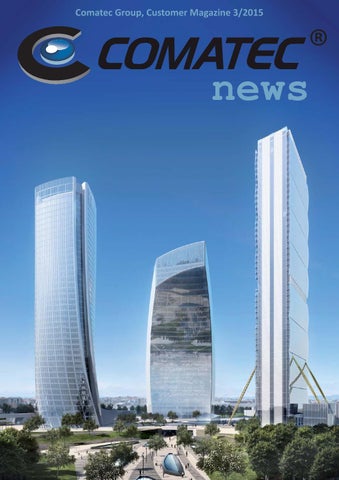
Cover: Zaha Hadid Architects
Taina Syrjänen Andrew Fisher (Transla on)
Feedback, subscripƟons, cancellaƟons Taina Syrjänen tel. +358 40 5931 259 taina.syrjanen@comatec.fi
ComatecNews 3
Noora Koski keeps everything in order Kone Corpora on is one of the leading manufacturers of escalators and elevators in the world. Kone’s products can be found in all parts of the globe. The company has succeeded in winning major trail-blazing projects. Noora Koski works in Comatec’s Cranes and Load Handling unit and has the task in Kone’s Major Projects Unit of making sure that informa on is in the right place at the right me. AUTHOR: TAINA SYRJÄNEN
Noora Koski’s job in the Major Projects Unit at Kone is to coordinate interna onal projects. At the moment Noora is working on two projects, one in Milan, Italy, and the other in the UK in London. She joined the Nova Victoria project in London a er the project had got underway, when projects were re-allocated because of the volume of work. On the other project, however, the Hadid Tower being built in Milan, she has been involved right from the beginning.
Photo courtesy of: Courtesy of Zaha Hadid Architects
“I started in Major Projects at just the right me for me to join the Hadid Tower project right from the start-up phase,” says Noora Koski. The Hadid Tower designed by Zaha Hadid is being built in Milan. It will be a 170 metre high skyscraper that twists around its own axis. Tower Hadid is one of a group of three buildings. There will be a shopping centre at the foot of the tower with covered access to the metro. The tower itself will comprise office and residen al premises on 44 floors. “Altogether 14 elevators will be installed in this project. They have all been customized to some extent, but nothing very unusual or special,” explains Noora. “The client and the architect have approved all the drawings, including those for the cabin and the cabin control panel, as well as the fonts to be used in these. We had to make some minor altera ons. For example, the font is the same on all the equipment where the text or numbers are visible. We have changed the posi on of the push bu ons and the material used in the handrail. So we have just had to make small changes,” states Noora.
Right informaƟon in the right place Global elevator and project sales at Kone are the task of sales companies opera ng in different countries. The Major Projects unit calculates, on behalf of the sales companies, tenders for the Kone machinery and equipment needed in a project when this is for a customized elevator or is an especially large-scale project. “If Kone wins the contract, we receive an order from the sales company. From that point on the Supply Manager takes over, in this case Noora,” explains Jukka Eloranta, Head of Area Supply, Europe. It is important in projects for informa on to get to where it is needed at any par cular me. That is why the Supply Manager is the only point of contact through which informa on passes.
4 ComatecNews
“I make sure that informa on is in the right place at the right me,” says Noora.
Noora Koski from Comatec works as Supply Manager at Kone and her superior is Jukka Eloranta, Head of Area Supply, Europe. “The first thing is to go through the technical data with the client. These form the basis for the design. If things go well, I don’t need to take part in the design phase. But there is always something that needs to be asked or checked, at least at the point when the designs are sent for checking by the sales company and the client. “I supply the designs and technical data to produc on, where the elevators are made. Produc on carries out a more detailed examina on to see where any extra diagrams are needed. I don’t take a stand on produc on’s comments but sort out any issues that arise so that produc on has sufficient accurate data to manufacture the elevators,” states Noora. “In principle I handle the project on my own, but I have a ’virtual’ team that I can turn to for assistance if I need it.” Kone operates on the life cycle concept in elevator projects. It offers a full range of services, from selling an elevator through to the end of its service life. The work of a Supply Manager, however, ends when the elevator has been supplied to the client. Even at that point there are usually things that s ll need to be sorted out. “Whatever the issue, if it is related to my project, I will sort it out,” is how Noora describes her role.
What makes a good project manager “People who work in project management must have an outgoing personality, and it is essen al that they get on with all sorts of people. Noora’s personality is very suitable for this project management work,” says Jukka. “She is a good example of the skills and service that Comatec can provide. “In major projects the buildings are designed by architects. Architects do not usually want to copy other people, so they can also have all sorts of unusual wishes for elevators,” states Jukka.
“Perhaps the most challenging aspect of Noora’s job is that she comes against the limits for customiza on and in mee ng a client’s wishes. “One of the most amazing requests that I remember was for a glass elevator sha in which the li itself was also a glass cube that went up and down. We always a empt to find a solu on that is as close as possible to the client’s vision, and on this occasion we also achieved a solu on that the client was happy with,” Jukka recalls. “In major projects it is vitally important for there to be only point of contact through which all informa on passes. Noora is the contact not only for the sales company, but also for design and produc on at the factory. Noora is therefore the only contact person in all direc ons,“ Jukka explains. “Someone in Noora’s posi on needs to have the ability to handle stress and to take nega ve feedback even when they know that they have done things properly.” “You must not take something personally, even if it is upse ng when some mes you just can’t do anything about a ma er. That is also part of this job. You have to try and learn from this and apply the feedback to the next project,” states Noora.
Europe region Jukka is responsible for the Europe region, and for Africa and Israel. There are currently 36 projects underway in his area. “Israel is included on our maps in Europe. That is because the requirements for Israel, as for Northern Africa, are similar to those in Southern Europe. “At the moment we have no less than four projects in the delivery stage in Israel. We have supplied one project for South Africa, but we do have several projects under tender there,” says Jukka. “I don’t actually coordinate projects. That is the job of Noora and the other supply managers. My role is to supervise the services of the unit supplying the products for projects in my own area,” says Jukka. “The supplying units can be anywhere in the world, for example in Finland in Hyvinkää, in China, in Italy or in North America. The Hyvinkää factory is at present the only Kone factory that supplies customized elevators,” states Jukka. Today Kone has more than 1000 offices in 60 countries. The Group has global opera ons and employs more than 47 000 people. Even though it has global opera ons, Kone has kept its head office in Finland.
ComatecNews 5
EEMC team in product development at ABB Marine ABB Finland’s Marine and Ports unit in Vuosaari Harbour in Helsinki develops electrical and automa on solu ons for the marine industry. The unit’s spearhead product is the Azipod® propulsion system, which enhances the fuel economy, energy efficiency and manoeuvrability of ships such as cruise ships, icebreakers, ro-ro vessels and tankers. AUTHOR: TAINA SYRJÄNEN
In the Azipod® propulsion system a variable frequency drive motor rota ng the fixed pitch propeller is located in a separate control unit on the outside of the ship’s hull. Since the control unit rotates 360 degrees about the ver cal axis, a vessel with an Azipod® propulsion system is easier to steer and is quieter, and the space inside the ship can be used more effec vely. Ease of steering means that it also gives a significant improvement in safety. Energy efficiency is becoming one of the key issues for ship building. A vessel fi ed with an Azipod® propulsion system can give fuel savings of up to 20 per cent compared to conven onal propellers. This is achieved because the propellers operate in a clear flow of water. Using the Azipod® system in a typical car ferry in the Bal c Sea reduces carbon dioxide emissions by some 10 000 tonnes a year compared to a conven onal propeller system.
Client plays key role in product development Nowadays ABB looks a er the products it supplies throughout their service life. More than 250 Azipod® units have been installed, on almost 120 vessels around the world. The orders received by ABB this year include one worth more than USD 60 million for Azipod® propulsion systems. These
Kai Karila, Manager, R&D, High Power Azipod®.
are built at ABB’s Vuosaari and Hamina factories in Finland. This is a repeat order from the MEYER WERFT shipyard, the leading builder of cruise ships in the world, which demonstrates the added value that the client obtains from ABB’s flagship product. It also shows that the Azipod® propulsion system has established a firm foo ng.
Development of Azipod® propulsion systems Product development of Azipod® propulsion systems goes on con nuously. ABB works with clients to develop solu ons. In most cases development focuses on improving performance or power, thrust or speed. Clients carry out improvements and adjustments to ships in other ways, so they also want to get as much as they can out of the propellers. User experiences provide some of the most valuable contribu ons to developing business opera ons and products. The client and their needs are always at the heart of ABB’s development ac vi es. ABB not only develops the products it has already launched, but is also con nuously developing new products and ideas. “The large Azipod®s are manufactured in Vuosaari and the small ones at ABB’s factory in China. Development of both takes place in Vuosaari, however,” says Kai Karila, R&D manager for high power Azipod® systems. “Two years ago we started a development project to look into a new rota ng device. One major element in this was the hydraulics system. We started working on the hydraulics with Comatec’s EEMC team at that me,” states Kai. “During this separate five month project the EEMC team created altogether 30 different concept op ons,” Kai con nues.
6 ComatecNews
The EEMC team discussed these with ABB and cut down the number of proposed solu ons and is now con nuing development of the hydraulics with the concept chosen by ABB, and this is being produc zed. About one year ago, project manager Suvi Westerlund from Comatec’s
EEMC team spent several months on secondment in Vuosaari in connec on with the project.
EEMC team members project manager Suvi Westerlund and special design engineer Hannu Vihtanen.
“Each of us has their own area of special exper se but we mainly work as a team. This also gives the best results for the client. For ABB, for example, during the concept project and while we have been working together since then we have made several inven on disclosures. In an inven on disclosure we tell the client what we have invented, how it works and of course how it can benefit the client. If the client decides to purchase the rights to the inven on, the EEMC team may no longer use it in other projects,” Suvi explains. “At that point the inven on becomes the property of the client, and the client’s own personnel may not necessarily know what the inven on consists of, so we are very paranoid about preserving confiden ality,” says Suvi with a laugh, but immediately becomes more serious. “The inven on then moves into the patent phase in accordance with the client’s schedule, that is if they decide to produc ze and protect it. “Confiden ality is a hallmark of the team’s work. Virtually all the projects are such that we cannot talk much about them. To start with, as a rule we cannot even say who we are working for. The client decides on how fast we move in these ma ers,” explains Suvi. “This product may go public in a year’s me,” says Kai.
Comatec experƟse The other people who have worked with Suvi on crea ng concepts and in R&D are EEMC team members special design engineer Hannu Vihtanen and design manager Jukka-Pekka Uusitalo. Senior design engineer Anne Kotalampi from Comatec’s expert services has also carried out an FMECA (failure mode, effects and cri cality analysis). “We have been very happy with the FMECA. It looks as if it has been carried out extremely thoroughly, taking all aspects into account. It did surprise us how much work was involved in the analysis, however. And it needs to be kept up to date and maintained,” states Kai. “We have ordered further training in
FMECA, and we will also be making use of Comatec’s exper se in both FMECA and hydraulics in our other projects,” says Kai. “Coopera on has been really smooth. I can find no faults. The make-up of the team and the people in it was just right. Hannu thinks through the technical issues down to the finest details – looking at the different op ons and from different angles. Suvi is also an engineering expert and can examine ma ers from different viewpoints, but she is also able to get things moving. Anne is another expert professional,” says Kai.
Thorough tesƟng “We aim to carry out tests at the factory on as many components and part solu ons as possible, as long as this is sensible. Suvi and Hannu oversaw the tes ng for the hydraulics,” says Kai. “For this project we tested different op ons affec ng safety and func onality to find the best way to implement a new feature,” explains Suvi. “We try to find any weak spots with new features on the designer’s desk, but some mes it requires tes ng or simula on. We always take decisions about these in consulta on with the client. “It is only possible to carry out sea trials, for example for the product being developed here, a er the client has purchased it and it has been installed on the first ship. The EEMC team may take part in the sea trials for the hydraulics
when that me comes,” states Kai.
Competence centre with five experts Comatec’s competence centre for hydraulics and mo on control set up by business unit manager Arto Timperi is headed by Jukka-Pekka Uusitalo. The other member of the core team, in addi on to Suvi, Hannu and Jukka-Pekka, is engineering manager Vesa Aarni from Comatec’s Kuopio office. They possess indepth exper se not only in mobile machinery but also in marine applica ons. “The EEMC team is the result of Arto’s vision and of Hannu’s and my desire to work together. Then Vesa joined us, and Arto invited Suvi to join the team soon a er it was set up. The structure of the core team has worked very well,” explains Jukka-Pekka. Comatec Group’s EEMC team (Energy Efficient Mo on Control) provides engineering solu ons that save energy and costs, in accordance with its philosophy. “The services offered by the competence centre include the concept phase, preliminary design, simula on, design and supervision of the construc on of a prototype and tes ng, either as individual services or combined with other Comatec Group services. A er the preliminary design, product design and consul ng con nue in coopera on with our clients throughout product development,” states Jukka-Pekka.
ComatecNews 7
Comatec celebrates anniversary in 2016 It is now 30 years since Comatec was established. The year 2016 is significant for Comatec founder Aulis Asikainen, but is also a major milestone for the whole company. The path from a one-man company to becoming a group of companies with almost 400 employees has had its ups and downs, but includes many memorable moments. Clients have always formed the cornerstone for the company’s business opera ons. The company exists for its clients, and Comatec personnel do their work for them. To celebrate the 30th anniversary, a commemora ve book is being wri en about Comatec, its clients and personnel, that will be published on 24 March 2016. AUTHOR: TAINA SYRJÄNEN AND EXCERPTS FROM COMMEMORATIVE BOOK TAPIO ERÄHEIMO
The commemora ve book is being wri en by Tapio Eräheimo, and he stresses that it is not a history. The text does not document the history of the company. If it did, the work would be the most long-winded book of the year. The goal has been to write something completely different about a company called Comatec. The author has aimed to mirror the company’s development against the change in society. It is the story of how the company and its personnel have coped with the changes in technology and business, in a changing world. The book tells about the company’s opera ons over the past 30 years. It contains informa on and descrip ons of the history of the company and the people who have worked there, but it also gives a wide-ranging narra ve about the jobs and projects in which the company and its design engineers have par cipated.
Eyes on tomorrow The commemora ve book does not simply s ck to the past but also takes a look at prospects for the future. Here is an extract from the chapter “Moving into the levita on business”: “The railways have played a key role in changes in socie es in the past couple of centuries. And the railway is not just part of history. All the signs indicate that trains will transport more and more people and freight, at higher and higher speeds. Rail services have a bright outlook. “The outlook is par cularly encouraging for rail services, compared with air services, for conveying people over distances of several hundred kilometres. There is an enormous need for transporta on for these distance for example in Europe and in many parts of East Asia. Flying creates considerable noise and air pollu on. Airports are located outside ci es, so it o en takes much me to get to them. The air transport sector
Finnish Post, logis cs centre at the start of the 1990s.
suffers from chronic overcapacity and does not seem to care about the use of its customer’s me, so the filling of aeroplanes is organized in a way that requires passengers to get to the airport early. Loading aeroplanes is a complex process, as is unloading them. And ge ng from the airport at the des na on to where the people are takes me. Even if the flight itself took place at the speed of light, it would normally s ll take four hours or more to travel a distance of 500 kilometres. “Trains travel straight to where the people are. You can easily make it to the train if you are on the sta on pla orm one minute before it departs. You can throw your bag into a locker as soon as you step on board. Five minutes later you can be sipping a cup of tea with milk, hot chocolate with cream or an espresso coffee. It is quite easy to achieve speeds of 250-300 kilometres an hour without massive expenditure on the track.” “The new genera on magne c levita on trains are a completely different story, with a record speed of 603 km/h recorded on a test run. The train in opera on in Shanghai has a maximum speed at the moment of 430 km/h. The Maglev train planned to operate between Tokyo and Nagoya is due to come into service in 2027. The top speed for the train is envisaged at just over 500 km/h and the journey between the two ci es will take 40 minutes. The distance between the ci es is 280 kilometres. The Maglev train has no wheels, it floats above the rails. This is not a case of overcoming gravity; the floa ng is achieved by magne sm. Even so, it is levita on, even though it is magne c levita on.”
Becoming a limited company 8 ComatecNews
“Aulis Asikainen set up his own company at a me when industrial produc on chains were beginning to be organized
in a radically new way. This opened up promising prospects for this expert in the machinery and equipment engineering design sector, which caused him to weigh up his own goals and job descrip on immediately a er his company Tmi Kulje nsuunni elu A. Asikainen had won its first order. Should he start to develop the company or should he concentrate on working at his profession? “The decision to begin to develop the company and employ others on a larger scale led Asikainen, in the winter of 198586, to think over the form of company and the ownership basis. Replacing the sole trader company with a limited company seemed a natural step. And, in a situa on where there are several owners, it also seemed natural to require a majority shareholder, who in the last instance would take decisions and take responsibility for them a erwards. “The decision to ask owners of a rival company to become shareholders amazed many people later. This amazement has always puzzled Asikainen and made him suspect that these people think that in the mutual rela onship between compe on and coopera on, these two are at opposite ends of the scale. If that is the case, then strengthening coopera on between A and B would require the compe ve situa on to weaken between them and, correspondingly, strengthening the compe ve situa on between two par es would reduce their ability to cooperate. The other way to look at the ma er is that A and B can compete in one ma er and one situa on, but that in no way reduces their ability to cooperate in another ma er at the same me. The only thing that is essen al is open communica on and playing fair in everything. It is possible to see A and B as two compe tors, or as two businesses opera ng in the same sector. “Coopera on with Enmac opened up new networks for both. Special client rela onships are to a large extent a ma er of personal chemistry. Someone gets on with one person, another with someone else. A good client rela onship could rise to a completely new level if a partner had the right person to bring that li le extra to the overall picture. Coopera on could also result in engineering work in new areas. Asikainen’s own par cular strength lay in conveyor systems for general cargo, but it would be important for the new company
to design other things as well. Combining skills and capacity might in the next few years enable them to win joint projects which neither of them could obtain on their own. It might be possible to make flexible use of engineering resources between the two companies. Learning and risk management were other issues that occurred to him; Enmac had got off to a good start and had certainly solved and would solve many of the same problems that awaited Asikainen. ”Aulis Asikainen, Marƫ Alavainio and Kauko Lehtonen established Insinööritoimisto Comatec Oy on 24 March 1986, and the company was domiciled in Tampere. Asikainen subscribed 60 % of the shares, and Alavainio and Lehtonen 20 % each. They had gradually se led on the name during the winter while perusing trade journals. A foreign language basis for the name seemed appropriate since it was quite possible that at some point in the future the company would operate outside Finland. Even though the inten on was not just to s ck to the original areas of knowhow, these were however depicted in the name, which derives from the words Conveyor Material Technic. The prefix ‘insinööritoimisto’ (engineering office) reflects the age. An ‘engineering office’ set up by a technician (ie. someone without a higher engineering degree) was not allowed to use the tle ‘insinööritoimisto’ in its marke ng.”
Strategy policies The strategic choices described in the following extract have formed the backbone for the company throughout its 30 year existence. “Three strategic policies were laid down for Comatec. The first was that the company focuses solely on engineering design. Although Asikainen was a racted to the idea that at some me in the future manufacturing could become a second pillar for the business, it was never considered as a serious op on when the company was set up, nor has been since then. To quote Juice Leh nen, a Savo/ Tampere based popular ar st, “it is not worth dreaming about living a double life if it takes all your efforts to live a single decent life”. “The second policy was that Comatec is a service company. It concentrates its efforts and knowhow on developing the products
of its clients, on resolving problems, on managing projects or sub-projects and on providing addi onal resources. The tempta on to go against this has at mes been strong, since there are numerous ingenious products that would find a place in the world, for which an engineering company cannot help genera ng ideas all the me but which do not fit in with the scope of customer companies. The company has stuck to this policy, however, and Comatec has not set out to develop product ideas as its own projects. “The third strategic choice was to focus on machinery and equipment design. This means that some mes the company may serve an investor, but usually it is a manufacturer. When serving an investor it is usually a ma er of a large, one-off project, in which Comatec, as well as providing product design, or instead of this, can serve as consultant or manage a project or part of a project.”
Background to the commemoraƟve book “30 years is a long me in the history of a company. One and a half years ago, when we started to think that it would be a good idea to get the 30-year history of Comatec in print, one basic idea was to create a work that would be more than just a conven onal company history. Together with Jouko LanƩo and Tapio Eräheimo, the creators of the book, we decided on a book like this,” says Kari Kantalainen, chairman of Comatec’s board of directors. “Our goal was above all for the book to be easy to read. It comprises several ”stories”, which portray in an interes ng way the diversity of the company’s opera ons and its ability to respond to the con nuous social and technical change in its business environment. The idea is that readers can turn to any chapter that they find interes ng and jump straight into a memorable “story”. “The book tells how Comatec and its personnel work. It brings together developments in the technology industry and trends with Comatec’s business concept as an engineering company. It aims to present Comatec the company, its owners, personnel and clients, in a deeper dimension than a company history and with a broader perspec ve,” states Kantalainen.
ComatecNews 9
Extra capacity for application design The design business of JAT-Asennus Oy became part of Insinööritoimisto Comatec Oy in December 2014. At that me four people in the applica on design business became Comatec Group employees in the Electromechanical Systems and Components business unit in the Industrial Produc on Systems segment. The acquisi on aimed to strengthen electrical design exper se in the segment and service capabili es in the Helsinki and Tampere economic regions. AUTHOR: TAINA SYRJÄNEN
“At that me we had a real need for extra capacity, and in par cular we needed to strengthen our long-term coopera on with ABB Drives. The cornerstone for Comatec’s opera ons lies in long-term customer rela ons based on trust. We want to invest in these. Through the acquisi on we obtained experienced experts with indepth knowhow and have achieved these goals very well,” says business unit manager Pekka Jaakola. “We now also carry out work for ABB Drives at our Tampere office.” Team leader Jonne Järventausta is one of the JAT-Asennus applica on designers who moved to Comatec in the acquisi on. He had worked at JAT-Asennus for nine years before this. “I started back then at JAT-Asennus on the shop floor, like all the applica on designers who moved to Comatec. To start with I carried out mechanical systems, wiring, finishing and inspec ons/tes ng. I also stood in for the produc on manager at one point, and was team leader for electrical work. I started in applica on design a er I graduated as an electrical engineer from the Tampere University of Applied Sciences. My work changed then in line with my training,” says Jonne Järventausta. “My team now carries out applica on design for ABB Drives. We customize machinery and equipment for which the client has ordered non-standard fi ngs. “I’ve se led in very well at Comatec, even though the move came rather unexpectedly. But this has been a posi ve change for us. Applica on design was an extra service at JAT-Asennus. At Comatec we are part of a large engineering company and applica on design is an integral element in the service offered by Comatec. Our work has remained more or less unchanged. In my opinion the business acquisi on was sensible, since Comatec already worked with ABB Drives. Our exper se fits in well with this partnership,” states Jonne.
10 ComatecNews
Comatec news Insinööritoimisto Comatec Oy purchases design business of edec Oy Insinööritoimisto Comatec Oy has purchased in a business acquisi on the design business of edec Oy in an agreement signed on 27 November 2015. edec Oy’s employees at its Helsinki and Kouvola units are transferring on 1 December 2015 to the service of Insinööritoimisto Comatec Oy. This transac on strengthens Comatec Group’s knowhow especially in electrical design for the marine industry. It is a major element in the development of Comatec Group in line with its strategy. Comatec Group’s market share in electrical design for the marine industry will increase and the Group will be able to offer its clients larger service packages. The acquired business will be part of the Electromechanical Systems and Components business unit in the Industrial Produc on Systems segment. Further informa on: Aulis Asikainen, President and CEO, Comatec Group, tel: +358 (0)400 504 021 Mikko Ala-Jääski, Managing Director, edec Oy, tel: +358 (0)20 765 9425
Comatec obtains management system cerƟficaƟon DNV GL Business Assurance Finland Oy has on 27 October 2015 granted Comatec Group a management systems cer ficate in accordance with the ISO 9001:2008 standards. The cer fied opera ons comprise the Group’s design, project management, site and expert services. The cer fica on assessments went very well and no devia ons were reported during the three-day assessments. Seven areas were recorded for development and possible improvement. The main area of focus in the cer fica on was opera ons in line with Comatec’s project model. Comatec has introduced a new project model during 2015 and projects are carried out in accordance with this at Comatec. Preparing for cer fica on has demanded long-term, determined efforts. The cer ficate achieved now forms a good springboard from which to con nue to develop opera ons and processes.
New appointment: Mikko Ala-Jääski has started on 1 December 2015 as head of department in the Electromechanical Systems and Components business unit in the Industrial Produc on Systems segment, with responsibility for electrical design projects for assignments for the ship-building sector, the building sector and industry.
ComatecNews 11
Comatec Groupin toimipaikat: TAMPERE Insinööritoimisto Comatec Oy Kalevan e 7 C, FI-33100 TAMPERE Tel. +358 29 000 2000 Rantotek Oy Kalevan e 7 C, FI-33100 TAMPERE Tel. +358 29 000 2090 VANTAA Myyrmäen e 2B, FI-01600 VANTAA Tel. +358 29 000 2000 HYVINKÄÄ Kehäkuja 6, P.O. Box 26, FI-05831 HYVINKÄÄ Tel. +358 40 5563 299 HÄMEENLINNA Parolan e 104, FI-13101 HÄMEENLINNA Tel. +358 29 000 2000 IMATRA Insinööritoimisto Metso Oy Vuoksenniskan e 97, FI-55800 IMATRA Tel. +358 29 000 2070 JOENSUU Hiiskosken e 9, FI-80100 JOENSUU Tel. +358 29 000 2000 JYVÄSKYLÄ Laukaan e 4 B, FI-40320 JYVÄSKYLÄ Tel. +358 50 555 6688 JÄRVENPÄÄ Sibeliuksenkatu 18, FI-04400 JÄRVENPÄÄ Tel. +358 400 675 778 KANKAANPÄÄ Insinööritoimisto Kisto Oy Keskuskatu 52 , FI-38700 KANKAANPÄÄ Tel. +358 2 5722 411 KOUVOLA Prikaa n e 9, FI-45100 KOUVOLA Tel. +358 20 765 9425 KUOPIO Microkatu 1, FI-70210 KUOPIO Tel. +358 44 7414 440 LAHTI Askonkatu 9 F, FI-15100 LAHTI Tel. +358 29 000 2000 LAPPEENRANTA Insinööritoimisto Metso Oy Fazerin kiinteistö Valtakatu 2 G, 3. krs, 53600 LAPPEENRANTA Tel. +358 29 000 2070 OULU Oucons Oy Kaarna e 14, 90530 OULU Tel. +358 400 542 547 TALLINNA Comatec Estonia OÜ Laki 16, 10621 TALLINN, ESTONIA Tel. +372 5685 0845 TURKU Pitkämäenkatu 11, FI-20250 TURKU Tel. +358 29 000 2000 VARKAUS Rantotek Oy Wredenkatu 2, FI-78250 VARKAUS Tel. +358 29 000 2090
Merry Christmas and prosperous New Year SOLUTIONS. PROJECTS. EXPERTS.
®
Comatec Group www.comatec.fi