Comatec Group, Customer Magazine 3/2014
ÂŽ news
London Gateway aims to be key global player Esa Puhakka in England IPMA C certification
Photo: London Gateway
Comatec – Electricity and automation
news
Table of Contents
Editorial
...................................................
Comatec – Electricity and automation ...................................................
London Gateway aims to be key global player
..................................................
Esa Puhakka in England
..................................................
IPMA C certification
..................................................
Comatec news
..................................................
2 ComatecNews
Editorial
Have a good day – and a better tomorrow
I
heard the slogan in the heading when I was out grouse shoo ng in the forest – spending a whole day ring myself out, without bagging anything. The idea behind it is, I think, very relevant to the economic situa on today. The struggle towards recovery has taken a surprisingly long me, although this must surely come in the next few years. There’s no going back to the me before the recession, but the structural changes that have taken place also open up new opportuni es. Growth depends on us, as growth company entrepreneurs keep saying. At present Finland’s economy is suffering from several problems. Industry is in a period of transi on, business condi ons are unfavourable, and public sector finances are in deficit and are too high in rela on to GNP. Events in the main market areas and the domes c sustainability gap cast further shadows over the economy. We have to reform our welfare state and at the same me recognize and admit that the future is going to contain more uncertainty. Too o en at the moment we just expect someone else to do something, and in our selfishness we do not think of the common good. This applies to poli cal decision makers, trade unions, investors, and the public sector such as the tax authori es or educa on etc. Now that we are gradually moving from an economic crisis into a structural crisis, success in this situa on as well is s ll partly up to us. This will require not only hard work but also knowhow, an understanding of the situa on, and control of costs. If we examine a successful subcontrac ng business, one feature that stands out is an in-depth understanding of the behaviour of its customers. The purchasing behaviour of major client companies, if their contract and payment terms start to be unreasonable, imposes extra pressure. A successful company is one that an cipates and plans for the future, has a customer-orientated strategy, is flexible and nimble, looks a er its personnel and has an effec ve, tac cally intelligent organisa on. Interna onal expansion, networking and con nuous learning already form part of its normal ways of working. Looking at the requirements for success, we realise that we are talking
about the commitment and competence of the en re organisa on. This requires effec ve ownership steering as well. The owners of Comatec Group have given the company’s Board of Directors, and through this the whole organisa on, the so familiar target of profitable growth. This is also where our slogan – “Our goal – to grow profitably, our challenge – to maintain control in the future” comes from. Fortunately these are not the only instruc ons given by the owners; they have also given a more detailed defini on of the strategic goal. The goal is for the company to be an interna onal engineering office that serves technology companies and is con nuously developing. By Finnish standards it is a large company that has the long-term goal of being one of the most highly skilled companies in its field. The company is at the same me gradually shi ing towards the project and solu on business. To achieve this goal the Board launched a process of change that is currently being implemented. The changes are being carried out through development projects and focus on management of the customer interface, on developing knowhow and capabili es, on internal systems and processes, on management and the organisa onal structure. The Group is looking for growth and profitability through both acquisi ons and internal growth, not forge ng cost management. A new skills-based and customer-oriented organisa on has been in opera on since the beginning of 2013. In the current difficult business climate, customer feedback has been encouraging, since the company is able to manage more complex assignments and take on greater responsibility. Since it is harder to grow and see the business as it develops over the next five or ten years than it is to talk about this, we need the par cipa on of all stakeholders - customers, management, personnel and various bodies in the public sector. Comatec’s customer rela ons personnel and management are happy to give more detailed informa on about the goals and development projects. At the same me, through joint discussion we wish to adjust our opera ons so that they meet genuine customer needs and generate added value for all par es.
Let’s move on together towards success – it’s up to us! Tuomo Nevalainen Vice chairman of the Board of Directors Comatec Group
Publisher
Edi ng and implementa on
Comatec Group Kalevan e 7 C FI-33100 Tampere tel. +358 29 000 2000 www.comatec.fi
Comatec Group Taina Syrjänen tel. +358 40 5931 259 taina.syrjanen@comatec.fi
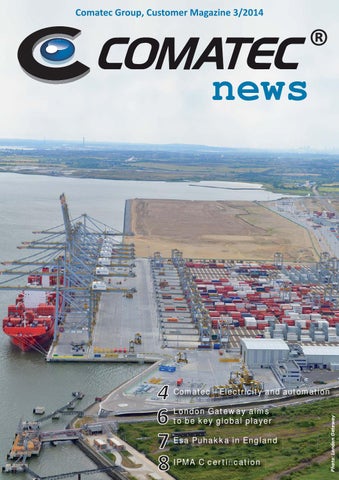
Cover: London Gateway
Taina Syrjänen Heikki Harri Andrew Fisher (Transla on)
Feedback, subscrip ons, cancella ons Taina Syrjänen tel. +358 40 5931 259 taina.syrjanen@comatec.fi
ComatecNews 3
Electricity and automation – Mobile machinery and special vehicles
Mechanical, automa on and electrical design are core competences at Comatec. In the design of mobile machinery, special vehicles and rail rolling stock these are inseparably linked. No mobile machine or train can move without careful electrical and automa on design. Janne Hirvonen has worked at Comatec for six years now and started his new du es as business unit manager at the Electricity and Automa on unit in the middle of September. Chief design engineer Juha Siekkinen and special design engineer Kai Aarikka work in his department. Comatec Group has 70 electrical and automa on engineers and 25 of these work with mobile machinery. AUTHOR: TAINA SYRJÄNEN
Exper se in the design of mobile machinery, special vehicles and rail rolling stock has become a real strongpoint for Comatec. Comatec designs all aspects of mobile machinery, such as steel structures, transmissions, actuators, hydraulics, cabins, electrifica on, automa on and so ware. In the Mobile Machinery and Special Vehicles business segment, electricity and automa on are smoothly integrated with in-depth knowhow in mechanical 4 ComatecNews design.
“Electrical engineering involves designing equipment and its wiring. On top of this we work on automa on and programming. It is difficult to draw a clear line between these,” says business unit manager Janne Hirvonen.
Customer is number one “In my department we carry out electrical and automa on design, programming and tes ng for many different customers,” says Janne Hirvonen. “Special design engineer Kai Aarikka, who designs automa on so ware, and chief design engineer Juha Siekkinen, who mainly designs electrical systems, have carried out a wide range of different projects for many customers,” states Janne. “The star ng point for what we design and the way we design it is always the customer’s specifica ons. Some customers give very precise specifica ons for the design, others just give an idea of how the end product should func on. On the basis of the source informa on, we start to design a system, we choose components, make circuit diagrams and in many cases wiring set drawings, and produc on drawings for a machine. “For an automa on system we design the necessary func ons and the cabling between the actuators on mobile machinery and the automa on system. Systems can vary in size from just a few signals to several thousand signals. “We design electrical and control systems for mobile machinery, which
typically include hydraulics, electric drives and a diesel engine. For control systems we design the display screens, the programmable logic, the buses and peripheral devices,” says Janne. “We also take part in project and installa on supervision as well as in choosing components and equipment, in compe ve tendering, and in purchasing ac vi es,” adds Janne. “We carry out design work in different areas, such as remote access and produc on test equipment, according to customer requirements. If a customer wants this, we can add a risk analysis of machine safety to the design. We work with Comatec experts in different fields,” says Janne. Kai Aarikka has most recently worked with the Rolling Stock unit on automa on design for a VR (Finnish Railways) locomo ve. “This VR project is for a wagon gri er. Pipes run from the locomo ve to the bogie wheels. The equipment we are designing heats the pipes and measures the temperature. It stops the grit from freezing in winter,” says Janne. Kai Aarikka has also taken part in designing the automa on system for the prototype machine for installing Posiva’s bentonite buffer blocks. Juha Siekkinen carried out the electrical design for the machine. Altogether some 30 Comatec experts par cipated in the design of the prototype. All areas of Comatec knowhow were required in the design, such as mechanics, hydraulics, electrical and automa on knowhow and expert services. The hydraulics in the machine
were replaced with electrical actuators and it will be remotely operated. “The Posiva project has been the biggest project that I have been involved in at Comatec,” states Juha Siekkinen. “I have also done some electrical design work for Sandvik, mainly for test equipment and prototype projects. I have designed raise borers and mobile drilling equipment for TRB-Raise Borers. I have also designed electrical systems for AW-Energy, working with our mo on control team.” “I have also produced some safety reports,” says Juha.
Machine safety Machine safety is an integral element in the design of mobile machinery. The EU’s Machinery Direc ve affects every aspect of their design – including electrical and automa on design. “The standards and risk analysis set certain performance requirements for control systems. The performance calcula ons that I have carried out are one part of this work,” says Juha.
Design programs “We have a wide range of design programs in use. The program we use depends on the format of the material that we receive from the customer, which has o en been saved in a specific program. So the customer has a big say in the choice of the program we use,” says Janne.
“All our designers are not experts in all the programs. Designers are chosen for a project on the basis of who has the appropriate skills and knowhow for a par cular job.
Tes ng Kai Aarikka designs automa on systems. Most of his work takes place at his desk, but some of it is in the field. Machines are tested in opera on and modifica ons are made to them during tes ng. “Tes ng always involves complete mobile machines. We carry out two forms of tes ng, either tes ng so ware code against a simulator or tes ng the opera on of a finished machine,” explains Janne. “In simulator tes ng we test different parts of the so ware and check if they func on as specified. In a test the simulator models the machine and uses real controllers and control units. “If there are faults in the way a system operates, we find out where they are. Anything is possible. The fault can be in many places, in the so ware, in components, in the drawings or in the manufacturing of the machine. If the fault is not in the so ware, it is probably in a component or in the wiring,” states Janne.
Commissioning support “Commissioning takes place when all the equipment is ready for the first start up. Every now and then problems and new
issues come to light during the first start up, and we can then give immediate assistance on the spot,” says Janne. “We offer our exper se for the commissioning. If we have programmed a piece of equipment, the programmer goes to the site to provide commissioning support. He can make any necessary correc ons and ramp ups on site”.
Many different projects Juha, Kai and Janne like being able to work on many kinds of projects at Comatec. “Almost every project involves something new. Nothing similar has been done before. It is interes ng to examine the source data for a project and then plan how to get the best end result for what the customer wants,” says Janne. “In my previous job I made slightly different varia ons on the same theme and in five years I had learnt what I was doing by heart. Here there is no fear of learning everything about the machines by heart. In the long run that is a good thing,” states Juha. “Comatec’s flexibility concerning working hours and holidays is something that we appreciate highly,” say Juha and Kai. “Flexibility does also depend on the customer. But I have managed to come to flexible arrangements with customers as well concerning holidays,” says Kai.
From le : chief design engineer Juha Siekkinen, business unit manager Janne Hirvonen and special design engineer Kai Aarikka.
ComatecNews 5
Kuva: London Gateway
London Gateway aims to be key global player
At the beginning of 2010, construc on began of a new container port on the north bank of the River Thames east of London. The enormous project, called the London Gateway, aims to be one of the main hubs for freight traffic in the world. It is being developed in phases, and the first ships docked and unloaded towards the end of 2013. The precise date has not been fixed yet, but it is expected to take 10 – 15 years to complete the en re project.
Sea. Almost 50 per cent of the UK’s consumers live in London and the south-eastern part of the Bri sh Isles. The new port and logis cs park will considerably reduce the need for transport by road and rail, since goods can be delivered direct to the London Gateway logis cs area and from there to shops and homes. The port will make a major contribu on to employment in the region. The port and logis cs park will together create directly up to 12 000 jobs. It is es mated that indirectly the project will result in a further 20 000 new jobs.
is being undertaken by Dubai-owned DP World. One indica on of the scale of the port is that it has altogether 2.7 kilometres of container quays. When completed, the port will have an annual capacity of 3.5 million TEU container units. It will have six deepsea quays for large ships, with a depth of 17 metres. The port and logis cs park are fi ed with the latest port automa on technology. Containers are handled automa cally at the main gate, in the container storage area and in the railway terminal. Iden fica on of road vehicles and drivers is also automated.
The port project has a cost es mate of almost two billion euros. The project
Kuva: London Gateway
AUTHOR: HEIKKI HARRI
The role of the port takes on greater significance because it can handle the world’s largest container ships. The development also comprises a major 300 hectare logis cs park which is being built in stages. It is located close to motorways and will have rail access. The idea behind the logis cs park is to provide smooth access in par cular to the UK consumer market. London Gateway is located some 40 kilometres from the centre of London, close to the towns of Thurrock, Basildon and Southend-on-
6 ComatecNews
The Edith Maersk is the largest container ship to enter the River Thames. The ship’s arrival in port was a historic moment.
Esa Puhakka in England and Esa Puhakka, a project manager in Comatec’s Material Handling Systems business line, spent nine months on secondment in London. The project was to install 40 automated port cranes, and the delivery also included straddle carriers. Esa Puhakka’s job Ɵtle was planner and he was responsible for resources and scheduling. AUTHOR: TAINA SYRJÄNEN
“Our customer is par cipa ng in London Gateway and asked my boss for a suitable person for their project team,” says Esa Puhakka, explaining how he ended up on the project. “I contacted the customer and went to meet the project team in London. In a project it is extremely important for the team to have good personal chemistry and to func on effec vely together. Since both par es felt that we got along very well, I was offered the job. “The secondment began in April 2013 and I came back in January 2014. I spent two or three weeks on loca on and at least one week at a me at home,” says Esa. “My main work involved resources and scheduling. I also made unloading plans for ships so that the goods were in convenient places for stacking. I worked closely with the crane builders in connec on with the stacking. “This project was just the first phase. Ul mately, there will be about 160 automated cranes, if I remember rightly,” says Esa. “So this was just the very beginning. Some of the port is now in opera on. A er all, it’s necessary to keep the containers moving and also to make some money to be able to con nue the expansion of opera ons,” states Esa.
“As far as scheduling was concerned, it was specifically natural forces that posed a challenge on this job. You can’t do anything about the wind and the rain, and they disrupt schedules. The fi ers naturally have to work at a great height. Rain makes iron girders slippery, and wind is dangerous when working high up. “England has stricter work safety regula ons
Hec c building site “Many different people are working on the building site. According to the figures announced by DP Worlds, the highest number of contract personnel there at any one me was probably 2500. That means lots of people, and they are of different na onali es. Our project team alone contained a German, an Indian, Bri sh, Finnish and Polish fi ers, and we had also some Swedish suppliers. You have somehow to make allowance for cultural differences and customs,” says Esa. “Even before we were able to get into the area, the infrastructure construc on team built the tracks for the cranes and the container storage areas, and asphalted the area. We made the schedule for installing the magnets, for example, very quickly, once we got into the area. “Life on the site is very hec c. Lots of things can happen during one day and there are many variable factors. Problems may occur due to weather condi ons, and goods may have been damaged in transport. So things happen that require a quick response and quick decisions,” says Esa.
Accommoda on and leisure “I stayed at a hotel all the me. It took 25 minutes by train from where I lived to get to London and 15 – 20 minutes by car to the site. In fact I only visited London a couple of mes, even though there would have been much to see there. But I o en went jogging in the nearby parks and got to know a few families, and spent my leisure me with them. “My family spent one holiday with me in Brighton. We spent the days shopping and sunbathing. We also paid a quick visit to London. Our children, a daughter of 17 and son of 20, took part in the Rock workshop in Brighton, which was arranged by Herbie Flowers, one of the most famous bass players in the world. My son stayed with him. “I liked Brighton more than London. It had the same shops but fewer people.”
Kuva: London Gateway
Weather complicates scheduling
than Finland. The work stops even for quite low winds. On stormy days it is not possible to erect and install equipment in the wind and rain,” states Esa.
ComatecNews 7
IPMA-C certification at Comatec Project managers today manage their projects in a rapidly changing environment together with numerous stakeholders and external par es. Projects have become more complex, more demanding and more variable in nature. At Comatec project managers can take part in a training programme with the goal of obtaining interna onally accredited IPMA individual cer fica on. Esa Puhakka, project manager in the Material Handling Systems business line, has obtained the IPMA-C cer ficate. AUTHOR: TAINA SYRJÄNEN
Developing the project business is part of Comatec Group’s strategy. Comatec Group project managers are qualified skilled professionals, and each of them has undergone an ap tude test. In addi on, Comatec Group has its own training programme, Comatec PM Professional, which aims to safeguard the professional skills and qualifica ons of project managers and to strengthen the project culture within the company. The Finnish Project Ins tute is Comatec’s partner in this programme. The training takes into account Comatec’s ERP system and the tools for managing and running projects. The examples used in the training are the par cipants’ own projects. Applying the ma ers that have been gone through in between the training sessions is an integral part of the programme. One absolute requirement for the success of the training is an ac ve a tude on behalf of the par cipants and mo va on to learn. At the end of the training course a project manager who has sufficient experience may apply for the IPMA cer ficate, which in Finland is run by Project Management Associa on Finland (www.pry.fi). Individual IPMA cer fica on is an interna onally accredited cer fica on system with four levels (A, B, C and D). Details of all cer ficates awarded are published four mes a year on the IPMA website (www.ipma.ch). The cer fica on programme is designed as a con nuous competence development process. IPMA cer fica on is unique in that it also assesses personal characteris cs. It assesses aspects rela ng to the
8 ComatecNews
knowledge, experience and individual a tudes of project personnel. In developing and implemen ng effec ve project plans and achieving good results, the personal characteris cs, mo va on and people management skills of project managers are a vital factor in addi on to their technical competence. A project manager must succeed in dealing with the organisa onal, financial and social aspects of implemen ng a project.
Cer fied project manager Esa Puhakka “I took part in the Comatec PM Professional training programme, and then passed the cer fica on process on 16 May 2014,” says Esa Puhakka. “Comatec made the ini al sugges on for me to take part in the cer fica on process. “Comatec is constantly developing its project management and the tools for this. We have had changes in our quality management system and in our organisa on, and in line with
our strategy we have increased our involvement in project opera ons,” says Esa, explaining Comatec’s firm commitment to training. “I even flew from London for one day just to take part in a classroom day for the course. “The course lasted about a year – from April to April. Some of the training was given by the Project Ins tute, but we also had internal training at Comatec. “The opinions of the par cipants in this training were taken into account when deciding which elements concerning project ac vi es should be included in the quality management system. We also formed a sort of test group in tes ng business methods and in assessing how effec ve they were,” says Esa. “Internal training was to a large extent related to the company’s ERP (enterprise resource planning) system. It also dealt with contract prac ces and the methods and tools we use at Comatec to manage projects. “The Project Ins tute also offered
The eye of competence given in the Project Associa on’s publica on Project Management Competence 3.0 represents the integra on of all the elements of project management as seen through the eyes of the project manager when evalua ng a specific situa on.
other tools and techniques for project administra on that are applied in managing projects. “I myself have more than ten years’ experience as a project manager in material handling. I gained some of this experience in a company in which I had a holding before I came to work at Comatec. There my work involved developing project management and the tools for this. I am very familiar with the en re supply chain, from the ini al sales event right through to the final handover of equipment,” says Esa. “In my opinion the tle of project manager was already suffering infla on a couple of years ago, since anyone could work as a project manager and there was no register of qualified professionals. “Cer fica on is important because it is proof of professional competence. Clients and partners know that they are working with someone with professional competence if a project manager is cer fied,” says Esa. “The applica on process itself showed that that this isn’t any old rubber stamp cer ficate. You really had to demonstrate your competence.
“For me personally, the benefit from the cer ficate is that I now actually do have the right to use the tle of project manager. There is an interna onal register of those who have obtained IPMA cer fica on. “The cer ficate is also proof for me of my own competence. Preparing for the exam and the exam itself reminded me of many ma ers, even though I had worked as a project manager for years,” says Esa. “But the company benefits from this as well. Otherwise Comatec would not invest so much in this. The proven competence of project personnel assists the company in its sales and marke ng. “It places the company in a be er posi on to win interna onal orders. A er all, this is a well-known cer ficate, and some mes it can be a requirement for obtaining an order,” stresses Esa. “Within the company the cer ficate is of benefit because it raises the effec veness, mo va on and commitment of an individual. Those who have obtained the cer ficate bring new lessons and ideas for developing the company’s work procedures. The more project managers have been cer fied, the easier it is to standardize
procedures. All in all it helps in crea ng the company’s project culture. “In the long term the training costs will go down, since cer fied personnel can act as internal trainers in different areas of project management. “All types of projects do not suit people of a certain nature. For example people who are extremely placid may not be able to react sufficiently quickly in very hec c projects,” states Esa. “It is very important for the whole project that the people in the project team get on well together. If people do not get on well together, it makes communica on more difficult. Ineffec ve communica on is the most dangerous thing for a project. Passing on the wrong informa on can some mes turn out to be extremely expensive,” states Esa. “A project manager should by nature be open with everyone and treat them equally. They should also find the strong points of each project worker. “I unreservedly recommend cer fica on to all project managers. My next target is the IPMA B cer ficate.”
ComatecNews 9
Comatec news Comatec at Subcontrac ng Trade Fair Comatec Group took part in the interna onal Subcontrac ng Trade Fair 16-18 September 2014. The Subcontrac ng Trade Fair is held once a year in Tampere for industrial subcontrac ng professionals. Machine building was the main theme for this year’s fair. Comatec Group is the leading Finnish company providing design, project management and expert services for technology companies and in par cular for machine building, so it was natural for the Group to be there. Unlike previous years at the Subcontrac ng Trade Fair, this year Comatec Group’s stand was in hall A. As before we met our customers and partners and built new customer rela ons. Over the three days a total of almost 17 000 people visited the Fair.
Exports to Germany network at FMB fair in Germany Comatec Group and three other companies belong to an export network to Germany called Semic Group. The four companies have joined forces with the aim of working together to break into the challenging German market. The ac vi es of the network also include holding joint marke ng events. One of these was the FMB Fair in Bad Salzuflen on 5 – 7 November 2014. Comatec and the other companies in the network - Creanex Oy, Remion Oy and Wapice Oy - had a joint stand at the fair. The FMB fair is an important pla orm for exchanging informa on between mechanical engineering companies and their suppliers in the East Westphalia-Lippe (OWL) region, which contains a major concentra on of mechanical engineering companies in Germany., For example it’s OWL, a leading edge cluster in the mechanical engineering sector, operates in the region (see: h p://www.its-owl.de/technologie-netzwerk/). The fair was the most successful to date in terms of exhibitors (485) and visitors (6000). The main a rac on on the Semic Group stand was Creanex’s excavator simulator, which drew much a en on. It was presented as a genuine tool for virtual product development that is meant for operator training. Wapice was strongly represented with its remote management systems and Industrie 4.0 solu ons, and it made an impact with its in-depth knowhow in Industrie 4.0 contents. The Remion and Tomra AB intelligent rubbish bin project was a very effec ve, concrete demonstra on of Remion’s exper se in remote monitoring. For its part Comatec highlighted its capabili es in integra ng turnkey projects and as an expert and coordinator for hydraulics and technical calcula ons and for EU projects.
10 ComatecNews
Comatec news Insinööritoimisto Kisto Oy in Kankaanpää reinforces Oucons’ knowhow Comatec Group company Oucons Oy purchased the en re share stock of Insinööritoimisto Kisto Oy on 18 September 2014. Insinööritoimisto Kisto Oy will now func on in Kankaanpää as part of Oucons Oy, which belongs to Comatec Group. Insinööritoimisto Kisto Oy was established in 1986 and has specialised in machine and equipment design. The company’s customers are companies that specialise in turnkey deliveries, and in par cular manufacturers of various conveyors. Kisto expands Oucons’s knowhow and provides addi onal resources in the design of conveyor and material handling systems and in project management throughout the customer base, and especially for customer companies with opera ons in south-western Finland. The company’s opera ons are being developed in Comatec Group as a provider of design and project services especially for bulk goods conveyor systems and steel structures. Toni Hämäläinen is the managing director of Insinööritoimisto Kisto Oy and he can be contacted on 040 588 9348.
Reinforcements in Lappeenranta Lappeenranta-based Meka-Suunni elu Oy was established in 1989 and is an engineering office specialising in machine and equipment design. The transac on reinforces Comatec’s service capabili es in the region and the design knowhow of Comatec Group’s Industrial Produc on Systems business segment.
ComatecNews 11
Comatec Group: TAMPERE Insinööritoimisto Comatec Oy Kalevan e 7 C, FI-33100 TAMPERE Tel. +358 29 000 2000 Rantotek Oy Kalevan e 7 C, FI-33100 TAMPERE Tel. +358 29 000 2090 VANTAA Myyrmäen e 2B, FI-01600 VANTAA Tel. +358 29 000 2020 HYVINKÄÄ Kehäkuja 6, P.O. Box 26, FI-05831 HYVINKÄÄ Tel. +358 40 5563 299 HÄMEENLINNA Parolan e 104, FI-13101 HÄMEENLINNA Tel. +358 29 000 2050 IMATRA Insinööritoimisto Metso Oy Vuoksenniskan e 97, FI-55800 IMATRA Tel. +358 29 000 2070 JOENSUU Hiiskosken e 9, FI-80100 JOENSUU Tel. +358 29 000 2060 JYVÄSKYLÄ Laukaan e 4 B, FI-40320 JYVÄSKYLÄ Tel. +358 50 555 6688 JÄRVENPÄÄ Sibeliuksenkatu 18, FI-04400 JÄRVENPÄÄ Tel. +358 400 675 778 KANKAANPÄÄ Keskuskatu 52 , FI-38700 KANKAANPÄÄ Tel. +358 2 5722 411
KUOPIO Microkatu 1, FI-70210 KUOPIO Tel. +358 44 7414 440 LAHTI Askonkatu 9 F, FI-15100 LAHTI Tel. +358 29 000 2030 LAPPEENRANTA Insinööritoimisto Metso Oy Kauppakatu 61, FI-53100 LAPPEENRANTA Tel. +358 29 000 2070 OULU Oucons Oy Kaarna e 14, 90530 OULU Tel. +358 400 542 547 TALLINNA Comatec Estonia OÜ Laki 16, 10621 TALLINN, ESTONIA Tel. +372 5685 0845 TURKU Pitkämäenkatu 11, FI-20250 TURKU Tel. +358 29 000 2040 VARKAUS Rantotek Oy Wredenkatu 2, FI-78250 VARKAUS Tel. +358 29 000 2090
Merry Christmas and prosperous New Year SOLUTIONS. PROJECTS. EXPERTS.
®
Comatec Group www.comatec.fi