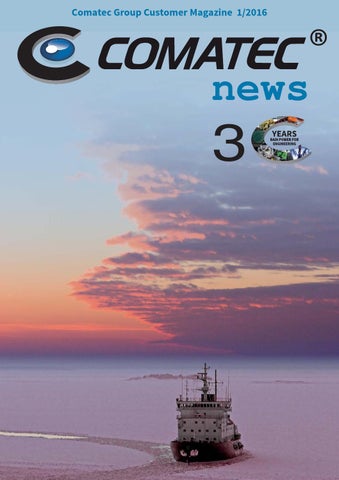
Comatec Group Customer Magazine 1/2016
速 news
3
news
Table of Contents Editorial
...................................................
Arctech Helsinki Shipyard Inc. – ArcƟc shipbuilding technology
...................................................
Comatec and edec unite design forces
..................................................
Presenting Mikko Ala-Jääski
..................................................
Presenting Ali Huttunen
..................................................
30 years of design with brain power
..................................................
Customer-oriented business model
..................................................
Aleksi Leino – aiming high
..................................................
Comatec news
..................................................
– Comatec Group’s commemoraƟve book ’Brain Power’ is published – Oucons Oy purchases design business of Insinööritoimisto Erkki Heinonen Oy in a business acquisiƟon – Comatec Group at IDEAL PLM Technology Day – Comatec Group at recruiƟng fairs
2 ComatecNews
30 years powered by brain power
T
his spring it is 30 years since Insinööritoimisto Comatec Oy was established. When Aulis Asikainen – the company’s founder and main shareholder – started the business, he could hardly imagine the scope of the challenge he had taken on or foresee all that he would experience as an entrepreneur.
Looking through a German engineering magazine, the eyes of the new entrepreneur spotted the words Conveyor, Material and Technics. The name for the new company, Comatec, a one man engineering office, was derived from these. Over a period of three decades the Tampere-based engineering office has grown into the Comatec Group employing almost 400 engineers – a diverse group of companies whose clients are Finnish and international technology companies of global standing. Much has changed during the past 30 years in the company’s business environment, in the sector and in the surrounding society. The products designed by the company, the services it offers, the tools and means of communication employed have changed and diversified along with developments in technology and international expansion. At the same time competition in the market has continually intensified. To maintain the highest standards in their engineering design knowhow, the company and its personnel have to continuously develop their skills and expertise. With Aulis Asikainen at the helm, Comatec Group has made steady progress, with firm confidence in its own efforts and in a long-term approach, presenting an example of the power and will-power of an entrepreneur. Growing from a one man engineering office into a diversified engineering design company serving the technology industry also demonstrates a confidence in engineers, which for its part has also enabled the rapid growth of the company. Trust in others – without being naive - goes hand in hand with a healthy self-confidence, for without trust it is impossible to obtain business partners, design contracts or project commissions or to build any other long-term customer, business or working relationships, the building blocks in the healthy growth of any company. Three decades contain years of both success and danger. Operating in an open society and in the global economy, from time to time the company is forced to take the economic and
political blows coming from elsewhere. To recover from these requires the unstinting efforts of skilled personnel and measures that ensure a high level of customer satisfaction, which in turn safeguards the very existence of the company. The driving forces for Comatec Group have been strong faith in the future, the desire to succeed, and management keeping its eye fixed firmly on the future. In 2016 Comatec Group’s message to its clients is of a successful company with a high level of professional expertise in all the areas of engineering design in which it operates. The Group companies assist their clients in designing, developing and implementing capital goods, and production plants and processes. We have grown so that we can take responsibility, we are able to carry out demanding assignments, and we are a company with personnel whose knowhow and professional expertise you can rely on. The Group serves its Finnish and international clients in all parts of Finland and outside the country. The Group has 15 offices in Finland and one in Estonia. The company has carried out projects outside Finland for more than 20 years and it has the goal of expanding its international operations in order to ensure the future growth of the company. This year the Group will have net sales of some EUR 26 million. On behalf of the Board of Directors of Insinööritoimisto Comatec Oy I would like to thank all the clients of Comatec Group companies for their trust over the years. I also wish to thank the management and personnel of the companies for their valuable and highly appreciated work in carrying out the engineering design assignments entrusted to us by our clients. I wish all of you an enjoyable and busy spring, and a brighter future for Finland, soon to celebrate 100 years of independence.
Kari Kantalainen Board Chairman, Honorary Counsellor Comatec Group
Publisher
Edi ng and implementa on
Comatec Group Kalevantie 7 C FI-33100 Tampere tel. +358 29 000 2000 www.comatec.fi
Comatec Group Taina Syrjänen tel. +358 40 5931 259 taina.syrjanen@comatec.fi
Cover: ©Ossi Lehtonen/Rodeo
Editorial
Taina Syrjänen Heikki Harri Andrew Fisher (Translation)
Feedback, subscrip ons, cancella ons Taina Syrjänen tel. +358 40 5931 259 taina.syrjanen@comatec.fi
ComatecNews 3
Arctech Helsinki Shipyard Inc. – Arc c shipbuilding technology Arctech Helsinki Shipyard Inc. specializes in Arctic shipbuilding technology, building icebreakers and other Arctic offshore and special vessels. Arctech has a long history in ship building. The Helsinki Shipyard was established in 1865 and it has delivered more than 500 ships, including 60 per cent of the icebreakers in operation around the world. Icebreakers and other Arctic vessels have been built at the shipyard for more than 100 years. Arctech focuses on innovative design and continuous development in shipbuilding.
During his career, Unto Ryynänen, head of the design group, has been involved in building almost 40 ships.
AUTHOR: TAINA SYRJÄNEN
Arctech Helsinki Shipyard Inc. is owned by the Russian company United Shipbuilding Corporation (USC). Arctech is based at the shipyard in Hietalahti, Helsinki. The 17 hectare shipyard has a 280 metre long covered shipbuilding dock, covered fitting and painting work sheds, and three outfitting jetties, at one of which Finland’s latest icebreaker, Polaris, is currently being fitted out. The company has 550 employees, and 90 of these work in engineering design. Arctech has 17 electrical engineers, including Unto Ryynänen , head of the electrical design group. During his career he has been involved in building almost 40 ships. “Our engineering design is split into seven main sectors and each of these requires its own special knowhow. These are hull, deck outfitting, interior, HVAC, machinery and electrical design. Each of these has its own group leader,” explains Unto Ryynänen. “Electrical and automation design are what my group does. That covers quite a large area. There are separate electrical, automation and telecoms engineering offices for land-based applications, but we have them all in the same group.”
4 ComatecNews
Strong order book in a sector sensi ve to economic fluctua ons “Arctech is currently in a very positive situation. The company has five ships in its order book and is negotiating for a sixth. It has sufficient work to last into 2018. However, with my 30 years of experience I can say that this is not an easy sector to make predictions about. It has always been very susceptible to the ups and downs in the economy,” states Unto. Unto shows on the wall of his office a long row of pictures of ships which he has been involved in designing. The last cruise liner to be built at the Helsinki shipyard was completed in 2004, and since then the yard has focused on passenger ferries and Arctic vessels. Hull assembly for two supply or stand-by vessels can take place at the same time in the construction dock and one ship out at the outfitting jetty. At present the shipyard is focusing on Arctic marine technology and ice-breaking vessels. “In the past few years we have increased the amount of engineering design work that we do ourselves, and have been successful in obtaining experts for our team in different electrical systems. Training up a new engineer in
the world of shipbuilding takes time. There’s a jungle of regulations governing shipbuilding,” says Unto. “If we have a strong order book and our own team is fully occupied in designing previous ships, there is good reason to use subcontractors. We may purchase basic design from one engineering office and, on a case by case basis, detail design from the same or another office, through normal competitive tendering.”
Stages in designing a ship “The three phases in designing a ship are the concept, basic and detail designs. Electrical design is involved right from the start. First of all we create the main diagram for electricity distribution on the ship, with the main features of the layout for the generators, switchboards, electricity distribution and secured networks. We specify the number of points for internal communications, such as how many phones, and how many antennae points, data outlets and speakers. The regulations for navigation systems specify which equipment always has to be included. In the first instance we design in accordance with these regulations, and then include extra equipment if the client so desires. We also define the level of automation,” states Unto.
“The concept design phase creates the overall dimensions and layout for a ship, and the preliminary design and the ship’s technical specifications are made at the same time. In many cases a consultant has created outline specifications and we receive these ready made. We build on this them with our expanded concept design and specifications. “After winning an order for a ship, the basic design phase begins. At Arctech electrical design is further divided into several sub-areas, since electrical design encompasses all the systems on a ship that use electricity. These sub-areas are distribution, lighting, automation, safety systems, internal communications, navigation and cable routing. In the basic design phase each of the sub-areas carries on with its own design work separately. Electricity distribution and automation are common factors. Every system needs a supply of electricity, and alarms are required from the different systems to the automation system. “In the basic design we may make use of an engineering office. For example, edec, which is now part of Comatec Group, went over the basic design phase for the ice-breaker NB509 Murmansk. The design material was ready but it was in Russian. Edec went over the translated material and updated all the working diagrams on our systems with the information we needed. I have been very happy with edec’s work. It has been easy to work with Edec’s design engineers
since we already know each other. The work atmosphere has been good,” says Unto. “In the detail design phase we create a more precise design and produce the documents so that production can install equipment, lay the cabling and connect it, and commission equipment. In this phase the precise requirements for the equipment for internal communications are determined - the phones and speakers, cabling and connections. For automation, the figures listed in the measuring point list, what is measured, how and where, become cabling charts in which various controls, measurements and alarms are passed by cable from the systems to the switchboards.”
Duplicate systems “A ship has to be in use at all times, even if a fault occurs somewhere. This is taken into account for example by duplicating systems. “Passenger vessels have even more system duplication, since they are governed by the ”safe return to port” regulation. If something happens, the ship is able to limp back to the port,” states Unto. “Supply and stand-by vessels for oil fields have slightly different requirements. The “safe return to port” requirements for these are not as high as for vessels classified as passenger ships. For the DP2 class, dynamic position (DP), which
means that a vessel stays in place while it operates, requires a vessel to actually stay in position while unloading. For example, when it has the loading hoses connected. As well as duplicating systems, analyses are also carried out of the impact on systems if a fault occurs. Arctech is able to carry out some of the analyses itself but also makes use of consultants that have specialized in these.
Seeing the whole picture is important “It is always better to be able to have a voice in equipment purchases from the viewpoint of electrical design and automation at an early stage. This makes sure that voltages and frequencies are correct and that the equipment and systems are compatible. Keeping the whole picture in view is certainly the most difficult part of design. We try as far as possible to purchase ready packages, so that the shipyard only has to do the cabling and connections, without having to purchase anything extra. “At least one, preferably two trial runs are made for each ship. The jetty tests are made first, with test runs of the systems to check that they function properly. That is when we test the diesel engines and auxiliary systems, the electricity network and the propulsion. After this the sea tests check the performance and seaworthiness of the ship.
The ice-breaking stand-by vessels NB 512, NB 513 and NB 514 built at the shipyard of Arctech Helsinki Shipyard Inc.
ComatecNews 5 Copyright Arctech Helsinki Shipyard
Comatec and edec unite design forces Insinööritoimisto Comatec Oy purchased the design business of edec Oy on 27 November 2015. The acquired business will be part of the Electromechanical Systems and Components business unit in Comatec’s Industrial Production Systems segment. This transaction strengthens Comatec Group’s knowhow especially in electrical design for the marine industry. AUTHOR: TAINA SYRJÄNEN
“Electrical engineering, electricity distribution and automation industry are some of Comatec’s most important areas of specialist knowhow. Low voltage systems and lighting design are areas in which edec is strong. Joining forces will boost our volumes, and our areas of knowhow fit in well with each other,” states business unit manager Pekka Jaakola. “Increasing our project business is part of Comatec Group’s strategy. The acquisition of edec is a very good step in this direction,” says Marko Pennanen, Vice President, Industrial Production Systems. “After the merger, with our current volume and our own capacity we can take on larger projects covering a wider range of services. At the customer interface the benefits
come from being able to design larger entities and design them more efficiently,” states Pekka Jaakola. “After completing the acquisition of edec we can also further expand the team organically. We have obtained a unit that functions very well, and integrating this into Comatec’s existing design team is one of our most important tasks in 2016. Together we are stronger. That is why we will be able to serve a broader client base and take on larger design packages,” says Marko.
Common history Comatec’s and edec’s marine electrical engineers used to work for the same company. In 2005 some of them set up edec Oy and some moved to Comatec. “People with a background more in
high power and automation systems came to Comatec. Design engineers with more of an emphasis on navigation and low voltage systems went to edec,” says Pekka. ”Comatec’s main focus has been in the engine room with its high voltage electricity and automation systems. Edec possesses indepth knowhow in the design of lighting and low voltage systems. They have expanded their offering so that they can carry out electrical design for ships and for real estate. “Edec and Comatec personnel have carried out extensive marine electrical design work, including for cruise ships. At the moment our design work has mainly been for ice-breaking vessels and car ferry projects, but we could for example do parts of the electrical design
The NB 511-514 ice-breaking stand-by and supply vessels built by Arctech Helsinki Shipyard.
6 ComatecNews Copyright Arctech Helsinki Shipyard
Aker ARC 124 Port Icebreaker
Copyright Aker Arctic
projects for cruise ships in Turku as well. We can offer a wide range of electrical design services for the marine sector,” states Pekka.
Electrical design projects Edec currently has an extensive order book from the Arctech Helsinki Shipyard Oy for the year ahead. Edec has been involved in designing the electrical systems for the first LNG-fuelled ice-breaker NB510 as well as in the electrical design for the multipurpose icebreakers NB511(PSV), NB512 -NB514 (SBV). “The design work for these new build ships has included basic and detail design for the lighting, safety, navigation, communication and electricity distribution systems. The ships are being built at the Arctech shipyard,” reports Mikko Ala-Jääski, department manager, Marine and Land electrical design projects. Another important client is Aker Arctic Techhology Oy, with whom Comatec has signed an agreement for the basic design phase for the
electrical and automation systems for a harbour icebreaker based on the Aker ARC 124 concept. The agreement arose out of the long-term cooperation between Comatec and Aker Arctic Technology Oy. Preparation for the design project obtained by Comatec began in the concept phase for the ARC 124.
The future “In line with our strategy we aim to offer larger total packages to our clients. Our goal is that in future we could take on responsibility for the total design for a certain area, not just for the electrical and automation design for the whole ship. The engine room, for example. But we intend to remain a service provider, so we will not be offering turnkey deliveries. A contractor for one area might, however, be looking for a strong design partner for their contract. Comatec could be that partner,” says Marko.
Electrical design – opening up interna onal markets “Electrical design for the marine sector is one of the spearhead products in Comatec’s Industrial Production Systems business segment. We aim first of all to strengthen our market position in the domestic market, but we will also be looking at international markets for the design of ship electrical and automation systems, for example at shipyards in the vicinity of the Baltic Sea. We are looking to raise market awareness by taking part in the international SMM 2016 trade fair for the marine industry to be held in Hamburg 6 – 9 September 2016,” reports Marko.
ComatecNews 7
Presenting Mikko Ala-Jääski Mikko Ala-Jääski joined Comatec Group on 1 December 2015 when Comatec acquired the engineering design business of edec Oy. He is department manager for marine and land electrical design projects in Comatec’s Electromechanical Systems and Components business unit. AUTHOR: TAINA SYRJÄNEN
Mikko Ala-Jääski is a founder shareholder in edec Oy. Edec Oy was established in 2003 when some of the engineering designers who previously worked at Aker Finnyards decided to set up their own engineering office. In 2005 Aker Finnyards transferred its engineering design for low current and navigation systems and for electricity distribution and lighting to edec Oy. Since then the company has also taken on electrical design for building technology, which edec’s design engineers have carried out for many different buildings. It has had many sites, such as schools, kindergartens, churches, sports halls and swimming pools, summer camp centres and fire stations. “To design building technology electrical systems it is necessary to know the full range of systems. The size of these projects is different from ship projects. Following the acquisition of Edec’s business operations, Comatec is now able to offer building technology electrical design,” says Mikko. Mikko Ala-Jääski worked at Aker Finnyards (Kvaerner Masa-Yards) for four years before edec was established. He took part in the design of automation, telecoms and safety systems, in equipment purchasing and in monitoring subcontractors. After graduating Mikko worked in a completely different sector, in automation design for the forest industry at Jaakko Pöyry. A colleague
8 ComatecNews
aroused his interest in the marine industry and at the end of the 1990s he moved to Kvaerner Masa-Yards. There he took part in the electrical design for several luxury cruise liners. After Edec was established, Mikko served for the first years as project manager, but later also took part in the work of the Board of Directors. He became chairman of the Board in 2008 and managing director in 2013. At Comatec he is responsible for electrical design projects for the marine industry and for the building construction sector and for other electrical design assignments for industry.
Goal of developing project business “These first months at Comatec have been a very busy time, but things are gradually settling down as I have got to know how the company works and how to use all of Comatec’s systems,” says Mikko. “At the moment we are designing five ships and the order book is extremely strong. We also have some smaller projects designing building technology. “In this new situation I consider one of my main tasks to be developing project operations at Comatec. My goal at the moment is to develop the operations of my own cost centre and increase the number of land and marine projects,” states Mikko. “I know my current boss Pekka Jaakola from my time at Kvaerner Masa-Yards, where he used to be project manager and head of ship design. And anyway edec and Comatec personnel already know each other quite well because of our common background. “Integration into the Comatec organization takes time. In my opinion it has been successful. We will be able to say that integration has been successful on the work front once we obtain a new project in which some of those involved previously worked at Comatec and some have come from edec,” says Mikko.
Prospects in the marine industry “At the moment the marine industry looks surprisingly positive. As an expert, however, I am bothered by the weak financial performance of shipyards,” says Mikko.
Land and marine electrical design services: • AV systems • Navigation systems
“Turku has a better order book than it has had for a long time now that Meyer has become owner of the shipyard. The order book is also in good shape in Helsinki. The order book there contains six ships at the moment. The Helsinki shipyard has concentrated on building ice-breaking vessels, in which it has a long tradition. Some 60 % of all the ice-breakers operating around the world were built in Helsinki. Aker Arctic seems to be doing very well with its own concept, they have expanded their offering in Arctic knowhow.
• Safety/security systems
“Rauma Marine Constructions (RMC), which used to be the STX Rauma shipyard, is seriously working to put the shipyard in better operating shape, including for new builds. At present the Rauma yard has maintenance and repair operations. RMC also collaborates with Patria, and has a long tradition in this.
• Supply icebreaker NB511
“The marine sector as a rule is fairly conservative and is rather slow to accept change. Existing regulations that change only slowly have a powerful impact on the sector. For this reason the sector is rather rigid and changes are difficult to implement. The use of liquid natural gas, LNG, for fuel on ships is the latest step forward,” states Mikko. “The northern regions will still require much assistance from ice-breakers in the future. The north-east passage is used as a short-cut to Asia. It cuts the distance by sea from Europe to Asia by several thousand kilometres. The route is currently used with assistance from ice-breakers from July to November. The route is still only in little use, a few dozen ships pass through it in a year.”
• Communication systems • IT networks • Electricity distribution systems
Recent electrical design references: Marine: • Stand-by icebreaker NB512-514 • Icebreaker NB510 • Multipurpose rescue vessel NB508 • Supply icebreaker NB506/507 • Color Superspeed NB 1359 • Brittany Ferries NB1357 • Norilsk Nickel NB505
Land: • Kerava, Kurkela school • Imatra border crossing • Kouvola, Mansikka-aho school • Vekaranjärvi, Sports hall • Käpylä vocational school HELTECH • Vuosaari swimming baths
ComatecNews 9
Presenting Ali Huttunen Comatec Group has once again obtained reinforcement for its already strong knowhow in rail rolling stock. Ali Huttunen, who has worked for many years in different tasks at rolling stock manufacturers and at VR (Finnish Railways), joined Comatec at the beginning of February 2016. Ali, if anyone, knows all about rolling stock. He has experience of working not only in Finland but also with Italians, North Americans and Russians. AUTHOR: HEIKKI HARRI
“Rail transport is going through a period of great change in the EU, as the regulations that have previously restricted operations and the borders between nations are also being removed from the railways and international competition is gradually becoming a reality. The changes have already brought new rail operators to Finland as well – and more will certainly be coming in the next few years,” states Ali Huttunen. “Operators specializing in a narrow field have come and will continue to come to the railway sector with the opening up of competition, and this is forcing the current operators to adjust their operations to face the demands of competition. The opening up of competition has also had a visible impact at VR, which for several years has been divesting activities that used to be part of the work of a railway company but now lie outside its core business. For me this change meant moving from VR to Comatec, which is a natural next step to all that I have done so far,” he continues. Ali’s role at Comatec is as senior consultant and key client manager. Moving to Comatec was easy since the company and many Comatec personnel have previously been his business partners, and Comatec is a strong player in a customer segment that is very familiar to Ali.
Outstanding opportunity “For Comatec the state of transition in the railway sector provides an outstanding opportunity to offer a wider range of design and expert services to clients in the sector and to take advantage of Comatec’s wide-ranging knowhow in different business operations. Comatec can offer the full range of knowhow relating to rail rolling stock technology, technical design and calculations, testing, and management of technical documentation. It is worth noting that Comatec has many long-term customer relationships some of them have continued for almost 30 years. Railway sector projects are also typically long-term projects. It has been said that the ”quarter year” in the sector is 25 years, which makes it possible to create collaboration and partnerships that can last for years,” says Ali Huttunen.
10 ComatecNews
“The changes taking place in the railway sector give Comatec an opportunity to expand its operations to more non-Finnish clients, since many of the new operators will come from outside Finland. Through the client relationships created it will be possible to offer Finnish specialist knowhow to international projects, or to offer a service to those needing it in Finland. It is not worth those needing the service to set up offices in Finland and learn how we do things in this this country. It is easier to purchase local expertise from one expert source,” argues Huttunen.
Solid experience in Finland and on the internaonal front Ali Huttunen’s career working with rolling stock began in Tampere. Huttunen, who was born in 1960 in Pyhäjärvi, studied construction technology in the mechanical engineering department at the Tampere Institute of Technology and graduated as an engineer in 1985. “At that time it was easy for a newly qualified engineer to get work. I already had a job arranged in the design department for board machines at Tampella, but after graduating I ended up in Valmet’s rolling stock factory,” recalls Huttunen. During his first years there, Huttunen was employed at the factory as a design engineer responsible for the design and calculations for rail rolling stock. He also took part in drawing up technical tenders and technical support for marketing. He was later project manager in the Pendolino project. This was his first international work. At the beginning of the 1990s the Finnish government reorganized Finnish rolling stock manufacturing, which was suffering from over capacity, and concentrated business operations at Transtech’s Otanmäki factory, which was controlled at that time by Rautaruukki Oy. Design engineers and administration remained in the office in Tampere until 1995, however, and Ali Huttunen was one of these. Between 1995 and 1997 Huttunen was employed
as project manager at Transtech’s Oulu office. In 1998 and 1999 he left the ”main line”, working as product manager at the compressor factory of US-owned Gardner Denver in Tampere. However, his interest in the railways drew him rapidly back to rail rolling stock.
Russia and Italy His new employer was VR Passenger Services, where during the period 1999 - 2002 he was project manager in rolling stock purchasing projects and in international duties relating to rolling stock technology. From there his career continued as business unit manager at VR Engineering and VR Technology between 2002 and 2011. Towards the end of this period he was also managing director of Oy Karelia Trains Ltd, a rolling stock company in which VR and Russian railway company OAO RZD have equal holdings and which owns the Allegro trains that operate between Helsinki and St Petersburg. “Oy Karelian Trains Ltd purchased the Allegro trains from the same ItalianFrench manufacturer from which VR previously purchased the Pendolino rolling stock in use in Finland. Knowing the manufacturer and its working methods from the Pendolino project was a big help in the Allegro project,” states Ali Huttunen. Through his work he has also got to know different cultures. “At Karelian Trains we had to find a balance between the different business models in Finland and Russia. We got through different situations once we had established a relationship of trust with all parties at a personal level. The knowhow and honesty of the Finns, and the precise way we carried things out, were a big help in creating these relationship. Following the same pattern also works with the Italians,” says Huttunen. For Huttunen the circle has closed. When he first went to work at the Valmet rolling stock factory, the person who gave him his initial training was Jorma Nordfors, who is now his boss and is introducing him to the secrets of working at Comatec.
Different rail gauge in Finland and Russia It is generally thought that Finland and Russia have the same rail gauge. However that is not the case. The rail gauge in Russia is four millimetres narrower than in Finland. The rail gauge in Finland is in fact unique worldwide. Another interesting fact is that the Finnish rail gauge, which is known generally as the Russian rail gauge, came to Finland from the southern states of the USA. The history of rail gauges contains some interesting details. When Russia started to plan its railways at the end of the 1930s, it decided on a rail gauge that would be different from what was already at that time the international standard. This standard gauge originated in Great Britain and was 1435 millimetres. The decision was taken on purely military grounds. The track between Moscow and St Petersburg was built in the period 1842 - 1851. The US military engineer George Washington Whistler was hired to head up the track construction, and in accordance with his specifications the rail gauge of 1524 mm was adopted, which corresponds to five feet. This rail gauge was then applied in Finland, Estonia, Lithuania, Latvia, Ukraine, Belarus and Mongolia. During the 1950s the Soviet Union changed the original rail gauge to 1520 millimetres, since it wanted a more logical rail gauge in the country rounded to the nearest ten In accordance with the international standards system. The change was achieved by tilting the rails inwards by four millimetres. The change was carried out in all the countries mentioned in the list above, apart from Finland.
ComatecNews 11
30 years of design with brain power Comatec Group has reason to celebrate on 24 March 2016, for it is 30 years since the company was established. Comatec has grown from nothing into an employer of almost 400 people in 30 years. Comatec’s business operations are based on confidence built up over the decades among its clients, on credibility, and on the professional skills and knowhow of its personnel that are being continuously developed. Aulis Asikainen, the founder and CEO of the company, has always looked far into the future. AUTHOR: TAINA SYRJÄNEN
An empty room Comatec literally started its business operations from scratch when Aulis Asiakainen set up the company Tmi Kuljetinsuunnittelu A. Asikainen in 1985. On his first day at work as his own boss, Aulis Asikainen sat down for a moment in an empty room. He left the empty office, purchased two drafting tables and a telephone, and started to win clients. This engineer, who had resigned from his position as second in charge at an engineering workshop, had contacts and solid faith in himself. Work began to come in gradually. Towards the end of the week Asikainen was confident enough to take on his first employee. He had won the contract for a product development project that was so large that it carried them through to the early spring. On 24 March 1986 the company’s name changed to Insinööritoimisto Comatec Oy, and at the same time what had been a sole proprietor company became a limited liability company. The owners then were Aulis Asikainen, Kauko Lehtonen and Martti Ala-Vainio. The name Comatec derives from the words Conveyor Material Technics. The inspiration for the name came while reading a trade journal. Three strategic policies were laid down for Comatec. The company focuses on machinery and equipment design and is a service company that concentrates its efforts and knowhow on developing the products of its clients, on solving problems, on managing projects or subprojects, and on providing additional resources.
Recession strikes Finland dived into a slump at the
12 ComatecNews
beginning of the 1990s. Recession struck. Devaluation in November 1991 and the total loss of clients that immediately followed came as a shock to Aulis Asikainen. Comatec struggled for its very existence. In this situation the first task was to create cash flow immediately. Two important client relationships, Outokumpu and Posti, were rapidly revitalized, to the extent that the company did not even need to resort to layoffs or redundancies The 25 years that have passed since these events have not dimmed the gratitude for what happened. It felt as if the client was not just buying something, but that it also wanted to support a company and an entrepreneur whose quality and ways of doing business in its previous work the client had been very satisfied with. Outokumpu and Posti formed almost 90 per cent of domestic demand for Comatec until 1994. Thanks to Veikko Hokkanen, a shareholder in Comatec at that time, Comatec obtained income from the USA until 1995. At its highest, half of net sales came from outside Finland. Thanks to a few very good clients, foreign sales and the flexibility of its employees, Comatec survived the recession.
New shareholders and new clients When Jorma Nordfors came “over the fence” to work at Comatec he brought with him a new, major client and business sector. Jorma and Aulis happened to be neighbours. Jorma asked Aulis over the fence about work, since Transtech was transferring its design activities from Tampere to Oulu. Jorma had also been
offered work in Oulu, but he preferred to stay in Tampere , on family grounds. That was the age of outsourcing and Transtech made a proposal to start up cooperation between Transtech and Comatec. Transtech was designing double decker passenger coaches at that time. The companies agreed that the design work would continue in Tampere through Comatec. Jorma and five other Transtech personnel moved to work at Insinööritoimisto Comatec Oy. Later on Petri Leino, a current Comatec shareholder, also joined Comatec. Jorma Nordfors became a shareholder in Comatec in 1996. He is at present business unit manager responsible for Special Vehicles and Rolling Stock. Rolling stock is nowadays one of Comatec’s areas of strong specialist knowhow. Petri Leino became a shareholder in 1998. He is currently vice president in charge of the Mobile Machinery and Special Vehicles segment. When the Transtech personnel moved to Comatec in the February – August period in 1995, the number of Comatec employees increased at one stroke by 50 per cent, and the total work force was close to 20 people. Looking back it can be seen that the 1990s recession ended for Comatec at that point.
Making use of research Comatec had a strategic survey of the business sector carried out at Tampere University in 1997. The message came from about 100 major engineering workshops that within three years the entire sector would switch from 2D to 3D design. Comatec decided to develop its 3D design. The company purchased computers and software and invested
in training personnel. This was a major decision in the history of Comatec. Comatec grew organically at the beginning of the 2000s at a rate of 20 - 25 per cent a year. The owners were mentally prepared for growth. The customer references were impressive. The company rapidly increased the scope and depth of its skills and knowhow. By the standards of that time, personnel were able to make good use of modern design tools. Continuous growth requires continuous recruitment. The company had acquired experience in recruitment and was equipped to take on new workers. It had developed a systematic approach to its work, systems to support management and tools for project management.
Years of rapid growth Aker Finnyards had decided to raise the level of outsourcing in design. Aker brought the matter up in the autumn of 2004, when Comatec had several people working at the Helsinki shipyard. In January 2005 the companies signed an agreement resulting eventually in 11 people moving to Comatec. The skills and knowhow brought by the people who moved to Comatec encompassed electrical engineering and related automation for large cruise liners. In spring 2005 a new client survey was carried out, and one strong message from this was the need to cut delivery times. It was not difficult for Comatec to adapt to this change. The company was ready for it, both mentally and with its processes.
Major acquisi on On 26 June 2008 an agreement was signed under which the Industrial Services business of Sweco Finland was transferred to Comatec. The Sweco acquisition raised Comatec into the 400 employee bracket, and this is where the company has been ever since.
The company worked for three years to recover from the dip imposed by the financial crisis, and in 2011 it again reached the same level in net sales as in 2008. Since profitability had also returned to a reasonable level, the company began to consider new potential acquisitions.
New strategy
In 2015 it can be seen that the acquisition strengthened several client relationships and brought several new ones which have since proved to be of significance. The acquisition also brought practices refined in an international engineering office, which were then adopted and integrated to form Comatec’s business model.
Comatec renewed its organization as part of a broader development project, which standardized working and operating methods, clarified responsibilities and authorizations, created the essentials for personnel skills and knowhow to match work assignments, and created structured career paths within the Group.
Another crash in the global economy
The organization was built based on skills from the client perspective. At the beginning of 2016 there are four business segments: Mobile Machinery and Special Vehicles, Material Handling, Industrial Production Systems, and Boilers and Power Plants.
At the end of 2008 the global economy dived into the deepest recession since the 1930s, as problems in the financial market were rapidly reflected in the real economy. In October 2008 more than ten major Comatec clients issued warnings of a decline in orders, and this is what actually happened. Once projects were completed there were no new projects to follow. The slowdown was not reflected in Comatec’s figures for 2008. The company’s net sales increased 40 per cent from 2007, passing the EUR 20 million mark. The operating profit was the best in the company’s history. In the spring of 2009 the situation had changed completely. Net sales fell 20 per cent in 2009. EBITDA was negative.
Growth through acquisi ons Comatec has had an ambitious growth target right from the start. Comatec has grown in 30 years, both organically and through numerous acquisitions, from a one man engineering office into a diverse engineering design office for the technology industry employing almost 400 people. Comatec is the client’s partner, technology expert and project manager. Comatec’s sales article is the knowhow and brain power of its personnel.
The current members of Comatec’s Board of Directors, left to right: Raimo Ylivakeri, chairman Kari Kantalainen, shareholder Jorma Nordfors, CEO, foounder and shareholder Aulis Asikainen, shareholder Petri Leino and Tuomo Nevalainen.
ComatecNews 13 Photo by Pekka Sipola
Customer-oriented business model Comatec Group’s mission has remained unchanged since it was established: Comatec helps develop and implement capital goods, production plants and production processes. Its key customer relationships are long-term partnerships. Comatec Group is developed with a customeroriented approach.
Comatec carried out assignments for Naaraharju Oy in Central Europe and participated in five major projects for self-adhesive paper manufacturers and for the food industry. Comatec carried out complete sub-units relating to conveyors, material handling and shuttle dumpers.
Organizing by knowhow
Customers in the early days
Comatec developed into a regional organization based on its offices, and one of its assets was being local. In order to develop its expertise and its ability to carry out complex customer projects, in the past few years an organization has been built that from the client’s viewpoint is based on expertise.
Aulis Asikainen learnt much about designing conveyor systems even before he established Comatec. Comatec’s story begins with designing conveyors.
The business environment changes, and so do client requirements, and Comatec wants to develop its operations so that it can meet client needs even better.
During its first years the company designed container handling equipment and straddle carriers for Valmet Siirtokonetehdas, carried out mechanical engineering design for conveyors systems and cranes for the factory in Nekala, Tampere, and the work for Posti included designing sorting centre layouts. In fact the assignments for Posti were a saving factor during the 1990s recession.
Today in 2016 Comatec has four business segments: Mobile Machinery and Special Vehicles, Material Handling, Industrial Production Systems, and Boilers and Power Plants. Each has its own development path In Comatec’s history.
AUTHOR: TAINA SYRJÄNEN
During its first years Comatec carried out numerous projects for Tampella, for example for the pressing units on paperboard making machines, as well as mechanical engineering for concentrators and various product development work for Outokumpu. This customer relationship that began then has continued in practice unbroken for 30 years, first with Outokumpu and then with Outotec Oyj after it split off from Outokumpu. Outokumpu was the other important client that helped Comatec get through the recession.
14 ComatecNews
Material Handling Cooperation with technology company Algol Oy grew stronger and in the autumn of 1994 Algol suggested the possibility of outsourcing some of its design functions. Negotiations resulted in Algol’s crane and conveyor design being transferred to Comatec. Five or six engineers moved from Algol to Comatec over a period of time. In 2012 Comatec acquired a majority holding in Oucons Oy, which expanded Comatec’s knowhow in the design of conveyor systems, especially for bulk goods systems. Oucons later became a 100 per cent owned Comatec subsidiary. Oucons in turn acquired Kisto Oy in 2014, which expanded the customer base and extended the
service offering. Joining Comatec Group increased Oucons’ service portfolio so that it includes not only mechanical engineering but also electrical and automation design.
Mobile Machinery and Produc on Plants In 1998 and 1999 Comatec carried out work for Tamrock, Rautaruukki, Pilkington, Timberjack, Kalmar, Pemamek, Nordberg-Lokomo, Fastems, Normet and Glassrobot. Tunnel drilling machinery, refrigeration equipment, straddle carriers, log stackers, rock crushers, lifting equipment for ship sections, scalers, and glass bending machinery were some of the products which Comatec was involved in designing. Many customer companies, for example Tamrock, Lokomo and Timberjack, were just starting to outsource design work. Comatec was one of their first partners. Many customer companies were beginning a period of rapid growth. Comatec was carried along on their wings, and in the 2000s with an increasingly broad service portfolio, not just with mechanical engineering. Now it could offer electrical design, automation and programming, as well as various expert services such as strength calculations, product testing and product safety issues. The move from 2D to 3D design also took place about this time. In construction and for example train design 3D had been in use since the 1980s. Machinery and equipment manufacturers were behind in this matter, apart from a few exceptions. At the beginning of the 2000s Comatec had developed its new customer acquisition consistently and the number of clients grew at a steady rate. New clients included ABB Marine, Andritz, Bombardier Transportation,
Daimler-Chrysler, Foster Wheeler, Instrumentarium, KCI Konecranes, Patria and Perlos. Electrical design developed into a strong area of expertise, alongside mechanical engineering. Automation design grew strongly, as did strength calculation services. Comatec obtained orders for larger entities, such as the overall design of a track-mounted crusher unit for Metso Minerals. Rail rolling stock is one of Comatec’s areas of special expertise in 2016. Rolling stock expertise came to Comatec through Transtech when Jorma Nordfors joined Comatec. Knowhow has increased with the opportunity to carry out all sorts of work for a wide range of clients. For transport operators, for rolling stock manufacturers and the authorities, for trains, metros and trams, for passenger and freight services, for Finnish and foreign clients. The work has included product design, assessments, consulting for tenders, rolling stock refurbishing design, life cycle cost calculations, and solution consulting. Petri Leino also came from Transtech. In his case trains were replaced by cars in March 1997, when Valmet Automotive signed a contract to start production of the Porsche Boxter model in Uusikaupunki. Comatec was involved in starting up production and Leino was Comatec’s person in charge of the project. At that time conveyor system design was the company’s main business in terms of the number of personnel. Integrating the rolling stock business had gone very smoothly and in fact it contributed more than half of EBITDA. The company also carried out various design work for cranes and production equipment. Leino began to actively market design work to Kalmar and Tamrock, and to SisuDiesel, Lokomo, Pilkington, Tamglass, Timberjack and so on. In 2016 Comatec’s two largest business segments are mobile machinery and special vehicles, and industrial production systems.
In 2007 Comatec acquired Insinööritoimisto Metso Oy. The acquisition diversified Comatec’s services for the commissioning, maintenance, service, repair and modernisation of production machinery.
Boilers and Power Plants Comatec ended up in the energy business by chance through its subtenants Timo Hartman and Hannu Koskela. They designed boilers in their own company and were doing work for Kvaerner Power. Koskela proposed that he and a couple of colleagues, along with the small order book, would transfer to Comatec as Kvaerner was reorganizing its operations. It was agreed that Comatec would start to develop the boiler design business. Since the business sector did not start to grow organically sufficiently quickly, at the end of 2005 Comatec acquired a majority holding in Rantotek Oy. Rauno Rantovaara, the owner of Rantotek at that time, was well known from many connections. Comatec purchased 60 % of Rantotek and Rantovaara continued as managing director under a five year contract. At the end of that period Comatec acquired the remaining 40 per cent.
Rantotek’s board of directors and Jouni Tuononen, who had been recruited in 2009, took over as managing director . Tuononen had previously worked at Foster Wheeler and had been in the boiler and energy business since 1985. With Tuononen at the helm the number of Rantotek personnel soon rose to thirty. Rantotek’s financial performance has remained strong every year. The company’s skills and knowhow have expanded to encompass ever larger project packages. At the same time, the knowledge of different boiler technologies has deepened. Rantotek has strengthened the international scope of Comatec Group and brought the Group project management knowhow. Rantotek is an energy sector expert whose areas of specialist knowhow are steam boilers, high pressure piping and storage tanks. One special feature in the sector is the pressure vessel regulations, which have specifications in accordance with the EU standards systems, with the American standards system and with diverse national systems. It is necessary to know all of these if like Rantotek a company has international operations.
From the beginning of 2006 Rantotek continued with a workforce of 15 people, after four boiler designers from Comatec joined the company. Rantotek grew under Rantovaara’s leadership into a team of 20 people by 2010, when as agreed the Rantovaaras handed over the remaining shares they held in the company. Rauno Rantovaara joined
ComatecNews 15
Aleksi Leino – aiming high Aleksi Leino, who is sponsored by Comatec, has competed in skiing since he was 17. This is his last year skiing in the U23 age group for men at national level. His goal in this category is to be among the top five. Next year he will continue in the men’s series. His goal is to break into the national leading group. At Finnish championship level that means in the top 20. Ski racing is a long-term activity and demands self-discipline, and Aleksi has plenty of this. AUTHOR: TAINA SYRJÄNEN
23-year-old Aleksi Leino has competed in skiing since he was 17. He started ski racing with the encouragement of friends who also raced. Football, his previous main sport, became an enjoyable fun activity, providing a little bit of extra training. This is his last year skiing at national championship level in the U23 men’s series. His goal in this series is to be in the top five. In the men’s national championships, which include skiers of national team level, he aims to be in the top 30 this year. “I have taken one year at a time. It is now clear that I will continue next year and I believe that I will still go on for many more years. At the moment I am in the third year of my mechanical engineering studies at the Tampere
16 ComatecNews
University of Technology. I also have a job. So I always practise when I can. I build my training schedule so that I manage to put in the planned amount of training. My long-term goal is to make it to the top at national level, which means being among the leading 20.”
Equipment plays key role “Skiing is an interesting sport because success does not depend entirely on the skier; the equipment has a big impact. For example in the classic ski style getting the right waxing is important. You must have good grip, but this must not impede gliding,” explains Aleksi. “Texturing the bottom of skis before glide waxing is a vitally important
phase in tuning if successful waxing and effective gliding properties are to be achieved. The first stage is to grind a pattern appropriate to the snow conditions on the bottom of the ski. After this a wax suitable for the conditions is applied, and then the right pattern is ground on the surface of the wax. Different waxes work in different ways in different conditions. Creating grooves or patterns on the bottom of the ski breaks the film of water that forms between the snow and the bottom of the ski and gives better gliding. “The skis naturally play an important role in the sport. I have five pairs of skis for both skiing styles, and I choose the best and most appropriate for each race. National team skiers have several
dozen pairs.
sessions regularly throughout the year.
“Choosing the right pair of skis is the most important issue for glide and grip, but the properties of skis can be improved and highlighted with the right tuning. A ski’s profile affects gliding in a very big way. In recent winters wet conditions have been quite frequent, and skis should then have a short pressure area and be roughly ground. Grinding creates the pattern on the bottom of the skis. Yellow bottom skis are of slightly harder material, so they do not collect dirt and the glide stays for longer,” states Aleksi.
“In the autumn before the racing season starts there is more intensive training , to prepare for the season. The main races are during the January – March period. Other races help prepare for the main races.
“December was terrible for snow, since snow cannons could not be used to produce snow because it was too warm. The low freezing temperatures in late December and January saved the whole season, since the snow cannons could also produce snow in southern Finland. Of course, the closer the snow, the easier it is to practise skiing. “The tracks are always challenging in major races. It would be easier to find good, tough places to train if there were plenty of tracks with natural snow.”
Four periods in the year “Ski racing is a long-term activity. Improvement does not take place overnight. It requires many hours of training and much skiing. The amount of training increases year by year. My fitness has risen all the time and each year I have succeeded in improving my performance. This year I have no longer been very far from the leaders,” says Aleksi. “The closer you get to the top the harder it is to improve results. “The year is split into four periods for training. After the racing season – December to March – we take about one month a bit more easily to allow the body to recover. After that comes the core fitness period, which continues into early autumn. “In the summer I roller ski 2-3 times a week. I also go running. Training with sticks on slopes is an important form of training. It gives similar conditions to the tough races in winter. I play football once or twice a week. I play all sorts of different sports and have long training
“Training has to be varied. That is my opinion. Skiing on its own will not get you there, various forms of training are needed; bearing skiing in mind of course. “Basic endurance training is light and takes place at a steady pace over periods varying from one to four hours. Muscular fitness training aims to give muscular endurance and maximum power. I myself enjoy muscular circuit training. “Ball games provide good training for speed and coordination. Training also involves rapid strokes or steps when skiing or running, leaps, jumps and other similar exercises. “Training is actually not very simple. I draw up an overall picture of my exercises. In that way training also stays meaningful for me. It is also important to plan and keep days of rest. This sport requires strong self-discipline.”
Races This year the open series Finnish championship level competitions are on three weekends, in Imatra, Taivalkoski and Kuusamo. In Imatra on 29 January 2016 at the Ukonniemi stadium Aleksi skied the 1.6 kilometre freestyle sprint and the 15 kilometre freestyle. In Taivalkoski he has the 7.5 kilometre classic style and 15 kilometre freestyle pursuit. “The season ends in Kuusamo with the classic style 50 kilometres. That is a tough distance, the last time I skied 50 kilometres was a year ago in Ruka. I started then too quickly or then I just ran out of energy. But I made it to the finishing line,” states Aleksi. “The longer distances suit me better, but skiers usually ski all the distances. “The racing season is from December to March. During the season there are on one or two races at weekends. There is really not time to do anything else. I also have friends in skiing circles, which
makes my social life easier. We train a lot together. During the racing season life is busy, since I have to do my studies and my job.”
Skiing close to the heart Comatec CEO Aulis Asikainen is himself a keen skier and skis hundreds of kilometres every winter. So skiing is a sport that is close to his heart. “At Comatec we want to support a young sportsman like this who sincerely aims to succeed,” states Aulis Asikainen. “At Comatec we value highly the longterm approach and self-discipline required to reach the top. The same is true in the intense competition between companies: if you want to get to the top you have to work extremely hard, doing the right things. If you are already at the top, you have to work even harder to stay there,” Aulis continues.
ComatecNews 17
Comatec news Comatec Group’s commemora ve book ’Brain Power’ is published The commemorative book ’Brain Power’, telling the story of Comatec’s business operations and the companies in the Group, has been published. Written by Tapio Eräheimo, the book tells what has happened in the group of companies over a thirty year period, of success in serving clients but also of the years full of hazards in consequence of the financial crises in Finland or globally. The words Conveyor, Material and Technics stood out in a German engineering magazine. In 1986 Aulis Asikainen saw in them the name for a new company, a one man engineering office. This has grown into the Comatec Group, which employs 400 people and serves global companies. Much has changed, such as the products being designed, the services offered, the tools used and the means of communication. But much has stayed the same, such as the people, and the competition, which always seems to be intense. Three decades contain success, but also years of danger. This and that has happened. The driving forces have been belief in the future and management keeping its eyes fixed on the future. Comatec is the client’s partner, technology expert and project manager. Comatec’s sales article is increasingly ideas, brain power.
AuthorTapio Eräheimo, left, presenting the commemorative book ’Ajatuksen voimalla’ (Brain Power) to Kari Kantalainen, chairman of Comatec’s Board of Directors.
Ajatuksen voimalla. ISBN 978-952-67691-3-4
Oucons Oy purchases design business of Insinööritoimisto Erkki Heinonen Oy in a business acquisi on Oucons Oy, part of Comatec Group, acquired the design business of Insinööritoimisto Erkki Heinonen Oy on 16 December 2015. The acquisition strengthens Comatec Group’s knowhow especially in the design of material handling systems. It is a major step in developing Oucons Oy in line with its strategy and enables Comatec Group to offer its clients even broader service packages. The employees at the Oulu office of Insinööritoimisto Erkki Heinonen Oy transferred to the service of Oucons Oy retaining their existing employee status on 1 January 2016.
18 ComatecNews
Comatec news Comatec Group at IDEAL PLM Technology Day Comatec Group took part in the IDEAL PLM Technology Day on 21 January 2016, where the Group presented its expert services and in particular at this event the various areas of simulation and virtual modelling. Using simulation and modelling can save time and costs by using virtual prototypes. With virtual prototypes testing and checking can be carried out right from the concept phase. Reducing the number of expensive physical prototypes and testing gives cost-efficiency and saves time in project development projects. Comatec Group’s expert services are of assistance in this by offering tools and knowhow in the various aspects of virtual prototypes. Ask our experts for more information. The IDEAL PLM Technology Day event was held on 21 January 2016 at the Tampere Hall with the theme ‘Flexible intelligence’. The event brought together in Tampere users of Siemens PLM Software solutions, and those interested in using these, around the themes of intelligence and digitalisation. “The theme for the event was carefully chosen, for we wish to highlight the key role played by managing the product portfolio in the age of digitalisation. Building the digital twin, the virtual equivalent of a product or product range, begins with concepts of the digital model. The digital twin lives in the virtual environment and its data is saved in a central location available to all stakeholders. All the data generated in the virtual design phase becomes available for use in actual production,” explains Tapio Juurakko, CEO, IDEAL PLM. Further information: Mikko Paakkunainen, Business Unit Manager, Expert Services, Comatec Group, tel.+358 ( 0)40 7782 791
Comatec Group at recrui ng fairs Recruiting fairs usually take place at the start of the year, and this year Comatec had its own stand at the following fairs: • Pesti-päivä, University of Oulu, 21 January 2016 • Portti Työelämään, Tampere University of Applied Sciences TAMK, 26 January 2016 • Contact Forum, Kaapelitehdas Helsinki, 28 January 2016 • Yrityspäivät, Tampere University of Technology, 4 February 2016 “Thanks to the young people visiting the fair and the efforts of the organisers, Contact Forum had an excellent, relaxed atmosphere. More people attended the fair than previously, and it looked as if the proportion of international visitors had increased significantly. There also seemed to be plenty of people with potential to join Comatec. Of course our goal was to market Comatec to the makers of the future, and in our opinion we succeeded in this,” says Pasi Rantanen, Business Unit Manager, Processing Machinery and Plant Engineering. “The ‘Portti työelämään’ event was one of the smallest recruiting fairs, but there was plenty of activity around Comatec’s stand and a good number of people came to ask about our company,” reports HR expert Anne Talvitie.
ComatecNews 19
Comatec Group: TAMPERE Insinööritoimisto Comatec Oy KalevanƟe 7 C, FI-33100 TAMPERE Tel. +358 29 000 2000 Rantotek Oy KalevanƟe 7 C, FI-33100 TAMPERE Tel. +358 29 000 2090 VANTAA MyyrmäenƟe 2B, FI-01600 VANTAA Tel. +358 29 000 2000 HYVINKÄÄ Kehäkuja 6, P.O. Box 26, FI-05831 HYVINKÄÄ Tel. +358 40 5563 299 IMATRA Insinööritoimisto Metso Oy VuoksenniskanƟe 97, FI-55800 IMATRA Tel. +358 29 000 2070 JOENSUU HiiskoskenƟe 9, FI-80100 JOENSUU Tel. +358 29 000 2000 JYVÄSKYLÄ LaukaanƟe 4 B, FI-40320 JYVÄSKYLÄ Tel. +358 50 555 6688 JÄRVENPÄÄ Sibeliuksenkatu 18, FI-04400 JÄRVENPÄÄ Tel. +358 400 675 778 KANKAANPÄÄ Insinööritoimisto Kisto Oy Keskuskatu 52 , FI-38700 KANKAANPÄÄ Tel. +358 2 5722 411 KOUVOLA PrikaaƟnƟe 9, FI-45100 KOUVOLA Tel. +358 20 765 9425 KUOPIO Microkatu 1, FI-70210 KUOPIO Tel. +358 44 7414 440 LAHTI Askonkatu 9 F, FI-15100 LAHTI Tel. +358 29 000 2000 LAPPEENRANTA Insinööritoimisto Metso Oy Fazerin kiinteistö Valtakatu 2 G, 3. krs, 53600 LAPPEENRANTA Tel. +358 29 000 2070 OULU Oucons Oy ElektroniikkaƟe 10 D, 2. kerros, 90590 OULU Tel. +358 400 542 547 TALLINNA Comatec Estonia OÜ Laki 16, 10621 TALLINN, ESTONIA Tel. +372 5685 0845 TURKU Pitkämäenkatu 11, FI-20250 TURKU Tel. +358 29 000 2000 VARKAUS Rantotek Oy Wredenkatu 2, FI-78250 VARKAUS Tel. +358 29 000 2090
Welcome to the trade fairs to discuss your company’s design and partnership needs with us!
We are taking part in the Northern Industry 2016 trade fair to be held in Oulu 25-26 May 2016. We are on stand 408.
We are taking part in the SMM 2016 trade fair to be held in Hamburg, Germany 6-9 September 2016. If you happen to be there, do call in on our stand.
We are taking part once again in the SubcontracƟng Trade Fair to be held in Tampere 27-29 September 2016. We will be in E hall on stand E 120. SOLUTIONS. PROJECTS. EXPERTS.
®
Comatec Group www.comatec.fi