Insinööritoimisto Comatec Oy - Customer magazine 1/2011
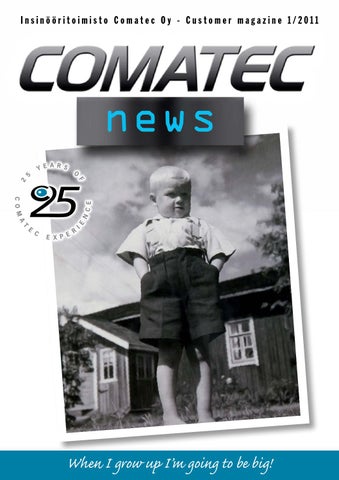
When I grow up I’m going to be big!
CONTENTS
4-9
History of Comatec
”This is a great story” Including comments from Petri Leino, Jorma Nordfors and Kauko Lehtonen
10
Case Comatec: Kome Oy
12
Comatec and Sanni Leinonen: Aiming for the top!
14
Comatec & ABB Marine: Power propellers
16
In the spotlight: Rantotek’s Jouni Tuononen
18 20 22 2
Interview with Kome Oy Managing Director Harri Komulainen
Senior Vice President Lasse Mäkelin
Case Comatec: Corenso United
Operating manager Teemu Javanainen
Doing it the Mantsinen way Pekka Gröhn
How did we become leading experts? Insider praise for Comatec
Comatec News • Editor in chief: Aulis Asikainen • Editorial and layout: Suunnittelutoimisto mera
EDITORIAL
From the heart of Savo! Just recently I heard an amusing comment about the people from the Savo region of Finland: apparently a Savo salesman is one who waits aggressively for calls for tender. My roots are in the heart of Savo, in Heinävesi. Even though I come from Savo, when I was still a little boy I said that when I grew up I would be big! People don’t change very much during their lifetime, and I have kept this drive and excitement about what I’m doing over the years. Comatec was established in 1986, so on Thursday 24 March 2011 we will celebrate our 25th anniversary. Working, of course. Well, maybe we’ll raise a toast or two … These years have contained amazing excitement from our successes but also instructive periods of recession. The recession in the 1990s was something totally unique. Our clients paid for our services with furniture, and we probably still have one golf ball typewriter that we received in payment. But we still have the client as well. The world of business is said to be tough and cold, but in my opinion this is about interaction with people. Our relationships are based on trust and on knowing each other and on taking on together the challenges we share. Skilled workers and strong partners are needed, whatever work we are involved in. But it takes a visionary to point the way, and that is what I feel I am. I have always been prepared to step out boldly and see what lies round the corner, to look for growth in new locations and restructure our work. We are now once again moving into a new phase in our history – we did have the option of continuing as we are, of remaining a purely Finnish business in our domestic market. We believe, however, that we are capable of doing more than this. We have to do our homework, make sure our systems work properly, and create common rules in our training of supervisory staff. There is no lack of competition out there, but even so we believe that Finland’s Comatec can establish a footing. How? By doing things as we have done them up until now – better than everyone else. I am just over 60 years old now, and still full of enthusiasm just like a little boy. I’m not dreaming yet about retirement but I’m looking even further ahead; I am sure that Comatec will still be needed in 2041.The basis for our work will remain; in the future we will still be designing production plants, special vehicles, mobile machinery and boiler plants. Vehicles may run on gas and trains by magnetic power. My eyes are fixed firmly on the future, so what do you say? Do we book tickets on the maglev (magnetic levitation) train from Tampere to Helsinki, let’s say on Sunday 24 March 2041? And we can celebrate Comatec’s 55th anniversary at the same time. The journey will only take half an hour, but that will still give us time to catch up on our news and have a cup of coffee. I’m buying. Wishing you a sunny spring! Aulis Asikainen From the heart of Savo, and still growing!
3
25 year old Comatec Oy is growing through a joyful spirit of
Now that we’ve acquired a taste for growth While telling his story, CEO Aulis Asikainen mentions in passing two details that explain quite a lot why Comatec has grown in 25 years to be a leading expert in its field and an enterprise with 300 employees. One of them is in fact a recipe, and we’ll get back to that later. The other is a memory from just over two years ago, when the recession was at its worst and everything looked very uncertain. “I spent three or four days around Christmas 2008 on my own at the cottage in Heinävesi and thought about what would happen after the recession. The result was this concept. “Note: what would happen after the recession, not during the recession, looking firmly to the future. “One option was to carry on with the business of providing resources, where price is the number one competitive factor. The alternative was to develop a more complex solutions business, in which knowhow and the ability to manage larger total solutions are also decisive factors. “We want to grow and expand on the international front, and you don’t go global by doing little jobs that pay by the hour. We’ve been looking into this for one and a half years now. I expect the project and solutions business to start to have a significant impact on our net sales in 2013-2014,” says Asikainen. “In 20 or 30 years’ time we want to have a similar standing in the metal and machine building sector as Pöyry has today.”
Starting from an empty office Insinööritoimisto Comatec Oy was established on 24 March 1986, but its history goes back to the previous autumn, when Aulis Asikainen set up his own company in Tampere and started to work for himself. ”I am quite proud that the company really started from nothing. “I shall always remember my first day at work. Sarvis Oy was being run down and I obtained a 20 square metre room in the Sarvis building. I had no idea where I was going to get work from. I tried to switch the lights on, but there was no lamp in the ceiling. “I sat on the floor in the gloom for nearly an hour and thought about what I was going to do. But as far as I was concerned I was working.” Asikainen left the empty office, obtained a couple of draughtsman’s desks and a telephone, and started to look round for clients. He was an engineer who had been made redundant from the number two
4
SOLUTIONS • PRO
enterprise and increasingly complex knowhow position in a machine shop, so he certainly had contacts, and no lack of self-confidence. The work started to come in. “I had been working for ten years and now started completely from scratch. Our oldest child was about to go to school, and we were in debt up to our ears. I was still building the cottage in Heinävesi at that time, with a loan of course. We must have been a bit crazy. And we still managed to laugh,” Asikainen recalls.
Through the big recession
Looking to the future
In 1987 the company moved to the light industrial building on Kalevantie Road in Tampere, where it still has its head office, today in premises with more than 2000 square metres. Comatec designed the technical systems for the sorting centre for the Finnish Post Office.
In the aftermath of the recession in 1995 Comatec took a step towards the future. Rolling stock manufacturer Transtech Oy moved its design function from Tampere to Oulu. Six of its employees came to work for Comatec, bringing with them work and knowhow in railway rolling stock.
At the end of the 1980s Finland was booming, but at the start of the 1990s the country was hit by recession and the Finnish markka was devalued twice. The young company was put to the test.
A common feature during two recessions and other periods of transition has been that Comatec has always aimed to think of the future, anticipating the needs of its clients.
“We had about ten people working for us. We were hard pressed but we managed to get through without any lay-offs or redundancies. The Finnish Post Office and Outokumpu Oy provided quite a lot of work in Finland, in the USA we were kept busy for two years designing warehouses, and we designed conveyor systems in Germany. This was all good work that kept us going until 1995.” The other original shareholders included Martti Ala-Vainio, who left in 1991, and Kauko Lehtonen, who was bought out in 1997, but Asikainen has kept on good terms with them. “I’m going out for lunch with Martti and Kake to celebrate our 25th anniversary.”
JECTS • EXPERTS
“Magnetic levitation trains will eventually come to Europe and replace air services. That is why we have railway knowhow,” Aulis Asikainen says now. “Ships are evolving into means of transport and leisure facilities. There will still be a need for mobile machinery, and people have to be transported. Boiler plants are needed in the energy sector, and the mining industry is going to be a major sector in Finland. So our present business segments fit in with these developments. “In 30 years’ time Finland Corp. will obtain its living from three things: from doing work, from wood and from uranium mines.”
5
National award of entrepreneurship 2007
Survey points the way Comatec survived the recession in the 1990s and began to establish itself. The company wanted to know what lay ahead for the sector, so it commissioned a strategic business sector survey from the university in 1997. “The message from about 100 of the largest machine shops was that within three years the entire sector would switch from 2D to 3D design. We decided to develop 3D design, and we bought computers, software and training. We only saw the results of this in terms of net sales four or five years later. “An important factor is that we have stayed within our sector and not branched out. We are an expert in metal and machine building. This involves quite a major choice. “And we also haven’t moved into machine shop operations. I knew what that’s like. Many of our competitors have tripped up because they have sought to spread their options with manufacturing.”
We had a good time, and made money Jorma Nordfors and Petri Leino, who had both joined the company from Transtech, also became Comatec shareholders at the end of the 1990s. The start of the 2000s was a brilliant time, as Aulis Asikainen recalls. “Above all we were enjoying ourselves, and we made money. This went on for many years. In 2005 we began to wonder how it was possible for us just to keep on enjoying ourselves.” Asikainen considers the strategic business plan drawn up in 1997 to be one
6
of the milestones in the company’s history. The new strategy project in 2005 was another. “We were confronted by three issues. Firstly, what our customers needed more than anything else was shorter delivery times. A second major issue was maintaining a high enough quality. Whatever part of the world machinery was designed for, it had to work properly. “The question of price was only third in priority. These observations still help to point the way forward for us today. In the early 2000s Comatec grew both organically and through acquisitions. Acquisitions have proved to be an effective way to boost creditability and volumes, and to establish a footing in new locations,” says Aulis Asikainen. The group now has operations in eight locations in Finland, and in the spring it is launching operations in Tallinn.
A limit to enjoyment The global recession began in autumn 2008. “In the last week of October everything came to a standstill, almost out of the blue. It brought an end to our enjoyment as well. The following year, 2009, was a very tough time. It was not very enjoyable. “The first recession taught us the importance of a decent cash flow. That helped us get through the second recession more easily. My musings in the forest in Heinävesi at Christmas 2008 began to develop into a new plan and concept.
SOLUTIONS • PRO
“We set up six strategy teams to consider what was going to happen to us in the future. We analysed our future business; what we are, what our capabilities are, and what clients expect of us. “The Finnish way is often to paint everything black, to think that it does not pay to do things here or that we don’t have the skills here. ”We do have the skills, and a first class Chinese engineer with good language skills costs just as much. “Finnish engineers are highly skilled, honest and quality-oriented. Very reliable. They are highly respected.”
Recipe for success Comatec Oy intends to continue to grow, further expanding its knowhow and meeting the needs of its clients. Its goal for the next 25 year period is to reach a size in the metal and machine building sector similar to that of Pöyry at the moment – to become a global consulting and engineering company with thousands of employees and net sales of more than half a billion euros. That food tip mentioned by Aulis Asikainen is connected with the success factors for the past 25 and the next 25 years. It is the answer to the question of what has been best in the 25 year history of Comatec.
It has to make money, and people should enjoy themselves Juha Näsi
“Running my own business. I have enjoyed it. Even though it’s been hard at times, it has been worth it. “It’s a bit like cutting a big slice off the Christmas ham and spreading it with a thick layer of strawberry jam. It’s delicious, and the contrasting flavours go very well together.
JECTS • EXPERTS
7
This is a great story “We have really achieved quite a lot,” admits Petri Leino, area director at Comatec Oy and shareholder since 1998.
“Back then we were really a challenger; there were some major players in the sector and large engineering offices. We have grown from challenger to take on a major role. In Tampere we have become the largest engineering office, and we have obtained new offices, setting some of them up ourselves and acquiring others. “It is an impressive story.” Leino thinks that long-term customer relationships have been a strong point for Comatec.
“We have managed continuously to change and introduce new services.” Petri Leino
“We have systematically worked on building relationships with customers. We have kept them satisfied with our work and have managed to continually increase volumes. “We have managed to change continuously and introduce new services. In this way we have been able to constantly bring added value to our clients. Petri Leino joined the company in 1995 when Transtech Oy was terminating its engineering operations in Tampere. Leino, an engineer who was born in Uusikaupunki and had studied in Tampere, worked for the rail rolling stock manufacturer for two and a half years. In 1998 he became a shareholder in Comatec Oy. “The company seemed to have plenty of potential. The recession was still having an impact, and at that time we were quite far down in the running order. I myself saw opportunities in mobile machinery, and I set out to examine them thoroughly. “The years 2000-2008 were a period of really strong growth, organic growth alone was twenty per cent a year, and then there were acquisitions on top of this.” The outlook is now starting to look bright again after the recession. “In the autumn things somehow took a quantum leap. Now the mood is quite positive. All clients have not picked up full speed yet, but many are already operating at quite a pace.
8
SOLUTIONS • PRO
Over the garden fence
Young company looks for background support
Business unit manager Jorma Nordfors almost literally jumped over the garden fence to join Comatec in the mid-1990s.
Kauko Lehtonen and Martti Ala-Vainio were involved as shareholders in Comatec Oy in the early days of the company, even though they had their own competing office.
“When Transtech Oy closed down its operations in Tampere in 1995, it would have meant moving to Oulu. I was offered work there, but the idea of moving there didn’t really appeal to me.
“We were a bit surprised at first, but came to the conclusion that Aulis Asikainen was looking for some background support and security. I’m sure we didn’t think we would be involved for ever,” recalls Lehtonen.
“Aulis Asikainen happened to be my neighbour at that time. So I just asked him over the fence what Comatec’s prospects were. We didn’t need long to think about it,” says Nordfors.
“Since we had our own business, we weren’t able to be very actively involved in the company’s actual operations, - and would Aulis even have wanted that?”
Transtech was involved in designing the double decker passenger coaches then. The companies came to an agreement that the design work could continue in Tampere through Comatec. Nordfors and five other Transtech employees transferred to Comatec Oy. Nordfors became a partner in Comatec in 1997. He is in charge of the company’s special vehicle and rolling stock business unit. He is not tired of railway rolling stock even after a career of more than 30 years. ”No indeed. Let’s just hope we can shake off completely the times of economic depression and get back on the growth track that we had in the first half of the 2000s. The mood is quite positive now. “Comatec’s key asset is its skilled personnel. In our railway business we have always had good relations with clients, we understand the needs of our clients. I’m sure it’s the same in our other segments.”
At times the companies were competing with each other, but they were also able to pool their resources for bigger jobs. Kauko Lehtonen considers that to have been a very positive thing. Asikainen and Ala-Vainio in particular held very different views on expanding Comatec’s business. Then came the recession. Martti Ala-Vainio severed his connections with the company in 1991. “I stayed on. The business continued on a smaller scale. “Aulis wanted me to get more involved, but I couldn’t since I also had my own company. We decided that it was best for me to leave. In any case we weren’t the best possible shareholders since we had our own company doing similar work. ”My overall picture of those early years when I was a partner in the company is quite positive,” says Lehtonen, who retired four years ago. “Comatec has made impressive progress over the years. It looks as if those acquisitions have also been very positive decisions. “At first I didn’t notice just how ambitious Aulis was. He did his utmost to overtake us, and has done so.”
JECTS • EXPERTS
9
Comatec and Kome Oy – smooth cooperation resulting in
Light weight heavy weig “We owe it to our history - we are known for our innovative solutions and products, which are a real source of pleasure on the road. We know the sector and many clients have asked us for lighter weight trailer bodies,” says Kome Oy CEO Harri Komulainen. “When selling heavy trucks, weight is always an issue. The weight of a load has a direct impact on earnings; the more tonnes you can carry, the more you earn. Legislation also monitors weight limits very strictly, so the product has to meet legal requirements as well. So we grasped the bull by the horns and decided to develop the lightest truck body for transporting gravel on the market, the Ultra Light,” adds Komulainen.
It’s easy to choose the best When aiming at the best, reliable partners are also needed. “At the start of the project we did compare several engineering offices, but I knew the people at Comatec and had confidence in their ability. Their previous achievements and good references made the choice easier, and we took the final decision very quickly.”
Really light weight product, 15 % reduction in weight A new, key element in this project was computer based analysis of strength calculations. In the past strength calculations have been based on experience and a strong ’gut feeling’. Comatec introduced in practice the theoretical analysis of materials and structures to the design. Utilising the strength calculations and through the choice of materials it was possible to choose lighter structures.
10
SOLUTIONS • PRO
ultralight trailer body
ght A normal truck body easily weighs 2,500 kg, the new Ultra Light less than 2000 kg. Since the customer only pays for the net load delivered, it is easy to work out what that means in euros. Durability was the biggest question. Comatec confirmed what Kome thought, that it was possible to build the truck body. Today’s materials are lighter in weight and longer lasting. The entire body is made from high strength steel, and the end result is exactly what was wanted: light weight, but strong. It was possible to improve the shape of the body; there are no bars in the bottom or sides as in conventional bodies, the key factor is the shape of the side profile. “We kept on schedule: our goal was to display the Ultra Light truck body at the 2009 transport trade fair, and that is what we did. Just under a year went in designing, testing and trial runs. Few projects have hit the mark first time round like this one,” states Komulainen with obvious satisfaction.
Complete cassette trailer Things did not end with the Ultra Light truck body. Kome soon wanted to give the same outstanding features to the full truck and trailer combination, so it is now possible to obtain an ultralight version of the complete automatic cassette combination – truck and trailer with light weight bodies.
More good things to come “We are continuing along the same lines with our other products. This year we will still be revealing a truck body for transporting ore for the mining environment. We are making small improvements to the body across the board for
JECTS • EXPERTS
transporting very heavy loads. The biggest change is reducing the number of parts and welding seams. In other words we can offer clients a simpler and stronger truck body. We have given this the job name ’no more welding’,” says CEO Komulainen with a laugh.
KOME Oy, founded in 1964 and based in Haapajärvi, central Finland, is in its prime, building truck bodies and trailers in four locations. At its 17,500 square metre production premises the company builds rigid and switch bodies as well as gravel, freight, timber, peat/woodchip carriers and special products under the KOME, RKP, Briab, and Akm brands, as well as KOME axles. Kome is familiar with Nordic conditions and knows what snow and frost mean when trucks are driven long distances and are in heavy use. Known for its wide range of structures and innovative materials, Kome produces new products and logistics solutions made from high strength steel and other special materials.
11
Comatec and Sanni Leinonen – global expertise f
Heading Working at a desk may sound very humdrum compared to what alpine skier Sanni Leinonen does. Sanni’s ‘job’ is to ski downhill in the sunshine, hair flowing in the breeze … or what do you say, Sanni?
Travelling 200 days a year “What spectators see is only a fraction of all the work needed to do this. I spend 200 days a year travelling. The work of a professional athlete demands discipline, and during the training season all you really have time for is training, eating and sleeping. A typical day at training camp has a very strict schedule. Wake up early, breakfast, on the slopes, lunch, muscle conditioning, meal and sleep. You have to go to work whether you feel like it or not, but usually by the training camp at the latest you start to feel good about all the work. The racing season starts in October and carries on until April. The further you get into the season, the better it feels, as the spring comes and the sunshine. I usually spend the few free days in resting, grabbing brief moments with friends and packing. “Sport has always been part of my life. I stood on skis for the first time when I was two and a half years old.” Sanni says that without any doubt the biggest reason why she is today heading for the top is her family, and especially the efforts of her father. He has had strength to drive Sanni and her three brothers to their hobbies and made it possible for them to keep on developing. “And my competitive drive is due to my brothers; being the only girl I was determined not to be worse than them. When I was 13 I already knew that this is exactly what I wanted to do. One dream was fulfilled when I was 16, when I got into the Finnish national alpine team, the youngest ever to do so.”
50 seconds The moment of truth can sometimes be harsh in alpine sports. Despite all the hard training, the whole season
12
can be over in one run, in 50 seconds. Disappointments and setbacks are all part of sport, but Sanni has got away very lightly. This season however brought enforced rest, when the anterior cruciate ligament in her knee snapped and the collateral ligament tore. Sanni is now taking things a day at a time, on the terms set by the knee, although, with the doctor’s permission her days now include spinning and water running. As she’s been waiting for the knee to heal, Sanni has dug out her knitting needles and her ’results’ for this winter include socks and a couple of woolly hats! Setbacks give the biggest lessons, and they mean that you appreciate successes even more. Your own resources are also tested, when your rivals have an unbroken season behind them and you have to start from scratch. An enforced break in training also gives time to think about the future. “I don’t want to be merely that former alpine skier; I have plans to study. Business studies, for example, would be useful whatever my future profession. But at the moment everything revolves around sport.”
SOLUTIONS • PRO
Photo: Patrick Forsblom/ Jkpromo Oy
rom Finland
for the top! That day will come
So what makes a winner? It takes talent, hard work and luck. You have to want to win, and in most cases the biggest problem lies between the ears. At the moment there are dozens of girls in the world who would be fast enough, but their state of mind and attitude require a lot of work.
May is the holiday month for winter sports athletes. It is a time of transition, a time for emptying mind and body and going as far away as possible, somewhere where there is certainly no snow! Swimsuit and books are all the luggage needed. Last year it meant lazing around in the Maldives, this spring heading for Thailand.
World beaters together You also need to learn how to win. You have to have confidence in your own skills and in what you are doing. You have to want to be the best. The race itself bears a surprising resemblance to any other major testing situation. Before the race you do the groundwork and get to know the track. At the top, don’t stop to think too much. Just let it go. A certain amount of tension and a burst of adrenalin are normal, but for a good performance you should also be relaxed.
Sanni Maaria Leinonen 8 November 1989 Siilinjärvi Tampereen Slalomseura Member of Finnish world cup team - slalom - giant slalom
JECTS • EXPERTS
Leading athletes need a strong support team behind them. Their family supports them during the good and the bad times. But they also need good partners, who understand the nature of sport and that every season may not be a real success. Sport is also close to the heart of Comatec. CEO Aulis Asikainen: “We are both standing on the threshold of international success. Comatec’s 25 year history contains many similarities with the career of a top athlete. In our first years we competed in the national league, and as we have tasted success our appetite has grown and now we are actively starting to expand globally and are already competing at world cup level. The competition is tough, but fortunately our effective background efforts and preparations provide a strong and realistic basis even for big goals. At times we get knocked down, and the conditions may not always favour us, but with the same determination and by developing ourselves we can reach the top. Our achievements in the domestic market are impressive and we can conquer the world. It will take much hard work and good partners, but in Sanni’s words: “That day will still come!”
13
A B B M a r i n e - sailing with a tailwind
Power propellers “We’ve got through the toughest stage now and the future is looking bright. The order book is growing nicely and we’re working on projects. However, the only right word to describe the market is thin, for decisions are still being taken slowly,” states Senior Vice President Lasse Mäkelin from ABB Marine. The Azipod thruster driven by electricity is a revolutionary invention, but it still only has a small share of the global market. Diesel-electric propulsion in total accounts for just over 5 % of all ships, and the Azipod is part of this. The vast majority of the ships in the world are still powered in the conventional way, with diesel-mechanical propulsion. In this light the market potential is enormous. Azipods are used mainly in cruise liners and vessels sailing in ice. The company is actively looking out for new markets. For example oil drilling rigs and special purpose vessels are a growing market. The overall global situation, with rising fuel prices and restrictions on emissions, gives a longed-for boost to the conquest of the world by electrical propulsion systems. Prospects are good, and the electrical propulsion market is growing considerably faster than the market on average.
Personal touch In the ship building business, as in other sectors, the most effective sales person is a good reference, and the best indicator of customer satisfaction is a new order. “Proof of this is the order worth more than EUR 40 million that we received last autumn to supply electrical and propulsion systems to two giant cruise liners for the Norwegian Cruise Line shipping company. The cruise liners themselves are being built this time at the Meyer Werft shipyard in Germany, but the propulsion solutions are being supplied by ABB Marine as before. We supplied NCL with systems for altogether six cruise liners in the period 2003 - 2007, so this new order continues our effective cooperation.” Initially the NCL order is providing most work in the design and project organization; the work done will start to have a visible impact on actual net sales towards the end of this year and during next year. “If I can boast a little in this connection, the situation is that good that we are taking on 15 new people in our R & D department. So send in your job applications … As well as our references, personal relationships are also very important in winning contracts. We know the people, so communication is easy and direct. People dare to call a spade a spade, and it is easier to sort out any problems that arise.
14
SOLUTIONS • PRO
Azipod®
ABB’s Azipod® propulsion system (azimuthing electric podded drive) is based on electrically powered propellers and a thruster pod that rotates freely around the upright axis. A separate rudder or steering propellers are not needed at the stern. Ships fitted with the system achieve fuel savings of up to 20 per cent compared to conventional propellers.
“The greater the power and the more complex the application - the better. Lasse Mäkelin
Lasting fruit
Growing demand for XO
The reliability of suppliers plays a key role throughout the supply chain. ABB has good experience of working with Comatec. Comatec has been able to provide expert engineering resources at competitive prices. In fact ABB has an annual agreement with Comatec, so cooperation is well established and simple.
To ensure it has a strong presence in growing markets, ABB Marine has launched two product series: the XO series for large ships and the under 4.5 megawatt Compact series for smaller vessels. New sizes are being launched for both product series and product development takes place in Finland at Vuosaari in Helsinki.
“The need for resources and for knowhow in different fields varies considerably, so a regular partner gives significant added value. At this moment 10 Comatec employees are working at ABB Marine’s premises solving mechanical design problems. There is plenty of work with the new Azipod XO series and the Azipod CZ models, everything from 3D-modelling to module design, from detail design to making labels and diagrams, in other words production specifications.
Azipods are also sold straight off the shelf, but especially for the largest cruise liners ABB and the client often develop solutions together. Development work mainly focuses on improving performance, power, thrust or speed. Ships are also tuned and adjusted in other respects, so maximum power is also wanted from the propellers. ABB has confidence in its own knowhow and, to quote Mäkelin: the greater the power and performance and the more complex the application – the better.
There is also an enormous amount of documentation in delivery projects like these. In addition to standard documents there is also a need for updating production documentation based on feedback received from stakeholders, in order to improve quality and productivity.
Compact size
“Comatec has contributed service and knowhow, and without these we would not be where we are now. We will be enjoying the fruit from this latest order for many years to come.”
JECTS • EXPERTS
In ship building, as in many other business sectors, Asia, led by Korea, China and Singapore, has strengthened its position. Ice breakers and cruise liners are still being built in Europe, but smaller vessels are increasingly being built in Asia. ABB Marine has also set up its own Azipod factory in China near Shanghai for the Compact product series. The factory manufactures products in the under 4.5 megawatt power range. “The shipbuilding market for vessels of this size is in Asia, so we are also here, close to the shipbuilders.”
15
Full speed ahead down by the riverside
You’re almost bowled over by the enthusiasm at the door of the office. The early spring sun drives extra light and energy into the corner office across the River Pirtinvirta in Varkaus. ”This has really been fun. Different situations and interesting people”, admits Jouni Tuononen, new managing director of Rantotek Oy. After a year as deputy managing director, Tuononen took over as managing director at the beginning of the year. The Rantovaara family gave up their minority holding in the company and Rantotek became a one hundred per cent owned subsidiary of Comatec Oy. Rauno Rantovaara, who had been managing director of the company from the beginning, continues as a member of the board of directors and in the role of independent senior consultant.
Long history as client
Jouni Tuononen takes over the helm at Rantotek, which is now wholly owned by Comatec.
Jouni Tuononen has only had a short career at Rantotek, but has a long-term relationship with the company. He worked for 23 years on the opposite shore of the River Pirtinvirta, in engineering and management positions at Foster Wheeler Energia, a major partner of Rantotek, until 2008. “It was easy to come here, since I already knew most of the people. I had worked together with Rantovaara on many jobs. It was me who purchased Rantotek’s services. “I had spent six months in Hungary in charge of an installation project. I was supposed to stay there for two and a half years, but the follow on project hadn’t started yet because of the state of the global economy. “I returned to Finland for my summer holiday and Rauno called and asked if I was interested in managing a project in Thailand. I came here just to do that job, but then they started talking about a more permanent position.”
16
SOLUTIONS • PRO
Discovering something new in other parts of the world Thailand is once again in active mode on Tuononen’s desk. A project for a community waste treatment plant that had been on hold because of permit and financing ssues has now clicked into motion again. Rantotek is designing the plant and is assisting the client in the choice of equipment.
ON THE SNOW AND THE WAVES
“The recession has been quite deep in this sector. We had to look for clients outside our established business partners. We had to go out and see if we could find some different kinds of jobs. And we did,” says Tuononen. “Our profile here in Finland and the rest of Europe is to be clearly a partner of plant suppliers and a sub-contractor in their projects. In the Far East we can also be the representative of end clients, with a slightly different service model. “The recession forced us to open our eyes and look at the new opportunities. Through this we are also able to offer our old partners a broader range of services.
Never a designer “I am really more a manager of people and projects than a technology person. I am probably quite quick in taking decisions, but I have the patience to see things through. “People should feel that they are responsible for what they do. They should be given responsibility and authority in the right proportion. It’s not necessary to be looking over their shoulder every day, asking what they are doing, but when necessary you should be able to point them in the right direction. “The company has possessed outstanding basic knowhow in technology for many years, and this has been broadened still further through new projects. Clients also value this knowhow.” Tuononen, who is now 51 years old, studied to become an engineer at the Wärtsilä college of technology in Joensuu. “Drive technology. When I was on a work placement during my studies I said that I would never apply for design work. And that’s what I’ve been doing all the time,” he says and bursts into laughter. “I worked with drives for one and a half years at the Kemira enrichment plant in Siilinjärvi. Then I left to do design work at the Ahlström steam boiler factory in Varkaus on a smaller salary, since I thought it would be a wise career move. And I haven’t regretted my choice.”
JECTS • EXPERTS
Rantotek Oy’s office in Varkaus is in the Navitas business centre, right beside Lake Haukivesi, which is part of Lake Saimaa, the largest lake in Finland. So when the ice covering the lake starts to melt in the spring, it is quite understandable for the managing director’s thoughts, like many others, to drift for a moment to waters blue. “We have a Tristan 770 boat. The scenery is impressive if you go north or south from here. The longest trip we have made was to Vyborg in Russia, and next summer we may be going to Koli,” says Jouni Tuononen, who is 51 years old. He and his partner now have their home to themselves in Varkaus. His son started his military service in the winter and his daughter, who is studying in Jyväskylä, has gone as an exchange student to Gothenburg in Sweden. Tuononen has migrated down to Varkaus from Kaavi, which is further up in the Savo region. His father had his own business, his mother was a handicraft teacher at an adult education centre. “I have also seen the harsher side of running your own business. My father went bankrupt with a holiday cottage business.” But what does Tuononen do in his free time when Lake Saimaa is still frozen over? He goes skiing and snowboarding. “I just tried it out when I was not so young. I’d been downhill skiing for many years and this brought a fresh, interesting challenge. ”And both my children got excited about snowboarding as a result. Although to start with my son did laugh a bit at his father crawling about in the woods.
17
CORENSO UNITED OY
Getting to the patient within two hours
18
SOLUTIONS • PRO
Growth in production also increases need for maintenance “Planning aims to keep the machines in good shape and running round the clock. However, if something happens, someone is on the spot within two hours to sort out the problem,” says Kalle Korento, managing director of Insinööritoimisto Metso Oy. Insinööritoimisto Metso Oy, which is part of Comatec Group, provides maintenance planning for Corenso United Oy’s core factory in Imatra, but also provides a 24-hour on-call service with two hours’ notice. “We carry out maintenance and service on mechanical equipment ourselves, but Corenso does not have anyone for electrical and automation equipment. This has been an outsourced service, and I’m sure that is how it will remain,” says Teemu Javanainen, operating manager at Corensolta. “This arrangement has really worked extremely well. A couple of fellows do most of the work for us, and they understand how we work. “The personnel lay-offs during the past couple of years reduced our needs, and that caused some minor problems. Now they are also working with another company in these premises, and they are here quite often. You can tug their sleeves if you have a question.” Everyone’s operations are not as critical and hectic as Corenso’s. In many cases it is enough to sort out problems the following day.
“Maintenance is not just a matter of repairing machinery and sorting out faults. Planning maintenance ensures that the machinery functions properly. It lengthens the working life of equipment, and tuning equipment can frequently raise their productivity. “Documentation is another element in this work. The documentation for older machinery is often quite poor, but high quality documentation simplifies maintenance and reduces down time,” says Korento. This year Insinööritoimisto Metso has expanded its pro-active maintenance with thermal imaging. Machinery safety assessments also give clients added value. “They examine how production lines or machinery function, and if they have any dangerous areas. They then look for a way to make the machine safe with minimum disruption to using the machine.”
“We have tried to reduce the need for the on-call service with a pro-active approach. Nowadays we have on average one alarm a fortnight, whereas at one time we had them as often as two or three times a week,” states Javanainen.
Broader service “Once the wheels of machinery have started to turn properly after the recession, demand for maintenance planning will also pick up,” says Kalle Korento. The clients of Insinööritoimisto Metso in Imatra also include Efora, Ovako and Suomen Kerta Oy.
JECTS • EXPERTS
19
Mantsinen Group
In the Mantsi
“Mantsinen and Comatec have been working together since 2006. Initially we were convinced by Comatec’s in-depth knowhow in the mobile machine sector, and our cooperation so far has strengthened this conviction, after a short period of learning,” states Pekka Gröhn. For Mantsinen it has always been important to lead the way in its sector and the Mantsinen model is known for its innovative solutions and creative thinking. Comatec takes part in the mechanical design and documentation for various material handling machines and port cranes.
20
“It’s obvious that no outsider can know our products as well as we do, but at times Comatec’s designers do surprise us with their expertise. “To achieve effective results it is extremely important to give sufficient instructions. In practice to start with we try to give Comatec personnel a clearly defined set of tasks. After a running in period it is possible to increase the complexity of the tasks and the amount of independent work, just as with our own new employees. “The work situation is now looking good again, our order book is at its highest level ever. In particular the HybriLift cranes fitted with an energy recovery system
SOLUTIONS • PRO
inen way Mantsinen Group Mantsinen manufactures hydraulic material handling machines and port cranes and provides comprehensive logistics services for timber terminals, industry and ports. The company started operations back at the start of the 1970s, transporting timber and doing contract work for wood processing, when the brothers Veli and Juhani Mantsinen set up a machine hire company called Veli-Jussi. The company is rapidly expanding on the international front and today employs 500 people. The Mantsinen Group includes the parent company Mantsinen Group Ltd Oy and subsidiaries in Russia, Estonia are in high demand because of their outstanding fuel economy and productivity. Most orders require project planning, and we are also currently carrying out a major renewal of our range of models. We have needed extra resources for mechanical design and also for documentation. At the moment Comatec personnel are putting together user guides for Mantsinen that also include the requirements introduced by the EU’s Machinery Directive.
and Latvia.
“Our cooperation with Comatec is continuing and I can with all sincerity recommend them. At present we have a couple of people from Comatec working at our offices. We could use even more, but for the moment we have run out of space,” concludes Gröhn.
JECTS • EXPERTS
21
How did we bec Comatec has grown in a period of 25 years from a small company into a large one, from an engineering office with local operations into a global operator. This growth has been made possible by skilled people. Below are the thoughts of a few Comatec personnel on their own development curve with Comatec. Petri Ollikainen, Department manager Comatec Vantaa
Comatec dares to be different Comatec’s success is based on a long term approach and having the courage to grow. Much of the credit for this is due to its president and CEO, who is full of enthusiasm in taking the company into new places and to face fresh challenges. Comatec’s style could be described as creative madness. People here have the ability and dare to take even original decisions. I myself was recruited on the spot at my summer cottage with a can of beer in my hand just over ten years ago... I received valuable lessons about the design sector when I went round our clients with Aulis and we got to know new companies. At the same time I learnt not to be bound by precedent and that anything is possible. My own skills and knowhow have increased steadily as the company and my unit have grown. Having people working under me, I am motivated by having a wide range of duties that I can carry out on my own. Training has always been available and innovation projects also always give something useful that personnel and the company’s processes can utilise. As we have grown, working on our strategy has brought additional diversity and a broader viewpoint. We are now moving towards international operations and new challenges. In future, expertise and the way people work will change. Competition creates a demand for renewal and learning new things at an ever faster pace. We are up against tough competition!
22
Simo Lahtinen, Project manager, Comatec Tampere
Third time lucky “It surely says something that I came to work here once and have come back twice,” says Comatec project manager Simo Lahtinen. “I joined the company for the first time back in 1988. It’s difficult to point out any single reason why I keep coming back, but I’ve always been given space to grow and develop here. They say that experience brings confidence and that is true for me as well. I have worked all the time with material handling systems and over the years I have been given more and more demanding tasks. My role at the moment increasingly resembles that of a consultant. I constantly follow with interest developments throughout the sector and the years have brought a certain degree of perspective to this. The more you know and understand, the more you get out of it.”
SOLUTIONS • PRO
come leading experts? Jukka Ossi, Project engineer, Comatec Turku
A time of growth ”I’ve been working at Comatec for just over three years and, although the office in Turku is small, I have still been involved in projects for many major clients. It has been instructive and useful to see the ways of working and systems at different companies – and extremely rewarding to see you can bring new ideas, for example in production methods or for simplifying operating mechanisms. I have happy memories of working with Rolls Royce and their product development people. All of Rolls Royce’s business is streamlined and fast and seems to be based on continuous development. “Working at Comatec I have discovered my own strong points and, what is more, have been able to focus increasingly on these areas. Nowadays much stress is put on learning on the job, and I hope that in future we will still be able to focus on the work that best suits us – that is probably one of our strong points and works very well, at least here in Turku.”
Kalle Korento, Managing director, Insinööritoimisto Metso Oy
A change is as good as a rest ”I’ve been working here since 1995, so you could say that I am a long-termer at Comatec. In the early days I carried out electrical design for Comatec, going from one project to another and working at the client’s premises. Working in a new environment you always face different ways of working and meet new people. Through this I accumulated unique knowhow both of working with people and in learning about different technologies. I have always been a bit crazy and enjoyed a good challenge. The harder the task the better. The years have taught me that common sense goes a long way and I’m not frightened by the unknown. An important factor in growing has been that my superiors have shown their confidence in my abilities and given me opportunities to show my skills. As success has come I have been given new challenges. After starting as an electrical designer and then taking on various supervisor duties, I’ve now become managing director of Insinööritoimisto Metso.
JECTS • EXPERTS
23
BRAIN POWER FOR ENGINEERING
It has to make money, and people should enjoy themselves
Juha N채si
24
w w w.com a te c.e n