Zambia
UN-Habitat Legal Review for Sustainable Development Goals
Consolidated Country Assessment
Assessment
Overview
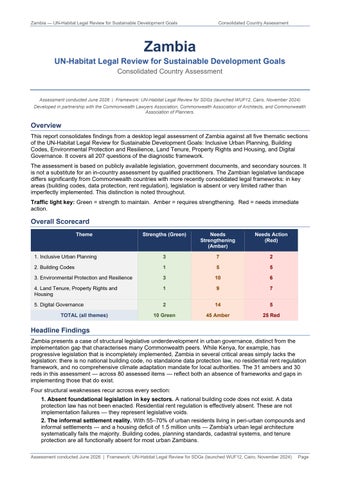
This report consolidates findings from a desktop legal assessment of Zambia against all five thematic sections of the UN-Habitat Legal Review for Sustainable Development Goals: Inclusive Urban Planning, Building Codes, Environmental Protection and Resilience, Land Tenure, Property Rights and Housing, and Digital Governance. It covers all 207 questions of the diagnostic framework.
The assessment is based on publicly available legislation, government documents, and secondary sources. It is not a substitute for an in-country assessment by qualified practitioners. The Zambian legislative landscape differs significantly from Commonwealth countries with more recently consolidated legal frameworks: in key areas (building codes, data protection, rent regulation), legislation is absent or very limited rather than imperfectly implemented. This distinction is noted throughout.
Traffic light key: Green = strength to maintain. Amber = requires strengthening. Red = needs immediate action.
Overall Scorecard
Headline Findings
Zambia presents a case of structural legislative underdevelopment in urban governance, distinct from the implementation gap that characterises many Commonwealth peers. While Kenya, for example, has progressive legislation that is incompletely implemented, Zambia in several critical areas simply lacks the legislation: there is no national building code, no standalone data protection law, no residential rent regulation framework, and no comprehensive climate adaptation mandate for local authorities. The 31 ambers and 30 reds in this assessment across 80 assessed items reflect both an absence of frameworks and gaps in implementing those that do exist.
Four structural weaknesses recur across every section:
1. Absent foundational legislation in key sectors. A national building code does not exist. A data protection law has not been enacted. Residential rent regulation is effectively absent. These are not implementation failures they represent legislative voids.
2. The informal settlement reality. With 55–70% of urban residents living in peri-urban compounds and informal settlements and a housing deficit of 1.5 million units Zambia's urban legal architecture systematically fails the majority. Building codes, planning standards, cadastral systems, and tenure protection are all functionally absent for most urban Zambians.
3. Severely constrained local authority capacity. Zambia's 116 local authorities are deeply underresourced in revenue, staffing and technical capacity. Building control, planning enforcement, environmental regulation and digital governance all depend on local authority implementation and that capacity is largely absent outside the largest cities.
4. Nascent digital and climate legal frameworks. The Green Economy and Climate Change Act (2024) and the Cyber Security Act (2025) are significant recent legislative developments, but both have been enacted without the complementary local-level governance architecture needed to make them effective in urban contexts. The cascade from national legislation to city-level implementation is missing.
Zambia's situation calls for a different diagnostic framing to Kenya's. The priority is not primarily to close an implementation gap in existing legislation, but to develop foundational legal frameworks particularly a national building code, a data protection law, and a local authority climate action mandate as preconditions for sustainable urban development.
Section 1: Inclusive Urban Planning
Score: 3 Green | 7 Amber | 2 Red
Zambia's Urban and Regional Planning Act No. 3 of 2015 is a genuinely reformed piece of legislation replacing a colonial-era Town and Country Planning Act. The three greens reflect this legislative progress. The dominant amber pattern reflects a systemic implementation gap: plans are required but many local authorities lack them; participation is mandated but rarely meaningful; enforcement exists on paper but not in practice. The two reds affordable housing targets absent from plans, and public space management funding represent the most acute gaps for a country with one of Africa's fastest urbanisation rates.
Area / Question
Rating Evidence & Notes
A. Planning hierarchy & content of plans (Questions 1–5)
Q1–3: Defined hierarchy of spatial plans (national, regional, local, neighbourhood)
Amber
Q4: Local spatial plan content requirements
Amber
Q5: Ratio of registered planners to inhabitants
Red
The Urban and Regional Planning Act No. 3 of 2015 (URPA) establishes a planning hierarchy covering national, provincial, district and local plans. However, the Act's implementation regulations remain incomplete and many local authorities have yet to produce approved integrated development plans under the new framework.
URPA specifies content requirements for integrated development plans including spatial frameworks, land use, infrastructure and social facilities. In practice, most of Zambia's 116 local authorities lack current approved plans older plans predate the 2015 Act and many districts operate without a valid plan.
Zambia has a severe planner shortage. The Zambia Institute of Planners (ZIP) has a small registered membership serving a population of approximately 20 million. No national data is publicly available on the precise ratio, but it is widely considered to fall well below the UNHabitat benchmark of 40 per 100,000 inhabitants. Rural and peri-urban areas are particularly underserved.
B. Planning process & participatory planning (Questions 6–12)
Q6–8: Stakeholder consultation in plan-making
Amber
Q7: Tailored processes for vulnerable groups
Amber
Q9–10: Inclusive planning including informal settlements
Amber
URPA 2015 requires public participation during plan preparation. The Local Government Act No. 2 of 2019 reinforces community consultation obligations. In practice, participatory processes are weak in resource-constrained local authorities, with consultations often limited to formal notice periods rather than substantive engagement.
No specific legal provisions for tailored participatory processes for women, youth, persons with disabilities or informal settlers are embedded in URPA or subsidiary legislation. Gender and disability considerations appear in policy documents (8th National Development Plan 2022–2026) but are not legally mandated in planning processes.
URPA provides for improvement areas a mechanism for planning in peri-urban settlements inherited from the Housing (Statutory and Improvement Areas) Act. In
Q11–12: Transparency, accountability & professional ethics
Amber
C. Land-use change provisions (Questions 13–15)
Q13–15: Clarity, public availability & timelines for land-use change
Amber
practice, 55–70% of urban dwellers live in informal or periurban settlements that are largely outside the formal planning system. Slum upgrading occurs through ad hoc programmes rather than systematic legal frameworks.
URPA requires transparent plan-making processes. The Zambia Institute of Planners maintains a code of professional conduct for registered planners. Accountability mechanisms exist in statute but enforcement is limited by capacity constraints across most local authorities.
URPA provides procedures for land-use change applications through local authorities. Timelines are not consistently met in practice; processing can take significantly longer than the two-month benchmark. Community participation requirements exist but are inconsistently applied. Planning decisions are not systematically published or easily publicly accessible.
D. Planning at scale & affordable housing (Questions 16–16.2)
Q16: Urban plans based on demographic projections with affordable housing targets
Red
A significant gap. Zambia has a nationally acknowledged housing deficit of approximately 1.5 million units (40% urban, 60% rural). Urban plans are not systematically required to incorporate demographic projections or explicit affordable housing targets. The National Housing Policy 2020–2024 sets aspirational targets but these are not legally embedded in planning instruments.
E. Public space (Questions 17–29)
Q17–23: Allocation, acquisition and protection of public space
Amber
Q24–29: Management, climate standards and funding for public space
Red
F. Sustainable urban design (Questions 30–36)
Q30–35: Mixed use, density, walkability, plot readjustment
URPA and the Local Government Act require the reservation of land for public uses including open space and recreational areas in development layouts. Enforcement of these requirements is weak in practice encroachment on designated spaces is widespread, particularly in peri-urban areas. Penalty provisions exist but are rarely applied.
No dedicated legal mechanism for earmarked funding for public space maintenance exists at local authority level. Climate resilience, safety standards and accessibility requirements for public spaces are not systematically prescribed in subsidiary planning regulations. Informal vendor accommodation provisions are absent from current planning law.
Amber
Q36: Regular updating of plans for climate change
Section 2: Building Codes
Green
URPA 2015 and its subsidiary regulations provide for mixed-use zoning and densification in principle. In practice, Zambian cities particularly Lusaka are characterised by low-density sprawl, high car dependency and limited walkability. Plot readjustment mechanisms are not well developed in law. Provisions for a variety of lot sizes and housing types to serve different income groups are not systematically embedded.
URPA 2015 requires regular review of spatial plans and mandates alignment with national development plans. The 8th National Development Plan 2022–2026 integrates climate considerations. The Green Economy and Climate Change Act No. 18 of 2024 creates a framework requiring sector-level climate planning. A formal update cycle for spatial plans is specified under URPA though implementation is uneven.
Score: 1 Green | 5 Amber | 5 Red
Building codes represent the most acute legislative gap in Zambia's urban governance framework. There is no national building code. Construction safety is regulated through a fragmented system of the National Council for Construction Act (2020), Public Health Act provisions, local by-laws, and professional practice norms with no unified national standard, no publicly available code, no performance-based framework, and no mechanism for upgrading the vast informal housing stock. The single green (the NCC's update cycle) reflects the 2020 statutory renewal but is insufficient to compensate for the fundamental absence of a codified national standard. This section contains the highest concentration of reds in the entire assessment.
Area / Question
A. General existence & enactment (Questions 37–41)
Q37–38: National building code exists and is publicly available
Q39–40: Responsible agency; local codes based on national model
Q41: Mechanisms for uniform interpretation and enforcement
B. Nature & scope of the code (Questions 42–45)
Q42: Performance-based, prescriptive, or hybrid?
Q43–44: Applies to new and existing buildings; incremental upgrading mechanism
& Notes
Zambia does not have a single, codified national building code. An important distinction must be drawn here: the National Council for Construction Act No. 10 of 2020 establishes a construction industry regulation framework governing contractor registration, project registration, professional conduct and penalties for unregistered practitioners. This is not the same instrument as a building code. A building code specifies the technical standards to which buildings must be designed and constructed: structural loads, fire safety, energy performance, accessibility, sanitation and materials. No such codified national standard exists or is publicly available in Zambia. The ICC Global Building Code Tool a specialist international reference explicitly confirms this. Building safety falls back on the Public Health Act (Cap 295) and scattered local authority by-laws, producing a fragmented and inconsistent system.
The NCC is responsible for construction industry regulation but does not publish or maintain a national building code in the technical sense. The practical consequence confirmed by official guidance directing those undertaking construction to 'consult the local council for specific building regulations' is that applicable standards vary by jurisdiction and are not consolidated into a publicly available national instrument. There is no national model code on which local codes could be based. This fragmentation means that the quality and safety of construction depends heavily on the standards applied by individual local authorities, which vary significantly in capacity and rigour.
No national mechanism for uniform interpretation and enforcement of building standards exists. Local authority building control departments apply inconsistent standards derived from different by-law traditions. The NCC registers contractors but does not publish a unified technical building standard. This is widely recognised as a governance gap in Zambia's construction sector.
In the absence of a national building code, the de facto regime is a mix of prescriptive Public Health Act requirements and local by-laws, supplemented by professional standards applied by registered architects and engineers on a project-by-project basis. No performancebased framework exists at national level.
Building controls as currently structured apply primarily to formal new construction requiring building permits. The vast majority of housing stock estimated at 55–70% of urban housing being informal or peri-urban is built entirely outside the regulatory framework. No mechanism for incremental upgrading of existing buildings to any standard exists in law.
Q45: Coverage structural, fire, electrical, sanitation, energy, disability access
Amber
C. Currency of the code (Questions 46–47)
Q46–47: Agency responsible for maintenance; publication and update history
Amber
D. Local & bio-based materials (Questions 48–49)
Q48–49: Regulations for local/biobased materials; financial incentives
Red
Individual sectoral standards exist across different instruments: the Zambia Bureau of Standards (ZABS) publishes standards including the Electrical Safety Code (ZS 418, updated 2024); fire safety is addressed under the Fire Services Act; sanitation under the Public Health Act; structural standards through professional practice norms. Energy efficiency, embodied carbon, and disability accessibility are not comprehensively addressed in any instrument. Coverage is fragmented rather than systematic.
The NCC Act 2020 updated the statutory framework for construction industry regulation. Individual sectoral standards (e.g. the ZABS electrical code) are periodically updated. However without a national building code there is no single maintenance responsibility or update history. Zambia's construction regulation system has not been comprehensively modernised as a package.
No provisions in Zambia's construction regulatory framework specifically promote or accommodate locally available or bio-based materials such as compressed earth blocks, bamboo, or timber frame construction. Financial incentives for their use do not exist in statute. This is a significant gap given Zambia's rich material resource base and the informal self-build housing tradition.
E. Implementation & enforcement (Questions 50–57)
Q50–52: Responsible agency; digital or paper application; who can apply
Amber
Q53–54: Is the building control authority adequately resourced? Staff experience?
Red
Q55: Average time to approve a building permit
Red
Q56–57: Process documented, predictable, transparent? Inspection, enforcement, certification?
Red
Building permit applications are processed by local authority planning and works departments. The process is primarily paper-based with limited digital systems. Applicants are generally required to engage a registered architect or engineer. The Lusaka City Council has begun digitalisation of some permit processes but coverage across Zambia's local authorities is very limited.
Building control capacity across Zambia's local authorities is widely acknowledged to be severely inadequate. Most councils lack sufficient qualified professional staff. Enforcement in peri-urban areas is effectively absent. This is compounded by very low local authority revenue bases and chronic underfunding of council technical departments.
No nationally reported data on average permit approval times is publicly available. Permit processing timelines are widely reported to be inconsistent and frequently well in excess of three months for formal applications. The practical reality is that the large majority of housing construction proceeds without permits at all.
Building control processes are not consistently documented, predictable or transparent across local authorities. Inspection of construction in progress is irregular. Enforcement action for non-compliance is rare. Building certification systems are not systematically applied. Building collapses including several high-profile incidents in Lusaka reflect the consequences of weak enforcement.
Section 3: Environmental Protection and Resilience
Score: 3 Green | 10 Amber | 6 Red
The Green Economy and Climate Change Act No. 18 of 2024 is a landmark piece of legislation Zambia's most significant climate governance development in decades. Combined with the Environmental Management Act 2011 and ZEMA's mandate, this gives Zambia a more credible national climate framework than many sub-
Saharan peers. The three greens reflect this. The dominance of ambers and reds reflects the cascade failure: national legislation is not translating into local authority climate capacity, and urban-specific provisions (for green space, slum climate resilience, neighbourhood energy design, and climate justice) are systematically absent. The 2024 El Niño drought which triggered a national emergency underscores the urgency.
Area / Question
Rating Evidence & Notes
1. Sustainable Urbanisation A. Climate governance (Questions 58–61)
Q58: Vertical coordination between national, regional and local government on climate
Amber
Q59: Legal provisions for monitoring climate goals and targets
Amber
Q60: Legal provisions for data and information sharing on climate matters
Amber
Q61: Legal empowerment of local authorities to implement climatesustainable development Red
The Green Economy and Climate Change Act No. 18 of 2024 (GEACC Act) establishes a national governance architecture with a Council and Technical Committee. The Environmental Management Act No. 12 of 2011 (EMA) requires ZEMA to coordinate across government. However, vertical coordination between central government and local authorities on climate implementation is weak most councils lack climate officers or climate action plans.
The GEACC Act 2024 establishes an Integrated Measuring, Reporting and Verification (IMRV) system and a Greenhouse Gas Inventory Management System. Zambia has submitted a provisional NDC 3.0 (2025) targeting 25% unconditional and 47% conditional GHG reductions from 2010 levels by 2030. National monitoring architecture is in place; local-level monitoring capacity is very limited.
The EMA 2011 (Sections 87–90) requires ZEMA to maintain a Central Environmental Information System and environmental information registry. The GEACC Act requires national reporting. However systematic dissemination of climate data to local government and the public is not consistently implemented, and ward or community-level climate information mechanisms do not exist in law.
The GEACC Act 2024 applies to the national level and to 'appropriate authorities' including ministries, but local authority roles in climate action are not specifically empowered in law. The Local Government Act 2019 does not prescribe climate functions for councils. Most local authorities have no dedicated climate or sustainability functions, no budget for climate action, and no legally specified responsibilities in this area.
B. Urban plans and GHG emissions (Questions 62–62.2)
Q62: Legal provisions assessing GHG emissions from planning instruments; targets and carbon sinks
Red
No legal requirement exists for urban spatial plans to include GHG emissions assessments, measurable reduction targets, or carbon sink estimations. The GEACC Act 2024 requires sector-level emission plans from relevant ministries but does not specifically require these to cascade into local spatial planning instruments. The gap between the national climate framework and urban planning law is significant.
C. Urban form and reduction of transport GHG emissions (Question 63)
Q63: Legal provisions promoting lowcarbon urban development; incentives for renewables and lowemission transport
D. Green spaces (Questions 64–67)
Q64–66: Network of green spaces; equitable distribution; monitoring body
Amber
Red
URPA 2015 provides for mixed-use and compact urban development in principle. Zambia's revised NDC 3.0 addresses transport sector emissions. The Energy Regulation Act and the Rural Electrification Act support renewable energy. However comprehensive legal provisions specifically linking urban form to transport GHG reduction including low-emission transport incentives are not embedded in planning law.
URPA and local authority by-laws require the reservation of open space in development layouts. In practice, Lusaka
Q67: Incentives or requirements for green infrastructure in urban projects
Red
and other Zambian cities have very limited accessible public green space, particularly in peri-urban areas. No dedicated body monitors urban greenery provision. Informal settlements where 55–70% of urban dwellers live have negligible planned green space.
No financial incentives (tax breaks, grants, subsidies) for green infrastructure integration into urban development projects are embedded in Zambia's planning or environmental legislation. EIA requirements under the EMA apply to larger projects but do not specifically require or incentivise green infrastructure. This is a significant gap.
E. Development control, mitigation and climate financing (Questions 68–68.3)
Q68: GHG mitigation in development approval; developer charges; enforcement penalties
EIA requirements under EMA 2011 (amended 2023) link large development approvals to environmental impact assessment including some climate considerations. Developer infrastructure contributions exist in principle through the planning approval process. Enforcement penalties for EIA non-compliance are prescribed under EMA. However climate-specific GHG mitigation requirements in development approval are not systematically embedded.
F. Neighbourhood design and energy savings (Questions 69–69.3)
Q69: Neighbourhood design principles for energy savings in buildings
G. Circular economy (Question 70)
Q70: Circular economy strategy; reuse standards; extended producer responsibility; monitoring
Red
No provisions in Zambia's planning or building regulatory framework require neighbourhood design for energy savings including wind and sun orientation, thermal surface properties, or optimal plot orientation for energy efficiency. This reflects the broader absence of a national building code with energy performance requirements.
Zambia lacks a comprehensive urban circular economy legal framework. Waste management is addressed through the EMA 2011 and the Local Government Act, but enforcement of waste regulations is weak and illegal dumping is widespread. Extended producer responsibility schemes are not established in law. The GEACC Act 2024 focuses on carbon markets and GHG reduction but does not address urban circular economy specifically.
2. Urban Resilience A. Adaptation planning (Questions 71–72)
Q71: Legal mandate for climate adaptation plans; stakeholder engagement; coordination; monitoring
Q72: Legal provisions requiring social vulnerability factors in adaptation planning
Amber
Red
The GEACC Act 2024 requires the Minister to develop a National Adaptation Plan and National Mitigation Plan within two years of commencement, revised every five years. A National Policy on Climate Change (2017) provides a policy framework. Ward or community-level adaptation planning structures are not legally mandated. Coordination between national adaptation planning and local spatial planning is not prescribed.
No specific legal provisions require the systematic consideration of social vulnerability factors (poverty, gender, ethnicity, age, disability) in climate adaptation planning within urban areas. The GEACC Act addresses environmental and social safeguards broadly but does not legally mandate vulnerability-responsive urban adaptation planning.
B. Climate risks and vulnerability assessments (Questions 73–74)
Q73: Law mandating climate risk assessments for urban areas; publication; stakeholder involvement; updates
Amber
EMA 2011 requires strategic environmental assessments for policies and plans, and Environmental Impact Assessments for specified developments. These include climate-related risk considerations. However a specific statutory mandate for regular, publicly disseminated, urban climate risk assessments with stakeholder involvement is
Q74: Spatial plans required to include climate vulnerability assessments
Amber
not in place. The GEACC Act 2024 establishes a national IMRV system but does not specifically mandate urban vulnerability assessments.
EIA requirements apply to major development projects. A universal requirement for all spatial plans to include climate vulnerability assessments (floods, landslides, drought) is not comprehensively embedded in URPA or its subsidiary regulations. Zambia is highly vulnerable to drought and flooding the 2024 El Niño drought caused a national emergency but this vulnerability is not systematically integrated into planning law.
C–D. Infrastructure and ecosystem-based adaptation (Questions 75–78)
Q75–78: Climate integration in infrastructure; nature-based solutions; ecosystem-based measures
Amber
E. Slum adaptive capacity (Questions 79–80)
Q79–80: Law on adaptation of slums to climate change; climate-smart upgrading criteria; community participation
Red
The GEACC Act 2024 mandates climate considerations across key sectors including infrastructure. EMA 2011 provides for ecosystem management and biodiversity protection. Community-level ecosystem-based adaptation projects exist (wetland conservation, agroforestry). However comprehensive legal mandates for nature-based solutions and ecosystem-based adaptation in infrastructure planning are not systematically prescribed.
No specific statute addresses the climate adaptation of Zambia's peri-urban compounds and informal settlements. With 55–70% of urban residents in informal settlements many located in flood-prone, environmentally fragile areas this is a critical gap. Slum upgrading when it occurs is ad hoc and project-based, without a systematic legal framework for climate-smart criteria or community participation standards.
F. Land-use change and security of tenure (Questions 81–82)
Q81–82: Flexible zoning; tenure rights during climate displacement; land tenure review for climate change
Amber
G. Climate financing (Questions 83–87)
Q83–87: Climate financing for local government; zoning for climate risk; EIA adaptation; monitoring
Amber
URPA 2015 provides for land-use change procedures and flexible zoning in principle. The Lands Act Cap 184 provides a framework for land rights. However specific legal provisions ensuring tenure security during climaterelated displacement, or preventing climate-induced forced evictions, are not embedded in Zambia's planning or land legislation. The GEACC Act 2024 does not address urban tenure security in climate contexts.
The GEACC Act 2024 establishes a Climate Change Fund at national level. Zambia has accessed international climate finance (Green Climate Fund, Global Environment Facility). EIA requirements address adaptation for major projects. However mechanisms to channel climate finance specifically to local government for urban climate action are not in place. Local authority climate finance capacity is effectively absent.
3. Climate Justice A. Environmental courts (Questions 88–92)
Q88–92: Specialist environmental courts; jurisdiction; appeal; trained judges; public access
Amber
Zambia does not have a dedicated specialist environmental court. Environmental cases are heard in the High Court and the Land Tribunal. The EMA 2011 provides for enforcement action through ZEMA and prosecution through the courts. No specific judicial training on climate change law is mandated. Public access to environmental court proceedings is possible but not systematically facilitated.
B–C. Legal actions and legal aid (Questions 93–100)
Q93–95: Legal action against city/government for climate inaction; accountability; penalties
Red
Q97–100: Legal aid for climate litigation; dedicated funds; NGO partnerships
Red
No specific law allows individuals to take binding legal action against local authorities specifically for failing to address climate change. Environmental enforcement action under EMA is state-initiated. Constitutional rights provisions are broad but their application to climate inaction by local authorities is untested. Penalties for city governments not complying with climate plans are not prescribed.
Formal legal aid for climate justice litigation is not available. The Legal Aid Board provides civil legal aid but resources are severely constrained. No dedicated climate justice fund exists. Civil society organisations working on environmental rights are active but underfunded. Access to courts for low-income communities on environmental matters is a significant barrier.
D–E. Compensation and enforcement (Questions 101–110)
Q101–105: Compensation types; claiming process; financial penalties for pollution
Q106–110: Enforcement of climate justice rulings; penalties; independent oversight; public reporting
Amber
Red
EMA 2011 provides for financial penalties for pollution and environmental damage, and ZEMA can require remediation. Monetary compensation claims can be brought through the courts. However a systematic, transparent framework for claiming compensation for climate-related harm covering both direct and indirect damages is not established in law. Financial penalties are often inadequately enforced.
ZEMA is chronically under-resourced for enforcement. Independent oversight of environmental enforcement is limited. The Environmental Council/ZEMA has a mandate for enforcement but political interference, capacity constraints and inadequate penalties undermine its effectiveness. Public reporting on enforcement outcomes is not systematic.
F. Community involvement in climate judicial proceedings (Questions 111–115)
Q111–115: Community participation in climate proceedings; outreach; local languages; feedback
Amber
EMA 2011 provides for public participation in environmental decision-making. Legal proceedings are formally accessible. However community outreach on climate legal rights is very limited, legal texts are in English only, and community representatives from peri-urban informal settlements face significant barriers to participation in any formal proceedings.
Section 4: Land Tenure, Property Rights and Housing
Score: 1 Green | 9 Amber | 7 Red
Land tenure and housing is where Zambia's urban governance crisis is most acute. With 55–70% of urban residents in informal settlements, a housing deficit of 1.5 million units, effectively no residential rent regulation, prohibitive mortgage rates (16–21%), and a cadastral system that excludes the majority of urban dwellers, the gap between legal aspiration and lived reality is extreme. The Lands Tribunal a genuine institutional strength is the sole green in this section, mirroring Kenya's pattern. The seven reds represent the most urgent priorities for legislative action across the entire assessment.
Area / Question
1. Property Rights and Land-Use Planning
A. Zoning regulations (Questions 116–118)
Q116–117: Quantifiable measures; sustainable land-use planning including disaster-prone areas
Amber
URPA 2015 provides for land-use planning and zoning frameworks. The EMA 2011 requires environmental considerations for development approvals. Specific quantifiable measures objectively assessing the balance between property rights and zoning goals are not comprehensively prescribed. Disaster-prone area mapping is not systematically integrated into local planning frameworks.
Q118: Inclusionary zoning practices
Red
B. Public-private partnerships (Questions 119–123)
Q119–121: Legal safeguards for property rights in PPPs; public participation; responsible private sector engagement
Q122–123: Land value capture in PPPs; government policy on mortgages and financing
Amber
Inclusionary zoning is not mandated in Zambia's planning legislation. The National Housing Policy 2020–2024 encourages mixed-income development in principle, but no legal mechanism requires private developers to include affordable units in developments. With a national housing deficit of approximately 1.5 million units, this is a critical gap.
The Public-Private Partnerships Act No. 14 of 2009 provides a legal framework for PPP structures including housing. Public participation requirements exist in principle. However the track record of PPP housing projects in Zambia is mixed, with inadequate community consultation and cases of displacement associated with urban redevelopment projects.
Red
C. Land-based finance (Questions 124–135)
Q124–126: Fiscal cadastre timely updating; coverage of informal settlements; public availability
Systematic land value capture mechanisms are not embedded in Zambia's PPP or planning law. The Zambia National Building Society provides mortgage finance but interest rates (16–21%) over 25–30 years are prohibitive for most urban residents. No comprehensive government policy framework effectively links PPP approvals to affordable housing finance mechanisms.
Red
Q127–129: Land value sharing mechanisms; redistribution of benefits; prioritisation of underserved areas
Q130–132: Developer fees and contributions; building permit conditionality; in-kind options
Red
Zambia's cadastral system is in a transitional state. While the Lands and Deeds Registry maintains formal records, 55–70% of urban dwellers in informal settlements are absent from the formal cadastre. The National Land Titling Programme (2014) aimed to extend title to all land but has made limited progress. Informal settlements locally known as compounds remain largely outside formal land records.
Zambia lacks systematic legal mechanisms for capturing and redistributing land value increases from public investments and planning decisions. No established criteria prioritise investments in underserved areas through land value sharing. The combination of land speculation around Lusaka and the absence of land value capture has deepened spatial inequality.
Amber
Q133–135: Property tax system; collection rates; value-based calculation; progressive rates for vacant land
Amber
Infrastructure contribution obligations for developers exist through the planning and development approval process. However a systematic, transparent and consistently applied framework for developer contributions is not in place. Local authority capacity to negotiate and enforce contributions varies widely, and informal development largely bypasses these requirements.
A property rating system exists under the Rating Act Cap 480 and the Local Government Act 2019, empowering local councils to levy rates. Collection rates are very low across most local authorities a major constraint on council revenues and service delivery. Progressive rates for vacant or undeveloped land are not systematically applied. The formal property tax base covers only a fraction of urban properties.
D. Flexible and socially responsible tenure systems (Questions 136–139)
Q136–137: Gender-responsive tenure legislation; recognition of statutory, customary and informal rights
Amber
The Lands Act Cap 184 and the Intestate Succession Act recognise women's land rights in principle. Customary tenure under Traditional Authority jurisdiction governs the majority of rural and some peri-urban land. The 30-year Land Occupancy Licence scheme in peri-urban areas and interim leases provide intermediate tenure options. In practice, women's tenure security remains weak customary norms frequently override statutory protections,
Q138–139: Simplified registration process; alternative tenure mechanisms Amber
2.
and the costs of registration exclude most low-income households.
The Land Titling Programme and the 30-year occupancy licence system provide alternative mechanisms to full 99year leaseholds. However first-time registration remains expensive and complex for low-income households, and the institutional processing capacity of the Lands and Deeds Registry is a persistent bottleneck. A continuum of tenure rights from occupancy licences to full freehold exists in theory but is inadequately supported by accessible registration systems.
Laws, Policies and Regulations Promoting Adequate Housing
A. Anti-discrimination and rent regulation (Questions 140–144)
Q140–141: Anti-discrimination in housing; redress mechanisms Amber
Q142–144: Rent regulation; tenancy termination safeguards; antiharassment provisions
The Zambian Constitution (2016) prohibits discrimination on grounds of sex, race, religion, and other characteristics. The Gender Equity and Equality Act No. 22 of 2015 provides anti-discrimination protections. However specific anti-discrimination provisions in housing law, with accessible redress mechanisms, are not comprehensively developed in dedicated housing legislation.
Zambia lacks a comprehensive residential rent regulation framework. The Rent Act Cap 207 is outdated and has limited practical effect. Informal rental markets through which most low-income urban dwellers access housing operate on the basis of informal agreements without meaningful legal protection. Tenancy termination safeguards and anti-harassment provisions are inadequate. This is a particularly acute gap given that renting is the dominant housing tenure in informal settlements.
B. Housing subsidies and affordability (Questions 145–148)
Q145–148: Affordability; effectiveness of subsidy frameworks; equitable distribution; adjustment mechanisms
The National Housing Policy 2020–2024 sets affordability objectives. Government housing programmes (National Housing Authority, Zambia National Service housing, civil servant housing) have produced very limited supply. Average monthly incomes of US$42–US$125 for most urban workers make mortgage-based housing entirely inaccessible. Effective housing subsidy frameworks for the majority of urban residents do not exist. Housing microfinance is emerging but is at very early stages.
C. Equitable distribution of adequate housing (Questions 149–155)
Q149–152: Equitable distribution; emergency housing; location adequacy; services and infrastructure
Q153–155: Habitability; cultural adequacy; inclusive design and disability accessibility
3. Security of Tenure
With over 55–70% of urban residents in inadequately serviced informal settlements and a housing deficit of 1.5 million units the gap between legal aspiration and reality is very large. Emergency housing provisions are absent. Most informal settlements lack adequate water, sanitation, energy and refuse disposal. The location of informal settlements frequently cuts residents off from formal employment, services and schools.
Habitability standards are not met in the informal housing stock. Building standards that do exist (under the Public Health Act) are not enforced in informal settlements. Cultural adequacy in housing design is not systematically addressed in law. Disability accessibility is not embedded in housing regulations, though it appears in the NCC Act framework for contractor registration.
A. Legal recognition of land rights and protection against forced evictions (Questions 156–160)
Q156–157: Legal recognition of land rights; enforcement against land grabs
Amber
Q158–159: Prohibition of forced evictions; judicial oversight
Q160: Proactive prevention of land grabbing; compensation provisions and timelines
Red
Amber
The Zambian Constitution guarantees property rights and the Lands Act provides for registered leaseholds. However only an estimated 30% of land nationally has formally registered rights. Unauthorised land grabbing including cases linked to politically connected actors is a documented problem. The Lands Tribunal provides a dispute resolution mechanism but is under-resourced.
Zambia's Constitution and the Lands Act provide for due process in eviction. In practice, forced evictions including evictions linked to government development projects occur without adequate notice, compensation or judicial oversight. Urban compd residents are particularly vulnerable. Court victories for affected communities are not always enforced.
The Lands Acquisition Act provides for compulsory acquisition with compensation and appeal rights. However compensation timelines are frequently not met, and definitions of public interest have been applied controversially. Proactive legal mechanisms to prevent land grabbing before it occurs are limited.
B. Protection of vulnerable and marginalized populations (Questions 161–163)
Q161–163: Land rights of refugees, displaced populations, indigenous communities and informal settlers
Red
Zambia hosts significant refugee populations (over 100,000, primarily from DRC and other neighbouring countries). Refugee land rights are addressed under the Refugee Act but tenure security in practice is limited. 55–70% of urban dwellers in informal settlements remain highly tenure-insecure. Customary land rights of rural communities are recognised under the Lands Act but inadequately protected against commercial encroachments.
C. Effective dispute resolution (Questions 164–171)
Q164–166: Accessible land dispute processes; dedicated tribunal; ADR; legally binding outcomes
Q167–171: Timelines; fee waivers; legal aid; appeal rights; anti-retaliation measures
Legal land registry (Questions 172–175)
Q172–175: Cadastre system; coverage; accuracy; public accessibility
The Lands Tribunal, established under the Lands Tribunal Act Cap 189, provides a dedicated mechanism for resolving land disputes with nationwide jurisdiction. Alternative dispute resolution is available through the Zambia Institute of Arbitrators and community-level mediation. Tribunal outcomes are legally binding and enforceable. This is a genuine institutional strength, though the Tribunal is under-resourced relative to demand.
The Lands Tribunal has specified procedures and appeal rights to the High Court. Legal aid through the Legal Aid Board is available in principle but severely limited in practice funding constraints mean most land dispute litigants cannot access support. Fee waivers for vulnerable populations are available in principle. Case backlogs mean specified timelines are not consistently met.
The Lands and Deeds Registry maintains the formal cadastre, supplemented by the National Land Titling Programme. Coverage is inadequate the majority of urban land occupied informally is absent from the formal register. Accuracy is limited. Public accessibility of land records requires physical attendance at registry offices and carries fees that exclude most low-income residents. Digitisation is at an early stage.
Section 5: Digital Governance
Score: 2 Green | 14 Amber | 5 Red
Digital governance is an area of active legislative development in Zambia, but from a very low baseline. The Access to Information Act 2021 and the Cyber Security/Cyber Crimes Acts 2025 represent recent statutory
progress. The two greens reflect Zambia's regional ICT participation and ZICTA's standards work. The fourteen ambers reflect frameworks that are either at early implementation stages or only partially in place. The five reds including the absence of a data protection law, automated decision-making governance, digital inclusion mandates, smart city frameworks, and municipal digital governance structures represent the most significant legislative gaps. Critically, the Cyber Security Acts 2025 have attracted serious civil society concern about their surveillance provisions and impact on privacy and free expression.
Area / Question
1.
Rating Evidence & Notes
Data-Driven Decision-Making A. Smart city operating model (Questions 176–180)
Q176: Smart city law, policy or strategy; vision; coordination; monitoring
Q177: Legislative requirement for municipal open data platform
Q178: Legal measures for digital inclusion (skills, WiFi, broadband, device subsidies)
Q179: Participation in smart city knowledge-sharing initiatives
Q180: Internationally recognised inter-operability standards
Amber
Zambia does not have a dedicated smart city law or formal smart city strategy at national or municipal level. The 8th National Development Plan 2022–2026 references digital transformation broadly. Lusaka and other Zambian cities have not adopted smart city governance frameworks. The Digital Economy Policy of 2021 addresses national digital transformation but does not translate into municipal smart city governance. This is a significant gap.
No legislative requirement exists for Zambian municipalities to maintain open data platforms. The Access to Information Act No. 13 of 2021 (ATI Act) establishes a right of access to information held by public bodies and requires proactive disclosure of certain categories of information. However implementation of the ATI Act is at an early stage and no online open data portal for municipal data is in operation.
No specific legal mandates for municipal digital inclusion measures skills training, WiFi access, broadband subsidies, or device subsidies are in place. The Digital Economy Policy of 2021 includes digital skills goals. However Zambia has very limited urban digital infrastructure outside Lusaka, and rural/peri-urban digital access is severely constrained. Only approximately 25–30% of the population has internet access.
Zambia participates in regional digital governance knowledge-sharing through COMESA digital frameworks and the Southern African Development Community (SADC) Digital Transformation Strategy. National engagement with UN-Habitat digital governance programmes exists. Systematic city-to-city knowledge exchange on smart city governance is limited.
The Zambia Information and Communications Technology Authority (ZICTA) promotes adoption of international ICT standards. The Cyber Security Act 2025 references alignment with international norms. However systematic adoption of inter-operability standards across municipal digital systems is very limited given the early stage of municipal digitalisation.
B. Automated decision-making (Questions 181–186)
Q181: Accessibility (disability) standards in digital service design
Q182: Law regulating data ownership and control; commercial data sharing obligations
No legislative requirement mandates disability accessibility standards in local government digital service design. The Persons with Disabilities Act No. 6 of 2012 provides general anti-discrimination protections but does not specifically prescribe accessibility standards for digital services. Digital service provision at municipal level is nascent.
The Electronic Communications and Transactions Act No. 21 of 2009 (ECT Act) addresses electronic transactions and some data aspects. ZICTA regulates the ICT sector. A comprehensive data protection law specifically addressing data ownership, intellectual property in data, and commercial data sharing obligations has not yet been
Q183–186: Digital services identification; algorithmic fairness audits; human oversight; redress
Red
enacted this is a significant gap in Zambia's digital governance framework.
Zambia does not have a comprehensive data protection or AI governance framework addressing algorithmic fairness audits, mandatory human oversight in automated decisionmaking, or specific redress mechanisms for those adversely affected by automated decisions. The ECT Act addresses electronic transactions but not these aspects of digital governance. This represents the largest gap in Zambia's digital legal framework.
C. Participatory decision-making (Questions 187–188)
Q187–188: Legal mandate for digital participatory platforms; privacy and security protections
Red
D. Decision-making authority (Questions 189–191)
Q189: Chief Digital Officer; dedicated digital team; roles in legal/administrative framework
No legal provisions mandate the use of digital platforms for public participation in urban governance decisions. The ATI Act 2021 and the Local Government Act 2019 require public participation but do not prescribe digital platforms. No comprehensive privacy and data security framework protects participants in digital engagement processes a gap that will become increasingly significant as digital governance develops.
Red
Q190–191: Data stewards; mandatory training on digital legal developments
Red
Zambia's local authorities do not have formally constituted digital governance leadership roles (Chief Digital Officers, Chief Innovation Officers or equivalent). At national level, the Ministry of Technology and Science leads digital transformation but municipal digital governance capacity is minimal. No legally specified digital governance roles or structures exist for local authorities.
No legal mandate for designated municipal data stewards exists. No statutory requirement for regular training of public officials on digital legal developments is prescribed. Digital capacity across Zambia's local authority workforce is very limited.
E. Data integration and information-sharing (Questions 192–195)
Q192–195: Collaborative data sharing; open data practices; right to be informed; harmonisation
Amber
The ATI Act 2021 establishes a right of access to government information and requires proactive disclosure. ZICTA promotes data sharing frameworks. The ECT Act addresses electronic records. However specific legal provisions mandating municipal open data practices, the right to be informed at the point of personal data collection, data lifecycle management, and harmonisation of diverse municipal datasets are not comprehensively in place. ATI Act implementation is at a very early stage.
2. Balancing Data Use and Privacy A–B. Data security and access (Questions 196–203)
Q196–203: Security framework; breach mitigation; business continuity; data exchange; data access regulations
Amber
The Cyber Security Act 2025 (replacing the 2021 Act) establishes the Zambia Cyber Security Agency and introduces provisions for cyber security audits, critical information infrastructure protection and annual cyber security exercises. Cyber crime offences are addressed in the Cyber Crimes Act 2025. However civil society and the Law Association of Zambia have raised serious concerns that these Acts include surveillance powers that threaten privacy and freedom of expression. A comprehensive data access regulation framework is absent.
C. Privacy, data protection and security (Questions 204–207)
Q204–207: Accountability for digital service standards; data protection law; privacy impact assessments; enforcement Red
Zambia does not have a standalone data protection law. The ECT Act provides some protections for electronic transactions. The Cyber Security Act 2025 addresses cybersecurity but not personal data protection as a right. No privacy impact assessment requirements are mandated. No independent data protection authority exists.
This is the most significant gap in Zambia's digital governance framework a data protection law is urgently needed and has been discussed in policy circles but not yet enacted.
Note on scope and methodology
This consolidated assessment covers all 207 questions of the UN-Habitat Legal Review for SDGs framework across five thematic sections. It is based on desktop research using publicly available legislation, government policy documents, and secondary sources including CAHF (Centre for Affordable Housing Finance in Africa), UN-Habitat Zambia country programme, World Bank, ZEMA, ICC Global Building Code Tool, CIPESA, Climate Change Laws of the World (Grantham Research Institute), DLA Piper Africa, ZambiaLII, Green Economy Tracker, and peer-reviewed academic analysis. It is not a substitute for an in-country assessment involving direct engagement with national government, local authority practitioners, community organisations, and professional bodies including the Zambia Institute of Planners, the Zambia Institute of Architects and the National Council for Construction. Where source material on Zambia specifically was limited, this is noted in the relevant assessment row.