Kenya
UN-Habitat Legal Review for Sustainable Development Goals
Consolidated Country Assessment
Assessment conducted May 2026 | Framework: UN-Habitat Legal Review for SDGs (launched WUF12, Cairo, November 2024)
Developed in partnership with the Commonwealth Lawyers Association, Commonwealth Association of Architects, and Commonwealth Association of Planners.
Overview
This report consolidates findings from a desktop legal assessment of Kenya against all five thematic sections of the UN-Habitat Legal Review for Sustainable Development Goals: Inclusive Urban Planning, Building Codes, Environmental Protection and Resilience, Land Tenure, Property Rights and Housing, and Digital Governance. It covers the full 207 questions of the diagnostic framework.
The assessment is based on publicly available legislation, government documents, and secondary sources. It is not a substitute for an in-country assessment by qualified practitioners. Implementation capacity and practice vary significantly across Kenya's 47 counties.
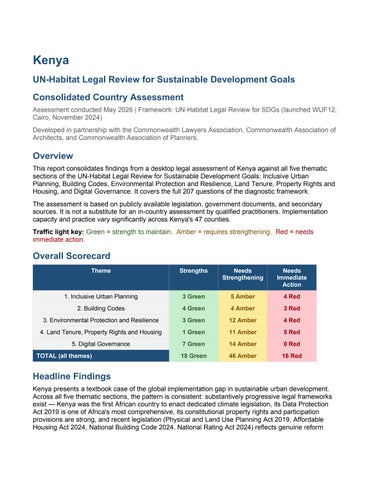
Traffic light key: Green = strength to maintain. Amber = requires strengthening. Red = needs immediate action.
Overall Scorecard
Headline Findings
Kenya presents a textbook case of the global implementation gap in sustainable urban development. Across all five thematic sections, the pattern is consistent: substantively progressive legal frameworks exist — Kenya was the first African country to enact dedicated climate legislation, its Data Protection Act 2019 is one of Africa's most comprehensive, its constitutional property rights and participation provisions are strong, and recent legislation (Physical and Land Use Planning Act 2019, Affordable Housing Act 2024, National Building Code 2024, National Rating Act 2024) reflects genuine reform
ambition. But the 46 ambers and 16 reds in this assessment — across 80 assessed items — reveal that laws alone are not sufficient.
The implementation gap operates through four structural weaknesses that recur across every section:
1. Chronic capacity deficit at local government level. Only ~2,000 registered planners serve 55 million people. County building control departments are under-resourced. Climate expertise in county governments is thin and inconsistently supported.
2. Fragmented multi-level governance. Overlapping mandates between national ministries and 47 county governments — in planning, building control, environmental enforcement, and land administration — create coordination failures, inconsistent application of national standards, and accountability gaps.
3. Chronic underfunding of regulatory bodies. NEMA, county planning departments, the National Land Commission, and building control authorities are all identified as inadequately resourced. The result: enforcement that exists in statute but not in practice.
4. The informal settlement blind spot. With 54.7% of Kenya's urban population in informal settlements, a legal architecture largely designed for the formal city systematically fails the majority. Planning standards, building codes, cadastral systems, green space provision, and tenure protection all functionally exclude most urban Kenyans.
Kenya illustrates the core argument for urban governance reform: the solutions and finance exist at the global and national level — what is missing is the local governance architecture to implement them.
Section 1: Inclusive Urban Planning
Score: 3 Green | 5 Amber | 4 Red
Kenya has a strong planning hierarchy in law (Physical and Land Use Planning Act 2019) and constitutionally entrenched public participation requirements. The persistent weaknesses are a critical planner shortage, absent affordable housing targets in plans, and public space that is legally reserved but practically undefended.
Area / Question Rating
Evidence & Notes
A. Planning hierarchy & content of plans (Questions 1–5)
Q1–3: Defined hierarchy of spatial plans (national, county, local) Green
Q4: Local spatial plan content requirements Amber
Q5: Ratio of registered planners to inhabitants Red
Physical & Land Use Planning Act 2019 establishes a clear four-tier hierarchy: National, Inter-County, County, and Local plans. Legal compliance between tiers is required.
The Act specifies plan content requirements but implementation is uneven across Kenya's 47 counties. Many counties lack approved local plans or have outdated ones based on 1996 Act frameworks.
Kenya faces a severe planner shortage. Only ~2,000 registered planners nationally for a population of ~55 million — well below the UN-Habitat benchmark of 40+ per 100,000 inhabitants.
B. Planning process & participatory planning (Questions 6–12)
Q6–8: Stakeholder consultation in plan-
Green Public participation is constitutionally mandated (Articles 1, 10, 232). The 2019 Act and Urban Areas & Cities Act both require
Area / Question Rating
Evidence & Notes
making stakeholder engagement at multiple plan stages, including public fora and citizen forums.
Q7: Tailored processes for vulnerable groups Amber
Q9–10: Inclusive planning including informal settlements Amber
Q11–12: Transparency, accountability & professional ethics Amber
Constitutional protections exist for marginalised groups but specific tailored planning processes for women, disabled persons, and informal settlers are weak in practice.
National Slum Upgrading & Prevention Policy exists and the Affordable Housing Act 2024 includes resettlement provisions. However planning standards have historically been unrealistic for informal settlements.
The Physical Planners Registration Act provides a professional body with ethical standards. Transparency obligations exist in law but enforcement is inconsistently applied across counties.
C. Land-use change provisions (Questions 13–15)
Q13–15: Clarity, public availability & timelines for land-use change Amber
The 2019 Act provides for change-of-use procedures. However processing timelines are not reliably met, community participation before approval is inconsistently applied, and information is not easily publicly accessible in many counties.
D. Planning at scale & affordable housing (Questions 16–16.2)
Q16: Urban plans based on demographic projections with affordable housing targets Red
E. Public space (Questions 17–29)
Q17–23: Allocation, acquisition and protection of public space Red
Q24–29: Management, climate standards and funding for public space Red
Significant weakness. Fragmented institutional coordination and limited financial mechanisms have constrained housing delivery. Urban plans often lack explicit affordable housing unit targets linked to demographic projections.
The 2019 Act requires reservation of land for open spaces. However enforcement is weak — encroachment on designated public spaces is widespread, with inadequate penalties in practice.
No earmarked funding mechanism for ongoing public space maintenance exists in most counties. Climate resilience and safety standards for public spaces are not systematically embedded in regulations.
F. Sustainable urban design (Questions 30–36)
Q30–35: Mixed use, density, walkability, plot readjustment Amber
Q36: Regular updating of plans for climate change Green
2021 Planning Regulations introduced densification provisions. In practice low-density, car-dependent sprawl predominates and walkability standards are not embedded in law.
The 2019 Act aligns planning with Kenya's Vision 2030 and climate commitments. The Affordable Housing Act 2024 reflects recent legislative updating with a improving revision cycle.
Section 2: Building Codes
Score: 4 Green | 4 Amber | 3 Red
The National Building Code 2024 is a landmark reform — performance-based, comprehensive, and publicly available. The four greens reflect real progress. The three reds all land in implementation: under-resourced building control authorities, long and inconsistent permit timelines, and weak inspection and enforcement in practice.
Area
/ Question Rating
Evidence & Notes
A. General — existence & enactment (Questions 37–41)
Q37–38: National building code exists and is publicly available Green
Q39–40: Responsible agency; local codes based on national model Green
Q41: Mechanisms for uniform interpretation and enforcement Amber
National Building Code 2024 (Legal Notice No. 47) in force from 1 March 2025. Replaces 1968 by-laws. Publicly available online. Enacted under the NCA Act 2011.
NCA leads development and enforcement. County governments apply the national code. A Multi-Agency Committee including NCA, county government, and NEMA oversees technical vetting.
The 2024 code aims to improve uniformity across all 47 counties. NCA has begun a nationwide sensitisation campaign; consistent application remains a work in progress, particularly in secondary cities.
B. Nature & scope of the code (Questions 42–45)
Q42: Performancebased, prescriptive, or hybrid? Green
Q43–44: Applies to new and existing buildings; incremental upgrading mechanism Amber
Q45: Coverage: structural, fire, electrical, sanitation, energy, disability access Green
The 2024 code is performance-based — a significant improvement over the prescriptive 1968 by-laws. Aligned with international codes (IBC, Eurocodes, ISO).
The 2024 code applies primarily to new construction. Provisions for incremental upgrading of existing buildings are limited; the informal housing stock falls largely outside the code's practical reach.
Covers structural safety, fire safety, electrical safety, sanitation, energy efficiency, thermal comfort, and disability accessibility. A mandatory energy efficiency section is a significant advance.
C. Currency of the code (Questions 46–47)
Q46–47: Agency responsible for maintenance; publication and update history Green
NCA responsible for maintenance. Full replacement of 1968 by-laws in 2024. A five-year revision clause is built into the code — a strong provision for ongoing currency.
D. Local & bio-based materials (Questions 48–49)
Q48–49: Regulations for local/bio-based materials; financial incentives Amber
The 2024 code encourages eco-friendly materials. However specific provisions for bio-based materials (bamboo, earth construction) are limited and financial incentives for their use are not embedded in the code.
Area / Question Rating
Evidence & Notes
E. Implementation & enforcement (Questions 50–57)
Q50–52: Responsible agency; digital or paper application; who can apply Amber
Q53–54: Is the building control authority adequately resourced? Staff experience? Red
Q55: Average time to approve a building permit Red
Q56–57: Process documented, predictable, transparent? Inspection, enforcement, certification adequacy? Red
An online submission platform exists in Nairobi. Uptake of digital systems is uneven across counties. Applications must be submitted by or through a licensed architect or engineer.
Building control capacity is widely recognised as inadequate. World Bank assessment identified insufficient professional staff across county building departments.
Total timelines often exceed 3–6 months, with inconsistency across counties. NEMA assessment alone takes ~30 days; architectural plans up to 45 days.
The 2024 code mandates periodic inspections and introduces penalties for non-compliance. In practice, inspection, enforcement and certification have historically been inadequate. Building collapses have been linked to weak enforcement.
Section 3: Environmental Protection and Resilience
Score: 3 Green | 12 Amber | 4 Red
Kenya has one of Africa's most advanced climate legal frameworks and a strong Environment and Land Court. The dominant amber pattern across this section reflects frameworks that exist in law but are incompletely implemented. The four reds — GHG targets in urban plans, green space delivery in informal areas, climate justice legal aid, and enforcement — represent the most urgent gaps.
Area / Question Rating
Evidence & Notes
1. Sustainable Urbanisation — A. Climate governance (Questions 58–61)
Q58: Vertical coordination between national, regional and local government on climate
Q59: Legal provisions for monitoring climate goals and targets
Q60: Legal provisions for data and information sharing on climate matters
Q61: Legal empowerment of local
Amber
Climate Change Act 2016 requires county governments to mainstream climate actions. Implementation at county level is incomplete — overlapping mandates and jurisdictional conflicts remain unresolved.
Green
Amber
Climate Change Act 2016 mandates the National Climate Change Council to set GHG targets (Section 6). NEMA is empowered to monitor and enforce compliance on GHG levels. National GHG reporting architecture is in place.
Ward Climate Change Planning Committees exist in some counties. Systematic public dissemination of climate data and consistent mechanisms for regular updating are not uniformly in place.
Amber Climate Change Act applies to county governments and links to planning legislation, but county-level capacity to enforce
Area / Question Rating
authorities to implement climate-sustainable development
Evidence & Notes
climate-resilient planning standards is limited.
B. Urban plans and GHG emissions (Questions 62–62.2)
Q62: Legal provisions assessing GHG emissions from planning instruments; targets and carbon sinks Red
No specific legal requirements for urban plans to include measurable GHG reduction targets or carbon sink estimations. Research confirms Kenya's CC regulatory framework has limited effects on GHG practices in the building and planning sector.
C. Urban form and reduction of transport GHG emissions (Question 63)
Q63: Legal provisions promoting low-carbon urban development; incentives for renewables and low-emission transport
D. Green spaces (Questions 64–67)
Q64–66: Network of green spaces; equitable distribution; monitoring body Red
Q67: Incentives/requirements for green infrastructure in urban projects Amber
Planning regulations promote densification and mixed use. Energy Act provides Feed-in Tariff for renewables. NDC targets transport emissions. Legal provisions specifically linking urban form to GHG reduction are not comprehensively embedded in planning law.
Constitution and Planning Act require open spaces but these are not properly implemented, particularly in slum areas. Overlapping institutional mandates (NEMA, Ministry of Lands, Nairobi City County) and limited funding produce erratic enforcement.
Building Code 2024 encourages eco-friendly materials. Large projects require NEMA EIA. However specific financial incentives for developers incorporating green infrastructure are not embedded in law.
E. Development control and climate financing (Questions 68–68.3)
Q68: GHG mitigation in development approval; developer charges; enforcement penalties Amber
NEMA EIA links development approval to climate considerations for large projects. NCA Act provides penalties for code violations. However enforcement in practice is weak due to chronic underfunding of regulators.
F. Neighbourhood design and energy savings (Questions 69–69.3)
Q69: Neighbourhood design principles for energy savings in buildings Amber
G. Circular economy (Question 70)
Q70: Circular economy strategy; re-use standards; extended producer responsibility; monitoring Red
Building Code 2024 includes energy efficiency and thermal comfort provisions. However comprehensive legal requirements for neighbourhood-scale wind/sun orientation and thermal surface standards are not prescribed in planning regulations.
Kenya lacks a comprehensive urban circular economy legal framework. Existing waste management regulations are inadequately enforced — illegal dumping and industrial effluent remain common. Extended producer responsibility schemes are not systematically in place.
Area / Question Rating
Evidence & Notes
2. Urban Resilience — A. Adaptation planning (Questions 71–72)
Q71: Legal mandate for climate adaptation plans; stakeholder engagement; coordination; monitoring Green
Q72: Legal provisions requiring social vulnerability factors in adaptation planning
Amber
National Adaptation Plan 2015–2030 and Climate Change Action Plans provide a comprehensive framework. Ward Climate Change Planning Committees enable local engagement. The BCRUP strategy provides an urban-specific framework for the urban poor.
BCRUP targets the urban poor with gender, youth and disability dimensions. However legally enforceable requirements for vulnerability factors in urban adaptation plans are more policy commitment than statute.
B. Climate risk and vulnerability assessments (Questions 73–74)
Q73: Law mandating climate risk assessments for urban areas; publication; stakeholder involvement; updates
Q74: Spatial plans required to include vulnerability assessments (floods, landslides, sea-level rise)
Amber
Amber
Ward Climate Change Planning Committees conduct local vulnerability assessments. However statutory requirements for mandatory, publicly disseminated, regularly updated urban climate risk assessments are not comprehensively in place.
NEMA EIAs for major developments address climate vulnerability. However a universal requirement for all spatial plans to include climate vulnerability assessments is not yet fully embedded in planning law.
C–D. Infrastructure and ecosystem-based adaptation (Questions 75–78)
Q75–78: Climate integration in infrastructure; naturebased solutions; ecosystem-based measures
Amber
Climate Change Act requires climate mainstreaming in infrastructure. NbS are applied at community level in Kibera and riparian settlements. However legal mandates for NbS integration in infrastructure are not systematically prescribed.
E. Slum adaptive capacity (Questions 79–80)
Q79–80: Law on adaptation of slums to climate change; climatesmart upgrading criteria; community participation
Amber
BCRUP and National Slum Upgrading Policy provide policy frameworks. Community-led upgrading is active. However a specific statute mandating climate adaptation for slums with enforceable standards does not fully exist.
F. Land-use and tenure in climate context (Questions 81–82)
Q81–82: Flexible zoning; tenure rights during climate displacement; land tenure review for climate change
Amber
Planning Act provides for flexible zoning. Climate Change Act and BCRUP recognise tenure security as critical. However specific legal provisions for tenure during climate-related displacement are not comprehensively embedded in statute.
G. Climate financing (Questions 83–87)
Q83–87: Climate financing for local government; zoning for
Amber Climate Change Fund established under the Climate Change Act. Carbon Markets Regulations 2024 create carbon finance framework. However chronic underfunding of county climate
Area / Question Rating
Evidence & Notes
climate risk; EIA adaptation; monitoring action and limited monitoring of climate finance effectiveness persist.
3.
Climate Justice — A. Environmental courts (Questions 88–92)
Q88–92: Specialist environmental courts; jurisdiction; appeal; trained judges; public access Green
Environment and Land Court (ELC) has constitutional standing and nationwide jurisdiction. Climate Change Act (Section 23) removes locus standi requirement. ELC has issued landmark rulings including the Owino Uhuru USD 15 million compensation award.
B–C. Legal actions and legal aid (Questions 93–100)
Q93–95: Legal action against city government for climate inaction; accountability; penalties Amber
Q97–100: Legal aid for climate litigation; dedicated funds; NGO partnerships Red
Constitutional rights and ELC jurisdiction allow action against government. Penalties in the Climate Change Act exist. However enforcement against city/county governments for climate inaction is rare in practice.
Formal legal aid for climate cases is limited. NGOs (e.g. CJGEA) have secured landmark cases but dedicated climate justice legal aid funds do not exist in statute. Access to ELC is constrained by legal costs for the poorest.
D–E. Compensation and enforcement (Questions 101–110)
Q101–105: Compensation types; claiming process; financial penalties for pollution Amber
Q106–110: Enforcement of climate justice rulings; penalties; independent oversight; public reporting Red
ELC has awarded monetary compensation and environmental clean-up orders. EMCA provides financial penalties for pollution. However a systematic compensation framework for climate-related damages does not yet fully exist.
Most critical weakness. Only a fraction of environmental violations result in prosecution. NEMA is chronically underfunded. Fragmented coordination, political interference and weak penalties undermine enforcement across the board.
F. Community involvement in climate judicial proceedings (Questions 111–115)
Q111–115: Community participation in climate proceedings; outreach; local languages; feedback mechanisms Amber
Climate Change Act removes locus standi. ELC proceedings are public. However outreach to informal settlement communities is limited. Laws are in English and rarely explained in local languages.
Section 4: Land Tenure, Property Rights and Housing
Score: 1 Green | 11 Amber | 5 Red
Land tenure and housing is where Kenya's implementation gap is most acute. With 54.7% of the urban population in informal settlements, a residential rental market that is essentially unregulated, and forced evictions linked even to government housing programmes, the gap between legal entitlement and lived
reality is the largest of any section. The Environment and Land Court — a genuine institutional strength — is the sole green in this section.
Area / Question Rating Evidence & Notes
1. Property Rights and Land-Use Planning
A. Zoning and land-use policies (Questions 116–118)
Q116–117: Quantifiable measures; sustainable land-use planning including disaster-prone areas
Q118: Inclusionary zoning practices
Amber
Amber
Physical and Land Use Planning Act 2019 provides a comprehensive framework. Environmental considerations addressed through NEMA EIAs. Quantifiable measures assessing the balance between property rights and zoning goals are not comprehensively prescribed.
Inclusionary zoning is not explicitly mandated. The Affordable Housing Act 2024 requires affordable housing preference for marginalised groups in government projects, but this is not a systematic requirement for private developers.
B. Public-private partnerships (Questions 119–123)
Q119–121: Legal safeguards for property rights in PPPs; public participation; responsible private sector engagement
Q122–123: Land value capture in PPPs; government policy on mortgages and financing
Amber
Amber
C. Land-based finance (Questions
Q124–126: Fiscal cadastre — timely updating; coverage of informal settlements; public availability
Q127–129: Land value sharing — mechanisms; redistribution of benefits; prioritisation of underserved areas
Q130–132: Developer fees and contributions; building permit conditionality; in-kind options
Q133–135: Property tax system; collection rates; value-based calculation; progressive rates for vacant land
Red
Affordable Housing Act 2024 establishes a PPP housing framework with public tendering requirements. However recent Affordable Housing Programme evictions reveal a significant gap between legal safeguards and practice.
National Rating Act 2024 provides a new property rating framework. Affordable Housing Levy (1.5%) creates dedicated housing finance. Systematic land value capture mechanisms in PPP frameworks are not yet comprehensively in place.
124–135)
Electronic Cadastre Transactions Regulations 2020/2024 are transitioning toward a digital system. However 54.7% of urban population in informal settlements are largely absent from formal cadastral records. Coverage, accuracy and public accessibility remain limited.
Red
Amber
Kenya lacks systematic legal mechanisms to capture and redistribute land value increases from planning decisions and public investments. No established criteria prioritise investments in underserved areas through land value sharing.
Developers are required to contribute through the development approval process. However a systematic, transparent framework for developer contributions uniformly applied across 47 counties does not exist.
Amber
National Rating Act 2024 is a significant reform empowering county governments to levy rates. Property tax is value-based. Collection rates remain low and progressive rates for vacant or empty housing are not yet systematically in place.
Area / Question Rating
Evidence & Notes
D. Flexible and socially responsible tenure systems (Questions 136–139)
Q136–137: Genderresponsive tenure legislation; recognition of statutory, customary and informal rights
Q138–139: Simplified registration process; alternative tenure mechanisms
2.
Amber
Amber
Constitution 2010 requires elimination of gender discrimination in land. Community Land Act 2016 recognises communal and customary rights. GLTN pilots test community registration in informal settlements. In practice, women's tenure rights and informal settler security remain weak.
Land Registration Act 2012 and electronic cadastre are simplifying some processes. Community Land Act provides for community tenure arrangements. First-time registration remains complex and costly for low-income households.
Laws, Policies and Regulations Promoting Adequate Housing
A. Anti-discrimination and rent regulation (Questions 140–144)
Q140–141: Antidiscrimination in housing; redress mechanisms Amber
Q142–144: Rent regulation; tenancy termination safeguards; anti-harassment provisions
Red
Constitution 2010 (Article 27) prohibits discrimination. Affordable Housing Act 2024 mandates preference for marginalised groups. Specific anti-discrimination provisions in dedicated housing legislation and access to redress are limited in practice.
Kenya lacks a comprehensive residential rent control framework. Tenancy termination protections and antiharassment provisions in statute are inadequate. The urban rental market — where most low-income households live — is largely unregulated.
B. Housing subsidies and affordability (Questions 145–148)
Q145–148: Affordability; effectiveness of subsidy frameworks; equitable distribution; adjustment mechanisms Amber
Affordable Housing Act 2024 establishes a dedicated levy and Affordable Housing Board. Boma Yangu platform provides centralised applicant database. However delivery has been slow and falls far short of demand. Adjustment mechanisms for changing economic conditions are limited.
C. Equitable distribution of adequate housing (Questions 149–155)
Q149–152: Equitable distribution; emergency housing; location adequacy; services and infrastructure Amber
Q153–155: Habitability; cultural adequacy; inclusive design and disability accessibility Amber
3. Security of Tenure
Affordable Housing Act 2024 mandates preference for marginalised groups. Emergency housing provisions are limited. Over 70% of informal settlement residents lack adequate water, sanitation, energy and refuse disposal — a large gap between law and practice.
Building Code 2024 includes structural safety, ventilation, sanitation and disability accessibility provisions. Habitability standards are not met in the informal housing stock. Cultural adequacy in housing design is not systematically addressed in statute.
A. Legal recognition of land rights and protection against forced evictions (Questions 156–160)
Q156–157: Legal recognition of land rights;
Amber Constitution 2010 (Article 40) guarantees property rights. Land Act 2012, Land Registration Act 2012 and Community Land Act
Area / Question Rating
Evidence & Notes
enforcement against land grabs 2016 provide a broad framework. In practice, land grabbing — including by government-linked actors — remains a serious problem.
Q158–159: Prohibition of forced evictions; judicial oversight Red
Q160: Proactive prevention of land grabbing; compensation provisions and timelines Amber
Constitution and Land Act Sections 152A–152I require legal processes for eviction. However forced evictions are prevalent — families removed for development projects with inadequate notice, violence and without due process. Court victories for communities often remain unfulfilled.
Land Act provides for compulsory acquisition with compensation and appeal rights. However compensation timelines are frequently not met, and definitions of public interest have been applied controversially.
B. Protection of vulnerable and marginalised populations (Questions 161–163)
Q161–163: Land rights of refugees, displaced populations, indigenous communities and informal settlers Red
Indigenous communities (Ogiek, Endorois) secured African Court judgments but face ongoing displacement and noncompliance. October 2024 land clashes in Tana River caused 20+ fatalities. 54.7% of urban population in informal settlements remain highly tenure-insecure.
C. Effective dispute resolution (Questions 164–171)
Q164–166: Accessible land dispute processes; dedicated tribunal; alternative dispute resolution; legally binding outcomes Green
Q167–171: Timelines; fee waivers; legal aid; appeal rights; antiretaliation measures
Amber
The Environment and Land Court (ELC) is a dedicated constitutional court for land disputes with nationwide jurisdiction. Alternative dispute resolution is promoted through the NLC and civil society organisations. ELC outcomes are legally binding and enforceable.
ELC has specified timelines and appeal rights. Legal aid is limited in practice — cases are lengthy and costly. Fee waivers for vulnerable populations are available in principle but not systematically applied.
Legal land registry (Questions 172–175)
Q172–175: Cadastre system; coverage; accuracy; public accessibility
Amber
Electronic Cadastre Transactions Regulations 2020/2024 mandate timely updates. However informal settlements housing over half the urban population are largely absent from the formal cadastre. Public accessibility is improving through digitisation but remains limited in practice.
Section 5: Digital Governance
Score: 7 Green | 14 Amber | 0 Red
Digital Governance is Kenya's strongest performing section — the only one with no reds. The Data Protection Act 2019 is one of Africa's most comprehensive data protection frameworks, with strong provisions on automated decision-making rights, human oversight, privacy impact assessments, and individual redress. The fourteen ambers reflect a consistent gap between the strength of the national
legal framework and county/municipal implementation capacity — with 70% of county offices only moderately or not at all digital.
Area / Question Rating
Evidence & Notes
1. Data-Driven Decision-Making — A. Smart city operating model (Questions 176–180)
Q176: Smart city law, policy or strategy; vision; coordination; monitoring
Q177: Legislative requirement for municipal open data platform
Amber
Kenya has a Digital Economy Blueprint (2020) and National ICT Policy (2019). The Konza Technopolis project is the flagship smart city initiative. However a dedicated municipal smart city law with coordination and monitoring mechanisms is not in place. 70% of county offices report as only moderately or not at all digital.
Amber
Q178: Legal measures for digital inclusion (skills training, WiFi, broadband subsidies, device subsidies)
Q179: Participation in smart city knowledgesharing initiatives
Q180: Internationally recognised interoperability standards
Amber
Access to Information Act 2016 provides a legal right of access to government information. The eCitizen portal delivers some government data online. A specific legislative requirement for municipalities to maintain open data platforms is not yet in place. The ODPC's Data Sharing Code is under public consultation.
The Ajira Digital Program supports digital skills training. The World Bank USD 390 million Digital Economy Acceleration Project (2023) includes digital inclusion components. However specific legal mandates for municipal digital inclusion measures are not comprehensively embedded in statute.
Green
Amber
Kenya actively participates in international smart city knowledge exchange. The Council of Governors collaborates with UN-Habitat and UNITAC. Kenya hosts UNEP and engages with ICLEI and other international networks.
National ICT Policy references international standards. Computer Misuse and Cybercrimes Act 2018 aligns with the Budapest Convention. Systematic adoption of inter-operability standards across municipal digital systems is at an early stage.
B. Automated decision-making (Questions 181–186)
Q181: Accessibility (disability) standards in digital service design
Q182: Law regulating data ownership and control; commercial data sharing obligations
Q183: Digital services identification requirements
Q184: Regular algorithmic fairness audits; public disclosure
Amber
Green
Data Protection Act 2019 protects vulnerable groups. A specific legislative requirement mandating disability accessibility standards in local government digital services is not comprehensively prescribed in statute.
Data Protection Act 2019 (modelled on GDPR) provides a comprehensive framework for data ownership, intellectual property rights, and data processing obligations. Commercial entities must register with the ODPC and comply with prescribed data handling obligations.
Amber eCitizen portal requires identification for government services. A uniform national framework specifying where identification is required versus optional, with tailored alternatives, is not comprehensively in place across all municipal digital services.
Amber Data Protection Act 2019 includes the right not to be subjected to automated decision-making with legal effects. DPIAs are required for high-risk processing. However specific
Area / Question Rating
Evidence & Notes
of results requirements for regular algorithmic fairness audits with publicly disclosed results are not yet prescribed in statute.
Q185: Legal provisions mandating human oversight in critical automated decision points
Q186: Redress and appeal mechanisms for automated decision harm
Green
Green
Data Protection Act 2019 and Data Protection (General) Regulations 2021 explicitly provide the right not to be subject to automated individual decision-making that produces legal or significant effects. Human oversight mechanisms and DPIAs are required.
Data Protection Act 2019 provides the right to object to automated decisions and seek redress through the ODPC. Complaints Management Manual and Alternative Dispute Resolution frameworks are in place.
C–D. Participatory decision-making & decision-making authority (Questions 187–191)
Q187: Legal mandate for digital platforms for public feedback in decision-making
Q188: Legal mechanisms protecting privacy and security in participatory platforms
Q189: Chief Digital Officer; dedicated digital team; roles in legal/administrative framework
Q190: Law mandating data stewards to correct data problems while minimising PII access
Q191: Regular training of officials on digital legal developments; mandated frequency
Amber
Green
Access to Information Act 2016 and Planning Act 2019 require public participation. However a specific legal mandate for municipalities to use digital platforms for systematic urban decision-making feedback is not yet comprehensively in law.
Data Protection Act 2019 and Regulations provide comprehensive privacy and security protections for personal data on digital platforms, including DPIAs and 72-hour breach reporting requirements.
Amber
Amber
National-level digital governance leadership exists. However dedicated Chief Digital Officers or formally constituted digital teams with legally specified roles at the county/municipal level are not consistently in place.
Data Protection Act 2019 and Regulations include data correction obligations and minimisation principles. ODPC Guidance Notes (2025) address stewardship. However a specific statutory mandate for designated municipal data stewards is not yet universally in place.
Amber
ODPC provides training materials. UNITAC/UN-Habitat training delivered at 2025 Devolution Conference. A legally mandated regular training cycle for public officials on digital legal developments is not prescribed in statute.
E. Data integration and information-sharing (Questions 192–195)
Q192: Legal provisions mandating collaborative data-sharing horizontally and vertically
Q193: Legal requirement for open data practices; categories of city data made public
Amber
Amber
ODPC's Data Sharing Code (under consultation, December 2024) will establish a framework. However comprehensive statutory mandates for horizontal and vertical data sharing across government tiers are not yet fully in place.
Access to Information Act 2016 establishes a right of access to public body information. However a specific legal requirement that local governments publish and maintain open datasets across standard categories is not comprehensively mandated. Access to information remains inconsistent in practice.
Q194: Right to be Green Data Protection Act 2019 and Regulations comprehensively
Area / Question Rating
informed about data collection; third-party notification; data lifecycle management
Q195: Mandated mechanisms for aggregation and harmonisation of diverse datasets
2.
Amber
Evidence & Notes
address the right to be informed, third-party data notification, data lifecycle management, retention and archiving policies, and data minimisation. ODPC enforces these obligations.
ICT Authority is mandated to promote inter-operability. The forthcoming Data Sharing Code will address harmonisation. Specific statutory mandates for municipal dataset aggregation and harmonisation are not yet fully in place.
Balancing Data Use and Privacy — A–B. Data security and access (Questions 196–203)
Q196–199: Security framework; breach mitigation; business continuity; data exchange policies
Q200–203: Data access regulations; equitable access criteria; consistent enforcement; mandatory open datasets
Amber
Amber
Computer Misuse and Cybercrimes Act 2018 and Critical Infrastructure Regulations 2024 require cyber risk assessment, incident response and 24-hour breach reporting. Cyber threats increased significantly in 2024. ODPC enforcement capacity across all counties is a concern.
Data Protection Act 2019 provides access safeguards. Access to Information Act 2016 establishes equitable access principles. However consistent enforcement across sectors and counties is limited. CIPESA (2025) notes widespread secrecy and delays in access to government project information.
C. Privacy, data protection and security (Questions 204–207)
Q204: Mechanisms holding government agencies accountable for ethical digital service standards
Q205: Data protection law coverage — lawful use, purpose limitation, minimisation, accuracy, retention, security, accountability
Q206: Privacy impact assessments mandated for new urban development, technologies or data initiatives
Q207: Accountability mechanisms for data protection violations; penalties; regulatory enforcement
Amber
Green
ODPC is an independent enforcement authority. However ODPC capacity is constrained — unchecked state surveillance and rising data breaches raise adequacy concerns. Compliance Audit Regulations (under consultation 2024) will strengthen the audit framework.
Data Protection Act 2019 and Regulations 2021 comprehensively address all listed aspects. Modelled on GDPR, this is one of the most comprehensive data protection regimes in Africa.
Green
Amber
Note on scope and methodology
Data Protection Act 2019 (Section 31) mandates DPIAs for high-risk processing including automated decision-making, new technologies, large-scale sensitive data processing, and crossborder transfers. ODPC reviews submitted DPIAs.
ODPC has enforcement powers including enforcement notices, investigations and sanctions. However ODPC capacity to enforce compliance across all government entities, counties and private sector actors is limited given Kenya's growing digital economy and rising cyber threats.
This consolidated assessment covers all 207 questions of the UN-Habitat Legal Review for SDGs framework across five thematic sections. It is based on desktop research using publicly available legislation, government policy documents, and secondary sources including World Bank, IMF, GLTN, ICLEI, Cities Alliance, Climate Action Tracker, OHCHR, Centre for Affordable Housing Finance in Africa, CIPESA, ODPC, Digital Policy Alert, UNITAC/UN-Habitat, and peer-reviewed academic analysis. It is not a substitute for an in-country assessment involving direct engagement with national and county government practitioners, community organisations, and professional bodies. Implementation capacity and practice vary significantly across Kenya's 47 counties.