UN-Habitat Legal Review for Sustainable Development Goals
Consolidated Country Assessment
Assessment conducted May 2026 | Framework: UN-Habitat Legal Review for SDGs (launched WUF12, Cairo, November 2024)
Developed in partnership with the Commonwealth Lawyers Association, Commonwealth Association of Architects, and Commonwealth Association of Planners.
Overview
This report consolidates findings from a desktop legal assessment of India against all five thematic sections of the UN-Habitat Legal Review for Sustainable Development Goals: Inclusive Urban Planning, Building Codes, Environmental Protection and Resilience, Land Tenure, Property Rights and Housing, and Digital Governance. It covers the full 207 questions of the diagnostic framework.
India presents a third distinct pattern alongside Kenya and Fiji — that of a large federal democracy with sophisticated national legal frameworks and institutions, a world-class judicial system for environmental enforcement, and recent landmark legislation (DPDPA 2023, RFCTLARR 2013, RERA 2016), but where the fundamental implementation problem lies in the gap between central and state/local government capacity. With 530 million urban residents — larger than the entire population of the European Union — and over 4,500 Urban Local Bodies of vastly varying capacity, the scale and heterogeneity of India's urban governance challenge is unmatched. India's greens are real but concentrated in specific national institutions and recent legislation; its reds and ambers reflect the chronic under-resourcing and disempowerment of the local government tier that is supposed to deliver most urban services.
Traffic light key: Green = strength to maintain. Amber = requires strengthening. Red = needs immediate action.
Overall Scorecard
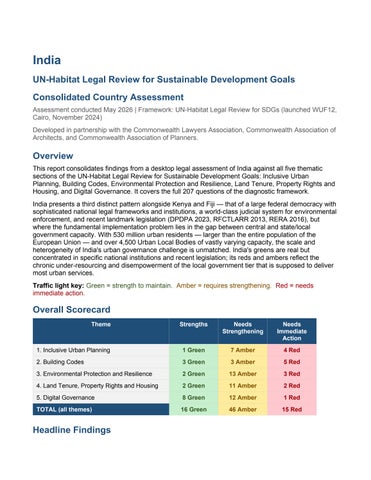
India's overall scorecard of 16 Green | 46 Amber | 15 Red reveals a country where ambitious national legal frameworks consistently outpace local implementation capacity. The pattern across all five sections is remarkably consistent: national institutions are strong, recent legislation is substantive, and the judiciary is one of the world's most powerful environmental enforcement mechanisms. But Urban Local Bodies — the tier responsible for actually delivering urban services to 530 million people — are chronically under-resourced, legally disempowered by state governments reluctant to devolve the 74th CAA's intended functions, and technically understaffed on a massive scale. Five structural characteristics define India's position:
1. The 74th CAA implementation gap. The 74th Constitutional Amendment 1992 was a landmark decentralisation framework. Thirty years on, most states have not satisfactorily transferred the 18 urban functions, financing, and functionaries to municipalities. This is the root cause of most of India's urban governance weaknesses.
2. The planner deficit. India has fewer than 5,000 registered planners for 530 million urban residents and 4,500+ ULBs. This is the world's largest urban planning capacity deficit in absolute terms and directly limits every aspect of urban plan quality, building control, and development regulation.
3. The NBC advisory status problem. The National Building Code is advisory at the national level, requiring state-by-state adoption into municipal bylaws. With 4,500+ ULBs, this produces enormous variation in what is enforced and how. Building collapses in major cities are a recurring consequence.
4. No climate legislation. India is the world's third-largest GHG emitter and has a net-zero by 2070 commitment, but has no dedicated federal climate change legislation. Climate policy is delivered through executive action, sectoral policy, and the NAPCC — powerful in intent but without the binding legal force and enforcement mechanisms that a dedicated climate law would provide.
5. Digital governance: India's strongest section. The DPDPA 2023, Aadhaar, the Smart Cities Mission, and India's digital public infrastructure represent genuine world-class achievements. Digital governance is the one section where India consistently performs above the global developing country average, though independence concerns around the Data Protection Board temper the overall assessment.
India at scale illustrates the implementation gap in its most extreme form: national legal sophistication and judicial strength coexisting with local governance disempowerment across 4,500+ ULBs serving a fifth of humanity. The architecture for sustainable urban development exists at the centre; the capacity to deliver it locally does not.
Section 1: Inclusive Urban Planning
Score: 1 Green | 7 Amber | 4 Red
Urban planning in India is primarily a state subject, with 29 different state planning acts and significant variation in planning quality and coverage. The 74th CAA devolves planning to ULBs but states have been reluctant to act on this. The Right to Information Act (the sole green) provides a strong transparency foundation. The critical reds are the planner shortage, inadequate funding for public space, and the absence of tailored participatory processes for vulnerable groups.
Area / Question Rating Evidence & Notes
A. Planning hierarchy & content of plans (Questions 1–5)
Q1–3: Defined hierarchy Amber The 74th Constitutional Amendment Act 1992 devolves 18
Area / Question Rating
of spatial plans (national, state, local)
Evidence & Notes
urban functions including planning to Urban Local Bodies (ULBs). State Town and Country Planning Acts govern spatial planning — there are 29 state-level planning acts with significant variation. The Model Town and Country Planning Act provides a national framework but adoption is inconsistent. A clear, legally mandated national-state-local planning hierarchy with required content is not uniformly in place across India's 28 states and 8 Union Territories.
Q4: Local spatial plan content requirements
Amber
Q5: Ratio of registered planners to inhabitants
Red
Master plans are required for Class I cities under most state planning acts. Content requirements vary significantly by state. Many master plans are outdated — Delhi's Master Plan 2041 is a notable recent update, but hundreds of smaller cities lack current plans. Financial viability reports, demographic projections and M&E frameworks are not universally required.
India has a severe shortage of urban planners. Town and Country Planning Organisation estimates a requirement of ~50,000 planners; fewer than 5,000 are registered with the Institute of Town Planners India. For a population of 1.44 billion with 530 million urban residents, this represents one of the world's largest planning capacity deficits.
B. Planning process & participatory planning (Questions 6–12)
Q6–8: Stakeholder consultation in planmaking
Q7: Tailored processes for vulnerable groups
Q9–10: Inclusive planning including informal settlements
Amber
Q11–12: Transparency, accountability and professional ethics
Red
Public participation is constitutionally embedded (Article 243ZE) and most state planning acts require public notice for draft plans. The Smart Cities Mission (2015–2025) incorporated citizen engagement mechanisms. However systematic, legally mandated stakeholder engagement at multiple plan stages — including marginalised groups — is inconsistently implemented across states and ULBs.
Specific legal or administrative participatory processes tailored for women, SC/ST communities, persons with disabilities, and informal settlers in urban planning are not systematically embedded in planning law. The Forest Rights Act 2006 provides for tribal forest community rights but does not translate into urban planning participation mechanisms.
Amber
Amber
PMAY (Urban) — Pradhan Mantri Awas Yojana — targets housing for urban poor including slum redevelopment and insitu upgrading. The Rajiv Awas Yojana (2013) specifically targeted slum-free cities. However planning law itself does not universally require socially inclusive approaches or community consultation in plan-making for informal settlements.
The Right to Information Act 2005 provides a strong transparency framework. Professional planning ethics are governed by the Institute of Town Planners India. The 74th CAA mandates ward committees for citizen participation, but implementation across ULBs is highly uneven. Accountability of planning officers varies significantly by state.
C. Land-use change provisions (Questions 13–15)
Area / Question Rating
Q13–15: Clarity, public availability and timelines for land-use change
Amber
Evidence & Notes
RERA 2016 (Real Estate Regulation and Development Act) has significantly improved transparency in housing development. State planning acts provide land-use change procedures. However timelines for land-use change approvals are not legally prescribed nationally and are often slow — the World Bank's Ease of Doing Business index consistently flagged Indian cities for slow construction permitting timelines.
D. Planning at scale & affordable housing (Questions 16–16.2)
Q16: Urban plans with demographic projections and affordable housing targets
Amber
E. Public space (Questions 17–29)
Q17–23: Allocation, acquisition and protection of public space
Amber
Q24–29: Management, climate standards and funding for public space Red
PMAY (Urban) has a target of 10 million houses for urban poor. The 2024-25 Union Budget committed to addressing housing needs of 10 million families. However urban master plans do not universally incorporate demographic projections linked to explicit affordable housing unit targets. India's urban housing shortage is estimated at 18.78 million units (2018 estimate), predominantly affecting EWS and LIG categories.
State planning acts and municipal laws require open space reservations in development. The Supreme Court has issued landmark orders protecting public spaces from encroachment (including in Mumbai, Delhi). However enforcement is weak — encroachment on reserved open spaces is endemic, and the quantity and quality of urban public space varies dramatically between cities and within them.
No nationally earmarked funding mechanism for ongoing public space maintenance exists. Most ULBs are severely underresourced — own-source revenue covers only a fraction of expenditure needs. Climate resilience and nature-based solutions standards for public spaces are not systematically embedded in planning regulations.
F. Sustainable urban design (Questions 30–36)
Q30–35: Mixed use, density, walkability, plot readjustment Amber
Q36: Regular updating of plans for climate change
Amber
Transit-Oriented Development (TOD) policies have been introduced by several states and the national government in relation to metro corridors. Some states have adopted mixeduse zoning provisions. However low-density sprawl continues to dominate urban growth patterns. Walkability standards, mixed-use mandates, and plot readjustment mechanisms are not nationally embedded in law.
Some states are updating master plans to incorporate climate considerations. The National Action Plan on Climate Change (NAPCC) includes urban missions. However regular legally mandated updating of plans for climate change is not uniformly required across India's planning framework.
Section 2: Building Codes
Score: 3 Green | 3 Amber | 5 Red
The NBC 2016 is a comprehensive, regularly updated code with good coverage across all key domains — three genuine greens. But its advisory legal status, state-by-state adoption, enforcement by underresourced ULBs, and chronically slow permit timelines produce five reds in implementation and enforcement. Building collapses across Indian cities are the most direct and tragic consequence of this gap.
Area / Question Rating
Evidence & Notes
A. General — existence & enactment (Questions 37–41)
Q37–38: National building code exists and is publicly available Green
Q39–40: Responsible agency; state/local codes based on national model Amber
Q41: Mechanisms for uniform interpretation and enforcement Red
National Building Code of India (NBC) 2016, formulated by the Bureau of Indian Standards (BIS), is comprehensive, publicly available, and covers safety, structural integrity, fire safety, sustainability, accessibility, and ICT. Major revisions in 1983, 2005 and 2016 reflect ongoing updating. Recent amendments address fire safety, earthquake resilience, accessibility (aligned with RPwD Act), energy efficiency and EV charging.
BIS formulates the NBC. State governments and ULBs are responsible for adoption and enforcement. The NBC is advisory at the national level — its provisions are incorporated into state and municipal bylaws, making enforcement dependent on state action. Significant variation exists across states in how NBC provisions are incorporated and enforced.
Uniform interpretation and enforcement is a critical weakness. NBC is incorporated into bylaws differently across ~4,500 ULBs. Building control is exercised by ULBs with very variable capacity. The 74th CAA devolves building regulation to ULBs but without the resources or technical capacity to enforce uniformly.
B. Nature & scope of the code (Questions 42–45)
Q42: Performancebased, prescriptive, or hybrid? Amber
Q43–44: Applies to new and existing buildings; incremental upgrading mechanism Amber
Q45: Coverage: structural, fire, electrical, sanitation, energy, embodied carbon, disability Green
The NBC 2016 incorporates both prescriptive and performance-based elements — a hybrid approach. Performance-based compliance pathways are available but not uniformly used. Capacity to apply performance-based approaches is limited in most ULBs.
The NBC 2016 applies to new construction and significant alterations. Provisions for bringing existing buildings up to standard are limited, despite India's large stock of ageing urban buildings and informal housing. Incremental construction — common in low-income settlements — is not formally accommodated.
The NBC 2016 is comprehensive: structural safety, fire safety, electrical safety, plumbing and sanitation, energy conservation (linked to Energy Conservation Act 2022 amendments), sustainability chapter, ICT infrastructure, accessibility (RPwD Act alignment), and EV provisions. Embodied carbon is not yet explicitly addressed but energy efficiency provisions are significant.
C. Currency of the code (Questions 46–47)
Area / Question Rating
Q46–47: Responsible agency for maintenance; publication and update history Green
Evidence & Notes
BIS is responsible for NBC maintenance. The code has undergone major revisions (1970, 1983, 2005, 2016) with ongoing amendments. Recent updates align with India's climate commitments and the Rights of Persons with Disabilities Act 2016. A systematic review process exists.
D. Local & bio-based materials (Questions 48–49)
Q48–49: Regulations for local/bio-based materials; financial incentives Amber
The NBC acknowledges diverse regional building cultures and materials. Some state-level provisions address vernacular construction. However systematic national provisions mandating or incentivising bio-based materials (bamboo, compressed earth, lime) with financial incentives are not embedded in the NBC.
E. Implementation & enforcement (Questions 50–57)
Q50–52: Responsible agency; digital/paper application; who can apply Amber
Q53–54: Is the building control authority adequately resourced? Staff experience? Red
Building plan approvals are managed by ULBs with significant digitalisation in larger cities — many metropolitan areas now have online approval systems. Smaller cities and towns lag significantly. Licensed architects and engineers must submit plans. The Online Building Plan Approval System (OBPAS) is being rolled out nationally under AMRUT.
This is India's most critical building governance weakness. Most of India's ~4,500 ULBs lack the technical staff to enforce the NBC. Parliamentary committees have flagged the inadequacy of human resource capacity in ULBs. Building collapses — including major incidents in Mumbai, Bengaluru and other cities — are regularly attributed to weak enforcement.
Q55: Average time to approve a building permit Red
Q56–57: Process documented, predictable, transparent? Inspection, enforcement, certification? Red
Permit timelines are slow and highly variable. Despite improvements in larger cities, the World Bank Ease of Doing Business reports consistently ranked India poorly on construction permitting. Average timelines in smaller cities often exceed 6 months. National targets under AMRUT 2.0 aim to improve timelines but progress is uneven.
Process predictability and transparency are weak outside major metropolitan areas. Inspection and certification are chronically understaffed across most ULBs. Building safety enforcement is further weakened by politicisation of municipal governance and corruption in permitting processes in many cities.
Section 3: Environmental Protection and Resilience
Score: 2 Green | 13 Amber | 3 Red
India has the National Green Tribunal — one of the world's most active specialised environmental courts — and a powerful PIL tradition that has driven landmark environmental protection. These are genuine greens. The thirteen ambers reflect the consistent pattern: strong national frameworks without binding climate legislation, fragmented implementation, and under-resourced ULBs. The reds flag the
absence of climate legislation, the lack of legal empowerment of local authorities for climate action, and inadequate climate adaptation provisions for India's 65 million slum dwellers.
Area / Question Rating
Evidence & Notes
1. Sustainable Urbanisation — A. Climate governance (Questions 58–61)
Q58: Vertical coordination between national, state and local government on climate
Q59: Legal provisions for monitoring climate goals and targets
Amber
Q60: Legal provisions for data and information sharing on climate matters
Amber
India has the National Action Plan on Climate Change (NAPCC) with 8 national missions, and State Action Plans on Climate Change (SAPCCs). The National Disaster Management Authority coordinates disaster risk reduction. However India has no dedicated federal climate change legislation — climate policy is delivered through sectoral policies and the Environment (Protection) Act 1986. Vertical coordination between national, state and ULB levels on climate is fragmented and relies on executive policy rather than enforceable statutory frameworks.
India updated its NDC in 2022, committing to net zero by 2070. The Energy Conservation Act 2022 amendments mandate carbon trading and energy efficiency standards. The NAPCC includes monitoring frameworks for national missions. However a comprehensive statutory GHG monitoring framework with legally prescribed targets at all governance levels — including cities — is not in place.
Amber
Q61: Legal empowerment of local authorities to implement climate-sustainable development Red
The Right to Information Act 2005 provides a legal framework for accessing government-held environmental data. The Environment (Protection) Act requires environmental reporting. However systematic data sharing mechanisms on climate matters between government tiers and with the public are not prescribed in a dedicated climate statute.
This is a critical weakness. The 74th CAA devolves urban functions to ULBs in principle, but state governments have been reluctant to transfer powers, functions and finances. Most ULBs lack the legal authority, financial resources and technical capacity to implement climate-resilient urban development standards. The National Urban Digital Mission and Smart Cities Mission have provided project-based capacity, but not systematic legal empowerment.
B. Urban plans and GHG emissions (Questions 62–62.2)
Q62: Legal provisions requiring GHG assessments in urban planning; targets and carbon sinks Red
India has no federal climate legislation requiring urban plans to include GHG targets or carbon sink assessments. The NAPCC urban mission (Smart Cities) included sustainability metrics, but these are not legally binding requirements in urban master plans. CPI research (2024) confirms that India's climate policy needs to be supported by a formal legal framework, which does not yet exist at the federal or state level.
C. Urban form and GHG emissions from transport (Question 63)
Q63: Legal provisions promoting low-carbon urban development; incentives for renewables
Amber The National Electric Mobility Mission Plan promotes EV adoption. The Energy Conservation Act 2022 introduces carbon trading. Transit-Oriented Development policies in several states promote compact urban form. However legally
Area / Question Rating
and low-emission transport
D. Green spaces (Questions 64–67)
Q64–66: Network of green spaces; equitable distribution; monitoring body
Evidence & Notes
binding provisions specifically linking urban form standards in master plans to GHG reduction targets are not nationally prescribed.
Q67: Incentives for green infrastructure integration in urban projects
Amber
Amber
State planning acts require green space reservations. The Supreme Court and National Green Tribunal (NGT) have issued landmark orders protecting urban forests and water bodies (notably in Delhi, Bengaluru, Mumbai). However equitable distribution of green spaces across socioeconomic areas is not legally mandated, and monitoring body responsibilities are fragmented across municipal corporations, development authorities and state forest departments.
Green building rating systems (GRIHA, IGBC) are promoted through policy incentives in some states. The Smart Cities Mission funded green infrastructure in 100 cities. However mandatory legal requirements or financial incentives for developers to incorporate green infrastructure (green roofs, urban forests, rain gardens) are not systematically embedded in national law.
E. Development control, mitigation and climate financing (Questions 68–68.3)
Q68: GHG mitigation in development approval; developer charges; enforcement penalties
Amber
Environmental Impact Assessments are required for projects above defined thresholds under EIA Notification 2006. Developer contributions to infrastructure are included in some state development regulations. However the linkage between development approval and climate mitigation standards is not systematic, and EIA enforcement has been criticised — the Supreme Court has stayed government orders that attempted to exempt projects from EIA requirements.
F. Neighbourhood design and energy savings (Questions 69–69.3)
Q69: Neighbourhood design principles for energy savings in buildings
Amber
G. Circular economy (Question 70)
Q70: Circular economy strategy; re-use standards; extended producer responsibility; monitoring
Amber
The Energy Conservation Building Code (ECBC) — developed under the Energy Conservation Act — prescribes energy efficiency standards for commercial buildings. The NBC 2016 includes a sustainability chapter addressing orientation and energy performance. However legal requirements for neighbourhood-scale design principles for energy savings are not comprehensively prescribed across all building types and all states.
The Extended Producer Responsibility framework exists under the Plastic Waste Management Rules 2016 (amended 2021) and E-Waste Management Rules. The Swachh Bharat Mission (Urban) has driven significant improvements in solid waste management. However a comprehensive urban circular economy legal framework specifically targeting the built environment — re-use, re-purposing, recycled materials markets — is not in place.
Area / Question Rating
2.
Evidence & Notes
Urban Resilience — A. Adaptation planning (Questions 71–72)
Q71: Legal mandate for climate adaptation plans; stakeholder engagement; coordination; monitoring Amber
Q72: Legal provisions requiring social vulnerability factors in adaptation planning Amber
State Action Plans on Climate Change (SAPCCs) exist for all states. The National Disaster Management Act 2005 and National Disaster Management Authority provide a coordination framework. The Sendai Framework is implemented through State Disaster Management Authorities. However legally binding requirements for municipal-level climate adaptation plans with stakeholder engagement and monitoring are not universally prescribed.
The Disaster Management Act 2005 recognises vulnerable populations. Constitutional provisions protect SC/ST communities. However specific legal requirements for urban climate adaptation plans to systematically incorporate social vulnerability factors (poverty, ethnicity, disability, age) are not embedded in statute.
B. Climate risk and vulnerability assessments (Questions 73–74)
Q73: Law mandating climate risk assessments for urban areas; publication; stakeholder involvement; updates Amber
Q74: Spatial plans required to include climate vulnerability assessments Amber
The National Disaster Management Authority conducts hazard vulnerability risk assessments. City Disaster Management Plans are prepared under the DM Act. The NAPCC includes vulnerability assessments at the sectoral level. However a specific statutory mandate for mandatory, publicly disseminated, regularly updated urban climate risk assessments with stakeholder participation is not uniformly in place.
Some states (e.g. Maharashtra, Tamil Nadu) are incorporating climate vulnerability considerations in urban master plan updates. The EIA process includes some climate consideration for major projects. However a universal legal requirement for all spatial plans to include climate vulnerability assessments (floods, heat, sea-level rise) is not nationally mandated.
C–D. Infrastructure and ecosystem-based adaptation (Questions 75–78)
Q75–78: Climate integration in infrastructure; naturebased solutions; ecosystem measures Amber
The National Water Mission (under NAPCC) addresses urban flooding and water security. The NGT has ordered ecosystem protection in multiple urban contexts (wetlands, rivers, forests). The Atal Mission for Rejuvenation and Urban Transformation (AMRUT) funds urban water and sanitation infrastructure. However legal mandates for systematic NbS integration in infrastructure planning are not prescribed in national law.
E. Slum adaptive capacity (Questions 79–80)
Q79–80: Law on adaptation of slums to climate change; climatesmart upgrading; community participation Red
India has an estimated 65 million slum dwellers. PMAY (Urban) and the Rajiv Awas Yojana target slum redevelopment and upgrading. However a specific statute mandating climate adaptation for slums — with legally prescribed climate-smart criteria, community participation requirements and dedicated resource allocation — does not exist. Forced evictions continue to occur in urban redevelopment contexts.
Area / Question Rating
Evidence & Notes
F. Land-use and tenure in climate context (Questions 81–82)
Q81–82: Flexible zoning; tenure rights during climate displacement; land tenure review for climate change
G.
Amber
Some states have introduced flexible zoning for climate risk areas. The Disaster Management Act provides for evacuation and temporary displacement. However specific legal provisions ensuring tenure rights are maintained during climate-induced displacement, or preventing forced evictions during climate crises, are not comprehensively embedded in national statute.
Climate financing (Questions 83–87)
Q83–87: Climate financing for local government; EIA adaptation; zoning for climate risk; monitoring Amber
India receives significant international climate finance (Green Climate Fund, bilateral sources). National Urban Climate Fund (under Smart Cities Mission) and AMRUT fund urban resilience. However direct climate finance flows to ULBs are limited — the 15th Finance Commission improved ULB fiscal transfers but climate-tagged municipal finance is nascent. Monitoring of climate finance at the urban scale is limited.
3. Climate Justice — A. Environmental courts (Questions
Q88–92: Specialist environmental courts; jurisdiction; appeal; trained judges; public access
Green
88–92)
India has the National Green Tribunal (NGT), established under the National Green Tribunal Act 2010 — a dedicated environmental court with nationwide jurisdiction and powers to adjudicate disputes relating to the environment, forests and biodiversity. The NGT has delivered landmark urban environmental rulings on Yamuna river, Aarey Forest, coastal zone protection, and urban solid waste. Judges receive specialised environmental training. Public interest litigation before the Supreme Court has also been a powerful environmental enforcement mechanism.
B–C. Legal actions and legal aid (Questions 93–100)
Q93–100: Legal action against government for climate inaction; accountability; legal aid; collective suits Green
Public Interest Litigation (PIL) before the Supreme Court and High Courts allows any citizen to bring environmental and climate cases. Landmark Supreme Court orders — MC Mehta v Union of India, T.N. Godavarman — have driven major environmental enforcement. The NGT removes locus standi barriers for environmental matters. The National Legal Services Authority provides legal aid. However dedicated climate justice legal aid for low-income communities bringing climate claims is limited in practice.
D–F. Compensation, enforcement and community involvement (Questions 101–115)
Q101–110: Compensation for climate harm; enforcement of rulings; penalties; public oversight
Q111–115: Community
Amber
The NGT can award compensation and issue cleanup orders enforceable against government and private actors. EMCAequivalent provisions in the Environment (Protection) Act provide penalties. However enforcement of NGT and Supreme Court orders by state agencies is often slow and incomplete. The Supreme Court has repeatedly noted non-compliance with environmental orders. Compensation mechanisms for climateinduced harm are not systematically prescribed.
Amber PIL removes standing barriers, enabling community access to
Area / Question Rating
participation in climate judicial proceedings; outreach; local languages; feedback
Evidence & Notes
courts. NGT proceedings are public. National Legal Services Authority provides some outreach. However judicial proceedings in English and Hindi create barriers for non-Hindispeaking communities (India has 22 scheduled languages), and outreach to informal settlement communities on climate legal rights is very limited.
Section 4: Land Tenure, Property Rights and Housing
Score: 2 Green | 11 Amber | 2 Red
Land tenure and housing is India's most balanced section — RERA 2016 and the comprehensive developer fees framework are genuine greens. The RFCTLARR 2013 provides strong legal protections for land acquisition. But property tax collection rates are critically low, weakening urban fiscal capacity, and forced evictions continue despite Supreme Court guidelines. The eleven ambers reflect the complexity of India's land governance across 28 states with different land laws and the challenge of tenure security for informal settlers.
Area / Question Rating
Evidence & Notes
1. Property Rights and Land-Use Planning
A–B. Zoning, land-use policies and PPPs (Questions 116–123)
Q116–118: Quantifiable measures; sustainable land-use planning; inclusionary zoning Amber
Q119–123: Legal safeguards for property rights in PPPs; public participation; land value capture; financing Amber
State planning acts provide land-use frameworks. RERA 2016 has significantly improved property rights protection in housing developments. Inclusionary zoning is not nationally mandated but some cities (e.g. Bengaluru, Delhi) have affordable housing quota requirements for private developments. EIA requirements address some environmental considerations in land-use planning, but systematic inclusionary zoning is not required nationally.
RERA 2016 provides strong consumer protections in housing PPPs. The Right to Fair Compensation and Transparency in Land Acquisition, Rehabilitation and Resettlement Act 2013 (RFCTLARR) provides legal safeguards and compensation requirements in land acquisition for public purposes. Land Value Capture policies are being developed in several states (e.g. Maharashtra, Haryana) but are not nationally legislated. TDR (Transferable Development Rights) mechanisms exist in some states.
C. Land-based finance (Questions 124–135)
Q124–126: Fiscal cadastre — updating; coverage of informal settlements; public availability
Amber India has state-level land record systems undergoing modernisation through the Digital India Land Records Modernisation Programme (DILRMP). Some states (e.g. Maharashtra, Karnataka) have well-developed digital cadastral systems. However coverage of informal settlements, slums,
Area / Question Rating
Evidence & Notes
and customary land rights is incomplete across most states. National cadastral data is not uniformly publicly accessible.
Q127–129: Land value sharing mechanisms; redistribution; prioritisation of underserved areas
Amber
Q130–132: Developer fees and contributions; building permit conditionality; in-kind options
Q133–135: Property tax; collection rates; valuebased calculation; progressive rates for vacant land
Green
Several states have introduced land value capture mechanisms — TDR, Development Charges, and betterment levies. The Maharashtra and Haryana models are relatively advanced. However a systematic national legal framework for land value capture and redistribution to public urban investment is not in place. Benefits of urban land value appreciation accrue disproportionately to landowners rather than being shared for public benefit.
Development charges and impact fees are widely levied by ULBs and development authorities across India. Building permits are conditional on payment of charges and compliance with development conditions. Some states allow in-kind contributions (e.g. provision of affordable housing, public amenities). RERA 2016 requires project registration and fund escrow, protecting homebuyers.
Red
Property tax in India is a critical weakness of urban finance. Collection rates are very low in most ULBs — often below 50% of assessed demand. The 15th Finance Commission noted that ULB own-source revenues are chronically inadequate. Most property tax systems use unit area methods rather than capital value-based assessment, limiting revenue potential. Progressive taxation of vacant land is not systematically in place, contributing to land speculation.
D. Flexible and socially responsible tenure systems (Questions 136–139)
Q136–137: Genderresponsive tenure legislation; recognition of statutory, customary and informal rights
Q138–139: Simplified registration process; alternative tenure mechanisms
Amber
Amber
The Hindu Succession Act (amended 2005) grants daughters equal inheritance rights. Scheduled Tribes and Other Traditional Forest Dwellers (Recognition of Forest Rights) Act 2006 recognises forest community land rights. However women's land rights in practice remain weak. Informal settlement dwellers — estimated 65 million — face significant tenure insecurity. Customary land rights are not comprehensively recognised in urban planning frameworks.
Land registration is state subject with significant variation. DILRMP is modernising records. Some states have introduced community title programmes for informal settlements (e.g. Rajasthan's Mukhyamantri Shahari Bhumi Adhikar Yojana). The PM Street Vendor's AtmaNirbhar Nidhi (PM SVANidhi) provides working capital to street vendors, recognising their economic presence if not formal tenure.
2. Laws, Policies and Regulations Promoting Adequate Housing
A. Anti-discrimination and rent regulation (Questions 140–144)
Q140–141: Antidiscrimination in housing; redress mechanisms
Amber Constitutional provisions (Articles 15, 17) prohibit discrimination. The SC/ST (Prevention of Atrocities) Act addresses housing-related discrimination. However specific anti-discrimination provisions in dedicated housing legislation
Area / Question Rating
Evidence & Notes
covering all forms of housing discrimination — particularly against Dalits, religious minorities and women — are not comprehensively enacted and enforcement is weak.
Q142–144: Rent regulation; tenancy termination safeguards; anti-harassment provisions
B–C.
Amber
The Model Tenancy Act 2021 was issued to states for adoption, providing a balanced framework for rent regulation, tenancy termination and dispute resolution. However adoption by states has been slow — only some states have enacted their own tenancy laws based on the model. The rental housing market in most cities remains inadequately regulated, with tenants vulnerable to arbitrary eviction and rent increases.
Housing subsidies, affordability and equitable distribution (Questions 145–155)
Q145–148: Affordability; effectiveness of subsidy frameworks; equitable distribution; adjustment mechanisms
Q149–155: Equitable distribution; emergency housing; habitability; cultural adequacy; disability access
3. Security of Tenure
Amber
Amber
PMAY (Urban) has a target of 10 million houses for EWS/LIG households, with interest subsidies through CLSS (Credit Linked Subsidy Scheme). The 2024-25 Budget committed to addressing housing for 10 million urban poor and middle-class families. Progress has been mixed — delivery has lagged targets significantly in several states, and adjustment mechanisms for changing economic conditions are limited.
PMAY (Urban) targets marginalised groups. The Rights of Persons with Disabilities Act 2016 mandates accessibility. Emergency housing for disaster-affected populations is addressed through the DM Act. However habitability standards in informal settlements housing 65 million people are far below any adequate standard, and cultural adequacy — particularly for tribal and minority communities — is not systematically addressed in housing law.
A–B. Legal recognition, forced evictions and protection of vulnerable groups (Questions 156–163)
Q156–160: Legal recognition of land rights; prohibition of forced evictions; compensation Amber
Q161–163: Protection of vulnerable groups including tribal communities and informal settlers
Amber
The RFCTLARR Act 2013 provides strong legal protections and compensation requirements for compulsory acquisition. Supreme Court orders have addressed demolition of informal settlements. However forced evictions and demolitions continue — including high-profile demolitions by municipal authorities in multiple cities in 2023-2024 — often affecting minority and low-income communities. Implementation of compensation provisions is inconsistent.
The Forest Rights Act 2006 provides rights recognition for forest-dwelling tribal communities. Constitutional provisions protect SC/ST land rights. However Adivasi and Dalit communities face disproportionate displacement from urban development. Informal settlers in cities have limited legal recognition and face eviction risks despite Supreme Court guidelines requiring notice and alternative accommodation.
C. Effective dispute resolution and land registry (Questions 164–175)
Q164–166: Land dispute
Green India has dedicated Revenue Courts and Civil Courts for land
Area / Question Rating Evidence & Notes
processes; tribunal; alternative dispute resolution; legally binding outcomes
Q167–171: Timelines; fee waivers; legal aid; appeal rights; antiretaliation Amber
disputes at the district level. Fast-track land dispute resolution mechanisms exist in several states. RERA 2016 provides a dedicated dispute resolution mechanism for real estate disputes. The National Legal Services Authority provides legal aid. Outcomes are legally binding. India's court system, despite backlogs, provides a comprehensive adjudication architecture.
Legal aid is available through NALSA for eligible persons. Fee waivers for vulnerable groups exist in principle. However land case backlogs in revenue and civil courts are enormous — average resolution times of years, not months, are common. Access to justice for informal settlers is practically constrained by costs and complexity. Appeals through the Supreme Court provide ultimate review.
Q172–175: Cadastre system; coverage; accuracy; public accessibility Amber
DILRMP is modernising state land record systems toward a fully digital, publicly accessible cadastre. Several states (Maharashtra, Karnataka, Andhra Pradesh, Telangana) have advanced digital land records. However national coverage is inconsistent — rural and forest land records are more developed than urban informal settlement records. The gap between legally registered land and actual occupation is large in urban areas.
Section 5: Digital Governance
Score: 8 Green | 12 Amber | 1 Red
Digital governance is India's strongest section. The DPDPA 2023, Aadhaar's digital identity infrastructure, the Smart Cities Mission ICCCs, and India's digital public infrastructure stack represent genuine world-class achievements. Eight greens reflects real legislative and institutional progress. The ambers reflect the gap between national digital frameworks and ULB-level implementation capacity — the same structural problem that underlies every other section. The single red flags data protection enforcement, where the Data Protection Board's limited independence is a concern.
1. Data-Driven Decision-Making — A. Smart city operating model (Questions 176–180)
Q176: Smart city law, policy or strategy; vision; coordination; monitoring Green
Q177: Legislative requirement for municipal open data platform
The Smart Cities Mission (2015–March 2025) covered 100 cities with INR 2,039 billion (USD 24 billion) investment. The National Urban Digital Mission (NUDM) provides a framework for data-driven urban governance. City-level Integrated Command and Control Centres (ICCCs) were established in participating cities. The Mission officially closed March 2025, with 7,479 of 8,058 projects completed. The NUDM continues as the digital urban governance framework post-Mission.
Amber The National Data Sharing and Accessibility Policy (NDSAP) 2012 promotes open government data. The data.gov.in portal provides access to government datasets. Several Smart Cities
Area / Question Rating
Evidence & Notes
have established city-level open data portals. However a specific legislative requirement for all municipalities to maintain and publish open data platforms is not nationally mandated.
Q178: Legal measures for digital inclusion (skills training, WiFi, broadband subsidies, device subsidies) Amber
Q179: Participation in smart city knowledgesharing initiatives Green
BharatNet provides rural broadband. PM-WANI (WiFi Access Network Interface) supports public WiFi. The Digital India programme funds digital skills training through Common Service Centres. However specific legal mandates for municipal digital inclusion measures — free WiFi, subsidised broadband and devices for those unable to afford them — are not embedded in statute.
India actively participates in international smart city networks — the Smart Cities Council, ISO TC268, and bilateral smart city partnerships with the EU, US, Singapore and others. The Smart Cities Mission had an extensive knowledge-sharing architecture. City-to-city learning was embedded in the Mission design.
Q180: Internationally recognised interoperability standards Amber
The Smart Cities Mission promoted inter-operable ICT standards. The National Open Digital Ecosystems (NODE) framework promotes inter-operability in government digital services. However systematic adoption of internationally recognised inter-operability standards across all municipal digital systems is at a variable stage nationally.
B. Automated decision-making (Questions 181–186)
Q181: Accessibility (disability) standards in digital service design Green
Q182: Law regulating data ownership and control; commercial data sharing obligations Green
The Rights of Persons with Disabilities Act 2016 requires accessibility in all government services including digital services. The Guidelines for Indian Government Websites (GIGW) prescribe accessibility standards. The IT Act 2000 and associated rules address e-governance accessibility. UIDAI (Aadhaar) has provisions for biometric alternatives for persons unable to use standard identification.
The Digital Personal Data Protection Act 2023 (DPDPA) and DPDP Rules 2025 provide a comprehensive framework for personal data governance, following the Supreme Court's landmark 2017 privacy ruling. The DPDPA establishes a Data Protection Board of India. Data fiduciaries (controllers) have prescribed obligations. The Aadhaar Act 2016 provides a specific framework for India's national identity system.
Q183: Digital services identification requirements Green
Q184: Regular algorithmic fairness audits; public disclosure of results
India's Aadhaar system is one of the world's largest digital identity systems (~1.35 billion enrolled). eKYC services enable digital identity verification. Aadhaar-based identification is used across a wide range of government services. The DPDPA 2023 includes provisions on consent and identification. Alternative identification options exist for those unable to use Aadhaar biometrics.
Amber The DPDPA 2023 and DPDP Rules 2025 include provisions on automated decision-making and Data Protection Impact Assessments. However specific requirements for regular algorithmic fairness audits with publicly disclosed results —
Area / Question Rating Evidence & Notes
particularly for government AI/ML systems affecting citizens — are not yet prescribed in statute. This is an emerging area of governance.
Q185: Legal provisions mandating human oversight in critical automated decision points
Q186: Redress and appeal mechanisms for automated decision harm
Amber
Amber
The DPDPA 2023 includes provisions on automated decisionmaking but is described by analysts as a major shift away from the GDPR-inspired approach of earlier drafts. The right not to be subject to automated decision-making with legal effects is less strongly articulated than in GDPR. Human oversight requirements for critical government automated processes are not comprehensively mandated.
The DPDPA 2023 establishes a Data Protection Board of India for adjudicating complaints and imposing penalties. The Board can pass orders and issue penalties for non-compliance. However the Board's design has been criticised — members are appointed by the government, raising independence concerns, and its mandate is more limited than the proposed DPA in earlier draft bills.
C–D. Participatory decision-making & decision-making authority (Questions 187–191)
Q187: Legal mandate for digital platforms for public feedback in decision-making
Q188: Legal mechanisms protecting privacy and security in participatory platforms
Q189: Chief Digital Officer; dedicated digital team; roles in legal/administrative framework
Amber
Green
The Smart Cities Mission embedded digital citizen feedback mechanisms in participating cities. The MyGov platform facilitates national-level digital citizen engagement. However a specific legal mandate requiring municipalities to use digital platforms for systematic public feedback on urban decisionmaking is not nationally prescribed.
The DPDPA 2023 and DPDP Rules 2025 provide comprehensive privacy and security protections for personal data collected on digital platforms. DPIAs are required for highrisk processing. Breach notification requirements apply. The IT Act 2000 and Cybersecurity frameworks provide additional protection.
Amber
Q190: Law mandating data stewards to correct data problems while minimising PII access
Q191: Regular training of officials on digital legal developments; mandated frequency
Amber
Smart Cities had dedicated SPVs (Special Purpose Vehicles) and Chief Information Officers as part of their governance structure. The NUDM framework promotes digital governance roles in ULBs. However nationally mandated Chief Digital Officers or formally constituted digital governance teams with legally specified roles at the ULB level are not prescribed. Digital governance capacity varies enormously between metropolitan corporations and smaller ULBs.
The DPDPA 2023 includes data correction rights for data principals and obligations for data fiduciaries to maintain accuracy. DPDP Rules 2025 operationalise some stewardship obligations. However specific statutory mandates for designated municipal-level data stewards with defined roles are not universally in place.
Amber Digital India training programmes reach hundreds of thousands of government officials. The National Institute of Urban Affairs (NIUA) provides urban governance capacity building. However a legally mandated regular training cycle specifically for ULB
Area / Question Rating Evidence & Notes
officials on digital legal developments is not prescribed in statute.
E. Data integration and information-sharing (Questions 192–195)
Q192: Legal provisions mandating collaborative data-sharing horizontally and vertically
Q193: Legal requirement for open data practices; categories of city data made public
Q194: Right to be informed about data collection; third-party notification; data lifecycle management
Q195: Legally mandated mechanisms for aggregation and harmonisation of diverse datasets
Amber
Amber
The NDSAP 2012 promotes data sharing across government. The NUDM framework promotes urban data integration. However comprehensive statutory mandates for horizontal data sharing across ULB departments and vertical sharing between ULBs and state/national government on urban data are not fully in place.
The NDSAP 2012 establishes open government data principles. The RTI Act 2005 provides a strong legal right to government information. The data.gov.in portal hosts thousands of government datasets. However a specific legal requirement that ULBs publish and maintain standard categories of open municipal data is not nationally mandated.
Green
Amber
The DPDPA 2023 comprehensively addresses the right to be informed about data collection and use at the time of collection, notification requirements, and data lifecycle management including retention and purpose limitation. DPDP Rules 2025 operationalise these provisions. This is one of India's strongest digital governance provisions.
The NUDM and India Urban Data Exchange (IUDX) framework promote municipal data harmonisation. The Smart Cities ICCCs integrated diverse urban data streams in 100 cities. However a universal statutory mandate for municipal dataset aggregation and harmonisation is not in place across all ULBs.
2. Balancing Data Use and Privacy — A–B. Data security and access (Questions 196–203)
Q196–199: Security framework; breach mitigation; business continuity; data exchange policies
Q200–203: Data access regulations; equitable access criteria; enforcement; mandatory open datasets
Green
Amber
The DPDPA 2023 and DPDP Rules 2025 require breach notification and data security measures. CERT-In (Computer Emergency Response Team India) provides national cybersecurity coordination. The National Cybersecurity Policy frameworks address risk management. Critical information infrastructure protection is mandated under the IT Act 2000. Breach notification requirements are prescribed.
The RTI Act 2005 provides strong information access rights. The DPDPA 2023 provides data access rights for individuals. However equitable access criteria for municipal datasets, consistent enforcement of data access across sectors, and mandatory publication of open datasets at the ULB level are not comprehensively prescribed.
C. Privacy, data protection and security (Questions 204–207)
Q204: Accountability mechanisms for government compliance with ethical digital service standards
Amber The Data Protection Board of India (under DPDPA 2023) adjudicates compliance. CERT-In oversees cybersecurity. However the DPB's independence has been questioned — its members are government-appointed and its mandate is more limited than a fully independent regulatory authority. The
Area / Question Rating
Evidence & Notes
DPDPA exempts government data processing in some cases, raising accountability concerns.
Q205: Data protection law coverage (lawful use, purpose limitation, minimisation, accuracy, retention, security, accountability)
Q206: Privacy impact assessments mandated for new urban development/technology initiatives
Green
Q207: Accountability for data protection violations; penalties; regulatory enforcement
Amber
The DPDPA 2023 and DPDP Rules 2025 cover: lawful processing (consent or legitimate use), purpose limitation, data minimisation, accuracy, storage limitation, security safeguards, and accountability. The framework is described as a major shift from GDPR-inspired earlier drafts to a more streamlined approach, but it addresses the core data protection principles.
The DPDPA 2023 and DPDP Rules 2025 require Data Protection Impact Assessments for significant data processing activities. However specific legal requirements for privacy impact assessments for new urban development projects, smart city technologies and government data initiatives are not comprehensively prescribed, and the DPDPA's exemptions for government processing reduce its scope in some public sector contexts.
Amber
Note on scope and methodology
The DPDPA 2023 provides for financial penalties for violations. The Data Protection Board can issue enforcement orders. However the Board's limited independence and design have been criticised by analysts as a departure from the more robust enforcement models in earlier draft bills. Enforcement against government data controllers is particularly limited under the current framework.
This consolidated assessment covers all 207 questions of the UN-Habitat Legal Review for SDGs framework across five thematic sections. It is based on desktop research using publicly available legislation, government documents, and secondary sources including PRS India, ORF, Climate Action Tracker, Climate Policy Initiative, Carnegie Endowment, IAPP, Bureau of Indian Standards, Ministry of Housing and Urban Affairs, National Green Tribunal, and academic analysis. India's federal structure means that significant variation exists across 28 states and 8 Union Territories — this assessment reflects the national legal framework; state-level implementation varies enormously. It is not a substitute for an in-country assessment by qualified practitioners in each domain.
Framework source: UN-Habitat Legal Review for Sustainable Development Goals, developed with the Commonwealth Lawyers Association, Commonwealth Association of Architects, and Commonwealth Association of Planners. Launched at WUF12, Cairo, November 2024.