UN-Habitat Legal Review for Sustainable Development Goals
Consolidated Country Assessment
Assessment conducted May 2026 | Framework: UN-Habitat Legal Review for SDGs (launched WUF12, Cairo, November 2024)
Developed in partnership with the Commonwealth Lawyers Association, Commonwealth Association of Architects, and Commonwealth Association of Planners.
Overview
This report consolidates findings from a desktop legal assessment of Fiji against all five thematic sections of the UN-Habitat Legal Review for Sustainable Development Goals: Inclusive Urban Planning, Building Codes, Environmental Protection and Resilience, Land Tenure, Property Rights and Housing, and Digital Governance. It covers the full 207 questions of the diagnostic framework.
Fiji presents a strikingly uneven profile across the five themes — a pattern quite different from Kenya. In climate legislation and resilience, Fiji is a global leader: the Climate Change Act 2021 is widely described as the world's most comprehensive SIDS climate law, and the country's planned relocation framework for climate-displaced communities is unique internationally. But in urban planning, digital governance, and land tenure, significant structural gaps exist — often rooted in the colonial-era legal architecture, the complexity of the three-tenure land system, and the governance constraints of a small island developing state. Fiji is a compelling case study in asymmetric legal development: world-leading in one domain, critically lagging in others.
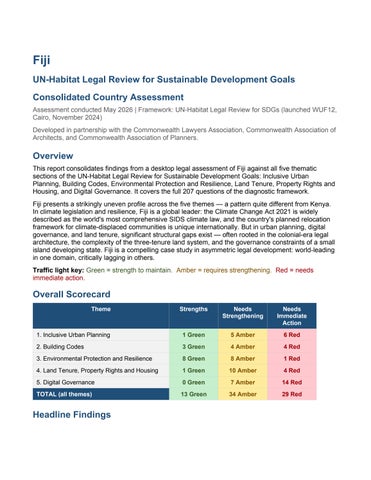
Traffic light key: Green = strength to maintain. Amber = requires strengthening. Red = needs immediate action.
Overall Scorecard
Headline Findings
Fiji's legal landscape across the 207 questions reveals a country of stark contrasts. The 8 greens in Environmental Protection and Resilience — more than any other section and reflecting the Climate Change Act 2021 — sit alongside 14 reds in Digital Governance, the worst performing section. The overall scorecard of 13 Green | 34 Amber | 29 Red reflects a country with world-leading ambition in some domains and critical foundational gaps in others. Four structural characteristics define Fiji's position:
1. Climate legislation: a global benchmark — with an implementation gap. The Climate Change Act 2021 is the world's most comprehensive SIDS climate law and Fiji's greatest legislative achievement. But the capacity of small, under-resourced municipal councils to implement climateresilient urban planning remains limited. The law is excellent; the local delivery system is not.
2. The colonial legacy in planning and building law. The Town Planning Act dates to 1946. Planning coverage outside gazetted urban centres is minimal. Penalties for illegal development are acknowledged as ineffective. This is the most urgent reform priority for the built environment.
3. The iTaukei land system: cultural strength, development constraint. With 83% of land held as iTaukei (indigenous) land managed by the TLTB, Fiji has a tenure system that protects indigenous rights and cultural identity but creates significant complexity for urban development, affordable housing, and land-based finance. The system is a constitutional protection and a development barrier simultaneously.
4. Digital governance: the most critical gap. Fiji has no data protection legislation, no open data mandate, no Freedom of Information Act, and no accountability framework for automated decisionmaking. As the country develops its digital ID system and e-government infrastructure, this legal vacuum poses significant risks. Digital governance is where the most urgent legislative action is needed.
Fiji illustrates a different dimension of the implementation gap: a small island developing state where world-class ambition in climate law coexists with colonial-era planning instruments and a digital governance framework that does not yet exist. The solutions are known — the missing pieces are legislative modernisation, local capacity, and coordinated finance.
Section 1: Inclusive Urban Planning
Score: 1 Green | 5 Amber | 6 Red
Urban planning is Fiji's most critical reform area in the built environment. The Town Planning Act 1946 is the primary instrument — nearly 80 years old, centralised around a single Director, with limited geographic reach and ineffective penalties. The sole green reflects Fiji's Climate Change Act requirement to update plans for climate. The six reds signal the urgency of comprehensive planning law reform.
Area / Question Rating
Evidence & Notes
A. Planning hierarchy & content of plans (Questions 1–5)
Q1–3: Defined hierarchy of spatial plans
Amber The Town Planning Act (Cap 139, 1946, amended 1978) provides the primary planning framework. Planning is administered by the Director of Town & Country Planning. A hierarchy of national/local plans exists in principle but the framework is severely outdated, structured around a single Director rather than a multi-tier governance system aligned with
Area / Question Rating
Evidence & Notes
SDGs and NUA. The government has announced new Town Planning Schemes for Suva, Lautoka and Nadi, signalling intent to modernise.
Q4: Local spatial plan content requirements
Red
Q5: Ratio of registered planners to inhabitants
Red
Existing Town Planning Schemes (where they exist) lack the comprehensive content requirements prescribed by the framework — demographic projections, affordable housing targets, monitoring frameworks, financial reports and action plans are not systematically required. Most areas of Fiji fall outside any operative town planning scheme.
Fiji has a very small pool of professional planners for a population of ~930,000 across 330 islands. No published data on planner-to-population ratio is available, but the Department of Town & Country Planning is a small national agency with limited reach beyond main urban centres of Suva, Lautoka and Nadi.
B. Planning process & participatory planning (Questions 6–12)
Q6–8: Stakeholder consultation in planmaking
Amber
Q7: Tailored processes for vulnerable groups
Red
The 2013 Constitution guarantees public participation in governance. Government announcements of new Town Planning Schemes for major cities specifically invite public consultation. However legal requirements for systematic stakeholder engagement at multiple planning stages are not well embedded in the 1946 Act. Participation processes for vulnerable groups are absent from planning statute.
No specific legal or administrative participatory processes tailored for women, ethnic minorities, persons with disabilities, or informal settlers are embedded in planning law. The Climate Change Act 2021 recognises vulnerability in relocation contexts, but this does not translate into urban planning participation requirements.
Q9–10: Inclusive planning including informal settlements
Amber
Q11–12: Transparency, accountability and professional ethics
Amber
The Ministry of Housing and Community Development operates an active informal settlement upgrading programme — 44 settlements under development lease, targeting in-situ upgrading with 99-year leases. However planning law itself does not explicitly require socially inclusive planning approaches or mandate consultation with informal settlement communities in plan-making.
The planning system is highly centralised around the Director of Town & Country Planning. A professional planning institute exists but enforcement of ethical standards across the small planning profession is limited. Transparency obligations in decision-making are present in constitutional provisions but not specifically embedded in planning statute.
C. Land-use change provisions (Questions 13–15)
Q13–15: Clarity, public availability and timelines for land-use change
Amber Town Planning Schemes define permissible uses in gazetted areas. Change-of-use applications are processed by the DTCP. However land-use change procedures outside formally gazetted areas are unclear, timelines are not legally
Area / Question Rating
Evidence & Notes
prescribed, and the complexity of the three-tenure land system (freehold, Crown, iTaukei) creates significant practical barriers to land-use change, particularly on the 83% of land that is iTaukei.
D. Planning at scale & affordable housing (Questions 16–16.2)
Q16: Urban plans with demographic projections and affordable housing targets Red
E. Public space (Questions 17–29)
Q17–23: Allocation, acquisition and protection of public space Amber
Q24–29: Management, climate standards and funding for public space Red
Fiji's urban plans do not systematically incorporate demographic projections or explicit affordable housing unit targets. Rapid urban growth — driven by climate displacement and rural-urban migration — is outpacing formal planning. The National Housing Policy 2025 provides a policy framework but legally binding affordable housing targets in spatial plans are absent.
Town Planning Schemes in gazetted areas include public space reservations. However outside formal urban areas, public space protection is weak. Enforcement against encroachment is limited and the Ministry of Local Government acknowledges penalties for illegal developments are very low and not an effective deterrent.
No earmarked funding mechanisms for public space maintenance exist at the municipal level. Climate resilience standards for public spaces (nature-based solutions, flood resilience) are not embedded in planning regulations. Municipal councils are chronically under-resourced.
F. Sustainable urban design (Questions 30–36)
Q30–35: Mixed use, density, walkability, plot readjustment Amber
Q36: Regular updating of plans for climate change Green
Town Planning Schemes in major cities include zoning provisions. However the planning framework does not systematically promote high-density, mixed-use, walkable urban form. Urban sprawl characterises growth in peri-urban areas. Plot readjustment mechanisms are not established in law.
Fiji's Climate Change Act 2021 requires integration of climate change projections across all sector plans and strategies. The National Climate Change Policy 2018–2030 and National Adaptation Plan provide a framework for climate-responsive planning. New Town Planning Schemes announced for Suva, Lautoka and Nadi are expected to incorporate climate considerations.
Section 2: Building Codes
Score: 3 Green | 4 Amber | 4 Red
The Fiji National Building Code 2024 is a genuine achievement — recently updated, comprehensive, and incorporating climate resilience provisions appropriate to a cyclone-prone SIDS. The three greens
reflect this. The four reds are entirely in implementation and enforcement: acknowledged inadequate penalties, slow permit timelines, and insufficient building control capacity.
Area / Question Rating Evidence & Notes
A. General — existence & enactment (Questions 37–41)
Q37–38: National building code exists and is publicly available Green
Q39–40: Responsible agency; local codes based on national model Amber
Q41: Mechanisms for uniform interpretation and enforcement Red
Fiji National Building Code (FNBC) 2024 (amended February 2024) is in place, publicly available, and covers standards for building strength, resilience, fire safety, health, amenity and sustainability across ten sections. This is a significant and recent update.
The Department of Town & Country Planning (DTCP), under the Ministry of Local Government, administers building code alongside municipal councils. Local building applications are managed jointly by DTCP and councils. However capacity and consistency across the small island geography is limited, particularly in outer islands and peri-urban areas.
Enforcement of the building code is a documented weakness. The Minister for Local Government acknowledged in parliament that penalties for illegal developments are very low and not an effective deterrent. Uniform interpretation across Fiji's dispersed island geography is not achieved in practice.
B. Nature & scope of the code (Questions 42–45)
Q42: Performancebased, prescriptive, or hybrid? Amber
Q43–44: Applies to new and existing buildings; incremental upgrading mechanism Amber
Q45: Coverage: structural, fire, electrical, sanitation, energy, disability access Green
The FNBC 2024 includes mandatory objectives, performance requirements and specifications — indicating a hybrid approach with performance elements. This is an improvement on earlier purely prescriptive approaches. Full performancebased compliance pathways are not yet comprehensively established.
The FNBC 2024 covers new construction comprehensively. Provisions for bringing existing buildings up to standard — critical given Fiji's large informal housing stock — are limited. Incremental construction, common in informal settlements, is not formally accommodated in the code.
FNBC 2024 covers structural safety, fire safety, health, amenity, sustainability and resilience across ten sections. Energy efficiency, climate resilience (reflecting Fiji's vulnerability as a SIDS) and disability accessibility provisions are included. This is a comprehensive code for a small island developing state.
C. Currency of the code (Questions 46–47)
Q46–47: Responsible agency for maintenance; publication and update history Green
DTCP is responsible for the building code. The FNBC was amended in February 2024, reflecting recent updating. The incorporation of resilience standards is particularly relevant for Fiji's exposure to cyclones, flooding and sea-level rise.
D. Local & bio-based materials (Questions 48–49)
Q48–49: Regulations for local/bio-based Amber Fiji has a tradition of using local materials (timber, bamboo, thatch) in traditional building. The building code acknowledges
Area / Question Rating Evidence & Notes
materials; financial incentives
local context. However specific provisions mandating or incentivising bio-based and local materials in formal construction, including financial incentives, are not systematically embedded in the code.
E. Implementation & enforcement (Questions 50–57)
Q50–52: Responsible agency; digital or paper application; who can apply Amber
Q53–54: Is the building control authority adequately resourced? Staff experience? Red
Q55: Average time to approve a building permit Red
Q56–57: Process documented, predictable, transparent? Inspection, enforcement, certification? Red
Building applications are submitted to the DTCP and relevant municipal council. The process is primarily paper-based. Applications must involve registered practitioners. Digital submission capabilities are limited outside Suva.
Building control capacity is critically constrained. The DTCP is a small national agency covering all of Fiji including outer islands. Municipal councils are under-resourced. The acknowledged failure of penalties to deter illegal development reflects inadequate enforcement capacity.
Building permit timelines are not legally prescribed and are reported to be slow and inconsistent. The DTCP acknowledges delays in processing applications. Outer island contexts face additional logistical barriers.
Process predictability and transparency are weak. Inspection and enforcement are particularly inadequate — illegal developments are common and penalties are acknowledged as insufficient. The government has signalled intent to amend Town Planning laws to address this.
Section 3: Environmental Protection and Resilience
Score: 8 Green | 8 Amber | 1 Red
This is Fiji's strongest section by far — and one of the strongest performances for any country assessed under this framework. The Climate Change Act 2021's whole-of-economy approach, net-zero commitment, climate information platform, nature-based solutions mandate, and world-first planned relocation legal framework deliver eight greens. The sole red is circular economy, where no framework exists. The ambers reflect the gap between national framework strength and local implementation capacity.
1. Sustainable Urbanisation — A. Climate governance (Questions 58–61)
Q58: Vertical coordination between national, regional and local government on climate Green
Fiji's Climate Change Act 2021 establishes a comprehensive whole-of-economy governance framework requiring integration of climate change projections across all sector plans. It creates carbon budgets, a net-zero target, and a national climate information platform. Sector ministries are required to incorporate climate objectives. This is globally groundbreaking legislation — the first SIDS to pass climate legislation with a net-zero goal.
Area / Question Rating
Q59: Legal provisions for monitoring climate goals and targets Green
Evidence & Notes
The Climate Change Act 2021 establishes a transparent framework for monitoring, reporting and verification of GHG emissions. It creates an Information Platform containing publicly accessible data on GHG emissions, climate projections and vulnerability. Carbon budgets and a long-term emission reduction target are legally prescribed.
Q60: Legal provisions for data and information sharing on climate matters Green
Q61: Legal empowerment of local authorities to implement climate-sustainable development Amber
The Climate Change Act 2021 mandates a publicly accessible Information Platform. The Fiji Climate Change Portal (FCCP) provides public access to climate policies, adaptation plans and data. Sector plans must incorporate climate change projections and share relevant data.
The Climate Change Act 2021 applies across government, including at the local level. However the capacity of Fiji's small, under-resourced municipal councils to implement climateresilient urban planning and development is limited. Local government is administered under the Local Government Act and the Ministry of Local Government, but climate governance capacity at the council level is nascent.
B. Urban plans and GHG emissions (Questions 62–62.2)
Q62: Legal provisions requiring GHG assessments in planning instruments; targets and carbon sinks Amber
The Climate Change Act 2021 requires GHG targets at the national level and integration across sector plans. However specific legal requirements for urban plans to include measurable GHG reduction targets or carbon sink estimations as part of spatial planning instruments are not yet embedded in planning law.
C. Urban form and GHG emissions from transport (Question 63)
Q63: Legal provisions promoting low-carbon urban development; incentives for renewables and low-emission transport
Amber
D. Green spaces (Questions 64–67)
Q64–66: Network of green spaces; equitable distribution; monitoring body
Fiji's NDC includes targets to reduce energy sector emissions by 30% by 2030 and to decarbonise transport. The energy sector is increasingly renewable. However specific legal provisions linking urban form standards to GHG reduction in transport — such as requirements for walkable, dense, mixeduse urban development — are not embedded in planning law.
Q67: Incentives or requirements for green infrastructure in urban projects
Amber
Amber
Town Planning Schemes in gazetted urban areas include green space reservations. Fiji's natural environment and traditional village land provide green space in many contexts. However systematic legal requirements for equitable distribution of urban green spaces, nature-based solutions, and a dedicated monitoring body for urban greenery are not in place.
The Climate Change Act 2021 promotes nature-based solutions. The FNBC 2024 includes sustainability provisions. However specific financial incentives or legal requirements for developers to incorporate green infrastructure (green roofs, rain gardens, urban forests) into urban projects are not systematically embedded in law.
Area / Question Rating
Evidence & Notes
E. Development control, mitigation and climate financing (Questions 68–68.3)
Q68: GHG mitigation in development approval; developer charges; enforcement penalties Amber
Environmental Impact Assessments are required for major developments under the Environment Management Act 2005. Climate considerations are increasingly integrated through the Climate Change Act 2021. However penalties for development non-compliance are acknowledged as very low and not effective, weakening any climate mitigation requirements in the development approval process.
F. Neighbourhood design and energy savings (Questions 69–69.3)
Q69: Neighbourhood design principles for energy savings in buildings Amber
G. Circular economy (Question 70)
Q70: Circular economy strategy; re-use standards; extended producer responsibility; monitoring Red
FNBC 2024 includes energy efficiency and sustainability provisions. However comprehensive legal requirements for neighbourhood-scale orientation, thermal properties of urban surfaces, and plot design for energy savings are not systematically prescribed in planning regulations.
Fiji lacks a comprehensive urban circular economy legal framework. Waste management is a significant challenge, particularly in urban areas and on outer islands. Extended producer responsibility schemes are not in place. The Climate Change Act 2021 addresses emissions but not circular economy principles systematically in the urban context.
2. Urban Resilience — A. Adaptation planning (Questions 71–72)
Q71: Legal mandate for climate adaptation plans; stakeholder engagement; coordination; monitoring Green
Q72: Legal provisions requiring social vulnerability factors in adaptation planning Green
The Climate Change Act 2021 is globally recognised as the most comprehensive climate legislation by a SIDS. It is the first nationally legislated process globally for the planned relocation of at-risk communities. Standard Operating Procedures for Planned Relocation (2018, updated) provide a detailed legaloperational framework. The National Adaptation Plan, Displacement Guidelines and Planned Relocation Guidelines all have a strong legal foundation.
The Climate Change Act 2021 explicitly recognises vulnerability as including women, children, the elderly and persons with disabilities. Planned relocation procedures require protection of the full spectrum of housing, land and property rights. The Standard Operating Procedures for Planned Relocation specifically address vulnerable groups including those with disabilities.
B. Climate risk and vulnerability assessments (Questions 73–74)
Q73: Law mandating climate risk assessments for urban areas; publication; stakeholder involvement; updates Green
The Climate Change Act 2021 establishes a publicly accessible Information Platform with climate projections and vulnerability data. Climate risk assessments are a mandated component of sector planning. The Fiji Climate Change Portal provides public access to risk information. Stakeholder engagement in adaptation planning is required by the Act.
Q74: Spatial plans required to include Amber The Climate Change Act 2021 requires sector plans to incorporate climate vulnerability assessments. However a
Area / Question Rating
vulnerability assessments
Evidence & Notes
universal requirement for all spatial plans to include vulnerability assessments for floods, storm surge and sea-level rise is not yet fully embedded in planning law, given the outdated Town Planning Act 1946 framework.
C–D. Infrastructure and ecosystem-based adaptation (Questions 75–78)
Q75–78: Climate integration in infrastructure; naturebased solutions; ecosystem measures Green
The Climate Change Act 2021 mandates climate integration across infrastructure planning. Fiji has active nature-based seawall programmes (Ministry of Waterways). The Act explicitly recognises nature-based solutions and ecosystem services. iTaukei land stewardship provides a cultural foundation for ecosystem-based adaptation. The TLTB's Land Conservation and Improvement Act supports land ecosystem protection.
E. Slum adaptive capacity (Questions 79–80)
Q79–80: Law on adaptation of slums to climate change; climatesmart upgrading; community participation Amber
The Ministry of Housing's informal settlement upgrading programme targets in-situ upgrading with 99-year leases. The Planned Relocation SOPs address communities at climate risk. However a specific statute mandating climate-smart criteria in informal settlement upgrading processes — with community participation requirements and climate-resilient construction standards — does not fully exist in enforceable law.
F. Land-use and tenure in climate context (Questions 81–82)
Q81–82: Flexible zoning; tenure rights during climate displacement; land tenure review Green
The Climate Change Act 2021 is the first law globally to legally recognise a state-supported process for relocation of at-risk communities, including protection of housing, land and property rights during relocation. Standard Operating Procedures for Planned Relocation provide detailed tenure protection during climate-induced displacement. This is a world-leading provision.
G. Climate financing (Questions 83–87)
Q83–87: Climate financing for local government; zoning for climate risk; EIA adaptation; monitoring Amber
Fiji accesses the Green Climate Fund, Adaptation Fund, and other international climate finance mechanisms. The Climate Change Act 2021 creates a framework for carbon markets. However climate finance flowing to the municipal/local government level for urban adaptation is limited, and monitoring of climate finance effectiveness at the urban scale is not systematically in place.
3. Climate Justice — A. Environmental courts and legal access (Questions 88–100)
Q88–92: Specialist environmental courts; jurisdiction; appeal; trained judges; public access Amber
Q93–100: Legal action against government for climate inaction;
Fiji does not have a dedicated environment court. Environmental and planning cases are heard in the ordinary court system. The Environment Management Act 2005 provides for environmental enforcement but without a specialist tribunal. The Climate Change Act 2021 creates governance mechanisms but does not establish a specialist climate court.
Amber The Constitution 2013 provides the right to a clean environment and enables legal action against government. Climate justice litigation is nascent in Fiji. Legal aid is limited.
Area / Question Rating
accountability; legal aid; collective suits
Evidence & Notes
The Climate Change Act's groundbreaking relocation provisions reduce the need for adversarial litigation in some contexts by providing proactive legal mechanisms.
D–F. Compensation, enforcement and community involvement (Questions 101–115)
Q101–110: Compensation for climate harm; enforcement of climate rulings; penalties; public oversight
Q111–115: Community participation in climate judicial proceedings; outreach; local languages; feedback
Amber
Amber
Compensation provisions for climate-related harm are not comprehensively prescribed. Climate enforcement mechanisms are improving through the Climate Change Act 2021 but judicial enforcement capacity is limited. Penalties for environmental violations under the Environment Management Act are not consistently applied.
The Constitution guarantees participation rights. The Climate Change Act requires community engagement in relocation decisions. iTaukei community structures (via TLTB) provide a cultural mechanism for community involvement. However formal legal mechanisms for community participation in climate judicial proceedings, outreach in local languages (iTaukei, Hindi), and feedback mechanisms are not systematically in place.
Section 4: Land Tenure, Property Rights and Housing
Score: 1 Green | 10 Amber | 4 Red
Fiji's land tenure section is dominated by the complexity and implications of the three-tenure system, within which 83% of land is iTaukei. The single green reflects the Ministry of Housing's progressive 99year lease programme for informal settlers. The reds cluster around the absence of land value sharing, an incomplete cadastre, and the structural exclusion of non-iTaukei residents from land ownership. The Climate Change Act's relocation tenure protections are a positive outlier.
A–B. Zoning, land-use policies and PPPs (Questions 116–123)
Q116–118: Quantifiable measures; sustainable land-use planning; inclusionary zoning
Q119–123: Legal safeguards for property
Fiji's three-tenure land system (83% iTaukei, ~13% Crown, ~4% freehold) creates fundamental complexity for land-use planning. The Town Planning Act 1946 does not contain quantifiable measures for balancing property rights and zoning goals. Inclusionary zoning is not mandated. The iTaukei land system means that development on 83% of land requires iTaukei Land Trust Board (TLTB) consent, creating a parallel governance layer that is not integrated into the planning framework.
Amber PPP frameworks for housing exist — the Ministry of Housing works with developers on informal settlement upgrading using
Area / Question Rating
rights in PPPs; public participation; land value capture; financing
C.
Evidence & Notes
development leases. The Constitution protects land lease rights. However systematic land value capture mechanisms in PPPs are absent. The TLTB administers iTaukei land value on behalf of landowners but this is not structured as a formal land value sharing mechanism for public benefit.
Land-based finance (Questions 124–135)
Q124–126: Fiscal cadastre — updating; coverage of informal settlements; public availability Red
Q127–129: Land value sharing mechanisms; redistribution; prioritisation of underserved areas Red
Q130–132: Developer fees; building permit conditionality; in-kind options Amber
Q133–135: Property tax; collection rates; valuebased calculation; progressive rates for vacant land
Amber
Fiji's land administration system covers freehold and Crown land reasonably well through the Torrens title system. However iTaukei land — 83% of the total — presents coverage challenges. Informal settlements are largely absent from the formal cadastre. Public accessibility of cadastral data is limited outside formal channels.
No systematic legal mechanisms exist to capture and redistribute land value increases from planning decisions and public investments. The TLTB distributes iTaukei land lease revenues to landowning units but this is a different mechanism from land value capture for public urban investment. No criteria prioritise investments in underserved areas through value sharing.
Development conditions can be attached to approvals by DTCP. However a systematic, transparent framework for developer infrastructure contributions across Fiji's small, dispersed urban system is not consistently applied.
Municipal rating systems exist in Fiji's four city/town councils. Property rates are levied on urban land. However rates collection is limited, coverage of iTaukei leasehold land in urban areas creates complexity, and progressive rates specifically targeting vacant land or empty houses are not in place.
D. Flexible and socially responsible tenure systems (Questions 136–139)
Q136–137: Genderresponsive tenure legislation; recognition of statutory, customary and informal rights Amber
Q138–139: Simplified registration process; alternative tenure mechanisms
Green
The Constitution 2013 prohibits gender discrimination. iTaukei customary land rights are constitutionally protected and administered through the TLTB. The Vola ni Kawa Bula (VKB) register documents all iTaukei landowners. However women's customary land rights within iTaukei communal systems are often secondary, and informal settlers lack secure tenure despite upgrading programmes.
Fiji's Torrens title system provides a reliable registration framework for freehold land. The Ministry of Housing's informal settlement upgrading programme offers 99-year development leases as an alternative tenure mechanism for informal settlers — a significant provision specifically designed for those without formal ownership. 451 households received lease documents through recent upgrading rounds.
2. Laws, Policies and Regulations Promoting Adequate Housing
A. Anti-discrimination and rent regulation (Questions 140–144)
Area / Question Rating
Q140–141: Antidiscrimination in housing; redress mechanisms Amber
Q142–144: Rent regulation; tenancy termination safeguards; anti-harassment provisions Amber
Evidence & Notes
The Constitution 2013 prohibits discrimination. The Human Rights Commission can receive housing discrimination complaints. However specific anti-discrimination provisions in dedicated housing legislation and accessible redress mechanisms for housing discrimination are limited in practice.
Fiji has some landlord-tenant law applicable to residential tenancies. However a comprehensive residential rent regulation framework, strong tenancy termination safeguards, and anti-harassment provisions specifically for the urban rental market — where many low-income households live — are not systematically in place.
B–C. Housing subsidies, affordability and equitable distribution (Questions 145–155)
Q145–148: Affordability; effectiveness of subsidies; equitable distribution; adjustment mechanisms Amber
Q149–155: Equitable distribution; emergency housing; habitability; cultural adequacy; disability access Amber
3. Security of Tenure
The First Home Ownership Initiative (2014) provides affordable housing for low-to-middle income earners. The National Housing Policy 2025 has been launched. The Ministry of Housing manages both urban housing programmes and informal settlement upgrading. However housing delivery falls short of demand, particularly for the lowest-income households, and adjustment mechanisms for changing economic conditions are limited.
The Ministry of Housing targets low-to-middle income households and informal settlers. The Building Code 2024 includes disability accessibility provisions. Cultural adequacy — particularly important given iTaukei cultural values around communal land and housing — is recognised through the TLTB system but not systematically addressed in housing law. Emergency housing provisions are limited.
A–B. Legal recognition, forced evictions and vulnerable groups (Questions 156–163)
Q156–160: Legal recognition of land rights; enforcement; prohibition of forced evictions; compensation Amber
Q161–163: Protection of vulnerable groups including refugees, indigenous communities, informal settlers Amber
The Constitution 2013 protects property rights including iTaukei communal land rights. The Torrens system provides reliable freehold title protection. The Climate Change Act 2021 provides world-leading protections for tenure rights during climate-induced relocation. However forced evictions of informal settlers have occurred in urban contexts, and the iTaukei system means 83% of land cannot be purchased, creating tenure insecurity for non-iTaukei residents on leasehold land.
iTaukei land rights are constitutionally protected — a strong provision for indigenous communities. The TLTB administers land on behalf of all iTaukei landholding units. However noniTaukei Fijians (Indo-Fijians and others) face vulnerability on expiring agricultural leases, and informal settlers across all ethnicities face tenure insecurity. Refugee and displaced population land rights are not specifically addressed.
C. Effective dispute resolution and land registry (Questions 164–175)
Area / Question Rating
Q164–166: Land dispute processes; tribunal; alternative dispute resolution; legally binding outcomes
Evidence & Notes
Amber
Q167–171: Timelines; fee waivers; legal aid; appeal rights; antiretaliation measures Amber
Q172–175: Cadastre system; coverage; accuracy; public accessibility Amber
Land disputes in Fiji are heard in the court system and through the iTaukei Land Commission for iTaukei land matters. TLTB provides an administrative dispute mechanism for iTaukei leases. Alternative dispute resolution is encouraged. However a dedicated, accessible land tribunal with published timelines is not in place.
Legal aid is available through the Legal Aid Commission for some land matters. Appeal rights exist through the court system. However access to legal aid specifically for land disputes is limited, particularly for low-income informal settlers and outer island communities.
The Torrens title system provides reliable registration for freehold land. The iTaukei Land Commission maintains registers of iTaukei land and landowners (VKB). Crown land is managed by the Ministry of Lands. However integration between these three systems is limited, coverage of informal settlements is poor, and public accessibility of cadastral data is restricted.
Section 5: Digital Governance
Score: 0 Green | 7 Amber | 14 Red
Digital Governance is Fiji's most critical gap — the only section with no greens. The absence of a data protection act is the foundational problem: without it, almost every question in this section defaults to red. As Fiji develops its digital ID system, e-government platforms, and smart city infrastructure, the absence of a legal framework for data protection, automated decision-making, privacy impact assessments, and accountability is a serious risk. This is the section requiring most urgent legislative action.
1. Data-Driven Decision-Making — A. Smart city operating model (Questions 176–180)
Q176: Smart city law, policy or strategy; vision; coordination; monitoring
Red
Q177: Legislative requirement for municipal open data platform Red
Q178: Legal measures for digital inclusion (skills
Fiji does not have a smart city law or dedicated municipal digital governance strategy. Cabinet approved a national digital ID programme in June 2024 (3-year implementation timeline) and a National ID Steering Committee was established in February 2025. However a legally embedded smart city framework with vision, coordination and monitoring mechanisms for municipalities does not exist.
No legislative requirement for municipalities to maintain open data platforms exists. The Constitution provides a right of access to information held by public bodies (Article 25), but this is not operationalised through a Freedom of Information Act or an open data mandate at the municipal level.
Amber Digital inclusion is addressed through national broadband programmes and rural electrification. However specific legal
Area / Question Rating
training, WiFi, broadband subsidies, device subsidies)
Q179: Participation in smart city knowledgesharing initiatives Amber
Q180: Internationally recognised interoperability standards
Amber
Evidence & Notes
mandates for municipal digital inclusion measures — free WiFi, broadband subsidies and device subsidies — are not embedded in statute. The digital divide between Fiji's urban centres and outer islands is significant.
Fiji engages with Pacific regional digital governance initiatives and UN-Habitat programmes. However formal participation in structured city-to-city or international smart city knowledgesharing networks is limited given Fiji's small size and resource constraints.
The Cybercrime Act 2021 aligns with international cybercrime frameworks. The national digital ID programme is being developed with Japan's Digital Government Agency and the Asian Development Bank, which will incorporate international standards. However systematic adoption of inter-operability standards across municipal digital systems is at a very early stage.
B. Automated decision-making (Questions 181–186)
Q181: Accessibility (disability) standards in digital service design Amber
Q182: Law regulating data ownership and control; commercial data sharing obligations Red
The Constitution 2013 prohibits disability discrimination. The Building Code 2024 addresses physical accessibility. However specific legislative requirements mandating accessibility standards in digital service design for local government digital services are not in place.
Fiji has no specific data protection legislation. The Constitution provides a right to privacy (Article 24) covering confidentiality of personal information, but this is not operationalised through a data protection act. Outsource Fiji has been advocating for data protection laws as a requirement for international digital trade. No obligations exist for commercial entities to share data with public authorities.
Q183: Digital services identification requirements
Amber
Q184: Regular algorithmic fairness audits; public disclosure of results Red
Q185: Legal provisions mandating human oversight in critical automated decision points
Red
Q186: Redress and appeal mechanisms for automated decision harm Red
Identification for government services is provided through the existing National ID and the new digital ID programme under development. A uniform national framework for digital service identification with tailored alternatives is not yet in place.
No legal provisions for algorithmic fairness audits exist. There is no data protection framework from which such requirements could derive. Automated decision-making governance is essentially absent from Fiji's legal architecture.
No legal provisions mandating human oversight in automated decision-making exist, given the absence of a data protection framework. This is a gap that will become more significant as Fiji develops its digital ID and e-government infrastructure.
No specific redress or appeal mechanisms for individuals adversely affected by automated decisions exist in Fiji's legal framework. Constitutional privacy rights provide a theoretical basis for challenge but there is no operationalised mechanism.
Area / Question Rating
Evidence & Notes
C–D. Participatory decision-making & decision-making authority (Questions 187–191)
Q187: Legal mandate for digital platforms for public feedback in decision-making
Q188: Legal mechanisms protecting privacy and security in participatory platforms
Q189: Chief Digital Officer; dedicated digital team; roles in legal/administrative framework
Q190: Law mandating data stewards to correct data problems while minimising PII access
Q191: Regular training of officials on digital legal developments; mandated frequency
Amber
Amber
The Constitution guarantees public participation rights. Government announcements of new town planning schemes invite digital and in-person consultation. However a specific legal mandate requiring municipalities to use digital platforms for systematic public feedback is not in place.
Constitutional privacy rights (Article 24) provide some protection. The Cybercrime Act 2021 addresses unauthorised data access. However without a dedicated data protection act, the legal mechanisms protecting privacy and security of data collected through digital participatory platforms are inadequate.
Amber
Red
Amber
National-level digital governance leadership exists through the Ministry responsible for ICT. The National ID Steering Committee provides a governance structure for the digital ID programme. However dedicated Chief Digital Officers or legally specified digital governance teams at the municipal level are not in place.
No legal obligation for data stewardship at the municipal level exists in the absence of a data protection framework. Data management in local government is not governed by formal statutory requirements.
Digital capacity building is occurring through the national digital ID programme and international partnerships (ADB, Japan). However a legally mandated regular training cycle for public officials on digital legal developments is not prescribed.
E. Data integration and information-sharing (Questions 192–195)
Q192–195: Collaborative data-sharing mandates; open data requirements; right to be informed; dataset harmonisation
Red
Fiji lacks the foundational legal infrastructure for digital governance data integration. There is no open data mandate, no right-to-be-informed provision for data collection, no Freedom of Information Act, and no statutory framework for dataset harmonisation. The right of access to information in the Constitution (Article 25) provides a foundation but has not been operationalised through enabling legislation.
2. Balancing Data Use and Privacy — A–B. Data security and access (Questions 196–203)
Q196–199: Security framework; breach mitigation; business continuity; data exchange policies
Q200–203: Data access regulations; equitable access criteria; enforcement; mandatory open datasets
Amber
Red
The Cybercrime Act 2021 provides a framework for cybercrime and addresses some data security matters. The national digital ID programme will require robust data security architecture. However a comprehensive statutory data security framework — breach reporting, risk assessment, disaster recovery — is not yet in place for government and municipal data management.
Fiji lacks statutory data access regulations, equitable access criteria, or mandatory open dataset requirements. Constitutional access to information rights (Article 25) are not operationalised. No Freedom of Information Act exists.
Area / Question Rating
Evidence & Notes
C. Privacy, data protection and security (Questions 204–207)
Q204: Accountability mechanisms for government compliance with ethical digital service standards
Q205: Data protection law coverage
Red
Q206: Privacy impact assessments mandated for new urban development/technology initiatives
Q207: Accountability for data protection violations; penalties; regulatory enforcement
Red
Without a data protection act or independent data protection authority, there are no formal accountability mechanisms for government compliance with ethical digital service standards. The Cybercrime Act addresses criminal misuse but not data governance accountability.
Fiji has no data protection legislation. Constitutional right to privacy (Article 24) provides limited protection. Sector-specific privacy provisions exist for banking, tax and health, but a comprehensive data protection framework covering fair/lawful use, purpose limitation, minimisation, accuracy, retention, security and accountability does not exist.
Red
Red
Note on scope and methodology
No legal requirement for privacy impact assessments exists in Fiji's legal framework. The digital ID programme's development has raised concerns about data security and government access, precisely because no safeguarding legislation is in place.
No dedicated data protection authority or enforcement mechanism for data protection violations exists. The Cybercrime Act 2021 addresses criminal data misuse but does not constitute a data protection enforcement regime. This is Fiji's most critical digital governance gap.
This consolidated assessment covers all 207 questions of the UN-Habitat Legal Review for SDGs framework across five thematic sections. It is based on desktop research using publicly available legislation, government documents, and secondary sources including ADB, TLTB, Ministry of Housing Fiji, Ministry of Local Government Fiji, Fiji Climate Change Portal, DLA Piper Data Protection Laws of the World, SEAP Statelessness Encyclopedia, ISOCARP, and academic analysis. It is not a substitute for an in-country assessment by qualified practitioners. Fiji's small island developing state context, three-tenure land system, and dispersed island geography create specific implementation challenges that in-country assessment would need to capture in greater depth.
Framework source: UN-Habitat Legal Review for Sustainable Development Goals, developed with the Commonwealth Lawyers Association, Commonwealth Association of Architects, and Commonwealth Association of Planners. Launched at WUF12, Cairo, November 2024.