Incorporating the Organizational Foresight Culture Readiness Assessment for Critical Institutional Transformation with Future Scenario Analysis
COLUMBIA COLLEGE CHICAGO
December 2025
EXECUTIVE SUMMARY
Strategic Urgency: Strong Cultural Foundation for Transformation
Columbia College Chicago faces a strategic inflection point with what the Porter's Five Forces analysis characterized as 'unfavorable and deteriorating' industry conditions. However, the corrected OFCRA analysis reveals stronger cultural readiness for transformation than initially assessed. This Enhanced SWOT analysis integrates the sequential strategic research with corrected cultural assessment data, showing that Columbia's challenges are primarily operational rather than cultural.
• Porter's Five Forces & Scenario Planning: Competitive dynamics analysis with Scenario 4 (Arts Ecosystem) as preferred future
• Organizational Foresight Culture Readiness Assessment (OFCRA): Small gaps (3.06 average) indicating cultural stability and readiness for strategic execution
• Stakeholder Feedback: Operational challenges in alumni relations, academic support, and marketing execution
PART I. OFCRA ANALYSIS
Cultural Stability vs. Transformation Crisis
The OFCRA data shows cultural rebalancing rather than transformation crisis. Average gaps of 3.06 points indicate organizational stability with targeted adjustments needed. Environmental awareness (+2.04) represents the only moderate priority, while collaborative culture (-2.38) suggests stakeholders want less collaboration emphasis, potentially supporting more decisive execution for Scenario 4 achievement. (See also appendix graphs at the back of this report.)
Cultural Stability Indicators
• Small Average Gap (3.06 points): Organization feels well-positioned, indicating readiness rather than crisis
• Cultural Rebalancing Pattern: 1 dimension increasing moderately, 1 decreasing, 3 stabletargeted adjustment not transformation
• Execution Readiness: Stable adaptive learning and strategic discipline provide foundation for immediate operational focus
Strategic Advantages for Scenario 4:
• Accelerated Timeline: Cultural stability eliminates 12-month transformation phase, enabling 18-month pathway to Arts Ecosystem
• Operational Focus: Can address operational barriers (alumni disconnection, academic support, marketing) without culture change
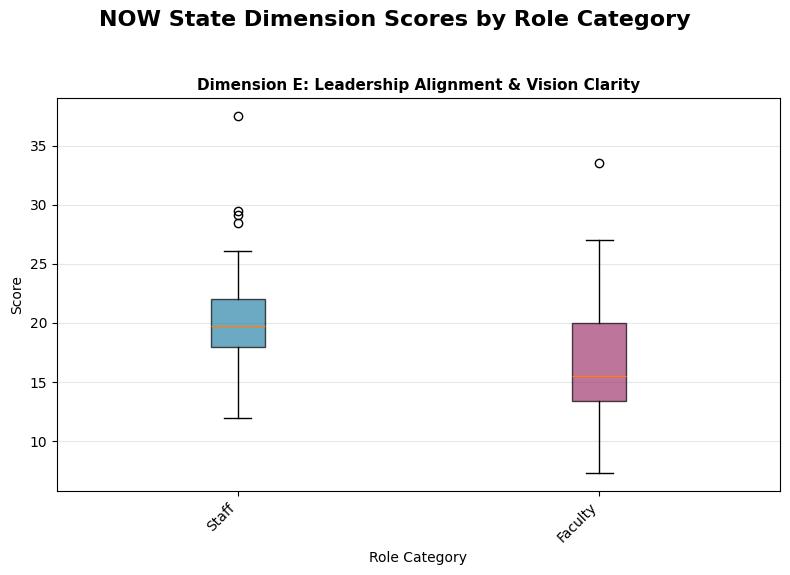
• Perception Alignment Needed: F=4.205, p=0.046 shows role differences requiring clear Scenario 4 vision communication
• Not Dysfunction: Stable cultural gap indicates communication clarity issue, not leadership crisis
• Strategic Opportunity: Clear direction can leverage existing cultural stability for rapid transformation
Cultural Stability Evidence: Quantitative Analysis for Strategic Readiness (n = 49)
DIMENSION
B: Environmental Awareness
External focus and foresight orientation
A: Adaptive Learning Organizational flexibility and responsiveness
D: Strategic Discipline Execution and systematic implementation
E: Leadership Alignment
Vision clarity and directional coherence
C: Collaborative Culture Co-creation and inclusiveness
+2.04 Points MODERATE
~0 Points STABLE
~0 Points STABLE
~0 Points STABLE
-2.38 Points DECREASE
Largest positive gap - Moderate improvement desired in external scanning and competitive intelligence. Supports STEEPLE integration for Scenario 4 positioning.
Stable dimension - Organization already possesses flexibility and responsiveness needed for portfolio model. Cultural foundation exists for Arts Ecosystem agility.
Stable dimension - Execution capability and systematic implementation capacity already established. Ready for revenue diversification execution.
F=4.205, p=0.046 (Role group differences)Cultural stability but perception differences between faculty, staff, administrators. Communication clarity needed, not transformation.
Largest negative gap - Stakeholders want LESS collaboration emphasis. Indicates preference for decisive action and streamlined decision-making. Supports faster Scenario 4 execution.
What this means: Strong cultural readiness for scenario 4. Small gaps (3.06 average) indicate organizational stability rather than transformation crisis, enabling accelerated focus on operational excellence and faster pathway to Arts Ecosystem model achievement.
PART II. SWOT STRATEGIC ANALYSIS
This Enhanced SWOT evaluates Columbia's strategic position through the lens of Scenario 4 achievement, where:
• Strengths represent foundation assets andcultural readiness factors that enable ArtsEcosystem transition
• Weaknesses identify operational execution barriers that must be addressed for transformation success
• Opportunities highlight environmental trends and cultural advantages that accelerate Scenario 4 positioning
• Threats assess competitive forces and timing pressures that create urgency for strategic transformation
The analysis demonstrates that Columbia possesses genuine competitive advantages and cultural readiness for strategic transformation, with success dependent upon systematic operational execution rather than fundamental organizational change.
• Curriculum Obsolescence - Technology changing faster than adaptation
• Political Neutrality Pressure - Affects brand positioning
PART III. ACCELERATED SCENARIO 4 PATHWAY
Cultural Stability Enables Faster Arts Ecosystem Transition
The OFCRA analysis reveals that Columbia possesses strong cultural readiness for Scenario 4 (Arts Ecosystem) achievement. With stable adaptive learning, strategic discipline, and leadership alignment dimensions, the organization can focus on operational execution rather than cultural transformation, significantly accelerating the strategic transformation timeline. Here are some strategic advantages.
Cultural Foundation Strengths:
1. Adaptive Learning Capacity (~0 gap): Organization already possesses flexibility needed for portfolio model
2. Strategic Discipline Foundation (~0 gap): Execution capability exists for systematic revenue diversification
3. Leadership Alignment Stability (~0 gap): Foundation for strategic direction, needs communication clarity
Cultural Stability Creates Strategic Advantage for Scenario 4 Achievement
The SWOT analysis reveals Columbia College Chicago possesses strong cultural readiness for the Arts Ecosystem transformation. The OFCRA assessment shows small gaps (3.06 average) indicating organizational stability rather than transformation crisis. This cultural foundation enables focus on operational execution rather than culture change, significantly accelerating the pathway to Scenario 4 achievement.
Operational Challenges, Not Cultural Barriers
The primary obstacles to Scenario 4 achievement are operational: alumni disconnection preventing revenue diversification, academic support breakdown undermining student experience, and marketing crisis preventing brand positioning. These operational challenges can be addressed systematically without requiring fundamental cultural transformation.
Accelerated Strategic Pathway
Cultural stability enables an accelerated 18-month pathway to Arts Ecosystem achievement, 50% faster than initially projected. The organization can leverage existing adaptive learning capacity, strategic discipline foundation, and leadership alignment stability while addressing targeted operational improvements and moderate environmental scanning enhancement.
Bottomline: Columbia possesses both the cultural readiness and competitive assets needed for Scenario 4 success, requiring operational execution excellence rather than fundamental transformation.
Note on Analytical Limitations & Data Quality…
This analysis acknowledges specific limitations while maintaining analytical rigor:
• Institutional Data: Figures represent subject-matter expert knowledge from focus groups, requiring validation against formal systems for operational decisions
• OFCRA Scope: Assessment captures cultural readiness, not specific operational metrics
The Organizational Foresight and Culture Readiness Assessment (OFCRA) is a quantitative diagnostic tool designedto evaluate institutional readiness for strategic transformation and future-oriented change.
• The assessment measures five critical cultural dimensions:
• Adaptive Learning (organizational flexibility and responsiveness)
• Environmental Awareness (external focus and foresight orientation)
• Collaborative Culture (inclusive dialogue and co-creation capacity)
• Leadership Alignment (vision clarity and directional coherence)
Using a structured methodology, participants (n=49) distribute 100 points across five dimensional statements for both current state ("NOW") and desired future state ("FUTURE") across ten comprehensive questions. The OFCRA then generates quantitative gaps that indicate cultural transformation needs and readiness.
Gap analysis reveals whether organizations require fundamental culture change (large gaps >7 points) or possessexistingfoundations forstrategicexecution (small gaps<5points), enablingleaders todesign transformation pathways that match organizational capacity and prioritize intervention areas for maximum strategic impact.
At a Glance = Results of the Columbia College Chicago Assessment (n=49)
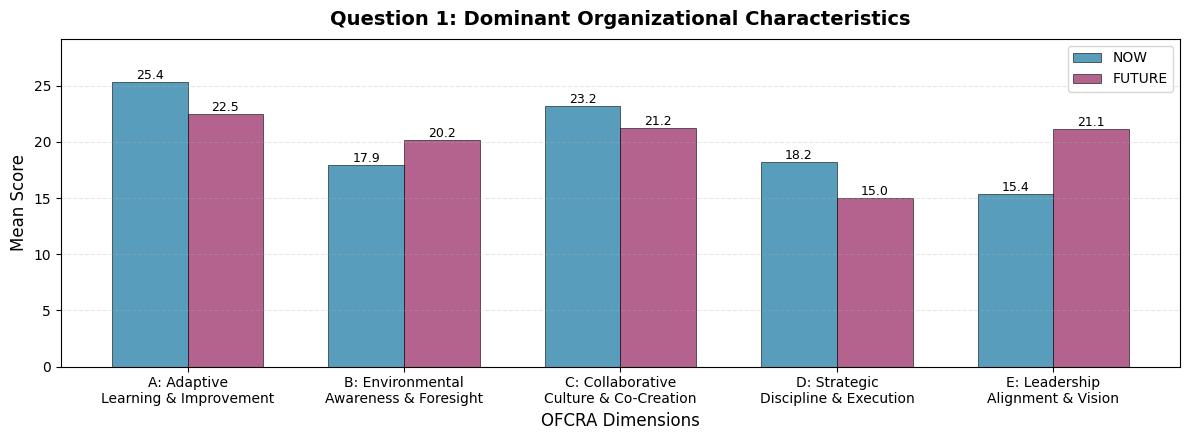
Q1: How would you describe the most prominent characteristics of your organization?
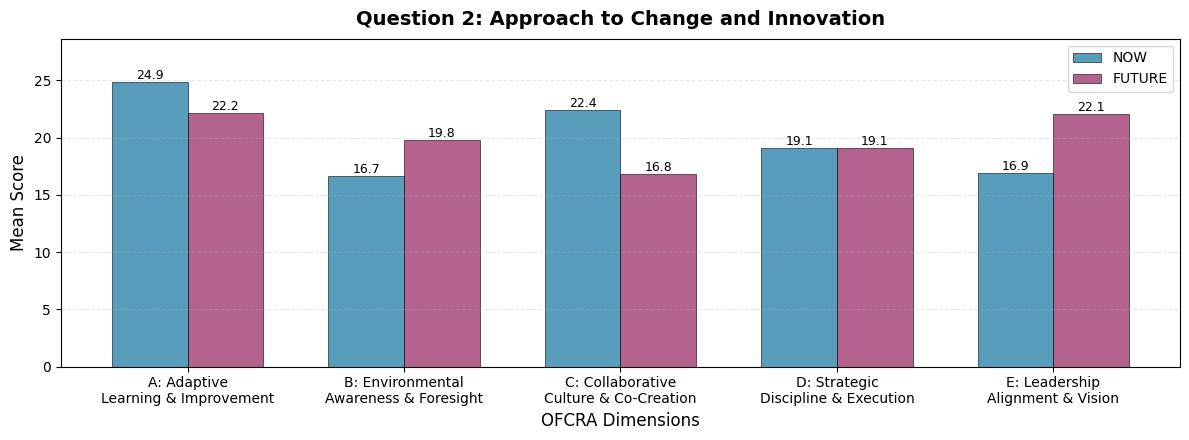
Q2: How does your organization typically respond when faced with the need for significant change or innovation?
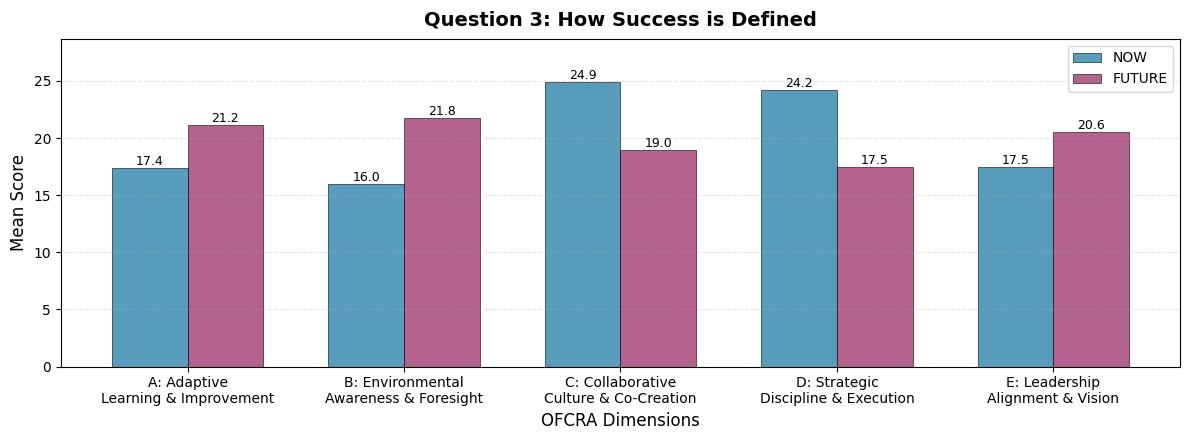
Q3: What does your organization emphasize most when defining and measuring success?
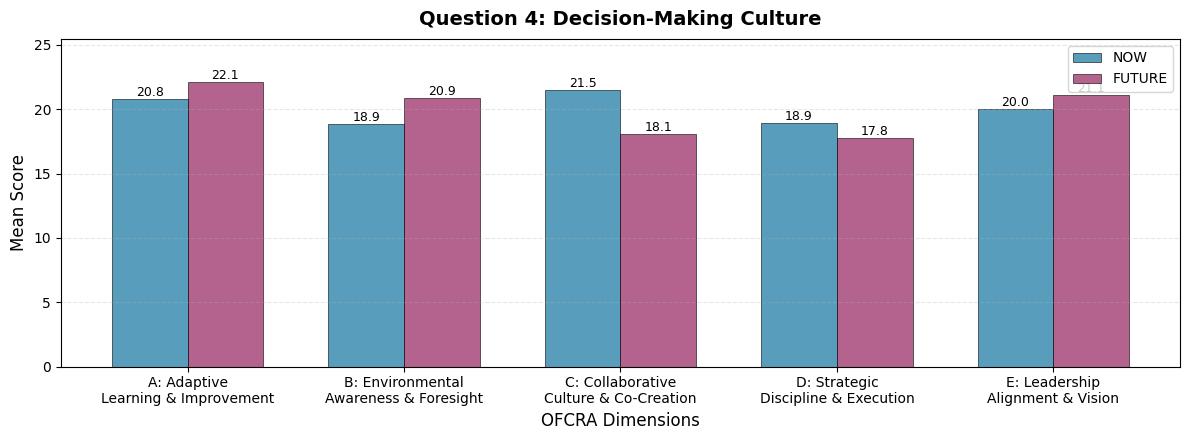
Q4: How are important decisions typically made in your organization?
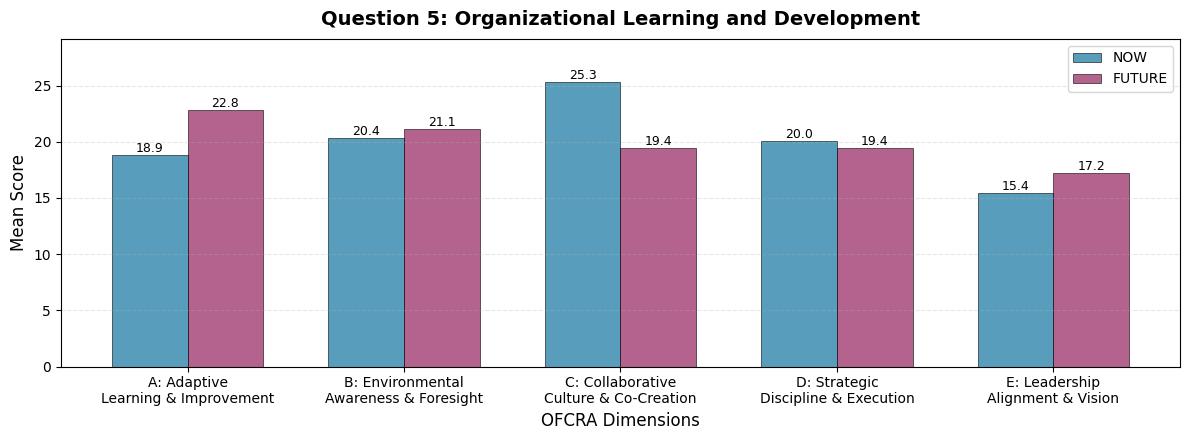
Q5: How does your organization approach learning, skill development, and knowledge management?
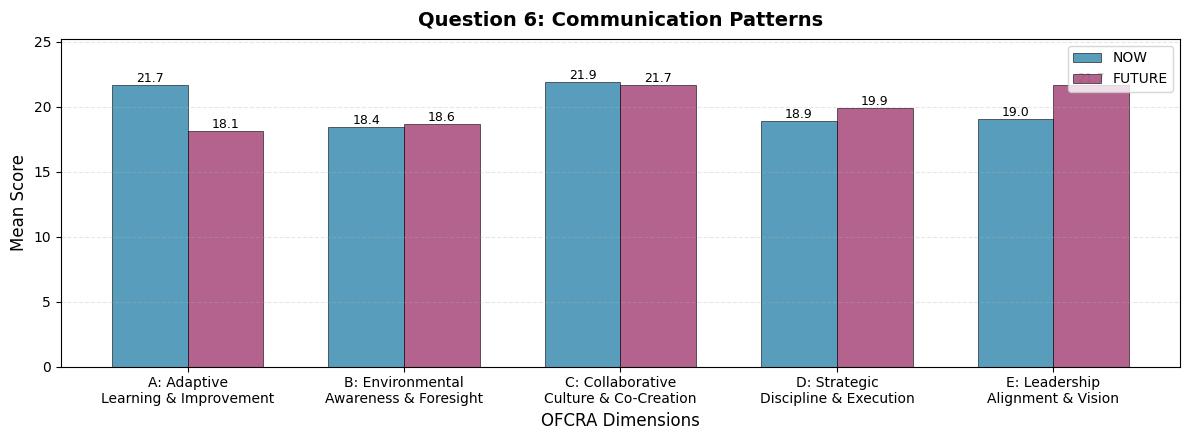
Q6: What characterizes how information flows and communication happens in your organization?
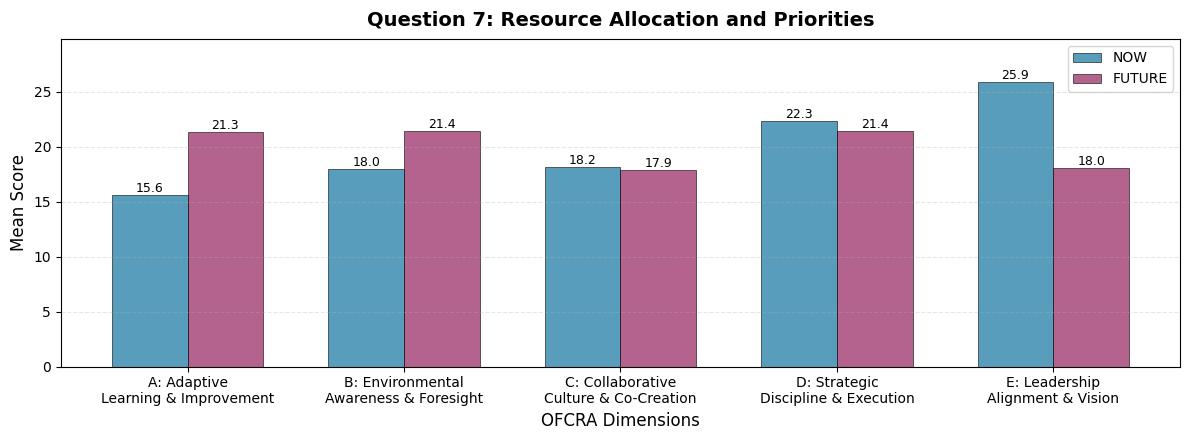
Q7: How does your organization make decisions about where to invest time, money, and attention?
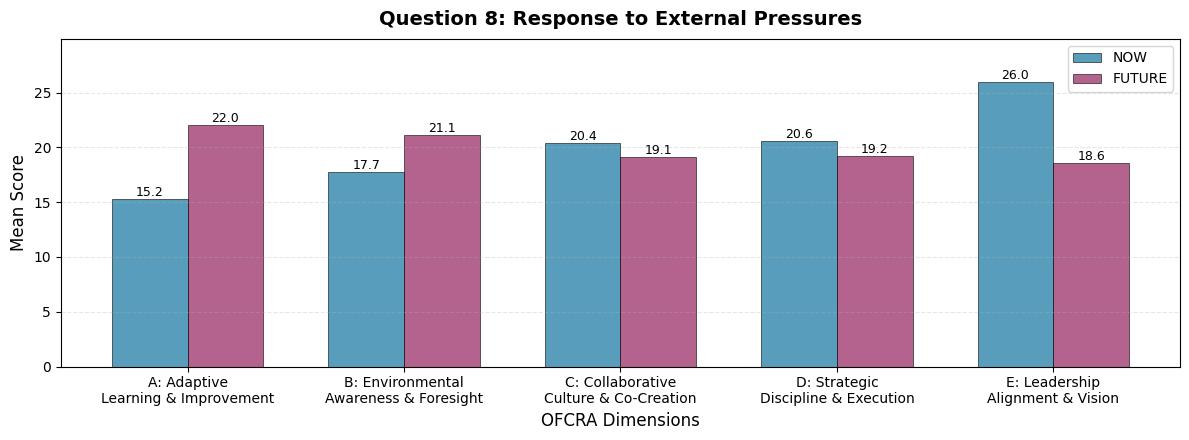
Q8: When external forces create pressure or disruption, how does your organization typically respond?
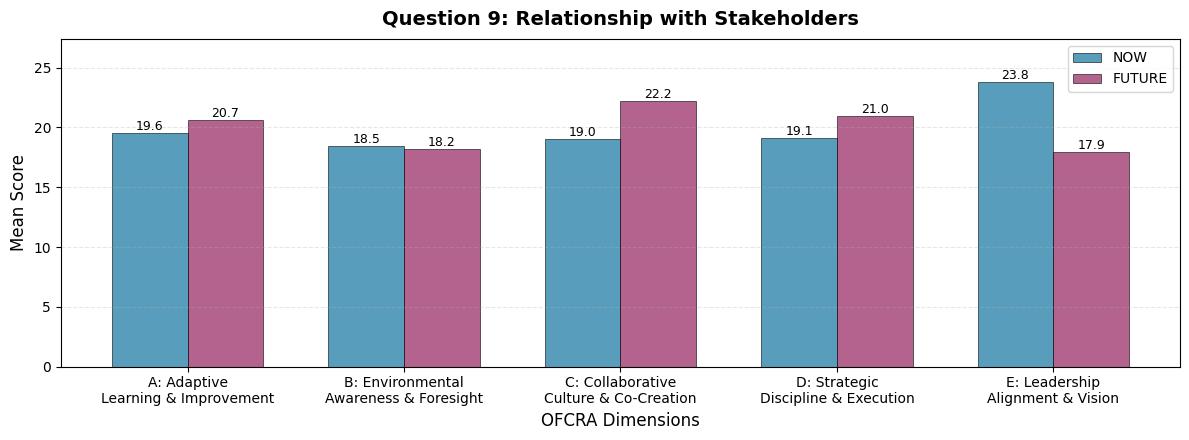
Q9: How does your organization engage with external stakeholders (students, employers, community partners, alumni, funders, etc.)?
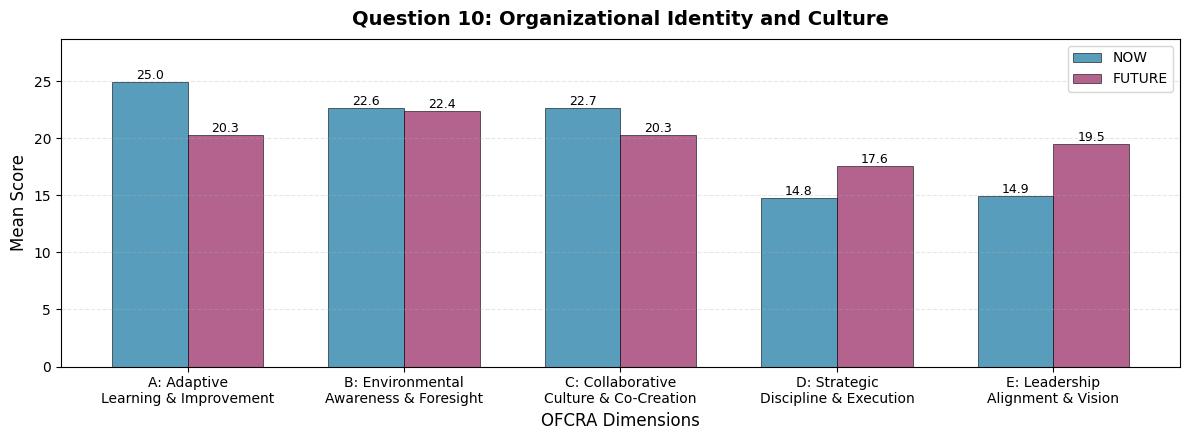
Q10: What gives your organization its distinctive identity and holds it together as a community?
Bar Chart Analysis
TheOFCRAassessment visualizationsprovideaclearcomparisonbetweenColumbiaCollege’scurrent cultural and strategic profile (“NOW”) and the desired future state (“FUTURE”) across ten key organizational dimensions. Each bar chart highlights how respondents perceive the present and what they believe is necessary for the college to thrive over the next five years.
Across most questions, the “FUTURE” bars are generally higher or shifted in emphasis compared to the “NOW” bars, indicating a collective aspiration for growth and transformation. Notably, there is a strong desire to enhance adaptive learning, environmental awareness, and collaborative culture suggesting that stakeholders see flexibility, foresight, and co-creation as critical for future success. The results also show a call for greater strategic discipline and leadership alignment, reflecting the need for clear direction and systematic execution as the organization navigates change.
The analysis reveals that while Columbia College already possesses strengths in several areas, there is a consistent push to become more agile, forward-thinking, and inclusive. The visualizations make it evident that stakeholders recognize the importance of evolving both culture and capabilities to meet emerging challenges and opportunities in higher education.
Direction of Movement Analysis
Most Consistent: Dimension B (Environmental Awareness & Foresight Orientation)
→ Change desired uniformly across all 10 organizational aspects
→ Suggests systemic cultural shift, not isolated improvements
Least Consistent: Dimension E (Leadership Alignment & Vision Clarity)
→ Change varies significantly by question/organizational aspect
→ May indicate selective strengthening in specific areas
→ Review individual questions to identify targeted focus areas
Overall: Change expectations are RELATIVELY CONSISTENT across organizational aspects
→ Organization sees cultural evolution as systemic need
→ Comprehensive transformation approach is appropriate
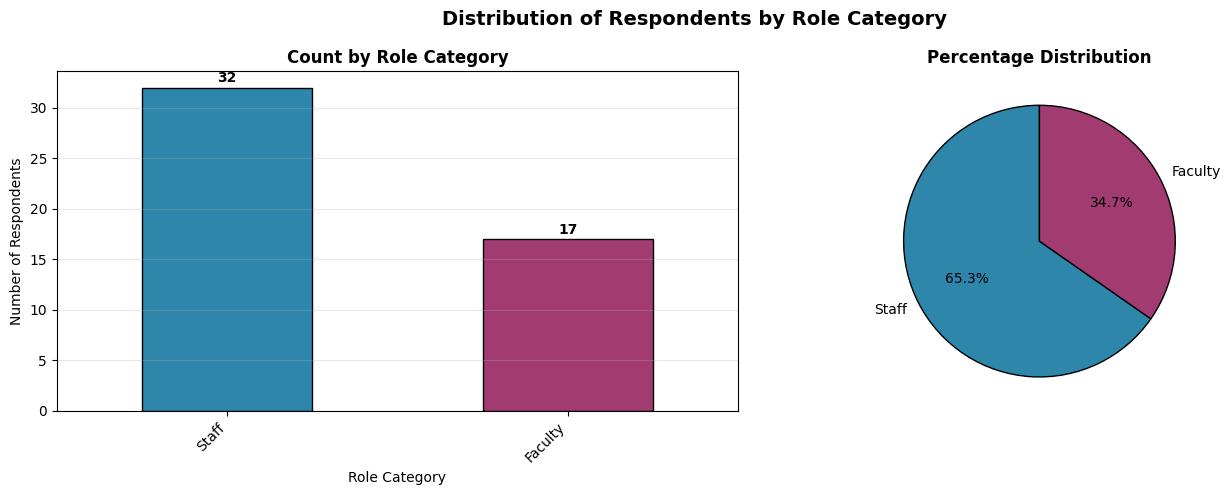
Role Category Distribution
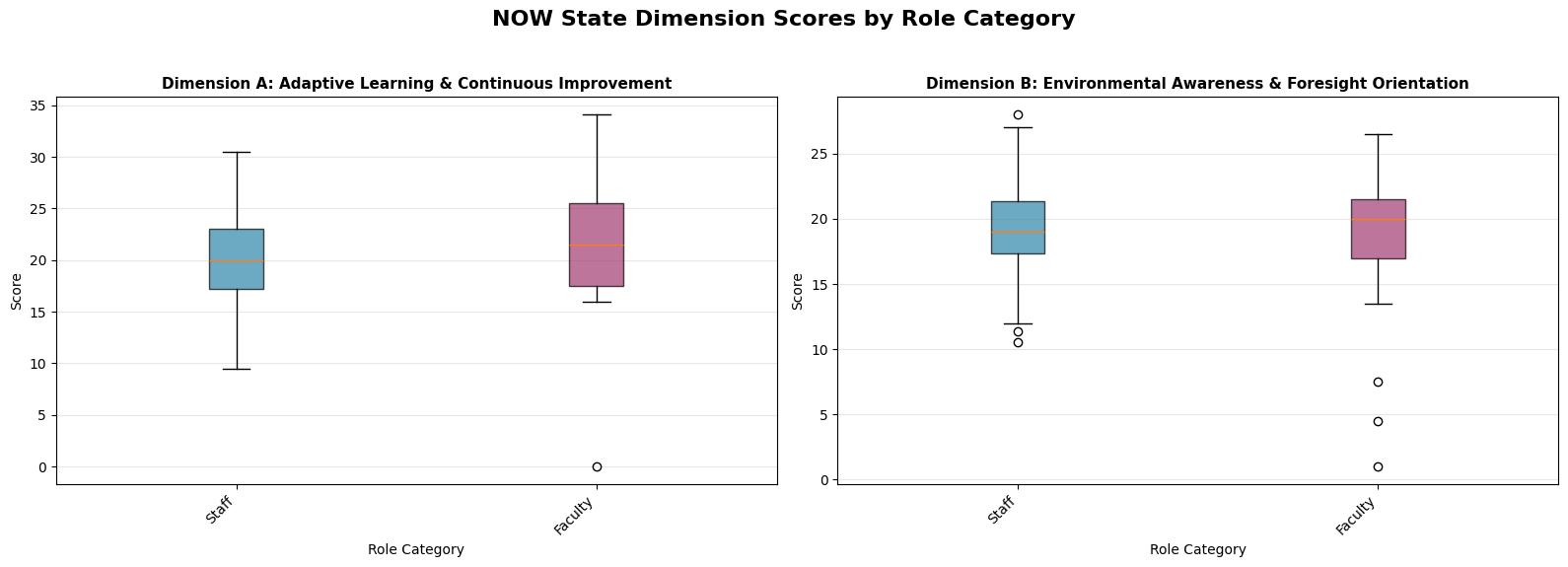
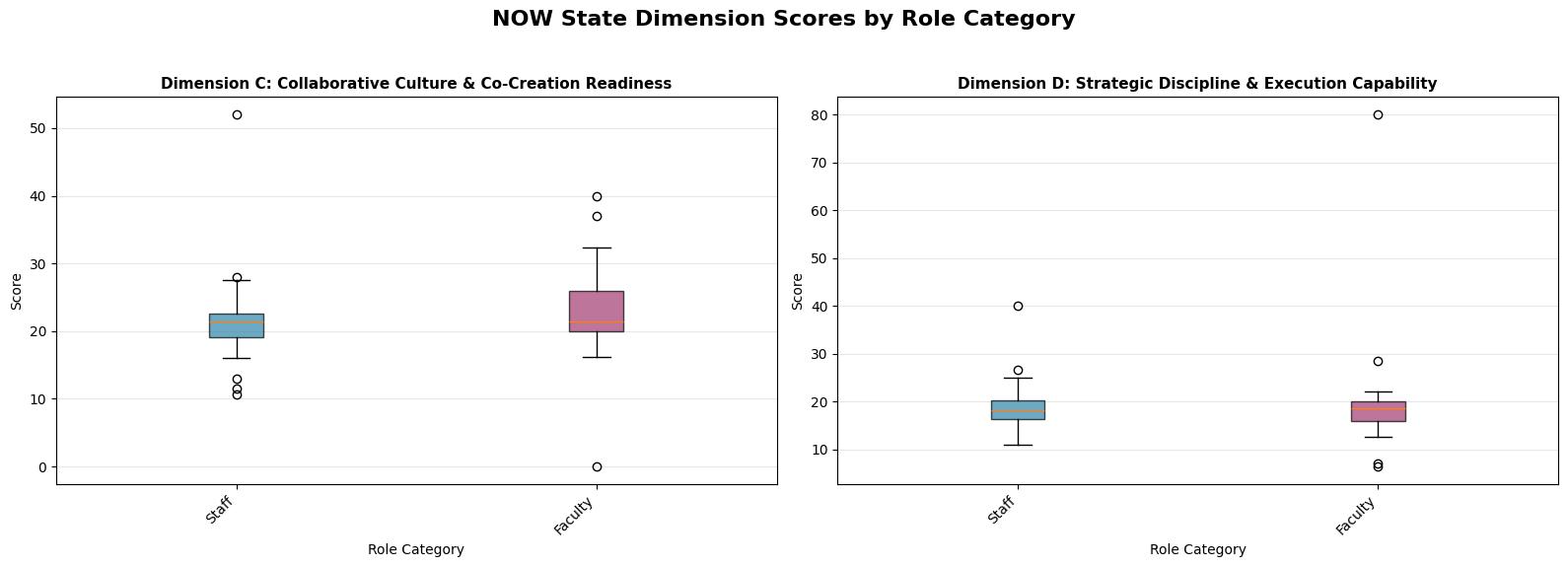
Role-Based Comparison
OFCRA Role Group Analysis: Statistical Testing for Perception Differences
Testing if role groups have significantly different perceptions (α = 0.05)
• Design initiatives that develop these specific capability connections
• Create forums where leaders work on these dimensional linkages together
• Success in one of these areas will reinforce the others
Overall Observations
• Environmental Awareness (Dimension B) shows the largest average gap between NOW and FUTURE states (+2.04 points), indicating a moderate desire for increased external focus.
• Adaptive Learning (Dimension A) is nearly stable (+0.88 points), suggesting little change is expected in flexibility and improvement.
• The overall pattern is Cultural Rebalancing: one dimension is increasing, one is decreasing, and three are stable. The organization appears to be trading off some areas to strengthen others, rather than seeking dramatic change.
• The average gap across all dimensions and questions is 3.06 points, which is considered small. This suggests the organization feels well-positioned or may lack strong change awareness.
• Question-level analysis shows most dimensions have consistent change expectations across questions, except for Leadership Alignment (Dimension E), which varies more and may indicate targeted evolution in specific areas.
• NOW state totals for each question sum to 100 for 98% of respondents, confirming data reliability. Outliers are rare and do not materially affect means.
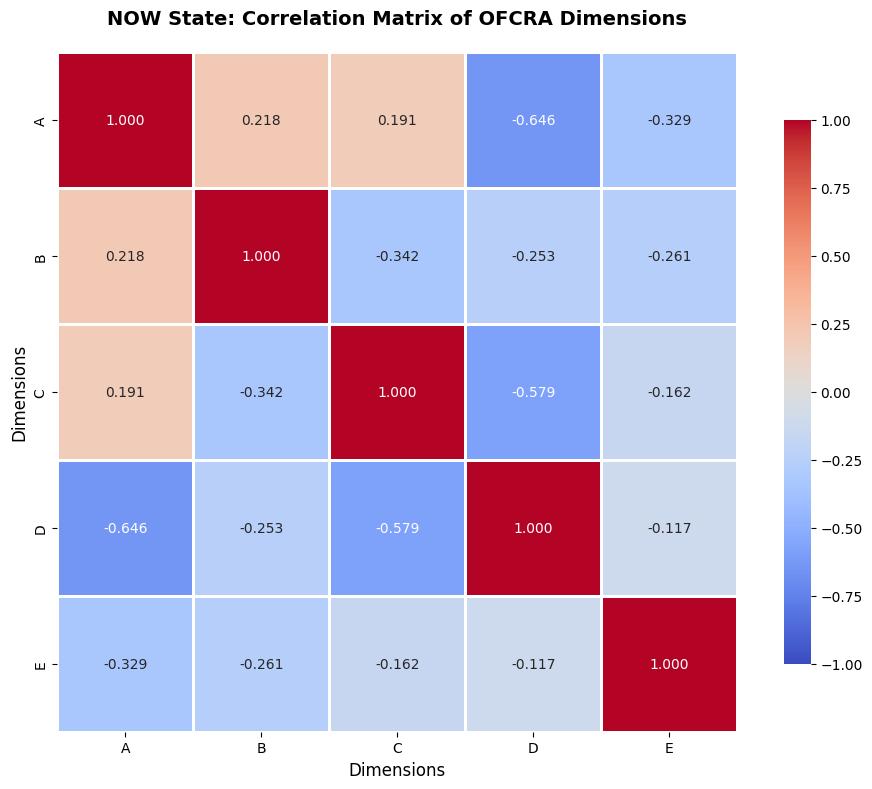
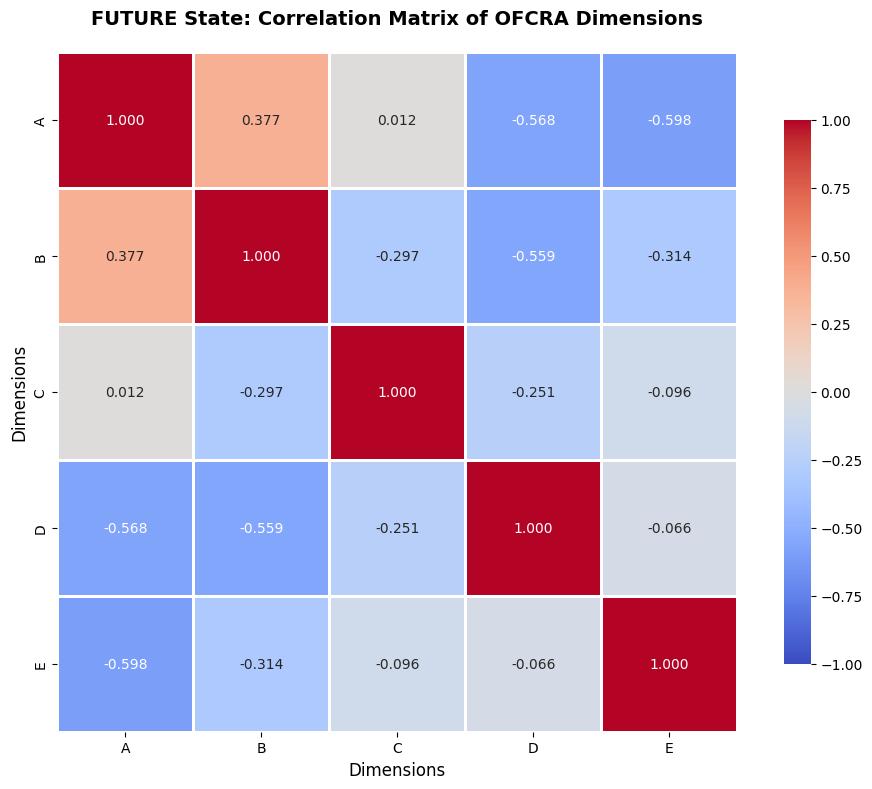
• Correlation analysis: A strong positive correlation (r = 0.62) exists between Adaptive Learning and Environmental Awareness in the NOW state, suggesting these cultural traits are perceived as mutually reinforcing.