PART I. INTEGRATION TEAM STRATEGIC BACKDROP
TOP STRENGTHS TO PRESERVE
The Integration Team identified eight core institutional strengths that represent Columbia's competitive differentiators and must be preserved regardless of future strategic direction:
Core Strength
1. Hands-on Learning
2. Diversity/Inclusion Values
3. Faculty = Practicing Artists
4. Students Help Each Other
5. Location = Chicago as Campus
6. Industry-Ready + Critical Thinking
7. Distinctive Creative Voice
8. Life-Changing Experience
Key Elements & Strategic Value
• Immersive, experiential learning that is hands-on
• DIY worth paying for
• Most diverse destination for creatives
• Comprehensive and contextualized arts & media curriculum
• Peer-support community of creatives that help find connections
• Authentic commitment to diversity and inclusion
• A cool and quirky culture
• Working professionals who bring real-world experience
• Industry connections and current practice
• Bridge between academic learning and professional reality
• Collaborative culture
• "Students find their tribe" environment
• Embedded and connected in Chicago
• Urban campus integrated with the city's creative ecosystem
• Access to professional opportunities and cultural resources
• Graduates prepared for professional practice
• Combination of technical skills and critical thinking
• Workforce preparation with intellectual development
• Unique creative identity and perspective
• Encourages individual artistic expression
• Transformational educational experience
• Personal and professional development
• Students undergo meaningful change during their time at Columbia
CRITICAL PAIN POINTS TO ADDRESS
The Integration Team identified systemic operational challenges that undermine Columbia's competitive positioning and prevent effective leverage of institutional strengths. These pain points are organized by operational category:
Category
Operational Excellence
Leadership & Culture
Critical Pain Points
• Marketing/Storytelling: Failure to communicate unique value proposition
• Curriculum Confusion: Lack of clarity in academic programs and pathways
• Advising Weakness: Inadequate academic support and navigation guidance
• Alumni Disconnection: Weak relationships and underutilized network
• Weak Leadership Decision Making: Ineffective processes and poor strategic decisions
Category
Resource Management
External Relations
Critical Pain Points
• Climate of Fear & Intimidation: Toxic culture hindering open communication
• Disastrous Labor Relations: Poor employee relations and low morale
• Overstretched Staff & Faculty: Unsustainable workloads impacting service quality
• Learning & Development Absent: No professional development opportunities
• Rigor Concerns: Questions about academic standards and quality
• Institutional Complexity: Burdensome processes and excessive bureaucracy
• Underutilized City Integration: Missing Chicago location advantages
• Declining Donor Support: Reduced philanthropic engagement
• Socio-Economic Diversity Challenges: Financial accessibility issues
• Disconnected Initiatives: Lack of institutional coherence
STRATEGIC RELEVANCE TO COMPETITIVE FORCES
The Integration Team's assessment reveals a critical strategic paradox: Columbia possesses genuine competitive advantages but systemic operational failures prevent their effective deployment against external competitive threats. The table below illustrates how internal factors directly impact competitive positioning:
Competitive Force How Strengths Help How Pain Points Hurt
Threat of Substitutes
Hands-on learning cannot be replicated by AI/online programs
Faculty networks provide real industry connections
Community culture missing from gig economy alternatives
Competitive Rivalry
Buyer Power
Distinctive voice differentiates from conservatories
Industry-ready + critical thinking unique vs pure technical/liberal arts
Transformational experience creates high switching costs
Community bonds reduce student leverage
New Entrants Chicago location creates barriers to entry
Established culture difficult to replicate
Supplier Power
Faculty loyalty to Columbia's mission and students
Location attraction draws quality faculty to Chicago
Rigor concerns make alternatives seem equivalent
Alumni disconnection removes proof of value
Marketing failure prevents differentiation
Curriculum confusion makes offerings indistinguishable
Advising weakness increases student complaints
Overstretched staff creates service failures
Weak leadership signals institutional instability
Labor relations create reputation damage
Disastrous labor relations affects faculty retention
No development opportunities undermines faculty growth
METHODOLOGY
This Integration Team Assessment synthesizes insights from Columbia College Chicago's senior leadership through structured facilitation sessions conducted in December 2025. The process involved:
• Consensus Building: Facilitated sessions to achieve leadership agreement on institutional strengths and challenges
• Priority Identification: Focused discussion to distinguish core competitive assets from operational capabilities
• Pain Point Mapping: Systematic identification of operational failures that undermine competitive positioning
• Strategic Relevance Analysis: Connection of internal factors to external competitive dynamics
The assessment prioritizes institutional knowledge and operational experience to provide authentic context for competitive analysis. These findings establish the internal strategic baseline against which external competitive forces can be evaluated and strategic responses developed.
IMPLICATIONS FOR COMPETITIVE ANALYSIS
Strategic Priority Sequence: The Integration Team assessment suggests that Columbia's competitive disadvantage stems not from lack of genuine strengths, but from operational failures that prevent leveraging those strengths effectively. This indicates that fixing critical pain points particularly marketing, advising, and leadership should precede efforts to build new capabilities.
Competitive Positioning Insight: Columbia's unique combination of hands-on learning, practicing artist faculty, and Chicago integration creates genuine differentiation potential. However, this competitive advantage remains latent until operational excellence enables effective market communication and student experience delivery.
Foundation forExternal Analysis: These internalinsights provide essential contextforinterpretinghow Porter's Five Forces impact Columbia's strategic options, market position, and institutional sustainability. The comprehensive competitive analysis that follows builds upon this foundational understanding of Columbia's internal strategic reality.
See Part II, Porter’s Five Forces Analysis on the following page.
FOUR STRATEGIC SCENARIOS
FORCE 1: COMPETITIVE RIVALRY AMONG EXISTING COMPETITORS
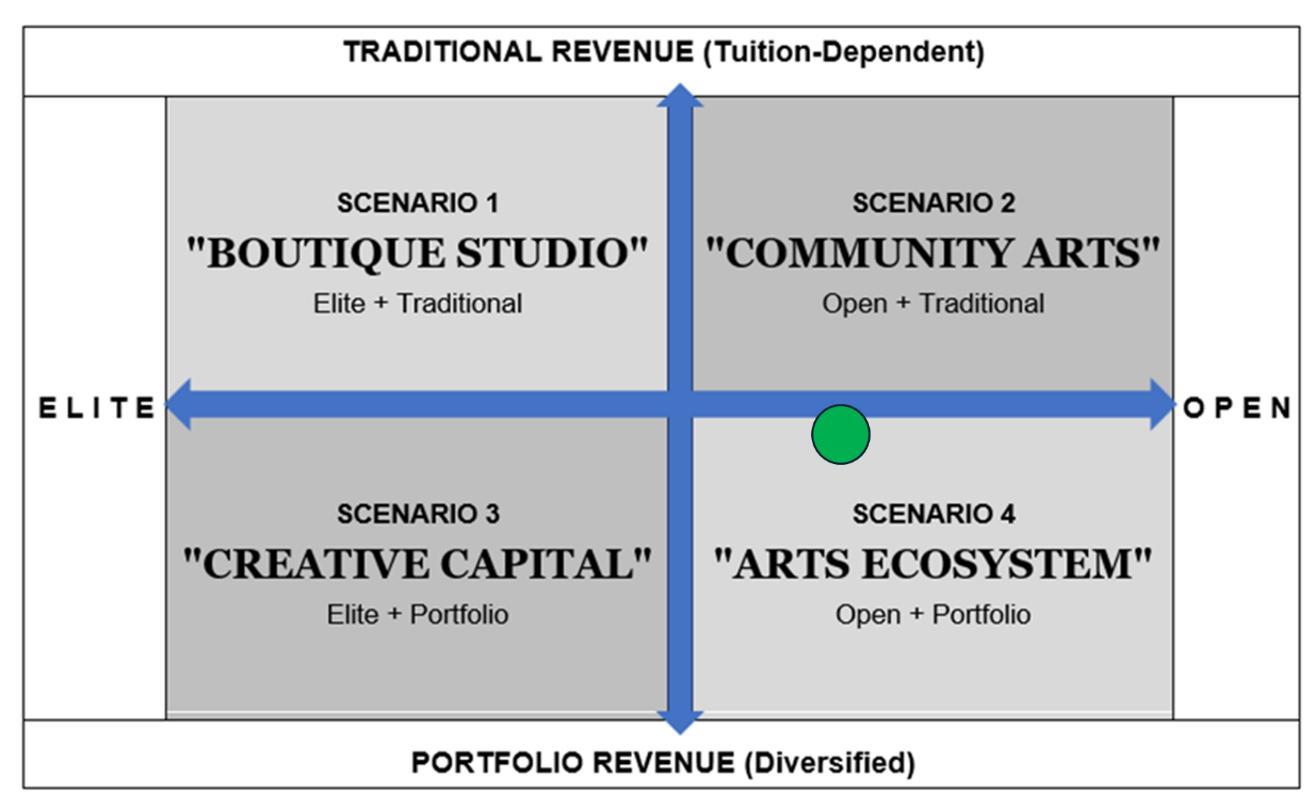
Strategic Positioning Context: Columbia's strategic framework positions the institution within Scenario 4 (Arts Ecosystem), where "Elite" refers to prestigious and selective institutions rather than Harvard-level exclusivity encompassing specialized arts programs with competitive standards and strong brand positioning within creative industries education. Columbia's preferred position targets the upper portion of Scenario 4 (see green dot), representing approximately 4/10 on the Elite-Open scale (moderately selective but accessible) and up to 50% tuition dependence (versus current 93%). This positioning balances Columbia's commitment to diversity, inclusion, and accessibility with the selectivity and revenue diversification necessary for competitive differentiation and institutional sustainability, creating a strategic "accessible excellence" model that serves mission-driven values while ensuring long-term viability in an increasingly hostile competitive environment.
Overall Assessment: MODERATE INTENSITY (6/10 scale)
1.1 Number and Balance of Competitors
Team Consensus: Columbia faces approximately 5-9 direct competitors in the Chicago market for arts-focused business education. This represents a moderate competitive density neither overcrowded nor monopolistic.
Primary Competitors Identified:
● DePaul University (primary rival) Competing aggressively on financial aid with "misleading zerocost offers" that hide Parent PLUS loans
● Roosevelt University
● School of the Art Institute of Chicago (SAIC) Conservatory model focused on fine arts
● Additional Chicago-area institutions (EXC and others mentioned)
Unique Positioning: Columbia occupiesa specializednicheas an "industry-focused business school" forarts and entertainment distinct from pure conservatories (Juilliard, Curtis Institute, SAIC) that "reproduce an existing tradition" without entrepreneurial orientation.
1.2 Industry Growth Prospects
Mixed Outlook with Political Dependency:
● Team Assessment: Growth potential exists within 3-5 years due to anticipated political/economic environment shifts ("as political things change")
● External Trends (STEEPLE Analysis): Declining college-age population (13% by 2041, Illinois -32%) creates structural headwinds
● ROI Crisis: Students considering 4-year degrees dropped from 66% to 52%
● Institutional Closures: One college per week closing nationally
Implication: The arts education sector is contracting overall, making each enrollment increasingly competitive. However, Columbia's unique hybrid positioning (arts + business + entrepreneurship) may tap growing demand for workforce-ready creative professionals.
1.3 Product/Service Differentiation
Columbia's Distinctive Strengths (from stakeholder feedback):
● Hands-on training with professional equipment and facilities
● Faculty are practicing artists/professionals with active industry networks
● "Learn by doing" brand (though poorly communicated)
● Prime Chicago location: "Right across from Grant Park" with 16-17 highly visible buildings creating strong brand presence
● Students "find their tribe" strong peer-to-peer learning community
● Workforce-ready graduates with real-world portfolios
● Diversity and inclusion values authentically embedded in culture
Critical Differentiation Failure: Marketing and Storytelling. Despite genuine strengths, Columbia is failing to communicate its unique value proposition:
● "We are not doing good in telling our story" (faculty/staff consensus)
● "Only the bad stuff gets to the news" reputation management failure
● Notable alumni ("kitchen table names") not leveraged in marketing
● Parents report: "High school counselors trying to deter students from attending" due to negative perceptions
● Website described as "feels like high school, not a college" and "stinks"
● Mission confusion: "Left out core competency... this is an arts school" yet "trying to turn into business school"
Competitor Differentiation Strategy: DePaul's Financial Aid Gamesmanship. DePaul differentiates through deceptive pricing practices:
● Sends letters saying "you're going for free" while hiding Parent PLUS loan requirements
● Students see "zero" cost and choose DePaul over Columbia's transparent $15K net price
● Columbia is "industry leader in Chicago for scholarship games" but presents information transparently, causing sticker shock
● Columbia lists non-billed items ($23K housing estimate, $7K miscellaneous) that competitors omit
Differentiation Gap: “We're somewhere in the middle.” Strategic positioning ambiguity weakens competitive differentiation:
● Not elite like conservatories (Juilliard, Curtis Institute) with 15% acceptance rates
● Not fully open access like community colleges
● Faculty concern: "Making choices constitutes a segment of your population, and everyone's scared to do that"
● Result: "Fudge the choice" leading to blurred identity and weakened market position
1.4 Switching Costs
Student Switching Costs: LOW TO MODERATE
Barriers to switching:
● Specialized equipment training and portfolios created on Columbia systems
● Relationship capital with practicing artist faculty and their industry networks
● Chicago location embeddedness for internships and part-time work
● Transfer credit loss (especially for specialized arts courses)
However, switching enablers reduce barriers:
● Curriculum confusion: "Classes advertised then cut" forces students to reconsider
● Academic advising weakness: "Advisors know little about programs" reduces guidance lock-in
● Course availability issues: "Too many waitlisted courses" creates frustration
● Housing instability: No Columbia-owned housing limits community attachment
● Financial uncertainty: Parents/students openly question "Will the school still be there?"
1.5 Exit Barriers
Institutional Exit Barriers: VERY HIGH
Columbia faces substantial exit barriers:
● Real Estate Portfolio: 16-17 buildings in prime Chicago locations (Grant Park area) with high illiquidity
● Specialized Equipment: Millions invested in professional audio, film, theater production facilities with limited alternative buyers
● Mission Commitment: 130+ year history and deep institutional identity as Chicago's arts college
● Accreditation and Degree-Granting Authority: Substantial regulatory barriers to exit
● Faculty Tenure Obligations: Long-term employment commitments
Alternative Exit Scenario Discussed: Acquisition
Team member prediction: "I see Columbia in 5 years being purchased by someone... If it [the institution] stays around, I see Columbia being on the door [for acquisition]."
● Historical precedent cited: Kendall College acquired by National Louis University
● Potential acquirers: Another university or for-profit education company
● Value proposition foracquirer: Prime real estate, establishedbrand, specialized facilities, diverse student population
FORCE 2: THREAT OF NEW ENTRANTS
Overall Assessment: MODERATE TO HIGH THREAT
2.1 Evidence of New Competition
"Huge increase of music business programs popping up at universities across the nation" Direct quote from staff with firsthand recruitment experience
Example: University of Colorado Boulder
● Launched new music business program targeting Columbia's niche
● Competitive advantage: "Significantly cheaper to live in Boulder than Chicago"
● Not traditionally a "creative hub" but building capacity
● Leveraging existing university infrastructure (housing, student services, alumni networks)
2.2 Barriers to Entry
HIGH BARRIERS (Protecting Incumbents):
● Capital Requirements: Specialized arts facilities require $millions in equipment (recording studios, production facilities, theater spaces)
● Faculty Networks: Columbia's practicing artists have deep industry connections built over decades
● Location Premium: Chicago's creative industry ecosystem and prime downtown real estate are irreplicable
● Brand Recognition: 130+ years as Chicago's arts college creates substantial brand equity
● Accreditation: NASAD, HLC, and specialized program accreditations take years to obtain
MODERATE/LOW BARRIERS (Enabling New Entrants):
● Traditional universities can add specialized programs without building new institutions
● Lower cost structures in smaller markets (Boulder, Nashville, etc.) offset facility investments
● Technology reduces capital requirements (digital production tools, online collaboration platforms)
● Industry professionals willing to teach part-time are widely available
● Student price sensitivity makes premium Chicago location less valuable: "Significantly cheaper to live in Boulder"
2.3 Non-Traditional Entrants: Alternative Delivery Models
Team concern: "There are some people that's like, hey, it doesn't have to be universities, it could be... it could be programs that may substitute what we do, and no longer a need for Columbia, because they could do it in some other way."
Emerging alternative models:
● Corporate Training Programs: Companies like Spotify, Live Nation creating internal creative business academies
● Bootcamp Models: Intensive 12-week programs in specific skills (audio engineering, music production) at fraction of degree cost
● Online Platforms: MasterClass, Coursera, LinkedIn Learning offering courses taught by industry icons
● Apprenticeship/Mentorship Networks: Direct industry placement without degree requirement
● AI-Enabled Learning: Personalized creative skill development through AI tutors and feedback systems
2.4 Retaliation by Incumbents
Columbia's Limited Capacity for Retaliation:
● Financial Constraints: Current revenue crisis ($70M, 93% tuition-dependent) limits aggressive competitive responses
● Price Competition Difficult: Already "industry leader in scholarship games" with limited room to increase aid
● Geographic Lock-in: Cannot relocate to lower-cost markets without losing core identity
● Operational Complexity: 16-17 buildings and 60+ programs create inflexibility
Potential Retaliatory Strengths:
● Alumni Network: "Alumni doesn't leave Chicago" could activate for recruitment and fundraising
● Real Estate Leverage: Underutilized buildings ("14th floor of 624 building, 20% usage") could enable corporate partnerships
● Brand Repositioning: "Learn by doing" could be powerfully communicated if marketing improved
FORCE 3: THREAT OF SUBSTITUTES
Overall Assessment: HIGH AND ACCELERATING THREAT
This is the most severe competitive force facing Columbia, with multiple substitute pathways threatening the traditional arts degree model.
3.1 AI as Creative Substitute
"AI as competitor in higher ed" identified as one of the top STEEPLE trends
● 49% of Gen Z believe AI has reduced the value of college education
● AI can now generate music, visual art, video content, writing core Columbia competencies
● Question posed: "Are the graduates career ready? Will these majors become irrelevant due to AI?"
● Conservatory vulnerability: Schools like SAIC "probably won't have their AI in creativity conversation" leaving graduates unprepared
● Columbia opportunity: "How do we teach the student to tap into and harness the power of AI so they can use AI as a resource/tool in their field?"
3.2 Gig Economy as Degree Substitute
"Gig economy dominance" STEEPLE trend with 85M jobs displaced, 97M new roles by 2025
● Students can earn creative income (Fiverr, Upwork, YouTube, Patreon) without degree credentials
● Portfolio/reputation economy: "Show me your work" replaces "Show me your degree"
● Columbia students already working "50+ hours per week" while taking 15 credit hours degree may be unsustainable burden
3.3 Community Colleges as Low-Cost Substitute
Students questioning value proposition:
● Student concern about rigor: Course "too easy" prompts response "Why am I paying for this? Go to a community college"
● Students asking: "Can I test out of this?" due to prior experience
● Community colleges offer first two years at fraction of cost, with articulation agreements for transfer
● For students seeking technical skills only, community college + YouTube may suffice
3.4 Alternative Credentials and Micro-Credentials
Non-degree pathways proliferating:
● Industry certifications (Pro Tools, Avid, Adobe) carry weight with employers
● Professional development workshops and bootcamps (12-week intensive programs)
● Corporate training programs with direct job placement
● Online learning platforms (MasterClass, Skillshare) taught by industry leaders at $15-30/month vs $34K/year tuition
3.5 Direct Industry Entry
Bypassing formal education entirely:
● Apprenticeships and mentorships in creative industries
● Production assistant roles leading to career advancement through experience
● Entrepreneur path: Start creating immediately with low-cost tools and distribute via digital platforms
● Columbia's ownmissionsupportsthis:"Workforce-readygraduates" implies practicalskills>theoretical knowledge
3.6 Conservatory Model Vulnerability
Critical insight from faculty: "Juilliard is a conservatory. The Curtis Institute of Music is a conservatory. They create... they keep the pipeline of practitioners in existing fields, creative disciplines... If it becomes harder to make a living as a musician, as a fine artist, they're in a bit of trouble, because they're not really oriented to think entrepreneurially. It's not their model, it's just not what they do."
Implications:
● Pure conservatories (SAIC, Juilliard) reproduce existing traditions without adaptation
● If traditional creative careers decline, conservatory model fails
● Columbia's hybrid model (arts + business + entrepreneurship) better positioned than conservatories
● However, if substitute pathways (AI, gig economy) dominate, even hybrid models may struggle
3.7 Return on Investment Crisis
Students increasingly questioning degree value:
● STEEPLE trend: Students considering 4-year degree dropped from 66% to 52%
● $34,000 annual tuition vs uncertain creative industry income creates difficult ROI calculation
● Parent concern: "Is college a value add? What is student/college exposure in various industries? What is the impact? Where is all this data?"
● Alumni outcomes data apparently unavailable or not systematically tracked
● Federal student loan caps for undergraduates create affordability ceiling
FORCE 4: BARGAINING POWER OF BUYERS (STUDENTS/FAMILIES)
Overall Assessment: HIGH AND INCREASING POWER
4.1
Price Sensitivity
Team Assessment: "Primarily affordable" but with critical vulnerabilities
Student Financial Profile:
● 54% of students from Illinois (high geographic concentration)
● "Close to half" are federal Pell Grant recipients (low-income)
● Large percentage receive Illinois MAP grants (state need-based aid)
● Chicago-area high-achieving students often attend "for free" (Pell + MAP + institutional aid covers full tuition)
● Student population "largely very dependent on financial aid"
Price Comparison Behavior:
● Students actively compare offers: "Can you give me... I really want to come to Columbia, but they're giving me a better scholarship at [competitor]"
● Sticker price matters: "Students see zero [at DePaul] and go, great, that's giving me more money"
● Cost of living comparison: "Significantly cheaper to live in Boulder than Chicago"
● Students working multiple jobs to afford attendance: "Working 50+ hours per week and taking 15 credit hours"
4.2 Critical Dependency: Federal Financial Aid
MAJOR THREAT: Department of Education Uncertainty
Team assessment of DoE abolishment likelihood: 2.8/5 (moderate probability)
Impact scenario:
● "If we see an abolition of the Department ofEducation, I'm worried about affordability" Financial aid director quote
● Pell Grants eliminated: Approximately 50% of students lose primary funding source
● Federal student loans eliminated: Remaining students cannot finance attendance
● Illinois MAP grants uncertain: State aid may not compensate for federal loss
● Institutional aid insufficient: Columbia "industry leader in scholarship games" but cannot replace $billions in federal aid
● Potential enrollment collapse: "This is a big threat"
4.3 Information Asymmetry and Transparency
Columbia's Transparency as Competitive Disadvantage: "The problem is that I run into when Imeet students for financial aid is we are transparent toa fault." Financial aid staff quote
Examples of transparency hurting Columbia:
● Lists full cost-of-attendance including non-billed items: "Housing can cost up to $23,000, a charge that's not required, and also it doesn't cost $23,000. It costs, on average, $14,600"
● Shows "miscellaneous expenses can cost up to $7,000" that Columbia doesn't actually charge
● Result: "Studentscometomeand say, why do Iowe$15,000to Columbia?And Igo, actually, you don't"
● Must educate students: "Here's why [DePaul] is lying to you, and here's why you don't actually owe $15,000"
Competitor advantage through opacity:
● • DePaul sends "you're going for free" letters hiding Parent PLUS loan requirements
● • Parents must repay loans "immediately, not after 4 years" but this isn't disclosed upfront
● • Students choose based on perceived zero cost vs Columbia's honest $15K net price
4.4 Buyer Concentration and Volume
Student Market Characteristics:
● Declining pool: 13% decline in college-age population by 2041 nationally, Illinois -32%
● Increasing selectivity: Students considering 4-year degree dropped 66% → 52%
● Each student more valuable: Falling enrollment means losing a single student has greater impact
● Team realism: "Regardless of what we decide, I truly believe we have to learn to live with a student population of only about 3,500"
● Down from peak: "In our heyday with 14,000 students" now ~4,000 and declining
4.5 Switching Costs for Buyers
LOW switching costs increase buyer power:
● Pre-enrollment: Students apply to multiple schools and compare offers freely
● Post-enrollment: Transfer barriers exist but operational failures reduce switching costs:
○ Course availability problems: "Too many waitlisted courses"
○ Curriculum instability: "Classes advertised then cut"
○ Advising weakness: "Advisors know little about programs"
● Parent sentiment: "Are they going to be here for them to graduate?” This is a weakness in recruiting; this instability keeps people from enrolling
4.6 Buyer Information and Sophistication
Increasingly Informed Buyers:
● "We get most of our information from the closed FB Parents group since the website isn't useful" Parents bypassing official channels
● "Student newspaper provided more reliable information than official communications" Trust in peer sources over institution
● Parents comparing data: "When I asked for employability data, what is the impact, where is all this data? They don't have or can't produce answers"
● High school counselors influencing decisions: "Counselor trying to deter student from attending"
● Social media amplifying concerns: Stability questions circulating among prospective families
4.7 Substitute Product Availability
Abundant alternatives give buyers leverage:
● Other arts schools in Chicago: DePaul, Roosevelt, SAIC
● Lower-cost options: Community colleges, online programs, bootcamps
● Non-degree pathways: Gig economy, apprenticeships, direct industry entry
● Geographic alternatives: "Music business programs popping up... significantly cheaper to live in Boulder"
● Result: Students hold credible threat of choosing alternatives, increasing negotiating power
FORCE 5: BARGAINING POWER OF SUPPLIERS
Overall Assessment: LOW TO MODERATE POWER
5.1 Faculty as Critical Suppliers
Faculty Power Assessment: MODERATE
Faculty as differentiation drivers:
● "Faculty are practicing artists" identified as top strength by all stakeholder groups
● Industry networks are faculty-owned: "Alumni reaches out to faculty looking for ways to connect with students"
● Parents value "industry-experienced professors" as key differentiator
● Students: "Faculty knows moreaboutwhat's going on"thanadvisors bypass formalstructurestoreach faculty
● Recruitment depends on faculty: "Prospective students don't need polish and professionalism; they need uncut and unpolished [authentic faculty interactions]"
Factors limiting faculty power:
● Large supply of qualified candidates: "Industry professionals willing to teach part-time are widely available"
● Part-time faculty prevalence: "Leverage PT faculty; their networks, availability, and resources"
● Recent cuts: Loss of working professionals impacts differentiation but reduces costs
● Exhaustion reducing retention: "I'm teaching so much that I don't have time for my craft and to stay current/relevant in my field. I'm student-facing 36+ hours per week"
● Administrative burden: "There is a disconnect withadministration... Students needengagement, support, and expertise from admin, but can't get appointments. So we try to fill into various roles, which takes away from our faculty responsibilities"
5.2 Real Estate as Supplier
Real Estate Power Assessment: MODERATE (Mixed Asset)
Positive aspects:
● Prime location: "Right across from Grant Park" major tourist and commuter visibility
● Brand recognition: "I only knew Colombia because of the building" real estate as marketing
● Students from suburbs: "I've never visited campus, but I see it all the time"
● Untapped partnership potential: "14th floor of 624 building, 20% usage... if we partner with organizations... use our real estate, give our students internships"
● Revenueopportunity:"OrganizationsleavingChicagobecauseofwhatthemayorisdoing... wetellthem, hey, come here"
Negative aspects:
● "Too many buildings" 16-17 buildings exceed operational capacity
● "Too many buildings that are not functional or do not fit into what we really want"
● No housing ownership: "We no longer own any housing... any summer programs are very expensive for students"
● Revenueconstraint:"Wewanttomakemorerevenuedoingthingsoutsidethenormal,likeinthesummer, and we can't, because we have no place to put [students]"
● Student complaint: "There isn't enough time to get from one side of campus to the other" scattered buildings hurt student experience
● Wrap-around costs: "Maintaining buildings a little more costly, energy may be a little more costly"
5.3 Technology and Equipment Suppliers
Equipment Power Assessment: LOW
● Competitive market for audio, video, production equipment
● Multiple vendors (Avid, Adobe, Apple, Blackmagic, etc.) create supplier competition
● Educational pricing reduces supplier power
● Student strength: "Worker space... the worker space is phenomenal... some equipment is super specialized, only a few places in the entire nation have this equipment" proprietary tech creates dependency
● Operational issue: "Not helpful when closed during evenings and weekends" access problems reduce equipment value
5.4 Government and Accreditation Bodies
Regulatory Power Assessment: HIGH
● Accreditation required for federal aid eligibility (HLC, NASAD)
● State authorization for degree-granting
● Federal financial aid programs: 50% of students depend on Pell Grants
● Department of Education uncertainty: "2.8/5 likelihood of abolishment" creates extreme regulatory risk
● HSI designation: "Should lean into HSI identity for funding but not depend totally" 30% Hispanic student population
● NEA/NEH grants: Political uncertainty around arts funding
5.5 Support Services and Other Suppliers
Healthcare/Insurance Power: MODERATE-HIGH
● "Healthcare, mental health costs skyrocketing" wrap-around cost increases
● Student needs: "There is mental health available? It would be nice to know about it" underutilized but essential service
● Cut services: "Doctor visits, there used to be a doctor on site but was cut due to budget"
● Student mental health crisis: "68% report mental health affecting academics" (note: actual validated figure is 37.4%)
IT/Systems Power: LOW
● • Competitive market for learning management systems, student information systems
● • Student complaint: "Columbia Central does everything with multiple logons there are 8 different logons!" integration failures
● • Need for SSO (single sign-on) indicates poor vendor integration management
STRATEGIC IMPLICATIONS AND RECOMMENDATIONS
Industry Attractiveness Assessment
Overall Industry Attractiveness: UNFAVORABLE AND DETERIORATING
The convergence of high buyer power, high substitute threats, and moderate-to-high new entrant threats creates an increasingly hostile competitive environment for traditional tuition-dependent arts education. Columbia faces a strategic inflection point requiring fundamental business model transformation.
Critical Success Factors
Based on Porter's Five Forces analysis, Columbia must excel in:
1. Revenue Diversification (Addresses: Buyer Power, Substitute Threat)
● Move from 93% tuition-dependent to 58% by 2030 (Scenario 4: Arts Ecosystem)
● Seven revenue streams:
● Target: $120M total revenue by 2030 (+$50M from current $70M)
2. Clear Differentiation and Brand Communication (Addresses: Competitive Rivalry)
● Fix marketing failure: Shift from "only bad stuff gets to the news" to proactive storytelling
● Clarify positioning: Arts + Business + Entrepreneurship (not pure conservatory, not traditional university)
● Leverage distinctive strengths:
○ "Learn by doing" with professional equipment
○ Practicing artist faculty with industry networks
○ Chicago location and real estate visibility
○ Diverse, inclusive community where students "find their tribe"
● Showcase notable alumni ("kitchen table names")
● Redesign website to professional standards
● Combat negative perceptions among high school counselors through data and success stories
3. Operational Excellence and Student Experience (Addresses: Buyer Power, Switching Costs)
● Fix course availability: Eliminate waitlist frustrations
● Strengthen academic advising: "Advisors need to know programs" current state unacceptable
● Curriculum clarity: Stop advertising then cutting classes
● Simplify systems: Single sign-on instead of "8 different logons"
● Transparent communication: "Open, transparent dialogue with community" about financial standingand direction
● Real estate optimization: Consolidate from 16-17 buildings to 2-5, monetize unused space
● Housing strategy: Partner with developers for Columbia-affiliated housing to enable summer revenue programs
4. AI Integration as Core Competency (Addresses: Substitute Threat)
● Differentiate from conservatories: "SAIC probably won't have their AI in creativity conversation"
● Teach students to "harness the power of AI as a resource/tool in their field"
● Position as leader in AI-augmented creative education
● Address faculty concern: "Are graduates career ready? Will these majors become irrelevant due to AI?"
5. Financial Aid Independence Strategy (Addresses: Buyer Power, DoE Threat)
● Reduce dependency on federal aid (currently 50%+ students on Pell Grants)
● Build endowment from $0 to $30M by 2030 through alumni engagement and corporate partnerships
● Develop institutional aid programs less vulnerable to political changes
● Lean into HSI designation for federal funding while diversifying beyond single source
● If DoE eliminated (2.8/5 probability), institutional capacity to support students becomes competitive advantage
Scenario 4: Arts Ecosystem Strategic Fit with Porter's Forces
The "Arts Ecosystem" future (open access + diversified portfolio) directly addresses the competitive forces identified:
VS. COMPETITIVE RIVALRY:
● Differentiates from conservatories (SAIC, Juilliard) through entrepreneurship + AI integration
● Differentiates from traditional universities (DePaul, Roosevelt) through "learn by doing" + caring institution
● Occupies unique position: Only place combining arts + business + community + support
VS. BUYER POWER:
● Open access maintains mission alignment with 50% Pell Grant population
● Diversified revenue reduces tuition dependency, enabling more aid flexibility
● Multiple touchpoints (alumni subscriptions, corporate certs, incubator) increase customer lifetime value
● 42% non-tuition revenue by 2030 creates buffer against DoE elimination
VS. SUBSTITUTE THREAT:
● SCNC re-enrollment ($7M) serves gig economy workers needing credentials
● Corporate certificates compete with bootcamp models at competitive price
● Business incubator provides alternative to immediate job market entry
● AI integration makes degree more valuable than AI-only learning
● Alumni subscriptions create lifelong learning model competing with MasterClass/Coursera
VS. NEW ENTRANTS:
● Leverage established Chicago presence and 130-year brand
● Corporate partnerships (real estate + internships) create barriers new entrants cannot replicate
● Alumni network in Chicago creates self-reinforcing ecosystem
● Multiple revenue streams create financial resilience that discourages competitive entry
VS. SUPPLIER POWER:
● Diversified revenue enables competitive faculty compensation despite tuition constraints
● Real estate partnerships monetize underutilized assets
● Reduced dependence on federal financial aid suppliers (DoE)
● Multiple revenue streams enable investment in mental health and student support services
CONCLUSION
Columbia College Chicago operates in an industry with unfavorable structural dynamics: high buyer power, high substitute threats, and increasing new entrant pressure create difficult competitive conditions. The traditional tuition-dependent model (Scenario 2: Community Arts) is not viable given these forces.
However, Porter's Five Forces analysis also reveals Columbia's unique competitive position: the intersection of arts education, business training, entrepreneurship development, and caring community support represents genuine differentiation unavailable from conservatories, traditional universities, or alternative pathways.
Success requires:
1. Immediate migration toward Scenario 4 (Arts Ecosystem) revenue diversification
2. Aggressive fixing of operational failures that increase buyer power and switching costs
3. Clear, compelling brand communication ending the storytelling failure
4. AI integration as competitive differentiator vs. both conservatories and substitutes
5. Financial aid independence strategy to buffer against DoE elimination threat
Thewindow for transformationis narrow. Asoneteammember noted:"I seeColumbiain5yearsbeingpurchased by someone... if we stay around." The alternative to strategic transformation is not maintaining the status quo it is acquisition or closure.
Columbia possesses the assets required for success: prime real estate, practicing artist faculty, diverse student community, Chicago location, and authentic mission. The strategic imperative is execution: moving from "we're not doing good in telling our story" to becoming the exemplar of arts education reimagined for the AI age.