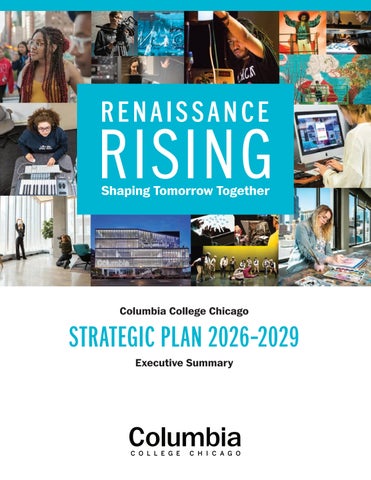
Columbia College Chicago Strategic Plan Executive Summary
Part 1: Introduction
Part 2: Mission, Purpose, and Vision
Part 3: Strategic Planning Process and Stakeholder Engagement
Part 4: Pillars, Objectives, and Actions
Strategic Pillar 1: Stabilizing Enrollment
Strategic Pillar 2: Elevating the Columbia Brand
Strategic Pillar 3: Strengthening Philanthropy
Strategic Pillar 4: Enhancing Operational E ectiveness
Part 5: Next Steps
PART 1: INTRODUCTION
Columbia College Chicago has always stood apart. Since its founding, the College has focused on preparing students not just to study creative fields, but to work in them, lead within them, and reshape them. at commitment to practical, career focused creative education remains the core of our mission.
Renaissance Rising: Shaping Tomorrow Together outlines how Columbia will sustain and strengthen that mission in the years ahead. e framework reflects both pride in our 135-year history and a clear recognition that the environment around us has shi ed. Higher education is evolving. Creative industries are transforming. Financial models are tightening. In this context, clarity and alignment are essential.
e plan is organized around four institutional priorities that define our path forward. We will focus on stabilizing and strengthening enrollment, elevating the College’s brand and national standing, deepening alumni and philanthropic engagement, and strengthening operational e ciency and systems to ensure long-term sustainability. ese priorities are interconnected. Enrollment depends on reputation. Reputation depends on program strength and student success. Sustainability depends on disciplined operations and diversified revenue.
Each initiative included in this Executive Summary identifies a clear purpose, outlines specific actions, and defines measurable indicators of progress. is approach ensures that the plan is not aspirational language alone, but a working framework for decision making and accountability.
Our history reminds us that Columbia thrives when it balances creativity with responsiveness. e College has reinvented itself before, expanding programs, embracing new technologies, and responding to shi s in culture and industry. Renaissance Rising continues that tradition with intentional focus.
At its heart, this plan a rms a simple truth. Columbia exists to prepare students to shape the culture of their time. By strengthening our foundation, sharpening our priorities, and aligning our work around shared values, we position the College not only to endure but to lead in the decades ahead.
Woven into the deep, rich DNA of Columbia’s culture, we strive to always have a “Student First” mentality when making all decisions, which results in faculty and sta demonstrating care, engagement, and accountability that is visible in both actions and outcomes. Further, grounded in academic experience and experiential learning, e orts are underway to integrate these approaches into each classroom where possible, to enhance academic rigor and student development that is applied, immersive, and career connected. And finally, to ensure there is a deliberate focus on the student experience, an investment in faculty and sta remains a priority so the individuals on their academic journey continue to be enhanced by skilled, qualified, members of the Columbia Team where our culture must always reflect care for students and commitment to excellence.
PART 2: MISSION, PURPOSE, AND VISION
Our Mission:
Columbia College Chicago is an undergraduate and graduate institution whose principal commitment is to provide a comprehensive educational opportunity in the arts, communications, and public information within a context of enlightened liberal education. Columbia’s intent is to educate students who will communicate creatively and shape the public’s perceptions of issues and events and who will author the culture of their times. Columbia is an urban institution whose students reflect the economic, racial, cultural, and educational diversity of contemporary America. Columbia conducts education in close relationship to a vital urban reality and serves an important civic purpose by active engagement in the life and culture of the city of Chicago.
Columbia’s purpose is:
•to educate students for creative occupations in diverse fields of the arts and media and to encourage awareness of their aesthetic relationship and the opportunity of professional choice among them;
•to extend educational opportunity by admitting unreservedly (at the undergraduate level) a student population with creative ability in, or inclination to, the subjects of Columbia’s interest;
•to provide a college climate that offers students an opportunity to try themselves out, to explore, and to discover what they can and want to do;
•to give educational emphasis to the work of a subject by providing a practical setting, professional facilities, and the example and guidance of an inventive faculty who work professionally at the subjects they teach;
•to teach students to do expertly the work they like, to master the crafts of their intended occupations, and to discover alternative opportunities to employ their talents in settings other than customary marketplaces;
•to help students to find out who they are and to discover their own voices, respect their own individuality, and improve their self-esteem and self-confidence;
• to offer specialized graduate programs which combine a strong conceptual emphasis with practical professional education, preparing students with mature interests to be both competent artists and successful professionals.
Vision for the Future:
Renaissance Rising: Shaping Tomorrow Together articulates a unified institutional strategy to align the college’s academic programs, financial models, and operational systems with the needs of our students and the realities of the creative economy. In developing and implementing this plan, Columbia will clarify its strategic goals, sharpen its competitive identity, and set a course for the future that supports institutional excellence.
PART 3: STRATEGIC PLANNING PROCESS AND STAKEHOLDER ENGAGEMENT
e strategic planning process was launched in October 2025 and is being overseen by a Strategic Planning Task Force with faculty, sta , student, senior administration, alumni, and community representation. Specific recommendations have come from four workstreams with similar stakeholder profiles:
• e Enrollment and Academic Portfolio Workstream explored strategies to attract, retain, and support a talented student body while strengthening the college’s academic o erings.
• e Brand, Reputation, and Philanthropy Workstream considered how to elevate Columbia’s public identity and engage alumni, donors, and partners in expanding the college’s reach and impact.
• e Financial and Operational E ciency Workstream focused on improving institutional systems, structures, and processes to enhance fiscal sustainability and performance.
• e People and Culture Workstream considered the college’s shared commitment to community, ensuring that Columbia remains an inspiring and inclusive place to learn and work.
Over 600 stakeholders contributed to the development of this strategic plan through a comprehensive informationgathering process. e e ort was led by the Dickens Consulting Group (DCG) of San Antonio, Texas. In December 2025, a DCG team conducted an intensive ten-day series of focus groups, interviews, and surveys with key stakeholder groups across the college community.
During this period, the team engaged trustees, members of the President’s Cabinet, senior and mid-level administrators, sta , academic directors from the college’s eight schools, full- and part-time faculty, students, alumni, parents and families, and community partners. In total, 70 in-person and virtual focus groups, interviews, and strategic sessions were held with approximately 350 participants. An additional 235 individuals provided input through online surveys, and 50 stakeholders completed an Organizational Foresight and Cultural Readiness Assessment, bringing the total number of contributors to more than 600.
e planning process also incorporated several strategic analysis tools. ese included a STEEPLE environmental scan—examining Social, Technological, Economic, Environmental, Political, Legal, and Ethical factors shaping higher education—and an analysis of the college’s competitive environment using Michael Porter’s Five Forces framework. Together, these inputs provided a broad, data-informed foundation for identifying priorities and shaping the strategic direction of the college.
PART 3: STRATEGIC PLANNING PROCESS AND STAKEHOLDER ENGAGEMENT (continued)
Task Force Members
Jenna Davis, Student Government Association President
Kevin Cooper, Associate Director of Semester in LA Program and Professor in the School of Film and Television
Karla Rae Fuller, Faculty Senate President and Professor in the School of Film and Television
Allison Geller, Sta Union President
Mark Kelly, Art and Civic Community Member – ex o cio
Emmanuel Lalande, Senior Vice President of Enrollment Strategy and Student Success
Mary Mazurek ‘11 MFA, National Alumni Board President
Suzanne McBride, Interim Senior Vice President and Provost
Jimmy Noriega, Professor and Allen and Lynn Turner Director of School of eater and Dance
Colbey E. Reid, Professor and Director of the School of Fashion
Diana Vallera, CFAC President and Adjunct Professor of Instruction in School of Visual Arts
Sharon Wilson-Taylor, Vice President of Student A airs
Co-Chairs: Beth Ryan, Professor of Instruction, School of Business and Entrepreneurship and Adriel A. Hilton, Vice President of Institutional Strategy and Chief of Sta
Enrollment and Academic Portfolio Workstream Members
Charles Borg — Adjunct Professor of Instruction, School of Film and Television
Jill Goldberg — Communications Manager
Ames Hawkins, PhD — Professor and Interim Director, School of Communication and Culture
Rachel Horton — Director of Student Persistence
Monika Jaiswal-Oliver — Academic Manager, Business and Entrepreneurship
Brian Marth — Associate Vice President for Student Success (Co-Chair)
Tim McCain — Adjunct Professor of Instruction, School of eatre and Dance
Dardi McGinley-Gallivan — Professor of Instruction, School of eatre and Dance
Ross Sawyers — Associate Professor, School of Visual Arts
Je Sanderson — Columbia Central Counselor
Skye Rust — Senior Director of Undergraduate Admissions and Recruitment
Lauren Targ — Assistant Director, College Advising O ce
Wenhwa Tsao — Professor and Interim Co-Director, School of Film and Television (Co-Chair
Brand, Reputation, and Philanthropy Workstream Members
Zeline Bates — Adjunct Professor of Instruction, School of Communication & Culture
Gabriela Diaz de Sabatés — Associate Professor and Associate Dean for Faculty A airs
Marcus Hamlin — Assistant Director of Alumni Relations and Annual Giving
Abby Hernandez — Student, AMA President
Sandra Kumorowski — Associate Professor of Instruction, School of Business and Entrepreneurship
Deana Lewis ’05 — Senior Director of Marketing, e Mather Group LLC
Allen Lucas — Coordinator of Student Organizations
Duncan MacKenzie — Associate Professor and Interim Director of the School of Visual Arts
Peg Murphy — Associate Professor, School of Business and Entrepreneurship
PART 3: STRATEGIC PLANNING PROCESS AND STAKEHOLDER ENGAGEMENT (continued)
Anna Ogier-Bloomer — Associate Dean for Career Development and Industry Relations Partners
Jim Rohn — Associate Professor, School of Design
Rajah Varnado — Assistant Director of New Student Programs
Lauren Viera — Adjunct Professor of Instruction, School of Communication and Culture
Jourdan Arnaud ompson — Senior Director of Campus Communications (Co-Chair)
Kubi Uner — Chair of the Graduate Council; Associate Professor and Graduate Director, School of Audio and Music (Co-Chair)
Michelle West — Assistant Director, Semester in L.A.
Financial and Operational E ciency Workstream Members
Chris Adamescu—Chief Information Security O cer
Nate Bakkum — Senior Associate Provost
Laura Bauknecht — Director of Academic Operations
Jerry Brindisi — Professor and Interim Director of the School of Business and Entrepreneurship (Co-Chair)
Natasha Egan — Executive Director of the Museum of Contemporary Photography (Co-Chair)
Marvery Gri n — Assistant Provost of Finance
Matthew Jaehrling — Associate Vice President, Controller and Treasurer
Ginny Johnson — Assistant Vice President for Student Financial Services
Ann P. Kalayil – Associate Vice President, Facilities Planning and Management
Jasmyn Leapheart — Assistant Director of Admissions and New Student Scholarships
John Losacco — Assistant Professor of Instruction, School of Design
Bernie Mack — Adjunct Professor of Instruction, School of Audio and Music
Devon Polderman — Academic Manager, School of Communication and Culture
Jesse Seay — Associate Professor, Associate Dean for Academic Programming
Susan Van Veen — Adjunct Professor of Instruction, School of Business and Entrepreneurship
Rebecca Urzua — Student, School of Audio and Music
People and Culture Workstream Members
Matthew Eiler-Rillie — Coordinator of Education and Community Development
Taylor Hokanson — Associate Professor, School of Visual Arts
Lambrini Lukidis — Associate Vice President for Strategic Communications and External Relations
Nick McCormick — Adjunct Professor of Instruction, School of Communication and Culture
Jesus Monroy — Admissions O cer – Transfer Specialist
Charee D. Mosby-Holloway — Director of Student Diversity and Inclusion (Co-Chair)
Patricia Olalde — Associate Vice President, Human Resources (Co-Chair)
Pegeen Quinn — Associate Provost for Academic Personnel
Ron Sodini — Associate Vice President for Safety and Security
Laura Sturm — Adjunct Professor of Instruction, School of eatre and Dance
Krista Wortendyke — Assistant Professor of Instruction, School of Design
PART 4: PILLARS, OBJECTIVES, AND ACTIONS
At Columbia College Chicago, the President has set forth a vision for renewal under the theme of “Renaissance Rising ”. Her strategic priorities are focused on strengthening the institution today while building a sustainable and vibrant future. These four priorities provide a roadmap for Columbia to thrive as a global center for creativity, innovation, and education.
STABILIZING ENROLLMENT ELEVATING THE BRAND
STRENGTHENING PHILANTHROPY
ENHANCING OPERATIONAL EFFECTIVENESS
STABILIZING ENROLLMENT
PART 4: PILLARS, OBJECTIVES, AND ACTIONS (continued)
Strategic Pillar 1: Stabilizing Enrollment
Columbia is committed to attracting, supporting, and retaining students from Chicago, across the United States, and around the world. Expanding access remains a central priority, with initiatives such as direct-admit pilots and stronger partnerships with community colleges and Chicago Public Schools. At the same time, Columbia is strengthening retention e orts through advising, academic support, and bridge programs designed to ensure student success from enrollment to graduation. By focusing on both access and persistence, Columbia will continue to build a global community of creatives.
Improve Student Experience and Increase Retention
Why is Matters: Student success is shaped by academic, financial, and co-curricular experiences. Focusing on the full student journey improves outcomes for students while supporting enrollment stability.
Key Strategic Actions:
a.Articulate a Student Success Mission Statement and map the end-to-end student journey to identify key friction points and support gaps
b. Establish a standard of service that embeds a culture of care, with shared principles across all units to drive accountability and continuous improvement.
c. Strengthen academic advising, early alert, and student success interventions by leveraging opportunities in the new SIS and Advising so ware to identify leading indicators and more quickly support students’ academic progress and holistic wellbeing.
d. Launch a 360-degree student support model within the Center for Student Success (Summer 2026) that integrates academic and student a airs—delivering coordinated digital and in-person services to address student barriers and strengthen community and belonging.
e. Expand targeted financial support and proactive outreach for at-risk students
f. Improve coordination between academic a airs and student a airs services
g. Use student feedback and data to continuously improve the student experience through recurring Student Success Surveys and other accountability-driven feedback mechanisms.
h. Design a four-semester curricular experience (starting with the first-semester Big Chicago course) for new students that provide support and connection both in and out of the classroom
Metrics of success:
•First-to-second year undergraduate retention rate (Baseline: 66%, Target 2029: 70%)
•Increase the number of students taking advantage of resources like the Academic Center for Tutoring, Center for Student Wellbeing, Financial Wellness seminars (Baseline: 15% Target 2029: 45%)
Stabilize and Right-Size the Academic Portfolio
Why is Matters: is clarifies who we are as an institution: a creative hub where rigorous liberal arts education intersects with professional practice. Academic o erings must remain nimble and expansive—responsive to emerging creative fields, evolving technologies, and workforce needs—while grounded in clear program priorities. Strong industry relationships will inform curriculum design, learning outcomes, and pathways to employment, ensuring graduates are prepared for contemporary creative careers.
PART 4: PILLARS, OBJECTIVES, AND ACTIONS (continued)
Key Strategic Actions:
a. Invest in state-of-the art equipment and technology tied to curricular advances
b. Conduct a comprehensive program review using enrollment, cost, brand impact, outcome data
c. Identify programs for growth, redesign, consolidation, or teach-out
d. Align faculty hiring, workload, and course scheduling with portfolio decisions
e. Develop new interdisciplinary or market-responsive programs where demand exists
f. Establish a recurring academic portfolio review cycle
Metrics of Success:
• Define enrollment and net contribution thresholds including other qualitative cultural, brand and identity measures
•Average class fill rate across undergraduate programs (Baseline: 89%, Target 2029: 90%)
•Undergraduate first-to-second year retention rate (Baseline: 66%, Target 2029: 70%)
Expand Adult, Graduate, and Non-Traditional Education Pathways
Why is Matters: Traditional undergraduate demand alone will not support long-term institutional stability. Expanding access for adult, graduate, and non-traditional learners allows the college to serve new populations while better utilizing existing academic and operational capacity.
Key Strategic Actions:
a. Launch high-margin continuing education, certificate, and pre-college programs aligned with the college’s creative mission
b. Develop online and hybrid graduate programs targeting working professionals
c. Pilot accelerated degree options for select undergraduate majors using year-round and intensive scheduling
d. Establish weekend and evening programming utilizing campus facilities during o -peak hours
e. Build corporate and industry partnerships to deliver employer-aligned credentials and workforce education
f. Create a distinct online and continuing education brand to support national reach and visibility
•Number of active industry and employer education partnerships (Baseline: 4, Target 2029: 15)
ELEVATING THE BRAND
PART 4: PILLARS, OBJECTIVES, AND ACTIONS (continued)
Strategic Pillar 2: Elevating the Columbia Brand
Columbia’s reputation as a college for creatives must be amplified nationally and internationally. e institution is investing in telling its story more powerfully showcasing excellence in film, television, music, design, media, theatre, and the arts. Leveraging its unique location in Chicago’s South Loop, Columbia is positioning itself as a premier destination for creative education and cultural engagement. By elevating the brand, the Columbia ensures that its students, faculty, and alumni receive the recognition they deserve as leaders in shaping culture.
Align Institutional Brand to Drive Engagement and Investment
Why is Matters: Clearly communicating our shared story—our mission, impact, and strategic priorities—while simultaneously building an e ective and e cient development operation will help pave a pathway for compelling engagement and transformative philanthropy.
Key Strategic Actions:
a.Reputation management and amplification. Advertorial placements, op-ed placements, continue thought leadership and public opportunities, continue with advertising and marketing campaigns for FY 26.
b. Unify the brand and streamline messaging. Conduct a comprehensive brand audit informed by stakeholder input, market research, and peer analysis.
c. Activate an updated, mission-aligned value proposition and messaging framework across external audiencesrecruitment, advancement, and alumni communications.
•Consistency of brand messaging across major platforms (Baseline: informal | Target 2027: 100% aligned)
STRENGTHENING PHILANTHROPY
PART 4: PILLARS, OBJECTIVES, AND ACTIONS (continued)
Strategic Pillar 3: Strengthening Philanthropy
For Columbia to realize its full potential, philanthropy is essential. e President has placed a strong emphasis on expanding the College’s fundraising capacity and cultivating deeper engagement with alumni, civic leaders, and philanthropic partners. Gi s to Columbia support scholarships, academic programs, facilities, and student experiences that transform lives. Strengthening philanthropy is not only about dollars raised, but about building a culture of generosity and investment in Columbia’s future.
Strengthen Philanthropy and Engagement
Why is Matters: For Columbia to realize its full potential, it will be essential to create meaningful pathways for philanthropy and engagement. Over the next three years, Columbia aspires to establish an e cient and e ective Development and Alumni Relations (DAR) team rooted in best practices and a constituent-first mindset that supports and amplifies the college’s mission to provide comprehensive educational opportunities for students pursuing creative careers.
Establish an e cient and e ective DAR team to better serve internal partners and external stakeholders.
a. Review and revise the DAR team structure to better support institutional e orts.
b. Hire and retain experienced sta , particularly major gi o cers and advancement services roles to best support fundraising goals and the donor life cycle.
c. Provide professional development training and encourage connections for peer learning. (annual therea er)
d. Audit operations to identify, and ultimately address, functional shortcomings, including completing the transition to a new Customer Relationship Management (CRM) so ware.
Metrics of Success:
•Increased knowledge and experience within DAR (update JDs and secure new hires)
•Increased fundraising productivity (meeting/exceeding established metrics)
• Active CASE membership and participation
•Increased contributed income to the College (goal to raise $5M annually by end of year 3)
Align philanthropic e orts with institutional mission, vision, and branding.
a. Partner with school leadership on annual plans that outline funding priorities, key alumni partners, potential prospects, and fundraising and/or stewardship events/opportunities, among other information. (annually therea er)
b. Create and implement an annual calendar of key annual fundraising events and stewardship touchpoints, including endowment reporting, scholarship meetings, giving days, peer-to-peer fundraising events, and appreciation-based events. (annually therea er)
c. Rebuild strategic e orts around institutional fundraising, including working with Columbia leadership to build philanthropic support into existing vendor contracts. (ongoing therea er)
Metrics of Success:
•Better rapport with school leadership and clearer pathways for support (outlined in annual plans)
•Clear calendar of activity around philanthropy/stewardship (outlined in annual plans)
• Augmented vendor partnerships (outlined in vendor contracts/separate agreements)
•Donor-first relationships (ask to capacity and welcome multi-interest approaches)
•Materials to support fundraising e orts (one-pagers, brochures, webpages)
•Top three donor market engagement (markets defined and shared)
PART 4: PILLARS, OBJECTIVES, AND ACTIONS (continued)
Create pathways for engagement that promote and amplify Columbia’s mission and institutional priorities with its various constituents.
a. Review the National Alumni Board’s (NAB) mission and revise/expand e orts targeting market-based engagement, support, and activation, as well as launch a sponsorship-based model for Creative Homecoming Weekend. (annually therea er)
b. Create and implement an annual calendar of events and engagement opportunities in key philanthropic and constituent markets anchored in demonstrating student, faculty, and alumni success. (annually therea er)
c. Partner with institutional and school leadership to identify and promote opportunities for alumni to leverage their experiences and expertise, including through recruitment and student retention e orts, as well as classroom mentorship and industry connections. (annually therea er)
Metrics of Success:
•Sponsorship-based Creative Homecoming Weekend (sponsorships created and each NAB member brings on one partnership)
•Top three alumni market engagement (markets defined and shared)
•Leveraging alumni for mentorship and industry connections (3-5 activations within each school)
• College-wide council established (2-3 members per school/area)
Expand and leverage partnerships to enhance academic and career opportunities for students
Why is Matters: To strengthen enrollment, enhance student career outcomes, and diversify revenue, the College must move from ad hoc partnerships to a coordinated, strategic partnership strategy that elevates the brand, helps attract new students, creates paid internships and job paths for students, helps inform programmatic decisions, and generates revenue through sponsorships and paid space rentals, while generating leads for scholarships, grants and Columbia Agency engagements.
Key Strategic Actions:
Build 10 anchor partnerships in Year 1, and 10 in each of year 2 and 3, that will be measured by their contributions to the following: paid internships, and opportunities for employment, joint activities that enrich students’ academic experience, joint communications that elevate Columbia’s brand, paid space rentals and Columbia agency engagements, sponsorships and grants, and other revenue-generating activities. To be considered an anchor partnership, a partnership must meet at least 2 goals of the above
Metrics of Success:
•Number of active industry & community partnerships (Baseline: FY ’26 total | Target 2029: FY26+35%)
•Student participation in internships, co-ops, and experiential learning opportunities (Baseline: FY26 total | Target 2029: FY26+35%)
• Revenue generated through partnership-based programs, sponsorships and related activities: (Baseline: FY26 total | FY26+35%)
• Employer and partner satisfaction with student engagement and collaboration (Baseline: measure by June 1, 2026, | Target 2029: ≥85% positive)
ENHANCING OPERATIONAL EFFECTIVENESS
PART 4: PILLARS, OBJECTIVES, AND ACTIONS (continued)
Pillar 4: Enhancing Operational E ectiveness
Operational strength is the foundation of institutional sustainability. Columbia is aligning resources to ensure financial stability while advancing e ciency, transparency, and accountability across all areas of the College. By improving the systems and structures that support teaching and learning, Columbia will be better positioned to deliver on its mission and adapt to a rapidly changing higher education landscape. Enhancing operations ensures that creativity is supported by sound management, enabling Columbia to thrive for generations to come.
Why is Matters: As the institution navigates change and positions itself for its renaissance, organizational performance is critical. is initiative seeks to build a high-accountability, high-trust, execution-oriented culture that operates with shared understanding and that consistently delivers on institutional priorities.
Key Strategic Actions:
a.Establish Leadership Expectations and Accountabilities
b. Improve Leader Capability & Enhance Coaching
c. Establish Role Clarity, and Define and Fill Talent Needs
d. Strengthen Faculty & Sta Performance & Accountability
e. Clarify and Improve How Decisions Get Made
f. Reward & Reinforce What We Prioritize and Value
Metrics of Success:
•Leaders with documented performance goals aligned to strategy: 0% g100%
Why is Matters: Physical and Digital infrastructures are misaligned with demand, fixed costs and increase in operational complexity. Right-sizing physical infrastructure (e.g., consolidating underutilized classrooms, o ces, etc.) and optimizing digital infrastructure (e.g., reducing redundant ERP systems) while increasing automation) will reduce institutional risk, improve service quality, and redirect resources toward mission-critical priorities.
PART 4: PILLARS, OBJECTIVES, AND ACTIONS (continued)
Key Strategic Actions:
a. Conduct an audit of space utilization, classroom scheduling, and o ce allocation and align building operating hours.
b. Develop a space consolidation and repurposing plan to reduce underutilized facilities and deferred maintenance liability.
c. Renegotiate major technology and vendor contracts to reduce costs.
d. Modernize and rationalize IT systems, licenses, and platforms to eliminate redundancy, and realize savings.
e. Increase adoption of existing IT tools through training and awareness to improve productivity and service quality.
f. Evaluate strategic outsourcing opportunities for non-core functions using mission alignment, service quality, cost-benefit criteria, and reduce institutional risk.
g. Assess sta ng structures to reduce duplication and optimize role alignment through redeployment and upskilling, improving e ciency and driving sustainable cost savings.
h. Expand sustainability initiatives, i.e. Green Buildings program that reduce both environmental impact and operating costs
i. Increase transparency in financial reporting for campus stakeholders
Metrics of Success
• Percentage reduction in underutilized space and operating hours (Baseline: 15% vacancy, 38% underutilized, Target 2029: ≤20%)
• Annual savings from technology contract renegotiation and system consolidation (Baseline: $0, Target 2029: $1.5M annually)
•Number of enterprise systems and so ware licenses retired or consolidated (Baseline: 96, Target 2029: 65)
• Reduction in utility and energy costs per square foot (Baseline: $1.79/s , Target 2029: $3.80/sq )
Strengthen Financial Sustainability and Cost Discipline
Why is Matters: Rising costs and constrained revenue demand more deliberate financial stewardship. is initiative ensures resources are allocated transparently and strategically to protect academic quality and institutional resilience.
Key Strategic Actions:
a.Examine and reduce overall college-wide overhead costs to align with current enrollment
b. Consult real estate expertise to dramatically downsize the physical size of campus
c. Implement a multi-year financial planning and forecasting model tied to strategic priorities
d. Establish clear cost-management guidelines and accountability across divisions
e. Conduct targeted reviews of high-cost and low-return operational areas
f. Align budget development and resource allocation with strategic initiatives
g. Streamline the procurement process to improve transparency, reduce complexity, increase operational e ciency, and drive cost savings.
h. Increase transparency in financial reporting for campus stakeholders.
PART 4: PILLARS, OBJECTIVES, AND ACTIONS (continued)
•Ratio of unrestricted reserves to annual operating expenses (Baseline: 0.35, Target 2029: 0.60)
•Percentage of budget aligned to strategic initiatives (Baseline: 40%, Target 2029: 75%)
•Growth rate of operating expenses compared to revenue growth (Baseline: +4.5%, Target 2029: ≤ revenue growth)
Expand and Diversify Non-Tuition Revenue Streams
Why is Matters: With 93% of institutional revenue derived from tuition, the college is highly vulnerable to enrollment volatility, making revenue diversification essential to long-term financial stability and strategic flexibility.
Key Strategic Actions:
a. Identify and prioritize non-tuition revenue opportunities aligned with mission and existing assets
b. Expand professional, continuing, and certificate programs using current faculty expertise
c. Centralize events planning to increase summer, conference, and event utilization of campus facilities
d. Strengthen grant development and sponsored research support
e. Develop partnerships with employers, community organizations, and regional institutions.
Measures of Success:
• Percentage of total revenue from non-tuition sources (Baseline: 7%, Target 2029: 15%)
• Net revenue generated from professional, continuing, and certificate programs (Baseline: $0.6M, Target 2029: $2.5M)
•Annual revenue from auxiliary and facility use (Baseline: $1.1M, Target 2029: $2.0M)
• Number of active external partnerships generating revenue (Baseline: 6, Target 2029: 20)
PART 5: NEXT STEPS
The President and the Board of Trustees have approved the Strategic Plan, and the College will now move forward with implementation and the communication of key strategic priorities and actions that will guide the institution’s future direction.
The College is deeply appreciative of the engagement, feedback, and contributions provided throughout the planning process by students, faculty, staff, alumni, parents, trustees, community leaders, and institutional stakeholders. Their collective input helped shape a plan grounded in institutional excellence, student success, innovation, and long-term sustainability.
As Columbia College Chicago advances Renaissance Rising: Shaping Tomorrow Together, the institution will continue working collaboratively across the campus community to operationalize strategic priorities, align implementation efforts, and advance the College’s mission with clarity, accountability, and shared purpose.