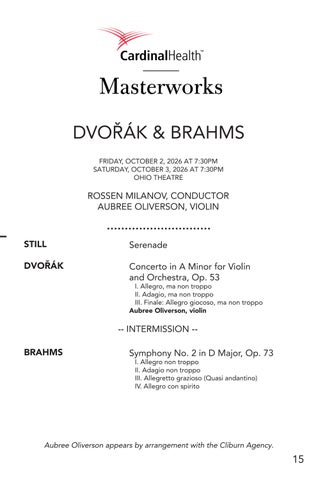
DVOŘÁK & BRAHMS FRIDAY, OCTOBER 2, 2026 AT 7:30PM SATURDAY, OCTOBER 3, 2026 AT 7:30PM OHIO THEATRE
ROSSEN MILANOV, CONDUCTOR AUBREE OLIVERSON, VIOLIN
............................. STILL
Serenade
DVOŘÁK
Concerto in A Minor for Violin and Orchestra, Op. 53
I. Allegro, ma non troppo II. Adagio, ma non troppo III. Finale: Allegro giocoso, ma non troppo Aubree Oliverson, violin
-- INTERMISSION -BRAHMS
Symphony No. 2 in D Major, Op. 73 I. Allegro non troppo II. Adagio non troppo III. Allegretto grazioso (Quasi andantino) IV. Allegro con spirito
Aubree Oliverson appears by arrangement with the Cliburn Agency.
15
AUBREE OLIVERSON, violin Praised for her evocative lyricism and joyful, genuine approach, young American violinist Aubree Oliverson is proving to be one of the most compelling artists of her generation, distinguishing herself with clear, honest, and colorful performances, which have been described as “powerful … brimming with confidence and joy” by the Miami New Times. Recent highlights include solo engagements with the San Diego Symphony/Edo de Waart, Utah Symphony/Ludovic Morlot, Pacific Symphony/ Alexander Shelley, Florida Orchestra/Kensho Watanabe, Buffalo Philharmonic/Anthony Parnther, Charleston Symphony/Carl St. Clair, and North Carolina Symphony/Carlos Miguel Prieto, along with a seven-concert summer tour with the Utah Symphony. Aubree continues to build an international presence through recent orchestral appearances with the Royal Liverpool Philharmonic Orchestra, Orquesta Clásica Santa Cecilia, Brno Philharmonic, Zagreb Philharmonic, Thailand Philharmonic, and Israel Camerata Jerusalem, among others. The violin concertos she has championed vary widely, from cornerstones of the repertoire such as Barber and Dvorák, to lesser-known works by Pergolesi (1730s) and Julius Conus (1896), Mieczysław Weinberg’s Concertino (1948), Reena Esmail’s The Blue Room (2007), and Salvatore di Vittorio’s Voyages of Aeneas (2022). Of a recent performance of Weinberg’s Concertino, San Francisco Classical Voice wrote, “Her performance combined exquisite virtuosity with deep emotional expression.” Aubree has collaborated with distinguished artists including Gil Shaham, performing Bach’s Double Concerto with the Orchestra of the Americas and most recently in chamber music at the Aix-en-Provence Easter Festival; with Anne Akiko Meyers in duo works by Bach, Glass, and Halvorsen (after Handel). She has appeared in recital with Jean-Yves Thibaudet and toured together as a chamber music partner in European capitals including London, Dublin, Berlin, and Paris. Recorded in Aspen in the summer of 2025 with pianist Yanfeng Tony Bai, her debut solo album, Aubree Oliverson: Live from the Aspen Music Festival, was released in June 2026. Oliverson is a graduate of the Colburn Conservatory, where she studied with Robert Lipsett. She plays a Giovanni Battista Guadagnini violin, thanks to the generosity of the Barthelemy family through the Beare’s International Violin Society and the Château de Larraldia, France.
16
PROGRAM NOTES Serenade (1957)
by William Grant Still (Woodville, Mississippi, 1895 - Los Angeles, 1978) This is the first Columbus Symphony performance. Duration: 10’ William Grant Still’s Afro-American Symphony (1930) was a landmark in the music history of this country as the first symphony by a Black composer to be performed by a major orchestra. The premiere, given by the Rochester Philharmonic, was followed by several more performances and made Still’s name known throughout the United States and beyond. Having moved from New York to Los Angeles in 1934, Still was active as an arranger in the film studios, while continuing to compose concert works, including four more symphonies and no fewer than nine operas. Over the years, he received several commissions from prestigious places, yet one of his most endearing shorter works, Serenade, was written for teenage musicians -- students at Great Falls High School in Montana. The work has since been taken up by many professional orchestras, who have found great pleasure in its delicate melodies and sensitive orchestration. The Serenade follows a simple ABA form, with a slower “A” and a slightly faster “B” section. It has particularly attractive parts for harp, flute, and clarinet.
Concerto in A Minor for Violin and Orchestra, Op. 53 (1879)
by Antonín Dvořák (Nelahozeves, Austrian Empire [now Czech Republic], 1841 – Prague, 1904) Most recent Columbus Symphony performance: October 15-16, 2004; Günther Herbig conducting; Giora Schmidt, soloist. Duration: 31’
Audiences and critics tend to agree: Dvořák’s sole violin concerto, tonight’s Opus 53 in A minor, is both an enjoyable piece to listen to and an excellent example of the violin concerto as a form. Why, then, is it performed relatively infrequently, last heard played by this orchestra over two decades ago? Perhaps it is because Dvořák, although he wrote a great violin concerto, is better remembered for writing one of the greatest cello concertos (at a time when relatively few had been composed for it, before composers like Elgar, Barber, and Shostakovich embraced the instrument in the 20th century). The cello concerto, from the mid-1890s, also bears more resemblance to Dvořák’s famous works inspired by his time in the United States, such as the “American” String Quartet No. 12 and the “New World” Symphony No. 9, both composed in 1893. Meanwhile, the violin concerto came to life around the same time as Dvořák’s more Bohemian Slavonic Dances, String Sextet, and Symphony No. 6 — popular works, to be sure, but less iconic than their younger cousins. Furthermore, major concerti often benefit from their attachment to a star premiere soloist, much as some modern pop songs are more associated with the artists who made them famous rather than their writers (think of “I Will Always Love You,” written by Dolly Parton but immortalized by Whitney Houston; Otis Redding’s “Respect” that Aretha Franklin made her own, or Bob Dylan acknowledging that “All Along the Watchtower” was defined by Jimi Hendrix’s cover). In Dvořák’s case, the opposite happened: although originally written for the rockstar violinist Joseph Joachim (who premiered Brahms’s more famous concerto), and despite several years of correspondence between the two men and repeated revisions to the concerto, the 1883 Prague premiere ultimately went to the lesser known Czech violinist František Ondříček. (There’s also a Midwest connection: the American premiere
17
PROGRAM NOTES was given in 1891 by the newly formed Chicago Symphony Orchestra, with the solo part performed by concertmaster Max Bendix, a fine American violinist who studied at the predecessors of today’s University of Cincinnati – College-Conservatory of Music). In addition to the solo violin, the concerto is scored for an orchestra of pairs of flutes, oboes, clarinets, and bassoons; four horns, two trumpets, timpani, and strings. The violin enters almost immediately after a brief orchestral introduction, and the concerto follows the typical fast–slow–fast arrangement of movements, with the first two connected attacca subito (without pause). The joyful and lively third movement, full of syncopated rhythms, is inspired by the furiant, a Czech folk dance.
Symphony No. 2 in D major, Op. 73 (1877) by Johannes Brahms (Hamburg, 1833 – Vienna, 1897) Most recent Columbus Symphony performance: Nov. 12-13, 2021; Rossen Milanov conducting. Duration: 40’ It took Brahms almost 20 years to complete his First Symphony. After the successful premiere of that work in November 1876, however, the ice was broken, and the Second Symphony was written in a single summer the following year. The Second Symphony is usually considered an “idyllic” work. Yet the usual cliché about the Second Symphony, that it is Brahms’s “Pastorale,” is just as misleading as the one about his First, which was called “Beethoven’s Tenth.” It is true that the Second is the happiest of the four Brahms symphonies, but there is no programmatic intent as in Beethoven’s Sixth. Also, the rhythm of the first movement’s opening theme recalls, if anything, the first theme of Beethoven’s Eroica, and the triumphant trumpet fanfares of the closing measures resemble the end of the
18
Egmont Overture, one of the most glorious examples of Beethoven’s heroic style. In fact, the Second Symphony describes a rather unique emotional curve, from a softspoken and lyrical, indeed somewhat pastorallike first movement to this exuberant ending, with a melancholy Adagio and a graceful Allegretto in between. In addition, each movement departs from its basic character to encompass others that are sometimes very different from the initial ones; so, it would be hard to attach a single descriptive label to the Symphony. The first movement is mostly gentle and sweet and contains some of Brahms’s warmest melodic thoughts. But there are some “dim and spectral effects,” as Karl Geiringer calls them, right at the beginning of the Symphony, as the trombones and tuba (the latter not used in any of the other Brahms symphonies) make their presence felt by their somber chordal progressions, punctuated by soft timpani rolls. And Brahms soon “rocks the boat” as he introduces the first of many subtle rhythmic irregularities. Before long, we hear some martial dotted rhythms — a typical Brahmsian moment, made special in this case by the asymmetry between the two halves of the phrase. In the development section there are moments of intense drama, but then the recapitulation eases these tensions, and the coda even adds a gentle smile as the melody is given a new accompaniment by pizzicato (plucked) strings. The second movement Adagio non troppo begins with an expansive cello theme that does not obey any Classical rules of articulation; the listener may never be sure when the phrase will come to a rest. After the melody has been repeated in a fuller instrumentation, a haunting horn solo leads into a more animated middle section, culminating in a dense forte passage. The recapitulation that follows still seems to be under the spell of the excitement that has not completely passed and includes a second outburst of emotions after which the movement dies away with a brief clarinet solo and a soft orchestral chord.
PROGRAM NOTES The third movement is a lyrical intermezzo, similar to the corresponding movement in Brahms’s First Symphony. The alternation of two contrasting thematic materials (ABABA) is an idea borrowed from scherzo form. The “B” section (or trio) is in a faster tempo than the opening Allegretto, and its theme is a variant of the latter. The second time, the 2/4 meter of the Trio is changed to 3/8. The final repeat of the Allegretto theme is somewhat extended, with a digression to a remote key; a beautiful, bittersweet new idea appears in the violins just before the end. The finale begins in a subdued piano as a unison melody; harmonies and counterpoint are added later as the full orchestra enters and the volume increases to forte. The broad second theme is played by violins and violas in sweet-sounding parallel sixths. The development section opens by the main theme in its original form, giving the impression for a moment that we are going back to the beginning of the movement.
Soon, however, the music takes a new turn, and a true development section follows. Instead of working up to a climactic high point, the music gets slower and softer and finally reaches a mysterious moment with the theme disintegrating into mere fragments, played by winds over the tremolos of the strings. The recapitulation is much abridged, but it still brings back all the important thematic material. The symphony concludes with the rousing trumpet fanfare mentioned above.
Dvořák note by David Hoyt. Still and Brahms notes by Peter Laki.
19