COLUMBUS SCHOOL FOR GIRLS
Columbus School for Girls offers a varied selection of required and elective courses with increasing flexibility and options as students progress through their four years of Upper School. Some courses may vary from year to year as the curriculum changes in response to student interest and/or world events. All classes and seminars are designed around highly challenging academic standards.
Each Upper School student collaborates with her college counselor, academic advisor, and faculty members to customize her course schedule based on her college and career interests.
Curriculum Overview
Course Designation
Graded courses receive the standard grade equivalents of A, B, C, D, or F.
Pass/Fail courses are graded on a pass or fail basis and do not count toward the fulfillment of departmental graduation requirements except in the areas of Health and Physical Education.
Advanced Placement
Columbus School for Girls offers many courses in the national Advanced Placement Program. AP classes are intensive and accelerated and require more preparation than other courses. These courses can offer several advantages: students will study the subject with a breadth and depth not found in other courses, and some universities offer credit for a score of three or better on the AP Examination. Admission into an AP course is dependent upon meeting certain prerequisites which are explained in the course descriptions. Each student enrolling in an AP course must obtain departmental permission in order to do so. Approval for AP courses at the time of scheduling is provisional and depends on continued success in the prerequisite courses. All AP scheduling will be reviewed at the end of Semester 2 to ensure that student grades and performance are consistent with AP standards.
Curriculum Overview
A student who does not meet the stated eligibility requirements for an AP or honors course may request consideration with a petition. To petition, a student must complete and submit to the Upper School office a petition form that includes a written letter to explain the student’s interest in taking the course and why she thinks it is a good fit and an appropriate challenge in which she can be successful. Petition forms are due to John Hartshorne by 3:30 PM on February 20th. Departments will review all petitions in the spring and return one of three decisions: approved, not recommended, or denied. A “not recommended” decision means that the student may enroll in the class but should discuss doing so with her advisor in the context of her anticipated course load. Petition approvals may come with stipulations to be met through the remainder of the current academic year. The College Board AP has an examination for each course at the end of the year. Families will register and pay for AP exams in the fall, via an online registration. The cost (set by College Board) is approximately $100 for each exam. Exam fee reductions are available for students who qualify for financial aid.
Course Offerings
Courses are offered based upon projected enrollment. In the event that actual enrollment for a specific course is insufficient to support it, CSG reserves the right to cancel the course for the academic year. Any student affected by this may select another course to complete her schedule.
Curriculum Overview
Independent Studies
An independent study project offers students the opportunity to pursue an academic interest in consultation with a faculty advisor. Independent studies can be arranged in most areas of the curriculum and may be either a single semester or a full-year commitment.
Cum Laude
In order to be eligible for Cum Laude, students must be enrolled in courses worth a total of at least 2.5 credits during each semester of their upper school years. Courses taken at local colleges and universities receive credit; however, the Cum Laude average is based only upon averages in courses taught by a CSG faculty member. Grades in Advanced Placement or post-Advanced Placement courses are weighted for Cum Laude consideration.
Schedule Changes
Students’ course requests determine the number of faculty hired, course materials ordered, teaching assignments and the number of course sections offered. Because scheduling requests are integral to academic planning structure for the upcoming school year, students must be committed to their requests before submitting them. Once the school year ends, no scheduling changes will be accepted until the start of the new school year and then will require written approval from a student’s faculty advisor and family.
Curriculum Overview
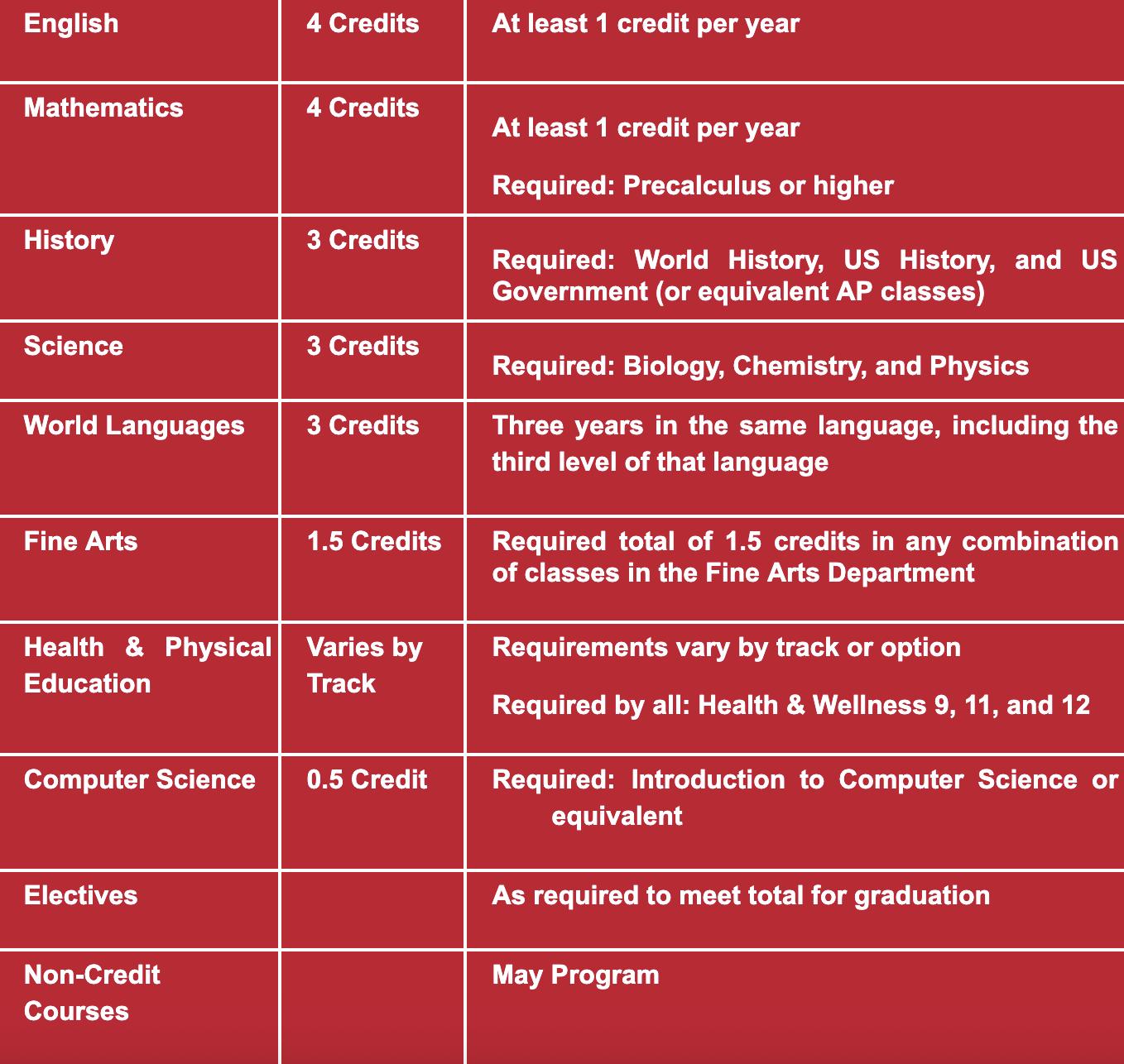
Graduation Requirements: 24 credits
Curriculum Overview
Additional Academic Options
One Schoolhouse Courses
Columbus School for Girls is an affiliate member of One Schoolhouse (OS) which is a fully accredited online school that serves independent school students in the U.S. around the world. Online courses require an exceptional degree of self motivation and time management. With approval from the Department Chair and Division Director, CSG students may take OS courses not offered at CSG for elective credit beginning in Form X. While the credit and grade for an OS course will be shown on the student’s transcript, the grade will not be included in the GPA calculation for the student. Tuition for OS courses is separate from CSG tuition. Students who are interested in a course from OS must fill out a registration form with CSG prior to June 2026. CSG will handle the course registration through OS. Please check the website www.oneschoolhouse.org for specific course descriptions and availability, and fill out the Course Intent Form by May 1, 2026.
Questions and Concerns
Questions Concerning Curriculum and Scheduling:
Please direct curriculum questions to:
Dr. Lisa Abrams, Dean of Academics labrams@columbusschoolforgirls.org
614.252.0781, ext. 335
Please direct scheduling questions to:
Mr. John Hartshorne, US Registar jhartshorne@columbusschoolforgirls.org
614.252.0781, ext. 298
College Counseling
College Preparation
No credit, non-graded
• Required of all students in Form XI (spring) and Form XII (fall)
• Semester course; no credit
• Prerequisites: None
The Form XI course focuses on self-discovery, college search tools, and the basics of college admission. Students finish the course with a balanced college list, a draft of their Common Application activity list, as well as a body of writing that will become the foundation of college essays. In Form XII, students learn about the ethical and practical components of the admission process, develop their application strategy and timeline, and actively work on their applications with the support of the College Counselors. As the cycle progresses, the course provides guidance on the financial aid process, interview skill-building, and continued writing support.
Computer Science
The primary goal of CSG’s computer science department is to introduce students to current and emerging technologies and to help them develop the fluency necessary to be users of an ever-changing list of devices, programs, and literacies. Courses are project-based and focus on problem solving and understanding hardware, software, and major topics in computer science.
INTRODUCTION TO COMPUTER SCIENCE
This course is an introduction to computer science programming. Through the course, students will learn fundamental programming concepts and how to apply them. This course has a heavy problem-solving emphasis allowing students to be creative through a graphics-based computer science curriculum taught in Python.
Full-credit, graded course
• Required of all students in Form IX
• Prerequisites: None
• Semester course (offered each semester), 0.5 credit
INTERMEDIATE COMPUTER SCIENCE
This course is designed for students who have foundational experience in computer science and are ready to deepen their programming skills using the Python language. Students will develop proficiency with core programming concepts such as functions, modular program design, file handling, object-oriented programming, and basic data structures including lists, dictionaries, and tuples. Emphasis is placed on writing clean, efficient, and well-documented code while applying computational thinking to solve increasingly complex, real-world problems. Students will engage in hands-on projects that may include data analysis, simulations, interactive applications, or simple game design. By the end of the course, students will be able to design, implement, test, and debug multi-file Python programs with confidence and will be well-prepared for advanced coursework in computer science or related fields.
Computer Science
Full-credit, graded course
• Open to students in Forms IX, X, XI, and XII
• Prerequisites: Introduction to Computer Science, Algebra I
• Semester course (offered once per year), 0.5 credit
AP COMPUTER SCIENCE A
AP Computer Science A teaches object-oriented programming methodology with an emphasis on problem solving and algorithm development. It also includes the study of data structures and abstraction. AP Computer Science A is taught in Java and is equivalent to a college-level Introduction to Computer Science course. The topics include iteration, recursion, arrays, object oriented programming and more.
Full-credit, graded course
• Open to students in Forms X, XI, XII
• Prerequisites: Introduction to Computer Science, Algebra I (starting in 2027-2028, prerequisites include Intermediate Computer Science)
• Full year, 1 credit
• Offered in 2026-27 (starting in 2027-2028, offered in even-numbered graduation years)
English
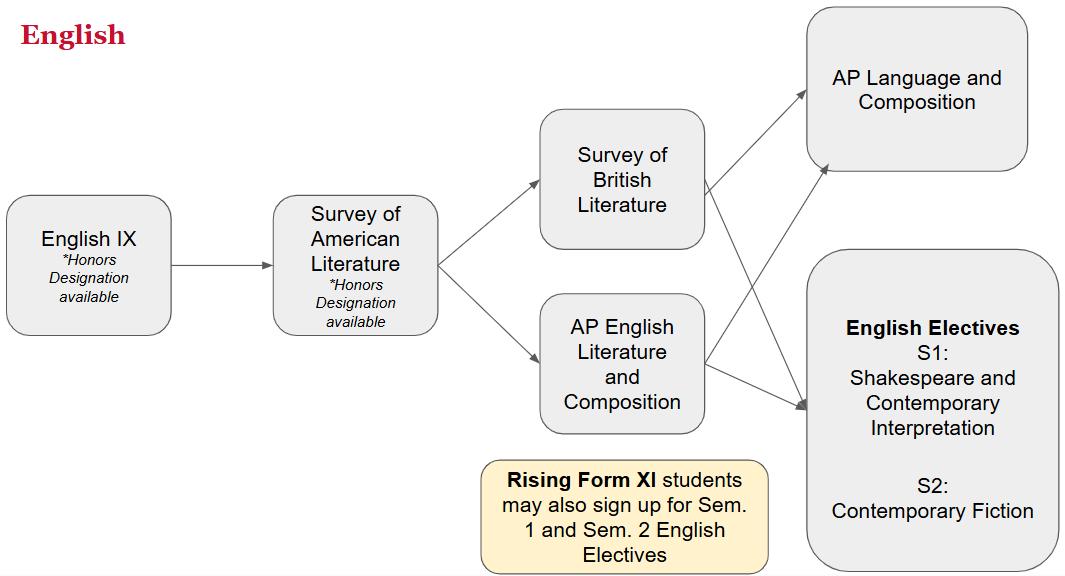
The English department’s goals are to foster students’ love of language and literature and to develop their ability to think and communicate effectively. The program emphasizes critical communication skills: reading, listening, speaking, and writing. Students continually hone their ability to read with comprehension, discrimination, sensitivity, and pleasure; to express their ideas with clarity, coherence, and fluency, and to understand the structure, complexity, and power of the English language. These skills are continually taught and reinforced at all grade levels, with the degree of development becoming more complex with each consecutive course. Upper School students take courses that follow a preset trajectory: English IX, Form X Survey of American Literature, and Form XI Survey of British Literature (or, if they meet the stated requirements, Form XI AP Literature and Composition, which features many of the same readings as the British Literature course, but also prepares students for the AP examination). Form XII students choose two semester-long elective courses or take a full year of AP Language and Composition, should they meet the stated prerequisites. New electives are periodically developed and offered by the English faculty according to their areas of expertise, the interests of students, and the evolving discipline of English. Each elective allows students to explore specific topics within one or more broad curricular threads: author/literary periods, genre studies, and multicultural and inclusive literature. Juniors may also choose to sign up for the semester electives in addition to their required Form XI English course or AP Literature and Composition.
ENGLISH IX
This course will bring together three key strands: (1) A reimagining of the hero, as presented in traditionally canonical, as well as recently published texts, so students can examine, contrast, and compare different models of voice, courage, resilience, and social justice; (2) literary “windows” and “mirrors,” which elicit self-reflection on their own perspectives and lived experiences as well as those encountered both in the texts we read and in class discussions with their peers; and (3) a broad range of writing activities and assignments, so students can develop foundations for analytical and rhetorical modes of writing in preparation for college-level writing.
Full-credit, graded course
• Required of all students in Form IX
• Full year, 1 credit
HONORS ENGLISH IX DESIGNATION
All students who are enrolled in English IX may declare an Honors designation that will require additional readings, research, and writing outside of regular class assignments. It will require meetings with the instructor and the librarian outside of class time and will culminate in a presentation of the student’s literary research and analysis.
Full-credit, graded course
English
SURVEY OF AMERICAN LITERATURE
In this course, students will focus on a comprehensive overview of American literary works. Students will read literature from early America to the present, including poetry, autobiography, essays, short stories, novels, and plays. Students are taught to read carefully, to think critically, and to demonstrate their reading and thinking skills in a variety of writing assignments, with particular emphasis on essays of literary analysis.
Full-credit, graded course
• Required of all students in Form X
• Prerequisites: Successful completion of English IX
• Full year, 1 credit
HONORS SURVEY OF AMERICAN LITERATURE DESIGNATION
All students who are enrolled in English X Survey of American Literature may declare an Honors designation that will require additional readings, research, and writing outside of regular class assignments. It will require meetings with the instructor and the librarian outside of class time and will culminate in a presentation of the student’s literary research and analysis
Full-credit, graded course
SURVEY OF BRITISH LITERATURE
In this course, students will read major works of British literature from the medieval period to our contemporary era, with continued attention to the history and development of the English language throughout. The course is designed to develop and refine students’ skills in reading literature, thinking critically, writing analytically and imaginatively, and working with and documenting secondary sources, such as scholarly literary criticism. In addition to shorter analytical and creative writing assignments, students will have multiple opportunities to practice research skills and writing: they will find and effectively use historical and literary resources and document these sources according to MLA guidelines. They will also continue to develop their skills in grammar, punctuation, listening and speaking, and source documentation.
Full-credit, graded course
• Required of all students in Form XI, unless enrolled in Advanced Placement English Literature and Composition.
• Prerequisites: Successful completion of Form X Survey of American Literature
• Full year, 1 credit
ADVANCED PLACEMENT ENGLISH LITERATURE AND COMPOSITION
In this course, students will develop the reading, writing, and analytical skills necessary for success on the Advanced Placement English Literature and Composition examination. AP students will study a variety of short fiction, poetry, and novels, including but not limited to works featured in the Survey of British Literature course and tackle writing assignments that push them to produce high-level, rigorous work. Being able to read a significant amount of writing quickly and to write comfortably and effectively on timed writing is central to success in this course, as students are required to take the AP Literature and Composition exam at the end of this brisk course. Students will continue to develop their skills in vocabulary, grammar, punctuation, analytical and creative writing, listening and speaking, and research writing and documentation. Full-credit, graded course
• Open to Form XI
• Prerequisites: Successful completion of Form X Survey of American Literature with a final grade of an A; PSAT verbal scores may also be considered.
• Full year, 1 credit
ADVANCED PLACEMENT ENGLISH LANGUAGE AND COMPOSITION
This course will introduce students to the principles and practice of rhetoric and composition. Students will gain further exposure to the genre of literary nonfiction and will refine their skills as close and careful readers, better able to analyze the rhetorical and stylistic choices made by a diverse range of writers. The course will prepare students for the Advanced Placement Language and Composition examination, as well as college-level classes in rhetoric and composition.
• Open to Form XII
• Prerequisites: Successful completion of Form XI English with a final grade of an A or AP Literature and Composition with a final grade of A-; PSAT verbal scores may also be considered.
• Full year, 1 credit
SHAKESPEARE AND CONTEMPORARY INTERPRETATION: ALL THE WORLD’S A STAGE
This course will focus on a close reading of various Shakespeare tragedies, comedies, histories, and romances, and their film and/or stage adaptations. Through reading, writing, and discussion, students will consider the major themes presented in the plays and the way those themes translate to film and other media. Students will develop a familiarity with Shakespeare’s language and historical context, as well as with the language of film criticism. In addition to reading and discussing the assigned texts, students will also continue to develop their skills in grammar, punctuation, analytical and creative writing, listening and speaking, and research writing and documentation.
Full-credit, graded course
• Open to Form XI and XII
• Semester 1 only, 0.5 credit
• Course will require a minimum of 8 students to run and will also be capped at 18 students, based on date of request.
• Junior/Senior Elective
English
CONTEMPORARY FICTION
What makes a book great? What kinds of literature and voices do we currently value? In Contemporary Fiction, we will examine these questions by reading and analyzing novels published in recent decades. In this discussion-based course, we will not only consider and discuss the novels individually, but we will also think about what they tell us about our current concerns and cultural values. The reading list and thematic focus of this class varies each year. Assignments may include several short analytical essays and a final project that will ask students to draw connections among multiple texts.
Full-credit, graded course
• Open to Form XI and XII
• Semester 2 only, 0.5 credit
• Course will require a minimum of 8 students to run and will also be capped at 16 students, based on date of request.
• Junior/Senior Elective
Fine Arts
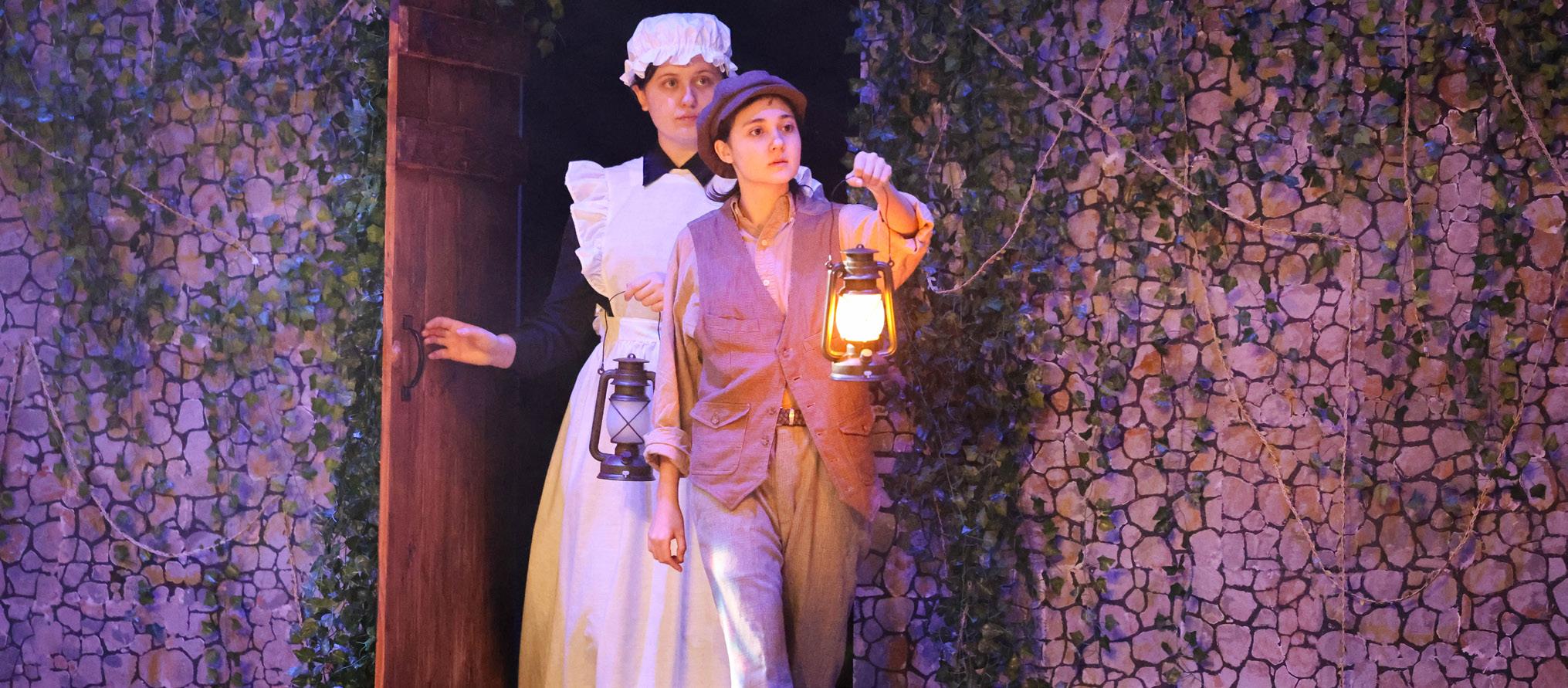
Studies in the fine arts have been developed to instill a knowledge and appreciation of the creative process through both the performance and academic lens. Students should emerge from these studies with first-hand experience in self-expression and communication through artistic disciplines and with an aesthetic appreciation for the similar expressions of others. Performing arts courses enable students to explore dramatic and musical literature in situations that encourage collaborative work. Skills are developed in ensemble and rehearsal technique. Students learn how to use problem-solving strategies, take direction, and acquire the discipline necessary for high quality performances. Creativity and risk-taking are encouraged as students develop confidence in their abilities. Students have the opportunity to build and refine technique, develop analytical and critical skills, and increase their repertoire of expressive tools. Performance classes allow students to grow in their involvement and appreciation for the process of the art as well as for the final performance. Visual arts courses have a multifaceted goal of building confidence in artistic competence through practical experience and academic critique, nurturing individual expression through multi-cultural and interdisciplinary studies, and encouraging aesthetic literacy through the study of historic and modern modes. Process and product are important. Through a spiral approach, artistic growth in manipulative skills and visual perception is cultivated from early childhood to young adulthood and beyond. Note: Scheduling priority in the Fine Arts courses is given to students in Form XII. All other forms have equal priority after seniors.
Performing Arts - Music
MUSIC THEORY
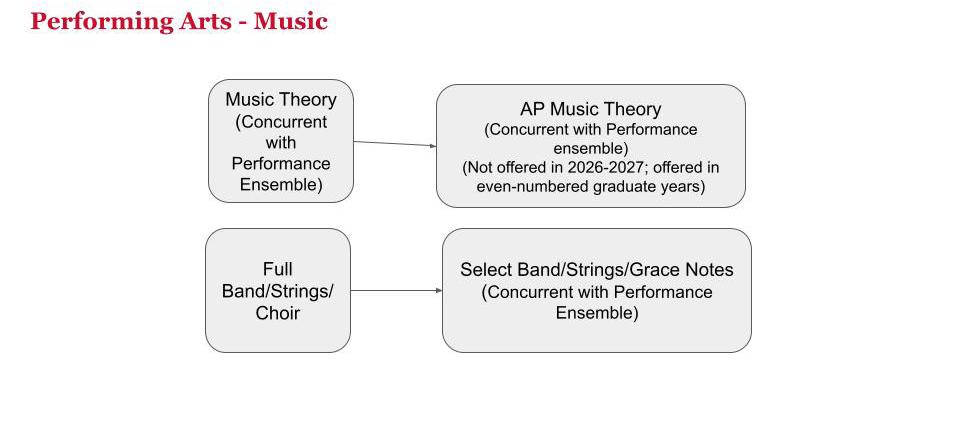
The music theory course is intended to develop a solid foundation of music theory and musicianship skills in our upper school musicians. Students will review each essential music element such as note names, rhythms, signatures, and expressive elements and demonstrate understanding through performance as well as written assessments at the basic and intermediate levels. Students will also learn basic piano skills in a group setting while applying them to music theory. No prior piano skills needed. At the end of this course, students will have the knowledge necessary to continue in AP Music Theory.
Partial-credit, graded course
• Open to Forms X, XI, XII
• Prerequisite: Enrolled in a CSG performance ensemble; fingernails must be kept short
• Passing grade required to take AP Music Theory
• Full year, 0.66 credit
• Offered in 2026-27; offered on odd-numbered graduation years.
Performing Arts - Music
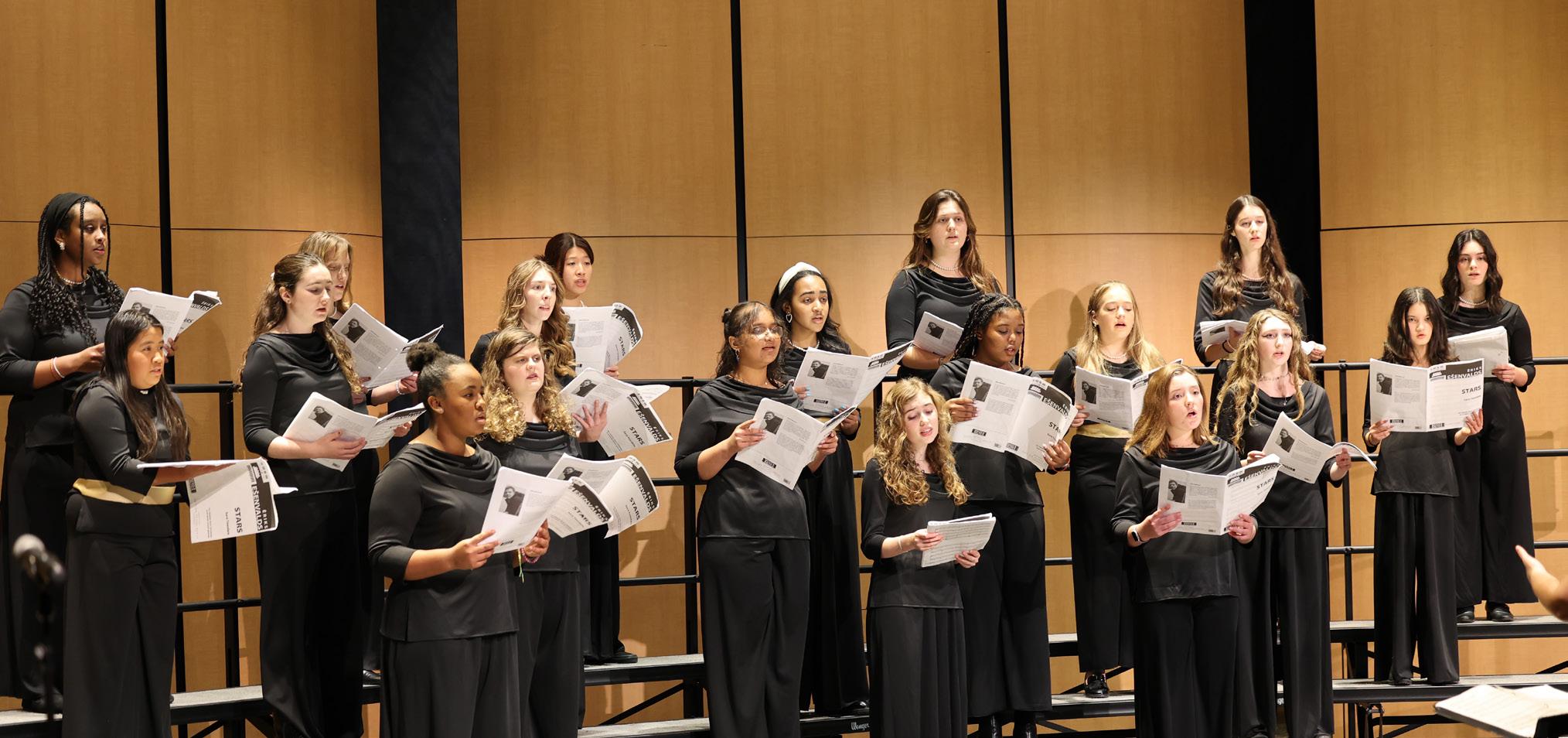
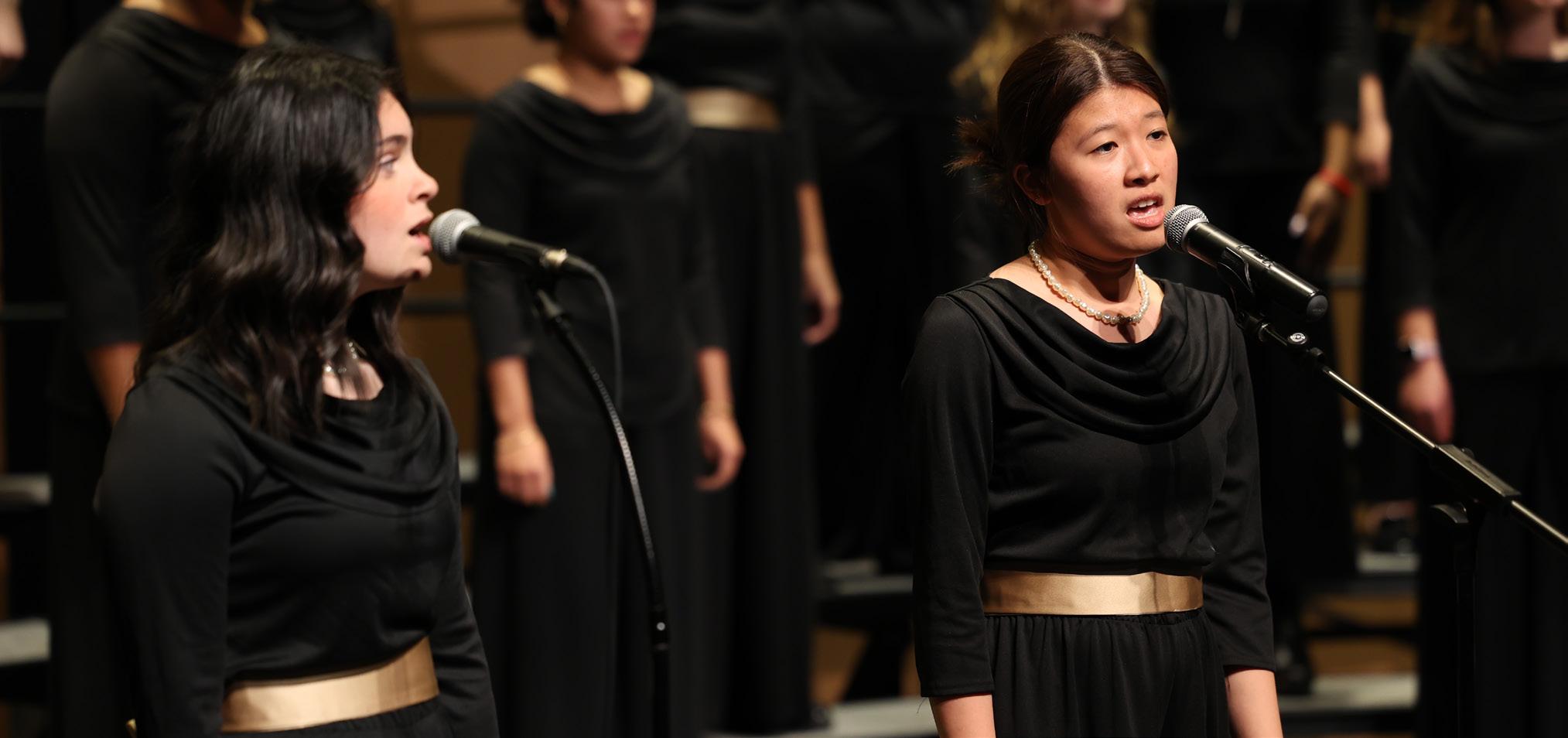
CONCERT CHOIR
Concert Choir is an intermediate vocal performance group. Students will sing a variety of styles and genres from different time periods. Emphasis will be placed on developing sight-reading, ear training, and musicianship skills, as well as exploration and development of vocal production techniques and skills necessary for achieving excellence in performance. Major concerts per year include: the CSG Thanksgiving Program, Fall, Winter, and Spring Concerts, and District/ State contest (dependent on eligibility). In order to participate in the OMEA Solo and Ensemble and large group contests, enrollment in this course is mandatory.
Partial-credit, graded course
• Open to Forms IX, X, XI, XII; this course may be taken more than once, each time for credit.
• Full year; 0.66 credit
• Costs: Students are responsible for covering the cost of trips and honor and all-state choir tuition and expenses, as well as official performance attire; limited need-based funding is sometimes available.
Performing Arts - Music
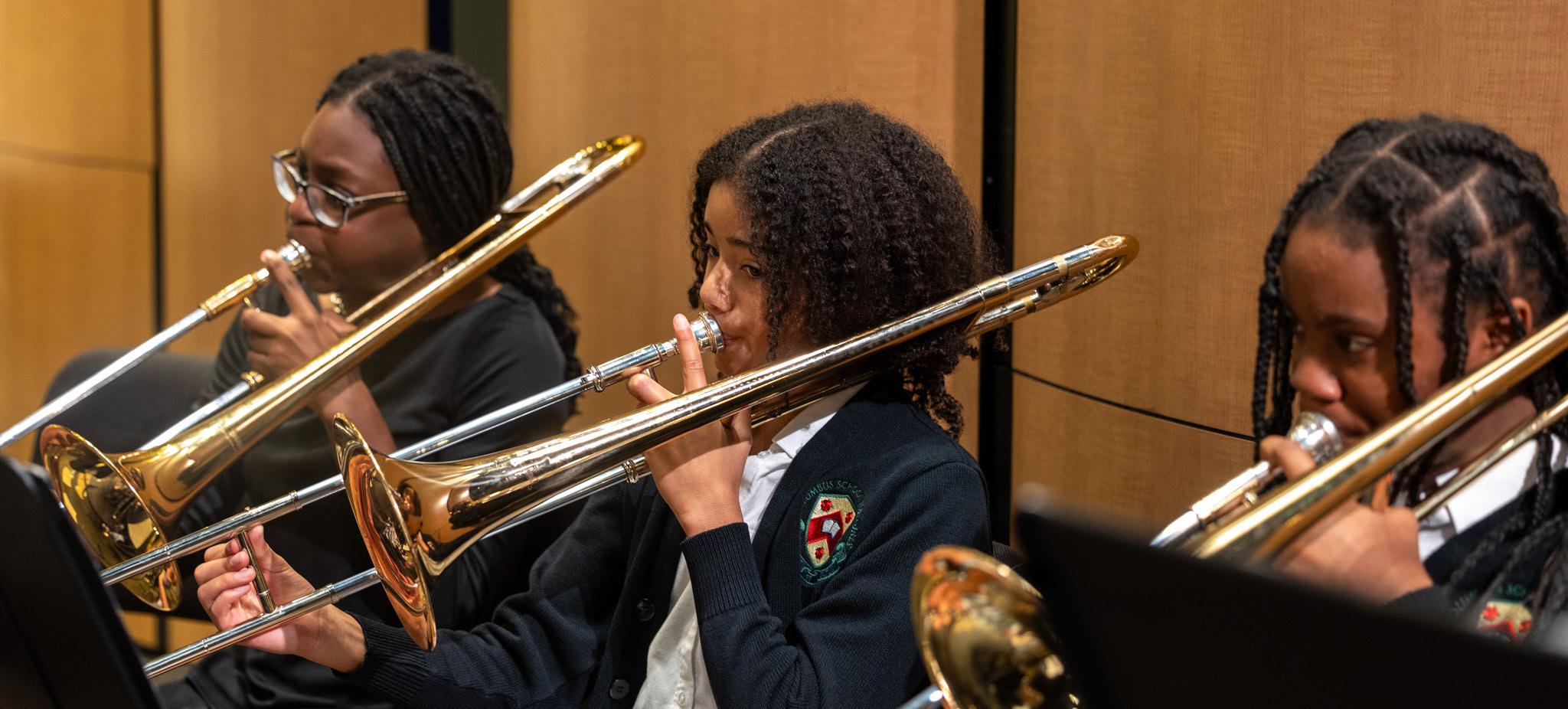
CONCERT BAND
Concert Band offers an opportunity for intermediate and advanced level woodwind, brass, and percussion students to continue improving their technical and musical skills. Technical and musical areas to be covered include scales, rhythm reading, intonation, articulation, dynamics, music notation, vocabulary, and technical and tone development.
Repertoire will be selected according to the appropriate ability level of the players. Several in-school and evening performance opportunities will be scheduled throughout the year. Attendance is required at all Concert Band events. In order to participate in the OMEA Solo and Ensemble Contests, enrollment in this course is mandatory.
Partial-credit, graded course
• Open to Forms IX, X, XI, XII; this course may be taken more than once, each time for credit.
• Prerequisites: Intermediate or advanced ability on a brass, woodwind, or percussion instrument.
• Full year, 0.66 credit
•Costs: Students who do not own their own instruments may rent them through private music companies or may use a school instrument, at no cost, when available; students are responsible for covering the cost of trips and honor and all-state band tuition and expenses as well as official performance attire; limited need-based funding is sometimes available.
Performing Arts - Music
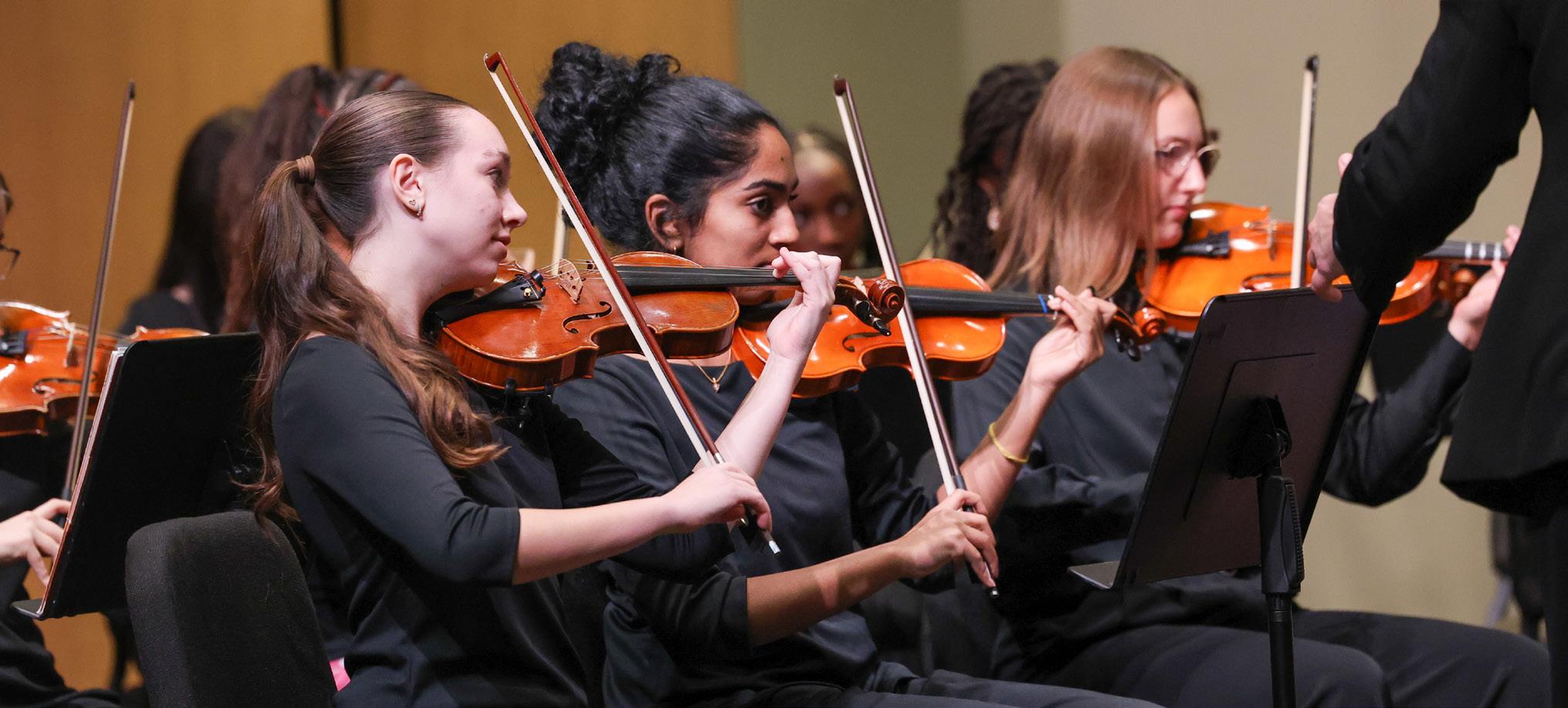
STRING ENSEMBLE
String Ensemble offers an opportunity for string students to continue improving their technical and musical skills in a performance based setting. Technical areas to be covered include: advanced key signatures, complex rhythm reading, upper position playing, vocabulary, and tone development. In addition, musical skills such as phrasing, balance, intonation, and blend will be developed. Materials will include scales and selected etudes, as well as string orchestra literature appropriate for the playing level of the ensemble. Music of the major stylistic periods will be included in the repertoire of the ensemble. Several in-school and evening concerts will be scheduled throughout the year. Attendance is required at all String Ensemble events. In order to participate in the OMEA events such as the South-Central Region Orchestra and Solo and Ensemble Contests, enrollment in this course is mandatory. Partial-credit, graded course
• Open to Forms IX, X, XI, XII; this course may be taken more than once, each time for credit.
• Prerequisites: Intermediate or advanced experience on a string instrument.
• Full year, 0.66 credit
• Costs: Students who do not own their own instruments may rent them through private music companies or may use a school instrument, at no cost, when available. Students are responsible for covering the cost of trips and honor and all-state band tuition and expenses as well as official performance attire; limited need-based funding is sometimes available.
Performing Arts - Music
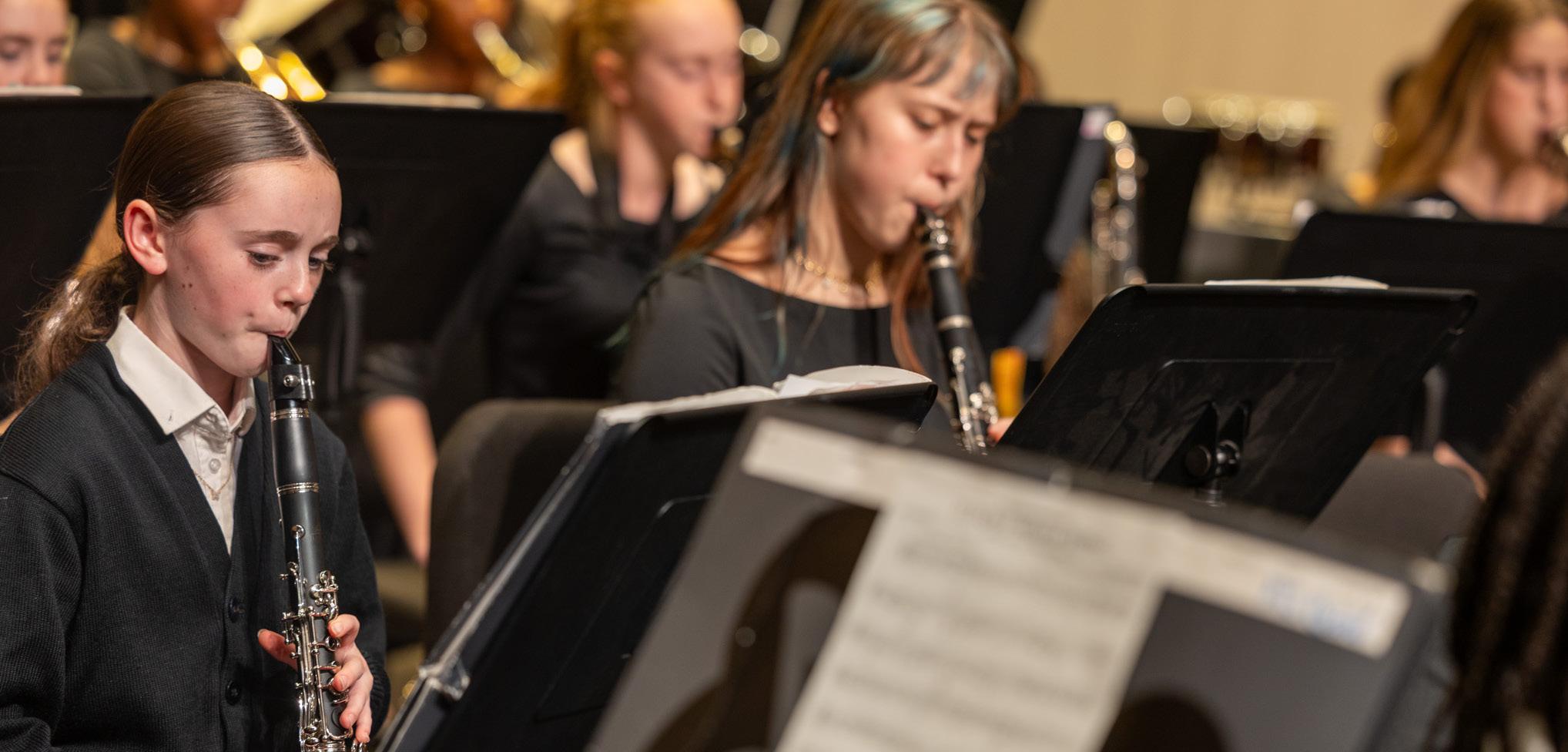
SELECT WIND ENSEMBLE
This course is designed for students who desire a smaller ensemble experience with advanced, varying repertoire. Students will focus on aspects of their performance and how it relates to creating a well-blended, well-balanced ensemble sound. The ensemble will perform at OMEA Solo and Ensemble and may be available to perform at school and community functions as the opportunities arise.
Partial-credit, graded course
• Open to Forms IX, X, XI, XII; this course may be taken more than once, each time for credit
• Prerequisites: Advanced experience on a band instrument; departmental signature required; concurrent enrollment in Wind Ensemble. Must audition; rising IX and new Upper School students may audition in the spring for the following fall, or they may audition at the beginning of the fall semester and add it to their schedules during the add/drop period.
• Full year, 0.66 credit
• Costs: Students who do not own their own instruments may rent them through private music companies or may use a school instrument, at no cost, when available. Students are responsible for covering the cost of trips and adjudicated events; limited need-based funding is sometimes available.
Performing Arts - Music
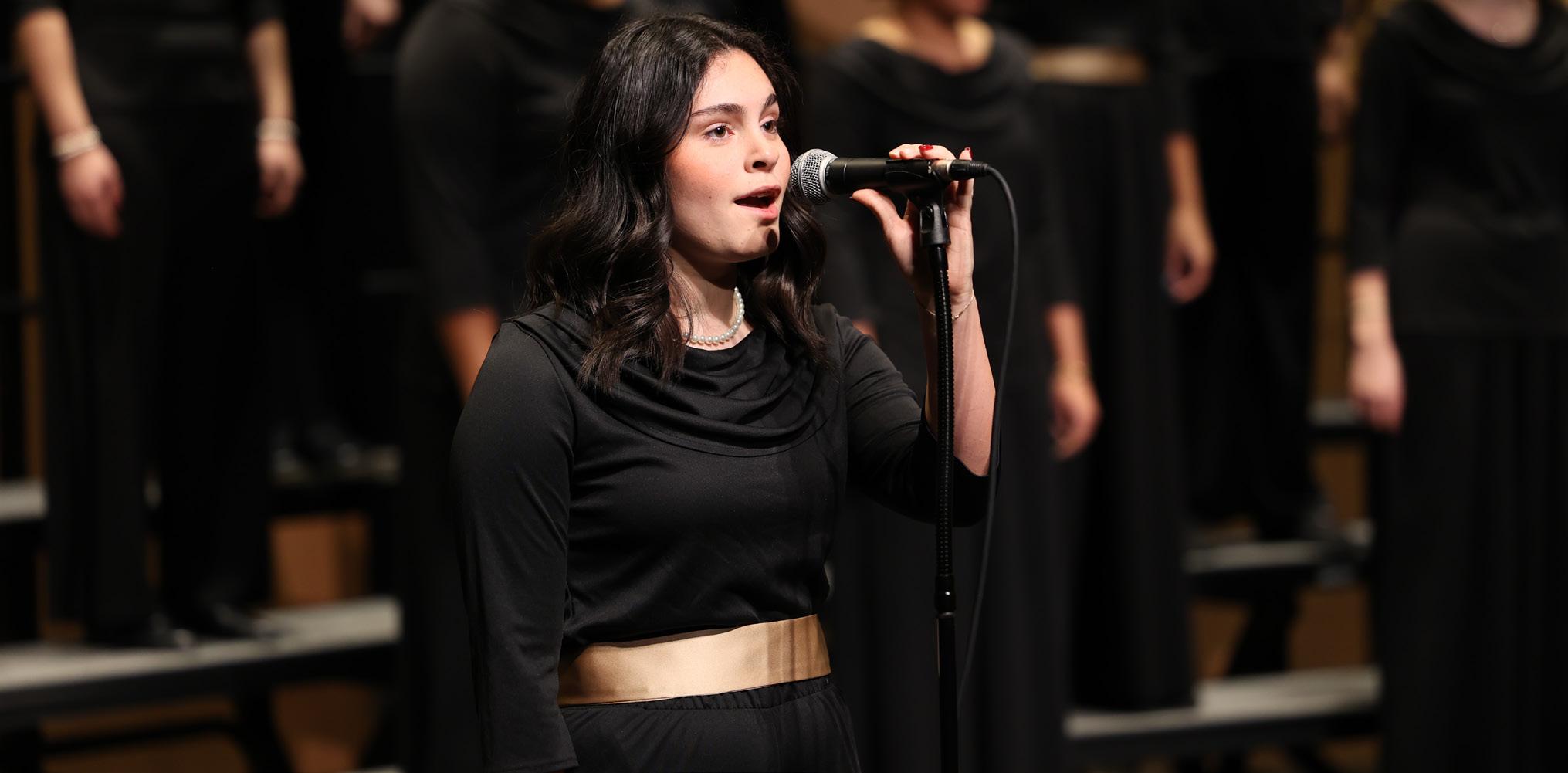
VOICE ENSEMBLE: THE GRACE NOTES
The Grace Notes offers qualifying students an opportunity to learn and perform an advanced level of vocal repertoire from many styles and periods. Students will focus on the skills and musicianship required for consistent excellence in performance, as well as further development of advanced vocal techniques. The performance commitment is essential and students will be expected to represent CSG in many different settings, including competition. Interested students may participate in other events as well, including OMEA events such as Solo and Ensemble and All-State Choir.
Partial-credit, graded course
• Open to Forms IX, X, XI, XII; this course may be taken more than once, each time for credit.
• Prerequisites: Must audition; departmental signature required; concurrent enrollment in Concert Choir.
• Full year, 0.66 credit
• Costs: Students purchase their own outfit accessories and are also responsible for covering the cost of trips and honor and all-state choir tuition and expenses; limited need-based funding is sometimes available.
Performing Arts - Music
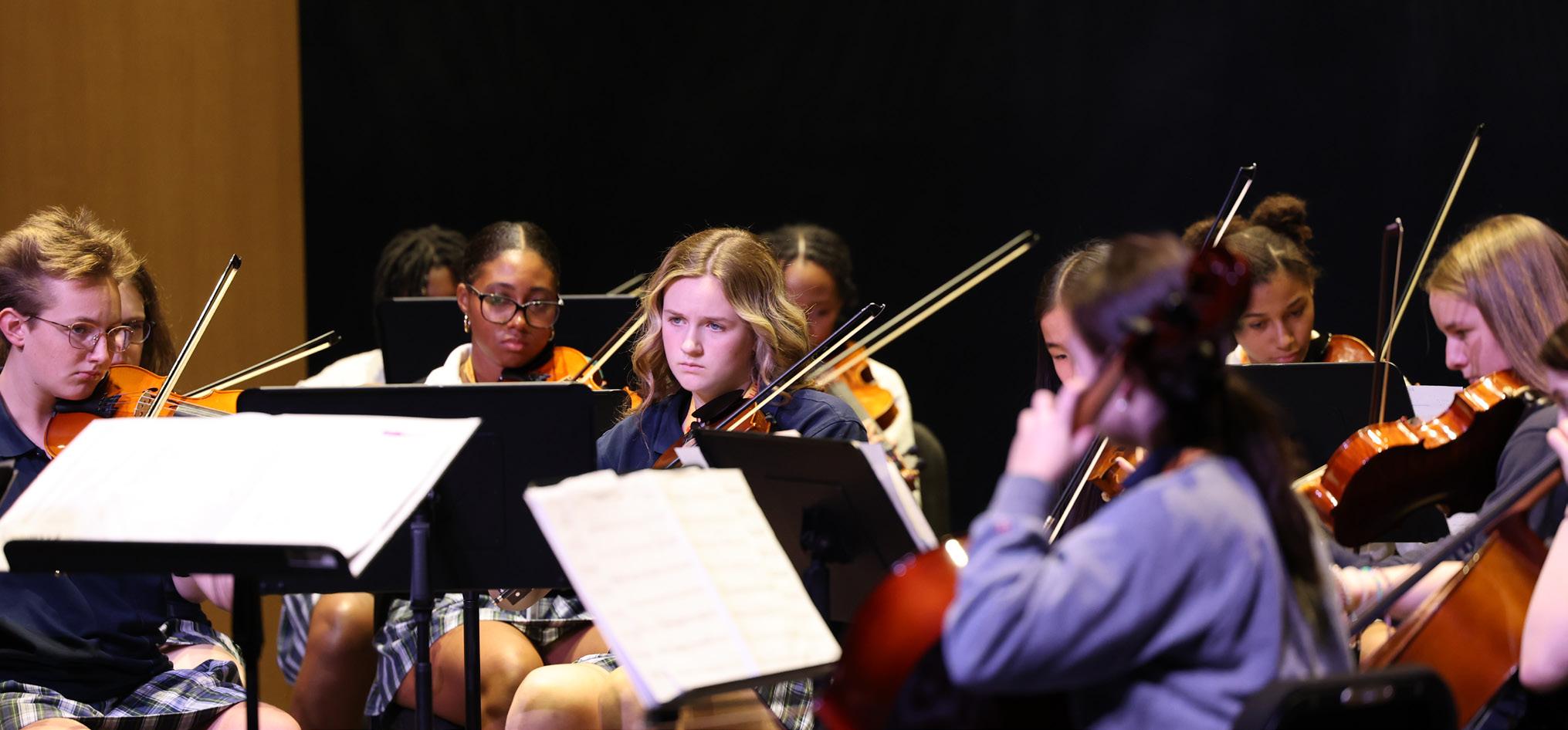
SELECT STRING ENSEMBLE
The Upper School Select String Ensemble will offer dedicated, advanced, and advancing string students an opportunity for increased musical challenges within a smaller chamber music setting. Students will have the opportunity to sharpen their musical, technical, and collaborative rehearsal skills by rehearsing and performing chamber music. Students in the Select String Ensemble will represent CSG by performing within the school and larger community serving as music ambassadors for CSG.
Partial-credit, graded course
• Open to Forms IX, X, XI, XII; this course may be taken more than once, each time for credit
• Prerequisites: Advanced experience on a string instrument; departmental signature required; concurrent enrollment in String Ensemble. Must audition; rising IX and new Upper School students may audition in the spring for the following fall, or they may audition at the beginning of the fall semester and add it to their schedules during the add/drop period.
• Full year, 0.66 credit
• Costs: Students who do not own their own instruments may rent them through private music companies or may use a school instrument, at no cost, when available. Students are responsible for covering the cost of trips and adjudicated events; limited need-based funding is sometimes available.
Performing Arts - Music
NOT OFFERED THIS YEAR
AP MUSIC THEORY
AP Music Theory is a course designed to develop musical skills that will lead to a thorough understanding of music composition and music theory. Students will receive instruction in the following content areas: advanced application of key signatures, scales, modes, chord structure and function, melodic and harmonic ear-training, meter, chordal analysis, secondary-dominant functions, dictation, circle of 5ths, two-part counterpoint, common compositional forms, and listening repertoire. Students will be prepared to take the AP Music Theory Exam when they have completed the course.
Partial-credit, graded course
• Open to Forms XI and XII
• Prerequisite: Music Essentials with a passing grade, Advanced ability on instrument (instrumental or vocal); departmental signature required.
• Full year, 1 credit
• Offered in 2027-28 (offered in even-numbered graduation years.)
Performing Arts - Theater
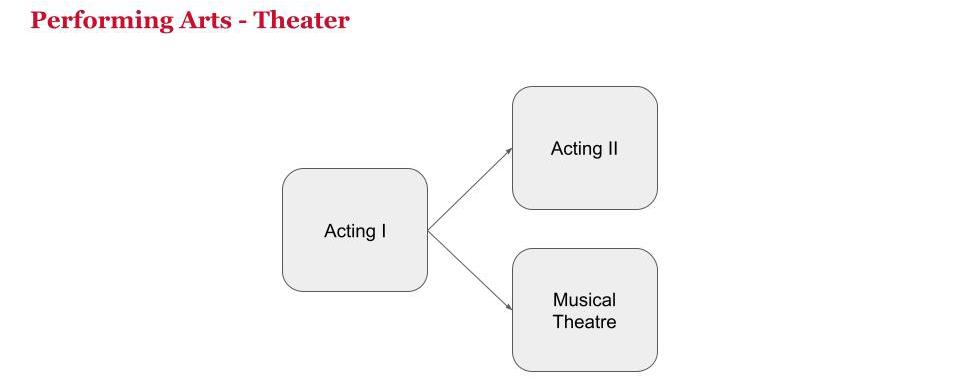
ACTING I
Students will explore basic acting techniques, principles of character interpretation and performance. Students will receive at least two monologues to practice and refine in class. Projects and exercises are presented to aid students in discovering more about their monologue, characters, acting techniques or the plays being worked on. Instructional methods will include research projects, exercises, rehearsals, scene work, improvisation, individual coaching and group coaching to promote physical and vocal awareness as well as self-confidence and creative problem-solving.
Partial-credit, graded course
• Open to Forms IX, X, XI, XII
• Prerequisites: None
• Semester course (offered each semester), 0.33 credit
ACTING II
Designed for students who are seriously interested in acting, this course provides the opportunity for in-depth one-on-one work on monologues and scenes. Students will participate in some Acting I exercises/games as refreshers. Students will also build upon skills through more in depth instruction on methods of acting introduced in Acting I. Participants in this course will select a play to collectively work on in class. They will analyze the script and each be assigned one role to perform from the play. Each student will follow the arch of the character through the script. Students will also receive individualized instruction based on the needs of the character or play such as learning IPA, dialect or accent coaching, and stage combat.
Performing Arts - Theater
Instructional methods will include research projects, exercises, rehearsals, scene work, improvisation, individual coaching and group coaching.
Partial-credit, graded course
• Open to Forms X, XI, XII
• Prerequisites: Acting I
• Semester course (offered each semester), 0.33 credit
MUSICAL THEATER
Musical Theater invites students to explore basic techniques of singing, dance and acting in a safe environment that allows for creative risk taking. We experiment with physicality, scene work, emotion, songs, and more to not only teach the student how to be a better musical theater actor, but to also promote self-awareness, empathy and confidence. Students will explore basic techniques and principles of character, script and song analysis. Classroom presentations are for the purpose of working on particular musical theater skills and styles. Musical Theater builds upon skills and terms learned in Acting I; evolving skills that the young actor/actress needs to successfully participate in a musical production. Standards in our production process require the theater student to challenge themselves and stretch their abilities in a new direction. Units in this course will include:
Musical theater history, Audition tips, Beginning Jazz, Beginning Tap, Beginning Ballet, Beginning Ballroom, Acting the song, Acting for a musical, Solo work and Group work.
Partial-credit, graded course
• Open to Forms IX, X, XI, and XII
• Prerequisite: Acting I
• Semester 2 course; 0.5 credit
Visual Art
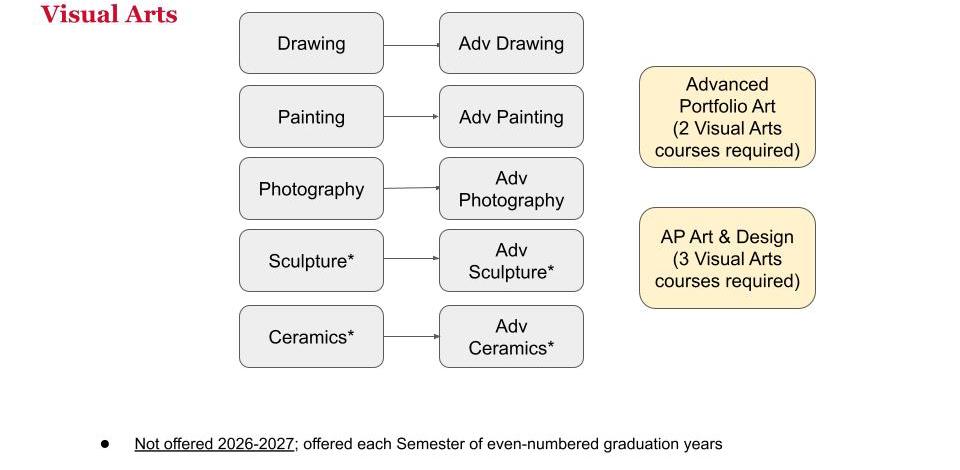
DRAWING
The beginning of the term focuses on basic drawing methods (measured drawings, additive and subtractive processes, etc.) and introduces the student to a variety of traditional drawing materials (graphite, charcoal, conte, etc.); the latter portion of the term will focus on non-traditional methods and materials and will explore more contemporary methods of drawing. Students learn to draw from life as well as from source material for reference and will have the opportunity to experiment with historical, contemporary and personal themes in art. Sketchbook assignments complement in-class projects and allow students to develop and research a diverse range of subject matter.
Full-credit, graded course
• Open to Forms IX, X, XI, XII
• Semester course (offered each semester), 0.5 credit
• Offered 2026-27; offered each Semester of odd-numbered graduation years.
ADVANCED DRAWING
This course is a continuation of the Drawing class. Students move from observational drawing to more challenging and conceptually based subject matter and content with each project. Traditional drawing materials are reinforced in tandem with the introduction of non-traditional materials. Students learn to effectively use the medium to create the desired end result. Regular critiques at this level will be an integral part of the course.
Visual Art
Full-credit, graded course
• Open to Forms IX, X, XI, XII
• Prerequisites: Drawing
• Semester course (offered each semester), 0.5 credit
• Offered 2026-27; offered each Semester of odd-numbered graduation years.
PAINTING
This course is intended to build and develop an understanding of color theory, drawing, and compositional skills through the use of traditional painting mediums. Controlled use of color palettes and introduction to various painting techniques will be filtered into this course.
Full-credit, graded course
• Open to Forms IX, X, XI, and XII
• Prerequisites: None
• Semester course (offered each semester); 0.5 credit
• Offered 2026-27; offered each semester of odd-numbered graduation years
ADVANCED PAINTING
This course is a continuation of the principles covered in Painting. More concentration and focus is directed at fewer, longer projects. Students learn the importance of slowing down and mastering specific painting techniques. Regular critiques at this level will be an integral part of the course.
Full-credit, graded course
• Open to Forms IX, X, XI, XII
• Prerequisites: Painting
• Semester course (offered each semester), 0.5 credit
• Offered 2026-27; offered each Semester of odd-numbered graduation years.
Visual Art
ADVANCED PORTFOLIO ART
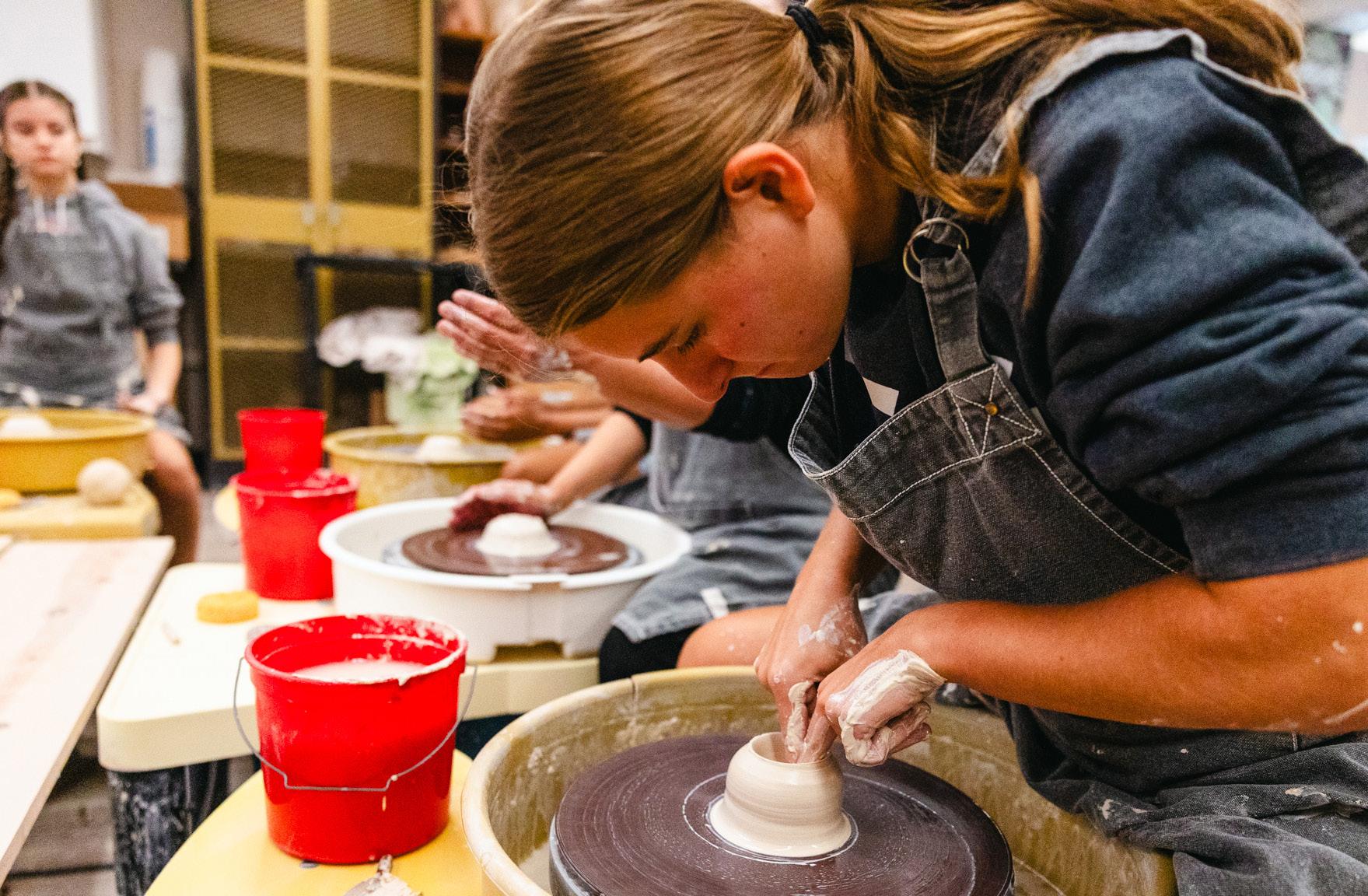
This course is for the highly self-motivated art student and demands significant time and production commitment. It is designed to help students create a body of work that is representative of their strengths in 2-D and/or 3-D art. Students will pursue special creative problems in depth and will have a completed portfolio by the end of the school year.
Full-credit, graded course
• Open to Forms X, XI and XII; this course may be taken more than once, each time for credit.
• Prerequisites: A combination of CSG art coursework (may include 2 of the following: Drawing, Advanced Drawing, Painting, Advanced Painting, Photography, Advanced Photography, Ceramics, Advanced Ceramics, Sculpture or Advanced Sculpture) or have advanced experience equivalent to combinations of the above.
• Full year, 1 credit
Visual Art
PHOTOGRAPHY
This course is an introduction to black and white film photography. Fundamentals of manual camera operation, film developing, and printing in the darkroom are taught. Assignments specific to basic design principles and fundamentals in art help the student develop her own style and way of seeing; critiques and class discussions aid the student in grasping the unique qualities of this medium. Students will be evaluated by a final edited portfolio of developed and printed work.
Full-credit, graded course
• Open to Forms IX, X, XI, XII; class size is limited; scheduling priority is given to Form XI and XII students.
• Semester course; offered each semester every year, 0.5 credit
ADVANCED PHOTOGRAPHY
Advanced Photography builds upon the traditional skills and techniques learned in Photography from the darkroom experience. Students will alternate between using film and digital cameras and will learn how Photoshop is used in a variety of industries where photography may exist. This is an advanced, fast paced course where each project builds upon the previous one in complexity and intensity. Students will be evaluated by a final edited portfolio of printed work.
Full-credit, graded course
• Open to Forms IX, X, XI XII; scheduling priority is given to Form XI and XII students.
• Prerequisites: Photography
• Semester 2 course; offered every year, 0.5 credit
Visual Art
ADVANCED ART PLACEMENT ART AND DESIGN: DRAWING, 2-D DESIGN, OR 3-D DESIGN
This course is for the highly self-motivated art student and demands significant time and production commitment. It is designed to provide the same benefits to secondary school students as those provided by an introductory college course.
Students will pursue special creative problems in depth and will prepare a portfolio consisting of concentration work; the portfolio will be submitted and will go through a rigorous national committee review by the AP College Board.
Students work closely with the art teacher to select the top quality work and may submit work in one of the following areas: drawing, 2-D Design, or 3-D Design.
Full-credit, graded course
• Open to Forms XI and XII; this course may be taken more than once, each time for credit.
• Prerequisites: A combination of CSG art coursework (may include 3 of the following: Drawing, Advanced Drawing, Painting, Advanced Painting, Photography, Advanced Photography, Ceramics, Advanced Ceramics, Sculpture, Advanced Sculpture, or Advanced Portfolio Art) or have advanced experience equivalent to combinations of the above; a portfolio of artwork made during a student’s HS career (IX, X and above) is a prerequisite for this course; departmental recommendation required.
• Full year, 1 credit
• No April practice examination is required in this course; a portfolio must be submitted to the College Board in May. Students participating in the May program will have to submit their portfolios in April prior to the College Board deadline date.
Visual Art

NOT OFFERED THIS YEAR
SCULPTURE
The study and application of design principles and a variety of materials to create three-dimensional works form thefoundation of this course. Students explore reductive and additive sculpting methods through the use of media such as clay, cardboard, fibers, found objects, as well as non- traditional materials. Students will learn how to critique 3- Dimensional works with a critical eye and understanding of art terminology.
Full-credit, graded course
• Open to Forms IX, X, XI, XII
• Semester course (offered each semester), 0.5 credit
• Offered in 2025-26; offered each Semester of even-numbered graduation years.
ADVANCED SCULPTURE
This course is a continuation of the principles covered in Sculpture. Advanced sculpture students will work to further develop their skills within the medium they choose (clay, wire, found objects, etc.) and will be challenged to create more complex and conceptual works. Regular critiques at this level will be an integral part of the course.
Full-credit, graded course
• Open to Forms IX, X, XI, XII
• Prerequisites: Sculpture
• Semester course (offered each semester), 0.5 credit
• Offered in 2025-26; offered each Semester of even-numbered graduation years.
Visual Arts
CERAMICS
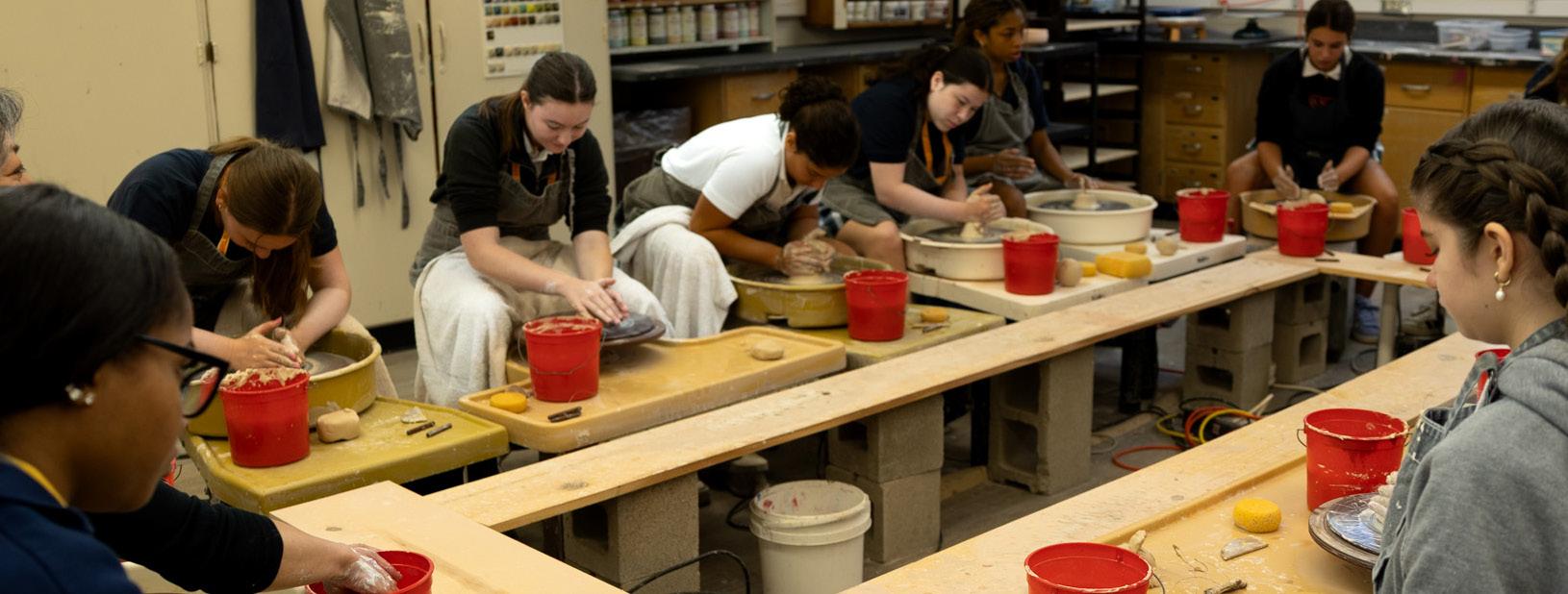
This course explores clay through traditional wheel throwing and handbuilding. The beginning of the semester focuses on throwing on the wheel, glazing, and firing techniques; the latter part of the semester focuses on hand building.
Full-credit, graded course
• Open to Forms IX, X, XI, XII; class size is limited to 16 students.
• Semester course (offered each semester), 0.5 credit
• Offered in 2025-26; offered each Semester of even-numbered graduation years.
ADVANCED CERAMICS
This course is a continuation of the techniques covered in Ceramics. Development of hand building and wheel throwing skills are further enhanced in this course. Students learn how to create more complex forms and expand their learning to explore more conceptual ways to develop their skills and craft. Regular critiques at this level will be an integral part of the course.
Full-credit, graded course
• Open to Forms IX, X, XI, XII, class size is limited to 16 students.
• Prerequisites: Ceramics
• Semester course (offered each semester), 0.5 credit
Health and Physical Education
The Health curriculum provides each student with the skills and knowledge to make informed healthy choices about personal wellness and lifestyle.
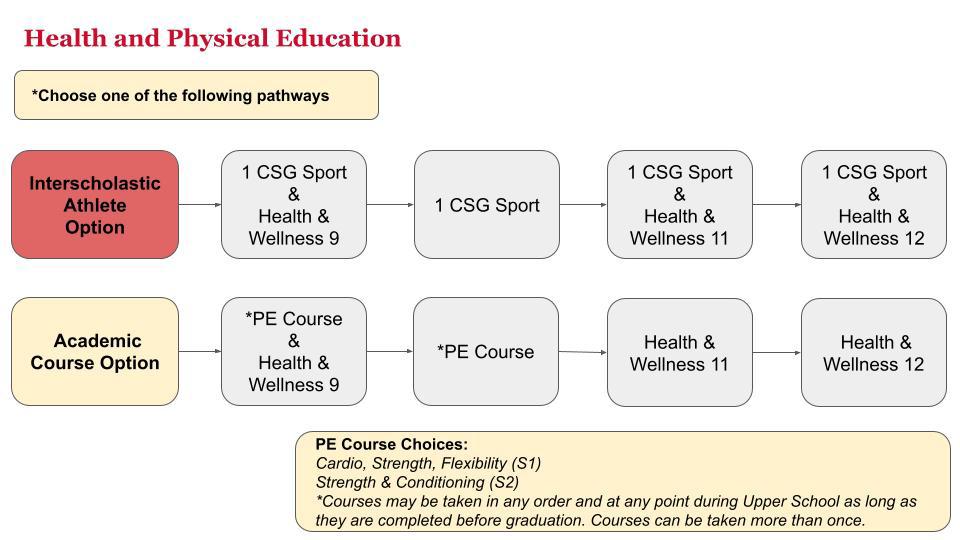
INTERSCHOLASTIC ATHLETE PROGRAM
This policy is intended to free time for additional academic scheduling during the school day for committed interscholastic sport student-athletes. Student-athletes meeting the requirements of this policy will not receive a grade or academic credit for interscholastic athletics; however, grades and academic credit will be awarded for Health & Wellness 9, 11, and 12. Successful completion of the applicable Interscholastic Athlete Program option fulfills the graduation requirement regardless of the total number of credits earned. Participation in an interscholastic sports season means the following: 2026-2027 Interscholastic Sports Seasons:
• Fall (Golf,Cross Country, Field Hockey, Soccer, Tennis, Volleyball): Friday August 3, 2026 – Postseason
• Winter (Basketball and Swim & Dive): Friday October 23, 2026 –Postseason
Spring (Lacrosse and Track & Field): Monday February 22, 2027 – Postseason
• Selection to any interscholastic team will require that student-athletes meet
Health and Physical Education
appropriate team standards in order to be a member of that team.
• A student-athlete must attend all team practices, competitions, and team events, beginning with the sport’s official start date set by the Ohio High School Athletic Association (even if this date is prior to the opening of school in the fall) and continuing through all post-season play. This may also include events held over school holidays.
• Each student-athlete is responsible for remaining academically eligible throughout the sports season. If at any time a student-athlete does not meet the criteria set forth above, they will be required to make up the appropriate coursework. It is the student’s responsibility to contact the US Scheduler and PE/Health Department Chair to make any necessary schedule changes.
No credit, non-graded (successful completion waives certain PE requirements)
• Open to Forms IX, X, XI, XII
• Prerequisites: None
• No credit* is awarded for athletic team participation.
• One CSG US sports season each of 4 years
*An Off-site Athlete option is available by request if certain requirements are met. Interested students will be required to get approval from the PE & Health Department Chair during the scheduling process in order to be considered.
Health and Physical Education
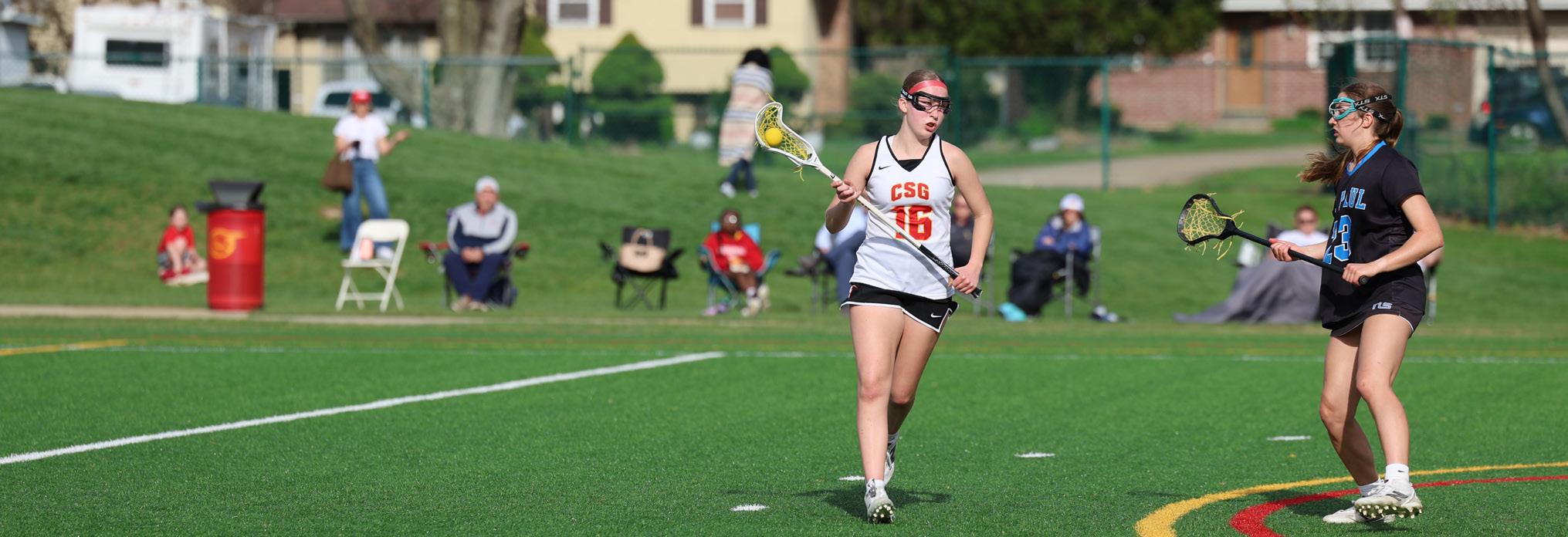
HEALTH AND WELLNESS 9
An introduction to personal wellness, this course emphasizes responsible decision-making, a life free of drugs, alcohol, and tobacco abuse, health and wellness related research, issues relating to human sexuality, and certification in First Aid, AED, and CPR through the American Red Cross. This course will also focus on introducing students to the weight room, the equipment within it, and general fitness concepts in an effort to ensure they have the tools for lifelong physical activity.
Full-credit, graded course
• Required of all students in Form IX
• Offered both semesters, 0.5 credit
HEALTH AND WELLNESS 11
As the second in the series of Upper School Health & Wellness courses, students will have the opportunity to dive deeper into topics and skills learned in Health & Wellness 9, as well as explore new topics and develop their voice relating to health & wellness topics. The objective is to equip students with the knowledge and skills necessary to make intelligent decisions on matters pertaining to personal and community health. This course offers insight on different health-related topics, human sexuality, gender representation, CPR, AED, and First Aid recertification through the American Red Cross, stress management and depression, breast cancer, and growth and development.
Full-credit, graded course
• Required of all students in Form XI
• Prerequisites: Successful completion of Health and Wellness 9
• Offered both semesters, 0.33 credit
Health and Physical Education
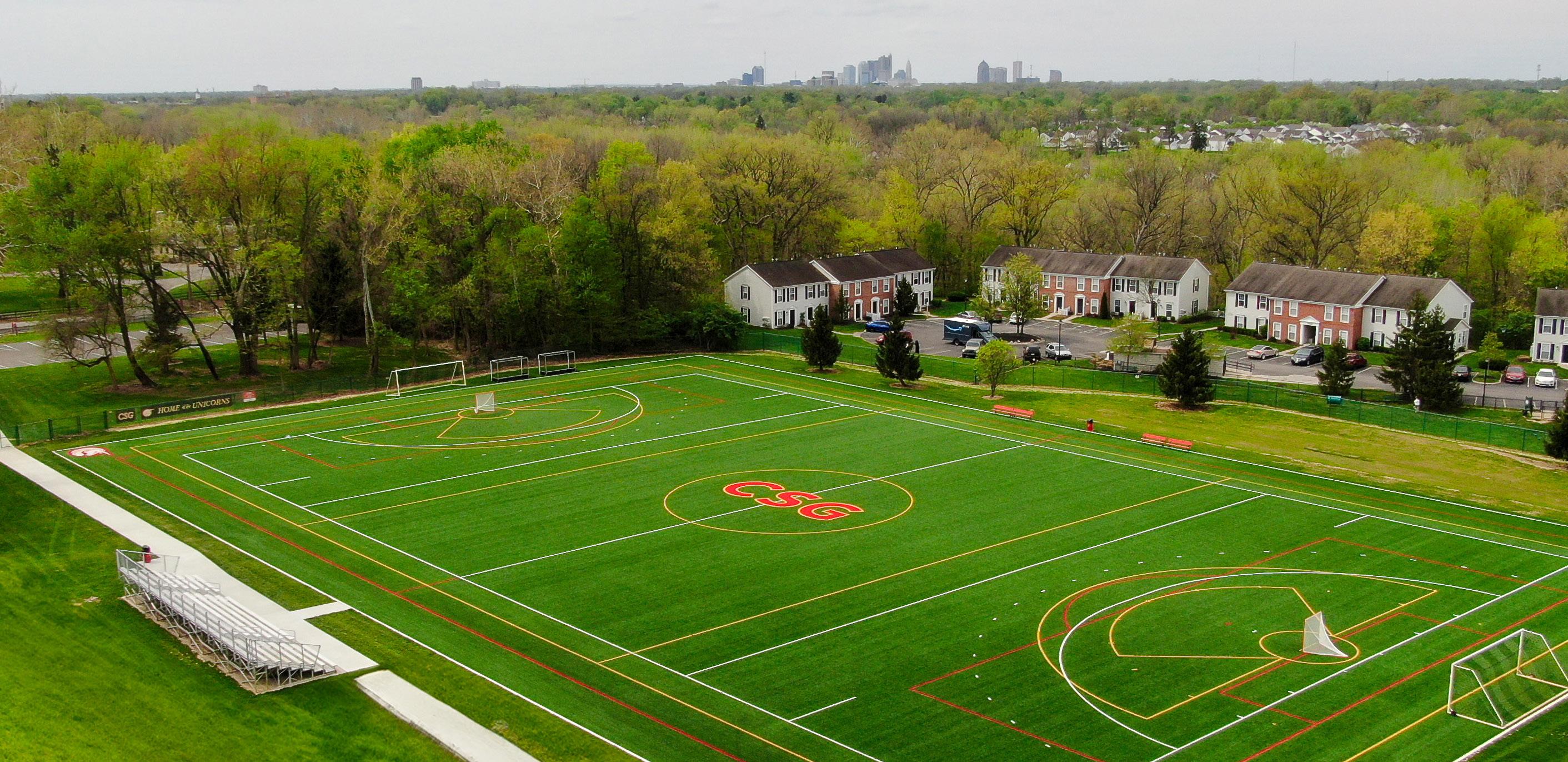
HEALTH AND WELLNESS 12
The objective of this course is to give students an opportunity to discuss wellness topics within the framework of their upcoming transition to college life. Topics will include relevant information that pertains to multiple aspects of wellness; physical, social emotional, mental, risk reduction, safety, etc. With a combination of speakers, class discussions, and opportunities to ask questions in a safe space, students will grow in their knowledge and understanding allowing them to make healthy informed decisions while living independently through college and beyond.
Partial-credit, pass/fail
• Required of all students in Form XII
• Semester 2 course, 0.17 credit
• Meets once/rotation
Health and Physical Education
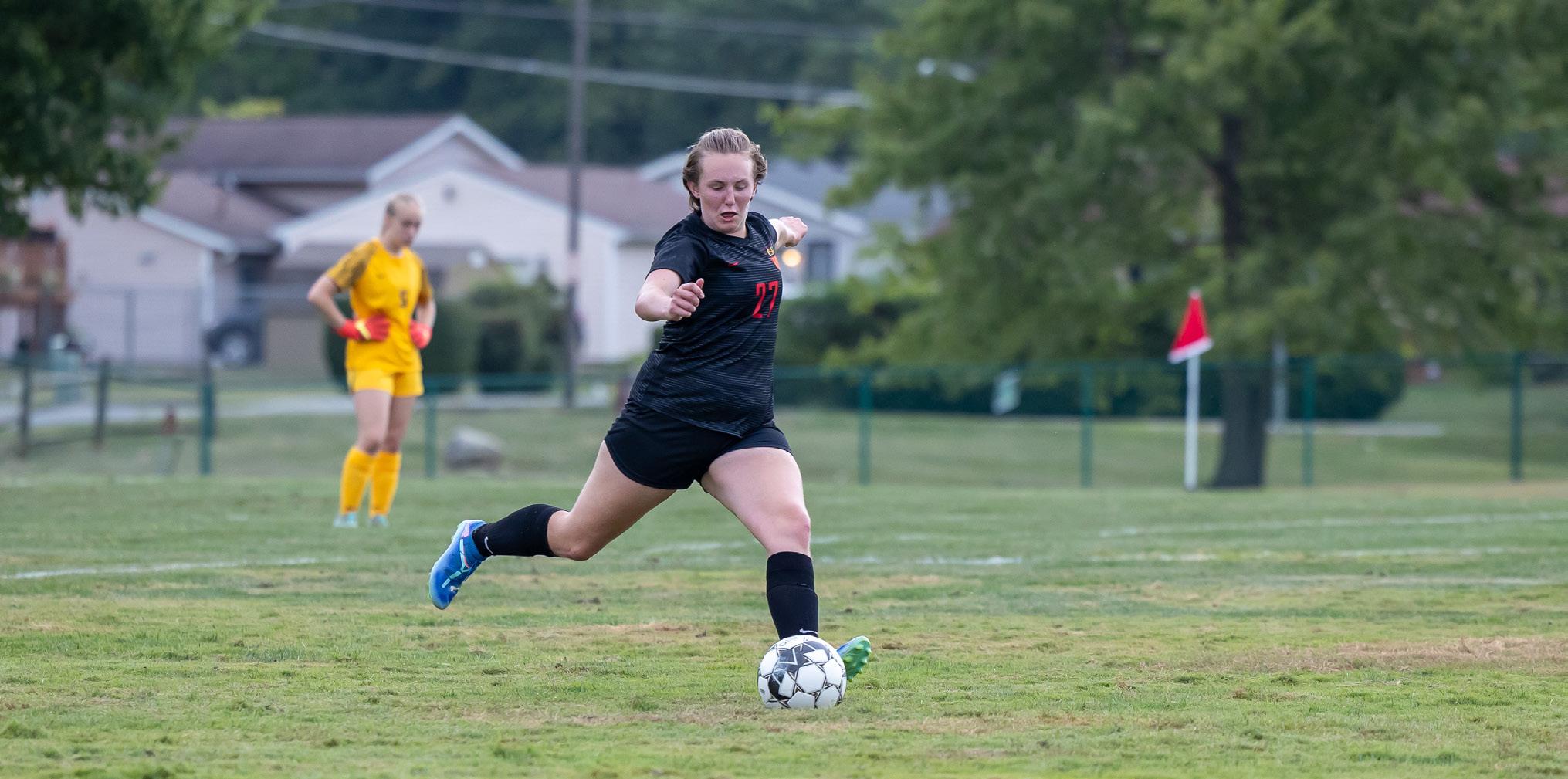
PHYSICAL EDUCATION
The Upper School Physical Education curriculum emphasizes understanding the importance of leading physically active lifestyles and creating opportunities for students to take ownership of their personal fitness and physical activity. The overall goal of the program is to develop young women who have the knowledge, skills, and confidence to enjoy a lifetime of healthful physical activities. Students are required to complete one of the following options for graduation:
• Interscholastic Athlete Option (see page 36)
• Academic Option: Two semesters of physical education courses during Upper School
Health and Physical Education
CARDIO, FLEXIBILITY, & STRENGTH: WELLNESS REVOLUTION
The course provides a number of options for students to improve their flexibility, strength, and cardiovascular fitness. Possible class activities include yoga, circuit training, Zumba, HIIT, and weight lifting. Students are encouraged to explore many modalities of fitness and develop a better understanding of how they could be incorporated into their lives independently.The objective of this course is to promote lifelong physical fitness and wellness. Upper School PE is a pass/fail course that meets twice a rotation during the fall semester.
Partial credit, pass/fail
• Required of all IX and/or X students in the Academic Physical Education Program, one semester each year OR one semester plus one other elective PE course- this course may be taken more than once, each time for credit
• Semester 1 only, twice per rotation, 0.33 credit
STRENGTH AND CONDITIONING
This course provides students with an opportunity to participate in physical education with a more advanced, specific focus on strength and conditioning. Each class will include the following: consistent dynamic warm up,class/skill specific warm up, focus lift/skill/concept of the day, workout of the day, cool down. The objective for this course is to expose students proper lead ups, technique, and cues for many different skills, lifts, and movements within Olympic Lifting, general strength, HIIT, and conditioning, and to increase the level of strength and general conditioning of each student. Strength & Conditioning is a pass/fail course that meets twice per rotation during the school day Semester 2 of the 26-27 school year.
Partial-credit, pass/fail, elective course
• Open to all students
• Semester 2 only, twice per rotation, 0.33 credit
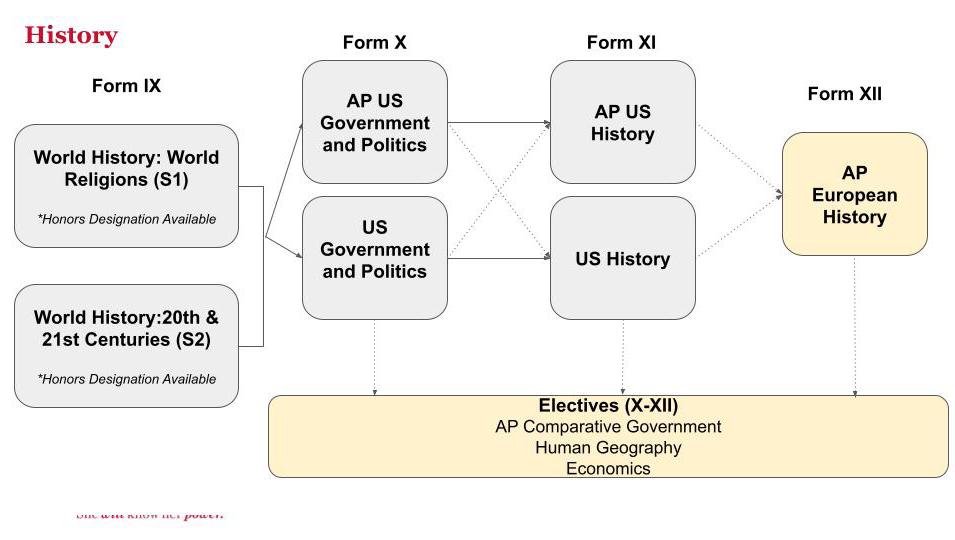
Our history curriculum introduces students to the breadth and depth of the human experience by a comparative study of past and contemporary societies and cultures and provides the foundation for them, as historians, to offer complex causal explanations of human events and processes and to challenge simplistic assumptions. Secondly, we develop students’ ability to conduct research, analyze and assess conflicting information and evidence, and articulate sound conclusions both orally and in writing. Particular attention is given to the skills necessary to develop a critical understanding of the diversity of global cultures and contemporary global issues.
History
WORLD HISTORY
This course introduces Upper School students to the foundations of historical inquiry and analysis by focusing on world regional geography and world history. Discussions of primary and secondary sources lay the foundation for historical and geopolitical analysis of civilizations in Europe, Asia, Africa, Latin America, and the Middle East. The course offerings are arranged thematically with emphasis placed on analytical essays and creative exercises in logic. The focus of the first semester will be on world religions, while the second semester will focus on contemporary history of the 20th and 21st centuries.
Full-credit, graded course
• Required of all Form IX students
• Full year, 1 credit
HONORS WORLD HISTORY DESIGNATION
Students may declare an Honors designation that will require them to complete a year-long research project in addition to regular class assignments. It will require meetings with the instructor and school librarian outside of class time.
Full-credit, graded course
ADVANCED PLACEMENT UNITED STATES GOVERNMENT AND POLITICS
Advanced Placement United States Government and Politics will give students an analytical perspective on a variety of topics, institutions, groups, beliefs, and ideas that constitute political life in the United States. Topics of investigation include the underpinnings of constitutional government, the structure of national political institutions, public policy, political beliefs and behaviors, political parties, interest groups, mass media, and civil rights and liberties. We will also explore a wide variety of topics through current event discussions, primarily focusing on governmental policies and their political bias, bureaucratic reform, and the relationships between citizens and government institutions. Students will be prepared to take the AP United States Government and Politics exam in May. Summer work may be required for this course.
Full-credit, graded course
• Required of all students in Form X who do not enroll in United States Government and Politics.
• Full year, 1 credit
• Students may not earn credit in both United States Government and Politics and AP United States Government and Politics.
UNITED STATES GOVERNMENT AND POLITICS
This course pursues a thematic approach to the political and social responsibilities required by residence in a nation served by a democratic constitution and tradition. Emphasis is placed on the development of critical thinking skills necessary for participation in social, civic, and political processes, recognition and consideration of moral dilemmas and ethical awareness, an appreciation of civic involvement and constructive social criticism, and the development of interpersonal skills necessary for the resolution of social conflicts. Students will study the primary documents of our special emphasis on the Constitution as it relates to everyday situations, major Supreme Court decisions and a discerning analysis of civil liberties.
Full-credit, graded course
• Required of all students in Form X who do not enroll in AP US Government and Politics
• Full year, 1 credit
• Students may not earn credit in both United States Government and Politics and AP United States Government and Politics.
ADVANCED PLACEMENT UNITED STATES HISTORY
AP United States History surveys, in greater depth, the evolution of our country’s history from the colonial era to the present. This course seeks to define who we are as a nation, what we believe in, and why we are as we are. The course concentrates on the following major topics: colonialism, revolution, nationalism, sectionalism, isolationism, imperialism, the role of women and people of color in the growth of the nation, economic change, and political development and reform. The class is student-centered and oriented toward an open discussion of the challenges facing the United States. Independent research and cooperative learning projects are an integral part of the course. Numerous opportunities are provided to encourage reflective, independent thinking. Current events play a key role in the daily life of this class. Students taking this level of United States History are expected to work at a higher level and will be prepared to take the AP United States History exam in May. Summer work may be required for this course.
Full-credit, graded course
• Required of all students in Form XI not enrolled in United States History.
• Full year, 1 credit
• Students may not earn credit in both United States History and AP United States History
UNITED STATES HISTORY
United States History surveys the evolution of our country’s history from the colonial era to the present. This course seeks to define who we are as a nation, what we believe in, and why we are as we are. The course concentrates on the following major topics: colonialism, revolution, nationalism, sectionalism, isolationism, imperialism, the role of women and people of color in the growth of the nation, economic change, and political development and reform. The class is studentcentered and oriented toward an open discussion of the challenges facing the United States. Independent research and cooperative learning projects are an integral part of the course. Numerous opportunities are provided to encourage reflective, independent thinking. Current events play a role in the daily life of this class.
Full-credit, graded course
• Required of all students in Form XI who do not enroll in AP United States History
• Prerequisites: Successful completion of United States Government and Politics or AP
US Government and Politics
• Full year, 1 credit
ADVANCED PLACEMENT EUROPEAN HISTORY
This course traces the history of Europe from the Renaissance to the present day and builds upon the student’s knowledge of the narrative background established in World History. This class addresses the theme of change in history and emphasizes political revolutions (English Civil War, French Revolution, Revolutions of 1848, Russian Revolution, etc.), the social impact of economic conditions (Industrial Revolution), intellectual movements (Humanism, Scientific Revolution, and Enlightenment), and artistic schools (Romantics, Cubists, Surrealists, etc.). Major themes that have influenced our contemporary world are developed and historically traced: nationalism, liberalism, conservatism, industrialism, internationalism, imperialism, and socialism. Emphasis in this course is placed upon a critical and sophisticated analysis of primary and secondary historical sources, a personal definition of human nature, and an appreciation of the competing forces of history. There is considerable supplementary reading on particular themes that are examined in depth. Students are prepared to take the AP examination. Summer work may be required for this course.
Full-credit, graded course
• Open to Form XII
• Full year, 1 credit
ADVANCED PLACEMENT COMPARATIVE GOVERNMENT AND POLITICS History
Advanced Placement United States Government and Politics will give students an analytical perspective on a variety of topics, institutions, groups, beliefs, and ideas that constitute political life in the United States. Topics of investigation include the underpinnings of constitutional government, the structure of national political institutions, public policy, political beliefs and behaviors, political parties, interest groups, mass media, and civil rights and liberties. We will also explore a wide variety of topics through current event discussions, primarily focusing on governmental policies and their political bias, bureaucratic reform, and the relationships between citizens and government institutions. Students will be prepared to take the AP United States Government and Politics exam in May. Summer work may be required for this course.
Full-credit, graded course
• Open to Forms X, XI, and XII
• Prerequisites: Prerequisites: Successful completion of World History with an A- or higher
• Full year, 1 credit
History
ECONOMICS
This course aims to provide students with theoretical underpinnings and functional knowledge in economics, so they may become informed consumers, producers, and citizens in today’s world. Economics is the study of how individuals, businesses, and governments make decisions about the use of scarce resources in a world of unlimited wants and needs. This is done at both the microeconomic level and the macroeconomic level, both of which will be examined in detail. At the microeconomic level, students will investigate the smaller units of the economy and individual firms and markets. In macroeconomics, students will study the global economy and economics of nations and governments as they attempt to foster growth and stability. Students will learn how to think like an economist and will be required to use and apply tools (such as graphs, tables, statistics, & equations) to their understanding of economic laws and principles. Finally, this course will also require students to demonstrate understanding of the connections between economics and personal financial decisions.
Full-credit, graded course
• Open to Forms X, XI, and XII
• Full year, 1 credit
HUMAN GEOGRAPHY
Human Geography explores how humans interact with, shape, and are shaped by the spaces and environments they inhabit. Students will study the distribution, organization, and impact of human activity across the globe, examining key topics such as population and migration, cultural patterns, political organization, agriculture, urbanization, and economic development. The course emphasizes spatial reasoning, data interpretation, and the use of geographic tools such as maps, models, and geospatial technologies to analyze global patterns and regional diversity. By connecting local experiences to global trends, students will develop a nuanced understanding of the complex relationships between people and place.
Full-credit, graded course
• Open to Forms X, XI, and XII
• Full year, 1 credit
Mathematics
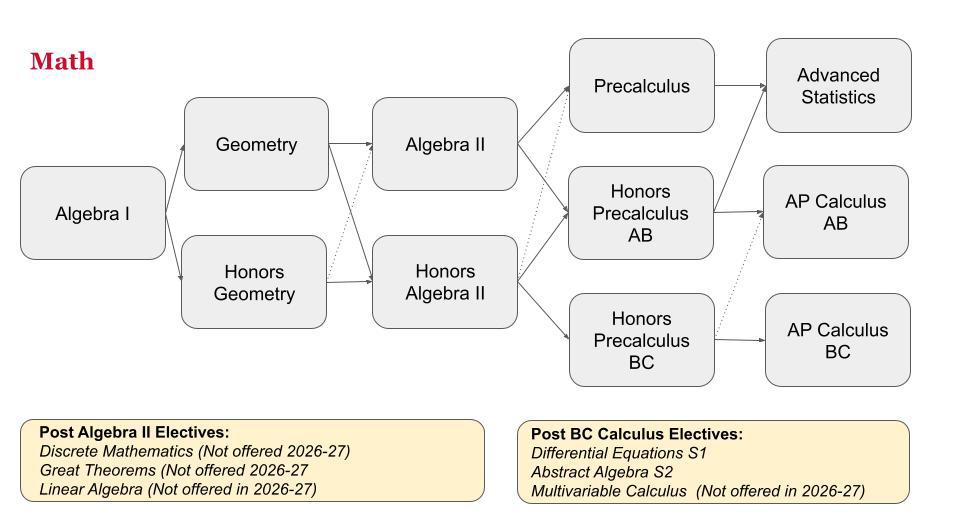
The mathematics department is committed to a core college preparatory curriculum that reflects the mandates set forth by the National Council of Teachers of Mathematics in “Curriculum and Evaluation Standards for Teaching Mathematics.” Mathematics must be ever-developing so that students continually expand their understanding of mathematical concepts in both breadth and depth as they progress through middle school and upper school. We strive to maintain a balance between skills and concepts, the concrete and the abstract, intuition and formalism, structure and problem solving, and induction and deduction. The goals of the mathematics department are that all students learn to value mathematics; to apply mathematical techniques confidently, skillfully, and accurately; to reason mathematically; to become effective mathematical problem-solvers; to communicate mathematically; and to become efficient users of modern technology. Students are encouraged to seek out and to accept appropriate challenges as they pursue their mathematics education.
ALGEBRA I
Algebra 1 is the critical element in secondary mathematics education. Topics introduced in Algebra 1 provide the foundation students require for future success in high school mathematics, critical thinking, and problem solving. transfer their concrete mathematical knowledge to more abstract algebraic generalizations. Topics include: functions, linear equations and inequalities, systems of equations and inequalities, exponents and radicals, polynomials, and quadratic functions and equations.
Full-credit, graded course
• Required of all students in Form IX who did not complete Algebra I in Middle School.
• Prerequisites: successful completion of Foundations in Algebra IA or equivalent course at another school
• Full year, 1 credit
• Technology required: TI-84+
Mathematics
GEOMETRY
The content of Geometry includes a strong emphasis on the basic concepts of Euclidean Geometry and the development of logical reasoning, including the formal method of proof. Students study triangles and triangle relationships, quadrilaterals, similarity, right triangle trigonometry, circles, area and volume. Concepts of coordinate geometry and three-dimensional geometry are integrated with plane geometry throughout the course.
Full-credit, graded course
• Open to Forms IX and X
• Prerequisites: Successful completion of Algebra I
• Full year, 1 credit
• Technology required: TI-84+
HONORS GEOMETRY
The content of Honors Geometry is similar to Geometry but emphasizes formal proofs and constructions.
Full-credit, graded course
• Open to Forms IX and X
• Prerequisites: Successful completion of Algebra I with a grade of A- or better; PSAT scores may also be considered
• Full year, 1 credit
• Technology required: TI-84+
Mathematics
ALGEBRA II
Algebra II is a continuation of the study of algebra. Topics covered are a review of Algebra I, linear equations, quadratic equations, factoring, polynomial functions, graphing using transformations, irrational and complex numbers, probability, trigonometry, and rational expressions and equations.
Full-credit, graded course
• Open to Forms X and XI
• Prerequisites: Completion of Geometry or concurrent enrollment in Geometry with teacher recommendation
• Full year, 1 credit
• Technology required: TI-84+
HONORS ALGEBRA II
Honors Algebra II is an in-depth course in which the student continues the study of algebra. The course content commences with a review of Algebra I topics and progresses to include a study of the irrational and complex numbers, quadratic equations and functions, equations and numerical methods, polynomial functions, rational expressions and equations, probability, and trigonometry. Students in Honors Algebra II spend significant time investigating the graphs of functions and transformation of functions. Graphing technology plays an integral role in the learning of mathematics in this course.
Full-credit, graded course
• Open to Forms IX, X, XI
• Prerequisites: Successful completion of Geometry with at least a grade of A-, Honors
Geometry with at least a grade of B-, or concurrent enrollment in Geometry/Honors
Geometry with teacher recommendation; PSAT scores may also be considered.
• Full year, 1 credit
• Technology required: TI-84+
Mathematics
PRECALCULUS
This course takes a conceptual and analytical approach to concepts in precalculus necessary for the study of college-level mathematics courses. The study of precalculus builds and deepens students’ conceptual understanding of function. Particular emphasis is placed on polynomial, rational, exponential, logarithmic, trigonometric, inverse, absolute value, and piecewise functions, each of which is explored in a variety of ways: graphical, analytical, and using technology. Additional topics include an introduction to sequences, series, trigonometric identities, and equations. A variety of assessment methods are used to capture understanding such as projects, tests, and quizzes. Students who enroll in this course will traditionally enter into Advanced Statistics, Linear Algebra, or Discrete Mathematics.
Full-credit, graded course
•Open to Forms X, XI, XII
• Prerequisites: Successful completion of Algebra II
• Full year, 1 credit
• Technology required: TI-84+
Mathematics
ADVANCED STATISTICS
Advanced Statistics provides students opportunities to understand, collect, and interpret data in order to address globally and locally relevant issues. After establishing a basic understanding of randomness and probability, students will use various inferential statistical tests, graphing techniques, and numerical methods to analyze data sets and predict future trends. Students will demonstrate their skills and growth through multiple projects throughout the year, including opportunities to engage with large publicly available data sets (such as from the U.S. Census or World Health Organization) and chances to use experimental design to properly gather their own data to make conclusions. The course will culminate with students taking a deep dive into an issue, problem, or phenomenon of interest by developing the methodology and statistical analyses necessary to answer their questions and provide mathematically grounded conclusions and solutions.
Full-credit, graded course
• Open to Forms X, XI, XII
• Prerequisites: Successful completion of Algebra II. If a student is planning on taking Precalculus, this course can only be taken concurrently with or after Precalculus; this course cannot be taken before or instead of Precalculus.
• Full year, 1 credit
• Technology required: TI-84+
HONORS PRECALCULUS AB
In addition to the topics covered in Precalculus, this course more deeply investigates trigonometric identities and applications of trigonometric functions. Additional topics include vectors, parametric functions, and polar coordinates and graphs. The course includes an introduction to the study of limits in preparation for AP Calculus AB.
Full-credit, graded course
• Open to Forms X, XI, XII
• Prerequisites: Successful completion of Honors Algebra II with at least a grade of Bor Algebra II with at least a grade of A-;PSAT scores may also be considered.
• Full year, 1 credit
• Technology required: TI-84+
Mathematics
ADVANCED PLACEMENT CALCULUS AB
This course consists of a full academic year of work in calculus that is comparable to courses in colleges and universities and prepares students for the AP Calculus AB examination. Centered on the themes of derivatives, integrals, limits, approximation, and applications and modeling, this course is primarily concerned with developing the students’ understanding of the concepts of calculus and providing experience with its methods and various interdisciplinary applications. It emphasizes a multi-representational approach to calculus, with concepts, results, and problems expressed geometrically, numerically, analytically, and verbally.
Full-credit, graded course
•Open to Forms X, XI, XII
• Prerequisites: Successful completion of Honors Precalculus AB
• Full year, 1 credit
• Technology required: TI-84+
HONORS PRECALCULUS BC
In addition to the topics covered in Precalculus, this course more deeply investigates trigonometric identities and applications of trigonometric functions. Additional topics include vectors, parametric functions, and polar coordinates and graphs. In preparation to take AP Calculus BC, this course culminates in a rigorous introduction to limits, continuity, and derivatives.
Full-credit, graded course
• Open to Forms X, XI, XII
• Prerequisites: Completion of Honors Algebra II with at least a grade of A-; PSAT scores may also be considered.
• Full year, 1 credit
• Technology required: TI-84+
ADVANCED PLACEMENT CALCULUS BC
Through a multi-representational approach to calculus, with concepts, results, and problems expressed in geometric, tabular, numerical, analytic and verbal form, this course prepares students for the AP Calculus BC examination. Students are expected to work both together and independently to apply, to synthesize and to articulate their understanding of the interconnectedness of the various mathematical topics to which they have been introduced over the years. Students begin by exploring the concepts of derivatives of functions and relations; including parametric, vector-defined and polar functions; and their applications, and proceed to working with definite and indefinite integrals (including improper integrals) with applications, differential equations and mathematical modeling, and concludes with a study of sequences and series.
Full-credit, graded course
• Open to Forms X, XI, XII
• Prerequisites: Successful completion of Honors Precalculus BC
• Full year, 1 credit
• Technology required: TI-84+
Mathematics
DIFFERENTIAL EQUATIONS: A SURVEY COURSE
This course is a study of the basic concepts and methods for solving ordinary differential equations. Topics include slope fields; separable, linear, exact, Bernoulli, and homogeneous first order equations; homogeneous and nonhomogeneous second and higher order linear equations; Laplace transforms; series solutions; and numerical methods. Applications to physical sciences and engineering are highlighted.
Full-credit, graded course
• Open to Forms XI and XII
• Prerequisites: Successful completion of AP Calculus AB or AP Calculus BC
• Semester 1 course, 0.5 credit
• Technology required: TI-84+
• Offered in 2026-27; offered on odd-numbered graduation years.
ABSTRACT ALGEBRA THEORY
Topics covered in this course include basic number theory, congruence and congruence classes, modular arithmetic, ring theory, arithmetic in F[X], congruence in F[X], and group theory. Possible additional topics include public-key cryptography, geometric construction, algebraic coding theory, and field extensions.
Full-credit, graded course
•Open to Forms XI and XII
• Prerequisites: Successful completion of AP Calculus AB or AP Calculus BC
• Semester 2 course, 0.5 credit
• Offered in 2026-27; offered on odd-numbered graduation years.
NOT OFFERED THIS YEAR
DISCRETE MATHEMATICS
Have you ever wondered how to find the shortest route from point A to point B on a map? What is the least amount of colors needed to color a map? How does a post really go viral? Looked into how many different ways you can deal 5 cards out of a standard 52 card deck? Discrete Mathematics provides an opportunity to dive deeper into the logic and problem solving of our traditional mathematics curriculum. Looking to study topics such as logical reasoning, graph theory, tree diagrams, as well as combinatorics and probability, discrete math focuses on the integers and their applications. This class is designed to challenge students to think mathematically and apply their logical reasoning to real world problems. This elective is open to all students who have finished Algebra II or equivalent.
Full-credit, graded course
• Open to Forms XI and XII
• Prerequisites: Successful completion of Algebra II.
• Semester 2 course, 0.5 credit
• Technology required: TI-84+
• Not offered in 2026-2027
Mathematics
MATHEMATICS’ GREAT THEOREMS
In this course, students will spend time exploring, critiquing, and interpreting the mathematical arguments used to prove the great theorems that have guided mathematical thinking for thousands of years. Focusing on algebraic proofs and using only the math available to the original authors at the time they were written, we will learn the impact of those theorems on mathematics, science, society, and politics. This course will also expose students to a diverse group of individuals who developed the proofs of the theorems and the social milieu in which they lived and worked, including the infighting, jealousy, and sabotage that nearly undid many of them. Through this exploration of the major theorems of math, students will grow to appreciate the foundation upon which their study of math has been built, as well as understand that their own mathematical thinking exists in a social context of other contemporary thinkers and that there are many mathematical questions that remain unanswered. Students will use the theorems studied as evidence to explore the unanswered question of whether mathematics is created or discovered.
Full-credit, graded course
•Open to Forms XI and XII
• Prerequisites: Successful completion of or concurrent enrollment in Precalculus
• Semester 2 course, 0.5 credit
• Technology required: TI-84+
• Not offered in 2026-2027
LINEAR ALEGBRA CONCEPTS
This semester course is a rigorous introduction to the study of linear systems through the use of matrix algebra. It provides the mathematical content necessary for application to college-level science and engineering classes. The course content includes systems of linear equations, matrices, determinants, vector space, coordinate systems and bases, linear transformations, eigenvalues, eigenvectors, inner product and orthogonality, orthogonal matrices, geometric and real-world applications. Full-credit, graded course
• Open to Forms XI and XII
• Prerequisites: Successful completion of or concurrent enrollment in Precalculus
• Semester 2 course, 0.5 credit
• Technology required: TI-84+
• Offered in 2027-2028, offered on even-numbered graduation years
Mathematics
MULTIVARIABLE CALCULUS: A SURVEY COURSE
This semester course follows AP Calculus BC and is an introduction to multivariable calculus. It is designed to be a college level course in terms of both its content and rigor. Applications to science and engineering will be highlighted throughout the course, and computer technology will be used to help students visualize the three-dimensional problems.The course content includes vector-valued functions, functions of several variables, partial derivatives, directional derivatives, gradients, extrema, multiple integrals, line integrals, Green’s Theorem, parametric surfaces, Divergence Theorem, and Stokes Theorem
Full-credit, graded course
• Open to Forms XI and XII
• Prerequisites: Successful completion of AP Calculus BC
•Semester 1 course, 0.5 credit
• Technology required: TI-84+
• Offered in 2027-2028, offered on even-numbered graduation years
NEWSPAPER (SILHOUETTE)
NEWSPAPER WORKSHOP (EDITORS)
Partial-credit, graded
• Requires submission of an application, writing and page-layout samples, and approval and signature of the faculty advisor.
• Open to XI and XII
• Full year, 0.4 credits
NEWSPAPER WORKSHOP (STAFF)
This workshop gives students an opportunity to participate in the publication of the Columbus School for Girls newspaper, Silhouette. Activities include composing and workshopping articles and using InDesign and other design applications to create page layouts. Each student will have an active role in the publication along with instruction in skills including journalistic writing, interviewing, editing, and more.
Partial-credit, pass/fail
•Open to Forms IX, X, XI, XII; this course may be taken more than once, each time for credit.
• May be taken one or two semesters, 0.2 credits per semester
YEARBOOK (TOPKNOT)
YEARBOOK WORKSHOP (EDITORS)
Partial-credit, graded course
•Approval and signature of faculty advisor. Completion of at least one semester as Staff.
• Open to XI and XII
• Full year, 0.4 credits
YEARBOOK WORKSHOP (STAFF)
This workshop affords students an opportunity to participate in the publication of the Columbus School for Girls yearbook, Topknot. Activities include digital layout design online, digital photo editing and cropping, and copywriting to prepare materials for use by a publishing company. Students interested in taking pictures for the yearbook are encouraged to sign up for the class but may still contribute to the publication if this class will not fit into their schedules.
Partial-credit, pass/fail
•Open to Forms IX, X, XI, XII; this course may be taken more than once, each time for credit.
• Full year, 0.4 credits
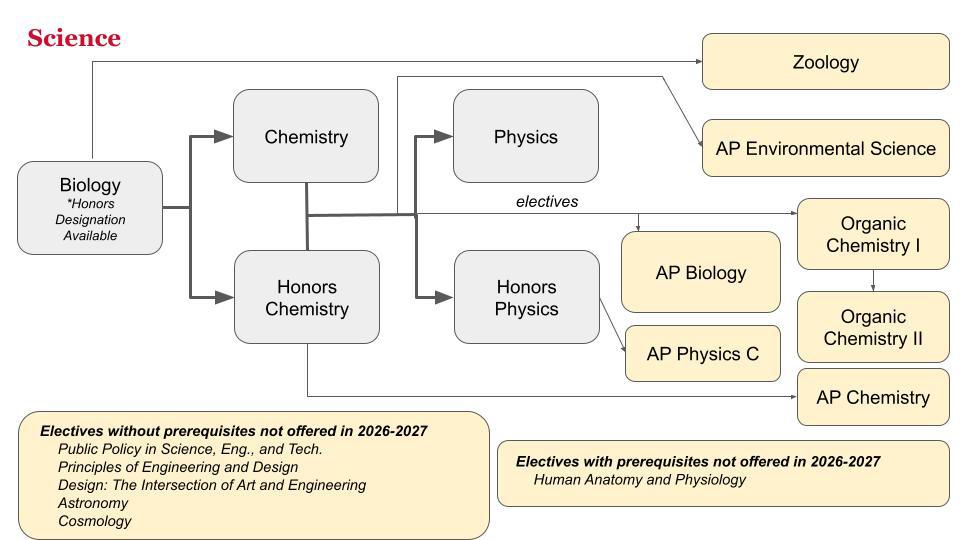
We believe that science is everywhere and for everyone. We want all students to discover that they are scientists: confident, curious, and capable of analytical and critical thinking. We offer students the opportunity to explore a wide range of science and engineering disciplines and time to engage in the practices of scientists and engineers. We guide students of all ages to approach the world with wonder and curiosity. Students will develop the confidence to analyze and solve real-world problems, and present evidence for their thinking.
Science
BIOLOGY
This course is designed to develop understanding of the essentials of living systems at a variety of scales, from biochemical reactions and cellular metabolism to evolutionary biology and global ecology. Emphasis is placed on connecting new knowledge to past work in science classes and on connecting biology to their own lives. Classwork takes many forms, including lecture, video, student presentations, modeling, and laboratory experiments and simulations. All laboratory work includes safe use of materials and appropriate laboratory techniques. Students will also use the course content, experiences, and textbook to develop study and organization skills essential to academic success in science and beyond.
Full-credit, graded course
•Required of Form IX students
•Full year, 1 credit
HONORS BIOLOGY DESIGNATION
All students who are enrolled in biology have an opportunity to earn an honors designation in the course. This is a great option for students who love science and are curious to learn more about the natural world. The honors pathway is best suited to students who are motivated and able to work well independently. Students choosing this option will gain a deeper understanding of the course content and explore their own scientific interests by conducting independent research each semester. This will include a book study of a nonfiction STEM book first semester and an experimental design or research-based project second semester. In addition, students wishing to earn an honors designation will need to complete separate more rigorous assessments for each unit of study and may be asked to complete additional work for the unit that will allow them to explore concepts in more depth. It is important to note that students choosing to participate in Honors Biology must complete the fall project and earn proficient grades on the honors exams in order to continue into the spring semester.
Full-credit, graded course
ZOOLOGY
Zoology is an upper level science course that will provide students with an in-depth study of the animal kingdom. We will gradually progress through the animal kingdom phylum-by-phylum according to evolutionary relationships from the most ancient animals (e.g. sea sponges and cnidarians) to the most recently-evolved animals (e.g. birds and mammals). This study of both invertebrate and vertebrate animals will include their evolution, classification, anatomy, physiology, behavior, development, and ecology (including human interactions and impacts). We will use comparative anatomy to determine how animals have evolved creative solutions to problems such as waste removal and movement and how body systems have changed and become more advanced over time. Students will have the opportunity to engage in independent research projects on topics of interest and lab work including dissections and animal behavior investigations. By the end of the year, the goal is for students to gain a substantial knowledge and appreciation of the vast diversity seen within the animal kingdom.
Full-credit, graded course
• Open to Forms X, XI, and XII students
• Prerequisites: Successful completion of Biology or Honors Biology
• Full year, 1 credit
• Offered in 2026-2027: Offered during odd-numbered graduation years
Science
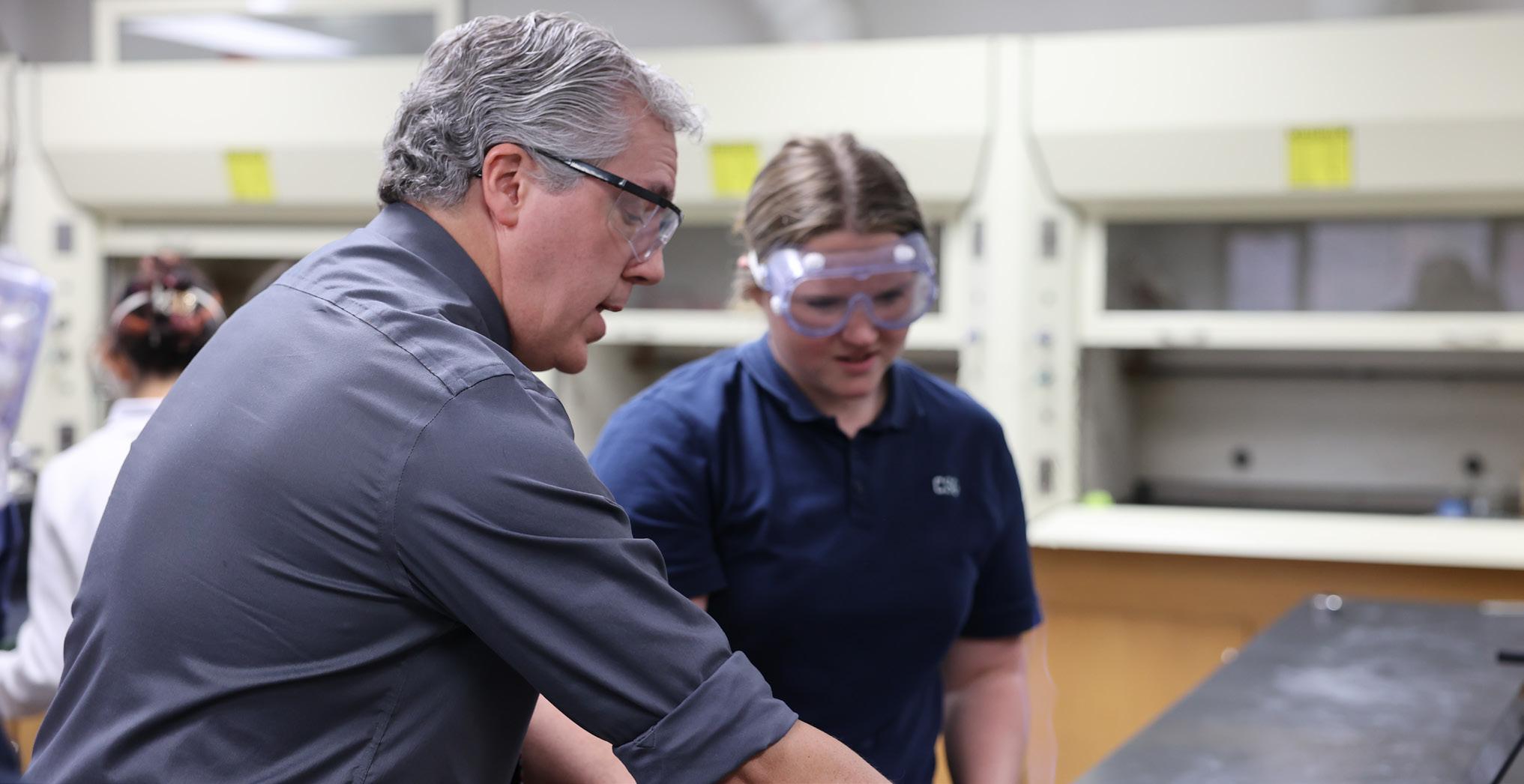
CHEMISTRY
Chemistry is a laboratory and inquiry-based course. This course covers the major concepts of chemistry, placing more emphasis on the fundamentals of chemistry and how they impact our daily lives and less emphasis on the mathematics of chemistry that is taught in Honors Chemistry. In addition, students master scientific skills including observation, data collection, hypotheses and predictions, and synthesis skills to make and support scientific claims. Each unit in Chemistry includes laboratory exercises, problem-based group activities, assessments and regular class checks for understanding. Students will learn through class lectures, labs, activities and independent work that includes digital and print media, interactive digital media giving students the ability to explore different styles of learning. This course fulfills the prerequisite for AP Biology and Organic Chemistry.
Full-credit, graded course
•Required of Form X students not enrolled in Honors Chemistry
• Prerequisites: Successful completion of Biology or Honors Biology
• Full year, 1 credit
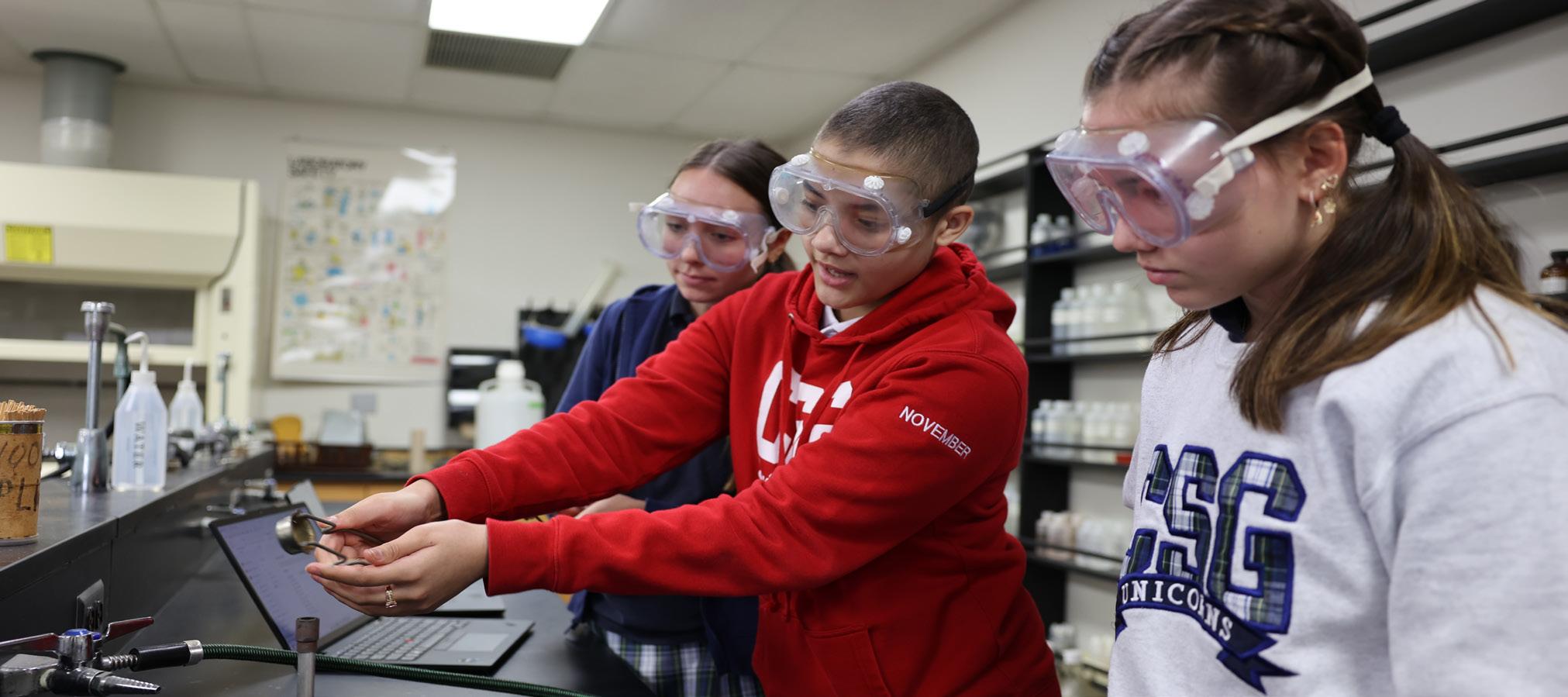
HONORS CHEMISTRY
The emphasis of this course is on the experimental approach and the development of unifying concepts. Understanding and application of chemical principles is stressed while memorization of factual material is minimized. Concepts discussed are generally related to laboratory experiences or to demonstrations. Topics include: laboratory techniques, quantitative problem-solving strategies, chemical formulas and equations, stoichiometry and the mole concept, atomic structure, the periodic law, bond formation and molecular geometry, kinetic theory and gas laws, enthalpy and entropy, chemical kinetics, solutions, equilibria, acid- base theories, oxidation-reduction, electrochemistry, and the important role of chemistry in our society. Classroom methods include demonstrations, discussions, small group problem-solving exercises, and lectures. Online computer links are available for drill and enrichment. Students enrolling in this class should have a high comfort level with Algebra I.
Full-credit, graded course
• Required of Form X students not enrolled in Chemistry
• Prerequisites: Recommendation of Biology teacher; PSAT math scores may also be considered.
• Full year, 1 credit
Science
AP ENVIRONMENTAL SCIENCE
This is a college-level survey course that prepares students for the AP Environmental Science examination. This course will focus on the issues that not only threaten the natural world, but our civilization. Students will be expected to engage with the scientific principles, concepts, and methodologies required to understand the interrelationships of the natural world and the human impact on the environment. This course includes inquiry-based projects, laboratories, and field investigations. These will weigh significantly throughout the year, and it is expected that students participate in all projects, labs, and field work presented throughout the course. Students will be required to identify and analyze environmental problems, evaluate the relative risks associated with these problems, and examine alternative, sustainable solutions for resolving or preventing them. Students will have the opportunity to think creatively on a project, perform experiments, and analyze data involving the study of air, water, as well as projects that explore modeling complex systems, recycling, composting, biodiversity, and the urban environment.
Full-credit, graded course
•Open to Forms XI and XII
•Prerequisites: Successful completion of Biology or Honors Biology (grade average of B+ or better) and Chemistry or Honors Chemistry PSAT Verbal scores may be considered
•Full year, 1 credit
•A final graded assessment is required; taken during an academic day in April, it will count as a CSG Semester 2 examination or a major portion of the student’s semester grade.
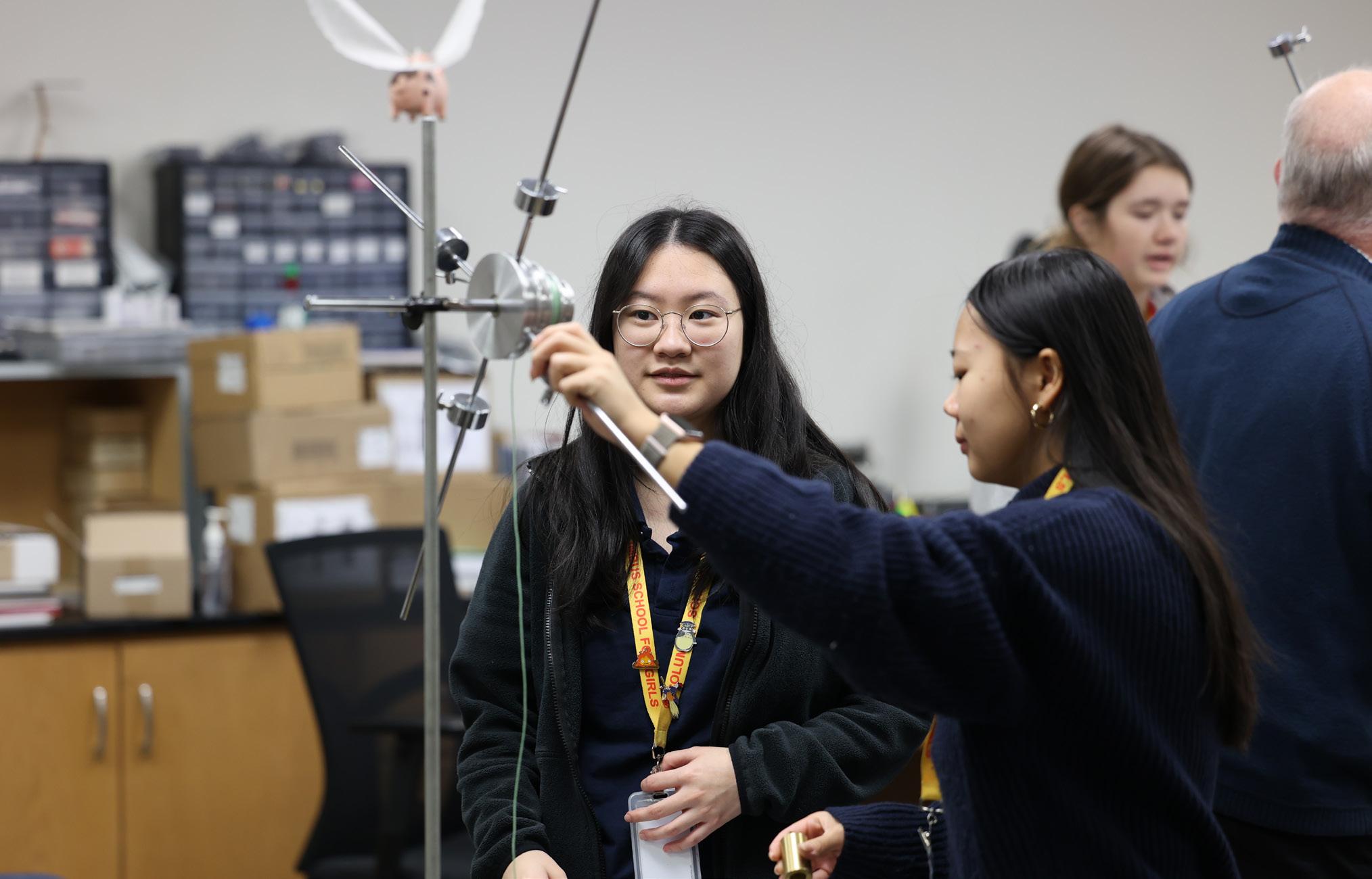
PHYSICS
This course provides a conceptually-based treatment of the fundamental principles and processes of the physical world. With the use of basic algebra skills, a selection of physics topics – such as motion, forces, energy, sound, light, electricity and magnetism – will be covered. Upon completion, students should be able to describe the principles studied with the use of examples and applications. Laboratory investigations, videos and computer-based models will be used to strengthen the understanding of concepts. In addition to providing students with a clearer understanding of their physical world, this course seeks to enhance their natural curiosity and strengthen their ability to reason clearly and effectively.
Full-credit, graded course
•Required of Form XI students not enrolled in Honors Physics
•Prerequisites: Successful completion of Chemistry or Honors Chemistry
•Full year, 1 credit
Science
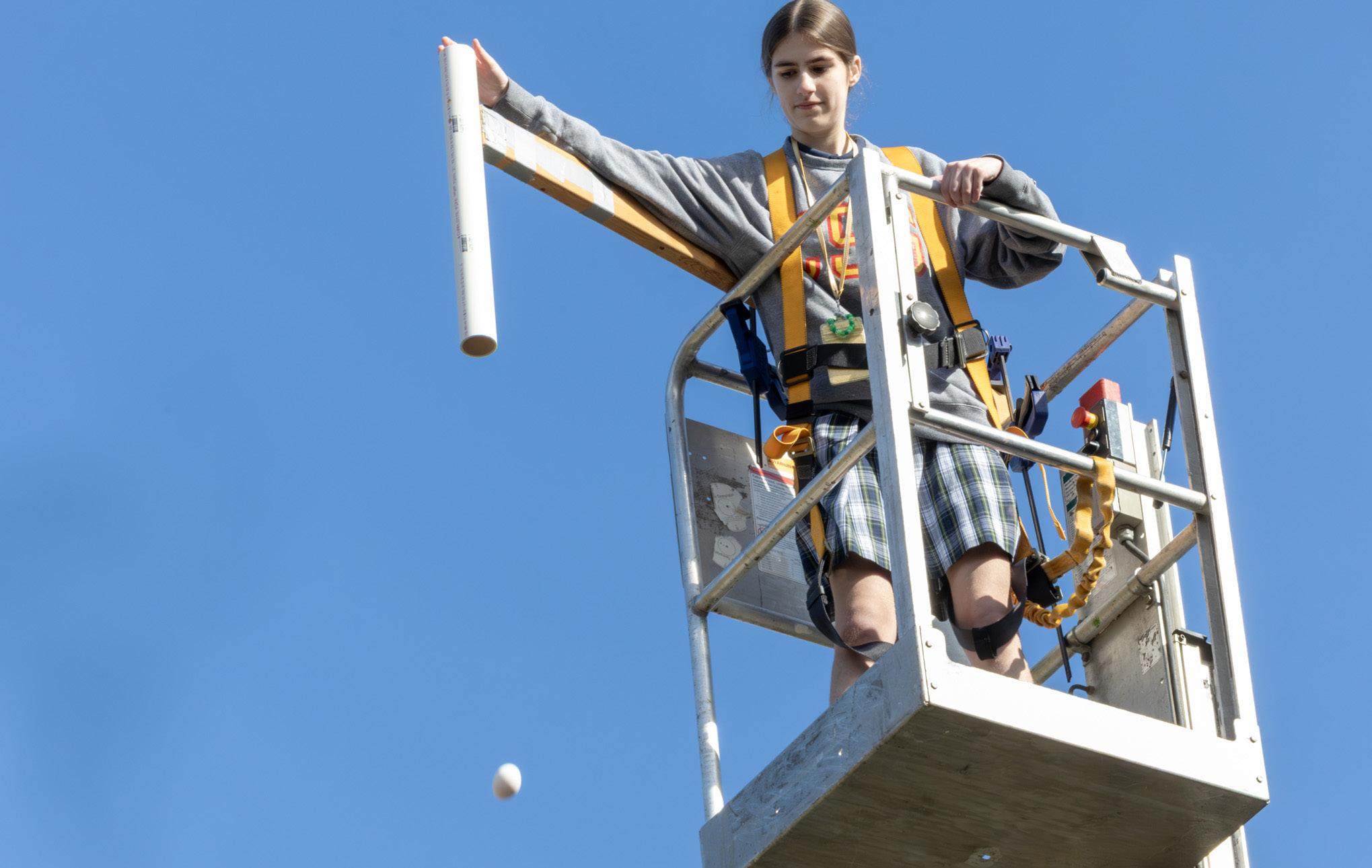
HONORS PHYSICS
Honors Physics challenges the student both to conceptualize and to resolve problems in Newtonian mechanics and dynamics. Topics include: 1D/2D motion, forces and Newton’s Laws, circular motion, rotational motion, torque, rolling motion, momentum and collisions as well as energy and work, and as time allows, oscillations, sound and basic circuits. Lectures, discussions and laboratory exercises are used to explore these tops. The course is supplemented with videos, demonstrations, and computer simulations. In addition to providing students with a clearer understanding of their physical world, this course seeks to enhance their natural curiosity and strengthen their ability to reason clearly and effectively.
Full-credit, graded course
•Required of Form XI students not enrolled in Physics
•Prerequisites: Successful completion of Chemistry or Honors Chemistry; concurrent enrollment in or successful completion of Honors Precalculus AB; PSAT math scores may be considered.
•Full year, 1 credit
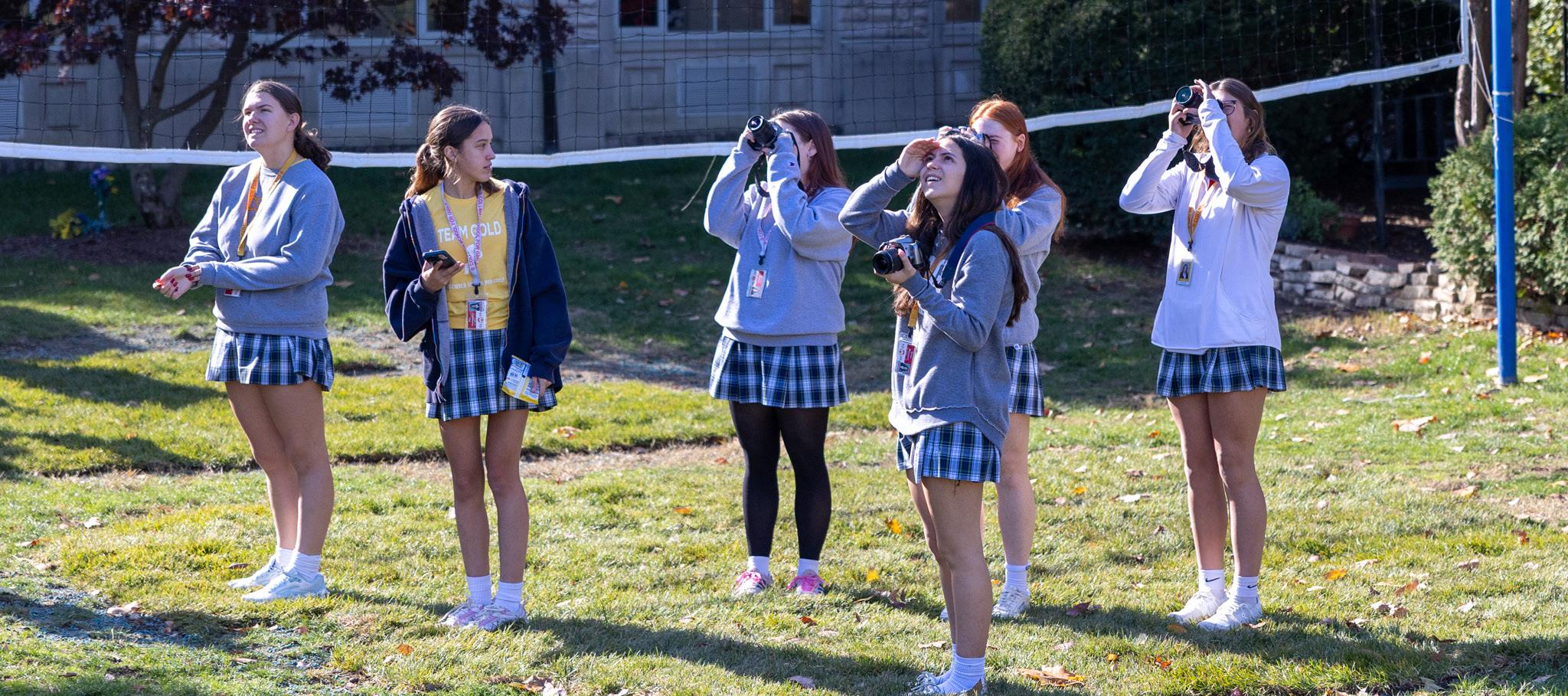
ADVANCED PLACEMENT BIOLOGY
This is a college-level survey course that prepares students for the AP Biology examination. Major areas of study are centered around four Big Ideas: 1) the process of evolution drives diversity and unity of life; 2) biological systems utilize free energy and molecular building blocks to grow, reproduce, and maintain homeostasis; 3) living systems receive, transmit, and respond to information; and 4) biological systems interact. This fast-paced course has a significant laboratory component with long- and short-term experiments, allowing students to develop scientific research skills and present their results through papers, poster sessions, and discussion. Students will also be guided as they read professional scientific papers and relate them to their own experimental work. Summer work may be required.
Full-credit, graded course
•Open to Forms XI and XII
• Prerequisites: Successful completion of Biology or Honors Biology (grade average of B+ or better) and Chemistry or Honors Chemistry; PSAT verbal scores may be considered.
• Full year, 1 credit
• A final graded assessment is required; taken during an academic day, it will count as a CSG Semester 2 exam or a major portion of the student’s semester grade.
Science
ADVANCED PLACEMENT PHYSICS C:
MECHANICS
The AP Physics C – Mechanics course is calculus-based and follows the AP course description as provided by the College Board. This college-level physics course challenges the student both to conceptualize and to resolve problems in kinematics, Newton’s laws of motion, work, energy and power, impulse and momentum, circular motion and rotation, oscillations and gravitation. The laboratory component will have a strong emphasis on “open-ended” labs in which the student makes careful observations of physical phenomena. The course is supplemented with videos, demonstrations and computer modeling. In addition to providing students with a clearer understanding of their physical world, this course seeks to enhance their natural curiosity and strengthen their ability to reason clearly and effectively. Textbook and laboratory examples will be covered in preparation for the Advanced Placement Physics C: Mechanics examination.
Full-credit, graded course
•Open to Form XII
•Prerequisites: Successful completion of Honors Physics with a grade average of A- or better; concurrent enrollment in or successful completion of AP Calculus; PSAT math scores may also be considered.
•Full year, 1 credit
•A final graded assessment is required; taken during an academic day in April, it will count as a CSG Semester 2 examination or a major portion of the student’s semester grade.
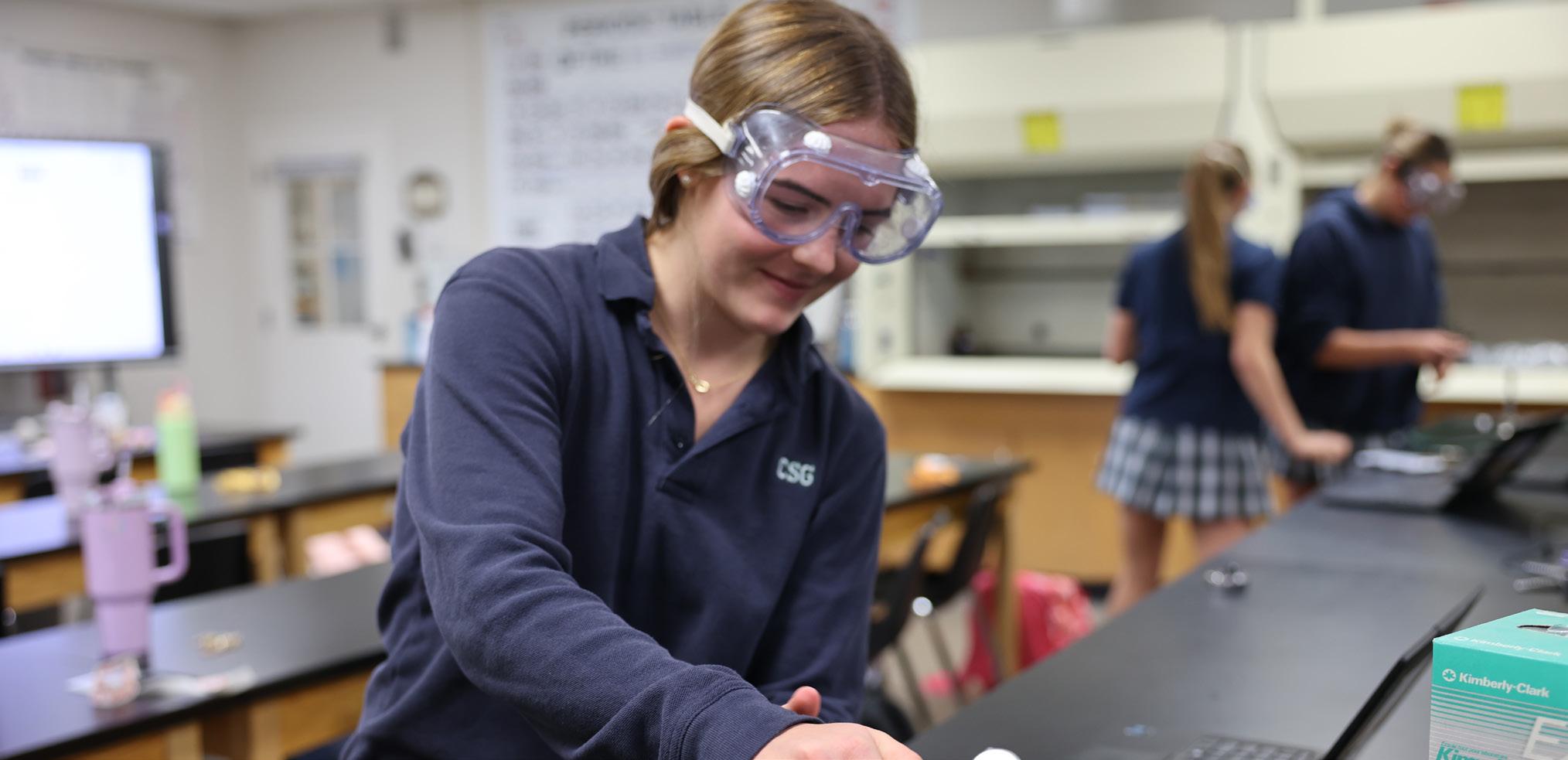
ORGANIC CHEMISTRY I
This course provides a conceptually-based treatment of the fundamentals of organic chemistry and serves as a good introduction to basic principles for students interested in the medical, dental, and pharmaceutical fields. Students will cover concepts of naming compounds, basic molecular structure and geometry, organic functional groups, structural and stereoisomers, and basic organic chemical reactions. We will also discuss analysis of organic compounds by interpreting infrared and nuclear magnetic resonance spectroscopy as well as mass spectrometry. The laboratory component will look at separation and analysis of organic compounds in a mixture. Students who have taken any general chemistry course will be prepared, though a strong knowledge of structures of compounds and 3-dimensional geometries is essential.
Full-credit, graded course
•Prerequisites: Successful completion of Chemistry or Honors Chemistry
•Semester 1 course, 0.5 credit
Science
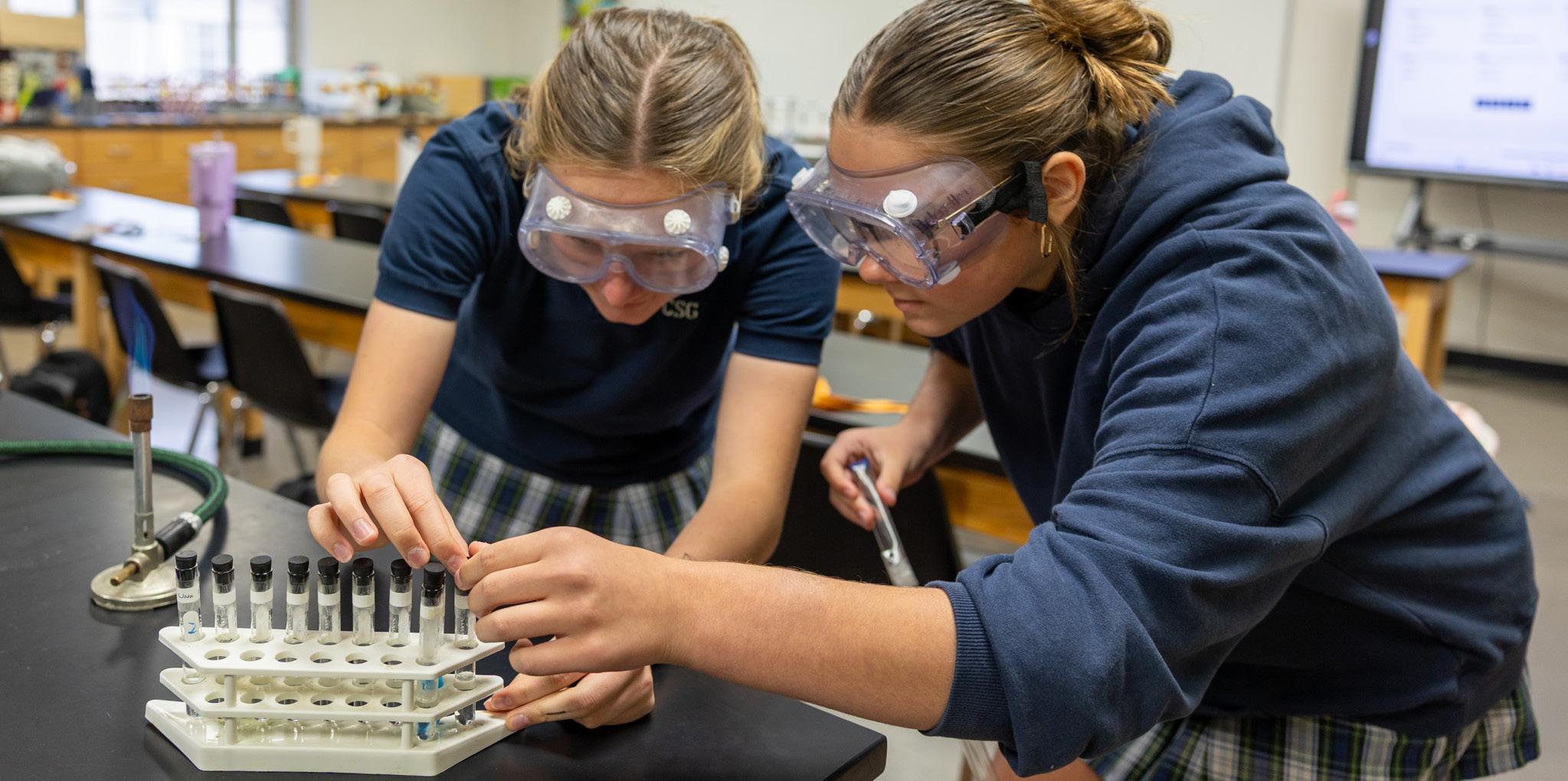
ORGANIC CHEMISTRY II
This course provides a conceptually-based treatment of the fundamentals of organic chemistry and builds off of basic principles presented in Organic Chemistry I. Continuing with the concepts introduced and developed in the first semester, mechanisms of reactions will be explored through application of thermodynamics and kinetics. The predominance of substitution vs. elimination mechanics in certain reactions will be investigated. Basic discussions around alkanes will expand to include alkenes and alkynes and addition reactions in which they are involved. General reactions with functional groups will also be covered.
Full-credit, graded course
•Prerequisites: Successful completion of Organic Chemistry I
•Semester 2 course, 0.5 credit
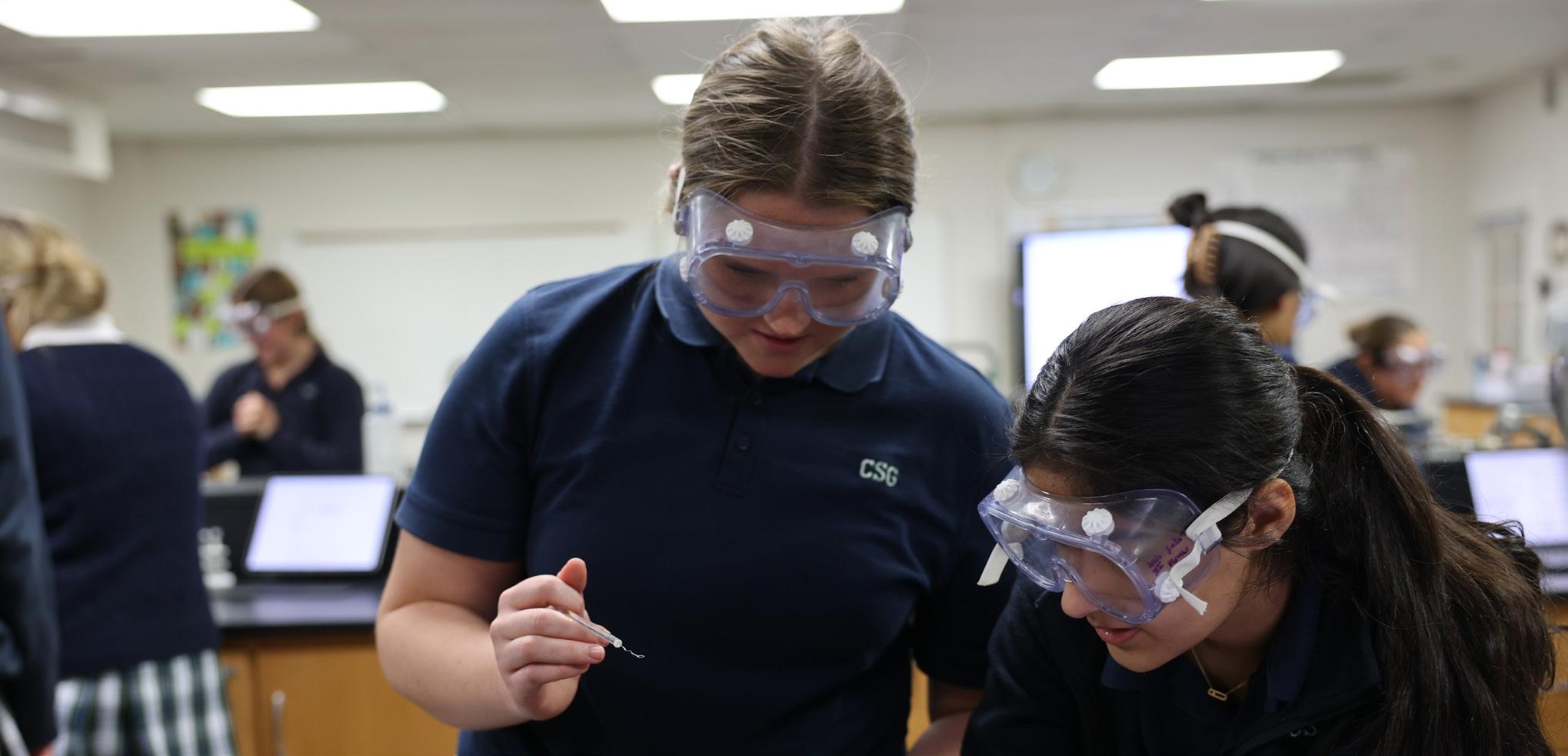
ADVANCED PLACEMENT CHEMISTRY
This is a college-level course that follows the Advanced Placement curriculum set forth by the College Board. Major topics covered in the course are the electromagnetic spectrum, chemical bonding and geometries, intermolecular attraction, stoichiometric relationships, chemical reactions and trends, gas laws, solutions, chemical equilibria, solubility, chemical kinetics, acid-base chemistry, oxidation-reduction, electrochemistry, and basic organic chemistry. An emphasis is placed on critical analysis, laboratory procedures, and technology in science. Laboratory material reinforces the principles and concepts covered in the lecture class. Textbook and laboratory examples will be covered in preparation for the Advanced Placement Chemistry examination. The course is a “gradeless” course that emphasizes skill-building and understanding of concepts over accumulation of points. A student/teacher meeting at the end of each semester will be held in order to determine the grade that is submitted for the student’s transcript.
Full-credit, graded course
•Prerequisites: Successful completion of Honors Chemistry with a grade average of A- or better; PSAT math scores may also be considered.
•Full year, 1 credit
•A final assessment is required; taken during an academic day in April, it will count as a major portion of the student’s semester grade
Science
NOT OFFERED THIS YEAR
PRINCIPLES OF ENGINEERING AND DESIGN
This course will expose students to the engineering design process including team development, brainstorming, drawing and modeling, reverse engineering, research and analysis, communication methods, technical documentation, and manufacturing. A component of this course will be learning the basics of a 3D solid modeling design software. In addition to learning the basics of solid modeling and computer-aided-design, students will be introduced to rapid prototyping via the use of three-dimensional printers, the Glowforge laser cutter and engraver, and will work with Arduino Uno microcontroller units, providing a platform for prototyping electromechanical devices. The application of the design process to the worlds of robotics, product design, theater set and prop design, and visual arts will be discussed in order to emphasize the interdisciplinary nature of engineering and design. Additional activities in this course could include discussions, guest speakers (especially CSG alumnae who have studied engineering and/or are working in the engineering field), class exercises, case studies, labs, and student presentations. As a final project for this course, the students will apply the tools and techniques learned during the semester on a final project that will be student-specific and will relate to the student’s own interests.
Full-credit, graded course
• Open to Forms X, XI, XII
• Semester 2 course, 0.5 credit
HUMAN ANATOMY AND PHYSIOLOGY
Human Anatomy and Physiology is a course that investigates the structure and function of the human body. Topics covered will include the basic organization of the body, its biochemical composition, and the major body systems, along with the impact of diseases on certain systems. From biochemistry and anatomical terminology to the large-scale details of each of the major body systems, students will learn through print and digital reading materials, digital and kinesthetic activities, group work, projects, and labs. Students will reinforce their study using Anatomy in Clay MANIKEN models throughout the year to sculpt the muscles, organs, nerves, blood vessels, and other structures of the human body in clay.
Full-credit, graded course
•Open to Forms XI and XII
•Prerequisites: Successful completion of Biology or Honors Biology and Chemistry or Honors Chemistry
•Full year, 1 credit
•Offered in 2027-2028: Offered during even-numbered graduation years
World Languages
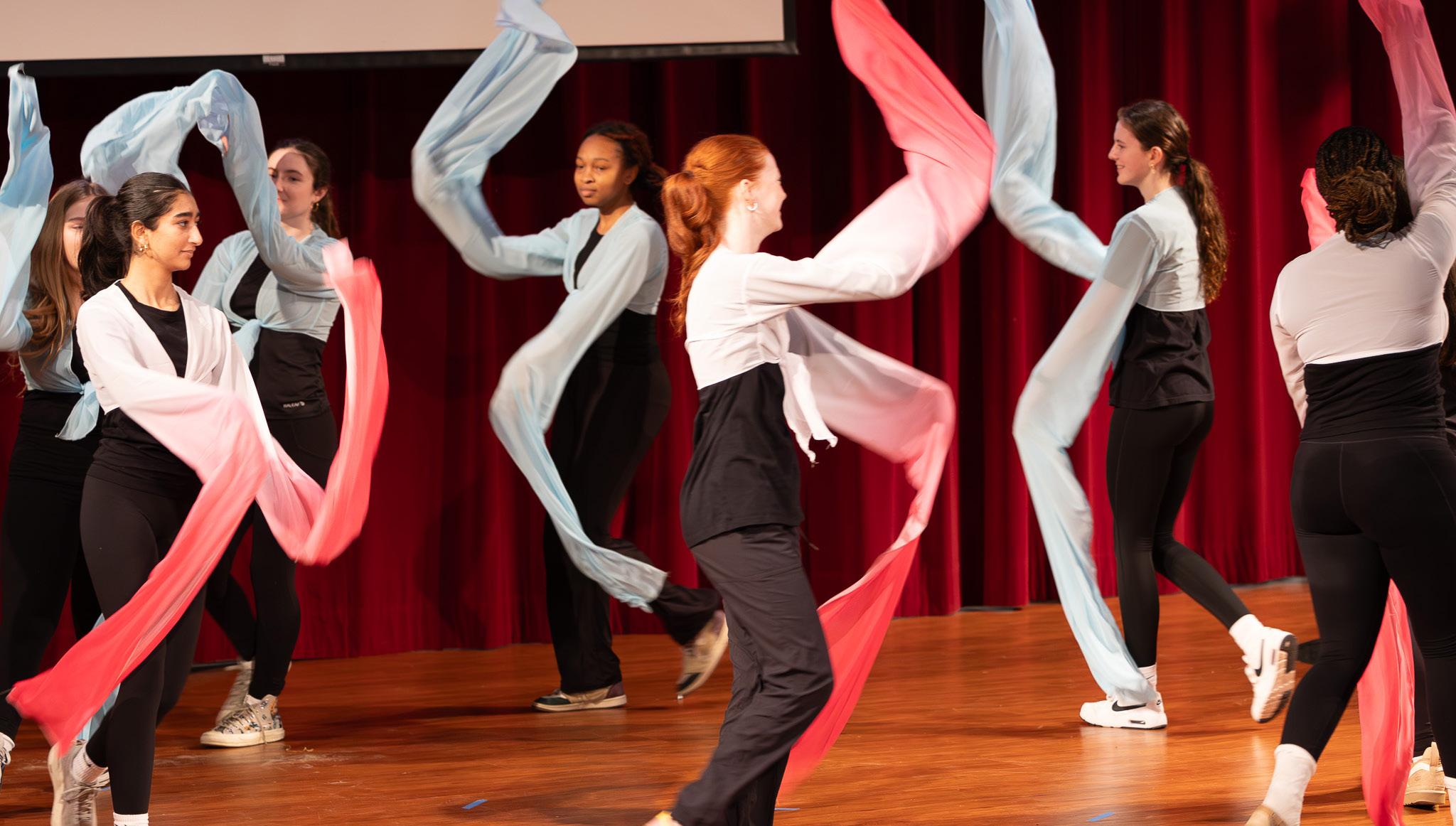
The World Languages Department strives to provide every student with meaningful study of languages and cultures. Our course offerings are in Latin, Mandarin, and Spanish. We guide our students in the development of communication and multicultural skills to become confident leaders and lifelong learners in an interconnected world. Our students undertake a journey of discovery and pursue their language studies to their highest potential, resulting in deeper cultural understanding and an enriched life experience. Developing the skills to become an effective language learner requires continuity and frequency. In the Upper School, The first three levels of a language form a foundation upon which significant oral proficiency and cultural understanding can be achieved. The process of language acquisition as an academic and natural endeavor is both valuable and necessary for the 21st century student. For this reason, satisfactory completion of a world language through Level III is required for graduation. Beyond the graduation requirement, it is encouraged that students take a language through their senior year. Upper School World Language classes highlight, practice and assess three approaches to language production and communication: interpretive, interpersonal and Students read, listen, speak and write on authentic and relevant topics of the target language. Upper School students are given the opportunity to participate in travel experiences to Think Globally and demonstrate an understanding of differences.
World Languages
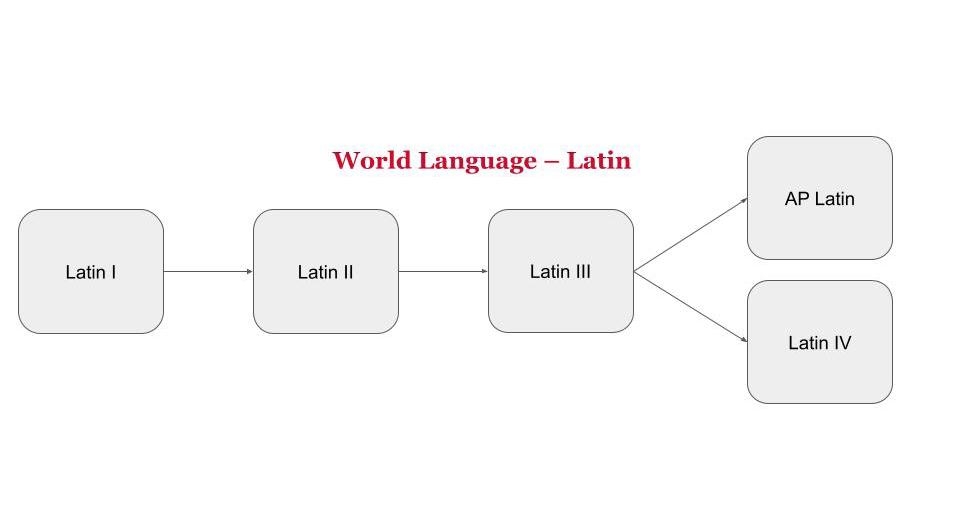
LATIN LATIN I
Formal introduction to the classical language is accomplished through a blend of the reading and grammar approaches using Lingua Latina. The textbook is supplemented with Latin readings from Colloquia Personarum. The focus of the course is on developing reading proficiency and mastery of fundamental Latin vocabulary and grammar. Systematic expansion of English vocabulary occurs through detailed study of Latin stems and modern root derivation. Students learn about Roman history and culture through a variety of English readings and creative projects.
Full-credit, graded course
•Open to Forms IX, X, XI, XII (scheduling priority is given to students in Form IX); seniors may take a first-year language only as a sixth course and are given last priority in scheduling.
• Prerequisites: Forms IX, X, and XI - none; Form XII - the student must be enrolled in five other full-credit courses each semester.
• Full year, 1 credit
World Languages
LATIN II
Students continue with the reading-approach in Lingua Latina textbook series. More complex grammar is introduced, including the subjunctive mood, participles, gerunds, gerundives, and all varieties of subordinate clauses. Students are further exposed to Roman culture and history through a variety of readings in English and lectures provided by the instructor. Introductory skills in Latin prose composition are acquired.
Full-credit, graded course
• Open to Forms IX, X, XI, XII
• Prerequisites: Successful completion of Latin I; for rising Form IX CSG students, successful completion of Latin in Form VIII with a grade of B- or better and departmental signature.
• Full year, 1 credit
LATIN III
In the student’s third year, coursework transitions from slightly adapted Latin to real Latin with readings drawn from authors such as Cicero, Livy, and Catullus. Grammar is renewed in depth with concentration on those forms and grammatical constructions found in standard prose authors and culminates in more advanced prose compositions based on the style of Cicero. Rhetorical devices, stylistic elements and literary tropes are discussed in depth as each author is encountered. In addition, an appreciation of classical literature is encouraged through reading various works of Greek and Roman literature.
Full-credit, graded course
• Open to Forms X, XI, XII
• Prerequisites: Successful completion of Latin II
• Full year, 1 credit
World Languages
LATIN IV
This course is a survey of Latin literature. In the fall, students focus on prose with Cicero, Caesar, and historians like Sallust & Tacitus. In the spring, they turn to Augustan poetry and authors like Ovid, Horace, and Vergil. Scansion of dactylic hexameter and elegiac couplets are studied in depth, with the student attaining mastery in this area by the end of the course.
Full-credit, graded course
• Open to Forms XI, XII
• Prerequisites: Successful completion of Latin III
• Full year, 1 credit
ADVANCED PLACEMENT LATIN
The AP Latin course is designed to prepare students for undergraduate Latin translation and Classics courses as well as the Advanced Placement examination in Latin. Some class time will be spent discussing the format of the exam, its scoring, and successful test-taking strategies. Students will work on numerous practice exercises from practice AP Exams to become as familiar with the test as possible. In the course, students comprehensively read, discuss, and interpret Virgil and Caesar in preparation for the AP Latin exam, but also a variety of canonical prose authors such as Cicero, Livy, Sallust, and Seneca and canonical poets such as Ovid, Catullus, Horace, and Propertius. Students study scansion of dactylic hexameter and elegiac couplets through in-depth, accelerated study of the major poets. Students will read the relevant biographical and stylistic information for each author from Gian Biagio Conte’s Latin Literature.
Full-credit, graded course
• Open to Forms XI, XII
• Prerequisites: Successful completion of Latin IV with a grade of A- or better or instructor approval; a strong work ethic and exceptional talent in listening, reading, speaking, or writing.
• Full year, 1 credit
• A final graded assessment is required; taken during an academic day in April, it will count as a CSG Semester 2 examination or a major portion of the student’s semester grade.
World Languages
ADVANCED READINGS IN LATIN LITERATURE
The Advanced Readings in Latin Literature course provides students who have completed AP Latin an opportunity to translate and analyze particular Latin authors not covered by the AP Latin curriculum. The course focuses on the genres of biography & philosophy. Students read and analyze authors like Cornelius Nepos, Suetonius, Seneca, Lucretius, and Apuleius. There is also a significant research writing component to the course that emphasizes breadth of preparation and analysis.
Full-credit, graded course
• Open to Forms XI, XII
• Prerequisites: Successful completion of AP Latin with a grade of B or better; a consistently strong work ethic and exceptional ability to analyze, comprehend, and translate Latin.
• Full year, 1 credit
World Languages
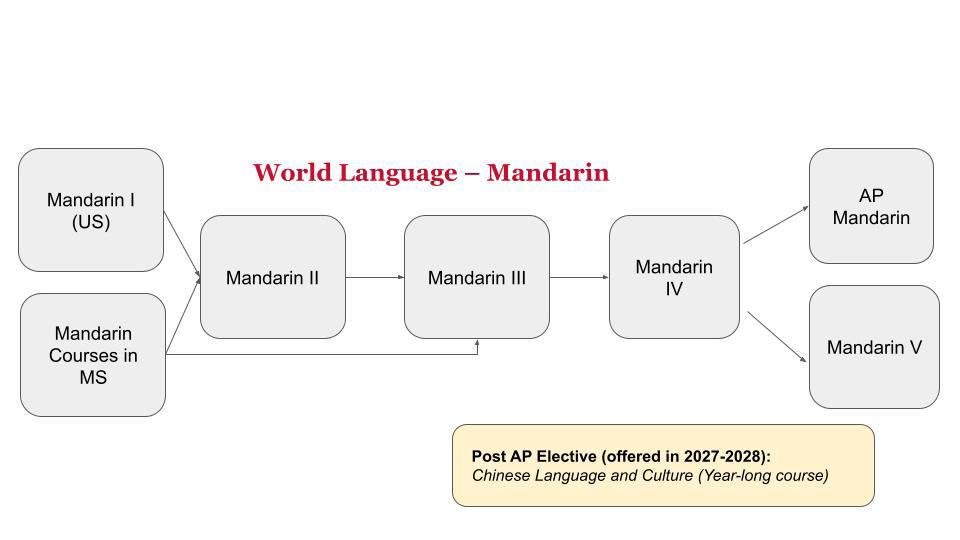
MANDARIN CHINESE
MANDARIN CHINESE I
Mandarin I introduces students to the fundamentals of the Chinese language and culture through the Comprehensible Input (CI) approach, a method that helps learners acquire language naturally through meaningful and engaging experiences. Students will build their Mandarin skills by hearing and using high-frequency words and phrases in authentic, communicative contexts. Classroom activities are interactive and fun—they may include games, short videos, stories, songs, tasting Chinese food and drinks, and celebrating traditional holidays. Students will also explore cultural topics through real-life materials and tasks that connect language to daily life. Topics include: greetings, self-introduction, family and friends, favorite foods and drinks, dates and time, weather, birthdays, hobbies, pets, daily routines, school life, and cultural celebrations such as the Mid-Autumn Festival and Lunar New Year. By the end of the course, students will be able to communicate about familiar topics in Mandarin and are expected to reach a Novice Low to Novice Mid level of proficiency according to American Council on the Teaching of Foreign Languages (ACTFL).
World Languages
Full-credit, graded course
• Open to Forms IX, X, XI, XII (scheduling priority is given to students in Form IX); seniors may take a first-year language only as a sixth course.
• Prerequisites: Forms IX, X, and XI, none; Form XII, the student must be enrolled in five other full-credit courses each semester.
• Full year, 1 credit
MANDARIN CHINESE II
Mandarin II builds on the foundation from Mandarin I and introduces students to a wider range of communication topics in Chinese language and culture through the Comprehensible Input (CI) approach—a method that helps learners acquire language naturally through meaningful and engaging experiences. Students will strengthen their Mandarin skills by adding more details to their speech and writing, using increasingly complex grammar structures, engaging in longer conversations and readings, and beginning to interact with native speakers. Classroom activities remain interactive and enjoyable, including games, videos, stories, songs, tasting Chinese foods and drinks, and celebrating traditional holidays. Students will continue exploring cultural topics through authentic materials and real-life tasks that connect language learning with everyday experiences. Topics include: school life in China and the U.S., summer activities, shopping, transportation and travel, regional food differences, climate, homes and houses, sports and musical talents, physical features and favorite people, sibling relationships, and standing up against negative behaviors. Traditional Chinese holidays are also explored through more text-based and interpretive activities. By the end of the course, students will be able to communicate on a variety of everyday topics, narrate past experiences, and are expected to reach a Novice Mid to Intermediate Mid level of proficiency according to American Council on the Teaching of Foreign Languages (ACTFL).
Full-credit, graded course
• Open to Forms IX, X, XI, XII
• Prerequisites: Successful completion of Mandarin Chinese I
• Full year, 1 credit
World Languages
MANDARIN CHINESE III
Mandarin III continues to develop students’ language proficiency and cultural understanding through the Comprehensible Input (CI) approach, emphasizing meaningful communication and authentic use of the language. Students will expand their ability to express opinions, compare cultural perspectives, and handle more complex social and academic situations in Mandarin. They will engage in extended conversations, read longer texts, write short paragraphs, and interact more confidently with native speakers. Classroom activities encourage creativity and real-world application through games, discussions, videos, short films, stories, songs, projects, speakers and cultural celebrations. Students will continue to explore authentic materials that deepen their understanding of contemporary Chinese culture and global Chinese-speaking communities. Topics include: school and career aspirations, health and daily routines, city life and travel, environmental issues, community (a field trip to an Asian market), volunteering and social responsibilities, food culture and etiquette, cultural values and traditions, and festivals celebrated across Chinese-speaking regions. By the end of the course, students will be able to communicate in a wider range of real-life contexts, express and support opinions, and are expected to reach an Intermediate Low to Intermediate Mid level of proficiency according to American Council on the Teaching of Foreign Languages (ACTFL).
Full-credit, graded course
• Open to Forms IX, X, XI, XII
• Prerequisites: Successful completion of Mandarin Chinese II
• Full year, 1 credit
World Languages
MANDARIN CHINESE IV
Mandarin IV is designed for advanced language learners who are ready to refine their proficiency and deepen their understanding of Chinese culture and society through the Comprehensible Input (CI) approach. Students will expand their communication skills to discuss abstract ideas, current events, and cultural perspectives with greater accuracy and nuance. They will engage in interpretive, interpersonal, and presentational tasks that reflect real-world use of Mandarin. Classroom learning emphasizes authentic materials and immersive experiences—such as TV shows, movies, documentaries, long videos, news articles, literary excerpts, interviews, speakers and cultural projects. Students will participate in discussions and presentations that encourage critical thinking, creativity, and cultural comparison. Topics include: modern Chinese youth culture, education and family expectations, global challenges and sustainability, traditional versus modern lifestyles, career and life planning, travel and tourism, arts and entertainment, technology and innovation, and contemporary social issues in Chinese-speaking communities. By the end of the course, students will be able to communicate with confidence and cultural awareness on both familiar and abstract topics and are expected to reach an Intermediate Mid to Intermediate High level of proficiency according to American Council on the Teaching of Foreign Languages (ACTFL).
Full-credit, graded course
• Open to Form X, XI, XII
• Prerequisites: Successful completion of Mandarin Chinese III
• Full year, 1 credit
World Languages
MANDARIN CHINESE V
Mandarin V is designed for students seeking advanced mastery of the Chinese language and culture. Through the Comprehensible Input (CI) approach, students will refine their ability to communicate effectively in a variety of real-world contexts, analyze complex topics, and engage critically with Chinese-language media and literature. The course emphasizes fluency, accuracy, and cultural insight, preparing students for continued study or use of Mandarin in academic, professional, and social settings. Classroom activities are highly interactive and immersive, including debates, research projects, presentations, literature discussions, movies, documentaries, interviews, and exploration of contemporary and historical Chinese cultural issues. Students will read authentic texts, write extended compositions, and participate in sophisticated conversations with peers and native speakers. Topics include: current events and social issues, literature and the arts, science and technology, global perspectives and intercultural communication, traditional and contemporary cultural practices, and Chinese philosophy and ethics. By the end of the course, students will be able to communicate with confidence and more accuracy as they develop fluency and are expected to reach Intermediate High level of proficiency according to American Council on the Teaching of Foreign Languages (ACTFL).
Full-credit, graded course
• Open to Form XII
• Prerequisites: Successful completion of Mandarin Chinese IV
• Full year, 1 credit
World Languages
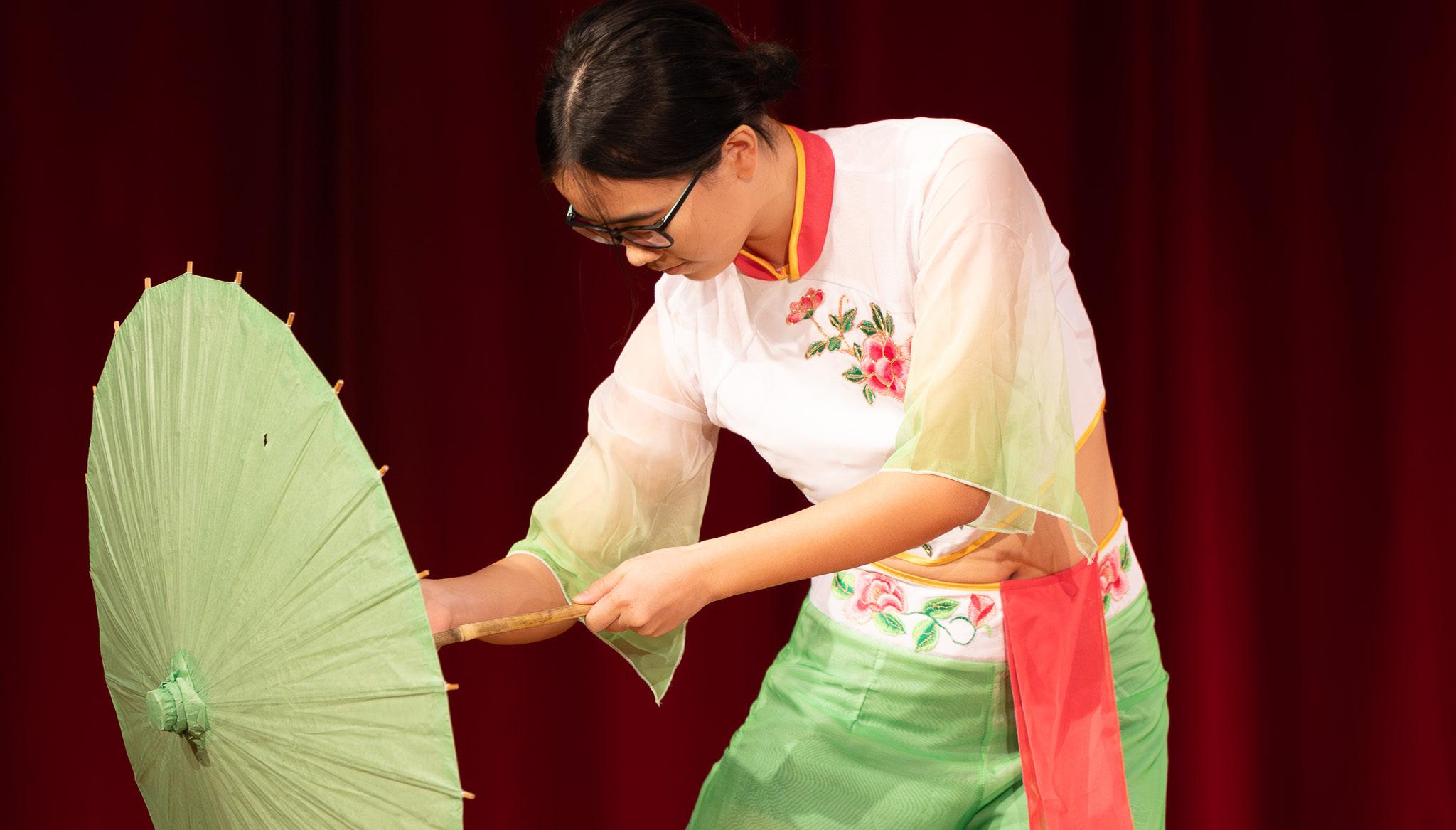
AP CHINESE LANGUAGE AND CULTURE
This advanced course is designed for students who wish to develop proficiency in Mandarin Chinese while gaining a deeper understanding of Chinese culture and contemporary society. The course emphasizes communication in real-life contexts and integrates the study of language with exploration of cultural topics such as family and community, personal and public identity, beauty and aesthetics, science and technology, contemporary life, and global challenges. Students will strengthen their interpretive, interpersonal, and presentational skills through authentic materials, including articles, videos, interviews, and literary excerpts. The class also prepares students for the AP Chinese Language and Culture Exam, focusing on proficiency, cultural insight, and confident expression in Mandarin.
Full-credit, graded course
• Open to Forms XI and XII
• Prerequisites: Successful completion of Mandarin Chinese IV with a grade of B or higher or with department approval.
• Full year, 1 credit
• A final graded assessment is required; taken during an academic day in April, it will count as a CSG Semester 2 examination or a major portion of the student’s semester grade
World Languages
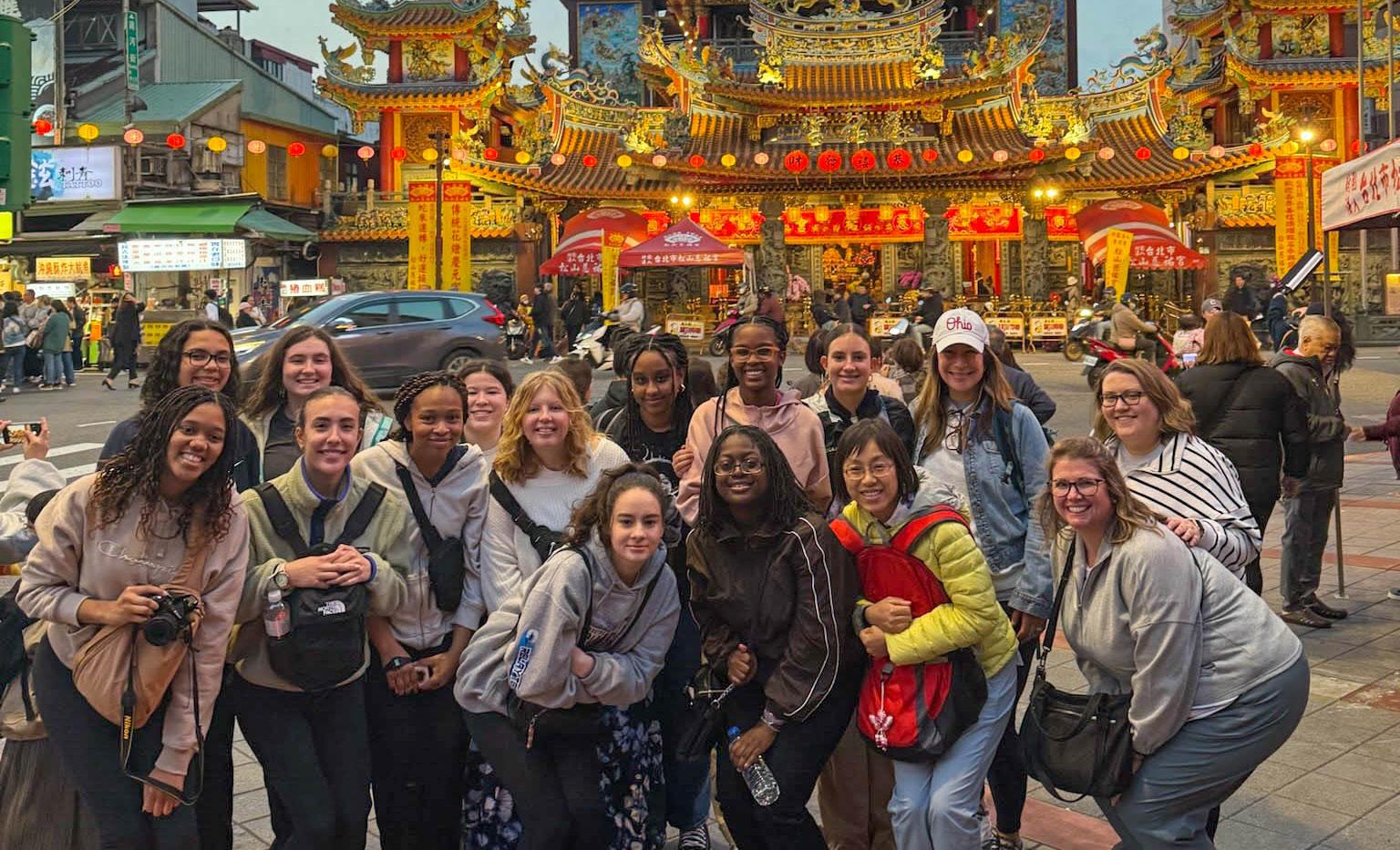
POST AP CHINESE LANGUAGE AND CULTURE
This post-AP course takes students on an in-depth exploration of China through its language, stories, and cultural evolution. Using folk tales, legends, excerpts from classical and modern literature, historical documents, archaeological discoveries, and carefully selected film and television clips, students will uncover how Chinese identity has been shaped over thousands of years. Through these diverse texts and media, students will sharpen their interpretive reading, analytical writing, and advanced conversational skills while engaging with questions about tradition, modernity, morality, and human behavior. The course bridges history and literature, giving students a panoramic view of Chinese civilization — from mythic beginnings to contemporary life — and inviting them to reflect on how cultural values endure and transform across time.
Full-credit, graded course
• Open to Forms XI and XII
• Prerequisites: Successful completion of AP Chinese Language and Culture with a grade of B or higher or with departmental approval.
• Full year, 1 credit
World Languages
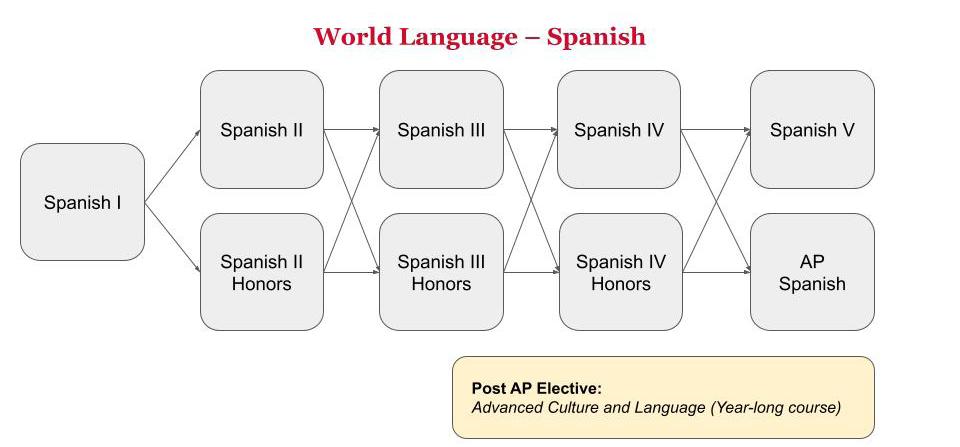
SPANISH
SPANISH I
This course teaches the basics of Spanish grammar. Emphasis is placed not only on written expression and correct grammar usage, but also on proper oral expression and pronunciation. Students are encouraged to be creative with the language and speak it as much as possible in class. Daily assignments and in-class activities, such as written exercises, board work, question-answer routines, mini-plays, listening exercises, and Spanish language videos, challenge students to continually practice and improve their Spanish listening, speaking, reading, and writing skills, as well as build their vocabulary. This class is conducted primarily in Spanish.
Full-credit, graded course
• Open to Forms IX, X, XI, XII students who did not take Spanish in Middle School (scheduling priority is given to Form IX); seniors may take a first-year language only as a sixth course and are given last priority in scheduling.
• Prerequisites: Forms IX, X, and XI, none; Form XII, the student must be enrolled in five other full-credit courses each semester.
• Full year, 1 credit
World Languages
SPANISH II/ HONORS DESIGNATION
This course reviews and builds on the basics of Spanish grammar learned in Spanish I. It includes a detailed study of new grammar, including the imperfect and preterite tenses, commands, and the future and conditional tenses, as well as other grammatical topics. Reading and writing skills are practiced through daily assignments and board work. There is an increased emphasis on speaking and listening skills in level II, and thus many in-class activities are geared toward working on those skills. Students speak with partners, perform skits in groups, and engage in conversation with the teacher on a daily basis. The class is conducted primarily in Spanish. Students who pursue an honors designation will complete required, communicative tasks each quarter to further challenge themselves and gain more Spanish proficiency.
Full-credit, graded course
• Open to Forms IX, X, XI, XII
• Prerequisites: Successful completion of Spanish I
• Full year, 1 credit
SPANISH III/ HONORS DESIGNATION
This course provides an intensive review of the grammar learned in Spanish II, while also introducing new grammatical topics. It also focuses on the history and culture of the Spanishspeaking world, including the Latinx population of the United States, by use of literature, videos, art, and so on. These sources serve to drive class discussion and class assignments, including papers, skits, projects, etc. Given that the course is taught entirely in Spanish, great emphasis is always placed on speaking Spanish in class, and students are encouraged to be creative with the language. At the end of this course, students will be able to handle a range of uncomplicated communicative tasks by creating their own detailed responses, and should be able to express some familiarity with cultures of the Spanish speaking world. Students who pursue an honors designation will complete required, communicative tasks each quarter to further challenge themselves and gain more Spanish proficiency.
Full-credit, graded course
• Open to Forms IX, X, XI, XII
• Prerequisites: Successful completion of Spanish II/II Honors
• Full year; 1 credit
World Languages
SPANISH IV/HONORS DESIGNATION
This course reviews the more challenging grammatical concepts of Spanish II and III, while placing a far greater emphasis on the cultures of the Spanish-speaking world. Given that students in Spanish IV normally are familiar with language basics, we instead focus on strengthening those basics and delving into exceptions to grow their language competency. To accomplish this, we use a wide array of cultural artifacts, including short readings, audios, videos, and literature, to put their language competency to use. Given that the class is taught entirely in Spanish, strong emphasis is placed on speaking Spanish in class. At the end of this course, students will be able to handle some more complex communicative tasks by creating their own detailed responses, and should be able to express familiarity with cultures of the Spanish speaking world. Students who pursue an honors designation will complete required, communicative tasks each quarter to further challenge themselves and gain more Spanish proficiency.
Full-credit, graded course
• Open to Forms X, XI, XII
• Prerequisites: Successful completion of Spanish III/III Honors
• Full year, 1 credit
SPANISH V
This course is open to all students who wish to study Spanish literature and review grammar. Emphasis is placed on readings from a variety of sources, including: short stories, articles, and plays, as well as the application of key grammatical points to both written and oral language. Class discussions will be conducted in Spanish to grow student communicative confidence. Given that this may be the final Spanish course that many students take at CSG, it is designed to prepare them to pursue the study of Spanish literature and language at the college level. At the end of this course, students will be comfortable holding basic conversations in Spanish, be able to handle many basic and some complex communicative tasks, and should be able to express deep familiarity with the cultures of the Spanish speaking world.
Full-credit, graded course
• Open to Forms XI and XII
World Languages
• Prerequisites: Successful completion of Spanish IV.
• Full year, 1 credit
ADVANCED PLACEMENT SPANISH LANGUAGE AND CULTURE
This course challenges students to develop a high level of fluency in spoken language, to acquire a command of vocabulary and language structure similar to that of an advanced non-native speaker, and to understand complex literary and non-literary prose written by Spanish and Latin American authors. Class discussion will be conducted entirely in Spanish. Designed as a college-level class, this course also prepares students for the Advanced Placement Spanish Language examination. Some of the class time will be spent discussing the format of the test, its scoring, and successful test-taking strategies. Students will work on numerous practice exercises from each section of the test to improve their skills and to become as familiar and comfortable with the test as possible. All students enrolled in this course are required to take the AP Spanish Language examination. At the end of this course, students will be comfortable holding extensive conversations in Spanish, be able to handle many basic and complex communicative tasks, and should be able to express deep familiarity with the cultures of the Spanish speaking world.
Full-credit, graded course
• Open to Forms XI and XII
• Prerequisites: Successful completion of Spanish IV/IV Honors with department approval.
• Full year, 1 credit
• A final graded assessment is required; taken during an academic day in April, it will count as a CSG Semester 2 examination or a major portion of the student’s semester grade.
World Languages
POST AP SPANISH LANGUAGE AND CULTURE
This course is designed to accommodate our students who have completed all possible Spanish courses at CSG up to and including AP Spanish Language and Culture. The focus of this course will be to improve students’ fluency and linguistic accuracy. Students will read and discuss various texts, engage in conversation, and write compositions while exploring Hispanic/Latinx cultures. Texts may include longer short stories (such as those by Jorge Luis Borges and Rosario Castellanos), young adult literature (including Esperanza Renace by Pam Muñoz Ryan and El teatro de los monstruos by Viviana Cordero), movies (Bajo la misma luna), and plays performed in class (such as La casa de Bernarda Alba by Federico García Lorca). Strengthening language competency may include work with the past tenses, prepositions, and the subjunctive, among others. The course structure will allow flexibility to identify where students need improvement, and specifically target those areas. At the end of this course, students will be comfortable holding extensive conversations in Spanish, be able to handle many basic and complex communicative tasks, and should be able to express deep familiarity with the cultures of the Spanish speaking world. This course is taught entirely in Spanish and all submitted work is in Spanish. Grading is based on participation, completion of reading selections, oral and written quizzes, submission of critical analyses, and oral project presentations. At the end of this course, students will be able to handle a wide range of communicative tasks by creating their own detailed sentences. Thus, students will be at the “Intermediate Mid to Advanced Low” proficiency level designated by the American Council on the Teaching of Foreign Languages.
Full-credit, graded course
• Open to Form XII
• Prerequisites: Successful completion of AP Spanish Language and Culture and departmental approval.
• Full year, 1 credit
Institute
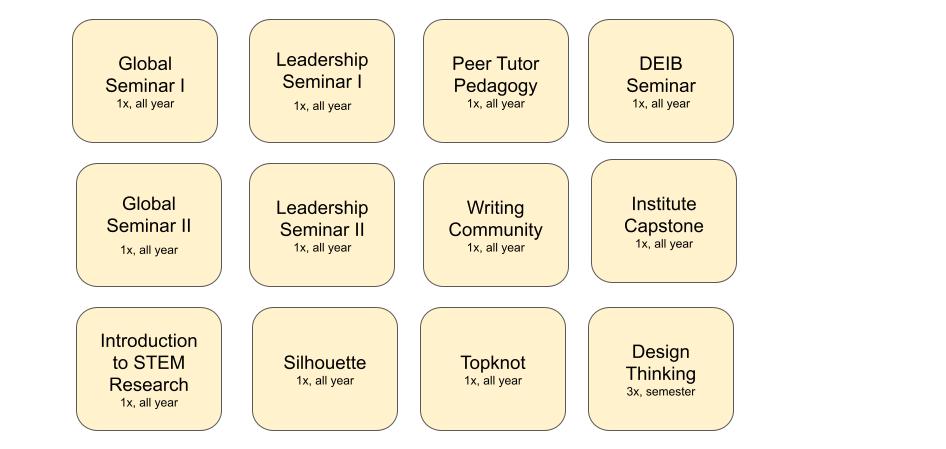
INSTITUTE FOR INNOVATION AND LEADERSHIP
From foundational curricula to cutting-edge technology to global experiences, this premier program will not only offer students the chance to develop talents in a variety of disciplines, but it will also prepare them for life after they graduate from CSG. With exceptional foundational knowledge, advanced studies, and real-world experiences, they will be prepared to stand out in their work after CSG and succeed in the next steps toward their future. Each Center is designed to empower our students in each of the respective fields of study. From leading in the classroom to performing on the stage to competing in a robotics tournament and more, the Institute offers every girl a chance to discover her distinct potential as a learner and leader.
GLOBAL SEMINAR I
Global Seminar examines the concept of global citizenship and develops students’ level of global competence by examining local, global, and intercultural issues while understanding and appreciating the perspectives and world views of others. Students will engage in discussion-based classes, follow the global news cycle, and work towards geographical mastery.
Partial-credit, pass/fail course
• Open to Forms IX, X, XI, XII;
• Full Year, 0.34 credit (meets once/rotation)
Institute
GLOBAL SEMINAR II
Global Seminar II continues to develop students’ global competence by extending their knowledge and experience with investigating the world, understanding and appreciating different perspectives, communicating across cultures, and taking meaningful action in their world . Students will take an active role in building their global competence through engaging in discussion-based classes, researching current issues, hearing from guest speakers, and engaging with their local and global community.
Partial-credit, pass/fail course
• Open to Forms IX, X, XI, XII
• Full Year, 0.34 credit (meets once/rotation)
INTRODUCTION TO STEM RESEARCH
This course is designed for students interested in applying for and preparing to participate in a 6–10 week summer research-intensive laboratory experience. It provides a collaborative environment and the guidance needed for students pursuing research opportunities outside the classroom. Students will learn how to prepare strong applications, understand research lab expectations, and develop skills for effective oral and written communication. Topics include professional conduct in a lab setting, strategies for working with research mentors, and techniques for presenting findings. Class discussions will address common challenges faced by high school students in research or industry environments and encourage collaborative problem-solving. Students will also explore the technical background of their chosen research field to better understand the context of their placement. Note that students taking this course are not guaranteed a placement with a research group outside of CSG; however, the skills developed in this class will help students apply for and succeed in these endeavors. This course can be taken by students multiple times throughout their high school career; veteran students will be encouraged to help and engage students new to the class, while new students bring in new ideas, interests, and perspectives.
Note: This course replaces part of STEM Seminar.
Partial-credit, pass/fail course
• Open to Forms X, XI, XII; this course may be taken more than once, each time for credit.
• Full Year, 0.34 credit (meets once/rotation)
Institute
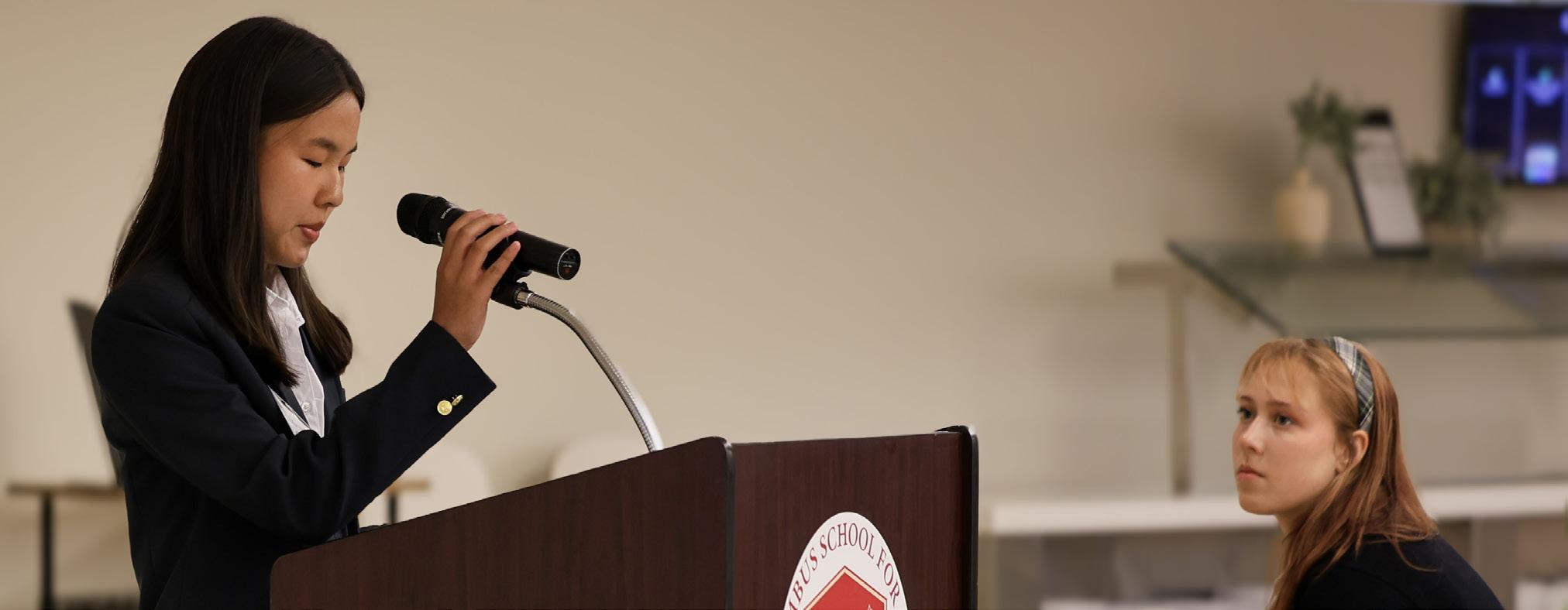
LEADERSHIP SEMINAR I
Leadership Seminar I is designed to guide students through a comprehensive exploration of leadership that begins with the individual and extends outward into the community. Students will first reflect on their own strengths, values, and identity as leaders, developing the self-awareness and confidence needed to lead authentically. The course then transitions into group leadership, where students examine team dynamics, collaboration strategies, and decision-making skills. Finally, students apply their learning through a focus on service leadership, exploring how leaders can create positive change by engaging with and serving others. As a culmination of their learning, each student will complete a capstone project that synthesizes personal reflection, collaborative practice, and service. This project challenges students to identify a meaningful issue, design a leadership response, and present their process and outcomes to the community. The capstone ensures that students not only understand leadership in theory but also put it into practice in ways that highlight their growth and readiness to lead with purpose.
Partial-credit, pass/fail course
• Open to Forms IX, X, XI, XII; this course may be taken more than once, each time for credit.
• Full Year, 0.34 credit (meets once/rotation)
Institute
LEADERSHIP SEMINAR II
Leadership Seminar II is an advanced, application-based course for students ready to move from learning about leadership to leading in real time. Enrollment requires successful completion of Leadership Seminar I. Any student meeting this prerequisite may sign up for this course regardless if they have been an Institute Fellow in the past. Students who take part in this course will be required to attend Institute events outside of the school day. This seminar serves as the collaborative working space for Institute Fellows. Students plan Institute programming, design marketing materials, write speeches, and prepare presentations connected to initiatives across the Institute’s six Centers. Working closely with Center Directors and peers, students receive ongoing feedback and learn to revise, adapt, and lead with purpose. Leadership Seminar II emphasizes real-world leadership skills including communication, collaboration, project management, and professional presentation. Through authentic, high-stakes experiences, students build the confidence and habits necessary for success in college, future careers, and their broader communities.
Partial-credit, pass/fail course
• Open to Forms X, XI, XII; this course may be taken more than once, each time for credit
• Prerequisite: Successful completion of Leadership Seminar I
• Full Year, 0.34 credit (meets once/rotation)
PEER TUTOR PEDAGOGY
In this course, students will be introduced to the principles and practices of tutoring while they are working in the Upper School Writing Center. In addition to tutoring every week, students will convene once a rotation to discuss current issues, ideas, and solutions related to tutoring. Students will also gain exposure to texts relevant to tutor pedagogy and learn more about the Writing Center discipline in secondary and post-secondary settings. Students also contribute to an annual Writing Center publication that is published every Spring. Overall, this course helps promote strong literacy skills in the Upper School and supports the broader community of writers at CSG.
Institute
Partial-credit, pass/fail course
• Open Forms X, XI, XII
• This course must be taken before students can become Peer Tutors in the Writing Center
• One semester, 0.17 credit (meets once/rotation)
WRITING COMMUNITY
In this course, students will explore writing in a supportive and creative community environment. The class will meet once a rotation to engage in ongoing creative writing exercises designed to explore a wide range of genres and craft. In a supportive workshop-style environment, students will expand their writing skills, develop confidence, and work together to build a vibrant culture of writers.
Partial-credit, pass/fail course
• Open to Forms IX, X, XI, XII
• Full year, repeatable, 0.34 credit, meets once/rotation
DEIB SEMINAR
This course is designed to provide students with the introductory and foundational knowledge necessary to better understand identity, diversity, multiculturalism, and social justice. Students participating in this course will embark on a journey of identity development. We will begin by exploring various cultural identifiers and will engage in a number of exercises and activities that help build a community of trust while also equipping students with the tools necessary to better understand themselves and the lenses that inform their engagement with their community and the world. Previous leadership or diversity training is not required. Students need to come to each class with an open mind and a willingness to embrace new perspectives. This is a dialogue-based class where enjoyable activities should be expected along with a deep dive into culture, identity, and multiculturalism.
Partial-credit, pass/fail course
• Open to Forms IX, X, XI, XII
• Full Year, 0.34 credit (meets once/rotation)
Institute
INSTITUTE CAPSTONE
This Capstone course offers students the opportunity to engage in advanced, independent research or creative inquiry in an area of personal interest— whether in the humanities, sciences, social sciences, arts, or interdisciplinary fields. Students will develop sophisticated skills in framing research questions, locating and evaluating sources, analyzing evidence, and constructing well-supported arguments. Throughout the year, students will immerse themselves in the research and creation process, which may culminate in a traditional research paper, a podcast series, or another approved format that demonstrates depth of analysis and originality. Projects may draw inspiration from current issues, emerging trends, or enduring questions within any discipline. Students will also have opportunities for experiential learning, such as visiting archives, conducting interviews, or engaging with community resources. The Capstone experience concludes with a formal presentation and defense of the student’s work before a faculty panel. Regardless of format, students will be grounded in the principles of scholarly inquiry, critical thinking, and effective communication. Note: This course replaces Research Capstone: The Art of Historical Detection (Thesis) and part of STEM Seminar.
Partial-credit, pass/fail course
• Open to Form X, XI, and XII
• Students must declare an area of focus (STEM, humanities, creative arts, etc.)
• Full year, 0.34 credit (meets once/rotation)
Institute
INTRODUCTION TO DESIGN THINKING
Design Thinking is a multidisciplinary creative solving methodology with human needs at its core. This approach allows teams to create meaningful products which tackle complex human-centered challenges and also allows individuals to solve their big life questions. Introduction to Design Thinking will allow students to explore this methodology to solve community problems and personal dilemmas. Coursework will include completing short design projects and exercises, generating idea boards, interviewing people, developing personas, drawing sketches, building prototypes, creating presentations, giving and receiving feedback, and more. Students will develop their empathy skills, build creative confidence, and enhance their problem-solving skills.
Partial-credit, pass/fail course
• Open Forms X, XI, XII
• Prerequisites: None
• Semester course (offered each semester), 0.5 credit (meets 3 times/rotation)